EP2248511B1 - Haarwäschezusammensetzung - Google Patents
Haarwäschezusammensetzung Download PDFInfo
- Publication number
- EP2248511B1 EP2248511B1 EP09717457.7A EP09717457A EP2248511B1 EP 2248511 B1 EP2248511 B1 EP 2248511B1 EP 09717457 A EP09717457 A EP 09717457A EP 2248511 B1 EP2248511 B1 EP 2248511B1
- Authority
- EP
- European Patent Office
- Prior art keywords
- ingredient
- group
- carbon atoms
- hydrogen atom
- hair
- Prior art date
- Legal status (The legal status is an assumption and is not a legal conclusion. Google has not performed a legal analysis and makes no representation as to the accuracy of the status listed.)
- Active
Links
- 0 C[C@@](C*1(C2C1CCC1C*(*)CC1)*2=C)*=*C Chemical compound C[C@@](C*1(C2C1CCC1C*(*)CC1)*2=C)*=*C 0.000 description 7
Classifications
-
- A—HUMAN NECESSITIES
- A61—MEDICAL OR VETERINARY SCIENCE; HYGIENE
- A61Q—SPECIFIC USE OF COSMETICS OR SIMILAR TOILETRY PREPARATIONS
- A61Q5/00—Preparations for care of the hair
- A61Q5/02—Preparations for cleaning the hair
-
- A—HUMAN NECESSITIES
- A61—MEDICAL OR VETERINARY SCIENCE; HYGIENE
- A61K—PREPARATIONS FOR MEDICAL, DENTAL OR TOILETRY PURPOSES
- A61K8/00—Cosmetics or similar toiletry preparations
- A61K8/02—Cosmetics or similar toiletry preparations characterised by special physical form
- A61K8/04—Dispersions; Emulsions
- A61K8/046—Aerosols; Foams
-
- A—HUMAN NECESSITIES
- A61—MEDICAL OR VETERINARY SCIENCE; HYGIENE
- A61K—PREPARATIONS FOR MEDICAL, DENTAL OR TOILETRY PURPOSES
- A61K8/00—Cosmetics or similar toiletry preparations
- A61K8/18—Cosmetics or similar toiletry preparations characterised by the composition
- A61K8/30—Cosmetics or similar toiletry preparations characterised by the composition containing organic compounds
- A61K8/40—Cosmetics or similar toiletry preparations characterised by the composition containing organic compounds containing nitrogen
- A61K8/44—Aminocarboxylic acids or derivatives thereof, e.g. aminocarboxylic acids containing sulfur; Salts; Esters or N-acylated derivatives thereof
-
- A—HUMAN NECESSITIES
- A61—MEDICAL OR VETERINARY SCIENCE; HYGIENE
- A61K—PREPARATIONS FOR MEDICAL, DENTAL OR TOILETRY PURPOSES
- A61K8/00—Cosmetics or similar toiletry preparations
- A61K8/18—Cosmetics or similar toiletry preparations characterised by the composition
- A61K8/30—Cosmetics or similar toiletry preparations characterised by the composition containing organic compounds
- A61K8/46—Cosmetics or similar toiletry preparations characterised by the composition containing organic compounds containing sulfur
- A61K8/463—Cosmetics or similar toiletry preparations characterised by the composition containing organic compounds containing sulfur containing sulfuric acid derivatives, e.g. sodium lauryl sulfate
-
- A—HUMAN NECESSITIES
- A61—MEDICAL OR VETERINARY SCIENCE; HYGIENE
- A61K—PREPARATIONS FOR MEDICAL, DENTAL OR TOILETRY PURPOSES
- A61K8/00—Cosmetics or similar toiletry preparations
- A61K8/18—Cosmetics or similar toiletry preparations characterised by the composition
- A61K8/72—Cosmetics or similar toiletry preparations characterised by the composition containing organic macromolecular compounds
- A61K8/81—Cosmetics or similar toiletry preparations characterised by the composition containing organic macromolecular compounds obtained by reactions involving only carbon-to-carbon unsaturated bonds
- A61K8/8135—Compositions of homopolymers or copolymers of compounds having one or more unsaturated aliphatic radicals, each having only one carbon-to-carbon double bond, and at least one being terminated by an acyloxy radical of a saturated carboxylic acid, of carbonic acid or of a haloformic acid; Compositions of derivatives of such polymers, e.g. vinyl esters (polyvinylacetate)
-
- A—HUMAN NECESSITIES
- A61—MEDICAL OR VETERINARY SCIENCE; HYGIENE
- A61K—PREPARATIONS FOR MEDICAL, DENTAL OR TOILETRY PURPOSES
- A61K8/00—Cosmetics or similar toiletry preparations
- A61K8/18—Cosmetics or similar toiletry preparations characterised by the composition
- A61K8/72—Cosmetics or similar toiletry preparations characterised by the composition containing organic macromolecular compounds
- A61K8/84—Cosmetics or similar toiletry preparations characterised by the composition containing organic macromolecular compounds obtained by reactions otherwise than those involving only carbon-carbon unsaturated bonds
- A61K8/86—Polyethers
Definitions
- the present invention relates to a hair cleansing composition.
- Alkyl sulfate, polyoxyethylene alkyl ether sulfate, polyoxyethylene alkyl ether acetate, a succinic acid surfactant or an amino acid surfactant is conventionally used as a primary surfactant for a hair cleansing composition.
- incorporating a cationic polymer into a cleansing composition is known as a way to improve the finger combability through the hair during shampooing/rinsing.
- Patent Document 1 discloses a hair cleansing composition
- a hair cleansing composition comprising (A) a copolymer which has a cationic group and a crosslinked structure in a molecular thereof, and which also carries a feature such that its 0.5 wt.% hydrogel satisfies the following equations: 0.3 ⁇ 1 ⁇ 20 (Pa ⁇ sec), 0.01 ⁇ 2 ⁇ 5 (Pa ⁇ sec), and ⁇ 1> ⁇ 2, wherein ⁇ 1 means a viscosity at a shear rate of 1 sec -1 and ⁇ 2 means a viscosity at a shear rate of 10 sec -1 , each at 25°C, and (B) an anionic surfactant.
- the composition is nice to the touch and excellent in spreadability during application, has a good foamability, is superior in hair sensation during cleansing or after drying, and even more has a high conditioning effect after cleansing.
- Patent Document 2 discloses a novel cleansing and conditioning composition containing (A) at least one sulfate or sulfonate anionic surfactant, (B) at least one carboxylic acid anionic surfactant other than the surfactant described in (A) and selected from polyoxyalkylenated (C 6 -C 24 ) alkyl ether carboxylic acids, polyoxyalkylenated (C 6 -C 24 ) alkyl aryl ether carboxylic acids or salts thereof, and polyoxyalkylenated (C 6 -C 24 ) alkylamido ether carboxylic acids or salts thereof, (C) at least one amphoteric surfactant, and (D) at least one water-insoluble carboxylic ester.
- A at least one sulfate or sulfonate anionic surfactant
- B at least one carboxylic acid anionic surfactant other than the surfactant described in (A) and selected from polyoxyalkylenated (C 6 -
- Patent Document 3 discloses a cleansing composition containing the following three ingredients (A), (B) and (C): (A) an ether carboxylic acid surfactant represented by the formula (1), (B) a glyceryl ether having an alkyl or alkenyl group with from 4 to 12 carbon atoms, and (C) a cationic-group containing copolymer.
- the composition is described to be less irritating to the skin, has excellent foamability and foam quality, and provide a good sensation during cleansing and rinsing and after drying.
- DE 195 30 550 A1 relates to a conditioning aqueous hair shampoo composition containing a) 1% to 25% by wt., of at least one alkyl amidoether carboxylic acid of the general formula I wherein R denotes an alkyl group having 8 to 18 carbon atoms, and n is a number between 1 and 10, and (or) the water-soluble salts thereof; b) 1% to 25% by wt. of at least one anionic surfactant of the sulfate and (or) sulfonate type; c) 0.1% to 10% by wt.
- EP 1 707 240 A1 relates to a cosmetic detergent composition
- a cosmetic detergent composition comprising: an anionic surface-active (I) sulfate/sulfonate; an anionic carboxylic surface-active different from (I) e.g. alkyl carboxylic acid polyoxyalkylene ether with 6-24 carbon; amphoteric surface-active agent; and an ester of carboxylic acid insoluble in water e.g. esters of carboxylic acid with 3-30 carbon and alcohol of 1-30 carbon, where at least one of which is branched, and esters of aromatic acid with 7-30 carbon, where the carboxylic function is directly boned to the aromatic cycle and alcohol with 1-30 carbon, in an aqueous medium.
- the esters are present at 0.5-10 wt.%.
- the ratio of anionic surface-active sulfates or sulfonate/anionic carboxylic surface-active agent is 2-12.
- JP 06-041580 A relates to a detergent composition containing (A) an amidoether sulfate type anionic surfactant of formula R 1 CONR 2 (CH 2 CH 2 O) n SO 3 M 1 (R 1 CO is a 10-22C aliphatic acyl; R 2 is H or a 1-3C alkyl; (n) is 2-15; M 1 is 1/2 Magnesium or 1/2 Calcium) and (B) an ether carbonate type anion surfactant of formula R 3 O(CH 2 CH 2 O) m COOM 2 [R 3 is a 10-22C alkyl or alkenyl; M 2 is an alkali (earth) metal or (organo) ammonium].
- R 1 CONR 2 (CH 2 CH 2 O) n SO 3 M 1 R 1 CONR 2 (CH 2 CH 2 O) n SO 3 M 1
- R 1 CO is a 10-22C aliphatic acyl
- R 2 is H or a 1-3C alkyl
- M 1 is 1/2 Magn
- the total content of the component A and the component B is 5-40 wt. % and the weight ratio of those components is 10/1-1/8. It is possible to admix an amphoteric surfactant such as an aminoacetobetaine type amphoteric surfactant, a foaming agent such as an aliphatic acid, a humidity keeping agent such as glycerin, etc., oil, perfume, natural extract, etc., to the composition.
- an amphoteric surfactant such as an aminoacetobetaine type amphoteric surfactant
- a foaming agent such as an aliphatic acid
- a humidity keeping agent such as glycerin, etc., oil, perfume, natural extract, etc.
- the present invention provides a hair cleansing composition containing the following ingredients (A), (B), (C) and (D), wherein an ingredient (A)/ingredient (B) weight ratio [(A)/(B)] is from 0.1 to 1.2 and an ingredient (A)/ingredient (C) weight ratio [(A)/(C)] is from 0.2 to 0.8:
- the present invention also provides use of a composition containing the above ingredients (A), (B), (C), and (D), wherein an ingredient (A)/ingredient (B) weight ratio [(A)/(B)] is from 0.1 to 1.2 and an ingredient (A)/ingredient (C) weight ratio [(A)/(C)] is from 0.2 to 0.8, as a hair cleansing agent.
- the present invention further provides a method for cleansing the hair, which includes using, for the hair, a composition containing the ingredients (A), (B), (C) and (D), wherein an ingredient (A)/ingredient (B) weight ratio [(A)/(B)] is from 0.1 to 1.2 and an ingredient (A)/ingredient (C) weight ratio [(A)/(C)] is from 0.2 to 0.8.
- An object of the invention is to provide a cleansing composition which is excellent in hair sensation during cleansing and rinsing, especially excellent in finger combability, and is superior in softness, while satisfying foam performance.
- the hair cleansing composition of the invention is excellent in hair sensation during cleansing and rinsing, while satisfying the foam performance needed when the hair is shampooed with it.
- the present invention was completed based on the finding that a cleansing composition containing the above ingredients (A) to (D) at a predetermined ratio provides an excellent sensation to the hair during cleansing and rinsing, while satisfying foam performance.
- composite which capable of improving finger combability and softness while satisfying foam performance, to precipitate owing to the use of a cationic-group containing copolymer as ingredient (D) and a surfactant composition containing ingredients (A), (B), and (C) at a predetermined ratio when subjected to a dilution step during cleansing, and then to a dilution step during rinsing.
- the hair cleansing composition of the invention including silicone has the ability to produce an excellent sensation in softness or finger combability not only during cleansing and rinsing but also when the hair is wet or dry. This is presumably because silicone is incorporated in the composite during cleansing or rinsing to improve the performance of the composite and in addition, heighten the residual property of silicone on the hair.
- the ether carboxylate surfactant as ingredient (A) is thought to be a principal ingredient for developing, mainly through an interaction with ingredient (D), the performance of the composite that relates to improvement of finger combability and softness.
- Ingredient (A) is not particularly limited, but is preferably a surfactant represented by the following formula (4) or (5).
- R 11 is preferably the group having from 12 to 16 carbon atoms.
- Z 1 represents -CONH-, R 11 is preferably the group having from 11 to 15 carbon atoms.
- a 1 represents an ethylene or propylene group, with an ethylene group being preferred.
- the average addition molar number n is preferably from 2 to 11, more preferably from 4 to 10 from the standpoint of a foam volume and hair sensation during cleansing and rinsing. It is preferably from 2 to 6 from the viewpoint of a foam volume, while it is preferably from 6 to 11 from the standpoint of finger combability and softness during cleansing and rinsing. It is also preferred to use, in combination, two or more ether carboxylate surfactants different in the average addition molar number.
- examples of the alkali metal include lithium, sodium, and potassium; those of the alkaline earth metal include magnesium and calcium; those of the organic ammonium include alkanolammoniums having preferably from 2 to 9 carbon atoms such as triethanolammonium; alkylammoniums having preferably from 1 to 9 carbon atoms such as trimethylammonium; and basic amino acid cations such as lysine cation and arginine cation. Of these, alkali metals such as sodium and potassium are preferred.
- Y 1 is preferably a methylene group having one carbon atom.
- R 12 represents a linear or branched alkyl or alkenyl group having from 4 to 34 carbon atoms
- at least one of X 2 and X 3 represents -CH 2 COOM 1 and the other one may represent a hydrogen atom
- M 1 represents a hydrogen atom, an alkali metal, an alkaline earth metal, ammonium, or an organic ammonium.
- R 12 represents the group having preferably having 8 to 25 carbon atoms, more preferably from 8 to 18 carbon atoms.
- X 2 and X 3 both represent - CH 2 COOM 1 or at least one of them represents -CH 2 COOM 1 and the other one represents a hydrogen atom.
- Preferred examples of M 1 are similar to the above examples of X 1 .
- ether carboxylate surfactants are, for example, "BEAULIGHT” (trade name), product of Sanyo Chemical and "KAOAKYPO RLM” Series (trade name), product of Kao Corporation.
- Ether carboxylic acids described in JP-A-06-316546 are also usable. Specific examples include polyoxyethylene (average addition molar number: from 4 to 10) decyl ether acetates, polyoxyethylene (average addition molar number: from 4 to 10) lauryl ether acetates, polyoxyethylene (average addition molar number: from 4 to 10) myristyl ether acetates, and polyoxyethylene (average addition molar number: from 4 to 10) cetyl ether acetates.
- salts include sodium, potassium, ammonium, triethanolammonium salts.
- ingredient (B) is not particularly limited, but is preferably represented by the following formula (6): R 13 O(CH 2 CH 2 O) p SO 3 M 2 (6) wherein R 13 represents an alkyl or alkenyl group having from 6 to 22 carbon atoms, p means an average addition molar number and is from 0.5 to 5, and M 2 represents a hydrogen atom, an alkali metal, an alkaline earth metal, ammonium, or an organic ammonium.
- R 13 is preferably the group having from 10 to 18 carbon atoms from the standpoint of foamability, and p is preferably from 0.5 to 3 from the standpoint of foamability.
- Preferred examples of M 2 are similar to those of X 1 .
- ether sulfate surfactants are for example "EMAL” series (trade name), product of Kao Corporation. Specific examples include polyoxyethylene (average addition molar number: from 0.5 to 3) decyl ether sulfates, polyoxyethylene (average addition molar number: from 0.5 to 3) lauryl ether sulfates, polyoxyethylene (average addition molar number: from 0.5 to 3) myristyl ether sulfates, and polyoxyethylene (average addition molar number: from 0.5 to 3) cetyl ether sulfates. Examples of their salts include sodium, potassium, ammonium, and triethanolammonium salts.
- the betaine amphoteric surfactant as Ingredient (C) is presumed to have mainly foam enhancing properties and at the same time facilitate precipitation of the structural composite together with ingredient (B).
- ingredient (C) include carbobetaine and amidocarbobetaine surfactants (hereinafter referred to as “carbobetaine” collectively), sulfobetaine and amidosulfobetaine surfactants (hereinafter referred to as “sulfobetaine”, collectively), and imidazolinium betaine and phosphobetaine surfactants.
- carbobetaines and amidocarbobetaines represented by the following formulas (B-2a) and (B-2b)
- sulfobetaines and amidosulfobetaines represented by the following formulas (B-2c) and (B-2d)
- imidazolinium betaines represented by the following formula (B-2e) or (B-2f).
- R 24 represents an alkyl or alkenyl group having from 6 to 22 carbon atoms
- R 25 and R 26 each represents an alkyl or hydroxyalkyl group having from 1 to 5 carbon atoms
- R 2 represents an alkylene or hydroxyalkylene group having from 1 to 6 carbon atoms
- R 28 represents a single bond or an alkylene group having from 1 to 5 carbon atoms
- R 29 represents an alkylene or hydroxyalkylene group having from 1 to 5 carbon atoms.
- betaines represented by the formulas (B-2a) to (B-2f) those having as R 24 an alkyl group with from 8 to 16 carbon atoms, as R 25 and R 26 a methyl group, as R 27 to R 29 an alkylene group with from 1 to 5 carbon atoms are preferred.
- R 24 an alkyl group with from 8 to 16 carbon atoms
- R 25 and R 26 a methyl group as R 27 to R 29 an alkylene group with from 1 to 5 carbon atoms
- R 27 to R 29 an alkylene group with from 1 to 5 carbon atoms are preferred.
- Specific examples include alkyl dimethylaminocarbobetaines, alkyl amidoalkylenedimethylaminocarbobetaines, alkyl dimethylaminohydroxysulfobetaines, alkyl amidoalkylenedimethylaminosulfobetaines, alkyl hydroxyethyl imidazolinium betaines, and alkyl amidohydroxyethyl imi
- At least one amphoteric surfactant selected from the group consisting of carbobetaines and sulfobetaines is preferred from the standpoint of foam performance and hair sensation during cleansing and rinsing. It is more preferred to use them in combination.
- the carbobetaine and the sulfobetaine are used preferably at a weight ratio (carbobetaine/sulfobetaine) from 1/5 to 5/1, more preferably from 1/3 to 3/1 from the standpoint of foam performance and hair sensation during cleansing and rinsing.
- Ingredient (D) to be used in the invention is a cationic-group containing copolymer available by polymerization of the above monomers (a1), (a2), and (a3) as essential constituent monomers.
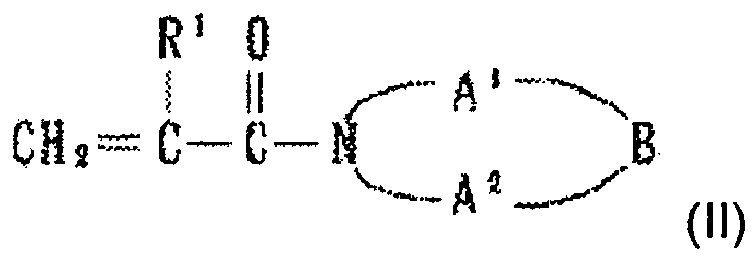
- Monomer (a1) is at least one hydrophilic nonionic-group containing vinyl monomer represented by the following formula (I) or (II): wherein R 1 represents a hydrogen atom or a methyl group, R 2 represents a hydrogen atom or a linear or branched alkyl or alkenyl group having from 1 to 4 carbon atoms, and R 3 represents a linear or branched alkyl or alkenyl group having from 1 to 4 carbon atoms.
- R 1 has the same meaning as described above
- a 1 and A 2 are the same or different and each is a group represented by the formula: -(CH 2 ) n - (n stands for an integer from 2 to 6), and B represents a group -O- or -CH 2 -.
- R 2 is preferably a linear or branched alkyl or alkenyl group having from 1 to 4 carbon atoms from the standpoint of finger combability and softness during rinsing.
- Preferred groups of R 2 and R 3 are the same or different and include a methyl group, an ethyl group, a propyl group, an isopropyl group, a butyl group, an isobutyl group, or a t-butyl group.
- hydrophilic nonionic-group containing vinyl monomer represented by the formula (I) examples include N-methyl (meth)acrylamide, N,N-dimethyl (meth)acrylamide, N,N-diethyl (meth)acrylamide, N-n-propyl (meth)acrylamide, N-isopropyl (meth)acrylamide, N-t-butyl (meth)acrylamide, and N-isobutyl (meth)acrylamide.
- the hydrophilic nonionic-group containing vinyl monomer represented by the formula (II) is, for example, N-(meth)acryloyl morpholine, but N,N-(di-substituted)acrylamides provide good feeling upon use. Use of N,N-dimethyl (meth)acrylamide or N,N-diethyl (meth)acrylamide is more preferred.
- Monomer (a2) is at least one cationic-group containing vinyl monomer represented by the following formula (III) or (IV): wherein R 1 has the same meaning as described above, R 4 and R 5 are the same or different and each represents an alkyl or alkenyl group having from 1 to 4 carbon atoms, R 6 represents a hydrogen atom or an alkyl group having from 1 to 4 carbon atoms, Y represents a group -O-, -NH-, -CH 2 -, or -O-CH 2 CH(OH)-, Z represents a linear or branched alkylene group having from 1 to 4 carbon atoms (with the proviso that when Y is -CH 2 -, the number of carbon atoms is from 0 to 3), and X represents a conjugate base of an acid, wherein R 7 and R 8 are the same or different and each represents a hydrogen atom or a methyl group, R 9 and R 10 are the same or different and each represents a hydrogen atom or an alkyl
- R 4 , R 5 , R 6 , R 9 , and R 10 are preferably the same or different and each represents a methyl group, an ethyl group, a propyl group, an isopropyl group, a butyl group, an isobutyl group, and a t-butyl group.
- X is preferably a halogen atom or an alkyl sulfate group having from 1 to 4 carbon atoms.
- Preferred examples of an acid to obtain a salt of the monomer (III) or (IV) include hydrochloric acid, sulfuric acid, acetic acid, citric acid, succinic acid, adipic acid, and sulfamic acid.
- Preferred examples of a quaternizing agent to obtain a quaternary ammonium salt include alkyl halides such as methyl chloride and methyl iodide, and diethyl sulfate and di-n-propyl sulfate.
- Monomer (a2) examples include quaternary ammonium salts obtained by quaternizing, with above-mentioned quaternizing agent, dimethylaminoethyl (meth)acrylate, diethylaminoethyl (meth)acrylate, dimethylaminopropyl (meth)acrylamide, or diethylaminopropyl (meth)acrylamide, and dimethyldiallyl ammonium chloride.
- Monomer (a3) is a crosslinkable monomer having two or more reactive unsaturated groups.
- Specific examples include (1) (meth)acrylate compounds of a polyhydric alcohol such as ethylene glycol di(meth)acrylate, diethylene glycol di(meth)acrylate, polyethylene glycol di(meth)acrylate, propylene glycol di(meth)acrylate, dipropylene glycol di(meth)acrylate, polypropylene glycol di(meth)acrylate, 1,2-butylene glycol di(meth)acrylate, 1,3-butylene glycol di(meth)acrylate, neopentyl glycol di(meth)acrylate, glycerin di(meth)acrylate, glycerin tri(meth)acrylate, trimethylolpropane tri(meth)acrylate, and pentaerythritol tetra(meth)acrylate; (2) divinyl compounds such as divinylbenzene, divinylether, and diviny
- Monomer (a1) and Monomer (a2) are added at an (a1)/(a2) molar ratio of preferably from 2/98 to 98/2, more preferably from 50/50 to 95/5, even more preferably from 60/40 to 93/7 from the standpoint of foamability, tangle-free hair during shampooing, and rinsability.
- Monomer (a3) is added in an amount of from 0.002 to 5 wt.% based on a total amount of the monomers from the standpoint of foamability, tangle-free hair during shampooing, suitability for scalp massage, and rinsability. It is more preferably from 0.002 to 0.5 wt.%, even more preferably from 0.002 to 0.08 wt.% from the standpoint of hair sensation during rinsing for providing the hair with softness and good slip.
- Ingredient (D) has a cationic charge density of preferably from 0.3 to 2.5 meq/g, more preferably from 0.3 to 2 meq/g, even more preferably from 0.5 to 1.5 meq/g from the standpoint of finger combability and softness during cleansing and rinsing.
- the cationic charge density can be determined from the following equation based on a charged cation monomer amount of a polymer.
- Cationic charge density of polymer meq / g weight of a ⁇ 2 ⁇ 1000 / total weight of a ⁇ 1 + a ⁇ 2 + a ⁇ 3 ⁇ molecular weight of a ⁇ 2
- Ingredient (D) in the form of a 0.5% hydrogel, preferably satisfies the following equations: 0.3 ⁇ 1 ⁇ 20 (Pa ⁇ sec), 0.01 ⁇ 2 ⁇ 5 (Pa ⁇ sec), and ⁇ 1> ⁇ 2, wherein ⁇ 1 is a viscosity at a shear rate of 1 sec -1 and ⁇ 2 is a viscosity at a shear rate of 10 sec -1 , each at 25°C.
- ingredient (D) in the form of a 0.5% hydrogel, satisfies the following equations under the conditions of 25°C and a strain frequency of 6.28 rad/sec: 1 ⁇ 1 ⁇ 300 (N/m 2 ) and tan ⁇ 1 ⁇ 2 and at the same time, 0.01 ⁇ 2 ⁇ 30 (N/m 2 ) and tan ⁇ 2 ⁇ 1 wherein ⁇ 1 is a complex modulus and tan ⁇ 1 is a loss tangent each at strain 1%, and ⁇ 2 is a complex modulus and tan ⁇ 2 is a loss tangent each at strain 500%, a hair cleansing composition with a more preferable hair sensation can be obtained.
- a range of the loss tangent of ingredient (D) to be satisfied becomes narrower: ta ⁇ 1 ⁇ 1.5 and then: tan ⁇ 1 ⁇ 1.0, a hair cleansing composition having a even more preferable sensation can be obtained.
- Specimen 1 A 0.5% hydrogel obtained by adding a powder sample (having an average particle size not greater than 50 ⁇ m) to ion exchanged water and retaining the mixture at 50°C for half a day.
- Measuring apparatus "Rotovisco RV-20", trade name; a viscometer manufactured by HAAKE Measurement conditions: Measuring head: M10, coaxial two-wall cylindrical type rotor, measuring temperature: 25°C, and sample amount: 15 ml.
- Shear rate Increased from 0 sec -1 to 15 sec -1 over two minutes. The number of data: Obtained at 60 points within the above range of the shear rate.
- Computation method Calculated from the above measured values by using a program of Rotation Version 2.8.
- Specimen The same as Specimen 1
- Measuring apparatus "Fluids Spectrometer RFS-II", trade name; product of Rheometrics.
- Measuring conditions Dynamic Strain Sweep mode Cone plate: Diameter: 50 mm, gap: 0.05 mm, angle: 0.04 rad, strain frequency: 6.2 rad/sec, strain: from 0.5 to 500%.
- Measuring temperature 25°C
- Ingredient (D) is preferably polymer particles from the standpoint of improving finger combability and softness during cleansing and rinsing. Its average particle size (median particle size based on volume) is preferably from 0.1 to 10 ⁇ m, more preferably from 0.5 to 5 ⁇ m, even more preferably from 1 to 4 ⁇ m from the above standpoint.
- Ingredient (D) has a particle size within the above range, an adequate amount of silicone as Ingredient (E) can be incorporated in the structural complex and the resulting hair cleansing composition is excellent in finger combability, slip, and softness after drying.
- a median particle size based on volume (D50) is measured by dispersing the powder of ingredient (D) in cyclohexane by using an apparatus to give a measurable arbitrary concentration (around 10 wt.%), adding several drops of the resulting polymer dispersion to a measurement solvent (cyclohexane) and retaining it for one minute.
- Measuring apparatus "Laser diffraction particle size analyzer LS230" (with a small volume module), trade name; product of Beckman Coulter.
- the content of Ingredient (A) in the cleansing composition of the invention is preferably from 1 to 10 wt.%, more preferably from 1 to 8 wt.%, even more preferably from 1.8 to 7 wt.% (in terms of an acid percentage, which will equally apply hereinafter) from the standpoint of softness during cleansing and finger combability during rinsing both provided through an interaction with Ingredient (D).
- the weight ratio of Ingredient (D) to Ingredient (A) [Ingredient (D)/Ingredient (A)] in the cleansing composition of the invention should be raised to a certain level in order to determine the performance of the structural complex. It is preferably from 0.05 to 0.3, more preferably from 0.06 to 0.25, even more preferably from 0.07 to 0.2 from the standpoint of softness during cleansing and finger combability during rinsing.
- the content of Ingredient (B) in the cleansing composition of the invention is preferably from 1 to 20 wt.%, more preferably from 2 to 15 wt.%, even more preferably from 3.5 to 13 wt.% from the standpoint of a foam performance and also from the standpoint of facilitating precipitation of the structural complex together with Ingredient (C) through an interaction with Ingredient (D).
- the content of Ingredient (C) in the cleansing composition of the invention is preferably from 2 to 20 wt.%, more preferably from 2 to 15 wt.%, even more preferably from 3 to 13 wt.% from the standpoint of a foam enhancing performance and also from the standpoint of facilitating precipitation of the structural complex together with Ingredient (B) through an interaction with Ingredient (D) and improving the softness during cleansing.
- the weight ratio of Ingredient (D) to Ingredient (C) [Ingredient (D)/Ingredient (C)] in the cleansing composition of the invention is preferably from 0.02 to 0.25, more preferably from 0.03 to 0.2, even more preferably from 0.03 to 0.15 from the above standpoint.
- the total content of Ingredient (A), Ingredient (B), and Ingredient (C) in the cleansing composition of the invention is preferably from 3 to 30 wt.%, more preferably from 5 to 25 wt.%, even more preferably from 5 to 20 wt.% from the standpoint of a sufficient foam performance and finger combability and softness during cleansing and rinsing.
- Ingredient (D) one or more of the above copolymers can be used.
- the content of it in the cleansing composition of the invention is preferably from 0.01 to 3 wt.%, more preferably from 0.05 to 2 wt.%, even more preferably from 0.1 to 1 wt.% from the standpoint of finger combability and softness during cleansing and rinsing.
- the weight ratio of Ingredient (A) to Ingredient (C) [(A)/(C)] in the cleansing composition of the invention is from 0.2 to 0.8.
- the weight ratios less than 0.1 may deteriorate finger combability and softness during cleansing and rinsing which will be imparted through an interaction with Ingredient (D).
- the weight ratios exceeding 1.2 may deteriorate the foam performance.
- the weight ratio of Ingredient (B) to Ingredient (C) [(B)/(C)] in the cleansing composition of the present invention is preferably from 0.1 to 6, more preferably from 0.2 to 5, even more preferably from 0.3 to 3 from the standpoint of a foam performance and also from the viewpoint of facilitating precipitation of the structural complex through an interaction among Ingredients (B), (C), and (D) and improving the finger combability and softness during cleansing and rinsing.
- the weight ratio of Ingredient (A) to Ingredient (B) [(A)/(B)] in the cleansing composition of the invention is preferably from 0.1 to 1.2, more preferably from 0.15 to 1, even more preferably from 0.2 to 0.8.
- the weight ratios less than 0.1 may deteriorate finger combability and softness during cleansing and rinsing which will be imparted through an interaction with Ingredient (D).
- the weight ratios exceeding 1.2 may deteriorate the foam performance.
- the weight ratio of the content of Ingredient (A) to the total content of Ingredients (A), (B), and (C) [Ingredient (A)/[Ingredient (A) + Ingredient (B) + Ingredient (C)] in the cleansing composition of the invention is preferably from 0.08 to 0.37, more preferably from 0.1 to 0.3, even more preferably from 0.1 to 0.25 mainly from the viewpoint of balance between improving finger combability and softness during cleansing and rinsing, and the foam performance.
- the weight ratio of the content of Ingredient (B) to the total content of Ingredients (A), (B), and (C) [Ingredient (B)/[Ingredient (A) + Ingredient (B) + Ingredient (C)] is preferably from 0.1 to 0.8, more preferably from 0.2 to 0.7, even more preferably from 0.2 to 0.6 mainly from the viewpoint of balance between improving the foam performance, and the finger combability and softness during cleansing and rinsing.
- the weight ratio of the content of Ingredient (C) to the total content of Ingredients (A), (B), and (C) [Ingredient (C)/[Ingredient (A) + Ingredient (B) + Ingredient (C)] is preferably from 0.1 to 0.8, more preferably from 0.2 to 0.8, even more preferably from 0.2 to 0.7 from the viewpoint of the balance between the foam performance, and the finger combability and softness during cleansing and rinsing.
- the weight ratio of the content of Ingredient (D) to the total content of Ingredients (A), (B), and (C) [Ingredient (D)/[Ingredient (A) + Ingredient (B) + Ingredient (C)] in the cleansing composition is preferably from 0.005 to 0.1, more preferably from 0.007 to 0.05 from the viewpoint of precipitating the structural complex.
- the structural complex can, through an interaction between the cationic-group containing copolymer as Ingredient (D) and a surfactant composition containing Ingredients (A), (B), and (C), leave an oil ingredient such as silicone and perfume, or a humectant such as ceramide on the hair efficiently during rinsing.
- the precipitation amount of the structural complex of the hair cleansing composition of the invention can be determined using a model cleansing composition obtained by setting a surfactant concentration at a certain value and removing ingredients having an influence on the measurement of the precipitation amount.
- Step 1 A step of preparing a cleansing composition to give a total content of Ingredient (A) to (C) of 15 wt.% while keeping the above composition ratio of Ingredients (A), (B), (C), and (D), with the proviso that the cleansing composition contains, as ingredients other than Ingredients (A) to (D), only 1 wt.% of NaCl, purified water, and if necessary, a pH regulator and has a pH (at 20°C) adjusted to 6.0.
- Step 2 a step of diluting 1 g of the cleansing composition obtained in Step 1 with 7 g of hard water having water hardness of 4°.
- the cleansing composition is prepared to give a total content of Ingredients (A) to (C) of 15 wt.%, while keeping the above composition ratio of Ingredients (A) to (D).
- the cleansing composition contains, as ingredients other than Ingredients (A) to (D), only 1 wt.% of NaCl, purified water, and if necessary, a pH regulator. It is prepared so as not to contain surfactants other than Ingredients (A) to (C), a polymer other than Ingredient (D), silicone, and a peraling agent.
- Step 2 the structural complex is precipitated by adding 7 g of hard water having water hardness of 4° to 1 g of the cleansing composition obtained in Step 1 for dilution. Within five minutes after dilution, the transmittance is measured. For the measurement of the transmittance, a glass cell having a length of 1 cm is employed.
- the turbidity (%) is preferably 10 or greater, more preferably from 10 to 60, even more preferably from 10 to 50 in order to give, to the hair, an excellent hair sensation in finger combability and softness during cleansing and rinsing.
- the complex available from predetermined amounts of the surfactants as Ingredients (A) to (C) and the cationic-group containing copolymer as Ingredient (D) gives an excellent sensation to the hair during cleansing and rinsing.
- silicone as Ingredient (E) from the standpoint of imparting to the hair an excellent sensation in softness and finger combability during wetting or after drying.
- any silicone or silicone derivative is usable as Ingredient (E) insofar as it is used ordinarily for cosmetics.
- Examples include dimethicone, dimethiconol, polyether modified silicone, polyglycerin modified silicone, branched (poly)glycerol modified silicone, glyceryl ether modified silicone, amino modified silicone, aminopolyether modified silicone, amidoalkyl modified silicone, aminoglycol modified silicone, oxazoline modified silicone, acrylic/aminosilicone copolymer, phenyl modified silicone, aminophenyl modified silicone, polyamide modified silicone, alkyl modified silicone, silicone elastomer (powder), and crosslinked polymer coated with modified silicone (powder).
- silicone or silicone derivatives those put on the market from silicone manufacturers such as Shin-Etsu Chemical and Dow Corning Toray and listed in the brochures such as "Silicones for cosmetics” or “Silicones for personal care” can also be used.
- Ingredient (E) one or more of those listed above can be used. It is incorporated in the hair cleansing composition of the invention in an amount of preferably from 0.5 to 5 wt.%, more preferably from 1 to 3 wt.%.
- a weight ratio of Ingredient (D) to Ingredient (E) [(D) / (E)] is preferably from 1/20 to 1/1, more preferably for 1/10 to 1/2 from the standpoint of facilitating incorporation of Ingredient (E) in the complex of the cationic-group containing copolymer (D) and the surfactants and imparting, to the hair, an excellent sensation in softness and finger combability during wetting or after drying.
- the hair cleansing composition of the invention can contain, in addition to the above essential ingredients, another ingredient ordinarily employed for cleansing agents without disturbing the advantage of the invention, depending on the using purpose.
- anionic surfactants other than Ingredients (A) and (B) such as alkyl sulfates, succinic acid surfactants, and amino acid surfactants; nonionic surfactants such as polyoxyalkylene alkyl ethers, alkyl glyceryl ethers, fatty acid alkanolamides, and alkyl polyglucosides; cationic surfactants such as alkyltrimethylammonium chloride and dialkyldimethylammonium chloride; cationic polymers other than Ingredient (D) such as cationic polysaccharide, cationic polypeptide, acrylamide/acrylic acid/dimethyldiallylammonium chloride copolymer, and poly(dimethylmethylenepiperidinium chloride); oil ingredients such as polyhydric alcohol fatty acid esters, polyoxyalky
- the hair cleansing composition of the invention can be provided in any form of liquid, emulsion, cream, gel, or foam.
- the hair cleansing composition of the invention has a pH (at 20°C) of preferably from 4 to 7.
- a reaction vessel was charged with an aqueous monomer solution composed of 23.85 g of N,N-dimethylaminoethyl methacrylic acid diethyl sulfate (MOEDES; product of Nitto Kagaku Kogyo K.K.), 71.37 g of N,N-dimethylacrylamide (DMAAm), 0.0429 g of polyethylene glycol dimethacrylate ("NK-9G", product of Shin-Nakamura Chemical), and 350 g of ion exchanged water and purged with nitrogen in advance. After blowing nitrogen into the aqueous solution for 20 minutes, the resulting solution was raised to 55°C under a nitrogen atmosphere.
- MOEDES N,N-dimethylaminoethyl methacrylic acid diethyl sulfate
- DMAAm N,N-dimethylacrylamide
- N-9G polyethylene glycol dimethacrylate
- MOEDES:DMAAm:NK-9G 10:90:0.01 (molar ratio), ⁇ 1: 2.5, ⁇ 2: 0.5, ⁇ 1: 2.4, ⁇ 2: 1.3, tan ⁇ 1: 0.98, tan ⁇ 2: 2.28
- the hair cleansing compositions having the composition as shown in Table 4 were prepared in the conventional manner and they were adjusted to pH 6.0 (at 20°C) with sodium hydroxide.
- the foam volume, foam quality, and the hair during cleansing and rinsing when they were applied thereto were evaluated as described below with a mean score.
- Organoleptic evaluation is performed in the following procedure.
- Warm water used tap water of from 38 to 40°C (hardness: from 3 to 5° DH)
- the experts are each asked to shampoo her hair by pouring warm water and wet her hair, putting an adequate amount (an equal amount to that of a shampoo ordinarily used, depending on the length of her hair) of the hair cleansing composition of the invention on her hands, and moving hands so as to uniformly spread the composition over the hair.
- the states during shampooing and rinsing are evaluated based on the criteria in the below tables.
- the precipitation amount of the complex including Ingredient (D) is determined in the following method.
- surfactants and polymers used in Table 4 The following are surfactants and polymers used in Table 4. The number in this table indicates a pure content. A total amount of the pure contents of the surfactants is set at 15 wt.%.
- Table 4 has revealed that the cleansing agents according to the invention are superior to those obtained in Comparative Examples in finger combability and softness during cleansing and rinsing while providing satisfactory foam quality and foam volume.
- the complex precipitated during the dilution procedure of the cleansing agent of the invention is presumed to give such a sensation.
- Example 4 Comparison between Example 4 and Comparative Examples 6 and 7 has revealed that the cleansing compositions using a cationic polymer are inferior in performance when the polymer is different from that of the invention. It is apparent from the results of Example 7 to Example 10 that the cleansing composition containing both cocamidopropyl betaine (carbobetaine) and laurylhydroxysulfobetaine (sulfobetaine) in combination has both an improved foam performance and an improved hair feel.
- cocamidopropyl betaine cocamidopropyl betaine
- sulfobetaine laurylhydroxysulfobetaine
- the hair cleansing compositions having the composition shown in Table 5 were prepared in the conventional manner and they were adjusted to pH 6.0 (at 20°C) with sodium hydroxide. Their foam volume, foam quality and the hair during wetting or after drying, in addition to the hair during cleansing and rinsing were evaluated similarly with a mean score.
- the precipitation amount of silicone is determined by the following method.
- the number in the table indicates wt.% of a pure content.
- Example 11 The results in Table 5 have revealed that the composition obtained in Example 11 is superior to those obtained in Comparative Examples 8 and 9 in slip, softness, and finger combability during wetting or after drying.
- the superiority of the composition of Example 11 is presumed to result from an increase in the residual amount of silicone through the action of the complex.
- a hair cleansing composition was prepared in a similar manner to Example 11 except that cocamidopropylbetaine was replaced by cocamidopropyl betaine and lauryl hydroxysulfobetaine which were used at a weight ratio of 1/1.
- the resulting composition had an improved foam performance and an improved hair sensation.
Landscapes
- Health & Medical Sciences (AREA)
- Life Sciences & Earth Sciences (AREA)
- Animal Behavior & Ethology (AREA)
- General Health & Medical Sciences (AREA)
- Public Health (AREA)
- Veterinary Medicine (AREA)
- Birds (AREA)
- Epidemiology (AREA)
- Chemical & Material Sciences (AREA)
- Dispersion Chemistry (AREA)
- Cosmetics (AREA)
- Detergent Compositions (AREA)
Claims (11)
- Haarreinigungszusammensetzung, umfassend die nachstehenden Bestandteile (A), (B), (C) und (D) in einem Gewichtsverhältnis von Bestandteil (A) zu Bestandteil (B) [(A)/(B)] von 0,1 bis 1,2 und in einem Gewichtsverhältnis von Bestandteil (A) zu Bestandteil (C) [(A)/(C)] von 0,2 bis 0,8:(A) ein Ethercarboxylat-Tensid,(B) ein Ethersulfat-Tensid,(C) ein amphoteres Betain-Tensid und(D) ein kationische Gruppen enthaltendes Copolymer, erhalten durch Copolymerisieren einer Monomerenmischung, die die nachstehenden Monomere (a1), (a2) und (a3) enthält:(a1) zumindest ein Vinylmonomer, dass eine hydrophile nicht-ionische Gruppe enthält, dargestellt durch die nachstehende Formel (I) oder (II):

 (a2) zumindest ein kationische Gruppen enthaltendes Vinylmonomer der nachstehenden Formel (III) oder (IV):
 (a3) ein vernetzbares Monomer mit zwei oder mehr reaktiven ungesättigten Gruppen.
 - Haarreinigungszusammensetzung gemäss Anspruch 1, wobei das Gewichtsverhältnis des Gehalts an Bestandteil (A) zu Gesamtgehalt an Bestandteilen (A), (B) und (C) [Bestandteil (A)/[Bestandteil (A) + Bestandteil (B) + Bestandteil (C)] innerhalb eines Bereichs von 0,08 bis 0,37 fällt.
- Haarreinigungszusammensetzung gemäss Anspruch 1 oder 2, wobei das Gewichtsverhältnis des Gehalts an Bestandteil (D) zu Gehalt an Bestandteil (A) [Bestandteil (D)/ Bestandteil (A)] innerhalb eines Bereichs von 0,05 bis 0,3 fällt.
- Haarreinigungszusammensetzung gemäss irgendeinem der Ansprüche 1 bis 3, wobei der Bestandteil (D) Polymerteilchen sind.
- Haarreinigungszusammensetzung gemäss irgendeinem der Ansprüche 1 bis 4, wobei der Bestandteil (C) Carbobetain und Sulfobetain enthält.
- Haarreinigungszusammensetzung gemäss Anspruch 5, wobei das Gewichtsverhältnis von Carbobetain zu Sulfobetain (Carbobetain/Sulfobetain) innerhalb eines Bereichs von 1/5 bis 5/1 fällt.
- Haarreinigungszusammensetzung gemäss irgendeinem der Ansprüche 1 bis 6, mit einer Trübheit von 10 % oder grösser, ermittelt gemäss der nachstehenden Gleichung (1) aus der Transmission T (%) (600 nm) einer Reinigungszusammensetzung, die im nachstehenden Schritt 1 hergestellt wurde, zum Zeitpunkt der Verdünnung im nachstehenden Schritt 2:

Schritt 1:ein Schritt, in dem eine Reinigungszusammensetzung mit einem Gesamtgehalt an Bestandteilen (A) bis (C) von 15 Gew.% hergestellt wird, während das Zusammensetzungsverhältnis der Bestandteile (A) bis (D) beibehalten wird, mit der Massgabe, dass die Reinigungszusammensetzung als andere Bestandteile ausser den Bestandteilen (A) bis (D) nur 1 Gew.% NaCl, gereinigtes Wasser und, falls erforderlich, einen pH-Regulator enthält und einen pH-Wert (bei 20°C) eingestellt auf 6,0, aufweist, undSchritt 2:ein Schritt, in dem 1 g der in Schritt 1 erhaltenen Reinigungszusammensetzung mit 7 g hartem Wasser mit einer Wasserhärte von 4° verdünnt wird. - Haarreinigungszusammensetzung gemäss irgendeinem der Ansprüche 1 bis 7, die ferner Silicon als Bestandteil (E) umfasst.
- Haarreinigungszusammensetzung gemäss Anspruch 8, wobei das Gewichtsverhältnis von kationische Gruppen enthaltendem Copolymer als Bestandteil (D) zu Silicon als Bestandteil (E) [(D)/(E)] innerhalb eines Bereichs von 1/20 bis 1/1 fällt.
- Verwendung einer Zusammensetzung, umfassend die nachstehenden Bestandteile (A), (B), (C) und (D) in einem Gewichtsverhältnis von Bestandteil (A) zu Bestandteil (B) [(A)/(B)] von 0,1 bis 1,2 und in einem Gewichtsverhältnis von Bestandteil (A) zu Bestandteil (C) [(A)/(C)] von 0,2 bis 0,8, als Haarreinigungsmittel:(A) ein Ethercarboxylat-Tensid,(B) ein Ethersulfat-Tensid,(C) ein amphoteres Betain-Tensid und(D) ein kationische Gruppen enthaltendes Copolymer, erhalten durch Copolymerisieren einer Monomerenmischung, die die nachstehenden Monomere (a1), (a2) und (a3) enthält:(a1) zumindest ein Vinylmonomer, das eine hydrophile nicht-ionische Gruppe enthält, dargestellt durch die nachstehende Formel (I) oder (II):

 (a2) zumindest ein kationische Gruppen enthaltendes Vinylmonomer der nachstehenden Formel (III) oder (IV):
 (a3) ein vernetzbares Monomer mit zwei oder mehr reaktiven ungesättigten Gruppen.
 - Verfahren zur Reinigung von Haar, umfassend die Verwendung einer Zusammensetzung, die die nachstehenden Bestandteile (A), (B), (C) und (D) in einem Gewichtsverhältnis von Bestandteil (A) zu Bestandteil (B) [(A)/(B)] von 0,1 bis 1,2 und in einem Gewichtsverhältnis von Bestandteil (A) zu Bestandteil (C) [(A)/(C)] von 0,2 bis 0,8 umfasst, für das Haar:(A) ein Ethercarboxylat-Tensid,(B) ein Ethersulfat-Tensid,(C) ein amphoteres Betain-Tensid und(D) ein kationische Gruppen enthaltendes Copolymer, erhalten durch Copolymerisieren einer Monomerenmischung, die die nachstehenden Monomere (a1), (a2) und (a3) enthält:(a1) zumindest ein Vinylmonomer, das eine hydrophile nicht-ionische Gruppe enthält, dargestellt durch die nachstehende Formel (I) oder (II):

 (a2) zumindest ein kationische Gruppen enthaltendes Vinylmonomer der nachstehenden Formel (III) oder (IV):
 (a3) ein vernetzbares Monomer mit zwei oder mehr reaktiven ungesättigten Gruppen.
Applications Claiming Priority (2)
| Application Number | Priority Date | Filing Date | Title |
|---|---|---|---|
| JP2008052907 | 2008-03-04 | ||
| PCT/JP2009/000951 WO2009110223A1 (ja) | 2008-03-04 | 2009-03-03 | 毛髪用洗浄剤組成物 |
Publications (3)
| Publication Number | Publication Date |
|---|---|
| EP2248511A1 EP2248511A1 (de) | 2010-11-10 |
| EP2248511A4 EP2248511A4 (de) | 2014-07-30 |
| EP2248511B1 true EP2248511B1 (de) | 2015-11-25 |
Family
ID=41055788
Family Applications (1)
| Application Number | Title | Priority Date | Filing Date |
|---|---|---|---|
| EP09717457.7A Active EP2248511B1 (de) | 2008-03-04 | 2009-03-03 | Haarwäschezusammensetzung |
Country Status (7)
| Country | Link |
|---|---|
| US (1) | US8741825B2 (de) |
| EP (1) | EP2248511B1 (de) |
| JP (1) | JP5502337B2 (de) |
| KR (1) | KR101607345B1 (de) |
| CN (1) | CN101959494B (de) |
| ES (1) | ES2559425T3 (de) |
| WO (1) | WO2009110223A1 (de) |
Families Citing this family (13)
| Publication number | Priority date | Publication date | Assignee | Title |
|---|---|---|---|---|
| FR2954129B1 (fr) | 2009-12-23 | 2012-03-02 | Oreal | Composition cosmetique comprenant au moins un compose organique du silicium, au moins deux tensioactifs anioniques et au moins un tensioactif amphotere |
| JP5493987B2 (ja) * | 2010-02-24 | 2014-05-14 | 栗田工業株式会社 | 硬度測定用試薬 |
| KR101921630B1 (ko) * | 2011-11-18 | 2018-11-26 | (주)아모레퍼시픽 | 기포력이 우수한 설페이트-프리 샴푸 조성물 |
| FR3001457B1 (fr) * | 2013-01-31 | 2015-02-06 | Snf Sas | Nouveaux polymeres peignes utilisables en cosmetique et detergence |
| JP6207068B2 (ja) * | 2013-10-18 | 2017-10-04 | 花王株式会社 | 介護用皮膚洗浄剤組成物 |
| JP6426914B2 (ja) * | 2014-05-26 | 2018-11-21 | 花王株式会社 | 毛髪洗浄剤組成物 |
| JP2015224195A (ja) * | 2014-05-26 | 2015-12-14 | 花王株式会社 | 毛髪洗浄剤組成物 |
| JP2015224196A (ja) * | 2014-05-26 | 2015-12-14 | 花王株式会社 | 毛髪洗浄剤組成物 |
| JP6423618B2 (ja) * | 2014-05-26 | 2018-11-14 | 花王株式会社 | 毛髪洗浄剤組成物 |
| DE102016223590A1 (de) * | 2016-11-28 | 2018-05-30 | Clariant International Ltd | Copolymer enthaltende reinigungsmittelzusammensetzungen |
| DE102016223586A1 (de) | 2016-11-28 | 2018-05-30 | Clariant International Ltd | Copolymere und deren verwendung in reinigungsmittel-zusammensetzungen |
| DE102016223588A1 (de) * | 2016-11-28 | 2018-05-30 | Clariant International Ltd | Copolymere und deren verwendung in reinigungsmittel-zusammensetzungen |
| JP7244228B2 (ja) * | 2018-07-24 | 2023-03-22 | 花王株式会社 | 洗浄剤組成物 |
Family Cites Families (20)
| Publication number | Priority date | Publication date | Assignee | Title |
|---|---|---|---|---|
| JPH04108724A (ja) * | 1990-08-30 | 1992-04-09 | Kao Corp | 洗浄剤組成物 |
| JP2613124B2 (ja) | 1990-08-30 | 1997-05-21 | 花王株式会社 | 新規シロキサン誘導体、その製造方法及びこれを含有する化粧料 |
| JPH0641580A (ja) * | 1992-07-23 | 1994-02-15 | Nippon Oil & Fats Co Ltd | 洗浄剤組成物 |
| JPH06316546A (ja) | 1993-11-24 | 1994-11-15 | Sanyo Chem Ind Ltd | カルボン酸類の製造法 |
| DE19530550A1 (de) * | 1995-08-19 | 1997-02-20 | Kao Corp Gmbh | Haarwaschmittel |
| JP3221851B2 (ja) | 1997-06-11 | 2001-10-22 | 花王株式会社 | カチオン性基含有共重合体及び増粘剤 |
| US6069216A (en) * | 1997-06-11 | 2000-05-30 | Kao Corporation | Cationic group-containing copolymer and thickener |
| JP2000144185A (ja) * | 1998-11-17 | 2000-05-26 | Kao Corp | 洗浄剤組成物 |
| JP4037970B2 (ja) * | 1998-11-17 | 2008-01-23 | 花王株式会社 | 洗浄剤組成物 |
| JP4037971B2 (ja) * | 1998-11-17 | 2008-01-23 | 花王株式会社 | 洗浄剤組成物 |
| JP4485134B2 (ja) | 2002-03-25 | 2010-06-16 | 花王株式会社 | 分岐ポリグリセロール変性シリコーン |
| JP2004144184A (ja) | 2002-10-24 | 2004-05-20 | Ntn Corp | 電食防止転がり軸受 |
| CN100438852C (zh) | 2002-12-25 | 2008-12-03 | 花王株式会社 | 毛发清洁剂 |
| JP2004217644A (ja) * | 2002-12-25 | 2004-08-05 | Kao Corp | 毛髪洗浄剤 |
| JP2004307700A (ja) * | 2003-04-09 | 2004-11-04 | Kao Corp | 洗浄剤組成物 |
| JP2005336387A (ja) * | 2004-05-28 | 2005-12-08 | Kao Corp | 洗浄剤組成物 |
| FR2883744B1 (fr) * | 2005-03-30 | 2009-07-03 | Oreal | Compositions cosmetiques detergentes comprenant trois tensioactifs et un ester gras et utilisation |
| JP3961555B2 (ja) * | 2005-12-28 | 2007-08-22 | 花王株式会社 | 皮膚又は毛髪用洗浄剤組成物 |
| JP4108724B1 (ja) | 2007-02-23 | 2008-06-25 | シャープ株式会社 | 構造物設置架台 |
| JP2008285437A (ja) * | 2007-05-17 | 2008-11-27 | Kao Corp | 毛髪処理方法 |
-
2009
- 2009-02-13 JP JP2009030980A patent/JP5502337B2/ja active Active
- 2009-03-03 US US12/863,998 patent/US8741825B2/en active Active
- 2009-03-03 EP EP09717457.7A patent/EP2248511B1/de active Active
- 2009-03-03 KR KR1020107017396A patent/KR101607345B1/ko active Active
- 2009-03-03 WO PCT/JP2009/000951 patent/WO2009110223A1/ja not_active Ceased
- 2009-03-03 CN CN200980107705.0A patent/CN101959494B/zh active Active
- 2009-03-03 ES ES09717457.7T patent/ES2559425T3/es active Active
Also Published As
| Publication number | Publication date |
|---|---|
| JP5502337B2 (ja) | 2014-05-28 |
| JP2009235059A (ja) | 2009-10-15 |
| CN101959494A (zh) | 2011-01-26 |
| KR101607345B1 (ko) | 2016-03-29 |
| CN101959494B (zh) | 2013-01-23 |
| EP2248511A4 (de) | 2014-07-30 |
| ES2559425T3 (es) | 2016-02-12 |
| US8741825B2 (en) | 2014-06-03 |
| WO2009110223A1 (ja) | 2009-09-11 |
| EP2248511A1 (de) | 2010-11-10 |
| US20100292116A1 (en) | 2010-11-18 |
| KR20100121613A (ko) | 2010-11-18 |
Similar Documents
| Publication | Publication Date | Title |
|---|---|---|
| EP2248511B1 (de) | Haarwäschezusammensetzung | |
| EP2039751B1 (de) | Reinigungsmittel | |
| EP2178497B1 (de) | Kosmetische mittel mit chitosan und silikonelastomeren | |
| CN101132756B (zh) | 含有疏水改性聚合物的个人护理组合物 | |
| US20110152150A1 (en) | Cleansing composition | |
| EP1817080A1 (de) | Shampoozusammensetzungen mit kationischem polymer und einem anionischen tensidgemisch | |
| US20100015189A1 (en) | Cosmetic composition comprising calcium carbonate particles and a combination of surfactants | |
| EP2039340B1 (de) | Hautreinigungszusammensetzung | |
| JP5410717B2 (ja) | 毛髪用洗浄剤組成物 | |
| WO2013186715A2 (en) | Rinse-off composition comprising a film-forming polymer | |
| WO2016085707A1 (en) | Personal care compositions containing cationic polymers | |
| US20120128618A1 (en) | Cosmetic cleaning agent having novel mixture of active agents | |
| CN107949369A (zh) | 基于聚乙二醇、聚醚酯和聚合物悬浮剂的清洁组合物 | |
| CN102028634A (zh) | 包含低dp聚合化表面活性剂和胶束增稠剂的组合物 | |
| JP5521699B2 (ja) | 毛髪洗浄剤組成物 | |
| JP2005336387A (ja) | 洗浄剤組成物 | |
| JP5390137B2 (ja) | 皮膚又は毛髪用洗浄剤組成物 | |
| JP7558733B2 (ja) | シャンプー組成物 | |
| EP3837018B1 (de) | Sulfatfreie kosmetische klarspülzusammensetzung mit einem hyperverzweigten copolymer | |
| EP4442326A1 (de) | Haarreinigungszusammensetzung | |
| CN101193621B (zh) | 个人护理组合物 | |
| HK1206237B (en) | Cosmetic composition and conditioning agent | |
| HK1206237A1 (en) | Cosmetic composition and conditioning agent | |
| JP2015224198A (ja) | 毛髪洗浄剤組成物 |
Legal Events
| Date | Code | Title | Description |
|---|---|---|---|
| PUAI | Public reference made under article 153(3) epc to a published international application that has entered the european phase |
Free format text: ORIGINAL CODE: 0009012 |
|
| 17P | Request for examination filed |
Effective date: 20100729 |
|
| AK | Designated contracting states |
Kind code of ref document: A1 Designated state(s): AT BE BG CH CY CZ DE DK EE ES FI FR GB GR HR HU IE IS IT LI LT LU LV MC MK MT NL NO PL PT RO SE SI SK TR |
|
| AX | Request for extension of the european patent |
Extension state: AL BA RS |
|
| DAX | Request for extension of the european patent (deleted) | ||
| A4 | Supplementary search report drawn up and despatched |
Effective date: 20140701 |
|
| RIC1 | Information provided on ipc code assigned before grant |
Ipc: A61K 8/36 20060101AFI20140625BHEP Ipc: A61K 8/20 20060101ALI20140625BHEP Ipc: C11D 17/08 20060101ALI20140625BHEP Ipc: A61K 8/89 20060101ALI20140625BHEP Ipc: A61K 8/81 20060101ALI20140625BHEP Ipc: A61K 8/46 20060101ALI20140625BHEP Ipc: A61K 8/42 20060101ALI20140625BHEP Ipc: C11D 1/92 20060101ALI20140625BHEP Ipc: C11D 1/90 20060101ALI20140625BHEP Ipc: C11D 1/29 20060101ALI20140625BHEP Ipc: C11D 1/06 20060101ALI20140625BHEP Ipc: A61Q 5/02 20060101ALI20140625BHEP Ipc: C11D 3/37 20060101ALI20140625BHEP Ipc: C11D 3/04 20060101ALI20140625BHEP |
|
| GRAP | Despatch of communication of intention to grant a patent |
Free format text: ORIGINAL CODE: EPIDOSNIGR1 |
|
| INTG | Intention to grant announced |
Effective date: 20150703 |
|
| GRAS | Grant fee paid |
Free format text: ORIGINAL CODE: EPIDOSNIGR3 |
|
| GRAA | (expected) grant |
Free format text: ORIGINAL CODE: 0009210 |
|
| AK | Designated contracting states |
Kind code of ref document: B1 Designated state(s): AT BE BG CH CY CZ DE DK EE ES FI FR GB GR HR HU IE IS IT LI LT LU LV MC MK MT NL NO PL PT RO SE SI SK TR |
|
| REG | Reference to a national code |
Ref country code: GB Ref legal event code: FG4D |
|
| REG | Reference to a national code |
Ref country code: CH Ref legal event code: EP |
|
| REG | Reference to a national code |
Ref country code: AT Ref legal event code: REF Ref document number: 762242 Country of ref document: AT Kind code of ref document: T Effective date: 20151215 |
|
| REG | Reference to a national code |
Ref country code: IE Ref legal event code: FG4D |
|
| REG | Reference to a national code |
Ref country code: DE Ref legal event code: R096 Ref document number: 602009034958 Country of ref document: DE |
|
| REG | Reference to a national code |
Ref country code: ES Ref legal event code: FG2A Ref document number: 2559425 Country of ref document: ES Kind code of ref document: T3 Effective date: 20160212 |
|
| REG | Reference to a national code |
Ref country code: FR Ref legal event code: PLFP Year of fee payment: 8 |
|
| REG | Reference to a national code |
Ref country code: LT Ref legal event code: MG4D |
|
| REG | Reference to a national code |
Ref country code: NL Ref legal event code: MP Effective date: 20160225 |
|
| REG | Reference to a national code |
Ref country code: AT Ref legal event code: MK05 Ref document number: 762242 Country of ref document: AT Kind code of ref document: T Effective date: 20151125 |
|
| PG25 | Lapsed in a contracting state [announced via postgrant information from national office to epo] |
Ref country code: IS Free format text: LAPSE BECAUSE OF FAILURE TO SUBMIT A TRANSLATION OF THE DESCRIPTION OR TO PAY THE FEE WITHIN THE PRESCRIBED TIME-LIMIT Effective date: 20160325 Ref country code: LT Free format text: LAPSE BECAUSE OF FAILURE TO SUBMIT A TRANSLATION OF THE DESCRIPTION OR TO PAY THE FEE WITHIN THE PRESCRIBED TIME-LIMIT Effective date: 20151125 Ref country code: NO Free format text: LAPSE BECAUSE OF FAILURE TO SUBMIT A TRANSLATION OF THE DESCRIPTION OR TO PAY THE FEE WITHIN THE PRESCRIBED TIME-LIMIT Effective date: 20160225 Ref country code: HR Free format text: LAPSE BECAUSE OF FAILURE TO SUBMIT A TRANSLATION OF THE DESCRIPTION OR TO PAY THE FEE WITHIN THE PRESCRIBED TIME-LIMIT Effective date: 20151125 Ref country code: NL Free format text: LAPSE BECAUSE OF FAILURE TO SUBMIT A TRANSLATION OF THE DESCRIPTION OR TO PAY THE FEE WITHIN THE PRESCRIBED TIME-LIMIT Effective date: 20151125 |
|
| PG25 | Lapsed in a contracting state [announced via postgrant information from national office to epo] |
Ref country code: FI Free format text: LAPSE BECAUSE OF FAILURE TO SUBMIT A TRANSLATION OF THE DESCRIPTION OR TO PAY THE FEE WITHIN THE PRESCRIBED TIME-LIMIT Effective date: 20151125 Ref country code: AT Free format text: LAPSE BECAUSE OF FAILURE TO SUBMIT A TRANSLATION OF THE DESCRIPTION OR TO PAY THE FEE WITHIN THE PRESCRIBED TIME-LIMIT Effective date: 20151125 Ref country code: SE Free format text: LAPSE BECAUSE OF FAILURE TO SUBMIT A TRANSLATION OF THE DESCRIPTION OR TO PAY THE FEE WITHIN THE PRESCRIBED TIME-LIMIT Effective date: 20151125 Ref country code: GR Free format text: LAPSE BECAUSE OF FAILURE TO SUBMIT A TRANSLATION OF THE DESCRIPTION OR TO PAY THE FEE WITHIN THE PRESCRIBED TIME-LIMIT Effective date: 20160226 Ref country code: PT Free format text: LAPSE BECAUSE OF FAILURE TO SUBMIT A TRANSLATION OF THE DESCRIPTION OR TO PAY THE FEE WITHIN THE PRESCRIBED TIME-LIMIT Effective date: 20160325 Ref country code: LV Free format text: LAPSE BECAUSE OF FAILURE TO SUBMIT A TRANSLATION OF THE DESCRIPTION OR TO PAY THE FEE WITHIN THE PRESCRIBED TIME-LIMIT Effective date: 20151125 Ref country code: PL Free format text: LAPSE BECAUSE OF FAILURE TO SUBMIT A TRANSLATION OF THE DESCRIPTION OR TO PAY THE FEE WITHIN THE PRESCRIBED TIME-LIMIT Effective date: 20151125 |
|
| PG25 | Lapsed in a contracting state [announced via postgrant information from national office to epo] |
Ref country code: CZ Free format text: LAPSE BECAUSE OF FAILURE TO SUBMIT A TRANSLATION OF THE DESCRIPTION OR TO PAY THE FEE WITHIN THE PRESCRIBED TIME-LIMIT Effective date: 20151125 Ref country code: IT Free format text: LAPSE BECAUSE OF FAILURE TO SUBMIT A TRANSLATION OF THE DESCRIPTION OR TO PAY THE FEE WITHIN THE PRESCRIBED TIME-LIMIT Effective date: 20151125 |
|
| REG | Reference to a national code |
Ref country code: DE Ref legal event code: R097 Ref document number: 602009034958 Country of ref document: DE |
|
| PG25 | Lapsed in a contracting state [announced via postgrant information from national office to epo] |
Ref country code: BE Free format text: LAPSE BECAUSE OF NON-PAYMENT OF DUE FEES Effective date: 20160331 Ref country code: DK Free format text: LAPSE BECAUSE OF FAILURE TO SUBMIT A TRANSLATION OF THE DESCRIPTION OR TO PAY THE FEE WITHIN THE PRESCRIBED TIME-LIMIT Effective date: 20151125 Ref country code: EE Free format text: LAPSE BECAUSE OF FAILURE TO SUBMIT A TRANSLATION OF THE DESCRIPTION OR TO PAY THE FEE WITHIN THE PRESCRIBED TIME-LIMIT Effective date: 20151125 Ref country code: SK Free format text: LAPSE BECAUSE OF FAILURE TO SUBMIT A TRANSLATION OF THE DESCRIPTION OR TO PAY THE FEE WITHIN THE PRESCRIBED TIME-LIMIT Effective date: 20151125 Ref country code: RO Free format text: LAPSE BECAUSE OF FAILURE TO SUBMIT A TRANSLATION OF THE DESCRIPTION OR TO PAY THE FEE WITHIN THE PRESCRIBED TIME-LIMIT Effective date: 20151125 |
|
| PLBE | No opposition filed within time limit |
Free format text: ORIGINAL CODE: 0009261 |
|
| STAA | Information on the status of an ep patent application or granted ep patent |
Free format text: STATUS: NO OPPOSITION FILED WITHIN TIME LIMIT |
|
| PG25 | Lapsed in a contracting state [announced via postgrant information from national office to epo] |
Ref country code: LU Free format text: LAPSE BECAUSE OF FAILURE TO SUBMIT A TRANSLATION OF THE DESCRIPTION OR TO PAY THE FEE WITHIN THE PRESCRIBED TIME-LIMIT Effective date: 20160303 Ref country code: MC Free format text: LAPSE BECAUSE OF FAILURE TO SUBMIT A TRANSLATION OF THE DESCRIPTION OR TO PAY THE FEE WITHIN THE PRESCRIBED TIME-LIMIT Effective date: 20151125 |
|
| REG | Reference to a national code |
Ref country code: CH Ref legal event code: PL |
|
| 26N | No opposition filed |
Effective date: 20160826 |
|
| PG25 | Lapsed in a contracting state [announced via postgrant information from national office to epo] |
Ref country code: SI Free format text: LAPSE BECAUSE OF FAILURE TO SUBMIT A TRANSLATION OF THE DESCRIPTION OR TO PAY THE FEE WITHIN THE PRESCRIBED TIME-LIMIT Effective date: 20151125 |
|
| REG | Reference to a national code |
Ref country code: IE Ref legal event code: MM4A |
|
| PG25 | Lapsed in a contracting state [announced via postgrant information from national office to epo] |
Ref country code: BE Free format text: LAPSE BECAUSE OF FAILURE TO SUBMIT A TRANSLATION OF THE DESCRIPTION OR TO PAY THE FEE WITHIN THE PRESCRIBED TIME-LIMIT Effective date: 20151125 |
|
| PG25 | Lapsed in a contracting state [announced via postgrant information from national office to epo] |
Ref country code: IE Free format text: LAPSE BECAUSE OF NON-PAYMENT OF DUE FEES Effective date: 20160303 Ref country code: CH Free format text: LAPSE BECAUSE OF NON-PAYMENT OF DUE FEES Effective date: 20160331 Ref country code: LI Free format text: LAPSE BECAUSE OF NON-PAYMENT OF DUE FEES Effective date: 20160331 |
|
| REG | Reference to a national code |
Ref country code: FR Ref legal event code: PLFP Year of fee payment: 9 |
|
| PG25 | Lapsed in a contracting state [announced via postgrant information from national office to epo] |
Ref country code: MT Free format text: LAPSE BECAUSE OF FAILURE TO SUBMIT A TRANSLATION OF THE DESCRIPTION OR TO PAY THE FEE WITHIN THE PRESCRIBED TIME-LIMIT Effective date: 20151125 |
|
| REG | Reference to a national code |
Ref country code: FR Ref legal event code: PLFP Year of fee payment: 10 |
|
| PG25 | Lapsed in a contracting state [announced via postgrant information from national office to epo] |
Ref country code: CY Free format text: LAPSE BECAUSE OF FAILURE TO SUBMIT A TRANSLATION OF THE DESCRIPTION OR TO PAY THE FEE WITHIN THE PRESCRIBED TIME-LIMIT Effective date: 20151125 Ref country code: HU Free format text: LAPSE BECAUSE OF FAILURE TO SUBMIT A TRANSLATION OF THE DESCRIPTION OR TO PAY THE FEE WITHIN THE PRESCRIBED TIME-LIMIT; INVALID AB INITIO Effective date: 20090303 |
|
| PG25 | Lapsed in a contracting state [announced via postgrant information from national office to epo] |
Ref country code: TR Free format text: LAPSE BECAUSE OF FAILURE TO SUBMIT A TRANSLATION OF THE DESCRIPTION OR TO PAY THE FEE WITHIN THE PRESCRIBED TIME-LIMIT Effective date: 20151125 Ref country code: MK Free format text: LAPSE BECAUSE OF FAILURE TO SUBMIT A TRANSLATION OF THE DESCRIPTION OR TO PAY THE FEE WITHIN THE PRESCRIBED TIME-LIMIT Effective date: 20151125 Ref country code: MT Free format text: LAPSE BECAUSE OF FAILURE TO SUBMIT A TRANSLATION OF THE DESCRIPTION OR TO PAY THE FEE WITHIN THE PRESCRIBED TIME-LIMIT Effective date: 20160331 |
|
| PG25 | Lapsed in a contracting state [announced via postgrant information from national office to epo] |
Ref country code: BG Free format text: LAPSE BECAUSE OF FAILURE TO SUBMIT A TRANSLATION OF THE DESCRIPTION OR TO PAY THE FEE WITHIN THE PRESCRIBED TIME-LIMIT Effective date: 20151125 |
|
| PGFP | Annual fee paid to national office [announced via postgrant information from national office to epo] |
Ref country code: GB Payment date: 20230202 Year of fee payment: 15 |
|
| P01 | Opt-out of the competence of the unified patent court (upc) registered |
Effective date: 20230522 |
|
| GBPC | Gb: european patent ceased through non-payment of renewal fee |
Effective date: 20240303 |
|
| PG25 | Lapsed in a contracting state [announced via postgrant information from national office to epo] |
Ref country code: GB Free format text: LAPSE BECAUSE OF NON-PAYMENT OF DUE FEES Effective date: 20240303 |
|
| PG25 | Lapsed in a contracting state [announced via postgrant information from national office to epo] |
Ref country code: GB Free format text: LAPSE BECAUSE OF NON-PAYMENT OF DUE FEES Effective date: 20240303 |
|
| PGFP | Annual fee paid to national office [announced via postgrant information from national office to epo] |
Ref country code: ES Payment date: 20250403 Year of fee payment: 17 |
|
| PGFP | Annual fee paid to national office [announced via postgrant information from national office to epo] |
Ref country code: DE Payment date: 20260128 Year of fee payment: 18 |
|
| PGFP | Annual fee paid to national office [announced via postgrant information from national office to epo] |
Ref country code: FR Payment date: 20260209 Year of fee payment: 18 |