EP2249388A2 - Réseau de photodiodes - Google Patents
Réseau de photodiodes Download PDFInfo
- Publication number
- EP2249388A2 EP2249388A2 EP10173659A EP10173659A EP2249388A2 EP 2249388 A2 EP2249388 A2 EP 2249388A2 EP 10173659 A EP10173659 A EP 10173659A EP 10173659 A EP10173659 A EP 10173659A EP 2249388 A2 EP2249388 A2 EP 2249388A2
- Authority
- EP
- European Patent Office
- Prior art keywords
- photo
- electrodes
- diodes
- sensitive area
- diode array
- Prior art date
- Legal status (The legal status is an assumption and is not a legal conclusion. Google has not performed a legal analysis and makes no representation as to the accuracy of the status listed.)
- Withdrawn
Links
Images


Classifications
-
- H—ELECTRICITY
- H10—SEMICONDUCTOR DEVICES; ELECTRIC SOLID-STATE DEVICES NOT OTHERWISE PROVIDED FOR
- H10F—INORGANIC SEMICONDUCTOR DEVICES SENSITIVE TO INFRARED RADIATION, LIGHT, ELECTROMAGNETIC RADIATION OF SHORTER WAVELENGTH OR CORPUSCULAR RADIATION
- H10F39/00—Integrated devices, or assemblies of multiple devices, comprising at least one element covered by group H10F30/00, e.g. radiation detectors comprising photodiode arrays
- H10F39/80—Constructional details of image sensors
- H10F39/802—Geometry or disposition of elements in pixels, e.g. address-lines or gate electrodes
-
- H—ELECTRICITY
- H10—SEMICONDUCTOR DEVICES; ELECTRIC SOLID-STATE DEVICES NOT OTHERWISE PROVIDED FOR
- H10F—INORGANIC SEMICONDUCTOR DEVICES SENSITIVE TO INFRARED RADIATION, LIGHT, ELECTROMAGNETIC RADIATION OF SHORTER WAVELENGTH OR CORPUSCULAR RADIATION
- H10F39/00—Integrated devices, or assemblies of multiple devices, comprising at least one element covered by group H10F30/00, e.g. radiation detectors comprising photodiode arrays
- H10F39/10—Integrated devices
- H10F39/12—Image sensors
- H10F39/18—Complementary metal-oxide-semiconductor [CMOS] image sensors; Photodiode array image sensors
-
- H—ELECTRICITY
- H10—SEMICONDUCTOR DEVICES; ELECTRIC SOLID-STATE DEVICES NOT OTHERWISE PROVIDED FOR
- H10F—INORGANIC SEMICONDUCTOR DEVICES SENSITIVE TO INFRARED RADIATION, LIGHT, ELECTROMAGNETIC RADIATION OF SHORTER WAVELENGTH OR CORPUSCULAR RADIATION
- H10F39/00—Integrated devices, or assemblies of multiple devices, comprising at least one element covered by group H10F30/00, e.g. radiation detectors comprising photodiode arrays
- H10F39/80—Constructional details of image sensors
- H10F39/811—Interconnections
Definitions
- the present invention relates to a photo diode array, and in particular, to a photo diode array whose linearity can be improved.
- a photo diode is formed by making a PN junction with a p-type region on the light-receiving surface side and an n-type region on the substrate side, and a current generated by the light incident from the photo sensitive area flows from the cathode to the anode.
- Figure 1 shows a sectional view of the configuration indicating an example of such conventional photo diodes.
- a p-type diffused region 2 is formed on one side of n-type layer 1, the substrate, n-contact 5 is formed on the opposite side of n-type layer 1, and passivation layer 3 is formed on the light-receiving surface side where p-type diffused region 2 is formed.
- a p-contact 4 connected to p-type diffused region 2 is formed by removing part of passivation layer 3 using etching or the like.
- Electrons generated in the photo diode by input light 100 incident from the photo sensitive area are accumulated in n-type layer 1, while holes are accumulated in p-type diffused region 2. Accordingly, n-type layer 1 is negatively charged and p-type diffused region 2 is positively charged. Thus, if an external circuit is connected between p-type diffused region 2 and n-type layer 1, electrons and holes flow toward the opposite layers from n-type layer 1 and p-type diffused region 2 respectively.
- an electron generated in p-type diffused region 2 shown as "EL01” in Figure 1 is accelerated towards n-type layer 1 by the electric field in the photo diode and accumulated there.
- a hole generated in n-type layer 1 shown as "HL01” in Figure 1 is accelerated towards p-type diffused region 2 and accumulated there.
- a photo diode array is composed of multiple such photo diodes arranged forming an array.
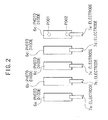
- Figure 2 shows a plan indicating an example of such a conventional photo diode array.
- Photo diodes 6a to 6e are arranged forming an array on a substrate (not shown) so that their photo sensitive area are oriented to a direction and electrodes 7a to 7e are connected to one end of the photo sensitive area of photo diodes 6a to 6e respectively.
- current values taken out may vary due to the incident positions of input light. For instance, if the input light is incident to a portion marked "P001" in Figure 2 , the distance from that portion to electrode 7e is longer compared with the case where the input light is incident to the portion marked "P002" in Figure 2 .
- a bias voltage forming a reverse bias is generally applied to the photo diode.
- a bias voltage serves to improve the frequency response and linearity, a problem exists that this causes an increase in dark current and so increases the noise, and also has the danger of breaking the photo diode.
- the subject of the present invention is to realize a photo diode array in which linearity can be improved.
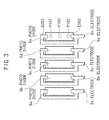
- Figure 3 shows a plan indicating an embodiment of photo diode array based on the present invention.
- Photo diodes 8a to 8e are arranged on a substrate (not shown) forming an array so that their photo sensitive area are oriented to a direction. Electrodes 9a to 9e are connected to one end of the photo sensitive area of photo diodes 8a to 8e respectively and also connected to the other end of the photo sensitive area of photo diodes 8a to 8e respectively by extending the electrodes between the photo sensitive area of two adjacent diodes.
- electrodes 9a to 9e connected to both ends of photo sensitive area photo diodes 8a to 8e respectively are wired on the substrate in a direction downwards in Figure 3 to be led out to the outside.
- the distance from the portion of "P101” to electrode 9e is that from the portion of "P101" to the connecting portion marked “ED01” in Figure 3 .
- the distance from the portion of "P102” to electrode 9e is that from the portion of "P102” to the connecting portion marked “ED02” in Figure 3 . That is, in both cases where the input light is incident to the portions marked "P101" and “P102” in Figure 3 , the distances to electrode 9e are the same.
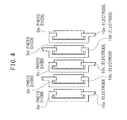
- FIG. 3 shows a plan indicating the second embodiment of a photo diode array of the present invention, in which the electrode lead-out direction is modified.
- Photo diodes 8a to 8e are arranged forming an array on a substrate (not shown) so that the light-receiving surfaces face to this side. Electrodes 10a to 10e are connected to one end of the photo sensitive area of photo diodes 8a to 8e respectively as well as connected to the other ends of the photo sensitive area of photo diodes 8a to 8e respectively by extending the electrodes between adjacent photo diodes.
- electrodes 10a, 10c, and 10e connected to both ends of the photo sensitive area of photo diodes 8a, 8c, and 8e respectively are extended on the substrate towards the bottom of Figure 4 to be led out to the outside, while electrodes 10b and 10d connected to both ends of the photo sensitive area photo diodes 8b and 8d respectively are extended on the substrate towards the top of Figure 4 to be led out to the outside.
- the electrode lead-out direction is changed alternately (every other electrode).
- the method of determining the electrode lead-out direction is not limited to the above but any number of electrodes may be led out in both directions.
- the lead-out direction may be changed regularly, for example, for every two electrodes, three electrodes, etc.
- the lead-out direction may also be changed irregularly.
- the electrodes extended between adjacent photo diodes may be made transparent to secure the photo sensitive area of those portions of the photo diodes.
- Figure 5 shows a plan indicating the third embodiment of a photo diode array of the present invention using such transparent electrodes in part of the array.
- Photo diodes 11a to 11e are arranged forming an array on a substrate (not shown) so that the light-receiving surfaces face to this side. Electrodes 12a to 12e are connected to one end of the photo sensitive area of photo diodes 11a to 11e and electrodes 14a to 14e to the other ends of photo diodes 11a to 11e respectively.
- electrodes 12a and 14a are connected to each other by transparent electrode extension 13a located between adjacent photo diodes, and electrodes 12b and 14b are connected to each other by transparent electrode extension 13b located between adjacent photo diodes.
- Electrodes 12c, 12d and 12e and electrodes 14c, 14d and 14e are connected to each other respectively by corresponding transparent electrodes 13c, 13d and 13e extended between adjacent photo diodes.
- electrodes 12a, 1.2c and 12e connected to one end of each photo sensitive area of photo diodes 11a, 11e and 11e respectively are wired on the substrate to lead out to the outside towards the bottom of Figure 5 .
- Electrodes 12b and 12d connected to one end of each photo sensitive area of photo diodes 11b and 11d respectively are wired on the substrate to lead out to the outside towards the top of Figure 5 .
- the light-receiving areas of the photo diodes can be increased compared with the embodiments shown in Figures 3 and 4 because these transparent electrode extensions may overlap with the photo diodes.
- electrode extensions connecting both ends of the photo sensitive area of photo diodes respectively are passed between the target photo diodes and the next photo diodes on the left side of the target photo diodes respectively.
- electrode extensions connecting both ends of the photo sensitive area of photo diodes respectively may of course be passed between the target photo diodes and the next photo diodes on the right side of the target photo diodes respectively.
- Electrodes that are led out in both directions alternately is shown.
- the electrodes may of course be led out in one direction only or alternately for every two electrodes in both directions or irregularly in both directions.
Landscapes
- Light Receiving Elements (AREA)
- Facsimile Heads (AREA)
- Solid State Image Pick-Up Elements (AREA)
Applications Claiming Priority (2)
| Application Number | Priority Date | Filing Date | Title |
|---|---|---|---|
| JP12993399A JP4165785B2 (ja) | 1999-05-11 | 1999-05-11 | フォトダイオードアレイ |
| EP00109551A EP1052697B1 (fr) | 1999-05-11 | 2000-05-04 | Réseau de photodiodes |
Related Parent Applications (1)
| Application Number | Title | Priority Date | Filing Date |
|---|---|---|---|
| EP00109551.2 Division | 2000-05-04 |
Publications (2)
| Publication Number | Publication Date |
|---|---|
| EP2249388A2 true EP2249388A2 (fr) | 2010-11-10 |
| EP2249388A3 EP2249388A3 (fr) | 2012-08-22 |
Family
ID=15022023
Family Applications (2)
| Application Number | Title | Priority Date | Filing Date |
|---|---|---|---|
| EP10173659A Withdrawn EP2249388A3 (fr) | 1999-05-11 | 2000-05-04 | Réseau de photodiodes |
| EP00109551A Expired - Lifetime EP1052697B1 (fr) | 1999-05-11 | 2000-05-04 | Réseau de photodiodes |
Family Applications After (1)
| Application Number | Title | Priority Date | Filing Date |
|---|---|---|---|
| EP00109551A Expired - Lifetime EP1052697B1 (fr) | 1999-05-11 | 2000-05-04 | Réseau de photodiodes |
Country Status (4)
| Country | Link |
|---|---|
| US (1) | US6552325B1 (fr) |
| EP (2) | EP2249388A3 (fr) |
| JP (1) | JP4165785B2 (fr) |
| CA (1) | CA2308100C (fr) |
Families Citing this family (5)
| Publication number | Priority date | Publication date | Assignee | Title |
|---|---|---|---|---|
| US7702904B2 (en) | 2002-11-15 | 2010-04-20 | Nec Corporation | Key management system and multicast delivery system using the same |
| WO2007033610A1 (fr) * | 2005-09-26 | 2007-03-29 | Hongkong Applied Science And Technology Research Institute Co., Ltd. | Photodetecteurs et dispositifs optiques les comprenant |
| JP5271104B2 (ja) * | 2009-02-13 | 2013-08-21 | 浜松ホトニクス株式会社 | リニアイメージセンサ |
| JP5091886B2 (ja) | 2009-02-13 | 2012-12-05 | 浜松ホトニクス株式会社 | イメージセンサ |
| US12451664B2 (en) | 2019-12-20 | 2025-10-21 | Nichia Corporation | Light-receiving element and light-emitting device |
Family Cites Families (11)
| Publication number | Priority date | Publication date | Assignee | Title |
|---|---|---|---|---|
| DE3688520T2 (de) * | 1985-12-27 | 1993-09-23 | Toshiba Kawasaki Kk | Festkoerperbildsensor mit amorpher, halbleitender, photoleitender zellenmatrix. |
| US4972254A (en) * | 1987-02-24 | 1990-11-20 | Kabushiki Kaisha Toshiba | Solid state image sensors for reproducing high definition images |
| JPH03159168A (ja) * | 1989-11-16 | 1991-07-09 | Nippon Steel Corp | 完全密着型イメージセンサ |
| JPH03171667A (ja) * | 1989-11-29 | 1991-07-25 | Sharp Corp | 密着型イメージセンサ |
| US5254848A (en) * | 1991-06-21 | 1993-10-19 | Fuji Xerox Co., Ltd. | Image sensor and method of reading data out of the same having load capacitors being respectively continuously connected to common signal lines |
| JP2687831B2 (ja) * | 1992-12-04 | 1997-12-08 | 日本電気株式会社 | 受光半導体装置、その製造方法およびそれを用いた光結合装置 |
| US5397920A (en) * | 1994-03-24 | 1995-03-14 | Minnesota Mining And Manufacturing Company | Light transmissive, electrically-conductive, oxide film and methods of production |
| FR2726691B1 (fr) * | 1994-11-08 | 1997-01-24 | Thomson Csf | Photodetecteur de grande dimension et procede de realisation d'un tel photodetecteur |
| US5821567A (en) * | 1995-12-13 | 1998-10-13 | Oki Electric Industry Co., Ltd. | High-resolution light-sensing and light-emitting diode array |
| US5838054A (en) * | 1996-12-23 | 1998-11-17 | General Electric Company | Contact pads for radiation imagers |
| JP3697827B2 (ja) * | 1997-03-31 | 2005-09-21 | 株式会社島津製作所 | フラット・パネル形センサ |
-
1999
- 1999-05-11 JP JP12993399A patent/JP4165785B2/ja not_active Expired - Fee Related
-
2000
- 2000-04-28 US US09/560,758 patent/US6552325B1/en not_active Expired - Fee Related
- 2000-05-04 EP EP10173659A patent/EP2249388A3/fr not_active Withdrawn
- 2000-05-04 EP EP00109551A patent/EP1052697B1/fr not_active Expired - Lifetime
- 2000-05-10 CA CA002308100A patent/CA2308100C/fr not_active Expired - Fee Related
Non-Patent Citations (1)
| Title |
|---|
| None |
Also Published As
| Publication number | Publication date |
|---|---|
| EP1052697A3 (fr) | 2004-03-24 |
| JP2000323743A (ja) | 2000-11-24 |
| EP1052697A2 (fr) | 2000-11-15 |
| CA2308100A1 (fr) | 2000-11-11 |
| EP2249388A3 (fr) | 2012-08-22 |
| JP4165785B2 (ja) | 2008-10-15 |
| US20030085341A1 (en) | 2003-05-08 |
| EP1052697B1 (fr) | 2011-07-13 |
| CA2308100C (fr) | 2004-11-02 |
| US6552325B1 (en) | 2003-04-22 |
Similar Documents
| Publication | Publication Date | Title |
|---|---|---|
| CN109478578B (zh) | 光检测装置 | |
| US11289614B2 (en) | Photoelectric conversion element and photoelectric conversion module | |
| CN113167637B (zh) | 光检测装置 | |
| US12113088B2 (en) | Light detection device | |
| US8350351B2 (en) | Semiconductor light receiving device | |
| US20180026145A1 (en) | Light detection device | |
| WO2019146725A1 (fr) | Dispositif photodétecteur | |
| EP1052697B1 (fr) | Réseau de photodiodes | |
| JP2001057418A (ja) | 固体撮像素子 | |
| JP6734644B2 (ja) | 光電変換装置 | |
| US7777234B2 (en) | Light-receiving element and photonic semiconductor device provided therewith | |
| US12199210B2 (en) | Optical semiconductor element | |
| US5744854A (en) | Surge protective device having a surface collector region directly shorted to a base region | |
| JP5474662B2 (ja) | 半導体受光素子 | |
| JPH06163977A (ja) | フォトカプラ | |
| KR100884203B1 (ko) | 광차단층을 구비한 이미지센서 | |
| US4210924A (en) | Semiconductor controlled rectifier with configured cathode to eliminate hot-spots | |
| JP3270874B2 (ja) | リニアセンサ | |
| US20250123412A1 (en) | Radiation detector and radiation detector array | |
| TWI785342B (zh) | 輻射偵測裝置 | |
| JP2005340517A (ja) | レーザモジュール | |
| JP2609608B2 (ja) | 半導体装置 | |
| JP2004309387A (ja) | 光学式エンコーダ | |
| JPH05251820A (ja) | 半導体レーザアレイ装置 | |
| KR20260051914A (ko) | 광 검출 소자 어레이 |
Legal Events
| Date | Code | Title | Description |
|---|---|---|---|
| PUAI | Public reference made under article 153(3) epc to a published international application that has entered the european phase |
Free format text: ORIGINAL CODE: 0009012 |
|
| AC | Divisional application: reference to earlier application |
Ref document number: 1052697 Country of ref document: EP Kind code of ref document: P |
|
| AK | Designated contracting states |
Kind code of ref document: A2 Designated state(s): DE GB |
|
| PUAL | Search report despatched |
Free format text: ORIGINAL CODE: 0009013 |
|
| AK | Designated contracting states |
Kind code of ref document: A3 Designated state(s): DE GB |
|
| RIC1 | Information provided on ipc code assigned before grant |
Ipc: H01L 27/146 20060101AFI20120718BHEP |
|
| 17P | Request for examination filed |
Effective date: 20130222 |
|
| STAA | Information on the status of an ep patent application or granted ep patent |
Free format text: STATUS: THE APPLICATION IS DEEMED TO BE WITHDRAWN |
|
| 18D | Application deemed to be withdrawn |
Effective date: 20151201 |