EP2272910B1 - Dispersion aqueuse - Google Patents
Dispersion aqueuse Download PDFInfo
- Publication number
- EP2272910B1 EP2272910B1 EP10158276.5A EP10158276A EP2272910B1 EP 2272910 B1 EP2272910 B1 EP 2272910B1 EP 10158276 A EP10158276 A EP 10158276A EP 2272910 B1 EP2272910 B1 EP 2272910B1
- Authority
- EP
- European Patent Office
- Prior art keywords
- carboxylic acid
- aqueous dispersion
- dispersing agent
- ethylene
- thermoplastic resin
- Prior art date
- Legal status (The legal status is an assumption and is not a legal conclusion. Google has not performed a legal analysis and makes no representation as to the accuracy of the status listed.)
- Expired - Lifetime
Links
Images
Classifications
-
- C—CHEMISTRY; METALLURGY
- C08—ORGANIC MACROMOLECULAR COMPOUNDS; THEIR PREPARATION OR CHEMICAL WORKING-UP; COMPOSITIONS BASED THEREON
- C08J—WORKING-UP; GENERAL PROCESSES OF COMPOUNDING; AFTER-TREATMENT NOT COVERED BY SUBCLASSES C08B, C08C, C08F, C08G or C08H
- C08J9/00—Working-up of macromolecular substances to porous or cellular articles or materials; After-treatment thereof
- C08J9/30—Working-up of macromolecular substances to porous or cellular articles or materials; After-treatment thereof by mixing gases into liquid compositions or plastisols, e.g. frothing with air
-
- A—HUMAN NECESSITIES
- A61—MEDICAL OR VETERINARY SCIENCE; HYGIENE
- A61L—METHODS OR APPARATUS FOR STERILISING MATERIALS OR OBJECTS IN GENERAL; DISINFECTION, STERILISATION OR DEODORISATION OF AIR; CHEMICAL ASPECTS OF BANDAGES, DRESSINGS, ABSORBENT PADS OR SURGICAL ARTICLES; MATERIALS FOR BANDAGES, DRESSINGS, ABSORBENT PADS OR SURGICAL ARTICLES
- A61L15/00—Chemical aspects of, or use of materials for, bandages, dressings or absorbent pads
- A61L15/16—Bandages, dressings or absorbent pads for physiological fluids such as urine or blood, e.g. sanitary towels, tampons
- A61L15/42—Use of materials characterised by their function or physical properties
- A61L15/425—Porous materials, e.g. foams or sponges
-
- C—CHEMISTRY; METALLURGY
- C08—ORGANIC MACROMOLECULAR COMPOUNDS; THEIR PREPARATION OR CHEMICAL WORKING-UP; COMPOSITIONS BASED THEREON
- C08L—COMPOSITIONS OF MACROMOLECULAR COMPOUNDS
- C08L23/00—Compositions of homopolymers or copolymers of unsaturated aliphatic hydrocarbons having only one carbon-to-carbon double bond; Compositions of derivatives of such polymers
- C08L23/02—Compositions of homopolymers or copolymers of unsaturated aliphatic hydrocarbons having only one carbon-to-carbon double bond; Compositions of derivatives of such polymers not modified by chemical after-treatment
- C08L23/16—Ethylene-propylene or ethylene-propylene-diene copolymers
-
- C—CHEMISTRY; METALLURGY
- C08—ORGANIC MACROMOLECULAR COMPOUNDS; THEIR PREPARATION OR CHEMICAL WORKING-UP; COMPOSITIONS BASED THEREON
- C08J—WORKING-UP; GENERAL PROCESSES OF COMPOUNDING; AFTER-TREATMENT NOT COVERED BY SUBCLASSES C08B, C08C, C08F, C08G or C08H
- C08J2205/00—Foams characterised by their properties
- C08J2205/04—Foams characterised by their properties characterised by the foam pores
- C08J2205/05—Open cells, i.e. more than 50% of the pores are open
-
- C—CHEMISTRY; METALLURGY
- C08—ORGANIC MACROMOLECULAR COMPOUNDS; THEIR PREPARATION OR CHEMICAL WORKING-UP; COMPOSITIONS BASED THEREON
- C08J—WORKING-UP; GENERAL PROCESSES OF COMPOUNDING; AFTER-TREATMENT NOT COVERED BY SUBCLASSES C08B, C08C, C08F, C08G or C08H
- C08J2207/00—Foams characterised by their intended use
- C08J2207/12—Sanitary use, e.g. diapers, napkins or bandages
-
- C—CHEMISTRY; METALLURGY
- C08—ORGANIC MACROMOLECULAR COMPOUNDS; THEIR PREPARATION OR CHEMICAL WORKING-UP; COMPOSITIONS BASED THEREON
- C08J—WORKING-UP; GENERAL PROCESSES OF COMPOUNDING; AFTER-TREATMENT NOT COVERED BY SUBCLASSES C08B, C08C, C08F, C08G or C08H
- C08J2300/00—Characterised by the use of unspecified polymers
- C08J2300/14—Water soluble or water swellable polymers, e.g. aqueous gels
-
- C—CHEMISTRY; METALLURGY
- C08—ORGANIC MACROMOLECULAR COMPOUNDS; THEIR PREPARATION OR CHEMICAL WORKING-UP; COMPOSITIONS BASED THEREON
- C08J—WORKING-UP; GENERAL PROCESSES OF COMPOUNDING; AFTER-TREATMENT NOT COVERED BY SUBCLASSES C08B, C08C, C08F, C08G or C08H
- C08J2323/00—Characterised by the use of homopolymers or copolymers of unsaturated aliphatic hydrocarbons having only one carbon-to-carbon double bond; Derivatives of such polymers
- C08J2323/02—Characterised by the use of homopolymers or copolymers of unsaturated aliphatic hydrocarbons having only one carbon-to-carbon double bond; Derivatives of such polymers not modified by chemical after treatment
-
- C—CHEMISTRY; METALLURGY
- C08—ORGANIC MACROMOLECULAR COMPOUNDS; THEIR PREPARATION OR CHEMICAL WORKING-UP; COMPOSITIONS BASED THEREON
- C08J—WORKING-UP; GENERAL PROCESSES OF COMPOUNDING; AFTER-TREATMENT NOT COVERED BY SUBCLASSES C08B, C08C, C08F, C08G or C08H
- C08J2323/00—Characterised by the use of homopolymers or copolymers of unsaturated aliphatic hydrocarbons having only one carbon-to-carbon double bond; Derivatives of such polymers
- C08J2323/02—Characterised by the use of homopolymers or copolymers of unsaturated aliphatic hydrocarbons having only one carbon-to-carbon double bond; Derivatives of such polymers not modified by chemical after treatment
- C08J2323/16—Ethene-propene or ethene-propene-diene copolymers
-
- C—CHEMISTRY; METALLURGY
- C08—ORGANIC MACROMOLECULAR COMPOUNDS; THEIR PREPARATION OR CHEMICAL WORKING-UP; COMPOSITIONS BASED THEREON
- C08L—COMPOSITIONS OF MACROMOLECULAR COMPOUNDS
- C08L2201/00—Properties
- C08L2201/50—Aqueous dispersion, e.g. containing polymers with a glass transition temperature (Tg) above 20°C
Definitions
- Aqueous dispersions of a thermoplastic resin of various types are known in the art.
- Aqueous dispersions have been used in a wide variety of fields since an aqueous dispersion prepared by using water as its dispersion medium is far more advantageous than the dispersions prepared by using an organic solvent for the dispersion medium in view of flammability, working environment, handling convenience, and the like.
- aqueous dispersion is coated and dried on a surface of a substrate such as paper, fiber, wood, metal, or plastic molded article, the resin coating formed will provide the substrate with water resistance, oil resistance, chemical resistance, corrosion resistance and heat sealability.
- thermoplastic resin Conventional aqueous dispersions of a thermoplastic resin have been produced either by a process wherein a polymerizable monomer which is the resin raw material is polymerized by emulsion polymerization in an aqueous medium in the presence of a dispersing agent, or by a process wherein a molten thermoplastic resin and an aqueous medium, and optionally, a dispersing agent are mixed by applying shearing force.
- the former process is associated with the disadvantage of the limited number of the polymerizable monomers that can be used, and hence, the variety of the aqueous dispersions of the thermoplastic resin that can be produced, is limited.
- the former process also suffers from complicated control of the polymerization reaction as well as intricate equipment.
- the latter process is applicable to a wide variety of resins in relatively simple equipment.
- the invention provides an aqueous dispersion comprising
- the thermoplastic resin is an alpha-olefin interpolymer of ethylene with at least one comonomer selected from propylene, 1-butene, 3-methyl-1-butene, 4-methyl-1-pentene, 3-methyl-1-pentene, 1-heptene, 1-hexene, 1-octene, 1-decene, and 1-dodecene.
- the interpolymer of ethylene has a density of less than about 0.92 g/cc.
- the at least one thermoplastic resin has a crystallinity of less than about 50 %. In other embodiments, the crystallinity ranges from about 5 % to about 45 %, or from about 5 % to about 40 %.
- the dispersing agent comprises at least one carboxylic acid, a salt of at least one carboxylic acid, or carboxylic acid ester or salt of the carboxylic acid ester.
- a carboxylic acid useful as a dispersant is a fatty acid such as montanic acid.
- the carboxylic acid, the salt of the carboxylic acid, or at least one carboxylic acid fragment of the carboxylic acid ester or at least one carboxylic acid fragment of the salt of the carboxylic acid ester has fewer than 25 carbon atoms.
- the carboxylic acid, the salt of the carboxylic acid, or at least one carboxylic acid fragment of the carboxylic acid ester or at least one carboxylic acid fragment of the salt of the carboxylic acid ester has 12 to 25 carbon atoms.
- carboxylic acids, salts of the carboxylic acid, at least one carboxylic acid fragment of the carboxylic acid ester or its salt has 15 to 25 carbon atoms are preferred.
- the number of carbon atoms is 25 to 60.
- Some preferred salts comprise a cation selected from the group consisting of an alkali metal cation, alkaline earth metal cation, or ammonium or alkyl ammonium cation.
- the dispersing agent is selected from the group consisting of ethylene carboxylic acid polymers, and their salts, such as ethylene acrylic acid copolymers or ethylene methacrylic acid copolymers.
- the dispersing agent is selected from alkyl ether carboxylates, petroleum sulfonates sulfonated polyoxyethylenated alcohol, sulfated or phosphated polyoxyethylenated alcohols, polymeric ethylene oxide/propylene oxide/ethylene oxide dispersing agents, primary and secondary alcohol ethoxylates, alkyl glycosides and alkyl glycerides.
- any of the above-enumerated dispersing agents can also be used to prepare some aqueous dispersions.
- the dispersion has a particle size distribution defined as volume average particle diameter (Dv) divided by number average particle diameter (Dn) of less than or equal to about 2.0. In other embodiments, the dispersion has a particle size distribution of less than or equal to about less than 1.5.
- Some dispersions described herein comprise particles having an average particle size of less than about 1.5 ⁇ m. In other embodiments, the average particle size ranges from about 0.05 ⁇ m to about 1.5 ⁇ m. In still other embodiments, the average particle size of the dispersion ranges from about 0.5 ⁇ m to about 1.5 ⁇ m.
- some dispersions have a pH of from about 5 to about 11.5, preferably from about 7 to about 11, more preferably from about 9 to about 11.
- the pH can be controlled by a number of factors, including type or strength of base (dispersing agent), degree of conversion of the base to the salt form, type of thermoplastic polymer to be dispersed, and melt kneading (e.g., extruder) processing conditions.
- the pH can be adjusted either in-situ, or by converting the carboxylic acid dispersing agent to the salt form before adding it to the thermoplastic resin and forming the dispersion. Of these, forming the salt in-situ is preferred.
- the dispersions are characterized by a percent solids content of less than about 74 % by volume. Some dispersions have a percent solids of from about 5 % to about 74 % by volume. Still other dispersions have a percent solids of less than about 70 % by volume, less than about 65 % by volume, or from about 5 % to about 50 % by volume.
- embodiments of the invention provide a method for producing an aqueous dispersion comprising: (1) melt kneading (A) at least one thermoplastic resin and (B) at least one dispersing agent, to produce a melt-kneaded product and (2) diluting said melt-kneaded product, and melt kneading the resulting mixture to form the aqueous dispersion, wherein the dispersion has an average particle size of less than about 5 ⁇ m.
- aqueous dispersion comprising:(1) melt kneading (A) at least one thermoplastic resin and (B) at least one dispersing agent, to produce a melt-kneaded product and (2) diluting said melt-kneaded product, and melt kneading the resulting mixture to form the aqueous dispersion to produce a dispersion having a pH of less than 12.
- the dispersing agent comprises less than about 4 percent by weight based on the weight of the thermoplastic resin.
- the dispersion also has a volume average particle size of less than about 5 ⁇ m.
- Some dispersions that have a particle size of less than about 5 ⁇ m also have a pH of less than 12.
- Embodiments of the methods use the thermoplastic resins and dispersing agents described above. And in some embodiments, the methods provide dispersions having one or more of the properties described above.
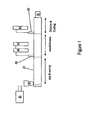
- FIG. 1 is a schematic representation of a typical melt-extrusion apparatus used to prepare embodiments of the invention.
- R R L + k*(R U -R L ), wherein k is a variable ranging from 1 % to 100 % with a 1 % increment, i.e., k is 1 %,2 %, 3 %, 4 %, 5 %,..., 50 %, 51 %, 52 %,..., 95 %, 96 %, 97 %, 98 %, 99 %, or 100 %.
- any numerical range defined by two R numbers as defined in the above is also specifically disclosed.
- thermoplastic resin (A) included in embodiments of the aqueous dispersion of the present invention is a resin that is not readily dispersible in water by itself. In some embodiments it is present in the dispersion in an amount of from greater than 0 percent by wt. to less than about 96 percent by wt. In certain embodiments, the resin is present in an amount of from about 35 to about 65 percent by wt. of the dispersion.
- thermoplastic materials such as polyvinyl chloride, polystyrene, and polyethylene and thermosetting materials such as polyesters, epoxies, and silicones that are used with fillers, stabilizers, pigments, and other components to form plastics.
- resin as used herein includes elastomers and is understood to include blends of olefin polymers.
- the thermoplastic resin is a semi-crystalline resin.
- si-crystalline is intended to identify those resins that possess at least one endotherm when subjected to standard differential scanning calorimetry (DSC) evaluation.
- Some semi-crystalline polymers exhibit a DSC endotherm that exhibits a relatively gentle slope as the scanning temperature is increased past the final endotherm maximum. This reflects a polymer of broad melting range rather than a polymer having what is generally considered to be a sharp melting point.
- Some polymers useful in the dispersions of the invention have a single melting point while other polymers have more than one melting point. In some polymers one or more of the melting points may be sharp such that all or a portion of the polymer melts over a fairly narrow temperature range, such as a few degrees centigrade. In other embodiments, the polymer may exhibit broad melting characteristics over a range of about 20 °C.
- thermoplastic resin (A) is selected from an alpha-olefin interpolymer of ethylene with at least one comonomer selected from propylene, 1-butene, 3-methyl-1-butene, 4-methyl-1-pentene, 3-methyl-1-pentene, 1-heptene, 1-hexene, 1-octene, 1-decene, and 1-dodecene.
- 13 C NMR spectroscopy is one of a number of techniques known in the art of measuring comonomer incorporation into a polymer.
- An example of this technique is described for the determination of comonomer content for ethylene/ ⁇ -olefin copolymers in Randall (Journal of Macromolecular Science, Reviews in Macromolecular Chemistry and Physics, C29 (2 & 3), 201-317 (1989 )).
- the basic procedure for determining the comonomer content of an olefin interpolymer involves obtaining the 13 C NMR spectrum under conditions where the intensity of the peaks corresponding to the different carbons in the sample is directly proportional to the total number of contributing nuclei in the sample.
- the mole % comonomer can be determined by the ratio of the integrals corresponding to the number of moles of comonomer to the integrals corresponding to the number of moles of all of the monomers in the interpolymer, as described in Randall, for example.
- the data is collected using a Varian UNITY Plus 400 MHz NMR spectrometer, corresponding to a 13 C resonance frequency of 100.4 MHz. Acquisition parameters are selected to ensure quantitative 13 C data acquisition in the presence of the relaxation agent.
- the data is acquired using gated 1 H decoupling, 4000 transients per data file, a 7 sec pulse repetition delay, spectral width of 24,200 Hz and a file size of 32 K data points, with the probe head heated to 130 °C.
- the sample is prepared by adding approximately 3 mL of a 50/50 mixture of tetrachloroethane-d2/orthodichlorobenzene that is 0.025 M in chromium acetylacetonate (relaxation agent) to 0.4 g sample in a 10 mm NMR tube.
- the headspace of the tube is purged of oxygen by displacement with pure nitrogen.
- the sample is dissolved and homogenized by heating the tube and its contents to 150 °C with periodic refluxing initiated by heat gun.
- Molecular weight distribution of the polymers is determined using gel permeation chromatography (GPC) on a Polymer Laboratories PL-GPC-220 high temperature chromatographic unit equipped with four linear mixed bed columns (Polymer Laboratories (20-micron particle size)).
- the oven temperature is at 160 °C with the autosampler hot zone at 160 °C and the warm zone at 145 °C.
- the solvent is 1,2,4-trichlorobenzene containing 200 ppm 2,6-di-t-butyl-4-methylphenol.
- the flow rate is 1.0 milliliter/minute and the injection size is 100 microliters.
- the molecular weight determination is deduced by using ten narrow molecular weight distribution polystyrene standards (from Polymer Laboratories, EasiCal PS1 ranging from 580 - 7,500,000 g/mole) in conjunction with their elution volumes.
- the equivalent propylene-ethylene copolymer molecular weights are determined by using appropriate Mark-Houwink coefficients for polypropylene (as described by Th.G. Scholte, N.L.J. Meijerink, H.M. Schoffeleers, and A.M.G. Brands, J. Appl. Polym. Sci., 29, 3763 - 3782 (1984 )) and polystyrene (as described by E. P. Otocka, R.
- N KMa
- Kpp 1.90E-04
- app 0.725
- Kps 1.26E-04
- aps 0.702.
- the thermoplastic resins utilized in the invention are characterized by a DSC curve with a Tme that remains essentially the same and a Tmax that decreases as the amount of unsaturated comonomer in the copolymer is increased.
- Tme means the temperature at which the melting ends and Tmax means the peak melting temperature, both as determined by one of ordinary skill in the art from DSC analysis using data from the final heating step.
- DSC analysis can be determined using a model Q1000 DSC from TA Instruments, Inc., which is calibrated using indium and deionized water.
- the copolymers are substantially free of diene-derived units.
- Dienes are nonconjugated diolefins which may be incorporated in polymers to facilitate chemical crosslinking reactions. "Substantially free of diene” is defined to be less than 1 % diene, or less than 0.5 % diene, or less than 0.1 % diene, or less than 0.05 % diene, or equal to 0 %. All of these percentages are by weight in the copolymer.
- the presence or absence of diene can be conventionally determined by infrared techniques well known to those skilled in the art.
- Sources of diene include diene monomer added to the polymerization of ethylene and propylene, or use of diene in catalysts. No matter the source of such dienes, the above outlined limits on their inclusion in the copolymer are contemplated. Conjugated diene-containing metallocene catalysts have been suggested for the formation of copolymers of olefins. However, polymers made from such catalysts will incorporate the diene from the catalyst, consistent with the incorporation of other monomers in the polymerization.
- a thermoplastic resin is included having a weight average molecular weight (Mw) of from 15,000-5,000,000, or from 20,000 to 1,000,000 and a molecular weight distribution Mw/Mn (sometimes referred to as a "polydispersity index" (PDI)) ranging from a lower limit of 1.01, 1.5 or 1.8 to an upper limit of 40 or 20 or 10 or 5 or 3.
- Mw weight average molecular weight
- PDI polydispersity index
- melt index of the polymer Another measure of molecular weight typically used for polyethylene polymers is the melt index of the polymer, also called I 2 .
- the melt index is indirectly proportional to the molecular weight, although the relationship is not linear.
- the melt index is measured according to ASTM D-1238, condition 190 deg C./2.16 kg).
- Typical thermoplastic resins useful in embodiments of the invention have an I 2 in the range of from 0.001 to 1000 g/10 min.
- the thermoplastic resin (A) has an I2 of from 0.5 to 500 g/10 min.
- Other embodiments include a thermoplastic resin with an I2 of from 1 to 300 g/10 min.
- the selection of suitable I 2 for the thermoplastic resin should be selected in view of the ease of melt kneadability and physical properties of the coating formed.
- DSC Differential scanning calorimetry
- TA Instruments, Inc which is calibrated using indium and deionized water. After heating the sample rapidly to 230 °C and holding for 3 minutes, the cooling curve is obtained by cooling at 10 C/min to -40 °C. After holding at -40 °C for 3 minutes, the DSC melting endotherm is recorded while heating at 10 C/min. The melting point is determined using the standard TA DSC software.
- a primarily ethylene-based polyolefin is selected in which ethylene comprises from about 98 to 65 percent of polymer. Selected comonomer(s) make up the remainder of the polymer.
- the ethylene polymer has the following characteristics and properties: 1) Crystallinity as determined by the observance of at least one endotherm when subjected to standard differential scanning calorimetry (DSC) evaluation; 2) a melt index of between about 30 and about 0.1 g/10 min, preferably of between 25 and 0.25 g/10 min, more preferably of between 22 and 0.5 g/10 min and most preferably of between 18 and 0.75 g/10 min; and 3) a density as determined according to ASTM D-792 of between about 0.845 and about 0.925 g/cc, preferably between 0.85 10 and 0.91 g/cc, and more preferably between 0.855 and 0.905 g/cc, and most preferably between 0.86 and 0.90 g/cc.
- DSC differential scanning calorimetry
- One class of resins particularly suited to use in embodiments of the invention are copolymers of ethylene and 1-octene or 1-butene, where ethylene comprises from about 90 to about 50, more preferably 85 to 55, and 1-octene or 1-butene from about 10 to about 50, more preferably about 15 to 45 percent by weight of the copolymer, and that have Melt Index of between about 0.25 and about 30, more preferably between 0.5 and 20 g/10 min.
- a blend of polymers may be employed that has the physical characteristics described above. For example, it may be desirable to blend a first polymer with relatively high MI that is outside the range described above, with another of relatively low MI, so that the combined MI and the averaged density of the blend fall within the ranges noted above.
- dispersions described herein include a dispersing agent.
- the term "dispersing agent” means an agent that aids in the formation and/or the stabilization of a dispersion.
- Some dispersing agents can also be used to form emulsions and are described in detail by Paul Becher (Emulsions: Theory and Practice, 3rd edition, Oxford University Press, New York, 2001 ), incorporated herein by reference in its entirety.
- Dispersing agents generally fall into three classes 1) surface-active materials, 2) naturally occurring materials, 3) finely divided solids.
- Surface-active agents, also called surfactants are materials that reduce the interfacial tension between two immiscible liquid phases.
- anionic, cationic, nonionic, or ampholytic amphoteric
- examples of commercially available dispersing agents is found in McCutcheon (McCutcheon's Emulsifiers and Detergents, Glen Rock, NJ, issued annually).
- examples of naturally occurring materials include phospholipids, sterols, lanolin, water-soluble gums, alginates, carageenin, and cellulose derivatives.
- examples of finely divided solids include basic salts of the metals, carbon black, powdered silica, and various clay (principally bentonite).
- a carboxylic acid or carboxylic acid salt is used as the dispersing agent.
- Typical salts include an alkali metal salt or an alkaline earth metal salts of the fatty acid.
- Other salts include ammonium or alkyl ammonium salts of the carboxylic acid.
- the carboxylic acid or it's salt with 12 to fewer than 25 carbon atoms.
- the dispersing agent is a salt
- the number of carbons refers to the carbon atoms associated with the carboxylic acid fragment.
- the salt is formed with a fatty acid fragment that has at from 15 to 25 carbon atoms.
- Particular embodiments use an alkali metal salt of erucic acid.
- Erucic acid is a carboxylic acid with 22 carbon atoms.
- Some embodiments use erucic acid in the form of rapeseed oil which is a natural oil that contains approximately 40 to about 50% erucic acid with the remainder consisting of primarily chains having 18 carbon atoms.
- An alkali metal salt of erucic acid is also useful in some embodiments.
- Some embodiments of the present invention use a fatty acid or its salt that is derived from an ester of a fatty acid.
- the alcohol residue constituting such ester may preferably contain 2 to 30 carbon atoms, and most preferably 6 to 20 carbon atoms.
- Such residue may be either a straight or a branched residue, and may also be a mixture of two or more residues each containing different number of carbon atoms.
- Exemplary such alcohol residues include residues of higher alcohols containing 10 to 20 carbon atoms such as cetyl alcohol, stearyl alcohol, and oleyl alcohol.
- Some embodiments use an ester wax of erucic acid.
- the salt of a fatty acid containing fewer than 25 carbon atoms is produced by neutralizing a fatty acid containing fewer than 25 carbon atoms or by saponification of an ester of a fatty acid containing fewer than 25 carbon atoms.
- the dispersing agent can be an ethlyene acrylic acid copolymer. Still other emobodimetns use alkyl ether carboxylates as the dispersing agent.
- Embodiments of the aqueous dispersions described herein contain water in addition to the components as described above. Deionized water is typically preferred. In some embodiments, water with excess hardness can undesirably affect the formation of a suitable dispersion. Particularly water containing high levels of alkaline earth ions, such as Ca 2+ , should be avoided.
- the term "dispersion" as used herein refers to a finely divided solid or liquid in a continuous liquid medium.
- An aqueous dispersion is a dispersion in which the continuous liquid medium is water.
- compositions of the invention is intended to include within its scope both emulsions of essentially liquid materials, prepared employing the thermoplastic resin and the dispersing agent, and dispersions of solid particles.
- Such solid dispersions can be obtained, for example, by preparing an emulsion as previously described, and then causing the emulsion particle to solidify by various means.
- some embodiments provide an aqueous dispersion wherein content of the dispersing agent is present in the range of from 0.5 to 30 parts by weight, and content of (C) water is in the range of 1 to 35% by weight per 100 parts by weight of the thermoplastic polymer; and total content of (A) and (B) is in the range of from 65 to 99% by weight.
- the dispersing agent ranges from 2 to 20 parts by weight based on 100 parts by weight of the polymer.
- the amount of dispersing agent is less than about 4 percent by wt., based on the weight of the thermoplastic polymer.
- the dispersing agent comprises from about 0.5 percent by wt.
- the dispersing agent is a carboxylic acid.
- the dispersions have a small particle size.
- the average particle size is less than about 5 ⁇ m.
- Some preferred dispersions have an average particle size of less than about 1.5 ⁇ m.
- the upper limit on the average particle size is about 4.5 ⁇ m, 4.0 ⁇ m, 3.5 ⁇ m, 3.75 ⁇ m, 3.5 ⁇ m, 3.0 ⁇ m, 2.5 ⁇ m, 2.0 ⁇ m, 1.5 ⁇ m, 1.0 ⁇ m, 0.5 ⁇ m, or 0.1 ⁇ m.
- Some embodiments have a lower limit on the average particle size of about 0.05 ⁇ m, 0.7 ⁇ m, 0.1 ⁇ m, 0.5 ⁇ m, 1.0 ⁇ m, 1.5 ⁇ m, 2.0 ⁇ m, or 2.5 ⁇ m.
- some particular embodiments have, for example, an average particle size of from about 0.05 ⁇ m to about 1.5 ⁇ m.
- the particles in the dispersion have an average particle size of from about 0.5 ⁇ m to about 1.5 ⁇ m.
- the diameter of the particle is the average of the long and short axes of the particle. Particle sizes can be measured on a Coulter LS230 light-scattering particle size analyzer or other suitable device.
- Another parameter that characterizes particles in the dispersions is the particle size distribution, defined herein as the volume average particle diameter (Dv) divided by number average particle diameter (Dn). Some embodiments are characterized by a particle size distribution of less than or equal to about 2.0. In other embodiments, the dispersions have a particle size distribution of less than or equal to about less than 1.9, 1.7, or 1.5.
- the aqueous dispersion has a concentration of the solid content including (A) thermoplastic resin is in the range of from 10 to 70%. Another measure of solids content is by volume. In some embodiments, the dispersion has a percent solids of less than about 74% by volume. Other dispersions have a solids content of from about 5% to about 74% by volume. In some embodiments, the dispersions have a percent solids of less than about 70% by volume, less than about 65% by volume, or ranging from about 5% to about 50% by volume.
- the pH which can affect the uses for which dispersions are suitable.
- the dispersions have a pH of less than 12.
- the pH ranges from about 5 to about 11.5, preferably from about 7 to about 11., more preferably from about 9 to about 11.
- dispersions having a lower limit of the pH of about 5, about 6, about 7, about 8, about 9, about 10, or about 11 are contemplated.
- Dispersions having an upper limit on the pH of about 6, about 7, about 8, about 9, about 10, about 11, or about 12 are contemplated.
- melt-kneading Any melt kneading means known in the art may be used. In some embodiments a kneader, a Banbury mixer, single-screw extruder, or a multi-screw extruder is used. The melt kneading may be conducted under the conditions which are typically used for melt kneading the thermoplastic resin (A).
- a process for producing the dispersions in accordance with the present invention is not particularly limited. One preferred process, for example, is a process comprises melt-kneading the above-mentioned components according to U.S. Pat. No. 5756659 and U.S.
- a preferred melt-kneading machine is, for example, a multi screw extruder having two or more screws, to which a kneading block can be added at any position of the screws. If desired, it is allowable that the extruder is provided with a first material-supplying inlet and a second material-supplying inlet, and further third and forth material-supplying inlets in this order from the upper stream to the down stream along the flow direction of a material to be kneaded. Further, if desired, a vacuum vent may be added at an optional position of the extruder.
- the dispersion is first diluted to contain about 1 to about 3% by weight of water and then subsequently further diluted to comprise greater than 25% by weight of water. In some embodiments, the further dilution provides a dispersion with at least about 30% by weight of water.
- the aqueous dispersion obtained by the melt kneading may be further supplemented with an aqueous dispersion of an ethylene-vinyl compound copolymer, or a dispersing agent.
- FIG. 1 schematically illustrates such an extrusion apparatus embodiments of the invention.
- An extruder in certain embodiments a twin screw extruder, 20 is coupled to a back pressure regulator, melt pump, or gear pump, 30.
- Embodiments also provide a base reservoir, 40 and an initial water reservoir 50, each of which includes a pump (not shown). Desired amounts of base and initial water are provided from the base reservoir 40 and the initial water reservoir 50, respectively.
- Any suitable pump may be used, but in some embodiments a pump that provides a flow of about 150 cc/min at a pressure of 240 bar is used to provide the base and the initial water to the extruder 20.
- a liquid injection pump provides a flow of 300 cc/min at 200 bar or 600 cc/min at 133 bar.
- the base and initial water are preheated in a preheater.
- Resin in the form of pellets, powder or flakes is fed from the feeder 80 to an inlet 90 of the extruder 20 where the resin is melted or compounded.
- the dispersing agent is added to the resin through an along with the resin and in other embodiments, the dispersing agent is provided separately to the twin screw extruder 20.
- the resin melt is then delivered to from the mix and convey zone to an emulsification zone of the extruder where the initial amount of water and base from the reservoirs 40 and 50 is added through inlet 55.
- dispersing agent may be added additionally or exclusively to the water stream.
- the emulsified mixture is further diluted with additional water inlet 95 from reservoir 60 in a dilution and cooling zone of the extruder 20.
- the dispersion is diluted to at least 30 weight percent water in the cooling zone.
- the diluted mixture may be diluted any number of times until the desired dilution level is achieved.
- water is not added into the twin screw extruder 20 but rather to a stream containing the resin melt after the melt has exited from the extruder. In this manner, steam pressure build-up in the extruder 20 is eliminated.
- a basic substance or aqueous solution, dispersion or slurry thereof is added to the dispersion at any point of the process, preferably to the extruder.
- the basic substance is added as an aqueous solution. But in some embodiments, it is added in other convenient forms, such as pellets or granules.
- the basic substance and water are added through separate inlets of the extruder.
- Examples of the basic substance which may be used for the neutralization or the saponification in the melt kneading process include alkaline metals and alkaline earth metals such as sodium, potassium, calcium, strontium, barium;inorganic amines such as hydroxylamine or hydrazine; organic amines such as methylamine, ethylamine, ethanolamine, cyclohexylamine, tetramethylammonium hydroxide; oxide, hydroxide, and hydride of alkaline metals and alkaline earth metals such as sodium oxide, sodium peroxide, potassium oxide, potassium peroxide, calcium oxide, strontium oxide, barium oxide, sodium hydroxide, potassium hydroxide, calcium hydroxide, strontium hydride, barium hydroxide, sodium hydride, potassium hydride, calcium hydride; and weak acid salts of alkaline metals and alkaline earth metals such as sodium carbonate, potassium carbonate, sodium hydrogencarbonate, potassium hydrogencarbonate, calcium hydrogen
- the aqueous dispersion may be coated onto a substrate by various procedures, and for example, by spray coating, curtain flow coating, coating with a roll coater or a gravure coater, brush coating, dipping.
- the coating is preferably dried by heating the coated substrate to 50 to 150 °C for 1 to 300 seconds although the drying may be accomplished by any suitable means.
- the substrate for coatings may comprise a film of a thermoplastic resin such as polyethylene terephthalate, polyethylene, polycarbonate, polyimide, polyamide, polyphenylene sulfide, polysulfone, aromatic polyester, polyether ether ketone, polyether sulfone, and polyether imide.
- a thermoplastic resin such as polyethylene terephthalate, polyethylene, polycarbonate, polyimide, polyamide, polyphenylene sulfide, polysulfone, aromatic polyester, polyether ether ketone, polyether sulfone, and polyether imide.
- the preferred is the film comprising polyethylene terephthalate, polyethylene, polyamide, and polycarbonate, and the most preferred is the film comprising polyethylene terephthalate.
- the films have a thickness in the range of from 0.5 to 50 microns, although some have a thickness of from 1 to 30 microns.
- Some embodiments of the dispersions described herein are capable of forming a coating which exhibits excellent water resistance, oil resistance, or chemical resistance. Some embodiments exhibit adhesion to non-polar materials, and therefore, when the aqueous dispersion of the present invention is coated and dried on the surface of a substrate such as paper, fiber, wood, metal, or plastic molded article, the resulting resin coating will provide the substrate with water resistance, oil resistance, chemical resistance, corrosion resistance and heat sealability.
- Coatings obtained from some dispersions described herein exhibit excellent moisture resistance, water repellency, thermal adhesion to paper, especially for water and/or grease barrier and ink adhesion coatings layers, metal, glass, wood, fiber (natural fiber and synthetic fiber), and nonwoven fabric, thermal transfer properties, abrasion resistance, impact resistance, weatherability, solvent resistance, flexibility, and adaptability to high-frequency fabricating.
- Some dispersions are particularly suited for the formation of textile coatings including fabric impregnation. Some dispersions are also suitable for use as carpet backing layers.
- Coatings for architectural works are also contemplated as well as coatings for controlled release coatings on fertilizer pellets or as coatings to control surface properties such as coefficient of friction. Additionally some dispersions can be used to prepare stable froths and foams, as described in "Froths and Durable Foams of Dispersed Olefin Polymers and articles Prepared from Same" filed concurrently herewith.
- Some aqueous dispersions described herein are used as a binder in a coating composition for a coated wallpaper; a fiber coating agent (for improving the strength, moisture adsorption, or water repellency of the fiber); a net for construction, a sizing agent for nylon, polyester or glass fibers; a sizing agent/thermal adhesive of a paper or a nonwoven fabric; and an agent for imparting heat sealability with a paper or a film; a thermal adhesive of a sterilized paper; a binder of an ink or a coating composition; a surface coating agent for a paper or a film adapted for use with an ink jet printer; an agent for improving chipping resistance of an automotive coating composition; and the like.
- the aqueous dispersions have additional components in an amount that does not adversely affect the object of the present invention.
- additional components include water-soluble amino resins such as water-soluble melamine resin and water-soluble benzoguanamine resin and water-soluble epoxy resins for improving coating performance; organic thickeners such as polyvinyl alcohol, polyvinyl pyrrolidone, polyvinyl methylether, polyethylene oxide, polyacrylamide, polyacrylic acid, carboxy methyl cellulose, methyl cellulose, and hydroxyethyl cellulose and inorganic thickeners such as silicon dioxide, active clay, and bentonite for improving the stability and adjusting the viscosity of the dispersion; dispersing agents such as nonionic dispersing agents and anionic dispersing agents and water-soluble polyvalent metal salts for improving the stability of the dispersion; other additives such as anti-rust agent, anti-mold agent, UV absorber, thermal stabilizer, foaming agent, antifoaming agent, and the like
- thermoplastic ethylene-vinyl acetate commercially available from DuPont having a vinyl acetate content of about 28 wt %, a density of about 0.95 g/cm 3 (ASTM D-792) and a melt index of about 6 g/10 min. (as determined according to ASTM D1238 at 190 °C and 2.16 kg), and a melting point of about 73 °C (as determined according to ASTM D3417) and 4.2 parts by weight of a C32 carboxylic acid (Unicid 425 manufactured by Baker-Petrolite, acid value 97 mg KOH/g) are melt kneaded at 180 °C in twin screw extruder at a rate of 8.3 kg/hr.
- a thermoplastic ethylene-vinyl acetate commercially available from DuPont having a vinyl acetate content of about 28 wt %, a density of about 0.95 g/cm 3 (ASTM D-792) and a melt index of about 6 g/10 min
- aqueous solution of potassium hydroxide is continuously fed into a downstream injection port at a rate 0.9 kg/hr (at a rate of 10 wt % of the total mixture).
- This aqueous dispersion is subsequently diluted with additional water at a rate of 5.7 kg/hr before exiting the extruder.
- An aqueous dispersion having a solids content of 56 wt % at pH 10.7 is obtained.
- the dispersed polymer phase measured by a Coulter LS230 particle analyzer consisted of an average volume diameter of 0.56 micron and a particle size distribution (dv/dn) of 1.45.
- a C18/C16 carboxylic acid Industrene 106 manufactured by CK Witco, acid value 200 mg KOH/g
- aqueous solution of potassium hydroxide is continuously fed into a downstream injection port at a rate 0.2 kg/hr (at a rate of 2.5 wt % of the total mixture).
- This aqueous dispersion is subsequently diluted with additional water at a rate of 5.4 kg/hr before exiting the extruder.
- additional water is added at a rate of 0.7 kg/hr after the mixture exited the extruder.
- An aqueous dispersion having a solids content of 56 wt % at pH 9.6 is obtained.
- the dispersed polymer phase measured by a Coulter LS230 particle analyzer consisted of an average volume diameter of 2.04 micron and a particle size distribution (dv/dn) of 1.18.
- aqueous solution of potassium hydroxide is continuously fed into a downstream injection port at a rate 0.1 kg/hr (at a rate of 2.0 wt % of the total mixture).
- This aqueous dispersion is subsequently diluted with additional water at a rate of 3.2 kg/hr before exiting the extruder.
- additional water is added at a rate of 0.8 kg/hr after the mixture exited the extruder.
- An aqueous dispersion having a solids content of 55 wt % at pH 10.7 is obtained.
- the dispersed polymer phase measured by a Coulter LS230 particle analyzer consisted of an average volume diameter of 1.11 micron and a particle size distribution (dv/dn) of 1.85.
- aqueous solution of potassium hydroxide is continuously fed into a downstream injection port at a rate 0.2 kg/hr (at a rate of 2.0 wt % of the total mixture).
- This aqueous dispersion is subsequently diluted with additional water at a rate of 7.5 kg/hr before exiting the extruder.
- An aqueous dispersion having a solids content of 56 wt % at pH 10.8 is obtained.
- the dispersed polymer phase measured by a Coulter LS230 particle analyzer consisted of an average volume diameter of 0.79 micron and a particle size distribution (dv/dn) of 1.95.
- the invention provides new dispersions useful for many applications.
- the new have one or more of the following advantages.
- some new dispersions have better durability. Certain dispersions exhibit improved adhesion properties and others may have improved adhesion as well as good toughness and durability. Other dispersions are easier to process in a melt-extrusion process. In particular, some dispersions are easier to process due to the low melting point of the polymers used therein. Some dispersions have the feature of being low yellowing. Other characteristics and additional advantages are apparent to those skilled in the art.
- the dispersions described herein may comprise other components.
- Various additives may also be used to further enhance one or more properties.
- the dispersions are substantially free of any additive not specifically enumerated herein.
- Some embodiments of the dispersions described herein consist of or consist essentially of the enumerated components.
- some embodiments of the methods described herein consist of or consist essentially of the enumerated steps. The appended claims intend to cover all such variations and modifications as falling within the scope of the invention.
Landscapes
- Chemical & Material Sciences (AREA)
- Health & Medical Sciences (AREA)
- Engineering & Computer Science (AREA)
- Materials Engineering (AREA)
- Chemical Kinetics & Catalysis (AREA)
- Medicinal Chemistry (AREA)
- Polymers & Plastics (AREA)
- Organic Chemistry (AREA)
- Epidemiology (AREA)
- Veterinary Medicine (AREA)
- Dispersion Chemistry (AREA)
- Life Sciences & Earth Sciences (AREA)
- Animal Behavior & Ethology (AREA)
- General Health & Medical Sciences (AREA)
- Public Health (AREA)
- Hematology (AREA)
- Compositions Of Macromolecular Compounds (AREA)
- Processes Of Treating Macromolecular Substances (AREA)
- Manufacture Of Porous Articles, And Recovery And Treatment Of Waste Products (AREA)
- Addition Polymer Or Copolymer, Post-Treatments, Or Chemical Modifications (AREA)
- Laminated Bodies (AREA)
- Emulsifying, Dispersing, Foam-Producing Or Wetting Agents (AREA)
- Absorbent Articles And Supports Therefor (AREA)
Claims (11)
- Une dispersion aqueuse comprenant(A) au moins une résine thermoplastique;(B) au moins un agent dispersant comprenant au moins un acide carboxylique, un sel d'au moins un acide carboxylique, un ester d'acide carboxylique ou un sel d'un ester d'acide carboxylique, ou un polymère d'acide éthylénique ;(C) de l'eau ; et facultativement(D) un agent neutralisant sélectionné parmi l'hydroxyde de potassium, l'hydroxyde de sodium et des combinaisons de ceux-ci ;la dispersion ayant un pH allant de 7 à 11, et dans laquelle la résine thermoplastique est sélectionnée parmi un interpolymère d'alpha-oléfine d'éthylène avec au moins un comonomère sélectionné parmi le propylène, le 1-butène, le 3-méthyl-1-butène, le 4-méthyl-1-pentène, le 3-méthyl-1-pentène, le 1-heptène, le 1-hexène, le 1-octène, le 1-décène, et le 1-dodécène,
la dispersion ayant une répartition granulométrique (définie comme étant le diamètre de particule moyen en volume Dv divisé par le diamètre de particule moyen en nombre Dn) inférieure ou égale à 2,0, et dans laquelle l'agent dispersant constitue en moins d'environ 4 pour cent en poids rapporté au poids de la résine thermoplastique. - Une dispersion aqueuse selon la revendication 1, la dispersion ayant une taille de particule moyenne en volume inférieure à 5 µm.
- Une dispersion aqueuse selon la revendication 1, dans laquelle l'agent dispersant comprend au moins un acide carboxylique, un sel d'au moins un acide carboxylique, un ester d'acide carboxylique ou un sel de l'ester d'acide carboxylique, ou est sélectionné parmi des polymères d'éthylène et d'acide carboxylique et leurs sels, des carboxylates d'éther d'alkyle, des sulfonates de pétrole, un alcool polyoxyéthyléné sulfoné, des alcools polyoxyéthylénés sulfatés ou phosphatés, des agents dispersants oxyde d'éthylène/oxyde de propylène/oxyde d'éthylène polymères, des éthoxylates d'alcools primaires et secondaires, des glycosides d'alkyle et des glycérides d'alkyle.
- Une dispersion aqueuse selon la revendication 1, dans laquelle l'agent dispersant est sélectionné parmi des copolymères d'éthylène et d'acide acrylique ou des copolymères d'éthylène et d'acide méthacrylique.
- Une dispersion aqueuse selon la revendication 1, dans laquelle l'agent dispersant comprend au moins un acide carboxylique.
- Une dispersion aqueuse selon la revendication 5, dans laquelle l'acide carboxylique a de 12 à 60 atomes de carbone.
- Une dispersion aqueuse selon la revendication 1, dans laquelle l'agent dispersant constitue moins de 4 pour cent en poids, rapporté au poids de la résine thermoplastique.
- Une dispersion aqueuse selon la revendication 1, la dispersion ayant une répartition granulométrique (Dv/Dn) inférieure ou égale à 1,5.
- Une dispersion aqueuse selon la revendication 1, la dispersion ayant une taille de particule moyenne en volume allant de 0,05 µm à 1,5 µm.
- Une dispersion aqueuse selon la revendication 1, la dispersion ayant une teneur en solides allant de 5 % à 74 % en volume.
- Une méthode pour produire une dispersion aqueuse comprenant les étapes consistant à :(1) pétrir à chaud (A) au moins une résine thermoplastique ; et (B) au moins un agent dispersant, pour produire un produit pétri à chaud,(2) diluer ledit produit pétri à chaud, et pétrir à chaud le mélange résultant pour former la dispersion aqueuse ;dans laquelle :la résine thermoplastique est sélectionnée parmi un interpolymère d'alpha-oléfine d'éthylène avec au moins un comonomère sélectionné parmi le propylène, le 1-butène,le 3-méthyl-1-butène, le 4-méthyl-1-pentène, le 3-méthyl-1-pentène, le 1-heptène, le 1-hexène, le 1-octène, le 1-décène, et le 1-dodécène ;l'agent dispersant comprenant au moins un acide carboxylique, un sel d'au moins un acide carboxylique, un ester d'acide carboxylique ou un sel d'un ester d'acide carboxylique, ou un polymère d'acide éthylénique ;grâce à quoi la dispersion résultante a une répartition granulométrique (définie comme étant le diamètre de particule moyen en volume Dv divisé par le diamètre de particule moyen en nombre Dn) inférieure ou égale à 2,0, et un pH allant de 7 à 11.
Applications Claiming Priority (3)
| Application Number | Priority Date | Filing Date | Title |
|---|---|---|---|
| US49752703P | 2003-08-25 | 2003-08-25 | |
| US54849304P | 2004-02-27 | 2004-02-27 | |
| EP04782191A EP1675902B1 (fr) | 2003-08-25 | 2004-08-25 | Dispersion aqueuse, son procede de production et son utilisation |
Related Parent Applications (4)
| Application Number | Title | Priority Date | Filing Date |
|---|---|---|---|
| EP04782191A Division EP1675902B1 (fr) | 2003-08-25 | 2004-08-25 | Dispersion aqueuse, son procede de production et son utilisation |
| WOPCT/US2004/027641 Previously-Filed-Application | 2004-08-25 | ||
| EP04782191.3 Division | 2004-08-25 | ||
| PCT/US2004/027641 Previously-Filed-Application WO2005021638A2 (fr) | 2003-08-25 | 2004-08-25 | Dispersion aqueuse, son procede de production et son utilisation |
Publications (2)
| Publication Number | Publication Date |
|---|---|
| EP2272910A1 EP2272910A1 (fr) | 2011-01-12 |
| EP2272910B1 true EP2272910B1 (fr) | 2014-03-12 |
Family
ID=34278553
Family Applications (5)
| Application Number | Title | Priority Date | Filing Date |
|---|---|---|---|
| EP04782150A Expired - Lifetime EP1660569B1 (fr) | 2003-08-25 | 2004-08-25 | Mousse de polymeres a olefines dispersees |
| EP10158275.7A Expired - Lifetime EP2264098B1 (fr) | 2003-08-25 | 2004-08-25 | Procédé de production d'une dispersion aqueuse |
| EP10158276.5A Expired - Lifetime EP2272910B1 (fr) | 2003-08-25 | 2004-08-25 | Dispersion aqueuse |
| EP10015366.7A Expired - Lifetime EP2298832B1 (fr) | 2003-08-25 | 2004-08-25 | Mousse et mousse durable de polymères d'olefine dispersée, procédés de fabrication de mousse et articles préparés à partir de celles-ci |
| EP04782191A Expired - Lifetime EP1675902B1 (fr) | 2003-08-25 | 2004-08-25 | Dispersion aqueuse, son procede de production et son utilisation |
Family Applications Before (2)
| Application Number | Title | Priority Date | Filing Date |
|---|---|---|---|
| EP04782150A Expired - Lifetime EP1660569B1 (fr) | 2003-08-25 | 2004-08-25 | Mousse de polymeres a olefines dispersees |
| EP10158275.7A Expired - Lifetime EP2264098B1 (fr) | 2003-08-25 | 2004-08-25 | Procédé de production d'une dispersion aqueuse |
Family Applications After (2)
| Application Number | Title | Priority Date | Filing Date |
|---|---|---|---|
| EP10015366.7A Expired - Lifetime EP2298832B1 (fr) | 2003-08-25 | 2004-08-25 | Mousse et mousse durable de polymères d'olefine dispersée, procédés de fabrication de mousse et articles préparés à partir de celles-ci |
| EP04782191A Expired - Lifetime EP1675902B1 (fr) | 2003-08-25 | 2004-08-25 | Dispersion aqueuse, son procede de production et son utilisation |
Country Status (17)
| Country | Link |
|---|---|
| US (1) | US7439276B2 (fr) |
| EP (5) | EP1660569B1 (fr) |
| JP (5) | JP5346153B2 (fr) |
| KR (2) | KR101186421B1 (fr) |
| CN (6) | CN102604124B (fr) |
| AR (1) | AR045487A1 (fr) |
| AT (1) | ATE483752T1 (fr) |
| AU (1) | AU2004269007B2 (fr) |
| BR (2) | BRPI0413396B1 (fr) |
| CA (3) | CA2536315C (fr) |
| DE (1) | DE602004029483D1 (fr) |
| ES (1) | ES2398464T3 (fr) |
| MX (2) | MX271451B (fr) |
| PL (1) | PL1660569T3 (fr) |
| SG (10) | SG183755A1 (fr) |
| TW (2) | TW200517426A (fr) |
| WO (2) | WO2005021622A2 (fr) |
Families Citing this family (124)
| Publication number | Priority date | Publication date | Assignee | Title |
|---|---|---|---|---|
| US8357749B2 (en) | 2003-08-25 | 2013-01-22 | Dow Global Technologies Llc | Coating composition and articles made therefrom |
| US8158711B2 (en) | 2003-08-25 | 2012-04-17 | Dow Global Technologies Llc | Aqueous dispersion, its production method, and its use |
| US8722787B2 (en) | 2003-08-25 | 2014-05-13 | Dow Global Technologies Llc | Coating composition and articles made therefrom |
| US7763676B2 (en) | 2003-08-25 | 2010-07-27 | Dow Global Technologies Inc. | Aqueous polymer dispersions and products from those dispersions |
| US9169406B2 (en) | 2003-08-25 | 2015-10-27 | Dow Global Technologies Llc | Coating compositions |
| US8349929B2 (en) * | 2003-08-25 | 2013-01-08 | Dow Global Technologies Llc | Coating composition and articles made therefrom |
| US8946329B2 (en) | 2003-08-25 | 2015-02-03 | Dow Global Technologies Llc | Coating compositions |
| US7803865B2 (en) * | 2003-08-25 | 2010-09-28 | Dow Global Technologies Inc. | Aqueous dispersion, its production method, and its use |
| US8779053B2 (en) | 2003-08-25 | 2014-07-15 | Dow Global Technologies Llc | Coating compositions |
| US7361694B2 (en) | 2004-02-27 | 2008-04-22 | Dow Global Technologies Inc. | Durable foam of olefin polymers, methods of making foam and articles prepared from same |
| US8357727B2 (en) | 2004-02-27 | 2013-01-22 | Dow Global Technologies Llc | Durable foam of olefin polymers, methods of making foam and articles prepared from same |
| US8287949B2 (en) * | 2005-07-07 | 2012-10-16 | Dow Global Technologies Inc. | Aqueous dispersions |
| CA2615792A1 (fr) | 2005-07-19 | 2007-01-25 | Dow Global Technologies Inc. | Mousse thermoplastique resiliente a microcavites, composite de cette mousse et de particules, procedes de preparation et articles prepares a partir de celle-ci |
| GB2432584A (en) * | 2005-11-28 | 2007-05-30 | Univ Sheffield | Particle stabilised foam |
| US8153243B2 (en) | 2005-12-09 | 2012-04-10 | Dow Global Technologies Llc | Interpolymers suitable for multilayer films |
| US8444811B2 (en) | 2005-12-15 | 2013-05-21 | Kimberly-Clark Worldwide, Inc. | Process for increasing the basis weight of sheet materials |
| US7837831B2 (en) | 2005-12-15 | 2010-11-23 | Kimberly-Clark Worldwide, Inc. | Tissue products containing a polymer dispersion |
| US7879189B2 (en) | 2005-12-15 | 2011-02-01 | Kimberly-Clark Worldwide, Inc. | Additive compositions for treating various base sheets |
| US7820010B2 (en) | 2005-12-15 | 2010-10-26 | Kimberly-Clark Worldwide, Inc. | Treated tissue products having increased strength |
| US7528080B2 (en) * | 2005-12-15 | 2009-05-05 | Dow Global Technologies, Inc. | Aqueous polyolefin dispersions for textile impregnation |
| US7879191B2 (en) | 2005-12-15 | 2011-02-01 | Kimberly-Clark Worldwide, Inc. | Wiping products having enhanced cleaning abilities |
| CN101356314B (zh) * | 2005-12-15 | 2012-07-04 | 陶氏环球技术有限责任公司 | 含添加剂组合物的改进纤维素制品 |
| US7883604B2 (en) | 2005-12-15 | 2011-02-08 | Kimberly-Clark Worldwide, Inc. | Creping process and products made therefrom |
| US7837832B2 (en) | 2005-12-15 | 2010-11-23 | Dow Global Technologies, Inc. | Additive compositions for treating various base sheets |
| US7879188B2 (en) | 2005-12-15 | 2011-02-01 | Kimberly-Clark Worldwide, Inc. | Additive compositions for treating various base sheets |
| US7842163B2 (en) | 2005-12-15 | 2010-11-30 | Kimberly-Clark Worldwide, Inc. | Embossed tissue products |
| US8043713B2 (en) | 2005-12-15 | 2011-10-25 | Dow Global Technologies Llc | Compositions and aqueous dispersions |
| US7807023B2 (en) | 2005-12-15 | 2010-10-05 | Kimberly-Clark Worldwide, Inc. | Process for increasing the basis weight of sheet materials |
| US8282776B2 (en) | 2005-12-15 | 2012-10-09 | Kimberly-Clark Worldwide, Inc. | Wiping product having enhanced oil absorbency |
| US8158689B2 (en) * | 2005-12-22 | 2012-04-17 | Kimberly-Clark Worldwide, Inc. | Hybrid absorbent foam and articles containing it |
| US8007978B2 (en) * | 2006-03-03 | 2011-08-30 | Dow Global Technologies Llc | Aqueous dispersions for use as toners |
| US8916640B2 (en) * | 2006-07-06 | 2014-12-23 | Dow Global Technologies Llc | Blended polyolefin dispersions |
| US8785531B2 (en) * | 2006-07-06 | 2014-07-22 | Dow Global Technologies Llc | Dispersions of olefin block copolymers |
| AR062738A1 (es) * | 2006-09-11 | 2008-11-26 | Dow Global Technologies Inc | Tecnologia de dispersion poliolefinica usada para arena recubierta con resina |
| US8476326B2 (en) * | 2006-09-22 | 2013-07-02 | Dow Global Technologies Llc | Fibrillated polyolefin foam |
| US20080118728A1 (en) * | 2006-10-20 | 2008-05-22 | Dow Global Technologies Inc. | Aqueous dispersions disposed on glass-based fibers and glass-containing substrates |
| EP2399615B1 (fr) | 2006-10-25 | 2014-08-06 | Dow Global Technologies LLC | Dispersions de polyoléfine, mousses et écumes |
| CA2668397A1 (fr) * | 2006-11-01 | 2008-05-15 | Dow Global Technologies Inc. | Articles comprenant du polyurethane et une polyolefine non polaire et procedes de preparation et d'utilisation de ces derniers |
| US7785443B2 (en) | 2006-12-07 | 2010-08-31 | Kimberly-Clark Worldwide, Inc. | Process for producing tissue products |
| ZA200902905B (en) * | 2006-12-07 | 2010-07-28 | Kimberly Clark Co | Tissue products with controlled lint properties |
| BRPI0806751B1 (pt) * | 2007-01-17 | 2018-08-14 | Agrofresh Inc. | Liberação de agentes de bloqueio e/ou promoção de etileno |
| US20080184663A1 (en) * | 2007-02-07 | 2008-08-07 | Armen Martirossyan | Structural composite panel, method of fabrication, and construction |
| US7588662B2 (en) | 2007-03-22 | 2009-09-15 | Kimberly-Clark Worldwide, Inc. | Tissue products containing non-fibrous polymeric surface structures and a topically-applied softening composition |
| TWI358161B (en) * | 2007-07-24 | 2012-02-11 | Hon Hai Prec Ind Co Ltd | Electrical card connector |
| US9381723B2 (en) * | 2007-09-12 | 2016-07-05 | University Of Washington | Microcellular thermoplastic thin films formed by a solid-state foaming process |
| EP2543393A3 (fr) | 2007-09-28 | 2013-10-30 | Dow Global Technologies LLC | Mousse produite à partir d'une dispersion d'oléfines de cristallinité supérieure |
| US8475878B2 (en) | 2007-10-25 | 2013-07-02 | Dow Global Technologies Llc | Polyolefin dispersion technology used for porous substrates |
| EP2568023B1 (fr) | 2007-11-15 | 2014-06-25 | Dow Global Technologies LLC | Article revêtu, et procédé pour former de tels articles |
| CN102119194B (zh) | 2007-11-15 | 2013-07-10 | 陶氏环球技术有限责任公司 | 涂料组合物、涂覆制品和制备该制品的方法 |
| US8420760B2 (en) | 2007-11-19 | 2013-04-16 | Dow Global Technologies Llc | Long chain branched propylene-alpha-olefin copolymers |
| JP2009263540A (ja) * | 2008-04-25 | 2009-11-12 | Beegan Tsusho Kk | オレフィン系プラスチック製品 |
| EP2286019B1 (fr) * | 2008-05-06 | 2012-05-16 | Dow Global Technologies LLC | Tapis obtenu à partir d'une composition aqueuse moussante et son procédé de fabrication |
| WO2009151446A1 (fr) * | 2008-06-10 | 2009-12-17 | Hewlett-Packard Development Company, L.P. | Encre électrophotographique liquide ayant une durabilité améliorée |
| EP2140888A1 (fr) * | 2008-07-04 | 2010-01-06 | Bayer MaterialScience AG | Composé feuilleté, adapté en tant que pansement, contenant une couche de mousse de polyuréthane, d'absorbeur et de revêtement |
| JP5624982B2 (ja) | 2008-07-16 | 2014-11-12 | トリュープ エムルジオンスヒェミー アーゲー | 熱可塑性分散体の無溶剤製造法 |
| CN104438026B (zh) * | 2008-12-22 | 2018-05-15 | 陶氏环球技术有限责任公司 | 织造地毯涂料混合物、相关的使用方法、和由该混合物制得的制品 |
| EP2411424A2 (fr) | 2009-03-06 | 2012-02-01 | Dow Global Technologies LLC | Catalyseurs, procédés de fabrication de catalyseurs, procédés de fabrication de compositions de polyoléfines et compositions de polyoléfines |
| US8105463B2 (en) | 2009-03-20 | 2012-01-31 | Kimberly-Clark Worldwide, Inc. | Creped tissue sheets treated with an additive composition according to a pattern |
| WO2010111869A1 (fr) | 2009-03-31 | 2010-10-07 | Dow Global Technologies Inc. | Film préparé à partir d'un interpolymère d'éthylène/alpha-oléfine hétérogène |
| SE533843C2 (sv) | 2009-06-15 | 2011-02-08 | Moelnlycke Health Care Ab | Sårdyna innefattande en kropp av komprimerat skummaterial med öppna celler |
| EP2448979B1 (fr) | 2009-07-01 | 2013-05-01 | Dow Global Technologies LLC | Polymère éthylénique et son utilisation |
| SG177446A1 (en) | 2009-07-01 | 2012-02-28 | Dow Global Technologies Llc | Ethylenic polymer and its use |
| JP5764561B2 (ja) | 2009-09-14 | 2015-08-19 | ダウ グローバル テクノロジーズ エルエルシー | エチレンおよびシロキサン由来の単位を含むポリマー |
| SG179054A1 (en) | 2009-09-14 | 2012-04-27 | Dow Global Technologies Llc | Polymers comprising units derived from ethylene and polyalkene |
| KR20120081136A (ko) | 2009-09-14 | 2012-07-18 | 다우 글로벌 테크놀로지스 엘엘씨 | 에틸렌 및 폴리(알콕시드)로부터 유도된 단위를 포함하는 중합체 |
| US8292863B2 (en) | 2009-10-21 | 2012-10-23 | Donoho Christopher D | Disposable diaper with pouches |
| US8729186B2 (en) | 2009-12-18 | 2014-05-20 | Dow Global Technologies Llc | Polymerization process to make low density polyethylene |
| EP2336235B1 (fr) * | 2009-12-18 | 2012-10-03 | Actega Artistica S.A. | Dispersion à base d'eau sur un polymère thermoplastique et un élastomère non thermoplastique |
| JP5498152B2 (ja) * | 2009-12-28 | 2014-05-21 | 花王株式会社 | 吸収体及び吸収性物品 |
| US9085909B2 (en) * | 2010-01-18 | 2015-07-21 | Ray D. Kanter | Protective flooring system |
| CN103189045B (zh) * | 2010-03-26 | 2015-08-26 | 联合碳化化学品及塑料技术公司 | 用于染发的个人护理组合物 |
| KR20130072193A (ko) | 2010-04-16 | 2013-07-01 | 킴벌리-클라크 월드와이드, 인크. | 탄성 코폼 층을 갖는 흡수 복합체 |
| KR101861865B1 (ko) * | 2010-05-10 | 2018-07-02 | 다우 글로벌 테크놀로지스 엘엘씨 | 접착 촉진제 시스템, 및 이의 제조 방법 |
| EP2569382B1 (fr) * | 2010-05-10 | 2018-01-17 | Dow Global Technologies LLC | Système promoteur d'adhérence, et son procédé de production |
| KR20130106277A (ko) * | 2010-05-10 | 2013-09-27 | 다우 글로벌 테크놀로지스 엘엘씨 | 접착 촉진제 시스템, 및 그의 제조 방법 |
| CN103249771B (zh) * | 2010-09-29 | 2014-10-22 | 陶氏环球技术有限责任公司 | 减敏的热塑性聚合物含水分散体 |
| BR112013007508A2 (pt) | 2010-09-30 | 2019-09-24 | Dow Global Technologies Llc | processo de polimerização em alta pressãp para formar um interpolímero a base de etileno, interpolímero a base de etileno e artigo |
| BR112013007510B1 (pt) | 2010-09-30 | 2020-10-20 | Dow Global Technologies Llc | processo de polimerização em alta pressão para formar um polímero a base de etileno, polímero a base de etileno, composição e artigo |
| US8916012B2 (en) * | 2010-12-28 | 2014-12-23 | Kimberly-Clark Worldwide, Inc. | Method of making substrates comprising frothed benefit agents |
| CA2823300C (fr) | 2010-12-29 | 2019-10-22 | Dow Global Technologies Llc | Procede de fabrication d'un element de renforcement pour cable |
| JP5586509B2 (ja) * | 2011-03-18 | 2014-09-10 | ユーエムジー・エービーエス株式会社 | 酸変性オレフィン系水性分散体の製造方法 |
| ES2660362T3 (es) * | 2011-05-27 | 2018-03-22 | Dsm Ip Assets B.V. | Procedimiento de extrusión y producto resultante del mismo. |
| US8841379B2 (en) | 2011-11-07 | 2014-09-23 | E I Du Pont De Nemours And Company | Method to form an aqueous dispersion of an ionomer-polyolefin blend |
| CN111685936A (zh) * | 2012-02-02 | 2020-09-22 | 凯希特许有限公司 | 用于定向肉芽形成的泡沫结构伤口插入物 |
| US20130274349A1 (en) * | 2012-04-12 | 2013-10-17 | Jian Qin | Open-celled foam with superabsorbent material and process for making the same |
| RU2624510C2 (ru) * | 2012-05-25 | 2017-07-04 | Кимберли-Кларк Ворлдвайд, Инк. | Усовершенствованное изделие личной гигиены |
| EP2730403A1 (fr) | 2012-11-12 | 2014-05-14 | Cryovac, Inc. | Films imprimés pour emballage et emballages obtenus à partir de ceux-ci |
| JP6342411B2 (ja) * | 2012-11-21 | 2018-06-13 | ダウ グローバル テクノロジーズ エルエルシー | コーティング組成物 |
| EP2925163B1 (fr) * | 2012-11-27 | 2025-12-24 | DSM IP Assets B.V. | Procédé pour la production de particules extrudées solides discrètes |
| CN105026502B (zh) | 2012-12-28 | 2020-12-04 | 陶氏环球技术有限责任公司 | 涂料组合物和由其制成的物品 |
| EP2922925B1 (fr) | 2012-12-28 | 2019-12-04 | Dow Global Technologies LLC | Compositions de revêtement |
| EP2765092B1 (fr) | 2013-02-06 | 2015-09-02 | Cryovac, Inc. | Emballage sans plateau à plusieurs compartiments avec un cadre rigide |
| US9034477B2 (en) * | 2013-03-05 | 2015-05-19 | Dow Global Technologies Llc | Coating composition, a film containing the same, and a method for forming a sealable film |
| US10357730B2 (en) | 2013-03-15 | 2019-07-23 | Donaldson Company, Inc. | Filter media and elements |
| JP6595978B2 (ja) * | 2013-03-15 | 2019-10-23 | エトクス ケミカルズ リミテッド ライアビリティ カンパニー | バイオベース分散剤 |
| US10233296B2 (en) * | 2013-05-30 | 2019-03-19 | Kimberly-Clark Worldwide, Inc. | Method of forming creped thin film-like structures from frothed chemistry |
| US9474994B2 (en) | 2013-06-17 | 2016-10-25 | Donaldson Company, Inc. | Filter media and elements |
| CN108047381B (zh) * | 2013-07-01 | 2021-02-02 | 罗门哈斯公司 | 复合聚合物组合物 |
| US10131775B2 (en) * | 2013-07-02 | 2018-11-20 | Rohm And Haas Company | Polyolefin/(meth)acrylic impact modifier and method of preparing same |
| US11485112B2 (en) | 2013-07-22 | 2022-11-01 | VaproShield, LLC | Building membrane with porous pressure sensitive adhesive |
| US11186985B2 (en) * | 2013-07-22 | 2021-11-30 | VaproShield, LLC | Vapor permeable, water resistive, air barrier polyester membrane having a polyacrylic coating with porous pressure sensitive adhesive added to the rear surface of the membrane |
| EP3013369B1 (fr) * | 2013-08-29 | 2017-12-27 | Dow Global Technologies LLC | Procédé pour produire une dispersion aqueuse |
| US20150073064A1 (en) * | 2013-09-12 | 2015-03-12 | Kimberly-Clark Worldwide, Inc. | Highly crystalline and frothed polyolefin foam |
| AU2014373830B2 (en) | 2013-12-30 | 2018-10-11 | Avery Dennison Corporation | Compostable films and compostable labels |
| JP6257392B2 (ja) * | 2014-03-17 | 2018-01-10 | 株式会社イノアック技術研究所 | 吸水性樹脂発泡体及びその製造方法 |
| US9550930B2 (en) | 2014-05-30 | 2017-01-24 | Michelman, Inc. | Thermal lamination adhesive coatings for use on substrates |
| EP3233956B1 (fr) * | 2014-12-17 | 2021-11-24 | Dow Global Technologies LLC | Mousse de polyuréthane à dispersion polymère aqueuse |
| SG10201508406WA (en) * | 2014-12-23 | 2016-07-28 | Dow Global Technologies Llc | Polyolefin dispersion compositions for making high vapor transport hydrophobic coatings |
| SG10201600773QA (en) * | 2015-03-25 | 2016-10-28 | Dow Global Technologies Llc | Water borne polyolefin dispersion coatings, and methods of making |
| RU2736075C2 (ru) * | 2015-10-07 | 2020-11-11 | Дау Глоубл Текнолоджиз Ллк | Способ получения композиций термоплавкого покрытия на водной основе |
| EP3400331A1 (fr) * | 2016-01-05 | 2018-11-14 | Dow Global Technologies, LLC | Composites pour tuyau durci sur place |
| CN106832114B (zh) * | 2017-03-10 | 2020-03-17 | 福建昆冈化学助剂科技有限公司 | 一种高效低毒的溢油消油剂及其合成方法 |
| JP7128659B2 (ja) * | 2017-06-15 | 2022-08-31 | ダウ グローバル テクノロジーズ エルエルシー | 機能性ポリオレフィンフィルムでコーティングされた紙 |
| BR112020006043B1 (pt) * | 2017-10-25 | 2024-03-05 | Dow Global Technologies Llc | Processo |
| RU2020115424A (ru) * | 2017-10-31 | 2021-11-08 | Дау Глоубл Текнолоджиз Ллк | Способы получения водных композиций термоплавких покрытий |
| CN112352002B (zh) | 2018-06-19 | 2022-10-14 | 3M创新有限公司 | 包含聚酯颗粒的水分散体、光致聚合型组合物、制品和方法 |
| US11525265B2 (en) | 2018-09-18 | 2022-12-13 | VaproShield, LLC | Permeable water resistive roof underlayment |
| JP2020093253A (ja) * | 2018-12-07 | 2020-06-18 | ミヨシ油脂株式会社 | 樹脂エマルションの整泡剤 |
| US11512473B2 (en) | 2018-12-13 | 2022-11-29 | Vaproshield Llc | Permeable water-resistive sloped roof underlayment/air barrier |
| EP3666835A1 (fr) * | 2018-12-14 | 2020-06-17 | Henkel AG & Co. KGaA | Dispersion à base d'eau pour fabriquer des revêtements ayant des propriétés de barrière mvtr accrues |
| CN113412303A (zh) * | 2018-12-21 | 2021-09-17 | 霍尼韦尔国际公司 | 包括水基面漆的制品 |
| DE102019215779A1 (de) * | 2019-10-14 | 2021-04-15 | Benecke-Kaliko Ag | Verfahren zur Herstellung von Polyolefinfolien, danach erhältliche Polyolefinfolien und deren Verwendung |
| ES2994981T3 (en) * | 2020-12-10 | 2025-02-05 | Actega Ds Gmbh | Aqueous dispersion for improving barrier properties |
| CN115651109B (zh) * | 2022-10-02 | 2024-02-02 | 中化国际聚合物(连云港)有限公司 | 用于生产弹性体的附聚剂及其制备方法 |
Family Cites Families (110)
| Publication number | Priority date | Publication date | Assignee | Title |
|---|---|---|---|---|
| USB632416I5 (fr) | 1956-03-01 | 1976-03-09 | ||
| CA849081A (en) | 1967-03-02 | 1970-08-11 | Du Pont Of Canada Limited | PRODUCTION OF ETHYLENE/.alpha.-OLEFIN COPOLYMERS OF IMPROVED PHYSICAL PROPERTIES |
| US3573152A (en) | 1969-07-29 | 1971-03-30 | Foster Grant Co Inc | Thermoplastic elongated cellular products |
| US3740353A (en) | 1970-11-09 | 1973-06-19 | Dow Chemical Co | Low density low shrink thermoset resin foams |
| GB1390180A (en) | 1971-11-19 | 1975-04-09 | Cowie Riding Ltd | Apparatus for mixing ingredients of synthetic plastics compositions |
| US4001158A (en) | 1974-01-16 | 1977-01-04 | Chas. S. Tanner Co. | Crushed foam-backed fabrics and emulsions for producing the same |
| US4045378A (en) * | 1976-09-29 | 1977-08-30 | Olin Corporation | Use of hydroquinone in polyurethane foams containing halogenated phosphate polyester additives |
| DE3127133A1 (de) | 1981-07-09 | 1983-01-27 | Hoechst Ag, 6000 Frankfurt | Verfahren zur herstellung von polyolefinen und deren copolymerisaten |
| US4543399A (en) | 1982-03-24 | 1985-09-24 | Union Carbide Corporation | Fluidized bed reaction systems |
| US4588790A (en) | 1982-03-24 | 1986-05-13 | Union Carbide Corporation | Method for fluidized bed polymerization |
| JPS59187036A (ja) * | 1983-04-05 | 1984-10-24 | Kanegafuchi Chem Ind Co Ltd | ポリエチレン系樹脂発泡粒子およびその製造方法 |
| ES8600348A1 (es) * | 1983-04-05 | 1985-10-01 | Kanegafuchi Chemical Ind | Un procedimiento para preparar particulas pre-expandidas de poliolefina |
| US5324800A (en) | 1983-06-06 | 1994-06-28 | Exxon Chemical Patents Inc. | Process and catalyst for polyolefin density and molecular weight control |
| US4599392A (en) | 1983-06-13 | 1986-07-08 | The Dow Chemical Company | Interpolymers of ethylene and unsaturated carboxylic acids |
| JPH0615620B2 (ja) * | 1985-07-09 | 1994-03-02 | 三井石油化学工業株式会社 | 水性分散体及びその製法 |
| US4808561A (en) | 1985-06-21 | 1989-02-28 | Exxon Chemical Patents Inc. | Supported polymerization catalyst |
| US4897455A (en) | 1985-06-21 | 1990-01-30 | Exxon Chemical Patents Inc. | Polymerization process |
| EP0214858B1 (fr) * | 1985-09-06 | 1992-04-22 | Kabushiki Kaisha Serutekuno | Mousse à alvéoles ouvertes |
| US4689351A (en) * | 1985-10-08 | 1987-08-25 | Mitsubishi Yuka Badische Co., Ltd. | Process for producing foamed particles of propylene copolymer resin |
| US4752597A (en) | 1985-12-12 | 1988-06-21 | Exxon Chemical Patents Inc. | New polymerization catalyst |
| PL276385A1 (en) | 1987-01-30 | 1989-07-24 | Exxon Chemical Patents Inc | Method for polymerization of olefines,diolefins and acetylene unsaturated compounds |
| US5198401A (en) | 1987-01-30 | 1993-03-30 | Exxon Chemical Patents Inc. | Ionic metallocene catalyst compositions |
| US5391629A (en) | 1987-01-30 | 1995-02-21 | Exxon Chemical Patents Inc. | Block copolymers from ionic catalysts |
| IL85097A (en) | 1987-01-30 | 1992-02-16 | Exxon Chemical Patents Inc | Catalysts based on derivatives of a bis(cyclopentadienyl)group ivb metal compound,their preparation and their use in polymerization processes |
| US4824720A (en) | 1988-02-11 | 1989-04-25 | The Dow Chemical Company | Coalesced polyolefin foam having exceptional cushioning properties |
| US4988781A (en) | 1989-02-27 | 1991-01-29 | The Dow Chemical Company | Process for producing homogeneous modified copolymers of ethylene/alpha-olefin carboxylic acids or esters |
| US4912075A (en) | 1987-12-17 | 1990-03-27 | Exxon Chemical Patents Inc. | Method for preparing a supported metallocene-alumoxane catalyst for gas phase polymerization |
| US4937301A (en) | 1987-12-17 | 1990-06-26 | Exxon Chemical Patents Inc. | Method for preparing a supported metallocene-alumoxane catalyst for gas phase polymerization |
| US4937217A (en) | 1987-12-17 | 1990-06-26 | Exxon Chemical Patents Inc. | Method for utilizing triethylaluminum to prepare an alumoxane support for an active metallocene catalyst |
| CN1033820A (zh) * | 1987-12-29 | 1989-07-12 | 马克斯·克林 | 复合材料、制备和其制品 |
| US5017714A (en) | 1988-03-21 | 1991-05-21 | Exxon Chemical Patents Inc. | Silicon-bridged transition metal compounds |
| US5120867A (en) | 1988-03-21 | 1992-06-09 | Welborn Jr Howard C | Silicon-bridged transition metal compounds |
| US5147949A (en) | 1988-03-29 | 1992-09-15 | Exxon Chemical Patents Inc. | Polymerization process using a silica gel supported metallocene-alumoxane catalyst |
| US5008228A (en) | 1988-03-29 | 1991-04-16 | Exxon Chemical Patents Inc. | Method for preparing a silica gel supported metallocene-alumoxane catalyst |
| US5086025A (en) | 1988-03-29 | 1992-02-04 | Exxon Chemical Patents Inc. | Method for preparing a silica gel supported metallocene-alumoxane catalyst |
| US4871705A (en) | 1988-06-16 | 1989-10-03 | Exxon Chemical Patents Inc. | Process for production of a high molecular weight ethylene a-olefin elastomer with a metallocene alumoxane catalyst |
| FR2634212B1 (fr) | 1988-07-15 | 1991-04-19 | Bp Chimie Sa | Appareillage et procede de polymerisation d'olefines en phase gazeuse dans un reacteur a lit fluidise |
| US4931484A (en) | 1988-10-13 | 1990-06-05 | Applied Extrusion Technologies, Inc. | Extruded ethylenic polymer foam containing both open and closed cells |
| DE69132371T2 (de) | 1989-02-27 | 2001-04-26 | The Dow Chemical Co., Freeport | Verfahren zur herstellung von homogenen, modifizierten copolymeren aus äthylen und alpha-olefincarbonsäuren oder estern |
| US5763549A (en) | 1989-10-10 | 1998-06-09 | Fina Technology, Inc. | Cationic metallocene catalysts based on organoaluminum anions |
| ATE137770T1 (de) | 1989-10-10 | 1996-05-15 | Fina Technology | Metallocenkatalysator mit lewissäure und alkylaluminium |
| US5387568A (en) | 1989-10-30 | 1995-02-07 | Fina Technology, Inc. | Preparation of metallocene catalysts for polymerization of olefins |
| DK0426637T4 (da) | 1989-10-30 | 2002-01-14 | Fina Technology | Fremgangsmåde til fremstilling af metallocenkatalysatorer til polymerisation af olefiner |
| US4990541A (en) | 1989-11-09 | 1991-02-05 | Hoechst Celanese Corp. | Water absorbent latex polymer foams |
| DE4005947A1 (de) | 1990-02-26 | 1991-08-29 | Basf Ag | Loesliche katalysatorsysteme zur polymerisation von c(pfeil abwaerts)2(pfeil abwaerts)- bis c(pfeil abwaerts)1(pfeil abwaerts)(pfeil abwaerts)0(pfeil abwaerts)-alk-1-enen |
| RU2118203C1 (ru) | 1990-06-22 | 1998-08-27 | Экксон Кэмикал Пейтентс Инк. | Каталитическая система для получения полиолефинов и композиция, используемая для полимеризации олефинов |
| US5272236A (en) | 1991-10-15 | 1993-12-21 | The Dow Chemical Company | Elastic substantially linear olefin polymers |
| JPH0465443A (ja) * | 1990-07-06 | 1992-03-02 | Sanwa Kako Kk | 不燃性架橋ポリオレフイン連続気泡体およびその製造方法 |
| US5243001A (en) | 1990-11-12 | 1993-09-07 | Hoechst Aktiengesellschaft | Process for the preparation of a high molecular weight olefin polymer |
| US5189192A (en) | 1991-01-16 | 1993-02-23 | The Dow Chemical Company | Process for preparing addition polymerization catalysts via metal center oxidation |
| US5272200A (en) * | 1991-02-15 | 1993-12-21 | Kuraray Co., Ltd. | Aqueous dispersion and substrate coated with the same |
| DE69224242T2 (de) | 1991-03-04 | 1998-05-14 | Dow Chemical Co | Verfahren zur Verbesserung der oxidativen thermischen Stabilität von Ethylenpolymeren |
| DE4120009A1 (de) | 1991-06-18 | 1992-12-24 | Basf Ag | Loesliche katalysatorsysteme zur herstellung von polyalk-1-enen mit hohen molmassen |
| US5721185A (en) | 1991-06-24 | 1998-02-24 | The Dow Chemical Company | Homogeneous olefin polymerization catalyst by abstraction with lewis acids |
| JPH059300A (ja) * | 1991-07-03 | 1993-01-19 | Yokohama Rubber Co Ltd:The | 感圧導電材 |
| US5242634A (en) * | 1991-08-06 | 1993-09-07 | Sanwa Kako Company Limited | Method of producing open-cell foams of cross-linked polyolefins |
| JPH0550522A (ja) * | 1991-08-19 | 1993-03-02 | Tonen Chem Corp | 微細多孔性エラストマーフイルムの製造方法 |
| TW300901B (fr) | 1991-08-26 | 1997-03-21 | Hoechst Ag | |
| US5100924A (en) | 1991-08-28 | 1992-03-31 | Nippon Unicar Company Limited | Open cell foam compositions |
| ATE286918T1 (de) | 1991-10-15 | 2005-01-15 | Basell Polyolefine Gmbh | Verfahren zur herstellung eines olefinpolymers unter verwendung von metallocenen mit speziell substituierten indenylliganden |
| US5847053A (en) | 1991-10-15 | 1998-12-08 | The Dow Chemical Company | Ethylene polymer film made from ethylene polymer blends |
| US6316549B1 (en) | 1991-10-15 | 2001-11-13 | The Dow Chemical Company | Ethylene polymer fiber made from ethylene polymer blends |
| US5278272A (en) | 1991-10-15 | 1994-01-11 | The Dow Chemical Company | Elastic substantialy linear olefin polymers |
| US5677383A (en) | 1991-10-15 | 1997-10-14 | The Dow Chemical Company | Fabricated articles made from ethylene polymer blends |
| WO1993013143A1 (fr) | 1991-12-30 | 1993-07-08 | The Dow Chemical Company | Polymerisation de copolymeres d'ethylene |
| DE69228564T2 (de) * | 1992-02-04 | 1999-09-02 | The Dow Chemical Co. | Verfahren zur herstellung eines durch anorganische treibmittel expandierten formstabilen polypropylenschaumstoffes |
| US5238892A (en) | 1992-06-15 | 1993-08-24 | Exxon Chemical Patents Inc. | Supported catalyst for 1-olefin(s) (co)polymerization |
| ES2206090T3 (es) | 1993-01-29 | 2004-05-16 | Dow Global Technologies Inc. | Interpolimerizaciones de etileno. |
| US6448341B1 (en) | 1993-01-29 | 2002-09-10 | The Dow Chemical Company | Ethylene interpolymer blend compositions |
| DE69434709T2 (de) | 1993-06-07 | 2006-10-19 | Mitsui Chemicals, Inc. | Propylenelastomere |
| DE4428382C2 (de) * | 1994-08-11 | 1996-09-19 | Henkel Kgaa | Verwendung eines wäßrigen Primers für unpolare Kunststoffe |
| US5717048A (en) * | 1994-12-07 | 1998-02-10 | Dai-Ichi Kogyo Seiyaku Co., Ltd. | Cation-modified acrylamide or methacrylamide copolymer as well as antistatic agent, thermoplastic resin composition, aqueous composition and thermoplastic resin laminate comprising same |
| JPH08176356A (ja) * | 1994-12-27 | 1996-07-09 | Ube Ind Ltd | 非晶質ポリオレフィン乳化物とその製造方法 |
| US5574091A (en) | 1995-06-05 | 1996-11-12 | The Dow Chemical Comapny | Aqueous dispersions of olefin copolymers |
| US5869575A (en) | 1995-08-02 | 1999-02-09 | The Dow Chemical Company | Ethylene interpolymerizations |
| WO1998052997A1 (fr) * | 1997-05-21 | 1998-11-26 | Denovus L.L.C. | Compositions en mousse contenant un epoxy et leurs utilisations |
| DE19726802C1 (de) * | 1997-06-24 | 1998-06-10 | Dyneon Gmbh | Wäßrige Dispersion von Fluorpolymeren unterschiedlicher Teilchengröße |
| US6525157B2 (en) | 1997-08-12 | 2003-02-25 | Exxonmobile Chemical Patents Inc. | Propylene ethylene polymers |
| JP4246290B2 (ja) * | 1998-06-25 | 2009-04-02 | 出光興産株式会社 | プロピレン系共重合体及びその組成物並びにそれらからなるフィルム及び積層体 |
| AU4965299A (en) | 1998-07-02 | 2000-01-24 | Exxon Chemical Patents Inc. | Propylene olefin copolymers |
| DE19831278A1 (de) * | 1998-07-13 | 2000-01-27 | Borealis Ag | Heterophasige Polyolefinlegierungen |
| US6130274A (en) * | 1998-07-15 | 2000-10-10 | Daihan Paint & Ink Co., Ltd. | Aqueous dispersion of low-temperature curable cationic electrodeposition resin composition and process for preparing the same |
| JP2000086771A (ja) * | 1998-07-16 | 2000-03-28 | Mitsui Chemicals Inc | 水性分散体及びその製造方法 |
| KR100338470B1 (ko) | 1998-07-16 | 2002-05-30 | 나까니시 히로유끼 | 수성 분산체, 그의 제조 방법 및 용도 |
| JP2002524635A (ja) * | 1998-09-17 | 2002-08-06 | ザ ダウ ケミカル カンパニー | 穴のある発泡体 |
| JP2000198893A (ja) * | 1998-10-26 | 2000-07-18 | Mitsui Chemicals Inc | 結晶性α―オレフィン系共重合体組成物および該組成物を含む熱可塑性樹脂組成物 |
| US6262128B1 (en) * | 1998-12-16 | 2001-07-17 | 3M Innovative Properties Company | Aqueous foaming compositions, foam compositions, and preparation of foam compositions |
| US6130266A (en) * | 1999-02-04 | 2000-10-10 | Kaneka Corporation | Pre-expanded particles of propylene resin, process for preparing the same and flow-restricting device |
| US6528574B1 (en) * | 1999-03-11 | 2003-03-04 | E. I. Du Pont De Nemours And Company | Blends of aqueous dispersions of fluoropolymers and aqueous dispersions of ethylene/acid or ionomeric copolymers |
| JP2000281844A (ja) * | 1999-03-31 | 2000-10-10 | Mitsui Chemicals Inc | オレフィン系樹脂組成物およびその成形体 |
| JP4847638B2 (ja) * | 1999-03-31 | 2011-12-28 | 出光興産株式会社 | プロピレン系樹脂組成物、その製造方法及び成形体 |
| JP2000327878A (ja) * | 1999-05-21 | 2000-11-28 | Mitsui Chemicals Inc | 水性分散体およびその製造方法 |
| US6541105B1 (en) | 1999-09-16 | 2003-04-01 | Dow Global Technologies Inc. | Acoustical open-cell polylefins and process for making |
| JP2001106838A (ja) * | 1999-10-12 | 2001-04-17 | Mitsui Chemicals Inc | 水性分散体及びその製造方法 |
| JP4966463B2 (ja) * | 1999-12-22 | 2012-07-04 | エクソンモービル・ケミカル・パテンツ・インク | プロピレン−ベース−接着剤組成物 |
| US6455636B2 (en) | 2000-01-19 | 2002-09-24 | Sumitomo Chemical Company, Limited | Thermoplastic resin composition |
| BRPI0110434B8 (pt) | 2000-04-26 | 2021-06-22 | Dow Global Technologies Inc | composição de espuma de látex polimérico, hidrofílica e durável e processo para produzi-la |
| AU2001272386A1 (en) * | 2000-05-03 | 2001-11-12 | Heinz Stemmler Jr. | Composition for coating sausages and hard cheeses |
| US6897252B2 (en) * | 2000-07-31 | 2005-05-24 | Mitsui Chemicals, Inc. | Aqueous dispersion composition for imparting chipping resistance |
| AU2001280177A1 (en) * | 2000-08-29 | 2002-03-13 | Jsp Corporation | Extruded polyolefin resin foam |
| GB2366797A (en) * | 2000-09-13 | 2002-03-20 | Procter & Gamble | Process for making foam component by pressurising/depressurising |
| US6548600B2 (en) * | 2000-09-22 | 2003-04-15 | Dupont Dow Elastomers L.L.C. | Thermoplastic elastomer compositions rheology-modified using peroxides and free radical coagents |
| KR200224195Y1 (ko) * | 2000-12-11 | 2001-05-15 | 한기웅 | 광고판 |
| JP2002241957A (ja) * | 2001-02-14 | 2002-08-28 | Nippon Paint Co Ltd | 金属表面処理剤、金属表面処理方法および表面処理金属材料 |
| JP2002241439A (ja) * | 2001-02-16 | 2002-08-28 | Chisso Corp | プロピレン−オレフィン共重合体とその製造方法 |
| JPWO2003025058A1 (ja) * | 2001-09-12 | 2004-12-24 | 住友精化株式会社 | エチレン/ビニルアルコール系共重合体水性分散液 |
| JP2003127265A (ja) * | 2001-10-18 | 2003-05-08 | Mitsui Chemicals Inc | ポリオレフィン系積層体 |
| US6986941B2 (en) * | 2001-11-30 | 2006-01-17 | Jsp Corporation | Multiple layers laminated polyolefin foam |
| DE10230583A1 (de) | 2002-07-05 | 2004-01-15 | Basf Ag | Offenzellige Polypropylen-Partikelschäume |
| EP1394202A3 (fr) * | 2002-08-26 | 2004-03-31 | JSR Corporation | Mélange pour tampon de polissage et tampon de polissage produit avec le mélange |
-
2004
- 2004-08-23 TW TW93125341A patent/TW200517426A/zh not_active IP Right Cessation
- 2004-08-24 AR ARP040103037A patent/AR045487A1/es unknown
- 2004-08-25 CN CN201210026205.8A patent/CN102604124B/zh not_active Expired - Lifetime
- 2004-08-25 SG SG2012062394A patent/SG183755A1/en unknown
- 2004-08-25 DE DE602004029483T patent/DE602004029483D1/de not_active Expired - Lifetime
- 2004-08-25 JP JP2006524829A patent/JP5346153B2/ja not_active Expired - Fee Related
- 2004-08-25 SG SG2012062436A patent/SG183759A1/en unknown
- 2004-08-25 MX MXPA06002219 patent/MX271451B/es active IP Right Grant
- 2004-08-25 AU AU2004269007A patent/AU2004269007B2/en not_active Expired
- 2004-08-25 CN CN201110260077.9A patent/CN102432893B/zh not_active Expired - Lifetime
- 2004-08-25 EP EP04782150A patent/EP1660569B1/fr not_active Expired - Lifetime
- 2004-08-25 SG SG2012062469A patent/SG183762A1/en unknown
- 2004-08-25 SG SG2012062428A patent/SG183758A1/en unknown
- 2004-08-25 SG SG200900883-0A patent/SG149898A1/en unknown
- 2004-08-25 AT AT04782191T patent/ATE483752T1/de not_active IP Right Cessation
- 2004-08-25 MX MXPA06002265 patent/MX272846B/es active IP Right Grant
- 2004-08-25 SG SG2012062402A patent/SG183756A1/en unknown
- 2004-08-25 KR KR1020067003752A patent/KR101186421B1/ko not_active Expired - Lifetime
- 2004-08-25 KR KR1020067003845A patent/KR100756744B1/ko not_active Expired - Lifetime
- 2004-08-25 BR BRPI0413396-0A patent/BRPI0413396B1/pt not_active IP Right Cessation
- 2004-08-25 US US10/566,612 patent/US7439276B2/en not_active Expired - Lifetime
- 2004-08-25 SG SG2012062410A patent/SG183757A1/en unknown
- 2004-08-25 CA CA2536315A patent/CA2536315C/fr not_active Expired - Fee Related
- 2004-08-25 EP EP10158275.7A patent/EP2264098B1/fr not_active Expired - Lifetime
- 2004-08-25 EP EP10158276.5A patent/EP2272910B1/fr not_active Expired - Lifetime
- 2004-08-25 SG SG2012062444A patent/SG183760A1/en unknown
- 2004-08-25 PL PL04782150T patent/PL1660569T3/pl unknown
- 2004-08-25 WO PCT/US2004/027593 patent/WO2005021622A2/fr not_active Ceased
- 2004-08-25 BR BRPI0413228-9A patent/BRPI0413228B1/pt not_active IP Right Cessation
- 2004-08-25 SG SG2012062451A patent/SG183761A1/en unknown
- 2004-08-25 SG SG2012062386A patent/SG183754A1/en unknown
- 2004-08-25 CA CA2536203A patent/CA2536203C/fr not_active Expired - Fee Related
- 2004-08-25 CN CN200480024339XA patent/CN1842561B/zh not_active Expired - Lifetime
- 2004-08-25 WO PCT/US2004/027641 patent/WO2005021638A2/fr not_active Ceased
- 2004-08-25 CN CN201210026178.4A patent/CN102585376B/zh not_active Expired - Lifetime
- 2004-08-25 ES ES04782150T patent/ES2398464T3/es not_active Expired - Lifetime
- 2004-08-25 EP EP10015366.7A patent/EP2298832B1/fr not_active Expired - Lifetime
- 2004-08-25 JP JP2006524817A patent/JP5054380B2/ja not_active Expired - Lifetime
- 2004-08-25 CN CN2011102600641A patent/CN102391524B/zh not_active Expired - Lifetime
- 2004-08-25 CN CNA2004800244570A patent/CN1842570A/zh active Pending
- 2004-08-25 EP EP04782191A patent/EP1675902B1/fr not_active Expired - Lifetime
- 2004-08-25 CA CA2707200A patent/CA2707200A1/fr not_active Abandoned
- 2004-08-26 TW TW093125616A patent/TWI347958B/zh not_active IP Right Cessation
-
2011
- 2011-08-08 JP JP2011173326A patent/JP2011256393A/ja active Pending
-
2013
- 2013-07-04 JP JP2013140391A patent/JP2013231192A/ja not_active Withdrawn
- 2013-07-04 JP JP2013140390A patent/JP2013231191A/ja not_active Withdrawn
Also Published As
Similar Documents
| Publication | Publication Date | Title |
|---|---|---|
| EP2272910B1 (fr) | Dispersion aqueuse | |
| US8063128B2 (en) | Aqueous dispersion, its production method, and its use | |
| AU2012202312B2 (en) | Aqueous dispersion, its production method, and its use | |
| AU2008201547B2 (en) | Aqueous dispersion, its production method, and its use |
Legal Events
| Date | Code | Title | Description |
|---|---|---|---|
| PUAI | Public reference made under article 153(3) epc to a published international application that has entered the european phase |
Free format text: ORIGINAL CODE: 0009012 |
|
| AC | Divisional application: reference to earlier application |
Ref document number: 1675902 Country of ref document: EP Kind code of ref document: P |
|
| AK | Designated contracting states |
Kind code of ref document: A1 Designated state(s): AT BE BG CH CY CZ DE DK EE ES FI FR GB GR HU IE IT LI LU MC NL PL PT RO SE SI SK TR |
|
| RAP1 | Party data changed (applicant data changed or rights of an application transferred) |
Owner name: DOW GLOBAL TECHNOLOGIES LLC |
|
| 17P | Request for examination filed |
Effective date: 20110712 |
|
| 17Q | First examination report despatched |
Effective date: 20110816 |
|
| GRAP | Despatch of communication of intention to grant a patent |
Free format text: ORIGINAL CODE: EPIDOSNIGR1 |
|
| GRAP | Despatch of communication of intention to grant a patent |
Free format text: ORIGINAL CODE: EPIDOSNIGR1 |
|
| INTG | Intention to grant announced |
Effective date: 20131219 |
|
| GRAS | Grant fee paid |
Free format text: ORIGINAL CODE: EPIDOSNIGR3 |
|
| GRAA | (expected) grant |
Free format text: ORIGINAL CODE: 0009210 |
|
| AC | Divisional application: reference to earlier application |
Ref document number: 1675902 Country of ref document: EP Kind code of ref document: P |
|
| AK | Designated contracting states |
Kind code of ref document: B1 Designated state(s): AT BE BG CH CY CZ DE DK EE ES FI FR GB GR HU IE IT LI LU MC NL PL PT RO SE SI SK TR |
|
| REG | Reference to a national code |
Ref country code: GB Ref legal event code: FG4D |
|
| REG | Reference to a national code |
Ref country code: CH Ref legal event code: EP |
|
| REG | Reference to a national code |
Ref country code: AT Ref legal event code: REF Ref document number: 656297 Country of ref document: AT Kind code of ref document: T Effective date: 20140315 |
|
| REG | Reference to a national code |
Ref country code: IE Ref legal event code: FG4D |
|
| REG | Reference to a national code |
Ref country code: DE Ref legal event code: R096 Ref document number: 602004044613 Country of ref document: DE Effective date: 20140424 |
|
| REG | Reference to a national code |
Ref country code: NL Ref legal event code: T3 |
|
| REG | Reference to a national code |
Ref country code: AT Ref legal event code: MK05 Ref document number: 656297 Country of ref document: AT Kind code of ref document: T Effective date: 20140312 |
|
| PG25 | Lapsed in a contracting state [announced via postgrant information from national office to epo] |
Ref country code: FI Free format text: LAPSE BECAUSE OF FAILURE TO SUBMIT A TRANSLATION OF THE DESCRIPTION OR TO PAY THE FEE WITHIN THE PRESCRIBED TIME-LIMIT Effective date: 20140312 Ref country code: SE Free format text: LAPSE BECAUSE OF FAILURE TO SUBMIT A TRANSLATION OF THE DESCRIPTION OR TO PAY THE FEE WITHIN THE PRESCRIBED TIME-LIMIT Effective date: 20140312 Ref country code: CY Free format text: LAPSE BECAUSE OF FAILURE TO SUBMIT A TRANSLATION OF THE DESCRIPTION OR TO PAY THE FEE WITHIN THE PRESCRIBED TIME-LIMIT Effective date: 20140312 |
|
| PG25 | Lapsed in a contracting state [announced via postgrant information from national office to epo] |
Ref country code: EE Free format text: LAPSE BECAUSE OF FAILURE TO SUBMIT A TRANSLATION OF THE DESCRIPTION OR TO PAY THE FEE WITHIN THE PRESCRIBED TIME-LIMIT Effective date: 20140312 Ref country code: RO Free format text: LAPSE BECAUSE OF FAILURE TO SUBMIT A TRANSLATION OF THE DESCRIPTION OR TO PAY THE FEE WITHIN THE PRESCRIBED TIME-LIMIT Effective date: 20140312 Ref country code: BG Free format text: LAPSE BECAUSE OF FAILURE TO SUBMIT A TRANSLATION OF THE DESCRIPTION OR TO PAY THE FEE WITHIN THE PRESCRIBED TIME-LIMIT Effective date: 20140612 Ref country code: CZ Free format text: LAPSE BECAUSE OF FAILURE TO SUBMIT A TRANSLATION OF THE DESCRIPTION OR TO PAY THE FEE WITHIN THE PRESCRIBED TIME-LIMIT Effective date: 20140312 Ref country code: BE Free format text: LAPSE BECAUSE OF FAILURE TO SUBMIT A TRANSLATION OF THE DESCRIPTION OR TO PAY THE FEE WITHIN THE PRESCRIBED TIME-LIMIT Effective date: 20140312 |
|
| PG25 | Lapsed in a contracting state [announced via postgrant information from national office to epo] |
Ref country code: AT Free format text: LAPSE BECAUSE OF FAILURE TO SUBMIT A TRANSLATION OF THE DESCRIPTION OR TO PAY THE FEE WITHIN THE PRESCRIBED TIME-LIMIT Effective date: 20140312 Ref country code: SK Free format text: LAPSE BECAUSE OF FAILURE TO SUBMIT A TRANSLATION OF THE DESCRIPTION OR TO PAY THE FEE WITHIN THE PRESCRIBED TIME-LIMIT Effective date: 20140312 Ref country code: ES Free format text: LAPSE BECAUSE OF FAILURE TO SUBMIT A TRANSLATION OF THE DESCRIPTION OR TO PAY THE FEE WITHIN THE PRESCRIBED TIME-LIMIT Effective date: 20140312 Ref country code: PL Free format text: LAPSE BECAUSE OF FAILURE TO SUBMIT A TRANSLATION OF THE DESCRIPTION OR TO PAY THE FEE WITHIN THE PRESCRIBED TIME-LIMIT Effective date: 20140312 |
|
| REG | Reference to a national code |
Ref country code: DE Ref legal event code: R097 Ref document number: 602004044613 Country of ref document: DE |
|
| PG25 | Lapsed in a contracting state [announced via postgrant information from national office to epo] |
Ref country code: PT Free format text: LAPSE BECAUSE OF FAILURE TO SUBMIT A TRANSLATION OF THE DESCRIPTION OR TO PAY THE FEE WITHIN THE PRESCRIBED TIME-LIMIT Effective date: 20140714 |
|
| PLBE | No opposition filed within time limit |
Free format text: ORIGINAL CODE: 0009261 |
|
| STAA | Information on the status of an ep patent application or granted ep patent |
Free format text: STATUS: NO OPPOSITION FILED WITHIN TIME LIMIT |
|
| PG25 | Lapsed in a contracting state [announced via postgrant information from national office to epo] |
Ref country code: DK Free format text: LAPSE BECAUSE OF FAILURE TO SUBMIT A TRANSLATION OF THE DESCRIPTION OR TO PAY THE FEE WITHIN THE PRESCRIBED TIME-LIMIT Effective date: 20140312 |
|
| 26N | No opposition filed |
Effective date: 20141215 |
|
| REG | Reference to a national code |
Ref country code: DE Ref legal event code: R097 Ref document number: 602004044613 Country of ref document: DE Effective date: 20141215 |
|
| PG25 | Lapsed in a contracting state [announced via postgrant information from national office to epo] |
Ref country code: MC Free format text: LAPSE BECAUSE OF FAILURE TO SUBMIT A TRANSLATION OF THE DESCRIPTION OR TO PAY THE FEE WITHIN THE PRESCRIBED TIME-LIMIT Effective date: 20140312 Ref country code: LU Free format text: LAPSE BECAUSE OF FAILURE TO SUBMIT A TRANSLATION OF THE DESCRIPTION OR TO PAY THE FEE WITHIN THE PRESCRIBED TIME-LIMIT Effective date: 20140825 Ref country code: IT Free format text: LAPSE BECAUSE OF FAILURE TO SUBMIT A TRANSLATION OF THE DESCRIPTION OR TO PAY THE FEE WITHIN THE PRESCRIBED TIME-LIMIT Effective date: 20140312 |
|
| REG | Reference to a national code |
Ref country code: CH Ref legal event code: PL |
|
| PG25 | Lapsed in a contracting state [announced via postgrant information from national office to epo] |
Ref country code: CH Free format text: LAPSE BECAUSE OF NON-PAYMENT OF DUE FEES Effective date: 20140831 Ref country code: LI Free format text: LAPSE BECAUSE OF NON-PAYMENT OF DUE FEES Effective date: 20140831 |
|
| REG | Reference to a national code |
Ref country code: IE Ref legal event code: MM4A |
|
| PG25 | Lapsed in a contracting state [announced via postgrant information from national office to epo] |
Ref country code: SI Free format text: LAPSE BECAUSE OF FAILURE TO SUBMIT A TRANSLATION OF THE DESCRIPTION OR TO PAY THE FEE WITHIN THE PRESCRIBED TIME-LIMIT Effective date: 20140312 |
|
| PG25 | Lapsed in a contracting state [announced via postgrant information from national office to epo] |
Ref country code: IE Free format text: LAPSE BECAUSE OF NON-PAYMENT OF DUE FEES Effective date: 20140825 |
|
| PG25 | Lapsed in a contracting state [announced via postgrant information from national office to epo] |
Ref country code: GR Free format text: LAPSE BECAUSE OF FAILURE TO SUBMIT A TRANSLATION OF THE DESCRIPTION OR TO PAY THE FEE WITHIN THE PRESCRIBED TIME-LIMIT Effective date: 20140613 |
|
| REG | Reference to a national code |
Ref country code: FR Ref legal event code: PLFP Year of fee payment: 13 |
|
| PG25 | Lapsed in a contracting state [announced via postgrant information from national office to epo] |
Ref country code: HU Free format text: LAPSE BECAUSE OF FAILURE TO SUBMIT A TRANSLATION OF THE DESCRIPTION OR TO PAY THE FEE WITHIN THE PRESCRIBED TIME-LIMIT; INVALID AB INITIO Effective date: 20040825 Ref country code: TR Free format text: LAPSE BECAUSE OF FAILURE TO SUBMIT A TRANSLATION OF THE DESCRIPTION OR TO PAY THE FEE WITHIN THE PRESCRIBED TIME-LIMIT Effective date: 20140312 |
|
| REG | Reference to a national code |
Ref country code: FR Ref legal event code: PLFP Year of fee payment: 14 |
|
| REG | Reference to a national code |
Ref country code: FR Ref legal event code: PLFP Year of fee payment: 15 |
|
| P01 | Opt-out of the competence of the unified patent court (upc) registered |
Effective date: 20230525 |
|
| PGFP | Annual fee paid to national office [announced via postgrant information from national office to epo] |
Ref country code: NL Payment date: 20230719 Year of fee payment: 20 |
|
| PGFP | Annual fee paid to national office [announced via postgrant information from national office to epo] |
Ref country code: GB Payment date: 20230706 Year of fee payment: 20 |
|
| PGFP | Annual fee paid to national office [announced via postgrant information from national office to epo] |
Ref country code: FR Payment date: 20230703 Year of fee payment: 20 Ref country code: DE Payment date: 20230627 Year of fee payment: 20 |
|
| REG | Reference to a national code |
Ref country code: DE Ref legal event code: R071 Ref document number: 602004044613 Country of ref document: DE |
|
| REG | Reference to a national code |
Ref country code: NL Ref legal event code: MK Effective date: 20240824 |
|
| REG | Reference to a national code |
Ref country code: GB Ref legal event code: PE20 Expiry date: 20240824 |
|
| PG25 | Lapsed in a contracting state [announced via postgrant information from national office to epo] |
Ref country code: GB Free format text: LAPSE BECAUSE OF EXPIRATION OF PROTECTION Effective date: 20240824 |
|
| PG25 | Lapsed in a contracting state [announced via postgrant information from national office to epo] |
Ref country code: GB Free format text: LAPSE BECAUSE OF EXPIRATION OF PROTECTION Effective date: 20240824 |