EP2284269A2 - Conception antisens - Google Patents
Conception antisens Download PDFInfo
- Publication number
- EP2284269A2 EP2284269A2 EP20100182316 EP10182316A EP2284269A2 EP 2284269 A2 EP2284269 A2 EP 2284269A2 EP 20100182316 EP20100182316 EP 20100182316 EP 10182316 A EP10182316 A EP 10182316A EP 2284269 A2 EP2284269 A2 EP 2284269A2
- Authority
- EP
- European Patent Office
- Prior art keywords
- lna
- oxy
- alpha
- nucleotide units
- beta
- Prior art date
- Legal status (The legal status is an assumption and is not a legal conclusion. Google has not performed a legal analysis and makes no representation as to the accuracy of the status listed.)
- Granted
Links
Images










Classifications
-
- C—CHEMISTRY; METALLURGY
- C12—BIOCHEMISTRY; BEER; SPIRITS; WINE; VINEGAR; MICROBIOLOGY; ENZYMOLOGY; MUTATION OR GENETIC ENGINEERING
- C12N—MICROORGANISMS OR ENZYMES; COMPOSITIONS THEREOF; PROPAGATING, PRESERVING, OR MAINTAINING MICROORGANISMS; MUTATION OR GENETIC ENGINEERING; CULTURE MEDIA
- C12N15/00—Mutation or genetic engineering; DNA or RNA concerning genetic engineering, vectors, e.g. plasmids, or their isolation, preparation or purification; Use of hosts therefor
- C12N15/09—Recombinant DNA-technology
- C12N15/11—DNA or RNA fragments; Modified forms thereof; Non-coding nucleic acids having a biological activity
- C12N15/113—Non-coding nucleic acids modulating the expression of genes, e.g. antisense oligonucleotides; Antisense DNA or RNA; Triplex- forming oligonucleotides; Catalytic nucleic acids, e.g. ribozymes; Nucleic acids used in co-suppression or gene silencing
-
- A—HUMAN NECESSITIES
- A61—MEDICAL OR VETERINARY SCIENCE; HYGIENE
- A61K—PREPARATIONS FOR MEDICAL, DENTAL OR TOILETRY PURPOSES
- A61K31/00—Medicinal preparations containing organic active ingredients
- A61K31/70—Carbohydrates; Sugars; Derivatives thereof
- A61K31/7088—Compounds having three or more nucleosides or nucleotides
-
- C—CHEMISTRY; METALLURGY
- C07—ORGANIC CHEMISTRY
- C07H—SUGARS; DERIVATIVES THEREOF; NUCLEOSIDES; NUCLEOTIDES; NUCLEIC ACIDS
- C07H19/00—Compounds containing a hetero ring sharing one ring hetero atom with a saccharide radical; Nucleosides; Mononucleotides; Anhydro-derivatives thereof
- C07H19/02—Compounds containing a hetero ring sharing one ring hetero atom with a saccharide radical; Nucleosides; Mononucleotides; Anhydro-derivatives thereof sharing nitrogen
- C07H19/04—Heterocyclic radicals containing only nitrogen atoms as ring hetero atom
-
- C—CHEMISTRY; METALLURGY
- C07—ORGANIC CHEMISTRY
- C07H—SUGARS; DERIVATIVES THEREOF; NUCLEOSIDES; NUCLEOTIDES; NUCLEIC ACIDS
- C07H19/00—Compounds containing a hetero ring sharing one ring hetero atom with a saccharide radical; Nucleosides; Mononucleotides; Anhydro-derivatives thereof
- C07H19/02—Compounds containing a hetero ring sharing one ring hetero atom with a saccharide radical; Nucleosides; Mononucleotides; Anhydro-derivatives thereof sharing nitrogen
- C07H19/04—Heterocyclic radicals containing only nitrogen atoms as ring hetero atom
- C07H19/06—Pyrimidine radicals
-
- C—CHEMISTRY; METALLURGY
- C07—ORGANIC CHEMISTRY
- C07H—SUGARS; DERIVATIVES THEREOF; NUCLEOSIDES; NUCLEOTIDES; NUCLEIC ACIDS
- C07H19/00—Compounds containing a hetero ring sharing one ring hetero atom with a saccharide radical; Nucleosides; Mononucleotides; Anhydro-derivatives thereof
- C07H19/02—Compounds containing a hetero ring sharing one ring hetero atom with a saccharide radical; Nucleosides; Mononucleotides; Anhydro-derivatives thereof sharing nitrogen
- C07H19/04—Heterocyclic radicals containing only nitrogen atoms as ring hetero atom
- C07H19/16—Purine radicals
-
- C—CHEMISTRY; METALLURGY
- C07—ORGANIC CHEMISTRY
- C07H—SUGARS; DERIVATIVES THEREOF; NUCLEOSIDES; NUCLEOTIDES; NUCLEIC ACIDS
- C07H21/00—Compounds containing two or more mononucleotide units having separate phosphate or polyphosphate groups linked by saccharide radicals of nucleoside groups, e.g. nucleic acids
-
- C—CHEMISTRY; METALLURGY
- C07—ORGANIC CHEMISTRY
- C07H—SUGARS; DERIVATIVES THEREOF; NUCLEOSIDES; NUCLEOTIDES; NUCLEIC ACIDS
- C07H21/00—Compounds containing two or more mononucleotide units having separate phosphate or polyphosphate groups linked by saccharide radicals of nucleoside groups, e.g. nucleic acids
- C07H21/02—Compounds containing two or more mononucleotide units having separate phosphate or polyphosphate groups linked by saccharide radicals of nucleoside groups, e.g. nucleic acids with ribosyl as saccharide radical
-
- C—CHEMISTRY; METALLURGY
- C07—ORGANIC CHEMISTRY
- C07H—SUGARS; DERIVATIVES THEREOF; NUCLEOSIDES; NUCLEOTIDES; NUCLEIC ACIDS
- C07H21/00—Compounds containing two or more mononucleotide units having separate phosphate or polyphosphate groups linked by saccharide radicals of nucleoside groups, e.g. nucleic acids
- C07H21/04—Compounds containing two or more mononucleotide units having separate phosphate or polyphosphate groups linked by saccharide radicals of nucleoside groups, e.g. nucleic acids with deoxyribosyl as saccharide radical
-
- C—CHEMISTRY; METALLURGY
- C12—BIOCHEMISTRY; BEER; SPIRITS; WINE; VINEGAR; MICROBIOLOGY; ENZYMOLOGY; MUTATION OR GENETIC ENGINEERING
- C12N—MICROORGANISMS OR ENZYMES; COMPOSITIONS THEREOF; PROPAGATING, PRESERVING, OR MAINTAINING MICROORGANISMS; MUTATION OR GENETIC ENGINEERING; CULTURE MEDIA
- C12N15/00—Mutation or genetic engineering; DNA or RNA concerning genetic engineering, vectors, e.g. plasmids, or their isolation, preparation or purification; Use of hosts therefor
- C12N15/09—Recombinant DNA-technology
- C12N15/11—DNA or RNA fragments; Modified forms thereof; Non-coding nucleic acids having a biological activity
- C12N15/111—General methods applicable to biologically active non-coding nucleic acids
-
- C—CHEMISTRY; METALLURGY
- C12—BIOCHEMISTRY; BEER; SPIRITS; WINE; VINEGAR; MICROBIOLOGY; ENZYMOLOGY; MUTATION OR GENETIC ENGINEERING
- C12N—MICROORGANISMS OR ENZYMES; COMPOSITIONS THEREOF; PROPAGATING, PRESERVING, OR MAINTAINING MICROORGANISMS; MUTATION OR GENETIC ENGINEERING; CULTURE MEDIA
- C12N15/00—Mutation or genetic engineering; DNA or RNA concerning genetic engineering, vectors, e.g. plasmids, or their isolation, preparation or purification; Use of hosts therefor
- C12N15/09—Recombinant DNA-technology
- C12N15/11—DNA or RNA fragments; Modified forms thereof; Non-coding nucleic acids having a biological activity
- C12N15/113—Non-coding nucleic acids modulating the expression of genes, e.g. antisense oligonucleotides; Antisense DNA or RNA; Triplex- forming oligonucleotides; Catalytic nucleic acids, e.g. ribozymes; Nucleic acids used in co-suppression or gene silencing
- C12N15/1137—Non-coding nucleic acids modulating the expression of genes, e.g. antisense oligonucleotides; Antisense DNA or RNA; Triplex- forming oligonucleotides; Catalytic nucleic acids, e.g. ribozymes; Nucleic acids used in co-suppression or gene silencing against enzymes
-
- C—CHEMISTRY; METALLURGY
- C12—BIOCHEMISTRY; BEER; SPIRITS; WINE; VINEGAR; MICROBIOLOGY; ENZYMOLOGY; MUTATION OR GENETIC ENGINEERING
- C12N—MICROORGANISMS OR ENZYMES; COMPOSITIONS THEREOF; PROPAGATING, PRESERVING, OR MAINTAINING MICROORGANISMS; MUTATION OR GENETIC ENGINEERING; CULTURE MEDIA
- C12N2310/00—Structure or type of the nucleic acid
- C12N2310/10—Type of nucleic acid
- C12N2310/11—Antisense
-
- C—CHEMISTRY; METALLURGY
- C12—BIOCHEMISTRY; BEER; SPIRITS; WINE; VINEGAR; MICROBIOLOGY; ENZYMOLOGY; MUTATION OR GENETIC ENGINEERING
- C12N—MICROORGANISMS OR ENZYMES; COMPOSITIONS THEREOF; PROPAGATING, PRESERVING, OR MAINTAINING MICROORGANISMS; MUTATION OR GENETIC ENGINEERING; CULTURE MEDIA
- C12N2310/00—Structure or type of the nucleic acid
- C12N2310/30—Chemical structure
- C12N2310/31—Chemical structure of the backbone
- C12N2310/315—Phosphorothioates
-
- C—CHEMISTRY; METALLURGY
- C12—BIOCHEMISTRY; BEER; SPIRITS; WINE; VINEGAR; MICROBIOLOGY; ENZYMOLOGY; MUTATION OR GENETIC ENGINEERING
- C12N—MICROORGANISMS OR ENZYMES; COMPOSITIONS THEREOF; PROPAGATING, PRESERVING, OR MAINTAINING MICROORGANISMS; MUTATION OR GENETIC ENGINEERING; CULTURE MEDIA
- C12N2310/00—Structure or type of the nucleic acid
- C12N2310/30—Chemical structure
- C12N2310/32—Chemical structure of the sugar
- C12N2310/323—Chemical structure of the sugar modified ring structure
- C12N2310/3231—Chemical structure of the sugar modified ring structure having an additional ring, e.g. LNA, ENA
-
- C—CHEMISTRY; METALLURGY
- C12—BIOCHEMISTRY; BEER; SPIRITS; WINE; VINEGAR; MICROBIOLOGY; ENZYMOLOGY; MUTATION OR GENETIC ENGINEERING
- C12N—MICROORGANISMS OR ENZYMES; COMPOSITIONS THEREOF; PROPAGATING, PRESERVING, OR MAINTAINING MICROORGANISMS; MUTATION OR GENETIC ENGINEERING; CULTURE MEDIA
- C12N2310/00—Structure or type of the nucleic acid
- C12N2310/30—Chemical structure
- C12N2310/34—Spatial arrangement of the modifications
- C12N2310/341—Gapmers, i.e. of the type ===---===
-
- C—CHEMISTRY; METALLURGY
- C12—BIOCHEMISTRY; BEER; SPIRITS; WINE; VINEGAR; MICROBIOLOGY; ENZYMOLOGY; MUTATION OR GENETIC ENGINEERING
- C12N—MICROORGANISMS OR ENZYMES; COMPOSITIONS THEREOF; PROPAGATING, PRESERVING, OR MAINTAINING MICROORGANISMS; MUTATION OR GENETIC ENGINEERING; CULTURE MEDIA
- C12N2310/00—Structure or type of the nucleic acid
- C12N2310/30—Chemical structure
- C12N2310/34—Spatial arrangement of the modifications
- C12N2310/344—Position-specific modifications, e.g. on every purine, at the 3'-end
-
- C—CHEMISTRY; METALLURGY
- C12—BIOCHEMISTRY; BEER; SPIRITS; WINE; VINEGAR; MICROBIOLOGY; ENZYMOLOGY; MUTATION OR GENETIC ENGINEERING
- C12N—MICROORGANISMS OR ENZYMES; COMPOSITIONS THEREOF; PROPAGATING, PRESERVING, OR MAINTAINING MICROORGANISMS; MUTATION OR GENETIC ENGINEERING; CULTURE MEDIA
- C12N2320/00—Applications; Uses
- C12N2320/30—Special therapeutic applications
-
- C—CHEMISTRY; METALLURGY
- C12—BIOCHEMISTRY; BEER; SPIRITS; WINE; VINEGAR; MICROBIOLOGY; ENZYMOLOGY; MUTATION OR GENETIC ENGINEERING
- C12N—MICROORGANISMS OR ENZYMES; COMPOSITIONS THEREOF; PROPAGATING, PRESERVING, OR MAINTAINING MICROORGANISMS; MUTATION OR GENETIC ENGINEERING; CULTURE MEDIA
- C12N2320/00—Applications; Uses
- C12N2320/50—Methods for regulating/modulating their activity
- C12N2320/51—Methods for regulating/modulating their activity modulating the chemical stability, e.g. nuclease-resistance
Definitions
- the present invention relates to pharmaceuticals comprising antisense oligonucleotides, and novel oligonucleotides having improved antisense properties.
- the first LNA monomer was based on the 2'-O-CH 2 -4' bicyclic structure. Due to the configuration of this structure it is called: beta-D-oxy-LNA. This oxy-LNA has since then showed promising biological applications ( Braasch & Corey, Biochemistry, 2002, 41(14), 4503-19 ; Childs et al. PNAS, 2002, 99(17), 11091-96 ; Crinelli et al., Nucl. Acid.
- alpha-L-xylo, xylo-LNA, and alpha-L-oxy-LNA containing thymidine bases have been shown.
- alpha-L-oxy-LNA also the 5-methyl and adenine nucleosides have been synthesised.
- T m melting temperature of duplexes containing the LNA distereoisomers have been presented. It turned out that the alpha-L-oxy-LNA has interesting properties. It was shown that the alpha-L-oxy-LNA can be incorporated in complex chimerae comprising DNA/RNA residues and be adapted in the oligo structure and increase the binding.
- This property of being incorporated in oligonucleotides containing several other monomeric classes and act co-operatively is a property that the alpha-L-oxy-LNA shares with the parent oxy-LNA. Furthermore, it has been demonstrated that a segment of 4 consecutive alpha-L-T monomers can be incorporated in conjunction with a segment of 4 consecutive oxy-LNA-T monomers ( Rajwanshi et al., Chem. Commun., 1999, 2073-74 ). Increased stability of oligonucleotides containing alpha-L-oxy-LNA monomers ( Me C, A, T-monomers) have been demonstrated.
- the alpha-L-oxy-LNA monomers were incorporated into oligonucleotides with alternating alpha-L-oxy-LNA and DNA monomers (mix-mers) and in fully modified alpha-L-oxy-LNA oligomers.
- the stability was compared to oxy-LNA and to DNA and it was found that alpha-L-oxy-LNA monomers displaced the same protection pattern as oxy-LNA ( Sorensen, et al., J.Amer.Chem.Soc., 2002, 124(10), 2164-76 ).
- the same alpha-L-oxy-LNA containing oligonucleotides were tested in RNase H assays and it was found that the designs disclosed were not efficiently recruiting RNase H.
- This morphological difference is originated in the difference in the preferred sugar conformations of the deoxyriboses and the riboses.
- the furanose ring of deoxyribose exists at room temperature in an equilibrium between C2'-endo (S-type) and C3'-endo (N-type) conformation with an energy barrier of ⁇ 2 kcal/mol ( Figure 3 ).
- the S-type conformation is slightly lowered in energy (-0.6 kcal/mol) compared to the N-type and explains why DNA is found in the S-type conformation.
- the conformation leads to the B-form helix.
- the preference is for the N-type that leads to the A-form helix.
- the A-form helix is associated with higher hybridisation stability.
- the oxy-LNA and the LNA analogues are locked in the N-conformation and consequently the oligonucleotides they are forming will be RNA-like.
- the alpha-L-oxy-LNA is locked in a S-type and therefore the oligonucleotides that it will form will be more DNA like ( S ⁇ rensen et al., J. Amer. Chem. Soc., 2002, 124(10), 2164-76 ; Rajwanshi et al., Angew. Chem. Int. Ed., 2000; 39:1656-1659 ).
- Molecular strategies are being developed to modulate unwanted gene expression that either directly causes, participates in, or aggravates a disease state.
- One such strategy involves inhibiting gene expression with oligonucleotides complementary in sequence to the messenger RNA of a target gene.
- the messenger RNA strand is a copy of the coding DNA strand and is therefore, as the DNA strand, called the sense strand.
- Oligonucleotides that hybridise to the sense strand are called antisense oligonucleotides. Binding of these strands to mRNA interferes with the translation process and consequently with gene expression.
- Zamecnik and co-workers originally described the Antisense strategy and the principle has since then attracted a lot of interest ( Zamecnik & Stephenson, PNAS, 1978, 75(1), 280-4 ; Bennet & Cowset, Biochim. Biophys.
- RNase H is an intra cellular enzyme that cleaves the RNA strand in RNA/DNA duplexes. Therefore, in the search for efficient Antisense oligonucleotides, it has been an important hallmark to prepare oligonucleotides that can activate RNase H.
- the prerequisite for an oligonucleotide in this regard is therefore that the oligo is DNA-like and as stated above most high affinity DNA analogues induces RNA-like oligonucleotides. Therefore, to compensate for the lack of RNase H substrate ability of most DNA analogues (like e.g.
- the oligonucleotides must have segments/consecutive stretches of DNA and/or phosphorothioates. Depending on the design of the segments of such oligonucleotides they are usually called Gap-mers, if the DNA segment is flanked by the segments of the DNA analogue, Head-mers, if the segment of the DNA analogue is located in the 5' region of the oligonucleotide, and Tail-mers, if the segment of the DNA analogue is located in the 3' region of the oligonucleotide.
- the DNA analogues can be placed in any combination design ( Childs et al. PNAS, 2002, 99(17), 11091-96 ; Crinelli et al., Nucl. Acid. Res., 2002, 30(11), 2435-43 ; Elayadi et al., Biochemistry, 2002, 1, 9973-9981 ; Kurreck et al., Nucl. Acid. Res., 2002, 30(9), 1911-1918 ; Alayadi & Corey, Curr. opinion in Inves. Drugs., 2001, 2(4), 558-61 ; Braasch & Corey, Chem. & Biol., 2000, 55, 1-7 ).
- alpha-L-oxy-LNA has a DNA-like locked conformation and it has been demonstrated that alpha-L-oxy-LNA can activate RNase H ( Sorensen et al., J. Amer. Chem. Soc., 2002, 124(10), 2164-76 ).
- RNase H Sorensen et al., J. Amer. Chem. Soc., 2002, 124(10), 2164-76 .
- the cleavage rate of RNase H is much lower compared to DNA in the disclosed designs and thus, the oligonucleotides in the disclosed designs have not been shown to be efficient Antisense reagents.
- the present inventors have found a novel class of pharmaceuticals which can be used in antisense therapy. Also, the inventors disclose novel oligonucleotides with improved antisense properties.
- the novel oligonucleotides are composed of at least one Locked Nucleic Acid (LNA) selected from beta-D-thio/amino-LNA or alpha-L-oxy/thio/amino-LNA.
- LNA Locked Nucleic Acid
- the oligonucleotides comprising LNA may also include DNA and/or RNA nucleotides.
- the present inventors have demonstrated that -L-oxy-LNA surprisingly provides the possibility for the design of improved Antisense oligonucleotides that are efficient substrates for RNase H. These novel designs are not previously described and the guidelines developed broaden the design possibilities of potent Antisense oligonucleotides.
- Antisense oligonucleotides having other improved properties than the capability of being RNase H substrates.
- the oligonucleotides comprise any combination of LNA-relatives with DNA/RNA, and their analogues, as well as oxy-LNA.
- the design of more potent Antisense reagents is a combination of several features. Among the features of these novel oligonucleotide designs are increased enzymatic stability, increased cellular uptake, and efficient ability tomati RNase H. Also important is the relation between the length and the potency of the oligonucleotides (e.g. a 15-mer having the same potency as a 21-mer is regarded to be much more optimal).
- the present invention in it broadest scope relates to a pharmaceutical composition
- a pharmaceutical composition comprising a therapeutically active antisense oligonucleotide construct which (i) comprises at least one locked nucleic acid unit selected from the group consisting of amino-LNA and thio-LNA and derivatives thereof; or (ii) comprises at least two consecutively located locked nucleotide units of which at least one is selected from the group consisting of alpha-L-oxy-LNA and derivatives thereof.
- the antisense construct can be in the form of a salt or in the form of prodrug or salts of such prodrug.
- the invention thus relates to pharmaceutical compositions in which an active ingredient is a pharmaceutically acceptable salt, prodrug (such as an ester) or salts of such prodrug of the above oligonucleotide construct.
- an active ingredient is a pharmaceutically acceptable salt, prodrug (such as an ester) or salts of such prodrug of the above oligonucleotide construct.
- Both amino- and thio-LNA can be either alpha or beta configuration, and in (i), the oligonucleotide construct encompasses constructs with at least one (such as 1, 2, 3, 4, 5, 6, 7, 8, 9, or 10) units selected from the group consisting of: alpha-L-thio-LNA, beta-D-thio-LNA, beta-D-amino-LNA, alpha-L-amino-LNA and derivatives thereof; optionally in combination with at least one (such as 1, 2, 3, 4, 5, 6, 7, 8, 9, 10, 11, 12, 13, 14, 15, 16, 17, 18, 19, 20 or more) further independently selected locked or non
- oxy-LNA such as alpha-L or beta-D
- thio/amino LNA such as alpha-L or beta-D
- a nucleotide unit which has a 2'-deoxy- erythro -pentofuranosyl sugar moiety such as a DNA nucleotide
- a nucleotide unit which has a ribo-pentofuranosyl sugar moiety such as a RNA nucleotide
- the oligonucleotide construct encompasses constructs with at least two (such as 2, 3, 4, 5, 6, 7, 8, 9, 10 or more) consecutively located nucleotide units, of which at least one (such as 1, 2, 3, 4, 5, 6, 7 or more) is alpha-L-oxy LNA units or derivatives thereof.
- the sequence of consecutively located locked nucleotide units optionally comprises other locked nucleotide units (such as the units defined herein).
- the construct in (ii) optionally comprises one or more (such as 1, 2, 3, 4, 5, 6, 7, 8, 9, 10, 11, 12, 13, 14, 15, 16, 17, 18, 19, 20 or more) independently selected locked or non-locked nucleotide units (such as the units defined herein).
- the invention relates to a pharmaceutical composition in which the antisense oligonucleotide construct comprises two adjacently located nucleotide sequences A and B, where
- A represents a sequence of nucleotide units comprising (i) at least one locked nucleotide unit selected from the group consisting of thio-LNA, amino-LNA (both in either alpha-L or beta-D configuration) and derivatives thereof, or (ii) at least two consecutively located locked nucleotide units of which at least one is selected from the group consisting of alpha-L-oxy-LNA and derivatives thereof; and B represents one nucleotide unit or a sequence of nucleotide units, with the proviso that at least one nucleotide unit in B has a 2'-deoxy- erythro -pentofuranosyl sugar moiety or a ribo-pentofuranosyl sugar moiety.
- Sequence A can additionally comprise at least one further locked nucleotide unit (such as 2, 3, 4 or 5 units), preferably selected independently from the group consisting of amino-LNA, thio-LNA (both in either alpha-L or beta-D configuration), alpha-L-oxy-LNA and derivatives thereof.
- at least one further locked nucleotide unit such as 2, 3, 4 or 5 units
- the invention relates to a pharmaceutical composition
- a pharmaceutical composition comprising an oligonucleotide construct which contains three adjacently located nucleotide sequences, A, B and C, in the following order (5' to 3'):
- the invention also relates to an oligonucleotide construct which comprises at least one nucleotide sequence comprising one or more nucleotide units selected from the group consisting of amino-LNA, thio-LNA (in all configurations) and derivatives thereof; with the proviso that the following oligonucleotide constructs are excluded:
- a presently preferred group of oligonucleotide constructs of the invention comprises two adjacently located nucleotide sequences, A and B, where A represents a sequence of nucleotide units comprising at least one locked nucleotide unit selected from the group consisting of amino-LNA, thio-LNA (both in either alpha-L or beta-D) configuration, and derivatives thereof; and B represents one nucleotide unit or a sequence of nucleotide units, with the proviso that at least one nucleotide unit in B has a 2'-deoxy- erythro -pentofuranosyl sugar moiety or a ribo-pentofuranosyl moiety; especially constructs in which B represents a sequence of nucleotide units, said sequence contains a subsequence of at least three nucleotide units having 2'-deoxy- erythro -pentofuranosyl sugar moieties, such as 4, 5, 6, 7, 8, 9 or 10 nucleo
- nucleotide sequences A and B are as defined as above
- C represents a sequence of nucleotide units, which comprises at least one locked nucleotide unit selected from the group consisting of amino-LNA, thio-LNA (both in either alpha-L or beta-D configuration) and derivatives thereof.
- A has a length of 2-10 (preferably 2-8, such as 3, 4, 5, 6, 7) nucleotide units; B has a length of 1-10 (preferably 5-8, such as 6 or 7) nucleotide units; and C (if present) has a length of 2-10 (preferably 2-8, such as 3, 4, 5, 6, or 7) nucleotide units; so that the overall length of the construct is 6-30 (preferably 10-20, more preferably 12-18, such as 13, 14, 15, 16 or 17) nucleotide units.
- a preferred embodiment of the above construct according to the invention is a construct in which A represents a sequence of nucleotide units comprising at least two consecutively located locked nucleotide units (such as 3, 4, 5, 6, 7, 8, 9 or 10 units), at least one of said locked nucleotide units being selected from the group consisting of amino-LNA, thio-LNA and derivatives thereof; C represents a sequence of nucleotide units comprising at least two consecutively located locked nucleotide units (such as 3, 4, 5, 6, 7, 8, 9 or 10 units), at least one of said locked nucleotide units being selected from the group consisting of amino-LNA, thio-LNA (in all configurations) and derivatives thereof, and/or B represents a sequence of least 2 nucleotide units (such as 3, 4, 5, 6, 7, 8, 9 or 10 units), which sequence in addition to the nucleotide unit(s) having 2'-deoxy- erythro- pentofuranosyl sugar moiety(ies) and/or ribo-
- An other embodiment of the invention relates to an oligonucleotide construct which contains three adjacently located nucleotide sequences, A, B and C, in the following order (5' to 3'): A-B-C or C-B-A, in which
- An other interesting embodiment is a construct in which A represents a sequence of nucleotide units comprising at least three consecutively located locked nucleotide units, at least one of said locked nucleotide units being selected from the group consisting of alpha-L-oxy-LNA and derivatives thereof; C represents a sequence of nucleotide units comprising at least three consecutively located locked nucleotide units, at least one of said locked nucleotide units being selected from the group consisting of alpha-L-oxy-LNA and derivatives thereof; and/or B represents a sequence of least 2 nucleotide units (such as 3, 4, 5, 6, 7, 8, 9 or 10 units), which sequence in addition to the nucleotide unit(s) having 2'-deoxy- erythro -pentofuranosyl sugar moiety(ies) and/or ribo-pentofuranosyl moiety(ies), comprises nucleotide units which are selected independently from the group consisting of: locked nucleotide units (such as alpha
- the invention relates to an oligonucleotide which has the formula (in 5' to 3' order): A-B-C-D, in which A represents a sequence of locked nucleotide units; B represents a sequence of non-locked nucleotide units, preferably at least one unit has a 2'-deoxy pentofuranose sugar moiety, in which sequence 1 or 2 nucleotide units optionally are substituted with locked nucleotide units, preferably alpha-L-oxy-LNA; C represents a sequence of locked nucleotide units; and D represents a non-locked nucleotide unit or a sequence of non-locked nucleotide units.
- A has a length of 2-6 (preferably 3, 4 or 5) nucleotide units; B has a length of 4-12 (preferably 6, 7, 8, 9, 10 or 11 ) nucleotide units; C has a length of 1-5 (preferably 2, 3, or 4) nucleotide units; D has a lenght of 1-3 (preferably 1-2) nucleotide units; and that the overall length of the construct is 8-26 (preferably 12-21) nucleotide units.
- A has a length of 4 nucleotide units; B has a length of 7-9, preferably 8, nucleotide units;
- the oligonucleotide constructs according to the invention can contain naturally occurring phosphordiester internucleoside linkages, as well as other internucleoside linkages as defined in this specification.
- Examples on internucleoside linkages are linkages selected from the group consisting of -O-P(O) 2 -O- , -O-P(O,S)-O-, -O-P(S) 2 -O-, -NR H -P(O) 2 -O-, -O-P(O,NR H )-O-, -O-PO(R")-O-, -O-PO(CH 3 )-O-, and -O-PO(NHR N )-O-, where R H is selected form hydrogen and C 1-4 -alkyl, and R" is selected from C 1-6 -alkyl and phenyl.
- the invention relates to an oligonucleotide construct which comprises at least one locked nucleotide unit selected from the group consisting of amino-LNA, thio-LNA (both in either alpha-L or beta-D configuration), alpha-L-oxy-LNA, and derivatives thereof; wherein at least one of the linkages between the nucleotide units is different from the natural occurring phosphordiester (-O-P(O) 2 -O-) linker.
- An embodiment of the oligonucleotide constructs according to the invention relates to such constructs that are able to mediate enzymatic inactivation (at least partly) of the target nucleic acid (eg. a RNA molecule) for the construct.
- the target nucleic acid eg. a RNA molecule
- Constructs that mediate RNase H cutting of the target are within the scope of the present invention.
- the present invention relates to constructs that are able to recruit RNase, especially constructs in which sequence B represents a sequence of nucleotide units that makes the construct able to recruit RNase H when hybridised to a target nucleic acid (such as RNA, mRNA).
- the invention also relates to a pharmaceutical composition which comprises a least one antisense oligonucleotide construct of the invention as an active ingredient.
- the pharmaceutical composition according to the invention optionally comprises a pharmaceutical carrier, and that the pharmaceutical composition optionally comprises further antisense compounds, chemotherapeutic compounds, antiinflammatory compounds and/or antiviral compounds.
- the pharmaceutical compositions of the present invention may be administered in a number of ways depending upon whether local or systemic treatment is desired and upon the area to be treated.
- Administration may be (a) oral (b) pulmonary, e.g., by inhalation or insufflation of powders or aerosols, including by nebulizer; intratracheal, intranasal, (c) topical including epidermal, transdermal, ophthalmic and to mucous membranes including vaginal and rectal delivery; or (d) parenteral including intravenous, intraarterial, subcutaneous, intraperitoneal or intramuscular injection or infusion; or intracranial, e.g., intrathecal or intraventricular, administration.
- pulmonary e.g., by inhalation or insufflation of powders or aerosols, including by nebulizer
- intratracheal intranasal
- topical including epidermal, transdermal, ophthalmic and to mucous membranes including vaginal and rectal delivery
- parenteral including intravenous, intraarterial, subcutaneous, intraperitoneal or intramuscular injection or infusion
- intracranial
- compositions and formulations for topical administration may include transdermal patches, ointments, lotions, creams, gels, drops, sprays, suppositories, liquids and powders.
- Conventional pharmaceutical carriers, aqueous, powder or oily bases, thickeners and the like may be necessary or desirable.
- Coated condoms, gloves and the like may also be useful.
- Preferred topical formulations include those in which the oligonucleotides of the invention are in admixture with a topical delivery agent such as lipids, liposomes, fatty acids, fatty acid esters, steroids, chelating agents and surfactants.
- compositions and formulations for oral administration include but is not restricted to powders or granules, microparticulates, nanoparticulates, suspensions or solutions in water or non-aqueous media, capsules, gel capsules, sachets, tablets or minitablets.
- Compositions and formulations for parenteral, intrathecal or intraventricular administration may include sterile aqueous solutions which may also contain buffers, diluents and other suitable additives such as, but not limited to, penetration enhancers, carrier compounds and other pharmaceutically acceptable carriers or excipients.
- Pharmaceutical compositions of the present invention include, but are not limited to, solutions, emulsions, and liposome-containing formulations. These compositions may be generated from a variety of components that include, but are not limited to, preformed liquids, self- emulsifying solids and self-emulsifying semisolids.
- the pharmaceutical formulations of the present invention may be prepared according to conventional techniques well known in the pharmaceutical industry. Such techniques include the step of bringing into association the active ingredients with the pharmaceutical carrier(s) or excipient(s). In general the formulations are prepared by uniformly and intimately bringing into association the active ingredients with liquid carriers or finely divided solid carriers or both, and then, if necessary, shaping the product.
- compositions of the present invention may be formulated into any of many possible dosage forms such as, but not limited to, tablets, capsules, gel capsules, liquid syrups, soft gels and suppositories.
- the compositions of the present invention may also be formulated as suspensions in aqueous, non-aqueous or mixed media.
- Aqueous suspensions may further contain substances which increase the viscosity of the suspension including, for example, sodium carboxymethylcellulose, sorbitol and/or dextran.
- the suspension may also contain stabilizers.
- the antisense nucleotide constructs of the invention encompass, in their brodest scope, any pharmaceutically acceptable salts, esters, or salts of such esters. Furthermore encompasses the invention any other compound, which, upon administration to an animal or a human, is capable of directly or indirectly providing the biologically active metabolite or residue thereof.
- the invention therefore also encompasses prodrugs of the compounds of the invention and pharmaceutically acceptable salts of such prodrugs, and other bioequivalents.
- prodrug indicates a therapeutic agent that is prepared in an inactive form and that is converted to an active form, a drug, within the body or cells thereof.
- the pharmaceutically acceptable salts include but are not limited to salts formed with cations; acid addition salts formed with inorganic acids salts formed with organic acids such as, and salts formed from elemental anions.
- the present invention employs various penetration enhancers to effect the efficient delivery of nucleic acids, particularly oligonucleotides, to the skin of animals or humans.
- nucleic acids particularly oligonucleotides
- Most drugs are present in solution in both ionized and nonionized forms. However, usually only lipid soluble or lipophilic drugs readily cross cell membranes. It has been discovered that even non-lipophilic drugs may cross cell membranes if the membrane to be crossed is treated with a penetration enhancer. In addition to aiding the diffusion of non-lipophilic drugs across cell membranes, penetration enhancers also enhance the permeability of lipophilic drugs.
- compositions of the invention include a pharmaceutical carrier that may contain a variety of components that provide a variety of functions, including regulation of drug concentration, regulation of solubility, chemical stabilization, regulation of viscosity, absorption enhancement, regulation of pH, and the like.
- the pharmaceutical carrier may comprise a suitable liquid vehicle or excipient and an optional auxiliary additive or additives.
- the liquid vehicles and excipients are conventional and commercially available. Illustrative thereof are distilled water, physiological saline, aqueous solutions of dextrose, and the like.
- the pharmaceutical composition preferably includes a buffer such as a phosphate buffer, or other organic acid salt.
- micro-emulsions may be employed.
- oligonucleotides may be encapsulated in liposomes for therapeutic delivery.
- the present invention provides pharmaceutical compositions containing (a) one or more antisense compounds and (b) one or more other chemotherapeutic agents which function by a non-antisense mechanism.
- chemotherapeutic agents may be used individually (e.g., mithramycin and oligonucleotide), sequentially (e.g., mithramycin and oligonucleotide for a period of time followed by another agent and oligonucleotide), or in combination with one or more other such chemotherapeutic agents or in combination with radiotherapy.
- Anti-inflammatory drugs including but not limited to nonsteroidal anti- inflammatory drugs and corticosteroids, and antiviral drugs, may also be combined in compositions of the invention. Two or more combined compounds may be used together or sequentially.
- compositions of the invention may contain one or more antisense compounds, particularly oligonucleotides, targeted to a first nucleic acid and one or more additional antisense compounds targeted to a second nucleic acid target. Two or more combined compounds may be used together or sequentially.
- Dosing is dependent on severity and responsiveness of the disease state to be treated, and the course of treatment lasting from several days to several months, or until a cure is effected or a diminution of the disease state is achieved.
- Optimal dosing schedules can be calculated from measurements of drug accumulation in the body of the patient.
- Optimum dosages may vary depending on the relative potency of individual oligonucleotides. Generally it can be estimated based on EC50s found to be effective in in vitro and in vivo animal models. In general, dosage is from 0.01 ug to 25 g per kg of body weight, and may be given once or more daily, weekly, monthly or yearly, or even once every 2 to 10 years. The repetition rates for dosing can be estimated based on measured residence times and concentrations of the drug in bodily fluids or tissues. Following successful treatment, it may be desirable to have the patient undergo maintenance therapy to prevent the recurrence of the disease state.
- the LNA containing antisense compounds of the present invention can be utilized for diagnostics, therapeutics, prophylaxis and as research reagents and kits.
- an animal or a human suspected of having a disease or disorder, which can be treated by modulating the expression of a gene by administering antisense compounds in accordance with this invention.
- methods of treating an animal and humans, suspected of having or being prone to a disease or condition, associated with expression of a target gene by administering a therapeutically or prophylactically effective amount of one or more of the antisense compounds or compositions of the invention.
- diseases are for example different types of cancer, infectious and inflammatory diseases.
- the present invention relates to a method of synthesis of a pharmaceutical compositions, a oligonucleotides or a construct according to the present invention.
- nucleotide sequence or “sequence” comprises a plurality (ie. more than one) nucleosides (or derivatives thereof), in which sequence each two adjacent nucleosides (or derivatives thereof) are linked by an internucleoside linker.
- length of a sequence are defined by a range (such as from 2-10 nucleotide units), the range are understood to comprise all integers in that range, i.e. "a sequence of 2-10 nucleotide units” comprises sequences having 2, 3, 4, 5, 6, 7, 8, 9, or 10 nucleotide units.
- oligonucleotide means a successive chain of nucleoside units (i.e. glycosides of heterocyclic bases) connected via internucleoside linkages.
- unit is understood a monomer
- At least one comprises the integers larger than or equal to 1, such as 1, 2, 3, 4, 5, 6, 7, 8, 9, 10, 11, 12, 13, 14, 15, 16, 17 and so forth.
- locked nucleotide comprises nucleotides in which the 2' deoxy ribose sugar moiety is modified by introduction of a structure containing a heteroatom bridging from the 2' to the 4' carbon atoms.
- the term includes nucleotides having the following substructures (the oxygen at the 3' and 5' ends illustrates examples of the starting point of the internucleoside linkages):
- n is an integer 1, 2 or 3, so that the group -(CH2)n- comprises methylen, ethylen or propylen groups.
- substituents such as one or more substituents selected from the group consisting of halogen atoms (Cl, F, Br, I), Nitro, C1-6 alkyl or C1-6 alkoxy, both optionally halogenated.
- C 1-6 -alkyl means a linear, cyclic or branched hydrocarbon group having 1 to 6 carbon atoms, such as methyl, ethyl, propyl, iso-propyl, butyl, tert-butyl, iso-butyl, pentyl, cyclopentyl, hexyl, cyclohexyl, in particular methyl, ethyl, propyl, iso -propyl, tert -butyl, iso -butyl and cyclohexyl.
- C 1-6 -alkoxy means -O-(C1-6-alkyl).
- non-locked nucleotide comprises nucleotides that do not contain a bridging structure in the ribose sugar moiety.
- the term comprises DNA and RNA nucleotide monomers (phosphorylated adenosine, guanosine, uridine, cytidine, deoxyadenosine, deoxyguanosine, deoxythymidine, deoxycytidine) and derivatives thereof as well as other nucleotides having a 2'-deoxy- erythro- pentofuranosyl sugar moiety or a ribo-pentofuranosyl moiety.
- thio-LNA comprises a locked nucleotide in which X in the above formulas represents S, and n is 1.
- Thio-LNA can be in both beta-D and alpha-L-configuration.
- amino-LNA comprises a locked nucleotide in which X in the above formulas represents -NR-, and n is 1. Amino-LNA can be in both beta-D and alpha-L-configuration.
- Oxy-LNA comprises a locked nucleotide in which X in the above formulas represents O and n is 1. Oxy-LNA can be in both beta-D and alpha-L-configuration.
- derivatives of the above locked LNA's comprise nucleotides in which n is an other integer than 1.
- nucleotide in addition to the bridging of the furan ring, can be further derivatized.
- the base of the nucleotide in addition to adenine, guanine, cytosine, uracil and thymine, can be a derivative thereof, or the base can be substituted with other bases.
- bases includes heterocyclic analogues and tautomers thereof.
- nucleobases are xanthine, diaminopurine, 8-oxo- N 6 -methyladenine, 7-deazaxanthine, 7-deazaguanine, N 4 , N 4 -ethanocytosin, N 6 , N 6 -ethano-2,6-diaminopurine, 5-methylcytosine, 5- (C 3 -C 6 )-alkynylcytosine, 5-fluorouracil, 5-bromouracil, pseudoisocytosine, 2-hydroxy-5-methyl-4-triazolopyridin, isocytosine, isoguanin, inosine, N 6 -alylpurines, N 6 - acylpurines, N 6 - benzylpurine, N 6 -halopurine, N 6 -vinylpurine, N 6 -acetylenic purine, N 6 -acyl purine, N 6 -hydroxyalkyl purine,
- Suitable protecting groups are well known to those skilled in the art, and included trimethylsilyl, dimethylhexylsilyl, t-butyldimenthylsilyl, and t-butyldiphenylsilyl, trityl, alkyl groups, acyl groups such as acetyl and propionyl, methanesulfonyl, and p-toluenesulfonyl.
- Preferred bases include cytosine, methyl cytosine, uracil, thymine, adenine and guanine.
- both locked and non-locked nucleotides can be derivatised on the ribose moiety.
- a 2' substituent can be introduced, such as a substituent selected from the group consisting of halogen (such as fluor), C1-C9 alkoxy (such as methoxy, ethoxy, n-propoxy or i-propoxy), C1-C9 aminoalkoxy (such as aminomethoxy and aminoethoxy), allyloxy, imidazolealkoxy, and polyethyleneglycol, or a 5' substituent (such as a substituent as defined above for the 2' position) can be introduced.
- halogen such as fluor
- C1-C9 alkoxy such as methoxy, ethoxy, n-propoxy or i-propoxy
- C1-C9 aminoalkoxy such as aminomethoxy and aminoethoxy
- allyloxy imidazolealkoxy
- polyethyleneglycol or a 5' substituent (such
- nucleoside linkage and “linkage between the nucleotide units” (which is used interchangeably) are to be understood the divalent linker group that forms the covalent linking of two adjacent nucleosides, between the 3' carbon atom on the first nucleoside and the 5' carbon atom on the second nucleoside (said nucleosides being 3',5' dideoxy).
- the nucleotides units may also contain a 3'-Terminal group or a 5'-terminal group, preferably -OH.
- the an oligonucleotide construct in order to elicit RNase H enzyme cleavage of a target nucleic acid (such as target mRNA), must include a segment or subsequence that is of DNA type. This means that at least some nucleotide units of the oligonucleotide construct (or a subsequence thereof) must have 2'-deoxy- erythro -pentofuranosyl sugar moieties.
- a subsequence having more than three consecutive, linked 2'-deoxy-erythro-pentofuranosyl containing nucleotide units likely is necessary in order to elicit RNase H activity upon hybridisation of an oligonucleotide construct of the invention with a target nucleic acid, such as a RNA.
- a sequence which is able to recruit RNase H contains more than three consecutively located nucleotides having 2'-deoxy- erythro -pentofuranosyl sugar moieties, such as 4,5, 6, 7, 8 or more units.
- such a subsequence of consecutively located nucleotides having 2'-deoxy- erythro -pentofuranosyl sugar moieties can by spiked (ie. one or more (such as 1, 2, 3, 4, or more) nucleotides being replaced) with other nucleotides, preferably alpha-L-oxy, thio- or amino-LNA units or derivatives thereof.
- salts examples include the iodide, acetate, phenylacetate, trifluoroacetate, acrylate, ascorbate, benzoate, chlorobenzoate, dinitrobenzoate, hydroxybenzoate, methoxybenzoate, methylbenzoate, o-acetoxybenzoate, naphthalene-2-benzoate, bromide, isobutyrate, phenylbutyrate, g-hydroxybutyrate, b-hydroxybutyrate, butyne-1,4-dioate, hexyne-1,4-dioate, hexyne-1,6-dioate, caproate, caprylate, chloride, cinnamate, citrate, decanoate, formate, fumarate, glycollate, heptanoate, hippurate, lactate, malate, maleate, hydroxymaleate, malonate, mandelate, mesylate, nicotinate
- Oligonucleotides were synthesized using the phosphoramidite approach on an Expedite 8900/MOSS synthesizer ( M ultiple O lionucleotide S ynthesis S ystem) at 1 ⁇ M scale.
- the oligonucleotides were cleaved from the solid support using aqueous ammonia for 1 h at room temperature, and further deprotected for 4 h at 65°C.
- the crudes were purified by reverse phase HPLC. After the removal of the DMT-group, the oligonucleotides were characterized by AE-HPLC or RP-HPLC, and the structure further confirmed by ESI.
- SVPD snake venom phosphodiesterase
- Amersham Pharmacia assays were performed using 26 ⁇ g/mL oligonucleotide, 0.3 ⁇ g/mL enzyme at 37°C in a buffer of 50 mM Tris-HCl, 10 mM MgCl 2 , pH 8. The enzyme was shown to maintain its activity under these conditions for at least 2 h. Aliquots of the enzymatic digestion were removed at the indicated times, quenched by heat denaturation for 3 min and stored at -20°C until analysis by RP-HPLC.
- SVPD snake venom phosphodiesterase
- S1 endonuclease (Amersham Pharmacia) assays were performed using 1.5 ⁇ mol oligonucleotide and 16 U/mL enzyme at 37°C in a buffer of 30 mM NaOAc, 100 mM NaCl, 1 mM ZnSO 4 , pH 4.6. The enzyme was shown to maintain its activity under these conditions for at least 2 h. Aliquots of the enzymatic digestion were removed at the indicated times, quenched by freezing-drying, and stored at - 20°C until analysis by either RP-HPLC and ES-MS or polyacrylamide electrophoresis.
- the X1/5 Hela cell line (ECACC Ref. No: 95051229), which is stably transfected with a "tet-off' luciferase system, was used. In the absence of tetracycline the luciferase gene is expressed constitutively. The expression can be measured as light in a luminometer, when the luciferase substrate, luciferin has been added.
- the X1/5 Hela cell line was grown in Minimun Essential Medium Eagle (Sigma M2279) supplemented with 1x Non Essential Amino Acid (Sigma M7145), 1x Glutamax I (Invitrogen 35050-038), 10 % FBS calf serum, 25 ⁇ g/ml Gentamicin (Sigma G1397), 500 ⁇ g/ml G418 (Invitrogen 10131-027) and 300 ⁇ g/ml Hygromycin B (invitrogen 10687-010).
- the X1/5 Hela cells were seeded at a density of 8000 cells per well in a white 96 well plate (Nunc 136101) the day before the transfection. Before the transfection, the cells were washed one time with OptiMEM (Invitrogen) followed by addition of 40 ⁇ l of OptiMEM with 2 ⁇ g/ml of Lipofectamine2000 (Invitrogen). The cells were incubated for 7 minutes before addition of the oligonucleotides. 10 ⁇ l of oligonucleotide solutions were added and the cells were incubated for 4 hours at 37°C and 5 % CO 2 . After the 4 hours of incubation the cells were washed once in OptiMEM and growth medium was added (100 ⁇ l). The luciferase expression was measure the next day.
- Luciferase expression was measured with the Steady-Glo luciferase assay system from Promega. 100 ⁇ l of the Steady-Glo reagent was added to each well and the plate was shaken for 30s at 700rpm. The plate was read in Luminoskan Ascent instrument from ThermoLabsystems after 8min of incubation to complete total lysis of the cells. The luciferase expression is measured as R elative L ight U nits per seconds (RLU/s). The data was processed in the Ascent software (v2.6) and graphs were drawn in SigmaPlot2001.
- RNA was incubated in the presence of a 10-fold excess of various complementary oligonucleotides in 1 x TMK-glutamate buffer (20 mM Tris acetate, 10 mM magnesium acetate and 200 mM potassium glutamate, pH 7.25) supplied with 1 mM DTT in a reaction volume of 40 ⁇ l.
- the reactions were preincubated for 3 minutes at 65°C followed by 15 minutes at 37°C before addition of RNase H (Promega, Cat.# 4285). 0.2 U of RNase H was added, and samples were withdrawn (6 ⁇ l) to formamide dye (3 ⁇ l) on ice at the time points 0, 10, 20 and 30 minutes after RNase H addition.
- Cell Culture Cell lines 15PC3 (human prostate cancer) and X1/5 (HeLa cells stably transfected with a Tet-Off luciferase construct) were used, 15PC3 were kindly donated by F. Baas, Neurozintuigen lab, Amsterdam, The Netherlands, X1/5 were purchased from ECACC. 15PC3 were maintained in DMEM + 10% FCS + glutamax + gentamicin and X1/5 were maintained in DMEM + 10% FCS + glutamax + gentamicin + hygromycin + G418 and both cell lines were passaged twice weekly.
- OptiMem GIBCO BRL
- Working stocks of 200 ⁇ M were prepared of each oligonucleotide to be tested and added to each well obtaining the desired concentration.
- oligonucleotide was substituted with water in both protocols.
- the cells were incubated with the oligonucleotide for 4 h at 37°C and 5% CO 2 in a humidified atmosphere and subsequently washed in OptiMem before complete growth medium was added. The cells were incubated for an additional 20h.
- FACS analysis was performed on a FACSCalibur (BD), settings were adjusted on mock controls. Data analysis was performed using the Cell Quest Pro software (BD).
- Transfections were performed in 6 well culture plates on microscope glass coverslips with FAM-labeled oligonucleotides at 400nM. Transfections were done with either DAC30 (Eurogentec) or Lipofectamine 2000 as liposomal transfection agents for 5h in serum free DMEM at 37°C. Immediately after the transfection period, the cells were washed with PBS and fixed with 4% paraformaldehyde.
- Prostate cancer cell line 15PC3 and pancreatic carcinoma cell line MiaPacall were maintained by serial passage in Dulbecco's modified Eagle's medium (DMEM). Cells were grown at 37°C and 5% CO 2 . Media were supplemented with 10% fetal calf serum, 2 mM L-glutamine, 100 U/mL penicillin and 100 ⁇ g/mL streptomycin.
- DMEM Dulbecco's modified Eagle's medium
- the cells were plated on glass cover slips in 6 well culture plates. Transfections were performed as described above but using FAM labeled oligonucleotides. At the time of analysis, the cells were fixed on the glass in 4% paraformaldehyde and sealed on microscope glass in Vectashield mounting medium (Vector Laboratories Inc.). Fluorescence microscopy was done with a Vanox Microscope and appropriate filtres.
- Tritium labeling of oligonucleotides was performed using the heat exchange method described by Graham et al. ( Graham, M.J., Freier, S.M., Crooke, R.M., Ecker, D.J., Maslova, R.N., and Lesnik, E.A. (1993). Tritium labeling of antisense oligonucleotides was carried out by exchange with tritiated water. Nucleic Acids Res., 21: 3737-3743 ). The only two introduced differences to the protocol were that only 1 mg was labeled per oligonucleotide and that the separation of free tritium from the labeled
- oligonucleotide was done by 3x G10 30cm Sephadex columns (the columns were made using 10ml plastic pipettes). Radioactivity in all samples was counted after dissolving the samples in Ultima Gold (Packard) scintillation fluid, and using a scintillation counter.
- Ultima Gold Packard
- mice Female nude mice (NMRI nu/nu, Charles River Netherlands, Maastricht, The Netherlands) with 15PC3 and Miapacall xenografts were used. See the in vivo experiment section for further details.
- the radioactivity in the different organs was corrected for serum present at the time of sampling as determined by the distribution of 125 I-BSA (personal communication K. Kruijt, University of Leiden, the Netherlands).
- the oligonucleotides were either administrated by bolus injection in the lower vena cava (circulation for 30 minutes) or using Alzet osmotic minipumps (see in vivo experiment section), for a prolonged systemic circulation.
- Tissue samples were dissolved in 5 M NaOH at 65°C and subsequently mixed with 10 volumes of Ultima Gold scintillation fluid. Serum and urine can be counted by mixing directly with Ultima gold.
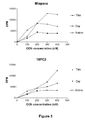
- the uptake efficiency of FAM-labeled oligonucleotide containing beta-D-amino-LNA was measured as the mean fluorescence intensity of the transfected cells by FACS analysis. Two different transfection agents were tested (Lipofectamine 2000 and DAC30) in two different cell lines (MiaPacall and 15PC3). Table 1. Oligonucleotides containing beta-D-amino-LNA used in cellular uptake and subcellular distribution experiments. Residue c is methyl-c both for DNA and LNA.
- the FAM-labeled oligonucleotide 2752 was also used to assay the subcellular distribution of oligonucleotides containing beta-D-amino-LNA, see figure 2 . Most of the staining was detected as nuclear fluorescence that appeared as bright spherical structures (the nucleoli is also stained) in a diffuse nucleoplasmic background, as well as some cytoplasmic staining in bright punctate structures. The observed distribution patterns were similar for 15PC3 and MiaPacall.
- beta-D-amino-LNA The subcellular distribution of beta-D-amino-LNA was comparable to the one observed with beta-D-oxy-LNA, 2740.
- the uptake efficiency was also measured with tritium-labeled oligonucleotide 2754 (see table 3 and figure 3 ) at different concentrations 100, 200, 300 and 400 nM, using Lipofectamine2000 as transfection agent, both in MiaPacall and 15PC3 cells, and compared with the equivalent beta-D-oxy-LNA, 2742 (see table 3). 2754 shows lower uptake than 2742.
- Antisense activity assay Luciferase target
- beta-D-oxy-LNA does not elicit RNaseH activity, which is the most common mode of action for an antisense oligonucleotide targeting the down-stream region of the mRNA.
- this disadvantage can be overcome by creating chimeric oligonucleotides composed of beta-D-oxy-LNA and a DNA gap positioned in the middle of the sequence.
- a gapmer is based on a central stretch of 4-12 DNA (gap) typically flanked by 1 to 6 residues of 2'-O modified nucleotides (beta-D-oxy-LNA in our case, flanks).
- the oligonucleotides from table 2 were prepared. We decided to carry out the study with gapmers of 16nt in length and a gap of 7nt, which contain 4 residues of beta-D-amino-LNA in one flank and 4 residues of beta-D-oxy-LNA in the other flank, and a thiolated gap. The FAM group was shown not to affect the antisense ability of the oligonucleotides. Therefore, we prepared a FAM-labelled oligonucleotide to be both tested in the Luciferase assay, and in the Cellular uptake (unassisted).
- the oligonucleotide which targets a motif of the mRNA of the Firefly Luciferase, contains two mismatches in the flanks. Two C residues of the 5'-end LNA flank were substituted for two Ts for synthetic reasons. At that point in time, only the T residues were available. Therefore and in order to be able to establish a correct comparison, the corresponding beta-D-oxy-LNA control was also included in the assay. No FAM labeling was necessary in this case.
- Table 2 Oligonucleotide containing beta-D-amino-LNA used in the antisense activity assay and the oxy-LNA control (Capital letters for LNA and small letters for DNA, T N is beta-D-amino-LNA).
- Residue c is methyl-c both for LNA.
- oligonucleotide with beta-D-amino-LNA presents good antisense activity at 50 nM oligonucleotide concentration.
- the inclusion of beta-D-amino- LNA in the flanks of an oligonucleotide results in good down-regulation.
- the antisense activity of an oligonucleotide containing beta-D-amino-LNA is at least as good as the parent all beta-D-oxy-LNA gapmer.
- Antisense activity assay Ha-Ras target
- oligonucleotides from table 3 were prepared. We decided to carry out the study with oligonucleotides of 16nt in length and a gap of 8nt, which contain 3 residues of beta-D-amino-LNA in each flank and a different extent of thiolation. 2754 is fully thiolated (PS), while 2755 is only thiolated in the gap (PO in the flanks and PS in the gap). The oligonucleotides were designed to target a motif of the mRNA of Ha-Ras. Different mismatch controls were also included, 2756 is fully thiolated and 2757 presents thiolation only in the gap, see table 3.
- beta-D-oxy-LNA gapmers (see table 3, 2742 is all PS, 2744 is the corresponding mismatch control; 2743 has PS in the gap, 2745 is the corresponding mismatch control) were also tested.
- Table 3 Oligonucleotides containing beta-D-amino-LNA and beta-D-oxy-LNA used in the antisense activity experiments. Residue c is methyl-c both for DNA and LNA.
- the Ras family of mammalian proto-oncogenes includes three well-known isoforms termed Ha-Ras (Ha-Ras), Ki-Ras (K-Ras) and N-Ras.
- the ras proto-oncogenes encode a group of plasma membrane associated G-proteins that bind guanine nucleotides with high affinity and activates several effectors including raf-1, Pl3-K etc. that are known to activate several distinct signaling cascades involved in the regulation of cellular survival, proliferation and differentiation.
- Ras family of proto-oncogenes are involved in the induction of malignant transformation. Consequently, the Ras family is regarded as important targets in development of anticancer drugs, and it has been found that the Ras proteins are either over-expressed or mutated (often leading to constitutive active Ras proteins) in approximately 25 % of all human cancers.
- the ras gene mutations in most cancer types are frequently limited to only one of the ras genes and are dependent on tumor type and tissue. Mutations in the Ha-Ras gene are mainly restricted to urinary tract and bladder cancer.
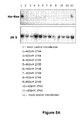
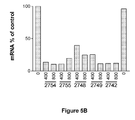
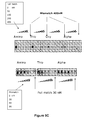
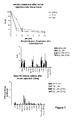
- beta-D-amino-LNA in the flanks of an oligonucleotide results in good down-regulation levels. From figure 5 , we can see that oligonucleotides with beta-D-amino-LNA present good antisense activity at two different concentrations, 400 and 800 nM. No significant difference in down-regulation can be seen between oligonucleotides 2755 and 2754, which present a different degree in thiolation. We can conclude that the antisense activity of an oligonucleotide containing beta-D-amino-LNA is at least as good as the parent beta-D-oxy-LNA gapmer. From figure 6 , a wider range of concentration was tested.
- oligonucleotides containing beta-D-amino-LNA (tritiated 2754) was also studied, both after i.v. injection and using Alzet osmotic minipumps.
- 2754 was administered to xenografted mice with 15PC3 tumors on the left side and MiaPacall tumors on the right side as an intraveneous injection, and the analysis was carried out after 30 min circulation. From figure 7 , the serum clearance for 2754 is very rapid, and the biodistribution looks very similar to the biodistribution pattern presented by the reference containing beta-D-oxy-LNA; the kidney and the liver (to lesser extent) are the main sites of uptake, when corrected for tissue weight.
- Rnase H is a ubiquitous cellular enzyme that specifically degrades the RNA strand of DNA/RNA hybrids, and thereby inactivates the mRNA toward further cellular metabolic processes.
- the inhibitory potency of some antisense agents seems to correlate with their ability to elicit ribonuclease H (RNaseH) degradation of the RNA target, which is considered a potent mode of action of antisense oligonucleotides.
- RNaseH ribonuclease H
- beta-D-amino-LNA beta-D-thio-LNA was also evaluated against a 3'-exonuclease (SVPD).
- SVPD 3'-exonuclease
- the oligonucleotide is synthesized on deoxynucleoside-support (t). The study was carried out with oligothymidylates by blocking the 3'-end with beta-D-thio-LNA.
- T s 2'-beta-D-thio-LNA
- the efficiency of FAM-labelled oligonucleotide uptake was measured as the mean fluorescence intensity of the transfected cells by FACS analysis.
- the transfection without lipid showed distinct differences between the tested oligonucleotides.
- the uptake as measured from mean fluorescence intensity of transfected cells was dose dependent. Gapmers (16nt in length and gap of 7nt) containing beta-D-thio-LNA in the flanks were analysed and compared with the corresponding beta-D-oxy-LNA gapmers. Beta-D-thio-LNA (one flank with beta-D-thio-LNA and the other one with oxy-LNA, as in table 5) showed higher uptake than oligonucleotides containing only oxy-LNA.
- beta-D-thio-LNA oligonucleotides both all-PO gapmer and gapmer with PS-gap and PO-flanks
- the beta-D-thio-LNA oligonucleotides had good uptake efficiency.
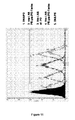
- the all-PO gapmer containing beta-D-thio-LNA was far superior to other all-PO oligonucleotides tested so far, as it can be appreciated from figure 11 .
- the uptake efficiency of FAM-labeled oligonucleotide containing beta-D-thio-LNA was measured as the mean fluorescence intensity of the transfected cells by FACS analysis. Two different transfection agents were tested (Lipofectamine 2000 and DAC30) in two different cell lines (MiaPacall and 15PC3). Table 4. Oligonucleotides containing beta-D-thio-LNA used in cellular uptake and subcellular distribution experiments.
- Residue c is methyl-c both for DNA and LNA DAC30 Lipofectamine 2000 ref oligonucleotides % cells % uptake % cells % uptake 2747 T S C S C S g s t s c s a s t s c s g s c s t s C s C s T s c-FAM - - 100 100 2746 T S s C S s C S s C S s g s t s c s a s t s c s g s c s t s C s s T s s c-FAM 80 50 100 100 2740 T s C s C s g s t s c s a s t s c s g s c s t s C s C s T s c-FAM 80 30 100 100 100 2740 T
- Oligonucleotides both fully thiolated (PS, 2746) and partially thiolated (PO in the flanks and PS in the gap, 2747) containing beta-D-thio-LNA listed in table 4 were transfected with good efficiency, see table 4. Both transfection agents, DAC30 and Lipofectamine, presented good transfection efficiency; however, Lipofectamine was superior. Lipofectamine showed 100% efficiency in all cases: for both oligonucleotides (2746 and 2747) and in both cell lines. Moreover, no significant differences in assisted transfection efficiency were observed between 2746 and 2747.
- the FAM-labeled oligonucleotide 2746 was also used to assay the subcellular distribution of oligonucleotides containing beta-D-thio-LNA, see figure 2 . Most of the staining was detected as nuclear fluorescence that appeared as bright spherical structures (the nucleoli is also stained) in a diffuse nucleoplasmic background, as well as some cytoplasmic staining in bright punctate structures. The observed distribution patterns were similar for 15PC3 and MiaPacall.
- beta-D-thio-LNA The subcellular distribution of beta-D-thio-LNA was comparable to the one observed with beta-D-oxy-LNA, 2740.
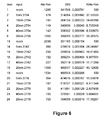
- the uptake efficiency was also measured with tritium-labeled oligonucleotide 2748 (see table 6 and figure 3 ) at different concentrations 100, 200, 300 and 400 nM, using Lipofectamine2000 as transfection agent, both in MiaPacall and 15PC3 cells, and compared with the equivalent beta-D-oxy-LNA, 2742 (see table 6). 2748 shows superior uptake than 2742.
- Antisense activity assay Luciferase target
- the FAM group was shown not to affect the antisense ability of the oligonucleotides. Therefore, we prepared a FAM-labelled oligonucleotide to be both tested in the Luciferase assay, and in the Cellular uptake (unassisted).
- the oligonucleotide which is directed against a motif of the mRNA of the firefly luciferase, contains two mismatches in the flanks. Two C residues of the 5'-end LNA flank were substituted for two Ts for synthetic reasons. At that point in time, only the T residues were available. Therefore and in order to be able to establish a correct comparison, the corresponding oxy-LNA control was also included in the assay. No FAM labeling was necessary in this case.
- the oligonucleotide with beta-D-thio-LNA presents good antisense activity at 50 nM oligonucleotide concentration. Therefore, the inclusion of beta-D-thio-LNA in the flanks of an oligonucleotide results in good down-regulation, and is at least as good as the parent all beta-D-oxy-LNA gapmer.
- Antisense activity assay Ha-Ras target
- oligonucleotides from table 6 were prepared. We decided to carry out the study with oligonucleotides of 16nt in length and a gap of 8nt, which contain 3 residues of beta-D-thio-LNA in each flank and a different extent of thiolation. 2748 is fully thiolated (PS), while 2749 is only thiolated in the gap (PO in the flanks and PS in the gap). The oligonucleotides were designed to target a motif of the mRNA of Ha-Ras. Different mismatch controls were also included, 2750 is fully thiolated and 2751 presents thiolation only in the gap, see table 6.
- beta-D-oxy-LNA gapmers (see table 6, 2742 is all PS, 2744 is the corresponding mismatch control; 2743 has PS in the gap, 2745 is the corresponding mismatch control) were also tested. Table 6. Oligonucleotides containing beta-D-thio-LNA and beta-D-oxy-LNA used in the antisense activity experiments. Residue c is methyl-c both for DNA and LNA.
- beta-D-thio-LNA in the flanks of an oligonucleotide results in good down-regulation levels. From figure 5 , we can see that oligonucleotides with beta-D-thio-LNA present good antisense activity at two different concentrations, 400 and 800 nM. No significant difference in down-regulation can be seen between oligonucleotides 2749 and 2748, which present a different degree in thiolation. However, 2749 presents better levels of down-regulation, both at 400 and 800 nM. We can conclude that the antisense activity of an oligonucleotide containing beta-D-thio-LNA lies in the range of the parent beta-D-oxy-LNA gapmer.
- oligonucleotides containing beta-D-thio-LNA (tritiated 2748) was also studied, both after i.v. injection and using Alzet osmotic minipumps.
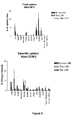
- 2748 was administered to xenografted mice with 15PC3 tumors on the left side and MiaPacall tumors on the right side as an intraveneous injection, and the analysis was carried out after 30 min circulation. From figure 7 , the serum clearance for 2748 is very rapid, and the biodistribution looks very similar to the biodistribution pattern presented by the reference containing beta-D-oxy-LNA; the kidney and the liver (to lesser extent) are the main sites of uptake, when corrected for tissue weight.
- FIG. 8 shows the distribution of 2748 in the tissues as a total uptake and as a specific uptake.
- the main sites of uptake were liver, muscle, kidney, skin and bone. When corrected for tissue weight, kidney and liver were the main uptake sites.
- alpha-L-oxy-LNA The stabilization properties of alpha-L-oxy-LNA were also evaluated.
- the study was carried out with oligothymidylates by blocking the 3'-end with alpha-L-oxy-LNA.
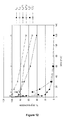
- the oligonucleotide is synthesized on deoxynucleoside-support (t). From figure 12 , we can see that the introduction of just one alpha-L-T (T ⁇ ) at the 3'-end of the oligonucleotide represents already a gain of 40% stability (after 2h digestion) with respect to the oxy-version, for which there was actually no gain. The addition of two modifications contributes even more to the stability of the oligonucleotide.
- beta-D-oxy-LNA, beta-D-amino-LNA, beta-D-thio-LNA and alpha-L-oxy-LNA stabilize oligonucleotides against nucleases.
- An order of efficiency in stabilization can be established: DNA phosphorothioates « oxy-LNA ⁇ ⁇ -L-oxy-LNA ⁇ beta-D-amino-LNA ⁇ beta-D-thio-LNA.
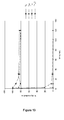
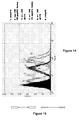
- the efficiency of FAM-labelled oligonucleotide uptake was measured as the mean fluorescence intensity of the transfected cells by FACS analysis. The uptake as measured from mean fluorescence intensity of transfected cells was dose dependent. Gapmers (16nt in length and gap of 7nt) containing ⁇ -L-oxy-LNA in the flanks were analysed and compared with the corresponding beta-D-oxy-LNA gapmer. ⁇ -L-oxy-LNA (in both flanks) showed higher uptake than the oligonucleotide containing only beta-D-oxy-LNA. Both all-PO and gapmer with PS-gap had good uptake efficiency; especially the all-PO gapmer was far superior than other all PO oligonucleotides tested so far, see figure 14 for FACS analysis.
- the uptake efficiency of FAM-labeled oligonucleotides containing alpha-L-oxy-LNA was measured as the mean fluorescence intensity of the transfected cells by FACS analysis. Two different transfection agents were tested (Lipofectamine 2000 and DAC30) in two different cancer cell lines (MiaPacall and 15PC3). Table 7. Oligonucleotides containing alpha-L-oxy-LNA used in cellular uptake and subcellular distribution experiments. Residue c is methyl-c both for DNA and LNA.
- Oligonucleotides both fully thiolated (PS, 2774) and partially thiolated (PO in the flanks and PS in the gap, 2773) containing alpha-L-oxy-LNA listed in table 7 were transfected with good efficiency, see table 7. Both transfection agents, DAC30 and Lipofectamine, presented good transfection efficiency; however, Lipofectamine was superior. Lipofectamine showed 100% efficiency in all cases: for both oligonucleotides (2773 and 2774) and in both cell lines. Moreover, no significant differences in assisted transfection efficiency were observed between 2773 and 2774.
- the FAM-labeled oligonucleotide 2774 was also used to assay the subcellular distribution of oligonucleotides containing alpha-L-oxy-LNA, see figure 2 . Most of the staining was detected as nuclear fluorescence that appeared as bright spherical structures (the nucleoli is also stained) in a diffuse nucleoplasmic background, as well as some cytoplasmic staining in bright punctate structures. The observed distribution patterns were similar for 15PC3 and MiaPacall.
- alpha-L-oxy-LNA was comparable to the one observed with beta-D-oxy-LNA, 2740.
- oligonucleotides were tested and compared with the corresponding FAM-labelled molecules, and no significant difference was appreciated between the free and FAM-labelled ones. Therefore, we included oligonucleotides from the Unassisted Cellular Uptake assay in the Luciferase assay study, assuming that the antisense activity will not be affected by the presence of the FAM group. From figure 16 , the oligonucleotide with alpha-L-oxy-LNA in the junctions shows potent antisense activity. It is actually 5-fold better than the corresponding all oxy-LNA gapmer (gap of 7nt), and slightly better than a gapmer with an optimised 9nt gap with oxy-LNA.
- the second design presents at least as good down-regulation levels as the observed for beta-D-oxy-LNA gapmers.
- alpha-L-oxy-LNA reveals to be a potent tool enabling the construction of different gapmers, which show good antisense activity.
- the placement of alpha-L-oxy-LNA in the junctions results in a very potent oligonucleotide.
- the length of the construct is usually designed to range from 15-25 nucleotide units, in order to ensure that optimal identification and binding takes place with a unique sequence in the mammalian genome and not with similar genetically redundant elements.
- Statistical analyses specify 11-15 base paired human sequences as the theoretical lower limits for sufficient recognition of a single genomic region. In practice, however, a longer oligonucleotide is commonly used to compensate for low melting transitions, especially for thiolated oligonucleotides that have lower affinity.
- the alpha-L-oxy-LNA can play an important role in enabling the design of short molecules by maintaining the required high-affinity, but also an optimal gap size. 12 and 14mers against a motif of the mRNA of the firefly luciferase were evaluated.
- alpha-L-oxy-LNA is a potent tool in enabling the design of short antisense oligonucleotides with significant down-regulation levels.
- beta-D-oxy-LNAs design 4-1-1-5-1-1-3
- the interruption of the gap with two beta-D-oxy-LNAs relates also with a loss in antisense activity.
- beta-D-oxy-LNA for alpha-L-oxy-LNA gives significant antisense activity, see figure 916.
- alpha-L-oxy-LNA reveals to be a potent tool enabling the construction of different mixmers, which are able to present high levels of antisense activity.
- Antisense activity assay Ha-Ras target
- oligonucleotides from table 9 were prepared. We decided to carry out the study with oligonucleotides of 16nt in length and a gap of 8nt, which contain 3 residues of alpha-L-oxy-LNA in each flank and a different extent of thiolation. 2776 is fully thiolated (PS), while 2775 is only thiolated in the gap (PO in the flanks and PS in the gap). The oligonucleotides were designed to target a motif of the mRNA of Ha-Ras. Different mismatch controls were also included, 2778 is fully thiolated and 2777 presents thiolation only in the gap, see table 9.
- beta-D-oxy-LNA gapmers (see table 9, 2742 is all PS, 2744 is the corresponding mismatch control; 2743 has PS in the gap, 2745 is the corresponding mismatch control) were also tested.
- Table 9 Oligonucleotides containing alpha-L-oxy-LNA and beta-D-oxy-LNA used in the antisense activity experiments. Residue c is methyl-c both for DNA and LNA.
- alpha-L-oxy-LNA in the flanks of an oligonucleotide results in good down-regulation levels. From figure 6 , we can see that the oligonucleotide 2776 with alpha-L-oxy-LNA present good antisense activity at a different range of concentrations, 50 nM-400 nM. No significant difference in down-regulation can be seen between 2776 and 2742. We can conclude that the antisense activity of an oligonucleotide containing alpha-L-oxy-LNA is at least as good as the parent beta-D-oxy-LNA gapmer.
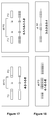
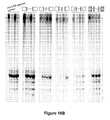
- alpha-L-oxy-LNA gapmer and mixmer designs recruit RnaseH activity, see figure 19 .
- Nude mice were injected s.c. with MiaPaca II cells (right flank) and 15PC3 cells (left flank) one week prior to the start of oligonucleotide treatment to allow xenograft growth.
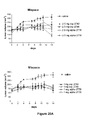
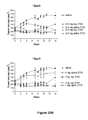
- the anti Ha-Ras oligonucleotides (2742 and 2776, table 10) and control oligonucleotides (2744 and 2778, table 10) were administrated for 14 days using Alzet osmotic minipumps (model 1002) implanted dorsally. Two dosages were used: 1 and 2.5 mg/Kg/day. During treatment the tumor growth was monitored.
- oligonucleotide containing alpha-L-oxy-LNA are as potent, or maybe even better, as the one containing beta-D-oxy-LNA in tumor growth inhibition in the concentration range tested.
- Table 10 Oligonucleotides containing alpha-L-oxy-LNA and beta-D-oxy-LNA used in the in vivo experiment.
- Residue c is methyl-c both for DNA and LNA ref oligonucleotides 2776 T ⁇ s C ⁇ s C ⁇ s g s t s c s a s t s c s g s c s t s C ⁇ s C ⁇ s T ⁇ s c match 2778 T ⁇ s C ⁇ s T ⁇ s g s t s a s a s t s a s g s c s s C ⁇ sC ⁇ s C ⁇ s c Mismatch control 2742 T s C s C s g s t s c s a s t s c s g s c s t s C s C s T s c match 2744 T s C s T s g s t s a s a a
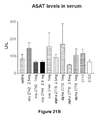
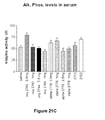
- ASAT aspartate aminotransferase
- ALAT alanine aminotransferase
- alkaline phosphatase alkaline phosphatase
- Design 3-9-3-1 has a deoxynucleoside residue at the 3'-end, see table 11 and figure 23 .
- oligonucleotides containing novel LNA monomers (beta-D-amino-, beta-D-thio- and alpha-L-LNA) and bearing a deoxynucleoside residue at the 3'-end were tested in different assays, see tables 3, 6, 9 and 10 for more detail.
Landscapes
- Chemical & Material Sciences (AREA)
- Health & Medical Sciences (AREA)
- Life Sciences & Earth Sciences (AREA)
- Engineering & Computer Science (AREA)
- Organic Chemistry (AREA)
- Genetics & Genomics (AREA)
- Molecular Biology (AREA)
- Biochemistry (AREA)
- Biotechnology (AREA)
- General Health & Medical Sciences (AREA)
- Biomedical Technology (AREA)
- Zoology (AREA)
- Wood Science & Technology (AREA)
- General Engineering & Computer Science (AREA)
- Bioinformatics & Cheminformatics (AREA)
- Plant Pathology (AREA)
- Microbiology (AREA)
- Biophysics (AREA)
- Physics & Mathematics (AREA)
- Veterinary Medicine (AREA)
- Medicinal Chemistry (AREA)
- Pharmacology & Pharmacy (AREA)
- Epidemiology (AREA)
- Animal Behavior & Ethology (AREA)
- Public Health (AREA)
- Virology (AREA)
- Pharmaceuticals Containing Other Organic And Inorganic Compounds (AREA)
- Medicines That Contain Protein Lipid Enzymes And Other Medicines (AREA)
- Enzymes And Modification Thereof (AREA)
Applications Claiming Priority (4)
| Application Number | Priority Date | Filing Date | Title |
|---|---|---|---|
| DKPA200201774 | 2002-11-18 | ||
| DKPA200301540 | 2003-10-20 | ||
| EP09169370.5A EP2141233B1 (fr) | 2002-11-18 | 2003-11-18 | Conception antisens |
| EP03773575A EP1569661B1 (fr) | 2002-11-18 | 2003-11-18 | Conception antisens |
Related Parent Applications (5)
| Application Number | Title | Priority Date | Filing Date |
|---|---|---|---|
| EP09169370.5A Division EP2141233B1 (fr) | 2002-11-18 | 2003-11-18 | Conception antisens |
| EP09169370.5A Division-Into EP2141233B1 (fr) | 2002-11-18 | 2003-11-18 | Conception antisens |
| EP03773575A Division EP1569661B1 (fr) | 2002-11-18 | 2003-11-18 | Conception antisens |
| EP03773575.0 Division | 2003-11-18 | ||
| EP09169370.5 Division | 2009-09-03 |
Publications (3)
| Publication Number | Publication Date |
|---|---|
| EP2284269A2 true EP2284269A2 (fr) | 2011-02-16 |
| EP2284269A3 EP2284269A3 (fr) | 2012-08-01 |
| EP2284269B1 EP2284269B1 (fr) | 2017-08-09 |
Family
ID=32327766
Family Applications (5)
| Application Number | Title | Priority Date | Filing Date |
|---|---|---|---|
| EP03773575A Expired - Lifetime EP1569661B1 (fr) | 2002-11-18 | 2003-11-18 | Conception antisens |
| EP10182316.9A Expired - Lifetime EP2284269B1 (fr) | 2002-11-18 | 2003-11-18 | Conception antisens |
| EP17170205.3A Expired - Lifetime EP3222722B1 (fr) | 2002-11-18 | 2003-11-18 | Conception antisens |
| EP14163184.6A Revoked EP2752488B1 (fr) | 2002-11-18 | 2003-11-18 | Conception antisens |
| EP09169370.5A Expired - Lifetime EP2141233B1 (fr) | 2002-11-18 | 2003-11-18 | Conception antisens |
Family Applications Before (1)
| Application Number | Title | Priority Date | Filing Date |
|---|---|---|---|
| EP03773575A Expired - Lifetime EP1569661B1 (fr) | 2002-11-18 | 2003-11-18 | Conception antisens |
Family Applications After (3)
| Application Number | Title | Priority Date | Filing Date |
|---|---|---|---|
| EP17170205.3A Expired - Lifetime EP3222722B1 (fr) | 2002-11-18 | 2003-11-18 | Conception antisens |
| EP14163184.6A Revoked EP2752488B1 (fr) | 2002-11-18 | 2003-11-18 | Conception antisens |
| EP09169370.5A Expired - Lifetime EP2141233B1 (fr) | 2002-11-18 | 2003-11-18 | Conception antisens |
Country Status (10)
| Country | Link |
|---|---|
| US (15) | US7687617B2 (fr) |
| EP (5) | EP1569661B1 (fr) |
| AT (1) | ATE442152T1 (fr) |
| AU (2) | AU2003281969B2 (fr) |
| CA (2) | CA2506576C (fr) |
| DE (1) | DE60329220D1 (fr) |
| DK (5) | DK2284269T3 (fr) |
| ES (1) | ES2607471T3 (fr) |
| HK (1) | HK1244504A1 (fr) |
| WO (1) | WO2004046160A2 (fr) |
Cited By (10)
| Publication number | Priority date | Publication date | Assignee | Title |
|---|---|---|---|---|
| US10538764B2 (en) | 2014-06-16 | 2020-01-21 | University Of Southampton | Reducing intron retention |
| US10683503B2 (en) | 2017-08-25 | 2020-06-16 | Stoke Therapeutics, Inc. | Antisense oligomers for treatment of conditions and diseases |
| US10696969B2 (en) | 2014-10-03 | 2020-06-30 | Cold Spring Harbor Laboratory | Targeted augmentation of nuclear gene output |
| US10941405B2 (en) | 2015-10-09 | 2021-03-09 | University Of Southampton | Modulation of gene expression and screening for deregulated protein expression |
| US11083745B2 (en) | 2015-12-14 | 2021-08-10 | Cold Spring Harbor Laboratory | Antisense oligomers for treatment of autosomal dominant mental retardation-5 and Dravet Syndrome |
| US11096956B2 (en) | 2015-12-14 | 2021-08-24 | Stoke Therapeutics, Inc. | Antisense oligomers and uses thereof |
| US11814622B2 (en) | 2020-05-11 | 2023-11-14 | Stoke Therapeutics, Inc. | OPA1 antisense oligomers for treatment of conditions and diseases |
| US12060558B2 (en) | 2018-05-04 | 2024-08-13 | Stoke Therapeutics, Inc. | Methods and compositions for treatment of cholesteryl ester storage disease |
| US12152243B2 (en) | 2020-09-17 | 2024-11-26 | Quelltx, Inc. | Therapeutic compositions for treating pain via multiple targets |
| US12577561B2 (en) | 2019-02-27 | 2026-03-17 | Stoke Therapeutics, Inc. | Antisense oligomers for treatment of conditions and diseases |
Families Citing this family (314)
| Publication number | Priority date | Publication date | Assignee | Title |
|---|---|---|---|---|
| ATE556714T1 (de) | 2002-02-01 | 2012-05-15 | Life Technologies Corp | Doppelsträngige oligonukleotide |
| US20060009409A1 (en) | 2002-02-01 | 2006-01-12 | Woolf Tod M | Double-stranded oligonucleotides |
| EP1572902B1 (fr) * | 2002-02-01 | 2014-06-11 | Life Technologies Corporation | Courts fragments d'arn interferant haute activite visant a reduire l'expression de genes cibles |
| AU2003225495B2 (en) | 2002-04-05 | 2009-01-15 | Roche Innovation Center Copenhagen A/S | Oligomeric compounds for the modulation HIF-1alpha expression |
| US20040248094A1 (en) * | 2002-06-12 | 2004-12-09 | Ford Lance P. | Methods and compositions relating to labeled RNA molecules that reduce gene expression |
| US20040219565A1 (en) | 2002-10-21 | 2004-11-04 | Sakari Kauppinen | Oligonucleotides useful for detecting and analyzing nucleic acids of interest |
| WO2004046160A2 (fr) | 2002-11-18 | 2004-06-03 | Santaris Pharma A/S | Conception antisens |
| US7480382B2 (en) * | 2003-09-30 | 2009-01-20 | Microsoft Corporation | Image file container |
| WO2005061710A1 (fr) | 2003-12-23 | 2005-07-07 | Santaris Pharma A/S | Composes oligomeres permettant la modulation de bcl-2 |
| MX2007005558A (es) | 2004-11-09 | 2008-01-31 | Santaris Pharma As | Oligonucleotidos de lna potentes para la inhibicion dela expresion de hif-1a. |
| US9447138B2 (en) | 2004-11-09 | 2016-09-20 | Roche Innovation Center Copenhagen A/S | Potent LNA oligonucleotides for the inhibition of HIF-1a expression |
| EP1838870A2 (fr) * | 2004-12-29 | 2007-10-03 | Exiqon A/S | Nouvelles compositions d'oligonucleotides et sequences de sondes utiles pour la detection et l'analyse de microarn et de leurs marn cibles |
| JP5713377B2 (ja) | 2005-12-28 | 2015-05-07 | ザ スクリプス リサーチ インスティテュート | 薬物標的としての天然アンチセンスおよび非コードrna転写物 |
| SG10201406016SA (en) | 2006-04-03 | 2014-11-27 | Stella Aps | Pharmaceutical composition comprising anti-mirna antisense oligonucleotides |
| EP2007888A2 (fr) | 2006-04-03 | 2008-12-31 | Santaris Pharma A/S | Composition pharmaceutique comprenant des oligonucleotides antisens anti-miarn |
| AU2012216487B2 (en) * | 2006-04-03 | 2015-05-14 | Roche Innovation Center Copenhagen A/S | Pharmaceutical composition comprising anti-miRNA antisense oligonucleotides |
| JP2009536222A (ja) | 2006-05-05 | 2009-10-08 | アイシス ファーマシューティカルズ, インコーポレーテッド | Pcsk9の発現を調節するための化合物および方法 |
| CA2666191C (fr) * | 2006-10-09 | 2017-07-11 | Santaris Pharma A/S | Composes antagonistes de l'arn pour la modulation de pcsk9 |
| ES2526295T5 (es) | 2006-10-18 | 2021-05-04 | Ionis Pharmaceuticals Inc | Compuestos antisentido |
| US8093222B2 (en) | 2006-11-27 | 2012-01-10 | Isis Pharmaceuticals, Inc. | Methods for treating hypercholesterolemia |
| CA2670563A1 (fr) * | 2006-11-27 | 2008-06-05 | Isis Pharmaceuticals, Inc. | Procedes pour traiter l'hypercholesterolemie |
| DK2149605T3 (da) | 2007-03-22 | 2013-09-30 | Santaris Pharma As | Korte RNA antagonist forbindelser til modulering af det ønskede mRNA |
| US8470791B2 (en) | 2007-03-22 | 2013-06-25 | Santaris Pharma A/S | RNA antagonist compounds for the inhibition of Apo-B100 expression |
| CA2682082A1 (fr) | 2007-03-24 | 2008-10-02 | Genzyme Corporation | Administration d'oligonucleotides |
| DK2152879T3 (da) | 2007-05-01 | 2013-02-18 | Santaris Pharma As | RNA antagonistforbindelser til modulering af beta-catenin |
| CA2686908A1 (fr) | 2007-05-11 | 2008-11-20 | Enzon Pharmaceuticals, Inc. | Composes antagonistes de l'arn modulamt le her3 |
| CA2688321A1 (fr) * | 2007-05-30 | 2008-12-11 | Isis Pharmaceuticals, Inc. | Analogues d'acides nucleiques bicycliques pontes par aminomethylene n-substitue |
| AU2008272918B2 (en) † | 2007-07-05 | 2012-09-13 | Isis Pharmaceuticals, Inc. | 6-disubstituted bicyclic nucleic acid analogs |
| EP2195428B1 (fr) | 2007-09-19 | 2013-12-11 | Applied Biosystems, LLC | Formats de modification indépendants d'une séquence d'arnsi pour réduire des effets phénotypiques hors cible dans de l'arni, et formes stabilisées de ceux-ci |
| EP2623599B1 (fr) | 2007-10-04 | 2019-01-02 | Roche Innovation Center Copenhagen A/S | Oligonucléotides micromir |
| WO2009068033A2 (fr) | 2007-11-26 | 2009-06-04 | Santaris Pharma A/S | Antagonistes basés sur les lna ciblant le récepteur de l'androgène |
| US8450290B2 (en) | 2007-11-26 | 2013-05-28 | Enzon Pharmaceuticals, Inc. | Methods for treating androgen receptor dependent disorders including cancers |
| KR20100105648A (ko) | 2007-12-03 | 2010-09-29 | 엔즌 파마슈티칼스, 인코포레이티드 | Pik3ca 발현 조절용 rna 길항제 화합물 |
| CA2717792A1 (fr) | 2008-03-07 | 2009-09-11 | Santaris Pharma A/S | Compositions pharmaceutiques pour le traitement de maladies associees aux microarn |
| EP2274423A2 (fr) * | 2008-04-04 | 2011-01-19 | Isis Pharmaceuticals, Inc. | Composés oligomères comprenant des nucléosides bicycliques et ayant une toxicité réduite |
| WO2010012667A1 (fr) | 2008-08-01 | 2010-02-04 | Santaris Pharma A/S | Modulation à médiation par micro-arn de facteurs stimulateurs de colonies |
| CN102239260B (zh) * | 2008-10-03 | 2017-04-12 | 库尔纳公司 | 通过抑制针对载脂蛋白‑a1的天然反义转录物治疗载脂蛋白‑a1相关疾病 |
| ES2600781T3 (es) | 2008-12-04 | 2017-02-10 | Curna, Inc. | Tratamiento para enfermedades relacionadas con el factor de crecimiento del endotelio vascular (vegf) mediante la inhibición de transcritos antisentido naturales de vegf |
| ES2629630T3 (es) | 2008-12-04 | 2017-08-11 | Curna, Inc. | Tratamiento de enfermedades relacionadas con eritropoyetina (EPO) mediante inhibición del transcrito antisentido natural a EPO |
| US20110294870A1 (en) | 2008-12-04 | 2011-12-01 | Opko Curna, Llc | Treatment of tumor suppressor gene related diseases by inhibition of natural antisense transcript to the gene |
| ES2762610T3 (es) | 2009-02-12 | 2020-05-25 | Curna Inc | Tratamiento de enfermedades relacionadas con el factor neurotrófico derivado de cerebro (BDNF) por inhibición de transcrito antisentido natural para BDNF |
| CN102482677B (zh) | 2009-03-16 | 2017-10-17 | 库尔纳公司 | 通过抑制nrf2的天然反义转录物治疗核因子(红细胞衍生2)‑样2(nrf2)相关疾病 |
| EP2408796B1 (fr) | 2009-03-16 | 2020-04-22 | Ionis Pharmaceuticals, Inc. | Ciblage de l'Apolipoprotéine B pour la réduction de l'apolipoprotéine C-III |
| WO2010107740A2 (fr) | 2009-03-17 | 2010-09-23 | Curna, Inc. | Traitement des maladies associées à l'homologue du delta-like 1 (dlk1) par inhibition du transcrit antisens naturel de dlk1 |
| ES2599979T3 (es) | 2009-04-24 | 2017-02-06 | Roche Innovation Center Copenhagen A/S | Composiciones farmacéuticas para el tratamiento de pacientes de VHC que no responden al interferón |
| CN103223177B (zh) | 2009-05-06 | 2016-08-10 | 库尔纳公司 | 通过针对脂质转运和代谢基因的天然反义转录物的抑制治疗脂质转运和代谢基因相关疾病 |
| ES2609655T3 (es) | 2009-05-06 | 2017-04-21 | Curna, Inc. | Tratamiento de enfermedades relacionadas con tristetraprolina (TTP) mediante inhibición de transcrito antisentido natural para TTP |
| JP5931720B2 (ja) | 2009-05-08 | 2016-06-08 | クルナ・インコーポレーテッド | Dmdファミリーに対する天然アンチセンス転写物の抑制によるジストロフィンファミリー関連疾患の治療 |
| DK2432881T3 (en) | 2009-05-18 | 2018-02-26 | Curna Inc | TREATMENT OF REPROGRAMMING FACTOR-RELATED DISEASES BY INHIBITING NATURAL ANTISENSE TRANSCRIPTS TO A REPROGRAMMING FACTOR |
| CA2762987A1 (fr) | 2009-05-22 | 2010-11-25 | Joseph Collard | Traitement des maladies liees au facteur de transcription e3 (tfe3) et au substrat recepteur d'insuline 2 (irs2) par inhibition du transcript antisens naturel du tfe3 |
| KR101704988B1 (ko) | 2009-05-28 | 2017-02-08 | 큐알엔에이, 인크. | 항바이러스 유전자에 대한 천연 안티센스 전사체의 억제에 의한 항바이러스 유전자 관련된 질환의 치료 |
| CA2764822A1 (fr) | 2009-06-12 | 2010-12-16 | Santaris Pharma A/S | Nouveaux composes antisens anti-apob puissants |
| US8951981B2 (en) | 2009-06-16 | 2015-02-10 | Curna, Inc. | Treatment of paraoxonase 1 (PON1) related diseases by inhibition of natural antisense transcript to PON1 |
| WO2010148050A2 (fr) | 2009-06-16 | 2010-12-23 | Curna, Inc. | Traitement de maladies liées au gène du collagène par inhibition d'un produit de transcription antisens naturel à un gène du collagène |
| WO2010151671A2 (fr) | 2009-06-24 | 2010-12-29 | Curna, Inc. | Traitement de maladies associées au récepteur de facteur nécrosant des tumeurs 2 (tnfr2) par inhibition de la transcription antisens naturelle de tnfr2 |
| EP2446037B1 (fr) | 2009-06-26 | 2016-04-20 | CuRNA, Inc. | Traitement de maladies associées aux gènes liés au syndrome de down par inhibition des gènes liés au syndrome de down médiée par le produit de transcription antisens naturel |
| EP2456870A1 (fr) | 2009-07-21 | 2012-05-30 | Santaris Pharma A/S | Oligomères anti-sens ciblant pcsk9 |
| CN102712925B (zh) | 2009-07-24 | 2017-10-27 | 库尔纳公司 | 通过抑制sirtuin(sirt)的天然反义转录物来治疗sirtuin(sirt)相关性疾病 |
| CN102762731B (zh) | 2009-08-05 | 2018-06-22 | 库尔纳公司 | 通过抑制针对胰岛素基因(ins)的天然反义转录物来治疗胰岛素基因(ins)相关的疾病 |
| CN104313027B (zh) | 2009-08-11 | 2018-11-20 | 库尔纳公司 | 通过抑制脂连蛋白(adipoq)的天然反义转录物治疗脂连蛋白(adipoq)相关疾病 |
| KR101805213B1 (ko) | 2009-08-21 | 2017-12-06 | 큐알엔에이, 인크. | Chip에 대한 천연 안티센스 전사체의 억제에 의한 “hsp70-상호작용 단백질(chip)의 c-말단” 관련된 질환의 치료 |
| CA2771172C (fr) | 2009-08-25 | 2021-11-30 | Opko Curna, Llc | Traitement de maladies associees a la proteine d'activation de gtpase contenant un motif iq (iqgap), par inhibition d'un transcrit antisens naturel de iqgap |
| US20120295952A1 (en) | 2009-09-25 | 2012-11-22 | Curna, Inc. | Treatment of filaggrin (flg) related diseases by modulation of flg expression and activity |
| BR112012008865A2 (pt) * | 2009-10-16 | 2019-09-24 | Glaxo Group Ltd | inibidores de hbv anti-sentido. |
| EP2490699A1 (fr) | 2009-10-20 | 2012-08-29 | Santaris Pharma A/S | Administration orale d'oligonucléotides de lna thérapeutiquement efficaces |
| WO2011054811A1 (fr) | 2009-11-03 | 2011-05-12 | Santaris Pharma A/S | Traitement combiné par des antagonistes d'arn ciblant hsp-27 |
| JP6025567B2 (ja) | 2009-12-16 | 2016-11-16 | カッパーアールエヌエー,インコーポレイテッド | 膜結合転写因子ペプチダーゼ、部位1(mbtps1)に対する天然アンチセンス転写物の阻害によるmbtps1関連性疾患の治療 |
| CN102869776B (zh) | 2009-12-23 | 2017-06-23 | 库尔纳公司 | 通过抑制肝细胞生长因子(hgf)的天然反义转录物而治疗hgf相关疾病 |
| RU2619185C2 (ru) | 2009-12-23 | 2017-05-12 | Курна, Инк. | Лечение заболеваний, связанных с разобщающим белком 2 (ucp2), путем ингибирования природного антисмыслового транскрипта к ucp2 |
| EP2519633B1 (fr) | 2009-12-29 | 2017-10-25 | CuRNA, Inc. | Traitement de maladies liées au facteur respiratoire nucléaire 1 (nrf1) par l'inhibition du produit de transcription antisens naturel de nrf1 |
| ES2585829T3 (es) | 2009-12-29 | 2016-10-10 | Curna, Inc. | Tratamiento de las enfermedades relacionadas con la proteína tumoral 63 (p63) por inhibición de transcripción antisentido natural a p63 |
| CA2785727C (fr) | 2009-12-31 | 2020-01-07 | Curna, Inc. | Traitement de maladies liees au substrat 2 du recepteur de l'insuline (irs2) par inhibition du produit de transcription antisens naturel d'irs2 et du facteur de transcription e3 (tfe3) |
| CA2785832A1 (fr) | 2010-01-04 | 2011-07-07 | Curna, Inc. | Traitement de maladies liees au facteur de regulation de l'interferon 8 (irf8) par l'inhibition du produit de transcription antisens naturel de l'irf8 |
| KR101853509B1 (ko) | 2010-01-06 | 2018-04-30 | 큐알엔에이, 인크. | 췌장 발달 유전자에 대한 천연 안티센스 전사체의 억제에 의한 췌장 발달 유전자와 관련된 질환의 치료 |
| JP6027893B2 (ja) | 2010-01-11 | 2016-11-16 | カッパーアールエヌエー,インコーポレイテッド | 性ホルモン結合グロブリン(shbg)に対する天然アンチセンス転写物の阻害による性ホルモン結合グロブリン(shbg)関連疾患の治療 |
| EP2529015B1 (fr) | 2010-01-25 | 2017-11-15 | CuRNA, Inc. | Traitement de maladies liées à la rnase h1 par l'inhibition du produit de transcription naturel antisens de la rnase h1 |
| CN102844435B (zh) | 2010-02-22 | 2017-05-10 | 库尔纳公司 | 通过抑制吡咯啉‑5‑羧酸还原酶1(pycr1)的天然反义转录物而治疗pycr1相关疾病 |
| RU2612884C2 (ru) | 2010-04-02 | 2017-03-13 | Курна, Инк. | Лечение заболеваний, связанных с колониестимулирующим фактором 3 (csf3), путем ингибирования природного антисмыслового транскрипта k csf3 |
| WO2011127337A2 (fr) | 2010-04-09 | 2011-10-13 | Opko Curna Llc | Traitement des maladies associées au facteur de croissance du fibroblaste 21 (fgf21) par l'inhibition d'un produit de la transcription antisens naturel de fgf21 |
| WO2011139387A1 (fr) | 2010-05-03 | 2011-11-10 | Opko Curna, Llc | Traitement de maladies liées à une sirtuine (sirt) par inhibition de la transcription antisens naturelle pour donner une sirtuine (sirt) |
| TWI531370B (zh) | 2010-05-14 | 2016-05-01 | 可娜公司 | 藉由抑制par4天然反股轉錄本治療par4相關疾病 |
| ES2664585T3 (es) | 2010-05-26 | 2018-04-20 | Curna, Inc. | Tratamiento de enfermedades relacionadas con metionina sulfóxido reductasa (MSRA) mediante inhibición del transcrito antisentido natural a MSRA |
| US8895528B2 (en) | 2010-05-26 | 2014-11-25 | Curna, Inc. | Treatment of atonal homolog 1 (ATOH1) related diseases by inhibition of natural antisense transcript to ATOH1 |
| CN109112126B (zh) | 2010-06-23 | 2024-06-14 | 库尔纳公司 | 通过抑制电压门控钠通道α亚基(SCNA)的天然反义转录物而治疗SCNA相关疾病 |
| WO2012007477A1 (fr) | 2010-07-12 | 2012-01-19 | Santaris Pharma A/S | Oligomères anti-vhc |
| JP5998131B2 (ja) | 2010-07-14 | 2016-09-28 | カッパーアールエヌエー,インコーポレイテッド | Discslargehomolog(dlg)dlg1への天然アンチセンス転写物の阻害によるdlg関連疾患の治療 |
| GB201012418D0 (en) | 2010-07-23 | 2010-09-08 | Santaris Pharma As | Process |
| WO2012034942A1 (fr) | 2010-09-13 | 2012-03-22 | Santaris Pharma A/S | Composés pour la modulation de l'expression de la kinase aurora b |
| CN103210086B (zh) | 2010-10-06 | 2017-06-09 | 库尔纳公司 | 通过抑制唾液酸酶4(neu4)的天然反义转录物而治疗neu4相关疾病 |
| KR101865433B1 (ko) | 2010-10-22 | 2018-07-13 | 큐알엔에이, 인크. | 알파-l 이두로니다아제 (idua)에 대한 자연 안티센스 전사체의 저해에 의한 idua 관련된 질환의 치료 |
| US9920317B2 (en) | 2010-11-12 | 2018-03-20 | The General Hospital Corporation | Polycomb-associated non-coding RNAs |
| CA2817256A1 (fr) | 2010-11-12 | 2012-05-18 | The General Hospital Corporation | Arn non codants associes a polycomb |
| AU2011326034B2 (en) | 2010-11-12 | 2016-02-04 | Roche Innovation Center Copenhagen A/S | Compositions and methods for treating androgen receptor dependent disorders including cancers |
| US10000752B2 (en) | 2010-11-18 | 2018-06-19 | Curna, Inc. | Antagonat compositions and methods of use |
| WO2012066092A1 (fr) | 2010-11-19 | 2012-05-24 | Santaris Pharma A/S | Composés de modulation de l'expression de l'aurora kinase a |
| WO2012066093A1 (fr) | 2010-11-19 | 2012-05-24 | Santaris Pharma A/S | Composés pour la modulation de l'expression de la protéine kinase pbk à liaison avec pdz |
| WO2012071238A2 (fr) | 2010-11-23 | 2012-05-31 | Opko Curna Llc | Traitement de maladies associées à nanog par l'inhibition d'un transcript antisens naturel de nanog |
| KR20140004646A (ko) | 2010-12-15 | 2014-01-13 | 미라젠 세러퓨틱스 | 잠금 뉴클레오티드를 포함하는 마이크로rna 억제제 |
| EP2673361B1 (fr) | 2011-02-08 | 2016-04-13 | Ionis Pharmaceuticals, Inc. | Composés oligomères comprenant des nucléotides bicycliques et leurs utilisations |
| WO2012110457A2 (fr) | 2011-02-14 | 2012-08-23 | Santaris Pharma A/S | Composés pour la modulation de l'expression de l'ostéopontine |
| WO2012143427A1 (fr) | 2011-04-19 | 2012-10-26 | Santaris Pharma A/S | Composés anti-polyomavirus |
| KR102043422B1 (ko) | 2011-06-09 | 2019-11-11 | 큐알엔에이, 인크. | 프라탁신 (fxn)에 대한 자연 안티센스 전사체의 저해에 의한 프라탁신 (fxn) 관련된 질환의 치료 |
| US10202599B2 (en) | 2011-08-11 | 2019-02-12 | Ionis Pharmaceuticals, Inc. | Selective antisense compounds and uses thereof |
| MX365525B (es) | 2011-09-06 | 2019-06-06 | Curna Inc | Compuestos que regulan la expresión de subunidades alfa de canales de sodio regulados por voltaje en enfermedades relacionadas con epilepsia mioclónica severa de la infancia. |
| AU2012308320C1 (en) | 2011-09-14 | 2018-08-23 | Translate Bio Ma, Inc. | Multimeric oligonucleotide compounds |
| KR20140091688A (ko) | 2011-10-06 | 2014-07-22 | 미라젠 세러퓨틱스 인코포레이티드 | 마이크로rna 조절에 의한 전신 에너지 항상성의 제어 |
| US10184151B2 (en) | 2011-10-11 | 2019-01-22 | The Brigham And Women's Hospital, Inc. | Micrornas in neurodegenerative disorders |
| HK1210211A1 (en) | 2012-03-15 | 2016-04-15 | 科纳公司 | Treatment of brain derived neurotrophic factor (bdnf) related diseases by inhibition of natural antisense transcript to bdnf |
| WO2013159108A2 (fr) | 2012-04-20 | 2013-10-24 | Isis Pharmaceuticals, Inc. | Composés oligomères comprenant des nucléotides bicycliques et utilisations de ceux-ci |
| BR112014028631A2 (pt) | 2012-05-16 | 2017-10-17 | Rana Therapeutics Inc | composições e métodos para modulação da expressão da família de genes da hemoglobina |
| EA201492122A1 (ru) | 2012-05-16 | 2015-10-30 | Рана Терапьютикс, Инк. | Композиции и способы для модулирования экспрессии utrn |
| US10837014B2 (en) | 2012-05-16 | 2020-11-17 | Translate Bio Ma, Inc. | Compositions and methods for modulating SMN gene family expression |
| SG11201407483YA (en) | 2012-05-16 | 2014-12-30 | Rana Therapeutics Inc | Compositions and methods for modulating smn gene family expression |
| EA201492116A1 (ru) | 2012-05-16 | 2015-05-29 | Рана Терапьютикс, Инк. | Композиции и способы для модулирования экспрессии mecp2 |
| AU2013262699A1 (en) | 2012-05-16 | 2015-01-22 | Rana Therapeutics, Inc. | Compositions and methods for modulating ATP2A2 expression |
| CN107236735B (zh) | 2012-06-21 | 2019-11-08 | 米拉根医疗股份有限公司 | 包含锁核酸基序的基于寡核苷酸的抑制剂 |
| US20150247141A1 (en) | 2012-09-14 | 2015-09-03 | Rana Therapeutics, Inc. | Multimeric oligonucleotide compounds |
| US9695418B2 (en) | 2012-10-11 | 2017-07-04 | Ionis Pharmaceuticals, Inc. | Oligomeric compounds comprising bicyclic nucleosides and uses thereof |
| CN104837996A (zh) | 2012-11-15 | 2015-08-12 | 罗氏创新中心哥本哈根有限公司 | 抗apob反义缀合物化合物 |
| WO2014080004A1 (fr) | 2012-11-26 | 2014-05-30 | Santaris Pharma A/S | Compositions et méthodes pour la modulation de l'expression de fgfr3 |
| AU2014211406B2 (en) | 2013-01-30 | 2019-07-18 | Roche Innovation Center Copenhagen A/S | LNA oligonucleotide carbohydrate conjugates |
| CN105247052A (zh) | 2013-05-24 | 2016-01-13 | 罗氏创新中心哥本哈根有限公司 | B-细胞cll/淋巴瘤11a(bcl11a)的寡核苷酸调节剂及其用途 |
| HUE048738T2 (hu) | 2013-06-27 | 2020-08-28 | Roche Innovation Ct Copenhagen As | Antiszensz oligomerek és konjugátumok, amelyek a PCK9-t célozzák meg |
| CA2921556A1 (fr) * | 2013-08-16 | 2015-02-19 | Rana Therapeutics, Inc. | Compositions et procedes pour la modulation d'arn |
| WO2015051283A1 (fr) | 2013-10-04 | 2015-04-09 | Rana Therapeutics, Inc. | Compositions et méthodes pour traiter la sclérose latérale amyotrophique (sla) |
| GB201408623D0 (en) | 2014-05-15 | 2014-07-02 | Santaris Pharma As | Oligomers and oligomer conjugates |
| WO2016024205A1 (fr) | 2014-08-15 | 2016-02-18 | Pfizer Inc. | Oligomères ciblant l'expansion d'une répétition hexanucléotidique dans le gène c9orf72 humain |
| WO2016040589A1 (fr) | 2014-09-12 | 2016-03-17 | Alnylam Pharmaceuticals, Inc. | Agents polynucléotidiques ciblant le composant du complément c5 et leurs méthodes d'utilisation |
| CN106795200B (zh) | 2014-10-10 | 2020-06-19 | 豪夫迈·罗氏有限公司 | Galnac亚磷酰胺、其核酸缀合物及其用途 |
| WO2016061487A1 (fr) | 2014-10-17 | 2016-04-21 | Alnylam Pharmaceuticals, Inc. | Agents polynucléotidiques de ciblage d'acide aminolévulinique synthase-1 (alas1) et utilisations de ceux-ci |
| EP3212794B1 (fr) | 2014-10-30 | 2021-04-07 | Genzyme Corporation | Agents polynucléotidiques ciblant serpinc 1 (at3) et leurs méthodes d'utilisation |
| WO2016070060A1 (fr) | 2014-10-30 | 2016-05-06 | The General Hospital Corporation | Procédés de modulation de la répression génique dépendant d'atrx |
| EP3020813A1 (fr) | 2014-11-16 | 2016-05-18 | Neurovision Pharma GmbH | Oligonculéotides antisens en tant qu'inhibiteurs de la signalisation de TGF-R |
| US10815481B2 (en) | 2014-12-16 | 2020-10-27 | Roche Innovation Center Copenhagen A/S | Chiral library screen |
| EP3247716A4 (fr) | 2015-01-20 | 2018-10-17 | Miragen Therapeutics, Inc. | Inhibiteurs de mir-92 et utilisations associées |
| CN115181778A (zh) | 2015-02-04 | 2022-10-14 | 百时美施贵宝公司 | 选择治疗性分子的方法 |
| US11077132B2 (en) | 2015-02-04 | 2021-08-03 | F. Hoffmann-La Roche Ag | Tau antisense oligomers and uses thereof |
| WO2016127002A1 (fr) * | 2015-02-04 | 2016-08-11 | Bristol-Myers Squibb Company | Oligonucléotides lna à flancs alternés |
| US10758558B2 (en) | 2015-02-13 | 2020-09-01 | Translate Bio Ma, Inc. | Hybrid oligonucleotides and uses thereof |
| WO2016149455A2 (fr) | 2015-03-17 | 2016-09-22 | The General Hospital Corporation | Interactome arn de complexe répressif polycomb 1 (prc1) |
| US10745702B2 (en) | 2015-04-08 | 2020-08-18 | Alnylam Pharmaceuticals, Inc. | Compositions and methods for inhibiting expression of the LECT2 gene |
| EP3310918B1 (fr) | 2015-06-18 | 2020-08-05 | Alnylam Pharmaceuticals, Inc. | Agents polynucléotidiques ciblant l'hydroxyacide oxydase (glycolate oxydase, hao1) et procédés d'utilisation de ceux-ci |
| JP6835826B2 (ja) | 2015-08-24 | 2021-02-24 | ロシュ イノベーション センター コペンハーゲン エーエス | Lna−gプロセス |
| WO2017068087A1 (fr) | 2015-10-22 | 2017-04-27 | Roche Innovation Center Copenhagen A/S | Procédé de détection d'oligonucléotides |
| US10955407B2 (en) | 2015-10-22 | 2021-03-23 | Roche Innovation Center Copenhagen A/S | In vitro toxicity screening assay |
| LT3374509T (lt) | 2015-11-12 | 2021-03-10 | F. Hoffmann-La Roche Ag | Oligonukleotidai, skirti sukelti iš tėvo paveldėto ube3a raišką |
| RU2747822C2 (ru) | 2016-03-14 | 2021-05-14 | Ф. Хоффманн-Ля Рош Аг | Олигонуклеотиды для понижения экспрессии pd-l1 |
| WO2017178656A1 (fr) | 2016-04-14 | 2017-10-19 | Roche Innovation Center Copenhagen A/S | Composés trityl-mono-galnac et leur utilisation |
| JP7012033B2 (ja) | 2016-06-17 | 2022-02-10 | エフ.ホフマン-ラ ロシュ アーゲー | インビトロ腎毒性スクリーニングアッセイ |
| EP4219767A1 (fr) | 2016-06-17 | 2023-08-02 | F. Hoffmann-La Roche AG | Inhibiteurs de papd5 et de papd7 pour le traitement d'une infection par l'hépatite b |
| CN109328236B (zh) | 2016-06-17 | 2022-10-25 | 豪夫迈·罗氏有限公司 | 体外肾毒性筛选测定法 |
| MX2018015722A (es) | 2016-07-01 | 2019-05-27 | Hoffmann La Roche | Oligonucleotidos antisentido para modular expresion del requisito de alta temperatura a 1 (htra1). |
| US20190284621A1 (en) | 2016-11-11 | 2019-09-19 | Roche Innovation Center Copenhagen A/S | Therapeutic oligonucleotides capture and detection |
| EP3568479A1 (fr) | 2017-01-13 | 2019-11-20 | Roche Innovation Center Copenhagen A/S | Oligonucléotides antisens pour moduler l'expression de nfkb1 |
| EP3568477A1 (fr) | 2017-01-13 | 2019-11-20 | Roche Innovation Center Copenhagen A/S | Oligonucléotides antisens pour moduler l'expression de rela |
| EP3568478A1 (fr) | 2017-01-13 | 2019-11-20 | Roche Innovation Center Copenhagen A/S | Oligonucléotides antisens pour moduler l'expression de rel |
| WO2018130584A1 (fr) | 2017-01-13 | 2018-07-19 | Roche Innovation Center Copenhagen A/S | Oligonucléotides antisens pour la modulation de l'expression de nfkb2 |
| US20190345496A1 (en) | 2017-01-13 | 2019-11-14 | Roche Innovation Center Copenhagen A/S | Antisense oligonucleotides for modulating relb expression |
| US20190055564A1 (en) | 2017-06-01 | 2019-02-21 | F. Hoffmann-La Roche Ag | Antisense oligonucleotides for modulating htra1 expression |
| WO2019030313A2 (fr) | 2017-08-11 | 2019-02-14 | Roche Innovation Center Copenhagen A/S | Oligonucléotides pour la modulation de l'expression de ube3c |
| WO2019038228A1 (fr) | 2017-08-22 | 2019-02-28 | Roche Innovation Center Copenhagen A/S | Oligonucléotides pour la modulation de l'expression de tom1 |
| EP3694995A1 (fr) | 2017-10-13 | 2020-08-19 | Roche Innovation Center Copenhagen A/S | Procédés d'identification de variants d'oligonucléotides phosphorothioate stéréodéfinis améliorés d'oligonucléotides antisens mettant en uvre des sous-bibliothèques d'oligonucléotides partiellement stéréodéfinis |
| CN111511914B (zh) | 2017-10-16 | 2023-11-17 | 豪夫迈·罗氏有限公司 | 减少PAPD5和PAPD7 mRNA的核酸分子用于治疗乙型肝炎感染 |
| WO2019115416A2 (fr) | 2017-12-11 | 2019-06-20 | Roche Innovation Center Copenhagen A/S | Oligonucléotides pour la modulation de l'expression de fndc3b |
| WO2019115417A2 (fr) | 2017-12-12 | 2019-06-20 | Roche Innovation Center Copenhagen A/S | Oligonucléotides pour la modulation de l'expression de rb1 |
| WO2019121838A1 (fr) | 2017-12-21 | 2019-06-27 | F. Hoffmann-La Roche Ag | Diagnostic compagnon pour des antagonistes d'arn de htra1 |
| WO2019122279A1 (fr) | 2017-12-22 | 2019-06-27 | Roche Innovation Center Copenhagen A/S | Oligonucléotides comprenant une liaison internucléosidique phosphorodithioate |
| CA3084170A1 (fr) | 2017-12-22 | 2019-06-27 | Roche Innovation Center Copenhagen A/S | Oligonucleotides gapmeres comprenant une liaison internucleosidique phosphorodithioate |
| US11597926B2 (en) | 2017-12-22 | 2023-03-07 | Roche Innovation Center Copenhagen A/S | Thiophosphoramidites |
| US20210095274A1 (en) | 2018-01-10 | 2021-04-01 | Roche Innovation Center Copenhagen A/S | Oligonucleotides for modulating pias4 expression |
| CN120310791A (zh) | 2018-01-12 | 2025-07-15 | 百时美施贵宝公司 | 靶向α-突触核蛋白的反义寡核苷酸及其用途 |
| SG11202006528XA (en) | 2018-01-12 | 2020-08-28 | Bristol Myers Squibb Co | Antisense oligonucleotides targeting alpha-synuclein and uses thereof |
| WO2019137974A1 (fr) | 2018-01-12 | 2019-07-18 | Roche Innovation Center Copenhagen A/S | Oligonucléotides pour la modulation de l'expression de gsk3b |
| SG11202006142PA (en) | 2018-01-12 | 2020-07-29 | Roche Innovation Ct Copenhagen As | Alpha-synuclein antisense oligonucleotides and uses thereof |
| CN111615558A (zh) | 2018-01-17 | 2020-09-01 | 罗氏创新中心哥本哈根有限公司 | 用于调节erc1表达的寡核苷酸 |
| CN111655851A (zh) | 2018-01-18 | 2020-09-11 | 哥本哈根罗氏创新中心 | 靶向srebp1的反义寡核苷酸 |
| WO2019145386A1 (fr) | 2018-01-26 | 2019-08-01 | Roche Innovation Center Copenhagen A/S | Oligonucléotides pour la modulation de l'expression de csnk1d |
| BR112020016170A2 (pt) | 2018-02-09 | 2020-12-15 | Genentech, Inc. | Oligonucleotídeos terapêutico e antissenso, conjugado, sal farmaceuticamente aceitável, composição farmacêutica, método in vitro ou in vivo para modular a expressão de tmem106b, método para tratar ou prevenir uma doença, uso do oligonucleotídeo e uso ou método |
| MX2020008581A (es) | 2018-02-21 | 2020-09-21 | Bristol Myers Squibb Co | Oligonucleotidos antisentido de la proteina cinasa del tipo ii delta dependiente del calcio/calmodulina (camk2d) y sus usos. |
| SG11202009680XA (en) | 2018-04-05 | 2020-10-29 | Hoffmann La Roche | Use of fubp1 inhibitors for treating hepatitis b virus infection |
| CN112105745A (zh) | 2018-05-07 | 2020-12-18 | 罗氏创新中心哥本哈根有限公司 | 用于寡核苷酸治疗剂的大规模平行发现方法 |
| US20210371860A1 (en) | 2018-05-08 | 2021-12-02 | Roche Innovation Center Copenhagen A/S | Oligonucleotides for modulating myh7 expression |
| JP2021524450A (ja) | 2018-05-18 | 2021-09-13 | エフ.ホフマン−ラ ロシュ アーゲーF. Hoffmann−La Roche Aktiengesellschaft | マイクロrna関連疾患の処置のための薬学的組成物 |
| WO2019224172A1 (fr) | 2018-05-25 | 2019-11-28 | Roche Innovation Center Copenhagen A/S | Nouveau procédé de fabrication d'allofuranose à partir de glucofuranose |
| JP7379387B2 (ja) | 2018-06-05 | 2023-11-14 | エフ. ホフマン-ラ ロシュ アーゲー | Atxn2発現を制御するためのオリゴヌクレオチド |
| WO2020007702A1 (fr) | 2018-07-02 | 2020-01-09 | Roche Innovation Center Copenhagen A/S | Oligonucléotides antisens ciblant bcl2l11 |
| WO2020007700A1 (fr) | 2018-07-02 | 2020-01-09 | Roche Innovation Center Copenhagen A/S | Oligonucléotides antisens ciblant spi1 |
| WO2020007772A1 (fr) | 2018-07-02 | 2020-01-09 | Roche Innovation Center Copenhagen A/S | Oligonucléotides antisens ciblant gbp-1 |
| PE20210346A1 (es) | 2018-07-03 | 2021-02-25 | Hoffmann La Roche | Oligonucleotidos para modular la expresion de tau |
| WO2020007889A1 (fr) | 2018-07-05 | 2020-01-09 | Roche Innovation Center Copenhagen A/S | Oligonucléotides antisens ciblant stat1 |
| WO2020007826A1 (fr) | 2018-07-05 | 2020-01-09 | Roche Innovation Center Copenhagen A/S | Oligonucléotides antisens ciblant mbtps1 |
| WO2020011653A1 (fr) | 2018-07-09 | 2020-01-16 | Roche Innovation Center Copenhagen A/S | Oligonucléotides antisens ciblant le kynu |
| WO2020011743A1 (fr) | 2018-07-09 | 2020-01-16 | Roche Innovation Center Copenhagen A/S | Oligonucléotides antisens ciblant mafb |
| WO2020011744A2 (fr) | 2018-07-11 | 2020-01-16 | Roche Innovation Center Copenhagen A/S | Oligonucléotides antisens ciblant cers5 |
| WO2020011745A2 (fr) | 2018-07-11 | 2020-01-16 | Roche Innovation Center Copenhagen A/S | Oligonucléotides antisens ciblant cers6 |
| WO2020011869A2 (fr) | 2018-07-11 | 2020-01-16 | Roche Innovation Center Copenhagen A/S | Oligonucléotides antisens ciblant tlr2 |
| CN112534055A (zh) | 2018-07-13 | 2021-03-19 | 豪夫迈·罗氏有限公司 | 用于调节rtel1表达的寡核苷酸 |
| BR112020025272A2 (pt) | 2018-07-31 | 2021-03-09 | Roche Innovation Center Copenhagen A/S | Oligonucleotídeos, oligonucleotídeo gapmer, sal farmaceuticamente aceitável, conjugado, composição farmacêutica, usos de um oligonucleotídeo, método para o tratamento ou profilaxia de uma doença, processo para a fabricação de um oligonucleotídeo e invenção |
| EP4122943B1 (fr) | 2018-07-31 | 2024-05-29 | Roche Innovation Center Copenhagen A/S | Oligonucléotides comprenant une liaison internucléosidique phosphorotrithioate |
| SG11202100928QA (en) | 2018-08-02 | 2021-02-25 | Dyne Therapeutics Inc | Muscle targeting complexes and uses thereof for treating facioscapulohumeral muscular dystrophy |
| US12370264B1 (en) | 2018-08-02 | 2025-07-29 | Dyne Therapeutics, Inc. | Complexes comprising an anti-transferrin receptor antibody linked to an oligonucleotide and method of delivering oligonucleotide to a subject |
| US12018087B2 (en) | 2018-08-02 | 2024-06-25 | Dyne Therapeutics, Inc. | Muscle-targeting complexes comprising an anti-transferrin receptor antibody linked to an oligonucleotide and methods of delivering oligonucleotide to a subject |
| US11911484B2 (en) | 2018-08-02 | 2024-02-27 | Dyne Therapeutics, Inc. | Muscle targeting complexes and uses thereof for treating myotonic dystrophy |
| US12097263B2 (en) | 2018-08-02 | 2024-09-24 | Dyne Therapeutics, Inc. | Muscle targeting complexes and uses thereof for treating myotonic dystrophy |
| CN112585280A (zh) | 2018-08-23 | 2021-03-30 | 罗氏创新中心哥本哈根有限公司 | 微小rna-134生物标志物 |
| WO2020038976A1 (fr) | 2018-08-23 | 2020-02-27 | Roche Innovation Center Copenhagen A/S | Oligonucléotides antisens ciblant l'usp8 |
| WO2020038973A1 (fr) | 2018-08-23 | 2020-02-27 | Roche Innovation Center Copenhagen A/S | Oligonucléotides antisens ciblant sptlc1 |
| WO2020038971A1 (fr) | 2018-08-23 | 2020-02-27 | Roche Innovation Center Copenhagen A/S | Oligonucléotides antisens ciblant la vcan |
| WO2020043750A1 (fr) | 2018-08-28 | 2020-03-05 | Roche Innovation Center Copenhagen A/S | Manipulation de néoantigène à l'aide de composés de modulation d'épissage |
| EP3620519A1 (fr) | 2018-09-04 | 2020-03-11 | F. Hoffmann-La Roche AG | Utilisation de vésicules extracellulaires de lait isolées pour l'administration orale d'oligonucléotides |
| JP2022512877A (ja) | 2018-11-01 | 2022-02-07 | エフ.ホフマン-ラ ロシュ アーゲー | Tia1を標的とするアンチセンスオリゴヌクレオチド |
| WO2020104492A1 (fr) | 2018-11-22 | 2020-05-28 | Roche Innovation Center Copenhagen A/S | Sels de pyridinium utilisés comme activateurs dans la synthèse d'oligonucléotides stéréodéfinis |
| WO2020109343A1 (fr) | 2018-11-29 | 2020-06-04 | F. Hoffmann-La Roche Ag | Polythérapie pour le traitement de la dégénérescence maculaire |
| WO2020109344A1 (fr) | 2018-11-29 | 2020-06-04 | F. Hoffmann-La Roche Ag | Dispositif d'administration oculaire pour oligonucléotides antisens |
| WO2020136125A2 (fr) | 2018-12-21 | 2020-07-02 | Boehringer Ingelheim International Gmbh | Oligonucléotides antisens ciblant la card9 |
| EP3914232A1 (fr) | 2019-01-25 | 2021-12-01 | F. Hoffmann-La Roche AG | Vésicule lipidique pour administration de médicament par voie orale |
| TW202102516A (zh) | 2019-02-20 | 2021-01-16 | 丹麥商羅氏創新中心哥本哈根有限公司 | 膦醯基乙酸酯間隙子寡核苷酸 |
| TW202045521A (zh) | 2019-02-20 | 2020-12-16 | 丹麥商羅氏創新中心哥本哈根有限公司 | 新穎亞磷醯胺化物 |
| JP7503072B2 (ja) | 2019-02-26 | 2024-06-19 | ロシュ イノベーション センター コペンハーゲン エーエス | オリゴヌクレオチドの製剤化方法 |
| CN113507942A (zh) | 2019-03-05 | 2021-10-15 | 豪夫迈·罗氏有限公司 | 分子的细胞内靶向 |
| US20240108747A1 (en) | 2019-03-21 | 2024-04-04 | Lonza Sales Ag | Extracellular vesicle conjugates and uses thereof |
| EP3947680A2 (fr) | 2019-04-03 | 2022-02-09 | Bristol-Myers Squibb Company | Oligonucléotides antisens angptl2 et leurs utilisations |
| EP3947677A1 (fr) | 2019-04-04 | 2022-02-09 | F. Hoffmann-La Roche AG | Oligonucléotides pour moduler l'expression d'atxn2 |
| US11286485B2 (en) | 2019-04-04 | 2022-03-29 | Hoffmann-La Roche Inc. | Oligonucleotides for modulating ATXN2 expression |
| US12421268B2 (en) | 2019-04-16 | 2025-09-23 | Roche Innovation Center Copenhagen A/S | Process for preparing nucleotide P(V) monomers |
| CN113767108A (zh) | 2019-04-30 | 2021-12-07 | 罗氏创新中心哥本哈根有限公司 | 制备铼螯合mag3寡核苷酸的新方法 |
| SG11202112741XA (en) | 2019-05-31 | 2021-12-30 | Aligos Therapeutics Inc | Modified gapmer oligonucleotides and methods of use |
| CN113950529A (zh) | 2019-06-06 | 2022-01-18 | 豪夫迈·罗氏有限公司 | 靶向atxn3的反义寡核苷酸 |
| KR20220070433A (ko) | 2019-08-14 | 2022-05-31 | 코디악 바이오사이언시즈, 인크. | Stat6을 표적으로 하는 세포외 소포-aso 작제물 |
| CA3147365A1 (fr) | 2019-08-14 | 2021-02-18 | Joanne LIM | Antagoniste de la vesicule extracellulaire-nlrp3 |
| CA3147366A1 (fr) | 2019-08-14 | 2021-02-18 | Adam T. BOUTIN | Vesicules extracellulaires avec des oligonucleotides antisens stat3 |
| AU2020330133A1 (en) | 2019-08-14 | 2022-03-17 | Lonza Sales Ag | Extracellular vesicle-ASO constructs targeting CEBP/beta |
| CA3147701A1 (fr) | 2019-08-14 | 2021-02-18 | Codiak Biosciences, Inc. | Vesicules extracellulaires a oligonucleotides antisens ciblant kras |
| US20220354963A1 (en) | 2019-08-14 | 2022-11-10 | Codiak Biosciences, Inc. | Extracellular vesicle linked to molecules and uses thereof |
| WO2021062058A1 (fr) | 2019-09-25 | 2021-04-01 | Codiak Biosciences, Inc. | Agoniste de sting comprenant des exosomes pour le traitement de troubles neuro-immunologiques |
| EP4077669A1 (fr) | 2019-12-19 | 2022-10-26 | F. Hoffmann-La Roche AG | Utilisation d'inhibiteurs de sbds pour traiter une infection par le virus de l'hépatite b |
| WO2021122735A1 (fr) | 2019-12-19 | 2021-06-24 | F. Hoffmann-La Roche Ag | Utilisation d'inhibiteurs de sept9 pour traiter une infection par le virus de l'hépatite b |
| WO2021122921A1 (fr) | 2019-12-19 | 2021-06-24 | F. Hoffmann-La Roche Ag | Utilisation d'inhibiteurs de cops3 pour traiter une infection par le virus de l'hépatite b |
| WO2021122869A1 (fr) | 2019-12-19 | 2021-06-24 | F. Hoffmann-La Roche Ag | Utilisation d'inhibiteurs de scamp3 pour traiter une infection par le virus de l'hépatite b |
| JP2023506954A (ja) | 2019-12-19 | 2023-02-20 | エフ. ホフマン-ラ ロシュ エージー. | B型肝炎ウイルス感染を処置するためのsaraf阻害剤の使用 |
| EP4077672A1 (fr) | 2019-12-20 | 2022-10-26 | F. Hoffmann-La Roche AG | Oligonucléotides améliorés pour inhiber l'expression de scn9a |
| MX2022007908A (es) | 2019-12-24 | 2022-07-21 | Hoffmann La Roche | Combinacion farmaceutica de un oligonucleotido terapeutico que actua sobre hbv y un agonista de tlr7 para el tratamiento de hbv. |
| EP4081217A1 (fr) | 2019-12-24 | 2022-11-02 | F. Hoffmann-La Roche AG | Association pharmaceutique d'agents antiviraux ciblant le vhb et/ou un modulateur immunitaire pour le traitement du vhb |
| WO2021158810A1 (fr) | 2020-02-05 | 2021-08-12 | Bristol-Myers Squibb Company | Oligonucléotides pour la modulation d'épissage de camk2d |
| EP4110916A1 (fr) | 2020-02-28 | 2023-01-04 | F. Hoffmann-La Roche AG | Oligonucléotides pour moduler l'épissage de l'exon 7 de cd73 |
| WO2021184021A1 (fr) | 2020-03-13 | 2021-09-16 | Codiak Biosciences, Inc. | Constructions de vésicules extracellulaires - aso ciblant pmp22 |
| WO2021184020A1 (fr) | 2020-03-13 | 2021-09-16 | Codiak Biosciences, Inc. | Méthodes de traitement d'une neuro-inflammation |
| EP4121534A1 (fr) | 2020-03-18 | 2023-01-25 | Alnylam Pharmaceuticals, Inc. | Compositions et méthodes pour traiter des sujets ayant un variant de gène d'alanine-glyoxylate aminotransférase hétérozygote (agxt) |
| WO2021231210A1 (fr) | 2020-05-11 | 2021-11-18 | Genentech, Inc. | Inhibiteurs du composant du complement c1r pour le traitement d'une maladie neurologique, et compositions, systemes et methodes d'utilisation associes |
| EP4149486A1 (fr) | 2020-05-11 | 2023-03-22 | Genentech, Inc. | Inhibiteurs de la composante c1s du complément pour le traitement d'une maladie neurologique, et compositions associées, systèmes et procédés d'utilisation de ceux-ci |
| JP2023525770A (ja) | 2020-05-11 | 2023-06-19 | ジェネンテック, インコーポレイテッド | 神経学的疾患を処置するための補体c4阻害剤および関連する組成物、ならびにそれを使用するシステムおよび方法 |
| WO2021229036A1 (fr) | 2020-05-13 | 2021-11-18 | F. Hoffmann-La Roche Ag | Agonistes oligonucléotidiques ciblant la progranuline |
| CN115884777A (zh) | 2020-05-22 | 2023-03-31 | 豪夫迈·罗氏有限公司 | 用于card9的剪接调节的寡核苷酸 |
| US20230212572A1 (en) | 2020-06-09 | 2023-07-06 | Roche Innovation Center Copenhagen A/S | Guanosine Analogues for Use in Therapeutics Polynucleotides |
| AR122731A1 (es) | 2020-06-26 | 2022-10-05 | Hoffmann La Roche | Oligonucleótidos mejorados para modular la expresión de fubp1 |
| WO2022018155A1 (fr) | 2020-07-23 | 2022-01-27 | F. Hoffmann-La Roche Ag | Oligonucléotides lna pour la modulation d'épissage de stmn2 |
| JP2023534557A (ja) | 2020-07-23 | 2023-08-09 | エフ. ホフマン-ラ ロシュ アーゲー | Rna結合タンパク質部位を標的とするオリゴヌクレオチド |
| CN116157522A (zh) | 2020-08-21 | 2023-05-23 | 豪夫迈·罗氏有限公司 | A1cf抑制剂用于治疗乙型肝炎病毒感染的用途 |
| US20230364127A1 (en) | 2020-10-06 | 2023-11-16 | Codiak Biosciences, Inc. | Extracellular vesicle-aso constructs targeting stat6 |
| AR124229A1 (es) | 2020-12-03 | 2023-03-01 | Hoffmann La Roche | Oligonucleótidos antisentido que actúan sobre atxn3 |
| US20230060373A1 (en) | 2020-12-03 | 2023-03-02 | Hoffmann-La Roche Inc. | Antisense Oligonucleotides Targeting ATXN3 |
| WO2022122613A1 (fr) | 2020-12-08 | 2022-06-16 | F. Hoffmann-La Roche Ag | Nouvelle synthèse d'oligonucléotides phosphorodithioate |
| CR20230308A (es) | 2020-12-11 | 2023-09-08 | Civi Biopharma Inc | Entrega oral de conjugados antisentido que tienen por blanco a pcsk9 |
| AR124378A1 (es) | 2020-12-18 | 2023-03-22 | Hoffmann La Roche | Oligonucleótidos antisentido dirigida a progranulina |
| WO2022136140A1 (fr) | 2020-12-22 | 2022-06-30 | F. Hoffmann-La Roche Ag | Oligonucléotides ciblant xbp1 |
| CA3202832A1 (fr) | 2020-12-31 | 2022-07-07 | Romesh R. Subramanian | Complexes de ciblage musculaire et utilisations associees pour le traitement de la dystrophie myotonique |
| TW202246500A (zh) | 2021-02-02 | 2022-12-01 | 瑞士商赫孚孟拉羅股份公司 | 用於抑制 rtel1 表現之增強型寡核苷酸 |
| EP4294456A1 (fr) | 2021-02-17 | 2023-12-27 | Lonza Sales AG | Vésicule extracellulaire liée à une molécule biologiquement active par l'intermédiaire d'un lieur optimisé et d'une fraction d'ancrage |
| CA3207944A1 (fr) | 2021-02-17 | 2022-08-25 | Ajay Verma | Antagoniste de nlrp3 de vesicule extracellulaire |
| KR20230166101A (ko) | 2021-04-01 | 2023-12-06 | 론자 세일즈 아게 | 세포외 소포 조성물 |
| CA3222546A1 (fr) | 2021-06-08 | 2022-12-15 | F. Hoffmann-La Roche Ag | Agonistes de la progranuline d'oligonucleotides |
| EP4105328A1 (fr) | 2021-06-15 | 2022-12-21 | Max-Planck-Gesellschaft zur Förderung der Wissenschaften e.V. | Oligonucléotides antisens pour la prévention d'un dysfonctionnement rénal favorisé par le dysfonctionnement endothélial par la suppression de l'ephrine-b2 |
| US11633498B2 (en) | 2021-07-09 | 2023-04-25 | Dyne Therapeutics, Inc. | Muscle targeting complexes and uses thereof for treating myotonic dystrophy |
| US11638761B2 (en) | 2021-07-09 | 2023-05-02 | Dyne Therapeutics, Inc. | Muscle targeting complexes and uses thereof for treating Facioscapulohumeral muscular dystrophy |
| US11969475B2 (en) | 2021-07-09 | 2024-04-30 | Dyne Therapeutics, Inc. | Muscle targeting complexes and uses thereof for treating facioscapulohumeral muscular dystrophy |
| WO2023003805A1 (fr) | 2021-07-19 | 2023-01-26 | Alnylam Pharmaceuticals, Inc. | Méthodes et compositions pour traiter des sujets ayant ou ayant un risque de développer une maladie ou un trouble d'hyperoxalurie non primaire |
| WO2023021046A1 (fr) | 2021-08-16 | 2023-02-23 | Vib Vzw | Oligonucléotides pour moduler l'expression de la synaptogyrine-3 |
| AU2022345881A1 (en) | 2021-09-20 | 2024-03-21 | Alnylam Pharmaceuticals, Inc. | Inhibin subunit beta e (inhbe) modulator compositions and methods of use thereof |
| JP2024536132A (ja) | 2021-09-29 | 2024-10-04 | エフ. ホフマン-ラ ロシュ アーゲー | Rna編集方法 |
| CN118318042A (zh) | 2021-11-03 | 2024-07-09 | 豪夫迈·罗氏有限公司 | 用于调节载脂蛋白e4表达的寡核苷酸 |
| KR20240101580A9 (ko) | 2021-11-11 | 2025-12-10 | 에프. 호프만-라 로슈 아게 | Hbv 치료를 위한 약학 조합물 |
| WO2023104693A1 (fr) | 2021-12-07 | 2023-06-15 | F. Hoffmann-La Roche Ag | Oligonucléotides antisens ciblant actl6b |
| JP2024546887A (ja) | 2021-12-17 | 2024-12-26 | ジェネンテック, インコーポレイテッド | オリゴヌクレオチドgbaアゴニスト |
| WO2023111210A1 (fr) | 2021-12-17 | 2023-06-22 | F. Hoffmann-La Roche Ag | Combinaison d'oligonucléotides pour moduler rtel1 et fubp1 |
| WO2023117738A1 (fr) | 2021-12-20 | 2023-06-29 | F. Hoffmann-La Roche Ag | Oligonucléotides antisens d'acide nucléique à thréose et procédés associés |
| KR20240126870A (ko) | 2021-12-22 | 2024-08-21 | 캠프4 테라퓨틱스 코포레이션 | 조절 rna들을 표적으로 하는 안티센스 올리고뉴클레오티드를 사용한 유전자 전사의 조절 |
| WO2023141507A1 (fr) | 2022-01-20 | 2023-07-27 | Genentech, Inc. | Oligonucléotides antisens pour moduler l'expression de tmem106b |
| AR128558A1 (es) | 2022-02-21 | 2024-05-22 | Hoffmann La Roche | Oligonucleótido antisentido |
| IL316143A (en) | 2022-04-15 | 2024-12-01 | Dyne Therapeutics Inc | Muscle targeting complexes and formulations for the treatment of myotonic dystrophy |
| CN119173632A (zh) | 2022-05-10 | 2024-12-20 | 豪夫迈·罗氏有限公司 | 靶向cfp-elk1基因间区域的反义寡核苷酸 |
| WO2023222858A1 (fr) | 2022-05-18 | 2023-11-23 | F. Hoffmann-La Roche Ag | Oligonucléotides améliorés ciblant des sites de protéine de liaison à l'arn |
| IL317425A (en) | 2022-06-10 | 2025-02-01 | Camp4 Therapeutics Corp | Methods of modulating progranulin expression using antisense oligonucleotides targeting regulatory RNAs |
| CN119365600A (zh) | 2022-06-17 | 2025-01-24 | 豪夫迈·罗氏有限公司 | 靶向颗粒蛋白前体的反义寡核苷酸 |
| CN120659627A (zh) | 2022-07-29 | 2025-09-16 | 瑞泽恩制药公司 | 用于转铁蛋白受体(tfr)介导的脑和肌肉递送的组合物和方法 |
| EP4332221A1 (fr) | 2022-08-29 | 2024-03-06 | Roche Innovation Center Copenhagen A/S | Oligonucléotides antisens d'acide nucléique à thréose et procédés associés |
| KR20250059413A (ko) | 2022-09-06 | 2025-05-02 | 에프. 호프만-라 로슈 아게 | 눈에 투여하기 위한 이중 가닥 rna 분자 |
| WO2024098061A2 (fr) | 2022-11-04 | 2024-05-10 | Genkardia Inc. | Agents thérapeutiques à base d'oligonucléotides ciblant la cycline d2 pour le traitement d'une insuffisance cardiaque |
| EP4612184A1 (fr) | 2022-11-04 | 2025-09-10 | Regeneron Pharmaceuticals, Inc. | Protéines de liaison de sous-unité auxiliaire gamma 1 du canal calcique dépendant de la tension (cacng1) et administration médiée par cacng1 au muscle squelettique |
| KR20250116795A (ko) | 2022-11-14 | 2025-08-01 | 리제너론 파마슈티칼스 인코포레이티드 | 별아교세포로의 섬유아세포 성장 인자 수용체 3-매개된 전달을 위한 조성물 및 방법 |
| EP4627084A1 (fr) | 2022-12-01 | 2025-10-08 | Camp4 Therapeutics Corporation | Modulation de la transcription du gène syngap1 à l'aide d'oligonucléotides antisens ciblant les arn régulateurs |
| WO2024126654A1 (fr) | 2022-12-14 | 2024-06-20 | F. Hoffmann-La Roche Ag | Oligonucléotides antisens ciblant actl6b |
| WO2024159071A1 (fr) | 2023-01-27 | 2024-08-02 | Regeneron Pharmaceuticals, Inc. | Glycoprotéines de rhabdovirus modifiées et leurs utilisations |
| WO2024160756A1 (fr) | 2023-01-30 | 2024-08-08 | Vib Vzw | Suppresseurs de tauopathies |
| EP4669750A2 (fr) | 2023-02-21 | 2025-12-31 | Vib Vzw | Inhibiteurs de l'expression de synaptogyrine-3 |
| WO2024175588A1 (fr) | 2023-02-21 | 2024-08-29 | Vib Vzw | Oligonucléotides pour moduler l'expression de la synaptogyrine-3 |
| EP4705457A2 (fr) | 2023-05-04 | 2026-03-11 | F. Hoffmann-La Roche AG | Oligonucléotides permettant de réguler à la hausse l'expression de glucocérébrosidase |
| TW202516004A (zh) | 2023-06-16 | 2025-04-16 | 瑞士商赫孚孟拉羅股份公司 | 調節jak1表現之雙股寡核苷酸 |
| WO2025008641A2 (fr) * | 2023-07-06 | 2025-01-09 | Imperial College Innovations Limited | Molécule d'arn |
| WO2025132962A2 (fr) | 2023-12-21 | 2025-06-26 | F. Hoffmann-La Roche Ag | Oligonucléotide antisens |
| WO2025252669A1 (fr) | 2024-06-03 | 2025-12-11 | Evotec International Gmbh | Oligonucléotides modifiés pour réduire l'expression d'atxn3 |
| WO2025255388A1 (fr) | 2024-06-05 | 2025-12-11 | Camp4 Therapeutics Corporation | Modulation de la transcription du gène syngap1 à l'aide d'oligonucléotides antisens ciblant les arn régulateurs |
| WO2025264554A1 (fr) | 2024-06-17 | 2025-12-26 | Pepgen Inc. | Conjugués oligonucléotidiques antisens ciblant la protéine de myéline périphérique 22 (pmp22) et leurs procédés d'utilisation |
| WO2026041784A1 (fr) | 2024-08-23 | 2026-02-26 | Vib Vzw | Oligonucléotides pour moduler l'expression de la synaptogyrine-3 |
| EP4711455A1 (fr) | 2024-09-11 | 2026-03-18 | Aarhus Universitet | Petit oligonucléotide d'arn artificiel (arn intelligent) pour moduler l'expression de protéine |
Citations (2)
| Publication number | Priority date | Publication date | Assignee | Title |
|---|---|---|---|---|
| WO1998039352A1 (fr) | 1997-03-07 | 1998-09-11 | Takeshi Imanishi | Nouveaux analogues de bicyclonucleoside et d'oligonucleotide |
| WO1999014226A2 (fr) | 1997-09-12 | 1999-03-25 | Exiqon A/S | Analogues d'oligonucleotides |
Family Cites Families (34)
| Publication number | Priority date | Publication date | Assignee | Title |
|---|---|---|---|---|
| US5955589A (en) | 1991-12-24 | 1999-09-21 | Isis Pharmaceuticals Inc. | Gapped 2' modified oligonucleotides |
| US5623065A (en) * | 1990-08-13 | 1997-04-22 | Isis Pharmaceuticals, Inc. | Gapped 2' modified oligonucleotides |
| JP3131222B2 (ja) | 1991-12-24 | 2001-01-31 | アイシス・ファーマシューティカルス・インコーポレーテッド | ギャップを有する2′修飾オリゴヌクレオチド |
| US6884787B2 (en) * | 2001-07-14 | 2005-04-26 | Isis Pharmaceuticals, Inc. | Antisense modulation of transforming growth factor-beta 3 expression |
| US5801154A (en) | 1993-10-18 | 1998-09-01 | Isis Pharmaceuticals, Inc. | Antisense oligonucleotide modulation of multidrug resistance-associated protein |
| US5898031A (en) * | 1996-06-06 | 1999-04-27 | Isis Pharmaceuticals, Inc. | Oligoribonucleotides for cleaving RNA |
| ES2234563T5 (es) * | 1999-02-12 | 2018-01-17 | Daiichi Sankyo Company, Limited | Nuevos análogos de nucleósidos y oligonucleótidos |
| KR20020013513A (ko) * | 1999-03-18 | 2002-02-20 | 추후제출 | Xylo-lna 유사체 |
| US7053207B2 (en) * | 1999-05-04 | 2006-05-30 | Exiqon A/S | L-ribo-LNA analogues |
| US20040002153A1 (en) | 1999-07-21 | 2004-01-01 | Monia Brett P. | Modulation of PTEN expression via oligomeric compounds |
| US6020199A (en) | 1999-07-21 | 2000-02-01 | Isis Pharmaceuticals Inc. | Antisense modulation of PTEN expression |
| US6617442B1 (en) | 1999-09-30 | 2003-09-09 | Isis Pharmaceuticals, Inc. | Human Rnase H1 and oligonucleotide compositions thereof |
| AU7406600A (en) | 1999-10-04 | 2001-05-10 | Exiqon A/S | A method of increasing the specificity of oxy-lna oligonucleotides |
| AU7406700A (en) | 1999-10-04 | 2001-05-10 | Exiqon A/S | Design of high affinity rnase h recruiting oligonucleotide |
| IL149694A0 (en) * | 1999-12-23 | 2002-11-10 | Exiqon As | Therapeutic uses of lna-modified oligonucleotides |
| JP4413493B2 (ja) | 2000-10-04 | 2010-02-10 | サンタリス ファーマ アー/エス | プリンlna類似体の改善された合成方法 |
| EP1251183A3 (fr) | 2001-04-18 | 2003-12-10 | Exiqon A/S | Des sondes assistantes supérieures pour la détéction d'une séquence cible utilisant une sonde de capture |
| AU2002317437A1 (en) | 2001-05-18 | 2002-12-03 | Cureon A/S | Therapeutic uses of lna-modified oligonucleotides in infectious diseases |
| US7407943B2 (en) | 2001-08-01 | 2008-08-05 | Isis Pharmaceuticals, Inc. | Antisense modulation of apolipoprotein B expression |
| US7888324B2 (en) | 2001-08-01 | 2011-02-15 | Genzyme Corporation | Antisense modulation of apolipoprotein B expression |
| AU2003225495B2 (en) | 2002-04-05 | 2009-01-15 | Roche Innovation Center Copenhagen A/S | Oligomeric compounds for the modulation HIF-1alpha expression |
| AU2003222743B2 (en) | 2002-05-08 | 2008-12-11 | Roche Innovation Center Copenhagen A/S | Synthesis of locked nucleic acid derivatives |
| EP2336318B1 (fr) | 2002-11-13 | 2013-04-24 | Genzyme Corporation | Modulation antisens de l'expression d'apolipoproteine b |
| WO2004046160A2 (fr) | 2002-11-18 | 2004-06-03 | Santaris Pharma A/S | Conception antisens |
| US7713738B2 (en) | 2003-02-10 | 2010-05-11 | Enzon Pharmaceuticals, Inc. | Oligomeric compounds for the modulation of survivin expression |
| DK1592793T3 (da) | 2003-02-10 | 2009-10-26 | Santaris Pharma As | Oligomeriske forbindelser for modulation af Survivin ekspression |
| WO2005061710A1 (fr) | 2003-12-23 | 2005-07-07 | Santaris Pharma A/S | Composes oligomeres permettant la modulation de bcl-2 |
| MX2007005558A (es) | 2004-11-09 | 2008-01-31 | Santaris Pharma As | Oligonucleotidos de lna potentes para la inhibicion dela expresion de hif-1a. |
| WO2007090071A2 (fr) | 2006-01-27 | 2007-08-09 | Isis Pharmaceuticals, Inc. | Analogues d'acides nucleiques bicycliques modifies en position 6 |
| US8470791B2 (en) | 2007-03-22 | 2013-06-25 | Santaris Pharma A/S | RNA antagonist compounds for the inhibition of Apo-B100 expression |
| AU2008272918B2 (en) | 2007-07-05 | 2012-09-13 | Isis Pharmaceuticals, Inc. | 6-disubstituted bicyclic nucleic acid analogs |
| CN104837996A (zh) | 2012-11-15 | 2015-08-12 | 罗氏创新中心哥本哈根有限公司 | 抗apob反义缀合物化合物 |
| AU2014211406B2 (en) | 2013-01-30 | 2019-07-18 | Roche Innovation Center Copenhagen A/S | LNA oligonucleotide carbohydrate conjugates |
| MX2016005855A (es) | 2013-11-14 | 2016-07-13 | Roche Innovation Ct Copenhagen As | Compuestos de conjugados antisentido de apolipoproteina b (apob). |
-
2003
- 2003-11-18 WO PCT/DK2003/000788 patent/WO2004046160A2/fr not_active Ceased
- 2003-11-18 US US10/717,434 patent/US7687617B2/en not_active Expired - Lifetime
- 2003-11-18 AU AU2003281969A patent/AU2003281969B2/en not_active Expired
- 2003-11-18 CA CA2506576A patent/CA2506576C/fr not_active Expired - Lifetime
- 2003-11-18 AT AT03773575T patent/ATE442152T1/de not_active IP Right Cessation
- 2003-11-18 DK DK10182316.9T patent/DK2284269T3/en active
- 2003-11-18 DE DE60329220T patent/DE60329220D1/de not_active Expired - Lifetime
- 2003-11-18 CA CA2994089A patent/CA2994089A1/fr not_active Abandoned
- 2003-11-18 ES ES09169370.5T patent/ES2607471T3/es not_active Expired - Lifetime
- 2003-11-18 DK DK03773575T patent/DK1569661T3/da active
- 2003-11-18 EP EP03773575A patent/EP1569661B1/fr not_active Expired - Lifetime
- 2003-11-18 EP EP10182316.9A patent/EP2284269B1/fr not_active Expired - Lifetime
- 2003-11-18 DK DK09169370.5T patent/DK2141233T3/en active
- 2003-11-18 DK DK17170205.3T patent/DK3222722T3/da active
- 2003-11-18 DK DK14163184.6T patent/DK2752488T3/da active
- 2003-11-18 EP EP17170205.3A patent/EP3222722B1/fr not_active Expired - Lifetime
- 2003-11-18 EP EP14163184.6A patent/EP2752488B1/fr not_active Revoked
- 2003-11-18 EP EP09169370.5A patent/EP2141233B1/fr not_active Expired - Lifetime
- 2003-11-18 US US10/535,472 patent/US9045518B2/en active Active
-
2011
- 2011-04-20 AU AU2011201821A patent/AU2011201821B2/en not_active Expired
-
2013
- 2013-03-12 US US13/797,919 patent/US20140288290A1/en not_active Abandoned
- 2013-03-12 US US13/797,913 patent/US9428534B2/en not_active Expired - Fee Related
- 2013-03-15 US US13/841,646 patent/US20140194614A1/en not_active Abandoned
- 2013-11-06 US US14/073,722 patent/US20140128586A1/en not_active Abandoned
- 2013-11-06 US US14/073,680 patent/US20140128591A1/en not_active Abandoned
-
2015
- 2015-10-13 US US14/882,366 patent/US20160168575A1/en not_active Abandoned
- 2015-10-13 US US14/882,369 patent/US20160168576A1/en not_active Abandoned
-
2016
- 2016-08-15 US US15/237,307 patent/US9708614B2/en not_active Expired - Fee Related
-
2017
- 2017-06-09 US US15/618,650 patent/US9890383B2/en not_active Expired - Lifetime
- 2017-06-09 US US15/618,892 patent/US9951333B2/en not_active Expired - Lifetime
- 2017-06-09 US US15/619,134 patent/US9994850B2/en not_active Expired - Lifetime
-
2018
- 2018-01-05 US US15/863,667 patent/US20180237778A1/en not_active Abandoned
- 2018-01-05 US US15/863,635 patent/US20180237777A1/en not_active Abandoned
- 2018-03-20 HK HK18103884.3A patent/HK1244504A1/en unknown
Patent Citations (2)
| Publication number | Priority date | Publication date | Assignee | Title |
|---|---|---|---|---|
| WO1998039352A1 (fr) | 1997-03-07 | 1998-09-11 | Takeshi Imanishi | Nouveaux analogues de bicyclonucleoside et d'oligonucleotide |
| WO1999014226A2 (fr) | 1997-09-12 | 1999-03-25 | Exiqon A/S | Analogues d'oligonucleotides |
Non-Patent Citations (45)
| Title |
|---|
| A. A KOSHKIN ET AL., J. AM. CHEM. SOC., vol. 120, 1998, pages 13252 - 53 |
| A. A. KOSHKIN ET AL., J. ORG. CHEM., vol. 63, 1998, pages 2778 |
| ALAYADI; COREY, CURR. OPINION IN INVES. DRUGS., vol. 2, no. 4, 2001, pages 558 - 61 |
| ARZUMANOV ET AL., BIOCHEMISTRY, vol. 40, 2001, pages 14645 - 54 |
| BENNET; COWSET, BIOCHIM. BIOPHYS. ACTA, vol. 1489, 1999, pages 19 - 30 |
| BIJSTERBOSCH, M.K.; MANOHARAN, M.; RUMP, E.T.; DE VRUEH, R.L.; VAN VEGHEL, R.; TIVEL, K.L.; BIESSEN, E.A.; BENNETT, C.F.; COOK, P.: "In vivo fate of phosphorothioate antisense oligodeoxynucleotides: predominant uptake by scavenger receptors on endothelial liver cells", NUCLEIC ACIDS RES., vol. 25, 1997, pages 3290 - 3296 |
| BRAASCH; COREY, BIOCHEMISTRY, vol. 41, no. 14, 2002, pages 4503 - 19 |
| BRAASCH; COREY, CHEM. & BIOL, vol. 55, 2000, pages 1 - 7 |
| BRAASCH; COREY, CHEM. & BIOL., vol. 55, 2000, pages 1 - 7 |
| CHILDS ET AL., PNAS, vol. 99, no. 17, 2002, pages 11091 - 96 |
| COOK, NUCLEOSIDES & NUCLEOTIDES, vol. 18, no. 6,7, 1999, pages 1141 - 62 |
| CRINELLI ET AL., NUCL. ACID. RES., vol. 30, no. 11, 2002, pages 2435 - 43 |
| CROOKE, BIOTECHNOL.GENET.ENG REV., vol. 15, 1998, pages 121 - 57 |
| ELAYADI ET AL., BIOCHEMISTRY, vol. 1, 2002, pages 9973 - 9981 |
| ELAYADI ET AL., BIOCHEMISTRY, vol. 41, 2002, pages 9973 - 9981 |
| FLUITER K; TEN ASBROEK AL; DE WISSEL MB; JAKOBS ME; WISSENBACH M; OLSSON H; OLSEN O; OERUM H; BAAS F.: "In vivo tumor growth inhibition and biodistribution studies of locked nucleic acid (LNA) antisense oligonucleotides", NUCLEIC ACIDS RES, vol. 31, no. 3, 1 February 2003 (2003-02-01), pages 953 - 962, XP002290401, DOI: doi:10.1093/nar/gkg185 |
| FLUITER K; TEN ASBROEK AL; VAN GROENIGEN M; NOOIJ M; AALDERS MC; BAAS F.: "Tumor genotype-specific growth inhibition in vivo by antisense oligonucleotides against a polymorphic site of the large subunit of human RNA polymerase II", CANCER RES, vol. 62, no. 7, 1 April 2002 (2002-04-01), pages 2024 - 2028, XP002380704 |
| FREIER; ALTMANN, NUCL. ACID RES., vol. 25, 1997, pages 4429 - 43 |
| GRAHAM, M.J.; FREIER, S.M.; CROOKE, R.M.; ECKER, D.J.; MASLOVA, R.N.; LESNIK, E.A.: "Tritium labeling of antisense oligonucleotides was carried out by exchange with tritiated water", NUCLEIC ACIDS RES., vol. 21, 1993, pages 3737 - 3743 |
| HAKANSSON; WENGEL, BIOORG MED CHEM LETT, vol. 11, no. 7, 2001, pages 935 - 938 |
| JACOBSEN ET AL., NUCL. ACID. RES., vol. 30, no. 19, 2002 |
| KUMAR ET AL., BIOORG, & MED. CHEM. LETT., vol. 8, 1998, pages 2219 - 2222 |
| KURRECK ET AL., NUCL. ACID. RES., vol. 30, no. 9, 2002, pages 1911 - 1918 |
| N. K. CHRISTENSEN ET AL., J. AM. CHEM. SOC., vol. 120, 1998, pages 5458 |
| OBIKA ET AL., BIOORG. & MED. CHEM., vol. 9, 2001, pages 1001 - 11 |
| P. NIELSEN ET AL., CHEM. COMMUN., vol. 9, 1997, pages 825 |
| P. NIELSEN ET AL., J. CHEM. SOC., PERKIN TRANS., vol. 1, 1997, pages 3423 |
| PETERSEN ET AL., J. AMER. CHEM. SOC., vol. 123, no. 30, 2001, pages 7431 - 32 |
| RAJWANSHI ET AL., ANGEW. CHEM. INT. ED., vol. 39, 2000, pages 1656 - 1659 |
| RAJWANSHI ET AL., CHEM COMMUN., 1999, pages 1395 - 1396 |
| RAJWANSHI ET AL., CHEM. COMMUN., 1999, pages 2073 - 74 |
| RAJWANSHI ET AL., J. CHEM COMMUN., 1999, pages 2073 - 2074 |
| S. OBIKA ET AL., BIOORG. MED. CHEM. LETT., 1999, pages 515 |
| SHARPE ET AL., J.AM.SOC. NEPHROL., vol. 11, pages 1600 - 1606 |
| SIMEONOV; NIKIFOROV, NUCL. ACID. RES., vol. 30, no. 17, 2002 |
| SINGH ET AL., J. ORG. CHEM., vol. 63, 1998, pages 10035 - 39 |
| SINGH, S. K., J. ORG. CHEM., vol. 63, 1998, pages 6078 - 79 |
| SORENSEN ET AL., J. AMER. CHEM. SOC., vol. 124, no. 10, 2002, pages 2164 - 76 |
| SORENSEN ET AL., J.AMER.CHEM.SOC., vol. 124, no. 10, 2002, pages 2164 - 76 |
| TEN ASBROEK ET AL., NAR, vol. 28, pages 1133 - 1138 |
| VESTER ET AL., J. AMER. CHEM. SOC., vol. 124, no. 46, 2002, pages 13682 - 13683 |
| WAHLESTEDT ET AL., PNAS, vol. 97, no. 10, 2000, pages 5633 - 38 |
| WENGEL, J.: "Principles, Strategies, and Applications", 2001, MARCEL DEKKER, INC., article "In Antisense Drug Technology", pages: 339 - 357 |
| WENGEL, NUCLEOSIDES NUCLEOTIDES NUCLEIC ACIDS, vol. 20, no. 4-7, 2001, pages 389 - 396 |
| ZAMECNIK; STEPHENSON, PNAS, vol. 75, no. 1, 1978, pages 280 - 4 |
Cited By (15)
| Publication number | Priority date | Publication date | Assignee | Title |
|---|---|---|---|---|
| US11891605B2 (en) | 2014-06-16 | 2024-02-06 | University Of Southampton | Reducing intron retention |
| US10538764B2 (en) | 2014-06-16 | 2020-01-21 | University Of Southampton | Reducing intron retention |
| US10696969B2 (en) | 2014-10-03 | 2020-06-30 | Cold Spring Harbor Laboratory | Targeted augmentation of nuclear gene output |
| US11702660B2 (en) | 2015-10-09 | 2023-07-18 | University Of Southampton | Modulation of gene expression and screening for deregulated protein expression |
| US10941405B2 (en) | 2015-10-09 | 2021-03-09 | University Of Southampton | Modulation of gene expression and screening for deregulated protein expression |
| US11083745B2 (en) | 2015-12-14 | 2021-08-10 | Cold Spring Harbor Laboratory | Antisense oligomers for treatment of autosomal dominant mental retardation-5 and Dravet Syndrome |
| US11096956B2 (en) | 2015-12-14 | 2021-08-24 | Stoke Therapeutics, Inc. | Antisense oligomers and uses thereof |
| US10913947B2 (en) | 2017-08-25 | 2021-02-09 | Stoke Therapeutics, Inc. | Antisense oligomers for treatment of conditions and diseases |
| US11873490B2 (en) | 2017-08-25 | 2024-01-16 | Stoke Therapeutics, Inc. | Antisense oligomers for treatment of conditions and diseases |
| US10683503B2 (en) | 2017-08-25 | 2020-06-16 | Stoke Therapeutics, Inc. | Antisense oligomers for treatment of conditions and diseases |
| US12060558B2 (en) | 2018-05-04 | 2024-08-13 | Stoke Therapeutics, Inc. | Methods and compositions for treatment of cholesteryl ester storage disease |
| US12577561B2 (en) | 2019-02-27 | 2026-03-17 | Stoke Therapeutics, Inc. | Antisense oligomers for treatment of conditions and diseases |
| US11814622B2 (en) | 2020-05-11 | 2023-11-14 | Stoke Therapeutics, Inc. | OPA1 antisense oligomers for treatment of conditions and diseases |
| US12338437B2 (en) | 2020-05-11 | 2025-06-24 | Stoke Therapeutics, Inc. | OPA1 antisense oligomers for treatment of conditions and diseases |
| US12152243B2 (en) | 2020-09-17 | 2024-11-26 | Quelltx, Inc. | Therapeutic compositions for treating pain via multiple targets |
Also Published As
Similar Documents
| Publication | Publication Date | Title |
|---|---|---|
| US9994850B2 (en) | Antisense design | |
| AU2017232083B2 (en) | Amino-LNA, thio-LNA and alpha-L-oxy-LN | |
| AU2013201763B2 (en) | Amino-LNA, thio-LNA and alpha-L-oxy-LN |
Legal Events
| Date | Code | Title | Description |
|---|---|---|---|
| PUAI | Public reference made under article 153(3) epc to a published international application that has entered the european phase |
Free format text: ORIGINAL CODE: 0009012 |
|
| AC | Divisional application: reference to earlier application |
Ref document number: 1569661 Country of ref document: EP Kind code of ref document: P Ref document number: 2141233 Country of ref document: EP Kind code of ref document: P |
|
| AK | Designated contracting states |
Kind code of ref document: A2 Designated state(s): AT BE BG CH CY CZ DE DK EE ES FI FR GB GR HU IE IT LI LU MC NL PT RO SE SI SK TR |
|
| PUAL | Search report despatched |
Free format text: ORIGINAL CODE: 0009013 |
|
| AK | Designated contracting states |
Kind code of ref document: A3 Designated state(s): AT BE BG CH CY CZ DE DK EE ES FI FR GB GR HU IE IT LI LU MC NL PT RO SE SI SK TR |
|
| RIC1 | Information provided on ipc code assigned before grant |
Ipc: C12N 15/113 20100101AFI20120628BHEP Ipc: A61K 31/712 20060101ALI20120628BHEP |
|
| RAP1 | Party data changed (applicant data changed or rights of an application transferred) |
Owner name: SANTARIS PHARMA A/S |
|
| 17P | Request for examination filed |
Effective date: 20130130 |
|
| RIN1 | Information on inventor provided before grant (corrected) |
Inventor name: KOCH, TROELS Inventor name: MIKKELSEN, NIKOLAJ Inventor name: THRUE, CHARLOTTE Inventor name: CHRISTENSEN, SIGNE Inventor name: ROSENBOHM, CHRISTOPH Inventor name: WESTERGAARD, MAJKEN Inventor name: PEDERSEN, DANIEL Inventor name: HANSEN, HENRIK Inventor name: FRIEDEN, MIRIAM |
|
| RIN1 | Information on inventor provided before grant (corrected) |
Inventor name: HANSEN, HENRIK Inventor name: THRUE, CHARLOTTE Inventor name: ROSENBOHM, CHRISTOPH Inventor name: FRIEDEN, MIRIAM Inventor name: CHRISTENSEN, SIGNE Inventor name: KOCH, TROELS Inventor name: WESTERGAARD, MAJKEN Inventor name: MIKKELSEN, NIKOLAJ Inventor name: PEDERSEN, DANIEL |
|
| 17Q | First examination report despatched |
Effective date: 20140905 |
|
| RAP1 | Party data changed (applicant data changed or rights of an application transferred) |
Owner name: ROCHE INNOVATION CENTER COPENHAGEN A/S |
|
| GRAP | Despatch of communication of intention to grant a patent |
Free format text: ORIGINAL CODE: EPIDOSNIGR1 |
|
| INTG | Intention to grant announced |
Effective date: 20151215 |
|
| GRAS | Grant fee paid |
Free format text: ORIGINAL CODE: EPIDOSNIGR3 |
|
| GRAP | Despatch of communication of intention to grant a patent |
Free format text: ORIGINAL CODE: EPIDOSNIGR1 |
|
| INTG | Intention to grant announced |
Effective date: 20160616 |
|
| GRAJ | Information related to disapproval of communication of intention to grant by the applicant or resumption of examination proceedings by the epo deleted |
Free format text: ORIGINAL CODE: EPIDOSDIGR1 |
|
| GRAL | Information related to payment of fee for publishing/printing deleted |
Free format text: ORIGINAL CODE: EPIDOSDIGR3 |
|
| GRAP | Despatch of communication of intention to grant a patent |
Free format text: ORIGINAL CODE: EPIDOSNIGR1 |
|
| INTC | Intention to grant announced (deleted) | ||
| INTG | Intention to grant announced |
Effective date: 20161207 |
|
| RIN1 | Information on inventor provided before grant (corrected) |
Inventor name: MIKKELSEN, NIKOLAJ Inventor name: ROSENBOHM, CHRISTOPH Inventor name: FRIEDEN, MIRIAM Inventor name: HANSEN, HENRIK Inventor name: PEDERSEN, DANIEL Inventor name: THRUE, CHARLOTTE Inventor name: CHRISTENSEN, SIGNE Inventor name: KOCH, TROELS Inventor name: WESTERGAARD, MAJKEN |
|
| GRAJ | Information related to disapproval of communication of intention to grant by the applicant or resumption of examination proceedings by the epo deleted |
Free format text: ORIGINAL CODE: EPIDOSDIGR1 |
|
| GRAL | Information related to payment of fee for publishing/printing deleted |
Free format text: ORIGINAL CODE: EPIDOSDIGR3 |
|
| GRAP | Despatch of communication of intention to grant a patent |
Free format text: ORIGINAL CODE: EPIDOSNIGR1 |
|
| INTC | Intention to grant announced (deleted) | ||
| INTG | Intention to grant announced |
Effective date: 20170420 |
|
| GRAA | (expected) grant |
Free format text: ORIGINAL CODE: 0009210 |
|
| AC | Divisional application: reference to earlier application |
Ref document number: 2141233 Country of ref document: EP Kind code of ref document: P Ref document number: 1569661 Country of ref document: EP Kind code of ref document: P |
|
| AK | Designated contracting states |
Kind code of ref document: B1 Designated state(s): AT BE BG CH CY CZ DE DK EE ES FI FR GB GR HU IE IT LI LU MC NL PT RO SE SI SK TR |
|
| REG | Reference to a national code |
Ref country code: GB Ref legal event code: FG4D |
|
| REG | Reference to a national code |
Ref country code: CH Ref legal event code: EP Ref country code: AT Ref legal event code: REF Ref document number: 916888 Country of ref document: AT Kind code of ref document: T Effective date: 20170815 |
|
| REG | Reference to a national code |
Ref country code: IE Ref legal event code: FG4D |
|
| REG | Reference to a national code |
Ref country code: CH Ref legal event code: NV Representative=s name: LATSCHA SCHOELLHORN PARTNER AG, CH |
|
| REG | Reference to a national code |
Ref country code: DE Ref legal event code: R096 Ref document number: 60350508 Country of ref document: DE |
|
| REG | Reference to a national code |
Ref country code: FR Ref legal event code: PLFP Year of fee payment: 15 |
|
| REG | Reference to a national code |
Ref country code: DK Ref legal event code: T3 Effective date: 20171018 |
|
| REG | Reference to a national code |
Ref country code: NL Ref legal event code: MP Effective date: 20170809 |
|
| REG | Reference to a national code |
Ref country code: AT Ref legal event code: MK05 Ref document number: 916888 Country of ref document: AT Kind code of ref document: T Effective date: 20170809 |
|
| PG25 | Lapsed in a contracting state [announced via postgrant information from national office to epo] |
Ref country code: NL Free format text: LAPSE BECAUSE OF FAILURE TO SUBMIT A TRANSLATION OF THE DESCRIPTION OR TO PAY THE FEE WITHIN THE PRESCRIBED TIME-LIMIT Effective date: 20170809 Ref country code: AT Free format text: LAPSE BECAUSE OF FAILURE TO SUBMIT A TRANSLATION OF THE DESCRIPTION OR TO PAY THE FEE WITHIN THE PRESCRIBED TIME-LIMIT Effective date: 20170809 Ref country code: SE Free format text: LAPSE BECAUSE OF FAILURE TO SUBMIT A TRANSLATION OF THE DESCRIPTION OR TO PAY THE FEE WITHIN THE PRESCRIBED TIME-LIMIT Effective date: 20170809 Ref country code: FI Free format text: LAPSE BECAUSE OF FAILURE TO SUBMIT A TRANSLATION OF THE DESCRIPTION OR TO PAY THE FEE WITHIN THE PRESCRIBED TIME-LIMIT Effective date: 20170809 |
|
| PG25 | Lapsed in a contracting state [announced via postgrant information from national office to epo] |
Ref country code: BG Free format text: LAPSE BECAUSE OF FAILURE TO SUBMIT A TRANSLATION OF THE DESCRIPTION OR TO PAY THE FEE WITHIN THE PRESCRIBED TIME-LIMIT Effective date: 20171109 Ref country code: GR Free format text: LAPSE BECAUSE OF FAILURE TO SUBMIT A TRANSLATION OF THE DESCRIPTION OR TO PAY THE FEE WITHIN THE PRESCRIBED TIME-LIMIT Effective date: 20171110 Ref country code: ES Free format text: LAPSE BECAUSE OF FAILURE TO SUBMIT A TRANSLATION OF THE DESCRIPTION OR TO PAY THE FEE WITHIN THE PRESCRIBED TIME-LIMIT Effective date: 20170809 |
|
| PG25 | Lapsed in a contracting state [announced via postgrant information from national office to epo] |
Ref country code: RO Free format text: LAPSE BECAUSE OF FAILURE TO SUBMIT A TRANSLATION OF THE DESCRIPTION OR TO PAY THE FEE WITHIN THE PRESCRIBED TIME-LIMIT Effective date: 20170809 Ref country code: CZ Free format text: LAPSE BECAUSE OF FAILURE TO SUBMIT A TRANSLATION OF THE DESCRIPTION OR TO PAY THE FEE WITHIN THE PRESCRIBED TIME-LIMIT Effective date: 20170809 |
|
| REG | Reference to a national code |
Ref country code: DE Ref legal event code: R097 Ref document number: 60350508 Country of ref document: DE |
|
| PG25 | Lapsed in a contracting state [announced via postgrant information from national office to epo] |
Ref country code: EE Free format text: LAPSE BECAUSE OF FAILURE TO SUBMIT A TRANSLATION OF THE DESCRIPTION OR TO PAY THE FEE WITHIN THE PRESCRIBED TIME-LIMIT Effective date: 20170809 Ref country code: SK Free format text: LAPSE BECAUSE OF FAILURE TO SUBMIT A TRANSLATION OF THE DESCRIPTION OR TO PAY THE FEE WITHIN THE PRESCRIBED TIME-LIMIT Effective date: 20170809 Ref country code: IT Free format text: LAPSE BECAUSE OF FAILURE TO SUBMIT A TRANSLATION OF THE DESCRIPTION OR TO PAY THE FEE WITHIN THE PRESCRIBED TIME-LIMIT Effective date: 20170809 |
|
| PLBE | No opposition filed within time limit |
Free format text: ORIGINAL CODE: 0009261 |
|
| STAA | Information on the status of an ep patent application or granted ep patent |
Free format text: STATUS: NO OPPOSITION FILED WITHIN TIME LIMIT |
|
| PG25 | Lapsed in a contracting state [announced via postgrant information from national office to epo] |
Ref country code: MC Free format text: LAPSE BECAUSE OF FAILURE TO SUBMIT A TRANSLATION OF THE DESCRIPTION OR TO PAY THE FEE WITHIN THE PRESCRIBED TIME-LIMIT Effective date: 20170809 |
|
| 26N | No opposition filed |
Effective date: 20180511 |
|
| PG25 | Lapsed in a contracting state [announced via postgrant information from national office to epo] |
Ref country code: SI Free format text: LAPSE BECAUSE OF FAILURE TO SUBMIT A TRANSLATION OF THE DESCRIPTION OR TO PAY THE FEE WITHIN THE PRESCRIBED TIME-LIMIT Effective date: 20170809 Ref country code: LU Free format text: LAPSE BECAUSE OF NON-PAYMENT OF DUE FEES Effective date: 20171118 |
|
| REG | Reference to a national code |
Ref country code: BE Ref legal event code: MM Effective date: 20171130 |
|
| REG | Reference to a national code |
Ref country code: IE Ref legal event code: MM4A |
|
| REG | Reference to a national code |
Ref country code: FR Ref legal event code: PLFP Year of fee payment: 16 |
|
| PG25 | Lapsed in a contracting state [announced via postgrant information from national office to epo] |
Ref country code: IE Free format text: LAPSE BECAUSE OF NON-PAYMENT OF DUE FEES Effective date: 20171118 |
|
| REG | Reference to a national code |
Ref country code: CH Ref legal event code: PCAR Free format text: NEW ADDRESS: GRELLINGERSTRASSE 60, 4052 BASEL (CH) |
|
| PG25 | Lapsed in a contracting state [announced via postgrant information from national office to epo] |
Ref country code: BE Free format text: LAPSE BECAUSE OF NON-PAYMENT OF DUE FEES Effective date: 20171130 |
|
| PG25 | Lapsed in a contracting state [announced via postgrant information from national office to epo] |
Ref country code: HU Free format text: LAPSE BECAUSE OF FAILURE TO SUBMIT A TRANSLATION OF THE DESCRIPTION OR TO PAY THE FEE WITHIN THE PRESCRIBED TIME-LIMIT; INVALID AB INITIO Effective date: 20031118 |
|
| PG25 | Lapsed in a contracting state [announced via postgrant information from national office to epo] |
Ref country code: CY Free format text: LAPSE BECAUSE OF NON-PAYMENT OF DUE FEES Effective date: 20170809 |
|
| PG25 | Lapsed in a contracting state [announced via postgrant information from national office to epo] |
Ref country code: TR Free format text: LAPSE BECAUSE OF FAILURE TO SUBMIT A TRANSLATION OF THE DESCRIPTION OR TO PAY THE FEE WITHIN THE PRESCRIBED TIME-LIMIT Effective date: 20170809 |
|
| PG25 | Lapsed in a contracting state [announced via postgrant information from national office to epo] |
Ref country code: PT Free format text: LAPSE BECAUSE OF FAILURE TO SUBMIT A TRANSLATION OF THE DESCRIPTION OR TO PAY THE FEE WITHIN THE PRESCRIBED TIME-LIMIT Effective date: 20170809 |
|
| PGFP | Annual fee paid to national office [announced via postgrant information from national office to epo] |
Ref country code: FR Payment date: 20221020 Year of fee payment: 20 |
|
| PGFP | Annual fee paid to national office [announced via postgrant information from national office to epo] |
Ref country code: GB Payment date: 20221012 Year of fee payment: 20 Ref country code: DK Payment date: 20221026 Year of fee payment: 20 Ref country code: DE Payment date: 20221012 Year of fee payment: 20 |
|
| PGFP | Annual fee paid to national office [announced via postgrant information from national office to epo] |
Ref country code: CH Payment date: 20221201 Year of fee payment: 20 |
|
| REG | Reference to a national code |
Ref country code: DE Ref legal event code: R071 Ref document number: 60350508 Country of ref document: DE |
|
| REG | Reference to a national code |
Ref country code: DK Ref legal event code: EUP Expiry date: 20231118 |
|
| REG | Reference to a national code |
Ref country code: CH Ref legal event code: PL |
|
| REG | Reference to a national code |
Ref country code: GB Ref legal event code: PE20 Expiry date: 20231117 |
|
| PG25 | Lapsed in a contracting state [announced via postgrant information from national office to epo] |
Ref country code: GB Free format text: LAPSE BECAUSE OF EXPIRATION OF PROTECTION Effective date: 20231117 |
|
| PG25 | Lapsed in a contracting state [announced via postgrant information from national office to epo] |
Ref country code: GB Free format text: LAPSE BECAUSE OF EXPIRATION OF PROTECTION Effective date: 20231117 |