EP2286236B1 - Procédés d'estimation de la toxicité hépatique - Google Patents
Procédés d'estimation de la toxicité hépatique Download PDFInfo
- Publication number
- EP2286236B1 EP2286236B1 EP09765716.7A EP09765716A EP2286236B1 EP 2286236 B1 EP2286236 B1 EP 2286236B1 EP 09765716 A EP09765716 A EP 09765716A EP 2286236 B1 EP2286236 B1 EP 2286236B1
- Authority
- EP
- European Patent Office
- Prior art keywords
- acid
- liver toxicity
- cis
- phosphatidylcholine
- analytes
- Prior art date
- Legal status (The legal status is an assumption and is not a legal conclusion. Google has not performed a legal analysis and makes no representation as to the accuracy of the status listed.)
- Not-in-force
Links
- 231100000304 hepatotoxicity Toxicity 0.000 title claims description 116
- 230000007056 liver toxicity Effects 0.000 title claims description 114
- 238000000034 method Methods 0.000 title claims description 90
- IPCSVZSSVZVIGE-UHFFFAOYSA-N hexadecanoic acid Chemical compound CCCCCCCCCCCCCCCC(O)=O IPCSVZSSVZVIGE-UHFFFAOYSA-N 0.000 claims description 188
- KEMQGTRYUADPNZ-UHFFFAOYSA-N heptadecanoic acid Chemical compound CCCCCCCCCCCCCCCCC(O)=O KEMQGTRYUADPNZ-UHFFFAOYSA-N 0.000 claims description 136
- XEZVDURJDFGERA-UHFFFAOYSA-N tricosanoic acid Chemical compound CCCCCCCCCCCCCCCCCCCCCCC(O)=O XEZVDURJDFGERA-UHFFFAOYSA-N 0.000 claims description 132
- UKMSUNONTOPOIO-UHFFFAOYSA-N docosanoic acid Chemical compound CCCCCCCCCCCCCCCCCCCCCC(O)=O UKMSUNONTOPOIO-UHFFFAOYSA-N 0.000 claims description 108
- YZXBAPSDXZZRGB-DOFZRALJSA-N arachidonic acid Chemical compound CCCCC\C=C/C\C=C/C\C=C/C\C=C/CCCC(O)=O YZXBAPSDXZZRGB-DOFZRALJSA-N 0.000 claims description 91
- 150000001875 compounds Chemical class 0.000 claims description 79
- OYHQOLUKZRVURQ-HZJYTTRNSA-N Linoleic acid Chemical compound CCCCC\C=C/C\C=C/CCCCCCCC(O)=O OYHQOLUKZRVURQ-HZJYTTRNSA-N 0.000 claims description 78
- HVYWMOMLDIMFJA-DPAQBDIFSA-N cholesterol Chemical compound C1C=C2C[C@@H](O)CC[C@]2(C)[C@@H]2[C@@H]1[C@@H]1CC[C@H]([C@H](C)CCCC(C)C)[C@@]1(C)CC2 HVYWMOMLDIMFJA-DPAQBDIFSA-N 0.000 claims description 78
- WTJKGGKOPKCXLL-RRHRGVEJSA-N phosphatidylcholine Chemical compound CCCCCCCCCCCCCCCC(=O)OC[C@H](COP([O-])(=O)OCC[N+](C)(C)C)OC(=O)CCCCCCCC=CCCCCCCCC WTJKGGKOPKCXLL-RRHRGVEJSA-N 0.000 claims description 78
- MBMBGCFOFBJSGT-KUBAVDMBSA-N all-cis-docosa-4,7,10,13,16,19-hexaenoic acid Chemical compound CC\C=C/C\C=C/C\C=C/C\C=C/C\C=C/C\C=C/CCC(O)=O MBMBGCFOFBJSGT-KUBAVDMBSA-N 0.000 claims description 70
- 229940106189 ceramide Drugs 0.000 claims description 58
- QZZGJDVWLFXDLK-UHFFFAOYSA-N tetracosanoic acid Chemical compound CCCCCCCCCCCCCCCCCCCCCCCC(O)=O QZZGJDVWLFXDLK-UHFFFAOYSA-N 0.000 claims description 57
- YDNKGFDKKRUKPY-JHOUSYSJSA-N C16 ceramide Natural products CCCCCCCCCCCCCCCC(=O)N[C@@H](CO)[C@H](O)C=CCCCCCCCCCCCCC YDNKGFDKKRUKPY-JHOUSYSJSA-N 0.000 claims description 56
- CRJGESKKUOMBCT-VQTJNVASSA-N N-acetylsphinganine Chemical compound CCCCCCCCCCCCCCC[C@@H](O)[C@H](CO)NC(C)=O CRJGESKKUOMBCT-VQTJNVASSA-N 0.000 claims description 56
- ZVEQCJWYRWKARO-UHFFFAOYSA-N ceramide Natural products CCCCCCCCCCCCCCC(O)C(=O)NC(CO)C(O)C=CCCC=C(C)CCCCCCCCC ZVEQCJWYRWKARO-UHFFFAOYSA-N 0.000 claims description 56
- VVGIYYKRAMHVLU-UHFFFAOYSA-N newbouldiamide Natural products CCCCCCCCCCCCCCCCCCCC(O)C(O)C(O)C(CO)NC(=O)CCCCCCCCCCCCCCCCC VVGIYYKRAMHVLU-UHFFFAOYSA-N 0.000 claims description 56
- QIQXTHQIDYTFRH-UHFFFAOYSA-N octadecanoic acid Chemical compound CCCCCCCCCCCCCCCCCC(O)=O QIQXTHQIDYTFRH-UHFFFAOYSA-N 0.000 claims description 52
- ZMXDDKWLCZADIW-UHFFFAOYSA-N N,N-Dimethylformamide Chemical compound CN(C)C=O ZMXDDKWLCZADIW-UHFFFAOYSA-N 0.000 claims description 51
- 235000020778 linoleic acid Nutrition 0.000 claims description 42
- OYHQOLUKZRVURQ-IXWMQOLASA-N linoleic acid Natural products CCCCC\C=C/C\C=C\CCCCCCCC(O)=O OYHQOLUKZRVURQ-IXWMQOLASA-N 0.000 claims description 42
- GVJHHUAWPYXKBD-IEOSBIPESA-N α-tocopherol Chemical compound OC1=C(C)C(C)=C2O[C@@](CCC[C@H](C)CCC[C@H](C)CCCC(C)C)(C)CCC2=C1C GVJHHUAWPYXKBD-IEOSBIPESA-N 0.000 claims description 42
- 239000000126 substance Substances 0.000 claims description 40
- 235000012000 cholesterol Nutrition 0.000 claims description 39
- WYURNTSHIVDZCO-UHFFFAOYSA-N Tetrahydrofuran Chemical compound C1CCOC1 WYURNTSHIVDZCO-UHFFFAOYSA-N 0.000 claims description 37
- GWHCXVQVJPWHRF-KTKRTIGZSA-N (15Z)-tetracosenoic acid Chemical compound CCCCCCCC\C=C/CCCCCCCCCCCCCC(O)=O GWHCXVQVJPWHRF-KTKRTIGZSA-N 0.000 claims description 36
- 235000021357 Behenic acid Nutrition 0.000 claims description 36
- XJXROGWVRIJYMO-SJDLZYGOSA-N Nervonic acid Natural products O=C(O)[C@@H](/C=C/CCCCCCCC)CCCCCCCCCCCC XJXROGWVRIJYMO-SJDLZYGOSA-N 0.000 claims description 36
- 235000021314 Palmitic acid Nutrition 0.000 claims description 36
- 229940116226 behenic acid Drugs 0.000 claims description 36
- GWHCXVQVJPWHRF-UHFFFAOYSA-N cis-tetracosenoic acid Natural products CCCCCCCCC=CCCCCCCCCCCCCCC(O)=O GWHCXVQVJPWHRF-UHFFFAOYSA-N 0.000 claims description 36
- WQEPLUUGTLDZJY-UHFFFAOYSA-N n-Pentadecanoic acid Natural products CCCCCCCCCCCCCCC(O)=O WQEPLUUGTLDZJY-UHFFFAOYSA-N 0.000 claims description 36
- XYZZKVRWGOWVGO-UHFFFAOYSA-N Glycerol-phosphate Chemical compound OP(O)(O)=O.OCC(O)CO XYZZKVRWGOWVGO-UHFFFAOYSA-N 0.000 claims description 35
- 235000021353 Lignoceric acid Nutrition 0.000 claims description 35
- CQXMAMUUWHYSIY-UHFFFAOYSA-N Lignoceric acid Natural products CCCCCCCCCCCCCCCCCCCCCCCC(=O)OCCC1=CC=C(O)C=C1 CQXMAMUUWHYSIY-UHFFFAOYSA-N 0.000 claims description 35
- 229940114079 arachidonic acid Drugs 0.000 claims description 35
- 235000021342 arachidonic acid Nutrition 0.000 claims description 35
- 229940090949 docosahexaenoic acid Drugs 0.000 claims description 35
- 235000020669 docosahexaenoic acid Nutrition 0.000 claims description 35
- FARYTWBWLZAXNK-WAYWQWQTSA-N ethyl (z)-3-(methylamino)but-2-enoate Chemical compound CCOC(=O)\C=C(\C)NC FARYTWBWLZAXNK-WAYWQWQTSA-N 0.000 claims description 35
- AHANXAKGNAKFSK-PDBXOOCHSA-N all-cis-icosa-11,14,17-trienoic acid Chemical compound CC\C=C/C\C=C/C\C=C/CCCCCCCCCC(O)=O AHANXAKGNAKFSK-PDBXOOCHSA-N 0.000 claims description 34
- PRHHYVQTPBEDFE-UHFFFAOYSA-N eicosatrienoic acid Natural products CCCCCC=CCC=CCCCCC=CCCCC(O)=O PRHHYVQTPBEDFE-UHFFFAOYSA-N 0.000 claims description 34
- 229960001153 serine Drugs 0.000 claims description 34
- 238000012360 testing method Methods 0.000 claims description 34
- AERBNCYCJBRYDG-RGBJRUIASA-N 4-hydroxysphinganine Chemical compound CCCCCCCCCCCCCCC(O)[C@@H](O)[C@@H](N)CO AERBNCYCJBRYDG-RGBJRUIASA-N 0.000 claims description 33
- AERBNCYCJBRYDG-UHFFFAOYSA-N D-ribo-phytosphingosine Natural products CCCCCCCCCCCCCCC(O)C(O)C(N)CO AERBNCYCJBRYDG-UHFFFAOYSA-N 0.000 claims description 33
- AWUCVROLDVIAJX-GSVOUGTGSA-N sn-glycerol 3-phosphate Chemical compound OC[C@@H](O)COP(O)(O)=O AWUCVROLDVIAJX-GSVOUGTGSA-N 0.000 claims description 33
- RZVAJINKPMORJF-UHFFFAOYSA-N Acetaminophen Chemical compound CC(=O)NC1=CC=C(O)C=C1 RZVAJINKPMORJF-UHFFFAOYSA-N 0.000 claims description 24
- 208000037265 diseases, disorders, signs and symptoms Diseases 0.000 claims description 22
- YAMUFBLWGFFICM-PTGWMXDISA-N 1-O-oleoyl-sn-glycero-3-phosphocholine Chemical compound CCCCCCCC\C=C/CCCCCCCC(=O)OC[C@@H](O)COP([O-])(=O)OCC[N+](C)(C)C YAMUFBLWGFFICM-PTGWMXDISA-N 0.000 claims description 21
- 229940087168 alpha tocopherol Drugs 0.000 claims description 21
- UWFYSQMTEOIJJG-FDTZYFLXSA-N cyproterone acetate Chemical compound C1=C(Cl)C2=CC(=O)[C@@H]3C[C@@H]3[C@]2(C)[C@@H]2[C@@H]1[C@@H]1CC[C@@](C(C)=O)(OC(=O)C)[C@@]1(C)CC2 UWFYSQMTEOIJJG-FDTZYFLXSA-N 0.000 claims description 21
- 229960000978 cyproterone acetate Drugs 0.000 claims description 21
- 229960005489 paracetamol Drugs 0.000 claims description 21
- 229960000984 tocofersolan Drugs 0.000 claims description 21
- 235000004835 α-tocopherol Nutrition 0.000 claims description 21
- 239000002076 α-tocopherol Substances 0.000 claims description 21
- INAPMGSXUVUWAF-QWBQGLJISA-N 1D-myo-inositol 2-phosphate Chemical compound O[C@H]1[C@H](O)[C@@H](O)[C@@H](OP(O)(O)=O)[C@@H](O)[C@@H]1O INAPMGSXUVUWAF-QWBQGLJISA-N 0.000 claims description 19
- KKADPXVIOXHVKN-UHFFFAOYSA-N 4-hydroxyphenylpyruvic acid Chemical compound OC(=O)C(=O)CC1=CC=C(O)C=C1 KKADPXVIOXHVKN-UHFFFAOYSA-N 0.000 claims description 19
- INAPMGSXUVUWAF-UHFFFAOYSA-N D-myo-inositol 2-monophosphate Natural products OC1C(O)C(O)C(OP(O)(O)=O)C(O)C1O INAPMGSXUVUWAF-UHFFFAOYSA-N 0.000 claims description 19
- 210000004185 liver Anatomy 0.000 claims description 19
- 238000004949 mass spectrometry Methods 0.000 claims description 19
- 210000002381 plasma Anatomy 0.000 claims description 19
- 239000005644 Dazomet Substances 0.000 claims description 16
- CRPUJAZIXJMDBK-UHFFFAOYSA-N Toxaphene Natural products C1CC2C(=C)C(C)(C)C1C2 CRPUJAZIXJMDBK-UHFFFAOYSA-N 0.000 claims description 16
- QAYICIQNSGETAS-UHFFFAOYSA-N dazomet Chemical compound CN1CSC(=S)N(C)C1 QAYICIQNSGETAS-UHFFFAOYSA-N 0.000 claims description 16
- 201000010099 disease Diseases 0.000 claims description 16
- OEJNXTAZZBRGDN-UHFFFAOYSA-N toxaphene Chemical compound ClC1C(Cl)C2(Cl)C(CCl)(CCl)C(=C)C1(Cl)C2(Cl)Cl OEJNXTAZZBRGDN-UHFFFAOYSA-N 0.000 claims description 16
- 230000001939 inductive effect Effects 0.000 claims description 15
- YLQBMQCUIZJEEH-UHFFFAOYSA-N tetrahydrofuran Natural products C=1C=COC=1 YLQBMQCUIZJEEH-UHFFFAOYSA-N 0.000 claims description 15
- 210000004369 blood Anatomy 0.000 claims description 14
- 239000008280 blood Substances 0.000 claims description 14
- 210000002966 serum Anatomy 0.000 claims description 12
- 238000004817 gas chromatography Methods 0.000 claims description 9
- 231100000240 steatosis hepatitis Toxicity 0.000 claims description 7
- 206010008635 Cholestasis Diseases 0.000 claims description 6
- 231100000359 cholestasis Toxicity 0.000 claims description 6
- 230000007870 cholestasis Effects 0.000 claims description 6
- 208000035475 disorder Diseases 0.000 claims description 6
- 238000004811 liquid chromatography Methods 0.000 claims description 6
- 230000007863 steatosis Effects 0.000 claims description 6
- 231100000283 hepatitis Toxicity 0.000 claims description 5
- 208000006454 hepatitis Diseases 0.000 claims description 5
- 206010016654 Fibrosis Diseases 0.000 claims description 4
- 231100000832 liver cell necrosis Toxicity 0.000 claims description 4
- 206010019695 Hepatic neoplasm Diseases 0.000 claims description 3
- 208000007536 Thrombosis Diseases 0.000 claims description 3
- 208000003167 cholangitis Diseases 0.000 claims description 3
- 230000007882 cirrhosis Effects 0.000 claims description 3
- 208000019425 cirrhosis of liver Diseases 0.000 claims description 3
- 230000003247 decreasing effect Effects 0.000 claims description 3
- 208000014018 liver neoplasm Diseases 0.000 claims description 3
- 210000003462 vein Anatomy 0.000 claims description 3
- 241000124008 Mammalia Species 0.000 claims description 2
- 239000002207 metabolite Substances 0.000 description 60
- PEDCQBHIVMGVHV-UHFFFAOYSA-N Glycerine Chemical compound OCC(O)CO PEDCQBHIVMGVHV-UHFFFAOYSA-N 0.000 description 45
- VKOBVWXKNCXXDE-UHFFFAOYSA-N icosanoic acid Chemical compound CCCCCCCCCCCCCCCCCCCC(O)=O VKOBVWXKNCXXDE-UHFFFAOYSA-N 0.000 description 42
- 239000012491 analyte Substances 0.000 description 38
- 239000000523 sample Substances 0.000 description 37
- 150000003626 triacylglycerols Chemical class 0.000 description 32
- WQZGKKKJIJFFOK-GASJEMHNSA-N Glucose Natural products OC[C@H]1OC(O)[C@H](O)[C@@H](O)[C@@H]1O WQZGKKKJIJFFOK-GASJEMHNSA-N 0.000 description 28
- 239000008103 glucose Substances 0.000 description 28
- WQZGKKKJIJFFOK-VFUOTHLCSA-N beta-D-glucose Chemical compound OC[C@H]1O[C@@H](O)[C@H](O)[C@@H](O)[C@@H]1O WQZGKKKJIJFFOK-VFUOTHLCSA-N 0.000 description 26
- -1 ID28x493 Chemical compound 0.000 description 22
- 241001465754 Metazoa Species 0.000 description 20
- 102000004190 Enzymes Human genes 0.000 description 18
- 108090000790 Enzymes Proteins 0.000 description 18
- BEYOFOLGETZPAY-PIIWLPLESA-N (Z,2S,3R)-2-amino-5-methoxyoctadec-4-ene-1,3-diol Chemical compound CCCCCCCCCCCCC\C(OC)=C\[C@@H](O)[C@@H](N)CO BEYOFOLGETZPAY-PIIWLPLESA-N 0.000 description 15
- 229910019142 PO4 Inorganic materials 0.000 description 15
- 241000700159 Rattus Species 0.000 description 15
- 235000021355 Stearic acid Nutrition 0.000 description 15
- 150000002632 lipids Chemical class 0.000 description 15
- OQCDKBAXFALNLD-UHFFFAOYSA-N octadecanoic acid Natural products CCCCCCCC(C)CCCCCCCCC(O)=O OQCDKBAXFALNLD-UHFFFAOYSA-N 0.000 description 15
- 239000010452 phosphate Substances 0.000 description 15
- 239000008117 stearic acid Substances 0.000 description 15
- FTNJQNQLEGKTGD-UHFFFAOYSA-N 1,3-benzodioxole Chemical compound C1=CC=C2OCOC2=C1 FTNJQNQLEGKTGD-UHFFFAOYSA-N 0.000 description 14
- UUGXJSBPSRROMU-UHFFFAOYSA-N 2,3-dimethoxy-5-methyl-2-<(all-E)-3',7',11',15',19',23',27',31',35'-nonamethylhexatriaconta-2',6',10',14',18',22',26',30',34',nonaenyl>cyclohexa-2,5-dien-1,4-dion Natural products COC1=C(OC)C(=O)C(CC=C(C)CCC=C(C)CCC=C(C)CCC=C(C)CCC=C(C)CCC=C(C)CCC=C(C)CCC=C(C)CCC=C(C)C)=C(C)C1=O UUGXJSBPSRROMU-UHFFFAOYSA-N 0.000 description 14
- FXUKWLSZZHVEJD-UHFFFAOYSA-N C16:0-14-methyl Natural products CCC(C)CCCCCCCCCCCCC(O)=O FXUKWLSZZHVEJD-UHFFFAOYSA-N 0.000 description 14
- 101000860835 Homo sapiens Ubiquinone biosynthesis protein COQ9, mitochondrial Proteins 0.000 description 14
- 102100028230 Ubiquinone biosynthesis protein COQ9, mitochondrial Human genes 0.000 description 14
- 238000013480 data collection Methods 0.000 description 14
- NBIIXXVUZAFLBC-UHFFFAOYSA-K phosphate Chemical compound [O-]P([O-])([O-])=O NBIIXXVUZAFLBC-UHFFFAOYSA-K 0.000 description 14
- WWUZIQQURGPMPG-KRWOKUGFSA-N sphingosine Chemical compound CCCCCCCCCCCCC\C=C\[C@@H](O)[C@@H](N)CO WWUZIQQURGPMPG-KRWOKUGFSA-N 0.000 description 14
- UUGXJSBPSRROMU-WJNLUYJISA-N ubiquinone-9 Chemical compound COC1=C(OC)C(=O)C(C\C=C(/C)CC\C=C(/C)CC\C=C(/C)CC\C=C(/C)CC\C=C(/C)CC\C=C(/C)CC\C=C(/C)CC\C=C(/C)CCC=C(C)C)=C(C)C1=O UUGXJSBPSRROMU-WJNLUYJISA-N 0.000 description 14
- AYFVYJQAPQTCCC-GBXIJSLDSA-N L-threonine Chemical compound C[C@@H](O)[C@H](N)C(O)=O AYFVYJQAPQTCCC-GBXIJSLDSA-N 0.000 description 13
- AYFVYJQAPQTCCC-UHFFFAOYSA-N Threonine Natural products CC(O)C(N)C(O)=O AYFVYJQAPQTCCC-UHFFFAOYSA-N 0.000 description 13
- 239000004473 Threonine Substances 0.000 description 13
- 229940079593 drug Drugs 0.000 description 13
- 239000003814 drug Substances 0.000 description 13
- 231100000784 hepatotoxin Toxicity 0.000 description 13
- 241000894007 species Species 0.000 description 13
- 238000013467 fragmentation Methods 0.000 description 12
- 238000006062 fragmentation reaction Methods 0.000 description 12
- 238000013500 data storage Methods 0.000 description 11
- DHMQDGOQFOQNFH-UHFFFAOYSA-N Glycine Chemical compound NCC(O)=O DHMQDGOQFOQNFH-UHFFFAOYSA-N 0.000 description 10
- 239000000203 mixture Substances 0.000 description 10
- 238000002290 gas chromatography-mass spectrometry Methods 0.000 description 9
- 230000008569 process Effects 0.000 description 9
- 238000004458 analytical method Methods 0.000 description 8
- 239000000090 biomarker Substances 0.000 description 8
- 150000004665 fatty acids Chemical class 0.000 description 8
- 238000011282 treatment Methods 0.000 description 8
- 238000003745 diagnosis Methods 0.000 description 7
- 230000009471 action Effects 0.000 description 6
- 210000000941 bile Anatomy 0.000 description 6
- 238000001514 detection method Methods 0.000 description 6
- 238000011156 evaluation Methods 0.000 description 6
- 238000000926 separation method Methods 0.000 description 6
- RSDQBPGKMDFRHH-MJVIGCOGSA-N (3s,3as,5ar,9bs)-3,5a,9-trimethyl-3a,4,5,7,8,9b-hexahydro-3h-benzo[g][1]benzofuran-2,6-dione Chemical compound O=C([C@]1(C)CC2)CCC(C)=C1[C@@H]1[C@@H]2[C@H](C)C(=O)O1 RSDQBPGKMDFRHH-MJVIGCOGSA-N 0.000 description 5
- RSDQBPGKMDFRHH-UHFFFAOYSA-N Taurin Natural products C1CC2(C)C(=O)CCC(C)=C2C2C1C(C)C(=O)O2 RSDQBPGKMDFRHH-UHFFFAOYSA-N 0.000 description 5
- 239000012472 biological sample Substances 0.000 description 5
- 238000004590 computer program Methods 0.000 description 5
- 238000004895 liquid chromatography mass spectrometry Methods 0.000 description 5
- 238000004519 manufacturing process Methods 0.000 description 5
- 210000000056 organ Anatomy 0.000 description 5
- 230000037361 pathway Effects 0.000 description 5
- 102000004196 processed proteins & peptides Human genes 0.000 description 5
- 108090000765 processed proteins & peptides Proteins 0.000 description 5
- 210000001519 tissue Anatomy 0.000 description 5
- DKPMWHFRUGMUKF-UHFFFAOYSA-N (3alpha,5alpha,6alpha,7alpha)-3,6,7-Trihydroxycholan-24-oic acid Natural products OC1C(O)C2CC(O)CCC2(C)C2C1C1CCC(C(CCC(O)=O)C)C1(C)CC2 DKPMWHFRUGMUKF-UHFFFAOYSA-N 0.000 description 4
- 238000005481 NMR spectroscopy Methods 0.000 description 4
- 150000001413 amino acids Chemical class 0.000 description 4
- 238000004422 calculation algorithm Methods 0.000 description 4
- 210000004027 cell Anatomy 0.000 description 4
- 230000006870 function Effects 0.000 description 4
- 230000014509 gene expression Effects 0.000 description 4
- 238000004128 high performance liquid chromatography Methods 0.000 description 4
- 230000037353 metabolic pathway Effects 0.000 description 4
- 238000002203 pretreatment Methods 0.000 description 4
- 150000003384 small molecules Chemical class 0.000 description 4
- 238000004885 tandem mass spectrometry Methods 0.000 description 4
- VZGDMQKNWNREIO-UHFFFAOYSA-N tetrachloromethane Chemical compound ClC(Cl)(Cl)Cl VZGDMQKNWNREIO-UHFFFAOYSA-N 0.000 description 4
- 102100036475 Alanine aminotransferase 1 Human genes 0.000 description 3
- 108010082126 Alanine transaminase Proteins 0.000 description 3
- 108010003415 Aspartate Aminotransferases Proteins 0.000 description 3
- 102000004625 Aspartate Aminotransferases Human genes 0.000 description 3
- 208000033962 Fontaine progeroid syndrome Diseases 0.000 description 3
- OKKJLVBELUTLKV-UHFFFAOYSA-N Methanol Chemical compound OC OKKJLVBELUTLKV-UHFFFAOYSA-N 0.000 description 3
- 206010028980 Neoplasm Diseases 0.000 description 3
- 102000015636 Oligopeptides Human genes 0.000 description 3
- 108010038807 Oligopeptides Proteins 0.000 description 3
- 229940024606 amino acid Drugs 0.000 description 3
- 235000001014 amino acid Nutrition 0.000 description 3
- 238000010171 animal model Methods 0.000 description 3
- 239000000427 antigen Substances 0.000 description 3
- 108091007433 antigens Proteins 0.000 description 3
- 102000036639 antigens Human genes 0.000 description 3
- 238000003556 assay Methods 0.000 description 3
- 238000004166 bioassay Methods 0.000 description 3
- 238000000738 capillary electrophoresis-mass spectrometry Methods 0.000 description 3
- 239000003795 chemical substances by application Substances 0.000 description 3
- 235000014113 dietary fatty acids Nutrition 0.000 description 3
- 230000000694 effects Effects 0.000 description 3
- 230000029142 excretion Effects 0.000 description 3
- 229930195729 fatty acid Natural products 0.000 description 3
- 239000000194 fatty acid Substances 0.000 description 3
- 235000013305 food Nutrition 0.000 description 3
- 230000006698 induction Effects 0.000 description 3
- 238000001095 inductively coupled plasma mass spectrometry Methods 0.000 description 3
- 238000011835 investigation Methods 0.000 description 3
- 238000007726 management method Methods 0.000 description 3
- 239000003550 marker Substances 0.000 description 3
- 230000002503 metabolic effect Effects 0.000 description 3
- 238000007254 oxidation reaction Methods 0.000 description 3
- 229930010796 primary metabolite Natural products 0.000 description 3
- 238000012545 processing Methods 0.000 description 3
- 235000018102 proteins Nutrition 0.000 description 3
- 108090000623 proteins and genes Proteins 0.000 description 3
- 102000004169 proteins and genes Human genes 0.000 description 3
- 238000000009 pyrolysis mass spectrometry Methods 0.000 description 3
- 230000004044 response Effects 0.000 description 3
- 229930000044 secondary metabolite Natural products 0.000 description 3
- 150000003408 sphingolipids Chemical class 0.000 description 3
- 239000000758 substrate Substances 0.000 description 3
- 208000024891 symptom Diseases 0.000 description 3
- 238000002560 therapeutic procedure Methods 0.000 description 3
- 238000001269 time-of-flight mass spectrometry Methods 0.000 description 3
- 239000003440 toxic substance Substances 0.000 description 3
- 230000001988 toxicity Effects 0.000 description 3
- 231100000419 toxicity Toxicity 0.000 description 3
- BHQCQFFYRZLCQQ-UHFFFAOYSA-N (3alpha,5alpha,7alpha,12alpha)-3,7,12-trihydroxy-cholan-24-oic acid Natural products OC1CC2CC(O)CCC2(C)C2C1C1CCC(C(CCC(O)=O)C)C1(C)C(O)C2 BHQCQFFYRZLCQQ-UHFFFAOYSA-N 0.000 description 2
- GNENVASJJIUNER-UHFFFAOYSA-N 2,4,6-tricyclohexyloxy-1,3,5,2,4,6-trioxatriborinane Chemical compound C1CCCCC1OB1OB(OC2CCCCC2)OB(OC2CCCCC2)O1 GNENVASJJIUNER-UHFFFAOYSA-N 0.000 description 2
- BSYNRYMUTXBXSQ-UHFFFAOYSA-N Aspirin Chemical compound CC(=O)OC1=CC=CC=C1C(O)=O BSYNRYMUTXBXSQ-UHFFFAOYSA-N 0.000 description 2
- BPYKTIZUTYGOLE-IFADSCNNSA-N Bilirubin Chemical compound N1C(=O)C(C)=C(C=C)\C1=C\C1=C(C)C(CCC(O)=O)=C(CC2=C(C(C)=C(\C=C/3C(=C(C=C)C(=O)N\3)C)N2)CCC(O)=O)N1 BPYKTIZUTYGOLE-IFADSCNNSA-N 0.000 description 2
- JPIJQSOTBSSVTP-GBXIJSLDSA-N D-threonic acid Chemical compound OC[C@@H](O)[C@H](O)C(O)=O JPIJQSOTBSSVTP-GBXIJSLDSA-N 0.000 description 2
- 206010072268 Drug-induced liver injury Diseases 0.000 description 2
- 238000002965 ELISA Methods 0.000 description 2
- 238000005033 Fourier transform infrared spectroscopy Methods 0.000 description 2
- 108020004206 Gamma-glutamyltransferase Proteins 0.000 description 2
- 206010019708 Hepatic steatosis Diseases 0.000 description 2
- 206010019851 Hepatotoxicity Diseases 0.000 description 2
- 208000022120 Jeavons syndrome Diseases 0.000 description 2
- 206010067125 Liver injury Diseases 0.000 description 2
- 241000699670 Mus sp. Species 0.000 description 2
- 108091034117 Oligonucleotide Proteins 0.000 description 2
- JUJWROOIHBZHMG-UHFFFAOYSA-N Pyridine Chemical compound C1=CC=NC=C1 JUJWROOIHBZHMG-UHFFFAOYSA-N 0.000 description 2
- 108700008625 Reporter Genes Proteins 0.000 description 2
- 241000283984 Rodentia Species 0.000 description 2
- 241000700605 Viruses Species 0.000 description 2
- JLCPHMBAVCMARE-UHFFFAOYSA-N [3-[[3-[[3-[[3-[[3-[[3-[[3-[[3-[[3-[[3-[[3-[[5-(2-amino-6-oxo-1H-purin-9-yl)-3-[[3-[[3-[[3-[[3-[[3-[[5-(2-amino-6-oxo-1H-purin-9-yl)-3-[[5-(2-amino-6-oxo-1H-purin-9-yl)-3-hydroxyoxolan-2-yl]methoxy-hydroxyphosphoryl]oxyoxolan-2-yl]methoxy-hydroxyphosphoryl]oxy-5-(5-methyl-2,4-dioxopyrimidin-1-yl)oxolan-2-yl]methoxy-hydroxyphosphoryl]oxy-5-(6-aminopurin-9-yl)oxolan-2-yl]methoxy-hydroxyphosphoryl]oxy-5-(6-aminopurin-9-yl)oxolan-2-yl]methoxy-hydroxyphosphoryl]oxy-5-(6-aminopurin-9-yl)oxolan-2-yl]methoxy-hydroxyphosphoryl]oxy-5-(6-aminopurin-9-yl)oxolan-2-yl]methoxy-hydroxyphosphoryl]oxyoxolan-2-yl]methoxy-hydroxyphosphoryl]oxy-5-(5-methyl-2,4-dioxopyrimidin-1-yl)oxolan-2-yl]methoxy-hydroxyphosphoryl]oxy-5-(4-amino-2-oxopyrimidin-1-yl)oxolan-2-yl]methoxy-hydroxyphosphoryl]oxy-5-(5-methyl-2,4-dioxopyrimidin-1-yl)oxolan-2-yl]methoxy-hydroxyphosphoryl]oxy-5-(5-methyl-2,4-dioxopyrimidin-1-yl)oxolan-2-yl]methoxy-hydroxyphosphoryl]oxy-5-(6-aminopurin-9-yl)oxolan-2-yl]methoxy-hydroxyphosphoryl]oxy-5-(6-aminopurin-9-yl)oxolan-2-yl]methoxy-hydroxyphosphoryl]oxy-5-(4-amino-2-oxopyrimidin-1-yl)oxolan-2-yl]methoxy-hydroxyphosphoryl]oxy-5-(4-amino-2-oxopyrimidin-1-yl)oxolan-2-yl]methoxy-hydroxyphosphoryl]oxy-5-(4-amino-2-oxopyrimidin-1-yl)oxolan-2-yl]methoxy-hydroxyphosphoryl]oxy-5-(6-aminopurin-9-yl)oxolan-2-yl]methoxy-hydroxyphosphoryl]oxy-5-(4-amino-2-oxopyrimidin-1-yl)oxolan-2-yl]methyl [5-(6-aminopurin-9-yl)-2-(hydroxymethyl)oxolan-3-yl] hydrogen phosphate Polymers Cc1cn(C2CC(OP(O)(=O)OCC3OC(CC3OP(O)(=O)OCC3OC(CC3O)n3cnc4c3nc(N)[nH]c4=O)n3cnc4c3nc(N)[nH]c4=O)C(COP(O)(=O)OC3CC(OC3COP(O)(=O)OC3CC(OC3COP(O)(=O)OC3CC(OC3COP(O)(=O)OC3CC(OC3COP(O)(=O)OC3CC(OC3COP(O)(=O)OC3CC(OC3COP(O)(=O)OC3CC(OC3COP(O)(=O)OC3CC(OC3COP(O)(=O)OC3CC(OC3COP(O)(=O)OC3CC(OC3COP(O)(=O)OC3CC(OC3COP(O)(=O)OC3CC(OC3COP(O)(=O)OC3CC(OC3COP(O)(=O)OC3CC(OC3COP(O)(=O)OC3CC(OC3COP(O)(=O)OC3CC(OC3COP(O)(=O)OC3CC(OC3CO)n3cnc4c(N)ncnc34)n3ccc(N)nc3=O)n3cnc4c(N)ncnc34)n3ccc(N)nc3=O)n3ccc(N)nc3=O)n3ccc(N)nc3=O)n3cnc4c(N)ncnc34)n3cnc4c(N)ncnc34)n3cc(C)c(=O)[nH]c3=O)n3cc(C)c(=O)[nH]c3=O)n3ccc(N)nc3=O)n3cc(C)c(=O)[nH]c3=O)n3cnc4c3nc(N)[nH]c4=O)n3cnc4c(N)ncnc34)n3cnc4c(N)ncnc34)n3cnc4c(N)ncnc34)n3cnc4c(N)ncnc34)O2)c(=O)[nH]c1=O JLCPHMBAVCMARE-UHFFFAOYSA-N 0.000 description 2
- 229960001138 acetylsalicylic acid Drugs 0.000 description 2
- 125000000539 amino acid group Chemical group 0.000 description 2
- 238000000149 argon plasma sintering Methods 0.000 description 2
- 239000003613 bile acid Substances 0.000 description 2
- 230000008512 biological response Effects 0.000 description 2
- 238000001574 biopsy Methods 0.000 description 2
- 150000001783 ceramides Chemical class 0.000 description 2
- 230000008859 change Effects 0.000 description 2
- 238000006243 chemical reaction Methods 0.000 description 2
- RUDATBOHQWOJDD-BSWAIDMHSA-N chenodeoxycholic acid Chemical compound C([C@H]1C[C@H]2O)[C@H](O)CC[C@]1(C)[C@@H]1[C@@H]2[C@@H]2CC[C@H]([C@@H](CCC(O)=O)C)[C@@]2(C)CC1 RUDATBOHQWOJDD-BSWAIDMHSA-N 0.000 description 2
- BHQCQFFYRZLCQQ-OELDTZBJSA-N cholic acid Chemical compound C([C@H]1C[C@H]2O)[C@H](O)CC[C@]1(C)[C@@H]1[C@@H]2[C@@H]2CC[C@H]([C@@H](CCC(O)=O)C)[C@@]2(C)[C@@H](O)C1 BHQCQFFYRZLCQQ-OELDTZBJSA-N 0.000 description 2
- 238000004587 chromatography analysis Methods 0.000 description 2
- 238000012790 confirmation Methods 0.000 description 2
- KXGVEGMKQFWNSR-LLQZFEROSA-N deoxycholic acid Chemical compound C([C@H]1CC2)[C@H](O)CC[C@]1(C)[C@@H]1[C@@H]2[C@@H]2CC[C@H]([C@@H](CCC(O)=O)C)[C@@]2(C)[C@@H](O)C1 KXGVEGMKQFWNSR-LLQZFEROSA-N 0.000 description 2
- KXGVEGMKQFWNSR-UHFFFAOYSA-N deoxycholic acid Natural products C1CC2CC(O)CCC2(C)C2C1C1CCC(C(CCC(O)=O)C)C1(C)C(O)C2 KXGVEGMKQFWNSR-UHFFFAOYSA-N 0.000 description 2
- 238000001784 detoxification Methods 0.000 description 2
- 238000011161 development Methods 0.000 description 2
- 239000003651 drinking water Substances 0.000 description 2
- 235000020188 drinking water Nutrition 0.000 description 2
- 230000007613 environmental effect Effects 0.000 description 2
- 238000002124 flame ionisation detection Methods 0.000 description 2
- 239000012634 fragment Substances 0.000 description 2
- 238000007306 functionalization reaction Methods 0.000 description 2
- 102000006640 gamma-Glutamyltransferase Human genes 0.000 description 2
- 230000007686 hepatotoxicity Effects 0.000 description 2
- DGABKXLVXPYZII-SIBKNCMHSA-N hyodeoxycholic acid Chemical compound C([C@H]1[C@@H](O)C2)[C@H](O)CC[C@]1(C)[C@@H]1[C@@H]2[C@@H]2CC[C@H]([C@@H](CCC(O)=O)C)[C@@]2(C)CC1 DGABKXLVXPYZII-SIBKNCMHSA-N 0.000 description 2
- 238000003018 immunoassay Methods 0.000 description 2
- 230000001771 impaired effect Effects 0.000 description 2
- 238000001802 infusion Methods 0.000 description 2
- 239000000543 intermediate Substances 0.000 description 2
- SMEROWZSTRWXGI-HVATVPOCSA-N lithocholic acid Chemical compound C([C@H]1CC2)[C@H](O)CC[C@]1(C)[C@@H]1[C@@H]2[C@@H]2CC[C@H]([C@@H](CCC(O)=O)C)[C@@]2(C)CC1 SMEROWZSTRWXGI-HVATVPOCSA-N 0.000 description 2
- 230000014759 maintenance of location Effects 0.000 description 2
- 108091070501 miRNA Proteins 0.000 description 2
- 239000012569 microbial contaminant Substances 0.000 description 2
- 238000012544 monitoring process Methods 0.000 description 2
- 238000002552 multiple reaction monitoring Methods 0.000 description 2
- 230000017074 necrotic cell death Effects 0.000 description 2
- 230000001613 neoplastic effect Effects 0.000 description 2
- 235000016709 nutrition Nutrition 0.000 description 2
- 230000003287 optical effect Effects 0.000 description 2
- 230000003647 oxidation Effects 0.000 description 2
- 108091033319 polynucleotide Proteins 0.000 description 2
- 239000002157 polynucleotide Substances 0.000 description 2
- 102000040430 polynucleotide Human genes 0.000 description 2
- 229920001184 polypeptide Polymers 0.000 description 2
- 229940002612 prodrug Drugs 0.000 description 2
- 239000000651 prodrug Substances 0.000 description 2
- 238000000746 purification Methods 0.000 description 2
- 238000005173 quadrupole mass spectroscopy Methods 0.000 description 2
- 238000003127 radioimmunoassay Methods 0.000 description 2
- 238000007423 screening assay Methods 0.000 description 2
- 238000001228 spectrum Methods 0.000 description 2
- 238000003860 storage Methods 0.000 description 2
- 150000003505 terpenes Chemical class 0.000 description 2
- 231100000167 toxic agent Toxicity 0.000 description 2
- 231100001265 toxicological assessment Toxicity 0.000 description 2
- 231100000027 toxicology Toxicity 0.000 description 2
- UFTFJSFQGQCHQW-UHFFFAOYSA-N triformin Chemical compound O=COCC(OC=O)COC=O UFTFJSFQGQCHQW-UHFFFAOYSA-N 0.000 description 2
- 230000003827 upregulation Effects 0.000 description 2
- RUDATBOHQWOJDD-UZVSRGJWSA-N ursodeoxycholic acid Chemical compound C([C@H]1C[C@@H]2O)[C@H](O)CC[C@]1(C)[C@@H]1[C@@H]2[C@@H]2CC[C@H]([C@@H](CCC(O)=O)C)[C@@]2(C)CC1 RUDATBOHQWOJDD-UZVSRGJWSA-N 0.000 description 2
- KUHIPZQDBQNOMT-JJULMGOSSA-N (Z,2S,3S)-2-aminooctadec-4-ene-1,3,4-triol Chemical compound CCCCCCCCCCCCC\C=C(/O)[C@@H](O)[C@@H](N)CO KUHIPZQDBQNOMT-JJULMGOSSA-N 0.000 description 1
- 108091032973 (ribonucleotides)n+m Proteins 0.000 description 1
- JOYGXTIHTHBSOA-UHFFFAOYSA-N 1-(4-chlorophenyl)-3-thiophen-2-ylprop-2-en-1-one Chemical compound C1=CC(Cl)=CC=C1C(=O)C=CC1=CC=CS1 JOYGXTIHTHBSOA-UHFFFAOYSA-N 0.000 description 1
- VBICKXHEKHSIBG-UHFFFAOYSA-N 1-monostearoylglycerol Chemical compound CCCCCCCCCCCCCCCCCC(=O)OCC(O)CO VBICKXHEKHSIBG-UHFFFAOYSA-N 0.000 description 1
- LRYZPFWEZHSTHD-HEFFAWAOSA-O 2-[[(e,2s,3r)-2-formamido-3-hydroxyoctadec-4-enoxy]-hydroxyphosphoryl]oxyethyl-trimethylazanium Chemical class CCCCCCCCCCCCC\C=C\[C@@H](O)[C@@H](NC=O)COP(O)(=O)OCC[N+](C)(C)C LRYZPFWEZHSTHD-HEFFAWAOSA-O 0.000 description 1
- 108010092058 4-methylumbelliferone glucuronyltransferase Proteins 0.000 description 1
- DXOCDBGWDZAYRQ-AURDAFMXSA-N 7-oxolithocholic acid Chemical compound C1C[C@@H](O)C[C@H]2CC(=O)[C@H]3[C@@H]4CC[C@H]([C@@H](CCC(O)=O)C)[C@@]4(C)CC[C@@H]3[C@]21C DXOCDBGWDZAYRQ-AURDAFMXSA-N 0.000 description 1
- 241000251468 Actinopterygii Species 0.000 description 1
- 208000007788 Acute Liver Failure Diseases 0.000 description 1
- 206010000804 Acute hepatic failure Diseases 0.000 description 1
- 108010088751 Albumins Proteins 0.000 description 1
- 102000009027 Albumins Human genes 0.000 description 1
- 102000002260 Alkaline Phosphatase Human genes 0.000 description 1
- 108020004774 Alkaline Phosphatase Proteins 0.000 description 1
- QGZKDVFQNNGYKY-UHFFFAOYSA-O Ammonium Chemical compound [NH4+] QGZKDVFQNNGYKY-UHFFFAOYSA-O 0.000 description 1
- 201000003076 Angiosarcoma Diseases 0.000 description 1
- 241000271566 Aves Species 0.000 description 1
- 101000950981 Bacillus subtilis (strain 168) Catabolic NAD-specific glutamate dehydrogenase RocG Proteins 0.000 description 1
- 241000283690 Bos taurus Species 0.000 description 1
- 208000007257 Budd-Chiari syndrome Diseases 0.000 description 1
- 241000282472 Canis lupus familiaris Species 0.000 description 1
- 241000700198 Cavia Species 0.000 description 1
- 241000282693 Cercopithecidae Species 0.000 description 1
- 208000008964 Chemical and Drug Induced Liver Injury Diseases 0.000 description 1
- 239000004380 Cholic acid Substances 0.000 description 1
- KRKNYBCHXYNGOX-UHFFFAOYSA-K Citrate Chemical compound [O-]C(=O)CC(O)(CC([O-])=O)C([O-])=O KRKNYBCHXYNGOX-UHFFFAOYSA-K 0.000 description 1
- 241000699800 Cricetinae Species 0.000 description 1
- 241000938605 Crocodylia Species 0.000 description 1
- 241000195493 Cryptophyta Species 0.000 description 1
- 102000002004 Cytochrome P-450 Enzyme System Human genes 0.000 description 1
- 108010015742 Cytochrome P-450 Enzyme System Proteins 0.000 description 1
- 101710088194 Dehydrogenase Proteins 0.000 description 1
- KCXVZYZYPLLWCC-UHFFFAOYSA-N EDTA Chemical compound OC(=O)CN(CC(O)=O)CCN(CC(O)=O)CC(O)=O KCXVZYZYPLLWCC-UHFFFAOYSA-N 0.000 description 1
- 108091006149 Electron carriers Proteins 0.000 description 1
- 241000283086 Equidae Species 0.000 description 1
- 208000004930 Fatty Liver Diseases 0.000 description 1
- 241000282326 Felis catus Species 0.000 description 1
- 102000016901 Glutamate dehydrogenase Human genes 0.000 description 1
- 239000004471 Glycine Substances 0.000 description 1
- 206010018691 Granuloma Diseases 0.000 description 1
- 208000001258 Hemangiosarcoma Diseases 0.000 description 1
- 206010019670 Hepatic function abnormal Diseases 0.000 description 1
- 206010019713 Hepatic vein thrombosis Diseases 0.000 description 1
- 241000282412 Homo Species 0.000 description 1
- DGABKXLVXPYZII-UHFFFAOYSA-N Hyodeoxycholic acid Natural products C1C(O)C2CC(O)CCC2(C)C2C1C1CCC(C(CCC(O)=O)C)C1(C)CC2 DGABKXLVXPYZII-UHFFFAOYSA-N 0.000 description 1
- ONIBWKKTOPOVIA-BYPYZUCNSA-N L-Proline Chemical compound OC(=O)[C@@H]1CCCN1 ONIBWKKTOPOVIA-BYPYZUCNSA-N 0.000 description 1
- 229930182821 L-proline Natural products 0.000 description 1
- SMEROWZSTRWXGI-UHFFFAOYSA-N Lithocholsaeure Natural products C1CC2CC(O)CCC2(C)C2C1C1CCC(C(CCC(O)=O)C)C1(C)CC2 SMEROWZSTRWXGI-UHFFFAOYSA-N 0.000 description 1
- 241000283973 Oryctolagus cuniculus Species 0.000 description 1
- 102000004316 Oxidoreductases Human genes 0.000 description 1
- 108090000854 Oxidoreductases Proteins 0.000 description 1
- 241001494479 Pecora Species 0.000 description 1
- 102100027378 Prothrombin Human genes 0.000 description 1
- 108010094028 Prothrombin Proteins 0.000 description 1
- 238000001069 Raman spectroscopy Methods 0.000 description 1
- 229930182558 Sterol Natural products 0.000 description 1
- 241000282887 Suidae Species 0.000 description 1
- 239000004098 Tetracycline Substances 0.000 description 1
- 108020004566 Transfer RNA Proteins 0.000 description 1
- 102000004357 Transferases Human genes 0.000 description 1
- 108090000992 Transferases Proteins 0.000 description 1
- BZHJMEDXRYGGRV-UHFFFAOYSA-N Vinyl chloride Chemical class ClC=C BZHJMEDXRYGGRV-UHFFFAOYSA-N 0.000 description 1
- DWDXPVOFUSZPIT-UHFFFAOYSA-N [S].C1=CC=C2NC=CC2=C1 Chemical class [S].C1=CC=C2NC=CC2=C1 DWDXPVOFUSZPIT-UHFFFAOYSA-N 0.000 description 1
- 238000009825 accumulation Methods 0.000 description 1
- 230000002378 acidificating effect Effects 0.000 description 1
- 231100000836 acute liver failure Toxicity 0.000 description 1
- 238000001042 affinity chromatography Methods 0.000 description 1
- 150000001298 alcohols Chemical class 0.000 description 1
- 150000001299 aldehydes Chemical class 0.000 description 1
- 150000001335 aliphatic alkanes Chemical class 0.000 description 1
- 150000001337 aliphatic alkines Chemical class 0.000 description 1
- 150000001336 alkenes Chemical class 0.000 description 1
- DKPMWHFRUGMUKF-GDYCBZMLSA-N alpha-muricholic acid Chemical compound C([C@H]1[C@H](O)[C@H]2O)[C@H](O)CC[C@]1(C)[C@@H]1[C@@H]2[C@@H]2CC[C@H]([C@@H](CCC(O)=O)C)[C@@]2(C)CC1 DKPMWHFRUGMUKF-GDYCBZMLSA-N 0.000 description 1
- 230000004075 alteration Effects 0.000 description 1
- 150000001408 amides Chemical class 0.000 description 1
- 150000001412 amines Chemical class 0.000 description 1
- 239000003263 anabolic agent Substances 0.000 description 1
- 229940070021 anabolic steroids Drugs 0.000 description 1
- 239000003146 anticoagulant agent Substances 0.000 description 1
- 229940127219 anticoagulant drug Drugs 0.000 description 1
- 238000013459 approach Methods 0.000 description 1
- 150000001491 aromatic compounds Chemical class 0.000 description 1
- 238000013475 authorization Methods 0.000 description 1
- DKPMWHFRUGMUKF-CRKPLTDNSA-N beta-muricholic acid Chemical compound C([C@H]1[C@H](O)[C@@H]2O)[C@H](O)CC[C@]1(C)[C@@H]1[C@@H]2[C@@H]2CC[C@H]([C@@H](CCC(O)=O)C)[C@@]2(C)CC1 DKPMWHFRUGMUKF-CRKPLTDNSA-N 0.000 description 1
- 238000012742 biochemical analysis Methods 0.000 description 1
- 239000012620 biological material Substances 0.000 description 1
- 230000007321 biological mechanism Effects 0.000 description 1
- 230000006696 biosynthetic metabolic pathway Effects 0.000 description 1
- 230000015572 biosynthetic process Effects 0.000 description 1
- 230000023555 blood coagulation Effects 0.000 description 1
- 210000001124 body fluid Anatomy 0.000 description 1
- 239000010839 body fluid Substances 0.000 description 1
- 230000037396 body weight Effects 0.000 description 1
- 229910052793 cadmium Inorganic materials 0.000 description 1
- BDOSMKKIYDKNTQ-UHFFFAOYSA-N cadmium atom Chemical compound [Cd] BDOSMKKIYDKNTQ-UHFFFAOYSA-N 0.000 description 1
- 238000004364 calculation method Methods 0.000 description 1
- 150000001720 carbohydrates Chemical class 0.000 description 1
- 235000014633 carbohydrates Nutrition 0.000 description 1
- 150000001735 carboxylic acids Chemical class 0.000 description 1
- 235000021466 carotenoid Nutrition 0.000 description 1
- 150000001747 carotenoids Chemical class 0.000 description 1
- 230000015556 catabolic process Effects 0.000 description 1
- 230000003915 cell function Effects 0.000 description 1
- 230000001413 cellular effect Effects 0.000 description 1
- 238000005119 centrifugation Methods 0.000 description 1
- 230000002490 cerebral effect Effects 0.000 description 1
- 210000001175 cerebrospinal fluid Anatomy 0.000 description 1
- 231100000481 chemical toxicant Toxicity 0.000 description 1
- 229960001091 chenodeoxycholic acid Drugs 0.000 description 1
- 229960002471 cholic acid Drugs 0.000 description 1
- 235000019416 cholic acid Nutrition 0.000 description 1
- 238000013375 chromatographic separation Methods 0.000 description 1
- 230000021615 conjugation Effects 0.000 description 1
- 239000003433 contraceptive agent Substances 0.000 description 1
- 230000002254 contraceptive effect Effects 0.000 description 1
- 230000002596 correlated effect Effects 0.000 description 1
- 230000000875 corresponding effect Effects 0.000 description 1
- 230000006378 damage Effects 0.000 description 1
- 238000007418 data mining Methods 0.000 description 1
- 238000006731 degradation reaction Methods 0.000 description 1
- 230000000593 degrading effect Effects 0.000 description 1
- 229960003964 deoxycholic acid Drugs 0.000 description 1
- 206010012601 diabetes mellitus Diseases 0.000 description 1
- 150000001982 diacylglycerols Chemical class 0.000 description 1
- DCOPUUMXTXDBNB-UHFFFAOYSA-N diclofenac Chemical compound OC(=O)CC1=CC=CC=C1NC1=C(Cl)C=CC=C1Cl DCOPUUMXTXDBNB-UHFFFAOYSA-N 0.000 description 1
- 229960001259 diclofenac Drugs 0.000 description 1
- 230000003292 diminished effect Effects 0.000 description 1
- 208000037765 diseases and disorders Diseases 0.000 description 1
- 238000010494 dissociation reaction Methods 0.000 description 1
- 230000005593 dissociations Effects 0.000 description 1
- 238000000835 electrochemical detection Methods 0.000 description 1
- 238000010828 elution Methods 0.000 description 1
- 238000005516 engineering process Methods 0.000 description 1
- 150000002148 esters Chemical class 0.000 description 1
- 150000002170 ethers Chemical class 0.000 description 1
- 230000001747 exhibiting effect Effects 0.000 description 1
- 238000000605 extraction Methods 0.000 description 1
- 235000019387 fatty acid methyl ester Nutrition 0.000 description 1
- 208000010706 fatty liver disease Diseases 0.000 description 1
- 230000004761 fibrosis Effects 0.000 description 1
- 238000001914 filtration Methods 0.000 description 1
- 229930003935 flavonoid Natural products 0.000 description 1
- 235000017173 flavonoids Nutrition 0.000 description 1
- 150000002215 flavonoids Chemical class 0.000 description 1
- 235000021588 free fatty acids Nutrition 0.000 description 1
- 238000003304 gavage Methods 0.000 description 1
- 230000002068 genetic effect Effects 0.000 description 1
- 239000003365 glass fiber Substances 0.000 description 1
- 230000004110 gluconeogenesis Effects 0.000 description 1
- 125000004383 glucosinolate group Chemical group 0.000 description 1
- 150000004676 glycans Chemical class 0.000 description 1
- 230000034659 glycolysis Effects 0.000 description 1
- BCQZXOMGPXTTIC-UHFFFAOYSA-N halothane Chemical compound FC(F)(F)C(Cl)Br BCQZXOMGPXTTIC-UHFFFAOYSA-N 0.000 description 1
- 230000036541 health Effects 0.000 description 1
- 231100000234 hepatic damage Toxicity 0.000 description 1
- 230000002440 hepatic effect Effects 0.000 description 1
- 231100000753 hepatic injury Toxicity 0.000 description 1
- 230000010224 hepatic metabolism Effects 0.000 description 1
- 231100000844 hepatocellular carcinoma Toxicity 0.000 description 1
- 206010073071 hepatocellular carcinoma Diseases 0.000 description 1
- 231100000334 hepatotoxic Toxicity 0.000 description 1
- 230000003082 hepatotoxic effect Effects 0.000 description 1
- 229940088597 hormone Drugs 0.000 description 1
- 239000005556 hormone Substances 0.000 description 1
- XNXVOSBNFZWHBV-UHFFFAOYSA-N hydron;o-methylhydroxylamine;chloride Chemical compound Cl.CON XNXVOSBNFZWHBV-UHFFFAOYSA-N 0.000 description 1
- 238000005286 illumination Methods 0.000 description 1
- 150000002466 imines Chemical class 0.000 description 1
- 238000001727 in vivo Methods 0.000 description 1
- 150000002475 indoles Chemical class 0.000 description 1
- 230000008595 infiltration Effects 0.000 description 1
- 238000001764 infiltration Methods 0.000 description 1
- 210000004969 inflammatory cell Anatomy 0.000 description 1
- 208000027866 inflammatory disease Diseases 0.000 description 1
- 150000002500 ions Chemical class 0.000 description 1
- FXDLIMJMHVKXAR-UHFFFAOYSA-K iron(III) nitrilotriacetate Chemical compound [Fe+3].[O-]C(=O)CN(CC([O-])=O)CC([O-])=O FXDLIMJMHVKXAR-UHFFFAOYSA-K 0.000 description 1
- 229930013032 isoflavonoid Natural products 0.000 description 1
- 150000003817 isoflavonoid derivatives Chemical class 0.000 description 1
- 235000012891 isoflavonoids Nutrition 0.000 description 1
- 150000002576 ketones Chemical class 0.000 description 1
- DKYWVDODHFEZIM-UHFFFAOYSA-N ketoprofen Chemical compound OC(=O)C(C)C1=CC=CC(C(=O)C=2C=CC=CC=2)=C1 DKYWVDODHFEZIM-UHFFFAOYSA-N 0.000 description 1
- 229960000991 ketoprofen Drugs 0.000 description 1
- 229910052747 lanthanoid Inorganic materials 0.000 description 1
- 239000011133 lead Substances 0.000 description 1
- 230000003902 lesion Effects 0.000 description 1
- 239000003446 ligand Substances 0.000 description 1
- 229920005610 lignin Polymers 0.000 description 1
- 231100000845 liver adenoma Toxicity 0.000 description 1
- 230000008818 liver damage Effects 0.000 description 1
- 230000003908 liver function Effects 0.000 description 1
- 210000005228 liver tissue Anatomy 0.000 description 1
- 238000011068 loading method Methods 0.000 description 1
- 238000002595 magnetic resonance imaging Methods 0.000 description 1
- 238000001819 mass spectrum Methods 0.000 description 1
- 239000000463 material Substances 0.000 description 1
- 238000005259 measurement Methods 0.000 description 1
- 108020004999 messenger RNA Proteins 0.000 description 1
- 230000004066 metabolic change Effects 0.000 description 1
- 230000004060 metabolic process Effects 0.000 description 1
- 238000007884 metabolite profiling Methods 0.000 description 1
- 230000000877 morphologic effect Effects 0.000 description 1
- 150000002825 nitriles Chemical class 0.000 description 1
- 239000012299 nitrogen atmosphere Substances 0.000 description 1
- 239000002777 nucleoside Substances 0.000 description 1
- 125000003835 nucleoside group Chemical group 0.000 description 1
- 239000002773 nucleotide Substances 0.000 description 1
- 125000003729 nucleotide group Chemical group 0.000 description 1
- 230000035764 nutrition Effects 0.000 description 1
- 230000004792 oxidative damage Effects 0.000 description 1
- 230000001590 oxidative effect Effects 0.000 description 1
- 230000036542 oxidative stress Effects 0.000 description 1
- 125000004043 oxo group Chemical group O=* 0.000 description 1
- 230000001575 pathological effect Effects 0.000 description 1
- 230000007170 pathology Effects 0.000 description 1
- 230000004108 pentose phosphate pathway Effects 0.000 description 1
- 238000005191 phase separation Methods 0.000 description 1
- 230000009120 phenotypic response Effects 0.000 description 1
- 229930015704 phenylpropanoid Natural products 0.000 description 1
- 125000001474 phenylpropanoid group Chemical group 0.000 description 1
- 150000008105 phosphatidylcholines Chemical class 0.000 description 1
- 150000003904 phospholipids Chemical class 0.000 description 1
- 150000003014 phosphoric acid esters Chemical class 0.000 description 1
- 239000006187 pill Substances 0.000 description 1
- 229930001119 polyketide Natural products 0.000 description 1
- 125000000830 polyketide group Chemical group 0.000 description 1
- 229920000642 polymer Polymers 0.000 description 1
- 229920001282 polysaccharide Polymers 0.000 description 1
- 239000005017 polysaccharide Substances 0.000 description 1
- 230000003449 preventive effect Effects 0.000 description 1
- 229960002429 proline Drugs 0.000 description 1
- 239000003223 protective agent Substances 0.000 description 1
- 230000006920 protein precipitation Effects 0.000 description 1
- 230000017854 proteolysis Effects 0.000 description 1
- 230000004063 proteosomal degradation Effects 0.000 description 1
- 229940039716 prothrombin Drugs 0.000 description 1
- 150000003212 purines Chemical class 0.000 description 1
- UMJSCPRVCHMLSP-UHFFFAOYSA-N pyridine Natural products COC1=CC=CN=C1 UMJSCPRVCHMLSP-UHFFFAOYSA-N 0.000 description 1
- 150000003230 pyrimidines Chemical class 0.000 description 1
- 230000002285 radioactive effect Effects 0.000 description 1
- 239000013074 reference sample Substances 0.000 description 1
- 230000001105 regulatory effect Effects 0.000 description 1
- 238000011160 research Methods 0.000 description 1
- 230000035806 respiratory chain Effects 0.000 description 1
- 210000003296 saliva Anatomy 0.000 description 1
- 238000010845 search algorithm Methods 0.000 description 1
- 238000012764 semi-quantitative analysis Methods 0.000 description 1
- 230000035945 sensitivity Effects 0.000 description 1
- 238000001877 single-ion monitoring Methods 0.000 description 1
- 238000001542 size-exclusion chromatography Methods 0.000 description 1
- 239000007790 solid phase Substances 0.000 description 1
- 239000011877 solvent mixture Substances 0.000 description 1
- 238000004611 spectroscopical analysis Methods 0.000 description 1
- 150000003431 steroids Chemical class 0.000 description 1
- 150000003432 sterols Chemical class 0.000 description 1
- 235000003702 sterols Nutrition 0.000 description 1
- 238000013517 stratification Methods 0.000 description 1
- 238000005728 strengthening Methods 0.000 description 1
- 150000003462 sulfoxides Chemical class 0.000 description 1
- 150000003467 sulfuric acid derivatives Chemical class 0.000 description 1
- 238000007910 systemic administration Methods 0.000 description 1
- 235000007586 terpenes Nutrition 0.000 description 1
- 229960002180 tetracycline Drugs 0.000 description 1
- 229930101283 tetracycline Natural products 0.000 description 1
- 235000019364 tetracycline Nutrition 0.000 description 1
- 150000003522 tetracyclines Chemical class 0.000 description 1
- 238000009482 thermal adhesion granulation Methods 0.000 description 1
- 238000004809 thin layer chromatography Methods 0.000 description 1
- 150000007970 thio esters Chemical class 0.000 description 1
- YUKQRDCYNOVPGJ-UHFFFAOYSA-N thioacetamide Chemical compound CC(N)=S YUKQRDCYNOVPGJ-UHFFFAOYSA-N 0.000 description 1
- DLFVBJFMPXGRIB-UHFFFAOYSA-N thioacetamide Natural products CC(N)=O DLFVBJFMPXGRIB-UHFFFAOYSA-N 0.000 description 1
- 150000003568 thioethers Chemical class 0.000 description 1
- 150000003573 thiols Chemical class 0.000 description 1
- 231100000331 toxic Toxicity 0.000 description 1
- 230000002588 toxic effect Effects 0.000 description 1
- 230000002110 toxicologic effect Effects 0.000 description 1
- 231100000723 toxicological property Toxicity 0.000 description 1
- 238000012546 transfer Methods 0.000 description 1
- 230000004102 tricarboxylic acid cycle Effects 0.000 description 1
- 238000000108 ultra-filtration Methods 0.000 description 1
- 238000002604 ultrasonography Methods 0.000 description 1
- 230000004143 urea cycle Effects 0.000 description 1
- 210000002700 urine Anatomy 0.000 description 1
- 229960001661 ursodiol Drugs 0.000 description 1
- 238000010200 validation analysis Methods 0.000 description 1
- 231100000216 vascular lesion Toxicity 0.000 description 1
- 229940088594 vitamin Drugs 0.000 description 1
- 229930003231 vitamin Natural products 0.000 description 1
- 235000013343 vitamin Nutrition 0.000 description 1
- 239000011782 vitamin Substances 0.000 description 1
- 239000002699 waste material Substances 0.000 description 1
- XLYOFNOQVPJJNP-UHFFFAOYSA-N water Substances O XLYOFNOQVPJJNP-UHFFFAOYSA-N 0.000 description 1
Images






Classifications
-
- G—PHYSICS
- G01—MEASURING; TESTING
- G01N—INVESTIGATING OR ANALYSING MATERIALS BY DETERMINING THEIR CHEMICAL OR PHYSICAL PROPERTIES
- G01N33/00—Investigating or analysing materials by specific methods not covered by groups G01N1/00 - G01N31/00
- G01N33/48—Biological material, e.g. blood, urine; Haemocytometers
- G01N33/50—Chemical analysis of biological material, e.g. blood, urine; Testing involving biospecific ligand binding methods; Immunological testing
- G01N33/92—Chemical analysis of biological material, e.g. blood, urine; Testing involving biospecific ligand binding methods; Immunological testing involving lipids, e.g. cholesterol, lipoproteins, or their receptors
-
- G—PHYSICS
- G01—MEASURING; TESTING
- G01N—INVESTIGATING OR ANALYSING MATERIALS BY DETERMINING THEIR CHEMICAL OR PHYSICAL PROPERTIES
- G01N2500/00—Screening for compounds of potential therapeutic value
-
- G—PHYSICS
- G01—MEASURING; TESTING
- G01N—INVESTIGATING OR ANALYSING MATERIALS BY DETERMINING THEIR CHEMICAL OR PHYSICAL PROPERTIES
- G01N2560/00—Chemical aspects of mass spectrometric analysis of biological material
-
- G—PHYSICS
- G01—MEASURING; TESTING
- G01N—INVESTIGATING OR ANALYSING MATERIALS BY DETERMINING THEIR CHEMICAL OR PHYSICAL PROPERTIES
- G01N2800/00—Detection or diagnosis of diseases
- G01N2800/08—Hepato-biliairy disorders other than hepatitis
- G01N2800/085—Liver diseases, e.g. portal hypertension, fibrosis, cirrhosis, bilirubin
-
- G—PHYSICS
- G01—MEASURING; TESTING
- G01N—INVESTIGATING OR ANALYSING MATERIALS BY DETERMINING THEIR CHEMICAL OR PHYSICAL PROPERTIES
- G01N2800/00—Detection or diagnosis of diseases
- G01N2800/60—Complex ways of combining multiple protein biomarkers for diagnosis
-
- Y—GENERAL TAGGING OF NEW TECHNOLOGICAL DEVELOPMENTS; GENERAL TAGGING OF CROSS-SECTIONAL TECHNOLOGIES SPANNING OVER SEVERAL SECTIONS OF THE IPC; TECHNICAL SUBJECTS COVERED BY FORMER USPC CROSS-REFERENCE ART COLLECTIONS [XRACs] AND DIGESTS
- Y02—TECHNOLOGIES OR APPLICATIONS FOR MITIGATION OR ADAPTATION AGAINST CLIMATE CHANGE
- Y02A—TECHNOLOGIES FOR ADAPTATION TO CLIMATE CHANGE
- Y02A90/00—Technologies having an indirect contribution to adaptation to climate change
- Y02A90/10—Information and communication technologies [ICT] supporting adaptation to climate change, e.g. for weather forecasting or climate simulation
Definitions
- the present invention pertains to the field of toxicological assessments for risk stratification of chemical compounds. Specifically, it relates to a method for diagnosing liver toxicity. It also relates to a method of determining whether a compound is capable of inducing such liver toxicity in a subject and to a method of identifying a drug for treating liver toxicity. Furthermore, the present specification discloses a data collection comprising characteristic values of at least five metabolites, a data storage medium comprising said data collection, and a system and a device for diagnosing liver toxicity. Finally, the present specification discloses the use of a group of metabolites or means for the determination thereof for the manufacture of a diagnostic device or composition for diagnosing liver toxicity in a subject.
- Liver toxicity also called Hepatotoxicity, refers to a chemically -induced or -driven liver damage.
- the liver plays a central role in the metabolism of various endogenous and exogenous chemicals in the body. Due to its function as a central metabolizing organ, the liver is, in particular, susceptible to the toxicity from toxic agents or their metabolites.
- Toxic chemical compounds are also called hepatotoxins.
- hepatotoxins may be chemically modified by the liver in a two-step process.
- the first step usually, comprises functionalization of the compound.
- the functionalized compounds will be conjugated in order to allow for, e.g., excretion via the bile.
- Some hepatotoxins may only be conjugated.
- functionalization which is mainly oxidation, particular oxidases are involved, namely the cytochrom P450 (CYP) enzymes.
- CYP cytochrom P450
- Several hepatotoxins either directly or indirectly affect the CYP enzymes and, thus, interfere with the physiological detoxification of themselves or other hepatotoxins. ( Jaeschke 2002, Toxicol Sci. 65(2): 166-76 ; Sturgill 1997, Clin. Chem. 43(8): 1512-1526 ).
- Liver toxicity may become apparent in a subject by various disorders, diseases or medical conditions including liver cell necrosis, hepatitis, steatosis, cirrhosis, phospholipoidosis, cholestasis, cholangitis, thrombosis of liver veins, liver tumors (see e.g., Grunhagen 2003, Z. Gastroenterol. 41(6): 565-578 ).
- the most common disorder observed as a result of administration of a hepatotoxin is induced liver cell necrosis or fibrosis.
- Hepatitis is an inflammatory disease accompanied by the infiltration of inflammatory cells into the liver. It may be caused, e.g., by viruses such as Hepatitis virus (HPV) A, B and C, or caused by the exposure to chemical compounds or drugs, such as halothan, diclofenac or aspirin or as a result of impaired bile production or flow. Cholestasis is characterized by an impaired bile flow.
- HPV Hepatitis virus
- Steatosis is accompanied by a triglyceride accumulation which leads to either microvesicular or macrovesicular fatty liver.
- a particular type of steatosis is the phospholipidosis.
- Compounds which are responsible for steatosis are, e.g., aspirin, ketoprofen or tetracycline.
- Vascular lesions have also been reported as a result of hepatotoxin exposure. Such lesions include, e.g., hepatic vein thrombosis.
- hepatotoxins may be responsible for the occurrence of hepatic tumors such as granuloma or neoplastic tumors including hepatocellular carcinoma, angiosarcoma and liver adenomas.
- Neoplastic tumors may, e.g., be induced by vinyl chlorides (see e.g., Weber 2003, Crit. Rev. Toxicol. 33(2): 105-36 ; Chitturi 2002, Semin Liver Dis. 22(2): 169-83 ; Scheen 2001, Diabetes Metab. 27(3): 305-313 ; Rikans 2000, J Biochem Mol Toxicol. 14(2): 110-117 ; Fromenty 1995, Pharmacol. Ther. 67(1) 101-154 ; Kaplowitz 1986, Ann Intern. Med. 104(6): 826-839 ).
- liver toxicity Due to the diversity of possible actions of hepatotoxins, the assessment of liver toxicity is a rather complex process.
- the current methods usually comprise clinical investigations (e.g. ultrasonography), pathological and histo-pathological investigations as well as a biochemical analysis.
- the main biochemical markers which are currently analyzed are alanine transaminase, aspartate transaminase, alkaline phosphatase and bilirubin.
- these biomarkers are rather complex regulated and changes may sometimes occur even at rather progressed stages.
- Major drawbacks of the histo-pathological assessments are that they are invasive, and even when combined with the clinical pathology measurements that they are less reliable because they are in part based on the individual interpretations of toxicologist carrying out the investigations.
- Deiana et al. ((2004), CLINICAL NUTRITION 23(2):183-193 ) teach evaluation of oxidative damage caused in vivo by ferric-nitrilotriacetate and assessment of a preventive treatment with protective agents, using, e.g. ⁇ -tocopherol and fatty acids as markers.
- Larregle et al. ((2008), FOOD AND CHEMICAL TOXICOLOGY 46(5):1786-1792 ) disclose biochemical markers for evaluating the liver metabolism in male rats exposed to hepatotoxic amounts of cadmium, using, e.g., liver enzymes, liver lipids, and liver fatty acid composition as markers.
- liver toxicity may become apparent if one considers that liver toxicity by now is the most common reason for a drug to be withdrawn from the market.
- chemical compounds which are used in any kind of industry in the European Community, e.g., will now need to comply with REACH (Registration, Evaluation and Authorisation of Chemicals). It will be understood that the potential of a chemical compound to induce liver toxicity will be deemed as a high risk for the compound and, consequently, the compound will be available only for limited applications and when obeying high security standards.
- Sensitive and specific methods for assessing the toxicological properties of a chemical compound and, in particular, liver toxicity, in an efficient and reliable manner are not yet available but would, nevertheless, be highly appreciated.
- the present invention relates to a method for diagnosing liver toxicity comprising:
- the present specification discloses a method for diagnosing liver toxicity comprising:
- ID28x493 refers to a lipid molecule having an apparent m/z of 91 Da as determined by GCMS single ion monitoring at a chromatographic retention time of 17.39 minutes, said lipid molecule being obtainable from a rat lipid plasma fraction. More preferably, GCMS spectra for the lipid molecule are to be found in the accompanying Figures.
- analytes are classes of molecules. These analytes encompass, e.g., "Phosphatidylcholine” refers to all types of phosphateidylcholines, “Triacylglyceride” to all types of TAGs. Some types of the phosphatidylcholines are, however, particularly preferred and, therefore, further specified with respect to their fatty acid moieties, e.g. "Phosphatidylcholine (C18:0/C22:6)".
- 18:1 Lyso PC refers to molecular species, preferably, characterized by the sum parameter of lyso glycerophosphorylcholines containing a C18:1 fatty acid unit.
- the mass-to-charge ratio (m/z) of the ionised spezies is 522.4 Da (+/- 0.3 Da).
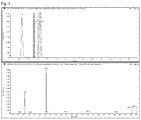
- a preferred fragmentation pattern is shown in Fig 3 , below.
- Phosphatidylcholine (C18:2, C20:4) refers to molecular species, preferably, characterized by the sum parameter of glycerophosphorylcholines containing either the combination of a C16:0 fatty acid unit and a C22:6 fatty acid unit or the combination of a C18:2 fatty acid unit and a C20:4 fatty acid unit.
- the mass-to-charge ratio (m/z) of the ionised spezies is 806.6 Da (+/- 0.3 Da).
- a preferred fragmentation pattern is shown in Fig 4 , below.
- Ceramide (d18:1, C24:1) refers to molecular species, preferably, characterized by the sum parameter of ceramides containing either the combination of a d18:1 long-chain base unit and a C24:1 fatty acid unit or the combination of a d18:2 long-chain base unit and a C24:0 fatty acid unit.
- the mass-to-charge ratio (m/z) of the ionised spezies is 648.6 Da (+/- 0.3 Da).
- a preferred fragmentation pattern is shown in Fig 5 , below.
- DAG C18:1, C18:2
- DAG C18:1, C18:2
- the mass-to-charge ratio (m/z) of the ionised spezies is 641.6 Da (+/- 0.3 Da).
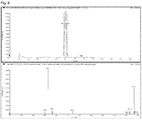
- Ceramide (d18:1, C24:0) refers to molecular species, preferably, characterized by the sum parameter of ceramides containing the combination of a d18:1 long-chain base unit and a C24:0 fatty acid unit.
- the mass-to-charge ratio (m/z) of the ionised spezies is 650.8 Da (+/- 0.3 Da).
- a preferred fragmentation pattern is shown in Fig 6 , below.
- TAG refers to molecular species, preferably, characterized by the sum parameter of triacylglycerols.
- the mass-to-charge ratio (m/z) of the ionised spezies is 547.6 Da (+/- 0.3 Da.
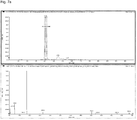
- Sphingomyelin (d18:1, C16:0) refers to molecular species, preferably, characterized by the sum parameter of sphingomyelins containing the combination of a d18:1 long-chain base unit and a C16:0 fatty acid unit.
- the mass-to-charge ratio (m/z) of the ionised spezies is 703.6 Da (+/- 0.3 Da).
- a preferred fragmentation pattern is shown in Fig 7 , below
- Phosphatidylcholine refers to molecular species, preferably, characterized by the sum parameter of glycerophosphorylcholines.
- the mass-to-charge ratio (m/z) of the ionised spezies is 780.8 Da (+/- 0.3 Da).
- 1,2-Dioleoyl-sn-glycero-3-phosphatidyl-L-serine refers to molecular species, preferably, characterized by the sum parameter of glycerophosphorylcholines containing fatty acid units with the total number of carbons of 36 and the total number of double bonds of 1.
- the mass-to-charge ratio (m/z) of the ionised spezies is 788.6 Da (+/- 0.3 Da).
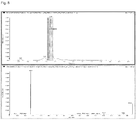
- Phosphatidylcholine (C18:0/C22:6) refers to molecular species, preferably, characterized by the sum parameter of glycerophosphorylcholines containing the combination of a C18:0 fatty acid unit and a C22:6 fatty acid unit.
- the mass-to-charge ratio (m/z) of the ionised spezies is 834.6 Da (+/- 0.3 Da).
- a preferred fragmentation pattern is shown in Fig 8 , below.
- method for diagnosing means that the method either essentially consists of the aforementioned steps or may include further steps.
- the method in a preferred embodiment, is a method carried out ex vivo, i.e. not practised on the human or animal body.
- Diagnosing refers to assessing the probability according to which a subject is suffering from a disease. As will be understood by those skilled in the art, such an assessment, although preferred to be, may usually not be correct for 100% of the subjects to be diagnosed. The term, however, requires that a statistically significant portion of subjects can be identified as suffering from the disease or as having a predisposition therefor.
- Whether a portion is statistically significant can be determined without further ado by the person skilled in the art using various well known statistic evaluation tools, e.g., determination of confidence intervals, p-value determination, WELCH-test, Mann-Whitney test, etc.. Details are found in Dowdy and Wearden, Statistics for Research, John Wiley & Sons, New York 1983 .
- Preferred confidence intervals are at least 50%, at least 60%, at least 70%, at least 80%, at least 90%, at least 95%.
- the p-values are, preferably, 0.2, 0.1, 0.05.
- Diagnosing according to the present invention includes monitoring, confirmation, and classification of the relevant disease or its symptoms.
- Monitoring relates to keeping track of an already diagnosed disease, e.g. to analyze the progression of the disease, the influence of a particular treatment on the progression of disease or complications arising during the disease period or after successful treatment of the disease.
- Confirmation relates to the strengthening or substantiating a diagnosis already performed using other indicators or markers.
- Classification relates to allocating the diagnosis according to the strength or kind of symptoms into different classes. Some of the diseases or conditions which appear in connection with liver toxicity may be accompanied by further metabolic changes. Preferably, for cholestasis it has been found in accordance with the present invention that in addition to the aforementioned analytes, the amounts of the bile acids in serum recited in the following table are increased.
- Bile acids which are increased during liver toxicity induced cholestasis Proprietary name Chemical name Conjugated with Cholic acid 3 ⁇ , 7 ⁇ , 12 ⁇ -Trihydroxy-5 ⁇ -cholanoic acid Taurin, Glycin Chenodesoxycholic acid 3 ⁇ , 7 ⁇ -Dihydroxy-5 ⁇ -cholanoic acid Taurin, Glycin Hyocholic acid 3 ⁇ , 6 ⁇ , 7 ⁇ -Trihydroxy-5 ⁇ -cholanoic acid Desoxycholic acid 3 ⁇ , 12 ⁇ -Dihydroxy-5 ⁇ -cholanoic acid Taurin, Glycin Lithocholic acid 3 ⁇ -Hydroxy-5 ⁇ -cholanoic acid Taurin, Glycin Hyodesoxycholic acid 3 ⁇ , 6 ⁇ -Dihydroxy-5 ⁇ -cholanoic acid ⁇ / ⁇ -Muricholic acid 3 ⁇ , 6 ⁇ , 7 ⁇ / ⁇ -Trihydroxy-5 ⁇ -cholanoic acid Ursodesoxycholic acid 3 ⁇ , 7 ⁇ -Dihydroxy-5 ⁇ -cholanoic acid
- classification also, preferably, includes allocating a mode of action to a compound to be tested by the method of the present invention.
- the method of the present invention allows for determination of a specific mode of action of a compound for which such mode of action is not yet known. This is, preferably, achieved by comparing the determined analytes representing biomarkers (i.e. the biomarker profile) for said compound to the biomarker profile of a compound for which the mode of action is known as a reference (e.g. Paracetamol-derived liver toxicity wherein Paracetamol elicits cell necrosis by inducing gluthatione depletion as a consequence of oxidative stress).
- biomarkers i.e. the biomarker profile
- a compound which has been determined to affect the CYP enzymes may be further assessed with respect to different genetic CYP enzyme phenotypes, such as poor, rapid or intermediate metabolizer phenotypes.
- a compound affecting the CYP enzymes may be liver toxic in poor metabolizer phenotypes but not rapid metabolizer phenotypes. This, of course, applies accordingly for other enzymes or parameters being involved in liver function.
- liver toxicity also called “hepatotoxicity” as used herein relates to a damage of the liver which results in an impaired liver function.
- affected due to liver toxicity are the metabolic, detoxification, and bile excretion functions of the liver.
- liver toxicity as used herein is induced by or is the result of the administration of a chemical compound or drug, i.e. a so-called hepatotoxin-induced liver toxicity.
- liver toxicity is manifested by one or more diseases or disorders from the following group: liver cell necrosis, hepatitis, steatosis, cirrhosis, phospholipoidosis, cholestasis, cholangitis, thrombosis of liver veins, liver tumors.
- diseases or disorders from the following group: liver cell necrosis, hepatitis, steatosis, cirrhosis, phospholipoidosis, cholestasis, cholangitis, thrombosis of liver veins, liver tumors.
- Each of the analytes to be determined in the method of the present invention is also suitable for diagnosing the diseases or disorders referred to herein when analysed alone.
- a combination of at least five different analytes further strengthen the diagnosis since each of the analytes is an apparently statistically independent predictor of equal value for the diagnosis.
- the specificity for liver toxicity is also significantly increased since influences from other tissues on the marker abundance are counterbalanced.
- Preferred marker combinations for specific liver toxic compound classes are those found in any one of Table 1 to 4, below.
- additional analytes are, preferably, determined in the method of the present invention.
- the additional analytes are, preferably, also selected from the aforementioned group. In other words, preferably, at least six, at least seven, at least eight, at least nine, at least ten or all of the analytes of the aforementioned group are determined in the method of the present invention. The additional determination of these analytes even further strengthen the result obtained by the method of this invention.
- other analytes or metabolites i.e. metabolites not specifically recited in the aforementioned group
- biomarkers such as enzymes
- additional parameters determined in accordance with the method of the present invention are: alanine aminotransferase, aspartate aminotransferase, gamma-glutamyl transferase, glutamate dehydrogenase, sorbit dehydrogenase, ornithin carbamyl transferase, albumin, total protein, ammonium, cholesterol, triglycerides or prothrombin time (blood coagulation).
- Further additional parameters are, preferably, total cytochrome P450 content, Alkoxyresorufin-O-Deethylase, 4-hydroxybiphenyl-UDP-glucuronosyltransferase or 4-methylumbelliferone-UDP-glucuronosyltransferase.
- the at least one analyte in the male sample is selected from the group consisting of: Palmitic acid (C16:0), Linoleic acid (C18:cis[9,12]2), Arachidonic acid (C20:cis-[5,8,11,14]4), Docosahexaenoic acid (C22:cis[4,7,10,13,16,19]6), Cholesterol, Glycerolphosphate, Lignoceric acid (C24:0), myo-Inositol-2-monophosphate, Behenic acid (C22:0), Nervonic acid (C24:1), and Eicosatrienoic acid (C20:3). In an even more preferred embodiments, all of the aforementioned analytes are determined.
- analytes in a group of at least five analytes to be determined in accordance with the present invention, one, two, three, or four analytes are from the aforementioned group of preferred analytes while the remaining analytes are analytes for male samples as specified elsewhere herein.
- the first analyte of a preferred group of five analytes to be determined in accordance with the present invention is Palmitic acid (C16:0)
- the remaining four analytes are selected from a group consisting of the following analytes: 4-Hydroxyphenylpyruvic acid, Linoleic acid (C18:cis[9,12]2), Arachidonic acid (C20:cis-[5,8,11,14]4), Docosahexaenoic acid (C22:cis[4,7,10,13,16,19]6), alpha-Tocopherol, Cholesterol, Glycerolphosphate, Lignoceric acid (C24:0), Heptadecanoic acid (C17:0), Tricosanoic acid (C23:0), myo-Inositol-2-monophosphate, Behenic acid (C22:0), 4-Hydroxysphinganine, Nervonic acid (C24:1), Eico
- first and second analyte are Palmitic acid (C16:0) and Linoleic acid (C18:cis[9,12]2)
- the remaining three analytes are selected from a group consisting of: 4-Hydroxyphenylpyruvic acid,, Arachidonic acid (C20:cis-[5,8,11,14]4), Docosahexaenoic acid (C22:cis[4,7,10,13,16,19]6), alpha-Tocopherol, Cholesterol, Glycerolphosphate, Lignoceric acid (C24:0), Heptadecanoic acid (C17:0), Tricosanoic acid (C23:0), myo-lnositol-2-monophosphate, Behenic acid (C22:0), 4-Hydroxysphinganine, Nervonic acid (C24:1), Eicosatrienoic acid (C20:3), Glycerol-3-Phosphate, Phos
- the remaining two analytes are selected from a group consisting of: 4-Hydroxyphenylpyruvic acid, Docosahexaenoic acid (C22:cis[4,7,10,13,16,19]6), alpha-Tocopherol, Cholesterol, Glycerolphosphate, Lignoceric acid (C24:0), Heptadecanoic acid (C17:0), Tricosanoic acid (C23:0), myo-Inositol-2-monophosphate, Behenic acid (C22:0), 4-Hydroxysphinganine, Nervonic acid (C24:1), Eicosatrienoic acid (C20:3), Glycerol-3-Phosphate, Phos
- the remaining analyte is selected from a group consisting of: 4-Hydroxyphenylpyruvic acid, alpha-Tocopherol, Cholesterol, Glycerolphosphate, Lignoceric acid (C24:0), Heptadecanoic acid (C17:0), Tricosanoic acid (C23:0), myo-Inositol-2-monophosphate, Behenic acid (C22:0), 4-Hydroxysphinganine, Nervonic acid (C24:1), Eicosatrienoic acid (C20:3), Glycerol-3-Phosphate,
- the at least one analyte in the female is selected from the group consisting of: Palmitic acid (C16:0), Stearic acid (C18:0), Arachidonic acid (C20:cis-[5,8,11,14]4), Docosahexaenoic acid (C22:cis[4,7,10,13,16,19]6), Cholesterol, Lignoceric acid (C24:0), Behenic acid (C22:0), Nervonic acid (C24:1), Linoleic acid (C18:cis[9,12]2) or Threonic acid. In an even more preferred embodiments, all six of the aforementioned analytes are determined.
- analytes in a group of at least five analytes to be determined in accordance with the present disclosure, one, two, three, or four analytes are from the aforementioned group of analytes while the remaining analytes are analytes for female samples as specified elsewhere herein.
- one, two, three, or four analytes are from the aforementioned group of analytes while the remaining analytes are analytes for male samples as specified elsewhere herein.
- the first analyte of a group of five analytes to be determined in accordance with the present disclosure is Palmitic acid (C16:0)
- the remaining four analytes are selected from a group consisting of the following analytes: Glycerol-3-Phosphate, Coenzyme Q9, Glucose, Glycerol, Stearic acid (C18:0), Arachidonic acid (C20:cis-[5,8,11,14]4), Docosahexaenoic acid (C22:cis[4,7,10,13,16,19]6), Cholesterol, Glycerolphosphate, Lignoceric acid (C24:0), Heptadecanoic acid (C17:0), Eicosanoic acid (C20:0), Tricosanoic acid (C23:0), Phosphate, Behenic acid (C22:0), 4-Hydroxysphinganine, Nervonic acid (C24:1)
- first and second analyte are Palmitic acid (C16:0) and Stearic acid (C18:0)
- the remaining three analytes are selected from a group consisting of: Glycerol-3-Phosphate, Coenzyme Q9, Glucose, Glycerol, Arachidonic acid (C20:cis-[5,8,11,14]4), Docosahexaenoic acid (C22:cis[4,7,10,13,16,19]6), Cholesterol, Glycerolphosphate, Lignoceric acid (C24:0), Heptadecanoic acid (C17:0), Eicosanoic acid (C20:0), Tricosanoic acid (C23:0), Phosphate, Behenic acid (C22:0), 4-Hydroxysphinganine, Nervonic acid (C24:1), 14-Methylhexadecanoic acid, Eicosatrienoic acid (
- first, second and third analytes are Palmitic acid (C16:0), Stearic acid (C18:0), and Arachidonic acid (C20:cis-[5,8,11,14]4)
- the remaining two analytes are selected from a group consisting of: Glycerol-3-Phosphate, Coenzyme Q9, Glucose, Glycerol, Docosahexaenoic acid (C22:cis[4,7,10,13,16,19]6), Cholesterol, Glycerolphosphate, Lignoceric acid (C24:0), Heptadecanoic acid (C17:0), Eicosanoic acid (C20:0), Tricosanoic acid (C23:0), Phosphate, Behenic acid (C22:0), 4-Hydroxysphinganine, Nervonic acid (C24:1), 14-Methylhexadecanoic acid, Eicosatrienoic acid (
- the remaining analyte is selected from a group consisting of: Glycerol-3-Phosphate, Coenzyme Q9, Glucose, Glycerol, Cholesterol, Glycerol-phosphate, Lignoceric acid (C24:0), Heptadecanoic acid (C17:0), Eicosanoic acid (C20:0), Tricosanoic acid (C23:0), Phosphate, Behenic acid (C22:0), 4-Hydroxysphinganine, Nervonic acid (C24:1), 14-Methylhexadecanoic acid, Eicosatrieno
- Analyte as used herein refers to at least one molecule of a specific analyte up to a plurality of molecules of the said specific analyte. It is to be understood further that a group of analytes means a plurality of chemically different molecules wherein for each analyte at least one molecule up to a plurality of molecules may be present.
- An analyte in accordance with the present invention encompasses all classes of organic or inorganic chemical compounds including those being comprised by biological material such as organisms.
- the analyte in accordance with the present invention is a small molecule compound.
- each analyte represents a metabolite and that the plurality of metabolites represent a metabolome.
- the metabolome is the collection of metabolites being comprised by an organism, an organ, a tissue or a cell at a specific time and under specific conditions.
- Metabolites are small molecule compounds, such as substrates for enzymes of metabolic pathways, intermediates of such pathways or the products obtained by a metabolic pathway.
- Metabolic pathways are well known in the art and may vary between species.
- said pathways include at least citric acid cycle, respiratory chain, glycolysis, gluconeogenesis, hexose monophosphate pathway, oxidative pentose phosphate pathway, production and ⁇ -oxidation of fatty acids, urea cycle, amino acid biosynthesis pathways, protein degradation pathways such as proteasomal degradation, amino acid degrading pathways, biosynthesis or degradation of: lipids, polyketides (including e.g. flavonoids and isoflavonoids), isoprenoids (including eg.
- terpenes sterols, steroids, carotenoids
- carbohydrates phenylpropanoids and derivatives, alcaloids, benzenoids, indoles, indole-sulfur compounds, porphyrines, hormones, vitamins, cofactors such as prosthetic groups or electron carriers, lignin, glucosinolates, purines, pyrimidines, nucleosides, nucleotides and related molecules such as tRNAs, microR-NAs (miRNA) or mRNAs.
- miRNA microR-NAs
- small molecule compound metabolites are preferably composed of the following classes of compounds: alcohols, alkanes, alkenes, alkines, aromatic compounds, ketones, aldehydes, carboxylic acids, esters, amines, imines, amides, cyanides, amino acids, peptides, thiols, thioesters, phosphate esters, sulfate esters, thioethers, sulfoxides, ethers, or combinations or derivatives of the aforementioned compounds.
- the small molecules among the metabolites may be primary metabolites which are required for normal cellular function, organ function or animal growth, development or health.
- small molecule metabolites further comprise secondary metabolites having essential ecological function, e.g. metabolites which allow an organism to adapt to its environment.
- metabolites are not limited to said primary and secondary metabolites and further encompass artificial small molecule compounds.
- Said artificial small molecule compounds are derived from exogenously provided small molecules which are administered or taken up by an organism but are not primary or secondary metabolites as defined above.
- artificial small molecule compounds may be metabolic products obtained from drugs by metabolic pathways of the animal.
- metabolites further include peptides, oligopeptides, polypeptides, oligonucleotides and polynucleotides, such as RNA or DNA.
- a metabolite has a molecular weight of 50 Da (Dalton) to 30,000 Da, most preferably less than 30,000 Da, less than 20,000 Da, less than 15,000 Da, less than 10,000 Da, less than 8,000 Da, less than 7,000 Da, less than 6,000 Da, less than 5,000 Da, less than 4,000 Da, less than 3,000 Da, less than 2,000 Da, less than 1,000 Da, less than 500 Da, less than 300 Da, less than 200 Da, less than 100 Da.
- a metabolite has, however, a molecular weight of at least 50 Da.
- a metabolite in accordance with the present invention has a molecular weight of 50 Da up to 1,500 Da.
- Analytes as referred to in accordance with this invention are molecular species which are derived from the naturally occurring metabolite due to the purification and/or determination process.
- the analyte will be identical. In other cases, however, it will be a chemical derivative thereof. Nevertheless, it is to be understood that the appearing of the analyte inevitably allows drawing conclusions on the occurrence of the metabolite.
- test sample refers to samples to be used for the diagnosis of liver toxicity by the method of the present invention.
- Said test sample is a biological sample.
- Samples from biological sources i.e. biological samples
- Biological samples disclosed for use in the method of the present invention are samples from body fluids, preferably, blood, plasma, serum, saliva, bile, urine or cerebrospinal fluid, or samples derived, e.g. by biopsy, from cells, tissues or organs, e.g. from the liver.
- the sample is a blood, plasma or serum sample, preferably, a plasma sample.
- Biological samples are derived from a subject as specified elsewhere herein. Techniques for obtaining the aforementioned different types of biological samples are well known in the art. For example, blood samples may be obtained by blood taking while tissue or organ samples are to be obtained, e.g. by biopsy.
- the aforementioned samples are, preferably, pre-treated before they are used for the method of the present invention.
- said pre-treatment may include treatments required to release or separate the compounds or to remove excessive material or waste. Suitable techniques comprise centrifugation, extraction, fractioning, ultrafiltration, protein precipitation followed by filtration and purification and/or enrichment of compounds.
- other pre-treatments are carried out in order to provide the compounds in a form or concentration suitable for compound analysis. For example, if gas-chromatography coupled mass spectrometry is used in the method of the present invention, it will be required to derivatize the compounds prior to the said gas chromatography. Suitable and necessary pre-treatments depend on the means used for carrying out the method of the invention and are well known to the person skilled in the art. Pre-treated samples as described before are also comprised by the term "sample" as used in accordance with the present invention.
- subject as used herein relates to animals, preferably to mammals such as mice, rats, guinea pigs, rabbits, hamsters, pigs, sheep, dogs, cats, horses, monkeys, or cows and, also preferably, to humans. More preferably, the subject is a rodent and, most preferably, a rat. Other animals which may be diagnosed applying the method of the present invention are fishes, birds or reptiles. Preferably, said subject was in or has been brought into contact with a compound suspected to be capable of inducing liver toxicity.
- a subject which has been brought into contact with a compound suspected to induce liver toxicity may, e.g., be a laboratory animal such as a rat which is used in a screening assay for, e.g., toxicity of compounds.
- a subject suspected to have been in contact with a compound capable of inducing liver toxicity may be also a subject to be diagnosed for selecting a suitable therapy.
- a compound capable of inducing liver toxicity as used herein is Dazomet, Dimethylformamide, Tetrahydrofuran, Cyproterone acetate, Tetrahydrofurane, Cyproterone Acetate, Toxaphene or Paracetamol.
- determining the amount refers to determining at least one characteristic feature of each analyte of the said at least five analytes.
- Characteristic features in accordance with the present invention are features which characterize the physical and/or chemical properties including biochemical properties of a analyte. Such properties include, e.g., molecular weight, viscosity, density, electrical charge, spin, optical activity, colour, fluorescence, chemoluminescence, elementary composition, chemical structure, capability to react with other compounds, capability to elicit a response in a biological read out system (e.g., induction of a reporter gene) and the like. Values for said properties may serve as characteristic features and can be determined by techniques well known in the art.
- the characteristic feature may be any feature which is derived from the values of the physical and/or chemical properties of a analyte by standard operations, e.g., mathematical calculations such as multiplication, division or logarithmic calculus.
- the at least one characteristic feature allows the determination and/or chemical identification of the analyte and its amount.
- the characteristic value preferably, also comprises information relating to the abundance of the metabolite from which the characteristic value is derived.
- a characteristic value of a metabolite may be a peak in a mass spectrum. Such a peak contains characteristic information of the metabolite, i.e. the m/z (mass to charge ratio) information, as well as an intensity value being related to the abundance of the said analyte (i.e. its amount) in the sample.
- each analyte of the group of analytes to be determined in accordance with the method of the present invention may be, preferably, determined quantitatively or semi-quantitatively.
- quantitative determination either the absolute or precise amount of the metabolite will be determined or the relative amount of the analyte will be determined based on the value determined for the characteristic feature(s) referred to herein above.
- the relative amount may be determined in a case were the precise amount of a analyte can or shall not be determined. In said case, it can be determined whether the amount in which the analyte is present is enlarged or diminished with respect to a second sample comprising said metabolite in a second amount.
- Quantitatively analysing a analyte thus, also includes what is sometimes referred to as semi-quantitative analysis of a analyte.
- determining as used in the method of the present invention includes using a compound separation step prior to the analysis step referred to before.
- said compound separation step yields a time resolved separation of the analytes comprised by the sample.
- Suitable techniques for separation to be used preferably in accordance with the present invention therefore, include all chromatographic separation techniques such as liquid chromatography (LC), high performance liquid chromatography (HPLC), gas chromatography (GC), thin layer chromatography, size exclusion or affinity chromatography. These techniques are well known in the art and can be applied by the person skilled in the art without further ado. Most preferably, LC and/or GC are chromatographic techniques to be envisaged by the method of the present invention.
- mass spectrometry is used in particular gas chromatography mass spectrometry (GC-MS), liquid chromatography mass spectrometry (LC-MS), direct infusion mass spectrometry or Fourier transform ion-cyclotrone-resonance mass spectrometry (FT-ICR-MS), capillary electrophoresis mass spectrometry (CE-MS), high-performance liquid chromatography coupled mass spectrometry (HPLC-MS), quadrupole mass spectrometry, any sequentially coupled mass spectrometry, such as MS-MS or MS-MS-MS, inductively coupled plasma mass spectrometry (ICP-MS), pyrolysis mass spectrometry (Py-MS), ion mobility mass spectrometry or time of flight mass spectrometry (TOF).
- GC-MS gas chromatography mass spectrometry
- LC-MS liquid chromatography mass spectrometry
- FT-ICR-MS Fourier transform ion-cyclotrone-resonance mass spectrome
- LC-MS and/or GC-MS are used as described in detail below. Said techniques are disclosed in, e.g., Nissen, Journal of Chromatography A, 703, 1995: 37-57 , US 4,540,884 or US 5,397,894 .
- mass spectrometry techniques the following techniques may be used for compound determination: nuclear magnetic resonance (NMR), magnetic resonance imaging (MRI), Fourier transform infrared analysis (FT-IR), ultraviolet (UV) spectroscopy, refraction index (RI), fluorescent detection, radiochemical detection, electrochemical detection, light scattering (LS), dispersive Raman spectroscopy or flame ionisation detection (FID).
- the method of the present invention shall be, preferably, assisted by automation.
- sample processing or pre-treatment can be automated by robotics.
- Data processing and comparison is, preferably, assisted by suitable computer programs and databases. Automation as described herein before allows using the method of the present invention in high-throughput approaches.
- the analyte can also be determined by a specific chemical or biological assay.
- Said assay shall comprise means which allow for specifically detecting the analyte in the sample.
- said means are capable of specifically recognizing the chemical structure of the analyte or are capable of specifically identifying the analyte based on its capability to react with other compounds or its capability to elicit a response in a biological read out system (e.g., induction of a reporter gene).
- Means which are capable of specifically recognizing the chemical structure of a metabolite are, preferably, antibodies or other proteins which specifically interact with chemical structures, such as receptors or enzymes. Specific antibodies, for instance, may be obtained using the metabolite as antigen by methods well known in the art.
- Antibodies as referred to herein include both polyclonal and monoclonal antibodies, as well as fragments thereof, such as Fv, Fab and F(ab) 2 fragments that are capable of binding the antigen or hapten.
- the present invention also includes humanized hybrid antibodies wherein amino acid sequences of a non-human donor antibody exhibiting a desired antigen-specificity are combined with sequences of a human acceptor antibody. Moreover, encompassed are single chain antibodies.
- the donor sequences will usually include at least the antigen-binding amino acid residues of the donor but may comprise other structurally and/or functionally relevant amino acid residues of the donor antibody as well.
- Such hybrids can be prepared by several methods well known in the art.
- Suitable proteins which are capable of specifically recognizing the metabolite are, preferably, enzymes which are involved in the metabolic conversion of the said metabolite. Said enzymes may either use the metabolite as a substrate or may convert a substrate into the metabolite. Moreover, said antibodies may be used as a basis to generate oligopeptides which specifically recognize the metabolite. These oligopeptides shall, for example, comprise the enzyme's binding domains or pockets for the said metabolite.
- Suitable antibody and/or enzyme based assays may be RIA (radioimmunoassay), ELI-SA (enzyme-linked immunosorbent assay), sandwich enzyme immune tests, electro-chemiluminescence sandwich immunoassays (ECLIA), dissociation-enhanced lanthanide fluoro immuno assay (DELFIA) or solid phase immune tests.
- the metabolite may also be identified based on its capability to react with other compounds, i.e. by a specific chemical reaction. Further, the metabolite may be determined in a sample due to its capability to elicit a response in a biological read out system.
- the biological response shall be detected as read out indicating the presence and/or the amount of the metabolite comprised by the sample.
- the biological response may be, e.g., the induction of gene expression or a phenotypic response of a cell or an organism.
- reference results refers to values of characteristic features of each of the analytes of the group of analytes which can be correlated to liver toxicity.
- Such reference results are, preferably, obtained from a sample derived from a subject which has been brought into contact with Dazomet, Dimethylformamide, Tetrahydrofuran, Cyproterone acetate, Toxaphene or Paracetamol.
- a subject may be brought into contact with the said compounds by each topic or systemic administration mode as long as the compounds are bioavailable.
- the reference results may be determined as described hereinabove for the amounts of the analytes.
- the reference results may be obtained from sample derived from a subject which has not been brought into contact with Dazomet, Dimethylformamide, Tetrahydrofuran, Cyproterone Acetate,
- the reference also preferably, could be a calculated reference, most preferably the average or median, for the relative or absolute amount for each of the analytes of the group of analytes derived from a population of individuals comprising the subject to be investigated.
- the population of subjects to be investigated for determining a calculated reference preferably, either consist of apparently healthy subjects (e.g. untreated) or comprise a number of apparently healthy subjects which is large enough to be statistically resistant against significant average or median changes due to the presence of the test subject(s) in the said population.
- the absolute or relative amounts of the analytes of said individuals of the population can be determined as specified elsewhere herein. How to calculate a suitable reference value, preferably, the average or median, is well known in the art.
- the population of subjects referred to before shall comprise a plurality of subjects, preferably, at least 5, 10, 50, 100, 1,000 or 10,000 subjects. It is to be understood that the subject to be diagnosed by the method of the present invention and the subjects of the said plurality of subjects are of the same species.
- the reference results i.e. values for at least one characteristic features of the analyte
- a suitable data storage medium such as a database and are, thus, also available for future diagnoses. This also allows efficiently diagnosing predisposition for a disease because suitable reference results can be identified in the database once it has been confirmed (in the future) that the subject from which the corresponding reference sample was obtained (indeed) developed liver toxicity.
- comparing refers to assessing whether the results of the determination described hereinabove in detail, i.e. the results of the qualitative or quantitative determination of a analyte, are identical or similar to reference results or differ therefrom.
- liver toxicity can be diagnosed based on the degree of identity or similarity between the test results obtained from the test sample and the aforementioned reference results, i.e. based on an identical or similar qualitative or quantitative composition with respect to the aforementioned analytes.
- the results of the test sample and the reference results are identical, if the values for the characteristic features and, in the case of quantitative determination, the intensity values are identical. Said results are similar, if the values of the characteristic features are identical but the intensity values are different.
- Such a difference is, preferably, not significant and shall be characterized in that the values for the intensity are within at least the interval between 1 st and 99 th percentile, 5 th and 95 th percentile, 10 th and 90 th percentile, 20 th and 80 th percentile, 30 th and 70 th percentile, 40 th and 60 th percentile of the reference value.the 50 th , 60 th , 70 th , 80 th , 90 th or 95 th percentile of the reference value.
- liver toxicity can be diagnosed based on the differences between the test results obtained from the test sample and the aforementioned reference results, i.e. differences in the qualitative or quantitative composition with respect to the aforementioned analytes. The same applies if a calculated reference as specified above is used.
- the difference may be an increase in the absolute or relative amount of a analyte (sometimes referred to as up-regulation of the metabolite; see also Examples) or a decrease in either of said amounts or the absence of a detectable amount of the analyte (sometimes referred to as up-regulation of the metabolite; see also Examples).
- the difference in the relative or absolute amount is significant, i.e. outside of the interval between 45 th and 55 th percentile, 40 th and 60 th percentile, 30 th and 70 th percentile, 20 th and 80 th percentile, 10 th and 90 th percentile, 5 th and 95 th percentile, 1 st and 99 th percentile of the reference value.
- the amounts of the analytes in comparison to the reference differ as follows in a sample of a male: 4-Hydroxyphenylpyruvic acid, Palmitic acid (C16:0), Linoleic acid (C18:cis[9,12]2), Arachidonic acid (C20:cis-[5,8,11,14]4), Docosahexaenoic acid (C22:cis[4,7,10,13,16,19]6), alpha-Tocopherol, Cholesterol, Glycerolphosphate, Lignoceric acid (C24:0), Heptadecanoic acid (C17:0), Tricosanoic acid (C23:0), myoInositol-2-monophosphate, Behenic acid (C22:0), 4-Hydroxysphinganine, Nervonic acid (C24:1), Eicosatrienoic acid (C20:3), Glycerol-3-Phosphate, Phosphat
- the amounts of the analytes in comparison to the reference differ as follows in a sample of a female subject: Glycerol-3-Phosphate, Coenzyme Q9, Glucose, Glycerol, Palmitic acid (C16:0), Stearic acid (C18:0), Arachidonic acid (C20:cis-[5,8,11,14]4), Docosahexaenoic acid (C22:cis[4,7,10,13,16,19]6), Cholesterol, Glycerolphosphate, Lignoceric acid (C24:0), Heptadecanoic acid (C17:0), Eicosanoic acid (C20:0), Tricosanoic acid (C23:0), Phosphate, Behenic acid (C22:0), 4-Hydroxysphinganine, Nervonic acid (C24:1), 14-Methylhexadecanoic acid, Eicosatrienoic
- the comparison is, preferably, assisted by automation.
- a suitable computer program comprising algorithm for the comparison of two different data sets (e.g., data sets comprising the values of the characteristic feature(s)) may be used.
- Such computer programs and algorithm are well known in the art. Notwithstanding the above, a comparison can also be carried out manually.
- a device as used herein shall comprise at least the aforementioned means.
- the device may further comprise means for comparison and evaluation of the detected characteristic feature(s) of the analytes and, also preferably, the determined signal intensity.
- the means of the device may be operatively linked to each other. How to link the means in an operating manner will depend on the type of means included into the device. For example, where means for automatically qualitatively or quantitatively determining the metabolite are applied, the data obtained by said automatically operating means can be processed by, e.g., a computer program in order to facilitate the diagnosis.
- the means are comprised by a single device in such a case.
- Said device may accordingly include an analyzing unit for the analytes and a computer unit for processing the resulting data for the diagnosis.
- the means for diagnosing may comprise control stripes or tables allocating the determined result data to result data known to be accompanied with liver toxicity or those being indicative for a healthy subject as discussed above.
- Further disclosed devices are those which can be applied without the particular knowledge of a specialized clinician, e.g., test stripes or electronic devices which merely require loading with a sample.
- the methods for the determination of the analytes can, in a further disclosure, be implemented into a system comprising several devices which are, in a disclosure, operatively linked to each other.
- the means must be linked in a manner as to allow carrying out the method of the present invention as described in detail above. Therefore, operatively linked, as used herein, in a disclosure, means functionally linked.
- said means may be functionally linked by connecting each mean with the other by means which allow data transport in between said means, e.g., glass fiber cables, and other cables for high throughput data transport.
- a further disclosed system comprises means for determining analytes.
- Means for determining analytes as used herein encompass means for separating analytes, such as chromatographic devices, and means for analyte determination, such as mass spectrometry devices. Suitable devices have been described in detail above.
- Further disclosed means for compound separation to be used in the system of the present invention include chromatographic devices, in a disclosure, devices for liquid chromatography, HPLC, and/or gas chromatography.
- Further disclosed devices for compound determination comprise mass spectrometry devices, more preferably, GC-MS, LC-MS, direct infusion mass spectrometry, FT-ICR-MS, CE-MS, HPLC-MS, quadrupole mass spectrometry, sequentially coupled mass spectrometry (including MS-MS or MS-MS-MS), ICP-MS, Py-MS or TOF.
- the separation and determination means are, in a disclosure, coupled to each other.
- LC-MS and/or GC-MS is used in the system as described in detail elsewhere in the specification.
- Further comprised shall be means for comparing and/or analyzing the results obtained from the means for determination of analytes.
- the means for comparing and/or analyzing the results may comprise at least one databases and an implemented computer program for comparison of the results. Further disclosures of the aforementioned systems and devices are also described in detail below.
- the amounts of a group of at least five of the aforementioned analytes serve as biomarkers for liver toxicity, specifically liver toxicity induced by Dazomet, Dimethylformamide, Tetrahydrofuran, Cyproterone acetate, Tetrahydrofurane, Cyproterone Acetate, Toxaphene or Paracetamol.
- the specificity and accuracy of the method will be even more improved by determining all of the aformetioned analytes.
- a change in the quantitative and/or qualitative composition of the metabolome with respect to these specific analytes is indicative for liver toxicity.
- liver toxicity of a compound can be more efficiently and reliably assessed. Moreover, based on the aforementioned findings, screening assays for drugs which are useful for the therapy of liver toxicity are feasible.
- the present specification also discloses the use of at least one, in a disclosure of at least five of the following analytes 4-Hydroxyphenylpyruvic acid, Palmitic acid (C16:0), Linoleic acid (C18:cis[9,12]2), Arachidonic acid (C20:cis-[5,8,11,14]4), Docosahexaenoic acid (C22:cis[4,7,10,13,16,19]6), alpha-Tocopherol, Cholesterol, Glycerol-phosphate, Lignoceric acid (C24:0), Heptadecanoic acid (C17:0), Tricosanoic acid (C23:0), myo-Inositol-2-monophosphate, Behenic acid (C22:0), 4-Hydroxysphinganine, Nervonic acid (C24:1), Eicosatrienoic acid (C20:3), Glycerol-3-Phosphate, Phos
- the present specification also discloses a method of determining whether a compound is capable of inducing liver toxicity in a subject comprising:
- the present invention also contemplates a method of determining whether a compound is capable of inducing liver toxicity in a subject comprising:
- said compound is at least one compound selected from the group consisting of: Dazomet, Dimethylformamide, Tetrahydrofuran, Cyproterone acetate, Tetrahydrofurane, Cyproterone Acetate, Toxaphene or Paracetamol.
- said reference is derived from a subject which suffers from liver toxicity or from a subject which has been brought into contact with at least one compound selected from the group consisting of: Dazomet, Dimethylformamide, Tetrahydrofuran, Cyproterone acetate, Toxaphene or Paracetamol. More preferably, essentially identical amounts for the analytes in the test sample and the reference are indicative for liver toxicity.
- said reference is derived from a subject known to not suffer from liver toxicity or from a subject which has not been brought into contact with at least one compound selected from the group consisting of: Dazomet, Dimethylformamide, Tetrahydrofuran, Cyproterone acetate, Tetrahydrofurane, Cyproterone Acetate, Toxaphene or Paracetamol.
- the said reference is a calculated reference for the analytes for a population of subjects. More preferably, amounts for the analytes which differ in the test sample in comparison to the reference are indicative for liver toxicity.
- the present specification also discloses a method of identifying a substance for treating liver toxicity comprising the steps of:
- the present invention also relates to a method of identifying a substance for treating liver toxicity comprising the steps of:
- said reference is, preferably, derived from a subject which has been brought into contact with at least one compound selected from the group consisting of: Dazomet, Dimethylformamide, Tetrahydrofuran, Cyproterone acetate, Tetrahydrofurane, Cyproterone Acetate, Toxaphene or Paracetamol or a subject which suffers from liver toxicity. More preferably, amounts for the metabolites which differ in the test sample and the reference are indicative for a substance useful for treating liver toxicity.
- indicative for a substance capable of treating liver toxicity are amounts of the analytes in comparison to the reference which differ as follows: (i) in a sample of a male: 4-Hydroxyphenylpyruvic acid, Palmitic acid (C16:0), Linoleic acid (C18:cis[9,12]2), Arachidonic acid (C20:cis-[5,8,11,14]4), Docosahexaenoic acid (C22:cis[4,7,10,13,16,19]6), alpha-Tocopherol, Cholesterol, Glycerolphosphate, Lignoceric acid (C24:0), Heptadecanoic acid (C17:0), Tricosanoic acid (C23:0), myo-Inositol-2-monophosphate, Behenic acid (C22:0), 4-Hydroxysphinganine, Nervonic acid (C24:1), Eicosatrienoic acid (C20:3),
- the said reference may be, preferably, be derived from a subject which has not been brought into contact with Dazomet, Dimethylformamide, Tetrahydrofuran, Cyproterone acetate, Toxaphene or Paracetamol or a subject known to not suffer from liver toxicity or may be a calculated reference for the analytes in a population of subjects. If such a reference is used, identical or similar amounts for the metabolites in the test sample and the reference are indicative for a substance useful for treating liver toxicity.
- the term "substance for treating liver toxicity” refers to compounds which may directly interfere with the biological mechanisms inducing liver toxicity referred to elsewhere in this specification. Accordingly, the activity of the enzymes involved in conjugation and/or oxidation may be increased, bile excretion may be improved or modulated. Alternatively, it is envisaged that substances may affect these activities indirectly by, e.g., modulating the expression of the enzymes or other factors involved in the said processes.
- Substances to be identified by the method of the present invention may be organic and inorganic chemicals, such as small molecules, polynucleotides, oligonucleotides, peptides, polypeptides including antibodies or other artificial or biological polymers.
- the substances are suitable as drugs, pro-drugs or lead substances for the development of drugs or pro-drugs.
- test samples of a plurality of subjects may be investigated for statistical reasons.
- the metabolome within such a cohort of test subjects shall be as similar as possible in order to avoid differences which are caused, e.g., by factors other than the compound to be investigated.
- Subjects to be used for the said methods are, preferably, laboratory animals such as rodents and more preferably rats. It is to be understood further that the said laboratory animals shall be, preferably, sacrificed after completion of the method of the present invention. All subjects of a cohort test and reference animals shall be kept under identical conditions to avoid any differential environmental influences. Suitable conditions and methods of providing such animals are described in detail in WO2007/014825 .
- the present specification also discloses a data collection comprising characteristic values for the following analytes 4-Hydroxyphenylpyruvic acid, Palmitic acid (C16:0), Linoleic acid (C18:cis[9,12]2), Arachidonic acid (C20:cis-[5,8,11,14]4), Docosahexaenoic acid (C22:cis[4,7,10,13,16,19]6), alpha-Tocopherol, Cholesterol, Glycerolphosphate, Lignoceric acid (C24:0), Heptadecanoic acid (C17:0), Tricosanoic acid (C23:0), myo-Inositol-2-monophosphate, Behenic acid (C22:0), 4-Hydroxysphinganine, Nervonic acid (C24:1), Eicosatrienoic acid (C20:3), Glycerol-3-Phosphate, Phosphatidylcholine
- the term "data collection” refers to a collection of data which may be physically and/or logically grouped together. Accordingly, the data collection may be implemented in a single data storage medium or in physically separated data storage media being operatively linked to each other.
- the data collection is implemented by means of a database.
- a database as used herein comprises the data collection on a suitable storage medium.
- the database in a disclosure, further comprises a database management system.
- the database management system is, in a disclosure, a network-based, hierarchical or object-oriented database management system.
- the database may be a federal or integrated database.
- the database will be implemented as a distributed (federal) system, e.g. as a Client-Server-System.
- the database is structured as to allow a search algorithm to compare a test data set with the data sets comprised by the data collection. Specifically, by using such an algorithm, the database can be searched for similar or identical data sets being indicative for liver toxicity (e.g. a query search). Thus, if an identical or similar data set can be identified in the data collection, the test data set will be associated with liver toxicity. Consequently, the information obtained from the data collection can be used to diagnose liver toxicity based on a test data set obtained from a subject. Moreover, the present specification discloses a data storage medium comprising the said data collection.
- data storage medium encompasses data storage media which are based on single physical entities such as a CD, a CD-ROM, a hard disk, optical storage media, or a diskette. Moreover, the term further includes data storage media consisting of physically separated entities which are operatively linked to each other in a manner as to provide the aforementioned data collection, in a disclosure, in a suitable way for a query search.
- the present specification also discloses to a system comprising
- system as used herein relates to different means which are operatively linked to each other. Said means may be implemented in a single device or may be implemented in physically separated devices which are operatively linked to each other.
- the means for comparing characteristic values of analytes operate, in a disclosure, based on an algorithm for comparison as mentioned before.
- the data storage medium in a disclosure, comprises the aforementioned data collection or database, wherein each of the stored data sets being indicative for liver toxicity.
- the system of the present invention allows identifying whether a test data set is comprised by the data collection stored in the data storage medium. Consequently, the system of the present invention may be applied as a diagnostic means in diagnosing liver toxicity.
- means for determining characteristic values of metabolites of a sample are comprised.
- the term "means for determining characteristic values of metabolites" in a disclosure relates to the aforementioned devices for the determination of analytes such as mass spectrometry devices, NMR devices or devices for carrying out chemical or biological assays for the analytes.
- the present specification also discloses a diagnostic composition
- a diagnostic composition comprising at least one, in a disclosure, at least five of the following analytes 4-Hydroxyphenylpyruvic acid, Palmitic acid (C16:0), Linoleic acid (C18:cis[9,12]2), Arachidonic acid (C20:cis-[5,8,11,14]4), Docosahexaenoic acid (C22:cis[4,7,10,13,16,19]6), alpha-Tocopherol, Cholesterol, Glycerolphosphate, Lignoceric acid (C24:0), Heptadecanoic acid (C17:0), Tricosanoic acid (C23:0), myo-Inositol-2-monophosphate, Behenic acid (C22:0), 4-Hydroxysphinganine, Nervonic acid (C24:1), Eicosatrienoic acid (C20:3), Glycerol-3-
- a diagnostic device comprising
- diagnostic means in a disclosure, relates to a diagnostic device, system or biological or chemical assay as specified elsewhere in the description in detail.
- Suitable devices may be spectrometric devices such as mass spectrometry, NMR devices or devices for carrying out chemical or biological assays for the metabolites.
- Suitable agents may be compounds which specifically detect the metabolites. Detection as used herein may be a two-step process, i.e. the compound may first bind specifically to the metabolite to be detected and subsequently generate a detectable signal, e.g., fluorescent signals, chemiluminescent signals, radioactive signals and the like.
- a group of each 5 male and female rats was dosed once daily with the indicated compounds (see tables below) at 10 and 100 mg/kg body weight per gavage over 28 days. Additional groups of each 5 male and female animals served as controls. Before starting the treatment period, animals, which were 62-64 days old when supplied, were acclimatized to the housing and environmental conditions for 7 days. All animals of the animal population were kept under the same constant temperature (20-24 ⁇ 3 °C) and the same constant humidity (30-70 %). Each animal of the animal population was kept in a separate cage. The animals of the animal population are fed ad libitum. The food to be used was be essentially free of chemical or microbial contaminants. Drinking water was also offered ad libitum.
- the water was be free of chemical and microbial contaminants as laid down in the European Drinking Water Directive 98/83/EG.
- the illumination period was 12 hours light followed by 12 hours darkness (12 hours light, from 6:00 to 18:00, and 12 hours darkness, from 18:00 to 6:00).
- Table 1 Markers of liver toxicity in male rats Tetrahydrofyran (MOA33) Dimethylformamide (MOA60) Metabolite Direction mh7 mh14 mh28 mh7 mh14 mh28 Palmitic acid (C16:0) up 1,48 1,49 1,36 1,38 1,64 1,41 Linoleic acid (C18:cis[9,12]2) up 1,52 1,46 1,50 1,71 1,70 1,49 Arachidonic acid (C20:cis-[5,8,11,14]4) up 1,71 1,64 1,76 1,68 1,74 1,55 Docosahexaenoic acid (C22:cis[4,7,10,13,16,19]6) up 2,52 2,37 2,02 1,96 1,99 2,06 alpha-Tocopherol up 2,61 2,23 2,15 2,69 2,46 1,87 Cholesterol up 1,81 1,98 2,03 2,01 2,15 1,81 G
Landscapes
- Life Sciences & Earth Sciences (AREA)
- Health & Medical Sciences (AREA)
- Molecular Biology (AREA)
- Engineering & Computer Science (AREA)
- Urology & Nephrology (AREA)
- Chemical & Material Sciences (AREA)
- Biomedical Technology (AREA)
- Immunology (AREA)
- Hematology (AREA)
- Medicinal Chemistry (AREA)
- General Health & Medical Sciences (AREA)
- Microbiology (AREA)
- Biophysics (AREA)
- Endocrinology (AREA)
- Food Science & Technology (AREA)
- Biotechnology (AREA)
- Analytical Chemistry (AREA)
- Cell Biology (AREA)
- Biochemistry (AREA)
- Physics & Mathematics (AREA)
- General Physics & Mathematics (AREA)
- Pathology (AREA)
- Investigating Or Analysing Biological Materials (AREA)
- Other Investigation Or Analysis Of Materials By Electrical Means (AREA)
Claims (21)
- Méthode de diagnostic de la toxicité hépatique comprenant :(a) la détermination de la quantité d'au moins cinq des analytes suivants : acide 4-hydroxyphénylpyruvique, acide palmitique (C16:0), acide linoléique (C18:cis[9,12]2), acide arachidonique (C20:cis-[5,8,11,14]4), acide docosahexénoïque (C22:cis[4,7,10,13,16,19]6), alpha-tocophérol, cholestérol, glycérol-phosphate, acide lignocérique (C24:0), acide heptadécanoïque (C17:0), acide tricosanoïque (C23:0), myo-inositol-2-monophosphate, acide béhénique (C22:0), 4-hydroxysphinganine, acide nervonique (C24:1), acide eicosatriénoïque (C20:3), glycérol-3-phosphate, phosphatidylcholine (C18:2, C20:4), céramide (d18:1, C24:1), céramide (d18:2, C24:0), sphingomyéline (d18:1, C16:0), 1,2-dioléoyl-sn-glycéro-3-phosphatidyl-L-sérine, phosphatidylcholine (C18:0/C22:6), 18:1 Lyso PC ou phosphatidylcholine dans un échantillon d'essai de sang, de plasma ou de sérum d'un sujet masculin soupçonné de souffrir de toxicité hépatique, et(b) la comparaison des quantités déterminées dans l'étape (a) avec une référence, par laquelle la toxicité hépatique doit être diagnostiquée.
- Méthode selon la revendication 1, où ledit sujet a été mis en contact avec un composé soupçonné d'être capable d'induire une toxicité hépatique.
- Méthode de détermination permettant de savoir si un composé est capable d'induire une toxicité hépatique chez un sujet comprenant :(a) la détermination dans un échantillon de sang, de plasma ou de sérum d'un sujet masculin mis en contact avec un composé soupçonné d'être capable d'induire une toxicité hépatique de la quantité d'au moins cinq des analytes suivants : acide 4-hydroxyphénylpyruvique, acide palmitique (C16:0), acide arachidonique (C20:cis-[5,8,11,14]4), acide docosahexénoïque (C22:cis[4,7,10,13,16,19]6), alpha-tocophérol, cholestérol, glycérol-phosphate, acide lignocérique (C24:0), acide heptadécanoïque (C17:0), acide tricosanoïque (C23:0), myo-inositol-2-monophosphate, acide béhénique (C22:0), 4-hydroxysphinganine, acide nervonique (C24:1), acide eicosatriénoïque (C20:3), glycérol-3-phosphate, phosphatidylcholine (C18:2, C20:4), céramide (d18:1, C24:1), céramide (d18:2, C24:0), sphingomyéline (d18:1, C16:0), 1,2-dioléoyl-sn-glycéro-3-phosphatidyl-L-sérine, phosphatidylcholine (C18:0/C22:6), acide linoléique (C18:cis[9,12]2), 18:1 Lyso PC ou phosphatidylcholine ; et (b) la comparaison des quantités déterminées dans l'étape (a) avec une référence, par laquelle la capacité du composé à induire une toxicité hépatique est déterminée.
- Méthode selon la revendication 2 ou 3, où ledit composé est au moins un composé choisi dans le groupe constitué par les suivants : Dazomet, Diméthylformamide, Tétrahydrofurane, Cyprotérone acétate, Toxaphène ou Paracétamol.
- Méthode selon l'une quelconque des revendications 1 à 4, où ladite référence est dérivée de (i) un sujet souffrant de toxicité hépatique ou de (ii) un sujet ayant été mis en contact avec au moins un composé choisi dans le groupe constitué par les suivants : Dazomet, Diméthylformamide, Tétrahydrofurane, Cyprotérone acétate, Toxaphène ou Paracétamol.
- Méthode selon la revendication 5, où des quantités identiques des analytes dans l'échantillon d'essai et dans la référence indiquent une toxicité hépatique.
- Méthode selon l'une quelconque des revendications 1 à 4, où ladite référence est dérivée de (i) un sujet dont on sait qu'il ne souffre pas de toxicité hépatique ou de (ii) un sujet n'ayant pas été mis en contact avec au moins un composé choisi dans le groupe constitué par les suivants : Dazomet, Diméthylformamide, Tétrahydrofurane, Cyprotérone acétate, Toxaphène ou Paracétamol.
- Méthode selon l'une quelconque des revendications 1 à 4, où ladite référence est une référence calculée pour les analytes pour une population de sujets.
- Méthode selon la revendication 7 ou 8, où des quantités des analytes différentes dans l'échantillon d'essai et dans la référence indiquent une toxicité hépatique.
- Méthode selon l'une quelconque des revendications 7 à 9, où les quantités des analytes par comparaison à la référence qui diffèrent de la façon suivante indiquent une toxicité hépatique : dans un échantillon de sang, de plasma de sérum d'un homme : acide 4-hydroxyphénylpyruvique, acide palmitique (C16:0), acide arachidonique (C20:cis-[5,8,11,14]4), acide docosahexénoïque (C22:cis[4,7,10,13,16,19]6), alpha-tocophérol, cholestérol, glycérol-phosphate, acide lignocérique (C24:0), acide heptadécanoïque (C17:0), acide tricosanoïque (C23:0), myo-inositol-2-monophosphate, acide béhénique (C22:0), 4-hydroxysphinganine, acide nervonique (C24:1), acide eicosatriénoïque (C20:3), glycérol-3-phosphate, phosphatidylcholine (C18:2, C20:4), céramide (d18:1, C24:1), céramide (d18:2, C24:0), sphingomyéline (d18:1, C16:0), 1,2-dioléoyl-sn-glycéro-3-phosphatidyl-L-sérine, phosphatidylcholine (C18:0/C22:6), acide linoléique (C18:cis[9,12]2), 18:1 Lyso PC ou phosphatidylcholine, toutes étant augmentées.
- Méthode d'identification d'une substance pour le traitement d'une toxicité hépatique comprenant les étapes suivantes :(a) détermination, dans un échantillon de sang, de plasma ou de sérum d'un sujet masculin souffrant de toxicité hépatique et ayant été mis en contact avec une substance candidate soupçonnée d'être capable de traiter une toxicité hépatique, de la quantité d'au moins cinq des analytes suivants : acide 4-hydroxyphénylpyruvique, acide palmitique (C16:0), acide arachidonique (C20:cis-[5,8,11,14]4), acide docosahexénoïque (C22:cis[4,7,10,13,16,19]6), alpha-tocophérol, cholestérol, glycérol-phosphate, acide lignocérique (C24:0), acide heptadécanoïque (C17:0), acide tricosanoïque (C23:0), myo-inositol-2-monophosphate, acide béhénique (C22:0), 4-hydroxysphinganine, acide nervonique (C24:1), acide eicosatriénoïque (C20:3), glycérol-3-phosphate, phosphatidylcholine (C18:2, C20:4), céramide (d18:1, C24:1), céramide (d18:2, C24:0), sphingomyéline (d18:1, C16:0), 1,2-dioléoyl-sn-glycéro-3-phosphatidyl-L-sérine, phosphatidylcholine (C18:0/C22:6), acide linoléique (C18:cis[9,12]2), 18:1 Lyso PC ou phosphatidylcholine ; et(b) la comparaison des quantités déterminées dans l'étape (a) avec une référence, par laquelle une substance capable de traiter la toxicité hépatique doit être identifiée.
- Méthode selon la revendication 11, où ladite référence est dérivée de (i) un sujet souffrant de toxicité hépatique ou de (ii) un sujet ayant été mis en contact avec au moins un composé choisi dans le groupe constitué par les suivants : Dazomet, Diméthylformamide, Tétrahydrofurane, Cyprotérone acétate, Toxaphène ou Paracétamol.
- Méthode selon la revendication 12, où des quantités des analytes différentes dans l'échantillon d'essai et dans la référence indiquent une substance capable de traiter une toxicité hépatique.
- Méthode selon l'une quelconque des revendications 11 à 13, où les quantités des analytes par comparaison à la référence qui diffèrent de la façon suivante indiquent une substance capable de traiter une toxicité hépatique : dans un échantillon de sang, de plasma de sérum d'un homme : acide 4-hydroxyphénylpyruvique, acide palmitique (C16:0), acide arachidonique (C20:cis-[5,8,11,14]4), acide docosahexénoïque (C22:cis[4,7,10,13,16,19]6), alpha-tocophérol, cholestérol, glycérol-phosphate, acide lignocérique (C24:0), acide heptadécanoïque (C17:0), acide tricosanoïque (C23:0), myo-inositol-2-monophosphate, acide béhénique (C22:0), 4-hydroxysphinganine, acide nervonique (C24:1), acide eicosatriénoïque (C20:3), glycérol-3-phosphate, phosphatidylcholine (C18:2, C20:4), céramide (d18:1, C24:1), céramide (d18:2, C24:0), sphingomyéline (d18:1, C16:0), 1,2-dioléoyl-sn-glycéro-3-phosphatidyl-L-sérine, phosphatidylcholine (C18:0/C22:6), acide linoléique (C18:cis[9,12]2), 18:1 Lyso PC ou phosphatidylcholine, toutes étant diminuées.
- Méthode selon la revendication 11, où ladite référence est dérivée de (i) un sujet ne souffrant pas de toxicité hépatique ou de (ii) un sujet n'ayant pas été mis en contact avec au moins un composé choisi dans le groupe constitué par les suivants : Dazomet, Diméthylformamide, Tétrahydrofurane, Cyprotérone acétate, Toxaphène ou Paracétamol.
- Méthode selon la revendication 11, où ladite référence est une référence calculée pour les analytes chez une population de sujets.
- Méthode selon la revendication 15 ou 16, où des quantités identiques des analytes dans l'échantillon d'essai et dans la référence indiquent une substance capable de traiter une toxicité hépatique.
- Méthode selon l'une quelconque des revendications 1 à 17, où ladite toxicité hépatique se manifeste par au moins un trouble ou maladie choisi dans le groupe constitué par les suivants : nécrose des cellules hépatiques, hépatite, stéatose, cirrhose, phospholipidose, cholestase, cholangite, thrombose des veines hépatiques, tumeurs hépatiques.
- Méthode selon l'une quelconque des revendications 1 à 18, où ladite détermination du groupe d'analytes comprend la spectrométrie de masse (MS).
- Méthode selon la revendication 19, où ladite spectrométrie de masse est la chromatographie liquide (LC)-MS ou la chromatographie en phase gazeuse (GC)-MS.
- Méthode selon l'une quelconque des revendications 1 à 20, où ledit sujet est un mammifère.
Priority Applications (2)
| Application Number | Priority Date | Filing Date | Title |
|---|---|---|---|
| EP16158939.5A EP3059592A1 (fr) | 2008-05-28 | 2009-05-26 | Procédés d'estimation de la toxicité hépatique |
| EP09765716.7A EP2286236B1 (fr) | 2008-05-28 | 2009-05-26 | Procédés d'estimation de la toxicité hépatique |
Applications Claiming Priority (4)
| Application Number | Priority Date | Filing Date | Title |
|---|---|---|---|
| EP08157117 | 2008-05-28 | ||
| EP09151548 | 2009-01-28 | ||
| PCT/EP2009/056367 WO2009153136A2 (fr) | 2008-05-28 | 2009-05-26 | Moyes et procédés d'estimation de la toxicité hépatique |
| EP09765716.7A EP2286236B1 (fr) | 2008-05-28 | 2009-05-26 | Procédés d'estimation de la toxicité hépatique |
Related Child Applications (2)
| Application Number | Title | Priority Date | Filing Date |
|---|---|---|---|
| EP16158939.5A Division-Into EP3059592A1 (fr) | 2008-05-28 | 2009-05-26 | Procédés d'estimation de la toxicité hépatique |
| EP16158939.5A Division EP3059592A1 (fr) | 2008-05-28 | 2009-05-26 | Procédés d'estimation de la toxicité hépatique |
Publications (2)
| Publication Number | Publication Date |
|---|---|
| EP2286236A2 EP2286236A2 (fr) | 2011-02-23 |
| EP2286236B1 true EP2286236B1 (fr) | 2016-04-20 |
Family
ID=41213188
Family Applications (2)
| Application Number | Title | Priority Date | Filing Date |
|---|---|---|---|
| EP16158939.5A Withdrawn EP3059592A1 (fr) | 2008-05-28 | 2009-05-26 | Procédés d'estimation de la toxicité hépatique |
| EP09765716.7A Not-in-force EP2286236B1 (fr) | 2008-05-28 | 2009-05-26 | Procédés d'estimation de la toxicité hépatique |
Family Applications Before (1)
| Application Number | Title | Priority Date | Filing Date |
|---|---|---|---|
| EP16158939.5A Withdrawn EP3059592A1 (fr) | 2008-05-28 | 2009-05-26 | Procédés d'estimation de la toxicité hépatique |
Country Status (9)
| Country | Link |
|---|---|
| US (1) | US8597875B2 (fr) |
| EP (2) | EP3059592A1 (fr) |
| JP (2) | JP2011522233A (fr) |
| CN (1) | CN102105792A (fr) |
| AU (1) | AU2009259540B2 (fr) |
| BR (1) | BRPI0912110A2 (fr) |
| CA (1) | CA2724247A1 (fr) |
| DE (1) | DE112009001234T5 (fr) |
| WO (1) | WO2009153136A2 (fr) |
Families Citing this family (23)
| Publication number | Priority date | Publication date | Assignee | Title |
|---|---|---|---|---|
| WO2009153131A1 (fr) * | 2008-05-28 | 2009-12-23 | Basf Se | Moyens et procédés pour évaluer une induction enzymatique du foie |
| CA2769889A1 (fr) * | 2009-08-13 | 2011-02-17 | Basf Se | Moyens et procedes pour diagnostiquer des desordres de la thyroide |
| US20120238028A1 (en) * | 2009-12-01 | 2012-09-20 | Metanomics Health Gmbh | Means and Methods for Diagnosing Multiple Sclerosis |
| EP2529235B1 (fr) | 2010-01-29 | 2019-03-06 | Metanomics GmbH | Moyens et méthodes de diagnostic d'une insuffisance cardiaque chez un sujet |
| AU2011260390B2 (en) * | 2010-06-01 | 2016-11-24 | Ernst-Moritz-Arndt Universitat Greifswald | Means and methods for diagnosing pancreatic cancer in a subject |
| EP3273247A1 (fr) * | 2010-06-10 | 2018-01-24 | Metanomics Health GmbH | Méthodes pour diagnostiquer des maladies du foie |
| CN103827667B (zh) * | 2011-09-13 | 2016-07-13 | 巴斯夫欧洲公司 | 评估造血毒性的工具和方法 |
| CN106018783A (zh) * | 2011-09-14 | 2016-10-12 | 巴斯夫欧洲公司 | 用于评估肾毒性的手段和方法 |
| JP2015509603A (ja) * | 2012-03-09 | 2015-03-30 | ビーエーエスエフ ソシエタス・ヨーロピアBasf Se | 肝疾患を評価するための手段および方法 |
| CA2863190A1 (fr) * | 2012-03-09 | 2013-09-12 | Basf Se | Moyens et procedes d'evaluation de l'hyperthyroidie |
| CN103364510B (zh) * | 2012-03-27 | 2015-01-07 | 中国科学院大连化学物理研究所 | Hplc-ms/ms结合代谢流量分析系统评估环境污染物细胞毒性的方法 |
| CN102749396B (zh) * | 2012-07-17 | 2013-10-23 | 陕西科技大学 | 一种气相色谱-质谱联用检测脂肪酸含量的方法 |
| CN103487412B (zh) * | 2013-09-30 | 2015-07-15 | 上海交通大学 | 一种酚类化合物肝毒性快速预测模型的构建方法 |
| JP6810023B2 (ja) * | 2014-07-30 | 2021-01-06 | メタボロン,インコーポレイテッド | 構造的に多様な複合脂質を分析するための方法、組成物およびキット |
| CN104280477B (zh) * | 2014-11-03 | 2016-03-30 | 天津中医药大学 | 内源性小分子物质在快速检测肝毒性方面的应用 |
| EP3271451A4 (fr) * | 2015-03-20 | 2018-09-19 | Hurel Corporation | Procédés de caractérisation de l'hépatotoxicité en fonction du temps |
| AU2019248549A1 (en) * | 2018-04-04 | 2020-10-22 | Metabolon, Inc. | Mass spectrometry assay method for detection and quantitation of liver function metabolites |
| US12009066B2 (en) | 2019-05-22 | 2024-06-11 | International Business Machines Corporation | Automated transitive read-behind analysis in big data toxicology |
| CN114813986B (zh) * | 2022-01-26 | 2024-04-16 | 北京市心肺血管疾病研究所 | 一组用于预测高危型扩张型心肌病的脂质代谢物组 |
| CN114441506B (zh) * | 2022-04-08 | 2022-06-21 | 港湾之星健康生物(深圳)有限公司 | 量子磁光传感器 |
| CN115128257B (zh) * | 2022-07-06 | 2025-02-18 | 南京医科大学 | 肝癌发病风险预测的代谢标志物及其应用 |
| CN116965376B (zh) * | 2023-07-17 | 2024-01-02 | 南方医科大学南方医院 | 一种子痫前期小鼠模型的构建方法与应用 |
| CN117929700A (zh) * | 2023-12-26 | 2024-04-26 | 无锡市妇幼保健院 | 棕榈酸作为检测靶点在制备icp辅助诊断试剂盒中的应用 |
Family Cites Families (15)
| Publication number | Priority date | Publication date | Assignee | Title |
|---|---|---|---|---|
| US1837867A (en) * | 1926-05-08 | 1931-12-22 | Hilscher Curt | Hosiery knitting machine |
| US4540884A (en) | 1982-12-29 | 1985-09-10 | Finnigan Corporation | Method of mass analyzing a sample by use of a quadrupole ion trap |
| US5397894A (en) * | 1993-05-28 | 1995-03-14 | Varian Associates, Inc. | Method of high mass resolution scanning of an ion trap mass spectrometer |
| KR20040101374A (ko) * | 2002-03-26 | 2004-12-02 | 카운슬 오브 사이언티픽 앤드 인더스트리얼 리서치 | 시토크롬 p-450 관련된 간독성에 대한 아말라의간치료 효과 |
| JP2007533005A (ja) * | 2004-04-07 | 2007-11-15 | ジーン ロジック インコーポレイテッド | 肝毒性分子モデル |
| WO2005109006A1 (fr) * | 2004-04-23 | 2005-11-17 | Ajinomoto Co., Inc. | Procédé d'évaluation d'une stéatohépatite non alcoolique |
| US7860656B2 (en) * | 2005-02-03 | 2010-12-28 | Assistance Publique-Hopitaux De Paris (Ap-Hp) | Diagnosis method of hepatic steatosis using biochemical markers |
| BRPI0613942B1 (pt) | 2005-07-25 | 2022-04-05 | Basf Aktiengesellschaft | Métodos para a identificação de um composto que efetua o metaboloma de um roedor, e, para a identificação de um marcador para um composto que efetua o metaboloma de um roedor |
| EP1837657A1 (fr) * | 2006-03-24 | 2007-09-26 | Metanomics GmbH | Moyens et procédé pour prédire ou diagnostiquer un diabète |
| EP2369346B1 (fr) | 2006-03-24 | 2014-08-27 | Metanomics GmbH | Procédé pour diagnostiquer un diabète de type II |
| EP3285072B1 (fr) | 2006-08-08 | 2020-04-15 | Metabolon, Inc. | Marqueurs de maladie du foie gras non alcoolique (nafld) et de la stéatohépatite non alcoolique (nash) et leurs procédés d'utilisation |
| US20080176266A1 (en) * | 2006-08-17 | 2008-07-24 | Alvin Berger | Biomarkers Of Metabolic Responses To Hepatotoxicants And Carcinogens |
| JP5363984B2 (ja) | 2006-10-13 | 2013-12-11 | メタボロン インコーポレイテッド | 代謝年齢に関するバイオマーカー及びその使用方法 |
| WO2009036376A1 (fr) | 2007-09-13 | 2009-03-19 | University Of Hawaii | Marqueurs d'acides gras pour le diagnostic, le pronostic et la gestion d'une maladie cardiovasculaire |
| EP2930512B1 (fr) | 2007-11-02 | 2018-01-31 | Metabolon, Inc. | Biomarqueurs de la stéatose hépatique et procédés les utilisant |
-
2009
- 2009-05-26 WO PCT/EP2009/056367 patent/WO2009153136A2/fr not_active Ceased
- 2009-05-26 CA CA2724247A patent/CA2724247A1/fr not_active Abandoned
- 2009-05-26 DE DE112009001234T patent/DE112009001234T5/de not_active Withdrawn
- 2009-05-26 CN CN2009801293149A patent/CN102105792A/zh active Pending
- 2009-05-26 US US12/994,642 patent/US8597875B2/en not_active Expired - Fee Related
- 2009-05-26 EP EP16158939.5A patent/EP3059592A1/fr not_active Withdrawn
- 2009-05-26 EP EP09765716.7A patent/EP2286236B1/fr not_active Not-in-force
- 2009-05-26 AU AU2009259540A patent/AU2009259540B2/en not_active Ceased
- 2009-05-26 JP JP2011510987A patent/JP2011522233A/ja active Pending
- 2009-05-26 BR BRPI0912110A patent/BRPI0912110A2/pt not_active IP Right Cessation
-
2014
- 2014-10-03 JP JP2014204451A patent/JP2015038497A/ja active Pending
Also Published As
| Publication number | Publication date |
|---|---|
| WO2009153136A2 (fr) | 2009-12-23 |
| AU2009259540A1 (en) | 2009-12-23 |
| JP2011522233A (ja) | 2011-07-28 |
| JP2015038497A (ja) | 2015-02-26 |
| BRPI0912110A2 (pt) | 2015-10-06 |
| WO2009153136A3 (fr) | 2010-03-18 |
| CN102105792A (zh) | 2011-06-22 |
| US8597875B2 (en) | 2013-12-03 |
| EP3059592A1 (fr) | 2016-08-24 |
| CA2724247A1 (fr) | 2009-12-23 |
| EP2286236A2 (fr) | 2011-02-23 |
| US20110163226A1 (en) | 2011-07-07 |
| DE112009001234T5 (de) | 2011-04-28 |
| AU2009259540B2 (en) | 2015-11-05 |
Similar Documents
| Publication | Publication Date | Title |
|---|---|---|
| EP2286236B1 (fr) | Procédés d'estimation de la toxicité hépatique | |
| US8216848B2 (en) | Means and method for diagnosing diabetes | |
| US9304136B2 (en) | Means and methods for assessing increased peroxisomal proliferation | |
| EP1837657A1 (fr) | Moyens et procédé pour prédire ou diagnostiquer un diabète | |
| US8808979B2 (en) | Methods related to liver enzyme induction as a predisposition for liver toxicity and diseases or disorders associated therewith | |
| AU2010281748B9 (en) | Means and methods for diagnosing thyroid disorders |
Legal Events
| Date | Code | Title | Description |
|---|---|---|---|
| PUAI | Public reference made under article 153(3) epc to a published international application that has entered the european phase |
Free format text: ORIGINAL CODE: 0009012 |
|
| 17P | Request for examination filed |
Effective date: 20101228 |
|
| AK | Designated contracting states |
Kind code of ref document: A2 Designated state(s): AT BE BG CH CY CZ DE DK EE ES FI FR GB GR HR HU IE IS IT LI LT LU LV MC MK MT NL NO PL PT RO SE SI SK TR |
|
| AX | Request for extension of the european patent |
Extension state: AL BA RS |
|
| DAX | Request for extension of the european patent (deleted) | ||
| 17Q | First examination report despatched |
Effective date: 20130828 |
|
| REG | Reference to a national code |
Ref country code: DE Ref legal event code: R079 Ref document number: 602009037989 Country of ref document: DE Free format text: PREVIOUS MAIN CLASS: G01N0033660000 Ipc: G01N0033820000 |
|
| GRAP | Despatch of communication of intention to grant a patent |
Free format text: ORIGINAL CODE: EPIDOSNIGR1 |
|
| RIC1 | Information provided on ipc code assigned before grant |
Ipc: G01N 33/82 20060101AFI20150924BHEP Ipc: G01N 33/92 20060101ALI20150924BHEP |
|
| INTG | Intention to grant announced |
Effective date: 20151028 |
|
| GRAS | Grant fee paid |
Free format text: ORIGINAL CODE: EPIDOSNIGR3 |
|
| GRAA | (expected) grant |
Free format text: ORIGINAL CODE: 0009210 |
|
| AK | Designated contracting states |
Kind code of ref document: B1 Designated state(s): AT BE BG CH CY CZ DE DK EE ES FI FR GB GR HR HU IE IS IT LI LT LU LV MC MK MT NL NO PL PT RO SE SI SK TR |
|
| REG | Reference to a national code |
Ref country code: GB Ref legal event code: FG4D |
|
| REG | Reference to a national code |
Ref country code: CH Ref legal event code: EP |
|
| REG | Reference to a national code |
Ref country code: AT Ref legal event code: REF Ref document number: 793011 Country of ref document: AT Kind code of ref document: T Effective date: 20160515 |
|
| REG | Reference to a national code |
Ref country code: IE Ref legal event code: FG4D |
|
| REG | Reference to a national code |
Ref country code: FR Ref legal event code: PLFP Year of fee payment: 8 |
|
| REG | Reference to a national code |
Ref country code: DE Ref legal event code: R096 Ref document number: 602009037989 Country of ref document: DE |
|
| PGFP | Annual fee paid to national office [announced via postgrant information from national office to epo] |
Ref country code: NL Payment date: 20160525 Year of fee payment: 8 |
|
| PGFP | Annual fee paid to national office [announced via postgrant information from national office to epo] |
Ref country code: FI Payment date: 20160524 Year of fee payment: 8 Ref country code: IE Payment date: 20160526 Year of fee payment: 8 Ref country code: GB Payment date: 20160531 Year of fee payment: 8 Ref country code: ES Payment date: 20160627 Year of fee payment: 8 Ref country code: CH Payment date: 20160525 Year of fee payment: 8 |
|
| REG | Reference to a national code |
Ref country code: NL Ref legal event code: FP |
|
| REG | Reference to a national code |
Ref country code: LT Ref legal event code: MG4D |
|
| PGFP | Annual fee paid to national office [announced via postgrant information from national office to epo] |
Ref country code: FR Payment date: 20160526 Year of fee payment: 8 Ref country code: AT Payment date: 20160525 Year of fee payment: 8 Ref country code: DK Payment date: 20160526 Year of fee payment: 8 Ref country code: BE Payment date: 20160525 Year of fee payment: 8 |
|
| REG | Reference to a national code |
Ref country code: AT Ref legal event code: MK05 Ref document number: 793011 Country of ref document: AT Kind code of ref document: T Effective date: 20160420 |
|
| PG25 | Lapsed in a contracting state [announced via postgrant information from national office to epo] |
Ref country code: LT Free format text: LAPSE BECAUSE OF FAILURE TO SUBMIT A TRANSLATION OF THE DESCRIPTION OR TO PAY THE FEE WITHIN THE PRESCRIBED TIME-LIMIT Effective date: 20160420 Ref country code: PL Free format text: LAPSE BECAUSE OF FAILURE TO SUBMIT A TRANSLATION OF THE DESCRIPTION OR TO PAY THE FEE WITHIN THE PRESCRIBED TIME-LIMIT Effective date: 20160420 Ref country code: NO Free format text: LAPSE BECAUSE OF FAILURE TO SUBMIT A TRANSLATION OF THE DESCRIPTION OR TO PAY THE FEE WITHIN THE PRESCRIBED TIME-LIMIT Effective date: 20160720 Ref country code: FI Free format text: LAPSE BECAUSE OF FAILURE TO SUBMIT A TRANSLATION OF THE DESCRIPTION OR TO PAY THE FEE WITHIN THE PRESCRIBED TIME-LIMIT Effective date: 20160420 |
|
| PGFP | Annual fee paid to national office [announced via postgrant information from national office to epo] |
Ref country code: DE Payment date: 20160729 Year of fee payment: 8 |
|
| PG25 | Lapsed in a contracting state [announced via postgrant information from national office to epo] |
Ref country code: ES Free format text: LAPSE BECAUSE OF FAILURE TO SUBMIT A TRANSLATION OF THE DESCRIPTION OR TO PAY THE FEE WITHIN THE PRESCRIBED TIME-LIMIT Effective date: 20160420 Ref country code: GR Free format text: LAPSE BECAUSE OF FAILURE TO SUBMIT A TRANSLATION OF THE DESCRIPTION OR TO PAY THE FEE WITHIN THE PRESCRIBED TIME-LIMIT Effective date: 20160721 Ref country code: HR Free format text: LAPSE BECAUSE OF FAILURE TO SUBMIT A TRANSLATION OF THE DESCRIPTION OR TO PAY THE FEE WITHIN THE PRESCRIBED TIME-LIMIT Effective date: 20160420 Ref country code: SE Free format text: LAPSE BECAUSE OF FAILURE TO SUBMIT A TRANSLATION OF THE DESCRIPTION OR TO PAY THE FEE WITHIN THE PRESCRIBED TIME-LIMIT Effective date: 20160420 Ref country code: AT Free format text: LAPSE BECAUSE OF FAILURE TO SUBMIT A TRANSLATION OF THE DESCRIPTION OR TO PAY THE FEE WITHIN THE PRESCRIBED TIME-LIMIT Effective date: 20160420 Ref country code: PT Free format text: LAPSE BECAUSE OF FAILURE TO SUBMIT A TRANSLATION OF THE DESCRIPTION OR TO PAY THE FEE WITHIN THE PRESCRIBED TIME-LIMIT Effective date: 20160822 Ref country code: LV Free format text: LAPSE BECAUSE OF FAILURE TO SUBMIT A TRANSLATION OF THE DESCRIPTION OR TO PAY THE FEE WITHIN THE PRESCRIBED TIME-LIMIT Effective date: 20160420 |
|
| PG25 | Lapsed in a contracting state [announced via postgrant information from national office to epo] |
Ref country code: IT Free format text: LAPSE BECAUSE OF FAILURE TO SUBMIT A TRANSLATION OF THE DESCRIPTION OR TO PAY THE FEE WITHIN THE PRESCRIBED TIME-LIMIT Effective date: 20160420 |
|
| REG | Reference to a national code |
Ref country code: DE Ref legal event code: R097 Ref document number: 602009037989 Country of ref document: DE |
|
| PG25 | Lapsed in a contracting state [announced via postgrant information from national office to epo] |
Ref country code: DK Free format text: LAPSE BECAUSE OF FAILURE TO SUBMIT A TRANSLATION OF THE DESCRIPTION OR TO PAY THE FEE WITHIN THE PRESCRIBED TIME-LIMIT Effective date: 20160420 Ref country code: EE Free format text: LAPSE BECAUSE OF FAILURE TO SUBMIT A TRANSLATION OF THE DESCRIPTION OR TO PAY THE FEE WITHIN THE PRESCRIBED TIME-LIMIT Effective date: 20160420 Ref country code: RO Free format text: LAPSE BECAUSE OF FAILURE TO SUBMIT A TRANSLATION OF THE DESCRIPTION OR TO PAY THE FEE WITHIN THE PRESCRIBED TIME-LIMIT Effective date: 20160420 Ref country code: CZ Free format text: LAPSE BECAUSE OF FAILURE TO SUBMIT A TRANSLATION OF THE DESCRIPTION OR TO PAY THE FEE WITHIN THE PRESCRIBED TIME-LIMIT Effective date: 20160420 Ref country code: MC Free format text: LAPSE BECAUSE OF FAILURE TO SUBMIT A TRANSLATION OF THE DESCRIPTION OR TO PAY THE FEE WITHIN THE PRESCRIBED TIME-LIMIT Effective date: 20160420 Ref country code: SK Free format text: LAPSE BECAUSE OF FAILURE TO SUBMIT A TRANSLATION OF THE DESCRIPTION OR TO PAY THE FEE WITHIN THE PRESCRIBED TIME-LIMIT Effective date: 20160420 |
|
| PLBE | No opposition filed within time limit |
Free format text: ORIGINAL CODE: 0009261 |
|
| STAA | Information on the status of an ep patent application or granted ep patent |
Free format text: STATUS: NO OPPOSITION FILED WITHIN TIME LIMIT |
|
| 26N | No opposition filed |
Effective date: 20170123 |
|
| PG25 | Lapsed in a contracting state [announced via postgrant information from national office to epo] |
Ref country code: SI Free format text: LAPSE BECAUSE OF FAILURE TO SUBMIT A TRANSLATION OF THE DESCRIPTION OR TO PAY THE FEE WITHIN THE PRESCRIBED TIME-LIMIT Effective date: 20160420 |
|
| REG | Reference to a national code |
Ref country code: DE Ref legal event code: R119 Ref document number: 602009037989 Country of ref document: DE |
|
| REG | Reference to a national code |
Ref country code: CH Ref legal event code: PL |
|
| REG | Reference to a national code |
Ref country code: NL Ref legal event code: MM Effective date: 20170601 |
|
| GBPC | Gb: european patent ceased through non-payment of renewal fee |
Effective date: 20170526 |
|
| REG | Reference to a national code |
Ref country code: IE Ref legal event code: MM4A |
|
| PG25 | Lapsed in a contracting state [announced via postgrant information from national office to epo] |
Ref country code: CH Free format text: LAPSE BECAUSE OF NON-PAYMENT OF DUE FEES Effective date: 20170531 Ref country code: LI Free format text: LAPSE BECAUSE OF NON-PAYMENT OF DUE FEES Effective date: 20170531 |
|
| REG | Reference to a national code |
Ref country code: FR Ref legal event code: ST Effective date: 20180131 |
|
| PG25 | Lapsed in a contracting state [announced via postgrant information from national office to epo] |
Ref country code: NL Free format text: LAPSE BECAUSE OF NON-PAYMENT OF DUE FEES Effective date: 20170601 |
|
| REG | Reference to a national code |
Ref country code: BE Ref legal event code: FP Effective date: 20160715 Ref country code: BE Ref legal event code: MM Effective date: 20170531 |
|
| PG25 | Lapsed in a contracting state [announced via postgrant information from national office to epo] |
Ref country code: DE Free format text: LAPSE BECAUSE OF NON-PAYMENT OF DUE FEES Effective date: 20171201 Ref country code: IE Free format text: LAPSE BECAUSE OF NON-PAYMENT OF DUE FEES Effective date: 20170526 Ref country code: GB Free format text: LAPSE BECAUSE OF NON-PAYMENT OF DUE FEES Effective date: 20170526 |
|
| PG25 | Lapsed in a contracting state [announced via postgrant information from national office to epo] |
Ref country code: CY Free format text: LAPSE BECAUSE OF FAILURE TO SUBMIT A TRANSLATION OF THE DESCRIPTION OR TO PAY THE FEE WITHIN THE PRESCRIBED TIME-LIMIT Effective date: 20160420 Ref country code: HU Free format text: LAPSE BECAUSE OF FAILURE TO SUBMIT A TRANSLATION OF THE DESCRIPTION OR TO PAY THE FEE WITHIN THE PRESCRIBED TIME-LIMIT; INVALID AB INITIO Effective date: 20090526 Ref country code: FR Free format text: LAPSE BECAUSE OF NON-PAYMENT OF DUE FEES Effective date: 20170531 |
|
| PG25 | Lapsed in a contracting state [announced via postgrant information from national office to epo] |
Ref country code: LU Free format text: LAPSE BECAUSE OF NON-PAYMENT OF DUE FEES Effective date: 20160526 Ref country code: MT Free format text: LAPSE BECAUSE OF NON-PAYMENT OF DUE FEES Effective date: 20160531 Ref country code: MK Free format text: LAPSE BECAUSE OF FAILURE TO SUBMIT A TRANSLATION OF THE DESCRIPTION OR TO PAY THE FEE WITHIN THE PRESCRIBED TIME-LIMIT Effective date: 20160420 Ref country code: IS Free format text: LAPSE BECAUSE OF FAILURE TO SUBMIT A TRANSLATION OF THE DESCRIPTION OR TO PAY THE FEE WITHIN THE PRESCRIBED TIME-LIMIT Effective date: 20160420 Ref country code: TR Free format text: LAPSE BECAUSE OF FAILURE TO SUBMIT A TRANSLATION OF THE DESCRIPTION OR TO PAY THE FEE WITHIN THE PRESCRIBED TIME-LIMIT Effective date: 20160420 |
|
| PG25 | Lapsed in a contracting state [announced via postgrant information from national office to epo] |
Ref country code: BG Free format text: LAPSE BECAUSE OF FAILURE TO SUBMIT A TRANSLATION OF THE DESCRIPTION OR TO PAY THE FEE WITHIN THE PRESCRIBED TIME-LIMIT Effective date: 20160420 |
|
| PG25 | Lapsed in a contracting state [announced via postgrant information from national office to epo] |
Ref country code: BE Free format text: LAPSE BECAUSE OF NON-PAYMENT OF DUE FEES Effective date: 20170531 |