EP2287231A2 - Polmeres silsesquioxanes polyhedriques transmissibles par uv - Google Patents
Polmeres silsesquioxanes polyhedriques transmissibles par uv Download PDFInfo
- Publication number
- EP2287231A2 EP2287231A2 EP10011270A EP10011270A EP2287231A2 EP 2287231 A2 EP2287231 A2 EP 2287231A2 EP 10011270 A EP10011270 A EP 10011270A EP 10011270 A EP10011270 A EP 10011270A EP 2287231 A2 EP2287231 A2 EP 2287231A2
- Authority
- EP
- European Patent Office
- Prior art keywords
- ppm
- reactive
- group
- groups
- polyhedral
- Prior art date
- Legal status (The legal status is an assumption and is not a legal conclusion. Google has not performed a legal analysis and makes no representation as to the accuracy of the status listed.)
- Granted
Links
Images

Classifications
-
- C—CHEMISTRY; METALLURGY
- C09—DYES; PAINTS; POLISHES; NATURAL RESINS; ADHESIVES; COMPOSITIONS NOT OTHERWISE PROVIDED FOR; APPLICATIONS OF MATERIALS NOT OTHERWISE PROVIDED FOR
- C09D—COATING COMPOSITIONS, e.g. PAINTS, VARNISHES OR LACQUERS; FILLING PASTES; CHEMICAL PAINT OR INK REMOVERS; INKS; CORRECTING FLUIDS; WOODSTAINS; PASTES OR SOLIDS FOR COLOURING OR PRINTING; USE OF MATERIALS THEREFOR
- C09D183/00—Coating compositions based on macromolecular compounds obtained by reactions forming in the main chain of the macromolecule a linkage containing silicon, with or without sulfur, nitrogen, oxygen, or carbon only; Coating compositions based on derivatives of such polymers
- C09D183/04—Polysiloxanes
-
- C—CHEMISTRY; METALLURGY
- C08—ORGANIC MACROMOLECULAR COMPOUNDS; THEIR PREPARATION OR CHEMICAL WORKING-UP; COMPOSITIONS BASED THEREON
- C08G—MACROMOLECULAR COMPOUNDS OBTAINED OTHERWISE THAN BY REACTIONS ONLY INVOLVING UNSATURATED CARBON-TO-CARBON BONDS
- C08G77/00—Macromolecular compounds obtained by reactions forming a linkage containing silicon with or without sulfur, nitrogen, oxygen or carbon in the main chain of the macromolecule
- C08G77/04—Polysiloxanes
-
- C—CHEMISTRY; METALLURGY
- C08—ORGANIC MACROMOLECULAR COMPOUNDS; THEIR PREPARATION OR CHEMICAL WORKING-UP; COMPOSITIONS BASED THEREON
- C08G—MACROMOLECULAR COMPOUNDS OBTAINED OTHERWISE THAN BY REACTIONS ONLY INVOLVING UNSATURATED CARBON-TO-CARBON BONDS
- C08G77/00—Macromolecular compounds obtained by reactions forming a linkage containing silicon with or without sulfur, nitrogen, oxygen or carbon in the main chain of the macromolecule
- C08G77/04—Polysiloxanes
- C08G77/045—Polysiloxanes containing less than 25 silicon atoms
-
- C—CHEMISTRY; METALLURGY
- C08—ORGANIC MACROMOLECULAR COMPOUNDS; THEIR PREPARATION OR CHEMICAL WORKING-UP; COMPOSITIONS BASED THEREON
- C08G—MACROMOLECULAR COMPOUNDS OBTAINED OTHERWISE THAN BY REACTIONS ONLY INVOLVING UNSATURATED CARBON-TO-CARBON BONDS
- C08G77/00—Macromolecular compounds obtained by reactions forming a linkage containing silicon with or without sulfur, nitrogen, oxygen or carbon in the main chain of the macromolecule
- C08G77/04—Polysiloxanes
- C08G77/06—Preparatory processes
-
- C—CHEMISTRY; METALLURGY
- C08—ORGANIC MACROMOLECULAR COMPOUNDS; THEIR PREPARATION OR CHEMICAL WORKING-UP; COMPOSITIONS BASED THEREON
- C08G—MACROMOLECULAR COMPOUNDS OBTAINED OTHERWISE THAN BY REACTIONS ONLY INVOLVING UNSATURATED CARBON-TO-CARBON BONDS
- C08G77/00—Macromolecular compounds obtained by reactions forming a linkage containing silicon with or without sulfur, nitrogen, oxygen or carbon in the main chain of the macromolecule
- C08G77/04—Polysiloxanes
- C08G77/14—Polysiloxanes containing silicon bound to oxygen-containing groups
-
- H—ELECTRICITY
- H10—SEMICONDUCTOR DEVICES; ELECTRIC SOLID-STATE DEVICES NOT OTHERWISE PROVIDED FOR
- H10F—INORGANIC SEMICONDUCTOR DEVICES SENSITIVE TO INFRARED RADIATION, LIGHT, ELECTROMAGNETIC RADIATION OF SHORTER WAVELENGTH OR CORPUSCULAR RADIATION
- H10F39/00—Integrated devices, or assemblies of multiple devices, comprising at least one element covered by group H10F30/00, e.g. radiation detectors comprising photodiode arrays
- H10F39/80—Constructional details of image sensors
- H10F39/805—Coatings
- H10F39/8057—Optical shielding
-
- H—ELECTRICITY
- H10—SEMICONDUCTOR DEVICES; ELECTRIC SOLID-STATE DEVICES NOT OTHERWISE PROVIDED FOR
- H10F—INORGANIC SEMICONDUCTOR DEVICES SENSITIVE TO INFRARED RADIATION, LIGHT, ELECTROMAGNETIC RADIATION OF SHORTER WAVELENGTH OR CORPUSCULAR RADIATION
- H10F39/00—Integrated devices, or assemblies of multiple devices, comprising at least one element covered by group H10F30/00, e.g. radiation detectors comprising photodiode arrays
- H10F39/80—Constructional details of image sensors
- H10F39/806—Optical elements or arrangements associated with the image sensors
-
- H—ELECTRICITY
- H10—SEMICONDUCTOR DEVICES; ELECTRIC SOLID-STATE DEVICES NOT OTHERWISE PROVIDED FOR
- H10F—INORGANIC SEMICONDUCTOR DEVICES SENSITIVE TO INFRARED RADIATION, LIGHT, ELECTROMAGNETIC RADIATION OF SHORTER WAVELENGTH OR CORPUSCULAR RADIATION
- H10F77/00—Constructional details of devices covered by this subclass
- H10F77/30—Coatings
-
- H—ELECTRICITY
- H10—SEMICONDUCTOR DEVICES; ELECTRIC SOLID-STATE DEVICES NOT OTHERWISE PROVIDED FOR
- H10F—INORGANIC SEMICONDUCTOR DEVICES SENSITIVE TO INFRARED RADIATION, LIGHT, ELECTROMAGNETIC RADIATION OF SHORTER WAVELENGTH OR CORPUSCULAR RADIATION
- H10F77/00—Constructional details of devices covered by this subclass
- H10F77/30—Coatings
- H10F77/306—Coatings for devices having potential barriers
- H10F77/331—Coatings for devices having potential barriers for filtering or shielding light, e.g. multicolour filters for photodetectors
- H10F77/334—Coatings for devices having potential barriers for filtering or shielding light, e.g. multicolour filters for photodetectors for shielding light, e.g. light blocking layers or cold shields for infrared detectors
-
- H—ELECTRICITY
- H10—SEMICONDUCTOR DEVICES; ELECTRIC SOLID-STATE DEVICES NOT OTHERWISE PROVIDED FOR
- H10W—GENERIC PACKAGES, INTERCONNECTIONS, CONNECTORS OR OTHER CONSTRUCTIONAL DETAILS OF DEVICES COVERED BY CLASS H10
- H10W74/00—Encapsulations, e.g. protective coatings
- H10W74/40—Encapsulations, e.g. protective coatings characterised by their materials
- H10W74/47—Encapsulations, e.g. protective coatings characterised by their materials comprising organic materials, e.g. plastics or resins
- H10W74/476—Organic materials comprising silicon
Definitions
- the present invention pertains to novel silsesquioxane polymer precursors, to methods of preparing them, and to ultraviolet transmissive polymers prepared therefrom.
- Transparent polymers are widely used. Polymers exhibit distinct processing advantages over other transparent media such as glasses, including fused or vitreous silica, and crystalline substances such as calcium fluorite. Polymers may be thermoplastic, i.e. melt processable, or may be thermoset, i.e. curing to a non-thermoplastic state by means of crosslinking. Hybrid polymers, for example those which are initially thermoplastic but which further crosslink upon heating, exposure to light, or over time, are also available.
- organic based materials are desirable since they are compatible with low-temperature processing. Accordingly, the development of transparent materials that possess both advantages of organic and inorganic materials is becoming important. In other words, materials that have high transparency and durability to short wavelength light (advantages of inorganic materials) and ease of processing at low temperatures (advantages of organic materials) are needed.
- Polymers previously used for such applications such as transparent epoxy resins, polyesters, polyacrylates, and organopolysiloxanes may have unwanted absorbtion peaks in the spectral areas of interest due to their chemical linkages and the presence of absorbing groups. Many of these materials do not transmit appreciably in the IR and/or UV areas of the spectrum. Importantly, these polymers also suffer from lack of abrasion resistance, and have undesirably high coefficients of thermal expansion and refractive index. Thus, while being quite processable, their optical and physical properties are less than desired.
- Silsesquioxanes as polyhedral structures are generally known. Silsesquioxanes may be prepared by hydrolysis of trifunctional silanes such as A 3 SiB where A is an alkoxy group or halogen and B is a functional or non-functional group, for example an alkyl group, vinyl group, or hydrogen. While polyhedral molecules can result from conventional synthetic methods, the primary products are generally highly crosslinked resins which are soluble in apolar solvents such as toluene. The resins may be cured by reaction with interreactive functional monomers to produce a wide variety of products. For example, Si-H functional resins may be cured with divinyl compounds. However, the products are generally high molecular weight elastomers or solids, and often contain numerous unreacted functional groups, even when reacted in solution.
- trifunctional silanes such as A 3 SiB where A is an alkoxy group or halogen and B is a functional or non-functional group, for example an alkyl group, vinyl group, or hydrogen.
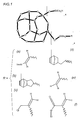
- Resinous silsesquioxanes are known from U.S. Patent 5,047,492 , and have been cited as of academic interest as well. Some of these products may contain polyhedral silsesquioxanes. However, when polyhedral silsesquioxanes are functionalized directly at a cage silicon atom, i.e. when functional groups R in Figure 1 are vinyl or H, the spatial arrangement of functional groups and their close proximity to the inflexible cage renders their reaction incomplete. This is particularly the case since prior functionalized silsesquioxanes have been completely functionalized, i.e. in silsesquioxane cages containing eight silicon atoms, each silicon bears the same reactive functional group. Unreacted groups can later react, altering the properties of the product, or may enter into a variety of degradation reactions, for example oxidizing to produce colored species or hydrolyzing to produce hydrolysis products as inclusions, which decreases transparency.
- polymers based on polyhedral silsesquioxanes which are functionalized via spacer moieties at the cage silicon atoms are highly transmissive in the UV region of the spectrum, and exhibit desirable properties such as abrasion resistance and easy processability as well.
- the preferably incompletely functionalized silsesquioxanes are easily prepared, and when suitably purified, offer a long shelf life.
- the subject invention is directed to polyhedral silsesquioxanes which bear functional groups attached to cage silicon atoms via spacer moieties which provide the functional groups with steric mobility such that a higher portion of functional groups can react.
- the polyhedral silsesquioxanes are incompletely functionalized such that on average, each molecule bears from about 20 to 80 mol percent, more preferably from 30 to 70 mol percent, and most preferably from 40 to 60 mol percent of functionalized cage silicon atoms, as more fully detailed hereafter.
- Si 8 silsesquioxanes cages it is preferable that on average 2 to 6, more preferably 3 to 5, and most preferably about 4 Si atoms are functionalized with a given type of reactive functionality linked to the cage Si atoms via spacer moieties.
- the subject invention is also directed to novel UV transmissive polymers which may be prepared from the inventive, partially functionalized polyhedral silsesquioxanes, or from completely functionalized silsesquioxanes where at least a portion of the reactive functionalities are bonded to cage silicon atoms via spacer molecules.
- the polyhedral silsesquioxanes have the general formula Si n O 1.5n where n is from 6-12, and most preferably 8.
- the actual Si/O stoichiometry can vary somewhat from the 1:3 ratio of the formula given, either due to the presence of unavoidable impurities, or the purposeful presence of SiO 2/2 or SiO 4/2 units.
- cages may be incomplete (i.e. have an open side) due to incomplete reaction, cleavage, or the presence of unavoidable or purposefully introduced monofunctional groups SiO 1/2 .
- the remaining valencies of the tetravalent silicon are satisfied by organic groups, hydrogen, halogen, etc.
- SiO 4/2 groups are purposefully added, for example during preparation of the silsesquioxanes in the form of tetrafunctional silanes such as SiCl 4 and (MeO) 4 Si, the amounts should be less than 20 mol percent, more preferably less than 10 mol percent, and most preferably less than 5 mol percent relative to the content of trifunctional SiO 3/2 moieties. Preferably, no SiO 4/2 moieties other than those introduced by unavoidable impurities or side reactions are present.
- SiO 2/2 moieties may also be present, for example less than 5 mol percent, preferably less than 3 mol percent, and most preferably 2 mol percent or less, again based on the content of SiO 3/2 moieties.
- substantially no SiO 2/2 groups are present.
- Such groups derived from unavoidable impurities are acceptable.
- the presence of SiO 2/2 groups may have two different effects. In a first case, these groups may extend the length of one or more "edges" of a polyhedral silsesquioxanes structure. In such cases, a cage "side” may be a pentagon or hexagon (with respect to Si) with the SiO 2/2 group at a non-three dimensionally bound apex of the polygon.
- Such products are perfectly acceptable so long as the amount of SiO 2/2 groups is not inordinately large. Such products can tolerate more than 5 mol percent of SiO 2/2 units.
- the SiO 2/2 groups react with themselves to form oligomeric chains (SiO 2/2 ) m where m>3, or where they serve to link two or more polyhedral silsesquioxanes together, the polymerized product may lose its rigidity and hardness, and may also generate regions within the polymer which will scatter light, particularly of short wavelengths, reducing the transmission of light under these conditions.
- the mode of synthesis of the silsesquioxanes cage can lead to such products, then the presence of SiO 2/2 units is desirably quite low, and preferably substantially no such units are present.
- SiO 4/2 groups discussed above are relative to tetrafunctional monomers, i.e. tetrahalosilanes or tetraalkoxysilanes introduced during the synthesis of silsesquioxanes cage structures, and not to fully reacted, i.e. SiO 2 units which may be present when the silsesquioxanes are prepared from silica sources such as precipitated or fumed silicas, fly ash, rice hull ash, etc. In these sources, it is likely that the SiO 4/2 units (as SiO 2 ) are already present in fully or partially polyhedral structures.
- the polyhedral silsesquioxanes used to prepare the inventive polymers must be functionalized with reactive, i.e. polymerizable groups, at least a portion of which must be bound to the Si atoms of the polyhedral silsesquioxanes by spacer moieties.
- the reactive functional groups may vary widely, and in principle include all reactive groups which may be used to chain extend or crosslink silicon-containing monomers or oligomers to produce organopolysiloxane or organocarbosiloxane products.
- such groups may be susceptible to reaction by addition, hydrosilylation, or condensation.
- Non-limiting examples include Si-H groups, unsaturated hydrocarbon groups, groups capable of Michael addition to double bonds, hydrolyzable groups such as Si-OH, SiX where X is halogen, preferably chlorine, or Si-OR where R is a hydrocarbon group, preferably an alkyl group.
- the polyhedral silsesquioxanes may contain a single type of reactive group or more than one type of reactive group. When more than one type of reactive group is present, it is desirable that the types of reactive groups are complementarily reactive, i.e. interreactive. In such cases, one of the reactive groups may optionally be directly bonded to a silicon atom of the polyhedral silsesquioxanes molecule, i.e. with no spacer moiety.
- reactive groups include ethylenically and ethylynically unsaturated hydrocarbons such as vinyl, allyl, 2-propenyl, isopropenyl, 3-butenyl, 2-butenyl, 5-hexenyl, cycloalkenyl, for example cyclopentenyl, cyclohexenyl, norbornenyl, acetylenyl, 3-hexynyl, acryloyloxy, methacryloyloxy, etc.
- vinyl groups When vinyl groups are present, these must not be directly linked to a cage Si atom unless the polymerizable mixture also contains complementarily reactive groups on the same or different molecule linked to cage Si atoms via a spacer moiety.
- Silicon-bonded hydrogen (Si-H) are also suitable reactive groups when a complementarily reactive group such as an unsaturated hydrocarbon group, Si-alkoxy group, silanol (Si-OH) group, oximino group, acetoxy group, or the like group is present.
- a complementarily reactive group such as an unsaturated hydrocarbon group, Si-alkoxy group, silanol (Si-OH) group, oximino group, acetoxy group, or the like group is present.
- the hydrogens of the Si-H groups may be bonded directly to a cage Si atom.
- the hydrogen atoms of the Si-H group may be bonded to a cage Si atom by means of a spacer group.
- SiH groups and spacer moieties which may be bound to cage Si atoms include, but are not limited, to -O-SiR 2 H, -O-R 1 -SiR 2 H, -R 1 -(SiR 2 O) 2 H, and the like.
- the spacer contain no more than 4 diorganosiloxy groups, preferably on average less than 3 diorganosiloxy groups, and most preferably, 1 or 2 diorganosiloxy groups.
- R is an organo group, preferably an alkyl, cycloalkyl, aryl, alkaryl, or aralkyl group, preferably a methyl group
- R 1 is a divalent hydrocarbon group other than a vinyl group or phenyl group, preferably an alkyl or cycloalkyl group.
- the reactive functional group may be a condensable group such as silanol, alkoxy, acetoxy, silazane, oximino-functional silyl group, or other groups which react and generate a molecular byproduct species.
- Condensable functional groups are not preferred unless polymerization can be conducted in vacuo, or when the byproduct molecules diffuse from the polymer or are present in such small domains that light scattering at the wavelengths of interest is minimal.
- Silanol, alkoxy, and acetoxy groups are all capable of condensing with Si-H groups.
- the byproducts, respectively are molecular hydrogen, alkanol, and acetic acid.
- the spacer moieties may be any which allow for some steric repositioning of the reactive functionalities such that a relatively high degree of reaction is possible.
- the most preferred spacer moieties include diorganosiloxy (OSiR 2 ) and hydrocarbon diradical spacers, although other spacer moieties such as alkoxy, polyoxyalkylene, ester and the like may also be employed. Phenyl groups and other aromatic groups are also useful spacer moieties, especially when other more "flexible" moieties such as aliphatic hydrocarbon diradicals or dialkylsiloxy diradicals are also present, either on the same or on a different molecule.
- Two or more different functionalized polyhedral silsesquioxanes may be polymerized, or a single type of polyhedral silsesquioxanes may be polymerized. It is particularly preferred that a single type of polyhedral silsesquioxane be polymerized, for example "incompletely functionalized” silsesquioxanes, or complementarily reactive silsesquioxanes.
- a polyhedral silsesquioxane is modified to contain a specific functional group or type of functional group different from the group or groups present in the initial polyhedral silsesquioxane, or is synthesized from monomers, which synthesis results in having one type of functional group present on between 20 mol percent and 80 mol percent, on average, of the cage Si atoms.
- a convenient starting material for synthesis of the monomers of the present invention is octakis[hydrido]silsesquioxane, H 8 Si 8 O 12 (“OHS").
- OHS is not a particularly good monomer.
- the ability of all eight of the Si-H bound hydrogens to react is limited as reaction proceeds due to the decreased mobility of the silsesquioxane cage and the steric unavailability of Si-H/akenyl reaction sites which results.
- OHS may be reacted with from 2 to 6 mols of a dialkenyl-functional silane such as allyldimethylcyclohexenylsilane in a hydrosilylation reaction to prepare incompletely functionalized polyhedral silsesquioxanes containing both SiH groups and 1-propyl-(cyclohexenyl)dimethylsilyl groups.
- a dialkenyl-functional silane such as allyldimethylcyclohexenylsilane
- hydrosilylation reaction preferably, about 4 mols of hydrosilylating reactant is used, thus preparing polyhedral silsesquioxanes having on average about 4 of each type of complementarily reactive groups.
- Preferred reactive polyhedral silsesquioxanes have all reactive functional groups bonded to cage Si atoms via spacer moieties, and most preferred polyhedral silsesquioxanes of this type also contain at least two types of reactive functionality, or a mixture of one or more reactive functionalities and also non-reactive groups such as methyl groups or trimethylsiloxy groups.
- Such preferred reactive polyhedral silsesquioxanes can be readily prepared from the octaanion Si 8 O 8- 12 by reaction with a suitably functionalized chlorodiorganosilane such as chlorohydridodimethylsilane (to provide spacer-linked Si-H functionality) or chlorocycloalkenyldimethylsilane (to provide spacer-linked cycloalkenyl functionality).
- chlorodiorganosilane such as chlorohydridodimethylsilane (to provide spacer-linked Si-H functionality) or chlorocycloalkenyldimethylsilane (to provide spacer-linked cycloalkenyl functionality).
- chlorodiorganosilane such as chlorohydridodimethylsilane (to provide spacer-linked Si-H functionality) or chlorocycloalkenyldimethylsilane (to provide spacer-linked cycloalkenyl functionality).
- both of these reactive moieties
- the ratio of functionalities may be easily adjusted, and polymers may be prepared, in this case by hydrosilylation in the presence of a hydrosilylation catalyst, from a single monomer, for example tetrakis[hydridodimethylsiloxy]-tetrakis[(cycloalkenyl)dimethylsiloxy]silsesquioxan e, or from mixtures of differently functionlized silsesquioxanes, for example hexakis[hydridodimethylsiloxy]-bis[(cyclohexenyl)dimethylsiloxy]silsesquioxane and bis[hydridodimethylsiloxy]-hexakis[(cyclohexenyl)dimethylsiloxy]silsesquioxane.
- a hydrosilylation catalyst from a single monomer, for example tetrakis[hydridodimethylsiloxy]-tetrakis[(cycloalkeny
- ratios other than equimolar for example 1:2 to 2:1, preferably 2:3 to 3:2 may be preferable.
- the optimal ratio is easily determined by a series of polymerizations at different ratios, and selecting the ratio which provides the best property or combinations of properties under consideration, e.g. ease of processability, color, transparency, hardness, tensile strength, etc.
- the length of the spacer moiety may be considered as the number of intervening atoms of all types in a continuous chain between the cage Si atom and the reactive functional group.
- the number of intervening atoms between the cage Si atom and the site of ethylenic unsaturation is 7 atoms (1 O, 1 Si, 5 C).
- the spacer moiety is preferably less than 10 atoms in length, more preferably less than 8 atoms in length. The spacer is too long on average when the polymer products begin to become rubbery or elastomeric rather than rigid solids.
- spacer linked alkenyl or cycloalkenyl functional groups may be prepared by reacting an SiH functional polyhedral silsesquioxane (hydrogen bonded to cage Si) or a hydridosiloxy-substituted polyhedral silsesquioxane such as octakis[hydridodimethylsiloxy]silsesquioxane with a bis[alkenyl] molecule such as allylcyclohexenyldimethylsilane, vinylcyclohexene, cyclohexadiene, cyclopentadiene, norbornadiene, and the like.
- the principle product is the corresponding alkylene-linked ethylenically unsaturated group.
- Dimer molecules containing alkylene-linked silsesquioxane cages are present in only small quantities, if at all, and can be removed readily.
- conjugated systems such as cyclohexadiene, cyclopentadiene, 1,3-hexadiene and the like, monoaddition products still containing a reactive unsaturation site are the predominant product.
- multi-unsaturated molecules which can react with Si-H functional polyhedral silsesquioxanes include the dienes mentioned previously, as well a furan, pyrrole, thiophene, thiophene-1,1-dioxide, dicyclopentadiene, vinylallyl ether, 5-hexenyallylether, divinylether, divinylbenzene, and the like. Also suitable are unsaturated alkanol esters such as hexanedioldiacrylate, glycerol diacrylate, and the like.
- Multifunctional unsaturated molecules such as glycerol triacrylate and trimethylolpropane triacrylate may be used when the total of unsaturated functionality is desired to be higher than can be obtained from compounds containing two sites of ethylenic unsaturation.
- incompatible solvent a solvent in which the product is insoluble or sparingly soluble, e.g. a solvent, which when added to a solution of the product in a first solvent, will cause the product to precipitate.
- a suitable "compatible” solvent is toluene
- suitable "incompatible” solvents include methanol, ethanol, and acetonitrile when alkenylsiloxy- and hydridosiloxy-functional polyhedral silsesquioxanes are involved. Since the hydrosilylation catalyst used to prepare such products has already been deactivated following hydrosilylation, further purification would not be expected to have any effect. However, the storage life is unexpectedly highly prolonged.
- solvent or solvent mixture(s) can be repeated two or more times, if desired.
- the same solvent or solvent mixture may be used, or alternatively may be changed.
- the wash solvent or solvent mixture may be the same as the solvent or solvent mixture from which the product is precipitated, or may be a different solvent or solvent mixture.
- Preferred solvents and solvent mixtures are or include a solvent selected from alcohols, nitriles such as acetonitrile, ethers such as diethylether, sulfoxides such as dimethylsulfoxide, and amides such as dimethylformamide and dimethylacetamide.
- the heterogenous catalyst may be any solid hydrosilylation catalyst which is substantially insoluble under the reaction conditions, and include metals such as Pt, Pd, Rh, either in particulate form or on supports such as alumina or silica.
- metals such as Pt, Pd, Rh, either in particulate form or on supports such as alumina or silica.
- Other insoluble metal compounds and complexes are suitable as well, for example PtO 2 , which is preferred.
- PtO 2 may be used in particulate form or may be formed on a support.
- the solid catalyst is removed by conventional methods such as distillation of the product monomer or by decantation, centrifugation, or filtration of the solid catalyst from the product, preferably filtration.
- the relatively expensive catalyst is thus more susceptible to recycle and/or reuse.
- monomers prepared by such techniques exhibit superior properties as compared to monomers prepared using soluble hydrosilylation catalysts, including lower coefficients of thermal expansion and in some cases improved transparency.
- the resulting product can be further functionalized by reacting the Si-H functionality obtained in the latter reaction with an unsaturated molecule such as vinylcyclohexene. If less than an equimolar amount of unsaturated compound is employed, a polyhedral silsesquioxane with both hydridodimethylsiloxy and dimethy[ethylcyclohexenyl]siloxy functionality will be obtained, both linked to the silsesquioxane cage by spacers.
- the Si 8 O 12 octaanion and similar anions of other polyhedral silsesquioxanes can also be reacted with reactive halogens such as chlorosilanes and chloroorgano compounds in the presence of base to generate other functionalities.
- Non-functional groups such as methyl groups and phenyl groups can also be introduced by these methods.
- the monomers of the subject invention may contain such non-functional groups as well as functional groups.
- less than 70% of cage Si atoms are bonded directly or indirectly to non-functional groups, more preferably about 50% or less, and most preferably, 30% or less, on a mol/mol basis.
- the monomers of the present invention are capable of sublimation. This is especially surprising in view of the nature of these monomers, which can be considered as having a high inorganic content due to their silsesquioxane cage.
- the ability to sublime these monomers leads not only to additional possibilities for monomer purification, but also to novel methods of deposition of the monomers onto substrates to prepare polymerization coatings, encapsulants, etc.
- sublimation at low pressure may be used to separate the monomeric molecules from dimers and oligomers.
- the monomers or mixtures of monomers are deposited, i.e. by sublimation, from solution, or from the melt, onto a suitable substrate, which may, e.g., be a device to be coated or encapsulated, a surface to be coated, a mold, etc., and where solvent is present, the solvent is evaporated at any convenient pressure.
- the monomer(s) are then heated for a time sufficient to provide the desired degree of reaction, i.e. polymerization.
- the polymerizable mixture may contain catalysts to accelerate cure, if desired. If the the curing (polymerization) reaction is a hydrosilylation, a hydrosilylation catalyst such as the known platinum hydrosilylation catalysts, may be added.
- condensation catalysts such as tin catalysts, amine catalysts, or the like may be added.
- Many of the monomers bearing unsaturated reactive functional groups can be polymerized thermally without added catalyst, or only with catalyst residues which may remain in the monomer product from its preparation.
- Suitable polymerization temperatures are easily determined by polymerizing at various temperatures for various lengths of time.
- the temperature and time will, in general, be dependent upon the type of reaction, i.e. addition, hydrosilylation, condensation, etc., as well as the reactivity of the specific monomers.
- the determination of thermal polymerization parameters may be simplified greatly by DSC and noting the temperature at which polymerization begins by the reactive exotherm. Once a suitable reaction temperature is established by DSC, a series of samples may be polymerized at various lengths of time to determine the minimum polymerization time necessary. In some cases, particularly when active hydrosilylation catalysts are employed without inhibitors or sulfur compounds, respectively, polymerization may take place at room temperature.
- Polymerization in the case of addition polymerization may also take place photochemically. Exposure to UV light alone may in some cases be sufficient, or the addition of photocuring catalysts well known in the art, such as the Darocur® and Irgacure® catalysts from Ciba Specialty Chemicals and Sartomer® photoinitators from Sartomer Company can be used. Addition polymerization may also be effected using free radical initiator precursors, or from thermal sources such as organic peroxides, hydroperoxides, peroxyesters, peroxyketones, and the like.
- the subject invention pertains to monomers and monomer systems containing a plurality of monomers, these monomers containing as at least a portion of their reactive or complementarily reactive groups, reactive functional species linked to Si atoms of polyhedral silsesquioxanes by means of spacer molecules.
- the monomers contain two complementarily reactive groups on the same molecule, at least one of which, or portions of both of which are bonded to cage Si atoms by spacer moieties.
- Preferred monomers contain Si-bound hydrogen bonded directly to cage Si atoms and ethylenic or ethylynic sites bonded to cage Si atoms via spacer moieties.
- the reactive R groups R 1 and R 2 may be individually selected from silicon-bonded H, halo, OR 3 where R 3 is H or alkyl, preferably C 1-4 alkyl, alkenyl, preferably C 2-18 alkenyl, and more preferably C 2-8 alkenyl, alkynyl, preferably C 2-8 alkynyl, and cycloalkenyl, preferably C 4-18 cycloalkenyl, more preferably C 4-12 cycloalkenyl, and most preferably C 6-10 cycloalkenyl, and non-reactive R are preferably selected from the group consisting of alkyl, cycloalkyl, trialkylsilyl, and ⁇ -trialkylsilyl-terminated (poly)siloxy, the alkyl groups in non-reactive R groups preferably being methyl groups.
- the ratio of reactive groups R 1 to reactive groups R 2 is desirably from 0.25:1 to 1:1.
- the invention pertains to a process for preparing an organic-inorganic hybrid polymer UV transparent material by functionalizing a polyhedral silsesquioxane with a first functionalizing group to form a first reactive functionalized polyhedral silsesquioxane of the approximate formula [R 1 Me 2 SiOSiO 1.5 ] n where n is 6, 8, 10, or 12, or a mixture thereof, and functionalizing a polyhedral silsesquioxane with a second functionalizing group to form a second reactive functionalized polyhedral silsesquioxane of the approximate formula [R 2 Me 2 SiOSiO 1-5 ] n where n is 6, 8, 10, or 12, or a mixture thereof, where R 1 and R 2 are reactive functional groups which react with each other to covalently bond the first reactive functional polyhedral silsesquioxane with the second reactive silsesquioxane, and wherein some of R 1 and R 2 may be replaced by R groups which are non-reactive with
- the first reactive functionalized polyhedral silsesquioxane bears on average at least 2 R 1 groups, more preferably at least 4 R 1 groups, and most preferably at least 6 R 1 groups and the second reactive functionalized polyhedral silsesquioxane bears on average at least 2 R 2 groups, more preferably at least 4 R 2 groups, and most preferably at least 6 R 2 groups.
- Reactive functional groups R 1 may comprise two different reactive functional groups R 1' and R 1"
- reactive functional groups R 2 may comprise two different reactive functional groups R 2' and R 2" , R 1 and R 2' reactive with each other and R 1" and R 2" reactive with each other.
- the reactive groups may be the same as already disclosed in other embodiments, and need not be repeated.
- the mol ratio of R 1 to R 2 is preferably 0.20:1: to 1:1, more preferably 0.25:1 to 1:1
- the mol ratio of R 1" to R 2" is preferably 0.20:1 to 1:1, more preferably 0.25:1 to 1:1.
- Preferred first and said second functionalized silsesquioxanes are prepared by reacting a silsesquioxane of the approximate formula [H-Si(Me) 2 -O-SiO 1.5 ] n where n is 6, 8, 10, or 12, or mixtures thereof, with at least one of dimethylvinylmethoxysilane and dimethylvinylethoxysilane.
- the invention pertains to a process for preparing an organic-inorganic hybrid polymer encapsulating material by providing a polyhedral silsesquioxane; functionalizing the polyhedral silsesquioxane with one or more types of reactive functional groups R 1 to provide functional polyhedral silsesquioxane of the formula [RMe 2 SiOSiO 1.5 ] n where n is 6, 8, 10, 12, or mixtures thereof, where R is a reactive or non-reactive organic group, with the proviso that at least one R is a reactive functional group R 1 , to form a macromonomer; adding a crosslinking agent reactive with reactive functional group R 1 , to form a curable mixture; and curing the curable mixture to form a hybrid organic-inorganic encapsulant having a light transmission at 215nm of at least 60%, where R and R 1 may be as previously disclosed.
- the invention pertains to a process for synthesizing a UV transparent organic-inorganic hybrid macromonomer by providing a polyhedral silsesquioxane having reactive sites thereon; reacting at least a portion of the reactive sites with one or more functionalizing reagents to provide a macromonomer of the formula [RMe 2 SiOSiO 1.5 ] n wherein n is 6, 8, 10, 12, or mixtures thereof, and R is a non-reactive or reactive group, with the proviso that at least one R is an R 1 reactive group and at least one R is an R 2 reactive group, where R 1 and R 2 are interreactive, and wherein all groups R are selected such that said macromonomer has a light transmission of at least 60% at 215nm, where R, R 1 , and R 2 may be as previously disclosed.
- the polyhedral silsesquioxane has the formula [HMe 2 SiOSiO 1.5 ] n and functionalizing takes place with one or more functionalizing reagents from among 4-vinyl-1-cyclohexene, dimethylvinylchlorosilane, dimethylvinylmethoxysilane, dimethylvinylethoxysilane, dicyclopentadiene, bis[trimethylsilyl]acetylene, and trimethylsilylacetylene.
- an organic-inorganic hybrid polymer material comprises a plurality of identical or different covalently bonded polyhedral silsesquioxane macromonomer-derived moieties, of the formula [A 0.5 Me 2 SiOSiO 1.5 ] n [RMe 2 SiOSiO 1.5 ] n' where n is a positive whole number, n' is 0 or a positive whole number, and the sum n + n' is 6, 8, 10, or 12, R is a non-reactive organic group or an unreacted reactive functional group R 1 or R 2 , and A is a divalent bridging group linking two polyhedral silsesquioxane moieties and derived from the reaction of two interreactive groups R 1 and R 2 which are different from each other, each macromonomer possessing, on average, both R 1 and R 2 groups, wherein the reactive and non-reactive groups R and the bridging group A are selected such that the
- the invention pertains to an organic-inorganic hybrid polymer material comprising a plurality of identical or different covalently bonded polyhedral silsesquioxane macromonomer-derived moieties, of the formula [A 0.5 Me 2 SiOSiO 1.5 ] n [RMe 2 SiOSiO 1.5 ] n' where n and n' are as described previously, R is a non-reactive organic group or an unreacted reactive functional group R 1 or R 2 , A is a divalent bridging group linking two polyhedral silsesquioxane moieties and derived from the reaction of two different interreactive groups R 1 and R 2 , each macromonomer bearing at least two R 1 or R 2 groups, and not bearing both R 1 and R 2 groups, wherein the reactive and non-reactive groups R and the bridging group A are selected such that the polymer material has a light transmission of at least 60% at 215nm.
- the invention pertains to an organic-inorganic hybrid polymer material comprising a plurality of identical or different covalently bonded polyhedral silsesquioxane macromonomer-derived moieties, of the formula [A 0.5 Me 2 SiOSiO 1.5 ] n [B 0.5 Me 2 SiOSiO 1.5]n" [RMe 2 SiOSi0 1.5 ] n' where n, and n' are as previously disclosed, and n" is 0 or a positive whole number, and the sum of n, n', and n" is 6, 8, 10, or 12, R is a non-reactive organic group or an unreacted reactive functional group R 1 , R 2 , R 3 , or R 4 , A is a divalent bridging group linking two polyhedral silsesquioxane moieties and derived from the reaction of two interreactive groups R 1 and R 2 , B is a divalent bridging group linking two polyhedral silsesquio
- the invention still further pertains to an organic-inorganic hybrid polymer material comprising a plurality of identical or different covalently linked polyhedral silsesquioxane macromonomers, of the formula [A 0.5 Me 2 SiOSiO 1.5 ] n [RMe 2 SiOSiO 1.5 ] n' wherein n and n' are as disclosed previously; R is a non-reactive organic group or an unreacted reactive group R 1 , R 1 being the same or different; A is a bridging group linking two polyhedral silsesquioxane moieties, formed from the reaction of two R 1 , wherein R, R 1 , and A are such that the polymer material has a light transmission of at least 60% at 215nm, and to an organic-inorganic polymer material comprising a plurality of identical or different covalently bonded silsesquioxane macromonomer-derived moieties, of the formula [A 0.5 Me 2 SiOSiO 1.5 ] n [RM
- the subject invention polymers may also contain up to 50 mol percent, preferably less than 20 mol percent, and most preferably less than 10 mol percent of highly crosslinked, substantially non-cage-like functionalized silicone resins, so long as the optical and physical properties desired of the polymers can be maintained.
- the polymers may also contain minor amounts of linear or branched organopolysiloxanes which are at least trifunctional, and preferably have a higher functionality. Examples include Si-H functional poly(dimethylsiloxy)(methylhydridosiloxy) oligomers and polymers. The latter are present in an amount such that the final product is not elastomeric or rubbery, generally in amounts of less than 20 mol percent, more preferably less than 10 mol percent.
- the compositions are most preferably free of such species.
- Difunctional organopolysiloxanes or oligomers such as a, ⁇ -Si(CH 3 ) 2 H-terminated siloxanes or a, ⁇ -divinyl-terminated siloxanes may be added in most minor amount, for example less than 10 mol percent, more preferably less than 5 mol percent, so long as hard, rigid polymers and not rubbery elastomers are obtained.
- polyalkenyl compounds such as 1,5-hexadiene and isoprene may be used as well, with the same limitations.
- the novel monomers of the subject invention are preferably polyhedral silsesquioxanes with complementarily reactive functional groups on each molecule.
- Preferred complementarily functional groups are Si-bound hydrogen and ethylenic or ethylynic unsaturation, and Si-bound hydrogen and silicon-bound alkoxy groups.
- the [Si n O 1.5n ] unit is a polyhedral silsesquioxane.
- R 3 is a non-functional group, preferably a C 1-18 hydrocarbon group, more preferably a C 1-4 alkyl group or C 6-10 aryl group, most preferably a methyl group;
- R 4 is H, -L-SiR 3 2 H, or -L-SiR 3 H 2 where R 3 is a non-functional hydrocarbon such as R 3 and L is a divalent, non-reactive spacer moiety which may be a C 2 -C 18 hydrocarbon, preferably C 2-8 alkylene, C 5-8 cycloalkylene, or C 7-10 alkarylene, a siloxy group -SiR 3 2 -O- or a polysiloxy group ⁇ SiR 3 2 O ⁇ m where m is an integer from 2-10, preferably 2-4; and R 5 is an alkenyl-functional group other than a vinyl group,
- R 5 may also, in lieu of an unsaturated group, bear an alkoxysilyl group such as dimethylmethoxysiloxy, etc., in other words, groups which bear a reactive silicon-bonded alkoxy group, preferably a C 1-4 alkoxy group. A plurality of alkoxy groups may also be present.
- an alkoxysilyl group such as dimethylmethoxysiloxy, etc.
- groups which bear a reactive silicon-bonded alkoxy group preferably a C 1-4 alkoxy group.
- a plurality of alkoxy groups may also be present.
- Preferred monomers are those where a is 0, 1, or 2, preferably 0, and both b and c on average are between 2 and 6, more preferably between 3 and 5, and the sum of b+c is on average 8.
- R 4 is -L-SiR 3 2 H or -L-SiR 3 H 2
- the preferred groups R 5 are ethylenically unsaturated aliphatic and cycloaliphatic hydrocarbons having 4 to 10 carbon atoms. Cycloaliphatic in this sense includes cycloaliphatic compounds attached to silicon via an alkylene group, such as those derived from vinylcyclohexene.
- Further preferred R 5 are those of the formula -SiR 3 2 -Y where Y is alkenyl, alkynyl, or cycloalkenyl.
- a preferred synthesis of the subject invention compementarily reactive monomers is the partial hydrosilylation of a polyhedral silsesquioxane bearing predominantly, and preferably wholly, cage silicon-bonded -SiR 3 2 H moieties.
- Hydrosilylation is preferably conducted in a suitable, preferably apolar organic solvent such as a paraffinic hydrocarbon such as hexane, or preferably, an aromatic solvent such as toluene or xylene (single isomer or mixture).
- solvents such as tetrahydrofuran, diethyl ether, dimethylformamide, dimethylacetamide, dimethylsulfoxide, etc., may also be used so long as the starting materials are soluble or become solubilized during the reaction.
- hydrosilylation catalyst compounds of Pt, Pd, Rh, and other noble metals generally used as hydrosilylation catalysts may be used, including platinum olefin complexes commonly known as Karstedt catalysts.
- the noble metals themselves may be used as well.
- Preferred hydrosilylation catalysts are those employed in the examples, particularly Pt (divinylsiloxane) complexes, Pt (dicyclopentadiene) complexes, and most preferably, metallic Pt and PtO 2 .
- Supported catalysts and solid catalysts are particularly suitable, as these can be removed from the reaction mixture for recycle or reuse, and catalyst deactivation need not occur. It has been surprisingly and unexpectedly discovered, for example, that TCHS prepared using the solid catalyst PtO 2 which is subsequently removed by filtration, can be polymerized to a transparent polymer which has a lower coefficient of thermal expansion than TCHS of similar composition prepared employing a soluble catalyst which is subsequently deactivated.
- the amount of hydrosilylation catalyst is typical for the use of these catalysts, and may vary from 0.01 ppm based on the weight of the starting polyhedral silsesquioxane with Si-H functionality, to 1000 ppm, preferably 0.01 ppm to 200 ppm, more preferably 0.01 to 50 ppm, and most preferably 0.02 to 2 pm. Where heterogenous (solid or supported) catalysts are employed, somewhat larger amounts are employed in order to keep the reaction time reasonable. For 100 g octakis[hydridodimethylsiloxy]silsesquioxane, from 0.05 to 0.2 g of PtO 2 has been found to work satisfactorily.
- catalyst deactivation When soluble catalysts are employed, and the product is not to be immediately used, the catalyst must generally be deactivated to provide an adequate shelf life of the monomer product, since the product itself contains both Si-H and ethylenic unsaturation which can react with each other via hydrosilylation.
- Conventional means of catalyst deactivation may be used, including addition of phosphines such as triphenyl phosphine, addition of sulfur compounds such as mercaptans, and any method generally known in the art. Catalyst deactivation may not be necessary if the hydrosilylation catalyst used is only effective at relatively high temperatures. Also, alkynol inhibitors and other inhibitors known to those skilled in the art of hydrosilylation can be used as well.
- triphenylphosphine is preferably used in an amount of less than 0.09 weight percent relative to the weight of the complementarily reactive monomer.
- Other deactivators may be used as well, however, including arsines, stibines, alkali cyanides, etc.
- TCHS will cure above 80 °C to a rigid body with less than 0.09 mol% deactivation agent relative to TCHS, although the hybrid does not fully cure even at 200 °C overnight with more than 0.2 mol% deactivation agent relative to TCHS. Less than 0.09 mol% of deactivating agent is preferred when triphenylphosphine is added. Amounts used for other deactivators will vary with the type and the curing conditions desired. Based on these results, the amount of deactivation agent serves an important role to prepare fully cured materials. In addition, the deactivator also will control the temperature required or the time required to fully cure these materials. Likewise, it will affect the rate of cure in the presence or absence of oxygen.
- novel polymers of the present invention comprise polymers prepared from polyhedral silsesquioxane monomers bearing spacer-linked unsaturated groups, optionally in conjunction with silicone resins or silicone oligomers or polymers containing in excess of three corresponding or complementarily reactive groups and preferably no more than 5 mol percent of difunctional silicone oligomers or polymers, preferably exclusively or substantially all polyhedral silsesquioxanes containing spacer-linked ethylenically unsaturated groups; or may contain the novel monomers of the subject invention bearing complementarily reactive groups, at least one of which is spacer-linked to the silicon atoms of the polyhedral silsesquioxane, optionally with further silicone oligomers or polymers or other molecules bearing at least two and preferably three or more of a corresponding functional group (i.e.
- the polymers are prepared exclusively from polyhedral silsesquioxanes of the same type, although the proportion of complementarily reactive groups may differ.
- the proportion of low functionality polymers i.e. those with a low "density" of functional groups per molecule, will be such that the product is a solid, and not a rubbery elastomer.
- Figure 3 compares the transparency of bulk synthetic quartz (blue), fused quartz (pink), KE-106, Shinetsu silicone resin (light blue, no aromatic components), low melting glass (red), transparent epoxy resin (purple) and TCHS (green-blue curve).
- Transparency herein means ⁇ 60 % transmittance at ⁇ 215 nm, preferably > 70 % and most preferably > 85 %.
- the minimum wavelength of transmitted light is ⁇ 380 nm and most prefereably ⁇ 300 nm.
- Cured TCHS materials satisfy all of these requirements.
- octakis [hydridodimethylsiloxy] silsesquioxane "OHSS" (20 g, 20 mmol).
- OHSS octakis [hydridodimethylsiloxy] silsesquioxane
- Toluene (50 ml), 5-vinyl-1-cyclohexene (8.7 g, 80 mmol), and 2 mM Pt(dcp)-toluene solution (1 ml, Pt: 2 ppm) as a catalyst are then added to the flask.
- Example 2 The synthesis procedure of Example 2 is followed except for the addition of deactivation agent. Purification is accomplished on a smaller scale (OHSS: 10 g, 10 mmol) by adding a TCHS toluene solution dropwise to a solvent such as methanol and acetonitrile (400 ml) to obtain white TCHS powder. This powder is filtered off then washed with solvent (50 ml) in a beaker and filtered to give a white powder. This procedure is repeated three times. The white powder is dried in vacuum. The yield of purified TCHS is 3.5 g (2.4 mmol, 24.5 %)
- OHSS and its Q 6 , Q 10 , and Q 12 analogs can also be synthesized by reaction of the corresponding anions with organochlorosilanes such as dimethylchlorosilane, and unsaturated compounds such as octakis[vinyl]silsesquioxane can be prepared by reaction with dimethylvinylchlorosilane.
- organochlorosilanes such as dimethylchlorosilane
- unsaturated compounds such as octakis[vinyl]silsesquioxane
- the latter can be hydrosilylated to produce spacer-linked silsesquioxanes, for example by reaction with dimethylsilane or cyclohexeryl dimethylchlorosilane.
- OHS octahydridosilsesquioxane
- Toluene (20 ml), 5-vinyl-1-cyclohexene (0.26 g, 5 mmol), and 2 mM Pt(dcp)-toluene solution (0.1 ml, Pt: 0.2 ppm) as a catalyst are then added to the flask.
- DTA-TGA Tg 5 : 452 °C
- Ceramic yield 75.8 % (1000 °C in air, Calcd.: 79.9 %). Note that the TGA in nitrogen also shows that some weight is also lost as some of the complex sublimes.
- DSC Mp: 82 °C
- Curing temperature 102, 167°C 1 H
- NMR Si-CH 3 , 0.15 ppm, 11 H, s
- octahydridosilsesquioxane OHS 21.4 g, 21 mmol.
- OHS octahydridosilsesquioxane
- the flask is heated under vacuum to eliminate residual air and moisture and then flushed with nitrogen.
- 5-vinyl-1-cyclohexene (18.2 g, 170 mmol)
- 2 mM Pt(dcp)-toluene solution 0.1 ml, Pt: 0.02 ppm
- the mixture is stirred at 90 °C for 4 h. After reaction, solvent is removed to obtain a white powder.
- the powder is rinsed with methanol to purify and then dried, providing a white powder.
- the yield is 38.5 g (20 mmol) 97 %.
- DTA-TGA Tg 5 : 348 °C
- Ceramic yield 46.8 % (1000 °C in air, Calcd.: 51.0 %). Note that in nitrogen the ceramic yield is only 36 st. % indicating that some material sublimes at one atmosphere. It also indicates that this material can be used for sublimation (CVD) coatings if desired.
- DSC Mp: 73 °C 1 H NMR: Si-CH 3 , 0.14 ppm, 48 H, s
- TCHS ( ⁇ 1 g) is added to a 10 ml Teflon [23.3 x 18.3 mm ID] or aluminum cup (25.2 x 39.6 mm ID).
- the cup is placed in a vacuum oven thermostatted at 85 °C. Following degassing for 2 h at 85 °C, the oven is flushed with nitrogen. The temperature is then raised at 30 °C/h to 200 °C and kept there for 10 to 24 h overnight providing a transparent disk with thickness of 2.0-4.0 mm.
- TMA data shows the effect of the purification procedure.
- the CTE (coefficient of thermal expansion) of resin prepared from TCHS purified with acetonitrile is smaller than unpurified TCHS or TCHS purified with methanol. This suggests purification with acetonitrile is better to improve properties of resin if low CTEs are desirable.
- the intensity of the remaining Si-H peak is affected by the addition of deactivation agent.
- the intensity ratio of Si-H (2140 cm -1 ) to Si-O-Si (1088 cm -1 ) of resin from TCHS with 5 mg (0.45 mol%) deactivation agent is 0.11 (intensity ratio of Si-H/Si-O-Si of original TCHS is 0.32); the ratio of resin from TCHS without deactivator is 0.06 when these resins are prepared under identical conditions (air heating to 200°C/24 h). This data suggests that the curing TCHS without deactivator goes further to completion than with deactivator.
- BCHS ( ⁇ 1 g) is added to a 10 ml Teflon [23.3 x 18.3 mm ID] or aluminum cup (25.2 x 39.6 mm ID). The cup is placed in a vacuum oven thermostatted at 85 °C. Following degassing for 2 h at 85 °C, the oven is flushed with nitrogen. The temperature is then raised at 30 °C/h to 200 °C and kept there for 10 to 24 h overnight providing a white powder. BCHS is not cured completely because of a lack of functional groups to crosslink. Therefore, it does not provide a homogeneous resin.
- OCHS ( ⁇ 1 g) is added to a 10 ml Teflon [23.3 x 18.3 mm ID] or aluminum cup (25.2 x 39.6 mm ID). The cup is placed in a vacuum oven thermostatted at 85 °C. Following degassing for 2 h at 85 °C, the oven is flushed with nitrogen. The temperature is then raised at 30 °C/h to 200 °C and there for 10 to 24 h overnight providing a white powder. OCHS melts but does not cure by thermal polymerization of vinyl groups.
- OCHS (1 g, 0.5 mmol)/OHSS (0.5 g, 0.5 mmol) are added to a 10 ml Teflon [23.3 x 18.3 mm ID] or aluminum cup (25.2 x 39.6 mm ID).
- the cup is placed in a vacuum oven thermostatted at 85 °C. Following degassing for 2 h at 85 °C, the oven is flushed with nitrogen. The temperature is then raised at 30 °C/h to 200 °C and held there for 10 to 24 h providing a white opaque disk.
- OCHS (0.08 g, 0.04 mmol) / BCHS (0.1 g, 0.08 mmol) are added to a 10 ml Teflon [23.3 x 18.3 mm ID] or aluminum cup (25.2 x 39.6 mm ID).
- the cup is placed in a vacuum oven thermostatted at 85 °C. Following degassing for 2 h at 85 °C, the oven is flushed with nitrogen. The temperature is then raised at 30 °C/h to 200 °C and left there for 10 to 24 h providing a white opaque disk.
- a 0.25 to 1 molar ratio of functional moiety on functionalized polyhedral silsesquioxane to Si-H functionality is preferred, most preferably 0.5 such as in TCHS described above. Because the degree of substitution affects the physical properties of the compound including solubility, melting point, etc., mixtures of compounds with different numbers of substituents like OCHS/BCHS are not always miscible, so that homogeneous and transparent resins do not always form. In addition, a large excess of one reactive group will lead to incomplete curing and inhomogeneities that also will reduce transparencies.
- ODCPDS Based on the 1 H NMR spectrum, the structure of ODCPDS is that shown below. Dicyclopentadiene does not react easily with all Si-H group on OHS partly because of the potential steric hindrance and also because it is a good ligand for the catalytic species, thereby slowing the reaction down. Other catalysts such as Pt or PtO 2 may provide superior results.
- DCPDS Based on 1 H NMR spectrum and TGA-DTA data, the structure of DCPDS is that shown below.
- TDCPDS (1 g) is added to a 10 ml Teflon (23.3 x 18.3 mm ID) or aluminum cup (25.2 x 39.6 mm (ID)).
- the cup is placed in a vacuum oven thermostatted at 85 °C. Following degassing for a period of 2 h at 85 °C, the oven is flushed with nitrogen. The temperature is then raised at 30 °C/h to 200 °C and held there for 10 to 24 h providing a white opaque (translucent) disk with thickness of 2-4 mm.
- OBTMSAS Based on the 1 H NMR spectrum and TGA-DTA data, the structure of OBTMSAS is that shown below. Bistrimethylsilylacetylene does not react stoichiometrically with all of reaction sites (Si-H group) on OHS even when excess bistrimethylsilylacetylene is added. This result is a combination of steric hindrance and the fact that the catalytically active species is bound with the vinyl groups which reduce its ability to catalyze the reaction.
- TBTMSAS Based on the 1 H NMR spectrum and TGA-DTA data, the structure of TBTMSAS is determined to be that shown below. From this data less than four equivalents of bistrimethylsilylacetylene react with the Si-H groups on OHS even though four equivalents are added in the time allotted for the reaction to proceed.
- TBTMSAS (1 g) is added to a 10 ml Teflon (23.3 x 18.3 mm ID) or aluminum cup, (25.2 x 39.6 mm ID). The cup is placed in a vacuum oven thermostatted at 85 °C. Following degassing for a period of 2hr at 85°C, the oven is flushed with nitrogen. The temperature is then raised at 30 °C/h up to 200 °C and held there for 10 to 24 h providing a white opaque (translucent) disk with thickness of 2-4 mm.
- DTA-TGA Td 5 : 238 °C
- Ceramic yield 65.3 % (1000 °C in air, calcd: 81.1 %).
- OTMSAS Based on the 1 H NMR and TGA-DTA data, the structure of OTMSAS is determined to be that shown below.
- TTMSAS Based on the 1 H NMR and TGA-DTA data, the structure of TTMSAS is determined to be as shown below.
- TTMSAS (1 g) is added to a 10 ml teflon(23.3 x 18.3 mmlD) or aluminum cup, (25.2 x 39.6 mm ID).
- the cup is placed in a vacuum oven thermostatted at 85 °C. Following degassing for a period of 2 h at 85°C, the oven is flushed with nitrogen. The temperature is then raised at 30 °C/h to 200 °C and held there for 10 to 24 h providing a white opaque (translucent) disk with thickness of 2-4 mm.
- Analytical data TMA: CTE 212 ppm (between 50° and 100 °C)
- NorbTHS (1 g) is added to a 10 ml Teflon (23.3 x 18.3 m (ID) or aluminum cup (25.2 x 39.6 mm ID). The cup is placed in a vacuum oven thermostatted at 85 °C. Following degassing for a period of 2 h at 85 °C, the oven is flushed with nitrogen. The temperature is then raised at 30 °C/h to 200 °C and held there for 10 to 24 h providing a white solid.
- OCHDS Based on 1 H NMR and FTIR, the structure of OCHDS is that described below.
- TCHDS Based on 1 H NMR spectrum, the structure of TCHDS is determined to be as shown below.
- the hexane layer is separated and dried over Na 2 SO 4 and then removed via rotary evaporator to produce white TViTHS powder.
- the yield is 4.46 g (3.8 mmol) 64 %.
- the molar ratio of dimethylchlorosilane and dimethylvinylchlorosilane directly affects the ratio of substitution ratio on synthesized compound.
- the ratio of dimethylchlorosilane/dimethyl-vinylchlorosilane/octaanion silsesquioxane 5/5/1 described above
- the ratio of dimethylsilyl group/dimethylvinylsilyl group on obtained compound is 4.02 /3.98 based on 1 H NMR spectrum. The determined structure is shown below.
- the ratio of dimethylallylchlorosilane/dimethylchloro-silane/octaanion is 5/5/1
- the ratio of dimethylallylsilyl to dimethylsilyl groups substituted on octaanion is 3.7/3.7 as described above and remaining positions may be OH groups from unreacted sites on octaanion based on 1 H NMR and FTIR data. The determined structure is shown below.
- TAllylTHS (1 g) is added to a 10 ml Teflon (23.3 x 18.3 mm ID) or aluminum cup (25.2 x 39.6 mm ID). The cup is placed in a vacuum oven thermostatted at 85°C. Following degassing for a period of 2 h at 85 °C, the oven was flushed with nitrogen. The temperature is then raised at 30 °C/h to 200°C and held there for 10-24 h providing a brown opaque disk with thickness of 2-4 mm.
- the hexane layer is separated and dried over Na 2 SO 4 and then removed via rotary evaporator to produce transparent ThexenylTHS liquid.
- the liquid is purified by washing with methanol/aeetonitrile (1:1 by volume) giving a yield of 4.68 g (3.5 mmol) 90 %.
- Analytical data DTA-TGA: Td 5 :95 °C, Ceramic yield: 51.9 % (1000 °C in air, Calcd.: 71.3 %). Some of the material sublimes during the TGA run as determined by a TGA run in nitrogen. This material offers potential for vapor deposition processes.
- DSC Curing temperature, 224 °C 1 H NMR: -Si-CH 3 , 0.085, 0.11, 0.14, 0.18 ppm, 32 H, dd
- ThexenylTHS is determined to be as shown above.
- ThexenylTHS (1 g) is added to a 10 ml Teflon (23.3 x 18.3 mm ID) or aluminum (25.2 x 39.6 mm ID).
- the cup is placed in a vacuum oven thermostatted at 60 °C. Following degassing for a period of 2h at 85 °C, the oven is flushed with nitrogen. The temperature is then raised at 30 °C/h up to 200 °C and held there for 10 to 24 h providing a colorless transparent disk with thickness around 2-4 mm.
- Octakis(vinyldimethylsiloxy)silsesquioxane (OVS, 1.5 g, 1.2 mmol) and Octakis(hydridodimethylsiloxy)ostasilsesquioxane (OHS, 1.25 g, 1.2 mol) are mixed with mortar and pestle.
- the mixture is placed in a 10 ml Aluminum cup (25.2 x 39.6 mm ID).
- the cup is placed in a vacuum oven at room temperature. Then the oven is flushed with nitrogen and the temperature raised at 30 °C/h up to 360 °C and held there for 10 to 24 h providing a colorless transparent disk 2-4 mm thickness.
- TrisViMe 2 SiOEtS Based on the 1 H NMR spectrum, the structure of TrisViMe 2 SiOEtS is determined to be as shown above.
- TrisViMe 2 SiOEtS (5.6 g, 3.6 mmol) and THF (20 ml). The mixture is then cooled at 0 °C for 30 min. 0.1 N HC1 acq (0.43 ml) is added into the flask and the solution stirred at 0 °C for 30 min and at RT for 30 min. The mixture is stirred at 60 °C for 1 d to complete the hydrolysis.
- TrisViMe 2 SiOEtS (Ig) is added to a 10ml teflon cup (23.3 x 18.3 mm ID). The cup is placed in a vacuum oven thermostatted at 30 °C to evaporate solvent over 2h. Then the oven ambient pressure was restored. The temperature is raised at 30 °C/h to 150 °C and held therefor 10 to 24 h providing a colorless transparent disk 2-4 mm thick.
- Analytical data DTA-TGA Td 5 : 297 °C, Ceramic yield: 80.0 % (1000 °C in air, Calcd.: 74.1 %)
- FTIR ⁇ -OH, 3640, 3380 cm -1
- TrisViMe 2 SiOEtS (2.2 g, 0.0015 mol). The apparatus is then gently heated in vacuum to remove residual air and moisture and then flushed with nitrogen. Then toluene (10 ml), trimethylvinylsilane (0.87 g, 0.0087 mol) and 2 mM Pt(dvs)-toluene solution (0.1 ml, Pt: 0.2 ppm) as a catalyst, are added. The mixture is stirred at 90 °C for 3 h. After reaction, solvent was evaporated at RT in vacuo to yield a transparent liquid. The yield is 3.5 g (1.9 mmol). Analytical data 1 H NMR: Si(CH 3 ) 3 , -0.02 ppm, 38H, s
- TrisSiOEtPentaldsSiMe 3 S solution and 1 wt. % dibutyl tin dilaurate as a curing catalyst are added to 10 ml Teflon (23.3 x 18.3 mm ID).
- the cup is placed in a vacuum oven thermostatted at 30 °C to evaporate solvent. Then the oven pressure is returned to ambient. The temperature is raised at 30 °C/h up to 150 °C and held there for 10 to 24 h providing an opaque disk 2.0-4.0 mm thick.
- FTI R ⁇ -OH, 3710 cm -1
- OHS octahydridosilsesquioxane
- PtO 2 0.02, 0.01, 0.005 g, Pt content: 0.08, 0.04, 0.02 mol, respectively
- TCHS ( ⁇ 1 g) as prepared in Example 28 is added to a 10 ml Teflon [23.3 x 18.3 mm ID] or aluminum cup (25.2 x 39.6 mm ID). The cup is placed in vacuum oven thermostatted at 85°C. Following degassing for 2 h at 85°C, the oven is flushed with nitrogen. The temperature is then raised at 30°C/h to 200°C and held there for 10 to 24 h overnight providing a transparent disk with thickness of 2.0 - 4.0 mm.
- CTE 50°C - 100°C: 126 ppm
- a catalyst deactivating agent may be added to lower the room temperature reactivity.
- the reactivity can also be controlled by storing at lower temperatures, or the catalyst can be removed by passing through a column designed to capture the catalyst.
- the amount of deactivating agent can be minimal such that at higher temperatures, reaction will proceed. In some instances exposure to air or water can oxidize or decompose the deactivating agent.
- triphenylphosphine is used above, it is meant only to be representative of a large group of hydrosilylation catalyst deactivators that those practiced in the art will recognize.
- deactivators include other phosphines, arsines, stibnines, alkali cyanides, etc that will not also react with the cube macromonomers but can deactivate the transition metal complex by exchange reaction of ligands.
- deactivating agent triphenylphosphine provides an example
- TCHS will cure above 80 °C to a rigid body with less than 1 mg (0.09 mol% to the TCHS) deactivation agent, although the hybrid does not fully cure even at 200 °C, overnight with more than 2.5 mg (0.2 mol% to TCHS) deactivation agent. Based on these results, the amount of deactivation agent serves an important role to prepare fully cured materials. In addition, the deactivator also will control the temperature required or the time required to fully cure these materials. Likewise, it will affect the rate of cure in the presence or absence of oxygen.
Landscapes
- Chemical & Material Sciences (AREA)
- Chemical Kinetics & Catalysis (AREA)
- Organic Chemistry (AREA)
- Health & Medical Sciences (AREA)
- Medicinal Chemistry (AREA)
- Polymers & Plastics (AREA)
- Life Sciences & Earth Sciences (AREA)
- Engineering & Computer Science (AREA)
- Materials Engineering (AREA)
- Wood Science & Technology (AREA)
- Silicon Polymers (AREA)
- Rolling Contact Bearings (AREA)
Applications Claiming Priority (3)
| Application Number | Priority Date | Filing Date | Title |
|---|---|---|---|
| US63382104P | 2004-12-07 | 2004-12-07 | |
| US11/075,042 US7915369B2 (en) | 2004-12-07 | 2005-03-08 | Ultraviolet transmissive polyhedral silsesquioxane polymers |
| EP05814653A EP1833880B1 (fr) | 2004-12-07 | 2005-12-05 | Polymeres de silsesquioxane polyedrique transmettant dans l'ultraviolet |
Related Parent Applications (1)
| Application Number | Title | Priority Date | Filing Date |
|---|---|---|---|
| EP05814653.1 Division | 2005-12-05 |
Publications (3)
| Publication Number | Publication Date |
|---|---|
| EP2287231A2 true EP2287231A2 (fr) | 2011-02-23 |
| EP2287231A3 EP2287231A3 (fr) | 2011-05-18 |
| EP2287231B1 EP2287231B1 (fr) | 2012-06-06 |
Family
ID=36097005
Family Applications (2)
| Application Number | Title | Priority Date | Filing Date |
|---|---|---|---|
| EP10011270A Expired - Lifetime EP2287231B1 (fr) | 2004-12-07 | 2005-12-05 | Polymères silsesquioxanes polyédriques perméables aux UV |
| EP05814653A Expired - Lifetime EP1833880B1 (fr) | 2004-12-07 | 2005-12-05 | Polymeres de silsesquioxane polyedrique transmettant dans l'ultraviolet |
Family Applications After (1)
| Application Number | Title | Priority Date | Filing Date |
|---|---|---|---|
| EP05814653A Expired - Lifetime EP1833880B1 (fr) | 2004-12-07 | 2005-12-05 | Polymeres de silsesquioxane polyedrique transmettant dans l'ultraviolet |
Country Status (6)
| Country | Link |
|---|---|
| US (2) | US7915369B2 (fr) |
| EP (2) | EP2287231B1 (fr) |
| JP (1) | JP4664976B2 (fr) |
| KR (1) | KR100944740B1 (fr) |
| AT (1) | ATE549367T1 (fr) |
| WO (1) | WO2006062219A1 (fr) |
Families Citing this family (29)
| Publication number | Priority date | Publication date | Assignee | Title |
|---|---|---|---|---|
| EP2277948B1 (fr) * | 2004-11-02 | 2015-02-18 | Bridgestone Corporation | Polymere a modification polyhedrique |
| JP4826160B2 (ja) * | 2005-07-28 | 2011-11-30 | ナガセケムテックス株式会社 | 光素子封止用樹脂組成物 |
| JP2007112977A (ja) * | 2005-09-26 | 2007-05-10 | Fujifilm Corp | 絶縁膜形成用組成物、絶縁膜およびその製造方法 |
| JP2007284652A (ja) * | 2006-03-20 | 2007-11-01 | Fujifilm Corp | 組成物、膜、およびその製造方法 |
| KR20090083330A (ko) * | 2006-08-17 | 2009-08-03 | 유니버시티 오브 유타 리써치 파운데이션 | 덴드리머 및 그의 제조 및 사용 방법 |
| JP2008074963A (ja) * | 2006-09-21 | 2008-04-03 | Fujifilm Corp | 組成物、膜、およびその製造方法 |
| WO2008069193A1 (fr) * | 2006-12-04 | 2008-06-12 | Panasonic Corporation | Tête optique, dispositif d'enregistrement et de lecture d'informations optiques, et système d'informations optiques |
| KR101340995B1 (ko) * | 2006-12-28 | 2013-12-13 | 엘지디스플레이 주식회사 | 액정표시소자용 박막 트랜지스터 |
| JP2008201832A (ja) * | 2007-02-16 | 2008-09-04 | Shin Etsu Chem Co Ltd | シロキサン重合体とその製造方法、該重合体を含有する多孔質膜形成用塗布液ならびに多孔質膜と、該多孔質膜を用いた半導体装置 |
| JP4451457B2 (ja) * | 2007-02-26 | 2010-04-14 | 富士通株式会社 | 絶縁膜材料及びその製造方法、多層配線及びその製造方法、並びに、半導体装置の製造方法 |
| JP4996946B2 (ja) * | 2007-03-02 | 2012-08-08 | 富士フイルム株式会社 | 反射防止膜形成用組成物、反射防止膜および光学デバイス |
| EP3042909B1 (fr) * | 2007-04-17 | 2018-08-01 | Kaneka Corporation | Produit modifié par un polysiloxane polyédrique et composition utilisant le produit modifié |
| WO2009002660A2 (fr) * | 2007-06-15 | 2008-12-31 | Mayaterials, Inc. | Silsesquioxanes multifonctionnels pour des nouvelles applications de revêtement |
| US7868198B2 (en) * | 2007-06-15 | 2011-01-11 | Laine Richard M | Multi-functional silsesquioxanes for novel coating applications |
| US7732553B2 (en) * | 2008-02-28 | 2010-06-08 | The Regents Of The University Of California | Method of producing encapsulation resins |
| JP2011515513A (ja) * | 2008-03-04 | 2011-05-19 | エージェンシー フォー サイエンス,テクノロジー アンド リサーチ | 低収縮多官能基化ssq樹脂 |
| JP5401118B2 (ja) * | 2008-12-10 | 2014-01-29 | 富士フイルム株式会社 | 組成物 |
| CN102918110B (zh) | 2010-05-28 | 2015-08-12 | 株式会社钟化 | 聚硅氧烷类组合物、固化物及光学器件 |
| US9698320B2 (en) * | 2010-09-22 | 2017-07-04 | Kaneka Corporation | Modified product of polyhedral structure polysiloxane, polyhedral structure polysiloxane composition, cured product, and optical semiconductor device |
| JP5694716B2 (ja) * | 2010-09-22 | 2015-04-01 | 株式会社カネカ | 多面体構造ポリシロキサン変性体およびこれから得られる組成物 |
| JP5821761B2 (ja) * | 2011-04-20 | 2015-11-24 | セントラル硝子株式会社 | シロキサン化合物およびその硬化物 |
| US20130241404A1 (en) * | 2012-03-14 | 2013-09-19 | Peter Guschl | Encapsulant compositions and methods for lighting devices |
| US20130241390A1 (en) * | 2012-03-14 | 2013-09-19 | Peter Guschl | Metal-containing encapsulant compositions and methods |
| KR102016348B1 (ko) | 2013-02-28 | 2019-08-30 | 주식회사 동진쎄미켐 | 광학소자 봉지용 수지 조성물 |
| JP6337336B2 (ja) * | 2013-03-26 | 2018-06-06 | Jnc株式会社 | アルコキシシリル基含有シルセスキオキサンおよびその組成物 |
| KR102114141B1 (ko) * | 2013-12-24 | 2020-05-22 | 엘지디스플레이 주식회사 | 하드 코팅 필름 및 이를 이용하는 표시 장치 |
| WO2015114939A1 (fr) * | 2014-01-31 | 2015-08-06 | 信越化学工業株式会社 | Composé d'organopolysiloxane et son procédé de production, et composition de silicone durcissable par addition |
| US10899937B2 (en) | 2014-12-22 | 2021-01-26 | U.S.A. As Represented By The Administrator Of The National Aeronautics And Space Administration | Hydrogen-bonding surfaces for ice mitigation |
| CN118630073B (zh) * | 2024-08-13 | 2024-12-10 | 比亚迪股份有限公司 | 一种电池 |
Citations (1)
| Publication number | Priority date | Publication date | Assignee | Title |
|---|---|---|---|---|
| US5047492A (en) | 1988-11-03 | 1991-09-10 | Wacker-Chemie Gmbh | Organooligosilsesquioxanes |
Family Cites Families (10)
| Publication number | Priority date | Publication date | Assignee | Title |
|---|---|---|---|---|
| US5330734A (en) | 1993-03-09 | 1994-07-19 | Exxon Research And Engineering Company | Silica pillared micas |
| US5618878A (en) | 1995-04-07 | 1997-04-08 | Dow Corning Corporation | Hydrogen silsesquioxane resin coating composition |
| US5939576A (en) * | 1998-01-05 | 1999-08-17 | The United States Of America As Represented By The Secretary Of The Air Force | Method of functionalizing polycyclic silicones and the compounds so formed |
| US6911518B2 (en) * | 1999-12-23 | 2005-06-28 | Hybrid Plastics, Llc | Polyhedral oligomeric -silsesquioxanes, -silicates and -siloxanes bearing ring-strained olefinic functionalities |
| US7261992B2 (en) | 2000-12-21 | 2007-08-28 | International Business Machines Corporation | Fluorinated silsesquioxane polymers and use thereof in lithographic photoresist compositions |
| GR1004403B (el) | 2002-05-30 | 2003-12-19 | "����������", ���������� ����������������� | Υλικα λιθογραφιας με βαση πολυμερη που περιεχουν πολυεδρικες ολιγομερεις σιλεναμισοξανες |
| US7037592B2 (en) | 2003-02-25 | 2006-05-02 | Dow Coming Corporation | Hybrid composite of silicone and organic resins |
| JP4734832B2 (ja) | 2003-05-14 | 2011-07-27 | ナガセケムテックス株式会社 | 光素子用封止材 |
| US7223517B2 (en) * | 2003-08-05 | 2007-05-29 | International Business Machines Corporation | Lithographic antireflective hardmask compositions and uses thereof |
| US7576169B2 (en) * | 2003-10-23 | 2009-08-18 | The Regents Of The University Of Michigan | Facile synthesis of polyhedral silsesquioxane anions and use thereof |
-
2005
- 2005-03-08 US US11/075,042 patent/US7915369B2/en not_active Expired - Fee Related
- 2005-12-05 EP EP10011270A patent/EP2287231B1/fr not_active Expired - Lifetime
- 2005-12-05 EP EP05814653A patent/EP1833880B1/fr not_active Expired - Lifetime
- 2005-12-05 JP JP2007526863A patent/JP4664976B2/ja not_active Expired - Fee Related
- 2005-12-05 KR KR1020077015459A patent/KR100944740B1/ko not_active Expired - Fee Related
- 2005-12-05 AT AT05814653T patent/ATE549367T1/de active
- 2005-12-05 WO PCT/JP2005/022719 patent/WO2006062219A1/fr not_active Ceased
-
2011
- 2011-03-14 US US13/046,957 patent/US20110251357A1/en not_active Abandoned
Patent Citations (1)
| Publication number | Priority date | Publication date | Assignee | Title |
|---|---|---|---|---|
| US5047492A (en) | 1988-11-03 | 1991-09-10 | Wacker-Chemie Gmbh | Organooligosilsesquioxanes |
Non-Patent Citations (2)
| Title |
|---|
| LAINE R.M. ET AL: "Polyfunctional cubic silsesquioxanes as building blocks for organic/inorganic hybrids", APPL. ORGANOMETAL. CHEM., vol. 12, 1998, pages 715 - 723, XP003028294 |
| SELLINGER A. ET AL: "Silsesquioxanes as synthetic platforms, thermally curable and photocurable inorganic/organic hybrids", MACROMOLECULES, vol. 29, 1996, pages 2327 - 2330, XP003028295 |
Also Published As
| Publication number | Publication date |
|---|---|
| EP1833880B1 (fr) | 2012-03-14 |
| JP2008523165A (ja) | 2008-07-03 |
| US20060122351A1 (en) | 2006-06-08 |
| KR20070093089A (ko) | 2007-09-17 |
| EP1833880A1 (fr) | 2007-09-19 |
| WO2006062219A1 (fr) | 2006-06-15 |
| US7915369B2 (en) | 2011-03-29 |
| KR100944740B1 (ko) | 2010-03-05 |
| US20110251357A1 (en) | 2011-10-13 |
| ATE549367T1 (de) | 2012-03-15 |
| EP2287231A3 (fr) | 2011-05-18 |
| JP4664976B2 (ja) | 2011-04-06 |
| EP2287231B1 (fr) | 2012-06-06 |
Similar Documents
| Publication | Publication Date | Title |
|---|---|---|
| EP2287231B1 (fr) | Polymères silsesquioxanes polyédriques perméables aux UV | |
| US3296196A (en) | Siloxane polymers containing allylcinnamate groups | |
| JP5662338B2 (ja) | シルセスキオキサン樹脂 | |
| CN113544195B (zh) | 具有聚(甲基)丙烯酸酯基团的聚有机硅氧烷及其制备方法和用途 | |
| EP3543304B1 (fr) | Siloxanes organofonctionnels, leur procédé de préparation et d'utilisation pour le traitement de charges et de surfaces | |
| KR20200128424A (ko) | 폴리올레핀 - 폴리디오르가노실록산 공중합체를 함유하는 폴리오르가노실록산 핫멜트 접착제 조성물 및 이의 제조 방법 및 사용 | |
| TW202204260A (zh) | 官能化矽石顆粒及其用途 | |
| KR101504308B1 (ko) | 케이지구조 함유 경화성 실리콘 공중합체 및 그 제조방법 그리고 케이지구조 함유 경화성 실리콘 공중합체를 사용한 경화성 수지 조성물 및 그 경화물 | |
| JP6213123B2 (ja) | シリカ粒子を含む硬化性組成物およびその硬化物、並びにそれを用いた半導体封止材 | |
| EP3484896B1 (fr) | Monomères de siloxane, leur polymérisation et leurs utilisations | |
| Chruściel | Hydrosilyl-functional polysiloxanes: synthesis, reactions and applications | |
| CN115803366B (zh) | 制备聚硅氧烷的前体、聚硅氧烷及其制备方法、聚硅氧烷树脂及其制备方法和光电子器件 | |
| JP2011063670A (ja) | 硬化性組成物 | |
| KR100665486B1 (ko) | 페놀 관능성 유기규소 화합물 및 이의 제조방법 | |
| KR0150184B1 (ko) | 푸라닐기함유 오르가노 실리콘화합물 | |
| EP0913420A2 (fr) | Polymère de silphénylène-silalkylène, son precéde de préparation et composition de revêtement | |
| TWI820328B (zh) | 含烷氧矽基之有機矽氮烷化合物與其製造方法及包含其之組成物與硬化物 | |
| CN101098911A (zh) | 透射紫外线的多面硅倍半氧烷聚合物 | |
| JP5889399B2 (ja) | 改善されたバリア性を有するシリコーン樹脂 | |
| JP5607522B2 (ja) | オルガノポリシロキサン系組成物および硬化物 | |
| JP5694716B2 (ja) | 多面体構造ポリシロキサン変性体およびこれから得られる組成物 | |
| JP5543138B2 (ja) | シリル化カゴ型ケイ酸の製造方法、および、それから得られるシリル化カゴ型ケイ酸および多面体構造ポリシロキサン変性体 | |
| KR950015136B1 (ko) | 이형제 실리콘 수지와 그의 제조방법 | |
| CN114746429A (zh) | 作为稳定的硅烯前体的环硅丙烷化合物及其在无催化剂制备硅氧烷中的用途 | |
| JP5620086B2 (ja) | 多面体構造ポリシロキサン変性体、及び該変性体を含有する組成物 |
Legal Events
| Date | Code | Title | Description |
|---|---|---|---|
| PUAI | Public reference made under article 153(3) epc to a published international application that has entered the european phase |
Free format text: ORIGINAL CODE: 0009012 |
|
| 17P | Request for examination filed |
Effective date: 20101029 |
|
| AC | Divisional application: reference to earlier application |
Ref document number: 1833880 Country of ref document: EP Kind code of ref document: P |
|
| AK | Designated contracting states |
Kind code of ref document: A2 Designated state(s): AT BE BG CH CY CZ DE DK EE ES FI FR GB GR HU IE IS IT LI LT LU LV MC NL PL PT RO SE SI SK TR |
|
| PUAL | Search report despatched |
Free format text: ORIGINAL CODE: 0009013 |
|
| AK | Designated contracting states |
Kind code of ref document: A3 Designated state(s): AT BE BG CH CY CZ DE DK EE ES FI FR GB GR HU IE IS IT LI LT LU LV MC NL PL PT RO SE SI SK TR |
|
| RIC1 | Information provided on ipc code assigned before grant |
Ipc: C08G 77/04 20060101ALI20110722BHEP Ipc: C09D 183/04 20060101ALI20110722BHEP Ipc: C08G 77/14 20060101ALI20110722BHEP Ipc: C08G 77/06 20060101AFI20110722BHEP |
|
| GRAP | Despatch of communication of intention to grant a patent |
Free format text: ORIGINAL CODE: EPIDOSNIGR1 |
|
| GRAC | Information related to communication of intention to grant a patent modified |
Free format text: ORIGINAL CODE: EPIDOSCIGR1 |
|
| TPAC | Observations filed by third parties |
Free format text: ORIGINAL CODE: EPIDOSNTIPA |
|
| RIN1 | Information on inventor provided before grant (corrected) |
Inventor name: LAINE, RICHARD M. Inventor name: SHINOTANI, KEN-ICHI Inventor name: VICULIS, LISA Inventor name: TAKAMURA, NORIHIRO |
|
| RTI1 | Title (correction) |
Free format text: ULLTRAVIOLET TRANSMISSIVE POLYHEDRAL SILSESQUIOXANE POLYMERS |
|
| GRAJ | Information related to disapproval of communication of intention to grant by the applicant or resumption of examination proceedings by the epo deleted |
Free format text: ORIGINAL CODE: EPIDOSDIGR1 |
|
| GRAP | Despatch of communication of intention to grant a patent |
Free format text: ORIGINAL CODE: EPIDOSNIGR1 |
|
| RAP1 | Party data changed (applicant data changed or rights of an application transferred) |
Owner name: THE REGENTS OF THE UNIVERSITY OF MICHIGAN Owner name: PANASONIC CORPORATION |
|
| GRAS | Grant fee paid |
Free format text: ORIGINAL CODE: EPIDOSNIGR3 |
|
| GRAA | (expected) grant |
Free format text: ORIGINAL CODE: 0009210 |
|
| AC | Divisional application: reference to earlier application |
Ref document number: 1833880 Country of ref document: EP Kind code of ref document: P |
|
| AK | Designated contracting states |
Kind code of ref document: B1 Designated state(s): AT BE BG CH CY CZ DE DK EE ES FI FR GB GR HU IE IS IT LI LT LU LV MC NL PL PT RO SE SI SK TR |
|
| REG | Reference to a national code |
Ref country code: GB Ref legal event code: FG4D |
|
| REG | Reference to a national code |
Ref country code: AT Ref legal event code: REF Ref document number: 561017 Country of ref document: AT Kind code of ref document: T Effective date: 20120615 Ref country code: CH Ref legal event code: EP |
|
| REG | Reference to a national code |
Ref country code: IE Ref legal event code: FG4D |
|
| REG | Reference to a national code |
Ref country code: DE Ref legal event code: R096 Ref document number: 602005034606 Country of ref document: DE Effective date: 20120802 |
|
| REG | Reference to a national code |
Ref country code: NL Ref legal event code: VDEP Effective date: 20120606 |
|
| PG25 | Lapsed in a contracting state [announced via postgrant information from national office to epo] |
Ref country code: LT Free format text: LAPSE BECAUSE OF FAILURE TO SUBMIT A TRANSLATION OF THE DESCRIPTION OR TO PAY THE FEE WITHIN THE PRESCRIBED TIME-LIMIT Effective date: 20120606 Ref country code: CY Free format text: LAPSE BECAUSE OF FAILURE TO SUBMIT A TRANSLATION OF THE DESCRIPTION OR TO PAY THE FEE WITHIN THE PRESCRIBED TIME-LIMIT Effective date: 20120606 Ref country code: FI Free format text: LAPSE BECAUSE OF FAILURE TO SUBMIT A TRANSLATION OF THE DESCRIPTION OR TO PAY THE FEE WITHIN THE PRESCRIBED TIME-LIMIT Effective date: 20120606 Ref country code: SE Free format text: LAPSE BECAUSE OF FAILURE TO SUBMIT A TRANSLATION OF THE DESCRIPTION OR TO PAY THE FEE WITHIN THE PRESCRIBED TIME-LIMIT Effective date: 20120606 |
|
| REG | Reference to a national code |
Ref country code: AT Ref legal event code: MK05 Ref document number: 561017 Country of ref document: AT Kind code of ref document: T Effective date: 20120606 |
|
| REG | Reference to a national code |
Ref country code: LT Ref legal event code: MG4D Effective date: 20120606 |
|
| PG25 | Lapsed in a contracting state [announced via postgrant information from national office to epo] |
Ref country code: LV Free format text: LAPSE BECAUSE OF FAILURE TO SUBMIT A TRANSLATION OF THE DESCRIPTION OR TO PAY THE FEE WITHIN THE PRESCRIBED TIME-LIMIT Effective date: 20120606 Ref country code: GR Free format text: LAPSE BECAUSE OF FAILURE TO SUBMIT A TRANSLATION OF THE DESCRIPTION OR TO PAY THE FEE WITHIN THE PRESCRIBED TIME-LIMIT Effective date: 20120907 Ref country code: SI Free format text: LAPSE BECAUSE OF FAILURE TO SUBMIT A TRANSLATION OF THE DESCRIPTION OR TO PAY THE FEE WITHIN THE PRESCRIBED TIME-LIMIT Effective date: 20120606 |
|
| PG25 | Lapsed in a contracting state [announced via postgrant information from national office to epo] |
Ref country code: AT Free format text: LAPSE BECAUSE OF FAILURE TO SUBMIT A TRANSLATION OF THE DESCRIPTION OR TO PAY THE FEE WITHIN THE PRESCRIBED TIME-LIMIT Effective date: 20120606 Ref country code: RO Free format text: LAPSE BECAUSE OF FAILURE TO SUBMIT A TRANSLATION OF THE DESCRIPTION OR TO PAY THE FEE WITHIN THE PRESCRIBED TIME-LIMIT Effective date: 20120606 Ref country code: EE Free format text: LAPSE BECAUSE OF FAILURE TO SUBMIT A TRANSLATION OF THE DESCRIPTION OR TO PAY THE FEE WITHIN THE PRESCRIBED TIME-LIMIT Effective date: 20120606 Ref country code: CZ Free format text: LAPSE BECAUSE OF FAILURE TO SUBMIT A TRANSLATION OF THE DESCRIPTION OR TO PAY THE FEE WITHIN THE PRESCRIBED TIME-LIMIT Effective date: 20120606 Ref country code: NL Free format text: LAPSE BECAUSE OF FAILURE TO SUBMIT A TRANSLATION OF THE DESCRIPTION OR TO PAY THE FEE WITHIN THE PRESCRIBED TIME-LIMIT Effective date: 20120606 Ref country code: IS Free format text: LAPSE BECAUSE OF FAILURE TO SUBMIT A TRANSLATION OF THE DESCRIPTION OR TO PAY THE FEE WITHIN THE PRESCRIBED TIME-LIMIT Effective date: 20121006 Ref country code: BE Free format text: LAPSE BECAUSE OF FAILURE TO SUBMIT A TRANSLATION OF THE DESCRIPTION OR TO PAY THE FEE WITHIN THE PRESCRIBED TIME-LIMIT Effective date: 20120606 Ref country code: SK Free format text: LAPSE BECAUSE OF FAILURE TO SUBMIT A TRANSLATION OF THE DESCRIPTION OR TO PAY THE FEE WITHIN THE PRESCRIBED TIME-LIMIT Effective date: 20120606 |
|
| PG25 | Lapsed in a contracting state [announced via postgrant information from national office to epo] |
Ref country code: PL Free format text: LAPSE BECAUSE OF FAILURE TO SUBMIT A TRANSLATION OF THE DESCRIPTION OR TO PAY THE FEE WITHIN THE PRESCRIBED TIME-LIMIT Effective date: 20120606 Ref country code: PT Free format text: LAPSE BECAUSE OF FAILURE TO SUBMIT A TRANSLATION OF THE DESCRIPTION OR TO PAY THE FEE WITHIN THE PRESCRIBED TIME-LIMIT Effective date: 20121008 Ref country code: IT Free format text: LAPSE BECAUSE OF FAILURE TO SUBMIT A TRANSLATION OF THE DESCRIPTION OR TO PAY THE FEE WITHIN THE PRESCRIBED TIME-LIMIT Effective date: 20120606 |
|
| PLBE | No opposition filed within time limit |
Free format text: ORIGINAL CODE: 0009261 |
|
| STAA | Information on the status of an ep patent application or granted ep patent |
Free format text: STATUS: NO OPPOSITION FILED WITHIN TIME LIMIT |
|
| PG25 | Lapsed in a contracting state [announced via postgrant information from national office to epo] |
Ref country code: ES Free format text: LAPSE BECAUSE OF FAILURE TO SUBMIT A TRANSLATION OF THE DESCRIPTION OR TO PAY THE FEE WITHIN THE PRESCRIBED TIME-LIMIT Effective date: 20120917 Ref country code: DK Free format text: LAPSE BECAUSE OF FAILURE TO SUBMIT A TRANSLATION OF THE DESCRIPTION OR TO PAY THE FEE WITHIN THE PRESCRIBED TIME-LIMIT Effective date: 20120606 |
|
| 26N | No opposition filed |
Effective date: 20130307 |
|
| REG | Reference to a national code |
Ref country code: DE Ref legal event code: R097 Ref document number: 602005034606 Country of ref document: DE Effective date: 20130307 |
|
| PG25 | Lapsed in a contracting state [announced via postgrant information from national office to epo] |
Ref country code: MC Free format text: LAPSE BECAUSE OF NON-PAYMENT OF DUE FEES Effective date: 20121231 Ref country code: BG Free format text: LAPSE BECAUSE OF FAILURE TO SUBMIT A TRANSLATION OF THE DESCRIPTION OR TO PAY THE FEE WITHIN THE PRESCRIBED TIME-LIMIT Effective date: 20120906 |
|
| REG | Reference to a national code |
Ref country code: CH Ref legal event code: PL |
|
| REG | Reference to a national code |
Ref country code: IE Ref legal event code: MM4A |
|
| PG25 | Lapsed in a contracting state [announced via postgrant information from national office to epo] |
Ref country code: IE Free format text: LAPSE BECAUSE OF NON-PAYMENT OF DUE FEES Effective date: 20121205 Ref country code: CH Free format text: LAPSE BECAUSE OF NON-PAYMENT OF DUE FEES Effective date: 20121231 Ref country code: LI Free format text: LAPSE BECAUSE OF NON-PAYMENT OF DUE FEES Effective date: 20121231 |
|
| PG25 | Lapsed in a contracting state [announced via postgrant information from national office to epo] |
Ref country code: TR Free format text: LAPSE BECAUSE OF FAILURE TO SUBMIT A TRANSLATION OF THE DESCRIPTION OR TO PAY THE FEE WITHIN THE PRESCRIBED TIME-LIMIT Effective date: 20120606 |
|
| PG25 | Lapsed in a contracting state [announced via postgrant information from national office to epo] |
Ref country code: LU Free format text: LAPSE BECAUSE OF NON-PAYMENT OF DUE FEES Effective date: 20121205 |
|
| PG25 | Lapsed in a contracting state [announced via postgrant information from national office to epo] |
Ref country code: HU Free format text: LAPSE BECAUSE OF FAILURE TO SUBMIT A TRANSLATION OF THE DESCRIPTION OR TO PAY THE FEE WITHIN THE PRESCRIBED TIME-LIMIT Effective date: 20051205 |
|
| REG | Reference to a national code |
Ref country code: FR Ref legal event code: PLFP Year of fee payment: 11 |
|
| PGFP | Annual fee paid to national office [announced via postgrant information from national office to epo] |
Ref country code: GB Payment date: 20151221 Year of fee payment: 11 |
|
| PGFP | Annual fee paid to national office [announced via postgrant information from national office to epo] |
Ref country code: FR Payment date: 20151218 Year of fee payment: 11 |
|
| PGFP | Annual fee paid to national office [announced via postgrant information from national office to epo] |
Ref country code: DE Payment date: 20151223 Year of fee payment: 11 |
|
| REG | Reference to a national code |
Ref country code: DE Ref legal event code: R119 Ref document number: 602005034606 Country of ref document: DE |
|
| GBPC | Gb: european patent ceased through non-payment of renewal fee |
Effective date: 20161205 |
|
| REG | Reference to a national code |
Ref country code: FR Ref legal event code: ST Effective date: 20170831 |
|
| PG25 | Lapsed in a contracting state [announced via postgrant information from national office to epo] |
Ref country code: FR Free format text: LAPSE BECAUSE OF NON-PAYMENT OF DUE FEES Effective date: 20170102 |
|
| PG25 | Lapsed in a contracting state [announced via postgrant information from national office to epo] |
Ref country code: DE Free format text: LAPSE BECAUSE OF NON-PAYMENT OF DUE FEES Effective date: 20170701 Ref country code: GB Free format text: LAPSE BECAUSE OF NON-PAYMENT OF DUE FEES Effective date: 20161205 |