EP2298852A2 - Procédé de traitement par voie sèche et précombustion et systèmes permettant d'améliorer les propriétés des combustibles solides - Google Patents
Procédé de traitement par voie sèche et précombustion et systèmes permettant d'améliorer les propriétés des combustibles solides Download PDFInfo
- Publication number
- EP2298852A2 EP2298852A2 EP10014392A EP10014392A EP2298852A2 EP 2298852 A2 EP2298852 A2 EP 2298852A2 EP 10014392 A EP10014392 A EP 10014392A EP 10014392 A EP10014392 A EP 10014392A EP 2298852 A2 EP2298852 A2 EP 2298852A2
- Authority
- EP
- European Patent Office
- Prior art keywords
- coal
- processing
- solid fuel
- fuel
- moisture
- Prior art date
- Legal status (The legal status is an assumption and is not a legal conclusion. Google has not performed a legal analysis and makes no representation as to the accuracy of the status listed.)
- Ceased
Links
Images





Classifications
-
- C—CHEMISTRY; METALLURGY
- C10—PETROLEUM, GAS OR COKE INDUSTRIES; TECHNICAL GASES CONTAINING CARBON MONOXIDE; FUELS; LUBRICANTS; PEAT
- C10L—FUELS NOT OTHERWISE PROVIDED FOR; NATURAL GAS; SYNTHETIC NATURAL GAS OBTAINED BY PROCESSES NOT COVERED BY SUBCLASSES C10G OR C10K; LIQUIFIED PETROLEUM GAS; USE OF ADDITIVES TO FUELS OR FIRES; FIRE-LIGHTERS
- C10L9/00—Treating solid fuels to improve their combustion
- C10L9/08—Treating solid fuels to improve their combustion by heat treatments, e.g. calcining
-
- C—CHEMISTRY; METALLURGY
- C10—PETROLEUM, GAS OR COKE INDUSTRIES; TECHNICAL GASES CONTAINING CARBON MONOXIDE; FUELS; LUBRICANTS; PEAT
- C10B—DESTRUCTIVE DISTILLATION OF CARBONACEOUS MATERIALS FOR PRODUCTION OF GAS, COKE, TAR, OR SIMILAR MATERIALS
- C10B57/00—Other carbonising or coking processes; Features of destructive distillation processes in general
- C10B57/08—Non-mechanical pretreatment of the charge, e.g. desulfurization
- C10B57/10—Drying
-
- C—CHEMISTRY; METALLURGY
- C10—PETROLEUM, GAS OR COKE INDUSTRIES; TECHNICAL GASES CONTAINING CARBON MONOXIDE; FUELS; LUBRICANTS; PEAT
- C10L—FUELS NOT OTHERWISE PROVIDED FOR; NATURAL GAS; SYNTHETIC NATURAL GAS OBTAINED BY PROCESSES NOT COVERED BY SUBCLASSES C10G OR C10K; LIQUIFIED PETROLEUM GAS; USE OF ADDITIVES TO FUELS OR FIRES; FIRE-LIGHTERS
- C10L9/00—Treating solid fuels to improve their combustion
-
- F—MECHANICAL ENGINEERING; LIGHTING; HEATING; WEAPONS; BLASTING
- F23—COMBUSTION APPARATUS; COMBUSTION PROCESSES
- F23K—FEEDING FUEL TO COMBUSTION APPARATUS
- F23K1/00—Preparation of lump or pulverulent fuel in readiness for delivery to combustion apparatus
-
- F—MECHANICAL ENGINEERING; LIGHTING; HEATING; WEAPONS; BLASTING
- F26—DRYING
- F26B—DRYING SOLID MATERIALS OR OBJECTS BY REMOVING LIQUID THEREFROM
- F26B3/00—Drying solid materials or objects by processes involving the application of heat
- F26B3/32—Drying solid materials or objects by processes involving the application of heat by development of heat within the materials or objects to be dried, e.g. by fermentation or other microbiological action
- F26B3/34—Drying solid materials or objects by processes involving the application of heat by development of heat within the materials or objects to be dried, e.g. by fermentation or other microbiological action by using electrical effects
- F26B3/347—Electromagnetic heating, e.g. induction heating or heating using microwave energy
-
- Y—GENERAL TAGGING OF NEW TECHNOLOGICAL DEVELOPMENTS; GENERAL TAGGING OF CROSS-SECTIONAL TECHNOLOGIES SPANNING OVER SEVERAL SECTIONS OF THE IPC; TECHNICAL SUBJECTS COVERED BY FORMER USPC CROSS-REFERENCE ART COLLECTIONS [XRACs] AND DIGESTS
- Y02—TECHNOLOGIES OR APPLICATIONS FOR MITIGATION OR ADAPTATION AGAINST CLIMATE CHANGE
- Y02P—CLIMATE CHANGE MITIGATION TECHNOLOGIES IN THE PRODUCTION OR PROCESSING OF GOODS
- Y02P20/00—Technologies relating to chemical industry
- Y02P20/10—Process efficiency
- Y02P20/129—Energy recovery, e.g. by cogeneration, H2recovery or pressure recovery turbines
-
- Y—GENERAL TAGGING OF NEW TECHNOLOGICAL DEVELOPMENTS; GENERAL TAGGING OF CROSS-SECTIONAL TECHNOLOGIES SPANNING OVER SEVERAL SECTIONS OF THE IPC; TECHNICAL SUBJECTS COVERED BY FORMER USPC CROSS-REFERENCE ART COLLECTIONS [XRACs] AND DIGESTS
- Y10—TECHNICAL SUBJECTS COVERED BY FORMER USPC
- Y10S—TECHNICAL SUBJECTS COVERED BY FORMER USPC CROSS-REFERENCE ART COLLECTIONS [XRACs] AND DIGESTS
- Y10S44/00—Fuel and related compositions
- Y10S44/903—Method including measuring, testing or automatic control
-
- Y—GENERAL TAGGING OF NEW TECHNOLOGICAL DEVELOPMENTS; GENERAL TAGGING OF CROSS-SECTIONAL TECHNOLOGIES SPANNING OVER SEVERAL SECTIONS OF THE IPC; TECHNICAL SUBJECTS COVERED BY FORMER USPC CROSS-REFERENCE ART COLLECTIONS [XRACs] AND DIGESTS
- Y10—TECHNICAL SUBJECTS COVERED BY FORMER USPC
- Y10S—TECHNICAL SUBJECTS COVERED BY FORMER USPC CROSS-REFERENCE ART COLLECTIONS [XRACs] AND DIGESTS
- Y10S44/00—Fuel and related compositions
- Y10S44/904—Method involving electric or wave energy
Definitions
- coals are extremely diverse and heterogeneous and generally contain significant amounts of moisture, ash, sulfur, and mineral impurities, all of which detract from its current potential to be an efficient and clean-burning fuel.
- cleaning systems and methods involve extensively drying the coal using centrifuges, rotary drum filters, fluidized bed dryers or other similar types of drying equipment prior to burning or combusting the coal or fuel.
- drying the coal using such types of equipment involves complex or multiple stages of equipment that are also expensive to purchase, to maintain, and to operate.
- Described herein are methodologies, systems, and processes that employ electromagnetic energy (e.g., microwave energy) to alter the mechanical structure of coal and to separately and/or collectively alter the core coal constituents by design to enhance the combustion quality of coal fuel (e.g., decrease moisture and increase BTU/1b to optimum levels for the application in question, decrease all forms of sulfur, including the more difficult to remove organic sulfur, and decrease ash, while maintaining or improving the heating value of the coals).
- electromagnetic energy e.g., microwave energy
- Embodiments of the present invention can be designed for the type of coal and the changes in properties being sought.
- the systems can be modular, scaleable, and portable or fixed and can be used at in-line or off-line locations for underground or surface mining or at utility plants.
- Process parameters can be selected to fit the requirements of specific applications, while removing and collecting valuable by-products such as water, sulfur, and ash.
- On-line and off-line methods can be used to determine the properties of the processed coal, with feedback systems used to change process control parameters such as dwell time (flow rate), power, airflow, etc., to obtain the pre-selected fuel enhancement properties desired and not over- or under-process.
- the process begins by gathering information on a particular coal including its location (mine mouth, surface mine, river blending facility, or utility plant anywhere before the final grinding, etc.) Another consideration is the purposes for which the processed coal will be used (for example, more-efficient and cleaner fuel can be used for coal-fired utility boilers, low-sulfur and high-volatility fuel can be used for steel and other processing, special-purpose fuel for chemical processing, etc.) and the properties being sought.
- the tonnage amounts being considered for processing and any existing handling procedures that need to be considered, such as grinding or screening of the coal, are identified.
- samples of the raws are measured to determine their properties.
- a system is designed to provide the specific processed fuel properties being sought.
- the system design parameters that can be pre-set or varied in real time include: the capacity of the coal-input handling system to accommodate the amounts and sizes to be fed into the processor; the size, form and type of process chamber / conveyor system to handle the sizes and flow rate(s) required in the time allotted or required for processing; the electromagnetic frequency or frequencies and power levels and the durations required to obtain the properties being sought for the coals in question; and the penetration depths required to assure that the coals are processed on average to the extent required.
- the electromagnetic, pre-burning, dry and single-stage coal process technology has been shown to: alter the mechanical structure of coals, and, thereby, significantly increase grindability; decrease moisture and increase BTU/Ib to optimum levels for the application in question; decrease all forms of sulfur, including the more difficult to remove organic sulfur; decrease ash; and significantly decrease the IbsSO 2 /MMBTU emissions index, while maintaining the heating value of the coals.
- the coal can be processed via these methods without forming a slurry or otherwise adding a solvent or other liquid before irradiating the coal.
- the methods described herein can also go well beyond simply removing sulfur or any other single component from the coal, as attempted in previous methods; instead, the methods can be used to achieve targets with respect to each of a variety of coal properties, such as those identified above.
- the process methodology has the ability to vary process parameters so as to target specific combustion properties of solid fuels. For example, it can effectively target a specific reduction in moisture and a resulting relatively narrow range of BTU/Ib even for a coal batch (every coal batch) with samples having a distribution of sizes and properties.
- the risk of arcing can be reduced or removed. While small-sized pieces and sample sizes were previously employed to try to reduce the risk of arcing, the use of on-line measurements, monitoring, and feedback systems along with the accompanying adjustments in power levels, airflow levels and dwell times to control surface temperature serves to reduce arcing in embodiments of the methods described below.
- Coal is a combustible fuel formed from fossilized plants; coal comprises amorphous carbon combined with various organic and some inorganic compounds.
- coal comprises amorphous carbon combined with various organic and some inorganic compounds.
- [c]oal ranges from a soft, moist, brownish material to a very hard, glossy, black solid
- its physical and chemical properties can vary considerably depending on how, when and where the materials were deposited, the types of organic material present initially, and its alteration over time. Therefore, it has been necessary to classify and standardize coal types and properties in order to mine, trade, and use coal in commercial practice.
- Coal has been divided into the following major “ranks” from poorest quality to best quality, respectively:
- Brown coal has a very high moisture content, with low BTU/Ib values (around 3000 BTU/Ib) as mined.
- Lignite is a class of brownish-black coal having a moisture content ranging from 20% to over 50% and BTU/Ib ranging from the high 4000's to approximately 7000.
- Subbituminous coal is a black coal without the woody texture found in lignites; subbituminous coal has high moisture (typically 30% to 35%) and BTU/Ib bridging the gap between lignites and bituminous coals.
- Bituminous coal is a soft coal having the widest variation in chemical composition; bituminous coal can vary from 5% to 20% moisture and has levels of BTU/Ib anywhere from 10000 to more than 14000.
- coal In the United States, bituminous coal is found primarily in eastern fields. Anthracite coals are very hard and have relatively low moisture content (typically ⁇ 5%) and BTU/Ib in the 14000 region, as mined. Each of these ranks has been still further divided into sub-categories (ref. ASTM, 1981, D-2796, and the U.S. Geological Survey). In all cases, coal is found to vary from mine to mine, from seam to seam, and within each seam, often varying significantly.
- coals are highly variable in appearance, composition, and properties (from brown coals to lignites to sub bituminous to bituminous to anthracites and within each rank and within each mine or seam or handful), generalizing as to how to enhance a particular coal's properties as a fuel is difficult and usually unreliable.
- coals are uniquely evaluated on a case-by-case basis.
- a database has been assembled of measurements on a wide variety of raw and processed coals including, but not limited to, low-sulfur coals from Australia, the People's Republic of China, and South Korea, a variety of coals from India, and coals from Canada and the United States (including Alabama, Florida, Illinois, Ohio, Oklahoma, Pennsylvania, Texas, and Wyoming).
- a self-consistent, statistical sampling method has been used to study hundreds of raw and processed samples as to their visual appearance, color, hardness, uniformity, sizes, and weights and, for processed samples, their surface and internal temperatures.
- a portion of this database comprises test results from Standard Laboratories of South Charleston, West Virginia, USA, on some 450 raw and processed samples, wherein the sample measurements included percent moisture, percent ash, percentage of volatiles, fixed-carbon percentage, BTU/Ib (as received, dry basis, moisture and ash free; defined below), forms of sulfur (percent each of total sulfur, pyrite, sulfate, organic sulfur, as received and dry basis), Hardgrove grindability index (HGI), total mercury, ash fusion temperatures and ash mineral analysis.
- HGI Hardgrove grindability index
- the first step was to pulverize the sample and use a small part to determine the percent moisture. Then another part of the same sample was used to determine the percent ash ("as received” means that nothing was done to the sample before it was tested).
- "Dry basis” is a calculated value that takes the as-received measurement and adjusts it to what it would be if there was no moisture in the sample.
- BTU/Ib is calculated in the same manner; i.e., the value is determined for part of the as-received sample and then calculated on the basis of there being no moisture (dry basis). Then a similar calculation, "M-A free,” is performed for what the value would be if there was no moisture (M) and no ash (A).
- "Forms of sulfur” is similarly determined for the as-received samples and then also calculated on a dry basis.
- electromagnetic radiation As the core active agent for processing solid fuels/coal, it is necessary to understand its effect on coals and on their separate constituents. This information can be obtained from measurements of electromagnetic absorption and reflection and, especially, permittivity of the materials. Permittivity is an intrinsic property of a material and it can be used to predict the response of a material to microwave or any other electromagnetic radiation.
- electromagnetic and microwave radiation are used somewhat interchangeably throughout this discussion. In all cases, the available range of electromagnetic radiation includes frequencies recited elsewhere herein, which may by some standards be considered to be in the lower “radio” frequency rather than the higher “microwave” frequency, as those terms are sometimes used.
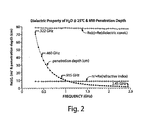
- Measurements of absorption and reflection have been made for several different coals, raw and processed; and measurements can also be made of several constituents of coal, such as ash, pyrite, and organic sulfur. Measurements of the absorption of electromagnetic radiation over the range of frequencies from 0.5 GHz to 18 GHz (500 MHz to 18,000 MHz) are reported in FIG. 1 for two samples each of the same raw (top curves) and processed east Texas lignite. The following features are evident in these measurements and in all of our absorption measurements:
- the range of frequencies chosen for these measurements covers most microwave frequencies, with the lower frequencies possibly merging into the realm of radio frequencies, depending on how these terms are defined.
- the marked frequencies at 0.322, 0.460, 0.915, and 2.45 GHz correspond to the principal electromagnetic frequencies within this range that are approved for domestic and some for international use. 2.45 GHz is the most common, being the frequency in widespread use worldwide in kitchen microwave ovens. 0.915 GHz is the frequency of choice worldwide for microwave drying applications, such as curing ceramics, drying pastas, pet food, peanuts, and non-wovens, etc. Note their proximity to two of the aforementioned peaks. The peaks at approximately 5.75, approximately 11.6 and approximately 18 GHz suggest these frequencies as additional options for the microwaves in this process.
- the data provides sufficient input to proceed with defining the next step required in the design of a core electromagnetic-radiation system. Use of this information is illustrated below (item 7).
- Coals range from a soft, moist brownish material to a very hard, glossy black solid, and its physical and chemical properties can vary considerably depending upon how, when, and where the materials were deposited, the types of organic material present initially, and its alteration over time.
- the sizes and shapes, hardness, volatility, carbon content, trace minerals, combustion and other properties vary widely within each rank of coal, from mine to mine, and within each mine or seam.
- the following properties of the raw coals selected for processing are determined: moisture, BTU/Ib, ash, forms of sulfur (e.g., pyrite, sulfate, organic), sizes, structure, and hardness (grindability).
- the first step in determining the properties of any raw or mine-run coal that is being considered for processing is to sample the coal by accepted standards. These standards include ASTM Standards D 388 (Classification of Coals by Rank), D 2013 (Method of Preparing Coal Samples for Analysis), D 3180 (Standard Practice for Calculating Coal and Coke Analyses from As-Determined to Different Bases), and US Geological Survey Bulletin 1823 (Methods for Sampling and Inorganic Analysis of Coal).
- coals and lignites there are large observable differences as to structure (e.g., smooth or rough or platelike), coloring (e.g., brown as in some dust-like Asian lignites, black and hard east Texas lignites, lines or streaks or patchiness) and composition (e.g., heavy or light with obvious pieces of ash or pyrite or even woody-textured pieces of vegetable matter or wood seen in some lignites), wet or dry, the distribution of sample sizes, etc.
- Some raw samples are also selected for testing based solely on such observable characteristics, and some samples that have these features randomly mixed are also selected to fully examine each of the many differences observed in coals. Since there is no single sampling standard that provides for such diversity, a comprehensive and consistent sampling method was developed, whereby no such differences go unexamined.
- the next step is to select an experienced and widely accepted testing laboratory (such as Standard Laboratories, Inc.) that is certified to test the widest possible variety of physical and chemical properties of coal.
- an experienced and widely accepted testing laboratory such as Standard Laboratories, Inc.
- Each of the following properties can be measured: percent moisture, percent ash, percent volatiles, percent fixed carbon, BTU/Ib (as received, dry basis, and moisture- and ash-free), forms of sulfur (percent of each of total, pyrite, sulfate, and organic sulfur, as received and dry basis), Hardgrove Grindability Index (HGI), mercury (PPM dry), ash fusion temperatures, and ash mineral analysis.
- HGI Hardgrove Grindability Index
- PPM dry mercury
- ash fusion temperatures ash mineral analysis.
- the terms used here are as defined by Standard Laboratories and are common to the coal-testing community and have been defined elsewhere.
- the processing goals are typically, if not always, defined by the party seeking improved properties for their own coals or for outside coals brought in for their specific needs.
- These goals can include improvements to one or more of the combustion properties of the coals, with the same improvements being made to all of the coal or processing some of the coal to higher properties thresholds and blending it with unprocessed coal to obtain the desired overall properties on average.
- power plants that burn low-grade, low-BTU/Ib lignites often bring in higher-grade western coals to blend with the lower-grade coals in an effort to achieve lower emissions and increased operating efficiency.
- the coals are pre-process tested in a laboratory-controlled setting to determine first hand the response of the coals to the process system being designed for use in the field.
- the information from this testing ensures that a process system can indeed fulfill the goals for which it is being designed.
- the coal batch is systematically sampled and processed to ensure that the results will provide this significant input to the core process system design.
- the tests utilize a versatile laboratory process system designed specifically for this purpose.
- the laboratory system has the following characteristics:
- This system does not require real-time measurements of moisture content, ash content, sulfur content or trace-minerals content or feedback systems coupled to process controls. Any system with similar capabilities will serve the purpose outlined here.
- the first step in coal testing by Standard Laboratories and other coal-testing laboratories is to pulverize the samples and then determine the properties being sought. Processing of the returned pulverized samples would conflict with how the coals would be processed in commercial practice, making it necessary to show that processing mine-run coal would give the same results as that obtained by processing the same coal but pulverizing it prior to processing. This would add the further unacceptable time and cost required to pulverize the coal at the mine or power plant prior to processing.
- this step in the process is intended to further define and refine the core process system design for its intended coals and not to substitute for full-scale tests of the final process system.
- Baseline information such as location of each coal considered for processing (coal mine or utility), their amounts and how they are moved (conveyor belts or trucks or barge and/or coal train, etc.), system footprint space available, available electrical power and cost, and how best to move the coal to and from the processor, is collected.
- Site factors, process system size, configuration, and design are directly affected by considerations such as the availability of adequate power and water at the mine or power plant site, system footprint space available (typically limited at power plants), and the means and speeds by which the coal is transported on site.
- Conveyor belts are used to transport coal at most mines and power plants, their having a variety of sizes, speeds, and belt materials.
- the process system input and exit feeds are designed and sized for the conveyor systems in question. If the conveyor belts transit the process chamber, their materials become especially important and must be taken into account in both the design and operation of the process system; e.g., metallic (electromagnetic reflecting) or nonmetallic (electromagnetic absorbing) belt materials introduce very different electromagnetic effects, and screens lose fines and smalls which can result in mechanical problems in the transport system.
- metallic (electromagnetic reflecting) or nonmetallic (electromagnetic absorbing) belt materials introduce very different electromagnetic effects, and screens lose fines and smalls which can result in mechanical problems in the transport system.
- the conveyor belt load capacity and speed also directly determine process system throughput capacity and operation, whether or not the belt feeds through the process chamber or couples into a coal feed system for the process system.
- the following is intended as a walk-through of an example of a design of an electromagnetic-radiation-based process system for obtaining a specific post-processing combustion property or properties for a given solid fuel or coal type.
- Raw lignite with 36% moisture and 7300 BTU/Ib (matching the coal from Table 3 in the Experimental Results section, infra) is processed with the goal of obtaining 23% moisture and 8000 BTU/Ib.
- Table 3 lists results from processing a very small sample (several pounds) at moderate power (5 to 20 kW) for short times (10 to 120 seconds)
- the intent of this example is to provide a guide as to how one can process the same coal but with much larger quantities and therefore much higher power but comparable dwell times.
- the throughput is set at 10 tons per hour (TPH) or 66,000 tons per year (based on 20 hours per day for 330 days), and the lignite is processed on a continuous or on-the-fly basis.
- the rate (10 TPH here) is generally chosen by the user based on current mine output or that portion of the output to be processed and the existing coal handling systems or modifications thereto required to handle the amount of coal to be processed.
- Magnetrons the basic element that generates microwaves
- 2.45 GHz are primarily used for relatively low-power laboratory, commercial, and kitchen oven applications and are not manufactured with the high powers (e.g., 75. kW or greater) required for effectively processing coal according to methods described herein. Further, 2.45 GHz does not provide the penetration required for the amount of coal and the coal carrier depth.
- the waveguide and chamber dimensions for optimally designed electromagnetic-radiation systems (high efficiency, uniformity, and safety) at this frequency are too small to accommodate coal sizes larger than 1 to 2 inches.
- 0.915 GHz is the frequency of choice for many electromagnetic-radiation drying applications, and 75 kW and 100 kW magnetrons are proven and widely available, and can be ganged together to achieve the power levels required for large scale coal processing (see below). Limited penetration depth and small electromagnetic-radiation system dimensions restrict this frequency's use to low-throughput processing of relatively small-sized coals.
- Magnetrons that generate 0.460 GHz electromagnetic radiation are not manufactured in the United States, and there have been difficulties in their performance and servicing and meeting promised delivery schedules.
- magnetrons that generate 0.322 GHz are manufactured in the United States with a variety of powers.
- Measurements of sample weights before and immediately after processing provide information that can be related directly to percent moisture reduction. Additional weight measurements 30 minutes after the end of processing and 24 hours later always find still further weight reductions, adding up to a total post-processing weight reduction of 3 to 5%.
- a pre-heating phase e.g., using thermal or infrared radiation, which is at a different frequency from that of the later applied electromagnetic-radiation in a separate chamber or in a separate part of the chamber
- active electromagnetic-radiation processing can further reduce the weight by 2 to 3%.
- the targeted 13% moisture reduction can be lowered conservatively to approximately 8% that would need to be targeted by the electromagnetic-radiation segment of the process. This reduction resulting from pre-heating results in the need to remove 160 pounds of water per ton by electromagnetic-radiation processing instead of the 260 pounds needed in the embodiment.
- 1 kW of electromagnetic energy can evaporate 3.05 lbs of water per hour at ambient temperature. For well-designed electromagnetic-radiation systems, 98% of that energy is absorbed and converted to heat. For reference, 1 kW of applied electromagnetic energy requires approximately 1.15 kW of electricity and evaporates 2.989 lbs of water. Therefore, 61.6 kW of electricity is required per 160 pounds of moisture removed [ i.e., 160 pounds times 1.15 kW per 100 kW of applied electromagnetic power divided by 2.989 pounds]. From the above, we obtain a power requirement of 533 kW per hour (20,000 pounds divided by 300 lbs of water times 8% per 100 kW). Therefore, three separate 200-kW systems can be employed. Process systems are used in parallel or in line, depending upon the available footprint space for the systems and the material handling systems that fit the location.
- Mines and coal-fired utility plants have different sets of requirements, often resulting in differences in the design and operation of a system for the two classes of operating locations and even within a given class. For example, many utilities have to seek advance approval to handle and burn any coal with properties different from the coals currently approved for use, even if the "new" coals are documented to be cleaner and more environmentally friendly. This can even require that process systems be designed so as to meet certain combustion requirements, individually or collectively, such as restricted emissions of SO 2 or NO x or CO 2 . Some of the requirements are analogous to the oft-used term "environmental impact statement.” Examples of such requirements include:
- microwave-systems manufacturers that focus on minimizing or completely containing microwaves; i.e., that have no detectable leakage. It is important to note that materials exiting from a microwave chamber after processing still emit some level of microwave radiation for a short period of time even after exit from being microwaved, including food exiting from kitchen microwave ovens, although those levels are very low.
- interior systems designs that deny exit of the microwave, one can shield the systems externally with properly placed metal screens and metal duct tape. In any case, regular and systematic surveys are conducted in search of microwave leakage to ensure that safety systems have not been compromised.
- Microwave-leakage detectors can be purchased or designed and built for a specific application.
- the core process system is modified in design, as needed, based on information from 8, above.
- Each of the four major process subsystems i.e., pre-heating system, electromagnetic-radiation system, multi-parameter measurement and feedback system, and by-products handling system
- pre-heating system i.e., electromagnetic-radiation system, multi-parameter measurement and feedback system, and by-products handling system
- the next step is to integrate and functionally test the four sub-systems when operated together, followed by full end-to-end process system qualification and verification tests, the end-to-end tests conducted using samples of the coal batch for which the process was designed.
- Steps 10 and 11, above offer a proven, effective, and standardized methodology for use when developing a major system that consists of several sub-systems and is used in laboratory and commercial settings and even in ocean, atmosphere, and space environments, where equipment must often be operated remotely.
- the custom-designed and fully tested intelligent process system is shipped to its intended operating location. Upon arrival, the system is further tested to ensure that there are no changes due to handling and shipping. Then, the process system is moved into its intended position and integrated with the existing on-site coal handling system or appropriate changes thereto, electrical hookups, water, and air or inert gas generating systems, as required, and is further tested prior to being put into service.
- the process results in fracturing of the coal matrix followed by liberation of moisture and then ash and then sulfur.
- the stages are separate and distinct, while for others there is overlap in the stages; e.g., for some, ash and sulfur emissions begin while moisture is still being liberated.
- surface temperatures of the coal are measured at several positions in the process chamber as the coal is being processed. Because the coals are not uniform in size, shape, or properties and are not uniformly distributed on the conveyor, such temperature measurements can be considered to provide representative data on average. Further, because the coals are undergoing fracturing, some of the measured temperatures may approach internal temperatures, which are generally somewhat higher. The intent is to have the capability to avoid large variations in temperature by adjusting microwave power as needed in such regions.
- Moisture liberated from the coal can be collected by any of several methods, such as, but not limited to:
- an on-line moisture analyzer and feedback system can be included. This system can determine when processing has reached the levels of moisture that will provide the desired BTU/Ib, and the system can then change or shut down the processing, as needed.
- an on-line chemical (sulfur and ash) signature level analyzer can be included.
- a feedback system optionally can be used to change or shut down the processing.
- an off-line sampling, weighing, and testing station is also available for use, as needed.
- Coals exit the process chamber into a discharge chute that is designed to fit the system location and process flow rate (tons per hour); e.g., the chute can be designed to feed a loading station, couple to another conveyor, etc.
- this process methodology with its ability to custom-design systems, can produce designer coals; i.e., any rank or form of coal can be processed so as to become a new and different coal with any of a wide variety of properties available per customer selection. Said differently, these methodologies can be used to create new coals with a wide variety of enhanced fuel properties not found in raw, unprocessed coals.
- FIG. 3 illustrates a flow diagram of an exemplary method 100.
- the method 100 illustrates handling and processing steps to improve the combustion characteristics of a fuel such as coal or another carbon-based fuel.
- the method 100 can be executed or otherwise performed by any of various systems and apparatuses.
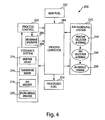
- the method 100 is described, below, as carried out by a system 200, shown schematically in FIG. 4 , by way of example; and various elements of the system 200 are referenced in explaining the example method of FIG. 3 .
- the invention may implement, and be embodied in, other systems and processes as well.
- each block shown in FIG. 3 represents one or more steps carried out in the exemplary method 100.
- the example method 100 begins in block 102, where raw fuel is received for processing.
- raw fuel can be received for processing by method 100 in the raw fuel section 202, shown in FIG. 4 and described below.
- the raw fuel is sized.
- Raw fuel is sized to a predetermined size by a crushing device.
- raw coal can be sized by the raw fuel section 202 as shown in FIG. 4 and described below.
- Block 102 is followed by block 104, in which a composition characteristic of the fuel is determined.
- the fuel is analyzed to determine a composition characteristic such as the moisture content of the fuel.
- a moisture analyzer can be used with the process conveyor section 204 and/or feedback system 206 (shown in FIG. 4 ) to determine the moisture content of the fuel.
- Block 104 is followed by block 106, in which the characteristics of the coal desired by the consumer are determined.
- the desired fuel properties and raw coal composition are used to establish the "design" parameters of the process system chosen.
- the power and duration of applied energy can be based on the desired combustion characteristic, such as moisture content, and can also be based on the relative speed or throughput of the fuel relative to an electromagnetic-radiation generator 208 (shown in FIG. 4 ).
- the "duration" of applied energy can be in the form of a duty cycle, whereby the power is cycled on and off to provide a reduced average power level.
- the moisture content of the raw coal and the desired properties are used to determine the amount of wave energy and other process parameters needed to create the "designer" coals.
- the feedback system 206 can monitor the fuel and selectively adjust the power and duration of electromagnetic energy to obtain the desired moisture level.
- a series of electromagnetic-radiation generators can be activated to provide a selected amount of electromagnetic energy to a bed of coal on a conveyor bed or the process conveyor 204 passing adjacent to the electromagnetic-radiation generators so that the bed of coal is sufficiently penetrated to remove a particular amount of moisture, ash and sulfur from the bed of coal.
- Block 106 is followed by block 108, in which the electromagnetic frequency, amount of wave energy and inert gases are applied to the fuel.
- the series of electromagnetic-radiation generators can be activated to apply a specific amount of wave energy to the fuel.
- Block 108 is followed by blocks 110,112, and 114, where by-products are removed or otherwise collected from the fuel.
- by-products such as excess moisture, ash or sulfur may be generated from the fuel.
- These by-products are collected in one of the blocks 110, 112, 114, as is further described below.
- an amount of moisture is removed or otherwise collected from the fuel.
- an amount of sulfur is removed or otherwise collected from the fuel.
- other by-products are removed or otherwise collected from the fuel.
- combustion characteristics of the fuel are improved.
- the improved fuel is collected by or otherwise received in the enhanced fuel section 116.
- coal process parameters chosen will also vary widely, varying according to the following factors: the amount of coal to be processed, the time and place available for processing, whether the coal is processed in batch mode or continuously or some combination thereof, the purposes for which the processing is being performed, and the intended use(s) for the coal. Said differently, generalizations cannot readily be made as to process parameters, though ranges suitable for use with the process can be identified, as is outlined below.
- Suitable frequencies of electromagnetic generators can be used in the process range from below 100 MHz to above 20,000 MHz. A single frequency or multiple frequencies can be used, simultaneously or alternated, or in stages. The frequency or frequencies can be continuous or pulsed or duty-cycled ( i.e., timed so as to power-on and power-off in much the same way that kitchen microwave ovens function).
- the power of the electromagnetic generators can be 100 watts to 100,000 watts, extending to megawatts
- Suitable electromagnetic radiation on-times range from 5 seconds to 45 minutes, depending on processing goals.
- the capacity of the system can range from ounces to tons. In continuous processing systems, tens of pounds to hundreds of tons per hour can be processed.
- the chamber atmosphere can be dry oxygen to provide more uniformity in the wave energy and in the process results.
- An inert gas atmosphere prevents production of oxides such as SO 2 , CO 2 , and NO x during processing and reduces or eliminates the risk of flaring and/or combustion.
- the temperature of the coal at its surface and at its interior can range from ambient to approximately 250°C during processing.
- Electromagnetic-radiation processing in a laboratory test setting is better evaluated and better understood if periodic measurements are made of the surface temperatures of the coals; these measurements can be easily made with hand-held infra-red sensors or temperature probes positioned inside the chamber.
- Temperature thresholds are pre-determined separately for every different set of coals to be processed and are dependent on the goals of the processing ( e.g., moisture reduction alone or combined with additional reductions). High-moisture coals will absorb electromagnetic radiation more readily than low-moisture coals and will, therefore, reach any given temperature more quickly.
- processing systems are provided with coupled temperature measurement and feedback systems to ensure that, if temperatures reach these thresholds, process parameters, such as applied microwave power or dwell time or airflow, are triggered to be modified immediately.
- process parameters such as applied microwave power or dwell time or airflow
- Such temperature thresholds can be laboratory pre-determined for each set of significantly different coal batch properties; alternatively, the temperature threshold can be determined from processing experience.
- temperature threshold is that associated with changes in materials, with sulfur being of particular interest here.
- the predominant form in sulfur vapor melts at 119°C and is a yellow, transparent liquid at temperatures up to 160°C, where sulfur undergoes a molecular transformation whereby sulfur atoms produce a dark viscous liquid.
- temperatures below 119° or above 160°C result in very different physical and chemical properties of free sulfur or sulfur bound in coal and must be taken into account if one is to be able to reduce sulfur content in any predictable manner.
- a maximum temperature limit can be set at about 200°C for convenience and because higher temperatures may introduce other, undesired changes to the coal or can cause the coal's properties to change too quickly to readily control.
- detection of a higher-than-expected chamber temperature could be an indicator of combustion and possibly pose a safety concern as well as a processing concern (i.e., providing more reason to include temperature-monitoring and feedback systems as an integral part of all processing systems).
- Systems for visual monitoring and remote imaging can also be used to ensure that there is redundancy in meeting both safety and processing concerns.
- Airflow is an important and multi-purpose process parameter. Dry, particulate-filtered air is particularly suitable, with the amount of airflow dependent upon the configuration and size of the process chamber and how coal enters and exits the chamber. Controlled airflow helps to mix the air in the process chamber, insuring a more-uniform distribution of heating in the chamber. Air is the carrier for process by-products such as moisture, fine particulate matter and any gases that result from the processing. Sufficient airflow negates any possibility of electrical arcing or sparking during processing in cases where the batch being processed (i.e., the load) is sufficiently large for the chamber size, shape, and power levels used.
- inert gas in the chamber is optional. Where inert gas is used in the chamber, the amount of inert gas depends on processing goals.
- Inert gas (preferably dry nitrogen or argon) serves several purposes. Any of several factors can result in overheating part of a coal batch or sample or part of a chunk of coal to a level where there could be ignition and combustion. Use of a nitrogen or argon atmosphere in the chamber will prevent any burning of coal during processing. Nitrogen is readily available in dry, gaseous form, tanked and metered for laboratory use, arid 20 to 25 CFH (cubic feet per hour) provides sufficient flow to carry away liquid and gaseous by-products during processing in small, kitchen-sized microwave chambers while preventing combustion. Larger chambers require appropriately-scaled larger volumes of nitrogen flow.
- Nitrogen is the inert gas of choice due to its widespread availability and lower cost compared with that for argon, but only if one assures that coal processing is stopped before reaching the undesirable hydrocarbon and, especially, tar phases, where hazardous compounds can be formed from chemical compounds resulting from exceeding temperature thresholds or from processing for too long.
- Use of an inert gas atmosphere in the chamber also prevents the production of oxides such as SO 2 , CO 2 , and NO x during processing.
- Hydrogen e.g., introduced via a hydrogen generator
- Hydrogen can be introduced to further control changes occurring in the coal during processing.
- the pressure in the process chamber is typically one atmosphere, but process parameters can be altered as/if needed when processing at elevation (above sea level). Vacuum can also be applied in some cases.
- On-line measurement systems can be provided for measuring moisture, ash, sulfur, trace minerals and temperatures in the chamber. All are designed to provide feedback to adjust process parameters, as needed, to ensure that targeted levels are achieved and not exceeded and, thereby, that the coal is not under- or over-processed.
- the system 200 includes a raw-fuel section 202.
- Raw-fuel section 102 can be a storage bin to collect raw coal or to otherwise receive raw coal to be processed by the apparatus.
- raw fuel is received from a remote location, such as a coal mine and collected in raw-fuel section 202, until called upon for further processing.
- Raw fuel such as lignite, anthracite, bituminous, sub-bituminous, low-sulfur, high-sulfur and blended coals can be stored in raw-fuel storage until needed. Selected amounts of raw fuel are sized by the raw-fuel section 202 for processing by other parts of the system 200.
- the raw-fuel section 202 can also include a series of one or more coal-crusher devices that break relatively large chunks of coal into smaller pieces of coal.
- Raw-fuel section 202 can include equipment such as, but not limited to, a pulverizer, a coal crusher, a ball mill, or a grinder.
- a coal crusher can be used to size raw coal to approximately a four-inch (10-cm) diameter. Larger or smaller sizes of coal or other fuel can be utilized in accordance with various embodiments of the invention.
- Raw-fuel section 202 is followed by process-conveyor section 204.
- the process-conveyor section interacts with the raw-fuel section 202 to receive a predetermined amount of fuel to be processed.
- Process-conveyor section 204 is also interconnected with feedback-system section 206, electromagnetic-radiation-generator section 208, air-handling-system section 210, and processed-fuel section 212.
- the feedback-system section 206 interacts with the process conveyer to determine a characteristic of the fuel, such as the percentage of moisture or the percentage of ash in the fuel.
- the feedback-system section 206 includes a moisture sensor 214, a temperature sensor 216, an ash analyzer 218, and a spectro-chemical analyzer 220. For example, using some or all of these components, one can determine the approximate amount and duration of microwave energy needed to remove a particular amount of moisture from the fuel.
- Other composition characteristics that can be determined are specific amounts of ash, sulfur, hydrogen, carbon, nitrogen, and other compounds or elements in a fuel.
- Such devices or methods are suitable for determining one or more combustion characteristics of a fuel. Such devices and methods can be used on-line or off-line Such devices and methods include, but are not limited to, moisture analyzers, ash analyzers, temperature sensors, and spectro-chemical analyzers.
- the feedback-system section 206 and process-conveyor section 204 also interact with a process-control section 222.
- the process-control section 222 interacts with the electromagnetic-radiation-generator section 208 to provide feedback control or other instructions from the feedback-system section 206 to control the electromagnetic-radiation-generator section 208.
- the electromagnetic-radiation-generator section 208 applies microwave energy to the fuel at the process-conveyor section 204.
- the electromagnetic-radiation generator 208 includes a series of magnetrons positioned relative to the fuel at the process-conveyor section 204; the magnetrons direct electromagnetic-radiation energy into the fuel based upon the predetermined characteristic, such as the moisture percentage that is sought.
- each of the magnetrons of the electromagnetic-radiation-generator section 208 can be controlled in terms of adjusting the power, duration, and other parameters to provide a sufficient amount or quality of wave energy to penetrate a fuel and to remove a targeted amount of moisture.
- the electromagnetic-radiation generators provide a specific, predetermined amount of wave energy to a fuel in accordance with the invention.
- the process-control section 222 can selectively adjust each of the generators to provide a particular amount of energy to the bed of coal at the process-conveyor section 204 until a specific amount of moisture is removed from the coal.
- wave energy means for applying a predefined amount of wave energy to a fuel.
- Such devices and methods include, but are not limited to, magnetrons, klystrons and gyrotrons.
- a suitable electromagnetic-radiation generator for the system 200 generates a frequency output between 100 MHz and 20 GHz. Other frequencies of wave energy can be used in accordance with other embodiments of the invention.
- the power of the wave energy can be pulsed or continuous.
- the generators can provide wave energy at continuous power.
- the wave energy output can also be pulsed at a regular time interval at a constant frequency.
- the power per source in particular embodiments is at least 15 kW at a frequency of 928 MHz or lower and in other embodiments is at least 75 kW at a frequency of 902 MHz or more.
- each of the generators can be controlled based on a "throughput" rate of a particular fuel being transported within the range of wave energy output by a series of generators.
- Throughput rate can be defined as the speed of a particular amount of fuel through the wave reactor for a particular period of time.
- the throughput of a fuel, such as coal can be 200 to 400 pounds (90-180 kg) per minute.
- each type of fuel can be treated with varying amounts and qualities of electromagnetic energy depending upon the type of fuel, the condition of the fuel, and other characteristics of the fuel environment or of the fuel itself.
- the air-handling-system section 210 provides by-product collection for the process-conveyor section 210.
- the air-handling system 210 includes a moisture-collection/storage section 224, a gas-collection/storage section 226, and a by-product collection/storage section 228.
- the air-handling-system section 210 collects and stores by-products from the processed fuel. For example, application of electromagnetic energy to raw coal creates water vapor and condensed water at the process-conveyor section 204.
- the moisture-collection/storage section 224 collects the condensed water for storage and subsequent use. Water vapor and gases can be collected by the gas-collection/storage section 226 for subsequent use.
- Other by-products from the process-conveyor section 204 are collected by the by-product-collection-storage section 228 for subsequent use.
- the remainder of the processed fuel from the process-conveyor section 204 is transferred or otherwise collected in the processed-fuel section 212.
- Such devices may be but are not limited to a bin, rail car, storage pile, or conveyor that transports directly to a combustion process (not shown).
- Fuel from the processed-fuel section 212 can then be utilized in a combustion process in, e.g., a combustion burner and steam boiler combination.
- the processed fuel from the invention can also be used in other conventional combustion processes.
- FIG. 5 is a perspective view of an existing conveyor system 300 that can be modified in accordance with the invention.
- the conveyor system 300 shown is a SlipstickTM conveyor designed and built by Triple/S Dynamics, Inc.
- the conveyor system 300 shown can be utilized or otherwise included with the process conveyor section 204 shown in FIG. 4 .
- Various apparatuses in accordance with the invention may be constructed using the conveyor system shown in FIG. 5 .
- Other conveyor systems can also be used in accordance with embodiments of the invention.
- FIGS. 5-10 illustrate an exemplary apparatus 400 in accordance with the invention.
- the apparatus 400 can be integrated into any of various systems and performs various methods in accordance with embodiments of the invention.
- the apparatus 400 can be incorporated into or otherwise utilized with the system 200 described above.
- Various elements of the system 200 are referenced in explaining the exemplary apparatus of FIGS. 5-12 .
- the method 200 described above can be carried out by the apparatus 400 shown in FIGS. 5-12 .
- the apparatus 400 includes a feeder assembly 402, a drive component 404, a conveyor assembly 406, and a reactor component 408.
- the feeder assembly 402 is adapted to receive a fuel, such as pre-sized coal, and is further adapted to direct the fuel towards the reactor component 406.
- the drive component 404 is adapted to transport the fuel through the reactor component 406.
- the reactor component 406 is adapted to apply a specific amount of electromagnetic energy to the fuel.
- FIG. 6 illustrates a feeder assembly 402 for the apparatus 400.
- the feeder assembly 402 sits just above the entry end of the conveyor chamber forward of the slipstick drive mechanism.
- the feeder assembly 402 includes an input section 418, a transition section 420, and an adapter section 422.
- the feeder assembly 402 and its respective sections 418, 420, 422 are typically fabricated from approximately 0.13-inch (3.2 mm) thick aluminum plate. Alternative arrangements for a feeder assembly can be designed in accordance with the invention, depending upon the processing capacity of the system 200.
- the input section 418 is sized to receive fuel from the raw fuel section 202 of FIG. 4 .
- the input section 418 is a funnel having a square-shaped cross-section that narrows from a fuel measurement end towards a transition section end. Note that the input section 418 can have alternative configurations, shapes, and sizes depending upon the raw fuel section 202, the processing capacity of the system 200, and/or the shape of the transition section 420.
- the transition section 420 is sized to receive pre-sized fuel from the input section 418, described above.
- the transition section 420 is a duct with a consistent square-shaped cross-section from an input section end towards an adapter section end.
- a set of slide gates 416 can be installed at or near the input section end and adapter section end to provide control of fuel flow from the raw fuel section 202.
- the transition section 420 can have alternative configurations, shapes, and sizes depending upon the processing capacity of the system 200, the shape of the input section 418 and/or the shape of the adapter section 422. Other types of gates or valves can be used in conjunction with the feeder assembly 402.
- the adapter section 422 is sized to receive fuel from the transition section 420 described above.
- the adapter section 422 is a concave-shaped piece that is adapted to fit with a corresponding opening of the drive component 404.
- the adapter section 422 can have alternative configurations, shapes, and sizes depending upon the processing capacity of the system 200, the shape of the transition section 420, and the drive section 404.
- expansion joints can be installed with or used in conjunction with various components 418, 420, 422 of the feeder assembly 402 to accommodate for any thermal expansion of the feeder assembly 402 or components operating adjacent to the feeder assembly 402.
- the conveyor assembly 406 includes a transfer bed 424.
- the transfer bed 424 is adapted to receive a fuel from the feeder assembly 402 and is further adapted to transfer fuel along a portion of the length of the transfer bed 424 towards a collection area 426 at an opposing end of the transfer bed 424.
- the transfer bed 424 shown is a horizontally-oriented, open-sided trough.
- the transfer bed 424 can have other configurations, shapes, and sizes depending upon the capacity of the system 200.
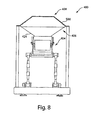
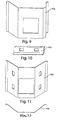
- FIGS. 7-12 illustrate aspects of a transfer bed hood for the apparatus shown in FIG. 5 .
- the reactor component 408 includes a transfer bed hood 500 and a series of magnetrons (described in FIG. 4 as the electromagnetic-radiation generator section 208).
- the transfer bed hood 500 is adapted to cover the open-end portion of the transfer bed 424.
- the series of magnetrons is installed along the length of the transfer bed hood 500 and is positioned to provide electromagnetic energy towards fuel located within the transfer bed 424.
- the feedback system section 206, the process-control section 222, and the electromagnetic-radiation generator 208 interact with the process conveyor section 204 to control, monitor and adjust the amount of electromagnetic energy provided by the series of magnetrons aligned along the transfer bed hood 500 and transfer bed 424.
- Other configurations of a reactor component 408 in accordance with the invention can be implemented with the system 200 or similar systems.
- the conveyor assembly 406 When activated, the conveyor assembly 406 applies a repetitive, actuation force to the transfer bed 424, and a solid fuel, such as coal, is fed to a proximate end of the transfer bed 424 from the feeder assembly 402. As each actuation force is applied to the transfer bed 424, the force causes the fuel to move toward a distal end of the transfer bed 424 (toward collection point 426). While the fuel is moving along the length of the transfer bed 424, the magnetrons are activated to provide a specific amount of electromagnetic energy to the fuel in the transfer bed 342. The amount of electromagnetic energy is based in part on the amount of fuel in the transfer bed and the rate of movement of the fuel along the transfer bed 424, as determined by the feedback system section 206 and/or process control section 222.
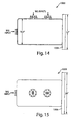
- FIGS. 13-15 illustrate an apparatus 1000 for batch processing of coals or other solid fuels.
- This apparatus 1000 can be used in conjunction with or separately from the apparatus shown in FIGS. 5-12 .
- the process methodology described by FIG. 3 specifically block 108, can also be implemented by the apparatus 1000.
- magnetrons 1002 are utilized to apply a specific,amount of electromagnetic energy to fuel such as coal placed within the apparatus.
- the wave energy is directed through a waveguide to the WG (waveguide) input on the apparatus.
- the apparatus 1000 includes electromagnetic-radiation monitoring ports 1004 and a front door 1006 for loading coal into the chamber.
- Other configurations of a batch-process apparatus can exist in accordance with the invention.
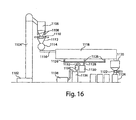
- FIG. 16 An embodiment of a pilot plant is illustrated in FIG. 16 .
- the plant features a bucket elevator feed 1102 coupled with a bucket elevator 1104 for transporting raw coal to the feed tank 1106.
- the feed tank 1106 is mounted over a shuttle valve 1110, hopper 1112 and hopper valve 1114.
- a transfer auger 1116 When coal flows from the feed tank 1106 down through the hopper valve 1114, the coal is dumped into a transfer auger 1116, which transports the coal through the microwave processing chamber 1118.
- the microwave processing chamber 1118 Upon exiting the microwave processing chamber 1118, the coal flows through a coal receiver 1120 and valve 1122 into storage receptacles 1124.
- the process chamber 1118 is also fitted with drains 1126, which feed into a vent line 1128.
- the vent line 1128 leads to a sulfur trap 1130.
- Another line 1132 directs the flow from the sulfur trap 1130 to the condenser 1134, then to a water storage tank 1136 and finally to an exhaust fan and emission-control system 1138.
- the exhaust fan 113 8 is started to control dust that would be generated by the dumping operation.
- the exhaust fan 1138 pulls air from the bucket elevator 1104 through the system and discharges the resulting clean air.
- Coal is supplied in drums and is dumped using a skid-steer loader or fork truck equipped with a drum-handler/dumper into the bucket elevator feed hopper 1102.
- the bucket elevator 1104 transfers coal samples to the feed tank 1106 for the batch to be processed. Depending on the size of the test run, several 55-gallon drums of coal can be dump-loaded into the system.
- the amount of coal transferred to the feed tank 1106 is monitored with the load cells 1108, which also supply feed-rate information.
- the shuttle valve 1110 is used to control the flow from the feed tank 1106 to the raw material transfer system. To maintain coal flow at a constant rate, this valve 1110 is shuttled back-and-forth to move small amounts of coal to the rotating hopper valve 1114.
- the hydraulic cylinders of the shuttle valve 1110 provide enough power to move the shuttle through the coal and crush larger lumps as required.
- the hopper 1112 could rotate continuously and thereby provide a constant supply of coal to the transfer auger 1116.
- the transfer auger 1116 acts to level the rate that coal is supplied to the microwave processing chamber 1118.
- the process control and feedback systems and conveyor are designed to ensure that the coals receive the required irradiation dose on average for their dwell times in the processing chamber.
- the rates of movement for each of the supply units are independently controlled to provide a constant feed rate of coal to the material transfer system in the microwave processing chamber 1118.
- the processed coal Before it reaches the exit end of the chamber 1118, the processed coal enters an area (not shown) where it is allowed to further emit and cool before it is removed, so as to help control odors-and collect other emissions from the processed coal.
- the nitrogen purge is stopped, but operation of the exhaust fan 1138 is continued to capture dust produced during transfer of the processed coal to drums.
- a hydraulic valve 1122 is used to aid transfer of the processed coal into drums 1124. After all of the coal has been processed, cooled, and transferred to drums 1124, the exhaust fan 1138 is stopped.
- any volatile materials water, sulfur, hydrocarbons, mercury, and other volatiles
- Water and other fluids drain from the chamber's "over-arched" walls are captured in the sulfur trap 1130.
- the volatile materials water and hydrocarbons
- the volatile materials are then pulled from the sulfur trap 1130 through the condenser 1134 and fall into the water storage tank 1136. Checks for mercury will be made before the material is released.
- Residual volatiles are pulled into a filter to remove particulates and a carbon bed to remove organics, mercury, and odors before the nitrogen is vented.
- the filter and carbon bed are located in the exhaust fan and emission control 1138.
- the carbon beds will be recycled or disposed of as hazardous waste.
- a new family of solid-fuel designer coals not found in nature can be produced via these methods and apparatus. These processed coals can be characterized by one or more of the following:
- a "new fuel” includes any of these processed coals having a property or properties contained in any of the seven property ranges for each coal type given below.
- Bituminous Coals U.S. Coal: typical raw to best BTU/lb 12537 to 14301 %Moisture 3.39 down to 0.44 %Ash 10.94 down to 2.65 %Total S 3.73 down to 1.21 %Pyrite 1.88 down to 0.32 %Sulfate 0.14 down to 0.01 %Organic S 1.73 down to 0.62 International Coal (ref.
- Lignite typical raw to best BTU/lb 7266 to 11550 %Moisture 38.27 down to 3.73 %Ash 7.29 down to 5.22 %Total S 2.18 down to 1.13 %Pyrite 0.68 down to 0.01 %Sulfate 0.02 down to 0.01 %Organic S 1.48 down to 1.12
- International Lignite typical raw to best BTU/lb 8195 to 11729 %Moisture 25.58 down to 5.67 %Ash 10.68 down to 6.76 %Total S 5.86 down to 1.78 %Pyrite 2.60 down to 0.23 %Sulfate 0.45 down to 0.07 %Organic S 2.81 down to 1.31
- Table 1 International Coal, Raw: BTU/lb BTU/lb BTU/lb Moisture Sulfur Content, Dry Basis (%) SL # As Rec. Dry Basis M-A Free (%) Ash (%) Total Pyrite Sulfate Organic 20221113 12565 12846 14482 2.19 11.30 4.23 0.85 0.15 3.23 20221114 12556 12810 14417 1.99 11.15 4.16 0.78 0.
- Table 2 lists Standard Laboratories (SL) test results for processed coals. These initial process tests were used to determine characteristic responses of these coals to process parameters. A small kitchen-sized electromagnetic-radiation chamber was used with low electromagnetic power (1000 watts and below) and relatively small samples (two to five pounds). Every one of our laboratory first process tests on a "new" coal was conducted in this manner.
- SL Standard Laboratories
- coals of different sizes, coloring, etc. were selected to examine their separate responses and effects, if any, on their post-processing properties.
- each sample batch was also divided into sections, some piled high and some in a flat layer, and the sections were placed on or in different holding vessels, made, e.g., of Pyrex TM ; alternatively, the vessels can be high-temperature ceramic plates, aluminized pans, or formed of other high-temperature materials.
- the locations of the vessels were varied in the chamber; also varied was the applied electromagnetic power and duty cycles (power on and off times).
- 6 2 6 2 Cracking sound heard in chamber and darker yellow fumes seen flowing in the tubing. 6 2 Open chamber to observe. Coals hot and chamber full of fumes. 6 2 Fumes pouring out of the chamber. Stop at 1 min 20 sec. No moisture in chamber but dark brown colored residue throughout chamber, probably the start of hydrocarbon release. End processing tests.
- Samples 20731114 and 20731115 consisted entirely of tiny pieces to fine granules, which were placed on two ceramic plates from 1/2 to 3/4 inches high, a flat plate near the wall closest to the magnetron and a rounded plate near the opposite wall.
- Table 4 Power Level Time (minutes) Notes 2 1 Power levels intentionally set lower than the above test set 2 1 2 2 2 2 2 2 3 1 3 2 Slight cloudiness observed in tubing. 3 2 4 2 4 2 4 2 Some condensation now visible in tubing. Stopped to open chamber at 24 minutes accumulated exposure (to compare with the above tests using higher power levels). No moisture and no fumes present, chamber air temperature and coat surfaces warm but not hot. Observed appearance and fuming amount definitely depend on coal chunk sizes, placement and distribution, duty cycle and time.
- Fumes start to exit from the tubing. 5 1 5 1 More fumes observed 5 1 Top cover of chamber hot to the touch; reset to lower power. 4 1 4 2 4 2 Stop processing to observe. Chamber interior filled with fumes, but no moisture on chamber walls and no hydrocarbon coloring and coals only warm and not hot. 4 2 Fumes observed after 1 min 40 sec. 4 2 Fumes throughout chamber and tubing. 4 2 4 2 4 2 4 2 Still no browning on tubing. 4 2 Stop to open chamber. Some fuming but no browning. 4 2 4 2 4 2 4 2 4 2 Stop to open chamber. Removed a tiny piece that appeared to have overheated. 4 2 5 1 Fuming resumed quickly. 5 1 5 1 5 1 5 1 Stop to open chamber. Full of yellow fumes.
- Table 5 examples are given to show how two of the principal process parameters alone can be used to target specific properties for BTU/lb and percent moisture. It is important to note that we had measured and processed these same lignite batches in our laboratory systems earlier and therefore had prior knowledge of their properties and their responses to multi-parameter electromagnetic-radiation processing. With this information, we were able to pinpoint those changes that could be expected from changes due only to power and time. A similar methodology can be used in a lab or field setting for each of the designated properties being sought prior to any coal's being processed on a commercial scale.
- the first test set combination of 5 kW and 30 seconds was clearly too small to achieve the desired moisture reduction for that sample, which was also evident in the relatively small amount of water vapor seen exiting the process chamber during its processing.
- the table presents the results of using various combinations of power and time with all other combinations except one of the 20/15's providing the levels sought.
- Table 6 (lignite, A): SL# Representative Btu/lb As Rec.
- Laboratory tests can provide the basic preprocessing coal-response input data required to custom-design an overall process system capable of targeting and obtaining specific coal properties.
- Table 8 below, provides a list of moisture, sulfur, ash, and Emissions Index reductions, as well as increases in BTU/lb for a wide variety of coals processed by methods of this disclosure.
- Table 8 Sample Raws, %M Proc, %M % M Redn % S Redn % Ash Redn Raws, BTU/lb Proc, BTU/lb % Incr BTU/lb % Redn, EI IL1 47.87 44.32 07 ND ND 5851 6269 07 ND IL2 52.92 46.94 11 ND ND 5363 5949 11 ND PRB1 26.10 22.46 14 NA 14 8960 9608 07 05 TL1 36.05 29.22 19 ND ND 6356 7788 22 ND WY1 21.65 17.05 21 05 06 10251 11345 11 10 WY2 20.16 15.66 22 10 18 10232 11431 12 16 IB1 2.00 1.43 29 46 67 12737 14096
Landscapes
- Chemical & Material Sciences (AREA)
- Engineering & Computer Science (AREA)
- Organic Chemistry (AREA)
- Oil, Petroleum & Natural Gas (AREA)
- Combustion & Propulsion (AREA)
- Physics & Mathematics (AREA)
- Microbiology (AREA)
- Life Sciences & Earth Sciences (AREA)
- Mechanical Engineering (AREA)
- General Engineering & Computer Science (AREA)
- Thermal Sciences (AREA)
- Materials Engineering (AREA)
- Electromagnetism (AREA)
- Health & Medical Sciences (AREA)
- Biomedical Technology (AREA)
- Biotechnology (AREA)
- Molecular Biology (AREA)
- Solid Fuels And Fuel-Associated Substances (AREA)
Applications Claiming Priority (2)
| Application Number | Priority Date | Filing Date | Title |
|---|---|---|---|
| US52920403P | 2003-12-12 | 2003-12-12 | |
| EP04814024A EP1697487B1 (fr) | 2003-12-12 | 2004-12-10 | Procede de traitement par voie seche et precombustion et systemes permettant d'ameliorer les proprietes des combustibles solides |
Related Parent Applications (1)
| Application Number | Title | Priority Date | Filing Date |
|---|---|---|---|
| EP04814024.8 Division | 2004-12-10 |
Publications (2)
| Publication Number | Publication Date |
|---|---|
| EP2298852A2 true EP2298852A2 (fr) | 2011-03-23 |
| EP2298852A3 EP2298852A3 (fr) | 2012-04-25 |
Family
ID=34699953
Family Applications (2)
| Application Number | Title | Priority Date | Filing Date |
|---|---|---|---|
| EP10014392A Ceased EP2298852A3 (fr) | 2003-12-12 | 2004-12-10 | Procédé de traitement par voie sèche et précombustion et systèmes permettant d'améliorer les propriétés des combustibles solides |
| EP04814024A Expired - Lifetime EP1697487B1 (fr) | 2003-12-12 | 2004-12-10 | Procede de traitement par voie seche et precombustion et systemes permettant d'ameliorer les proprietes des combustibles solides |
Family Applications After (1)
| Application Number | Title | Priority Date | Filing Date |
|---|---|---|---|
| EP04814024A Expired - Lifetime EP1697487B1 (fr) | 2003-12-12 | 2004-12-10 | Procede de traitement par voie seche et precombustion et systemes permettant d'ameliorer les proprietes des combustibles solides |
Country Status (12)
| Country | Link |
|---|---|
| US (3) | US7901473B2 (fr) |
| EP (2) | EP2298852A3 (fr) |
| JP (1) | JP2007514044A (fr) |
| KR (1) | KR101239034B1 (fr) |
| CN (1) | CN1914299B (fr) |
| AU (2) | AU2004299837B2 (fr) |
| CA (1) | CA2549193A1 (fr) |
| CO (1) | CO6140049A2 (fr) |
| MX (1) | MXPA06006664A (fr) |
| RU (1) | RU2366689C2 (fr) |
| UA (1) | UA84185C2 (fr) |
| WO (1) | WO2005059064A1 (fr) |
Families Citing this family (38)
| Publication number | Priority date | Publication date | Assignee | Title |
|---|---|---|---|---|
| EP2298852A3 (fr) * | 2003-12-12 | 2012-04-25 | CoalTek, Inc. | Procédé de traitement par voie sèche et précombustion et systèmes permettant d'améliorer les propriétés des combustibles solides |
| CA2576115C (fr) * | 2004-08-05 | 2014-07-29 | Microcoal Inc. | Gestion d'energie dans une installation de production d'energie |
| US7666235B2 (en) * | 2005-11-30 | 2010-02-23 | Industrial Microwave Systems, L.L.C. | Microwave drying of coal |
| US8585786B2 (en) * | 2006-03-31 | 2013-11-19 | Coaltek, Inc. | Methods and systems for briquetting solid fuel |
| US8585788B2 (en) * | 2006-03-31 | 2013-11-19 | Coaltek, Inc. | Methods and systems for processing solid fuel |
| MX2008012355A (es) * | 2006-03-31 | 2009-02-16 | Coaltek Inc | Metodos y sistemas para mejorar propiedades de combustible solido. |
| EP2209878A4 (fr) * | 2007-10-08 | 2011-10-12 | Coaltek Inc | Procédés et systèmes pour le briquetage de combustibles solides |
| JP4927020B2 (ja) * | 2008-04-16 | 2012-05-09 | 新日本製鐵株式会社 | 石炭中硫黄の形態別定量方法 |
| WO2009137437A1 (fr) * | 2008-05-05 | 2009-11-12 | Coaltek, Inc. | Procédés et systèmes pour traiter un combustible solide |
| US20110192989A1 (en) * | 2008-06-19 | 2011-08-11 | Isaac Yaniv | System and method for treatment of materials by electromagnetic radiation (emr) |
| KR100960793B1 (ko) * | 2009-06-29 | 2010-06-03 | 한국전력공사 | 저급 석탄의 고품위화 방법 및 장치 |
| JP5342355B2 (ja) * | 2009-07-22 | 2013-11-13 | 株式会社神戸製鋼所 | ボイラの灰付着抑制方法及び灰付着抑制装置 |
| WO2011038307A1 (fr) * | 2009-09-25 | 2011-03-31 | Conyers Technology Group, Llc | Traitement électrochimique de fluides |
| EP2336637A1 (fr) * | 2009-12-14 | 2011-06-22 | ABB Research Ltd. | Système et procédé associé de surveillance et de contrôle d'une centrale électrique |
| DE102010022400B4 (de) | 2010-06-01 | 2013-04-25 | Outotec Oyj | Verfahren und Anlage zur Absenkung des Rest-Kohlenstoffgehaltes von Asche |
| US9435585B2 (en) * | 2010-07-23 | 2016-09-06 | Kwok Fai Lam | Microwave dryer and microwave drying method |
| BR112013004939B1 (pt) * | 2010-09-01 | 2020-11-10 | Jfe Steel Corporation | método para avaliar a plasticidade térmica de carvões e aditivos de formação de torta |
| EP2710097B1 (fr) | 2011-05-18 | 2019-12-11 | Bioendev AB | Torréfaction améliorée par introduction d'oxygène à contre-courant |
| DK2710099T3 (en) * | 2011-05-18 | 2016-12-19 | Bioendev Ab | Method for monitoring and control of a torreficeringstemperatur |
| US20140352206A1 (en) * | 2012-01-26 | 2014-12-04 | Microcoal, Inc. | Apparatus and methods for treating solids by electromagnetic radiation |
| US9184593B2 (en) | 2012-02-28 | 2015-11-10 | Microcoal Inc. | Method and apparatus for storing power from irregular and poorly controlled power sources |
| JP5877542B2 (ja) * | 2012-04-16 | 2016-03-08 | 一般財団法人電力中央研究所 | 硫黄放出量の推算式の生成方法、推算方法および推算システム |
| CN102690699B (zh) * | 2012-05-25 | 2017-03-29 | 上海中方宝达纺织智能仪器有限公司 | 一种煤炭全硫快速处理生成洁净煤的装置与方法 |
| CN102816623B (zh) * | 2012-08-14 | 2014-03-19 | 南京三乐电子信息产业集团有限公司 | 一种微波低温脱水及脱硫的煤炭提质装置 |
| WO2014078277A1 (fr) * | 2012-11-14 | 2014-05-22 | Johnson Industries, Inc. | Dispositif d'échantillonnage de matériau à ensemble d'analyseur de matériau intégré |
| CN104163330B (zh) * | 2014-07-24 | 2016-08-24 | 湖南三德科技股份有限公司 | 一种采制样输料速度的控制方法 |
| US9810480B2 (en) | 2015-06-12 | 2017-11-07 | Targeted Microwave Solutions Inc. | Methods and apparatus for electromagnetic processing of phyllosilicate minerals |
| CL2017000574A1 (es) * | 2017-03-09 | 2018-02-23 | Lmagne Ingenieria Ltda | Un sistema y un proceso para determinar en linea las características de bolas gastadas y los trozos de las mismas, que han sido expulsadas de un molino de molienda de minerales semiautógeno (sag) |
| CN108153948B (zh) * | 2017-12-14 | 2021-07-13 | 中国电力工程顾问集团西北电力设计院有限公司 | 一种褐煤干燥管具体长度确定方法 |
| CN110160320B (zh) * | 2018-02-12 | 2020-08-28 | 中冶长天国际工程有限责任公司 | 一种烧结燃料厚料层微波干燥方法及装置 |
| CN108759313B (zh) * | 2018-06-14 | 2019-10-29 | 中国矿业大学 | 一种褐煤干燥-干法分选协同优化提质方法及工艺 |
| US12021384B2 (en) | 2019-05-29 | 2024-06-25 | Tata Consultancy Services Limited | Method and system for optimum coal selection and power plant optimization |
| RU2707276C1 (ru) * | 2019-08-27 | 2019-11-26 | Федеральное государственное автономное образовательное учреждение высшего образования "Новосибирский национальный исследовательский государственный университет" (Новосибирский государственный университет, НГУ) | Способ подготовки пылеугольного топлива для сжигания |
| CN114621778B (zh) * | 2020-12-11 | 2023-09-01 | 中国石油化工股份有限公司 | 存储器、生物质微波热解工艺温控方法、装置和设备 |
| CN114713135A (zh) * | 2022-03-16 | 2022-07-08 | 山西潞安环保能源开发股份有限公司 | 一种利用微波处理喷吹煤的装置及方法 |
| KR20250016838A (ko) | 2023-07-26 | 2025-02-04 | 한국전력공사 | 기계학습을 이용한 고체연료 특성 예측 시스템 및 방법 |
| DE102024112107B4 (de) * | 2024-04-30 | 2026-02-12 | Fraunhofer-Gesellschaft zur Förderung der angewandten Forschung eingetragener Verein | Verfahren zum Betrieb eines elektrisch betriebenen Prozessraums eines Industriesystems, Industriesystem, Computerprogrammprodukt und computerlesbares Speichermedium |
| KR102889192B1 (ko) * | 2025-08-25 | 2025-11-25 | 주식회사 이에스티 | 마이크로파 발열체 및 이를 이용한 열분해 반응 시스템 |
Citations (3)
| Publication number | Priority date | Publication date | Assignee | Title |
|---|---|---|---|---|
| US4076607A (en) * | 1975-12-22 | 1978-02-28 | Zavitsanos Peter D | Process for coal desulfurization |
| US4567340A (en) * | 1985-01-09 | 1986-01-28 | Phillips Petroleum Company | Apparatus and method for drying solid materials |
| WO1997007185A1 (fr) * | 1995-08-11 | 1997-02-27 | Spear Charles E | Stabilisation de charbons de classe inferieure apres sechage |
Family Cites Families (118)
| Publication number | Priority date | Publication date | Assignee | Title |
|---|---|---|---|---|
| US38213A (en) * | 1863-04-21 | Improved pistol-holster | ||
| DE8234316U1 (de) | 1983-03-17 | Vöcklinghaus, Heinrich, 4650 Gelsenkirchen | Rekuperativer Wärmetauscher | |
| US2164933A (en) * | 1934-11-07 | 1939-07-04 | Maurel Invest Corp | Process of baking fuel briquettes |
| US3356469A (en) * | 1966-07-29 | 1967-12-05 | Brown Co | Coated fuel bodies |
| US3500266A (en) * | 1968-08-01 | 1970-03-10 | Federal Pacific Electric Co | High-speed circuit breakers |
| US3566152A (en) * | 1969-07-23 | 1971-02-23 | Gen Electric | High voltage electric circuit breaker including a synchronously closed resistor switch |
| FR2076405A5 (fr) * | 1970-01-14 | 1971-10-15 | Materiel Telephonique | |
| DE2014375C3 (de) * | 1970-03-25 | 1978-11-30 | Brown, Boveri & Cie Ag, 6800 Mannheim | Anordnung zur richtungsgebundenen Beeinflussung der Stromverteilung in einem Hochspannungs-Gleichstrom-Maschennetz |
| US3954674A (en) | 1973-01-26 | 1976-05-04 | Thomas Reis | Process and device for calcinating desulfurization of green cokes with high sulfur content by the preparation of high quality and density desulfurized cokes |
| JPS5090603A (fr) * | 1973-12-15 | 1975-07-19 | ||
| US3884794A (en) | 1974-03-04 | 1975-05-20 | Us Interior | Solvent refined coal process including recycle of coal minerals |
| US3954647A (en) * | 1974-05-23 | 1976-05-04 | Anscott Chemical Industries, Inc. | Industrial drycleaning detergent |
| DE2435755A1 (de) * | 1974-07-25 | 1976-02-05 | Bbc Brown Boveri & Cie | Energieuebertragungssystem mit sammelleitung fuer gleichstrom |
| US3958199A (en) * | 1975-01-31 | 1976-05-18 | Amp Incorporated | High voltage relay package |
| US4123230A (en) * | 1977-09-07 | 1978-10-31 | Kirkbride Chalmer G | Sulfur removal from coal |
| US4259560A (en) * | 1977-09-21 | 1981-03-31 | Rhodes George W | Process for drying coal and other conductive materials using microwaves |
| US4158760A (en) * | 1977-12-30 | 1979-06-19 | Raytheon Company | Seed heating microwave appliance |
| US4435628A (en) * | 1977-12-30 | 1984-03-06 | Raytheon Company | Seed heating microwave appliance |
| US4227063A (en) * | 1978-01-25 | 1980-10-07 | Raytheon Company | Microwave apparatus seal |
| US4152120A (en) * | 1978-02-06 | 1979-05-01 | General Electric Company | Coal desulfurization using alkali metal or alkaline earth compounds and electromagnetic irradiation |
| DE2812520C3 (de) * | 1978-03-22 | 1981-04-30 | Didier Engineering Gmbh, 4300 Essen | Verfahren zum Verkoken von Kohle, Kohleformling für die Verwendung in diesem Verfahren und Verkokungsofen für die Durchführung dieses Verfahrens |
| DE2812521B2 (de) * | 1978-03-22 | 1980-01-17 | Didier Engineering Gmbh, 4300 Essen | Verfahren zum Wärmebehandeln von Kohle und Vorrichtung zur Durchführung des Verfahrens |
| US4148614A (en) * | 1978-04-13 | 1979-04-10 | Kirkbride Chalmer G | Process for removing sulfur from coal |
| US4164772A (en) * | 1978-04-17 | 1979-08-14 | Electric Power Research Institute, Inc. | AC fault current limiting circuit |
| DE2907886A1 (de) | 1979-03-01 | 1980-09-11 | Roechling Burbach Gmbh Stahl | Verfahren zur rauchgaslosen kohletrocknung |
| US4253005A (en) * | 1979-09-17 | 1981-02-24 | Raytheon Company | Microwave suppression apparatus |
| US4376034A (en) * | 1979-12-17 | 1983-03-08 | Wall Edward T | Method and apparatus for recovering carbon products from oil shale |
| SU876172A1 (ru) * | 1980-01-14 | 1981-10-30 | Восточный научно-исследовательский углехимический институт | Способ обогащени угл |
| US4268315A (en) * | 1980-03-31 | 1981-05-19 | Burke Michael T | Briquette forming process and composition |
| US4684777A (en) * | 1980-04-02 | 1987-08-04 | Raytheon Company | Product support tray for microwave processing |
| US4329686A (en) * | 1980-06-18 | 1982-05-11 | The University Of Rochester | Methods and apparatus for generating microwave pulses and for the measurement and control thereof |
| US4469156A (en) * | 1980-09-12 | 1984-09-04 | Misato Norimoto | Method and apparatus for shaping wood material into a predetermined configuration |
| SU977041A1 (ru) * | 1981-01-05 | 1982-11-30 | Ворошиловградский Филиал Государственного Проектно-Конструкторского И Научно-Исследовательского Института "Гипроуглеавтоматизация" | Способ управлени процессом обогащени угл |
| SU963566A1 (ru) * | 1981-01-14 | 1982-10-07 | Магнитогорский горно-металлургический институт им.Г.И.Носова | Способ обогащени угл |
| US4408999A (en) * | 1981-05-11 | 1983-10-11 | Exxon Research And Engineering Co. | Coal and oil shale beneficiation process |
| DE3121050C2 (de) | 1981-05-27 | 1986-05-07 | Carl Still Gmbh & Co Kg, 4350 Recklinghausen | Verfahren zur Vergleichmäßigung der Einsatzkohlemischungen für Verkokungsofenbatterien |
| US4412841A (en) * | 1981-06-29 | 1983-11-01 | Inland Steel Company | Compacted carbonaceous shapes and process for making the same |
| US4365975A (en) * | 1981-07-06 | 1982-12-28 | Exxon Research & Engineering Co. | Use of electromagnetic radiation to recover alkali metal constituents from coal conversion residues |
| JPS5829884A (ja) * | 1981-08-17 | 1983-02-22 | Sumitomo Metal Ind Ltd | 冶金用コ−クスの製造方法 |
| JPS5832683A (ja) * | 1981-08-20 | 1983-02-25 | Sumitomo Metal Ind Ltd | 成型コ−クスの製造方法 |
| US4441003A (en) * | 1982-04-16 | 1984-04-03 | Raytheon Company | Conveyorized microwave oven with multiple lanes |
| JPS5949292A (ja) * | 1982-09-15 | 1984-03-21 | Shinichiro Nishida | 亜炭成型法 |
| DE3234315A1 (de) | 1982-09-16 | 1984-03-22 | Klöckner-Humboldt-Deutz AG, 5000 Köln | Verfahren zur verringerung der schwefelemission |
| US4589050A (en) * | 1983-02-17 | 1986-05-13 | General Electric Company | Method and apparatus for the protection of a thyristor power conversion system |
| US4488027A (en) * | 1983-06-06 | 1984-12-11 | Raytheon Company | Leakage suppression tunnel for conveyorized microwave oven |
| US5055180A (en) * | 1984-04-20 | 1991-10-08 | Electromagnetic Energy Corporation | Method and apparatus for recovering fractions from hydrocarbon materials, facilitating the removal and cleansing of hydrocarbon fluids, insulating storage vessels, and cleansing storage vessels and pipelines |
| US4663507A (en) * | 1985-03-21 | 1987-05-05 | Trerice Douglas N | Method and apparatus for reduction of fly ash carbon by microwave |
| US4678478A (en) * | 1986-04-14 | 1987-07-07 | Massachusetts Institute Of Technology | Method for desulfurization of coal |
| US5185586A (en) * | 1986-04-24 | 1993-02-09 | Energy Compression Research Corp. | Method and apparatus for digital synthesis of microwaves |
| US4825330A (en) * | 1987-10-06 | 1989-04-25 | The United States Of America As Represented By The Department Of Health And Human Services | Ultra-fast solid state power interrupter |
| JPH02202588A (ja) * | 1989-01-31 | 1990-08-10 | Nkk Corp | コークスの製造方法 |
| US5489818A (en) * | 1989-05-22 | 1996-02-06 | Olin Corporation | High power compact microwave source |
| US4981627A (en) * | 1989-08-04 | 1991-01-01 | Raytheon Company | Method for closure heating |
| US5136458A (en) * | 1989-08-31 | 1992-08-04 | Square D Company | Microcomputer based electronic trip system for circuit breakers |
| JPH03275797A (ja) * | 1990-03-26 | 1991-12-06 | Tetsuo Aida | 石炭から硫黄分を除去する方法 |
| US5172291A (en) * | 1990-03-27 | 1992-12-15 | Struthers-Dunn, Inc. | Intelligent power controller |
| US4999469A (en) * | 1990-04-02 | 1991-03-12 | Raytheon Company | Apparatus for microwave heating test coupons |
| US5079433A (en) * | 1990-10-05 | 1992-01-07 | Corning Incorporated | Method for monitoring fiber tension by measuring fiber vibration frequency |
| GB2248848A (en) * | 1990-10-19 | 1992-04-22 | David Edward Forder | A method of treating and using waste products |
| US5254139A (en) * | 1991-08-05 | 1993-10-19 | Adams Robert J | Method for treating coal |
| RU2096354C1 (ru) | 1991-10-04 | 1997-11-20 | Корнинг Инкорпорейтед | Способ управления процессом изготовления оптического волокна и способ изготовления оптического волокна |
| JPH05311183A (ja) * | 1992-05-11 | 1993-11-22 | Idemitsu Kosan Co Ltd | 石炭の化学的脱硫方法 |
| CN2141507Y (zh) * | 1992-11-06 | 1993-09-01 | 河北唐山碱厂 | 振动给煤机防粘料槽 |
| US5393311A (en) * | 1993-02-19 | 1995-02-28 | Marhanka; Frank D. | Method and apparatus for desulfurizing coal |
| WO1995001670A1 (fr) * | 1993-06-29 | 1995-01-12 | Square D Company | Systeme de conversion de puissance ac-cc |
| GB9409442D0 (en) | 1994-05-12 | 1994-06-29 | Ulster Carpet Mills Holdings L | A loom |
| US5421450A (en) * | 1994-05-31 | 1995-06-06 | Chukoh Chemical Industries, Ltd. | Heat-resistant, laminated conveyer belt |
| US5841342A (en) * | 1995-10-13 | 1998-11-24 | Com Dev Ltd. | Voltage controlled superconducting microwave switch and method of operation thereof |
| EP0803726A3 (fr) * | 1996-04-26 | 1998-03-25 | Japan Tobacco Inc. | Méthode et dispositif pour la discrimination des familles de charbon |
| US5828338A (en) * | 1996-05-23 | 1998-10-27 | Hughes Electronics | Thyratron switched beam steering array |
| US5756975A (en) * | 1996-11-21 | 1998-05-26 | Ewes Enterprises | Apparatus and method for microwave curing of resins in engineered wood products |
| US5997288A (en) * | 1997-04-18 | 1999-12-07 | Robert J. Adams | Apparatus for thermal removal of surface and inherent moisture and limiting rehydration in high moisture coals |
| US6068737A (en) * | 1997-05-16 | 2000-05-30 | Simon Bolivar University | Simultaneous demetallization and desulphuration of carbonaceous materials via microwaves |
| US5854729A (en) * | 1997-05-23 | 1998-12-29 | Utility Systems Technologies, Inc. | Power system device and method for actively interrupting fault current before reaching peak magnitude |
| SE511552C2 (sv) * | 1998-02-18 | 1999-10-18 | Abb Ab | Styrutrustning för aktiva filter och förfarande för reduktion av övertoner i en bipolär likströmslänk |
| US5958276A (en) * | 1998-03-13 | 1999-09-28 | Ferrite Components, Inc. | Microwave compliant automatically sealing oven door |
| DE19815538A1 (de) * | 1998-03-31 | 1999-10-07 | Siemens Ag | Antriebseinrichtungen für Unterbrechereinheiten von Schaltgeräten zur Energieversorgung und -verteilung |
| US7335246B2 (en) * | 1998-05-14 | 2008-02-26 | United States Of America Enviromental Protection Agency | Contaminant adsorption and oxidation via the fenton reaction |
| US6340912B1 (en) * | 1998-07-02 | 2002-01-22 | Raytheon Company | Solid state magnetron switcher |
| BR9913755A (pt) * | 1998-09-16 | 2001-06-05 | James K Jeanblanc | Processo para remover enxofre de materiais carbonáceos contendo enxofre, material carbonáceo de enxofre reduzido, e, óleo bruto pesado da califórnia tratado |
| US6163444A (en) * | 1999-01-25 | 2000-12-19 | Lam; Sheir Chun | Circuit breaker |
| RU2156969C1 (ru) | 1999-02-02 | 2000-09-27 | Государственный научно-исследовательский институт биологического приборостроения | Устройство для измерения концентрации кислорода в жидкостях и газах |
| US6169391B1 (en) * | 1999-07-12 | 2001-01-02 | Supertex, Inc. | Device for converting high voltage alternating current to low voltage direct current |
| SE514965C2 (sv) * | 1999-09-22 | 2001-05-21 | Abb Ab | Kontrollutrustning för en tyristorstyrd seriekondensatorutrustning, och förfarande för styrning därav |
| RU2166751C1 (ru) * | 2000-03-09 | 2001-05-10 | Никитин Петр Иванович | Способ анализа смеси биологических и/или химических компонентов с использованием магнитных частиц и устройство для его осуществления |
| JP3783836B2 (ja) * | 2000-05-26 | 2006-06-07 | 三菱電機株式会社 | 真空遮断器 |
| US6274858B1 (en) * | 2000-06-01 | 2001-08-14 | The Ferrite Company | Bends in a compact circularly polarized microwave feed |
| US6265703B1 (en) * | 2000-06-02 | 2001-07-24 | The Ferrite Company, Inc. | Arc suppression in waveguide using vent holes |
| CA2313882A1 (fr) * | 2000-07-12 | 2002-01-12 | Adalbert W. Goraczko | Valorisation de sous-produits dans le processus de transformation du charbon dit ecologique |
| US6325001B1 (en) | 2000-10-20 | 2001-12-04 | Western Syncoal, Llc | Process to improve boiler operation by supplemental firing with thermally beneficiated low rank coal |
| JP3479687B2 (ja) * | 2000-11-28 | 2003-12-15 | 独立行政法人産業技術総合研究所 | 炭化物の製造方法 |
| US6704184B2 (en) * | 2001-01-12 | 2004-03-09 | The Ferrite Company, Inc. | Arc suppression in waveguide using optical detector and forced air |
| EP1371219A4 (fr) * | 2001-02-14 | 2006-06-21 | Current Tech Llc | Communication de donnees par ligne electrique |
| US6741143B2 (en) * | 2001-06-01 | 2004-05-25 | Rf Technologies Corporation | Apparatus and method for in-process high power variable power division |
| US20050054566A1 (en) * | 2001-09-12 | 2005-03-10 | Buescher E Stephen | Calcium-influx inhibitory factor and method of isolation thereof |
| AUPS037402A0 (en) * | 2002-02-07 | 2002-02-28 | Commonwealth Scientific And Industrial Research Organisation | A process for producing metallurgical coke |
| DE10243066A1 (de) | 2002-07-15 | 2004-04-15 | Panel Tuning Gmbh | Verfahren zur Herstellung von Biomassefestbrennstoff |
| EP1443096B1 (fr) * | 2003-01-28 | 2011-04-20 | Hans Werner | Procédé et appareil pour la production de combuslibles à partir de biomasse compactée et leur usage |
| US7388179B2 (en) | 2003-05-16 | 2008-06-17 | The Ferrite Company, Inc. | Microwave radiating applicator with reduced sensitivity to surrounding media |
| US7256377B2 (en) | 2003-05-16 | 2007-08-14 | The Ferrite Company, Inc. | Coupled-waveguide microwave applicator for uniform processing |
| DE10339609A1 (de) * | 2003-08-28 | 2005-03-24 | Forschungszentrum Karlsruhe Gmbh | Oligonukleotid, Verfahren und System zur Detektion von Antibiotikaresistenz-vermittelnden Genen in Mikroorganismen mittels der Echtzeit-PCR |
| US20050082283A1 (en) * | 2003-10-17 | 2005-04-21 | William Hein | Microwave dryer |
| US7002122B2 (en) * | 2003-10-24 | 2006-02-21 | The Ferrite Company, Inc. | Choke assembly for continuous conveyor microwave oven |
| US7214254B2 (en) * | 2003-10-28 | 2007-05-08 | Hendrix Holding Company, Inc. | Method of removing mercury from mercury contaminated materials |
| EP2298852A3 (fr) | 2003-12-12 | 2012-04-25 | CoalTek, Inc. | Procédé de traitement par voie sèche et précombustion et systèmes permettant d'améliorer les propriétés des combustibles solides |
| US20090235577A1 (en) * | 2003-12-17 | 2009-09-24 | Kela Energy, Llc | Methods For Binding Particulate Solids And Particulate Solid Compositions |
| US20060049185A1 (en) * | 2004-08-23 | 2006-03-09 | Masson Randall S | Conveyor belt configurations for microwave oven |
| US7523626B2 (en) * | 2004-10-01 | 2009-04-28 | Saint-Gobain Performance Plastics Corporation | Conveyor belt |
| US20060101755A1 (en) * | 2004-11-15 | 2006-05-18 | Rf Technologies Llc--A Ferrite Company | I-beam curing system |
| US20060231550A1 (en) * | 2005-01-20 | 2006-10-19 | Wendel Thomas D | Product guidance system for continuous conveyor microwave oven |
| DE102005004634B4 (de) | 2005-02-01 | 2011-03-03 | Hans Werner | Herstellung von Biomassebrennstoff |
| US7666235B2 (en) * | 2005-11-30 | 2010-02-23 | Industrial Microwave Systems, L.L.C. | Microwave drying of coal |
| MX2008012355A (es) | 2006-03-31 | 2009-02-16 | Coaltek Inc | Metodos y sistemas para mejorar propiedades de combustible solido. |
| US8585786B2 (en) * | 2006-03-31 | 2013-11-19 | Coaltek, Inc. | Methods and systems for briquetting solid fuel |
| US8585788B2 (en) * | 2006-03-31 | 2013-11-19 | Coaltek, Inc. | Methods and systems for processing solid fuel |
| EP2209878A4 (fr) | 2007-10-08 | 2011-10-12 | Coaltek Inc | Procédés et systèmes pour le briquetage de combustibles solides |
| DE102007056533A1 (de) * | 2007-11-23 | 2009-05-28 | Clariant International Limited | Wachsartige Ionomere |
| WO2009137437A1 (fr) | 2008-05-05 | 2009-11-12 | Coaltek, Inc. | Procédés et systèmes pour traiter un combustible solide |
-
2004
- 2004-12-10 EP EP10014392A patent/EP2298852A3/fr not_active Ceased
- 2004-12-10 CA CA002549193A patent/CA2549193A1/fr not_active Abandoned
- 2004-12-10 EP EP04814024A patent/EP1697487B1/fr not_active Expired - Lifetime
- 2004-12-10 UA UAA200607632A patent/UA84185C2/ru unknown
- 2004-12-10 JP JP2006544094A patent/JP2007514044A/ja active Pending
- 2004-12-10 US US11/009,301 patent/US7901473B2/en not_active Expired - Fee Related
- 2004-12-10 RU RU2006124866/04A patent/RU2366689C2/ru not_active IP Right Cessation
- 2004-12-10 WO PCT/US2004/041786 patent/WO2005059064A1/fr not_active Ceased
- 2004-12-10 AU AU2004299837A patent/AU2004299837B2/en not_active Ceased
- 2004-12-10 KR KR1020067014030A patent/KR101239034B1/ko not_active Expired - Fee Related
- 2004-12-10 CN CN200480037129.4A patent/CN1914299B/zh not_active Expired - Fee Related
- 2004-12-10 MX MXPA06006664A patent/MXPA06006664A/es active IP Right Grant
-
2006
- 2006-07-12 CO CO06067528A patent/CO6140049A2/es unknown
-
2008
- 2008-08-06 US US12/186,804 patent/US8579998B2/en not_active Expired - Fee Related
-
2010
- 2010-12-22 AU AU2010257374A patent/AU2010257374C1/en not_active Ceased
-
2013
- 2013-11-12 US US14/078,483 patent/US8992638B2/en not_active Expired - Fee Related
Patent Citations (3)
| Publication number | Priority date | Publication date | Assignee | Title |
|---|---|---|---|---|
| US4076607A (en) * | 1975-12-22 | 1978-02-28 | Zavitsanos Peter D | Process for coal desulfurization |
| US4567340A (en) * | 1985-01-09 | 1986-01-28 | Phillips Petroleum Company | Apparatus and method for drying solid materials |
| WO1997007185A1 (fr) * | 1995-08-11 | 1997-02-27 | Spear Charles E | Stabilisation de charbons de classe inferieure apres sechage |
Non-Patent Citations (1)
| Title |
|---|
| HAROLD H. SCHOBERT: "Coal, the Energy Source of the Past and Future", 1987, AMERICAN CHEMICAL SOCIETY |
Also Published As
| Publication number | Publication date |
|---|---|
| JP2007514044A (ja) | 2007-05-31 |
| CO6140049A2 (es) | 2010-03-19 |
| KR101239034B1 (ko) | 2013-03-04 |
| MXPA06006664A (es) | 2007-02-21 |
| US8579998B2 (en) | 2013-11-12 |
| RU2366689C2 (ru) | 2009-09-10 |
| AU2004299837A1 (en) | 2005-06-30 |
| CN1914299B (zh) | 2014-12-17 |
| AU2004299837B2 (en) | 2010-09-23 |
| US20050160667A1 (en) | 2005-07-28 |
| KR20070053649A (ko) | 2007-05-25 |
| EP1697487A1 (fr) | 2006-09-06 |
| CA2549193A1 (fr) | 2005-06-30 |
| CN1914299A (zh) | 2007-02-14 |
| US20090038213A1 (en) | 2009-02-12 |
| US8992638B2 (en) | 2015-03-31 |
| UA84185C2 (ru) | 2008-09-25 |
| AU2010257374A1 (en) | 2011-01-20 |
| RU2006124866A (ru) | 2008-01-20 |
| AU2010257374C1 (en) | 2013-05-23 |
| US7901473B2 (en) | 2011-03-08 |
| WO2005059064A1 (fr) | 2005-06-30 |
| EP2298852A3 (fr) | 2012-04-25 |
| EP1697487B1 (fr) | 2013-02-27 |
| US20140070116A1 (en) | 2014-03-13 |
| AU2010257374B2 (en) | 2013-01-10 |
Similar Documents
| Publication | Publication Date | Title |
|---|---|---|
| US8992638B2 (en) | Pre-burning, dry process methodology and systems for enhancing mettallurgical solid fuel properties | |
| US8585786B2 (en) | Methods and systems for briquetting solid fuel | |
| US8585788B2 (en) | Methods and systems for processing solid fuel | |
| AU2008310990B2 (en) | Methods and systems for briquetting solid fuel | |
| CN101522867B (zh) | 用来增强固体燃料性质的方法和系统 | |
| AU2009244461B2 (en) | Methods and systems for processing solid fuel | |
| HK1104056A (en) | A pre-burning, dry process methodology and systems for enhancing solid fuel properties |
Legal Events
| Date | Code | Title | Description |
|---|---|---|---|
| PUAI | Public reference made under article 153(3) epc to a published international application that has entered the european phase |
Free format text: ORIGINAL CODE: 0009012 |
|
| 17P | Request for examination filed |
Effective date: 20101108 |
|
| AC | Divisional application: reference to earlier application |
Ref document number: 1697487 Country of ref document: EP Kind code of ref document: P |
|
| AK | Designated contracting states |
Kind code of ref document: A2 Designated state(s): AT BE BG CH CY CZ DE DK EE ES FI FR GB GR HU IE IS IT LI LT LU MC NL PL PT RO SE SI SK TR |
|
| RIN1 | Information on inventor provided before grant (corrected) |
Inventor name: ATEN JED A Inventor name: GINTHER NEIL E. Inventor name: WANG, RU T Inventor name: WEINBERG JERRY |
|
| RIN1 | Information on inventor provided before grant (corrected) |
Inventor name: ATEN JED A Inventor name: GINTHER NEIL E. Inventor name: WEINBERG JERRY Inventor name: WANG, RU T |
|
| PUAL | Search report despatched |
Free format text: ORIGINAL CODE: 0009013 |
|
| RIN1 | Information on inventor provided before grant (corrected) |
Inventor name: WEINBERG, JERRY L. Inventor name: GINTHER, NEIL E. Inventor name: ATEN, JED A. Inventor name: WANG, RU T. |
|
| AK | Designated contracting states |
Kind code of ref document: A3 Designated state(s): AT BE BG CH CY CZ DE DK EE ES FI FR GB GR HU IE IS IT LI LT LU MC NL PL PT RO SE SI SK TR |
|
| RIC1 | Information provided on ipc code assigned before grant |
Ipc: C10B 57/10 20060101ALI20120322BHEP Ipc: C10L 9/08 20060101ALI20120322BHEP Ipc: C10L 9/00 20060101AFI20120322BHEP |
|
| 17Q | First examination report despatched |
Effective date: 20131009 |
|
| RAP1 | Party data changed (applicant data changed or rights of an application transferred) |
Owner name: JY CAPITAL INVESTMENT LLC |
|
| STAA | Information on the status of an ep patent application or granted ep patent |
Free format text: STATUS: THE APPLICATION HAS BEEN REFUSED |
|
| 18R | Application refused |
Effective date: 20160513 |