EP2314580B1 - Procédé de fabrication de cannabinoïdes de synthèse - Google Patents
Procédé de fabrication de cannabinoïdes de synthèse Download PDFInfo
- Publication number
- EP2314580B1 EP2314580B1 EP10004422.1A EP10004422A EP2314580B1 EP 2314580 B1 EP2314580 B1 EP 2314580B1 EP 10004422 A EP10004422 A EP 10004422A EP 2314580 B1 EP2314580 B1 EP 2314580B1
- Authority
- EP
- European Patent Office
- Prior art keywords
- group
- carbon atoms
- acid
- compounds
- process according
- Prior art date
- Legal status (The legal status is an assumption and is not a legal conclusion. Google has not performed a legal analysis and makes no representation as to the accuracy of the status listed.)
- Active
Links
- 0 CC([C@](CCC(C)=C1)[C@@]1c(c(O)cc(*)c1)c1O)=C Chemical compound CC([C@](CCC(C)=C1)[C@@]1c(c(O)cc(*)c1)c1O)=C 0.000 description 8
Classifications
-
- C—CHEMISTRY; METALLURGY
- C07—ORGANIC CHEMISTRY
- C07D—HETEROCYCLIC COMPOUNDS
- C07D311/00—Heterocyclic compounds containing six-membered rings having one oxygen atom as the only hetero atom, condensed with other rings
- C07D311/02—Heterocyclic compounds containing six-membered rings having one oxygen atom as the only hetero atom, condensed with other rings ortho- or peri-condensed with carbocyclic rings or ring systems
- C07D311/78—Ring systems having three or more relevant rings
- C07D311/80—Dibenzopyrans; Hydrogenated dibenzopyrans
-
- A—HUMAN NECESSITIES
- A61—MEDICAL OR VETERINARY SCIENCE; HYGIENE
- A61P—SPECIFIC THERAPEUTIC ACTIVITY OF CHEMICAL COMPOUNDS OR MEDICINAL PREPARATIONS
- A61P43/00—Drugs for specific purposes, not provided for in groups A61P1/00-A61P41/00
-
- C—CHEMISTRY; METALLURGY
- C07—ORGANIC CHEMISTRY
- C07C—ACYCLIC OR CARBOCYCLIC COMPOUNDS
- C07C37/00—Preparation of compounds having hydroxy or O-metal groups bound to a carbon atom of a six-membered aromatic ring
- C07C37/50—Preparation of compounds having hydroxy or O-metal groups bound to a carbon atom of a six-membered aromatic ring by reactions decreasing the number of carbon atoms
-
- C—CHEMISTRY; METALLURGY
- C07—ORGANIC CHEMISTRY
- C07D—HETEROCYCLIC COMPOUNDS
- C07D311/00—Heterocyclic compounds containing six-membered rings having one oxygen atom as the only hetero atom, condensed with other rings
-
- C—CHEMISTRY; METALLURGY
- C07—ORGANIC CHEMISTRY
- C07D—HETEROCYCLIC COMPOUNDS
- C07D311/00—Heterocyclic compounds containing six-membered rings having one oxygen atom as the only hetero atom, condensed with other rings
- C07D311/02—Heterocyclic compounds containing six-membered rings having one oxygen atom as the only hetero atom, condensed with other rings ortho- or peri-condensed with carbocyclic rings or ring systems
- C07D311/04—Benzo[b]pyrans, not hydrogenated in the carbocyclic ring
-
- C—CHEMISTRY; METALLURGY
- C07—ORGANIC CHEMISTRY
- C07B—GENERAL METHODS OF ORGANIC CHEMISTRY; APPARATUS THEREFOR
- C07B2200/00—Indexing scheme relating to specific properties of organic compounds
- C07B2200/07—Optical isomers
-
- C—CHEMISTRY; METALLURGY
- C07—ORGANIC CHEMISTRY
- C07C—ACYCLIC OR CARBOCYCLIC COMPOUNDS
- C07C2602/00—Systems containing two condensed rings
- C07C2602/36—Systems containing two condensed rings the rings having more than two atoms in common
- C07C2602/42—Systems containing two condensed rings the rings having more than two atoms in common the bicyclo ring system containing seven carbon atoms
-
- Y—GENERAL TAGGING OF NEW TECHNOLOGICAL DEVELOPMENTS; GENERAL TAGGING OF CROSS-SECTIONAL TECHNOLOGIES SPANNING OVER SEVERAL SECTIONS OF THE IPC; TECHNICAL SUBJECTS COVERED BY FORMER USPC CROSS-REFERENCE ART COLLECTIONS [XRACs] AND DIGESTS
- Y02—TECHNOLOGIES OR APPLICATIONS FOR MITIGATION OR ADAPTATION AGAINST CLIMATE CHANGE
- Y02P—CLIMATE CHANGE MITIGATION TECHNOLOGIES IN THE PRODUCTION OR PROCESSING OF GOODS
- Y02P20/00—Technologies relating to chemical industry
- Y02P20/50—Improvements relating to the production of bulk chemicals
- Y02P20/55—Design of synthesis routes, e.g. reducing the use of auxiliary or protecting groups
Definitions
- the field of the invention is organic synthesis, in particular a process for the production of cannabinoids.
- the method described is applicable to all stereoisomers and homologs of cannabinoids.
- Cannabinoids have become increasingly the focus of pharmaceutical research since the discovery of endogenous receptors.
- Cannabidiol (1a) (the numerals throughout the text in parentheses after the compounds given refer to the structural formulas shown below in Tables 1 and 2), delta-9-tetrahydrocannabinol (dronabinol) (2a) and nabilone (rac. 4b), and their isomers and homologues have a number of pharmacological properties that make these substances therapeutically interesting.
- Cannabidiol is also of particular economic importance as a starting material for the synthesis of dronabinol.
- the object of the present invention is to provide a novel process for preparing the abovementioned compounds with a few process steps and with a good yield.
- the present patent application provides a method for producing the above-mentioned compounds in two or three chemical synthesis steps.
- a first step (“a") compounds of the general formula III (eg Alkylresorcylklareester (6-alkyl-2,4-dihydroxybenzoeklare-ester, 5a) with unsaturated hydrocarbons, alcohols, ketones (or their derivatives such as enol esters, enol ethers and ketals) are condensed in high yields to the corresponding 3-substituted-6-alkyl-2,4-dihydroxy-benzoic acid esters.
- a second step (“b") the ester functional intermediates produced in the first step are subjected to decarboxylative saponification to give the corresponding ester-free cannabinoids.
- a third step an acid-catalyzed rearrangement is undertaken.
- This isomerization can z.
- B. the ring closure of the pyran ring in CBD to be dronabinol, but also the rearrangement of a double bond such.
- z. For example, the conversion of delta-9 to delta-8-THC or an acid catalyzed epimerization such as the rearrangement of cis-9-Ketocannabinoiden in the corresponding trans compounds.
- the acid-catalyzed rearrangement c can also take place before the saponification step b where it is necessary.
- step (b) should be emphasized that it is new and inventive.
- ketocannabinoids such as nabilone, its stereoisomers and their homologs
- saponification and decarboxylation processes described here under “b” can also be used and give superior yields of the desired products.
- esters of type [16] Petrzilka et al, Helv. Chim. Acata 52 (1969), 1102-1134 ) or [18] (Herlt at al, US Pat. 5342.971 ) to boil with alkalis in methanol, even after very long reaction times of several days in our hands largely unchanged starting material and only low yields of the desired product. It is therefore not useful for an economical synthesis of drugs and their precursors.
- Suitable catalysts are finely divided transition metals and the salts of transition metals, eg. As stainless steel powder or silver powder.
- the advantage of the printing process is the easy separability of low boiling solvents from the reaction products by distillation, which facilitates recycling of the solvent and makes the process more environmentally friendly.
- the advantage of the non-pressurized method lies in the lower expenditure on equipment, which results from the reaction in an open system with respect to a pressure vessel.
- a Alkylresorcylklar (6-alkyl-2,4-dihydroxybenzoic acid ester) (formula image 5) with unsaturated hydrocarbons, alcohols, ketones (or their derivatives such Enol esters, enol ethers and ketals) in high yields to the corresponding substituted in 3-position 6-alkyl-2,4-dihydroxy-benzoic acid esters condensed.
- a second step b the ester functional intermediates produced in the first step undergo decarboxylative saponification to give the corresponding ester-free cannabinoids.
- an acid-catalysed rearrangement is carried out in a third step c .
- This isomerization can z.
- z. For example, the conversion of delta-9 to delta-8-THC or an acid-catalyzed epimerization such as the rearrangement of cis-9-Ketocannabinoiden in the corresponding trans compounds.
- the acid-catalyzed rearrangement c can also take place before the saponification step b where it is necessary.
- ester precursors of the decarboxylative saponification which are finished with respect to the structure of the hydrocarbon skeleton.
- R 1 is a straight or branched alkyl chain or alkoxy chain of one to 16 carbon (C) atoms, which at any position double bonds, triple bonds or other substituents such as deuterium atoms, phenyl, substituted phenyl, cycloalkyl, nitrile, Alkoxy and keto groups may have.
- R 2 is a carboxyl-protecting function (definition analogous to Herlt U.S. Patent 5,342,971 p.4) from one to 16 carbon atoms, typically an alkyl function or a substituted alkyl function such as benzyl (phenylmethyl), diphenylmethyl or such 2-substituted alkyl radicals of one to 16 carbon atoms as (i) lower alkoxy, for example 2-methoxyethyl, 2-ethoxyethyl, (ii) lower alkylthio, such as: 2-methylthioethyl and 2-ethylthioethyl, (iii) halogen, such as 2,2,2-trichloroethyl, 2-bromoethyl and 2-chloroethyl, (iv ) one or two phenyl groups (substituted or unsubstituted) substituted alkyl groups; and aroyl groups such as phenacyl.
- cannabinoid carboxylic esters can be synthesized in the manner outlined above.
- step a of usable unsaturated hydrocarbons, alcohols and ketones (or their derivatives such as enol esters, enol ethers and ketals).
- a keto function may be protected as enol ether, enol ester or ketal, where R 3 and R 4 may be straight-chain, branched or cyclic organic groups having up to 16 carbon atoms or organosilicon radicals having up to 16 carbon atoms.
- R 3 and R 4 may also be bridged straight-chain or branched hydrocarbon radicals having up to 16 carbon atoms such as. B. - (CH 2 ) n-, -CH 2 (CCH 3 ) 2 CH 2 -.
- the groups R 5 and R 6 may be [formula (6) to (15)] hydrogen (H) or an alcoholic protective function such as a straight-chain, branched or cyclic alkyl, acyl or an organosilicon radical having up to 16 carbon atoms be.
- optically active substituted terpenes are used in the Menthan structural part at C-4, optically active cannabinoids can be prepared as end products (cf. T. Petrzilka et al .: Helv. Chim. Acta Vol. 52 (1969) 1102-1134 ).
- 6-Alkyl-2,4-dihydroxybenzoic acid ester (alkylresoryl acid ester) (5a): 5a corresponds to the general formula III when R 8 is H and R 1 and R 2 are the substituents R 9 and R 12 of the formula III (R 8 is a C 1 -C 16 -alkyl group , H or a protecting group, R9 is a C1-C16, or OC 1 -C 16 group, wherein C 1 -C 16 represents a straight or branched alkyl chain having at any position one or more double or triple bonds, or Substituents such as deuterium or halogen atoms, phenyl, substituted phenyl, cycloalkyl, nitrile, alkoxy or a keto group may have, R12 is a CO 2 -R13 group, and R13 is H, C 1 -C 16 an alkyl group or a protecting group).
- ester intermediate products The intermediates formed by reaction a have an ester function CO 2 R 2 and are referred to below as "ester intermediate products”.
- ester intermediates are converted to the corresponding ester-free cannabinoids, which carry a hydrogen function instead of the ester function.
- reaction step c an acid-catalyzed rearrangement (reaction step c) is necessary for the synthesis of the desired end product.
- This rearrangement may be an isomerization or, as a special case thereof, an epimerization and may be carried out both before and after reaction step b.
- the acid-catalyzed rearrangement c and the acid terpenylation can in some cases also be advantageously carried out as a "one-pot process", so that the rearranged intermediates can be subjected to the decarboxylative saponification b.
- geraniol can be by acid condensation methyl cannabigeroleate (Methylcannabigerolat) and from the method described under b cannabigerol (CBG) produce.
- Citral can be used to produce methyl and methyl cannabichromates A and B. Both result according to the procedures b Cannabichromen.
- ketocannabinoids such as nabilone, its stereoisomers and their homologs can be the methods described herein for the condensation "a” of alcohols, ketones (or their derivatives such as enol ethers, enol esters and ketals), carboxylic acids and esters with compounds of type III apply advantageous and provide saponification and decarboxylation (Method "b") give superior yields of the desired products.
- acetals (25-A) and (25-B) or (26-A) and (26-B) are also formed in the condensation step.
- racemate of the trans-esters 27-A and 28-A (27-A and 28-A as a racemic mixture) is formed from 23-A and 24-A by acid catalyzed epimerization:
- racemate of the trans-esters 27-B and 28-B (27-B and 28-B as a racemic mixture) is the acid-catalyzed epimerization of 23-B and 24-B:
- step b By alkaline decarboxylating saponification (step b) arise from the trans compounds 27 and 28 racemic compounds of the trans- (4) type, such as.
- B. Nabilone (R 1 1,1-dimethylheptyl)
- the cis compounds 23 and 24, as well as the acetals 25 and 26, can also first be subjected to the decarboxylative saponification and the rearrangement can be carried out analogously Archer et al .: (J. Org. Chem. Vol. 42 pp. 1177-2284 ) to the corresponding ester-free cis compounds.
- the acetals 25 are compounds of type 31:
- Type 26 acetals are Type 32 compounds:
- 31 and 32 can be determined as in Archer et al. described either directly or via the detour of the cis compounds acid catalyzed rearrange in the compounds of type trans-4.
- the keto function may be protected as enol ether, enol ester or ketal, wherein R 3 and R 4 may be straight-chain, branched or cyclic organic groups having up to 16 carbon atoms or organosilicon radicals having up to 16 carbon atoms.
- R 3 and R 4 may also be bridged straight-chain or branched hydrocarbon radicals with up to 16 carbon atoms such.
- the groups R 5 and R 6 may in this case (type 10 to 15) hydrogen (H) or an alcoholic protective function such as a straight-chain, branched or cyclic alkyl radical, Acyl or an organosilicon radical having up to 16 carbon atoms.
- H hydrogen
- alcoholic protective function such as a straight-chain, branched or cyclic alkyl radical, Acyl or an organosilicon radical having up to 16 carbon atoms.
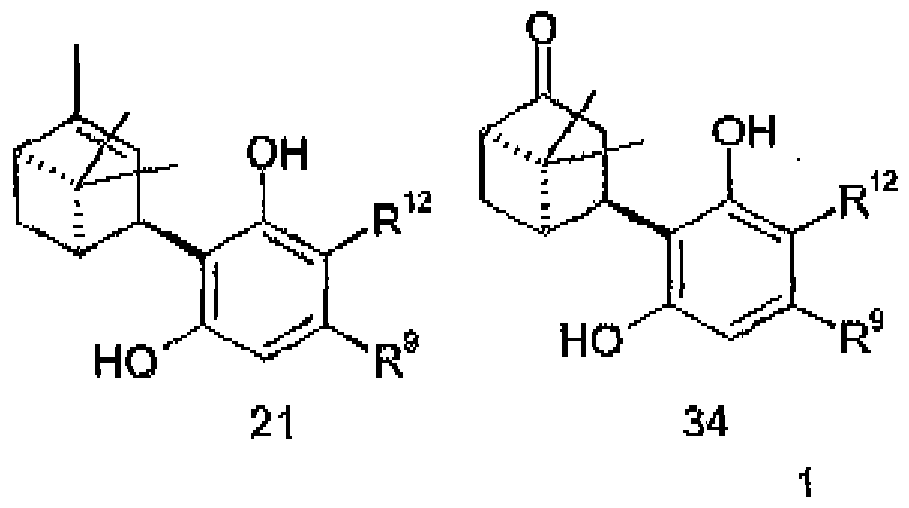
- (+) - Apoverbenone (1S, 5S) -14 condenses with type 5 compounds directly to the optically active trans-esters 28-A and 28-B, which after decarboxylative saponification b give the corresponding ester-free compounds 33: (1S, 5S) -14a and (1S, 5S) -15b condense with 5 to give compounds of type 34:
- step b the decarboxylative saponification (step b) can take place before the acid catalyzed rearrangement.
- 35 is first prepared from 34, which is then rearranged acid-catalyzed to 33.
- Halogen compounds of elements of the fourth and fifth and sixth main group such as tin tetrachloride, phosphorus trichloride, phosphorus pentachloride, Phosphoroxychlo-rid, antimony pentafluoride, thionyl chloride, sulfuryl chloride, alone or in admixture with other Lewis or Brönstedt acids.
- Suitable reagents for carrying out the condensation are the acetals of N, N-dimethylformamide, e.g. N, N.Dimethylformamid-dineopentylacetal and other dehydrating reagents, for example those, such as those used for the formation of amides and peptides such.
- T3P propanephosphonic anhydride
- these reagents may be added to the reaction mixture or may be applied to a carrier material such as e.g. Alumina can be applied.
- Suitable solvents for carrying out the condensation step are water-immiscible or water-miscible solvents such as. Hydrocarbons having up to 30 carbon atoms, halogenated hydrocarbons having up to 20 carbon atoms such as e.g. Dichloromethane or chloroform, ethers such as. B. 2-methoxytetrahydrofuran, alcohols, carboxylic acids having up to 16 carbon atoms, amides having up to 20 carbon atoms, esters having up to 60 carbon atoms, carbon dioxide. Sulfur dioxide, water, water with a phase transfer catalyst, the acidic catalysts themselves, and mixtures of these solvents with each other.
- reaction step "c" The same acids and solvents are also used for the mentioned isomerization and Epimerleitersrrezen (reaction step "c"), it is chosen only usually somewhat more energetic conditions such. higher temperatures.
- Step 1 Condensation of p-mentha-2,8-dienol with methyl olivetate (method "a"):
- This step is identical, regardless of whether it is subsequently saponified and decarboxylated using the printing process or whether subsequent isomerization "c" takes place before or after saponification "b"
- the flask is immersed in an external cooling bath of ice-salt and stirring is continued until an internal temperature of minus 15 ° C is established.
- the Bortifluorid etherate solution is added dropwise with vigorous stirring and external cooling within about one hour to the reaction mixture, with an internal temperature of about minus 15 ° C is maintained.
- the reaction solution turns yellowish and cloudy.
- the flask is removed from the ice bath.
- the organic phase is washed with two portions of 1 liter each of deionized water.
- the organic phase is separated off and concentrated on a rotary evaporator, finally the bath temperature is increased to 90 ° C. and the pressure reduced to 3 mbar in order to remove residual solvent.
- CBDAMe cannabidiolate
- CBDAMe cannabidiolate
- the aqueous phases are combined and can be acidified to recover unreacted methyl olivetate.
- the organic phase is washed with two portions of 0.5 liter of deionized water, in each of which 20 g of sodium sulfate may be dissolved in order to improve the phase separation.
- Step 2 Saponification and Decarboxylation of the Cannabinoid Carboxylic Acid Esters (Methods "b")
- the autoclave is purged with argon, sealed and heated on a hot plate with magnetic stirrer.
- the autoclave contents are transferred to a round bottom flask with 250 ml of methanol and neutralized by careful (CO 2 evolution - foaming!) Addition of a solution of 23.2 g (0.36 eq) citric acid in 150 ml deionized water.
- the resulting emulsion is rotary evaporated on a rotary evaporator (recovery of aqueous methanol) and the residue consisting of CBD, potassium salts of citric acid and residual water between 200 ml of deionized water and 300 ml of petroleum ether (or other water-immiscible solvent) by rotating in a 40 ° warm water bath.
- the apparatus is rinsed for 5 min. With about 5 l argon / min, then it is started to heat with stirring and the argon stream is reduced to about 0.1 l / min.
- the inert gas is stopped and at an internal temperature of ⁇ 40 ° C within half an hour, 1.5 liters of petroleum ether dropwise (or another water-immiscible solvent), with more carbon dioxide escapes.
- reaction times by adding a suitable catalyst such. 0.1% by weight (based on CBDAMe) of groundwood powder or 0.01% by weight of silver powder.
- This catalyst accelerates the decarboxylation of the intermediate carboxylic acid.
- the vacuum distillation of CBD can take place both from a bottom flask and from a thin-film apparatus. Expediently distilled at pressures below 1 mbar, preferably ⁇ 0.3 mbar.
- the cooling liquid of the condenser should be sufficiently warm (> 50 ° C) to ensure a sufficient flow rate of the condensed CBD:
- Thermostatic water bath with circulating pump as cooling liquid for the distillation bridge is thermostatic water bath with circulating pump as cooling liquid for the distillation bridge.
- the distillation flask is charged with 242 g crude CBD.
- the crude CBD is preheated to approx. 60 ° C and the stirrer is started.
- the third fraction (178 g) consists of 90% CBD and distils at 133-155 ° C head temperature and a pressure of 0.10 to 0.15 mbar. Cooling water 70 ° C.
- the dropping funnel of a short path distillation apparatus such as the KD 1 of UIC is charged in portions with 1971.4 g preheated (about 60 ° C) CBD.
- the heating jacket of the apparatus is kept at 180 ° C.
- the cold trap to the vacuum pump (oil rotary vane pump) is charged with dry ice-acetone or with liquid nitrogen.
- the cooling liquid is preheated to 60 ° C
- the CBD is now allowed to drip into the apparatus within about 12 hours.
- Silica gel or other chromatographic adsorbents such as Silica gel or other chromatographic adsorbents such.
- alumina can retain many impurities that inhibit crystallization of CBD when crude, adsorbed CBD is eluted with a suitable solvent.
- Suitable solvents are hydrocarbons, halogenated hydrocarbons, esters, ethers and ketones having up to 20 carbon atoms, and mixtures thereof with one another.
- one part by weight of the CBD to be purified is dissolved in a suitable first solvent such as n-heptane, and this solution is applied to a silica gel bed of one, preferably two parts by weight of silica gel for chromatography.
- a suitable first solvent such as n-heptane
- the first solvent is allowed to drain and elute (wash) the silica gel bed with a suitable solvent or mixture such as. B. a volume of dichloromethane and 4 volumes of heptane until no more CBD is detectable in the eluate.
- Crude CBD preferably CBD pre-purified by distillation or silica gel filtration
- This cleaning process is loss-making with appropriate implementation and provides excellent cleaning effect.
- Suitable solvents for crystallization are hydrocarbons having from 3 to 30 carbon atoms, preferably straight-chain hydrocarbons, such as n-pentane, n-hexane, n-heptane.
- highly fluorinated or partially fluorinated chain hydrocarbons and esters of saturated or unsaturated chain carboxylic acids of one to 36 carbon atoms with mono-, di- or oligo-alcohols e.g. Glycerol, and mixtures of said solvents.
- the solution is cooled with constant stirring and repeatedly inoculated. At a temperature ⁇ 20 ° C, the CBD begins to crystallize.
- condensation step "a" the same acids and solvents are used as in condensation step "a".
- the reaction can be controlled in the desired manner.
- an alkaline drying agent such as potassium carbonate or basic aluminum oxide may be added.
- the mixture is stirred for one hour, the phases are separated, the organic phase is washed successively with 300 ml of 5% sodium bicarbonate solution and twice with 300 ml of deionized water.
Landscapes
- Chemical & Material Sciences (AREA)
- Organic Chemistry (AREA)
- Chemical Kinetics & Catalysis (AREA)
- Health & Medical Sciences (AREA)
- Pharmacology & Pharmacy (AREA)
- Animal Behavior & Ethology (AREA)
- Medicinal Chemistry (AREA)
- Nuclear Medicine, Radiotherapy & Molecular Imaging (AREA)
- Bioinformatics & Cheminformatics (AREA)
- Engineering & Computer Science (AREA)
- Life Sciences & Earth Sciences (AREA)
- General Chemical & Material Sciences (AREA)
- General Health & Medical Sciences (AREA)
- Public Health (AREA)
- Veterinary Medicine (AREA)
- Organic Low-Molecular-Weight Compounds And Preparation Thereof (AREA)
- Pharmaceuticals Containing Other Organic And Inorganic Compounds (AREA)
- Pyrane Compounds (AREA)
Claims (16)
- Procédé pour la préparation d'un composé de formule générale Ia, Ib et leurs diastéréo-isomères 22, 35
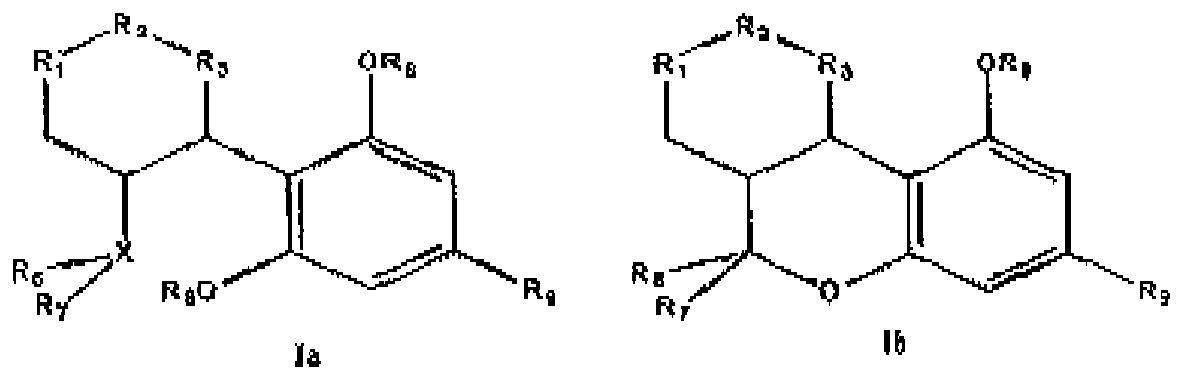


R1 et R3 représentant CH2 ou CH, et
R2 représentant soit C=O, soit un groupe R10-C-R11,
où
R10 et R11 représentent, indépendamment l'un de l'autre, soit H, soit un groupe alkyle inférieur en C1-C4, lorsqu'il n'existe pas de double liaison entre R1 et R3, soit, lorsqu'il existe une double liaison entre R1 et R3, un des groupes R10 ou R11 est supprimé et l'autre est tel que défini ci-dessus ;
X représente soit C, lorsque R6 représente un groupe =CH2 et R7 représente un groupe CH3, soit
X représente un groupe CR4, R4 représentant H ou un groupe alkyle inférieur, CH ou un groupe C-O-R5 et R5 représentant soit H, soit un groupe alkyle en C1-C18 soit un groupe de protection ;
R6 et R7 représentent un groupe CH3 ou au moins un des groupes R6 et R7 représente un groupe CH2= et l'autre représente un groupe CH3,
R8 représente un groupe alkyle en C1-C16, H ou un groupe de protection,
R9 représente un groupe C1-C16 ou un groupe O-C1-C16, C1-C16 représentant une chaîne alkyle linéaire ou ramifiée qui présente, en un endroit quelconque, une ou plusieurs doubles ou triples liaisons ou qui peut présenter un ou plusieurs substituants tels que des atomes de deutérium ou d'halogène, des groupes phényle, phényle substitué, cycloalkyle, nitrile, alcoxy ou un groupe céto,
R12 représente un groupe CO2-R13, et
R13 représente un groupe alkyle en C1-C16 ou un groupe de protection,
la saponification avec décarboxylation étant réalisée dans un milieu alcalin. - Procédé pour la préparation d'un composé de formule générale Ia, Ib et leurs diastéréo-isomères 22 ou 35


R1 et R2 représentant CH2 ou CH, et
R2 représentant soit C=O, soit un groupe R10-C-R11,
où
Rio et R11 représentent, indépendamment l'un de l'autre, soit H, soit un groupe alkyle inférieur en C1-C4, lorsqu'il n'existe pas de double liaison entre R1 et R3, soit, lorsqu'il existe une double liaison entre R1 et R3, un des groupes R10 ou R11 est supprimé et l'autre est tel que défini ci-dessus ;
X représente soit C, lorsque R6 représente un groupe =CH2 et R7 représente un groupe CH3, soit
X représente un groupe CR4, R4 représentant H ou un groupe alkyle inférieur, CH ou un groupe C-O-R5 et R5 représentant soit H, soit un groupe alkyle en C1-C16 soit un groupe de projection ;
R6 et R7 représentent un groupe CH3 ou au moins un des groupes R6 et R7 représente un groupe CH2= et l'autre représente un groupe CH3,
R8 représente un groupe alkyle en C1-C16, H ou un groupe de protection,
R9 représente un groupe C1-C16 ou un groupe O-C1-C16, C1-C16 représentant une chaîne alkyle linéaire ou ramifiée qui présente, en un endroit quelconque, une ou plusieurs doubles ou triples liaisons ou qui peut présenter un ou plusieurs substituants tels que des atomes de deutérium ou d'halogène, des groupes phényle, phényle substitué, cycloalkyle, nitrile, alcoxy ou un groupe céto,
R12 représente un groupe CO2-R13, et
R13 représente un groupe alkyle en C1-C16 ou un groupe de protection,
la saponification avec décarboxylation étant réalisée dans un milieu alcalin. - Procédé selon l'une quelconque des revendications 1 ou 2, caractérisé en ce qu'on utilise des catalyseurs de décarboxylation, par exemple des métaux de transition et leurs sels, de préférence des poudres d'acier noble ou des poudres d'argent.
- Procédé selon la revendication 1, caractérisé en ce qu'on utilise, comme solvant, des alcools inférieurs comprenant jusqu'à cinq atomes de carbone, de l'ammoniaque ainsi que leurs mélanges les uns avec les autres et avec de l'eau.
- Procédé selon la revendication 1, caractérisé en ce que le procédé est réalisé en milieu aqueux avec des catalyseurs de transfert de phase ou des émulsifiants.
- Procédé selon la revendication 2, caractérisé en ce qu'on utilise au moins un des solvants suivants DMF, DMSO, sulfolane, furfurol, dihydrofurfurol et tétrahydrofurfurol, 2-méthoxytétrahydrofuranne, triamide de l'acide hexaméthylènephosphorique, acétamide, des amides comprenant jusqu'à 12 atomes de carbone, tétraméthylurée, éthylèneglycol, ainsi que ses monoéthers et bis-éthers, éthanolamine, éthylènediamine, propylèneglycol et ses éthers comprenant jusqu'à 20 atomes de carbone, glycérol et glycéroléthers comprenant jusqu'à 30 atomes de carbone, 1,2-butanediol, 1,3-butanediol, 1,4-butanediol, diéthylèneglycol et ses éthers, triéthylèneglycol et ses éthers, polyéthyléneglycol, polyvinylpyrrolidone avec ou sans eau.
- Procédé selon l'une quelconque des revendications 1 à 6, caractérisé en ce qu'on utilise une ou plusieurs des bases suivantes pour la saponification alcaline : hydroxydes de métaux alcalins et alcalino-terreux ainsi que de sels d'ammonium quaternaire, carbonates, hydrogénocarbonates et carboxylates comprenant jusqu'à 30 atomes de carbone, phénolates, phosphates, phosphites, sulfures, hydrogénosulfures, mercaptides comprenant jusqu'à 30 atomes de carbone, sulfites, hydrogénosulfites, cyanures de métaux alcalins et de sels d'ammonium quaternaire comprenant 4 à 98 atomes de carbone, ammoniaque, alkylamines, arylamines, aminés hétérocycliques aromatiques ou non aromatiques, organiques, comprenant jusqu'à 36 atomes de carbone ainsi que leurs sels, borates, tétraborates.
- Procédé selon l'une quelconque des revendications 1 ou 2, caractérisé en ce que le produit intermédiaire de type ester du composé de formule Ia, Ib, 22 ou 35 est préparé par une condensation catalysée d'un acide d'un précurseur terpénique insaturé approprié avec le composé de formule générale III, R8, R9 et R12 étant tels que définis dans la revendication 1

- Procédé selon la revendication 8, caractérisé en ce que la condensation est réalisée en présence d'acétals de N,N-diméthylformamide, comme par exemple le N,N-diméthylformamide-dinéopentylacétal ou d'autres réactifs dissociant de l'eau, de préférence l'anhydride de l'acide propanephosphonique, ceux-ci étant ajoutés tels quels à la solution réactionnelle ou pouvant être appliqués sur un matériau support tel que par exemple l'oxyde d'aluminium, en présence d'au moins un des acides de Brönstedt ou de Lewis suivants : acide perchlorique, acides halogénohydriques (HF, HCl, HBr, HI), acide sulfurique, hydrogénosulfates, acide phosphorique et ses sels acides, acides pyrophosphorique et polyphosphorique, acides carboxyliques et sulfoniques organiques comprenant un jusqu'à 30 atomes de carbone et un ou plusieurs groupes acides, ainsi que groupes acides liés à un support polymère, tels que par exemple des échangeurs d'ions acides et des mélanges des acides mentionnés, par exemple acide formique, acide oxalique, acide trifluoroacétique, acide p-toluènesulfonique, cations de métaux alcalins et alcalino-terreux ainsi que métaux de transition ; composés halogénés et d'autres composés trivalents d'éléments du troisième groupe principal, tels que trifluorure de bore et d'autres composés de bore-halogène et leurs complexes, halogénures d'aluminium tels que le chlorure d'aluminium anhydre ; sels et composés halogénés de métaux de transition, tels que tétrachlorure de titane, chlorure de zinc, trifluorométhanesulfonate de zinc ; composés halogénés d'éléments du quatrième, cinquième et sixième groupe principal, par exemple tétrachlorure d'étain, trichlorure de phosphore, pentachlorure de phosphore, oxychlorure de phosphore, pentafluorure d'antimoine, chlorure de thionyle, chlorure de sulfuryle, soit seuls soit dans des mélanges avec d'autres acides de Brönstedt ou de Lewis ; centres positifs liés à des structures polymères, tels que par exemple montmorillonite.
- Procédé selon la revendication 8 ou 9, caractérisé en ce que la condensation est réalisée dans au moins un des solvants suivants, miscibles ou non miscibles à l'eau : hydrocarbures comprenant jusqu'à 30 atomes de carbone, hydrocarbures halogénés comprenant jusqu'à 20 atomes de carbone tels que par exemple dichlorométhane ou chloroforme, éthers tels que par exemple 2-méthoxytétrahydrofuranne, alcools, acides carboxyliques comprenant jusqu'à 16 atomes de carbone, amides comprenant jusqu'à 20 atomes de carbone, esters comprenant jusqu'à 60 atomes de carbone, dioxyde de carbone, dioxyde de soufre, eau, eau avec un catalyseur de transfert de phase, les catalyseurs acides eux-mêmes ainsi que des mélanges des solvants mentionnés les uns avec les autres.
- Procédé selon l'une quelconque des revendications 1 ou 2, caractérisé en ce que le composé de formule (1a)

est préparé par saponification avec décarboxylation du composé de formule 16a
- Procédé selon l'une quelconque des revendications 8 à 11, caractérisé en ce que le composé de formule 16a

est préparé par condensation catalysée par un acide des composés des formules 6a et 5a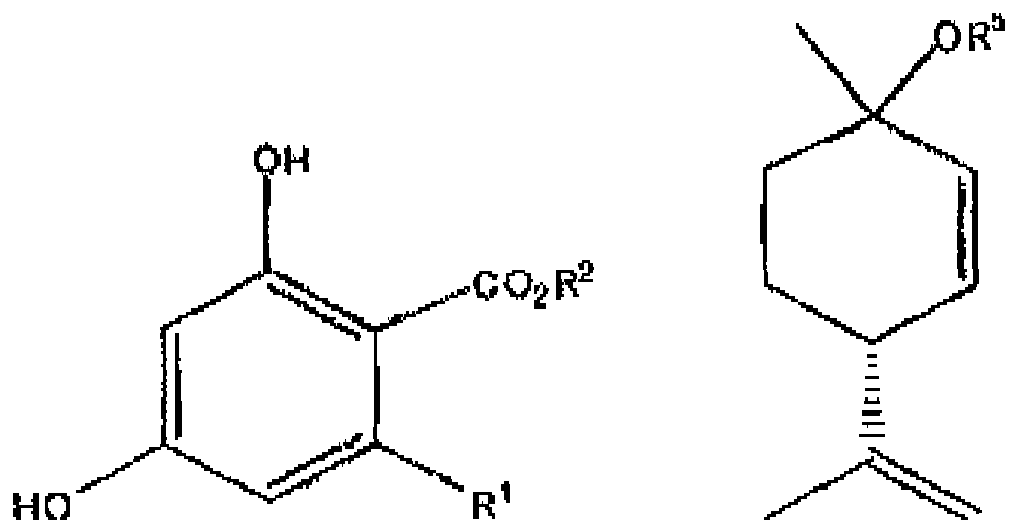
- Procédé selon la revendication 11, caractérisé en ce qu'on prépare, à partir du composé de formule 1a, dans une étape d'isomérisation consécutive catalysée par un acide, du (-)-delta-9-tétrahydrocannabinol (Dronabinol, formule 2a)

- Procédé selon l'une quelconque des revendications précédentes, caractérisé en ce qu'on réalise, avant ou après la saponification avec décarboxylation, une transposition catalysée par un acide.
- Procédé selon la revendication 14, caractérisé en ce que la transposition est une épimérisation.
- Procédé pour la préparation des composés de formule générale Ia, Ib, 22 ou 35 selon la revendication 1 ou 2, caractérisé par les étapes suivantes :a) transformation de composés de formule générale III avec un terpène insaturé approprié selon la revendication 8, pour obtenir un composé de formule générale IIa, IIb, IIc, 21 ou 34 selon la revendication 1 ou 2 ;b) réalisation d'une saponification avec décarboxylation selon la revendication 1 ou 2 ; etc) réalisation d'une transposition catalysée par un acide,l'étape c) pouvant être réalisée avant l'étape b).
Priority Applications (1)
| Application Number | Priority Date | Filing Date | Title |
|---|---|---|---|
| PL10004422T PL2314580T3 (pl) | 2009-04-30 | 2010-04-27 | Sposób wytwarzania syntetycznych kannabinoidów |
Applications Claiming Priority (1)
| Application Number | Priority Date | Filing Date | Title |
|---|---|---|---|
| DE102009019322A DE102009019322A1 (de) | 2009-04-30 | 2009-04-30 | Verfahren zur Herstellung von Synthetischen Cannabinoiden |
Publications (2)
| Publication Number | Publication Date |
|---|---|
| EP2314580A1 EP2314580A1 (fr) | 2011-04-27 |
| EP2314580B1 true EP2314580B1 (fr) | 2015-09-09 |
Family
ID=42932300
Family Applications (1)
| Application Number | Title | Priority Date | Filing Date |
|---|---|---|---|
| EP10004422.1A Active EP2314580B1 (fr) | 2009-04-30 | 2010-04-27 | Procédé de fabrication de cannabinoïdes de synthèse |
Country Status (5)
| Country | Link |
|---|---|
| US (1) | US20100298579A1 (fr) |
| EP (1) | EP2314580B1 (fr) |
| DE (1) | DE102009019322A1 (fr) |
| ES (1) | ES2554653T3 (fr) |
| PL (1) | PL2314580T3 (fr) |
Cited By (4)
| Publication number | Priority date | Publication date | Assignee | Title |
|---|---|---|---|---|
| EP3461545A1 (fr) | 2017-09-30 | 2019-04-03 | Bionorica Ethics GmbH | Distillation à évaporation instantanée sous vide permettant d'enrichir des matières naturelles |
| US11440870B2 (en) | 2017-06-20 | 2022-09-13 | University Of Guelph | Cannabidiolic acid esters compositions and uses thereof |
| US12403114B2 (en) | 2019-03-12 | 2025-09-02 | Epm (Ip), Inc. | Cannabinoid acid ester compositions and uses thereof |
| EP4469426A4 (fr) * | 2022-01-27 | 2026-04-29 | Citrachem Corp | Procédés de synthèse de cannabidiol, de dérivés de celui-ci et d'autres phytocannabinoïdes |
Families Citing this family (49)
| Publication number | Priority date | Publication date | Assignee | Title |
|---|---|---|---|---|
| US9376367B2 (en) | 2011-09-29 | 2016-06-28 | The Health Concept Gmbh | Cannabinoid carboxylic acids, salts of cannabinoid carboxylic acids, and the production and uses of same |
| JP6581509B2 (ja) | 2013-02-28 | 2019-09-25 | ティーウィノット テクノロジーズ リミテッド | 化合物を合成する化学工学プロセス及び装置 |
| EP2842933B1 (fr) * | 2013-09-03 | 2015-07-29 | Symrise AG | Mélanges de composés cannabinoïdes, leur préparation et leur utilisation |
| AU2015308136B2 (en) | 2014-08-25 | 2020-07-09 | Teewinot Technologies Limited | Apparatus and methods for the simultaneous production of cannabinoid compounds |
| DK3232808T3 (da) | 2014-12-19 | 2020-06-02 | Thc Pharm Gmbh The Health Concept | CBD-holdig drik |
| US20160228385A1 (en) * | 2015-02-05 | 2016-08-11 | Colorado Can Llc | Purified cbd and cbda, and methods, compositions and products employing cbd or cbda |
| EP3061450A1 (fr) | 2015-02-26 | 2016-08-31 | Symrise AG | Mélanges de composés cannabinoïdes, leur fabrication et leur utilisation |
| US20160250270A1 (en) | 2015-02-27 | 2016-09-01 | Ebbu, LLC | Compositions comprising combinations of purified cannabinoids, with at least one flavonoid, terpene, or mineral |
| US20170008869A1 (en) * | 2015-07-10 | 2017-01-12 | Noramco, Inc. | Process for the production of cannabidiol and delta-9-tetrahydrocannabinol |
| EP3150264A1 (fr) * | 2015-09-30 | 2017-04-05 | Bionorica Ethics GmbH | Distillation sous vide destinee a enrichir le cbd |
| EP3455213B1 (fr) | 2016-05-13 | 2021-11-24 | Symrise AG | Méthode pour la purification des composés cannabinoids par chromatographie en lit mobile simulée (smb) |
| US10399920B2 (en) | 2016-06-01 | 2019-09-03 | S&B Pharma, Inc. | Crystalline form of cannabidiol |
| US12485129B2 (en) | 2016-08-29 | 2025-12-02 | Canopy Growth Corporation | Water soluble compositions comprising purified cannabinoids |
| CA3034004C (fr) | 2016-08-29 | 2021-08-03 | Canopy Growth Corporation | Compositions hydrosolubles comprenant des cannabinoides purifies |
| US10239808B1 (en) | 2016-12-07 | 2019-03-26 | Canopy Holdings, LLC | Cannabis extracts |
| CN106810426B (zh) * | 2016-12-29 | 2020-05-08 | 暨明医药科技(苏州)有限公司 | 一种大麻二酚的合成方法 |
| AU2018227544A1 (en) * | 2017-03-01 | 2019-08-29 | Canopy Growth Corporation | Compositions purposefully selected comprising purified cannabinoids and/or purified terpenes |
| AU2018317939B2 (en) * | 2017-08-16 | 2021-06-03 | The University Of Sydney | Synthesis of phytocannabinoids including a decarboxylation step |
| CA3089994A1 (fr) | 2018-01-31 | 2019-08-08 | Canopy Holdings, LLC | Poudre de chanvre |
| BR102018002843A2 (pt) * | 2018-02-09 | 2019-08-27 | Prati, Donaduzzi & Cia Ltda | composição farmacêutica e uso da mesma |
| US11192870B2 (en) * | 2018-03-07 | 2021-12-07 | Socati Technologies—Oregon, Llc | Continuous isolation of cannabidiol and conversion of cannabidiol to delta 8-tetrahydrocannabinol and delta 9-tetrahydrocannabinol |
| US11851415B2 (en) * | 2018-03-07 | 2023-12-26 | Cleen Technology Inc. | Continuous isolation of cannabidiol and cannabinoids and conversion of cannabidiol to delta 8-tetrahydrocannabinol and delta 9-tetrahydrocannabinol |
| DE102018001959A1 (de) | 2018-03-10 | 2019-09-12 | Florian Frey | Thermisches Trennverfahren zur Anreicherung von Cannabinoiden |
| WO2019222459A1 (fr) | 2018-05-18 | 2019-11-21 | Diverse Biotech, Inc. | Préparations de cannabinoïdes et utilisations thérapeutiques |
| WO2020028198A1 (fr) | 2018-08-03 | 2020-02-06 | Biomass Oil Separation Solutions, Llc | Procédés et appareil d'extraction de substances et d'extraits enrichis à partir d'une matière végétale |
| CA3119729A1 (fr) | 2018-10-10 | 2020-04-16 | Treehouse Biotech, Inc. | Synthese du cannabigerol |
| EP3873451A4 (fr) | 2018-10-31 | 2022-08-10 | BayMedica, Inc. | Analogues de cannabinoïdes et leurs procédés de préparation |
| WO2020117288A1 (fr) * | 2018-12-07 | 2020-06-11 | Mckinney Jeffrey A | Agonistes deutérés et leurs procédés d'utilisation |
| WO2020176547A1 (fr) | 2019-02-25 | 2020-09-03 | Ginkgo Bioworks, Inc. | Biosynthèse de cannabinoïdes et de précurseurs cannabinoïdes |
| US10981850B2 (en) | 2019-04-15 | 2021-04-20 | Trustees Of Boston University | One-step flow-mediated synthesis of cannabidiol (CBD) and derivatives |
| KR20220007078A (ko) * | 2019-05-10 | 2022-01-18 | 베누비아 매뉴팩처링, 엘엘씨 | 칸나비디올 또는 칸나비디바린의 제조 방법 및 칸나비디올 또는 칸나비디바린 제조의 중간체 |
| CN111943813B (zh) | 2019-05-17 | 2023-04-14 | 上海特化医药科技有限公司 | 大麻二酚类化合物的制备方法 |
| US10799546B1 (en) | 2019-07-26 | 2020-10-13 | Biomass Oil Separation Solutions, Llc | Modular, integrated process and apparatus for extracting, refining and remediating active substances from plant material |
| MX2022002183A (es) * | 2019-08-22 | 2022-05-24 | Epm Group Inc | Composiciones de éster de ácido cannabinoide y sus usos. |
| US11542243B1 (en) | 2019-09-26 | 2023-01-03 | FusionFarms, LLC | Method of converting delta9-THC to delta10-THC and the purification of the delta10-THC by crystallization |
| CA3162971A1 (fr) * | 2019-12-27 | 2021-07-01 | Charles K. Marlowe | Preparation de cannabichromene et de cannabinoides apparentes |
| EP4089084A4 (fr) * | 2020-01-08 | 2024-03-13 | Chengdu Baiyu Pharmaceutical Co., Ltd. | Dérivé cannabidiol et son procédé de préparation et son utilisation médicale |
| US12545694B2 (en) | 2020-01-08 | 2026-02-10 | Chengdu Baiyu Pharmaceutical Co., Ltd. | Cannabidiol derivatives, preparation method thereof and use thereof |
| US12391711B2 (en) | 2020-01-08 | 2025-08-19 | Chengdu Baiyu Pharmaceutical Co., Ltd. | Tetrahydrocannabinol derivatives, preparation method thereof and use thereof |
| ES2936274T3 (es) | 2020-02-21 | 2023-03-15 | Sci Pharmtech Inc | Método sin disolvente para preparar cannabinoides |
| MX2022011832A (es) * | 2020-03-31 | 2023-03-03 | Phytotherapeutix Ltd | Compuestos terpenofenolicos y su uso. |
| US20210355097A1 (en) * | 2020-05-12 | 2021-11-18 | FinChemica, Inc. | Catalytic conversation of cannabidiol and methods thereof |
| CA3132439A1 (fr) * | 2020-05-12 | 2021-11-12 | Canopy Growth Corporation | Methodes de synthese du cannabigerole, de l`acide cannabigerolique et d`analogues connexes |
| CN111848365A (zh) * | 2020-07-16 | 2020-10-30 | 云南自由贸易试验区睿之成医药科技有限公司 | 一种大麻二酚的合成方法 |
| CN113173857B (zh) * | 2021-03-09 | 2023-05-23 | 昆明理工大学 | 一种大麻二酚衍生物及其制备方法与应用 |
| CN113603568A (zh) * | 2021-07-19 | 2021-11-05 | 厦门朝阳生物工程有限公司 | 一种大麻二酚的制备方法 |
| WO2024028516A1 (fr) | 2022-08-05 | 2024-02-08 | Salud & Semillas, S.L. | Synthèse de cannabinoïdes à partir d'olivétol et de terpène dans du dichlorométhane avec fecl3 * 6h2o en tant que catalyseur |
| EP4642449A1 (fr) * | 2022-12-29 | 2025-11-05 | Adtech Pharma, Inc. | Compositions pharmaceutiques comprenant de la nabilone pour le traitement d'affections ophtalmiques |
| EP4431169A1 (fr) | 2023-03-17 | 2024-09-18 | Siegfried AG | Methode de purifier des composants cannabinoïdes à partir d'extraits de plantes |
Family Cites Families (1)
| Publication number | Priority date | Publication date | Assignee | Title |
|---|---|---|---|---|
| US5342971A (en) | 1992-12-29 | 1994-08-30 | The Australian National University | Process for the preparation of dibenzo[b,d]pyrans |
-
2009
- 2009-04-30 DE DE102009019322A patent/DE102009019322A1/de not_active Ceased
-
2010
- 2010-04-27 ES ES10004422.1T patent/ES2554653T3/es active Active
- 2010-04-27 PL PL10004422T patent/PL2314580T3/pl unknown
- 2010-04-27 EP EP10004422.1A patent/EP2314580B1/fr active Active
- 2010-04-29 US US12/770,056 patent/US20100298579A1/en not_active Abandoned
Non-Patent Citations (2)
| Title |
|---|
| EDERY H ET AL: "STRUCTURE-ACTIVITY RELATIONS IN THE TETRAHYDROCANNABINOL SERIES. MODIFICATIONS ON THE AROMATIC RING AND IN THE SIDE-CHAIN", ARZNEIMITTEL FORSCHUNG. DRUG RESEARCH, ECV EDITIO CANTOR VERLAG, AULENDORF, DE, vol. 22, no. 11, 1 January 1972 (1972-01-01), pages 1995 - 2003, XP008048340, ISSN: 0004-4172 * |
| LEE Y R ET AL: "Efficient one-pot synthetic approaches for cannabinoid analogues and their application to biologically interesting (-)-hexahydrocannabinol and (+)-hexahydrocannabinol", TETRAHEDRON LETTERS, PERGAMON, GB, vol. 49, no. 20, 12 May 2008 (2008-05-12), pages 3283 - 3287, XP022613638, ISSN: 0040-4039, [retrieved on 20080320], DOI: 10.1016/J.TETLET.2008.03.075 * |
Cited By (5)
| Publication number | Priority date | Publication date | Assignee | Title |
|---|---|---|---|---|
| US11440870B2 (en) | 2017-06-20 | 2022-09-13 | University Of Guelph | Cannabidiolic acid esters compositions and uses thereof |
| EP3461545A1 (fr) | 2017-09-30 | 2019-04-03 | Bionorica Ethics GmbH | Distillation à évaporation instantanée sous vide permettant d'enrichir des matières naturelles |
| WO2019063848A1 (fr) | 2017-09-30 | 2019-04-04 | Bionorica Ethics Gmbh | Distillation à court trajet sous vide pour l'enrichissement de substances naturelles |
| US12403114B2 (en) | 2019-03-12 | 2025-09-02 | Epm (Ip), Inc. | Cannabinoid acid ester compositions and uses thereof |
| EP4469426A4 (fr) * | 2022-01-27 | 2026-04-29 | Citrachem Corp | Procédés de synthèse de cannabidiol, de dérivés de celui-ci et d'autres phytocannabinoïdes |
Also Published As
| Publication number | Publication date |
|---|---|
| ES2554653T3 (es) | 2015-12-22 |
| DE102009019322A1 (de) | 2010-11-11 |
| PL2314580T3 (pl) | 2016-02-29 |
| EP2314580A1 (fr) | 2011-04-27 |
| US20100298579A1 (en) | 2010-11-25 |
Similar Documents
| Publication | Publication Date | Title |
|---|---|---|
| EP2314580A1 (fr) | Procédé de fabrication de cannabinoïdes de synthèse | |
| EP2225192A2 (fr) | Procédé de production de menthol racémique et optiquement actif | |
| DE2729859A1 (de) | Verfahren zur herstellung eines optischen isomers eines 1-hydroxy-3- substituierten-6,6-dimethyl-6,6a,7,8,10, 10a-hexahydro-9h-dibenzo eckige klammer auf b,d eckige klammer zu pyran-9-ons | |
| EP1293493A2 (fr) | Procédé pour la préparation de meso-zeaxanthine | |
| DE2902466C2 (fr) | ||
| WO2006125530A1 (fr) | Derives de tetrahydropyranne pourvus de plusieurs cycles contenant de l'oxygene et procede de production desdits derives | |
| EP2059493A1 (fr) | Recuperation de ligands phenol lors de la production d'isopulegol | |
| EP0004621A2 (fr) | Procédé de préparation en plusieurs étapes de la zéaxanthine et de l'alloxanthine à partir de dérivés de la cyclohexanone ou du cyclohexanol; dérivés de la cyclohexanone et du cyclohexanol | |
| EP0577040A2 (fr) | Procédé de préparation de l'ester tert.-butyle de l'acide (3R,5S)6-hydroxy-3,5-O-isopropylidène-3,5-dihydroxy-hexanoique | |
| DE10146689C2 (de) | Verfahren zur Herstellung von Sorbinsäure aus Sorbinsäurepolyester | |
| EP0022955A1 (fr) | Procédé pour la préparation de cétones supérieures non saturées | |
| DE102012005219B4 (de) | Verfahren zur Isomerisierung von Alkenen | |
| Aaron et al. | Synthesis of the eight stereoisomers of a tetrahydrocannabinol congener | |
| DE69222678T2 (de) | Synthesezwischenprodukte mit einem Hexanring und Verfahren zu ihrer Herstellung | |
| DE69903498T2 (de) | Verfahren zur Herstellung von 13-cis-Retinsäure | |
| DE4010925A1 (de) | Quaternaere ammoniumverbindungen mit muskelentspannender wirkung | |
| DE19944874C1 (de) | Verfahren zur Herstellung von Cyclooctanol | |
| EP0119546B1 (fr) | Procédé de préparation de composés de la série 4-oxo-damascone ainsi que les parfums de cette série de composés | |
| EP0112502A2 (fr) | Esters carboxyliques et aldéhydes du oméga,oméga-diacyloxy-2,6-diméthyl-octatriène, procédé de préparation et utilisation dans la synthèse de composés terpéniques | |
| DE2164662A1 (de) | Indanderivate und Verfahren zu ihrer Herstellung | |
| CH635305A5 (de) | 3-alkoxy- bzw. cycloalkoxy-4-homoisotwistan, verfahren zu seiner herstellung, riech- und geschmackstoffkomposition dasselbe enthaltend. | |
| DD289528A5 (de) | Verfahren zur herstellung eines [2,3-trane]tetrahydro-2-phenyl-5-hydroxy-3-hydroxymethylfurans | |
| DE843410C (de) | Verfahren zur Herstellung von Octahydrophenanthren-2-carbonsaeuren und ihren Derivaten | |
| WO2006125527A1 (fr) | Procede de fabrication de derives de tetrahydropyrane | |
| EP0069880B1 (fr) | Dérivés de la cyclopentanone et procédé pour leur isomérisation |
Legal Events
| Date | Code | Title | Description |
|---|---|---|---|
| PUAI | Public reference made under article 153(3) epc to a published international application that has entered the european phase |
Free format text: ORIGINAL CODE: 0009012 |
|
| 17P | Request for examination filed |
Effective date: 20100527 |
|
| AK | Designated contracting states |
Kind code of ref document: A1 Designated state(s): AT BE BG CH CY CZ DE DK EE ES FI FR GB GR HR HU IE IS IT LI LT LU LV MC MK MT NL NO PL PT RO SE SI SK SM TR |
|
| AX | Request for extension of the european patent |
Extension state: AL BA ME RS |
|
| GRAP | Despatch of communication of intention to grant a patent |
Free format text: ORIGINAL CODE: EPIDOSNIGR1 |
|
| INTG | Intention to grant announced |
Effective date: 20141008 |
|
| GRAP | Despatch of communication of intention to grant a patent |
Free format text: ORIGINAL CODE: EPIDOSNIGR1 |
|
| INTG | Intention to grant announced |
Effective date: 20150330 |
|
| GRAS | Grant fee paid |
Free format text: ORIGINAL CODE: EPIDOSNIGR3 |
|
| GRAA | (expected) grant |
Free format text: ORIGINAL CODE: 0009210 |
|
| AK | Designated contracting states |
Kind code of ref document: B1 Designated state(s): AT BE BG CH CY CZ DE DK EE ES FI FR GB GR HR HU IE IS IT LI LT LU LV MC MK MT NL NO PL PT RO SE SI SK SM TR |
|
| REG | Reference to a national code |
Ref country code: GB Ref legal event code: FG4D Free format text: NOT ENGLISH |
|
| REG | Reference to a national code |
Ref country code: AT Ref legal event code: REF Ref document number: 748027 Country of ref document: AT Kind code of ref document: T Effective date: 20150915 Ref country code: CH Ref legal event code: EP |
|
| REG | Reference to a national code |
Ref country code: IE Ref legal event code: FG4D Free format text: LANGUAGE OF EP DOCUMENT: GERMAN |
|
| REG | Reference to a national code |
Ref country code: DE Ref legal event code: R096 Ref document number: 502010010222 Country of ref document: DE |
|
| REG | Reference to a national code |
Ref country code: ES Ref legal event code: FG2A Ref document number: 2554653 Country of ref document: ES Kind code of ref document: T3 Effective date: 20151222 |
|
| PG25 | Lapsed in a contracting state [announced via postgrant information from national office to epo] |
Ref country code: GR Free format text: LAPSE BECAUSE OF FAILURE TO SUBMIT A TRANSLATION OF THE DESCRIPTION OR TO PAY THE FEE WITHIN THE PRESCRIBED TIME-LIMIT Effective date: 20151210 Ref country code: FI Free format text: LAPSE BECAUSE OF FAILURE TO SUBMIT A TRANSLATION OF THE DESCRIPTION OR TO PAY THE FEE WITHIN THE PRESCRIBED TIME-LIMIT Effective date: 20150909 Ref country code: NO Free format text: LAPSE BECAUSE OF FAILURE TO SUBMIT A TRANSLATION OF THE DESCRIPTION OR TO PAY THE FEE WITHIN THE PRESCRIBED TIME-LIMIT Effective date: 20151209 Ref country code: LV Free format text: LAPSE BECAUSE OF FAILURE TO SUBMIT A TRANSLATION OF THE DESCRIPTION OR TO PAY THE FEE WITHIN THE PRESCRIBED TIME-LIMIT Effective date: 20150909 Ref country code: LT Free format text: LAPSE BECAUSE OF FAILURE TO SUBMIT A TRANSLATION OF THE DESCRIPTION OR TO PAY THE FEE WITHIN THE PRESCRIBED TIME-LIMIT Effective date: 20150909 |
|
| REG | Reference to a national code |
Ref country code: LT Ref legal event code: MG4D |
|
| REG | Reference to a national code |
Ref country code: NL Ref legal event code: FP |
|
| PG25 | Lapsed in a contracting state [announced via postgrant information from national office to epo] |
Ref country code: HR Free format text: LAPSE BECAUSE OF FAILURE TO SUBMIT A TRANSLATION OF THE DESCRIPTION OR TO PAY THE FEE WITHIN THE PRESCRIBED TIME-LIMIT Effective date: 20150909 Ref country code: SE Free format text: LAPSE BECAUSE OF FAILURE TO SUBMIT A TRANSLATION OF THE DESCRIPTION OR TO PAY THE FEE WITHIN THE PRESCRIBED TIME-LIMIT Effective date: 20150909 |
|
| REG | Reference to a national code |
Ref country code: FR Ref legal event code: PLFP Year of fee payment: 7 |
|
| PG25 | Lapsed in a contracting state [announced via postgrant information from national office to epo] |
Ref country code: IS Free format text: LAPSE BECAUSE OF FAILURE TO SUBMIT A TRANSLATION OF THE DESCRIPTION OR TO PAY THE FEE WITHIN THE PRESCRIBED TIME-LIMIT Effective date: 20160109 Ref country code: EE Free format text: LAPSE BECAUSE OF FAILURE TO SUBMIT A TRANSLATION OF THE DESCRIPTION OR TO PAY THE FEE WITHIN THE PRESCRIBED TIME-LIMIT Effective date: 20150909 Ref country code: SK Free format text: LAPSE BECAUSE OF FAILURE TO SUBMIT A TRANSLATION OF THE DESCRIPTION OR TO PAY THE FEE WITHIN THE PRESCRIBED TIME-LIMIT Effective date: 20150909 |
|
| PG25 | Lapsed in a contracting state [announced via postgrant information from national office to epo] |
Ref country code: RO Free format text: LAPSE BECAUSE OF FAILURE TO SUBMIT A TRANSLATION OF THE DESCRIPTION OR TO PAY THE FEE WITHIN THE PRESCRIBED TIME-LIMIT Effective date: 20150909 Ref country code: PT Free format text: LAPSE BECAUSE OF FAILURE TO SUBMIT A TRANSLATION OF THE DESCRIPTION OR TO PAY THE FEE WITHIN THE PRESCRIBED TIME-LIMIT Effective date: 20160111 |
|
| REG | Reference to a national code |
Ref country code: DE Ref legal event code: R097 Ref document number: 502010010222 Country of ref document: DE |
|
| PLBE | No opposition filed within time limit |
Free format text: ORIGINAL CODE: 0009261 |
|
| STAA | Information on the status of an ep patent application or granted ep patent |
Free format text: STATUS: NO OPPOSITION FILED WITHIN TIME LIMIT |
|
| 26N | No opposition filed |
Effective date: 20160610 |
|
| PG25 | Lapsed in a contracting state [announced via postgrant information from national office to epo] |
Ref country code: DK Free format text: LAPSE BECAUSE OF FAILURE TO SUBMIT A TRANSLATION OF THE DESCRIPTION OR TO PAY THE FEE WITHIN THE PRESCRIBED TIME-LIMIT Effective date: 20150909 Ref country code: BE Free format text: LAPSE BECAUSE OF NON-PAYMENT OF DUE FEES Effective date: 20160430 Ref country code: SI Free format text: LAPSE BECAUSE OF FAILURE TO SUBMIT A TRANSLATION OF THE DESCRIPTION OR TO PAY THE FEE WITHIN THE PRESCRIBED TIME-LIMIT Effective date: 20150909 |
|
| REG | Reference to a national code |
Ref country code: DE Ref legal event code: R082 Ref document number: 502010010222 Country of ref document: DE Representative=s name: BECKER KURIG & PARTNER PATENTANWAELTE MBB, DE Ref country code: DE Ref legal event code: R082 Ref document number: 502010010222 Country of ref document: DE Representative=s name: SIMANDI PATENTANWAELTE, DE |
|
| PG25 | Lapsed in a contracting state [announced via postgrant information from national office to epo] |
Ref country code: LU Free format text: LAPSE BECAUSE OF FAILURE TO SUBMIT A TRANSLATION OF THE DESCRIPTION OR TO PAY THE FEE WITHIN THE PRESCRIBED TIME-LIMIT Effective date: 20160427 |
|
| REG | Reference to a national code |
Ref country code: IE Ref legal event code: MM4A |
|
| REG | Reference to a national code |
Ref country code: FR Ref legal event code: PLFP Year of fee payment: 8 |
|
| PG25 | Lapsed in a contracting state [announced via postgrant information from national office to epo] |
Ref country code: IE Free format text: LAPSE BECAUSE OF NON-PAYMENT OF DUE FEES Effective date: 20160427 |
|
| REG | Reference to a national code |
Ref country code: FR Ref legal event code: PLFP Year of fee payment: 9 |
|
| PG25 | Lapsed in a contracting state [announced via postgrant information from national office to epo] |
Ref country code: SM Free format text: LAPSE BECAUSE OF FAILURE TO SUBMIT A TRANSLATION OF THE DESCRIPTION OR TO PAY THE FEE WITHIN THE PRESCRIBED TIME-LIMIT Effective date: 20150909 Ref country code: HU Free format text: LAPSE BECAUSE OF FAILURE TO SUBMIT A TRANSLATION OF THE DESCRIPTION OR TO PAY THE FEE WITHIN THE PRESCRIBED TIME-LIMIT; INVALID AB INITIO Effective date: 20100427 Ref country code: CY Free format text: LAPSE BECAUSE OF FAILURE TO SUBMIT A TRANSLATION OF THE DESCRIPTION OR TO PAY THE FEE WITHIN THE PRESCRIBED TIME-LIMIT Effective date: 20150909 |
|
| PG25 | Lapsed in a contracting state [announced via postgrant information from national office to epo] |
Ref country code: MC Free format text: LAPSE BECAUSE OF FAILURE TO SUBMIT A TRANSLATION OF THE DESCRIPTION OR TO PAY THE FEE WITHIN THE PRESCRIBED TIME-LIMIT Effective date: 20150909 Ref country code: MK Free format text: LAPSE BECAUSE OF FAILURE TO SUBMIT A TRANSLATION OF THE DESCRIPTION OR TO PAY THE FEE WITHIN THE PRESCRIBED TIME-LIMIT Effective date: 20150909 Ref country code: MT Free format text: LAPSE BECAUSE OF FAILURE TO SUBMIT A TRANSLATION OF THE DESCRIPTION OR TO PAY THE FEE WITHIN THE PRESCRIBED TIME-LIMIT Effective date: 20150909 |
|
| PG25 | Lapsed in a contracting state [announced via postgrant information from national office to epo] |
Ref country code: BG Free format text: LAPSE BECAUSE OF FAILURE TO SUBMIT A TRANSLATION OF THE DESCRIPTION OR TO PAY THE FEE WITHIN THE PRESCRIBED TIME-LIMIT Effective date: 20150909 |
|
| PGFP | Annual fee paid to national office [announced via postgrant information from national office to epo] |
Ref country code: TR Payment date: 20200421 Year of fee payment: 11 Ref country code: ES Payment date: 20200504 Year of fee payment: 11 Ref country code: CZ Payment date: 20200423 Year of fee payment: 11 Ref country code: FR Payment date: 20200430 Year of fee payment: 11 |
|
| PGFP | Annual fee paid to national office [announced via postgrant information from national office to epo] |
Ref country code: IT Payment date: 20200428 Year of fee payment: 11 Ref country code: PL Payment date: 20200424 Year of fee payment: 11 |
|
| PG25 | Lapsed in a contracting state [announced via postgrant information from national office to epo] |
Ref country code: FR Free format text: LAPSE BECAUSE OF NON-PAYMENT OF DUE FEES Effective date: 20210430 Ref country code: CZ Free format text: LAPSE BECAUSE OF NON-PAYMENT OF DUE FEES Effective date: 20210427 |
|
| REG | Reference to a national code |
Ref country code: DE Ref legal event code: R082 Ref document number: 502010010222 Country of ref document: DE Representative=s name: BECKER KURIG & PARTNER PATENTANWAELTE MBB, DE |
|
| REG | Reference to a national code |
Ref country code: ES Ref legal event code: FD2A Effective date: 20220706 |
|
| PG25 | Lapsed in a contracting state [announced via postgrant information from national office to epo] |
Ref country code: ES Free format text: LAPSE BECAUSE OF NON-PAYMENT OF DUE FEES Effective date: 20210428 |
|
| PG25 | Lapsed in a contracting state [announced via postgrant information from national office to epo] |
Ref country code: PL Free format text: LAPSE BECAUSE OF NON-PAYMENT OF DUE FEES Effective date: 20210427 |
|
| PG25 | Lapsed in a contracting state [announced via postgrant information from national office to epo] |
Ref country code: IT Free format text: LAPSE BECAUSE OF NON-PAYMENT OF DUE FEES Effective date: 20200427 |
|
| P01 | Opt-out of the competence of the unified patent court (upc) registered |
Effective date: 20230505 |
|
| REG | Reference to a national code |
Ref country code: DE Ref legal event code: R081 Ref document number: 502010010222 Country of ref document: DE Owner name: CANDORO ETHICS GMBH, DE Free format text: FORMER OWNER: THE HEALTH CONCEPT GMBH, 60599 FRANKFURT, DE |
|
| PGFP | Annual fee paid to national office [announced via postgrant information from national office to epo] |
Ref country code: NL Payment date: 20250422 Year of fee payment: 16 |
|
| PGFP | Annual fee paid to national office [announced via postgrant information from national office to epo] |
Ref country code: DE Payment date: 20250429 Year of fee payment: 16 |
|
| PGFP | Annual fee paid to national office [announced via postgrant information from national office to epo] |
Ref country code: CH Payment date: 20250501 Year of fee payment: 16 |
|
| PGFP | Annual fee paid to national office [announced via postgrant information from national office to epo] |
Ref country code: AT Payment date: 20250416 Year of fee payment: 16 |
|
| PG25 | Lapsed in a contracting state [announced via postgrant information from national office to epo] |
Ref country code: IT Free format text: LAPSE BECAUSE OF NON-PAYMENT OF DUE FEES Effective date: 20210427 |
|
| PGFP | Annual fee paid to national office [announced via postgrant information from national office to epo] |
Ref country code: GB Payment date: 20260324 Year of fee payment: 17 |
|
| REG | Reference to a national code |
Ref country code: CH Ref legal event code: U11 Free format text: ST27 STATUS EVENT CODE: U-0-0-U10-U11 (AS PROVIDED BY THE NATIONAL OFFICE) Effective date: 20260501 |