EP2320189A2 - Verfahren zum Betreiben eines Rückkühlkreislaufes mit einem Hybridkühler für eine Anlage mit einer diskontinuierlichen Wärmeabgabe und Vorrichtung hierfür - Google Patents
Verfahren zum Betreiben eines Rückkühlkreislaufes mit einem Hybridkühler für eine Anlage mit einer diskontinuierlichen Wärmeabgabe und Vorrichtung hierfür Download PDFInfo
- Publication number
- EP2320189A2 EP2320189A2 EP10188007A EP10188007A EP2320189A2 EP 2320189 A2 EP2320189 A2 EP 2320189A2 EP 10188007 A EP10188007 A EP 10188007A EP 10188007 A EP10188007 A EP 10188007A EP 2320189 A2 EP2320189 A2 EP 2320189A2
- Authority
- EP
- European Patent Office
- Prior art keywords
- temperature
- spraying
- hybrid cooler
- circuit
- heat
- Prior art date
- Legal status (The legal status is an assumption and is not a legal conclusion. Google has not performed a legal analysis and makes no representation as to the accuracy of the status listed.)
- Granted
Links
- 238000000034 method Methods 0.000 title claims abstract description 34
- 238000001179 sorption measurement Methods 0.000 claims abstract description 22
- 239000007921 spray Substances 0.000 claims abstract description 11
- 238000005507 spraying Methods 0.000 claims description 51
- 238000009423 ventilation Methods 0.000 claims description 9
- 230000017525 heat dissipation Effects 0.000 claims description 3
- 238000001514 detection method Methods 0.000 claims description 2
- 230000003213 activating effect Effects 0.000 claims 1
- 230000033228 biological regulation Effects 0.000 abstract description 3
- 238000001816 cooling Methods 0.000 description 31
- XLYOFNOQVPJJNP-UHFFFAOYSA-N water Substances O XLYOFNOQVPJJNP-UHFFFAOYSA-N 0.000 description 20
- 230000008569 process Effects 0.000 description 9
- 239000003570 air Substances 0.000 description 7
- 238000005057 refrigeration Methods 0.000 description 7
- 239000012080 ambient air Substances 0.000 description 6
- 125000004122 cyclic group Chemical group 0.000 description 4
- 238000010586 diagram Methods 0.000 description 3
- 230000000694 effects Effects 0.000 description 3
- LYCAIKOWRPUZTN-UHFFFAOYSA-N Ethylene glycol Chemical compound OCCO LYCAIKOWRPUZTN-UHFFFAOYSA-N 0.000 description 2
- 238000010521 absorption reaction Methods 0.000 description 2
- 230000009471 action Effects 0.000 description 2
- 230000004913 activation Effects 0.000 description 2
- 230000007423 decrease Effects 0.000 description 2
- 238000003795 desorption Methods 0.000 description 2
- 230000020169 heat generation Effects 0.000 description 2
- 230000003134 recirculating effect Effects 0.000 description 2
- 230000001105 regulatory effect Effects 0.000 description 2
- 230000000630 rising effect Effects 0.000 description 2
- 235000008733 Citrus aurantifolia Nutrition 0.000 description 1
- 235000011941 Tilia x europaea Nutrition 0.000 description 1
- 230000009286 beneficial effect Effects 0.000 description 1
- 239000003990 capacitor Substances 0.000 description 1
- 238000010276 construction Methods 0.000 description 1
- 230000003111 delayed effect Effects 0.000 description 1
- 238000001704 evaporation Methods 0.000 description 1
- 230000008020 evaporation Effects 0.000 description 1
- 238000010438 heat treatment Methods 0.000 description 1
- WGCNASOHLSPBMP-UHFFFAOYSA-N hydroxyacetaldehyde Natural products OCC=O WGCNASOHLSPBMP-UHFFFAOYSA-N 0.000 description 1
- 239000004571 lime Substances 0.000 description 1
- 238000012423 maintenance Methods 0.000 description 1
- 239000000203 mixture Substances 0.000 description 1
- 230000002093 peripheral effect Effects 0.000 description 1
- 230000005855 radiation Effects 0.000 description 1
- 230000009467 reduction Effects 0.000 description 1
- 239000003507 refrigerant Substances 0.000 description 1
- 230000004044 response Effects 0.000 description 1
- 239000002918 waste heat Substances 0.000 description 1
- 238000009736 wetting Methods 0.000 description 1
Images


Classifications
-
- F—MECHANICAL ENGINEERING; LIGHTING; HEATING; WEAPONS; BLASTING
- F28—HEAT EXCHANGE IN GENERAL
- F28F—DETAILS OF HEAT-EXCHANGE AND HEAT-TRANSFER APPARATUS, OF GENERAL APPLICATION
- F28F27/00—Control arrangements or safety devices specially adapted for heat-exchange or heat-transfer apparatus
- F28F27/003—Control arrangements or safety devices specially adapted for heat-exchange or heat-transfer apparatus specially adapted for cooling towers
-
- F—MECHANICAL ENGINEERING; LIGHTING; HEATING; WEAPONS; BLASTING
- F25—REFRIGERATION OR COOLING; COMBINED HEATING AND REFRIGERATION SYSTEMS; HEAT PUMP SYSTEMS; MANUFACTURE OR STORAGE OF ICE; LIQUEFACTION SOLIDIFICATION OF GASES
- F25B—REFRIGERATION MACHINES, PLANTS OR SYSTEMS; COMBINED HEATING AND REFRIGERATION SYSTEMS; HEAT PUMP SYSTEMS
- F25B49/00—Arrangement or mounting of control or safety devices
- F25B49/04—Arrangement or mounting of control or safety devices for sorption type machines, plants or systems
- F25B49/046—Operating intermittently
-
- F—MECHANICAL ENGINEERING; LIGHTING; HEATING; WEAPONS; BLASTING
- F28—HEAT EXCHANGE IN GENERAL
- F28D—HEAT-EXCHANGE APPARATUS, NOT PROVIDED FOR IN ANOTHER SUBCLASS, IN WHICH THE HEAT-EXCHANGE MEDIA DO NOT COME INTO DIRECT CONTACT
- F28D5/00—Heat-exchange apparatus having stationary conduit assemblies for one heat-exchange medium only, the media being in contact with different sides of the conduit wall, using the cooling effect of natural or forced evaporation
- F28D5/02—Heat-exchange apparatus having stationary conduit assemblies for one heat-exchange medium only, the media being in contact with different sides of the conduit wall, using the cooling effect of natural or forced evaporation in which the evaporating medium flows in a continuous film or trickles freely over the conduits
-
- F—MECHANICAL ENGINEERING; LIGHTING; HEATING; WEAPONS; BLASTING
- F24—HEATING; RANGES; VENTILATING
- F24F—AIR-CONDITIONING; AIR-HUMIDIFICATION; VENTILATION; USE OF AIR CURRENTS FOR SCREENING
- F24F5/00—Air-conditioning systems or apparatus not covered by F24F1/00 or F24F3/00, e.g. using solar heat or combined with household units such as an oven or water heater
- F24F5/0007—Air-conditioning systems or apparatus not covered by F24F1/00 or F24F3/00, e.g. using solar heat or combined with household units such as an oven or water heater cooling apparatus specially adapted for use in air-conditioning
- F24F5/0014—Air-conditioning systems or apparatus not covered by F24F1/00 or F24F3/00, e.g. using solar heat or combined with household units such as an oven or water heater cooling apparatus specially adapted for use in air-conditioning using absorption or desorption
-
- F—MECHANICAL ENGINEERING; LIGHTING; HEATING; WEAPONS; BLASTING
- F25—REFRIGERATION OR COOLING; COMBINED HEATING AND REFRIGERATION SYSTEMS; HEAT PUMP SYSTEMS; MANUFACTURE OR STORAGE OF ICE; LIQUEFACTION SOLIDIFICATION OF GASES
- F25B—REFRIGERATION MACHINES, PLANTS OR SYSTEMS; COMBINED HEATING AND REFRIGERATION SYSTEMS; HEAT PUMP SYSTEMS
- F25B17/00—Sorption machines, plants or systems, operating intermittently, e.g. absorption or adsorption type
- F25B17/08—Sorption machines, plants or systems, operating intermittently, e.g. absorption or adsorption type the absorbent or adsorbent being a solid, e.g. salt
- F25B17/083—Sorption machines, plants or systems, operating intermittently, e.g. absorption or adsorption type the absorbent or adsorbent being a solid, e.g. salt with two or more boiler-sorbers operating alternately
Definitions
- the invention relates to a method for operating a recooling circuit with a hybrid cooler for a system with a discontinuously occurring heat emission according to the preamble of claim 1 and an apparatus therefor according to the preamble of claim 5.
- Recoolers and recirculating cooling circuits are used to dissipate heat from a heat source to the environment.
- a recooling medium is used to conduct the heat from the heat source to a heat exchange surface, which is in thermal contact with the environment.
- the heat is transferred to the environment either via a dry recooler, in which the recooling medium flows through pipes within the heat exchange surface and thus transfers the heat to the environment, or via a wet cooler, in which the predominantly formed in the form of water remindksselmedium directly evaporated or evaporated , as is the case for example with a cooling tower.
- the conventional control of the operation of a hybrid cooler is such that the spray is then put into operation when a certain temperature in the supply air or at the outlet of the recooler is established.
- a valve is opened and water is continuously sprayed into the supply air stream.
- the spraying is usually controlled by detecting the temperature at the recooler outlet. This is compared with a predetermined setpoint.
- This control method has the disadvantage that the water consumption in the spraying and thus the efficiency of the spray of the recooler can be influenced to a very limited extent.
- the known control method is designed for continuous spraying. The water consumption is therefore disproportionately large, the constant spraying also leads to dirt and lime deposits in the recooler. This additionally worsens the efficiency of the re-cooling and in turn leads to an additional water consumption during the spraying.
- the recooling circuit should be particularly suitable for systems in which the heat transfer within relatively short time cycles changes.
- the recooling circuit should have a reduced water consumption during the spraying, increase the efficiency of the recooling and ensure an increased life of the components present in the recooling circuit, in particular of the hybrid cooler itself. In conjunction with this, the operating and maintenance costs of the recooling circuit and beyond the system should be lowered and optimized.
- the spraying device remains activated as long as the relevant operating parameter is exceeded. Thereafter, the sprayer is deactivated by closing a valve.
- the valve can be opened or closed during a fixed interval so that the hybrid cooler is sprayed at intervals.
- the discontinuous heat removal plant is an adsorption chiller.
- the operating parameter in one embodiment of the method is a temperature within the system.
- a continuous detection of a current temperature takes place within a heat carrier circuit of the adsorption refrigeration system.
- the thus detected current temperature is compared with a predetermined temperature setpoint in a control unit.
- a spraying device of the hybrid cooler is activated by the control unit when the temperature setpoint is reached and / or exceeded by the current temperature. This activation continues until an undershooting of the temperature setpoint takes place due to the current temperature and is then terminated.
- an operating parameter for example a temperature value
- an operating parameter for example a temperature value
- the operation of the spraying device is thus directly coupled with the operating sequences of the system and thus with the heat-generating process occurring there.
- the spraying device thus reacts directly to the operating processes and thus to the heat generation within the system.
- the response times of the control of the sprayer are significantly shortened, so a true discontinuous and / or cyclical operation of the spraying device according to the discontinuous heat generation within the plant is executable.
- the spraying device thereby reacts in particular to operating cycles running within the system and is coupled to these.
- the amount of water consumed for spraying and thus the stress on the hybrid cooler is lowered sustainably and set the recirculation circuit in an effective manner to the heat load delivered by the system.
- the plant can be designed as an adsorption chiller.
- the currently detected operating parameter is detected within an evaporator in a cold water circuit or a condenser in the adsorption refrigerator.
- a switching signal for opening a valve in the spraying device is output via a control unit until the desired value of the operating parameter sets again or a maximum spraying time has been exceeded.
- Adsorption chillers are characterized by a discontinuously generated and cyclic heat output.
- the inventively operated stuntkühlniklauf is thus particularly advantageous.
- the recooling circuit with hybrid cooler for a system with a discontinuous heat output by a sensor device for detecting an operating parameter within the system, a control unit coupled to the sensor device with a comparison member and a valve coupled to the control unit in a spraying of the hybrid radiator.
- the plant is an adsorption refrigerating machine, wherein the temperature sensor is arranged in the region of a secondary side of an adsorber, condenser and / or evaporator of the refrigerating machine is.
- the hybrid radiator in one embodiment is configured as a dry recooler with ventilation and spraying in the direction of ventilation.
- the method according to the invention is illustrated by way of example below on the basis of an operation of a recooling circuit, in particular a recooling water circuit, coupled to an adsorption refrigerating machine.
- a recooling circuit in particular a recooling water circuit
- efficient and efficient re-cooling of the supplied drive energy and the generated cooling energy is also of great importance for such systems.
- the one from the machine Therefore, reusable energy in the form of heat, which can no longer be utilized, must be efficiently removed via the recooling circuit and via a heat exchange.
- a heat carrier which consists for example of water or a mixture of water and glycol.
- the heat carrier temperature in the recooling circuit increases.
- the heat transfer medium is cooled down to a lower temperature level along the recooling circuit and in particular on a cooler designed as a heat exchanger. He is then the refrigeration system thus for the new heat absorption available.
- the efficiency and performance of the recooling circuit depend on the outside temperature, the type of cooler used, its peripheral components and the refrigeration system itself.
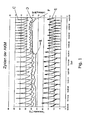
- Fig. 1 shows a representation of the cyclic operation of a Adsorptionshimltemaschine.
- the characteristic discontinuous mode of operation of the machine is characterized by the structure and the changing processes of adsorption and desorption. In order to keep the machine operating as continuously as possible, adsorption and desorption processes are alternately carried out in two adsorbers.
- the fluctuations In the outlet temperature of a heat transfer medium circuit shown in the curve C, the fluctuations are extremely steep and occur cyclically. These fluctuations are also reflected in a damped form at the inlet temperature of the heat transfer circuit at the curve D.
- the cyclical operation of the machine is particularly clearly expressed in the course of a cooling capacity shown by the curve E. In the example shown here, a maximum cooling capacity of 8 kW and a minimum cooling capacity of 2 kW is achieved.
- the outside temperature represented by the curve F shows up to a point X a course with natural fluctuations.
- the sudden increase in the outside temperature at point X is due to incident solar radiation.
- the increase in the outside temperature has a delayed rise in the inlet temperature at curve D and outlet temperature at curve C of the heat transfer circuit result.
- the reduction of the cooling capacity at curve E after point X is due to the temperature increase in the circuit.
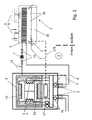
- FIG. 2 shows an exemplary recooling circuit 1 provided for the adsorption refrigerating machine 1
- FIG. 3 an exemplary embodiment of a circuit connected hybrid cooler.
- the recooling circuit contains a suitably arranged outdoors hybrid cooler 2 and a system 3, for example, a Adsorptionskarltemaschine with in Fig. 1 shown operating cycles, which gives off intermittently heat to the recooling circuit.
- the heat carrier flowing in the recooling circuit flows via a feed line 4 from the system into the hybrid cooler. There he transfers the heat absorbed by the system to the ambient air.
- a cooling element 5 is provided in a lamellar construction, which offers a particularly good thermal contact with the environment.
- the cooled in the hybrid cooler heat carrier flows back through a return line 6 to the plant.
- a pump 7 is provided for circulating the heat carrier within the recooling circuit.
- the flow of the heat carrier in the recooling circuit can be regulated via a series of valves. About arranged in the vicinity of the pump check valves 10, the flow can be locked if necessary.
- An associated with the recooling circuit reservoir and expansion tank 11 compensates for pressure fluctuations.
- a process medium flows within a process cycle.
- the process cycle corresponds to the cycle of the adsorbed and desorbed refrigerant which is customary in such systems.
- This exchanges heat via arranged in the circuit heat exchanger, in particular a condenser 13, two adsorbers 14 and an evaporator 15 with adjacent operating components.
- the evaporator 15 is thermally coupled to an external cold water circuit (not shown here).
- an external cold water circuit includes, for example, a cooling ceiling or a cooling coil. These facilities are not shown here.
- the adsorbers 14 are in turn thermally coupled to an external hot water circuit containing, for example, a solar storage, not shown here, a district heating device or a waste heat of a combined heat and power plant.
- an external hot water circuit containing, for example, a solar storage, not shown here, a district heating device or a waste heat of a combined heat and power plant.
- temperature sensors 16 are provided, in particular in the region of the condenser, the evaporator and / or the adsorber. These pass the operating parameters detected at these locations, i. the temperature values measured in this example, to a control unit 17.
- the hybrid cooler already mentioned is a dry hybrid cooler with a spraying device 18 and a ventilation system 19.
- the spraying device consists of a nozzle arrangement 20 arranged below the cooling element 5, which is supplied with cold water from a supply line 21.
- the water supply via the supply line can be released or shut off via a check valve 22.
- the opening state of the check valve is determined by the control unit 17 via a control line 17a and the transmitted via this line electrical switching signals.
- the check valve is for this purpose designed as an electrically switchable valve, for example as a solenoid valve.
- the nozzle arrangement is in the form of a nozzle block under the cooling element.
- the sucked ambient air thus flows first through the nozzle and rips the water sprayed there with it.
- the cooling element is wetted on its surface.
- An evaporation effect which occurs in the air volume flow and on the surface of the finned heat exchanger wall of the cooling element makes it possible to cool the heat carrier to a temperature which is below the ambient temperature.
- the cooling of the heat carrier in the recooling circuit is intensified.
- the spray can be activated or deactivated and thus the effectiveness of the cooling can be adjusted.
- Fig. 4 shows the effect of discontinuous spraying using an exemplary diagram.
- the diagram shows the time course of an exit temperature at the recooler under the influence of a discontinuous heat load during a work cycle of the adsorption chiller. This essentially repeats periodically.
- the curve A shows the temperature profile of the outlet temperature from the recooler without spraying
- the curve B indicates the temperature profile of the outlet temperature with Besprühung.
- the spraying is carried out during the working cycle within two time intervals t S1 . From the course of curve A, it can be seen that the temperature at the outlet of the recooler initially reaches a maximum which asymptotically decreases with time due to the incipient action of the recooler against a limit value.
- the initial temperature maximum is considerably reduced by the spraying during the first time interval t S1 .
- the temperature curve shows a much flatter course.
- the short-term spraying in the two time intervals is thus sufficient to smooth the temperature profile at the outlet of the hybrid cooler and thus a constant cooling capacity of the hybrid cooler to ensure a discontinuous heat load.
- the spraying performed only within the time intervals is sufficient to effectively dissipate the discontinuously supplied heat.
- This effect is caused by the reduced temperature of the ambient air sucked in by the ventilation due to the spraying.
- the temperature profile of the ambient air is represented by the curve B '.
- the beginning and the duration of the respective time intervals t S1 are determined by the control unit.
- the spraying then starts when the temperature T reaches or exceeds a desired value T soll at a point in the refrigeration cycle of the adsorption chiller. It is then turned off and the valve 22 is closed when the predetermined operating parameters, in this case, the target value T set, has fallen again.
- the strong flattening of the curve B in comparison to A is explained by the fact that the spraying of the cooling element in the hybrid cooler already starts before the now more heated heat transfer medium has reached the cooling element via the supply line. As a result, the cooling element is already wetted and can thus absorb the heat introduced by the heat transfer medium very effectively.
- the spraying thus starts at a point in time when the temperature of the heat carrier is still rising.
- the minimum reached in the curve B 'of the air temperature during the time interval t S1 thus coincides with the rising portion of the curve B of the outlet temperature.
- the effectiveness of regulated by the control unit intermittent spraying thus results primarily from the fact that the temperature rise of the heat carrier in the return cooling circuit is met timely and already at the beginning.
- Fig. 5 shows the beneficial influence of in Fig. 4 illustrated embodiment of the spraying on a machine operating a adsorption chiller with such operated recirculating cooling circuit at different ambient temperatures.
- the machine operating rate is a measure of the effectiveness of the adsorption chiller. It indicates the ratio between the heat pumped by the adsorption chiller and the energy required for it. A high machine operating count thus means a high efficiency of the refrigeration system.
- the graph shows that the machine operating count is expected to decrease as the outside temperature increases. It reaches a value of less than 10 without spraying at a temperature of 26 ° C. At this temperature the spraying follows according to the procedure Fig. 3 put into operation, the machine work rate increases significantly to a value of 15 and thus to one and a half times.
Landscapes
- Engineering & Computer Science (AREA)
- Physics & Mathematics (AREA)
- Mechanical Engineering (AREA)
- Thermal Sciences (AREA)
- General Engineering & Computer Science (AREA)
- Sorption Type Refrigeration Machines (AREA)
- Air Conditioning Control Device (AREA)
- Rectifiers (AREA)
Abstract
Description
- Die Erfindung betrifft ein Verfahren zum Betreiben eines Rückkühlkreislaufes mit einem Hybridkühler für eine Anlage mit einer diskontinuierlich anfallenden Wärmeabgabe nach dem Oberbegriff des Anspruchs 1 und eine Vorrichtung hierfür nach dem Oberbegriff des Anspruchs 5.
- Rückkühler und Rückkühlkreisläufe werden eingesetzt, um Wärme von einer Wärmequelle an die Umgebung abzuführen. Dabei wird ein Rückkühlmedium verwendet, um die Wärme von der Wärmequelle zu einer Wärmeaustauschfläche zu leiten, die mit der Umgebung im thermischen Kontakt steht. Hierzu sind eine Vielzahl unterschiedlicher Konfigurationen bekannt. Die Wärmeabgabe an die Umgebung erfolgt entweder über einen trockenen Rückkühler, bei dem das Rückkühlmedium durch Rohre innerhalb der Wärmetauschfläche fließt und so die Wärme an die Umgebung überträgt, oder über einen Naßkühler, bei dem das überwiegend in Form von Wasser ausgebildete Rückkühlmedium direkt verdampft oder verdunstet, wie dies beispielsweise bei einem Kühlturm der Fall ist.
- Bei einem Hybridkühler ist das Prinzip der trockenen Rückkühlung und der Nasskühlung kombiniert. Dabei erfolgt eine trockene Rückkühlung, welche durch eine Wasserbesprühung, -berieselung oder -benetzung der Kühlflächen oder der umgebenden Luft unterstützt wird.
- Die herkömmliche Steuerung des Betriebs eines Hybridkühlers erfolgt in der Weise, dass die Besprühung dann in Betrieb genommen wird, wenn sich eine bestimmte Temperatur in der Zuluft oder am Ausgang des Rückkühlers einstellt. Bei der Aktivierung der Besprühung wird ein Ventil geöffnet und es wird kontinuierlich Wasser in den Zuluftstrom eingesprüht. Durch die damit bewirkte Absenkung der Temperatur in der Zuluft wird eine höhere Wärmeabfuhr im Rückkühlkreislauf ermöglicht. Die Besprühung wird üblicherweise dadurch geregelt, indem die Temperatur am Rückkühleraustritt erfasst wird. Diese wird mit einem vorgegebenen Sollwert verglichen.
- Dieses Regelungsverfahren weist den Nachteil auf, dass sich der Wasserverbrauch bei der Besprühung und damit die Effizienz der Besprühung des Rückkühlers in einem nur sehr eingeschränkten Maße beeinflussen lässt. Das bekannte Regelungsverfahren ist für eine kontinuierliche Besprühung ausgelegt. Der Wasserverbrauch ist daher unverhältnismäßig groß, die ständige Besprühung führt außerdem zu Schmutz- und Kalkablagerungen im Rückkühler. Dies verschlechtert die Effizienz der Rückkühlung zusätzlich und führt wiederum zu einem zusätzlichen Wasserverbrauch bei der Besprühung.
- Außerdem erweist sich die Regelung der Besprühung des Rückkühlers bei den derzeit bekannten Verfahren als nur sehr eingeschränkt variierbar. Sie weist technisch bedingt eine feste Hysterese auf, die verhindert, dass das Ein- und Ausschalten der Besprühung zeitgenau erfolgt. Der gesamte Regelvorgang gestaltet sich somit sehr träge.
- Die genannten Nachteile werden besonders dann gravierend, wenn Anlagen rückzukühlen sind, die eine diskontinuierliche Wärmeabgabe aufweisen, die noch dazu innerhalb relativ kurzer zeitlicher Zyklen wechselt. Die herkömmlichen Steuerungsverfahren der Rückkühlung führen in diesem Fall dazu, dass die Besprühung immer dann nutzlos im Betrieb bleibt, wenn von der Anlage keine oder eine nur geringe Wärmemenge abzuführen ist. Das bekannte Steuerungsverfahren der Besprühung ist wegen dessen Trägheit nicht in der Lage, auf die sich verändernden zyklischen Wärmelasten der Anlage zu reagieren. Dadurch wird die Rückkühlung einer solchen Anlage ineffizient.
- Es besteht somit die Aufgabe, einen Rückkühlkreislauf mit einem Hybridkühler so zu gestalten, dass dieser sich besonders gut für Anlagen mit einer diskontinuierlichen Wärmeabgabe eignet. Der Rückkühlkreislauf soll insbesondere für Anlagen geeignet sein, bei der die Wärmeabgabe innerhalb vergleichsweise kurzer Zeitzyklen wechselt. Der Rückkühlkreislauf soll einen reduzierten Wasserverbrauch bei der Besprühung aufweisen, die Effizienz der Rückkühlung steigern und eine erhöhte Lebensdauer der in dem Rückkühlkreislauf vorhandenen Komponenten, insbesondere des Hybridkühlers selbst, gewährleisten. In Verbindung damit sollen die Betriebs- und Wartungskosten des Rückkühlkreislaufs und darüber hinaus der Anlage gesenkt und optimiert werden.
- Die Aufgabe wird hinsichtlich des Verfahrensaspektes gemäß der Lehre zum Betreiben eines Rückkühlkreislaufes mit den Merkmalen des Anspruchs 1 und hinsichtlich des Vorrichtungsaspektes mit einer Vorrichtung zum Betreiben eines Rückkühlkreislaufes mit den Merkmalen des Anspruchs 5 gelöst. Die jeweiligen Unteransprüche enthalten zweckmäßige und/oder vorteilhafte Ausführungsformen des Verfahrens oder der Vorrichtung.
- Erfindungsgemäß zeichnet sich das Verfahren zum Betreiben eines Rückkühlkreislaufes mit einem Hybridkühler für eine Anlage mit einer diskontinuierlichen Wärmeabgabe durch eine Besprühregelung des Hybridkühlers mit folgenden Verfahrensschritten aus:
- Es erfolgt ein kontinuierliches Erfassen eines aktuellen Betriebsparameters innerhalb der Anlage. Der so erfasste Betriebsparameter wird mit einem vorgegebenen ersten Wert in einer Regeleinheit verglichen. Eine Besprüheinrichtung des Hybridkühlers wird bei einem Erreichen und/oder Überschreiten des vorgegebenen Wertes durch den aktuell erfassten Betriebsparameter aktiviert, bis ein vorgegebener zweiter Wert erreicht und/oder unterschritten worden ist.
- Die Besprüheinrichtung bleibt so lange aktiviert, wie der betreffende Betriebsparameter überschritten ist. Danach wird die Besprüheinrichtung deaktiviert, indem ein Ventil geschlossen wird. Alternativ kann das Ventil während eines festen Intervalls geöffnet oder geschlossen werden, sodass der Hybridkühler intervallartig besprüht wird.
- Bei einer Ausführungsform des Verfahrens ist die Anlage mit der diskontinuierlichen Wärmeabgabe eine Adsorptionskältemaschine. Der Betriebsparameter ist bei einer Ausführungsform des Verfahrens eine Temperatur innerhalb der Anlage.
- Bei einer Ausführungsform erfolgt ein kontinuierliches Erfassen einer aktuellen Temperatur innerhalb eines Wärmeträgerkreislaufes der Adsorptionskälteanlage. Die so erfasste aktuelle Temperatur wird mit einem vorgegebenen Temperatursollwert in einer Regeleinheit verglichen. Eine Besprüheinrichtung des Hybridkühlers wird durch die Regeleinheit dann aktiviert, wenn der Temperatursollwert durch die aktuelle Temperatur erreicht und/oder überschritten wird. Diese Aktivierung hält so lange an, bis ein Unterschreiten des Temperatursollwertes durch die aktuelle Temperatur stattfindet und wird anschließend beendet.
- Im Gegensatz zu der herkömmlichen Steuerung der Besprüheinrichtung, die auf den Temperaturwert am Ausgang des Rückkühlers rückgekoppelt ist, wird ein Betriebsparameter, beispielsweise ein Temperaturwert, aus der Anlage selbst zur Regelung der Besprüheinrichtung verwendet. Der Betrieb der Besprüheinrichtung ist somit unmittelbar mit den Betriebsabläufen der Anlage und damit mit dem dort ablaufenden wärmeerzeugenden Prozess gekoppelt. Die Besprüheinrichtung reagiert somit unmittelbar auf die Betriebsabläufe und damit auf die Wärmeerzeugung innerhalb der Anlage. Dadurch werden die Ansprechzeiten der Regelung der Besprüheinrichtung entscheidend verkürzt, sodass ein echter diskontinuierlicher und/oder zyklischer Betrieb der Besprüheinrichtung entsprechend der diskontinuierlichen Wärmeerzeugung innerhalb der Anlage ausführbar ist. Die Besprüheinrichtung reagiert dadurch insbesondere auf innerhalb der Anlage ablaufende Betriebszyklen und ist mit diesen gekoppelt. Damit wird die zum Besprühen verbrauchte Wassermenge und somit die Beanspruchung des Hybridkühlers nachhaltig gesenkt und der Rückkühlkreislauf in effektiver Weise auf die von der Anlage gelieferte Wärmelast eingestellt.
- Die Anlage kann als eine Adsorptionskältemaschine ausgeführt sein. Dabei wird der aktuell erfasste Betriebsparameter innerhalb eines Verdampfers in einem Kaltwasserkreislauf oder einem Kondensator in der Adsorptionskältemaschine erfasst. Bei einem Erreichen und/oder Überschreiten des Betriebssollwertes wird über eine Regeleinheit ein Schaltsignal zum Öffnen eines Ventils in der Besprüheinrichtung ausgegeben, bis sich der Sollwert des Betriebsparameters wieder einstellt oder eine maximale Besprühdauer überschritten worden ist.
- Adsorptionskältemaschinen zeichnen sich durch eine diskontinuierlich erzeugte und zyklische Wärmeabgabe aus. Für derartige Zwecke ist der erfindungsgemäß betriebene Rückkühlkreislauf somit besonders vorteilhaft.
- Vorrichtungsseitig zeichnet sich der erfindungsgemäße Rückkühlkreislauf mit Hybridkühler für eine Anlage mit einer diskontinuierlichen Wärmeabgabe durch eine Sensorvorrichtung zum Erfassen eines Betriebsparameters innerhalb der Anlage, eine mit der Sensorvorrichtung gekoppelte Regeleinheit mit einem Vergleichsglied und einem mit der Regeleinheit gekoppelten Ventil in einer Besprüheinrichtung des Hybridkühlers aus.
- Die Anlage ist bei einer vorteilhaften Ausführungsform eine Adsorptionskältemaschine, wobei der Temperatursensor im Bereich einer Sekundärseite eines Adsorbers, Kondensators und/oder Verdampfers der Kältemaschine angeordnet ist. Der Hybridkühler ist bei einer Ausführungsform als ein Trockenrückkühler mit Ventilation und Besprühung in Ventilationsrichtung ausgebildet.
- Das Verfahren und die Vorrichtung zum Ausführen des Verfahrens sollen nachfolgend anhand von Ausführungsbeispielen näher erläutert werden. Zur Verdeutlichung dienen die
Figuren 1 bis 5 . Es werden für gleiche und/oder gleichwirkende Teile dieselben Bezugszeichen verwendet. - Hierbei zeigen:
- Fig. 1
- eine Darstellung einer zyklischen Arbeitsweise einer Adsorptionskältemaschine,
- Fig. 2
- eine Darstellung eines beispielhaften Rückkühlkreislaufs im Überblick,
- Fig. 3
- eine zweckmäßige Ausführungsform eines beispielhaften Hybridkühlers,
- Fig. 4
- eine Darstellung eines Temperaturverlaufs am Austritt eines Hybridkühlers unter dem Einfluss einer zeitlich diskontinuierlichen Wärmelast mit und ohne Besprühungsintervalle und
- Fig. 5
- eine Darstellung einer Maschinenarbeitszahl einer rückgekühlten Adsorptionskältemaschine in Abhängigkeit von einer Außentemperatur mit und ohne Besprühung.
- Nachfolgend wird das erfindungsgemäße Verfahren anhand eines Betriebs eines mit einer Adsorptionskältemaschine gekoppelten Rückkühlkreislaufes, insbesondere eines Rückkühlwasserkreislaufes, beispielhaft dargestellt. Wie für alle thermisch angetriebenen Kälteanlagen, ist auch für derartige Anlagen eine leistungsfähige und effiziente Rückkühlung der zugeführten Antriebsenergie und der erzeugten Kälteenergie von großer Bedeutung. Die von der Maschine nicht weiter verwertbare Rückkühlenergie in Form von Wärme muss daher über den Rückkühlkreislauf und über einen Wärmeaustausch effizient abgeführt werden. Hierzu zirkuliert in dem Rückkühlkreislauf ein Wärmeträger, der beispielsweise aus Wasser oder einem Gemisch aus Wasser und Glykol besteht.
- Durch die Wärmeaufnahme in der Maschine steigt die Wärmeträgertemperatur im Rückkühlkreislauf. Der Wärmeträger wird entlang des Rückkühlkreislaufs und insbesondere an einem als ein Wärmeübertrager ausgebildeten Kühler wieder auf ein niedrigeres Temperaturniveau abgekühlt. Er steht danach der Kälteanlage somit für die erneute Wärmeaufnahme zur Verfügung. Die Effizienz und die Leistung des Rückkühlkreislaufs sind von der Außentemperatur, der Art des eingesetzten Kühlers, dessen Peripheriekomponenten und der Kälteanlage selbst abhängig.
-
Fig. 1 zeigt eine Darstellung der zyklischen Arbeitsweise einer Adsorptionskältemaschine. Die charakteristische diskontinuierliche Arbeitsweise der Maschine ist durch den Aufbau und die wechselnden Prozesse Adsorption und Desorption geprägt. Für einen möglichst kontinuierlichen Betrieb der Maschine werden in zwei Adsorbern im Wechsel Adsorptions- und Desorptionsprozesse ausgeführt. Bei der in der Kurve C dargestellten Austrittstemperatur eines Wärmeträgerkreislaufs sind die Schwankungen extrem steil und treten zyklisch auf. Diese Schwankungen zeigen sich auch in gedämpfter Form bei der Eintrittstemperatur des Wärmeträgerkreislaufs an der Kurve D. Die zyklische Arbeitsweise der Maschine kommt besonders deutlich in dem durch die Kurve E gezeigten Verlauf einer Kälteleistung zum Ausdruck. Bei dem hier gezeigten Beispiel wird eine maximale Kälteleistung von 8 kW und eine minimale Kälteleistung von 2 kW erreicht. - Die durch die Kurve F dargestellte Außentemperatur zeigt bis zu einem Punkt X einen Verlauf mit natürlichen Schwankungen. Der sprunghafte Anstieg der Außentemperatur im Punkt X ist auf einfallende Sonnenstrahlung zurückzuführen. Der Anstieg der Außentemperatur hat einen verzögerten Anstieg der Eintrittstemperatur bei Kurve D und Austrittstemperatur bei Kurve C des Wärmeträgerkreislaufs zur Folge. Die nach dem Punkt X erfolgende Minderung der Kälteleistung bei Kurve E ist auf die Temperaturerhöhung im Kreislauf zurückzuführen.
-
Figur 2 zeigt einen für die Adsorptionskältemaschine vorgesehenen beispielhaften Rückkühlkreislauf 1,Figur 3 eine beispielhafte Ausführungsform eines in den Kreislauf geschalteten Hybridkühlers. - Der Rückkühlkreislauf enthält einen zweckmäßigerweise im Freien angeordneten Hybridkühler 2 und eine Anlage 3, beispielsweise eine Adsorptionskältemaschine mit den in
Fig. 1 dargestellten Betriebszyklen, die diskontinuierlich Wärme an den Rückkühlkreislauf abgibt. Der in dem Rückkühlkreislauf strömende Wärmeträger strömt über einen Vorlauf 4 von der Anlage in den Hybridkühler. Er übergibt dort die von der Anlage aufgenommene Wärme an die Umgebungsluft. Hierzu ist ein Kühlelement 5 in einer Lamellenbauweise vorgesehen, die einen besonders guten Wärmekontakt mit der Umgebung bietet. - Der in dem Hybridkühler abgekühlte Wärmeträger strömt über einen Rücklauf 6 zur Anlage zurück. Zum Umwälzen des Wärmeträgers innerhalb des Rückkühlkreislaufs ist eine Pumpe 7 vorgesehen. Der Fluss des Wärmeträgers im Rückkühlkreislauf kann über eine Reihe von Ventilen geregelt werden. Über in der Nähe der Pumpe angeordnete Sperrventile 10 kann der Vorlauf bei Bedarf gesperrt werden. Ein mit dem Rückkühlkreislauf verbundener Vorrats- und Ausgleichsbehälter 11 kompensiert Druckschwankungen.
- Innerhalb der von dem Rückkühlkreislauf gekühlten Anlage strömt ein Prozessmedium innerhalb eines Prozesskreislaufes. Bei einer Adsorptionskältemaschine entspricht der Prozesskreislauf dem bei derartigen Anlagen üblichen Kreislauf des adsorbierten und desorbierten Kältemittels. Dieser tauscht Wärme über in dem Kreislauf angeordnete Wärmetauscher, insbesondere einen Kondensator 13, zwei Adsorbern 14 und einen Verdampfer 15 mit angrenzenden Betriebskomponenten aus.
- Der Verdampfer 15 ist hierzu thermisch an einen hier nicht gezeigten externen Kaltwasserkreislauf gekoppelt. Dieser schließt beispielsweise ein Kühldecke oder eine Kühlspirale ein. Diese Einrichtungen sind hier nicht dargestellt.
- Die Adsorber 14 sind wiederum thermisch an einen externen Heißwasserkreislauf gekoppelt, der beispielsweise einen hier nicht dargestellten Solarspeicher, eine Fernwärmeeinrichtung oder eine Abwärmeeinrichtung eines Blockheizkraftwerk enthält.
- An verschiedenen Stellen der Sekundärseiten der Wärmetauscher oder auch im Rückkühlkreislauf sind, insbesondere im Bereich des Kondensators, des Verdampfers und/oder der Adsorber, Temperatursensoren 16 vorgesehen. Diese übergeben die an diesen Stellen erfassten Betriebsparameter, d.h. die in diesem Beispiel gemessenen Temperaturwerte, an eine Regeleinheit 17.
- Bei dem bereits erwähnten Hybridkühler handelt es sich um einen Trockenhybridkühler mit einer Besprüheinrichtung 18 und einer Ventilation 19. Die Besprüheinrichtung besteht aus einer unter dem Kühlelement 5 angeordneten Düsenanordnung 20, die von einer Zulaufleitung 21 mit Kaltwasser versorgt wird. Die Wasserzufuhr über die Zulaufleitung kann über ein Sperrventil 22 freigegeben oder abgesperrt werden. Der Öffnungszustand des Sperrventils wird von der Regeleinheit 17 über eine Steuerleitung 17a sowie die über diese Leitung übermittelten elektrischen Schaltsignale bestimmt. Das Sperrventil ist hierzu als ein elektrisch schaltbares Ventil, beispielsweise als ein Magnetventil, ausgebildet.
- Bei dem hier vorliegenden Aufbau des Hybridkühlers wird Umgebungsluft durch die Ventilation angesaugt. Diese durchströmt das Kühlelement und tritt aus dem Hybridkühler wieder aus. Bei dem Trockenrückkühler mit Besprühung in Ventilationsrichtung befindet sich die Düsenanordnung in Form eines Düsenstocks unter dem Kühlelement. Die angesaugte Umgebungsluft strömt somit zuerst durch den Düsenstock und reißt das dort eingesprühte Wasser mit sich. Durch das Einsprühen von Wasser in die Strömungsrichtung des Luftvolumenstroms wird das Kühlelement an dessen Oberfläche benetzt. Ein zum einem in dem Luftvolumenstrom und zum anderen auf der Oberfläche der Lamellenwärmetauscherwand des Kühlelementes auftretender Verdunstungseffekt ermöglicht eine Abkühlung des Wärmeträgers auf eine Temperatur, die unterhalb der Umgebungstemperatur liegt. Dadurch wird die Kühlung des Wärmeträgers im Rückkühlkreislauf intensiviert. Über den Schaltzustand des Sperrventils kann die Besprühung aktiviert oder deaktiviert und somit die Effektivität der Kühlung eingestellt werden.
-
Fig. 4 zeigt den Effekt der diskontinuierlichen Besprühung anhand eines beispielhaften Diagramms. Das Diagramm zeigt den zeitlichen Verlauf einer Austrittstemperatur am Rückkühler unter dem Einfluss einer diskontinuierlichen Wärmelast während eines Arbeitszyklus der Adsorptionskältemaschine. Dieser wiederholt sich im Wesentlichen zeitlich periodisch. - Die Kurve A zeigt dabei den Temperaturverlauf der Austrittstemperatur aus dem Rückkühler ohne Besprühung, die Kurve B gibt den Temperaturverlauf der Austrittstemperatur mit Besprühung an. Bei dem hier gezeigten Beispiel wird die Besprühung während des Arbeitszyklus' innerhalb von zwei Zeitintervallen tS1 ausgeführt. Aus dem Verlauf der Kurve A ist zu entnehmen, dass die Temperatur am Austritt des Rückkühlers zunächst ein Maximum erreicht, das mit der Zeit durch die einsetzende Wirkung des Rückkühlers asymptotisch gegen einen Grenzwert sinkt.
- Wie der Verlauf der Kurve B zeigt, wird durch die während des ersten Zeitintervalls tS1 erfolgende Besprühung das anfängliche Temperaturmaximum beträchtlich gesenkt. Die Temperaturkurve zeigt im Anschluss daran einen weitaus flacheren Verlauf. Im Gegensatz zu dem Temperaturverlauf bei Kurve A kann durch eine spätere, wiederum innerhalb eines Zeitintervalls tS1 erfolgende Besprühung die zum Zeitpunkt t = 0 vorliegende Anfangstemperatur schnell wieder erreicht werden. Die kurzzeitige Besprühung in den beiden Zeitintervallen genügt somit, um den Temperaturverlauf am Austritt des Hybridkühlers zu glätten und somit eine gleichbleibende Kühlleistung des Hybridkühlers bei einer diskontinuierlichen Wärmelast zu gewährleisten. Die nur innerhalb der Zeitintervalle ausgeführte Besprühung reicht aus, um die diskontinuierlich herangeführte Wärme effektiv abzuführen.
- Dieser Effekt wird durch die infolge der Besprühung herabgesetzte Temperatur der über die Ventilation angesaugten Umgebungsluft bewirkt. Der Temperaturverlauf der Umgebungsluft ist durch die Kurve B' dargestellt.
- Der Beginn und die Dauer der jeweiligen Zeitintervalle tS1 werden von der Regeleinheit bestimmt. Die Besprühung setzt dann ein, wenn die Temperatur T an einer Stelle des Kältekreislaufs der Adsorptionskältemaschine einen Sollwert Tsoll erreicht oder überschreitet. Sie wird dann deaktiviert und das Ventil 22 geschlossen, wenn der vorgegebene Betriebsparameter, in diesem Fall der Sollwert Tsoll, wieder unterschritten wird. Die starke Abflachung des Kurvenverlaufs B im Vergleich zu A erklärt sich dadurch, dass die Besprühung des Kühlelementes im Hybridkühlers bereits dann einsetzt, bevor der nun stärker erwärmte Wärmeträger das Kühlelement über den Vorlauf erreicht hat. Dadurch ist das Kühlelement bereits benetzt und kann somit die von dem Wärmeträger herangeführte Wärme sehr effektiv aufnehmen.
- Wie aus dem Diagramm auch hervorgeht, setzt die Besprühung somit zu einem Zeitpunkt ein, wenn die Temperatur des Wärmeträgers noch im Steigen begriffen ist. Das während des Zeitintervalls tS1 erreichte Minimum in der Kurve B' der Lufttemperatur fällt damit zeitlich mit dem ansteigenden Abschnitt der Kurve B der Austrittstemperatur zusammen. Die Wirksamkeit der durch die Regeleinheit geregelten intervallartigen Besprühung ergibt sich somit vor allem daraus, dass dem Temperaturanstieg des Wärmeträgers im Rückkühlkreislauf zeitgenau und bereits zu Beginn begegnet wird.
- Ein versuchsweise ausgeführter Vergleich der genannten Besprühart für den Hybridrückkühler mit der herkömmlichen Betriebsweise einer quasi kontinuierlichen Besprühung zeigt, dass bei dem Ausführen letzterer eine erheblich größere Wassermenge verbraucht wird. Im Vergleich zur herkömmlichen Betriebsweise ist bei dem erfindungsgemäßen Verfahren der Wasserverbrauch bei der Besprühung auf etwa ein Siebentel reduziert.
-
Fig. 5 zeigt den vorteilhaften Einfluss der inFig. 4 dargestellten Ausführung der Besprühung auf eine Maschinenarbeitszahl einer Adsorptionskältemaschine mit einem derartig betriebenen Rückkühlkreislauf bei verschiedenen Umgebungstemperaturen. Die Maschinenarbeitszahl ist ein Maß für die Effektivität der Adsorptionskältemaschine. Sie gibt das Verhältnis zwischen der durch die Adsorptionskältemaschine gepumpten Wärme zum dafür benötigten Energieaufwand an. Eine hohe Maschinenarbeitszahl bedeutet somit eine hohe Effektivität der Kälteanlage. - Das Diagramm zeigt, dass die Maschinenarbeitszahl erwartungsgemäß bei zunehmender Außentemperatur sinkt. Sie erreicht ohne Besprühung etwa einen Wert von weniger als 10 bei einer Temperatur von 26 °C. Wird bei dieser Temperatur die Besprühung gemäß der Vorgehensweise nach
Fig. 3 in Betrieb genommen, steigt die Maschinenarbeitszahl deutlich auf einen Wert von 15 und damit auf das anderthalbfache. - Das erfindungsgemäße Verfahren und die Vorrichtung wurden anhand von Ausführungsbeispielen näher erläutert. Im Rahmen fachmännischen Handelns sind weitere Ausgestaltungen des Verfahrens und der Vorrichtung möglich. Diese verbleiben sämtlich im Bereich des erfindungsgemäßen Grundgedankens. Weitere Ausführungsformen ergeben sich aus den Unteransprüchen.
-
- 1
- Rückkühlkreislauf
- 2
- Hybridkühler
- 3
- Anlage mit diskontinuierlicher Wärmeabgabe
- 4
- Vorlauf
- 5
- Kühlelement
- 6
- Rücklauf
- 7
- Pumpe
- 10
- Sperrventile
- 11
- Vorrats- und Ausgleichsbehälter
- 13
- Kondensator
- 14
- Adsorber
- 15
- Verdampfer
- 16
- Temperatursensor
- 17
- Regeleinheit
- 17a
- Steuerleitung
- 18
- Besprüheinrichtung
- 19
- Ventilation
- 20
- Düsenanordnung
- 21
- Zulaufleitung
- 22
- Sperrventil
- A
- Austrittstemperatur ohne Besprühung
- B
- Austrittstemperatur mit Intervallbesprühung
- B'
- Temperatur der Umgebungsluft
- C
- zyklisch variierende Austrittstemperatur im Wärmeträgerkreislauf einer AKM
- D
- zyklisch variierende Eintrittstemperatur im Wärmeträgerkreislauf der AKM
- E
- zyklisch variierende Kälteleistung der AKM
Claims (8)
- Verfahren zum Betreiben eines Rückkühlkreislaufes (1) mit einem Hybridkühler (2) für eine Anlage (3) mit einer diskontinuierlichen Wärmeabgabe,
gekennzeichnet durch
eine Besprühregelung des Hybridkühler mit folgenden Verfahrensschritten:- kontinuierliches Erfassen eines aktuellen Betriebsparameters der Anlage,- Vergleich des erfassten Betriebsparameters mit einem vorgegebenen ersten Wert in einer Regeleinheit (17),- Aktivieren einer Besprüheinrichtung (18) des Hybridkühlers bei einem Erreichen und/oder Überschreiten des vorgegebenen Wertes durch den aktuell erfassten Betriebsparameter bis zu einem Erreichen oder Überschreiten eines vorgegebenen zweiten Wertes. - Verfahren nach Anspruch 1,
dadurch gekennzeichnet, dass
die Anlage (3) eine Adsorptionskältemaschine ist. - Verfahren nach Anspruch 1 oder 2,
dadurch gekennzeichnet, dass
der aktuell erfasste Betriebsparameter eine Temperatur (T) in der Anlage ist. - Verfahren nach einem der vorhergehenden Ansprüche,
dadurch gekennzeichnet, dass- die aktuelle Temperatur (T) innerhalb eines Wärmeträgerkreislaufs erfasst wird und- bei einem Erreichen und/oder Überschreiten des Temperatursollwertes (Tsoll) über eine Regeleinheit ein Schaltsignal zum Öffnen eines Ventils der Besprüheinrichtung bis zum Unterschreiten des Temperatursollwertes (Tsoll) ausgegeben wird. - Vorrichtung zum Betreiben eines Rückkühlkreislaufes (1) mit einem Hybridkühler (2) für eine Anlage (3) mit diskontinuierlicher Wärmeabgabe, gekennzeichnet durch
eine Sensorvorrichtung (16) zum Erfassen eines Betriebsparameters innerhalb der Anlage, eine mit der Sensorvorrichtung gekoppelte Regeleinheit mit einem Vergleichsglied und einem mit der Regeleinheit gekoppelten Ventil (22) in einer Besprüheinrichtung des Hybridkühlers. - Vorrichtung nach Anspruch 5,
dadurch gekennzeichnet, dass
die Anlage eine Adsorptionskältemaschine ist, wobei die Sensorvorrichtung (16) als eine am Verdampfer und/oder Kondensator der Adsorptionskältemaschine angeordnete Temperaturmesseinrichtung ausgebildet ist. - Vorrichtung nach einem der Ansprüche 5 und 6,
dadurch gekennzeichnet, dass
ein Temperatursensor (16) innerhalb eines Wärmeträgerkreislaufs der Anlage, eine mit dem Temperatursensor gekoppelte Regeleinheit (17) mit einem Vergleichsglied und einer Umschalteinheit und einem mit der Umschalteinheit gekoppelten Ventil (22) in einer Besprüheinrichtung (18) des Hybridkühlers vorgesehen ist. - Vorrichtung nach einem der vorhergehenden Ansprüche,
dadurch gekennzeichnet, dass
der Hybridkühler (2) als ein Trockenrückkühler mit Ventilation und Besprühung in Ventilationsrichtung ausgebildet ist.
Applications Claiming Priority (2)
| Application Number | Priority Date | Filing Date | Title |
|---|---|---|---|
| DE102009051888 | 2009-11-04 | ||
| DE102010008408.5A DE102010008408B4 (de) | 2009-11-04 | 2010-02-18 | Verfahren zum Betreiben eines Rückkühlkreislaufes mit einem Hybridkühler für eine Anlage mit einer diskontinuierlichen Wärmeabgabe und Vorrichtung hierfür |
Publications (3)
| Publication Number | Publication Date |
|---|---|
| EP2320189A2 true EP2320189A2 (de) | 2011-05-11 |
| EP2320189A3 EP2320189A3 (de) | 2014-09-03 |
| EP2320189B1 EP2320189B1 (de) | 2020-07-22 |
Family
ID=43530901
Family Applications (1)
| Application Number | Title | Priority Date | Filing Date |
|---|---|---|---|
| EP10188007.8A Active EP2320189B1 (de) | 2009-11-04 | 2010-10-19 | Verfahren zum Betreiben eines Rückkühlkreislaufes mit einem Hybridkühler für eine Anlage mit einer diskontinuierlichen Wärmeabgabe |
Country Status (3)
| Country | Link |
|---|---|
| EP (1) | EP2320189B1 (de) |
| DE (1) | DE102010008408B4 (de) |
| ES (1) | ES2820876T3 (de) |
Families Citing this family (2)
| Publication number | Priority date | Publication date | Assignee | Title |
|---|---|---|---|---|
| DE202014101463U1 (de) | 2013-12-23 | 2014-06-20 | Entrade Energiesysteme Ag | Modulare Anlage zur Bereitstellung von thermischer und elektrischer Energie |
| CN109612184A (zh) * | 2018-11-13 | 2019-04-12 | 上海可瑞视冷链科技有限公司 | 一种移动方舱冷凝器的散热装置 |
Family Cites Families (7)
| Publication number | Priority date | Publication date | Assignee | Title |
|---|---|---|---|---|
| HU165521B (de) | 1972-07-03 | 1974-09-28 | ||
| DE3408192C2 (de) | 1984-03-06 | 1987-03-26 | Markus 8058 Erding Rothmeyer | Verfahren zum Hochtransformieren der Temperatur von Wärme sowie Wärmetransformator |
| DE4215898C2 (de) | 1992-04-09 | 1997-09-04 | E W Gohl Gmbh | Verfahren zum Kühlen von Flüssigkeit in einem geschlossenen Primärkreislauf sowie Kühlvorrichtung dafür |
| DE19906954A1 (de) | 1999-02-19 | 2000-08-24 | E W Gohl Gmbh | Verfahren zum Kühlen von Flüssigkeiten sowie Vorrichtung dafür |
| DE20001528U1 (de) * | 2000-01-28 | 2000-04-06 | Kühlturm GmbH, 76189 Karlsruhe | Kühlvorrichtung |
| US6823684B2 (en) | 2002-02-08 | 2004-11-30 | Tim Allan Nygaard Jensen | System and method for cooling air |
| US7310958B2 (en) | 2004-03-08 | 2007-12-25 | Baltimore Aircoil Company, Inc. | Control of heat exchanger operation |
-
2010
- 2010-02-18 DE DE102010008408.5A patent/DE102010008408B4/de not_active Expired - Fee Related
- 2010-10-19 EP EP10188007.8A patent/EP2320189B1/de active Active
- 2010-10-19 ES ES10188007T patent/ES2820876T3/es active Active
Non-Patent Citations (1)
| Title |
|---|
| None |
Also Published As
| Publication number | Publication date |
|---|---|
| DE102010008408A1 (de) | 2011-07-14 |
| ES2820876T3 (es) | 2021-04-22 |
| DE102010008408B4 (de) | 2019-07-11 |
| EP2320189A3 (de) | 2014-09-03 |
| EP2320189B1 (de) | 2020-07-22 |
Similar Documents
| Publication | Publication Date | Title |
|---|---|---|
| DE2748415C2 (de) | Heizverfahren und bimodales Heizsystem zum Heizen von Gebäuden | |
| DE102011114220B4 (de) | Wärmemanagementsteuerungen für ein Fahrzeug mit einem aufladbaren Energiespeichersystem | |
| DE2754626C2 (de) | Mit einer Energiequelle relativ niedriger Temperatur, insbesondere Solarenergie, arbeitende Kälteanlage | |
| DE3005291A1 (de) | Verfahren und vorrichtung zur konditionierung von luft mittels trocknung durch ein sorbierendes material | |
| DE112013003304T5 (de) | Fahrzeugklimaanlageneinheit | |
| DE3907859C2 (de) | Luftgekühltes Kälteaggregat mit einem Kühlmittelkreislauf | |
| DE102019109003B4 (de) | Laservorrichtung mit wärmeübertragungsvorrichtung zur abgabe von wärme im inneren eines gehäuses nach aussen | |
| EP2199706B1 (de) | Schaltschrank-Klimagerät und Verfahren zum Betreiben eines Solchen | |
| DE3938875A1 (de) | Mobiles und transportables klimageraet zur kuehlung und klimatisierung innenliegender raeume | |
| DE102010008408B4 (de) | Verfahren zum Betreiben eines Rückkühlkreislaufes mit einem Hybridkühler für eine Anlage mit einer diskontinuierlichen Wärmeabgabe und Vorrichtung hierfür | |
| EP2187148A1 (de) | Kälteanlage | |
| DE102010016344A1 (de) | Wärmepumpenanlage und Verfahren zur Regelung einer Wärmepumpenanlage | |
| CH649371A5 (en) | Air-conditioning device | |
| EP1792126A1 (de) | Vorrichtung zur wärmezu- und/oder -abfuhr zu zumindest einem verbraucher | |
| DE1288615B (de) | Vorrichtung zur Kuehlung einer Kammer | |
| DE10318655B3 (de) | Klimatisierungssystem für ein Kraftfahrzeug und Verfahren zum Betreiben desselben | |
| EP3480534B1 (de) | Heizungsanlage und steuerverfahren für eine heizungsanlage | |
| EP2837275A2 (de) | Kühlgerät für einen schaltschrank sowie ein entsprechendes verfahren | |
| DE102007062343A1 (de) | Verfahren und Anordnung zur Kälteerzeugung nach einem Wasser-Lithiumbromid-Resorptionskälteprozess | |
| DE102008057110A1 (de) | Kühlvorrichtung | |
| AT504762B1 (de) | Wärmepumpe | |
| WO2020182462A9 (de) | Wärmepumpeneinrichtung, heizungs- und/oder warmwasserbereitungssystem und verfahren zum betrieb einer wärmepumpeneinrichtung | |
| DE10240659B4 (de) | Verfahren und Vorrichtung zur solarthermischen Kälteerzeugung | |
| EP2216611A1 (de) | Kältemittelreservoir für eine mobile Absorptionsklimaanlage | |
| DE69706892T2 (de) | Vorrichtung zur rückkühlung von wärmetauscherkühlmittel |
Legal Events
| Date | Code | Title | Description |
|---|---|---|---|
| PUAI | Public reference made under article 153(3) epc to a published international application that has entered the european phase |
Free format text: ORIGINAL CODE: 0009012 |
|
| AK | Designated contracting states |
Kind code of ref document: A2 Designated state(s): AL AT BE BG CH CY CZ DE DK EE ES FI FR GB GR HR HU IE IS IT LI LT LU LV MC MK MT NL NO PL PT RO RS SE SI SK SM TR |
|
| AX | Request for extension of the european patent |
Extension state: BA ME |
|
| PUAL | Search report despatched |
Free format text: ORIGINAL CODE: 0009013 |
|
| AK | Designated contracting states |
Kind code of ref document: A3 Designated state(s): AL AT BE BG CH CY CZ DE DK EE ES FI FR GB GR HR HU IE IS IT LI LT LU LV MC MK MT NL NO PL PT RO RS SE SI SK SM TR |
|
| AX | Request for extension of the european patent |
Extension state: BA ME |
|
| RIC1 | Information provided on ipc code assigned before grant |
Ipc: F28F 27/00 20060101AFI20140730BHEP Ipc: F25B 17/08 20060101ALI20140730BHEP Ipc: F28D 5/02 20060101ALI20140730BHEP |
|
| 17P | Request for examination filed |
Effective date: 20141209 |
|
| RAP1 | Party data changed (applicant data changed or rights of an application transferred) |
Owner name: FAHRENHEIT GMBH |
|
| STAA | Information on the status of an ep patent application or granted ep patent |
Free format text: STATUS: EXAMINATION IS IN PROGRESS |
|
| 17Q | First examination report despatched |
Effective date: 20190410 |
|
| GRAP | Despatch of communication of intention to grant a patent |
Free format text: ORIGINAL CODE: EPIDOSNIGR1 |
|
| STAA | Information on the status of an ep patent application or granted ep patent |
Free format text: STATUS: GRANT OF PATENT IS INTENDED |
|
| INTG | Intention to grant announced |
Effective date: 20200311 |
|
| GRAS | Grant fee paid |
Free format text: ORIGINAL CODE: EPIDOSNIGR3 |
|
| GRAA | (expected) grant |
Free format text: ORIGINAL CODE: 0009210 |
|
| STAA | Information on the status of an ep patent application or granted ep patent |
Free format text: STATUS: THE PATENT HAS BEEN GRANTED |
|
| AK | Designated contracting states |
Kind code of ref document: B1 Designated state(s): AL AT BE BG CH CY CZ DE DK EE ES FI FR GB GR HR HU IE IS IT LI LT LU LV MC MK MT NL NO PL PT RO RS SE SI SK SM TR |
|
| REG | Reference to a national code |
Ref country code: GB Ref legal event code: FG4D Free format text: NOT ENGLISH |
|
| REG | Reference to a national code |
Ref country code: CH Ref legal event code: EP |
|
| REG | Reference to a national code |
Ref country code: DE Ref legal event code: R096 Ref document number: 502010016706 Country of ref document: DE |
|
| REG | Reference to a national code |
Ref country code: AT Ref legal event code: REF Ref document number: 1293805 Country of ref document: AT Kind code of ref document: T Effective date: 20200815 |
|
| REG | Reference to a national code |
Ref country code: IE Ref legal event code: FG4D Free format text: LANGUAGE OF EP DOCUMENT: GERMAN |
|
| REG | Reference to a national code |
Ref country code: LT Ref legal event code: MG4D |
|
| PG25 | Lapsed in a contracting state [announced via postgrant information from national office to epo] |
Ref country code: NO Free format text: LAPSE BECAUSE OF FAILURE TO SUBMIT A TRANSLATION OF THE DESCRIPTION OR TO PAY THE FEE WITHIN THE PRESCRIBED TIME-LIMIT Effective date: 20201022 Ref country code: SE Free format text: LAPSE BECAUSE OF FAILURE TO SUBMIT A TRANSLATION OF THE DESCRIPTION OR TO PAY THE FEE WITHIN THE PRESCRIBED TIME-LIMIT Effective date: 20200722 Ref country code: BG Free format text: LAPSE BECAUSE OF FAILURE TO SUBMIT A TRANSLATION OF THE DESCRIPTION OR TO PAY THE FEE WITHIN THE PRESCRIBED TIME-LIMIT Effective date: 20201022 Ref country code: GR Free format text: LAPSE BECAUSE OF FAILURE TO SUBMIT A TRANSLATION OF THE DESCRIPTION OR TO PAY THE FEE WITHIN THE PRESCRIBED TIME-LIMIT Effective date: 20201023 Ref country code: FI Free format text: LAPSE BECAUSE OF FAILURE TO SUBMIT A TRANSLATION OF THE DESCRIPTION OR TO PAY THE FEE WITHIN THE PRESCRIBED TIME-LIMIT Effective date: 20200722 Ref country code: HR Free format text: LAPSE BECAUSE OF FAILURE TO SUBMIT A TRANSLATION OF THE DESCRIPTION OR TO PAY THE FEE WITHIN THE PRESCRIBED TIME-LIMIT Effective date: 20200722 Ref country code: PT Free format text: LAPSE BECAUSE OF FAILURE TO SUBMIT A TRANSLATION OF THE DESCRIPTION OR TO PAY THE FEE WITHIN THE PRESCRIBED TIME-LIMIT Effective date: 20201123 Ref country code: LT Free format text: LAPSE BECAUSE OF FAILURE TO SUBMIT A TRANSLATION OF THE DESCRIPTION OR TO PAY THE FEE WITHIN THE PRESCRIBED TIME-LIMIT Effective date: 20200722 |
|
| PG25 | Lapsed in a contracting state [announced via postgrant information from national office to epo] |
Ref country code: LV Free format text: LAPSE BECAUSE OF FAILURE TO SUBMIT A TRANSLATION OF THE DESCRIPTION OR TO PAY THE FEE WITHIN THE PRESCRIBED TIME-LIMIT Effective date: 20200722 Ref country code: PL Free format text: LAPSE BECAUSE OF FAILURE TO SUBMIT A TRANSLATION OF THE DESCRIPTION OR TO PAY THE FEE WITHIN THE PRESCRIBED TIME-LIMIT Effective date: 20200722 Ref country code: RS Free format text: LAPSE BECAUSE OF FAILURE TO SUBMIT A TRANSLATION OF THE DESCRIPTION OR TO PAY THE FEE WITHIN THE PRESCRIBED TIME-LIMIT Effective date: 20200722 Ref country code: IS Free format text: LAPSE BECAUSE OF FAILURE TO SUBMIT A TRANSLATION OF THE DESCRIPTION OR TO PAY THE FEE WITHIN THE PRESCRIBED TIME-LIMIT Effective date: 20201122 |
|
| PG25 | Lapsed in a contracting state [announced via postgrant information from national office to epo] |
Ref country code: NL Free format text: LAPSE BECAUSE OF FAILURE TO SUBMIT A TRANSLATION OF THE DESCRIPTION OR TO PAY THE FEE WITHIN THE PRESCRIBED TIME-LIMIT Effective date: 20200722 |
|
| REG | Reference to a national code |
Ref country code: ES Ref legal event code: FG2A Ref document number: 2820876 Country of ref document: ES Kind code of ref document: T3 Effective date: 20210422 |
|
| REG | Reference to a national code |
Ref country code: DE Ref legal event code: R097 Ref document number: 502010016706 Country of ref document: DE |
|
| PG25 | Lapsed in a contracting state [announced via postgrant information from national office to epo] |
Ref country code: SM Free format text: LAPSE BECAUSE OF FAILURE TO SUBMIT A TRANSLATION OF THE DESCRIPTION OR TO PAY THE FEE WITHIN THE PRESCRIBED TIME-LIMIT Effective date: 20200722 Ref country code: RO Free format text: LAPSE BECAUSE OF FAILURE TO SUBMIT A TRANSLATION OF THE DESCRIPTION OR TO PAY THE FEE WITHIN THE PRESCRIBED TIME-LIMIT Effective date: 20200722 Ref country code: CZ Free format text: LAPSE BECAUSE OF FAILURE TO SUBMIT A TRANSLATION OF THE DESCRIPTION OR TO PAY THE FEE WITHIN THE PRESCRIBED TIME-LIMIT Effective date: 20200722 Ref country code: DK Free format text: LAPSE BECAUSE OF FAILURE TO SUBMIT A TRANSLATION OF THE DESCRIPTION OR TO PAY THE FEE WITHIN THE PRESCRIBED TIME-LIMIT Effective date: 20200722 Ref country code: EE Free format text: LAPSE BECAUSE OF FAILURE TO SUBMIT A TRANSLATION OF THE DESCRIPTION OR TO PAY THE FEE WITHIN THE PRESCRIBED TIME-LIMIT Effective date: 20200722 |
|
| PLBE | No opposition filed within time limit |
Free format text: ORIGINAL CODE: 0009261 |
|
| STAA | Information on the status of an ep patent application or granted ep patent |
Free format text: STATUS: NO OPPOSITION FILED WITHIN TIME LIMIT |
|
| PG25 | Lapsed in a contracting state [announced via postgrant information from national office to epo] |
Ref country code: AL Free format text: LAPSE BECAUSE OF FAILURE TO SUBMIT A TRANSLATION OF THE DESCRIPTION OR TO PAY THE FEE WITHIN THE PRESCRIBED TIME-LIMIT Effective date: 20200722 |
|
| REG | Reference to a national code |
Ref country code: CH Ref legal event code: PL |
|
| 26N | No opposition filed |
Effective date: 20210423 |
|
| PG25 | Lapsed in a contracting state [announced via postgrant information from national office to epo] |
Ref country code: SK Free format text: LAPSE BECAUSE OF FAILURE TO SUBMIT A TRANSLATION OF THE DESCRIPTION OR TO PAY THE FEE WITHIN THE PRESCRIBED TIME-LIMIT Effective date: 20200722 Ref country code: LU Free format text: LAPSE BECAUSE OF NON-PAYMENT OF DUE FEES Effective date: 20201019 Ref country code: MC Free format text: LAPSE BECAUSE OF FAILURE TO SUBMIT A TRANSLATION OF THE DESCRIPTION OR TO PAY THE FEE WITHIN THE PRESCRIBED TIME-LIMIT Effective date: 20200722 |
|
| REG | Reference to a national code |
Ref country code: BE Ref legal event code: MM Effective date: 20201031 |
|
| PG25 | Lapsed in a contracting state [announced via postgrant information from national office to epo] |
Ref country code: BE Free format text: LAPSE BECAUSE OF NON-PAYMENT OF DUE FEES Effective date: 20201031 Ref country code: CH Free format text: LAPSE BECAUSE OF NON-PAYMENT OF DUE FEES Effective date: 20201031 Ref country code: SI Free format text: LAPSE BECAUSE OF FAILURE TO SUBMIT A TRANSLATION OF THE DESCRIPTION OR TO PAY THE FEE WITHIN THE PRESCRIBED TIME-LIMIT Effective date: 20200722 Ref country code: LI Free format text: LAPSE BECAUSE OF NON-PAYMENT OF DUE FEES Effective date: 20201031 |
|
| REG | Reference to a national code |
Ref country code: NL Ref legal event code: MP Effective date: 20200722 |
|
| PG25 | Lapsed in a contracting state [announced via postgrant information from national office to epo] |
Ref country code: IE Free format text: LAPSE BECAUSE OF NON-PAYMENT OF DUE FEES Effective date: 20201019 |
|
| REG | Reference to a national code |
Ref country code: AT Ref legal event code: MM01 Ref document number: 1293805 Country of ref document: AT Kind code of ref document: T Effective date: 20201019 |
|
| REG | Reference to a national code |
Ref country code: ES Ref legal event code: FD2A Effective date: 20220127 |
|
| PG25 | Lapsed in a contracting state [announced via postgrant information from national office to epo] |
Ref country code: AT Free format text: LAPSE BECAUSE OF NON-PAYMENT OF DUE FEES Effective date: 20201019 |
|
| PGFP | Annual fee paid to national office [announced via postgrant information from national office to epo] |
Ref country code: DE Payment date: 20211020 Year of fee payment: 12 Ref country code: GB Payment date: 20211022 Year of fee payment: 12 |
|
| PGFP | Annual fee paid to national office [announced via postgrant information from national office to epo] |
Ref country code: IT Payment date: 20211029 Year of fee payment: 12 Ref country code: FR Payment date: 20211021 Year of fee payment: 12 |
|
| PG25 | Lapsed in a contracting state [announced via postgrant information from national office to epo] |
Ref country code: TR Free format text: LAPSE BECAUSE OF FAILURE TO SUBMIT A TRANSLATION OF THE DESCRIPTION OR TO PAY THE FEE WITHIN THE PRESCRIBED TIME-LIMIT Effective date: 20200722 Ref country code: MT Free format text: LAPSE BECAUSE OF FAILURE TO SUBMIT A TRANSLATION OF THE DESCRIPTION OR TO PAY THE FEE WITHIN THE PRESCRIBED TIME-LIMIT Effective date: 20200722 Ref country code: ES Free format text: LAPSE BECAUSE OF NON-PAYMENT OF DUE FEES Effective date: 20201020 Ref country code: CY Free format text: LAPSE BECAUSE OF FAILURE TO SUBMIT A TRANSLATION OF THE DESCRIPTION OR TO PAY THE FEE WITHIN THE PRESCRIBED TIME-LIMIT Effective date: 20200722 |
|
| PG25 | Lapsed in a contracting state [announced via postgrant information from national office to epo] |
Ref country code: MK Free format text: LAPSE BECAUSE OF FAILURE TO SUBMIT A TRANSLATION OF THE DESCRIPTION OR TO PAY THE FEE WITHIN THE PRESCRIBED TIME-LIMIT Effective date: 20200722 |
|
| REG | Reference to a national code |
Ref country code: DE Ref legal event code: R119 Ref document number: 502010016706 Country of ref document: DE |
|
| GBPC | Gb: european patent ceased through non-payment of renewal fee |
Effective date: 20221019 |
|
| PG25 | Lapsed in a contracting state [announced via postgrant information from national office to epo] |
Ref country code: FR Free format text: LAPSE BECAUSE OF NON-PAYMENT OF DUE FEES Effective date: 20221031 Ref country code: DE Free format text: LAPSE BECAUSE OF NON-PAYMENT OF DUE FEES Effective date: 20230503 |
|
| PG25 | Lapsed in a contracting state [announced via postgrant information from national office to epo] |
Ref country code: IT Free format text: LAPSE BECAUSE OF NON-PAYMENT OF DUE FEES Effective date: 20221019 Ref country code: GB Free format text: LAPSE BECAUSE OF NON-PAYMENT OF DUE FEES Effective date: 20221019 |