EP2321332B1 - Selbstvermeidende molekulare erkennungssysteme in dna-amplifikationen - Google Patents
Selbstvermeidende molekulare erkennungssysteme in dna-amplifikationen Download PDFInfo
- Publication number
- EP2321332B1 EP2321332B1 EP09808504A EP09808504A EP2321332B1 EP 2321332 B1 EP2321332 B1 EP 2321332B1 EP 09808504 A EP09808504 A EP 09808504A EP 09808504 A EP09808504 A EP 09808504A EP 2321332 B1 EP2321332 B1 EP 2321332B1
- Authority
- EP
- European Patent Office
- Prior art keywords
- group
- seq
- samrs
- primers
- dna
- Prior art date
- Legal status (The legal status is an assumption and is not a legal conclusion. Google has not performed a legal analysis and makes no representation as to the accuracy of the status listed.)
- Active
Links
- 0 CC*OCC(C(C1)OC(C)(C)C*)OC1O Chemical compound CC*OCC(C(C1)OC(C)(C)C*)OC1O 0.000 description 7
- QRMQVLPXICUNBE-UHFFFAOYSA-N CCOC(C1)C(CO[N+]([O-])=C)OC1O Chemical compound CCOC(C1)C(CO[N+]([O-])=C)OC1O QRMQVLPXICUNBE-UHFFFAOYSA-N 0.000 description 1
Images








Classifications
-
- C—CHEMISTRY; METALLURGY
- C12—BIOCHEMISTRY; BEER; SPIRITS; WINE; VINEGAR; MICROBIOLOGY; ENZYMOLOGY; MUTATION OR GENETIC ENGINEERING
- C12Q—MEASURING OR TESTING PROCESSES INVOLVING ENZYMES, NUCLEIC ACIDS OR MICROORGANISMS; COMPOSITIONS OR TEST PAPERS THEREFOR; PROCESSES OF PREPARING SUCH COMPOSITIONS; CONDITION-RESPONSIVE CONTROL IN MICROBIOLOGICAL OR ENZYMOLOGICAL PROCESSES
- C12Q1/00—Measuring or testing processes involving enzymes, nucleic acids or microorganisms; Compositions therefor; Processes of preparing such compositions
- C12Q1/68—Measuring or testing processes involving enzymes, nucleic acids or microorganisms; Compositions therefor; Processes of preparing such compositions involving nucleic acids
- C12Q1/6844—Nucleic acid amplification reactions
- C12Q1/6853—Nucleic acid amplification reactions using modified primers or templates
-
- C—CHEMISTRY; METALLURGY
- C07—ORGANIC CHEMISTRY
- C07H—SUGARS; DERIVATIVES THEREOF; NUCLEOSIDES; NUCLEOTIDES; NUCLEIC ACIDS
- C07H21/00—Compounds containing two or more mononucleotide units having separate phosphate or polyphosphate groups linked by saccharide radicals of nucleoside groups, e.g. nucleic acids
- C07H21/04—Compounds containing two or more mononucleotide units having separate phosphate or polyphosphate groups linked by saccharide radicals of nucleoside groups, e.g. nucleic acids with deoxyribosyl as saccharide radical
-
- C—CHEMISTRY; METALLURGY
- C12—BIOCHEMISTRY; BEER; SPIRITS; WINE; VINEGAR; MICROBIOLOGY; ENZYMOLOGY; MUTATION OR GENETIC ENGINEERING
- C12Q—MEASURING OR TESTING PROCESSES INVOLVING ENZYMES, NUCLEIC ACIDS OR MICROORGANISMS; COMPOSITIONS OR TEST PAPERS THEREFOR; PROCESSES OF PREPARING SUCH COMPOSITIONS; CONDITION-RESPONSIVE CONTROL IN MICROBIOLOGICAL OR ENZYMOLOGICAL PROCESSES
- C12Q1/00—Measuring or testing processes involving enzymes, nucleic acids or microorganisms; Compositions therefor; Processes of preparing such compositions
- C12Q1/68—Measuring or testing processes involving enzymes, nucleic acids or microorganisms; Compositions therefor; Processes of preparing such compositions involving nucleic acids
- C12Q1/6844—Nucleic acid amplification reactions
- C12Q1/6848—Nucleic acid amplification reactions characterised by the means for preventing contamination or increasing the specificity or sensitivity of an amplification reaction
-
- C—CHEMISTRY; METALLURGY
- C12—BIOCHEMISTRY; BEER; SPIRITS; WINE; VINEGAR; MICROBIOLOGY; ENZYMOLOGY; MUTATION OR GENETIC ENGINEERING
- C12Q—MEASURING OR TESTING PROCESSES INVOLVING ENZYMES, NUCLEIC ACIDS OR MICROORGANISMS; COMPOSITIONS OR TEST PAPERS THEREFOR; PROCESSES OF PREPARING SUCH COMPOSITIONS; CONDITION-RESPONSIVE CONTROL IN MICROBIOLOGICAL OR ENZYMOLOGICAL PROCESSES
- C12Q1/00—Measuring or testing processes involving enzymes, nucleic acids or microorganisms; Compositions therefor; Processes of preparing such compositions
- C12Q1/68—Measuring or testing processes involving enzymes, nucleic acids or microorganisms; Compositions therefor; Processes of preparing such compositions involving nucleic acids
- C12Q1/6876—Nucleic acid products used in the analysis of nucleic acids, e.g. primers or probes
-
- C—CHEMISTRY; METALLURGY
- C12—BIOCHEMISTRY; BEER; SPIRITS; WINE; VINEGAR; MICROBIOLOGY; ENZYMOLOGY; MUTATION OR GENETIC ENGINEERING
- C12Q—MEASURING OR TESTING PROCESSES INVOLVING ENZYMES, NUCLEIC ACIDS OR MICROORGANISMS; COMPOSITIONS OR TEST PAPERS THEREFOR; PROCESSES OF PREPARING SUCH COMPOSITIONS; CONDITION-RESPONSIVE CONTROL IN MICROBIOLOGICAL OR ENZYMOLOGICAL PROCESSES
- C12Q2525/00—Reactions involving modified oligonucleotides, nucleic acids, or nucleotides
- C12Q2525/10—Modifications characterised by
- C12Q2525/117—Modifications characterised by incorporating modified base
-
- C—CHEMISTRY; METALLURGY
- C12—BIOCHEMISTRY; BEER; SPIRITS; WINE; VINEGAR; MICROBIOLOGY; ENZYMOLOGY; MUTATION OR GENETIC ENGINEERING
- C12Q—MEASURING OR TESTING PROCESSES INVOLVING ENZYMES, NUCLEIC ACIDS OR MICROORGANISMS; COMPOSITIONS OR TEST PAPERS THEREFOR; PROCESSES OF PREPARING SUCH COMPOSITIONS; CONDITION-RESPONSIVE CONTROL IN MICROBIOLOGICAL OR ENZYMOLOGICAL PROCESSES
- C12Q2600/00—Oligonucleotides characterized by their use
- C12Q2600/16—Primer sets for multiplex assays
Definitions
- This invention relates to the field of nucleic acid chemistry, more specifically to the field of compositions of matter that serve as primers for the copying of DNA and RNA, and more specifically to the amplification by the polymerase chain reaction of DNA.
- compositions of matter include non-standard nucleotides that bind to natural complements to contribute to the stability of duplexes following rules, where those rules are delimited by a large number of experimental data, do not bind as strongly to themselves, and are accepted by DNA polymerases in both primers and templates discovered through experimentation.
- Such heuristic rules have come for natural DNA, RNA, and a variety of its modified forms (e.g., 2'-OMe modified RNA) and analogs (e.g. PNA) by performing substantial numbers of melting temperature experiments. In general, without these, molecular recognition cannot be predicted in a useful way. For DNA, these experiments have been done for many years and have yielded many examples of heuristic rules. Three rules are especially important:A pairs with T, G pairs with C, and the strands are antiparallel. Documented now for several decade, these rules permit one skilled in the art to design of two DNA molecules that bind to each other in aqueous solution. When the rules are perfectly followed, two perfectly complementary DNA strands of a substantial length (15-20 nucleotides is normally sufficient in physiological buffers at 37 °C) will bind to each other with substantial selectivity even in complex mixtures containing many other DNA molecules.
- Non-standard DNA analog expands the number of nucleobase pairs by adding nucleotides (for example, X and Y) that bind to each other (here, to form an X:Y pair) and contribute to overall duplex stability, but where X and Y, when matched with standard DNA nucleotides, do not contribute to the duplex stability.
- nucleotides for example, X and Y
- X and Y when matched with standard DNA nucleotides, do not contribute to the duplex stability.
- the most useful genetic alphabet expanded by adding X and Y has biophysical properties where A:P, T:P, G:P, C:P, A:X, T:X, G:X, and C:X "mismatched" pairs all contribute to duplex stability less than the X:Y pair.
- mismatched pairs contribute to duplex stability about the same as mismatches between standard pairs (e.g., A:G, C:A, T:G, and so on) or a mismatch between a standard nucleotide and an abasic site, with the X:Y pair contributing more than these mismatches.
- standard pairs e.g., A:G, C:A, T:G, and so on
- X:Y pair contributing more than these mismatches.
- the hydrogen bonding pattern that makes an AEGIS component useful as a unit of molecular recognition can be discussed independent of the heterocycle that implements it. This means that different heterocycles can often serve interchangeably as molecular recognition elements. This, in turn, permits the elements of an artificial molecular recognition system to be chosen based on considerations other than simple recognition.
- the pyADA hydrogen bonding pattern in AEGIS is implemented by thymidine, uridine, uridine derivatives carrying a 5-position linker attached to a fluorescent moiety, uridine derivatives carrying a 5-position linker attached to a biotin, and pseudouridine, for example.
- nucleotide analogs are "self-avoiding".
- Self-avoiding nucleotide building blocks are designated A*, T*, G*, and C*.
- A*:T, T*:A, G*:C and C*:G pairs all must contribute to duplex stability more than standard mismatches (or mismatches to abasic sites), but where the A*:T* and G*:C* pairs, formally matched, contribute to duplex stability less.
- US5912340 The first intellectual property to emerge from this work was disclosed by US patent 5912340 (issued 1999/06/15 ). US5912340 was not concerned with creating primers for DNA polymerases or multiplexed PCR. Rather, US5912340 claimed a pair of oligonucleotides (ODNs) that were formally complementary to each other, that could bind to their complement if built from natural nucleotides, but did not bind to each other. This pair would be useful to invade duplex DNA.
- ODNs oligonucleotides
- US5912340 The inventors of US5912340 were satisfied if "sufficient" numbers of their nucleotides (analogous to the * analogs discussed here) were incorporated to prevent two oligonucleotides in the pair from binding to each other, or (in later work) if sufficient numbers of the analogs were present to prevent the DNA or RNA molecule from folding on itself. US5912340 did not provide any melting temperatures, nor did subsequent work, nor did it provide assurance that one of ordinary skill in the art could get useful predictability (without undue experimentation) from oligonucleotides built from the components that they (and they and others in subsequent work) provided.
- a particularly valuable application of a self-avoiding molecular recognition system would be in multiplexed polymerase chain reaction (PCR) architectures.
- SAMRS self-avoiding molecular recognition system
- PCR polymerase chain reaction
- oligonucleotides built from * SAMRS nucleotides would be prepared in pairs, where the members of the pairs would not serve as probes, but rather as PCR primers.
- One member of the pair would serve as a forward primer, being complementary to a target oligonucleotide; the other member of the pair would be identical to a segment of the target nucleotide that lies in the 5'-direction from the position where the first member of the pair is complementary.
- Such pairs if built from SAMRS nucleotides, could be presented in plurality (more than one pair), or even in large abundance. By being self-avoiding, they should be able to support the PCR amplification of many targets at the same time in a single reaction tube and offer a solution to the "multiplexed PCR problem".
- a solution to the multiplexed PCR problem is a "Holy Grail" in the analytical chemistry of DNA.
- Evidence for this includes the literature descriptions of multiple attempts by many research groups to achieve it [Bro97], often with clever architectures, including cyclization to remove the "PCR mess” [Fre07] that arises from cross-binding and off-target priming of primer pairs.
- the multiplexed PCR problem is avoided by first diluting a complex mixture of DNA molecules to a single molecule state, and then amplifying single molecules separately. This does not solve the multiplexed PCR problem, but rather avoids it, at the cost of dealing with all of the problems that arise from single molecule chemistry.
- US2008/090235 discloses amplification methods using primers with artificial nucleotides.
- This inventors identified SAMRS nucleobase analogs (T*, A*, G* and C*) that, when paired against natural adenine, thymine, cytosine, and guanine (respectively) add to duplex stability, when paired against A*, T*, G* and C* (respectively) subtract from duplex stability, and where an oligonucleotide analog containing SAMRS nucleobases near the 3'-end can serve as a primer able to support PCR amplifications. Further, this description provides for specific compositions for those oligonucleotide analogs that serve as prime pairs in a polymerase chain reaction (PCR), and provides experimental evidence that these compositions can so serve.
- PCR polymerase chain reaction
- compositions of matter that comprise a plurality of pairs of these analogs that support multiplexed PCR, and provides experimental evidence that these compositions can support multiplexed PCR at concentrations that are high enough to support useful multiplexed PCR.
- compositions of matter that comprise self-avoiding molecular recognition systems to support PCR reactions.
- concentration of PCR primers must be very much higher than the concentration of the target that they are designed to amplify for the PCR reaction to be useful.
- polymerases must be able to capture the primer-template complexes and extend them. Should this be demonstrated, then polymerases must be able to copy the extended product, the final elementary step in a PCR process. These too must be determined by experiment, as polymerases are notoriously idiosyncratic as to what unnatural species they will accept [Hor95]. Literature (such as US Patent 7371580 ) that concerns only binding properties does not provide experimental support.
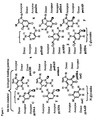
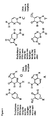
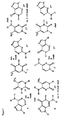
- SAMRS nucleobase analogs (T*, A*, G* and C*) were designed to form exactly two hydrogen bonds to the complementary A, T, C, and G, respectively, but to have only one hydrogen bond joining the putative A*:T* pair and only one hydrogen bond joining the putative G*:C* pair.
- T*:A, A*:T, C:*G, and G*:C nucleobase pairs would contribute to duplex stability to approximately the same extent as a natural A:T pair, which is also joined by two hydrogen bonds. Further, these designs were compatible with rules for designing non-standard nucleobases reported in [Gey03], where uncompensated carbonyl hydrogen bonding units were found experimentally to be compatible with duplex stability while uncompensated amino groups were not.
- the 2'-deoxyriboside of pyrimidin-2-one (the nucleobase found in zebularine, implementing the first generation C*) is also known [Viv04]. It was commercially available as the 5-methyl derivative from Glen Research [Sin01]. Inosine is commercially available in multiple forms, and can be synthesized inexpensively from the appropriate adenosine derivative through deamination. It may also be obtained as the 7-deazainosine analog.
- the instant invention is therefore based on several discoveries about the interaction between polymerases and SAMRS oligonucleotides, including:
- SAMRS-containing oligonucleotides can be prepared with a 5'-phosphate label, and where the 5'-OH group is replaced by a 5'-amino group (and is therefore useful in the architecture shown in Figure 2 .
- Further modification at the 5'-end, to include a biotin, a capture tag, or a fluorescent tag, are also taught herein.
- PCR primer pairs are designed to contain SAMRS components where the first primer in the pair is complementary to a target sequence at a preselected portion, and therefore binds to this portion of the target sequence, and the second member in the pair is formally the same as a segment of the same target sequence at a position upstream (that is in the 5'-direction) from this portion, where "formally the same” means that A or A* in the second primer corresponds to an A in the target sequence, T or T* in the second primer corresponds to a T in the target sequence, G or G* in the second primer corresponds to a G in the target sequence, and C or C* in the second primer corresponds to a C in the target sequence.
- the length of the amplicon (excluding the portion derived from the primers themselves) is determined by this spacing.
- Useful amplicons are of length 10-1000, preferably, more preferably from 10 to 400.Thus, nucleotide on the target that binds the 3'-end of the first primer should be 10 nucleotides in the 3'-direction from the nucleotide in the target that is formally equivalent to the 3'-end nucleotide of the second primer.
- HPLC purification of the oligonucleotides is accomplished as described below.
- Analytical HPLC is also used for purification of the oligonucleotides.
- Ion exchange; 25 mM TEAA, 200 mM NaCl, B solution 25 mM TEAA, 1 M NaCl.
- Phosphoramidite chemistry has made routine the synthesis of the 4 n of DNA and RNA molecules having n nucleotides in a sequence. Therefore, it is not necessary to have in possession every one of those sequences to enable the practice of an invention that claims all of those sequences.
- the compositions of the instant invention are prepared by phosphoramidite synthesis, where the outcome of the synthesis is not dependent on the precise order in which nucleoside phosphoramidites are added.
- SAMRS components phosphoramidites are commercially available. Literature procedures are available to make others [Ono87][Ngu98]Oligonucleotides containing the presently preferred SAMRS components were prepared as follows:
- Example 3 Melting temperatures of oligonucleotides containing various SAMRS components, preferred and not preferred.
- RNA:DNA duplexes are more stable than the corresponding DNA:DNA duplexes with analogous sequences.
- pairs of oligonucleotides were synthesized with a single * analog at the positions indicated by X and Y. Melting temperature measurements of duplexes were done at 260 nm with 1 mL samples at a concentration of 3 ⁇ M per single strand. Table 3.5.
- T m values for primers used to amplify the gene for Taq DNA polymerase sequence T m (°C) 5'-TATCTGCGTGCCCTGTCTCTGGAGG-3' SEQ ID NO 31 74.0 3'-ATAGACGCACGGGACAGAGACCTCC-5' SEQ ID NO 32 5'-TATCTGCGTGCCCTGTCTCTG*G*A*G*G -3' SEQ ID NO 1 68.8 3'-ATAGACGCACGGGACAGAGAC C T C C -5' SEQ ID NO 32 5'-TATCTGCGTGCCCTGTC*T*C*T*G*G*A*G*G -3' SEQ ID NO 3 65.0 3'-ATAGACGCACGGGACAG A G A C C T C C -5' SEQ ID NO 32
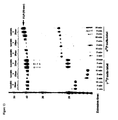
- PCR experiment was performed with template at 66 pM, the primers were at 500 nM, triphosphates at 0.2 mM, Mg ++ at 2.5 mM, with 1 unit of Taq polymerase. Cycles (25) were run at 94 °C (1 min), 55 °C (1 min), then 72 °C (2 min). Results are shown in Fig. 10 .
- the primers were deliberately designed to produce primer dimers when implemented using standard nucleotides. Accordingly, no amplicon is observed with these primers, unless they have SAMRS components at their 3'-end. Adding SAMRS components to the 3'-end reduces, and then eliminates primer-dimer, and increases the amount of full-length amplicon. This represents the first experimental demonstration of self-avoiding properties in primer extension experiments, and is therefore a key discovery that supports the patentability of the instant invention.
- SAMRS can support PCR.
- primers The concentration of primers is important, as it quantitates self-avoidance. Primers at high dilution, of course, will always avoid each other. However, to be useful in PCR, primers must be present at high concentration and at high stoichiometric ratio over target; their concentration, in fact, determines the fold amplification. Hence, these concentrations are appropriate parts of aspects in the instant disclosure.
- T m values for primers useful for amplifying human retinoblastoma cDNA sequence T m (°C) 5'-C*C*A*G*G*A*T*C*C*A*C*T*G*T*G*C*G*A*C*G*A*G*C*T*G-3' SEQ ID NO 33 40.3 3'-G G T C C T A G G T G A C A C G C T G C T C G A C-5' SEQ ID NO 34 5'-C G C A C G G T G A T C G C A G C G C A G C G C A G C G C T G C A G C G C T G C C-3' SEQ ID NO 35 44.0 3'-G C*G*T*G*C*C*A*C*T*A*G*C*G*T*C*G*G*A*C*G*-5' SEQ ID NO 36 5'-CCA*GGA*T*CCA*CT*GT*GCGA*C
- Example 6 Melting temperatures with primers targeted against Taq and the human retinoblastoma transcript (RET) as a function of length.
- RET human retinoblastoma transcript
- T m s of all-SAMRS oligonucleotides were compared with the chimeric species having the same sequence.
- 20 mM Na cacodylate (pH 7.0), 100 mM NaCl, 3 microM oligonucleotides n.d. means that any transition was not observed over 15 °C; the T m is lower than 15 °C).
- T m values for RET transcript primers sequence T m (°C) 5'-C*C*A*G*G*A*T*C*C*A*C*T*G*T*G*C*G*A*C*G*A*G*C*T*G -3' SEQ ID NO 33 40.3 3'-G G T C C T A G G T G A C A C G C T G C T C G A C -5' SEQ ID NO 34 5'-C G C A C G G T G A T C G C A G C G C A G C G C T G T C C C -3' SEQ ID NO 35 44.0 3'-G C*G*T*G*C*C*A*C*T*A*G*C*G*T*G*G*C*G*A*C*-5' SEQ ID NO 36
- Example 8 T m for alternative implementations of A* as a function of salt concentration.
- Example 9 Examination of T m of 2-methylhypoxanthine (2MeI) as an alternative for hypoxanthine as a G*, and N 4 -ethylcytosine as an implementation of C*.
- Example 10 Examination of melting temperatures with N 4 -ethylcytosine (N4eU) as an implementation of C*.
- SAMRS primers (18 nt) were annealed to the complementary template by heating (2 min) at 95 °C followed by slow cooling to 20 °C (over 20 min).
- Alpha- 32 P-dCTP and dNTPs was then added, followed by Klenow fragment of DNA polymerase 1. Incubation was continued for various times at indicated temperatures, and quenched with 10 mM EDTA in formamide loading buffer. The resulting reaction mixtures were separated on 14 % PAGE and visualized by autoradiography. The results are shown in Figure 12 .
- SAMRS I 20mer, SAMRS I 18mer and SAMRS I 15mer were elongated on a standard template by using Klenow (exo-) in the presence extra 50 mM NaCl. The sequences were shown as above. ⁇ 32P-labeled 20mer, 18mer and 15mer of SAMRS primers were annealed to the complementary template first. dNTPs (100 ⁇ M, final) were then added, followed by Klenow (exo-) polymerase. The reactions were performed at 30 °C. At 2 min, 5 min and 10 min, aliquots of reaction mixtures were taken and quenched with 10 mM EDTA in formamide loading buffer.
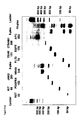
- This experiment demonstrates the level of read through of templates containing SAMRS components using 6 kinds of NEB thermophilic polymerases at various temperatures. The following template-primer combination was used.
- ⁇ - 32 P-labeled primer was annealed to the complementary SAMRS template as above, and then the annealed template-primer complex was contacted with dNTPs in solution (100 ⁇ M, final concentration), followed by 6 kinds of NEB thermophilic polymerases as indicated.
- the reactions were performed at 30 °C, 40 °C, 50 °C, 60 °C and 70 °C for 10 min, and aliquots of reaction mixtures were taken and quenched with 10 mM EDTA in formamide loading buffer. The resulting reaction mixtures were separated on 14 % PAGE and visualized by auto radiography.
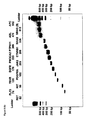
- thermophilic polymerases Six different thermophilic polymerases were initially screened for their ability to read through SAMRS in template. Surprisingly and unexpectedly, Figure 1 showed that the 6 NEB thermophilic polymerases were all able to read through consecutive SAMRS components in templates to some extent. Taq, vent (exo-), Deep Vent (exo-) and Bst DNA polymerases showed better ability to read through the SAMRS template. Taq DNA polymerase performed the best. Also, the read-through full length product increased with increase in the incubation temperature. Since Vent and Deep Vent polymerases contain 3' to 5' exonuclease activity, the hot primers were degraded and the small successive bands were shown on the gel. Taq and Bst DNA polymerases are therefore the preferred polymerases for reading templates containing SAMRS components.
- ⁇ - 32 P-labeled primers were annealed to the complementary SAMRS template, dNTPs were then added (100 ⁇ M, final), followed by Taq and vent (exo-) polymerases as indicated. The reactions were performed at 30 °C, 40 °C, 50 °C, 60 °C and 70 °C for 10 min, and aliquots of reaction mixtures were taken and quenched with 10 mM EDTA in formamide loading buffer. The products were separated (14% PAGE) and visualized by autoradiography ( Fig. 14 ).
- This experiment optimized conditions of polymerase read-through of the SAMRS-containing template by varying the concentrations of KCl, so as to decrease the pausing during the read through with the non-preferred implementation of C*.
- Three thermophilic polymerases were used together with the following
- ⁇ - 32 P-labeled primer was annealed to the complementary SAMRS template as described above.
- dNTPs were then contacted in aqueous solution added (100 ⁇ M, final concentration of each), followed by three NEB thermophilic polymerases as indicated. The reactions were performed at 50 °C and 70 °C for 10 min and quenched with 10 mM EDTA in formamide loading buffer. Products were separated (14 % PAGE, autoradiography). The results show that increasing the concentration of KCl decreased pausing ( Fig. 16 ) with this implementation of C*.
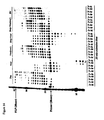
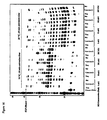
- Example 18 PCR using SAMRS primers, with comparison to standard primers, targeted against 13 cancer genes ( Figure 8 and Figure 9).
- Examples above provide experimental data showing polymerases that support PCR with SAMRS primer pairs, the SAMRS components preferred to support PCR amplifications, and the placement of those in oligonucleotides to give the preferred sequences.
- Experiments were then done to demonstrate multiplexing of PCR using primers that contain SAMRS components.
- DNA targets are chosen to be of interest to cancer biologists. The targets were found in human genome DNA (Promega, 200 nM). The ratio of primer to target is high enough to be useful in PCR, and may also be used to define the metes and bounds of claims.
- SAMRS monoplexed PCR experiments with standard primers ( Fig. 8a ) and SAMRS chimeric primers ( Fig. 8b ).
- T* 2-thiothymine
- A* 2-aminopurine
- G* hypoxanthine
- C* N 4 -ethylcytosine.
- the template was human genomic DNA, 25 ng/ 25 microL Primers were each 200 nM, a concentration that is within the presently preferred range of greater than 100 nM. Concentration of dNTPs was each 0.2 mM.
- MgCl 2 concentration in commercially supplied Taq buffer was used (ca. 2 mM).
- SAMRS primers an additional 5 mM MgCl 2 was added.
- Taq polymerase 1.0 units/ 0.025 mL. 40 cycles: denature at 94 °C for 1 min, annealing at 55 °C for SAMRS and 60 °C for standard primers for 1 min; then primer extension at 72 °C for 90 sec. Products were resolved on a 3% agarose gel and visualized by phosphorimager (one primer was 5'-radiolabeled).
- the template was human genomic DNA, 25 ng/25 microL Primers each 200 nM.
- dNTPs were each 1 mM.
- standard primers an additional 2.5 mM MgCl 2 was added to Taq buffer.
- SAMRS primers an additional 10 mM MgCl 2 was added.
- Taq polymerase 5.0 units/0.025 mL. 40 cycles: denature at 94 °C for 1 min, then annealing at 55 °C for SAMRS and 60 °C for standard primers for 1 min; then primer extension at 72 °C for 90 sec. Products were resolved (3% agarose gel, phosphorimager (one primer was 5'-radiolabeled).
Landscapes
- Chemical & Material Sciences (AREA)
- Life Sciences & Earth Sciences (AREA)
- Organic Chemistry (AREA)
- Health & Medical Sciences (AREA)
- Proteomics, Peptides & Aminoacids (AREA)
- Engineering & Computer Science (AREA)
- Zoology (AREA)
- Wood Science & Technology (AREA)
- Biochemistry (AREA)
- Molecular Biology (AREA)
- Analytical Chemistry (AREA)
- Genetics & Genomics (AREA)
- Biotechnology (AREA)
- General Health & Medical Sciences (AREA)
- Chemical Kinetics & Catalysis (AREA)
- Biophysics (AREA)
- Microbiology (AREA)
- Bioinformatics & Cheminformatics (AREA)
- General Engineering & Computer Science (AREA)
- Immunology (AREA)
- Physics & Mathematics (AREA)
- Measuring Or Testing Involving Enzymes Or Micro-Organisms (AREA)
Claims (12)
- Ein Verfahren zur Vervielfältigung eines Oligonukleotids mittels enzymatischer Matrizen-gesteuerter geprimter Polymerisation (enzymatic template-directed primed polymerization), wobei dieses Verfahren (a) das In-Kontakt-Bringen eines oder mehrerer Oligonukleotidprimerpaare in wäßriger Lösung mit dem Oligonukleotid, einer Polymerase und normalen Nukleosidtriphosphaten, und (b) das Inkubieren des Gemischs über eine vorbestimmte Zeitspanne umfasst, wobei jeder Oligonukleotidprimer in dem Paar die Formel

- Das Verfahren nach Anspruch 1, wobei A* aus der Gruppe bestehend aus 2-Aminopurin und 2,6-Diaminopurin ausgewählt wird, T* 2-Thiothymin ist, G* Hypoxanthin ist und C* aus der Gruppe bestehend aus N4-Ethylcytosin und N4-Methylcytosin ausgewählt wird.
- Das Verfahren nach Anspruch 1, wobei die Summe von m und n in den Primem mindestens 15 beträgt.
- Das Verfahren nach Anspruch 1, wobei die D-Einheiten unabhängig voneinander aus der Gruppe bestehend aus T*, A*, G* und C* ausgewählt werden.
- Das Verfahren nach Anspruch 1, wobei die B-Einheiten unabhängig voneinander aus der Gruppe bestehend aus Thymin, Adenin, Guanin, und Cytosin ausgewählt werden.
- Das Verfahren nach Anspruch 1, wobei mehr als 5 dieser Primerpaare in Kontakt gebracht werden.
- Eine Verbindung der Formel

- Die Verbindung nach Anspruch 7, wobei A* aus der Gruppe bestehend aus 2-Aminopurin und 2,6-Diaminopurin ausgewählt wird, T* 2-Thiothymin ist, G* Hypoxanthin ist und C* aus der Gruppe bestehend aus N4-Ethylcytosin und N4-Methylcytosin ausgewählt wird.
- Eine Stoffzusammensetzung, die eine Vielzahl von Oligonukleotidpaaren umfasst, wobei jedes Oligonukleotid die Formel

- Die Zusammensetzung nach Anspruch 9, wobei A* aus der Gruppe bestehend aus 2-Aminopurin und 2,6-Diaminopurin ausgewählt wird, T* 2-Thiothymin ist, G* Hypoxanthin ist und C* aus der Gruppe bestehend aus N4-Ethylcytosin und N4-Methylcytosin ausgewählt wird.
- Die Zusammensetzung nach Anspruch 9, wobei mindestens ein B oder ein D aus der Gruppe bestehend aus N4-Ethylcytosin und N4-Methylcytosin ausgewählt wird.
- Die Zusammensetzung nach Anspruch 9, wobei diese Oligonukleotide in einer Konzentration von 100 nanomolar oder größer in Wasser aufgelöst sind.
Applications Claiming Priority (2)
| Application Number | Priority Date | Filing Date | Title |
|---|---|---|---|
| US12/229,159 US8871469B1 (en) | 2004-11-13 | 2008-08-20 | Self-avoiding molecular recognition systems in DNA priming |
| PCT/US2009/004718 WO2010021702A1 (en) | 2008-08-20 | 2009-08-19 | Self-avoiding molecular recognition systems in dna amplification |
Publications (3)
| Publication Number | Publication Date |
|---|---|
| EP2321332A1 EP2321332A1 (de) | 2011-05-18 |
| EP2321332A4 EP2321332A4 (de) | 2011-10-19 |
| EP2321332B1 true EP2321332B1 (de) | 2013-03-27 |
Family
ID=41707387
Family Applications (1)
| Application Number | Title | Priority Date | Filing Date |
|---|---|---|---|
| EP09808504A Active EP2321332B1 (de) | 2008-08-20 | 2009-08-19 | Selbstvermeidende molekulare erkennungssysteme in dna-amplifikationen |
Country Status (5)
| Country | Link |
|---|---|
| US (2) | US8871469B1 (de) |
| EP (1) | EP2321332B1 (de) |
| CN (1) | CN102124020B (de) |
| CA (1) | CA2734514C (de) |
| WO (1) | WO2010021702A1 (de) |
Families Citing this family (19)
| Publication number | Priority date | Publication date | Assignee | Title |
|---|---|---|---|---|
| US8871469B1 (en) * | 2004-11-13 | 2014-10-28 | Steven Albert Benner | Self-avoiding molecular recognition systems in DNA priming |
| US9353393B2 (en) | 2012-02-15 | 2016-05-31 | General Electric Company | Methods and kits for reducing non-specific nucleic acid amplification |
| US9315842B2 (en) * | 2013-08-19 | 2016-04-19 | Steven A Benner | Helicase dependent amplification of DNA molecules using nucleotide analogs |
| WO2016030899A1 (en) | 2014-08-28 | 2016-03-03 | Yeda Research And Development Co. Ltd. | Methods of treating amyotrophic lateral scleroses |
| HK1247255A1 (zh) | 2014-12-15 | 2018-09-21 | Cepheid | 底数大於2的指数核酸扩增 |
| CA2983819A1 (en) * | 2015-04-24 | 2016-10-27 | Atila Biosystems Incorporated | Amplification with primers of limited nucleotide composition |
| EP3294280A1 (de) | 2015-05-11 | 2018-03-21 | Yeda Research and Development Co., Ltd. | Citrinhemmer zur behandlung von krebs |
| ES2867949T3 (es) | 2015-06-02 | 2021-10-21 | Biofire Defense Llc | Muestra para secuenciar |
| ES2965461T3 (es) | 2015-08-03 | 2024-04-15 | Biokine Therapeutics Ltd | Inhibidor de CXCR4 para el tratamiento del cáncer |
| WO2019033065A1 (en) | 2017-08-11 | 2019-02-14 | Atila Biosystems, Inc. | DIGITAL AMPLIFICATION WITH LIMITED NUCLEOTIDE COMPOSITION PRIMERS |
| CA3118000A1 (en) | 2018-10-29 | 2020-05-07 | Cepheid | Exponential base-3 nucleic acid amplification with reduced amplification time using nested overlapping primers |
| IL263184A (en) | 2018-11-21 | 2020-05-31 | Yarden Yosef | Method of treating cancer and compositions for same |
| CN110295241A (zh) * | 2019-07-11 | 2019-10-01 | 深圳易致生物科技有限公司 | 用于检测尿路感染的引物组和包含该引物组的试剂盒 |
| CA3176983A1 (en) | 2020-04-27 | 2021-11-04 | Cepheid | Exponential base-3 and greater nucleic acid amplification with cycling probe |
| EP4228637A1 (de) | 2020-10-15 | 2023-08-23 | Yeda Research and Development Co. Ltd | Verfahren zur behandlung von myeloidmalignitäten |
| US12492398B2 (en) * | 2020-11-23 | 2025-12-09 | Zunyi Yang | Compositions for the multiplexed detection of viruses |
| CN118019858A (zh) * | 2021-10-21 | 2024-05-10 | 因美纳有限公司 | 用于核酸测序的预文库靶标富集 |
| WO2024220135A1 (en) * | 2023-04-17 | 2024-10-24 | University Of Massachusetts | Prime editing systems having pegrna with reduced auto-inhibitory interaction |
| WO2026020120A1 (en) * | 2024-07-19 | 2026-01-22 | University Of Massachusetts | Increasing cas9 genome editing fidelity through attenuation of guide rna watson-crick base pairing potential |
Family Cites Families (7)
| Publication number | Priority date | Publication date | Assignee | Title |
|---|---|---|---|---|
| US5432272A (en) * | 1990-10-09 | 1995-07-11 | Benner; Steven A. | Method for incorporating into a DNA or RNA oligonucleotide using nucleotides bearing heterocyclic bases |
| US5912340A (en) | 1995-10-04 | 1999-06-15 | Epoch Pharmaceuticals, Inc. | Selective binding complementary oligonucleotides |
| US7371580B2 (en) * | 2001-08-24 | 2008-05-13 | Agilent Technologies, Inc. | Use of unstructured nucleic acids in assaying nucleic acid molecules |
| US8871469B1 (en) * | 2004-11-13 | 2014-10-28 | Steven Albert Benner | Self-avoiding molecular recognition systems in DNA priming |
| RU2400538C2 (ru) * | 2005-03-05 | 2010-09-27 | Сиджен, Инк. | Олигонуклеотид с двойственной специфичностью и способы, в которых он используется |
| US8097711B2 (en) * | 2006-09-02 | 2012-01-17 | Agilent Technologies, Inc. | Thioether substituted aryl carbonate protecting groups |
| US20080090235A1 (en) * | 2006-10-13 | 2008-04-17 | Zohar Yakhini | Unstructured nucleic acid PCR primers and methods of using the same |
-
2008
- 2008-08-20 US US12/229,159 patent/US8871469B1/en active Active
-
2009
- 2009-08-19 CA CA 2734514 patent/CA2734514C/en active Active
- 2009-08-19 EP EP09808504A patent/EP2321332B1/de active Active
- 2009-08-19 CN CN200980132866.5A patent/CN102124020B/zh not_active Expired - Fee Related
- 2009-08-19 WO PCT/US2009/004718 patent/WO2010021702A1/en not_active Ceased
-
2014
- 2014-10-27 US US14/524,227 patent/US9249458B1/en not_active Expired - Lifetime
Also Published As
| Publication number | Publication date |
|---|---|
| EP2321332A4 (de) | 2011-10-19 |
| US9249458B1 (en) | 2016-02-02 |
| CN102124020A (zh) | 2011-07-13 |
| CA2734514A1 (en) | 2010-02-25 |
| CA2734514C (en) | 2015-04-21 |
| WO2010021702A1 (en) | 2010-02-25 |
| CN102124020B (zh) | 2015-04-29 |
| EP2321332A1 (de) | 2011-05-18 |
| US8871469B1 (en) | 2014-10-28 |
| WO2010021702A9 (en) | 2010-05-06 |
Similar Documents
| Publication | Publication Date | Title |
|---|---|---|
| EP2321332B1 (de) | Selbstvermeidende molekulare erkennungssysteme in dna-amplifikationen | |
| EP3620533B1 (de) | Geschlossene nukleinsäurestrukturen | |
| US11396673B2 (en) | Closed nucleic acid structures | |
| EP2753714B1 (de) | Zirkularisierte schablonen zur sequenzierung | |
| CN114250278B (zh) | 捕获、检测和定量小rna的方法、组合物与试剂盒 | |
| BRPI0609031B1 (pt) | METHODS FOR THE SYNTHESIS OF A NUCLEIC ACID MOLECULE, TO SELECTIVELY AMPLIFY A SEQUENCE OF NUCLEIC ACID TARGETED OF A DNA OR A MIXTURE OF NUCLEIC ACIDS, TO AMPLIFY TWO OR MORE SEQUENCES OF NUCLEOTIDE TARGET SIMULTANEOUSLY, TO SEQUENCE A TARGETED NUCLEIC ACID MOLECULE , To detect a nucleic acid molecule with genetic diversity to detect a target nucleotide sequence in a sample of the nucleic acid and to allow a ring specificity of an oligonucleotide to be determined by a structure of the oligonucleotide and oligonucleotide OF DUAL SPECIFICITY | |
| JP2002291490A (ja) | 修飾プライマーを使用する増幅 | |
| US7501254B2 (en) | Methods and compositions for amplification and capture of nucleic acid sequences | |
| US10865431B1 (en) | Polymerase incorporation of non-standard nucleotides | |
| JP2008535518A (ja) | プソイドイソシトシン核酸塩基誘導体を含む3’改変オリゴヌクレオチド、およびプライマーまたはプローブとしてのその適用 | |
| AU723202B2 (en) | Phosphoramidate-phosphodiester oligonucleotide chimera as primers | |
| US12460256B1 (en) | Nucleotide analogs for efficient DNA and RNA amplification | |
| JP2019118294A (ja) | プローブを用いた核酸検出用プライマーセット | |
| US10745728B1 (en) | Applications for biversal nucleoside analogs | |
| CN121344163A (zh) | 用于分离靶多核苷酸的组合物、试剂盒和方法 |
Legal Events
| Date | Code | Title | Description |
|---|---|---|---|
| PUAI | Public reference made under article 153(3) epc to a published international application that has entered the european phase |
Free format text: ORIGINAL CODE: 0009012 |
|
| 17P | Request for examination filed |
Effective date: 20110224 |
|
| AK | Designated contracting states |
Kind code of ref document: A1 Designated state(s): AT BE BG CH CY CZ DE DK EE ES FI FR GB GR HR HU IE IS IT LI LT LU LV MC MK MT NL NO PL PT RO SE SI SK SM TR |
|
| AX | Request for extension of the european patent |
Extension state: AL BA RS |
|
| RIC1 | Information provided on ipc code assigned before grant |
Ipc: C07H 21/04 20060101AFI20110908BHEP Ipc: C12P 19/34 20060101ALI20110908BHEP Ipc: C12Q 1/68 20060101ALI20110908BHEP Ipc: A61K 31/70 20060101ALI20110908BHEP |
|
| A4 | Supplementary search report drawn up and despatched |
Effective date: 20110916 |
|
| DAX | Request for extension of the european patent (deleted) | ||
| 17Q | First examination report despatched |
Effective date: 20120426 |
|
| GRAP | Despatch of communication of intention to grant a patent |
Free format text: ORIGINAL CODE: EPIDOSNIGR1 |
|
| GRAS | Grant fee paid |
Free format text: ORIGINAL CODE: EPIDOSNIGR3 |
|
| GRAA | (expected) grant |
Free format text: ORIGINAL CODE: 0009210 |
|
| AK | Designated contracting states |
Kind code of ref document: B1 Designated state(s): AT BE BG CH CY CZ DE DK EE ES FI FR GB GR HR HU IE IS IT LI LT LU LV MC MK MT NL NO PL PT RO SE SI SK SM TR |
|
| REG | Reference to a national code |
Ref country code: GB Ref legal event code: FG4D |
|
| REG | Reference to a national code |
Ref country code: CH Ref legal event code: EP |
|
| REG | Reference to a national code |
Ref country code: AT Ref legal event code: REF Ref document number: 603352 Country of ref document: AT Kind code of ref document: T Effective date: 20130415 |
|
| REG | Reference to a national code |
Ref country code: IE Ref legal event code: FG4D |
|
| REG | Reference to a national code |
Ref country code: DE Ref legal event code: R096 Ref document number: 602009014540 Country of ref document: DE Effective date: 20130523 |
|
| PG25 | Lapsed in a contracting state [announced via postgrant information from national office to epo] |
Ref country code: NO Free format text: LAPSE BECAUSE OF FAILURE TO SUBMIT A TRANSLATION OF THE DESCRIPTION OR TO PAY THE FEE WITHIN THE PRESCRIBED TIME-LIMIT Effective date: 20130627 Ref country code: BG Free format text: LAPSE BECAUSE OF FAILURE TO SUBMIT A TRANSLATION OF THE DESCRIPTION OR TO PAY THE FEE WITHIN THE PRESCRIBED TIME-LIMIT Effective date: 20130627 Ref country code: SE Free format text: LAPSE BECAUSE OF FAILURE TO SUBMIT A TRANSLATION OF THE DESCRIPTION OR TO PAY THE FEE WITHIN THE PRESCRIBED TIME-LIMIT Effective date: 20130327 Ref country code: LT Free format text: LAPSE BECAUSE OF FAILURE TO SUBMIT A TRANSLATION OF THE DESCRIPTION OR TO PAY THE FEE WITHIN THE PRESCRIBED TIME-LIMIT Effective date: 20130327 |
|
| REG | Reference to a national code |
Ref country code: AT Ref legal event code: MK05 Ref document number: 603352 Country of ref document: AT Kind code of ref document: T Effective date: 20130327 |
|
| REG | Reference to a national code |
Ref country code: LT Ref legal event code: MG4D |
|
| PG25 | Lapsed in a contracting state [announced via postgrant information from national office to epo] |
Ref country code: SI Free format text: LAPSE BECAUSE OF FAILURE TO SUBMIT A TRANSLATION OF THE DESCRIPTION OR TO PAY THE FEE WITHIN THE PRESCRIBED TIME-LIMIT Effective date: 20130327 Ref country code: LV Free format text: LAPSE BECAUSE OF FAILURE TO SUBMIT A TRANSLATION OF THE DESCRIPTION OR TO PAY THE FEE WITHIN THE PRESCRIBED TIME-LIMIT Effective date: 20130327 Ref country code: GR Free format text: LAPSE BECAUSE OF FAILURE TO SUBMIT A TRANSLATION OF THE DESCRIPTION OR TO PAY THE FEE WITHIN THE PRESCRIBED TIME-LIMIT Effective date: 20130628 Ref country code: FI Free format text: LAPSE BECAUSE OF FAILURE TO SUBMIT A TRANSLATION OF THE DESCRIPTION OR TO PAY THE FEE WITHIN THE PRESCRIBED TIME-LIMIT Effective date: 20130327 |
|
| REG | Reference to a national code |
Ref country code: NL Ref legal event code: VDEP Effective date: 20130327 |
|
| PG25 | Lapsed in a contracting state [announced via postgrant information from national office to epo] |
Ref country code: BE Free format text: LAPSE BECAUSE OF FAILURE TO SUBMIT A TRANSLATION OF THE DESCRIPTION OR TO PAY THE FEE WITHIN THE PRESCRIBED TIME-LIMIT Effective date: 20130327 Ref country code: HR Free format text: LAPSE BECAUSE OF FAILURE TO SUBMIT A TRANSLATION OF THE DESCRIPTION OR TO PAY THE FEE WITHIN THE PRESCRIBED TIME-LIMIT Effective date: 20130327 |
|
| PG25 | Lapsed in a contracting state [announced via postgrant information from national office to epo] |
Ref country code: EE Free format text: LAPSE BECAUSE OF FAILURE TO SUBMIT A TRANSLATION OF THE DESCRIPTION OR TO PAY THE FEE WITHIN THE PRESCRIBED TIME-LIMIT Effective date: 20130327 Ref country code: RO Free format text: LAPSE BECAUSE OF FAILURE TO SUBMIT A TRANSLATION OF THE DESCRIPTION OR TO PAY THE FEE WITHIN THE PRESCRIBED TIME-LIMIT Effective date: 20130327 Ref country code: NL Free format text: LAPSE BECAUSE OF FAILURE TO SUBMIT A TRANSLATION OF THE DESCRIPTION OR TO PAY THE FEE WITHIN THE PRESCRIBED TIME-LIMIT Effective date: 20130327 Ref country code: PT Free format text: LAPSE BECAUSE OF FAILURE TO SUBMIT A TRANSLATION OF THE DESCRIPTION OR TO PAY THE FEE WITHIN THE PRESCRIBED TIME-LIMIT Effective date: 20130729 Ref country code: SK Free format text: LAPSE BECAUSE OF FAILURE TO SUBMIT A TRANSLATION OF THE DESCRIPTION OR TO PAY THE FEE WITHIN THE PRESCRIBED TIME-LIMIT Effective date: 20130327 Ref country code: CZ Free format text: LAPSE BECAUSE OF FAILURE TO SUBMIT A TRANSLATION OF THE DESCRIPTION OR TO PAY THE FEE WITHIN THE PRESCRIBED TIME-LIMIT Effective date: 20130327 Ref country code: AT Free format text: LAPSE BECAUSE OF FAILURE TO SUBMIT A TRANSLATION OF THE DESCRIPTION OR TO PAY THE FEE WITHIN THE PRESCRIBED TIME-LIMIT Effective date: 20130327 Ref country code: IS Free format text: LAPSE BECAUSE OF FAILURE TO SUBMIT A TRANSLATION OF THE DESCRIPTION OR TO PAY THE FEE WITHIN THE PRESCRIBED TIME-LIMIT Effective date: 20130727 Ref country code: ES Free format text: LAPSE BECAUSE OF FAILURE TO SUBMIT A TRANSLATION OF THE DESCRIPTION OR TO PAY THE FEE WITHIN THE PRESCRIBED TIME-LIMIT Effective date: 20130708 |
|
| PG25 | Lapsed in a contracting state [announced via postgrant information from national office to epo] |
Ref country code: CY Free format text: LAPSE BECAUSE OF FAILURE TO SUBMIT A TRANSLATION OF THE DESCRIPTION OR TO PAY THE FEE WITHIN THE PRESCRIBED TIME-LIMIT Effective date: 20130327 Ref country code: PL Free format text: LAPSE BECAUSE OF FAILURE TO SUBMIT A TRANSLATION OF THE DESCRIPTION OR TO PAY THE FEE WITHIN THE PRESCRIBED TIME-LIMIT Effective date: 20130327 |
|
| PG25 | Lapsed in a contracting state [announced via postgrant information from national office to epo] |
Ref country code: DK Free format text: LAPSE BECAUSE OF FAILURE TO SUBMIT A TRANSLATION OF THE DESCRIPTION OR TO PAY THE FEE WITHIN THE PRESCRIBED TIME-LIMIT Effective date: 20130327 |
|
| PLBE | No opposition filed within time limit |
Free format text: ORIGINAL CODE: 0009261 |
|
| STAA | Information on the status of an ep patent application or granted ep patent |
Free format text: STATUS: NO OPPOSITION FILED WITHIN TIME LIMIT |
|
| PG25 | Lapsed in a contracting state [announced via postgrant information from national office to epo] |
Ref country code: IT Free format text: LAPSE BECAUSE OF FAILURE TO SUBMIT A TRANSLATION OF THE DESCRIPTION OR TO PAY THE FEE WITHIN THE PRESCRIBED TIME-LIMIT Effective date: 20130327 |
|
| 26N | No opposition filed |
Effective date: 20140103 |
|
| REG | Reference to a national code |
Ref country code: DE Ref legal event code: R097 Ref document number: 602009014540 Country of ref document: DE Effective date: 20140103 |
|
| PG25 | Lapsed in a contracting state [announced via postgrant information from national office to epo] |
Ref country code: MC Free format text: LAPSE BECAUSE OF FAILURE TO SUBMIT A TRANSLATION OF THE DESCRIPTION OR TO PAY THE FEE WITHIN THE PRESCRIBED TIME-LIMIT Effective date: 20130327 |
|
| REG | Reference to a national code |
Ref country code: IE Ref legal event code: MM4A |
|
| PG25 | Lapsed in a contracting state [announced via postgrant information from national office to epo] |
Ref country code: IE Free format text: LAPSE BECAUSE OF NON-PAYMENT OF DUE FEES Effective date: 20130819 |
|
| PG25 | Lapsed in a contracting state [announced via postgrant information from national office to epo] |
Ref country code: SM Free format text: LAPSE BECAUSE OF FAILURE TO SUBMIT A TRANSLATION OF THE DESCRIPTION OR TO PAY THE FEE WITHIN THE PRESCRIBED TIME-LIMIT Effective date: 20130327 |
|
| PG25 | Lapsed in a contracting state [announced via postgrant information from national office to epo] |
Ref country code: TR Free format text: LAPSE BECAUSE OF FAILURE TO SUBMIT A TRANSLATION OF THE DESCRIPTION OR TO PAY THE FEE WITHIN THE PRESCRIBED TIME-LIMIT Effective date: 20130327 Ref country code: MT Free format text: LAPSE BECAUSE OF FAILURE TO SUBMIT A TRANSLATION OF THE DESCRIPTION OR TO PAY THE FEE WITHIN THE PRESCRIBED TIME-LIMIT Effective date: 20130327 |
|
| PG25 | Lapsed in a contracting state [announced via postgrant information from national office to epo] |
Ref country code: MK Free format text: LAPSE BECAUSE OF FAILURE TO SUBMIT A TRANSLATION OF THE DESCRIPTION OR TO PAY THE FEE WITHIN THE PRESCRIBED TIME-LIMIT Effective date: 20130327 Ref country code: LU Free format text: LAPSE BECAUSE OF NON-PAYMENT OF DUE FEES Effective date: 20130819 Ref country code: HU Free format text: LAPSE BECAUSE OF FAILURE TO SUBMIT A TRANSLATION OF THE DESCRIPTION OR TO PAY THE FEE WITHIN THE PRESCRIBED TIME-LIMIT; INVALID AB INITIO Effective date: 20090819 |
|
| REG | Reference to a national code |
Ref country code: FR Ref legal event code: PLFP Year of fee payment: 8 |
|
| REG | Reference to a national code |
Ref country code: FR Ref legal event code: PLFP Year of fee payment: 9 |
|
| PGFP | Annual fee paid to national office [announced via postgrant information from national office to epo] |
Ref country code: CH Payment date: 20170814 Year of fee payment: 9 |
|
| REG | Reference to a national code |
Ref country code: FR Ref legal event code: PLFP Year of fee payment: 10 |
|
| REG | Reference to a national code |
Ref country code: CH Ref legal event code: PL |
|
| PG25 | Lapsed in a contracting state [announced via postgrant information from national office to epo] |
Ref country code: CH Free format text: LAPSE BECAUSE OF NON-PAYMENT OF DUE FEES Effective date: 20180831 Ref country code: LI Free format text: LAPSE BECAUSE OF NON-PAYMENT OF DUE FEES Effective date: 20180831 |
|
| P01 | Opt-out of the competence of the unified patent court (upc) registered |
Effective date: 20230523 |
|
| REG | Reference to a national code |
Ref country code: DE Ref legal event code: R081 Ref document number: 602009014540 Country of ref document: DE Owner name: DYNAMIC COMBINATORIAL CHEMISTRY LLC, GAINESVIL, US Free format text: FORMER OWNERS: BENNER, STEVEN A., GAINESVILLE, FLA., US; CHEN, FEI, GAINESVILLE, FLA., US; HOSHIKA, SHUICHI, GAINESVILLE, FLA., US |
|
| PGFP | Annual fee paid to national office [announced via postgrant information from national office to epo] |
Ref country code: DE Payment date: 20250820 Year of fee payment: 17 |
|
| PGFP | Annual fee paid to national office [announced via postgrant information from national office to epo] |
Ref country code: GB Payment date: 20250820 Year of fee payment: 17 |
|
| PGFP | Annual fee paid to national office [announced via postgrant information from national office to epo] |
Ref country code: FR Payment date: 20250829 Year of fee payment: 17 |
|
| REG | Reference to a national code |
Ref country code: GB Ref legal event code: 732E Free format text: REGISTERED BETWEEN 20251127 AND 20251203 |