EP2336085A2 - Lithium métal phosphates, leur production et utilisation commes matériaux d'électrode - Google Patents
Lithium métal phosphates, leur production et utilisation commes matériaux d'électrode Download PDFInfo
- Publication number
- EP2336085A2 EP2336085A2 EP10186314A EP10186314A EP2336085A2 EP 2336085 A2 EP2336085 A2 EP 2336085A2 EP 10186314 A EP10186314 A EP 10186314A EP 10186314 A EP10186314 A EP 10186314A EP 2336085 A2 EP2336085 A2 EP 2336085A2
- Authority
- EP
- European Patent Office
- Prior art keywords
- limpo
- precursor
- suspension
- source
- carbon
- Prior art date
- Legal status (The legal status is an assumption and is not a legal conclusion. Google has not performed a legal analysis and makes no representation as to the accuracy of the status listed.)
- Withdrawn
Links
- 238000004519 manufacturing process Methods 0.000 title claims abstract description 9
- 239000007772 electrode material Substances 0.000 title claims description 10
- 229910052744 lithium Inorganic materials 0.000 title claims description 5
- 229910019142 PO4 Inorganic materials 0.000 title description 5
- 235000021317 phosphate Nutrition 0.000 title description 3
- 150000003013 phosphoric acid derivatives Chemical class 0.000 title description 3
- 239000002245 particle Substances 0.000 claims abstract description 100
- 229910013275 LiMPO Inorganic materials 0.000 claims abstract description 74
- 239000002243 precursor Substances 0.000 claims abstract description 74
- 239000000203 mixture Substances 0.000 claims abstract description 65
- 239000000725 suspension Substances 0.000 claims abstract description 56
- 238000000227 grinding Methods 0.000 claims abstract description 22
- 239000002244 precipitate Substances 0.000 claims abstract description 10
- 150000001875 compounds Chemical class 0.000 claims abstract description 9
- 238000000034 method Methods 0.000 claims description 58
- 229910010707 LiFePO 4 Inorganic materials 0.000 claims description 33
- WMFOQBRAJBCJND-UHFFFAOYSA-M Lithium hydroxide Chemical compound [Li+].[OH-] WMFOQBRAJBCJND-UHFFFAOYSA-M 0.000 claims description 33
- 239000000463 material Substances 0.000 claims description 28
- 230000008569 process Effects 0.000 claims description 25
- 238000010335 hydrothermal treatment Methods 0.000 claims description 24
- 238000001035 drying Methods 0.000 claims description 22
- 229910052799 carbon Inorganic materials 0.000 claims description 21
- OKTJSMMVPCPJKN-UHFFFAOYSA-N Carbon Chemical compound [C] OKTJSMMVPCPJKN-UHFFFAOYSA-N 0.000 claims description 20
- NBIIXXVUZAFLBC-UHFFFAOYSA-N Phosphoric acid Chemical compound OP(O)(O)=O NBIIXXVUZAFLBC-UHFFFAOYSA-N 0.000 claims description 20
- 238000001556 precipitation Methods 0.000 claims description 20
- 238000006243 chemical reaction Methods 0.000 claims description 19
- 238000002360 preparation method Methods 0.000 claims description 19
- XLYOFNOQVPJJNP-UHFFFAOYSA-N water Substances O XLYOFNOQVPJJNP-UHFFFAOYSA-N 0.000 claims description 19
- 239000013078 crystal Substances 0.000 claims description 18
- 238000005245 sintering Methods 0.000 claims description 18
- 238000002156 mixing Methods 0.000 claims description 14
- 239000002270 dispersing agent Substances 0.000 claims description 13
- 239000000126 substance Substances 0.000 claims description 13
- 230000015572 biosynthetic process Effects 0.000 claims description 10
- 239000007789 gas Substances 0.000 claims description 10
- 229910000147 aluminium phosphate Inorganic materials 0.000 claims description 9
- 239000007833 carbon precursor Substances 0.000 claims description 9
- 239000011261 inert gas Substances 0.000 claims description 9
- 238000003801 milling Methods 0.000 claims description 8
- 239000012298 atmosphere Substances 0.000 claims description 7
- 229910052742 iron Inorganic materials 0.000 claims description 7
- 230000001681 protective effect Effects 0.000 claims description 7
- 239000007864 aqueous solution Substances 0.000 claims description 6
- 238000001027 hydrothermal synthesis Methods 0.000 claims description 6
- -1 sugar or cellulose Chemical class 0.000 claims description 6
- 239000012065 filter cake Substances 0.000 claims description 5
- 238000001914 filtration Methods 0.000 claims description 5
- 239000007788 liquid Substances 0.000 claims description 5
- 238000000197 pyrolysis Methods 0.000 claims description 5
- WHXSMMKQMYFTQS-UHFFFAOYSA-N Lithium Chemical compound [Li] WHXSMMKQMYFTQS-UHFFFAOYSA-N 0.000 claims description 4
- 150000003839 salts Chemical class 0.000 claims description 4
- 229920000049 Carbon (fiber) Polymers 0.000 claims description 3
- 239000004917 carbon fiber Substances 0.000 claims description 3
- 239000003245 coal Substances 0.000 claims description 3
- 229910052748 manganese Inorganic materials 0.000 claims description 3
- 230000006911 nucleation Effects 0.000 claims description 3
- 238000010899 nucleation Methods 0.000 claims description 3
- 238000000926 separation method Methods 0.000 claims description 3
- 239000002904 solvent Substances 0.000 claims description 3
- GUBGYTABKSRVRQ-QKKXKWKRSA-N Lactose Natural products OC[C@H]1O[C@@H](O[C@H]2[C@H](O)[C@@H](O)C(O)O[C@@H]2CO)[C@H](O)[C@@H](O)[C@H]1O GUBGYTABKSRVRQ-QKKXKWKRSA-N 0.000 claims description 2
- 150000001720 carbohydrates Chemical class 0.000 claims description 2
- 235000014633 carbohydrates Nutrition 0.000 claims description 2
- 239000001913 cellulose Substances 0.000 claims description 2
- 229920002678 cellulose Polymers 0.000 claims description 2
- 238000005119 centrifugation Methods 0.000 claims description 2
- 239000000084 colloidal system Substances 0.000 claims description 2
- 239000012297 crystallization seed Substances 0.000 claims description 2
- 238000001704 evaporation Methods 0.000 claims description 2
- 230000008020 evaporation Effects 0.000 claims description 2
- 238000004898 kneading Methods 0.000 claims description 2
- 239000008101 lactose Substances 0.000 claims description 2
- 125000001190 organyl group Chemical group 0.000 claims description 2
- 229910052723 transition metal Inorganic materials 0.000 claims description 2
- 150000003624 transition metals Chemical class 0.000 claims description 2
- 229910011281 LiCoPO 4 Inorganic materials 0.000 claims 2
- NBIIXXVUZAFLBC-UHFFFAOYSA-L Phosphate ion(2-) Chemical compound OP([O-])([O-])=O NBIIXXVUZAFLBC-UHFFFAOYSA-L 0.000 claims 1
- 239000003125 aqueous solvent Substances 0.000 claims 1
- NBIIXXVUZAFLBC-UHFFFAOYSA-M dihydrogenphosphate Chemical compound OP(O)([O-])=O NBIIXXVUZAFLBC-UHFFFAOYSA-M 0.000 claims 1
- 229910001463 metal phosphate Inorganic materials 0.000 claims 1
- 229910052751 metal Inorganic materials 0.000 abstract description 5
- 239000002184 metal Substances 0.000 abstract description 5
- 230000007704 transition Effects 0.000 abstract description 2
- 238000009826 distribution Methods 0.000 description 37
- XEEYBQQBJWHFJM-UHFFFAOYSA-N iron Substances [Fe] XEEYBQQBJWHFJM-UHFFFAOYSA-N 0.000 description 19
- 239000000523 sample Substances 0.000 description 17
- GELKBWJHTRAYNV-UHFFFAOYSA-K lithium iron phosphate Chemical compound [Li+].[Fe+2].[O-]P([O-])([O-])=O GELKBWJHTRAYNV-UHFFFAOYSA-K 0.000 description 16
- 239000000843 powder Substances 0.000 description 15
- IJGRMHOSHXDMSA-UHFFFAOYSA-N Atomic nitrogen Chemical compound N#N IJGRMHOSHXDMSA-UHFFFAOYSA-N 0.000 description 14
- 239000000047 product Substances 0.000 description 13
- 235000011007 phosphoric acid Nutrition 0.000 description 9
- 239000007787 solid Substances 0.000 description 9
- 239000000243 solution Substances 0.000 description 9
- 229910052757 nitrogen Inorganic materials 0.000 description 8
- CSCPPACGZOOCGX-UHFFFAOYSA-N Acetone Chemical compound CC(C)=O CSCPPACGZOOCGX-UHFFFAOYSA-N 0.000 description 7
- 239000003575 carbonaceous material Substances 0.000 description 5
- 239000012153 distilled water Substances 0.000 description 5
- XKRFYHLGVUSROY-UHFFFAOYSA-N Argon Chemical compound [Ar] XKRFYHLGVUSROY-UHFFFAOYSA-N 0.000 description 4
- 239000003929 acidic solution Substances 0.000 description 4
- 230000008901 benefit Effects 0.000 description 4
- 239000008367 deionised water Substances 0.000 description 4
- 229910021641 deionized water Inorganic materials 0.000 description 4
- 230000000694 effects Effects 0.000 description 4
- 229910001416 lithium ion Inorganic materials 0.000 description 4
- 238000003756 stirring Methods 0.000 description 4
- LFQSCWFLJHTTHZ-UHFFFAOYSA-N Ethanol Chemical compound CCO LFQSCWFLJHTTHZ-UHFFFAOYSA-N 0.000 description 3
- LYCAIKOWRPUZTN-UHFFFAOYSA-N Ethylene glycol Chemical compound OCCO LYCAIKOWRPUZTN-UHFFFAOYSA-N 0.000 description 3
- KFZMGEQAYNKOFK-UHFFFAOYSA-N Isopropanol Chemical compound CC(C)O KFZMGEQAYNKOFK-UHFFFAOYSA-N 0.000 description 3
- 229910001305 LiMPO4 Inorganic materials 0.000 description 3
- HBBGRARXTFLTSG-UHFFFAOYSA-N Lithium ion Chemical compound [Li+] HBBGRARXTFLTSG-UHFFFAOYSA-N 0.000 description 3
- OKKJLVBELUTLKV-UHFFFAOYSA-N Methanol Chemical compound OC OKKJLVBELUTLKV-UHFFFAOYSA-N 0.000 description 3
- ZMXDDKWLCZADIW-UHFFFAOYSA-N N,N-Dimethylformamide Chemical compound CN(C)C=O ZMXDDKWLCZADIW-UHFFFAOYSA-N 0.000 description 3
- DNIAPMSPPWPWGF-UHFFFAOYSA-N Propylene glycol Chemical compound CC(O)CO DNIAPMSPPWPWGF-UHFFFAOYSA-N 0.000 description 3
- 238000000149 argon plasma sintering Methods 0.000 description 3
- 239000012467 final product Substances 0.000 description 3
- 230000002452 interceptive effect Effects 0.000 description 3
- 239000000543 intermediate Substances 0.000 description 3
- 150000002642 lithium compounds Chemical class 0.000 description 3
- 229910001386 lithium phosphate Inorganic materials 0.000 description 3
- 238000005259 measurement Methods 0.000 description 3
- 230000003647 oxidation Effects 0.000 description 3
- 238000007254 oxidation reaction Methods 0.000 description 3
- 239000002798 polar solvent Substances 0.000 description 3
- 238000012545 processing Methods 0.000 description 3
- 238000005086 pumping Methods 0.000 description 3
- TWQULNDIKKJZPH-UHFFFAOYSA-K trilithium;phosphate Chemical compound [Li+].[Li+].[Li+].[O-]P([O-])([O-])=O TWQULNDIKKJZPH-UHFFFAOYSA-K 0.000 description 3
- ZWEHNKRNPOVVGH-UHFFFAOYSA-N 2-Butanone Chemical compound CCC(C)=O ZWEHNKRNPOVVGH-UHFFFAOYSA-N 0.000 description 2
- CURLTUGMZLYLDI-UHFFFAOYSA-N Carbon dioxide Chemical compound O=C=O CURLTUGMZLYLDI-UHFFFAOYSA-N 0.000 description 2
- IAZDPXIOMUYVGZ-UHFFFAOYSA-N Dimethylsulphoxide Chemical compound CS(C)=O IAZDPXIOMUYVGZ-UHFFFAOYSA-N 0.000 description 2
- KMTRUDSVKNLOMY-UHFFFAOYSA-N Ethylene carbonate Chemical compound O=C1OCCO1 KMTRUDSVKNLOMY-UHFFFAOYSA-N 0.000 description 2
- 229910052786 argon Inorganic materials 0.000 description 2
- 239000006227 byproduct Substances 0.000 description 2
- 239000007795 chemical reaction product Substances 0.000 description 2
- 239000004020 conductor Substances 0.000 description 2
- JHIVVAPYMSGYDF-UHFFFAOYSA-N cyclohexanone Chemical compound O=C1CCCCC1 JHIVVAPYMSGYDF-UHFFFAOYSA-N 0.000 description 2
- 238000000840 electrochemical analysis Methods 0.000 description 2
- VEPSWGHMGZQCIN-UHFFFAOYSA-H ferric oxalate Chemical compound [Fe+3].[Fe+3].[O-]C(=O)C([O-])=O.[O-]C(=O)C([O-])=O.[O-]C(=O)C([O-])=O VEPSWGHMGZQCIN-UHFFFAOYSA-H 0.000 description 2
- 239000000706 filtrate Substances 0.000 description 2
- 239000012530 fluid Substances 0.000 description 2
- 238000010438 heat treatment Methods 0.000 description 2
- 239000008240 homogeneous mixture Substances 0.000 description 2
- 230000006872 improvement Effects 0.000 description 2
- 229910000398 iron phosphate Inorganic materials 0.000 description 2
- 229910000358 iron sulfate Inorganic materials 0.000 description 2
- BAUYGSIQEAFULO-UHFFFAOYSA-L iron(2+) sulfate (anhydrous) Chemical compound [Fe+2].[O-]S([O-])(=O)=O BAUYGSIQEAFULO-UHFFFAOYSA-L 0.000 description 2
- WBJZTOZJJYAKHQ-UHFFFAOYSA-K iron(3+) phosphate Chemical compound [Fe+3].[O-]P([O-])([O-])=O WBJZTOZJJYAKHQ-UHFFFAOYSA-K 0.000 description 2
- 230000000670 limiting effect Effects 0.000 description 2
- AMXOYNBUYSYVKV-UHFFFAOYSA-M lithium bromide Chemical compound [Li+].[Br-] AMXOYNBUYSYVKV-UHFFFAOYSA-M 0.000 description 2
- KWGKDLIKAYFUFQ-UHFFFAOYSA-M lithium chloride Chemical compound [Li+].[Cl-] KWGKDLIKAYFUFQ-UHFFFAOYSA-M 0.000 description 2
- PQXKHYXIUOZZFA-UHFFFAOYSA-M lithium fluoride Chemical compound [Li+].[F-] PQXKHYXIUOZZFA-UHFFFAOYSA-M 0.000 description 2
- HSZCZNFXUDYRKD-UHFFFAOYSA-M lithium iodide Chemical compound [Li+].[I-] HSZCZNFXUDYRKD-UHFFFAOYSA-M 0.000 description 2
- 230000036961 partial effect Effects 0.000 description 2
- 150000003016 phosphoric acids Chemical class 0.000 description 2
- 239000011164 primary particle Substances 0.000 description 2
- RUOJZAUFBMNUDX-UHFFFAOYSA-N propylene carbonate Chemical compound CC1COC(=O)O1 RUOJZAUFBMNUDX-UHFFFAOYSA-N 0.000 description 2
- 230000009467 reduction Effects 0.000 description 2
- 230000002829 reductive effect Effects 0.000 description 2
- 238000001878 scanning electron micrograph Methods 0.000 description 2
- 238000004062 sedimentation Methods 0.000 description 2
- 238000010008 shearing Methods 0.000 description 2
- 239000008247 solid mixture Substances 0.000 description 2
- 239000007858 starting material Substances 0.000 description 2
- 238000003786 synthesis reaction Methods 0.000 description 2
- 229910052725 zinc Inorganic materials 0.000 description 2
- ZNQVEEAIQZEUHB-UHFFFAOYSA-N 2-ethoxyethanol Chemical compound CCOCCO ZNQVEEAIQZEUHB-UHFFFAOYSA-N 0.000 description 1
- 229940093475 2-ethoxyethanol Drugs 0.000 description 1
- GGZZISOUXJHYOY-UHFFFAOYSA-N 8-amino-4-hydroxynaphthalene-2-sulfonic acid Chemical compound C1=C(S(O)(=O)=O)C=C2C(N)=CC=CC2=C1O GGZZISOUXJHYOY-UHFFFAOYSA-N 0.000 description 1
- WSVLPVUVIUVCRA-KPKNDVKVSA-N Alpha-lactose monohydrate Chemical compound O.O[C@@H]1[C@@H](O)[C@@H](O)[C@@H](CO)O[C@H]1O[C@@H]1[C@@H](CO)O[C@H](O)[C@H](O)[C@H]1O WSVLPVUVIUVCRA-KPKNDVKVSA-N 0.000 description 1
- 239000004254 Ammonium phosphate Substances 0.000 description 1
- UGFAIRIUMAVXCW-UHFFFAOYSA-N Carbon monoxide Chemical compound [O+]#[C-] UGFAIRIUMAVXCW-UHFFFAOYSA-N 0.000 description 1
- 206010013786 Dry skin Diseases 0.000 description 1
- 102100031416 Gastric triacylglycerol lipase Human genes 0.000 description 1
- 101000941284 Homo sapiens Gastric triacylglycerol lipase Proteins 0.000 description 1
- 229910013063 LiBF 4 Inorganic materials 0.000 description 1
- 229910013870 LiPF 6 Inorganic materials 0.000 description 1
- UEZVMMHDMIWARA-UHFFFAOYSA-N Metaphosphoric acid Chemical compound OP(=O)=O UEZVMMHDMIWARA-UHFFFAOYSA-N 0.000 description 1
- 241000589614 Pseudomonas stutzeri Species 0.000 description 1
- YDHWWBZFRZWVHO-UHFFFAOYSA-N [hydroxy(phosphonooxy)phosphoryl] phosphono hydrogen phosphate Chemical compound OP(O)(=O)OP(O)(=O)OP(O)(=O)OP(O)(O)=O YDHWWBZFRZWVHO-UHFFFAOYSA-N 0.000 description 1
- 230000009471 action Effects 0.000 description 1
- 230000002411 adverse Effects 0.000 description 1
- 239000012670 alkaline solution Substances 0.000 description 1
- LFVGISIMTYGQHF-UHFFFAOYSA-N ammonium dihydrogen phosphate Chemical compound [NH4+].OP(O)([O-])=O LFVGISIMTYGQHF-UHFFFAOYSA-N 0.000 description 1
- 229910000387 ammonium dihydrogen phosphate Inorganic materials 0.000 description 1
- 229910000148 ammonium phosphate Inorganic materials 0.000 description 1
- 235000019289 ammonium phosphates Nutrition 0.000 description 1
- 239000012736 aqueous medium Substances 0.000 description 1
- 229910052790 beryllium Inorganic materials 0.000 description 1
- 230000002902 bimodal effect Effects 0.000 description 1
- 239000011230 binding agent Substances 0.000 description 1
- 230000000740 bleeding effect Effects 0.000 description 1
- 229910052791 calcium Inorganic materials 0.000 description 1
- 150000001722 carbon compounds Chemical class 0.000 description 1
- 229910002092 carbon dioxide Inorganic materials 0.000 description 1
- 239000001569 carbon dioxide Substances 0.000 description 1
- 229910002091 carbon monoxide Inorganic materials 0.000 description 1
- 239000010406 cathode material Substances 0.000 description 1
- 229910052804 chromium Inorganic materials 0.000 description 1
- 239000011362 coarse particle Substances 0.000 description 1
- 239000011248 coating agent Substances 0.000 description 1
- 238000000576 coating method Methods 0.000 description 1
- 230000000052 comparative effect Effects 0.000 description 1
- 239000002482 conductive additive Substances 0.000 description 1
- 238000007796 conventional method Methods 0.000 description 1
- 238000001816 cooling Methods 0.000 description 1
- 229910052802 copper Inorganic materials 0.000 description 1
- 238000002425 crystallisation Methods 0.000 description 1
- 230000008025 crystallization Effects 0.000 description 1
- 230000001955 cumulated effect Effects 0.000 description 1
- 238000000354 decomposition reaction Methods 0.000 description 1
- 230000008021 deposition Effects 0.000 description 1
- 238000011161 development Methods 0.000 description 1
- 230000018109 developmental process Effects 0.000 description 1
- MNNHAPBLZZVQHP-UHFFFAOYSA-N diammonium hydrogen phosphate Chemical compound [NH4+].[NH4+].OP([O-])([O-])=O MNNHAPBLZZVQHP-UHFFFAOYSA-N 0.000 description 1
- IEJIGPNLZYLLBP-UHFFFAOYSA-N dimethyl carbonate Chemical compound COC(=O)OC IEJIGPNLZYLLBP-UHFFFAOYSA-N 0.000 description 1
- XPPKVPWEQAFLFU-UHFFFAOYSA-N diphosphoric acid Chemical compound OP(O)(=O)OP(O)(O)=O XPPKVPWEQAFLFU-UHFFFAOYSA-N 0.000 description 1
- 239000006185 dispersion Substances 0.000 description 1
- 238000005516 engineering process Methods 0.000 description 1
- 230000005284 excitation Effects 0.000 description 1
- 238000009472 formulation Methods 0.000 description 1
- 239000010439 graphite Substances 0.000 description 1
- 229910002804 graphite Inorganic materials 0.000 description 1
- 229910052739 hydrogen Inorganic materials 0.000 description 1
- 238000007654 immersion Methods 0.000 description 1
- 238000011835 investigation Methods 0.000 description 1
- FBAFATDZDUQKNH-UHFFFAOYSA-M iron chloride Chemical compound [Cl-].[Fe] FBAFATDZDUQKNH-UHFFFAOYSA-M 0.000 description 1
- 150000002506 iron compounds Chemical class 0.000 description 1
- 235000014413 iron hydroxide Nutrition 0.000 description 1
- SURQXAFEQWPFPV-UHFFFAOYSA-L iron(2+) sulfate heptahydrate Chemical compound O.O.O.O.O.O.O.[Fe+2].[O-]S([O-])(=O)=O SURQXAFEQWPFPV-UHFFFAOYSA-L 0.000 description 1
- MVFCKEFYUDZOCX-UHFFFAOYSA-N iron(2+);dinitrate Chemical compound [Fe+2].[O-][N+]([O-])=O.[O-][N+]([O-])=O MVFCKEFYUDZOCX-UHFFFAOYSA-N 0.000 description 1
- PVFSDGKDKFSOTB-UHFFFAOYSA-K iron(3+);triacetate Chemical compound [Fe+3].CC([O-])=O.CC([O-])=O.CC([O-])=O PVFSDGKDKFSOTB-UHFFFAOYSA-K 0.000 description 1
- GYCHYNMREWYSKH-UHFFFAOYSA-L iron(ii) bromide Chemical compound [Fe+2].[Br-].[Br-] GYCHYNMREWYSKH-UHFFFAOYSA-L 0.000 description 1
- NCNCGGDMXMBVIA-UHFFFAOYSA-L iron(ii) hydroxide Chemical class [OH-].[OH-].[Fe+2] NCNCGGDMXMBVIA-UHFFFAOYSA-L 0.000 description 1
- BQZGVMWPHXIKEQ-UHFFFAOYSA-L iron(ii) iodide Chemical compound [Fe+2].[I-].[I-] BQZGVMWPHXIKEQ-UHFFFAOYSA-L 0.000 description 1
- SHXXPRJOPFJRHA-UHFFFAOYSA-K iron(iii) fluoride Chemical compound F[Fe](F)F SHXXPRJOPFJRHA-UHFFFAOYSA-K 0.000 description 1
- 229960001375 lactose Drugs 0.000 description 1
- 229960001021 lactose monohydrate Drugs 0.000 description 1
- 229910052746 lanthanum Inorganic materials 0.000 description 1
- 239000010410 layer Substances 0.000 description 1
- XGZVUEUWXADBQD-UHFFFAOYSA-L lithium carbonate Chemical compound [Li+].[Li+].[O-]C([O-])=O XGZVUEUWXADBQD-UHFFFAOYSA-L 0.000 description 1
- 229910052808 lithium carbonate Inorganic materials 0.000 description 1
- 229910003002 lithium salt Inorganic materials 0.000 description 1
- 159000000002 lithium salts Chemical class 0.000 description 1
- 238000011068 loading method Methods 0.000 description 1
- 229910052749 magnesium Inorganic materials 0.000 description 1
- 230000007246 mechanism Effects 0.000 description 1
- 239000002609 medium Substances 0.000 description 1
- 239000012528 membrane Substances 0.000 description 1
- 150000002739 metals Chemical class 0.000 description 1
- 235000019837 monoammonium phosphate Nutrition 0.000 description 1
- 239000004570 mortar (masonry) Substances 0.000 description 1
- 239000012452 mother liquor Substances 0.000 description 1
- 238000006386 neutralization reaction Methods 0.000 description 1
- 229910052759 nickel Inorganic materials 0.000 description 1
- 239000012299 nitrogen atmosphere Substances 0.000 description 1
- 239000011255 nonaqueous electrolyte Substances 0.000 description 1
- 238000005580 one pot reaction Methods 0.000 description 1
- 150000002894 organic compounds Chemical class 0.000 description 1
- 230000008092 positive effect Effects 0.000 description 1
- 229940005657 pyrophosphoric acid Drugs 0.000 description 1
- 230000000630 rising effect Effects 0.000 description 1
- 238000001507 sample dispersion Methods 0.000 description 1
- 229910052706 scandium Inorganic materials 0.000 description 1
- 238000004626 scanning electron microscopy Methods 0.000 description 1
- 238000012216 screening Methods 0.000 description 1
- 239000002356 single layer Substances 0.000 description 1
- 229910001220 stainless steel Inorganic materials 0.000 description 1
- 239000010935 stainless steel Substances 0.000 description 1
- 229910052712 strontium Inorganic materials 0.000 description 1
- 238000010189 synthetic method Methods 0.000 description 1
- 239000010409 thin film Substances 0.000 description 1
- 229910052719 titanium Inorganic materials 0.000 description 1
- 231100000331 toxic Toxicity 0.000 description 1
- 230000002588 toxic effect Effects 0.000 description 1
- UNXRWKVEANCORM-UHFFFAOYSA-N triphosphoric acid Chemical compound OP(O)(=O)OP(O)(=O)OP(O)(O)=O UNXRWKVEANCORM-UHFFFAOYSA-N 0.000 description 1
- 229940048102 triphosphoric acid Drugs 0.000 description 1
- 238000001291 vacuum drying Methods 0.000 description 1
- 229910052720 vanadium Inorganic materials 0.000 description 1
- 238000013022 venting Methods 0.000 description 1
- 239000007966 viscous suspension Substances 0.000 description 1
- 229910052726 zirconium Inorganic materials 0.000 description 1
Images

Classifications
-
- H—ELECTRICITY
- H01—ELECTRIC ELEMENTS
- H01M—PROCESSES OR MEANS, e.g. BATTERIES, FOR THE DIRECT CONVERSION OF CHEMICAL ENERGY INTO ELECTRICAL ENERGY
- H01M4/00—Electrodes
- H01M4/02—Electrodes composed of, or comprising, active material
- H01M4/36—Selection of substances as active materials, active masses, active liquids
- H01M4/58—Selection of substances as active materials, active masses, active liquids of inorganic compounds other than oxides or hydroxides, e.g. sulfides, selenides, tellurides, halogenides or LiCoFy; of polyanionic structures, e.g. phosphates, silicates or borates
- H01M4/5825—Oxygenated metallic salts or polyanionic structures, e.g. borates, phosphates, silicates, olivines
-
- C—CHEMISTRY; METALLURGY
- C01—INORGANIC CHEMISTRY
- C01B—NON-METALLIC ELEMENTS; COMPOUNDS THEREOF; METALLOIDS OR COMPOUNDS THEREOF NOT COVERED BY SUBCLASS C01C
- C01B25/00—Phosphorus; Compounds thereof
-
- C—CHEMISTRY; METALLURGY
- C01—INORGANIC CHEMISTRY
- C01B—NON-METALLIC ELEMENTS; COMPOUNDS THEREOF; METALLOIDS OR COMPOUNDS THEREOF NOT COVERED BY SUBCLASS C01C
- C01B25/00—Phosphorus; Compounds thereof
- C01B25/16—Oxyacids of phosphorus; Salts thereof
- C01B25/26—Phosphates
- C01B25/45—Phosphates containing plural metal, or metal and ammonium
-
- H—ELECTRICITY
- H01—ELECTRIC ELEMENTS
- H01M—PROCESSES OR MEANS, e.g. BATTERIES, FOR THE DIRECT CONVERSION OF CHEMICAL ENERGY INTO ELECTRICAL ENERGY
- H01M4/00—Electrodes
- H01M4/02—Electrodes composed of, or comprising, active material
-
- H—ELECTRICITY
- H01—ELECTRIC ELEMENTS
- H01M—PROCESSES OR MEANS, e.g. BATTERIES, FOR THE DIRECT CONVERSION OF CHEMICAL ENERGY INTO ELECTRICAL ENERGY
- H01M4/00—Electrodes
- H01M4/02—Electrodes composed of, or comprising, active material
- H01M4/36—Selection of substances as active materials, active masses, active liquids
- H01M4/58—Selection of substances as active materials, active masses, active liquids of inorganic compounds other than oxides or hydroxides, e.g. sulfides, selenides, tellurides, halogenides or LiCoFy; of polyanionic structures, e.g. phosphates, silicates or borates
-
- H—ELECTRICITY
- H01—ELECTRIC ELEMENTS
- H01M—PROCESSES OR MEANS, e.g. BATTERIES, FOR THE DIRECT CONVERSION OF CHEMICAL ENERGY INTO ELECTRICAL ENERGY
- H01M10/00—Secondary cells; Manufacture thereof
- H01M10/05—Accumulators with non-aqueous electrolyte
- H01M10/052—Li-accumulators
- H01M10/0525—Rocking-chair batteries, i.e. batteries with lithium insertion or intercalation in both electrodes; Lithium-ion batteries
-
- H—ELECTRICITY
- H01—ELECTRIC ELEMENTS
- H01M—PROCESSES OR MEANS, e.g. BATTERIES, FOR THE DIRECT CONVERSION OF CHEMICAL ENERGY INTO ELECTRICAL ENERGY
- H01M4/00—Electrodes
- H01M4/02—Electrodes composed of, or comprising, active material
- H01M2004/021—Physical characteristics, e.g. porosity, surface area
-
- H—ELECTRICITY
- H01—ELECTRIC ELEMENTS
- H01M—PROCESSES OR MEANS, e.g. BATTERIES, FOR THE DIRECT CONVERSION OF CHEMICAL ENERGY INTO ELECTRICAL ENERGY
- H01M4/00—Electrodes
- H01M4/02—Electrodes composed of, or comprising, active material
- H01M4/62—Selection of inactive substances as ingredients for active masses, e.g. binders, fillers
- H01M4/624—Electric conductive fillers
- H01M4/625—Carbon or graphite
-
- Y—GENERAL TAGGING OF NEW TECHNOLOGICAL DEVELOPMENTS; GENERAL TAGGING OF CROSS-SECTIONAL TECHNOLOGIES SPANNING OVER SEVERAL SECTIONS OF THE IPC; TECHNICAL SUBJECTS COVERED BY FORMER USPC CROSS-REFERENCE ART COLLECTIONS [XRACs] AND DIGESTS
- Y02—TECHNOLOGIES OR APPLICATIONS FOR MITIGATION OR ADAPTATION AGAINST CLIMATE CHANGE
- Y02E—REDUCTION OF GREENHOUSE GAS [GHG] EMISSIONS, RELATED TO ENERGY GENERATION, TRANSMISSION OR DISTRIBUTION
- Y02E60/00—Enabling technologies; Technologies with a potential or indirect contribution to GHG emissions mitigation
- Y02E60/10—Energy storage using batteries
-
- Y—GENERAL TAGGING OF NEW TECHNOLOGICAL DEVELOPMENTS; GENERAL TAGGING OF CROSS-SECTIONAL TECHNOLOGIES SPANNING OVER SEVERAL SECTIONS OF THE IPC; TECHNICAL SUBJECTS COVERED BY FORMER USPC CROSS-REFERENCE ART COLLECTIONS [XRACs] AND DIGESTS
- Y10—TECHNICAL SUBJECTS COVERED BY FORMER USPC
- Y10T—TECHNICAL SUBJECTS COVERED BY FORMER US CLASSIFICATION
- Y10T428/00—Stock material or miscellaneous articles
- Y10T428/29—Coated or structually defined flake, particle, cell, strand, strand portion, rod, filament, macroscopic fiber or mass thereof
- Y10T428/2982—Particulate matter [e.g., sphere, flake, etc.]
Definitions
- the present invention relates to a process for the production of lithium iron phosphate, the material of very small particle size and narrow particle size distribution obtainable thereafter and its use, in particular in a secondary battery.
- phosphates such as lithium iron phosphate as a positive electrode for secondary lithium batteries is still in of the WO 02/099913 A1 described, wherein for the preparation of an equimolar aqueous solution of Li + , Fe 3+ and PO 4 3- the water is evaporated and thereby a solid mixture is prepared, whereupon the solid mixture is decomposed at a temperature below 500 ° C to a pure Li and to produce Fe-Phosphatprecursor, and then by reacting the precursor at a temperature of less than 800 ° C in a reducing atmosphere, a LiFePO 4 powder is obtained.
- the JP 2002-151082 A describes lithium iron phosphate, process for its preparation and a secondary battery using it.
- the process for producing lithium iron phosphate is characterized in that a lithium compound, a divalent iron compound and a phosphoric acid compound are mixed so that at least the molar ratio of the divalent iron ions and the phosphoric acid ions is about 1 : 1, and the mixture in a temperature range of at least 100 ° C is reacted to a maximum of 200 ° C in a sealed vessel with the addition of a polar solvent and an inactive gas.
- the lithium iron phosphate thus obtained can then be physically comminuted.
- M represents at least one metal of the first transition series.
- M is selected from at least one metal of the group consisting of Fe, Sc, Ti, V, Cr, Mn, Co, Ni, Cu, Zn, Be, Mg, Ca, Sr, Ba, Al, Zr, and La. More preferably, M is selected from Fe, Mn, Co and / or Ni. Preferably, however, M comprises at least Fe.
- M may be two or more transition metals in the compound LiMPO 4 ;
- the iron in LiFePO 4 may be partially replaced by one or more other metals selected from the group above, e.g. B. be replaced by Zn.
- Particularly preferred is LiFePO 4 .
- LiMP0 4 is preferably obtained by the novel process in phase-pure form.
- the use according to the invention of the dispersing or grinding treatment of the precursor mixture brings about an intensive mixing and simultaneously a deagglomeration or reduction of the particle aggregates in the suspension. This is not effected by conventional low speed stirring.
- any apparatus which appears suitable to the person skilled in the art can be used with which sufficient shearing forces or turbulence can be produced, which can lead to intensive mixing and simultaneously deagglomeration or reduction of the particle aggregates in the suspension that a D90 value of less than 50 microns is achieved.
- Preferred devices include dispersants (with or without pump rotors), Ultraturrax, mills such as colloid mills or Manton-Gaulin mills, intensive mixers, centrifugal pumps, in-line mixers, mixing nozzles such as injector nozzles or ultrasonic devices. Such devices as such are known to the person skilled in the art.
- the adjustments required to obtain the desired effect on the average particle size in the precursor suspension can be determined by routine experimentation, depending on the type of device.
- Precursor suspension in the dispersing or grinding treatment according to the invention at least 5 kW / m 3 of the mixture or suspension to be treated, in particular at least 7 kW / m 3 .
- the energy input into the precursor suspension in the dispersing or milling treatment according to the invention will be at least 5 kWh / m 3 of the mixture or suspension to be treated, in particular at least 7 kWh / m 3 .
- the above values for the power input are met.
- crystal agglomerates are prevented, or at least be reduced after the formation.
- These crystal agglomerates may also be (partially) attributable to phosphates of Li + and M 2+ as intermediates which, depending on the concentration, may lead to an increase in viscosity due to the formation of larger crystal platelets or agglomerates.
- a particularly preferred embodiment of the invention can thus be used for the dispersion of the precursor mixture or suspension such devices whose high mixing action (or shearing) sufficient to prevent the formation of large crystallites or crystallite agglomerates in the mixture or suspension and at the same time to lead to a high rate of nucleation.
- suitable devices have already been mentioned above.
- the mentioned crystal aggregates or crystal platelets can also be formed by precipitation of a defined precursor (precursor) from a soluble Li + source, a soluble M 2+ source and the (soluble) PO 4 3- source.
- a defined precursor precursor
- example z. B an aqueous solution of Fe 2+ source, in particular an aqueous solution of iron (II) sulfate heptahydrate, FeSO 4 . 7 H 2 O, and a liquid PO 4 3- source, in particular 85% phosphoric acid, presented, and with slow addition of an aqueous Li + source, in particular an aqueous LiOH solution, a fresh precipitate of Vivianit (Fe 3 (PO 4 ) 2 hydrate). It is preferable in this case for the dispersing or grinding treatment to prevent or reduce the formation of large crystal platelets or crystal agglomerates already from the beginning of the first crystal formation until the conclusion of the precipitation. Before a subsequent preferred
- Hydrothermal treatment is then using the dispersing or milling a homogeneous precursor mixture or suspension, preferably with a solid content containing Vivianit (optionally impregnated with Li + ions), lithium phosphate and / or iron hydroxides before.
- This intermediate (s) need not be isolated.
- the combination and / or the precipitation of the precursor mixture or suspension can already be carried out in the hydrothermal vessel (one-pot process).
- the dispersing or grinding treatment according to the invention thus ensures that the precipitation proceeds very homogeneously and a homogeneous mixture of many small, approximately equal-sized crystal nuclei is formed. These crystal nuclei can subsequently be converted into very uniformly grown crystals of the end product LiMPO 4 with a very narrow particle size distribution, in particular during a subsequent hydrothermal treatment.
- the hydrothermal treatment instead of the hydrothermal treatment also, optionally after separation of the mother liquor z. Example by filtration and / or centrifuging, drying and optionally sintering of the precipitate from the precursor mixture after the dispersing or grinding treatment according to the invention possible.
- the hydrothermal treatment is preferred and gives the best results.
- the dispersing or milling treatment according to the invention can therefore preferably be used before or during the precipitation of a precipitate from the precursor mixture in order to prevent the formation of large crystal nuclei or agglomerates or to comminute and homogenize them.
- a D90 value of the particles in the suspension of less than 50 microns is to be achieved. It is preferred a D90 value of the particles in the precursor suspension of not more than 25 ⁇ m, in particular not more than 20 ⁇ m, particularly preferably not more than 15 ⁇ m, since the best properties of the finished product were observed herewith.
- the dispersing or grinding treatment according to the invention can also be used after the precipitation of a precipitate from the precursor mixture, provided that the o. G. D90 value is reached.
- the dispersing or grinding treatment according to the invention should preferably take place before the final conversion to the lithium iron phosphate, in particular before completion of a subsequent to the precipitation of the precursor mixture hydrothermal treatment in order to achieve optimum results.
- a dispersing or grinding treatment according to the invention both a treatment of a precursor mixture before and during a hydrothermal treatment is considered.
- a significant advantage of the method according to the invention is that the particle size distribution of the produced LiMPO 4 can be controlled in a particularly reproducible manner, and thus also the good electrochemical properties can be stably maintained without great fluctuations.
- Li + source, M 2+ source and PO 4 3- source is basically not limited. All starting materials which are familiar or suitable for the person skilled in the art can be used. Various lithium compounds, divalent compounds of M and phosphoric acid compounds can be suitably combined as synthesis base materials be used. Soluble salts or compounds of Li and M and liquid or soluble PO 4 sources are preferred. As examples of suitable lithium compounds, there may be mentioned, without limitation, lithium fluoride, lithium chloride, lithium bromide, lithium iodide, lithium carbonate, lithium hydroxide or lithium phosphate, among others. Particularly preferred is LiOH.
- M Fe
- Fe may, without limitation, u. a. Iron fluoride, iron chloride, iron bromide, iron iodide, iron sulfate, iron phosphate, iron nitrate, organyl salts of iron such as iron oxalate or iron acetate. Iron sulfate is particularly preferred. If M is a metal other than Fe, the analog connections can be used.
- phosphoric acid compounds without limitation, u. a. Orthophosphoric acid, metaphosphoric acid, pyrophosphoric acid, triphosphoric acid, tetraphosphoric acid, hydrogen phosphates or dihydrogen phosphates such as ammonium phosphate or ammonium dihydrogen phosphate, lithium phosphate or iron phosphate or any mixtures thereof. Phosphoric acid is particularly preferred.
- LiOH Li + source
- phosphoric acid as PO 4 3- source
- the addition of LiOH can also neutralize the phosphoric acid and thus initiate the precipitation in the precursor mixture.
- the precursor mixture is any liquid or fluid mixture containing at least one Li + source, at least one M 2+ source and at least one PO 4 3- source.
- any liquid or fluid precursor mixture is considered according to the invention after at least partial precipitation of a precipitate.
- the precipitate may contain LiMPO 4 or intermediates.
- the precursor mixture will contain a solvent, in particular a polar solvent.
- a solvent for example, water, methanol, ethanol, 2-propanol, ethylene glycol, propylene glycol, acetone, cyclohexanone, 2-methylpyrrolidone, ethyl methyl ketone, 2-ethoxyethanol, propylene carbonate, ethylene carbonate, dimethyl carbonate, dimethylformamide or dimethylsulfoxide or mixtures thereof may be mentioned.
- Water is preferred as a solvent. It can then be carried out according to the invention preferred wet precipitation of LiMPO 4 from aqueous solution.
- the temperature in the preparation of the precursor mixture or the combination of the at least one Li + source, the at least one M 2+ source and / or the at least one PO 4 3- source is preferably in the range between about 20 and 80 ° C. , in particular between 25 and 60 ° C, selected.
- the method according to the invention there is no direct evaporation or drying of the precursor mixture or precursor suspension. Also, according to a preferred embodiment, there is no sintering of the precursor mixture or precursor suspension, since this may adversely affect the properties of the final product obtained.
- any treatment at a temperature above room temperature and a vapor pressure above 1 bar is considered in the context of the present invention.
- the hydrothermal treatment per se can be carried out in a manner known and familiar to the person skilled in the art.
- temperatures between 100 to 250 ° C, in particular 100 to 180 ° C and a pressure of 1 bar to 40 bar, in particular 1 bar to 10 bar steam pressure used.
- a possible hydrothermal process is for example in the JP 2002-151082 the disclosure of which is hereby incorporated by reference.
- the precursor mixture is reacted in a sealed or pressure-resistant vessel.
- the reaction is preferably carried out in an inert or inert gas atmosphere.
- Suitable inert gases are, for example, nitrogen, argon, carbon dioxide, carbon monoxide or mixtures thereof.
- the hydrothermal treatment can be carried out for example for 0.5 to 15 hours, in particular for 3 to 11 hours.
- the following specific conditions can be selected only as a non-limiting example: 1.5 h heating time of 50 ° C. (temperature of the precursor mixture) to 160 ° C., 10 h hydrothermal treatment at 160 ° C., cooling from 160 ° C. to 30 ° C. for 3 h ,
- the M 2+ source and the PO 4 3- source are initially in an aqueous medium, especially under an inert gas atmosphere, mixed and then, preferably again under an inert gas atmosphere, the Li + source added.
- the dispersing or grinding treatment is then started and then the reaction is carried out under hydrothermal conditions.
- a separation of the LiMPO 4 from the suspension for. B. via filtration and / or centrifugation, connect.
- the separated LiMPO 4 can be washed, in particular with water, in order to reduce or remove the salt load.
- Drying and / or sintering of the LiMPO 4 in particular under a protective gas or inert atmosphere, can likewise follow the hydrothermal treatment. Careful drying / post-drying is usually required for the electrochemical quality of the end product, since even slight traces of moisture in the electrochemical application of the material in Li batteries or Li batteries can cause problems such as a decomposition of the conductive salt LiPF 6 . Sintering can be done optionally.
- the drying of the LiMPO 4 can be carried out over a wide temperature range of about 50 to 750 ° C, the drying temperature also depends on economic considerations. If the preparation of the LiMPO 4 is carried out in the absence of a carbonaceous or electron-conductive substance or a precursor thereof (see below), in most cases a drying between about 50 and 350 ° C, for example for 3 h at 250 ° C under Use of nitrogen 5.0, vacuum or forming gas, be sufficient.
- a higher drying temperature is generally reached, generally above 500 or more. 700 ° C, selected.
- sintering may be carried out, wherein, for example, it may be heated at about 750 ° C for 3 hours using nitrogen 5.0. Only at sufficiently high temperatures is the desired conductive coating of the carbon-containing or electron-conductive substance obtained.
- At least the molar ratio of M 2+ iron ions to PO 4 3 - is about 1: 1.
- the above stoichiometric ratios are also preferred for economic reasons, but not necessarily.
- LiMPO 4 is formed as the thermodynamically most stable phase preferably from, in addition, deviations from the above-mentioned conditions for influencing the precipitation or morphology properties may even be intended in individual cases. As a rule, deviations of 20%, at least about 10% of the above stoichiometric ratios can be tolerated.
- the hydrothermal process also offers advantages in terms of a greatly reduced shielding gas requirement compared to a alternatively possible sintering process from a dry powder premix or precursor mixture.
- the particle morphology and particle size distribution can be controlled much more targeted than in a pure sintering process.
- LiFePO 4 particles lead to a kinetically controlled limitation of the capacity that can be taken from an accumulator, ie the lithium ions can no longer move fast enough through the boundary layer LiFePO 4 / FePO 4 during discharge specific capacity of the electrode drops sharply at high charge / discharge rates.
- a sufficient specific capacity is important even at high charge / discharge currents.
- This material preferably has a D 90 value of the particles of not more than 25 ⁇ m, in particular not more than 20 ⁇ m, particularly preferably not more than 15 ⁇ m.
- the average (average) particle size (D50 value) is less than 0.8 ⁇ m, preferably less than 0.7 ⁇ m, in particular less than 0.6 ⁇ m, particularly preferably less than 0.5 ⁇ m.
- the particle size distribution is preferably at least substantially a normal distribution (monomodal).
- the D10 value according to one embodiment, is less than 0.35 ⁇ m, preferably less than 0.40 ⁇ m, but may also be higher with narrow particle size distributions, depending on the D90 value.
- the D90 value is preferably less than 3.0 ⁇ m, preferably less than 2.5 ⁇ m, in particular less than 2.0 ⁇ m.
- the particle size distribution of the LiMPO 4 according to the invention is preferably very narrow, and according to a particularly preferred embodiment, the difference between the D90 value and the D10 value is not more than 2 ⁇ m, preferably not more than 1.5 ⁇ m, in particular not more than 1 micron, more preferably not more than 0.5 microns.
- LiMPO 4 also in the subsequent processing with other components, eg. B. of carbonaceous materials in the manufacture of electrode materials offer particular advantages.
- the LiMPO 4 according to the invention apparently allows better and easier processing to electrode materials and a particularly intimate bond, for example due to its particular particle size distribution as defined herein. B. with the carbonaceous conductive materials.
- Another aspect of the present invention therefore relates to a composition, in particular electrode material, containing LiMPO 4 as defined herein.
- LiMPO 4 material as defined above in a lithium secondary battery or a secondary (rechargeable) Li battery as the electrode material.
- LiMPO 4 not produced by the process according to the invention have unevenly large primary particles or nonuniform crystal morphologies.
- the preparation or precipitation of the precursor mixture and / or the reaction takes place under hydrothermal conditions in the presence of further components, in particular an electron-conductive substance.
- This may preferably be a carbonaceous solid such as coal, in particular conductive carbon or carbon fibers.
- a precursor of an electron-conducting substance or of the carbonaceous solid which converts to carbon particles during the drying or sintering of the LiMPO 4 , such as a sugar compound.
- suitable organic compounds are in the WO 02/083555 whose relevant disclosure is hereby incorporated by reference.
- the carbon particles contained in the final LiMPO 4 product are homogeneously distributed.
- the carbonaceous solid used is used as a crystallization seed in the reaction of the precursor mixture.
- any method familiar to the person skilled in the art for introducing carbon or carbonaceous, electrically conductive material or for mixing with other components is suitable. Intensive mixing or milling of the finished LiMPO 4 with at least one carbonaceous solid, such as conductive carbon, is also possible. Further possible methods are the deposition of carbon particles onto the surface of the LiMPO 4 particles in an aqueous or nonaqueous suspension or the pyrolysis of a mixture of LiMPO 4 powder and a carbon precursor material.
- the carbon-containing LiMPO 4 thus obtained for example, generally contains up to 10% by weight, preferably up to 5% by weight, particularly preferably up to 2.5% by weight, of carbon, based on the LiMPO 4 .
- a pyrolysis process in which at least one carbon precursor material, preferably a carbohydrate, such as sugar or cellulose and particularly preferably lactose is mixed with the LiMPO 4 powder according to the invention, for. B. by kneading, with water can be added as an aid.
- the carbon precursor material is added to the still undried LiMPO 4 moist filter cake.
- the mixture of inventive LiMPO 4 powder and carbon precursor material is dried on inert gas, in air or in vacuo at temperatures of preferably 50 ° C to 200 ° C and inert gas such. B. nitrogen 5.0 or argon to a temperature between z. B. 500 ° C and 1000 ° C, preferably heated between 700 ° C and 800 ° C, wherein the carbon precursor material is pyrolyzed to carbon.
- a grinding or deagglomeration treatment is preferably carried out.
- the BET surface area of the LiMPO 4 used is more than about 3.5 m 2 / g, in particular more than about 4 m 2 / g, more preferably more than 5 m 2 / g, more than 10 m 2 / g or even more than 15 m 2 / g, determined according to DIN 66131 (multipoint determination).
- the carbon content also improves the processability of the LiMPO 4 powder to battery electrodes by changing the surface properties and / or improves the electrical connection in the battery electrode.
- the secondary battery (lithium ion secondary battery) can be manufactured in a manner known per se, for example, as set forth below and in the JP 2002-151082 described.
- the lithium iron phosphate of the present invention obtained as above is used at least as a part of the material for the positive pole of the secondary battery.
- first mixing of the lithium iron phosphate of the present invention with, if necessary, electrically conductive additives and a binder according to a conventional method for producing the positive electrode of a secondary battery.
- the secondary battery is then made of this positive electrode, and a commonly used material for the negative electrode such as metallic lithium or a layered carbon compound such as.
- a commonly used material for the negative electrode such as metallic lithium or a layered carbon compound such as.
- graphite further from a commonly used non-aqueous electrolyte solution, for example, from propylene carbonate or ethylene carbonate o. ⁇ ., In which a lithium salt such as LiBF 4 or LIPF 6 is dissolved, prepared as main components.
- the particle size distributions for the precursor suspensions and the produced LiMPO 4 are determined by the light scattering method using commercial equipment. This method is known to the person skilled in the art, wherein also the disclosure of this in the JP 2002-151082 and the WO 02/083555 and reference is made. In the present case, the particle size distributions were determined with the aid of a laser diffraction meter (on Mastersizer S, Malvern Instruments GmbH,dorfberg, DE) and the manufacturer's software (version 2.19) with a Malvern Small Volume Sample Dispersion Unit, DIF 2002 as measuring unit. The following measurement conditions were selected: Compressed range; active beam length 2.4 mm; Measuring range: 300 RF; 0.05 to 900 ⁇ m. The sample preparation and measurement was carried out according to the manufacturer's instructions.
- the D90 value indicates the value at which 90% of the particles in the measured sample have a smaller or equal particle diameter. Accordingly, the D50 value or the D10 value indicate the value at. 50% or 10% of the particles in the measured sample have a smaller or the same particle diameter.
- the values given in the present specification for the D10 values, the D50 values, the D90 values and the difference between the D90 and D10 values relative to the volume fraction of the respective particles in the total volume apply.
- the hereinabove mentioned D10, D50 and D90 values according to this embodiment of the invention indicate those values at which 10% by volume, 50% by volume and 90% by volume, respectively, of the particles in the sample being measured are smaller or equal Have particle diameter.
- particularly advantageous materials are provided according to the invention and negative influences of relatively coarse particles (with a relatively larger volume fraction) on the processability and the electrochemical product properties are avoided.
- compositions eg. electrode materials
- the above light scattering method can lead to misleading results because the LiMPO 4 particles (particles) are affected by the additional (e.g. carbonaceous)
- the method described also applies to LiMPO 4 -containing battery electrodes.
- a fresh cut or fractured surface of the electrode is mounted on the sample carrier and examined in the SEM.
- Example 1 Preparation of LiFePO 4 according to a method of the invention including hydrothermal treatment
- LiFePO 4 can be stored as a finished product at room temperature in air without oxidation.
- LiFePO 4 In the preparation of LiFePO 4 according to the given reaction equation, it should be noted that the LiFe II PO 4 is precipitated from an aqueous Fe II precursor solution.
- the reaction and drying / sintering should therefore be carried out under protective gas or vacuum in order to avoid partial oxidation of Fe II to FE III to form by-products such as Fe 2 O 3 or FePO 4 .
- a disperser (company IKA, ULTRATURRAX® UTL 25 Basic Inline with dispersing chamber DK 25.11) is connected to the autoclave between the venting valve and the bottom outlet valve.
- the pumping direction of the disperser is bottom outlet valve - disperser - vent valve.
- the disperser is started at medium power level (13500 rpm) according to the manufacturer's instructions.
- the prepared LiOH solution is pumped via the immersion tube into the autoclave with a Prominent membrane pump (stroke 100%, 180 strokes / minute, corresponds to the highest power of the pump) and rinsed with about 500 to 600 ml of distilled water.
- the process takes about 20 minutes, the temperature of the resulting suspension rises to about 35 ° C.
- the suspension is heated to 50 ° C. in an autoclave. After addition of the lithium hydroxide precipitates a greenish-brown precipitate.
- the dispersant which is started before the beginning of the LiOH addition, is used for a total of about 1 hour for intensive mixing or grinding of the resulting, very viscous suspension (after pumping the LiOH solution at 50 ° C.).
- the volume-related D90 value was corresponding.
- the following procedure can be followed: With reference to the method for determining the particle sizes given before the examples (Distribution) are suspended 20 to 40 mg of the suspension in 15 ml of water and dispersed for 5 min with an ultrasonic finger (rated power 25 watts, 60% power). It is then measured immediately in the measuring unit. The correct setting of the sample quantity can be checked in each case on the basis of the display on the measuring device (green measuring range).
- a dispersant causes an intensive mixing and deagglomeration of the precipitated viscous premix.
- the premilling or intensive mixing in the disperser produces a homogeneous mixture of many small, approximately equal sized, crystal nuclei. These crystal nuclei crystallize in the subsequent hydrothermal treatment (see below) to very uniformly grown crystals of the final product LiFePO 4 with a very narrow particle size distribution.
- the power or energy input via the dispersing treatment was more than 7 kW / m 3 or more than 7 kWh / m 3 of the treated precursor mixture / suspension.
- the cooled suspension (maximum 30 ° C.) is pumped under a nitrogen atmosphere through the bottom outlet valve of the autoclave into a pressure filter (so-called "Seitz filter”).
- the Prominent diaphragm pump is adjusted so that a pressure of 5 bar is not exceeded.
- the filter cake is washed with distilled water until the conductivity of the wash water falls below 200 ⁇ S / cm.
- the filter cake is pre-dried in a vacuum oven at 70 ° C overnight to a residual moisture content below 5% and then in.
- a protective gas oven (“Linn KS 80-S”) under a Formiergasstrom (90% N 2 /10% H 2 ) from 2001 / h after-dried at 250 ° C to a residual moisture ⁇ 0.5%.
- the LiFePO 4 is deagglomerated in a laboratory rotor mill ("Fritsch Pulverisette 14") with a 0.08 mm sieve.
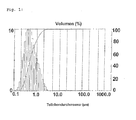
- Fig. 1 The resulting typical particle size distribution of the finished LiFePo 4 (with dispersant treatment, after hydrothermal treatment, Drying and deagglomeration as described above) is off Fig. 1 seen.
- the values relating to the particle fraction (%) were as follows: D50 value less than 0.5 ⁇ m, D10 value less than 0.35 ⁇ m; D90 value less than 2.0 ⁇ m; Difference between the D90 value and the D10 value less than 1.5 ⁇ m.
- the following procedure can be followed: With reference to the particle size distribution method described above, 20 to 40 mg of the powder sample are suspended in 15 ml of water and subjected to an ultrasonic finger (rated power) for 5 min 25 watts, 60% power). It is then measured immediately in the measuring unit. The correct setting of the sample quantity can be checked in each case on the basis of the display on the measuring device (green measuring range).
- LiFePO 4 was prepared by the same synthetic method as described in Example 1, but without using the dispersant according to the invention. Under otherwise identical reaction conditions, a significantly broader particle size distribution was obtained with a larger proportion of intergrown agglomerate structures. Without the use of a dispersant, the D 90 value (based on volume fraction or particle number) was more than 200 ⁇ m after addition of the LiOH solution. The despite the also achieved phase purity of LiFePO 4 significantly coarser Particle size distribution of the final LiFePO 4 (after hydrothermal treatment, drying and deagglomeration) is in Fig. 2 shown. To illustrate the presence of interfering larger particles, the volume-related data are shown. The D50 value based on the particle fraction (%) was more than 0.8 ⁇ m.
- Example 3 Preparation of LiFePO 4 according to a method of the invention including hydrothermal treatment
- LiFePO 4 was prepared according to the same synthesis procedure as described in Example 1, but the disperser (company IKA, ULTRATURRAX® UTL 25 Basic Inline with dispersing chamber DK 25.11) was operated at the highest power level.
- the power or energy input via the dispersing treatment was more than 10 kW / m 3 or more than 10 kWh / m 3 of the treated precursor mixture / suspension.
- the volume-related D90 was slightly lower.
- Example 1 The hydrothermal treatment, filtration, drying and deagglomeration were carried out as indicated in Example 1.
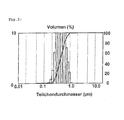
- the resulting typical particle size distribution of the finished LiFePO 4 is out Fig. 3 seen.
- the values relating to the particle fraction (%) were as follows: D50 value less than 0.5 ⁇ m; D10 value less than 0.35 ⁇ m; D90 value less than 2.0 ⁇ m; Difference between the D90 value and the D10 value less than 1.0 ⁇ m.
- the LiFePO 4 of the present invention prepared using the dispersant showed the comparison material prepared without using a dispersant, as well as one obtained by a pure sintering method
- the material produced by the technology has the best properties, especially at high charge / discharge rates.
- Example 4 Preparation of LiFePO 4 according to a method of the invention including hydrothermal treatment
- This alkaline solution is fed via a monopump and an injector to the recirculated acidic solution on the pressure side of the centrifugal pump.
- This process lasts 15 minutes, with the temperature of the pumped solution rising from 18.3 ° C to 42.1 ° C.
- the resulting suspension is pumped further for 45 min with the centrifugal pump and stirred with the anchor stirrer at 45 rpm, with the temperature further increased to 51.1 ° C.
- the centrifugal pump with its high turbulence effect during the entire process ensures the formation of a finely divided suspension, it being possible to achieve comparable particle size distributions as in Example 1.
- the power or energy input via the dispersing treatment was more than 7 kW / m 3 or more than 7 kWh / m 3 of the treated precursor mixture / suspension.
- the autoclave After switching off and disconnecting the external devices, the autoclave is pressure-tight and heated with constant stirring at 90 rpm in 1.5 h at 160 ° C and held for 10h at this temperature. It is then cooled to 20 ° C. within 3 h and the finished LiFePO 4 suspension is filtered analogously to Example 1 in the "Seitz filter". The pH of the filtrate is 7.5. It is then washed with deionized water until the filtrate has a conductivity of less than 480 ⁇ S.
- Example 5 Charring of a material produced by the process according to the invention
Landscapes
- Chemical & Material Sciences (AREA)
- Organic Chemistry (AREA)
- Inorganic Chemistry (AREA)
- Chemical Kinetics & Catalysis (AREA)
- Electrochemistry (AREA)
- General Chemical & Material Sciences (AREA)
- Crystallography & Structural Chemistry (AREA)
- Battery Electrode And Active Subsutance (AREA)
- Secondary Cells (AREA)
Applications Claiming Priority (2)
| Application Number | Priority Date | Filing Date | Title |
|---|---|---|---|
| DE10353266A DE10353266B4 (de) | 2003-11-14 | 2003-11-14 | Lithiumeisenphosphat, Verfahren zu seiner Herstellung und seine Verwendung als Elektrodenmaterial |
| EP04803141A EP1682446B1 (fr) | 2003-11-14 | 2004-11-14 | Lithium-metal-phosphate, procedes de realisation associes et utilisation comme matiere d'electrode |
Related Parent Applications (2)
| Application Number | Title | Priority Date | Filing Date |
|---|---|---|---|
| EP04803141.3 Division | 2004-11-14 | ||
| EP04803141A Division-Into EP1682446B1 (fr) | 2003-11-14 | 2004-11-14 | Lithium-metal-phosphate, procedes de realisation associes et utilisation comme matiere d'electrode |
Publications (2)
| Publication Number | Publication Date |
|---|---|
| EP2336085A2 true EP2336085A2 (fr) | 2011-06-22 |
| EP2336085A3 EP2336085A3 (fr) | 2012-04-18 |
Family
ID=34585111
Family Applications (2)
| Application Number | Title | Priority Date | Filing Date |
|---|---|---|---|
| EP10186314A Withdrawn EP2336085A3 (fr) | 2003-11-14 | 2004-11-14 | Lithium métal phosphates, leur production et utilisation commes matériaux d'électrode |
| EP04803141A Expired - Lifetime EP1682446B1 (fr) | 2003-11-14 | 2004-11-14 | Lithium-metal-phosphate, procedes de realisation associes et utilisation comme matiere d'electrode |
Family Applications After (1)
| Application Number | Title | Priority Date | Filing Date |
|---|---|---|---|
| EP04803141A Expired - Lifetime EP1682446B1 (fr) | 2003-11-14 | 2004-11-14 | Lithium-metal-phosphate, procedes de realisation associes et utilisation comme matiere d'electrode |
Country Status (12)
| Country | Link |
|---|---|
| US (2) | US7807121B2 (fr) |
| EP (2) | EP2336085A3 (fr) |
| JP (1) | JP4176804B2 (fr) |
| KR (1) | KR101209016B1 (fr) |
| CN (1) | CN1867514B (fr) |
| CA (1) | CA2537278C (fr) |
| DE (1) | DE10353266B4 (fr) |
| DK (1) | DK1682446T3 (fr) |
| ES (1) | ES2393974T3 (fr) |
| PL (1) | PL1682446T3 (fr) |
| TW (1) | TWI266744B (fr) |
| WO (1) | WO2005051840A1 (fr) |
Cited By (3)
| Publication number | Priority date | Publication date | Assignee | Title |
|---|---|---|---|---|
| US9809456B2 (en) | 2009-08-07 | 2017-11-07 | Semiconductor Energy Laboratory Co., Ltd. | Manufacturing method for positive electrode active material |
| CN108264046A (zh) * | 2018-03-05 | 2018-07-10 | 中国科学院山西煤炭化学研究所 | 一种石墨烯-沥青基活性炭及其制备方法和应用 |
| WO2019102226A1 (fr) * | 2017-11-27 | 2019-05-31 | Johnson Matthey Public Limited Company | Matériaux de cathode |
Families Citing this family (145)
| Publication number | Priority date | Publication date | Assignee | Title |
|---|---|---|---|---|
| US7390472B1 (en) * | 2002-10-29 | 2008-06-24 | Nei Corp. | Method of making nanostructured lithium iron phosphate—based powders with an olivine type structure |
| US7815708B2 (en) | 2003-09-29 | 2010-10-19 | Umicore | Process and apparatus for recovery of non-ferrous metals from zinc residues |
| DE10353266B4 (de) * | 2003-11-14 | 2013-02-21 | Süd-Chemie Ip Gmbh & Co. Kg | Lithiumeisenphosphat, Verfahren zu seiner Herstellung und seine Verwendung als Elektrodenmaterial |
| DE102005012640B4 (de) * | 2005-03-18 | 2015-02-05 | Süd-Chemie Ip Gmbh & Co. Kg | Kreisprozess zur nasschemischen Herstellung von Lithiummetallphosphaten |
| DE102005015613A1 (de) * | 2005-04-05 | 2006-10-12 | Süd-Chemie AG | Kristallines Ionenleitendes Nanomaterial und Verfahren zu seiner Herstellung |
| CA2613926C (fr) * | 2005-06-29 | 2013-10-29 | Umicore | Lifepo4 nanometrique cristallin |
| US7939201B2 (en) | 2005-08-08 | 2011-05-10 | A123 Systems, Inc. | Nanoscale ion storage materials including co-existing phases or solid solutions |
| US8158090B2 (en) | 2005-08-08 | 2012-04-17 | A123 Systems, Inc. | Amorphous and partially amorphous nanoscale ion storage materials |
| US8323832B2 (en) | 2005-08-08 | 2012-12-04 | A123 Systems, Inc. | Nanoscale ion storage materials |
| US20070160752A1 (en) * | 2006-01-09 | 2007-07-12 | Conocophillips Company | Process of making carbon-coated lithium metal phosphate powders |
| KR20130106440A (ko) | 2006-02-28 | 2013-09-27 | 프리메트 프리시젼 머테리알스, 인크. | 리튬계 화합물 나노입자 조성물 및 이의 제조 방법 |
| JP5174803B2 (ja) * | 2006-04-06 | 2013-04-03 | ダウ グローバル テクノロジーズ エルエルシー | リチウム二次電池用のリチウム金属リン酸塩正極物質のナノ粒子の合成 |
| US8491861B2 (en) * | 2006-05-26 | 2013-07-23 | Eltron Research, Inc. | Synthetic process for preparation of high surface area electroactive compounds for battery applications |
| CN101473469A (zh) * | 2006-06-16 | 2009-07-01 | 夏普株式会社 | 正极、其制备方法以及使用该正极的锂二次电池 |
| KR100984586B1 (ko) * | 2006-07-14 | 2010-09-30 | 주식회사 엘지화학 | 리튬 철 인산 복합산화물(LiFePO₄)의 제조방법 |
| CN100528746C (zh) * | 2006-08-18 | 2009-08-19 | 河南环宇集团有限公司 | 湿法制备磷酸亚铁锂的方法及其制备的磷酸亚铁锂 |
| CA2566906A1 (fr) | 2006-10-30 | 2008-04-30 | Nathalie Ravet | Stockage et manipulation de lifeo4 recouvert de carbone |
| CA2672954C (fr) | 2006-12-22 | 2014-07-22 | Umicore | Synthese de lifempo4....nanometrique cristalline |
| KR101401797B1 (ko) * | 2006-12-22 | 2014-05-29 | 썽뜨르 나쇼날르 드 라 르쉐르쉐 씨엉띠삐끄 | 전기활성 결정성 나노메트릭 LiMnPO₄분말 |
| CA2672952C (fr) * | 2006-12-22 | 2014-08-05 | Umicore | Synthese d'une poudre de limnpo4 nanometrique cristalline electroactive |
| KR101401836B1 (ko) * | 2006-12-22 | 2014-05-29 | 썽뜨르 나쇼날르 드 라 르쉐르쉐 씨엉띠삐끄 | 결정성 나노메트릭 LiFeMPO₄의 합성 방법 |
| US8771877B2 (en) * | 2006-12-28 | 2014-07-08 | Gs Yuasa International Ltd. | Positive electrode material for nonaqueous electrolyte secondary battery, nonaqueous electrolyte secondary battery including the same, and method for producing the same |
| CA2622675A1 (fr) | 2007-02-28 | 2008-08-28 | Sanyo Electric Co., Ltd. | Methode de production d'un materiau actif pour pile au lithium secondaire, methode de production d'une electrode pour pile au lithium secondaire et methode de controle de la qualite du materiau actif pour la pile au lithium secondaire |
| JP2009032656A (ja) * | 2007-02-28 | 2009-02-12 | Sanyo Electric Co Ltd | リチウム二次電池用活物質の製造方法、リチウム二次電池用電極の製造方法、リチウム二次電池の製造方法、及びリチウム二次電池用活物質の品質モニタリング方法 |
| JP4388135B2 (ja) * | 2007-02-28 | 2009-12-24 | 株式会社三徳 | オリビン型構造を有する化合物を含む粒子、その製造方法、非水電解質二次電池用正極、非水電解質二次電池 |
| EP2130248B1 (fr) | 2007-03-19 | 2011-06-15 | Umicore | Matière d'insertion/extraction de li à une seule phase à température ambiante pour une utilisation dans une batterie à base de li |
| US8480987B2 (en) * | 2007-04-20 | 2013-07-09 | Sung Yoon Chung | Method of preparing nanoparticles of lithium transition metal phosphates, lithium transition metal phosphates, and method of preparing the same |
| KR100821832B1 (ko) * | 2007-04-20 | 2008-04-14 | 정성윤 | 리튬전이금속 인산화물의 나노입자 분말의 제조방법 |
| JP5293936B2 (ja) * | 2007-05-21 | 2013-09-18 | 戸田工業株式会社 | 非水電解質二次電池用オリビン型複合酸化物及びその製造方法、並びに二次電池 |
| WO2008145034A1 (fr) | 2007-05-28 | 2008-12-04 | Byd Company Limited | Procédé d'élaboration de phosphate de lithium et de fer comme matériau actif d'anode de batterie secondaire aux ions lithium |
| US20080303004A1 (en) * | 2007-06-08 | 2008-12-11 | Conocophillips Company | Method for producing lithium transition metal polyanion powders for batteries |
| US20080305256A1 (en) * | 2007-06-08 | 2008-12-11 | Conocophillips Company | Method for producing lithium vanadium polyanion powders for batteries |
| DE102008031152A1 (de) * | 2007-07-06 | 2009-04-30 | Sanyo Electric Co., Ltd., Moriguchi | Vorrichtung zur Herstellung von aktivem Material für eine Lithium-Sekundärbatterie und Verfahren zur Herstellung von aktivem Material für eine Lithium-Sekundärbatterie, Verfahren zur Herstellung einer Elektrode für eine Lithium-Sekundärbatterie, und Verfahren zur Herstellung einer Lithium-Sekundärbatterie |
| EP2015382A1 (fr) * | 2007-07-13 | 2009-01-14 | High Power Lithium S.A. | Matériau à cathode de phosphate de manganèse de lithium recouvert de carbone |
| DE102007033460A1 (de) | 2007-07-18 | 2009-01-22 | Süd-Chemie AG | Kreisprozess zur Herstellung von Bariumsulfat und Lithiummetallphosphatverbindungen |
| JP2009046383A (ja) * | 2007-07-24 | 2009-03-05 | Nippon Chem Ind Co Ltd | リチウム鉄リン系複合酸化物炭素複合体の製造方法及びリチウム、鉄及びリンを含む共沈体の製造方法 |
| JP5281765B2 (ja) * | 2007-07-27 | 2013-09-04 | 日本化学工業株式会社 | リチウム鉄リン系複合酸化物炭素複合体の製造方法及びリチウム、鉄及びリンを含む共沈体の製造方法 |
| KR20090131680A (ko) * | 2007-07-31 | 2009-12-29 | 비와이디 컴퍼니 리미티드 | 리튬 이온 2차 전지용 양극 활성 물질로서 리튬 철 인산염을 제조하는 방법 |
| JP5352069B2 (ja) * | 2007-08-08 | 2013-11-27 | トヨタ自動車株式会社 | 正極材料、正極板、二次電池、及び正極材料の製造方法 |
| JP5164477B2 (ja) * | 2007-08-23 | 2013-03-21 | 三洋電機株式会社 | 非水電解質二次電池 |
| US20090068080A1 (en) * | 2007-09-06 | 2009-03-12 | Valence Technology, Inc. | Method of Making Active Materials For Use in Secondary Electrochemical Cells |
| DE102007045941A1 (de) * | 2007-09-25 | 2009-04-16 | Webasto Ag | Fahrzeugklimaanlage mit Energieversorgung und Verfahren zum Betreiben der Fahrzeugklimaanlage |
| US20090119821A1 (en) * | 2007-11-14 | 2009-05-14 | Jeffery Neil Stillwell | Belt with ball mark repair tool |
| DE102007058674A1 (de) | 2007-12-06 | 2009-07-02 | Süd-Chemie AG | Nanopartikuläre Zusammensetzung und Verfahren zu deren Herstellung |
| CN101952999A (zh) * | 2007-12-22 | 2011-01-19 | 普里梅精密材料有限公司 | 小颗粒电极材料组合物及其形成方法 |
| US20090181291A1 (en) * | 2008-01-11 | 2009-07-16 | Lewis Ii Lucian R | Surgical Instrument With Lithium Ion Energy Source Including Phosphates |
| EP2248220B1 (fr) * | 2008-02-22 | 2015-11-04 | Steven E. Sloop | Réintroduction de lithium dans des matériaux d'électrodes recyclés pour batteries |
| JP2009238488A (ja) * | 2008-03-26 | 2009-10-15 | Sanyo Electric Co Ltd | 非水電解質二次電池及びその製造方法 |
| US8460573B2 (en) | 2008-04-25 | 2013-06-11 | Sumitomo Osaka Cement Co., Ltd. | Method for producing cathode active material for lithium ion batteries, cathode active material for lithium ion batteries obtained by the production method, lithium ion battery electrode, and lithium ion battery |
| DE102008042498A1 (de) * | 2008-09-30 | 2010-04-01 | Evonik Degussa Gmbh | Verfahren zur Pyrolyse von Kohlehydraten |
| CN102186769A (zh) * | 2008-10-22 | 2011-09-14 | 株式会社Lg化学 | 具有橄榄石结构的锂铁磷酸盐及其分析方法 |
| WO2010079962A2 (fr) * | 2009-01-06 | 2010-07-15 | 주식회사 엘지화학 | Matériau actif d'électrode positive pour batterie secondaire au lithium |
| DE102009010264B4 (de) * | 2009-02-24 | 2015-04-23 | Süd-Chemie Ip Gmbh & Co. Kg | Verfahren zur Aufreinigung lithiumhaltiger Abwässer bei der kontinuierlichen Herstellung von Lithiumübergangsmetallphosphaten |
| EP2228855B1 (fr) | 2009-03-12 | 2014-02-26 | Belenos Clean Power Holding AG | Matériau nano-composite conducteur électriquement poreux ouvert |
| EP2237346B1 (fr) | 2009-04-01 | 2017-08-09 | The Swatch Group Research and Development Ltd. | Matériau nano-composite conducteur électriquement comportant des nanoparticules de sacrifice et nano-composites poreuses ouvertes produites ainsi |
| JP5347603B2 (ja) * | 2009-03-16 | 2013-11-20 | Tdk株式会社 | 活物質の製造方法、活物質、電極及びリチウムイオン二次電池 |
| JP5509918B2 (ja) | 2009-03-27 | 2014-06-04 | 住友大阪セメント株式会社 | リチウムイオン電池用正極活物質の製造方法とリチウムイオン電池用正極活物質及びリチウムイオン電池用電極並びにリチウムイオン電池 |
| DE102009020832A1 (de) | 2009-05-11 | 2010-11-25 | Süd-Chemie AG | Verbundmaterial enthaltend ein gemischtes Lithium-Metalloxid |
| JP5510036B2 (ja) * | 2009-05-28 | 2014-06-04 | Tdk株式会社 | 活物質、活物質の製造方法及びリチウムイオン二次電池 |
| KR20120082878A (ko) * | 2009-08-28 | 2012-07-24 | 프리메트 프리시젼 머테리알스, 인크. | 조성물 및 그의 제조 방법 |
| WO2011027503A1 (fr) * | 2009-09-01 | 2011-03-10 | 日立ビークルエナジー株式会社 | Batterie rechargeable à électrolyte non aqueux |
| WO2011030786A1 (fr) | 2009-09-09 | 2011-03-17 | 戸田工業株式会社 | Poudre de particules d'hydrate de phosphate ferrique et son procédé de production, poudre de particules de phosphate de fer et de lithium du type olivine et son procédé de production, et batterie rechargeable à électrolyte non aqueux |
| DK2322473T3 (da) * | 2009-10-15 | 2012-08-20 | Sued Chemie Ip Gmbh & Co Kg | Fremgangsmåde til fjernelse af et partikulært forurenende materiale fra et partikulært blandet lithiummetal phosphatmateriale |
| DE102009049693A1 (de) * | 2009-10-16 | 2011-04-21 | Süd-Chemie AG | Phasenreines Lithiumaluminiumtitanphosphat und Verfahren zur Herstellung und dessen Verwendung |
| EP2322474A1 (fr) | 2009-11-16 | 2011-05-18 | Evonik Degussa GmbH | Procédé de pyrolyse d'hydrates de carbone |
| EP2322476A1 (fr) | 2009-11-16 | 2011-05-18 | Evonik Degussa GmbH | Nouveau procédé de fabrication de silicium |
| DE102010006077B4 (de) | 2010-01-28 | 2014-12-11 | Süd-Chemie Ip Gmbh & Co. Kg | Substituiertes Lithium-Mangan-Metallphosphat |
| DE102010006083B4 (de) | 2010-01-28 | 2014-12-11 | Süd-Chemie Ip Gmbh & Co. Kg | Substituiertes Lithium-Mangan-Metallphosphat |
| US9269950B2 (en) | 2010-01-28 | 2016-02-23 | Johnson Matthey Public Limited Company | Procedure to optimize materials for cathodes and cathode material having enhanced electrochemical properties |
| JP5544934B2 (ja) * | 2010-03-03 | 2014-07-09 | 住友大阪セメント株式会社 | リチウムイオン電池用正極活物質の製造方法 |
| DE102010018041A1 (de) | 2010-04-23 | 2011-10-27 | Süd-Chemie AG | Kohlenstoffhaltiges Verbundmaterial enthaltend eine sauerstoffhaltige Lithium-Übergangsmetallverbindung |
| DE102010021804A1 (de) | 2010-05-27 | 2011-12-01 | Süd-Chemie AG | Verbundmaterial enthaltend ein gemischtes Lithium-Metallphosphat |
| US20110300446A1 (en) | 2010-06-03 | 2011-12-08 | Hon Hai Precision Industry Co., Ltd. | Lithium battery cathode composite material |
| TWI415324B (zh) * | 2010-06-15 | 2013-11-11 | Hon Hai Prec Ind Co Ltd | 鋰電池電極材料的製備方法 |
| EP2586084A2 (fr) * | 2010-06-22 | 2013-05-01 | K2 Energy Solutions, Inc. | Batterie au lithium-ion |
| WO2012006725A1 (fr) | 2010-07-15 | 2012-01-19 | Phostech Lithium Inc. | Formulation de revêtement de cathode conçue pour des accumulateurs |
| DE102010032206A1 (de) | 2010-07-26 | 2012-04-05 | Süd-Chemie AG | Gasphasenbeschichtetes Lithium-Übergangsmetallphosphat und Verfahren zu dessen Herstellung |
| DE102010032207B4 (de) | 2010-07-26 | 2014-02-13 | Süd-Chemie Ip Gmbh & Co. Kg | Verfahren zur Verminderung von magnetischen und/oder oxidischen Verunreinigungen in Lithium-Metall-Sauerstoff-Verbindungen |
| CA2810132C (fr) | 2010-09-03 | 2015-03-17 | Showa Denko K.K. | Procede de production de phosphate de metal-lithium |
| CN103270628B (zh) | 2010-12-17 | 2016-06-29 | 住友大阪水泥股份有限公司 | 电极材料及其制造方法 |
| DE102010061504B4 (de) * | 2010-12-22 | 2014-10-16 | Technische Universität Berlin | Verfahren zum Bestimmen eines Mahlgutes und Vorrichtung |
| CN102569794B (zh) * | 2011-03-23 | 2015-05-20 | 江苏菲思特新能源有限公司 | 一种正极材料磷酸铁锂的碳包覆方法 |
| JP2012204150A (ja) * | 2011-03-25 | 2012-10-22 | Sumitomo Osaka Cement Co Ltd | 電極活物質の製造方法と電極活物質及び電極並びに電池 |
| KR20140053875A (ko) * | 2011-03-28 | 2014-05-08 | 미쯔이 죠센 가부시키가이샤 | 2차 전지용 전극 재료, 2차 전지용 전극 재료의 제조방법 및 2차 전지 |
| CN103503206B (zh) | 2011-04-22 | 2016-03-02 | 昭和电工株式会社 | 锂二次电池用正极活性物质的制造方法 |
| JP6057893B2 (ja) | 2011-04-28 | 2017-01-11 | 昭和電工株式会社 | リチウム二次電池用正極材料及びその製造方法 |
| US9884765B2 (en) | 2011-06-17 | 2018-02-06 | National Tsing Hua University | Ferrous phosphate powders, lithium iron phosphate powders for li-ion battery, and methods for manufacturing the same |
| US10875771B2 (en) | 2011-06-17 | 2020-12-29 | National Tsing Hua University | Metal (II) phosphate powders, lithium metal phosphate powders for Li-ion battery, and methods for manufacturing the same |
| US10593947B2 (en) | 2011-06-17 | 2020-03-17 | National Tsing Hua University | Metal (II) phosphate powders, lithium metal phosphate powders for Li-ion battery, and methods for manufacturing the same |
| US10029918B2 (en) | 2011-06-17 | 2018-07-24 | National Tsing Hua University | Ferrous phosphate powders, lithium iron phosphate powders for Li-ion battery, and methods for manufacturing the same |
| TWI448420B (zh) * | 2011-06-17 | 2014-08-11 | Nat Univ Tsing Hua | 鋰離子電池之磷酸亞鐵前驅物、使用其製備之磷酸鋰鐵粉末、及其製作方法 |
| US20120328774A1 (en) * | 2011-06-22 | 2012-12-27 | Phostech Lithium Inc. | Carbon-deposited alkali metal oxyanion electrode material and process of preparing same |
| DE102011106326B3 (de) | 2011-07-01 | 2013-01-03 | Süd-Chemie AG | Verfahren zur Herstellung von nanopartikulären Lithiumübergangsmetallphosphaten; nanopartikuläres Lithiumübergangsmetallphosphat und Kathode damit |
| US9249524B2 (en) * | 2011-08-31 | 2016-02-02 | Semiconductor Energy Laboratory Co., Ltd. | Manufacturing method of composite oxide and manufacturing method of power storage device |
| US9118077B2 (en) * | 2011-08-31 | 2015-08-25 | Semiconductor Energy Laboratory Co., Ltd. | Manufacturing method of composite oxide and manufacturing method of power storage device |
| DE102011112948B3 (de) | 2011-09-13 | 2012-12-06 | Gottfried Wilhelm Leibniz Universität Hannover | Verfahren zur Verbesserung der elektrischen Leitfähigkeit von anorganischen Partikeln und deren Verwendung |
| CN102694168B (zh) * | 2011-09-14 | 2014-04-23 | 中国科学院宁波材料技术与工程研究所 | 一种磷酸锰锂正极材料及其制备方法 |
| JP5329006B1 (ja) * | 2011-09-29 | 2013-10-30 | 昭和電工株式会社 | リチウム二次電池用正極活物質及びその製造方法 |
| JP5364865B2 (ja) * | 2011-09-30 | 2013-12-11 | 昭和電工株式会社 | リチウム二次電池用正極活物質の製造方法 |
| WO2013055792A1 (fr) * | 2011-10-10 | 2013-04-18 | The Regents Of The University Of California | Nanostructures de dimension et de morphologie contrôlées pour stockage d'énergie |
| EP2581345A1 (fr) | 2011-10-12 | 2013-04-17 | Clariant Produkte (Deutschland) GmbH | Séparation de métaux alcalinoterreux et de métaux lourds au moyen d'une colonne d'échange de cations dans le mode tampon |
| US20130108802A1 (en) * | 2011-11-01 | 2013-05-02 | Isaiah O. Oladeji | Composite electrodes for lithium ion battery and method of making |
| CN102420327A (zh) * | 2011-12-02 | 2012-04-18 | 苏州冠硕新能源有限公司 | 碳处理的正极材料以及它的制备方法 |
| CN102522522A (zh) * | 2011-12-02 | 2012-06-27 | 苏州冠硕新能源有限公司 | 一种纳米正极材料以及制备方法 |
| WO2013089400A1 (fr) * | 2011-12-12 | 2013-06-20 | Research Institute Of Industrial Science & Technology | Procédé pour l'extraction de lithium à partir d'une solution contenant du lithium |
| EP2604576B1 (fr) | 2011-12-12 | 2016-03-09 | BK Giulini GmbH | Procédé de fabrication de lithium-métal-phosphate |
| DE102012000914B4 (de) | 2012-01-18 | 2012-11-15 | Süd-Chemie AG | Verfahren zur Herstellung von hochreinen Elektrodenmaterialien |
| DE102012202586A1 (de) | 2012-02-21 | 2013-08-22 | Evonik Degussa Gmbh | Verfahren zur Herstellung von Silizium über carbothermische Reduktion von Siliciumoxid mit Kohlenstoff in einem Schmelzofen |
| CN102820486A (zh) * | 2012-06-28 | 2012-12-12 | 上海广为美线电源电器有限公司 | 大电流放电技术的磷酸铁锂电池组模块 |
| KR101973052B1 (ko) | 2012-08-10 | 2019-04-26 | 삼성에스디아이 주식회사 | 리튬 금속인산화물의 제조방법 |
| EP2698346A1 (fr) | 2012-08-14 | 2014-02-19 | Clariant International Ltd. | Sulfate mixte contenant du phosphate de lithium-manganèse-métal |
| EP2698345A1 (fr) | 2012-08-14 | 2014-02-19 | Clariant International Ltd. | Sulfate mixte contenant du phosphate de lithium-fer |
| US20140147586A1 (en) * | 2012-11-27 | 2014-05-29 | Universite De Montreal | Process for making an alkali metal oxyanion comprising iron |
| CN103050691A (zh) * | 2012-12-17 | 2013-04-17 | 天津能元谷科技有限公司 | 磷酸铁锂前驱体的制备方法 |
| CN104937752A (zh) | 2012-12-20 | 2015-09-23 | 尤米科尔公司 | 用于可再充电电池的负极材料,以及其生产方法 |
| KR101586556B1 (ko) * | 2013-01-10 | 2016-01-20 | 주식회사 엘지화학 | 탄소 코팅 리튬 인산철 나노분말 제조방법 |
| KR101561373B1 (ko) | 2013-01-10 | 2015-10-19 | 주식회사 엘지화학 | 리튬 인산철 나노분말 제조방법 |
| KR101561377B1 (ko) | 2013-01-10 | 2015-10-20 | 주식회사 엘지화학 | 리튬 인산철 나노분말 제조방법 |
| CN103107333B (zh) * | 2013-01-31 | 2015-08-19 | 贵州安达科技能源股份有限公司 | 一种磷酸铁锂的制备方法及磷酸铁锂 |
| EP2778126A1 (fr) | 2013-03-15 | 2014-09-17 | Clariant International Ltd. | Agglomérats secondaires de phosphate de métal de transition au lithium et leur procédé de fabrication |
| EP2778127A1 (fr) | 2013-03-15 | 2014-09-17 | Clariant International Ltd. | Agglomérats secondaires de phosphate de métal de transition au lithium et leur procédé de fabrication |
| JP2014179291A (ja) | 2013-03-15 | 2014-09-25 | Sumitomo Osaka Cement Co Ltd | 電極材料及び電極並びにリチウムイオン電池 |
| CN103258993B (zh) * | 2013-04-24 | 2015-11-25 | 北京化工大学 | 一种用于锂离子电池正极材料的磷酸铁锂粉体的制备方法 |
| KR101580030B1 (ko) * | 2013-07-09 | 2015-12-23 | 주식회사 엘지화학 | 탄소 코팅 리튬 인산철 나노분말의 제조방법 |
| RU2585646C2 (ru) * | 2013-07-11 | 2016-05-27 | Общество с ограниченной ответственностью "Минерал" | Способ получения литий-железо-фосфата |
| US20160240856A1 (en) | 2013-10-02 | 2016-08-18 | Umicore | Carbon Coated Electrochemically Active Powder |
| CN106458587A (zh) | 2014-05-07 | 2017-02-22 | 庄信万丰股份有限公司 | 制备碳涂覆的锂过渡金属磷酸盐的方法及其用途 |
| JP6231966B2 (ja) * | 2014-09-30 | 2017-11-15 | 住友大阪セメント株式会社 | 電極材料及びその製造方法、電極、並びにリチウムイオン電池 |
| DE102014222664B4 (de) | 2014-11-06 | 2023-12-07 | Bayerische Motoren Werke Aktiengesellschaft | Verfahren zur Herstellung der Kathode und/oder der Anode einer Lithium-Ionen-Zelle und Verwendung einer Lithium-lonen-Zelle |
| CN106698382A (zh) * | 2015-11-12 | 2017-05-24 | 宁夏际华环境安全科技有限公司 | 一种磷酸铁锂生产工艺 |
| JP6070882B1 (ja) * | 2016-03-29 | 2017-02-01 | 住友大阪セメント株式会社 | リチウムイオン二次電池用電極材料およびその製造方法、リチウムイオン二次電池 |
| CN107954460A (zh) * | 2016-10-14 | 2018-04-24 | 德阳威旭锂电科技有限责任公司 | 一种制备高白度和高纯度硫酸钡的方法 |
| CN107915239A (zh) * | 2017-12-08 | 2018-04-17 | 天齐锂业股份有限公司 | 一种回收水热法生产磷酸铁锂废液制备高纯硫酸锂的方法 |
| TWI739098B (zh) * | 2018-06-25 | 2021-09-11 | 國立清華大學 | 用於鋰離子電池之二價金屬磷酸鹽粉末和鋰金屬磷酸鹽粉末及其製備方法 |
| JP6593511B1 (ja) * | 2018-09-28 | 2019-10-23 | 住友大阪セメント株式会社 | リチウムイオン二次電池用電極材料、リチウムイオン二次電池用電極、リチウムイオン二次電池 |
| CA3073706A1 (fr) * | 2019-02-26 | 2020-08-26 | Christophe Michot | Matiere active d`electrode positive, electrode positive la comprenant et batterie secondaire au lithium |
| GB201905177D0 (en) | 2019-04-11 | 2019-05-29 | Johnson Matthey Plc | Lithium metal phosphate, its preparation and use |
| JP7328790B2 (ja) * | 2019-05-13 | 2023-08-17 | 太陽誘電株式会社 | セラミック原料粉末、全固体電池の製造方法、および全固体電池 |
| US12021202B2 (en) | 2019-11-12 | 2024-06-25 | Hulico LLC | Battery deactivation |
| CN111483995A (zh) * | 2020-04-18 | 2020-08-04 | 蒋央芳 | 一种磷酸铁锂的制备方法 |
| GB202014766D0 (en) | 2020-09-18 | 2020-11-04 | Johnson Matthey Plc | Cathode material |
| EP4229689A1 (fr) | 2020-09-18 | 2023-08-23 | EV Metals UK Limited | Matériaux de cathode |
| GB202104495D0 (en) | 2021-03-30 | 2021-05-12 | Johnson Matthey Plc | Cathode material and process |
| CN114604842B (zh) * | 2022-03-14 | 2023-07-07 | 鞍钢集团北京研究院有限公司 | 一种成核晶化隔离制备纳米磷酸钒钠的方法 |
| WO2025188876A1 (fr) * | 2024-03-05 | 2025-09-12 | Mitra Future Technologies, Inc. | Procédé de conversion de matériaux à stœchiométrie déséquilibrée en matériaux de cathode utiles |
Citations (6)
| Publication number | Priority date | Publication date | Assignee | Title |
|---|---|---|---|---|
| US5910382A (en) | 1996-04-23 | 1999-06-08 | Board Of Regents, University Of Texas Systems | Cathode materials for secondary (rechargeable) lithium batteries |
| EP1094523A2 (fr) | 1999-10-21 | 2001-04-25 | Matsushita Electric Industrial Co., Ltd. | Transistor latéral à hétérojonction et procédé pour sa fabrication |
| JP2002151082A (ja) | 2000-11-10 | 2002-05-24 | Kansai Research Institute | 鉄リン酸リチウム及びその製造方法並びにこれを用いた二次電池 |
| WO2002083555A2 (fr) | 2001-04-10 | 2002-10-24 | Zentrum Für Sonnenenergie- Und Wasserstoff-Forschung Baden-Württemberg, Gemeinnützige Stiftung | Phosphates de lithium binaires, ternaires et quaternaires, leur procede de production et leur utilisation |
| WO2002099913A1 (fr) | 2001-05-23 | 2002-12-12 | N.V. Umicore S.A. | Poudre de phosphates de metaux de transition de lithium pour piles rechargeables |
| US20030124423A1 (en) | 2000-07-27 | 2003-07-03 | Tsuyoshi Sasaki | Lithium secondary battery |
Family Cites Families (15)
| Publication number | Priority date | Publication date | Assignee | Title |
|---|---|---|---|---|
| JPS56138745U (fr) * | 1980-03-21 | 1981-10-20 | ||
| JP3493568B2 (ja) * | 1997-02-12 | 2004-02-03 | 光洋精工株式会社 | 自動車の舵取装置 |
| JP2000198453A (ja) * | 1998-12-29 | 2000-07-18 | Robert Bosch Gmbh | 車両のステア―バイ―ワイヤ操舵システム |
| US7416803B2 (en) * | 1999-01-22 | 2008-08-26 | California Institute Of Technology | Solid acid electrolytes for electrochemical devices |
| DE19920092C2 (de) * | 1999-05-03 | 2002-11-14 | Kostal Leopold Gmbh & Co Kg | Lenkeinrichtung für ein Kraftfahrzeug |
| US6528033B1 (en) * | 2000-01-18 | 2003-03-04 | Valence Technology, Inc. | Method of making lithium-containing materials |
| DE10021814B4 (de) * | 2000-05-04 | 2006-09-07 | Daimlerchrysler Ag | Lenksystem für ein Kraftfahrzeug |
| US6892605B2 (en) * | 2002-03-04 | 2005-05-17 | Delphi Technologies, Inc. | Hand wheel actuator having stationary hub |
| US6815122B2 (en) * | 2002-03-06 | 2004-11-09 | Valence Technology, Inc. | Alkali transition metal phosphates and related electrode active materials |
| US6938720B2 (en) * | 2002-05-09 | 2005-09-06 | Delphi Technologies, Inc. | Steering input devices for steer-by-wire systems |
| CN1442917A (zh) * | 2003-04-08 | 2003-09-17 | 复旦大学 | 碳膜与LiFePO4复合纳米导电材料及其合成方法 |
| US20040202935A1 (en) * | 2003-04-08 | 2004-10-14 | Jeremy Barker | Cathode active material with increased alkali/metal content and method of making same |
| US7348100B2 (en) * | 2003-10-21 | 2008-03-25 | Valence Technology, Inc. | Product and method for the processing of precursors for lithium phosphate active materials |
| DE10353266B4 (de) * | 2003-11-14 | 2013-02-21 | Süd-Chemie Ip Gmbh & Co. Kg | Lithiumeisenphosphat, Verfahren zu seiner Herstellung und seine Verwendung als Elektrodenmaterial |
| US7338647B2 (en) * | 2004-05-20 | 2008-03-04 | Valence Technology, Inc. | Synthesis of cathode active materials |
-
2003
- 2003-11-14 DE DE10353266A patent/DE10353266B4/de not_active Expired - Fee Related
-
2004
- 2004-11-12 TW TW093134723A patent/TWI266744B/zh not_active IP Right Cessation
- 2004-11-14 US US10/578,032 patent/US7807121B2/en active Active
- 2004-11-14 ES ES04803141T patent/ES2393974T3/es not_active Expired - Lifetime
- 2004-11-14 DK DK04803141.3T patent/DK1682446T3/da active
- 2004-11-14 JP JP2006538815A patent/JP4176804B2/ja not_active Expired - Lifetime
- 2004-11-14 PL PL04803141T patent/PL1682446T3/pl unknown
- 2004-11-14 CA CA002537278A patent/CA2537278C/fr not_active Expired - Lifetime
- 2004-11-14 WO PCT/EP2004/012911 patent/WO2005051840A1/fr not_active Ceased
- 2004-11-14 EP EP10186314A patent/EP2336085A3/fr not_active Withdrawn
- 2004-11-14 EP EP04803141A patent/EP1682446B1/fr not_active Expired - Lifetime
- 2004-11-14 CN CN2004800298227A patent/CN1867514B/zh not_active Expired - Lifetime
-
2006
- 2006-05-15 KR KR1020067009375A patent/KR101209016B1/ko not_active Expired - Lifetime
-
2010
- 2010-10-04 US US12/897,339 patent/US7998618B2/en not_active Expired - Lifetime
Patent Citations (6)
| Publication number | Priority date | Publication date | Assignee | Title |
|---|---|---|---|---|
| US5910382A (en) | 1996-04-23 | 1999-06-08 | Board Of Regents, University Of Texas Systems | Cathode materials for secondary (rechargeable) lithium batteries |
| EP1094523A2 (fr) | 1999-10-21 | 2001-04-25 | Matsushita Electric Industrial Co., Ltd. | Transistor latéral à hétérojonction et procédé pour sa fabrication |
| US20030124423A1 (en) | 2000-07-27 | 2003-07-03 | Tsuyoshi Sasaki | Lithium secondary battery |
| JP2002151082A (ja) | 2000-11-10 | 2002-05-24 | Kansai Research Institute | 鉄リン酸リチウム及びその製造方法並びにこれを用いた二次電池 |
| WO2002083555A2 (fr) | 2001-04-10 | 2002-10-24 | Zentrum Für Sonnenenergie- Und Wasserstoff-Forschung Baden-Württemberg, Gemeinnützige Stiftung | Phosphates de lithium binaires, ternaires et quaternaires, leur procede de production et leur utilisation |
| WO2002099913A1 (fr) | 2001-05-23 | 2002-12-12 | N.V. Umicore S.A. | Poudre de phosphates de metaux de transition de lithium pour piles rechargeables |
Non-Patent Citations (4)
| Title |
|---|
| A. K. PADHI; K. S. NANJUNDASWAMY; J. B. GOODENOUGH, J. ELECTROCHEM. SOC., vol. 144, 1977 |
| ANDERSON ET AL., ELECTROCHEM. AND SOLID STATE LETTERS, vol. 3, no. 2, 2000, pages 66 - 68 |
| FRANGER ET AL., JOURNAL OF POWER SOURCES, vol. 119 - 12, 2003, pages 252 - 257 |
| S. Y. CHUNG; J. T. BLOKING; Y. M. CHIANG, NATURE, vol. 1, October 2002 (2002-10-01), pages 123 |
Cited By (4)
| Publication number | Priority date | Publication date | Assignee | Title |
|---|---|---|---|---|
| US9809456B2 (en) | 2009-08-07 | 2017-11-07 | Semiconductor Energy Laboratory Co., Ltd. | Manufacturing method for positive electrode active material |
| WO2019102226A1 (fr) * | 2017-11-27 | 2019-05-31 | Johnson Matthey Public Limited Company | Matériaux de cathode |
| CN108264046A (zh) * | 2018-03-05 | 2018-07-10 | 中国科学院山西煤炭化学研究所 | 一种石墨烯-沥青基活性炭及其制备方法和应用 |
| CN108264046B (zh) * | 2018-03-05 | 2019-12-24 | 中国科学院山西煤炭化学研究所 | 一种石墨烯-沥青基活性炭及其制备方法和应用 |
Also Published As
| Publication number | Publication date |
|---|---|
| US20070054187A1 (en) | 2007-03-08 |
| TW200523210A (en) | 2005-07-16 |
| CA2537278C (fr) | 2007-11-13 |
| DK1682446T3 (da) | 2012-09-24 |
| DE10353266B4 (de) | 2013-02-21 |
| US7807121B2 (en) | 2010-10-05 |
| TWI266744B (en) | 2006-11-21 |
| JP2007511458A (ja) | 2007-05-10 |
| JP4176804B2 (ja) | 2008-11-05 |
| KR20060120112A (ko) | 2006-11-24 |
| CA2537278A1 (fr) | 2005-06-09 |
| HK1096371A1 (en) | 2007-06-01 |
| EP2336085A3 (fr) | 2012-04-18 |
| CN1867514B (zh) | 2011-11-09 |
| WO2005051840A1 (fr) | 2005-06-09 |
| PL1682446T3 (pl) | 2013-01-31 |
| EP1682446A1 (fr) | 2006-07-26 |
| US20110017947A1 (en) | 2011-01-27 |
| US7998618B2 (en) | 2011-08-16 |
| EP1682446B1 (fr) | 2012-08-22 |
| ES2393974T3 (es) | 2013-01-03 |
| KR101209016B1 (ko) | 2012-12-07 |
| CN1867514A (zh) | 2006-11-22 |
| DE10353266A1 (de) | 2005-06-16 |
Similar Documents
| Publication | Publication Date | Title |
|---|---|---|
| EP1682446B1 (fr) | Lithium-metal-phosphate, procedes de realisation associes et utilisation comme matiere d'electrode | |
| EP2528863B1 (fr) | Phosphate métallique de lithium-manganèse substitué | |
| DE102005012640B4 (de) | Kreisprozess zur nasschemischen Herstellung von Lithiummetallphosphaten | |
| DE102010006083B4 (de) | Substituiertes Lithium-Mangan-Metallphosphat | |
| EP1866242B1 (fr) | Nanomateriau cristallin conduisant les ions et procede de fabrication | |
| KR101751423B1 (ko) | 혼합 황산염을 함유한 리튬-망간 철 포스페이트 | |
| EP3337764A1 (fr) | Particules d'oxyde de métaux de transition à base de lithium-nickel-manganèse, leur production ainsi que leur utilisation en tant que matériau d'électrode | |
| DE102011003125A1 (de) | Eisen(III)orthophosphat-Kohlenstoff-Komposit | |
| WO2014161742A1 (fr) | Phosphate de fer(iii) amorphisé | |
| DE112012004694B4 (de) | Lithiumsekundärbatterie und Verfahren zum Herstellen derselben | |
| AT522061B1 (de) | Herstellungsverfahren für Lithiumvanadiumphosphat | |
| HK1096371B (en) | Lithium metal phosphates, method for producing the same and use thereof as electrode material | |
| HK1153994A (en) | Lithium metal phosphates, their production and use as electrode materials |
Legal Events
| Date | Code | Title | Description |
|---|---|---|---|
| PUAI | Public reference made under article 153(3) epc to a published international application that has entered the european phase |
Free format text: ORIGINAL CODE: 0009012 |
|
| 17P | Request for examination filed |
Effective date: 20101001 |
|
| AC | Divisional application: reference to earlier application |
Ref document number: 1682446 Country of ref document: EP Kind code of ref document: P |
|
| AK | Designated contracting states |
Kind code of ref document: A2 Designated state(s): AT BE BG CH CY CZ DE DK EE ES FI FR GB GR HU IE IS IT LI LU MC NL PL PT RO SE SI SK TR |
|
| PUAL | Search report despatched |
Free format text: ORIGINAL CODE: 0009013 |
|
| AK | Designated contracting states |
Kind code of ref document: A3 Designated state(s): AT BE BG CH CY CZ DE DK EE ES FI FR GB GR HU IE IS IT LI LU MC NL PL PT RO SE SI SK TR |
|
| RIC1 | Information provided on ipc code assigned before grant |
Ipc: H01M 4/02 20060101ALI20120309BHEP Ipc: H01M 4/58 20100101ALI20120309BHEP Ipc: C01B 25/455 20060101ALI20120309BHEP Ipc: C01B 25/45 20060101AFI20120309BHEP |
|
| REG | Reference to a national code |
Ref country code: HK Ref legal event code: DE Ref document number: 1153994 Country of ref document: HK |
|
| RAP1 | Party data changed (applicant data changed or rights of an application transferred) |
Owner name: SUED-CHEMIE IP GMBH & CO. KG |
|
| RAP1 | Party data changed (applicant data changed or rights of an application transferred) |
Owner name: JOHNSON MATTHEY PLC |
|
| STAA | Information on the status of an ep patent application or granted ep patent |
Free format text: STATUS: THE APPLICATION HAS BEEN WITHDRAWN |
|
| 18W | Application withdrawn |
Effective date: 20170613 |
|
| REG | Reference to a national code |
Ref country code: HK Ref legal event code: WD Ref document number: 1153994 Country of ref document: HK |