EP2343304A1 - Composés boronophthalide biocides - Google Patents
Composés boronophthalide biocides Download PDFInfo
- Publication number
- EP2343304A1 EP2343304A1 EP11154575A EP11154575A EP2343304A1 EP 2343304 A1 EP2343304 A1 EP 2343304A1 EP 11154575 A EP11154575 A EP 11154575A EP 11154575 A EP11154575 A EP 11154575A EP 2343304 A1 EP2343304 A1 EP 2343304A1
- Authority
- EP
- European Patent Office
- Prior art keywords
- substituted
- compound
- unsubstituted
- member selected
- benzoxaborole
- Prior art date
- Legal status (The legal status is an assumption and is not a legal conclusion. Google has not performed a legal analysis and makes no representation as to the accuracy of the status listed.)
- Granted
Links
- 0 C*(c1c(*)cc(C(*)OB2O*)c2c1)C#C Chemical compound C*(c1c(*)cc(C(*)OB2O*)c2c1)C#C 0.000 description 1
Images






Classifications
-
- C—CHEMISTRY; METALLURGY
- C07—ORGANIC CHEMISTRY
- C07F—ACYCLIC, CARBOCYCLIC OR HETEROCYCLIC COMPOUNDS CONTAINING ELEMENTS OTHER THAN CARBON, HYDROGEN, HALOGEN, OXYGEN, NITROGEN, SULFUR, SELENIUM OR TELLURIUM
- C07F5/00—Compounds containing elements of Groups 3 or 13 of the Periodic Table
- C07F5/02—Boron compounds
- C07F5/025—Boronic and borinic acid compounds
-
- C—CHEMISTRY; METALLURGY
- C07—ORGANIC CHEMISTRY
- C07F—ACYCLIC, CARBOCYCLIC OR HETEROCYCLIC COMPOUNDS CONTAINING ELEMENTS OTHER THAN CARBON, HYDROGEN, HALOGEN, OXYGEN, NITROGEN, SULFUR, SELENIUM OR TELLURIUM
- C07F5/00—Compounds containing elements of Groups 3 or 13 of the Periodic Table
- C07F5/02—Boron compounds
- C07F5/05—Cyclic compounds having at least one ring containing boron but no carbon in the ring
-
- A—HUMAN NECESSITIES
- A61—MEDICAL OR VETERINARY SCIENCE; HYGIENE
- A61K—PREPARATIONS FOR MEDICAL, DENTAL OR TOILETRY PURPOSES
- A61K31/00—Medicinal preparations containing organic active ingredients
- A61K31/69—Boron compounds
-
- A—HUMAN NECESSITIES
- A61—MEDICAL OR VETERINARY SCIENCE; HYGIENE
- A61K—PREPARATIONS FOR MEDICAL, DENTAL OR TOILETRY PURPOSES
- A61K31/00—Medicinal preparations containing organic active ingredients
- A61K31/70—Carbohydrates; Sugars; Derivatives thereof
-
- A—HUMAN NECESSITIES
- A61—MEDICAL OR VETERINARY SCIENCE; HYGIENE
- A61K—PREPARATIONS FOR MEDICAL, DENTAL OR TOILETRY PURPOSES
- A61K31/00—Medicinal preparations containing organic active ingredients
- A61K31/70—Carbohydrates; Sugars; Derivatives thereof
- A61K31/7042—Compounds having saccharide radicals and heterocyclic rings
- A61K31/7052—Compounds having saccharide radicals and heterocyclic rings having nitrogen as a ring hetero atom, e.g. nucleosides, nucleotides
- A61K31/706—Compounds having saccharide radicals and heterocyclic rings having nitrogen as a ring hetero atom, e.g. nucleosides, nucleotides containing six-membered rings with nitrogen as a ring hetero atom
- A61K31/7064—Compounds having saccharide radicals and heterocyclic rings having nitrogen as a ring hetero atom, e.g. nucleosides, nucleotides containing six-membered rings with nitrogen as a ring hetero atom containing condensed or non-condensed pyrimidines
- A61K31/7076—Compounds having saccharide radicals and heterocyclic rings having nitrogen as a ring hetero atom, e.g. nucleosides, nucleotides containing six-membered rings with nitrogen as a ring hetero atom containing condensed or non-condensed pyrimidines containing purines, e.g. adenosine, adenylic acid
-
- A—HUMAN NECESSITIES
- A61—MEDICAL OR VETERINARY SCIENCE; HYGIENE
- A61K—PREPARATIONS FOR MEDICAL, DENTAL OR TOILETRY PURPOSES
- A61K9/00—Medicinal preparations characterised by special physical form
- A61K9/0012—Galenical forms characterised by the site of application
-
- A—HUMAN NECESSITIES
- A61—MEDICAL OR VETERINARY SCIENCE; HYGIENE
- A61P—SPECIFIC THERAPEUTIC ACTIVITY OF CHEMICAL COMPOUNDS OR MEDICINAL PREPARATIONS
- A61P11/00—Drugs for disorders of the respiratory system
-
- A—HUMAN NECESSITIES
- A61—MEDICAL OR VETERINARY SCIENCE; HYGIENE
- A61P—SPECIFIC THERAPEUTIC ACTIVITY OF CHEMICAL COMPOUNDS OR MEDICINAL PREPARATIONS
- A61P15/00—Drugs for genital or sexual disorders; Contraceptives
-
- A—HUMAN NECESSITIES
- A61—MEDICAL OR VETERINARY SCIENCE; HYGIENE
- A61P—SPECIFIC THERAPEUTIC ACTIVITY OF CHEMICAL COMPOUNDS OR MEDICINAL PREPARATIONS
- A61P17/00—Drugs for dermatological disorders
-
- A—HUMAN NECESSITIES
- A61—MEDICAL OR VETERINARY SCIENCE; HYGIENE
- A61P—SPECIFIC THERAPEUTIC ACTIVITY OF CHEMICAL COMPOUNDS OR MEDICINAL PREPARATIONS
- A61P17/00—Drugs for dermatological disorders
- A61P17/06—Antipsoriatics
-
- A—HUMAN NECESSITIES
- A61—MEDICAL OR VETERINARY SCIENCE; HYGIENE
- A61P—SPECIFIC THERAPEUTIC ACTIVITY OF CHEMICAL COMPOUNDS OR MEDICINAL PREPARATIONS
- A61P17/00—Drugs for dermatological disorders
- A61P17/14—Drugs for dermatological disorders for baldness or alopecia
-
- A—HUMAN NECESSITIES
- A61—MEDICAL OR VETERINARY SCIENCE; HYGIENE
- A61P—SPECIFIC THERAPEUTIC ACTIVITY OF CHEMICAL COMPOUNDS OR MEDICINAL PREPARATIONS
- A61P21/00—Drugs for disorders of the muscular or neuromuscular system
-
- A—HUMAN NECESSITIES
- A61—MEDICAL OR VETERINARY SCIENCE; HYGIENE
- A61P—SPECIFIC THERAPEUTIC ACTIVITY OF CHEMICAL COMPOUNDS OR MEDICINAL PREPARATIONS
- A61P27/00—Drugs for disorders of the senses
- A61P27/02—Ophthalmic agents
-
- A—HUMAN NECESSITIES
- A61—MEDICAL OR VETERINARY SCIENCE; HYGIENE
- A61P—SPECIFIC THERAPEUTIC ACTIVITY OF CHEMICAL COMPOUNDS OR MEDICINAL PREPARATIONS
- A61P31/00—Antiinfectives, i.e. antibiotics, antiseptics, chemotherapeutics
-
- A—HUMAN NECESSITIES
- A61—MEDICAL OR VETERINARY SCIENCE; HYGIENE
- A61P—SPECIFIC THERAPEUTIC ACTIVITY OF CHEMICAL COMPOUNDS OR MEDICINAL PREPARATIONS
- A61P31/00—Antiinfectives, i.e. antibiotics, antiseptics, chemotherapeutics
- A61P31/04—Antibacterial agents
-
- A—HUMAN NECESSITIES
- A61—MEDICAL OR VETERINARY SCIENCE; HYGIENE
- A61P—SPECIFIC THERAPEUTIC ACTIVITY OF CHEMICAL COMPOUNDS OR MEDICINAL PREPARATIONS
- A61P31/00—Antiinfectives, i.e. antibiotics, antiseptics, chemotherapeutics
- A61P31/04—Antibacterial agents
- A61P31/08—Antibacterial agents for leprosy
-
- A—HUMAN NECESSITIES
- A61—MEDICAL OR VETERINARY SCIENCE; HYGIENE
- A61P—SPECIFIC THERAPEUTIC ACTIVITY OF CHEMICAL COMPOUNDS OR MEDICINAL PREPARATIONS
- A61P31/00—Antiinfectives, i.e. antibiotics, antiseptics, chemotherapeutics
- A61P31/10—Antimycotics
-
- A—HUMAN NECESSITIES
- A61—MEDICAL OR VETERINARY SCIENCE; HYGIENE
- A61P—SPECIFIC THERAPEUTIC ACTIVITY OF CHEMICAL COMPOUNDS OR MEDICINAL PREPARATIONS
- A61P31/00—Antiinfectives, i.e. antibiotics, antiseptics, chemotherapeutics
- A61P31/12—Antivirals
-
- A—HUMAN NECESSITIES
- A61—MEDICAL OR VETERINARY SCIENCE; HYGIENE
- A61P—SPECIFIC THERAPEUTIC ACTIVITY OF CHEMICAL COMPOUNDS OR MEDICINAL PREPARATIONS
- A61P31/00—Antiinfectives, i.e. antibiotics, antiseptics, chemotherapeutics
- A61P31/12—Antivirals
- A61P31/14—Antivirals for RNA viruses
-
- A—HUMAN NECESSITIES
- A61—MEDICAL OR VETERINARY SCIENCE; HYGIENE
- A61P—SPECIFIC THERAPEUTIC ACTIVITY OF CHEMICAL COMPOUNDS OR MEDICINAL PREPARATIONS
- A61P31/00—Antiinfectives, i.e. antibiotics, antiseptics, chemotherapeutics
- A61P31/12—Antivirals
- A61P31/14—Antivirals for RNA viruses
- A61P31/16—Antivirals for RNA viruses for influenza or rhinoviruses
-
- A—HUMAN NECESSITIES
- A61—MEDICAL OR VETERINARY SCIENCE; HYGIENE
- A61P—SPECIFIC THERAPEUTIC ACTIVITY OF CHEMICAL COMPOUNDS OR MEDICINAL PREPARATIONS
- A61P31/00—Antiinfectives, i.e. antibiotics, antiseptics, chemotherapeutics
- A61P31/12—Antivirals
- A61P31/14—Antivirals for RNA viruses
- A61P31/18—Antivirals for RNA viruses for HIV
-
- A—HUMAN NECESSITIES
- A61—MEDICAL OR VETERINARY SCIENCE; HYGIENE
- A61P—SPECIFIC THERAPEUTIC ACTIVITY OF CHEMICAL COMPOUNDS OR MEDICINAL PREPARATIONS
- A61P31/00—Antiinfectives, i.e. antibiotics, antiseptics, chemotherapeutics
- A61P31/12—Antivirals
- A61P31/20—Antivirals for DNA viruses
-
- A—HUMAN NECESSITIES
- A61—MEDICAL OR VETERINARY SCIENCE; HYGIENE
- A61P—SPECIFIC THERAPEUTIC ACTIVITY OF CHEMICAL COMPOUNDS OR MEDICINAL PREPARATIONS
- A61P31/00—Antiinfectives, i.e. antibiotics, antiseptics, chemotherapeutics
- A61P31/12—Antivirals
- A61P31/20—Antivirals for DNA viruses
- A61P31/22—Antivirals for DNA viruses for herpes viruses
-
- A—HUMAN NECESSITIES
- A61—MEDICAL OR VETERINARY SCIENCE; HYGIENE
- A61P—SPECIFIC THERAPEUTIC ACTIVITY OF CHEMICAL COMPOUNDS OR MEDICINAL PREPARATIONS
- A61P33/00—Antiparasitic agents
-
- A—HUMAN NECESSITIES
- A61—MEDICAL OR VETERINARY SCIENCE; HYGIENE
- A61P—SPECIFIC THERAPEUTIC ACTIVITY OF CHEMICAL COMPOUNDS OR MEDICINAL PREPARATIONS
- A61P33/00—Antiparasitic agents
- A61P33/02—Antiprotozoals, e.g. for leishmaniasis, trichomoniasis, toxoplasmosis
-
- A—HUMAN NECESSITIES
- A61—MEDICAL OR VETERINARY SCIENCE; HYGIENE
- A61P—SPECIFIC THERAPEUTIC ACTIVITY OF CHEMICAL COMPOUNDS OR MEDICINAL PREPARATIONS
- A61P33/00—Antiparasitic agents
- A61P33/02—Antiprotozoals, e.g. for leishmaniasis, trichomoniasis, toxoplasmosis
- A61P33/04—Amoebicides
-
- A—HUMAN NECESSITIES
- A61—MEDICAL OR VETERINARY SCIENCE; HYGIENE
- A61P—SPECIFIC THERAPEUTIC ACTIVITY OF CHEMICAL COMPOUNDS OR MEDICINAL PREPARATIONS
- A61P33/00—Antiparasitic agents
- A61P33/02—Antiprotozoals, e.g. for leishmaniasis, trichomoniasis, toxoplasmosis
- A61P33/06—Antimalarials
-
- A—HUMAN NECESSITIES
- A61—MEDICAL OR VETERINARY SCIENCE; HYGIENE
- A61P—SPECIFIC THERAPEUTIC ACTIVITY OF CHEMICAL COMPOUNDS OR MEDICINAL PREPARATIONS
- A61P33/00—Antiparasitic agents
- A61P33/02—Antiprotozoals, e.g. for leishmaniasis, trichomoniasis, toxoplasmosis
- A61P33/08—Antiprotozoals, e.g. for leishmaniasis, trichomoniasis, toxoplasmosis for Pneumocystis carinii
-
- A—HUMAN NECESSITIES
- A61—MEDICAL OR VETERINARY SCIENCE; HYGIENE
- A61P—SPECIFIC THERAPEUTIC ACTIVITY OF CHEMICAL COMPOUNDS OR MEDICINAL PREPARATIONS
- A61P37/00—Drugs for immunological or allergic disorders
- A61P37/02—Immunomodulators
-
- C—CHEMISTRY; METALLURGY
- C07—ORGANIC CHEMISTRY
- C07F—ACYCLIC, CARBOCYCLIC OR HETEROCYCLIC COMPOUNDS CONTAINING ELEMENTS OTHER THAN CARBON, HYDROGEN, HALOGEN, OXYGEN, NITROGEN, SULFUR, SELENIUM OR TELLURIUM
- C07F5/00—Compounds containing elements of Groups 3 or 13 of the Periodic Table
- C07F5/02—Boron compounds
-
- C—CHEMISTRY; METALLURGY
- C07—ORGANIC CHEMISTRY
- C07F—ACYCLIC, CARBOCYCLIC OR HETEROCYCLIC COMPOUNDS CONTAINING ELEMENTS OTHER THAN CARBON, HYDROGEN, HALOGEN, OXYGEN, NITROGEN, SULFUR, SELENIUM OR TELLURIUM
- C07F5/00—Compounds containing elements of Groups 3 or 13 of the Periodic Table
- C07F5/02—Boron compounds
- C07F5/027—Organoboranes and organoborohydrides
-
- Y—GENERAL TAGGING OF NEW TECHNOLOGICAL DEVELOPMENTS; GENERAL TAGGING OF CROSS-SECTIONAL TECHNOLOGIES SPANNING OVER SEVERAL SECTIONS OF THE IPC; TECHNICAL SUBJECTS COVERED BY FORMER USPC CROSS-REFERENCE ART COLLECTIONS [XRACs] AND DIGESTS
- Y02—TECHNOLOGIES OR APPLICATIONS FOR MITIGATION OR ADAPTATION AGAINST CLIMATE CHANGE
- Y02A—TECHNOLOGIES FOR ADAPTATION TO CLIMATE CHANGE
- Y02A50/00—TECHNOLOGIES FOR ADAPTATION TO CLIMATE CHANGE in human health protection, e.g. against extreme weather
- Y02A50/30—Against vector-borne diseases, e.g. mosquito-borne, fly-borne, tick-borne or waterborne diseases whose impact is exacerbated by climate change
Definitions
- ungual and/or periungual infections pose serious problems in dermatology. These ungual and/or periungual can be caused by sources such as fungi, viruses, yeast, bacteria and parasites. Onychomycosis is an example of these serious ungual and/or periungual infections and is caused by at least one fungus.
- Current treatment for ungual and/or periungual infections generally falls into three categories: systemic administration of medicine; surgical removal of all or part of the nail or hoof followed by topical treatment of the exposed tissue; or topical application of conventional creams, lotions, gels or solutions, frequently including the use of bandages to keep these dosage forms in place on the nail or hoof. All of these approaches have major drawbacks. The following discussion is particularly directed to drawbacks associated with current treatment of ungual and/or periungual antifungal infections.
- Surgical removal of all or part of the nail followed by topical treatment also has severe drawbacks.
- the pain and discomfort associated with the surgery and the undesirable cosmetic appearance of the nail or nail bed represent significant problems, particularly for female patients or those more sensitive to physical appearance.
- this type of treatment is not realistic for ruminants such as horses.
- Nail is more like hair than stratum corneum with respect to chemical composition and permeability. Nitrogen is the major component of the nail attesting to the nail's proteinaceous nature. The total lipid content of mature nail is 0.1-1.0%, while the stratum corneum lipid is about 10% w/w. The nail is 100-200 times thicker than the stratum corneum and has a very high affinity and capacity for binding and retaining antifungal drugs. Consequently little if any drug penetrates through the nail to reach the target site. Because of these reasons topical therapy for fungal infections have generally been ineffective.
- R 2a is a member selected from H, substituted or unsubstituted alkyl, substituted or unsubstituted heteroalkyl, substituted or unsubstituted cycloalkyl, substituted or unsubstituted heterocycloalkyl, substituted or unsubstituted aryl, and substituted or unsubstituted heteroaryl.
- J1 is a member selected from (CR 3a R 4a ) n1 and CR 5a .
- R 10a and R 11a together with the atoms to which they are attached, are optionally joined to form a 4 to 7 membered ring.
- R 11a and R 12a together with the atoms to which they are attached, are optionally joined to form a 4 to 7 membered ring.
- W1 is a member selected from (CR 3a R 4a ) n1 , wherein n1 is 0, J1 is a member selected from (CR 6a R 7a )m1, wherein ml is 1, A1 is CR 9a , D1 is CR 10a , E1 is CR 11a , G1 is CR 12a , then R 9a is not halogen, methyl, ethyl, or optionally joined with R 10a to a form phenyl ring; R 10a is not unsubstituted phenoxy, C(CH 3 ) 3 , halogen, CF 3 , methoxy, ethoxy, or optionally joined with R 9a to form a phenyl ring; R 11a is not halogen or optionally joined with R 10a to form a phenyl ring; and R 12a is not halogen.
- the aspect has the further proviso that when M1 is oxygen, W1 is CR 5a J1 is CR 8a A1 is CR 9a , D1 is CR 10a , E1 is CR 11a G1 is CR 12a R 6a , R 7a , R 9a , R 10a , R 11a and R 12a are H, then R 5a and R 8a , together with the atoms to which they are attached, do not form a phenyl ring.
- R 6b , R 7b , and R 8b are members independently selected from H, OH, NH 2 , SH, substituted or unsubstituted alkyl, substituted or unsubstituted heteroalkyl, substituted or unsubstituted cycloalkyl, substituted or unsubstituted heterocycloalkyl, substituted or unsubstituted aryl, and substituted or unsubstituted heteroaryl.
- the index m2 is an integer selected from 0 and 1.
- A2 is a member selected from CR 9b and N.
- D2 is a member selected from CR 10b and N.
- E2 is a member selected from CR 11b and N.
- G2 is a member selected from CR 12b and N.
- a member selected from R 3b , R 4b and R 5b and a member selected from R 6b , R 7b and R 8b , together with the atoms to which they are attached, are optionally joined to form a 4 to 7 membered ring.
- R 3b and R 4b together with the atoms to which they are attached, are optionally joined to form a 4 to 7 membered ring.
- R 6b and R 7b together with the atoms to which they are attached, are optionally joined to form a 4 to 7 membered ring.
- R 9b and R 10b together with the atoms to which they are attached, are optionally joined to form a 4 to 7 membered ring.
- the invention provides a method of treating an infection in an animal, comprising administering to the animal a therpeutically effective amount of a compound of the invention.
- the invention provides a method of synthesizing a compound of the invention.
- the invention provides a method of delivering a compound from the dorsal layer of the nail plate to the nail bed.
- the method comprises contacting said cell with a compound capable of penetrating the nail plate, under conditions sufficient to penetrate said nail plate, and thereby delivering the compound.
- the compound has a molecular weight of between about 100 and about 200 Da.
- the compound also has a log P value of between about 1.0 and about 2.6.
- the compound has a water solubility between about 0.1 mg/mL and 1.0 g/mL octanol/saturated water.
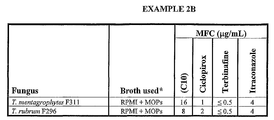
- FIG. 2B displays minimum fungicidal concentration (MFC) for C10 , ciclopirox, terbinafine and itraconazole (comparator drugs) against 2 test strains of fungi.
- MFC minimum fungicidal concentration
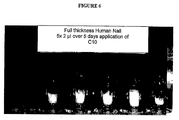
- FIG. 4 displays a comparison of C10 and Ciclopirox Equivalent in Cotton Ball Supporting Bed Samples after 14-day Treatment.
- FIG. 6 displays the results of a 40 ⁇ L/cm 2 aliquot of C10 10% w/v solution applied per day over five days. Zones of inhibition (in the order of the cells shown in the figure) of 100%, 67%, 46%, 57%, 38% and 71% were observed for the growth of T. rubrum. Green arrow indicates the measurement of zone of inhibition.
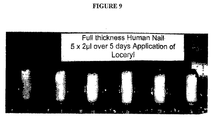
- FIG. 9 displays the results of a 40 ⁇ L/cm 2 aliquot of 5% amorolfine w/v in commercial lacquer applied per day over five days. No zone of inhibition observed; full carpet growth of T. rubrum.
- Compound of the invention refers to the compounds discussed herein, pharmaceutically acceptable salts and prodrugs of these compounds.
- MIC or minimum inhibitory concentration
- substituent groups are specified by their conventional chemical formulae, written from left to right, they equally encompass the chemically identical substituents, which would result from writing the structure from right to left, e.g., -CH 2 O- is intended to also recite -OCH 2 -.
- poly as used herein means at least 2.
- a polyvalent metal ion is a metal ion having a valency of at least 2.
- Moiety refers to the radical of a molecule that is attached to another moiety.
- the symbol whether utilized as a bond or displayed perpendicular to a bond, indicates the point at which the displayed moiety is attached to the remainder of the molecule.
- alkyl by itself or as part of another substituent, means, unless otherwise stated, a straight or branched chain, or cyclic hydrocarbon radical, or combination thereof, which may be fully saturated, mono- or polyunsaturated and can include di- and multivalent radicals, having the number of carbon atoms designated (i.e. C 1 -C 10 means one to ten carbons).
- saturated hydrocarbon radicals include, but are not limited to, groups such as methyl, ethyl, n-propyl, isopropyl, n-butyl, t-butyl, isobutyl, sec-butyl, cyclohexyl, (cyclohexyl)methyl, cyclopropylmethyl, homologs and isomers of, for example, n-pentyl, n-hexyl, n-heptyl, n-octyl, and the like.
- An unsaturated alkyl group is one having one or more double bonds or triple bonds.
- alkyl groups examples include, but are not limited to, vinyl, 2-propenyl, crotyl, 2-isopentenyl, 2-(butadienyl), 2,4-pentadienyl, 3-(1,4-pentadienyl), ethynyl, 1- and 3-propynyl, 3-butynyl, and the higher homologs and isomers.
- alkyl unless otherwise noted, is also meant to include those derivatives of alkyl defined in more detail below, such as “heteroalkyl.” Alkyl groups that are limited to hydrocarbon groups are termed "homoalkyl".
- alkylene by itself or as part of another substituent means a divalent radical derived from an alkane, as exemplified, but not limited, by - CH 2 CH 2 CH 2 CH 2 -, and further includes those groups described below as “heteroalkylene.”
- an alkyl (or alkylene) group will have from 1 to 24 carbon atoms, with those groups having 10 or fewer carbon atoms being preferred in the present invention.
- a “lower alkyl” or “lower alkylene” is a shorter chain alkyl or alkylene group, generally having eight or fewer carbon atoms.
- alkoxy alkylamino and “alkylthio” (or thioalkoxy) are used in their conventional sense, and refer to those alkyl groups attached to the remainder of the molecule via an oxygen atom, an amino group, or a sulfur atom, respectively.
- heteroalkyl by itself or in combination with another term, means, unless otherwise stated, a stable straight or branched chain, or cyclic hydrocarbon radical, or combinations thereof, consisting of the stated number of carbon atoms and at least one heteroatom.
- the heteroatoms can be selected from the group consisting of B, O, N and S, and wherein the nitrogen and sulfur atoms may optionally be oxidized and the nitrogen heteroatom may optionally be quaternized.
- the heteroatom(s) B, O, N and S may be placed at any interior position of the heteroalkyl group or at the position at which the alkyl group is attached to the remainder of the molecule.
- cycloalkyl and “heterocycloalkyl”, by themselves or in combination with other terms, represent, unless otherwise stated, cyclic versions of “alkyl” and “heteroalkyl”, respectively. Additionally, for heterocycloalkyl, a heteroatom can occupy the position at which the heterocycle is attached to the remainder of the molecule. Examples of cycloalkyl include, but are not limited to, cyclopentyl, cyclohexyl, 1-cyclohexenyl, 3-cyclohexenyl, cycloheptyl, and the like.
- halo or halogen
- haloalkyl by themselves or as part of another substituent, mean, unless otherwise stated, a fluorine, chlorine, bromine, or iodine atom.
- terms such as “haloalkyl,” are meant to include monohaloalkyl and polyhaloalkyl.
- halo(C 1 -C 4 )alkyl is mean to include, but not be limited to, trifluoromethyl, 2,2,2-trifluoroethyl, 4-chlorobutyl, 3-bromopropyl, and the like.
- Ring as used herein means a substituted or unsubstituted cycloalkyl, substituted or unsubstituted heterocycloalkyl, substituted or unsubstituted aryl, or substituted or unsubstituted heteroaryl.
- a ring includes fused ring moieties. The number of atoms in a ring is typically defined by the number of members in the ring. For example, a "5- to 7-membered ring” means there are 5 to 7 atoms in the encircling arrangement. The ring optionally included a heteroatom. Thus, the term “5- to 7-membered ring” includes, for example pyridinyl and piperidinyl.
- the term “ring” further includes a ring system comprising more than one "ring", wherein each "ring” is independently defined as above.
- heteroatom includes atoms other than carbon (C) and hydrogen (H). Examples include oxygen (O), nitrogen (N) sulfur (S), silicon (Si), germanium (Ge), aluminum (Al) and boron (B).
- R is a general abbreviation that represents a substituent group that is selected from substituted or unsubstituted alkyl, substituted or unsubstituted heteroalkyl, substituted or unsubstituted aryl, substituted or unsubstituted heteroaryl, substituted or unsubstituted cycloalkyl and substituted or unsubstituted heterocycloalkyl groups.
- Cosmetically effective refers to a material that, when applied to the skin, nail, hair, claw or hoof, produces a desired cosmetic result locally at the place of application of an active ingredient in the material.
- Examples of pharmaceutically acceptable acid addition salts include those derived from inorganic acids like hydrochloric, hydrobromic, nitric, carbonic, monohydrogencarbonic, phosphoric, monohydrogenphosphoric, dihydrogenphosphoric, sulfuric, monohydrogensulfuric, hydriodic, or phosphorous acids and the like, as well as the salts derived from relatively nontoxic organic acids like acetic, propionic, isobutyric, maleic, malonic, benzoic, succinic, suberic, fumaric, lactic, mandelic, phthalic, benzenesulfonic, p-tolylsulfonic, citric, tartaric, methanesulfonic, and the like.
- inorganic acids like hydrochloric, hydrobromic, nitric, carbonic, monohydrogencarbonic, phosphoric, monohydrogenphosphoric, dihydrogenphosphoric, sulfuric, monohydrogensulfuric, hydriodic, or phosphorous acids and
- the present invention provides compounds which are in a prodrug form.
- Prodrugs of the compounds or complexes described herein readily undergo chemical changes under physiological conditions to provide the compounds of the present invention. Additionally, prodrugs can be converted to the compounds of the present invention by chemical or biochemical methods in an ex vivo environment.
- Certain compounds of the present invention can exist in unsolvated forms as well as solvated forms, including hydrated forms. In general, the solvated forms are equivalent to unsolvated forms and are encompassed within the scope of the present invention. Certain compounds of the present invention may exist in multiple crystalline or amorphous forms. In general, all physical forms are equivalent for the uses contemplated by the present invention and are intended to be within the scope of the present invention.
- Certain compounds of the present invention possess asymmetric carbon atoms (optical centers) or double bonds; the racemates, diastereomers, geometric isomers and individual isomers are encompassed within the scope of the present invention.
- the compounds of the present invention may also contain unnatural proportions of atomic isotopes at one or more of the atoms that constitute such compounds.
- the compounds may be radiolabeled with radioactive isotopes, such as for example tritium ( 3 H), iodine-125 ( 125 I) or carbon-14 ( 14 C). All isotopic variations of the compounds of the present invention, whether radioactive or not, are intended to be encompassed within the scope of the present invention.
- pharmaceutically acceptable additive refers to preservatives, antioxidants, fragrances, emulsifiers, dyes and excipients known or used in the field of drug formulation and that do not unduly interfere with the effectiveness of the biological activity of the active agent, and that is sufficiently non-toxic to the host or patient.
- Additives for topical formulations are well-known in the art, and may be added to the topical composition, as long as they are pharmaceutically acceptable and not deleterious to the epithelial cells or their function. Further, they should not cause deterioration in the stability of the composition.
- Topical administration refers to the application of a pharmaceutical agent to the external surface of the skin, nail, hair, claw or hoof, such that the agent crosses the external surface of the skin, nail, hair, claw or hoof and enters the underlying tissues.
- Topical administration includes application of the composition to intact skin, nail, hair, claw or hoof, or to an broken, raw or open wound of skin, nail, hair, claw or hoof.
- Topical administration of a pharmaceutical agent can result in a limited distribution of the agent to the skin and surrounding tissues or, when the agent is removed from the treatment area by the bloodstream, can result in systemic distribution of the agent.
- Absorption through intact skin, nail, hair, claw or hoof can be enhanced by placing the active agent in an appropriate pharmaceutically acceptable vehicle before application to the skin, nail, hair, claw or hoof.
- Passive topical administration may consist of applying the active agent directly to the treatment site in combination with emollients or penetration enhancers.
- transdermal delivery is intended to include delivery by permeation through or past the integument, i.e. skin, nail, hair, claw or hoof.
- R 6a , R 7a , and R 8a are members independently selected from H, OH, NH 2 , SH, substituted or unsubstituted alkyl, substituted or unsubstituted heteroalkyl, substituted or unsubstituted cycloalkyl, substituted or unsubstituted heterocycloalkyl, substituted or unsubstituted aryl, and substituted or unsubstituted heteroaryl.
- the index m1 is an integer selected from 0 and 1.
- A1 is a member selected from CR 9a and N.
- D1 is a member selected from CR 10a and N.
- E1 is a member selected from CR 11a and N.
- G1 is a member selected from CR 12a and N.
- a member selected from R 3a , R 4a and R 5a and a member selected from R 6a , R 7a and R 8a , together with the atoms to which they are attached, are optionally joined to form a 4 to 7 membered ring.
- R 3a and R 4a together with the atoms to which they are attached, are optionally joined to form a 4 to 7 membered ring.
- R 6a and R 7a together with the atoms to which they are attached, are optionally joined to form a 4 to 7 membered ring.
- R 9a and R 10a together with the atoms to which they are attached, are optionally joined to form a 4 to 7 membered ring.
- R 10a and R 11a together with the atoms to which they are attached, are optionally joined to form a 4 to 7 membered ring.
- R 11a and R 12a together with the atoms to which they are attached, are optionally joined to form a 4 to 7 membered ring.
- the aspect has the further proviso that when M1 is oxygen, W1 is CR 5a , J1 is CR 8a , A1 is CR 9a , D1 is CR 10a , E1 is CR 11a , G1 is CR 12a , R 6a , R 7a , R 9a , R 10a , R 11a and R 12a are H, then R 5a and R 8a , together with the atoms to which they are attached, do not form a phenyl ring.
- the aspect has the proviso that when M2 is oxygen, W2 is a member selected from (CR 3b R 4b )n2, wherein n2 is 0, J2 is a member selected from (CR 6b R 7b )m2, wherein m2 is 1, A2 is CR 9b , D2 is CR 10b , E is CR 11b , G is CR 12b , then R 9b is not a member selected from halogen, methyl, ethyl, or optionally joined with R 10b to a form phenyl ring.
- the aspect has the proviso that when M2 is oxygen, W2 is a member selected from (CR 3b R 4b )n, wherein n2 is 0, J2 is a member selected from (CR 6b R 7b )m, wherein m2 is 1, A2 is CR 9b , D2 is CR 10b , E2 is CR 11b , G2 is CR 12b , then R 10b is not a member selected from unsubstituted phenoxy, C(CH 3 ) 3 , halogen, CF 3 , methoxy, ethoxy, or optionally joined with R 9b to form a phenyl ring.
- the following exemplary schemes illustrate methods of preparing boron-containing molecules of the present invention. These methods are not limited to producing the compounds shown, but can be used to prepare a variety of molecules such as the compounds and complexes described herein.
- the compounds of the present invention can also be synthesized by methods not explicitly illustrated in the schemes but are well within the skill of one in the art.
- the compounds can be prepared using readily available materials of known intermediates.
- Step 3 the hydroxyl group of compound 3 is protected with a protecting group which is stable under neutral or basic conditions.
- the protecting group is typically selected from methoxymethyl, ethoxyethyl, tetrahydropyran-2-yl, trimethylsilyl, tert -butyldimethylsilyl, tributylsilyl, combinations thereof and the like.
- methoxymethyl compound 3 is treated with 1 to 3 equivalents of chloromethyl methyl ether in the presence of a base.
- Suitable solvents include tetrahydrofuran, 1,4-dioxane, 1,2-dimethoxyethane, methanol, ethanol, propanol, acetonitrile, acetone, combination thereof and the like.
- Reaction temperatures range from 0°C to the boiling point of the solvent used; preferably between 10 and 40 °C; reaction completion times range from 0.5 to 48 h.
- Steps 3 through 5 convert compound 3 into a compound of Formulae (I) and (II).
- compound (Ia) is converted into its aminoalcohol complex (Ib).
- Compound (Ia) is treated with HOR 1 NR 1a R 1b .
- the aminoalcohol can be used in quantities ranging from 1 to 10 equivalents relative to compound (Ia).
- Suitable solvents include methanol, ethanol, propanol, tetrahydrofuran, acetone, acetonitrile, 1,2-dimethoxyethane, 1,4-dioxane, toluene, N,N -dimethylformamide, water, combination thereof and the like.
- Reaction temperatures range from 20°C to the boiling point of the solvent used; preferably between 50 and 100°C; reaction completion times range from 1 to 24 h.
- the compounds of Formulae (I) or (II) can be converted into hydrates and solvates by methods similar to those described above.
- the microorganism is a member selected from a fungus and a yeast.
- the fungus or yeast is a member selected from Candida species, Trichophyton species, Microsporium species, Aspergillus species, Cryptococcus species, Blastomyces species, Cocciodiodes species, Histoplasma species, Paracoccidiodes species, Phycomycetes species, Malassezia species, Fusarium species, Epidermophyton species, Scytalidium species, Scopulariopsis species, Alternaria species, Penicillium species, Phialophora species, Rhizopus species, Scedosporium species and Zygomycetes class.
- the fungus or yeast is a member selected from Aspergilus fumigatus ( A. fumigatus ) , Blastomyces dermatitidis, Candida Albicans ( C. albicans, both fluconazole sensitive and resistant strains), Candida glabrata ( C. glabrata ) , Candida krusei ( C. krusei ) , Cryptococcus neoformans ( C. neoformans ) , Candida parapsilosis ( C. parapsilosis ) , Candida tropicalis ( C. tropicalis ) , Cocciodiodes immitis, Epidermophyton floccosum ( E.
- the bacterium is a member selected from Propionibacterium acnes; Staphylococcus aureus; Staphylococcus epidermidis, Staphylococcus saprophyticus; Streptococcus pyogenes; Streptococcus agalactiae; Streptococcus pneumoniae; Enterococcus faecalis; Enterococcus faecium; Bacillus anthracis; Mycobacterium avium-intracellulare; Mycobacterium tuberculosis, Acinetobacter baumanii; Corynebacterium diphtheria; Clostridium perfringens; Clostridium botulinum; Clostridium tetani; Neisseria gonorrhoeae; Neisseria meningitidis; Pseudomonas aeruginosa; Legionella pneumophila; Escherichia coli; Yersin
- the microorganism is a virus.
- the virus is a member selected from hepatitis A-B, human rhinoviruses, Yellow fever virus, human respiratory coronaviruses, Severe acute respiratory syndrome (SARS), respiratory syncytial virus, influenza viruses, parainfluenza viruses 1-4, human immunodeficiency virus 1 (HIV-1), human immunodeficiency virus 2 (HIV-2), Herpes simplex virus 1 (HSV-1), Herpes simplex virus 2 (HSV-2), human cytomegalovirus (HCMV), Varicella zoster virus, Epstein-Barr (EBV), polioviruses, coxsackieviruses, echoviruses, rubella virus, neurodermatropic virus, variola virus, papoviruses, rabies virus, dengue virus, West Nile virus and SARS virus.
- the virus is a member selected from picornaviridae, flaviviridae, coronaviridae, paramyxoviridae, orthoinyxoviridae, retroviridae, herpesviridae and hepadnaviridae.
- the virus is a member selected from a virus included in the following table: Table A.
- Viruses Virus Category Pertinent Human Infections RNA Viruses Polio Picomaviridae Human hepatitis A Human rhinovirus Togaviridae and Flaviviridae Rubella - German measles Yellow fever Coronaviridae Human respiratory coronavirus (HCV) Severe acute respiratory syndrome (SAR) Rhabdoviridae Lyssavirus - Rabies Paramyxovirus - Mumps Paramyxoviridae Morbillvirus - measles Pneumovirus - respiratory syncytial virus Orthomyxoviridae Influenza A-C Bunyavirus - Bunyamwera (BUN) Hantavirus - Hantaan (HTN) Bunyaviridae Nairevirus - Crimean-Congo hemorrhagic fever (CCHF) Phlebovirus - Sandfly fever (SFN) Uukuvirus - Uukuniemi (UUK) Rift Valley Fever (RVFN
- the microorganism is a parasite.
- the parasite is a member selected from Plasmodium falciparum, P. vivax, P. ovale P. malariae, P. berghei, Leishmania donovani, L. infantum, L. chagasi, L. mexicana, L. amazonensis, L. venezuelensis, L. tropics, L. major, L. minor, L. aethiopica, L. Biana braziliensis, L. (V.) guyanensis, L. (V.) panamensis, L.
- Distal subungual onychomycosis is the most common presentation of tinea unguium, with the main site of entry through the hyponychium (the thickened epidermis underneath the free distal end of a nail) progressing in time to involve the nail bed and the nail plate.
- Discoloration, onycholysis, and accumulation of subungual debris and nail plate dystrophy characterize the disease.
- the disease adversely affects the quality of life of its victims, with subject complaints ranging from unsightly nails and discomfort with footwear, to more serious complications including secondary bacterial infections.
- onychomycosis has proven to be resistant to most treatments.
- Nail fungal infections reside in an area difficult to access by conventional topical treatment and anti-fungal drugs cannot readily penetrate the nail plate to reach the infection sites under the nail. Therefore, onychomycosis has traditionally been treated by oral administration of anti-fungal drugs; however, clearly this is undesirable due to the potential for side effects of such drugs, in particular those caused by the more potent anti-fungal drugs such as itraconazole and ketoconazole.
- An alternative method of treatment of onychomycosis is by removal of the nail before treating with a topically active anti-fungal agent; such a method of treatment is equally undesirable.
- Systemic antimycotic agents require prolonged use and have the potential for significant side effects. Topical agents have usually been of little benefit, primarily because of poor penetration of the anti-fungal agents into and through the nail mass.
- the invention provides a method of treating or preventing onychomycosis.
- the method includes administering to the animal a therapeutically effective amount of a pharmaceutical formulation of the invention, sufficient to treat or prevent onychomycosis.
- the method includes administering the pharmaceutical formulation of the invention at a site which is a member selected from the skin, nail, hair, hoof, claw and the skin surrounding the nail, hair, hoof and claw.
- the pharmaceutical formulation includes a compound having a structure according to Formula (IIb).
- R 1b is H.
- R 10b and R 11b are H.
- one member selected from R 10b and R 11b is H and the other member selected from R 10b and R 11b is a member selected from halo, methyl, cyano, methoxy, hydroxymethyl and p-cyanophenyloxy.
- R 10b and R 11b are members independently selected from fluoro, chloro, methyl, cyano, methoxy, hydroxymethyl, and p-cyanophenyl.
- R 1b is H;
- R 7b is H;
- R 10b is F and R 11b are H.
- R 11b and R 12b along with the atoms to which they are attached, are joined to form a phenyl group.
- the invention provides a method of treating or preventing an ungual or periungual infection in a mammal. This method comprising administering to the mammal a therapeutically effective amount of a compound of the invention, thereby treating or preventing the ungual or periungual infection.
- the ungual or periungual infection is a member selected from: chloronychia, paronychias, erysipeloid, onychorrhexis, gonorrhea, swimming-pool granuloma, larva migrans, leprosy, Orf nodule, milkers' nodules, herpetic whitlow, acute bacterial perionyxis, chronic perionyxis, sporotrichosis, syphilis, tuberculosis verrucosa cutis, tularemia, tungiasis, peri- and subungual warts, zona, nail dystrophy (trachyonychia), and dermatological diseases with an effect on the nails, such as psoriasis, pustular psoriasis, alopecia aerata, parakeratosis pustulosa, contact dermatosis, Reiter's syndrome, psoriasiform
- the compounds and pharmaceutical formulations of the invention useful for ungual and periungual applications also find application in the cosmetics field, in particular for the treatment of irregularities of the nails, koilonychias, Beau's lines, longitudinal ridging, ingrown nails.
- the invention provides a method of treating a systemic disease.
- the method involves contacting an animal with a compound of the invention.
- the method of delivery for treatment of systemic disesases can be oral, intravenous or transdermal.
- the infection is systemic and is a member selected from candidiasis, aspergillosis, coccidioidomycosis, cryptococcosis, histoplasmosis, blastomycosis, paracoccidioidomycosis, zygomycosis, phaeohyphomycosis and rhinosporidiosis.
- the compounds of the invention are useful for the treatment of diseases of both animals and humans, involving viruses.
- the disease is a member selected from hepatitis A - B - C, yellow fever, respiratory syncytial, influenza, AIDS, herpes simplex, chicken pox, varicella zoster, and Epstein-Barr disease.
- the compounds of the invention are useful for the treatment of diseases of both animals and humans, involving parasites.
- the disease is a member selected from malaria, Chagas' disease, Leishmaniasis, African sleeping sickness (African human trypanosomiasis), giardiasis, toxoplasmosis, amebiasis and cryptosporidiosis.
- an active agent in order for an active agent to be effective once disseminated throughout the infected area, it must be bioavailable to the fungal pathogen and cannot be so tightly and/or preferentially bound to keratin that the drug is rendered inactive.
- the invention provides a method of delivering a compound from the dorsal layer of the nail plate to the nail bed.
- This method comprises contacting the cell with a compound capable of penetrating the nail plate, under conditions sufficient to penetrate the nail.
- the compound has a molecular weight of between about 100 and about 200 Da.
- the compound also has a log P value of between about 1.0 and about 2.6.
- the compound additionally has a water solubility between about 0.1 mg/mL and 1 g/mL octanol/saturated water, thereby delivering said compound.
- the physicochemical properties of the compound of the invention described by quantities predictive for migration of the compound through the nail plate, including, but not limited to, molecular weight, log P and solubility in water, and the like, are effective to provide substantial penetration of the nail plate.
- the compound has a molecular weight of between 130 and 200. In another embodiment of this invention, the compound has a molecular weight of from about 140 to about 200 Da. In another embodiment of this invention, the compound has a molecular weight of from about 170 to about 200 Da. In another embodiment of this invention, the compound has a molecular weight of from about 155 to about 190 Da. In another embodiment of this invention, the compound has a molecular weight of from about 165 to about 185 Da. In another embodiment of this invention, the compound has a molecular weight of from about 145 to about 170 Da. In yet another embodiment the molecular weight is either 151.93 or 168.39 Da.
- the compound has a Log P value of between about -3.5 to about 2.5. In another exemplary embodiment, the compound has a Log P value of from about -1.0 to about 2.5. In another exemplary embodiment, the compound has a Log P value of from about -1.0 to about 2.0. In another exemplary embodiment, the compound has a Log P value of from about -0.5 to about 2.5. In another exemplary embodiment, the compound has a Log P value of from about -0.5 to about 1.5. In another exemplary embodiment, the compound has a Log P value of from about 0.5 to about 2.5. In another exemplary embodiment, the compound has a Log P value of from about 1.0 to about 2.5. In yet another exemplary embodiment, the compound has a Log P value of 1.9 or 2.3.
- Also contemplated by the present invention is a compound with a Log P value less then 2.5, with a molecular weight less than 200 Da, that are still able to penetrate the nail plate.
- the compound has a water solubility between about 0.1 mg/mL to 1 g/mL in octanol saturated water. In one embodiment of the present invention the compound has a water solubility of between 0.1 mg/mL and 100 mg/mL. In another embodiment of this invention, the compound has a water solubility of from about 0.1 mg/mL and 10 mg/mL. In another embodiment of this invention, the compound has a water solubility of from about 0.1 1 mg/mL and 1 mg/mL. In another embodiment of this invention, the compound has a water solubility of from about 5 mg/mL and 1 g/mL. In another embodiment of this invention, the compound has a water solubility of from about 10 mg/mL and 500 g/mL. In another embodiment of this invention, the compound has a water solubility of from about 80 mg/mL and 250 mg/mL.
- the present invention provides a compound with a Log P value selected from a range above, with a molecular weight selected from a range above, that are still able to penetrate the nail plate.
- the present invention provides compounds with a molecular weight selected from a range above, with a water solubility selected from a range above, that are still able to penetrate the nail plate.
- the present invention provides compounds with a log P selected from a range above, with a water solubility selected from a range above, that are still able to penetrate the nail plate.
- the present invention provides compounds with a molecular weight selected from a range above, with a log P selected from a range above, and with a water solubility selected from a range above, that are still able to penetrate the nail plate.
- Compound 3 below is an example of a compound similar in molecular weight to ciclopirox, and like ciclopirox, penetrates the nail plate poorly.
- the topical formulations including a compound of Formulae (I) or (II) described structurally above has a total molecular weight of less than 200 Da, has a Log P of less than 2.5, and a minimum inhibitory concentration against Trichophyton rubrum that is substantially unchanged in the presence of 5% keratin.
- This invention is still further directed to methods for treating a viral infection mediated at least in part by dermatophytes, Trichophyton, Microsporum or Epidermophyton species, or a yeast-like fungi including Candida species, in mammals, which methods comprise administering to a mammal, that has been diagnosed with said viral infection or is at risk of developing said viral infection, a pharmaceutical composition comprising a pharmaceutically acceptable diluent and a therapeutically effective amount of a compound described herein or mixtures of one or more of such compounds.
- the infection is onychomycosis.
- Compounds contemplated by the present invention may have broad spectrum antifungal activity and as such may be candidates for use against other cutaneous fungal infections.
- the methods provided in this aspect of the invention are useful in the penetration of nails and hoofs, as well as the treatment of ungual and periungual conditions.
- the invention is a pharmaceutical formulation which includes: (a) a pharmaceutically acceptable excipient; and (b) a compound of the invention.
- the invention is a pharmaceutical formulation which includes: (a) a pharmaceutically acceptable excipient; and (b) a compound having a structure according to Formula (I), (Ia), (Ib), (Ic), or (Id).
- the invention is a pharmaceutical formulation which includes: (a) a pharmaceutically acceptable excipient; and (b) a compound which has a structure according to Formula (II), (IIa), (IIb), (IIc), (IId).
- the invention is a pharmaceutical formulation comprising: (a) a pharmaceutically acceptable excipient; and (b) a compound having a structure according to Formula II: wherein B is boron.
- R 1b is a member selected from a negative charge, a salt counterion, H, substituted or unsubstituted alkyl, substituted or unsubstituted heteroalkyl, substituted or unsubstituted cycloalkyl, substituted or unsubstituted heterocycloalkyl, substituted or unsubstituted aryl, and substituted or unsubstituted heteroaryl.
- M2 is a member selected from oxygen, sulfur and NR 2b .
- R 2b is a member selected from H, substituted or unsubstituted alkyl, substituted or unsubstituted heteroalkyl, substituted or unsubstituted cycloalkyl, substituted or unsubstituted heterocycloalkyl, substituted or unsubstituted aryl, and substituted or unsubstituted heteroaryl.
- J2 is a member selected from (CR 3b R 4b ) n2 and CR 5b .
- R 3b , R 4b , and R 5b are members independently selected from H, OH, NH 2 , SH, substituted or unsubstituted alkyl, substituted or unsubstituted heteroalkyl, substituted or unsubstituted cycloalkyl, substituted or unsubstituted heterocycloalkyl, substituted or unsubstituted aryl, and substituted or unsubstituted heteroaryl.
- the index n2 is an integer selected from 0 to 2.
- R 6b , R 7b , and R 8b are members independently selected from H, OH, NH 2 , SH, substituted or unsubstituted alkyl, substituted or unsubstituted heteroalkyl, substituted or unsubstituted cycloalkyl, substituted or unsubstituted heterocycloalkyl, substituted or unsubstituted aryl, and substituted or unsubstituted heteroaryl.
- the index m2 is an integer selected from 0 and 1.
- A2 is a member selected from CR 9b and N.
- D2 is a member selected from CR 10b and N.
- E2 is a member selected from CR 11b and N.
- G2 is a member selected from CR 12b and N.
- R 9b , R 10b , R 11b and R 12b are members independently selected from H, OH, NH 2 , SH, substituted or unsubstituted alkyl, substituted or unsubstituted heteroalkyl, substituted or unsubstituted cycloalkyl, substituted or unsubstituted heterocycloalkyl, substituted or unsubstituted aryl, and substituted or unsubstituted heteroaryl.
- the combination of nitrogens (A2 + D2 + E2 + G2) is an integer selected from 0 to 3.
- a member selected from R 3b , R 4b and R 5b and a member selected from R 6b , R 7b and R 8b , together with the atoms to which they are attached, are optionally joined to form a 4 to 7 membered ring.
- R 3b and R 4b together with the atoms to which they are attached, are optionally joined to form a 4 to 7 membered ring.
- R 6b and R 7b together with the atoms to which they are attached, are optionally joined to form a 4 to 7 membered ring.
- R 9b and R 10b together with the atoms to which they are attached, are optionally joined to form a 4 to 7 membered ring.
- R 10b and R 11b together with the atoms to which they are attached, are optionally joined to form a 4 to 7 membered ring.
- R 11b and R 12b together with the atoms to which they are attached, are optionally joined to form a 4 to 7 membered ring.
- the aspect has the proviso that when M2 is oxygen, W2 is a member selected from (CR 3b R 4b ) n2 , wherein n2 is 0, J2 is a member selected from (CR 6b R 7b ) m2 , wherein m2 is 1, A2 is CR 9b , D2 is CR 10b , E is CR 11b , G is CR 12b , then R 9b is not a member selected from halogen, methyl, ethyl, or optionally joined with R 10b to a form phenyl ring.
- the aspect has the proviso that when M2 is oxygen, W2 is a member selected from (CR 3b R 4b ) n , wherein n2 is 0, J2 is a member selected from (CR 6b R 7b ) m , wherein m2 is 1, A2 is CR 9b D2 is CR 10b E2 is CR 11b , G2 is CR 12b , then R 10b is not a member selected from unsubstituted phenoxy, C(CH 3 ) 3 , halogen, CF 3 , methoxy, ethoxy, or optionally joined with R 9b to form a phenyl ring.
- the aspect has the proviso that when M2 is oxygen, W2 is a member selected from (CR 3b R 4b ) n , wherein n2 is 0, J2 is a member selected from (CR 6b R 7b ) m2 , wherein m2 is 1, A2 is CR 9b , D2 is CR 10b , E2 is CR 11b , G2 is CR 12b , then R 11b is not a member selected from halogen or optionally joined with R 10b to form a phenyl ring.
- the aspect has the proviso that when M2 is oxygen, W2 is a member selected from (CR 3b R 4b ) n2 , wherein n2 is 0, J2 is a member selected from (CR 6b R 7b ) m2 , wherein m2 is 1, A2 is CR 9b , D2 is CR 10b , E2 is CR 11b , G2 is CR 12b , then R 12b is not halogen.
- the aspect has the proviso that when M2 is oxygen, W2 is a member selected from (CR 3b R 4b ) n2 , wherein n2 is 0, J2 is a member selected from (CR 6b R 7b ) m2 wherein m2 is 1, A2 is CR 9b , D2 is CR 10b , E2 is CR 11b , G2 is CR 12b , then R 6b is not halophenyl.
- the aspect has the proviso that when M2 is oxygen, W2 is a member selected from (CR 3b R 4b ) n2 , wherein n2 is 0, J2 is a member selected from (CR 6b R 7b ) m2 , wherein m2 is 1, A2 is CR 9b , D2 is CR 10b , E2 is CR 11b , G2 is CR 12b , then R 7b is not halophenyl.
- the aspect has the proviso that when M2 is oxygen, W2 is a member selected from (CR 3b R 4b ) n2 , wherein n2 is 0, J2 is a member selected from (CR 6b R 7b ) m2 , wherein m2 is 1, A2 is CR 9b , D2 is CR 10b , E2 is CR 11b , G2 is CR 12b , then R 6b and R 7b are not halophenyl.
- the aspect has the proviso that when M2 is oxygen, W2 is a member selected from (CR 3b R 4b ) n2 , wherein n2 is 0, J2 is a member selected from (CR 6b R 7b ) m2 , wherein m2 is 1, A2 is CR 9b , D2 is CR 10b , E2 is CR 11b G2 is CR 12b and R 9b , R 10b and R 11b are H, then R 6b , R 7b and R 12b are not H.
- the aspect has the proviso that when M2 is oxygen, W2 is CR 5b , J2 is CR 8b A2 is CR 9b D2 is CR 10b E2 is CR 11b G2 is CR 12b , R 6b R 7b , R 9b , R 10b , R 11b and R 12b are H, then R 5b and R 8b , together with the atoms to which they are attached, do not form a phenyl ring.
- the pharmaceutical formulation has a compound with a structure according to Formula (IIa):
- the pharmaceutical formulation has a compound with a structure according to Formula (IIb): wherein R 7b is a member selected from H, methyl, ethyl and phenyl.
- R 10b is a member selected from H, OH, NH 2 , SH, halogen, substituted or unsubstituted phenoxy, substituted or unsubstituted phenylalkyloxy, substituted or unsubstituted phenylthio and substituted or unsubstituted phenylalkylthio.
- R 11b is a member selected from H, OH, NH 2 , SH, methyl, substituted or unsubstituted phenoxy, substituted or unsubstituted phenylalkyloxy, substituted or unsubstituted phenylthio and substituted or unsubstituted phenylalkylthio.
- R 1b is a member selected from a negative charge, H and a salt counterion.
- R 10b and R 11b are H.
- one member selected from R 10b and R 11b is H and the other member selected from R 10b and R 11b is a member selected from halo, methyl, cyano, methoxy, hydroxymethyl and p-cyanophenyloxy.
- R 10b and R 11b are members independently selected from fluoro, chloro, methyl, cyano, methoxy, hydroxymethyl, and p-cyanophenyl.
- R 1b is a member selected from a negative charge, H and a salt counterion; R 7b is H; R 10b is F and R 11b is H. In another exemplary embodiment, R 11b and R 12b , along with the atoms to which they are attached, are joined to form a phenyl group. In another exemplary embodiment, R 1b is a member selected from a negative charge, H and a salt counterion; R 7b is H; R 10b is 4-cyanophenoxy; and R 11b is H.
- the pharmaceutical formulation has a compound with a structure according to Formula (IIc): wherein R 10b is a member selected from H, halogen, CN and substituted or unsubstituted C 1-4 alkyl.
- R 10b is a member selected from H, halogen, CN and substituted or unsubstituted C 1-4 alkyl.
- the compound has a formulation which is a member selected from:
- the pharmaceutical formulation has a compound with a structure according to Formula (IId): wherein B is boron.
- R x2 is a member selected from substituted or unsubstituted C 1 -C 5 alkyl and substituted or unsubstituted C 1 -C 5 heteroalkyl.
- R y2 and R z2 are members independently selected from H, substituted or unsubstituted alkyl, substituted or unsubstituted heteroalkyl, substituted or unsubstituted cycloalkyl, substituted or unsubstituted heterocycloalkyl, substituted or unsubstituted aryl, and substituted or unsubstituted heteroaryl.
- the pharmaceutical formulations of the invention can take a variety of forms adapted to the chosen route of administration. Those skilled in the art will recognize various synthetic methodologies that may be employed to prepare non-toxic pharmaceutical formulations incorporating the compounds described herein. Those skilled in the art will recognize a wide variety of non-toxic pharmaceutically acceptable solvents that may be used to prepare solvates of the compounds of the invention, such as water, ethanol, propylene glycol, mineral oil, vegetable oil and dimethylsulfoxide (DMSO).
- DMSO dimethylsulfoxide
- compositions of the invention may be administered orally, topically, parenterally, by inhalation or spray or rectally in dosage unit formulations containing conventional non-toxic pharmaceutically acceptable carriers, adjuvants and vehicles. It is further understood that the best method of administration may be a combination of methods. Oral administration in the form of a pill, capsule, elixir, syrup, lozenge, troche, or the like is particularly preferred.
- parenteral as used herein includes subcutaneous injections, intradermal, intravascular (e.g., intravenous), intramuscular, spinal, intrathecal injection or like injection or infusion techniques.
- the pharmaceutical formulations containing compounds of the invention are preferably in a form suitable for oral use, for example, as tablets, troches, lozenges, aqueous or oily suspensions, dispersible powders or granules, emulsion, hard or soft capsules, or syrups or elixirs.
- compositions intended for oral use may be prepared according to any method known in the art for the manufacture of pharmaceutical formulations, and such compositions may contain one or more agents selected from the group consisting of sweetening agents, flavoring agents, coloring agents and preserving agents in order to provide pharmaceutically elegant and palatable preparations.
- Tablets may contain the active ingredient in admixture with non-toxic pharmaceutically acceptable excipients that are suitable for the manufacture of tablets.
- excipients may be for example, inert diluents, such as calcium carbonate, sodium carbonate, lactose, calcium phosphate or sodium phosphate; granulating and disintegrating agents, for example, corn starch, or alginic acid; binding agents, for example starch, gelatin or acacia; and lubricating agents, for example magnesium stearate, stearic acid or talc.
- the tablets may be uncoated or they may be coated by known techniques to delay disintegration and absorption in the gastrointestinal tract and thereby provide a sustained action over a longer period.
- a time delay material such as glyceryl monostearate or glyceryl distearate may be employed.
- Formulations for oral use may also be presented as hard gelatin capsules wherein the active ingredient is mixed with an inert solid diluent, for example, calcium carbonate, calcium phosphate or kaolin, or as soft gelatin capsules wherein the active ingredient is mixed with water or an oil medium, for example peanut oil, liquid paraffin or olive oil.
- an inert solid diluent for example, calcium carbonate, calcium phosphate or kaolin
- water or an oil medium for example peanut oil, liquid paraffin or olive oil.
- Aqueous suspensions contain the active materials in admixture with excipients suitable for the manufacture of aqueous suspensions.
- excipients are suspending agents, for example sodium carboxymethylcellulose, methylcellulose, hydroxypropylmethylcellulose, sodium alginate, polyvinylpyrrolidone, gum tragacanth and gum acacia; and dispersing or wetting agents, which may be a naturally-occurring phosphatide, for example, lecithin, or condensation products of an alkylene oxide with fatty acids, for example polyoxyethylene stearate, or condensation products of ethylene oxide with long chain aliphatic alcohols, for example heptadecaethyleneoxycetanol, or condensation products of ethylene oxide with partial esters derived from fatty acids and a hexitol such as polyoxyethylene sorbitol monooleate, or condensation products of ethylene oxide with partial esters derived from fatty acids and hexitol anhydrides, for example polyethylene sorbitan
- the aqueous suspensions may also contain one or more preservatives, for example ethyl, or n-propyl p-hydroxybenzoate, one or more coloring agents, one or more flavoring agents, and one or more sweetening agents, such as sucrose or saccharin.
- preservatives for example ethyl, or n-propyl p-hydroxybenzoate
- coloring agents for example ethyl, or n-propyl p-hydroxybenzoate
- flavoring agents for example ethyl, or n-propyl p-hydroxybenzoate
- sweetening agents such as sucrose or saccharin.
- Oily suspensions may be formulated by suspending the active ingredients in a vegetable oil, for example arachis oil, olive oil, sesame oil or coconut oil, or in a mineral oil such as liquid paraffin.
- the oily suspensions may contain a thickening agent, for example beeswax, hard paraffin or cetyl alcohol. Sweetening agents such as those set forth above, and flavoring agents may be added to provide palatable oral preparations. These compositions may be preserved by the addition of an anti-oxidant such as ascorbic acid.
- Dispersible powders and granules suitable for preparation of an aqueous suspension by the addition of water provide the active ingredient in admixture with a dispersing or wetting agent, suspending agent and one or more preservatives.
- a dispersing or wetting agent e.g., glycerol, glycerol, glycerol, glycerol, glycerol, glycerol, glycerin, glycerin, glycerin, glycerin, glycerin, sorbitol, sorbitol, sorbitol, sorbitol, sorbitol, sorbitol, sorbitol, sorbitol, sorbitol, sorbitol, glycerol, glycerol, glycerol, glycerol, glycerol, glycerol, glycerol, glycerol, glycerol
- compositions of the invention may also be in the form of oil-in-water emulsions and water-in-oil emulsions.
- the oily phase may be a vegetable oil, for example olive oil or arachis oil, or a mineral oil, for example liquid paraffin or mixtures of these.
- Suitable emulsifying agents may be naturally-occurring gums, for example gum acacia or gum tragacanth; naturally-occurring phosphatides, for example soy bean, lecithin, and esters or partial esters derived from fatty acids and hexitol; anhydrides, for example sorbitan monooleate; and condensation products of the said partial esters with ethylene oxide, for example polyoxyethylene sorbitan monooleate.
- the emulsions may also contain sweetening and flavoring agents.
- Syrups and elixirs may be formulated with sweetening agents, for example glycerol, propylene glycol, sorbitol or sucrose. Such formulations may also contain a demulcent, a preservative, and flavoring and coloring agents.
- the pharmaceutical formulations may be in the form of a sterile injectable aqueous or oleaginous suspension. This suspension may be formulated according to the known art using those suitable dispersing or wetting agents and suspending agents, which have been mentioned above.
- the sterile injectable preparation may also be a sterile injectable solution or suspension in a non-toxic parenterally acceptable diluent or solvent, for example as a solution in 1,3-butanediol.
- Suitable vehicles and solvents that may be employed are water, Ringer's solution and isotonic sodium chloride solution.
- sterile, fixed oils are conventionally employed as a solvent or suspending medium.
- any bland fixed oil may be employed including synthetic mono- or diglycerides.
- fatty acids such as oleic acid find use in the preparation of injectables.
- composition of the invention may also be administered in the form of suppositories, e.g., for rectal administration of the drug.
- suppositories e.g., for rectal administration of the drug.
- These compositions can be prepared by mixing the drug with a suitable non-irritating excipient that is solid at ordinary temperatures but liquid at the rectal temperature and will therefore melt in the rectum to release the drug.
- suitable non-irritating excipient that is solid at ordinary temperatures but liquid at the rectal temperature and will therefore melt in the rectum to release the drug.
- Such materials are cocoa butter and polyethylene glycols.
- compositions can be administered parenterally in a sterile medium.
- the drug depending on the vehicle and concentration used, can either be suspended or dissolved in the vehicle.
- adjuvants such as local anesthetics, preservatives and buffering agents can be dissolved in the vehicle.
- the composition containing the therapeutic compound may be added to the animal's feed or drinking water. Also, it will be convenient to formulate animal feed and drinking water products so that the animal takes in an appropriate quantity of the compound in its diet. It will further be convenient to present the compound in a composition as a premix for addition to the feed or drinking water. The composition can also added as a food or drink supplement for humans.
- Dosage levels of the order of from about 5 mg to about 250 mg per kilogram of body weight per day and more preferably from about 25 mg to about 150 mg per kilogram of body weight per day, are useful in the treatment of the above-indicated conditions.
- the amount of active ingredient that may be combined with the carrier materials to produce a single dosage form will vary depending upon the condition being treated and the particular mode of administration.
- Dosage unit forms will generally contain between from about 1 mg to about 500 mg of an active ingredient.
- Frequency of dosage may also vary depending on the compound used and the particular disease treated. However, for treatment of most disorders, a dosage regimen of 4 times daily or less is preferred. It will be understood, however, that the specific dose level for any particular patient will depend upon a variety of factors including the activity of the specific compound employed, the age, body weight, general health, sex, diet, time of administration, route of administration and rate of excretion, drug combination and the severity of the particular disease undergoing therapy.
- Preferred compounds of the invention will have desirable pharmacological properties that include, but are not limited to, oral bioavailability, low toxicity, low serum protein binding and desirable in vitro and in vivo half-lives. Penetration of the blood brain barrier for compounds used to treat CNS disorders is necessary, while low brain levels of compounds used to treat peripheral disorders are often preferred.
- Assays may be used to predict these desirable pharmacological properties. Assays used to predict bioavailability include transport across human intestinal cell monolayers, including Caco-2 cell monolayers. Toxicity to cultured hepatocyctes may be used to predict compound toxicity. Penetration of the blood brain barrier of a compound in humans may be predicted from the brain levels of laboratory animals that receive the compound intravenously.
- Serum protein binding may be predicted from albumin binding assays. Such assays are described in a review by Oravcova, et al. (Journal of Chromatography B (1996) volume 677, pages 1-27 ).
- Compound half-life is inversely proportional to the frequency of dosage of a compound.
- In vitro half-lives of compounds may be predicted from assays of microsomal half-life as described by Kuhnz and Gieschen (Drug Metabolism and Disposition, (1998) volume 26, pages 1120-1127 ).
- compositions required for use in treatment will vary not only with the particular compound selected but also with the route of administration, the nature of the condition being treated and the age and condition of the patient and will ultimately be at the discretion of the attendant physician or clinician.
- the methods of the invention can be used employed through the topical application of the compounds described herein.
- compositions of the present invention comprises fluid or semi-solid vehicles that may include but are not limited to polymers, thickeners, buffers, neutralizers, chelating agents, preservatives, surfactants or emulsifiers, antioxidants, waxes or oils, emollients, sunscreens, and a solvent or mixed solvent system.
- the solvent or mixed solvent system is important to the formation because it is primarily responsible for dissolving the drug.
- the best solvent or mixed solvent systems are also capable of maintaining clinically relevant levels of the drug in solution despite the addition of a poor solvent to the formulation.
- the topical compositions useful in the subject invention can be made into a wide variety of product types.
- compositions include, but are not limited to, lotions, creams, gels, sticks, sprays, ointments, pastes, foams, mousses, and cleansers.
- product types can comprise several types of carrier systems including, but not limited to particles, nanoparticles, and liposomes.
- disintegrating agents can be added, such as the cross-linked polyvinyl pyrrolidone, agar or alginic acid or a salt thereof such as sodium alginate. Techniques for formulation and administration can be found in Remington: The Science and Practice of Pharmacy, supra. The formulation can be selected to maximize delivery to a desired target site in the body.
- Lotions which are preparations that are to be applied to the skin, nail, hair, claw or hoof surface without friction, are typically liquid or semi-liquid preparations in which finely divided solid, waxy, or liquid are dispersed. Lotions will typically contain suspending agents to produce better dispersions as well as compounds useful for localizing and holding the active agent in contact with the skin, nail, hair, claw or hoof, e.g., methylcellulose, sodium carboxymethyl-cellulose, or the like.
- Creams containing the active agent for delivery according to the present invention are viscous liquid or semisolid emulsions, either oil-in-water or water-in-oil.
- Cream bases are water-washable, and contain an oil phase, an emulsifier and an aqueous phase.
- the oil phase is generally comprised of petrolatum or a fatty alcohol, such as cetyl- or stearyl alcohol; the aqueous phase usually, although not necessarily, exceeds the oil phase in volume, and generally contains a humectant.
- the emulsifier in a cream formulation as explained in Remington: The Science and Practice of Pharmacy, supra, is generally a nonionic, anionic, cationic or amphoteric surfactant.
- Gel formulations can also be used in connection with the present invention. As will be appreciated by those working in the field of topical drug formulation, gels are semisolid. Single-phase gels contain organic macromolecules distributed substantially uniformly throughout the carrier liquid, which is typically aqueous, but also may be a solvent or solvent blend.
- Ointments which are semisolid preparations, are typically based on petrolatum or other petroleum derivatives.
- the specific ointment base to be used is one that provides for optimum delivery for the active agent chosen for a given formulation, and, preferably, provides for other desired characteristics as well, e.g., emolliency or the like.
- an ointment base should be inert, stable, nonirritating and non-sensitizing. As explained in Remington: The Science and Practice of Pharmacy, 19th Ed.
- ointment bases may be grouped in four classes: oleaginous bases; emulsifiable bases; emulsion bases; and water-soluble bases.
- Oleaginous ointment bases include, for example, vegetable oils, fats obtained from animals, and semisolid hydrocarbons obtained from petroleum.
- Emulsifiable ointment bases also known as absorbent ointment bases, contain little or no water and include, for example, hydroxystearin sulfate, anhydrous lanolin and hydrophilic petrolatum.
- Emulsion ointment bases are either water-in-oil (W/O) emulsions or oil-in-water (O/W) emulsions, and include, for example, cetyl alcohol, glyceryl monostearate, lanolin and stearic acid.
- W/O water-in-oil
- O/W oil-in-water
- Preferred water-soluble ointment bases are prepared from polyethylene glycols of varying molecular weight; again, reference may be had to Remington: The Science and Practice of Pharmacy, supra, for further information.
- Sprays generally provide the active agent in an aqueous and/or alcoholic solution which can be misted onto the skin, nail, hair, claw or hoof for delivery.
- Such sprays include those formulated to provide for concentration of the active agent solution at the site of administration following delivery, e.g., the spray solution can be primarily composed of alcohol or other like volatile liquid in which the drug or active agent can be dissolved.
- the carrier evaporates, leaving concentrated active agent at the site of administration.
- the topical pharmaceutical compositions may also comprise suitable solid or gel phase carriers.
- suitable solid or gel phase carriers include but are not limited to calcium carbonate, calcium phosphate, various sugars, starches, cellulose derivatives, gelatin, and polymers such as polyethylene glycols.
- the topical pharmaceutical compositions may also comprise a suitable emulsifier which refers to an agent that enhances or facilitates mixing and suspending oil-in-water or water-in-oil.
- a suitable emulsifier which refers to an agent that enhances or facilitates mixing and suspending oil-in-water or water-in-oil.
- the emulsifying agent used herein may consist of a single emulsifying agent or may be a nonionic, anionic, cationic or amphoteric surfactant or blend of two or more such surfactants; preferred for use herein are nonionic or anionic emulsifiers.
- Such surface-active agents are described in " McCutcheon's Detergent and Emulsifiers," North American Edition, 1980 Annual published by the McCutcheon Division, MC Publishing Company, 175 Rock Road, Glen Rock, N.J. 07452, USA .
- high molecular weight alcohols such as cetearyl alcohol, cetyl alcohol, stearyl alcohol, emulsifying wax, glyceryl monostearate.
- Other examples are ethylene glycol distearate, sorbitan tristearate, propylene glycol monostearate, sorbitan monooleate, sorbitan monostearate (SPAN 60), diethylene glycol monolaurate, sorbitan monopalmitate, sucrose dioleate, sucrose stearate (CRODESTA F-160), polyoxyethylene lauryl ether (BRIJ 30), polyoxyethylene (2) stearyl ether (BRIJ 72), polyoxyethylene (21) stearyl ether (BRIJ 721), polyoxyethylene monostearate (Myrj 45), polyoxyethylene sorbitan monostearate (TWEEN 60), polyoxyethylene sorbitan monooleate (TWEEN 80), polyoxyethylene sorbitan monolaurate (TWEEN 20) and
- nonionic emulsifying agents are those with hydrophile-lipophile balances (HLB) of about 3 to 6 for w/o system and 8 to 18 for o/w system as determined by the method described by Paul L. Lindner in "Emulsions and Emulsion", edited by Kenneth Lissant, published by Dekker, New York, N.Y., 1974, pages 188-190 . More preferred for use herein are one or more nonionic surfactants that produce a system having HLB of about 8 to about 18.
- HLB hydrophile-lipophile balances
- nonionic emulsifiers include but are not limited to "BRIJ 72", the trade name for a polyoxyethylene (2) stearyl ether having an HLB of 4.9; "BRIJ 721 ", the trade name for a polyoxyethylene (21) stearyl ether having an HLB of 15.5, “Brij 30", the trade name for polyoxyethylene lauryl ether having an HLB of 9.7; "Polawax”, the trade name for emulsifying wax having an HLB of 8.0; “Span 60”, the trade name for sorbitan monostearate having an HLB of 4.7; “Crodesta F-160”, the trade name for sucrose stearate” having an HLB of 14.5.
- each emulsifying agent is present in amount from about 0.5 to about 2.5 wt%, preferably 0.5 to 2.0%, more preferably 1.0% or 1.8%.
- the emulsifying agent comprises a mixture of steareth 21 (at about 1.8 %) and steareth 2 (at about 1.0%).
- the topical pharmaceutical compositions may also comprise suitable emollients.
- Emollients are materials used for the prevention or relief of dryness, as well as for the protection of the skin, nail, hair, claw or hoof.
- Useful emollients include, but are not limited to, cetyl alcohol, isopropyl myristate, stearyl alcohol, and the like.
- suitable emollients are known and can be used herein. See e.g., Sagarin, Cosmetics, Science and Technology, 2nd Edition, Vol. 1, pp. 32-43 (1972 ), and U.S. Pat. No. 4,919,934, to Deckner et al., issued Apr. 24, 1990 , both of which are incorporated herein by reference in their entirety.
- These materials are available from Ruger Chemical Co, (Irvington, NJ).
- each emollient is present in an amount from about 0.1 to 15%, preferably 0.1 to about 3.0, more preferably 0.5, 1.0, or 2.5 wt%.
- the emollient is a mixture of cetyl alcohol, isopropyl myristate and stearyl alcohol in a 1/5/2 ratio.
- the emollient may also be a mixture of cetyl alcohol and stearyl alcohol in a 1 /2 ratio.
- the topical pharmaceutical compositions may also comprise suitable antioxidants, substances known to inhibit oxidation.
- Antioxidants suitable for use in accordance with the present invention include, but are not limited to, butylated hydroxytoluene, ascorbic acid, sodium ascorbate, calcium ascorbate, ascorbic palmitate, butylated hydroxyanisole, 2,4,5-trihydroxybutyrophenone, 4-hydroxymethyl-2,6-di- tert -butylphenol, erythorbic acid, gum guaiac, propyl gallate, thiodipropionic acid, dilauryl thiodipropionate, tert-butylhydroquinone and tocopherols such as vitamin E, and the like, including pharmaceutically acceptable salts and esters of these compounds.
- the antioxidant is butylated hydroxytoluene, butylated hydroxyanisole, propyl gallate, ascorbic acid, pharmaceutically acceptable salts or esters thereof, or mixtures thereof.
- the antioxidant is butylated hydroxytoluene. These materials are available from Ruger Chemical Co, (Irvington, NJ).
- the total amount of antioxidant present is from about 0.001 to 0.5 wt%, preferably 0.05 to about 0.5 wt%, more preferably 0.1 %.
- the topical pharmaceutical compositions may also comprise suitable preservatives.
- Preservatives are compounds added to a pharmaceutical formulation to act as an anti-microbial agent.
- preservatives known in the art as being effective and acceptable in parenteral formulations are benzalkonium chloride, benzethonium, chlorohexidine, phenol, m-cresol, benzyl alcohol, methylparaben, propylparaben, chlorobutanol, o-cresol, p-cresol, chlorocresol, phenylmercuric nitrate, thimerosal, benzoic acid, and various mixtures thereof. See, e.g., Wall Later, K.-H., Develop. Biol.
- the preservative is selected from methylparaben, propylparaben and mixtures thereof. These materials are available from Inolex Chemical Co (Philadelphia, PA) or Spectrum Chemicals.
- the total amount of preservative present is from about 0.01 to about 0.5 wt%, preferably from about 0.1 to 0.5%, more preferably from about 0.03 to about 0.15.
- the preservative is a mixture of methylparaben and proplybarben in a 5/1 ratio.
- the amount is usually 15 to 20%.
- the topical pharmaceutical compositions may also comprise suitable chelating agents to form complexes with metal cations that do not cross a lipid bilayer.
- suitable chelating agents include ethylene diamine tetraacetic acid (EDTA), ethylene glycol-bis(beta-aminoethyl ether)-N,N,N',N'-tetraacetic acid (EGTA) and 8-Amino-2-[(2-amino-5-methylphenoxy)methyl]-6-methoxyquinoline-N,N,N',N'-tetraacetic acid, tetrapotassium salt (QUIN-2).
- the chelating agents are EDTA and citric acid. These materials are available from Spectrum Chemicals.
- the total amount of chelating agent present is from about 0.005% to 2.0% by weight, preferably from about 0.05% to about 0.5 wt%, more preferably about 0.1 % by weight.
- the topical pharmaceutical compositions may also comprise suitable neutralizing agents used to adjust the pH of the formulation to within a pharmaceutically acceptable range.
- neutralizing agents include but are not limited to trolamine, tromethamine, sodium hydroxide, hydrochloric acid, citric acid, and acetic acid. Such materials are available from are available from Spectrum Chemicals (Gardena, CA).
- the total amount of neutralizing agent present is from about 0.1 wt to about 10 wt %, preferably 0.1 wt % to about 5.0 wt%, and more preferably about 1.0 wt %.
- the neutralizing agent is generally added in whatever amount is required to bring the formulation to the desired pH.
- the topical pharmaceutical compositions may also comprise suitable viscosity increasing agents. These components are diffusible compounds capable of increasing the viscosity of a polymer-containing solution through the interaction of the agent with the polymer.
- CARBOPOL ULTREZ 10 may be used as a viscosity-increasing agent. These materials are available from Noveon Chemicals, Cleveland, OH.
- the total amount of viscosity increasing agent present is from about 0.25% to about 5.0% by weight, preferably from about 0.25% to about 1.0 wt%, and more preferably from about 0.4% to about 0.6% by weight.
- the topical pharmaceutical compositions may also comprise suitable nail penetration enhancers.
- nail penetration enhancers include mercaptan compounds, sulfites and bisulfites, keratolytic agents and surfactants.
- nail penetration enhancers suitable for use in the invention are described in greater detail in Malhotra et al., J. Pharm. Sci., 91:2, 312-323 (2002 ), which is incorporated herein by reference in its entirety.
- the topical pharmaceutical compositions may also comprise one or more suitable solvents.
- suitable solvents The ability of any solid substance (solute) to dissolve in any liquid substance (solvent) is dependent upon the physical properties of the solute and the solvent. When solutes and solvents have similar physical properties the solubility of the solute in the solvent will be the greatest. This gives rise to the traditional understanding that "like dissolves like.”
- Solvents can be characterized in one extreme as non-polar, lipophilic oils, while in the other extreme as polar hydrophilic solvents. Oily solvents dissolve other non-polar substances by Van der Wals interactions while water and other hydrophilic solvents dissolve polar substances by ionic, dipole, or hydrogen bonding interactions. All solvents can be listed along a continuum from the least polar, i.e.
- hydrocarbons such as decane to the most polar solvent being water.
- a solute will have its greatest solubility in solvents having equivalent polarity.
- less polar solvents will provide improved solubility with the solvent having polarity nearly equivalent to the solute providing maximum solubility.
- Most drugs have intermediate polarity, and thus experience maximum solubility in solvents such as propylene glycol or ethanol, which are significantly less polar than water. If the drug has greater solubility in propylene glycol (for example 8% (w/w)) than in water (for example 0.1 % (w/w)), then addition of water to propylene glycol should decrease the maximum amount of drug solubility for the solvent mixture compared with pure propylene glycol. Addition of a poor solvent to an excellent solvent will decrease the maximum solubility for the blend compared with the maximum solubility in the excellent solvent.
- the concentration of active ingredient in the formulation may be limited by the solubility of the active ingredient in the chosen solvent and/or carrier.
- Non-lipophilic drugs typically display very low solubility in pharmaceutically acceptable solvents and/or carriers.
- the solubility of some compounds in the invention in water is less than 0.00025% wt/wt.
- the solubility of the same compounds in the invention can be less than about 2% wt/wt in either propylene glycol or isopropyl myristate.
- diethylene glycol monoethyl ether (DGME) is the solvent used to dissolve the compounds of Formula (I) of Formula (II).
- the compounds in the invention useful in the present formulation are believed to have a solubility of from about 10% wt/wt to about 25% wt/wt in DGME.
- a DGME water cosolvent system is used to dissolve the compounds of Formula (I) of Formula (II).
- the solvent capacity of DGME drops when water is added; however, the DGME/water cosolvent system can be designed to maintain the desired concentration of from about 0.1 % to about 5% wt/wt active ingredient.
- the active ingredient is present from about 0.5 % to about 3% wt/wt, and more preferably at about 1% wt/wt, in the as-applied topical formulations.
- DGME is less volatile than water, as the topical formulation evaporates upon application, the active agent becomes more soluble in the cream formulation. This increased solubility reduces the likelihood of reduced bioavailability caused by the drug precipitating on the surface of the skin, nail, hair, claw or hoof.
- Liquid forms such as lotions suitable for topical administration or suitable for cosmetic application, may include a suitable aqueous or nonaqueous vehicle with buffers, suspending and dispensing agents, thickeners, penetration enhancers, and the like.
- Solid forms such as creams or pastes or the like may include, for example, any of the following ingredients, water, oil, alcohol or grease as a substrate with surfactant, polymers such as polyethylene glycol, thickeners, solids and the like.
- Liquid or solid formulations may include enhanced delivery technologies such as liposomes, microsomes, microsponges and the like.
- the compounds can be delivered using a sustained-release system, such as semipermeable matrices of solid hydrophobic polymers containing the therapeutic agent.
- sustained-release materials have been established and are well known by those skilled in the art.
- Topical treatment regimens comprise applying the composition directly to the skin, nail, hair, claw or hoof at the application site, from one to several times daily.
- Formulations of the present invention can be used to treat, ameliorate or prevent conditions or symptoms associated with bacterial infections, acne, inflammation and the like.
- the pharmaceutical formulation includes a simple solution.
- the simple solution includes an alcohol.
- the simple solution includes alcohol and water.
- the alcohol is ethanol, ethylene glycol, propanol, polypropylene glycol, isopropanol or butanol.
- the simple solution is a member selected from about 10% polypropylene glycol and about 90% ethanol; about 20% polypropylene glycol and about 80% ethanol; about 30% polypropylene glycol and about 70% ethanol; about 40% polypropylene glycol and about 60% ethanol; about 50% polypropylene glycol and about 50% ethanol; about 60% polypropylene glycol and about 40% ethanol; about 70% polypropylene glycol and about 30% ethanol; about 80% polypropylene glycol and about 20% ethanol; about 90% polypropylene glycol and about 10% ethanol.
- the compound is present in said pharmaceutical formulation in a concentration of from about 0.5% to about 15%. In an exemplary embodiment, the compound is present in said pharmaceutical formulation in a concentration of from about 0.1 % to about 12.5%. In an exemplary embodiment, the compound is present in said pharmaceutical formulation in a concentration of from about 1% to about 10%. In an exemplary embodiment, the compound is present in said pharmaceutical formulation in a concentration of from about 1% to about 5%. In an exemplary embodiment, the compound is present in said pharmaceutical formulation in a concentration of from about 2% to about 8%. In an exemplary embodiment, the compound is present in said pharmaceutical formulation in a concentration of from about 4% to about 9%.
- the following agents are known compounds and are readily available commercially.
- Vitamins include, but are not limited to, Vitamin B, Vitamin E, Vitamin A, Vitamin D, and the like and vitamin derivatives such as tazarotene, calcipotriene, tretinoin, adapalene and the like.
- Sunscreens and or sunburn relief agents include, but are not limited to, PABA, jojoba, aloe, padimate-O, methoxycinnamates, proxamine HCl, lidocaine and the like.
- Sunless tanning agents include, but are not limited to, dihydroxyacetone (DHA).
- Compounds of the present invention can be administered to a patient using a therapeutically effective amount of a compound of Formulae (I) or (II) in any one of the following three lacquer formulations and one solvent formulation.
- the lacquer formulation provides good durability while the solvent formulation provides good ease of use.
- These compounds can also be applied using a spray formulation, paint-on lacquer, drops, or other.
- FIG. 1 A comparison of MIC data for several compounds of the invention against T. rubrum, with and without the presence of 5% keratin, is provided in FIG. 1 .
- (C10) is a novel compound in development for use as a topical antifungal treatment.
- the purpose of this study was to determine the minimum inhibitory concentration (MIC) for (C10) against 19 test strains of fungi including: Aspergilus fumigatus (A. fumigatus), Candida Albicans (C. albicans, both fluconazole sensitive and resistant strains), Candida glabrata (C. glabrata ), Candida krusei ( C. krusei), Cryptococcus neoformans ( C. neoformans ), Candida parapsilosis ( C, parapsilosis ), Candida tropicalis ( C, tropicalis), Epidermophyton floccosum (E.
- Aspergilus fumigatus A. fumigatus
- Candida Albicans C. albicans, both fluconazole sensitive and resistant strains
- Candida glabrata C. glabrata
- Candida krusei C. krusei
- C10 was obtained from Anacor Pharmaceuticals, Inc. (Palo Alto, CA, USA). ATCC strains were obtained from ATCC (Manassas, VA, USA). Ciclopirox-olamine was obtained from Sigma-Aldrich Co. (St. Louis, MO, USA). Terbinafine, fluconazole and itraconazole were synthesized at NAEJA Pharmaceutical Inc. (Edmonton, AB, Canada), experimental procedures and analytical data for these standards are stored in NAEJA archives.
- the plates were inoculated with the fungal suspensions to give a final inoculum size of 0.5-2.5 x 10 3 cells/mL for yeasts or 0.4-5 x 10 4 CFU/mL for filamentous fungi and then incubated for 24-168 h at 35 °C.
- the final concentration of DMSO did not exceed 5%.
- the MIC was defined as the lowest concentration that resulted in over 90% reduction of growth, as compared to a drug-free control.
- the MFC was defined as the lowest concentration that killed over 90% of the fungi, as compared to a drug-free control.
- the results for the MIC of (C10) and reference compounds against 19 strains of fungi are shown in FIG. 2 .
- the results for the MFC of AN2690 against 2 strains of fungi are shown in Table 2.
- (C10) had MIC values ranging from 0.25 - 2 ⁇ g/mL against all fungi tested. Addition of 5% keratin powder to the media did not effect the MIC against T. rubrum.
- (C10) had fungicidal activity against T. rubrum and T. mentagrophytes with MFC values of 8 and 16 ⁇ g/mL, respectively.
- Reference compounds had MIC values in the range defined by NCCLS.
- the solubility, room temperature stability and Log P of C10 was determined by the following methodology.
- Ethanol 200 proof ACS Grade (EM Science, Gibbstown, NJ, USA); Octanol: Octyl alcohol (EM Science, Gibbstown, NJ, USA); Acetonitrile: HPLC Grade (Burdick & Jackson, Muskegon, MI, USA); Ammonium Acetate: lot 3272X49621 (Mallinckrodt, Phillipsburg, NJ, USA); C10 : lot A032-103 (Anacor Pharmaceuticals, Palo Alto, CA, USA); p-Nitrophenol (PNP): lot OGNO1 (TCI America, Portland, OR, USA); Water: Deionized water (from Millipore systems, Billerica, MA, USA)
- N-Octanol and water were mutually pre-saturated by vigorously stirring a mixture of both solvents for up to 12 h and the mixture was allowed to separate. Solubility in each solvent was determined by adding 10 ⁇ L of 20, 40, 200, 1000 and 5000 ⁇ g/mL of C10 in DMSO to the pre-saturated n-octanol or water. After the sample was vortexed for 10 sec, the sample was centrifuged for 10 min at ca. 3000 rpm. A visual inspection was made to determine if the sample was clear or if a pellet had formed on the bottom of the tube.
- C10 (10 ⁇ L of 5000 ⁇ g/mL) was added both to 0.5 mL n-octanol and 0.5 mL water in triplicate. Samples were mixed. At 0 h and 24 h samples were stored at ca. -20 °C. Twenty five ⁇ L of sample was used for analysis.
- octanol sample 25 ⁇ L of ethanol, 25 ⁇ L of water and 300 ⁇ L of acetonitrile containing the internal standard was added.
- water sample 25 ⁇ L of ethanol, 25 ⁇ L of octanol and 300 ⁇ L of acetonitrile containing the internal standard [60 mL of acetonitrile add 6 ⁇ L of PNP (1000 ⁇ g/mL)] was added.
- acetonitrile add 6 ⁇ L of PNP (1000 ⁇ g/mL) was added.
- the calibrators 25 ⁇ L of octanol, 25 ⁇ L of water and 300 pL of acetonitrile containing the internal standard was added. The sample was vortexed for 10 seconds. Two hundred ⁇ L of the organic layer were transferred into a clean deactivated autosampler vial.
- Table 17B shows the results of the log P determination after 1 h and 24 h for C10.
- Table 17B Log P of C10 Sample Conc. in Water ( ⁇ g/mL) Conc. in Octanol ( ⁇ g/mL) LogP 1h-1 1.26 108 1.93 1h-2 1.21 103 1.93 1h-3 1.05 115 2.04 24h-1 1.27 104 1.91 24h-2 1.17 109 1.97 24h-3 1.28 99.0 1.89
- Healthy human finger nail plates were collected from adult human cadavers and stored in a closed container at 0 - 4°C. Before the experiment, the nail plates were gently washed with normal saline to remove any contamination, then rehydrated by placing them for three hours on a cloth wetted with normal saline. The nail samples were randomly selected into four groups.
- Radioactivity of each group is approximately 0.19 ⁇ 0.01 and 0.22 ⁇ 0.03 ⁇ Ci/10 ⁇ L solutions respectively, for 14 C- C10 (group A), and 14 C-ciclopirox (group C).
- a Teflon one-chamber diffusion cell (PermeGear, Inc., Hellertown, PA) was used to hold each nail.
- a small cotton ball wetted with 0.1 mL normal saline was placed in the chamber to serve as a nail bed and provide moisture for the nail plate. Every 3 days, 0.1 mL normal saline was injected through the inlet into the chamber to keep the cotton ball wet.
- the nail plate was placed on a ledge inside the receptor (1.0 cm in diameter and 0.5 cm high). The ventral (inner) surface of the nail was placed face down and rested on the wet cotton ball.
- the cells were placed on a platform in a large glass holding tank filled with saturated sodium phosphate solution to keep the cells at a constant humidity of 40%.
- the nail sampling instrument had two parts, a nail sample stage and a drill.
- the nail sampling stage consists of a copper nail holder, three adjustments, and a nail powder capture. Three adjustments allow movement in vertical direction. The first coarse adjustment (on the top) was for changing the copper cell and taking powder samples from the capture. The other two adjustments (lower) were for sampling process. The second coarse adjustment allowed movement of 25 mm and the fine adjustment provides movement of 0.20 mm.
- the nail powder capture was located between the copper cell and the cutter. The inner shape of the capture was inverted funnel and the end of funnel connects to a vacuum. By placing a circle filter paper inside of the funnel, the nail powder samples were captured on the filter paper during the sampling process.
- the nail plate was transferred from the diffusion cell to a clean copper nail holder for sampling process.
- the nail plate was inverted so that the ventral (nail bed) surface now faced up and the dorsal (outer) dosed surfaced faced down.
- the copper nail holder has an opening as it sits on top of the stage.
- the coarse adjustment was adjusted to move the position of the stage until the nail plate was just touching the tip of the cutter.
- the drill was turned on and the fine adjustment was turned to push the stage closer to the drill, removing a nail core sample.
- approximate 0.40 - 0.50 mm in depth and 7.9 mm in diameter nail pulverized samples were harvested from the center of the ventral (nail bed) surface of the nail.
- the powdered nail samples were collected into a glass scintillation vial and weighted. Aliquots of 5.0 mL Packard soluene-350 (Packard Instrument Company, Meriden, CT) was added to the scintillation vial to dissolve the powder. The upper part, the intermediate and dorsal layers of the center of the nail, including the area of application of the dose was cut in the same diameter as the sampled area and was then placed into a glass scintillation vial with 5.0 mL packard soluene-350. The rest of the nail was also placed in a glass scintillation vial with 5.0 mL packard soluene-350.
- Packard soluene-350 Packard Instrument Company, Meriden, CT
- the amount of nail sample removed was measured by the difference in weight of the nail plate before and after drilling, and collecting the core of powder.
- test chemical equivalent is the sum of the concentration of 14 C-labeled test chemical and the concentration of non-labeled test chemical.
- the value of total amount of test chemical equivalent in each nail sample was calculated from those values based on radioactivity of the sample and the ratio of total mg test chemical equivalent and radioactivity of the test chemical. The data was further normalized by dividing with the weight of the sample. Statistical significant of nail samples from every two groups was analyzed by student t-test.
- ventral / intermediate center Powdered nail sample drilled from the center of the inner surface (facing the nail bed) approximately 0.3 - 0.5 mm in depth to the surface. The area is beneath the dosed site of the nail place but does not include dosed surface (dorsal nail surface).
- Remainder nail The remaining part of the nail that has not been dosed.
- Supporting bed The cotton ball placed within the Teflon chamber of the diffusion cell to provide moisture to the nail plate and also to receive chemicals penetrating through the nail plate.
- Surfacing washing Ethanol (or other organic solvents) and soap/water washing on the surface of the dosed site.
- a plastic ring placed on the top of the nail plate to prevent leakage from the dose site onto rest of the nail plate or inside of the cell chamber.
- Ethanol or other organic solvents
- soap / water wash of the inside of the diffusion cell Ethanol (or other organic solvents) and soap / water wash of the inside of the diffusion cell.
- FIG. 3 shows summarized normalized drug equivalents in each part (layer) of nail samples. After weight normalization, the concentration of C10 equivalent in dorsal/intermediate center, ventral/intermediate center, and remainder nail samples was significantly higher than that of ciclopirox equivalent ( p ⁇ 0.002).
- FIG. 4 shows summarized C10 and ciclopirox equivalent in supporting bed cotton ball samples. Similar to weight normalized C10 equivalent in the nail plate samples, absolute amount of C10 equivalent per cotton ball sample in group A (after 14 day dosing) was significantly higher than that of ciclopirox in group C ( P ⁇ 0.004). The difference of these two test chemicals was 250 times.
- Table 5 shows summarized radioactive recovery from washing, nail samples, and supporting bed cotton ball samples. Cumulative radioactivity recoveries of carbon-14 were 88 ⁇ 9.21, and 89 ⁇ 1.56 percent of applied dose in group A, and group C, respectively. 88% of the radiolabeled material was accounted for.
- Results show that much more amount of [ 14 C]- C10 penetrating into the deeper parts of the nail when compared with [ 14 C]-ciclopirox.
- Tables 3 and 4 show that the amount of [ 14 C]- C10 equivalent in ventral/intermediate center of the nail layer and cotton ball supporting bed in the group A was statistically higher ( p ⁇ 0.002) than group C after a 14-day dosing period.
- a dose of 40 ⁇ L/cm 2 of the test compound C10 in 50:50 propylene glycol:ethyl acetate was applied to a full thickness nail sample each day over a total duration of five days. Both the reference formulations were also applied at the same dose.
- test item C10 in vehicle and the reference formulations Y and Z were tested for their inhibition of Trichophyton rubrum (T. rubrum) growth after penetration through a full thickness human nail using a zone of inhibition measurement.
- Trichophyton rubrum T. rubrum
- FIGs. 5-9 show the results obtained from the TurChub zone of inhibition assays. It can be observed that C10 is a potent antifungal agent, which can penetrate through a full thickness nail to elicit its effect against the target organism T. rubrum. No zones of inhibition were observed with reference formulations Y and Z or with the placebo for C10. The experiment using C10 was repeated for a second time to confirm the result and it can be observed from FIGs. 6 and 7 that C10 shows zones of inhibition of 100%, 67%, 46%, 57%, 38% and 71% in the first experiment and 74%, 86%, 100%, 82%, 100% and 84% in the second experiment. The measurement was taken from the nail to the first point of growth observed.
- test item C10 was found to be a powerful antifungal agent and demonstrated superior results vs. the commercial reference formulations Y and Z. From these experiments it appears that the compound is permeating through a full thickness nail barrier to exhibit the antifungal activity.
- the optimal dose-response range for penetration into the human nail was determined to be between 1% and 15%.
- the experiments to determine the optimal dose-response was conducted as follows.
- Tests at different test compound concentrations were conducted on nails derived from the same cadaver. Cadaver nails were hydrated overnight, cut into 4 equally sized squares and placed onto individual poloxomer supports. Test articles were formulated in a lacquer at 1%, 2.5%, 5%, 7.5%, 10% and 15% w/v. A 40 ⁇ L/cm 2 dose is applied to the center of the nail piece and the nails are left for 24 hrs. Nails are removed from the poloxomer support. Poloxomer support is analyzed for quantity of compound using LC/MS/MS.
Landscapes
- Health & Medical Sciences (AREA)
- Chemical & Material Sciences (AREA)
- Life Sciences & Earth Sciences (AREA)
- Organic Chemistry (AREA)
- Veterinary Medicine (AREA)
- Animal Behavior & Ethology (AREA)
- Medicinal Chemistry (AREA)
- Pharmacology & Pharmacy (AREA)
- General Health & Medical Sciences (AREA)
- Public Health (AREA)
- General Chemical & Material Sciences (AREA)
- Nuclear Medicine, Radiotherapy & Molecular Imaging (AREA)
- Chemical Kinetics & Catalysis (AREA)
- Virology (AREA)
- Oncology (AREA)
- Engineering & Computer Science (AREA)
- Communicable Diseases (AREA)
- Bioinformatics & Cheminformatics (AREA)
- Tropical Medicine & Parasitology (AREA)
- Molecular Biology (AREA)
- Epidemiology (AREA)
- Dermatology (AREA)
- Immunology (AREA)
- Pulmonology (AREA)
- Biotechnology (AREA)
- Ophthalmology & Optometry (AREA)
- Orthopedic Medicine & Surgery (AREA)
- Physical Education & Sports Medicine (AREA)
- Neurology (AREA)
- Endocrinology (AREA)
- Reproductive Health (AREA)
- AIDS & HIV (AREA)
- Pharmaceuticals Containing Other Organic And Inorganic Compounds (AREA)
- Medicinal Preparation (AREA)
- Acyclic And Carbocyclic Compounds In Medicinal Compositions (AREA)
Priority Applications (11)
| Application Number | Priority Date | Filing Date | Title |
|---|---|---|---|
| PL18187390T PL3424932T3 (pl) | 2005-02-16 | 2006-02-16 | Boronoftalidy do zastosowania terapeutycznego |
| EP18187390.2A EP3424932B1 (fr) | 2005-02-16 | 2006-02-16 | Boronophthalides à usage thérapeutique |
| EP15171026.6A EP2987796B1 (fr) | 2005-02-16 | 2006-02-16 | Boronophthalides substitues par halogene pour le traitement d'infections |
| PL15171026T PL2987796T3 (pl) | 2005-02-16 | 2006-02-16 | Fluorowco-podstawione boronoftalidy do leczenia zakażeń |
| PL11154575T PL2343304T3 (pl) | 2005-02-16 | 2006-02-16 | Biobójcze związki boronoftalidowe |
| DK15171026.6T DK2987796T3 (en) | 2005-02-16 | 2006-02-16 | HALOGEN-SUBSTITUTED BORONOPHTHALIDES FOR TREATING INFECTIONS |
| SI200631937T SI2343304T1 (sl) | 2005-02-16 | 2006-02-16 | Biocidne boroftalidne spojine |
| CY20151100569T CY1116454T1 (el) | 2005-02-16 | 2015-07-01 | Ενωσεις βιοκτονου βοριουχου φθαλιδιου |
| CY181100962T CY1120695T1 (el) | 2005-02-16 | 2018-09-18 | Αλογονοϋποκατεστημενα βοριοφθαλιδια για την αντιμετωπιση λοιμωξεων |
| HUS2000019C HUS2000019I1 (hu) | 2005-02-16 | 2020-06-25 | Biocid bór-ftalid (boronophthalide) vegyületek |
| CY20211100432T CY1124503T1 (el) | 2005-02-16 | 2021-05-19 | Βοριοφθαλιδια για θεραπευτικη χρηση |
Applications Claiming Priority (2)
| Application Number | Priority Date | Filing Date | Title |
|---|---|---|---|
| US65406005P | 2005-02-16 | 2005-02-16 | |
| EP06735282.3A EP1853251B1 (fr) | 2005-02-16 | 2006-02-16 | Boronophthalides substitues par halogene pour le traitement d'infections |
Related Parent Applications (2)
| Application Number | Title | Priority Date | Filing Date |
|---|---|---|---|
| EP06735282.3A Division EP1853251B1 (fr) | 2005-02-16 | 2006-02-16 | Boronophthalides substitues par halogene pour le traitement d'infections |
| EP06735282.3 Division | 2006-02-16 |
Related Child Applications (2)
| Application Number | Title | Priority Date | Filing Date |
|---|---|---|---|
| EP15171026.6A Division EP2987796B1 (fr) | 2005-02-16 | 2006-02-16 | Boronophthalides substitues par halogene pour le traitement d'infections |
| EP18187390.2A Division EP3424932B1 (fr) | 2005-02-16 | 2006-02-16 | Boronophthalides à usage thérapeutique |
Publications (2)
| Publication Number | Publication Date |
|---|---|
| EP2343304A1 true EP2343304A1 (fr) | 2011-07-13 |
| EP2343304B1 EP2343304B1 (fr) | 2015-06-10 |
Family
ID=36917059
Family Applications (4)
| Application Number | Title | Priority Date | Filing Date |
|---|---|---|---|
| EP11154575.2A Expired - Lifetime EP2343304B1 (fr) | 2005-02-16 | 2006-02-16 | Composés boronophthalide biocides |
| EP06735282.3A Expired - Lifetime EP1853251B1 (fr) | 2005-02-16 | 2006-02-16 | Boronophthalides substitues par halogene pour le traitement d'infections |
| EP15171026.6A Expired - Lifetime EP2987796B1 (fr) | 2005-02-16 | 2006-02-16 | Boronophthalides substitues par halogene pour le traitement d'infections |
| EP18187390.2A Expired - Lifetime EP3424932B1 (fr) | 2005-02-16 | 2006-02-16 | Boronophthalides à usage thérapeutique |
Family Applications After (3)
| Application Number | Title | Priority Date | Filing Date |
|---|---|---|---|
| EP06735282.3A Expired - Lifetime EP1853251B1 (fr) | 2005-02-16 | 2006-02-16 | Boronophthalides substitues par halogene pour le traitement d'infections |
| EP15171026.6A Expired - Lifetime EP2987796B1 (fr) | 2005-02-16 | 2006-02-16 | Boronophthalides substitues par halogene pour le traitement d'infections |
| EP18187390.2A Expired - Lifetime EP3424932B1 (fr) | 2005-02-16 | 2006-02-16 | Boronophthalides à usage thérapeutique |
Country Status (26)
| Country | Link |
|---|---|
| US (11) | US7582621B2 (fr) |
| EP (4) | EP2343304B1 (fr) |
| JP (6) | JP5038912B2 (fr) |
| KR (4) | KR101426220B1 (fr) |
| CN (2) | CN101914109B (fr) |
| AU (3) | AU2006214247C1 (fr) |
| BE (1) | BE2020C531I2 (fr) |
| BR (1) | BRPI0608431B8 (fr) |
| CA (1) | CA2597982C (fr) |
| CY (3) | CY1120695T1 (fr) |
| DK (3) | DK3424932T3 (fr) |
| ES (4) | ES2540966T3 (fr) |
| FR (1) | FR20C1024I2 (fr) |
| HU (4) | HUE054365T2 (fr) |
| IL (2) | IL207156A (fr) |
| LT (1) | LTC2343304I2 (fr) |
| LU (1) | LUC00157I2 (fr) |
| MX (1) | MX369262B (fr) |
| NL (1) | NL301049I2 (fr) |
| NZ (3) | NZ598441A (fr) |
| PL (4) | PL1853251T3 (fr) |
| PT (4) | PT2343304E (fr) |
| RU (3) | RU2414906C2 (fr) |
| SI (3) | SI2987796T1 (fr) |
| WO (1) | WO2006089067A2 (fr) |
| ZA (4) | ZA200707408B (fr) |
Cited By (8)
| Publication number | Priority date | Publication date | Assignee | Title |
|---|---|---|---|---|
| US9138002B2 (en) | 2013-01-30 | 2015-09-22 | Agrofresh Inc. | Compounds and compositions |
| US9426996B2 (en) | 2013-01-30 | 2016-08-30 | Agrofresh Inc. | Use of benzoxaboroles as volatile antimicrobial agents on meats, plants, or plant parts |
| US9585396B2 (en) | 2013-01-30 | 2017-03-07 | Agrofresh Inc. | Volatile applications against pathogens |
| WO2018115362A1 (fr) * | 2016-12-22 | 2018-06-28 | Laboratorios Lesvi, Sl | Procédé de préparation de 4-[(1-hydroxy-1,3-dihydro -2,1-benzoxaborol-5-yl)oxy]benzonitrile (crisaborole) |
| US10070649B2 (en) | 2013-01-30 | 2018-09-11 | Agrofresh Inc. | Volatile applications against pathogens |
| US10966429B2 (en) | 2016-03-07 | 2021-04-06 | Agrofresh Inc. | Synergistic methods of using benzoxaborole compounds and preservative gases as an antimicrobial for crops |
| US11039617B2 (en) | 2013-01-30 | 2021-06-22 | Agrofresh Inc. | Large scale methods of uniformly coating packaging surfaces with a volatile antimicrobial to preserve food freshness |
| US12065456B2 (en) * | 2019-07-25 | 2024-08-20 | National Institutes Of Health (Nih), U.S. Dept. Of Health And Human Services (Dhhs), U.S. Government | Boron-containing pharmacophore |
Families Citing this family (120)
| Publication number | Priority date | Publication date | Assignee | Title |
|---|---|---|---|---|
| US7820186B2 (en) | 2001-12-21 | 2010-10-26 | Galderma Research & Development | Gel composition for once-daily treatment of common acne comprising a combination of benzoyl peroxide and adapalene and/or adapalene salt |
| JP5038912B2 (ja) | 2005-02-16 | 2012-10-03 | アナコール ファーマシューティカルズ,インコーポレイテッド | ホウ素含有小分子 |
| US7767657B2 (en) | 2005-02-16 | 2010-08-03 | Anacor Pharmaceuticals, Inc. | Boron-containing small molecules |
| US7793666B2 (en) * | 2005-07-28 | 2010-09-14 | Innovation Biomedical Devices, Inc. | Apparatus and method for treatment of infected nail |
| NZ570257A (en) | 2006-02-16 | 2011-11-25 | Anacor Pharmaceuticals Inc | Boron-containing small molecules as anti-inflammatory agents |
| CA2651212A1 (fr) * | 2006-05-02 | 2007-11-15 | Anacor Pharmaceuticals, Inc. | Substances therapeutiques contenant du bore resistant a l'hydrolyse et methodes d'utilisation |
| EP1900378A1 (fr) * | 2006-08-31 | 2008-03-19 | Novartis AG | Compositions pharmaceutiques pour le traitment d'infections fongiques |
| JO3598B1 (ar) * | 2006-10-10 | 2020-07-05 | Infinity Discovery Inc | الاحماض والاسترات البورونية كمثبطات اميد هيدروليز الحامض الدهني |
| FR2910320B1 (fr) * | 2006-12-21 | 2009-02-13 | Galderma Res & Dev S N C Snc | Emulsion comprenant au moins un retinoide et du peroxyde de benzole |
| FR2910321B1 (fr) | 2006-12-21 | 2009-07-10 | Galderma Res & Dev S N C Snc | Gel creme comprenant au moins un retinoide et du peroxyde de benzole |
| JO3396B1 (ar) * | 2007-06-20 | 2019-10-20 | Anacor Pharmaceuticals Inc | جزيئات صغيرة تحتوي على البورون |
| US20090175810A1 (en) | 2008-01-03 | 2009-07-09 | Gareth Winckle | Compositions and methods for treating diseases of the nail |
| JP2015178508A (ja) * | 2008-01-09 | 2015-10-08 | アナコール ファーマシューティカルズ,インコーポレイテッド | 抗炎症剤としてのホウ素含有小分子 |
| WO2009111676A2 (fr) * | 2008-03-06 | 2009-09-11 | Anacor Pharmaceuticals, Inc | Petites molécules contenant du bore utilisées en tant qu'agents anti-inflammatoires |
| BRPI0908565A2 (pt) | 2008-03-06 | 2017-05-23 | Anacor Pharmaceuticals Inc | composto, formulação farmacêutica, métodos para reduzir a liberação de uma citocina ou de uma quimiocina, para tratar uma condição em um animal e para inibir uma fosfodiesterase |
| AU2009233711B2 (en) * | 2008-04-09 | 2015-02-12 | Infinity Pharmaceuticals, Inc | Inhibitors of fatty acid amide hydrolase |
| US20100256092A1 (en) * | 2008-05-12 | 2010-10-07 | Anacor Pharmaceuticals, Inc. | Boron-containing small molecules |
| WO2010011354A2 (fr) * | 2008-07-25 | 2010-01-28 | Innovation Biomedical Devices, Inc. | Administration de médicament de trans-kératine améliorée |
| US8461336B2 (en) | 2008-09-04 | 2013-06-11 | Anacor Pharmaceuticals, Inc. | Boron-containing small molecules |
| EP2348863A4 (fr) * | 2008-09-04 | 2012-03-07 | Anacor Pharmaceuticals Inc | Petites molécules contenant du bore |
| US9493489B2 (en) * | 2008-10-15 | 2016-11-15 | Anacor Pharmaceuticals, Inc. | Boron-containing small molecules as anti-protozoal agents |
| MX2011006334A (es) * | 2008-12-17 | 2011-09-22 | Anacor Pharmaceuticals Inc | Polimorfos de (s)-3-amino-metil-7-(3-hidroxi-propoxi)-3h-benzo-[c] [1,2]-oxaborol-1-ol. |
| WO2010118159A1 (fr) | 2009-04-07 | 2010-10-14 | Infinity Pharmaceuticals, Inc. | Inhibiteurs d'hydrolase d'amide d'acide gras |
| EP2416660B1 (fr) | 2009-04-07 | 2014-07-02 | Infinity Pharmaceuticals, Inc. | Inhibiteurs d'amide d'hydrolase d'acide gras |
| KR20130031233A (ko) | 2009-07-28 | 2013-03-28 | 아나코르 파마슈티칼스 인코포레이티드 | 삼치환된 붕소 함유 분자 |
| WO2011019616A1 (fr) | 2009-08-14 | 2011-02-17 | Anacor Pharmaceuticals, Inc. | Petites molécules contenant du bore à titre d'agents anti-protozoaires |
| WO2011019612A1 (fr) | 2009-08-14 | 2011-02-17 | Anacor Pharmaceuticals, Inc. | Petites molécules contenant du bore en tant qu'agents antiprotozoaires |
| AP4039A (en) | 2009-08-14 | 2017-02-28 | Daitao Chen | Boron-containing small molecules as antiprotozoal agents |
| MX2012002031A (es) * | 2009-08-19 | 2012-07-04 | Anacor Pharmaceuticals Inc | Moleculas pequeñas que contienen boro como agentes antiprotozoarios. |
| WO2011037731A1 (fr) | 2009-09-25 | 2011-03-31 | Anacor Pharmaceuticals, Inc. | Petites molécules contenant du bore |
| US8979820B2 (en) | 2009-10-09 | 2015-03-17 | Cynthia S. Bailey | Method and apparatus for improving the appearance of nails affected by onychomycosis through the topical application of an aqueous solution containing boric acid and camphor or other terpenes |
| WO2011049971A1 (fr) | 2009-10-20 | 2011-04-28 | Anacor Pharmaceuticals, Inc. | Petites molécules contenant du bore comme agents antiprotozoaires |
| US20110212918A1 (en) * | 2009-11-11 | 2011-09-01 | Anacor Pharmaceuticals, Inc. | Boron-containing small molecules |
| WO2011063293A1 (fr) | 2009-11-20 | 2011-05-26 | Anacor Pharmaceuticals, Inc. | Petites molécules contenant du bore en tant qu'agents antihelminthes |
| WO2011094450A1 (fr) | 2010-01-27 | 2011-08-04 | Anacor Pharmaceuticals, Inc | Petites molecules contenant du bore |
| EP2531511A1 (fr) | 2010-02-03 | 2012-12-12 | Infinity Pharmaceuticals, Inc. | Inhibiteurs de l'hydrolase d'amides d'acides gras |
| AP2012006482A0 (en) | 2010-03-19 | 2012-10-31 | Anacor Pharmacueticals Inc | Boron-containing small molecules as anti-protozoalagent |
| US8039494B1 (en) | 2010-07-08 | 2011-10-18 | Dow Pharmaceutical Sciences, Inc. | Compositions and methods for treating diseases of the nail |
| RU2432158C1 (ru) * | 2010-07-28 | 2011-10-27 | Закрытое акционерное общество "Институт прикладной нанотехнологии" | Профилактический бактерицидный лак для обработки ногтей |
| PL3412676T3 (pl) | 2010-08-10 | 2021-04-06 | Melinta Therapeutics, Inc. | Cykliczne pochodne estrowe kwasu boronowego, sposób otrzymywania oraz ich zastosowania terapeutyczne |
| SG10201507032YA (en) | 2010-09-07 | 2015-10-29 | Anacor Pharmaceuticals Inc | Benzoxaborole derivatives for treating bacterial infections |
| WO2013033461A1 (fr) | 2011-08-31 | 2013-03-07 | Rempex Pharmaceuticals, Inc. | Dérivés d'ester d'acide boronique hétérocyclique et leurs utilisations thérapeutiques |
| US9162999B2 (en) | 2011-09-28 | 2015-10-20 | Wisconsin Alumni Research Foundation | Catalytic conversion of cellulose to fuels and chemicals using boronic acids |
| CN103857289A (zh) * | 2011-10-07 | 2014-06-11 | 先正达参股股份有限公司 | 用于保护有用植物或植物繁殖材料的方法 |
| AR088669A1 (es) | 2011-11-21 | 2014-06-25 | Lilly Co Eli | Derivados de dihidrodibenzo[c][1,2]oxaborol y dihidroisoxazol utiles para el control de ectoparasitos |
| AR088668A1 (es) * | 2011-11-21 | 2014-06-25 | Lilly Co Eli | Moleculas pequeñas que contienen boro |
| US9156858B2 (en) | 2012-05-23 | 2015-10-13 | Rempex Pharmaceuticals, Inc. | Boronic acid derivatives and therapeutic uses thereof |
| US10561675B2 (en) | 2012-06-06 | 2020-02-18 | Rempex Pharmaceuticals, Inc. | Cyclic boronic acid ester derivatives and therapeutic uses thereof |
| WO2014007831A1 (fr) | 2012-07-06 | 2014-01-09 | Anacor Pharmaceuticals, Inc. | Petites molécules contenant du bore |
| KR20150103270A (ko) | 2013-01-04 | 2015-09-09 | 렘펙스 파머수티클스 인코퍼레이티드 | 보론산 유도체 및 그의 치료적 용도 |
| EP2941246A4 (fr) | 2013-01-04 | 2016-12-21 | Rempex Pharmaceuticals Inc | Dérivés d'acide boronique et leurs utilisations thérapeutiques |
| US9101638B2 (en) | 2013-01-04 | 2015-08-11 | Rempex Pharmaceuticals, Inc. | Boronic acid derivatives and therapeutic uses thereof |
| US9241947B2 (en) | 2013-01-04 | 2016-01-26 | Rempex Pharmaceuticals, Inc. | Boronic acid derivatives and therapeutic uses thereof |
| US9446131B2 (en) | 2013-01-31 | 2016-09-20 | Merz Pharmaceuticals, Llc | Topical compositions and methods for making and using same |
| US9433680B2 (en) | 2013-01-31 | 2016-09-06 | Merz Pharmaceuticals, Llc | Topical compositions and methods for making and using same |
| US9452173B2 (en) | 2013-01-31 | 2016-09-27 | Merz Pharmaceuticals, Llc | Topical compositions and methods for making and using same |
| US8778365B1 (en) | 2013-01-31 | 2014-07-15 | Merz Pharmaceuticals, Llc | Topical compositions and methods for making and using same |
| AP2015008638A0 (en) | 2013-02-01 | 2015-08-31 | Anacor Pharmaceuticals Inc | Boron-containing small molecules as antiprotozoal agents |
| AR094961A1 (es) | 2013-03-15 | 2015-09-09 | Lilly Co Eli | 1-hidroxi-benzooxaboroles como agentes antiparasitarios |
| AU2014202928B1 (en) * | 2013-06-05 | 2014-09-11 | Agrofresh Inc. | Compounds and compositions |
| CN104224810B (zh) * | 2013-06-20 | 2017-04-19 | 中国科学院上海生命科学研究院 | 一种化合物及其衍生物治疗肺炎球菌感染性疾病的用途 |
| KR101636431B1 (ko) | 2013-07-30 | 2016-07-05 | 동아에스티 주식회사 | 트리사이클릭 벤즈옥사보롤 화합물, 이의 제조방법 및 용도 |
| CN105492388B (zh) | 2013-08-09 | 2018-12-21 | 葛兰素史克知识产权第二有限公司 | 三环苯并氧杂硼杂环戊烯化合物及其用途 |
| KR102320051B1 (ko) | 2013-10-03 | 2021-10-29 | 다우 파마슈티컬 사이언시즈, 인코포레이티드 | 안정화된 에피나코나졸 조성물 |
| CA3052643A1 (fr) | 2013-11-22 | 2015-05-28 | Bausch Health Ireland Limited | Procedes, compositions et dispositifs anti-infectieux |
| MX2016010451A (es) * | 2014-02-17 | 2016-09-22 | Syngenta Participations Ag | Benzoxaboroles microbicidamente activos. |
| WO2015134500A1 (fr) | 2014-03-03 | 2015-09-11 | Cook Medical Technologies Llc | Dilatateur mécanique |
| US9687497B1 (en) | 2014-05-05 | 2017-06-27 | Rempex Pharmaceuticals, Inc. | Salts and polymorphs of cyclic boronic acid ester derivatives and therapeutic uses thereof |
| EP3140310B1 (fr) | 2014-05-05 | 2019-08-07 | Rempex Pharmaceuticals, Inc. | Synthèse de sels boronate et utilisations de ceux-ci |
| JP2015212249A (ja) * | 2014-05-05 | 2015-11-26 | アナコール ファーマシューティカルズ,インコーポレイテッド | 化合物および爪光沢剤 |
| MX382705B (es) * | 2014-05-12 | 2025-03-13 | Agrofresh Inc | Compuesto animicrobiano volátil oxaborol para usarse contra infecciones vaginales por levaduras, pie de atleta, tiña o sus combinaciones. |
| AU2015264418A1 (en) | 2014-05-19 | 2016-11-10 | Rempex Pharmaceuticals, Inc. | Boronic acid derivatives and therapeutic uses thereof |
| US10206937B2 (en) | 2014-07-01 | 2019-02-19 | Qpex Biopharma, Inc. | Boronic acid derivatives and therapeutic uses thereof |
| JP6605513B2 (ja) * | 2014-07-01 | 2019-11-13 | 第一三共株式会社 | 抗菌剤としての三環式ベンゾオキサボロール |
| CN118453831A (zh) | 2014-10-21 | 2024-08-09 | 戴夫生物技术私人有限公司 | 一种治疗方法 |
| WO2016081297A1 (fr) | 2014-11-18 | 2016-05-26 | Rempex Pharmaceuticals, Inc. | Dérivés d'esters d'acide boronique cycliques et leurs utilisations thérapeutiques |
| MA41495A (fr) | 2015-02-12 | 2017-12-19 | Anacor Pharmaceuticals Inc | Composés benzoxaborole et leurs utilisations |
| US20180051041A1 (en) | 2015-03-17 | 2018-02-22 | Rempex Pharmaceuticals, Inc. | Boronic acid derivatives and therapeutic uses thereof |
| KR101580077B1 (ko) * | 2015-03-28 | 2015-12-24 | 한국콜마주식회사 | 시크로피록스 함유 네일락카 조성물 |
| BR112017021478B1 (pt) | 2015-04-09 | 2022-04-19 | The Penn State Research Foundation | Composição antifúngica sinérgica que contém benzoxaborol |
| US10011616B2 (en) | 2015-04-09 | 2018-07-03 | Mmv Medicines For Malaria Venture | Boron-containing small molecules as antiprotozoal1 agents |
| WO2016201440A1 (fr) * | 2015-06-12 | 2016-12-15 | The Regents Of The University Of California | Spiro-indolinones et leurs utilisations thérapeutiques |
| CA3014757C (fr) * | 2015-08-06 | 2020-01-14 | The Penn State Research Foundation | Revetement contenant du benzoxaborole resistant a un champignon susceptible d'etre porte par la cellulose |
| CN106467557B (zh) * | 2015-08-18 | 2019-05-03 | 北京海美桐医药科技有限公司 | 他瓦硼罗的一种制备方法 |
| HUE053115T2 (hu) | 2015-11-30 | 2021-06-28 | Anacor Pharmaceuticals Inc | Topikális gyógyszerészeti formulációk gyulladással összefüggõ állapotok kezelésére |
| CN113321672A (zh) * | 2016-03-02 | 2021-08-31 | 比尔及梅琳达盖茨基金会 | 含硼小分子 |
| US10874679B2 (en) | 2016-03-02 | 2020-12-29 | Bill & Melinda Gates Foundation | Boron-containing small molecules |
| US10611781B2 (en) | 2016-03-02 | 2020-04-07 | Bill And Melinda Gates Foundation | Boron-containing small molecules |
| TW201733442A (zh) | 2016-03-07 | 2017-10-01 | 農業保鮮股份有限公司 | 殺有害生物劑之汽化給予 |
| BR112018073017B1 (pt) * | 2016-05-09 | 2022-06-14 | Anacor Pharmaceuticals, Inc | Forma cristalina i de crisaborol na forma livre, método de preparação e uso da mesma |
| US11447506B2 (en) | 2016-05-09 | 2022-09-20 | Anacor Pharmaceuticals, Inc. | Crystal forms of crisaborole in free form and preparation method and use thereof |
| MY196909A (en) | 2016-06-30 | 2023-05-09 | Qpex Biopharma Inc | Boronic acid derivatives and therapeutic uses thereof |
| WO2018013655A1 (fr) | 2016-07-12 | 2018-01-18 | Pliva Hrvatska D.O.O. | Formes à l'état solide de crisaborole |
| US10743232B1 (en) | 2016-11-15 | 2020-08-11 | Sprint Spectrum L.P. | Controlling handover based on carrier-aggregation policies and UE capabilities |
| GB201701583D0 (en) * | 2017-01-31 | 2017-03-15 | Drug Delivery Solutions Ltd | Topical composition |
| WO2018150327A1 (fr) * | 2017-02-14 | 2018-08-23 | Wavelength Enterprises Ltd | Procédé de production de crisaborole |
| WO2018164959A1 (fr) * | 2017-03-09 | 2018-09-13 | The Penn State Research Foundation | Petites molécules contenant du bore pour inhiber l'activité d'une protéine tyrosine phosphatase de type récepteur |
| WO2018207216A1 (fr) | 2017-05-12 | 2018-11-15 | Biophore India Pharmaceuticals Pvt. Ltd. | Procédé de préparation de 4-[(1-hydroxy-1,3-dihydro-2,1-benzoxaborol-5-yl)oxy]benzonitrile (crisaborole) |
| WO2018216032A1 (fr) * | 2017-05-23 | 2018-11-29 | Msn Laboratories Private Limited, R&D Center | Procédé de préparation de 5-(4-cyanophénoxy)-1,3-dihydro-1-hydroxy- [2,1]-benzoxaborole et ses polymorphes |
| EP3694864B1 (fr) | 2017-10-11 | 2025-03-05 | Qpex Biopharma, Inc. | Dérivés d'acide boronique et synthèse de ces derniers |
| EP4119566A1 (fr) | 2017-11-02 | 2023-01-18 | Halcyon Labs Private Limited | Nouveau procédé de préparation de tavaborole et de ses intermédiaires |
| BR112020010927A2 (pt) | 2017-11-30 | 2020-12-01 | Boragen, Inc. | compostos de benzoxaborol e formulações dos mesmos |
| US10329311B1 (en) | 2017-12-21 | 2019-06-25 | Olon S.P.A. | Process for the preparation of crisaborole |
| CN108148085B (zh) * | 2018-01-04 | 2019-11-01 | 合肥医工医药股份有限公司 | 具有抑制磷酸二酯酶4的化合物、制法及其药物用途 |
| BR112020013794B1 (pt) | 2018-01-09 | 2023-05-02 | Halcyon Labs Private Limited | Processo para a preparação de crisaborola de fórmula (i), compostos, uso de um composto de fórmula (iv), (iii) ou (ii), processo para a preparação de crisaborola altamente pura e sal |
| US10597410B2 (en) | 2018-02-02 | 2020-03-24 | Dipharma Francis S.R.L. | Intermediates and process for the preparation of a crystalline form of a topical anti-inflammatory agent |
| CN108451898A (zh) * | 2018-04-03 | 2018-08-28 | 苏州尚宜佳生物科技有限公司 | 一种克立硼罗温敏凝胶剂及其制备方法和应用 |
| AU2019256351B2 (en) | 2018-04-20 | 2024-02-29 | Qpex Biopharma, Inc. | Boronic acid derivatives and therapeutic uses thereof |
| GB201809378D0 (en) * | 2018-06-07 | 2018-07-25 | Glaxosmithkline Ip Dev Ltd | Novel compounds |
| CN108659024A (zh) * | 2018-07-24 | 2018-10-16 | 武汉轻工大学 | 克立硼罗的制备方法 |
| ES3039445T3 (en) * | 2018-07-31 | 2025-10-21 | Mc2 Therapeutics Ltd | Topical composition |
| WO2020041200A1 (fr) * | 2018-08-18 | 2020-02-27 | Boragen Inc. | Formes solides de benzoxaborole substitué et compositions associées |
| CU20210023A7 (es) * | 2018-10-05 | 2021-10-12 | Pfizer | Inhibidores fenil sustituidos de la piridinil 1,2-oxaborolan-2-ol fosfodiesterasa 4 |
| CN113924084A (zh) | 2019-03-20 | 2022-01-11 | 瑞塔·多布迈尔 | 药物组合物 |
| CN110664756B (zh) * | 2019-10-09 | 2020-11-17 | 吉林大学 | 一种小儿外伤喷雾剂及其制备方法 |
| US12552815B2 (en) | 2020-05-05 | 2026-02-17 | Qpex Biopharma, Inc. | Boronic acid derivatives and synthesis, polymorphic forms, and therapeutic uses thereof |
| EP4204012A1 (fr) | 2020-08-31 | 2023-07-05 | Pfizer Inc. | Procédés de protection de l'arn |
| CN114644645B (zh) * | 2022-03-08 | 2023-05-26 | 南京农业大学 | 3-吲哚取代苯硼唑类化合物及其制备方法和应用 |
| CN119233823A (zh) | 2022-06-23 | 2024-12-31 | 上海盟科药业股份有限公司 | 硼化合物治疗非结核分枝杆菌感染的方法和用途及用于治疗相同疾病的药物组合物 |
| GB202306663D0 (en) | 2023-05-05 | 2023-06-21 | Union Therapeutics As | Combination therapy |
Citations (5)
| Publication number | Priority date | Publication date | Assignee | Title |
|---|---|---|---|---|
| US3873279A (en) * | 1972-08-11 | 1975-03-25 | Ici Ltd | Method for the control of micro-organisms |
| US4602011A (en) | 1975-10-24 | 1986-07-22 | Chapman Chemical Company | Antimicrobial compositions and methods of using same |
| US4766113A (en) | 1975-10-24 | 1988-08-23 | Chapman Chemical Company | Antimicrobial compositions and methods of using same |
| US4919934A (en) | 1989-03-02 | 1990-04-24 | Richardson-Vicks Inc. | Cosmetic sticks |
| US5880188A (en) * | 1994-06-09 | 1999-03-09 | Zeneca Limited | Oxaboroles and salts thereof, and their use as biocides |
Family Cites Families (77)
| Publication number | Priority date | Publication date | Assignee | Title |
|---|---|---|---|---|
| US2260336A (en) | 1939-10-16 | 1941-10-28 | Dow Chemical Co | Method of preparation of organic borates |
| US3686398A (en) | 1970-07-20 | 1972-08-22 | Chevron Res | 10,9-boroxarophenanthrene as fungicides |
| US4716035A (en) | 1985-05-24 | 1987-12-29 | The Procter & Gamble Company | Oral compositions and methods for treating gingivitis |
| US5962498A (en) | 1986-06-11 | 1999-10-05 | Procyon Pharmaceuticals, Inc. | Protein kinase C modulators. C. indolactam structural-types with anti-inflammatory activity |
| US4894220A (en) | 1987-01-30 | 1990-01-16 | Colgate-Palmolive Company | Antibacterial antiplaque oral composition |
| US5514696A (en) * | 1992-05-06 | 1996-05-07 | Bristol-Myers Squibb Co. | Phenyl sulfonamide endothelin antagonists |
| SG47101A1 (en) | 1992-07-31 | 1998-03-20 | Us Bioscience | Crystalline amifostine compositions and methods for the preparation and use of same |
| US5348948A (en) | 1993-05-07 | 1994-09-20 | American Cyanamid Company | 2,2-diaryl-1-(oxa and thia)-2a-azonia-2-borataacenaphthene fungicidal |
| US5348947A (en) | 1993-05-07 | 1994-09-20 | American Cyanamid Company | Diarylboron ester and thioester fungicidal agents |
| US5594151A (en) | 1994-01-28 | 1997-01-14 | Prolinx, Inc. | Phenylboronic acid complexing reagents derived from aminosalicylic acid |
| US5688258A (en) | 1995-05-02 | 1997-11-18 | The Procter & Gamble Company | Disposable cover for an absorbent materials |
| US6083903A (en) * | 1994-10-28 | 2000-07-04 | Leukosite, Inc. | Boronic ester and acid compounds, synthesis and uses |
| GB9500856D0 (en) * | 1995-01-17 | 1995-03-08 | Zeneca Ltd | Composition and use |
| JPH09124620A (ja) * | 1995-10-11 | 1997-05-13 | Bristol Myers Squibb Co | 置換ビフェニルスルホンアミドエンドセリン拮抗剤 |
| US6766183B2 (en) | 1995-11-22 | 2004-07-20 | Medtronic Minimed, Inc. | Long wave fluorophore sensor compounds and other fluorescent sensor compounds in polymers |
| GB9604926D0 (en) | 1996-03-08 | 1996-05-08 | Sandoz Ltd | Organic compounds |
| JP4373497B2 (ja) | 1996-06-19 | 2009-11-25 | ローン−プーラン・ロレ・リミテツド | 置換されたアザビシクロ化合物、ならびにtnfおよびサイクリックampホスホジエステラーゼ産生の阻害剤としてのそれらの使用 |
| US5831046A (en) | 1996-08-05 | 1998-11-03 | Prolinx, Incorporated | Boronic acid-contaning nucleic acid monomers |
| WO1998012206A1 (fr) | 1996-09-19 | 1998-03-26 | The Board Of Trustees Of Leland Stanford Jr. University | Adn methyltransferases et leur utilisation |
| AU4967997A (en) | 1996-12-02 | 1998-06-29 | Chisso Corporation | Optically active nitro alcohol derivatives, optically active amino alcohol derivates, and process for preparing the same |
| US6221640B1 (en) | 1997-05-14 | 2001-04-24 | Cubist Pharmaceuticals, Inc. | Enterococcal aminoacyl-trna synthetase proteins, nucleic acids and strains comprising same |
| US6140328A (en) | 1997-12-12 | 2000-10-31 | Rutgers, The State University Of New Jersey | Heterocyclic cytotoxic agents |
| DE19829947A1 (de) | 1998-07-04 | 2000-01-05 | Bayer Ag | Elektrolumineszierende Anordnungen mit Bor-Chelaten |
| US6462036B1 (en) | 1998-11-06 | 2002-10-08 | Basf Aktiengesellschaft | Tricyclic pyrazole derivatives |
| WO2000027822A2 (fr) | 1998-11-06 | 2000-05-18 | Basf Aktiengesellschaft | Derives de pyrazole tricyclique |
| EP1155698A4 (fr) | 1999-01-29 | 2003-01-15 | Nitto Kasei Co Ltd | Composes organobores presentant une activite de coccidiostats |
| CN1370170A (zh) | 1999-05-25 | 2002-09-18 | 宾夕法尼亚州研究基金会 | Dna甲基转移酶抑制剂 |
| WO2001014578A1 (fr) | 1999-08-25 | 2001-03-01 | Ambergen, Inc. | Techniques de detection, d'analyse et d'isolation de nouvelles proteines |
| US6306628B1 (en) | 1999-08-25 | 2001-10-23 | Ambergen, Incorporated | Methods for the detection, analysis and isolation of Nascent proteins |
| US6921763B2 (en) * | 1999-09-17 | 2005-07-26 | Abbott Laboratories | Pyrazolopyrimidines as therapeutic agents |
| US6369098B1 (en) | 1999-10-05 | 2002-04-09 | Bethesda Pharmaceuticals, Inc. | Dithiolane derivatives |
| EP1246630A4 (fr) * | 2000-01-06 | 2007-04-18 | Marantech Holding Llc | Compositions et procedes destines a faciliter la croissance de la peau et a gerer des affections cutanees |
| US6521619B2 (en) | 2000-06-29 | 2003-02-18 | Icos Corporation | Aryl phenylcyclopropyl sulfide derivatives and their use as cell adhesion inhibiting anti-inflammatory and immune suppressive agents |
| WO2002006316A2 (fr) | 2000-07-14 | 2002-01-24 | Zycos, Inc. | Composes en rapport avec $g(a)-msh et methodes d'utilisation |
| CA2428191A1 (fr) | 2000-11-07 | 2002-05-30 | Bristol-Myers Squibb Company | Derives d'acide utiles comme inhibiteurs de serines proteases |
| DE60124759T2 (de) | 2000-11-30 | 2007-03-15 | The Penn State Research Foundation | Dna methyl transferase inhibitoren |
| DE10110051C2 (de) | 2001-03-02 | 2003-07-03 | Clariant Gmbh | Verfahren zur Herstellung von Boron- und Borinsäuren |
| ES2332090T3 (es) | 2001-04-06 | 2010-01-26 | Biocryst Pharmaceuticals, Inc. | Compuestos biarilicos como inhibidores de serina proteasa. |
| GB0117645D0 (en) | 2001-07-19 | 2001-09-12 | Isis Innovation | Therapeutic stratergies for prevention and treatment of alzheimers disease |
| DE10143979A1 (de) | 2001-09-07 | 2003-03-27 | Clariant Gmbh | Verfahren zur Herstellung von Bisallylboranen und nicht-aromatischen Boronsäuren |
| JPWO2003033002A1 (ja) | 2001-10-11 | 2005-02-03 | 御子柴 克彦 | 細胞内カルシウム濃度上昇抑制剤 |
| AU2003205089B2 (en) | 2002-01-10 | 2007-01-25 | The Pennsylvania State Research Foundation | Methods for the preparation of alkyl diaryl borinates and complexed diarylborinic acids |
| AU2003248921A1 (en) | 2002-07-09 | 2004-01-23 | Point Therapeutics, Inc. | Boroproline compound combination therapy |
| ATE552253T1 (de) | 2002-11-08 | 2012-04-15 | Novartis Int Pharm Ltd | 3-substituierte-6-aryl- pyridin derivate als liganden für c5a-rezeptoren |
| CA2507908A1 (fr) | 2002-12-02 | 2004-06-17 | Solvias Ag | Hydrogenation catalytique de doubles liaisons carbone-heteroatome |
| US7390806B2 (en) | 2002-12-18 | 2008-06-24 | Anacor Pharmaceuticals, Inc. | Antibiotics containing borinic acid complexes and methods of use |
| EP1980564A1 (fr) | 2002-12-18 | 2008-10-15 | Anacor Pharmaceuticals, Inc. | Antibiotiques contenant des complexes d'acide boronique et procédés d'utilisation |
| EP1613625A1 (fr) | 2003-03-14 | 2006-01-11 | AstraZeneca AB | Triazolones fusionnees et utilisations de celles-ci |
| WO2005000200A2 (fr) | 2003-05-09 | 2005-01-06 | Sugen, Inc. | Nouvelles kinases |
| BRPI0411582A (pt) | 2003-06-16 | 2006-08-08 | Anacor Pharmaceuticals Inc | substáncias terapêuticas contendo boro hidroliticamente resistentes e método de uso |
| JP2005022986A (ja) * | 2003-06-30 | 2005-01-27 | Sankyo Co Ltd | Edg受容体拮抗作用を有するアルキン誘導体 |
| HRP20070471T3 (hr) | 2003-07-03 | 2007-11-30 | F. Hoffmann - La Roche Ag | Dvojni nk1/nk3 antagonisti za liječenje shizofrenije |
| CA2552101A1 (fr) | 2003-12-29 | 2005-07-21 | 3M Innovative Properties Company | Composes de cycles accoles imidazo de piperazine, [1,4]diazepane, [1,4]diazocane, et [1,5]diazocane |
| KR101314461B1 (ko) | 2004-05-12 | 2013-10-07 | 더 브리검 앤드 우먼즈 하스피털, 인크. | 감염 치료를 위한 겔솔린의 용도 |
| AR049915A1 (es) | 2004-06-14 | 2006-09-13 | Anacor Pharmaceuticals Inc | Compuestos con contenido de boro y metodos de uso de los mismos |
| KR100624238B1 (ko) | 2004-06-22 | 2006-09-19 | 한국화학연구원 | 알파-아릴메톡시아크릴레이트 유도체를 함유하는 대사성골 질환의 예방 및 치료용 약학 조성물 |
| WO2006062731A1 (fr) | 2004-11-19 | 2006-06-15 | University Of North Texas Health Science Center At Fort Worth | Utilisation de la phenanthroline et de ses derives pour abaisser la tension intraoculaire d'un oeil affecte |
| GB0501944D0 (en) | 2005-01-31 | 2005-03-09 | Univ Cambridge Tech | Compounds for use in chemical detection and/or quantitation |
| US7767657B2 (en) * | 2005-02-16 | 2010-08-03 | Anacor Pharmaceuticals, Inc. | Boron-containing small molecules |
| JP5038912B2 (ja) | 2005-02-16 | 2012-10-03 | アナコール ファーマシューティカルズ,インコーポレイテッド | ホウ素含有小分子 |
| WO2006096131A1 (fr) | 2005-03-08 | 2006-09-14 | Agency For Science, Technology And Research | Catalyseurs chiraux a base de bisoxazoline |
| UY29449A1 (es) | 2005-03-30 | 2006-10-02 | Astion Dev As | Tratamiento de enfermedades dermatólogicas y del prurito. |
| WO2007022437A2 (fr) | 2005-08-18 | 2007-02-22 | Auspex Pharmaceuticals, Inc. | Nouveaux agents thérapeutiques pour le traitement de cancers, de maladies métaboliques et de troubles cutanés |
| NZ570257A (en) | 2006-02-16 | 2011-11-25 | Anacor Pharmaceuticals Inc | Boron-containing small molecules as anti-inflammatory agents |
| US20070286822A1 (en) | 2006-06-12 | 2007-12-13 | Anacor Pharmaceuticals Inc. | Compounds for the Treatment of Periodontal Disease |
| RU2008152367A (ru) | 2006-06-12 | 2010-07-20 | Анакор Фармасьютикалз, Инк. (Us) | Соединения для лечения периодонтального заболевания |
| KR100848491B1 (ko) | 2007-01-16 | 2008-07-28 | 영진약품공업주식회사 | 베타아미노기를 갖는 2-싸이아졸리딘 유도체, 이의약학적으로 허용 가능한 염 및 이의 제조 방법 |
| JO3396B1 (ar) | 2007-06-20 | 2019-10-20 | Anacor Pharmaceuticals Inc | جزيئات صغيرة تحتوي على البورون |
| KR100895300B1 (ko) | 2007-07-20 | 2009-05-07 | 한국전자통신연구원 | 생체신호 측정의복과 생체신호 처리시스템 |
| WO2009111676A2 (fr) | 2008-03-06 | 2009-09-11 | Anacor Pharmaceuticals, Inc | Petites molécules contenant du bore utilisées en tant qu'agents anti-inflammatoires |
| BRPI0908565A2 (pt) | 2008-03-06 | 2017-05-23 | Anacor Pharmaceuticals Inc | composto, formulação farmacêutica, métodos para reduzir a liberação de uma citocina ou de uma quimiocina, para tratar uma condição em um animal e para inibir uma fosfodiesterase |
| US20100256092A1 (en) | 2008-05-12 | 2010-10-07 | Anacor Pharmaceuticals, Inc. | Boron-containing small molecules |
| US8461336B2 (en) | 2008-09-04 | 2013-06-11 | Anacor Pharmaceuticals, Inc. | Boron-containing small molecules |
| US9493489B2 (en) | 2008-10-15 | 2016-11-15 | Anacor Pharmaceuticals, Inc. | Boron-containing small molecules as anti-protozoal agents |
| WO2010045505A1 (fr) | 2008-10-15 | 2010-04-22 | Anacor Pharmaceuticals, Inc | Petites molécules contenant du bore en tant qu’agents antiprotozoaires |
| AR088668A1 (es) * | 2011-11-21 | 2014-06-25 | Lilly Co Eli | Moleculas pequeñas que contienen boro |
| AR088669A1 (es) * | 2011-11-21 | 2014-06-25 | Lilly Co Eli | Derivados de dihidrodibenzo[c][1,2]oxaborol y dihidroisoxazol utiles para el control de ectoparasitos |
-
2006
- 2006-02-16 JP JP2007555382A patent/JP5038912B2/ja not_active Expired - Lifetime
- 2006-02-16 CN CN201010231477.2A patent/CN101914109B/zh not_active Expired - Lifetime
- 2006-02-16 WO PCT/US2006/005542 patent/WO2006089067A2/fr not_active Ceased
- 2006-02-16 US US11/357,687 patent/US7582621B2/en active Active
- 2006-02-16 DK DK18187390.2T patent/DK3424932T3/da active
- 2006-02-16 HU HUE18187390A patent/HUE054365T2/hu unknown
- 2006-02-16 IL IL207156A patent/IL207156A/en active Protection Beyond IP Right Term
- 2006-02-16 DK DK15171026.6T patent/DK2987796T3/en active
- 2006-02-16 DK DK11154575.2T patent/DK2343304T3/en active
- 2006-02-16 ES ES11154575.2T patent/ES2540966T3/es not_active Expired - Lifetime
- 2006-02-16 PT PT111545752T patent/PT2343304E/pt unknown
- 2006-02-16 SI SI200632291T patent/SI2987796T1/sl unknown
- 2006-02-16 KR KR1020137021906A patent/KR101426220B1/ko not_active Expired - Lifetime
- 2006-02-16 PL PL06735282T patent/PL1853251T3/pl unknown
- 2006-02-16 KR KR1020107017187A patent/KR101337068B1/ko not_active Expired - Lifetime
- 2006-02-16 AU AU2006214247A patent/AU2006214247C1/en not_active Expired
- 2006-02-16 HU HUE11154575A patent/HUE026021T2/en unknown
- 2006-02-16 ES ES18187390T patent/ES2872962T3/es not_active Expired - Lifetime
- 2006-02-16 EP EP11154575.2A patent/EP2343304B1/fr not_active Expired - Lifetime
- 2006-02-16 EP EP06735282.3A patent/EP1853251B1/fr not_active Expired - Lifetime
- 2006-02-16 EP EP15171026.6A patent/EP2987796B1/fr not_active Expired - Lifetime
- 2006-02-16 RU RU2007134429/04A patent/RU2414906C2/ru active
- 2006-02-16 PT PT67352823T patent/PT1853251E/pt unknown
- 2006-02-16 KR KR1020137021530A patent/KR101456815B1/ko not_active Expired - Lifetime
- 2006-02-16 BR BRPI0608431A patent/BRPI0608431B8/pt active IP Right Grant
- 2006-02-16 CA CA2597982A patent/CA2597982C/fr active Active
- 2006-02-16 PL PL18187390T patent/PL3424932T3/pl unknown
- 2006-02-16 KR KR1020077021229A patent/KR101337045B1/ko not_active Expired - Lifetime
- 2006-02-16 MX MX2015007465A patent/MX369262B/es unknown
- 2006-02-16 CN CNA2006800119809A patent/CN101160124A/zh active Pending
- 2006-02-16 PT PT181873902T patent/PT3424932T/pt unknown
- 2006-02-16 EP EP18187390.2A patent/EP3424932B1/fr not_active Expired - Lifetime
- 2006-02-16 ES ES15171026.6T patent/ES2686981T3/es not_active Expired - Lifetime
- 2006-02-16 SI SI200632404T patent/SI3424932T1/sl unknown
- 2006-02-16 HU HUE15171026A patent/HUE040060T2/hu unknown
- 2006-02-16 NZ NZ598441A patent/NZ598441A/xx not_active IP Right Cessation
- 2006-02-16 ZA ZA200707408A patent/ZA200707408B/xx unknown
- 2006-02-16 SI SI200631937T patent/SI2343304T1/sl unknown
- 2006-02-16 NZ NZ578297A patent/NZ578297A/en not_active IP Right Cessation
- 2006-02-16 NZ NZ560448A patent/NZ560448A/en not_active IP Right Cessation
- 2006-02-16 PL PL15171026T patent/PL2987796T3/pl unknown
- 2006-02-16 ES ES06735282T patent/ES2414095T3/es not_active Expired - Lifetime
- 2006-02-16 PL PL11154575T patent/PL2343304T3/pl unknown
- 2006-02-16 PT PT15171026T patent/PT2987796T/pt unknown
-
2007
- 2007-08-06 IL IL185080A patent/IL185080A/en active IP Right Grant
-
2009
- 2009-07-21 US US12/507,010 patent/US8039451B2/en active Active
- 2009-08-27 ZA ZA2009/05950A patent/ZA200905950B/en unknown
-
2010
- 2010-07-20 AU AU2010203096A patent/AU2010203096C1/en active Active
- 2010-07-28 ZA ZA2010/05380A patent/ZA201005380B/en unknown
- 2010-08-05 JP JP2010175989A patent/JP6046876B2/ja not_active Expired - Lifetime
- 2010-08-10 RU RU2010133524A patent/RU2606947C2/ru active
-
2011
- 2011-03-01 AU AU2011200994A patent/AU2011200994A1/en not_active Abandoned
- 2011-09-01 US US13/224,252 patent/US8440642B2/en not_active Expired - Lifetime
-
2012
- 2012-09-20 JP JP2012207001A patent/JP2013018778A/ja active Pending
-
2013
- 2013-04-30 US US13/874,329 patent/US8889656B2/en not_active Expired - Lifetime
-
2014
- 2014-01-27 US US14/165,428 patent/US20140142064A1/en not_active Abandoned
- 2014-04-09 JP JP2014080464A patent/JP2014132031A/ja active Pending
- 2014-11-10 US US14/537,694 patent/US20150065459A1/en not_active Abandoned
-
2015
- 2015-09-17 ZA ZA2015/06944A patent/ZA201506944B/en unknown
- 2015-09-24 JP JP2015187408A patent/JP2016020374A/ja active Pending
- 2015-12-21 US US14/977,052 patent/US20160108063A1/en not_active Abandoned
-
2016
- 2016-11-18 US US15/355,813 patent/US20170066788A1/en not_active Abandoned
- 2016-11-23 RU RU2016145916A patent/RU2016145916A/ru not_active Application Discontinuation
-
2017
- 2017-02-15 JP JP2017025789A patent/JP2017105826A/ja active Pending
-
2018
- 2018-09-18 CY CY181100962T patent/CY1120695T1/el unknown
- 2018-10-18 US US16/164,331 patent/US20190048026A1/en not_active Abandoned
-
2019
- 2019-07-12 US US16/510,135 patent/US20190330245A1/en not_active Abandoned
-
2020
- 2020-06-08 LU LU00157C patent/LUC00157I2/fr unknown
- 2020-06-23 FR FR20C1024C patent/FR20C1024I2/fr active Active
- 2020-06-24 NL NL301049C patent/NL301049I2/nl unknown
- 2020-06-25 HU HUS2000019C patent/HUS2000019I1/hu unknown
- 2020-07-30 CY CY2020027C patent/CY2020027I1/el unknown
- 2020-08-14 LT LTPA2020524C patent/LTC2343304I2/lt unknown
- 2020-08-21 BE BE2020C531C patent/BE2020C531I2/nl unknown
- 2020-11-16 US US17/098,636 patent/US20210070780A1/en not_active Abandoned
-
2021
- 2021-05-19 CY CY20211100432T patent/CY1124503T1/el unknown
Patent Citations (5)
| Publication number | Priority date | Publication date | Assignee | Title |
|---|---|---|---|---|
| US3873279A (en) * | 1972-08-11 | 1975-03-25 | Ici Ltd | Method for the control of micro-organisms |
| US4602011A (en) | 1975-10-24 | 1986-07-22 | Chapman Chemical Company | Antimicrobial compositions and methods of using same |
| US4766113A (en) | 1975-10-24 | 1988-08-23 | Chapman Chemical Company | Antimicrobial compositions and methods of using same |
| US4919934A (en) | 1989-03-02 | 1990-04-24 | Richardson-Vicks Inc. | Cosmetic sticks |
| US5880188A (en) * | 1994-06-09 | 1999-03-09 | Zeneca Limited | Oxaboroles and salts thereof, and their use as biocides |
Non-Patent Citations (24)
| Title |
|---|
| "McCutcheon's Detergent and Emulsifiers", 1980, MCCUTCHEON DIVISION, MC PUBLISHING COMPANY |
| "Remington: The Science and Practice of Pharmacy", 1995, MACK PUBLISHING CO., pages: 1399 - 1404 |
| "Remington: The Science and Practice of Pharmacy", 2005, LIPPINCOTT, WILLIAMS & WILKINS |
| BERGE ET AL.: "Pharmaceutical Salts", JOURNAL OF PHARMACEUTICAL SCIENCE, vol. 66, 1977, pages 1 - 19 |
| CAIRNS J F ET AL: "Derivatives of 1,4-xylene-2,5-diboronic acid and 1,4-xylene-2-boronic acid", JOURNAL OF ORGANIC CHEMISTRY, AMERICAN CHEMICAL SOCIETY, EASTON.; US, vol. 29, 1 January 1964 (1964-01-01), pages 2810 - 2812, XP002376199, ISSN: 0022-3263 * |
| DALE, WESLEY J. ET AL: "Substituted styrenes. VII. Syntheses and some reactions of the vinylbenzeneboronic acids", JOURNAL OF ORGANIC CHEMISTRY , 27, 2598-2603 CODEN: JOCEAH; ISSN: 0022-3263, 1962, XP002557301 * |
| FINGL ET AL.: "The Pharmacological Basis of Therapeutics", 1975, pages: 1 |
| HAYNES, R. R. ET AL: "Arylboronic acids. VIII. Reactions of boronophthalide", JOURNAL OF ORGANIC CHEMISTRY , 29(11), 3229-33 CODEN: JOCEAH; ISSN: 0022-3263, 1964, XP002515241 * |
| HUI ET AL., JOURNAL OFPHARMACEUTICAL SCIENCES, vol. 91, no. 1, 2002, pages 189 - 195 |
| IGARASHI, S. ET AL., CHEMICAL & PHARMACEUTICAL BULLETIN, vol. 48, no. 11, 2000, pages 1689 - 1697 |
| KUHNZ; GIESCHEN, DRUG METABOLISM AND DISPOSITION, vol. 26, 1998, pages 1120 - 1127 |
| KULINZ; GLESCHEN, DRUG METABOLISM AND DISPOSITION, vol. 26, 1998, pages 1120 - 1127 |
| LENNARZ W J ET AL: "Arylboronic acids. IV. Reactions of boronophthalide", JOURNAL OF THE AMERICAN CHEMICAL SOCIETY, AMERICAN CHEMICAL SOCIETY, US, vol. 82, 1 January 1960 (1960-01-01), pages 2172 - 2175, XP002376014, ISSN: 0002-7863, DOI: 10.1021/JA01494A021 * |
| LI, F. ET AL., ORGANIC LETTERS, vol. 5, no. 12, 2003, pages 2169 - 2171 |
| MALHOTRA, J. PHARM. SCI., vol. 91, no. 2, 2002, pages 312 - 323 |
| MERRITT ET AL.: "Diffusion Apparatus for Skin Penetration", J OF CONTROLLED RELEASE, vol. 1, 1984, pages 161 - 162 |
| NAKAMURA ET AL., ANTIMICROBIAL AGENTS AND CHEMOTHERAPY, vol. 44, no. 8, 2000, pages 2185 - 2186 |
| ORAVCOVA ET AL., J. CHROMAT., vol. B677, 1996, pages 1 - 27 |
| ORAVCOVA ET AL., JOURNAL OF CHROMATOGRAPHY B, vol. 677, 1996, pages 1 - 27 |
| PAUL L.; LINDNER: "Emulsions and Emulsion", 1974, DEKKER, pages: 188 - 190 |
| PFALLER ET AL.: "NCCLS publication M38-A - Reference Method for Broth Dilution Antifungal Susceptibility Testing of Filamentous Fungi", APPROVED STANDARD. WAYNE, PA: NCCLS, vol. 22, no. 16, 2002 |
| SAGARIN: "Cosmetics, Science and Technology", vol. 1, 1972, pages: 32 - 43 |
| TATSUMI, ANTIMICROBIAL AGENTS AND CHEMOTHERAPY, vol. 46, no. 12, 2002, pages 3797 - 3801 |
| WALLHAUSSER, K.-H., DEVELOP. BIOL. STANDARD, vol. 24, 1974, pages 9 - 28 |
Cited By (14)
| Publication number | Priority date | Publication date | Assignee | Title |
|---|---|---|---|---|
| US12329158B2 (en) | 2013-01-30 | 2025-06-17 | Agrofresh Inc. | Large-scale methods of uniformly coating packaging surfaces with a volatile antimicrobial to preserve food freshness |
| US9426996B2 (en) | 2013-01-30 | 2016-08-30 | Agrofresh Inc. | Use of benzoxaboroles as volatile antimicrobial agents on meats, plants, or plant parts |
| US9585396B2 (en) | 2013-01-30 | 2017-03-07 | Agrofresh Inc. | Volatile applications against pathogens |
| US12490742B2 (en) | 2013-01-30 | 2025-12-09 | Agrofresh Inc. | Volatile applications against pathogens |
| US10070649B2 (en) | 2013-01-30 | 2018-09-11 | Agrofresh Inc. | Volatile applications against pathogens |
| US10765117B2 (en) | 2013-01-30 | 2020-09-08 | Agrofresh Inc. | Volatile applications against pathogens |
| US9138002B2 (en) | 2013-01-30 | 2015-09-22 | Agrofresh Inc. | Compounds and compositions |
| US11039617B2 (en) | 2013-01-30 | 2021-06-22 | Agrofresh Inc. | Large scale methods of uniformly coating packaging surfaces with a volatile antimicrobial to preserve food freshness |
| US11202448B2 (en) | 2013-01-30 | 2021-12-21 | Agrofresh Inc. | Volatile applications against pathogens |
| US11771089B2 (en) | 2013-01-30 | 2023-10-03 | Agrofresh Inc. | Large-scale methods of uniformly coating packaging surfaces with a volatile antimicrobial to preserve food freshness |
| US11917997B2 (en) | 2013-01-30 | 2024-03-05 | Agrofresh Inc. | Volatile applications against pathogens |
| US10966429B2 (en) | 2016-03-07 | 2021-04-06 | Agrofresh Inc. | Synergistic methods of using benzoxaborole compounds and preservative gases as an antimicrobial for crops |
| WO2018115362A1 (fr) * | 2016-12-22 | 2018-06-28 | Laboratorios Lesvi, Sl | Procédé de préparation de 4-[(1-hydroxy-1,3-dihydro -2,1-benzoxaborol-5-yl)oxy]benzonitrile (crisaborole) |
| US12065456B2 (en) * | 2019-07-25 | 2024-08-20 | National Institutes Of Health (Nih), U.S. Dept. Of Health And Human Services (Dhhs), U.S. Government | Boron-containing pharmacophore |
Also Published As
Similar Documents
| Publication | Publication Date | Title |
|---|---|---|
| EP2343304B1 (fr) | Composés boronophthalide biocides | |
| HK40000784B (en) | Boronophthalides for therapeutic use | |
| HK40000784A (en) | Boronophthalides for therapeutic use | |
| HK1160139B (en) | Biocidal boronophthalide compounds | |
| HK1221956B (en) | Halogen-substituted boronophthalides for the treatment of infections | |
| HK1109735B (en) | Halogen-substituted boronophthalides for the treatment of infections | |
| MX2007009625A (en) | Boron-containing small molecules |
Legal Events
| Date | Code | Title | Description |
|---|---|---|---|
| PUAI | Public reference made under article 153(3) epc to a published international application that has entered the european phase |
Free format text: ORIGINAL CODE: 0009012 |
|
| AC | Divisional application: reference to earlier application |
Ref document number: 1853251 Country of ref document: EP Kind code of ref document: P |
|
| AK | Designated contracting states |
Kind code of ref document: A1 Designated state(s): AT BE BG CH CY CZ DE DK EE ES FI FR GB GR HU IE IS IT LI LT LU LV MC NL PL PT RO SE SI SK TR |
|
| AX | Request for extension of the european patent |
Extension state: AL BA HR MK YU |
|
| 17P | Request for examination filed |
Effective date: 20120109 |
|
| REG | Reference to a national code |
Ref country code: HK Ref legal event code: DE Ref document number: 1160139 Country of ref document: HK |
|
| 17Q | First examination report despatched |
Effective date: 20121121 |
|
| GRAP | Despatch of communication of intention to grant a patent |
Free format text: ORIGINAL CODE: EPIDOSNIGR1 |
|
| GRAS | Grant fee paid |
Free format text: ORIGINAL CODE: EPIDOSNIGR3 |
|
| INTG | Intention to grant announced |
Effective date: 20150401 |
|
| GRAA | (expected) grant |
Free format text: ORIGINAL CODE: 0009210 |
|
| AC | Divisional application: reference to earlier application |
Ref document number: 1853251 Country of ref document: EP Kind code of ref document: P |
|
| AK | Designated contracting states |
Kind code of ref document: B1 Designated state(s): AT BE BG CH CY CZ DE DK EE ES FI FR GB GR HU IE IS IT LI LT LU LV MC NL PL PT RO SE SI SK TR |
|
| REG | Reference to a national code |
Ref country code: GB Ref legal event code: FG4D |
|
| REG | Reference to a national code |
Ref country code: CH Ref legal event code: EP |
|
| REG | Reference to a national code |
Ref country code: DK Ref legal event code: T3 Effective date: 20150625 |
|
| REG | Reference to a national code |
Ref country code: RO Ref legal event code: EPE |
|
| REG | Reference to a national code |
Ref country code: SE Ref legal event code: TRGR |
|
| REG | Reference to a national code |
Ref country code: NL Ref legal event code: T3 |
|
| REG | Reference to a national code |
Ref country code: AT Ref legal event code: REF Ref document number: 730861 Country of ref document: AT Kind code of ref document: T Effective date: 20150715 Ref country code: CH Ref legal event code: NV Representative=s name: MICHELI AND CIE SA, CH Ref country code: ES Ref legal event code: FG2A Ref document number: 2540966 Country of ref document: ES Kind code of ref document: T3 Effective date: 20150715 |
|
| REG | Reference to a national code |
Ref country code: DE Ref legal event code: R096 Ref document number: 602006045680 Country of ref document: DE |
|
| REG | Reference to a national code |
Ref country code: IE Ref legal event code: FG4D |
|
| REG | Reference to a national code |
Ref country code: PT Ref legal event code: SC4A Free format text: AVAILABILITY OF NATIONAL TRANSLATION Effective date: 20150706 |
|
| REG | Reference to a national code |
Ref country code: CH Ref legal event code: PCOW Free format text: NEW ADDRESS: 1020 EAST MEADOW CIRCLE, PALO ALTO CA 94303 (US) |
|
| REG | Reference to a national code |
Ref country code: EE Ref legal event code: FG4A Ref document number: E010783 Country of ref document: EE Effective date: 20150703 |
|
| RAP2 | Party data changed (patent owner data changed or rights of a patent transferred) |
Owner name: ANACOR PHARMACEUTICALS, INC. |
|
| REG | Reference to a national code |
Ref country code: PL Ref legal event code: T3 |
|
| REG | Reference to a national code |
Ref country code: EE Ref legal event code: HE1A Ref document number: E010783 Country of ref document: EE |
|
| REG | Reference to a national code |
Ref country code: SI Ref legal event code: SP73 Owner name: ANACOR PHARMACEUTICALS, INC.; US Effective date: 20150911 |
|
| REG | Reference to a national code |
Ref country code: SK Ref legal event code: T3 Ref document number: E 18970 Country of ref document: SK |
|
| REG | Reference to a national code |
Ref country code: GR Ref legal event code: EP Ref document number: 20150401380 Country of ref document: GR Effective date: 20150901 |
|
| REG | Reference to a national code |
Ref country code: HK Ref legal event code: GR Ref document number: 1160139 Country of ref document: HK |
|
| REG | Reference to a national code |
Ref country code: AT Ref legal event code: UEP Ref document number: 730861 Country of ref document: AT Kind code of ref document: T Effective date: 20150610 |
|
| REG | Reference to a national code |
Ref country code: FR Ref legal event code: PLFP Year of fee payment: 11 |
|
| REG | Reference to a national code |
Ref country code: DE Ref legal event code: R097 Ref document number: 602006045680 Country of ref document: DE |
|
| PLBE | No opposition filed within time limit |
Free format text: ORIGINAL CODE: 0009261 |
|
| STAA | Information on the status of an ep patent application or granted ep patent |
Free format text: STATUS: NO OPPOSITION FILED WITHIN TIME LIMIT |
|
| 26N | No opposition filed |
Effective date: 20160311 |
|
| REG | Reference to a national code |
Ref country code: DE Ref legal event code: R082 Ref document number: 602006045680 Country of ref document: DE Representative=s name: KRAUS & WEISERT PATENTANWAELTE PARTGMBB, DE Ref country code: DE Ref legal event code: R082 Ref document number: 602006045680 Country of ref document: DE Representative=s name: HERNANDEZ, YORCK, DIPL.-ING., DE |
|
| REG | Reference to a national code |
Ref country code: HU Ref legal event code: AG4A Ref document number: E026021 Country of ref document: HU |
|
| REG | Reference to a national code |
Ref country code: FR Ref legal event code: PLFP Year of fee payment: 12 |
|
| REG | Reference to a national code |
Ref country code: FR Ref legal event code: PLFP Year of fee payment: 13 |
|
| REG | Reference to a national code |
Ref country code: DK Ref legal event code: CTFF Free format text: PRODUCT NAME: CRISABOROLE, EVENTUELT I FORM AF ET FARMACEUTISK ACCEPTABELT SALT DERAF; REG. NO/DATE: EU/1/19/1421 20200401 Spc suppl protection certif: CA 2020 00022 Filing date: 20200609 Expiry date: 20260216 Extension date: 20310216 |
|
| REG | Reference to a national code |
Ref country code: FR Ref legal event code: CP Free format text: PRODUCT NAME: CRISABOROLE, OPTIONNELLEMENT SOUS LA FORME D'UN SEL PHARMACEUTIQUEMENT ACCEPTABLE; REGISTRATION NO/DATE: EU/1/19/1421 20200401 Spc suppl protection certif: 20C1024 Filing date: 20200623 |
|
| REG | Reference to a national code |
Ref country code: NL Ref legal event code: SPCF Free format text: PRODUCT NAME: CRISABOROLE, DESGEWENST IN DE VORM VAN EEN FARMACEUTISCH AANVAARDBAAR ZOUT; REGISTRATION NO/DATE: EU/1/19/1421 20200401 Spc suppl protection certif: 301049 Filing date: 20200624 Expiry date: 20260215 Extension date: 20310215 |
|
| REG | Reference to a national code |
Ref country code: SE Ref legal event code: SPCF Free format text: PRODUCT NAME: CRISABOROLE, OPTIONALLY IN THE FORM OF PHARMACEUTICALLY ACCEPTABLE SALT; REG. NO/DATE: EU/1/19/1421 20200401 Spc suppl protection certif: 2090017-1 |
|
| REG | Reference to a national code |
Ref country code: GB Ref legal event code: CTFF Free format text: PRODUCT NAME: CRISABOROLE, OPTIONALLY IN THE FORM OF A PHARMACEUTICALLY ACCEPTABLE SALT; REGISTERED: UK EU/1/19/1421 20200401 Spc suppl protection certif: SPC/GB20/025 Filing date: 20200601 |
|
| REG | Reference to a national code |
Ref country code: LU Ref legal event code: HC Owner name: ANACOR PHARMACEUTICALS, INC.; US Free format text: FORMER OWNER: ANACOR PHARMACEUTICALS INC. Effective date: 20200608 Ref country code: LU Ref legal event code: SPCF Free format text: PRODUCT NAME: CRISABOROLE, EVENTUELLEMENT SOUS LA FORME D'UN SEL PHARMACEUTIQUEMENT ACCEPTABLE (CONFORME AUX REVENDICATIONS 30 ET 33 DU BREVET DE BASE); AUTHORISATION NUMBER AND DATE: EU/1/19/1421 20200401 Spc suppl protection certif: LUC00157 Filing date: 20200608 Expiry date: 20260216 Extension date: 20310216 |
|
| REG | Reference to a national code |
Ref country code: FI Ref legal event code: SPCF Spc suppl protection certif: C20200030 Ref country code: IT Ref legal event code: SPCF Ref document number: 502015000031450 Country of ref document: IT Free format text: PRODUCT NAME: CRISABOROLO, OPZIONALMENTE NELLA FORMA DI UN SALE FARMACEUTICAMENTE ACCETTABILE(STAQUIS); AUTHORISATION NUMBER(S) AND DATE(S): EU/1/19/1421, 20200401 Spc suppl protection certif: 132020000000082 |
|
| REG | Reference to a national code |
Ref country code: IE Ref legal event code: SPCF Free format text: PRODUCT NAME: CRISABOROLE, OPTIONALLY IN THE FORM OF A PHARMACEUTICALLY ACCEPTABLE SALT; REGISTRATION NO/DATE: EU/1/19/1421/001 EU/1/19/1421/004 20200327 Spc suppl protection certif: 2020/024 Filing date: 20200629 |
|
| REG | Reference to a national code |
Ref country code: DE Ref legal event code: R082 Ref document number: 602006045680 Country of ref document: DE Representative=s name: KRAUS & LEDERER PARTGMBB, DE Ref country code: DE Ref legal event code: R082 Ref document number: 602006045680 Country of ref document: DE Representative=s name: KRAUS & WEISERT PATENTANWAELTE PARTGMBB, DE |
|
| REG | Reference to a national code |
Ref country code: HU Ref legal event code: AA1S Ref document number: E026021 Country of ref document: HU Spc suppl protection certif: S2000019 Filing date: 20200625 |
|
| REG | Reference to a national code |
Ref country code: IT Ref legal event code: SPCG Ref document number: 502015000031450 Country of ref document: IT Free format text: PRODUCT NAME: CRISABOROLO, OPZIONALMENTE NELLA FORMA DI UN SALE FARMACEUTICAMENTE ACCETTABILE(STAQUIS); AUTHORISATION NUMBER(S) AND DATE(S): EU/1/19/1421, 20200401 Spc suppl protection certif: 132020000000082 Extension date: 20310216 |
|
| REG | Reference to a national code |
Ref country code: DE Ref legal event code: R081 Ref document number: 602006045680 Country of ref document: DE Owner name: ANACOR PHARMACEUTICALS, LLC (N.D.GES.D. STAATE, US Free format text: FORMER OWNER: ANACOR PHARMACEUTICALS, INC., PALO ALTO, CALIF., US Ref country code: DE Ref legal event code: R081 Ref document number: 602006045680 Country of ref document: DE Owner name: ANACOR PHARMACEUTICALS, INC., NEW YORK, US Free format text: FORMER OWNER: ANACOR PHARMACEUTICALS, INC., PALO ALTO, CALIF., US Ref country code: DE Ref legal event code: R082 Ref document number: 602006045680 Country of ref document: DE Representative=s name: KRAUS & WEISERT PATENTANWAELTE PARTGMBB, DE |
|
| REG | Reference to a national code |
Ref country code: ES Ref legal event code: SPCF Free format text: PRODUCT NAME: CRISABOROL, OPCIONALMENTE EN FORMA DE UNA SAL FARMACEUTICAMENTE ACEPTABLE; NATIONAL AUTHORISATION NUMBER: EU/1/19/1421; DATE OF AUTHORISATION: 20200327; NUMBER OF FIRST AUTHORISATION IN EUROPEAN ECONOMIC AREA (EEA): EU/1/19/1421; DATE OF FIRST AUTHORISATION IN EEA: 20200327 Spc suppl protection certif: C202030031 Effective date: 20200625 |
|
| REG | Reference to a national code |
Ref country code: LT Ref legal event code: SPCF Free format text: PRODUCT NAME: KRISABOROLAS, PASIRINKTINAI FARMACINIU POZIURIU PRIIMTINOS DRUSKOS FORMOJE; REGISTRATION NO/DATE: EU/1/19/1421 20200327 Spc suppl protection certif: PA2020524 Filing date: 20200814 Expiry date: 20260216 |
|
| REG | Reference to a national code |
Ref country code: EE Ref legal event code: HC1A Ref document number: E010783 Country of ref document: EE |
|
| REG | Reference to a national code |
Ref country code: NL Ref legal event code: SPCG Free format text: PRODUCT NAME: CRISABOROLE, DESGEWENST IN DE VORM VAN EEN FARMACEUTISCH AANVAARDBAAR ZOUT; REGISTRATION NO/DATE: EU/1/19/1421 20200401 Spc suppl protection certif: 301049 Filing date: 20200624 Expiry date: 20260215 Extension date: 20310215 Effective date: 20200910 |
|
| REG | Reference to a national code |
Ref country code: DE Ref legal event code: R065 Ref document number: 602006045680 Country of ref document: DE Free format text: PRODUCT NAME: CRISABOROL, GEGEBENENFALLS IN FORM EINES PHARMAZEUTISCH ANNEHMBAREN SALZES DAVON; REGISTRATION NO/DATE: EU/1/19/1421 20200327 Spc suppl protection certif: 122020000038 Filing date: 20200722 Expiry date: 20260217 Extension date: 20310216 Ref country code: DE Ref legal event code: R065 Ref document number: 602006045680 Country of ref document: DE Free format text: PRODUCT NAME: CRISABOROL, GEGEBENENFALLS IN FORM EINES PHARMAZEUTISCH ANNEHMBAREN SALZES DAVON; REGISTRATION NO/DATE: EU/1/19/1421 20200327 Spc suppl protection certif: 122020000038 Filing date: 20200722 Expiry date: 20260217 |
|
| REG | Reference to a national code |
Ref country code: SI Ref legal event code: SP73 Owner name: ANACOR PHARMACEUTICALS, INC.; US Effective date: 20200812 Ref country code: SI Ref legal event code: SPCF Ref document number: 2343304 Country of ref document: SI Kind code of ref document: T1 Free format text: PRODUCT NAME: CRISABOROLE, OPTIONALLY IN THE FORM OF PHARMACEUTICALLY ACCEPTABLE SALT; NATIONAL AUTHORISATION NUMBER: EU/1/19/1421/001-004; DATE OF NATIONAL AUTHORISATION: 20200327; AUTHORITY FOR NATIONAL AUTHORISATION: EU Spc suppl protection certif: 202040027 Filing date: 20200806 |
|
| REG | Reference to a national code |
Ref country code: BE Ref legal event code: SPCF Free format text: PRODUCT NAME: CRISABOROLE, OPTIONEEL IN DE VORM VAN EEN FARMACEUTISCH AANVAARDBAAR ZOUT HIERVAN; AUTHORISATION NUMBER AND DATE: EU/1/19/1421 20200401 Spc suppl protection certif: 2020C/531 Filing date: 20200821 Expiry date: 20260216 Extension date: 20310216 |
|
| REG | Reference to a national code |
Ref country code: EE Ref legal event code: AA1Y Ref document number: E010783 Country of ref document: EE Free format text: PRODUCT NAME: KRISABOROOL;REG NO/DATE: EU/1/19/1421 01.04.2020 Spc suppl protection certif: C20200027 Filing date: 20200828 Ref country code: AT Ref legal event code: SPCF Ref document number: 730861 Country of ref document: AT Kind code of ref document: T Free format text: PRODUCT NAME: CRISABOROL, GEGEBENENFALLS IN FORM EINES PHARMAZEUTISCH AKZEPTABLEN SALZES; REGISTRATION NO/DATE: EU/1/19/1421 (MITTEILUNG) 20200401 Spc suppl protection certif: 23/2020 Filing date: 20200625 Effective date: 20201015 |
|
| REG | Reference to a national code |
Ref country code: SI Ref legal event code: SPCG Ref document number: 2343304 Country of ref document: SI Kind code of ref document: T1 Free format text: PRODUCT NAME: CRISABOROLE, OPTIONALLY IN THE FORM OF PHARMACEUTICALLY ACCEPTABLE SALT; NATIONAL AUTHORISATION NUMBER: EU/1/19/1421/001-004; DATE OF NATIONAL AUTHORISATION: 20200327; AUTHORITY FOR NATIONAL AUTHORISATION: EU Spc suppl protection certif: 202040027 Filing date: 20200806 Expiry date: 20260216 Extension date: 20310216 |
|
| REG | Reference to a national code |
Ref country code: SK Ref legal event code: SPCF Free format text: PRODUCT NAME: KRISABOROL VO VSETKYCH FORMACH CHRANENYCH ZAKLADNYM PATENTOM; REGISTRATION NO/DATE: EU/1/19/1421 20200401 Spc suppl protection certif: 13-2020 Filing date: 20200911 Ref country code: SK Ref legal event code: TE4A Ref document number: E 18970 Country of ref document: SK Owner name: ANACOR PHARMACEUTICALS, INC., NEW YORK, NY, US Effective date: 20201022 |
|
| REG | Reference to a national code |
Ref country code: SE Ref legal event code: SPCG Free format text: PRODUCT NAME: CRISABOROLE, OPTIONALLY IN THE FORM OF PHARMACEUTICALLY ACCEPTABLE SALT; REG. NO/DATE: EU/1/19/1421 20200401 Spc suppl protection certif: 2090017-1 Expiry date: 20260217 Extension date: 20310216 |
|
| REG | Reference to a national code |
Ref country code: DK Ref legal event code: CTFG Free format text: PRODUCT NAME: CRISABOROLE, EVENTUELT I FORM AF ET FARMACEUTISK ACCEPTABELT SALT DERAF; REG. NO/DATE: EU/1/19/1421 20200401 Spc suppl protection certif: CR 2020 00022 Filing date: 20200609 Expiry date: 20260216 Extension date: 20310216 |
|
| REG | Reference to a national code |
Ref country code: IE Ref legal event code: SPCG Free format text: PRODUCT NAME: CRISABOROLE, OPTIONALLY IN THE FORM OF A PHARMACEUTICALLY ACCEPTABLE SALT; REGISTRATION NO/DATE: EU/1/19/1421/001 EU/1/19/1421/004 20200327 Spc suppl protection certif: 2020/024 Extension date: 20310215 Effective date: 20201110 |
|
| REG | Reference to a national code |
Ref country code: ES Ref legal event code: SPCG Free format text: PRODUCT NAME: CRISABOROL, OPCIONALMENTE EN FORMA DE UNA SAL FARMACEUTICAMENTE ACEPTABLE; NATIONAL AUTHORISATION NUMBER: EU/1/19/1421; DATE OF AUTHORISATION: 20200327; NUMBER OF FIRST AUTHORISATION IN EUROPEAN ECONOMIC AREA (EEA): EU/1/19/1421; DATE OF FIRST AUTHORISATION IN EEA: 20200327 Spc suppl protection certif: C202030031 Extension date: 20310216 Effective date: 20210413 |
|
| PGFP | Annual fee paid to national office [announced via postgrant information from national office to epo] |
Ref country code: MC Payment date: 20210201 Year of fee payment: 16 |
|
| REG | Reference to a national code |
Ref country code: AT Ref legal event code: SPCG Ref document number: 730861 Country of ref document: AT Kind code of ref document: T Free format text: PRODUCT NAME: CRISABOROL, GEGEBENENFALLS IN FORM EINES PHARMAZEUTISCH AKZEPTABLEN SALZES; REGISTRATION NO/DATE: EU/1/19/1421 (MITTEILUNG) 20200401 Spc suppl protection certif: 23/2020 Filing date: 20200625 Expiry date: 20260216 Extension date: 20310216 Effective date: 20210615 |
|
| REG | Reference to a national code |
Ref country code: FR Ref legal event code: CT Free format text: PRODUCT NAME: CRISABOROLE, OPTIONNELLEMENT SOUS LA FORME D'UN SEL PHARMACEUTIQUEMENT ACCEPTABLE; REGISTRATION NO/DATE: EU/1/19/1421 20200401 Spc suppl protection certif: 20C1024 Filing date: 20200623 Extension date: 20310215 Ref country code: FR Ref legal event code: CT Free format text: PRODUCT NAME: CRISABOROLE, OPTIONNELLEMENT SOUS LA FORME D'UN SEL PHARMACEUTIQUEMENT ACCEPTABLE; REGISTRATION NO/DATE: EU/1/19/1421 20200401 Spc suppl protection certif: 20C1024 Filing date: 20200623 Extension date: 20310215 Effective date: 20210709 |
|
| REG | Reference to a national code |
Ref country code: HU Ref legal event code: FG4S Ref document number: E026021 Country of ref document: HU Spc suppl protection certif: S2000019 Filing date: 20200625 |
|
| REG | Reference to a national code |
Ref country code: LU Ref legal event code: SPCG Free format text: PRODUCT NAME: CRISABOROLE, EVENTUELLEMENT SOUS LA FORME D'UN SEL PHARMACEUTIQUEMENT ACCEPTABLE (CONFORME AUX REVENDICATIONS 30 ET 33 DU BREVET DE BASE); AUTHORISATION NUMBER AND DATE: EU/1/19/1421 20200401 Spc suppl protection certif: LUC00157 Filing date: 20200608 Expiry date: 20260216 Extension date: 20310216 Effective date: 20210706 |
|
| REG | Reference to a national code |
Ref country code: DE Ref legal event code: R067 Ref document number: 602006045680 Country of ref document: DE Free format text: PRODUCT NAME: CRISABOROL, GEGEBENENFALLS IN FORM EINES PHARMAZEUTISCH ANNEHMBAREN SALZES DAVON; REGISTRATION NO/DATE: EU/1/19/1421 20200327 Spc suppl protection certif: 122020000038 Filing date: 20200722 Expiry date: 20260217 Extension date: 20310216 |
|
| REG | Reference to a national code |
Ref country code: DE Ref legal event code: R069 Ref document number: 602006045680 Country of ref document: DE Free format text: PRODUCT NAME: CRISABOROL, GEGEBENENFALLS IN FORM EINES PHARMAZEUTISCH ANNEHMBAREN SALZES DAVON; REGISTRATION NO/DATE: EU/1/19/1421 20200327 Spc suppl protection certif: 122020000038 Filing date: 20200722 Expiry date: 20260217 Extension date: 20310216 |
|
| REG | Reference to a national code |
Ref country code: EE Ref legal event code: FG1Y Ref document number: E010783 Country of ref document: EE Free format text: PRODUCT NAME: KRISABOROOL;REG NO/DATE: EU/1/19/1421 01.04.2020 Spc suppl protection certif: C20200027 00352 Filing date: 20200828 Extension date: 20310216 |
|
| PG25 | Lapsed in a contracting state [announced via postgrant information from national office to epo] |
Ref country code: MC Free format text: LAPSE BECAUSE OF NON-PAYMENT OF DUE FEES Effective date: 20220228 |
|
| REG | Reference to a national code |
Ref country code: RO Ref legal event code: SPCG Free format text: PRODUCT NAME: CRISABOROL SI SARURILE SALE FARMACEUTIC ACCEPTABILE FARMACEUTIC; NATIONAL AUTHORISATION NUMBER: EU/1/19/1421; DATE OF NATIONAL AUTHORISATION: 20200327; NUMBER OF FIRST AUTHORISATION IN EUROPEAN ECONOMIC AREA (EEA): EU/1/19/1421; DATE OF FIRST AUTHORISATION IN EEA: 20200327 Spc suppl protection certif: C 2020 030 Extension date: 20310216 Effective date: 20220930 |
|
| REG | Reference to a national code |
Ref country code: LT Ref legal event code: SPCG Free format text: PRODUCT NAME: KRISABOROLAS, PASIRINKTINAI FARMACINIU POZIURIU PRIIMTINOS DRUSKOS FORMOJE; REGISTRATION NO/DATE: EU/1/19/1421 20200327 Spc suppl protection certif: PA2020524,C2343304 Filing date: 20200814 Expiry date: 20260216 Extension date: 20310216 |
|
| REG | Reference to a national code |
Ref country code: GB Ref legal event code: CTFG Free format text: PRODUCT NAME: CRISABOROLE, OPTIONALLY IN THE FORM OF A PHARMACEUTICALLY ACCEPTABLE SALT; REGISTERED: UK EU/1/19/1421 20200401; UK PLGB 00057-1691 20200401 Spc suppl protection certif: SPC/GB20/025 Filing date: 20200601 Extension date: 20310215 Effective date: 20230127 |
|
| REG | Reference to a national code |
Ref country code: FI Ref legal event code: SPCG Ref document number: C20200030 Country of ref document: FI Spc suppl protection certif: 757 Filing date: 20200715 Expiry date: 20260216 |
|
| P01 | Opt-out of the competence of the unified patent court (upc) registered |
Effective date: 20230324 |
|
| REG | Reference to a national code |
Ref country code: DE Ref legal event code: R081 Ref document number: 602006045680 Country of ref document: DE Owner name: ANACOR PHARMACEUTICALS, LLC (N.D.GES.D. STAATE, US Free format text: FORMER OWNER: ANACOR PHARMACEUTICALS, INC., NEW YORK, NY, US Ref country code: DE Ref legal event code: R081 Ref document number: 602006045680 Country of ref document: DE Owner name: ANACOR PHARMACEUTICALS, LLC (N.D.GES.D. STAATE, US Free format text: FORMER OWNER: ANACOR PHARMACEUTICALS, INC., NEW YORK, NY, US Spc suppl protection certif: 122020000038 Filing date: 20200722 Expiry date: 20260217 Extension date: 20310216 |
|
| PGFP | Annual fee paid to national office [announced via postgrant information from national office to epo] |
Ref country code: BG Payment date: 20241227 Year of fee payment: 20 |
|
| PGFP | Annual fee paid to national office [announced via postgrant information from national office to epo] |
Ref country code: NL Payment date: 20250114 Year of fee payment: 20 Ref country code: LU Payment date: 20250110 Year of fee payment: 20 |
|
| PGFP | Annual fee paid to national office [announced via postgrant information from national office to epo] |
Ref country code: HU Payment date: 20250205 Year of fee payment: 20 |
|
| PGFP | Annual fee paid to national office [announced via postgrant information from national office to epo] |
Ref country code: PT Payment date: 20250127 Year of fee payment: 20 Ref country code: DE Payment date: 20250109 Year of fee payment: 20 Ref country code: IS Payment date: 20250113 Year of fee payment: 20 |
|
| PGFP | Annual fee paid to national office [announced via postgrant information from national office to epo] |
Ref country code: DK Payment date: 20250206 Year of fee payment: 20 Ref country code: FI Payment date: 20250128 Year of fee payment: 20 Ref country code: RO Payment date: 20250120 Year of fee payment: 20 Ref country code: LT Payment date: 20250117 Year of fee payment: 20 |
|
| PGFP | Annual fee paid to national office [announced via postgrant information from national office to epo] |
Ref country code: ES Payment date: 20250311 Year of fee payment: 20 |
|
| PGFP | Annual fee paid to national office [announced via postgrant information from national office to epo] |
Ref country code: SE Payment date: 20250210 Year of fee payment: 20 Ref country code: IE Payment date: 20250127 Year of fee payment: 20 |
|
| PGFP | Annual fee paid to national office [announced via postgrant information from national office to epo] |
Ref country code: GR Payment date: 20250127 Year of fee payment: 20 Ref country code: AT Payment date: 20250127 Year of fee payment: 20 Ref country code: LV Payment date: 20250109 Year of fee payment: 20 Ref country code: CH Payment date: 20250301 Year of fee payment: 20 Ref country code: BE Payment date: 20250113 Year of fee payment: 20 Ref country code: SI Payment date: 20250113 Year of fee payment: 20 Ref country code: EE Payment date: 20250113 Year of fee payment: 20 |
|
| PGFP | Annual fee paid to national office [announced via postgrant information from national office to epo] |
Ref country code: FR Payment date: 20250110 Year of fee payment: 20 Ref country code: PL Payment date: 20250211 Year of fee payment: 20 Ref country code: CZ Payment date: 20250114 Year of fee payment: 20 |
|
| PGFP | Annual fee paid to national office [announced via postgrant information from national office to epo] |
Ref country code: SK Payment date: 20250109 Year of fee payment: 20 Ref country code: IT Payment date: 20250212 Year of fee payment: 20 Ref country code: GB Payment date: 20250109 Year of fee payment: 20 |
|
| PGFP | Annual fee paid to national office [announced via postgrant information from national office to epo] |
Ref country code: TR Payment date: 20250121 Year of fee payment: 20 |
|
| PGFP | Annual fee paid to national office [announced via postgrant information from national office to epo] |
Ref country code: CY Payment date: 20250110 Year of fee payment: 20 |
|
| REG | Reference to a national code |
Ref country code: BE Ref legal event code: SPCG Free format text: PRODUCT NAME: CRISABOROLE, OPTIONEEL IN DE VORM VAN EEN FARMACEUTISCH AANVAARDBAAR ZOUT HIERVAN; AUTHORISATION NUMBER AND DATE: EU/1/19/1421 20200401 Spc suppl protection certif: 2020C/531 Filing date: 20200821 Expiry date: 20260216 Extension date: 20310216 Effective date: 20250905 |
|
| REG | Reference to a national code |
Ref country code: FR Ref legal event code: SPAY Free format text: PRODUCT NAME: CRISABOROLE, OPTIONNELLEMENT SOUS LA FORME D'UN SEL PHARMACEUTIQUEMENT ACCEPTABLE; REGISTRATION NO/DATE: EU/1/19/1421 20200401 Spc suppl protection certif: 20C1024 Filing date: 20200623 Year of fee payment: 1 Extension date: 20310215 |
|
| REG | Reference to a national code |
Ref country code: CH Ref legal event code: H14 Free format text: ST27 STATUS EVENT CODE: U-0-0-H10-H14 (AS PROVIDED BY THE NATIONAL OFFICE) Effective date: 20260216 Ref country code: DE Ref legal event code: R071 Ref document number: 602006045680 Country of ref document: DE |
|
| REG | Reference to a national code |
Ref country code: NL Ref legal event code: MK Effective date: 20260215 |
|
| REG | Reference to a national code |
Ref country code: DK Ref legal event code: EUP Expiry date: 20260216 |
|
| REG | Reference to a national code |
Ref country code: LT Ref legal event code: MM9A Effective date: 20260216 |
|
| REG | Reference to a national code |
Ref country code: ES Ref legal event code: FD2A Effective date: 20260305 |
|
| REG | Reference to a national code |
Ref country code: SK Ref legal event code: MK4A Ref document number: E 18970 Country of ref document: SK Expiry date: 20260216 Ref country code: GB Ref legal event code: PE20 Expiry date: 20260215 |
|
| REG | Reference to a national code |
Ref country code: BE Ref legal event code: MK Effective date: 20260216 |
|
| REG | Reference to a national code |
Ref country code: IE Ref legal event code: MK9A |
|
| PG25 | Lapsed in a contracting state [announced via postgrant information from national office to epo] |
Ref country code: ES Free format text: LAPSE BECAUSE OF EXPIRATION OF PROTECTION Effective date: 20260217 |
|
| PG25 | Lapsed in a contracting state [announced via postgrant information from national office to epo] |
Ref country code: IE Free format text: LAPSE BECAUSE OF EXPIRATION OF PROTECTION Effective date: 20260216 |
|
| REG | Reference to a national code |
Ref country code: AT Ref legal event code: MK07 Ref document number: 730861 Country of ref document: AT Kind code of ref document: T Effective date: 20260216 |
|
| PG25 | Lapsed in a contracting state [announced via postgrant information from national office to epo] |
Ref country code: PT Free format text: LAPSE BECAUSE OF EXPIRATION OF PROTECTION Effective date: 20260226 Ref country code: CZ Free format text: LAPSE BECAUSE OF EXPIRATION OF PROTECTION Effective date: 20260216 |
|
| PG25 | Lapsed in a contracting state [announced via postgrant information from national office to epo] |
Ref country code: SK Free format text: LAPSE BECAUSE OF EXPIRATION OF PROTECTION Effective date: 20260216 |