EP2347672A1 - Kosmetische quaste - Google Patents
Kosmetische quaste Download PDFInfo
- Publication number
- EP2347672A1 EP2347672A1 EP09820596A EP09820596A EP2347672A1 EP 2347672 A1 EP2347672 A1 EP 2347672A1 EP 09820596 A EP09820596 A EP 09820596A EP 09820596 A EP09820596 A EP 09820596A EP 2347672 A1 EP2347672 A1 EP 2347672A1
- Authority
- EP
- European Patent Office
- Prior art keywords
- moisturizer
- specimen
- weight
- cosmetic puff
- fibers
- Prior art date
- Legal status (The legal status is an assumption and is not a legal conclusion. Google has not performed a legal analysis and makes no representation as to the accuracy of the status listed.)
- Withdrawn
Links
Images



Classifications
-
- A—HUMAN NECESSITIES
- A45—HAND OR TRAVELLING ARTICLES
- A45D—HAIRDRESSING OR SHAVING EQUIPMENT; EQUIPMENT FOR COSMETICS OR COSMETIC TREATMENTS, e.g. FOR MANICURING OR PEDICURING
- A45D33/00—Containers or accessories specially adapted for handling powdery toiletry or cosmetic substances
- A45D33/34—Powder-puffs, e.g. with installed container
-
- A—HUMAN NECESSITIES
- A45—HAND OR TRAVELLING ARTICLES
- A45D—HAIRDRESSING OR SHAVING EQUIPMENT; EQUIPMENT FOR COSMETICS OR COSMETIC TREATMENTS, e.g. FOR MANICURING OR PEDICURING
- A45D37/00—Sachet pads specially adapted for liquid toiletry or cosmetic substances
-
- A—HUMAN NECESSITIES
- A61—MEDICAL OR VETERINARY SCIENCE; HYGIENE
- A61F—FILTERS IMPLANTABLE INTO BLOOD VESSELS; PROSTHESES; DEVICES PROVIDING PATENCY TO, OR PREVENTING COLLAPSING OF, TUBULAR STRUCTURES OF THE BODY, e.g. STENTS; ORTHOPAEDIC, NURSING OR CONTRACEPTIVE DEVICES; FOMENTATION; TREATMENT OR PROTECTION OF EYES OR EARS; BANDAGES, DRESSINGS OR ABSORBENT PADS; FIRST-AID KITS
- A61F13/00—Bandages or dressings; Absorbent pads
- A61F13/01—Non-adhesive bandages or dressings
- A61F13/01008—Non-adhesive bandages or dressings characterised by the material
- A61F13/01012—Non-adhesive bandages or dressings characterised by the material being made of natural material, e.g. cellulose-, protein-, collagen-based
-
- A—HUMAN NECESSITIES
- A61—MEDICAL OR VETERINARY SCIENCE; HYGIENE
- A61F—FILTERS IMPLANTABLE INTO BLOOD VESSELS; PROSTHESES; DEVICES PROVIDING PATENCY TO, OR PREVENTING COLLAPSING OF, TUBULAR STRUCTURES OF THE BODY, e.g. STENTS; ORTHOPAEDIC, NURSING OR CONTRACEPTIVE DEVICES; FOMENTATION; TREATMENT OR PROTECTION OF EYES OR EARS; BANDAGES, DRESSINGS OR ABSORBENT PADS; FIRST-AID KITS
- A61F13/00—Bandages or dressings; Absorbent pads
- A61F13/01—Non-adhesive bandages or dressings
- A61F13/01021—Non-adhesive bandages or dressings characterised by the structure of the dressing
- A61F13/01025—Non-adhesive bandages or dressings characterised by the structure of the dressing made of a single layer
-
- A—HUMAN NECESSITIES
- A61—MEDICAL OR VETERINARY SCIENCE; HYGIENE
- A61F—FILTERS IMPLANTABLE INTO BLOOD VESSELS; PROSTHESES; DEVICES PROVIDING PATENCY TO, OR PREVENTING COLLAPSING OF, TUBULAR STRUCTURES OF THE BODY, e.g. STENTS; ORTHOPAEDIC, NURSING OR CONTRACEPTIVE DEVICES; FOMENTATION; TREATMENT OR PROTECTION OF EYES OR EARS; BANDAGES, DRESSINGS OR ABSORBENT PADS; FIRST-AID KITS
- A61F13/00—Bandages or dressings; Absorbent pads
- A61F13/15—Absorbent pads, e.g. sanitary towels, swabs or tampons for external or internal application to the body; Supporting or fastening means therefor; Tampon applicators
- A61F13/20—Tampons, e.g. catamenial tampons; Accessories therefor
- A61F13/2002—Tampons, e.g. catamenial tampons; Accessories therefor characterised by the use
-
- A—HUMAN NECESSITIES
- A61—MEDICAL OR VETERINARY SCIENCE; HYGIENE
- A61F—FILTERS IMPLANTABLE INTO BLOOD VESSELS; PROSTHESES; DEVICES PROVIDING PATENCY TO, OR PREVENTING COLLAPSING OF, TUBULAR STRUCTURES OF THE BODY, e.g. STENTS; ORTHOPAEDIC, NURSING OR CONTRACEPTIVE DEVICES; FOMENTATION; TREATMENT OR PROTECTION OF EYES OR EARS; BANDAGES, DRESSINGS OR ABSORBENT PADS; FIRST-AID KITS
- A61F13/00—Bandages or dressings; Absorbent pads
- A61F13/15—Absorbent pads, e.g. sanitary towels, swabs or tampons for external or internal application to the body; Supporting or fastening means therefor; Tampon applicators
- A61F13/20—Tampons, e.g. catamenial tampons; Accessories therefor
- A61F13/2071—Tampons, e.g. catamenial tampons; Accessories therefor characterised by the material or the structure of the outer layer
-
- A—HUMAN NECESSITIES
- A61—MEDICAL OR VETERINARY SCIENCE; HYGIENE
- A61F—FILTERS IMPLANTABLE INTO BLOOD VESSELS; PROSTHESES; DEVICES PROVIDING PATENCY TO, OR PREVENTING COLLAPSING OF, TUBULAR STRUCTURES OF THE BODY, e.g. STENTS; ORTHOPAEDIC, NURSING OR CONTRACEPTIVE DEVICES; FOMENTATION; TREATMENT OR PROTECTION OF EYES OR EARS; BANDAGES, DRESSINGS OR ABSORBENT PADS; FIRST-AID KITS
- A61F13/00—Bandages or dressings; Absorbent pads
- A61F13/15—Absorbent pads, e.g. sanitary towels, swabs or tampons for external or internal application to the body; Supporting or fastening means therefor; Tampon applicators
- A61F13/20—Tampons, e.g. catamenial tampons; Accessories therefor
- A61F13/2077—Tampons, e.g. catamenial tampons; Accessories therefor having a visual effect, e.g. printed or embossed
-
- A—HUMAN NECESSITIES
- A61—MEDICAL OR VETERINARY SCIENCE; HYGIENE
- A61F—FILTERS IMPLANTABLE INTO BLOOD VESSELS; PROSTHESES; DEVICES PROVIDING PATENCY TO, OR PREVENTING COLLAPSING OF, TUBULAR STRUCTURES OF THE BODY, e.g. STENTS; ORTHOPAEDIC, NURSING OR CONTRACEPTIVE DEVICES; FOMENTATION; TREATMENT OR PROTECTION OF EYES OR EARS; BANDAGES, DRESSINGS OR ABSORBENT PADS; FIRST-AID KITS
- A61F13/00—Bandages or dressings; Absorbent pads
- A61F2013/00361—Plasters
- A61F2013/00365—Plasters use
- A61F2013/0037—Plasters use for cosmesis
Definitions
- the present invention relates to a technique for providing a cosmetic puff.
- Japanese non-examined laid-open Patent Publication No. 2007-195614 discloses a cosmetic puff for use in applying skin lotion by patting.
- the known cosmetic puff includes an air-laid non-woven fabric sheet.
- it is required to provide a cosmetic puff having enhanced usability to release an appropriate amount of lotion according to the force with which a user pats the skin with the cosmetic puff impregnated with skin lotion.
- the representative cosmetic puff according to this invention includes an air-laid non-woven fabric sheet manufactured by an air-laid technique.
- the representative cosmetic puff is preferably applied to the structure of a cosmetic puff which is used, as it is or with cosmetic liquid, powder, gel or cream contained in or on it, to pat the user's face when wearing makeup.
- the representative cosmetic puff particularly includes pulp fibers and hydrophobic synthetic fibers.
- the "hydrophobic synthetic fibers" here may include various kinds of hydrophobic synthetic fibers, and typically, one or more of polyethylene terephthalate (PET) fibers, polypropylene (PP) fibers, nylon fibers or the like can be used as hydrophobic synthetic fibers.
- PET polyethylene terephthalate
- PP polypropylene
- nylon fibers or the like can be used as hydrophobic synthetic fibers.
- the air-laid non-woven fabric sheet contains the hydrophobic synthetic fibers at the rate of 10 to 50% by weight.
- the "rate of recovery after loaded” is defined as the rate of recovery of the thickness of the specimen based on the difference of the thickness measured before and after application of a predetermined load to the wetted specimens.
- the “rate of one-time moisture release” here is defined as the rate of moisture release based on the amount of moisture which is released at one time from the specimen to filter paper when a predetermined load is generally applied to the wetted specimen with the filter paper stacked on top of the specimen. Further, the “rate of fraction moisture release” here is defmed as the rate of moisture release based on the amount of moisture which is finally released from the specimen to filter paper when a predetermined load is generally applied several times to the wetted specimen with the filter paper stacked on top of the specimen.
- the pulp fibers of the air-laid non-woven fabric sheet have a fiber weight per unit length of 0.20 mg/m or more.
- a pulp fiber having a relatively heavy fiber weight per unit length has an average pore size (void diameter) of 100 ⁇ m or more and has a strong skeleton structure, so that the cosmetic puff having a higher rate of recovery after loaded in the wet state, a higher rate of one-time moisture release and a higher rate of fraction moisture release can be realized.
- a cosmetic puff according to another embodiment of this invention includes an air-laid non-woven fabric sheet, and the air-laid non-woven fabric sheet contains pulp fibers with a fiber weight per unit length of 0.20 mg/m or more.
- pulp fibers having a relatively heavy fiber weight per unit length has an average pore size (void diameter) of 100 ⁇ m or more and has a strong skeleton structure, so that the cosmetic puff having a higher rate of recovery after loaded in the wet state, a higher rate of one-time moisture release and a higher rate of fraction moisture release can be realized.
- the air-laid non-woven fabric sheet includes surface layers, and at least one of the surface layers is formed of rayon fibers.
- either one of the surface layers of the air-laid non-woven fabric sheet may be formed of rayon fibers, or both of the surface layers of the air-laid non-woven fabric sheet may be formed of rayon fibers.
- At least one of the surface layers of the air-laid non-woven fabric sheet includes moisturizer application regions to which a moisturizer is applied and moisturizer non-application regions which are regions other than the moisturizer application regions. Further, this surface layer has an area in which the moisturizer application regions and the moisturizer non-application regions are alternately arranged at least in one of the directions of the width and the length of the air-laid non-woven fabric sheet.
- either one of the surface layers of the air-laid non-woven fabric sheet may include an area in which the moisturizer application regions and the moisturizer non-application regions are alternately arranged, or both of the surface layers of the air-laid non-woven fabric sheet may include an area in which the moisturizer application regions and the moisturizer non-application regions are alternately arranged.
- the "moisturizer” here may preferably include diglycerin, triglycerin, ethylene glycol, propylene glycol, 1,3-butylene glycol, liquid paraffm, squalane, vaseline, olive oil, soy oil, safflower oil, camellia oil, jojoba oil, almond oil, castor oil, palm oil, mink oil, vitamin E, dimethyl silicone, silicone oil, modified silicone, sorbitol, sucrose, glucose, maltose, bees wax, hyaluronan, placental extract, aloe extract, chamomilla recutita, peach leaf extract, collagen, loofah extract, hinokitiol.
- the cosmetic puff in the moisturizer application regions, can be provided with a moist texture and thus can provide an improved texture.
- the moisturizer non-application regions are kept with an apparent sheet thickness (kept bulky) without application of the moisturizer, so that it is effective in improving the appearance of the cosmetic puff (adding a quality appearance to it). Therefore, the cosmetic puff can be provided with both of an improved texture and an improved appearance.
- a cosmetic puff having an air-laid non-woven fabric sheet particularly, by provision of a structure having pulp fibers and hydrophobic synthetic fibers or a structure having pulp fibers with a fiber weight per unit length of 0.20 mg/m or more, an effective technique for releasing an appropriate amount of skin lotion according to user's patting force can be provided.
- FIG. 1 is a perspective external view showing a cosmetic puff 100 according to this embodiment.
- the cosmetic puff 100 has a sheet-like or plate-like form as a whole and includes an inner layer 110 in the form of a sheet and surface layers 120 in the form of laminated sheets on the both sides of the inner layer 110.
- the cosmetic puff 100 is formed by an air-laid non-woven fabric sheet which is manufactured by a known air-laid technique.
- the cosmetic puff 100 is a cosmetic tool which is used, as it is or with cosmetic liquid, powder, cream or gel contained in or on it, to pat the user's face when wearing makeup.
- the cosmetic puff is also referred to as a "cosmetic cotton".
- Each of the surface layers 120 is typically formed by a non-woven fabric primarily made of at least one kind of fibers of rayon, cotton, silk, pulp or the like.
- the inner layer 110 contains at least pulp fibers and polyethylene terephthalate (PET) fibers.
- the inner layer 110 may be formed by an air-laid non-woven fabric sheet containing pulp fibers and not containing polyethylene terephthalate (PET) fibers, as necessary.
- PET polyethylene terephthalate
- the surface layers 120 may be formed by the same fibers as the inner layer 110.
- the inner layer 110 and the surface layers 120 are features that correspond to the "air-laid non-woven fabric sheet" and the "surface layers", respectively, according to this invention.
- the pulp fibers and polyethylene terephthalate fibers in the inner layer 110 are features that correspond to the "pulp fibers" and the "hydrophobic synthetic fibers", respectively, according to this invention.
- criterion A rate of recovery after loaded
- criterion B rate of one-time moisture release
- criterion C rate of fraction moisture release
- the “rate of one-time moisture release” here is defined as the rate of moisture release based on the amount of moisture which is released at one time from the specimen to filter paper when a predetermined load is generally applied to the wetted specimen with the filter paper stacked on top of the specimen.
- the “rate of fraction moisture release” here is defined as the rate of moisture release based on the amount of moisture which is finally released from the specimen to filter paper when a predetermined load is generally applied several times to the wetted specimen with the filter paper stacked on top of the specimen.
- a non-woven fabric (weight: approx. 60 g/m 2 ) made of pulp fibers having a medium fiber diameter (fiber length: 2.58 mm, fiber weight: 0.20 mg/m) is used as the air-laid non-wove fabric sheet in the form of the inner layer 110, and rayon fibers (1.7dot ⁇ 29 mm) are used as the non-wove fabric in the form of the surface layers 120.
- the ratio (weight percentage) of mixture of the pulp fibers and the rayon fibers is set to 93 : 7. Further, the mixture ratio of a binder or typically styrene-butadiene rubber is set to 12.5% by weight.
- a non-woven fabric (weight: approx. 60 g/m 2 ) made of pulp fibers having a medium fiber diameter (fiber length: 2.58 mm, fiber weight: 0.20 mg/m) and polyethylene terephthalate fibers (2.2dt ⁇ 5 mm) is used as the air-laid non-wove fabric sheet in the form of the inner layer 110, and rayon fibers (1.7dt ⁇ 29 mm) are used as the non-wove fabric in the form of the surface layers 120.
- the ratio (weight percentage) of mixture of the pulp fibers, the polyethylene terephthalate fibers and the rayon fibers is set to 83 : 10 : 7. Further, the mixture ratio of the same binder as in the working example 1 is set to 12.5% by weight.
- a non-woven fabric made of pulp fibers having a medium fiber diameter (fiber length: 2.58 mm, fiber weight: 0.20 mg/m) and polyethylene terephthalate fibers (2.2dt ⁇ 5 mm) is used as the air-laid non-wove fabric sheet in the form of the inner layer 110, and rayon fibers (1.7dt ⁇ 29 mm) are used as the non-wove fabric in the form of the surface layers 120.
- the ratio (weight percentage) of mixture of the pulp fibers, the polyethylene terephthalate fibers and the rayon fibers is set to 73 : 20 : 7. Further, the mixture ratio of the same binder as in the working example 1 is set to 12.5% by weight.
- a non-woven fabric made of pulp fibers having a medium fiber diameter (fiber length: 2.58 mm, fiber weight: 0.20 mg/m) and polyethylene terephthalate fibers (2.2dt ⁇ 5 mm) is used as the air-laid non-wove fabric sheet in the form of the inner layer 110, and rayon fibers (1.7dt ⁇ 29 mm) are used as the non-wove fabric in the form of the surface layers 120.
- the ratio (weight percentage) of mixture of the pulp fibers, the polyethylene terephthalate fibers and the rayon fibers is set to 63 : 30 : 7. Further, the mixture ratio of the same binder as in the working example 1 is set to 12.5% by weight.
- a non-woven fabric made of pulp fibers having a medium fiber diameter (fiber length: 2.58 mm, fiber weight: 0.20 mg/m) and polyethylene terephthalate fibers (2.2dt ⁇ 5 mm) is used as the air-laid non-wove fabric sheet in the form of the inner layer 110, and rayon fibers (1.7dt ⁇ 29 mm) are used as the non-wove fabric in the form of the surface layers 120.
- the ratio (weight percentage) of mixture of the pulp fibers, the polyethylene terephthalate fibers and the rayon fibers is set to 63 : 30 : 7. Further, the mixture ratio of the same binder as in the working example 1 is set to 7.5% by weight.
- a non-woven fabric made of pulp fibers having a medium fiber diameter (fiber length: 2.58 mm, fiber weight: 0.20 mg/m) and polyethylene terephthalate fibers (2.2dt ⁇ 5 mm) is used as the air-laid non-wove fabric sheet in the form of the inner layer 110, and rayon fibers (1.7dt ⁇ 29 mm) are used as the non-wove fabric in the form of the surface layers 120.
- the ratio (weight percentage) of mixture of the pulp fibers, the polyethylene terephthalate fibers and the rayon fibers is set to 63 : 30 : 7. Further, the mixture ratio of the same binder as in the working example 1 is set to 15.0% by weight.
- a non-woven fabric made of pulp fibers having a relatively large fiber diameter (fiber length: 2.77 mm, fiber weight: 0.24 mg/m) and polyethylene terephthalate fibers (2.2dt x 5 mm) is used as the air-laid non-wove fabric sheet in the form of the inner layer 110, and rayon fibers (1.7dt ⁇ 29 mm) are used as the non-wove fabric in the form of the surface layers 120.
- the ratio (weight percentage) of mixture of the pulp fibers, the polyethylene terephthalate fibers and the rayon fibers is set to 63 : 30 : 7. Further, the mixture ratio of the same binder as in the working example 1 is set to 12.5% by weight.
- a non-woven fabric (weight: approx. 60 g/m 2 ) made of pulp fibers having a relatively small fiber diameter (fiber length: 2.42 mm, fiber weight: 0.17 mg/m) is used as the air-laid non-wove fabric sheet in the form of the inner layer 110. Further, the mixture ratio of the same binder as in the working example 1 is set to 10.0% by weight.
- a non-woven fabric (weight: approx. 60 g/m 2 ) made of pulp fibers having a relatively small fiber diameter (fiber length: 2.42 mm, fiber weight: 0.17 mg/m) is used as the air-laid non-wove fabric sheet in the form of the inner layer 110, and rayon fibers (1.7dt ⁇ 29 mm) are used as the non-wove fabric in the form of the surface layers 120.
- the ratio (weight percentage) of mixture of the pulp fibers and the rayon fibers is set to 93 : 7. Further, the mixture ratio of the same binder as in the working example 1 is set to 12.5% by weight.
- criterion A rate of recovery after loaded
- criterion B rate of one-time moisture release
- criterion C rate of fraction moisture release
- a portable thickness gage (CR-10A of Daiei Kagaku Seiki Mfg. Co., Ltd.) is used to measure the thickness of each of the wetted specimens while applying a first pressure (1.96 kPa (20 gf/cm 2 )) or a second pressure (3.92 kPa (40 gf/cm 2 )) by a pressure-foot (1 cm 2 ( ⁇ 11.28 mm)).
- the rate of recovery after loaded is obtained by the equation of (Dc - Db )/Db ⁇ 100.
- filter paper having dimensions of 50 ⁇ 50 mm is laid on top of each specimen having dimensions of 50 ⁇ 50 mm and wetted (impregnated with 2 ml of test liquid). Thereafter, a predetermined pressure (17.5 kgf/ cm 2 ) is applied thereto and the amount of moisture released from each specimen to the filter case is calculated. Specifically, a weight Wa of each wetted specimen and a weight Wb of ten pieces of filter paper are measured in advance, and then the ten pieces of filter paper (of the weight Wb) are laid on top of each wetted specimen.
- the above-described predetermined pressure is applied to the filter paper from above for 15 seconds and thereafter a weight Wc of the ten pieces of filter paper is measured. Then, the rate of one-time moisture release (%) is obtained by the equation of (Wc - Wb)/Wa ⁇ 100.
- filter paper having dimensions of 50 ⁇ 50 mm is laid on top of each specimen having dimensions of 50 ⁇ 50 mm and wetted (impregnated with 2 ml of test liquid). Thereafter, a predetermined pressure (34.6 kgf/ cm 2 ) is applied thereto in three steps and the amount of moisture released from each specimen to the filter case is calculated after each application of pressure. Specifically, in the first step, a weight Wd of each wetted specimen and a weight We of ten pieces of filter paper are measured in advance, and then the ten pieces of filter paper (of the weight We) are laid on top of each wetted specimen.
- the above-described predetermined pressure is applied to the filter paper from above for 5 seconds and thereafter a weight Wf of the ten pieces of filter paper is measured. Then, the rate of the first moisture release (%) is obtained by the equation of (Wf - We)/Wd ⁇ 100.
- a weight Wg of ten new pieces of filter paper is measured, and then the ten pieces of filter paper (of the weight Wg) are laid on top of each wetted specimen obtained in the first step.
- the above-described predetermined pressure is applied to the filter paper from above for 5 seconds and thereafter a weight Wh of the ten pieces of filter paper is measured.
- a weight Wi of another ten new pieces of filter paper is measured, and then the ten pieces of filter paper (of the weight Wi) are laid on top of each wetted specimen obtained in the second step.
- the above-described predetermined pressure is applied to the filter paper from above for 5 seconds and thereafter a weight Wj of the ten pieces of filter paper is measured. Then, the rate of the second moisture release (%) is obtained by the equation of (Wh - Wg)/Wd ⁇ 100.
- a weight Wg of ten new pieces of filter paper is measured, and then the ten pieces of filter paper (of the weight Wg) are laid on top of each wetted specimen obtained in the first step.
- the above-described predetermined pressure is applied to the filter paper from above for 5 seconds and thereafter a weight Wh of the ten pieces of filter paper is measured.
- a weight Wi of another ten new pieces of filter paper is measured, and then the ten pieces of filter paper (of the weight Wi) are laid on top of each wetted specimen obtained in the second step.
- the above-described predetermined pressure is applied to the filter paper from above for 5 seconds and thereafter a weight Wj of the ten pieces of filter paper is measured. Then, the rate of the third moisture release (%) is obtained by the equation of (Wj - Wi)/Wd ⁇ 100.
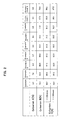
- FIG. 2 shows results of evaluation of each specimen in the working examples 1 to 7 and the comparative examples 1 and 2 in this embodiment on criteria A, B, C. Further, in this embodiment, the fiber length and the fiber weight of the pulp fibers are the "average fiber length” and the fiber weight (also referred to as the "fiber roughness") per unit length, respectively. From the evaluation results shown in FIG. 2 , evaluations are made as follows:
- the rate of recovery after loaded of every specimen in the working examples 1 to 7 exceeds 7%, and it is thus verified that the specimens in the working examples 1 to 7 have higher performance of recovery after loaded, compared with the specimens of the comparative examples 1 and 2 in which the rate of recovery after loaded is below 7%. Therefore, when, for example, a cosmetic puff impregnated with skin lotion is used for patting, a sufficient amount of release of skin lotion can be provided. Further, due to the higher performance of releasing skin lotion, such a cosmetic puff is economical without wasting skin lotion
- the rate of one-time moisture release of every specimen in the working examples 1 to 7 exceeds 75%, and it is thus verified that the specimens in the working examples 1 to 7 have higher performance of one-time moisture release (at one time or in one step), compared with the specimens of the comparative examples 1 and 2 in which the rate of one-time moisture release is below 75%. Therefore, when, for example, a cosmetic puff impregnated with skin lotion is used for patting, a sufficient amount of release of skin lotion can be provided even by lightly patting the skin. In other words, it is not necessary to pat the skin with a strong force which may put a strain on the skin.
- the rate of (first to second) moisture release of every specimen exceeds 85%, and the rate of (first to third) moisture release of every specimen exceeds 90%. It is thus verified that the specimens in the working examples 1 to 7 have higher performance of fraction moisture release (in several steps), compared with the specimens of the comparative examples 1 and 2 in which the rate of (first to second) moisture release is below 85% and the rate of (first to third) moisture release is below 90%. Therefore, when, for example, a cosmetic puff impregnated with skin lotion is used for patting several times (in several steps), a sufficient amount of release of skin lotion can be continuously provided. Application of skin lotion to the skin by patting in several steps is effective for increasing moisture in the skin.
- each of the air-laid non-woven fabric sheets corresponding to the specimens of the working examples 1 to 7 contains pulp fibers with a fiber weight per unit length of 0.20 mg/m or more.
- pulp fibers has an average pore size (void diameter) of 100 ⁇ m or more and has a strong skeleton structure, so that the rate of recovery after loaded in the wet state, the rate of one-time moisture release and the rate of fraction moisture release can be increased.
- each of the air-laid non-woven fabric sheets corresponding to the specimens of the working examples 2 to 6 contains 10 to 50% of polyethylene terephthalate fibers by weight. Therefore, in this case, the rate of recovery after loaded in the wet state, the rate of one-time moisture release and the rate of fraction moisture release can be further increased, so that the effect of gradually discharging the skin lotion retained in space between the fibers, to the surface layer can be further enhanced.
- each of the air-laid non-woven fabric sheets corresponding to the specimens of the working examples 1 to 7 contains rayon fibers in areas corresponding to the surface layers 120, so that the cosmetic puff provide a smooth texture in use. Either one of the two surface layers 120 may be formed by the rayon fibers, as necessary.
- the mixture ratio of a binder contained in the air-laid non-woven fabric sheet is preferably set to 5 to 15% by weight. If the mixture ratio of the binder is decreased to below 5% by weight, disadvantageously, the rate of recovery after loaded in the wet state is decreased, and the amount of first moisture release is increased. Further, if the mixture ratio of the binder exceeds 15% by weight, disadvantageously, the material is hardened and rendered unsuitable for a cosmetic puff.
- the content of polyethylene terephthalate fibers in the air-laid non-woven fabric sheet is preferably set to 10 to 50% by weight.
- the polyethylene terephthalate fibers are hydrophobic, and if the content of polyethylene terephthalate fibers exceeds 50% by weight, disadvantageously, most of the skin lotion absorbed therein is immediately released by first patting, and an increase in the amount of polyethylene terephthalate fibers leads to cost increase.
- other hydrophobic synthetic fibers may be used. In this case, polypropylene (PP) fibers, nylon fibers or the like can be used as the other hydrophobic synthetic fibers.
- FIG. 3 is a plan view of the cosmetic puff 200 according to this embodiment
- FIG. 4 is a sectional view of the cosmetic puff 200 which is taken along line A-A in FIG. 3 .
- the cosmetic puff 200 as a representative embodiment according to the invention has surface layers 220 each including moisturizer application regions 221 to which a moisturizer is applied and moisturizer non-application regions 222 or regions other than the moisturizer application regions 221.
- the cosmetic puff 200 has an area in which the moisturizer application regions 221 and the moisturizer non-application regions 222 are alternately arranged in the direction of the width of the cosmetic puff 200 (which direction is set to coincide with the horizontal direction in FIG. 3 ).
- each of the moisturizer application regions 221 is defined as an elongated region having an application width d1 in the horizontal direction and an application width d2 in the vertical direction.
- the moisturizer application regions 221 are arranged with pitches d3 in the horizontal direction.
- each of the moisturizer non-application regions 222 is defmed as a region between adjacent moisturizer application regions 221. As shown in FIG. 4 , due to application of the moisturizer, a sheet thickness h1 of the moisturizer application region 221 is rendered smaller than a sheet thickness h2 of the moisturizer non-application region 222. By such arrangement of the moisturizer application regions 221 shown in FIG. 3 , a so-called “stripe pattern" is formed.
- the moisturizer application regions 221 and the moisturizer non-application regions 222 here are features that correspond to the "moisturizer application regions" and the “moisturizer non-application regions", respectively, according to this invention.
- glycerin As the moisturizer to be applied to the moisturizer application regions 221, typically, glycerin can be used. This moisturizer has a softening property as well as the moisturizing property, so that it is also referred to as a softener.
- the moisturizer other than glycerin at least one of the following materials can be used: diglycerin, triglycerin, ethylene glycol, propylene glycol, 1,3-butylene glycol, liquid paraffin, squalane, vaseline, olive oil, soy oil, safflower oil, camellia oil, jojoba oil, almond oil, castor oil, palm oil, mink oil, vitamin E, dimethyl silicone, silicone oil, modified silicone, sorbitol, sucrose, glucose, maltose, bees wax, hyaluronan, placental extract, aloe extract, chamomilla recutita, peach leaf extract, collagen, loofah extract, hinokitiol.
- the cosmetic puff in the moisturizer application regions 221, the cosmetic puff can be provided with a moist texture and thus can provide an improved texture.
- the moisturizer non-application regions 222 are kept with an apparent sheet thickness (kept bulky) without application of the moisturizer as shown in FIG. 4 , so that it is effective in improving the appearance of the cosmetic puff (adding a quality appearance to it). Therefore, the cosmetic puff can be provided with both of an improved texture and an improved appearance.
- FIG. 5 is a plan view of a cosmetic puff 300 according to another embodiment of the present invention.
- the cosmetic puff 300 as a representative embodiment of the invention has surface layers 320 each including moisturizer application regions 321 to which a moisturizer is applied and moisturizer non-application regions 322 or regions other than the moisturizer application regions 321.
- the cosmetic puff 300 has an area in which the moisturizer application regions 321 and the moisturizer non-application regions 322 are alternately arranged in the directions of the width and the length of the cosmetic puff 200 (wherein the direction of the width is set to coincide with the horizontal direction in FIG. 5 ).
- each of the moisturizer application regions 321 is defined as a rectangular region (typically a square region) having an application width d4 in the horizontal direction and an application width d5 in the vertical direction.
- the moisturizer application regions 321 are arranged with pitches d6 in the horizontal direction and with pitches d7 in the vertical direction. Further, each of the moisturizer non-application regions 322 is defined as a region between adjacent moisturizer application regions 321. Like in the case shown in FIG. 4 , the sheet thickness of the moisturizer application region 321 is rendered smaller than the sheet thickness of the moisturizer non-application region 322. By such arrangement of the moisturizer application regions 321 shown in FIG. 5 , a so-called “lattice pattern" or “checkered pattern” is formed.
- the moisturizer application regions 321 and the moisturizer non-application regions 322 here are features that correspond to the "moisturizer application regions" and the "moisturizer non-application regions", respectively, according to this invention.
- the moisturizer application regions and the moisturizer non-application regions are preferably provided in the surface layers of the cosmetic puff.
- Applicants of this invention further found successfully that improvements in texture and appearance can both be realized at a higher level by defining the shape, dimensions, pitches or the like of the moisturizer application regions.
- criterion D dry thickness
- criterion E flexible property
- the specimen of the working example 1 is used without application of a moisturizer and as a basis of evaluation, i.e. "blank" of the other specimens.
- the thickness of each dry specimen (which corresponds to the sheet thickness h2 in FIG. 4 ) is measured by using a portable thickness gage (CR-10A of Daiei Kagaku Seiki Mfg. Co., Ltd.).
- a value B (gf ⁇ cm 2 /cm) of the flexural property is obtained by using a flexural property measuring equipment (KES-FB2 AUTO-A of Kato Tech Co., Ltd.).
- FIG. 6 shows results of evaluation of each specimen in the working examples 11 to 16 and the comparative examples 11 to 14 in this embodiment on criteria D, E. From the evaluation results shown in FIG. 6 , evaluations are made as follows:
- the dry thickness of every specimen of the working examples 11 to 16 exceeds 1.2 mm, and it is thus verified that the specimens in the working examples 11 to 16 are kept bulky, compared with the specimens of the comparative examples 12 to 14 in which the dry thickness is far below the initial thickness (1.322 mm) of the comparative example 11. Therefore, the cosmetic puff can be improved in appearance (or provide a quality appearance).
- the value B (gf ⁇ cm 2 /cm) of the flexural property of every specimen of the working examples 11 to 16 and the comparative examples 12 to 14 is far below the value B (0.2300 gf ⁇ cm 2 /cm) of the comparative example 11. It is thus verified that improvement in texture is realized by application of a moisturizer.
Landscapes
- Health & Medical Sciences (AREA)
- Engineering & Computer Science (AREA)
- Biomedical Technology (AREA)
- Heart & Thoracic Surgery (AREA)
- Vascular Medicine (AREA)
- Life Sciences & Earth Sciences (AREA)
- Animal Behavior & Ethology (AREA)
- General Health & Medical Sciences (AREA)
- Public Health (AREA)
- Veterinary Medicine (AREA)
- Epidemiology (AREA)
- Cosmetics (AREA)
Applications Claiming Priority (2)
| Application Number | Priority Date | Filing Date | Title |
|---|---|---|---|
| JP2008268963A JP5388535B2 (ja) | 2008-10-17 | 2008-10-17 | 化粧パフ |
| PCT/JP2009/067775 WO2010044418A1 (ja) | 2008-10-17 | 2009-10-14 | 化粧パフ |
Publications (2)
| Publication Number | Publication Date |
|---|---|
| EP2347672A1 true EP2347672A1 (de) | 2011-07-27 |
| EP2347672A4 EP2347672A4 (de) | 2013-05-29 |
Family
ID=42106581
Family Applications (1)
| Application Number | Title | Priority Date | Filing Date |
|---|---|---|---|
| EP09820596.6A Withdrawn EP2347672A4 (de) | 2008-10-17 | 2009-10-14 | Kosmetische quaste |
Country Status (5)
| Country | Link |
|---|---|
| US (1) | US20110247648A1 (de) |
| EP (1) | EP2347672A4 (de) |
| JP (1) | JP5388535B2 (de) |
| CN (1) | CN102186372A (de) |
| WO (1) | WO2010044418A1 (de) |
Cited By (1)
| Publication number | Priority date | Publication date | Assignee | Title |
|---|---|---|---|---|
| EP2823727A4 (de) * | 2012-03-06 | 2015-11-11 | Taiki Corp Ltd | Kosmetikapplikator |
Families Citing this family (5)
| Publication number | Priority date | Publication date | Assignee | Title |
|---|---|---|---|---|
| WO2011100780A1 (en) * | 2010-02-19 | 2011-08-25 | Majic Beauty Pty Ltd | Cosmetic applicator |
| US20120305556A1 (en) * | 2011-05-31 | 2012-12-06 | Jun Murase | Cosmetic applicator, precursor and related manufacturing method |
| KR200484157Y1 (ko) * | 2015-01-21 | 2017-08-08 | (주)아모레퍼시픽 | 배출판과 메쉬망이 구비된 화장품 용기 |
| KR101745366B1 (ko) * | 2015-11-24 | 2017-06-12 | (주)아모레퍼시픽 | 레이저 가공에 의해 표면에 음각이 형성된 함침부재를 갖는 화장품 |
| JP6542458B1 (ja) * | 2018-09-28 | 2019-07-10 | ユニ・チャーム株式会社 | 化粧用シート |
Family Cites Families (13)
| Publication number | Priority date | Publication date | Assignee | Title |
|---|---|---|---|---|
| US2932052A (en) * | 1956-03-15 | 1960-04-12 | Personal Products Corp | Applicator pad |
| US5273596A (en) * | 1990-03-21 | 1993-12-28 | Fiberweb North America, Inc. | Nonwoven fabric for diaper top sheet and method of making the same |
| US6006761A (en) * | 1999-04-08 | 1999-12-28 | Victoria Vogue, Inc. | Two-sided preparation and finishing applicator |
| US7108440B1 (en) * | 1999-10-08 | 2006-09-19 | The Procter & Gamble Company | Applicator for distributing a substance onto a target surface |
| JP2003093152A (ja) * | 2001-09-26 | 2003-04-02 | Lion Corp | 化粧料含浸シート |
| FI116226B (fi) * | 2001-12-10 | 2005-10-14 | Suominen Nonwovens Ltd | Kuitukangaskomposiitti, sen käyttö ja menetelmä sen valmistamiseksi |
| FR2833245B1 (fr) * | 2001-12-11 | 2004-03-19 | Oreal | Ensemble applicateur d'un produit, notamment cosmetique |
| JP2005538077A (ja) * | 2002-07-12 | 2005-12-15 | ジョンソン・アンド・ジョンソン・ゲーエムベーハー | 塗薬用具および蝋質相を備えた乾燥性製品 |
| US20060233866A1 (en) * | 2003-01-08 | 2006-10-19 | Matthias Hauser | Products comprising an applicator and a wax dispersion |
| US7846462B2 (en) * | 2003-12-22 | 2010-12-07 | Unilever Home & Personal Care Usa, Division Of Conopco, Inc. | Personal care implement containing a stable reactive skin care and cleansing composition |
| JP2005211177A (ja) * | 2004-01-28 | 2005-08-11 | Oji Kinocloth Co Ltd | 絵柄付使いすておしぼり |
| US20060135026A1 (en) * | 2004-12-22 | 2006-06-22 | Kimberly-Clark Worldwide, Inc. | Composite cleaning products having shape resilient layer |
| JP2007195614A (ja) | 2006-01-24 | 2007-08-09 | Asahi Kasei Fibers Corp | 化粧パフ |
-
2008
- 2008-10-17 JP JP2008268963A patent/JP5388535B2/ja active Active
-
2009
- 2009-10-14 CN CN200980141099.4A patent/CN102186372A/zh active Pending
- 2009-10-14 EP EP09820596.6A patent/EP2347672A4/de not_active Withdrawn
- 2009-10-14 WO PCT/JP2009/067775 patent/WO2010044418A1/ja not_active Ceased
- 2009-10-14 US US13/124,749 patent/US20110247648A1/en not_active Abandoned
Cited By (2)
| Publication number | Priority date | Publication date | Assignee | Title |
|---|---|---|---|---|
| EP2823727A4 (de) * | 2012-03-06 | 2015-11-11 | Taiki Corp Ltd | Kosmetikapplikator |
| US9498043B2 (en) | 2012-03-06 | 2016-11-22 | Taiki Corp., Ltd. | Cosmetics applicator |
Also Published As
| Publication number | Publication date |
|---|---|
| CN102186372A (zh) | 2011-09-14 |
| EP2347672A4 (de) | 2013-05-29 |
| JP2010094373A (ja) | 2010-04-30 |
| WO2010044418A1 (ja) | 2010-04-22 |
| US20110247648A1 (en) | 2011-10-13 |
| JP5388535B2 (ja) | 2014-01-15 |
Similar Documents
| Publication | Publication Date | Title |
|---|---|---|
| EP2347672A1 (de) | Kosmetische quaste | |
| KR100481563B1 (ko) | 피부 또는 모발용 세정 및 컨디셔닝 제품 | |
| EP1521877B1 (de) | Kosmetisches wattepad | |
| ES2228466T3 (es) | Articulos de limpieza que limitan el flujo de agua. | |
| KR20100088097A (ko) | 격리 층을 포함하는 안면 처치 마스크 | |
| US20050058833A1 (en) | Lotioned tissue product with improved stability | |
| EP2589324A1 (de) | Tissuepapier und verfahren zur herstellung von tissuepapier | |
| ES2411012T3 (es) | Toallitas húmedas de bajo peso por unidad de superficie con tacto agradable | |
| CN107105869A (zh) | 擦拭片 | |
| KR20170042098A (ko) | 거즈패드를 포함하는 시트 마스크 팩 | |
| JP2010094373A5 (de) | ||
| US8017145B2 (en) | Exfoliating personal care wipe article containing an array of projections | |
| JP2013227707A (ja) | 薬液が付与されたティシュペーパー及び薬液が付与されたティシュペーパーの製造方法 | |
| JP2010209486A (ja) | 化粧料含浸マスク用シート及びこのシートを使用した化粧料含浸マスク | |
| JPH1129434A (ja) | シート状パック化粧料 | |
| US20140037701A1 (en) | Stacked lotioned and folded web substrates | |
| CN1990926B (zh) | 湿片材用片材基材及湿片材 | |
| BRPI0900980A2 (pt) | processos e produtos para aplicação de composições estruturadas a um substrato | |
| JP2002255737A (ja) | シート状化粧料 | |
| US20140037896A1 (en) | Folded and lotioned web products | |
| JP2007176850A (ja) | シート状化粧料 | |
| JP5436002B2 (ja) | 化粧用パフおよび化粧用パフの製造方法 | |
| JP6199081B2 (ja) | 皮膚洗浄シート | |
| WO2023120241A1 (ja) | フェイスマスク及びフェイスマスク用の不織布 | |
| US20140034542A1 (en) | Stacked folded and lotioned tissues |
Legal Events
| Date | Code | Title | Description |
|---|---|---|---|
| PUAI | Public reference made under article 153(3) epc to a published international application that has entered the european phase |
Free format text: ORIGINAL CODE: 0009012 |
|
| 17P | Request for examination filed |
Effective date: 20110504 |
|
| AK | Designated contracting states |
Kind code of ref document: A1 Designated state(s): AT BE BG CH CY CZ DE DK EE ES FI FR GB GR HR HU IE IS IT LI LT LU LV MC MK MT NL NO PL PT RO SE SI SK SM TR |
|
| AX | Request for extension of the european patent |
Extension state: AL BA RS |
|
| DAX | Request for extension of the european patent (deleted) | ||
| A4 | Supplementary search report drawn up and despatched |
Effective date: 20130503 |
|
| RIC1 | Information provided on ipc code assigned before grant |
Ipc: A61F 13/511 20060101ALI20130425BHEP Ipc: A45D 37/00 20060101ALI20130425BHEP Ipc: A61K 8/02 20060101ALI20130425BHEP Ipc: A45D 34/04 20060101AFI20130425BHEP Ipc: A45D 33/34 20060101ALI20130425BHEP |
|
| STAA | Information on the status of an ep patent application or granted ep patent |
Free format text: STATUS: THE APPLICATION IS DEEMED TO BE WITHDRAWN |
|
| 18D | Application deemed to be withdrawn |
Effective date: 20131203 |