EP2352020A2 - Verfahren zur Probenanalyse durch Elektrophorese und Verwendung davon - Google Patents
Verfahren zur Probenanalyse durch Elektrophorese und Verwendung davon Download PDFInfo
- Publication number
- EP2352020A2 EP2352020A2 EP20110151413 EP11151413A EP2352020A2 EP 2352020 A2 EP2352020 A2 EP 2352020A2 EP 20110151413 EP20110151413 EP 20110151413 EP 11151413 A EP11151413 A EP 11151413A EP 2352020 A2 EP2352020 A2 EP 2352020A2
- Authority
- EP
- European Patent Office
- Prior art keywords
- sample
- electrophoresis
- ion
- running buffer
- analyte
- Prior art date
- Legal status (The legal status is an assumption and is not a legal conclusion. Google has not performed a legal analysis and makes no representation as to the accuracy of the status listed.)
- Withdrawn
Links
- 238000001962 electrophoresis Methods 0.000 title claims abstract description 169
- 238000000034 method Methods 0.000 title claims abstract description 79
- 239000012147 electrophoresis running buffer Substances 0.000 claims abstract description 145
- 239000012491 analyte Substances 0.000 claims abstract description 109
- 150000002500 ions Chemical class 0.000 claims description 207
- 239000000463 material Substances 0.000 claims description 138
- 108010054147 Hemoglobins Proteins 0.000 claims description 56
- 102000001554 Hemoglobins Human genes 0.000 claims description 56
- 238000002360 preparation method Methods 0.000 claims description 43
- 238000005259 measurement Methods 0.000 claims description 32
- 238000004458 analytical method Methods 0.000 claims description 26
- 238000005251 capillar electrophoresis Methods 0.000 claims description 17
- 238000004891 communication Methods 0.000 claims description 3
- 238000000926 separation method Methods 0.000 abstract description 72
- 238000012284 sample analysis method Methods 0.000 abstract description 30
- 239000000523 sample Substances 0.000 description 355
- 239000000243 solution Substances 0.000 description 69
- 239000002994 raw material Substances 0.000 description 49
- 239000000306 component Substances 0.000 description 40
- SQDAZGGFXASXDW-UHFFFAOYSA-N 5-bromo-2-(trifluoromethoxy)pyridine Chemical compound FC(F)(F)OC1=CC=C(Br)C=N1 SQDAZGGFXASXDW-UHFFFAOYSA-N 0.000 description 31
- 229920001287 Chondroitin sulfate Polymers 0.000 description 31
- FEWJPZIEWOKRBE-JCYAYHJZSA-N Dextrotartaric acid Chemical compound OC(=O)[C@H](O)[C@@H](O)C(O)=O FEWJPZIEWOKRBE-JCYAYHJZSA-N 0.000 description 31
- 229940059329 chondroitin sulfate Drugs 0.000 description 31
- 210000004369 blood Anatomy 0.000 description 28
- 239000008280 blood Substances 0.000 description 28
- 230000000052 comparative effect Effects 0.000 description 28
- FEWJPZIEWOKRBE-UHFFFAOYSA-N Tartaric acid Natural products [H+].[H+].[O-]C(=O)C(O)C(O)C([O-])=O FEWJPZIEWOKRBE-UHFFFAOYSA-N 0.000 description 25
- 235000002906 tartaric acid Nutrition 0.000 description 25
- 239000011975 tartaric acid Substances 0.000 description 25
- 239000012472 biological sample Substances 0.000 description 22
- SEQKRHFRPICQDD-UHFFFAOYSA-N N-tris(hydroxymethyl)methylglycine Chemical compound OCC(CO)(CO)[NH2+]CC([O-])=O SEQKRHFRPICQDD-UHFFFAOYSA-N 0.000 description 20
- 239000000460 chlorine Substances 0.000 description 19
- DHMQDGOQFOQNFH-UHFFFAOYSA-N Glycine Chemical compound NCC(O)=O DHMQDGOQFOQNFH-UHFFFAOYSA-N 0.000 description 18
- 238000007865 diluting Methods 0.000 description 17
- 239000000126 substance Substances 0.000 description 16
- HEMHJVSKTPXQMS-UHFFFAOYSA-M Sodium hydroxide Chemical compound [OH-].[Na+] HEMHJVSKTPXQMS-UHFFFAOYSA-M 0.000 description 15
- 239000004475 Arginine Substances 0.000 description 14
- ODKSFYDXXFIFQN-BYPYZUCNSA-P L-argininium(2+) Chemical compound NC(=[NH2+])NCCC[C@H]([NH3+])C(O)=O ODKSFYDXXFIFQN-BYPYZUCNSA-P 0.000 description 14
- 238000002835 absorbance Methods 0.000 description 14
- ODKSFYDXXFIFQN-UHFFFAOYSA-N arginine Natural products OC(=O)C(N)CCCNC(N)=N ODKSFYDXXFIFQN-UHFFFAOYSA-N 0.000 description 14
- 229920001282 polysaccharide Polymers 0.000 description 14
- 239000005017 polysaccharide Substances 0.000 description 14
- 150000004804 polysaccharides Chemical class 0.000 description 14
- KIDHWZJUCRJVML-UHFFFAOYSA-N putrescine Chemical compound NCCCCN KIDHWZJUCRJVML-UHFFFAOYSA-N 0.000 description 14
- 239000000654 additive Substances 0.000 description 13
- PXIPVTKHYLBLMZ-UHFFFAOYSA-N Sodium azide Chemical compound [Na+].[N-]=[N+]=[N-] PXIPVTKHYLBLMZ-UHFFFAOYSA-N 0.000 description 12
- UZMAPBJVXOGOFT-UHFFFAOYSA-N Syringetin Natural products COC1=C(O)C(OC)=CC(C2=C(C(=O)C3=C(O)C=C(O)C=C3O2)O)=C1 UZMAPBJVXOGOFT-UHFFFAOYSA-N 0.000 description 10
- 239000007997 Tricine buffer Substances 0.000 description 10
- 230000000996 additive effect Effects 0.000 description 10
- KCFYHBSOLOXZIF-UHFFFAOYSA-N dihydrochrysin Natural products COC1=C(O)C(OC)=CC(C2OC3=CC(O)=CC(O)=C3C(=O)C2)=C1 KCFYHBSOLOXZIF-UHFFFAOYSA-N 0.000 description 10
- 239000004471 Glycine Substances 0.000 description 9
- 108010027616 Hemoglobin A2 Proteins 0.000 description 9
- 239000007853 buffer solution Substances 0.000 description 9
- KXKPYJOVDUMHGS-OSRGNVMNSA-N chondroitin sulfate Chemical compound CC(=O)N[C@H]1[C@H](O)O[C@H](OS(O)(=O)=O)[C@H](O)[C@@H]1O[C@H]1[C@H](O)[C@@H](O)[C@H](O)[C@@H](C(O)=O)O1 KXKPYJOVDUMHGS-OSRGNVMNSA-N 0.000 description 8
- 150000003839 salts Chemical class 0.000 description 8
- 239000005700 Putrescine Substances 0.000 description 7
- 206010012601 diabetes mellitus Diseases 0.000 description 7
- 238000012545 processing Methods 0.000 description 7
- 241000894007 species Species 0.000 description 7
- XLYOFNOQVPJJNP-UHFFFAOYSA-N water Chemical compound O XLYOFNOQVPJJNP-UHFFFAOYSA-N 0.000 description 7
- INGWEZCOABYORO-UHFFFAOYSA-N 2-(furan-2-yl)-7-methyl-1h-1,8-naphthyridin-4-one Chemical compound N=1C2=NC(C)=CC=C2C(O)=CC=1C1=CC=CO1 INGWEZCOABYORO-UHFFFAOYSA-N 0.000 description 6
- 210000000601 blood cell Anatomy 0.000 description 6
- 210000003743 erythrocyte Anatomy 0.000 description 6
- 108010036302 hemoglobin AS Proteins 0.000 description 6
- 230000006872 improvement Effects 0.000 description 6
- 239000008213 purified water Substances 0.000 description 6
- 210000002966 serum Anatomy 0.000 description 6
- 108010088751 Albumins Proteins 0.000 description 5
- 102000009027 Albumins Human genes 0.000 description 5
- -1 amine compound Chemical class 0.000 description 5
- 238000003745 diagnosis Methods 0.000 description 5
- 239000003085 diluting agent Substances 0.000 description 5
- 230000000694 effects Effects 0.000 description 5
- 230000002949 hemolytic effect Effects 0.000 description 5
- 238000005070 sampling Methods 0.000 description 5
- BPYKTIZUTYGOLE-IFADSCNNSA-N Bilirubin Chemical compound N1C(=O)C(C)=C(C=C)\C1=C\C1=C(C)C(CCC(O)=O)=C(CC2=C(C(C)=C(\C=C/3C(=C(C=C)C(=O)N\3)C)N2)CCC(O)=O)N1 BPYKTIZUTYGOLE-IFADSCNNSA-N 0.000 description 4
- CZMRCDWAGMRECN-UGDNZRGBSA-N Sucrose Chemical compound O[C@H]1[C@H](O)[C@@H](CO)O[C@@]1(CO)O[C@@H]1[C@H](O)[C@@H](O)[C@H](O)[C@@H](CO)O1 CZMRCDWAGMRECN-UGDNZRGBSA-N 0.000 description 4
- 229930006000 Sucrose Natural products 0.000 description 4
- 239000003795 chemical substances by application Substances 0.000 description 4
- 239000012470 diluted sample Substances 0.000 description 4
- 238000004193 electrokinetic chromatography Methods 0.000 description 4
- 229940088597 hormone Drugs 0.000 description 4
- 239000005556 hormone Substances 0.000 description 4
- 238000004226 microchip electrophoresis Methods 0.000 description 4
- 230000003287 optical effect Effects 0.000 description 4
- 150000007524 organic acids Chemical class 0.000 description 4
- 239000006174 pH buffer Substances 0.000 description 4
- 235000018102 proteins Nutrition 0.000 description 4
- 108090000623 proteins and genes Proteins 0.000 description 4
- 102000004169 proteins and genes Human genes 0.000 description 4
- 239000005720 sucrose Substances 0.000 description 4
- 108010085686 Hemoglobin C Proteins 0.000 description 3
- OFOBLEOULBTSOW-UHFFFAOYSA-N Propanedioic acid Natural products OC(=O)CC(O)=O OFOBLEOULBTSOW-UHFFFAOYSA-N 0.000 description 3
- 238000000246 agarose gel electrophoresis Methods 0.000 description 3
- 150000001450 anions Chemical class 0.000 description 3
- 239000002585 base Substances 0.000 description 3
- 239000000872 buffer Substances 0.000 description 3
- 150000001768 cations Chemical class 0.000 description 3
- 230000006866 deterioration Effects 0.000 description 3
- 230000005684 electric field Effects 0.000 description 3
- 239000007788 liquid Substances 0.000 description 3
- 238000000691 measurement method Methods 0.000 description 3
- 239000000203 mixture Substances 0.000 description 3
- 239000012146 running buffer Substances 0.000 description 3
- 239000012266 salt solution Substances 0.000 description 3
- 238000005464 sample preparation method Methods 0.000 description 3
- 229910052708 sodium Inorganic materials 0.000 description 3
- 239000011734 sodium Substances 0.000 description 3
- 239000004094 surface-active agent Substances 0.000 description 3
- 102000004506 Blood Proteins Human genes 0.000 description 2
- 108010017384 Blood Proteins Proteins 0.000 description 2
- VEXZGXHMUGYJMC-UHFFFAOYSA-M Chloride anion Chemical compound [Cl-] VEXZGXHMUGYJMC-UHFFFAOYSA-M 0.000 description 2
- VZCYOOQTPOCHFL-OWOJBTEDSA-N Fumaric acid Chemical compound OC(=O)\C=C\C(O)=O VZCYOOQTPOCHFL-OWOJBTEDSA-N 0.000 description 2
- 102000017011 Glycated Hemoglobin A Human genes 0.000 description 2
- 108010068377 Hemoglobin M Proteins 0.000 description 2
- KDXKERNSBIXSRK-YFKPBYRVSA-N L-lysine Chemical class NCCCC[C@H](N)C(O)=O KDXKERNSBIXSRK-YFKPBYRVSA-N 0.000 description 2
- 239000004696 Poly ether ether ketone Substances 0.000 description 2
- NPYPAHLBTDXSSS-UHFFFAOYSA-N Potassium ion Chemical compound [K+] NPYPAHLBTDXSSS-UHFFFAOYSA-N 0.000 description 2
- RJKFOVLPORLFTN-LEKSSAKUSA-N Progesterone Chemical compound C1CC2=CC(=O)CC[C@]2(C)[C@@H]2[C@@H]1[C@@H]1CC[C@H](C(=O)C)[C@@]1(C)CC2 RJKFOVLPORLFTN-LEKSSAKUSA-N 0.000 description 2
- FKNQFGJONOIPTF-UHFFFAOYSA-N Sodium cation Chemical compound [Na+] FKNQFGJONOIPTF-UHFFFAOYSA-N 0.000 description 2
- FAPWRFPIFSIZLT-UHFFFAOYSA-M Sodium chloride Chemical compound [Na+].[Cl-] FAPWRFPIFSIZLT-UHFFFAOYSA-M 0.000 description 2
- 229920002472 Starch Polymers 0.000 description 2
- 239000007983 Tris buffer Chemical class 0.000 description 2
- 238000011481 absorbance measurement Methods 0.000 description 2
- 230000009471 action Effects 0.000 description 2
- 150000001408 amides Chemical class 0.000 description 2
- 235000001014 amino acid Nutrition 0.000 description 2
- 150000001413 amino acids Chemical class 0.000 description 2
- 229920002301 cellulose acetate Polymers 0.000 description 2
- 229910052801 chlorine Inorganic materials 0.000 description 2
- 238000000576 coating method Methods 0.000 description 2
- 238000007796 conventional method Methods 0.000 description 2
- 238000001514 detection method Methods 0.000 description 2
- 238000010586 diagram Methods 0.000 description 2
- 238000010790 dilution Methods 0.000 description 2
- 239000012895 dilution Substances 0.000 description 2
- 238000009826 distribution Methods 0.000 description 2
- 238000005370 electroosmosis Methods 0.000 description 2
- 238000001997 free-flow electrophoresis Methods 0.000 description 2
- 238000001502 gel electrophoresis Methods 0.000 description 2
- 108091005995 glycated hemoglobin Proteins 0.000 description 2
- JYGXADMDTFJGBT-VWUMJDOOSA-N hydrocortisone Chemical compound O=C1CC[C@]2(C)[C@H]3[C@@H](O)C[C@](C)([C@@](CC4)(O)C(=O)CO)[C@@H]4[C@@H]3CCC2=C1 JYGXADMDTFJGBT-VWUMJDOOSA-N 0.000 description 2
- 239000000815 hypotonic solution Substances 0.000 description 2
- NOESYZHRGYRDHS-UHFFFAOYSA-N insulin Chemical compound N1C(=O)C(NC(=O)C(CCC(N)=O)NC(=O)C(CCC(O)=O)NC(=O)C(C(C)C)NC(=O)C(NC(=O)CN)C(C)CC)CSSCC(C(NC(CO)C(=O)NC(CC(C)C)C(=O)NC(CC=2C=CC(O)=CC=2)C(=O)NC(CCC(N)=O)C(=O)NC(CC(C)C)C(=O)NC(CCC(O)=O)C(=O)NC(CC(N)=O)C(=O)NC(CC=2C=CC(O)=CC=2)C(=O)NC(CSSCC(NC(=O)C(C(C)C)NC(=O)C(CC(C)C)NC(=O)C(CC=2C=CC(O)=CC=2)NC(=O)C(CC(C)C)NC(=O)C(C)NC(=O)C(CCC(O)=O)NC(=O)C(C(C)C)NC(=O)C(CC(C)C)NC(=O)C(CC=2NC=NC=2)NC(=O)C(CO)NC(=O)CNC2=O)C(=O)NCC(=O)NC(CCC(O)=O)C(=O)NC(CCCNC(N)=N)C(=O)NCC(=O)NC(CC=3C=CC=CC=3)C(=O)NC(CC=3C=CC=CC=3)C(=O)NC(CC=3C=CC(O)=CC=3)C(=O)NC(C(C)O)C(=O)N3C(CCC3)C(=O)NC(CCCCN)C(=O)NC(C)C(O)=O)C(=O)NC(CC(N)=O)C(O)=O)=O)NC(=O)C(C(C)CC)NC(=O)C(CO)NC(=O)C(C(C)O)NC(=O)C1CSSCC2NC(=O)C(CC(C)C)NC(=O)C(NC(=O)C(CCC(N)=O)NC(=O)C(CC(N)=O)NC(=O)C(NC(=O)C(N)CC=1C=CC=CC=1)C(C)C)CC1=CN=CN1 NOESYZHRGYRDHS-UHFFFAOYSA-N 0.000 description 2
- 238000004519 manufacturing process Methods 0.000 description 2
- 239000012528 membrane Substances 0.000 description 2
- 238000001012 micellar electrokinetic chromatography Methods 0.000 description 2
- 239000002736 nonionic surfactant Substances 0.000 description 2
- 230000003204 osmotic effect Effects 0.000 description 2
- XNGIFLGASWRNHJ-UHFFFAOYSA-N phthalic acid Chemical compound OC(=O)C1=CC=CC=C1C(O)=O XNGIFLGASWRNHJ-UHFFFAOYSA-N 0.000 description 2
- 210000004180 plasmocyte Anatomy 0.000 description 2
- 239000004033 plastic Substances 0.000 description 2
- 229920003023 plastic Polymers 0.000 description 2
- 229920003229 poly(methyl methacrylate) Polymers 0.000 description 2
- 229920002530 polyetherether ketone Polymers 0.000 description 2
- 239000004926 polymethyl methacrylate Substances 0.000 description 2
- 239000004810 polytetrafluoroethylene Substances 0.000 description 2
- 229920001343 polytetrafluoroethylene Polymers 0.000 description 2
- 229910052700 potassium Inorganic materials 0.000 description 2
- 229910001414 potassium ion Inorganic materials 0.000 description 2
- 230000002265 prevention Effects 0.000 description 2
- 238000011084 recovery Methods 0.000 description 2
- 238000006884 silylation reaction Methods 0.000 description 2
- 229910001415 sodium ion Inorganic materials 0.000 description 2
- 230000000087 stabilizing effect Effects 0.000 description 2
- 239000008107 starch Substances 0.000 description 2
- 235000019698 starch Nutrition 0.000 description 2
- VZCYOOQTPOCHFL-UHFFFAOYSA-N trans-butenedioic acid Natural products OC(=O)C=CC(O)=O VZCYOOQTPOCHFL-UHFFFAOYSA-N 0.000 description 2
- SFLSHLFXELFNJZ-QMMMGPOBSA-N (-)-norepinephrine Chemical compound NC[C@H](O)C1=CC=C(O)C(O)=C1 SFLSHLFXELFNJZ-QMMMGPOBSA-N 0.000 description 1
- KIUKXJAPPMFGSW-DNGZLQJQSA-N (2S,3S,4S,5R,6R)-6-[(2S,3R,4R,5S,6R)-3-Acetamido-2-[(2S,3S,4R,5R,6R)-6-[(2R,3R,4R,5S,6R)-3-acetamido-2,5-dihydroxy-6-(hydroxymethyl)oxan-4-yl]oxy-2-carboxy-4,5-dihydroxyoxan-3-yl]oxy-5-hydroxy-6-(hydroxymethyl)oxan-4-yl]oxy-3,4,5-trihydroxyoxane-2-carboxylic acid Chemical compound CC(=O)N[C@H]1[C@H](O)O[C@H](CO)[C@@H](O)[C@@H]1O[C@H]1[C@H](O)[C@@H](O)[C@H](O[C@H]2[C@@H]([C@@H](O[C@H]3[C@@H]([C@@H](O)[C@H](O)[C@H](O3)C(O)=O)O)[C@H](O)[C@@H](CO)O2)NC(C)=O)[C@@H](C(O)=O)O1 KIUKXJAPPMFGSW-DNGZLQJQSA-N 0.000 description 1
- UCTWMZQNUQWSLP-VIFPVBQESA-N (R)-adrenaline Chemical compound CNC[C@H](O)C1=CC=C(O)C(O)=C1 UCTWMZQNUQWSLP-VIFPVBQESA-N 0.000 description 1
- 229930182837 (R)-adrenaline Natural products 0.000 description 1
- BJEPYKJPYRNKOW-REOHCLBHSA-N (S)-malic acid Chemical compound OC(=O)[C@@H](O)CC(O)=O BJEPYKJPYRNKOW-REOHCLBHSA-N 0.000 description 1
- JKMHFZQWWAIEOD-UHFFFAOYSA-N 2-[4-(2-hydroxyethyl)piperazin-1-yl]ethanesulfonic acid Chemical compound OCC[NH+]1CCN(CCS([O-])(=O)=O)CC1 JKMHFZQWWAIEOD-UHFFFAOYSA-N 0.000 description 1
- ZVZFHCZCIBYFMZ-UHFFFAOYSA-N 6-methylheptoxybenzene Chemical compound CC(C)CCCCCOC1=CC=CC=C1 ZVZFHCZCIBYFMZ-UHFFFAOYSA-N 0.000 description 1
- 239000007991 ACES buffer Substances 0.000 description 1
- 239000007988 ADA buffer Substances 0.000 description 1
- 239000000275 Adrenocorticotropic Hormone Substances 0.000 description 1
- PQSUYGKTWSAVDQ-ZVIOFETBSA-N Aldosterone Chemical compound C([C@@]1([C@@H](C(=O)CO)CC[C@H]1[C@@H]1CC2)C=O)[C@H](O)[C@@H]1[C@]1(C)C2=CC(=O)CC1 PQSUYGKTWSAVDQ-ZVIOFETBSA-N 0.000 description 1
- PQSUYGKTWSAVDQ-UHFFFAOYSA-N Aldosterone Natural products C1CC2C3CCC(C(=O)CO)C3(C=O)CC(O)C2C2(C)C1=CC(=O)CC2 PQSUYGKTWSAVDQ-UHFFFAOYSA-N 0.000 description 1
- 239000007992 BES buffer Substances 0.000 description 1
- 102000011022 Chorionic Gonadotropin Human genes 0.000 description 1
- 108010062540 Chorionic Gonadotropin Proteins 0.000 description 1
- 101800000414 Corticotropin Proteins 0.000 description 1
- 108090000790 Enzymes Proteins 0.000 description 1
- 102000004190 Enzymes Human genes 0.000 description 1
- 108010044495 Fetal Hemoglobin Proteins 0.000 description 1
- 229920000855 Fucoidan Polymers 0.000 description 1
- 102000006395 Globulins Human genes 0.000 description 1
- 108010044091 Globulins Proteins 0.000 description 1
- 102000051325 Glucagon Human genes 0.000 description 1
- 108060003199 Glucagon Proteins 0.000 description 1
- 239000007995 HEPES buffer Substances 0.000 description 1
- 108091005880 Hemoglobin F Proteins 0.000 description 1
- 229920002971 Heparan sulfate Polymers 0.000 description 1
- HTTJABKRGRZYRN-UHFFFAOYSA-N Heparin Chemical compound OC1C(NC(=O)C)C(O)OC(COS(O)(=O)=O)C1OC1C(OS(O)(=O)=O)C(O)C(OC2C(C(OS(O)(=O)=O)C(OC3C(C(O)C(O)C(O3)C(O)=O)OS(O)(=O)=O)C(CO)O2)NS(O)(=O)=O)C(C(O)=O)O1 HTTJABKRGRZYRN-UHFFFAOYSA-N 0.000 description 1
- 108090001061 Insulin Proteins 0.000 description 1
- 102000004877 Insulin Human genes 0.000 description 1
- 108010044467 Isoenzymes Proteins 0.000 description 1
- QNAYBMKLOCPYGJ-REOHCLBHSA-N L-alanine Chemical compound C[C@H](N)C(O)=O QNAYBMKLOCPYGJ-REOHCLBHSA-N 0.000 description 1
- HNDVDQJCIGZPNO-YFKPBYRVSA-N L-histidine Chemical compound OC(=O)[C@@H](N)CC1=CN=CN1 HNDVDQJCIGZPNO-YFKPBYRVSA-N 0.000 description 1
- ROHFNLRQFUQHCH-YFKPBYRVSA-N L-leucine Chemical compound CC(C)C[C@H](N)C(O)=O ROHFNLRQFUQHCH-YFKPBYRVSA-N 0.000 description 1
- ROHFNLRQFUQHCH-UHFFFAOYSA-N Leucine Natural products CC(C)CC(N)C(O)=O ROHFNLRQFUQHCH-UHFFFAOYSA-N 0.000 description 1
- KDXKERNSBIXSRK-UHFFFAOYSA-N Lysine Natural products NCCCCC(N)C(O)=O KDXKERNSBIXSRK-UHFFFAOYSA-N 0.000 description 1
- 239000004472 Lysine Substances 0.000 description 1
- 239000007987 MES buffer Substances 0.000 description 1
- 239000007993 MOPS buffer Substances 0.000 description 1
- 241000124008 Mammalia Species 0.000 description 1
- 241001465754 Metazoa Species 0.000 description 1
- 108010061951 Methemoglobin Proteins 0.000 description 1
- 108091005461 Nucleic proteins Proteins 0.000 description 1
- 229910019142 PO4 Inorganic materials 0.000 description 1
- 229920003171 Poly (ethylene oxide) Polymers 0.000 description 1
- 239000004793 Polystyrene Substances 0.000 description 1
- 108010016797 Sickle Hemoglobin Proteins 0.000 description 1
- VYPSYNLAJGMNEJ-UHFFFAOYSA-N Silicium dioxide Chemical compound O=[Si]=O VYPSYNLAJGMNEJ-UHFFFAOYSA-N 0.000 description 1
- KDYFGRWQOYBRFD-UHFFFAOYSA-N Succinic acid Natural products OC(=O)CCC(O)=O KDYFGRWQOYBRFD-UHFFFAOYSA-N 0.000 description 1
- QAOWNCQODCNURD-UHFFFAOYSA-L Sulfate Chemical compound [O-]S([O-])(=O)=O QAOWNCQODCNURD-UHFFFAOYSA-L 0.000 description 1
- 239000007994 TES buffer Substances 0.000 description 1
- 238000010521 absorption reaction Methods 0.000 description 1
- 108010015562 acetylated hemoglobin Proteins 0.000 description 1
- 239000002253 acid Substances 0.000 description 1
- 230000002378 acidificating effect Effects 0.000 description 1
- 239000000853 adhesive Substances 0.000 description 1
- 230000001070 adhesive effect Effects 0.000 description 1
- 239000002390 adhesive tape Substances 0.000 description 1
- 230000001155 adrenomedullary effect Effects 0.000 description 1
- 239000011543 agarose gel Substances 0.000 description 1
- 235000004279 alanine Nutrition 0.000 description 1
- 229960002478 aldosterone Drugs 0.000 description 1
- 239000000783 alginic acid Substances 0.000 description 1
- 229920000615 alginic acid Polymers 0.000 description 1
- 229960001126 alginic acid Drugs 0.000 description 1
- 235000010443 alginic acid Nutrition 0.000 description 1
- 150000004781 alginic acids Chemical class 0.000 description 1
- 229910052783 alkali metal Inorganic materials 0.000 description 1
- 150000001340 alkali metals Chemical class 0.000 description 1
- 229910052784 alkaline earth metal Inorganic materials 0.000 description 1
- BJEPYKJPYRNKOW-UHFFFAOYSA-N alpha-hydroxysuccinic acid Natural products OC(=O)C(O)CC(O)=O BJEPYKJPYRNKOW-UHFFFAOYSA-N 0.000 description 1
- 125000003277 amino group Chemical group 0.000 description 1
- 150000003863 ammonium salts Chemical class 0.000 description 1
- 239000003098 androgen Substances 0.000 description 1
- 150000001483 arginine derivatives Chemical class 0.000 description 1
- 235000013361 beverage Nutrition 0.000 description 1
- 239000000337 buffer salt Substances 0.000 description 1
- KDYFGRWQOYBRFD-NUQCWPJISA-N butanedioic acid Chemical compound O[14C](=O)CC[14C](O)=O KDYFGRWQOYBRFD-NUQCWPJISA-N 0.000 description 1
- 159000000007 calcium salts Chemical class 0.000 description 1
- 238000001818 capillary gel electrophoresis Methods 0.000 description 1
- 238000005515 capillary zone electrophoresis Methods 0.000 description 1
- 210000004027 cell Anatomy 0.000 description 1
- 210000001175 cerebrospinal fluid Anatomy 0.000 description 1
- 229940015047 chorionic gonadotropin Drugs 0.000 description 1
- 239000011248 coating agent Substances 0.000 description 1
- 150000001875 compounds Chemical class 0.000 description 1
- IDLFZVILOHSSID-OVLDLUHVSA-N corticotropin Chemical compound C([C@@H](C(=O)N[C@@H](CO)C(=O)N[C@@H](CCSC)C(=O)N[C@@H](CCC(O)=O)C(=O)N[C@@H](CC=1NC=NC=1)C(=O)N[C@@H](CC=1C=CC=CC=1)C(=O)N[C@@H](CCCNC(N)=N)C(=O)N[C@@H](CC=1C2=CC=CC=C2NC=1)C(=O)NCC(=O)N[C@@H](CCCCN)C(=O)N1[C@@H](CCC1)C(=O)N[C@@H](C(C)C)C(=O)NCC(=O)N[C@@H](CCCCN)C(=O)N[C@@H](CCCCN)C(=O)N[C@@H](CCCNC(N)=N)C(=O)N[C@@H](CCCNC(N)=N)C(=O)N1[C@@H](CCC1)C(=O)N[C@@H](C(C)C)C(=O)N[C@@H](CCCCN)C(=O)N[C@@H](C(C)C)C(=O)N[C@@H](CC=1C=CC(O)=CC=1)C(=O)N1[C@@H](CCC1)C(=O)N[C@@H](CC(N)=O)C(=O)NCC(=O)N[C@@H](C)C(=O)N[C@@H](CCC(O)=O)C(=O)N[C@@H](CC(O)=O)C(=O)N[C@@H](CCC(O)=O)C(=O)N[C@@H](CO)C(=O)N[C@@H](C)C(=O)N[C@@H](CCC(O)=O)C(=O)N[C@@H](C)C(=O)N[C@@H](CC=1C=CC=CC=1)C(=O)N1[C@@H](CCC1)C(=O)N[C@@H](CC(C)C)C(=O)N[C@@H](CCC(O)=O)C(=O)N[C@@H](CC=1C=CC=CC=1)C(O)=O)NC(=O)[C@@H](N)CO)C1=CC=C(O)C=C1 IDLFZVILOHSSID-OVLDLUHVSA-N 0.000 description 1
- 229960000258 corticotropin Drugs 0.000 description 1
- 239000002537 cosmetic Substances 0.000 description 1
- 238000005443 coulometric titration Methods 0.000 description 1
- 239000003599 detergent Substances 0.000 description 1
- 238000000502 dialysis Methods 0.000 description 1
- 230000004069 differentiation Effects 0.000 description 1
- 238000011209 electrochromatography Methods 0.000 description 1
- 239000003792 electrolyte Substances 0.000 description 1
- 229960005139 epinephrine Drugs 0.000 description 1
- 229940011871 estrogen Drugs 0.000 description 1
- 239000000262 estrogen Substances 0.000 description 1
- 238000001704 evaporation Methods 0.000 description 1
- 230000008020 evaporation Effects 0.000 description 1
- 239000000284 extract Substances 0.000 description 1
- 238000011049 filling Methods 0.000 description 1
- 235000013305 food Nutrition 0.000 description 1
- 238000004108 freeze drying Methods 0.000 description 1
- 238000007710 freezing Methods 0.000 description 1
- 230000008014 freezing Effects 0.000 description 1
- 239000001530 fumaric acid Substances 0.000 description 1
- 239000005350 fused silica glass Substances 0.000 description 1
- 238000007429 general method Methods 0.000 description 1
- 239000011521 glass Substances 0.000 description 1
- MASNOZXLGMXCHN-ZLPAWPGGSA-N glucagon Chemical compound C([C@@H](C(=O)N[C@H](C(=O)N[C@@H](CCC(N)=O)C(=O)N[C@@H](CC=1C2=CC=CC=C2NC=1)C(=O)N[C@@H](CC(C)C)C(=O)N[C@@H](CCSC)C(=O)N[C@@H](CC(N)=O)C(=O)N[C@@H]([C@@H](C)O)C(O)=O)C(C)C)NC(=O)[C@H](CC(O)=O)NC(=O)[C@H](CCC(N)=O)NC(=O)[C@H](C)NC(=O)[C@H](CCCNC(N)=N)NC(=O)[C@H](CCCNC(N)=N)NC(=O)[C@H](CO)NC(=O)[C@H](CC(O)=O)NC(=O)[C@H](CC(C)C)NC(=O)[C@H](CC=1C=CC(O)=CC=1)NC(=O)[C@H](CCCCN)NC(=O)[C@H](CO)NC(=O)[C@H](CC=1C=CC(O)=CC=1)NC(=O)[C@H](CC(O)=O)NC(=O)[C@H](CO)NC(=O)[C@@H](NC(=O)[C@H](CC=1C=CC=CC=1)NC(=O)[C@@H](NC(=O)CNC(=O)[C@H](CCC(N)=O)NC(=O)[C@H](CO)NC(=O)[C@@H](N)CC=1NC=NC=1)[C@@H](C)O)[C@@H](C)O)C1=CC=CC=C1 MASNOZXLGMXCHN-ZLPAWPGGSA-N 0.000 description 1
- 229960004666 glucagon Drugs 0.000 description 1
- 229920000669 heparin Polymers 0.000 description 1
- 229960002897 heparin Drugs 0.000 description 1
- HNDVDQJCIGZPNO-UHFFFAOYSA-N histidine Natural products OC(=O)C(N)CC1=CN=CN1 HNDVDQJCIGZPNO-UHFFFAOYSA-N 0.000 description 1
- 150000002410 histidine derivatives Chemical class 0.000 description 1
- 229920002674 hyaluronan Polymers 0.000 description 1
- 229960003160 hyaluronic acid Drugs 0.000 description 1
- 229960000890 hydrocortisone Drugs 0.000 description 1
- 238000002354 inductively-coupled plasma atomic emission spectroscopy Methods 0.000 description 1
- 238000002347 injection Methods 0.000 description 1
- 239000007924 injection Substances 0.000 description 1
- 229940125396 insulin Drugs 0.000 description 1
- 238000004255 ion exchange chromatography Methods 0.000 description 1
- 229910003002 lithium salt Inorganic materials 0.000 description 1
- 159000000002 lithium salts Chemical class 0.000 description 1
- VZCYOOQTPOCHFL-UPHRSURJSA-N maleic acid Chemical compound OC(=O)\C=C/C(O)=O VZCYOOQTPOCHFL-UPHRSURJSA-N 0.000 description 1
- 239000011976 maleic acid Substances 0.000 description 1
- 239000001630 malic acid Substances 0.000 description 1
- 235000011090 malic acid Nutrition 0.000 description 1
- 230000007246 mechanism Effects 0.000 description 1
- 230000005499 meniscus Effects 0.000 description 1
- 230000002503 metabolic effect Effects 0.000 description 1
- 238000013508 migration Methods 0.000 description 1
- 230000005012 migration Effects 0.000 description 1
- 238000002156 mixing Methods 0.000 description 1
- 229960002748 norepinephrine Drugs 0.000 description 1
- SFLSHLFXELFNJZ-UHFFFAOYSA-N norepinephrine Natural products NCC(O)C1=CC=C(O)C(O)=C1 SFLSHLFXELFNJZ-UHFFFAOYSA-N 0.000 description 1
- 150000007523 nucleic acids Chemical class 0.000 description 1
- 102000039446 nucleic acids Human genes 0.000 description 1
- 108020004707 nucleic acids Proteins 0.000 description 1
- 235000005985 organic acids Nutrition 0.000 description 1
- 150000007530 organic bases Chemical class 0.000 description 1
- 238000010979 pH adjustment Methods 0.000 description 1
- 239000005426 pharmaceutical component Substances 0.000 description 1
- 239000010452 phosphate Substances 0.000 description 1
- 229920000447 polyanionic polymer Polymers 0.000 description 1
- 229920000515 polycarbonate Polymers 0.000 description 1
- 239000004417 polycarbonate Substances 0.000 description 1
- 229920000193 polymethacrylate Polymers 0.000 description 1
- 229920002223 polystyrene Polymers 0.000 description 1
- XAEFZNCEHLXOMS-UHFFFAOYSA-M potassium benzoate Chemical class [K+].[O-]C(=O)C1=CC=CC=C1 XAEFZNCEHLXOMS-UHFFFAOYSA-M 0.000 description 1
- 230000008569 process Effects 0.000 description 1
- 229960003387 progesterone Drugs 0.000 description 1
- 239000000186 progesterone Substances 0.000 description 1
- 239000012925 reference material Substances 0.000 description 1
- 210000003296 saliva Anatomy 0.000 description 1
- 239000003566 sealing material Substances 0.000 description 1
- 239000011780 sodium chloride Substances 0.000 description 1
- 159000000000 sodium salts Chemical class 0.000 description 1
- 239000002904 solvent Substances 0.000 description 1
- 239000012086 standard solution Substances 0.000 description 1
- 230000000638 stimulation Effects 0.000 description 1
- 239000007785 strong electrolyte Substances 0.000 description 1
- 238000012360 testing method Methods 0.000 description 1
- 238000010257 thawing Methods 0.000 description 1
- 238000009210 therapy by ultrasound Methods 0.000 description 1
- 210000001685 thyroid gland Anatomy 0.000 description 1
- 238000005406 washing Methods 0.000 description 1
Images



Classifications
-
- G—PHYSICS
- G01—MEASURING; TESTING
- G01N—INVESTIGATING OR ANALYSING MATERIALS BY DETERMINING THEIR CHEMICAL OR PHYSICAL PROPERTIES
- G01N27/00—Investigating or analysing materials by the use of electric, electrochemical, or magnetic means
- G01N27/26—Investigating or analysing materials by the use of electric, electrochemical, or magnetic means by investigating electrochemical variables; by using electrolysis or electrophoresis
- G01N27/416—Systems
- G01N27/447—Systems using electrophoresis
- G01N27/44704—Details; Accessories
- G01N27/44747—Composition of gel or of carrier mixture
-
- G—PHYSICS
- G01—MEASURING; TESTING
- G01N—INVESTIGATING OR ANALYSING MATERIALS BY DETERMINING THEIR CHEMICAL OR PHYSICAL PROPERTIES
- G01N27/00—Investigating or analysing materials by the use of electric, electrochemical, or magnetic means
- G01N27/26—Investigating or analysing materials by the use of electric, electrochemical, or magnetic means by investigating electrochemical variables; by using electrolysis or electrophoresis
- G01N27/416—Systems
- G01N27/447—Systems using electrophoresis
- G01N27/44756—Apparatus specially adapted therefor
- G01N27/44769—Continuous electrophoresis, i.e. the sample being continuously introduced, e.g. free flow electrophoresis [FFE]
-
- G—PHYSICS
- G01—MEASURING; TESTING
- G01N—INVESTIGATING OR ANALYSING MATERIALS BY DETERMINING THEIR CHEMICAL OR PHYSICAL PROPERTIES
- G01N27/00—Investigating or analysing materials by the use of electric, electrochemical, or magnetic means
- G01N27/26—Investigating or analysing materials by the use of electric, electrochemical, or magnetic means by investigating electrochemical variables; by using electrolysis or electrophoresis
- G01N27/416—Systems
- G01N27/447—Systems using electrophoresis
- G01N27/44756—Apparatus specially adapted therefor
- G01N27/44791—Microapparatus
Definitions
- Electrophoresis is well known as a way to separate/analyze an analyte, such as a variety of compounds, nucleic acids and proteins, with high accuracy by utilizing an electric field. Since electrophoresis allows separation of substances based on their charge, molecular weight, stereo structure, etc., it is widely used.
- electrophoresis there are various types of electrophoresis depending on the presence or absence of a support and the type of a support, among others.
- polyacrylic amide electrophoresis polyacrylic amide electrophoresis, agarose gel electrophoresis, starch gel electrophoresis, filter paper electrophoresis, cellulose acetate membrane electrophoresis, electrochromatography, free flow electrophoresis, and capillary electrophoresis are known.
- agarose gel electrophoresis it is proposed to use agarose gel electrophoresis to separate glycated hemoglobin using an agarose gel to which sulfonated polysaccharides such as chondroitin sulfate are added ( JP H05-133938 A ).
- capillary electrophoresis to analyze a sample in a short time by electrokinetic chromatography as one type of capillary electrophoresis and incorporating a polyanion, such as chondroitin sulfate, or polycation in a electrophoresis buffer solution
- Japanese Patent No. 3,124,993 A microchip electrophoresis apparatus is proposed to reduce the size of analysis apparatus (Japanese Patent Nos. 2,790,067 and 3,656,165 ).
- a problem with a microchip electrophoresis apparatus is that a channel (separation length) used in separating a sample becomes smaller in length compared with a conventional apparatus, resulting in deterioration of separation capability.
- Tb solve this problem, a variety of solutions have been proposed, including increasing the sample injection capacity and the separation length, condensing an analyte within the channel prior to the separation, combining a microchip electrophoresis apparatus with the base stacking method ( Kim et al., J. Chromatgr. A, 1064, 121-127, 2005 ), and using a different buffer solution from that used for the preparation of a sample as an electrophoresis buffer solution ( JP 2009-74811A ).
- these conventional methods may not be adequate in terms of analyzing a sample with high accuracy.
- the present invention provides a new method for an improved separation capability to an electrophoretic sample analysis by a frontal analysis where a sample is introduced and components of the sample are separated by application of a voltage to a channel.
- the present invention provides a method for analyzing a sample by electrophoresis using an electrophoresis apparatus comprising a channel and a sample reservoir formed in the channel.
- the method includes: adding the sample to the sample reservoir of the electrophoresis apparatus where the channel contains an electrophoresis running buffer and performing electrophoresis by applying a voltage to both ends of the channel.
- the concentration of at least one of a) and b) is set to be approximately the same between the sample and the electrophoresis running buffer where a) and b) are defined as follows:
- FIG. 1A is a conceptual diagram showing a configuration of an exemplary electrophoresis chip that can be used in the method of the present invention
- FIG. 1B is a cross-sectional view of the electrophoresis chip shown in FIG. 1A along the line I-I.
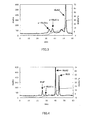
- FIG. 2 is a graph showing exemplary results of Example 1.
- FIG. 3 is a graph showing exemplary results of Comparative Example 1.
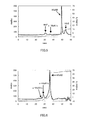
- FIG. 4 is a graph showing exemplary results of Example 2.
- FIG. 5 is a graph showing exemplary results of Comparative Example 2.
- FIG. 6 is a graph showing exemplary results of Example 3.
- FIG. 7 is a graph showing exemplary results of Example 7.
- FIG. 8 is a graph showing exemplary results of Comparative Example 3.
- FIG. 9 is a graph showing exemplary results of Example 8 and Comparative Example 4.
- the present invention relates to a method for analyzing a sample by electrophoresis using an electrophoresis apparatus comprising a channel and a sample reservoir formed in the channel.
- the method includes: adding the sample to the sample reservoir of the electrophoresis apparatus where the channel contains an electrophoresis running buffer; and performing electrophoresis by applying a voltage to both ends of the channel.
- concentration of at least one of a) and b) is set to be approximately the same between the sample and the electrophoresis running buffer; where a) and b) are defined as follows:
- the analyte separation capability of an electrophoretic sample analysis by a frontal analysis method can be improved. Further, with the present invention, an analysis can be preferably conducted in a shorter time than conventional methods. Moreover, the method of the present invention is particularly suitable for a sample analysis using a small-size capillary electrophoresis chip, and more preferably for a sample analysis by frontal analysis Continuous Capillary Electrophoresis using a microchip electrophoresis apparatus.
- the inventors have further improved the separation capability of a method in which a sample is introduced from the sample reservoir and components of the sample are separated by application of a voltage as in WO 2008/136465 , i.e., a method in which electrophoresis is performed while sampling continuously.
- a voltage as in WO 2008/136465
- the inventors have focused their attention on the ion distribution in the channel. Specifically, they have found that ions in a sample, which hardly affect the separation when a trace amount of a sample is injected into an electrophoresis running buffer and are thus ignorable, could affect the accuracy of separation when performing electrophoresis while sampling continuously.
- a method for analyzing a sample by electrophoresis that includes: introducing the sample into a channel from a sample reservoir by applying a voltage to both ends of the channel; and performing electrophoresis on the sample, by setting the concentration of at least one of a) and b) to be approximately the same between the sample and the electrophoresis running buffer, the analyte separation capability can be improved and the accuracy of separation can be improved even when the separation length is small; where a) and b) are defined as follows:
- a width where an electrophoresis running buffer and a sample are in contact with each other becomes a peak width.
- the peak width is increased by 1) variations in the charge of the sample, 2) scattering of components of the sample caused by temperature or Brownian movement, 3) a nonuniform flow of the sample, and 4) a meniscus at the time of introducing the sample.
- the most crucial reason for the increase of the peak width in the case of electrophoresis with a small separation length is considered to be 1) variations in the charge of the sample.
- the concentration of at least one of the earlier defined a) and b) is set to be approximately the same, and preferably substantially the same between the sample and the electrophoresis running buffer, variations in the charge of the sample are suppressed. Because an increase in the peak width can be suppressed as a result, the separation capability can be improved. Note that these are only presumptions and the present invention is not limited to these mechanisms.
- the present invention is suited for capillary electrophoresis such as electrokinetic chromatography, capillary zone electrophoresis, micellar electrokinetic chromatography, and capillary gel electrophoresis, preferably for electrokinetic chromatography and micellar electrokinetic chromatography, and particularly preferably for capillary electrophoresis using an electrophoresis microchip.
- capillary electrophoresis such as electrokinetic chromatography, capillary zone electrophoresis, micellar electrokinetic chromatography, and capillary gel electrophoresis, preferably for electrokinetic chromatography and micellar electrokinetic chromatography, and particularly preferably for capillary electrophoresis using an electrophoresis microchip.
- the term “mobility” refers to the speed at which a substance moves in an electric field created in the channel as a result of applying a voltage to both ends of the channel.
- the mobility is determined in accordance with, for example, the charge, size, and shape of the substance as well as the environment within the channel (e.g., the components of a liquid in the channel, the pH of the liquid and an electroosmotic flow in the channel).
- the term “electroosmotic flow” refers to, for example, in the case of performing capillary electrophoresis using a channel including an inner wall with a negative charge, a flow that is created by the negative charge of the inner wall of the channel and directed to the cathode from the anode side.
- the term "ion” refers to a component having a negative charge and a component having a positive charge contained in an electrophoresis running buffer and/or a sample to such a degree that they may have an effect on the separation capability
- examples of such components include a buffer agent, an acidic substance, a weak electrolyte, a basic substance, a strong electrolyte, protein, and other components having a positive or negative charge.
- setting the concentration of at least one of the 'ion that moves in the same direction as an analyte by electrophoresis and has a smaller degree of mobility than the analyte' and the 'ion that moves in the opposite direction to the analyte' to be approximately the same between the sample and the electrophoresis running buffer includes setting the electrophoresis running buffer and the sample to contain, in approximately the same concentration, ions having approximately the same degree of mobility.
- it is preferable to set the concentrations of the component having a negative charge and the component having a positive charge in the sample and the concentrations of the corresponding components in the electrophoresis running buffer to be approximately the same, and more preferably its concentrations to be substantially the same.
- the concentrations of at least one of the former ion species and at least one of the latter ion species may be set to be approximately the same between the sample and the electrophoresis running buffer.
- the concentrations of all of the former ion species and the latter ion species are approximately the same between the sample and the electrophoresis running buffer.
- the scope of the term “approximately the same concentration” includes both the same concentration and a difference in concentration such that there is approximately no effect on the separation capability This difference in concentration is determined appropriately in accordance with the length used for the separation of a sample.
- the separation length (the distance between the end of the sample reservoir on the channel side and the analyzing portion) is about 10 to about 30 mm and the difference in concentration between an ion contained in the electrophoresis running buffer and the corresponding ion in the sample is more than about -10 mmol/L and less than about +10 mmol/L, it can be considered that the concentrations are approximately the same.
- the difference is preferably in a range of about -5 mmol/L to about +5 mmol/L.
- the separation length is about 10 to about 30 mm and the difference in concentration between the ion contained in the electrophoresis running buffer and the corresponding ion in the sample is more than about -10 wt% and less than about +10 wt%, it can be considered that the concentrations are approximately the same. In this case, the difference is preferably in a range of about -5 wt% to about +5 wt%.
- the species and concentration of each ion in the electrophoresis running buffer and the sample can be determined by inductively coupled plasma-atomic emission spectroscopy, ion chromatography, and coulometric titration or with an electric conductivity meter.
- ions having approximately the same degree of mobility include those having the same degree of mobility or those with a difference in mobility to such a degree that it has approximately no effect on the separation capability.
- the difference in mobility to such a degree that it has approximately no effect on the separation capability is determined appropriately in accordance with, for example, the length used for the separation of a sample. For example, when the separation length (the distance between the end of the sample reservoir on the channel side and the analyzing portion) is about 20 to about 30 mm, the difference in mobility between an ion contained in the electrophoresis running buffer and the corresponding ion in the sample is ⁇ 5%, and preferably ⁇ 2%.
- an ion in the electrophoresis running buffer and/or the sample (hereinafter referred also to as a "target ion”) corresponds to the "ion that moves in the same direction as an analyte by electrophoresis and has a smaller degree of mobility than the analyte (i.e., the ion of a))" as follows.
- a target ion an ion in the electrophoresis running buffer and/or the sample
- the electrophoresis running buffer filled in the cathode side is filled when the target ion is a cation and that filled in the anode side is filled when the target ion is an anion.
- a counter ion to the target ion may be added to the running buffers.
- an ion having a higher degree of mobility than the target ion is preferable, such as Na, K and Cl.
- the target ion corresponds to the "ion that moves in the opposite direction to the analyte (the ion of b))" can be determined as follows. When the target ion is an anion and the analyte is a cation, it can be concluded that the target ion corresponds to the ion of b). In contrast, when the target ion is a cation and the analyte is an anion, it can be concluded that the target ion corresponds to the ion of b).
- examples of the "analyte” include proteins, substances in living body, and substances in blood.
- proteins include hemoglobin, albumin and globulin.
- hemoglobin include glycated hemoglobin, variant hemoglobin, minor hemoglobin, and modified hemoglobin, and more specifically, hemoglobin A0 (HbA0), hemoglobin A1c (HbA1c), hemoglobin A2 (HbA2), hemoglobin S (HbS, sickle cell hemoglobin), hemoglobin F (HbF, fetal hemoglobin), hemoglobin M (HbM), hemoglobin C (HbC), methemoglobin, carbamylated hemoglobin, and acetylated hemoglobin.
- HbA1c has the following types: stable HbA1c and unstable HbA1c.
- substances in living body and substances in blood include bilirubin, hormones and metabolic substances.
- hormones include a thyroid stimulation hormone, an adrenocorticotrophic hormone, chorionic gonadotropin, insulin, glucagon, an adrenomedullary hormone, epinephrine, norepinephrine, androgen, estrogen, progesterone, aldosterone, and cortisol.
- sample refers to a sample prepared from a sample raw material.
- sample raw material include a biological sample, preferably a biological sample containing the above-mentioned analyte, and more preferably a sample containing hemoglobin.
- biological samples include blood, products derived from blood and containing a red blood cell component, saliva and cerebrospinal fluid.
- blood include blood collected from a living body, preferably animal blood, more preferably mammal blood, and still more preferably human blood.
- Examples of products derived from blood and containing a red blood cell component include those separated or prepared from blood and containing a red blood cell component, such as a blood cell fraction from which plasma is removed, a blood cell condensate, freeze-dried blood or blood cell, a hemolyzed sample prepared by hemolyzing whole blood, centrifuged blood, spontaneously-sedimented blood, and washed blood cell.
- a red blood cell component such as a blood cell fraction from which plasma is removed, a blood cell condensate, freeze-dried blood or blood cell, a hemolyzed sample prepared by hemolyzing whole blood, centrifuged blood, spontaneously-sedimented blood, and washed blood cell.
- a calibration material may be used for improving the accuracy and reproducibility of the analysis.
- a control material may also be used for controlling or maintaining the accuracy and reproducibility of the analysis. Therefore, the “sample” or the “sample raw material” in this specification may include a calibration material and a control material.
- examples of the "calibration material” include a reference material used for calibrating an apparatus
- examples of the "control material” include a sample used for controlling or maintaining the accuracy and/or reproducibility of an analysis such as control serum, polled serum and a standard solution.
- the sample analysis method of the present invention relates to a method for analyzing a sample by electrophoresis using an electrophoresis apparatus comprising a channel and a sample reservoir formed in the channel.
- the method includes: adding the sample to the sample reservoir of the electrophoresis apparatus where the channel contains an electrophoresis running buffer; and performing electrophoresis by applying a voltage to both ends of the channel.
- the concentration of at least one of a) and b) is set to be approximately the same between the sample and the electrophoresis running buffer; where a) and b) are defined as follows:
- the sample analysis method of the present invention also is a method in which electrophoresis is performed while sampling continuously. Therefore, viewed from another aspect, the sample analysis method of the present invention relates to a method for analyzing a sample by electrophoresis while sampling continuously. The method includes setting the concentration of at least one of a) and b) to be approximately the same between the sample and the electrophoresis running buffer where a) and b) are defined as follows:
- the concentrations of a) and b) are preferably set to be approximately the same between the sample and the electrophoresis running buffer because the separation capability can be further improved.
- Examples of the way to set the concentration of at least one of a) and b) to be approximately the same between the sample and the electrophoresis running buffer include: preparing a sample by diluting (mixing) a sample raw material with a sample preparation solution containing the same or similar ion component to that of an electrophoresis running buffer such that the concentration of the ion component in the sample becomes approximately the same as that in the electrophoresis running buffer; and preparing an electrophoresis running buffer and a sample individually such that the concentration of the ion component becomes approximately the same between the electrophoresis running buffer and the sample.
- examples of the way include: preparing a sample preparation solution (sample diluent solution) that makes the concentration of at least one of a) and b) approximately the same between an electrophoresis running buffer and a diluted sample; preparing an additive having the same composition (proportion of components) of at least one of the ions of a) and b) as an electrophoresis running buffer and having a higher concentration of at least one of a) and b) than the electrophoresis running buffer; and adding the prepared additive to a sample raw material or a diluted sample to set the concentration of at least one of a) and b) to be approximately the same between the electrophoresis running buffer and the sample.
- sample preparation solution refers to a material that is mixed with a sample raw material in preparing a sample, and examples of which include a diluent solution for diluting a sample raw material.
- the sample analysis method of the present invention may further include a step of preparing a sample.
- the step of preparing a sample preferably includes diluting a sample raw material with a sample preparation solution having the same or similar ion component to that of an electrophoresis running buffer such that the concentration of the ion component in the sample becomes approximately the same as that in the electrophoresis running buffer.
- the step may include preparing the above-described sample preparation solution (sample diluent solution) and preparing the above-described additive.
- the concentration of the ion component in the sample preparation solution used for the dilution is preferably higher than that in the electrophoresis running buffer in view of diluting the sample raw material.
- the sample analysis method of the present invention may further include a step of preparing an electrophoresis running buffer.
- the sample analysis method of the present invention may further include a step of filling the channel with the prepared electrophoresis running buffer.
- the sample analysis method of the present invention preferably includes allowing, when the concentration of at least one of a) and b) is set to be approximately the same between the sample and the electrophoresis running buffer during the electrophoresis, ions sufficiently close to the sample in the channel to be in approximately the same state as the sample added to the sample reservoir.
- the vicinity of the sample includes a range from which the charge of the sample can be affected and changed, and preferably includes a range from which the charge of the analyte in the sample can be affected.
- the channel preferably includes an ionic pseudostationary phase in terms of further improving the separation capability
- the term "ionic pseudostationary phase” refers to a material that may be bonded to and form a complex with an analyte in a sample.
- the ionic pseudostationary phase may be introduced into the channel by incorporating the ionic pseudostationary phase in the electrophoresis running buffer or in the sample.
- the ionic pseudostationary phase may be introduced into the channel independently from the electrophoresis running buffer and the sample, it is preferably added to both the electrophoresis running buffer and the sample in terms of improving the separation capability
- polysaccharides having a cathodic group such as sulfated polysaccharides, carboxylated polysaccharides, sulfonated polysaccharides, and phosphorylated polysaccharides can be used as the ionic pseudostationary phase.
- sulfated polysaccharides and carboxylated polysaccharides and more preferably sulfated polysaccharides.
- Examples of sulfated polysaccharides include chondroitin sulfate, heparin, heparan, fucoidan or salts thereof, and particularly chondroitin sulfate or a salt thereof is preferable.
- Examples of chondroitin sulfate include chondroitin sulfate A, chondroitin sulfate C, chondroitin sulfate D and chondroitin sulfate E.
- Examples of carboxylated polysaccharides include alginic acid, hyaluronic acid or salts thereof.
- examples of the counter ion include ions of alkali metal, alkali earth metal, an amine compound and organic base.
- Examples of salts of carboxylated polysaccharides include sodium salt, potassium salt, lithium salt, calcium salt, ammonium salt, tris salt, arginine salt, lysine salt, and histidine salt.
- the sample analysis method of the present invention may include a step of detecting separation by electrophoresis by optical means.
- detection by optical means include absorbance measurement.
- the wavelength of the absorbance can be determined appropriately in accordance with the types of the sample and the analyte.
- the sample analysis method of the present invention may include a step of analyzing an electropherogram obtained by optical means.
- This analyzing step may include performing an operation on the electropherogram to obtain electropherograms separated based on the mobility (separation time) and determining the proportion of components of the analyte in the sample on the basis of the height and/or area of each peak of the electropherogram after the operation. Examples of the operation include differentiation and calculus of finite differences.
- the channel is preferably a capillary. Consequently, capillary electrophoresis can be performed.
- the term "capillary” refers to a tube having an inner diameter of about 100 ⁇ m or less. The tube may have a circular or rectangular cross-section.
- the length of the capillary is not particularly limited. An adequate separation capability can be achieved by the sample analysis method of the present invention even when the separation length is small. Thus, the length of the capillary is about 10 to about 150 mm, and preferably about 20 to about 60 mm.
- the electrophoresis apparatus is preferably an electrophoresis microchip.
- the electrophoresis chip has a length of about 10 to about 200 mm, a width of about 10 to about 60 mm, and a thickness of about 0.3 to about 5 mm, and preferably has a length of about 30 to about 70 mm, a width of about 10 to about 60 mm, and a thickness of about 0.3 to about 5 mm.
- the electrophoresis chip one that is to be discussed later can be used.
- an electrophoresis running buffer and/or a washing may be introduced into the channel in place of the sample.
- the electrophoresis running buffer is preferably the same electrophoresis running buffer that has been filled in the channel.
- a calibration material or a control material may be used as a sample or sample raw material.
- the sample analysis method of the present invention preferably includes a step of preparing a sample from a calibration material and/or a control material as a sample raw material.
- This sample preparation step may include, for example: checking an ion contained in the calibration material and/or the control material; comparing the ion contained in the calibration material and/or the control material with an ion contained in a biological sample to be analyzed (hereinafter referred to as a "sample to be analyzed”): and adjusting, in accordance with the "ion that moves in the same direction as an analyte by electrophoresis and has a smaller degree of mobility than the analyte (the ion of a))" and/or the "ion that moves in the opposite direction to the analyte (the ion of b))" or the presence or absence of other ions in the calibration material and/or the control material and/or concentrations thereof, the ion concentration in the calibration material and/or the control material or the prepared sample to be approximately the same as the ion concentration in the sample to be analyzed or the sample raw material.
- the calibration material and the control material can be electrophoretically analyzed under approximately the same conditions as the sample to be analyzed, so that the accuracy of calibration of the apparatus can be improved and adequate control can be performed.
- examples of other ions include an ion that moves in the same direction as the analyte by electrophoresis and has a larger degree of mobility than the analyte.
- the sample analysis method of the present invention is based upon the following findings.
- An ion concentration in a typical calibration material and/or control material may differ from that in a biological sample, and calibration and control using such materials do not result in adequate accuracy.
- the state of the ion in the calibration material or control material By setting the state of the ion in the calibration material or control material to be approximately the same as that in the biological sample, the accuracy of calibration of the apparatus can be improved and/or adequate control can be performed.
- biological samples such as serum and plasma as described above contain various ions.
- the ions may include, for example, the "ion that moves in the same direction as an analyte by electrophoresis and has a smaller degree of mobility than the analyte (the ion of a))" and the "ion that moves in the opposite direction to the analyte (the ion of b)).
- serum and plasma contain about 140 mmol/L of sodium ion, about 4 mmol/L of potassium ion and about 100 mmol/L of chlorine ion
- red blood cells contain about 100 mmol/L of sodium ion, about 50 mmol/L of potassium ion, and about 100 mmol/L of chlorine ion.
- Tb supply a calibration material and a control material under the condition where the analyte can be preserved stably
- an additive for stabilizing the analyte is generally added to the calibration material and the control material.
- the analyte is hemoglobin or albumin
- additives such as a buffer solution, salts and sucrose are added to stabilize the analyte (hemoglobin: JP H6-308120 , Japanese Patent Nos. 3686482 and 4061365 , JP 2004-125560 ; albumin: Japanese Patent No. 4183116 , WO 2001-094618 ).
- the concentration of the ion of a) and/or the ion of b) in the calibration material or the control material may be lower/higher than that in the sample to be analyzed in some instances.
- ion components that are generally contained in a biological sample are removed during the production by dialysis or the like in some instances and the above-mentioned ions are hardly contained in the calibration material and the control material.
- the inventors have found that when such calibration material and control material are used in an analysis by electrophoresis, the obtained results differ from analysis results on the sample to be actually analyzed (e.g., a sample originating from a biological sample), the calibration material and the control material not adequately fulfilling their purposes.
- the concentrations of ions such as the ion of a), the ion of b) and other ions in the calibration material and the control material differ from those in the sample to be analyzed in many instances. It has been found that the difference in concentration causes variations in the accuracy of analysis such as the accuracy of separation and variations in measurement time. For example, when an ion concentration in the calibration material and the control material is lower than that in the sample to be analyzed or the calibration material and the control material hardly contain an ion, the concentration of an ion originating from the sample becomes smaller as compared with a biological sample, making a current difficult to flow. As a result, the speed of electrophoresis becomes small, requiring enormous amounts of measurement time.
- the method according to this aspect of the invention includes the sample preparation step as described above, the accuracy of separation can be improved even when measuring a calibration material or control material. Thus, the accuracy of calibration of the apparatus can be improved and adequate control can be performed.
- allowing ions to be in approximately the same state includes the following.
- a sample is prepared from a calibration material or control material as a sample raw material such that the ion concentration in the prepared sample becomes approximately the same as that in the sample to be analyzed.
- a sample is prepared from a calibration material or control material as a sample raw material such that the concentrations of the ion of a), the ion of b) and other ions in the preparing sample become approximately the same as those in the sample to be analyzed.
- Examples of the way to make the concentrations approximately the same include, when an ion for preventing deterioration of stability is to be added to the calibration material and/or the control material at the time of production, adding the ion so that its concentration becomes approximately the same as that in a biological sample, or when the calibration material and/or the control material is used in the dissolved form, using a solution thereof to set the concentration to be approximately the same as that in a biological sample, and dissolving the calibration material and/or the control material using an electrophoresis running buffer having approximately the same ion concentration as the biological sample.
- the present invention relates to a calibration method using the calibration material and a control method using the control material both of which include the sample preparation step.
- the present invention relates to a method for measuring an analyte in a sample by the sample analysis method of the present invention.
- the sample and the analyte are as described above.
- the analyte is preferably hemoglobin, more preferably HbA1c and still more preferably stable HbA1c as an indicator in the diagnosis of diabetes.
- stable HbA1c as an indicator in the diagnosis of diabetes and other hemoglobin components are preferably measured. Therefore, when viewed from still another aspect, the present invention relates to a method for measuring HbA1c including measuring HbA1c by the sample analysis method of the present invention. In terms of diagnosing diabetes, stable HbA1c is separated from other hemoglobin components and measured by the sample analysis method of the present invention.
- the present invention relates to a measurement kit including an electrophoresis running buffer, a sample preparation solution for preparing a sample, and an instruction manual describing preparing the sample using the sample preparation solution such that the concentration of at least one of a) and b) becomes approximately the same between the electrophoresis running buffer and the prepared sample; where a) and b) are defined as follows:
- the electrophoresis running buffer and the sample preparation solution are as described above.
- the measurement kit further includes an electrophoresis chip.
- the electrophoresis chip preferably includes a sample reservoir, an electrophoresis running buffer reservoir and a channel, and the sample reservoir and the electrophoresis running buffer reservoir are in communication with each other via the channel. Further, the channel of the electrophoresis chip may be filled with the above-described electrophoresis running buffer.
- the electrophoresis chip for example, the electrophoresis chip described in WO 2008/136465 and the electrophoresis chip (described herein) shown in FIG. 1 can be used.
- the measurement kit of the present invention may include an additive having the same composition (proportion of components) of at least one of the ions of a) and b) as the electrophoresis running buffer and having a higher concentration of at least one of a) and b) than the electrophoresis running buffer.
- the measurement kit of the present invention may include an instruction manual describing a way to prepare a sample from a commercially available calibration material and/or control material as a sample raw material. Consequently, even when the kit does not include a calibration material and/or control material or when using a calibration material and/or control material other than the calibration material and/or control material included in the kit, it is possible to set the ion concentration to be approximately the same between a sample originating from the calibration material and the control material and a biological sample, so that the accuracy of calibration of the apparatus can be improved and adequate control can be performed.
- the instruction manual preferably describes a method for preparing a variety of the calibration material and/or control material products.
- the instruction manual may describe, as to one product, dissolving the product in purified water, as to another product, dissolving the product in a physiological salt solution (0.9% of salt solution), and, as to still another product, dissolving the product in an electrophoresis running buffer.
- the instruction manual may describe that a sample is prepared by diluting them with a solution, such as purified water, a physiological salt solution or an electrophoresis running buffer.
- the calibration material and the control material are of a dry type such as freeze-dried products, the instruction manual may describe that a sample is prepared by dissolving them in any of the above-described solutions.
- descriptions of the dilution factor, solution amount, etc., in the instruction manual allow more appropriate sample preparation, so that the accuracy of calibration and/or control can be improved.
- the present invention relates to a method for preparing a sample to be analyzed by electrophoresis.
- the method includes preparing the sample such that the concentration of at least one of a) and b) becomes approximately the same between an electrophoresis running buffer used for electrophoresis and the preparing sample; where a) and b) are defined as follows:
- sample preparation examples include: preparing a sample by diluting a sample raw material with a sample preparation solution containing the same or similar ion component to that of an electrophoresis running buffer such that the concentration of the ion component becomes approximately the same between the sample and the electrophoresis running buffer and individually preparing an electrophoresis running buffer and a sample such that the concentration of an ion component becomes approximately the same between the electrophoresis running buffer and the sample.
- the sample analysis method, the analyte measurement method, the measurement kit and the sample preparation method of the present invention can be used for, but are not limited to, the diagnosis, treatment and observation of progression of diabetes, etc.
- they can also be used for non-diagnostic purposes such as simple chemical analysis, detection of gene polymorphism such as variant hemoglobin, checking of the proportion of isozyme as an enzyme, analysis of food, beverage, flavoring, detergent, cosmetic and pharmaceutical components, and analysis of extracts or solutes such as adhesives (e.g., adhesive tape), coatings and ink.
- the kit when the kit includes a commercially available calibration material, the kit according to this aspect of the invention preferably includes an instruction manual describing preparing a sample such that the concentrations of the "ion that moves in the same direction as the analyte by electrophoresis and has a smaller degree of mobility than the analyte (the ion of a))"and the “ion that moves in the opposite direction to the analyte (the ion of b))" or the concentrations of other ions become approximately the same between the calibration material and the sample to be analyzed.
- the calibration material, the control material, and the kit including these materials of the present invention are not only used in the sample analysis method and the analyte measurement method of the present invention, but may be used in other measurements by electrophoresis and measurements using measurement principles other than electrophoresis as a calibration material and a control material. Even when they are used in other measurements by electrophoresis and measurements using principles other than electrophoresis, the above-described sample preparation method is similarly carried out.
- the calibration material and the control material of the present invention do not include one produced by freeze-drying or diluting the biological sample such as an untreated hemolyzed sample.
- a capillary electrophoresis microchip shown in FIG. 1 is used.
- the sample raw material is whole blood and the analyte is hemoglobin.
- Examples of the material of the channel 3 include, but are not limited to, glass, fused silica and plastic.
- the plastic include, but are not limited to, polymethyl methacrylate (PMMA), polycarbonate, polystyrene, polytetrafluoroethylene (PTFE), and polyetheretherketone (PEEK).
- PMMA polymethyl methacrylate
- PMMA polycarbonate
- PTFE polystyrene
- PEEK polyetheretherketone
- the inner wall of the channel 3 may be coated with a silylation agent or the like.
- the coating of the inner wall of the channel 3 with a silylation agent or the like can be carried out in the same manner as any of the methods described in WO 2008/029685 , WO 2008/136465 and JP 2009-186445 A .
- the channel 3 may be a commercially available capillary.
- the top faces of the channel 3, the sample reservoir 2a and the electrophoresis running buffer reservoir 2b are preferably covered with a sealing material or the like.
- organic acid a buffer solution, amino acids, etc.
- organic acids can be used as the electrophoresis running buffer, among which organic acids are preferable.
- organic acid include, but are not limited to, maleic acid, tartaric acid, succinic acid, fumaric acid, phthalic acid, malonic acid and malic acid.
- buffer solution include, but are not limited to, MES, ADA, ACES, BES, MOPS, TES, HEPES, and TRICINE.
- amino acids include, but are not limited to, glycine, alanine and leucine.
- the electrophoresis running buffer may also contain a weak base and 1,4-diaminobutane in addition to the organic acid and/or buffer solution.
- a sample is placed in the sample reservoir 2a of the electrophoresis chip where the channel 3 is filled with the electrophoresis running buffer.
- a voltage is applied to the both ends of the channel 3, in other words, between the sample reservoir 2a and the electrophoresis running buffer reservoir 2b.
- the sample is introduced into the channel 3 from the sample reservoir 2a and is separated in the channel 3, whereby the sample containing hemoglobin moves towards the electrophoresis running buffer reservoir 2b from the sample reservoir 2a.
- the voltage applied to the both ends of the channel 3 is, for example, about 0.5 to about 10 kV, and preferably about 0.5 to about 5 kV
- a measurement is performed at a given position.
- a measurement can be performed by optical means, for example, by absorbance measurement.
- the absorbance at a wavelength of 415 nm is preferably measured.
- a hemolyzed sample obtained by hemolyzing whole blood has been used as the sample raw material and the sample obtained by diluting the sample raw material with the sample preparation has been used.
- the sample may be, for example, a sample raw material itself that is collected from a living body and untreated (e.g., hemolyzed blood) or may be a sample obtained by diluting a sample raw material with a solvent (sample preparation solution).
- the sample raw material may be, for example, a blood sample such as blood or a sample containing a commercially available product containing hemoglobin.
- the blood sample is not particularly limited, and examples of which include a hemolyzed sample obtained by hemolyzing a blood cell containing material, such as whole blood.
- the hemolyzation method is not particularly limited, and examples of which may include ultrasonic treatment, freezing and thawing treatment, pressure treatment, osmotic pressure treatment, and surfactant treatment.
- the osmotic pressure treatment is not particularly limited, a blood cell containing material, such as whole blood, may be treated with a hypotonic solution.
- the hypotonic solution is not particularly limited, and examples of which include water and a buffer solution.
- the buffer solution is not particularly limited, and examples of which may include the above-described buffer agent and additive.
- 111 mmol/L of a L-tartaric acid solution containing 1.11 wt% of sodium chondroitin sulfate C (manufactured by Seikagaku corporation), 1.1 mM of NaN 3 and 0.011% of TritonTM X-100 and adjusted with L-argine to have a pH of 4.8 was prepared as a sample preparation solution.
- a hemoglobin solution having a hemoglobin concentration of 140 g/L was prepared as a sample raw materials. Although the hemoglobin solution contained sucrose as an additive, it did not contain the ion of a), the ion of b) or other ions described above.
- the method of Example 1 allowed not only the clear separation of HbA1c and HbA0 from each other but also the clear separation of stable HbA1c from unstable HBA1c. Further, as shown in FIGS. 2 and 3 , since each peak of the electropherogram of Example 1 is more sharp (narrow peak width) than each peak of the electropherogram of Comparative Example 1, a clear improvement is seen in the separation capability of the method of Example 1 as compared with the method of Comparative Example 1.
- the thin line indicates the measured electropherogram and the heavy line indicates variations in absorbance obtained by processing the electropherogram.
- the terms "HbF', "s-HbA1c", “HbA0” and “HbS” in FIGS. 4 and 5 indicate peaks of the respective hemoglobins.
- the method of Example 2 allowed the separation of HbF, stable HbA1c, HbA0 and HbS from each other.
- each peak of the electropherogram of Example 2 is more sharp and appeared more clearly than each peak of the electropherogram of Comparative Example 2.
- a clear improvement is seen in the separation capability of the method of Example 2 as compared with the method of Comparative Example 2.
- Example 3 shows an example of the obtained electropherogram.
- Example 3 the concentrations of chondroitin sulfate, tartaric acid and arginine in the electrophoresis running buffer and those in the sample were the same as Example 1.
- the thin line indicates the measured electropherogram and the heavy line indicates variations in absorbance obtained by processing the electropherogram.
- the terms "u-HbA1c", “s-HbA1c” and “HbA0" in FIG. 6 indicate peaks of the respective hemoglobins.
- the method of Example 3 allowed the separation of unstable HbA1c, stable HbA1c and HbA0 from each other in the hemolyzed sample obtained by hemolyzing the blood from a normal subject. Furthermore, as shown in FIG. 6 , the method of Example 3 allowed the separation in a short time.
- Table 2 provides the ion concentrations of chondroitin sulfate, tartaric acid, arginine and Cl in the electrophoresis running buffer and those in the sample.
- the method of Example 4 allowed the separation of unstable HbA1c, stable HbA1c and HbA0 from each other in the hemolyzed sample obtained by hemolyzing the blood from a normal subject. Furthermore, the method allowed the separation in a short time.
- Example 5 electrophoresis was performed as follows. Cl ion was added to a sample preparation solution and an electrophoresis running solution to bring the concentrations of chondroitin sulfate, tartaric acid, and Cl to be substantially the same between the electrophoresis running solution and the sample. In Example 5, a measurement was performed in the same manner as Example 4 except that the following sample was used. Note that chondroitin sulfate, tartaric acid, and Cl correspond to the "ion that moves in the opposite direction to the analyte (the ion of b))."
- a sample preparation solution containing 1.11 wt% of sodium chondroitin sulfate C (manufactured by Seikagaku corporation), 1.1 mM of NaN 3 , 0.011% of TritonTM X-100, and 11 mmol/L of NaCl and adjusted with L-argine to have a pH of 4.8 was prepared as a sample preparation solution.
- a hemoglobin solution having a hemoglobin concentration of 140 g/L was prepared as a sample raw material.
- a sample was prepared by diluting 0.01 ml of the sample raw material with 0.09 ml of the sample preparation solution (diluted by 10 times). Although the hemoglobin solution contained sucrose, it did not contain the ion of a), the ion of b) or other ions described above.
- Table 3 provides the ion concentrations of chondroitin sulfate, tartaric acid, arginine and Cl in the electrophoresis running buffer and those in the sample.
- the method of Example 5 allowed, similarly to Example 1, not only the clear separation of HbA1c and HbA0 from each other but also the clear separation of HbA1c into unstable HbA1c and stable HbA1c. Furthermore, the method of Example 5 allowed the separation of unstable HbA1c, stable HbA1c and HbA0 from each other in a short time with accuracy.
- Example 6 electrophoresis was performed as follows. Freeze-dried hemoglobin dissolved in purified water was used as a sample raw material, and Cl ion was added to an electrophoresis running solution to bring the ion concentrations of chondroitin sulfate, tartaric acid, and Cl to be substantially the same between the electrophoresis running solution and the sample. In Example 6, a measurement was performed in the same manner as Example 4 except that the following sample was used. Note that chondroitin sulfate, tartaric acid, and Cl correspond to the "ion that moves in the opposite direction to the analyte (the ion of b)):"
- Example 2 The same sample preparation as in Example 1 was prepared. Further, a solution having a hemoglobin concentration of 140 g/L and containing 100 mmol/L of NaCI was prepared as the sample raw material by adding 1 mL of purified water to freeze-dried hemoglobin as a freeze-dried hemolyzed sample. A sample was prepared by diluting 0.01 ml of the sample raw material with 0.09 ml of the sample preparation solution (diluted by 10 times).
- Table 4 provides the ion concentrations of chondroitin sulfate, tartaric acid, arginine and Cl in the electrophoresis running buffer and those in the sample.
- the method of Example 6 allowed, similarly to Example 1, not only the clear separation of HbA1c and HbA0 from each other but also the clear separation of HbA1c into unstable HbA1c and stable HbA1c. Further, the method of Example 6 allowed the separation of unstable HbA1c, stable HbA1c and HbA0 from each other in a short time with accuracy.
- Example 7 variant Hb (HbF, HbS and HbA2) was detected by capillary electrophoresis.
- a solution containing 200 mM of tricine and 15 mM of 1,4-diaminobutane and adjusted with NaOH to have a pH of 9.4 was used as an electrophoresis running buffer.
- a solution containing 222 mM of tricine and 16.7 mM of 1,4-diaminobutane and adjusted with NaOH to have a pH of 9.4 was prepared as a sample preparation solution.
- a hemoglobin solution having a hemoglobin concentration of 80 g/L was prepared as a sample raw material by dissolving LyphocheckA2 control (manufactured by Bio-Rad Laboratories, Inc.) containing HbA, HbA2, HbF and HbS in purified water.
- a sample was prepared by diluting 0.01 ml of the sample raw material with 0.09 ml of the sample preparation solution (diluted by 10 times). That is, the sample was prepared such that the concentration of tricine became 200 mmol/L.
- Table 5 provides the concentrations of tricine and 1,4-diaminobutane in the electrophoresis running buffer and those in the sample. Note that tricine corresponds to the "ion that moves in the opposite direction to the analyte (the ion of b)):"
- FIG. 7 shows an example of the obtained electropherogram.
- the thin line indicates the measured electropherogram and the heavy line indicates variations in absorbance obtained by processing the electropherogram.
- the terms "HbA”, “HbF”, “HbS” and “HbA2" in FIG. 7 indicate peaks of the respective hemoglobins.
- the method of Example 7 allowed the separation of variant hemoglobins such as HbF, HbS and HbA2 from each other in a short time with accuracy.
- FIG. 8 shows as an example of the obtained electropherogram.
- Table 5 provides the concentrations of tricine and 1,4-diaminobutane in the electrophoresis running buffer and those in the sample.
- a solution containing 200 mM of tricine and 15 mM of 1,4-diaminobutane and adjusted with NaOH to have a pH of 9.4 was prepared as a sample preparation solution.
- a hemoglobin solution having a hemoglobin concentration of 80 g/L was prepared as a sample raw material by dissolving Lyphocheck A2 control (manufactured by Bio-Rad Laboratories, Inc.) containing HbA, HbA2, HbF and HbS in purified water.
- a sample was prepared by diluting 0.01 ml of the sample raw material with 0.09 ml of the sample preparation solution (diluted by 10 times). That is, the sample was prepared such that the concentration of tricine became 180 mmol/L.
- Electrophoresis running buffer Sample Electrophoresis running buffer Sample tricine 200 mmol/L 200 mmol/L 200 mmol/L 180 mmol/L 1,4-diaminobutane 15 mM 15 mM 15 mM 13.5 mM
- the thin line indicate the measured electropherogram and the heavy line indicates variations in absorbance obtained by processing the electropherogram. Further, the terms “HbA”, “HbF”, “HbS” and “HbA2" in FIG. 8 indicate peaks of the respective hemoglobins.
- each peak of the electropherogram of Example 7 has a narrower width than that of the electropherogram of Comparative Example 3, meaning that the respective hemoglobins were separated from each other with an excellent degree of separation.
- an improvement is seen in the separation capability of the method of Example 7 as compared with the method of Comparative Example 3.
- Example 8 serum protein was detected by capillary electrophoresis.
- a solution containing 150 mM of glycine was adjusted with NaOH to have a pH of 10.0.
- a solution containing 167 mM of glycine and adjusted with NaOH to have a pH of 10.0 was prepared as a sample preparation solution.
- a solution having an albumin concentration of 40 g/L was prepared as a sample raw material.
- a sample was prepared by diluting 0.01 ml of the sample raw material with 0.09 ml of the sample preparation solution (diluted by 10 times). That is, the sample was prepared such that the concentration of glycine became 150 mmol/L.
- Table 6 provides the concentration of glycine in the electrophoresis solution and that in the sample. Note that glycine corresponds to the "ion that moves in the opposite direction to the analyte (the ion of b))."
- FIG. 9 is a graph showing variations in absorbance obtained by processing the electropherogram.
- the heavy line indicates Example 8 and the thin line indicates Comparative Example 4.
- the electropherogram of Example 8 has a narrower peak than the electropherogram of Comparative Example 4 (thin line), meaning that serum protein (albumin) was separated with an excellent degree of separation. Therefore, an improvement is seen in the separation capability of the method of Example 8 as compared with the method of Comparative Example 4.
- the sample analysis method of the present invention is useful in a variety of fields such as the medical field, the field of clinical testing, and the field of treatment/prevention of diabetes.
Landscapes
- Health & Medical Sciences (AREA)
- Life Sciences & Earth Sciences (AREA)
- Chemical & Material Sciences (AREA)
- Molecular Biology (AREA)
- Electrochemistry (AREA)
- Chemical Kinetics & Catalysis (AREA)
- Physics & Mathematics (AREA)
- Analytical Chemistry (AREA)
- Biochemistry (AREA)
- General Health & Medical Sciences (AREA)
- General Physics & Mathematics (AREA)
- Immunology (AREA)
- Pathology (AREA)
- Dispersion Chemistry (AREA)
- Investigating Or Analysing Biological Materials (AREA)
Applications Claiming Priority (1)
| Application Number | Priority Date | Filing Date | Title |
|---|---|---|---|
| JP2010009364 | 2010-01-19 |
Publications (2)
| Publication Number | Publication Date |
|---|---|
| EP2352020A2 true EP2352020A2 (de) | 2011-08-03 |
| EP2352020A3 EP2352020A3 (de) | 2013-04-24 |
Family
ID=44065167
Family Applications (1)
| Application Number | Title | Priority Date | Filing Date |
|---|---|---|---|
| EP20110151413 Withdrawn EP2352020A3 (de) | 2010-01-19 | 2011-01-19 | Verfahren zur Probenanalyse durch Elektrophorese und Verwendung davon |
Country Status (4)
| Country | Link |
|---|---|
| US (1) | US20110174621A1 (de) |
| EP (1) | EP2352020A3 (de) |
| JP (1) | JP5551092B2 (de) |
| CN (1) | CN102128873A (de) |
Cited By (1)
| Publication number | Priority date | Publication date | Assignee | Title |
|---|---|---|---|---|
| EP3614134A1 (de) * | 2018-08-23 | 2020-02-26 | ARKRAY, Inc. | Komponentenanalyseverfahren und komponentenanalysevorrichtung |
Families Citing this family (11)
| Publication number | Priority date | Publication date | Assignee | Title |
|---|---|---|---|---|
| JP5990440B2 (ja) * | 2012-09-26 | 2016-09-14 | テルモ株式会社 | ヘマトクリット値の測定方法 |
| JP5977269B2 (ja) * | 2013-01-22 | 2016-08-24 | アークレイ株式会社 | 試料の分析方法及びそれに用いる溶液 |
| CN103235027B (zh) * | 2013-04-17 | 2015-07-08 | 普瑞麦迪(北京)实验室技术有限公司 | 一种电泳系统的压紧装置 |
| JP6153972B2 (ja) * | 2014-07-09 | 2017-06-28 | アークレイ株式会社 | 緩衝剤組成物 |
| EP2993467A1 (de) * | 2014-09-04 | 2016-03-09 | ARKRAY, Inc. | Analyseverfahren und analysesystem |
| CN104598767B (zh) * | 2015-01-16 | 2018-03-30 | 上海市第一人民医院 | 一种利用计算机鉴定免疫固定电泳m蛋白成份的方法 |
| US10349589B2 (en) * | 2016-09-08 | 2019-07-16 | Hemex Health, Inc. | Diagnostics systems and methods |
| EP3301445B1 (de) * | 2016-09-30 | 2020-03-18 | ARKRAY, Inc. | Verfahren zur magnetischen etikettierung von partikeln |
| JP6871575B2 (ja) * | 2017-12-11 | 2021-05-12 | 日本電信電話株式会社 | 生体分子移動制御方法およびデバイス |
| SG11202008338PA (en) * | 2018-03-02 | 2020-09-29 | Eiken Chemical | Method of stabilizing protein contained in specimen and solution for stabilizing protein contained in specimen |
| JP7057728B2 (ja) | 2018-07-13 | 2022-04-20 | 浜松ホトニクス株式会社 | 電気泳動方法、電気泳動システム、及び電気泳動用の収容容器 |
Citations (14)
| Publication number | Priority date | Publication date | Assignee | Title |
|---|---|---|---|---|
| JPH0461365B2 (de) | 1983-11-24 | 1992-09-30 | Toyoda Chuo Kenkyusho Kk | |
| JPH05133938A (ja) | 1991-01-15 | 1993-05-28 | Analis Sa | アガロースゲル電気泳動によるグリコシル化ヘモグロビンHb Alcの分離法 |
| JPH06308120A (ja) | 1993-04-27 | 1994-11-04 | Sekisui Chem Co Ltd | 糖化ヘモグロビン測定用管理物質およびその製造法 |
| JP2790067B2 (ja) | 1994-12-27 | 1998-08-27 | 株式会社島津製作所 | 電気泳動装置 |
| JP3124993B2 (ja) | 1995-03-22 | 2001-01-15 | アナリス・ソシエテ・アノニム | 毛管電気泳動検出および/または分析方法およびユニット |
| WO2001094618A1 (fr) | 2000-06-07 | 2001-12-13 | Bml, Inc. | Procede de detection d'albumine saccharifiee |
| JP2004125560A (ja) | 2002-10-01 | 2004-04-22 | Sekisui Chem Co Ltd | ヘモグロビン標準試料調製液、ヘモグロビン標準試料溶液およびヘモグロビン類の測定方法 |
| JP3656165B2 (ja) | 1993-04-15 | 2005-06-08 | ツェプトゼンス アクチエンゲゼルシャフト | ミクロカラム分離技術における試料導入を制御するための方法及びその方法を使用するサンプリング装置 |
| JP3686482B2 (ja) | 1996-06-27 | 2005-08-24 | 株式会社ビー・エム・エル | ヘモグロビンa1cの管理試料 |
| WO2008029685A1 (en) | 2006-09-04 | 2008-03-13 | National Institute Of Advanced Industrial Science And Technology | Method for analysis of sample by capillary electrophoresis |
| WO2008136465A1 (ja) | 2007-04-27 | 2008-11-13 | National Institute Of Advanced Industrial Science And Technology | 電気泳動チップ、電気泳動装置およびキャピラリー電気泳動法による試料の分析方法 |
| JP4183116B2 (ja) | 2002-06-18 | 2008-11-19 | 旭化成ファーマ株式会社 | 糖化タンパク質測定用検量物質および標準測定法 |
| JP2009074811A (ja) | 2007-09-18 | 2009-04-09 | National Institute Of Advanced Industrial & Technology | 異種緩衝液を使用する電気泳動法 |
| JP2009186445A (ja) | 2008-02-08 | 2009-08-20 | Arkray Inc | キャピラリー電気泳動法によるヘモグロビンの分析方法およびそれに用いる試薬 |
Family Cites Families (7)
| Publication number | Priority date | Publication date | Assignee | Title |
|---|---|---|---|---|
| US20050027111A1 (en) * | 1999-02-02 | 2005-02-03 | Caliper Life Sciences, Inc. | Methods, devices and systems for characterizing proteins |
| GB2422908B (en) * | 2003-09-22 | 2007-11-21 | Shimadzu Corp | Electrophoretic member electrophoretic device electrophoretic method and sample dispensing probe |
| FR2878033B1 (fr) * | 2004-11-18 | 2007-05-04 | Sebia Sa | Procede d'analyse de l'hemoglobine par electrophorese capillaire, trousse pour electrophorese capillaire et utilisation de ralentisseur de flux dans un tel procede |
| US9121821B2 (en) * | 2006-09-04 | 2015-09-01 | National Institute Of Advanced Industrial Science And Technology | Process for analyzing sample by capillary electrophoresis method |
| JP4129054B2 (ja) * | 2006-10-16 | 2008-07-30 | 積水化学工業株式会社 | ヘモグロビン類の測定方法 |
| US9017536B2 (en) * | 2006-12-26 | 2015-04-28 | Sekisui Chemical Co., Ltd. | Hemoglobin measurement method and electrophoresis apparatus |
| CN101622532B (zh) * | 2007-04-27 | 2013-08-14 | 爱科来株式会社 | 分析芯片以及分析装置 |
-
2011
- 2011-01-13 JP JP2011005139A patent/JP5551092B2/ja active Active
- 2011-01-13 US US13/006,197 patent/US20110174621A1/en not_active Abandoned
- 2011-01-17 CN CN2011100094467A patent/CN102128873A/zh active Pending
- 2011-01-19 EP EP20110151413 patent/EP2352020A3/de not_active Withdrawn
Patent Citations (14)
| Publication number | Priority date | Publication date | Assignee | Title |
|---|---|---|---|---|
| JPH0461365B2 (de) | 1983-11-24 | 1992-09-30 | Toyoda Chuo Kenkyusho Kk | |
| JPH05133938A (ja) | 1991-01-15 | 1993-05-28 | Analis Sa | アガロースゲル電気泳動によるグリコシル化ヘモグロビンHb Alcの分離法 |
| JP3656165B2 (ja) | 1993-04-15 | 2005-06-08 | ツェプトゼンス アクチエンゲゼルシャフト | ミクロカラム分離技術における試料導入を制御するための方法及びその方法を使用するサンプリング装置 |
| JPH06308120A (ja) | 1993-04-27 | 1994-11-04 | Sekisui Chem Co Ltd | 糖化ヘモグロビン測定用管理物質およびその製造法 |
| JP2790067B2 (ja) | 1994-12-27 | 1998-08-27 | 株式会社島津製作所 | 電気泳動装置 |
| JP3124993B2 (ja) | 1995-03-22 | 2001-01-15 | アナリス・ソシエテ・アノニム | 毛管電気泳動検出および/または分析方法およびユニット |
| JP3686482B2 (ja) | 1996-06-27 | 2005-08-24 | 株式会社ビー・エム・エル | ヘモグロビンa1cの管理試料 |
| WO2001094618A1 (fr) | 2000-06-07 | 2001-12-13 | Bml, Inc. | Procede de detection d'albumine saccharifiee |
| JP4183116B2 (ja) | 2002-06-18 | 2008-11-19 | 旭化成ファーマ株式会社 | 糖化タンパク質測定用検量物質および標準測定法 |
| JP2004125560A (ja) | 2002-10-01 | 2004-04-22 | Sekisui Chem Co Ltd | ヘモグロビン標準試料調製液、ヘモグロビン標準試料溶液およびヘモグロビン類の測定方法 |
| WO2008029685A1 (en) | 2006-09-04 | 2008-03-13 | National Institute Of Advanced Industrial Science And Technology | Method for analysis of sample by capillary electrophoresis |
| WO2008136465A1 (ja) | 2007-04-27 | 2008-11-13 | National Institute Of Advanced Industrial Science And Technology | 電気泳動チップ、電気泳動装置およびキャピラリー電気泳動法による試料の分析方法 |
| JP2009074811A (ja) | 2007-09-18 | 2009-04-09 | National Institute Of Advanced Industrial & Technology | 異種緩衝液を使用する電気泳動法 |
| JP2009186445A (ja) | 2008-02-08 | 2009-08-20 | Arkray Inc | キャピラリー電気泳動法によるヘモグロビンの分析方法およびそれに用いる試薬 |
Non-Patent Citations (2)
| Title |
|---|
| KIM ET AL., J. CHROMATGR. A, vol. 1064, 2005, pages 121 - 127 |
| NIE Z ET AL., ELECTROPHORESIS, vol. 29, no. 9, 2008, pages 1924 - 1931 |
Cited By (1)
| Publication number | Priority date | Publication date | Assignee | Title |
|---|---|---|---|---|
| EP3614134A1 (de) * | 2018-08-23 | 2020-02-26 | ARKRAY, Inc. | Komponentenanalyseverfahren und komponentenanalysevorrichtung |
Also Published As
| Publication number | Publication date |
|---|---|
| JP2011169892A (ja) | 2011-09-01 |
| JP5551092B2 (ja) | 2014-07-16 |
| CN102128873A (zh) | 2011-07-20 |
| US20110174621A1 (en) | 2011-07-21 |
| EP2352020A3 (de) | 2013-04-24 |
Similar Documents
| Publication | Publication Date | Title |
|---|---|---|
| EP2352020A2 (de) | Verfahren zur Probenanalyse durch Elektrophorese und Verwendung davon | |
| JP5977269B2 (ja) | 試料の分析方法及びそれに用いる溶液 | |
| EP2447712B1 (de) | Ein-Punkt-Kalibrierverfahren bei der Messung von Hämoglobin A1c | |
| CN102498392A (zh) | 通过毛细管电泳进行的糖化血红蛋白分析及测定、用于毛细管电泳的缓冲液组合物及试剂盒 | |
| CN102047104A (zh) | 利用毛细管电泳法的分析装置及分析方法 | |
| EP2081021A1 (de) | Hämoglobinbestimmungsverfahren | |
| Kunkel et al. | Quantitation of acetaminophen and salicylic acid in plasma using capillary electrophoresis without sample pretreatment improvement of precision | |
| US10545117B2 (en) | Sample analysis method and solution therefor | |
| Xu et al. | Dynamic pH junction–sweeping technique for on-line concentration of acidic amino acids in human serum by capillary electrophoresis with indirect UV detection | |
| EP2144055B1 (de) | Verfahren zur hämoglobinanalyse durch kapillarelektrophorese und darin zu verwendender zusatzstoff | |
| Kartsova et al. | Current status of capillary electrophoresis | |
| Kartsova et al. | Preconcentration techniques in capillary electrophoresis | |
| Tůma | Steady state microdialysis of microliter volumes of body fluids for monitoring of amino acids by capillary electrophoresis with contactless conductivity detection | |
| Bergmann et al. | Potential of on-line isotachophoresis-capillary zone electrophoresis with hydrodynamic counterflow in the analysis of various basic proteins and recombinant human interleukin-3 | |
| Lillard et al. | Analysis of single erythrocytes by injection-based capillary isoelectric focusing with laser-induced native fluorescence detection | |
| EP3474007B1 (de) | Bestimmungsverfahren, analyseverfahren und analysesystem | |
| Gysler et al. | Utility of isotachophoresis–capillary zone electrophoresis, mass spectrometry and high-performance size-exclusion chromatography for monitoring of interleukin-6 dimer formation | |
| JP4854638B2 (ja) | 安定型ヘモグロビンA1c値の測定方法 | |
| Jenkins | Clinical applications of capillary electrophoresis: Status at the new millennium | |
| EP3754330A1 (de) | Verfahren zur analyse der probenkomponententrennung | |
| Kubačák et al. | Simultaneous determination of essential basic amino acids in pharmaceuticals by capillary isotachophoresis | |
| Ackermans et al. | Isotachophoresis in open systems: problems in quantitative analysis | |
| Tůma et al. | Determination of intact heparin by capillary electrophoresis with contactless conductivity detection in background electrolytes containing hydrophilic polymers | |
| Kreft et al. | Reversed‐polarity capillary zone electrophoretic analysis of usnic acid | |
| Zhao | Applications of capillary electrophoresis-mass spectrometry interfaced by a flow-thourgh microvial electrospray ionization sprayer |
Legal Events
| Date | Code | Title | Description |
|---|---|---|---|
| PUAI | Public reference made under article 153(3) epc to a published international application that has entered the european phase |
Free format text: ORIGINAL CODE: 0009012 |
|
| AK | Designated contracting states |
Kind code of ref document: A2 Designated state(s): AL AT BE BG CH CY CZ DE DK EE ES FI FR GB GR HR HU IE IS IT LI LT LU LV MC MK MT NL NO PL PT RO RS SE SI SK SM TR |
|
| AX | Request for extension of the european patent |
Extension state: BA ME |
|
| PUAL | Search report despatched |
Free format text: ORIGINAL CODE: 0009013 |
|
| AK | Designated contracting states |
Kind code of ref document: A3 Designated state(s): AL AT BE BG CH CY CZ DE DK EE ES FI FR GB GR HR HU IE IS IT LI LT LU LV MC MK MT NL NO PL PT RO RS SE SI SK SM TR |
|
| AX | Request for extension of the european patent |
Extension state: BA ME |
|
| RIC1 | Information provided on ipc code assigned before grant |
Ipc: G01N 27/447 20060101AFI20130318BHEP |
|
| 17P | Request for examination filed |
Effective date: 20131023 |
|
| RBV | Designated contracting states (corrected) |
Designated state(s): AL AT BE BG CH CY CZ DE DK EE ES FI FR GB GR HR HU IE IS IT LI LT LU LV MC MK MT NL NO PL PT RO RS SE SI SK SM TR |
|
| 17Q | First examination report despatched |
Effective date: 20150327 |
|
| RAP1 | Party data changed (applicant data changed or rights of an application transferred) |
Owner name: ARKRAY, INC. |
|
| STAA | Information on the status of an ep patent application or granted ep patent |
Free format text: STATUS: THE APPLICATION IS DEEMED TO BE WITHDRAWN |
|
| 18D | Application deemed to be withdrawn |
Effective date: 20170204 |