EP2355932B1 - Rackvorrichtung für ein probenverteilsystem - Google Patents
Rackvorrichtung für ein probenverteilsystem Download PDFInfo
- Publication number
- EP2355932B1 EP2355932B1 EP09749030.4A EP09749030A EP2355932B1 EP 2355932 B1 EP2355932 B1 EP 2355932B1 EP 09749030 A EP09749030 A EP 09749030A EP 2355932 B1 EP2355932 B1 EP 2355932B1
- Authority
- EP
- European Patent Office
- Prior art keywords
- rack
- latching
- carriage
- pair
- rack device
- Prior art date
- Legal status (The legal status is an assumption and is not a legal conclusion. Google has not performed a legal analysis and makes no representation as to the accuracy of the status listed.)
- Active
Links
Images


Classifications
-
- B—PERFORMING OPERATIONS; TRANSPORTING
- B01—PHYSICAL OR CHEMICAL PROCESSES OR APPARATUS IN GENERAL
- B01L—CHEMICAL OR PHYSICAL LABORATORY APPARATUS FOR GENERAL USE
- B01L9/00—Supporting devices; Holding devices
- B01L9/06—Test-tube stands; Test-tube holders
-
- G—PHYSICS
- G01—MEASURING; TESTING
- G01N—INVESTIGATING OR ANALYSING MATERIALS BY DETERMINING THEIR CHEMICAL OR PHYSICAL PROPERTIES
- G01N35/00—Automatic analysis not limited to methods or materials provided for in any single one of groups G01N1/00 - G01N33/00; Handling materials therefor
- G01N35/02—Automatic analysis not limited to methods or materials provided for in any single one of groups G01N1/00 - G01N33/00; Handling materials therefor using a plurality of sample containers moved by a conveyor system past one or more treatment or analysis stations
- G01N35/026—Automatic analysis not limited to methods or materials provided for in any single one of groups G01N1/00 - G01N33/00; Handling materials therefor using a plurality of sample containers moved by a conveyor system past one or more treatment or analysis stations having blocks or racks of reaction cells or cuvettes
-
- B—PERFORMING OPERATIONS; TRANSPORTING
- B01—PHYSICAL OR CHEMICAL PROCESSES OR APPARATUS IN GENERAL
- B01L—CHEMICAL OR PHYSICAL LABORATORY APPARATUS FOR GENERAL USE
- B01L2200/00—Solutions for specific problems relating to chemical or physical laboratory apparatus
- B01L2200/02—Adapting objects or devices to another
- B01L2200/023—Adapting objects or devices to another adapted for different sizes of tubes, tips or container
-
- B—PERFORMING OPERATIONS; TRANSPORTING
- B01—PHYSICAL OR CHEMICAL PROCESSES OR APPARATUS IN GENERAL
- B01L—CHEMICAL OR PHYSICAL LABORATORY APPARATUS FOR GENERAL USE
- B01L2200/00—Solutions for specific problems relating to chemical or physical laboratory apparatus
- B01L2200/02—Adapting objects or devices to another
- B01L2200/025—Align devices or objects to ensure defined positions relative to each other
-
- G—PHYSICS
- G01—MEASURING; TESTING
- G01N—INVESTIGATING OR ANALYSING MATERIALS BY DETERMINING THEIR CHEMICAL OR PHYSICAL PROPERTIES
- G01N35/00—Automatic analysis not limited to methods or materials provided for in any single one of groups G01N1/00 - G01N33/00; Handling materials therefor
- G01N35/02—Automatic analysis not limited to methods or materials provided for in any single one of groups G01N1/00 - G01N33/00; Handling materials therefor using a plurality of sample containers moved by a conveyor system past one or more treatment or analysis stations
- G01N35/04—Details of the conveyor system
- G01N2035/0401—Sample carriers, cuvettes or reaction vessels
- G01N2035/0412—Block or rack elements with a single row of samples
- G01N2035/0413—Block or rack elements with a single row of samples moving in one dimension
Definitions
- the invention relates to a rack device for a sample distribution system.
- the invention further relates to a rack and a rack slide for a rack device.
- a sample distribution system is off US Pat. No. 7,141,213 B1 known.
- a sample distribution system serves to prepare samples for analysis or the like. For example, the samples are divided, centrifuged, mixed with test liquids and the like.
- sample carriers in particular sample tubes, are fed to the system in so-called racks or sample holders in an input or loading area. Feeding takes place for example via drawer-like adjustable tray or drawer elements.
- the racks can then be moved to certain positions and / or distributed to specific stations. It is known to mount the rack on a so-called carriage, through which the rack can be moved in the system.
- Usually, several racks are arranged side by side and in series on a tray or drawer, the racks being arranged very close to one another.
- the EP 1 705 149 A2 shows a device for automatically opening and closing of reaction vessels, comprising a holding device for non-rotatably holding at least one reaction vessel.
- the EP 1 655 609 A1 shows a rack for holding containers.
- the JP 2007-303960 A shows a rack for holding test tubes.
- a rack device for a sample distribution system comprising a rack with holders for sample carriers and a rack slide, wherein the rack slide and the rack can be firmly connected to one another by means of a tool-free releasable latching device.
- a fixed connection is to be understood as meaning a connection without degrees of freedom, wherein a small clearance can be present in individual directions, for example due to manufacturing tolerances.
- a play-free connection is given.
- the latching device thus allows fixing of the rack to the detent slide without degrees of freedom, so that the rack device can be manipulated in any way with high accuracy within the sample distribution system.
- a tool-free release or connecting the two components is possible by a relative movement.
- the latching device has arranged on the rack slide and the rack, mutually complementary latching elements and at least one force element for applying a constraining force, wherein a latching connection can be produced or released by a relative movement between the rack slide and the rack against the constraining force.
- the relative movement is in one embodiment, a translational movement. In other embodiments, rotational movements or combination movements are provided for releasing the connection.
- the force required to release is preferably 15 to 20 N.
- the locking elements comprise locking bolts and locking grooves, in which the locking bolts can be inserted.
- the locking bolts are arranged and dimensioned in one embodiment so that the locking bolts protrude not or only slightly from the rack device in the coupled state.
- the latching elements comprise at least one latching bolt pair, comprising a rigid latching pin and a movable locking bolt spaced therefrom, wherein a distance of the latching bolt against the forced force of the at least one force element is variable.
- the locking bolts can be so constrained by the force element in locking grooves and held in the locking grooves.
- the latching elements comprise at least one pair of locking grooves complementary to the latching pin pair with at least two opposing active surfaces, wherein the at least one force element forces the latching pin pair against the effective surfaces in a latching connection.
- the active surfaces can face each other or facing away from each other be arranged.
- a respective latching pin pair is provided on opposite side surfaces of the rack slide, wherein the latching bolts are arranged spaced apart in the longitudinal direction.
- a direction of insertion of the rack device into a sample distribution system is referred to as the longitudinal direction.
- the rack and rack slide have essentially rectangular base surfaces.
- side surfaces while the parallel to the longitudinal direction extending lateral surfaces are referred to.
- a pair of Rastnuten is provided on side surfaces of the rack, in which engages a locking pin pair for a latching connection. In such an arrangement ergonomically particularly favorable handling is possible.
- inserts are used with elastic spring arms for holding the sample carrier in the recordings.
- the elastic spring arms allow a good positioning of sample carriers, in particular of sample tubes.
- racks with inserts or without inserts, as well as mixed forms are advantageous.
- the receptacles preferably have a circular cross-section. A diameter is for example about 13.3 mm or about 16.5 mm.
- the rack is formed of a shatterproof plastic, in particular of polycarbonate, for example Lexan (CAS # 25971-63-5).
- the rack is formed of an autoclavable plastic, in particular of polycarbonate, for example Lexan (CAS # 25971-63-5).
- the rack is composed of an upper part and a firmly connected, in particular welded or glued lower part.
- the lower part and the upper part have mutually aligned receptacles for sample carrier, wherein the receptacles of the lower part are conically tapered. Due to the conical taper, sample tubes with different diameters can be accommodated. The rejuvenation can take place continuously or stepwise.
- the receptacles preferably have a circular cross-section.
- the rack slide is at least partially formed of a magnetic and / or magnetizable material.
- the rack slide can thus be easily coupled to different stations of the sample distribution system.
- the rack slide for example, as a bent stamped part cost manufacturable.
- the rack slide is made of a plastic.
- the rack slide has on its underside coupling elements, in particular positioning pins, for coupling to the sample distribution system.
- the coupling elements can be designed arbitrarily.
- the coupling elements comprise in one embodiment a coding for the detection of a rack type.
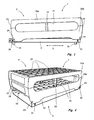
- FIG. 1 schematically shows a rack device 1 according to the invention, comprising a rack 2 and a rack slide 3, which according to the invention are firmly connected to each other by means of a releasable tool locking device.
- the rack 2 is in the illustrated embodiment of two parts made of plastic with an upper part 20a and a lower part 20b, which are fixedly connected to each other, for example glued and / or welded.
- the upper part 20a and the lower part 20b are connected to one another in such a way that a recessed grip 21 remains for easy handling of the upper 2.
- webs 22 are provided between the upper part 20a and the lower part 20b.
- locking grooves 24 are provided on end surfaces 23 of the deck, which are open in the illustrated embodiment, in each case in the direction of the end surfaces 23.
- the locking grooves 24 are placed on locking pins 30, 31 of the rack slide.
- the locking bolts 30, 31 protrude in the illustrated embodiment from an outer side of the rack slide 3.
- the associated rack 2 can be placed on the rack slide 3 such that inner sides of the lower part 20b are opposite the outer sides of the rack slide 3.
- the latching grooves 24 and the latching pins 30, 31 are spaced in pairs in the longitudinal direction L of the rack device 1.
- a direction in which the rack device 1 is inserted into a sample distribution system (not shown) is designated as the longitudinal direction L.
- the arrangement of the locking pins 30, 31 on these side surfaces a particularly simple handling is realized.
- latching bolts 30, 31 and associated latching grooves 24 are provided on end faces of the rack device 1.
- the locking pin 30 is movably mounted.
- the locking pin 30 itself elastically deformable, so that the force element is integrally formed with the locking pin.
- FIG. 1 shown schematically To connect the rack 2 with the latching slide 3 is first, as in FIG. 1 shown schematically, the rack 2 is guided with its locking groove 24 on the movable locking pin 30.
- the movable locking pin 30 can then be moved in the longitudinal direction L with the rack 2 inserted thereon until insertion of the locking groove 24 on the rigidly arranged locking pin 31 is possible.
- the locking pin 30 in the in FIG. 1 shown latching position by means of a force element, in particular by means of a spring held. A manufacture or release of the latching connection is thus possible only by overcoming the force applied by the spring force.
- the rack slide 3 has coupling elements 32, which are formed in the illustrated embodiment as positioning pins. With these coupling elements 32 of the rack slide 3 with corresponding elements of the sample distribution system, not shown, can be connected.
- the rack slide 3 is preferably made of a magnetic and / or a magnetizable material, so that a coupling of the rack carriage 3 with the sample distribution system is also possible by means of magnetic force.
- FIG. 2 schematically shows the rack device 1 according to FIG. 1 in a perspective view.
- the upper part 20a and the lower part 20b respectively recordings 25, 26, in which in FIG. 2 Sample carriers, not shown, in particular sample tubes, can be used.
- the rack slide 3 is formed as a substantially U-shaped part having a rectangular base. The rack 2 can be placed on the rack slide 3 such that the inner surfaces 27 of the lower part 20b come to lie on outer sides 33 of the flanks of the rack carriage 3.
- FIG. 3 schematically shows a sectional side view of a rack device according to FIG. 1 with three sample carriers 4a, 4b and 4c received therein.
- inserts 5 are used with spring arms 50 in the illustrated embodiment, through which the sample carrier 4a, 4b, 4c are held securely in the receptacles 25.
- the receptacles 26 are conically shaped in the lower part 20b, wherein the diameter of the receptacles 26 is formed gradually tapering downwards.
- FIG. 4 schematically shows a sectional view of the rack device 1 along a section line IV-IV according to FIG. 3 , As in FIG. 4 can be seen, the rack slide 3 has a fastening device 34. On the fastening device 34 formed as leaf springs 6 force elements are fixed, by which the movable locking pins 30 are forced into the locking position.
- receptacles 25 and 26 are provided, which are arranged in rows and columns, wherein five columns are provided, in each of which ten receptacles 25, 26 are formed.
- embodiments with a different column and / or row numbers are also conceivable.
- embodiments are preferred which have five columns, wherein four, five, ten, fifteen or even thirty rows can be provided.
- any other configurations are conceivable.
- FIG. 5 schematically shows a rack 2 according to a second embodiment of the invention, wherein receptacles 25, 26 are provided in thirty rows with five receptacles 25, 26.
- the rack device 1 according to FIG. 5 corresponds essentially to the rack device 1 according to the FIGS. 1 to 4 , Uniform reference symbols are used for the same components and a detailed description of these components will be omitted. Due to the increased length in the longitudinal direction L, the number of connecting webs 22 between the upper part 20a and the lower part 20b is increased to improve the stability.
- FIG. 6 schematically shows in a perspective view of another embodiment of a rack 2, wherein only four rows of receptacles 25, 26 are provided.
- FIGS. 7 and 8 schematically show a rack slide 3 for a rack device according to the invention, wherein in FIG. 7 for a better illustration the leaf springs 6 are not shown.
- the rack slide 3 has a fastening device 34 to which leaf springs 6 are attached in such a way that latching pins 30 connected to the leaf springs 6 are guided into a slot 35 provided on the side flanks 33 of the rack slide 3.
- the latching device By means of the latching device according to the invention, it is possible to connect a rack 2 in a simple manner and without tools to an associated rack slide 3.
- a plurality of rack slides 3 and / or rack devices 1 in a small space for example in a drawer or an input area of a Probenverteilsystems close together, next to each other and in series, without hindering handling of the rack device 1 for making or releasing the locking connection.
Landscapes
- Chemical & Material Sciences (AREA)
- Health & Medical Sciences (AREA)
- Chemical Kinetics & Catalysis (AREA)
- Biochemistry (AREA)
- Life Sciences & Earth Sciences (AREA)
- Analytical Chemistry (AREA)
- Physics & Mathematics (AREA)
- General Health & Medical Sciences (AREA)
- General Physics & Mathematics (AREA)
- Immunology (AREA)
- Pathology (AREA)
- Clinical Laboratory Science (AREA)
- Automatic Analysis And Handling Materials Therefor (AREA)
- Sampling And Sample Adjustment (AREA)
Description
- Die Erfindung betrifft eine Rackvorrichtung für ein Probenverteilsystem. Die Erfindung betrifft weiter ein Rack und einen Rackschlitten für eine Rackvorrichtung.
- Ein Probenverteilsystem ist beispielsweise aus
US 7,141,213 B1 bekannt. Ein Probenverteilsystem dient dazu, Proben für eine Analyse oder dergleichen vorzubereiten. Die Proben werden dabei beispielsweise aufgeteilt, zentrifugiert, mit Testflüssigkeiten vermischt und ähnliches. Dabei werden in einem Eingangs- oder Ladebereich dem System Probenträger, insbesondere Probenröhrchen, in sogenannten Racks oder Probehaltern zugeführt. Ein Zuführen erfolgt beispielsweise über schubladenartig verstellbare Wannen- oder Schubladenelemente. In dem Probenverteilsystem können die Racks dann in bestimmte Positionen verschoben und/oder an bestimmte Stationen verteilt werden. Dabei ist es bekannt, das Rack auf einem sogenannten Schlitten anzubringen, durch welchen das Rack in dem System verfahrbar ist. Üblicherweise werden mehrere Racks nebeneinander und in Reihe an einer Wanne oder Schublade angeordnet, wobei die Racks sehr eng aneinander angrenzend angeordnet sind. - Aus der
US 7,141,213 B1 ist es bekannt, an einer Unterseite eines Racks Aufnahmeöffnungen vorzusehen, durch welche das Rack auf Positionierstifte eines Schlittens beweglich aufsetzbar ist. - Die
EP 1 705 149 A2 zeigt eine Vorrichtung zum automatischen Öffnen und Schließen von Reaktionsgefäßen, umfassend eine Halteeinrichtung zum verdrehsicheren Halten von zumindest einem Reaktionsgefäß. - Die
EP 1 655 609 A1 zeigt ein Rack zum Halten von Containern. - Die
JP 2007-303960 A - Es ist Aufgabe der vorliegenden Erfindung, eine Rackvorrichtung zu schaffen, wobei ein Rack mit einem Rackschlitten fest verbindbar ist und die Verbindung werkzeuglos auch bei beengten Platzverhältnissen lösbar ist.
- Diese Aufgabe wird gelöst durch eine Rackvorrichtung für ein Probenverteilsystem umfassend ein Rack mit Aufnahmen für Probenträger und einen Rackschlitten, wobei der Rackschlitten und das Rack mittels einer werkzeuglos lösbaren Rasteinrichtung fest miteinander verbindbar sind.
- Unter einer festen Verbindung wird im Zusammenhang mit der Erfindung eine Verbindung ohne Freiheitsgrade verstanden, wobei in einzelne Richtungen ein geringes Spiel - beispielsweise aufgrund von Fertigungstoleranzen - vorhanden sein kann. Vorzugsweise ist jedoch eine spielfreie Verbindung gegeben. Die Rasteinrichtung erlaubt somit ein Fixieren des Racks an dem Rastschlitten ohne Freiheitsgrade, so dass die Rackvorrichtung innerhalb des Probenverteilsystems auf beliebige Weise mit hoher Genauigkeit manipulierbar ist. Ein werkzeugloses Lösen oder Verbinden der beiden Bauteile ist durch eine Relativbewegung möglich.
- Die Rasteinrichtung weist an dem Rackschlitten und dem Rack angeordnete, zueinander komplementäre Rastelemente und mindestens ein Kraftelement zum Aufbringen einer Zwangskraft auf, wobei eine Rastverbindung durch eine Relativbewegung zwischen dem Rackschlitten und dem Rack entgegen der Zwangskraft herstellbar oder lösbar ist. Je nach Gestaltung der Rastelemente können dabei bereits geringe Bewegungen zum Lösen der Verbindung ausreichend sein. Die Relativbewegung ist in einer Ausgestaltung eine translatorische Bewegung. In anderen Ausgestaltungen sind Rotationsbewegungen oder Kombinationsbewegungen zum Lösen der Verbindung vorgesehen. Die erforderliche Kraft zum Lösen liegt vorzugsweise bei 15 bis 20 N.
- Die Rastelemente umfassen Rastbolzen und Rastnuten, in welche die Rastbolzen einführbar sind. Die Rastbolzen sind dabei in einer Ausgestaltung so angeordnet und dimensioniert, dass die Rastbolzen nicht oder nur unwesentlich von der Rackvorrichtung im gekoppelten Zustand abragen.
- Die Rastelemente umfassen mindestens ein Rastbolzenpaar, umfassend einen starren Rastbolzen und einen davon beabstandeten, beweglichen Rastbolzen, wobei ein Abstand der Rastbolzen entgegen der Zwangskraft des mindestens einen Kraftelements veränderbar ist. Die Rastbolzen können so durch das Kraftelement in Rastnuten gezwängt und in den Rastnuten gehalten werden. In einer vorteilhaften Ausgestaltung umfassen die Rastelemente mindestens ein zu dem Rastbolzenpaar komplementäres Rastnutenpaar mit mindestens zwei gegenüberliegenden Wirkflächen, wobei das mindestens eine Kraftelement bei einer Rastverbindung das Rastbolzenpaar an die Wirkflächen zwingt. Die Wirkflächen können dabei einander zugewandt oder voneinander abgewandt angeordnet sein. Zum Verbinden wird das Rack auf dem beweglichen Rastbolzen aufgebracht und der Rastbolzen wird verschoben bis die dem starren Rastbolzen zugeordnete Rastnut in diesen Rastbolzen einführbar ist. Die hierfür notwendige Relativbewegung ist eine Kombinationsbewegung.
- In einer Weiterbildung ist an gegenüberliegenden Seitenflächen des Rackschlittens jeweils ein Rastbolzenpaar vorgesehen, wobei die Rastbolzen in Längsrichtung beabstandet angeordnet sind. Als Längsrichtung wird im Zusammenhang mit der Erfindung eine Einschubrichtung der Rackvorrichtung in ein Probenverteilsystem bezeichnet. Das Rack und der Rackschlitten weisen je nach Größe im Wesentlichen rechteck-förmige Grundflächen auf. Als Seitenflächen werden dabei die parallel zur Längsrichtung verlaufenden seitlichen Flächen bezeichnet. Vorzugsweise ist an Seitenflächen des Racks jeweils ein Rastnutenpaar vorgesehen, in welche ein Rastbolzenpaar für eine Rastverbindung eingreift. Bei einer derartigen Anordnung ist eine ergonomisch besonders günstige Handhabung möglich.
- In einer weiteren Ausgestaltung der Erfindung ist vorgesehen, dass in die Aufnahmen Einsätze mit elastischen Federarmen zum Halten der Probenträger eingesetzt sind. Die elastischen Federarme erlauben eine gute Positionierung von Probenträgern, insbesondere von Probenröhrchen. Je nach Anwendung sind Racks mit Einsätzen oder ohne Einsätze, sowie Mischformen vorteilhaft. Die Aufnahmen weisen vorzugsweise einen kreisförmigen Querschnitt auf. Ein Durchmesser beträgt beispielsweise ca. 13,3 mm oder ca. 16,5 mm.
- In noch einer weiteren Ausgestaltung der Erfindung ist vorgesehen, dass das Rack aus einem bruchsicheren Kunststoff, insbesondere aus Polycarbonat, beispielsweise Lexan (CAS#25971-63-5) ausgebildet ist.
- In noch einer weiteren Ausgestaltung der Erfindung ist vorgesehen, dass das Rack aus einem autoklavierbaren Kunststoff, insbesondere aus Polycarbonat, beispielsweise Lexan (CAS#25971-63-5) ausgebildet ist.
- In einer Weiterbildung der Erfindung ist vorgesehen, dass das Rack aus einem Oberteil und einem fest damit verbundenen, insbesondere verschweißten oder verklebten Unterteil zusammengesetzt ist. Dadurch ist eine einfache Fertigung beispielsweise durch Spritzguss möglich.
- Vorzugsweise ist vorgesehen, dass das Unterteil und das Oberteil zueinander fluchtend angeordnete Aufnahmen für Probenträger aufweisen, wobei die Aufnahmen des Unterteils konisch verjüngend ausgebildet sind. Durch die konische Verjüngung können Probenröhrchen mit unterschiedlichem Durchmesser aufgenommen werden. Die Verjüngung kann dabei kontinuierlich oder stufenweise erfolgen. Die Aufnahmen haben vorzugsweise einen kreisförmigen Querschnitt.
- In einer weiteren Ausgestaltung der Erfindung ist vorgesehen, dass der Rackschlitten zumindest teilweise aus einem magnetischen und/oder magnetisierbaren Material ausgebildet ist. Der Rackschlitten kann so auf einfache Weise mit unterschiedlichen Stationen des Probenverteilsystems gekoppelt werden. Der Rackschlitten ist beispielsweise als gebogenes Stanzteil kostengünstig fertigbar. In anderen Ausgestaltungen ist der Rackschlitten aus einem Kunststoff.
- In wieder einer weiteren Ausgestaltung der Erfindung ist vorgesehen, dass der Rackschlitten an seiner Unterseite Kopplungselemente, insbesondere Positionierstifte, zur Kopplung mit dem Probenverteilsystem aufweist. Die Kopplungselemente können beliebig gestaltet sein. Die Kopplungselemente umfassen in einer Ausgestaltung eine Kodierung zur Erkennung eines Racktyps.
- Weitere Vorteile der Erfindung ergeben sich aus den Unteransprüchen und aus der nachfolgenden Beschreibung von Ausführungsbeispielen der Erfindung, die in den Zeichnungen schematisch dargestellt sind. Für gleiche oder ähnliche Bauteile werden in den Zeichnungen einheitliche Bezugszeichen verwendet. Als Teil eines Ausführungsbeispiels beschriebene oder dargestellte Merkmale können ebenso in einem anderen Ausführungsbeispiel verwendet werden, um eine weitere Ausführungsform der Erfindung zu erhalten.
- In den Zeichnungen zeigen:
- Fig. 1:
- Eine schematische Seitenansicht einer erfindungsgemäßen Rackvorrichtung beim Einsetzen eines Racks auf einen Rackschlitten;
- Fig. 2:
- die Rackvorrichtung gemäß
Fig. 1 in einer perspektivischen Darstellung; - Fig. 3:
- die Rackvorrichtung gemäß
Fig. 1 in einer geschnittenen Seitenansicht; - Fig. 4:
- die Rackvorrichtung gemäß
Fig. 3 in einer geschnitten Frontansicht; - Fig. 5:
- ein erfindungsgemäßes Rack für eine Rackvorrichtung ähnlich
Fig. 1 in einer Explosionsdarstellung; - Fig. 6:
- eine weitere Ausgestaltung eines Racks für eine erfindungsgemäße Rackvorrichtung;
- Fig. 7:
- einen Rackschlitten für eine erfindungsgemäße Rackvorrichtung in einer perspektivischen Darstellung und
- Fig. 8:
- eine Draufsicht auf einen Rackschlitten gemäß
Fig. 7 mit daran angeordneten Blattfedern. -
Figur 1 zeigt schematisch eine erfindungsgemäße Rackvorrichtung 1, umfassend ein Rack 2 und einen Rackschlitten 3, welche erfindungsgemäß mittels einer werkzeuglos lösbaren Rasteinrichtung fest miteinander verbindbar sind. - Das Rack 2 ist in dem dargestellten Ausführungsbeispiel zweiteilig aus Kunststoff hergestellt mit einem Oberteil 20a und einem Unterteil 20b, welche miteinander fest verbunden, beispielsweise verklebt und/oder verschweißt sind. Das Oberteil 20a und das Unterteil 20b sind derart miteinander verbunden, dass eine Griffmulde 21 für eine einfache Handhabung des Recks 2 verbleibt. Zur Erhöhung einer Stabilität des Racks 2 sind Stege 22 zwischen dem Oberteil 20a und dem Unterteil 20b vorgesehen. Zur Verbindung mit dem Rackschlitten 3 sind an Stirnflächen 23 des Recks 2 Rastnuten 24 vorgesehen, welche in dem dargestellten Ausführungsbeispiel jeweils in Richtung der Stirnflächen 23 offen sind. Zum Verbinden mit dem Rackschlitten 3 werden die Rastnuten 24 auf Rastbolzen 30, 31 des Rackschlittens aufgesetzt. Die Rastbolzen 30, 31 ragen in dem dargestellten Ausführungsbeispiel von einer Außenseite des Rackschlittens 3 ab. Das zugehörige Rack 2 ist auf den Rackschlitten 3 derart aufsetzbar, dass Innenseiten des Unterteils 20b den Außenseiten des Rackschlittens 3 gegenüberliegen. Die Rastnuten 24 bzw. die Rastbolzen 30, 31 sind in Längsrichtung L der Rackvorrichtung 1 paarweise beabstandet. Als Längsrichtung L wird dabei eine Richtung bezeichnet, in welche die Rackvorrichtung 1 in ein nicht dargestelltes Probenverteilsystem eingesetzt wird. Durch die Anordnung der Rastbolzen 30, 31 an diesen Seitenflächen ist eine besonders einfache Handhabung realisiert. Es sind jedoch auch Ausgestaltungen denkbar, an welchen Rastbolzen 30, 31 und zugehörige Rastnuten 24 an Stirnflächen der Rackvorrichtung 1 vorgesehen sind.
- Um ein Einsetzen der Rastnuten 24 auf die Rastbolzen 30, 31 zu ermöglichen, ist der Rastbolzen 30 beweglich gelagert. In anderen Ausgestaltungen sind die Rastbolzen 30 selbst elastisch verformbar, so dass das Kraftelement einteilig mit den Rastbolzen ausgebildet ist.
- Zum Verbinden des Racks 2 mit dem Rastschlitten 3 wird zunächst, wie in
Figur 1 schematisch dargestellt, das Rack 2 mit seiner Rastnut 24 auf den bewegbaren Rastbolzen 30 geführt. Der bewegbare Rastbolzen 30 kann dann in Längsrichtung L mit dem darauf eingesetzten Rack 2 verschoben werden, bis ein Einsetzen der Rastnut 24 auf den starr angeordneten Rastbolzen 31 möglich ist. Um die Rastverbindung zu sichern, wird der Rastbolzen 30 in der inFigur 1 dargestellten Rastposition mittels eines Kraftelements, insbesondere mittels einer Feder, gehalten. Ein Herstellen oder Lösen der Rastverbindung ist somit nur durch Überwinden der durch die Feder aufgebrachten Zwangskraft möglich. - Der Rackschlitten 3 weist Kopplungselemente 32 auf, welche in dem dargestellten Ausführungsbeispiel als Positionierstifte ausgebildet sind. Mit diesen Kopplungselementen 32 ist der Rackschlitten 3 mit entsprechenden Elementen des nicht dargestellten Probenverteilsystems verbindbar. Der Rackschlitten 3 ist vorzugsweise aus einem magnetischen und/oder einen magnetisierbaren Material, so dass ein Koppeln des Rackschlittens 3 mit dem Probenverteilsystem auch mittels Magnetkraft möglich ist.
-
Figur 2 zeigt schematisch die Rackvorrichtung 1 gemäßFigur 1 in einer perspektivischen Darstellung. Wie inFigur 2 erkennbar ist, weisen das Oberteil 20a und das Unterteil 20b jeweils Aufnahmen 25, 26 auf, in welche inFigur 2 nicht dargestellte Probenträger, insbesondere Probenröhrchen, einsetzbar sind. Wie inFigur 2 ebenfalls erkennbar ist, ist der Rackschlitten 3 als im Wesentlichen U-förmig geformtes Teil mit einer rechteckförmigen Grundfläche ausgebildet. Das Rack 2 ist derart auf den Rackschlitten 3 aufsetzbar, dass die Innenflächen 27 des Unterteils 20b an Außenseiten 33 der Flanken des Rackschlittens 3 zu liegen kommen. -
Figur 3 zeigt schematisch eine geschnittene Seitenansicht einer Rackvorrichtung gemäßFigur 1 mit drei darin aufgenommenen Probenträgern 4a, 4b und 4c. In die Aufnahmen 25 des Oberteils 20a sind in dem dargestellten Ausführungsbeispiel Einsätze 5 mit Federarmen 50 eingesetzt, durch welche die Probenträger 4a, 4b, 4c sicher in den Aufnahmen 25 gehalten werden. Wie inFigur 3 ebenfalls erkennbar ist, sind die Aufnahmen 26 in dem Unterteil 20b konisch gestaltet, wobei der Durchmesser der Aufnahmen 26 nach unten hin stufenweise verjüngend ausgebildet ist. Dadurch wird eine Aufnahme von Probenträgern 4a, 4b, 4c mit unterschiedlichen Durchmessern, wie inFigur 3 schematisch dargestellt, verbessert. -
Figur 4 zeigt schematisch eine geschnittene Ansicht der Rackvorrichtung 1 entlang einer Schnittlinie IV-IV gemäßFigur 3 . Wie inFigur 4 erkennbar ist, weist der Rackschlitten 3 eine Befestigungseinrichtung 34 auf. An der Befestigungseinrichtung 34 sind als Blattfedern 6 ausgebildete Kraftelemente befestigt, durch welche die beweglichen Rastbolzen 30 in die Rastposition gezwungen werden. - Bei der Ausführungsform einer Rackvorrichtung 1 gemäß den
Figuren 1 bis 4 sind fünfzig Aufnahmen 25 bzw. 26 vorgesehen, welche geordnet in Reihen und Spalten angeordnet sind, wobei fünf Spalten vorgesehen sind, in welchen jeweils zehn Aufnahmen 25, 26 ausgebildet sind. Es sind jedoch auch Ausgestaltungen mit einer davon abweichenden Spalten- und/oder Reihenzahlen denkbar. Üblicherweise sind Ausführungsformen bevorzugt, welche fünf Spalten aufweisen, wobei vier, fünf, zehn, fünfzehn oder sogar dreißig Reihen vorgesehen sein können. Selbstverständlich sind jedoch auch beliebige andere Ausgestaltungen denkbar. -
Figur 5 zeigt schematisch ein Rack 2 gemäß einem zweiten Ausführungsbeispiel der Erfindung, wobei Aufnahmen 25, 26 in dreißig Reihen mit jeweils fünf Aufnahmen 25, 26 vorgesehen sind. Die Rackvorrichtung 1 gemäßFigur 5 entspricht im Wesentlichen der Rackvorrichtung 1 gemäß denFiguren 1 bis 4 . Für gleiche Bauteile werden einheitliche Bezugszeichen verwendet und auf eine detaillierte Beschreibung dieser Bauteile wird verzichtet. Aufgrund der erhöhten Länge in Längsrichtung L ist zur Verbesserung der Stabilität die Anzahl an Verbindungsstegen 22 zwischen dem Oberteil 20a und dem Unterteil 20b erhöht. -
Figur 6 zeigt schematisch in einer perspektivischen Darstellung eine weitere Ausführungsform eines Racks 2, wobei lediglich vier Reihen an Aufnahmen 25, 26 vorgesehen sind. -
Figur 7 und 8 zeigen schematisch einen Rackschlitten 3 für eine erfindungsgemäße Rackvorrichtung, wobei inFigur 7 für eine bessere Darstellung die Blattfedern 6 nicht dargestellt sind. Wie bereits beschrieben, weist der Rackschlitten 3 eine Befestigungseinrichtung 34 auf, an welche Blattfedern 6 derart angebracht werden, dass mit den Blattfedern 6 verbundene Rastbolzen 30 in einen an den Seitenflanken 33 des Rackschlittens 3 vorgesehenen Langloch 35 geführt werden. - Durch die erfindungsgemäße Rasteinrichtung ist es möglich, ein Rack 2 auf einfache Weise und werkzeuglos mit einem zugehörigen Rackschlitten 3 zu verbinden. Dabei können mehrere Rackschlitten 3 und/oder Rackvorrichtungen 1 auf geringem Bauraum, beispielsweise in einem Schubfach oder einem Eingangsbereich eines Probenverteilsystems eng aneinanderliegend, nebeneinander und in Reihe angeordnet sein, ohne dass eine Handhabung der Rackvorrichtung 1 zum Herstellen oder Lösen der Rastverbindung behindert ist.
Claims (10)
- Rackvorrichtung für ein Probenverteilsystem, umfassend ein Rack (2) mit Aufnahmen für Probenträger (4a, 4b, 4c) und einen Rackschlitten (3), wobei- der Rackschlitten (3) und das Rack (2) mittels einer werkzeuglos lösbaren Rasteinrichtung fest miteinander verbindbar sind,- wobei die Rasteinrichtung an dem Rackschlitten (3) und dem Rack (2) angeordnete, zueinander komplementäre Rastelemente (30, 31, 24) und mindestens ein Kraftelement (6) zum Aufbringen einer Zwangskraft aufweist, wobei eine Rastverbindung durch eine Relativbewegung zwischen dem Rackschlitten (3) und dem Rack (2) entgegen der Zwangskraft herstellbar oder lösbar ist,- wobei die Rastelemente mindestens ein Rastbolzenpaar (30, 31), umfassend einen starren Rastbolzen (31) und einen davon beabstandeten, beweglichen Rastbolzen (30), und Rastnuten (24), in welche die Rastbolzen (30, 31) einführbar sind, umfassen, wobei ein Abstand der Rastbolzen (30, 31) entgegen der Zwangskraft des mindestens einen Kraftelements (6) veränderbar ist.
- Rackvorrichtung nach Anspruch 1, dadurch gekennzeichnet, dass die Rastelemente mindestens ein zu dem Rastbolzenpaar (30, 31) komplementäres Rastnutenpaar (24) mit mindestens zwei gegenüberliegenden Wirkflächen umfassen, wobei das mindestens eine Kraftelement (6) bei einer Rastverbindung das Rastbolzenpaar (30, 31) an die Wirkflächen zwingt.
- Rackvorrichtung nach Anspruch 1 oder 2, dadurch gekennzeichnet, dass an gegenüberliegenden Seitenflächen (33) des Rackschlittens (3) jeweils ein Rastbolzenpaar (30, 31) vorgesehen ist, wobei die Rastbolzen (30, 31) in Längsrichtung (L) beabstandet angeordnet sind.
- Rackvorrichtung nach Anspruch 3, dadurch gekennzeichnet, dass an Seitenflächen des Racks (2) jeweils ein Rastnutenpaar (24) vorgesehen ist, in welche ein Rastbolzenpaar (30, 31) für eine Rastverbindung eingreift.
- Rackvorrichtung nach einem der Ansprüche 1 bis 4, dadurch gekennzeichnet, dass in die Aufnahmen Einsätze (5) mit elastischen Federarmen (50) zum Halten der Probenträger (4a, 4b, 4c) eingesetzt sind.
- Rackvorrichtung nach einem der Ansprüche 1 bis 5, dadurch gekennzeichnet, dass das Rack (2) aus einem bruchsicheren Kunststoff, insbesondere aus Polycarbonat, ausgebildet ist.
- Rackvorrichtung nach Anspruch 6, dadurch gekennzeichnet, dass das Rack (2) aus einem Oberteil (20a) und einem fest damit verbundenen, insbesondere verschweißten oder verklebten, Unterteil (20b) zusammengesetzt ist.
- Rackvorrichtung nach Anspruch 7, dadurch gekennzeichnet, dass das Unterteil (20b) und das Oberteil (20a) zueinander fluchtend angeordnete Aufnahmen (25, 26) für Probenträger (4a, 4b, 4c) aufweisen, wobei die Aufnahmen (25, 26) des Unterteils (20b) konisch verjüngend ausgebildet sind.
- Rackvorrichtung nach einem der Ansprüche 1 bis 8, dadurch gekennzeichnet, dass der Rackschlitten (3) zumindest teilweise aus einem magnetischen und/oder magnetisierbaren Material ausgebildet ist.
- Rackvorrichtung nach einem der Ansprüche 1 bis 9, dadurch gekennzeichnet, dass der Rackschlitten (3) an seiner Unterseite Kopplungselemente, insbesondere Positionierstifte (32), zur Kopplung mit dem Probenverteilsystem aufweist.
Applications Claiming Priority (2)
| Application Number | Priority Date | Filing Date | Title |
|---|---|---|---|
| DE200810058755 DE102008058755A1 (de) | 2008-11-14 | 2008-11-14 | Rackvorrichtung für ein Probenverteilsystem |
| PCT/EP2009/008028 WO2010054799A1 (de) | 2008-11-14 | 2009-11-11 | Rackvorrichtung für ein probenverteilsystem |
Publications (3)
| Publication Number | Publication Date |
|---|---|
| EP2355932A1 EP2355932A1 (de) | 2011-08-17 |
| EP2355932B1 true EP2355932B1 (de) | 2014-02-12 |
| EP2355932B8 EP2355932B8 (de) | 2014-04-09 |
Family
ID=41820465
Family Applications (1)
| Application Number | Title | Priority Date | Filing Date |
|---|---|---|---|
| EP09749030.4A Active EP2355932B8 (de) | 2008-11-14 | 2009-11-11 | Rackvorrichtung für ein probenverteilsystem |
Country Status (5)
| Country | Link |
|---|---|
| US (1) | US8940252B2 (de) |
| EP (1) | EP2355932B8 (de) |
| DE (1) | DE102008058755A1 (de) |
| ES (1) | ES2457532T3 (de) |
| WO (1) | WO2010054799A1 (de) |
Families Citing this family (26)
| Publication number | Priority date | Publication date | Assignee | Title |
|---|---|---|---|---|
| US8357538B2 (en) | 2007-04-06 | 2013-01-22 | Qiagen Gaithersburg, Inc. | Automated assay and system |
| US8703492B2 (en) | 2007-04-06 | 2014-04-22 | Qiagen Gaithersburg, Inc. | Open platform hybrid manual-automated sample processing system |
| US20130116597A1 (en) * | 2011-11-04 | 2013-05-09 | Phenomenex, Inc. | Method and apparatus for acquiring blood for testing |
| JP6425498B2 (ja) * | 2013-11-06 | 2018-11-21 | 協和メデックス株式会社 | 搬送装置、及び分析装置 |
| EP3283222B1 (de) * | 2015-04-17 | 2025-02-19 | Neoteryx, LLC | Vorrichtung zur handhabung von blut zum testen |
| US10071381B2 (en) | 2015-04-17 | 2018-09-11 | Neoteryx, Llc. | Method and apparatus for handling blood for testing |
| ES2920382T3 (es) | 2015-11-16 | 2022-08-03 | Beckman Coulter Inc | Gradilla para tubos de muestras y sistema de análisis de tubos de muestras |
| EP3211423A1 (de) * | 2016-02-23 | 2017-08-30 | Siemens Healthcare Diagnostics Products GmbH | Automatisches analysegerät mit aufnahmepositionen für flüssigkeitsbehälter |
| USD812243S1 (en) | 2016-07-28 | 2018-03-06 | Beckman Coulter, Inc. | Sample tube rack |
| USD808540S1 (en) | 2016-07-28 | 2018-01-23 | Beckman Coulter, Inc. | Sample tube rack |
| EP3330713A1 (de) | 2016-12-01 | 2018-06-06 | Roche Diagniostics GmbH | Laborhandhabungssystem und laborautomatisierungssystem |
| CN110869770B (zh) | 2017-06-16 | 2024-10-29 | 拜克门寇尔特公司 | 用于处理样品容器的设备和方法 |
| USD938612S1 (en) | 2017-06-16 | 2021-12-14 | Beckman Coulter, Inc. | Sample rack |
| US10694922B1 (en) * | 2018-04-25 | 2020-06-30 | 4 R Oceans, LLC | Drinking straw cleaning caddy |
| USD925767S1 (en) | 2019-04-02 | 2021-07-20 | DePuy Synthes Products, Inc. | Storage rack for sterile packaging |
| USD966550S1 (en) | 2019-04-02 | 2022-10-11 | DePuy Synthes Products, Inc. | Storage rack for sterile packaging |
| USD930852S1 (en) * | 2019-04-02 | 2021-09-14 | DePuy Synthes Products, Inc. | Storage rack for sterile packaging |
| US11083295B2 (en) | 2019-04-02 | 2021-08-10 | DePuy Synthes Products, Inc. | Tube rack apparatus |
| USD1002869S1 (en) | 2019-04-02 | 2023-10-24 | DePuy Synthes Products, Inc. | Storage rack for sterile packaging |
| CN110420677A (zh) * | 2019-09-02 | 2019-11-08 | 华东师范大学 | 一种高度可调用于富集分离痕量元素的工作台 |
| EP3789772B1 (de) | 2019-09-05 | 2025-03-26 | Roche Diagnostics GmbH | Verfahren zur bestimmung einer position eines ständers auf einer ständerplatziereinheit eines laborhandling-systems und laborhandling-system |
| US11642677B2 (en) * | 2019-12-05 | 2023-05-09 | QIS, Inc. | Split microplate and vials |
| EP3862094A1 (de) | 2020-02-10 | 2021-08-11 | Roche Diagnostics GmbH | Adapter für ein probenbehältergestell und probenbehältergestellvorrichtung |
| US11786907B2 (en) * | 2020-11-21 | 2023-10-17 | Mercy Bioanalytics, Inc. | Column tube holder for improved-accuracy assays |
| USD959924S1 (en) * | 2021-04-21 | 2022-08-09 | Guangzhou Shengjisong International Trade Co., Ltd. | Flipping egg holder |
| WO2025132629A1 (en) | 2023-12-20 | 2025-06-26 | Roche Diagnostics Gmbh | Sample tube holder, mounting aid device, and sample tube transport system |
Family Cites Families (12)
| Publication number | Priority date | Publication date | Assignee | Title |
|---|---|---|---|---|
| US3857606A (en) * | 1973-11-29 | 1974-12-31 | Everest & Jennings | Swing-away detachable wheelchair footrest |
| US5632388A (en) | 1995-01-30 | 1997-05-27 | Forma Scientific, Inc. | Test tube rack assembly |
| US7141213B1 (en) | 1996-07-05 | 2006-11-28 | Beckman Coulter, Inc. | Automated sample processing system |
| US6193892B1 (en) * | 1999-03-03 | 2001-02-27 | Promega Corporation | Magnetic separation assembly and method |
| US6752967B2 (en) * | 2002-01-04 | 2004-06-22 | Dade Behring Inc. | Stackable aliquot vessel array |
| EP1331473B1 (de) | 2002-01-22 | 2005-04-06 | MPB MelTec Patent- und Beteiligungsgesellschaft mbH | Verfahren und Vorrichtung für die Probenvorbereitung zur Analyse von biologischen Proben |
| DE20310332U1 (de) * | 2003-07-04 | 2004-11-11 | Mwg-Biotech Ag | Vorrichtung zum automatischen Öffnen und Schließen von Reaktionsgefäßen |
| JP2005233664A (ja) * | 2004-02-17 | 2005-09-02 | Ids:Kk | 試験管ラック |
| EP1655609B1 (de) * | 2004-11-04 | 2013-09-18 | F.Hoffmann-La Roche Ag | Röhrchenständer mit einem beweglichen Teil zum Schütteln der Probe |
| US7669721B2 (en) | 2005-12-01 | 2010-03-02 | Handi-Craft Company | Drying rack assembly for baby bottles |
| JP2007303960A (ja) | 2006-05-11 | 2007-11-22 | Olympus Corp | ラックトレイ |
| US7820115B2 (en) * | 2007-05-30 | 2010-10-26 | Bel-Art Products, Inc. | Adjustable laboratory rack |
-
2008
- 2008-11-14 DE DE200810058755 patent/DE102008058755A1/de not_active Withdrawn
-
2009
- 2009-11-11 WO PCT/EP2009/008028 patent/WO2010054799A1/de not_active Ceased
- 2009-11-11 ES ES09749030.4T patent/ES2457532T3/es active Active
- 2009-11-11 EP EP09749030.4A patent/EP2355932B8/de active Active
- 2009-11-11 US US13/129,056 patent/US8940252B2/en active Active
Also Published As
| Publication number | Publication date |
|---|---|
| US8940252B2 (en) | 2015-01-27 |
| WO2010054799A1 (de) | 2010-05-20 |
| EP2355932A1 (de) | 2011-08-17 |
| ES2457532T3 (es) | 2014-04-28 |
| US20110274595A1 (en) | 2011-11-10 |
| EP2355932B8 (de) | 2014-04-09 |
| DE102008058755A1 (de) | 2010-05-27 |
Similar Documents
| Publication | Publication Date | Title |
|---|---|---|
| EP2355932B1 (de) | Rackvorrichtung für ein probenverteilsystem | |
| EP3200654B1 (de) | Führungsvorrichtung | |
| EP2746634B1 (de) | Kabelhalter mit einem U-förmigen Rahmen und einer Anzahl von Tüllen zum Hindurchführen von Kabeln | |
| EP2767828B1 (de) | Einspannvorrichtung zum Einspannen von mehreren Säulen für eine Vorrichtung zur Probenvorbereitung | |
| EP3613312A1 (de) | Auszugführung | |
| EP3598188B1 (de) | Kupplung zur ausbildung einer optischen steckverbindung | |
| DE20014492U1 (de) | Gleitschienenanordnung | |
| EP3909477A1 (de) | Vorhangaufhänger | |
| EP2392286B1 (de) | Lagereinheit für Knochenschrauben, Set und chirurgischer Behälter | |
| WO2023099243A1 (de) | Abstandshalter zum halten von übereinandergestapelten pipettenspitzenträgern auf abstand voneinander | |
| WO2017013114A1 (de) | Katheterfixierung | |
| EP3699660A2 (de) | Schaltschrank mit einer leerrohreinführung zur einführung einer vielzahl lichtwellenleiter in einen schaltschrankinnenraum | |
| EP1809441B1 (de) | Spann- oder greifvorrichtung insbesondere linear- oder zentrischgreifer | |
| DE102009009522A1 (de) | Umlenkkörper für einen Kugelgewindetrieb | |
| DE20013949U1 (de) | Klemmstück | |
| DE102017219983B4 (de) | Behältnisaufnahmevorrichtung für einen Fahrzeuginnenraum | |
| DE102019108777A1 (de) | Einrichtung zum Fixieren von Knochen | |
| DE19827350A1 (de) | Vorrichtung zur verschiebbaren Montage eines Gegenstands, insbesondere einer Handbrause, an einer Tragstange | |
| DE2821893A1 (de) | Klammer, insbesondere chirurgische klammer | |
| AT398890B (de) | Vorrichtung zur halterung und präsentation von warenpäckchen | |
| CH662159A5 (de) | Loesbare steckverbindung fuer einen stift in einer stecktafel. | |
| WO2014194981A1 (de) | Bahnelement für eine behältertransportanlage mit einer rastkopplung | |
| DE102014107150B4 (de) | Schraubstock | |
| DE202009001790U1 (de) | Präsentationsvorrichtung | |
| DE2811137C2 (de) | Stecker für Lichtleitfasern mit V-Nut-Führung |
Legal Events
| Date | Code | Title | Description |
|---|---|---|---|
| PUAI | Public reference made under article 153(3) epc to a published international application that has entered the european phase |
Free format text: ORIGINAL CODE: 0009012 |
|
| 17P | Request for examination filed |
Effective date: 20110530 |
|
| AK | Designated contracting states |
Kind code of ref document: A1 Designated state(s): AT BE BG CH CY CZ DE DK EE ES FI FR GB GR HR HU IE IS IT LI LT LU LV MC MK MT NL NO PL PT RO SE SI SK SM TR |
|
| DAX | Request for extension of the european patent (deleted) | ||
| GRAP | Despatch of communication of intention to grant a patent |
Free format text: ORIGINAL CODE: EPIDOSNIGR1 |
|
| INTG | Intention to grant announced |
Effective date: 20130821 |
|
| GRAS | Grant fee paid |
Free format text: ORIGINAL CODE: EPIDOSNIGR3 |
|
| GRAA | (expected) grant |
Free format text: ORIGINAL CODE: 0009210 |
|
| AK | Designated contracting states |
Kind code of ref document: B1 Designated state(s): AT BE BG CH CY CZ DE DK EE ES FI FR GB GR HR HU IE IS IT LI LT LU LV MC MK MT NL NO PL PT RO SE SI SK SM TR |
|
| RAP1 | Party data changed (applicant data changed or rights of an application transferred) |
Owner name: ROCHE PVT GMBH |
|
| REG | Reference to a national code |
Ref country code: GB Ref legal event code: FG4D Free format text: NOT ENGLISH |
|
| REG | Reference to a national code |
Ref country code: CH Ref legal event code: EP |
|
| REG | Reference to a national code |
Ref country code: AT Ref legal event code: REF Ref document number: 651888 Country of ref document: AT Kind code of ref document: T Effective date: 20140215 |
|
| RAP2 | Party data changed (patent owner data changed or rights of a patent transferred) |
Owner name: F.HOFFMANN-LA ROCHE AG Owner name: ROCHE DIAGNOSTICS GMBH |
|
| REG | Reference to a national code |
Ref country code: IE Ref legal event code: FG4D Free format text: LANGUAGE OF EP DOCUMENT: GERMAN |
|
| REG | Reference to a national code |
Ref country code: DE Ref legal event code: R096 Ref document number: 502009008785 Country of ref document: DE Effective date: 20140327 |
|
| REG | Reference to a national code |
Ref country code: ES Ref legal event code: FG2A Ref document number: 2457532 Country of ref document: ES Kind code of ref document: T3 Effective date: 20140428 |
|
| REG | Reference to a national code |
Ref country code: NL Ref legal event code: VDEP Effective date: 20140212 |
|
| REG | Reference to a national code |
Ref country code: LT Ref legal event code: MG4D |
|
| PG25 | Lapsed in a contracting state [announced via postgrant information from national office to epo] |
Ref country code: NO Free format text: LAPSE BECAUSE OF FAILURE TO SUBMIT A TRANSLATION OF THE DESCRIPTION OR TO PAY THE FEE WITHIN THE PRESCRIBED TIME-LIMIT Effective date: 20140512 Ref country code: LT Free format text: LAPSE BECAUSE OF FAILURE TO SUBMIT A TRANSLATION OF THE DESCRIPTION OR TO PAY THE FEE WITHIN THE PRESCRIBED TIME-LIMIT Effective date: 20140212 Ref country code: IS Free format text: LAPSE BECAUSE OF FAILURE TO SUBMIT A TRANSLATION OF THE DESCRIPTION OR TO PAY THE FEE WITHIN THE PRESCRIBED TIME-LIMIT Effective date: 20140612 |
|
| PG25 | Lapsed in a contracting state [announced via postgrant information from national office to epo] |
Ref country code: PT Free format text: LAPSE BECAUSE OF FAILURE TO SUBMIT A TRANSLATION OF THE DESCRIPTION OR TO PAY THE FEE WITHIN THE PRESCRIBED TIME-LIMIT Effective date: 20140612 Ref country code: SE Free format text: LAPSE BECAUSE OF FAILURE TO SUBMIT A TRANSLATION OF THE DESCRIPTION OR TO PAY THE FEE WITHIN THE PRESCRIBED TIME-LIMIT Effective date: 20140212 Ref country code: NL Free format text: LAPSE BECAUSE OF FAILURE TO SUBMIT A TRANSLATION OF THE DESCRIPTION OR TO PAY THE FEE WITHIN THE PRESCRIBED TIME-LIMIT Effective date: 20140212 Ref country code: FI Free format text: LAPSE BECAUSE OF FAILURE TO SUBMIT A TRANSLATION OF THE DESCRIPTION OR TO PAY THE FEE WITHIN THE PRESCRIBED TIME-LIMIT Effective date: 20140212 Ref country code: CY Free format text: LAPSE BECAUSE OF FAILURE TO SUBMIT A TRANSLATION OF THE DESCRIPTION OR TO PAY THE FEE WITHIN THE PRESCRIBED TIME-LIMIT Effective date: 20140212 |
|
| PG25 | Lapsed in a contracting state [announced via postgrant information from national office to epo] |
Ref country code: HR Free format text: LAPSE BECAUSE OF FAILURE TO SUBMIT A TRANSLATION OF THE DESCRIPTION OR TO PAY THE FEE WITHIN THE PRESCRIBED TIME-LIMIT Effective date: 20140212 Ref country code: LV Free format text: LAPSE BECAUSE OF FAILURE TO SUBMIT A TRANSLATION OF THE DESCRIPTION OR TO PAY THE FEE WITHIN THE PRESCRIBED TIME-LIMIT Effective date: 20140212 |
|
| PG25 | Lapsed in a contracting state [announced via postgrant information from national office to epo] |
Ref country code: EE Free format text: LAPSE BECAUSE OF FAILURE TO SUBMIT A TRANSLATION OF THE DESCRIPTION OR TO PAY THE FEE WITHIN THE PRESCRIBED TIME-LIMIT Effective date: 20140212 Ref country code: CZ Free format text: LAPSE BECAUSE OF FAILURE TO SUBMIT A TRANSLATION OF THE DESCRIPTION OR TO PAY THE FEE WITHIN THE PRESCRIBED TIME-LIMIT Effective date: 20140212 Ref country code: RO Free format text: LAPSE BECAUSE OF FAILURE TO SUBMIT A TRANSLATION OF THE DESCRIPTION OR TO PAY THE FEE WITHIN THE PRESCRIBED TIME-LIMIT Effective date: 20140212 Ref country code: DK Free format text: LAPSE BECAUSE OF FAILURE TO SUBMIT A TRANSLATION OF THE DESCRIPTION OR TO PAY THE FEE WITHIN THE PRESCRIBED TIME-LIMIT Effective date: 20140212 |
|
| REG | Reference to a national code |
Ref country code: DE Ref legal event code: R097 Ref document number: 502009008785 Country of ref document: DE |
|
| PG25 | Lapsed in a contracting state [announced via postgrant information from national office to epo] |
Ref country code: SK Free format text: LAPSE BECAUSE OF FAILURE TO SUBMIT A TRANSLATION OF THE DESCRIPTION OR TO PAY THE FEE WITHIN THE PRESCRIBED TIME-LIMIT Effective date: 20140212 Ref country code: PL Free format text: LAPSE BECAUSE OF FAILURE TO SUBMIT A TRANSLATION OF THE DESCRIPTION OR TO PAY THE FEE WITHIN THE PRESCRIBED TIME-LIMIT Effective date: 20140212 |
|
| PLBE | No opposition filed within time limit |
Free format text: ORIGINAL CODE: 0009261 |
|
| STAA | Information on the status of an ep patent application or granted ep patent |
Free format text: STATUS: NO OPPOSITION FILED WITHIN TIME LIMIT |
|
| 26N | No opposition filed |
Effective date: 20141113 |
|
| REG | Reference to a national code |
Ref country code: DE Ref legal event code: R097 Ref document number: 502009008785 Country of ref document: DE Effective date: 20141113 |
|
| PG25 | Lapsed in a contracting state [announced via postgrant information from national office to epo] |
Ref country code: SI Free format text: LAPSE BECAUSE OF FAILURE TO SUBMIT A TRANSLATION OF THE DESCRIPTION OR TO PAY THE FEE WITHIN THE PRESCRIBED TIME-LIMIT Effective date: 20140212 |
|
| PG25 | Lapsed in a contracting state [announced via postgrant information from national office to epo] |
Ref country code: LU Free format text: LAPSE BECAUSE OF FAILURE TO SUBMIT A TRANSLATION OF THE DESCRIPTION OR TO PAY THE FEE WITHIN THE PRESCRIBED TIME-LIMIT Effective date: 20141111 Ref country code: BE Free format text: LAPSE BECAUSE OF NON-PAYMENT OF DUE FEES Effective date: 20141130 Ref country code: MC Free format text: LAPSE BECAUSE OF FAILURE TO SUBMIT A TRANSLATION OF THE DESCRIPTION OR TO PAY THE FEE WITHIN THE PRESCRIBED TIME-LIMIT Effective date: 20140212 |
|
| REG | Reference to a national code |
Ref country code: IE Ref legal event code: MM4A |
|
| REG | Reference to a national code |
Ref country code: FR Ref legal event code: PLFP Year of fee payment: 7 |
|
| PG25 | Lapsed in a contracting state [announced via postgrant information from national office to epo] |
Ref country code: IE Free format text: LAPSE BECAUSE OF NON-PAYMENT OF DUE FEES Effective date: 20141111 |
|
| PG25 | Lapsed in a contracting state [announced via postgrant information from national office to epo] |
Ref country code: SM Free format text: LAPSE BECAUSE OF FAILURE TO SUBMIT A TRANSLATION OF THE DESCRIPTION OR TO PAY THE FEE WITHIN THE PRESCRIBED TIME-LIMIT Effective date: 20140212 |
|
| PG25 | Lapsed in a contracting state [announced via postgrant information from national office to epo] |
Ref country code: BG Free format text: LAPSE BECAUSE OF FAILURE TO SUBMIT A TRANSLATION OF THE DESCRIPTION OR TO PAY THE FEE WITHIN THE PRESCRIBED TIME-LIMIT Effective date: 20140212 Ref country code: GR Free format text: LAPSE BECAUSE OF FAILURE TO SUBMIT A TRANSLATION OF THE DESCRIPTION OR TO PAY THE FEE WITHIN THE PRESCRIBED TIME-LIMIT Effective date: 20140513 |
|
| PG25 | Lapsed in a contracting state [announced via postgrant information from national office to epo] |
Ref country code: MT Free format text: LAPSE BECAUSE OF FAILURE TO SUBMIT A TRANSLATION OF THE DESCRIPTION OR TO PAY THE FEE WITHIN THE PRESCRIBED TIME-LIMIT Effective date: 20140212 Ref country code: TR Free format text: LAPSE BECAUSE OF FAILURE TO SUBMIT A TRANSLATION OF THE DESCRIPTION OR TO PAY THE FEE WITHIN THE PRESCRIBED TIME-LIMIT Effective date: 20140212 Ref country code: HU Free format text: LAPSE BECAUSE OF FAILURE TO SUBMIT A TRANSLATION OF THE DESCRIPTION OR TO PAY THE FEE WITHIN THE PRESCRIBED TIME-LIMIT; INVALID AB INITIO Effective date: 20091111 |
|
| REG | Reference to a national code |
Ref country code: FR Ref legal event code: PLFP Year of fee payment: 8 |
|
| REG | Reference to a national code |
Ref country code: FR Ref legal event code: PLFP Year of fee payment: 9 |
|
| PG25 | Lapsed in a contracting state [announced via postgrant information from national office to epo] |
Ref country code: MK Free format text: LAPSE BECAUSE OF FAILURE TO SUBMIT A TRANSLATION OF THE DESCRIPTION OR TO PAY THE FEE WITHIN THE PRESCRIBED TIME-LIMIT Effective date: 20140212 |
|
| REG | Reference to a national code |
Ref country code: FR Ref legal event code: PLFP Year of fee payment: 10 |
|
| REG | Reference to a national code |
Ref country code: CH Ref legal event code: U11 Free format text: ST27 STATUS EVENT CODE: U-0-0-U10-U11 (AS PROVIDED BY THE NATIONAL OFFICE) Effective date: 20251201 |
|
| PGFP | Annual fee paid to national office [announced via postgrant information from national office to epo] |
Ref country code: DE Payment date: 20251022 Year of fee payment: 17 |
|
| PGFP | Annual fee paid to national office [announced via postgrant information from national office to epo] |
Ref country code: GB Payment date: 20251023 Year of fee payment: 17 |
|
| PGFP | Annual fee paid to national office [announced via postgrant information from national office to epo] |
Ref country code: AT Payment date: 20251024 Year of fee payment: 17 |
|
| PGFP | Annual fee paid to national office [announced via postgrant information from national office to epo] |
Ref country code: IT Payment date: 20251022 Year of fee payment: 17 |
|
| PGFP | Annual fee paid to national office [announced via postgrant information from national office to epo] |
Ref country code: FR Payment date: 20251022 Year of fee payment: 17 |
|
| PGFP | Annual fee paid to national office [announced via postgrant information from national office to epo] |
Ref country code: CH Payment date: 20251201 Year of fee payment: 17 |
|
| PGFP | Annual fee paid to national office [announced via postgrant information from national office to epo] |
Ref country code: ES Payment date: 20251201 Year of fee payment: 17 |