EP2363036A1 - Procédé de fabrication d'une pièce comportant un revêtement élastomère, et pièce obtenue par ce procédé - Google Patents
Procédé de fabrication d'une pièce comportant un revêtement élastomère, et pièce obtenue par ce procédé Download PDFInfo
- Publication number
- EP2363036A1 EP2363036A1 EP11153384A EP11153384A EP2363036A1 EP 2363036 A1 EP2363036 A1 EP 2363036A1 EP 11153384 A EP11153384 A EP 11153384A EP 11153384 A EP11153384 A EP 11153384A EP 2363036 A1 EP2363036 A1 EP 2363036A1
- Authority
- EP
- European Patent Office
- Prior art keywords
- substrate
- elastomer
- composition
- silane
- coating
- Prior art date
- Legal status (The legal status is an assumption and is not a legal conclusion. Google has not performed a legal analysis and makes no representation as to the accuracy of the status listed.)
- Granted
Links
Images

Classifications
-
- B—PERFORMING OPERATIONS; TRANSPORTING
- B29—WORKING OF PLASTICS; WORKING OF SUBSTANCES IN A PLASTIC STATE IN GENERAL
- B29C—SHAPING OR JOINING OF PLASTICS; SHAPING OF MATERIAL IN A PLASTIC STATE, NOT OTHERWISE PROVIDED FOR; AFTER-TREATMENT OF THE SHAPED PRODUCTS, e.g. REPAIRING
- B29C70/00—Shaping composites, i.e. plastics material comprising reinforcements, fillers or preformed parts, e.g. inserts
- B29C70/68—Shaping composites, i.e. plastics material comprising reinforcements, fillers or preformed parts, e.g. inserts by incorporating or moulding on preformed parts, e.g. inserts or layers, e.g. foam blocks
- B29C70/74—Moulding material on a relatively small portion of the preformed part, e.g. outsert moulding
- B29C70/745—Filling cavities in the preformed part
-
- A—HUMAN NECESSITIES
- A44—HABERDASHERY; JEWELLERY
- A44C—PERSONAL ADORNMENTS, e.g. JEWELLERY; COINS
- A44C27/00—Making jewellery or other personal adornments
- A44C27/001—Materials for manufacturing jewellery
- A44C27/005—Coating layers for jewellery
- A44C27/007—Non-metallic coatings
-
- B—PERFORMING OPERATIONS; TRANSPORTING
- B29—WORKING OF PLASTICS; WORKING OF SUBSTANCES IN A PLASTIC STATE IN GENERAL
- B29C—SHAPING OR JOINING OF PLASTICS; SHAPING OF MATERIAL IN A PLASTIC STATE, NOT OTHERWISE PROVIDED FOR; AFTER-TREATMENT OF THE SHAPED PRODUCTS, e.g. REPAIRING
- B29C70/00—Shaping composites, i.e. plastics material comprising reinforcements, fillers or preformed parts, e.g. inserts
- B29C70/68—Shaping composites, i.e. plastics material comprising reinforcements, fillers or preformed parts, e.g. inserts by incorporating or moulding on preformed parts, e.g. inserts or layers, e.g. foam blocks
- B29C70/681—Component parts, details or accessories; Auxiliary operations
- B29C70/683—Pretreatment of the preformed part, e.g. insert
-
- C—CHEMISTRY; METALLURGY
- C04—CEMENTS; CONCRETE; ARTIFICIAL STONE; CERAMICS; REFRACTORIES
- C04B—LIME, MAGNESIA; SLAG; CEMENTS; COMPOSITIONS THEREOF, e.g. MORTARS, CONCRETE OR LIKE BUILDING MATERIALS; ARTIFICIAL STONE; CERAMICS; REFRACTORIES; TREATMENT OF NATURAL STONE
- C04B41/00—After-treatment of mortars, concrete, artificial stone or ceramics; Treatment of natural stone
- C04B41/009—After-treatment of mortars, concrete, artificial stone or ceramics; Treatment of natural stone characterised by the material treated
-
- C—CHEMISTRY; METALLURGY
- C04—CEMENTS; CONCRETE; ARTIFICIAL STONE; CERAMICS; REFRACTORIES
- C04B—LIME, MAGNESIA; SLAG; CEMENTS; COMPOSITIONS THEREOF, e.g. MORTARS, CONCRETE OR LIKE BUILDING MATERIALS; ARTIFICIAL STONE; CERAMICS; REFRACTORIES; TREATMENT OF NATURAL STONE
- C04B41/00—After-treatment of mortars, concrete, artificial stone or ceramics; Treatment of natural stone
- C04B41/45—Coating or impregnating, e.g. injection in masonry, partial coating of green or fired ceramics, organic coating compositions for adhering together two concrete elements
- C04B41/52—Multiple coating or impregnating multiple coating or impregnating with the same composition or with compositions only differing in the concentration of the constituents, is classified as single coating or impregnation
-
- C—CHEMISTRY; METALLURGY
- C04—CEMENTS; CONCRETE; ARTIFICIAL STONE; CERAMICS; REFRACTORIES
- C04B—LIME, MAGNESIA; SLAG; CEMENTS; COMPOSITIONS THEREOF, e.g. MORTARS, CONCRETE OR LIKE BUILDING MATERIALS; ARTIFICIAL STONE; CERAMICS; REFRACTORIES; TREATMENT OF NATURAL STONE
- C04B41/00—After-treatment of mortars, concrete, artificial stone or ceramics; Treatment of natural stone
- C04B41/80—After-treatment of mortars, concrete, artificial stone or ceramics; Treatment of natural stone of only ceramics
- C04B41/81—Coating or impregnation
- C04B41/89—Coating or impregnation for obtaining at least two superposed coatings having different compositions
-
- G—PHYSICS
- G04—HOROLOGY
- G04B—MECHANICALLY-DRIVEN CLOCKS OR WATCHES; MECHANICAL PARTS OF CLOCKS OR WATCHES IN GENERAL; TIME PIECES USING THE POSITION OF THE SUN, MOON OR STARS
- G04B19/00—Indicating the time by visual means
- G04B19/06—Dials
- G04B19/12—Selection of materials for dials or graduations markings
-
- B—PERFORMING OPERATIONS; TRANSPORTING
- B29—WORKING OF PLASTICS; WORKING OF SUBSTANCES IN A PLASTIC STATE IN GENERAL
- B29K—INDEXING SCHEME ASSOCIATED WITH SUBCLASSES B29B, B29C OR B29D, RELATING TO MOULDING MATERIALS OR TO MATERIALS FOR MOULDS, REINFORCEMENTS, FILLERS OR PREFORMED PARTS, e.g. INSERTS
- B29K2021/00—Use of unspecified rubbers as moulding material
-
- C—CHEMISTRY; METALLURGY
- C04—CEMENTS; CONCRETE; ARTIFICIAL STONE; CERAMICS; REFRACTORIES
- C04B—LIME, MAGNESIA; SLAG; CEMENTS; COMPOSITIONS THEREOF, e.g. MORTARS, CONCRETE OR LIKE BUILDING MATERIALS; ARTIFICIAL STONE; CERAMICS; REFRACTORIES; TREATMENT OF NATURAL STONE
- C04B2111/00—Mortars, concrete or artificial stone or mixtures to prepare them, characterised by specific function, property or use
- C04B2111/50—Flexible or elastic materials
- C04B2111/503—Elastic materials
Definitions
- the present invention relates to parts provided with an elastomeric coating, and more particularly to parts comprising a substrate or a ceramic structure, sapphire or crystal, at least partially covered with an elastomer.
- Such parts can be used in particular in the field of watchmaking or jewelery, but also in other areas such as the medical field relative for example to ceramic implants.
- the invention also relates to a method of manufacturing such parts.
- Parts of this type comprising a metal substrate, are for example described in the patent EP 0 738 747 .
- the metal substrate is plasma treated and then coated with a primer comprising a bifunctional silane, prior to deposition of a rubber coating.
- the patent EP 0 498 339 describes an ornament, on the surface of which is deposited a thin film comprising fluorinated groups.
- the ornament can be ceramic, sapphire, ruby, diamond, crystal, etc.
- the film is obtained by depositing a solution containing a component having at one end a fluorinated carbon group and at the other end a chlorosilane group that will react with the hydroxyl groups on the surface of the ornament.
- a first layer of silane can be deposited. This document does not therefore provide for the application of an elastomeric coating.
- An object of the present invention is therefore to overcome these disadvantages, by proposing another method for producing parts not comprising silane in the outer coating, the latter possibly being in contact with the skin.
- Another object of the present invention is to provide a method more specifically for making parts comprising an elastomeric coating and a ceramic, sapphire or crystal substrate.
- the substrate is made of a material chosen from ceramic, sapphire and crystal.
- This method makes it possible to produce a part comprising an elastomer coating adjacent to a relief made of a different material, their surface states being similar. This gives a continuous surface, having a homogeneous appearance, despite the contrast of the materials used and their very different physical and mechanical characteristics.
- the present invention also relates to a part comprising a substrate and an elastomer coating based on a second elastomer material, said part comprising between the substrate and the elastomer coating an intermediate layer obtained from a composition comprising at least a first elastomer material at least one silane and optionally at least one bonding agent.
- the substrate may comprise a relief surrounded by a hollow zone adjoining the elastomeric coating, said relief and said elastomeric coating having apparent surfaces whose state is similar, connected to each other without continuity solution.
- step a) of the method according to the invention depending on the nature of the substrate, especially when the substrate is made of ceramic, sapphire and crystal, it is preferable to first treat said substrate so as to generate on the surface active groups capable of reacting with the silane of the first composition.
- This treatment according to step a) may comprise a physical treatment such as the treatment of the substrate by plasma, and more particularly an oxygen plasma for generating active hydroxyl groups on the surface.
- the surface state of the substrate is such that the arithmetical average deviation Ra of its surface profile is between 1.6 ⁇ m and 12.5 ⁇ m.
- the method of the invention may comprise a sandblasting step prior to step a) in order to give the substrate the appropriate surface condition.
- the ceramic is based on zirconia, with a degree of purity higher than 90%.
- a first composition comprising at least a first elastomer material, at least one silane and optionally at least one bonding agent is then applied to the optionally treated substrate, said first composition deposited forming the intermediate layer.
- the first composition may also comprise reinforcing or non-reinforcing fillers, vulcanizing agents or any other additive commonly used by those skilled in the art in the field of elastomer-based formulations, and more particularly fluoroelastomer-based formulations.
- elastomeric formulation the mixture composed of elastomer, fillers, vulcanizing agents and other traditional additives.
- the first composition comprises between 20% and 80% by weight of an elastomer formulation comprising the first elastomer material, between 0.1% and 30% by weight of silane, and preferably between 0.1% and 30% by weight of agent. adhesion relative to the total weight of the first composition.
- the silane is preferably at least bifunctional and comprises a functional group capable of forming covalent bonds with the surface of the substrate and a functional group capable of forming covalent bonds with the functional groups of at least one of the components of the first composition and at least one of the components of the second composition, in particular the first and second elastomeric materials.
- the functional group capable of forming covalent bonds with the surface of the substrate may be a hydroxy group or an alkoxy group which may comprise a cyclic or acyclic radical.
- the functional group capable of forming covalent bonds with the functional groups of at least one of the components of the first composition and at least one of the components of the second composition may be a hydroxyalkyl, an aminoalkyl, a polyaminoalkyl , an epoxyalkyl, in particular a glycidylalkyl, a haloalkyl, a mercaptoalkyl, an alkylsulfide or an alkylpolysulfide which may contain a silicon atom, an azidoalkyl, a cyclic or acyclic radical containing at least one double bond, such as a vinyl radical.
- silanes examples include 3-aminopropyltriethoxysilane, vinyltriethoxysilane, 3-glycidoxypropyltrimethoxysilane, 3-mercaptopropyltrimethoxysilane, N-beta-aminoethyl-3-aminopropyltrimethoxysilane, 3-aminopropyltrimethoxysilane, 3-aminoethyltriethoxysilane, 3-glycidoxyethyltriethoxysilane, 3-mercaptopropyltriethoxysilane, N beta-aminoethyl-3-aminoethyl-trimethoxysilane, 3-aminobutyltriethoxysilane, 3-aminoethyl-trimethoxysilane, 3-aminopropyl-methyl-diethoxysilane, bis-triethoxy-silylpropyl tetrasulf
- the preferred silanes are 3-aminopropyltriethoxysilane and vinyltriethoxysilane.
- a single silane or a mixture of silanes can be used.
- the silane is preferably mixed with a bonding agent which comprises at least one alcohol for hydrolyzing the starting silane.
- the bonding agent is selected from the group comprising methanol and ethanol.
- the first and / or second elastomer is preferably a fluorocarbon elastomer.
- the first and / or second elastomer may also be thermoplastic.
- the first and / or second elastomer may be used alone or in admixture with other suitable elastomers.
- step c) the second composition comprising a second elastomeric material is then applied to form an elastomeric coating.
- the second elastomeric material is chosen so that the elastomeric coating has a Shore A hardness of between 40 and 80.
- the second composition also includes all the additives customarily used depending on the applications, such as fillers, vulcanizing agents, colorants, etc. in order to form with the second elastomeric material an elastomeric formulation.
- additives customarily used depending on the applications such as fillers, vulcanizing agents, colorants, etc.
- the components of the second composition which will constitute the elastomeric coating exterior in contact with the skin are biocompatible and meet FDA and Reach standards.
- the second composition is silane-free so that the elastomeric coating disposed on the outside is silane-free.
- the intermediate layer has a thickness of between 0.02 mm and 0.05 mm and the elastomeric coating has a minimum thickness of 0.2 mm.
- step d) the part according to the invention undergoes a cooking operation.
- the first composition may be applied by spraying on the substrate, followed by drying in an oven or in the open air, the second composition is applied by overmolding the substrate according to any one of the known techniques, namely, the injection , compression, injection compression, etc.
- the baking comprises the vulcanization of the elastomer.
- the present invention using an intermediate layer, allows the manufacturer to keep his formulations of the composition of the outer coating while ensuring the adhesion of this outer coating on a substrate, in particular ceramic, sapphire or crystal.
- the intermediate layer has a high elastomer content, which allows it to confer a polymer behavior.
- the mechanical properties are improved. It is also possible to control the rigidity between the substrate and the elastomer coating by adapting the proportions of the silane / first elastomer material of the intermediate layer.
- the parts of the invention may be parts used in the field of watchmaking or jewelery, such as the elements of a watchband or dial.
- the present invention can also be used to form a rubber seal on a ceramic support or to provide a ceramic medical implant comprising a bone compatible elastomeric coating, and whose rigidity is controlled by means of the intermediate layer formulation.
- the part comprises a substrate having a relief surrounded by a hollow zone adjacent to the elastomeric coating, said relief and said elastomeric coating having apparent surfaces whose state is similar, connected to one another. other without continuity solution.
- the relief may be disposed in the central portion of the elastomeric coating or may form a frame surrounding said coating.
- the recessed areas have a depth of between 0.2 mm and 0.3 mm.
- the surface state of the bottom of the recessed areas is such that the average arithmetic difference Ra of its surface profile is between 1.6 ⁇ m and 12.5 ⁇ m.
- the filling of the recessed areas is done by overmolding completely covering the reliefs with an excess thickness of between 0.05 mm and 0.2 mm.
- the technique used for overmoulding is a function of the geometry of the part.
- the finishing operation can be of the satin or polishing type in order to obtain a final satin or polished appearance, without damaging the substrate.
- Part 10 is intended to be partially coated with an elastomer layer, by the method according to the invention.
- the upper face has an extra thickness ⁇ e of 0.05 mm compared to the dimension e of the completed part 10.
- the upper face is then worked ( figure 2 ), by milling or etching to form a hollow 12.
- a decoration appears forming a relief 14, which may represent a mark or an aesthetic design.
- the perimeter of the recess 12, also in relief, is a partition made of extra thickness 15 having essentially an aesthetic function.
- the depth of the recess 12 is 0.3 mm and the surface state of the bottom of the recess is such that the average arithmetic deviation Ra of its surface profile is between 1.6 ⁇ m and 12.5 ⁇ m.
- the decor 14 forming relief could be reported, be obtained by stamping or by any other method known to those skilled in the art and to form a decoration in relief.
- the part is first treated with an oxygen plasma.
- the layer 16 has a thickness of the order of 0.02 mm to 0.05 mm. It is deposited on the part 10 by spraying, the parts to be spared being protected by a mask. It is also possible to use photolithography techniques. The layer 16 appears in the figures with an exaggerated thickness so as to make it apparent.
- the layer 16 can be mechanically or chemically removed from the uncovered areas after only the part has been completed. In this way, the layer 16 can provide protection during manufacture.
- the relief does not necessarily have to be covered with the first composition forming the intermediate layer, since the elastomeric coating will then be removed from these areas.
- the second composition forming the elastomeric coating 18 is set up by overmoulding, according to any one of the known techniques, namely injection, compression, injection compression, transfer injection etc ... Whatever the technique used, the coating 18 completely cover the decor 14 and the partition 15 by at least 0.05 mm.
- the second composition is silane-free and comprises a fluorocarbon elastomer of Shore A hardness between 60 and 80.
- the part is then vulcanized according to any of the known techniques, namely injection, compression, injection compression, transfer injection.
- the following operation, illustrated in figure 5 is to remove the extra thickness of the elastomeric coating 18 by abrasion, for example by means of a stoning machine, which is provided with a grinding wheel.
- abrasion for example by means of a stoning machine, which is provided with a grinding wheel.
- Such machines are well known to those skilled in the art.
- the surface condition is finalized, by emery, satin or polishing. It is during this operation that is removed the extra thickness ⁇ e mentioned with reference to the figure 1 .
- a dial element 20 comprising a ceramic substrate 21, recessed areas 22 filled with an elastomeric coating 23 and recessed areas 24 having a decor 25 in relief forming figures, said recessed areas 24 being also filled with an elastomeric coating 23.
Landscapes
- Chemical & Material Sciences (AREA)
- Engineering & Computer Science (AREA)
- Ceramic Engineering (AREA)
- Materials Engineering (AREA)
- Structural Engineering (AREA)
- Organic Chemistry (AREA)
- Mechanical Engineering (AREA)
- Composite Materials (AREA)
- Manufacturing & Machinery (AREA)
- General Physics & Mathematics (AREA)
- Physics & Mathematics (AREA)
- Laminated Bodies (AREA)
- Application Of Or Painting With Fluid Materials (AREA)
Abstract
Description
- La présente invention se rapporte aux pièces munies d'un revêtement élastomère, et plus particulièrement à des pièces comportant un substrat ou une structure en céramique, saphir ou cristal, recouvert au moins partiellement d'un élastomère. De telles pièces peuvent être utilisées notamment dans le domaine de l'horlogerie ou de la bijouterie, mais également dans d'autres domaines tels que le domaine médical relatif par exemple aux implants en céramique.
- L'invention concerne également un procédé de fabrication de telles pièces.
- Des pièces de ce type, comprenant un substrat métallique, sont par exemple décrites dans le brevet
EP 0 738 747 . Le substrat métallique est traité par plasma, puis recouvert d'un primaire comprenant un silane bifonctionnel, avant le dépôt d'un revêtement de caoutchouc. - On connait également par la demande
WO 08/044884 - Il existe donc de nombreux procédés permettant d'obtenir une pièce comprenant un substrat de nature variée et un revêtement élastomère.
- Toutefois, ces procédés ne sont pas décrits comme pouvant être utilisés sur un substrat en céramique, saphir ou cristal.
- Le brevet
EP 0 498 339 décrit un ornement, à la surface duquel est déposé un film fin comprenant des groupes fluorés. L'ornement peut être de la céramique, du saphir, rubis, diamant, cristal, etc... Le film est obtenu par dépôt d'une solution contenant un composant présentant à une extrémité un groupe carboné fluoré et à l'autre extrémité un groupe chlorosilane qui va réagir avec les groupes hydroxyle de la surface de l'ornement. Une première couche de silane peut être déposée. Ce document ne prévoit donc pas l'application d'un revêtement élastomère. - De plus, aucun de ces procédés n'est satisfaisant. En effet, ces procédés prévoyant l'utilisation de silanes dans le revêtement extérieur, en contact avec la peau, les pièces obtenues ne sont pas compatibles avec les normes de la FDA ou la norme Reach.
- Un but de la présente invention est donc de pallier ces inconvénients, en proposant un autre procédé permettant de réaliser des pièces ne comprenant pas de silane dans le revêtement extérieur, celui-ci pouvant être éventuellement en contact avec la peau.
- Un autre but de la présente invention est de proposer un procédé permettant plus spécifiquement de réaliser des pièces comprenant un revêtement élastomère et un substrat en céramique, saphir ou cristal.
- A cet effet, il est proposé un procédé de fabrication d'une pièce comportant un substrat et un revêtement élastomère, caractérisé en ce qu'il comprend les étapes suivantes :
- a) éventuellement, traitement du substrat pour générer en surface des groupes actifs,
- b) application sur le substrat d'une première composition comprenant au moins un premier matériau élastomère, au moins un silane et éventuellement au moins un agent d'adhérisation, pour former une couche intermédiaire,
- c) application d'une seconde composition comprenant un second matériau élastomère pour former ledit revêtement, et
- d) cuisson de la pièce formée.
- De préférence, le substrat est réalisé dans un matériau choisi parmi la céramique, le saphir et le cristal.
- Selon une variante de mise en oeuvre, le substrat peut comprendre un relief entouré d'une zone en creux, et le procédé peut comprendre en outre les étapes suivantes, postérieures à l'étape d):
- e) éliminer par abrasion le revêtement élastomère et la couche intermédiaire jusqu'à rendre le relief apparent,
- f) effectuer une opération de finition sur les surfaces du relief et du revêtement élastomère leur conférant leur aspect final.
- Ce procédé permet de réaliser une pièce comprenant un revêtement élastomère jouxtant un relief réalisé dans un matériau différent, leurs états de surface étant similaire. On obtient alors une surface continue, ayant un aspect homogène, malgré le contraste des matériaux utilisés et leurs caractéristiques physiques et mécaniques très différentes.
- La présente invention concerne également une pièce comprenant un substrat et un revêtement élastomère à base d'un second matériau élastomère, ladite pièce comprenant entre le substrat et le revêtement élastomère une couche intermédiaire obtenue à partir d'une composition comprenant au moins un premier matériau élastomère, au moins un silane et éventuellement au moins un agent d'adhérisation.
- Selon une variante de réalisation, le substrat peut comprendre un relief entouré d'une zone en creux jouxtant le revêtement élastomère, ledit relief et ledit revêtement élastomère ayant des surfaces apparentes dont l'état est similaire, reliées l'une à l'autre sans solution de continuité.
- Le fait de combiner un matériau rigide et élastique tel que la céramique à un matériau viscoélastique ouvre une multitude de possibilités d'applications.
- D'autres caractéristiques de la présente invention apparaîtront plus clairement à la lecture de la description qui va suivre, faite en référence aux dessins annexés, dans lesquels :
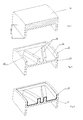
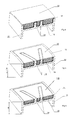
- les
figures 1 à 6 représentent, en vue cavalière et en coupe, les différentes étapes relatives à la mise en oeuvre du procédé selon l'invention sur une pièce constitutive d'un fermoir, et - la
figure 7 représente en vue cavalière un élément d'un cadran fabriqué selon l'invention. - Selon l'invention, le procédé de fabrication d'une pièce comportant un substrat et un revêtement élastomère comprend les étapes suivantes :
- a) éventuellement, traitement du substrat pour générer en surface des groupes actifs,
- b) application sur le substrat d'une première composition comprenant au moins un premier matériau élastomère, au moins un silane et éventuellement au moins un agent d'adhérisation, pour former une couche intermédiaire,
- c) application d'une seconde composition comprenant un second matériau élastomère pour former ledit revêtement, et
- d) cuisson de la pièce formée.
- Conformément à l'étape a) du procédé selon l'invention, en fonction de la nature du substrat, notamment lorsque le substrat est réalisé en céramique, saphir et cristal, il est préférable de traiter au préalable ledit substrat de manière à générer en surface des groupes actifs, capables de réagir avec le silane de la première composition. Ce traitement selon l'étape a) peut comprendre un traitement physique tel que le traitement du substrat par plasma, et plus particulièrement un plasma d'oxygène permettant de générer en surface des groupes hydroxyle actifs.
- Par ailleurs, l'état de surface du substrat est tel que l'écart moyen arithmétique Ra de son profil de surface est compris entre 1.6 µm et 12.5 µm. Si nécessaire, le procédé de l'invention peut comprendre une étape de sablage préalablement à l'étape a) afin de conférer au substrat l'état de surface adéquat.
- De préférence, la céramique est à base de zircone, avec un taux de pureté supérieur à 90%.
- Conformément à l'étape b), on applique ensuite sur le substrat éventuellement traité, une première composition comprenant au moins un premier matériau élastomère, au moins un silane et éventuellement au moins un agent d'adhérisation, ladite première composition déposée formant la couche intermédiaire.
- La première composition peut comprendre également des charges, renforçantes ou non, des agents de vulcanisation ou tout autre additif communément utilisé par l'homme du métier dans le domaine des formulations à base d'élastomère, et plus particulièrement des formulations à base de fluoroélastomère.
- Dans la suite de la description, le mélange composé de l'élastomère, des charges, des agents de vulcanisation et autres additifs traditionnels, est appelé « formulation élastomère ».
- La première composition comprend entre 20 % et 80 % en poids d'une formulation élastomère comprenant le premier matériau élastomère, entre 0.1 % et 30 % en poids de silane, et de préférence entre 0.1 % et 30 % en poids d'agent d'adhérisation par rapport au poids total de la première composition.
- Le silane est de préférence au moins bifonctionnel et comprend un groupe fonctionnel capable de former des liaisons covalentes avec la surface du substrat et un groupe fonctionnel capable de former des liaisons covalentes avec les groupes fonctionnels d'au moins l'un des composants de la première composition et d'au moins l'un des composants de la seconde composition, en particulier les premier et second matériaux élastomères.
- Le groupe fonctionnel capable de former des liaisons covalentes avec la surface du substrat peut être un groupe hydroxy ou un groupe alcoxy pouvant comprendre un radical cyclique ou acyclique.
- Le groupe fonctionnel capable de former des liaisons covalentes avec les groupes fonctionnels d'au moins l'un des composants de la première composition et d'au moins l'un des composants de la seconde composition peut être un hydroxyalkyle, un aminoalkyle, un polyaminoalkyle, un époxyalkyle, notamment un glycidylalkyle, un halogénoalkyle, un mercaptoalkyle, un alkylsulfure ou un alkylpolysulfure pouvant contenir un atome de silicium, un azidoalkyle, un radical cyclique ou acyclique comportant au moins une double liaison, tel que radical vinyl.
- Des exemples des silanes qui peuvent être utilisés sont le 3-aminopropyl-triéthoxysilane, le vinyltriéthoxysilane, le 3-glycidoxypropyl-triméthoxysilane, le 3-mercaptopropyl-triméthoxysilane, le N-béta-aminoéthyl-3-aminopropyl-triméthoxysilane, le 3-aminopropyl-triméthoxysilane, le 3-aminoéthyl-triéthoxysilane, le 3-glycidoxyéthyl-triéthoxysilane, le 3-mercaptopropyl-triéthoxysilane, le N-béta-aminoéthyl-3-aminoéthyl-triméthoxysilane, le 3-aminobutyl- triéthoxysilane, le 3-aminoéthyl-triméthoxysilane, le 3-aminopropyl-méthyl-diéthoxysilane, le tétrasulfure de bis triéthoxy silylpropyle, le tétrasulfure de bis triméthoxy silylpropyle, le p-(triméthoxysilyl)benzyl diazoacétate, le 4-(triméthoxysilyl)cyclohexylsulfonyl azidure, le 6-(triméthoxysilyl)hexylsulfonyl azidure.
- Les silanes préférés sont le 3-aminopropyl-triéthoxysilane et le vinyltriéthoxysilane.
- On peut utiliser un seul silane ou un mélange de silanes.
- Le silane est de préférence mélangé à un agent d'adhérisation qui comprend au moins un alcool permettant l'hydrolyse du silane de départ. L'agent d'adhérisation est choisi parmi le groupe comprenant le méthanol et l'éthanol.
- Le premier et /ou second élastomère est de préférence un élastomère fluorocarboné.
- Le premier et/ou second élastomère peut être également thermoplastique.
- Le premier et/ou second élastomère peut être utilisé seul ou en mélange avec d'autres élastomères appropriés.
- Selon l'étape c), on applique ensuite la seconde composition comprenant un second matériau élastomère pour former un revêtement élastomère.
- Le second matériau élastomère est choisi de sorte que le revêtement élastomère présente une dureté Shore A comprise entre 40 et 80.
- La seconde composition comprend également tous les additifs utilisés habituellement en fonction des applications, tels que des charges, des agents de vulcanisation, des colorants, etc afin de former avec le second matériau élastomère une formulation élastomère. Lorsque la pièce est utilisée dans le domaine de l'horlogerie ou de la bijouterie, les composants de la seconde composition qui va constituer le revêtement élastomère extérieur en contact avec la peau, sont biocompatibles et répondent aux normes FDA et Reach.
- D'une manière avantageuse, la seconde composition est exempte de silane de sorte que le revêtement élastomère disposé à l'extérieur est exempt de silane.
- La couche intermédiaire présente une épaisseur comprise entre 0,02 mm et 0,05 mm et le revêtement élastomère présente une épaisseur mimimum de 0,2 mm.
- Conformément à l'étape d), la pièce selon l'invention subit une opération de cuisson.
- La première composition peut être appliquée par pulvérisation sur le substrat, suivie d'un séchage en étuve ou à l'air libre, la deuxième composition est appliquée par surmoulage du substrat selon l'une quelconque des techniques connues, à savoir, l'injection, la compression, l'injection compression, etc. En fonction de l'élastomère utilisé, la cuisson comprend la vulcanisation de l'élastomère.
- La présente invention, utilisant une couche intermédiaire, permet au fabricant de conserver ses formulations de la composition du revêtement extérieur tout en garantissant l'adhésion de ce revêtement extérieur sur un substrat, notamment en céramique, saphir ou cristal.
- De plus, la couche intermédiaire présente une teneur en élastomère importante, ce qui permet de lui conférer un comportement polymère. Les propriétés mécaniques sont améliorées. On peut également contrôler la rigidité entre le substrat et le revêtement élastomère en adaptant les proportions silane/premier matériau élastomère de la couche intermédiaire.
- Les pièces de l'invention peuvent être des pièces utilisées dans le domaine de l'horlogerie ou de la bijouterie, telles que les éléments d'un bracelet de montre ou du cadran. La présente invention peut également être utilisée pour former un joint caoutchouc sur un support en céramique ou pour réaliser un implant médical en céramique comprenant un revêtement élastomère compatible avec les os, et dont la rigidité est contrôlée au moyen de la formulation de la couche intermédiaire.
- Selon une variante de réalisation, la pièce comprend un substrat présentant un relief entouré d'une zone en creux jouxtant le revêtement élastomère, ledit relief et ledit revêtement élastomère ayant des surfaces apparentes dont l'état est similaire, reliées l'une à l'autre sans solution de continuité. Le relief peut être disposé dans la partie centrale du revêtement élastomère ou peut former un cadre entourant ledit revêtement. Les zones en creux ont une profondeur comprise entre 0.2 mm et 0.3 mm. L'état de surface du fond des zones en creux est tel que l'écart moyen arithmétique Ra de son profil de surface est compris entre 1.6 µm et 12.5 µm.
- Le remplissage des zones en creux se fait par surmoulage en recouvrant complètement les reliefs avec une surépaisseur comprise entre 0.05 mm et 0.2 mm. La technique utilisée pour le surmoulage est fonction de la géométrie de la pièce.
- Une telle pièce est obtenue au moyen du procédé selon l'invention qui comprend en outre les étapes suivantes postérieures à l'étape d):
- e) éliminer par abrasion le revêtement élastomère et la couche intermédiaire jusqu'à rendre le relief apparent,
- f) effectuer une opération de finition sur les surfaces du relief et du revêtement élastomère leur conférant leur aspect final.
- L'opération de finition peut être de type satinage ou polissage afin d'obtenir un aspect final satiné ou poli, sans abimer le substrat.
- L'invention sera aisément comprise à l'aide des exemples non limitatifs qui suivent.
- Dans tous ces essais toutes les données concernant les formulations des compositions sont des parties en poids, sauf indication différente.
- En référence aux
figures 1 à 6 , il est représenté une pièce constitutive d'un bracelet 10 en céramique, tel qu'un maillon. La pièce 10 est destinée à être partiellement revêtue d'une couche d'élastomère, par le procédé selon l'invention. La face supérieure a une surépaisseur Δe de 0,05 mm par rapport à la cote e de la pièce 10 terminée. - La face supérieure est ensuite travaillée (
figure 2 ), par fraisage ou par attaque chimique pour former une creusure 12. Un décor apparaît formant un relief 14, pouvant représenter une marque ou un dessin esthétique. Le pourtour de la creusure 12, également en relief, constitue une cloison en surépaisseur 15 ayant essentiellement une fonction esthétique. - Il est primordial que le pourtour du décor soit parfait, celui-ci formant le contraste entre le métal et l'élastomère, comme cela sera expliqué plus loin. La profondeur de la creusure 12 est de 0.3 mm et l'état de surface du fond de la creusure est tel que l'écart moyen arithmétique Ra de son profil de surface est compris entre 1.6 µm et 12.5 µm.
- En variante le décor 14 formant relief pourrait être rapporté, être obtenu par emboutissage ou encore par tout autre procédé connu de l'homme du métier et permettant de former un décor en relief.
- Selon l'invention, la pièce est tout d'abord traitée par un plasma d'oxygène.
- Puis on applique sur le substrat traité une première composition formant la couche intermédiaire 16. Ladite première composition comprend :
- 20 à 80% d'une formulation élastomère comprenant un élastomère fluorocarboné,
- 0,1 à 30% d'un mélange de silane comprenant du 3-aminopropyl-triéthoxysilane et du vinyltriéthoxysilane dans un rapport 1/1,
- 0,1 à 30% d'éthanol utilisé comme agent d'adhérisation.
- La couche 16 a une épaisseur de l'ordre de 0,02 mm à 0,05 mm. Elle est déposée sur la pièce 10 par pulvérisation, les parties devant être épargnées étant protégées par un masque. Il est également possible de faire appel aux techniques de photolithographie. La couche 16 apparaît sur les figures avec une épaisseur exagérée de manière à la rendre apparente.
- En variante, la couche 16 peut être éliminée mécaniquement ou chimiquement des zones non recouvertes après seulement que la pièce a été terminée. De la sorte, la couche 16 peut assurer une protection en cours de fabrication.
- On relèvera que le relief ne doit pas nécessairement être recouvert de la première composition formant la couche intermédiaire, dès lors que le revêtement élastomère sera ensuite retiré de ces zones-là.
- Après le dépôt de la couche intermédiaire 16, et comme le montre la
figure 4 , la seconde composition formant le revêtement élastomère 18 est mise en place par surmoulage, selon l'une quelconque des techniques connues, soit l'injection, la compression, l'injection compression, l'injection transfert etc... Quelle que soit la technique utilisée, le revêtement 18 recouvrira complètement le décor 14 et la cloison 15 d'au moins 0,05 mm. - La seconde composition est exempte de silane et comprend un élastomère fluorocarboné de dureté Shore A comprise entre 60 et 80.
- La pièce est ensuite vulcanisée selon l'une quelconque des techniques connues, soit l'injection, la compression, l'injection compression, l'injection transfert.
- L'opération suivante, illustrée à la
figure 5 , consiste à enlever la surépaisseur du revêtement élastomère 18 par abrasion, par exemple au moyen d'une machine à lapider, qui est munie d'une meule. De telles machines sont bien connues de l'homme du métier. - Enfin, au cours d'une opération de finition, représentée à la
figure 6 , l'état de surface est finalisé, par émerisage, satinage ou polissage. C'est au cours de cette opération qu'est enlevée la surépaisseur Δe mentionnée en référence à lafigure 1 . - En référence à la
figure 7 , le procédé de l'invention est appliqué de manière similaire pour la fabrication d'un élément de cadran 20 comprenant un substrat en céramique 21, des zones en creux 22 remplies d'un revêtement élastomère 23 et des zones en creux 24 comportant un décor 25 en relief formant des chiffres, lesdites zones en creux 24 étant également remplies d'un revêtement élastomère 23.
Claims (17)
- Procédé de fabrication d'une pièce (10) comportant un substrat et un revêtement élastomère (18), caractérisé en ce qu'il comprend les étapes suivantes :a) éventuellement, traitement du substrat pour générer en surface des groupes actifs,b) application sur le substrat d'une première composition comprenant au moins un premier matériau élastomère, au moins un silane et éventuellement au moins un agent d'adhérisation, pour former une couche intermédiaire,c) application d'une seconde composition comprenant un second matériau élastomère pour former ledit revêtement, etd) cuisson de la pièce formée.
- Procédé selon la revendication 1, caractérisé en ce que le substrat est réalisé dans un matériau choisi parmi la céramique, le saphir et le cristal.
- Procédé selon l'une quelconque des revendications précédentes, caractérisé en ce que l'étape a) comprend le traitement du substrat par plasma.
- Procédé selon l'une quelconque des revendications précédentes, caractérisé en ce que la seconde composition est exempte de silane.
- Procédé selon l'une quelconque des revendications précédentes, caractérisé en ce que la première composition comprend entre 20 % et 80 % en poids d'une formulation élastomère comprenant ledit premier matériau élastomère, entre 0.1 % et 30 % en poids de silane, et éventuellement entre 0.1 % et 30 % en poids d'agent d'adhérisation, par rapport au poids total de la première composition.
- Procédé selon l'une quelconque des revendications précédentes, caractérisé en ce que le premier et/ou second élastomère est un élastomère fluorocarboné.
- Procédé selon l'une quelconque des revendications précédentes, caractérisé en ce que le silane est au moins bifonctionnel et comprend un groupe fonctionnel capable de former des liaisons covalentes avec la surface du substrat et un groupe fonctionnel capable de former des liaisons covalentes avec les groupes fonctionnels d'au moins l'un des composants des première et seconde compositions.
- Procédé selon l'une quelconque des revendications précédentes, caractérisé en ce que l'agent d'adhérisation est choisi parmi le groupe comprenant le méthanol et l'éthanol.
- Procédé selon l'une quelconque des revendications précédentes, dans lequel le substrat comprend un relief (14) entouré d'une zone en creux (12), caractérisé en ce qu'il comprend en outre les étapes suivantes postérieures à l'étape d):e) éliminer par abrasion le revêtement élastomère (18) et la couche intermédiaire jusqu'à rendre le relief (14) apparent,f) effectuer une opération de finition sur les surfaces du relief (14) et du revêtement élastomère (18) leur conférant leur aspect final.
- Pièce (10) comprenant un substrat et un revêtement élastomère (18) à base d'un second matériau élastomère, caractérisée en ce qu'elle comprend entre le substrat et le revêtement élastomère (18) une couche intermédiaire (16) obtenue à partir d'une composition comprenant au moins un premier matériau élastomère, au moins un silane et éventuellement au moins un agent d'adhérisation.
- Pièce selon la revendication 10, caractérisée en ce que le substrat est réalisé dans un matériau choisi parmi la céramique, le saphir et le cristal.
- Pièce selon l'une quelconque des revendications 10 et 11, caractérisée en ce le substrat a préalablement été traité par plasma.
- Pièce selon l'une quelconque des revendications 10 à 12, caractérisée en ce que le revêtement élastomère (18) est extérieur et est exempt de silane.
- Pièce selon l'une quelconque des revendications 10 à 13, caractérisée en ce que ladite composition comprend entre 20 % et 80 % en poids d'une formulation élastomère comprenant ledit premier matériau élastomère, entre 0.1 % et 30 % en poids de silane, et éventuellement entre 0.1 % et 30 % en poids d'agent d'adhérisation, par rapport au poids total de la composition.
- Pièce selon l'une quelconque des revendications 10 à 14, caractérisée en ce que le premier et /ou second élastomère est un élastomère fluorocarboné.
- Pièce selon l'une quelconque des revendications 10 à 15, caractérisée en ce que la couche intermédiaire (16) présente une épaisseur comprise entre 0,02 mm et 0.05 mm et en ce que le revêtement élastomère (18) présente une épaisseur minimale de 0.2mm.
- Pièce selon l'une quelconque des revendications 10 à 16, caractérisée en ce que le substrat comprend un relief (14) entouré d'une zone en creux (12) jouxtant le revêtement élastomère (18), ledit relief (14) et ledit revêtement élastomère (18) ayant des surfaces apparentes dont l'état est similaire, reliées l'une à l'autre sans solution de continuité.
Applications Claiming Priority (1)
| Application Number | Priority Date | Filing Date | Title |
|---|---|---|---|
| CH00240/10A CH702731A1 (fr) | 2010-02-25 | 2010-02-25 | Procédé de fabrication d'une pièce comportant un revêtement élastomère et ladite pièce obtenue. |
Publications (2)
| Publication Number | Publication Date |
|---|---|
| EP2363036A1 true EP2363036A1 (fr) | 2011-09-07 |
| EP2363036B1 EP2363036B1 (fr) | 2012-11-07 |
Family
ID=42197855
Family Applications (1)
| Application Number | Title | Priority Date | Filing Date |
|---|---|---|---|
| EP20110153384 Active EP2363036B1 (fr) | 2010-02-25 | 2011-02-04 | Procédé de fabrication d'une pièce comportant un revêtement élastomère, et pièce obtenue par ce procédé |
Country Status (2)
| Country | Link |
|---|---|
| EP (1) | EP2363036B1 (fr) |
| CH (1) | CH702731A1 (fr) |
Cited By (6)
| Publication number | Priority date | Publication date | Assignee | Title |
|---|---|---|---|---|
| EP2423763A3 (fr) * | 2010-08-31 | 2014-06-25 | Biwi S.A. | Procédé de fabrication d'une pièce d'horlogerie comportant un revêtement élastomère et ladite pièce obtenue |
| ITMI20130705A1 (it) * | 2013-04-30 | 2014-10-31 | Mestel Rss S R L | Procedimento di fabbricazione di un componente rigido provvisto di un rivestimento elastomerico |
| EP2837976A2 (fr) | 2013-08-16 | 2015-02-18 | Valiance SA | Procédé de fabrication d une pièce mécanique |
| EP2902177A3 (fr) * | 2014-01-30 | 2015-09-09 | Mestel SA | Procédé d'application d'un matériau de remplissage sur un substrat présentant une surface libre à l'etat fini et composant horloger |
| EP2965855A3 (fr) * | 2014-06-17 | 2016-03-09 | Mestel SA | Procede de realisation d'un motif en relief, en un materiau de type polymere, sur un substrat |
| US20180095427A1 (en) * | 2016-10-05 | 2018-04-05 | The Swatch Group Research And Development Ltd | Watchmaking gasket |
Families Citing this family (1)
| Publication number | Priority date | Publication date | Assignee | Title |
|---|---|---|---|---|
| BR112014002528A2 (pt) | 2011-09-06 | 2017-03-14 | Vita Zahnfabrik H Rauter Gmbh & Co Kg | processo para preparação de implantes cerâmicos para propósitos médicos |
Citations (8)
| Publication number | Priority date | Publication date | Assignee | Title |
|---|---|---|---|---|
| US4495247A (en) * | 1983-06-30 | 1985-01-22 | E. I. Du Pont De Nemours And Company | Primer coating composition of a fluorocarbon polymer and an amino alkyl alkoxy silane |
| EP0498339A1 (fr) | 1991-01-28 | 1992-08-12 | Matsushita Electric Industrial Co., Ltd. | Objet avec un ornement portant un film monomoléculaire |
| EP0738747A1 (fr) | 1995-04-20 | 1996-10-23 | Wacker-Chemie GmbH | Dispersions aqueuses d'organopolysiloxanes |
| EP1127510A1 (fr) * | 2000-02-28 | 2001-08-29 | Miki Corporation | Accessoire susceptible de recevoir un vernis à ongles |
| WO2002062592A1 (fr) | 2001-02-07 | 2002-08-15 | L'oreal | Film et procede de marquage a chaud |
| EP1813385A1 (fr) * | 2006-01-27 | 2007-08-01 | Comadur S.A. | Procédé de satinage d'un matériau dur et pièce d'ornement en matériau dur satinée |
| WO2008044884A1 (fr) | 2006-10-13 | 2008-04-17 | Sunwoo Amc Co., Ltd. | Pellicule de revêtement de plastique/téflon-silicium et procédé de préparation correspondant |
| EP2147907A1 (fr) * | 2008-07-16 | 2010-01-27 | Alpin-Chemie GmbH | Composition et son utilisation |
-
2010
- 2010-02-25 CH CH00240/10A patent/CH702731A1/fr not_active Application Discontinuation
-
2011
- 2011-02-04 EP EP20110153384 patent/EP2363036B1/fr active Active
Patent Citations (8)
| Publication number | Priority date | Publication date | Assignee | Title |
|---|---|---|---|---|
| US4495247A (en) * | 1983-06-30 | 1985-01-22 | E. I. Du Pont De Nemours And Company | Primer coating composition of a fluorocarbon polymer and an amino alkyl alkoxy silane |
| EP0498339A1 (fr) | 1991-01-28 | 1992-08-12 | Matsushita Electric Industrial Co., Ltd. | Objet avec un ornement portant un film monomoléculaire |
| EP0738747A1 (fr) | 1995-04-20 | 1996-10-23 | Wacker-Chemie GmbH | Dispersions aqueuses d'organopolysiloxanes |
| EP1127510A1 (fr) * | 2000-02-28 | 2001-08-29 | Miki Corporation | Accessoire susceptible de recevoir un vernis à ongles |
| WO2002062592A1 (fr) | 2001-02-07 | 2002-08-15 | L'oreal | Film et procede de marquage a chaud |
| EP1813385A1 (fr) * | 2006-01-27 | 2007-08-01 | Comadur S.A. | Procédé de satinage d'un matériau dur et pièce d'ornement en matériau dur satinée |
| WO2008044884A1 (fr) | 2006-10-13 | 2008-04-17 | Sunwoo Amc Co., Ltd. | Pellicule de revêtement de plastique/téflon-silicium et procédé de préparation correspondant |
| EP2147907A1 (fr) * | 2008-07-16 | 2010-01-27 | Alpin-Chemie GmbH | Composition et son utilisation |
Non-Patent Citations (1)
| Title |
|---|
| Material Safety Data Sheet - Silane Primer july 2009 |
Cited By (11)
| Publication number | Priority date | Publication date | Assignee | Title |
|---|---|---|---|---|
| EP2423763A3 (fr) * | 2010-08-31 | 2014-06-25 | Biwi S.A. | Procédé de fabrication d'une pièce d'horlogerie comportant un revêtement élastomère et ladite pièce obtenue |
| ITMI20130705A1 (it) * | 2013-04-30 | 2014-10-31 | Mestel Rss S R L | Procedimento di fabbricazione di un componente rigido provvisto di un rivestimento elastomerico |
| EP2837976A2 (fr) | 2013-08-16 | 2015-02-18 | Valiance SA | Procédé de fabrication d une pièce mécanique |
| EP2902177A3 (fr) * | 2014-01-30 | 2015-09-09 | Mestel SA | Procédé d'application d'un matériau de remplissage sur un substrat présentant une surface libre à l'etat fini et composant horloger |
| EP2965855A3 (fr) * | 2014-06-17 | 2016-03-09 | Mestel SA | Procede de realisation d'un motif en relief, en un materiau de type polymere, sur un substrat |
| US20180095427A1 (en) * | 2016-10-05 | 2018-04-05 | The Swatch Group Research And Development Ltd | Watchmaking gasket |
| EP3306419A1 (fr) * | 2016-10-05 | 2018-04-11 | The Swatch Group Research and Development Ltd | Joint horloger |
| JP2018059933A (ja) * | 2016-10-05 | 2018-04-12 | ザ・スウォッチ・グループ・リサーチ・アンド・ディベロップメント・リミテッド | 腕時計製造用ガスケット |
| CN107918271A (zh) * | 2016-10-05 | 2018-04-17 | 斯沃奇集团研究和开发有限公司 | 钟表垫片 |
| US10520894B2 (en) | 2016-10-05 | 2019-12-31 | The Swatch Group Research And Development Ltd | Watchmaking gasket |
| CN107918271B (zh) * | 2016-10-05 | 2020-11-10 | 斯沃奇集团研究和开发有限公司 | 钟表垫片 |
Also Published As
| Publication number | Publication date |
|---|---|
| EP2363036B1 (fr) | 2012-11-07 |
| CH702731A1 (fr) | 2011-08-31 |
Similar Documents
| Publication | Publication Date | Title |
|---|---|---|
| EP2363036B1 (fr) | Procédé de fabrication d'une pièce comportant un revêtement élastomère, et pièce obtenue par ce procédé | |
| EP2456714B1 (fr) | Procédé de fabrication d'un pièce micromécanique en silicium renforcé | |
| CN108682623B (zh) | 用于永久接合晶片的方法 | |
| ATE517957T1 (de) | Verfahren zur herstellung eines silikonschichtverbunds | |
| FR2874455A1 (fr) | Traitement thermique avant collage de deux plaquettes | |
| EP3066044A1 (fr) | Pièce de micromécanique creuse, à plusieurs niveaux fonctionnels et monobloc en un matériau à base d'un allotrope synthétique du carbone | |
| EP3335239B1 (fr) | Procédé de fabrication d'une structure semi-conductrice avec collage direct temporaire exploitant une couche poreuse | |
| EP2316299A1 (fr) | Pièce comportant une structure en matériau inorganique et un revêtement élastomère et procédé pour l'obtention d'une telle pièce | |
| EP2543653B2 (fr) | Procédé de fabrication d'une céramique mate non marquante | |
| WO2002052965A1 (fr) | Gant a haute performance mecanique, ainsi qu'a haute resistance aux produits chimiques et/ou a la radiolyse, et son procede de fabrication | |
| CH713911A2 (fr) | Procédé de fabrication d'un composant horloger en élastomère comprenant un insert métallique. | |
| EP3888868A1 (fr) | Procédé de réalisation d'un élément de support de siège | |
| EP4000850B1 (fr) | Vessie de vulcanisation de pneu | |
| EP2423763A2 (fr) | Procédé de fabrication d'une pièce d'horlogerie comportant un revêtement élastomère et ladite pièce obtenue | |
| CH709184B1 (fr) | Composant présentant à sa surface des matériaux différents présentant des états de surface différents. | |
| CN1530779A (zh) | 附件和手表 | |
| FR2985601A1 (fr) | Procede de fabrication d'un substrat et structure semiconducteur | |
| WO2010063636A1 (fr) | Lingot formé de lingots élementaires, plaquette issue de ce lingot et procédé associé | |
| EP2965855A2 (fr) | Procede de realisation d'un motif en relief, en un materiau de type polymere, sur un substrat | |
| CH719091B1 (fr) | Objet manufacturé thermochromique et son procédé de réalisation. | |
| JP2021529650A5 (fr) | ||
| CH708108B1 (fr) | Procédé de fabrication d'une pièce mécanique. | |
| EP4580462A1 (fr) | Composant horloger et procédé de fabrication d'un composant horloger | |
| EP4052883A1 (fr) | Procédé de fabrication d'un composant horloger | |
| EP4249645A1 (fr) | Procédé pour fabriquer une pluralité de micropièces |
Legal Events
| Date | Code | Title | Description |
|---|---|---|---|
| PUAI | Public reference made under article 153(3) epc to a published international application that has entered the european phase |
Free format text: ORIGINAL CODE: 0009012 |
|
| AK | Designated contracting states |
Kind code of ref document: A1 Designated state(s): AL AT BE BG CH CY CZ DE DK EE ES FI FR GB GR HR HU IE IS IT LI LT LU LV MC MK MT NL NO PL PT RO RS SE SI SK SM TR |
|
| AX | Request for extension of the european patent |
Extension state: BA ME |
|
| 17P | Request for examination filed |
Effective date: 20111005 |
|
| TPAC | Observations filed by third parties |
Free format text: ORIGINAL CODE: EPIDOSNTIPA |
|
| GRAP | Despatch of communication of intention to grant a patent |
Free format text: ORIGINAL CODE: EPIDOSNIGR1 |
|
| RIC1 | Information provided on ipc code assigned before grant |
Ipc: C09D 5/00 20060101ALI20120626BHEP Ipc: C04B 41/91 20060101ALI20120626BHEP Ipc: G04B 19/12 20060101ALI20120626BHEP Ipc: C04B 41/49 20060101ALI20120626BHEP Ipc: B29C 70/68 20060101ALI20120626BHEP Ipc: C04B 41/89 20060101ALI20120626BHEP Ipc: B29C 70/74 20060101ALI20120626BHEP Ipc: B29K 21/00 20060101ALI20120626BHEP Ipc: A44C 27/00 20060101ALI20120626BHEP Ipc: C04B 41/48 20060101ALI20120626BHEP Ipc: C09D 127/12 20060101ALI20120626BHEP Ipc: C04B 41/45 20060101ALI20120626BHEP Ipc: C04B 41/52 20060101ALI20120626BHEP Ipc: A44C 5/00 20060101AFI20120626BHEP |
|
| GRAS | Grant fee paid |
Free format text: ORIGINAL CODE: EPIDOSNIGR3 |
|
| GRAA | (expected) grant |
Free format text: ORIGINAL CODE: 0009210 |
|
| AK | Designated contracting states |
Kind code of ref document: B1 Designated state(s): AL AT BE BG CH CY CZ DE DK EE ES FI FR GB GR HR HU IE IS IT LI LT LU LV MC MK MT NL NO PL PT RO RS SE SI SK SM TR |
|
| REG | Reference to a national code |
Ref country code: GB Ref legal event code: FG4D Free format text: NOT ENGLISH |
|
| REG | Reference to a national code |
Ref country code: CH Ref legal event code: EP Ref country code: AT Ref legal event code: REF Ref document number: 582631 Country of ref document: AT Kind code of ref document: T Effective date: 20121115 |
|
| REG | Reference to a national code |
Ref country code: IE Ref legal event code: FG4D Free format text: LANGUAGE OF EP DOCUMENT: FRENCH |
|
| REG | Reference to a national code |
Ref country code: DE Ref legal event code: R096 Ref document number: 602011000394 Country of ref document: DE Effective date: 20130103 |
|
| REG | Reference to a national code |
Ref country code: AT Ref legal event code: MK05 Ref document number: 582631 Country of ref document: AT Kind code of ref document: T Effective date: 20121107 |
|
| REG | Reference to a national code |
Ref country code: NL Ref legal event code: VDEP Effective date: 20121107 |
|
| REG | Reference to a national code |
Ref country code: LT Ref legal event code: MG4D |
|
| PG25 | Lapsed in a contracting state [announced via postgrant information from national office to epo] |
Ref country code: NL Free format text: LAPSE BECAUSE OF FAILURE TO SUBMIT A TRANSLATION OF THE DESCRIPTION OR TO PAY THE FEE WITHIN THE PRESCRIBED TIME-LIMIT Effective date: 20121107 Ref country code: HR Free format text: LAPSE BECAUSE OF FAILURE TO SUBMIT A TRANSLATION OF THE DESCRIPTION OR TO PAY THE FEE WITHIN THE PRESCRIBED TIME-LIMIT Effective date: 20121107 Ref country code: FI Free format text: LAPSE BECAUSE OF FAILURE TO SUBMIT A TRANSLATION OF THE DESCRIPTION OR TO PAY THE FEE WITHIN THE PRESCRIBED TIME-LIMIT Effective date: 20121107 Ref country code: IS Free format text: LAPSE BECAUSE OF FAILURE TO SUBMIT A TRANSLATION OF THE DESCRIPTION OR TO PAY THE FEE WITHIN THE PRESCRIBED TIME-LIMIT Effective date: 20130307 Ref country code: LT Free format text: LAPSE BECAUSE OF FAILURE TO SUBMIT A TRANSLATION OF THE DESCRIPTION OR TO PAY THE FEE WITHIN THE PRESCRIBED TIME-LIMIT Effective date: 20121107 Ref country code: SE Free format text: LAPSE BECAUSE OF FAILURE TO SUBMIT A TRANSLATION OF THE DESCRIPTION OR TO PAY THE FEE WITHIN THE PRESCRIBED TIME-LIMIT Effective date: 20121107 Ref country code: NO Free format text: LAPSE BECAUSE OF FAILURE TO SUBMIT A TRANSLATION OF THE DESCRIPTION OR TO PAY THE FEE WITHIN THE PRESCRIBED TIME-LIMIT Effective date: 20130207 |
|
| PG25 | Lapsed in a contracting state [announced via postgrant information from national office to epo] |
Ref country code: GR Free format text: LAPSE BECAUSE OF FAILURE TO SUBMIT A TRANSLATION OF THE DESCRIPTION OR TO PAY THE FEE WITHIN THE PRESCRIBED TIME-LIMIT Effective date: 20130208 Ref country code: SI Free format text: LAPSE BECAUSE OF FAILURE TO SUBMIT A TRANSLATION OF THE DESCRIPTION OR TO PAY THE FEE WITHIN THE PRESCRIBED TIME-LIMIT Effective date: 20121107 Ref country code: LV Free format text: LAPSE BECAUSE OF FAILURE TO SUBMIT A TRANSLATION OF THE DESCRIPTION OR TO PAY THE FEE WITHIN THE PRESCRIBED TIME-LIMIT Effective date: 20121107 Ref country code: PL Free format text: LAPSE BECAUSE OF FAILURE TO SUBMIT A TRANSLATION OF THE DESCRIPTION OR TO PAY THE FEE WITHIN THE PRESCRIBED TIME-LIMIT Effective date: 20121107 Ref country code: PT Free format text: LAPSE BECAUSE OF FAILURE TO SUBMIT A TRANSLATION OF THE DESCRIPTION OR TO PAY THE FEE WITHIN THE PRESCRIBED TIME-LIMIT Effective date: 20130307 |
|
| PGFP | Annual fee paid to national office [announced via postgrant information from national office to epo] |
Ref country code: BE Payment date: 20130227 Year of fee payment: 3 |
|
| PG25 | Lapsed in a contracting state [announced via postgrant information from national office to epo] |
Ref country code: AT Free format text: LAPSE BECAUSE OF FAILURE TO SUBMIT A TRANSLATION OF THE DESCRIPTION OR TO PAY THE FEE WITHIN THE PRESCRIBED TIME-LIMIT Effective date: 20121107 |
|
| PG25 | Lapsed in a contracting state [announced via postgrant information from national office to epo] |
Ref country code: DK Free format text: LAPSE BECAUSE OF FAILURE TO SUBMIT A TRANSLATION OF THE DESCRIPTION OR TO PAY THE FEE WITHIN THE PRESCRIBED TIME-LIMIT Effective date: 20121107 Ref country code: BG Free format text: LAPSE BECAUSE OF FAILURE TO SUBMIT A TRANSLATION OF THE DESCRIPTION OR TO PAY THE FEE WITHIN THE PRESCRIBED TIME-LIMIT Effective date: 20130207 Ref country code: CZ Free format text: LAPSE BECAUSE OF FAILURE TO SUBMIT A TRANSLATION OF THE DESCRIPTION OR TO PAY THE FEE WITHIN THE PRESCRIBED TIME-LIMIT Effective date: 20121107 Ref country code: SK Free format text: LAPSE BECAUSE OF FAILURE TO SUBMIT A TRANSLATION OF THE DESCRIPTION OR TO PAY THE FEE WITHIN THE PRESCRIBED TIME-LIMIT Effective date: 20121107 Ref country code: EE Free format text: LAPSE BECAUSE OF FAILURE TO SUBMIT A TRANSLATION OF THE DESCRIPTION OR TO PAY THE FEE WITHIN THE PRESCRIBED TIME-LIMIT Effective date: 20121107 Ref country code: RS Free format text: LAPSE BECAUSE OF FAILURE TO SUBMIT A TRANSLATION OF THE DESCRIPTION OR TO PAY THE FEE WITHIN THE PRESCRIBED TIME-LIMIT Effective date: 20121107 |
|
| PG25 | Lapsed in a contracting state [announced via postgrant information from national office to epo] |
Ref country code: RO Free format text: LAPSE BECAUSE OF FAILURE TO SUBMIT A TRANSLATION OF THE DESCRIPTION OR TO PAY THE FEE WITHIN THE PRESCRIBED TIME-LIMIT Effective date: 20121107 Ref country code: IT Free format text: LAPSE BECAUSE OF FAILURE TO SUBMIT A TRANSLATION OF THE DESCRIPTION OR TO PAY THE FEE WITHIN THE PRESCRIBED TIME-LIMIT Effective date: 20121107 |
|
| PLBE | No opposition filed within time limit |
Free format text: ORIGINAL CODE: 0009261 |
|
| STAA | Information on the status of an ep patent application or granted ep patent |
Free format text: STATUS: NO OPPOSITION FILED WITHIN TIME LIMIT |
|
| PG25 | Lapsed in a contracting state [announced via postgrant information from national office to epo] |
Ref country code: MC Free format text: LAPSE BECAUSE OF NON-PAYMENT OF DUE FEES Effective date: 20130228 |
|
| 26N | No opposition filed |
Effective date: 20130808 |
|
| PG25 | Lapsed in a contracting state [announced via postgrant information from national office to epo] |
Ref country code: ES Free format text: LAPSE BECAUSE OF FAILURE TO SUBMIT A TRANSLATION OF THE DESCRIPTION OR TO PAY THE FEE WITHIN THE PRESCRIBED TIME-LIMIT Effective date: 20130218 |
|
| PG25 | Lapsed in a contracting state [announced via postgrant information from national office to epo] |
Ref country code: CY Free format text: LAPSE BECAUSE OF FAILURE TO SUBMIT A TRANSLATION OF THE DESCRIPTION OR TO PAY THE FEE WITHIN THE PRESCRIBED TIME-LIMIT Effective date: 20121107 |
|
| REG | Reference to a national code |
Ref country code: IE Ref legal event code: MM4A |
|
| REG | Reference to a national code |
Ref country code: DE Ref legal event code: R097 Ref document number: 602011000394 Country of ref document: DE Effective date: 20130808 |
|
| PG25 | Lapsed in a contracting state [announced via postgrant information from national office to epo] |
Ref country code: IE Free format text: LAPSE BECAUSE OF NON-PAYMENT OF DUE FEES Effective date: 20130204 Ref country code: AL Free format text: LAPSE BECAUSE OF FAILURE TO SUBMIT A TRANSLATION OF THE DESCRIPTION OR TO PAY THE FEE WITHIN THE PRESCRIBED TIME-LIMIT Effective date: 20121107 |
|
| REG | Reference to a national code |
Ref country code: CH Ref legal event code: NV Representative=s name: GLN S.A., CH |
|
| PG25 | Lapsed in a contracting state [announced via postgrant information from national office to epo] |
Ref country code: MT Free format text: LAPSE BECAUSE OF FAILURE TO SUBMIT A TRANSLATION OF THE DESCRIPTION OR TO PAY THE FEE WITHIN THE PRESCRIBED TIME-LIMIT Effective date: 20121107 |
|
| PGFP | Annual fee paid to national office [announced via postgrant information from national office to epo] |
Ref country code: DE Payment date: 20130227 Year of fee payment: 3 |
|
| BERE | Be: lapsed |
Owner name: BIWI S.A. Effective date: 20140228 |
|
| REG | Reference to a national code |
Ref country code: DE Ref legal event code: R119 Ref document number: 602011000394 Country of ref document: DE |
|
| REG | Reference to a national code |
Ref country code: DE Ref legal event code: R119 Ref document number: 602011000394 Country of ref document: DE Effective date: 20140902 |
|
| PG25 | Lapsed in a contracting state [announced via postgrant information from national office to epo] |
Ref country code: BE Free format text: LAPSE BECAUSE OF NON-PAYMENT OF DUE FEES Effective date: 20140228 Ref country code: DE Free format text: LAPSE BECAUSE OF NON-PAYMENT OF DUE FEES Effective date: 20140902 |
|
| REG | Reference to a national code |
Ref country code: FR Ref legal event code: PLFP Year of fee payment: 5 |
|
| PG25 | Lapsed in a contracting state [announced via postgrant information from national office to epo] |
Ref country code: SM Free format text: LAPSE BECAUSE OF FAILURE TO SUBMIT A TRANSLATION OF THE DESCRIPTION OR TO PAY THE FEE WITHIN THE PRESCRIBED TIME-LIMIT Effective date: 20121107 |
|
| PGFP | Annual fee paid to national office [announced via postgrant information from national office to epo] |
Ref country code: FR Payment date: 20150217 Year of fee payment: 5 |
|
| PG25 | Lapsed in a contracting state [announced via postgrant information from national office to epo] |
Ref country code: TR Free format text: LAPSE BECAUSE OF FAILURE TO SUBMIT A TRANSLATION OF THE DESCRIPTION OR TO PAY THE FEE WITHIN THE PRESCRIBED TIME-LIMIT Effective date: 20121107 |
|
| PG25 | Lapsed in a contracting state [announced via postgrant information from national office to epo] |
Ref country code: HU Free format text: LAPSE BECAUSE OF FAILURE TO SUBMIT A TRANSLATION OF THE DESCRIPTION OR TO PAY THE FEE WITHIN THE PRESCRIBED TIME-LIMIT; INVALID AB INITIO Effective date: 20110204 Ref country code: MK Free format text: LAPSE BECAUSE OF FAILURE TO SUBMIT A TRANSLATION OF THE DESCRIPTION OR TO PAY THE FEE WITHIN THE PRESCRIBED TIME-LIMIT Effective date: 20121107 Ref country code: LU Free format text: LAPSE BECAUSE OF NON-PAYMENT OF DUE FEES Effective date: 20130204 |
|
| GBPC | Gb: european patent ceased through non-payment of renewal fee |
Effective date: 20150204 |
|
| PG25 | Lapsed in a contracting state [announced via postgrant information from national office to epo] |
Ref country code: GB Free format text: LAPSE BECAUSE OF NON-PAYMENT OF DUE FEES Effective date: 20150204 |
|
| REG | Reference to a national code |
Ref country code: FR Ref legal event code: ST Effective date: 20161028 |
|
| REG | Reference to a national code |
Ref country code: CH Ref legal event code: PFA Owner name: BIWI S.A., CH Free format text: FORMER OWNER: BIWI S.A., CH |
|
| PG25 | Lapsed in a contracting state [announced via postgrant information from national office to epo] |
Ref country code: FR Free format text: LAPSE BECAUSE OF NON-PAYMENT OF DUE FEES Effective date: 20160229 |
|
| REG | Reference to a national code |
Ref country code: CH Ref legal event code: NV Representative=s name: BOVARD SA NEUCHATEL CONSEILS EN PROPRIETE INTE, CH |
|
| REG | Reference to a national code |
Ref country code: CH Ref legal event code: R18 Free format text: ST27 STATUS EVENT CODE: U-0-0-R10-R18 (AS PROVIDED BY THE NATIONAL OFFICE) Effective date: 20260209 |
|
| REG | Reference to a national code |
Ref country code: CH Ref legal event code: U11 Free format text: ST27 STATUS EVENT CODE: U-0-0-U10-U11 (AS PROVIDED BY THE NATIONAL OFFICE) Effective date: 20260301 |
|
| REG | Reference to a national code |
Ref country code: CH Ref legal event code: R18 Free format text: ST27 STATUS EVENT CODE: U-0-0-R10-R18 (AS PROVIDED BY THE NATIONAL OFFICE) Effective date: 20260320 |
|
| PGFP | Annual fee paid to national office [announced via postgrant information from national office to epo] |
Ref country code: CH Payment date: 20260301 Year of fee payment: 16 |