EP2372817A1 - Matériau d'électrode négative pour batterie secondaire avec électrolyte non aqueuse, procédé de fabrication de matériau d'électrode négative pour batterie secondaire avec électrolyte non aqueuse et batterie secondaire au lithium-ion - Google Patents
Matériau d'électrode négative pour batterie secondaire avec électrolyte non aqueuse, procédé de fabrication de matériau d'électrode négative pour batterie secondaire avec électrolyte non aqueuse et batterie secondaire au lithium-ion Download PDFInfo
- Publication number
- EP2372817A1 EP2372817A1 EP11002386A EP11002386A EP2372817A1 EP 2372817 A1 EP2372817 A1 EP 2372817A1 EP 11002386 A EP11002386 A EP 11002386A EP 11002386 A EP11002386 A EP 11002386A EP 2372817 A1 EP2372817 A1 EP 2372817A1
- Authority
- EP
- European Patent Office
- Prior art keywords
- lithium
- negative electrode
- silicon
- secondary battery
- electrode material
- Prior art date
- Legal status (The legal status is an assumption and is not a legal conclusion. Google has not performed a legal analysis and makes no representation as to the accuracy of the status listed.)
- Granted
Links
Images


Classifications
-
- H—ELECTRICITY
- H01—ELECTRIC ELEMENTS
- H01M—PROCESSES OR MEANS, e.g. BATTERIES, FOR THE DIRECT CONVERSION OF CHEMICAL ENERGY INTO ELECTRICAL ENERGY
- H01M4/00—Electrodes
- H01M4/02—Electrodes composed of, or comprising, active material
- H01M4/36—Selection of substances as active materials, active masses, active liquids
- H01M4/362—Composites
- H01M4/366—Composites as layered products
-
- C—CHEMISTRY; METALLURGY
- C23—COATING METALLIC MATERIAL; COATING MATERIAL WITH METALLIC MATERIAL; CHEMICAL SURFACE TREATMENT; DIFFUSION TREATMENT OF METALLIC MATERIAL; COATING BY VACUUM EVAPORATION, BY SPUTTERING, BY ION IMPLANTATION OR BY CHEMICAL VAPOUR DEPOSITION, IN GENERAL; INHIBITING CORROSION OF METALLIC MATERIAL OR INCRUSTATION IN GENERAL
- C23C—COATING METALLIC MATERIAL; COATING MATERIAL WITH METALLIC MATERIAL; SURFACE TREATMENT OF METALLIC MATERIAL BY DIFFUSION INTO THE SURFACE, BY CHEMICAL CONVERSION OR SUBSTITUTION; COATING BY VACUUM EVAPORATION, BY SPUTTERING, BY ION IMPLANTATION OR BY CHEMICAL VAPOUR DEPOSITION, IN GENERAL
- C23C16/00—Chemical coating by decomposition of gaseous compounds, without leaving reaction products of surface material in the coating, i.e. chemical vapour deposition [CVD] processes
- C23C16/02—Pretreatment of the material to be coated
-
- C—CHEMISTRY; METALLURGY
- C23—COATING METALLIC MATERIAL; COATING MATERIAL WITH METALLIC MATERIAL; CHEMICAL SURFACE TREATMENT; DIFFUSION TREATMENT OF METALLIC MATERIAL; COATING BY VACUUM EVAPORATION, BY SPUTTERING, BY ION IMPLANTATION OR BY CHEMICAL VAPOUR DEPOSITION, IN GENERAL; INHIBITING CORROSION OF METALLIC MATERIAL OR INCRUSTATION IN GENERAL
- C23C—COATING METALLIC MATERIAL; COATING MATERIAL WITH METALLIC MATERIAL; SURFACE TREATMENT OF METALLIC MATERIAL BY DIFFUSION INTO THE SURFACE, BY CHEMICAL CONVERSION OR SUBSTITUTION; COATING BY VACUUM EVAPORATION, BY SPUTTERING, BY ION IMPLANTATION OR BY CHEMICAL VAPOUR DEPOSITION, IN GENERAL
- C23C16/00—Chemical coating by decomposition of gaseous compounds, without leaving reaction products of surface material in the coating, i.e. chemical vapour deposition [CVD] processes
- C23C16/22—Chemical coating by decomposition of gaseous compounds, without leaving reaction products of surface material in the coating, i.e. chemical vapour deposition [CVD] processes characterised by the deposition of inorganic material, other than metallic material
- C23C16/26—Deposition of carbon only
-
- C—CHEMISTRY; METALLURGY
- C23—COATING METALLIC MATERIAL; COATING MATERIAL WITH METALLIC MATERIAL; CHEMICAL SURFACE TREATMENT; DIFFUSION TREATMENT OF METALLIC MATERIAL; COATING BY VACUUM EVAPORATION, BY SPUTTERING, BY ION IMPLANTATION OR BY CHEMICAL VAPOUR DEPOSITION, IN GENERAL; INHIBITING CORROSION OF METALLIC MATERIAL OR INCRUSTATION IN GENERAL
- C23C—COATING METALLIC MATERIAL; COATING MATERIAL WITH METALLIC MATERIAL; SURFACE TREATMENT OF METALLIC MATERIAL BY DIFFUSION INTO THE SURFACE, BY CHEMICAL CONVERSION OR SUBSTITUTION; COATING BY VACUUM EVAPORATION, BY SPUTTERING, BY ION IMPLANTATION OR BY CHEMICAL VAPOUR DEPOSITION, IN GENERAL
- C23C16/00—Chemical coating by decomposition of gaseous compounds, without leaving reaction products of surface material in the coating, i.e. chemical vapour deposition [CVD] processes
- C23C16/44—Chemical coating by decomposition of gaseous compounds, without leaving reaction products of surface material in the coating, i.e. chemical vapour deposition [CVD] processes characterised by the method of coating
- C23C16/4417—Methods specially adapted for coating powder
-
- C—CHEMISTRY; METALLURGY
- C23—COATING METALLIC MATERIAL; COATING MATERIAL WITH METALLIC MATERIAL; CHEMICAL SURFACE TREATMENT; DIFFUSION TREATMENT OF METALLIC MATERIAL; COATING BY VACUUM EVAPORATION, BY SPUTTERING, BY ION IMPLANTATION OR BY CHEMICAL VAPOUR DEPOSITION, IN GENERAL; INHIBITING CORROSION OF METALLIC MATERIAL OR INCRUSTATION IN GENERAL
- C23C—COATING METALLIC MATERIAL; COATING MATERIAL WITH METALLIC MATERIAL; SURFACE TREATMENT OF METALLIC MATERIAL BY DIFFUSION INTO THE SURFACE, BY CHEMICAL CONVERSION OR SUBSTITUTION; COATING BY VACUUM EVAPORATION, BY SPUTTERING, BY ION IMPLANTATION OR BY CHEMICAL VAPOUR DEPOSITION, IN GENERAL
- C23C16/00—Chemical coating by decomposition of gaseous compounds, without leaving reaction products of surface material in the coating, i.e. chemical vapour deposition [CVD] processes
- C23C16/56—After-treatment
-
- H—ELECTRICITY
- H01—ELECTRIC ELEMENTS
- H01M—PROCESSES OR MEANS, e.g. BATTERIES, FOR THE DIRECT CONVERSION OF CHEMICAL ENERGY INTO ELECTRICAL ENERGY
- H01M10/00—Secondary cells; Manufacture thereof
- H01M10/05—Accumulators with non-aqueous electrolyte
- H01M10/052—Li-accumulators
-
- H—ELECTRICITY
- H01—ELECTRIC ELEMENTS
- H01M—PROCESSES OR MEANS, e.g. BATTERIES, FOR THE DIRECT CONVERSION OF CHEMICAL ENERGY INTO ELECTRICAL ENERGY
- H01M10/00—Secondary cells; Manufacture thereof
- H01M10/05—Accumulators with non-aqueous electrolyte
- H01M10/052—Li-accumulators
- H01M10/0525—Rocking-chair batteries, i.e. batteries with lithium insertion or intercalation in both electrodes; Lithium-ion batteries
-
- H—ELECTRICITY
- H01—ELECTRIC ELEMENTS
- H01M—PROCESSES OR MEANS, e.g. BATTERIES, FOR THE DIRECT CONVERSION OF CHEMICAL ENERGY INTO ELECTRICAL ENERGY
- H01M4/00—Electrodes
- H01M4/02—Electrodes composed of, or comprising, active material
- H01M4/04—Processes of manufacture in general
- H01M4/0402—Methods of deposition of the material
- H01M4/0421—Methods of deposition of the material involving vapour deposition
- H01M4/0428—Chemical vapour deposition
-
- H—ELECTRICITY
- H01—ELECTRIC ELEMENTS
- H01M—PROCESSES OR MEANS, e.g. BATTERIES, FOR THE DIRECT CONVERSION OF CHEMICAL ENERGY INTO ELECTRICAL ENERGY
- H01M4/00—Electrodes
- H01M4/02—Electrodes composed of, or comprising, active material
- H01M4/13—Electrodes for accumulators with non-aqueous electrolyte, e.g. for lithium-accumulators; Processes of manufacture thereof
- H01M4/131—Electrodes based on mixed oxides or hydroxides, or on mixtures of oxides or hydroxides, e.g. LiCoOx
-
- H—ELECTRICITY
- H01—ELECTRIC ELEMENTS
- H01M—PROCESSES OR MEANS, e.g. BATTERIES, FOR THE DIRECT CONVERSION OF CHEMICAL ENERGY INTO ELECTRICAL ENERGY
- H01M4/00—Electrodes
- H01M4/02—Electrodes composed of, or comprising, active material
- H01M4/13—Electrodes for accumulators with non-aqueous electrolyte, e.g. for lithium-accumulators; Processes of manufacture thereof
- H01M4/133—Electrodes based on carbonaceous material, e.g. graphite-intercalation compounds or CFx
-
- H—ELECTRICITY
- H01—ELECTRIC ELEMENTS
- H01M—PROCESSES OR MEANS, e.g. BATTERIES, FOR THE DIRECT CONVERSION OF CHEMICAL ENERGY INTO ELECTRICAL ENERGY
- H01M4/00—Electrodes
- H01M4/02—Electrodes composed of, or comprising, active material
- H01M4/13—Electrodes for accumulators with non-aqueous electrolyte, e.g. for lithium-accumulators; Processes of manufacture thereof
- H01M4/134—Electrodes based on metals, Si or alloys
-
- H—ELECTRICITY
- H01—ELECTRIC ELEMENTS
- H01M—PROCESSES OR MEANS, e.g. BATTERIES, FOR THE DIRECT CONVERSION OF CHEMICAL ENERGY INTO ELECTRICAL ENERGY
- H01M4/00—Electrodes
- H01M4/02—Electrodes composed of, or comprising, active material
- H01M4/36—Selection of substances as active materials, active masses, active liquids
- H01M4/362—Composites
- H01M4/364—Composites as mixtures
-
- H—ELECTRICITY
- H01—ELECTRIC ELEMENTS
- H01M—PROCESSES OR MEANS, e.g. BATTERIES, FOR THE DIRECT CONVERSION OF CHEMICAL ENERGY INTO ELECTRICAL ENERGY
- H01M4/00—Electrodes
- H01M4/02—Electrodes composed of, or comprising, active material
- H01M4/36—Selection of substances as active materials, active masses, active liquids
- H01M4/38—Selection of substances as active materials, active masses, active liquids of elements or alloys
- H01M4/386—Silicon or alloys based on silicon
-
- H—ELECTRICITY
- H01—ELECTRIC ELEMENTS
- H01M—PROCESSES OR MEANS, e.g. BATTERIES, FOR THE DIRECT CONVERSION OF CHEMICAL ENERGY INTO ELECTRICAL ENERGY
- H01M4/00—Electrodes
- H01M4/02—Electrodes composed of, or comprising, active material
- H01M4/36—Selection of substances as active materials, active masses, active liquids
- H01M4/48—Selection of substances as active materials, active masses, active liquids of inorganic oxides or hydroxides
-
- H—ELECTRICITY
- H01—ELECTRIC ELEMENTS
- H01M—PROCESSES OR MEANS, e.g. BATTERIES, FOR THE DIRECT CONVERSION OF CHEMICAL ENERGY INTO ELECTRICAL ENERGY
- H01M4/00—Electrodes
- H01M4/02—Electrodes composed of, or comprising, active material
- H01M4/36—Selection of substances as active materials, active masses, active liquids
- H01M4/48—Selection of substances as active materials, active masses, active liquids of inorganic oxides or hydroxides
- H01M4/483—Selection of substances as active materials, active masses, active liquids of inorganic oxides or hydroxides for non-aqueous cells
-
- H—ELECTRICITY
- H01—ELECTRIC ELEMENTS
- H01M—PROCESSES OR MEANS, e.g. BATTERIES, FOR THE DIRECT CONVERSION OF CHEMICAL ENERGY INTO ELECTRICAL ENERGY
- H01M4/00—Electrodes
- H01M4/02—Electrodes composed of, or comprising, active material
- H01M4/36—Selection of substances as active materials, active masses, active liquids
- H01M4/58—Selection of substances as active materials, active masses, active liquids of inorganic compounds other than oxides or hydroxides, e.g. sulfides, selenides, tellurides, halogenides or LiCoFy; of polyanionic structures, e.g. phosphates, silicates or borates
- H01M4/583—Carbonaceous material, e.g. graphite-intercalation compounds or CFx
-
- Y—GENERAL TAGGING OF NEW TECHNOLOGICAL DEVELOPMENTS; GENERAL TAGGING OF CROSS-SECTIONAL TECHNOLOGIES SPANNING OVER SEVERAL SECTIONS OF THE IPC; TECHNICAL SUBJECTS COVERED BY FORMER USPC CROSS-REFERENCE ART COLLECTIONS [XRACs] AND DIGESTS
- Y02—TECHNOLOGIES OR APPLICATIONS FOR MITIGATION OR ADAPTATION AGAINST CLIMATE CHANGE
- Y02E—REDUCTION OF GREENHOUSE GAS [GHG] EMISSIONS, RELATED TO ENERGY GENERATION, TRANSMISSION OR DISTRIBUTION
- Y02E60/00—Enabling technologies; Technologies with a potential or indirect contribution to GHG emissions mitigation
- Y02E60/10—Energy storage using batteries
-
- Y—GENERAL TAGGING OF NEW TECHNOLOGICAL DEVELOPMENTS; GENERAL TAGGING OF CROSS-SECTIONAL TECHNOLOGIES SPANNING OVER SEVERAL SECTIONS OF THE IPC; TECHNICAL SUBJECTS COVERED BY FORMER USPC CROSS-REFERENCE ART COLLECTIONS [XRACs] AND DIGESTS
- Y02—TECHNOLOGIES OR APPLICATIONS FOR MITIGATION OR ADAPTATION AGAINST CLIMATE CHANGE
- Y02P—CLIMATE CHANGE MITIGATION TECHNOLOGIES IN THE PRODUCTION OR PROCESSING OF GOODS
- Y02P70/00—Climate change mitigation technologies in the production process for final industrial or consumer products
- Y02P70/50—Manufacturing or production processes characterised by the final manufactured product
-
- Y—GENERAL TAGGING OF NEW TECHNOLOGICAL DEVELOPMENTS; GENERAL TAGGING OF CROSS-SECTIONAL TECHNOLOGIES SPANNING OVER SEVERAL SECTIONS OF THE IPC; TECHNICAL SUBJECTS COVERED BY FORMER USPC CROSS-REFERENCE ART COLLECTIONS [XRACs] AND DIGESTS
- Y02—TECHNOLOGIES OR APPLICATIONS FOR MITIGATION OR ADAPTATION AGAINST CLIMATE CHANGE
- Y02T—CLIMATE CHANGE MITIGATION TECHNOLOGIES RELATED TO TRANSPORTATION
- Y02T10/00—Road transport of goods or passengers
- Y02T10/60—Other road transportation technologies with climate change mitigation effect
- Y02T10/70—Energy storage systems for electromobility, e.g. batteries
Definitions
- the present invention relates to a negative electrode material for a secondary battery with a non-aqueous electrolyte, such as a lithium ion secondary battery, to a method for manufacturing the same, and to a lithium ion secondary battery by using the same, and the material is composed of a silicon-silicon oxide-lithium composite useful for the negative electrode material for a secondary battery with a non-aqueous electrolyte.
- lithium ion secondary batteries are widely used for mobile electronic devices, such as a mobile phone, a laptop computer, and the like, because of high energy density.
- the performance of a current lithium ion secondary battery is insufficient for application to the electric automobile in terms of capacity and cycle durability.
- the silicon oxide has several times as much theoretical capacity as carbon has, and there is thereby possibility that silicon oxide becomes an excellent negative electrode material. There were, however, problems such as low first efficiency, low electronic conductivity, and low cycle durability at the beginning of the development, and various improvements have accordingly made so far.
- the "first efficiency” means a ratio of discharge capacity to charge capacity in the first charge/discharge.
- the energy density of the lithium ion secondary battery decreases.
- the low first efficiency of silicon oxide is caused by generating a lot of lithium compounds that do not contribute to the charge/discharge at the first charge.
- a method to solve this there has been known a method of generating the above-described lithium compounds by making silicon oxide and lithium metal or a lithium compound (lithium oxide, lithium hydroxide, lithium hydride, organolithium, and the like) react in advance, before the first charge.
- Patent Literature 1 discloses use of a silicon oxide that can occlude and release lithium ions as a negative electrode active material, and a negative electrode material that satisfies a relation of x>0 and 2>y>0 wherein a ratio of the number of atoms among silicon, lithium, and oxygen contained in the silicon oxide is represented by 1:x:y.
- a method for manufacturing the above-described silicon oxide that is represented by a compositional formula of Li x SiO y and contains lithium there is disclosed a method in which a suboxide of silicon SiO y that does not contain lithium is synthesized in advance, and lithium ions are occluded by an electrochemical reaction between the obtained suboxide of silicon SiO y and lithium or a substance containing lithium.
- a method in which a simple substance of each of lithium and silicon, or a compound thereof are blended at a predetermined molar ratio, and it is heated under a non-oxidizing atmosphere or an oxygen-regulated atmosphere to synthesize.
- each of oxides and hydroxides, salts such as carbonates and nitrates, organolithiums, or the like are exemplified, and although it is normally possible to synthesize at a heating temperature of 400°C or more, a temperature of 400 to 800°C is preferable, since a disproportionation reaction to silicon and silicon dioxide may occur at a temperature of 800°C or more.
- Patent Literatures 2 to 4 describe that a chemical method or an electrochemical method is used as a method for preliminarily inserting lithium before storing the negative electrode active material in a battery container. It describes that as the chemical method, a method of making the negative electrode active material directly react with lithium metal, a lithium alloy (lithium-aluminum alloy and the like), or a lithium compound (n-butyllithium, lithium hydride, lithium aluminum hydride, or the like), and a lithium insertion reaction is preferably performed at a temperature of 25 to 80°C in the chemical method.
- a lithium alloy lithium-aluminum alloy and the like
- a lithium compound n-butyllithium, lithium hydride, lithium aluminum hydride, or the like
- the electrochemical method a method of discharging, at open system, oxidation reduction system in which the above-described negative electrode active material is used for a positive electrode active material and a non-aqueous electrolyte containing lithium metal, a lithium alloy, or a lithium salt is used for a negative electrode active material, and a method of charging oxidation reduction system that is composed of a non-aqueous electrolyte that contains a transition metal oxide containing lithium, the negative electrode active material, and a lithium salt, as the positive electrode active material.
- Patent Literature 5 discloses powder of silicon oxide containing lithium represented by a general formula of SiLi x O y , in which the ranges of x and y are 0 ⁇ x ⁇ 1.0 and 0 ⁇ y ⁇ 1.5, lithium is fused, and a part of the fused lithium is crystallized. It also discloses a method for manufacturing the powder of the silicon oxide containing lithium, in which a blend of raw material powder that generates SiO gas and metallic lithium or a lithium compound is made to react by heating under an inert gas atmosphere or under reduced pressure at a temperature of 800 to 1300°C.
- silicon oxide (SiO z ) powder (0 ⁇ z ⁇ 2) and silicon dioxide powder can be used as the raw material powder that generates SiO gas, and it is used after adding reduction powder (metallic silicon compounds, and powder containing carbon) as needed.
- metallic lithium and the lithium compounds are not restricted in particular, and as the lithium compounds, for example, lithium oxide, lithium hydroxide, lithium carbonate, lithium nitrate, lithium silicate, hydrates thereof, or the like can be used, other than the metallic lithium.
- Patent Literature 6 discloses a negative electrode material having an electronic conductive material layer formed on a surface of silicon oxide particles. It describes that the silicon oxide among them is silicon oxide having an elementary composition of Si and O, and is preferably a suboxide of silicon represented by SiO x (0 ⁇ x ⁇ 2), and that it can be lithium silicate in which silicon oxide is doped with Li. It also describes that a carbon material is preferably used for a conductive material and it can be manufactured by using a CVD method, a liquid phase method, or a sintering method.
- Patent Literature 7 discloses a conductive silicon composite in which a diffraction peak attributable to Si (111) is observed when x-ray diffraction, the size of silicon crystal obtained by the Scherrer method based on the half-width of a diffraction line thereof is 1 to 500 nm, and a surface of its particle is coated with carbon, the composite having a structure that crystallites of silicon are dispersed to a silicon compound, particularly, the conductive silicon composite in which the silicon compound is silicon dioxide and at least a part of the surface thereof is adhered to carbon.
- silicon oxide is subjected to disproportionation with an organic gas and/or vapor at a temperature of 900 to 1400°C, and carbon is deposited by chemical vapor deposition treatment.
- Patent Literature 8 discloses a silicon-silicon oxide composite doped with lithium, the composite having a structure that silicon particles having a size of 0.5 to 50 nm are dispersed to silicon oxide in an atomic order and/or a crystallite state, particularly, a conductive silicon-silicon oxide-lithium composite in which the surface thereof is coated with carbon at a coating amount of 5 to 50 mass % with respect to an amount of the whole composite particles after surface treatment.
- silicon oxide is a lithium dopant and lithium metal and/or an organolithium compound is used to dope with lithium at a temperature of 1300°C or less
- a silicon-silicon oxide-lithium composite that is pulverized into a predetermined particle size is subjected to heat CVD with an organic hydrocarbon gas and/or vapor at a temperature of 900 to 1400°C and a carbon coating is formed at a coating amount of 5 to 50 mass % with respect to an amount of the whole composite particles after surface treatment.
- the silicon oxide negative electrode material has been improved.
- the conductive silicon-silicon oxide-lithium composite manufactured by the method described in Patent Literature 8 has consequently achieved extensive improvement in terms of the first efficiency but the cycle durability thereof is inferior in comparison with a conductive silicon-silicon oxide composite that is not doped with lithium.
- the present invention was accomplished in view of the aforementioned problems, and it is an object of the present invention to provide a silicon oxide-based negative electrode material for a secondary battery with a non-aqueous electrolyte, having superior first efficiency and cycle durability to a conventional negative electrode material, a method for manufacturing the same, and a lithium ion secondary battery using the same.
- the negative electrode material is based on the silicon-silicon oxide composite that is doped with lithium and has the carbon coating formed thereon, it has higher capacity and superior in, particularly, the first efficiency
- a peak attributable to lithium aluminate can be further observed in the negative electrode material for a secondary battery with a non-aqueous electrolyte, when the x-ray diffraction using Cu-K ⁇ ray.
- the above-described negative electrode material containing aluminum can also has a sufficiently low amount of SiC at the interface between the silicon-silicon oxide composite and the carbon coating, and thereby is superior in, particularly, the cycle durability and the first efficiency.
- lithium aluminum hydride containing aluminum is preferably used for doping with lithium.
- the present invention provides a lithium ion secondary battery having at least a positive electrode, a negative electrode, and a non-aqueous electrolyte having lithium ion conductivity, wherein the negative electrode material for a secondary battery with a non-aqueous electrolyte described in the present invention is used for the negative electrode.
- the negative electrode material for a secondary battery with a non-aqueous electrolyte according to the present invention enables good battery characteristics (the first efficiency and the cycle durability) when used for a negative electrode of a non-aqueous electrolyte secondary battery.
- the lithium ion secondary battery in which the negative electrode material for a secondary battery with a non-aqueous electrolyte according to the present invention is used is therefore superior in the battery characteristics, particularly, the first efficiency and the cycle durability.
- the present invention provides a method for manufacturing a negative electrode material for a secondary battery with a non-aqueous electrolyte including at least coating a surface of powder composed of at least one of silicon oxide and a silicon-silicon oxide composite with carbon by heat CVD treatment, blending a lithium dopant with the powder coated with carbon, and thereafter heating the powder coated with carbon to be doped with lithium.
- the negative electrode material can be manufactured, the material which enables good battery characteristics, such as cycle durability, when used for a negative electrode.
- the silicon-silicon oxide composite is coated with carbon and doped with lithium, the capacity thereof can be improved in comparison with conventional methods, and the negative electrode material for a secondary battery with a non-aqueous electrolyte can be manufactured which has improved conductivity and first efficiency.
- lithium hydride and/or lithium aluminum hydride is preferably used as the lithium dopant.
- the reaction is milder in comparison with the case of using lithium metal as the lithium dopant, and it can be doped with lithium with readily controlling the temperature.
- silicon oxide can be more reduced in comparison with the case of using a dopant containing oxygen, such as lithium hydroxide and lithium oxide, the negative electrode material having high discharge capacity can be thereby manufactured, and it can be a method for manufacturing a high capacity negative electrode material suitable to industrial mass production.
- the doping with lithium is preferably performed at a temperature equal to or lower than the temperature of the heat CVD treatment.
- the doping with lithium is performed at a temperature equal to or lower than the temperature of the heat CVD treatment for coating with carbon, the acceleration of the generation of SiC and of the crystallization of silicon at the interface between the silicon-silicon oxide composite and the carbon coating can be surely suppressed, and the negative electrode material superior in battery characteristics can be manufactured.
- the temperature of the doping with lithium is preferably 800°C or less.
- SiC when it is heated at a temperature of 800°C or less to be doped with lithium, SiC can be prevented from being generated, the silicon crystal contained in the silicon-silicon oxide composite can be prevented from excessively growing, the discharge capacity and the cycle durability can be surely prevented from deteriorating, and the negative electrode material for a secondary battery with a non-aqueous electrolyte having high capacity and high cycle durability can be manufactured.
- the temperature of the heat CVD treatment is preferably 800°C or more.
- the temperature of the heat CVD treatment is 800°C or more, crystallization of carbon contained in the carbon coating and bonding of the carbon coating and the silicon-silicon oxide composite can be promoted, a high quality and fine carbon coating can be formed with high productivity, and the negative electrode material for a secondary battery with a non-aqueous electrolyte can be manufactured which has higher capacity and is superior in the cycle durability.
- the present invention provides the silicon oxide-based negative electrode material for a secondary battery with a non-aqueous electrolyte, having superior first efficiency and cycle durability to a conventional negative electrode material, the method for manufacturing the same, and the lithium ion secondary battery using the same.
- the present inventor has found that in the conductive silicon-silicon oxide-lithium composite manufactured by the method disclosed in Patent Literature 8, the carbon coating is apt to change into SiC and silicon is apt to crystallize when CVD treatment with high heat is performed after doping with lithium, and that this is caused by the doping with lithium.
- the mechanism is not quite clear. It can be, however, considered that a part of silicon oxide is reduced by lithium and becomes silicon during the doping with lithium by using lithium metal and/or an organolithium compound, this silicon is apt to change into SiC and to crystallize as compared with silicon generated by the disproportionation, and causes deterioration of the battery characteristics, particularly, the cycle durability and the discharge capacity, when used for a negative electrolyte.
- the present inventor further has repeatedly keenly conducted studies based on the above result of the studies, and consequently found that the doping with lithium after coating with carbon, the surface of the silicon oxide or the silicon-silicon oxide composite that is constituted by silicon particles being dispersed to silicon oxide enables doping with lithium while suppressing progress of the crystallization of silicon and the change into SiC, and that use of this silicon-silicon oxide composite, as a negative electrode active material of the secondary battery with a non-aqueous electrolyte, such as the lithium ion secondary battery, enables the secondary battery with a non-aqueous electrolyte having higher capacity, higher first efficiency, and superior cycle durability in comparison with conventional ones to be obtained.
- the present inventor thereby brought the present invention to completion.
- the negative electrode material for a secondary battery with a non-aqueous electrolyte according to the present invention comprises at least the silicon-silicon oxide composite and the carbon coating formed on the surface of the silicon-silicon oxide composite.
- the negative electrode material is composed of a silicon-silicon oxide composite that has a fine structure that silicon particles are dispersed to silicon oxide and/or lithium silicate in an atomic order and/or a crystallite state and has superior conductivity due to the carbon coating, superior first efficiency due to the doping with lithium, larger discharge capacity than conventional ones, and good cycle durability. It is to be noted that this dispersion structure can be observed by a transmission electron microscope.
- This I(SiC)/I(Si) can be used as a criterion of the change of the carbon coating into SiC.
- I(SiC)/I(Si)>0.03 too many parts are changed into SiC in the carbon coating, and this may make a negative electrode material inferior in electronic conductivity and discharge capacity, because the generation of a large amount of SiC causes a decrease in the electronic conductivity of the interface and of the carbon coating, the capacity of the lithium ion secondary battery under high load consequently decreases, and particularly the cycle durability decreases.
- generating a very thin SiC layer at the interface between the carbon coating and the silicon-silicon oxide composite is useful for enhancing the adhesion strength of the coating.
- the battery characteristics are therefore significantly deteriorated in the case of I(SiC)/I(Si)>0.03, whereas it is sufficiently permissible to be the amount of generated SiC under a condition of satisfying the relation of I(SiC)/I(Si) ⁇ 0.03, when x-ray diffraction using Cu-K ⁇ ray.
- the negative electrode material for a secondary battery with a non-aqueous electrolyte according to the present invention accordingly satisfies I(SiC)/I(Si) ⁇ 0.03.
- the peak attributable to lithium aluminate can be further observed in the negative electrode material for a secondary battery with a non-aqueous electrolyte according to the present invention, when the x-ray diffraction using Cu-K ⁇ ray.
- the peak attributable to lithium silicate can be also observed in the negative electrode material.
- lithium silicate means compounds represented by a general formula of Li x SiO y (1 ⁇ x ⁇ 4, 2.5 ⁇ y ⁇ 4)
- lithium aluminate means compounds represented by a general formula of Li x AlO y (0.2 ⁇ x ⁇ 1, 1.6 ⁇ y ⁇ 2).
- the doping lithium can exist mainly in a state of lithium silicate and/or lithium aluminate in the negative electrode material for a secondary battery with a non-aqueous electrolyte, and thereby lithium stably exists in the silicon-silicon oxide composite.
- the negative electrode material according to the present invention can be doped with lithium by using lithium aluminum hydride containing aluminum. This negative electrode material also has a sufficiently low amount of SiC at the interface between the silicon-silicon oxide composite and the carbon coating and is superior in the cycle durability and the first efficiency.
- powder is prepared which is composed of at least one of silicon oxide desirably being represented by a general formula of SiO x (0.5 ⁇ x ⁇ 1.6), and the silicon-silicon oxide composite desirably having the structure that silicon particles are dispersed to silicon oxide in an atomic order and/or a crystallite state, the composite desirably having a Si/O molar ratio of 1/0.5 to 1/1.6. It is to be noted that this powder can be pulverized and classified in a desired particle size distribution.
- the powder is coated with carbon by the heat CVD treatment to give conductivity to the surface thereof.
- the time of the heat CVD treatment is appropriately set according to the relation of the carbon coating amount.
- the prepared powder contains silicon oxide
- silicon oxide changes into a silicon-silicon oxide composite due to the influence of the treatment heat.
- the aggregation can be disintegrated with a ball mill and the like.
- the heat CVD treatment can be performed again by the same way as above.
- the temperature of the heat CVD treatment can be 800°C or more.
- powder that is composed of at least one of silicon oxide and the silicon-silicon oxide composite can be subjected to carbon coating treatment by heating to a temperature of 800°C or more and desirably 1300°C or less (more desirably 900 to 1300°C, further 900 to 1200°C), under an atmosphere containing at least an organic gas and/or vapor, by using a reactor that is heated at 800 to 1300°C under inert gas flow.
- the temperature of the heat CVD treatment is 800°C or more, sufficient fusion between the carbon coating and the silicon-silicon oxide composite, and sufficient alignment (crystallization) of carbon atom can be ensured.
- the negative electrode material for a secondary battery with a non-aqueous electrolyte that has higher capacity and is superior in the cycle durability can be therefore obtained.
- forming silicon crystallite does not take long time, and it is efficient.
- the silicon-silicon oxide composite powder having the carbon coating formed thereon has not been doped with lithium yet, in the present invention.
- the formation of SiC is thereby suppressed even when the heat CVD treatment is performed at a high temperature of 800°C or more, particularly, 900°C or more.
- a lithium dopant is blended with the powder coated with carbon.
- This blending is not restricted in particular as long as an apparatus that enables uniform blending under a dry atmosphere is used, and a tumbler mixer is exemplified as a small apparatus.
- a predetermined amount of the silicon-silicon oxide composite powder having the carbon coating formed thereon and of the lithium dopant is weighed out in a glove box under a dry air atmosphere to put into a stainless steel sealed container. They are rotated at room temperature for a predetermined time with them set to the tumbler mixer, and blended so as to be uniform.
- lithium hydride or lithium aluminum hydride can be used as the lithium dopant.
- the first efficiency is higher in comparison with the case of using lithium aluminum hydride having the same mass amount, and use of lithium hydride is thus better from the viewpoint of the battery characteristics.
- lithium hydride may be used together with lithium aluminum hydride. Commercial lithium aluminum hydride as a reducing agent is circulated, and thus can be easily obtained.
- the reactivity of lithiating agent is too high, and it is therefore necessary to perform the blending under an inert gas atmosphere, such as argon, in addition to under a dry atmosphere.
- an inert gas atmosphere such as argon
- the blending can be performed under a dry atmosphere only, and is remarkably easy to handle.
- metallic lithium and the like a chain reaction occurs, and there is a high risk to create an ignited state. In the ignited state, there is a problem that a silicon crystal is excessively grown and the capacity and the cycle durability thereby decrease, in some cases.
- an additive amount of lithium is desirably equal to or less than an amount to supplement overall irreversible capacity (the difference between the charge capacity and the discharge capacity at the first charge/discharge), that is, Li/0 ⁇ 1.
- the doping with lithium can be performed at a temperature equal to or lower than the temperature of the heat CVD treatment.
- the lithiation reaction treatment is performed at a temperature equal to or lower than the temperature of the heat CVD treatment of the carbon coating, the generation of SiC at the interface between the silicon-silicon oxide composite and the carbon coating can be strongly suppressed, the generation which is accelerate due to heating at the lithiation, and the negative electrode material superior in the battery characteristics, particularly the cycle durability can be thereby obtained.
- the temperature of the doping with lithium can be 800°C or less.
- the silicon crystal contained in the silicon-silicon oxide composite can be prevented from excessively growing, and thereby the discharge capacity and the cycle durability can be surely prevented from deteriorating. That is, the negative electrode material for a secondary battery with a non-aqueous electrolyte that has high capacity and is superior in high cycle durability can be manufactured.
- temperature of the doping with lithium is desirably 200°C or more from the viewpoint of reactivity.
- a reactor having a heating mechanism is preferably used for the above-described lithiation reaction under an inert gas atmosphere, and the detail thereof is not restricted in particular.
- continuous or batch-wise treatment can be performed.
- a rotary furnace, a vertical moving bed reactor, a tunnel furnace, a batch furnace, a rotary kiln, and the like may be selected, depending on a particular purpose.
- An electric tube furnace is exemplified as a small apparatus. More specifically, the above-described blend is put into a quartz tube through which an argon gas flows, and heated with the electric tube furnace to react for a predetermined time.
- the heat CVD treatment is performed after the powder composed of silicon oxide or the silicon-silicon oxide composite is doped with lithium, carbon reacts with silicon due to the influence of the doping lithium.
- the conductivity therefore decreases due to the generation of SiC, the cycle durability deteriorates due to excessive growth of the silicon crystal, and the battery characteristics thus deteriorate.
- the generation amount of SiC at the interface between the silicon-silicon oxide composite and the carbon coating and the growth of the silicon crystal can be sufficiently suppressed, and the negative electrode material superior in the battery characteristics, such as the cycle durability, when used for a negative electrode can be obtained.
- the negative electrode material for a secondary battery with a non-aqueous electrolyte can be therefore obtained which has large discharge capacity and good cycle durability.
- low first efficiency which is a fault of silicon oxide and the silicon-silicon oxide composite, is improved, in the negative electrode material.
- the negative electrode material for a secondary battery with a non-aqueous electrolyte obtained according to the present invention as above can significantly contribute to the manufacture of an excellent non-aqueous electrolyte secondary battery that has high capacity and good first efficiency and is superior in the cycle performance, particularly a high performance lithium ion secondary battery, when used for the negative electrode active material of the non-aqueous electrolyte secondary battery.
- the obtained lithium ion secondary battery is characterized by the use of the above-described negative electrode active material, while the materials of the positive electrode, the negative electrode, electrolyte, and separator, and the shape of the battery are not restricted.
- the positive electrode active material to be used may be transition metal oxides, such as LiCoO 2 , LiNiO 2 , LiMn 2O4 , V 2 O 5 , MnO 2 , TiS 2 , and MOS 2 , and chalcogen compounds.
- the electrolyte to be used may be lithium salts, such as lithium perchlorate, in a non-aqueous solution form.
- a non-aqueous solvent to be used may be propylene carbonate, ethylene carbonate, dimethoxyethane, ⁇ -butyrolactone and 2-methyltetrahydrofuran, alone or in admixture.
- Other various non-aqueous electrolytes and solid electrolytes can be used.
- a conductive agent such as graphite
- the type of conductive agent is not restricted in particular, as long as it is an electronically conductive material that does not cause decomposition and alteration in the manufactured battery.
- the usable conductive agent includes metals in powder or fiber form, such as Al, Ti, Fe, Ni, Cu, Zn, Ag, Sn and Si, natural graphite, synthetic graphite, various coke powders, meso-phase carbon, vapor phase grown carbon fibers, pitch base carbon fibers, PAN base carbon fibers, and graphite obtained by firing various resins.
- metals in powder or fiber form such as Al, Ti, Fe, Ni, Cu, Zn, Ag, Sn and Si, natural graphite, synthetic graphite, various coke powders, meso-phase carbon, vapor phase grown carbon fibers, pitch base carbon fibers, PAN base carbon fibers, and graphite obtained by firing various resins.
- the amount of the conductive agent contained in a blend of the negative electrode material for a secondary battery with a non-aqueous electrolyte according to the present invention and the conductive agent is desirably 1 to 60 mass % (more desirably 5 to 60 mass %, particularly 10 to 50 mass %, more particularly 20 to 50 mass %).
- the additive amount of the conductive agent is 1 mass % or more, a risk of not being able to withstand expansion and contraction associated with charge/discharge can be avoided.
- it is 60 mass % or less a risk of a decrease in charge/discharge capacity can be reduced as much as possible.
- the total amount of carbon in the negative electrode active material is desirably 5 to 90 mass % (more desirably 25 to 90 mass %, particularly 30 to 50 mass %).
- the total amount is 5 mass % or more, it can withstand the expansion and contraction associated with charge/discharge.
- the total amount is 90 mass % or less, the charge/discharge capacity does not decrease.
- the size of silicon crystal is a size of a crystallite of Si (111) face obtained by the Scherrer method from data of the x-ray diffraction using Cu-K ⁇ ray.
- the powder of the silicon-silicon oxide composite was subjected to the heat CVD treatment by using a raw material of a methane gas at 1100°C under a reduced pressure of 1000 Pa for 5 hours to coat the surface of the powder with carbon.
- the carbon coating amount was 5% of the whole powder including the coating.
- the blend of 29 g was transferred to a 70 ml alumina boat and the boat was carefully placed at the center of a furnace tube of an electric tube furnace provided with an alumina furnace tube having an inner diameter of 50 mm. It was heated up to 600°C at 5°C every minute while passing an argon gas at 2 liters every minute, and was cooled after holding of 1 hour.
- the doping amount of lithium of the negative electrode material for a secondary battery with a non-aqueous electrolyte obtained as above was 8%.
- the structure that silicon particles were dispersed to silicon oxide in an atomic order and/or a crystallite state was observed with a transmission electron microscope.
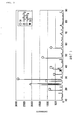
- the x-ray diffraction chart thereof is shown in FIG. 1 .
- the negative electrode material for a secondary battery with a non-aqueous electrolyte was manufactured in the same conditions as Example 1, and the same evaluation was carried out.
- the doping amount of lithium was 2%.
- the structure that silicon particles were dispersed to silicon oxide in an atomic order and/or a crystallite state was observed with a transmission electron microscope.
- the peaks attributable to silicon, lithium silicate, and lithium aluminate were observed when the x-ray diffraction using Cu-K ⁇ ray, the size of silicon crystal was 10 nm, and thus the growth of the silicon crystal was suppressed.
- the x-ray diffraction chart thereof is shown in FIG. 2 .
- Powder of a silicon-silicon oxide composite having a silicon crystal size of 4 nm was obtained by the same method as Example 1. Except that the temperature of the heat CVD treatment was 1300°C and the treatment time thereof was 1. hour, this powder of the silicon-silicon oxide composite was subjected to the heat CVD treatment in the same condition as Example 1, and the silicon-silicon oxide composite powder having the carbon coating formed thereon at a carbon coating amount of 5% was consequently obtained. Next, the silicon-silicon oxide composite powder having the carbon coating formed thereon was reacted with lithium hydride in the same condition as Example 1.
- Powder of a silicon-silicon oxide composite having a silicon crystal size of 4 nm was obtained by the same method as Example 1. Except that the treatment time of the heat CVD treatment was 63 hours, this powder of the silicon-silicon oxide composite was subjected to the heat CVD treatment in the same condition as Example 1, and the silicon-silicon oxide composite powder having the carbon coating formed thereon at a carbon coating amount of 40% was consequently obtained. Next, the silicon-silicon oxide composite powder having the carbon coating formed thereon was reacted with lithium hydride in the same condition as Example 1.
- Powder of a silicon-silicon oxide composite having a silicon crystal size of 4 nm was obtained by the same method as Example 1. This powder of the silicon-silicon oxide composite was subjected to the heat CVD treatment in the same condition as Example 1, and the silicon-silicon oxide composite powder having the carbon coating formed thereon at a carbon coating amount of 5% was consequently obtained. The size of silicon crystal of the powder was 7 nm. The powder was used for a negative electrode material for a secondary battery with a non-aqueous electrolyte without doping with lithium.
- Comparative Example 2 Except that, in Comparative Example 2, the temperature and the time of the heat CVD treatment process were 1300°C and 1 hour (Comparative Example 3), 1300°C and 10 hours (Comparative Example 4), 800°C and 120 hours (Comparative Example 5), respectively, a negative electrode material for a secondary battery with a non-aqueous electrolyte was manufactured in the same condition as Comparative Example 2, and the same evaluation was carried out.
- the evaluation as the negative electrode active material for a lithium ion secondary battery was carried out by the following method/procedure which was common to all Examples and Comparative Examples.
- Binder KSC-4011 made by Shin-Etsu Chemical Co., Ltd. was added in an amount of 10% as solids to the blend to form a slurry at the temperature not exceeding 20°C.
- N-methylpyrrolidone was further added for viscosity adjustment.
- This slurry was speedily coated onto a copper foil having a thickness of 20 ⁇ m and dried at 120°C for 1 hour.
- An electrode was thereafter formed by pressing with a roller press and finally punched out so as to have a size of 2 cm 2 as the negative electrode.
- the mass of the negative electrode was measured to calculate the mass of the negative electrode material by subtracting the mass of the copper foil, flake synthetic graphite powder, and the binder therefrom.
- a lithium-ion secondary battery for evaluation was fabricated using a lithium foil as a counter electrode; using, as a non-aqueous electrolyte, a non-aqueous electrolyte solution obtained by dissolving lithium hexafluorophosphate in a 1/1 (a volume ratio) mixture of ethylene carbonate and 1,2-dimethoxyethane at a concentration of 1 mol/L; and using a polyethylene microporous film having a thickness of 30 ⁇ m as a separator.
- the fabricated lithium-ion secondary battery was allowed to stand overnight at room temperature.
- the battery for evaluation was charged at a constant current of 1.5 mA until the test cell voltage reached 5 mV at room temperature. After the voltage reached 5 mV, the battery was charged at a reduced current so that the cell voltage was maintained at 5 mV. When the current value had decreased below 200 ⁇ A, the charging was terminated. The battery was discharged at a constant current of 0.6 mA, and the discharging was terminated when the cell voltage reached 2.0 V.
- the charge/discharge capacity per unit mass of the negative electrode material was calculated by subtracting the charge/discharge capacity of the flake synthetic graphite powder from the above-obtained charge/discharge capacity.
- the charge/discharge test of the lithium-ion secondary battery for evaluation was carried out 50 times by repeating the charge/discharge test as above, to evaluate the cycle durability.
Landscapes
- Chemical & Material Sciences (AREA)
- Chemical Kinetics & Catalysis (AREA)
- General Chemical & Material Sciences (AREA)
- Engineering & Computer Science (AREA)
- Electrochemistry (AREA)
- Materials Engineering (AREA)
- Mechanical Engineering (AREA)
- Metallurgy (AREA)
- Organic Chemistry (AREA)
- Inorganic Chemistry (AREA)
- Composite Materials (AREA)
- Manufacturing & Machinery (AREA)
- Battery Electrode And Active Subsutance (AREA)
Applications Claiming Priority (1)
| Application Number | Priority Date | Filing Date | Title |
|---|---|---|---|
| JP2010086922A JP5411781B2 (ja) | 2010-04-05 | 2010-04-05 | 非水電解質二次電池用負極材及び非水電解質二次電池用負極材の製造方法並びにリチウムイオン二次電池 |
Publications (2)
| Publication Number | Publication Date |
|---|---|
| EP2372817A1 true EP2372817A1 (fr) | 2011-10-05 |
| EP2372817B1 EP2372817B1 (fr) | 2016-03-16 |
Family
ID=44247536
Family Applications (1)
| Application Number | Title | Priority Date | Filing Date |
|---|---|---|---|
| EP11002386.8A Active EP2372817B1 (fr) | 2010-04-05 | 2011-03-22 | Matériau d'électrode négative pour batterie secondaire avec électrolyte non aqueuse, procédé de fabrication de matériau d'électrode négative pour batterie secondaire avec électrolyte non aqueuse et batterie secondaire au lithium-ion |
Country Status (6)
| Country | Link |
|---|---|
| US (4) | US8889294B2 (fr) |
| EP (1) | EP2372817B1 (fr) |
| JP (1) | JP5411781B2 (fr) |
| KR (2) | KR101728171B1 (fr) |
| CN (1) | CN102214823B (fr) |
| TW (1) | TWI501456B (fr) |
Cited By (7)
| Publication number | Priority date | Publication date | Assignee | Title |
|---|---|---|---|---|
| EP2573842A1 (fr) * | 2011-09-21 | 2013-03-27 | Samsung SDI Co., Ltd. | Matériau actif négatif pour batterie au lithium rechargeable, procédé de préparation de celui-ci et batterie au lithium rechargeable comprenant celui-ci |
| CN103199222A (zh) * | 2012-01-06 | 2013-07-10 | 三星Sdi株式会社 | 负极活性材料、其制备方法及包括其的可充电锂电池 |
| EP3089245A4 (fr) * | 2013-12-25 | 2017-09-20 | Shin-Etsu Chemical Co., Ltd. | Matériau actif d'électrode négative pour batteries secondaires à électrolyte non aqueux et son procédé de production |
| CN107710466A (zh) * | 2015-06-17 | 2018-02-16 | 信越化学工业株式会社 | 非水电解质二次电池用负极活性物质及非水电解质二次电池、以及非水电解质二次电池用负极材料的制造方法 |
| US9929399B2 (en) | 2013-10-29 | 2018-03-27 | Shin-Etsu Chemical Co., Ltd. | Negative electrode active material, method for producing a negative electrode active material, and lithium ion secondary battery |
| EP3309877A4 (fr) * | 2015-06-15 | 2019-01-23 | Shin-Etsu Chemical Co., Ltd. | Substance active d'électrode négative pour batterie secondaire à électrolyte non aqueux, électrode négative pour batterie secondaire à électrolyte non aqueux, batterie secondaire à électrolyte non aqueux et procédé de production de matériau d'électrode négative pour batterie secondaire à électrolyte non aqueux |
| EP3496189A4 (fr) * | 2017-03-06 | 2020-03-18 | Btr New Material Group Co., Ltd. | Composé et son procédé de préparation, et utilisation dans une batterie rechargeable lithium-ion |
Families Citing this family (83)
| Publication number | Priority date | Publication date | Assignee | Title |
|---|---|---|---|---|
| JP5411781B2 (ja) * | 2010-04-05 | 2014-02-12 | 信越化学工業株式会社 | 非水電解質二次電池用負極材及び非水電解質二次電池用負極材の製造方法並びにリチウムイオン二次電池 |
| CA2752844A1 (fr) | 2011-09-19 | 2013-03-19 | Hydro-Quebec | Methode de preparation de particules de materiau a base de si ou siox et materiau ainsi obtenu |
| KR101772113B1 (ko) * | 2011-11-08 | 2017-08-29 | 삼성에스디아이 주식회사 | 음극 활물질, 그 제조방법, 이를 포함하는 전극 및 이를 채용한 리튬 전지 |
| JP5831268B2 (ja) * | 2012-02-07 | 2015-12-09 | 株式会社豊田自動織機 | 二次電池用活物質およびその製造方法 |
| US20150072220A1 (en) * | 2012-03-30 | 2015-03-12 | Nec Corporation | Lithium Secondary Battery and Method for Manufacturing Same |
| US9512523B2 (en) | 2012-04-19 | 2016-12-06 | Lg Chem, Ltd. | Porous electrode active material and secondary battery including the same |
| US9780357B2 (en) | 2012-04-19 | 2017-10-03 | Lg Chem, Ltd. | Silicon-based anode active material and secondary battery comprising the same |
| CN103427069B (zh) * | 2012-05-19 | 2016-03-16 | 湖南省正源储能材料与器件研究所 | 一种锂离子电池复合负极材料及其制备 |
| WO2013180083A1 (fr) * | 2012-05-29 | 2013-12-05 | 日本電気株式会社 | Batterie secondaire au lithium-ion |
| KR101578262B1 (ko) | 2012-07-24 | 2015-12-28 | 주식회사 엘지화학 | 다공성 규소계 전극 활물질 및 이를 포함하는 이차전지 |
| KR101634843B1 (ko) | 2012-07-26 | 2016-06-29 | 주식회사 엘지화학 | 이차전지용 전극 활물질 |
| CN103579593A (zh) * | 2012-08-03 | 2014-02-12 | 株式会社Lg化学 | 电极活性材料、二次电池和制备多孔氧化硅基复合物的方法 |
| JP5447618B2 (ja) | 2012-08-28 | 2014-03-19 | 株式会社豊田自動織機 | 非水電解質二次電池用負極材料、その製造方法、非水電解質二次電池用負極及び非水電解質二次電池 |
| JP6092558B2 (ja) * | 2012-09-27 | 2017-03-08 | 三洋電機株式会社 | 負極活物質の製造方法 |
| KR101591698B1 (ko) * | 2012-11-30 | 2016-02-04 | 주식회사 엘지화학 | 음극활물질, 이를 포함하는 리튬 이차전지 및 상기 음극활물질의 제조방법 |
| KR101610995B1 (ko) * | 2012-11-30 | 2016-04-08 | 주식회사 엘지화학 | 규소계 복합체 및 이의 제조방법 |
| CN103258992B (zh) * | 2013-04-28 | 2016-02-24 | 浙江大学 | 一种首次库仑效率高的锂离子电池负极材料的制备方法 |
| KR102204928B1 (ko) * | 2013-05-16 | 2021-01-18 | 알베마를 저머니 게엠베하 | 리튬-이온 배터리를 위한 활성 리튬 저장소 |
| US9893353B2 (en) * | 2013-05-23 | 2018-02-13 | Shin-Etsu Chemical Co., Ltd. | Negative electrode material for nonaqueous electrolyte secondary batteries, and secondary battery |
| KR20150105648A (ko) * | 2013-05-24 | 2015-09-17 | 오사카 티타늄 테크놀로지스 캄파니 리미티드 | 리튬 함유 산화규소 분말 |
| JP6500776B2 (ja) * | 2013-06-06 | 2019-04-17 | 日本電気株式会社 | リチウムイオン二次電池用正極材料及びその製造方法 |
| DE102014111781B4 (de) * | 2013-08-19 | 2022-08-11 | Korea Atomic Energy Research Institute | Verfahren zur elektrochemischen Herstellung einer Silizium-Schicht |
| RU2672556C2 (ru) | 2013-09-02 | 2018-11-16 | Мицубиси Газ Кемикал Компани, Инк. | Батарея с твёрдым электролитом и способ получения активного материала электрода |
| JP5679485B1 (ja) * | 2013-09-11 | 2015-03-04 | 株式会社大阪チタニウムテクノロジーズ | リチウム含有酸化珪素粉末 |
| CN104701509B (zh) * | 2013-12-06 | 2017-11-14 | 奇瑞汽车股份有限公司 | 锂离子电池负极材料及其制备方法、锂离子电池 |
| JP6397262B2 (ja) * | 2014-02-07 | 2018-09-26 | 信越化学工業株式会社 | 非水電解質二次電池 |
| JP5870129B2 (ja) * | 2014-02-12 | 2016-02-24 | 株式会社大阪チタニウムテクノロジーズ | リチウムイオン二次電池の負極用粉末、およびその製造方法 |
| WO2015137041A1 (fr) * | 2014-03-12 | 2015-09-17 | 三洋化成工業株式会社 | Matériau actif revêtu pour électrode négative à utiliser dans une batterie lithium-ion, bouillie à utiliser dans une batterie lithium-ion, électrode négative à utiliser dans une batterie lithium-ion, batterie lithium-ion et méthode de fabrication de matériau actif revêtu pour électrode négative à utiliser dans une batterie lithium-ion |
| JP6196183B2 (ja) * | 2014-04-22 | 2017-09-13 | 信越化学工業株式会社 | 非水電解質二次電池用負極材及びその製造方法、並びに非水電解質二次電池用負極活物質層、非水電解質二次電池用負極、非水電解質二次電池 |
| US10340508B2 (en) * | 2014-06-16 | 2019-07-02 | The Regents Of The University Of California | Porous silicon oxide (SiO) anode enabled by a conductive polymer binder and performance enhancement by stabilized lithium metal power (SLMP) |
| JP6268049B2 (ja) * | 2014-06-23 | 2018-01-24 | 信越化学工業株式会社 | 非水電解質二次電池用負極材及び非水電解質二次電池並びに負極活物質粒子の製造方法 |
| WO2016035290A1 (fr) | 2014-09-03 | 2016-03-10 | 三洋電機株式会社 | Matériau actif d'électrode positive pour batteries à électrolyte non aqueux et batterie secondaire à électrolyte non aqueux |
| JP6215804B2 (ja) * | 2014-09-25 | 2017-10-18 | 信越化学工業株式会社 | 非水電解質二次電池用負極活物質、非水電解質二次電池用負極、及び非水電解質二次電池、並びに負極活物質粒子の製造方法 |
| WO2016121326A1 (fr) | 2015-01-28 | 2016-08-04 | 三洋電機株式会社 | Matériau actif d'électrode négative pour batterie secondaire à électrolyte non aqueux, et batterie secondaire à électrolyte non aqueux |
| CN107210435B (zh) | 2015-01-28 | 2021-03-26 | 三洋电机株式会社 | 非水电解质二次电池用负极活性物质和非水电解质二次电池 |
| US10516153B2 (en) | 2015-01-28 | 2019-12-24 | Sanyo Electric Co., Ltd. | Negative-electrode active material for non-aqueous electrolyte secondary battery and non-aqueous electrolyte secondary battery |
| JP6970617B2 (ja) * | 2015-03-02 | 2021-11-24 | イーオーセル リミテッド | ケイ素:ケイ酸リチウムの複合材母材中にナノケイ素粒子を埋込んだケイ素−酸化ケイ素−リチウムの複合材料、及びその製造工程、及びバッテリ二次セル負電極製造工程でのその使用、及びリチウムイオンバッテリセル |
| KR101701331B1 (ko) * | 2015-04-15 | 2017-02-02 | 울산과학기술원 | 리튬 이차 전지용 음극 활물질, 이의 제조 방법, 및 이를 포함하는 리튬 이차 전지 |
| US10297820B2 (en) | 2015-04-22 | 2019-05-21 | Lg Chem, Ltd. | Anode active material with a core-shell structure, lithium secondary battery comprising same, and method for preparing anode active material with a core-shell structure |
| JP6386414B2 (ja) * | 2015-04-22 | 2018-09-05 | 信越化学工業株式会社 | 非水電解質二次電池用負極活物質及びその製造方法、並びにその負極活物質を用いた非水電解質二次電池及び非水電解質二次電池用負極材の製造方法 |
| EP3343678B1 (fr) | 2015-08-28 | 2020-05-13 | OSAKA Titanium technologies Co., Ltd. | Poudre d'oxyde de silicium contenant du lithium et son procédé de production |
| JP6389159B2 (ja) * | 2015-10-08 | 2018-09-12 | 信越化学工業株式会社 | 非水電解質二次電池用負極活物質、非水電解質二次電池、非水電解質二次電池用負極材の製造方法、及び非水電解質二次電池の製造方法 |
| KR20170048184A (ko) * | 2015-10-23 | 2017-05-08 | 주식회사 엘지화학 | 이차전지용 음극활물질, 이의 제조 방법 및 이를 포함하는 이차전지 |
| KR101902071B1 (ko) | 2015-10-26 | 2018-11-02 | 주식회사 엘지화학 | 음극 활물질 입자 및 이의 제조방법 |
| JP6448510B2 (ja) * | 2015-11-05 | 2019-01-09 | 信越化学工業株式会社 | 非水電解質二次電池用負極活物質の製造方法及び非水電解質二次電池の製造方法 |
| JP6862091B2 (ja) * | 2016-02-15 | 2021-04-21 | 信越化学工業株式会社 | 負極活物質、混合負極活物質材料、非水電解質二次電池用負極、リチウムイオン二次電池、及び負極活物質の製造方法 |
| JP6765984B2 (ja) * | 2016-03-16 | 2020-10-07 | 信越化学工業株式会社 | 非水電解質二次電池用負極活物質の製造方法及び非水電解質二次電池用負極の製造方法 |
| JP2017168406A (ja) * | 2016-03-18 | 2017-09-21 | 信越化学工業株式会社 | 非水電解質二次電池負極活物質、負極及び電池の製造方法 |
| CN108701826B (zh) * | 2016-03-29 | 2021-04-16 | 株式会社大阪钛技术 | 含锂氧化硅粉末 |
| JP2018032602A (ja) * | 2016-08-26 | 2018-03-01 | 株式会社豊田自動織機 | 負極材料の製造方法 |
| US11196040B2 (en) * | 2016-11-30 | 2021-12-07 | Panasonic Intellectual Property Management Co., Ltd. | Negative electrode material and non-aqueous electrolyte secondary battery |
| JP6981338B2 (ja) | 2018-03-28 | 2021-12-15 | トヨタ自動車株式会社 | 負極材料、非水電解質二次電池およびそれらの製造方法 |
| US11417886B2 (en) | 2018-03-30 | 2022-08-16 | Osaka Titanium Technologies Co., Ltd. | Method for producing silicon oxide powder and negative electrode material |
| CN112166513A (zh) | 2018-05-22 | 2021-01-01 | 三菱化学株式会社 | 非水二次电池用负极材料、非水二次电池用负极及非水二次电池 |
| CN110970600B (zh) * | 2018-09-28 | 2023-06-30 | 贝特瑞新材料集团股份有限公司 | 一种锂离子二次电池负极材料及其制备方法和应用 |
| CN112840476A (zh) | 2018-10-12 | 2021-05-25 | 雅宝公司 | 包含硅和锂的颗粒 |
| JP7098543B2 (ja) | 2019-01-16 | 2022-07-11 | 信越化学工業株式会社 | 非水電解質二次電池用負極活物質及び非水電解質二次電池、並びに、非水電解質二次電池用負極材の製造方法 |
| KR102837219B1 (ko) | 2019-08-19 | 2025-07-23 | 대주전자재료 주식회사 | 이차전지 및 이의 제조방법 |
| CN114600271A (zh) | 2019-08-19 | 2022-06-07 | 大洲电子材料株式会社 | 二次电池及其制造方法 |
| KR102853401B1 (ko) | 2019-08-19 | 2025-09-02 | 대주전자재료 주식회사 | 이차전지의 제조방법 |
| KR102909739B1 (ko) * | 2019-12-17 | 2026-01-09 | 주식회사 엘지에너지솔루션 | 음극 및 상기 음극을 포함하는 이차 전지 |
| US20220367862A1 (en) * | 2019-12-17 | 2022-11-17 | Lg Energy Solution, Ltd. | Negative electrode and secondary battery including the same |
| US20220393151A1 (en) * | 2019-12-25 | 2022-12-08 | Lg Energy Solution, Ltd. | Anode active material, and anode and secondary battery comprising same anode active material |
| CN115699368A (zh) | 2020-05-28 | 2023-02-03 | 昭和电工株式会社 | 锂离子二次电池用负极材料及其用途 |
| CN115668539A (zh) | 2020-05-28 | 2023-01-31 | 昭和电工株式会社 | 复合粒子、负极材料和锂离子二次电池 |
| WO2021241754A1 (fr) * | 2020-05-28 | 2021-12-02 | 昭和電工株式会社 | Particule composite, matériau actif d'électrode négative et batterie secondaire au lithium |
| CN114079050B (zh) * | 2020-08-31 | 2026-04-10 | 贝特瑞新材料集团股份有限公司 | 硅氧复合材料、其制备方法、负极材料及锂离子电池 |
| KR20220052541A (ko) | 2020-10-21 | 2022-04-28 | 에스케이온 주식회사 | 리튬 이차 전지용 음극 조성물 및 이를 사용해 제조된 리튬 이차 전지 |
| CN112467096B (zh) * | 2020-10-30 | 2022-09-23 | 安普瑞斯(南京)有限公司 | 一种负极材料及其制备方法、电极、二次电池 |
| CN114520313B (zh) | 2020-11-20 | 2026-03-13 | 华为技术有限公司 | 一种硅碳复合材料及其制备方法和应用 |
| CN112687853B (zh) * | 2020-12-10 | 2022-08-16 | 安普瑞斯(南京)有限公司 | 硅氧颗粒团聚体及其制备方法、负极材料、电池 |
| KR102539600B1 (ko) | 2021-02-18 | 2023-06-02 | 에스케이온 주식회사 | 리튬 이차 전지용 음극 활물질 및 이를 포함하는 리튬 이차 전지 |
| KR102912050B1 (ko) * | 2021-11-29 | 2026-01-14 | 대주전자재료 주식회사 | 규소-탄소 복합체, 이의 제조방법 및 이를 포함하는 음극 활물질 |
| KR20230088286A (ko) * | 2021-12-10 | 2023-06-19 | 주식회사 엘지에너지솔루션 | 음극 활물질, 이를 포함하는 음극 슬러리, 이를 포함하는 음극, 이를 포함하는 이차전지 및 음극 활물질의 제조방법 |
| JP7659512B2 (ja) | 2022-01-19 | 2025-04-09 | 信越化学工業株式会社 | 非水電解質二次電池用負極活物質及びその製造方法 |
| CN114784233A (zh) * | 2022-03-02 | 2022-07-22 | 安普瑞斯(南京)有限公司 | 一种负极活性材料及其制备方法和应用 |
| JP7840811B2 (ja) | 2022-07-25 | 2026-04-06 | 信越化学工業株式会社 | 非水電解質二次電池用負極活物質及びその製造方法 |
| JPWO2024071116A1 (fr) * | 2022-09-30 | 2024-04-04 | ||
| CN116042247B (zh) * | 2022-11-04 | 2024-09-20 | 湖南中科星城石墨有限公司 | 一种改性生焦材料及其制备方法和应用 |
| KR20240071872A (ko) | 2022-11-16 | 2024-05-23 | 에스케이온 주식회사 | 리튬 이차 전지용 음극 조성물 및 이를 사용해 제조된 리튬 이차 전지 |
| CN119695129A (zh) * | 2023-09-22 | 2025-03-25 | 贝特瑞新材料集团股份有限公司 | 负极材料及其制备方法、锂离子电池 |
| CN117727916A (zh) * | 2024-02-07 | 2024-03-19 | 长沙矿冶研究院有限责任公司 | 一种含有碳化硅涂层的硅氧碳复合材料及其制备方法、应用 |
| CN118919704B (zh) * | 2024-10-09 | 2025-01-24 | 中建材(浙江)材料科技有限公司 | 一体化硅碳复合负极材料及其制备方法 |
Citations (3)
| Publication number | Priority date | Publication date | Assignee | Title |
|---|---|---|---|---|
| US5707756A (en) * | 1994-11-29 | 1998-01-13 | Fuji Photo Film Co., Ltd. | Non-aqueous secondary battery |
| US20020102462A1 (en) * | 2000-12-06 | 2002-08-01 | Huggins Robert A. | Electrodes for lithium batteries |
| US20060068287A1 (en) * | 2004-09-24 | 2006-03-30 | Kabushiki Kaisha Toshiba | Negative electrode active material for nonaqueous electrolyte secondary battery and nonaqueous electrolyte secondary battery |
Family Cites Families (28)
| Publication number | Priority date | Publication date | Assignee | Title |
|---|---|---|---|---|
| JP2997741B2 (ja) | 1992-07-29 | 2000-01-11 | セイコーインスツルメンツ株式会社 | 非水電解質二次電池及びその製造方法 |
| JPH07235295A (ja) * | 1994-02-21 | 1995-09-05 | Fuji Photo Film Co Ltd | 非水二次電池 |
| US5567539A (en) | 1994-05-23 | 1996-10-22 | Fuji Photo Film Co., Ltd. | Non-aqueous secondary cell |
| JPH08102331A (ja) | 1994-09-29 | 1996-04-16 | Fuji Photo Film Co Ltd | 非水二次電池 |
| CA2127621C (fr) * | 1994-07-08 | 1999-12-07 | Alfred Macdonald Wilson | Composes d'insertion carbones et leur utilisation comme anodes dans les piles rechargeables |
| US5543021A (en) * | 1994-09-01 | 1996-08-06 | Le Carbone Lorraine | Negative electrode based on pre-lithiated carbonaceous material for a rechargeable electrochemical lithium generator |
| JPH08130011A (ja) | 1994-09-05 | 1996-05-21 | Fuji Photo Film Co Ltd | 非水二次電池 |
| JPH08130036A (ja) | 1994-09-08 | 1996-05-21 | Fuji Photo Film Co Ltd | 非水二次電池 |
| US6350543B2 (en) | 1999-12-29 | 2002-02-26 | Kimberly-Clark Worldwide, Inc. | Manganese-rich quaternary metal oxide materials as cathodes for lithium-ion and lithium-ion polymer batteries |
| JP2002042806A (ja) | 2000-07-19 | 2002-02-08 | Japan Storage Battery Co Ltd | 非水電解質二次電池 |
| JP4702510B2 (ja) | 2001-09-05 | 2011-06-15 | 信越化学工業株式会社 | リチウム含有酸化珪素粉末及びその製造方法 |
| CN100414743C (zh) * | 2002-05-08 | 2008-08-27 | 株式会社杰士汤浅 | 一种非水电解质二次电池 |
| JP3952180B2 (ja) * | 2002-05-17 | 2007-08-01 | 信越化学工業株式会社 | 導電性珪素複合体及びその製造方法並びに非水電解質二次電池用負極材 |
| TWI278429B (en) * | 2002-05-17 | 2007-04-11 | Shinetsu Chemical Co | Conductive silicon composite, preparation thereof, and negative electrode material for non-aqueous electrolyte secondary cell |
| US20050130043A1 (en) * | 2003-07-29 | 2005-06-16 | Yuan Gao | Lithium metal dispersion in electrodes |
| JP5008180B2 (ja) * | 2006-02-13 | 2012-08-22 | 日立マクセルエナジー株式会社 | 非水二次電池 |
| US7776473B2 (en) | 2006-03-27 | 2010-08-17 | Shin-Etsu Chemical Co., Ltd. | Silicon-silicon oxide-lithium composite, making method, and non-aqueous electrolyte secondary cell negative electrode material |
| US20070224509A1 (en) * | 2006-03-27 | 2007-09-27 | Shin-Etsu Chemical Co., Ltd. | SiCO-Li COMPOSITE, MAKING METHOD, AND NON-AQUEOUS ELECTROLYTE SECONDARY CELL NEGATIVE ELECTRODE MATERIAL |
| JP4985949B2 (ja) * | 2006-03-27 | 2012-07-25 | 信越化学工業株式会社 | 珪素−珪素酸化物−リチウム系複合体の製造方法、並びに非水電解質二次電池用負極材 |
| US20080070120A1 (en) * | 2006-09-14 | 2008-03-20 | Shin-Etsu Chemical Co., Ltd. | Non-aqueous electrolyte secondary battery and making method |
| JP5192703B2 (ja) * | 2007-02-06 | 2013-05-08 | Necエナジーデバイス株式会社 | 非水電解質二次電池 |
| KR101451801B1 (ko) * | 2007-02-14 | 2014-10-17 | 삼성에스디아이 주식회사 | 음극 활물질, 그 제조 방법 및 이를 채용한 음극과 리튬전지 |
| US7736805B2 (en) * | 2007-05-16 | 2010-06-15 | Gm Global Technology Operations, Inc. | Lithium hydride negative electrode for rechargeable lithium batteries |
| JP5329858B2 (ja) * | 2008-07-10 | 2013-10-30 | 株式会社東芝 | 非水電解質二次電池用負極活物質の製造方法およびこれによって得られる非水電解質電池用負極活物質 |
| US20100203391A1 (en) * | 2009-02-09 | 2010-08-12 | Applied Materials, Inc. | Mesoporous carbon material for energy storage |
| WO2011060023A2 (fr) * | 2009-11-11 | 2011-05-19 | Amprius Inc. | Préchargement de composants de piles lithium-ion avec du lithium |
| JP5411780B2 (ja) * | 2010-04-05 | 2014-02-12 | 信越化学工業株式会社 | 非水電解質二次電池用負極材及び非水電解質二次電池用負極材の製造方法並びにリチウムイオン二次電池 |
| JP5411781B2 (ja) * | 2010-04-05 | 2014-02-12 | 信越化学工業株式会社 | 非水電解質二次電池用負極材及び非水電解質二次電池用負極材の製造方法並びにリチウムイオン二次電池 |
-
2010
- 2010-04-05 JP JP2010086922A patent/JP5411781B2/ja active Active
-
2011
- 2011-03-21 US US13/052,732 patent/US8889294B2/en active Active
- 2011-03-22 EP EP11002386.8A patent/EP2372817B1/fr active Active
- 2011-03-31 TW TW100111289A patent/TWI501456B/zh active
- 2011-04-02 CN CN201110085975.5A patent/CN102214823B/zh active Active
- 2011-04-04 KR KR1020110030663A patent/KR101728171B1/ko active Active
-
2014
- 2014-09-09 US US14/481,521 patent/US9614222B2/en active Active
-
2016
- 2016-12-22 KR KR1020160176786A patent/KR101767848B1/ko active Active
-
2017
- 2017-02-21 US US15/438,292 patent/US9825290B2/en active Active
- 2017-10-19 US US15/788,479 patent/US10622626B2/en active Active
Patent Citations (3)
| Publication number | Priority date | Publication date | Assignee | Title |
|---|---|---|---|---|
| US5707756A (en) * | 1994-11-29 | 1998-01-13 | Fuji Photo Film Co., Ltd. | Non-aqueous secondary battery |
| US20020102462A1 (en) * | 2000-12-06 | 2002-08-01 | Huggins Robert A. | Electrodes for lithium batteries |
| US20060068287A1 (en) * | 2004-09-24 | 2006-03-30 | Kabushiki Kaisha Toshiba | Negative electrode active material for nonaqueous electrolyte secondary battery and nonaqueous electrolyte secondary battery |
Cited By (18)
| Publication number | Priority date | Publication date | Assignee | Title |
|---|---|---|---|---|
| US10826107B2 (en) | 2011-09-21 | 2020-11-03 | Samsung Sdi Co., Ltd. | Negative active material for rechargeable lithium battery, method of preparing the same and rechargeable lithium battery including the same |
| US12444767B2 (en) | 2011-09-21 | 2025-10-14 | Samsung Sdi Co., Ltd. | Negative active material for rechargeable lithium battery, method of preparing the same and rechargeable lithium battery including the same |
| EP2573842A1 (fr) * | 2011-09-21 | 2013-03-27 | Samsung SDI Co., Ltd. | Matériau actif négatif pour batterie au lithium rechargeable, procédé de préparation de celui-ci et batterie au lithium rechargeable comprenant celui-ci |
| US11830972B2 (en) | 2011-09-21 | 2023-11-28 | Samsung Sdi Co., Ltd. | Negative active material for rechargeable lithium battery, method of preparing the same and rechargeable lithium battery including the same |
| US11502326B2 (en) | 2011-09-21 | 2022-11-15 | Samsung Sdi Co., Ltd. | Negative active material for rechargeable lithium battery, method of preparing the same and rechargeable lithium battery including the same |
| CN103199222A (zh) * | 2012-01-06 | 2013-07-10 | 三星Sdi株式会社 | 负极活性材料、其制备方法及包括其的可充电锂电池 |
| CN103199222B (zh) * | 2012-01-06 | 2017-06-13 | 三星Sdi株式会社 | 负极活性材料、其制备方法及包括其的可充电锂电池 |
| US9929399B2 (en) | 2013-10-29 | 2018-03-27 | Shin-Etsu Chemical Co., Ltd. | Negative electrode active material, method for producing a negative electrode active material, and lithium ion secondary battery |
| US10283756B2 (en) | 2013-10-29 | 2019-05-07 | Shin-Etsu Chemical Co., Ltd. | Negative electrode active material, method for producing a negative electrode active material, and lithium ion secondary battery |
| EP3089245A4 (fr) * | 2013-12-25 | 2017-09-20 | Shin-Etsu Chemical Co., Ltd. | Matériau actif d'électrode négative pour batteries secondaires à électrolyte non aqueux et son procédé de production |
| US10050272B2 (en) | 2013-12-25 | 2018-08-14 | Shin-Etsu Chemical Co., Ltd. | Negative electrode active material for non-aqueous electolyte secondary battery and method of producing the same |
| EP3309877A4 (fr) * | 2015-06-15 | 2019-01-23 | Shin-Etsu Chemical Co., Ltd. | Substance active d'électrode négative pour batterie secondaire à électrolyte non aqueux, électrode négative pour batterie secondaire à électrolyte non aqueux, batterie secondaire à électrolyte non aqueux et procédé de production de matériau d'électrode négative pour batterie secondaire à électrolyte non aqueux |
| EP3312916A4 (fr) * | 2015-06-17 | 2019-03-20 | Shin-Etsu Chemical Co., Ltd. | Matériau actif d'électrode négative pour piles rechargeables à électrolyte non aqueux, pile rechargeable à électrolyte non aqueux, et procédé de production de matériau d'électrode négative pour piles rechargeables à électrolyte non aqueux |
| CN107710466B (zh) * | 2015-06-17 | 2020-11-03 | 信越化学工业株式会社 | 负极活性物质及二次电池、以及负极材料的制造方法 |
| US10418627B2 (en) | 2015-06-17 | 2019-09-17 | Shin-Etsu Chemical Co., Ltd. | Negative electrode active material for non-aqueous electrolyte secondary battery, non-aqueous electrolyte secondary battery, and method of producing negative electrode material for non-aqueous electrolyte secondary battery |
| CN107710466A (zh) * | 2015-06-17 | 2018-02-16 | 信越化学工业株式会社 | 非水电解质二次电池用负极活性物质及非水电解质二次电池、以及非水电解质二次电池用负极材料的制造方法 |
| EP3496189A4 (fr) * | 2017-03-06 | 2020-03-18 | Btr New Material Group Co., Ltd. | Composé et son procédé de préparation, et utilisation dans une batterie rechargeable lithium-ion |
| US11929484B2 (en) | 2017-03-06 | 2024-03-12 | Btr New Material Group Co., Ltd. | Compound, preparation method therefore, and use in lithium ion secondary battery |
Also Published As
| Publication number | Publication date |
|---|---|
| US20140377456A1 (en) | 2014-12-25 |
| EP2372817B1 (fr) | 2016-03-16 |
| TWI501456B (zh) | 2015-09-21 |
| US20170170468A1 (en) | 2017-06-15 |
| US20180040884A1 (en) | 2018-02-08 |
| KR20170001947A (ko) | 2017-01-05 |
| US9614222B2 (en) | 2017-04-04 |
| KR101767848B1 (ko) | 2017-08-11 |
| US10622626B2 (en) | 2020-04-14 |
| US8889294B2 (en) | 2014-11-18 |
| JP5411781B2 (ja) | 2014-02-12 |
| US20110244334A1 (en) | 2011-10-06 |
| JP2011222153A (ja) | 2011-11-04 |
| KR101728171B1 (ko) | 2017-04-18 |
| US9825290B2 (en) | 2017-11-21 |
| TW201212356A (en) | 2012-03-16 |
| CN102214823A (zh) | 2011-10-12 |
| KR20110112216A (ko) | 2011-10-12 |
| CN102214823B (zh) | 2016-03-16 |
Similar Documents
| Publication | Publication Date | Title |
|---|---|---|
| US10622626B2 (en) | Negative electrode material for secondary battery with non-aqueous electrolyte, method for manufacturing negative electrode material for secondary battery with non-aqueous electrolyte, and lithium ion secondary battery | |
| EP2372816B1 (fr) | Matériau d'électrode négative pour batterie secondaire avec électrolyte non aqueuse, procédé de fabrication de matériau d'électrode négative pour batterie secondaire avec électrolyte non aqueuse et batterie secondaire au lithium-ion | |
| JP5406799B2 (ja) | 非水電解質二次電池用負極材とその製造方法及びリチウムイオン二次電池 | |
| EP1291321B1 (fr) | Poudre de oxyde de silicium contenant du lithium et son procédé de préparation | |
| KR20180024004A (ko) | Li 함유 산화 규소 분말 및 그 제조 방법 | |
| WO2010043884A2 (fr) | Composés de sulfure de métal de transition lithié | |
| JP2021520602A (ja) | アノード材料並びにその製造方法及び使用方法 | |
| KR101298719B1 (ko) | 리튬 이차 전지용 양극 활물질, 이의 제조 방법 및 이를 포함하는 리튬 이차 전지 | |
| CN101209822B (zh) | 锂离子二次电池正极活性物质磷酸亚铁锂的制备方法 | |
| JP2022503649A (ja) | 複合アノードを備える、再充電可能なリチウム電池 | |
| JP7420790B2 (ja) | アニオン-酸化還元活性複合カソードを備える、再充電可能な高エネルギー電池の製造方法 | |
| CN101209825B (zh) | 锂离子二次电池正极活性物质磷酸亚铁锂的制备方法 | |
| JP4305613B2 (ja) | 非水電解質二次電池用正極活物質並びに非水電解質二次電池 |
Legal Events
| Date | Code | Title | Description |
|---|---|---|---|
| PUAI | Public reference made under article 153(3) epc to a published international application that has entered the european phase |
Free format text: ORIGINAL CODE: 0009012 |
|
| AK | Designated contracting states |
Kind code of ref document: A1 Designated state(s): AL AT BE BG CH CY CZ DE DK EE ES FI FR GB GR HR HU IE IS IT LI LT LU LV MC MK MT NL NO PL PT RO RS SE SI SK SM TR |
|
| AX | Request for extension of the european patent |
Extension state: BA ME |
|
| 17P | Request for examination filed |
Effective date: 20120228 |
|
| 17Q | First examination report despatched |
Effective date: 20121005 |
|
| GRAP | Despatch of communication of intention to grant a patent |
Free format text: ORIGINAL CODE: EPIDOSNIGR1 |
|
| RIC1 | Information provided on ipc code assigned before grant |
Ipc: C01B 6/24 20060101ALI20150811BHEP Ipc: C23C 16/26 20060101ALI20150811BHEP Ipc: C23C 16/44 20060101ALI20150811BHEP Ipc: H01M 4/134 20100101AFI20150811BHEP Ipc: H01M 4/36 20060101ALI20150811BHEP Ipc: H01M 4/48 20100101ALI20150811BHEP Ipc: H01M 10/052 20100101ALI20150811BHEP |
|
| INTG | Intention to grant announced |
Effective date: 20150917 |
|
| RIN1 | Information on inventor provided before grant (corrected) |
Inventor name: KAWADA, NOBUO |
|
| GRAS | Grant fee paid |
Free format text: ORIGINAL CODE: EPIDOSNIGR3 |
|
| GRAA | (expected) grant |
Free format text: ORIGINAL CODE: 0009210 |
|
| AK | Designated contracting states |
Kind code of ref document: B1 Designated state(s): AL AT BE BG CH CY CZ DE DK EE ES FI FR GB GR HR HU IE IS IT LI LT LU LV MC MK MT NL NO PL PT RO RS SE SI SK SM TR |
|
| REG | Reference to a national code |
Ref country code: GB Ref legal event code: FG4D |
|
| REG | Reference to a national code |
Ref country code: CH Ref legal event code: EP |
|
| REG | Reference to a national code |
Ref country code: IE Ref legal event code: FG4D |
|
| REG | Reference to a national code |
Ref country code: FR Ref legal event code: PLFP Year of fee payment: 6 |
|
| REG | Reference to a national code |
Ref country code: AT Ref legal event code: REF Ref document number: 781919 Country of ref document: AT Kind code of ref document: T Effective date: 20160415 |
|
| REG | Reference to a national code |
Ref country code: DE Ref legal event code: R096 Ref document number: 602011023958 Country of ref document: DE |
|
| REG | Reference to a national code |
Ref country code: NL Ref legal event code: MP Effective date: 20160316 |
|
| REG | Reference to a national code |
Ref country code: LT Ref legal event code: MG4D |
|
| PG25 | Lapsed in a contracting state [announced via postgrant information from national office to epo] |
Ref country code: FI Free format text: LAPSE BECAUSE OF FAILURE TO SUBMIT A TRANSLATION OF THE DESCRIPTION OR TO PAY THE FEE WITHIN THE PRESCRIBED TIME-LIMIT Effective date: 20160316 Ref country code: NO Free format text: LAPSE BECAUSE OF FAILURE TO SUBMIT A TRANSLATION OF THE DESCRIPTION OR TO PAY THE FEE WITHIN THE PRESCRIBED TIME-LIMIT Effective date: 20160616 Ref country code: HR Free format text: LAPSE BECAUSE OF FAILURE TO SUBMIT A TRANSLATION OF THE DESCRIPTION OR TO PAY THE FEE WITHIN THE PRESCRIBED TIME-LIMIT Effective date: 20160316 Ref country code: GR Free format text: LAPSE BECAUSE OF FAILURE TO SUBMIT A TRANSLATION OF THE DESCRIPTION OR TO PAY THE FEE WITHIN THE PRESCRIBED TIME-LIMIT Effective date: 20160617 |
|
| REG | Reference to a national code |
Ref country code: AT Ref legal event code: MK05 Ref document number: 781919 Country of ref document: AT Kind code of ref document: T Effective date: 20160316 |
|
| PG25 | Lapsed in a contracting state [announced via postgrant information from national office to epo] |
Ref country code: SE Free format text: LAPSE BECAUSE OF FAILURE TO SUBMIT A TRANSLATION OF THE DESCRIPTION OR TO PAY THE FEE WITHIN THE PRESCRIBED TIME-LIMIT Effective date: 20160316 Ref country code: RS Free format text: LAPSE BECAUSE OF FAILURE TO SUBMIT A TRANSLATION OF THE DESCRIPTION OR TO PAY THE FEE WITHIN THE PRESCRIBED TIME-LIMIT Effective date: 20160316 Ref country code: NL Free format text: LAPSE BECAUSE OF FAILURE TO SUBMIT A TRANSLATION OF THE DESCRIPTION OR TO PAY THE FEE WITHIN THE PRESCRIBED TIME-LIMIT Effective date: 20160316 Ref country code: BE Free format text: LAPSE BECAUSE OF NON-PAYMENT OF DUE FEES Effective date: 20160331 Ref country code: LV Free format text: LAPSE BECAUSE OF FAILURE TO SUBMIT A TRANSLATION OF THE DESCRIPTION OR TO PAY THE FEE WITHIN THE PRESCRIBED TIME-LIMIT Effective date: 20160316 Ref country code: LT Free format text: LAPSE BECAUSE OF FAILURE TO SUBMIT A TRANSLATION OF THE DESCRIPTION OR TO PAY THE FEE WITHIN THE PRESCRIBED TIME-LIMIT Effective date: 20160316 |
|
| PG25 | Lapsed in a contracting state [announced via postgrant information from national office to epo] |
Ref country code: EE Free format text: LAPSE BECAUSE OF FAILURE TO SUBMIT A TRANSLATION OF THE DESCRIPTION OR TO PAY THE FEE WITHIN THE PRESCRIBED TIME-LIMIT Effective date: 20160316 Ref country code: IS Free format text: LAPSE BECAUSE OF FAILURE TO SUBMIT A TRANSLATION OF THE DESCRIPTION OR TO PAY THE FEE WITHIN THE PRESCRIBED TIME-LIMIT Effective date: 20160716 Ref country code: PL Free format text: LAPSE BECAUSE OF FAILURE TO SUBMIT A TRANSLATION OF THE DESCRIPTION OR TO PAY THE FEE WITHIN THE PRESCRIBED TIME-LIMIT Effective date: 20160316 |
|
| REG | Reference to a national code |
Ref country code: CH Ref legal event code: PL |
|
| PG25 | Lapsed in a contracting state [announced via postgrant information from national office to epo] |
Ref country code: SM Free format text: LAPSE BECAUSE OF FAILURE TO SUBMIT A TRANSLATION OF THE DESCRIPTION OR TO PAY THE FEE WITHIN THE PRESCRIBED TIME-LIMIT Effective date: 20160316 Ref country code: CZ Free format text: LAPSE BECAUSE OF FAILURE TO SUBMIT A TRANSLATION OF THE DESCRIPTION OR TO PAY THE FEE WITHIN THE PRESCRIBED TIME-LIMIT Effective date: 20160316 Ref country code: AT Free format text: LAPSE BECAUSE OF FAILURE TO SUBMIT A TRANSLATION OF THE DESCRIPTION OR TO PAY THE FEE WITHIN THE PRESCRIBED TIME-LIMIT Effective date: 20160316 Ref country code: SK Free format text: LAPSE BECAUSE OF FAILURE TO SUBMIT A TRANSLATION OF THE DESCRIPTION OR TO PAY THE FEE WITHIN THE PRESCRIBED TIME-LIMIT Effective date: 20160316 Ref country code: RO Free format text: LAPSE BECAUSE OF FAILURE TO SUBMIT A TRANSLATION OF THE DESCRIPTION OR TO PAY THE FEE WITHIN THE PRESCRIBED TIME-LIMIT Effective date: 20160316 Ref country code: PT Free format text: LAPSE BECAUSE OF FAILURE TO SUBMIT A TRANSLATION OF THE DESCRIPTION OR TO PAY THE FEE WITHIN THE PRESCRIBED TIME-LIMIT Effective date: 20160718 Ref country code: ES Free format text: LAPSE BECAUSE OF FAILURE TO SUBMIT A TRANSLATION OF THE DESCRIPTION OR TO PAY THE FEE WITHIN THE PRESCRIBED TIME-LIMIT Effective date: 20160316 |
|
| REG | Reference to a national code |
Ref country code: DE Ref legal event code: R097 Ref document number: 602011023958 Country of ref document: DE |
|
| REG | Reference to a national code |
Ref country code: IE Ref legal event code: MM4A |
|
| PG25 | Lapsed in a contracting state [announced via postgrant information from national office to epo] |
Ref country code: BE Free format text: LAPSE BECAUSE OF FAILURE TO SUBMIT A TRANSLATION OF THE DESCRIPTION OR TO PAY THE FEE WITHIN THE PRESCRIBED TIME-LIMIT Effective date: 20160316 Ref country code: IT Free format text: LAPSE BECAUSE OF FAILURE TO SUBMIT A TRANSLATION OF THE DESCRIPTION OR TO PAY THE FEE WITHIN THE PRESCRIBED TIME-LIMIT Effective date: 20160316 |
|
| PLBE | No opposition filed within time limit |
Free format text: ORIGINAL CODE: 0009261 |
|
| STAA | Information on the status of an ep patent application or granted ep patent |
Free format text: STATUS: NO OPPOSITION FILED WITHIN TIME LIMIT |
|
| PG25 | Lapsed in a contracting state [announced via postgrant information from national office to epo] |
Ref country code: IE Free format text: LAPSE BECAUSE OF NON-PAYMENT OF DUE FEES Effective date: 20160322 Ref country code: CH Free format text: LAPSE BECAUSE OF NON-PAYMENT OF DUE FEES Effective date: 20160331 Ref country code: DK Free format text: LAPSE BECAUSE OF FAILURE TO SUBMIT A TRANSLATION OF THE DESCRIPTION OR TO PAY THE FEE WITHIN THE PRESCRIBED TIME-LIMIT Effective date: 20160316 Ref country code: LI Free format text: LAPSE BECAUSE OF NON-PAYMENT OF DUE FEES Effective date: 20160331 |
|
| REG | Reference to a national code |
Ref country code: FR Ref legal event code: PLFP Year of fee payment: 7 |
|
| 26N | No opposition filed |
Effective date: 20161219 |
|
| PG25 | Lapsed in a contracting state [announced via postgrant information from national office to epo] |
Ref country code: BG Free format text: LAPSE BECAUSE OF FAILURE TO SUBMIT A TRANSLATION OF THE DESCRIPTION OR TO PAY THE FEE WITHIN THE PRESCRIBED TIME-LIMIT Effective date: 20160616 |
|
| PG25 | Lapsed in a contracting state [announced via postgrant information from national office to epo] |
Ref country code: SI Free format text: LAPSE BECAUSE OF FAILURE TO SUBMIT A TRANSLATION OF THE DESCRIPTION OR TO PAY THE FEE WITHIN THE PRESCRIBED TIME-LIMIT Effective date: 20160316 |
|
| PG25 | Lapsed in a contracting state [announced via postgrant information from national office to epo] |
Ref country code: MT Free format text: LAPSE BECAUSE OF FAILURE TO SUBMIT A TRANSLATION OF THE DESCRIPTION OR TO PAY THE FEE WITHIN THE PRESCRIBED TIME-LIMIT Effective date: 20160316 |
|
| REG | Reference to a national code |
Ref country code: FR Ref legal event code: PLFP Year of fee payment: 8 |
|
| PG25 | Lapsed in a contracting state [announced via postgrant information from national office to epo] |
Ref country code: HU Free format text: LAPSE BECAUSE OF FAILURE TO SUBMIT A TRANSLATION OF THE DESCRIPTION OR TO PAY THE FEE WITHIN THE PRESCRIBED TIME-LIMIT; INVALID AB INITIO Effective date: 20110322 Ref country code: CY Free format text: LAPSE BECAUSE OF FAILURE TO SUBMIT A TRANSLATION OF THE DESCRIPTION OR TO PAY THE FEE WITHIN THE PRESCRIBED TIME-LIMIT Effective date: 20160316 |
|
| PG25 | Lapsed in a contracting state [announced via postgrant information from national office to epo] |
Ref country code: LU Free format text: LAPSE BECAUSE OF NON-PAYMENT OF DUE FEES Effective date: 20160322 Ref country code: MC Free format text: LAPSE BECAUSE OF FAILURE TO SUBMIT A TRANSLATION OF THE DESCRIPTION OR TO PAY THE FEE WITHIN THE PRESCRIBED TIME-LIMIT Effective date: 20160316 Ref country code: MK Free format text: LAPSE BECAUSE OF FAILURE TO SUBMIT A TRANSLATION OF THE DESCRIPTION OR TO PAY THE FEE WITHIN THE PRESCRIBED TIME-LIMIT Effective date: 20160316 Ref country code: MT Free format text: LAPSE BECAUSE OF FAILURE TO SUBMIT A TRANSLATION OF THE DESCRIPTION OR TO PAY THE FEE WITHIN THE PRESCRIBED TIME-LIMIT Effective date: 20160331 Ref country code: TR Free format text: LAPSE BECAUSE OF FAILURE TO SUBMIT A TRANSLATION OF THE DESCRIPTION OR TO PAY THE FEE WITHIN THE PRESCRIBED TIME-LIMIT Effective date: 20160316 |
|
| PG25 | Lapsed in a contracting state [announced via postgrant information from national office to epo] |
Ref country code: AL Free format text: LAPSE BECAUSE OF FAILURE TO SUBMIT A TRANSLATION OF THE DESCRIPTION OR TO PAY THE FEE WITHIN THE PRESCRIBED TIME-LIMIT Effective date: 20160316 |
|
| PGFP | Annual fee paid to national office [announced via postgrant information from national office to epo] |
Ref country code: GB Payment date: 20260202 Year of fee payment: 16 |
|
| PGFP | Annual fee paid to national office [announced via postgrant information from national office to epo] |
Ref country code: DE Payment date: 20260128 Year of fee payment: 16 |
|
| PGFP | Annual fee paid to national office [announced via postgrant information from national office to epo] |
Ref country code: FR Payment date: 20260209 Year of fee payment: 16 |