EP2375480A2 - Matériau actif pour batterie et son procédé de préparation - Google Patents
Matériau actif pour batterie et son procédé de préparation Download PDFInfo
- Publication number
- EP2375480A2 EP2375480A2 EP11164704A EP11164704A EP2375480A2 EP 2375480 A2 EP2375480 A2 EP 2375480A2 EP 11164704 A EP11164704 A EP 11164704A EP 11164704 A EP11164704 A EP 11164704A EP 2375480 A2 EP2375480 A2 EP 2375480A2
- Authority
- EP
- European Patent Office
- Prior art keywords
- active material
- group
- compound
- lithium
- battery
- Prior art date
- Legal status (The legal status is an assumption and is not a legal conclusion. Google has not performed a legal analysis and makes no representation as to the accuracy of the status listed.)
- Withdrawn
Links
Images











Classifications
-
- H—ELECTRICITY
- H01—ELECTRIC ELEMENTS
- H01M—PROCESSES OR MEANS, e.g. BATTERIES, FOR THE DIRECT CONVERSION OF CHEMICAL ENERGY INTO ELECTRICAL ENERGY
- H01M4/00—Electrodes
- H01M4/02—Electrodes composed of, or comprising, active material
- H01M4/13—Electrodes for accumulators with non-aqueous electrolyte, e.g. for lithium-accumulators; Processes of manufacture thereof
- H01M4/131—Electrodes based on mixed oxides or hydroxides, or on mixtures of oxides or hydroxides, e.g. LiCoOx
-
- H—ELECTRICITY
- H01—ELECTRIC ELEMENTS
- H01M—PROCESSES OR MEANS, e.g. BATTERIES, FOR THE DIRECT CONVERSION OF CHEMICAL ENERGY INTO ELECTRICAL ENERGY
- H01M4/00—Electrodes
- H01M4/02—Electrodes composed of, or comprising, active material
- H01M4/36—Selection of substances as active materials, active masses, active liquids
- H01M4/48—Selection of substances as active materials, active masses, active liquids of inorganic oxides or hydroxides
-
- H—ELECTRICITY
- H01—ELECTRIC ELEMENTS
- H01M—PROCESSES OR MEANS, e.g. BATTERIES, FOR THE DIRECT CONVERSION OF CHEMICAL ENERGY INTO ELECTRICAL ENERGY
- H01M4/00—Electrodes
- H01M4/02—Electrodes composed of, or comprising, active material
- H01M4/04—Processes of manufacture in general
-
- H—ELECTRICITY
- H01—ELECTRIC ELEMENTS
- H01M—PROCESSES OR MEANS, e.g. BATTERIES, FOR THE DIRECT CONVERSION OF CHEMICAL ENERGY INTO ELECTRICAL ENERGY
- H01M4/00—Electrodes
- H01M4/02—Electrodes composed of, or comprising, active material
- H01M4/13—Electrodes for accumulators with non-aqueous electrolyte, e.g. for lithium-accumulators; Processes of manufacture thereof
- H01M4/131—Electrodes based on mixed oxides or hydroxides, or on mixtures of oxides or hydroxides, e.g. LiCoOx
- H01M4/1315—Electrodes based on mixed oxides or hydroxides, or on mixtures of oxides or hydroxides, e.g. LiCoOx containing halogen atoms, e.g. LiCoOxFy
-
- H—ELECTRICITY
- H01—ELECTRIC ELEMENTS
- H01M—PROCESSES OR MEANS, e.g. BATTERIES, FOR THE DIRECT CONVERSION OF CHEMICAL ENERGY INTO ELECTRICAL ENERGY
- H01M4/00—Electrodes
- H01M4/02—Electrodes composed of, or comprising, active material
- H01M4/13—Electrodes for accumulators with non-aqueous electrolyte, e.g. for lithium-accumulators; Processes of manufacture thereof
- H01M4/133—Electrodes based on carbonaceous material, e.g. graphite-intercalation compounds or CFx
-
- H—ELECTRICITY
- H01—ELECTRIC ELEMENTS
- H01M—PROCESSES OR MEANS, e.g. BATTERIES, FOR THE DIRECT CONVERSION OF CHEMICAL ENERGY INTO ELECTRICAL ENERGY
- H01M4/00—Electrodes
- H01M4/02—Electrodes composed of, or comprising, active material
- H01M4/13—Electrodes for accumulators with non-aqueous electrolyte, e.g. for lithium-accumulators; Processes of manufacture thereof
- H01M4/134—Electrodes based on metals, Si or alloys
-
- H—ELECTRICITY
- H01—ELECTRIC ELEMENTS
- H01M—PROCESSES OR MEANS, e.g. BATTERIES, FOR THE DIRECT CONVERSION OF CHEMICAL ENERGY INTO ELECTRICAL ENERGY
- H01M4/00—Electrodes
- H01M4/02—Electrodes composed of, or comprising, active material
- H01M4/13—Electrodes for accumulators with non-aqueous electrolyte, e.g. for lithium-accumulators; Processes of manufacture thereof
- H01M4/136—Electrodes based on inorganic compounds other than oxides or hydroxides, e.g. sulfides, selenides, tellurides, halogenides or LiCoFy
-
- H—ELECTRICITY
- H01—ELECTRIC ELEMENTS
- H01M—PROCESSES OR MEANS, e.g. BATTERIES, FOR THE DIRECT CONVERSION OF CHEMICAL ENERGY INTO ELECTRICAL ENERGY
- H01M4/00—Electrodes
- H01M4/02—Electrodes composed of, or comprising, active material
- H01M4/36—Selection of substances as active materials, active masses, active liquids
- H01M4/362—Composites
- H01M4/366—Composites as layered products
-
- H—ELECTRICITY
- H01—ELECTRIC ELEMENTS
- H01M—PROCESSES OR MEANS, e.g. BATTERIES, FOR THE DIRECT CONVERSION OF CHEMICAL ENERGY INTO ELECTRICAL ENERGY
- H01M4/00—Electrodes
- H01M4/02—Electrodes composed of, or comprising, active material
- H01M4/36—Selection of substances as active materials, active masses, active liquids
- H01M4/38—Selection of substances as active materials, active masses, active liquids of elements or alloys
- H01M4/40—Alloys based on alkali metals
-
- H—ELECTRICITY
- H01—ELECTRIC ELEMENTS
- H01M—PROCESSES OR MEANS, e.g. BATTERIES, FOR THE DIRECT CONVERSION OF CHEMICAL ENERGY INTO ELECTRICAL ENERGY
- H01M4/00—Electrodes
- H01M4/02—Electrodes composed of, or comprising, active material
- H01M4/36—Selection of substances as active materials, active masses, active liquids
- H01M4/48—Selection of substances as active materials, active masses, active liquids of inorganic oxides or hydroxides
- H01M4/485—Selection of substances as active materials, active masses, active liquids of inorganic oxides or hydroxides of mixed oxides or hydroxides for inserting or intercalating light metals, e.g. LiTi2O4 or LiTi2OxFy
-
- H—ELECTRICITY
- H01—ELECTRIC ELEMENTS
- H01M—PROCESSES OR MEANS, e.g. BATTERIES, FOR THE DIRECT CONVERSION OF CHEMICAL ENERGY INTO ELECTRICAL ENERGY
- H01M4/00—Electrodes
- H01M4/02—Electrodes composed of, or comprising, active material
- H01M4/36—Selection of substances as active materials, active masses, active liquids
- H01M4/48—Selection of substances as active materials, active masses, active liquids of inorganic oxides or hydroxides
- H01M4/50—Selection of substances as active materials, active masses, active liquids of inorganic oxides or hydroxides of manganese
- H01M4/505—Selection of substances as active materials, active masses, active liquids of inorganic oxides or hydroxides of manganese of mixed oxides or hydroxides containing manganese for inserting or intercalating light metals, e.g. LiMn2O4 or LiMn2OxFy
-
- H—ELECTRICITY
- H01—ELECTRIC ELEMENTS
- H01M—PROCESSES OR MEANS, e.g. BATTERIES, FOR THE DIRECT CONVERSION OF CHEMICAL ENERGY INTO ELECTRICAL ENERGY
- H01M4/00—Electrodes
- H01M4/02—Electrodes composed of, or comprising, active material
- H01M4/36—Selection of substances as active materials, active masses, active liquids
- H01M4/48—Selection of substances as active materials, active masses, active liquids of inorganic oxides or hydroxides
- H01M4/52—Selection of substances as active materials, active masses, active liquids of inorganic oxides or hydroxides of nickel, cobalt or iron
- H01M4/525—Selection of substances as active materials, active masses, active liquids of inorganic oxides or hydroxides of nickel, cobalt or iron of mixed oxides or hydroxides containing iron, cobalt or nickel for inserting or intercalating light metals, e.g. LiNiO2, LiCoO2 or LiCoOxFy
-
- H—ELECTRICITY
- H01—ELECTRIC ELEMENTS
- H01M—PROCESSES OR MEANS, e.g. BATTERIES, FOR THE DIRECT CONVERSION OF CHEMICAL ENERGY INTO ELECTRICAL ENERGY
- H01M4/00—Electrodes
- H01M4/02—Electrodes composed of, or comprising, active material
- H01M4/36—Selection of substances as active materials, active masses, active liquids
- H01M4/58—Selection of substances as active materials, active masses, active liquids of inorganic compounds other than oxides or hydroxides, e.g. sulfides, selenides, tellurides, halogenides or LiCoFy; of polyanionic structures, e.g. phosphates, silicates or borates
- H01M4/5825—Oxygenated metallic salts or polyanionic structures, e.g. borates, phosphates, silicates, olivines
-
- H—ELECTRICITY
- H01—ELECTRIC ELEMENTS
- H01M—PROCESSES OR MEANS, e.g. BATTERIES, FOR THE DIRECT CONVERSION OF CHEMICAL ENERGY INTO ELECTRICAL ENERGY
- H01M4/00—Electrodes
- H01M4/02—Electrodes composed of, or comprising, active material
- H01M4/36—Selection of substances as active materials, active masses, active liquids
- H01M4/58—Selection of substances as active materials, active masses, active liquids of inorganic compounds other than oxides or hydroxides, e.g. sulfides, selenides, tellurides, halogenides or LiCoFy; of polyanionic structures, e.g. phosphates, silicates or borates
- H01M4/583—Carbonaceous material, e.g. graphite-intercalation compounds or CFx
-
- H—ELECTRICITY
- H01—ELECTRIC ELEMENTS
- H01M—PROCESSES OR MEANS, e.g. BATTERIES, FOR THE DIRECT CONVERSION OF CHEMICAL ENERGY INTO ELECTRICAL ENERGY
- H01M4/00—Electrodes
- H01M4/02—Electrodes composed of, or comprising, active material
- H01M4/62—Selection of inactive substances as ingredients for active masses, e.g. binders, fillers
-
- H—ELECTRICITY
- H01—ELECTRIC ELEMENTS
- H01M—PROCESSES OR MEANS, e.g. BATTERIES, FOR THE DIRECT CONVERSION OF CHEMICAL ENERGY INTO ELECTRICAL ENERGY
- H01M10/00—Secondary cells; Manufacture thereof
- H01M10/05—Accumulators with non-aqueous electrolyte
- H01M10/052—Li-accumulators
-
- H—ELECTRICITY
- H01—ELECTRIC ELEMENTS
- H01M—PROCESSES OR MEANS, e.g. BATTERIES, FOR THE DIRECT CONVERSION OF CHEMICAL ENERGY INTO ELECTRICAL ENERGY
- H01M10/00—Secondary cells; Manufacture thereof
- H01M10/05—Accumulators with non-aqueous electrolyte
- H01M10/052—Li-accumulators
- H01M10/0525—Rocking-chair batteries, i.e. batteries with lithium insertion or intercalation in both electrodes; Lithium-ion batteries
-
- H—ELECTRICITY
- H01—ELECTRIC ELEMENTS
- H01M—PROCESSES OR MEANS, e.g. BATTERIES, FOR THE DIRECT CONVERSION OF CHEMICAL ENERGY INTO ELECTRICAL ENERGY
- H01M10/00—Secondary cells; Manufacture thereof
- H01M10/05—Accumulators with non-aqueous electrolyte
- H01M10/056—Accumulators with non-aqueous electrolyte characterised by the materials used as electrolytes, e.g. mixed inorganic/organic electrolytes
- H01M10/0561—Accumulators with non-aqueous electrolyte characterised by the materials used as electrolytes, e.g. mixed inorganic/organic electrolytes the electrolyte being constituted of inorganic materials only
- H01M10/0563—Liquid materials, e.g. for Li-SOCl2 cells
-
- H—ELECTRICITY
- H01—ELECTRIC ELEMENTS
- H01M—PROCESSES OR MEANS, e.g. BATTERIES, FOR THE DIRECT CONVERSION OF CHEMICAL ENERGY INTO ELECTRICAL ENERGY
- H01M10/00—Secondary cells; Manufacture thereof
- H01M10/24—Alkaline accumulators
- H01M10/30—Nickel accumulators
-
- H—ELECTRICITY
- H01—ELECTRIC ELEMENTS
- H01M—PROCESSES OR MEANS, e.g. BATTERIES, FOR THE DIRECT CONVERSION OF CHEMICAL ENERGY INTO ELECTRICAL ENERGY
- H01M10/00—Secondary cells; Manufacture thereof
- H01M10/34—Gastight accumulators
- H01M10/345—Gastight metal hydride accumulators
-
- Y—GENERAL TAGGING OF NEW TECHNOLOGICAL DEVELOPMENTS; GENERAL TAGGING OF CROSS-SECTIONAL TECHNOLOGIES SPANNING OVER SEVERAL SECTIONS OF THE IPC; TECHNICAL SUBJECTS COVERED BY FORMER USPC CROSS-REFERENCE ART COLLECTIONS [XRACs] AND DIGESTS
- Y02—TECHNOLOGIES OR APPLICATIONS FOR MITIGATION OR ADAPTATION AGAINST CLIMATE CHANGE
- Y02E—REDUCTION OF GREENHOUSE GAS [GHG] EMISSIONS, RELATED TO ENERGY GENERATION, TRANSMISSION OR DISTRIBUTION
- Y02E60/00—Enabling technologies; Technologies with a potential or indirect contribution to GHG emissions mitigation
- Y02E60/10—Energy storage using batteries
Definitions
- the present invention relates to an active material for a battery and a method of preparing the same, and more specifically to an active material for a battery with excellent electrochemical characteristics and thermal stability, and a method of preparing the same.
- batteries are classified as primary batteries that can be used only once and secondary batteries that are rechargeable.
- Primary batteries include manganese batteries, alkaline batteries, mercury batteries, silver oxide batteries and so on, and secondary batteries include lead-acid storage batteries, Ni-MH (nickel metal hydride) batteries, nickel-cadmium batteries, lithium metal batteries, lithium ion batteries, lithium polymer batteries and lithium-sulfur batteries.
- Ni-MH (nickel metal hydride) batteries nickel-cadmium batteries
- lithium metal batteries lithium ion batteries
- lithium polymer batteries lithium-sulfur batteries.
- lithium metal provides both high capacity because it has a high electric capacity per unit mass and high voltage due to a relatively high electronegativity.
- other materials that can reversibly deintercalate and intercalate lithium ions are being used extensively for the active material of the negative electrodes in lithium secondary batteries.
- Lithium secondary batteries use materials that reversibly intercalate or deintercalate lithium ions during charge and discharge reactions for both positive and negative active materials, and contain organic electrolyte or polymer electrolyte between the positive electrode and the negative electrode. This battery generates electric energy from changes of chemical potential during the intercalation/deintercalation of lithium ions at the positive and negative electrodes.
- Lithium metal compounds of a complex formula are used as the positive active material of the lithium secondary battery.
- Typical examples include LiCoO 2 , LiMn 2 O 4 , LiNiO 2 , LiNi 1 . x Co x O 2 (O ⁇ x ⁇ 1), LiMnO 2 and a mixture of these compounds.
- Manganese-based positive active materials such as LiMn 2 O 4 or LiMnO 2 are the easiest to synthesize, less costly than the other materials, and environmentally friendly. However, these manganese-based materials have relatively low capacity.
- LiCoO 2 has good electric conductivity, high battery voltage and excellent electrode characteristics. This compound is presently the most popular material for positive electrodes of commercially available Li-ion batteries.
- LiNiO 2 is currently the least costly of the positive active materials mentioned above and has a high discharge capacity, but it is difficult to synthesize and the least stable among the compounds mentioned above.
- the above active materials are lithiated intercalation compounds in which stability and capacity of active material is determined by the nature of intercalation/deintercalation reactions of lithium ions. As the charging potential increases, the amount of Li deintercalation increases, thus increasing the electrode capacity, but thermal stability of the electrode decreases steeply due to its structural instability. When the interior temperature of the battery increases in the fully charged state, the bonding energy between the metal ions and the oxygen of the active material decreases, releasing oxygen when a temperature above a threshold value is reached.
- LiCoO 2 active material in a charged state has the formula Li 1-x CoO 2 , where 0 ⁇ x ⁇ 1.
- the active material having the above structural formula is unstable, especially when x>0.5, if the interior temperature of the battery increases beyond the threshold value, oxygen gas (O 2 ) is released. Since the reaction of this oxygen with organic electrolyte in the battery is highly exothermic, a thermal runaway situation may be created in the battery, and this may cause an explosion in the battery. Therefore, it is desirable to control the threshold temperature and the amount of exothermic heat evolved from the reaction in order to improve the safety of the battery.
- One way of controlling the threshold temperature and the amount of exothermic heat is controlling the surface area of the active material through particle size control, which is usually achieved by pulverizing and sieving the active material.
- the power capability i.e. capacity values and discharge voltages at low temperatures and at high rates.
- battery safety, cycle life and self-discharge become worse as the particle size decreases. Because of these conflicting factors, there is a practical limitation in controlling the threshold temperature and heat evolution rate through particle size alone.
- U.S. Patent No. 5,292,601 discloses Li x MO 2 (where M is at least one element selected from Co, Ni and Mn; and-x is 0.5 to 1) as an improved material over LiCoO 2 .
- Japanese Patent Laid-Open No. Hei 9-55210 discloses that lithium nickel-based oxide is coated with alkoxide of Co, Al and Mn and is heat-treated to prepare a positive active material.
- Japanese Patent Laid-Open No. Hei 11-16566 discloses lithium-based oxide coated with a metal and/or an oxide thereof. The metal includes Ti, Sn, Bi, Cu, Si, Ga, W, Zr, B or Mo.
- Japanese Patent Laid-Open No. Hei 11-185758 discloses coating a surface of lithium manganese oxide with a metal oxide by using a co-precipitation process and heat-treating the same to prepare a positive active material.
- the threshold temperature wherein the active material prepared according to the above methods begins to react with an electrolyte that is, the decomposition temperature, at which oxygen bound to metal of the active material begins to be released (exothermic starting temperature, T s ) does not shift sufficiently to a higher temperature and the amount of released oxygen (the value related to the exothermic heat) does not decrease sufficiently by the methods described above.
- U.S. Patent No. 5,705,291 discloses a method in which a composition comprising borate, aluminate, silicate or mixtures thereof was coated onto the surface of lithiated intercalation compound, but it still has a problem with structural stability.
- an object of the present invention to provide an active material for a battery with good electrochemical characteristics, such as capacity and cycle life.
- the present invention provides an active material for a battery having a surface treatment layer comprising the compound having the formula (1): MXO k (1) wherein M is at least one selected from the group consisting of an alkali metal, an alkaline earth metal, a group 13 element, a group 14 element, a transition metal and a rare-earth element; X is an element that can form a double bond with oxygen; and k is a numerical value in the range of 2 to 4.
- the present invention also provides a process for preparing an active material for a battery comprising:
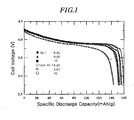
- FIG. 1 shows voltage and capacity characteristics at various C-rate discharges of half-cells of Example 1 of the present invention and Comparative Example 1.
- FIG. 2 shows voltage and capacity characteristics of half-cells according to Example 1 of the present invention and Comparative Example 1 at various cycle numbers at a 1C rate of discharge.
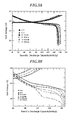
- FIG. 3A shows charge and discharge curves of a half-cell according to Example 5 of the present invention at rates of 0.2C, 0.5C, and 1C in the voltage range of 4.3V to 2.75V.
- FIG. 3B is an expanded view of a portion of FIG, 3A .
- FIG. 4 shows charge and discharge curves of a half-cell according to Example 2 of the present invention at rates of 0.2C, 0.5C and 1C in the voltage range of 4.3V to 2.75V.
- FIG. 5 shows charge and discharge curves of a half-cell according to Example 12 of the present invention at rates of 0.2C, 0.5C and 1C in the voltage range of 4.3V to 2.75V.
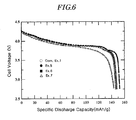
- FIG. 6 shows voltage and discharge capacities of half-cells according to Examples 5 to 7 of the present invention-and Comparative Example at 1C rate of discharge.
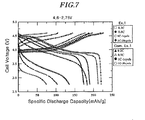
- FIG. 7 shows charge and discharge curves of half-cells according to Example 1 of the present invention and Comparative Example 1 at rates of 0.2C, 0.5C and 1C in the voltage range of 4.6V to 2.75V.
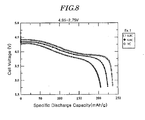
- FIG. 8 shows discharge curves of a half-cell according to Example 1 of the present invention at rates of 0.2C, 0.5C and 1C in the voltage range of 4.95V to 2,75V.
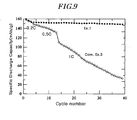
- FIG. 9 shows cycle life characteristics at 1C rate of half-cells of Example 1 of the present invention and Comparative Example 3.
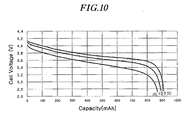
- FIG. 10 shows discharge curves of a Li-ion cell comprising active material of Example 15 of the present invention at rates of 0,5C, 1C and 2C in the voltage range of 4.2V to 2.75V.
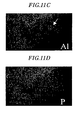
- FIGs. 11A to 11E show the results of elemental analyses of active materials prepared according to Example 1 of the present invention using Scanning Transmission Electron Microscopy (STEM).
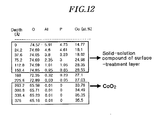
- FIG. 12 shows the results of elemental analyses for components of a surface-treatment layer of active material prepared according to Example 1 of the present invention using Auger Spectroscopy.
- FIGs. 13A and 13B show the results of elemental distribution analyses for a cross-sectional view of active material prepared according to Example 1 of the present invention, by line scanning with Electron Probe Micro Analysis (EPMA),
- FIG. 14 shows the results of an analysis of a surface-treatment layer of active material of Example 1 of the present invention, by X-ray photoelectron spectroscopy (XPS).
- XPS X-ray photoelectron spectroscopy
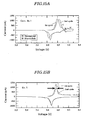
- FIGS. 15A and 15B show cyclic voltammograms of active materials according to Example 5 of the present invention and Comparative Example 1.
- FIG. 16 shows diffusion coefficients (D Li+ ) of lithium ions of active materials of Example 5 according to the present invention and Comparative Example 1.
- FIGs. 17A and 17B show changes of lattice constants of the active material in various states of charge of half-cells prepared according to Example 5 of the present invention and Comparative Example 1, in the voltage range of 4.6V to 4.25V.
- FIG. 18 shows the results of Differential Scanning Calorimetry (DSC) of active materials obtained after charging half-cells prepared according to Example 5 of the present invention and Comparative Example 1, at 4.3V.
- DSC Differential Scanning Calorimetry
- FIG. 19 shows the results of Differential Scanning Calorimetry (DSC) of active materials obtained after charging half-cells prepared according to Examples 5 to 7 of the present invention and Comparative Example 1, at 4.3V.
- DSC Differential Scanning Calorimetry
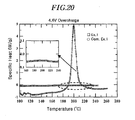
- FIG. 20 shows the results of Differential Scanning Calorimetry (DSC) of active materials obtained after overcharging half-cells prepared according to Example 1 of the present invention and Comparative Example 1, at 4.6V.
- DSC Differential Scanning Calorimetry
- FIG. 21 shows the results of Differential Scanning Calorimetry (DSC) of active materials obtained after overcharging half-cells prepared according to Example 8 of the present invention and Comparative Example 2, at 4.6V.
- DSC Differential Scanning Calorimetry
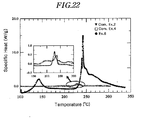
- FIG. 22 shows the results of Differential Scanning Calorimetry (DSC) of active materials obtained after overcharging half-cells prepared according to Example 8 of the present invention and Comparative Examples 2 and 4, at 5V.
- DSC Differential Scanning Calorimetry
- FIG. 23 shows the results of Differential Scanning Calorimetry (DSC) of active materials obtained after overcharging half-cells prepared according to Examples 1 and 9 of the present invention and Comparative Examples 1 and 4, at 5V.
- DSC Differential Scanning Calorimetry
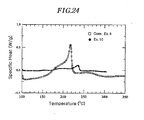
- FIG. 24 shows the results of Differential Scanning Calorimetry (DSC) of active materials obtained after overcharging half-cells prepared according to Example 10 of the present invention and Comparative Example 4, at 5V.
- DSC Differential Scanning Calorimetry
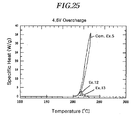
- FIG. 25 shows the results of Differential Scanning Calorimetry (DSC) of active materials obtained after overcharging half-cells prepared according to Examples 12 and 13 of the present invention and Comparative Example 5, at 4.6V.
- DSC Differential Scanning Calorimetry
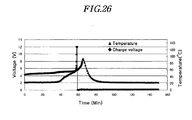
- FIG. 26 shows charge voltage and cell temperature of a Li-ion cell comprising active material prepared in Example 1 when the cell is overcharged at 1C rate.
- the active material for a battery of the present invention comprises a surface-treatment layer comprising a compound with the formula (1) on the surface thereof: MXO k (1) wherein M is at least one element selected from the group consisting of an alkali metal, an alkaline earth metal, a group 13 element, a group 14 element, a transition metal, and a rare-earth element; X is an element that is capable of forming a double bond with oxygen; and k is a numerical value in the range of 2 to 4.
- the group 13 element refers to the element group including Al of the Periodic Table.
- the group 14 element refers to the element group including Si of the Periodic Table.
- M includes Na, K, Mg, Ca, Sr, Ni, Co, Si, Ti, B, Al, Sn, Mn, Cr, Fe, V, Zr, or a combination thereof, and X is P, S, W or a combination thereof.
- the element X forms a double bond with oxygen, which means a classical chemical bonding. For example, in classical Chemistry, when X bonds with four oxygen elements, it means one double bond and three single bonds. However, in modern Chemistry, it means that X bonds with 1.25 oxygens because of delocalization of electrons.
- the amount of element M of the compound with the formula (1) of the present invention is 0.1 to 15 % by weight, preferably 0.1 to 6 % by weight of the active material.
- the amount of element X that is capable of forming a double bond with oxygen of the compound having the formula (1) is 0.1 to 15 % by weight, preferably 0.1 to 6 % by weight of the active material.
- the thickness of the surface-treatment layer of the present invention is preferably 0.01 to 2 ⁇ m , and more preferably 0.01 to 1 ⁇ m . While other thicknesses are possible, if the thickness of the surface-treatment layer is less than 0.01 ⁇ m , the effect obtained from the surface-treatment layer may not be realized. In contrast, if the thickness is more than 2 ⁇ m , the capacity of the battery is deteriorated.
- the surface-treated active material is a lithiated intercalation compound
- a solid-solution compound between the lithiated intercalation compound and the MXO k compound with the formula (1) is formed on the surface of the active material in addition to the MXO k compound.
- a surface-treatment layer of the active material comprises both the solid-solution compound and the MXO k compound.
- the solid-solution compound comprises Li, M' (M' is at least one selected from the group consisting of Al, Ni, Co, Mn, Cr, Fe, Mg, Sr, V, and a rare-earth element, that originate from the lithiated intercalation compound), M (M is at least one selected from the group consisting of an alkali metal, an alkaline earth metal, a group 13 element, a group 14 element, a transition metal, and a rare-earth element), X (an element capable of forming a double bond with oxygen), and O (oxygen).
- M' is at least one selected from the group consisting of Al, Ni, Co, Mn, Cr, Fe, Mg, Sr, V, and a rare-earth element, that originate from the lithiated intercalation compound
- M is at least one selected from the group consisting of an alkali metal, an alkaline earth metal, a group 13 element, a group 14 element, a transition metal, and a rare-earth element
- the elements M and X have a concentration gradient from the surface of the active material toward the center of the active material particle grain. That is, M and X have a high concentration at the surface of the active material and the concentration gradually decreases toward the inside of the particle.
- the active material for a battery comprising a lithiated intercalation compound and a surface-treatment layer comprising the solid-solution compound with Al and P, and AlPO k (k is 2 to 4) is provided.
- the surface treatment technique of the active material with the MXO k compound of the present invention may be used for all batteries, and is effective in improving the performance characteristics of both active materials for the positive electrodes as well as the negative electrodes.
- the surface-treated active material includes materials that can undergo reversible electrochemical oxidation-reduction reactions.
- the electrochemically oxidizable and reducible material includes a metal, a lithium-containing alloy, sulfur-based compounds, compounds that can reversibly form lithium-containing compounds by a reaction with lithium ions, all materials that can reversibly intercalate/deintercalate lithium ions (lithiated intercalation compounds), although the present invention is not limited thereto.
- the metal includes lithium, tin or titanium.
- the lithium-containing alloy includes a lithium/aluminum alloy, a lithium/tin alloy, or a lithium/magnesium alloy.
- the compound that can reversibly form a lithium-containing compound by a reaction with lithium ions includes silicon, titanium nitrate or tin oxide (SnO 2 ).
- the active material that can reversibly intercalate/deintercalate lithium ion includes carbon-based material, lithium-containing metal oxides, and lithium-containing chalcogenide compounds.
- the carbon-based material can be non-crystalline carbon, crystalline carbon, or a mixture thereof.
- the non-crystalline carbon includes soft carbon (low temperature calcinated carbon), and hard carbon (high temperature calcinated carbon).
- Examples of crystalline carbon include natural graphite or artificial graphite which are plate, sphere or fiber shape.
- the lithium-containing metal oxide and lithium-containing chalcogenide compound has a monoclinic, hexagonal or cubic structure as a basic structure.
- a conventional lithium-containing compound (lithium-containing metal oxide and lithium-containing chalcogenide compound) can be used as the lithiated intercalation compound of the present invention, and preferable examples are as follows: Li x Mn 1-y M' y A 2 (2) Li x Mn 1-y M' y O 2-z B z (3) Li x Mn 2 O 4-z B z (4) Li x Mn 2-y M' y A 4 .
- Li x Co 1-y M' y A 2 Li x CO 1-y M' y O 2-z B z (7) Li x Ni 1-y M' y A 2 (8) Li x Ni 1-y M' y O 2-z B z (9) Li x Ni 1-y Co y O 2-z B z (10) Li x N 1-y-z Co y M' z A ⁇ (11) Li x Ni 1-y-z Co y M' z O 2- ⁇ B ⁇ (12) Li x Ni 1-y-z Mn y M' z A ⁇ (13) Li x Ni 1-y-z Mn y M' z O 2- ⁇ B ⁇ (14) wherein 0.95 ⁇ x ⁇ 1.1,0 ⁇ y ⁇ 0.5, 0 ⁇ z ⁇ 0.5, and 0 ⁇ ⁇ ⁇ 2; M' is at least one element selected from the group consisting of Al, Ni, Co, Mn, Cr, Fe, Mg, Sr, V, and a rare-e
- the average particle size of these lithiated intercalation compounds is preferably 1 to 20 ⁇ m , more preferably 3 to 15 ⁇ m ,
- a surface-treatment layer comprising the MXO k compound is formed on the surface of the active material.
- the active material is a lithiated intercalation compound
- a surface-treatment layer comprising a solid-solution compound including Li M' (M' is at least one selected from the group consisting of Al, Ni, Co, Mn, Cr, Fe, Mg, Sr, V, and a rare-earth element that originate from lithiated intercalation compounds), M (M is at least one selected from the group consisting of an alkali metal, an alkaline earth metal, a group 13 element, a group 14 element, a transition metal, and a rare-earth element), X (an element capable of forming a double bond with oxygen) and O; as well as the MXO k compound, is formed.
- the capacity of a battery cell using the active material with a high tap density is greater than one using a similar active material having a low tap density. Therefore, an improved tap density of the active material is generally desired for a battery cell.
- the active materials surface-treated according to the present invention show a much higher tap density than the corresponding equivalent active material without surface-treatment, indicating that the surface-treatment facilitates compaction of the active material powder.
- the tap density of the active material of the present invention is maintained at 1 to 3 g/cc, thus it increases the capacity of the battery cell. According to the preferable example of the present invention, the tap density of the active material is more than about 2 g/cc.
- the active materials with the surface-treated according to the present invention, also produces electrodes having a much higher electrode density, meaning more active material per unit volume, than the corresponding active material without surface-treatment, when the electrodes are fabricated by a conventional electrode fabrication process used by the Li-ion battery industries which involves a coating onto a current collector of an active material slurry comprising a conductive agent, a binder and a solvent in addition to the active material.
- the electrodes are compacted by compression, the electrodes containing the surface-treated active material compact well without micro-cracks in the active material powder, while the electrode containing bare active material shows micro-cracks in the active material powder.
- the surface-treatment of the active material of the present invention might possibly provide a lubricating effect on the surface of the powder for improved compaction of the active material,
- LiCoO 2 lithiated intercalation compounds
- Li 1 . x CoO 2 When it is charged at a voltage over 4.93V, Li is completely removed, and it has a structure of a hexagonal type of Cdl 2 .
- thermal stability decreases and it becomes a stronger oxidant.
- the active material composition becomes Li 1-x CoO 2 where x is greater than or equal to 0.5.
- Such a composition becomes unstable as the battery temperature rises, i.e., the oxygen bound with metal, that is cobalt, is released to form gaseous O 2 .
- the released oxygen might react with electrolyte inside the battery, possibly leading to an explosion. Therefore, the oxygen-releasing temperature (exothermic reaction starting temperature) and the amount of exothermic heat released by the reaction are important factors to determine the safety of the battery.
- thermal stability can be evaluated from DSC (Differential Scanning Calorimetry) curves by determining the starting temperature of the exothermic reaction and the heat of reaction.
- the active material that is surface-treated with the MXO k compound of the present invention is substantially improved in thermal stability over the conventional surface-untreated active material.
- the surface-treatment layer comprising the MXO k compound of the present invention may be applied- to the active material for a primary battery such as a manganese battery, an alkaline battery, a mercury battery, a silver oxide battery, as well as to the active material for a secondary battery such as a lead-acid storage battery, a Ni-MH (nickel metal hydride) battery, a nickel-cadmium battery, a lithium metal battery, a lithium ion battery, a lithium polymer battery and a lithium-sulfur battery.
- a primary battery such as a manganese battery, an alkaline battery, a mercury battery, a silver oxide battery
- a secondary battery such as a lead-acid storage battery, a Ni-MH (nickel metal hydride) battery, a nickel-cadmium battery, a lithium metal battery, a lithium ion battery, a lithium polymer battery and a lithium-sulfur battery.
- the structures of such batteries, including a lithium secondary battery shell are well known
- the process for preparing active material having the surface-treatment layer of MXO k compound is as follows.
- the coating liquid is prepared by reacting a compound comprising X (an element that is capable of forming a double bond with oxygen) with a compound comprising M (an alkali metal, an alkaline earth metal, a group 13 element, a group 14 element, a transition metal, a rare-earth element or a combination thereof) in water.
- X an element that is capable of forming a double bond with oxygen
- M an alkali metal, an alkaline earth metal, a group 13 element, a group 14 element, a transition metal, a rare-earth element or a combination thereof
- coating liquid refers to a homogeneous suspension or a solution.
- the present process is advantageous over the process using an organic solvent for the process cost-reduction.
- the choice of the compound type comprising element (X) has no particular limitation as long as the compound is soluble in water.
- X when X is P, it can be diammonium hydrogen phosphate ((NH 4 ) 2 HPO 4 ), P 2 O 5 , H 3 PO 4 , or Li 3 PO 4 .
- the content of the compound comprising X is preferably 0.01 to 30 % by weight, more preferably 0.1 to 20 % by weight of the total weight of the coating liquid.
- the element (M) used for the coating liquid is an alkali metal, an alkaline earth metal, a group 13 element, a group 14 element, a transition metal, a rare-earth element or a combination thereof.
- the preferable examples of these elements are Al, Ni, Co, Zr, Mn, Cr, Fe, Mg, Sr, V, or a combination thereof.
- the choice of the compound type comprising these elements has no particular limitation as long as the compound is soluble in water.
- the preferred examples are a nitrate and an acetate.
- the amount of the compound comprising an alkali metal, an alkaline earth metal, a group 13 element, a group 14 element, a transition metal, a rare-earth element or a combination thereof is preferably 0.01 to 30 % by weight, more preferably 0.1 to 20 % by weight of the weight of the coating liquid.
- the coating liquid as prepared above is used to coat the active material.
- the coating may be achieved by simply adding a predetermined amount of the coating liquid to a given amount of the active material powder followed by a through mixing and optionally drying, although the present invention is not limited to this method.
- the coated active material is heat-treated at 100 to 700 C, preferably at 100 to 500 C for 1 to 20 hours. If the heat-treatment process is over-done, an AIPO k (k is 2 to 4) compound diffuses into the inside of the active material resulting in a battery capacity decrease. Before the heat-treatment process, a separate drying process that dries the coated liquid may be used. In the present invention, since the heat-treatment process is made at a lower temperature and for a shorter time than a prior-art process using organic solvent, which requires a higher calcination temperature and a longer calcination time, it reduces cost during large-scale production.
- the desired surface-treatment layer comprising the MXO k compound is formed on the surface of the active material after the heat-treatment process.
- the active material being coated is a lithiated intercalation compound
- a solid-solution compound which is formed by combination of the lithiated intercalation compound and the MXO x compound may be formed between the layer of MXO k compound and the active material
- the method includes preparing a coating liquid by adding a compound including an element that is capable of forming a double bond with oxygen of lithium metal oxide, and a metal compound comprising at least one element from the group consisting of an alkali metal, an alkaline earth metal, a group 13 element, a group 14 element, a transition metal, and a rare-earth element, to water.
- An active material is added to the coating liquid to coat the active material.
- the coated active material is heat treated to prepare an active material having a surface-treatment layer comprising a compound having the formula (1): MXO k (1) wherein M is at least one element selected from the group consisting of an alkali metal, an alkaline earth metal, a group 13 elements, a group 14 element, a transition metal, and a rare-earth element, X is an element that is capable of forming a double bond with oxygen, and k is a numerical value in the range of 2 to 4.
- a slurry comprising the active material with the surface treatment layer is coated onto a current collector to prepare at least one of a positive and negative electrode which is used in the fabrication of a battery.
- a coating liquid was prepared by adding 1 g of (NH 4 ) 2 HPO 4 and 1.5 g of aluminum nitrate (Al(NO 3 ) 3 9H 2 O) to 100 ml of water.
- the resulting liquid was a homogeneous colloidal suspension of amorphous AIPO k phase.
- After adding a 10 ml portion of the coating liquid to 20g of LiCoO 2 powder having an average particle diameter of 10 ⁇ m it was thoroughly mixed before drying at 130 C for 30 minutes.
- the positive active material with the coating layer comprising a solid-solution compound including Al and P and the AIPO k compound on the surface was further heat-treated at 400 C for 5 hours to obtain the desired coating.
- the total amount of Al and P was 1 % by weight of the total active material weight.
- the slurry for the positive electrode containing the positive active material as described, super P (conductive agent), and polyvinylidene fluoride (binder) in the weight ratio of 94/3/3 was prepared by mixing them thoroughly in an N-methyl pyrrolidone (NMP) solvent.
- NMP N-methyl pyrrolidone
- the slurry composition comprising the positive active material was coated on an Al foil at a thickness of about 300 ⁇ m , dried for 20 minutes at 130 C, and pressed under a 1 ton pressure to make a positive electrode for a coin cell.
- a coin-typed half-cell was prepared by using this positive electrode and lithium metal as a counter electrode.
- 1 M LiPF 6 solution of mixed solvent of ethylene carbonate (EC) and dimethyl carbonate (DMC) in the volume ratio of 1:1 was used.
- a coin-typed half-cell was prepared by the same method as in Example 1, except that a 15 ml portion of the coating liquid of Example 1 was added to 20 g of LiCoO 2 with an average particle diameter of 10 ⁇ m .
- the total amount of Al and P was 1.5 % by weight of the total active material weight.
- a coin-typed half-cell was prepared by the same method as in Example 1, except that a 20 ml portion of the coating liquid of Example 1 was added to 20 g of LiCoO 2 with an average particle diameter of 10 ⁇ m .
- the total amount of Al and P was 2 % by weight of the total active material weight.
- a coin-typed half-cell was prepared by the same method as in Example 1, except that a 10 ml portion of the coating liquid of Example 1 was added to 20 g of LiCoO 2 with an average particle diameter of 5 ⁇ m .
- the total amount of Al and P was 1 % by weight of the total active material weight.
- a coin-typed half-cell was prepared by the same method as in Example 1, except that the heat-treatment time was 10 hours.
- a coin-typed half-cell was prepared by the same method as in Example 1, except that the heat-treatment step was made at 500 C for 5 hours.
- a coin-typed half-cell was prepared by the same method as in Example 1, except that the heat-treatment step was made at 500 C for 10 hours.
- a coin-typed half-cell was prepared by the same method as in Example 1, except that a 20 ml portion of the coating liquid of Example 1 was added to 20 g of LiCoO 2 with an average particle diameter of 5 ⁇ m , and the heat-treatment step was made at 400 C for 10 hours.
- the total amount of Al and P was 2 % by weight of the total active material weight.
- a coin-typed half-cell was prepared by the same method as in Example 1, except that a 15 ml portion of the coating liquid of Example 1 was added to 20 g of UCoO 2 with an average particle diameter of 10 ⁇ m , and the heat-treatment step was made at 400 C for 10 hours.
- the total amount of Al and P was 1.5 % by weight of the total active material weight.
- a coin-typed half-cell was prepared by the same method as in Example 1, except that LiMn 2 O 4 with an average particle diameter of 13 ⁇ m was used instead of LiCoO 2 .
- a coin-typed half-cell was prepared by the same method as in Example 1, except that LiNi 0.9 Co 0.1 Sr 0.002 O 2 with an average particle diameter of 13 ⁇ m was used instead of LiCoO 2 .
- a coin-typed half-cell was prepared by the same method as in Example 1, except that LiNi 0.8 Mn 0.2 O 2 with an average particle diameter of 10 ⁇ m was used instead of LiCoO 2 and the heat-treatment step was made at 400 C for 10 hours.
- a coin-typed half-cell was prepared by the same method as in Example 1, except that 20 g of LiNi 0,8 Mn 0.2 O 2 with an average diameter of 10 ⁇ m was used instead of LiCoO 2 , it was coated with 20 ml of coating liquid prepared in Example 1 and the heat-treatment step was made at 400 C for 10 hours.
- a coin-typed half-cell was prepared by the same method as in Example 1, except that Li 1.03 Ni 0.69 Mn 0.19 Co 0.1 Al 0.0.7 Mg 0.07 O 2 with an average diameter of 13 ⁇ m was used instead of LiCoO 2 .
- a slurry containing positive active material was prepared by mixing the positive active material of Example 1, super P (conductive agent), and polyvinylidene fluoride (binder) in the weight ratio of 96/2/2 in a mixing solvent of N-methyl pyrrolidone (NMP).
- the positive electrode was prepared using this slurry by the same method as in Example 1.
- a slurry containing negative active material was prepared by mixing artificial graphite as a negative active material and polyvinylidene fluoride as a binder in the weight ratio of 90/10 in a mixing solvent of NMP.
- the negative electrode was prepared by casting the slurry containing the negative active material on a Cu foil.
- a 930mAh prismatic Li-ion cell was fabricated using the positive and the negative electrodes, For the electrolyte, 1 M LiPF 6 solution of a mixed solvent of ethylene carbonate/ dimethyl carbonate in the volume ratio of 1/1 was used.
- a coin-typed half-cell was prepared by the same method as in Example 1, except that a 20 ml portion of the coating liquid of Example 1 was added to 20 g of natural graphite.
- the total amount of Al and P was 2 % by weight of the total weight of the total active material weight.
- a coin-typed half-cell was prepared by the same method as in Example 1, except that a 20 ml portion of the coating liquid of Example 1 was added to 20 g of SnO 2 .
- the total amount of Al and P was 2 % of the total active material weight.
- a coin-typed half-cell was prepared by the same method as in Example 1, except that a 20 ml portion of the coating liquid of Example 1 was added to 20 g of silicon (Si) active material.
- the total amount of Al and P was 2 % by weight of the total active material weight.
- a coin-typed half-cell was prepared by the same method as in Example 1, except that LiCoO 2 with an average particle diameter of 10 ⁇ m was used as the positive active material.
- a coin-typed half-cell was prepared by the same method as in Example 1, except that LiCoO 2 with an average particle diameter of 5 ⁇ m was used as the positive active material.
- a coin-typed half-cell was prepared by the same method as in Example 1, except that aluminum nitrate (Al(NO 3 ) 3 9H 2 O) was not added to the coating liquid, and thus the active material coated with P 2 O 5 on the surface was prepared.
- Al(NO 3 ) 3 9H 2 O aluminum nitrate
- a coin-typed half-cell was prepared by the same method as in Example 1, except that LiMn 2 O 4 with an average particle diameter of 13 ⁇ m was used as the positive active material.
- a coin-typed half-cell was prepared by the same method as in Example 1, except that LiNi 0.8 Mn 0.2 O 2 with an average particle diameter of 10 ⁇ m was used as the positive active material.
- a coin-typed half-cell was prepared by the same method as in Example 1, except that LiNi 0.9 Co 0.1 Sr 0.002 O 2 with an average particle diameter of 13 ⁇ m was used as the positive active material.
- a coin-typed half-cell was prepared by the same method as in Example 1, except that Li 1.03 Ni 0.69 Mn 0.19 Co 0.1 Al 0.07 Mg 0.07 O 2 with an average particle diameter of 13 ⁇ m was used as the positive active material.
- Charge-discharge characteristics of the coin-typed half-cell of Example 1 at 0.2C, 0.5C and 1C rates in the voltage range of 4.3V to 2.75V are shown in FIG. 1 .
- the characteristics of the cell of Comparative Example 1 are also shown.
- the initial capacity of the cell of Comparative Example 1 is much smaller at a high rate (1C) than those at low rates (0.2C and 0.5C).
- the initial capacity of the cell of Example 1 is very high (152mAhlg) even at the high rate. This value is close to those at low rates.
- FIG. 2 shows capacity characteristics for cycling at 1C rate of the half-cells according to Example 1 and Comparative Example 1 in the voltage range of 4.3V to 2.75V.
- Example 1 more than 99 % of initial capacity was maintained after 30 charge-discharge cycles.
- the capacity of the cell of Comparative Example 1 decreased sharply after 30 charge-discharge cycles.
- the average discharge voltage of the cell of Comparative Example 1 decreased significantly with repeated cycling while the average value for Example 1 showed a negligible change.
- FIG. 3A shows the charge-discharge characteristics of a half-cell according to Example 5 at 0.2C, 0.5C and 1C rates in the voltage range of 4.3V to 2.75V.
- powder of the positive active material of Example 5 was synthesized in a large scale (1.5Kg batch size) and about thirty cells were made to evaluate the charge-discharge characteristics.
- FIG. 3A represents the average values.
- FIG. 3B is an expanded view of a portion of FIG. 3A.
- FIG. 3A shows that the initial capacity at 1C rate was 150-152mAh/g and the average voltage was about 3.91V, which is similar to those at a low rate (0.2C).
- the discharge curve at 1C rate gradually approaches that at 0.2C rate as the charge-discharge cycling at 1C rate proceeds. This means that there is a slight improvement rather than deterioration of discharge capacity due to a decrease in internal resistance with cycling.
- FIG. 4 shows the results of charge-discharge cycling of the cell of Example 2 at 0,2C, 0.5C and 1C rates in the voltage range of 4.3V to 2.75V. On repeated charge-discharge cycling, the average voltages at a 1C rate approach those at 0.2C rate. This observation is also similar to those of Example 12 as shown in FIG. 5 . This observation indicates that the coating technique of the present invention is effective in improving the cell performance for Ni-based compounds as well as for Co-based compounds.
- Discharge capacities of FIG. 1 , FIG, 3A , FIG. 4 and FIG. 5 are summarized as shown in Table 1.
- Table 1 discharge capacities at various C-rate rates (unit: mAh/g) C-rate Com.
- FIG. 6 shows the results of charge-discharge cycling of the cells of Examples 5 to 7 at 1C rate in the voltage range of 4.3V to 2.75V.
- the cells containing heat-treated positive active material powder at various heat-treatment temperatures and times showed improved high-rate characteristics over those of the cell containing the conventional uncoated LiCoO 2 (Comparative Example 1).
- FIG. 7 shows the results of charge-discharge cycling of cells of Example 1 and Comparative Example 1 at 0.2C, 0.5C and 1C rates in the voltage range of 4.6V to 2.75V instead of 4.3V to 2.75V.
- Comparative Example 1 shows that as the discharge rate increases, the discharge curve abruptly deteriorates and high cell polarization is indicated.
- the capacity at 1C rate after 30 cycles was less than 70 % of the initial capacity.
- the cell of Example 1 showed remarkably improved 1C-rate characteristics; i.e., high discharge voltage and improved cycle life even after charging at 4.6V.
- FIG. 8 shows the results of charge-discharge cycling of cells of Example 1 and Comparative Example 1 at 0.2C, 0.5C and 1C rates in the voltage range of 4.95V to 2.75V.
- the cell of Comparative Example 1 did not show any measurable discharge capacity when it was charged at 4.95V, while the cell of Example 1 showed excellent discharge characteristics after charging at 4.95V, similar to the case of 4.6V charging.
- electrochemical characteristics of the cell containing positive active material of the present invention are excellent because the solid-solution compound including Al and P, and the AIPO x (k is 2 to 4) compound which is formed on the surface of the lithiated intercalation compound probably improve conductivity of lithium ions and reduce surface polarization at high rates.
- cycle life characteristics at 1C rate of the cells of Example 1 containing the active material that has the surface-treatment layer comprising the solid-solution compound including Al and P on the surface as well as the AIPO k (k is 2 to 4) compound and the cell of Comparative Example 3 containing the active material consisting of a P-containing layer derived from P 2 O 5 are shown in FIG. 9 .
- Cycle life characteristics were measured by varying charge-discharge rate from 0.2C to 0.5C and 1C.
- the cell capacity of Comparative Example 3 decreases rapidly with cycling, while the cell capacity of Example 1 is maintained constant with cycling at the initial value.
- FIG. 10 shows discharge voltage curves of a 930mAh prismatic Li-ion cell prepared in Example 15 at discharge rates of 0.5C, 1C and 2C in the voltage range of 4.2V to 2.75V. As shown in FIG. 10 , the discharge capacity of the cell at 2C rate was more than 95 % of that at 0.5C rate. Therefore, Li-ion cells comprising the active material prepared according to the present invention have excellent cell performance, similar to those of the coin-type half-cells.
- Active material prepared according to Example 1 of the present invention has a surface-treatment layer comprising a solid-solution compound including Al and P and an AIPO k (k is 2 to 4) compound on the surface of the active material.
- elemental mapping was performed on the surface of the cross-section of a grain of the surface-treated active material using STEM (Scanning Transmission Electron Microscopy). The results are shown in FIGs. 11A to 11E .
- FIG. 11A is a STEM photograph of active material in a bright field
- FIGs. 11B to 11E are STEM photographs showing distribution of Co, Al, P and O respectively.
- Co, Al, P and O are all found in the surface portion of the particle, suggesting the existence of the solid-solution compound and the AIPO k (k is 2 to 4) compound.
- FIG. 12 shows the result from the surface to a depth of about 380A.
- FIG. 12 shows that a layer of the solid-solution compound including Al and P and another layer of the AlPO k (k is 2 to 4) compound were formed from the surface to a depth of about 230 ⁇ , and CoO 2 (possibly Li 1-x CoO 2 where x is greater than or equal to 0.5) was formed further inside.
- Electron Probe Micro Analysis for Co, Al, and P was performed by line scanning across the cross-section of a particle grain of the active material prepared in Example 1.
- FIGS, 13A and 13B show the results. As shown in FIG. 13B , the presence of Al and P was found only in the surface layer of the particle at less than 1 ⁇ m in depth. These results indicate that the solid-solution compounds including Al and P and the ALPO k (k is 2 to 4) compound in the surface-treatment layer did not diffuse further into the bulk of the active material.
- XPS X-ray photoelectron spectroscopy
- the capacity of the cell of Comparative Example 3 comprising active material coated with P 2 O 5 on the surface deteriorates rapidly with high-rate (1C) cycling, while the cell of Example 1 containing the active material comprising the solid-solution compound and the AlPO k (k is 2 to 4) compound maintains good capacity and average voltage on cycling both at a high rate as well as at a low rate (see FIG. 9 ).
- the solid-solution compound and the AlPO k compound of Example 1 and the P 2 O 5 compound have a double bond in the surface layer of the active material, the P 2 O 5 compound is different from the compounds in the surface-treatment layer in terms of effect on the mobility of lithium ions. That is, the solid-solution compound and the AlPO k compound that have a double bond probably promote the mobility of lithium ions so that the capacity at the high rate can be maintained at a high level.
- oxidation and reduction peaks of cyclic voltammograms of the cells of Comparative Example 1 and Example 5 were studied.
- the cyclic voltammograms were measured in the voltage range of 3V to 4.4V at a scanning rate of 0.02 mV/sec. Lithium metal was used as the reference electrode in the cell.
- FIGs. 15A and 15B show the results.
- the widths of oxidation/reduction peaks in the cyclic voltammogram of Example 5 are significantly smaller than those of Comparative Example 1, indicating that the electrode reaction rate is improved, and therefore, the mobility of lithium ions is also improved by the surface layer.
- the fact that the mobility of lithium ions in the compound formed on the surface of the present positive active material is high was confirmed by the measurement of diffusion coefficient of lithium ions as shown in FIG. 16 .
- the diffusion coefficient of lithium ions for Example 5 of the present invention is five times as high as that of Comparative Example 1.
- cyclic voltammograms of FIG. 15A for Comparative Example 1 indicate that a phase transition occurs from a hexagonal phase to a monoclinic phase and then it returns to the hexagonal phase at about 4.1 to 4.25V.
- cyclic voltammograms of Example 5 FIG. 15B ) have no peak that is assumed to be related to this phase transition.
- positive active material of the present invention does not show a peak that is assumed to be related to the phase transition in the cyclic voltammogram is because the c-axis, which affects volume expansion during charging, hardly changes.
- Changes of lattice constants (a-axis and c-axis) of active materials prepared according to Example 5 and Comparative Example 1 during charge-discharge in the voltage range of 4.6V to 4.25V were measured.
- FIGs. 17A and 17B show the results.
- Active material of Comparative Example 1 shows phase transitions from hexagonal (H) to monoclinic (M) and back to hexagonal (H) phase in the voltage range of 4.1 to 4.25V during charge-discharge.
- the change of the c-axis lattice constant was larger than that of the a-axis.
- these anisotropic contraction and expansion are more than 0.2% of the elasticity limit of the active material, micro-cracks develop in the particles so that the particles break down to smaller particles causing the decrease of the cell capacity.
- the active material of Comparative Example 1 had contraction and expansion of more than 1 % in the c-axis so that micro-cracks occurred in the particles and thus the cell capacity decreased sharply as the discharge rate increased (see FIGs. 1 and 7 ).
- the cell of Example 5 showed a significantly reduced variation of lattice constant of the c-axis ( FIG. 17A ) so that the cell capacity was maintained high at the high rates of discharge (see FIGs. 1 , 7 and 8 ).
- Example 5 of the present invention In order to evaluate thermal stability of the positive active material prepared according to Example 5 of the present invention and Comparative Example 1, DSC analysis was performed as follows, The coin cells of Example 5 and Comparative Example 1 were charged using a voltage cut-off at 4.3V. About 10 mg of the positive active materials from charged electrodes of each cell were collected. DSC analyses were carried out in sealed aluminum cans using a 910 DSC (TA Instrument company) equipment by scanning temperatures from 25 to 300 C at the rate of 3 C/min. The results are shown in FIG. 18 .
- Comparative Example 1 (not surface-treated LiCoO 2 ) showed a large exothermic peak in the temperature range of 180 to 220 C as a result of O 2 release from the breakage of Co-O bonds of charged Li 1-x CoO 2 followed by the exothermic reaction of the oxygen with electrolyte. This phenomenon is known as the cause of the safety problem.
- Example 5 the exothermic peak in the DSC was reduced to a negligible size, strongly suggesting that the thermal stability, and therefore the safety of the batteries using the active material of Example 5 will be much better than that of Comparative Example 1.
- the DSC measurements of the charged electrodes at the cut-off voltage of 4.3V for the cells of Examples 6 and 7 were carried out as shown in FIG. 19 .
- the open circuit voltage (OCV) of the cell disassembly was maintained at over 4.295V.
- OCV open circuit voltage
- LiCoO 2 is overcharged at voltages over 4.93V, it turns to a Cdl 2 -type hexagonal structure that does not have Li. This structure has the least unstable state of the active material and it reacts rapidly with electrolyte at high temperature, releasing oxygen.
- DSC measurement was carried out. The result is shown in FIG. 22 .
- the DSC measurements of the cells of Examples 1 and 9 were also carried out. The results are shown in FIG. 23 . As shown in FIGs.
- the coated active material, LiCoO 2 has comparable or better thermal stability and characteristics (Examples 1 and 9), as shown in Fig. 23 , than uncoated LiMn 2 O 4 (Comparative Example 4) active material which is known for its good thermal stability and characteristics among positive materials used in commercially available lithium secondary battery cells.
- Example 10 In order to evaluate thermal stability of positive active materials of Example 10 and Comparative Example 4 (not surface-treated LiMn 2 O 4 ), DSC measurements were carried out using a similar technique as described above. The results are shown in FIG. 24 . Even without the surface-treatment, LiMn 2 O 4 is known as the most thermally stable of positive active materials. The exothermic heat of active material containing the surface-treatment of the AlPO k compound is remarkably reduced from that of the untreated material indicating that the thermal stability is remarkably improved by the surface-treatment.
- FIG. 25 shows the results of a DSC evaluation of the thermal stability of positive active materials of Examples 12 and 13 and Comparative Example 5 (not surface-treated LiNi 0,8 Mn 0,2 O 2 ), The cells of Examples 12 and 13 and Comparative Example 5 were overcharged at 4.6V. Fully charged positive electrode samples were taken from the cells. About 10 mg of the active material was removed from the electrode samples. The test material was sealed in an aluminum can and DSC thermograms were obtained using 910 DSC (TA Instrument company) equipment by scanning temperatures from 100 to 300 C at the rate of 3 C /min. As shown in FIG.
- the values of the exothermic heat of the surface-treated LiN ⁇ 0.8 Mn 0 2 O 2 active material according to Examples 12 and 13 decreased to about 1/30 of the value of the active material of Comparative Example 5 that was not surface-treated. Therefore, the thermal stability of the nickel manganese-based active material is improved significantly, similar to the cases of the cobalt-based and manganese-based active materials.
- the temperature of the prismatic Li-ion cell of Example 15 was tested for the increased charge voltage to 12V as shown in FIG. 26 .
- the cell voltage dropped to 0V during the high-voltage overcharge, the cell explodes and the cell temperature increases abruptly.
- the cell of Example 15 did not show the increase of temperature over 100 C when the charge voltage drops from 12V to 0V as shown in FIG. 26 . Therefore, the cells prepared using the surface-treated active material of the present invention show excellent safety.
- the active material containing a surface-treatment layer comprising the MXO k (k is 2 to 4) compound of the present invention shows excellent structural stability and high average discharge voltages both at high and low rates, excellent cycle life characteristics, and good capacity. Its excellent thermal stability improves the safety of the cells in various categories including combustion, heat exposure, and overcharge tests.
- the process of the present invention uses a water-based coating liquid giving a great low cost benefit over a similar process using an organic solvent-based solution. Since the process is performed at a lower temperature and in a shorter process time than the conventional process using an organic solvent, productivity is expected to be improved in large-scale production.
Landscapes
- Chemical & Material Sciences (AREA)
- Electrochemistry (AREA)
- General Chemical & Material Sciences (AREA)
- Chemical Kinetics & Catalysis (AREA)
- Inorganic Chemistry (AREA)
- Engineering & Computer Science (AREA)
- Materials Engineering (AREA)
- Composite Materials (AREA)
- Crystallography & Structural Chemistry (AREA)
- Manufacturing & Machinery (AREA)
- Battery Electrode And Active Subsutance (AREA)
- Secondary Cells (AREA)
- Inorganic Compounds Of Heavy Metals (AREA)
- Compounds Of Iron (AREA)
Priority Applications (1)
| Application Number | Priority Date | Filing Date | Title |
|---|---|---|---|
| EP12186249.4A EP2573847A3 (fr) | 2001-06-14 | 2002-04-23 | Matériau actif pour batterie et son procédé de préparation |
Applications Claiming Priority (4)
| Application Number | Priority Date | Filing Date | Title |
|---|---|---|---|
| US29778301P | 2001-06-14 | 2001-06-14 | |
| US30479301P | 2001-07-13 | 2001-07-13 | |
| US09/995,868 US7135251B2 (en) | 2001-06-14 | 2001-11-29 | Active material for battery and method of preparing the same |
| EP02008296.2A EP1267431B1 (fr) | 2001-06-14 | 2002-04-23 | Materiau actif pour pile et sa méthode de préparation |
Related Parent Applications (2)
| Application Number | Title | Priority Date | Filing Date |
|---|---|---|---|
| EP02008296.2A Division-Into EP1267431B1 (fr) | 2001-06-14 | 2002-04-23 | Materiau actif pour pile et sa méthode de préparation |
| EP02008296.2 Division | 2002-04-23 |
Publications (2)
| Publication Number | Publication Date |
|---|---|
| EP2375480A2 true EP2375480A2 (fr) | 2011-10-12 |
| EP2375480A3 EP2375480A3 (fr) | 2012-02-29 |
Family
ID=27404521
Family Applications (3)
| Application Number | Title | Priority Date | Filing Date |
|---|---|---|---|
| EP02008296.2A Expired - Lifetime EP1267431B1 (fr) | 2001-06-14 | 2002-04-23 | Materiau actif pour pile et sa méthode de préparation |
| EP11164704A Withdrawn EP2375480A3 (fr) | 2001-06-14 | 2002-04-23 | Matériau actif pour batterie et son procédé de préparation |
| EP12186249.4A Withdrawn EP2573847A3 (fr) | 2001-06-14 | 2002-04-23 | Matériau actif pour batterie et son procédé de préparation |
Family Applications Before (1)
| Application Number | Title | Priority Date | Filing Date |
|---|---|---|---|
| EP02008296.2A Expired - Lifetime EP1267431B1 (fr) | 2001-06-14 | 2002-04-23 | Materiau actif pour pile et sa méthode de préparation |
Family Applications After (1)
| Application Number | Title | Priority Date | Filing Date |
|---|---|---|---|
| EP12186249.4A Withdrawn EP2573847A3 (fr) | 2001-06-14 | 2002-04-23 | Matériau actif pour batterie et son procédé de préparation |
Country Status (5)
| Country | Link |
|---|---|
| US (3) | US7135251B2 (fr) |
| EP (3) | EP1267431B1 (fr) |
| JP (1) | JP4582990B2 (fr) |
| KR (1) | KR100424646B1 (fr) |
| CN (1) | CN1268014C (fr) |
Families Citing this family (164)
| Publication number | Priority date | Publication date | Assignee | Title |
|---|---|---|---|---|
| JP2002270176A (ja) * | 2001-03-14 | 2002-09-20 | Sony Corp | 正極材料およびそれを用いた電池 |
| WO2002078105A1 (fr) | 2001-03-22 | 2002-10-03 | Matsushita Electric Industrial Co., Ltd. | Materiau actif a electrode positive et accumulateur a electrolyte non-aqueux contenant ce materiau |
| US7135251B2 (en) * | 2001-06-14 | 2006-11-14 | Samsung Sdi Co., Ltd. | Active material for battery and method of preparing the same |
| JP4510331B2 (ja) * | 2001-06-27 | 2010-07-21 | パナソニック株式会社 | 非水電解質二次電池 |
| JP4836371B2 (ja) * | 2001-09-13 | 2011-12-14 | パナソニック株式会社 | 正極活物質およびこれを含む非水電解質二次電池 |
| JP3827545B2 (ja) * | 2001-09-13 | 2006-09-27 | 松下電器産業株式会社 | 正極活物質、その製造方法および非水電解質二次電池 |
| KR100399642B1 (ko) * | 2001-10-24 | 2003-09-29 | 삼성에스디아이 주식회사 | 리튬 이차 전지용 양극 활물질 및 그 제조방법 |
| US8658125B2 (en) | 2001-10-25 | 2014-02-25 | Panasonic Corporation | Positive electrode active material and non-aqueous electrolyte secondary battery containing the same |
| JP2003257427A (ja) * | 2002-02-28 | 2003-09-12 | Sumitomo Chem Co Ltd | 非水二次電池用電極材料 |
| US9391325B2 (en) * | 2002-03-01 | 2016-07-12 | Panasonic Corporation | Positive electrode active material, production method thereof and non-aqueous electrolyte secondary battery |
| JP4197237B2 (ja) * | 2002-03-01 | 2008-12-17 | パナソニック株式会社 | 正極活物質の製造方法 |
| KR100437339B1 (ko) * | 2002-05-13 | 2004-06-25 | 삼성에스디아이 주식회사 | 전지용 활물질의 제조방법 및 그로부터 제조되는 전지용활물질 |
| KR100454238B1 (ko) * | 2002-07-27 | 2004-10-26 | 한국과학기술원 | 마그네슘-니켈 산화물이 포함된 리튬유황이차전지용 양극및 이를 포함하는 리튬유황이차전지 |
| US8241790B2 (en) * | 2002-08-05 | 2012-08-14 | Panasonic Corporation | Positive electrode active material and non-aqueous electrolyte secondary battery containing the same |
| JP3632686B2 (ja) * | 2002-08-27 | 2005-03-23 | ソニー株式会社 | 正極活物質及び非水電解質二次電池 |
| KR100448017B1 (ko) * | 2002-09-18 | 2004-09-08 | 한국타이어 주식회사 | 납축전지용 전극 조성물 |
| JP4061648B2 (ja) * | 2003-04-11 | 2008-03-19 | ソニー株式会社 | 非水電解質二次電池用正極活物質及びそれを用いた非水電解質二次電池 |
| JP4604460B2 (ja) * | 2003-05-16 | 2011-01-05 | パナソニック株式会社 | 非水電解質二次電池および電池充放電システム |
| WO2005008812A1 (fr) * | 2003-07-17 | 2005-01-27 | Yuasa Corporation | Materiau actif d'electrode positive et procede de fabrication associe, electrode positive pour cellule secondaire au lithium utilisant ce materiau et cellule secondaire au lithium |
| JP4554911B2 (ja) * | 2003-11-07 | 2010-09-29 | パナソニック株式会社 | 非水電解質二次電池 |
| KR100508941B1 (ko) * | 2003-11-29 | 2005-08-17 | 삼성에스디아이 주식회사 | 리튬 이차 전지용 양극 활물질의 제조 방법 및 그방법으로 제조된 리튬 이차 전지용 양극 활물질 |
| JP4502664B2 (ja) * | 2004-02-24 | 2010-07-14 | 三洋電機株式会社 | 非水電解液二次電池 |
| KR101135501B1 (ko) * | 2004-03-03 | 2012-04-13 | 삼성에스디아이 주식회사 | 리튬 이차 전지 |
| JP4679064B2 (ja) * | 2004-03-18 | 2011-04-27 | 三洋電機株式会社 | 非水電解液二次電池 |
| JP4843918B2 (ja) * | 2004-08-26 | 2011-12-21 | 新神戸電機株式会社 | 複合酸化物材料及びリチウム二次電池用正極活物質 |
| TWI290781B (en) * | 2004-09-02 | 2007-12-01 | Lg Chemical Ltd | Electrode active material with multi-element based oxide layers and preparation method thereof |
| JP4679112B2 (ja) * | 2004-10-29 | 2011-04-27 | 三洋電機株式会社 | 非水電解質二次電池及びその製造方法 |
| JP4754209B2 (ja) * | 2004-12-16 | 2011-08-24 | 日本化学工業株式会社 | リチウムコバルト系複合酸化物粉末の製造方法 |
| CN100583500C (zh) * | 2005-01-14 | 2010-01-20 | 松下电器产业株式会社 | 非水电解质二次电池 |
| JP2006222072A (ja) | 2005-01-14 | 2006-08-24 | Matsushita Electric Ind Co Ltd | 非水電解質二次電池 |
| CN100420070C (zh) * | 2005-02-03 | 2008-09-17 | 比亚迪股份有限公司 | 一种电池正极和采用该正极的锂离子电池及它们的制备方法 |
| CN100420071C (zh) * | 2005-02-04 | 2008-09-17 | 比亚迪股份有限公司 | 一种电池正极和采用该正极的锂离子电池及它们的制备方法 |
| FR2882048B1 (fr) * | 2005-02-11 | 2007-03-23 | Commissariat Energie Atomique | Procede de modification d'un oxyde lithie comprenant au moins un metal de transition, electrode positive comprenant cet oxyde et accumulateur au lithium |
| JP5065884B2 (ja) * | 2005-02-14 | 2012-11-07 | Agcセイミケミカル株式会社 | リチウム二次電池正極用のリチウム含有複合酸化物の製造方法 |
| KR100822013B1 (ko) * | 2005-04-15 | 2008-04-14 | 주식회사 에너세라믹 | 불소화합물코팅 리튬이차전지 양극 활물질 및 그 제조방법 |
| EP1880435A4 (fr) * | 2005-04-15 | 2009-07-15 | Enerceramic Inc | Matiere active de cathode recouverte de compose de fluor pour batteries secondaires au lithium et leur procede de preparation |
| US9054374B2 (en) | 2005-05-17 | 2015-06-09 | Sony Corporation | Cathode active material, method of manufacturing the same and battery |
| CN104064729B (zh) * | 2005-05-17 | 2018-01-30 | 株式会社村田制作所 | 正极活性物质,正极活性物质的制造方法和电池 |
| KR100701532B1 (ko) * | 2005-06-21 | 2007-03-29 | 대정화금주식회사 | 불소화합물이 첨가된 리튬이차전지 양극 활물질 및 그제조방법 |
| US7618404B2 (en) | 2005-06-23 | 2009-11-17 | The Procter & Gamble Company | Disposable absorbent article having doubled side flaps and backsheet strips |
| WO2007037234A1 (fr) | 2005-09-27 | 2007-04-05 | Agc Seimi Chemical Co., Ltd. | Processus de fabrication d'un oxyde composite contenant du lithium pour l'électrode positive d’une pile secondaire au lithium |
| CA2534243A1 (fr) * | 2006-01-25 | 2007-07-25 | Hydro Quebec | Particules d'oxyde metallique enrobees a faible taux de dissolution, procedes de preparation et utilisation dans les systemes electrochimiques |
| KR20080102427A (ko) * | 2006-03-15 | 2008-11-25 | 스미또모 가가꾸 가부시끼가이샤 | 정극 활물질 분말 |
| KR100984591B1 (ko) * | 2006-05-04 | 2010-09-30 | 한국화학연구원 | 안정성이 향상된 전극활물질 및 이를 이용한 전기 화학소자 |
| KR100819741B1 (ko) * | 2006-06-16 | 2008-04-07 | 주식회사 엘 앤 에프 | 리튬 이차 전지용 양극 활물질, 이의 제조방법 및 이를포함하는 리튬 이차 전지 |
| JP4306697B2 (ja) * | 2006-06-16 | 2009-08-05 | ソニー株式会社 | 二次電池 |
| JP5082308B2 (ja) * | 2006-07-03 | 2012-11-28 | ソニー株式会社 | 正極活物質およびその製造方法、並びに非水電解質二次電池 |
| US8911903B2 (en) * | 2006-07-03 | 2014-12-16 | Sony Corporation | Cathode active material, its manufacturing method, and non-aqueous electrolyte secondary battery |
| JP2008071569A (ja) * | 2006-09-13 | 2008-03-27 | Sanyo Electric Co Ltd | 非水電解質二次電池用正極材料及び非水電解質二次電池 |
| KR100814831B1 (ko) * | 2006-11-20 | 2008-03-20 | 삼성에스디아이 주식회사 | 리튬 이차 전지 |
| KR101342509B1 (ko) | 2007-02-26 | 2013-12-17 | 삼성에스디아이 주식회사 | 리튬 이차 전지 |
| KR101330616B1 (ko) * | 2007-04-04 | 2013-11-18 | 삼성에스디아이 주식회사 | 리튬 이차 전지용 양극, 및 이를 포함하는 리튬 이차 전지 |
| JP2008311224A (ja) | 2007-06-18 | 2008-12-25 | Advanced Lithium Eletrochemistry Co Ltd | 電気化学的酸化還元反応で用いる組成、電極、電気化学電池、および電気化学的酸化還元反応で用いる組成を準備する過程 |
| JP5396629B2 (ja) * | 2007-07-27 | 2014-01-22 | 独立行政法人産業技術総合研究所 | マグネシウム合金材、およびマグネシウム合金材の表面処理方法 |
| JP5077131B2 (ja) * | 2007-08-02 | 2012-11-21 | ソニー株式会社 | 正極活物質、並びにそれを用いた正極、および非水電解質二次電池 |
| WO2009020369A1 (fr) * | 2007-08-09 | 2009-02-12 | Lg Chem, Ltd. | Électrolyte non aqueux et batterie secondaire comprenant cet électrolyte |
| JP4462451B2 (ja) * | 2007-11-12 | 2010-05-12 | 戸田工業株式会社 | 非水電解液二次電池用Li−Ni系複合酸化物粒子粉末及びその製造方法、並びに非水電解質二次電池 |
| KR101492304B1 (ko) * | 2007-12-28 | 2015-02-11 | 도다 고교 가부시끼가이샤 | 비수전해액 이차 전지용 망간산리튬 및 그의 제조 방법, 및 비수전해액 이차 전지 |
| KR100914406B1 (ko) * | 2008-03-24 | 2009-08-31 | 주식회사 엘 앤 에프 | 리튬 이차 전지용 양극 활물질의 제조방법 |
| KR101623963B1 (ko) | 2008-08-04 | 2016-05-24 | 소니 가부시끼가이샤 | 정극 활물질 및 그것을 이용한 정극과 비수 전해질 2차 전지 |
| JP5300370B2 (ja) * | 2008-08-13 | 2013-09-25 | 住友金属鉱山株式会社 | 非水系電解質二次電池用正極活物質、その製造方法および非水系電解質二次電池 |
| US8916294B2 (en) * | 2008-09-30 | 2014-12-23 | Envia Systems, Inc. | Fluorine doped lithium rich metal oxide positive electrode battery materials with high specific capacity and corresponding batteries |
| US8389160B2 (en) * | 2008-10-07 | 2013-03-05 | Envia Systems, Inc. | Positive electrode materials for lithium ion batteries having a high specific discharge capacity and processes for the synthesis of these materials |
| US8465873B2 (en) | 2008-12-11 | 2013-06-18 | Envia Systems, Inc. | Positive electrode materials for high discharge capacity lithium ion batteries |
| WO2010079965A2 (fr) * | 2009-01-06 | 2010-07-15 | 주식회사 엘지화학 | Matériau actif d'électrode positive et batterie rechargeable au lithium comprenant ce matériau |
| JP5277984B2 (ja) * | 2009-01-20 | 2013-08-28 | トヨタ自動車株式会社 | 正極活物質材料 |
| CN102239586B (zh) * | 2009-02-05 | 2013-12-04 | Agc清美化学股份有限公司 | 锂离子二次电池的正极活性物质用表面修饰含锂复合氧化物及其制造方法 |
| JP5373889B2 (ja) | 2009-03-31 | 2013-12-18 | Jx日鉱日石金属株式会社 | リチウムイオン電池用正極活物質 |
| US20110039162A1 (en) * | 2009-08-11 | 2011-02-17 | Samsung Electronics Co., Ltd. | All-solid secondary battery and positive electrode used therefor |
| JP5667753B2 (ja) * | 2009-08-25 | 2015-02-12 | 株式会社東芝 | 非水電解質電池、それに用いる活物質、その製造方法、及び電池パック |
| EP2471134B1 (fr) | 2009-08-27 | 2022-01-05 | Zenlabs Energy, Inc. | Oxydes métalliques complexes riches en lithium couche-couche avec une capacité spécifique élevée et une excellente succession de cycles |
| TWI437753B (zh) * | 2009-08-27 | 2014-05-11 | 安維亞系統公司 | 鋰基電池之經金屬氧化物塗佈之正電極材料 |
| US9843041B2 (en) * | 2009-11-11 | 2017-12-12 | Zenlabs Energy, Inc. | Coated positive electrode materials for lithium ion batteries |
| EP2515364A1 (fr) | 2009-12-18 | 2012-10-24 | JX Nippon Mining & Metals Corporation | Electrode positive pour batterie au lithium-ion, procédé de production de ladite électrode positive, et batterie au lithium-ion |
| WO2011077932A1 (fr) | 2009-12-22 | 2011-06-30 | Jx日鉱日石金属株式会社 | Matériau actif d'électrode positive pour une batterie lithium ion, électrode positive pour une batterie lithium ion, batterie lithium ion l'utilisant, et précurseur de matériau actif d'électrode positive pour une batterie lithium ion |
| JP5747457B2 (ja) * | 2010-01-06 | 2015-07-15 | 三洋電機株式会社 | リチウム二次電池 |
| US9118076B2 (en) | 2010-02-05 | 2015-08-25 | Jx Nippon Mining & Metals Corporation | Positive electrode active material for lithium ion battery, positive electrode for lithium ion battery and lithium ion battery |
| CN102792496B (zh) | 2010-02-05 | 2016-03-23 | Jx日矿日石金属株式会社 | 锂离子电池用正极活性物质、锂离子电池用正极和锂离子电池 |
| KR101330843B1 (ko) | 2010-03-04 | 2013-11-18 | 제이엑스 닛코 닛세키 킨조쿠 가부시키가이샤 | 리튬 이온 전지용 정극 활물질, 리튬 이온 전지용 정극, 및 리튬 이온 전지 |
| TWI424606B (zh) * | 2010-03-04 | 2014-01-21 | Jx日鑛日石金屬股份有限公司 | A positive electrode active material for a lithium ion battery, a positive electrode for a lithium ion battery, and a lithium ion battery |
| KR101430843B1 (ko) | 2010-03-04 | 2014-08-18 | 제이엑스 닛코 닛세키 킨조쿠 가부시키가이샤 | 리튬 이온 전지용 정극 활물질, 리튬 이온 전지용 정극, 및 리튬 이온 전지 |
| US9225020B2 (en) | 2010-03-04 | 2015-12-29 | Jx Nippon Mining & Metals Corporation | Positive electrode active substance for lithium ion batteries, positive electrode for lithium ion batteries, and lithium ion battery |
| WO2011108595A1 (fr) | 2010-03-04 | 2011-09-09 | Jx日鉱日石金属株式会社 | Substance active d'électrode positive pour batteries à ions lithium, électrode positive pour batteries à ions lithium et batteries à ions lithium |
| CN102782913B (zh) | 2010-03-04 | 2015-02-11 | Jx日矿日石金属株式会社 | 锂离子电池用正极活性物质、锂离子电池用正极及锂离子电池 |
| EP2544290B1 (fr) * | 2010-03-04 | 2018-04-25 | Kabushiki Kaisha Toshiba | Pile à électrolyte non aqueux, bloc de piles et automobile |
| EP2544280B1 (fr) | 2010-03-05 | 2018-06-06 | JX Nippon Mining & Metals Corporation | Matière active d'électrode positive destinée à une batterie au lithium-ion, électrode positive destinée à une batterie au lithium-ion et batterie au lithium-ion |
| JP5149927B2 (ja) * | 2010-03-05 | 2013-02-20 | 株式会社日立製作所 | リチウム二次電池用正極材料、リチウム二次電池及びそれを用いた二次電池モジュール |
| JP5672432B2 (ja) * | 2010-03-12 | 2015-02-18 | 株式会社エクォス・リサーチ | 二次電池用正極 |
| US8741484B2 (en) | 2010-04-02 | 2014-06-03 | Envia Systems, Inc. | Doped positive electrode active materials and lithium ion secondary battery constructed therefrom |
| CN102447105B (zh) * | 2010-10-14 | 2014-03-26 | 清华大学 | 镍酸锂复合材料及其制备方法以及锂离子电池 |
| CN102347473B (zh) * | 2010-08-02 | 2014-03-26 | 清华大学 | 锂离子电池正极复合材料颗粒及其制备方法 |
| US8568620B2 (en) * | 2010-08-02 | 2013-10-29 | Tsinghua University | Electrode composite material, method for making the same, and lithium ion battery using the same |
| JP5205424B2 (ja) * | 2010-08-06 | 2013-06-05 | 株式会社日立製作所 | リチウム二次電池用正極材料,リチウム二次電池及びそれを用いた二次電池モジュール |
| US8928286B2 (en) | 2010-09-03 | 2015-01-06 | Envia Systems, Inc. | Very long cycling of lithium ion batteries with lithium rich cathode materials |
| US8663849B2 (en) | 2010-09-22 | 2014-03-04 | Envia Systems, Inc. | Metal halide coatings on lithium ion battery positive electrode materials and corresponding batteries |
| WO2012073549A1 (fr) | 2010-12-03 | 2012-06-07 | Jx日鉱日石金属株式会社 | Matériau actif d'électrode positive pour une batterie au lithium-ion, électrode positive pour une batterie au lithium-ion, et batterie au lithium-ion |
| WO2012077785A1 (fr) * | 2010-12-10 | 2012-06-14 | 日立化成工業株式会社 | Matériau d'électrode négative pour batterie secondaire au lithium-ion, procédé de fabrication dudit matériau, électrode négative pour batterie secondaire au lithium-ion et batterie secondaire au lithium-ion |
| CN102534616B (zh) * | 2010-12-16 | 2015-03-11 | 鸿富锦精密工业(深圳)有限公司 | 镁合金制品及其制作方法 |
| CN102569789B (zh) | 2010-12-29 | 2014-10-08 | 清华大学 | 正极复合材料及其制备方法,以及锂离子电池 |
| CN102544446B (zh) | 2010-12-29 | 2014-04-30 | 清华大学 | 负极复合材料及其制备方法,以及锂离子电池 |
| JP5808316B2 (ja) | 2011-01-21 | 2015-11-10 | Jx日鉱日石金属株式会社 | リチウムイオン電池用正極活物質の製造方法 |
| KR101233410B1 (ko) * | 2011-01-31 | 2013-02-15 | 한국과학기술원 | 리튬 이차 전지용 양극 활물질 및 이를 포함하는 리튬 이차 전지 |
| JP5508322B2 (ja) * | 2011-03-10 | 2014-05-28 | 日本化学工業株式会社 | リチウムコバルト系複合酸化物粉末、リチウム二次電池正極活物質及びリチウム二次電池 |
| CN102812583B (zh) | 2011-03-29 | 2015-02-11 | Jx日矿日石金属株式会社 | 锂离子电池用正极活性物质的制造方法及锂离子电池用正极活性物质 |
| EP2693536B1 (fr) | 2011-03-31 | 2017-05-03 | JX Nippon Mining & Metals Corporation | Matériau actif d'électrode positive pour batteries au lithium-ion, électrode positive pour batterie au lithium-ion et batterie au lithium-ion |
| US10020495B2 (en) * | 2011-04-06 | 2018-07-10 | Umicore | Glass-coated cathode powders for rechargeable batteries |
| CN102747353A (zh) * | 2011-04-22 | 2012-10-24 | 鸿富锦精密工业(深圳)有限公司 | 镁合金壳体及其制作方法 |
| JP6253408B2 (ja) | 2011-06-24 | 2017-12-27 | 住友化学株式会社 | リチウムイオン二次電池用正極活物質の製造方法 |
| WO2013021955A1 (fr) | 2011-08-05 | 2013-02-14 | 旭硝子株式会社 | Matière active d'électrode positive pour batterie secondaire aux ions-lithium |
| KR101298719B1 (ko) * | 2011-08-24 | 2013-08-21 | 주식회사 엘앤에프신소재 | 리튬 이차 전지용 양극 활물질, 이의 제조 방법 및 이를 포함하는 리튬 이차 전지 |
| CN103828096A (zh) | 2011-09-30 | 2014-05-28 | 旭硝子株式会社 | 锂离子二次电池用正极活性物质及其制造方法 |
| US10170762B2 (en) | 2011-12-12 | 2019-01-01 | Zenlabs Energy, Inc. | Lithium metal oxides with multiple phases and stable high energy electrochemical cycling |
| JP6292739B2 (ja) | 2012-01-26 | 2018-03-14 | Jx金属株式会社 | リチウムイオン電池用正極活物質、リチウムイオン電池用正極、及び、リチウムイオン電池 |
| JP6292738B2 (ja) | 2012-01-26 | 2018-03-14 | Jx金属株式会社 | リチウムイオン電池用正極活物質、リチウムイオン電池用正極、及び、リチウムイオン電池 |
| US9070489B2 (en) | 2012-02-07 | 2015-06-30 | Envia Systems, Inc. | Mixed phase lithium metal oxide compositions with desirable battery performance |
| US9552901B2 (en) | 2012-08-17 | 2017-01-24 | Envia Systems, Inc. | Lithium ion batteries with high energy density, excellent cycling capability and low internal impedance |
| CN103700828B (zh) | 2012-09-27 | 2016-03-09 | 清华大学 | 锂离子电池正极复合材料 |
| CN103700834B (zh) | 2012-09-27 | 2016-11-02 | 清华大学 | 锂离子电池正极复合材料的制备方法 |
| CN103700833B (zh) * | 2012-09-27 | 2016-04-27 | 清华大学 | 锂离子电池正极复合材料 |
| CN103700832B (zh) | 2012-09-27 | 2016-06-15 | 清华大学 | 锂离子电池正极复合材料 |
| JP6132180B2 (ja) * | 2012-09-27 | 2017-05-24 | 株式会社Gsユアサ | 非水電解液二次電池及びその製造方法 |
| CN103700843B (zh) * | 2012-09-27 | 2016-03-09 | 清华大学 | 锂离子电池正极复合材料 |
| KR101729824B1 (ko) | 2012-09-28 | 2017-04-24 | 제이엑스금속주식회사 | 리튬 이온 전지용 정극 활물질, 리튬 이온 전지용 정극 및 리튬 이온 전지 |
| CA2886569C (fr) | 2012-10-12 | 2021-03-30 | National Institute Of Advanced Industrial Science And Technology | Batterie rechargeable au lithium-ion comprenant un liant copolymere aleatoire dans son electrode positive |
| JP5534377B2 (ja) * | 2012-11-12 | 2014-06-25 | 株式会社豊田自動織機 | リチウムイオン二次電池用正極活物質およびそれを有するリチウムイオン二次電池 |
| US10193151B2 (en) * | 2012-12-14 | 2019-01-29 | Umicore | Low porosity electrodes for rechargeable batteries |
| US10115962B2 (en) | 2012-12-20 | 2018-10-30 | Envia Systems, Inc. | High capacity cathode material with stabilizing nanocoatings |
| TW201439371A (zh) * | 2013-01-21 | 2014-10-16 | Kinestral Technologies Inc | 多層電致變色結構之製備方法 |
| CN105870424A (zh) * | 2013-01-25 | 2016-08-17 | 株式会社丰田自动织机 | 高电压特性优异的活性物质 |
| WO2014142802A1 (fr) | 2013-03-12 | 2014-09-18 | Sachem, Inc. | Formation d'une coque d'oxyde sur un substrat inorganique par déposition de sel polyoxoanion oxydant |
| SG11201506150SA (en) * | 2013-03-12 | 2015-09-29 | Sachem Inc | Oxide shell formation on inorganic substrates via lithium polyoxoanion salt deposition |
| KR102044735B1 (ko) | 2013-04-12 | 2019-11-15 | 에스케이이노베이션 주식회사 | 층상 구조 리튬 니켈 금속 산화물의 제조방법 및 상기 산화물을 포함하는 리튬 이차 전지 |
| JP2014216245A (ja) * | 2013-04-26 | 2014-11-17 | 株式会社豊田自動織機 | 正極活物質およびその製造方法、正極ならびに二次電池 |
| WO2015001631A1 (fr) * | 2013-07-03 | 2015-01-08 | 株式会社日立製作所 | Matériau actif d'électrode positive d'accumulateur lithium-ion, électrode positive d'accumulateur lithium-ion, accumulateur lithium-ion, et procédé de fabrication dudit matériau actif, de ladite électrode positive et dudit accumulateur |
| KR102202822B1 (ko) * | 2013-07-17 | 2021-01-14 | 스미토모 긴조쿠 고잔 가부시키가이샤 | 비수계 전해질 이차전지용 정극 활물질, 이러한 비수계 전해질 이차전지용 정극 활물질의 제조 방법 및 이러한 비수계 전해질 이차전지용 정극 활물질을 이용한 비수계 전해질 이차전지 |
| CN103572410A (zh) * | 2013-09-12 | 2014-02-12 | 上海大学 | 利用静电纺丝工艺制备锡酸钙(CaSnO3)纳米纤维 |
| JP6034265B2 (ja) | 2013-09-12 | 2016-11-30 | トヨタ自動車株式会社 | 活物質複合粉体及びリチウム電池並びにその製造方法 |
| KR101682502B1 (ko) * | 2013-10-11 | 2016-12-05 | 주식회사 엘 앤 에프 | 리튬 이차 전지용 양극 활물질, 이의 제조방법 및 이를 포함하는 리튬 이차 전지 |
| KR101646729B1 (ko) * | 2013-10-11 | 2016-08-08 | 주식회사 엘 앤 에프 | 리튬 이차 전지용 양극 활물질, 이의 제조방법 및 이를 포함하는 리튬 이차 전지 |
| KR20150101873A (ko) | 2014-02-27 | 2015-09-04 | 삼성에스디아이 주식회사 | 양극 활물질, 이를 채용한 양극과 리튬 전지 및 이의 제조 방법 |
| KR101644684B1 (ko) | 2014-02-28 | 2016-08-01 | 주식회사 엘지화학 | 리튬-니켈계 양극 활물질, 이의 제조방법 및 이를 포함하는 리튬 이차전지 |
| JP6160602B2 (ja) * | 2014-03-24 | 2017-07-12 | 株式会社デンソー | リチウムイオン二次電池 |
| WO2015151529A1 (fr) | 2014-04-02 | 2015-10-08 | 日本ゼオン株式会社 | Suspension épaisse pour électrode positive d'élément secondaire au lithium-ion, procédé de production de suspension épaisse pour électrode positive d'élément secondaire au lithium-ion, et élément secondaire au lithium-ion |
| JP6338091B2 (ja) * | 2014-05-13 | 2018-06-06 | 株式会社豊田自動織機 | リチウム複合金属酸化物及びその製造方法 |
| JP6311925B2 (ja) * | 2014-05-13 | 2018-04-18 | 株式会社豊田自動織機 | リチウム複合金属酸化物及びその製造方法 |
| US10670936B2 (en) | 2014-07-23 | 2020-06-02 | Kinestral Technologies, Inc. | Wet-coating of thin film lithium nickel oxides for electrochromic applications |
| US10061177B2 (en) | 2014-07-23 | 2018-08-28 | Kinestral Technologies, Inc. | Process for preparing multi-layer electrochromic stacks |
| JP6570843B2 (ja) * | 2014-07-31 | 2019-09-04 | 株式会社東芝 | 非水電解質電池及び電池パック |
| US10141566B2 (en) | 2014-08-15 | 2018-11-27 | Samsung Electronics Co., Ltd. | Lithium secondary battery including a coated cathode material and solid electrolyte, and method of preparing the same |
| JP6380807B2 (ja) * | 2015-04-17 | 2018-08-29 | トヨタ自動車株式会社 | 非水電解質二次電池用正極活物質 |
| JP6281545B2 (ja) * | 2015-09-14 | 2018-02-21 | トヨタ自動車株式会社 | 活物質複合粉体の製造方法 |
| KR102059978B1 (ko) * | 2015-11-30 | 2019-12-30 | 주식회사 엘지화학 | 이차전지용 양극활물질 및 이를 포함하는 이차전지 |
| WO2019013557A2 (fr) * | 2017-07-12 | 2019-01-17 | 주식회사 엘지화학 | Électrode négative pour batterie secondaire au lithium, batterie secondaire au lithium la comprenant et procédé de fabrication associé |
| CN108365181B (zh) * | 2017-11-23 | 2021-09-21 | 山东省科学院能源研究所 | 一种高镍层状正极材料改性方法 |
| JP2020013713A (ja) * | 2018-07-19 | 2020-01-23 | 本田技研工業株式会社 | 正極活物質、および正極活物質の製造方法 |
| CN112151773B (zh) * | 2019-06-26 | 2022-05-24 | 中国科学院物理研究所 | 一种正极活性材料及其制备方法和锂电池 |
| JP2023516031A (ja) * | 2020-02-27 | 2023-04-17 | ビーエーエスエフ ソシエタス・ヨーロピア | 電極活物質の製造方法、及び電極活物質 |
| KR102606683B1 (ko) * | 2020-03-26 | 2023-11-28 | 주식회사 엘지화학 | 양극 활물질의 제조 방법 |
| CN114512642B (zh) * | 2020-11-17 | 2023-10-20 | 松山湖材料实验室 | 正极活性材料以及制备方法,正极,锂离子二次电池 |
| CN114512659B (zh) * | 2020-11-17 | 2023-10-20 | 松山湖材料实验室 | 改性尖晶石结构正极活性材料以及制备方法,正极,锂离子二次电池 |
| CN112670508A (zh) * | 2020-12-22 | 2021-04-16 | 东莞新能源科技有限公司 | 正极材料、电化学装置和电子装置 |
| KR20230087148A (ko) * | 2021-12-09 | 2023-06-16 | 에스케이온 주식회사 | 리튬 이차 전지용 양극 활물질, 이의 제조 방법 및 이를 포함하는 리튬 이차 전지 |
| CN115911606A (zh) * | 2022-11-09 | 2023-04-04 | 深圳市德方创域新能源科技有限公司 | 补锂材料及其制备方法和应用 |
| KR20260021974A (ko) * | 2024-08-07 | 2026-02-19 | 주식회사 엘 앤 에프 | 단일체 활물질 입자 및 이를 포함하는 리튬 이차전지 |
Citations (6)
| Publication number | Priority date | Publication date | Assignee | Title |
|---|---|---|---|---|
| JPH01116566A (ja) | 1987-10-29 | 1989-05-09 | Canon Inc | 画像形成装置 |
| US5292601A (en) | 1990-11-17 | 1994-03-08 | Sony Corporation | Nonaqueous electrolyte secondary battery |
| JPH0955210A (ja) | 1995-08-11 | 1997-02-25 | Sony Corp | 正極活物質及びそれを用いた非水電解質二次電池 |
| US5705291A (en) | 1996-04-10 | 1998-01-06 | Bell Communications Research, Inc. | Rechargeable battery cell having surface-treated lithiated intercalation positive electrode |
| US5753387A (en) | 1995-11-24 | 1998-05-19 | Kabushiki Kaisha Toshiba | Lithium secondary battery |
| JPH11185758A (ja) | 1997-12-24 | 1999-07-09 | Aichi Steel Works Ltd | 非水二次電池用正極材料 |
Family Cites Families (16)
| Publication number | Priority date | Publication date | Assignee | Title |
|---|---|---|---|---|
| US5034291A (en) | 1989-08-16 | 1991-07-23 | Rayovac Corporation | Aluminum compound additives to reduce zinc corrosion in anodes of electrochemical cells |
| DE4025208A1 (de) * | 1990-08-09 | 1992-02-13 | Varta Batterie | Elektrochemisches sekundaerelement |
| JP3553104B2 (ja) | 1992-08-04 | 2004-08-11 | 株式会社エスアイアイ・マイクロパーツ | アルカリ電池 |
| JP3195175B2 (ja) * | 1994-11-11 | 2001-08-06 | 株式会社東芝 | 非水溶媒二次電池 |
| JPH09259863A (ja) * | 1996-03-19 | 1997-10-03 | Matsushita Electric Ind Co Ltd | 非水電解液二次電池およびその製造法 |
| US5788993A (en) * | 1996-06-27 | 1998-08-04 | E. I. Du Pont De Nemours And Company | Spinneret with slotted outlet |
| DE69707637T2 (de) | 1996-12-20 | 2002-08-01 | Matsushita Electric Industrial Co., Ltd. | Sekundärbatterie mit nichtwässerigem Elektrolyt |
| US6287726B1 (en) * | 1997-01-10 | 2001-09-11 | Matsushita Electric Industrial Co., L.T.D. | Method for producing nickel positive electrode for alkaline storage batteries |
| JPH1116566A (ja) | 1997-06-20 | 1999-01-22 | Hitachi Ltd | 電 池 |
| JP3965657B2 (ja) * | 1997-10-03 | 2007-08-29 | 株式会社ジーエス・ユアサコーポレーション | リチウム電池用活物質およびそれを用いたリチウム電池用正極 |
| JPH11312521A (ja) * | 1998-04-28 | 1999-11-09 | Japan Storage Battery Co Ltd | 非水電解質電池用正極活物質材料および非水電解質電池 |
| JP4706090B2 (ja) * | 1999-04-23 | 2011-06-22 | 三菱化学株式会社 | リチウム二次電池用正極材料及び正極、並びにリチウム二次電池 |
| JP2001143703A (ja) * | 1999-11-11 | 2001-05-25 | Nichia Chem Ind Ltd | リチウム二次電池用正極活物質 |
| JP2001160418A (ja) * | 1999-12-01 | 2001-06-12 | Toshiba Battery Co Ltd | リチウムイオン二次電池 |
| KR20020046658A (ko) * | 2000-12-15 | 2002-06-21 | 윤덕용 | 리튬이차전지의 양극전극용 층상구조 산화물의 표면처리방법 |
| US7135251B2 (en) * | 2001-06-14 | 2006-11-14 | Samsung Sdi Co., Ltd. | Active material for battery and method of preparing the same |
-
2001
- 2001-11-29 US US09/995,868 patent/US7135251B2/en not_active Expired - Lifetime
-
2002
- 2002-02-22 KR KR10-2002-0009619A patent/KR100424646B1/ko not_active Expired - Lifetime
- 2002-04-23 EP EP02008296.2A patent/EP1267431B1/fr not_active Expired - Lifetime
- 2002-04-23 EP EP11164704A patent/EP2375480A3/fr not_active Withdrawn
- 2002-04-23 EP EP12186249.4A patent/EP2573847A3/fr not_active Withdrawn
- 2002-04-30 JP JP2002127806A patent/JP4582990B2/ja not_active Expired - Lifetime
- 2002-04-30 CN CNB02118951XA patent/CN1268014C/zh not_active Expired - Lifetime
-
2006
- 2006-08-22 US US11/507,547 patent/US7713659B2/en not_active Expired - Lifetime
-
2010
- 2010-03-19 US US12/727,510 patent/US8409752B2/en not_active Expired - Fee Related
Patent Citations (6)
| Publication number | Priority date | Publication date | Assignee | Title |
|---|---|---|---|---|
| JPH01116566A (ja) | 1987-10-29 | 1989-05-09 | Canon Inc | 画像形成装置 |
| US5292601A (en) | 1990-11-17 | 1994-03-08 | Sony Corporation | Nonaqueous electrolyte secondary battery |
| JPH0955210A (ja) | 1995-08-11 | 1997-02-25 | Sony Corp | 正極活物質及びそれを用いた非水電解質二次電池 |
| US5753387A (en) | 1995-11-24 | 1998-05-19 | Kabushiki Kaisha Toshiba | Lithium secondary battery |
| US5705291A (en) | 1996-04-10 | 1998-01-06 | Bell Communications Research, Inc. | Rechargeable battery cell having surface-treated lithiated intercalation positive electrode |
| JPH11185758A (ja) | 1997-12-24 | 1999-07-09 | Aichi Steel Works Ltd | 非水二次電池用正極材料 |
Also Published As
| Publication number | Publication date |
|---|---|
| US20030082448A1 (en) | 2003-05-01 |
| JP2003007299A (ja) | 2003-01-10 |
| KR20020095421A (ko) | 2002-12-26 |
| US20100183922A1 (en) | 2010-07-22 |
| EP2573847A3 (fr) | 2013-08-07 |
| EP2573847A2 (fr) | 2013-03-27 |
| KR100424646B1 (ko) | 2004-03-31 |
| US7135251B2 (en) | 2006-11-14 |
| EP1267431A1 (fr) | 2002-12-18 |
| JP4582990B2 (ja) | 2010-11-17 |
| CN1399364A (zh) | 2003-02-26 |
| EP2375480A3 (fr) | 2012-02-29 |
| US8409752B2 (en) | 2013-04-02 |
| CN1268014C (zh) | 2006-08-02 |
| EP1267431B1 (fr) | 2014-09-03 |
| US20060281005A1 (en) | 2006-12-14 |
| US7713659B2 (en) | 2010-05-11 |
Similar Documents
| Publication | Publication Date | Title |
|---|---|---|
| EP1267431B1 (fr) | Materiau actif pour pile et sa méthode de préparation | |
| US7473493B2 (en) | Process of preparing active material for battery and active material for battery prepared therefrom | |
| US7883798B2 (en) | Active material for battery and method of preparing the same | |
| EP1291941B1 (fr) | Matière active pour batterie et sa méthode de préparation | |
| US6846592B2 (en) | Positive electrode for rechargeable lithium batteries and method of the same | |
| US6984469B2 (en) | Positive active material for rechargeable lithium batteries and method of preparing same | |
| US6379842B1 (en) | Mixed lithium manganese oxide and lithium nickel cobalt oxide positive electrodes | |
| US6753111B2 (en) | Positive active material for rechargeable lithium batteries and method for preparing same | |
| EP1195825B1 (fr) | Matière active positive pour batterie rechargeable au lithium et méthode de préparation | |
| JP2019021623A (ja) | 充電式リチウムイオン電池のためのNi系カソード材料 | |
| CN112151773A (zh) | 一种正极活性材料及其制备方法和锂电池 | |
| TW201031044A (en) | Positive electrode materials for high discharge capacity lithium ion batteries | |
| US20090087744A1 (en) | Method of making cathode compositions | |
| US20230231125A1 (en) | Method for activating electrochemical property of cathode active material for lithium secondary battery and cathode active material for lithium secondary battery | |
| KR100393684B1 (ko) | 리튬 이차 전지용 양극 활물질 및 그 제조방법 | |
| KR100441520B1 (ko) | 리튬 이차 전지용 양극 활물질 및 그 제조방법 | |
| KR100424638B1 (ko) | 리튬 이차전지용 양극 활물질 및 그의 제조방법 | |
| JP2002216761A (ja) | リチウムイオン電池用正極及びロッキングチェアー型リチウムイオン電池 |
Legal Events
| Date | Code | Title | Description |
|---|---|---|---|
| PUAI | Public reference made under article 153(3) epc to a published international application that has entered the european phase |
Free format text: ORIGINAL CODE: 0009012 |
|
| AC | Divisional application: reference to earlier application |
Ref document number: 1267431 Country of ref document: EP Kind code of ref document: P |
|
| AK | Designated contracting states |
Kind code of ref document: A2 Designated state(s): BE DE FR GB |
|
| RIN1 | Information on inventor provided before grant (corrected) |
Inventor name: HWANG, SANG-MOON Inventor name: CHO, JAEPHIL Inventor name: KIM, GEUN-BAE |
|
| PUAL | Search report despatched |
Free format text: ORIGINAL CODE: 0009013 |
|
| RIC1 | Information provided on ipc code assigned before grant |
Ipc: H01M 4/485 20100101ALI20120119BHEP Ipc: H01M 4/58 20100101ALI20120119BHEP Ipc: H01M 4/40 20060101ALI20120119BHEP Ipc: H01M 4/136 20100101ALI20120119BHEP Ipc: H01M 4/133 20100101ALI20120119BHEP Ipc: H01M 4/505 20100101ALI20120119BHEP Ipc: H01M 4/525 20100101ALI20120119BHEP Ipc: H01M 4/62 20060101AFI20120119BHEP Ipc: H01M 4/134 20100101ALI20120119BHEP Ipc: H01M 4/131 20100101ALI20120119BHEP Ipc: H01M 4/583 20100101ALI20120119BHEP Ipc: H01M 4/48 20100101ALI20120119BHEP Ipc: H01M 4/1315 20100101ALI20120119BHEP |
|
| AK | Designated contracting states |
Kind code of ref document: A3 Designated state(s): BE DE FR GB |
|
| 17P | Request for examination filed |
Effective date: 20120829 |
|
| 17Q | First examination report despatched |
Effective date: 20130806 |
|
| RIN1 | Information on inventor provided before grant (corrected) |
Inventor name: CHO, JAEPHIL Inventor name: JUNG, WON-IL Inventor name: KIM, GEUN-BAE Inventor name: HWANG, SANG-MOON Inventor name: PARK, YONG-CHUL |
|
| RIN1 | Information on inventor provided before grant (corrected) |
Inventor name: PARK, YONG-CHUL, LEGAL & IP TEAM Inventor name: HWANG, SANG-MOON Inventor name: CHO, JAEPHIL Inventor name: JUNG, WON-IL Inventor name: KIM, GEUN-BAE |
|
| STAA | Information on the status of an ep patent application or granted ep patent |
Free format text: STATUS: THE APPLICATION IS DEEMED TO BE WITHDRAWN |
|
| 18D | Application deemed to be withdrawn |
Effective date: 20181101 |