EP2385077B2 - Verfahren zur Herstellung von Siliconemulsionen - Google Patents
Verfahren zur Herstellung von Siliconemulsionen Download PDFInfo
- Publication number
- EP2385077B2 EP2385077B2 EP11164116.3A EP11164116A EP2385077B2 EP 2385077 B2 EP2385077 B2 EP 2385077B2 EP 11164116 A EP11164116 A EP 11164116A EP 2385077 B2 EP2385077 B2 EP 2385077B2
- Authority
- EP
- European Patent Office
- Prior art keywords
- weight
- terminated
- organopolysiloxanes
- viscosity
- radicals
- Prior art date
- Legal status (The legal status is an assumption and is not a legal conclusion. Google has not performed a legal analysis and makes no representation as to the accuracy of the status listed.)
- Active
Links
Classifications
-
- C—CHEMISTRY; METALLURGY
- C08—ORGANIC MACROMOLECULAR COMPOUNDS; THEIR PREPARATION OR CHEMICAL WORKING-UP; COMPOSITIONS BASED THEREON
- C08G—MACROMOLECULAR COMPOUNDS OBTAINED OTHERWISE THAN BY REACTIONS ONLY INVOLVING UNSATURATED CARBON-TO-CARBON BONDS
- C08G77/00—Macromolecular compounds obtained by reactions forming a linkage containing silicon with or without sulfur, nitrogen, oxygen or carbon in the main chain of the macromolecule
- C08G77/04—Polysiloxanes
- C08G77/06—Preparatory processes
-
- C—CHEMISTRY; METALLURGY
- C08—ORGANIC MACROMOLECULAR COMPOUNDS; THEIR PREPARATION OR CHEMICAL WORKING-UP; COMPOSITIONS BASED THEREON
- C08G—MACROMOLECULAR COMPOUNDS OBTAINED OTHERWISE THAN BY REACTIONS ONLY INVOLVING UNSATURATED CARBON-TO-CARBON BONDS
- C08G77/00—Macromolecular compounds obtained by reactions forming a linkage containing silicon with or without sulfur, nitrogen, oxygen or carbon in the main chain of the macromolecule
- C08G77/04—Polysiloxanes
-
- C—CHEMISTRY; METALLURGY
- C08—ORGANIC MACROMOLECULAR COMPOUNDS; THEIR PREPARATION OR CHEMICAL WORKING-UP; COMPOSITIONS BASED THEREON
- C08L—COMPOSITIONS OF MACROMOLECULAR COMPOUNDS
- C08L83/00—Compositions of macromolecular compounds obtained by reactions forming in the main chain of the macromolecule a linkage containing silicon with or without sulfur, nitrogen, oxygen or carbon only; Compositions of derivatives of such polymers
- C08L83/04—Polysiloxanes
-
- C—CHEMISTRY; METALLURGY
- C08—ORGANIC MACROMOLECULAR COMPOUNDS; THEIR PREPARATION OR CHEMICAL WORKING-UP; COMPOSITIONS BASED THEREON
- C08L—COMPOSITIONS OF MACROMOLECULAR COMPOUNDS
- C08L83/00—Compositions of macromolecular compounds obtained by reactions forming in the main chain of the macromolecule a linkage containing silicon with or without sulfur, nitrogen, oxygen or carbon only; Compositions of derivatives of such polymers
- C08L83/04—Polysiloxanes
- C08L83/06—Polysiloxanes containing silicon bound to oxygen-containing groups
-
- C—CHEMISTRY; METALLURGY
- C08—ORGANIC MACROMOLECULAR COMPOUNDS; THEIR PREPARATION OR CHEMICAL WORKING-UP; COMPOSITIONS BASED THEREON
- C08L—COMPOSITIONS OF MACROMOLECULAR COMPOUNDS
- C08L83/00—Compositions of macromolecular compounds obtained by reactions forming in the main chain of the macromolecule a linkage containing silicon with or without sulfur, nitrogen, oxygen or carbon only; Compositions of derivatives of such polymers
- C08L83/04—Polysiloxanes
- C08L83/08—Polysiloxanes containing silicon bound to organic groups containing atoms other than carbon, hydrogen and oxygen
-
- C—CHEMISTRY; METALLURGY
- C08—ORGANIC MACROMOLECULAR COMPOUNDS; THEIR PREPARATION OR CHEMICAL WORKING-UP; COMPOSITIONS BASED THEREON
- C08G—MACROMOLECULAR COMPOUNDS OBTAINED OTHERWISE THAN BY REACTIONS ONLY INVOLVING UNSATURATED CARBON-TO-CARBON BONDS
- C08G77/00—Macromolecular compounds obtained by reactions forming a linkage containing silicon with or without sulfur, nitrogen, oxygen or carbon in the main chain of the macromolecule
- C08G77/04—Polysiloxanes
- C08G77/14—Polysiloxanes containing silicon bound to oxygen-containing groups
- C08G77/16—Polysiloxanes containing silicon bound to oxygen-containing groups to hydroxy groups
Definitions
- the invention relates to a process for the preparation of emulsions of organopolysiloxanes by polymerization of hydroxy-terminated organopolysiloxanes and trialkylsilyl-terminated organopolysiloxanes.
- the advantage of the process is that a higher reproducibility with respect to the desired degree of polymerization of the organopolysiloxanes (O) is achieved by using trialkylsilyl-terminated organopolysiloxanes (2) than when using hydroxy-terminated organopolysiloxanes (1) or cyclic dimethylsiloxanes alone is the case, as it corresponds to the well-known procedure.
- Trialkylsilyl-terminated organopolysiloxane (2) reacts as chain endstopper.
- the process according to the invention has the advantage that, in addition to emulsions of organopolysiloxanes (O) of higher oil viscosity, those with a lower oil viscosity can also be obtained in a very targeted manner and with high reproducibility.
- the emulsions obtained according to the invention are further distinguished by their high storage stability, even at elevated temperature, and by their high shear stability.
- the process can be used as organopolysiloxanes (O) mixtures of dihydroxy-terminated, trialkylsilyl twice-terminated and mixed hydroxy-trialkylsilyl-terminated organopolysiloxanes.
- hydroxy-terminated organopolysiloxanes (1) are preferably polymers of the general formula 1 to understand, R is a monovalent, unsubstituted or substituent containing elements selected from N, P, S, O, Si, H and halogen bearing, saturated or unsaturated hydrocarbon radical having 1 to 200 carbon atoms, preferably 1 to 36 carbon atoms, more preferably 1 to 8 carbon atoms, in particular alkyl radical, preferably a methyl or ethyl radical and n is to be chosen so that the viscosity of the hydroxy-terminated organopolysiloxane (1) 5 to 80 000 mm 2 / s at 25 °. C is.
- trialkylsilyl-terminated organopolysiloxanes (2) are preferably polymers of general formula 2 to understand, R has the above meanings, R 1 is an alkyl radical having 1 to 18 carbon atoms which may be interrupted by oxygen atoms, preferably a methyl or ethyl radical, and z is to be chosen so that the viscosity of the trialkylsilyl-terminated organopolysiloxane (2) of 55 to 50 000 mm 2 / s at 25 °. C is.
- hydrocarbon radicals R are alkyl radicals, such as the methyl, ethyl, n-propyl, iso-propyl, 1-n-butyl, 2-n-butyl, isobutyl, tert-butyl, n-pentyl, iso-pentyl, neo-pentyl, tert-pentyl; Hexyl radicals, such as the n-hexyl radical; Heptyl radicals, such as the n-heptyl radical; Octyl radicals, such as the n-octyl radical and iso-octyl radicals, such as the 2,2,4-trimethylpentyl radical; Nonyl radicals, such as the n-nonyl radical; Decyl radicals, such as the n-decyl radical; Dodecyl radicals, such as the n-dodecyl radical; Octadecyl radicals, such as the
- the radicals R are preferably the methyl, ethyl, octyl and phenyl radicals, particularly preferably the methyl and ethyl radicals.
- halogenated radicals R are haloalkyl radicals, such as the 3,3,3-trifluoro-n-propyl radical, the 2,2,2,2 ', 2', 2'-hexafluoroisopropyl radical, the heptafluoroisopropyl radical and haloaryl radicals, such as the O-, m- and p-chlorophenyl.
- radical R 1 examples are the alkyl radicals listed above at R.
- hydroxy-terminated organosiloxanes (1) are commercially available silanol-terminated polydimethylsiloxanes.
- hydroxy-terminated organopolysiloxane (1) it can be used in the process according to the invention, a type of hydroxy-terminated organopolysiloxane (1) or various types of hydroxy-terminated organopolysiloxane (1).
- the hydroxy-terminated organopolysiloxanes (1) used in the process according to the invention have preferably viscosities of at least 10 mm 2 / s, more preferably at least 20 mm 2 / s, in particular at least 50 mm 2 / s and at most 60 000 mm 2 / s, more preferably at most 10 000 mm 2 / s, in particular at most 1000 mm 2 / s, each at 25 deg. C on.
- Trialkylsilyl-terminated organopolysiloxanes (2) are commercially produced in large quantities and are very inexpensive to access, whereby the inventive method is economically particularly attractive.
- trialkylsilyl-terminated organopolysiloxane (2) or various types of trialkylsilyl-terminated organopolysiloxane (2) can be used.
- the trialkylsilyl-terminated organopolysiloxanes (2) used in the process according to the invention preferably have viscosities of viscosities of at least 60 mm 2 / s, more preferably at least 70 mm 2 / s, in particular at least 90 mm 2 / s and at most 20 000 mm 2 / s , particularly preferably at most 5000 mm 2 / s, in particular at most 2000 mm 2 / s, in each case at 25 °. C on.
- trialkylsilyl-terminated organopolysiloxane (2) is preferably used in amounts of at least 0.02 parts by weight, more preferably at least 0.05 parts by weight and at most 80 parts by weight, more preferably at most 25 parts by weight, in particular not more than 15 parts by weight, based on 100 parts by weight of hydroxy -terminated organopolysiloxane (1).
- the emulsions of organopolysiloxanes (O) according to the invention are prepared by intensive mixing of the hydroxy-terminated organopolysiloxanes (1) in aqueous medium with the trialkylsilyl-terminated organopolysiloxanes (2), surface-active, acidic catalysts (3) and an emulsifier (4) and optionally other substances (5). A stable emulsion is formed. As a result, the organopolysiloxanes (O) are in finely divided form.
- the preparation can be carried out batchwise or continuously.
- the components (1) and (2) are premixed with each other, then the surface-active, acidic catalyst (3) and the emulsifiers are added and then the dispersant and optionally further substances (5) are incorporated. It is also possible to meter the components (1) to (3) or to (4) or to (5) in sequence into the emulsifying apparatus. In many cases it has been shown that it is advantageous to present component (3) and / or component (4) or portions of component (3) and / or component (4) with a portion of the dispersing agent in the emulsifying apparatus and in this Mix the still further components (1) to (5) to dose. In special cases it may e.g.
- the dispersant water in amounts of preferably at least 1 wt .-%, more preferably at least 5 wt .-%, in particular at least 10 wt .-% and at most 99 wt .-%, particularly preferably at most 95 wt. %, in particular at most 90 wt .-%, based on the total weight of all ingredients of the emulsion used.
- sulfonic acids which can be used are aliphatically substituted naphthalenesulfonic acids, aliphatically substituted phenylsulfonic acids, aliphatic sulfonic acids, silylalkylsulfonic acids and aliphatically substituted diphenyl ether sulfonic acids.
- Aliphatic substituents in this sense contain at least 6 C-atoms, preferably at least 8 C-atoms and more preferably at least 10-C-atoms, and preferably not more than 18 C-atoms.
- Examples of such aliphatic substituents are hexyl, octyl, decyl, dodecyl, cetyl, myricyl, nonenyl, phytyl and pentadecadienyl radicals.
- hydrogen sulfates which can be used are alkyl hydrogen sulfates with branched or unbranched alkyl radicals having at least 8 and in particular 10 to 18 carbon atoms, such as hexyl, octyl, dodecyl, cetyl, stearyl, myricyl, oleyl and octinyl radicals.
- acidic polymerization catalysts (3) both a single compound and mixtures of two or more different compounds of the types mentioned can be used. In practice In general, mixtures are used because these acids are difficult to obtain in pure form due to the high molecular weight.
- the acidic catalysts (3) are preferably used in amounts of at least 0.1 part by weight, more preferably at least 0.4 part by weight, especially at least 0.8 part by weight and at most 50 parts by weight, more preferably at most 40 parts by weight, especially at most 30 parts by weight used.
- acidic catalysts (3) are used as acidic polymerization catalysts (3) which themselves act as emulsifiers, it is possible to dispense with the addition of separate emulsifier (4). In this case, components (3) and (4) are identical.
- emulsifiers (4) all previously known, ionic and nonionic emulsifiers both individually and as mixtures of different emulsifiers with which previously aqueous dispersions, especially aqueous emulsions of organopolysiloxanes could be produced.
- inorganic solids are, for example, silicas or bentonites as in EP 1017745A or DE 19742759 A described.
- Preferred emulsifiers are nonionic emulsifiers, in particular the alkyl polyglycol ethers listed under 6. above.
- the component (4) can be from one of the o.g. Emulsifiers or from a mixture of two or more o.g. Emulsifiers exist, it can be used in pure form or as solutions of one or more emulsifiers in water or organic solvents.
- the emulsifiers (4) are preferably used in amounts of at least 0.1 parts by weight, more preferably at least 0.4 parts by weight, in particular at least 0.8 parts by weight and at most 80 parts by weight, more preferably at most 60 parts by weight, in particular at most 30 parts by weight ,
- water-soluble solids which can be used as further substances (5) are, for example, inorganic salts such as alkali or alkaline earth halides, sulfates, phosphates, - hydrogen phosphates, for example sodium chloride, potassium sulfate, magnesium bromide, calcium chloride, ammonium chloride, ammonium carbonate, or salts of C 1 - to C 8 -carboxylic acids such as alkali metal or alkaline earth metal salts, for example sodium acetate.
- inorganic salts such as alkali or alkaline earth halides, sulfates, phosphates, - hydrogen phosphates, for example sodium chloride, potassium sulfate, magnesium bromide, calcium chloride, ammonium chloride, ammonium carbonate, or salts of C 1 - to C 8 -carboxylic acids such as alkali metal or alkaline earth metal salts, for example sodium acetate.
- Examples of water-insoluble solids which can be used as further substances (5) are reinforcing and non-reinforcing fillers.
- Examples of reinforcing fillers ie fillers with a BET surface area of at least 50 m 2 / g, are fumed silica, precipitated silica or silicon-aluminum mixed oxides having a BET surface area of more than 50 m 2 / g.
- the fillers mentioned may be hydrophobic.
- non-reinforcing fillers examples include powders of quartz, chalk, cristobalite, diatomaceous earth, calcium silicate, zirconium silicate, montmorillonites, such as bentonites, zeolites, including molecular sieves, such as sodium aluminum silicate.
- Metal oxides such as aluminum or zinc oxide or their mixed oxides or titanium dioxide, metal hydroxides such as aluminum hydroxide, barium sulfate, calcium carbonate, gypsum, silicon nitride, silicon carbide, boron nitride, glass, carbon and plastic powder and glass and plastic hollow spheres.
- the emulsification process for preparing the emulsion used in the process is preferably carried out at temperatures of at least 10 ° C, more preferably at least 15 ° C and at most 80 ° C, more preferably at most 70 ° C.
- the temperature increase is preferably due to the entry of mechanical shear energy needed for the emulsification process.
- the temperature increase is not needed to accelerate a chemical process.
- the inventive method is preferably carried out at the pressure of the surrounding atmosphere, but can also be carried out at higher or lower pressures.
- the average particle size measured by means of light scattering in the emulsions is preferably at least 0.001 ⁇ m, particularly preferably at least 0.002 ⁇ m and at most 100 ⁇ m, particularly preferably at most 10 ⁇ m.
- the process of the polymerization process according to the invention subsequent to the emulsification process for the preparation of emulsions of organopolysiloxanes (O) is preferably carried out at temperatures of at least 1 ° C., more preferably at least 15 ° C. and at most 40 ° C., particularly preferably at most 35 ° C.
- the emulsion is preferably left at this temperature for a period of time, ideally less than 24 hours, until the desired degree of polymerization is achieved.
- occasional or continuous mixing can be advantageous, which is achieved by any technical aids, such as rapid mechanical movement or application of ultrasound.
- the emulsion is neutralized after the desired time with any alkaline agents to stop the chain propagation and the parallel chain fracture reaction.
- the addition of the alkaline agent is carried out with stirring until a pH of about 7 is reached.
- salts such as (alkaline earth) alkali metal hydroxides, e.g. Sodium hydroxide, potassium hydroxide, lithium hydroxide, (earth) alkali metal carbonates, e.g. Potassium carbonate, sodium carbonate, lithium carbonate, or ammonium salts, e.g. Ammonium hydroxide, or their aqueous solutions or organic amines, e.g. Triethanolamine (TEA), triethylamine, isopropylamine, or their aqueous solutions can be used.
- alkaline earth alkali metal hydroxides e.g. Sodium hydroxide, potassium hydroxide, lithium hydroxide, (earth) alkali metal carbonates, e.g. Potassium carbonate, sodium carbonate, lithium carbonate, or ammonium salts, e.g. Ammonium hydroxide, or their aqueous solutions or organic amines, e.g. Triethanolamine (TEA), triethylamine, is
- the organopolysiloxane (O) may be obtained by breaking the emulsion in any manner, e.g. by adding water-soluble organic solvents, e.g. Methanol, ethanol, isopropanol, acetone, or by adding salts, such as sodium chloride, or by removing the water virtually catalyst-free recovered.
- water-soluble organic solvents e.g. Methanol, ethanol, isopropanol, acetone
- salts such as sodium chloride
- emulsifier PC Laboratory System
- Isotridecyldecaethoxylat 80% in water, commercially available under the trade name Lutensol ® TO 108 (BASF), 4.16 wt.% 4-C 10 -C 13 sec.
- Alkyl-benzenesulfonic acid commercially available under the trade name Marlon AS 3 (Sasol) and 5.20 wt.% Desalted water produced an emulsifier to which in portions 49.48 wt.% PDMS 1a (polydimethylsiloxane with a content of terminal OH Groups of 0.765% by weight and a viscosity between 70 and 100 mm 2 / s) and 1.40% by weight (2.75% by weight based on silicone content) PDMS 2a (trimethylsilyl-terminated polydimethylsiloxane viscosity between 90 and 110 mm 2 / s) is metered.
- PDMS 1a polydimethylsiloxane with a content of terminal OH Groups of 0.765% by weight and a viscosity between 70 and 100 mm 2 / s
- PDMS 2a trimethylsilyl-terminated polydimethylsiloxane viscosity between 90 and 110
- the siloxane polymer is precipitated with acetone and washed.
- the dried polysiloxane has a viscosity of 114,000 mm 2 / s (25 ° C).
- Example 1 is repeated analogously, with the difference that the following starting materials were used: 3.74% by weight of isotridecyldecaethoxylate, 80% in water, 2.99% by weight of 4-C 10 -C 13 -alk-alkylsulfonic acid, 35.66 wt.% PDMS 1a and 3.00 wt.% (3.76 wt.% Based on silicone content) PDMS 2a .
- the precipitated as in Example 1 polysiloxane has a viscosity of 17 900 mm 2 / s (25 ° C).
- Example 1 is repeated analogously, with the difference that the following starting materials were used: 3.74% by weight of isotridecyldecaethoxylate, 80% in water, 2.99% by weight of 4-C 10 -C 13 -alk-alkylsulfonic acid, 35.66 wt.% PDMS 1b (polydimethylsiloxanediol having a content of terminal OH groups of 0.418% by weight and a viscosity of between 250 and 280 mm 2 / s) and 1.50% by weight (4.04% by weight) on silicon content) PDMS 2a . After 20 hours of polymerization at 25 ° C and neutralization to obtain a stable emulsion having an average particle size of 125 nm.
- Example 1 The precipitated as in Example 1 polysiloxane has a viscosity of 59 400 mm 2 / s (25 ° C).
- Example 1 is repeated analogously, with the difference that the following starting materials were used: 3.74% by weight of isotridecyldecaethoxylate, 80% in water, 2.99% by weight of 4-C 10 -C 13 -alk-alkylsulfonic acid, 35.66 wt.% PDMS 1a and 3.00 wt.% (7.76 wt.% Based on silicone content) PDMS 2b (trimethylsilyl-terminated polydimethylsiloxane viscosity between 330 and 370 mm 2 / s). After 20 hours of polymerization at 25 ° C and neutralization to obtain a stable emulsion having an average particle size of 126 nm.
- Example 1 The precipitated as in Example 1 polysiloxane has a viscosity of 63 700 mm 2 / s (25 ° C).
- Example 1 is repeated analogously, with the difference that the following starting materials were used: 3.74% by weight of isotridecyldecaethoxylate, 80% in water, 2.99% by weight of 4-C 10 -C 13 -alk-alkylsulfonic acid, 35.66 wt.% PDMS 1a and 0.23 wt.% (0.64 wt.% Based on silicone content) PDMS 2c (trimethylsilyl-terminated polydimethylsiloxane the viscosity between 9 and 11 mm 2 / s). After 15 hours of polymerization at 20 ° C and neutralization to obtain a stable emulsion having an average particle size of 109 nm and a solids content of 42.0 wt.%.
- Example 1 The precipitated as in Example 1 polysiloxane has a viscosity of 56 700 mm 2 / s (25 ° C).
- Example 2 The example is repeated giving polysiloxanes precipitated as in Example 1 with viscosities (as shown in Table 2 below).
Landscapes
- Chemical & Material Sciences (AREA)
- Health & Medical Sciences (AREA)
- Chemical Kinetics & Catalysis (AREA)
- Medicinal Chemistry (AREA)
- Polymers & Plastics (AREA)
- Organic Chemistry (AREA)
- Silicon Polymers (AREA)
- Compositions Of Macromolecular Compounds (AREA)
Description
- Die Erfindung betrifft ein Verfahren zur Herstellung von Emulsionen von Organopolysiloxanen durch Polymerisation von Hydroxy-terminierten Organopolysiloxanen und Trialkylsilyl-terminierten Organopolysiloxanen.
- Die Herstellung von Emulsionen von Organopolysiloxanen durch Emulsionspolymerisation ist eine seit langem etablierte Methode. Dies gilt insbesondere für die Emulsionspolymerisation von Cyclen. So ist beispielsweise in
US 2,891,920 die Herstellung von Organopolysiloxan-Emulsionen geringer Ölviskosität ausgehend von Octamethylcyclotetrasiloxan in Gegenwart starker Alkali oder starker Mineralsäuren beschrieben. - In
DE 1495512 wird die gleichzeitige Verwendung von Sulfonsäuren und deren Salze als Emulgator und Katalysator zur Emulsionspolymerisation von cyclischen Dimethylsiloxanen bei unterschiedlichen Temperaturen beschrieben. Der Cyclen-Gehalt im resultierenden Produkt liegt allerdings in der Regel über 10%. - Unterschiedliche Katalysatoren/Emulgatoren/Stabilisatoren, mit dem Ziel stabilere Emulsionen oder Emulsionen mit gewünschter Ölviskosität zu erhalten, werden in vielen Patenten beschrieben, z.B. in
DE 1495512 . Dort ist insbesondere beschrieben, dass durch die Bildung einer Voremulsion besonders stabile Emulsionen erhalten werden können. - Die Herstellung von Emulsionen von Organopolysiloxanen in Gegenwart Trimethylsilyl-terminierter Monomere ist in
JP 2002-37888 JP 2000-95661 US 2,891,920 beschreibt bereits diese Methode für den Fall, dass man Trimetyhlsilyl-terminierte Dimethylsiloxane erhalten möchte; hier werden cyclische Dimethylsiloxane zusammen mit Hexamethyldisiloxan im Mol-Verhältnis 99:1 in der Emulsion polymerisiert. - Die Herstellung von Emulsionen von Organopolysiloxanen aus Hydroxy-terminierten Organopolysiloxane und zyklischen Organopolysiloxanen in wässrigem Medium in Gegenwart eines kurzkettigen, Trialkylsilyl-terminierten Diorganopolysiloxans, wobei dieses zwingend eine Viskosität höchstens 50 mm2/s aufweist, ist in
JP 2006-117868 - Diese Übersicht zeigt, dass die Herstellung von Emulsionen von Organopolysiloxanen durch Emulsionspolymerisation sehr komplex und in Bezug auf die Einstellung einer geeigneten Kettenlänge und damit einer geeigneten Ölviskosität bei gleichzeitig optimalen Emulsionseigenschaften wie Scher- und Lagerstabilität schwierig ist. Dies hängt vor allem mit damit zusammen, dass die Emulsionspolymerisation einem Mechanismus unterliegt, bei dem Kettenpropagation wie Kettenbruch parallel zueinander ablaufen.
- Gegenstand der Erfindung ist ein Verfahren zur Herstellung von Emulsionen von Organopolysiloxanen (O), bei dem in wässrigem Medium
- (1) 100 Gewichtsteile Hydroxy-terminierte Organopolysiloxane und
- (2) mindestens 0,01 Gewichtsteile Trialkylsilyl-terminierte Organopolysiloxane mit einer Viskosität von mindestens 55 mm2/s
in Gegenwart von - (3) oberflächenaktiven sauren Polymerisationskatalysatoren, die ausgewählt werden aus Sulfonsäuren und Hydrogensulfaten und
- (4) Emulgator
bis zum Erreichen der gewünschten Molekülgröße polymerisiert werden. - Der Vorteil des Verfahrens liegt zum einen darin, dass durch die Verwendung von Trialkylsilyl-terminierten Organopolysiloxanen (2) eine höhere Reproduzierbarkeit bezüglich des gewünschten Polymerisationsgrades der Organopolysiloxane (O) erreicht wird, als dies bei Verwendung Hydroxy-terminierter Organopolysiloxane (1) oder cyclischer Dimethylsiloxane alleine der Fall ist, wie es der allgemein bekannten Verfahrensführung entspricht. Trialkylsilyl-terminiertes Organopolysiloxan (2) reagiert dabei als Kettenendstopper.
- Das erfindungsgemäße Verfahren hat zum anderen den Vorteil, dass neben Emulsionen von Organopolysiloxanen (O) höherer Ölviskosität auch solche mit geringerer Ölviskosität sehr gezielt und mit hoher Reproduzierbarkeit erhalten werden können.
- Überraschenderweise wurde festgestellt, dass im Gegensatz zur Verwendung von Monomeren wie in
JP 2002-37888 JP 2006-117868 - Desweiteren ist die Fahrweise bei den gegebenen Temperaturen und der Zeit unter 24 Stunden wirtschaftlich besonders attraktiv und wirkt sich sehr vorteilhaft auf eine möglichst geringe Bildung an cyclischen Dimethylsiloxanen, wie Octamethylcyclotetrasiloxan oder Decamethylcyclopentasiloxan aus.
- Die erfindungsgemäß erhaltenen Emulsionen zeichnen sich ferner durch ihre hohe Lagerstabilität, auch bei erhöhter Temperatur, und durch ihre hohe Scherstabilität aus.
- Durch das Verfahren können als Organopolysiloxane (O) Gemische aus zweifach Hydroxy-terminierten, zweifach Trialkylsilyl-terminierten und gemischt Hydroxy-trialkylsilyl-terminierten Organopolysiloxanen erhalten werden.
- Bei dem erfindungsgemäßen Verfahren sind unter Hydroxy-terminierten Organopolysiloxanen (1) vorzugsweise Polymere der allgemeinen Formel 1

R einen einwertigen, unsubstituierten oder Substituenten, die Elemente enthalten, die ausgewählt werden aus N, P, S, O, Si, H und Halogen tragenden, gesättigten oder ungesättigten Kohlenwasserstoffrest mit 1 bis 200 Kohlenstoffatomen, vorzugsweise 1 bis 36 Kohlenstoffatomen, besonders bevorzugt 1 bis 8 Kohlenstoffatomen, insbesondere Alkylrest, bevorzugt einen Methyl- oder Ethylrest bedeutet und
n so zu wählen ist, dass die Viskosität des Hydroxy-terminierten Organopolysiloxans (1) 5 bis 80 000 mm2/s bei 25 deg. C beträgt. - Unter Trialkylsilyl-terminierten Organopolysiloxanen (2) sind vorzugsweise Polymere der allgemeinen Formel 2

R die vorstehenden Bedeutungen aufweist,
R1 einen Alkylrest mit 1 bis 18 Kohlenstoffatomen, die durch Sauerstoffatome unterbrochen sein können, bevorzugt einen Methyl- oder Ethylrest bedeutet und
z so zu wählen ist, dass die Viskosität des Trialkylsilyl-terminierten Organopolysiloxans (2) von 55 bis 50 000 mm2/s bei 25 deg. C beträgt. - Beispiele für Kohlenwasserstoffreste R sind Alkylreste, wie der Methyl-, Ethyl-, n-Propyl-, iso-Propyl-, 1-n-Butyl-, 2-n-Butyl-, iso-Butyl-, tert.-Butyl-, n-Pentyl-, iso-Pentyl-, neo-Pentyl-, tert.-Pentylrest ; Hexylreste, wie der n-Hexylrest ; Heptylreste, wie der n-Heptylrest ; Octylreste, wie der n-Octylrest und iso-Octylreste, wie der 2,2,4-Trimethylpentylrest ; Nonylreste, wie der n-Nonylrest ; Decylreste, wie der n-Decylrest ; Dodecylreste, wie der n-Dodecylrest ; Octadecylreste, wie der n-Octadecylrest ; Cycloalkylreste, wie der Cyclopentyl-, Cyclohexyl-, Cycloheptylrest und Methylcyclohexylreste ; Alkenylreste, wie der Vinyl-, 5-Hexenyl-, Cyclohexenyl-, 1-Propenyl-, Allyl-, 3-Butenyl- und 4-Pentenylrest; Arylreste, wie der Phenyl-, Naphthyl-, Anthryl- und Phenanthrylrest; Alkarylreste, wie O -, m-, p-Tolylreste; Xylylreste und Ethylphenylreste; und Aralkylreste, wie der Benzylrest, der [alpha]- und der [beta]-Phenylethylrest.
- Bevorzugt sind als Rest R der Methyl-, Ethyl-, Octyl- und Phenylrest, besonders bevorzugt sind der Methyl- und Ethylrest.
- Beispiele für halogenierte Reste R sind Halogenalkylreste, wie der 3,3,3-Trifluor-n-propylrest, der 2,2,2,2',2',2'-Hexafluorisopropylrest, der Heptafluorisopropylrest und Halogenarylreste, wie der O-, m- und p-Chlorphenylrest.
- Beispiele für Rest R1 sind die vorstehend bei R aufgeführten Alkylreste.
- Beispiele für Hydroxy-terminierten Organosiloxane (1) sind handelsübliche Polydimethylsiloxane mit endständigen Silanolgruppen.
- Diese Verbindungen werden in grossen Mengen kommerziell erzeugt und sind sehr kostengünstig zugänglich, wodurch das erfindungsgemässe Verfahren wirtschaftlich besonders attraktiv ist.
- Es kann bei dem erfindungsgemässen Verfahren eine Art von Hydroxy-terminiertem Organopolysiloxan (1) oder verschiedene Arten von Hydroxy-terminiertem Organopolysiloxan (1) eingesetzt werden.
- Die bei dem erfindungsgemässen Verfahren eingesetzten Hydroxy-terminierten Organopolysiloxane (1) weisen vorzugsweise Viskositäten von mindestens 10 mm2/s, besonders bevorzugt mindestens 20 mm2/s, insbesondere mindestens 50 mm2/s und höchstens 60 000 mm2/s, besonders bevorzugt höchstens 10 000 mm2/s, insbesondere höchstens 1000 mm2/s, jeweils bei 25 deg. C auf.
- Trialkylsilyl-terminierte Organopolysiloxane (2) werden in grossen Mengen kommerziell erzeugt und sind sehr kostengünstig zugänglich, wodurch das erfindungsgemässe Verfahren wirtschaftlich besonders attraktiv ist.
- Es kann bei dem erfindungsgemässen Verfahren eine Art von Trialkylsilyl-terminierte Organopolysiloxan (2) oder verschiedene Arten Trialkylsilyl-terminierte Organopolysiloxan (2) eingesetzt werden.
- Die bei dem erfindungsgemässen Verfahren eingesetzten Trialkylsilyl-terminierten Organopolysiloxane (2) weisen vorzugsweise Viskositäten von Viskositäten von mindestens 60 mm2/s, besonders bevorzugt mindestens 70 mm2/s, insbesondere mindestens 90 mm2/s und höchstens 20 000 mm2/s, besonders bevorzugt höchstens 5000 mm2/s, insbesondere höchstens 2000 mm2/s, jeweils bei 25 deg. C auf.
- Bei dem erfindungsgemässen Verfahren wird Trialkylsilyl-terminiertes Organopolysiloxan (2) vorzugsweise in Mengen von mindestens 0,02 Gewichtsteilen, besonders bevorzugt mindestens 0,05 Gewichtsteilen und höchstens 80 Gewichtsteilen, besonders bevorzugt höchstens 25 Gewichtsteilen, insbesondere höchstens 15 Gewichtsteilen eingesetzt bezogen auf 100 Gewichtsteile Hydroxy-terminiertes Organopolysiloxan (1).
- Die Herstellung der erfindungsgemäßen Emulsionen von Organopolysiloxanen (O) erfolgt durch intensives Mischen der Hydroxy-terminierten Organopolysiloxane (1) in wässrigem Medium mit den Trialkylsilyl-terminierten Organopolysiloxanen (2), oberflächenaktiven, sauren Katalysatoren (3) und einem Emulgator (4) und gegebenenfalls weiteren Stoffen (5) miteinander. Es wird eine stabilen Emulsion gebildet. Dadurch liegen die hergestellten Organopolysiloxane (O) in fein verteilter Form vor.
- Die Herstellung kann diskontinuierlich oder kontinuierlich erfolgen.
- Technologien zur Herstellung von Emulsionen von Organopolysiloxanen sind bekannt. So kann das intensive Mischen und Dispergieren in Rotor-Stator-Rührvorrichtungen, Kolloidmühlen, Hochdruckhomogenisatoren, Mikrokanälen, Membranen, Strahldüsen und ähnlichem, oder mittels Ultraschall erfolgen. Homogenisiergeräte und Verfahren sind z.B. in Ullmann's Encyclopedia of Industrial Chemistry, CD-ROM-Ausgabe 2003, Wiley-VCH Verlag, unter dem Stichwort "Emulsions" beschrieben.
- Die Art der Mischung der Komponenten, die zur Herstellung der erfindungsgemässen Emulsionen gebraucht werden, ist nicht sehr kritisch und kann in verschiedener Reihenfolge ausgeübt werden. In Abhängigkeit von den Komponenten (1), (2), (3), (4) und gegebenenfalls (5) können sich aber bevorzugte Vorgehensweisen ergeben, die im Einzelfall geprüft werden sollten.
- Es können z.B. die Komponenten (1) und (2) miteinander vorgemischt werden, daraufhin der oberflächenaktive, saure Katalysator (3) und die Emulgatoren zugefügt und danach das Dispersionsmittel und gegebenenfalls weitere Stoffe (5) eingearbeitet werden. Es ist auch möglich, die Komponenten (1) bis (3) bzw. bis (4) bzw. bis (5) der Reihe nach in die Emulgierapparatur zu dosieren. In vielen Fällen hat sich gezeigt, dass es vorteilhaft ist, Komponente (3) und/oder Komponente (4) oder Anteile von Komponente (3) und/oder Komponente (4) mit einem Teil des Dispersionsmittels in der Emulgierapparatur vorzulegen und in diese erhaltene Mischung die noch weiteren Komponenten (1) bis (5)zu dosieren. In besonderen Fällen kann es z.B. aufgrund der Siloxanviskosität oder -reaktivität vorteilhaft sein, Trialkylsilyl-terminiertes Organopolysiloxan (2) mit einem Hydroxy-terminierten Organopolysiloxan (1) zu mischen und danach ein anderes Hydroxy-terminiertes Organopolysiloxan (1) einzuarbeiten, oder umgekehrt, je nachdem, wie sich günstigere rheologische Eigenschaften für die Verarbeitung der Komponenten ergeben. Bei dem erfindungsgemäßen Verfahren wird das Dispersionsmittel Wasser in Mengen von vorzugsweise mindestens 1 Gew.-%, besonders bevorzugt mindestens 5 Gew.-%, insbesondere mindestens 10 Gew.-% und höchstens 99 Gew.-%, besonders bevorzugt höchstens 95 Gew.-%, insbesondere höchstens 90 Gew.-%, bezogen auf das Gesamtgewicht aller Inhaltsstoffe der Emulsion eingesetzt.
- Als saure Katalysatoren (3) werden oberflächenaktive saure Polymerisationskatalysatoren (3) eingesetzt, da damit die Ölviskosität besonders gezielt und mit hoher Reproduzierbarkeit eingestellt werden können.
- Als oberflächenaktive, saure Polymerisationskatalysatoren (3) kann bei dem erfindungsgemäßen Verfahren eine große Anzahl von Sulfonsäuren und Hydrogensulfaten verwendet werden, die sowohl wasser- als auch öllöslich sind.
- Beispiele für verwendbare Sulfonsäuren sind aliphatisch substituierte Napthalinsulfonsäuren, aliphatisch substituierte Phenylsulfonsäuren, aliphatische Sulfonsäuren, Silylalkylsulfonsäuren und aliphatisch substituierte Diphenylethersulfonsäuren. Aliphatische Substituenten in diesem Sinne enthalten mindestens 6 C-Atome, vorzugsweise mindestens 8 C-Atome und besonders bevorzugt mindestens 10-C-Atome, sowie vorzugsweise nicht mehr als 18 C-Atome. Beispiele für solche aliphatischen Substituenten sind Hexyl-, Octyl-, Decyl-, Dodecyl-, Cetyl-, Myricyl-, Nonenyl- Phytyl- und Pentadecadienylreste.
- Beispiele für verwendbare Hydrogensulfate sind Alkylhydrogensulfate mit verzweigten oder unverzweigten Alkylresten mit mindestens 8 und insbesondere 10 bis 18 Kohlenstoffatomen, wie Hexyl-, Octyl-, Dodecyl-, Cetyl-, Stearyl-, Myricyl-, Oleyl- und Octinylreste.
- Als oberflächenaktive, saure Polymerisationskatalysatoren (3) können sowohl eine einzelne Verbindung als auch Gemische aus zwei oder mehr verschiedenen Verbindungen der genannten Arten eingesetzt werden. In der Praxis werden im allgemeinen Gemische verwendet, da diese Säuren aufgrund des hohen Molekulargewichts nur schwierig in reiner Form erhalten werden können.
- Bei dem erfindungsgemässen Verfahren werden die sauren Katalysatoren (3) vorzugsweise in Mengen von mindestens 0,1 Gewichtsteilen, besonders bevorzugt mindestens 0,4 Gewichtsteilen, insbesondere mindestens 0,8 Gewichtsteilen und höchstens 50 Gewichtsteilen, besonders bevorzugt höchstens 40 Gewichtsteilen, insbesondere höchstens 30 Gewichtsteilen eingesetzt.
- Falls als saure Katalysatoren (3) oberflächenaktive saure Polymerisationskatalysatoren (3) eingesetzt werden, die selbst als Emulgatoren wirken, kann auf den Zusatz von separatem Emulgator (4) verzichtet werden. In diesem Fall sind die Komponenten (3) und (4) identisch.
- Bei dem erfindungsgemäßen Verfahren können als Emulgatoren (4) alle bisher bekannten, ionischen und nicht-ionischen Emulgatoren sowohl einzeln als auch als Mischungen verschiedener Emulgatoren eingesetzt werden, mit denen auch bisher wässrige Dispersionen, insbesondere wässrige Emulsionen von Organopolysiloxanen hergestellt werden konnten. Ebenso können bekanntermassen anorganische Feststoffe als Emulgatoren (4) eingesetzt werden. Dies sind z.B. Kieselsäuren oder Bentonite wie in
EP 1017745 A oderDE 19742759 A beschrieben. - Beispiele für anionische Emulgatoren sind:
- 1. Alkylsulfate, besonders solche mit einer Kettenlänge von 8 bis 18 C-Atomen, Alkyl- und Alkarylethersulfate mit 8 bis 18 C-Atomen im hydrophoben Rest und 1 bis 40 Ethylenoxid (EO)- bzw. Propylenoxid(PO)einheiten.
- 2. Sulfonate, besonders Alkylsulfonate mit 8 bis 18 C-Atomen, Alkylarylsulfonate mit 8 bis 18 C-Atomen, Tauride, Ester und Halbester der Sulfobernsteinsäure mit einwertigen Alkoholen oder Alkylphenolen mit 4 bis 15 C-Atomen; gegebenenfalls können diese Alkohole oder Alkylphenole auch mit 1 bis 40 EO-Einheiten ethoxyliert sein.
- 3. Alkali- und Ammoniumsalze von Carbonsäuren mit 8 bis 20 C-Atomen im Alkyl-, Aryl-, Alkaryl- oder Aralkylrest.
- 4. Phosphorsäureteilester und deren Alkali- und Ammoniumsalze, besonders Alkyl- und Alkarylphosphate mit 8 bis 20 C-Atomen im organischen Rest, Alkylether- bzw. Alkaryletherphosphate mit 8 bis 20 C-Atomen im Alkyl- bzw. Alkarylrest und 1 bis 40 EO-Einheiten.
- Beispiele für nichtionische Emulgatoren sind:
- 5. Polyvinylalkohol, der noch 5 bis 50%, vorzugsweise 8 bis 20 Vinylacetateinheiten aufweist, mit einem Polymerisationsgrad von 500 bis 3000.
- 6. Alkylpolyglycolether, vorzugsweise solche mit 3 bis 40 EO-Einheiten und Alkylresten von 8 bis 20 C-Atomen.
- 7. Alkylarylpolyglycolether, vorzugsweise solche mit 5 bis 40 EO-Einheiten und 8 bis 20 C-Atomen in den Alkyl- und Arylresten.
- 8. Ethylenoxid/Propylenoxid(EO/PO)-Blockcopolymere, vorzugsweise solche mit 8 bis 40 EO- bzw. PO-Einheiten.
- 9. Additionsprodukte von Alkylaminen mit Alkylresten von 8 bis 22 C-Atomen mit Ethylenoxid oder Propylenoxid.
- 10. Fettsäuren mit 6 bis 24 C-Atomen.
- 11. Alkylpolyglykoside der allgemeinen Formel R*-O-ZO, worin R* einen linearen oder verzweigten, gesättigten oder ungesättigten
- Alkylrest mit im Mittel 8-24 C-Atomen und ZO einen Oligoglykosidrest mit im Mittel O = 1-10 Hexose- oder Pentoseeinheiten oder Gemischen davon bedeuten.
- 12. Naturstoffe und deren Derivate, wie Lecithin, Lanolin, Saponine, Cellulose ; Cellulosealkylether und Carboxyalkylcellulosen, deren Alkylgruppen jeweils bis zu 4 Kohlenstoffatome besitzen.
- 13. Polare Gruppen, enthaltend insbesondere die Elemente O, N, C, S, P, Si, enthaltende lineare Organo(poly)siloxane, insbesondere solche mit Alkoxygruppen mit bis zu 24 C-Atomen und/oder bis zu 40 EO- und/oder PO-Gruppen.
- Beispiele für kationische Emulgatoren sind:
- 14. Salze von primären, sekundären und tertiären Fettaminen mit 8 bis 24 C-Atomen mit Essigsäure, Schwefelsäure, Salzsäure und Phosphorsäuren.
- 15. Quarternäre Alkyl- und Alkylbenzolammoniumsalze, insbesondere solche, deren Alkylgruppen 6 bis 24 C-Atome besitzen, insbesondere die Halogenide, Sulfate, Phosphate und Acetate.
- 16. Alkylpyridinium-, Alkylimidazolinium- und
Alkyloxazoliniumsalze, insbesondere solche, deren Alkylkette bis zu 18 C-Atome besitzt, speziell die Halogenide, Sulfate, Phosphate und Acetate. - Als Ampholytische Emulgatoren eignen sich besonders:
- 17. Langkettig substituierte Aminosäuren, wie N-Alkyl-di-(aminoethyl-)glycin oder N-Alkyl-2-aminopropionsäuresalze.
- 18. Betaine, wie N-(3-Acylamidopropyl)-N,N-dimethylammoniumsalze mit einem C8-C18-Acylrest und Alkylimidazolium-Betaine.
- Bevorzugt als Emulgatoren sind nichtionische Emulgatoren, insbesondere die vorstehend unter 6. aufgeführten Alkylpolyglycolether. Der Bestandteil (4) kann aus einem der o.g. Emulgatoren oder aus einem Gemisch zweier oder mehrerer o.g. Emulgatoren bestehen, er kann in reiner Form oder als Lösungen eines oder mehrerer Emulgatoren in Wasser oder organischen Lösungsmitteln eingesetzt werden.
- Bei dem erfindungsgemässen Verfahren werden die Emulgatoren (4) vorzugsweise in Mengen von mindestens 0,1 Gewichtsteilen, besonders bevorzugt mindestens 0,4 Gewichtsteilen, insbesondere mindestens 0,8 Gewichtsteilen und höchstens 80 Gewichtsteilen, besonders bevorzugt höchstens 60 Gewichtsteilen, insbesondere höchstens 30 Gewichtsteilen eingesetzt.
- Beispiele für wasserlöslich Feststoffe, die als weitere Stoffe (5) eingesetzt werden können, sind z.B. anorganische Salze wie Alkali- oder Erdalkalihalogenide, -sulfate, -phosphate, - hydrogenphosphate, z.B. Natriumchlorid, Kaliumsulfat, Magnesiumbromid, Calciumchlorid, Ammoniumchlorid, Ammoniumcarbonat, oder Salze von C1- bis C8-Carbonsäuren wie Alkali- oder Erdalkalisalze, z.B. Natriumacetat.
- Beispiele für wasserunlösliche Feststoffe, die als weitere Stoffe (5) eingesetzt werden können, sind verstärkende und nicht verstärkende Füllstoffe. Beispiele für verstärkende Füllstoffe, also Füllstoffe mit einer BET-Oberfläche von mindestens 50 m2/g, sind pyrogen hergestellte Kieselsäure, gefällte Kieselsäure oder Silicium-Aluminium-Mischoxide mit einer BET-Oberfläche von mehr als 50 m2/g. Die genannten Füllstoffe können hydrophobiert sein. Beispiele für nicht verstärkenden Füllstoffe, also Füllstoffe mit einer BET-Oberfläche von weniger als 50 m2/g, sind Pulver aus Quarz, Kreide, Cristobalit, Diatomeenerde, Calciumsilikat, Zirkoniumsilikat, Montmorillonite, wie Bentonite, Zeolithe einschliesslich der Molekularsiebe, wie Natriumaluminiumsilikat, Metalloxide, wie Aluminium- oder Zinkoxid bzw. deren Mischoxide oder Titandioxid, Metallhydroxide, wie Aluminiumhydroxid, Bariumsulfat, Calciumcarbonat, Gips, Siliciumnitrid, Siliciumcarbid, Bornitrid, Glas-, Kohle- und Kunststoffpulver und Glas- und Kunststoffhohlkugeln.
- Der Emulgiervorgang zur Herstellung der im Verfahren eingesetzten Emulsion wird vorzugsweise bei Temperaturen von mindestens 10°C, besonders bevorzugt mindestens 15°C und höchstens 80°C, besonders bevorzugt höchstens 70°C durchgeführt.
- Die Temperaturerhöhung kommt vorzugsweise durch den Eintrag mechanischer Scherenergie, die für den Emulgierprozess benötigt wird, zustande. Die Temperaturerhöhung wird nicht zur Beschleunigung eines chemischen Prozesses benötigt. Weiterhin wird das erfindungsgemässe Verfahren vorzugsweise beim Druck der umgebenden Atmosphäre durchgeführt, kann aber auch bei höheren oder niederen Drücken durchgeführt werden.
- Die mittels Lichtstreuung in den Emulsionen gemessene mittlere Teilchengrösse beträgt vorzugsweise mindestens 0,001 µm, besonders bevorzugt mindestens 0,002 µm und höchstens 100 µm, besonders bevorzugt höchstens 10 µm.
- Das an den Emulgiervorgang anschliessende erfindungsgemässe Verfahren des Polymerisationsvorganges zur Herstellung von Emulsionen von Organopolysiloxanen (O) wird vorzugsweise bei Temperaturen von mindestens 1°C, besonders bevorzugt mindestens 15°C und höchstens 40°C, besonders bevorzugt höchstens 35°C durchgeführt. Die Emulsion wird bei dieser Temperatur vorzugsweise für eine gewisse Zeit, idealerweise unter 24 Stunden, belassen, bis der gewünschte Polymerisationsgrad erreicht ist. Hier kann eine gelegentliche oder stete Durchmischung vorteilhaft sein, was durch beliebige technische Hilfsmittel, wie rasche mechanische Bewegung oder Anwendung von Ultraschall, erreicht wird.
- Die Emulsion wird nach der gewünschten Zeit mit beliebigen alkalisch wirkenden Mitteln neutralisiert, um die Kettenpropagation und die parallel verlaufende Kettenbruchreaktion zu stoppen. Die Zugabe des alkalisch wirkenden Mittels erfolgt unter Rühren bis ein pH-Wert von etwa 7 erreicht ist.
- Als alkalisch wirkende Mittel zur Neutralisation der Emulsion können Salze wie (Erd) alkalimetallhydroxide, z.B. Natriumhydroxid, Kaliumhydroxid, Lithiumhydroxid, (Erd)alkalimetallcarbonate, z.B. Kaliumcarbonat, Natriumcarbonat, Lithiumcarbonat, oder Ammoniumsalze, z.B. Ammoniumhydroxid, oder deren wässrige Lösungen bzw. organische Amine, z.B. Triethanolamin (TEA), Triethylamin, Isopropylamin, oder deren wässrige Lösungen verwendet werden.
- Nach beendeter Polymerisation kann das Organopolysiloxan (O) durch Brechen der Emulsion auf beliebige Weise, z.B. durch Zugabe wasserlöslicher organischer Lösemittel, z.B. Methanol, Ethanol, Isopropanol, Aceton, oder durch Zugabe von Salzen, wie Natriumchlorid, oder durch Entfernen des Wassers praktisch katalysatorfrei gewonnen werden.
- Alle vorstehenden Symbole der vorstehenden Formeln weisen ihre Bedeutungen jeweils unabhängig voneinander auf. In allen Formeln ist das Siliciumatom vierwertig. Angaben zu Gewichtsteilen beziehen sich immer auf 100 Gewichtsteile Hydroxy-terminierte Organopolysiloxane (1).
- In den folgenden Beispielen sind, falls jeweils nicht anders angegeben, alle Mengen- und Prozentangaben auf das Gewicht bezogen, alle Drücke 0,10 MPa (abs.) und alle Temperaturen 20°C.
- In einem Emulgiergerät (Fa. PC-Laborsystem) wird aus 5,20 Gew.% Isotridecyldecaethoxylat, 80%ig in Wasser, käuflich erwerblich unter dem Handelsnamen Lutensol® TO 108 (Fa. BASF), 4,16 Gew.% 4-C10-C13-sek. -Alkyl-Benzolsulfonsäure, käuflich erwerblich unter dem Handelsnamen Marlon AS 3 (Fa. Sasol) und 5,20 Gew.% entsalztes Wasser ein Emulgatorgemisch hergestellt, zu dem portionsweise 49,48 Gew.% PDMS 1a (Polydimethylsiloxandiol mit einem Gehalt an terminalen OH-Gruppen von 0,765 Gew.% und einer Viskosität zwischen 70 und 100 mm2/s) und 1,40 Gew.% (2,75 Gew.% bezogen auf Silicon-Gehalt) PDMS 2a (Trimethylsilyl-terminiertes Polydimethylsiloxan der Viskosität zwischen 90 und 110 mm2/s) dosiert wird. Es wird dann mit insgesamt 31,69 Gew.% vollentsalztem Wasser portionsweise verdünnt, worauf man eine milchig-weisse Emulsion erhält. Nach 20 Stunden Polymerisationszeit bei 25°C wird mit Natronlauge (25 Gew.%ige Lösung) neutralisiert und konserviert. Die erhaltene , stabile Emulsion mit einer durchschnittlichen Teilchengrösse von 133 nm hat einen Festgehalt von 59,9 Gew.%.
- Aus einem Teil der Emulsion wird das Siloxanpolymer mit Aceton gefällt und nachgewaschen. Das getrocknete Polysiloxan hat eine Viskosität von 114 000 mm2/s (25°C).
- Beispiel 1 wird sinngemäß wiederholt mit dem Unterschied, dass folgende Startmaterialien verwendet wurden: 3,74 Gew.% Isotridecyldecaethoxylat, 80%ig in Wasser, 2,99 Gew.% 4-C10-C13-sek.-Alkyl-Benzolsulfonsäure, 35,66 Gew.% PDMS 1a und 3,00 Gew.% (3,76 Gew.% bezogen auf Silicon-Gehalt) PDMS 2a. Nach 20 Stunden Polymerisationszeit bei 25°C und Neutralisation erhält man eine stabile Emulsion mit einer durchschnittlichen Teilchengrösse von 130 nm und einem Festgehalt von 45,3 Gew.%. Das wie in Beispiel 1 gefällte Polysiloxan hat eine Viskosität von 17 900 mm2/s (25°C).
- Beispiel 1 wird sinngemäß wiederholt mit dem Unterschied, dass folgende Startmaterialien verwendet wurden: 3,74 Gew.% Isotridecyldecaethoxylat, 80%ig in Wasser, 2,99 Gew.% 4-C10-C13-sek.-Alkyl-Benzolsulfonsäure, 35,66 Gew.% PDMS 1b (Polydimethylsiloxandiol mit einem Gehalt an terminalen OH-Gruppen von 0,418 Gew.% und einer Viskosität zwischen 250 und 280 mm2/s) und 1,50 Gew.% (4,04 Gew.% bezogen auf Silicon-Gehalt) PDMS 2a. Nach 20 Stunden Polymerisationszeit bei 25°C und Neutralisation erhält man eine stabile Emulsion mit einer durchschnittlichen Teilchengrösse von 125 nm.
- Das wie in Beispiel 1 gefällte Polysiloxan hat eine Viskosität von 59 400 mm2/s (25°C).
- Beispiel 1 wird sinngemäß wiederholt mit dem Unterschied, dass folgende Startmaterialien verwendet wurden: 3,74 Gew.% Isotridecyldecaethoxylat, 80%ig in Wasser, 2,99 Gew.% 4-C10-C13-sek.-Alkyl-Benzolsulfonsäure, 35,66 Gew.% PDMS 1a und 3,00 Gew.% (7,76 Gew.% bezogen auf Silicon-Gehalt) PDMS 2b (Trimethylsilyl-terminiertes Polydimethylsiloxan der Viskosität zwischen 330 und 370 mm2/s). Nach 20 Stunden Polymerisationszeit bei 25°C und Neutralisation erhält man eine stabile Emulsion mit einer durchschnittlichen Teilchengrösse von 126 nm.
- Das wie in Beispiel 1 gefällte Polysiloxan hat eine Viskosität von 63 700 mm2/s (25°C).
- Folgende Beispiele wurden sinngemäß nach Beispiel 1 bzw. 2 hergestellt und zeigen die hohe Reproduzierbarkeit bezüglich der Viskosität des durch die Emulsionspolymerisation erhaltenen Polysiloxans bei Verwendung des PDMS 2a.
- Auch geringe Unterschiede bezüglich der Menge an Trimethylsilyl-terminiertem Polydimethylsiloxan 2a führen zu keiner größeren Variationsbreite der gewünschten Viskosität:
Tabelle 1 Beispiel Menge an 1a Menge an 2a
(bezogen auf Silicon-Gehalt)Viskosität Beispiel 5 35,66 Gew.% 4,04 Gew.% 58 600 mm2/s Beispiel 6 35,66 Gew.% 4,04 Gew.% 61 900 mm2/s Beispiel 7 49,41 Gew.% 3,89 Gew.% 60 200 mm2/s Beispiel 8 49,48 Gew.% 3,96 Gew.% 61 100 mm2/s - Beispiel 1 wird sinngemäß wiederholt mit dem Unterschied, dass folgende Startmaterialien verwendet wurden: 3,74 Gew.% Isotridecyldecaethoxylat, 80%ig in Wasser, 2,99 Gew.% 4-C10-C13-sek.-Alkyl-Benzolsulfonsäure, 35,66 Gew.% PDMS 1a und 0,23 Gew.% (0,64 Gew.% bezogen auf Silicon-Gehalt) PDMS 2c (Trimethylsilyl-terminiertes Polydimethylsiloxan der Viskosität zwischen 9 und 11 mm2/s). Nach 15 Stunden Polymerisationszeit bei 20°C und Neutralisation erhält man eine stabile Emulsion mit einer durchschnittlichen Teilchengrösse von 109 nm und einem Festgehalt von 42,0 Gew.%.
- Das wie in Beispiel 1 gefällte Polysiloxan hat eine Viskosität von 56 700 mm2/s (25°C).
- Das Beispiel wird wiederholt, wobei wie in Beispiel 1 gefällte Polysiloxane mit Viskositäten (wie in folgender Tabelle 2 gezeigt) erhalten wird.
- Die Variationsbreite der erhaltenen Viskositäten ist deutlich breiter; die Herstellung von Emulsionen mit Polysiloxanen bestimmter Viskositätsbereiche ist gezielt nicht möglich.
Tabelle 2 Beispiel Menge an 1a Menge an 2c
(bezogen auf Silicon-Gehalt)Viskosität Beispiel 9 35,66 Gew.% 0,64 Gew.% 56 700 mm2/s Beispiel 10 35,66 Gew.% 0,64 Gew.% 82 200 mm2/s Beispiel 11 35,66 Gew.% 0,64 Gew.% 121 000 mm2/s Beispiel 12 35,66 Gew.% 0,59 Gew.% 107 000 mm2/s Beispiel 13 35,66 Gew.% 0,59 Gew.% 135 000 mm2/s
Claims (5)
- Verfahren zur Herstellung von Emulsionen von Organopolysiloxanen (O), bei dem in wässrigem Medium(1) 100 Gewichtsteile Hydroxy-terminierte Organopolysiloxane und(2) mindestens 0,01 Gewichtsteile Trialkylsilyl-terminierte Organopolysiloxane der allgemeinen Formel 2
 R einen einwertigen, unsubstituierten oder Substituenten, die Elemente enthalten, die ausgewählt werden aus N, P, S, O, Si, H und Halogen tragenden, gesättigten oder ungesättigten Kohlenwasserstoffrest mit 1 bis 36 Kohlenstoffatomen bedeutet,R1 einen Alkylrest mit 1 bis 18 Kohlenstoffatomen, der durch Sauerstoffatome unterbrochen sein kann, bedeutet undz so zu wählen ist, dass die Viskosität des Trialkylsilylterminierten Organopolysiloxans (2) von 55 bis 50 000 mm2/s bei 25 deg. C beträgt,in Gegenwart von(3) oberflächenaktiven sauren Polymerisationskatalysatoren, die ausgewählt werden aus Sulfonsäuren und Hydrogensulfaten_und(4) Emulgatorbis zum Erreichen der gewünschten Molekülgröße polymerisiert werden.
 - Verfahren nach Anspruch 1, bei dem die Hydroxy-terminierten Organopolysiloxane (1) Polymere der allgemeinen Formel 1
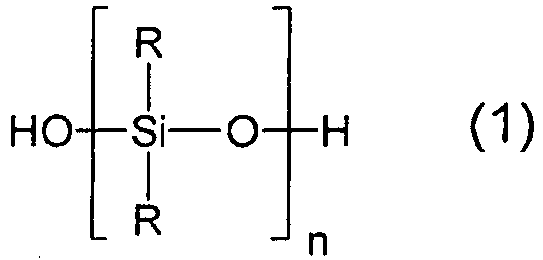 R einen einwertigen, unsubstituierten oder Substituenten, die Elemente enthalten, die ausgewählt werden aus N, P, S, O, Si, H und Halogen tragenden, gesättigten oder ungesättigten Kohlenwasserstoffrest mit 1 bis 36 Kohlenstoffatomen bedeutet undn so zu wählen ist, dass die Viskosität des Hydroxyterminierte Organopolysiloxans (1) 5 bis 80 000 mm2/s bei 25 deg. C beträgt.
 - Verfahren nach Anspruch 1 oder 2, bei dem die Hydroxy-terminierten Organopolysiloxane (1) Viskositäten von 20 mm2/s bis 10 000 mm2/s, bei 25 deg. C aufweisen.
- Verfahren nach Anspruch 1 bis 3, bei dem die Trialkylsilyl-terminierten Organopolysiloxane (2) Viskositäten von 60 mm2/s bis 20 000 mm2/s, jeweils bei 25 deg. C aufweisen.
- Verfahren nach Anspruch 1 bis 4, bei dem als Emulgatoren (4) nichtionische Emulgatoren eingesetzt werden.
Applications Claiming Priority (1)
| Application Number | Priority Date | Filing Date | Title |
|---|---|---|---|
| DE102010028491A DE102010028491A1 (de) | 2010-05-03 | 2010-05-03 | Verfahren zur Herstellung von Siliconemulsionen |
Publications (3)
| Publication Number | Publication Date |
|---|---|
| EP2385077A1 EP2385077A1 (de) | 2011-11-09 |
| EP2385077B1 EP2385077B1 (de) | 2012-12-26 |
| EP2385077B2 true EP2385077B2 (de) | 2019-11-27 |
Family
ID=44022918
Family Applications (1)
| Application Number | Title | Priority Date | Filing Date |
|---|---|---|---|
| EP11164116.3A Active EP2385077B2 (de) | 2010-05-03 | 2011-04-28 | Verfahren zur Herstellung von Siliconemulsionen |
Country Status (6)
| Country | Link |
|---|---|
| US (1) | US8575266B2 (de) |
| EP (1) | EP2385077B2 (de) |
| JP (1) | JP5558409B2 (de) |
| KR (1) | KR101316678B1 (de) |
| CN (1) | CN102241824B (de) |
| DE (1) | DE102010028491A1 (de) |
Families Citing this family (11)
| Publication number | Priority date | Publication date | Assignee | Title |
|---|---|---|---|---|
| GB201103690D0 (en) | 2011-03-04 | 2011-04-20 | Dow Corning | Emulsion polymerisation method |
| US20150105529A1 (en) * | 2012-05-23 | 2015-04-16 | Dow Corning Corporation | Process For Preparing Silicone Resins |
| US20150274970A1 (en) * | 2014-03-26 | 2015-10-01 | Wacker Chemical Corporation | Control of internal viscosity in in situ polymerized organopolysiloxane emulsions |
| EP3144339B1 (de) * | 2014-05-14 | 2022-08-17 | Shin-Etsu Chemical Co., Ltd. | Verfahren zur herstellung einer organopolysiloxanemulsionszusammensetzung und emulsionszusammensetzung |
| DE102014212725A1 (de) | 2014-07-01 | 2014-11-06 | Wacker Chemie Ag | Verfahren zur Herstellung von Polysiloxan-Emulsionen unter Verwendung von Alkylpolyglycosiden |
| EP3064531B1 (de) * | 2015-03-05 | 2019-10-02 | Shin-Etsu Chemical Co., Ltd. | Verfahren zur herstellung einer organopolysiloxanemulsionszusammensetzung |
| JP2018519293A (ja) * | 2015-07-02 | 2018-07-19 | ダウ (シャンハイ) ホールディング カンパニー リミテッド | 水中油型エマルション及び方法 |
| DE102015217551A1 (de) * | 2015-09-14 | 2017-03-16 | Wacker Chemie Ag | Verfahren zur kontinuierlichen Herstellung von stabilen Siliconemulsionen |
| CN107460759B (zh) * | 2017-08-18 | 2020-12-22 | 华南理工大学 | 一种纳米纤维素悬浮液的快速纯化方法 |
| CN111116916B (zh) * | 2019-12-18 | 2022-06-28 | 宁波辉宏新材料有限公司 | 一种用Si-OH封端的二甲基硅氧烷低聚物经乳液聚合制备羟基硅油乳液的方法 |
| CN117616070A (zh) * | 2021-07-09 | 2024-02-27 | 瓦克麦特罗克化学私营有限责任公司 | 由聚二甲基硅氧烷混合物经乳液聚合制备乳液和对乳液产物中环状物生成的影响 |
Citations (1)
| Publication number | Priority date | Publication date | Assignee | Title |
|---|---|---|---|---|
| US5504150A (en) † | 1995-04-05 | 1996-04-02 | Dow Corning Corporation | Method of making polysiloxane emulsions |
Family Cites Families (16)
| Publication number | Priority date | Publication date | Assignee | Title |
|---|---|---|---|---|
| US2891920A (en) | 1955-01-26 | 1959-06-23 | Dow Corning | Polymerization of organopolysiloxanes in aqueous emulsion |
| GB1024024A (en) | 1963-04-08 | 1966-03-30 | Dow Corning | Improvements in or relating to polymerising or co-polymerising organosilicon compounds |
| US4962153A (en) * | 1987-12-09 | 1990-10-09 | Dow Corning Corporation | Precured silicone emulsion |
| JPH0633333B2 (ja) | 1989-07-25 | 1994-05-02 | 信越化学工業株式会社 | オルガノポリシロキサンエマルジョンの製造方法 |
| DE19742761A1 (de) | 1997-09-27 | 1999-04-01 | Gerd Dr Rossmy | An ihrer Oberfläche anisotrop verteilte überwiegend hydrophile und überwiegend hydrophobe Domänen aufweisende amphiphile Teilchen oder Moleküle |
| DE19742759A1 (de) | 1997-09-27 | 1999-04-01 | Gerd Dr Rossmy | Verfahren zur Herstellung amphiphiler anisotroper Teilchen |
| JPH11302542A (ja) | 1998-04-23 | 1999-11-02 | Bridgestone Corp | 表面保護艶出し剤 |
| JP3892156B2 (ja) | 1998-09-22 | 2007-03-14 | ジーイー東芝シリコーン合同会社 | 化粧料 |
| JP2002037888A (ja) | 2000-07-25 | 2002-02-06 | Mitsubishi Rayon Co Ltd | ポリオルガノシロキサンラテックス及びその製造方法 |
| KR100887267B1 (ko) * | 2004-05-13 | 2009-03-06 | 와커 헤미 아게 | 실리콘 에멀젼의 비연속식 제조 방법 |
| JP4557147B2 (ja) | 2004-10-25 | 2010-10-06 | 信越化学工業株式会社 | オルガノポリシロキサンエマルジョンの製造方法 |
| JP4664053B2 (ja) | 2004-12-08 | 2011-04-06 | 東レ・ダウコーニング株式会社 | オルガノポリシロキサンエマルジョンの製造方法 |
| DE102005022106A1 (de) * | 2005-05-12 | 2006-11-16 | Wacker Chemie Ag | Hochviskose Polydiorganosiloxane enthaltende additionsvernetzbare Siliconmassen |
| DE102005022099A1 (de) * | 2005-05-12 | 2006-11-16 | Wacker Chemie Ag | Verfahren zur Herstellung von Dispersionen von vernetzten Organopolysiloxanen |
| WO2009129175A1 (en) | 2008-04-14 | 2009-10-22 | Dow Corning Corporation | Emulsions of boron crosslinked organopolysiloxanes |
| DE102009029520A1 (de) | 2009-09-16 | 2011-03-24 | Wacker Chemie Ag | Siliconemulsionen und Verfahren zu deren Herstellung |
-
2010
- 2010-05-03 DE DE102010028491A patent/DE102010028491A1/de not_active Withdrawn
-
2011
- 2011-04-28 EP EP11164116.3A patent/EP2385077B2/de active Active
- 2011-05-02 US US13/098,822 patent/US8575266B2/en active Active
- 2011-05-02 KR KR1020110041387A patent/KR101316678B1/ko active Active
- 2011-05-03 CN CN201110113211.2A patent/CN102241824B/zh active Active
- 2011-05-06 JP JP2011103864A patent/JP5558409B2/ja active Active
Patent Citations (1)
| Publication number | Priority date | Publication date | Assignee | Title |
|---|---|---|---|---|
| US5504150A (en) † | 1995-04-05 | 1996-04-02 | Dow Corning Corporation | Method of making polysiloxane emulsions |
Also Published As
| Publication number | Publication date |
|---|---|
| KR101316678B1 (ko) | 2013-10-15 |
| US8575266B2 (en) | 2013-11-05 |
| JP2011236421A (ja) | 2011-11-24 |
| DE102010028491A1 (de) | 2011-11-03 |
| CN102241824A (zh) | 2011-11-16 |
| EP2385077B1 (de) | 2012-12-26 |
| JP5558409B2 (ja) | 2014-07-23 |
| EP2385077A1 (de) | 2011-11-09 |
| US20110269892A1 (en) | 2011-11-03 |
| CN102241824B (zh) | 2015-09-16 |
| KR20110122060A (ko) | 2011-11-09 |
Similar Documents
| Publication | Publication Date | Title |
|---|---|---|
| EP2385077B2 (de) | Verfahren zur Herstellung von Siliconemulsionen | |
| EP0093310B2 (de) | Verfahren zur Herstellung von feinteiligen, stabilen O/W-Emulsionen von Organopolysiloxanen | |
| DE69124838T2 (de) | Verfahren zur Herstellung von Polysiloxanemulsionen | |
| EP2478055B1 (de) | Siliconemulsionen und verfahren zu deren herstellung | |
| DE3687704T2 (de) | Verfahren zur herstellung von mikroemulsionen von polydiorganosiloxanen. | |
| EP0143877B1 (de) | Stabile Siliconemulsionen | |
| EP1921106A1 (de) | Verfahren zur Herstellung von wässrigen Dispersionen von Organopolysiloxanen | |
| DE1495512B2 (de) | Verfahren zur Herstellung stabiler Organopoly si loxanemulsi onen | |
| EP2663393B1 (de) | Siliconemulsionen und verfahren zu deren herstellung | |
| JP2014512418A (ja) | 乳化重合の方法 | |
| EP2622003B1 (de) | Vollständig acylierte aminofunktionelle organopolysiloxane | |
| EP1735370B1 (de) | Verfahren zur kontinuierlichen herstellung von siilicon emulsionen | |
| EP2510057A1 (de) | Siliconharzemulsion und deren einsatz bei der hydrophobierung von gips | |
| EP2885353B1 (de) | Verfahren zur herstellung von siliconemulsionen | |
| EP3679086B1 (de) | Wässrige emulsionen aus oxamidoester-funktionalisierten organopolysiloxanen | |
| EP1988116B1 (de) | Verfahren zur Herstellung von Aminoalkylpolysiloxanen | |
| EP4263462B1 (de) | Verdünnungsstabile wässrige zusammensetzung zur massenhydrophobierung von mineralischen baustoffen | |
| EP2609164B1 (de) | Emulsionen von organopolysiloxanen mit sauren und basischen gruppen und deren herstellung | |
| DE10214139C2 (de) | Verfahren zur Herstellung von Emulsionen von Hydroxysäureamid funktionellem Organopolysiloxan | |
| DE102014212725A1 (de) | Verfahren zur Herstellung von Polysiloxan-Emulsionen unter Verwendung von Alkylpolyglycosiden |
Legal Events
| Date | Code | Title | Description |
|---|---|---|---|
| 17P | Request for examination filed |
Effective date: 20110428 |
|
| AK | Designated contracting states |
Kind code of ref document: A1 Designated state(s): AL AT BE BG CH CY CZ DE DK EE ES FI FR GB GR HR HU IE IS IT LI LT LU LV MC MK MT NL NO PL PT RO RS SE SI SK SM TR |
|
| AX | Request for extension of the european patent |
Extension state: BA ME |
|
| PUAI | Public reference made under article 153(3) epc to a published international application that has entered the european phase |
Free format text: ORIGINAL CODE: 0009012 |
|
| GRAP | Despatch of communication of intention to grant a patent |
Free format text: ORIGINAL CODE: EPIDOSNIGR1 |
|
| GRAS | Grant fee paid |
Free format text: ORIGINAL CODE: EPIDOSNIGR3 |
|
| GRAA | (expected) grant |
Free format text: ORIGINAL CODE: 0009210 |
|
| AK | Designated contracting states |
Kind code of ref document: B1 Designated state(s): AL AT BE BG CH CY CZ DE DK EE ES FI FR GB GR HR HU IE IS IT LI LT LU LV MC MK MT NL NO PL PT RO RS SE SI SK SM TR |
|
| REG | Reference to a national code |
Ref country code: GB Ref legal event code: FG4D Free format text: NOT ENGLISH |
|
| REG | Reference to a national code |
Ref country code: CH Ref legal event code: EP |
|
| REG | Reference to a national code |
Ref country code: AT Ref legal event code: REF Ref document number: 590455 Country of ref document: AT Kind code of ref document: T Effective date: 20130115 |
|
| REG | Reference to a national code |
Ref country code: DE Ref legal event code: R096 Ref document number: 502011000312 Country of ref document: DE Effective date: 20130307 |
|
| PG25 | Lapsed in a contracting state [announced via postgrant information from national office to epo] |
Ref country code: NO Free format text: LAPSE BECAUSE OF FAILURE TO SUBMIT A TRANSLATION OF THE DESCRIPTION OR TO PAY THE FEE WITHIN THE PRESCRIBED TIME-LIMIT Effective date: 20130326 Ref country code: SE Free format text: LAPSE BECAUSE OF FAILURE TO SUBMIT A TRANSLATION OF THE DESCRIPTION OR TO PAY THE FEE WITHIN THE PRESCRIBED TIME-LIMIT Effective date: 20121226 Ref country code: HR Free format text: LAPSE BECAUSE OF FAILURE TO SUBMIT A TRANSLATION OF THE DESCRIPTION OR TO PAY THE FEE WITHIN THE PRESCRIBED TIME-LIMIT Effective date: 20121226 Ref country code: FI Free format text: LAPSE BECAUSE OF FAILURE TO SUBMIT A TRANSLATION OF THE DESCRIPTION OR TO PAY THE FEE WITHIN THE PRESCRIBED TIME-LIMIT Effective date: 20121226 Ref country code: LT Free format text: LAPSE BECAUSE OF FAILURE TO SUBMIT A TRANSLATION OF THE DESCRIPTION OR TO PAY THE FEE WITHIN THE PRESCRIBED TIME-LIMIT Effective date: 20121226 |
|
| REG | Reference to a national code |
Ref country code: NL Ref legal event code: T3 |
|
| REG | Reference to a national code |
Ref country code: LT Ref legal event code: MG4D |
|
| PG25 | Lapsed in a contracting state [announced via postgrant information from national office to epo] |
Ref country code: SI Free format text: LAPSE BECAUSE OF FAILURE TO SUBMIT A TRANSLATION OF THE DESCRIPTION OR TO PAY THE FEE WITHIN THE PRESCRIBED TIME-LIMIT Effective date: 20121226 Ref country code: GR Free format text: LAPSE BECAUSE OF FAILURE TO SUBMIT A TRANSLATION OF THE DESCRIPTION OR TO PAY THE FEE WITHIN THE PRESCRIBED TIME-LIMIT Effective date: 20130327 Ref country code: LV Free format text: LAPSE BECAUSE OF FAILURE TO SUBMIT A TRANSLATION OF THE DESCRIPTION OR TO PAY THE FEE WITHIN THE PRESCRIBED TIME-LIMIT Effective date: 20121226 |
|
| PG25 | Lapsed in a contracting state [announced via postgrant information from national office to epo] |
Ref country code: ES Free format text: LAPSE BECAUSE OF FAILURE TO SUBMIT A TRANSLATION OF THE DESCRIPTION OR TO PAY THE FEE WITHIN THE PRESCRIBED TIME-LIMIT Effective date: 20130406 Ref country code: EE Free format text: LAPSE BECAUSE OF FAILURE TO SUBMIT A TRANSLATION OF THE DESCRIPTION OR TO PAY THE FEE WITHIN THE PRESCRIBED TIME-LIMIT Effective date: 20121226 Ref country code: RS Free format text: LAPSE BECAUSE OF FAILURE TO SUBMIT A TRANSLATION OF THE DESCRIPTION OR TO PAY THE FEE WITHIN THE PRESCRIBED TIME-LIMIT Effective date: 20121226 Ref country code: SK Free format text: LAPSE BECAUSE OF FAILURE TO SUBMIT A TRANSLATION OF THE DESCRIPTION OR TO PAY THE FEE WITHIN THE PRESCRIBED TIME-LIMIT Effective date: 20121226 Ref country code: BG Free format text: LAPSE BECAUSE OF FAILURE TO SUBMIT A TRANSLATION OF THE DESCRIPTION OR TO PAY THE FEE WITHIN THE PRESCRIBED TIME-LIMIT Effective date: 20130326 Ref country code: CZ Free format text: LAPSE BECAUSE OF FAILURE TO SUBMIT A TRANSLATION OF THE DESCRIPTION OR TO PAY THE FEE WITHIN THE PRESCRIBED TIME-LIMIT Effective date: 20121226 Ref country code: IS Free format text: LAPSE BECAUSE OF FAILURE TO SUBMIT A TRANSLATION OF THE DESCRIPTION OR TO PAY THE FEE WITHIN THE PRESCRIBED TIME-LIMIT Effective date: 20130426 |
|
| PG25 | Lapsed in a contracting state [announced via postgrant information from national office to epo] |
Ref country code: PL Free format text: LAPSE BECAUSE OF FAILURE TO SUBMIT A TRANSLATION OF THE DESCRIPTION OR TO PAY THE FEE WITHIN THE PRESCRIBED TIME-LIMIT Effective date: 20121226 Ref country code: RO Free format text: LAPSE BECAUSE OF FAILURE TO SUBMIT A TRANSLATION OF THE DESCRIPTION OR TO PAY THE FEE WITHIN THE PRESCRIBED TIME-LIMIT Effective date: 20121226 Ref country code: PT Free format text: LAPSE BECAUSE OF FAILURE TO SUBMIT A TRANSLATION OF THE DESCRIPTION OR TO PAY THE FEE WITHIN THE PRESCRIBED TIME-LIMIT Effective date: 20130426 |
|
| PLBI | Opposition filed |
Free format text: ORIGINAL CODE: 0009260 |
|
| PLAX | Notice of opposition and request to file observation + time limit sent |
Free format text: ORIGINAL CODE: EPIDOSNOBS2 |
|
| PG25 | Lapsed in a contracting state [announced via postgrant information from national office to epo] |
Ref country code: DK Free format text: LAPSE BECAUSE OF FAILURE TO SUBMIT A TRANSLATION OF THE DESCRIPTION OR TO PAY THE FEE WITHIN THE PRESCRIBED TIME-LIMIT Effective date: 20121226 |
|
| 26 | Opposition filed |
Opponent name: DOW CORNING CORPORATION Effective date: 20130925 |
|
| PG25 | Lapsed in a contracting state [announced via postgrant information from national office to epo] |
Ref country code: CY Free format text: LAPSE BECAUSE OF FAILURE TO SUBMIT A TRANSLATION OF THE DESCRIPTION OR TO PAY THE FEE WITHIN THE PRESCRIBED TIME-LIMIT Effective date: 20121226 Ref country code: MC Free format text: LAPSE BECAUSE OF FAILURE TO SUBMIT A TRANSLATION OF THE DESCRIPTION OR TO PAY THE FEE WITHIN THE PRESCRIBED TIME-LIMIT Effective date: 20121226 |
|
| REG | Reference to a national code |
Ref country code: DE Ref legal event code: R026 Ref document number: 502011000312 Country of ref document: DE Effective date: 20130925 |
|
| PG25 | Lapsed in a contracting state [announced via postgrant information from national office to epo] |
Ref country code: IT Free format text: LAPSE BECAUSE OF FAILURE TO SUBMIT A TRANSLATION OF THE DESCRIPTION OR TO PAY THE FEE WITHIN THE PRESCRIBED TIME-LIMIT Effective date: 20121226 |
|
| REG | Reference to a national code |
Ref country code: IE Ref legal event code: MM4A |
|
| PLBB | Reply of patent proprietor to notice(s) of opposition received |
Free format text: ORIGINAL CODE: EPIDOSNOBS3 |
|
| PG25 | Lapsed in a contracting state [announced via postgrant information from national office to epo] |
Ref country code: IE Free format text: LAPSE BECAUSE OF NON-PAYMENT OF DUE FEES Effective date: 20130428 |
|
| REG | Reference to a national code |
Ref country code: CH Ref legal event code: PL |
|
| PG25 | Lapsed in a contracting state [announced via postgrant information from national office to epo] |
Ref country code: CH Free format text: LAPSE BECAUSE OF NON-PAYMENT OF DUE FEES Effective date: 20140430 Ref country code: LI Free format text: LAPSE BECAUSE OF NON-PAYMENT OF DUE FEES Effective date: 20140430 |
|
| PG25 | Lapsed in a contracting state [announced via postgrant information from national office to epo] |
Ref country code: MT Free format text: LAPSE BECAUSE OF FAILURE TO SUBMIT A TRANSLATION OF THE DESCRIPTION OR TO PAY THE FEE WITHIN THE PRESCRIBED TIME-LIMIT Effective date: 20121226 |
|
| PG25 | Lapsed in a contracting state [announced via postgrant information from national office to epo] |
Ref country code: SM Free format text: LAPSE BECAUSE OF FAILURE TO SUBMIT A TRANSLATION OF THE DESCRIPTION OR TO PAY THE FEE WITHIN THE PRESCRIBED TIME-LIMIT Effective date: 20121226 |
|
| PG25 | Lapsed in a contracting state [announced via postgrant information from national office to epo] |
Ref country code: TR Free format text: LAPSE BECAUSE OF FAILURE TO SUBMIT A TRANSLATION OF THE DESCRIPTION OR TO PAY THE FEE WITHIN THE PRESCRIBED TIME-LIMIT Effective date: 20121226 |
|
| PG25 | Lapsed in a contracting state [announced via postgrant information from national office to epo] |
Ref country code: MK Free format text: LAPSE BECAUSE OF FAILURE TO SUBMIT A TRANSLATION OF THE DESCRIPTION OR TO PAY THE FEE WITHIN THE PRESCRIBED TIME-LIMIT Effective date: 20121226 Ref country code: LU Free format text: LAPSE BECAUSE OF NON-PAYMENT OF DUE FEES Effective date: 20130428 Ref country code: HU Free format text: LAPSE BECAUSE OF FAILURE TO SUBMIT A TRANSLATION OF THE DESCRIPTION OR TO PAY THE FEE WITHIN THE PRESCRIBED TIME-LIMIT; INVALID AB INITIO Effective date: 20110428 |
|
| REG | Reference to a national code |
Ref country code: FR Ref legal event code: PLFP Year of fee payment: 6 |
|
| APBM | Appeal reference recorded |
Free format text: ORIGINAL CODE: EPIDOSNREFNO |
|
| APBP | Date of receipt of notice of appeal recorded |
Free format text: ORIGINAL CODE: EPIDOSNNOA2O |
|
| APAH | Appeal reference modified |
Free format text: ORIGINAL CODE: EPIDOSCREFNO |
|
| APBQ | Date of receipt of statement of grounds of appeal recorded |
Free format text: ORIGINAL CODE: EPIDOSNNOA3O |
|
| REG | Reference to a national code |
Ref country code: FR Ref legal event code: PLFP Year of fee payment: 7 |
|
| REG | Reference to a national code |
Ref country code: AT Ref legal event code: MM01 Ref document number: 590455 Country of ref document: AT Kind code of ref document: T Effective date: 20160428 |
|
| PG25 | Lapsed in a contracting state [announced via postgrant information from national office to epo] |
Ref country code: AT Free format text: LAPSE BECAUSE OF NON-PAYMENT OF DUE FEES Effective date: 20160428 |
|
| REG | Reference to a national code |
Ref country code: FR Ref legal event code: PLFP Year of fee payment: 8 |
|
| PG25 | Lapsed in a contracting state [announced via postgrant information from national office to epo] |
Ref country code: AL Free format text: LAPSE BECAUSE OF FAILURE TO SUBMIT A TRANSLATION OF THE DESCRIPTION OR TO PAY THE FEE WITHIN THE PRESCRIBED TIME-LIMIT Effective date: 20121226 |
|
| APBU | Appeal procedure closed |
Free format text: ORIGINAL CODE: EPIDOSNNOA9O |
|
| PUAH | Patent maintained in amended form |
Free format text: ORIGINAL CODE: 0009272 |
|
| STAA | Information on the status of an ep patent application or granted ep patent |
Free format text: STATUS: PATENT MAINTAINED AS AMENDED |
|
| 27A | Patent maintained in amended form |
Effective date: 20191127 |
|
| AK | Designated contracting states |
Kind code of ref document: B2 Designated state(s): AL AT BE BG CH CY CZ DE DK EE ES FI FR GB GR HR HU IE IS IT LI LT LU LV MC MK MT NL NO PL PT RO RS SE SI SK SM TR |
|
| REG | Reference to a national code |
Ref country code: DE Ref legal event code: R102 Ref document number: 502011000312 Country of ref document: DE |
|
| REG | Reference to a national code |
Ref country code: NL Ref legal event code: FP |
|
| P01 | Opt-out of the competence of the unified patent court (upc) registered |
Effective date: 20230502 |
|
| REG | Reference to a national code |
Ref country code: DE Ref legal event code: R081 Ref document number: 502011000312 Country of ref document: DE Owner name: WACKER CHEMIE AG, DE Free format text: FORMER OWNER: WACKER CHEMIE AG, 81737 MUENCHEN, DE |
|
| PGFP | Annual fee paid to national office [announced via postgrant information from national office to epo] |
Ref country code: NL Payment date: 20250418 Year of fee payment: 15 |
|
| PGFP | Annual fee paid to national office [announced via postgrant information from national office to epo] |
Ref country code: DE Payment date: 20250422 Year of fee payment: 15 |
|
| PGFP | Annual fee paid to national office [announced via postgrant information from national office to epo] |
Ref country code: BE Payment date: 20250418 Year of fee payment: 15 |
|
| PGFP | Annual fee paid to national office [announced via postgrant information from national office to epo] |
Ref country code: FR Payment date: 20250424 Year of fee payment: 15 |
|
| PGFP | Annual fee paid to national office [announced via postgrant information from national office to epo] |
Ref country code: GB Payment date: 20260306 Year of fee payment: 16 |