EP2410600A2 - Positive Elektrode und wiederaufladbare Lithiumbatterie damit - Google Patents
Positive Elektrode und wiederaufladbare Lithiumbatterie damit Download PDFInfo
- Publication number
- EP2410600A2 EP2410600A2 EP20110173886 EP11173886A EP2410600A2 EP 2410600 A2 EP2410600 A2 EP 2410600A2 EP 20110173886 EP20110173886 EP 20110173886 EP 11173886 A EP11173886 A EP 11173886A EP 2410600 A2 EP2410600 A2 EP 2410600A2
- Authority
- EP
- European Patent Office
- Prior art keywords
- active material
- formula
- sublayer
- layer
- positive electrode
- Prior art date
- Legal status (The legal status is an assumption and is not a legal conclusion. Google has not performed a legal analysis and makes no representation as to the accuracy of the status listed.)
- Granted
Links
Images


Classifications
-
- H—ELECTRICITY
- H01—ELECTRIC ELEMENTS
- H01M—PROCESSES OR MEANS, e.g. BATTERIES, FOR THE DIRECT CONVERSION OF CHEMICAL ENERGY INTO ELECTRICAL ENERGY
- H01M4/00—Electrodes
- H01M4/02—Electrodes composed of, or comprising, active material
- H01M4/13—Electrodes for accumulators with non-aqueous electrolyte, e.g. for lithium-accumulators; Processes of manufacture thereof
- H01M4/131—Electrodes based on mixed oxides or hydroxides, or on mixtures of oxides or hydroxides, e.g. LiCoOx
-
- C—CHEMISTRY; METALLURGY
- C01—INORGANIC CHEMISTRY
- C01G—COMPOUNDS CONTAINING METALS NOT COVERED BY SUBCLASSES C01D OR C01F
- C01G39/00—Compounds of molybdenum
-
- C—CHEMISTRY; METALLURGY
- C01—INORGANIC CHEMISTRY
- C01G—COMPOUNDS CONTAINING METALS NOT COVERED BY SUBCLASSES C01D OR C01F
- C01G39/00—Compounds of molybdenum
- C01G39/006—Compounds containing molybdenum, with or without oxygen or hydrogen, and containing two or more other elements
-
- C—CHEMISTRY; METALLURGY
- C01—INORGANIC CHEMISTRY
- C01G—COMPOUNDS CONTAINING METALS NOT COVERED BY SUBCLASSES C01D OR C01F
- C01G53/00—Compounds of nickel
-
- C—CHEMISTRY; METALLURGY
- C01—INORGANIC CHEMISTRY
- C01G—COMPOUNDS CONTAINING METALS NOT COVERED BY SUBCLASSES C01D OR C01F
- C01G53/00—Compounds of nickel
- C01G53/80—Compounds containing nickel, with or without oxygen or hydrogen, and containing one or more other elements
- C01G53/82—Compounds containing nickel, with or without oxygen or hydrogen, and containing two or more other elements
-
- H—ELECTRICITY
- H01—ELECTRIC ELEMENTS
- H01M—PROCESSES OR MEANS, e.g. BATTERIES, FOR THE DIRECT CONVERSION OF CHEMICAL ENERGY INTO ELECTRICAL ENERGY
- H01M10/00—Secondary cells; Manufacture thereof
- H01M10/05—Accumulators with non-aqueous electrolyte
- H01M10/052—Li-accumulators
- H01M10/0525—Rocking-chair batteries, i.e. batteries with lithium insertion or intercalation in both electrodes; Lithium-ion batteries
-
- H—ELECTRICITY
- H01—ELECTRIC ELEMENTS
- H01M—PROCESSES OR MEANS, e.g. BATTERIES, FOR THE DIRECT CONVERSION OF CHEMICAL ENERGY INTO ELECTRICAL ENERGY
- H01M4/00—Electrodes
- H01M4/02—Electrodes composed of, or comprising, active material
- H01M4/36—Selection of substances as active materials, active masses, active liquids
- H01M4/362—Composites
- H01M4/364—Composites as mixtures
-
- H—ELECTRICITY
- H01—ELECTRIC ELEMENTS
- H01M—PROCESSES OR MEANS, e.g. BATTERIES, FOR THE DIRECT CONVERSION OF CHEMICAL ENERGY INTO ELECTRICAL ENERGY
- H01M4/00—Electrodes
- H01M4/02—Electrodes composed of, or comprising, active material
- H01M4/36—Selection of substances as active materials, active masses, active liquids
- H01M4/362—Composites
- H01M4/366—Composites as layered products
-
- H—ELECTRICITY
- H01—ELECTRIC ELEMENTS
- H01M—PROCESSES OR MEANS, e.g. BATTERIES, FOR THE DIRECT CONVERSION OF CHEMICAL ENERGY INTO ELECTRICAL ENERGY
- H01M4/00—Electrodes
- H01M4/02—Electrodes composed of, or comprising, active material
- H01M4/36—Selection of substances as active materials, active masses, active liquids
- H01M4/48—Selection of substances as active materials, active masses, active liquids of inorganic oxides or hydroxides
- H01M4/485—Selection of substances as active materials, active masses, active liquids of inorganic oxides or hydroxides of mixed oxides or hydroxides for inserting or intercalating light metals, e.g. LiTi2O4 or LiTi2OxFy
-
- H—ELECTRICITY
- H01—ELECTRIC ELEMENTS
- H01M—PROCESSES OR MEANS, e.g. BATTERIES, FOR THE DIRECT CONVERSION OF CHEMICAL ENERGY INTO ELECTRICAL ENERGY
- H01M4/00—Electrodes
- H01M4/02—Electrodes composed of, or comprising, active material
- H01M4/36—Selection of substances as active materials, active masses, active liquids
- H01M4/48—Selection of substances as active materials, active masses, active liquids of inorganic oxides or hydroxides
- H01M4/52—Selection of substances as active materials, active masses, active liquids of inorganic oxides or hydroxides of nickel, cobalt or iron
- H01M4/525—Selection of substances as active materials, active masses, active liquids of inorganic oxides or hydroxides of nickel, cobalt or iron of mixed oxides or hydroxides containing iron, cobalt or nickel for inserting or intercalating light metals, e.g. LiNiO2, LiCoO2 or LiCoOxFy
-
- C—CHEMISTRY; METALLURGY
- C01—INORGANIC CHEMISTRY
- C01P—INDEXING SCHEME RELATING TO STRUCTURAL AND PHYSICAL ASPECTS OF SOLID INORGANIC COMPOUNDS
- C01P2002/00—Crystal-structural characteristics
- C01P2002/50—Solid solutions
- C01P2002/52—Solid solutions containing elements as dopants
-
- C—CHEMISTRY; METALLURGY
- C01—INORGANIC CHEMISTRY
- C01P—INDEXING SCHEME RELATING TO STRUCTURAL AND PHYSICAL ASPECTS OF SOLID INORGANIC COMPOUNDS
- C01P2002/00—Crystal-structural characteristics
- C01P2002/70—Crystal-structural characteristics defined by measured X-ray, neutron or electron diffraction data
- C01P2002/72—Crystal-structural characteristics defined by measured X-ray, neutron or electron diffraction data by d-values or two theta-values, e.g. as X-ray diagram
-
- H—ELECTRICITY
- H01—ELECTRIC ELEMENTS
- H01M—PROCESSES OR MEANS, e.g. BATTERIES, FOR THE DIRECT CONVERSION OF CHEMICAL ENERGY INTO ELECTRICAL ENERGY
- H01M4/00—Electrodes
- H01M4/02—Electrodes composed of, or comprising, active material
- H01M4/36—Selection of substances as active materials, active masses, active liquids
- H01M4/48—Selection of substances as active materials, active masses, active liquids of inorganic oxides or hydroxides
-
- H—ELECTRICITY
- H01—ELECTRIC ELEMENTS
- H01M—PROCESSES OR MEANS, e.g. BATTERIES, FOR THE DIRECT CONVERSION OF CHEMICAL ENERGY INTO ELECTRICAL ENERGY
- H01M4/00—Electrodes
- H01M4/02—Electrodes composed of, or comprising, active material
- H01M4/36—Selection of substances as active materials, active masses, active liquids
- H01M4/48—Selection of substances as active materials, active masses, active liquids of inorganic oxides or hydroxides
- H01M4/50—Selection of substances as active materials, active masses, active liquids of inorganic oxides or hydroxides of manganese
- H01M4/505—Selection of substances as active materials, active masses, active liquids of inorganic oxides or hydroxides of manganese of mixed oxides or hydroxides containing manganese for inserting or intercalating light metals, e.g. LiMn2O4 or LiMn2OxFy
-
- Y—GENERAL TAGGING OF NEW TECHNOLOGICAL DEVELOPMENTS; GENERAL TAGGING OF CROSS-SECTIONAL TECHNOLOGIES SPANNING OVER SEVERAL SECTIONS OF THE IPC; TECHNICAL SUBJECTS COVERED BY FORMER USPC CROSS-REFERENCE ART COLLECTIONS [XRACs] AND DIGESTS
- Y02—TECHNOLOGIES OR APPLICATIONS FOR MITIGATION OR ADAPTATION AGAINST CLIMATE CHANGE
- Y02E—REDUCTION OF GREENHOUSE GAS [GHG] EMISSIONS, RELATED TO ENERGY GENERATION, TRANSMISSION OR DISTRIBUTION
- Y02E60/00—Enabling technologies; Technologies with a potential or indirect contribution to GHG emissions mitigation
- Y02E60/10—Energy storage using batteries
-
- Y—GENERAL TAGGING OF NEW TECHNOLOGICAL DEVELOPMENTS; GENERAL TAGGING OF CROSS-SECTIONAL TECHNOLOGIES SPANNING OVER SEVERAL SECTIONS OF THE IPC; TECHNICAL SUBJECTS COVERED BY FORMER USPC CROSS-REFERENCE ART COLLECTIONS [XRACs] AND DIGESTS
- Y10—TECHNICAL SUBJECTS COVERED BY FORMER USPC
- Y10T—TECHNICAL SUBJECTS COVERED BY FORMER US CLASSIFICATION
- Y10T428/00—Stock material or miscellaneous articles
- Y10T428/249921—Web or sheet containing structurally defined element or component
-
- Y—GENERAL TAGGING OF NEW TECHNOLOGICAL DEVELOPMENTS; GENERAL TAGGING OF CROSS-SECTIONAL TECHNOLOGIES SPANNING OVER SEVERAL SECTIONS OF THE IPC; TECHNICAL SUBJECTS COVERED BY FORMER USPC CROSS-REFERENCE ART COLLECTIONS [XRACs] AND DIGESTS
- Y10—TECHNICAL SUBJECTS COVERED BY FORMER USPC
- Y10T—TECHNICAL SUBJECTS COVERED BY FORMER US CLASSIFICATION
- Y10T428/00—Stock material or miscellaneous articles
- Y10T428/249921—Web or sheet containing structurally defined element or component
- Y10T428/249923—Including interlaminar mechanical fastener
Definitions
- the present invention relates to a positive electrode and a lithium battery including the positive electrode.
- a lithium battery converts chemical energy into electrical energy through electrochemical redox reactions between chemical substances.
- a typical lithium battery includes a positive electrode, a negative electrode, and an electrolyte.
- an active material may need high capacity or a high battery charging voltage.
- a silicon-based composite material having high capacity may be used as a negative active material for a negative electrode of a battery.
- silicon-based composite materials irreversibly deintercalate lithium.
- a positive electrode includes: a current collector; a first layer capable of irreversible deintercalation of lithium ions; and a second layer capable of reversible intercalation and deintercalation of lithium ions.
- the first and second layers may be sequentially disposed on the current collector in the order stated, i.e. the first layer may be disposed between the current collector and the second layer.
- the first layer may include a first active material represented by Formula 1 below: Li 2 Mo 1-n R 1 n O 3 Formula 1
- R 1 is selected from the group consisting of manganese (Mn), iron (Fe), cobalt (Co), copper (Cu), zinc (Zn), magnesium (Mg), nickel (Ni), and combinations thereof.
- the first layer may include a second active material represented by Formula 2 below: Li 2 Ni 1-m R 2 m O 2 Formula 2
- R 2 is selected from the group consisting of manganese (Mn), iron (Fe), cobalt (Co), copper (Cu), zinc (Zn), magnesium (Mg), molybdenum (Mo), and combinations thereof.
- the second active material may further include a Li 2 Ni 8 O 10 phase.
- the first layer may include a first active material represented by Formula 1 below and a second active material represented by Formula 2 below: Li 2 Mo 1-n R 1 O 3 Formula 1 Li 2 Ni 1-m R m 2 O 2 Formula 2
- R 1 is selected from the group consisting of manganese (Mn), iron (Fe), cobalt (Co), copper (Cu), zinc (Zn), magnesium (Mg), nickel (Ni), and combinations thereof.
- R 2 is selected from the group consisting of Mn, Fe, Co, Cu, Zn, Mg, Mo, and combinations thereof.
- the second active material may further include a Li 2 Ni 8 O 10 phase.
- the first layer may include a first sublayer and a second sublayer, in which the first sublayer is interposed between the current collector and the second sublayer.
- the first sublayer may include the first active material represented by Formula 1 above
- the second sublayer may include the second active material represented by Formula 2 above.
- the second active material may further include a Li 2 Ni 8 O 10 phase.
- the first layer may include a first sublayer and a second sublayer, in which the first sublayer is interposed between the current collector and the second sublayer.
- the first sublayer may include the second active material represented by Formula 2 above.
- the second sublayer may include the first active material represented by Formula 1 above.
- the second active material may further include a Li 2 Ni 8 O 10 phase.
- a lithium battery includes: a negative electrode including a negative active material; a positive electrode according to the invention in its first aspect; and an electrolyte.
- the negative active material may include a material selected from the group consisting of silicon, a silicon-based composite material (for example, a silicon oxide), tin, a tin-based composite material, lithium titanate, and a combination of at least two of these materials.
- the negative active material comprises silicon oxide.
- a third aspect of the present invention there is provided use of a first layer comprising at least one active material capable of irreversible deintercalation of lithium ions; and a second layer comprising an active material capable of reversible intercalation and deintercalation of lithium ions, in a positive electrode of a lithium battery.
- a positive electrode includes a current collector, a first layer and a second layer.
- the first layer contains one or more materials that irreversibly deintercalate lithium ions.
- the second layer second layer contains one or more materials that allow reversible intercalation and deintercalation of lithium ions.
- the first and second layers may be sequentially stacked on the current collector in the order stated. Alternatively, the first and second layers may be stacked on the current collector in the reverse order.
- FIG. 1 is a schematic cross-sectional view of a positive electrode 10 according to an embodiment of the present invention.
- the positive electrode 10 includes a current collector 11, a first layer 13 and a second layer 15.
- the first layer 13 is disposed on the current collector 11 and irreversibly deintercalates lithium ions.
- the second layer 15 is disposed on the first layer 13 and allows reversible intercalation and deintercalation of lithium ions.
- the current collector 11 may be any one selected from the group consisting of copper foil, nickel foil, stainless steel foil, titanium foil, nickel foam, copper foam, a polymeric substrate coated with a conductive metal, and an aluminium substrate. However, any other forms of current collector may be used instead. Alternatively, the current collector 11 may be manufactured from a mixture of the materials listed above or by stacking substrates made from the materials on one another. The current collector 11 may have any of a variety of structures.
- the first layer 13 irreversibly deintercalates lithium ions.
- the first layer 13 deintercalates and provides lithium ions to a negative electrode during the initial charge or charging of the battery (i.e., during which the positive electrode provides for the first time lithium ions to the negative electrode).
- the first layer 13 does not allow intercalation of lithium ions during discharge following the initial charging. In other words, the first layer 13 does not take part in charge-discharge cycles of the battery.
- the second layer 15 allows reversible intercalation and deintercalation of lithium ions and is involved in charge-discharge cycles of the battery.
- the positive electrode 10 including the first layer 13 and the second layer 15 is used with a negative electrode including a negative active material capable of irreversibly deintercalating lithium ions
- the first layer 13 may compensate for the irreversibility of the negative electrode, and thus, the retention of the capacity of the lithium battery may be improved. This is supported by the following explanations.
- a lithium battery L1 that includes a positive electrode made of only the second layer 15 (allowing irreversible intercalation and deintercalation of lithium ions) and a negative electrode made of a negative active material (capable of deintercalating 80% of the lithium ions received from the positive electrode during the initial charge)
- the negative electrode may, in theory, deintercalate 80 lithium ions during the discharge following the initial charge.
- the positive electrode in the case of a lithium battery L2 that is identical to the lithium battery L1, except that the positive electrode further includes the first layer 13 capable of irreversibly deintercalating 20 lithium ions during the initial charge, the positive electrode can provide 120 lithium ions (rather than 100 lithium ions) to the negative electrode during the initial charge.
- the use of the first layer 13 in the positive electrode of the lithium battery L2 may compensate for the irreversibility of the negative electrode.
- the lithium battery L2 may have good capacity retention while maintaining substantially the same capacity as the lithium battery L1.
- the first layer 13 may include a first active material represented by Formula 1 below: Li 2 Mo 1-n R 1 n O 3 Formula 1
- R 1 is selected from the group consisting of manganese (Mn), iron (Fe), cobalt (Co), copper (Cu), zinc (Zn), magnesium (Mg), nickel (Ni), and a combination of these elements.
- Li 2 MoO 3 -based active material used herein refers to a material including a Li 2 MoO 3 compound.
- the Li 2 MoO 3 -based active material may further include a layer and/or phase that are of a different stoichiometry from the Li 2 MoO 3 compound.
- the term "-based active material” used herein may be construed in the similar way.
- the first active material may be a material capable of irreversibly deintercalating lithium ions.
- the first layer 13 may include a second active material represented by Formula 2 below: Li 2 Ni 1-m R 2 m O 2 Formula 2
- R 2 is selected from the group consisting of Mn, Fe, Co, Cu, Zn, Mg, Mo, and a combination of these elements.
- the second active material may be a Li 2 NiO 2 -based active material.
- the Li 2 NiO 2 -based active material may also be a material capable of irreversibly deintercalating lithium.
- the second active material for example, a Li 2 NiO 2 -based active material, may further include a Li 2 Ni 8 O 10 phase.
- the second active material for example, a Li 2 NiO 2- based active material, may irreversibly discharge a large number of lithium ions and may also generate gases.
- the Li 2 NiO 2 -based active material used as the second active material may generate O 2 according to Reaction 1: Li 2 NiO 2 ⁇ NiO + O +2Li Reaction 1
- Li 2 O generated from the reaction results of Reaction 1 may react with one or more components of the electrolyte, conducting agent, and/or various additives to produce Li 2 CO 3 , which may then release CO 2 .
- the second active material for example, a Li 2 NiO 2 -based active material, can irreversibly deintercalate lithium ions, which may generate O 2 and/or CO 2 in the lithium battery.
- the phase of the second active material may be stabilized, and additional reactions of the results of Reaction 1 may be suppressed or substantially prevented.
- the first layer 13 including, for example, the Li 2 NiO 2 -based active material as the second active material may irreversibly deintercalate a large number of lithium ions, and may suppress or substantially prevent additional reactions generating O 2 and/or CO 2 , thereby improving the stability of the positive electrode.
- the Li 2 Ni 8 O 10 phase may be obtained by adjusting or controlling heat-treatment conditions for synthesis of the second active material, for example, a Li 2 NiO 2 -based active material.
- a Li 2 NiO 2 -based active material for example, Li 2 O and NiO are mixed in a stoichiometric ratio (1:1 molar ratio), and the resulting mixture is heat-treated under inert atmospheric conditions (for example, a N 2 atmosphere) at one or more temperatures from about 500°C to 600°C (for example, about 550°C) for about 5 hours to about 15 hours (for example, about 10 hours).
- the heat-treated material may be cooled to a temperature ranging from room temperature to 100°C.
- the heat-treated material is then further heat treated under inert atmospheric conditions (for example, a N z atmosphere) at one or more temperatures from about 500°C to about 600°C (for example, about 550°C) for about 5 hours to about 15 hours (for example, about 10 hours), which provides the Li 2 NiO 2- based active material including a Li 2 Ni 8 O 10 phase.
- inert atmospheric conditions for example, a N z atmosphere
- Figure 2 is a graph of X-ray diffraction (XRD) analysis of a Li 2 NiO 2 -based active material prepared by thermally treating a mixture of Li 2 O and NiO in a stoichiometric ratio (1:1 molar ratio) in a N 2 atmosphere at 550°C for 10 hours and then further at 550°C for 10 hours.
- Figure 2 confirms the presence of a Li 2 Ni 8 O 10 phase.
- the first layer 13 may further include both the first active material and the second active material.
- the second active material for example, a Li 2 NiO 2- based active material
- the first active material for example, a Li 2 NiO 2- based active material
- the first active material can absorb O 2 generated from the second active material, and thus the net generation of gas in the lithium battery may be substantially prevented.
- the second active material may further include a Li 2 Ni 8 O 10 phase.
- Reaction 1 may be even suppressed, and some small amount of O 2 that may be generated in the lithium battery may be absorbed by the first material.
- the irreversibility of the negative electrode may be effectively compensated, and the stability of lithium battery can be improved.
- the thickness of the first layer 13 may vary depending upon various factors, which include the material of the first layer 13, a desired structure of the lithium battery, the positive active material to be used, or the like.
- the first layer 13 may have a thickness of about 2 ⁇ m to about 30 ⁇ m.
- the first layer 13 may have a thickness of about 5 ⁇ m to about 15 ⁇ m.
- the second layer 15 may allow reversible intercalation and deintercalation of lithium ions.
- An active material for the second layer 15 may be any appropriate positive active material for lithium batteries that allows reversible intercalation and deintercalation of lithium ions.
- the second layer 15 may include any of the following positive active materials. However, any suitable positive active material may be used.
- Li a A 1-b X b D 2 wherein 0.95 ⁇ a ⁇ 1.1, and 0 ⁇ b ⁇ 0.5
- Li a E 1-b X b O 2-c D c wherein 0.95 ⁇ a ⁇ 1.1, 0 ⁇ b ⁇ 0.5, and 0 ⁇ c ⁇ 0.05
- LiE 2-b X b O 4-c D c wherein 0 ⁇ b ⁇ 0.5, and 0 ⁇ c ⁇ 0.05
- Li a Ni 1-b-c Co b BcD ⁇ wherein 0.95 ⁇ a ⁇ 1.1, 0 ⁇ b ⁇ 0.5, 0 ⁇ c ⁇ 0.05, and 0 ⁇ ⁇ ⁇ 2
- A is selected from the group consisting of nickel (Ni), cobalt (Co), manganese (Mn), and combinations thereof;
- X is selected from the group consisting of aluminum (Al), nickel (Ni), cobalt (Co), manganese (Mn), chromium (Cr), iron (Fe), magnesium (Mg), strontium (Sr), vanadium (V), a rare earth element, and combinations thereof;
- D is selected from the group consisting of oxygen (O), fluorine (F), sulfur (S), phosphorus (P), and combinations thereof;
- E is selected from the group consisting of cobalt (Co), manganese (Mn), and combinations thereof;
- M is selected from the group consisting of fluorine (F), sulfur (S), phosphorus (P), and combinations thereof;
- G is selected from the group consisting of aluminium (Al), chromium (Cr), manganese (Mn), iron (Fe), magnesium (Mg), lanthanum (La), cerium (C
- the second layer 15 may include at least one compound selected from the group consisting of LiCoO 2 , LiMn 2 O 4 , LiFePO 4 , a compound represented by Formula 3 below, and a compound represented by Formula 4 below.
- any other suitable active material may be used instead.
- the active material of Formula 3 may be a LiNi 0.2 Co 0.2 Mn 0.3 O 2 compound. However, any suitable active material according to Formula 3 may be used.
- t1, t2 and t3 may be appropriately varied.
- a thickness ratio of the first layer 13 to the second layer 15 may be from about 5:95 to about 30:70.
- the thickness ratio of the first layer 13 to the second layer 15 may be from about 5:95 to about 20:80.
- the thickness of the two layers may be adjusted for any suitable ratio.
- the thickness ratio of the first layer 13 to the second layer 15 may be appropriately varied within the foregoing ranges, in consideration of the used positive active material, the desired structure of the lithium battery, and the like.
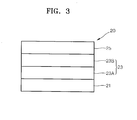
- Figure 3 is a schematic cross-sectional view of a positive electrode 20 according to an embodiment.
- the positive electrode 20 includes a current collector 20, a first layer 23, and a second layer 25.
- the first layer 23 is disposed on the current collector 20 and irreversibly deintercalates lithium ions.
- the second layer 25 is disposed on the first layer 23 and allows reversible intercalation and deintercalation of lithium ions.
- the discussion of current collector 11 and second layer 15 in connection with Figure 1 above is applicable to the current collector 21 and the second layer 25 of Figure 3 .
- the first layer 23 may include a first sublayer 23A and a second sublayer 23B. As illustrated, the first sublayer 23A is interposed between the current collector 21 and the second sublayer 23B, which in turn is interposed between the first sublayer 23A and the second layer 25.
- the first sublayer 23A may include a first active material represented by Formula 1 below.
- the second sublayer 23B may include a second active material represented by Formula 2. Li 2 Mo 1-n R 1 nO 3 Formula 1 Li 2 Ni 1-m R 2 m O 2 Formula 2
- R 1 is selected from the group consisting of Mn, Fe, Co, Cu, Zn, Mg, Ni, and combinations of at least two of the foregoing elements.
- R 2 is selected from the group consisting of Mn, Fe, Co, Cu, Zn, Mg, Mo, and combinations of at least two of the foregoing elements.
- the first active material may be a Li 2 MoO 3 -based active material.
- the second active material may be a Li 2 NiO 2 -based active material.
- any other suitable materials can be used for the first and second active materials.
- the second sublayer 23B may include a second active material, for example, capable of irreversibly deintercalating a large number of lithium ions.
- the second active material may generate O 2 , as described above.
- the net generation of O 2 by the second sublayer 23b may be suppressed or prevented, since the first sublayer 23A including the first active material, for example, a Li 2 MoO 3 -based active material, may absorb O 2 .
- the irreversibility of the negative electrode may be compensated by the first layer 23, and thus, an improved capacity retention rate and guaranteed stability of the lithium battery may be attained.
- the second active material may further include a Li 2 Ni 8 O 10 phase.
- the first sublayer 23A may include the second active material, for example, a Li 2 NiO 2 -based active material
- the second sublayer 23B may include the first active material, for example, a Li 2 MoO 3 -based active material.
- the second active material in the first intermediate layer 23A may further include a Li 2 Ni 8 O 10 phase.
- the thickness ratio of the first sublayer 23A to the second sublayer 23B may vary depending on various factors, which include the active materials, the desired level of performance of the lithium battery, and the like.
- the thickness ratio of the first sublayer 23A to the second sublayer 23B may be from about 5:95 to about 95:5.
- the thickness ratio of the first sublayer 23A to the second sublayer 23B may be from about 72:25 to about 25:75.
- the positive electrode is described with reference to Figures 1 and 3 , the positive electrode may have any of a variety of structures.
- a lithium battery includes: a negative electrode including a negative active material; a positive electrode containing a current collector and at least one positive active material; and an electrolyte.
- the positive electrode includes a first layer that irreversibly deintercalates lithium ions, and a second layer that allows reversible intercalation and deintercalation of lithium ions.
- the negative active material may be selected from various negative active materials suitable for lithium batteries.
- the negative active material may be a negative active material having high capacity.
- the negative active material may be a material that has high capacity, but allows irreversible deintercalation of lithium ions.
- the negative active material examples include silicon, a silicon-based composite material, tin, a tin-based composite material, lithium titanate, and a combination of at least two of these materials.
- the negative active material comprises silicon oxide.
- any other suitable material may be used.
- the negative electrode may include a silicon thin film or a silicon-based composite material.
- the silicon-based composite material may contain silicon and at least one non-silicon material and/or element.
- the silicon-based composite material may be selected from the group consisting of a silicon oxide, a silicon-graphite composite material, a silicon oxide-graphite composite material, a silicon-carbon nanotube composite material, a silicon oxide-carbon nanotube composite material, and a material represented as Si-M 1 wherein M 1 is selected from the group consisting of Al, Sn, Ag, Fe, Bi, Mg, Zn, In, Ge, Pb, Ti, and a combination of at least two of these elements.
- any other suitable material may be used.
- a Lewis' acid such as PF 5 or HF can be produced when a lithium salt is decomposed in the electrolyte during the charge and discharge cycles and Lewis' acid may break down Si-Si bonds and irreversibly form Si-F bonds.
- Si-F bonds have a strong binding force and are stable, and thus, cause irreversible reactions in the negative electrode.
- the tin-based composite material is selected from the group consisting of a tin-graphite composite material, a tin-carbon nanotube composite material, and a material represented as Sn-M 2 wherein M 2 is selected from the group consisting of Al, Si, Ag, Fe, Bi, Mg, Zn, In, Ge, Pb, Ti and a combination of at least two of these elements.
- M 2 is selected from the group consisting of Al, Si, Ag, Fe, Bi, Mg, Zn, In, Ge, Pb, Ti and a combination of at least two of these elements.
- any other suitable material may be used.
- lithium titanate examples include spinel-structured lithium titanate, anatase-structured lithium titanate, and ramsdellite-structured lithium titanate, which are classified according to their crystal structures.
- the negative active material may be Li 4-x Ti 5 O 12 (0 ⁇ x ⁇ 3).
- the negative active material may be Li 4 Ti 5 O 12 .
- any other suitable material may be used.
- tin, tin-based composite materials, and lithium titanate Similar to the silicon-based thin film or silicon-based composite material, tin, tin-based composite materials, and lithium titanate have high capacity, but irreversibly deintercalate lithium ions, and thus, may lead to a poor capacity retention rate.
- the lithium battery may have high capacity characteristics and a good capacity retention rate. This is because the negative electrode is provided with the lithium ions irreversibly deintercalated by the first layer of the positive electrode.
- the first layer described above may be implemented in various forms. According to the invention, net gas generation in a lithium battery may be significantly prevented or reduced, and the lithium battery may have improved stability.
- the negative electrode that may be used together with the positive electrode described above may include a silicon composite material (for example, a silicon oxide) as a negative active material.
- a silicon composite material for example, a silicon oxide
- any other suitable negative active material may be used instead.
- the electrolyte may include a non-aqueous organic solvent and a lithium salt.
- the non-aqueous organic solvent in the electrolyte may function as a migration medium of ions involved in electrochemical reactions of the lithium battery.
- Examples of the non-aqueous organic solvent include a carbonate-based solvent, an ester-based solvent, an ether-based solvent, a ketone-based solvent, an alcohol-based solvent, and an aprotic solvent.
- Examples of the carbonate-based solvent include dimethyl carbonate (DMC), diethyl carbonate (DEC), dipropyl carbonate (DPC), methylpropyl carbonate (MPC), ethylpropyl carbonate (EPC), ethylmethyl carbonate (EMC), ethylene carbonate (EC), propylene carbonate (PC), and butylene carbonate (BC).
- DMC dimethyl carbonate
- DEC diethyl carbonate
- DPC dipropyl carbonate
- MPC methylpropyl carbonate
- EPC ethylpropyl carbonate
- EMC ethylmethyl carbonate
- EMC ethylmethyl carbonate
- EC ethylene carbonate
- PC propylene carbonate
- BC butylene carbonate
- any other suitable carbonate-based solvent may be used.
- ester-based solvent examples include methyl acetate, ethyl acetate, n-propyl acetate, dimethyl acetate, methyl propionate, ethyl propionate, ⁇ -butyrolactone (GBL), decanolide, valerolactone, mevalonolactone, and caprolactone.
- GBL ⁇ -butyrolactone
- ether-based solvent examples include dibutyl ether, tetraglyme, diglyme, dimethoxy ethane, 2-methyltetrahydrofuran, and tetrahydrofuran. However, any other suitable ether-based solvent may be used.
- ketone-based solvent is cyclohexanone.
- any other suitable ketone-based solvent may be used.
- alcohol-based solvent examples include ethyl alcohol, and isopropyl alcohol. However, any other suitable alcohol-based solvent may be used.
- aprotic solvent examples include nitriles (such as R-CN, where R is a C 2 -C 20 linear, branched, or cyclic hydrocarbon-based moiety that may include a double-bonded aromatic ring or an ether bond), amides (such as dimethylformamide), dioxolanes (such as 1,3-dioxolane), and sulfolanes.
- nitriles such as R-CN, where R is a C 2 -C 20 linear, branched, or cyclic hydrocarbon-based moiety that may include a double-bonded aromatic ring or an ether bond
- amides such as dimethylformamide
- dioxolanes such as 1,3-dioxolane
- sulfolanes any other suitable aprotic solvent may be used.
- the non-aqueous organic solvent may include a single solvent used alone or a combination of at least two solvents. If a combination of solvents is used, the ratio of the non-aqueous organic solvents may vary according to the desired performance of the lithium battery, which will be obvious to one of ordinary skill in the art.
- the non-aqueous organic solvent may be a mixture of ethylene carbonate (EC) and ethylmethyl carbonate (EMC) in a volume ratio of about 3:7.
- the non-aqueous organic solvent may be a mixture of EC, GBL, and EMC in a volume ratio of about 3:3:4.
- the lithium salt in the electrolyte solution is dissolved in the non-aqueous organic solvent and functions as a source of lithium ions in the lithium battery, and accelerates the migration of lithium ions between the positive electrode and the negative electrode.
- the lithium salt may include at least one supporting electrolyte salt selected from the group consisting of LiPF 6 , LiBF 4 , LiSbF 6 , LiAsF 6 , LiN (SO 2 C 2 F 5 ) 2 , Li (CF 3 SO 2 ) 2 N, LiC 4 F 9 SO 3 , LiClO 4 , LiAlO 2 , LiAlCl 4 , LiN (C x F 2x+1 SO 2 )(C y F 2y+1 SO 2 ) (where x and y are each independently a natural number), LiCl, LiI, and LiB (C 2 O 4 ) 2 (lithium bis(oxalato) borate or LiBOB).
- the electrolyte salt may be a combination of two or more of the foregoing electrolyte salts.
- the concentration of the lithium salt may be in a range of about 0.1 M to about 2.0 M.
- the concentration of the lithium salt may be about 0.6 M to about 2.0 M.
- the first electrolyte may have the desired conductivity and viscosity, and thus lithium ions may efficiently migrate.
- the electrolyte may further include an additive capable of improving the low-temperature performance of the lithium battery.
- the additive include a carbonate-based material and propane sultone (PS).
- PS propane sultone
- any suitable additive may be used.
- one additive may be used, or a combination of additives may be used.
- Examples of the carbonate-based material include vinylene carbonate (VC); vinylene carbonate (VC) derivatives having at least one substituent selected from the group consisting of halogen atoms (such as F, Cl, Br, and I), cyano groups (CN), and nitro groups (NO 2 ); and ethylene carbonate (EC) derivatives having at least one substituent selected from the group consisting of halogen atoms (such as F, Cl, Br, and I), cyano groups (CN), and nitro groups (NO 2 ).
- VC vinylene carbonate
- VC vinylene carbonate
- VC vinylene carbonate
- EC ethylene carbonate
- any suitable carbonate-based material may be used.
- the electrolyte may further include at least one additive selected from the group consisting of vinylene carbonate (VC), fluoroethylene carbonate (FEC), and propane sultone (PS).
- VC vinylene carbonate
- FEC fluoroethylene carbonate
- PS propane sultone
- the amount of the additive may be about 10 parts or less by weight based on 100 parts by weight of the total amount of the non-aqueous organic solvent and the lithium salt.
- the amount of the additive may be in a range of about 0.1 parts by weight to about 10 parts by weight based on 100 parts by weight of the total amount of the non-aqueous organic solvent and the lithium salt. When the amount of the additive is within these ranges, the lithium battery may have satisfactorily improved low-temperature characteristics.
- the amount of the additive may be in a range of about 1 part by weight to about 5 parts by weight based on 100 parts by weight of the total amount of the non-aqueous organic solvent and the lithium salt.
- the amount of the additive may be in a range of about 2 parts by weight to about 4 parts by weight, based on 100 parts by weight of the total amount of the non-aqueous organic solvent and the lithium salt.
- the amount of the additive may be about 2 parts by weight based on 100 parts by weight of the total amount of the non-aqueous organic solvent and the lithium salt.
- a separator may be positioned between the positive electrode and the negative electrode in the lithium battery. Any separator commonly used for lithium batteries may be used.
- the separator may have low resistance to the migration of ions in an electrolyte and a high electrolyte-retaining ability.
- materials used to form the separator include glass fiber, polyester, Teflon®, polyethylene, polypropylene, polytetrafluoroethylene (PTFE), and combinations thereof, each of which may be a non-woven or woven fabric.
- PTFE polytetrafluoroethylene
- a rollable separator formed of a material such as polyethylene and polypropylene may be used for lithium ion batteries.
- a separator capable of retaining a large amount of an organic electrolyte may be used for lithium ion polymer batteries.
- a polymer resin, a filler, and a solvent are mixed to prepare a separator composition.
- the separator composition may be coated directly on an electrode, and then dried to form a separator film.
- the separator composition may be cast on a separate support and then dried to form a separator composition film, which is then removed from the support and laminated on an electrode to form a separator film.
- the polymer resin may be any material commonly used as a binder for electrode plates.
- the polymer resin include a vinylidenefluoride/hexafluoropropylene copolymer, polyvinylidenefluoride, polyacrylonitrile, polymethylmethacrylate, and mixtures thereof.
- any suitable polymer resin may be used.
- a vinylidenefluoride/hexafluoropropylene copolymer containing about 8 to about 25 wt% of hexafluoropropylene may be used.
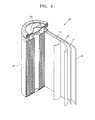
- FIG 4 is a schematic perspective view of a lithium battery 30 according to an embodiment of the present invention.
- the lithium battery 30 includes an electrode assembly having a positive electrode 23, a negative electrode 22, and a separator 24 between the positive electrode 23 and the negative electrode 22.
- the electrode assembly is contained within a battery case 25, and a sealing member 26 seals the battery case 25.
- An electrolyte (not shown) is injected into the battery case 25 to impregnate the electrolyte assembly.
- the lithium battery 30 is manufactured by sequentially stacking the positive electrode 23, the negative electrode 22, and the separator 24 on one another to form a stack, rolling the stack, and inserting the rolled up stack into the battery case 25.
- the type of the lithium battery is not particularly limited, and may be, for example, a lithium secondary battery such as a lithium ion battery, a lithium ion polymer battery, a lithium sulfur battery, or the like, or a lithium primary battery.
- a lithium secondary battery such as a lithium ion battery, a lithium ion polymer battery, a lithium sulfur battery, or the like, or a lithium primary battery.
- a positive electrode may be manufactured by forming first and second layers on a current collector.
- a method of forming the first layer involves mixing a first active material represented by Formula 1 and/or a second active material represented by Formula 2 with a binder and a solvent to prepare a first layer composition.
- the first layer composition is coated directly on a current collector (for example, an aluminium current collector) to form the first layer.
- a second layer composition including an active material that allows reversible intercalation and deintercalation of lithium ions, a binder, and a solvent is coated on the first layer and is then dried to form the second layer, thereby manufacturing a positive electrode plate.
- first and second layer compositions may be cast on separate supports, respectively, to form the first and second layers, which are then separated from the supports and laminated on the current collector to manufacture a positive electrode plate.
- suitable solvents include N-methylpyrrolidone, acetone, water, and the like.
- a first sublayer composition, a second sublayer composition, and a second layer composition may be separately prepared and sequentially coated on a current collector to form a first sublayer, a second sublayer and a second layer, respectively. Active materials added to these compositions are described in more detail above.
- the binders in the first and second layers bind the active material particles together and to the current collector.
- the binders include polyvinyl alcohol, carboxymethyl cellulose, hydroxypropyl cellulose, diacetyl cellulose, polyvinyl chloride, carboxylated polyvinyl chloride, polyvinyl fluoride, a polymer including ethylene oxide, polyvinylpyrrolidone, polyurethane, polytetrafluoroethylene, polyvinylidene fluoride, polyethylene, polypropylene, styrene-butadiene rubber (SBR), acrylated SBR, epoxy resin, and nylon.
- SBR styrene-butadiene rubber
- the first layer and/or the second layer may further include a conducting agent for providing conductivity to the positive electrode.
- a conducting agent for providing conductivity to the positive electrode.
- Any electron conducting materials that would not induce chemical changes in batteries may be used.
- the conducting agent may include carbonaceous materials, such as natural graphite, artificial graphite, carbon black, acetylene black, ketjen black, carbon fibers, and the like; metal-based materials, such as copper (Cu), nickel (Ni), aluminum (Al), silver (Ag), and the like, in powder or fiber form; and conductive materials, including conductive polymers, such as a polyphenylene derivative, and mixtures thereof.
- the current collector may be aluminum (Al). However, any other suitable material may be used instead.
- a negative active material, a conducting agent, a binder, and a solvent are mixed to prepare a negative active material composition.
- the negative active material composition is coated directly on a current collector (for example, a Cu current collector), or is cast on a separate support to form a negative active material film, which is then separated from the support and laminated on a Cu current collector to obtain a negative electrode plate.
- the amounts of the negative active material, the conducting agent, the binder, and the solvent may be amounts commonly used in lithium batteries.
- the negative electrode may be manufactured using plating or any of a variety of methods.
- the conducting agent, the binder, and the solvent in the negative active material composition may be the same as those used in the positive active material composition. If required, a plasticizer may be further added to each of the positive electrode active material composition and the negative electrode active material composition to produce pores in the electrode plates.
- the separator is positioned between the positive electrode plate and the negative electrode plate to form a battery assembly, which is then wound or folded.
- the primary assembly is then encased in a cylindrical or rectangular battery case. Then, an electrolyte is injected into the battery case, thereby completing the manufacture of a lithium battery assembly.
- a SiO x negative active material and a polyvinylidene fluoride (PVDF) binder were mixed in weight ratio of 90:10 in an N-methylpyrrolidone solvent to prepare negative electrode slurry.
- the negative electrode slurry was coated on a copper (Cu)-foil to form a thin negative electrode plate having thickness of 14 ⁇ m, and dried at 135°C for 20 minutes to provide a negative electrode.
- PVDF polyvinylidene fluoride
- the first layer composition was coated on an aluminum (Al)-foil to form a thin electrode plate having thickness of 60 ⁇ m, and dried at 135°C for 20 minutes to form a first layer having thickness of 35 ⁇ m (including the Li 2 MoO 3 active material).
- a LiCoO 2 active material, a PVDF binder, and a carbon conducting agent (Denka Black, an acetylene black) were dispersed in weight ratio of 96:2:2 in an N-methylpyrrolidone solvent to prepare a second layer composition.
- the second layer composition was coated on the first layer to form a thin electrode plate having thickness of 60 ⁇ m, dried at 135°C for 3 hours or longer, and then pressed to form a second layer having thickness of 35 ⁇ m (including the LiCoO 2 active material), thereby completing the manufacture of a positive electrode.
- 1.0M LiPF 6 was added to a mixture of ethylene carbonate (EC) and ethylmethyl carbonate (EMC) (in volume ratio of 3:7) to prepare an electrolyte.
- EC ethylene carbonate
- EMC ethylmethyl carbonate
- the negative electrode, the positive electrode, the electrolyte, and a porous polyethylene (PE) separator film were assembled to manufacture a coin cell battery.
- a lithium battery was manufactured in the same manner as in Example 1, except that Li 2 NiO 2 , instead of Li 2 MoO 3 , was used in the first layer composition.
- the first layer of the lithium battery included the Li 2 NiO 2 active material.
- a lithium battery was manufactured in the same manner as in Example 1, except that Li 2 NiO 2 including a Li 2 Ni 8 O 10 phase was used in the first layer composition, instead of Li 2 MoO 3 .
- the first layer of the lithium battery included the Li 2 Ni 8 O 10 phase-included Li 2 NiO 2 active material.
- the Li 2 NiO 2 active material including Li 2 Ni 8 O 10 phase was synthesized as follows. A mixture of Li 2 O and NiO in stoichiometric ratio (1:1 molar ratio) was thermally treated in N 2 atmosphere at 550°C for 10 hours and then further at 550°C for 10 hours.
- Figure 2 is a graph of X-ray diffraction (XRD) analysis of the Li 2 NiO 2 active material.
- a lithium battery was manufactured in the same manner as in Example 1, except that Li 2 NiO 2 including Li 2 Ni 8 O 10 phase was further added to the first layer composition.
- the first layer of the lithium battery included both the Li 2 Ni 8 O 10 phase-included Li 2 NiO 2 , and Li 2 MoO 3 .
- Weight ratio of the Li 2 Ni 8 O 1o phase-included Li 2 MoO 3 to Li 2 NiO 2 was about 75:25.
- a lithium battery was manufactured in the same manner as in Example 1, except that a first sublayer and a second sublayer were sequentially formed to obtain a first layer, instead of the first layer according to Example 1.
- a Li 2 MoO 3 active material, a PVDF binder, and a carbon conducting agent (an acetylene black, DENKA BLACK) were dispersed in weight ratio of 96:2:2 in an N-methylpyrrolidone solvent to prepare a composition for the first sublayer.
- the first sublayer composition was coated on an aluminium (Al)-foil to form a thin electrode plate having thickness of 60 ⁇ m, and dried at 135°C for 3 hours or longer to form the first sublayer having thickness of 35 ⁇ m.
- a Li 2 NiO 2 binder, a PVDF binder, and a carbon conducting agent (an acetylene black, DENKA BLACK) were dispersed in a weight ratio of 96:2:2 in an N-methylpyrrolidone solvent to prepare a composition for the second sublayer.
- the second sublayer composition was coated on the first sublayer to form a thin electrode plate having thickness of 60 ⁇ m, and dried at 135°C for 3 hours or longer to form the second sublayer having thickness of 35 ⁇ m.
- a lithium battery was manufactured in the same manner as in Example 1, except that a first sublayer and a second sublayer were sequentially formed to obtain a first layer, instead of the first layer according to Example 1.
- a Li 2 NiO 2 active material, a PVDF binder, and a carbon conducting agent (an acetylene black, DENKA BLACK) were dispersed in a weight ratio of 96:2:2 in an N-methylpyrrolidone solvent to prepare a first sublayer composition.
- the first sublayer composition was coated on an aluminium (Al)-foil to form a thin electrode plate having thickness of 60 ⁇ m, and dried at 135°C for 3 hours or longer to form the first sublayer having thickness of 35 ⁇ m.
- a Li 2 MoO 3 binder, a PVDF binder, and a carbon conducting agent (an acetylene black, DENKA BLACK) were dispersed in weight ratio of 96:2:2 in an N-methylpyrrolidone solvent to prepare a second sublayer composition.
- the second sublayer composition was coated on the first sublayer to form a thin electrode plate having thickness of 60 ⁇ m, and dried at 135°C for 3 hours or longer to form the second sublayer having thickness of 35 ⁇ m.
- a lithium battery was manufactured in the same manner as in Example 1, except that no first layer was formed, unlike Example 1.
- the lithium batteries of Comparative Example 1 and Examples 1, 5 and 6 were left at room temperature (25°C) for 20 hours and were then subjected to charging and discharging (formation process) of the lithium batteries at the rate of 0.05 C. After completion of the formation process, the lithium batteries were charged in a constant current/constant voltage (CC/CV) mode at the rate of 0.6 C, charge voltage of 4.35 V and charge cut-off current of 0.06 C and then discharged at the rate of 1 C and discharge cut-off voltage of 2.5V. This charge and discharge cycle was repeated to measure the capacity and 0.6C/1C cycle lifetime of each of the lithium batteries. The 0.6 C/1 C cycle lifetime was measured as a relative capacity percentage with respect to the overall initial cycle capacity. The results are shown in Figure 5 . Referring to Figure 5 , the lithium batteries of Examples 1, 5 and 6 show better lifetime characteristics than the lithium battery of Comparative Example 1.
- a lithium battery including the positive electrode according to embodiments of the invention may have good capacity retention characteristics and stability even when using a negative electrode including a negative active material that irreversibly deintercalates lithium ions.
Landscapes
- Chemical & Material Sciences (AREA)
- Organic Chemistry (AREA)
- Chemical Kinetics & Catalysis (AREA)
- Electrochemistry (AREA)
- General Chemical & Material Sciences (AREA)
- Inorganic Chemistry (AREA)
- Composite Materials (AREA)
- Engineering & Computer Science (AREA)
- Materials Engineering (AREA)
- Manufacturing & Machinery (AREA)
- Battery Electrode And Active Subsutance (AREA)
- Secondary Cells (AREA)
Applications Claiming Priority (1)
| Application Number | Priority Date | Filing Date | Title |
|---|---|---|---|
| KR1020100070078A KR101202334B1 (ko) | 2010-07-20 | 2010-07-20 | 양극 및 이를 포함한 리튬 전지 |
Publications (3)
| Publication Number | Publication Date |
|---|---|
| EP2410600A2 true EP2410600A2 (de) | 2012-01-25 |
| EP2410600A3 EP2410600A3 (de) | 2013-10-23 |
| EP2410600B1 EP2410600B1 (de) | 2019-10-23 |
Family
ID=44503600
Family Applications (1)
| Application Number | Title | Priority Date | Filing Date |
|---|---|---|---|
| EP11173886.0A Active EP2410600B1 (de) | 2010-07-20 | 2011-07-13 | Positive Elektrode und wiederaufladbare Lithiumbatterie damit |
Country Status (5)
| Country | Link |
|---|---|
| US (1) | US8999575B2 (de) |
| EP (1) | EP2410600B1 (de) |
| JP (1) | JP5536720B2 (de) |
| KR (1) | KR101202334B1 (de) |
| CN (1) | CN102339980B (de) |
Cited By (4)
| Publication number | Priority date | Publication date | Assignee | Title |
|---|---|---|---|---|
| WO2017045941A1 (de) * | 2015-09-16 | 2017-03-23 | Robert Bosch Gmbh | Aktivmaterial für eine positive elektrode einer batteriezelle, positive elektrode und batteriezelle |
| EP3147971A1 (de) * | 2015-09-24 | 2017-03-29 | Contemporary Amperex Technology Co., Limited | Positive elektrode und lithium-ionen-batterie damit |
| CN117594891A (zh) * | 2023-12-07 | 2024-02-23 | 兰钧新能源科技有限公司 | 一种复合补锂剂及其应用、正极极片、锂电池和用电装置 |
| US12266796B2 (en) | 2019-09-20 | 2025-04-01 | Semiconductor Energy Laboratory Co., Ltd. | Positive electrode for secondary battery, secondary battery, and electronic device |
Families Citing this family (33)
| Publication number | Priority date | Publication date | Assignee | Title |
|---|---|---|---|---|
| US11101465B2 (en) | 2017-03-28 | 2021-08-24 | Enevate Corporation | Reaction barrier between electrode active material and current collector |
| US10388943B2 (en) | 2010-12-22 | 2019-08-20 | Enevate Corporation | Methods of reducing occurrences of short circuits and/or lithium plating in batteries |
| US9583757B2 (en) | 2010-12-22 | 2017-02-28 | Enevate Corporation | Electrodes, electrochemical cells, and methods of forming electrodes and electrochemical cells |
| CN108666527B (zh) * | 2013-03-12 | 2022-03-04 | 新强能电池公司 | 形成电极的方法 |
| KR101558774B1 (ko) * | 2013-05-23 | 2015-10-08 | 주식회사 엘지화학 | 다층의 활물질층을 포함하는 리튬 이차전지 |
| CN105359312A (zh) * | 2013-07-15 | 2016-02-24 | 株式会社半导体能源研究所 | 正极活性物质及二次电池 |
| WO2015016548A1 (ko) * | 2013-07-30 | 2015-02-05 | 주식회사 엘지화학 | 비가역 첨가제가 포함되어 있는 이차전지용 양극 합제 |
| US11721831B2 (en) * | 2013-08-30 | 2023-08-08 | Sila Nanotechnologies, Inc. | Electrolyte or electrode additives for increasing metal content in metal-ion batteries |
| CN104577088A (zh) * | 2013-10-16 | 2015-04-29 | 中国科学院物理研究所 | 二次电池电极材料钼酸锂 |
| JP6117718B2 (ja) * | 2014-03-03 | 2017-04-19 | Jx金属株式会社 | リチウム複合酸化物 |
| JP6497854B2 (ja) * | 2014-07-01 | 2019-04-10 | 旭化成建材株式会社 | 木造建築物の耐火外壁構造 |
| JP6497855B2 (ja) * | 2014-07-01 | 2019-04-10 | 旭化成建材株式会社 | 木造建築物の耐火外壁構造 |
| DE102014213686A1 (de) | 2014-07-15 | 2016-01-21 | Robert Bosch Gmbh | Elektrode für eine galvanische Zelle |
| KR101786909B1 (ko) * | 2014-10-06 | 2017-10-18 | 주식회사 엘지화학 | 교번 배열된 전극 합제부와 비가역부를 포함하고 있는 전극 및 그것을 포함하는 이차전지 |
| CN105895905B (zh) * | 2015-02-13 | 2021-06-22 | 松下知识产权经营株式会社 | 电池正极材料和锂离子电池 |
| KR102475888B1 (ko) * | 2015-08-13 | 2022-12-08 | 삼성전자주식회사 | 금속산화물 복합체 및 금속산화물 복합체 제조방법 |
| WO2017163317A1 (ja) * | 2016-03-22 | 2017-09-28 | 国立研究開発法人産業技術総合研究所 | 非水電解質二次電池用の正極材料およびその製造方法 |
| KR102172153B1 (ko) * | 2016-06-16 | 2020-10-30 | 주식회사 엘지화학 | 용량 및 안전성이 개선된 리튬 이차전지용 양극 및 이를 포함하는 리튬 이차전지 |
| EP3319156A1 (de) * | 2016-11-07 | 2018-05-09 | Samsung Electronics Co., Ltd. | Elektrochemische vorrichtung und verfahren zur herstellung davon |
| KR102727051B1 (ko) * | 2016-11-07 | 2024-11-07 | 삼성전자주식회사 | 전기화학 디바이스 및 이의 제조방법 |
| KR102314029B1 (ko) * | 2017-03-30 | 2021-10-18 | 주식회사 엘지에너지솔루션 | 고로딩 전극의 제조 방법 |
| HUE062067T2 (hu) * | 2017-11-17 | 2023-09-28 | Lg Energy Solution Ltd | Eljárás egy lítium szekunder akkumulátorhoz alkalmas katód anyagba foglalt irreverzibilis adalékanyag elõállítására, az azzal elõállított irreverzibilis adalékanyagot magába foglaló katód anyag, és a katód anyagot tartalmazó lítium szekunder akkumulátor |
| KR102646712B1 (ko) * | 2017-11-22 | 2024-03-12 | 주식회사 엘지에너지솔루션 | 리튬 이차전지용 양극 첨가제의 제조방법 |
| US10686214B2 (en) | 2017-12-07 | 2020-06-16 | Enevate Corporation | Sandwich electrodes and methods of making the same |
| US11133498B2 (en) | 2017-12-07 | 2021-09-28 | Enevate Corporation | Binding agents for electrochemically active materials and methods of forming the same |
| US12334542B2 (en) | 2017-12-07 | 2025-06-17 | Enevate Corporation | Solid film as binder for battery electrodes |
| PL3605678T3 (pl) | 2017-12-27 | 2023-04-24 | Lg Energy Solution, Ltd. | Akumulator litowy |
| WO2021039063A1 (ja) * | 2019-08-27 | 2021-03-04 | パナソニックIpマネジメント株式会社 | 二次電池 |
| PL3985762T3 (pl) | 2020-01-31 | 2023-10-23 | Lg Energy Solution, Ltd. | Nieodwracalny dodatek zawarty w materiale katodowym dla baterii akumulatorowej, zawierający go materiał katodowy i bateria akumulatorowa zawierająca materiał katodowy |
| CN114667614B (zh) * | 2020-08-24 | 2025-07-11 | 株式会社Lg新能源 | 包含含有不可逆添加剂的正极材料的二次电池及其制造方法 |
| KR102915029B1 (ko) * | 2021-11-25 | 2026-01-19 | 컨템포러리 엠퍼렉스 테크놀로지 (홍콩) 리미티드 | 양극 슬러리, 양극 극판 및 상기 양극 극판을 포함하는 이차 전지 |
| JP2023142796A (ja) * | 2022-03-25 | 2023-10-05 | 本田技研工業株式会社 | リチウム二次電池 |
| CN119297272A (zh) * | 2024-09-29 | 2025-01-10 | 合肥国轩高科动力能源有限公司 | 一种正极补锂添加剂及其制备方法与应用 |
Family Cites Families (27)
| Publication number | Priority date | Publication date | Assignee | Title |
|---|---|---|---|---|
| JP2526093B2 (ja) * | 1988-05-20 | 1996-08-21 | 日立マクセル株式会社 | リチウム二次電池 |
| JPH06342673A (ja) | 1993-05-31 | 1994-12-13 | Hitachi Maxell Ltd | リチウム二次電池 |
| WO1997024773A1 (en) * | 1995-12-27 | 1997-07-10 | Motorola Inc. | Electrode material for electrochemical lithium intercalation |
| JPH10112318A (ja) | 1996-10-08 | 1998-04-28 | Fuji Elelctrochem Co Ltd | 非水電解液二次電池 |
| JP3378756B2 (ja) | 1997-03-10 | 2003-02-17 | 三洋電機株式会社 | リチウム電池 |
| DE69819395T2 (de) | 1997-04-15 | 2004-09-09 | Sanyo Electric Co., Ltd., Moriguchi | Positivelektrodenmaterialf für Verwendung nichtwässriger Elektrolyt enthaltender Batterie und Verfahren zur seiner Herstellung und nichtwässriger Elektrolyt enthaltende Batterie |
| JP3561607B2 (ja) | 1997-05-08 | 2004-09-02 | 三洋電機株式会社 | 非水電解質二次電池及び正極材料の製造方法 |
| KR20020046658A (ko) | 2000-12-15 | 2002-06-21 | 윤덕용 | 리튬이차전지의 양극전극용 층상구조 산화물의 표면처리방법 |
| JP4415241B2 (ja) * | 2001-07-31 | 2010-02-17 | 日本電気株式会社 | 二次電池用負極およびそれを用いた二次電池、および負極の製造方法 |
| JP2005521220A (ja) | 2002-03-22 | 2005-07-14 | エルジー ケミカル エルティーディー. | 過放電防止剤を含むリチウム二次電池 |
| CN100344018C (zh) | 2003-09-26 | 2007-10-17 | 株式会社Lg化学 | 调节过放电期间阴极终止电压的方法和用于锂二次电池的阴极活性材料 |
| CN100338800C (zh) * | 2004-02-17 | 2007-09-19 | 比亚迪股份有限公司 | 一种锂电池正极及其制备方法以及锂离子二次电池 |
| KR100578877B1 (ko) | 2004-03-12 | 2006-05-11 | 삼성에스디아이 주식회사 | 리튬 이차 전지 |
| KR100644915B1 (ko) | 2005-01-21 | 2006-11-10 | 주식회사 이엔켐 | 리튬이차전지용 양극활 물질 및 이를 포함한 리튬이차전지 |
| KR100667951B1 (ko) | 2005-04-12 | 2007-01-11 | 삼성에스디아이 주식회사 | 리튬 이차 전지 |
| WO2006114775A2 (en) * | 2005-04-27 | 2006-11-02 | Tg Biotech | Treatment of insulin resistance syndrome |
| JP5051988B2 (ja) | 2005-07-29 | 2012-10-17 | 三洋電機株式会社 | 電極の製造方法、その製造方法に用いる電極の製造装置、及び当該電極の製造方法により製造された電極を用いた電池 |
| KR100775077B1 (ko) | 2005-08-19 | 2007-11-08 | 경상대학교산학협력단 | 리튬 이차전지의 양극재 및 그 제조방법 |
| US20070077488A1 (en) * | 2005-10-04 | 2007-04-05 | Kaimin Chen | Power capability of a cathode |
| US20070141470A1 (en) | 2005-12-16 | 2007-06-21 | Kensuke Nakura | Lithium ion secondary battery |
| JP5100143B2 (ja) * | 2007-02-05 | 2012-12-19 | 三洋電機株式会社 | 電池ユニット |
| KR100999563B1 (ko) | 2008-01-14 | 2010-12-08 | 한양대학교 산학협력단 | 리튬 이차 전지용 양극 활물질, 이의 제조방법, 및 이를포함하는 리튬 이차 전지 |
| WO2009119093A1 (ja) * | 2008-03-26 | 2009-10-01 | パナソニック株式会社 | リチウム二次電池用電極およびその製造方法 |
| JP5259268B2 (ja) | 2008-06-25 | 2013-08-07 | 三星エスディアイ株式会社 | 非水電解質二次電池 |
| US20090325072A1 (en) * | 2008-06-25 | 2009-12-31 | Hideaki Maeda | Rechargeable lithium battery |
| KR101435212B1 (ko) | 2008-09-17 | 2014-08-28 | 주식회사 엘지화학 | 두께가 상이한 전극을 포함하는 다층 구조의 이차전지 |
| JP5172564B2 (ja) | 2008-09-25 | 2013-03-27 | 株式会社東芝 | 非水電解質二次電池 |
-
2010
- 2010-07-20 KR KR1020100070078A patent/KR101202334B1/ko active Active
-
2011
- 2011-05-05 US US13/101,645 patent/US8999575B2/en active Active
- 2011-07-12 JP JP2011153722A patent/JP5536720B2/ja active Active
- 2011-07-13 EP EP11173886.0A patent/EP2410600B1/de active Active
- 2011-07-15 CN CN201110198639.1A patent/CN102339980B/zh active Active
Non-Patent Citations (1)
| Title |
|---|
| None |
Cited By (6)
| Publication number | Priority date | Publication date | Assignee | Title |
|---|---|---|---|---|
| WO2017045941A1 (de) * | 2015-09-16 | 2017-03-23 | Robert Bosch Gmbh | Aktivmaterial für eine positive elektrode einer batteriezelle, positive elektrode und batteriezelle |
| US10833319B2 (en) | 2015-09-16 | 2020-11-10 | Robert Bosch Gmbh | Active material for a positive electrode of a battery cell, positive electrode, and battery cell |
| EP3147971A1 (de) * | 2015-09-24 | 2017-03-29 | Contemporary Amperex Technology Co., Limited | Positive elektrode und lithium-ionen-batterie damit |
| US10541410B2 (en) | 2015-09-24 | 2020-01-21 | Contemporary Amperex Technology Co., Limited | Positive electrode and li-ion battery including the same |
| US12266796B2 (en) | 2019-09-20 | 2025-04-01 | Semiconductor Energy Laboratory Co., Ltd. | Positive electrode for secondary battery, secondary battery, and electronic device |
| CN117594891A (zh) * | 2023-12-07 | 2024-02-23 | 兰钧新能源科技有限公司 | 一种复合补锂剂及其应用、正极极片、锂电池和用电装置 |
Also Published As
| Publication number | Publication date |
|---|---|
| JP5536720B2 (ja) | 2014-07-02 |
| KR101202334B1 (ko) | 2012-11-16 |
| US20120021284A1 (en) | 2012-01-26 |
| US8999575B2 (en) | 2015-04-07 |
| EP2410600A3 (de) | 2013-10-23 |
| JP2012028322A (ja) | 2012-02-09 |
| CN102339980A (zh) | 2012-02-01 |
| EP2410600B1 (de) | 2019-10-23 |
| CN102339980B (zh) | 2015-12-16 |
| KR20120009703A (ko) | 2012-02-02 |
Similar Documents
| Publication | Publication Date | Title |
|---|---|---|
| EP2410600B1 (de) | Positive Elektrode und wiederaufladbare Lithiumbatterie damit | |
| EP3512028B1 (de) | Elektrolytadditiv und nicht-wässrige elektrolytlösung für lithiumsekundärbatterie dasselbe enthaltend | |
| US11139507B2 (en) | Electrolyte for lithium secondary battery and lithium secondary battery including the same | |
| EP2302725B1 (de) | Lithiumbatterie mit einem nichtwässrigen Elektrolyten und einem Additiv | |
| KR101744088B1 (ko) | 리튬 이차 전지 | |
| US20120021287A1 (en) | Positive electrode and lithium battery including the same | |
| US8415057B2 (en) | Electrolytic solution for lithium battery, lithium battery comprising the same and method of operating the lithium battery | |
| CN102290562A (zh) | 锂电池及其制造方法 | |
| EP3506411B1 (de) | Organische elektrolytlösung und lithiumbatterie damit | |
| KR102018756B1 (ko) | 리튬 이차전지용 전해액 및 이를 포함하는 리튬 이차전지 | |
| EP1970989A1 (de) | Elektrolyt für eine wiederaufladbare Lithium-Ionen-Batterie und wiederaufladbare Lithium-Ionen-Batterie damit | |
| KR102436421B1 (ko) | 리튬 이차전지용 전해액 및 이를 포함하는 리튬 이차전지 | |
| US8685572B2 (en) | Organic electrolyte and lithium battery including the same | |
| EP3644417B1 (de) | Lithiumsekundärbatterie umfassend einen elektrolyten mit einer isocyanatverbindung | |
| KR102426254B1 (ko) | 리튬 이차전지용 전해질 첨가제를 포함하는 리튬 이차전지 | |
| KR102475181B1 (ko) | 리튬 금속 전지용 음극, 이의 제조 방법, 및 이를 포함하는 리튬 금속 전지 | |
| KR20150069904A (ko) | 리튬 이차 전지용 전해질 및 이를 포함하는 리튬 이차 전지 | |
| KR102233778B1 (ko) | 전해질 및 이를 포함하는 이차 전지 | |
| KR20130080337A (ko) | 리튬 이차전지용 양극 및 이것을 포함하는 리튬이차전지 |
Legal Events
| Date | Code | Title | Description |
|---|---|---|---|
| AK | Designated contracting states |
Kind code of ref document: A2 Designated state(s): AL AT BE BG CH CY CZ DE DK EE ES FI FR GB GR HR HU IE IS IT LI LT LU LV MC MK MT NL NO PL PT RO RS SE SI SK SM TR |
|
| AX | Request for extension of the european patent |
Extension state: BA ME |
|
| PUAI | Public reference made under article 153(3) epc to a published international application that has entered the european phase |
Free format text: ORIGINAL CODE: 0009012 |
|
| 17P | Request for examination filed |
Effective date: 20120326 |
|
| PUAL | Search report despatched |
Free format text: ORIGINAL CODE: 0009013 |
|
| RIC1 | Information provided on ipc code assigned before grant |
Ipc: H01M 4/131 20100101ALI20130909BHEP Ipc: H01M 4/36 20060101ALI20130909BHEP Ipc: H01M 4/48 20100101ALN20130909BHEP Ipc: H01M 4/485 20100101ALI20130909BHEP Ipc: H01M 10/0525 20100101AFI20130909BHEP Ipc: C01G 53/04 20060101ALI20130909BHEP Ipc: C01G 39/02 20060101ALI20130909BHEP Ipc: H01M 4/505 20100101ALN20130909BHEP Ipc: H01M 4/525 20100101ALI20130909BHEP |
|
| AK | Designated contracting states |
Kind code of ref document: A3 Designated state(s): AL AT BE BG CH CY CZ DE DK EE ES FI FR GB GR HR HU IE IS IT LI LT LU LV MC MK MT NL NO PL PT RO RS SE SI SK SM TR |
|
| AX | Request for extension of the european patent |
Extension state: BA ME |
|
| 17Q | First examination report despatched |
Effective date: 20150716 |
|
| STAA | Information on the status of an ep patent application or granted ep patent |
Free format text: STATUS: EXAMINATION IS IN PROGRESS |
|
| GRAP | Despatch of communication of intention to grant a patent |
Free format text: ORIGINAL CODE: EPIDOSNIGR1 |
|
| STAA | Information on the status of an ep patent application or granted ep patent |
Free format text: STATUS: GRANT OF PATENT IS INTENDED |
|
| RIC1 | Information provided on ipc code assigned before grant |
Ipc: C01G 39/00 20060101ALI20190322BHEP Ipc: H01M 4/131 20100101ALI20190322BHEP Ipc: H01M 4/48 20100101ALN20190322BHEP Ipc: H01M 4/485 20100101ALI20190322BHEP Ipc: H01M 4/505 20100101ALN20190322BHEP Ipc: C01G 53/00 20060101ALI20190322BHEP Ipc: H01M 10/0525 20100101AFI20190322BHEP Ipc: H01M 4/36 20060101ALI20190322BHEP Ipc: H01M 4/525 20100101ALI20190322BHEP Ipc: C01G 39/02 20060101ALI20190322BHEP |
|
| INTG | Intention to grant announced |
Effective date: 20190408 |
|
| GRAS | Grant fee paid |
Free format text: ORIGINAL CODE: EPIDOSNIGR3 |
|
| GRAJ | Information related to disapproval of communication of intention to grant by the applicant or resumption of examination proceedings by the epo deleted |
Free format text: ORIGINAL CODE: EPIDOSDIGR1 |
|
| GRAL | Information related to payment of fee for publishing/printing deleted |
Free format text: ORIGINAL CODE: EPIDOSDIGR3 |
|
| STAA | Information on the status of an ep patent application or granted ep patent |
Free format text: STATUS: EXAMINATION IS IN PROGRESS |
|
| GRAR | Information related to intention to grant a patent recorded |
Free format text: ORIGINAL CODE: EPIDOSNIGR71 |
|
| STAA | Information on the status of an ep patent application or granted ep patent |
Free format text: STATUS: GRANT OF PATENT IS INTENDED |
|
| GRAA | (expected) grant |
Free format text: ORIGINAL CODE: 0009210 |
|
| STAA | Information on the status of an ep patent application or granted ep patent |
Free format text: STATUS: THE PATENT HAS BEEN GRANTED |
|
| INTC | Intention to grant announced (deleted) | ||
| RIC1 | Information provided on ipc code assigned before grant |
Ipc: H01M 4/485 20100101ALI20190903BHEP Ipc: C01G 39/02 20060101ALI20190903BHEP Ipc: C01G 39/00 20060101ALI20190903BHEP Ipc: H01M 4/48 20100101ALN20190903BHEP Ipc: H01M 10/0525 20100101AFI20190903BHEP Ipc: C01G 53/00 20060101ALI20190903BHEP Ipc: H01M 4/525 20100101ALI20190903BHEP Ipc: H01M 4/505 20100101ALN20190903BHEP Ipc: H01M 4/36 20060101ALI20190903BHEP Ipc: H01M 4/131 20100101ALI20190903BHEP |
|
| INTG | Intention to grant announced |
Effective date: 20190911 |
|
| AK | Designated contracting states |
Kind code of ref document: B1 Designated state(s): AL AT BE BG CH CY CZ DE DK EE ES FI FR GB GR HR HU IE IS IT LI LT LU LV MC MK MT NL NO PL PT RO RS SE SI SK SM TR |
|
| REG | Reference to a national code |
Ref country code: GB Ref legal event code: FG4D |
|
| REG | Reference to a national code |
Ref country code: CH Ref legal event code: EP |
|
| REG | Reference to a national code |
Ref country code: IE Ref legal event code: FG4D |
|
| REG | Reference to a national code |
Ref country code: DE Ref legal event code: R096 Ref document number: 602011062860 Country of ref document: DE |
|
| REG | Reference to a national code |
Ref country code: AT Ref legal event code: REF Ref document number: 1194707 Country of ref document: AT Kind code of ref document: T Effective date: 20191115 |
|
| REG | Reference to a national code |
Ref country code: NL Ref legal event code: MP Effective date: 20191023 |
|
| REG | Reference to a national code |
Ref country code: LT Ref legal event code: MG4D |
|
| PG25 | Lapsed in a contracting state [announced via postgrant information from national office to epo] |
Ref country code: LT Free format text: LAPSE BECAUSE OF FAILURE TO SUBMIT A TRANSLATION OF THE DESCRIPTION OR TO PAY THE FEE WITHIN THE PRESCRIBED TIME-LIMIT Effective date: 20191023 Ref country code: PL Free format text: LAPSE BECAUSE OF FAILURE TO SUBMIT A TRANSLATION OF THE DESCRIPTION OR TO PAY THE FEE WITHIN THE PRESCRIBED TIME-LIMIT Effective date: 20191023 Ref country code: GR Free format text: LAPSE BECAUSE OF FAILURE TO SUBMIT A TRANSLATION OF THE DESCRIPTION OR TO PAY THE FEE WITHIN THE PRESCRIBED TIME-LIMIT Effective date: 20200124 Ref country code: NO Free format text: LAPSE BECAUSE OF FAILURE TO SUBMIT A TRANSLATION OF THE DESCRIPTION OR TO PAY THE FEE WITHIN THE PRESCRIBED TIME-LIMIT Effective date: 20200123 Ref country code: BG Free format text: LAPSE BECAUSE OF FAILURE TO SUBMIT A TRANSLATION OF THE DESCRIPTION OR TO PAY THE FEE WITHIN THE PRESCRIBED TIME-LIMIT Effective date: 20200123 Ref country code: NL Free format text: LAPSE BECAUSE OF FAILURE TO SUBMIT A TRANSLATION OF THE DESCRIPTION OR TO PAY THE FEE WITHIN THE PRESCRIBED TIME-LIMIT Effective date: 20191023 Ref country code: ES Free format text: LAPSE BECAUSE OF FAILURE TO SUBMIT A TRANSLATION OF THE DESCRIPTION OR TO PAY THE FEE WITHIN THE PRESCRIBED TIME-LIMIT Effective date: 20191023 Ref country code: PT Free format text: LAPSE BECAUSE OF FAILURE TO SUBMIT A TRANSLATION OF THE DESCRIPTION OR TO PAY THE FEE WITHIN THE PRESCRIBED TIME-LIMIT Effective date: 20200224 Ref country code: FI Free format text: LAPSE BECAUSE OF FAILURE TO SUBMIT A TRANSLATION OF THE DESCRIPTION OR TO PAY THE FEE WITHIN THE PRESCRIBED TIME-LIMIT Effective date: 20191023 Ref country code: SE Free format text: LAPSE BECAUSE OF FAILURE TO SUBMIT A TRANSLATION OF THE DESCRIPTION OR TO PAY THE FEE WITHIN THE PRESCRIBED TIME-LIMIT Effective date: 20191023 Ref country code: LV Free format text: LAPSE BECAUSE OF FAILURE TO SUBMIT A TRANSLATION OF THE DESCRIPTION OR TO PAY THE FEE WITHIN THE PRESCRIBED TIME-LIMIT Effective date: 20191023 |
|
| PG25 | Lapsed in a contracting state [announced via postgrant information from national office to epo] |
Ref country code: HR Free format text: LAPSE BECAUSE OF FAILURE TO SUBMIT A TRANSLATION OF THE DESCRIPTION OR TO PAY THE FEE WITHIN THE PRESCRIBED TIME-LIMIT Effective date: 20191023 Ref country code: RS Free format text: LAPSE BECAUSE OF FAILURE TO SUBMIT A TRANSLATION OF THE DESCRIPTION OR TO PAY THE FEE WITHIN THE PRESCRIBED TIME-LIMIT Effective date: 20191023 Ref country code: IS Free format text: LAPSE BECAUSE OF FAILURE TO SUBMIT A TRANSLATION OF THE DESCRIPTION OR TO PAY THE FEE WITHIN THE PRESCRIBED TIME-LIMIT Effective date: 20200224 |
|
| PG25 | Lapsed in a contracting state [announced via postgrant information from national office to epo] |
Ref country code: AL Free format text: LAPSE BECAUSE OF FAILURE TO SUBMIT A TRANSLATION OF THE DESCRIPTION OR TO PAY THE FEE WITHIN THE PRESCRIBED TIME-LIMIT Effective date: 20191023 |
|
| REG | Reference to a national code |
Ref country code: DE Ref legal event code: R097 Ref document number: 602011062860 Country of ref document: DE |
|
| PG2D | Information on lapse in contracting state deleted |
Ref country code: IS |
|
| PG25 | Lapsed in a contracting state [announced via postgrant information from national office to epo] |
Ref country code: CZ Free format text: LAPSE BECAUSE OF FAILURE TO SUBMIT A TRANSLATION OF THE DESCRIPTION OR TO PAY THE FEE WITHIN THE PRESCRIBED TIME-LIMIT Effective date: 20191023 Ref country code: RO Free format text: LAPSE BECAUSE OF FAILURE TO SUBMIT A TRANSLATION OF THE DESCRIPTION OR TO PAY THE FEE WITHIN THE PRESCRIBED TIME-LIMIT Effective date: 20191023 Ref country code: DK Free format text: LAPSE BECAUSE OF FAILURE TO SUBMIT A TRANSLATION OF THE DESCRIPTION OR TO PAY THE FEE WITHIN THE PRESCRIBED TIME-LIMIT Effective date: 20191023 Ref country code: EE Free format text: LAPSE BECAUSE OF FAILURE TO SUBMIT A TRANSLATION OF THE DESCRIPTION OR TO PAY THE FEE WITHIN THE PRESCRIBED TIME-LIMIT Effective date: 20191023 Ref country code: IS Free format text: LAPSE BECAUSE OF FAILURE TO SUBMIT A TRANSLATION OF THE DESCRIPTION OR TO PAY THE FEE WITHIN THE PRESCRIBED TIME-LIMIT Effective date: 20200223 |
|
| REG | Reference to a national code |
Ref country code: AT Ref legal event code: MK05 Ref document number: 1194707 Country of ref document: AT Kind code of ref document: T Effective date: 20191023 |
|
| PLBE | No opposition filed within time limit |
Free format text: ORIGINAL CODE: 0009261 |
|
| STAA | Information on the status of an ep patent application or granted ep patent |
Free format text: STATUS: NO OPPOSITION FILED WITHIN TIME LIMIT |
|
| PG25 | Lapsed in a contracting state [announced via postgrant information from national office to epo] |
Ref country code: SK Free format text: LAPSE BECAUSE OF FAILURE TO SUBMIT A TRANSLATION OF THE DESCRIPTION OR TO PAY THE FEE WITHIN THE PRESCRIBED TIME-LIMIT Effective date: 20191023 Ref country code: IT Free format text: LAPSE BECAUSE OF FAILURE TO SUBMIT A TRANSLATION OF THE DESCRIPTION OR TO PAY THE FEE WITHIN THE PRESCRIBED TIME-LIMIT Effective date: 20191023 Ref country code: SM Free format text: LAPSE BECAUSE OF FAILURE TO SUBMIT A TRANSLATION OF THE DESCRIPTION OR TO PAY THE FEE WITHIN THE PRESCRIBED TIME-LIMIT Effective date: 20191023 |
|
| 26N | No opposition filed |
Effective date: 20200724 |
|
| PG25 | Lapsed in a contracting state [announced via postgrant information from national office to epo] |
Ref country code: AT Free format text: LAPSE BECAUSE OF FAILURE TO SUBMIT A TRANSLATION OF THE DESCRIPTION OR TO PAY THE FEE WITHIN THE PRESCRIBED TIME-LIMIT Effective date: 20191023 Ref country code: SI Free format text: LAPSE BECAUSE OF FAILURE TO SUBMIT A TRANSLATION OF THE DESCRIPTION OR TO PAY THE FEE WITHIN THE PRESCRIBED TIME-LIMIT Effective date: 20191023 |
|
| PG25 | Lapsed in a contracting state [announced via postgrant information from national office to epo] |
Ref country code: MC Free format text: LAPSE BECAUSE OF FAILURE TO SUBMIT A TRANSLATION OF THE DESCRIPTION OR TO PAY THE FEE WITHIN THE PRESCRIBED TIME-LIMIT Effective date: 20191023 |
|
| REG | Reference to a national code |
Ref country code: CH Ref legal event code: PL |
|
| REG | Reference to a national code |
Ref country code: BE Ref legal event code: MM Effective date: 20200731 |
|
| PG25 | Lapsed in a contracting state [announced via postgrant information from national office to epo] |
Ref country code: LI Free format text: LAPSE BECAUSE OF NON-PAYMENT OF DUE FEES Effective date: 20200731 Ref country code: CH Free format text: LAPSE BECAUSE OF NON-PAYMENT OF DUE FEES Effective date: 20200731 Ref country code: LU Free format text: LAPSE BECAUSE OF NON-PAYMENT OF DUE FEES Effective date: 20200713 |
|
| PG25 | Lapsed in a contracting state [announced via postgrant information from national office to epo] |
Ref country code: BE Free format text: LAPSE BECAUSE OF NON-PAYMENT OF DUE FEES Effective date: 20200731 |
|
| PG25 | Lapsed in a contracting state [announced via postgrant information from national office to epo] |
Ref country code: IE Free format text: LAPSE BECAUSE OF NON-PAYMENT OF DUE FEES Effective date: 20200713 |
|
| PG25 | Lapsed in a contracting state [announced via postgrant information from national office to epo] |
Ref country code: TR Free format text: LAPSE BECAUSE OF FAILURE TO SUBMIT A TRANSLATION OF THE DESCRIPTION OR TO PAY THE FEE WITHIN THE PRESCRIBED TIME-LIMIT Effective date: 20191023 Ref country code: MT Free format text: LAPSE BECAUSE OF FAILURE TO SUBMIT A TRANSLATION OF THE DESCRIPTION OR TO PAY THE FEE WITHIN THE PRESCRIBED TIME-LIMIT Effective date: 20191023 Ref country code: CY Free format text: LAPSE BECAUSE OF FAILURE TO SUBMIT A TRANSLATION OF THE DESCRIPTION OR TO PAY THE FEE WITHIN THE PRESCRIBED TIME-LIMIT Effective date: 20191023 |
|
| PG25 | Lapsed in a contracting state [announced via postgrant information from national office to epo] |
Ref country code: MK Free format text: LAPSE BECAUSE OF FAILURE TO SUBMIT A TRANSLATION OF THE DESCRIPTION OR TO PAY THE FEE WITHIN THE PRESCRIBED TIME-LIMIT Effective date: 20191023 |
|
| P01 | Opt-out of the competence of the unified patent court (upc) registered |
Effective date: 20230528 |
|
| PGFP | Annual fee paid to national office [announced via postgrant information from national office to epo] |
Ref country code: GB Payment date: 20250626 Year of fee payment: 15 |
|
| PGFP | Annual fee paid to national office [announced via postgrant information from national office to epo] |
Ref country code: FR Payment date: 20250623 Year of fee payment: 15 |
|
| PGFP | Annual fee paid to national office [announced via postgrant information from national office to epo] |
Ref country code: DE Payment date: 20250624 Year of fee payment: 15 |