EP2435542B1 - Compositions d'essence - Google Patents
Compositions d'essence Download PDFInfo
- Publication number
- EP2435542B1 EP2435542B1 EP10723990.7A EP10723990A EP2435542B1 EP 2435542 B1 EP2435542 B1 EP 2435542B1 EP 10723990 A EP10723990 A EP 10723990A EP 2435542 B1 EP2435542 B1 EP 2435542B1
- Authority
- EP
- European Patent Office
- Prior art keywords
- component
- base
- gasoline
- composition
- value
- Prior art date
- Legal status (The legal status is an assumption and is not a legal conclusion. Google has not performed a legal analysis and makes no representation as to the accuracy of the status listed.)
- Active
Links
- KFXWEROVRKVBKJ-UHFFFAOYSA-N CC(COOC)=N Chemical compound CC(COOC)=N KFXWEROVRKVBKJ-UHFFFAOYSA-N 0.000 description 1
Classifications
-
- C—CHEMISTRY; METALLURGY
- C10—PETROLEUM, GAS OR COKE INDUSTRIES; TECHNICAL GASES CONTAINING CARBON MONOXIDE; FUELS; LUBRICANTS; PEAT
- C10L—FUELS NOT OTHERWISE PROVIDED FOR; NATURAL GAS; SYNTHETIC NATURAL GAS OBTAINED BY PROCESSES NOT COVERED BY SUBCLASSES C10G OR C10K; LIQUIFIED PETROLEUM GAS; USE OF ADDITIVES TO FUELS OR FIRES; FIRE-LIGHTERS
- C10L1/00—Liquid carbonaceous fuels
- C10L1/02—Liquid carbonaceous fuels essentially based on components consisting of carbon, hydrogen, and oxygen only
- C10L1/023—Liquid carbonaceous fuels essentially based on components consisting of carbon, hydrogen, and oxygen only for spark ignition
-
- C—CHEMISTRY; METALLURGY
- C10—PETROLEUM, GAS OR COKE INDUSTRIES; TECHNICAL GASES CONTAINING CARBON MONOXIDE; FUELS; LUBRICANTS; PEAT
- C10L—FUELS NOT OTHERWISE PROVIDED FOR; NATURAL GAS; SYNTHETIC NATURAL GAS OBTAINED BY PROCESSES NOT COVERED BY SUBCLASSES C10G OR C10K; LIQUIFIED PETROLEUM GAS; USE OF ADDITIVES TO FUELS OR FIRES; FIRE-LIGHTERS
- C10L1/00—Liquid carbonaceous fuels
- C10L1/10—Liquid carbonaceous fuels containing additives
- C10L1/14—Organic compounds
- C10L1/18—Organic compounds containing oxygen
-
- C—CHEMISTRY; METALLURGY
- C10—PETROLEUM, GAS OR COKE INDUSTRIES; TECHNICAL GASES CONTAINING CARBON MONOXIDE; FUELS; LUBRICANTS; PEAT
- C10L—FUELS NOT OTHERWISE PROVIDED FOR; NATURAL GAS; SYNTHETIC NATURAL GAS OBTAINED BY PROCESSES NOT COVERED BY SUBCLASSES C10G OR C10K; LIQUIFIED PETROLEUM GAS; USE OF ADDITIVES TO FUELS OR FIRES; FIRE-LIGHTERS
- C10L10/00—Use of additives to fuels or fires for particular purposes
- C10L10/08—Use of additives to fuels or fires for particular purposes for improving lubricity; for reducing wear
-
- C—CHEMISTRY; METALLURGY
- C10—PETROLEUM, GAS OR COKE INDUSTRIES; TECHNICAL GASES CONTAINING CARBON MONOXIDE; FUELS; LUBRICANTS; PEAT
- C10L—FUELS NOT OTHERWISE PROVIDED FOR; NATURAL GAS; SYNTHETIC NATURAL GAS OBTAINED BY PROCESSES NOT COVERED BY SUBCLASSES C10G OR C10K; LIQUIFIED PETROLEUM GAS; USE OF ADDITIVES TO FUELS OR FIRES; FIRE-LIGHTERS
- C10L10/00—Use of additives to fuels or fires for particular purposes
- C10L10/10—Use of additives to fuels or fires for particular purposes for improving the octane number
-
- C—CHEMISTRY; METALLURGY
- C10—PETROLEUM, GAS OR COKE INDUSTRIES; TECHNICAL GASES CONTAINING CARBON MONOXIDE; FUELS; LUBRICANTS; PEAT
- C10L—FUELS NOT OTHERWISE PROVIDED FOR; NATURAL GAS; SYNTHETIC NATURAL GAS OBTAINED BY PROCESSES NOT COVERED BY SUBCLASSES C10G OR C10K; LIQUIFIED PETROLEUM GAS; USE OF ADDITIVES TO FUELS OR FIRES; FIRE-LIGHTERS
- C10L1/00—Liquid carbonaceous fuels
- C10L1/10—Liquid carbonaceous fuels containing additives
- C10L1/14—Organic compounds
- C10L1/18—Organic compounds containing oxygen
- C10L1/182—Organic compounds containing oxygen containing hydroxy groups; Salts thereof
- C10L1/1822—Organic compounds containing oxygen containing hydroxy groups; Salts thereof hydroxy group directly attached to (cyclo)aliphatic carbon atoms
- C10L1/1824—Organic compounds containing oxygen containing hydroxy groups; Salts thereof hydroxy group directly attached to (cyclo)aliphatic carbon atoms mono-hydroxy
-
- C—CHEMISTRY; METALLURGY
- C10—PETROLEUM, GAS OR COKE INDUSTRIES; TECHNICAL GASES CONTAINING CARBON MONOXIDE; FUELS; LUBRICANTS; PEAT
- C10L—FUELS NOT OTHERWISE PROVIDED FOR; NATURAL GAS; SYNTHETIC NATURAL GAS OBTAINED BY PROCESSES NOT COVERED BY SUBCLASSES C10G OR C10K; LIQUIFIED PETROLEUM GAS; USE OF ADDITIVES TO FUELS OR FIRES; FIRE-LIGHTERS
- C10L1/00—Liquid carbonaceous fuels
- C10L1/10—Liquid carbonaceous fuels containing additives
- C10L1/14—Organic compounds
- C10L1/18—Organic compounds containing oxygen
- C10L1/185—Ethers; Acetals; Ketals; Aldehydes; Ketones
- C10L1/1852—Ethers; Acetals; Ketals; Orthoesters
-
- C—CHEMISTRY; METALLURGY
- C10—PETROLEUM, GAS OR COKE INDUSTRIES; TECHNICAL GASES CONTAINING CARBON MONOXIDE; FUELS; LUBRICANTS; PEAT
- C10L—FUELS NOT OTHERWISE PROVIDED FOR; NATURAL GAS; SYNTHETIC NATURAL GAS OBTAINED BY PROCESSES NOT COVERED BY SUBCLASSES C10G OR C10K; LIQUIFIED PETROLEUM GAS; USE OF ADDITIVES TO FUELS OR FIRES; FIRE-LIGHTERS
- C10L1/00—Liquid carbonaceous fuels
- C10L1/10—Liquid carbonaceous fuels containing additives
- C10L1/14—Organic compounds
- C10L1/18—Organic compounds containing oxygen
- C10L1/185—Ethers; Acetals; Ketals; Aldehydes; Ketones
- C10L1/1852—Ethers; Acetals; Ketals; Orthoesters
- C10L1/1855—Cyclic ethers, e.g. epoxides, lactides, lactones
-
- C—CHEMISTRY; METALLURGY
- C10—PETROLEUM, GAS OR COKE INDUSTRIES; TECHNICAL GASES CONTAINING CARBON MONOXIDE; FUELS; LUBRICANTS; PEAT
- C10L—FUELS NOT OTHERWISE PROVIDED FOR; NATURAL GAS; SYNTHETIC NATURAL GAS OBTAINED BY PROCESSES NOT COVERED BY SUBCLASSES C10G OR C10K; LIQUIFIED PETROLEUM GAS; USE OF ADDITIVES TO FUELS OR FIRES; FIRE-LIGHTERS
- C10L1/00—Liquid carbonaceous fuels
- C10L1/10—Liquid carbonaceous fuels containing additives
- C10L1/14—Organic compounds
- C10L1/18—Organic compounds containing oxygen
- C10L1/19—Esters ester radical containing compounds; ester ethers; carbonic acid esters
-
- C—CHEMISTRY; METALLURGY
- C10—PETROLEUM, GAS OR COKE INDUSTRIES; TECHNICAL GASES CONTAINING CARBON MONOXIDE; FUELS; LUBRICANTS; PEAT
- C10L—FUELS NOT OTHERWISE PROVIDED FOR; NATURAL GAS; SYNTHETIC NATURAL GAS OBTAINED BY PROCESSES NOT COVERED BY SUBCLASSES C10G OR C10K; LIQUIFIED PETROLEUM GAS; USE OF ADDITIVES TO FUELS OR FIRES; FIRE-LIGHTERS
- C10L2200/00—Components of fuel compositions
- C10L2200/04—Organic compounds
- C10L2200/0461—Fractions defined by their origin
- C10L2200/0469—Renewables or materials of biological origin
Definitions
- the present invention relates to an oxygenate composition suitable for use in gasoline.
- Esters are known components for use in fragrance and flavouring applications. Esters of unsaturated acids have also found application as general chemicals, e.g. as solvents.
- Alkanols can be used in the preparation of esters and in other chemical processes.
- the abstracts of JP 02 164848 A and JP 58021630 A disclose respectively the preparation of methacrylic esters by use of a blend of methyl methacrylate with a mixture of ethyl and butyl alcohols, and the purification of raw ethanol/butanol mixtures by the addition of ethyl acrylate.
- EP 488721 A1 documents the addition of alkanols to alkyl acrylate to form 3-alkyl propanoates.
- GB 1,174,148 relates to the production of esters of unsaturated acids, particularly acrylic and methacrylic esters via transesterification with alcohols and amino-alcohols.
- US 5,606,102 concerns the purification of butyl acrylate from an azeotropic mixture of the acrylate and the esterifying alcohol, butanol.
- Unsaturated esters have previously been used in diesel fuel applications; in particular, when the unsaturated esters are in the form of, or contained within, fatty acid methyl ester (FAME) compositions.
- FAME fatty acid methyl ester
- Low carbon number acrylates and methacrylates for example methyl, ethyl and tert-butyl acrylates and methacrylates, are known to be skin sensitisers, where even a small amount, eg 0.1 wt%, can trigger a problem. Therefore it is undesirable to use such compounds as a component of a fuel composition.
- EP 1731589 A2 discloses palm-based biodiesel formulations with enhanced cold flow properties. Alkyl esters of C 6 -C 18 saturated or unsaturated fatty acids are disclosed as one possible component of the biodiesel.
- US 2002/0026744 A1 discloses motor fuel compositions comprising an oxygen-containing component and optionally a hydrocarbon component.
- the oxygen-containing component disclosed therein comprises a mixture of organic compounds having oxygen-containing functional groups.
- the oxygen-containing functional groups disclosed therein include alcohols, ethers, aldehydes, ketones, esters, inorganic acid esters, acetals, epoxides and peroxides.
- the motor fuel compositions of US 2002/0026744 A1 were used as a fuel for various diesel, jet, gas-turbine and turbojet engines.
- Esters as a general class of compounds alongside ethers, alcohols, ketones and other oxygenated components, are also proposed as additives for fuels in US 2001/0024966 A1 , to improve vapour pressure properties.
- US 2001/0024966 A1 does not specifically disclose or exemplify the use of low carbon number alkyl alkenoate compounds; the preferred use is of C 5 -C 8 alkyl esters of saturated carboxylic acids.
- FR 2757539 A1 discloses a fuel and a process for manufacturing a fuel from vegetable matter. The process disclosed involves the production of esters from vegetable matter, and the inclusion of them in a fuel.
- Ethanol is a well known bio-component currently used in gasoline, however, it has been observed that the addition of ethanol to base gasoline has the effect of increasing the E70 and E100 of the formulated gasoline relative to the base gasoline. Therefore, in order to include significant quantities of ethanol in gasoline, the base gasoline to which it is added has to be specially formulated in order for the formulated gasoline to meet gasoline specifications around the world.
- blends of certain oxygenates can be prepared that can be blended with base gasoline to provide a gasoline composition without significantly altering the E70 and E100 value of the base gasoline.
- composition as disclosed in and by the appended claims comprising component A and component C only or comprising components A, B and C, wherein:
- composition may further comprise a component D which is butanol; and component E which is an ether of the general formula IV.
- component D which is butanol
- component E which is an ether of the general formula IV.
- composition wherein said composition comprises component A and at least one component selected from categories (a) and (b) below:
- the present invention yet further provides a gasoline composition as disclosed in and by the appended claims comprising a base gasoline and a composition as described herein.
- An oxygenates composition described herein comprises component A and at least one component selected from components B, C, D and E.
- composition of the present invention comprises any of the following mixtures of components A, B and C:
- Component A is an alkyl alkenoate compound, or mixture of alkyl alkenoate compounds, having formula I: wherein R 1 is a linear alkenyl group containing 4 carbon atoms, optionally substituted by a methyl group, and R 2 is a linear or branched alkyl group containing 1 to 4 carbon atoms, with the proviso that component A has a boiling point or boiling point range within the temperature range of from 90 to 200 °C.
- a particularly preferred R 1 group is an unsubstituted linear alkenyl group containing 4 carbon atoms. Typically, the carbon chain of the R 1 group will only contain a single point of unsaturation (monoolefinic).
- the R 2 group is an alkyl group which contains from 1 to 4 carbon atoms, and especially from 2 to 4 carbon atoms.
- a particularly preferred R 2 group is a linear alkyl group containing from 2 to 4 carbon atoms.
- Examples of particularly preferred R 2 groups include methyl, ethyl, propyl, iso-propyl, butyl, iso-butyl, and tert-buyl groups.
- An especially preferred R 2 group is ethyl.
- Component A has a boiling point, or boiling point range having an upper limit of at most 200 °C. However, preferably component A has a boiling point, or boiling point range, having an upper limit of at most 190 °C, at most 180 °C, at most 170 °C, or at most 160 °C. The boiling point, or boiling point range, of component A also has a lower limit of at least 90 °C. However, preferably component A has a boiling point, or boiling point range, having a lower limit of at least 100 °C, at least 110 °C, at least 120 °C, or at least 130 °C.
- the boiling point, or boiling point range, of component A is within a range having a lower limit selected from any one of 90 °C, 100 °C, 110 °C, 120 °C, and 130 °C, and an upper limit selected from any one of 200 °C, 190 °C, 180 °C, 170 °C, and 160 °C.
- Suitable compounds according to formula I include methyl pentenoate, ethyl pentenoate, propyl pentenoate, butyl pentenoate, their methyl-substituted analogues, and mixtures thereof.
- the isomers, whether they are stereoscopic isomers or structural isomers, of each of the aforementioned compounds are also explicitly covered by the present invention.
- component A comprises or is ethyl pentenoate, which may be in the form of any single isomer, such as ethyl 2-pentenoate, ethyl 3-pentenoate or ethyl 4-pentenoate, or a mixture of any two or more isomers.
- the primary isomer present is most suitably the trans-isomer of ethyl 3-pentenoate, which may suitably be present in an amount of from 45 to 50 wt% of the total amount of isomers present.
- the cis-isomer of ethyl 3-pentenoate and ethyl 4-pentenoate may suitably be present each in an amount in the range of from 20 to 25 wt% of the total of mixed isomers.
- Ethyl 2-pentenoate may also suitably be present for example in an amount in the range of from 5 to 10 wt% of the total isomer mixture.
- ethyl pentenoate in whatever isomeric form present in the isomer mixture, cannot exceed 100 wt%. It is possible, depending on the origin of the isomeric mixture, for minor amounts, e.g less than 2 wt%, of other compounds, for example diethyl ether and/or unreacted starting materials, to be present in the isomer mixture. Such components may be present for example in an amount in the range of from 0.1 to 1.5 wt% of the total mixture.
- Component B is ethanol.
- Component C is a compound or mixture of compounds having formula II or formula III: wherein the R 3 , R 4 , R 5 and R 6 groups are independently selected from hydrogen and C 1-6 alkyl groups, with the proviso that component C has a boiling point or boiling point range of at most 110 °C.
- one or two of the R 3 , R 4 , R 5 and R 6 groups are independently selected from C 1-6 alkyl groups, with the remaining R 3 , R 4 , R 5 and R 6 groups being hydrogen. More preferably, the R 4 and R 5 groups are hydrogen and the R 3 and R 6 groups are independently selected from hydrogen and C 1-6 alkyl groups, with at least one of the R 3 and R 6 groups being a C 1-6 alkyl group.
- the C 1-6 alkyl groups are methyl, ethyl and propyl groups.
- the boiling point or boiling point range of component C is preferably at most 105 °C, more preferably at most 100 °C.
- the boiling point or boiling point range of component C is in the range of from 40 to 110 °C, more typically in the temperature range of from 50 to 105 °C, most typically in the temperature range of from 60 to 100 °C.
- Examples of suitable compounds according to formula III include 2-methyl tetrahydrofuran, 3-methyl tetrahydrofuran, 2-ethyl tetrahydrofuran, 3-ethyl tetrahydrofuran, 2,5-dimethyl tetrahydrofuran, 2,5-diethyl tetrahydrofuran and 2-methyl-5-ethyl tetrahydrofuran, and mixtures thereof.
- component C is selected from 2-methyl furan, 2,5-dimethyl furan and mixtures thereof.
- Component D is butanol.
- Component E is an ether of the general formula IV.
- composition of the present invention is suitable for blending with a base gasoline to form a gasoline composition.
- compositions according to the present invention can be partially or entirely derived from a biological source material and therefore be included in a gasoline composition as a biofuel component.
- at least one of components A to D is derived from a biological source material.
- the relative concentrations of the at least two different components in the composition of the present invention allows the formation of a gasoline component that has a reduced impact on the Dry Vapour Pressure Equivalent (DVPE) (EN 13016-1), E70 (%vol. evaporated at 70 °C, as determined by EN ISO 3405) and E100 (%vol. evaporated at 100 °C, as determined by EN ISO 3405) of the base gasoline to which it is to be blended, compared to the blending of a concentration equal to the concentration of the composition of the present invention of any of the individual components.
- DVPE Dry Vapour Pressure Equivalent
- a composition according to the present invention may be blended that will not significantly alter the E70 and E100 values in the formed gasoline composition.
- not significantly alter the E70 and E100 values it is meant that both the E70 value and the E100 value of the formulated gasoline composition is maintained within 25 %, preferably within 20 %, more preferably within 15 %, of both the E70 value and the E100 value of the base gasoline, and the value of E70 + E100 will be maintained within 15 %, preferably within 10 %, more preferably within 5 % of the value of E70 + E100 of the base gasoline.
- the E70 base value is preferably in the range of from 5 to 65 %vol., more preferably in the range of from 10 to 60 %vol., and most preferably in the range of from 15 to 55 %vol..
- the E100 base value is preferably in the range of from 30 to 85 %vol., more preferably in the range of from 35 to 80 %vol., and most preferably in the range of from 40 to 75 %vol..
- the EN228 gasoline specification specifies that the E70 value is in the range of from 20 to 50 %vol., specifically for summer gasoline the E70 value is in the range of from 20 to 48 %vol. and for winter gasoline E70 value is in the range of from 22 to 50 %vol., and the E100 value is in the range of from 46 to 71 %vol.. Therefore, the E70 base value and the E100 base value are conveniently in the range of from 20 to 50 %vol. and from 46 to 71 %vol., respectively.
- composition of the present invention may be blended with a base gasoline that complies with current gasoline specifications (e.g. EN228) in relation to DVPE, E70 and E100, to form a gasoline composition which still complies with same gasoline specification relating to DVPE, E70 and E100.
- a base gasoline that complies with current gasoline specifications (e.g. EN228) in relation to DVPE, E70 and E100, to form a gasoline composition which still complies with same gasoline specification relating to DVPE, E70 and E100.
- compositions according to the present invention can be derived from a biological source material and the fact that compositions according to the present invention may be blended with a base gasoline without significantly altering the E70 and E100 values, the composition of the present invention can be used in order to maximize the bio-energy content of a gasoline composition.
- a base gasoline may be blended with compositions of the present invention having relative concentrations of components A to C that are not defined by equation I above in order to form a gasoline composition wherein the E70 value and/or an E100 value is different from the E70 value and/or the E100 value of the base gasoline; and because the change in the E70 and the E100 values of a base gasoline caused by the blending a composition according to the present invention with said base gasoline is proportional to the concentration of the composition according to the present invention in the blended gasoline composition, with higher concentrations of the composition according to the present invention causing a greater change in the E70 and/or E100 values of the base gasoline.
- An alternative preferred embodiment of the present invention is also provided which specifically encompasses compositions of component A and at least one component selected from components B or C, having relative concentrations defined as follows.
- the composition of the present invention comprises component A and component C only, then the composition preferably comprises at most 70 %vol. of component A and at least 30 %vol. of component C, such that the total amount of component A and component C is 100 %vol. More preferably, if the composition of the present invention comprises component A and component C only, then the composition preferably comprises at most 49 %vol. of component A and at least 51 %vol. of component C, such that the total amount of component A and component C is 100 %vol.
- composition of the present invention comprises components A, B and C, then the concentration of the composition preferably comprises:
- compositions of the present invention typically have high RON (Research Octane Number) and MON (Motor Octane Number) values, and therefore may be also be used to increase the RON and/or MON of a base gasoline.
- the present invention also provides a gasoline composition comprising:
- the gasoline composition according to the present invention may be prepared by blending the base gasoline with component A and at least one component selected from components B and C.
- the order in which the base gasoline and components A to C are combined is not critical.
- the preferred relative concentrations of components A to C in the gasoline composition are as described above and are calculated on the basis of a composition comprising component A and at least one component selected from components B and C, in the absence of the base gasoline, whether or not such a composition is prepared prior to combining components A to C with the base gasoline.
- the concentration, based on the overall gasoline composition, of the composition comprising component A and at least one component selected from components B and C, as described above, which can be blended with the base gasoline to form a gasoline composition according to the present invention preferably accords with one of parameters (i) to (v) below, or a combination of one of parameters (i) to (v) and one of parameters (vi) to (x):-
- the concentration of the composition comprising component A and at least one component selected from components B and C is calculated on the basis of a composition comprising component A and at least one component selected from components B and C, in the absence of the base gasoline, whether or not such a composition is prepared prior to combining components A to C with the base gasoline.
- Ranges having a combination of any feature selected from (i) through (v) above and any feature selected from (vi) through (x) above are particularly applicable in the gasoline compositions provided by the present invention.
- Examples of specific combinations of the above features include (i) and (vi), (ii) and (vii), (iii) and (viii), (iv) and (ix), and (v) and (x), respectively being progressively more preferred.
- the base gasoline to which the composition of the present invention can be blended with may be any gasoline suitable for use in an internal combustion engine of the spark-ignition (petrol) type known in the art.
- the base gasoline typically comprises mixtures of hydrocarbons boiling in the range from 25 to 230 °C (EN-ISO 3405), the optimal ranges and distillation curves typically varying according to climate and season of the year.
- the hydrocarbons in a gasoline base fuel may be derived by any means known in the art, conveniently the hydrocarbons may be derived in any known manner from straight-run gasoline, synthetically-produced aromatic hydrocarbon mixtures, thermally or catalytically cracked hydrocarbons, hydro-cracked petroleum fractions, catalytically reformed hydrocarbons or mixtures of these.
- the specific distillation curve, hydrocarbon composition, research octane number (RON) and motor octane number (MON) of the gasoline base fuel are not critical.
- the research octane number (RON) of the gasoline base fuel may be in the range of from 80 to 110, preferably from 90 to 105, more preferably from 93 to 102, most preferably from 94 to 100 (EN 25164);
- the motor octane number (MON) of the gasoline base fuel may suitably be in the range of from 70 to 110, preferably from 75 to 105, more preferably from 80 to 100, most preferably from 84 to 95 (EN 25163).
- gasoline base fuels comprise components selected from one or more of the following groups; saturated hydrocarbons, olefinic hydrocarbons, aromatic hydrocarbons, and oxygenated hydrocarbons.
- the gasoline base fuel may comprise a mixture of saturated hydrocarbons, olefinic hydrocarbons, aromatic hydrocarbons, and, optionally, oxygenated hydrocarbons.
- the olefinic hydrocarbon content of the gasoline base fuel is in the range of from 0 to 40 percent by volume based on the gasoline base fuel; preferably, the olefinic hydrocarbon content of the gasoline base fuel is in the range of from 0 to 30 percent by volume based on the gasoline base fuel.
- the aromatic hydrocarbon content of the gasoline base fuel is in the range of from 0 to 70 percent by volume based on the gasoline base fuel; preferably, the aromatic hydrocarbon content of the gasoline base fuel is in the range of from 10 to 60 percent by volume based on the gasoline base fuel.
- the benzene content of the gasoline base fuel is at most 10 percent by volume, more preferably at most 5 percent by volume, especially at most 1 percent by volume based on the gasoline base fuel.
- the saturated hydrocarbon content of the gasoline base fuel is at least 40 percent by volume based on the gasoline base fuel; preferably, the saturated hydrocarbon content of the gasoline base fuel is in the range of from 40 to 80 percent by volume based on the gasoline base fuel.
- the gasoline base fuel preferably has a low or ultra low sulphur content, for instance at most 1000 ppmw (parts per million by weight), preferably no more than 500 ppmw, more preferably no more than 100, even more preferably no more than 50 and most preferably no more than even 10 ppmw.
- the gasoline base fuel also preferably has a low total lead content, such as at most 0.005 g/l, most preferably being lead free - having no lead compounds added thereto (i.e. unleaded).
- the gasoline comprises oxygenated hydrocarbons
- at least a portion of non-oxygenated hydrocarbons will be substituted for oxygenated hydrocarbons.
- the oxygenated hydrocarbons that may be included in the gasoline base fuel are oxygenated components other than components A to C described herein. If the base gasoline contains an oxygenated component of the type described by components A to C, then this component is to be considered as a component of the composition according to the present invention and the relative quantities of the other components A to C will be adjusted accordingly.
- gasoline base fuels examples include gasoline base fuels which have an olefinic hydrocarbon content of from 0 to 20 percent by volume (ASTM D1319), an oxygen content of from 0 to 5 percent by weight (EN 1601), an aromatic hydrocarbon content of from 0 to 50 percent by volume (ASTM D1319) and a benzene content of at most 1 percent by volume.
- the gasoline base fuel or the gasoline composition of the present invention may conveniently additionally include one or more fuel additive.
- concentration and nature of the fuel additive(s) that may be included in the gasoline base fuel or the gasoline composition of the present invention is not critical.
- suitable types of fuel additives that can be included in the gasoline base fuel or the gasoline composition of the present invention include anti-oxidants, corrosion inhibitors, detergents, dehazers, antiknock additives, metal deactivators, valve-seat recession protectant compounds, dyes, friction modifiers, carrier fluids, diluents and markers. Examples of suitable such additives are described generally in US Patent No. 5,855,629 .
- the fuel additives can be blended with one or more diluents or carrier fluids, to form an additive concentrate, the additive concentrate can then be admixed with the gasoline composition or gasoline base fuel.
- the (active matter) concentration of any additives present in the gasoline base fuel or the gasoline composition is preferably up to 1 percent by weight, more preferably in the range from 5 to 1000 ppmw, advantageously in the range of from 75 to 300 ppmw, such as from 95 to 150 ppmw.
- a gasoline composition according to the present invention may be prepared by a process which comprises bringing into admixture with the base gasoline, a composition comprising component A and at least one of components B and C, and optionally other conventional gasoline components, such as one or more fuel additives.
- a composition comprising component A and at least one of components B and C is formed prior to blending with the base gasoline, provided that component A and at least one of components B to C are brought into admixture with the base gasoline (i.e. the composition may be formed in-situ).
- a process for the preparation of a gasoline composition as described above comprising bringing into admixture with the base gasoline, a composition comprising component A and at least one component selected from categories (a) and (b) below:
- a process for the preparation of a gasoline composition as described above comprising bringing into admixture with the base gasoline, component A and at least one component selected from categories (a) and (b) below:
- the one or more fuel additive, or the additive concentrate may be admixed with one or more of the constituents of the gasoline composition (e.g. component A, component B, component C, component D, component E, or the composition comprising component A and at least one component selected from categories (a) and (b) as described above, and the base gasoline) or with the gasoline composition itself. If the one or more fuel additive is added to more than one of the constituents of the gasoline composition, then the fuel additive added to each of the constituents of the gasoline composition may be the same or different.
- Also described herein is a method of operating a spark-ignition internal combustion engine, which comprises bringing into the combustion chambers of said engine a gasoline composition as defined above.
- gasoline compositions according to the present invention can also unexpectedly provide benefits in terms of improved lubricity of the gasoline composition compared to the gasoline compositions not containing component A.
- the base gasoline used in comparative examples A to C was an EN 228 unleaded gasoline having the specific properties detailed in Table 1 below: Table 1 Property RON 95.1 MON 85.4 RVP (kPa) 93.4 Density (kg/m 3 ) 738.5 IBP (°C) 27.3 FBP (°C) 203.6 Residue (%v) 1.0 Recovery (%v) 95.5 Loss (%v) 3.5 10% evap (°C) 43.6 20% evap (°C) 58.6 30% evap (°C) 75.2 40% evap (°C) 90.5 50% evap (°C) 102.2 60% evap (°C) 111.0 70% evap (°C) 120.2 80% evap (°C) 134.8 90% evap (°C) 159.5 95% evap (°C) 175.6 E70 (%v) 26.9 E100 (%v) 47.8 E120 (%v) 69.7 E150 (%v) 86.5 E180 (%v) 95.9
- the ethyl pentenoate used was a mixed isomer ethyl pentenoate component prepared in accordance with the process described in WO 2005/058793 A1 .
- the composition of the mixed isomer ethyl pentenoate component determined by 13 C NMR analysis is detailed in Table 2 below.
- Table 2 Component Mole % Weight % Unreacted gamma valerolactone 0.0 0.0 Unreacted ethanol 0.0 0.0 Diethyl ether 2.0 1.2 Ethyl 2-pentenoate 6.0 6.0 Ethyl 3-pentenoate (trans) 47.7 48.1 Ethyl 3-pentenoate (cis) 22.6 22.7 Ethyl 4-pentenoate 21.8 22.0
- the base gasoline used in comparative examples E to H was an EN 228 unleaded gasoline having the specific properties detailed in Table 4 below: Table 4 Property RON 92.2 MON 83.0 Density (kg/m 3 ) 740.9 IBP (°C) 35.3 FBP (°C) 193.4 Recovery (%v) 97.5 10% evap (°C) 52.4 20% evap (°C) 58.6 30% evap (°C) 65.2 40% evap (°C) 73.1 50% evap (°C) 83.9 60% evap (°C) 97.1 70% evap (°C) 113.8 80% evap (°C) 132 90% evap (°C) 151.6 95% evap (°C) 164.7 E70 (%v) 36.2 E100 (%v) 61.8 E120 (%v) 73.4 E150 (%v) 89.4 E180 (%v) 97.7
- the ethanol (anhydrous) used was supplied by Sigma-Aldrich and had a purity of >99%.
- the base gasoline used in the following examples was an EN 228 unleaded gasoline having the specific properties detailed in Table 6 below.
- Table 6 Property RON 95.5 MON 85.0 RVP (kPa) 89.1 Density (kg/m 3 ) 730.8 IBP (°C) 25.7 FBP (°C) 198.9 Residue (%v) 0.8 Recovery (%v) 97.1 Loss (%v) 2.1 10% evap (°C) 39.9 20% evap (°C) 50.8 30% evap (°C) 63.2 40% evap (°C) 77 50% evap (°C) 91.2 60% evap (°C) 104.6 70% evap (°C) 116.
- the ethyl pentenoate used was ethyl 4-pentenoate (ex Bedoukian Chemicals).
- the ethanol (anhydrous) used was supplied by Sigma-Aldrich and had a purity of >99%.
- the 2-methyl furan used was supplied by Sigma-Aldrich and had a purity of 99%.
- compositions Ox1, Ox2 and Ox3 according to the present invention were prepared and are detailed in Table 7 below (composition Ox4 is not according to the invention).
- Table 7 Example Composition Ethyl Pentenoate (%v/v) Ethanol (%v/v) 2-Methyl Furan (%v/v) 1 Ox1 48 0 52 2 Ox2 58 10 32 3 Ox3 69 20 11 4 Ox4 74 26 0
- the E70, E100 and the E70 + E100 values of the gasoline compositions according to the present invention are not significantly altered from the E70, E100 and the E70 + E100 values of the base gasoline (Comparative Example H).
- the impact on the E70, E100 and the E70 + E100 values of the base gasoline is reduced compared to when only ethanol or only ethyl pentenoate are blended with a base gasoline (comparative examples A to G).
- the E70 and E100 values of the gasoline compositions according to the present invention are well within the current EN 228 gasoline specifications.
- RVP values of the gasoline compositions according to the present invention were not significantly altered from the RVP value of the base gasoline composition.
- the RVP of the gasoline compositions according to the present invention resulted in a slight decrease of the RVP value relative to the RVP value of the base gasoline, and when the RVP of the gasoline was higher than the RVP of the base gasoline, this increase in RVP was a change of less than 2 percent relative to the base gasoline.
- E70 and the E100 is obtained, as per EN ISO 3405.
- the blending E70 and E100 values are determined. Volume fractions for the ethyl pentenoate and the 2-methyl furan components of the oxygenates composition are then determined to satisfy equation I:
Landscapes
- Chemical & Material Sciences (AREA)
- Oil, Petroleum & Natural Gas (AREA)
- Engineering & Computer Science (AREA)
- Organic Chemistry (AREA)
- Combustion & Propulsion (AREA)
- Chemical Kinetics & Catalysis (AREA)
- General Chemical & Material Sciences (AREA)
- Health & Medical Sciences (AREA)
- Emergency Medicine (AREA)
- Liquid Carbonaceous Fuels (AREA)
Claims (7)
- Composition comprenant le composant A et le composant C uniquement ou comprenant les composants A, B et C, dans laquelle :le composant A est un composé de type alcénoate d'alkyle ou un mélange de composés de type alcénoates d'alkyle, choisis parmi les composés de formule I :
 où R1 représente un groupe alcényle linéaire contenant 4 atomes de carbone, éventuellement substitués par un groupe méthyle, et où R2 représente un groupe alkyle linéaire ou ramifié contenant 1 à 4 atomes de carbone, à condition que le composant A ait un point d'ébullition ou une plage de points d'ébullition dans l'intervalle de températures compris entre 90 et 200 °C ;le composant B représente l'éthanol ; etle composé C représente un composé de formule II ou de formule III :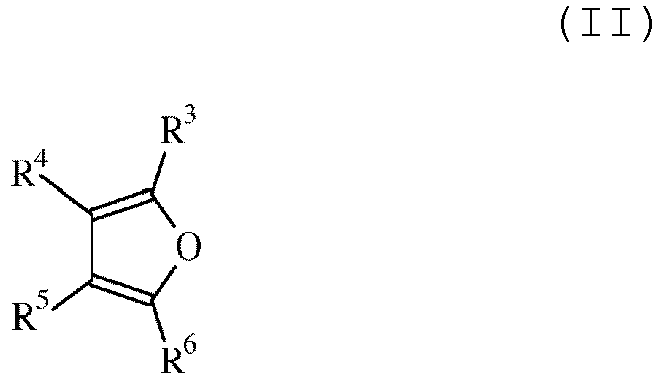

- Composition selon la revendication 1, dans laquelle dans le composant A, le groupe R1 représente un groupe alcényle linéaire contenant 4 atomes de carbone, et où le groupe R2 représente un groupe alkyle contenant 2 atomes de carbone.
- Composition selon la revendication 1 ou la revendication 2, dans laquelle le composant A est le pentanoate d'éthyle.
- Composition selon la revendication 3, dans laquelle le composant A est un mélange d'isomères de pentanoate d'éthyle.
- Composition selon l'une quelconque des revendications 1 à 4, dans laquelle dans le composant C, les groupes R4 et R5 représentent l'hydrogène, où les groupes R3 et R6 sont choisis indépendamment parmi l'hydrogène et les groupes alkyle en C1-6, au moins l'un des groupes R3 et R6 étant un groupe alkyle en C1-6, et à condition que le composant C ait un point d'ébullition ou une plage de points d'ébullition d'au maximum 100 °C.
- Composition selon l'une quelconque des revendications 1 à 5, dans laquelle le composant C est choisi parmi le 2-méthylfurane, le 2,5-diméthylfurane et des mélanges de ceux-ci.
- Composition d'essence comprenant :(i) une essence de base ; et(ii) entre au moins 5,0 % vol. et au maximum 20 % vol., en fonction de la composition d'essence globale, d'une composition selon l'une quelconque des revendications 1 à 6,dans laquelle pour un E70 donné tel que déterminé par l'EN ISO 3405 et E100 tel que déterminé par l'EN ISO 3405 d'une essence de base, E70base et E100base respectivement, les concentrations des deux ou trois composants de la composition de la présente invention peuvent être calculées par utilisation de l'équation suivante (équation I) :
 n = 1 correspond au composant B,n = 2 correspond au composant A,n = 3 correspond au composant C,vfn représente la fraction volumique du composant n = 1, 2 ou 3 dans la composition comprenant le composant A et au moins un composant choisi parmi les composants B et C, E70n représente la valeur E70 de mélange du composant représenté par n,E100n représente la valeur E100 de mélange du composant représenté par n,E70base représente la valeur E70 de l'essence de base, etE100base représente la valeur E100 de l'essence de base, dans laquelle les valeurs E70n et E100n sont déterminées en fonction des équations II et III ci-dessous :dans lesquelles :
 n correspond au composant A, B ou Cvfn représente la fraction volumique du composant A, B ou C lorsqu'il est combiné avec une essence de baseE70base représente la valeur E70 de l'essence de base, etE100base représente la valeur E100 de l'essence de base.
Priority Applications (1)
| Application Number | Priority Date | Filing Date | Title |
|---|---|---|---|
| EP10723990.7A EP2435542B1 (fr) | 2009-05-25 | 2010-05-25 | Compositions d'essence |
Applications Claiming Priority (3)
| Application Number | Priority Date | Filing Date | Title |
|---|---|---|---|
| EP09160986 | 2009-05-25 | ||
| PCT/EP2010/057133 WO2010136437A1 (fr) | 2009-05-25 | 2010-05-25 | Compositions d'essence |
| EP10723990.7A EP2435542B1 (fr) | 2009-05-25 | 2010-05-25 | Compositions d'essence |
Publications (2)
| Publication Number | Publication Date |
|---|---|
| EP2435542A1 EP2435542A1 (fr) | 2012-04-04 |
| EP2435542B1 true EP2435542B1 (fr) | 2019-02-27 |
Family
ID=41168683
Family Applications (1)
| Application Number | Title | Priority Date | Filing Date |
|---|---|---|---|
| EP10723990.7A Active EP2435542B1 (fr) | 2009-05-25 | 2010-05-25 | Compositions d'essence |
Country Status (5)
| Country | Link |
|---|---|
| US (1) | US8518129B2 (fr) |
| EP (1) | EP2435542B1 (fr) |
| JP (1) | JP2012528219A (fr) |
| CA (1) | CA2762258A1 (fr) |
| WO (1) | WO2010136437A1 (fr) |
Families Citing this family (1)
| Publication number | Priority date | Publication date | Assignee | Title |
|---|---|---|---|---|
| RU2734918C1 (ru) * | 2019-12-30 | 2020-10-26 | Акционерное общество "Всероссийский научно-исследовательский институт по переработке нефти" (АО "ВНИИ НП") | Альтернативное автомобильное топливо для бензиновых двигателей, содержащее производное фурфурола |
Citations (2)
| Publication number | Priority date | Publication date | Assignee | Title |
|---|---|---|---|---|
| US4431593A (en) * | 1980-10-03 | 1984-02-14 | Rhone-Poulenc Industries | Ester preparation by carbonylation of monoolefins |
| EP0284170A1 (fr) * | 1987-03-27 | 1988-09-28 | Shell Internationale Researchmaatschappij B.V. | Procédé de préparation d'un diester de l'acide adipique |
Family Cites Families (17)
| Publication number | Priority date | Publication date | Assignee | Title |
|---|---|---|---|---|
| US3563715A (en) | 1958-07-15 | 1971-02-16 | Chevron Res | Motor fuels |
| US3282662A (en) * | 1961-03-22 | 1966-11-01 | Shell Oil Co | Organic co-antiknock agents |
| GB1174148A (en) | 1967-08-11 | 1969-12-10 | Nii Monomerov Dlya Sint Kauchu | Method of producing Acrylic and Methacrylic Esters |
| JPH02164848A (ja) | 1988-12-15 | 1990-06-25 | Daicel Chem Ind Ltd | エステル交換方法 |
| US5081285A (en) | 1990-04-04 | 1992-01-14 | Hoechst Celanese Corporation | Production of ethyl 3-ethoxypropanoate by acid catalyzed addition of ethanol to ethyl acrylate |
| JP3478825B2 (ja) | 1992-08-24 | 2003-12-15 | シー. オアー,ウィリアム | 無鉛mmt燃料組成物 |
| FR2723089B1 (fr) | 1994-07-28 | 1996-09-06 | Atochem Elf Sa | Procede de fabrication de l'acrylate de butyle par esterification directe |
| DE69613549T2 (de) | 1995-12-22 | 2001-10-25 | Exxon Mobil Research And Engineering Co., Annandale | Benzinzusatzkonzentrat |
| TW477784B (en) | 1996-04-26 | 2002-03-01 | Shell Int Research | Alkoxy acetic acid derivatives |
| US5697987A (en) | 1996-05-10 | 1997-12-16 | The Trustees Of Princeton University | Alternative fuel |
| KR100337275B1 (ko) | 1996-05-31 | 2002-07-18 | 더 어소시에이티드 옥텔 캄파니 리미티드 | 연료첨가제 |
| FR2757539B1 (fr) | 1996-12-24 | 1999-03-05 | Bioconversion | Esters d'origine vegetale utilises comme substituts de carburants ou combustibles et leur procede de production |
| WO2001018154A1 (fr) | 1999-09-06 | 2001-03-15 | Agrofuel Ab | Carburant pour moteurs diesel |
| ATE251373T1 (de) | 2000-01-24 | 2003-10-15 | Scheidt & Bachmann Gmbh | Kommunikationssystem |
| US20010034966A1 (en) | 2000-01-24 | 2001-11-01 | Angelica Golubkov | Method of reducing the vapor pressure of ethanol-containing motor fuels for spark ignition combustion engines |
| US6923839B2 (en) * | 2001-06-26 | 2005-08-02 | Cooper Cameron | Fuel blend for an internal combustion engine |
| MY142383A (en) | 2005-06-10 | 2010-11-30 | Malaysian Palm Oil Board Mpob | Palm- based biodiesel formulation |
-
2010
- 2010-05-25 EP EP10723990.7A patent/EP2435542B1/fr active Active
- 2010-05-25 CA CA2762258A patent/CA2762258A1/fr not_active Abandoned
- 2010-05-25 JP JP2012512337A patent/JP2012528219A/ja not_active Withdrawn
- 2010-05-25 US US12/787,273 patent/US8518129B2/en active Active
- 2010-05-25 WO PCT/EP2010/057133 patent/WO2010136437A1/fr not_active Ceased
Patent Citations (2)
| Publication number | Priority date | Publication date | Assignee | Title |
|---|---|---|---|---|
| US4431593A (en) * | 1980-10-03 | 1984-02-14 | Rhone-Poulenc Industries | Ester preparation by carbonylation of monoolefins |
| EP0284170A1 (fr) * | 1987-03-27 | 1988-09-28 | Shell Internationale Researchmaatschappij B.V. | Procédé de préparation d'un diester de l'acide adipique |
Also Published As
| Publication number | Publication date |
|---|---|
| EP2435542A1 (fr) | 2012-04-04 |
| CA2762258A1 (fr) | 2010-12-02 |
| US20110035992A1 (en) | 2011-02-17 |
| JP2012528219A (ja) | 2012-11-12 |
| US8518129B2 (en) | 2013-08-27 |
| WO2010136437A1 (fr) | 2010-12-02 |
Similar Documents
| Publication | Publication Date | Title |
|---|---|---|
| EP2435541B1 (fr) | Compositions d'essence | |
| EP2152835B1 (fr) | Utilisation d'un ester d'alkyle d'un acide gras dans des compositions de gazole comprenant un gas oil de base | |
| EP2304001B1 (fr) | Compositions de carburant liquide | |
| CA2397579A1 (fr) | Procede permettant de reduire la pression de la vapeur des carburants a base d'ethanol dans des moteurs a combustion a allumage commande | |
| CA2722384A1 (fr) | Formulations de carburant | |
| JP2014507542A (ja) | ガソリン燃料配合物に関する改良 | |
| JP5068523B2 (ja) | ディーゼル燃料のセタン価を向上させる組成物及びディーゼル燃料 | |
| CN104603244B (zh) | 燃料组合物 | |
| EP2435542B1 (fr) | Compositions d'essence | |
| JP7260476B2 (ja) | 無鉛ガソリン用のアルコールおよびエーテル燃料添加剤 | |
| CN113646413A (zh) | 无铅汽油共混物 | |
| EP2958977B1 (fr) | Carburant diesel ayant des caractéristiques d'allumage améliorées | |
| CN114502697A (zh) | 具有辛烷协同效应的汽油组合物 | |
| US20110000124A1 (en) | Gasoline compositions | |
| RU2476585C1 (ru) | Композиция антиокислительной присадки, ее раствор и способ повышения стабильности биодизельного топлива при хранении (варианты) | |
| CA2729353A1 (fr) | Compositions d'essence | |
| CN101336284B (zh) | 用于柴油的十六烷值提高组分和含有该组分的柴油燃料 | |
| CN107849469A (zh) | 具有改进的辛烷值的汽油组合物 | |
| EP3320058B1 (fr) | Compositions de diesel présentant un indice de cétane et des performances de pouvoir lubrifiant améliorés | |
| EP1674552A1 (fr) | Compositions de Combustibles. | |
| US20100000483A1 (en) | Gasoline compositions | |
| JP2025515786A (ja) | Co2排出への影響が少ない燃料組成物、及び特に新しい車両におけるその使用 | |
| GB2451507A (en) | Fuel additive | |
| GB2466713A (en) | Gasoline compositions |
Legal Events
| Date | Code | Title | Description |
|---|---|---|---|
| PUAI | Public reference made under article 153(3) epc to a published international application that has entered the european phase |
Free format text: ORIGINAL CODE: 0009012 |
|
| 17P | Request for examination filed |
Effective date: 20111215 |
|
| AK | Designated contracting states |
Kind code of ref document: A1 Designated state(s): AL AT BE BG CH CY CZ DE DK EE ES FI FR GB GR HR HU IE IS IT LI LT LU LV MC MK MT NL NO PL PT RO SE SI SK SM TR |
|
| DAX | Request for extension of the european patent (deleted) | ||
| STAA | Information on the status of an ep patent application or granted ep patent |
Free format text: STATUS: EXAMINATION IS IN PROGRESS |
|
| 17Q | First examination report despatched |
Effective date: 20161130 |
|
| REG | Reference to a national code |
Ref country code: DE Ref legal event code: R079 Ref document number: 602010057207 Country of ref document: DE Free format text: PREVIOUS MAIN CLASS: C10L0001020000 Ipc: C10L0001180000 |
|
| RIC1 | Information provided on ipc code assigned before grant |
Ipc: C10L 1/185 20060101ALI20180213BHEP Ipc: C10L 10/10 20060101ALI20180213BHEP Ipc: C10L 1/18 20060101AFI20180213BHEP Ipc: C10L 10/08 20060101ALI20180213BHEP Ipc: C10L 1/14 20060101ALI20180213BHEP Ipc: C10L 1/182 20060101ALI20180213BHEP Ipc: C10L 1/02 20060101ALI20180213BHEP Ipc: C10L 1/19 20060101ALI20180213BHEP |
|
| GRAP | Despatch of communication of intention to grant a patent |
Free format text: ORIGINAL CODE: EPIDOSNIGR1 |
|
| STAA | Information on the status of an ep patent application or granted ep patent |
Free format text: STATUS: GRANT OF PATENT IS INTENDED |
|
| RAP1 | Party data changed (applicant data changed or rights of an application transferred) |
Owner name: SHELL INTERNATIONALE RESEARCH MAATSCHAPPIJ B.V. |
|
| INTG | Intention to grant announced |
Effective date: 20180320 |
|
| GRAJ | Information related to disapproval of communication of intention to grant by the applicant or resumption of examination proceedings by the epo deleted |
Free format text: ORIGINAL CODE: EPIDOSDIGR1 |
|
| STAA | Information on the status of an ep patent application or granted ep patent |
Free format text: STATUS: EXAMINATION IS IN PROGRESS |
|
| INTC | Intention to grant announced (deleted) | ||
| GRAP | Despatch of communication of intention to grant a patent |
Free format text: ORIGINAL CODE: EPIDOSNIGR1 |
|
| STAA | Information on the status of an ep patent application or granted ep patent |
Free format text: STATUS: GRANT OF PATENT IS INTENDED |
|
| INTG | Intention to grant announced |
Effective date: 20180913 |
|
| GRAS | Grant fee paid |
Free format text: ORIGINAL CODE: EPIDOSNIGR3 |
|
| GRAA | (expected) grant |
Free format text: ORIGINAL CODE: 0009210 |
|
| STAA | Information on the status of an ep patent application or granted ep patent |
Free format text: STATUS: THE PATENT HAS BEEN GRANTED |
|
| AK | Designated contracting states |
Kind code of ref document: B1 Designated state(s): AL AT BE BG CH CY CZ DE DK EE ES FI FR GB GR HR HU IE IS IT LI LT LU LV MC MK MT NL NO PL PT RO SE SI SK SM TR |
|
| REG | Reference to a national code |
Ref country code: GB Ref legal event code: FG4D |
|
| REG | Reference to a national code |
Ref country code: CH Ref legal event code: EP |
|
| REG | Reference to a national code |
Ref country code: DE Ref legal event code: R096 Ref document number: 602010057207 Country of ref document: DE |
|
| REG | Reference to a national code |
Ref country code: AT Ref legal event code: REF Ref document number: 1101335 Country of ref document: AT Kind code of ref document: T Effective date: 20190315 |
|
| REG | Reference to a national code |
Ref country code: IE Ref legal event code: FG4D |
|
| REG | Reference to a national code |
Ref country code: NL Ref legal event code: FP |
|
| REG | Reference to a national code |
Ref country code: LT Ref legal event code: MG4D |
|
| PG25 | Lapsed in a contracting state [announced via postgrant information from national office to epo] |
Ref country code: PT Free format text: LAPSE BECAUSE OF FAILURE TO SUBMIT A TRANSLATION OF THE DESCRIPTION OR TO PAY THE FEE WITHIN THE PRESCRIBED TIME-LIMIT Effective date: 20190627 Ref country code: NO Free format text: LAPSE BECAUSE OF FAILURE TO SUBMIT A TRANSLATION OF THE DESCRIPTION OR TO PAY THE FEE WITHIN THE PRESCRIBED TIME-LIMIT Effective date: 20190527 Ref country code: LT Free format text: LAPSE BECAUSE OF FAILURE TO SUBMIT A TRANSLATION OF THE DESCRIPTION OR TO PAY THE FEE WITHIN THE PRESCRIBED TIME-LIMIT Effective date: 20190227 Ref country code: FI Free format text: LAPSE BECAUSE OF FAILURE TO SUBMIT A TRANSLATION OF THE DESCRIPTION OR TO PAY THE FEE WITHIN THE PRESCRIBED TIME-LIMIT Effective date: 20190227 Ref country code: SE Free format text: LAPSE BECAUSE OF FAILURE TO SUBMIT A TRANSLATION OF THE DESCRIPTION OR TO PAY THE FEE WITHIN THE PRESCRIBED TIME-LIMIT Effective date: 20190227 |
|
| PG25 | Lapsed in a contracting state [announced via postgrant information from national office to epo] |
Ref country code: BG Free format text: LAPSE BECAUSE OF FAILURE TO SUBMIT A TRANSLATION OF THE DESCRIPTION OR TO PAY THE FEE WITHIN THE PRESCRIBED TIME-LIMIT Effective date: 20190527 Ref country code: HR Free format text: LAPSE BECAUSE OF FAILURE TO SUBMIT A TRANSLATION OF THE DESCRIPTION OR TO PAY THE FEE WITHIN THE PRESCRIBED TIME-LIMIT Effective date: 20190227 Ref country code: IS Free format text: LAPSE BECAUSE OF FAILURE TO SUBMIT A TRANSLATION OF THE DESCRIPTION OR TO PAY THE FEE WITHIN THE PRESCRIBED TIME-LIMIT Effective date: 20190627 Ref country code: LV Free format text: LAPSE BECAUSE OF FAILURE TO SUBMIT A TRANSLATION OF THE DESCRIPTION OR TO PAY THE FEE WITHIN THE PRESCRIBED TIME-LIMIT Effective date: 20190227 Ref country code: GR Free format text: LAPSE BECAUSE OF FAILURE TO SUBMIT A TRANSLATION OF THE DESCRIPTION OR TO PAY THE FEE WITHIN THE PRESCRIBED TIME-LIMIT Effective date: 20190528 |
|
| REG | Reference to a national code |
Ref country code: AT Ref legal event code: MK05 Ref document number: 1101335 Country of ref document: AT Kind code of ref document: T Effective date: 20190227 |
|
| PG25 | Lapsed in a contracting state [announced via postgrant information from national office to epo] |
Ref country code: RO Free format text: LAPSE BECAUSE OF FAILURE TO SUBMIT A TRANSLATION OF THE DESCRIPTION OR TO PAY THE FEE WITHIN THE PRESCRIBED TIME-LIMIT Effective date: 20190227 Ref country code: IT Free format text: LAPSE BECAUSE OF FAILURE TO SUBMIT A TRANSLATION OF THE DESCRIPTION OR TO PAY THE FEE WITHIN THE PRESCRIBED TIME-LIMIT Effective date: 20190227 Ref country code: SK Free format text: LAPSE BECAUSE OF FAILURE TO SUBMIT A TRANSLATION OF THE DESCRIPTION OR TO PAY THE FEE WITHIN THE PRESCRIBED TIME-LIMIT Effective date: 20190227 Ref country code: CZ Free format text: LAPSE BECAUSE OF FAILURE TO SUBMIT A TRANSLATION OF THE DESCRIPTION OR TO PAY THE FEE WITHIN THE PRESCRIBED TIME-LIMIT Effective date: 20190227 Ref country code: ES Free format text: LAPSE BECAUSE OF FAILURE TO SUBMIT A TRANSLATION OF THE DESCRIPTION OR TO PAY THE FEE WITHIN THE PRESCRIBED TIME-LIMIT Effective date: 20190227 Ref country code: DK Free format text: LAPSE BECAUSE OF FAILURE TO SUBMIT A TRANSLATION OF THE DESCRIPTION OR TO PAY THE FEE WITHIN THE PRESCRIBED TIME-LIMIT Effective date: 20190227 Ref country code: EE Free format text: LAPSE BECAUSE OF FAILURE TO SUBMIT A TRANSLATION OF THE DESCRIPTION OR TO PAY THE FEE WITHIN THE PRESCRIBED TIME-LIMIT Effective date: 20190227 Ref country code: AL Free format text: LAPSE BECAUSE OF FAILURE TO SUBMIT A TRANSLATION OF THE DESCRIPTION OR TO PAY THE FEE WITHIN THE PRESCRIBED TIME-LIMIT Effective date: 20190227 |
|
| REG | Reference to a national code |
Ref country code: DE Ref legal event code: R097 Ref document number: 602010057207 Country of ref document: DE |
|
| PG25 | Lapsed in a contracting state [announced via postgrant information from national office to epo] |
Ref country code: SM Free format text: LAPSE BECAUSE OF FAILURE TO SUBMIT A TRANSLATION OF THE DESCRIPTION OR TO PAY THE FEE WITHIN THE PRESCRIBED TIME-LIMIT Effective date: 20190227 Ref country code: PL Free format text: LAPSE BECAUSE OF FAILURE TO SUBMIT A TRANSLATION OF THE DESCRIPTION OR TO PAY THE FEE WITHIN THE PRESCRIBED TIME-LIMIT Effective date: 20190227 |
|
| REG | Reference to a national code |
Ref country code: CH Ref legal event code: PL |
|
| PG25 | Lapsed in a contracting state [announced via postgrant information from national office to epo] |
Ref country code: AT Free format text: LAPSE BECAUSE OF FAILURE TO SUBMIT A TRANSLATION OF THE DESCRIPTION OR TO PAY THE FEE WITHIN THE PRESCRIBED TIME-LIMIT Effective date: 20190227 |
|
| PLBE | No opposition filed within time limit |
Free format text: ORIGINAL CODE: 0009261 |
|
| STAA | Information on the status of an ep patent application or granted ep patent |
Free format text: STATUS: NO OPPOSITION FILED WITHIN TIME LIMIT |
|
| PG25 | Lapsed in a contracting state [announced via postgrant information from national office to epo] |
Ref country code: MC Free format text: LAPSE BECAUSE OF FAILURE TO SUBMIT A TRANSLATION OF THE DESCRIPTION OR TO PAY THE FEE WITHIN THE PRESCRIBED TIME-LIMIT Effective date: 20190227 Ref country code: LI Free format text: LAPSE BECAUSE OF NON-PAYMENT OF DUE FEES Effective date: 20190531 Ref country code: CH Free format text: LAPSE BECAUSE OF NON-PAYMENT OF DUE FEES Effective date: 20190531 |
|
| 26N | No opposition filed |
Effective date: 20191128 |
|
| REG | Reference to a national code |
Ref country code: BE Ref legal event code: MM Effective date: 20190531 |
|
| PG25 | Lapsed in a contracting state [announced via postgrant information from national office to epo] |
Ref country code: SI Free format text: LAPSE BECAUSE OF FAILURE TO SUBMIT A TRANSLATION OF THE DESCRIPTION OR TO PAY THE FEE WITHIN THE PRESCRIBED TIME-LIMIT Effective date: 20190227 Ref country code: LU Free format text: LAPSE BECAUSE OF NON-PAYMENT OF DUE FEES Effective date: 20190525 |
|
| PG25 | Lapsed in a contracting state [announced via postgrant information from national office to epo] |
Ref country code: TR Free format text: LAPSE BECAUSE OF FAILURE TO SUBMIT A TRANSLATION OF THE DESCRIPTION OR TO PAY THE FEE WITHIN THE PRESCRIBED TIME-LIMIT Effective date: 20190227 |
|
| PG25 | Lapsed in a contracting state [announced via postgrant information from national office to epo] |
Ref country code: IE Free format text: LAPSE BECAUSE OF NON-PAYMENT OF DUE FEES Effective date: 20190525 |
|
| PG25 | Lapsed in a contracting state [announced via postgrant information from national office to epo] |
Ref country code: BE Free format text: LAPSE BECAUSE OF NON-PAYMENT OF DUE FEES Effective date: 20190531 |
|
| PG25 | Lapsed in a contracting state [announced via postgrant information from national office to epo] |
Ref country code: CY Free format text: LAPSE BECAUSE OF FAILURE TO SUBMIT A TRANSLATION OF THE DESCRIPTION OR TO PAY THE FEE WITHIN THE PRESCRIBED TIME-LIMIT Effective date: 20190227 |
|
| PG25 | Lapsed in a contracting state [announced via postgrant information from national office to epo] |
Ref country code: MT Free format text: LAPSE BECAUSE OF FAILURE TO SUBMIT A TRANSLATION OF THE DESCRIPTION OR TO PAY THE FEE WITHIN THE PRESCRIBED TIME-LIMIT Effective date: 20190227 Ref country code: HU Free format text: LAPSE BECAUSE OF FAILURE TO SUBMIT A TRANSLATION OF THE DESCRIPTION OR TO PAY THE FEE WITHIN THE PRESCRIBED TIME-LIMIT; INVALID AB INITIO Effective date: 20100525 |
|
| PG25 | Lapsed in a contracting state [announced via postgrant information from national office to epo] |
Ref country code: MK Free format text: LAPSE BECAUSE OF FAILURE TO SUBMIT A TRANSLATION OF THE DESCRIPTION OR TO PAY THE FEE WITHIN THE PRESCRIBED TIME-LIMIT Effective date: 20190227 |
|
| REG | Reference to a national code |
Ref country code: FR Ref legal event code: PLFP Year of fee payment: 14 |
|
| PGFP | Annual fee paid to national office [announced via postgrant information from national office to epo] |
Ref country code: NL Payment date: 20250409 Year of fee payment: 16 |
|
| PGFP | Annual fee paid to national office [announced via postgrant information from national office to epo] |
Ref country code: DE Payment date: 20250402 Year of fee payment: 16 |
|
| PGFP | Annual fee paid to national office [announced via postgrant information from national office to epo] |
Ref country code: FR Payment date: 20250401 Year of fee payment: 16 |
|
| PGFP | Annual fee paid to national office [announced via postgrant information from national office to epo] |
Ref country code: GB Payment date: 20260313 Year of fee payment: 17 |