EP2476438B1 - Medikament mit einer spezifisch an den menschlichen cc-chemokin-rezeptor 4 (ccr4) gebundenen antikörperzusammensetzung - Google Patents
Medikament mit einer spezifisch an den menschlichen cc-chemokin-rezeptor 4 (ccr4) gebundenen antikörperzusammensetzung Download PDFInfo
- Publication number
- EP2476438B1 EP2476438B1 EP10815436.0A EP10815436A EP2476438B1 EP 2476438 B1 EP2476438 B1 EP 2476438B1 EP 10815436 A EP10815436 A EP 10815436A EP 2476438 B1 EP2476438 B1 EP 2476438B1
- Authority
- EP
- European Patent Office
- Prior art keywords
- antibody
- human
- ccr4
- cell
- pharmaceutical composition
- Prior art date
- Legal status (The legal status is an assumption and is not a legal conclusion. Google has not performed a legal analysis and makes no representation as to the accuracy of the status listed.)
- Active
Links
Images

Classifications
-
- A—HUMAN NECESSITIES
- A61—MEDICAL OR VETERINARY SCIENCE; HYGIENE
- A61K—PREPARATIONS FOR MEDICAL, DENTAL OR TOILETRY PURPOSES
- A61K39/00—Medicinal preparations containing antigens or antibodies
- A61K39/395—Antibodies; Immunoglobulins; Immune serum, e.g. antilymphocytic serum
- A61K39/39533—Antibodies; Immunoglobulins; Immune serum, e.g. antilymphocytic serum against materials from animals
- A61K39/39558—Antibodies; Immunoglobulins; Immune serum, e.g. antilymphocytic serum against materials from animals against tumor tissues, cells, antigens
-
- A—HUMAN NECESSITIES
- A61—MEDICAL OR VETERINARY SCIENCE; HYGIENE
- A61K—PREPARATIONS FOR MEDICAL, DENTAL OR TOILETRY PURPOSES
- A61K31/00—Medicinal preparations containing organic active ingredients
- A61K31/33—Heterocyclic compounds
- A61K31/395—Heterocyclic compounds having nitrogen as a ring hetero atom, e.g. guanethidine or rifamycins
- A61K31/435—Heterocyclic compounds having nitrogen as a ring hetero atom, e.g. guanethidine or rifamycins having six-membered rings with one nitrogen as the only ring hetero atom
- A61K31/44—Non condensed pyridines; Hydrogenated derivatives thereof
- A61K31/445—Non condensed piperidines, e.g. piperocaine
- A61K31/4523—Non condensed piperidines, e.g. piperocaine containing further heterocyclic ring systems
- A61K31/454—Non condensed piperidines, e.g. piperocaine containing further heterocyclic ring systems containing a five-membered ring with nitrogen as a ring hetero atom, e.g. pimozide, domperidone
-
- A—HUMAN NECESSITIES
- A61—MEDICAL OR VETERINARY SCIENCE; HYGIENE
- A61K—PREPARATIONS FOR MEDICAL, DENTAL OR TOILETRY PURPOSES
- A61K39/00—Medicinal preparations containing antigens or antibodies
- A61K39/395—Antibodies; Immunoglobulins; Immune serum, e.g. antilymphocytic serum
- A61K39/39533—Antibodies; Immunoglobulins; Immune serum, e.g. antilymphocytic serum against materials from animals
- A61K39/3955—Antibodies; Immunoglobulins; Immune serum, e.g. antilymphocytic serum against materials from animals against proteinaceous materials, e.g. enzymes, hormones, lymphokines
-
- A—HUMAN NECESSITIES
- A61—MEDICAL OR VETERINARY SCIENCE; HYGIENE
- A61K—PREPARATIONS FOR MEDICAL, DENTAL OR TOILETRY PURPOSES
- A61K45/00—Medicinal preparations containing active ingredients not provided for in groups A61K31/00 - A61K41/00
- A61K45/06—Mixtures of active ingredients without chemical characterisation, e.g. antiphlogistics and cardiaca
-
- A—HUMAN NECESSITIES
- A61—MEDICAL OR VETERINARY SCIENCE; HYGIENE
- A61P—SPECIFIC THERAPEUTIC ACTIVITY OF CHEMICAL COMPOUNDS OR MEDICINAL PREPARATIONS
- A61P35/00—Antineoplastic agents
-
- C—CHEMISTRY; METALLURGY
- C07—ORGANIC CHEMISTRY
- C07K—PEPTIDES
- C07K2317/00—Immunoglobulins specific features
- C07K2317/70—Immunoglobulins specific features characterized by effect upon binding to a cell or to an antigen
- C07K2317/73—Inducing cell death, e.g. apoptosis, necrosis or inhibition of cell proliferation
- C07K2317/732—Antibody-dependent cellular cytotoxicity [ADCC]
Definitions
- a pharmaceutical composition comprising an antibody composition which specifically binds to human CC chemokine receptor 4 (hereinafter also referred to as CCR4) and at least one medicament.
- CCR4 human CC chemokine receptor 4
- a pharmaceutical composition comprising an antibody composition which specifically binds to CCR4 can be a pharmaceutical composition effective for treating T-cell tumors which expresses CCR4 (Patent literatures 1, 2 and 3).
- Lenalidomide is a standard therapeutic agent for multiple myeloma and clinical trials have been conducted on diseases including a T-cell lymphoma for the purpose of expanding indications (Non-patent literature 3).
- Lenalidomide is a so-called immunomodulating agent having immunostimulatory activity (Non-patent literature 4) and is known to actually enhance an ADCC activity of a therapeutic antibody such as anti-CD20 antibody and anti-CD40 antibody (Non-patent literatures 5 and 6).
- WO2008/019378 describes methods of treating myeloma using combination therapies based on anti-CS1 antibodies.
- WO200/058021 describes the use of anti-CD33 antibodies in cancer therapies.
- Wu et al (ASH Annual Meeting Abstracts), 2007, 110: Abstract 4885 ) reports that the authors previously showed that in an in vitro ADCC system lenalidomide was able to enhance human NK cells and monocyte function in response to rituximab.
- An object of the present invention is to provide a pharmaceutical composition comprising a recombinant antibody against CCR4 and at least one medicament, i.e. lenalidomide; and a pharmaceutical composition for administering a recombinant antibody against CCR4 and at least one medicament, i.e. lenalidomide in combination.
- a pharmaceutical composition comprising a recombinant antibody against CCR4 and at least one medicament, i.e. lenalidomide
- a pharmaceutical composition for administering a recombinant antibody against CCR4 and at least one medicament, i.e. lenalidomide in combination i.e. lenalidomide in combination.
- any combination therapy of Lenalidomide and a therapeutic antibody has not been approved in clinical practice.
- the present invention relates to the following (1) to (6):
- the present disclosure provides a pharmaceutical composition comprising a recombinant antibody against CCR4 and at least one medicament; and a pharmaceutical composition for administering a recombinant antibody against CCR4 and at least one medicament in combination.
- Examples of the pharmaceutical composition of the present disclosure include a pharmaceutical composition comprising a recombinant antibody against CCR4 and at least one medicament; and a pharmaceutical composition for administering a recombinant antibody against CCR4 and at least one medicament in combination.
- the pharmaceutical composition comprising a recombinant antibody against CCR4 and at least one medicament may be a combination drug in which each medicament component is mixed, or a pharmaceutical composition for simultaneously or sequentially administering a recombinant antibody which specifically binds to CCR4 and at least one medicament in combination after preparing each medicament separately.
- the combination drug in which each medicament component is mixed include a fusion antibody in which at least one medicament is bound to a recombinant antibody which specifically binds to CCR4.
- the pharmaceutical composition for administering a recombinant antibody against CCR4 and at least one medicament in combination may be a pharmaceutical composition for simultaneously or sequentially administering a recombinant antibody which specifically binds to CCR4 and at least one medicament in combination after preparing each medicament separately, or a combination drug in which each medicament component is mixed.
- the combination drug in which each medicament component is mixed include a fusion antibody in which at least one medicament is bound to a recombinant antibody which specifically binds to CCR4.
- these medicaments may be simultaneously or sequentially administered to a patient after adjusting a pharmaceutical kit comprising each medicament, or administered after mixing these medicaments.
- a recombinant antibody which specifically reacts to CCR4 and at least one medicament are simultaneously administered, the order of administration is not limited.
- the recombinant antibody which specifically binds to CCR4 may be administered to a patient before or after administering at least one medicament.
- the term "sequentially" means that a recombinant antibody and at least one medicament are administered in one after another within a time frame so that these medicaments can therapeutically act within the same time frame.
- Examples of the recombinant antibody which specifically binds to CCR4 include a recombinant antibody which specifically reacts with an extracellular region of human CCR4. Among them, a recombinant antibody which does not show reactivity with a human blood platelet, a recombinant antibody having high antibody-dependent cellular cytotoxicity (hereinafter also referred to as ADCC activity) are preferable.
- an antibody does not show reactivity with a human blood platelet means that an antibody does not substantially react with a human blood platelet. Specifically, it means that reactivity is not shown by the measurement with a flow cytometer.
- the antibody in the present disclosure includes an antibody which specifically reacts with preferably the region comprising positions 1 to 39, 98 to 112, 176 to 206 or 271 to 284 in the amino acid sequence represented by SEQ ID NO:1, more preferably the region comprising positions 2 to 29 (SEQ ID NO:2) in the amino acid sequence represented by SEQ ID NO:1, still more preferably the region comprising positions 12 to 29 (SEQ ID NO:3) in the amino acid sequence represented by SEQ ID NO:1, and particularly preferably the region comprising positions 13 to 25 (SEQ ID NO:4) in the amino acid sequence represented by SEQ ID NO:1.
- examples also include an antibody which specifically reacts to an epitope which is recognized by a monoclonal antibody binding to CCR4 which is produced by a hybridoma KM2160 (FERM BP-10090) disclosed in WO2005/053741 .
- the antibody in the present disclosure include an antibody which is produced by cells resistant to a lectin which recognizes a sugar chain structure in which 1-position of fucose is bound to 6-position of N -acetylglucosamine in the reducing end through ⁇ -bond in a complex type N -glycoside-linked sugar chain ( WO02/31140 , WO03/58118 and WO03/85107 ).
- Examples of the recombinant antibody in the present invention include a humanized antibody and a human antibody.
- humanized antibody examples include a human chimeric antibody and a human CDR-grafted antibody.
- the human chimeric antibody refers an antibody comprising H chain V region (hereinafter also referred to as HV or VH) of an antibody of a non-human animal, and L chain V region (hereinafter also referred to as LV or VL) of an antibody of a non-human animal, and H chain C region (hereinafter referred to as CH) of a human antibody and L chain C region (hereinafter referred to as CL) of a human antibody.
- HV or VH H chain V region
- LV or VL L chain V region
- CH H chain C region
- CL L chain C region
- the human chimeric antibody of the present invention can be produced by obtaining cDNAs encoding VH and VL of an antibody from a non-human animal hybridoma capable of producing a monoclonal antibody derived from non-human animal which specifically binds to CCR4, inserting them into an expression vector for animal cell having genes encoding human antibody CH and human antibody CL to thereby construct a vector for expression of human chimeric antibody, and then introducing the vector into a host cell to express the antibody.
- CH of a human chimeric antibody can be used, so long as it belongs to human immnogloblin (hereinafter referred to as hIg), but those of the hIgG class are preferred, and any one of the subclasses belonging to the IgG such as ⁇ 1, ⁇ 2, ⁇ 3 and ⁇ 4 can be also used.
- CL of a human chmeric antibody those of ⁇ class or ⁇ class can be used.
- the human chimeric antibody of the present invention include a human chimeric antibody which comprises CDR1, CDR2 and CDR3 of VH comprising the amino acid sequences represented by SEQ ID NOs:5, 6 and 7, respectively, and CDR1, CDR2 and CDR3 of VL comprising the amino acid sequences represented by SEQ ID NOs:8, 9 and 10, respectively. More specifically, examples include a human chimeric antibody in which the amino acid sequences of VH and VL are the amino acid sequences represented by SEQ ID NOs:11 and 12, respectively.
- VH comprises the amino acid sequence represented by SEQ ID NO: 11
- CH comprises the amino acid sequence of the IgG1 subclass of a human antibody
- VL comprises the amino acid sequence represented by SEQ ID NO:12
- CL comprises the amino acid sequence of ⁇ class of a human antibody.
- a human CDR-grafted antibody refers to an antibody in which amino acid sequences of CDRs of VH and VL of an antibody derived from a non-human animal are grafted into appropriate sites in VH and VL of a human antibody.
- the human CDR-grafted antibody of the present invention can be produced by constructing cDNAs encoding V regions in which amino acid sequences of CDRs of VH and VL of an antibody derived from a non-human animal which specifically binds to CCR4 are grafted into frameworks (hereinafter referred to as "FR") of VH and VL of an arbitrary human antibody, inserting the resulting cDNAs into an expression vector for animal cells which have DNAs encoding CH and CL of a human antibody, respectively, to construct a human CDR-grafted antibody expression vector, and introducing the expression vector into an animal cell to induce expression.
- FR frameworks
- any of those derived from human antibodies can be used.
- the method for selecting include the amino acid sequences of FRs of VH and VL of human antibodies registered in database such as Protein Data Bank, and the amino acid sequences common to each subgroup of FRs of VH and VL of human antibodies ( Sequence of Proteins of Immunological Interest, US Dept. Health and Human Services, 1991 ).
- CH of the antibody of the present invention any CH can be used, so long as it belongs to hIg and those of the hIgG class are preferred.
- any one of the subclasses belonging to the IgG class such as ⁇ 1, ⁇ 2, ⁇ 3 and ⁇ 4 can be used.
- CL of the human CDR-grafted antibody those belonging to the ⁇ class or ⁇ class can be used.
- Examples of the human CDR-grafted antibody of the present invention include a human chimeric antibody in which CDR1, CDR2 and CDR3 of VH of the antibody comprise the amino acid sequences represented by SEQ ID NOs:5, 6 and 7, respectively, and/or CDR1, CDR2 and CDR3 of VL comprise the amino acid sequences represented by SEQ ID NOs:8, 9 and 10, respectively.
- human CDR-grafted antibody of the present invention include a human CDR-grafted antibody wherein VH comprises the amino acid sequence represented by SEQ ID NO:11 and VL comprises the amino acid sequence represented by SEQ ID NO: 12 is preferably used.
- a human antibody originally means an antibody naturally existing in the human body, and it also includes an antibody obtained from a human antibody phage library or a human antibody-producing transgenic animal, which is prepared based on the recent advanced techniques in genetic engineering, cell engineering and developmental engineering.
- human peripheral blood lymphocytes are isolated, infected e.g. with EB virus for immortalization and cloning, whereby lymphocytes producing the antibody can be cultured, and the antibody can be purified from the culture.
- the human antibody phage library is a library in which antibody gene from a human B cell is inserted into a phage gene to express an antibody fragments such as Fab and scFv on the surface of the phage.
- a library in which mutation is artificially introduced can be used to develop the library.
- a phage having a desired antigen binding activity can be recovered from the library, using a binding activity to a substrate having an antigen-immobilized thereon as an index.
- the antibody fragment can be further converted to a human antibody molecule comprising two full length H chains and two full length L chains by a protein engineering method.
- the human antibody-producing transgenic animal means an animal in which a human antibody gene is incorporated into cells.
- Examples of the human antibody-producing transgenic animal include a human antibody-producing transgenic mouse which is prepared by introducing a human antibody gene into a mouse ES cell, grafting the ES cell on an early embryo of the mouse and developing the same.
- the human antibody can be produced and accumulated in a culture supernatant by culturing a human antibody-producing hybridoma obtained by a hybridoma preparation method using a general cell fusion method.
- transgenic non-human animals examples include cattle, sheep, goats, pigs, horses, mice, rats, chickens, monkeys and rabbits.
- examples of a recombinant antibody having a high ADCC activity include a composition comprising an antibody molecule having a complex type N-glycoside-linked sugar chain in the Fc region, and comprising a sugar chain in which fucose is not bound to N- acetylglucosamine in the reducing end in the sugar chain among the total complex N- glycoside-linked sugar chains binding to the Fc region in the antibody composition reducing end.
- a high antibody-dependent cellular cytotoxicity means that the antibody has a higher ADCC activity than those mainly produced in a living body.
- an antibody having a high ADCC activity is hereinafter referred to as an antibody lacking in fucose modification.
- a human CDR-grafted antibody which is an antibody lacking in fucose modification which specifically binds to CCR4 and comprises VH comprising the amino acid sequence represented by SEQ ID NO: 11 and VL comprising the amino acid sequence represented by SEQ ID NO:12 (hereinafter also referred to as KM8760).
- N -glycoside-linked sugar chain is bound to the Fc region in an antibody molecule. Therefore, two sugar chains are bound to one antibody molecule.
- N- glycoside-linked sugar chain examples include a complex type sugar chain in which the non-reducing end side of the core structure has one or more parallel branches containing galactose-N-acetylglucosamine (hereinafter referred to as "Gal-GlcNAc”) and the non-reducing end side of Gal-GlcNAc has sialic acid, and bisecting N- acetylglucosamine.
- Gal-GlcNAc galactose-N-acetylglucosamine
- N- glycoside-linked sugar chain is shown by the following formula.
- a gene antibody which specifically binds to CCR4 may be administered as a composition.
- the recombinant antibody composition comprising an antibody molecule the N -glycoside-linked sugar chain in the Fc region may be comprised of an antibody molecule having a single sugar chain structure or an antibody molecule having plural and different sugar chain structures, so long as it has the above sugar chain structure. That is, the recombinant antibody composition of the present invention means a composition comprising a recombinant antibody molecule having a single or plural and different sugar chain structure(s).
- the ratio of sugar chains in which fucose is not bound to N- acetylglucosamine in the reducing end of the antibody antibodies having any ratio are included, so long as the ADCC activity is increased.
- the ratio is preferably 20% or more, more preferably 51 % to 100%, still more preferably 80% to 100%, particularly preferably 90% to 99% and most preferably 100%.
- the sugar chain in which fucose is not bound may have any sugar chain structure in the non-reducing end, so long as fucose is not bound to N-acetylglucosamine in the reducing end in the above formula.
- the case where fucose is not bound to N-acetylglucosamine in the reducing end in the sugar chain means that fucose is not substantially bound.
- An antibody composition in which fucose is not substantially bound specifically refers to an antibody composition in such a degree that fucose is not substantially detected according to the known sugar chain analysis ( WO02/31140 , WO03/85107 ).
- the degree that fucose is not substantially detected means the content of fucose is below the detection limit.
- a recombinant antibody composition in which fucose is not bound to N-acetylglucosamine in the reducing ends of all sugar chains has the highest ADCC activity.
- the ratio of sugar chains in which fucose is not bound to N -acetylglucosamine in the reducing end in the sugar chains contained in the composition which comprises an antibody molecule having complex type N- glycoside-linked sugar chains in the Fc region can be determined by the following analytic methods.
- Examples of the analytic method include a method in which the sugar chains are released from the antibody molecule using a known method such as hydrazinolysis or enzyme digestion [ Biochemical Experimentation Methods 23 - Method for Studying Glycoprotein Sugar Chain (Japan Scientific Societies Press), edited by Reiko Takahashi (1989 )], the released sugar chain was subject to fluorescence labeling or radioisotope labeling and then the labeled sugar chains by chromatography were separated. Also, the released sugar chains can also be analyzed using the HPAED-PAD method [ J. Liq. Chromatogr., 6, 1577 (1983 )].
- the transformant producing the recombinant antibody composition which specifically binds to CCR4 of the present invention can be obtained by introducing, into an animal cell, a recombinant antibody composition expression vector into which DNAs encoding a variable region and a constant region of an antibody molecule are inserted.
- the recombinant antibody composition expression vector can be constructed as described below ( WO02/31140 , WO03/85107 ).
- Each of the above DNAs encoding CH and CL is introduced into an expression vector in animal cell to produce an expression vector for animal cell.
- the expression vector for animal cell includes pAGE107 (Japanese Published Unexamined Patent Application No. 22979/91 ; Miyaji H. et al., Cytotechnology, 3, 133-140 (1990 )), pAGE103 ( Mizukami T. and Itoh S., J. Biochem., 101, 1307-1310 (1987 )), pHSG274 ( Brady G. et al., Gene, 27, 223-232 (1984 )), pKCR ( O'Hare K. et al., Proc. Natl. Acad. Sci. USA., 78, 1527-1531 (1981 )), pSG1 ⁇ d2-4 ( Miyaji H.
- the promoter and enhancer used for the expression vector for animal cell include SV40 early promoter and enhancer ( Mizukami T. and Itoh S., J. Biochem., 101, 1307-1310 (1987 )), LTR promoter and enhancer of Moloney mouse leukemia virus ( Kuwana Y. et al., Biochem. Biophys. Res. Commun., 149, 960-968 (1987 )), immunoglobulin H chain promoter ( Mason J. O. et al., Cell, 41, 479-487 (1985 )) and ehnancer ( Gillies S. D. et al., Cell, 33, 717-728 (1983 )).
- the vector for expression of recombinant antibody composition may be either of a type in which genes encoding the H chain and L chain exist on separate vectors or of a type in which both genes exist on the same vector (tandem type).
- tandem type of the vector for expression of recombinant antibody composition is more preferred ( Shitara K. et al., J. Immunol. Methods, 167, 271-278 (1994 )).
- the tandem type vector for expression of recombinant antibody composition includes pKANTEX93 ( WO97/10354 ), pEE18 ( Bentley K. J. et al., Hybridoma, 17, 559-567 (1998 )).
- cDNAs encoding VH and VL of antibodies for various antigens are cloned into the upstream of DNAs encoding CH and CL of the constructed vector for expression of a recombinant antibody composition to thereby construct a recombinant antibody composition expression vector.
- a method for introducing the expression vector into a host cell includes electroporation (Japanese Published Unexamined Patent Application No. 257891/90 ; Miyaji H. et al., Cytotechnology, 3, 133-140 (1990 )).
- the host cell producing the recombinant antibody composition of the present invention may be any host cell which is generally used in production of a recombinant protein, such as an animal cell, a plant cell or a microorganism.
- the host cell producing the recombinant antibody composition of the present invention includes a CHO cell derived from a Chinese hamster ovary tissue, a rat myeloma cell line YB2/3HL.P2.G11.16Ag.20 cell, a mouse myeloma cell line NS0 cell, a mouse myeloma SP2/0-Ag14 cell, a BHK cell derived from a syrian hamster kidney tissue, a human leukemia cell line Namalwa cell, a hybridoma cell produced by using a myeloma cell and any B cell, a hybridoma cell produced by a B cell obtained by immunizing with an antigen a transgenic non-human animal produced by using an embryonic stem cell or a fertilized egg cell and any myeloma cell; a hybridoma cell produced by the above myeloma cell and a B cell obtained by immunizing a transgenic non-human animal produced by using an embryonic
- the host cell capable of expressing a recombinant antibody composition having a high ADCC activity includes a host cell resistant to a lectin which recognizes a sugar chain structure in which 1-position of fucose is bound to 6-position of N-acetylglucosamine in the reducing end through ⁇ -bond in the complex type N-glycoside-linked sugar chain, such as a host cell capable of producing an antibody composition comprising an antibody molecule having complex type N-glycoside-linked sugar chains in the Fc region, wherein the ratio of sugar chains in which fucose is not bound to N-acetylglucosamine in the reducing end of the sugar chains among the total complex type N-glycoside-linked sugar chains which bind to the Fc region contained in the composition is 20% or more.
- Examples include cells in which activity of at least one protein described below is decreased or deleted, such as the following (a) to (c):
- the above host cell is preferably a host cell in which a gene encoding ⁇ 1,6-fucosyltransferase in the host cell is knocked out ( WO02/31140 , WO03185107 ).
- the enzyme relating to synthesis of an intracellular sugar nucleotide, GDP-fucose may be any enzyme, so long as it is an enzyme relating to the synthesis of the intracellular sugar nucleotide, GDP-fucose, as a supply source of fucose to a sugar chain.
- the enzyme relating to synthesis of an intracellular sugar nucleotide, GDP-fucose includes an enzyme which has influence on the synthesis of the intracellular sugar nucleotide, GDP-fucose.
- the intracellular sugar nucleotide, GDP-fucose is supplied by a de novo synthesis pathway or a salvage synthesis pathway.
- all enzymes relating to the synthesis pathways are included in the enzyme relating to synthesis of an intracellular sugar nucleotide, GDP-fucose.
- GDP-fucose The enzyme relating to the de novo synthesis pathway of an intracellular sugar nucleotide, GDP-fucose includes GDP-mannose 4,6-dehydratase (hereinafter referred to as "GMD”), GDP-keto-6-deoxymannose-3,5-epimerase, and 4,6-reductase (hereinafter referred to as "Fx").
- GMD GDP-mannose 4,6-dehydratase
- Fx 4,6-reductase
- GDP-fucose includes GDP-beta-L-fucose pyrophosphorylase (hereinafter referred to as "GFPP"), and fucokinase.
- GFPP GDP-beta-L-fucose pyrophosphorylase
- the enzyme relating to modification of a sugar chain in which 1-position of fucose is bound to 6-position of N-acetylglucosamine in the reducing end through ⁇ -bond in a complex type N-glycoside-linked sugar chain includes any enzyme, so long as it is an enzyme relating to the reaction of binding of 1-position of fucose to 6-position of N-acetylglucosamine in the reducing end through ⁇ -bond in the complex type N-glycoside-linked sugar chain.
- the enzyme relating to the reaction of binding of 1-position of fucose to 6-position of N-acetylglucosamine in the reducing end through ⁇ -bond in the complex type N-glycoside-linked sugar chain includes an enzyme which has influence on the reaction of binding of 1-position of fucose to 6-position of N-acetylglucosamine in the reducing end through ⁇ -bond in the complex type N-glycoside-linked sugar chain. Examples include ⁇ 1,6-fucosyltransferase and ⁇ -L-fucosidase.
- the enzyme relating to the reaction of binding of 1-position of fucose to 6-position of N-acetylglucosamine in the reducing end through ⁇ -bond in the complex type N-glycoside-linked sugar chain includes an enzyme which has influence on the activity of the enzyme relating to the reaction of binding of 1-position of fucose to 6-position of N-acetylglucosamine in the reducing end through ⁇ -bond in the complex type N-glycoside-linked sugar chain and an enzyme which has influence on the structure of substances as the substrate of the enzyme.
- the protein relating to transport of an intracellular sugar nucleotide, GDP-fucose, to the Golgi body may be any protein, so long as it is a protein relating to the transport of the intracellular sugar nucleotide, GDP-fucose, to the Golgi body, or a protein which has an influence on the reaction for the transport of the intracellular sugar nucleotide, GDP-fucose, to the Golgi body.
- the protein relating to the transport of the intracellular sugar nucleotide, GDP-fucose, to the Golgi body includes a GDP-fucose transporter.
- the protein which has an influence on the reaction for the transport of the intracellular sugar nucleotide, GDP-fucose, to the Golgi body include a protein which has an influence on the activity of the above protein relating to the transport of the intracellular sugar nucleotide, GDP-fucose, to the Golgi body or has influence on the expression thereof.
- the method for obtaining a cell in which the above enzyme activity is decreased or deleted may by any method, so long as it is a method for decreasing or deleting the objective enzyme activity. Examples include the following (a) to (e):
- any lectin capable of recognizing the sugar chain structure can be used.
- Specific examples include lentil lectin LCA (lentil agglutinin derived from Lens culinaris ) , pea lectin PSA (pea lectin derived from Pisum sativum ) , broad bean lectin VFA (agglutinin derived from Vicia faba ) , Aleuria aurantia lectin AAL (lectin derived from Aleuria aurantia ) .
- the cell resistant to a lectin refers to a cell in which growth is not inhibited by the presence of a lectin at an effective concentration.
- the effective concentration is a concentration higher than the concentration that does not allow the normal growth of a cell prior to the genome modification (hereinafter referred to also as parent cell line).
- the effective concentration is preferably equal to the concentration that does not allow the normal growth of a cell prior to the genome modification, more preferably 2 to 5 times, further preferably 10 times, most preferably 20 or more times the concentration that does not allow the normal growth of a cell prior to the modification of the genomic gene.
- the effective concentration of lectin that does not inhibit growth may be appropriately determined according to each cell line. It is usually 10 ⁇ g/ml to 10 mg/ml, preferably 0.5 mg/ml to 2.0 mg/ml.
- examples of at least one medicament include an immunomodulating agent, such as Lenalidomide and Actimid.
- the above medicament may produce adverse effects in the case where the medicament is administered alone to a living body at a high dose.
- the above medicament can be administered at a low dose by combining the above medicament with a recombinant antibody which specifically binds to CCR4.
- composition of the present invention can be combined with the following other medicaments or methods.
- Examples of the above medicaments or methods include drugs for multidrug chemotherapy, such as CHOP therapy which combines cyclophosphamide, doxorubicin, vincristine, and prednisolone; CHOP-like therapy, such as THP-COP therapy which combines pirarubicin instead of doxorubicin; EPOCH therapy which adds etoposide to CHOP therapy; ESHAP therapy which combines etoposide, cisplatin, methylprednisolone, and cytarabine; LSG15 therapy which combines vincristine, cyclophosphamide, doxorubicin, prednisolone, ranimustine, vindesine, etoposide, and carboplatin; modified LSG 15 therapy (also referred to as mLSG15 therapy) which combines vincristine, cyclophosphamide, doxorubicin, prednisolone, ranimustine, vindesine etopo
- Examples for the molecular targeting drugs include a nucleotide analogue, a monoclonal antibody, a histone deacetylase inhibitor (HDAC inhibitor), a folic acid analog, a signal inhibitor and proteasome inhibitor.
- HDAC inhibitor histone deacetylase inhibitor
- folic acid analogs examples include Gemcitabine, Cladribine, Fludarabine, Pentostatin, Forodesine, Pralatrexate.
- Examples of the monoclonal antibodies include Alemtuzumab, Bevacizumab, SGN-30, Iratumumab, Zanolimumab, Siplizumab, Denileukin diftitox.
- HDAC inhibitors examples include Vorinostat, Belinostat, Panobinostat, Romidepsin.
- Examples of the signal inhibitors include Enzastaurin.
- proteasome inhibitors examples include Bortezomib.
- examples of at least one medicament include Gemcitabine, Cladribine, Fludarabine, Pentostatin, Forodesine, Alemtuzumab, Bevacizumab, SGN-30, Iratumumab, Zanolimumab, Sevirumab, Denileukin diftitox, Vorinostat, Belinostat, Panobinostat, Romidepsin, Pralatrexate, Enzasutaurin and Bortezomib, and the combination of these medicaments.
- the pharmaceutical composition of the present disclosure can be applied to any tumor which expresses CCR4 regardless of the type of the cancer.
- the tumor include hematopoietic organ tumor.
- hematopoietic organ tumor examples include acute leukemia, chronic leukemia, non-Hodgkin's disease, Hodgkin's disease (or Hodgkin's lymphoma).
- Examples of the acute leukemia include acute lymphatic leukemia.
- Examples of the chronic leukemia include chronic lymphatic leukemia and the like.
- non-Hodgkin's disease examples include precursor T lymphoblastic leukemia/lymphoma, mature T cell tumor, NK cell tumor.
- T cell prolymphocytic leukemia examples include T cell prolymphocytic leukemia, T cell large granular lymphocytic leukemia, Sezary syndrome, NK leukemia cells of extranodal NK/T cell lymphoma (nasal type), mycosis fungoides, primary cutaneous anaplastic large cell lymphoma, subcutaneous panniculitis-like T-cell lymphoma, enteropathy-type T-cell lymphoma, hepatosplenic ⁇ T-cell lymphoma, angioimmunoblastic T-cell lymphoma, peripheral T-cell lymphoma (non-specific), anaplastic large cell lymphoma (ALK positive, ALK negative), and adult T-cell leukemia/lymphoma.
- T cell prolymphocytic leukemia examples include T cell prolymphocytic leukemia, T cell large granular lymphocytic leukemia, Sezary syndrome, NK leukemia cells
- Hodgkin's lymphoma examples include nodular lymphocyte predominant Hodgkin lymphoma, classical Hodgkin lymphoma. Examples of classical Hodgkin lymphoma include nodular sclerosis Hodgkin's lymphoma, lymphocyte-rich classical Hodgkin's lymphoma, mixed cellularity Hodgkin's lymphoma, lymphocytic depleted Hodgkin's lymphoma.
- Examples of the therapy which can be conducted in combination with the administration of the pharmaceutical composition of the present invention include surgery, blood transfusions, immunotherapy, biologic therapy, radiation therapy and other non-drug therapies. However, examples are not limited to the above.
- the effect of the pharmaceutical composition of the present invention may be examined by measuring an in vivo antitumor activity using animal models.
- Examples of the animal models include xenograft models obtained by transplanting a culture cell line derived from a human cancer tissue into mice.
- the xenograft models can be obtained by transplanting a human cancer cell line into various regions of immunodefecient mice, such as SCID mice, for example, subcutaneousely, intracutaneously, intraperitoneally, or intravenously.
- the effect of the pharmaceutical composition of the present invention can be evaluated by comparing an effect of administration of the antibody alone or an effect of administration of the agent alone with an effect of the pharmaceutical composition of the present invention by using the above animal models.
- the pharmaceutical composition of the present invention may be administered alone as a therapeutic agent. However, it is preferably mixed with one or more pharmaceutically acceptable carriers and then provided as a pharmaceutical preparation produced by any method well known in the technical field of pharmaceutical preparations.
- Suitable administration routes include oral administration and parenteral administration such as intraoral administration, intratracheal administration, intrarectal administration, subcutaneous administration, intramuscular administration and intravenous administration.
- intravenous administration is preferable.
- preparations for the administration include spray, capsules, tablets, granules, syrup, emulsion, suppository, injection, ointment and tape.
- preparations suitable for the oral administration include emulsions, syrups, capsules, tablets, powders and granules.
- Liquid preparations such as emulsions and syrups can be prepared using, as additives, water, sugars such as sucrose, sorbitol and fructose, glycols such as polyethylene glycol and propylene glycol, oils such as sesame oil, olive oil and soybean oil, antiseptics such as p-hydroxybenzoates, flavors such as strawberry flavor and peppermint.
- sugars such as sucrose, sorbitol and fructose
- glycols such as polyethylene glycol and propylene glycol
- oils such as sesame oil, olive oil and soybean oil
- antiseptics such as p-hydroxybenzoates
- flavors such as strawberry flavor and peppermint.
- Capsules, tablets, powders, granules can be prepared using, as additives, excipients such as lactose, glucose, sucrose and mannitol, disintegrating agents such as starch and sodium alginate, lubricants such as magnesium stearate and talc, binders such as polyvinyl alcohol, hydroxypropyl cellulose and gelatin, surfactants such as fatty acid esters, plasticizers such as glycerin.
- excipients such as lactose, glucose, sucrose and mannitol
- disintegrating agents such as starch and sodium alginate
- lubricants such as magnesium stearate and talc
- binders such as polyvinyl alcohol, hydroxypropyl cellulose and gelatin
- surfactants such as fatty acid esters
- plasticizers such as glycerin.
- Examples of the pharmaceutical preparations suitable for parenteral administration include injections, suppositories and sprays.
- Injections can be prepared, for example, using carriers comprising a salt solution, a glucose solution, or a mixture thereof, etc.
- Suppositories can be prepared, for example, using carriers such as cacao butter, hydrogenated fat and carboxylic acid.
- Sprays can be prepared using carriers which do not stimulate the oral or airway mucous membrane of a recipient and which can disperse the pharmaceutical composition as fine particles to facilitate absorption thereof.
- the carriers include lactose and glycerin. It is also possible to prepare aerosols, dry powders, according to the properties of the composition and the carriers used. In preparing these parenteral preparations, the above-mentioned additives for the oral preparations may also be added.
- a dose or an administration frequency varies depending on the desired therapeutic effect, the administration route, the period of treatment, age, body weight. However, it is preferable that a dose of the antibody for an adult is generally 0.01 to 5 mg/kg per dose. It is preferable that the medicament administered with the antibody is the same or less than that administered alone in clinical practice in combination.
- HH cells cutaneous T cell lymphoma ATCC No: CRL-2105
- Dulbecco's phosphate buffered saline without calcium chloride and magnesium chloride PBS, manufactured by Invitrogen
- a diameter of a tumor was measured with calipers, and a tumor volume was calculated using the following formula.
- Tumor volume short diameter ⁇ short diameter ⁇ long diameter ⁇ 0.5
- the experiment was conducted with groups each consisting of eight mice.
- KM8760 was diluted with saline (manufactured by Otsuka Pharmaceutical), and the obtained solution was administered from the tail vein.
- Lenalidomide was suspended with saline containing 0.5% of methylcellulose and the obtained solution was intraperitoneally administered.
- the tumor volume was measured chronologically.
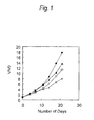
- the antitumor effect was evaluated by comparing the average values of values (V/V0) obtained by dividing the tumor volume on each day of measurement by the tumor volume on Day 0 in each group.
- Fig. 1 The chronological change in the average values of V/V0 in each group is shown in Fig. 1 .
- the administration of KM8760 and Lenalidomide in combination exhibited higher effect in suppressing growth than the administration of Lenalidomide alone or the antibody alone.
- Table 1 The results of the test for significant differences (One-way ANOVA, Dunnett test) compared with the negative control group are shown in Table 1. In addition, when p ⁇ 0.05, the value is considered to show a significant difference and is shown with * in the table. Table 1 P value Day 4 Day 7 Day 10 Day 14 Day 18 Day 21 One-way ANOVA 0.390 0.101 0.039* 0.007* 0.005* 0.006* Dunnett vs KM8760 0.751 0.071 0.119 0.070 0.034* 0.046* vs Lenalidomide 0.965 0.763 0.950 0.670 0.159 0.261 vs Combination administration group 0.503 0.144 0.037* 0.003* 0.001* 0.002*
- T/C A value obtained by dividing V/V0 of each group by V/V0 of the negative control group is shown in Table 2.
- * means the case where the actual value of T/C is smaller than the theoretical value.
- Table 2 T/C Day 0 Day 4 Day 7 Day 10 Day 14 Day 17 Day 21 KM8760 1.000 0.910 0.764 0.750 0.691 0.652 0.639 Lenalidomide 1.000 1.041 0.918 0.948 0.875 0.750 0.766
- Combination administration group (Theoretical value) 1.000 0.948 0.701 0.712 0.604 0.489 0.489 (Actual value) 1.000 0.870* 0.800 0.684* 0.520* 0.487* 0.450*
- HH cells cutaneous T cell lymphoma cell line; ATCC No: CRL-2105
- Dulbecco's phosphate buffered saline without calcium chloride and magnesium chloride PBS, manufactured by Invitrogen
- a diameter of a tumor was measured with calipers, and a tumor volume was calculated using the following formula.
- Tumor volume short diameter ⁇ short diameter ⁇ long diameter ⁇ 0.5
- the experiment was conducted with groups each consisting of twelve mice.
- KM8760 was diluted with saline (manufactured by Otsuka Pharmaceutical), and the obtained solution was administered from the tail vein.
- Lenalidomide was suspended with saline containing 0.5% of methylcellulose and the diluent was intraperitoneally administered.
- the tumor volume was measured chronologically.
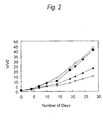
- the antitumor effect was evaluated by comparing the average values of values (V/V0) obtained by dividing the tumor volume on each day of measurement by the tumor volume on Day 0 in each group.
- Fig. 2 The chronological change in the average values of V/V0 in each group is shown in Fig. 2 .
- the administration group of KM8760 and Lenalidomide in combination exhibited higher effect in suppressing growth than the administration group of Lenalidomide alone or the antibody alone.
- T/C A value (T/C) obtained by dividing V/V0 of each group by V/V0 of the negative control group is shown in Table 4.
- * means the case where the actual value of T/C is smaller than the theoretical value.
- Table 4 T/C Day 0 Day 4 Day 7 Day 10 Day 14 Day 19 Day 21 Day 24 Day 28
- Negative control group 1.00 1.00 1.00 1.00 1.00 1.00 1.00 1.00 1.00 KM8760 1.00 0.89 0.71 0.62 0.54 0.54 0.54 0.55 0.53
- Lenalidomide 1.00 1.05 0.92 0.93 0.75 0.90 0.88 0.95 0.95
- Combination administration group Actual value
- ADCC Antibody-Dependent Cellular Cytotoxicity
- hPBMC Mononuclear cells
- HH cells suspended in about 100 ⁇ L and 20 ⁇ L of 51 Cr solution (NEZ030, manufactured by Perkin-Elmer) were mixed, the mixed solution was incubated at 37°C for 2 to 4 hours so that HH cells were radiolabeled. After the radiolabeled HH cells were washed three times with the medium, the washed cells were adjusted to give a concentration of about 2 ⁇ 10 5 cells/mL. The obtained cells were used as target cells.
- 51 Cr solution NZ030, manufactured by Perkin-Elmer
- KM8760 was adjusted to give a concentration of 0.03, 0.3, or 3 ⁇ g/mL, using the medium.
- the obtained solution was used as antibody solution.
- Spontaneous CPM was obtained in the absence of the effector cell and the antibody, and maximum CPM was obtained by adding 1 % of NP-40 instead of the effector cell in absence of the antibody.
- the present disclosure can provide a pharmaceutical composition comprising a recombinant antibody against CCR4 and at least one medicament; and a pharmaceutical composition for administering in combination of a recombinant antibody against CCR4 and at least one medicament.
Landscapes
- Health & Medical Sciences (AREA)
- Chemical & Material Sciences (AREA)
- Medicinal Chemistry (AREA)
- Life Sciences & Earth Sciences (AREA)
- Public Health (AREA)
- Veterinary Medicine (AREA)
- Pharmacology & Pharmacy (AREA)
- Animal Behavior & Ethology (AREA)
- General Health & Medical Sciences (AREA)
- Epidemiology (AREA)
- Engineering & Computer Science (AREA)
- Immunology (AREA)
- Bioinformatics & Cheminformatics (AREA)
- Mycology (AREA)
- Microbiology (AREA)
- Biomedical Technology (AREA)
- Oncology (AREA)
- Endocrinology (AREA)
- Chemical Kinetics & Catalysis (AREA)
- General Chemical & Material Sciences (AREA)
- Nuclear Medicine, Radiotherapy & Molecular Imaging (AREA)
- Organic Chemistry (AREA)
- Medicines Containing Antibodies Or Antigens For Use As Internal Diagnostic Agents (AREA)
- Peptides Or Proteins (AREA)
- Preparation Of Compounds By Using Micro-Organisms (AREA)
- Pharmaceuticals Containing Other Organic And Inorganic Compounds (AREA)
Claims (6)
- Pharmazeutische Zusammensetzung, umfassend einen rekombinanten Antikörper, der spezifisch an den menschlichen CC-Chemokin-Rezeptor 4 (CCR4) bindet, und Lenalidomid, wobei der Antikörper komplementaritätsbestimmende Region (CDR) 1, CDR2 und CDR3 einer schweren Kette der variablen Region eines Antikörpermoleküls, umfassend die Aminosäuresequenzen SEQ ID NO: 5, 6 bzw. 7, und CDR1, CDR2 und CDR3 einer leichten Kette der variablen Region eines Antikörpers, umfassend die Aminosäuresequenzen SEQ ID NO: 8, 9 bzw. 10, umfasst, zur Verwendung bei einem Verfahren zur Behandlung eines T-Zell-Lymphoms.
- Pharmazeutische Zusammensetzung zur Verwendung nach Anspruch 1, wobei der rekombinante Antikörper, der spezifisch an CCR4 bindet, und Lenalidomid in Kombination verabreicht werden sollen.
- Pharmazeutische Zusammensetzung zur Verwendung nach Anspruch 2, wobei der rekombinante Antikörper, der spezifisch an CCR4 bindet, und Lenalidomid gleichzeitig oder nacheinander verabreicht werden sollen.
- Pharmazeutische Zusammensetzung zur Verwendung nach einem der Ansprüche 1 bis 3, wobei der rekombinante Antikörper ein Antikörper mit einer hohen Antikörperabhängigen zellulären Zytotoxizität ist.
- Pharmazeutische Zusammensetzung zur Verwendung nach einem der Ansprüche 1 bis 4, wobei der rekombinante Antikörper ein humanisierter Antikörper ist.
- Pharmazeutische Zusammensetzung zur Verwendung nach einem der Ansprüche 1 bis 5, wobei, in dem humanisierten Antikörper, die schwere Kette der variablen Region eines Antikörpermoleküls die Aminosäuresequenz SEQ ID NO: 11 umfasst, und die leichte Kette der variablen Region eines Antikörpermoleküls die Aminosäuresequenz SEQ ID NO: 12 umfasst.
Applications Claiming Priority (3)
| Application Number | Priority Date | Filing Date | Title |
|---|---|---|---|
| JP2009209218 | 2009-09-10 | ||
| US24155809P | 2009-09-11 | 2009-09-11 | |
| PCT/JP2010/065566 WO2011030841A1 (ja) | 2009-09-10 | 2010-09-09 | ヒトccケモカイン受容体4(ccr4)に特異的に結合する抗体組成物を含む医薬 |
Publications (3)
| Publication Number | Publication Date |
|---|---|
| EP2476438A1 EP2476438A1 (de) | 2012-07-18 |
| EP2476438A4 EP2476438A4 (de) | 2013-03-06 |
| EP2476438B1 true EP2476438B1 (de) | 2014-07-23 |
Family
ID=43732510
Family Applications (1)
| Application Number | Title | Priority Date | Filing Date |
|---|---|---|---|
| EP10815436.0A Active EP2476438B1 (de) | 2009-09-10 | 2010-09-09 | Medikament mit einer spezifisch an den menschlichen cc-chemokin-rezeptor 4 (ccr4) gebundenen antikörperzusammensetzung |
Country Status (7)
| Country | Link |
|---|---|
| US (3) | US8574574B2 (de) |
| EP (1) | EP2476438B1 (de) |
| JP (1) | JP5709061B2 (de) |
| AU (1) | AU2010293383B2 (de) |
| CA (1) | CA2773579C (de) |
| ES (1) | ES2502541T3 (de) |
| WO (1) | WO2011030841A1 (de) |
Families Citing this family (8)
| Publication number | Priority date | Publication date | Assignee | Title |
|---|---|---|---|---|
| EP2476438B1 (de) * | 2009-09-10 | 2014-07-23 | Kyowa Hakko Kirin Co., Ltd. | Medikament mit einer spezifisch an den menschlichen cc-chemokin-rezeptor 4 (ccr4) gebundenen antikörperzusammensetzung |
| US20150126582A1 (en) * | 2012-04-30 | 2015-05-07 | Sevion Therapeutics, Inc. | Combination Treatment of Multiple Myeloma |
| JP6310845B2 (ja) | 2012-07-06 | 2018-04-11 | 学校法人 聖マリアンナ医科大学 | Htlv−1関連脊髄症患者の治療方法および治療剤 |
| US20180271861A1 (en) | 2015-07-14 | 2018-09-27 | Kyowa Hakko Kirin Co., Ltd. | Therapeutic agent for a tumor comprising an ido inhibitor administered in combination with an antibody |
| WO2018159845A1 (ja) * | 2017-03-02 | 2018-09-07 | 学校法人 聖マリアンナ医科大学 | 低用量抗ccr4抗体を用いたhtlv-1関連脊髄症の予防または治療剤 |
| AU2018360766B2 (en) | 2017-11-06 | 2024-09-19 | Rapt Therapeutics, Inc. | Anticancer agents |
| CN108250290B (zh) * | 2018-02-23 | 2024-03-12 | 上海捌加壹医药科技有限公司 | Ccr4的n端重组蛋白及其用途 |
| WO2022173950A1 (en) * | 2021-02-11 | 2022-08-18 | The Trustees Of The University Of Pennsylvania | Ccr4-targeting chimeric antigen receptor cell therapy |
Family Cites Families (14)
| Publication number | Priority date | Publication date | Assignee | Title |
|---|---|---|---|---|
| JPH02257891A (ja) | 1989-03-31 | 1990-10-18 | Kyowa Hakko Kogyo Co Ltd | 組換え動物細胞による蛋白質の製造 |
| JPH0322979A (ja) | 1989-06-19 | 1991-01-31 | Kyowa Hakko Kogyo Co Ltd | 新規プラスミノーゲン活性化因子 |
| ES2233974T3 (es) | 1995-09-11 | 2005-06-16 | Kyowa Hakko Kogyo Co., Ltd. | Anticuerpo contra la cadena alfa del receptor de la interleucina 5 humana. |
| CN103333860B (zh) | 2000-10-06 | 2015-07-08 | 协和发酵麒麟株式会社 | 产生抗体组合物的细胞 |
| CN100430420C (zh) * | 2001-08-31 | 2008-11-05 | 协和发酵工业株式会社 | 人cdr-移植抗体及其抗体片段 |
| NO318161B1 (no) | 2002-01-14 | 2005-02-07 | Norra Lampen As | Lampebakstykke og lampedeksel, isaer for utebelysning |
| KR20050000380A (ko) | 2002-04-09 | 2005-01-03 | 교와 핫꼬 고교 가부시끼가이샤 | 게놈이 개변된 세포 |
| WO2005057341A2 (en) | 2003-12-02 | 2005-06-23 | Koolspan, Inc. | Automatic hardware-enabled virtual private network system |
| DE602004029934D1 (de) * | 2003-12-04 | 2010-12-16 | Kyowa Hakko Kirin Co Ltd | Einen genetisch modifizierten antikörper gegen chemokin-rezeptor-ccr4 enthaltendes medikament |
| AU2007281684C1 (en) * | 2006-08-07 | 2013-12-19 | Abbvie Biotherapeutics Inc. | Methods of treating multiple myeloma using combination therapies based on anti-CS1 antibodies |
| US20110038856A1 (en) * | 2006-11-02 | 2011-02-17 | Seattle Genetics, Inc. | Methods of treating neoplastic, autoimmune and inflammatory diseases |
| US7893045B2 (en) * | 2007-08-07 | 2011-02-22 | Celgene Corporation | Methods for treating lymphomas in certain patient populations and screening patients for said therapy |
| JP2009209218A (ja) | 2008-02-29 | 2009-09-17 | Univ Of Tokyo | 機能性セルロースビーズの製造方法、及び機能性セルロースビーズ |
| EP2476438B1 (de) * | 2009-09-10 | 2014-07-23 | Kyowa Hakko Kirin Co., Ltd. | Medikament mit einer spezifisch an den menschlichen cc-chemokin-rezeptor 4 (ccr4) gebundenen antikörperzusammensetzung |
-
2010
- 2010-09-09 EP EP10815436.0A patent/EP2476438B1/de active Active
- 2010-09-09 JP JP2011530880A patent/JP5709061B2/ja active Active
- 2010-09-09 ES ES10815436.0T patent/ES2502541T3/es active Active
- 2010-09-09 AU AU2010293383A patent/AU2010293383B2/en active Active
- 2010-09-09 WO PCT/JP2010/065566 patent/WO2011030841A1/ja not_active Ceased
- 2010-09-09 CA CA2773579A patent/CA2773579C/en active Active
- 2010-09-10 US US12/879,121 patent/US8574574B2/en active Active
-
2013
- 2013-06-10 US US13/914,027 patent/US8980263B2/en active Active
-
2015
- 2015-02-04 US US14/613,668 patent/US9387248B2/en active Active
Non-Patent Citations (3)
| Title |
|---|
| "Lenalidomide Therapy for Patients With Relapsed and/or Refractory, Peripheral T-Cell Lymphomas", INTERNET CITATION, 12 February 2009 (2009-02-12), Retrieved from the Internet <URL:http://clinicaltrials.gov/archive/NCT00704691/2009_02_12> [retrieved on 20140109] * |
| LAPALOMBELLA R ET AL: "Lenalidomide down-regulates the CD20 antigen and antagonizes direct and antibody-dependent cellular cytotoxicity of rituximab on primary chronic lymphocytic leukemia cells (vol 112, pg 5180, 2008)", BLOOD, vol. 114, no. 16, April 2008 (2008-04-01), pages 3506, ISSN: 0006-4971 * |
| LAPALOMBELLA ROSA ET AL: "The humanized CD40 antibody SGN-40 demonstrates pre-clinical activity that is enhanced by lenalidomide in chronic lymphocytic leukaemia", BRITISH JOURNAL OF HAEMATOLOGY, vol. 144, no. 6, March 2009 (2009-03-01), pages 848 - 855, ISSN: 0007-1048 * |
Also Published As
| Publication number | Publication date |
|---|---|
| CA2773579C (en) | 2019-01-15 |
| JPWO2011030841A1 (ja) | 2013-02-07 |
| AU2010293383B2 (en) | 2014-12-18 |
| WO2011030841A1 (ja) | 2011-03-17 |
| JP5709061B2 (ja) | 2015-04-30 |
| AU2010293383A1 (en) | 2012-04-05 |
| ES2502541T3 (es) | 2014-10-03 |
| EP2476438A4 (de) | 2013-03-06 |
| EP2476438A1 (de) | 2012-07-18 |
| US20110262431A1 (en) | 2011-10-27 |
| CA2773579A1 (en) | 2011-03-17 |
| US8574574B2 (en) | 2013-11-05 |
| US20130287768A1 (en) | 2013-10-31 |
| US20150147321A1 (en) | 2015-05-28 |
| US8980263B2 (en) | 2015-03-17 |
| US9387248B2 (en) | 2016-07-12 |
Similar Documents
| Publication | Publication Date | Title |
|---|---|---|
| US9387248B2 (en) | Pharmaceutical composition comprising antibody composition which specifically binds to CCR4 | |
| KR101874215B1 (ko) | 항-cd20 항체와 btk 억제제의 병용 요법 | |
| US9675625B2 (en) | Medicament comprising recombinant antibody against chemokine receptor CCR4 | |
| RU2585489C2 (ru) | КОМБИНИРОВАННАЯ ТЕРАПИЯ АФУКОЗИЛИРОВАННЫМ АНТИТЕЛОМ CD20 И ИНГИБИТОРОМ mTOR | |
| KR20120054068A (ko) | 벤다무스틴과 어푸코실화된 cd20 항체의 복합 요법 | |
| US20150274834A1 (en) | Combination therapy of an afucosylated cd20 antibody with fludarabine and/or mitoxantrone | |
| JP2017061454A (ja) | アンタゴニスト抗il−7受容体抗体および方法 | |
| KR20130088170A (ko) | 비푸코실화 cd20 항체와 mdm2 저해제와의 조합 치료 | |
| US20200237905A1 (en) | Combination therapy with a bet inhibitor, a bcl-2 inhibitor and an anti-cd20 antibody | |
| US20100111947A1 (en) | Pharmaceutical composition comprising antibody composition which specifically binds to ganglioside gm2 | |
| HK40070001A (en) | Combination therapy of an anti cd20 antibody with a btk inhibitor | |
| HK1167339B (en) | Combination therapy of an afucosylated cd20 antibody with fludarabine and/or mitoxantrone |
Legal Events
| Date | Code | Title | Description |
|---|---|---|---|
| PUAI | Public reference made under article 153(3) epc to a published international application that has entered the european phase |
Free format text: ORIGINAL CODE: 0009012 |
|
| 17P | Request for examination filed |
Effective date: 20120309 |
|
| AK | Designated contracting states |
Kind code of ref document: A1 Designated state(s): AL AT BE BG CH CY CZ DE DK EE ES FI FR GB GR HR HU IE IS IT LI LT LU LV MC MK MT NL NO PL PT RO SE SI SK SM TR |
|
| DAX | Request for extension of the european patent (deleted) | ||
| A4 | Supplementary search report drawn up and despatched |
Effective date: 20130131 |
|
| RIC1 | Information provided on ipc code assigned before grant |
Ipc: A61K 31/454 20060101ALI20130125BHEP Ipc: A61P 35/00 20060101ALI20130125BHEP Ipc: C07K 16/28 20060101ALI20130125BHEP Ipc: A61K 45/06 20060101ALI20130125BHEP Ipc: A61K 39/395 20060101AFI20130125BHEP |
|
| 17Q | First examination report despatched |
Effective date: 20131002 |
|
| GRAP | Despatch of communication of intention to grant a patent |
Free format text: ORIGINAL CODE: EPIDOSNIGR1 |
|
| INTG | Intention to grant announced |
Effective date: 20140127 |
|
| GRAS | Grant fee paid |
Free format text: ORIGINAL CODE: EPIDOSNIGR3 |
|
| GRAA | (expected) grant |
Free format text: ORIGINAL CODE: 0009210 |
|
| AK | Designated contracting states |
Kind code of ref document: B1 Designated state(s): AL AT BE BG CH CY CZ DE DK EE ES FI FR GB GR HR HU IE IS IT LI LT LU LV MC MK MT NL NO PL PT RO SE SI SK SM TR |
|
| REG | Reference to a national code |
Ref country code: GB Ref legal event code: FG4D |
|
| REG | Reference to a national code |
Ref country code: CH Ref legal event code: EP |
|
| REG | Reference to a national code |
Ref country code: IE Ref legal event code: FG4D |
|
| REG | Reference to a national code |
Ref country code: AT Ref legal event code: REF Ref document number: 678491 Country of ref document: AT Kind code of ref document: T Effective date: 20140815 |
|
| REG | Reference to a national code |
Ref country code: DE Ref legal event code: R096 Ref document number: 602010017795 Country of ref document: DE Effective date: 20140904 |
|
| REG | Reference to a national code |
Ref country code: ES Ref legal event code: FG2A Ref document number: 2502541 Country of ref document: ES Kind code of ref document: T3 Effective date: 20141003 |
|
| REG | Reference to a national code |
Ref country code: NL Ref legal event code: T3 |
|
| REG | Reference to a national code |
Ref country code: AT Ref legal event code: MK05 Ref document number: 678491 Country of ref document: AT Kind code of ref document: T Effective date: 20140723 |
|
| REG | Reference to a national code |
Ref country code: LT Ref legal event code: MG4D |
|
| PG25 | Lapsed in a contracting state [announced via postgrant information from national office to epo] |
Ref country code: FI Free format text: LAPSE BECAUSE OF FAILURE TO SUBMIT A TRANSLATION OF THE DESCRIPTION OR TO PAY THE FEE WITHIN THE PRESCRIBED TIME-LIMIT Effective date: 20140723 Ref country code: NO Free format text: LAPSE BECAUSE OF FAILURE TO SUBMIT A TRANSLATION OF THE DESCRIPTION OR TO PAY THE FEE WITHIN THE PRESCRIBED TIME-LIMIT Effective date: 20141023 Ref country code: LT Free format text: LAPSE BECAUSE OF FAILURE TO SUBMIT A TRANSLATION OF THE DESCRIPTION OR TO PAY THE FEE WITHIN THE PRESCRIBED TIME-LIMIT Effective date: 20140723 Ref country code: GR Free format text: LAPSE BECAUSE OF FAILURE TO SUBMIT A TRANSLATION OF THE DESCRIPTION OR TO PAY THE FEE WITHIN THE PRESCRIBED TIME-LIMIT Effective date: 20141024 Ref country code: BG Free format text: LAPSE BECAUSE OF FAILURE TO SUBMIT A TRANSLATION OF THE DESCRIPTION OR TO PAY THE FEE WITHIN THE PRESCRIBED TIME-LIMIT Effective date: 20141023 Ref country code: PT Free format text: LAPSE BECAUSE OF FAILURE TO SUBMIT A TRANSLATION OF THE DESCRIPTION OR TO PAY THE FEE WITHIN THE PRESCRIBED TIME-LIMIT Effective date: 20141124 Ref country code: SE Free format text: LAPSE BECAUSE OF FAILURE TO SUBMIT A TRANSLATION OF THE DESCRIPTION OR TO PAY THE FEE WITHIN THE PRESCRIBED TIME-LIMIT Effective date: 20140723 |
|
| PG25 | Lapsed in a contracting state [announced via postgrant information from national office to epo] |
Ref country code: HR Free format text: LAPSE BECAUSE OF FAILURE TO SUBMIT A TRANSLATION OF THE DESCRIPTION OR TO PAY THE FEE WITHIN THE PRESCRIBED TIME-LIMIT Effective date: 20140723 Ref country code: CY Free format text: LAPSE BECAUSE OF FAILURE TO SUBMIT A TRANSLATION OF THE DESCRIPTION OR TO PAY THE FEE WITHIN THE PRESCRIBED TIME-LIMIT Effective date: 20140723 Ref country code: IS Free format text: LAPSE BECAUSE OF FAILURE TO SUBMIT A TRANSLATION OF THE DESCRIPTION OR TO PAY THE FEE WITHIN THE PRESCRIBED TIME-LIMIT Effective date: 20141123 Ref country code: PL Free format text: LAPSE BECAUSE OF FAILURE TO SUBMIT A TRANSLATION OF THE DESCRIPTION OR TO PAY THE FEE WITHIN THE PRESCRIBED TIME-LIMIT Effective date: 20140723 Ref country code: AT Free format text: LAPSE BECAUSE OF FAILURE TO SUBMIT A TRANSLATION OF THE DESCRIPTION OR TO PAY THE FEE WITHIN THE PRESCRIBED TIME-LIMIT Effective date: 20140723 Ref country code: LV Free format text: LAPSE BECAUSE OF FAILURE TO SUBMIT A TRANSLATION OF THE DESCRIPTION OR TO PAY THE FEE WITHIN THE PRESCRIBED TIME-LIMIT Effective date: 20140723 |
|
| REG | Reference to a national code |
Ref country code: DE Ref legal event code: R097 Ref document number: 602010017795 Country of ref document: DE |
|
| PG25 | Lapsed in a contracting state [announced via postgrant information from national office to epo] |
Ref country code: DK Free format text: LAPSE BECAUSE OF FAILURE TO SUBMIT A TRANSLATION OF THE DESCRIPTION OR TO PAY THE FEE WITHIN THE PRESCRIBED TIME-LIMIT Effective date: 20140723 Ref country code: RO Free format text: LAPSE BECAUSE OF FAILURE TO SUBMIT A TRANSLATION OF THE DESCRIPTION OR TO PAY THE FEE WITHIN THE PRESCRIBED TIME-LIMIT Effective date: 20140723 Ref country code: EE Free format text: LAPSE BECAUSE OF FAILURE TO SUBMIT A TRANSLATION OF THE DESCRIPTION OR TO PAY THE FEE WITHIN THE PRESCRIBED TIME-LIMIT Effective date: 20140723 Ref country code: CZ Free format text: LAPSE BECAUSE OF FAILURE TO SUBMIT A TRANSLATION OF THE DESCRIPTION OR TO PAY THE FEE WITHIN THE PRESCRIBED TIME-LIMIT Effective date: 20140723 Ref country code: MC Free format text: LAPSE BECAUSE OF FAILURE TO SUBMIT A TRANSLATION OF THE DESCRIPTION OR TO PAY THE FEE WITHIN THE PRESCRIBED TIME-LIMIT Effective date: 20140723 Ref country code: SK Free format text: LAPSE BECAUSE OF FAILURE TO SUBMIT A TRANSLATION OF THE DESCRIPTION OR TO PAY THE FEE WITHIN THE PRESCRIBED TIME-LIMIT Effective date: 20140723 Ref country code: LU Free format text: LAPSE BECAUSE OF FAILURE TO SUBMIT A TRANSLATION OF THE DESCRIPTION OR TO PAY THE FEE WITHIN THE PRESCRIBED TIME-LIMIT Effective date: 20140909 |
|
| REG | Reference to a national code |
Ref country code: CH Ref legal event code: PL |
|
| PLBE | No opposition filed within time limit |
Free format text: ORIGINAL CODE: 0009261 |
|
| STAA | Information on the status of an ep patent application or granted ep patent |
Free format text: STATUS: NO OPPOSITION FILED WITHIN TIME LIMIT |
|
| REG | Reference to a national code |
Ref country code: IE Ref legal event code: MM4A |
|
| PG25 | Lapsed in a contracting state [announced via postgrant information from national office to epo] |
Ref country code: BE Free format text: LAPSE BECAUSE OF NON-PAYMENT OF DUE FEES Effective date: 20140930 |
|
| 26N | No opposition filed |
Effective date: 20150424 |
|
| PG25 | Lapsed in a contracting state [announced via postgrant information from national office to epo] |
Ref country code: CH Free format text: LAPSE BECAUSE OF NON-PAYMENT OF DUE FEES Effective date: 20140930 Ref country code: LI Free format text: LAPSE BECAUSE OF NON-PAYMENT OF DUE FEES Effective date: 20140930 |
|
| PG25 | Lapsed in a contracting state [announced via postgrant information from national office to epo] |
Ref country code: IE Free format text: LAPSE BECAUSE OF NON-PAYMENT OF DUE FEES Effective date: 20140909 |
|
| PG25 | Lapsed in a contracting state [announced via postgrant information from national office to epo] |
Ref country code: SI Free format text: LAPSE BECAUSE OF FAILURE TO SUBMIT A TRANSLATION OF THE DESCRIPTION OR TO PAY THE FEE WITHIN THE PRESCRIBED TIME-LIMIT Effective date: 20140723 |
|
| PG25 | Lapsed in a contracting state [announced via postgrant information from national office to epo] |
Ref country code: SM Free format text: LAPSE BECAUSE OF FAILURE TO SUBMIT A TRANSLATION OF THE DESCRIPTION OR TO PAY THE FEE WITHIN THE PRESCRIBED TIME-LIMIT Effective date: 20140723 |
|
| PG25 | Lapsed in a contracting state [announced via postgrant information from national office to epo] |
Ref country code: MT Free format text: LAPSE BECAUSE OF FAILURE TO SUBMIT A TRANSLATION OF THE DESCRIPTION OR TO PAY THE FEE WITHIN THE PRESCRIBED TIME-LIMIT Effective date: 20140723 |
|
| PG25 | Lapsed in a contracting state [announced via postgrant information from national office to epo] |
Ref country code: TR Free format text: LAPSE BECAUSE OF FAILURE TO SUBMIT A TRANSLATION OF THE DESCRIPTION OR TO PAY THE FEE WITHIN THE PRESCRIBED TIME-LIMIT Effective date: 20140723 Ref country code: BE Free format text: LAPSE BECAUSE OF FAILURE TO SUBMIT A TRANSLATION OF THE DESCRIPTION OR TO PAY THE FEE WITHIN THE PRESCRIBED TIME-LIMIT Effective date: 20140723 Ref country code: HU Free format text: LAPSE BECAUSE OF FAILURE TO SUBMIT A TRANSLATION OF THE DESCRIPTION OR TO PAY THE FEE WITHIN THE PRESCRIBED TIME-LIMIT; INVALID AB INITIO Effective date: 20100909 |
|
| REG | Reference to a national code |
Ref country code: FR Ref legal event code: PLFP Year of fee payment: 7 |
|
| REG | Reference to a national code |
Ref country code: FR Ref legal event code: PLFP Year of fee payment: 8 |
|
| PG25 | Lapsed in a contracting state [announced via postgrant information from national office to epo] |
Ref country code: MK Free format text: LAPSE BECAUSE OF FAILURE TO SUBMIT A TRANSLATION OF THE DESCRIPTION OR TO PAY THE FEE WITHIN THE PRESCRIBED TIME-LIMIT Effective date: 20140723 |
|
| REG | Reference to a national code |
Ref country code: FR Ref legal event code: PLFP Year of fee payment: 9 |
|
| PG25 | Lapsed in a contracting state [announced via postgrant information from national office to epo] |
Ref country code: AL Free format text: LAPSE BECAUSE OF FAILURE TO SUBMIT A TRANSLATION OF THE DESCRIPTION OR TO PAY THE FEE WITHIN THE PRESCRIBED TIME-LIMIT Effective date: 20140723 |
|
| REG | Reference to a national code |
Ref country code: DE Ref legal event code: R082 Ref document number: 602010017795 Country of ref document: DE Representative=s name: HOFFMANN - EITLE PATENT- UND RECHTSANWAELTE PA, DE Ref country code: DE Ref legal event code: R081 Ref document number: 602010017795 Country of ref document: DE Owner name: KYOWA KIRIN CO., LTD., JP Free format text: FORMER OWNER: KYOWA HAKKO KIRIN CO., LTD., TOKYO, JP |
|
| REG | Reference to a national code |
Ref country code: NL Ref legal event code: HC Owner name: KYOWA KIRIN CO., LTD.; JP Free format text: DETAILS ASSIGNMENT: CHANGE OF OWNER(S), CHANGE OF OWNER(S) NAME; FORMER OWNER NAME: KYOWA HAKKO KIRIN CO., LTD. Effective date: 20191108 |
|
| P01 | Opt-out of the competence of the unified patent court (upc) registered |
Effective date: 20230522 |
|
| REG | Reference to a national code |
Ref country code: ES Ref legal event code: PC2A Owner name: KYOWA KIRIN CO., LTD. Effective date: 20240319 |
|
| PGFP | Annual fee paid to national office [announced via postgrant information from national office to epo] |
Ref country code: NL Payment date: 20250814 Year of fee payment: 16 |
|
| PGFP | Annual fee paid to national office [announced via postgrant information from national office to epo] |
Ref country code: DE Payment date: 20250730 Year of fee payment: 16 |
|
| PGFP | Annual fee paid to national office [announced via postgrant information from national office to epo] |
Ref country code: IT Payment date: 20250825 Year of fee payment: 16 |
|
| PGFP | Annual fee paid to national office [announced via postgrant information from national office to epo] |
Ref country code: GB Payment date: 20250731 Year of fee payment: 16 |
|
| PGFP | Annual fee paid to national office [announced via postgrant information from national office to epo] |
Ref country code: FR Payment date: 20250808 Year of fee payment: 16 |
|
| PGFP | Annual fee paid to national office [announced via postgrant information from national office to epo] |
Ref country code: ES Payment date: 20251013 Year of fee payment: 16 |