EP2500113A1 - Procédé et voie de laminage pour laminer un produit de laminage fabriqué dans un procédé de coulée de lingots, dispositif de commande et/ou de réglage pour une voie de laminage, code de programme lisible par machine pour un dispositif de commande et/ou de réglage et support de stockage - Google Patents
Procédé et voie de laminage pour laminer un produit de laminage fabriqué dans un procédé de coulée de lingots, dispositif de commande et/ou de réglage pour une voie de laminage, code de programme lisible par machine pour un dispositif de commande et/ou de réglage et support de stockage Download PDFInfo
- Publication number
- EP2500113A1 EP2500113A1 EP11002088A EP11002088A EP2500113A1 EP 2500113 A1 EP2500113 A1 EP 2500113A1 EP 11002088 A EP11002088 A EP 11002088A EP 11002088 A EP11002088 A EP 11002088A EP 2500113 A1 EP2500113 A1 EP 2500113A1
- Authority
- EP
- European Patent Office
- Prior art keywords
- rolling
- stock
- rolling stock
- regulating device
- control
- Prior art date
- Legal status (The legal status is an assumption and is not a legal conclusion. Google has not performed a legal analysis and makes no representation as to the accuracy of the status listed.)
- Withdrawn
Links
- 238000000034 method Methods 0.000 title claims abstract description 24
- 230000001105 regulatory effect Effects 0.000 title claims abstract description 19
- 238000005266 casting Methods 0.000 title claims abstract description 13
- 238000003860 storage Methods 0.000 title claims abstract description 7
- 238000003801 milling Methods 0.000 title 1
- 238000005096 rolling process Methods 0.000 claims abstract description 246
- 239000000463 material Substances 0.000 abstract description 7
- 239000000047 product Substances 0.000 description 4
- 230000002441 reversible effect Effects 0.000 description 4
- 241001136792 Alle Species 0.000 description 3
- 230000008901 benefit Effects 0.000 description 3
- 238000009826 distribution Methods 0.000 description 3
- 238000003892 spreading Methods 0.000 description 3
- 230000007480 spreading Effects 0.000 description 3
- 230000008859 change Effects 0.000 description 2
- 238000005098 hot rolling Methods 0.000 description 2
- 238000012545 processing Methods 0.000 description 2
- 229910052710 silicon Inorganic materials 0.000 description 2
- 239000010703 silicon Substances 0.000 description 2
- 238000007711 solidification Methods 0.000 description 2
- 230000008023 solidification Effects 0.000 description 2
- 241000196324 Embryophyta Species 0.000 description 1
- 235000004443 Ricinus communis Nutrition 0.000 description 1
- 240000000528 Ricinus communis Species 0.000 description 1
- 241000826860 Trapezium Species 0.000 description 1
- 230000004913 activation Effects 0.000 description 1
- 238000009749 continuous casting Methods 0.000 description 1
- 230000001276 controlling effect Effects 0.000 description 1
- 238000012937 correction Methods 0.000 description 1
- 230000001419 dependent effect Effects 0.000 description 1
- 230000002349 favourable effect Effects 0.000 description 1
- 230000001788 irregular Effects 0.000 description 1
- 238000004519 manufacturing process Methods 0.000 description 1
- 230000008569 process Effects 0.000 description 1
- 230000000284 resting effect Effects 0.000 description 1
- 239000004065 semiconductor Substances 0.000 description 1
- 239000011265 semifinished product Substances 0.000 description 1
- 230000008719 thickening Effects 0.000 description 1
- 238000012549 training Methods 0.000 description 1
- 238000012546 transfer Methods 0.000 description 1
Images
Classifications
-
- B—PERFORMING OPERATIONS; TRANSPORTING
- B21—MECHANICAL METAL-WORKING WITHOUT ESSENTIALLY REMOVING MATERIAL; PUNCHING METAL
- B21B—ROLLING OF METAL
- B21B1/00—Metal-rolling methods or mills for making semi-finished products of solid or profiled cross-section; Sequence of operations in milling trains; Layout of rolling-mill plant, e.g. grouping of stands; Succession of passes or of sectional pass alternations
- B21B1/02—Metal-rolling methods or mills for making semi-finished products of solid or profiled cross-section; Sequence of operations in milling trains; Layout of rolling-mill plant, e.g. grouping of stands; Succession of passes or of sectional pass alternations for rolling heavy work, e.g. ingots, slabs, blooms, or billets, in which the cross-sectional form is unimportant ; Rolling combined with forging or pressing
- B21B1/026—Rolling
-
- B—PERFORMING OPERATIONS; TRANSPORTING
- B21—MECHANICAL METAL-WORKING WITHOUT ESSENTIALLY REMOVING MATERIAL; PUNCHING METAL
- B21B—ROLLING OF METAL
- B21B1/00—Metal-rolling methods or mills for making semi-finished products of solid or profiled cross-section; Sequence of operations in milling trains; Layout of rolling-mill plant, e.g. grouping of stands; Succession of passes or of sectional pass alternations
- B21B1/22—Metal-rolling methods or mills for making semi-finished products of solid or profiled cross-section; Sequence of operations in milling trains; Layout of rolling-mill plant, e.g. grouping of stands; Succession of passes or of sectional pass alternations for rolling plates, strips, bands or sheets of indefinite length
-
- B—PERFORMING OPERATIONS; TRANSPORTING
- B21—MECHANICAL METAL-WORKING WITHOUT ESSENTIALLY REMOVING MATERIAL; PUNCHING METAL
- B21B—ROLLING OF METAL
- B21B1/00—Metal-rolling methods or mills for making semi-finished products of solid or profiled cross-section; Sequence of operations in milling trains; Layout of rolling-mill plant, e.g. grouping of stands; Succession of passes or of sectional pass alternations
- B21B1/38—Metal-rolling methods or mills for making semi-finished products of solid or profiled cross-section; Sequence of operations in milling trains; Layout of rolling-mill plant, e.g. grouping of stands; Succession of passes or of sectional pass alternations for rolling sheets of limited length, e.g. folded sheets, superimposed sheets, pack rolling
-
- B—PERFORMING OPERATIONS; TRANSPORTING
- B21—MECHANICAL METAL-WORKING WITHOUT ESSENTIALLY REMOVING MATERIAL; PUNCHING METAL
- B21B—ROLLING OF METAL
- B21B1/00—Metal-rolling methods or mills for making semi-finished products of solid or profiled cross-section; Sequence of operations in milling trains; Layout of rolling-mill plant, e.g. grouping of stands; Succession of passes or of sectional pass alternations
- B21B1/08—Metal-rolling methods or mills for making semi-finished products of solid or profiled cross-section; Sequence of operations in milling trains; Layout of rolling-mill plant, e.g. grouping of stands; Succession of passes or of sectional pass alternations for rolling structural sections, i.e. work of special cross-section, e.g. angle steel
-
- B—PERFORMING OPERATIONS; TRANSPORTING
- B21—MECHANICAL METAL-WORKING WITHOUT ESSENTIALLY REMOVING MATERIAL; PUNCHING METAL
- B21B—ROLLING OF METAL
- B21B1/00—Metal-rolling methods or mills for making semi-finished products of solid or profiled cross-section; Sequence of operations in milling trains; Layout of rolling-mill plant, e.g. grouping of stands; Succession of passes or of sectional pass alternations
- B21B1/08—Metal-rolling methods or mills for making semi-finished products of solid or profiled cross-section; Sequence of operations in milling trains; Layout of rolling-mill plant, e.g. grouping of stands; Succession of passes or of sectional pass alternations for rolling structural sections, i.e. work of special cross-section, e.g. angle steel
- B21B1/0805—Flat bars, i.e. having a substantially rectangular cross-section
-
- B—PERFORMING OPERATIONS; TRANSPORTING
- B21—MECHANICAL METAL-WORKING WITHOUT ESSENTIALLY REMOVING MATERIAL; PUNCHING METAL
- B21B—ROLLING OF METAL
- B21B1/00—Metal-rolling methods or mills for making semi-finished products of solid or profiled cross-section; Sequence of operations in milling trains; Layout of rolling-mill plant, e.g. grouping of stands; Succession of passes or of sectional pass alternations
- B21B1/02—Metal-rolling methods or mills for making semi-finished products of solid or profiled cross-section; Sequence of operations in milling trains; Layout of rolling-mill plant, e.g. grouping of stands; Succession of passes or of sectional pass alternations for rolling heavy work, e.g. ingots, slabs, blooms, or billets, in which the cross-sectional form is unimportant ; Rolling combined with forging or pressing
- B21B2001/028—Slabs
-
- B—PERFORMING OPERATIONS; TRANSPORTING
- B21—MECHANICAL METAL-WORKING WITHOUT ESSENTIALLY REMOVING MATERIAL; PUNCHING METAL
- B21B—ROLLING OF METAL
- B21B2205/00—Particular shaped rolled products
- B21B2205/04—Taper- or wedge-shaped profiles
-
- B—PERFORMING OPERATIONS; TRANSPORTING
- B21—MECHANICAL METAL-WORKING WITHOUT ESSENTIALLY REMOVING MATERIAL; PUNCHING METAL
- B21B—ROLLING OF METAL
- B21B2263/00—Shape of product
- B21B2263/02—Profile, e.g. of plate, hot strip, sections
-
- B—PERFORMING OPERATIONS; TRANSPORTING
- B21—MECHANICAL METAL-WORKING WITHOUT ESSENTIALLY REMOVING MATERIAL; PUNCHING METAL
- B21B—ROLLING OF METAL
- B21B2263/00—Shape of product
- B21B2263/30—Shape in top view
Definitions
- the invention relates to a method for rolling a rolling stock produced in a block casting process, a so-called slab or ingot in a rolling train, wherein the rolling stock before rolling in the form of a truncated pyramid having a base, a top surface and four side surfaces.
- the invention further relates to a rolling train for rolling such a rolling stock, a control and / or regulating device for such a rolling train, a machine-readable program code for such a control and / or regulating device and a storage medium for such a machine-readable program code.
- a rolling stock is then produced, for example, in a block casting process and is called "slab" before the rolling process.
- the slab forms a sheet or strip, ideally having a cuboid shape.
- a mold is used, which is slightly conical, with its cross-section tapers down. Due to the special shape of the mold, the slab dissolves completely after solidification of the mold wall when the slab is pressed out by means of special pliers from the mold. Without the conicity or convergence of the mold, the slab could not be removed from the mold. However, the slab takes on the shape of the mold, and then there is a problem that the double taper of the slab, ie, a thickness wedge and a wedge of the slab during rolling must be removed.
- a major problem in the rolling of slabs is to achieve a rectangular basic shape with a constant over the length of the sheet or the strip width.
- vertically oriented upset rolls are used which can thicken the hot strip in a longitudinal edge region and thus reduce the width of the strip within a certain range.
- the DE 196 13 718 C1 and the DE 197 57 486 A1 each discloses a plant for the production of hot strip, wherein before a first horizontal rolling mill, a vertical rolling stand is provided, with which the two longitudinal edge regions of a cast semi-finished product is compressed. As a result, a decrease in width of the slab is limited.
- the invention has for its object to enable a novel processing of a truncated pyramidal slab to a sheet or strip with a rectangular basic shape as uniform as possible width and thickness, in which the use of vertical rolling stands is not provided.
- roller is here both the slab or the ingot before rolling, as well as their intermediate forms and final shape, which they assume during or after rolling, called.
- a “rolling pass sequence” is understood to mean a series of rolling passes without rotation of the rolling stock.
- the rolling stock or the slab which was produced in a mold during ingot casting, due to the geometry of the mold, a thickness wedge and a wedge on.
- the slab thus has the shape of a truncated pyramid with a base, a top surface that is smaller than the base, and four lateral surfaces forming a lateral surface.
- the slab lies with a side surface in a horizontal support plane. This "down” oriented side surface, as well as the opposite side surface, which is directed “up” come in rolling pass in contact with the work rolls of the rolling stands of the rolling mill, when the rolling stands are horizontal rolling stands.
- the slab is characterized by a length, the length of the slab being defined by the distance between the base and the top surface. A width of the slab runs in the support plane transverse to the length. And a thickness of the slab extends substantially perpendicular to the support plane.
- the slab is usually with its top surface forward in a nip between the work rolls of the rolling stands driven into it, alternatively, however, it can also be moved laterally, ie with one of the side surfaces forward in the nip, this being dependent on the size of the slab.
- the rotation of the rolling stock by 90 ° takes place in the support plane, ie the side surface with which the rolling stock is located in the support plane remains after rotation in the support plane and it changes only the orientation of the base, the top surface and the other two side surfaces opposite the nip.
- the invention is based on the idea of enabling a favorable material distribution in a two-stage or multi-stage rolling process, by means of which the desired cuboid shape is achieved in a simple manner.
- This optimal distribution of material takes place in that all cross-sectional areas of the rolling stock between the base area and the top area have the same area at the end of the first rolling pass sequence in the rolling direction.
- the wedge-shaped course of the rolling stock in the first direction is in particular inverted.
- inverting the direction of the converging profile is changed after rolling, so that instead of a diverging course. In other words, a thickening of the slab is replaced by a taper in the rolling direction.
- the base surface, the top surface and all cross-sectional areas between the base surface and the top surface have the same surface area, ie the product of width and thickness is always the same in the rolling direction.
- the resulting from the inversion of the wedge-shaped course of the two opposite side surfaces redistribution of the material of the rolling combined with the rolling of the rolling in two transverse directions allows fully automatic, high-precision adjustment of the desired geometry by means of a rolling mill, in the use of vertical rolling stands is not required.
- an activation of the rolling train is also conceivable, in which the original surface gradient in the rolling direction is not completely reduced or overcompensated.
- the rolling pass sequence can be carried out on a plurality of rolling stands, wherein a rolling stand is provided in particular for each stitch.
- the rolling pass sequence can also be performed on a few or even only one stand in a reversible operation in which the rolling direction changes alternately.
- the rolling process starts in the longitudinal direction of the rolling stock and the first rolling pass sequence, which is also referred to as a pre-sequence, serves to reduce the original thickness difference in the longitudinal direction of the rolling stock and instead to produce a new Dickengradient, but in the opposite direction to the first Dickengradient.
- the length of the rolling stock is particularly increased.
- the rolling stock is transported "normally". However, if the odd-numbered rollers are rotated in opposition to the even-numbered ones, the rolling stock rotates around the normal vector standing on the roller table plane.
- the rolling stock is rolled with the aid of at least one rolling stand, which is set in such a way that the two opposite side faces of the rolling stock are rolled in the rolling direction over their entire length from the work rolls of the rolling stand during each rolling pass.
- the height of the roll gap in which the dimension or height of the roll gap is actively adjusted during de Walzstiches.
- a change in thickness of the rolling stock over the entire length of the rolling stock in the rolling direction is effected in the continuous rolling process.
- the continuous procedure thus has the advantage that a small change in the geometry of the rolling stock is achieved by a few rolling passes.
- At least two rolling pass sequences are required, wherein one is rolled in the longitudinal direction and the other in the width direction.
- small corrections of the shape of the rolling stock can be carried out after the second roll pass sequence by the rolling stock is rotated a further 90 ° and another roll stitch sequence again in the first direction.
- the length of the rolling train is minimized by operating the rolling train preferably reversibly, i. that at least one of the rolling mills of the rolling mill is operated reversibly.
- a high number of stitches is carried out on a few rolling stands.
- all rolling passes are performed on a single roll stand, i. that the rolling mills only comprises a rolling stand, which is reversible operable.
- a rolling mill for rolling a rolling stock produced in a block casting process in the form of a truncated pyramid comprising at least one rolling stand for rolling the rolling stock in the first direction and in a second direction transverse to the first direction and means for rotating the rolling stock by 90 °.
- control and / or regulating device for such a rolling mill, with a machine-readable program code which has control commands which, when executed, cause the control and / or regulating device to carry out a method according to one of the embodiments described above ,
- the object is further achieved according to the invention by a machine-readable program code for a control and / or regulating device for a rolling train, wherein the program code has control commands that cause the control and / or regulating device for carrying out the method according to one of the embodiments described above.
- the object is finally achieved according to the invention by a storage medium having stored thereon such machine-readable program code.
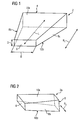
- a slab is shown, which is also referred to as rolling stock 2, which is produced in a block casting process.
- the slab 2 is in this embodiment, a so-called ingot, ie a block of a semiconductor material such as silicon.
- the silicon was melted and poured into a mold not shown here. After solidification of the mass in the mold, the slab 2 is pulled out of the mold or pushed out. This is possible due to the slightly conical shape of the mold. Accordingly, the slab 2 also has a double conicity, which manifests itself in a thickness wedge and a wedge, which must be removed during rolling, especially during hot rolling.
- the side surface 10b forms a lower side surface on which the rolling stock 2 rests during rolling.
- the opposite side surface 10a is directed substantially upwards and open.
- the rolling stock 2 in its original form is characterized by a length L which substantially corresponds to the distance between the base surface 4 and the smaller top surface 6.
- the rolling stock 2 has a varying width B, which is defined perpendicular to the length L, and a likewise varying thickness D, which protrudes from the support plane of the side surface 10b and which rises steadily between the top surface 6 and the base 4.
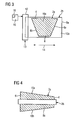
- the rolling stock 2 is rolled by means of a rolling line 13, which is indicated in FIG.
- the rolling train 13 may comprise a plurality of rolling stands, but in the illustrated embodiment it comprises only a single, horizontal rolling stand 12, which in FIG. 3 symbolically indicated by the block 12.
- the roll stand 12 is operated reversibly, ie the roll stand can reverse a rolling direction 14.
- a control and / or regulating device 16 is provided, which comprises a stored on a storage medium not shown here program code 18.
- the program code has control commands, in the execution of which the control and / or regulating device 16 controls the rolling train 13 in a suitable manner for producing the desired geometry of the rolling stock.
- the rolling stock 2 moved with its base 4 or its top surface 6 forward into a nip not shown here in detail between two work rolls of the roll stand 12 in.
- the rolling stock 2 is driven forward in the first nip with the top surface 6 in the nip and rolled in the direction of its length L.
- the roll gap of the roll stand 12 is set such that the side surfaces 10a and 10b at each pass across their entire length with the work rolls come into contact, ie that the work rolls roll in the rolling direction over the entire length of the rolling stock 2.
- This first roll pass sequence is called a pre-sequence.
- the wedge-shaped course is inverted from the top surface 6 toward the bottom surface 4, so that the top surface 6 is now thicker than the bottom surface 4.
- This intermediate geometry of the rolling stock 2a is shown in FIG FIG. 2 shown.
- the rolling stock 2a has the shape of an irregular hexahedron in which the side surfaces 8a, 8b, 10a, 10b are further formed trapezoidal, but each two adjacent side surfaces 8a, 8b, 10a, 10b converge in the reverse direction.
- the rolled stock 2a is rotated by about 90 ° after the termination of the pre-sequence, while still resting on its downwardly directed side surface 10b.
- the rolling stock 2 is aligned in relation to the roll stand 12 in such a way that the rolling stock 2 with its lateral side faces 8a, 8b is moved into the rolling gap of the roll stand 12.
- the traversing directions of the rolling stock 2a during a second rolling sequence, a so-called spreading sequence is in FIG. 3 shown by the arrow 14.
- the hatched trapezium shows the rolling stock 2a before the Breitungssequenz and the superimposed, white block 2b represents the rolling stock 2 at the end of the Breitungssequenz.
- This second roll pass sequence is used to reduce the latitude gradient. At the end of this rolling pass sequence, the desired sheet shape is essentially achieved.
- FIG. 4 illustrates the orientation of the rolling stock 2 with respect to the nip during the spreading sequence.
- the hatched square shows the rolling stock 2 and the white square 2b shows a cross section through the rolling stock 2 after the Breitungssequenz.
- the rolling stock 2 can optionally be rotated again by 90 ° and further rolled in the course of a finished sequence in order to achieve a particularly high precision in the desired shape of the rolling stock 2.
Landscapes
- Engineering & Computer Science (AREA)
- Mechanical Engineering (AREA)
- Metal Rolling (AREA)
Priority Applications (8)
| Application Number | Priority Date | Filing Date | Title |
|---|---|---|---|
| EP11002088A EP2500113A1 (fr) | 2011-03-14 | 2011-03-14 | Procédé et voie de laminage pour laminer un produit de laminage fabriqué dans un procédé de coulée de lingots, dispositif de commande et/ou de réglage pour une voie de laminage, code de programme lisible par machine pour un dispositif de commande et/ou de réglage et support de stockage |
| CN201280012149.0A CN103415357B (zh) | 2011-03-14 | 2012-02-29 | 轧制轧件的方法、轧机机列、控制和/或调节装置 |
| ES12706582.9T ES2562730T3 (es) | 2011-03-14 | 2012-02-29 | Procedimiento para laminar un material a ser laminado, producido en un proceso de colada en lingotera |
| RU2013145703/02A RU2589962C2 (ru) | 2011-03-14 | 2012-02-29 | Способ, а также прокатный стан для прокатки изготовленного методом разлива в слитки прокатного материала, устройство управления и/или регулирования для прокатного стана, машинно-считываемый программный код для устройства управления и/или регулирования, а также запоминающая среда |
| US14/005,173 US9381553B2 (en) | 2011-03-14 | 2012-02-29 | Method and rolling train for rolling a rolled stock produced in an ingot casting process, open- and/or closed-loop control device for a rolling train, machine-readable program code for an open- and/or closed-loop control device, and storage medium |
| BR112013023355A BR112013023355A2 (pt) | 2011-03-14 | 2012-02-29 | método e trem de laminação para laminar um pedaço de metal a ser laminado produzido em um processo de fundição de lingote, dispositivo de controle e/ou regulação para um trem de laminação, código de programa legível em máquina para um dispositivo de controle e/ou regulação e meio de armazenamento |
| EP12706582.9A EP2667981B1 (fr) | 2011-03-14 | 2012-02-29 | Procédé pour le laminage d'un produit à laminer élaboré par coulée |
| PCT/EP2012/053430 WO2012123256A1 (fr) | 2011-03-14 | 2012-02-29 | Procédé et train de laminage pour le laminage d'un produit à laminer élaboré par coulée, dispositif de commande et/ou de réglage pour un train de laminage, code de programme lisible par machine pour un dispositif de commande et/ou de réglage, ainsi que support mémoire |
Applications Claiming Priority (1)
| Application Number | Priority Date | Filing Date | Title |
|---|---|---|---|
| EP11002088A EP2500113A1 (fr) | 2011-03-14 | 2011-03-14 | Procédé et voie de laminage pour laminer un produit de laminage fabriqué dans un procédé de coulée de lingots, dispositif de commande et/ou de réglage pour une voie de laminage, code de programme lisible par machine pour un dispositif de commande et/ou de réglage et support de stockage |
Publications (1)
| Publication Number | Publication Date |
|---|---|
| EP2500113A1 true EP2500113A1 (fr) | 2012-09-19 |
Family
ID=44503406
Family Applications (2)
| Application Number | Title | Priority Date | Filing Date |
|---|---|---|---|
| EP11002088A Withdrawn EP2500113A1 (fr) | 2011-03-14 | 2011-03-14 | Procédé et voie de laminage pour laminer un produit de laminage fabriqué dans un procédé de coulée de lingots, dispositif de commande et/ou de réglage pour une voie de laminage, code de programme lisible par machine pour un dispositif de commande et/ou de réglage et support de stockage |
| EP12706582.9A Active EP2667981B1 (fr) | 2011-03-14 | 2012-02-29 | Procédé pour le laminage d'un produit à laminer élaboré par coulée |
Family Applications After (1)
| Application Number | Title | Priority Date | Filing Date |
|---|---|---|---|
| EP12706582.9A Active EP2667981B1 (fr) | 2011-03-14 | 2012-02-29 | Procédé pour le laminage d'un produit à laminer élaboré par coulée |
Country Status (7)
| Country | Link |
|---|---|
| US (1) | US9381553B2 (fr) |
| EP (2) | EP2500113A1 (fr) |
| CN (1) | CN103415357B (fr) |
| BR (1) | BR112013023355A2 (fr) |
| ES (1) | ES2562730T3 (fr) |
| RU (1) | RU2589962C2 (fr) |
| WO (1) | WO2012123256A1 (fr) |
Cited By (3)
| Publication number | Priority date | Publication date | Assignee | Title |
|---|---|---|---|---|
| US9381553B2 (en) | 2011-03-14 | 2016-07-05 | Siemens Aktiengesellschaft | Method and rolling train for rolling a rolled stock produced in an ingot casting process, open- and/or closed-loop control device for a rolling train, machine-readable program code for an open- and/or closed-loop control device, and storage medium |
| CN106061635A (zh) * | 2013-09-24 | 2016-10-26 | 首要金属科技德国有限责任公司 | 轧制方法 |
| CN114472509A (zh) * | 2022-02-08 | 2022-05-13 | 南京钢铁股份有限公司 | 一种楔形坯的轧制方法 |
Families Citing this family (2)
| Publication number | Priority date | Publication date | Assignee | Title |
|---|---|---|---|---|
| ITUB20154967A1 (it) * | 2015-10-16 | 2017-04-16 | Danieli Off Mecc | Metodo ed apparato di laminazione di prodotti metallici |
| JP6798567B2 (ja) * | 2019-01-21 | 2020-12-09 | Jfeスチール株式会社 | 鋼塊圧延方法 |
Citations (5)
| Publication number | Priority date | Publication date | Assignee | Title |
|---|---|---|---|---|
| DE625129C (de) * | 1933-04-08 | 1936-02-04 | Sack Gmbh Maschf | Verfahren zum Auswalzen von Blech aus einer konischen Bramme |
| DE2814472A1 (de) * | 1977-04-04 | 1978-10-05 | Kawasaki Steel Co | Verfahren zum walzen von grobblech |
| JPS5844904A (ja) * | 1981-09-10 | 1983-03-16 | Sumitomo Metal Ind Ltd | 厚板圧延方法 |
| DE19613718C1 (de) | 1996-03-28 | 1997-10-23 | Mannesmann Ag | Verfahren und Anlage zur Herstellung von warmgewalztem Stahlband |
| DE19757486A1 (de) | 1997-12-23 | 1999-06-24 | Schloemann Siemag Ag | Walzverfahren für ein Metallband |
Family Cites Families (3)
| Publication number | Priority date | Publication date | Assignee | Title |
|---|---|---|---|---|
| SU707621A1 (ru) | 1977-08-17 | 1980-01-05 | Краматорский Научно-Исследовательский И Проектно-Технологический Институт Машиностроения | Способ прокатки металлов |
| CN1850376A (zh) * | 2006-04-29 | 2006-10-25 | 东北大学 | 梯形宽度钢板的轧制方法 |
| EP2500113A1 (fr) | 2011-03-14 | 2012-09-19 | Siemens Aktiengesellschaft | Procédé et voie de laminage pour laminer un produit de laminage fabriqué dans un procédé de coulée de lingots, dispositif de commande et/ou de réglage pour une voie de laminage, code de programme lisible par machine pour un dispositif de commande et/ou de réglage et support de stockage |
-
2011
- 2011-03-14 EP EP11002088A patent/EP2500113A1/fr not_active Withdrawn
-
2012
- 2012-02-29 EP EP12706582.9A patent/EP2667981B1/fr active Active
- 2012-02-29 RU RU2013145703/02A patent/RU2589962C2/ru not_active IP Right Cessation
- 2012-02-29 US US14/005,173 patent/US9381553B2/en not_active Expired - Fee Related
- 2012-02-29 WO PCT/EP2012/053430 patent/WO2012123256A1/fr not_active Ceased
- 2012-02-29 ES ES12706582.9T patent/ES2562730T3/es active Active
- 2012-02-29 BR BR112013023355A patent/BR112013023355A2/pt not_active IP Right Cessation
- 2012-02-29 CN CN201280012149.0A patent/CN103415357B/zh active Active
Patent Citations (5)
| Publication number | Priority date | Publication date | Assignee | Title |
|---|---|---|---|---|
| DE625129C (de) * | 1933-04-08 | 1936-02-04 | Sack Gmbh Maschf | Verfahren zum Auswalzen von Blech aus einer konischen Bramme |
| DE2814472A1 (de) * | 1977-04-04 | 1978-10-05 | Kawasaki Steel Co | Verfahren zum walzen von grobblech |
| JPS5844904A (ja) * | 1981-09-10 | 1983-03-16 | Sumitomo Metal Ind Ltd | 厚板圧延方法 |
| DE19613718C1 (de) | 1996-03-28 | 1997-10-23 | Mannesmann Ag | Verfahren und Anlage zur Herstellung von warmgewalztem Stahlband |
| DE19757486A1 (de) | 1997-12-23 | 1999-06-24 | Schloemann Siemag Ag | Walzverfahren für ein Metallband |
Cited By (4)
| Publication number | Priority date | Publication date | Assignee | Title |
|---|---|---|---|---|
| US9381553B2 (en) | 2011-03-14 | 2016-07-05 | Siemens Aktiengesellschaft | Method and rolling train for rolling a rolled stock produced in an ingot casting process, open- and/or closed-loop control device for a rolling train, machine-readable program code for an open- and/or closed-loop control device, and storage medium |
| CN106061635A (zh) * | 2013-09-24 | 2016-10-26 | 首要金属科技德国有限责任公司 | 轧制方法 |
| CN114472509A (zh) * | 2022-02-08 | 2022-05-13 | 南京钢铁股份有限公司 | 一种楔形坯的轧制方法 |
| CN114472509B (zh) * | 2022-02-08 | 2024-01-09 | 南京钢铁股份有限公司 | 一种楔形坯的轧制方法 |
Also Published As
| Publication number | Publication date |
|---|---|
| EP2667981A1 (fr) | 2013-12-04 |
| CN103415357B (zh) | 2015-08-19 |
| BR112013023355A2 (pt) | 2016-12-06 |
| WO2012123256A1 (fr) | 2012-09-20 |
| CN103415357A (zh) | 2013-11-27 |
| ES2562730T3 (es) | 2016-03-07 |
| RU2013145703A (ru) | 2015-04-20 |
| RU2589962C2 (ru) | 2016-07-10 |
| US9381553B2 (en) | 2016-07-05 |
| US20140000331A1 (en) | 2014-01-02 |
| EP2667981B1 (fr) | 2016-01-13 |
Similar Documents
| Publication | Publication Date | Title |
|---|---|---|
| DE69202088T2 (de) | Vorrichtung und Verfahren zur Herstellung von warmgewalztem Stahl. | |
| DE102007058709A1 (de) | Verfahren zum Herstellen eines Bandes aus Stahl | |
| DE10041280C2 (de) | Verfahren und Vorrichtung zum flexiblen Walzen eines Metallbandes | |
| DE10062193A1 (de) | Verfahren und Vorrichtung zum Verbinden von Metallplatten und Warmbandwalzwerk | |
| EP2667981B1 (fr) | Procédé pour le laminage d'un produit à laminer élaboré par coulée | |
| EP3678799B1 (fr) | Laminoir circulaire radial-axial destiné à laminer une bague | |
| DE19639297A1 (de) | Verfahren und Vorrichtung für Hochgeschwindigkeits-Stranggießanlagen mit einer Strangdickenreduktion während der Erstarrung | |
| DE102011006357A1 (de) | Walzstraße zum Herstellen eines Metallbandes und Verfahren zur Herstellung einer Walzstraße | |
| AT406644B (de) | Präzisionswalzverfahren | |
| DE2246693A1 (de) | Verfahren und vorrichtung zum verjuengtwalzen von metall | |
| DE3230573A1 (de) | Vorrichtung zum kontinuierlichen giessen von stahl | |
| EP3782745B1 (fr) | Machine à dresser, agencement d'entretien et procédé permettant de rendre les rouleaux de dressage accessibles pour l'entretien d'une machine à dresser | |
| DE2437545C3 (de) | Verfahren zum Walzen von Metallstäben | |
| DE2254676A1 (de) | Walzverfahren und walzwerk zur durchfuehrung des verfahrens | |
| DE2335966A1 (de) | Verfahren und vorrichtung zum schlitzen von metallstreifen | |
| DE10063278C5 (de) | Vorrichtung zum Trennen von aneinander anhaftenden Lagen eines Porenbetonblocks | |
| DE3033866C2 (de) | Verfahren zum Herstellen eines im Querschnitt Knochenform aufweisenden Träger-Rohlings | |
| WO2011018063A1 (fr) | Procédé pour l'ébavurage multibrin de brins de fil et dispositif correspondant | |
| WO2010149351A1 (fr) | Dispositif et procédé pour couler horizontalement un feuillard métallique | |
| DE10329525A1 (de) | Verfahren zum Richten von warmen Profilen | |
| DE2845052A1 (de) | Geruestwechselvorrichtung | |
| DE3222930A1 (de) | Verfahren zur herstellung eines traegerrohlings fuer universaltraeger | |
| DE60005679T2 (de) | Walzgerüst zum walzen von flachprodukten und verfahren zur regelung der planheit dieser produkte | |
| DE202010018534U1 (de) | Giess- und kontinuierliche Walzanlage zur Herstellung von langen metallischen Walzerzeugnissen | |
| DE60113507T2 (de) | Verfahren zum Brennschneiden von warmen oder kalten Brammen ohne Schweissen |
Legal Events
| Date | Code | Title | Description |
|---|---|---|---|
| PUAI | Public reference made under article 153(3) epc to a published international application that has entered the european phase |
Free format text: ORIGINAL CODE: 0009012 |
|
| AK | Designated contracting states |
Kind code of ref document: A1 Designated state(s): AL AT BE BG CH CY CZ DE DK EE ES FI FR GB GR HR HU IE IS IT LI LT LU LV MC MK MT NL NO PL PT RO RS SE SI SK SM TR |
|
| AX | Request for extension of the european patent |
Extension state: BA ME |
|
| RAP1 | Party data changed (applicant data changed or rights of an application transferred) |
Owner name: SIEMENS AKTIENGESELLSCHAFT |
|
| STAA | Information on the status of an ep patent application or granted ep patent |
Free format text: STATUS: THE APPLICATION IS DEEMED TO BE WITHDRAWN |
|
| 18D | Application deemed to be withdrawn |
Effective date: 20130320 |