EP2509018B1 - Verfahren und Vorrichtung zum Schätzen von biologischen oder chemischen Parametern in einer Probe, entsprechendes Diagnose-Hilfsverfahren - Google Patents
Verfahren und Vorrichtung zum Schätzen von biologischen oder chemischen Parametern in einer Probe, entsprechendes Diagnose-Hilfsverfahren Download PDFInfo
- Publication number
- EP2509018B1 EP2509018B1 EP12162895.2A EP12162895A EP2509018B1 EP 2509018 B1 EP2509018 B1 EP 2509018B1 EP 12162895 A EP12162895 A EP 12162895A EP 2509018 B1 EP2509018 B1 EP 2509018B1
- Authority
- EP
- European Patent Office
- Prior art keywords
- biological
- parameters
- sample
- chemical
- concentrations
- Prior art date
- Legal status (The legal status is an assumption and is not a legal conclusion. Google has not performed a legal analysis and makes no representation as to the accuracy of the status listed.)
- Not-in-force
Links
Images

Classifications
-
- G—PHYSICS
- G01—MEASURING; TESTING
- G01N—INVESTIGATING OR ANALYSING MATERIALS BY DETERMINING THEIR CHEMICAL OR PHYSICAL PROPERTIES
- G01N30/00—Investigating or analysing materials by separation into components using adsorption, absorption or similar phenomena or using ion-exchange, e.g. chromatography or field flow fractionation
- G01N30/02—Column chromatography
- G01N30/86—Signal analysis
- G01N30/8693—Models, e.g. prediction of retention times, method development and validation
-
- G—PHYSICS
- G01—MEASURING; TESTING
- G01N—INVESTIGATING OR ANALYSING MATERIALS BY DETERMINING THEIR CHEMICAL OR PHYSICAL PROPERTIES
- G01N30/00—Investigating or analysing materials by separation into components using adsorption, absorption or similar phenomena or using ion-exchange, e.g. chromatography or field flow fractionation
- G01N30/02—Column chromatography
- G01N30/86—Signal analysis
- G01N30/8675—Evaluation, i.e. decoding of the signal into analytical information
-
- G—PHYSICS
- G16—INFORMATION AND COMMUNICATION TECHNOLOGY [ICT] SPECIALLY ADAPTED FOR SPECIFIC APPLICATION FIELDS
- G16B—BIOINFORMATICS, i.e. INFORMATION AND COMMUNICATION TECHNOLOGY [ICT] SPECIALLY ADAPTED FOR GENETIC OR PROTEIN-RELATED DATA PROCESSING IN COMPUTATIONAL MOLECULAR BIOLOGY
- G16B40/00—ICT specially adapted for biostatistics; ICT specially adapted for bioinformatics-related machine learning or data mining, e.g. knowledge discovery or pattern finding
-
- G—PHYSICS
- G16—INFORMATION AND COMMUNICATION TECHNOLOGY [ICT] SPECIALLY ADAPTED FOR SPECIFIC APPLICATION FIELDS
- G16B—BIOINFORMATICS, i.e. INFORMATION AND COMMUNICATION TECHNOLOGY [ICT] SPECIALLY ADAPTED FOR GENETIC OR PROTEIN-RELATED DATA PROCESSING IN COMPUTATIONAL MOLECULAR BIOLOGY
- G16B40/00—ICT specially adapted for biostatistics; ICT specially adapted for bioinformatics-related machine learning or data mining, e.g. knowledge discovery or pattern finding
- G16B40/10—Signal processing, e.g. from mass spectrometry [MS] or from PCR
Definitions
- the present invention relates to a method and a device for estimating biological or chemical parameters in a sample. It also relates to a corresponding diagnostic assistance method.
- a particularly promising application of such a method is for example the analysis of biological samples such as blood or plasma samples to extract biological parameters such as an estimate of molecular concentrations of proteins.
- biological samples such as blood or plasma samples
- biological parameters such as an estimate of molecular concentrations of proteins.
- the knowledge of these concentrations makes it possible to detect abnormalities or diseases.
- certain diseases such as cancers, even at an early stage, may have a possibly detectable impact on the molecular concentrations of certain proteins.
- the analysis of samples for the extraction of relevant parameters allowing an aid to the diagnosis of a condition (health, pollution, etc.) that may be associated with these samples is a promising field of application for a process according to the invention.
- the biological analysis of samples by detection of proteins characterization of bacteria by mass spectrometry; the characterization of the pollution status of a chemical sample (for example, the determination of a gas in an environment or the determination of a heavy metal in a liquid sample).
- the relevant extracted parameters may include concentrations of components such as molecules (peptides, proteins, enzymes, antibodies, etc.) or molecular assemblies.
- molecular assembly is meant for example a nanoparticle or a biological species (bacterium, microorganism, cell, ).
- the difficulty is to arrive at the most accurate estimate possible in a noisy environment where the proteins of interest are sometimes present in the sample in a very small quantity.
- the sample passes through a processing line comprising for example a chromatography column or a mass spectrometer, or both.
- This processing chain is designed to provide a signal representative of the molecular concentrations of the components in the sample as a function of a retention time in the chromatography column or a mass / charge ratio in the mass spectrometer. or both.
- the processing line may comprise, upstream of the chromatography column, a centrifuge and / or a capture column by affinity, so as to purify the sample. It may also comprise, also upstream of the chromatography column and when the components to be studied are proteins, a digestion column sectioning the proteins into smaller peptides, thus better suited to the measurement range of the mass spectrometer.
- the treatment chain comprises both the chromatography column, to be traversed by a sample in the liquid phase, and the mass spectrometer, requiring that the sample be in the nebulized gas phase, it must further comprise an electrospray (or equivalent) able to proceed to the necessary phase change, in this case by nebulization of the mixture provided at the outlet of the chromatography column.
- the processing chain comprises the chromatography column and the mass spectrometer
- This two-dimensional signal has a multitude of peaks indicative of component concentrations more or less embedded in noise and more or less superimposed on each other.
- a known method for estimating the concentrations of the components consists in measuring the height of the peaks or their integral (area, volume) beyond a certain level and deducing the concentration of a corresponding component.
- Another process called “spectral analysis” consists of comparing the two-dimensional signal as a whole to a library of models listed. But these methods generally suffer from a lack of precision or reliability, especially when the peaks are not very marked or made less visible because of noise or very similar peaks that overlap.
- the analytical modeling proposed in this document makes the chromato-spectrographic signal observed depending in particular on the following biological and technical parameters: a vector representative of the concentrations of P proteins, a vector representative of the concentrations of 1 peptides resulting from a digestion of P proteins, a general gain parameter of the processing chain, a noise parameter, a retention time parameter in the chromatography column.
- the values of some of these parameters are variable or unknown from one chromato-spectrography to another.
- These parameters are then modeled by laws of probabilities independent of each other (vector of protein concentrations, gain parameter, noise parameter and retention time parameter), while others are obtained deterministically, by learning. (such as the vector of molecular concentrations of peptides determined from the vector of protein concentrations and of an invariable digestion matrix) or possibly by calibration of the treatment chain.
- modeling can be refined, and thus approach reality, by integrating a hierarchy of certain parameters using probabilistic dependencies translated by conditional probability laws, knowing that these probabilistic dependencies can be modeled a priori, for example, either by specific learning or by a realistic model imposed by experience. This ultimately results in a better estimate of the biological or chemical parameters involved.
- the biological or chemical parameters are related to proteins and the sample comprises one of the elements of the set consisting of blood, plasma and urine.
- a diagnostic aid method comprising the steps of a method for estimating biological or chemical parameters as defined above, in which the biological or chemical parameters of the sample comprise a biological status parameter or discrete-valued chemical value, each possible discrete value of that parameter being associated with a possible state of the sample, and a representative vector of component concentrations of the sample, and wherein the representative vector of the concentrations and the state parameter biological or chemical having a probabilistic dependence relation between them, the Bayesian inference signal processing is furthermore performed on the basis of prior probability modeling of the representative vector of the concentrations conditionally to the possible values of the state parameter. biological or chemical.
- the processing chain comprises a chromatography column and / or a mass spectrometer and is designed to provide a signal representative of the sample component concentrations as a function of a retention time in the column.
- chromatography and / or a mass / charge ratio in the mass spectrometer are designed to provide a signal representative of the sample component concentrations as a function of a retention time in the column.
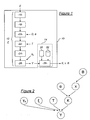
- the device 10 for estimating biological or chemical parameters in a sample E comprises a sample processing chain 12 designed to supply a signal Y representative of these biological or chemical parameters as a function of at least one variable of the processing chain 12. It further comprises a device 14 signal processing system designed to apply, in combination with the processing line 12, a method for estimating biological or chemical parameters and for aiding diagnosis according to these parameters.
- the estimated parameters are biological parameters, among which concentrations of biological components of the sample E considered then as a biological sample, and the Treatment chain 12 is a biological treatment chain.
- the components are proteins of interest, for example selected based on their relevance to characterize an abnormality, condition or disease, and the sample E is a sample of blood, plasma or urine. We will then speak of molecular concentrations of proteins to designate the concentrations of these particular components.
- the sample E first passes through a centrifuge 16, then by an affinity capture column 18, so as to be purified.
- Digestion can be modeled by a D digestion matrix, defining in a deterministic manner how each protein of interest is divided into peptides, and by a digestion coefficient ⁇ characterizing the yield of this digestion.
- This coefficient ⁇ can be qualified as an uncertain parameter in the sense that it is likely to vary randomly from one biological treatment to another. It can therefore advantageously be modeled according to a predetermined prior probability law, for example a uniform law over an interval included in [0,1].
- the sample E successively passes through a liquid chromatography column 22, an electrospray 24 and a mass spectrometer 26, for the supply of the signal Y which is then representative of the molecular concentrations of the proteins in the sample E as a function of a retention time in the chromatography column 22 and a mass / charge ratio in the mass spectrometer 26.
- This signal Y can thus be qualified as a chromatospectrogram.
- the observed signal Y is supplied in the form of of a two-dimensional signal whose positive amplitude varies as a function of the retention time in the chromatography column 22 in one dimension and the mass / charge ratio in the mass spectrometer 26 in the other dimension.
- the peptides are separated in the chromatography column 22 according to their retention time T in this column.
- This parameter T is also an uncertain parameter since it is likely to vary randomly from one biological treatment to another. It can therefore advantageously be modeled according to a predetermined probability law a priori.
- the observable output Y of the mass spectrometer 26 can be considered as disturbed by a noise whose inverse variance is defined by a parameter ⁇ b .
- This noise parameter is also an uncertain parameter that can vary randomly from one biological treatment to another. It can therefore advantageously be modeled according to a predetermined probability law a priori.
- the processing chain 12 has a gain ⁇ which, too, is an uncertain parameter that can vary randomly from one biological treatment to another. It can therefore advantageously be modeled according to a predetermined probability law a priori.
- the two-dimensional signal Y is provided at the input of the processing device 14. More specifically, the processing device 14 comprises a processor 28 connected to storage means including in particular at least one programmed instruction sequence 30 and a modeling database. 32.
- the gain parameter ⁇ is not known absolutely and without this absolute knowledge, it is not possible to correctly estimate the x concentration of the proteins of interest.
- this problem is solved by the insertion of labeling proteins equivalent to the proteins of interest (but of different mass) in the sample E before the passage of the latter in the treatment chain 12.
- the concentration x * of these labeling proteins is known, so that the gain as well as the concentration x can then be estimated using x * and a comparison of the peaks corresponding to the proteins of interest and to the labeling proteins in the observed signal Y.
- the vector K comprising the K i concentrations of each peptide i in a volume equal to the initial volume of the protein sample, may contain not only isolated peptides, i.e. ie well digested, but also polypeptides, for example from poor digestion, the latter being then assimilated to a peptide in the model.
- the template D defines the amount of peptides and polypeptides produced by the digestion of a protein and the ⁇ p values represent a yield that can be variable for different peptides of a p protein. This results in taking into account well digested peptides, but also poorly digested polypeptides. All the peptides are however treated in the same way, the poorly digested polypeptides being assimilated to a peptide in the modeling.
- the programmed sequence of instructions 30 is designed to resolve the inversion of this analytic model in a Bayesian framework by a posterior estimation based on probability models, for example prior models, of at least a part of the aforementioned parameters.
- the instruction sequence 30 and the database 32 are functionally presented as distinct on the figure 1 , but in practice they can be distributed differently in data files, source codes or computer libraries without this changing anything to the functions performed.
- Some of the aforementioned parameters are uncertain and are modeled a priori by continuous or discrete probabilities of probability: they are the technical parameters ⁇ b , ⁇ , T, K, K * and ⁇ of the biological treatment chain 12 and parameters biological, x and B. It is these parameters, among which are the vector x (for an estimation of the molecular concentrations of proteins) and the biological status parameter B (for a diagnosis aid), which are estimated by inversion of the direct model according to a method which will be detailed with reference to the figure 3 .
- uncertain parameters are defined as having a probabilistic dependency relation between them, leading to a global hierarchical probabilistic model.
- the vector x representative of the molecular concentrations of proteins of interest is defined as dependent on the biological state parameter B. Indeed, it is conceivable that in a realistic way, the random variable x follows a probability law which varies according to the state associated with the sample E.
- the vector K representative of the molecular concentrations of peptides is dependent on the vector x and the ⁇ digestion matrix including the terms ⁇ ip , which corresponds well to our realistic model of digestion with a yield less than 1.
- the vector K * representative of the molecular concentrations of peptides derived from the labeled proteins is dependent on the constant and known vector x * and the ⁇ digestion matrix, which corresponds well to our realistic model of digestion with a yield less than 1.
- the observed signal Y depends only on the random variables ⁇ b , ⁇ , T, K and K *.
- the vector K depends only on the random variables ⁇ and x, and K * of the random variable ⁇ and the fixed variable x *.
- the vector x depends on the random variable with discrete values B.
- this hierarchical model generates, by the dependence defined between K and x (and also K * and x *) via ⁇ , a hierarchy between the biological parameters and the technical parameters: it thus presents indeed a first technical stage, dependent on a second biological stage, each of these two stages being itself able to present an internal hierarchy according to the model retained.
- the first case involves an estimation of the concentration of K * peptides from the labeled proteins.
- the estimation of the molecular concentrations x is done jointly with the estimation of the set of random variables ⁇ b , ⁇ , T, K, K *, ⁇ , x and B by applying an estimator on the the posterior probability of these random variables in view of the observation Y.
- This posterior probability of a posteriori is developed as follows according to the rule of Bayes: p ⁇ b , ⁇ , T , K , K * , ⁇ , x , B
- Y p Y
- ⁇ b , ⁇ , T , K , K *, ⁇ , x, B ) can be expressed analytically and although the joined law of the parameters p ( ⁇ b , ⁇ , T , K , K *, ⁇ , x, B ) can develop into a product of probabilities a priori conditional modeled by the experiment or by a specific calibration, the marginal law p ( Y ) is not known and not calculable analytically . Consequently, the attached posterior probability law is also not analytically computable since we do not know this multiplicative factor p ( Y ), which remains constant for all the parameters. This unknown multiplicative factor is therefore not penalizing.
- Equations (3) to (9) show that the conditional posterior probability distributions of all the parameters ⁇ b , ⁇ , T, K, K *, ⁇ , x and B are analytically expressible since they are proportional to products a priori distributions or probabilities that are either modelable or definable by learning.
- concentration of the proteins of interest x we choose a conditional a priori probability model p ( x
- B R x
- the average and inverse-matrix of covariance of the concentration x for each of the possible states B are for example determined by learning on sets of samples whose corresponding state B is known a priori.
- the sampling of the inverse variance ⁇ b of the noise b can thus be done simply in the context of an iterative Gibbs sampling process.
- Gain sampling ⁇ can be done simply as part of an iterative Gibbs sampling process.
- the posterior probability for the retention time T is expressed in the form of the product of a uniform law and the function of likelihood.
- Y, ⁇ b , ⁇ ', K') in case 3, does not have simple expression, so that the sampling of the retention time T can not be done simply in the context of an iterative Gibbs sampling process. It will be necessary to use a sampling technique such as the Metropolis-Hastings algorithm for example.
- Y , ⁇ b , ⁇ , T , ⁇ , x, K *) (or p (K '
- Y, ⁇ b , ⁇ ', T, x ) in case 3) also follows a normal distribution of mean ⁇ ' K and covariance inverse-matrix ⁇ ' K (or even ⁇ ' K' and ⁇ ' K' in case 3) verifying the equations following: ⁇ K ' ⁇ K ' - 1 ⁇ ⁇ K
- x + ⁇ b ⁇ H T ⁇ Y + H ⁇ * T ⁇ H * K * , and ⁇ K ' ⁇ K
- K, K *, x ) for the digestion coefficient ⁇ is expressed in the form of a Dirac distribution centered at ⁇ 0 in case 2) and in the form of a Dirac distribution centered at 1 in case 3).
- the sampling of this parameter in the example considered is therefore trivial.
- K , K * , x ) does not have a simple expression, so that the sampling of the digestion coefficient ⁇ can not be done simply within the framework of an iterative Gibbs sampling method. It will be necessary to use a sampling technique such as the Metropolis-Hasting algorithm for example.
- the sampling of the concentration of the proteins of interest x can thus be done simply as part of an iterative Gibbs sampling process.
- x p x
- B ⁇ Pr B p x Pr B ⁇ det ⁇ x
- the sampling of the biological state B can thus be done simply as part of an iterative Gibbs sampling process.
- a method for estimating biological or chemical parameters or more specifically, in the context of the non-limiting example chosen, a method for estimating molecular concentrations of proteins of interest and diagnostic assistance implemented by the processor 28 by executing the instruction sequence 30 comprises a main phase 100 of joint estimation of the so-called uncertain parameters of a biological sample E whose biological state is unknown, including in particular at least one of the two following parameters: the vector x protein concentrations of interest and the biological state B.
- Phases 200 and 300 can be qualified as discovery phases, because they are executed when no particular component of interest is selected, while phases 400, 500 and 100 can be qualified as validation phases, because 'executed by focusing specifically on the parameters of well-identified components of interest.
- the five phases mentioned above should be carried out in the following order: (1) the first external calibration phase 200 for the determination of certain parameters not yet known and stable statistical parameters using the sample E CALIB1 and their registration in the base 32, then (2) the selection phase 300 for the determination of the components of interest using the set of samples E REF , certain parameters and stable statistical parameters and their registration in the base 32, then (3) the second phase external calibration option 400 for the refined determination of the certain parameters and the stable statistical parameters using the sample E CALIB2 , the latter possibly comprising marking components, and updating them in the base 32, then (4 ) the learning phase 500 for determining at least a part of the prior probability models of the uncertain parameters, using the samples E * and E REF , certain parameters and the identified selection of components of interest, and their registration in the base 32, then (5) the main phase of joint estimation 100 for the estimation of the biological or chemical parameters (ie the molecular concentrations of the proteins of interest in the example chosen) and a help to the diagnosis using the samples E, E * and data previously recorded in the
- the 500 and 100 phases use the E * sample of labeling components, so that they can be considered to include internal calibration for quantitatively accurate estimation of biological or chemical parameters. It can also be the same for the second optional phase 400.
- Phases 100 to 500 will now be detailed in the context of the chosen example of a biological analysis of a biological sample whose biological parameters include molecular concentrations of proteins of interest, but they are generalizable as indicated above.
- the main joint estimation phase 100 comprises a first measuring step 102 in which, in accordance with the assembly of the figure 1 the sample E to which the E * labeling proteins have been added crosses the entire processing line 12 of the device 10 for the supply of a chromatospectrogram Y.
- the random variables ⁇ b , ⁇ , T, K, ⁇ , x and B are each initialized by the processor 28 to a first value ⁇ b (0) ⁇ (0) , T (0) , K (0) , ⁇ (0) , x (0) and B (0) .
- the processor 28 then executes, by application of a Markov Chain Monte Carlo algorithm and on an index k varying from 1 to kmax, a Gibbs sampling loop 106 of each of the random variables initialized in view of their laws. of conditional posterior conditional probability as expressed analytically.
- kmax is the maximum value taken by index k before a predetermined stopping criterion is checked.
- the stopping criterion is for example a maximum number of iterations fixed a priori, the satisfaction of a stability criterion (as the fact that an additional iteration has no significant impact on the chosen estimator of the random variables) or other.
- the maximum posterior estimator of the random variable B is approximated by the selection of the state that appears most often between the indices kmin and kmax.
- kmin is a predetermined "heating time” value deemed necessary for Gibbs sampling random draw
- the estimates ⁇ b , ⁇ , T , K , K *, ⁇ , x and B are returned, possibly accompanied by an uncertainty factor.
- the estimate x gives a set of values for the protein concentrations of interest in the sample E and the estimate B constitutes a diagnostic aid. Note that this diagnosis can then be made in a second time by a practitioner on the basis of this estimate but is not part of the object of the invention. It should also be noted that only empirical probabilities should be given for each biological state B that can be expressed as not B k max - k min + 1 where n B is the number of times an event B has been selected between the iterations kmin and kmax.
- the first external calibration phase 200 of the biological treatment line 12 comprises a first measurement step 202 in which, in accordance with the assembly of the figure 1 , the sample of external calibration proteins E CALIB1 crosses the entire treatment chain 12 of the device 10 for the supply of a chromatospectrogram Y CALIB1 .
- the processing applied by the processor 28 to the signal Y CAUB1 consists in determining values that are not yet known for certain parameters, that is to say parameters that in reality remain relatively constant from one biological treatment to another. These certain parameters are then considered and modeled by constants in the biological treatment chain. For example, they are the coefficients of the digestion matrix D or of the digestion gain correction matrix ⁇ if D is known a priori. , the width of the chromatographic and spectrometric peaks and the proportions of proteins of interest to neutrons or additional charges.
- This treatment can also consist in determining stable parameters (for example mean or variance) of the probability models a priori uncertain parameters. These stable parameters are then also considered and modeled by constants.
- Step 204 thus reproduces a part of the determination steps 104, 106 and 108 of the main phase 100.
- the selection phase 300 assumes that all certain and stable parameters are known. It comprises a first measurement step 302 during which, in accordance with the assembly of the figure 1 , the E REF samples each traverse the entire processing line 12 of the device 10 for the supply of Y REF spectrospectrograms .
- the set of samples E REF comprises a subset of samples known to be healthy and a subset of samples known to be pathological.
- the objective of the selection phase 300 is to select, from among a set of candidate proteins, the proteins whose concentrations are the most discriminating with respect to these two biological states.
- the determination is made by a digital sampling according to the Markov chain Monte-Carlo method, knowing that this time the biological state B is not a random variable, but a known constant. for each of the aforementioned subsets.
- the random variables ⁇ b , T, K and x are each initialized by the processor 28 at a first value ⁇ b (0) , T. (0) , K (0) and x (0) .
- x is the vector of the concentrations of the candidate proteins. If a value for the digestion coefficient is known, it can be used in the model.
- the processor 28 then performs an estimation step 308 during which the expectation estimator a posteriori is calculated in particular for the variable x to obtain an estimate x .
- the estimator expectation a posteriori is approximated by the average of the samples taken between the indices kmin and kmax.
- the steps 304 to 308 being executed for each healthy or pathological reference sample, one finally obtains for each biological state S or P a set of values of x . It is observed that the succession of steps 304, 306, 308 partially reproduces the determination steps 104, 106, 108 of the main phase 100.
- the processor 28 determines the x p 0 concentration x p value for which the error of the first kind in relation to the biological state B is equal to the error of the second kind.
- a score S p is then assigned to the p-th protein based on the value of ⁇ S p x 0 p or ⁇ P p x 0 p depending on whether the protein in question is over or under expressed in the P state. In other words, both values are retained.
- ⁇ S p x 0 p or ⁇ P p x 0 p the one that is highest in x p 0 .
- the steps 312 and 314 for selecting P proteins of interest were detailed on the basis of a hypothesis of independence of the candidate proteins. But they can be generalized in a global subproteome selection approach differentiating in case of protein dependence, for example as follows.
- the center of each cloud of points (ie values of x for S or P) obtained at the end of step 308 is calculated.
- V the vector which links these two centers.
- the points of the multidimensional space onto the one-dimensional subspace generated by V, the projection of a Gaussian remaining a Gaussian.
- the differentiation score of a set of proteins By eliminating some of them, you end up with a selection of proteins of interest.
- the second optional phase 400 of external calibration of the biological treatment chain 12 is identical to the first phase 200 of external calibration, except that the sample of external calibration proteins E CALIB1 used in phase 200 is replaced by the minus a sample of E CALIB2 external calibration proteins in which the proteins are selected from the proteins of interest selected in phase 300. Marking samples may be used.
- Steps 402, 404 and 406 of this second optional external calibration phase 400 are identical to steps 202, 204 and 206 so that they will not be described again. Coefficients such as ⁇ -matrix digestion yields may however be neglected in steps 200 but calibrated in steps 400 due to the use of a limited number of proteins and a more accurate acquisition chain model.
- the learning phase 500 assumes that all certain and stable parameters are known (phase 200 and possibly phase 400) and that the proteins of interest are selected and identified (phase 300). It comprises a first measurement step 502 during which, in accordance with the assembly of the figure 1 , the E REF samples each traverse the entire processing chain 12 of the device 10 for the supply of Y chromatospectrograms.
- the sample of E * labeling proteins is integrated into each sample of the set of E REF samples because, in this case, learning phase, it is necessary to estimate the protein concentrations of interest in an absolute way and therefore to know the gain parameter ⁇ .
- the set of samples E REF comprises a subset of samples known to be healthy and a subset of known samples. as being pathological.
- the determination of the concentrations of proteins of interest is done by a digital sampling according to the Monte-Carlo Markov chain process, knowing that this time again the biological state B is not a random variable, but a known constant for each of the aforementioned subsets.
- the random variables ⁇ , ⁇ b , T, K, K *, ⁇ and x are each initialized by the processor 28 at a first value ⁇ (0) , ⁇ b (0) , T (0) , K (0) , K * (0) , ⁇ (0) and x (0) .
- x is the vector of the concentrations of the proteins of interest.
- the processor 28 then performs an estimation step 508 during which the estimator expectation a posteriori is calculated in particular for the variable x to obtain an estimate x .
- the estimator expectation a posteriori is approximated by the average of the samples taken between the indices kmin and kmax. Since steps 504 to 508 are performed for each healthy or pathological reference sample, a set of x values is finally obtained for each biological state S or P. It is observed that the succession of steps 504, 506, 508 partially reproduces the determination steps 104, 106, 108 of the main phase 100.
- steps 508 and 510 it is also possible, if this is not already known, to estimate in the same way but this time independently of the biological state B, the parameters of the prior probability laws for the parameters of gain ⁇ , of noise ⁇ b , or of retention time T.
- a method such as that described above, implemented by the estimation device 10, allows, thanks to a fine hierarchical modeling of the processing chain 12, to provide a reliable estimate of biological or chemical parameters (for example the concentrations) of predetermined components of interest, and even possibly to constitute a diagnostic aid when a learning phase 500 such as that described above can be conducted.
- this method excels in correctly evaluating measurement peaks in the presence of significant noise or superimposed on other peaks of a chromatospectrogram, which conventional methods of peak analysis or spectral analysis perform less well.
- Concrete applications of this method include the detection of cancer markers (in this case the components of interest are proteins) in a biological sample of blood or urine.
- cancer markers in this case the components of interest are proteins
- the biological state B may take more than two discrete values for the detection of one of several possible pathologies or to reserve the possibility of diagnosing an uncertain biological state.
- the components of interest are not necessarily proteins, but may more generally be molecules or molecular assemblies for a biological or chemical analysis.
Landscapes
- Health & Medical Sciences (AREA)
- Life Sciences & Earth Sciences (AREA)
- Physics & Mathematics (AREA)
- Engineering & Computer Science (AREA)
- Medical Informatics (AREA)
- General Health & Medical Sciences (AREA)
- Spectroscopy & Molecular Physics (AREA)
- Public Health (AREA)
- Biotechnology (AREA)
- Biophysics (AREA)
- Computer Vision & Pattern Recognition (AREA)
- Data Mining & Analysis (AREA)
- Databases & Information Systems (AREA)
- Epidemiology (AREA)
- Evolutionary Computation (AREA)
- Artificial Intelligence (AREA)
- Pathology (AREA)
- Software Systems (AREA)
- Bioinformatics & Cheminformatics (AREA)
- Bioinformatics & Computational Biology (AREA)
- Bioethics (AREA)
- Evolutionary Biology (AREA)
- Immunology (AREA)
- Theoretical Computer Science (AREA)
- General Physics & Mathematics (AREA)
- Chemical & Material Sciences (AREA)
- Analytical Chemistry (AREA)
- Biochemistry (AREA)
- Library & Information Science (AREA)
- Molecular Biology (AREA)
- Signal Processing (AREA)
- Investigating Or Analysing Biological Materials (AREA)
- Other Investigation Or Analysis Of Materials By Electrical Means (AREA)
Claims (13)
- Verfahren zum Schätzen von biologischen oder chemischen Parametern (x, B) in einer Probe (E), das die folgenden Schritte umfasst:- die Probe (E) durch eine Behandlungskette (12) durchlaufen lassen (102),- auf diese Weise ein Signal (Y) erhalten, das für die biologischen oder chemischen Parameter (x, B), abhängig von mindestens einer Variablen der Behandlungskette, repräsentativ ist, und- schätzen (104, 106, 108, 110) der biologischen oder chemischen Parameter (x, B) mithilfe einer Vorrichtung zur Signalverarbeitung (14) durch Bayessche Inferenz, auf der Grundlage einer direkten analytischen Modellierung des genannten Signals (Y) in Abhängigkeit der biologischen oder chemischen Parameter (x, B) und der technischen Parameter (γb, ξ, T, K, K*, α) der Behandlungskette (12),dadurch gekennzeichnet, dass mindestens zwei der genannten biologischen oder chemischen (x, B) oder der technischen (γb, ξ, T, K, K*, α) Parameter, nach denen die direkte analytische Modellierung des genannten Signals (Y) definiert wird, unter ihnen ein auf Wahrscheinlichkeiten beruhender Abhängigkeitszusammenhang aufweisen, und dadurch, dass die Signalverarbeitung durch Bayessche Inferenz des Weiteren aufgrund einer Wahrscheinlichkeits-Modellierung dieser Abhängigkeit realisiert wird, die a priori bedingt ist.
- Verfahren zum Schätzen von biologischen oder chemischen Parametern (x, B) nach Anspruch 1, in dem der Schritt der Schätzung (104, 106, 108, 110) der biologischen oder chemischen Parameter (x, B) durch die Näherung der a posteriori Wahrscheinlichkeitsgesetzmäßigkeit mit Bezug auf biologischen oder chemischen Parameter (x, B) und der technischen Parameter (γb, ξ, T, K, K*, α) bedingt durch das mithilfe eines Algorithmus' zur stochastischen Probennahme erhaltene Signal (Y) Folgendes umfasst:- eine Probenschleife (106) von mindestens einem Teil (x, B) der biologischen oder chemischen Parameter der Probe (E) und von mindestens einem Teil (γb, ξ, T, K, K*, α) der technischen Parameter der Behandlungskette, die Probewerte dieser Parameter bereitstellt, und- eine Schätzung (108) des mindestens einen genannten Teils der biologischen oder chemischen und technischen Parameter (x, B, γb, ξ, T, K, K*, α), die ausgehend von den bereitgestellten Probewerten berechnet wird.
- Verfahren zum Schätzen von biologischen oder chemischen Parametern (x, B) nach Anspruch 2, in dem die Schätzung (108) des mindestens einen genannten Teils der biologischen oder chemischen und technischen Parameter (x, B, γb, ξ, T, K, K*, α), die ausgehend von den bereitgestellten Probewerten berechnet wird, Folgendes umfasst:- eine Berechnung des Schätzers für den Erwartungswert oder für den Median oder Maximalwert a posteriori für jeden Parameter mit kontinuierlichen Werten (X, γb, ξ, T, K, K*, α),- eine Berechnung des Schätzers für den Maximalwert a posteriori für jeden Parameter mit diskreten Werten (B), oder- eine Wahrscheinlichkeitsrechnung für mindestens einen Teil der biologischen oder chemischen und technischen Parameter (x, B, γb, ξ, T, K, K*, α).
- Verfahren zum Schätzen von biologischen oder chemischen Parametern (x, B) nach einem der Ansprüche von 1 bis 3, in dem die biologischen oder chemischen Parameter einen Vektor umfassen, der die Konzentrationen der Bestandteile der Probe wiedergibt, wobei das Verfahren des Weiteren eine vorgelagerte Kalibrier-Phase (200), genannt externes Kalibrieren, umfasst, die folgende Schritte umfasst:- durchlaufen lassen (202) einer Probe (ECALIB1) von externen Kalibrier-Bestandteilen durch die Behandlungskette (12), wobei diese externen Kalibrier-Bestandteile unter den Bestandteilen der Probe ausgewählt werden und eine bekannte Konzentration aufweisen,- folglich erhalten eines Signals, das für die Konzentrationen der externen Kalibrier-Bestandteile, in Abhängigkeit von mindestens einer Variablen der Behandlungskette (12) und von mindestens einem konstanten Parameter unbekannten Werts und/oder von mindestens einem stabilen statistischen Parameter der Behandlungskette, repräsentativ ist,- anwenden (204) von mindestens einem Teil des Schätzungs-Schrittes der biologischen oder chemischen Parameter unter Zuhilfenahme der Vorrichtung zur Signalverarbeitung (14) durch Bayessche Inferenz, um daraus den Wert von jedem konstanten Parameter unbekannten Werts und/oder von jedem stabilen statistischen Parameter der Behandlungskette (12) abzuleiten,- aufzeichnen (206) im Speicher (32) von jedem zuvor abgeleiteten Wert des konstanten Parameters und/oder des stabilen statistischen Parameters.
- Verfahren zum Schätzen von biologischen oder chemischen Parametern (x, B) nach einem der Ansprüche von 1 bis 4, in dem sich die chemischen und biologischen Parameter (x, B) auf Proteine beziehen und in dem die Probe (E) eines der Elemente aus der Gruppe umfasst, die aus Blut, Plasma und Urin besteht.
- Verfahren zum Schätzen von biologischen oder chemischen Parametern (x, B) nach einem der Ansprüche von 1 bis 5, in dem:- das die biologischen oder chemischen Parameter (x, B) darstellende Signal (Y) in Abhängigkeit der molekularen Konzentrationen der Spezies (K) ausgedrückt wird,- diese Spezies (K) sich aus einem Zerfall der im Fokus stehenden bzw. zentralen molekularen Spezies (x) ergeben,- das Verfahren eine Schätzung einer Menge diese Spezies umfasst, die sich aus einem Zerfall der zentralen molekularen Spezies (x) ergeben.
- Verfahren zum Schätzen von biologischen oder chemischen Parametern (x, B) nach Anspruch 6, in dem:- die Spezies Peptide oder Polypeptide umfassen,- die zentralen molekulare Spezies Proteine umfassen, die jeweils eine bestimmte Menge an diesen Peptiden oder Polypeptiden enthalten,- man definiert einen Verdauungsertrag (α) der Proteine als Matrix aus Koeffizienten αip, wobei αip den Verdauungsertrag des p-ten Proteins im Verhältnis zum i-ten Peptid oder Polypeptid darstellt, sodass die molekularen Konzentrationen (K) von Peptiden oder Polypeptiden an einen Vektor (x) gebunden sind, der die Protein-Konzentrationen durch eine Verdauungs-Matrix (D) und diesen Verdauungsertrag (α) darstellt,- das Verfahren eine Schätzung dieses Verdauungsertrags (α) umfasst.
- Verfahren zum Schätzen von biologischen oder chemischen Parametern (x, B) nach Anspruch 6, in dem:- die Spezies Peptide und Polypeptide umfassen,- die zentralen molekularen Spezies Proteine umfassen, die eine bestimmte Menge an diesen Peptiden oder Polypeptiden enthalten,- man einen Gesamtgewinn (ξ) der Behandlungskette (12) definiert, sodass das die biologischen oder chemischen Parameter (x, B) darstellende Signal (Y) durch die Gleichung Y= ξ K dargestellt wird, wobei K ein Vektor ist, der die Konzentrationen der Peptide oder Polypeptide darstellt,- das Verfahren eine Schätzung dieses Gesamtgewinns (ξ) beinhaltet.
- Verfahren zur Unterstützung der Diagnose, das die Schritte eines Verfahrens zur Schätzung von biologischen oder chemischen Parametern (x, B) nach irgendeinem der Ansprüche von 1 bis 8 umfasst, in dem die biologischen oder chemischen Parameter (x, B) der Probe (E) einen biologischen oder chemischen Zustandsparameter (B) mit diskreten Werten umfassen, wobei jeder mögliche diskrete Wert dieses Parameters einem möglichen Zustand der Probe (E) zugeordnet ist, und einen Vektor, der die Konzentrationen der Bestandteile der Probe (E) darstellt, und in dem der die Konzentrationen (x) darstellende Vektor und der biologische oder chemische Zustandsparameter (B) einen probabilistischen Zusammenhang untereinander aufweisen, und wobei die Signalverarbeitung durch Bayessche Inferenz des Weiteren auf der Grundlage einer a priori Wahrscheinlichkeits-Modellierung des die Konzentrationen (x) darstellenden Vektors, bedingt durch die möglichen Werte des biologischen oder chemischen Zustandsparameters (B) realisiert wird.
- Verfahren zur Unterstützung der Diagnose nach Anspruch 9, das eine vorangehende Lernphase (500) umfasst, die die folgenden Schritte umfasst:- aufeinander folgend, eine Vielzahl an Referenz-Proben (EREF) durch die Behandlungskette (12) durchlaufen lassen (502), wobei der Wert des biologischen oder chemischen Zustandsparameters (B) einer jeden Referenz-Probe bekannt ist,- auf diese Weise ein Signal erhalten, das die Konzentrationen (x) der Bestandteile für jede Referenz-Probe (EREF) in Abhängigkeit von mindestens einer Variablen der Behandlungskette (12) darstellt,- anwenden (504, 506, 508) von mindestens einem Teil des Schätzungs-Schrittes der biologischen oder chemischen Parameter unter Zuhilfenahme der Vorrichtung zur Signalverarbeitung durch Bayessche Inferenz, um daraus Werte der Konzentrationen der Bestandteile für jede Referenz-Probe (EREF) abzuleiten,- daraus ableiten (510) von Parametern der a priori WahrscheinlichkeitsGesetzmäßigkeit des die Konzentrationen (x) darstellenden Vektors bedingt durch die möglichen Werte des biologischen oder chemischen Zustandsparameters (B), und- aufzeichnen (510) im Speicher (32) dieser Parameter der Wahrscheinlichkeits-Gesetzmäßigkeit.
- Verfahren zur Unterstützung der Diagnose nach Anspruch 9 oder 10, das eine vorangehende Phase (300) der Auswahl der genannten Bestandteile aus einer Menge aus Bestandteil-Kandidaten umfasst, wobei diese vorangehende Phase (300) der Auswahl die folgenden Schritte umfasst:- aufeinander folgend, eine Vielzahl an Referenz-Proben (EREF) durch die Behandlungskette (12) durchlaufen lassen (302), wobei der Wert des biologischen oder chemischen Zustandsparameters (B) einer jeden Referenz-Probe bekannt ist,- auf diese Weise ein Signal erhalten, das die Konzentrationen (x) der Kandidaten-Bestandteile für jede Referenz-Probe (EREF) in Abhängigkeit von mindestens einer Variablen der Behandlungskette (12) darstellt,- anwenden (304, 306, 308) von mindestens einem Teil des Schätzungs-Schrittes der biologischen oder chemischen Parameter unter Zuhilfenahme der Vorrichtung zur Signalverarbeitung durch Bayessche Inferenz, um daraus Werte abzuleiten, welche die Konzentrationen (x) der Kandidaten-Bestandteile für jede Referenz-Probe (EREF) darstellen,- daraus ableiten (310) von Parametern der Verteilungen des Vektors, der die Konzentrationen (x) der Kandidaten-Bestandteile für jeden diskreten Wert des biologischen oder chemischen Zustandsparameters (B) darstellt,- auswählen (312, 314), unter den Bestandteil-Kandidaten, diejenigen, deren Verteilungen untereinander die größten Unterschiede aufweisen, in Abhängigkeit der Werte des biologischen oder chemischen Zustandsparameters (B).
- Vorrichtung (10) zur Schätzung der biologischen oder chemischen Parameter (x, B) in einer Probe (E), das Folgendes umfasst:- eine Kette (12) zur Behandlung der Probe (E), die zur Bereitstellung eines Signals (Y) konzipiert ist, das die biologischen oder chemischen Parameter (x, B), abhängig von mindestens einer Variablen der Behandlungskette, darstellt,- eine Vorrichtung zur Signalverarbeitung (14), die, in Kombination mit der Behandlungskette (12), zur Anwendung eines Verfahrens (100) zur Schätzung der biologischen oder chemischen Parameter (x, B) oder zur Unterstützung der Diagnose nach irgendeinem der Ansprüche von 1 bis 11 konzipiert ist.
- Vorrichtung (10) zur Schätzung der biologischen oder chemischen Parameter (x, B) nach Anspruch 12, bei der die Behandlungskette (12) eine chromatografische Säule (22) und/oder ein Massenspektrometer (26) umfasst, und zur Bereitstellung eines Signals (Y) konzipiert ist, das die Konzentrationen (x) der Bestandteile der Probe (E) in Abhängigkeit einer Retentionszeit (T) in der chromatografischen Säule (22) und/oder des Masse/Ladungs-Verhältnisses im Massenspektrometer (26) darstellt.
Applications Claiming Priority (1)
| Application Number | Priority Date | Filing Date | Title |
|---|---|---|---|
| FR1153008A FR2973880B1 (fr) | 2011-04-06 | 2011-04-06 | Procede et dispositif d'estimation de parametres biologiques ou chimiques dans un echantillon, procede d'aide au diagnostic correspondant |
Publications (2)
| Publication Number | Publication Date |
|---|---|
| EP2509018A1 EP2509018A1 (de) | 2012-10-10 |
| EP2509018B1 true EP2509018B1 (de) | 2015-02-11 |
Family
ID=45878024
Family Applications (1)
| Application Number | Title | Priority Date | Filing Date |
|---|---|---|---|
| EP12162895.2A Not-in-force EP2509018B1 (de) | 2011-04-06 | 2012-04-02 | Verfahren und Vorrichtung zum Schätzen von biologischen oder chemischen Parametern in einer Probe, entsprechendes Diagnose-Hilfsverfahren |
Country Status (3)
| Country | Link |
|---|---|
| US (1) | US20120271556A1 (de) |
| EP (1) | EP2509018B1 (de) |
| FR (1) | FR2973880B1 (de) |
Families Citing this family (13)
| Publication number | Priority date | Publication date | Assignee | Title |
|---|---|---|---|---|
| EP2973095B1 (de) | 2013-03-15 | 2018-05-09 | Animas Corporation | Zeitaktionsmodell für insulin |
| FR3026188B1 (fr) | 2014-09-20 | 2017-06-23 | Commissariat Energie Atomique | Procede et dispositif de determination d'une composition d'un echantillon gazeux traite par chromatographie gazeuse |
| FR3040215B1 (fr) | 2015-08-20 | 2019-05-31 | Commissariat A L'energie Atomique Et Aux Energies Alternatives | Procede d’estimation d’une quantite de particules reparties en classes, a partir d’un chromatogramme. |
| EP3781941B1 (de) | 2018-04-20 | 2026-01-14 | Janssen Biotech, Inc. | Qualifizierungsprozess für chromatographiesäule in einem verfahren zur herstellung von anti-tnf antikörper gemischen |
| WO2020110268A1 (ja) * | 2018-11-29 | 2020-06-04 | 株式会社島津製作所 | 試料測定装置、プログラムおよび測定パラメータ設定支援装置 |
| EP4026134A1 (de) * | 2019-09-04 | 2022-07-13 | Waters Technologies Ireland Limited | Verfahren zur ausnahmenbasierten validierung von analytischen informationen |
| CN114846326B (zh) * | 2019-12-17 | 2025-02-11 | 豪夫迈·罗氏有限公司 | 用于校准具有多个重复硬件组件的至少一个分析装置的方法 |
| CN111080020B (zh) * | 2019-12-23 | 2023-03-31 | 中山大学 | 钻孔布置方案的鲁棒性评估方法和装置 |
| GB202007690D0 (en) * | 2020-05-22 | 2020-07-08 | Fluidic Analytics Ltd | Improvements in or relating to an apparatus for characterising a component |
| JP7757632B2 (ja) * | 2021-05-26 | 2025-10-22 | 株式会社島津製作所 | 分析方法および診断支援方法 |
| JP7600875B2 (ja) * | 2021-06-01 | 2024-12-17 | 株式会社島津製作所 | 試料分析装置、試料分析方法、医薬分析装置および医薬分析方法 |
| CN114418600B (zh) * | 2022-01-19 | 2023-04-14 | 中国检验检疫科学研究院 | 一种食品输入风险监测预警方法 |
| CN119691884B (zh) * | 2023-09-22 | 2025-11-25 | 中国航发商用航空发动机有限责任公司 | 一种航空发动机燃烧室净阻尼系数的统计推断方法、统计推断系统、统计推断设备及计算机可读存储介质 |
Family Cites Families (5)
| Publication number | Priority date | Publication date | Assignee | Title |
|---|---|---|---|---|
| EP1151319A1 (de) * | 1999-02-19 | 2001-11-07 | Fox Chase Cancer Center | Verfahren zum zersetzen von kompletten daten |
| CA2399967A1 (en) * | 2000-02-01 | 2001-08-09 | Dwight W. Miller | Methods for predicting the biological, chemical, and physical properties of molecules from their spectral properties |
| AU2003224651A1 (en) * | 2002-02-27 | 2003-09-09 | Protein Mechanics, Inc. | Clustering conformational variants of molecules and methods of use thereof |
| FR2920235B1 (fr) * | 2007-08-22 | 2009-12-25 | Commissariat Energie Atomique | Procede d'estimation de concentrations de molecules dans un releve d'echantillon et appareillage |
| WO2010026228A1 (fr) * | 2008-09-05 | 2010-03-11 | Commissariat A L'energie Atomique | Procédé de mesures de concentrations d'espèces moléculaires au moyen d'un chromatogramme |
-
2011
- 2011-04-06 FR FR1153008A patent/FR2973880B1/fr not_active Expired - Fee Related
-
2012
- 2012-04-02 EP EP12162895.2A patent/EP2509018B1/de not_active Not-in-force
- 2012-04-04 US US13/438,977 patent/US20120271556A1/en not_active Abandoned
Also Published As
| Publication number | Publication date |
|---|---|
| US20120271556A1 (en) | 2012-10-25 |
| FR2973880A1 (fr) | 2012-10-12 |
| EP2509018A1 (de) | 2012-10-10 |
| FR2973880B1 (fr) | 2013-05-17 |
Similar Documents
| Publication | Publication Date | Title |
|---|---|---|
| EP2509018B1 (de) | Verfahren und Vorrichtung zum Schätzen von biologischen oder chemischen Parametern in einer Probe, entsprechendes Diagnose-Hilfsverfahren | |
| EP2565904B1 (de) | Verfahren und Vorrichtung zum Schätzen eines Molekülmassenparameters in einer Probe | |
| Lange et al. | CellRank for directed single-cell fate mapping | |
| EP2407912B1 (de) | Verfahren und System zur Klassifikation von neuronalen Signalen und Verfahren zur Auswahl von Elektroden für direkte neuronale Steuerung | |
| CN116959585A (zh) | 基于深度学习的全基因组预测方法 | |
| US20200191768A1 (en) | Biomarker for diagnosing depression and use of biomarker | |
| JP7483367B2 (ja) | 情報処理装置、情報処理装置の制御方法、及びプログラム | |
| CN115398552A (zh) | 遗传算法用于基于拉曼光谱识别样品特征的用途 | |
| EP4022287B1 (de) | Systeme und verfahren zur beurteilung der fixierdauer und der qualität von proben mittels vibrationsspektroskopie | |
| Harada et al. | Enhanced conformational sampling method for proteins based on the T a B oo S e A rch algorithm: Application to the folding of a mini‐protein, chignolin | |
| JP2023551913A (ja) | 生物学的疾患及び障害の動的ラマンプロファイリングのためのシステム及び方法 | |
| Wang et al. | NMRQNet: a deep learning approach for automatic identification and quantification of metabolites using Nuclear Magnetic Resonance (NMR) in human plasma samples | |
| Nguyen et al. | Advancing the prediction of ms/ms spectra using machine learning | |
| JP7592462B2 (ja) | 情報処理装置、及び情報処理装置の制御方法 | |
| EP2553496A1 (de) | Verfahren für spektrometrische analyse und zugehörige vorrichtung | |
| WO2011151148A2 (fr) | Procédé d'évaluation toxicologique, procédé de criblage toxicologique et système associé | |
| Pais et al. | MALDI-ToF mass spectra phenomic analysis for human disease diagnosis enabled by cutting-edge data processing pipelines and bioinformatics tools | |
| JP2024501620A (ja) | 生物学的障害の動的免疫組織化学プロファイリングのためのシステム及び方法 | |
| Ogane et al. | Development of hidden Markov modeling method for molecular orientations and structure estimation from high-speed atomic force microscopy time-series images | |
| Moraes et al. | Predicting age from human lung tissue through multi-modal data integration | |
| EP2647990A1 (de) | Verfahren und Vorrichtung zum Abschätzen der Molekülparameter in einer chromatografisch behandelten Probe | |
| Schweickart et al. | AutoFocus: a hierarchical framework to explore multi-omic disease associations spanning multiple scales of biomolecular interaction | |
| US20080275651A1 (en) | Methods for inferring the presence of a protein in a sample | |
| Tu et al. | Prediction with high dimensional regression via hierarchically structured Gaussian mixtures and latent variables | |
| EP4522980A1 (de) | Verfahren zur erzeugung synthetischer spektraldaten |
Legal Events
| Date | Code | Title | Description |
|---|---|---|---|
| PUAI | Public reference made under article 153(3) epc to a published international application that has entered the european phase |
Free format text: ORIGINAL CODE: 0009012 |
|
| AK | Designated contracting states |
Kind code of ref document: A1 Designated state(s): AL AT BE BG CH CY CZ DE DK EE ES FI FR GB GR HR HU IE IS IT LI LT LU LV MC MK MT NL NO PL PT RO RS SE SI SK SM TR |
|
| AX | Request for extension of the european patent |
Extension state: BA ME |
|
| 17P | Request for examination filed |
Effective date: 20130402 |
|
| GRAP | Despatch of communication of intention to grant a patent |
Free format text: ORIGINAL CODE: EPIDOSNIGR1 |
|
| INTG | Intention to grant announced |
Effective date: 20140820 |
|
| GRAS | Grant fee paid |
Free format text: ORIGINAL CODE: EPIDOSNIGR3 |
|
| GRAA | (expected) grant |
Free format text: ORIGINAL CODE: 0009210 |
|
| RAP1 | Party data changed (applicant data changed or rights of an application transferred) |
Owner name: COMMISSARIAT A L'ENERGIE ATOMIQUE ET AUX ENERGIES Owner name: UNIVERSITE DE BORDEAUX |
|
| AK | Designated contracting states |
Kind code of ref document: B1 Designated state(s): AL AT BE BG CH CY CZ DE DK EE ES FI FR GB GR HR HU IE IS IT LI LT LU LV MC MK MT NL NO PL PT RO RS SE SI SK SM TR |
|
| REG | Reference to a national code |
Ref country code: GB Ref legal event code: FG4D Free format text: NOT ENGLISH |
|
| REG | Reference to a national code |
Ref country code: CH Ref legal event code: EP |
|
| REG | Reference to a national code |
Ref country code: IE Ref legal event code: FG4D Free format text: LANGUAGE OF EP DOCUMENT: FRENCH |
|
| REG | Reference to a national code |
Ref country code: AT Ref legal event code: REF Ref document number: 710123 Country of ref document: AT Kind code of ref document: T Effective date: 20150315 |
|
| REG | Reference to a national code |
Ref country code: DE Ref legal event code: R096 Ref document number: 602012005200 Country of ref document: DE Effective date: 20150326 |
|
| REG | Reference to a national code |
Ref country code: FR Ref legal event code: PLFP Year of fee payment: 4 |
|
| REG | Reference to a national code |
Ref country code: NL Ref legal event code: VDEP Effective date: 20150211 |
|
| REG | Reference to a national code |
Ref country code: AT Ref legal event code: MK05 Ref document number: 710123 Country of ref document: AT Kind code of ref document: T Effective date: 20150211 |
|
| REG | Reference to a national code |
Ref country code: LT Ref legal event code: MG4D |
|
| PG25 | Lapsed in a contracting state [announced via postgrant information from national office to epo] |
Ref country code: SE Free format text: LAPSE BECAUSE OF FAILURE TO SUBMIT A TRANSLATION OF THE DESCRIPTION OR TO PAY THE FEE WITHIN THE PRESCRIBED TIME-LIMIT Effective date: 20150211 Ref country code: ES Free format text: LAPSE BECAUSE OF FAILURE TO SUBMIT A TRANSLATION OF THE DESCRIPTION OR TO PAY THE FEE WITHIN THE PRESCRIBED TIME-LIMIT Effective date: 20150211 Ref country code: LT Free format text: LAPSE BECAUSE OF FAILURE TO SUBMIT A TRANSLATION OF THE DESCRIPTION OR TO PAY THE FEE WITHIN THE PRESCRIBED TIME-LIMIT Effective date: 20150211 Ref country code: FI Free format text: LAPSE BECAUSE OF FAILURE TO SUBMIT A TRANSLATION OF THE DESCRIPTION OR TO PAY THE FEE WITHIN THE PRESCRIBED TIME-LIMIT Effective date: 20150211 Ref country code: HR Free format text: LAPSE BECAUSE OF FAILURE TO SUBMIT A TRANSLATION OF THE DESCRIPTION OR TO PAY THE FEE WITHIN THE PRESCRIBED TIME-LIMIT Effective date: 20150211 Ref country code: NO Free format text: LAPSE BECAUSE OF FAILURE TO SUBMIT A TRANSLATION OF THE DESCRIPTION OR TO PAY THE FEE WITHIN THE PRESCRIBED TIME-LIMIT Effective date: 20150511 |
|
| PG25 | Lapsed in a contracting state [announced via postgrant information from national office to epo] |
Ref country code: AT Free format text: LAPSE BECAUSE OF FAILURE TO SUBMIT A TRANSLATION OF THE DESCRIPTION OR TO PAY THE FEE WITHIN THE PRESCRIBED TIME-LIMIT Effective date: 20150211 Ref country code: GR Free format text: LAPSE BECAUSE OF FAILURE TO SUBMIT A TRANSLATION OF THE DESCRIPTION OR TO PAY THE FEE WITHIN THE PRESCRIBED TIME-LIMIT Effective date: 20150512 Ref country code: LV Free format text: LAPSE BECAUSE OF FAILURE TO SUBMIT A TRANSLATION OF THE DESCRIPTION OR TO PAY THE FEE WITHIN THE PRESCRIBED TIME-LIMIT Effective date: 20150211 Ref country code: RS Free format text: LAPSE BECAUSE OF FAILURE TO SUBMIT A TRANSLATION OF THE DESCRIPTION OR TO PAY THE FEE WITHIN THE PRESCRIBED TIME-LIMIT Effective date: 20150211 Ref country code: IS Free format text: LAPSE BECAUSE OF FAILURE TO SUBMIT A TRANSLATION OF THE DESCRIPTION OR TO PAY THE FEE WITHIN THE PRESCRIBED TIME-LIMIT Effective date: 20150611 Ref country code: NL Free format text: LAPSE BECAUSE OF FAILURE TO SUBMIT A TRANSLATION OF THE DESCRIPTION OR TO PAY THE FEE WITHIN THE PRESCRIBED TIME-LIMIT Effective date: 20150211 |
|
| PG25 | Lapsed in a contracting state [announced via postgrant information from national office to epo] |
Ref country code: DK Free format text: LAPSE BECAUSE OF FAILURE TO SUBMIT A TRANSLATION OF THE DESCRIPTION OR TO PAY THE FEE WITHIN THE PRESCRIBED TIME-LIMIT Effective date: 20150211 Ref country code: SK Free format text: LAPSE BECAUSE OF FAILURE TO SUBMIT A TRANSLATION OF THE DESCRIPTION OR TO PAY THE FEE WITHIN THE PRESCRIBED TIME-LIMIT Effective date: 20150211 Ref country code: RO Free format text: LAPSE BECAUSE OF FAILURE TO SUBMIT A TRANSLATION OF THE DESCRIPTION OR TO PAY THE FEE WITHIN THE PRESCRIBED TIME-LIMIT Effective date: 20150211 Ref country code: EE Free format text: LAPSE BECAUSE OF FAILURE TO SUBMIT A TRANSLATION OF THE DESCRIPTION OR TO PAY THE FEE WITHIN THE PRESCRIBED TIME-LIMIT Effective date: 20150211 Ref country code: CZ Free format text: LAPSE BECAUSE OF FAILURE TO SUBMIT A TRANSLATION OF THE DESCRIPTION OR TO PAY THE FEE WITHIN THE PRESCRIBED TIME-LIMIT Effective date: 20150211 |
|
| REG | Reference to a national code |
Ref country code: DE Ref legal event code: R097 Ref document number: 602012005200 Country of ref document: DE |
|
| PG25 | Lapsed in a contracting state [announced via postgrant information from national office to epo] |
Ref country code: PL Free format text: LAPSE BECAUSE OF FAILURE TO SUBMIT A TRANSLATION OF THE DESCRIPTION OR TO PAY THE FEE WITHIN THE PRESCRIBED TIME-LIMIT Effective date: 20150211 Ref country code: MC Free format text: LAPSE BECAUSE OF FAILURE TO SUBMIT A TRANSLATION OF THE DESCRIPTION OR TO PAY THE FEE WITHIN THE PRESCRIBED TIME-LIMIT Effective date: 20150211 Ref country code: LU Free format text: LAPSE BECAUSE OF FAILURE TO SUBMIT A TRANSLATION OF THE DESCRIPTION OR TO PAY THE FEE WITHIN THE PRESCRIBED TIME-LIMIT Effective date: 20150402 |
|
| REG | Reference to a national code |
Ref country code: CH Ref legal event code: PL |
|
| PLBE | No opposition filed within time limit |
Free format text: ORIGINAL CODE: 0009261 |
|
| STAA | Information on the status of an ep patent application or granted ep patent |
Free format text: STATUS: NO OPPOSITION FILED WITHIN TIME LIMIT |
|
| PG25 | Lapsed in a contracting state [announced via postgrant information from national office to epo] |
Ref country code: IT Free format text: LAPSE BECAUSE OF FAILURE TO SUBMIT A TRANSLATION OF THE DESCRIPTION OR TO PAY THE FEE WITHIN THE PRESCRIBED TIME-LIMIT Effective date: 20150211 |
|
| 26N | No opposition filed |
Effective date: 20151112 |
|
| REG | Reference to a national code |
Ref country code: IE Ref legal event code: MM4A |
|
| PG25 | Lapsed in a contracting state [announced via postgrant information from national office to epo] |
Ref country code: CH Free format text: LAPSE BECAUSE OF NON-PAYMENT OF DUE FEES Effective date: 20150430 Ref country code: LI Free format text: LAPSE BECAUSE OF NON-PAYMENT OF DUE FEES Effective date: 20150430 |
|
| PG25 | Lapsed in a contracting state [announced via postgrant information from national office to epo] |
Ref country code: SI Free format text: LAPSE BECAUSE OF FAILURE TO SUBMIT A TRANSLATION OF THE DESCRIPTION OR TO PAY THE FEE WITHIN THE PRESCRIBED TIME-LIMIT Effective date: 20150211 |
|
| REG | Reference to a national code |
Ref country code: FR Ref legal event code: PLFP Year of fee payment: 5 |
|
| PG25 | Lapsed in a contracting state [announced via postgrant information from national office to epo] |
Ref country code: IE Free format text: LAPSE BECAUSE OF NON-PAYMENT OF DUE FEES Effective date: 20150402 |
|
| PG25 | Lapsed in a contracting state [announced via postgrant information from national office to epo] |
Ref country code: MT Free format text: LAPSE BECAUSE OF FAILURE TO SUBMIT A TRANSLATION OF THE DESCRIPTION OR TO PAY THE FEE WITHIN THE PRESCRIBED TIME-LIMIT Effective date: 20150211 |
|
| REG | Reference to a national code |
Ref country code: FR Ref legal event code: PLFP Year of fee payment: 6 |
|
| PG25 | Lapsed in a contracting state [announced via postgrant information from national office to epo] |
Ref country code: SM Free format text: LAPSE BECAUSE OF FAILURE TO SUBMIT A TRANSLATION OF THE DESCRIPTION OR TO PAY THE FEE WITHIN THE PRESCRIBED TIME-LIMIT Effective date: 20150211 Ref country code: HU Free format text: LAPSE BECAUSE OF FAILURE TO SUBMIT A TRANSLATION OF THE DESCRIPTION OR TO PAY THE FEE WITHIN THE PRESCRIBED TIME-LIMIT; INVALID AB INITIO Effective date: 20120402 Ref country code: BG Free format text: LAPSE BECAUSE OF FAILURE TO SUBMIT A TRANSLATION OF THE DESCRIPTION OR TO PAY THE FEE WITHIN THE PRESCRIBED TIME-LIMIT Effective date: 20150211 |
|
| PG25 | Lapsed in a contracting state [announced via postgrant information from national office to epo] |
Ref country code: CY Free format text: LAPSE BECAUSE OF FAILURE TO SUBMIT A TRANSLATION OF THE DESCRIPTION OR TO PAY THE FEE WITHIN THE PRESCRIBED TIME-LIMIT Effective date: 20150211 |
|
| PG25 | Lapsed in a contracting state [announced via postgrant information from national office to epo] |
Ref country code: BE Free format text: LAPSE BECAUSE OF NON-PAYMENT OF DUE FEES Effective date: 20150430 Ref country code: PT Free format text: LAPSE BECAUSE OF FAILURE TO SUBMIT A TRANSLATION OF THE DESCRIPTION OR TO PAY THE FEE WITHIN THE PRESCRIBED TIME-LIMIT Effective date: 20150611 |
|
| PG25 | Lapsed in a contracting state [announced via postgrant information from national office to epo] |
Ref country code: TR Free format text: LAPSE BECAUSE OF FAILURE TO SUBMIT A TRANSLATION OF THE DESCRIPTION OR TO PAY THE FEE WITHIN THE PRESCRIBED TIME-LIMIT Effective date: 20150211 |
|
| REG | Reference to a national code |
Ref country code: FR Ref legal event code: PLFP Year of fee payment: 7 |
|
| PG25 | Lapsed in a contracting state [announced via postgrant information from national office to epo] |
Ref country code: MK Free format text: LAPSE BECAUSE OF FAILURE TO SUBMIT A TRANSLATION OF THE DESCRIPTION OR TO PAY THE FEE WITHIN THE PRESCRIBED TIME-LIMIT Effective date: 20150211 |
|
| PG25 | Lapsed in a contracting state [announced via postgrant information from national office to epo] |
Ref country code: AL Free format text: LAPSE BECAUSE OF FAILURE TO SUBMIT A TRANSLATION OF THE DESCRIPTION OR TO PAY THE FEE WITHIN THE PRESCRIBED TIME-LIMIT Effective date: 20150211 |
|
| REG | Reference to a national code |
Ref country code: DE Ref legal event code: R079 Ref document number: 602012005200 Country of ref document: DE Free format text: PREVIOUS MAIN CLASS: G06F0019240000 Ipc: G16B0040000000 |
|
| REG | Reference to a national code |
Ref country code: FR Ref legal event code: PLFP Year of fee payment: 12 |
|
| PGFP | Annual fee paid to national office [announced via postgrant information from national office to epo] |
Ref country code: GB Payment date: 20240423 Year of fee payment: 13 |
|
| PGFP | Annual fee paid to national office [announced via postgrant information from national office to epo] |
Ref country code: DE Payment date: 20240418 Year of fee payment: 13 |
|
| PGFP | Annual fee paid to national office [announced via postgrant information from national office to epo] |
Ref country code: FR Payment date: 20240423 Year of fee payment: 13 |
|
| REG | Reference to a national code |
Ref country code: DE Ref legal event code: R119 Ref document number: 602012005200 Country of ref document: DE |
|
| GBPC | Gb: european patent ceased through non-payment of renewal fee |
Effective date: 20250402 |
|
| PG25 | Lapsed in a contracting state [announced via postgrant information from national office to epo] |
Ref country code: DE Free format text: LAPSE BECAUSE OF NON-PAYMENT OF DUE FEES Effective date: 20251104 |
|
| PG25 | Lapsed in a contracting state [announced via postgrant information from national office to epo] |
Ref country code: GB Free format text: LAPSE BECAUSE OF NON-PAYMENT OF DUE FEES Effective date: 20250402 |
|
| PG25 | Lapsed in a contracting state [announced via postgrant information from national office to epo] |
Ref country code: FR Free format text: LAPSE BECAUSE OF NON-PAYMENT OF DUE FEES Effective date: 20250430 |