EP2565904B1 - Verfahren und Vorrichtung zum Schätzen eines Molekülmassenparameters in einer Probe - Google Patents
Verfahren und Vorrichtung zum Schätzen eines Molekülmassenparameters in einer Probe Download PDFInfo
- Publication number
- EP2565904B1 EP2565904B1 EP12183031.9A EP12183031A EP2565904B1 EP 2565904 B1 EP2565904 B1 EP 2565904B1 EP 12183031 A EP12183031 A EP 12183031A EP 2565904 B1 EP2565904 B1 EP 2565904B1
- Authority
- EP
- European Patent Office
- Prior art keywords
- parameter
- molecular mass
- sample
- parameters
- estimating
- Prior art date
- Legal status (The legal status is an assumption and is not a legal conclusion. Google has not performed a legal analysis and makes no representation as to the accuracy of the status listed.)
- Not-in-force
Links
Images

Classifications
-
- G—PHYSICS
- G06—COMPUTING OR CALCULATING; COUNTING
- G06F—ELECTRIC DIGITAL DATA PROCESSING
- G06F17/00—Digital computing or data processing equipment or methods, specially adapted for specific functions
- G06F17/10—Complex mathematical operations
- G06F17/18—Complex mathematical operations for evaluating statistical data, e.g. average values, frequency distributions, probability functions, regression analysis
-
- B—PERFORMING OPERATIONS; TRANSPORTING
- B82—NANOTECHNOLOGY
- B82Y—SPECIFIC USES OR APPLICATIONS OF NANOSTRUCTURES; MEASUREMENT OR ANALYSIS OF NANOSTRUCTURES; MANUFACTURE OR TREATMENT OF NANOSTRUCTURES
- B82Y15/00—Nanotechnology for interacting, sensing or actuating, e.g. quantum dots as markers in protein assays or molecular motors
-
- B—PERFORMING OPERATIONS; TRANSPORTING
- B82—NANOTECHNOLOGY
- B82Y—SPECIFIC USES OR APPLICATIONS OF NANOSTRUCTURES; MEASUREMENT OR ANALYSIS OF NANOSTRUCTURES; MANUFACTURE OR TREATMENT OF NANOSTRUCTURES
- B82Y35/00—Methods or apparatus for measurement or analysis of nanostructures
-
- G—PHYSICS
- G01—MEASURING; TESTING
- G01N—INVESTIGATING OR ANALYSING MATERIALS BY DETERMINING THEIR CHEMICAL OR PHYSICAL PROPERTIES
- G01N29/00—Investigating or analysing materials by the use of ultrasonic, sonic or infrasonic waves; Visualisation of the interior of objects by transmitting ultrasonic or sonic waves through the object
- G01N29/02—Analysing fluids
- G01N29/022—Fluid sensors based on microsensors, e.g. quartz crystal-microbalance [QCM], surface acoustic wave [SAW] devices, tuning forks, cantilevers, flexural plate wave [FPW] devices
-
- G—PHYSICS
- G01—MEASURING; TESTING
- G01N—INVESTIGATING OR ANALYSING MATERIALS BY DETERMINING THEIR CHEMICAL OR PHYSICAL PROPERTIES
- G01N29/00—Investigating or analysing materials by the use of ultrasonic, sonic or infrasonic waves; Visualisation of the interior of objects by transmitting ultrasonic or sonic waves through the object
- G01N29/22—Details, e.g. general constructional or apparatus details
- G01N29/30—Arrangements for calibrating or comparing, e.g. with standard objects
-
- G—PHYSICS
- G16—INFORMATION AND COMMUNICATION TECHNOLOGY [ICT] SPECIALLY ADAPTED FOR SPECIFIC APPLICATION FIELDS
- G16C—COMPUTATIONAL CHEMISTRY; CHEMOINFORMATICS; COMPUTATIONAL MATERIALS SCIENCE
- G16C20/00—Chemoinformatics, i.e. ICT specially adapted for the handling of physicochemical or structural data of chemical particles, elements, compounds or mixtures
- G16C20/20—Identification of molecular entities, parts thereof or of chemical compositions
-
- H—ELECTRICITY
- H01—ELECTRIC ELEMENTS
- H01J—ELECTRIC DISCHARGE TUBES OR DISCHARGE LAMPS
- H01J49/00—Particle spectrometers or separator tubes
- H01J49/0013—Miniaturised spectrometers, e.g. having smaller than usual scale, integrated conventional components
- H01J49/0018—Microminiaturised spectrometers, e.g. chip-integrated devices, Micro-Electro-Mechanical Systems [MEMS]
-
- G—PHYSICS
- G01—MEASURING; TESTING
- G01N—INVESTIGATING OR ANALYSING MATERIALS BY DETERMINING THEIR CHEMICAL OR PHYSICAL PROPERTIES
- G01N2291/00—Indexing codes associated with group G01N29/00
- G01N2291/02—Indexing codes associated with the analysed material
- G01N2291/025—Change of phase or condition
- G01N2291/0255—(Bio)chemical reactions, e.g. on biosensors
-
- G—PHYSICS
- G01—MEASURING; TESTING
- G01N—INVESTIGATING OR ANALYSING MATERIALS BY DETERMINING THEIR CHEMICAL OR PHYSICAL PROPERTIES
- G01N2291/00—Indexing codes associated with group G01N29/00
- G01N2291/02—Indexing codes associated with the analysed material
- G01N2291/025—Change of phase or condition
- G01N2291/0256—Adsorption, desorption, surface mass change, e.g. on biosensors
-
- G—PHYSICS
- G01—MEASURING; TESTING
- G01N—INVESTIGATING OR ANALYSING MATERIALS BY DETERMINING THEIR CHEMICAL OR PHYSICAL PROPERTIES
- G01N2291/00—Indexing codes associated with group G01N29/00
- G01N2291/04—Wave modes and trajectories
- G01N2291/042—Wave modes
- G01N2291/0427—Flexural waves, plate waves, e.g. Lamb waves, tuning fork, cantilever
-
- G—PHYSICS
- G16—INFORMATION AND COMMUNICATION TECHNOLOGY [ICT] SPECIALLY ADAPTED FOR SPECIFIC APPLICATION FIELDS
- G16C—COMPUTATIONAL CHEMISTRY; CHEMOINFORMATICS; COMPUTATIONAL MATERIALS SCIENCE
- G16C20/00—Chemoinformatics, i.e. ICT specially adapted for the handling of physicochemical or structural data of chemical particles, elements, compounds or mixtures
- G16C20/70—Machine learning, data mining or chemometrics
Definitions
- the present invention relates to a method and a device for estimating a molecular weight parameter in a sample.
- a particularly promising application of such a method is, for example, the analysis of biological samples such as blood or plasma samples in order to extract biological parameters such as a mass spectrum estimate making it possible to trace back to molecular concentrations in proteins.
- biological parameters such as a mass spectrum estimate making it possible to trace back to molecular concentrations in proteins.
- the knowledge of this mass spectrum and / or these concentrations makes it possible to detect abnormalities or diseases.
- certain diseases such as cancers, even at an early stage, may have a possibly detectable impact on the molecular concentrations of certain proteins.
- proteomics thus becomes an essential element in many areas of medicine.
- proteins are particularly interesting cases of biomarkers which describe both the expression of genes, the influence of the environment and are moreover accessible in a good number of organic fluids (blood, serum, urine, fluid biological, lysate of a biological sample, ).
- organic fluids blood, serum, urine, fluid biological, lysate of a biological sample, .
- the analysis of samples for the extraction of relevant molecular weight parameters allowing for example an aid to the diagnosis of a condition (health, pollution, ...) that can be associated with these samples is a field of promising application of a method according to the invention.
- the biological analysis of samples by detection of proteins and their masses may include mass spectra of components such as molecules (peptides, proteins, enzymes, antibodies, etc.) or molecular assemblies.
- molecular assembly is meant for example a nanoparticle or a biological species (bacterium, microorganism, cell, ).
- the difficulty is to arrive at the most accurate estimate possible in a noisy environment where the proteins of interest are sometimes present in the sample in a very small quantity.
- the sample passes through a treatment chain comprising at least one mass spectrometer.
- This processing chain is designed for the providing a representative signal of masses of the components in the sample based on a mass / charge ratio in the mass spectrometer.
- the processing chain may comprise, upstream of the imposing mass spectrometer that the sample is in the nebulized gas phase, a vaporizer and an electrospray (or equivalent, to achieve ionization and / or desorption of the components of the sample) able to proceed to the necessary phase change when the sample to be analyzed is for example available in liquid or solid phase.
- the processing chain may possibly include a focusing electronics, for example a hexapole, guiding the ionized components through a very low pressure chamber.
- MEMS type sensors are used for compounds of large molecular weight, for example molecular assemblies, whereas NEMS type sensors are used to detect compounds of lower molecular weight, for example single molecules.
- the major advantage of using a MEMS or NEMS type electromechanical sensor mass spectrometer in the processing chain is to allow quantification and estimation of the mass parameter (for example the mass or the mass spectrum) at the level of the single component.
- the mass spectrometry task is then performed in counting mode, which gives rise to a high sensitivity and a reduction of the measurement noise.
- the molecules are adsorbed on the NEMS sensor.
- This sensor behaving like a mass-spring system, sees its resonant frequency drop as a function of the adsorbed mass.
- the electronic reading system which is in this case a phase locked loop, reads this resonance frequency.
- This estimation method remains very experimental and approximate. In addition, it is performed globally on all falls frequency. There is no estimate molecule per molecule.
- the proposed analytical modeling makes the signal observed statistically dependent on the mass parameter and a set of technical parameters of the processing chain, some of which are directly related to the presence of a MEMS or NEMS sensor mass spectrometer.
- Knowledge, a priori incomplete, some of these parameters can be modeled by laws of probability, while others are obtained deterministically, by learning or possibly by calibration of the processing chain.
- a Bayesian inference inversion of the statistical model obtained then makes it possible to obtain a simple and reliable estimate of the molecular weight parameter considered, based on the signal observed at the output of the processing chain.
- the molecular weight parameter is defined on the basis of a temporal distribution parameter of successive detections, by the MEMS or NEMS type electromechanical sensor, of the adsorption of said component.
- the analytical modeling comprises the definition of a parameter representing the instants, so-called detection times, at which the electromechanical sensor detects the adsorption of said component.
- the molecular weight parameter is advantageously defined from this parameter representing the instants of detection.
- the parameter representing the detection instants takes the form of a vector or a list of parameters of each component detection.
- a method according to the invention may further comprise a step of detecting the sites of adsorption of the components on the electromechanical sensor of the MEMS or NEMS type, in which case the analytical modeling further comprises a temporal distribution parameter of these adsorption sites and a deterministic function giving a frequency drop value for each pair of values of an adsorbed component mass and a corresponding adsorption site.
- At least two of the molecular weight parameters and the processing chain according to which the direct analytical modeling of said signal is defined have a probabilistic dependency relation between them, and the Bayesian inference signal processing is furthermore realized on the basis of a priori conditional probability model of this dependence.
- the modeling can be refined, and thus approach reality, by integrating a hierarchy between signals or between signals and parameters using probabilistic dependencies translated by laws of conditional probabilities, knowing that these probabilistic dependencies can be modeled a priori, for example either by a specific learning, or by a realistic model imposed by the experiment. This ultimately results in a better estimate of the molecular weight parameter concerned.
- the molecular weight parameter is a mass spectrum relating to at least one component whose mass is part of the parameters processed by the sampling loop and is one of the elements of the set consisting of a single molecular weight, a discrete plurality of molecular weights and a continuous mass distribution.
- the molecular weight parameter is relative to proteins and the sample comprises one of the elements of the set consisting of blood, plasma, urine, biological fluid and lysate of a biological sample.
- the invention also relates to a device for estimating a molecular weight parameter in a sample, according to claim 11.
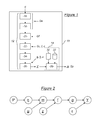
- the device 10 for estimating a molecular weight parameter in a sample E comprises a sample processing chain 12 designed to supply a signal Y representative of this molecular weight parameter as a function of at least one variable of the processing chain 12. It further comprises a device 14 signal processing device adapted to apply, in combination with the processing chain 12, a method for estimating this molecular weight parameter as a function of the technical parameters of the processing chain 12.
- the estimated parameter is a mass spectrum relating to biological components of the sample E considered then as a biological sample
- the chain of Treatment 12 is a biological treatment chain. More specifically, the components are proteins of interest, for example selected according to their relevance for characterizing an anomaly, disease or condition
- Sample E is a sample of blood, plasma, urine, other biological fluid, or a biological sample lysate.
- the sample E first passes through an ion source, that is to say a vaporizer 16, then an ionizer 18 (electrospray or equivalent), so as to present itself in the nebulized gas phase.
- This source of ions 16, 18 has a gain Ge which can, according to a simplified model of the processing chain 12, be considered constant and independent of the mass of the molecules present in the sample E.
- This gain Ge can be qualified certain parameter in the sense that it can be considered constant from one biological treatment to another.
- Sample E then passes through a focussing hexapole, guiding the ionized molecules through a very low pressure chamber.
- This focusing also has a gain Gf which can, according to a simplified model of the processing chain 12, be considered as constant and independent of the mass of the molecules present in the sample E.
- This gain Gf can also be described as a certain parameter.
- ionized and focused molecules of the sample E meet the MEMS or NEMS type electromechanical sensor of a mass spectrometer 22 for example similar to that described in the aforementioned article by Naik et al. They are adsorbed by this sensor according to a gain Gc which can, according to a simplified model of the processing chain 12, be considered constant and independent of the mass of the molecules present in the sample E.
- This gain Gc can also be described as certain parameter.
- the processing chain 12 may optionally comprise a device 24 for detecting the position of the last molecule adsorbed on the MEMS or NEMS sensor. It is considered that such a device 24 is known, it will not be detailed.
- a device 24 for detecting the position of the last molecule adsorbed on the MEMS or NEMS sensor. It is considered that such a device 24 is known, it will not be detailed.
- the MEMS or NEMS sensor is functionalized locally, which makes it possible to predetermine the position of any adsorption.
- the functionalization can be carried out over a sufficiently narrow zone, so that the variability of the place of absorption does not affect the measurement.
- the processing chain 12 comprises a system 26 for electronic reading of the frequency drops of the MEMS or NEMS sensor of the mass spectrometer 22 for the supply of an observed signal Y which is then representative of the molecular masses of the proteins in the sample E.
- This Y signal corresponds to the recording of the instantaneous resonance frequency of the MEMS or NEMS sensor as a function of time.
- a first type of calibration can be performed using at least one sample E CALIB of external calibration components whose molecular profile is known, for example a sample of standard proteins or predetermined proteins contained in protein cocktails, the molecular weight of these sizing proteins being known and their concentration (or number) in the E CALIB sample being also known.
- a second type of calibration can be achieved by incorporating in the sample E to analyze at least one other sample E * of known components (in the example chosen, these are proteins) of marking (equivalent to the components of interest but of known different mass, their concentration or their number in the sample E * being also known).
- known components in the example chosen, these are proteins
- the processing chain 12 may be calibrated by internal or external calibration, one not excluding the other.
- the product of the three aforementioned gains Ge Gf and Gc can be determined by internal calibration.
- the adsorptions of molecules on the MEMS or NEMS sensor of the mass spectrometer 22 are counted in observation windows of T regular samples and the parameters are expressed by discretized vectors. to T components.
- the observed signal Y becomes a vector Y discretized at T components.
- this distribution becomes a vector m to T components, including I non-zero components.
- This temporal distribution can also be expressed alternatively in the form of a list m comprising, for each event, the detected mass (M i ) and the detection time (t i ).
- M i the detected mass
- t i the detection time
- this distribution becomes a vector z with T components.
- This parameter z can be qualified as an uncertain parameter in the sense that it is likely to vary randomly from one biological treatment to another. But since at any time we can know the position of the last adsorbed molecule through the position detection device 24, there is no need to model it by a prior probability law.
- the frequency drop induced in the MEMS or NEMS sensor at each adsorption is dependent on the electromechanical characteristics of this sensor according to a deterministic function denoted c of each pair (M i , z i ).
- a deterministic function denoted c of each pair (M i , z i ).
- An example of such a function can be deduced from the aforementioned article by Dohn et al.
- the values that this function takes at each detection time t i can be denoted c (M i , z i ).
- the MEMS or NEMS sensor of the mass spectrometer 22 is chosen so as to be sufficiently sensitive to detect a significant voltage drop at each adsorption and fast enough to discriminate temporally the successive frequency drops due to successive adsorptions.
- each observable frequency drop can be considered immediate and perfect.
- the observed signal Y is related to g by the addition of a parameter noise ⁇ , this parameter being, for example, the variance of the noise.
- This parameter ⁇ can be qualified as an uncertain parameter in the sense that it is likely to vary randomly from one biological treatment to another. It can therefore advantageously be modeled according to a predetermined probability law a priori, for example a law inverse-gamma IGAM ( ⁇
- the observed signal Y is provided at the input of the processing device 14. More specifically, the processing device 14 comprises a processor 28 connected to storage means including in particular at least one programmed instruction sequence 30 and a modeling database. 32.
- the programmed instruction sequence 30 is designed to solve the inversion of this analytic model in a Bayesian framework by a posterior estimation based on probability models, for example prior models, d at least some of the above parameters.
- the instruction sequence 30 and the database 32 are functionally presented as distinct on the figure 1 , but in practice they can be distributed differently in data files, source codes or computer libraries without this changing anything to the functions performed.
- the parameter m can be refined by introducing a theoretical parameter q with binary values representing each adsorption on the MEMS or NEMS sensor.
- variable t i denotes the respective instants of adsorptions, an adsorption corresponding to the detection of a molecule or a molecular assembly on the MEMS or NEMS sensor.
- variable q takes into account the discrete nature of the detection of molecules or molecular assemblies by a sensor, which is a special feature of MEMS or NEMS sensors.
- each event of index i is assigned a pair (M i , t i ) representing the mass M i detected at time t i .
- the list consists of all these couples, each pair being associated with a detection. The formalism of such a list takes into account the discreteness of the detection of molecules or molecular assemblies by a sensor, a specific character of the MEMS or NEMS sensors, as previously indicated.
- m ⁇ ⁇ q
- ⁇ the estimate of the continuous mass of molecules at each moment.
- ⁇ the estimate of the continuous mass of molecules at each moment.
- the values of ⁇ are only meaningful where the values of q are not zero.
- the parameter q is uncertain and itself subject to another uncertain parameter P theoretical indicating the probability that the components of q take the value 1 in an observation window.
- the parameter P is a scalar that models the temporal density of the adsorptions. It can advantageously be modeled according to a predetermined a priori probability law, for example a BET beta law ( P
- a priori probability law for example a BET beta law ( P
- the vector q it can be modeled by a Bernoulli law, the probability that q is 1 at each instant given by the parameter P.
- the vector parameter ⁇ is uncertain and its T independent components ⁇ k are modeled according to a predetermined a priori probability law, for example a gamma law GAM ( ⁇ k
- GAM gamma law
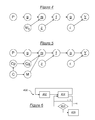
- some of the aforementioned parameters or functions are uncertain or dependent on uncertain parameters and are possibly, for some of them, modeled a priori by probability laws: these are the parameters / technical or theoretical functions ⁇ , g , f , z , q and P of the biological treatment chain 12 and molecular weight parameters, m and ⁇ . It is these parameters, among which are the vectors m and ⁇ , which are estimated by inversion of the direct model according to a process which will be detailed with reference to the figures 3 .
- these uncertain parameters are defined as having a probabilistic dependency relation between them, leading to a global hierarchical probabilistic model.
- the vector q representative of the adsorptions is defined as dependent on the parameter P of adsorptions density.
- the random variable q follows a Bernoulli probability law which varies according to the value of the random variable P.
- the function f representative of the temporal evolution of the resonant natural frequency of the MEMS or NEMS sensor defined by its parameter f 0 and the function c ( m , z ) is dependent on the vectors m and z , which corresponds to to a realistic model of the sensor.
- the observed signal Y depends directly on the function g and the noise parameter ⁇ .
- the observed signal Y depends solely on the random variables g and ⁇ , the latter being defined by the nature of its a priori probabilistic model and the a priori knowledge ⁇ ⁇ .
- the random variable g depends solely on the random variable f .
- the random variable f depends solely on the random variables m and z , the latter being in fact known thanks to the presence of the detection device 24.
- the random variable m depends only on the random variables q and ⁇ , the latter being defined by the nature of its a priori probabilistic model and the prior knowledge ⁇ m .
- the random variable q depends solely on the random variable P, the latter being defined by the nature of its a priori probabilistic model and the a priori knowledge ⁇ P.
- this hierarchical model generates, through the dependence defined between f , on the one hand, and m , z , on the other hand, a hierarchy between the biological mass parameters of the sample E and the technical parameters of the processing chain 12: it thus has indeed a first technical stage (second and third levels), dependent on a second biological stage (fourth and fifth levels), each of these two stages can itself present an internal hierarchy in depending on the model chosen.
- this method performs an inversion of the probabilistic model constructed in view of the observed signal Y. This inversion makes it possible to estimate the mass parameter m of the molecules adsorbed on the MEMS or NEMS sensor.
- this method makes it possible to estimate the mass spectrum Sp of the components of the sample E from the parameter m .
- the estimation of the parameter m is done jointly with the estimation of the set of random variables ⁇ , g , f , z , m , ⁇ , q and P by application of an estimator on the joint posterior probability distribution of these random variables in view of observation Y or, equivalently, on the joint probability law of these random variables and observation Y.
- MCMC digital sampling can be carried out by iterative methods of the Gibbs stochastic sampling type possibly involving the Metropolis-Hastings algorithm (or equivalent) and the estimator, for example, a posteriori expectation, can then be approached simply by the average values of the respective samplings.
- the posterior probability for the noise parameter ⁇ follows a gamma-inverse law so that the sampling of this parameter can be done simply and conventionally in the context of an iterative Gibbs sampling process.
- the posterior probability for parameter P follows a beta law so that the sampling of this parameter can be done simply and conventionally in the context of an iterative Gibbs sampling process.
- the posterior probability for the ⁇ parameter is expressed as the product of a normal law and gamma laws.
- This posterior probability has no simple expression, so that sampling of the ⁇ parameter can not be done simply in the context of an iterative Gibbs sampling process. It will be necessary to use a random walk sampling technique, such as the Random Walk Metropolis-Hastings algorithm (MHMA) or a similar algorithm.
- MHMA Random Walk Metropolis-Hastings algorithm
- Such a sampling technique requires defining at each iteration a neighborhood of the parameter concerned as estimated at the previous iteration in order to draw a new value.
- the parameter ⁇ being by hypothesis a vector with continuous values, this concept of neighborhood will be traditional.
- the posterior distribution is estimated numerically in a neighborhood of the value of the preceding sample; this law is normalized, then a new sample is drawn according to the posterior law; if this sample does not increase the joint probability, it is accepted with probability dependent on the ratio of the probability attached to the old sample and the new sample.
- the posterior probability for the parameter q is expressed as the product of a normal law and a Bernoulli law. This posterior probability does not have a simple expression either, so that sampling of the q parameter can not be done simply in the context of an iterative Gibbs sampling process. It will be necessary to use a random-walk sampling technique, such as the Metropolis-Hastings algorithm with Random Walk (MHMA) or an approaching algorithm, which imposes defining a neighborhood of the parameter concerned.
- MHMA Metropolis-Hastings algorithm with Random Walk
- the parameter q being hypothetically a vector with binary values, a particular notion of neighborhood will now be defined.
- This new definition of neighborhood has a significant impact on the good convergence of sampling. In particular, it makes it possible to strongly limit the risk of converging towards a local optimum.
- the main joint estimation phase 100 comprises a first measuring step 102 in which, in accordance with the assembly of the figure 1 the sample E passes through the entire processing line 12 of the device 10 for the supply of an observed signal Y.
- the initialization 104 is also the step allowing the pre-allocation of memory necessary for the smooth running of the process.
- the processor 28 then executes, by application of a Markov Chain Monte Carlo algorithm and on an index k varying from 1 to kmax, a Gibbs sampling loop 106 of each of the random variables initialized in view of their laws. of conditional posterior conditional probability as expressed analytically.
- kmax is the maximum value taken by index k before a predetermined stopping criterion is checked.
- the stopping criterion is, for example, a maximum number of iterations fixed a priori, the satisfaction of a stability criterion (such as the fact that an additional iteration has no significant impact on the chosen estimator of random variables) or other.
- the marginal joined law is estimated and its value is stored in memory with the current values ⁇ (k) , ⁇ (k) , q (k) , P (k) .
- the processor 28 then executes an estimation step 108 in which an estimate is retained for each sampled unknown parameter.
- Each parameter is estimated from the set of sample values that it has taken and that have been taken by the joined marginalized law over the iterations.
- the set of values taken into account can be reduced to the results of iterations between a subscript kmin and the index kmax, kmin being a predetermined value of "heating time” deemed necessary for the Gibbs sampling to be , the law of random draw converges to the posterior law attached, the latter can also be called target law.
- kmin being a predetermined value of "heating time” deemed necessary for the Gibbs sampling to be
- the law of random draw converges to the posterior law attached, the latter can also be called target law.
- the estimation step 108 thus provides estimated values ⁇ , ⁇ , q and P for each of the unknown parameters ⁇ , ⁇ , q and P.
- An estimate of the value m ⁇ ⁇ q for the parameter m which contains the quantity and mass information of the molecules adsorbed by the MEMS or NEMS sensor.
- This last step of the first main phase of joint estimation 100 is followed by the second main phase of reconstruction 200.
- adsorptions detected but for which the location on the MEMS or NEMS sensor leads to a value frequency drop are suppressed. These deletions are referred to as "z rejects".
- the rate of discharges in z TR Z is also calculated at this stage.
- a histogram of the parameter m is calculated, the latter corresponding to the mass spectrum of the sample E. This calculation step is conventional and will not be detailed.
- this histogram is multiplied by a constant which proves to be the inverse of a gain, in particular the inverse of the overall gain of the processing chain 12, namely the product Ge .Gf.Gc, multiplied by the reciprocal of (1-TR Z ) (complement to 1 of the rejection rate in z calculated in step 202).
- a constant which proves to be the inverse of a gain, in particular the inverse of the overall gain of the processing chain 12, namely the product Ge .Gf.Gc, multiplied by the reciprocal of (1-TR Z ) (complement to 1 of the rejection rate in z calculated in step 202).
- an internal calibration can be carried out by incorporating into the sample E, at step 102, a sample E * of known components weighed with marking.
- a first consequence of such an internal calibration carried out during the measurement step 102 is to add knowledge a priori to at least a part of the parameters of the processing chain 12.
- the components ⁇ k of the vector parameter ⁇ being modeled according to a GAM gamma law ( ⁇ k
- step 206 the inverse of the gain used to weight the histogram of the parameter m not being known a priori but estimated by the processing device 14 thanks to the internal calibration.
- the external calibration phase 300 of the biological treatment chain 12 comprises a first measurement step 302 during which, in accordance with the assembly of the figure 1 , the sample of external calibration proteins E CALIB crosses the entire processing chain 12 of the device 10 for the supply of an observed signal Y CALIB .
- the processing applied by the processor 28 to the signal Y CALIB consists in determining values that are not yet known for certain parameters, that is to say parameters that remain in reality relatively constant from one biological treatment to another. These certain parameters are then considered and modeled by constants in the biological treatment chain 12. For example, these are the various gains of the processing chain 12 such as Ge, Gf and Gc, of the aforementioned parameters f 0 or g 0 , the filter function h of the read loop, etc.
- This treatment can also consist of determining stable parameters (for example, mean or variance) of prior probability models of uncertain parameters such as those mentioned above. These stable parameters are then also considered and modeled by constants.
- Step 304 thus reproduces a part of the determination steps 104, 106 and 108 of the main phase 100.
- the parameter M 0 is uncertain and is modeled according to a predetermined prior probability law, for example a gamma law GAM ( M 0
- GAM gamma law
- the uncertain parameters of the new model are defined as having a probabilistic dependency relation between them, leading to a hierarchical global probabilistic model .
- the observed signal Y depends solely on the random variables g and ⁇ , the latter being defined by the nature of its a priori probabilistic model and the a priori knowledge ⁇ ⁇ .
- the random variable g depends solely on the random variable f .
- the random variable f depends solely on the random variables m and z , the latter being in fact known thanks to the presence of the detection device 24.
- the random variable m depends only on the random variables q and M 0 , the latter being defined by the nature of its a priori probabilistic model and the prior knowledge ⁇ m .
- the random variable q depends solely on the random variable P, the latter being defined by the nature of its a priori probabilistic model and the a priori knowledge ⁇ P.
- the estimation of the parameter m is done jointly with the estimation of the set of random variables ⁇ , g , f , z , m , M 0 , q and P by application of an estimator on the joint posterior probability distribution of these random variables in view of observation Y or, equivalently, on the joint probability law of these random variables and observation Y.
- the method of estimating molecular weight parameter illustrated on the figure 3 including the first main joint estimation phase 100, the second main reconstruction phase 200 and the possible prior external calibration phase 300, apply in the same way.
- the random variables ⁇ , M 0 , q and P are each initialized by the processor 28 to a first value ⁇ (0) , M 0 (0) , q (0) and P (0) .
- the processor 28 then executes, by application of a Markov Chain Monte Carlo algorithm and on an index k varying from 1 to kmax, the Gibbs sampling loop 106 of each of the random variables initialized in view of their laws. of conditional posterior conditional probability as expressed analytically.
- the marginal joined law is estimated and its value is stored in memory with the current values ⁇ (k) , M 0 (k) , q (k) , P (k) .
- the estimation step 108 provides estimated values ⁇ , M 0 , q and P for each of the unknown parameters ⁇ , M 0 , q and P.
- An estimate of the value m M 0 ⁇ q for the parameter m is directly deduced therefrom. .
- the next phase of spectrum reconstruction 200 is also unchanged.
- the parameter m can be refined by introducing the theoretical parameter q mentioned in the first two embodiments. Unlike a continuous distribution of masses, it is assumed that the molecules of the sample E * are grouped into classes, each molecule of a given class having the same mass as all the other molecules of the same class. C is the number of these classes.
- Cq is a vector with T components, each of its components indicating the index i, 1 ⁇ i ⁇ C, of a class
- M ( Cq ) is a vector with T components, each of its components indicating the mass associated with the class indicated in the corresponding component of the vector Cq .
- the vector parameter M is uncertain and its C independent components M i , 1 ⁇ i ⁇ C, are modeled according to a predetermined prior probability law, for example a gamma law GAM ( M i
- GAM gamma law
- the integer parameter C is uncertain and is modeled according to a predetermined prior probability law, for example a Poisson distribution of parameter ⁇ C , this parameter representing the prior knowledge of the parameter C noted ⁇ C .
- a priori represented by a Dirac distribution centered on the known value.
- the vector parameter Cq is uncertain, its components have discrete values ranging between 1 and C and the probability that any of its components is equal to i, 1 ⁇ i ⁇ C, is worth the value of the i-th component of Cp.
- the vector parameter Cp is uncertain and is modeled according to a predetermined prior probability law, for example a Dirichlet law D ( C p , ⁇ a Cp , ... , a Cp ⁇ ) parameters. of form all equal to a value a Cp , this common value representing the knowledge a priori on the parameter Cp noted ⁇ Cp .
- D Dirichlet law
- the uncertain parameters of the new model are defined as having a probabilistic dependency relation between them, leading to a global hierarchical probabilistic model.
- the observed signal Y depends solely on the random variables g and ⁇ , the latter being defined by the nature of its a priori probabilistic model and the a priori knowledge ⁇ ⁇ .
- the random variable g depends solely on the random variable f .
- the random variable f depends solely on the random variables m and z , the latter being in fact known thanks to the presence of the detection device 24.
- the random variable m depends only on the random variables q , Cq and M, the latter being defined by the nature of its a priori probabilistic model and the prior knowledge ⁇ m .
- the random variable q depends solely on the random variable P, the latter being defined by the nature of its a priori probabilistic model and the a priori knowledge ⁇ P.
- the random variable Cq depends solely on the random variable Cp, the latter being defined by the nature of its a priori probabilistic model and the a priori knowledge ⁇ Cp .
- the random variable M depends solely on the random variable C, the latter being defined by the nature of its a priori probabilistic model and the prior knowledge ⁇ C.
- the random variable Cp depends solely on the random variable C.
- the estimation of the parameter m is done in conjunction with the estimation of the set of random variables ⁇ , g , f , z , m , M, Cq , Cp, C, q and P by applying an estimator on the joined posterior probability law of these random variables in view of observation Y or, equivalently, on the joint probability law of these random variables and observation Y.
- conditional posterior probability law followed by the parameter M takes the following form: p M
- Y , ⁇ , q , P , cq , Pc , VS NOT Y
- vs M cq ⁇ q , z * h , ⁇ ⁇ I T ⁇ ⁇ i 1 VS GAM M i
- the posterior probability for the noise parameter ⁇ follows a gamma-inverse law, as in the previous embodiments, so that the sampling of this parameter can be done simply and conventionally in the context of an iterative Gibbs sampling method.
- the posterior probability for the parameter P follows a beta law, as in the previous embodiments, so that the sampling of this parameter can be done simply and conventionally in the context of an iterative process. Gibbs sampling.
- the posterior probability for the parameter M is expressed as the product of a normal law and gamma laws so that it will be necessary to use a random-walk sampling technique, as in the embodiments of the invention. previous for ⁇ and M 0 .
- a sampling technique requires defining at each iteration a neighborhood of the parameter M as estimated at the previous iteration in order to draw a new value. This neighborhood will be defined as in the previous embodiments for ⁇ and M 0 .
- the posterior probability for parameter q is expressed as the product of a normal law and a Bernoulli law so that it will be necessary to use a random-walk sampling technique, as in previous embodiments.
- a sampling technique requires defining at each iteration a neighborhood of the parameter q as estimated at the previous iteration in order to draw a new value. This neighborhood will be defined as in the previous embodiments.
- the posterior probability for the Cq parameter is expressed as the product of a normal distribution and a variable number of prior probabilities. This posterior probability does not have a simple expression, so it will be necessary to use a random walk sampling technique, such as the Random Walk Metropolis-Hastings algorithm (MHMA) or an algorithm approaching, imposing to define a neighborhood of the parameter Cq .
- MHMA Random Walk Metropolis-Hastings algorithm
- This parameter being hypothesis a vector with discrete values, a particular notion of neighborhood will now be defined.
- the components of the vector Cq are iterated a process which proposes to each iteration as many neighbors as there are classes.
- the k-th component of Cq may be worth all integers between 1 and C: it will have C-1 selectable neighbors (in addition, possibly, of the current value) at the same time. 'sampling.
- the posterior probability for the Cp parameter follows a Dirichlet law so that the sampling of this parameter can be done simply and conventionally in the context of an iterative Gibbs sampling process.
- the method of estimating molecular weight parameter illustrated on the figure 3 including the first main joint estimation phase 100, the second main reconstruction phase 200 and the possible prior external calibration phase 300, apply in the same way, except for the Gibbs sampling loop 106 which must be replaced by a more complex sampling loop 400, adapted to the particular sampling of the parameter C and illustrated on the figure 6 .
- the processor 28 executes the sampling loop 400.
- a sample of C is generated according to its a priori probability law around its current value, the last values of the other unknown parameters and the last value of the attached law. marginalized being stored in memory.
- the marginalized joined law is estimated and its value is stored in memory with the current values ⁇ (k) , q (k) , P (k) , M (k) , Cq (k) and Cp (k) .
- a test 406 is executed on the current value of the marginalized joined law. If this current value remains lower than the last value stored in memory in step 402, then step 404 is interrupted and a step 408 is made in which the last parameter values stored in memory at step 402 are restored with a probability dependent on the marginalized likelihood values of the joined law before and after the C parameter sampling 402. The step 408 terminates the sampling loop 400 and is followed by the step 108.
- the current value of the joined marginalized law tested in step 406 is greater than the last value stored in memory at step 402, so step 404 is completed and followed by a return to step 402.
- the estimation step 108 provides estimated values ⁇ , q , P, M, ⁇ q , ⁇ p and ⁇ for each of the unknown parameters ⁇ , q , P, M, Cq , Cp and C. A value can be deduced therefrom.
- estimated m M ( ⁇ q ) ⁇ q for the parameter m .
- an internal calibration can be carried out by incorporating into the sample E, in step 102, a sample E * of known components weighed with marking.
- a first consequence of such an internal calibration carried out during the measurement step 102 is to add knowledge a priori on at least a part of the parameters of the processing chain 12.
- the prior law on the number C of classes necessarily becomes zero below a known minimum as a function of the weighted component sample E *: this minimum corresponds to the number of weighted component classes.
- this also induces knowledge on the vector M which must contain the corresponding indications on the masses of the weighted components of the sample E *. It is then necessary to separate the vector M into two sub-vectors: a vector M i of the components of the sample E, challenged at each sampling, and a vector M c of the weighted components of the sample E *, never delivered in question.
- step 206 the inverse of the gain used to weight the histogram of the parameter m not being known a priori but estimated by the processing device 14 thanks to the internal calibration.
- Concrete applications of this method include the detection of cancer markers (in this case the components are proteins) in a biological sample of blood or urine.
- cancer markers in this case the components are proteins
- the components of interest are not necessarily proteins, but may more generally be molecules or molecular assemblies for a biological or chemical analysis.
- a variant when performing a Gibbs sampling loop, whether during step 106 or step 404, it is possible to question the result of each iteration. For example, when estimating the joined marginalized law at the end of the iteration, by comparing this new estimate to the previous value, if the value is lower, we accept the new set of parameters with a probability equal to the ratio of the new probability on the old probability.
- the Gibbs sampling can, instead of being made globally over the entire vector, be component-by-component, either from the first to the last, or in another predetermined order, or by traversing the vector components in a random order so that a predetermined direction of travel does not affect the results of the sampling.
Landscapes
- Chemical & Material Sciences (AREA)
- Engineering & Computer Science (AREA)
- Physics & Mathematics (AREA)
- Life Sciences & Earth Sciences (AREA)
- Analytical Chemistry (AREA)
- Nanotechnology (AREA)
- General Physics & Mathematics (AREA)
- General Health & Medical Sciences (AREA)
- Health & Medical Sciences (AREA)
- Crystallography & Structural Chemistry (AREA)
- Theoretical Computer Science (AREA)
- Biochemistry (AREA)
- Immunology (AREA)
- Pathology (AREA)
- Data Mining & Analysis (AREA)
- Bioinformatics & Cheminformatics (AREA)
- Bioinformatics & Computational Biology (AREA)
- Mathematical Optimization (AREA)
- Pure & Applied Mathematics (AREA)
- Computational Mathematics (AREA)
- Mathematical Physics (AREA)
- Mathematical Analysis (AREA)
- Acoustics & Sound (AREA)
- Molecular Biology (AREA)
- Spectroscopy & Molecular Physics (AREA)
- Computing Systems (AREA)
- Probability & Statistics with Applications (AREA)
- Operations Research (AREA)
- Algebra (AREA)
- Evolutionary Biology (AREA)
- Databases & Information Systems (AREA)
- Software Systems (AREA)
- General Engineering & Computer Science (AREA)
- Other Investigation Or Analysis Of Materials By Electrical Means (AREA)
Claims (11)
- Verfahren zur Schätzung eines Molekularmasseparameters (m, Sp) in einer Probe (E) mit mindestens einem Bestandteil einer gegebenen Molekularmasse, das die folgenden Schritte umfasst:- die Probe (E) eine Verarbeitungskette (12) mit Massenspektrometer (22) mit elektromechanischem Sensor des Typs MEMS oder NEMS durchlaufen lassen (102), um die Anzahl der aufeinanderfolgenden Detektionen der Adsorption des genannten Bestandteils zählen,- damit ein Signal (Y) zu gewinnen, das für den Molekularmasseparameter (m, Sp) repräsentativ ist, und- den Molekularmasseparameter (m, Sp) mithilfe einer Vorrichtung (14) zur Zeichenverarbeitung zu schätzen (104, 106, 108, 200),gekennzeichnet dadurch, dass der Molekularmasseparameter (m, Sp) auf der Grundlage eines Parameters (q, m) für die zeitliche Verteilung der aufeinanderfolgenden Detektionen der Adsorption des genannten Bestandteils durch den elektromechanischen Sensor des Typs MEMS oder NEMS definiert wird, und dass dessen Schätzung (104, 106, 108, 200) durch bayessche Inferenz auf der Grundlage einer direkten analytischen Modellierung des genannten Signals (Y) in Abhängigkeit vom Molekularmasseparameter und von technischen Parametern (Ge, Gf, Gc, f, c, g, h, ε) der Verarbeitungskette (12) mit mindestens einem technischen Parameter (c) des elektromechanischen Sensors des Typs MEMS oder NEMS erfolgt.
- Verfahren zur Schätzung von mindestens einem Molekularmasseparameter gemäß Anspruch 1, in dem die analytische Modellierung einen Parameter (q) umfasst, der die Momente, die sogenannten Detektionsmomente, repräsentiert, in denen der elektromechanische Sensor die Adsorption des genannten Bestandteils erkennt, wobei der Molekularmasseparameter (m, Sp) ausgehend von diesem die Detektionsmomente repräsentierenden Parameter definiert wird.
- Verfahren zur Schätzung von mindestens einem Molekularmasseparameter gemäß Anspruch 2, in dem der die Detektionsmomente repräsentierende Parameter (q) die Form eines Vektors oder einer Liste der Parameter jeder Bestandteildetektion aufweist.
- Verfahren zur Schätzung von mindestens einem Molekularmasseparameter gemäß einem der Ansprüche 1 bis 3, das ausserdem ein Schritt der Detektion der Adsorptionsstellen der Bestandteile auf dem elektromechanischen Sensor des Typs MEMS oder NEMS umfasst, in der die analytische Modellierung ausserdem einen Parameter für die zeitliche Verteilung dieser Adsorptionsstellen und eine determinierende Funktion umfasst, die einen Frequenzabfallwert für jedes Wertepaar einer adsorbierten Bestandteilmasse und einer entsprechenden Adsorptionsstelle umfasst.
- Verfahren zur Schätzung von mindestens einem Molekularmasseparameter gemäß einem der Ansprüche 1 bis 4, in dem mindestens zwei der Parameter der Molekularmasse (m, Sp) und der Verarbeitungskette (Ge, Gf, Gc, f, c, g, h, ε), abhängig von denen die direkte analytische Modellierung des genannten Signals (Y) definiert wird, eine probabilistische Abhängigkeit zueinander aufweisen, und in dem die Signalverarbeitung durch bayessche Inferenz ausserdem auf der Grundlage einer Modellbildung durch Wahrscheinlichkeitsgesetz erfolgt, das a priori eine Bedingung dieser Abhängigkeit ist.
- Verfahren zur Schätzung von mindestens einem Molekularmasseparameter gemäß einem der Ansprüche 1 bis 5, in dem der Schritt (104, 106, 108, 200) zur Schätzung des Molekularmasseparameters (m, Sp) durch Näherung des Wahrscheinlichkeitsgesetzes, das a posteriori einem Parameter (µ, M0, M) hinzugefügt wird, der mit dem Molekularmasseparameter (m, Sp) und den technischen Parametern der Verarbeitungskette (12) verbunden ist, bedingt durch das mithilfe eines stochastischen Probenahmealgorithmus erzielte Signal (Y) umfasst:- Probenahmeschleife (106; 400) dieser Parameter, die Probenahmewerte dieser Parameter bereitstellt, und- Schätzung (108, 200) des Molekularmasseparameters (m, Sp), die auf der Grundlage der bereitgestellten Probenahmewerte berechnet wird.
- Verfahren zur Schätzung mindestens eines Molekularmasseparameters gemäß den Ansprüchen 3 und 6, in dem:- der die Detektionsmomente repräsentierende Parameter (g) die Form eines Vektors mit binären Werten aufweist, wobei einer der Binärwerte, A, die Detektion einer Adsorption angibt,- an jeder Iteration der Probenahmeschleife (106; 400) eine Probe dieses Parameters in unmittelbarer Nähe der bei der vorherigen Iteration berechneten Probe berechnet wird,- die unmittelbare Nähe einer aktuellen Probe dieses Parameters folgendermaßen definiert ist: Jede Probe mit einem Bestandteil für A mehr oder weniger, einem versetzten Bestandteil für A, oder einem A-Bestandteil, der zwei aufeinanderfolgende Bestandteile für A der aktuellen Probe enthält.
- Verfahren zur Schätzung mindestens eines Molekularmasseparameters gemäß den Ansprüchen 6 oder 7, in dem:- an jeder Iteration der Probenahmeschleife (106; 400) eine verbundete Wahrscheinlichkeit mindestens aller beprobten Parameter geschätzt wird, und- die Schätzung des Molekularmasseparameters (m, Sp) gemeinsam mit der Schätzung der beprobten Parameter auf der Grundlage der aufeinanderfolgenden Werte der genannten hinzugefügten Wahrscheinlichkeit erfolgt.
- Verfahren zur Schätzung mindestens eines Molekularmasseparameters gemäß einem der Ansprüche 6 bis 8, in dem der Molekularmasseparameter ein Massespektrum (Sp) in Bezug auf zumindest einen Bestandteil ist, dessen Masse zu den durch die Probenahmeschleife verarbeiteten Parametern gehört (106; 400) und eines der Elemente der aus einer einzigen Molekularmasse (M0), einer diskreten Vielzahl von Molekularmassen (M) und einer kontinuierlichen Masseverteilung (µ) gebildeten Gesamtheit ist.
- Verfahren zur Schätzung mindestens eines Molekularmasseparameters gemäß einem der Ansprüche 1 bis 9, in dem der Molekularmasseparameter (m, Sp) auf Proteine bezogen ist und die Probe (E) ein Element der aus Blut, Plasma, Urin, biologischer Flüssigkeit und Lysat einer biologischen Probe gebildeten Gesamtheit enthält.
- Vorrichtung zur Schätzung eines Molekularmasseparameters (m, Sp) in einer Probe (E) mit mindestens einem Bestandteil einer gegebenen Molekularmasse, die umfasst:- einer Kette (12) zur Verarbeitung der Probe (E) mit Massenspektrometer (22) mit elektromechanischer Sonde des Typs MEMS oder NEMS, die darauf ausgelegt ist, die Anzahl der aufeinanderfolgenden Absorptionsdetektionen für den genannten Bestandteil zu zählen und ein das den Molekularmasseparameter repräsentierendes Signal (Y) bereitzustellen,- einer Vorrichtung (14) zur Signalverarbeitung, die darauf ausgelegt ist, in Kombination mit der Verarbeitungskette (12) ein Verfahren zur Schätzung von Molekularmasseparametern gemäß einem der Ansprüche 1 bis 10 anzuwenden, wobei der Molekularmasseparameter (m, Sp) auf der Grundlage eines Parameters (q, m) für die zeitliche Verteilung der aufeinanderfolgenden adsorbierten Bestandteilmassen durch den elektromechanischen Sensor des Typs MEMS oder NEMS definiert wird.
Applications Claiming Priority (1)
| Application Number | Priority Date | Filing Date | Title |
|---|---|---|---|
| FR1157857A FR2979705B1 (fr) | 2011-09-05 | 2011-09-05 | Procede et dispositif d'estimation d'un parametre de masse moleculaire dans un echantillon |
Publications (2)
| Publication Number | Publication Date |
|---|---|
| EP2565904A1 EP2565904A1 (de) | 2013-03-06 |
| EP2565904B1 true EP2565904B1 (de) | 2015-10-21 |
Family
ID=46754352
Family Applications (1)
| Application Number | Title | Priority Date | Filing Date |
|---|---|---|---|
| EP12183031.9A Not-in-force EP2565904B1 (de) | 2011-09-05 | 2012-09-04 | Verfahren und Vorrichtung zum Schätzen eines Molekülmassenparameters in einer Probe |
Country Status (3)
| Country | Link |
|---|---|
| US (1) | US9251122B2 (de) |
| EP (1) | EP2565904B1 (de) |
| FR (1) | FR2979705B1 (de) |
Families Citing this family (14)
| Publication number | Priority date | Publication date | Assignee | Title |
|---|---|---|---|---|
| GB201205720D0 (en) * | 2012-03-30 | 2012-05-16 | Micromass Ltd | A method for the investigation of differences in analytical data and an apparatus adapted to perform such a method |
| ES2655203T3 (es) * | 2012-11-30 | 2018-02-19 | Iti Scotland - Scottish Enterprise | Espectroscopia mejorada de fase de vapor |
| WO2014130095A2 (en) | 2013-02-22 | 2014-08-28 | California Institute Of Technology | Shape analysis and mass spectrometry of individual molecules by nanomechanical systems |
| FR3003083B1 (fr) * | 2013-03-11 | 2015-04-10 | Commissariat Energie Atomique | Dispositif de determination de la masse d'une particule en suspension ou en solution dans un fluide |
| US11093869B2 (en) * | 2014-02-13 | 2021-08-17 | Brewmetrix Inc. | Analytical system with iterative method of analyzing data in web-based data processor with results display designed for non-experts |
| CN110718442B (zh) | 2015-01-23 | 2022-08-16 | 加州理工学院 | 整合的混合nems质谱测定法 |
| CN104750982B (zh) * | 2015-03-19 | 2017-10-31 | 北京航空航天大学 | 一种基于比例分组再抽样的可靠度区间估计方法 |
| CN104820873B (zh) * | 2015-05-13 | 2017-12-26 | 中国环境科学研究院 | 一种基于金属定量构效关系的淡水急性基准预测方法 |
| CN109002684B (zh) * | 2018-06-20 | 2021-08-06 | 北京大学 | 一种区间信息分析方法 |
| CN109781858A (zh) * | 2018-12-29 | 2019-05-21 | 华中科技大学同济医学院附属同济医院 | 中心静脉导管测量装置及方法 |
| GB201912494D0 (en) * | 2019-08-30 | 2019-10-16 | Micromass Ltd | Mass spectometer calibration |
| EP3970183B1 (de) * | 2020-07-24 | 2025-07-09 | Ihsan Dogramaci Bilkent Üniversitesi | Vorrichtung zur gewinnung der masse einzelner nanopartikel, viren und proteine in suspension oder in lösung mit hohem sammeleffizienz |
| JP7757632B2 (ja) | 2021-05-26 | 2025-10-22 | 株式会社島津製作所 | 分析方法および診断支援方法 |
| JP7600875B2 (ja) * | 2021-06-01 | 2024-12-17 | 株式会社島津製作所 | 試料分析装置、試料分析方法、医薬分析装置および医薬分析方法 |
Family Cites Families (5)
| Publication number | Priority date | Publication date | Assignee | Title |
|---|---|---|---|---|
| EP1047108B1 (de) * | 1999-04-06 | 2006-03-08 | Micromass UK Limited | Verfahren zur Identifizierung von Peptidensequenzen und Proteinensequenzen mittels Massenspektromterie |
| US7408147B2 (en) * | 2005-07-27 | 2008-08-05 | Wisconsin Alumni Research Foundation | Nanoelectromechanical and microelectromechanical sensors and analyzers |
| FR2920235B1 (fr) | 2007-08-22 | 2009-12-25 | Commissariat Energie Atomique | Procede d'estimation de concentrations de molecules dans un releve d'echantillon et appareillage |
| US8227747B2 (en) * | 2008-01-25 | 2012-07-24 | California Institute Of Technology | Single molecule mass spectroscopy enabled by nanoelectromechanical systems (NEMS-MS) |
| WO2012166849A1 (en) * | 2011-06-02 | 2012-12-06 | Wisconsin Alumni Research Foundation | Membrane detector for time-of-flight mass spectrometry |
-
2011
- 2011-09-05 FR FR1157857A patent/FR2979705B1/fr not_active Expired - Fee Related
-
2012
- 2012-09-04 EP EP12183031.9A patent/EP2565904B1/de not_active Not-in-force
- 2012-09-05 US US13/603,716 patent/US9251122B2/en not_active Expired - Fee Related
Also Published As
| Publication number | Publication date |
|---|---|
| US20130238252A1 (en) | 2013-09-12 |
| FR2979705B1 (fr) | 2014-05-09 |
| FR2979705A1 (fr) | 2013-03-08 |
| EP2565904A1 (de) | 2013-03-06 |
| US9251122B2 (en) | 2016-02-02 |
Similar Documents
| Publication | Publication Date | Title |
|---|---|---|
| EP2565904B1 (de) | Verfahren und Vorrichtung zum Schätzen eines Molekülmassenparameters in einer Probe | |
| EP2509018B1 (de) | Verfahren und Vorrichtung zum Schätzen von biologischen oder chemischen Parametern in einer Probe, entsprechendes Diagnose-Hilfsverfahren | |
| EP3865872B1 (de) | Informationsverarbeitungsvorrichtung, verfahren zur steuerung einer informationsverarbeitungsvorrichtung, programm, berechnungsvorrichtung und berechnungsverfahren | |
| Cadusch et al. | Improved methods for fluorescence background subtraction from Raman spectra | |
| Been et al. | Profiling of counterfeit medicines by vibrational spectroscopy | |
| US7949476B2 (en) | Method for estimating molecule concentrations in a sampling and equipment therefor | |
| Lopes et al. | Near-infrared hyperspectral unmixing based on a minimum volume criterion for fast and accurate chemometric characterization of counterfeit tablets | |
| Flanagan et al. | Exploring generative artificial intelligence and data augmentation techniques for spectroscopy analysis | |
| EP4143545A1 (de) | Verfahren zum nachweis eines pathogenen wirkstoffs in einer biologischen flüssigkeit mittels oberflächenverstärkter raman-spektroskopie | |
| WO2011120785A1 (fr) | Procede d'analyse spectrometrique et dispositif apparente | |
| Palmer et al. | Using collective expert judgements to evaluate quality measures of mass spectrometry images | |
| JP7592462B2 (ja) | 情報処理装置、及び情報処理装置の制御方法 | |
| EP1007962B1 (de) | Klassifizieranlage und klassifizierverfahren unter verwendung einer kombination von warscheinlichkeitsverfahren und neuronalen netzwerken | |
| WO2016042060A1 (fr) | Systeme et procede de detection de particules | |
| EP3006935B1 (de) | Verfahren und vorrichtung zur bestimmung einer zusammensetzung in einer gasförmigen probe, die mit gaschromatographie behandelt wurde | |
| EP2649436B1 (de) | Verfahren zur extraktion eines ersten streuungsspektrums | |
| EP3087444B9 (de) | Verfahren zur quantitativen bestimmung von verunreinigung von distanzplatten in einem dampferzeuger | |
| Zhao et al. | Practical Guidance for Training Machine Learning Models in Metabolomics and Mass Spectrometry Research | |
| Khanmohammadi et al. | Cardiovascular biodiagnosis by infrared spectroscopy through choline determination | |
| EP4522980A1 (de) | Verfahren zur erzeugung synthetischer spektraldaten | |
| EP4068724B1 (de) | Verfahren zur erkennung von anomalien in einem informationssystem, computerprogramm und system zur erkennung von anomalien, das ein solches verfahren verwendet | |
| Li et al. | A hybrid variable selection and modeling strategy for the determination of target compounds in different spectral datasets | |
| Lawler et al. | Detecting episodes of star formation using Bayesian model selection | |
| EP1904872B1 (de) | Verbesserte verarbeitung eines strahlung repräsentierenden signals | |
| EP2769209B1 (de) | Verfahren und vorrichtung zur charakterisierung eines materials durch streuung einer elektromagnetischen strahlung |
Legal Events
| Date | Code | Title | Description |
|---|---|---|---|
| PUAI | Public reference made under article 153(3) epc to a published international application that has entered the european phase |
Free format text: ORIGINAL CODE: 0009012 |
|
| AK | Designated contracting states |
Kind code of ref document: A1 Designated state(s): AL AT BE BG CH CY CZ DE DK EE ES FI FR GB GR HR HU IE IS IT LI LT LU LV MC MK MT NL NO PL PT RO RS SE SI SK SM TR |
|
| AX | Request for extension of the european patent |
Extension state: BA ME |
|
| 17P | Request for examination filed |
Effective date: 20130905 |
|
| RBV | Designated contracting states (corrected) |
Designated state(s): AL AT BE BG CH CY CZ DE DK EE ES FI FR GB GR HR HU IE IS IT LI LT LU LV MC MK MT NL NO PL PT RO RS SE SI SK SM TR |
|
| 17Q | First examination report despatched |
Effective date: 20141021 |
|
| GRAP | Despatch of communication of intention to grant a patent |
Free format text: ORIGINAL CODE: EPIDOSNIGR1 |
|
| INTG | Intention to grant announced |
Effective date: 20150611 |
|
| GRAS | Grant fee paid |
Free format text: ORIGINAL CODE: EPIDOSNIGR3 |
|
| GRAA | (expected) grant |
Free format text: ORIGINAL CODE: 0009210 |
|
| AK | Designated contracting states |
Kind code of ref document: B1 Designated state(s): AL AT BE BG CH CY CZ DE DK EE ES FI FR GB GR HR HU IE IS IT LI LT LU LV MC MK MT NL NO PL PT RO RS SE SI SK SM TR |
|
| REG | Reference to a national code |
Ref country code: GB Ref legal event code: FG4D Free format text: NOT ENGLISH Ref country code: NL Ref legal event code: MP Effective date: 20151021 |
|
| REG | Reference to a national code |
Ref country code: CH Ref legal event code: EP |
|
| REG | Reference to a national code |
Ref country code: AT Ref legal event code: REF Ref document number: 757074 Country of ref document: AT Kind code of ref document: T Effective date: 20151115 |
|
| REG | Reference to a national code |
Ref country code: IE Ref legal event code: FG4D Free format text: LANGUAGE OF EP DOCUMENT: FRENCH |
|
| REG | Reference to a national code |
Ref country code: DE Ref legal event code: R096 Ref document number: 602012011745 Country of ref document: DE |
|
| REG | Reference to a national code |
Ref country code: LT Ref legal event code: MG4D |
|
| REG | Reference to a national code |
Ref country code: AT Ref legal event code: MK05 Ref document number: 757074 Country of ref document: AT Kind code of ref document: T Effective date: 20151021 |
|
| PG25 | Lapsed in a contracting state [announced via postgrant information from national office to epo] |
Ref country code: NO Free format text: LAPSE BECAUSE OF FAILURE TO SUBMIT A TRANSLATION OF THE DESCRIPTION OR TO PAY THE FEE WITHIN THE PRESCRIBED TIME-LIMIT Effective date: 20160121 Ref country code: IS Free format text: LAPSE BECAUSE OF FAILURE TO SUBMIT A TRANSLATION OF THE DESCRIPTION OR TO PAY THE FEE WITHIN THE PRESCRIBED TIME-LIMIT Effective date: 20160221 Ref country code: LT Free format text: LAPSE BECAUSE OF FAILURE TO SUBMIT A TRANSLATION OF THE DESCRIPTION OR TO PAY THE FEE WITHIN THE PRESCRIBED TIME-LIMIT Effective date: 20151021 Ref country code: IT Free format text: LAPSE BECAUSE OF FAILURE TO SUBMIT A TRANSLATION OF THE DESCRIPTION OR TO PAY THE FEE WITHIN THE PRESCRIBED TIME-LIMIT Effective date: 20151021 Ref country code: HR Free format text: LAPSE BECAUSE OF FAILURE TO SUBMIT A TRANSLATION OF THE DESCRIPTION OR TO PAY THE FEE WITHIN THE PRESCRIBED TIME-LIMIT Effective date: 20151021 Ref country code: ES Free format text: LAPSE BECAUSE OF FAILURE TO SUBMIT A TRANSLATION OF THE DESCRIPTION OR TO PAY THE FEE WITHIN THE PRESCRIBED TIME-LIMIT Effective date: 20151021 Ref country code: NL Free format text: LAPSE BECAUSE OF FAILURE TO SUBMIT A TRANSLATION OF THE DESCRIPTION OR TO PAY THE FEE WITHIN THE PRESCRIBED TIME-LIMIT Effective date: 20151021 |
|
| PG25 | Lapsed in a contracting state [announced via postgrant information from national office to epo] |
Ref country code: RS Free format text: LAPSE BECAUSE OF FAILURE TO SUBMIT A TRANSLATION OF THE DESCRIPTION OR TO PAY THE FEE WITHIN THE PRESCRIBED TIME-LIMIT Effective date: 20151021 Ref country code: LV Free format text: LAPSE BECAUSE OF FAILURE TO SUBMIT A TRANSLATION OF THE DESCRIPTION OR TO PAY THE FEE WITHIN THE PRESCRIBED TIME-LIMIT Effective date: 20151021 Ref country code: SE Free format text: LAPSE BECAUSE OF FAILURE TO SUBMIT A TRANSLATION OF THE DESCRIPTION OR TO PAY THE FEE WITHIN THE PRESCRIBED TIME-LIMIT Effective date: 20151021 Ref country code: AT Free format text: LAPSE BECAUSE OF FAILURE TO SUBMIT A TRANSLATION OF THE DESCRIPTION OR TO PAY THE FEE WITHIN THE PRESCRIBED TIME-LIMIT Effective date: 20151021 Ref country code: FI Free format text: LAPSE BECAUSE OF FAILURE TO SUBMIT A TRANSLATION OF THE DESCRIPTION OR TO PAY THE FEE WITHIN THE PRESCRIBED TIME-LIMIT Effective date: 20151021 Ref country code: GR Free format text: LAPSE BECAUSE OF FAILURE TO SUBMIT A TRANSLATION OF THE DESCRIPTION OR TO PAY THE FEE WITHIN THE PRESCRIBED TIME-LIMIT Effective date: 20160122 Ref country code: PL Free format text: LAPSE BECAUSE OF FAILURE TO SUBMIT A TRANSLATION OF THE DESCRIPTION OR TO PAY THE FEE WITHIN THE PRESCRIBED TIME-LIMIT Effective date: 20151021 Ref country code: PT Free format text: LAPSE BECAUSE OF FAILURE TO SUBMIT A TRANSLATION OF THE DESCRIPTION OR TO PAY THE FEE WITHIN THE PRESCRIBED TIME-LIMIT Effective date: 20160222 |
|
| REG | Reference to a national code |
Ref country code: DE Ref legal event code: R097 Ref document number: 602012011745 Country of ref document: DE |
|
| PG25 | Lapsed in a contracting state [announced via postgrant information from national office to epo] |
Ref country code: CZ Free format text: LAPSE BECAUSE OF FAILURE TO SUBMIT A TRANSLATION OF THE DESCRIPTION OR TO PAY THE FEE WITHIN THE PRESCRIBED TIME-LIMIT Effective date: 20151021 |
|
| PLBE | No opposition filed within time limit |
Free format text: ORIGINAL CODE: 0009261 |
|
| STAA | Information on the status of an ep patent application or granted ep patent |
Free format text: STATUS: NO OPPOSITION FILED WITHIN TIME LIMIT |
|
| PG25 | Lapsed in a contracting state [announced via postgrant information from national office to epo] |
Ref country code: SM Free format text: LAPSE BECAUSE OF FAILURE TO SUBMIT A TRANSLATION OF THE DESCRIPTION OR TO PAY THE FEE WITHIN THE PRESCRIBED TIME-LIMIT Effective date: 20151021 Ref country code: EE Free format text: LAPSE BECAUSE OF FAILURE TO SUBMIT A TRANSLATION OF THE DESCRIPTION OR TO PAY THE FEE WITHIN THE PRESCRIBED TIME-LIMIT Effective date: 20151021 Ref country code: SK Free format text: LAPSE BECAUSE OF FAILURE TO SUBMIT A TRANSLATION OF THE DESCRIPTION OR TO PAY THE FEE WITHIN THE PRESCRIBED TIME-LIMIT Effective date: 20151021 Ref country code: DK Free format text: LAPSE BECAUSE OF FAILURE TO SUBMIT A TRANSLATION OF THE DESCRIPTION OR TO PAY THE FEE WITHIN THE PRESCRIBED TIME-LIMIT Effective date: 20151021 Ref country code: RO Free format text: LAPSE BECAUSE OF FAILURE TO SUBMIT A TRANSLATION OF THE DESCRIPTION OR TO PAY THE FEE WITHIN THE PRESCRIBED TIME-LIMIT Effective date: 20151021 |
|
| REG | Reference to a national code |
Ref country code: FR Ref legal event code: PLFP Year of fee payment: 5 |
|
| 26N | No opposition filed |
Effective date: 20160722 |
|
| PGFP | Annual fee paid to national office [announced via postgrant information from national office to epo] |
Ref country code: GB Payment date: 20160921 Year of fee payment: 5 Ref country code: DE Payment date: 20160922 Year of fee payment: 5 |
|
| PG25 | Lapsed in a contracting state [announced via postgrant information from national office to epo] |
Ref country code: SI Free format text: LAPSE BECAUSE OF FAILURE TO SUBMIT A TRANSLATION OF THE DESCRIPTION OR TO PAY THE FEE WITHIN THE PRESCRIBED TIME-LIMIT Effective date: 20151021 |
|
| PGFP | Annual fee paid to national office [announced via postgrant information from national office to epo] |
Ref country code: FR Payment date: 20160922 Year of fee payment: 5 |
|
| PG25 | Lapsed in a contracting state [announced via postgrant information from national office to epo] |
Ref country code: BE Free format text: LAPSE BECAUSE OF NON-PAYMENT OF DUE FEES Effective date: 20160930 |
|
| PG25 | Lapsed in a contracting state [announced via postgrant information from national office to epo] |
Ref country code: MC Free format text: LAPSE BECAUSE OF FAILURE TO SUBMIT A TRANSLATION OF THE DESCRIPTION OR TO PAY THE FEE WITHIN THE PRESCRIBED TIME-LIMIT Effective date: 20151021 |
|
| REG | Reference to a national code |
Ref country code: CH Ref legal event code: PL |
|
| REG | Reference to a national code |
Ref country code: IE Ref legal event code: MM4A |
|
| PG25 | Lapsed in a contracting state [announced via postgrant information from national office to epo] |
Ref country code: IE Free format text: LAPSE BECAUSE OF NON-PAYMENT OF DUE FEES Effective date: 20160904 Ref country code: LI Free format text: LAPSE BECAUSE OF NON-PAYMENT OF DUE FEES Effective date: 20160930 Ref country code: CH Free format text: LAPSE BECAUSE OF NON-PAYMENT OF DUE FEES Effective date: 20160930 |
|
| PG25 | Lapsed in a contracting state [announced via postgrant information from national office to epo] |
Ref country code: LU Free format text: LAPSE BECAUSE OF NON-PAYMENT OF DUE FEES Effective date: 20160904 |
|
| REG | Reference to a national code |
Ref country code: BE Ref legal event code: MM Effective date: 20160930 |
|
| REG | Reference to a national code |
Ref country code: DE Ref legal event code: R119 Ref document number: 602012011745 Country of ref document: DE |
|
| GBPC | Gb: european patent ceased through non-payment of renewal fee |
Effective date: 20170904 |
|
| PG25 | Lapsed in a contracting state [announced via postgrant information from national office to epo] |
Ref country code: CY Free format text: LAPSE BECAUSE OF FAILURE TO SUBMIT A TRANSLATION OF THE DESCRIPTION OR TO PAY THE FEE WITHIN THE PRESCRIBED TIME-LIMIT Effective date: 20151021 Ref country code: HU Free format text: LAPSE BECAUSE OF FAILURE TO SUBMIT A TRANSLATION OF THE DESCRIPTION OR TO PAY THE FEE WITHIN THE PRESCRIBED TIME-LIMIT; INVALID AB INITIO Effective date: 20120904 |
|
| PG25 | Lapsed in a contracting state [announced via postgrant information from national office to epo] |
Ref country code: MT Free format text: LAPSE BECAUSE OF FAILURE TO SUBMIT A TRANSLATION OF THE DESCRIPTION OR TO PAY THE FEE WITHIN THE PRESCRIBED TIME-LIMIT Effective date: 20151021 Ref country code: TR Free format text: LAPSE BECAUSE OF FAILURE TO SUBMIT A TRANSLATION OF THE DESCRIPTION OR TO PAY THE FEE WITHIN THE PRESCRIBED TIME-LIMIT Effective date: 20151021 Ref country code: MK Free format text: LAPSE BECAUSE OF FAILURE TO SUBMIT A TRANSLATION OF THE DESCRIPTION OR TO PAY THE FEE WITHIN THE PRESCRIBED TIME-LIMIT Effective date: 20151021 |
|
| REG | Reference to a national code |
Ref country code: FR Ref legal event code: ST Effective date: 20180531 |
|
| PG25 | Lapsed in a contracting state [announced via postgrant information from national office to epo] |
Ref country code: GB Free format text: LAPSE BECAUSE OF NON-PAYMENT OF DUE FEES Effective date: 20170904 Ref country code: DE Free format text: LAPSE BECAUSE OF NON-PAYMENT OF DUE FEES Effective date: 20180404 Ref country code: BG Free format text: LAPSE BECAUSE OF FAILURE TO SUBMIT A TRANSLATION OF THE DESCRIPTION OR TO PAY THE FEE WITHIN THE PRESCRIBED TIME-LIMIT Effective date: 20151021 |
|
| PG25 | Lapsed in a contracting state [announced via postgrant information from national office to epo] |
Ref country code: FR Free format text: LAPSE BECAUSE OF NON-PAYMENT OF DUE FEES Effective date: 20171002 |
|
| PG25 | Lapsed in a contracting state [announced via postgrant information from national office to epo] |
Ref country code: AL Free format text: LAPSE BECAUSE OF FAILURE TO SUBMIT A TRANSLATION OF THE DESCRIPTION OR TO PAY THE FEE WITHIN THE PRESCRIBED TIME-LIMIT Effective date: 20151021 |