EP2647990A1 - Verfahren und Vorrichtung zum Abschätzen der Molekülparameter in einer chromatografisch behandelten Probe - Google Patents
Verfahren und Vorrichtung zum Abschätzen der Molekülparameter in einer chromatografisch behandelten Probe Download PDFInfo
- Publication number
- EP2647990A1 EP2647990A1 EP13162366.2A EP13162366A EP2647990A1 EP 2647990 A1 EP2647990 A1 EP 2647990A1 EP 13162366 A EP13162366 A EP 13162366A EP 2647990 A1 EP2647990 A1 EP 2647990A1
- Authority
- EP
- European Patent Office
- Prior art keywords
- parameters
- signal
- sample
- molecular parameters
- molecular
- Prior art date
- Legal status (The legal status is an assumption and is not a legal conclusion. Google has not performed a legal analysis and makes no representation as to the accuracy of the status listed.)
- Granted
Links
Images

Classifications
-
- G—PHYSICS
- G01—MEASURING; TESTING
- G01N—INVESTIGATING OR ANALYSING MATERIALS BY DETERMINING THEIR CHEMICAL OR PHYSICAL PROPERTIES
- G01N27/00—Investigating or analysing materials by the use of electric, electrochemical, or magnetic means
- G01N27/62—Investigating or analysing materials by the use of electric, electrochemical, or magnetic means by investigating the ionisation of gases, e.g. aerosols; by investigating electric discharges, e.g. emission of cathode
- G01N27/622—Ion mobility spectrometry
- G01N27/623—Ion mobility spectrometry combined with mass spectrometry
-
- G—PHYSICS
- G01—MEASURING; TESTING
- G01N—INVESTIGATING OR ANALYSING MATERIALS BY DETERMINING THEIR CHEMICAL OR PHYSICAL PROPERTIES
- G01N30/00—Investigating or analysing materials by separation into components using adsorption, absorption or similar phenomena or using ion-exchange, e.g. chromatography or field flow fractionation
- G01N30/02—Column chromatography
- G01N30/62—Detectors specially adapted therefor
- G01N30/72—Mass spectrometers
-
- G—PHYSICS
- G01—MEASURING; TESTING
- G01N—INVESTIGATING OR ANALYSING MATERIALS BY DETERMINING THEIR CHEMICAL OR PHYSICAL PROPERTIES
- G01N30/00—Investigating or analysing materials by separation into components using adsorption, absorption or similar phenomena or using ion-exchange, e.g. chromatography or field flow fractionation
- G01N30/02—Column chromatography
- G01N30/86—Signal analysis
-
- G—PHYSICS
- G01—MEASURING; TESTING
- G01N—INVESTIGATING OR ANALYSING MATERIALS BY DETERMINING THEIR CHEMICAL OR PHYSICAL PROPERTIES
- G01N30/00—Investigating or analysing materials by separation into components using adsorption, absorption or similar phenomena or using ion-exchange, e.g. chromatography or field flow fractionation
- G01N30/02—Column chromatography
- G01N30/88—Integrated analysis systems specially adapted therefor, not covered by a single one of the groups G01N30/04 - G01N30/86
-
- G—PHYSICS
- G01—MEASURING; TESTING
- G01N—INVESTIGATING OR ANALYSING MATERIALS BY DETERMINING THEIR CHEMICAL OR PHYSICAL PROPERTIES
- G01N30/00—Investigating or analysing materials by separation into components using adsorption, absorption or similar phenomena or using ion-exchange, e.g. chromatography or field flow fractionation
- G01N30/02—Column chromatography
- G01N30/88—Integrated analysis systems specially adapted therefor, not covered by a single one of the groups G01N30/04 - G01N30/86
- G01N2030/8809—Integrated analysis systems specially adapted therefor, not covered by a single one of the groups G01N30/04 - G01N30/86 analysis specially adapted for the sample
- G01N2030/8813—Integrated analysis systems specially adapted therefor, not covered by a single one of the groups G01N30/04 - G01N30/86 analysis specially adapted for the sample biological materials
Definitions
- the present invention relates to a method for estimating molecular parameters in a sample. It also relates to a device having means for implementing this method.
- a particularly promising application of such a method is for example the analysis of biological samples such as blood or plasma samples to extract biological parameters such as an estimate of molecular concentrations of proteins.
- biological samples such as blood or plasma samples
- biological parameters such as an estimate of molecular concentrations of proteins.
- the knowledge of these concentrations makes it possible to detect abnormalities or diseases.
- certain diseases such as cancers, even at an early stage, may have a possibly detectable impact on the molecular concentrations of certain proteins.
- the analysis of samples for the extraction of relevant parameters allowing an aid to the diagnosis of a condition (health, pollution, etc.) that may be associated with these samples is a promising field of application for a process according to the invention.
- the biological analysis of samples by detection of proteins characterization of bacteria by mass spectrometry; the characterization of the pollution status of a chemical sample (for example, the determination of a gas in an environment or the determination of a heavy metal in a liquid sample).
- the relevant extracted molecular parameters may include concentrations of components such as molecules (peptides, proteins, enzymes, antibodies, ...) or molecular assemblies.
- molecular assembly is meant for example a nanoparticle or a biological species (bacterium, microorganism, cell, ).
- the difficulty is to arrive at the most accurate estimate possible in a noisy environment where the proteins of interest are sometimes present in the sample in a very small quantity.
- the sample passes through a processing chain comprising a chromatography column and a mass spectrometer.
- This processing chain is designed to provide a signal representative of the molecular concentrations of the components in the sample as a function of a retention time in the chromatography column and at least a mass / charge ratio in the spectrometer of the sample. mass.
- the processing line may comprise, upstream of the chromatography column, a centrifuge and / or a capture column by affinity, so as to purify the sample. It may also comprise, also upstream of the chromatography column and when the components to be studied are proteins, a digestion column sectioning the proteins into smaller peptides, thus better suited to the measurement range of the mass spectrometer.
- the treatment chain comprises both a chromatography column to be traversed by a sample in the liquid phase, and a mass spectrometer, requiring that the sample be in the gas phase, it must further comprise an electro-atomizer (or equivalent) able to proceed to the necessary phase change, in this case by nebulization of the mixture provided at the outlet of the chromatography column.
- the processing chain comprises the chromatography column and the mass spectrometer
- This two-dimensional signal has a multitude of peaks indicative of component concentrations more or less embedded in noise and more or less superimposed on each other.
- a known method for estimating the concentrations of the components consists in measuring the height of the peaks or their integral (area, volume) beyond a certain level and deducing the concentration of a corresponding component.
- Another process called “spectral analysis” consists of comparing the two-dimensional signal as a whole to a library of models listed. But these methods generally suffer from a lack of precision or reliability, especially when the peaks are not very marked or made less visible because of noise or very similar peaks that overlap.
- the processing chain includes a tandem mass spectrometry phase, for example using an SRM (Selected Reaction Monitoring) spectrometer
- certain specificities of the treatment are not taken into account.
- the model is not precisely adapted to the fact that two successive spectrometries are carried out, one on a first type of ions, called parent ions, from products of the chromatography, the other on a second type of ions, so-called children ions, resulting from fragmentation of parent ions.
- multiple measurements is meant that at least two fragments derived from the same product are measured. More generally, the expression “multiple measures” refers to the fact that two different measurements are made from the same product, this product being derived from a chromatography column. Such measurements make it possible to distinguish different elements constituting this product, these elements not having been distinguished by the chromatography step. For example, these various elements are ions obtained by the fragmentation of the product in a mass spectrometer, in particular an SRM-type mass spectrometer.
- NEMS sensors arranged downstream of the column, these sensors being arranged to discriminate the contribution of different elements constituting the same product.
- this modeling imposes at least one common characteristic between signals obtained from these multiple measurements.
- the associated modeling can be refined, and therefore closer to reality, by also integrating in the model of the common characteristic constraints (s) of the signals obtained from these multiple measurements. This ultimately results in a better estimate of the molecular parameters involved.
- chromatography is generally understood to mean a process of molecular analysis making it possible to follow a quantity of molecule in the sample in time.
- said at least one common characteristic comprises a common chromatographic time form of the signals obtained.
- the multiple measurement step includes tandem mass spectrometry of products from the chromatography step, for example, SRM spectrometry.
- the molecular parameters are relative to proteins and the sample comprises one of the elements of the assembly consisting of blood, plasma and urine or other biological fluid.
- the inversion of the direct analytical model is performed by minimizing a quadratic error according to the least squares criterion or by a Bayesian inversion method.
- the processing chain comprises a chromatography column and a tandem mass spectrometer and is designed to provide a signal representative of the sample component concentrations as a function of a retention time in the column.
- chromatography and several mass / charge ratios in the tandem mass spectrometer are designed to provide a signal representative of the sample component concentrations as a function of a retention time in the column.
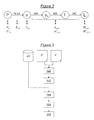
- the device 10 for estimating molecular parameters in a sample E comprises a sample processing chain 12 designed to supply a signal M i representative of these molecular parameters as a function of at least one variable of the processing chain 12. It further comprises a device 14 for signal processing adapted to apply, in combination with the processing chain 12, a method for estimating molecular parameters.
- the index i of the signal M i denotes an experiment, that is to say a i-th passage of the sample E in the processing chain 12.
- the estimated parameters are biological parameters, among which concentrations of biological components of the sample E considered then as a biological sample, and the Treatment chain 12 is a biological treatment chain.
- the components are proteins of interest, for example selected based on their relevance to characterize an abnormality, condition or disease
- the sample E is a sample of blood, plasma or urine. In general, it is a biological fluid, and in particular a body fluid. We will then speak of molecular concentrations of proteins to designate the concentrations of these particular components.
- the sample E first passes through a centrifuge 16, then by an affinity capture column 18, so as to be purified.
- the sample E successively passes through a liquid chromatography column 22, an electrospray 24 and a tandem mass spectrometer 26, for the supply of the signal M i which is then representative of the molecular concentrations of the proteins in the sample E in function a retention time in the chromatography column 22 and mass / charge ratios in the mass spectrometer 26.
- This signal M i is the set of chromatograms produced by the biological treatment chain 12 for an experiment. It is a temporal function representing the amplitude of the signal detected by the mass spectrometer for a transition, a transition being the selection by the mass spectrometer of a parent ion and one of its daughter ions derived from fragmentation.
- the tandem mass spectrometer 26 is more precisely a triple quadrupole SRM mass spectrometer.
- the first quadrupole 26A is a first analyzer selecting a parent ion (i.e. finally an ionized peptide) by mass spectrometry.
- the mass spectrometer can distinguish, by the mass-to-charge ratio, several ions charged differently from the peptide k. Typically, only one ion is selected. Thus, subsequently, the same index k will be used for the ion selected from all the ions produced by the ionization of the peptide.
- the term ionized peptide will refer to this ion.
- the second quadrupole 26B is a collision cell designed to fragment the parent ion into a plurality of son ions.
- the third quadrupole 26C is a second analyzer selecting a son ion derived from the parent ion by fragmentation.
- the passage of the sample E in the mass spectrometer SRM, from the fragmentation stage to the detection of the signals, is carried out according to a yield denoted ⁇ i, j, k, l , where i denotes the experiment, j denotes a protein of interest, k denotes a peptide derived from the digestion column and I denotes a fragment of this peptide. More generally, k denotes a product from the chromatography column, while I designates an element constituting this product, this element being detected by a measurement carried out downstream of the chromatography column. This yield is therefore a priori different from one fragment to another, from one peptide to another, from one protein of interest to another and from one experiment to another.
- a pair of indices (k, l) identifies a transition, defined as the selection in the SRM mass spectrometer 26 of a parent ion (index k) derived from the peptide k and one of its son ions (index I) after fragmentation.
- the signal M i is provided at the input of the processing device 14. More specifically, the processing device 14 comprises a processor 28 connected to storage means including in particular at least one programmed instruction sequence 30 and a modeling database. 32.
- labeled molecules such as labeled peptides may be injected together or in place of labeled proteins.
- constraints are imposed on the direct model of the signal M i .
- the step following the chromatography comprising several measurements of signals representative of products of this chromatography, the model imposes at least one common characteristic between signals obtained from these multiple measurements.
- the passage of ionized peptides in the SRM mass spectrometer 26 induces a plurality of measurable signals representative of several fragments of these peptides that are produced by the collision cell 26B.
- the model assumes that the temporal shape of the representative signals of the L fragments of the same parent peptide is derived from the chromatographic temporal form of the signal representative of the parent peptide for the same experiment.
- Y i, j, k ( t ) be this temporal form
- g 1 is a function associated with the fragment I binding the continuous time signal of the signal of the precursor ion Y i, j, k ( t ).
- the function g l performs temporal sampling and integration of the continuous signal Y i, j, k ( t ).
- the signal Y i, j, k, l (n) corresponds to a signal representative of an element I constituting the product k.
- the element I comes from the fragmentation of the product k.
- the function g 1 is independent of the fragment I, and that the response of the detector is linear, which corresponds to a particular case.
- the yield ⁇ i, j, k, l of the SRM mass spectrometry steps from fragmentation is a priori different depending on whether the proteins are labeled or not.
- This choice in the model is not obvious because the use is to consider that labeled and unlabeled molecules have the same exact behavior. But this choice makes it possible to adjust more faithfully to the data even when they differ from the direct model. This case occurs for example when adding the signal of a contaminant on the signals of labeled molecules and not on those of unmarked molecules.
- the noise parameters ⁇ i, j, k, l depend on whether the proteins are labeled or not, but all are assumed to follow normal laws of zero mean. If this is not the case, the data can be transformed to obtain a noise statistic similar to the one mentioned above, such as the Anscombe transformation.
- M i, j, k, l (n) is the signal model representative of fragment I of peptide k of protein j of experiment i
- M * i, j, k, l (n) the model of the same marked fragment
- the programmed instruction sequence 30 is designed to solve the inversion of this analytical model, for example by minimizing quadratic error according to least squares criterion, which can be written in the following form, for the acquired signals of a fragment and its marked counterpart: argmin ⁇ i , j , k , ⁇ i , j , k , l , ⁇ * i , j , k , l , VS i , j , ⁇ i , j , k ⁇ ⁇ M i , j , k , l not - ⁇ i , j , k , l ⁇ ⁇ i , j , k ⁇ VS i , j ⁇ Y i , j , k not ⁇ ⁇ i ,
- the quadratic error has limited performance because it is unstable and has very fast variations. It can then be optimized by weighting the least squares criterion by the inverse variance of the noise. This weighting makes it possible to penalize the signals having a low signal-to-noise ratio and thus to adjust their contribution to the determination of the parameters. Each residue composing the sum above is therefore advantageously controlled by a penalty term. This least-squares weighted notation ensures that the most noisy measurements do not influence the resulting solution more strongly than other measurements. This allows automatic management of signals of different qualities, without selection of the measures to be performed by an operator contrary to what generally offer known techniques.
- the quadratic error can thus be regularized in the following form: argmin ⁇ i , j , k , ⁇ i , j , k , l , ⁇ * i , j , k , l , VS i , j , ⁇ i , j , k ⁇ 1 R i , j , k , l ⁇ ⁇ M i , j , k , l not - ⁇ i , j , k , l ⁇ ⁇ i , j , k ⁇ ⁇ i , j , k ⁇ VS i , j ⁇ Y i , j , k not ⁇ ⁇ i , j , k ⁇ 2 + 1 R * i , j , k , l ⁇ ⁇ M * i , j , k ,
- the quadratic error can also be regularized in the following form: argmin ⁇ i , j , k , ⁇ i , j , k , l , ⁇ * i , j , k , l , VS i , j , ⁇ i , j , k ⁇ 1 R i , j , k , l ⁇ ⁇ M i , j , k , l not - ⁇ i , j , k , l ⁇ ⁇ i , j , k ⁇ ⁇ i , j , k ⁇ VS i , j ⁇ Y i , j , k not ⁇ ⁇ i , j , k ⁇ 2 + 1 R * i , j , k , l ⁇ ⁇ M * i , j , k ,
- the parameter ⁇ acts as an adjustment or compromise parameter.
- the difference of the gains of the transitions of the step of spectrometry SRM is strongly penalized. This tends to take as a model signals equal earnings gains transitions.
- ⁇ there is no constraint on the estimates of the gains of the transitions.
- This parameter can be estimated by varying it on test acquisitions and verifying the stability of the solutions obtained and / or the adequacy of these estimates with respect to the value expected if this is known.
- the quadratic error equation to be minimized implies the use of three terms, R i, j, k, l , R * i, j, k, l and ⁇ , previously estimated.
- this minimization is at the level of the peptide fragments.
- the estimated parameters can be reevaluated by considering all the signals at the peptide scale.
- the minimization criterion is the minimization of the sum of the minimization criteria of all the fragments resulting from the considered peptide, namely: argmin ⁇ i , j , k , ⁇ * i , j , k , l , VS i , j , ⁇ i , j , k ⁇ ⁇ l 1 R i , j , k , l ⁇ ⁇ M i , j , k , l not - ⁇ i , j , k , l ⁇ ⁇ i , j , k ⁇ ⁇ i , j , k ⁇ VS i , j ⁇ Y i , j , k not ⁇ ⁇ i , j , k ⁇ 2 + 1 R * i , j , k , l ⁇ ⁇ M * i , j
- the estimated parameters can be re-evaluated by considering all the signals at the protein level.
- the minimization criterion is the minimization of the sum of the minimization criteria of all the peptides derived from the considered protein, namely: argmin ⁇ , VS ⁇ ⁇ k ⁇ l 1 R i , j , k , l ⁇ ⁇ M i , j , k , l not - ⁇ i , j , k , l ⁇ ⁇ i , j , k ⁇ ⁇ i , j , k ⁇ VS i , j ⁇ Y i , j , k not ⁇ ⁇ i , j , k ⁇ 2 + 1 R * i , j , k , l ⁇ ⁇ M * i , j , k , l not - ⁇ * i , j , k , l ⁇ ⁇ i , j , k ⁇
- the inversion as detailed above could be solved in a Bayesian framework by a posterior estimation based on probability models, for example prior models, of at least some of the aforementioned parameters.
- a posterior estimation based on probability models, for example prior models, of at least some of the aforementioned parameters.
- the instruction sequence 30 and the database 32 are functionally presented as distinct on the figure 1 , but in practice they can be distributed differently in data files, source codes or computer libraries without this changing anything to the functions performed.
- the parameters of the processing chain 12 are linked together so as to form a global model presenting a hierarchy by the similarity of the models of the signals representative of the son ions (f k, l ) of the same parent ion (p k ) treated by SRM spectrometry.
- P proteins are associated with concentrations C i, j and C * i, to be determined by inversion.
- the yield of which is modeled by the parameters ⁇ i, j, k , peptides p are identifiable by the signals Y i, j, k modeled.
- the parent ions p k can be identified before to be fragmented into son ions f which can in turn be identified individually (f k, l ) using the measures M i, j, k, l and M * i, j, k, l .
- the yields ⁇ i, j, k, l and ⁇ * i, j, k, 1 correspond to the yields of the fragmentation stage and subsequent stages.
- the method for estimating molecular parameters illustrated on the figure 3 comprises a first measurement step 100 in which, in accordance with the mounting of the figure 1 the sample E, to which the E * tagging proteins have been added, crosses the entire processing chain 12 of the device 10. This step is identified as an indexing experiment i.
- the set of measured signals M i is thus provided at the output of the SRM spectrometer 26 during a step 102.
- the concentrations C i, j of proteins of interest are estimated, among the other technical parameters of the processing chain 12 , by inversion of the direct analytical model detailed above, at the scale of the ionized peptide fragments provided at the output of the second analyzer 26C.
- the concentrations C i, j of proteins of interest are reevaluated, among the other technical parameters of the processing chain 12 , by inversion of the direct analytical model detailed above, at the level of the ionized peptides provided at the input of the first analyzer 26A.
- the concentrations C i, j of proteins of interest are re-evaluated, among a part of the other technical parameters of the processing chain 12, by inversion of the direct model detailed above, at the scale of the proteins provided at the inlet of the digestion column 20.
- Concrete applications of this method include the detection of cancer markers (in this case the components of interest are proteins) in a biological sample of blood or urine.
- cancer markers in this case the components of interest are proteins
- the fields of application are numerous, ranging from the improvement of the specificity of SRM mass spectrometers to the automated quantification of molecules.
- this redundancy which is a legacy of the characteristics of a parent ion to child fragments, can be formulated as a hierarchical model.
- this hierarchical model becomes deterministic.
- the components of interest are not necessarily proteins, but may more generally be molecules or molecular assemblies for a biological or chemical analysis.
- the step of multiple measurements of products resulting from the chromatography step is not necessarily an SRM-type tandem spectrometry.
Landscapes
- Physics & Mathematics (AREA)
- Chemical & Material Sciences (AREA)
- Health & Medical Sciences (AREA)
- Life Sciences & Earth Sciences (AREA)
- General Physics & Mathematics (AREA)
- Pathology (AREA)
- Immunology (AREA)
- Analytical Chemistry (AREA)
- Biochemistry (AREA)
- General Health & Medical Sciences (AREA)
- Spectroscopy & Molecular Physics (AREA)
- Chemical Kinetics & Catalysis (AREA)
- Electrochemistry (AREA)
- Molecular Biology (AREA)
- Other Investigation Or Analysis Of Materials By Electrical Means (AREA)
Applications Claiming Priority (1)
| Application Number | Priority Date | Filing Date | Title |
|---|---|---|---|
| FR1253181A FR2989169B1 (fr) | 2012-04-05 | 2012-04-05 | Procede et dispositif d'estimation de parametres moleculaires dans un echantillon traite par chromatographie |
Publications (2)
| Publication Number | Publication Date |
|---|---|
| EP2647990A1 true EP2647990A1 (de) | 2013-10-09 |
| EP2647990B1 EP2647990B1 (de) | 2023-05-24 |
Family
ID=47998341
Family Applications (1)
| Application Number | Title | Priority Date | Filing Date |
|---|---|---|---|
| EP13162366.2A Active EP2647990B1 (de) | 2012-04-05 | 2013-04-04 | Verfahren und vorrichtung zum abschätzen der molekülparameter in einer chromatografisch behandelten probe |
Country Status (3)
| Country | Link |
|---|---|
| US (1) | US20130266978A1 (de) |
| EP (1) | EP2647990B1 (de) |
| FR (1) | FR2989169B1 (de) |
Cited By (1)
| Publication number | Priority date | Publication date | Assignee | Title |
|---|---|---|---|---|
| CN118243827A (zh) * | 2024-05-27 | 2024-06-25 | 云南云测质量检验有限公司 | 一种食品安全的自动化农残检测系统 |
Families Citing this family (1)
| Publication number | Priority date | Publication date | Assignee | Title |
|---|---|---|---|---|
| FR3040215B1 (fr) * | 2015-08-20 | 2019-05-31 | Commissariat A L'energie Atomique Et Aux Energies Alternatives | Procede d’estimation d’une quantite de particules reparties en classes, a partir d’un chromatogramme. |
Citations (3)
| Publication number | Priority date | Publication date | Assignee | Title |
|---|---|---|---|---|
| FR1153008A (fr) | 1956-06-29 | 1958-02-28 | Pecquet | Perfectionnements aux réservoirs de fluide sous pression et plus particulièrement aux bouteilles à gaz |
| EP2028486A1 (de) | 2007-08-22 | 2009-02-25 | Commissariat A L'Energie Atomique - CEA | Schätzverfahren für Molekülkonzentrationen in einer Probenentnahme und entsprechendes Gerät |
| WO2010026228A1 (fr) * | 2008-09-05 | 2010-03-11 | Commissariat A L'energie Atomique | Procédé de mesures de concentrations d'espèces moléculaires au moyen d'un chromatogramme |
Family Cites Families (4)
| Publication number | Priority date | Publication date | Assignee | Title |
|---|---|---|---|---|
| SE0000751D0 (sv) * | 2000-03-07 | 2000-03-07 | Swetree Genomics Ab | Transgenic trees and methods for their production |
| AU2003262188A1 (en) * | 2002-04-12 | 2003-10-27 | Northeastern University | Matched filtration with experimental noise determination for denoising, peak picking and quantitation in lc-ms |
| CA2507815A1 (en) * | 2002-12-04 | 2004-06-17 | Pharmos Corporation | High enantiomeric purity dexanabinol for pharmaceutical compositions |
| US20090326828A1 (en) * | 2008-06-27 | 2009-12-31 | Amol Prakash | Optimizing Selection of SRM Transitions for Analysis of Biomolecules by Tandem Mass Spectrometry |
-
2012
- 2012-04-05 FR FR1253181A patent/FR2989169B1/fr not_active Expired - Fee Related
-
2013
- 2013-04-04 EP EP13162366.2A patent/EP2647990B1/de active Active
- 2013-04-05 US US13/857,455 patent/US20130266978A1/en not_active Abandoned
Patent Citations (3)
| Publication number | Priority date | Publication date | Assignee | Title |
|---|---|---|---|---|
| FR1153008A (fr) | 1956-06-29 | 1958-02-28 | Pecquet | Perfectionnements aux réservoirs de fluide sous pression et plus particulièrement aux bouteilles à gaz |
| EP2028486A1 (de) | 2007-08-22 | 2009-02-25 | Commissariat A L'Energie Atomique - CEA | Schätzverfahren für Molekülkonzentrationen in einer Probenentnahme und entsprechendes Gerät |
| WO2010026228A1 (fr) * | 2008-09-05 | 2010-03-11 | Commissariat A L'energie Atomique | Procédé de mesures de concentrations d'espèces moléculaires au moyen d'un chromatogramme |
Cited By (1)
| Publication number | Priority date | Publication date | Assignee | Title |
|---|---|---|---|---|
| CN118243827A (zh) * | 2024-05-27 | 2024-06-25 | 云南云测质量检验有限公司 | 一种食品安全的自动化农残检测系统 |
Also Published As
| Publication number | Publication date |
|---|---|
| EP2647990B1 (de) | 2023-05-24 |
| FR2989169A1 (fr) | 2013-10-11 |
| FR2989169B1 (fr) | 2015-01-23 |
| US20130266978A1 (en) | 2013-10-10 |
Similar Documents
| Publication | Publication Date | Title |
|---|---|---|
| EP2565904B1 (de) | Verfahren und Vorrichtung zum Schätzen eines Molekülmassenparameters in einer Probe | |
| EP2509018B1 (de) | Verfahren und Vorrichtung zum Schätzen von biologischen oder chemischen Parametern in einer Probe, entsprechendes Diagnose-Hilfsverfahren | |
| Parsons et al. | Tile-based Fisher ratio analysis of comprehensive two-dimensional gas chromatography time-of-flight mass spectrometry (GC× GC–TOFMS) data using a null distribution approach | |
| Demeler | Methods for the design and analysis of sedimentation velocity and sedimentation equilibrium experiments with proteins | |
| US7983852B2 (en) | Methods of automated spectral peak detection and quantification without user input | |
| JP4818116B2 (ja) | メタボノミクスにおいてlc−msまたはlc−ms/msデータの処理を行うための方法およびデバイス | |
| Jessen et al. | Simultaneous determination of glucose, triglycerides, urea, cholesterol, albumin and total protein in human plasma by Fourier transform infrared spectroscopy: Direct clinical biochemistry without reagents | |
| EP4022287B1 (de) | Systeme und verfahren zur beurteilung der fixierdauer und der qualität von proben mittels vibrationsspektroskopie | |
| CN109564207A (zh) | 用于检测和定量代谢物的质谱方法 | |
| Anderson et al. | Modifying chromatography conditions for improved unknown feature identification in untargeted metabolomics | |
| EP2293077A2 (de) | Verfahren zum Nachweis von Koronararterienkrankheit | |
| Fitzgerald et al. | Dilute and shoot: analysis of drugs of abuse using selected reaction monitoring for quantification and full scan product ion spectra for identification | |
| Bliziotis et al. | A comparison of high-throughput plasma NMR protocols for comparative untargeted metabolomics | |
| Murphy et al. | Characterizing odorous emissions using new software for identifying peaks in chemometric models of gas chromatography–mass spectrometry datasets | |
| FR2920235A1 (fr) | Procede d'estimation de concentrations de molecules dans un releve d'echantillon et appareillage | |
| Gabrielsson et al. | Recent developments in multivariate calibration | |
| Scano et al. | 1H NMR metabolite fingerprinting as a new tool for body fluid identification in forensic science | |
| Higgs et al. | Label-free LC-MS method for the identification of biomarkers | |
| Wang et al. | NMRQNet: a deep learning approach for automatic identification and quantification of metabolites using Nuclear Magnetic Resonance (NMR) in human plasma samples | |
| Squara et al. | Extending the breadth of saliva metabolome fingerprinting by smart template strategies and effective pattern realignment on comprehensive two-dimensional gas chromatographic data | |
| Deda et al. | GC-MS-based metabolic phenotyping | |
| EP2647990B1 (de) | Verfahren und vorrichtung zum abschätzen der molekülparameter in einer chromatografisch behandelten probe | |
| Mortezazadeh et al. | Systematic noise removal from analytical ultracentrifugation data with UltraScan | |
| Liebeke et al. | Combining spectral ordering with peak fitting for one-dimensional NMR quantitative metabolomics | |
| CN104350378B (zh) | 用于测量光谱系统的性能的方法和设备 |
Legal Events
| Date | Code | Title | Description |
|---|---|---|---|
| PUAI | Public reference made under article 153(3) epc to a published international application that has entered the european phase |
Free format text: ORIGINAL CODE: 0009012 |
|
| AK | Designated contracting states |
Kind code of ref document: A1 Designated state(s): AL AT BE BG CH CY CZ DE DK EE ES FI FR GB GR HR HU IE IS IT LI LT LU LV MC MK MT NL NO PL PT RO RS SE SI SK SM TR |
|
| AX | Request for extension of the european patent |
Extension state: BA ME |
|
| 17P | Request for examination filed |
Effective date: 20140408 |
|
| RBV | Designated contracting states (corrected) |
Designated state(s): AL AT BE BG CH CY CZ DE DK EE ES FI FR GB GR HR HU IE IS IT LI LT LU LV MC MK MT NL NO PL PT RO RS SE SI SK SM TR |
|
| STAA | Information on the status of an ep patent application or granted ep patent |
Free format text: STATUS: EXAMINATION IS IN PROGRESS |
|
| 17Q | First examination report despatched |
Effective date: 20190108 |
|
| RIC1 | Information provided on ipc code assigned before grant |
Ipc: G01N 30/72 20060101ALI20191010BHEP Ipc: G01N 30/86 20060101AFI20191010BHEP Ipc: G01N 30/88 20060101ALN20191010BHEP Ipc: G06F 17/17 20060101ALI20191010BHEP Ipc: G01N 33/68 20060101ALI20191010BHEP |
|
| GRAP | Despatch of communication of intention to grant a patent |
Free format text: ORIGINAL CODE: EPIDOSNIGR1 |
|
| STAA | Information on the status of an ep patent application or granted ep patent |
Free format text: STATUS: GRANT OF PATENT IS INTENDED |
|
| RIC1 | Information provided on ipc code assigned before grant |
Ipc: G01N 27/623 20210101ALN20220916BHEP Ipc: G01N 30/88 20060101ALN20220916BHEP Ipc: G06F 17/17 20060101ALI20220916BHEP Ipc: G01N 33/68 20060101ALI20220916BHEP Ipc: G01N 30/72 20060101ALI20220916BHEP Ipc: G01N 30/86 20060101AFI20220916BHEP |
|
| RIC1 | Information provided on ipc code assigned before grant |
Ipc: G01N 27/623 20210101ALN20220930BHEP Ipc: G01N 30/88 20060101ALN20220930BHEP Ipc: G06F 17/17 20060101ALI20220930BHEP Ipc: G01N 33/68 20060101ALI20220930BHEP Ipc: G01N 30/72 20060101ALI20220930BHEP Ipc: G01N 30/86 20060101AFI20220930BHEP |
|
| INTG | Intention to grant announced |
Effective date: 20221020 |
|
| GRAS | Grant fee paid |
Free format text: ORIGINAL CODE: EPIDOSNIGR3 |
|
| GRAA | (expected) grant |
Free format text: ORIGINAL CODE: 0009210 |
|
| STAA | Information on the status of an ep patent application or granted ep patent |
Free format text: STATUS: THE PATENT HAS BEEN GRANTED |
|
| AK | Designated contracting states |
Kind code of ref document: B1 Designated state(s): AL AT BE BG CH CY CZ DE DK EE ES FI FR GB GR HR HU IE IS IT LI LT LU LV MC MK MT NL NO PL PT RO RS SE SI SK SM TR |
|
| REG | Reference to a national code |
Ref country code: GB Ref legal event code: FG4D Free format text: NOT ENGLISH |
|
| REG | Reference to a national code |
Ref country code: CH Ref legal event code: EP |
|
| REG | Reference to a national code |
Ref country code: DE Ref legal event code: R096 Ref document number: 602013083825 Country of ref document: DE |
|
| REG | Reference to a national code |
Ref country code: AT Ref legal event code: REF Ref document number: 1569807 Country of ref document: AT Kind code of ref document: T Effective date: 20230615 |
|
| REG | Reference to a national code |
Ref country code: IE Ref legal event code: FG4D Free format text: LANGUAGE OF EP DOCUMENT: FRENCH |
|
| REG | Reference to a national code |
Ref country code: LT Ref legal event code: MG9D |
|
| REG | Reference to a national code |
Ref country code: NL Ref legal event code: MP Effective date: 20230524 |
|
| REG | Reference to a national code |
Ref country code: AT Ref legal event code: MK05 Ref document number: 1569807 Country of ref document: AT Kind code of ref document: T Effective date: 20230524 |
|
| PG25 | Lapsed in a contracting state [announced via postgrant information from national office to epo] |
Ref country code: SE Free format text: LAPSE BECAUSE OF FAILURE TO SUBMIT A TRANSLATION OF THE DESCRIPTION OR TO PAY THE FEE WITHIN THE PRESCRIBED TIME-LIMIT Effective date: 20230524 Ref country code: PT Free format text: LAPSE BECAUSE OF FAILURE TO SUBMIT A TRANSLATION OF THE DESCRIPTION OR TO PAY THE FEE WITHIN THE PRESCRIBED TIME-LIMIT Effective date: 20230925 Ref country code: NO Free format text: LAPSE BECAUSE OF FAILURE TO SUBMIT A TRANSLATION OF THE DESCRIPTION OR TO PAY THE FEE WITHIN THE PRESCRIBED TIME-LIMIT Effective date: 20230824 Ref country code: NL Free format text: LAPSE BECAUSE OF FAILURE TO SUBMIT A TRANSLATION OF THE DESCRIPTION OR TO PAY THE FEE WITHIN THE PRESCRIBED TIME-LIMIT Effective date: 20230524 Ref country code: ES Free format text: LAPSE BECAUSE OF FAILURE TO SUBMIT A TRANSLATION OF THE DESCRIPTION OR TO PAY THE FEE WITHIN THE PRESCRIBED TIME-LIMIT Effective date: 20230524 Ref country code: AT Free format text: LAPSE BECAUSE OF FAILURE TO SUBMIT A TRANSLATION OF THE DESCRIPTION OR TO PAY THE FEE WITHIN THE PRESCRIBED TIME-LIMIT Effective date: 20230524 |
|
| PG25 | Lapsed in a contracting state [announced via postgrant information from national office to epo] |
Ref country code: RS Free format text: LAPSE BECAUSE OF FAILURE TO SUBMIT A TRANSLATION OF THE DESCRIPTION OR TO PAY THE FEE WITHIN THE PRESCRIBED TIME-LIMIT Effective date: 20230524 Ref country code: PL Free format text: LAPSE BECAUSE OF FAILURE TO SUBMIT A TRANSLATION OF THE DESCRIPTION OR TO PAY THE FEE WITHIN THE PRESCRIBED TIME-LIMIT Effective date: 20230524 Ref country code: LV Free format text: LAPSE BECAUSE OF FAILURE TO SUBMIT A TRANSLATION OF THE DESCRIPTION OR TO PAY THE FEE WITHIN THE PRESCRIBED TIME-LIMIT Effective date: 20230524 Ref country code: LT Free format text: LAPSE BECAUSE OF FAILURE TO SUBMIT A TRANSLATION OF THE DESCRIPTION OR TO PAY THE FEE WITHIN THE PRESCRIBED TIME-LIMIT Effective date: 20230524 Ref country code: IS Free format text: LAPSE BECAUSE OF FAILURE TO SUBMIT A TRANSLATION OF THE DESCRIPTION OR TO PAY THE FEE WITHIN THE PRESCRIBED TIME-LIMIT Effective date: 20230924 Ref country code: HR Free format text: LAPSE BECAUSE OF FAILURE TO SUBMIT A TRANSLATION OF THE DESCRIPTION OR TO PAY THE FEE WITHIN THE PRESCRIBED TIME-LIMIT Effective date: 20230524 Ref country code: GR Free format text: LAPSE BECAUSE OF FAILURE TO SUBMIT A TRANSLATION OF THE DESCRIPTION OR TO PAY THE FEE WITHIN THE PRESCRIBED TIME-LIMIT Effective date: 20230825 |
|
| PG25 | Lapsed in a contracting state [announced via postgrant information from national office to epo] |
Ref country code: FI Free format text: LAPSE BECAUSE OF FAILURE TO SUBMIT A TRANSLATION OF THE DESCRIPTION OR TO PAY THE FEE WITHIN THE PRESCRIBED TIME-LIMIT Effective date: 20230524 |
|
| PG25 | Lapsed in a contracting state [announced via postgrant information from national office to epo] |
Ref country code: SK Free format text: LAPSE BECAUSE OF FAILURE TO SUBMIT A TRANSLATION OF THE DESCRIPTION OR TO PAY THE FEE WITHIN THE PRESCRIBED TIME-LIMIT Effective date: 20230524 |
|
| PG25 | Lapsed in a contracting state [announced via postgrant information from national office to epo] |
Ref country code: SM Free format text: LAPSE BECAUSE OF FAILURE TO SUBMIT A TRANSLATION OF THE DESCRIPTION OR TO PAY THE FEE WITHIN THE PRESCRIBED TIME-LIMIT Effective date: 20230524 Ref country code: SK Free format text: LAPSE BECAUSE OF FAILURE TO SUBMIT A TRANSLATION OF THE DESCRIPTION OR TO PAY THE FEE WITHIN THE PRESCRIBED TIME-LIMIT Effective date: 20230524 Ref country code: RO Free format text: LAPSE BECAUSE OF FAILURE TO SUBMIT A TRANSLATION OF THE DESCRIPTION OR TO PAY THE FEE WITHIN THE PRESCRIBED TIME-LIMIT Effective date: 20230524 Ref country code: EE Free format text: LAPSE BECAUSE OF FAILURE TO SUBMIT A TRANSLATION OF THE DESCRIPTION OR TO PAY THE FEE WITHIN THE PRESCRIBED TIME-LIMIT Effective date: 20230524 Ref country code: DK Free format text: LAPSE BECAUSE OF FAILURE TO SUBMIT A TRANSLATION OF THE DESCRIPTION OR TO PAY THE FEE WITHIN THE PRESCRIBED TIME-LIMIT Effective date: 20230524 Ref country code: CZ Free format text: LAPSE BECAUSE OF FAILURE TO SUBMIT A TRANSLATION OF THE DESCRIPTION OR TO PAY THE FEE WITHIN THE PRESCRIBED TIME-LIMIT Effective date: 20230524 |
|
| REG | Reference to a national code |
Ref country code: DE Ref legal event code: R097 Ref document number: 602013083825 Country of ref document: DE |
|
| PLBE | No opposition filed within time limit |
Free format text: ORIGINAL CODE: 0009261 |
|
| STAA | Information on the status of an ep patent application or granted ep patent |
Free format text: STATUS: NO OPPOSITION FILED WITHIN TIME LIMIT |
|
| 26N | No opposition filed |
Effective date: 20240227 |
|
| PG25 | Lapsed in a contracting state [announced via postgrant information from national office to epo] |
Ref country code: SI Free format text: LAPSE BECAUSE OF FAILURE TO SUBMIT A TRANSLATION OF THE DESCRIPTION OR TO PAY THE FEE WITHIN THE PRESCRIBED TIME-LIMIT Effective date: 20230524 |
|
| PG25 | Lapsed in a contracting state [announced via postgrant information from national office to epo] |
Ref country code: SI Free format text: LAPSE BECAUSE OF FAILURE TO SUBMIT A TRANSLATION OF THE DESCRIPTION OR TO PAY THE FEE WITHIN THE PRESCRIBED TIME-LIMIT Effective date: 20230524 Ref country code: IT Free format text: LAPSE BECAUSE OF FAILURE TO SUBMIT A TRANSLATION OF THE DESCRIPTION OR TO PAY THE FEE WITHIN THE PRESCRIBED TIME-LIMIT Effective date: 20230524 |
|
| PGFP | Annual fee paid to national office [announced via postgrant information from national office to epo] |
Ref country code: GB Payment date: 20240423 Year of fee payment: 12 |
|
| PGFP | Annual fee paid to national office [announced via postgrant information from national office to epo] |
Ref country code: DE Payment date: 20240418 Year of fee payment: 12 |
|
| PGFP | Annual fee paid to national office [announced via postgrant information from national office to epo] |
Ref country code: FR Payment date: 20240423 Year of fee payment: 12 |
|
| PG25 | Lapsed in a contracting state [announced via postgrant information from national office to epo] |
Ref country code: BG Free format text: LAPSE BECAUSE OF FAILURE TO SUBMIT A TRANSLATION OF THE DESCRIPTION OR TO PAY THE FEE WITHIN THE PRESCRIBED TIME-LIMIT Effective date: 20230524 |
|
| PG25 | Lapsed in a contracting state [announced via postgrant information from national office to epo] |
Ref country code: MC Free format text: LAPSE BECAUSE OF FAILURE TO SUBMIT A TRANSLATION OF THE DESCRIPTION OR TO PAY THE FEE WITHIN THE PRESCRIBED TIME-LIMIT Effective date: 20230524 |
|
| PG25 | Lapsed in a contracting state [announced via postgrant information from national office to epo] |
Ref country code: MC Free format text: LAPSE BECAUSE OF FAILURE TO SUBMIT A TRANSLATION OF THE DESCRIPTION OR TO PAY THE FEE WITHIN THE PRESCRIBED TIME-LIMIT Effective date: 20230524 Ref country code: BG Free format text: LAPSE BECAUSE OF FAILURE TO SUBMIT A TRANSLATION OF THE DESCRIPTION OR TO PAY THE FEE WITHIN THE PRESCRIBED TIME-LIMIT Effective date: 20230524 |
|
| REG | Reference to a national code |
Ref country code: CH Ref legal event code: PL |
|
| PG25 | Lapsed in a contracting state [announced via postgrant information from national office to epo] |
Ref country code: LU Free format text: LAPSE BECAUSE OF NON-PAYMENT OF DUE FEES Effective date: 20240404 |
|
| REG | Reference to a national code |
Ref country code: BE Ref legal event code: MM Effective date: 20240430 |
|
| PG25 | Lapsed in a contracting state [announced via postgrant information from national office to epo] |
Ref country code: LU Free format text: LAPSE BECAUSE OF NON-PAYMENT OF DUE FEES Effective date: 20240404 |
|
| PG25 | Lapsed in a contracting state [announced via postgrant information from national office to epo] |
Ref country code: BE Free format text: LAPSE BECAUSE OF NON-PAYMENT OF DUE FEES Effective date: 20240430 |
|
| PG25 | Lapsed in a contracting state [announced via postgrant information from national office to epo] |
Ref country code: BE Free format text: LAPSE BECAUSE OF NON-PAYMENT OF DUE FEES Effective date: 20240430 Ref country code: CH Free format text: LAPSE BECAUSE OF NON-PAYMENT OF DUE FEES Effective date: 20240430 |
|
| PG25 | Lapsed in a contracting state [announced via postgrant information from national office to epo] |
Ref country code: IE Free format text: LAPSE BECAUSE OF NON-PAYMENT OF DUE FEES Effective date: 20240404 |
|
| PG25 | Lapsed in a contracting state [announced via postgrant information from national office to epo] |
Ref country code: CY Free format text: LAPSE BECAUSE OF FAILURE TO SUBMIT A TRANSLATION OF THE DESCRIPTION OR TO PAY THE FEE WITHIN THE PRESCRIBED TIME-LIMIT; INVALID AB INITIO Effective date: 20130404 |
|
| PG25 | Lapsed in a contracting state [announced via postgrant information from national office to epo] |
Ref country code: HU Free format text: LAPSE BECAUSE OF FAILURE TO SUBMIT A TRANSLATION OF THE DESCRIPTION OR TO PAY THE FEE WITHIN THE PRESCRIBED TIME-LIMIT; INVALID AB INITIO Effective date: 20130404 |
|
| REG | Reference to a national code |
Ref country code: DE Ref legal event code: R119 Ref document number: 602013083825 Country of ref document: DE |
|
| PG25 | Lapsed in a contracting state [announced via postgrant information from national office to epo] |
Ref country code: TR Free format text: LAPSE BECAUSE OF FAILURE TO SUBMIT A TRANSLATION OF THE DESCRIPTION OR TO PAY THE FEE WITHIN THE PRESCRIBED TIME-LIMIT Effective date: 20230524 |
|
| GBPC | Gb: european patent ceased through non-payment of renewal fee |
Effective date: 20250404 |
|
| PG25 | Lapsed in a contracting state [announced via postgrant information from national office to epo] |
Ref country code: DE Free format text: LAPSE BECAUSE OF NON-PAYMENT OF DUE FEES Effective date: 20251104 |
|
| PG25 | Lapsed in a contracting state [announced via postgrant information from national office to epo] |
Ref country code: GB Free format text: LAPSE BECAUSE OF NON-PAYMENT OF DUE FEES Effective date: 20250404 |
|
| PG25 | Lapsed in a contracting state [announced via postgrant information from national office to epo] |
Ref country code: FR Free format text: LAPSE BECAUSE OF NON-PAYMENT OF DUE FEES Effective date: 20250430 |