EP2513113B1 - Inhibiteurs du virus de l'hépatite c à base de 5,5-arylène ou hétéroarylène condensé - Google Patents
Inhibiteurs du virus de l'hépatite c à base de 5,5-arylène ou hétéroarylène condensé Download PDFInfo
- Publication number
- EP2513113B1 EP2513113B1 EP10798901.4A EP10798901A EP2513113B1 EP 2513113 B1 EP2513113 B1 EP 2513113B1 EP 10798901 A EP10798901 A EP 10798901A EP 2513113 B1 EP2513113 B1 EP 2513113B1
- Authority
- EP
- European Patent Office
- Prior art keywords
- compound
- mmol
- certain embodiments
- mixture
- methyl
- Prior art date
- Legal status (The legal status is an assumption and is not a legal conclusion. Google has not performed a legal analysis and makes no representation as to the accuracy of the status listed.)
- Not-in-force
Links
- 0 Cc1nc(*)c[n]1 Chemical compound Cc1nc(*)c[n]1 0.000 description 45
- XDTMQSROBMDMFD-UHFFFAOYSA-N C1CCCCC1 Chemical compound C1CCCCC1 XDTMQSROBMDMFD-UHFFFAOYSA-N 0.000 description 2
- DFMPVYZMICAYCS-UHFFFAOYSA-N Brc1c[s]c2c1[s]cc2Br Chemical compound Brc1c[s]c2c1[s]cc2Br DFMPVYZMICAYCS-UHFFFAOYSA-N 0.000 description 1
- BKAXMGROXRXIRN-SNAWJCMRSA-N CC(C(CNC1CC2)C1[IH]2=C)/C=C/C Chemical compound CC(C(CNC1CC2)C1[IH]2=C)/C=C/C BKAXMGROXRXIRN-SNAWJCMRSA-N 0.000 description 1
- HPVUVGAQCPBNHQ-INIZCTEOSA-N CC(C)(C)OC(N(CCC1)[C@@H]1c1nc(-c2c[s]c3c2[s]cc3Br)c[n]1C(OC(C)(C)C)=O)=O Chemical compound CC(C)(C)OC(N(CCC1)[C@@H]1c1nc(-c2c[s]c3c2[s]cc3Br)c[n]1C(OC(C)(C)C)=O)=O HPVUVGAQCPBNHQ-INIZCTEOSA-N 0.000 description 1
- SPTSLSXEWYQURV-FKTBZTESSA-N CC(C)COC(N[C@@H](C(N(CCC1)C1c1ncc(-c2c[s]c3c2[s]cc3-c(cc2)ccc2-c2cnc(C(CCC3)N3C([C@H](C(C)C)NC(OC)=O)=O)[nH]2)[nH]1)=O)c1ccccc1)=O Chemical compound CC(C)COC(N[C@@H](C(N(CCC1)C1c1ncc(-c2c[s]c3c2[s]cc3-c(cc2)ccc2-c2cnc(C(CCC3)N3C([C@H](C(C)C)NC(OC)=O)=O)[nH]2)[nH]1)=O)c1ccccc1)=O SPTSLSXEWYQURV-FKTBZTESSA-N 0.000 description 1
- KAXPJCIRIXNZAX-MFTWVQLTSA-N CC(C)[C@@H](C(N(CCC1)C1c1ncc(-c(cc2)ccc2-c2c[s]c3c2[s]cc3-c(cc2)cc3c2[nH]c(C(CCC2)N2C([C@H](C(C)C)NC(OC)=O)=O)n3)[nH]1)=O)NC(OC)=O Chemical compound CC(C)[C@@H](C(N(CCC1)C1c1ncc(-c(cc2)ccc2-c2c[s]c3c2[s]cc3-c(cc2)cc3c2[nH]c(C(CCC2)N2C([C@H](C(C)C)NC(OC)=O)=O)n3)[nH]1)=O)NC(OC)=O KAXPJCIRIXNZAX-MFTWVQLTSA-N 0.000 description 1
- HCEPUIUXVLEJTK-SKYZXBIZSA-N CC(C)[C@@H](C(N(CCC1)C1c1ncc(-c(cc2)ccc2-c2c[s]c3c2[s]cc3-c(cc2)ccc2-c2cnc(C(CCC3)N3C([C@H](C(C)C)NC(OC)=O)=O)[nH]2)[nH]1)=O)NC(OC)=O Chemical compound CC(C)[C@@H](C(N(CCC1)C1c1ncc(-c(cc2)ccc2-c2c[s]c3c2[s]cc3-c(cc2)ccc2-c2cnc(C(CCC3)N3C([C@H](C(C)C)NC(OC)=O)=O)[nH]2)[nH]1)=O)NC(OC)=O HCEPUIUXVLEJTK-SKYZXBIZSA-N 0.000 description 1
- UEHWPBBFYGKEPV-IIOGIKGTSA-N CC(C)[C@@H](C(N(CCC1)C1c1ncc(-c(cc2)ccc2-c2c[s]c3c2[s]cc3-c2c3nc(C(CCC4)N4C([C@H](C(C)C)NC(OC)=O)=O)[nH]c3ccc2)[nH]1)=O)NC(OC)=O Chemical compound CC(C)[C@@H](C(N(CCC1)C1c1ncc(-c(cc2)ccc2-c2c[s]c3c2[s]cc3-c2c3nc(C(CCC4)N4C([C@H](C(C)C)NC(OC)=O)=O)[nH]c3ccc2)[nH]1)=O)NC(OC)=O UEHWPBBFYGKEPV-IIOGIKGTSA-N 0.000 description 1
- YYFMZHZLIZUJTF-ZZFZTORUSA-N CC(C)[C@@H](C(N(CCC1)C1c1ncc(-c2c[s]c3c2[s]cc3-c(cc2)ccc2-c2cnc(C(CCC3)N3C([C@@H](c3ccccc3)NC(OC)=O)=O)[nH]2)[nH]1)=O)NC(OC)=O Chemical compound CC(C)[C@@H](C(N(CCC1)C1c1ncc(-c2c[s]c3c2[s]cc3-c(cc2)ccc2-c2cnc(C(CCC3)N3C([C@@H](c3ccccc3)NC(OC)=O)=O)[nH]2)[nH]1)=O)NC(OC)=O YYFMZHZLIZUJTF-ZZFZTORUSA-N 0.000 description 1
- AYJWCQOHLQIWRO-IZBVHTJASA-N CC(C)[C@@H](C(N(CCC1)C1c1ncc(-c2c[s]c3c2[s]cc3-c2cnc(C(CCC3)N3C([C@@H](c3ccccc3)NC(OC)=O)=O)[nH]2)[nH]1)=O)NC(OC)=O Chemical compound CC(C)[C@@H](C(N(CCC1)C1c1ncc(-c2c[s]c3c2[s]cc3-c2cnc(C(CCC3)N3C([C@@H](c3ccccc3)NC(OC)=O)=O)[nH]2)[nH]1)=O)NC(OC)=O AYJWCQOHLQIWRO-IZBVHTJASA-N 0.000 description 1
- CHQCJNJEYHEMDQ-SEXBWERRSA-N CC(C)[C@@H](C(N(CCC1)[C@@H]1c1nc(-c(cc2)ccc2-c2c[s]c3c2[nH]c2c3-c(ccc(-c3cnc([C@H](CCC4)N4C([C@H](C(C)C)NC(OC)=O)=O)[nH]3)c3)c3OC2=O)c[nH]1)=O)NC(OC)=O Chemical compound CC(C)[C@@H](C(N(CCC1)[C@@H]1c1nc(-c(cc2)ccc2-c2c[s]c3c2[nH]c2c3-c(ccc(-c3cnc([C@H](CCC4)N4C([C@H](C(C)C)NC(OC)=O)=O)[nH]3)c3)c3OC2=O)c[nH]1)=O)NC(OC)=O CHQCJNJEYHEMDQ-SEXBWERRSA-N 0.000 description 1
- AJJPHDXNDLPQDP-AFEGWXKPSA-N CC(C)[C@@H](C(N(CCC1)[C@@H]1c1nc(-c(cc2)ccc2-c2c[s]c3c2[s]cc3-c(cc2)cc3c2nc([C@H](CCC2)N2C(OC(C)(C)C)=O)[nH]3)c[nH]1)=O)NC(OC)=O Chemical compound CC(C)[C@@H](C(N(CCC1)[C@@H]1c1nc(-c(cc2)ccc2-c2c[s]c3c2[s]cc3-c(cc2)cc3c2nc([C@H](CCC2)N2C(OC(C)(C)C)=O)[nH]3)c[nH]1)=O)NC(OC)=O AJJPHDXNDLPQDP-AFEGWXKPSA-N 0.000 description 1
- FDISZRRLONSPCJ-PDHQTVFISA-N CC(C)[C@@H](C(N(CCC1)[C@@H]1c1nc(-c2c[s]c3c2[s]cc3-c(cc2)ccc2-c2cnc(C(CCC3)N3C([C@@H](c3ccccc3)N(C)C)=O)[nH]2)c[nH]1)=O)NC(OC)=O Chemical compound CC(C)[C@@H](C(N(CCC1)[C@@H]1c1nc(-c2c[s]c3c2[s]cc3-c(cc2)ccc2-c2cnc(C(CCC3)N3C([C@@H](c3ccccc3)N(C)C)=O)[nH]2)c[nH]1)=O)NC(OC)=O FDISZRRLONSPCJ-PDHQTVFISA-N 0.000 description 1
- WEHZXNDSNMCNLU-GJZGRUSLSA-N CC(C)[C@@H](C(N(CCC1)[C@@H]1c1nc(-c2c[s]c3c2[s]cc3Br)c[nH]1)=O)NC(OC)=O Chemical compound CC(C)[C@@H](C(N(CCC1)[C@@H]1c1nc(-c2c[s]c3c2[s]cc3Br)c[nH]1)=O)NC(OC)=O WEHZXNDSNMCNLU-GJZGRUSLSA-N 0.000 description 1
- AWPQGPJNSHZCOL-BTSKBWHGSA-N CC(C)[C@@H](C(N(CCC1)[C@@H]1c1ncc(-c(cc2)ccc2-c2c[s]c3c2[s]cc3-c(cc2)cc3c2nc([C@H](CCC2)N2C([C@@H](c2ccccc2)NC(OC)=O)=O)[nH]3)[nH]1)=O)NC(OC)=O Chemical compound CC(C)[C@@H](C(N(CCC1)[C@@H]1c1ncc(-c(cc2)ccc2-c2c[s]c3c2[s]cc3-c(cc2)cc3c2nc([C@H](CCC2)N2C([C@@H](c2ccccc2)NC(OC)=O)=O)[nH]3)[nH]1)=O)NC(OC)=O AWPQGPJNSHZCOL-BTSKBWHGSA-N 0.000 description 1
- XHYINLLLRYJLLC-NAYUSWPISA-N CC(C)[C@@H](C(N(CCC1)[C@@H]1c1ncc(-c(cc2)ccc2-c2c[s]c3c2[s]cc3-c(cc2)cc3c2nc([C@H]2NCCC2)[nH]3)[nH]1)=O)NC(OC)=O Chemical compound CC(C)[C@@H](C(N(CCC1)[C@@H]1c1ncc(-c(cc2)ccc2-c2c[s]c3c2[s]cc3-c(cc2)cc3c2nc([C@H]2NCCC2)[nH]3)[nH]1)=O)NC(OC)=O XHYINLLLRYJLLC-NAYUSWPISA-N 0.000 description 1
- ZGKQYULMJDTGEV-JKDOVBDQSA-N CC1(C(c2c[nH]c([C@H]3NCCC3)n2)=CSC11)SC=C1Br Chemical compound CC1(C(c2c[nH]c([C@H]3NCCC3)n2)=CSC11)SC=C1Br ZGKQYULMJDTGEV-JKDOVBDQSA-N 0.000 description 1
- CZHHWROZIVPTSA-UHFFFAOYSA-N CCC(C)(C)C(CSC12)C1SCC2C(C)(C)C Chemical compound CCC(C)(C)C(CSC12)C1SCC2C(C)(C)C CZHHWROZIVPTSA-UHFFFAOYSA-N 0.000 description 1
- LWXPSOCOHDDYAQ-NQGJMHSESA-N CCOC(N[C@@H](C(N(CCC1)C1c1ncc(-c(cc2)ccc2-c2c[s]c3c2[s]cc3-c2cnc(C(CCC3)N3C([C@H](C(C)C)NC(OC)=O)=O)[nH]2)[nH]1)=O)c1ccccc1)=O Chemical compound CCOC(N[C@@H](C(N(CCC1)C1c1ncc(-c(cc2)ccc2-c2c[s]c3c2[s]cc3-c2cnc(C(CCC3)N3C([C@H](C(C)C)NC(OC)=O)=O)[nH]2)[nH]1)=O)c1ccccc1)=O LWXPSOCOHDDYAQ-NQGJMHSESA-N 0.000 description 1
- MLOBRLOZPSSKKO-SECBINFHSA-N CN(C)[C@@H](C(O)=O)c1ccccc1 Chemical compound CN(C)[C@@H](C(O)=O)c1ccccc1 MLOBRLOZPSSKKO-SECBINFHSA-N 0.000 description 1
- GBPFKXHMSUUOHL-UHFFFAOYSA-N COC(c([nH]c1c2[s]cc1Br)c2I)=O Chemical compound COC(c([nH]c1c2[s]cc1Br)c2I)=O GBPFKXHMSUUOHL-UHFFFAOYSA-N 0.000 description 1
- FZMSYEZKZFUHPQ-UHFFFAOYSA-N COC(c1cc([s]cc2Br)c2[nH]1)=O Chemical compound COC(c1cc([s]cc2Br)c2[nH]1)=O FZMSYEZKZFUHPQ-UHFFFAOYSA-N 0.000 description 1
- PLYTVAFAKDFFKM-ZCFIWIBFSA-N C[C@H]1N(C)CCOC1 Chemical compound C[C@H]1N(C)CCOC1 PLYTVAFAKDFFKM-ZCFIWIBFSA-N 0.000 description 1
- SDXAWLJRERMRKF-UHFFFAOYSA-N Cc1cc(C)n[nH]1 Chemical compound Cc1cc(C)n[nH]1 SDXAWLJRERMRKF-UHFFFAOYSA-N 0.000 description 1
- SEDSLMWYUQACGR-UHFFFAOYSA-N Cc1nc(I)c[nH]1 Chemical compound Cc1nc(I)c[nH]1 SEDSLMWYUQACGR-UHFFFAOYSA-N 0.000 description 1
Classifications
-
- C—CHEMISTRY; METALLURGY
- C07—ORGANIC CHEMISTRY
- C07D—HETEROCYCLIC COMPOUNDS
- C07D513/00—Heterocyclic compounds containing in the condensed system at least one hetero ring having nitrogen and sulfur atoms as the only ring hetero atoms, not provided for in groups C07D463/00, C07D477/00 or C07D499/00 - C07D507/00
- C07D513/02—Heterocyclic compounds containing in the condensed system at least one hetero ring having nitrogen and sulfur atoms as the only ring hetero atoms, not provided for in groups C07D463/00, C07D477/00 or C07D499/00 - C07D507/00 in which the condensed system contains two hetero rings
- C07D513/04—Ortho-condensed systems
-
- A—HUMAN NECESSITIES
- A61—MEDICAL OR VETERINARY SCIENCE; HYGIENE
- A61K—PREPARATIONS FOR MEDICAL, DENTAL OR TOILETRY PURPOSES
- A61K31/00—Medicinal preparations containing organic active ingredients
- A61K31/33—Heterocyclic compounds
- A61K31/395—Heterocyclic compounds having nitrogen as a ring hetero atom, e.g. guanethidine or rifamycins
- A61K31/41—Heterocyclic compounds having nitrogen as a ring hetero atom, e.g. guanethidine or rifamycins having five-membered rings with two or more ring hetero atoms, at least one of which being nitrogen, e.g. tetrazole
- A61K31/4164—1,3-Diazoles
- A61K31/4178—1,3-Diazoles not condensed 1,3-diazoles and containing further heterocyclic rings, e.g. pilocarpine, nitrofurantoin
-
- A—HUMAN NECESSITIES
- A61—MEDICAL OR VETERINARY SCIENCE; HYGIENE
- A61K—PREPARATIONS FOR MEDICAL, DENTAL OR TOILETRY PURPOSES
- A61K31/00—Medicinal preparations containing organic active ingredients
- A61K31/33—Heterocyclic compounds
- A61K31/395—Heterocyclic compounds having nitrogen as a ring hetero atom, e.g. guanethidine or rifamycins
- A61K31/41—Heterocyclic compounds having nitrogen as a ring hetero atom, e.g. guanethidine or rifamycins having five-membered rings with two or more ring hetero atoms, at least one of which being nitrogen, e.g. tetrazole
- A61K31/4164—1,3-Diazoles
- A61K31/4184—1,3-Diazoles condensed with carbocyclic rings, e.g. benzimidazoles
-
- A—HUMAN NECESSITIES
- A61—MEDICAL OR VETERINARY SCIENCE; HYGIENE
- A61K—PREPARATIONS FOR MEDICAL, DENTAL OR TOILETRY PURPOSES
- A61K31/00—Medicinal preparations containing organic active ingredients
- A61K31/33—Heterocyclic compounds
- A61K31/395—Heterocyclic compounds having nitrogen as a ring hetero atom, e.g. guanethidine or rifamycins
- A61K31/41—Heterocyclic compounds having nitrogen as a ring hetero atom, e.g. guanethidine or rifamycins having five-membered rings with two or more ring hetero atoms, at least one of which being nitrogen, e.g. tetrazole
- A61K31/42—Oxazoles
- A61K31/424—Oxazoles condensed with heterocyclic ring systems, e.g. clavulanic acid
-
- A—HUMAN NECESSITIES
- A61—MEDICAL OR VETERINARY SCIENCE; HYGIENE
- A61K—PREPARATIONS FOR MEDICAL, DENTAL OR TOILETRY PURPOSES
- A61K31/00—Medicinal preparations containing organic active ingredients
- A61K31/33—Heterocyclic compounds
- A61K31/395—Heterocyclic compounds having nitrogen as a ring hetero atom, e.g. guanethidine or rifamycins
- A61K31/41—Heterocyclic compounds having nitrogen as a ring hetero atom, e.g. guanethidine or rifamycins having five-membered rings with two or more ring hetero atoms, at least one of which being nitrogen, e.g. tetrazole
- A61K31/425—Thiazoles
- A61K31/429—Thiazoles condensed with heterocyclic ring systems
-
- A—HUMAN NECESSITIES
- A61—MEDICAL OR VETERINARY SCIENCE; HYGIENE
- A61K—PREPARATIONS FOR MEDICAL, DENTAL OR TOILETRY PURPOSES
- A61K31/00—Medicinal preparations containing organic active ingredients
- A61K31/33—Heterocyclic compounds
- A61K31/395—Heterocyclic compounds having nitrogen as a ring hetero atom, e.g. guanethidine or rifamycins
- A61K31/535—Heterocyclic compounds having nitrogen as a ring hetero atom, e.g. guanethidine or rifamycins having six-membered rings with at least one nitrogen and one oxygen as the ring hetero atoms, e.g. 1,2-oxazines
- A61K31/5375—1,4-Oxazines, e.g. morpholine
- A61K31/5377—1,4-Oxazines, e.g. morpholine not condensed and containing further heterocyclic rings, e.g. timolol
-
- A—HUMAN NECESSITIES
- A61—MEDICAL OR VETERINARY SCIENCE; HYGIENE
- A61K—PREPARATIONS FOR MEDICAL, DENTAL OR TOILETRY PURPOSES
- A61K31/00—Medicinal preparations containing organic active ingredients
- A61K31/70—Carbohydrates; Sugars; Derivatives thereof
- A61K31/7042—Compounds having saccharide radicals and heterocyclic rings
- A61K31/7052—Compounds having saccharide radicals and heterocyclic rings having nitrogen as a ring hetero atom, e.g. nucleosides, nucleotides
- A61K31/7056—Compounds having saccharide radicals and heterocyclic rings having nitrogen as a ring hetero atom, e.g. nucleosides, nucleotides containing five-membered rings with nitrogen as a ring hetero atom
-
- A—HUMAN NECESSITIES
- A61—MEDICAL OR VETERINARY SCIENCE; HYGIENE
- A61K—PREPARATIONS FOR MEDICAL, DENTAL OR TOILETRY PURPOSES
- A61K38/00—Medicinal preparations containing peptides
- A61K38/04—Peptides having up to 20 amino acids in a fully defined sequence; Derivatives thereof
- A61K38/05—Dipeptides
-
- A—HUMAN NECESSITIES
- A61—MEDICAL OR VETERINARY SCIENCE; HYGIENE
- A61K—PREPARATIONS FOR MEDICAL, DENTAL OR TOILETRY PURPOSES
- A61K38/00—Medicinal preparations containing peptides
- A61K38/16—Peptides having more than 20 amino acids; Gastrins; Somatostatins; Melanotropins; Derivatives thereof
- A61K38/17—Peptides having more than 20 amino acids; Gastrins; Somatostatins; Melanotropins; Derivatives thereof from animals; from humans
- A61K38/19—Cytokines; Lymphokines; Interferons
- A61K38/20—Interleukins [IL]
-
- A—HUMAN NECESSITIES
- A61—MEDICAL OR VETERINARY SCIENCE; HYGIENE
- A61K—PREPARATIONS FOR MEDICAL, DENTAL OR TOILETRY PURPOSES
- A61K38/00—Medicinal preparations containing peptides
- A61K38/16—Peptides having more than 20 amino acids; Gastrins; Somatostatins; Melanotropins; Derivatives thereof
- A61K38/17—Peptides having more than 20 amino acids; Gastrins; Somatostatins; Melanotropins; Derivatives thereof from animals; from humans
- A61K38/19—Cytokines; Lymphokines; Interferons
- A61K38/21—Interferons [IFN]
-
- A—HUMAN NECESSITIES
- A61—MEDICAL OR VETERINARY SCIENCE; HYGIENE
- A61K—PREPARATIONS FOR MEDICAL, DENTAL OR TOILETRY PURPOSES
- A61K38/00—Medicinal preparations containing peptides
- A61K38/16—Peptides having more than 20 amino acids; Gastrins; Somatostatins; Melanotropins; Derivatives thereof
- A61K38/17—Peptides having more than 20 amino acids; Gastrins; Somatostatins; Melanotropins; Derivatives thereof from animals; from humans
- A61K38/19—Cytokines; Lymphokines; Interferons
- A61K38/21—Interferons [IFN]
- A61K38/212—IFN-alpha
-
- A—HUMAN NECESSITIES
- A61—MEDICAL OR VETERINARY SCIENCE; HYGIENE
- A61K—PREPARATIONS FOR MEDICAL, DENTAL OR TOILETRY PURPOSES
- A61K38/00—Medicinal preparations containing peptides
- A61K38/16—Peptides having more than 20 amino acids; Gastrins; Somatostatins; Melanotropins; Derivatives thereof
- A61K38/17—Peptides having more than 20 amino acids; Gastrins; Somatostatins; Melanotropins; Derivatives thereof from animals; from humans
- A61K38/19—Cytokines; Lymphokines; Interferons
- A61K38/21—Interferons [IFN]
- A61K38/215—IFN-beta
-
- A—HUMAN NECESSITIES
- A61—MEDICAL OR VETERINARY SCIENCE; HYGIENE
- A61K—PREPARATIONS FOR MEDICAL, DENTAL OR TOILETRY PURPOSES
- A61K38/00—Medicinal preparations containing peptides
- A61K38/16—Peptides having more than 20 amino acids; Gastrins; Somatostatins; Melanotropins; Derivatives thereof
- A61K38/17—Peptides having more than 20 amino acids; Gastrins; Somatostatins; Melanotropins; Derivatives thereof from animals; from humans
- A61K38/19—Cytokines; Lymphokines; Interferons
- A61K38/21—Interferons [IFN]
- A61K38/217—IFN-gamma
-
- A—HUMAN NECESSITIES
- A61—MEDICAL OR VETERINARY SCIENCE; HYGIENE
- A61P—SPECIFIC THERAPEUTIC ACTIVITY OF CHEMICAL COMPOUNDS OR MEDICINAL PREPARATIONS
- A61P1/00—Drugs for disorders of the alimentary tract or the digestive system
- A61P1/16—Drugs for disorders of the alimentary tract or the digestive system for liver or gallbladder disorders, e.g. hepatoprotective agents, cholagogues, litholytics
-
- A—HUMAN NECESSITIES
- A61—MEDICAL OR VETERINARY SCIENCE; HYGIENE
- A61P—SPECIFIC THERAPEUTIC ACTIVITY OF CHEMICAL COMPOUNDS OR MEDICINAL PREPARATIONS
- A61P31/00—Antiinfectives, i.e. antibiotics, antiseptics, chemotherapeutics
- A61P31/12—Antivirals
-
- A—HUMAN NECESSITIES
- A61—MEDICAL OR VETERINARY SCIENCE; HYGIENE
- A61P—SPECIFIC THERAPEUTIC ACTIVITY OF CHEMICAL COMPOUNDS OR MEDICINAL PREPARATIONS
- A61P31/00—Antiinfectives, i.e. antibiotics, antiseptics, chemotherapeutics
- A61P31/12—Antivirals
- A61P31/14—Antivirals for RNA viruses
-
- A—HUMAN NECESSITIES
- A61—MEDICAL OR VETERINARY SCIENCE; HYGIENE
- A61P—SPECIFIC THERAPEUTIC ACTIVITY OF CHEMICAL COMPOUNDS OR MEDICINAL PREPARATIONS
- A61P43/00—Drugs for specific purposes, not provided for in groups A61P1/00-A61P41/00
-
- C—CHEMISTRY; METALLURGY
- C07—ORGANIC CHEMISTRY
- C07D—HETEROCYCLIC COMPOUNDS
- C07D487/00—Heterocyclic compounds containing nitrogen atoms as the only ring hetero atoms in the condensed system, not provided for by groups C07D451/00 - C07D477/00
- C07D487/02—Heterocyclic compounds containing nitrogen atoms as the only ring hetero atoms in the condensed system, not provided for by groups C07D451/00 - C07D477/00 in which the condensed system contains two hetero rings
- C07D487/04—Ortho-condensed systems
-
- C—CHEMISTRY; METALLURGY
- C07—ORGANIC CHEMISTRY
- C07D—HETEROCYCLIC COMPOUNDS
- C07D491/00—Heterocyclic compounds containing in the condensed ring system both one or more rings having oxygen atoms as the only ring hetero atoms and one or more rings having nitrogen atoms as the only ring hetero atoms, not provided for by groups C07D451/00 - C07D459/00, C07D463/00, C07D477/00 or C07D489/00
- C07D491/02—Heterocyclic compounds containing in the condensed ring system both one or more rings having oxygen atoms as the only ring hetero atoms and one or more rings having nitrogen atoms as the only ring hetero atoms, not provided for by groups C07D451/00 - C07D459/00, C07D463/00, C07D477/00 or C07D489/00 in which the condensed system contains two hetero rings
- C07D491/04—Ortho-condensed systems
- C07D491/044—Ortho-condensed systems with only one oxygen atom as ring hetero atom in the oxygen-containing ring
- C07D491/048—Ortho-condensed systems with only one oxygen atom as ring hetero atom in the oxygen-containing ring the oxygen-containing ring being five-membered
-
- C—CHEMISTRY; METALLURGY
- C07—ORGANIC CHEMISTRY
- C07D—HETEROCYCLIC COMPOUNDS
- C07D495/00—Heterocyclic compounds containing in the condensed system at least one hetero ring having sulfur atoms as the only ring hetero atoms
- C07D495/02—Heterocyclic compounds containing in the condensed system at least one hetero ring having sulfur atoms as the only ring hetero atoms in which the condensed system contains two hetero rings
- C07D495/04—Ortho-condensed systems
-
- C—CHEMISTRY; METALLURGY
- C07—ORGANIC CHEMISTRY
- C07D—HETEROCYCLIC COMPOUNDS
- C07D498/00—Heterocyclic compounds containing in the condensed system at least one hetero ring having nitrogen and oxygen atoms as the only ring hetero atoms
- C07D498/02—Heterocyclic compounds containing in the condensed system at least one hetero ring having nitrogen and oxygen atoms as the only ring hetero atoms in which the condensed system contains two hetero rings
- C07D498/04—Ortho-condensed systems
-
- C—CHEMISTRY; METALLURGY
- C07—ORGANIC CHEMISTRY
- C07K—PEPTIDES
- C07K5/00—Peptides containing up to four amino acids in a fully defined sequence; Derivatives thereof
- C07K5/04—Peptides containing up to four amino acids in a fully defined sequence; Derivatives thereof containing only normal peptide links
- C07K5/06—Dipeptides
- C07K5/06139—Dipeptides with the first amino acid being heterocyclic
- C07K5/06165—Dipeptides with the first amino acid being heterocyclic and Pro-amino acid; Derivatives thereof
Definitions
- 5,5-fused heteroarylene hepatitis C virus inhibitor compounds and pharmaceutical compositions comprising the compounds. Also provided are the compounds for use in the treatment of an HCV infection in a host.
- Hepatitis C virus is known to cause at least 80% of posttransfusion hepatitis and a substantial proportion of sporadic acute hepatitis ( Kuo et al., Science 1989, 244, 362-364 ; Thomas, Curr. Top. Microbiol. Immunol. 2000, 25-41 ).
- Preliminary evidence also implicates HCV in many cases of "idiopathic" chronic hepatitis, "cryptogenic" cirrhosis, and probably hepatocellular carcinoma unrelated to other hepatitis viruses, such as hepatitis B virus ( Di Besceglie et al., Scientific American, 1999, October, 80-85 ; Boyer et al., J. Hepatol. 2000, 32, 98-112 ).
- HCV is an enveloped virus containing a positive-sense single-stranded RNA genome of approximately 9.4 kb ( Kato et al., Proc. Natl. Acad. Sci. USA 1990, 87, 9524-9528 ; Kato, Acta Medica Okayama, 2001, 55, 133-159 ).
- the viral genome consists of a 5' untranslated region (UTR), a long open reading frame encoding a polyprotein precursor of approximately 3011 amino acids, and a short 3' UTR.
- the 5' UTR is the most highly conserved part of the HCV genome and is important for the initiation and control of polyprotein translation. Translation of the HCV genome is initiated by a cap-independent mechanism known as an internal ribosome entry.
- RNA pseudoknot structure has recently been determined to be an essential structural element of the HCV IRES.
- Viral structural proteins include a nucleocapsid core protein (C) and two envelope glycoproteins, E1 and E2.
- C nucleocapsid core protein
- E1 and E2 envelope glycoproteins
- HCV also encodes two proteinases, a zinc-dependent metalloproteinase encoded by the NS2-NS3 region and a serine proteinase encoded in the NS3 region. These proteinases are required for cleavage of specific regions of the precursor polyprotein into mature peptides.
- the carboxyl half of nonstructural protein 5, NS5B contains the RNA-dependent RNA polymerase.
- the function of the remaining nonstructural proteins, NS4A and NS4B, and that of NS5A remain unknown.
- WO 2010/065668 and WO 2010/065674 relate to compounds, pharmaceutical compositions and combination therapies useful in the treatment of hepatitis C infection.
- a compound of Formula IC or a single enantiomer, a racemic mixture, a mixture of diastereomers, or an isotopic variant thereof; or a pharmaceutically acceptable salt, or solvate thereof; wherein:
- compositions comprising a compound disclosed herein, e.g., a compound of Formula IC, including a single enantiomer, a racemic mixture, a mixture of diastereomers, or an isotopic variant thereof; or a pharmaceutically acceptable salt or solvate thereof; in combination with one or more pharmaceutically acceptable excipients or carriers.
- a compound disclosed herein e.g., a compound of Formula IC, including a single enantiomer, a racemic mixture, a mixture of diastereomers, or an isotopic variant thereof; or a pharmaceutically acceptable salt or solvate thereof; in combination with one or more pharmaceutically acceptable excipients or carriers.
- a compound of the invention including a single enantiomer, a racemic mixture, a mixture of diastereomers, or an isotopic variant thereof; or a pharmaceutically acceptable salt or solvate thereof, for use in treating or preventing an HCV infection in a subject.
- a compound of the invention including a single enantiomer, a racemic mixture, a mixture of diastereomers, or an isotopic variant thereof; or a pharmaceutically acceptable salt or solvate thereof, for use in treating, preventing, or ameliorating one or more symptoms of a liver disease or disorder associated with an HCV infection in a subject.
- a compound of the invention including a single enantiomer, a racemic mixture, a mixture of diastereomers, or an isotopic variant thereof; or a pharmaceutically acceptable salt or solvate thereof, for use in inhibiting replication of a virus in a host.
- subject refers to an animal, including, but not limited to, a primate (e.g., human), cow, pig, sheep, goat, horse, dog, cat, rabbit, rat, or mouse.
- primate e.g., human
- cow, pig, sheep, goat horse
- dog cat
- rabbit rat
- patient are used interchangeably herein in reference, for example, to a mammalian subject, such as a human subject, in one embodiment, a human.
- host refers to a unicellular or multicellular organism in which a virus can replicate, including, but not limited to, a cell, cell line, and animal, such as a human.
- treat means to include alleviating or abrogating a disorder, disease, or condition, or one or more of the symptoms associated with the disorder, disease, or condition; or alleviating or eradicating the cause(s) of the disorder, disease, or condition itself.
- prevent are meant to include a method of delaying and/or precluding the onset of a disorder, disease, or condition, and/or its attendant symptoms; barring a subject from acquiring a disorder, disease, or condition; or reducing a subject's risk of acquiring a disorder, disease, or condition.
- therapeutically effective amount are meant to include the amount of a compound that, when administered, is sufficient to prevent development of, or alleviate to some extent, one or more of the symptoms of the disorder, disease, or condition being treated.
- therapeutically effective amount also refers to the amount of a compound that is sufficient to elicit the biological or medical response of a biological molecule (e.g., a protein, enzyme, RNA, or DNA), cell, tissue, system, animal, or human, which is being sought by a researcher, veterinarian, medical doctor, or clinician.
- a biological molecule e.g., a protein, enzyme, RNA, or DNA
- IC 50 or "EC 50” refers an amount, concentration, or dosage of a compound that is required for 50% inhibition of a maximal response in an assay that measures such response.
- CC 50 refers an amount, concentration, or dosage of a compound that results in 50% reduction of the viability of a host.
- the CC 50 of a compound is the amount, concentration, or dosage of the compound that is required to reduce the viability of cells treated with the compound by 50%, in comparison with cells untreated with the compound.
- pharmaceutically acceptable carrier refers to a pharmaceutically-acceptable material, composition, or vehicle, such as a liquid or solid filler, diluent, solvent, or encapsulating material.
- each component is “pharmaceutically acceptable” in the sense of being compatible with the other ingredients of a pharmaceutical formulation, and suitable for use in contact with the tissue or organ of humans and animals without excessive toxicity, irritation, allergic response, immunogenicity, or other problems or complications, commensurate with a reasonable benefit/risk ratio.
- the term “about” or “approximately” means an acceptable error for a particular value as determined by one of ordinary skill in the art, which depends in part on how the value is measured or determined. In certain embodiments, the term “about” or “approximately” means within 1, 2, 3, or 4 standard deviations. In certain embodiments, the term “about” or “approximately” means within 50%, 20%, 15%, 10%, 9%, 8%, 7%, 6%, 5%, 4%, 3%, 2%, 1%, 0.5%, or 0.05% of a given value or range.
- active ingredient and “active substance” refer to a compound, which is administered, alone or in combination with one or more pharmaceutically acceptable excipients, to a subject for treating, preventing, or ameliorating one or more symptoms of a condition, disorder, or disease.
- active ingredient and active substance may be an optically active isomer or an isotopic variant of a compound described herein.
- drug refers to a compound, or a pharmaceutical composition thereof, which is administered to a subject for treating, preventing, or ameliorating one or more symptoms of a condition, disorder, or disease.
- alkyl refers to a linear or branched saturated monovalent hydrocarbon radical, wherein the alkyl may optionally be substituted with one or more substituents Q as described herein.
- C 1-6 alkyl refers to a linear saturated monovalent hydrocarbon radical of 1 to 6 carbon atoms or a branched saturated monovalent hydrocarbon radical of 3 to 6 carbon atoms.
- the alkyl is a linear saturated monovalent hydrocarbon radical that has 1 to 20 (C 1-20 ), 1 to 15 (C 1-15 ), 1 to 10 (C 1-10 ), or 1 to 6 (C 1-6 ) carbon atoms, or branched saturated monovalent hydrocarbon radical of 3 to 20 (C 3-20 ), 3 to 15 (C 3-15 ), 3 to 10 (C 3-10 ), or 3 to 6 (C 3-6 ) carbon atoms.
- linear C 1-6 and branched C 3-6 alkyl groups are also referred as "lower alkyl.”
- alkyl groups include, methyl, ethyl, propyl (including all isomeric forms), n -propyl, isopropyl, butyl (including all isomeric forms), n -butyl, isobutyl, sec -butyl, t -butyl, pentyl (including all isomeric forms), and hexyl (including all isomeric forms).
- alkylene refers to a linear or branched saturated divalent hydrocarbon radical, wherein the alkylene may optionally be substituted with one or more substituents Q as described herein.
- C 1-6 alkylene refers to a linear saturated divalent hydrocarbon radical of 1 to 6 carbon atoms or a branched saturated divalent hydrocarbon radical of 3 to 6 carbon atoms.
- the alkylene is a linear saturated divalent hydrocarbon radical that has 1 to 20 (C 1-20 ), 1 to 15 (C 1-15 ), 1 to 10 (C 1-10 ), or 1 to 6 (C 1-6 ) carbon atoms, or branched saturated divalent hydrocarbon radical of 3 to 20 (C 3-20 ), 3 to 15 (C 3-15 ), 3 to 10 (C 3-10 ), or 3 to 6 (C 3-6 ) carbon atoms.
- linear C 1-6 and branched C 3-6 alkylene groups are also referred as "lower alkylene.”
- alkylene groups include, methylene, ethylene, propylene (including all isomeric forms), n- propylene, isopropylene, butylene (including all isomeric forms), n -butylene, isobutylene, t- butylene, pentylene (including all isomeric forms), and hexylene (including all isomeric forms).
- heteroalkylene refers to a linear or branched saturated divalent hydrocarbon radical that contains one or more heteroatoms each independently selected from O, S, and N in the hydrocarbon chain.
- C 1-6 heteroalkylene refers to a linear saturated divalent hydrocarbon radical of 1 to 6 carbon atoms or a branched saturated divalent hydrocarbon radical of 3 to 6 carbon atoms.
- the heteroalkylene is a linear saturated divalent hydrocarbon radical that has 1 to 20 (C 1-20 ), 1 to 15 (C 1-15 ), 1 to 10 (C 1-10 ), or 1 to 6 (C 1-6 ) carbon atoms, or branched saturated divalent hydrocarbon radical of 3 to 20 (C 3-20 ), 3 to 15 (C 3-15 ), 3 to 10 (C 3-10 ), or 3 to 6 (C 3-6 ) carbon atoms.
- linear C 1-6 and branched C 3-6 heteroalkylene groups are also referred as "lower heteroalkylene.”
- heteroalkylene groups include, -CH 2 O-, -CH 2 OCH 2 -,-CH 2 CH 2 O-, -CH 2 NH-, -CH 2 NHCH 2 -, -CH 2 CH 2 NH-, -CH 2 S-, -CH 2 SCH 2 -, and-CH 2 CH 2 S-.
- heteroalkylene may also be optionally substituted with one or more substituents Q as described herein.
- alkenyl refers to a linear or branched monovalent hydrocarbon radical, which contains one or more, in one embodiment, one to five, in another embodiment, one, carbon-carbon double bond(s).
- the alkenyl may be optionally substituted with one or more substituents Q as described herein.
- alkenyl embraces radicals having a " cis “ or “ trans “ configuration or a mixture thereof, or alternatively, a "Z” or “E” configuration or a mixture thereof, as appreciated by those of ordinary skill in the art.
- C 2-6 alkenyl refers to a linear unsaturated monovalent hydrocarbon radical of 2 to 6 carbon atoms or a branched unsaturated monovalent hydrocarbon radical of 3 to 6 carbon atoms.
- the alkenyl is a linear monovalent hydrocarbon radical of 2 to 20 (C 2-20 ), 2 to 15 (C 2-15 ), 2 to 10 (C 2-10 ), or 2 to 6 (C 2-6 ) carbon atoms, or a branched monovalent hydrocarbon radical of 3 to 20 (C 3-20 ), 3 to 15 (C 3-15 ), 3 to 10 (C 3-10 ), or 3 to 6 (C 3-6 ) carbon atoms.
- alkenyl groups include, ethenyl, propen-1-yl, propen-2-yl, allyl, butenyl, and 4-methylbutenyl.
- alkenylene refers to a linear or branched divalent hydrocarbon radical, which contains one or more, in one embodiment, one to five, in another embodiment, one, carbon-carbon double bond(s).
- the alkenylene may be optionally substituted with one or more substituents Q as described herein.
- alkenylene embraces radicals having a " cis “ or “ trans “ configuration or a mixture thereof, or alternatively, a "Z” or “E” configuration or a mixture thereof, as appreciated by those of ordinary skill in the art.
- C 2-6 alkenylene refers to a linear unsaturated divalent hydrocarbon radical of 2 to 6 carbon atoms or a branched unsaturated divalent hydrocarbon radical of 3 to 6 carbon atoms.
- the alkenylene is a linear divalent hydrocarbon radical of 2 to 20 (C 2-20 ), 2 to 15 (C 2-15 ), 2 to 10 (C 2-10 ), or 2 to 6 (C 2-6 ) carbon atoms, or a branched divalent hydrocarbon radical of 3 to 20 (C 3-20 ), 3 to 15 (C 3-15 ), 3 to 10 (C 3-10 ), or 3 to 6 (C 3-6 ) carbon atoms.
- alkenylene groups include, ethenylene, allylene, propenylene, butenylene, and 4-methylbutenylene.
- heteroalkenylene refers to a linear or branched divalent hydrocarbon radical, which contains one or more, in one embodiment, one to five, in another embodiment, one, carbon-carbon double bond(s), and which contains one or more heteroatoms each independently selected from O, S, and N in the hydrocarbon chain.
- the heteroalkenylene may be optionally substituted with one or more substituents Q as described herein.
- heteroalkenylene embraces radicals having a " cis “ or " trans “ configuration or a mixture thereof, or alternatively, a "Z” or “E” configuration or a mixture thereof, as appreciated by those of ordinary skill in the art.
- C 2-6 heteroalkenylene refers to a linear unsaturated divalent hydrocarbon radical of 2 to 6 carbon atoms or a branched unsaturated divalent hydrocarbon radical of 3 to 6 carbon atoms.
- the heteroalkenylene is a linear divalent hydrocarbon radical of 2 to 20 (C 2-20 ), 2 to 15 (C 2-15 ), 2 to 10 (C 2-10 ), or 2 to 6 (C 2-6 ) carbon atoms, or a branched divalent hydrocarbon radical of 3 to 20 (C 3-20 ), 3 to 15 (C 3-15 ), 3 to 10 (C 3-10 ), or 3 to 6 (C 3-6 ) carbon atoms.
- alkynyl refers to a linear or branched monovalent hydrocarbon radical, which contains one or more, in one embodiment, one to five, in another embodiment, one, carbon-carbon triple bond(s).
- the alkynyl may be optionally substituted with one or more substituents Q as described herein.
- C 2-6 alkynyl refers to a linear unsaturated monovalent hydrocarbon radical of 2 to 6 carbon atoms or a branched unsaturated monovalent hydrocarbon radical of 3 to 6 carbon atoms.
- the alkynyl is a linear monovalent hydrocarbon radical of 2 to 20 (C 2-20 ), 2 to 15 (C 2-15 ), 2 to 10 (C 2-10 ), or 2 to 6 (C 2-6 ) carbon atoms, or a branched monovalent hydrocarbon radical of 3 to 20 (C 3-20 ), 3 to 15 (C 3-15 ), 3 to 10 (C 3-10 ), or 3 to 6 (C 3-6 ) carbon atoms.
- alkynylene refers to a linear or branched divalent hydrocarbon radical, which contains one or more, in one embodiment, one to five, in another embodiment, one, carbon-carbon triple bond(s).
- the alkynylene may be optionally substituted with one or more substituents Q as described herein.
- C 2-6 alkynylene refers to a linear unsaturated divalent hydrocarbon radical of 2 to 6 carbon atoms or a branched unsaturated divalent hydrocarbon radical of 3 to 6 carbon atoms.
- the alkynylene is a linear divalent hydrocarbon radical of 2 to 20 (C 2-20 ), 2 to 15 (C 2-15 ), 2 to 10 (C 2-10 ), or 2 to 6 (C 2-6 ) carbon atoms, or a branched divalent hydrocarbon radical of 3 to 20 (C 3-20 ), 3 to 15 (C 3-15 ), 3 to 10 (C 3-10 ), or 3 to 6 (C 3-6 ) carbon atoms.
- alkynylene groups include, ethynylene, propynylene (including all isomeric forms, e.g ., 1-propynylene and propargylene), butynylene (including all isomeric forms, e.g., 1-butyn-1-ylene and 2-butyn-1-ylene), pentynylene (including all isomeric forms, e.g., 1-pentyn-1-ylene and 1-methyl-2-butyn-1-ylene), and hexynylene (including all isomeric forms, e.g. , 1-hexyn-1-ylene).
- cycloalkyl refers to a cyclic monovalent hydrocarbon radical, which may be optionally substituted with one or more substituents Q as described herein.
- cycloalkyl groups may be saturated or unsaturated but non-aromatic, and/or bridged, and/or non-bridged, and/or fused bicyclic groups.
- the cycloalkyl has from 3 to 20 (C 3-20 ), from 3 to 15 (C 3-15 ), from 3 to 10 (C 3-10 ), or from 3 to 7 (C 3-7 ) carbon atoms.
- cycloalkyl groups include, cyclopropyl, cyclobutyl, cyclopentyl, cyclopentenyl, cyclohexyl, cyclohexenyl, cyclohexadienyl, cycloheptyl, cycloheptenyl, bicyclo[2.1.1]hexyl, bicyclo[2.2.1]heptyl, decalinyl, and adamantyl.
- cycloalkylene refers to a cyclic divalent hydrocarbon radical, which may be optionally substituted with one or more substituents Q as described herein.
- cycloalkyl groups may be saturated or unsaturated but non-aromatic, and/or bridged, and/or non-bridged, and/or fused bicyclic groups.
- the cycloalkylene has from 3 to 20 (C 3-20 ), from 3 to 15 (C 3-15 ), from 3 to 10 (C 3-10 ), or from 3 to 7 (C 3-7 ) carbon atoms.
- cycloalkylene groups include, cyclopropylene (e.g., 1,1-cyclopropylene and 1,2-cyclopropylene), cyclobutylene (e.g., 1,1-cyclobutylene, 1,2-cyclobutylene, or 1,3-cyclobutylene), cyclopentylene (e.g., 1,1-cyclopentylene, 1,2-cyclopentylene, or 1,3-cyclopentylene), cyclohexylene ( e.g., 1,1-cyclohexylene, 1,2-cyclohexylene, 1,3-cyclohexylene, or 1,4-cyclohexylene), cycloheptylene ( e.g., 1,1-cycloheptylene, 1,2-cycloheptylene, 1,3-cycloheptylene, or 1,4-cycloheptylene), decalinylene, and adamantylene.
- cyclopropylene e.g., 1,1
- aryl refers to a monovalent monocyclic aromatic group and/or monovalent polycyclic aromatic group that contain at least one aromatic carbon ring. In certain embodiments, the aryl has from 6 to 20 (C 6-20 ), from 6 to 15 (C 6-15 ), or from 6 to 10 (C 6-10 ) ring atoms. Examples of aryl groups include, phenyl, naphthyl, fluorenyl, azulenyl, anthryl, phenanthryl, pyrenyl, biphenyl, and terphenyl.
- Aryl also refers to bicyclic or tricyclic carbon rings, where one of the rings is aromatic and the others of which may be saturated, partially unsaturated, or aromatic, for example, dihydronaphthyl, indenyl, indanyl, or tetrahydronaphthyl (tetralinyl).
- aryl may be optionally substituted with one or more substituents Q as described herein.
- arylene refers to a divalent monocyclic aromatic group and/or divalent polycyclic aromatic group that contain at least one aromatic carbon ring. In certain embodiments, the arylene has from 6 to 20 (C 6-20 ), from 6 to 15 (C 6-15 ), or from 6 to 10 (C 6-10 ) ring atoms. Examples of arylene groups include, phenylene, naphthylene, fluorenylene, azulenylene, anthrylene, phenanthrylene, pyrenylene, biphenylene, and terphenylene.
- Arylene also refers to bicyclic or tricyclic carbon rings, where one of the rings is aromatic and the others of which may be saturated, partially unsaturated, or aromatic, for example, dihydronaphthylene, indenylene, indanylene, or tetrahydronaphthylene (tetralinylene).
- arylene may be optionally substituted with one or more substituents Q as described herein.
- aralkyl refers to a monovalent alkyl group substituted with one or more aryl groups.
- the aralkyl has from 7 to 30 (C 7-30 ), from 7 to 20 (C 7-20 ), or from 7 to 16 (C 7-16 ) carbon atoms.
- Examples of aralkyl groups include, benzyl, 2-phenylethyl, and 3-phenylpropyl.
- aralkyl are optionally substituted with one or more substituents Q as described herein.
- heteroaryl refers to a monovalent monocyclic aromatic group or monovalent polycyclic aromatic group that contain at least one aromatic ring, wherein at least one aromatic ring contains one or more heteroatoms independently selected from O, S, and N in the ring. Heteroaryl groups are bonded to the rest of a molecule through the aromatic ring. Each ring of a heteroaryl group can contain one or two O atoms, one or two S atoms, and/or one to four N atoms, provided that the total number of heteroatoms in each ring is four or less and each ring contains at least one carbon atom. In certain embodiments, the heteroaryl has from 5 to 20, from 5 to 15, or from 5 to 10 ring atoms.
- Examples of monocyclic heteroaryl groups include, furanyl, imidazolyl, isothiazolyl, isoxazolyl, oxadiazolyl, oxadiazolyl, oxazolyl, pyrazinyl, pyrazolyl, pyridazinyl, pyridyl, pyrimidinyl, pyrrolyl, thiadiazolyl, thiazolyl, thienyl, tetrazolyl, triazinyl, and triazolyl.
- bicyclic heteroaryl groups include, but are not limited to, benzofuranyl, benzimidazolyl, benzoisoxazolyl, benzopyranyl, benzothiadiazolyl, benzothiazolyl, benzothienyl, benzotriazolyl, benzoxazolyl, furopyridyl, imidazopyridinyl, imidazothiazolyl, indolizinyl, indolyl, indazolyl, isobenzofuranyl, isobenzothienyl, isoindolyl, isoquinolinyl, isothiazolyl, naphthyridinyl, oxazolopyridinyl, phthalazinyl, pteridinyl, purinyl, pyridopyridyl, pyrrolopyridyl, quinolinyl, quinoxalinyl, quinazolinyl, thiadiazolopyrimi
- tricyclic heteroaryl groups include, but are not limited to, acridinyl, benzindolyl, carbazolyl, dibenzofuranyl, perimidinyl, phenanthrolinyl, phenanthridinyl, phenarsazinyl, phenazinyl, phenothiazinyl, phenoxazinyl, and xanthenyl.
- heteroaryl may also be optionally substituted with one or more substituents Q as described herein.
- heteroarylene refers to a divalent monocyclic aromatic group or divalent polycyclic aromatic group that contain at least one aromatic ring, wherein at least one aromatic ring contains one or more heteroatoms independently selected from O, S, and N in the ring.
- Each ring of a heteroarylene group can contain one or two O atoms, one or two S atoms, and/or one to four N atoms, provided that the total number of heteroatoms in each ring is four or less and each ring contains at least one carbon atom.
- the heteroarylene has from 5 to 20, from 5 to 15, or from 5 to 10 ring atoms.
- Examples of monocyclic heteroarylene groups include, furanylene, imidazolylene, isothiazolylene, isoxazolylene, oxadiazolylene, oxadiazolylene, oxazolylene, pyrazinylene, pyrazolylene, pyridazinylene, pyridylene, pyrimidinylene, pyrrolylene, thiadiazolylene, thiazolylene, thienylene, tetrazolylene, triazinylene, and triazolylene.
- bicyclic heteroarylene groups include, but are not limited to, benzofuranylene, benzimidazolylene, benzoisoxazolylene, benzopyranylene, benzothiadiazolylene, benzothiazolylene, benzothienylene, benzotriazolylene, benzoxazolylene, furopyridylene, imidazopyridinylene, imidazothiazolylene, indolizinylene, indolylene, indazolylene, isobenzofuranylene, isobenzothienylene, isoindolylene, isoquinolinylene, isothiazolylene, naphthyridinylene, oxazolopyridinylene, phthalazinylene, pteridinylene, purinylene, pyridopyridylene, pyrrolopyridylene, quinolinylene, quinoxalinylene, quinazolinylene, thiadiazolopyrimi
- tricyclic heteroarylene groups include, but are not limited to, acridinylene, benzindolylene, carbazolylene, dibenzofuranylene, perimidinylene, phenanthrolinylene, phenanthridinylene, phenarsazinylene, phenazinylene, phenothiazinylene, phenoxazinylene, and xanthenylene.
- heteroarylene may also be optionally substituted with one or more substituents Q as described herein.
- heterocyclyl refers to a monovalent monocyclic non-aromatic ring system or monovalent polycyclic ring system that contains at least one non-aromatic ring, wherein one or more of the non-aromatic ring atoms are heteroatoms independently selected from O, S, and N; and the remaining ring atoms are carbon atoms.
- the heterocyclyl or heterocyclic group has from 3 to 20, from 3 to 15, from 3 to 10, from 3 to 8, from 4 to 7, or from 5 to 6 ring atoms.
- Heterocyclyl groups are bonded to the rest of a molecule through the non-aromatic ring.
- the heterocyclyl is a monocyclic, bicyclic, tricyclic, or tetracyclic ring system, which may be fused or bridged, and in which nitrogen or sulfur atoms may be optionally oxidized, nitrogen atoms may be optionally quaternized, and some rings may be partially or fully saturated, or aromatic.
- the heterocyclyl may be attached to the main structure at any heteroatom or carbon atom which results in the creation of a stable compound.
- heterocyclic groups include, azepinyl, benzodioxanyl, benzodioxolyl, benzofuranonyl, benzopyranonyl, benzopyranyl, benzotetrahydrofuranyl, benzotetrahydrothienyl, benzothiopyranyl, benzoxazinyl, ⁇ -carbolinyl, chromanyl, chromonyl, cinnolinyl, coumarinyl, decahydroisoquinolinyl, dihydrobenzisothiazinyl, dihydrobenzisoxazinyl, dihydrofuryl, dihydroisoindolyl, dihydropyranyl, dihydropyrazolyl, dihydropyrazinyl, dihydropyridinyl, dihydropyrimidinyl, dihydropyrrolyl, dioxolanyl, 1,4-dithianyl, furanonyl
- heterocyclylene refers to a divalent monocyclic non-aromatic ring system or divalent polycyclic ring system that contains at least one non-aromatic ring, wherein one or more of the non-aromatic ring atoms are heteroatoms independently selected from O, S, and N; and the remaining ring atoms are carbon atoms.
- the heterocyclylene group has from 3 to 20, from 3 to 15, from 3 to 10, from 3 to 8, from 4 to 7, or from 5 to 6 ring atoms.
- the heterocyclylene is a monocyclic, bicyclic, tricyclic, or tetracyclic ring system, which may be fused or bridged, and in which nitrogen or sulfur atoms may be optionally oxidized, nitrogen atoms may be optionally quaternized, and some rings may be partially or fully saturated, or aromatic.
- the heterocyclylene may be attached to the main structure at any heteroatom or carbon atom which results in the creation of a stable compound.
- heterocyclylene groups include, azepinylene, benzodioxanylene, benzodioxolylene, benzofuranonylene, benzopyranonylene, benzopyranylene, benzotetrahydrofuranylene, benzotetrahydrothienylene, benzothiopyranylene, benzoxazinylene, ⁇ -carbolinylene, chromanylene, chromonylene, cinnolinylene, coumarinylene, decahydroisoquinolinylene, dihydrobenzisothiazinylene, dihydrobenzisoxazinylene, dihydrofurylene, dihydroisoindolylene, dihydropyranylene, dihydropyrazolylene, dihydropyrazinylene, dihydropyridinylene, dihydropyrimidinylene, dihydropyrrolylene, dioxolanylene, 1,4-dithianylene, furanon
- halogen refers to fluorine, chlorine, bromine, and/or iodine.
- optically active and “enantiomerically active” refer to a collection of molecules, which has an enantiomeric excess of no less than about 50%, no less than about 70%, no less than about 80%, no less than about 90%, no less than about 91%, no less than about 92%, no less than about 93%, no less than about 94%, no less than about 95%, no less than about 96%, no less than about 97%, no less than about 98%, no less than about 99%, no less than about 99.5%, or no less than about 99.8%.
- the compound comprises about 95% or more of one enantiomer and about 5% or less of the other enantiomer based on the total weight of the racemate in question.
- the prefixes R and S are used to denote the absolute configuration of the molecule about its chiral center(s).
- the (+) and (-) are used to denote the optical rotation of the compound, that is, the direction in which a plane of polarized light is rotated by the optically active compound.
- the (-) prefix indicates that the compound is levorotatory, that is, the compound rotates the plane of polarized light to the left or counterclockwise.
- the (+) prefix indicates that the compound is dextrorotatory, that is, the compound rotates the plane of polarized light to the right or clockwise.
- the sign of optical rotation, (+) and (-) is not related to the absolute configuration of the molecule, R and S.
- isotopic variant refers to a compound that contains an unnatural proportion of an isotope at one or more of the atoms that constitute such compounds.
- an "isotopic variant" of a compound contains unnatural proportions of one or more isotopes, including, hydrogen ( 1 H), deuterium ( 2 H), tritium ( 3 H), carbon-11 ( 11 C), carbon-12 ( 12 C), carbon-13 ( 13 C), carbon-14 ( 14 C), nitrogen-13 ( 13 N), nitrogen-14 ( 14 N), nitrogen-15 ( 15 N), oxygen-14 ( 14 O), oxygen-15 ( 15 O), oxygen-16 ( 16 O), oxygen-17 ( 17 O), oxygen-18 ( 18 O), fluorine-17 ( 17 F), fluorine-18 ( 18 F), phosphorus-31 ( 31 P), phosphorus-32 ( 32 P), phosphorus-33 ( 33 P), sulfur-32 ( 32 S), sulfur-33 ( 33 S), sulfur-34 ( 34 S), sulfur-35 ( 35 S), sulfur-36 ( 36 S), chlorine-35 ( 35 Cl), chlorine-36 ( 36 Cl), hydrogen-36 ( 36
- an "isotopic variant" of a compound is in a stable form, that is, non-radioactive.
- an "isotopic variant” of a compound contains unnatural proportions of one or more isotopes, including, but not limited to, hydrogen ( 1 H), deuterium ( 2 H), carbon-12 ( 12 C), carbon-13 ( 13 C), nitrogen-14 ( 14 N), nitrogen-15 ( 15 N), oxygen-16 ( 16 O), oxygen-17 ( 17 O), oxygen-18 ( 18 O), fluorine-17 ( 17 F), phosphorus-31 ( 31 P), sulfur-32 ( 32 S), sulfur-33 ( 33 S), sulfur-34 ( 34 S), sulfur-36 ( 36 S), chlorine-35 ( 35 Cl), chlorine-37 ( 37 Cl), bromine-79 ( 79 Br), bromine-81 ( 81 Br), and iodine-127 ( 127 I).
- an "isotopic variant" of a compound is in an unstable form, that is, radioactive.
- an "isotopic variant” of a compound contains unnatural proportions of one or more isotopes, including, but not limited to, tritium ( 3 H), carbon-11 ( 11 C), carbon-14 ( 14 C), nitrogen-13 ( 13 N), oxygen-14 ( 14 O), oxygen-15 ( 15 O), fluorine-18 ( 18 F), phosphorus-32 ( 32 P), phosphorus-33 ( 33 P), sulfur-35 ( 35 S), chlorine-36 ( 36 Cl), iodine-123 ( 123 I), iodine-125 ( 125 I), iodine-129 ( 129 I), and iodine-131 ( 131 I).
- any hydrogen can be 2 H, for example, or any carbon can be 13 C, as example, or any nitrogen can be 15 N, as example, and any oxygen can be 18 O, where feasible according to the judgment of one of skill.
- an "isotopic variant" of a compound contains unnatural proportions of deuterium.
- solvate refers to a complex or aggregate formed by one or more molecules of a solute, e.g., a compound provided herein, and one or more molecules of a solvent, which present in stoichiometric or non-stoichiometric amount.
- Suitable solvents include, but are not limited to, water, methanol, ethanol, n -propanol, isopropanol, and acetic acid.
- the solvent is pharmaceutically acceptable.
- the complex or aggregate is in a crystalline form.
- the complex or aggregate is in a noncrystalline form.
- the solvent is water
- the solvate is a hydrate. Examples of hydrates include, a hemihydrate, monohydrate, dihydrate, trihydrate, tetrahydrate, and pentahydrate.
- a single enantiomer, a racemic mixture, a mixture of diastereomers, or an isotopic variant thereof; or a pharmaceutically acceptable salt, solvate, or prodrug thereof' has the same meaning as the phrase "a single enantiomer, a racemic mixture, a mixture of diastereomers, or an isotopic variant of the compound referenced therein; or a pharmaceutically acceptable salt, solvate, or prodrug of the compound referenced therein, or a single enantiomer, a racemic mixture, a mixture of diastereomers, or an isotopic variant of the compound referenced therein.”
- HCV has a single positive-stranded RNA genome having about 9.6 kb in length that encodes a large polyprotein having about 3010 amino acids.
- This precursor polyprotein is then processed into a range of structural proteins, including core protein, C, and envelope glycoproteins, E1 and E2; and non-structural proteins, including NS2, NS3, NS4A, NS4B, NS5A, and NS5B, by host signal peptidases and two viral proteases, NS2-3 and NS3.
- the nonstructural protein 5A (NS5A) is a multifunctional protein essential for HCV replication. Because of its vital role in viral replication, HCV NS5A protein has been actively pursued as a drug target for developing anti-HCV therapy.
- a compound of Formula IC or a single enantiomer, a racemic mixture, a mixture of diastereomers, or an isotopic variant thereof; or a pharmaceutically acceptable salt or solvate thereof; wherein R 1 , R 2 , L 1 , L 2 , Z 1 , Z 2 , n, p, q, r, s, t, and u are each as defined herein.
- a compound of Formula ICa or a single enantiomer, a racemic mixture, a mixture of diastereomers, or an isotopic variant thereof; or a pharmaceutically acceptable salt or solvate thereof; wherein R 1 , R 2 , L 1 , L 2 , Z 1 , Z 2 , n, p, q, r, s, t, and u are each as defined herein.
- a compound of Formula ICb or a single enantiomer, a racemic mixture, a mixture of diastereomers, or an isotopic variant thereof; or a pharmaceutically acceptable salt or solvate thereof; wherein R 1a , R 1c , R 1e , L 1 , L 2 , Z 1 , Z 2 , n, p, q, r, s, t, and u are each as defined herein.
- a compound of Formula ICc or a single enantiomer, a racemic mixture, a mixture of diastereomers, or an isotopic variant thereof; or a pharmaceutically acceptable salt or solvate thereof; wherein R 1a , R 1c , R 1e , L 1 , L 2 , Z 1 , Z 2 , n, p, q, r, s, t, and u are each as defined herein.
- a compound of Formula ICd or a single enantiomer, a racemic mixture, a mixture of diastereomers, or an isotopic variant thereof; or a pharmaceutically acceptable salt or solvate thereof; wherein R 1a , R 1c , R 1e , L 1 , L 2 , Z 1 , Z 2 , n, p, q, r, s, t, and u are each as defined herein.
- a compound of Formula IIC or a single enantiomer, a racemic mixture, a mixture of diastereomers, or an isotopic variant thereof; or a pharmaceutically acceptable salt or solvate thereof; wherein R 1 , R 2 , L 1 , Z 1 , Z 2 , n, p, q, r, s, and t are each as defined herein.
- a compound of Formula IICa or a single enantiomer, a racemic mixture, a mixture of diastereomers, or an isotopic variant thereof; or a pharmaceutically acceptable salt or solvate thereof; wherein R 1 , R 2 , L 1 , Z 1 , Z 2 , n, p, q, r, s, and t are each as defined herein.
- a compound of Formula IICb or a single enantiomer, a racemic mixture, a mixture of diastereomers, or an isotopic variant thereof; or a pharmaceutically acceptable salt or solvate thereof; wherein R 1a , R 1c , R 1e , L 1 , Z 1 , Z 2 , n, p, q, r, s, and t are each as defined herein.
- a compound of Formula IICc or a single enantiomer, a racemic mixture, a mixture of diastereomers, or an isotopic variant thereof; or a pharmaceutically acceptable salt or solvate thereof; wherein R 1a , R 1c , R 1e , R 5 , R 6 , L 1 , Z 1 , Z 2 , n, p, q, r, s, and t are each as defined herein.
- a compound of Formula IICd or a single enantiomer, a racemic mixture, a mixture of diastereomers, or an isotopic variant thereof; or a pharmaceutically acceptable salt or solvate thereof; wherein R 1a , R 1c , R 1e , L 1 , Z 1 , Z 2 , n, p, q, r, s, and t are each as defined herein.
- R 1 is-C(O)CH[N(C(O)OR 1b )R 1c ]R 1a , wherein R 1a , R 1b , and R 1c are each as defined herein.
- R 2 is -C(O)CH[N(C(O)OR 1b )R 1c ]R 1a , wherein R 1a , R 1b , and R 1c are each as defined herein.
- R 1e is hydrogen or -C(O)OR 1b ;
- R 1a is hydrogen, methyl, isopropyl, 2-methylpropyl, 1-methylpropyl, 2-methylthioethyl, phenyl, benzyl, 3-indolylmethyl, hydroxymethyl, 1-hydroxyethyl, sulfhydrylmethyl, 4-hydroxybenzyl, aminocarbonylmethyl, 2-(aminocarbonyl)ethyl, carboxymethyl, 2-carboxyethyl, 4-aminobutyl, 3-guanidinopropyl, or 5 -imidazo lylmethyl;
- R 1b is methyl, ethyl, propyl, or butyl.
- R 1c is hydrogen
- R 1a and R 1c together with the C and N atoms to which they are attached form pyrrolidinyl
- R 3a is hydrogen, oxo, chloro, fluoro, nitro, amino, hydroxy, methyl, trifluoromethyl, cyclohexyl, phenyl, methoxy, or methoxycarbonyl.
- R 3 is oxo, chloro, fluoro, nitro, amino, hydroxy, methyl, trifluoromethyl, cyclohexyl, phenyl, methoxy, or methoxycarbonyl.
- L 1 and L 2 are each independently selected from: a bond, wherein each moiety is optionally substituted with one, two, three, or four R 3 ; the star (*) on each moiety represents the point of attachment thought which the moiety is connected to and the zigzag line ( ) on each moiety represents the point of attachment through which the moiety is connected to and wherein T 3 is a bond, C, N, O, S, CR 3a , or NR 3a ; U 3 , V 3 , W 3 , and X 3 are each independently C, N, O, S, CR 3a , or NR 3a ; and Y 3 is C or N; where each R 3a and R 3 is as defined herein.
- L 1 and L 2 are each independently selected from: a bond, wherein each moiety is optionally substituted with one, two, three, or four R 3 ; the star (*) on each moiety represents the point of attachment thought which the moiety is connected to and the zigzag line ( ) on each moiety represents the point of attachment through which the moiety is connected to where each R 3 is as defined herein.
- L 1 and L 2 are each independently selected from: a bond, wherein each moiety is optionally substituted with one, two, three, or four R 3 ; the star (*) on each moiety represents the point of attachment thought which the moiety is connected to and the zigzag line ( ) on each moiety represents the point of attachment through which the moiety is connected to where each R 3 is as defined herein.
- T 3 is a bond. In certain embodiments, T 3 is C. In certain embodiments, T 3 is N. In certain embodiments, T 3 is O. In certain embodiments, T 3 is S. In certain embodiments, T 3 is CR 3a , wherein R 3a is as defined herein. In certain embodiments, T 3 is CH. In certain embodiments, T 3 is NR 3a , wherein R 3a is as defined herein. In certain embodiments, T 3 is NH.
- U 3 is C. In certain embodiments, U 3 is N. In certain embodiments, U 3 is O. In certain embodiments, U 3 is S. In certain embodiments, U 3 is CR 3a , wherein R 3a is as defined herein. In certain embodiments, U 3 is CH. In certain embodiments, U 3 is NR 3a , wherein R 3a is as defined herein. In certain embodiments, U 3 is NH.
- V 3 is C. In certain embodiments, V 3 is N. In certain embodiments, V 3 is O. In certain embodiments, V 3 is S. In certain embodiments, V 3 is CR 3a , wherein R 3a is as defined herein. In certain embodiments, V 3 is CH. In certain embodiments, V 3 is NR 3a , wherein R 3a is as defined herein. In certain embodiments, V 3 is NH.
- W 3 is C. In certain embodiments, W 3 is N. In certain embodiments, W 3 is O. In certain embodiments, W 3 is S. In certain embodiments, W 3 is CR 3a , wherein R 3a is as defined herein. In certain embodiments, W 3 is CH. In certain embodiments, W 3 is NR 3a , wherein R 3a is as defined herein. In certain embodiments, W 3 is NH.
- X 3 is C. In certain embodiments, X 3 is N. In certain embodiments, X 3 is O. In certain embodiments, X 3 is S. In certain embodiments, X 3 is CR 3a , wherein R 3a is as defined herein. In certain embodiments, X 3 is CH. In certain embodiments, X 3 is NR 3a , wherein R 3a is as defined herein. In certain embodiments, X 3 is NH.
- Y 3 is C. In certain embodiments, Y 3 is N.
- Z 1 is a bond. In certain embodiments, Z 1 is -O-. In certain embodiments, Z 1 is -S-. In certain embodiments, Z 1 is -S(O)-. In certain embodiments, Z 1 is -S(O 2 )-. In certain embodiments, Z 1 is -N(R 7 )-, where R 7 is as defined herein. In certain embodiments, Z 1 is -NH-. In certain embodiments, Z 1 is -N(C(O)R 1a )-, where R 1a is as defined herein. In certain embodiments, Z 1 is -N(C(O)C 1-6 alkyl)-. In certain embodiments, Z 1 is -N(C(O)CH 3 )-.
- Z 2 is a bond. In certain embodiments, Z 2 is -O-. In certain embodiments, Z 2 is -S-. In certain embodiments, Z 2 is -S(O)-. In certain embodiments, Z 2 is -S(O 2 )-. In certain embodiments, Z 2 is -N(R 7 )-, where R 7 is as defined herein. In certain embodiments, Z 2 is -NH-. In certain embodiments, Z 2 is -N(C(O)R 1a )-, where R 1a is as defined herein. In certain embodiments, Z 2 is -N(C(O)C 1-6 alkyl)-. In certain embodiments, Z 2 is -N(C(O)CH 3 )-.
- q is 1. In certain embodiments, q is 2. In certain embodiments, q is 3. In certain embodiments, q is 4. In certain embodiments, q is an integer of 2, 3, or 4.
- r is 1. In certain embodiments, r is 2. In certain embodiments, r is 3. In certain embodiments, r is 4. In certain embodiments, r is an integer of 2, 3, or 4.
- s and t are both 1. In certain embodiments, s is 2 and t is 1.
- u is 1. In certain embodiments, u is 2.
- the moieties are each independently selected from:
- a compound selected from the group consisting of: A15 A49 A76 A77 A78 A82 A83 A84 A85 A86 A87 A88 A106 A107 A108 A109 A110 A111 A112 A113 A114 A115 A116 A117 A118 A119 A151 A169 A171 A172 A173 A181 A182 A183 A184 A200 A201 A202 A203 A204 A205 A206 A207 A208 A209 A210 A211 and isotopic variants thereof; and pharmaceutically acceptable salts and solvates thereof.
- the compounds provided herein are intended to encompass all possible stereoisomers, unless a particular stereochemistry is specified.
- the compound provided herein contains an alkenyl or alkenylene group
- the compound may exist as one or mixture of geometric cis / trans (or Z/E) isomers.
- structural isomers are interconvertible
- the compound may exist as a single tautomer or a mixture of tautomers. This can take the form of proton tautomerism in the compound that contains, for example, an imino, keto, or oxime group; or so-called valence tautomerism in the compound that contain an aromatic moiety. It follows that a single compound may exhibit more than one type of isomerism.
- heterocyclic moieties each contain at least one chiral center as indicated by star symbols.
- the heterocyclic moiety may exist in at least two different stereoisomeric forms as shown below.
- the heterocyclic moiety is in configuration (i) or (ii). In certain embodiments, the heterocyclic moiety is in configuration (iii) or (iv).
- the compounds provided herein may be enantiomerically pure, such as a single enantiomer or a single diastereomer, or be stereoisomeric mixtures, such as a mixture of enantiomers, e.g., a racemic mixture of two enantiomers; or a mixture of two or more diastereomers.
- a compound in its ( R ) form is equivalent, for compounds that undergo epimerization in vivo, to administration of the compound in its ( S ) form.
- Conventional techniques for the preparation/isolation of individual enantiomers include synthesis from a suitable optically pure precursor, asymmetric synthesis from achiral starting materials, or resolution of an enantiomeric mixture, for example, chiral chromatography, recrystallization, resolution, diastereomeric salt formation, or derivatization into diastereomeric adducts followed by separation.
- the compound provided herein may also be provided as a pharmaceutically acceptable salt. See, Berge et al., J. Pharm. Sci. 1977, 66, 1-19 ; and Handbook of Pharmaceutical Salts, Properties, and Use; Stahl and Wermuth, Ed.; Wiley-VCH and VHCA: Zurich, Switzerland, 2002 .
- Suitable acids for use in the preparation of pharmaceutically acceptable salts include, acetic acid, 2,2-dichloroacetic acid, acylated amino acids, adipic acid, alginic acid, ascorbic acid, L-aspartic acid, benzenesulfonic acid, benzoic acid, 4-acetamidobenzoic acid, boric acid, (+)-camphoric acid, camphorsulfonic acid, (+)-(1 S )-camphor-10-sulfonic acid, capric acid, caproic acid, caprylic acid, cinnamic acid, citric acid, cyclamic acid, cyclohexanesulfamic acid, dodecylsulfuric acid, ethane-1,2-disulfonic acid, ethanesulfonic acid, 2-hydroxy-ethanesulfonic acid, formic acid, fumaric acid, galactaric acid, gentisic acid, glucoheptonic acid, D-gluconic
- Suitable bases for use in the preparation of pharmaceutically acceptable salts including, inorganic bases, such as magnesium hydroxide, calcium hydroxide, potassium hydroxide, zinc hydroxide, or sodium hydroxide; and organic bases, such as primary, secondary, tertiary, and quaternary, aliphatic and aromatic amines, including L-arginine, benethamine, benzathine, choline, deanol, diethanolamine, diethylamine, dimethylamine, dipropylamine, diisopropylamine, 2-(diethylamino)-ethanol, ethanolamine, ethylamine, ethylenediamine, isopropylamine, N -methyl-glucamine, hydrabamine, 1 H -imidazole, L-lysine, morpholine, 4-(2-hydroxyethyl)-morpholine, methylamine, piperidine, piperazine, propylamine, pyrrolidine, 1-(2-hydroxyethyl)-pyr
- the compound provided herein may also exist as a prodrug, which is a functional derivative of the compound, for example, of Formula IC or IIC and is readily convertible into the parent compound in vivo.
- Prodrugs are often useful because, in some situations, they may be easier to administer than the parent compound. They may, for instance, be bioavailable by oral administration whereas the parent compound is not.
- the prodrug may also have enhanced solubility in pharmaceutical compositions over the parent compound.
- a prodrug may be converted into the parent drug by various mechanisms, including enzymatic processes and metabolic hydrolysis. See, Harper, Progress in Drug Research 1962, 4, 221-294 ; Morozowich et al. in Design of Biopharmaceutical Properties through Prodrugs and Analogs ; Roche Ed., APHA Acad.
- compositions comprising a compound provided herein, e.g., a compound of Formula IC or IIC, as an active ingredient, including a single enantiomer, a racemic mixture, a mixture of diastereomers, or an isotopic variant thereof; or a pharmaceutically acceptable salt or solvate thereof; in combination with a pharmaceutically acceptable vehicle, carrier, diluent, or excipient, or a mixture thereof.
- Suitable excipients are well known to those skilled in the art, and non-limiting examples of suitable excipients are provided herein. Whether a particular excipient is suitable for incorporation into a pharmaceutical composition or dosage form depends on a variety of factors well known in the art, including, the method of administration. For example, oral dosage forms such as tablets may contain excipients not suited for use in parenteral dosage forms. The suitability of a particular excipient may also depend on the specific active ingredients in the dosage form. For example, the decomposition of some active ingredients may be accelerated by some excipients such as lactose, or when exposed to water. Active ingredients that comprise primary or secondary amines are particularly susceptible to such accelerated decomposition.
- lactose-free compositions comprise an active ingredient provided herein, a binder/filler, and a lubricant.
- lactose-free dosage forms comprise an active ingredient, microcrystalline cellulose, pre-gelatinized starch, and magnesium stearate.
- the compound provided herein may be administered alone, or in combination with one or more other compounds provided herein.
- the pharmaceutical compositions that comprise a compound provided herein, e.g., a compound of Formula IC or IIC, including a single enantiomer, a racemic mixture, a mixture of diastereomers, or an isotopic variant thereof; or a pharmaceutically acceptable salt or solvate thereof, can be formulated in various dosage forms for oral, parenteral, and topical administration.
- the pharmaceutical compositions can also be formulated as modified release dosage forms, including delayed-, extended-, prolonged-, sustained-, pulsatile-, controlled-, accelerated-, fast-, targeted-, programmed-release, and gastric retention dosage forms.
- dosage forms can be prepared according to conventional methods and techniques known to those skilled in the art (see, Remington: The Science and Practice of Pharmacy, supra; Modified-Release Drug Delivery Technology, 2nd ed.; Rathbone et al., Eds.; Marcel Dekker, Inc.: New York, NY, 2008 ).
- the pharmaceutical compositions are provided in a dosage form for oral administration, which comprise a compound provided herein, e.g., a compound of Formula IC or IIC, including a single enantiomer, a racemic mixture, a mixture of diastereomers, or an isotopic variant thereof; or a pharmaceutically acceptable salt or solvate thereof; and one or more pharmaceutically acceptable excipients or carriers.
- a compound provided herein e.g., a compound of Formula IC or IIC, including a single enantiomer, a racemic mixture, a mixture of diastereomers, or an isotopic variant thereof; or a pharmaceutically acceptable salt or solvate thereof; and one or more pharmaceutically acceptable excipients or carriers.
- compositions are provided in a dosage form for parenteral administration, which comprise a compound provided herein, e.g., a compound of Formula IC or IIC, including a single enantiomer, a racemic mixture, a mixture of diastereomers, or an isotopic variant thereof; or a pharmaceutically acceptable salt or solvate thereof; and one or more pharmaceutically acceptable excipients or carriers.
- a compound provided herein e.g., a compound of Formula IC or IIC, including a single enantiomer, a racemic mixture, a mixture of diastereomers, or an isotopic variant thereof; or a pharmaceutically acceptable salt or solvate thereof; and one or more pharmaceutically acceptable excipients or carriers.
- compositions are provided in a dosage form for topical administration, which comprise a compound provided herein, e.g., a compound of Formula IC or IIC, including a single enantiomer, a racemic mixture, a mixture of diastereomers, or an isotopic variant thereof; or a pharmaceutically acceptable salt or solvate thereof; and one or more pharmaceutically acceptable excipients or carriers.
- a compound provided herein e.g., a compound of Formula IC or IIC, including a single enantiomer, a racemic mixture, a mixture of diastereomers, or an isotopic variant thereof; or a pharmaceutically acceptable salt or solvate thereof; and one or more pharmaceutically acceptable excipients or carriers.
- compositions provided herein can be provided in a unit-dosage form or multiple-dosage form.
- a unit-dosage form refers to physically discrete a unit suitable for administration to a human and animal subject, and packaged individually as is known in the art. Each unit-dose contains a predetermined quantity of an active ingredient(s) sufficient to produce the desired therapeutic effect, in association with the required pharmaceutical carriers or excipients. Examples of a unit-dosage form include an ampoule, syringe, and individually packaged tablet and capsule. For example, a 100 mg unit dose contains about 100 mg of an active ingredient in a packaged tablet or capsule.
- a unit-dosage form may be administered in fractions or multiples thereof.
- a multiple-dosage form is a plurality of identical unit-dosage forms packaged in a single container to be administered in segregated unit-dosage form.
- Examples of a multiple-dosage form include a vial, bottle of tablets or capsules, or bottle of pints or gallons.
- compositions provided herein can be administered at once, or multiple times at intervals of time. It is understood that the precise dosage and duration of treatment may vary with the age, weight, and condition of the patient being treated, and may be determined empirically using known testing protocols or by extrapolation from in vivo or in vitro test or diagnostic data. It is further understood that for any particular individual, specific dosage regimens should be adjusted over time according to the individual need and the professional judgment of the person administering or supervising the administration of the formulations.
- oral administration can be provided in solid, semisolid, or liquid dosage forms for oral administration.
- oral administration also includes buccal, lingual, and sublingual administration.
- Suitable oral dosage forms include, tablets, fastmelts, chewable tablets, capsules, pills, strips, troches, lozenges, pastilles, cachets, pellets, medicated chewing gum, bulk powders, effervescent or non-effervescent powders or granules, oral mists, solutions, emulsions, suspensions, wafers, sprinkles, elixirs, and syrups.
- the pharmaceutical compositions can contain one or more pharmaceutically acceptable carriers or excipients, including, binders, fillers, diluents, disintegrants, wetting agents, lubricants, glidants, coloring agents, dye-migration inhibitors, sweetening agents, flavoring agents, emulsifying agents, suspending and dispersing agents, preservatives, solvents, non-aqueous liquids, organic acids, and sources of carbon dioxide.
- pharmaceutically acceptable carriers or excipients including, binders, fillers, diluents, disintegrants, wetting agents, lubricants, glidants, coloring agents, dye-migration inhibitors, sweetening agents, flavoring agents, emulsifying agents, suspending and dispersing agents, preservatives, solvents, non-aqueous liquids, organic acids, and sources of carbon dioxide.
- Binders or granulators impart cohesiveness to a tablet to ensure the tablet remaining intact after compression.
- Suitable binders or granulators include, starches, such as corn starch, potato starch, and pre-gelatinized starch (e.g., STARCH 1500); gelatin; sugars, such as sucrose, glucose, dextrose, molasses, and lactose; natural and synthetic gums, such as acacia, alginic acid, alginates, extract of Irish moss, panwar gum, ghatti gum, mucilage of isabgol husks, carboxymethylcellulose, methylcellulose, polyvinylpyrrolidone (PVP), Veegum, larch arabogalactan, powdered tragacanth, and guar gum; celluloses, such as ethyl cellulose, cellulose acetate, carboxymethyl cellulose calcium, sodium carboxymethyl cellulose, methyl cellulose, hydroxyethylcellulose (HEC
- Suitable fillers include, talc, calcium carbonate, microcrystalline cellulose, powdered cellulose, dextrates, kaolin, mannitol, silicic acid, sorbitol, starch, pre-gelatinized starch, and mixtures thereof.
- the amount of a binder or filler in the pharmaceutical compositions provided herein varies upon the type of formulation, and is readily discernible to those of ordinary skill in the art.
- the binder or filler may be present from about 50 to about 99% by weight in the pharmaceutical compositions provided herein.
- Suitable diluents include, dicalcium phosphate, calcium sulfate, lactose, sorbitol, sucrose, inositol, cellulose, kaolin, mannitol, sodium chloride, dry starch, and powdered sugar.
- Certain diluents, such as mannitol, lactose, sorbitol, sucrose, and inositol when present in sufficient quantity, can impart properties to some compressed tablets that permit disintegration in the mouth by chewing. Such compressed tablets can be used as chewable tablets.
- the amount of a diluent in the pharmaceutical compositions provided herein varies upon the type of formulation, and is readily discernible to those of ordinary skill in the art.
- Suitable disintegrants include, agar; bentonite; celluloses, such as methylcellulose and carboxymethylcellulose; wood products; natural sponge; cation-exchange resins; alginic acid; gums, such as guar gum and Veegum HV; citrus pulp; cross-linked celluloses, such as croscarmellose; cross-linked polymers, such as crospovidone; cross-linked starches; calcium carbonate; microcrystalline cellulose, such as sodium starch glycolate; polacrilin potassium; starches, such as corn starch, potato starch, tapioca starch, and pre-gelatinized starch; clays; aligns; and mixtures thereof.
- the amount of a disintegrant in the pharmaceutical compositions provided herein varies upon the type of formulation, and is readily discernible to those of ordinary skill in the art.
- the amount of a disintegrant in the pharmaceutical compositions provided herein varies upon the type of formulation, and is readily discernible to those of ordinary skill in the art.
- the pharmaceutical compositions provided herein may contain from about 0.5 to about 15% or from about 1 to about 5% by weight of a disintegrant.
- Suitable lubricants include, calcium stearate; magnesium stearate; mineral oil; light mineral oil; glycerin; sorbitol; mannitol; glycols, such as glycerol behenate and polyethylene glycol (PEG); stearic acid; sodium lauryl sulfate; talc; hydrogenated vegetable oil, including peanut oil, cottonseed oil, sunflower oil, sesame oil, olive oil, corn oil, and soybean oil; zinc stearate; ethyl oleate; ethyl laureate; agar; starch; lycopodium; silica or silica gels, such as AEROSIL® 200 (W.R. Grace Co., Baltimore, MD) and CAB-O-SIL® (Cabot Co. of Boston, MA); and mixtures thereof.
- the pharmaceutical compositions provided herein may contain about 0.1 to about 5% by weight of a lubricant.
- Suitable glidants include, colloidal silicon dioxide, CAB-O-SIL® (Cabot Co. of Boston, MA), and asbestos-free talc.
- Suitable coloring agents include, any of the approved, certified, water soluble FD&C dyes, and water insoluble FD&C dyes suspended on alumina hydrate, and color lakes and mixtures thereof.
- a color lake is the combination by adsorption of a water-soluble dye to a hydrous oxide of a heavy metal, resulting in an insoluble form of the dye.
- Suitable flavoring agents include, natural flavors extracted from plants, such as fruits, and synthetic blends of compounds which produce a pleasant taste sensation, such as peppermint and methyl salicylate.
- Suitable sweetening agents include, sucrose, lactose, mannitol, syrups, glycerin, and artificial sweeteners, such as saccharin and aspartame.
- Suitable emulsifying agents include, gelatin, acacia, tragacanth, bentonite, and surfactants, such as polyoxyethylene sorbitan monooleate (TWEEN® 20), polyoxyethylene sorbitan monooleate 80 (TWEEN® 80), and triethanolamine oleate.
- Suitable suspending and dispersing agents include, sodium carboxymethylcellulose, pectin, tragacanth, Veegum, acacia, sodium carbomethylcellulose, hydroxypropyl methylcellulose, and polyvinylpyrrolidone.
- Suitable preservatives include, glycerin, methyl and propylparaben, benzoic add, sodium benzoate and alcohol.
- Suitable wetting agents include, propylene glycol monostearate, sorbitan monooleate, diethylene glycol monolaurate, and polyoxyethylene lauryl ether.
- Suitable solvents include, but are not limited to, glycerin, sorbitol, ethyl alcohol, and syrup.
- Suitable non-aqueous liquids utilized in emulsions include, mineral oil and cottonseed oil.
- Suitable organic acids include, citric and tartaric acid.
- Suitable sources of carbon dioxide include, sodium bicarbonate and sodium carbonate.
- compositions provided herein for oral administration can be provided as compressed tablets, tablet triturates, chewable lozenges, rapidly dissolving tablets, multiple compressed tablets, or enteric-coating tablets, sugar-coated, or film-coated tablets.
- Enteric-coated tablets are compressed tablets coated with substances that resist the action of stomach acid but dissolve or disintegrate in the intestine, thus protecting the active ingredients from the acidic environment of the stomach.
- Enteric-coatings include, fatty acids, fats, phenyl salicylate, waxes, shellac, ammoniated shellac, and cellulose acetate phthalates.
- Sugar-coated tablets are compressed tablets surrounded by a sugar coating, which may be beneficial in covering up objectionable tastes or odors and in protecting the tablets from oxidation.
- Film-coated tablets are compressed tablets that are covered with a thin layer or film of a water-soluble material.
- Film coatings include, hydroxyethylcellulose, sodium carboxymethylcellulose, polyethylene glycol 4000, and cellulose acetate phthalate. Film coating imparts the same general characteristics as sugar coating.
- Multiple compressed tablets are compressed tablets made by more than one compression cycle, including layered tablets, and press-coated or dry-coated tablets.
- the tablet dosage forms can be prepared from the active ingredient in powdered, crystalline, or granular forms, alone or in combination with one or more carriers or excipients described herein, including binders, disintegrants, controlled-release polymers, lubricants, diluents, and/or colorants. Flavoring and sweetening agents are especially useful in the formation of chewable tablets and lozenges.
- the pharmaceutical compositions provided herein for oral administration can be provided as soft or hard capsules, which can be made from gelatin, methylcellulose, starch, or calcium alginate.
- the hard gelatin capsule also known as the dry-filled capsule (DFC)
- DFC dry-filled capsule
- the soft elastic capsule is a soft, globular shell, such as a gelatin shell, which is plasticized by the addition of glycerin, sorbitol, or a similar polyol.
- the soft gelatin shells may contain a preservative to prevent the growth of microorganisms.
- Suitable preservatives are those as described herein, including methyl- and propyl-parabens, and sorbic acid.
- the liquid, semisolid, and solid dosage forms provided herein may be encapsulated in a capsule.
- Suitable liquid and semisolid dosage forms include solutions and suspensions in propylene carbonate, vegetable oils, or triglycerides. Capsules containing such solutions can be prepared as described in U.S. Pat. Nos. 4,328,245 ; 4,409,239 ; and 4,410,545 .
- the capsules may also be coated as known by those of skill in the art in order to modify or sustain dissolution of the active ingredient.
- compositions provided herein for oral administration can be provided in liquid and semisolid dosage forms, including emulsions, solutions, suspensions, elixirs, and syrups.
- An emulsion is a two-phase system, in which one liquid is dispersed in the form of small globules throughout another liquid, which can be oil-in-water or water-in-oil.
- Emulsions may include a pharmaceutically acceptable non-aqueous liquid or solvent, emulsifying agent, and preservative.
- Suspensions may include a pharmaceutically acceptable suspending agent and preservative.
- Aqueous alcoholic solutions may include a pharmaceutically acceptable acetal, such as a di(lower alkyl) acetal of a lower alkyl aldehyde, e.g ., acetaldehyde diethyl acetal; and a water-miscible solvent having one or more hydroxyl groups, such as propylene glycol and ethanol.
- Elixirs are clear, sweetened, and hydroalcoholic solutions.
- Syrups are concentrated aqueous solutions of a sugar, for example, sucrose, and may also contain a preservative.
- a solution in a polyethylene glycol may be diluted with a sufficient quantity of a pharmaceutically acceptable liquid carrier, e.g ., water, to be measured conveniently for administration.
- liquid and semisolid dosage forms include, but are not limited to, those containing the active ingredient(s) provided herein, and a dialkylated mono- or polyalkylene glycol, including, 1,2-dimethoxymethane, diglyme, triglyme, tetraglyme, polyethylene glycol-350-dimethyl ether, polyethylene glycol-550-dimethyl ether, polyethylene glycol-750-dimethyl ether, wherein 350, 550, and 750 refer to the approximate average molecular weight of the polyethylene glycol.
- a dialkylated mono- or polyalkylene glycol including, 1,2-dimethoxymethane, diglyme, triglyme, tetraglyme, polyethylene glycol-350-dimethyl ether, polyethylene glycol-550-dimethyl ether, polyethylene glycol-750-dimethyl ether, wherein 350, 550, and 750 refer to the approximate average molecular weight of the polyethylene glycol.
- These formulations can further comprise one or more antioxidants, such as butylated hydroxytoluene (BHT), butylated hydroxyanisole (BHA), propyl gallate, vitamin E, hydroquinone, hydroxycoumarins, ethanolamine, lecithin, cephalin, ascorbic acid, malic acid, sorbitol, phosphoric acid, bisulfite, sodium metabisulfite, thiodipropionic acid and its esters, and dithiocarbamates.
- antioxidants such as butylated hydroxytoluene (BHT), butylated hydroxyanisole (BHA), propyl gallate, vitamin E, hydroquinone, hydroxycoumarins, ethanolamine, lecithin, cephalin, ascorbic acid, malic acid, sorbitol, phosphoric acid, bisulfite, sodium metabisulfite, thiodipropionic acid and its esters, and dithiocarbamates.
- antioxidants such as
- compositions provided herein for oral administration can be also provided in the forms of liposomes, micelles, microspheres, or nanosystems.
- Micellar dosage forms can be prepared as described in U.S. Pat. No. 6,350,458 .
- compositions provided herein for oral administration can be provided as non-effervescent or effervescent, granules and powders, to be reconstituted into a liquid dosage form.
- Pharmaceutically acceptable carriers and excipients used in the non-effervescent granules or powders may include diluents, sweeteners, and wetting agents.
- Pharmaceutically acceptable carriers and excipients used in the effervescent granules or powders may include organic acids and a source of carbon dioxide.
- Coloring and flavoring agents can be used in all of the above dosage forms.
- compositions provided herein for oral administration can be formulated as immediate or modified release dosage forms, including delayed-, sustained, pulsed-, controlled, targeted-, and programmed-release forms.
- compositions provided herein can be administered parenterally by injection, infusion, or implantation, for local or systemic administration.
- Parenteral administration include intravenous, intraarterial, intraperitoneal, intrathecal, intraventricular, intraurethral, intrasternal, intracranial, intramuscular, intrasynovial, intravesical, and subcutaneous administration.
- compositions provided herein for parenteral administration can be formulated in any dosage forms that are suitable for parenteral administration, including solutions, suspensions, emulsions, micelles, liposomes, microspheres, nanosystems, and solid forms suitable for solutions or suspensions in liquid prior to injection.
- dosage forms can be prepared according to conventional methods known to those skilled in the art of pharmaceutical science (see, Remington: The Science and Practice of Pharmacy, supra).
- compositions intended for parenteral administration can include one or more pharmaceutically acceptable carriers and excipients, including, aqueous vehicles, water-miscible vehicles, non-aqueous vehicles, antimicrobial agents or preservatives against the growth of microorganisms, stabilizers, solubility enhancers, isotonic agents, buffering agents, antioxidants, local anesthetics, suspending and dispersing agents, wetting or emulsifying agents, complexing agents, sequestering or chelating agents, cryoprotectants, lyoprotectants, thickening agents, pH adjusting agents, and inert gases.
- aqueous vehicles water-miscible vehicles
- non-aqueous vehicles non-aqueous vehicles
- antimicrobial agents or preservatives against the growth of microorganisms stabilizers, solubility enhancers, isotonic agents, buffering agents, antioxidants, local anesthetics, suspending and dispersing agents, wetting or emulsifying agents, complexing
- Suitable aqueous vehicles include, but are not limited to, water, saline, physiological saline or phosphate buffered saline (PBS), sodium chloride injection, Ringers injection, isotonic dextrose injection, sterile water injection, dextrose and lactated Ringers injection.
- Suitable non-aqueous vehicles include, fixed oils of vegetable origin, castor oil, corn oil, cottonseed oil, olive oil, peanut oil, peppermint oil, safflower oil, sesame oil, soybean oil, hydrogenated vegetable oils, hydrogenated soybean oil, and medium-chain triglycerides of coconut oil, and palm seed oil.
- Suitable water-miscible vehicles include, ethanol, 1,3-butanediol, liquid polyethylene glycol (e.g., polyethylene glycol 300 and polyethylene glycol 400), propylene glycol, glycerin, N -methyl-2-pyrrolidone, N,N- dimethylacetamide, and dimethyl sulfoxide.
- Suitable antimicrobial agents or preservatives include, phenols, cresols, mercurials, benzyl alcohol, chlorobutanol, methyl and propyl p-hydroxybenzoates, thimerosal, benzalkonium chloride (e.g., benzethonium chloride), methyl- and propyl-parabens, and sorbic acid.
- Suitable isotonic agents include, sodium chloride, glycerin, and dextrose.
- Suitable buffering agents include, phosphate and citrate.
- Suitable antioxidants are those as described herein, including bisulfite and sodium metabisulfite.
- Suitable local anesthetics include, procaine hydrochloride.
- Suitable suspending and dispersing agents are those as described herein, including sodium carboxymethylcelluose, hydroxypropyl methylcellulose, and polyvinylpyrrolidone.
- Suitable emulsifying agents are those described herein, including polyoxyethylene sorbitan monolaurate, polyoxyethylene sorbitan monooleate 80, and triethanolamine oleate.
- Suitable sequestering or chelating agents include EDTA.
- Suitable pH adjusting agents include sodium hydroxide, hydrochloric acid, citric acid, and lactic acid.
- Suitable complexing agents include, cyclodextrins, including ⁇ -cyclodextrin, ⁇ -cyclodextrin, hydroxypropyl- ⁇ -cyclodextrin, sulfobutylether- ⁇ -cyclodextrin, and sulfobutylether 7- ⁇ -cyclodextrin (CAPTISOL®, CyDex, Lenexa, KS).
- cyclodextrins including ⁇ -cyclodextrin, ⁇ -cyclodextrin, hydroxypropyl- ⁇ -cyclodextrin, sulfobutylether- ⁇ -cyclodextrin, and sulfobutylether 7- ⁇ -cyclodextrin (CAPTISOL®, CyDex, Lenexa, KS).
- the multiple dosage parenteral formulations must contain an antimicrobial agent at bacteriostatic or fungistatic concentrations. All parenteral formulations must be sterile, as known and practiced in the art.
- the pharmaceutical compositions for parenteral administration are provided as ready-to-use sterile solutions.
- the pharmaceutical compositions are provided as sterile dry soluble products, including lyophilized powders and hypodermic tablets, to be reconstituted with a vehicle prior to use.
- the pharmaceutical compositions are provided as ready-to-use sterile suspensions.
- the pharmaceutical compositions are provided as sterile dry insoluble products to be reconstituted with a vehicle prior to use.
- the pharmaceutical compositions are provided as ready-to-use sterile emulsions.
- compositions provided herein for parenteral administration can be formulated as immediate or modified release dosage forms, including delayed-, sustained, pulsed-, controlled, targeted-, and programmed-release forms.
- compositions provided herein for parenteral administration can be formulated as a suspension, solid, semi-solid, or thixotropic liquid, for administration as an implanted depot.
- the pharmaceutical compositions provided herein are dispersed in a solid inner matrix, which is surrounded by an outer polymeric membrane that is insoluble in body fluids but allows the active ingredient in the pharmaceutical compositions diffuse through.
- Suitable inner matrixes include, polymethylmethacrylate, polybutylmethacrylate, plasticized or unplasticized polyvinylchloride, plasticized nylon, plasticized polyethylene terephthalate, natural rubber, polyisoprene, polyisobutylene, polybutadiene, polyethylene, ethylene-vinyl acetate copolymers, silicone rubbers, polydimethylsiloxanes, silicone carbonate copolymers, hydrophilic polymers, such as hydrogels of esters of acrylic and methacrylic acid, collagen, cross-linked polyvinyl alcohol, and cross-linked partially hydrolyzed polyvinyl acetate.
- Suitable outer polymeric membranes include, polyethylene, polypropylene, ethylene/propylene copolymers, ethylene/ethyl acrylate copolymers, ethylene/vinyl acetate copolymers, silicone rubbers, polydimethyl siloxanes, neoprene rubber, chlorinated polyethylene, polyvinylchloride, vinyl chloride copolymers with vinyl acetate, vinylidene chloride, ethylene and propylene, ionomer polyethylene terephthalate, butyl rubber epichlorohydrin rubbers, ethylene/vinyl alcohol copolymer, ethylene/vinyl acetate/vinyl alcohol terpolymer, and ethylene/vinyloxyethanol copolymer.
- compositions provided herein can be administered topically to the skin, orifices, or mucosa.
- topical administration includes (intra)dermal, conjunctival, intracorneal, intraocular, ophthalmic, auricular, transdermal, nasal, vaginal, urethral, respiratory, and rectal administration.
- compositions provided herein can be formulated in any dosage forms that are suitable for topical administration for local or systemic effect, including emulsions, solutions, suspensions, creams, gels, hydrogels, ointments, dusting powders, dressings, elixirs, lotions, suspensions, tinctures, pastes, foams, films, aerosols, irrigations, sprays, suppositories, bandages, and dermal patches.
- the topical formulation of the pharmaceutical compositions provided herein can also comprise liposomes, micelles, microspheres, nanosystems, and mixtures thereof.
- Pharmaceutically acceptable carriers and excipients suitable for use in the topical formulations provided herein include, aqueous vehicles, water-miscible vehicles, non-aqueous vehicles, antimicrobial agents or preservatives against the growth of microorganisms, stabilizers, solubility enhancers, isotonic agents, buffering agents, antioxidants, local anesthetics, suspending and dispersing agents, wetting or emulsifying agents, complexing agents, sequestering or chelating agents, penetration enhancers, cryoprotectants, lyoprotectants, thickening agents, and inert gases.
- compositions can also be administered topically by electroporation, iontophoresis, phonophoresis, sonophoresis, or microneedle or needle-free injection, such as POWDFRJFCTTM (Chiron Corp., Emeryville, CA), and BIOJECTTM (Bioject Medical Technologies Inc., Tualatin, OR).
- electroporation iontophoresis, phonophoresis, sonophoresis, or microneedle or needle-free injection
- POWDFRJFCTTM Chiron Corp., Emeryville, CA
- BIOJECTTM Bioject Medical Technologies Inc., Tualatin, OR
- Suitable ointment vehicles include oleaginous or hydrocarbon vehicles, including lard, benzoinated lard, olive oil, cottonseed oil, and other oils, white petrolatum; emulsifiable or absorption vehicles, such as hydrophilic petrolatum, hydroxystearin sulfate, and anhydrous lanolin; water-removable vehicles, such as hydrophilic ointment; water-soluble ointment vehicles, including polyethylene glycols of varying molecular weight; emulsion vehicles, either water-in-oil (W/O) emulsions or oil-in-water (O/W) emulsions, including cetyl alcohol, glyceryl monostearate, lanolin, and stearic acid ( see, Remington: The Science and Practice of Pharmacy, supra). These vehicles are emollient but generally require addition of antioxidants and
- Suitable cream base can be oil-in-water or water-in-oil.
- Suitable cream vehicles may be water-washable, and contain an oil phase, an emulsifier, and an aqueous phase.
- the oil phase is also called the "internal" phase, which is generally comprised of petrolatum and a fatty alcohol such as cetyl or stearyl alcohol.
- the aqueous phase usually, although not necessarily, exceeds the oil phase in volume, and generally contains a humectant.
- the emulsifier in a cream formulation may be a nonionic, anionic, cationic, or amphoteric surfactant.
- Gels are semisolid, suspension-type systems. Single-phase gels contain organic macromolecules distributed substantially uniformly throughout the liquid carrier.
- Suitable gelling agents include, crosslinked acrylic acid polymers, such as carbomers, carboxypolyalkylenes, and CARBOPOL®; hydrophilic polymers, such as polyethylene oxides, polyoxyethylene-polyoxypropylene copolymers, and polyvinylalcohol; cellulosic polymers, such as hydroxypropyl cellulose, hydroxyethyl cellulose, hydroxypropyl methylcellulose, hydroxypropyl methylcellulose phthalate, and methylcellulose; gums, such as tragacanth and xanthan gum; sodium alginate; and gelatin.
- dispersing agents such as alcohol or glycerin can be added, or the gelling agent can be dispersed by trituration, mechanical mixing, and/or stirring.
- compositions provided herein can be administered rectally, urethrally, vaginally, or perivaginally in the forms of suppositories, pessaries, bougies, poultices or cataplasm, pastes, powders, dressings, creams, plasters, contraceptives, ointments, solutions, emulsions, suspensions, tampons, gels, foams, sprays, or enemas.
- These dosage forms can be manufactured using conventional processes as described in Remington: The Science and Practice of Pharmacy, supra.
- Rectal, urethral, and vaginal suppositories are solid bodies for insertion into body orifices, which are solid at ordinary temperatures but melt or soften at body temperature to release the active ingredient(s) inside the orifices.
- Pharmaceutically acceptable carriers utilized in rectal and vaginal suppositories include bases or vehicles, such as stiffening agents, which produce a melting point in the proximity of body temperature, when formulated with the pharmaceutical compositions provided herein; and antioxidants as described herein, including bisulfite and sodium metabisulfite.
- Suitable vehicles include, cocoa butter (theobroma oil), glycerin-gelatin, carbowax (polyoxyethylene glycol), spermaceti, paraffin, white and yellow wax, and appropriate mixtures of mono-, di- and triglycerides of fatty acids, and hydrogels, such as polyvinyl alcohol, hydroxyethyl methacrylate, and polyacrylic acid;. Combinations of the various vehicles can also be used. Rectal and vaginal suppositories may be prepared by compressing or molding. The typical weight of a rectal and vaginal suppository is about 2 to about 3 g.
- compositions provided herein can be administered ophthalmically in the forms of solutions, suspensions, ointments, emulsions, gel-forming solutions, powders for solutions, gels, ocular inserts, and implants.
- the pharmaceutical compositions provided herein can be administered intranasally or by inhalation to the respiratory tract.
- the pharmaceutical compositions can be provided in the form of an aerosol or solution for delivery using a pressurized container, pump, spray, atomizer, such as an atomizer using electrohydrodynamics to produce a fine mist, or nebulizer, alone or in combination with a suitable propellant, such as 1,1,1,2-tetrafluoroethane or 1,1,1,2,3,3,3-heptafluoropropane.
- atomizer such as an atomizer using electrohydrodynamics to produce a fine mist, or nebulizer, alone or in combination with a suitable propellant, such as 1,1,1,2-tetrafluoroethane or 1,1,1,2,3,3,3-heptafluoropropane.
- a suitable propellant such as 1,1,1,2-tetrafluoroethane or 1,1,1,2,3,3,3-heptafluoropropane.
- Solutions or suspensions for use in a pressurized container, pump, spray, atomizer, or nebulizer can be formulated to contain ethanol, aqueous ethanol, or a suitable alternative agent for dispersing, solubilizing, or extending release of the active ingredient provided herein; a propellant as solvent; and/or a surfactant, such as sorbitan trioleate, oleic acid, or an oligolactic acid.
- compositions provided herein can be micronized to a size suitable for delivery by inhalation, such as about 50 micrometers or less, or about 10 micrometers or less.
- Particles of such sizes can be prepared using a comminuting method known to those skilled in the art, such as spiral jet milling, fluid bed jet milling, supercritical fluid processing to form nanoparticles, high pressure homogenization, or spray drying.
- Capsules, blisters, and cartridges for use in an inhaler or insufflator can be formulated to contain a powder mix of the pharmaceutical compositions provided herein; a suitable powder base, such as lactose or starch; and a performance modifier, such as l -leucine, mannitol, or magnesium stearate.
- the lactose may be anhydrous or in the form of the monohydrate.
- Other suitable excipients or carriers include, but are not limited to, dextran, glucose, maltose, sorbitol, xylitol, fructose, sucrose, and trehalose.
- the pharmaceutical compositions provided herein for inhaled/intranasal administration can further comprise a suitable flavor, such as menthol and levomenthol; and/or sweeteners, such as saccharin and saccharin sodium.
- compositions provided herein for topical administration can be formulated to be immediate release or modified release, including delayed-, sustained-, pulsed-, controlled-, targeted, and programmed release.
- modified release dosage forms can be formulated as a modified release dosage form.
- modified release dosage forms include, but are not limited to, delayed-, extended-, prolonged-, sustained-, pulsatile-, controlled-, accelerated- and fast-, targeted-, programmed-release, and gastric retention dosage forms.
- compositions in modified release dosage forms can be prepared using a variety of modified release devices and methods known to those skilled in the art, including, matrix controlled release devices, osmotic controlled release devices, multiparticulate controlled release devices, ion-exchange resins, enteric coatings, multilayered coatings, microspheres, liposomes, and combinations thereof.
- the release rate of the active ingredient(s) can also be modified by varying the particle sizes and polymorphorism of the active ingredient(s).
- modified release examples include, those described in U.S. Pat. Nos.: 3,845,770 ; 3,916,899 ; 3,536,809 ; 3,598,123 ; 4,008,719 ; 5,674,533 ; 5,059,595 ; 5,591,767 ; 5,120,548 ; 5,073,543 ; 5,639,476 ; 5,354,556 ; 5,639,480 ; 5,733,566 ; 5,739,108 ; 5,891,474 ; 5,922,356 ; 5,958,458 ; 5,972,891 ; 5,980,945 ; 5,993,855 ; 6,045,830 ; 6,087,324 ; 6,113,943 ; 6,197,350 ; 6,248,363 ; 6,264,970 ; 6,267,981 ; 6,270,798 ; 6,375,987 ; 6,376,461 ; 6,419,961 ; 6,589,548 ; 6,61
- compositions provided herein in a modified release dosage form can be fabricated using a matrix controlled release device known to those skilled in the art. See, Takada et al. in Encyclopedia of Controlled Drug Delivery; Mathiowitz Ed.; Wiley: 1999; Vol 2 .
- the pharmaceutical compositions provided herein in a modified release dosage form is formulated using an erodible matrix device, which is water-swellable, erodible, or soluble polymers, including, synthetic polymers, and naturally occurring polymers and derivatives, such as polysaccharides and proteins.
- an erodible matrix device which is water-swellable, erodible, or soluble polymers, including, synthetic polymers, and naturally occurring polymers and derivatives, such as polysaccharides and proteins.
- Materials useful in forming an erodible matrix include, chitin, chitosan, dextran, and pullulan; gum agar, gum arabic, gum karaya, locust bean gum, gum tragacanth, carrageenans, gum ghatti, guar gum, xanthan gum, and scleroglucan; starches, such as dextrin and maltodextrin; hydrophilic colloids, such as pectin; phosphatides, such as lecithin; alginates; propylene glycol alginate; gelatin; collagen; cellulosics, such as ethyl cellulose (EC), methylethyl cellulose (MEC), carboxymethyl cellulose (CMC), CMEC, hydroxyethyl cellulose (HEC), hydroxypropyl cellulose (HPC), cellulose acetate (CA), cellulose propionate (CP), cellulose butyrate (CB), cellulose acetate butyrate (CAB
- the pharmaceutical compositions provided herein are formulated with a non-erodible matrix device.
- the active ingredient(s) is dissolved or dispersed in an inert matrix and is released primarily by diffusion through the inert matrix once administered.
- Materials suitable for use as a non-erodible matrix device include, insoluble plastics, such as polyethylene, polypropylene, polyisoprene, polyisobutylene, polybutadiene, polymethylmethacrylate, polybutylmethacrylate, chlorinated polyethylene, polyvinylchloride, methyl acrylate-methyl methacrylate copolymers, ethylene-vinyl acetate copolymers, ethylene/propylene copolymers, ethylene/ethyl acrylate copolymers, vinyl chloride copolymers with vinyl acetate, vinylidene chloride, ethylene and propylene, ionomer polyethylene terephthalate, butyl rubbers, epichlorohydrin rubbers, ethylene
- the desired release kinetics can be controlled, for example, via the polymer type employed, the polymer viscosity, the particle sizes of the polymer and/or the active ingredient(s), the ratio of the active ingredient(s) versus the polymer, and other excipients or carriers in the compositions.
- compositions provided herein in a modified release dosage form can be prepared by methods known to those skilled in the art, including direct compression, dry or wet granulation followed by compression, and melt-granulation followed by compression.
- compositions provided herein in a modified release dosage form can be fabricated using an osmotic controlled release device, including, one-chamber system, two-chamber system, asymmetric membrane technology (AMT), and extruding core system (ECS).
- an osmotic controlled release device including, one-chamber system, two-chamber system, asymmetric membrane technology (AMT), and extruding core system (ECS).
- AMT asymmetric membrane technology
- ECS extruding core system
- such devices have at least two components: (a) a core which contains an active ingredient; and (b) a semipermeable membrane with at least one delivery port, which encapsulates the core.
- the semipermeable membrane controls the influx of water to the core from an aqueous environment of use so as to cause drug release by extrusion through the delivery port(s).
- the core of the osmotic device optionally includes an osmotic agent, which creates a driving force for transport of water from the environment of use into the core of the device.
- osmotic agents water-swellable hydrophilic polymers, which are also referred to as “osmopolymers” and “hydrogels.”
- Suitable water-swellable hydrophilic polymers as osmotic agents include, but are not limited to, hydrophilic vinyl and acrylic polymers, polysaccharides such as calcium alginate, polyethylene oxide (PEO), polyethylene glycol (PEG), polypropylene glycol (PPG), poly(2-hydroxyethyl methacrylate), poly(acrylic) acid, poly(methacrylic) acid, polyvinylpyrrolidone (PVP), crosslinked PVP, polyvinyl alcohol (PVA), PVA/PVP copolymers, PVA/PVP copolymers with hydrophobic monomers such as methyl
- osmogens which are capable of imbibing water to affect an osmotic pressure gradient across the barrier of the surrounding coating.
- Suitable osmogens include, inorganic salts, such as magnesium sulfate, magnesium chloride, calcium chloride, sodium chloride, lithium chloride, potassium sulfate, potassium phosphates, sodium carbonate, sodium sulfite, lithium sulfate, potassium chloride, and sodium sulfate; sugars, such as dextrose, fructose, glucose, inositol, lactose, maltose, mannitol, raffinose, sorbitol, sucrose, trehalose, and xylitol; organic acids, such as ascorbic acid, benzoic acid, fumaric acid, citric acid, maleic acid, sebacic acid, sorbic acid, adipic acid, edetic acid, glutamic acid, p-
- Osmotic agents of different dissolution rates can be employed to influence how rapidly the active ingredient(s) is initially delivered from the dosage form.
- amorphous sugars such as MANNOGEMTM EZ (SPI Pharma, Lewes, DE) can be used to provide faster delivery during the first couple of hours to promptly produce the desired therapeutic effect, and gradually and continually release of the remaining amount to maintain the desired level of therapeutic or prophylactic effect over an extended period of time.
- the active ingredient(s) is released at such a rate to replace the amount of the active ingredient metabolized and excreted.
- the core can also include a wide variety of other excipients and carriers as described herein to enhance the performance of the dosage form or to promote stability or processing.
- Materials useful in forming the semipermeable membrane include various grades of acrylics, vinyls, ethers, polyamides, polyesters, and cellulosic derivatives that are water-permeable and water-insoluble at physiologically relevant pHs, or are susceptible to being rendered water-insoluble by chemical alteration, such as crosslinking.
- Suitable polymers useful in forming the coating include plasticized, unplasticized, and reinforced cellulose acetate (CA), cellulose diacetate, cellulose triacetate, CA propionate, cellulose nitrate, cellulose acetate butyrate (CAB), CA ethyl carbamate, CAP, CA methyl carbamate, CA succinate, cellulose acetate trimellitate (CAT), CA dimethylaminoacetate, CA ethyl carbonate, CA chloroacetate, CA ethyl oxalate, CA methyl sulfonate, CA butyl sulfonate, CA p-toluene sulfonate, agar acetate, amylose triacetate, beta glucan acetate, beta glucan triacetate, acetaldehyde dimethyl acetate, triacetate of locust bean gum, hydroxylated ethylene-vinylacetate, EC, PEG, PPG, PEG/PPG copo
- Semipermeable membrane can also be a hydrophobic microporous membrane, wherein the pores are substantially filled with a gas and are not wetted by the aqueous medium but are permeable to water vapor, as disclosed in U.S. Pat. No. 5,798,119 .
- Such hydrophobic but water-vapor permeable membrane are typically composed of hydrophobic polymers such as polyalkenes, polyethylene, polypropylene, polytetrafluoroethylene, polyacrylic acid derivatives, polyethers, polysulfones, polyethersulfones, polystyrenes, polyvinyl halides, polyvinylidene fluoride, polyvinyl esters and ethers, natural waxes, and synthetic waxes.
- the delivery port(s) on the semipermeable membrane can be formed post-coating by mechanical or laser drilling. Delivery port(s) can also be formed in situ by erosion of a plug of water-soluble material or by rupture of a thinner portion of the membrane over an indentation in the core. In addition, delivery ports can be formed during coating process, as in the case of asymmetric membrane coatings of the type disclosed in U.S. Pat. Nos. 5,612,059 and 5,698,220 .
- the total amount of the active ingredient(s) released and the release rate can substantially by modulated via the thickness and porosity of the semipermeable membrane, the composition of the core, and the number, size, and position of the delivery ports.
- compositions in an osmotic controlled-release dosage form can further comprise additional conventional excipients or carriers as described herein to promote performance or processing of the formulation.
- the osmotic controlled-release dosage forms can be prepared according to conventional methods and techniques known to those skilled in the art. See, Remington: The Science and Practice of Pharmacy, supra; Santus and Baker, J. Controlled Release 1995, 35, 1-21 ; Verma et al., Drug Development and Industrial Pharmacy 2000, 26, 695-708 ; and Verma et al., J. Controlled Release 2002, 79, 7-27 .
- the pharmaceutical compositions provided herein are formulated as AMT controlled-release dosage form, which comprises an asymmetric osmotic membrane that coats a core comprising the active ingredient(s) and other pharmaceutically acceptable excipients or carriers.
- AMT controlled-release dosage form can be prepared according to conventional methods and techniques known to those skilled in the art, including direct compression, dry granulation, wet granulation, and a dip-coating method.
- the pharmaceutical compositions provided herein are formulated as ESC controlled-release dosage form, which comprises an osmotic membrane that coats a core comprising the active ingredient(s), a hydroxylethyl cellulose, and other pharmaceutically acceptable excipients or carriers.
- compositions provided herein in a modified release dosage form can be fabricated as a multiparticulate controlled release device, which comprises a multiplicity of particles, granules, or pellets, ranging from about 10 ⁇ m to about 3 mm, about 50 ⁇ m to about 2.5 mm, or from about 100 ⁇ m to about 1 mm in diameter.
- multiparticulates can be made by the processes known to those skilled in the art, including wet-and dry-granulation, extrusion/spheronization, roller-compaction, melt-congealing, and by spray-coating seed cores. See, for example, Multiparticulate Oral Drug Delivery; Ghebre-Sellassie Ed.; Marcel Dekker: 1994 ; and Pharmaceutical Pelletization Technology; Ghebre-Sellassie Ed.; Marcel Dekker: 1989 .
- excipients or carriers as described herein can be blended with the pharmaceutical compositions to aid in processing and forming the multiparticulates.
- the resulting particles can themselves constitute the multiparticulate device or can be coated by various film-forming materials, such as enteric polymers, water-swellable, and water-soluble polymers.
- the multiparticulates can be further processed as a capsule or a tablet.
- compositions provided herein can also be formulated to be targeted to a particular tissue, receptor, or other area of the body of the subject to be treated, including liposome-, resealed erythrocyte-, and antibody-based delivery systems. Examples include, but are not limited to, those disclosed in U.S. Pat. Nos.
- a compound of the invention including a single enantiomer, a racemic mixture, a mixture of diastereomers, or an isotopic variant thereof; or a pharmaceutically acceptable salt or solvate thereof for use in treating or preventing a hepatitis C viral infection in a subject, which comprises administering to a subject.
- the subject is a mammal. In another embodiment, the subject is a human.
- hepatitis C virus refers to a viral species or a genetic variation thereof, a pathogenic strain of which causes hepatitis C.
- HCV include, but are not limited to, HCV genotypes 1, 2, 3, 4, and 5, and subtype 1a, 1b, 1c, 2a, 2b, 2c, 3a, and 3b.
- the hepatitis C viral infection is caused by HCV genotype 1. In certain embodiments, the hepatitis C viral infection is caused by HCV subtype 1a. In certain embodiments, the hepatitis C viral infection is caused by HCV subtype 1b. In certain embodiments, the hepatitis C viral infection is caused by HCV subtype 1c. In another embodiment, the hepatitis C viral infection is caused by HCV genotype 2. In certain embodiments, the hepatitis C viral infection is caused by HCV subtype 2a. In certain embodiments, the hepatitis C viral infection is caused by HCV subtype 2b. In certain embodiments, the hepatitis C viral infection is caused by HCV subtype 2c.
- the hepatitis C viral infection is caused by HCV genotype 3. In certain embodiments, the hepatitis C viral infection is caused by HCV subtype 3a. In certain embodiments, the hepatitis C viral infection is caused by HCV subtype 3b. In yet another embodiment, the hepatitis C viral infection is caused by HCV genotype 4. In yet another embodiment, the hepatitis C viral infection is caused by HCV genotype 5. In yet another embodiment, the hepatitis C viral infection is caused by HCV genotype 6.
- a compound of the invention including a single enantiomer, a racemic mixture, a mixture of diastereomers, or an isotopic variant thereof; or a pharmaceutically acceptable salt or solvate thereof for use in inhibiting replication of a virus in a host.
- the host is a cell.
- the host is a human cell.
- the host is a mammal.
- the host is human.
- the virus is a hepatitis C virus. In another embodiment, the virus is HCV genotype 1. In certain embodiments, the virus is HCV subtype 1a. In yet certain embodiments, the virus is HCV subtype 1b. In certain embodiments, the virus is HCV subtype 1c. In another embodiment, the virus is HCV genotype 2. In certain embodiments, the virus is HCV subtype 2a. In certain embodiments, the virus is HCV subtype 2b. In certain embodiments, the virus is HCV subtype 2c. In yet another embodiment, the virus is HCV genotype 3. In certain embodiments, the virus is HCV subtype 3a. In certain embodiments, the virus is HCV subtype 3b. In yet another embodiment, the virus is HCV genotype 4. In yet another embodiment, the virus is HCV genotype 5. In yet another embodiment, the virus is HCV genotype 6.
- administration of a therapeutically effective amount of a compound provided herein results in a 10%, 20%, 30%, 40%, 50%, 60%, 70%, 80%, 90%, 95%, 99% or more reduction in the replication of the virus relative to a subject without administration of the compound, as determined at 1 day, 2 days, 3 days, 4 days, 5 days, 10 days, 15 days, or 30 days after the administration by a method known in the art, e.g., determination of viral titer.
- administration of a therapeutically effective amount of a compound provided herein results in a 1, 2, 3, 4, 5, 10, 15, 20, 25, 50, 75, 100-fold or more reduction in the replication of the virus relative to a subject without administration of the compound, as determined at 1 day, 2 days, 3 days, 4 days, 5 days, 10 days, 15 days, or 30 days after the administration by a method known in the art.
- a compound provided herein e.g., a compound of Formula IC or IIC, including a single enantiomer, a racemic mixture, a mixture of diastereomers, or an isotopic variant thereof; or a pharmaceutically acceptable salt or solvate thereof
- a therapeutically effective amount of a compound provided herein results in a 10%, 20%, 30%, 40%, 50%, 60%, 70%, 80%, 90%, 95%, 99% or more reduction in the viral titer relative to a subject without administration of the compound, as determined at 1 day, 2 days, 3 days, 4 days, 5 days, 10 days, 15 days, or 30 days after the administration by a method known in the art.
- administration of a therapeutically effective amount of a compound provided herein results in a 1, 2, 3, 4, 5, 10, 15, 20, 25, 50, 75, 100 or more fold reduction in the viral titer relative to a subject without administration of the compound, as determined at 1 day, 2 days, 3 days, 4 days, 5 days, 10 days, 15 days, or 30 days after the administration by a method known in the art.
- a compound provided herein e.g., a compound of Formula IC or IIC, including a single enantiomer, a racemic mixture, a mixture of diastereomers, or an isotopic variant thereof; or a pharmaceutically acceptable salt or solvate thereof
- a compound of the invention including a single enantiomer, a racemic mixture, a mixture of diastereomers, or an isotopic variant thereof; or a pharmaceutically acceptable salt or solvate thereof, for use in inhibiting the replication of an HCV virus.
- the HCV is genotype 1. In certain embodiments, the HCV is subtype 1a. In certain embodiments, the HCV is subtype 1b. In certain embodiments, the HCV is subtype 1c. In another embodiment, the HCV is genotype 2. In certain embodiments, the HCV is subtype 2a. In certain embodiments, the HCV is subtype 2b. In certain embodiments, the HCV is subtype 2c. In yet another embodiment, the HCV is genotype 3. In certain embodiments, the HCV is subtype 3a. In certain embodiments, the HCV is subtype 3b. In yet another embodiment, the HCV is genotype 4. In yet another embodiment, the HCV is genotype 5. In yet another embodiment, the HCV is genotype 6.
- the contacting of the virus with a therapeutically effective amount of a compound provided herein results in a 10%, 20%, 30%, 40%, 50%, 60%, 70%, 80%, 90%, 95%, 99% or more reduction in the virus titer relative to the virus without such contact, as determined at 1 day, 2 days, 3 days, 4 days, 5 days, 10 days, 15 days, or 30 days after the initial contact, by a method known in the art.
- a compound provided herein e.g., a compound of Formula IC or IIC, including a single enantiomer, a racemic mixture, a mixture of diastereomers, or an isotopic variant thereof; or a pharmaceutically acceptable salt or solvate thereof
- the contacting of the virus with a therapeutically effective amount of a compound provided herein results in a 1, 2, 3, 4, 5, 10, 15, 20, 25, 50, 75, 100 or more fold reduction in the viral titer relative to the virus without such contact, as determined at 1 day, 2 days, 3 days, 4 days, 5 days, 10 days, 15 days, or 30 days after the initial contact, by a method known in the art.
- a compound provided herein e.g., a compound of Formula IC or IIC, including a single enantiomer, a racemic mixture, a mixture of diastereomers, or an isotopic variant thereof; or a pharmaceutically acceptable salt or solvate thereof
- a compound of the invention including a single enantiomer, a racemic mixture, a mixture of diastereomers, or an isotopic variant thereof, or a pharmaceutically acceptable salt or solvate thereof, for use in treating, preventing, or ameliorating one or more symptoms of a liver disease or disorder associated with an HCV infection in a subject.
- diseases associated with HCV infection include, chronic hepatitis, cirrhosis, hepatocarcinoma, or extra hepatic manifestation.
- the hepatitis C viral infection is caused by HCV genotype 1. In certain embodiments, the hepatitis C viral infection is caused by HCV subtype 1a. In certain embodiments, the hepatitis C viral infection is caused by HCV subtype 1b. In certain embodiments, the hepatitis C viral infection is caused by HCV subtype 1c. In another embodiment, the hepatitis C viral infection is caused by HCV genotype 2. In certain embodiments, the hepatitis C viral infection is caused by HCV subtype 2a. In certain embodiments, the hepatitis C viral infection is caused by HCV subtype 2b. In certain embodiments, the hepatitis C viral infection is caused by HCV subtype 2c.
- the hepatitis C viral infection is caused by HCV genotype 3. In certain embodiments, the hepatitis C viral infection is caused by HCV subtype 3a. In certain embodiments, the hepatitis C viral infection is caused by HCV subtype 3b. In yet another embodiment, the hepatitis C viral infection is caused by HCV genotype 4. In yet another embodiment, the hepatitis C viral infection is caused by HCV genotype 5. In yet another embodiment, the hepatitis C viral infection is caused by HCV genotype 6.
- a compound provided herein may be administered by oral, parenteral (e.g ., intramuscular, intraperitoneal, intravenous, intracerebroventricular (ICV), intracistemal injection or infusion, subcutaneous injection, or implant), inhalation, nasal, vaginal, rectal, sublingual, or topical (e.g ., transdermal or local) routes of administration, and may be formulated, alone or together, in suitable dosage unit with pharmaceutically acceptable carriers, adjuvants and vehicles appropriate for each route of administration.
- the dose may be in the form of one, two, three, four, five, six, or more sub-doses that are administered at appropriate intervals per day.
- the dose or sub-doses can be administered in the form of dosage units containing from about 0.1 to about 1,000 milligram, from about 0.1 to about 500 milligrams, or from 0.5 about to about 100 milligram active ingredient(s) per dosage unit, and if the condition of the patient requires, the dose can, by way of alternative, be administered as a continuous infusion.
- an appropriate dosage level is about 0.01 to about 100 mg per kg patient body weight per day (mg/kg per day), about 0.01 to about 50 mg/kg per day, about 0.01 to about 25 mg/kg per day, or about 0.05 to about 10 mg/kg per day, which may be administered in single or multiple doses.
- a suitable dosage level may be about 0.01 to about 100 mg/kg per day, about 0.05 to about 50 mg/kg per day, or about 0.1 to about 10 mg/kg per day. Within this range the dosage may be about 0.01 to about 0.1, about 0.1 to about 1.0, about 1.0 to about 10, or about 10 to about 50 mg/kg per day.
- the compounds provided herein may also be combined or used in combination with other therapeutic agents useful in the treatment and/or prevention of an HCV infection.
- the term "in combination” includes the use of more than one therapy (e.g., one or more prophylactic and/or therapeutic agents). However, the use of the term “in combination” does not restrict the order in which therapies (e.g ., prophylactic and/or therapeutic agents) are administered to a subject with a disease or disorder.
- a first therapy e.g., a prophylactic or therapeutic agent such as a compound provided herein
- a prophylactic or therapeutic agent such as a compound provided herein
- can be administered prior to e.g., 5 minutes, 15 minutes, 30 minutes, 45 minutes, 1 hour, 2 hours, 4 hours, 6 hours, 12 hours, 24 hours, 48 hours, 72 hours, 96 hours, 1 week, 2 weeks, 3 weeks, 4 weeks, 5 weeks, 6 weeks, 8 weeks, or 12 weeks before
- a second therapy e.g., a prophylactic or therapeutic agent
- Triple therapy is also contemplated herein.
- the term "synergistic” includes a combination of a compound provided herein and another therapy (e.g., a prophylactic or therapeutic agent) which has been or is currently being used to prevent, treat, or manage a condition, disorder, or disease, which is more effective than the additive effects of the therapies.
- a synergistic effect of a combination of therapies permits the use of lower dosages of one or more of the therapies and/or less frequent administration of said therapies to a subject with a condition, disorder, or disease.
- a therapy e.g., a prophylactic or therapeutic agent
- a synergistic effect can result in improved efficacy of agents in the prevention, treatment, or management of a condition, disorder, or disease.
- a synergistic effect of a combination of therapies may avoid or reduce adverse or unwanted side effects associated with the use of either therapy alone.
- the compound provided herein can be administered in combination or alternation with another therapeutic agent, such as an anti-HCV agent.
- combination therapy effective dosages of two or more agents are administered together, whereas in alternation or sequential-step therapy, an effective dosage of each agent is administered serially or sequentially.
- the dosages given will depend on absorption, inactivation, and excretion rates of the drug as well as other factors known to those of skill in the art. It is to be noted that dosage values will also vary with the severity of the condition to be alleviated. It is to be further understood that for any particular subject, specific dosage regimens and schedules should be adjusted over time according to the individual need and the professional judgment of the person administering or supervising the administration of the compositions.
- HCV drug-resistant variants of HCV can emerge after prolonged treatment with an antiviral agent. Drug resistance most typically occurs due to the mutation of a gene that encodes for an enzyme used in viral replication.
- the efficacy of a drug against the viral infection can be prolonged, augmented, or restored by administering the compound in combination or alternation with a second, and perhaps third, antiviral compound that induces a different mutation from that caused by the principle drug.
- the pharmacokinetics, biodistribution, or other parameters of the drug can be altered by such combination or alternation therapy.
- combination therapy is typically preferred over alternation therapy because it induces multiple simultaneous stresses on the virus.
- the pharmaceutical compositions provided herein further comprise a second antiviral agent as described herein.
- the compound provided herein is combined with one or more agents selected from the group consisting of an interferon, ribavirin, amantadine, an interleukin, a NS3 protease inhibitor, a cysteine protease inhibitor, a phenanthrenequinone, a thiazolidine, a benzanilide, a helicase inhibitor, a polymerase inhibitor, a nucleotide analogue, a gliotoxin, a cerulenin, an antisense phosphorothioate oligodeoxynucleotide, an inhibitor of IRES-dependent translation, and a ribozyme.
- the second antiviral agent is an interferon.
- the interferon is selected from the group consisting of pegylated interferon alpha 2a, interferon alfacon-1, natural interferon, ALBUFERON®, interferon beta-la, omega interferon, interferon alpha, interferon gamma, interferon tau, interferon delta, and interferon gamma-lb.
- the compound provided herein is combined with a HCV protease inhibitor, including, BI 201335 (Boehringer Ingelheim); TMC 435 or TMC 435350 (Medivir/Tibotec); ITMN 191/R7227 (InterMune); MK 7009 (Merck); SCH 5034/SCH 503034/Boceprevir and SCH 900518/narlaprevir (Schering); VX950/telaprevir (Vertex); substrate-based NS3 protease inhibitors as disclosed in DE 19914474 , WO 98/17679 , WO 98/22496 , WO 99/07734 , and Attwood et al., Antiviral Chemistry and Chemotherapy 1999, 10, 259-273 ; non-substrate-based NS3 protease inhibitors, including 2,4,6-trihydroxy-3-nitro-benzamide derivatives ( Sudo et al., Biochem.
- a HCV protease inhibitor including,
- protease inhibitors for the treatment of HCV include those disclosed in, for example, U.S. Pat. No. 6,004,933 , which discloses a class of cysteine protease inhibitors of HCV endopeptidase 2.
- Additional hepatitis C virus NS3 protease inhibitors include those disclosed in, for example, Llinàs-Brunet et al., Bioorg. Med. Chem. Lett. 1998, 8, 1713-1718 ; Steinkühler et al., Biochemistry 1998, 37, 8899-8905 ; U.S. Pat.
- protease inhibitors include thiazolidine derivatives, such as RD-1-6250, RD4 6205, and RD4 6193, which show relevant inhibition in a reverse-phase HPLC assay with an NS3/4A fusion protein and NS5A/5B substrate ( Sudo et al., Antiviral Research 1996, 32, 9-18 ); and thiazolidines and benzanilides identified in Kakiuchi et al., FEBS Lett. 1998, 421, 217-220 ; and Takeshita et al., Analytical Biochemistry 1997, 247, 242-246 .
- Suitable helicase inhibitors include, those disclosed in U.S. Pat. No. 5,633,358 ; and International Pat. Appl. Publ. No. WO 97/36554 .
- Suitable nucleotide polymerase inhibitors include, gliotoxin ( Ferrari et al., Journal of Virology 1999, 73, 1649-1654 ) and cerulenin ( Lohmann et al., Virology 1998, 249, 108-118 ).
- Suitable interfering RNA (iRNA) based antivirals include, short interfering RNA (siRNA) based antivirals, such as Sirna-034 and those described in International Pat. Appl. Publ. Nos. WO/03/070750 and WO 2005/012525 , and U.S. Pat. Appl. Publ. No. 2004/0209831 .
- Suitable antisense phosphorothioate oligodeoxynucleotides (S-ODN) complementary to sequence stretches in the 5' non-coding region (NCR) of HCV virus include, but are not limited to those described in Alt et al., Hepatology 1995, 22, 707-717 , and nucleotides 326-348 comprising the 3' end of the NCR and nucleotides 371-388 located in the core coding region of HCV RNA ( Alt et al., Archives of Virology 1997, 142, 589-599 ; and Galderisi et al., Journal of Cellular Physiology 1999, 181, 251-257 );
- Suitable inhibitors of IRES-dependent translation include, those described in Japanese Pat. Appl. Publ. Nos.: JP 08268890 and JP 10101591 .
- Suitable ribozymes include those disclosed in, for example, U.S. Pat. Nos. 6,043,077 ; 5,869,253 ; and 5,610,054 .
- Suitable nucleoside analogs include, the compounds described in U.S. Pat. Nos.: 6,660,721 ; 6,777,395 ; 6,784,166 ; 6,846,810 ; 6,927,291 ; 7,094,770 ; 7,105,499 ; 7,125,855 ; and 7,202,224 ; U.S. Pat. Appl. Publ. Nos. 2004/0121980 ; 2005/0009737 ; 2005/0038240 ; and 2006/0040890 ; and International Pat. Appl. Publ.
- miscellaneous compounds that can be used as second agents include, for example, 1-amino-alkylcyclohexanes ( U.S. Pat. No. 6,034,134 ), alkyl lipids ( U.S. Pat. No. 5,922,757 ), vitamin E and other antioxidants ( U.S. Pat. No. 5,922,757 ), squalene, amantadine, bile acids ( U.S. Pat. No. 5,846,964 ), N-(phosphonacetyl)-L-aspartic acid ( U.S. Pat. No. 5,830,905 ), benzenedicarboxamides ( U.S. Pat. No.
- one or more compounds provided herein are administered in combination or alternation with an anti-hepatitis C virus interferon, including, but not limited to, INTRON® A (interferon alfa-2b), PEGASYS® (Peginterferon alfa-2a) ROFERON® A (recombinant interferon alfa-2a), INFERGEN® (interferon alfacon-1), and PEG-INTRON® (pegylated interferon alfa-2b).
- INTRON® A interferon alfa-2b
- PEGASYS® Proginterferon alfa-2a
- ROFERON® A recombinant interferon alfa-2a
- INFERGEN® interferon alfacon-1
- PEG-INTRON® pegylated interferon alfa-2b
- the anti-hepatitis C virus interferon is INFERGEN®, IL-29 (PEG-Interferon lambda), R7025 (Maxy-alpha), BELEROFON®, oral interferon alpha, BLX-883 (LOCTERON®), omega interferon, MULTIFERON®, medusa interferon, ALBUFERON®, or REBIF®.
- one or more compounds provided herein are administered in combination or alternation with an anti-hepatitis C virus polymerase inhibitor, such as ribavirin, viramidine, NM 283 (valopicitabine), PSI-6130, R1626, HCV-796, R7128, and those as disclosed in U.S. Pat. Appl. Publ. Nos. 2009/0081158 and 2009/0238790 .
- an anti-hepatitis C virus polymerase inhibitor such as ribavirin, viramidine, NM 283 (valopicitabine), PSI-6130, R1626, HCV-796, R7128, and those as disclosed in U.S. Pat. Appl. Publ. Nos. 2009/0081158 and 2009/0238790 .
- the one or more compounds provided herein are administered in combination with ribavirin and an anti-hepatitis C virus interferon, such as INTRON® A (interferon alfa-2b), PEGASYS® (Peginterferon alfa-2a), ROFERON® A (recombinant interferon alfa-2a), INFERGEN® (interferon alfacon-1), and PEG-INTRON® (pegylated interferon alfa-2b),
- INTRON® A interferon alfa-2b
- PEGASYS® Peginterferon alfa-2a
- ROFERON® A recombinant interferon alfa-2a
- INFERGEN® interferon alfacon-1
- PEG-INTRON® pegylated interferon alfa-2b
- one or more compounds provided herein are administered in combination or alternation with an anti-hepatitis C virus protease inhibitor, such as ITMN-191, SCH 503034, VX950 (telaprevir), andTMC 435.
- an anti-hepatitis C virus protease inhibitor such as ITMN-191, SCH 503034, VX950 (telaprevir), andTMC 435.
- one or more compounds provided herein are administered in combination or alternation with an anti-hepatitis C virus vaccine, including, but not limited to, TG4040, PEVIPROTM, CGI-5005, HCV/MF59, GV1001, IC41, and INN00101 (E1).
- an anti-hepatitis C virus vaccine including, but not limited to, TG4040, PEVIPROTM, CGI-5005, HCV/MF59, GV1001, IC41, and INN00101 (E1).
- one or more compounds provided herein are administered in combination or alternation with an anti-hepatitis C virus monoclonal antibody, such as AB68 and XTL-6865 (formerly HepX-C); or an anti-hepatitis C virus polyclonal antibody, such as cicavir.
- an anti-hepatitis C virus monoclonal antibody such as AB68 and XTL-6865 (formerly HepX-C); or an anti-hepatitis C virus polyclonal antibody, such as cicavir.
- one or more compounds provided herein are administered in combination or alternation with an anti-hepatitis C virus immunomodulator, such as ZADAXIN® (thymalfasin), NOV-205, and oglufanide.
- an anti-hepatitis C virus immunomodulator such as ZADAXIN® (thymalfasin), NOV-205, and oglufanide.
- one or more compounds provided herein are administered in combination or alternation with NEXAVAR®, doxorubicin, PI-88, amantadine, JBK-122, VGX-410C, MX-3253 (celgosivir), SUVUS® (BIVN-401 or virostat), PF-03491390 (formerly IDN-6556), G126270, UT-231B, DEBIO-025, EMZ702, ACH-0137171, MitoQ, ANA975, AVI-4065, bavituximab (tarvacin), ALINIA® (nitrazoxanide), and PYN17.
- the compounds provided herein can also be administered in combination with other classes of compounds, including, (1) alpha-adrenergic agents; (2) antiarrhythmic agents; (3) anti-atherosclerotic agents, such as ACAT inhibitors; (4) antibiotics, such as anthracyclines, bleomycins, mitomycin, dactinomycin, and plicamycin; (5) anticancer agents and cytotoxic agents, e.g., alkylating agents, such as nitrogen mustards, alkyl sulfonates, nitrosoureas, ethylenimines, and triazenes; (6) anticoagulants, such as acenocoumarol, argatroban, bivalirudin, lepirudin, fondaparinux, heparin, phenindione, warfarin, and ximelagatran; (7) anti-diabetic agents, such as biguanides (e.g ., metformin), glucosidase inhibitors (
- NEP neutral endopeptidase
- hormonal agents such as glucocorticoids (e.g ., cortisone), estrogens/antiestrogens, androgens/antiandrogens, progestins, and luteinizing hormone-releasing hormone antagonists, and octreotide acetate
- immunosuppressants such as mineralocorticoid receptor antagonists, such as spironolactone and eplerenone
- microtubule-disruptor agents such as ecteinascidins
- microtubule-stabilizing agents such as pacitaxel, docetaxel, and epothilones A-F
- MTP Inhibitors such as MTP Inhibitors; (37) niacin; (38)
- the compounds provided herein can also be provided as an article of manufacture using packaging materials well known to those of skill in the art. See, e.g., U.S. Pat. Nos. 5,323,907 ; 5,052,558 ; and 5,033,252 .
- packaging materials include, but are not limited to, blister packs, bottles, tubes, inhalers, pumps, bags, vials, containers, syringes, and any packaging material suitable for a selected formulation and intended mode of administration and treatment.
- kits which, when used by the medical practitioner, can simplify the administration of appropriate amounts of active ingredients to a subject.
- the kit provided herein includes a container and a dosage form of a compound provided herein, including a single enantiomer, a racemic mixture, a mixture of diastereomers, or an isotopic variant thereof; or a pharmaceutically acceptable salt, or solvate thereof.
- the kit includes a container comprising a dosage form of the compound provided herein, including a single enantiomer, a racemic mixture, a mixture of diastereomers, or an isotopic variant thereof; or a pharmaceutically acceptable salt, solvate, or prodrug thereof, in a container comprising one or more other therapeutic agent(s) described herein.
- Kits provided herein can further include devices that are used to administer the active ingredients. Examples of such devices include, syringes, needle-less injectors drip bags, patches, and inhalers.
- the kits provided herein can also include condoms for administration of the active ingredients.
- Kits provided herein can further include pharmaceutically acceptable vehicles that can be used to administer one or more active ingredients.
- the kit can comprise a sealed container of a suitable vehicle in which the active ingredient can be dissolved to form a particulate-free sterile solution that is suitable for parenteral administration.
- Examples of pharmaceutically acceptable vehicles include: aqueous vehicles, including, but not limited to, Water for Injection USP, Sodium Chloride Injection, Ringer's Injection, Dextrose Injection, Dextrose and Sodium Chloride Injection, and Lactated Ringer's Injection; water-miscible vehicles, including, ethyl alcohol, polyethylene glycol, and polypropylene glycol; and non-aqueous vehicles, including, but not limited to, corn oil, cottonseed oil, peanut oil, sesame oil, ethyl oleate, isopropyl myristate, and benzyl benzoate.
- aqueous vehicles including, but not limited to, Water for Injection USP, Sodium Chloride Injection, Ringer's Injection, Dextrose Injection, Dextrose and Sodium Chloride Injection, and Lactated Ringer's Injection
- water-miscible vehicles including, ethyl alcohol, polyethylene glycol, and polypropylene
- Huh-7 cells containing HCV Con1 subgenomic replicon were grown in Dulbecco's Modified Eagle Medium (DMEM) supplemented with 10% fetal bovine serum (FBS), 2 mM L-glutamine, 110 mg/L sodium pyruvate, 1X non-essential amino acids, 100 U/mL penicillin- streptomycin, and 0.5 mg/mL G418 (Invitrogen).
- DMEM Dulbecco's Modified Eagle Medium
- FBS fetal bovine serum
- FBS fetal bovine serum
- 1X non-essential amino acids 100 U/mL penicillin- streptomycin
- the cells were seeded in 96-well plates at 7.5 x 10 3 cells/well in a volume of 50 ⁇ L, and incubated at 37 °C/5% CO 2 .
- the plates were then fixed for 1 min with acetone/methanol (1:1, v/v), washed twice with phosphate-buffered saline (PBS), 0.1% Tween 20, blocked for 1 hr at room temperature with TNE buffer containing 10% FBS and then incubated for 2 hr at 37 °C with the anti-NS5A mouse monoclonal antibody A-236 (ViroGen) diluted in the same buffer. After washing three times with PBS, 0.1% Tween 20, the cells were incubated 1 hr at 37 °C with anti-mouse immunoglobulin G-peroxidase conjugate in TNE, 10% FBS.
- PBS phosphate-buffered saline
- GS4.1 cells were treated with compounds as described above and cellular viability was monitored using the Cell Titer 96 AQ ueous One Solution Cell Proliferation Assay (Promega). CC 50 values were determined from the % cytotoxicity versus concentration data with Tecan Magellan software as described above.
- A represents a value smaller than 1 ⁇ M
- B represents a value between 1 ⁇ M to 10 ⁇ M
- C represents a value between 10 ⁇ M to 75 ⁇ M
- D represents a value greater than 75 ⁇ M
- A' represents a value smaller than 1 nM
- B' represents a value between 1 nM to 10 nM
- C' represents a value between 10 nM to 100 nM
- D' represents a value greater than 100 nM.
- the nucleotide sequences of the NS5A region of genotype 2a (GenBank Accession # AB047639), genotype 3a (GenBank Accession # D17763), and genotype 4a (GenBank Accession# DQ418788) were synthesized by an outside vendor.
- the NS5A region of each of these genotypes included the first 11 amino acids of the protease recognition sequence of genotype 1b, as well as the last 10 amino acids of genotype 1b.
- the NS5A gene cassettes were excised with site specific restriction endonucleases and ligated into a ZS11-luciferase genotype 1b backbone (backbone contains the genotype 1b NS3 protease, NS4a, NS4b, and NS5b coding regions) with similarly cut restriction enzyme sites.
- backbone contains the genotype 1b NS3 protease, NS4a, NS4b, and NS5b coding regions
- the newly constructed plasmid contains a genotype 2a-, 3a- or 4a-specific NS5A gene within the 1b-replicon.
- NS5a intergenotypic plasmid To generate the 1a-H77 NS5a intergenotypic plasmid, dual cut sites were inserted into the ZS11-lucifrease genotype 1b backbone that would bracket the NS5a region almost in its entirety. Using PCR and 1a-H77 specific primers also containing the corresponding restriction enzyme sites, the NS5a gene was amplified from the 1a-H77 replicon. The ZS11-luciferase genotype 1b backbone and the genotype1a NS5a PCR products were restriction enzyme digested and then ligated using standard molecular cloning techniques. The newly constructed plasmid contains the genotype 1a-specific NS5a gene where as the backbone remains 1b as described herein.
- Drug titration anaylsis was performed using the luciferase replicon assay described herein.
- the genotype 2a infectious virus assay measures the ability of a test compound to inhibit HCV replication in cell culture after 5 days of treatment at the time of HCV genotype 2a virus infection of a permissive human hepatoma cell line (HPC cells).
- the inhibition of HCV replication was measured by quantification of HCV core protein expression by an enzyme-linked immunosorbent assay (ELISA). Briefly, HPC cells were grown in DMEM containing glucose, L-glutamine and sodium pyruvate, 10% FBS, 100 IU/mL penicillin, 100 ⁇ g/mL streptomycin, 2 mM GlutaMAX, and non-essential amino acids.
- GlutaMAX was obtained from Invitrogen, Corp.; all other media reagents were obtained from Mediatech, Inc.
- ninety-six-well plates were seeded with HPC cells at a density of 2.5 x 10 3 cells/well in a volume of 50 ⁇ L, and incubated at 37 °C/5% CO 2 .
- 50 ⁇ L of ten 5-fold serial dilutions of compound and 100 ⁇ L of genotype 2a virus were added, and cell cultures were incubated at 37 °C/5% CO 2 .
- mock infected HPC cells served as negative control.
- the virus inoculum was removed by aspiration.
- the cultures were treated at the same final concentrations of drug diluted in media and incubated for 4 additional days at 37°C/5% CO 2 .
- the core ELISA was performed as follows. The plates were fixed for 90 seconds with acetone/methanol (1:1, v/v), washed three times with KPL wash solution (KPL, Inc.), blocked for 1 hr at room temperature with TNE buffer containing 10% FBS and then incubated for 2 hr at 37 °C with the anti-HCV core mouse monoclonal antibody (Thermo Scientific) diluted in the same buffer.
- the cells were incubated for 1 hr at 37 °C with an anti-mouse immunoglobulin G- peroxidase conjugate in TNE/10% FBS. After washing as described above, the reaction was developed with O-phenylenediamine (Invitrogen). The reaction was stopped after 30 min with 2NH 2 SO 4 , and absorbance was read at 490 nm in a Victor 3 V 1420 multilabel counter (Perkin Elmer) and EC 50 concentrations were determined using Microsoft Excel and XLfit 4.1 software.
- HPC cells were treated with compounds as described above in the absence of the genotype 2a virus and cellular viability was monitored using the Cell Titer 96 AQueous One Solution Cell Proliferation Assay (Promega). Plates were then read at 490 nm in a Victor 3 V 1420 multilabel counter (Perkin Elmer) and CC 50 concentrations were determined using Microsoft Excel and XLfit 4.1 software.
- the HCV luciferase replicon assay measures the ability of a test compound to inhibit HCV replication in cell culture after 3 days of treatment in a human hepatoma cell line (Huh-7) bearing a HCV replicon containing a luciferase-neomycin phosphotransferase fusion gene. The inhibition of HCV replication was measured by quantification of luciferase protein expression.
- Huh-7 cells containing either the HCV genotype 1a H77 strain or genotype 1b Con1 strain subgenomic luciferase replicon were grown in DMEM containing glucose, L-glutamine and sodium pyruvate, 10% fetal bovine serum (FBS), 100 IU/mL penicillin, 100 ⁇ g/mL streptomycin, 2 mM GlutaMAX, non-essential amino acids and 0.25 (H1a-luc) or 0.5 (Zluc) mg/mL G418.
- GlutaMAX was obtained from Invitrogen, Corp.; all other media reagents were obtained from Mediatech, Inc.
- the cells were seeded in 96-well plates at 1 x 10 4 (H1a-luc) or 7.5 x 10 3 (Zluc) cells/well in a volume of 50 ⁇ L, and incubated at 37 °C/5% CO 2 . Three hours after plating, 50 ⁇ L of ten 5-fold serial dilutions of compound were added, and cell cultures were incubated at 37 °C/5% CO 2 for 72 hours. In all cases, Huh-7 cells lacking the HCV replicon served as negative control. To assess luciferase expression, the media/compound was removed from the plates and ONE-glo Luciferase assay reagent (Promega) was added to each well.
- H1a-luc or Zluc cells were treated with compounds as described above and cellular viability was monitored using the Cell Titer 96 AQueous One Solution Cell Proliferation Assay (Promega). Plates were then read at 490 nm in a Victor 3 V 1420 multilabel counter (Perkin Elmer) and CC 50 concentrations were determined using Microsoft Excel and XLfit 4.1 software.
- reaction mixture was stirred at room temperature during 3 days.
- the mixture was filtered through an isolute SPE SCX-2 column and after different washings with dichloromethane and dichloromethane/methanol, the expected compound was removed with NH 3 /methanol.
- the filtrate was evaporated under reduced pressure and purified by preparative HPLC to give compound A26 as a white solid in 21% yield.
- reaction mixture was then allowed to reach to 0 °C, and water (100 mL) and ethyl acetate (100 mL) were added. The layers were separated and the organic was washed sequentially with a diluted HCl solution and brine. After evaporation in vacuo of the organic layer, the residue was purified by silica gel chromatography (eluent: DCM to DCM/methanol (1%)) to give compound 48 as a white foam in 52% yield.
- Compound A215 was synthesized as shown in 27.
Landscapes
- Health & Medical Sciences (AREA)
- Chemical & Material Sciences (AREA)
- Life Sciences & Earth Sciences (AREA)
- Organic Chemistry (AREA)
- General Health & Medical Sciences (AREA)
- Medicinal Chemistry (AREA)
- Pharmacology & Pharmacy (AREA)
- Animal Behavior & Ethology (AREA)
- Public Health (AREA)
- Veterinary Medicine (AREA)
- Epidemiology (AREA)
- Proteomics, Peptides & Aminoacids (AREA)
- Engineering & Computer Science (AREA)
- Bioinformatics & Cheminformatics (AREA)
- Gastroenterology & Hepatology (AREA)
- Immunology (AREA)
- Zoology (AREA)
- Molecular Biology (AREA)
- Chemical Kinetics & Catalysis (AREA)
- General Chemical & Material Sciences (AREA)
- Nuclear Medicine, Radiotherapy & Molecular Imaging (AREA)
- Virology (AREA)
- Biophysics (AREA)
- Genetics & Genomics (AREA)
- Biochemistry (AREA)
- Communicable Diseases (AREA)
- Oncology (AREA)
- Pharmaceuticals Containing Other Organic And Inorganic Compounds (AREA)
- Medicines That Contain Protein Lipid Enzymes And Other Medicines (AREA)
- Nitrogen Condensed Heterocyclic Rings (AREA)
- Heterocyclic Carbon Compounds Containing A Hetero Ring Having Oxygen Or Sulfur (AREA)
- Nitrogen And Oxygen Or Sulfur-Condensed Heterocyclic Ring Systems (AREA)
- Medicinal Preparation (AREA)
- Peptides Or Proteins (AREA)
Claims (11)
- Composé de la Formule IC:


où:chaque R1 et R2 est indépendamment -C(O)CH(N(R1c)C(O)R1b)R1a, -C(O)CH(N(R1c)C(O)OR1b)R1a ou -C(O)CH(N(R1c)C(O)NR1bR1d)R1a;chaque R3a est indépendamment un hydrogène ou R3;chaque R3 est indépendamment (a) cyano, halo ou nitro; (b) alkyle C1-6, alcényle C2-6, alcynyle C2-6, cycloalkyle C3-7, aryle C6-14, aralkyle C7-15, hétéroaryle ou hétérocyclyle; ou bien (c) -C(O)R1a, -C(O)OR1a, -C(O)NR1bR1c, -C(NR1a)NR1bR1c, - OR1a, -OC(O)R1a, -OC(O)R1a, -OC(O)NR1bR1c, -OC(=NR1a)NR1bR1c, -OS(O)R1a, - OS(O)2R1a, -OS(O)NR1bR1c, -OS(O)2NR1bR1c, -NR1bR1c, -NR1aC(O)R1d, - NR1aC(O)OR1d, -NR1aC(O)NR1bR1c, -NR1aC(=NR1d)NR1bR1c, -NR1aS(O)R1d, - NR1aS(O)2R1d, -NR1aS(O)NR1bR1c, -NR1aS(O)2NR1bR1c, -SR1a, -S(O)R1a, -S(O)2R1a, - S(O)NR1bR1c ou -S(O)2NR1bR1c.L1 et L2 sont sélectionnés chacun indépendamment parmi:
une liaison,


 ) sur chaque fraction représente le point d'attache par lequel la fraction est raccordée
 et où T3 est une liaison, C, N, O, S, CR3a ou NR3a; U3, V3, W3 et X3 sont chacun indépendamment C, N, O, S, CR3a ou NR3a; et Y3 est C ou N;chaque Z1 et Z2 est indépendamment une liaison, -O-, -S-, -S(O)-, -S(O2)- ou - N(R7)-;chaque R7 est indépendamment (a) un hydrogène; (b) un alkyle C1-6, alcényle C2-6, alcynyle C2-6, cycloalkyle C3-7, aryle C6-14, aralkyle C7-15, hétéroaryle ou hétérocyclyle; ou bien (c) -C(O)R1a, -C(O)OR1a, -C(O)NR1bR1c, -C(NR1a)NR1bR1c, -OR1a, -OC(O)R1a, - OC(O)OR1a, -OC(O)NR1bR1c, -OC(=NR1a)NR1bR1c, -OS(O)R1a, -OS(O)2R1a, - OS(O)NR1bR1c, -OS(O)2NR1bR1c, -NR1bR1c, -NR1aC(O)R1d, -NR1aC(O)OR1d, - NR1aC(O)NR1bR1c, -NR1aC(=NR1d)NR1bR1c, -NR1aS(O)R1d, -NR1aS(O)2R1d, - NR1aS(O)NR1bR1c, -NR1aS(O)2NR1bR1c, -P(O)(OR1a)R1d, -CH2P(O)(OR1a)R1d, -S(O)R1a, -S(O)2R1a, -S(O)NR1bR1c ou -S(O)2NR1bR1c;chaque R1a, R1b, R1c et R1d est indépendamment un hydrogène, alkyle C1-6, alcényle C2-6, alcynyle C2-6, cyloalkyle C3-7, aryle C6-14, aralkyle C7-15 hétéroaryle ou hétérocyclyle; ou bien R1a et R1c avec les atomes C et N auxquels ils sont attachés forment un hétérocyclyle; ou bien R1b et R1c avec l'atome N auquel ils sont attachés forment un hétérocyclyle;chaque R1e est indépendamment (a) un hydrogène; (b) un alkyle C1-6, alcényle C2-6, alcynyle C2-6, cycloalkyle C3-7, aryle C6-14, aralkyle C7-15, hétéroaryle ou hétérocyclyle, chacun optionnellement substitué par un ou plusieurs substituants Q; ou bien (c)-C(O)R1b, -C(O)OR1b ou -C(O)NR1bR1d.chaque q et r est indépendamment un nombre entier de 1, 2, 3 ou 4;s est un nombre entier de 1 ou 2;t est un nombre entier de 1; etu est un nombre entier de 1 ou 2;où chaque alkyle, alkylène, hétéroalkylène, alcényle, alcénylène, hétéroalcénylène, alcynyle, cycloalkyle, aryle, aralkyle, hétéroaryle et hétérocyclyle est optionnellement substitué par un ou plusieurs substituants Q, où chaque Q est sélectionné indépendamment parmi (a) cyano, halo et nitro; (b) alkyle C1-6, alcényle C2-6, alcynyle C2-6, cycloalkyle C3-7, aryle C6-14, aralkyle C7-15, hétéroaryle et hétérocyclyle, chacun desquels est en outre optionnellement substitué par un ou plusieurs substituants Qa; et (c) -C(O)Ra, -C(O)ORa, -C(O)NRbRc, -C(NRa)NRbRc, -ORa, -OC(O)Ra, -OC(O)ORa, - OC(O)NRbRc, -OC(=NRa)NRbRc, -OS(O)Ra, -OS(O)2Ra, -OS(O)NRbRc, - OS(O)2NRbRc, -NRbRc, -NRaC(O)Rd, -NRaC(O)ORd, -NRaC(O)NRbRc, - NRaC(=NRd)NRbRc, -NRaS(O)Rd, -NRaS(O)2Rd, -NRaS(O)NRbRc, -NRaS(O)2NRbRc, - SRa, -S(O)Ra, -S(O)2Ra, -S(O)NRbRc et -S(O)2NRbRc, où chaque Ra, Rb, Rc et Rd est indépendamment (i) un hydrogène; (ii) un alkyle C1-6, alcényle C2-6, alcynyle C2-6, cycloalkyle C3-7, aryle C6-14, aralkyle C7-15, hétéroaryle ou hétérocyclyle, chacun optionnellement substitué par un ou plusieurs substituants Qa; ou bien (iii) Rb et Rc avec l'atome N auquel ils sont attachés forment un hétérocyclyle, optionnellement substitué par un ou plusieurs substituants Qa;où chaque Qa est sélectionné indépendamment parmi le groupe consistant en (a) cyano, halo et nitro; (b) alkyle C1-6, alcényle C2-6, alcynyle C2-6, cycloalkyle C3-7, aryle C6-14, aralkyle C7-15, hétéroaryle et hétérocyclyle; et (c) -C(O)Re, -C(O)ORe, -C(O)NRfRg,-C(NRe)NRfRg, -ORe, -OC(O)Re, -OC(O)ORe, -OC(O)NRfRg, -OC(=NRe)NRfRg,-OS(O)Re, -OS(O)2Re, -OS(O)NRfRg, -OS(O)2NRfRg, -NRfRg, -NReC(O)Rh,-NReC(O)ORf, -NReC(O)NRfRg, -NReC(=NRh)NRfRg, -NReS(O)Rh, -NReS(O)2Rh,-NReS(O)NRfRg, -NReS(O)2NRfRg, -SRe, -S(O)Re, -S(O)2Re, -S(O)NRfRg et-S(O)2NRfRg; où chaque Re, Rf, Rg et Rh est indépendamment (i) un hydrogène; (ii) un alkyle C1-6, alcényle C2-6, alcynyle C2-6, cycloalkyle C3-7, aryle C6-14, aralkyle C7-15, hétéroaryle ou hétérocyclyle; ou bien (iii) Rf et Rg avec l'atome N auquel ils sont attachés forment un hétérocyclyle.
 - Composé selon la revendication 1,
dans lequel u est 1; ou bien
dans lequel u est 2;
et/ou
où L1 et L2 sont sélectionnés chacun indépendamment parmi le groupe consistant en:
une liaison,


 ) sur chaque fraction représente le point d'attache par lequel la fraction est raccordée à

une liaison,




- Composé selon la revendication 1, ayant la structure de la Formule IIC:

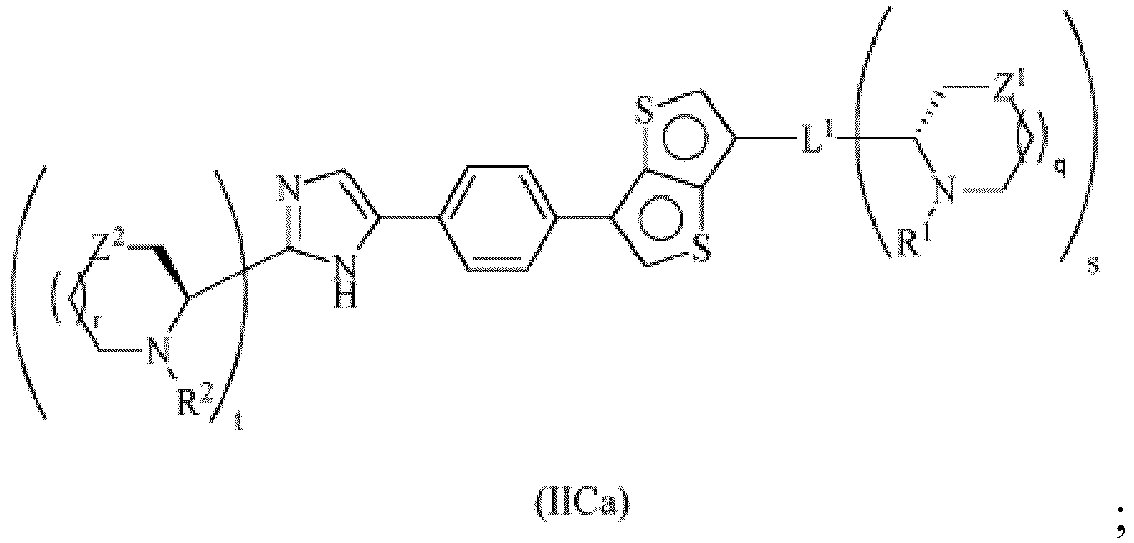


- Composé selon l'une quelconque des revendications 1 à 3,
dans lequel R1 est -C(O)CH[N(C(O)OR1b)R1c]R1a;
et/ou
dans lequel R2 est -C(O)CH[N(C(O)OR1b)R1c]R1a;
et/ou
dans lequel R1e est un hydrogène ou -C(O)OR1b;
et/ou
dans lequel R1a est un hydrogène, méthyle, isopropyle, 2-méthylpropyle, 1-méthylpropyle, 2-méthylthioéthyle, phényle, benzyle, 3-indolylméthyle, hydroxyméthyle, 1-hydroxyéthyle, sulfhydrylméthyle, 4-hydroxybenzyle, aminocarbonylméthyle, 2-(aminocarbonyl)éthyle, carboxyméthyle, 2-carboxyéthyle, 4-aminobutyle, 3-guanidinopropyle ou 5-imidazolylméthyle;
et/ou
dans lequel R1b est un méthyle, éthyle, propyle ou butyle;
et/ou
dans lequel R1c est un hydrogène; ou bien
dans lequel R1a et R1c avec les atomes C et N auxquels ils sont attachés forment un pyrrolidinyle;
et/ou
dans lequel R3a est un hydrogène, oxo, chloro, fluoro, nitro, amino, hydroxy, méthyle, trifluorométhyle, cyclohexyle, phényle, méthoxy ou méthoxycarbonyle; ou bien
dans lequel R3 est un oxo, chloro, fluoro, nitro, amino, hydroxy, méthyle, trifluorométhyle, cyclohexyle, phényle, méthoxy ou méthoxycarbonyle;
et/ou
dans lequel Z1 est une liaison, -O- ou -N(R7)-;
et/ou
dans lequel q est 1 ou 2;
et/ou
dans lequel Z2 est une liaison, -O- ou -N(R7)-;
et/ou
dans lequel r est 1 ou 2. - Composé selon l'une quelconque des revendications 1 à 4,
dans lequel la fraction


- Composé selon l'une quelconque des revendications 1 à 5, dans lequel s est 1.
- Composé selon la revendication 1, sélectionné parmi le groupe consistant en:
A15 
A49 
A76 
A77 
A78 
A82 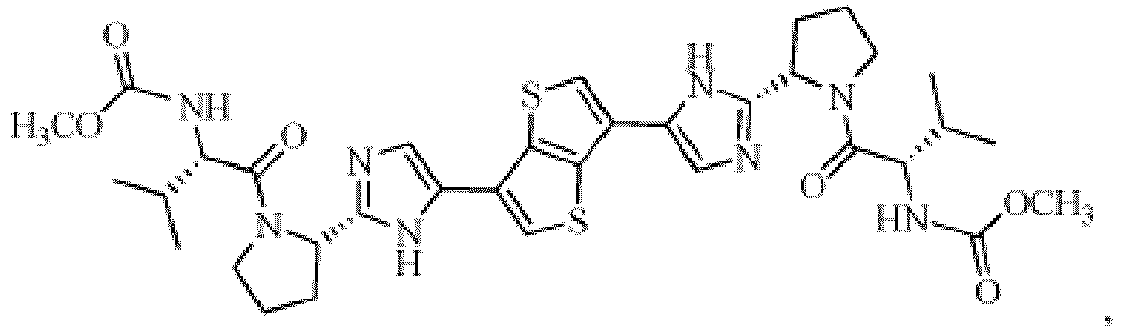
A83 
A84 
A85 
A86 
A87 
A88 
A106 
A107 
A108 
A109 
A110 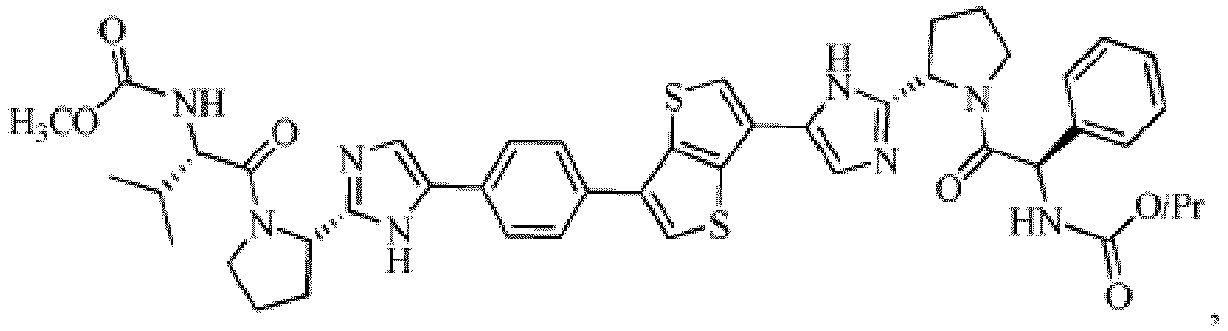
A111 
A112 
A113 
A114 
A115 
A116 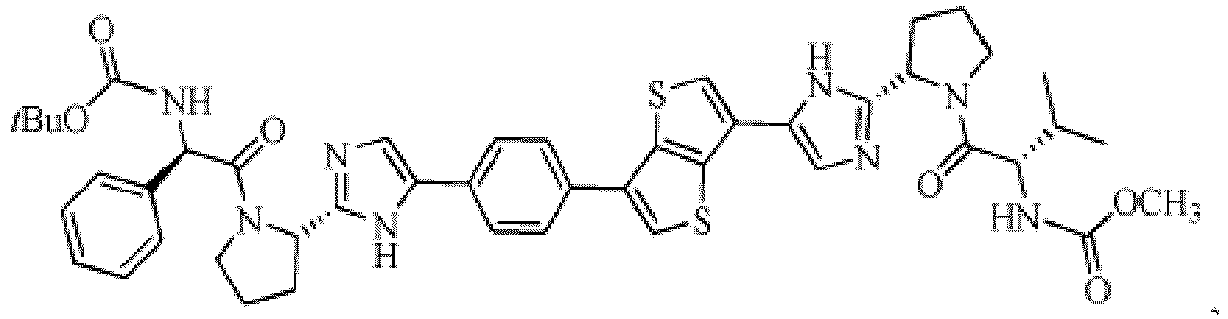
A117 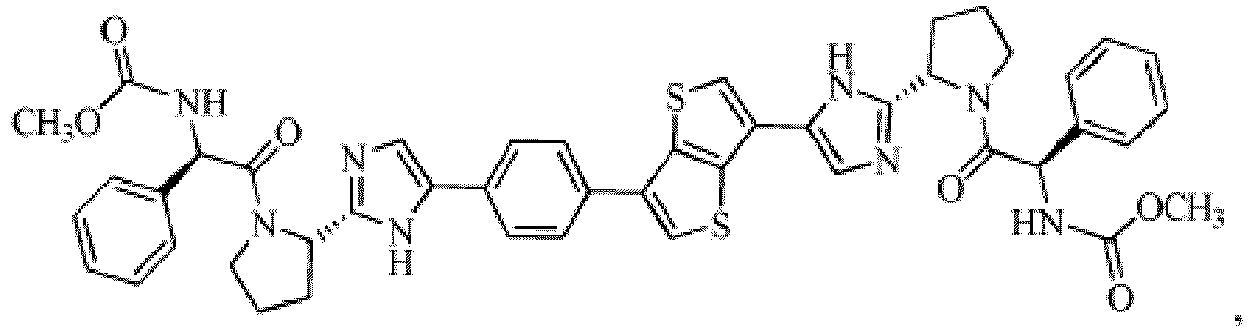
A118 
A119 
A151 
A169 
A171 
A172 
A173 
A181 
A182 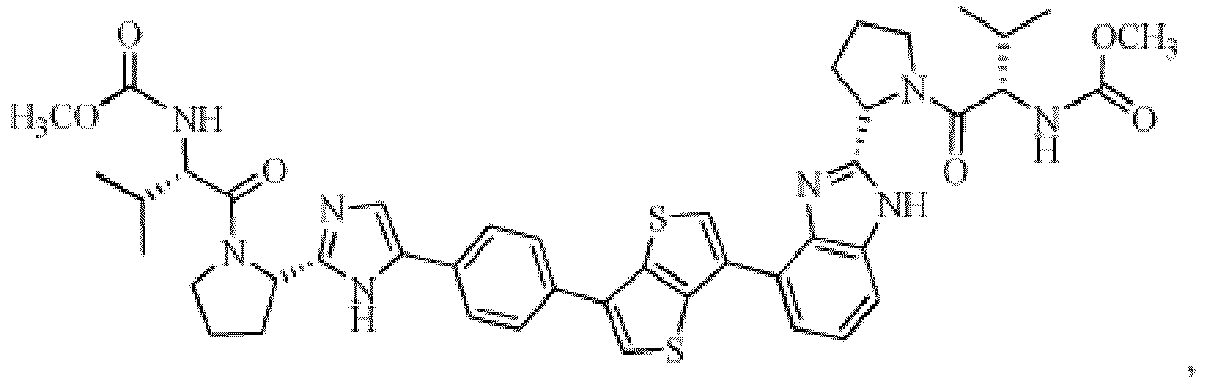
A183 
A184 
A200 
A201 
A202 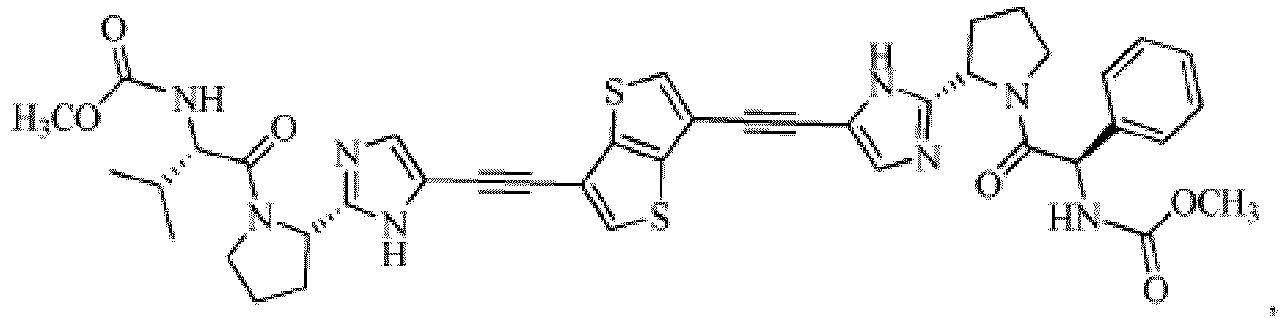
A203 
A204 
A205 
A206 
A207 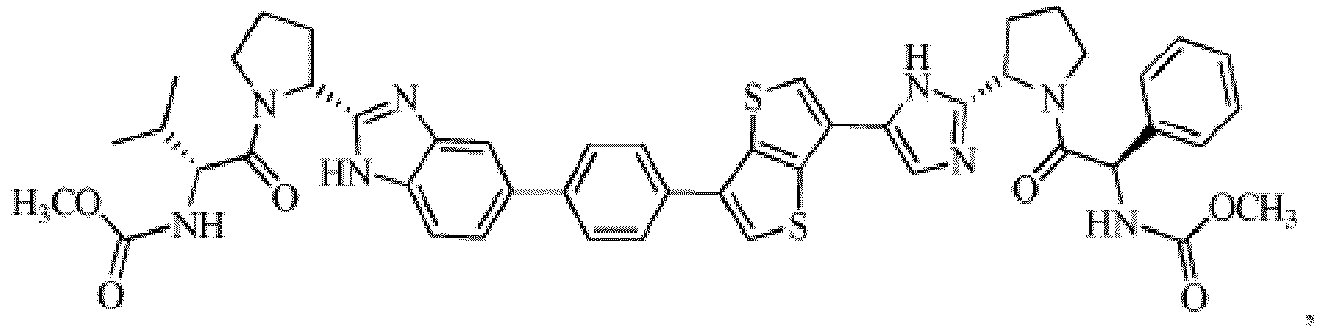
A209 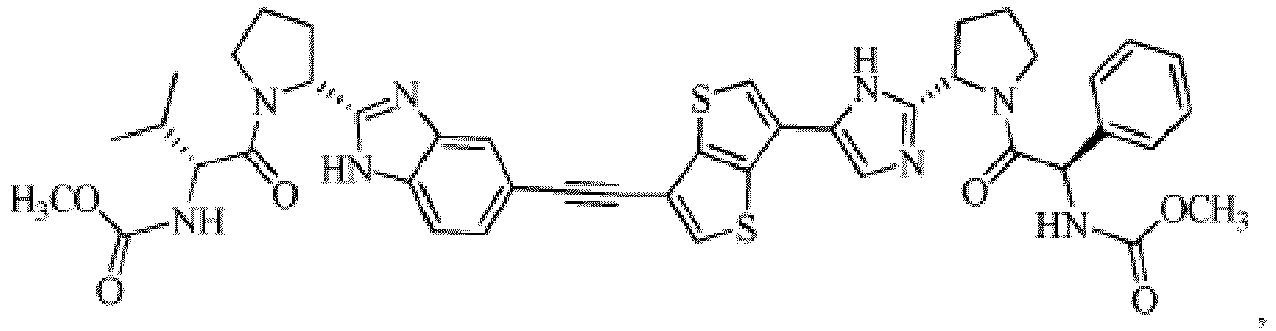
A210 
et A211 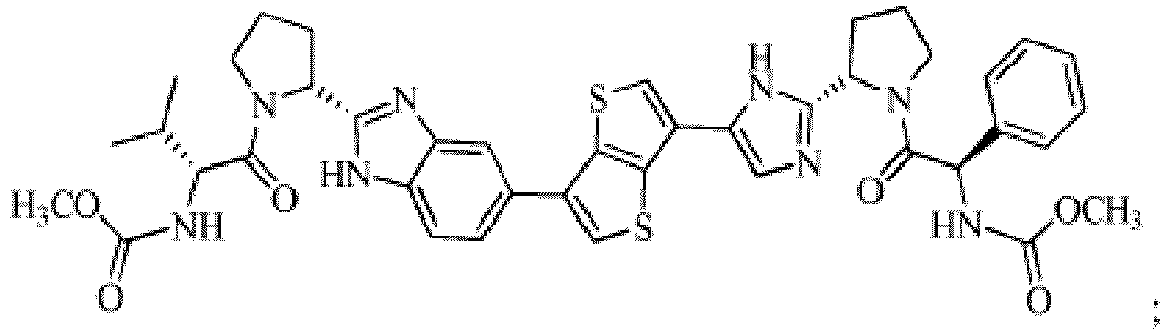
- Composé selon la revendication 1 de la structure:

- Composition pharmaceutique comprenant le composé selon l'une quelconque des revendications 1 à 8, et un ou plusieurs véhicules pharmaceutiquement acceptables, et optionnellement un deuxième agent antiviral;
dans laquelle le deuxième agent antiviral est sélectionné parmi le groupe consistant en un interféron, une ribavirine, une interleukine, un inhibiteur de la protéase NS3, un inhibiteur de la cystéine protéase, une phénanthrènequinone, une thiazolidine, un benzanilide, un inhibiteur de l'hélicase, un inhibiteur de polymérase, un analogue nucléotidique, une liotoxine, acérulénine, un oligodésoxynucléotide anti-sens sous forme de phosphorothiate, un inhibiteur de traduction IRES-dépendante et un ribozyme;
dans laquelle l'interféron est optionnellement sélectionné parmi le groupe consistant en interféron alpha 2a pégylé, interféron alfacon-1, interféron naturel, albuféron, interféron bêta-la, interféron omega, interféron alpha, interféron gamma, interféron tau, interféron delta et interféron gamma-1b. - Composition pharmaceutique selon la revendication 9,
où la composition est formulée pour administration en monodose; et/ou
où la composition est formulée sous forme pharmaceutique orale, parentérale ou intraveineuse, optionnellement où la forme pharmaceutique orale est un comprimé ou une capsule; et/ou
où le composé est administré en une dose d'environ 0,5 milligramme à environ 1000 milligrammes par jour. - Composé selon l'une quelconque des revendications 1 à 8 ou composition pharmaceutique selon les revendications 9 ou 10,
à utiliser dans une méthode de traitement ou de prévention d'une infection par le VHC; ou bien
à utiliser dans une méthode de traitement, de prévention ou d'amélioration d'un ou de plusieurs symptômes d'une maladie du foie ou d'un trouble associé à une infection par le VHC.
Applications Claiming Priority (3)
| Application Number | Priority Date | Filing Date | Title |
|---|---|---|---|
| US28820709P | 2009-12-18 | 2009-12-18 | |
| US37163410P | 2010-08-06 | 2010-08-06 | |
| PCT/US2010/060928 WO2011075615A1 (fr) | 2009-12-18 | 2010-12-17 | Inhibiteurs du virus de l'hépatite c à base de 5,5-arylène ou hétéroarylène condensé |
Publications (2)
| Publication Number | Publication Date |
|---|---|
| EP2513113A1 EP2513113A1 (fr) | 2012-10-24 |
| EP2513113B1 true EP2513113B1 (fr) | 2018-08-01 |
Family
ID=43567928
Family Applications (1)
| Application Number | Title | Priority Date | Filing Date |
|---|---|---|---|
| EP10798901.4A Not-in-force EP2513113B1 (fr) | 2009-12-18 | 2010-12-17 | Inhibiteurs du virus de l'hépatite c à base de 5,5-arylène ou hétéroarylène condensé |
Country Status (16)
| Country | Link |
|---|---|
| US (2) | US8362068B2 (fr) |
| EP (1) | EP2513113B1 (fr) |
| JP (2) | JP2013514982A (fr) |
| KR (1) | KR20120118008A (fr) |
| CN (1) | CN102822175A (fr) |
| AR (1) | AR079528A1 (fr) |
| AU (1) | AU2010330862B2 (fr) |
| BR (1) | BR112012014899A2 (fr) |
| CA (1) | CA2784748A1 (fr) |
| MX (1) | MX2012006877A (fr) |
| MY (1) | MY159958A (fr) |
| NZ (1) | NZ600608A (fr) |
| RU (1) | RU2554087C2 (fr) |
| SG (1) | SG181797A1 (fr) |
| TW (1) | TW201136942A (fr) |
| WO (1) | WO2011075615A1 (fr) |
Families Citing this family (75)
| Publication number | Priority date | Publication date | Assignee | Title |
|---|---|---|---|---|
| SG172352A1 (en) | 2008-12-23 | 2011-07-28 | Abbott Lab | Anti-viral compounds |
| US8546405B2 (en) | 2008-12-23 | 2013-10-01 | Abbott Laboratories | Anti-viral compounds |
| US8394968B2 (en) | 2009-02-17 | 2013-03-12 | Bristol-Myers Squibb Company | Hepatitis C virus inhibitors |
| US8796466B2 (en) | 2009-03-30 | 2014-08-05 | Bristol-Myers Squibb Company | Hepatitis C virus inhibitors |
| TW201038559A (en) | 2009-04-09 | 2010-11-01 | Bristol Myers Squibb Co | Hepatitis C virus inhibitors |
| US8143414B2 (en) | 2009-04-13 | 2012-03-27 | Bristol-Myers Squibb Company | Hepatitis C virus inhibitors |
| US9278922B2 (en) | 2009-04-15 | 2016-03-08 | Abbvie Inc. | Anti-viral compounds |
| HUE030465T2 (hu) | 2009-05-13 | 2017-05-29 | Antivirális vegyületek | |
| US8618076B2 (en) | 2009-05-20 | 2013-12-31 | Gilead Pharmasset Llc | Nucleoside phosphoramidates |
| US8138215B2 (en) | 2009-05-29 | 2012-03-20 | Bristol-Myers Squibb Company | Hepatitis C virus inhibitors |
| US8211928B2 (en) | 2009-05-29 | 2012-07-03 | Bristol-Myers Squibb Company | Hepatitis C virus inhibitors |
| US8937150B2 (en) | 2009-06-11 | 2015-01-20 | Abbvie Inc. | Anti-viral compounds |
| US8716454B2 (en) | 2009-06-11 | 2014-05-06 | Abbvie Inc. | Solid compositions |
| US9394279B2 (en) | 2009-06-11 | 2016-07-19 | Abbvie Inc. | Anti-viral compounds |
| EA020031B1 (ru) * | 2009-06-11 | 2014-08-29 | Эббви Бахамаз Лтд. | Противовирусные соединения |
| AU2010274001A1 (en) | 2009-07-16 | 2012-02-23 | Vertex Pharmaceuticals Incorporated | Benzimidazole analogues for the treatment or prevention of Flavivirus infections |
| CN102480971B (zh) | 2009-09-04 | 2014-11-26 | 杨森制药公司 | 化合物 |
| US20110269956A1 (en) | 2009-11-11 | 2011-11-03 | Bristol-Myers Squibb Company | Hepatitis C Virus Inhibitors |
| US20110274648A1 (en) | 2009-11-11 | 2011-11-10 | Bristol-Myers Squibb Company | Hepatitis C Virus Inhibitors |
| US20110281910A1 (en) | 2009-11-12 | 2011-11-17 | Bristol-Myers Squibb Company | Hepatitis C Virus Inhibitors |
| US8377980B2 (en) | 2009-12-16 | 2013-02-19 | Bristol-Myers Squibb Company | Hepatitis C virus inhibitors |
| MX2012006877A (es) | 2009-12-18 | 2012-08-31 | Idenix Pharmaceuticals Inc | Inhibidores de virus de hepatitis c de arileno o heteroarileno 5, 5 - fusionado. |
| US20110152246A1 (en) * | 2009-12-18 | 2011-06-23 | Intermune, Inc. | Novel inhibitors of hepatitis c virus replication |
| US8362020B2 (en) | 2009-12-30 | 2013-01-29 | Bristol-Myers Squibb Company | Hepatitis C virus inhibitors |
| EP2550268A1 (fr) * | 2010-03-24 | 2013-01-30 | Vertex Pharmaceuticals Incorporated | Analogues pour traiter ou prévenir les infections à flavivirus |
| CN102869657A (zh) | 2010-03-24 | 2013-01-09 | 沃泰克斯药物股份有限公司 | 用于治疗或预防黄病毒感染的类似物 |
| AR081848A1 (es) * | 2010-06-09 | 2012-10-24 | Presidio Pharmaceuticals Inc | Inhibidores de la proteina ns5a del vhc |
| NZ605440A (en) | 2010-06-10 | 2014-05-30 | Abbvie Bahamas Ltd | Solid compositions comprising an hcv inhibitor |
| US8859595B2 (en) | 2010-08-26 | 2014-10-14 | Rfs Pharma, Llc | Potent and selective inhibitors of hepatitis C virus |
| US8552047B2 (en) | 2011-02-07 | 2013-10-08 | Bristol-Myers Squibb Company | Hepatitis C virus inhibitors |
| US20120252721A1 (en) * | 2011-03-31 | 2012-10-04 | Idenix Pharmaceuticals, Inc. | Methods for treating drug-resistant hepatitis c virus infection with a 5,5-fused arylene or heteroarylene hepatitis c virus inhibitor |
| US9546160B2 (en) | 2011-05-12 | 2017-01-17 | Bristol-Myers Squibb Company | Hepatitis C virus inhibitors |
| US10201584B1 (en) | 2011-05-17 | 2019-02-12 | Abbvie Inc. | Compositions and methods for treating HCV |
| CA2841095A1 (fr) | 2011-07-09 | 2013-01-17 | Sunshine Lake Pharma Co., Ltd. | Composes spiro en tant qu'inhibiteurs du virus de l'hepatite c |
| WO2013028953A1 (fr) * | 2011-08-24 | 2013-02-28 | Glaxosmithkline Llc | Traitements combinés contre l'hépatite c |
| EP2709613B2 (fr) | 2011-09-16 | 2020-08-12 | Gilead Pharmasset LLC | Procédés permettant de traiter le virus de l'hépatite c (hcv) |
| US9034832B2 (en) | 2011-12-29 | 2015-05-19 | Abbvie Inc. | Solid compositions |
| US9326973B2 (en) | 2012-01-13 | 2016-05-03 | Bristol-Myers Squibb Company | Hepatitis C virus inhibitors |
| TWI610916B (zh) | 2012-08-03 | 2018-01-11 | 廣東東陽光藥業有限公司 | 作爲丙型肝炎抑制劑的橋環化合物及其在藥物中的應用 |
| EP2890377A1 (fr) * | 2012-08-31 | 2015-07-08 | IDENIX Pharmaceuticals, Inc. | Méthodes d'administration d'un inhibiteur du virus de l'hépatite c à base d'hétéroarylène fusionné en 5,5 pour le traitement ou la prévention de l'infection à virus de l'hépatite c |
| CN103848818B (zh) | 2012-11-29 | 2017-03-15 | 广东东阳光药业有限公司 | 作为丙型肝炎抑制剂的并环化合物、药物组合物及它们在药物中的应用 |
| CN103848821B (zh) | 2012-11-29 | 2016-10-12 | 广东东阳光药业有限公司 | 作为丙型肝炎抑制剂的螺环化合物、药物组合物及它们的用途 |
| EP2950786B1 (fr) | 2013-01-31 | 2019-11-27 | Gilead Pharmasset LLC | Formulation de combinaison de deux composés antiviraux |
| US11484534B2 (en) | 2013-03-14 | 2022-11-01 | Abbvie Inc. | Methods for treating HCV |
| CN105837561B (zh) * | 2013-06-06 | 2019-06-28 | 上海爱博医药科技有限公司 | 抑制丙肝病毒的化合物、药物组合物及其应用 |
| US9717712B2 (en) | 2013-07-02 | 2017-08-01 | Bristol-Myers Squibb Company | Combinations comprising tricyclohexadecahexaene derivatives for use in the treatment of hepatitis C virus |
| US20150023913A1 (en) | 2013-07-02 | 2015-01-22 | Bristol-Myers Squibb Company | Hepatitis C Virus Inhibitors |
| US9775831B2 (en) | 2013-07-17 | 2017-10-03 | Bristol-Myers Squibb Company | Combinations comprising biphenyl derivatives for use in the treatment of HCV |
| PT3038601T (pt) | 2013-08-27 | 2020-06-30 | Gilead Pharmasset Llc | Formulação combinada de dois compostos antivirais |
| WO2015042375A1 (fr) | 2013-09-20 | 2015-03-26 | Idenix Pharmaceuticals, Inc. | Inhibiteurs du virus de l'hépatite c |
| ES2670550T3 (es) | 2013-10-14 | 2018-05-30 | Eisai R&D Management Co., Ltd. | Derivados de quinolina selectivamente sustituidos |
| SG10202103278TA (en) | 2013-10-14 | 2021-04-29 | Eisai R&D Man Co Ltd | Selectively substituted quinoline compounds |
| WO2015103490A1 (fr) | 2014-01-03 | 2015-07-09 | Abbvie, Inc. | Formes galéniques antivirales solides |
| WO2015110048A1 (fr) | 2014-01-23 | 2015-07-30 | Sunshine Lake Pharma Co., Ltd. | Composés cycliques pontés comme inhibiteurs du virus de l'hépatite c, compositions pharmaceutiques et utilisations correspondantes |
| US20170066795A1 (en) | 2014-03-05 | 2017-03-09 | Idenix Pharmaceuticals Llc | Solid prodrug forms of 2'-chloro-2'-methyl uridine for hcv |
| WO2015134561A1 (fr) | 2014-03-05 | 2015-09-11 | Idenix Pharmaceuticals, Inc. | Compositions pharmaceutiques comprenant un inhibiteur de flaviviridae hétéroarylène fusionné en 5,5 et son utilisation pour le traitement ou la prévention d'une infection par les flaviviridae |
| US20170066779A1 (en) * | 2014-03-05 | 2017-03-09 | Idenix Pharmaceuticals Llc | Solid forms of a flaviviridae virus inhibitor compound and salts thereof |
| WO2015184644A1 (fr) * | 2014-06-06 | 2015-12-10 | 爱博新药研发(上海)有限公司 | Composés et compositions pharmaceutiques destinés à inhiber le virus de l'hépatite c, et utilisations desdits composés et compositions |
| CA3182565A1 (fr) | 2015-03-06 | 2016-09-15 | Atea Pharmaceuticals, Inc. | Nucleotides de purine ?-d-2'-desoxy-2'?-fluoro-2'-?-c-substitues-2-modifies-n6-substitues pour le traitement du virus de l'hepatite c |
| WO2017023631A1 (fr) | 2015-08-06 | 2017-02-09 | Bristol-Myers Squibb Company | Inhibiteurs du virus de l'hépatite c |
| CN109641874A (zh) | 2016-05-10 | 2019-04-16 | C4医药公司 | 用于靶蛋白降解的c3-碳连接的戊二酰亚胺降解决定子体 |
| CN109790143A (zh) | 2016-05-10 | 2019-05-21 | C4医药公司 | 用于靶蛋白降解的胺连接的c3-戊二酰亚胺降解决定子体 |
| ES2990061T3 (es) | 2016-05-10 | 2024-11-28 | C4 Therapeutics Inc | Degronímeros espirocíclicos para la degradación de proteínas diana |
| EP3454856B1 (fr) | 2016-05-10 | 2024-09-11 | C4 Therapeutics, Inc. | Dégronimères hétérocycliques pour la dégradation de protéines cibles |
| WO2018013937A1 (fr) | 2016-07-14 | 2018-01-18 | Atea Pharmaceuticals, Inc. | Nucléotides de purine beta-d-2'-deoxy-2'-alpha-fluoro-2'-beta-c-substitué-4'-fluoro-n6-substitué-6-amino-2-substitué pour le traitement de l'infection par le virus de l'hépatite c |
| WO2018048937A1 (fr) | 2016-09-07 | 2018-03-15 | Atea Pharmaceuticals, Inc. | Nucléotides de purine substitués en position 2'-n 6 pour le traitement du virus à arn |
| IL288737B (en) | 2017-02-01 | 2022-09-01 | Atea Pharmaceuticals Inc | Hemisulfate nucleotide salt for treatment of hepatitis c virus |
| RU2650610C1 (ru) | 2017-02-28 | 2018-04-16 | Васильевич Иващенко Александр | Противовирусная композиция и способ ее применения |
| CN110769822A (zh) | 2017-06-20 | 2020-02-07 | C4医药公司 | 用于蛋白降解的n/o-连接的降解决定子和降解决定子体 |
| EP3773753A4 (fr) | 2018-04-10 | 2021-12-22 | ATEA Pharmaceuticals, Inc. | Traitement de patients infectés par le virus de l'hépatite c avec une cirrhose |
| US10874687B1 (en) | 2020-02-27 | 2020-12-29 | Atea Pharmaceuticals, Inc. | Highly active compounds against COVID-19 |
| CN111377943A (zh) * | 2020-03-31 | 2020-07-07 | 烟台显华化工科技有限公司 | 一种并五元杂环类有机化合物及其应用 |
| US12037340B2 (en) | 2021-05-21 | 2024-07-16 | Gilead Sciences, Inc. | Pentacyclic derivatives as Zika virus inhibitors |
| US12497408B2 (en) | 2021-05-21 | 2025-12-16 | Gilead Sciences, Inc. | Tetracyclic compounds and methods for the treatment of Zika virus infection |
| IL308921A (en) | 2021-06-17 | 2024-01-01 | Atea Pharmaceuticals Inc | Combination anti-HCV therapy is beneficial |
Citations (3)
| Publication number | Priority date | Publication date | Assignee | Title |
|---|---|---|---|---|
| WO2010065674A1 (fr) * | 2008-12-03 | 2010-06-10 | Presidio Pharmaceuticals, Inc. | Inhibiteurs de la protéine ns5a du vhc |
| WO2010065668A1 (fr) * | 2008-12-03 | 2010-06-10 | Presidio Pharmaceuticals, Inc. | Inhibiteurs du virus de l'hépatite c de type ns5a |
| WO2011009084A2 (fr) * | 2009-07-16 | 2011-01-20 | Vertex Pharmaceuticals Incorporated | Analogues du benzimidazole pour le traitement ou la prévention des infections à flavivirus |
Family Cites Families (304)
| Publication number | Priority date | Publication date | Assignee | Title |
|---|---|---|---|---|
| US365127A (en) | 1887-06-21 | Feed-guide for printing-machines | ||
| US3536809A (en) | 1969-02-17 | 1970-10-27 | Alza Corp | Medication method |
| US3598123A (en) | 1969-04-01 | 1971-08-10 | Alza Corp | Bandage for administering drugs |
| US3845770A (en) | 1972-06-05 | 1974-11-05 | Alza Corp | Osmatic dispensing device for releasing beneficial agent |
| US3916899A (en) | 1973-04-25 | 1975-11-04 | Alza Corp | Osmotic dispensing device with maximum and minimum sizes for the passageway |
| US4008719A (en) | 1976-02-02 | 1977-02-22 | Alza Corporation | Osmotic system having laminar arrangement for programming delivery of active agent |
| US4368190A (en) | 1980-04-17 | 1983-01-11 | Merck & Co., Inc. | Immunologically active dipeptidyl 4-O-,6-O-acyl-2-amino-2-deoxy-D-glucose derivatives and methods for their preparation |
| US4328245A (en) | 1981-02-13 | 1982-05-04 | Syntex (U.S.A.) Inc. | Carbonate diester solutions of PGE-type compounds |
| US4410545A (en) | 1981-02-13 | 1983-10-18 | Syntex (U.S.A.) Inc. | Carbonate diester solutions of PGE-type compounds |
| US4409239A (en) | 1982-01-21 | 1983-10-11 | Syntex (U.S.A.) Inc. | Propylene glycol diester solutions of PGE-type compounds |
| HU196714B (en) | 1984-10-04 | 1989-01-30 | Monsanto Co | Process for producing non-aqueous composition comprising somatotropin |
| IE58110B1 (en) | 1984-10-30 | 1993-07-14 | Elan Corp Plc | Controlled release powder and process for its preparation |
| US5033252A (en) | 1987-12-23 | 1991-07-23 | Entravision, Inc. | Method of packaging and sterilizing a pharmaceutical product |
| US5052558A (en) | 1987-12-23 | 1991-10-01 | Entravision, Inc. | Packaged pharmaceutical product |
| US5073543A (en) | 1988-07-21 | 1991-12-17 | G. D. Searle & Co. | Controlled release formulations of trophic factors in ganglioside-lipsome vehicle |
| US5612059A (en) | 1988-08-30 | 1997-03-18 | Pfizer Inc. | Use of asymmetric membranes in delivery devices |
| US5270302A (en) | 1988-12-21 | 1993-12-14 | Abbott Laboratories | Derivatives of tetrapeptides as CCK agonists |
| IT1229203B (it) | 1989-03-22 | 1991-07-25 | Bioresearch Spa | Impiego di acido 5 metiltetraidrofolico, di acido 5 formiltetraidrofolico e dei loro sali farmaceuticamente accettabili per la preparazione di composizioni farmaceutiche in forma a rilascio controllato attive nella terapia dei disturbi mentali organici e composizioni farmaceutiche relative. |
| PH30995A (en) | 1989-07-07 | 1997-12-23 | Novartis Inc | Sustained release formulations of water soluble peptides. |
| US5296468A (en) | 1989-10-30 | 1994-03-22 | The Salk Institute For Biological Studies | GnRH analogs |
| US5120548A (en) | 1989-11-07 | 1992-06-09 | Merck & Co., Inc. | Swelling modulated polymeric drug delivery device |
| US5585112A (en) | 1989-12-22 | 1996-12-17 | Imarx Pharmaceutical Corp. | Method of preparing gas and gaseous precursor-filled microspheres |
| US5026687A (en) | 1990-01-03 | 1991-06-25 | The United States Of America As Represented By The Department Of Health And Human Services | Treatment of human retroviral infections with 2',3'-dideoxyinosine alone and in combination with other antiviral compounds |
| DE69132332T2 (de) | 1990-04-06 | 2000-11-30 | Genelabs Technologies, Inc. | Hepatitis c-virus-epitope |
| IT1246382B (it) | 1990-04-17 | 1994-11-18 | Eurand Int | Metodo per la cessione mirata e controllata di farmaci nell'intestino e particolarmente nel colon |
| US5733566A (en) | 1990-05-15 | 1998-03-31 | Alkermes Controlled Therapeutics Inc. Ii | Controlled release of antiparasitic agents in animals |
| US5543390A (en) | 1990-11-01 | 1996-08-06 | State Of Oregon, Acting By And Through The Oregon State Board Of Higher Education, Acting For And On Behalf Of The Oregon Health Sciences University | Covalent microparticle-drug conjugates for biological targeting |
| IL101074A (en) | 1991-03-14 | 1997-09-30 | Salk Inst For Biological Studi | GnRH ANALOGS AND THEIR PREPARATION |
| US5382569A (en) | 1991-05-16 | 1995-01-17 | Warner-Lambert Company | Endotherlin antagonists |
| AU2238192A (en) | 1991-06-27 | 1993-01-25 | Du Pont Merck Pharmaceutical Company, The | Modified peptides transportable into the central nervous system |
| JPH06509075A (ja) | 1991-07-01 | 1994-10-13 | ユニヴァーシティ テクノロジーズ インターナショナル インコーポレイテッド | GnRH及び他の生物学的に活性なリガンドの非感度低下性類縁体 |
| DE4126485A1 (de) | 1991-08-10 | 1993-02-11 | Bayer Ag | Trifluormethyl-haltige pseudopeptide |
| JPH06501961A (ja) | 1991-08-26 | 1994-03-03 | 日本たばこ産業株式会社 | 免疫調節活性を有するシユードペンタペプチド |
| US5580578A (en) | 1992-01-27 | 1996-12-03 | Euro-Celtique, S.A. | Controlled release formulations coated with aqueous dispersions of acrylic polymers |
| US5610054A (en) | 1992-05-14 | 1997-03-11 | Ribozyme Pharmaceuticals, Inc. | Enzymatic RNA molecule targeted against Hepatitis C virus |
| US5323907A (en) | 1992-06-23 | 1994-06-28 | Multi-Comp, Inc. | Child resistant package assembly for dispensing pharmaceutical medications |
| WO1994009031A1 (fr) | 1992-10-19 | 1994-04-28 | Warner-Lambert Company | Analogues de cholecystokinine (30-33) contenant un acide amine a substitution alpha |
| TW333456B (en) | 1992-12-07 | 1998-06-11 | Takeda Pharm Ind Co Ltd | A pharmaceutical composition of sustained-release preparation the invention relates to a pharmaceutical composition of sustained-release preparation which comprises a physiologically active peptide. |
| US5591767A (en) | 1993-01-25 | 1997-01-07 | Pharmetrix Corporation | Liquid reservoir transdermal patch for the administration of ketorolac |
| US5496546A (en) | 1993-02-24 | 1996-03-05 | Jui H. Wang | Compositions and methods of application of reactive antiviral polyadenylic acid derivatives |
| US6274552B1 (en) | 1993-03-18 | 2001-08-14 | Cytimmune Sciences, Inc. | Composition and method for delivery of biologically-active factors |
| AU6491294A (en) | 1993-03-26 | 1994-10-24 | Warner-Lambert Company | Inhibitors of endothelin converting enzyme |
| US5523092A (en) | 1993-04-14 | 1996-06-04 | Emory University | Device for local drug delivery and methods for using the same |
| US5985307A (en) | 1993-04-14 | 1999-11-16 | Emory University | Device and method for non-occlusive localized drug delivery |
| US6087324A (en) | 1993-06-24 | 2000-07-11 | Takeda Chemical Industries, Ltd. | Sustained-release preparation |
| US5846964A (en) | 1993-07-19 | 1998-12-08 | Tokyo Tanabe Company Limited | Hepatitis C virus proliferation inhibitor |
| US6004534A (en) | 1993-07-23 | 1999-12-21 | Massachusetts Institute Of Technology | Targeted polymerized liposomes for improved drug delivery |
| DE69420044T2 (de) | 1993-10-29 | 2000-03-23 | Smithkline Beecham Corp., King Of Prussia | Blutregulierende peptide |
| DE4415539C2 (de) | 1994-05-03 | 1996-08-01 | Osama Dr Dr Med Omer | Pflanzen mit virustatischer und antiviraler Wirkung |
| US5958458A (en) | 1994-06-15 | 1999-09-28 | Dumex-Alpharma A/S | Pharmaceutical multiple unit particulate formulation in the form of coated cores |
| IT1270594B (it) | 1994-07-07 | 1997-05-07 | Recordati Chem Pharm | Composizione farmaceutica a rilascio controllato di moguisteina in sospensione liquida |
| US5759542A (en) | 1994-08-05 | 1998-06-02 | New England Deaconess Hospital Corporation | Compositions and methods for the delivery of drugs by platelets for the treatment of cardiovascular and other diseases |
| DE4432623A1 (de) | 1994-09-14 | 1996-03-21 | Huels Chemische Werke Ag | Verfahren zur Bleichung von wäßrigen Tensidlösungen |
| US5605809A (en) | 1994-10-28 | 1997-02-25 | Oncoimmunin, Inc. | Compositions for the detection of proteases in biological samples and methods of use thereof |
| US5618792A (en) | 1994-11-21 | 1997-04-08 | Cortech, Inc. | Substituted heterocyclic compounds useful as inhibitors of (serine proteases) human neutrophil elastase |
| US5660854A (en) | 1994-11-28 | 1997-08-26 | Haynes; Duncan H | Drug releasing surgical implant or dressing material |
| FR2729954B1 (fr) | 1995-01-30 | 1997-08-01 | Sanofi Sa | Composes heterocycliques substitues, procede pour leur preparation et compositions pharmaceutiques les contenant |
| JP3786447B2 (ja) | 1995-03-31 | 2006-06-14 | エーザイ株式会社 | C型肝炎の予防・治療剤 |
| US6316652B1 (en) | 1995-06-06 | 2001-11-13 | Kosta Steliou | Drug mitochondrial targeting agents |
| US5798119A (en) | 1995-06-13 | 1998-08-25 | S. C. Johnson & Son, Inc. | Osmotic-delivery devices having vapor-permeable coatings |
| AU6242096A (en) | 1995-06-27 | 1997-01-30 | Takeda Chemical Industries Ltd. | Method of producing sustained-release preparation |
| US6248713B1 (en) | 1995-07-11 | 2001-06-19 | Biogen, Inc. | Cell adhesion inhibitors |
| TW448055B (en) | 1995-09-04 | 2001-08-01 | Takeda Chemical Industries Ltd | Method of production of sustained-release preparation |
| JP2909418B2 (ja) | 1995-09-18 | 1999-06-23 | 株式会社資生堂 | 薬物の遅延放出型マイクロスフイア |
| US6039975A (en) | 1995-10-17 | 2000-03-21 | Hoffman-La Roche Inc. | Colon targeted delivery system |
| US5980945A (en) | 1996-01-16 | 1999-11-09 | Societe De Conseils De Recherches Et D'applications Scientifique S.A. | Sustained release drug formulations |
| AU2064297A (en) | 1996-02-29 | 1997-09-16 | Immusol, Inc | Hepatitis c virus ribozymes |
| US5830905A (en) | 1996-03-29 | 1998-11-03 | Viropharma Incorporated | Compounds, compositions and methods for treatment of hepatitis C |
| US5633388A (en) | 1996-03-29 | 1997-05-27 | Viropharma Incorporated | Compounds, compositions and methods for treatment of hepatitis C |
| US5804578A (en) | 1996-04-03 | 1998-09-08 | Merck & Co., Inc. | Piperidines, pyrrolidines and hexahydro-1H-azepines promote release of growth hormone |
| US5990276A (en) | 1996-05-10 | 1999-11-23 | Schering Corporation | Synthetic inhibitors of hepatitis C virus NS3 protease |
| US6214799B1 (en) | 1996-05-14 | 2001-04-10 | Agouron Pharmaceuticals, Inc. | Antipicornaviral compounds and methods for their use and preparation |
| TW345603B (en) | 1996-05-29 | 1998-11-21 | Gmundner Fertigteile Gmbh | A noise control device for tracks |
| US5891874A (en) | 1996-06-05 | 1999-04-06 | Eli Lilly And Company | Anti-viral compound |
| US6264970B1 (en) | 1996-06-26 | 2001-07-24 | Takeda Chemical Industries, Ltd. | Sustained-release preparation |
| US5837257A (en) | 1996-07-09 | 1998-11-17 | Sage R&D | Use of plant extracts for treatment of HIV, HCV and HBV infections |
| US6419961B1 (en) | 1996-08-29 | 2002-07-16 | Takeda Chemical Industries, Ltd. | Sustained release microcapsules of a bioactive substance and a biodegradable polymer |
| JP3927630B2 (ja) | 1996-09-27 | 2007-06-13 | エーザイ・アール・アンド・ディー・マネジメント株式会社 | ウイルス感染症の予防・治療剤 |
| US5922757A (en) | 1996-09-30 | 1999-07-13 | The Regents Of The University Of California | Treatment and prevention of hepatic disorders |
| JP2000508339A (ja) | 1996-10-01 | 2000-07-04 | シーマ・ラブス・インコーポレイテッド | 味隠蔽マイクロカプセル組成物及び製造方法 |
| US6375987B1 (en) | 1996-10-01 | 2002-04-23 | Gattefossé, S.A. | Process for the manufacture of pharmaceutical composition with modified release of active principle comprising the matrix |
| CA2217134A1 (fr) | 1996-10-09 | 1998-04-09 | Sumitomo Pharmaceuticals Co., Ltd. | Formulation a liberation-retard |
| KR100509388B1 (ko) | 1996-10-18 | 2005-08-23 | 버텍스 파마슈티칼스 인코포레이티드 | 세린 프로테아제, 특히 간염 c 바이러스 ns3 프로테아제의 저해제 |
| PT839525E (pt) | 1996-10-31 | 2004-10-29 | Takeda Chemical Industries Ltd | Preparacao de libertacao prolongada |
| GB9623908D0 (en) | 1996-11-18 | 1997-01-08 | Hoffmann La Roche | Amino acid derivatives |
| US6131570A (en) | 1998-06-30 | 2000-10-17 | Aradigm Corporation | Temperature controlling device for aerosol drug delivery |
| DE19648576C2 (de) | 1996-11-23 | 1999-08-12 | Lohmann Therapie Syst Lts | Lutschtablette zur modifizierten Freisetzung von Wirkstoffen im Gastrointestinaltrakt |
| TW445265B (en) | 1996-11-25 | 2001-07-11 | Meiji Seika Kaisha | Carbapenem derivatives and antimicrobial agents |
| IL119833A (en) | 1996-12-15 | 2001-01-11 | Lavie David | Hypericum perforatum extracts for the preparation of pharmaceutical compositions for the treatment of hepatitis |
| WO1998027980A2 (fr) | 1996-12-20 | 1998-07-02 | Takeda Chemical Industries, Ltd. | Procede de production d'une preparation a liberation prolongee |
| US5891474A (en) | 1997-01-29 | 1999-04-06 | Poli Industria Chimica, S.P.A. | Time-specific controlled release dosage formulations and method of preparing same |
| US6037137A (en) | 1997-02-20 | 2000-03-14 | Oncoimmunin, Inc. | Fluorogenic peptides for the detection of protease activity |
| US6120751A (en) | 1997-03-21 | 2000-09-19 | Imarx Pharmaceutical Corp. | Charged lipids and uses for the same |
| US6060082A (en) | 1997-04-18 | 2000-05-09 | Massachusetts Institute Of Technology | Polymerized liposomes targeted to M cells and useful for oral or mucosal drug delivery |
| US6004933A (en) | 1997-04-25 | 1999-12-21 | Cortech Inc. | Cysteine protease inhibitors |
| KR100630506B1 (ko) | 1997-06-30 | 2006-09-29 | 메르츠 파마 게엠베하 운트 코. 카가아 | Nmda 수용체 길항물질로서의 1-아미노-알킬시클로헥산 화합물, 이를 함유하는 제약학적 조성물 및 이것으로 치료하는 방법 |
| WO1999003880A1 (fr) | 1997-07-15 | 1999-01-28 | Novo Nordisk A/S | Analogues de nociceptine |
| US6143721A (en) | 1997-07-18 | 2000-11-07 | Basf Aktiengesellschaft | Dolastatin 15 derivatives |
| ES2234144T3 (es) | 1997-08-11 | 2005-06-16 | Boehringer Ingelheim (Canada) Ltd. | Analogos de peptidos inhibidores de la hepatitis c. |
| US6350458B1 (en) | 1998-02-10 | 2002-02-26 | Generex Pharmaceuticals Incorporated | Mixed micellar drug deliver system and method of preparation |
| WO1999043691A1 (fr) | 1998-02-25 | 1999-09-02 | Emory University | 2'-fluoronucleosides |
| US6613358B2 (en) | 1998-03-18 | 2003-09-02 | Theodore W. Randolph | Sustained-release composition including amorphous polymer |
| GB9806815D0 (en) | 1998-03-30 | 1998-05-27 | Hoffmann La Roche | Amino acid derivatives |
| US6048736A (en) | 1998-04-29 | 2000-04-11 | Kosak; Kenneth M. | Cyclodextrin polymers for carrying and releasing drugs |
| KR19990085365A (ko) | 1998-05-16 | 1999-12-06 | 허영섭 | 지속적으로 약물 조절방출이 가능한 생분해성 고분자 미립구 및그 제조방법 |
| US7169410B1 (en) | 1998-05-19 | 2007-01-30 | Sdg, Inc. | Targeted liposomal drug delivery system |
| US6323180B1 (en) | 1998-08-10 | 2001-11-27 | Boehringer Ingelheim (Canada) Ltd | Hepatitis C inhibitor tri-peptides |
| MXPA01004381A (es) | 1998-11-02 | 2005-09-08 | Elan Corp Plc | Composicion de multiparticulado de liberacion modificada. |
| US6248363B1 (en) | 1999-11-23 | 2001-06-19 | Lipocine, Inc. | Solid carriers for improved delivery of active ingredients in pharmaceutical compositions |
| EP1165492A1 (fr) | 1999-03-30 | 2002-01-02 | Pharmacor Inc. | Derives d'hydroxyphenyle possedant des proprietes inhibitrices de l'integrase du vih |
| UA74546C2 (en) | 1999-04-06 | 2006-01-16 | Boehringer Ingelheim Ca Ltd | Macrocyclic peptides having activity relative to hepatitis c virus, a pharmaceutical composition and use of the pharmaceutical composition |
| US6608027B1 (en) | 1999-04-06 | 2003-08-19 | Boehringer Ingelheim (Canada) Ltd | Macrocyclic peptides active against the hepatitis C virus |
| US6271359B1 (en) | 1999-04-14 | 2001-08-07 | Musc Foundation For Research Development | Tissue-specific and pathogen-specific toxic agents and ribozymes |
| US6515104B1 (en) | 1999-06-25 | 2003-02-04 | Xoma Technology Ltd. | Therapeutic peptide-based constructs derived from domain II of bactericidal/permeability-increasing protein |
| US6566365B1 (en) | 1999-11-04 | 2003-05-20 | Biochem Pharma Inc. | Method for the treatment of Flaviviridea viral infection using nucleoside analogues |
| KR20030005197A (ko) | 2000-02-18 | 2003-01-17 | 샤이어 바이오켐 인코포레이티드 | 뉴클레오시드유도체를 이용한 플라비바이러스 감염의 치료또는 예방 방법 |
| DE60124080T2 (de) | 2000-03-23 | 2007-03-01 | Elan Pharmaceuticals, Inc., San Francisco | Verbindungen und verfahren zur behandlung der alzheimerschen krankheit |
| AR029903A1 (es) | 2000-04-05 | 2003-07-23 | Schering Corp | Inhibidores macrociclicos de la ns3-serina proteasa, del virus de la hepatitis c, que comprenden partes p2 n-ciclicas, composiciones farmaceuticas y utilizacion de los mismos para la manufactura de un medicamento |
| EP1964569A3 (fr) | 2000-04-13 | 2009-07-22 | Pharmasset, Inc. | Dérivés de nucléoside substitué 3'-Or 2'-hydroxymethyl pour le traitement des infections virales |
| US6525024B1 (en) | 2000-04-17 | 2003-02-25 | Idun Pharmaceuticals, Inc. | Inhibitors of the ICE/ced-3 family of cysteine proteases |
| CN101580536A (zh) | 2000-04-19 | 2009-11-18 | 先灵公司 | 含有烷基和芳基丙氨酸p2部分的丙型肝炎病毒的大环ns3-丝氨酸蛋白酶抑制剂 |
| US6623756B1 (en) | 2000-04-27 | 2003-09-23 | Noveon Ip Holdings Corp. | Directly compressed solid dosage articles |
| MY164523A (en) | 2000-05-23 | 2017-12-29 | Univ Degli Studi Cagliari | Methods and compositions for treating hepatitis c virus |
| EP1736478B1 (fr) | 2000-05-26 | 2015-07-22 | IDENIX Pharmaceuticals, Inc. | Procédés et compositions de traitement des flavivirus et des pestivirus |
| KR20030081297A (ko) | 2000-07-21 | 2003-10-17 | 쉐링 코포레이션 | C형 간염 바이러스의 ns3-세린 프로테아제억제제로서의 신규한 펩티드 |
| AR034127A1 (es) | 2000-07-21 | 2004-02-04 | Schering Corp | Imidazolidinonas como inhibidores de ns3-serina proteasa del virus de hepatitis c, composicion farmaceutica, un metodo para su preparacion, y el uso de las mismas para la manufactura de un medicamento |
| AR029851A1 (es) | 2000-07-21 | 2003-07-16 | Dendreon Corp | Nuevos peptidos como inhibidores de ns3-serina proteasa del virus de hepatitis c |
| CA2418199A1 (fr) | 2000-07-21 | 2002-01-31 | Corvas International, Inc. | Nouveaux peptides utilises comme inhibiteurs de ns3-serine protease du virus de l'hepatite c |
| DK1385870T3 (da) | 2000-07-21 | 2010-07-05 | Schering Corp | Peptider som inhibitorer af NS3-serinprotease fra hepatitis C-virus |
| BR0113626A (pt) | 2000-08-30 | 2003-06-17 | Pfizer Prod Inc | Formulações de liberação sustentada para secretores de hormÈnio do crescimento |
| US20030008841A1 (en) | 2000-08-30 | 2003-01-09 | Rene Devos | Anti-HCV nucleoside derivatives |
| SV2003000617A (es) * | 2000-08-31 | 2003-01-13 | Lilly Co Eli | Inhibidores de la proteasa peptidomimetica ref. x-14912m |
| MXPA03003039A (es) | 2000-10-06 | 2003-10-15 | Neurogen Corp | Derivados de indola y bencimidazola como moduladores del receptor crf. |
| WO2002032920A2 (fr) | 2000-10-18 | 2002-04-25 | Pharmasset Limited | Nucleosides modifies pour traiter des infections virales et une proliferation cellulaire anormale |
| DE60119968T2 (de) | 2000-11-20 | 2007-01-18 | Bristol-Myers Squibb Co. | Hepatitis c tripeptid inhibitoren |
| KR20030091946A (ko) | 2000-12-12 | 2003-12-03 | 쉐링 코포레이션 | C형 간염 바이러스의 ns3-세린 프로테아제억제제로서의 디아릴 펩티드 |
| AU2002230763A1 (en) | 2000-12-13 | 2008-01-03 | Bristol-Myers Squibb Pharma Company | Inhibitors of hepatitis c virus ns3 protease |
| AU2002230764A1 (en) | 2000-12-13 | 2002-06-24 | Bristol-Myers Squibb Pharma Company | Imidazolidinones and their related derivatives as hepatitis c virus ns3 protease inhibitors |
| US6653295B2 (en) | 2000-12-13 | 2003-11-25 | Bristol-Myers Squibb Company | Inhibitors of hepatitis C virus NS3 protease |
| WO2002048165A2 (fr) | 2000-12-15 | 2002-06-20 | Pharmasset Ltd. | Agents antiviraux utilises dans le traitement des infections par les flaviviridae |
| US7105499B2 (en) | 2001-01-22 | 2006-09-12 | Merck & Co., Inc. | Nucleoside derivatives as inhibitors of RNA-dependent RNA viral polymerase |
| SK286630B6 (sk) | 2001-01-22 | 2009-02-05 | Merck & Co., Inc. | Nukleozidové deriváty, farmaceutický prostriedok s ich obsahom a ich použitie |
| CA2439836A1 (fr) | 2001-03-01 | 2002-09-12 | Pharmasset, Inc. | Procede de synthese de 2',3'-dideoxy-2',3'-didehydronucleosides |
| US20040209831A1 (en) | 2002-02-20 | 2004-10-21 | Mcswiggen James | RNA interference mediated inhibition of hepatitis C virus (HCV) gene expression using short interfering nucleic acid (siNA) |
| GB0112617D0 (en) | 2001-05-23 | 2001-07-18 | Hoffmann La Roche | Antiviral nucleoside derivatives |
| GB0114286D0 (en) | 2001-06-12 | 2001-08-01 | Hoffmann La Roche | Nucleoside Derivatives |
| JP4019374B2 (ja) | 2001-07-27 | 2007-12-12 | アステラス製薬株式会社 | 口腔内速崩壊錠用徐放性微粒子含有組成物およびその製造法 |
| NZ532096A (en) | 2001-09-28 | 2006-10-27 | Mcneil Ppc Inc | Dosage forms having an inner core and outer shell with different shapes |
| KR20040054729A (ko) | 2001-10-18 | 2004-06-25 | 브리스톨-마이어스 스큅 컴퍼니 | 인간 글루카곤-유사-펩티드-1 모방체, 및 당뇨병 및 이와관련된 증상의 치료에 있어서 이의 용도 |
| DE10159922A1 (de) | 2001-12-06 | 2003-06-26 | Gruenenthal Gmbh | Substituierte 2-Pyrrolidin-2-yl-1H-indol-Derivate |
| EP1355633B1 (fr) | 2001-12-19 | 2005-01-19 | AstraZeneca AB | NOUVELLE PELLICULE contenant un copolymère acrylate d'éthyle/méthacrylate de méthyle et un acétate de polyvinyle |
| US6867185B2 (en) | 2001-12-20 | 2005-03-15 | Bristol-Myers Squibb Company | Inhibitors of hepatitis C virus |
| CA2369711A1 (fr) | 2002-01-30 | 2003-07-30 | Boehringer Ingelheim (Canada) Ltd. | Peptides macrocycliques qui agissent contre le virus de l'hepatite c |
| CA2369970A1 (fr) | 2002-02-01 | 2003-08-01 | Boehringer Ingelheim (Canada) Ltd. | Tri-peptides inhibiteur de l'hepatite c |
| US6642204B2 (en) | 2002-02-01 | 2003-11-04 | Boehringer Ingelheim International Gmbh | Hepatitis C inhibitor tri-peptides |
| US7091184B2 (en) | 2002-02-01 | 2006-08-15 | Boehringer Ingelheim International Gmbh | Hepatitis C inhibitor tri-peptides |
| CA2370396A1 (fr) | 2002-02-01 | 2003-08-01 | Boehringer Ingelheim (Canada) Ltd. | Tri-peptides inhibiteur de l'hepatite c |
| US6828301B2 (en) | 2002-02-07 | 2004-12-07 | Boehringer Ingelheim International Gmbh | Pharmaceutical compositions for hepatitis C viral protease inhibitors |
| AU2003219817B2 (en) | 2002-02-20 | 2006-08-31 | Sirna Therapeutics, Inc. | RNA interference mediated inhibition of hepatitis C virus |
| US6958161B2 (en) | 2002-04-12 | 2005-10-25 | F H Faulding & Co Limited | Modified release coated drug preparation |
| JP4271148B2 (ja) | 2002-05-20 | 2009-06-03 | ブリストル−マイヤーズ スクイブ カンパニー | 置換シクロアルキルp1’c型肝炎ウイルスインヒビター |
| WO2004032827A2 (fr) | 2002-05-20 | 2004-04-22 | Bristol-Myers Squibb Company | Inhibiteurs du virus de l'hepatite c |
| MY140680A (en) | 2002-05-20 | 2010-01-15 | Bristol Myers Squibb Co | Hepatitis c virus inhibitors |
| JP4312711B2 (ja) | 2002-05-20 | 2009-08-12 | ブリストル−マイヤーズ スクイブ カンパニー | ヘテロ環式スルホンアミドc型肝炎ウイルス阻害剤 |
| CN1678326A (zh) | 2002-06-28 | 2005-10-05 | 埃迪尼克斯(开曼)有限公司 | 用于治疗黄病毒感染的2'-c-甲基-3'-o-l-缬氨酸酯核糖呋喃基胞苷 |
| PL374792A1 (en) | 2002-06-28 | 2005-10-31 | Idenix (Cayman) Limited | 2' and 3'-nucleoside prodrugs for treating flaviviridae infections |
| TW200500375A (en) | 2002-06-28 | 2005-01-01 | Idenix Cayman Ltd | Modified 2' and 3'-nucleoside prodrugs for treating flaviviridae |
| TWI332507B (en) | 2002-11-19 | 2010-11-01 | Hoffmann La Roche | Antiviral nucleoside derivatives |
| US7485322B2 (en) | 2002-12-24 | 2009-02-03 | Lek Pharmaceuticals D.D. | Modified release pharmaceutical composition |
| WO2004058804A1 (fr) | 2002-12-24 | 2004-07-15 | Walter And Eliza Hall Institute Of Medical Research | Peptides et utilisations therapeutiques de ceux-ci |
| US7601709B2 (en) | 2003-02-07 | 2009-10-13 | Enanta Pharmaceuticals, Inc. | Macrocyclic hepatitis C serine protease inhibitors |
| US6908901B2 (en) | 2003-03-05 | 2005-06-21 | Boehringer Ingelheim International, Gmbh | Hepatitis C inhibitor peptide analogs |
| UY28240A1 (es) | 2003-03-27 | 2004-11-08 | Boehringer Ingelheim Pharma | Fases cristalinas de un potente inhibidor de la hcv |
| JP2006526011A (ja) | 2003-04-11 | 2006-11-16 | バーテックス ファーマシューティカルズ インコーポレイテッド | セリンプロテアーゼ(特に、hcvns3−ns4aプロテアーゼ)のインヒビター |
| US7176208B2 (en) | 2003-04-18 | 2007-02-13 | Enanta Pharmaceuticals, Inc. | Quinoxalinyl macrocyclic hepatitis C serine protease inhibitors |
| HUE029877T2 (en) | 2003-05-30 | 2017-04-28 | Gilead Pharmasset Llc | Modified fluorinated nucleoside analogues |
| JP2007501866A (ja) | 2003-06-13 | 2007-02-01 | マイクロバイア インコーポレイテッド | 胃腸疾患の治療のための方法および組成物 |
| JP2006527719A (ja) | 2003-06-19 | 2006-12-07 | エフ.ホフマン−ラ ロシュ アーゲー | 4’−アジドヌクレオシド誘導体の調製方法 |
| US7125845B2 (en) | 2003-07-03 | 2006-10-24 | Enanta Pharmaceuticals, Inc. | Aza-peptide macrocyclic hepatitis C serine protease inhibitors |
| US20050043266A1 (en) | 2003-07-25 | 2005-02-24 | Sumedha Jayasena | Short interfering RNA as an antiviral agent for hepatitis C |
| US20110150835A1 (en) | 2003-09-26 | 2011-06-23 | Schering Corporation | Macrocyclic Inhibitors of Hepatitis C Virus NS3 Serine Protease |
| WO2005032541A1 (fr) | 2003-10-03 | 2005-04-14 | Florida State University Research Foundation, Inc. | Inhibiteurs de mercaptosulfure hétérocyclique substitué |
| WO2005037860A2 (fr) | 2003-10-10 | 2005-04-28 | Vertex Pharmaceuticals Incoporated | Inhibiteurs de serine proteases, en particulier la ns3-ns4a protease du hcv |
| US7491794B2 (en) | 2003-10-14 | 2009-02-17 | Intermune, Inc. | Macrocyclic compounds as inhibitors of viral replication |
| WO2005037214A2 (fr) | 2003-10-14 | 2005-04-28 | Intermune, Inc. | Acylsulfonamides et acides carboxyliques macrocycliques utilises en tant qu'inhibiteurs de la replication du virus de l'hepatite c |
| WO2005049622A1 (fr) | 2003-11-19 | 2005-06-02 | Japan Tobacco Inc. | Compose heterocyclique fusionne a cinq branches et utilisation de celui-ci comme inhibiteur de la polymerase du vhc |
| US20050256056A1 (en) | 2003-12-05 | 2005-11-17 | The Regents Of The University Of California Office Of Technology Transfer University Of California | Peptide inhibitors of HIV |
| JP2007536214A (ja) | 2003-12-16 | 2007-12-13 | ソシエテ・ドゥ・コンセイユ・ドゥ・ルシェルシュ・エ・ダプリカーション・シャンティフィック・エス・ア・エス | Glp−1類似体 |
| DE10359791A1 (de) | 2003-12-19 | 2005-07-21 | Bayer Healthcare Ag | Substituierte Thiophene |
| BRPI0418212A (pt) | 2003-12-29 | 2007-04-27 | Banyu Pharma Co Ltd | composto ou um sal deste farmaceuticamente aceitável, ativador da glicocinase, e, medicamentos para a terapia e/ou prevenção da diabete, e da obesidade |
| JP4874227B2 (ja) | 2004-02-27 | 2012-02-15 | シェーリング コーポレイション | C型肝炎ウイルスのns3セリンプロテアーゼインヒビターとしての環状p4’sを有する新規ケトアミド |
| CN1946691A (zh) | 2004-02-27 | 2007-04-11 | 先灵公司 | 作为丙型肝炎病毒ns3丝氨酸蛋白酶抑制剂的化合物 |
| PE20060426A1 (es) | 2004-06-02 | 2006-06-28 | Schering Corp | DERIVADOS DE ACIDO TARTARICO COMO INHIBIDORES DE MMPs, ADAMs, TACE Y TNF-alfa |
| US20070167426A1 (en) | 2004-06-02 | 2007-07-19 | Schering Corporation | Compounds for the treatment of inflammatory disorders and microbial diseases |
| BRPI0401908A (pt) | 2004-06-04 | 2006-01-17 | Univ Rio De Janeiro | Compostos inibidores de serina protease, processo de obtenção e uso para tratamento de flaviviroses |
| JP2008504370A (ja) | 2004-06-09 | 2008-02-14 | メルク パテント ゲゼルシャフト ミット ベシュレンクテル ハフトング | 重合性チエノ[3,2−b]チオフェン類 |
| US20070197430A1 (en) | 2004-06-24 | 2007-08-23 | Jonathan Baell | Conjugates And Therapeutic Uses Thereof |
| CA2556669C (fr) | 2004-06-28 | 2012-05-01 | Boehringer Ingelheim International Gmbh | Analogues peptidiques d'inhibiteurs de l'hepatite c |
| US20080085860A1 (en) | 2004-08-18 | 2008-04-10 | Eli Lilly And Company | Selective Vpac2 Receptor Peptide Agonists |
| EP1781692A2 (fr) | 2004-08-18 | 2007-05-09 | Eli Lilly And Company | Recepteur selectif vpac2 pour agonistes peptidiques |
| WO2006021341A1 (fr) | 2004-08-23 | 2006-03-02 | F. Hoffmann-La Roche Ag | 4’-azido-nucléosides antiviraux |
| ATE513844T1 (de) | 2004-08-27 | 2011-07-15 | Schering Corp | Acylsulfonamidverbindungen als inhibitoren der ns3-serinprotease des hepatitis-c-virus |
| WO2007001406A2 (fr) | 2004-10-05 | 2007-01-04 | Chiron Corporation | Composes macrocycliques contenant un aryle |
| GB2436261B (en) | 2004-12-11 | 2010-06-09 | Merck Patent Gmbh | Liquid crystal compounds,liquid crystal medium and liquid crystal display |
| DK1836201T4 (da) | 2004-12-20 | 2013-11-11 | Genentech Inc | Pyrrolidininhibitorer af IAP. |
| US8030318B2 (en) * | 2005-03-25 | 2011-10-04 | Tibotec Pharmaceuticals Ltd. | Fused bicyclic inhibitors of HCV |
| US7803568B2 (en) | 2005-04-20 | 2010-09-28 | Purdue Research Foundation | Carbodithioate ligands for nanotechnology and biosensing applications |
| AU2006242475B2 (en) | 2005-05-02 | 2011-07-07 | Merck Sharp & Dohme Corp. | HCV NS3 protease inhibitors |
| US7592336B2 (en) | 2005-05-10 | 2009-09-22 | Bristol-Myers Squibb Company | Hepatitis C virus inhibitors |
| US20070021351A1 (en) | 2005-06-02 | 2007-01-25 | Schering Corporation | Liver/plasma concentration ratio for dosing hepatitis C virus protease inhibitor |
| US8143288B2 (en) | 2005-06-06 | 2012-03-27 | Bristol-Myers Squibb Company | Inhibitors of HCV replication |
| TWI389908B (zh) | 2005-07-14 | 2013-03-21 | Gilead Sciences Inc | 抗病毒化合物類 |
| TW200738742A (en) | 2005-07-14 | 2007-10-16 | Gilead Sciences Inc | Antiviral compounds |
| MX2008001166A (es) | 2005-07-25 | 2008-03-18 | Intermune Inc | Nuevos inhibidores macrociclicos de la replicacion del virus de hepatitis c. |
| ES2373685T3 (es) | 2005-07-29 | 2012-02-07 | Tibotec Pharmaceuticals | Inhibidores macrocíclicos del virus de la hepatitis c. |
| PE20070211A1 (es) | 2005-07-29 | 2007-05-12 | Medivir Ab | Compuestos macrociclicos como inhibidores del virus de hepatitis c |
| KR20080033481A (ko) | 2005-08-02 | 2008-04-16 | 버텍스 파마슈티칼스 인코포레이티드 | 세린 프로테아제의 억제제 |
| WO2007021498A1 (fr) | 2005-08-11 | 2007-02-22 | Eli Lilly And Company | Agonistes peptidiques sélectifs du récepteur vpac2 |
| US7399758B2 (en) | 2005-09-12 | 2008-07-15 | Meanwell Nicholas A | Cyclopropyl fused indolobenzazepine HCV NS5B inhibitors |
| US7473688B2 (en) | 2005-09-13 | 2009-01-06 | Bristol-Myers Squibb Company | Indolobenzazepine HCV NS5B inhibitors |
| JP4682767B2 (ja) * | 2005-09-21 | 2011-05-11 | ブラザー工業株式会社 | 電気泳動表示媒体の隔壁とスペーサとを基板上に形成する形成方法、及び、隔壁及びスペーサが電気泳動表示媒体の隔壁とスペーサとを基板上に形成する形成方法によって形成された電気泳動表示媒体 |
| US7772183B2 (en) | 2005-10-12 | 2010-08-10 | Bristol-Myers Squibb Company | Hepatitis C virus inhibitors |
| CN101296708B (zh) | 2005-10-26 | 2011-12-07 | 伊莱利利公司 | 选择性vpac2受体肽激动剂 |
| JP5116687B2 (ja) | 2005-11-02 | 2013-01-09 | バイエル・ファルマ・アクチェンゲゼルシャフト | がんおよび他の過剰増殖性疾患の処置のためのピロロ[2,1−f][1,2,4]トリアジン−4−イルアミンIGF−1Rキナーゼ阻害剤 |
| US7741281B2 (en) | 2005-11-03 | 2010-06-22 | Bristol-Myers Squibb Company | Hepatitis C virus inhibitors |
| RU2008128453A (ru) * | 2005-12-12 | 2010-01-20 | Дженелабс Текнолоджис, Инк. (Us) | Соединение n-(5-членных арил)-амидов, фармацевтическая композиция с противовирусной активностью на их основе, способ лечения или профилактики вирусной инфекции с их помощью и способ их получения |
| CA2633541A1 (fr) * | 2005-12-12 | 2007-06-21 | Genelabs Technologies, Inc. | Composes antiviraux n-(noyau aromatique a 6 chainons) amido |
| CN101374829A (zh) | 2005-12-19 | 2009-02-25 | 健泰科生物技术公司 | Iap的抑制剂 |
| CN101370509A (zh) | 2006-01-13 | 2009-02-18 | 安克瑞格公司 | 化合物连同γ辐射在用于治疗癌症中的应用 |
| US7427414B2 (en) | 2006-01-18 | 2008-09-23 | Astron Research Limited | Modified release oral dosage form using co-polymer of polyvinyl acetate |
| CN101490058A (zh) | 2006-07-14 | 2009-07-22 | 健亚生物科技公司 | 抗病毒剂 |
| JP5452223B2 (ja) | 2006-07-24 | 2014-03-26 | テトラロジック ファーマシューティカルズ コーポレーション | Iap阻害剤 |
| CA2656816A1 (fr) | 2006-08-04 | 2008-02-14 | Enanta Pharmaceuticals, Inc. | Inhibiteurs de serine proteases de l'hepatite c macrocycliques de type tetrazolyle |
| US20090035271A1 (en) | 2007-08-01 | 2009-02-05 | Ying Sun | Tetrazolyl macrocyclic hepatitis c serine protease inhibitors |
| US7718612B2 (en) | 2007-08-02 | 2010-05-18 | Enanta Pharmaceuticals, Inc. | Pyridazinonyl macrocyclic hepatitis C serine protease inhibitors |
| ITMI20061607A1 (it) | 2006-08-09 | 2008-02-10 | Maria Vincenza Carriero | Peptidi con attivita farmacologica |
| US8303944B2 (en) | 2006-08-11 | 2012-11-06 | Bristol-Myers Squibb Company | Hepatitis C virus inhibitors |
| US7659270B2 (en) * | 2006-08-11 | 2010-02-09 | Bristol-Myers Squibb Company | Hepatitis C virus inhibitors |
| WO2008021960A2 (fr) | 2006-08-11 | 2008-02-21 | Enanta Pharmaceuticals, Inc. | Inhibiteurs triazolyle macrocycliques de la sérine protéase de l'hépatite c |
| US7745636B2 (en) | 2006-08-11 | 2010-06-29 | Bristol-Myers Squibb Company | Hepatitis C virus inhibitors |
| US20100158862A1 (en) | 2006-08-11 | 2010-06-24 | Bristol-Myers Squibb Company | Hepatitis C Virus Inhibitors |
| US7759495B2 (en) | 2006-08-11 | 2010-07-20 | Bristol-Myers Squibb Company | Hepatitis C virus inhibitors |
| US8329159B2 (en) | 2006-08-11 | 2012-12-11 | Bristol-Myers Squibb Company | Hepatitis C virus inhibitors |
| WO2008022006A2 (fr) | 2006-08-11 | 2008-02-21 | Enanta Pharmaceuticals, Inc. | Inhibiteurs de protéase du virus de l'hépatite c arylalcoxyle |
| EP2068869A4 (fr) | 2006-10-06 | 2011-05-25 | Abbott Lab | Nouveaux imidazothiazoles et imidazoxazoles |
| WO2008045905A1 (fr) | 2006-10-12 | 2008-04-17 | Novartis Ag | Composes organiques |
| RU2500685C2 (ru) | 2006-11-10 | 2013-12-10 | Кара Терапеутикс, Инк | Синтетические пептидные амиды |
| NZ577150A (en) | 2006-12-19 | 2012-04-27 | Genentech Inc | Imidazopyridine inhibitors of iap |
| WO2008077194A1 (fr) | 2006-12-22 | 2008-07-03 | Xenome Ltd | Agonistes de récepteurs |
| EP2111227A1 (fr) | 2007-01-08 | 2009-10-28 | Phenomix Corporation | Inhibiteurs macrocycliques de la protéase du virus de l'hépatite c |
| WO2008134679A1 (fr) | 2007-04-30 | 2008-11-06 | Genentech, Inc. | Inhibiteurs de iap |
| US7893272B2 (en) | 2007-05-15 | 2011-02-22 | Cellex, Inc. | Reagents and kits for detection of influenza virus and the like |
| US7741347B2 (en) | 2007-05-17 | 2010-06-22 | Bristol-Myers Squibb Company | Hepatitis C virus inhibitors |
| WO2009000297A1 (fr) | 2007-06-25 | 2008-12-31 | Oncoreg Ab | Inhibiteurs de la tpp ii en vue d'une utilisation en combinaison avec une chimiothérapie destinée au traitement du cancer |
| EP2170364A2 (fr) | 2007-06-25 | 2010-04-07 | Oncoreg AB | Inhibiteurs de tpp ii utilisés dans le traitement de maladies auto-immunes et inflammatoires et le rejet de greffes |
| WO2009014730A1 (fr) | 2007-07-26 | 2009-01-29 | Idenix Pharmaceuticals, Inc. | Inhibiteurs macrocycliques de la sérine protéase |
| US8629171B2 (en) | 2007-08-08 | 2014-01-14 | Bristol-Myers Squibb Company | Crystalline form of methyl ((1S)-1-((25)-2-(5-(4'-(2-((25)-1((2S)-2-((methoxycarbonyl)amino)-3-methylbutanoyl)-2-pyrrolidinyl)-1H-imidazol-2-yl)-1-pyrrolidinyl)carbonyl)-2-methylpropyl)carbamate dihydrochloride salt |
| WO2009053828A2 (fr) | 2007-10-22 | 2009-04-30 | Enanta Pharmaceuticals, Inc. | Inhibiteurs p3-hydroxyamino macrocycliques des sérine protéases de l'hépatite c |
| US8383583B2 (en) | 2007-10-26 | 2013-02-26 | Enanta Pharmaceuticals, Inc. | Macrocyclic, pyridazinone-containing hepatitis C serine protease inhibitors |
| JP2009108152A (ja) | 2007-10-29 | 2009-05-21 | Sumitomo Chemical Co Ltd | 重合性化合物および光学フィルム |
| WO2009070692A1 (fr) | 2007-11-29 | 2009-06-04 | Enanta Pharmaceuticals, Inc. | Inhibiteurs de sérine protéase de l'hépatite c macrocycliques, dérivés de la proline, substitués en c5 |
| US8268777B2 (en) | 2007-12-05 | 2012-09-18 | Enanta Pharmaceuticals, Inc. | Oximyl macrocyclic derivatives |
| CN101932242A (zh) | 2007-12-05 | 2010-12-29 | 益安药业 | 喹喔啉基衍生物 |
| US8193346B2 (en) | 2007-12-06 | 2012-06-05 | Enanta Pharmaceuticals, Inc. | Process for making macrocyclic oximyl hepatitis C protease inhibitors |
| US8283309B2 (en) | 2007-12-20 | 2012-10-09 | Enanta Pharmaceuticals, Inc. | Bridged carbocyclic oxime hepatitis C virus serine protease inhibitors |
| CA2710144A1 (fr) | 2007-12-21 | 2009-07-02 | Avila Therapeutics, Inc. | Inhibiteurs de hcv protease et leurs utilisations |
| CA2709032C (fr) | 2007-12-21 | 2016-02-23 | F. Hoffmann-La Roche Ag | Procede de preparation d'un macrocycle |
| MX2010006736A (es) | 2007-12-21 | 2010-10-15 | Avila Therapeutics Inc | Inhibidores de proteasa del virus de la hepatitis c (hcv) y usos de los mismos. |
| CA2712604A1 (fr) | 2008-01-24 | 2009-07-30 | Tetralogic Pharmaceutical Corporation | Inhibiteurs de proteines d'apoptose |
| RU2490272C2 (ru) | 2008-02-04 | 2013-08-20 | Айденикс Фармасьютикалз, Инк. | Макроциклические ингибиторы серинпротеазы |
| KR20100123717A (ko) | 2008-02-12 | 2010-11-24 | 브리스톨-마이어스 스큅 컴퍼니 | C형 간염 바이러스 억제제로서의 헤테로시클릭 유도체 |
| DK2250163T3 (da) | 2008-02-12 | 2012-07-16 | Bristol Myers Squibb Co | Hepatitis C-virusinhibitorer |
| US7704992B2 (en) * | 2008-02-13 | 2010-04-27 | Bristol-Myers Squibb Company | Hepatitis C virus inhibitors |
| US8147818B2 (en) * | 2008-02-13 | 2012-04-03 | Bristol-Myers Squibb Company | Hepatitis C virus inhibitors |
| WO2009143359A2 (fr) | 2008-05-22 | 2009-11-26 | Smithkline Beecham Corporation | Composés amido antiviraux |
| WO2009143361A1 (fr) | 2008-05-22 | 2009-11-26 | Smithkline Beecham Corporation | Composés anti-viraux amido |
| US7906655B2 (en) | 2008-08-07 | 2011-03-15 | Bristol-Myers Squibb Company | Hepatitis C virus inhibitors |
| US8383094B2 (en) | 2008-10-01 | 2013-02-26 | Bristol-Myers Squibb Company | Hepatitis C virus inhibitors |
| EP2393359A4 (fr) | 2009-02-09 | 2012-10-03 | Enanta Pharm Inc | Dérivés du dibenzimidazole liés |
| WO2010096462A1 (fr) | 2009-02-17 | 2010-08-26 | Enanta Pharmaceuticals, Inc | Dérivés du diimidazole lié |
| TWI438200B (zh) | 2009-02-17 | 2014-05-21 | 必治妥美雅史谷比公司 | C型肝炎病毒抑制劑 |
| US8420686B2 (en) | 2009-02-17 | 2013-04-16 | Enanta Pharmaceuticals, Inc. | Linked diimidazole antivirals |
| US8637561B2 (en) | 2009-02-17 | 2014-01-28 | Enanta Pharmaceuticals, Inc. | Linked diimidazole derivatives |
| US20120040977A1 (en) | 2009-02-23 | 2012-02-16 | Presidio Pharmaceuticals, Inc. | Inhibitors of hcv ns5a |
| WO2010094977A1 (fr) | 2009-02-23 | 2010-08-26 | Arrow Therapeutics Limited | Nouveaux composés de biphényle utiles pour le traitement de l'hépatite c |
| US8101643B2 (en) | 2009-02-27 | 2012-01-24 | Enanta Pharmaceuticals, Inc. | Benzimidazole derivatives |
| RU2544010C2 (ru) | 2009-02-27 | 2015-03-10 | Энанта Фармасьютикалс, Инк. | Ингибиторы вируса гепатита с |
| US8426458B2 (en) | 2009-02-27 | 2013-04-23 | Enanta Pharmaceuticals, Inc. | Hepatitis C Virus inhibitors |
| US8673954B2 (en) | 2009-02-27 | 2014-03-18 | Enanta Pharmaceuticals, Inc. | Benzimidazole derivatives |
| US8507522B2 (en) | 2009-03-06 | 2013-08-13 | Enanta Pharmaceuticals, Inc. | Hepatitis C virus inhibitors |
| HUE030465T2 (hu) | 2009-05-13 | 2017-05-29 | Antivirális vegyületek | |
| JP2012528195A (ja) | 2009-05-29 | 2012-11-12 | メルク・シャープ・アンド・ドーム・コーポレーション | C型肝炎などの疾患を処置するための3つの結合アリール部分で構成された抗菌性化合物 |
| EA020031B1 (ru) | 2009-06-11 | 2014-08-29 | Эббви Бахамаз Лтд. | Противовирусные соединения |
| US8937150B2 (en) | 2009-06-11 | 2015-01-20 | Abbvie Inc. | Anti-viral compounds |
| MX2012006877A (es) | 2009-12-18 | 2012-08-31 | Idenix Pharmaceuticals Inc | Inhibidores de virus de hepatitis c de arileno o heteroarileno 5, 5 - fusionado. |
| MX2012007420A (es) | 2009-12-24 | 2012-07-23 | Vertex Pharma | Analogos para el tratamiento o prevencion de infecciones de flavivirus. |
| BRPI1000099B1 (pt) | 2010-01-27 | 2018-06-12 | Universidade Federal Fluminense | Compostos peptídeos miméticos potencialmente ativos contra vírus da hepatite c e composição farmacêutica contendo tais compostos |
| TWI611213B (zh) | 2010-02-18 | 2018-01-11 | 住友化學股份有限公司 | 立體顯示系統、立體顯示系統用眼鏡及立體顯示系統用顯示裝置 |
| CN102869657A (zh) | 2010-03-24 | 2013-01-09 | 沃泰克斯药物股份有限公司 | 用于治疗或预防黄病毒感染的类似物 |
| EP2550268A1 (fr) | 2010-03-24 | 2013-01-30 | Vertex Pharmaceuticals Incorporated | Analogues pour traiter ou prévenir les infections à flavivirus |
| US20110312996A1 (en) | 2010-05-17 | 2011-12-22 | Intermune, Inc. | Novel inhibitors of hepatitis c virus replication |
| JP5906253B2 (ja) | 2010-12-16 | 2016-04-20 | アッヴィ・インコーポレイテッド | 抗ウイルス性化合物 |
| WO2012087976A2 (fr) | 2010-12-21 | 2012-06-28 | Intermune, Inc. | Nouveaux inhibiteurs de la réplication du virus de l'hépatite c |
| US20120252721A1 (en) * | 2011-03-31 | 2012-10-04 | Idenix Pharmaceuticals, Inc. | Methods for treating drug-resistant hepatitis c virus infection with a 5,5-fused arylene or heteroarylene hepatitis c virus inhibitor |
-
2010
- 2010-12-17 MX MX2012006877A patent/MX2012006877A/es unknown
- 2010-12-17 EP EP10798901.4A patent/EP2513113B1/fr not_active Not-in-force
- 2010-12-17 RU RU2012130430/04A patent/RU2554087C2/ru not_active IP Right Cessation
- 2010-12-17 SG SG2012045043A patent/SG181797A1/en unknown
- 2010-12-17 JP JP2012544864A patent/JP2013514982A/ja active Pending
- 2010-12-17 AU AU2010330862A patent/AU2010330862B2/en not_active Ceased
- 2010-12-17 WO PCT/US2010/060928 patent/WO2011075615A1/fr not_active Ceased
- 2010-12-17 NZ NZ600608A patent/NZ600608A/en not_active IP Right Cessation
- 2010-12-17 CA CA2784748A patent/CA2784748A1/fr not_active Abandoned
- 2010-12-17 KR KR1020127018189A patent/KR20120118008A/ko not_active Withdrawn
- 2010-12-17 BR BR112012014899A patent/BR112012014899A2/pt not_active IP Right Cessation
- 2010-12-17 AR ARP100104745A patent/AR079528A1/es unknown
- 2010-12-17 TW TW099144670A patent/TW201136942A/zh unknown
- 2010-12-17 MY MYPI2012002720A patent/MY159958A/en unknown
- 2010-12-17 CN CN2010800639922A patent/CN102822175A/zh active Pending
- 2010-12-17 US US12/972,254 patent/US8362068B2/en active Active
-
2012
- 2012-11-13 US US13/675,787 patent/US9187496B2/en active Active
-
2016
- 2016-07-13 JP JP2016138135A patent/JP2017008058A/ja active Pending
Patent Citations (3)
| Publication number | Priority date | Publication date | Assignee | Title |
|---|---|---|---|---|
| WO2010065674A1 (fr) * | 2008-12-03 | 2010-06-10 | Presidio Pharmaceuticals, Inc. | Inhibiteurs de la protéine ns5a du vhc |
| WO2010065668A1 (fr) * | 2008-12-03 | 2010-06-10 | Presidio Pharmaceuticals, Inc. | Inhibiteurs du virus de l'hépatite c de type ns5a |
| WO2011009084A2 (fr) * | 2009-07-16 | 2011-01-20 | Vertex Pharmaceuticals Incorporated | Analogues du benzimidazole pour le traitement ou la prévention des infections à flavivirus |
Also Published As
| Publication number | Publication date |
|---|---|
| JP2013514982A (ja) | 2013-05-02 |
| US9187496B2 (en) | 2015-11-17 |
| US20130071352A1 (en) | 2013-03-21 |
| TW201136942A (en) | 2011-11-01 |
| CN102822175A (zh) | 2012-12-12 |
| EP2513113A1 (fr) | 2012-10-24 |
| AR079528A1 (es) | 2012-02-01 |
| RU2012130430A (ru) | 2014-01-27 |
| US20110150827A1 (en) | 2011-06-23 |
| SG181797A1 (en) | 2012-07-30 |
| CA2784748A1 (fr) | 2011-06-23 |
| AU2010330862A1 (en) | 2012-07-05 |
| JP2017008058A (ja) | 2017-01-12 |
| WO2011075615A1 (fr) | 2011-06-23 |
| NZ600608A (en) | 2015-01-30 |
| RU2554087C2 (ru) | 2015-06-27 |
| KR20120118008A (ko) | 2012-10-25 |
| US8362068B2 (en) | 2013-01-29 |
| AU2010330862B2 (en) | 2015-06-25 |
| BR112012014899A2 (pt) | 2017-03-14 |
| MX2012006877A (es) | 2012-08-31 |
| MY159958A (en) | 2017-02-15 |
Similar Documents
| Publication | Publication Date | Title |
|---|---|---|
| EP2513113B1 (fr) | Inhibiteurs du virus de l'hépatite c à base de 5,5-arylène ou hétéroarylène condensé | |
| US20120252721A1 (en) | Methods for treating drug-resistant hepatitis c virus infection with a 5,5-fused arylene or heteroarylene hepatitis c virus inhibitor | |
| EP2461811B1 (fr) | Inhibiteurs macrocycliques de la sérine protéase macrocyclique utiles contre les infections virales, en particulier le virus de l'hépatite c | |
| EP2250174B1 (fr) | Inhibiteurs de sérine protéase macrocycliques | |
| EP2417134B1 (fr) | Inhibiteurs macrocycliques de la sérine protéase | |
| EP2403860B1 (fr) | Composes phosphothiophene and phosphothiazole comme agent d'inhibiteur polymerase hcv | |
| US20090047244A1 (en) | Macrocyclic serine protease inhibitors i | |
| US20160229866A1 (en) | Hepatitis c virus inhibitors | |
| US9353100B2 (en) | Macrocyclic serine protease inhibitors, pharmaceutical compositions thereof, and their use for treating HCV infections | |
| EP3445367B1 (fr) | Inhibiteurs du virus de l'hépatite c | |
| AU2013203341A1 (en) | 5,5-fused arylene or heteroarylene hepatitis C virus inhibitors | |
| HK1144198B (en) | Macrocyclic serine protease inhibitors |
Legal Events
| Date | Code | Title | Description |
|---|---|---|---|
| PUAI | Public reference made under article 153(3) epc to a published international application that has entered the european phase |
Free format text: ORIGINAL CODE: 0009012 |
|
| 17P | Request for examination filed |
Effective date: 20120703 |
|
| AK | Designated contracting states |
Kind code of ref document: A1 Designated state(s): AL AT BE BG CH CY CZ DE DK EE ES FI FR GB GR HR HU IE IS IT LI LT LU LV MC MK MT NL NO PL PT RO RS SE SI SK SM TR |
|
| DAX | Request for extension of the european patent (deleted) | ||
| RAP1 | Party data changed (applicant data changed or rights of an application transferred) |
Owner name: IDENIX PHARMACEUTICALS, INC. |
|
| REG | Reference to a national code |
Ref country code: HK Ref legal event code: DE Ref document number: 1177740 Country of ref document: HK |
|
| 17Q | First examination report despatched |
Effective date: 20131202 |
|
| RAP1 | Party data changed (applicant data changed or rights of an application transferred) |
Owner name: IDENIX PHARMACEUTICALS LLC |
|
| RAP1 | Party data changed (applicant data changed or rights of an application transferred) |
Owner name: IDENIX PHARMACEUTICALS LLC |
|
| GRAP | Despatch of communication of intention to grant a patent |
Free format text: ORIGINAL CODE: EPIDOSNIGR1 |
|
| RIC1 | Information provided on ipc code assigned before grant |
Ipc: A61K 31/429 20060101ALI20170720BHEP Ipc: C07D 491/048 20060101ALI20170720BHEP Ipc: C07D 487/04 20060101AFI20170720BHEP Ipc: C07D 495/04 20060101ALI20170720BHEP Ipc: C07D 513/04 20060101ALI20170720BHEP Ipc: A61K 38/05 20060101ALI20170720BHEP Ipc: A61K 31/5377 20060101ALI20170720BHEP Ipc: A61K 38/21 20060101ALI20170720BHEP Ipc: A61K 38/20 20060101ALI20170720BHEP Ipc: A61K 31/381 20060101ALI20170720BHEP Ipc: A61K 31/4178 20060101ALI20170720BHEP Ipc: A61P 31/12 20060101ALI20170720BHEP Ipc: C07D 498/04 20060101ALI20170720BHEP Ipc: A61K 31/4184 20060101ALI20170720BHEP Ipc: C07K 5/078 20060101ALI20170720BHEP Ipc: A61K 31/7056 20060101ALI20170720BHEP Ipc: A61K 31/424 20060101ALI20170720BHEP |
|
| INTG | Intention to grant announced |
Effective date: 20170811 |
|
| GRAJ | Information related to disapproval of communication of intention to grant by the applicant or resumption of examination proceedings by the epo deleted |
Free format text: ORIGINAL CODE: EPIDOSDIGR1 |
|
| GRAP | Despatch of communication of intention to grant a patent |
Free format text: ORIGINAL CODE: EPIDOSNIGR1 |
|
| INTC | Intention to grant announced (deleted) | ||
| INTG | Intention to grant announced |
Effective date: 20180118 |
|
| GRAS | Grant fee paid |
Free format text: ORIGINAL CODE: EPIDOSNIGR3 |
|
| GRAA | (expected) grant |
Free format text: ORIGINAL CODE: 0009210 |
|
| AK | Designated contracting states |
Kind code of ref document: B1 Designated state(s): AL AT BE BG CH CY CZ DE DK EE ES FI FR GB GR HR HU IE IS IT LI LT LU LV MC MK MT NL NO PL PT RO RS SE SI SK SM TR |
|
| REG | Reference to a national code |
Ref country code: GB Ref legal event code: FG4D |
|
| REG | Reference to a national code |
Ref country code: CH Ref legal event code: EP Ref country code: AT Ref legal event code: REF Ref document number: 1024154 Country of ref document: AT Kind code of ref document: T Effective date: 20180815 |
|
| REG | Reference to a national code |
Ref country code: IE Ref legal event code: FG4D |
|
| REG | Reference to a national code |
Ref country code: DE Ref legal event code: R096 Ref document number: 602010052381 Country of ref document: DE |
|
| REG | Reference to a national code |
Ref country code: NL Ref legal event code: MP Effective date: 20180801 |
|
| REG | Reference to a national code |
Ref country code: LT Ref legal event code: MG4D |
|
| REG | Reference to a national code |
Ref country code: AT Ref legal event code: MK05 Ref document number: 1024154 Country of ref document: AT Kind code of ref document: T Effective date: 20180801 |
|
| PG25 | Lapsed in a contracting state [announced via postgrant information from national office to epo] |
Ref country code: BG Free format text: LAPSE BECAUSE OF FAILURE TO SUBMIT A TRANSLATION OF THE DESCRIPTION OR TO PAY THE FEE WITHIN THE PRESCRIBED TIME-LIMIT Effective date: 20181101 Ref country code: NL Free format text: LAPSE BECAUSE OF FAILURE TO SUBMIT A TRANSLATION OF THE DESCRIPTION OR TO PAY THE FEE WITHIN THE PRESCRIBED TIME-LIMIT Effective date: 20180801 Ref country code: AT Free format text: LAPSE BECAUSE OF FAILURE TO SUBMIT A TRANSLATION OF THE DESCRIPTION OR TO PAY THE FEE WITHIN THE PRESCRIBED TIME-LIMIT Effective date: 20180801 Ref country code: IS Free format text: LAPSE BECAUSE OF FAILURE TO SUBMIT A TRANSLATION OF THE DESCRIPTION OR TO PAY THE FEE WITHIN THE PRESCRIBED TIME-LIMIT Effective date: 20181201 Ref country code: RS Free format text: LAPSE BECAUSE OF FAILURE TO SUBMIT A TRANSLATION OF THE DESCRIPTION OR TO PAY THE FEE WITHIN THE PRESCRIBED TIME-LIMIT Effective date: 20180801 Ref country code: NO Free format text: LAPSE BECAUSE OF FAILURE TO SUBMIT A TRANSLATION OF THE DESCRIPTION OR TO PAY THE FEE WITHIN THE PRESCRIBED TIME-LIMIT Effective date: 20181101 Ref country code: GR Free format text: LAPSE BECAUSE OF FAILURE TO SUBMIT A TRANSLATION OF THE DESCRIPTION OR TO PAY THE FEE WITHIN THE PRESCRIBED TIME-LIMIT Effective date: 20181102 Ref country code: PL Free format text: LAPSE BECAUSE OF FAILURE TO SUBMIT A TRANSLATION OF THE DESCRIPTION OR TO PAY THE FEE WITHIN THE PRESCRIBED TIME-LIMIT Effective date: 20180801 Ref country code: SE Free format text: LAPSE BECAUSE OF FAILURE TO SUBMIT A TRANSLATION OF THE DESCRIPTION OR TO PAY THE FEE WITHIN THE PRESCRIBED TIME-LIMIT Effective date: 20180801 Ref country code: FI Free format text: LAPSE BECAUSE OF FAILURE TO SUBMIT A TRANSLATION OF THE DESCRIPTION OR TO PAY THE FEE WITHIN THE PRESCRIBED TIME-LIMIT Effective date: 20180801 Ref country code: LT Free format text: LAPSE BECAUSE OF FAILURE TO SUBMIT A TRANSLATION OF THE DESCRIPTION OR TO PAY THE FEE WITHIN THE PRESCRIBED TIME-LIMIT Effective date: 20180801 |
|
| PG25 | Lapsed in a contracting state [announced via postgrant information from national office to epo] |
Ref country code: LV Free format text: LAPSE BECAUSE OF FAILURE TO SUBMIT A TRANSLATION OF THE DESCRIPTION OR TO PAY THE FEE WITHIN THE PRESCRIBED TIME-LIMIT Effective date: 20180801 Ref country code: AL Free format text: LAPSE BECAUSE OF FAILURE TO SUBMIT A TRANSLATION OF THE DESCRIPTION OR TO PAY THE FEE WITHIN THE PRESCRIBED TIME-LIMIT Effective date: 20180801 Ref country code: HR Free format text: LAPSE BECAUSE OF FAILURE TO SUBMIT A TRANSLATION OF THE DESCRIPTION OR TO PAY THE FEE WITHIN THE PRESCRIBED TIME-LIMIT Effective date: 20180801 |
|
| PG25 | Lapsed in a contracting state [announced via postgrant information from national office to epo] |
Ref country code: EE Free format text: LAPSE BECAUSE OF FAILURE TO SUBMIT A TRANSLATION OF THE DESCRIPTION OR TO PAY THE FEE WITHIN THE PRESCRIBED TIME-LIMIT Effective date: 20180801 Ref country code: IT Free format text: LAPSE BECAUSE OF FAILURE TO SUBMIT A TRANSLATION OF THE DESCRIPTION OR TO PAY THE FEE WITHIN THE PRESCRIBED TIME-LIMIT Effective date: 20180801 Ref country code: CZ Free format text: LAPSE BECAUSE OF FAILURE TO SUBMIT A TRANSLATION OF THE DESCRIPTION OR TO PAY THE FEE WITHIN THE PRESCRIBED TIME-LIMIT Effective date: 20180801 Ref country code: RO Free format text: LAPSE BECAUSE OF FAILURE TO SUBMIT A TRANSLATION OF THE DESCRIPTION OR TO PAY THE FEE WITHIN THE PRESCRIBED TIME-LIMIT Effective date: 20180801 Ref country code: ES Free format text: LAPSE BECAUSE OF FAILURE TO SUBMIT A TRANSLATION OF THE DESCRIPTION OR TO PAY THE FEE WITHIN THE PRESCRIBED TIME-LIMIT Effective date: 20180801 |
|
| REG | Reference to a national code |
Ref country code: DE Ref legal event code: R097 Ref document number: 602010052381 Country of ref document: DE |
|
| PG25 | Lapsed in a contracting state [announced via postgrant information from national office to epo] |
Ref country code: SK Free format text: LAPSE BECAUSE OF FAILURE TO SUBMIT A TRANSLATION OF THE DESCRIPTION OR TO PAY THE FEE WITHIN THE PRESCRIBED TIME-LIMIT Effective date: 20180801 Ref country code: DK Free format text: LAPSE BECAUSE OF FAILURE TO SUBMIT A TRANSLATION OF THE DESCRIPTION OR TO PAY THE FEE WITHIN THE PRESCRIBED TIME-LIMIT Effective date: 20180801 Ref country code: SM Free format text: LAPSE BECAUSE OF FAILURE TO SUBMIT A TRANSLATION OF THE DESCRIPTION OR TO PAY THE FEE WITHIN THE PRESCRIBED TIME-LIMIT Effective date: 20180801 |
|
| PLBE | No opposition filed within time limit |
Free format text: ORIGINAL CODE: 0009261 |
|
| STAA | Information on the status of an ep patent application or granted ep patent |
Free format text: STATUS: NO OPPOSITION FILED WITHIN TIME LIMIT |
|
| 26N | No opposition filed |
Effective date: 20190503 |
|
| REG | Reference to a national code |
Ref country code: CH Ref legal event code: PL |
|
| PG25 | Lapsed in a contracting state [announced via postgrant information from national office to epo] |
Ref country code: MC Free format text: LAPSE BECAUSE OF FAILURE TO SUBMIT A TRANSLATION OF THE DESCRIPTION OR TO PAY THE FEE WITHIN THE PRESCRIBED TIME-LIMIT Effective date: 20180801 Ref country code: LU Free format text: LAPSE BECAUSE OF NON-PAYMENT OF DUE FEES Effective date: 20181217 Ref country code: SI Free format text: LAPSE BECAUSE OF FAILURE TO SUBMIT A TRANSLATION OF THE DESCRIPTION OR TO PAY THE FEE WITHIN THE PRESCRIBED TIME-LIMIT Effective date: 20180801 |
|
| REG | Reference to a national code |
Ref country code: BE Ref legal event code: MM Effective date: 20181231 |
|
| PG25 | Lapsed in a contracting state [announced via postgrant information from national office to epo] |
Ref country code: IE Free format text: LAPSE BECAUSE OF NON-PAYMENT OF DUE FEES Effective date: 20181217 |
|
| PG25 | Lapsed in a contracting state [announced via postgrant information from national office to epo] |
Ref country code: BE Free format text: LAPSE BECAUSE OF NON-PAYMENT OF DUE FEES Effective date: 20181231 |
|
| PG25 | Lapsed in a contracting state [announced via postgrant information from national office to epo] |
Ref country code: LI Free format text: LAPSE BECAUSE OF NON-PAYMENT OF DUE FEES Effective date: 20181231 Ref country code: CH Free format text: LAPSE BECAUSE OF NON-PAYMENT OF DUE FEES Effective date: 20181231 |
|
| PG25 | Lapsed in a contracting state [announced via postgrant information from national office to epo] |
Ref country code: MT Free format text: LAPSE BECAUSE OF NON-PAYMENT OF DUE FEES Effective date: 20181217 |
|
| PG25 | Lapsed in a contracting state [announced via postgrant information from national office to epo] |
Ref country code: TR Free format text: LAPSE BECAUSE OF FAILURE TO SUBMIT A TRANSLATION OF THE DESCRIPTION OR TO PAY THE FEE WITHIN THE PRESCRIBED TIME-LIMIT Effective date: 20180801 |
|
| PG25 | Lapsed in a contracting state [announced via postgrant information from national office to epo] |
Ref country code: PT Free format text: LAPSE BECAUSE OF FAILURE TO SUBMIT A TRANSLATION OF THE DESCRIPTION OR TO PAY THE FEE WITHIN THE PRESCRIBED TIME-LIMIT Effective date: 20180801 |
|
| PG25 | Lapsed in a contracting state [announced via postgrant information from national office to epo] |
Ref country code: CY Free format text: LAPSE BECAUSE OF FAILURE TO SUBMIT A TRANSLATION OF THE DESCRIPTION OR TO PAY THE FEE WITHIN THE PRESCRIBED TIME-LIMIT Effective date: 20180801 Ref country code: MK Free format text: LAPSE BECAUSE OF NON-PAYMENT OF DUE FEES Effective date: 20180801 Ref country code: HU Free format text: LAPSE BECAUSE OF FAILURE TO SUBMIT A TRANSLATION OF THE DESCRIPTION OR TO PAY THE FEE WITHIN THE PRESCRIBED TIME-LIMIT; INVALID AB INITIO Effective date: 20101217 |
|
| PGFP | Annual fee paid to national office [announced via postgrant information from national office to epo] |
Ref country code: GB Payment date: 20221109 Year of fee payment: 13 Ref country code: FR Payment date: 20221110 Year of fee payment: 13 Ref country code: DE Payment date: 20220615 Year of fee payment: 13 |
|
| REG | Reference to a national code |
Ref country code: DE Ref legal event code: R119 Ref document number: 602010052381 Country of ref document: DE |
|
| GBPC | Gb: european patent ceased through non-payment of renewal fee |
Effective date: 20231217 |
|
| PG25 | Lapsed in a contracting state [announced via postgrant information from national office to epo] |
Ref country code: DE Free format text: LAPSE BECAUSE OF NON-PAYMENT OF DUE FEES Effective date: 20240702 |
|
| PG25 | Lapsed in a contracting state [announced via postgrant information from national office to epo] |
Ref country code: GB Free format text: LAPSE BECAUSE OF NON-PAYMENT OF DUE FEES Effective date: 20231217 |
|
| PG25 | Lapsed in a contracting state [announced via postgrant information from national office to epo] |
Ref country code: FR Free format text: LAPSE BECAUSE OF NON-PAYMENT OF DUE FEES Effective date: 20231231 |
|
| PG25 | Lapsed in a contracting state [announced via postgrant information from national office to epo] |
Ref country code: GB Free format text: LAPSE BECAUSE OF NON-PAYMENT OF DUE FEES Effective date: 20231217 Ref country code: FR Free format text: LAPSE BECAUSE OF NON-PAYMENT OF DUE FEES Effective date: 20231231 Ref country code: DE Free format text: LAPSE BECAUSE OF NON-PAYMENT OF DUE FEES Effective date: 20240702 |