EP2514535B1 - Lochpresse - Google Patents
Lochpresse Download PDFInfo
- Publication number
- EP2514535B1 EP2514535B1 EP10837582.5A EP10837582A EP2514535B1 EP 2514535 B1 EP2514535 B1 EP 2514535B1 EP 10837582 A EP10837582 A EP 10837582A EP 2514535 B1 EP2514535 B1 EP 2514535B1
- Authority
- EP
- European Patent Office
- Prior art keywords
- die
- work
- punch press
- turret
- lift
- Prior art date
- Legal status (The legal status is an assumption and is not a legal conclusion. Google has not performed a legal analysis and makes no representation as to the accuracy of the status listed.)
- Active
Links
Images














Classifications
-
- B—PERFORMING OPERATIONS; TRANSPORTING
- B21—MECHANICAL METAL-WORKING WITHOUT ESSENTIALLY REMOVING MATERIAL; PUNCHING METAL
- B21D—WORKING OR PROCESSING OF SHEET METAL OR METAL TUBES, RODS OR PROFILES WITHOUT ESSENTIALLY REMOVING MATERIAL; PUNCHING METAL
- B21D28/00—Shaping by press-cutting; Perforating
- B21D28/24—Perforating, i.e. punching holes
- B21D28/26—Perforating, i.e. punching holes in sheets or flat parts
-
- B—PERFORMING OPERATIONS; TRANSPORTING
- B21—MECHANICAL METAL-WORKING WITHOUT ESSENTIALLY REMOVING MATERIAL; PUNCHING METAL
- B21D—WORKING OR PROCESSING OF SHEET METAL OR METAL TUBES, RODS OR PROFILES WITHOUT ESSENTIALLY REMOVING MATERIAL; PUNCHING METAL
- B21D28/00—Shaping by press-cutting; Perforating
- B21D28/02—Punching blanks or articles with or without obtaining scrap; Notching
- B21D28/12—Punching using rotatable carriers
-
- B—PERFORMING OPERATIONS; TRANSPORTING
- B21—MECHANICAL METAL-WORKING WITHOUT ESSENTIALLY REMOVING MATERIAL; PUNCHING METAL
- B21D—WORKING OR PROCESSING OF SHEET METAL OR METAL TUBES, RODS OR PROFILES WITHOUT ESSENTIALLY REMOVING MATERIAL; PUNCHING METAL
- B21D28/00—Shaping by press-cutting; Perforating
- B21D28/24—Perforating, i.e. punching holes
- B21D28/34—Perforating tools; Die holders
-
- B—PERFORMING OPERATIONS; TRANSPORTING
- B21—MECHANICAL METAL-WORKING WITHOUT ESSENTIALLY REMOVING MATERIAL; PUNCHING METAL
- B21D—WORKING OR PROCESSING OF SHEET METAL OR METAL TUBES, RODS OR PROFILES WITHOUT ESSENTIALLY REMOVING MATERIAL; PUNCHING METAL
- B21D28/00—Shaping by press-cutting; Perforating
- B21D28/24—Perforating, i.e. punching holes
- B21D28/36—Perforating, i.e. punching holes using rotatable work or tool holders
-
- Y—GENERAL TAGGING OF NEW TECHNOLOGICAL DEVELOPMENTS; GENERAL TAGGING OF CROSS-SECTIONAL TECHNOLOGIES SPANNING OVER SEVERAL SECTIONS OF THE IPC; TECHNICAL SUBJECTS COVERED BY FORMER USPC CROSS-REFERENCE ART COLLECTIONS [XRACs] AND DIGESTS
- Y10—TECHNICAL SUBJECTS COVERED BY FORMER USPC
- Y10T—TECHNICAL SUBJECTS COVERED BY FORMER US CLASSIFICATION
- Y10T83/00—Cutting
- Y10T83/869—Means to drive or to guide tool
- Y10T83/8727—Plural tools selectively engageable with single drive
- Y10T83/8732—Turret of tools
-
- Y—GENERAL TAGGING OF NEW TECHNOLOGICAL DEVELOPMENTS; GENERAL TAGGING OF CROSS-SECTIONAL TECHNOLOGIES SPANNING OVER SEVERAL SECTIONS OF THE IPC; TECHNICAL SUBJECTS COVERED BY FORMER USPC CROSS-REFERENCE ART COLLECTIONS [XRACs] AND DIGESTS
- Y10—TECHNICAL SUBJECTS COVERED BY FORMER USPC
- Y10T—TECHNICAL SUBJECTS COVERED BY FORMER US CLASSIFICATION
- Y10T83/00—Cutting
- Y10T83/869—Means to drive or to guide tool
- Y10T83/8748—Tool displaceable to inactive position [e.g., for work loading]
Definitions
- the present invention relates to a punch press which includes plural punches and plural dies and punches a work by a punch and a die that are set at a work position.
- a punch press that includes plural dies
- a Patent Document 1 listed below discloses a punch press that can prevent this issue.
- upper end surfaces of the dies are preliminarily set below the path line of the work, and only a die requisite for punching is lifted up to the path line by a die elevating mechanism. At this time, the die that has been lifted up to the path line by the die elevating mechanism is supported by a spacer that is inserted into a lower portion of the die.
- Patent Document 2 listed below discloses a punch press that prevents damages of a work due to contacts with dies when conveying the work along upper positions of lower turrets .
- a flat-plate-shaped work support cover (a cover plate) is provided above the lower turrets.
- through-holes into which the dies can enter are provided.
- shutters that can open/close the holes are provided. The contacts between the work and the dies upon conveying can be prevented by closing the through-holes with the shutters, so that damages of the work can be avoided.
- workings to the work can become workable by opening the shutters.
- An object of the present invention is to provide a punch press that can prevent contacts between a work and dies while conveying the work.
- the die to be set at the work position is supported by the die supporter in a state where lifted up to the path line. Therefore, only a requisite die can be lifted up to the path line, and an unrequisite die can be held at a lower level than the path line while conveying the work. Thus, a bottom surface of the work conveyed on the path line can be prevented form damages due to contacts with the die.
- Fig. 1 shows an entire of a turret punch press according to a first embodiment.
- This turret punch press includes a workspace 3 at a center of a main frame 1.
- An upper turret 7 to which plural punches P is installed is rotatably supported, via a rotary shaft 9, by an upper frame 5 located above the workspace 3.
- a lower turret 13 to which plural dies D is installed is rotatably supported, via a rotary shaft 15, by a lower frame 11 located below the workspace 3.
- the upper turret 7 and the lower turret 11 can be rotationally stepped synchronously by a rotational stepping mechanism.
- a vertical cylinder 17 is provided in the upper frame 5.
- a ram 21 is attached to a lower end of a piston rod 19 of the vertical cylinder 17.
- a striker 23 for performing punching by striking a punch P set at a work position is provided below the ram 21 so as to move horizontally in the drawing.
- a shifting cylinder 25 for shifting a striker 23 horizontally is provided at the upper frame 5 in order to strike only a punch P to be used for punching (e.g. a punch P2) among punches P1 and P2 aligned along a radial direction of the upper turret 7, for example.
- a lifter 27 is provided at a work position on the lower frame 11 (i.e. at a position below a die D stepped for punching so as to work together with the above-mentioned punch P) in order to lifted up the dies D 1 and D 2 aligned, in association with the punches P 1 and P 2 , along a radial direction of the lower turret 13.
- an alignment unit 29 is provided on a left side of the upper turret 7 and the lower turret 13 in the drawing in order to move and set a work W as a material to be worked to the work position.
- the alignment unit 29 includes a worktable 33 having brushes 46 (shown in an after-explained third embodiment: see Fig. 19 ) on its surface.
- the worktable 33 is constituted of a fixed table (a work support cover) 31 and movable tables 32 located at both sides of the fixed table 31 (shown in the after-explained third embodiment: see Fig. 18 ).
- a carriage base 35 is provided integrally with the movable tables so as to stride over the fixed table 31.
- the carriage base 35 can be moved along a Y-axis direction and then its position is set.
- the carriage base 35 is moved due to a rotation of a boll screw 41 rotatably supported by a motor 37 and a bearing 39 to set its position.
- the fixed table 31 is disposed from a left area of the lower turret 13 to an upper area of the lower turret 13.
- the movable tables 32 (see Fig. 18 ) moves on both sides of the fixed table 31 along the fixed table 31 in a state where the work W is laid thereon.
- a carriage 45 having clampers 43 that for clamping the work W is provided on the carriage base 35.
- the carriage 45 can be moved along an X-axis direction by a shifting mechanism (not shown) and then its position is set.
- the brushes (damage restriction materials) 46 are mounted on the surfaces of the fixed table 31 and the movable tables 32 in order to restrict damages on a surface of the work W (see Fig. 19 ).
- the brushes 46 are mounted on an entire of the surfaces of the fixed table 31 and the movable tables 32 with constant heights.
- the work W clamped by the clamper 43 is set at the work position by movement and alignment along the Y-axis direction with the carriage base 35 and movement and alignment along the X-axis direction with the carriage 45.
- the upper turret 7 and the lower turret 13 are synchronously rotated, so that the punch P (the punches P 1 and P 2 ) and the die D (the dies D 1 and D 2 ) to be used for punching are set at the work position. Subsequently, the striker 23 is struck to the punch P by the vertical cylinder 17 to punch out a desired portion on the work W.
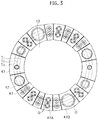
- the lower turret 13 has a circular plate shape as shown in Fig. 3 .
- Die holders 47 are detachably attached to an outer circumferential side on an upper surface of the lower turret 13 by bolts 49 (see Fig. 2 ) along a circumferential direction.
- Different kinds of the dies D are detachably installed in the die holders 47, respectively.
- Three concentric tracks T 1 , T 2 and T 3 are provided in this order from an inner circumference to an outer circumference at attached positions on the die holders 47 of the lower turret 13.
- Each of the dies D in the die holders 47 is associated with any one of the three tracks T1, T2 and T3 and arranged thereon.
- the die holder 47A small-diameter dies D are attached on the inner circumferential track T1 and the outer circumferential track T3, respectively.
- a large-diameter die D is attached on the center track T 2 .
- the dies D1 and D2 aligned in the radial direction correspond to the die D attached to the die holder 47A.
- the upper turret 7 also has a circular plate shape.
- the upper turret 7 includes plural punch holders that are associated with the die holders 47 of the lower turret 13 along the circumferential direction, and the punches P are installed in the punch holders.
- the die holder 47 shown in Fig. 2 corresponds to the die holder 47A shown in Fig. 3 .
- the die holder 47 (47A) includes the die D 1 associated with the inner circumferential track T 1 and the die D 2 associated with the outer circumferential track T3.
- the die holder 47 is fixed to the lower turret 13 by the bolts 49 as explained above.
- the dies D (D 1 and D 2 ) are installed in upper-end openings of cylindrical lifter pipes 51 and 53, respectively.
- the lifter pipe 51 is vertically-movably housed in a through hole 13a provided in the lower turret 13 and a through hole 47a provided in the die holder 47.
- the lifter pipe 53 is vertically-movably housed in a through hole 13b provided in the lower turret 13 and a through hole 47b provided in the die holder 47.
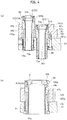
- Each of the lifter pipes 51 and 53 is biased downward to the lower turret 13 by a spring 55 or 57 as shown in Fig. 4 (a) .
- the lifter pipe 51 is moved downward by the spring 55, and the lifter pipe 53 is lifted upward by the lifter 27 (explained in detail later) against an elastic force of the spring 57.
- a lifter pipe 59 is housed in a through hole 13c provided in the lower turret 13 and a through hole 47c provided in the die holder 47 as shown in Fig. 4(b) similarly to the above-explained small-diameter dies D (D 1 and D 2 ), and is biased downward by a spring 61. Note that, in Fig. 4(b) , the lifter pipe 59 is lifted upward by the lifter 27 against an elastic force of the spring 61.
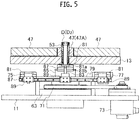
- a trapezoidal screw thread type lifting mechanism is adapted to the lifter 27.
- a cylindrical female thread member 63 on whose inner circumferential surface female threads 63a are formed is fixed to the lower frame 11.
- a cylindrical lift ram (lifting member) 65 that includes, on its lower outer circumferential surface, male threads 65a that meshes with the female threads 63a is rotatably housed in the female thread member 63.
- Fig. 2 shown is a state where the lift ram 65 is at its uppermost position.
- the lift ram 65 lifts up the lifter pipe 53 via an attachment (a die-support member) 67
- an upper end surface of the die D 2 associated with the lifter pipe 53 is lifted up to a path line (a conveying path of the work W) PL.
- a path line a conveying path of the work W
- a rotatable driven ring 69 that rotates together with the lift ram 65 is disposed at an upper end of the female thread member 63.
- the rotatable driven ring 69 is spline-coupled with the lift ram 65 above the male threads 65a. Therefore, the lift ram 65 can rotate integrally with the rotatable driven ring 69 and concurrently move vertically to the rotatable driven ring 69.
- Gears 69a are formed at an outer circumference of the rotatable driven ring 69, and the gears 69a mesh with a toothed belt 71.
- the toothed belt 71 couples the rotatable driven ring 69 with an output shaft of a drive motor 73 attached to the lower frame 11 so as to interlock them.
- the attachment 67 (the die-support member) is disposed between the lift ram 65 and the lower turret 13.
- the attachment 67 shown in Fig. 2 lifts up the die D (D 2 ) on the outer circumferential track T3.
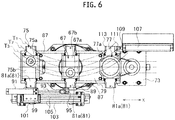
- An attachment 75 (see Fig. 6 and Fig. 7(a) ) for lifting up the die D on the inner circumferential track T1 and an attachment 77 (see Fig. 6 and Fig. 8(a) ) for lifting up the die D on the center track T 2 are provided as other components that constitute the die-support member.
- attachments 67, 75 and 77 can be moved along a lateral direction by an attachment base 79 extended in the lateral direction in Fig. 6 .
- the attachment 67 associating with the die D (D 2 ) on the track T 3 that has been set at the work position is held in a vertical direction by a pair of hooks 81 (see Fig. 2 and Fig. 6 ) together with the lift ram 65.
- Each of both edges of the attachment 67 is held vertically by an upper member 81a and a lower member 81b of the hook 81.
- An inner projection 81b1 of the lower member 81b engages with a bottom surface of a ring-shaped flange 65f provided at an upper end of the lift ram 65, so that the lift ram 65 is held in a vertical direction together with the attachment 67.
- Each of the upper member 81a of the hooks 81 is extended outward, and an upper end of a restriction shaft 83 for restricting rotation of the attachment 67 is coupled with an extended end of the upper member 81a.
- Each lower portion of the restriction shafts 83 is vertically-movably inserted into a guide 85.
- a pair of guide rails 87 is extended on sides of the attachment base 79 (see Fig. 2 and Fig. 6 ).
- a slider 89 is provided at each of the guide rails 87.
- Each of the guides 85 is fixed on a side of each of the sliders 89.
- each of the other attachments 75 and 77 also includes equivalent components to the hooks 81, the restriction shafts 83, the guides 85 and the sliders 89 explained above. Explanations for the components of the attachment 75 and 77 are omitted by adding same numerals as of equivalent components of the attachment 67 to them.
- the attachment 67 for the outer circumferential track T 3 is moved by a cylinder 91 along the attachment base 79. Namely, an end of a piston rod 93 protruded from the cylinder 91 is coupled with the slider 89 via a coupler 95.
- the cylinder 91 is fixed on an attachment plate 99 as shown in Fig. 2 .
- a rod-less cylinder 101 for moving the attachment 75 for the inner circumferential track T 1 is fixed on an external side of a bottom surface of the attachment plate 99.
- an internal side of the attachment plate 99 is coupled with the guide 85 of the attachment 75. Therefore, the rod-less cylinder 101 is coupled with the attachment 75 via the attachment plate 99, the guide 85, the restriction shaft 83 and the hook 81.
- the rod-less cylinder 101 is moved on a base 103 provided in the lower frame 11 along guide rods 105 as shown in Fig. 2 and Fig. 6 . Therefore, the attachment 75 and the attachment 67 are moved along the attachment base 79 by an operation of the rod-less cylinder 101.
- the attachment 77 for the center track T 2 is moved along the attachment base 79 by a cylinder 107 fixed on the lower frame 11.
- a coupler 111 on an end of a piston rod 109 of the cylinder 107 is coupled with the guide 85 of the attachment 77. Therefore, the piston rod 109 is coupled with the attachment 77 via the coupler 111, the guide 85, the restriction shaft 83 and the hook 81.
- Fig. 6 shown is a state where the attachment 67 for the inner circumferential track T3 is set to the work position (the piston rod 93 of the cylinder 91 is extended most).
- the piston rod 93 is retracted most and the rod-less cylinder 101 is moved rightward in Fig. 6 .
- the attachment 75 is set at the work position positioned at the center in Fig. 6 , and the attachment 67 is moved to its waiting position between the attachment 75 and the attachment 77.
- the attachment 67 for the track T 3 includes a ring-shaped protruded portion (die supporter) 67a for supporting the lifter pipe 53 associating with the die D 2 set at the work position, and a flat portion (waiting-die supporter) 67b for supporting the lifter pipe 51 associating with the die D 1 for the track T 1 arranged at an adjacent inside in the radial direction.
- die supporter for supporting the lifter pipe 53 associating with the die D 2 set at the work position
- a flat portion (waiting-die supporter) 67b for supporting the lifter pipe 51 associating with the die D 1 for the track T 1 arranged at an adjacent inside in the radial direction.
- the protruded portion 67a supports the die D2 that is to be used for punching and set at the work position in a state where it is lifted up to the path line PL of the work W, and the flat portion 67b concurrently supports the die D 1 that is to be unused for punching among the dies D (D 1 and D 2 ) and set at the work position at a lower level than the path line PL.
- a through hole 67a1 that communicates a cavity 53a within the lifter pipe 53 located thereon with a cavity 65b within the lift ram 65 located thereunder.
- the cavity 53a, the cavity 65a and the through hole 67a1 constitute a hollow cavity for dropping off punched wastes made upon punching the work W.
- this hollow cavity is suctioned from underneath of the lower frame 11 by a suction device (not shown), so that the punched wastes made upon punching are forcibly ejected outward.
- the attachment 75 for the track T1 includes a ring-shaped protruded portion (die supporter) 75a for supporting the lifter pipe 51 associating with the die D 1 set at the work position, and a flat portion (waiting-die supporter) 75b for supporting the lifter pipe 53 associating with the die D 2 for the track T 3 arranged at an adjacent outside in the radial direction.
- die supporter for supporting the lifter pipe 51 associating with the die D 1 set at the work position
- a flat portion (waiting-die supporter) 75b for supporting the lifter pipe 53 associating with the die D 2 for the track T 3 arranged at an adjacent outside in the radial direction.
- the protruded portion 75a supports the die D1 that is to be used for punching and set at the work position in a state where it is lifted up to the path line PL of the work W, and the flat portion 75b concurrently supports the die D 2 that is to be unused for punching among the dies D (D 1 and D 2 ) and set to the work position at a lower level than the path line PL.
- a through hole 75a1 that communicates a cavity 51a within the lifter pipe 51 located thereon with a cavity 65b within the lift ram 65 located thereunder.
- the cavity 51a, the cavity 65b and the through hole 75a1 constitute a hollow cavity for dropping off punched wastes made upon punching the work W.
- the attachment 77 for the track T 2 includes a ring-shaped protruded portion (die supporter) 77a for supporting the lifter pipe 59 associating with the die D set at the work position.
- the protruded portion 77a supports the die D that is to be used for punching and set at the work position in a state where it is lifted up to the path line PL of the work W.
- a through hole 77a1 that communicates a cavity 59a within the lifter pipe 59 located thereon with a cavity 65b within the lift ram 65 located thereunder.
- the cavity 59a, the cavity 65b and the through hole 77a1 constitute a hollow cavity for dropping off punched wastes made upon punching the work W.
- a lower end of a lifter pipe for this small-diameter die D has an inner diameter almost same as that of the through hole 77a1, and a portion upper from this large-diameter portion of the lifter pipe is formed as a small-diameter portion for supporting the small-diameter die D. Therefore, the lifter pipe for the small-diameter die D can be supported by the protruded portion 77a.
- the upper turret 7 and the lower turret 13 are rotated adequately to set the punch P and the die D needed for punching at a position associating with the striker 23 as shown in Fig. 1 .
- the work W is set at the work position above the lower turret 13 by the alignment unit 29.
- punching by uses of the die D (D 1 ) for the inner circumferential track T 1 will be explained as an example.
- the striker 23 is set by the shifting cylinder 25 so as to be aligned on the track T 1 .
- the attachment 75 for the track T 1 is set at the work position. As explained above, from the state shown in Fig. 6 , the piston rod 93 is retracted most and the rod-less cylinder 101 is moved rightward in Fig. 6 . As a result, the attachment 75 is set at the work position positioned at the center in Fig. 6 , and the attachment 67 is moved to its waiting position between the attachment 75 and the attachment 77.
- the lift ram 65 is located at its lowermost position as shown in Fig. 7(a) .
- the attachment 75 is also located at its lowermost position when the lift ram 65 is located at its lowermost position, and a minor gap is formed between a bottom surface of the attachment 75 and an upper surface of the lift ram 65. Therefore, the attachment 75 can be slid to an above position of the lift ram 65 located at its lowermost position shown in Fig 7(a) .
- the projections 81b1 are inserted into under sides of the flange 65f of the lift ram 65, so that the relative vertical movement between the lift ram 65 and the attachment is restricted. At this moment, the lift ram 65 can rotate relatively to the hooks 81 (the projections 81b1).
- the attachment 75 is also lifted up together with the hooks 81 by lift-up of the lift ram 65.
- the protruded portion 75a of the attachment 75 contacts with the lower end of the lifter pipe 51 and the lifter pipe 51 is lifted up against the elastic force of the spring 55 (see Fig. 4 (a) ), so that the die D 1 at the work position is entered into the opening 31a of the fixed table 31.
- the upper end surface of the die D 1 is lifted up to the path line PL of the work W.
- the flat portion 75b of the attachment 75 contacts with the lower end of the lifter pipe 53 for the track T3 and the lifter pipe 53 is lifted against the elastic force of the spring 57 (see Fig. 4(a) ).
- its lift-up stroke is small by a stepped amount between the upper surface of the protruded portion 75a and the upper surface of the flat portion 75b, so that the upper end surface of the die D 2 is located at a level slightly lower the bottom surface of the fixed table 31.
- the punch P associating with the die D1 is struck by the striker 23 to perform punching.
- the punched wastes are ejected outward as shown by an arrow A in Fig. 7(b) through a punched waste path (the hollow cavity) formed of the cavity 51a, the through hole 75a1 and the cavity 65b by driving the suction device (not shown).
- the flat portion 67b of the attachment 67 contacts with the lower end of the lifter pipe 51 for the die D 1 on the track T 1 , so that the upper end surface of the die D 1 is located at a level slightly lower the bottom surface of the fixed table 31.
- the punch P associating with the die D2 is struck by the striker 23 to perform punching.
- the punched wastes are ejected outward through a punched waste path formed of the cavity 53a, the through hole 67al and the cavity 65b by driving the suction device (not shown).
- the upper opening of the cavity 65b in the lift ram 65 is closed by a portion of the attachment 67 other than the through hole 67a1 (incl. the flat portion 67b). Therefore, the inside of the punched waste path is made almost sealed between the die D2 and the suction device. As a result, the punched wastes can be ejected out efficiently, and scattering of the punched wastes and remaining of the punched wastes due to short of suction force of the suction device can be prevented.
- the protruded portion 77a of the attachment 77 lifts up the lifter pipe 59 to lift the upper end surface of the die D up to the path line PL as shown in Fig. 8(a) and Fig. 8(b) .
- the punch P associating with the die D is struck by the striker 23 to perform punching. Also in this case, the punched wastes are ejected outward through a punched waste path formed of the cavity 59a, the through hole 77a1 and the cavity 65b by driving the suction device (not shown).
- the inside of the punched waste path is made almost sealed between the die D and the suction device, so that the punched wastes can be ejected out efficiently and scattering of the punched wastes and remaining of the punched wastes due to short of suction force of the suction device can be prevented.
- the attachments 67, 75 and 77 are provided with the selectable protruded portions (the die supporters) 67a, 75a and 77a for lifting the die D set at the work position up to the path line PL of the work W.
- the die D when the work W is moved along the path line PL to be set at the work position above the lower turret 13, the die D is made waited at a lower level than the path line PL and the fixed table 31 as shown in Fig. 7(a) and Fig. 8(a) . Therefore, it can be prevented that the bottom surface of the work W moving along the path line PL is damaged due to contacts with the upper end surface of the die D.
- the three attachments 75, 77 and 67 are provided in association with the dies D on the three tracks T1, T2 and T3 provided concentrically so as to be able to move independently between the work position and the waiting position (s) distanced from the work position. Therefore, the plural dies D provided not only along the circumferential direction but also provided along the radial direction can be utilized, so that punching can be performed while preventing damages on the work during upon conveying.
- the attachment 75, 77 or 67 can be easily set at the work position by sliding the attachment 75, 77 or 67 on the slide base 9.
- the attachment 67 (the die-support member) includes the protruded portion (the die supporter) 67a and the flat portion 67b along the radial direction of the lower turret 13, and can move along a tangential direction of the lower turret 13 located at the work position.
- the attachment 75 (the die-support member) includes the protruded portion (the die supporter) 75a and the flat portion 75b along the radial direction of the lower turret 13, and can move along the tangential direction of the lower turret 13 located at the work position.
- the die to be used for punching can be associated with the protruded portion by moving, along the tangential direction, the attachment associating with the die D to be used for punching among the plural dies D provided along the radial direction of the lower turret 13. Therefore, the die D to be used for punching can be lifted up to the path line PL and also the die D to be unused for punching can be located at a lower level than the path line by the flat portion.
- the lift ram 65 and the protruded portions 65a, 75a and 77a of the attachments 67, 75 and 77 include the cavity 65b and the through holes 67a1, 75a1 and 77a1 that become the hollow cavity for dropping off the punched wastes . Therefore, the punched wastes made upon punching drop off through the hollow cavity and then can be ejected outward.
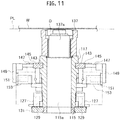
- a die-support member that includes a die supporter 117 and a flat portion (a waiting-die supporter) 119 is provided integrally at an upper portion of a cylindrical lift ram (lifter) 115.
- a drive motor 121 arranged on a side of the lift ram 115, the lift ram 115 is rotated together with the index device 125.
- the lift ram 115 is moved between its upper position ( Fig. 11 ) and its lower position ( Fig. 12 ) by plural vertical cylinders 127 arranged around a lower portion of the rift ram 115.
- Each of the vertical cylinders 127 has a piston rod 129 that can be projected downward.
- Each end (lower end) of the piston rods 129 is coupled with a ring-shaped base 131 fixed to a circumferential lower end of the lift ram 115. Therefore, the piston rods 129 are projected downward from a state shown in Fig. 11 , so that the lift ram 115 is moved downward together with the base 131 as shown in Fig. 12 .
- Fig. 9 shown are the die D 1 for the inner circumferential track T 1 and the die D 2 for the outer circumferential track T 3 , similarly to the first embodiment.
- Fig. 10 shown is the die D for the center track T 2 .
- lifter pipes 133 and 135 to whose upper portions the two dies (D 1 and D 2 ) provided along a radial direction are attached, respectively, are disposed above the lift ram 115.
- a lifter pipe 137 to whose upper potion the die D is attached is disposed.
- Each of these lifter pipes 133, 135 and 137 is biased downward by a spring, and can move vertically to the die holder attached to the lower turret so as to be moved vertically due to a vertical movement of the lift ram 115.
- the two lifter pipes 133 and 135 shown in Fig. 9 are disposed on an upper surface of the ring-shaped die-support member at the upper potion of the lift ram 115, and located at positions distanced by 180° along a circumferential direction with each other.
- the one lifter pipe 137 shown in Fig. 10 is disposed on an upper surface of the die-support member so as to make its center axis coincident with the center axis of the lift ram 115 as shown by a cross sectional view shown in Fig. 11 .
- the lifter pipe 135 for the die D 2 on the track T 3 is disposed on the die supporter 117 of the die-support member.
- the lifter pipe 133 for the die D1 on the track T1 is disposed in the flat portion 119 that is formed by cutting off the die supporter 117.
- the die D 2 on the lifter pipe 135 reaches up to the path line PL of the work by the die-support member 117, and the die D 1 is located at a lower level than the path line PI by the flat portion 119
- a groove 143 is formed on an outer circumferential surface of a lower portion of the rift ram 115 than the die-support member.
- Blocks 145 can move between its forward position ( Fig. 11 ) and its backward position ( Fig. 12 ) in relation to the groove 143.
- the blocks 145 are coupled with upper portions of coupling plates 149 via rods 147, respectively.
- the blocks 145 are moved by stroking piston rods 151 by cylinders 153.
- the lifter pipe 137 (also the lifter pipes 133 and 135 in Fig. 9 are similar) is biased downward by the spring in a state where the lift ram 115 is took down, and the upper end surfaces of the dies D (D 1 and D 2 ) are locates at a lower level than the path line PL.
- the work W is set at the work position above the lower turret in the same manner as the first embodiment.
- the lower turret is set at the work position and the dies D 1 and D 2 are located above the lift ram 115 in the state where the lift ram 115 is moved down. Then, the lift ram 115 is rotated via the index device 125 due to driving the drive motor 121, so that the flat portion 119 is set at a position associating with the track T 1 as shown in Fig. 9 .
- the blocks 145 are moved forward and entered into the groove 143 on the lift ram 115 to restrict a vertical movement of the lift ram 115 (see Fig. 11 ) .
- the punch P associating with the die D 2 is struck by the striker 23 to perform punching.
- punched wastes of the work W are ejected outward through a punched waste path (a hollow cavity) formed of a cavity in the lifter pipe 135 and a cavity 115a in the lift ram 115.
- the flat portion 119 is set at a position associating with the track T3 in the state where the lift ram 115 is moved down, and operations same as the above operations are done. Namely, in this case, when the lift ram 115 is lifted up, the lifter pipe 135 for the die D 2 to be unused for punching enters into the flat portion 119 and the lifter pipe 133 for the die D 1 to be used for punching contacts with the die supporter 117, contrary to the state shown in Fig. 9 . As a result, only the die D 1 on the lifter pipe 133 is lifted up to the path line PL.
- the blocks 145 are moved forward and entered into the groove 143 on the lift ram 115 to restrict a vertical movement of the lift ram 115 (see Fig. 11 and Fig. 12 ).
- the punch P associating with the die D 1 is struck by the striker 23 to perform punching.
- punched wastes of the work W are ejected outward through a punched waste path (a hollow cavity) formed of a cavity in the lifter pipe 133 and the cavity 115a in the lift ram 115.
- the lift ram 115 is lifted up from a state shown in Fig. 12 , and the lift ram 115 contacts with the lifter pipe 137. As a result, the die D on the lifter pipe 137 is lifted up to the path line PL. Then, the blocks 145 are moved forward and entered into the groove 143 on the lift ram 115 to restrict a vertical movement of the lift ram 115 as shown in Fig. 11 . In this state, the punch P associating with the die D is struck by the striker 23 to perform punching.
- punched wastes of the work W are ejected outward through a punched waste path (a hollow cavity) formed of a cavity 137a in the lifter pipe 137 and the cavity 115a in the lift ram 115.
- An inner diameter of the lifter pipe 137 is almost equivalent to an inner diameter of the lift ram 115, so that the inside of the punched waste path formed of the cavities 137a and 115a is made almost sealed between the die D and the suction device.
- the punched wastes can be ejected out efficiently, and scattering of the punched wastes and remaining of the punched wastes due to short of suction force of the suction device can be prevented.
- the dies D (D 1 and D 2 ) are made waited at a lower level than the path line PL. Therefore, it can be prevented that the bottom surface of the work W moving along the path line PL is damaged due to contacts with the upper end surface of the dies D (D 1 and D 2 ).
- the die-support member is integrated with the upper portion of the rift ram (lifter) 115 and provided rotatably together with the lift ram 115. Further, the die supporter 117 and the flat portion 119 on the die-support member are disposed along a rotational direction of the die-support member.
- the sliding stopper 155 is provided also in the above-explained first and second embodiments. In addition, it is also provided in after-explained third to sixth embodiments. By utilizing the sliding stopper 155, it can be confirmed that the die(s) (D 1 and D 2 ) that was lifted up to the path line PL ( Fig. 7 (b) ) has been reset to its waiting position ( Fig. 7 (a) ) after completion of punching.
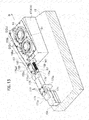
- the sliding stopper 155 is slidably provided on the die holder 47 (47A) at a side edge of the die(s) D along the radial direction of the lower turret 13.
- the sliding stopper 155 is covered by a stopper holder 157, so that its vertical displacement is restricted. Namely, the sliding stopper 155 slides along the radial direction of the lower turret 13 within a gap between an upper surface of the die holder 47 (47A) and the stopper holder 157.
- Stopper tabs 155a and 155b are projected from a side edge of the sliding stopper 155 towards the dies (D 1 and D 2 ), respectively.
- Fig. 13 shows a locked state where the sliding stopper 155 is slid outward (in a direction indicated by an arrow B in Fig. 13 ) along the radial direction of the lower turret 13 and the stopper tabs 155a and 155b are engaged with upper circumferential edges of the lifter pipes 51 and 53 for the dies D 1 and D 2 , respectively
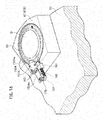
- Fig. 14 and Fig. 15 show an unlocked state where the sliding stopper 155 is slid inward along the radial direction of the lower turret 13 by driving the stopper drive cylinder (restriction canceller) 159 and restriction of the lifter pipes 51 and 53 by the stopper tabs 155a and 155b is cancelled.
- the stopper drive cylinder 159 in the present embodiment is an air cylinder. Therefore, in the state shown in Fig. 14 and Fig. 15 , the lifter pipes 51 and 53 can be lifted up when lifting up the dies D 1 and D 2 for punching of the work W.
- the sliding stopper (lift restrictor) 155 cab be slide between its lift restricting position where the stopper tabs 155a and 155b contact with the upper surfaces of the dies D 1 and D 2 and its lift allowing position that deviates from the lift restricting position.
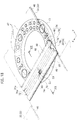
- Fig. 15 shows a state where the stopper holder 157 that is shown in Fig. 13 and Fig. 14 is not shown.
- Fig. 15 shows a state where the sliding stopper 155 is located at the lift allowing position but the die D 1 or D2 is not lifted up.
- the sliding stopper 155 includes an extended base 155c extending inward along the radial direction of the lower turret 13.
- a movable block 161 is fixed on a bottom surface of the sliding stopper 155 by screws 163.
- the movable block 161 is projected from the extended base 155c in a direction perpendicular to the radial direction of the lower turret 13 and coupled with a guide pin 165 (see Fig. 14 and Fig. 15 ), so that it can move in an axial direction of the guide pin 165.
- the guide pin 165 is extended inward along the radial direction from an inner side surface of the die holder 47A in the radial direction.
- a spring seat 167 is formed at an end of the guide pin 165.
- a lock spring (elastic member) 169 is provided between the spring seat 167 and the movable block 161.
- the movable block 161 contacts with the die holder 47A by being pushed by the lock spring 169.
- the sliding stopper 155 is slid to its identical direction and located at the lift restricting position, so that the dies D 1 and D 2 are in the locked state.
- the sliding stopper 155 is slid against the lock spring 169 by driving of the stopper drive cylinder 159, so that the dies D 1 and D 2 are in the unlocked state.
- a short sliding stopper 155A shown in Fig. 16 is used instead of the long sliding stopper 155 shown in Fig. 13 to Fig. 15 .
- the short sliding stopper 155A includes an extended base 155Ac extending inward along the radial direction of the lower turret 13 and a stopper tab 155Aa provided at an end thereof.
- a short stopper holder stopper 157A shown in Fig. 16 is used instead of the long stopper holder 157 shown in Fig. 13 and Fig. 14 .
- the stopper tab 155Aa extended out from the stopper holder 157A engages with an upper circumferential edge of the lifter pipe 59 for the die D.
- the stopper drive cylinder 159 for driving the sliding stopper 155 (the sliding stopper 155A) from the locked state shown in Fig. 13 ( Fig. 16 ) to the unlocked state shown in Fig. 14 is attached to a bottom surface of the fixed table 31 at the work position (on a right side of the die holder 47 shown in Fig. 2 ). Namely, the stopper drive cylinder 159 is separated from the lower turret 13.
- the single stopper drive cylinder 159 is provided so as to be shared by all of the die holders 47 and can unlock the sliding stopper 155 (155A) on the die holder 47 located at the work position.
- the stopper drive cylinder 159 includes a piston rod 171 projected toward the die holder 47 and a sliding bracket 173 as shown in Fig. 13 and Fig. 14 .
- the sliding bracket 173 includes a slider 173a capable of sliding along a projecting direction of the piston rod 171 and a tab 173b extended downward from an end of the slider 173a. An end of the piston rod 171 is coupled with the tab 173b.
- a coupling plate 175 is fixed on an upper surface of the slider 173a by screws 177.
- a depression 175a is formed at an end of the coupling plate 175.
- Sidewalls 175a1 and 175a2 are provided on both sides of the depression 175a in the radial direction of the lower turret 13, respectively. Both sides of the depression 175 in a circumferential direction perpendicular to the radial direction are opened.
- a roller 179 that enters into the depression 175a is provided from a bottom surface of the extended base 155c of the sliding stopper 155.
- the die D (D 1 ) is took down together with the lifter pipe 51 from the state shown in Fig. 14 and then the piston rod 171 is moved forward by driving the stopper drive cylinder 159, so that the stopper tabs 155a and 155b of the sliding stopper 155 contact with the dies D (D 1 and D 2 ⁇ to form the locked state (see Fig. 13 ).
- the movable block 161 is contacted with the die holder 47 (47A) by the lock spring 169 under the locked state, so that the locked state of the sliding stopper 155 is kept.
- the lift ram 65 shown in Fig. 2 is took down when the lower turret 13 is rotated, and the die(s) D is located at a lower level than the fixed table 31. Then, the die holder 47 (47A) is set at the work position by rotating the lower turret 13, so that the roller 179 enters into the inside of the depression 175a as shown in Fig. 13 .
- the piston rod 171 is moved backward by driving the stopper drive cylinder 159, so that the sliding stopper 155 is pulled inward as shown in Fig. 15 and then restriction of the lifter pipes 51 and 53 by the stopper tabs 155a and 155b is released to form the unlock state.
- the striker 23 is moved so as to be located above the die D 2 and the punch P associating with the die D 2 is struck by the striker 23 to perform punching.
- the lift ram 65 is moved downward and the lifter pipes 51 and 53 are moved downward together with the dies D 1 and D 2 , so that the upper surfaces of the dies D1 and D2 is made flat to the upper surface of the die holder 47A.
- the stopper drive cylinder 159 is driven forward, so that the lifter pipes 51 and 53 are made restricted by the stopper tabs 155a and 155b to form the locked state as shown in Fig. 13 .
- the locked state of the sliding stopper 155 can be detected through an operated position of the stopper drive cylinder 159. Alternatively, it may be detected by additionally providing a sensor for directly detecting the sliding stopper 155. According to this, it can be confirmed that the stopper tabs 155a and 155b engage with the lifter pipes 51 and 53 and the lifter pipes 51 and 53 are located at their adequate waiting positions in the die holder 47A.
- the lifter pipe 51,53 and 59 are provided with the through holes 51a, 53a and 59a shown in Fig. 4(a) and Fig. 4(b) , respectively.
- An ejector pipe (s) 181, 183 and 185 is disposed in the through hole(s) 51a, 53a and 59a below the die D (D 1 , D 2 and D) .
- the ejector pipe 181, 183 or 185 is pressed upward by a pressing member (not shown) from beneath at an exchange position that locates at a position rotationally shifted from the work position by a predetermined rotational angle, so that the die D (D 1 , D 2 or D) is upwardly protruded out from the lifter pipe 51a, 53a or 59a.
- the die D (D 1 , D 2 or D) can be removed away by a gripper of an automatic tool changer (ATC: not shown) in a state where it is upwardly protruded.
- ATC automatic tool changer
- an outer diameter of the lower turret 13 is made larger than an outer diameter of the upper turret 7 and rotational centers of the turrets 13 and 7 are made eccentric to each other s that the gripper can grip the die D. According to this, the die exchange position of the lower turret 13 can be shifted outward in a plan view of the upper turret 7 (Japanese Patent Application Laid-Open No. 2000-140957 ).
- the ejector pipe 181, 183 or 185 includes a cylindrical portion 181a, 183a or 185a and a flange 181b, 183b or 185b formed at an upper end of the cylindrical portion 181a, 183a or 185a.
- An outer diameter of the flange 181b, 183b or 185b is made almost equivalent-to or slightly smaller-than an outer diameter of the die D (D 1 , D 2 or D) .
- a die housing hole 51b, 53b or 59b is formed at an upper end of the through hole 51a, 53a or 59a of the lifter pipe 51, 53 or 59.
- the flange 181b, 183b or 185b is disposed below the die housing hole 51b, 53b or 59b, and the die D (D 1 , D 2 or D) is disposed in the die housing hole 51b, 53b or 59b above the flange 181b, 183b or 185b.
- the upper surface of the die D (D 1 , D 2 or D) is set at a level almost equivalent-to or slightly higher-than an upper end edge of the lifter pipe 51, 53 or 59.
- the flange 181b, 183b or 185b is set on a stepped portion 51c, 53c and 59c at an lower end of the die housing hole 51b, 53b or 59b, and the die D 1 , D 2 or D is laid on the flange 181b, 183b or 185b.
- the flange 181b, 183b or 185b lifts up the die D 1 , D 2 or D.
- the D 1 , D 2 or D is upwardly protruded out from the lifter pipe 51a, 53a or 59a.
- the die D 1 , D 2 or D can be removed away by the gripper of the automatic tool changer in the protruded state.
- this protruded state is a state where the die D 2 or D on the lifter pipes 53 or 59 is used in punching.
- the state shown in Fig. 4(a) or Fig. 4(b) is not a state for exchanging the die D 2 or D.
- the ejector pipe(s) is provided for the dies D other than the above-mentioned dies D 1 , D 2 and D.
- the vertical movement of the lifter pipe 51, 53 or 59 is restricted by the sliding stopper 155 (155A) in a state where the die holder 47 is located at a moving position between the work position and the die exchange position.
- the die D2 can be surely lifted up by restricting upward movement of the lifter pipe 51 by the sliding stopper 155. As a result, exchange operation of the dies D 1 , D 2 and D can be done efficiently.
- the dies D 1 and D 2 are installed in upper openings of the lifter pipes 51 and 53, respectively, as shown in Fig. 4(a) , and the die D is installed in an upper opening of the lifter pipe 59 as shown in Fig. 4(b) .
- the dies D (D 1 and D 2 ) are attached on upper portion of the lifter pipes 133 and 135, respectively, as shown in Fig. 9 , and the die D is attached on an upper portion of the lifter pipe 137 as shown in Fig. 10 .
- the "die” includes the die D (D 1 , D 2 or D) as a die main body and the lifter pipe (die-base member) 51, 53, 59, 133, 135 or 137 that has the die D (D 1 , D 2 or D) at its upper portion.
- the sliding stopper 155 can move between the lift restricting position and the lift allowing position explained above.
- the plural dies D are provided at the rotatable lower turret 13 along its circumferential direction, and the plural punches P are provided on the rotatable upper turret 7 along its circumferential direction, and the sliding stopper 155 (155A) is provided at each of the dies D, and the sliding stopper 155 (155A) is held at its lift restricting position by the lock spring 169, and the single stopper drive cylinder 159 for moving, against the lock spring 169, the sliding stopper 155 associating with the die D set at the work position is provided near the work position.
- the sliding stopper 155 (155A) can be unlocked at the work position by a simple configuration.
- Fig. 17 shows an entire of a turret punch press according to a third embodiment. Since the punch press according to the present embodiment has almost same configurations as those of the punch press according to the above-explained first embodiment, configurations different from those in the first embodiment will be explained in detail hereinafter. Explanations for configurations identical or similar to those in the first embodiment are omitted by adding identical reference numerals thereto.
- the worktable 33 having the brushes 46 (see Fig. 19 ) on its surface is configured of the fixed table (the work support cover) 31 and the movable tables 32 (see Fig. 18 ).
- a brush-mounted shutter (a cover member) 72 is provided in the opening 31a formed on the fixed table 31.
- the brush-mounted shutter 72 has four shutter elements (cover member elements) 74 on each of both sides in the X-axis direction with the work position located at a middle of the both sides, i.e. has total eight.
- Each of the shutter elements 74 can independently slide relatively to a brush base 76 provided below them.
- the brushes 46 are mounted also on each base plate 78 of the shutter elements 74.
- the brush base 76 is formed as a frame having a rectangular shape whose outline is almost fit to the opening 31a.
- a rectangular hole 76a is formed at an almost center of the brush base 76.
- the eight shutter elements 74 are arranged so as to form the hole 76a.
- Fixed divided tables 80 are provided on both sides of the eight shutter elements 74 in the Y-axis direction, respectively.
- the divided tables 80 are fixed on long sides of the brush base 76 formed as a frame.
- the brushes 46 are mounted also on the divided tables 80.
- ends of the four shutter elements 74 extended along the X-axis direction with associated with the lifted-up die D 2 are contacted with (or made close to) an outer circumferential surface of the lifter pipe 53 that holds the die D 2 .
- the remaining four shutter elements 74 are moved toward the work position, so that opposite ends in each of two pairs of the shutter elements 74 located oppositely are almost contacted with each other. In this state, punching by use of the die D 2 can be performed.
- a first air cylinder 84 is attached on each of the shutter elements 74 (the base plates 78) via a cylinder bracket 82.
- Each piston rod 86 of the first air cylinders 84 projected toward a side opposite to the work position as shown in Fig. 24(a) and Fig. 24(b) .
- Ends of the piston rods 86 are linked to a link bracket 88.
- the link bracket 88 links the first air cylinders 84 to an after-explained second air cylinder 90.
- Fig. 28(a) and Fig. 24(b) show a state where all of the four air cylinders 84 are located at identical positions.
- the link bracket 88 includes a first link tab 88a, an intermediate plate 88b and a second link tab 88c as shown in Fig. 24 (a) .
- the first link tab 88a is extended upward from an end of the intermediate plate 88b and connected with the piston rod 86.
- the second link tab 88c is extended downward from another end of the intermediate plate 88b and connected with a piston rod 92 of an after-explained second air cylinder 92.
- the second air cylinder 92 is fixed on a bottom surface of a fixed bracket 94.
- the fixed bracket 94 includes a fixture tab 94a, a vertical wall 94b and an attachment tab 94c.
- the fixture tab 94a is parallel to the intermediate plate 88b of the link bracket 88 and located beneath the intermediate plate 88b.
- the vertical wall 94b is extended upward from an end opposite to the piston rod 92 in the fixture tab 94a.
- the attachment tab 94c is curved inward from an upper end of the vertical wall 94b and attached to a bottom surface of the short side 76c of the brush base 76.
- the four shutter elements 74 are slid in the X-axis direction (a lateral direction in Fig. 24 (a) and Fig. 24 (b) ) via the link bracket 88 and the first air cylinders 84. Further, when first air cylinders 84 are driven, the shutter elements 74 are independently slid in the X-axis direction via the cylinder brackets 82.
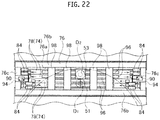
- a slide rail 96 is attached to a bottom surface of the base plate 78 of each of the shutter elements 74 as shown in Fig. 22 .
- bridge members 98 for bridging a pair of the long sides 76b are provided on a bottom surface of the brush base 76 so as to avoid the work position.
- Guide nuts 100 for guiding the slide rails 96 are fixed on each of the bridge members 98.
- the shutter elements 74 slide in the X-axis direction (a direction perpendicular to a drawing plane in Fig.23 ) while the slide rails 96 are guided by the guide nuts 100.
- FIG. 23 and Fig. 24 associates with a right portion in Fig. 21 and Fig. 22 , and similar symmetrical structure is constructed at a left portion.
- support structure for the brush-mounted shutter 72 is not shown in Fig. 20
- support posts 102 is mounted on the lower frame 11 and the brush base 76 is supported via arms 102a that are provided at upper ends of the support posts 102 and extended horizontally in the support structure as simply shown in Fig. 17 .
- Fig. 18 shows a state for punching by the die D 2 on the outer circumferential track (T 3 ) of the lower turret 13.
- the die D2 is lifted up to the path line PL. Therefore, the ends of the four shutter elements 74 associating with the die D 2 are almost contacted with (or made close to) the outer circumferential surface of the lifter pipe 53 that holds the die D2. Namely, the ends of the shutter elements 74 opposing to each other are distanced so as to form a gap having a width almost equivalent to a diameter of the lifter pipe 53.
- the second air cylinders 90 are extended and the four first air cylinders 84 associating with the die D1 are extended as shown in Fig. 22 .
- the four first air cylinders 84 associating with the die D 2 are shortened. Note that, when the first or second air cylinder 84 or 90 is extended, the piston rod 86 or 92 is projected. When the first or second air cylinder 84 or 90 is shortened, the piston rod 86 or 92 is retracted.
- the lift ram 65 When the work has been set at the work position, the lift ram 65 is lifted up.
- the attachment 67 is also lifted up by lifting-up of the lift ram 65.
- the protruded portion 67a of the attachment 67 contacts with the lower end of the lifter pipe 53, so that the die D 2 and the lifter pope 53 at the work position are entered into the gap (the square opening in Fig. 22 ) between the ends of the shutter elements 74 distanced with each other as shown in Fig. 18 .
- the upper end of the die D 2 is coincident with the path line PL as shown in Fig. 18 .
- the punch P associating with the die D 2 is struck by the striker 23 and thereby high quality and stable punching can be performed.
- the die D 2 is took down together with the lifter pipe 53.
- the second air cylinders 90 are extended and the four first air cylinders 84 associating with the die D 2 are extended as shown in Fig. 25 (b) .
- the four first air cylinders 84 associating with the die D 1 are shortened.
- the attachment 75 is used in order to lift up the die D 1 (see Fig.7(b) ) .
- Processes for conveying the work W and punching are similar to those in the case shown by Fig. 18 .
- an entering area (a square opening) for the lifter pipe 51 is formed at the work position as shown in Fig. 25 (b) .
- the work W is curved so as to be convex toward the fixed table 31 (downward)
- contacts between the work W and the die D 1 can be prevented effectively because the opening area is made narrow in conformity to a size of the die D 1 to be used.
- operations for aligning the work W to the work position can become ease and damages on surfaces of the work W can be prevented.
- the second air cylinders 90 are extended and the four first air cylinders 84 associating with the die D 3 are shortened as shown in Fig. 26 (b) . Concurrently, the remaining four first air cylinders 84 are extended.
- an attachment for the die D 3 is used in order to lift up the die D 3 instead of the attachment 67 shown in Fig. 20 .
- Processes for conveying the work W and punching are similar to those in the case shown by Fig. 18 .
- an entering area (a square opening) for the lifter pipe 52 is formed at the work position as shown in Fig. 26 (b) .
- the work W is curved so as to be convex toward the fixed table 31 (downward)
- contacts between the work W and the die D 3 can be prevented effectively because the opening area is made narrow in conformity to a size of the die D 3 to be used.
- operations for aligning the work W to the work position can become ease and damages on surfaces of the work W can be prevented.
- the second air cylinders 90 are shortened and all of the first air cylinders 84 are also shortened as shown in Fig. 27 (b) .
- the attachment 77 is used in order to lift up the die D 1 (see Fig.8(b) ).
- the attachment for the die D 3 and the attachment 77 for the die D 4 may be integrated because the die D 3 and the die D 4 are similarly positioned on the center track.
- the lifter pipe 52 for the die D 3 is configured so that a lower end inner diameter of the lifter pipe 52 is made equivalent to an inner diameter of the attachment 77 for the die D 4 and an upper end inner diameter of the die D 3 is made equivalent to an inner diameter of the die D 3 .
- Processes for conveying the work W and punching are similar to those in the case shown by Fig. 18 .
- an entering area (a square opening) for the lifter pipe 59 is formed at the work position as shown in Fig. 27 (b) .
- the work W is curved so as to be convex toward the fixed table 31 (downward)
- contacts between the work W and the die D 4 can be prevented effectively because the opening area is made narrow in conformity to a size of the die D 4 to be used.
- operations for aligning the work W to the work position can become ease and damages on surfaces of the work W can be prevented.
- Fig. 28 (a) and Fig. 28 (b) show the brush-mounted shutter 72 in a case where punching is not performed by the die D, for example, laser processing is performed.
- the ends of the oppositely-located shutter elements 74 are almost contacted with each other. Namely, an area at the work position is closed so that the die (s) D can't enter thereto.
- the shutter elements 74 can be slid in two steps by the first and second air cylinders 84 and 90 in the present embodiment.
- the shutter elements 74 can be set to three positions by being slid in two steps, a position where the ends thereof are substantially contacted with the lifter pipe 51, 53 or 52 for the small-diameter die D 1 , D 2 or D 3 ( Fig. 25(a) . Fig. 18 or Fig. 26(a) ), a position where the ends thereof are substantially contacted with the lifter pipe 59 for the large-diameter die D 4 ( Fig. 27 (a) ), and a position where the ends thereof are substantially contacted with each other ( Fig. 28 (a) ).
- the brush-mounted shutter 72 can be applied to a lifter pipe that has a different diameter from that of the lifter pipe 51, 53, 52 or 59 by adequately adjusting operational strokes of the first and second air cylinders 84 and 90.
- the opening 31a may be closed as shown in Fig. 28(a) while the work W is conveyed.
- the shutter elements 74 are set in the state shown in Fig. 18 , Fiq. 25(a).
- Fig. 26(a) or Fig. 27(a) According to this, contacts between the work W and the die(s) D can be prevented more securely.
- the shutter element 104 has the same length along the X-axis direction as that of the shutter element 74, but has a width along the Y-axis direction almost as twice as that of the shutter element 74.
- a slide mechanism for the shutter elements 104 is configured of four first air cylinders (84) for sliding the shutter elements 104 in the X-axis direction and two second air cylinders (90) each for sliding, on one side, all the first air cylinder (84) in the X-axis direction, similarly to the third embodiment.
- the ends of the two shutter elements 104 associating the die D 2 are almost contacted with (or made close to) the outer circumferential surface of the lifter pipe 53 that holds the die D 2 as shown in Fig. 29 .
- the ends of the oppositely-located shutter elements 104 in the X-axis direction are distanced to each other so as to form a gap having a width almost equivalent to a diameter of the lifter pipe 53.
- the second air cylinders (90) are extended and the two first air cylinders (84) associating with the die D 1 are extended.
- the two first air cylinders (84) associating with the die D 2 are shortened.
- the ends of the two shutter elements 104 associating with the die D 1 are almost contacted with (or made close to) the outer circumferential surface of the lifter pipe 51 that holds the die D 1 as shown in Fig. 30 .
- the ends of the oppositely-located shutter elements 104 in the X-axis direction are distanced to each other so as to form a gap having a width almost equivalent to a diameter of the lifter pipe 51.
- the second air cylinders (90) are extended and the two first air cylinders (84) associating with the die D 2 are extended. Concurrently, the two first air cylinders (84) associating with the die D 1 are shortened.
- the second air cylinders (90) are extended and all of the first air cylinders (84) are shortened.
- the ends of all of the shutter elements 104 associating the die D 4 are almost contacted with (or made close to) the outer circumferential surface of the lifter pipe 59 that holds the die D 4 as shown in Fig. 32 .
- the ends of the oppositely-located shutter elements 104 in the X-axis direction are distanced to each other so as to form a gap having a width almost equivalent to a diameter of the lifter pipe 59.
- the second air cylinders (90) are shortened and all of the first air cylinders (84) are shortened.
- the present embodiment can be also applied to a case where punching is not performed by the die D, for example, laser processing is performed, similarly to Fig. 28(a) and Fig. 28(b) .
- the ends of the oppositely-located shutter elements 104 are almost contacted with (or made close to) each other and an area at the work position is closed so that the die(s) D can't enter thereto.
- a narrow opening is formed as an entering area for the die D to be used at the work position, or the entering area is closed.
- the shutter element 106 has the same length along the X-axis direction as that of the shutter element 74, but has a width along the Y-axis direction almost as four times as that of the shutter element 74.
- corner tabs 106a each having a triangular shape are extended from width-direction (Y-axis direction) side edges of ends of the shutter elements 106 oppositely-located to each other.
- a slide mechanism for the shutter elements 106 is configured of second air cylinders (90) for sliding the shutter elements 106 in the X-axis direction.
- piston rods (92) of the second air cylinders (90) are fixed to brackets provided on bottom surfaces of the base plates 78 of the shutter elements 106, respectively.
- the second air cylinders (90) are fixed on bottom surface of the brush base 76 via fixed brackets (94), respectively.
- ends of the shutter elements 106 are almost contacted with (or made close to) the outer circumferential surface of the lifter pipe 53 that holds the die D 2 as shown in Fig. 33 .
- ends of the oppositely-located shutter elements 106 in the X-axis direction are distanced to each other so as to form a gap having a width almost equivalent to a diameter of the lifter pipe 53.
- the second air cylinders (90) are extended.
- an entering area for the die D 1 is not closed but opened, and its opened area size becomes larger than that in the case shown in Fig. 18 or Fig. 29(a) .
- the opened area is made as narrow as possible by the corner tabs 106a.
- the ends of the shutter elements 106 associating with the die D 1 are almost contacted with (or made close to) the outer circumferential surface of the lifter pipe 51 that holds the die D 1 as shown in Fig. 34 .
- the ends of the oppositely-located shutter elements 106 in the X-axis direction are distanced to each other so as to form a gap having a width almost equivalent to a diameter of the lifter pipe 51.
- the second air cylinders (90) are extended.
- an entering area for the die D 2 is not closed but opened, and its opened area size becomes larger than that in the case shown in Fig. 25 (a) or Fig. 30(a) .
- the opened area is made as narrow as possible by the corner tabs 106a.
- the ends of the shutter elements 106 are almost contacted with (or made close to) the outer circumferential surface of the lifter pipe 52 that holds the die D 3 as shown in Fig. 35 .
- the ends of the oppositely-located shutter elements 106 in the X-axis direction are distanced to each other so as to form a gap having a width almost equivalent to a diameter of the lifter pipe 52.
- the second air cylinders (90) are extended.
- both side areas of the die D 3 are not closed but opened, and its opened area size becomes larger than that in the case shown in Fig. 26 .
- the opened area is made as narrow as possible by the corner tabs 106a.
- the ends of the shutter elements 106 are almost contacted with (or made close to) the outer circumferential surface of the lifter pipe 59 that holds the die D 4 as shown in Fig. 36 .
- the ends of the oppositely-located shutter elements 106 in the X-axis direction are distanced to each other so as to form a gap having a width almost equivalent to a diameter of the lifter pipe 59.
- the second air cylinders (90) are shortened.
- the opened area is partially closed by the corner tabs 106a, so that the opened area is made narrower than that in the case shown in Fig. 27 (a) or Fig. 32 .
- the shutter elements 106 can be slid in a single step by the second air cylinders (90) in the present embodiment.
- the shutter elements 106 can be set to two positions by being slid in a single step, a position where the ends thereof are substantially contacted with the lifter pipe 51, 53 or 52 for the small-diameter die D 1 , D 2 or D 3 ( Fig. 34, Fig. 33 or Fig. 35 ), and a position where the ends thereof are substantially contacted with the lifter pipe 59 for the large-diameter die D 4 ( Fig. 36 ).
- the present embodiment can be also applied to a case where punching is not performed by the die D, for example, laser processing is performed, by sliding the shutter elements 106 closer to each other to contact the corner tabs 106 with each other.
- the present embodiment can be also applied to a lifter pipe that has a different diameter from that of the lifter pipe 51, 53, 52 or 59 by adequately adjusting operational strokes of the second air cylinders (90).
- Fig. 37 shows a case where punching is to be performed by the small-diameter die D 3 on the center track.
- Each width of the shutter elements 108 along the Y-axis direction is almost identical to a diameter of the lifter pipe 52 that holds the die D 3 , and each width of the shutter elements 110 along the Y-axis direction is almost half the width of the shutter elements 108 and almost identical to the width of the shutter elements 74 along the Y-axis direction in the third embodiments.
- a slide mechanism for the shutter elements 108 and 110 is configured of six first air cylinders (84) for sliding the shutter elements 108 and 110 in the X-axis direction and two second air cylinders (90) each for sliding, on one side, all the first air cylinder (84) in the X-axis direction, similarly to the third embodiment.
- the ends of all the shutter elements 118 and 110 are almost contacted with (or made close to) the outer circumferential surface of the lifter pipe 53 that holds the die D 2 as shown in Fig. 38 .
- the ends of the oppositely-located shutter elements 108 and 110 in the X-axis direction are distanced to each other so as to form a gap having a width almost equivalent to a diameter of the lifter pipe 53.
- the second air cylinders (90) are extended and all the first air cylinders (84) are shortened.
- the ends of the two shutter elements 110 associating with the die D 1 to be unused may be almost contacted with each other. According to this, the opened area can be made narrower.
- the ends of all the shutter elements 108 and 110 are almost contacted with (or made close to) the outer circumferential surface of the lifter pipe 51 that holds the die D1 as shown in Fig. 39 .
- the ends of the oppositely-located shutter elements 108 and 110 in the X-axis direction are distanced to each other so as to form a gap having a width almost equivalent to a diameter of the lifter pipe 51.
- the second air cylinders (90) are extended and all the first air cylinders (84) are shortened.
- the ends of the two shutter elements 110 associating with the die D 2 to be unused may be almost contacted with each other. According to this, the opened area can be made narrower.
- the ends of all of the shutter elements 108 and 110 are almost contacted with (or made close to) the outer circumferential surface of the lifter pipe 59 that holds the die D 4 as shown in Fig. 40 .
- the ends of the oppositely-located shutter elements 108 and 110 in the X-axis direction are distanced to each other so as to form a gap having a width almost equivalent to a diameter of the lifter pipe 59.
- the second air cylinders (90) are shortened and all the first air cylinders (84) are also shortened.
- the present embodiment can be also applied to a case where punching is not performed by the die D, for example, laser processing is performed, similarly to Fig. 28(a) and Fig. 28(b) .
- the ends of the oppositely-located shutter elements 108 and 110 are almost contacted with (or made close to) each other and an area at. the work position is closed so that the die(s) D can't enter thereto.
- the second air cylinders (90) are extended and the first air cylinders (84) are also extended.
- the shutter elements 108 and 110 can be slid in two steps by the first and second air cylinders (84 and 90) in the present embodiment.
- the shutter elements 108 and 110 can be set three positions by being slid in two steps, a position where the ends thereof are substantially contacted with the lifter pipe 51, 53 or 52 for the small-diameter die D 1 , D 2 or D 3 ( Fig. 39 , Fig. 38 or Fig. 37 ), a position where the ends thereof are substantially contacted with the lifter pipe 59 for the large-diameter die D 4 ( Fig. 40 ), and a position where the ends thereof are substantially contacted with each other (not shown).
- At least one pair of the shutter elements (the cover member elements) 74, 104, 106, 108 or 110 is provided on both sides of the entering area of the die(s) D within the opening 31a so as to be capable of being made distanced/closed to each other. Therefore, the pair of the shutter elements can be set at a position associating with the die D to be used easily and quickly by being shifted symmetrically with each other.
Landscapes
- Engineering & Computer Science (AREA)
- Mechanical Engineering (AREA)
- Punching Or Piercing (AREA)
Claims (12)
- Eine Revolverstanzpresse, die einen Rahmen (1, 5, 11), einen unteren Revolver (13), der mit einer Vielzahl von Matrizen (D, D1, D2) bestückt ist, und einen oberen Revolver (7) beinhaltet, der mit einer Vielzahl von Stempeln (P) bestückt ist, und ein Erzeugnis (W) durch einen Ausgewählten von der Vielzahl von Stempeln (P) und einer Ausgewählten von der Vielzahl von Matrizen (D, D1, D2) stanzt, wobei die Revolverstanzpresse (1) umfasst:einen Anheber (27, 115) zum Anheben der Matratze (D, D1, D2), um an der Arbeitsposition bis zu einer Pfadlinie (PL) des Erzeugnisses (W) gestellt zu werden; gekennzeichnet durch eine Vielzahl von Matrizenstützelementen (67, 75, 77, 117, 119), die an dem Rahmen (11) entlang einer tangentialen Richtung des drehbaren unteren Revolvers (13) zu der Arbeitsposition an dem Anheber (27, 115) beweglich vorgesehen sind; undeine Vielzahl von Matrizenträgern (67a, 75a, 77a, 117), die jeweils an der Vielzahl von Matrizenstützelementen (67, 75, 77, 117, 119) vorgesehen sind, um eine Ausgewählte von der Vielzahl Matrizen (D, D1, D2) an der Arbeitsposition anzuheben,die Revolverstanzpresse ist konfiguriert, dass die Vielzahl von Matrizen (D, D1, D2) an der Arbeitsposition positioniert werden, indem der untere Revolver (13) rotiert wird, und die Vielzahl von Matrizenstützelementen (67, 75, 77, 117, 119) entlang der tangentialen Richtung des drehbaren unteren Revolvers (13) zu der Arbeitsposition bewegt werden,die Matrizenträger (67a, 75a, 77a, 117) sind ausgebildet, eine Ausgewählte von der Vielzahl von Matrizen (D, D1, D2) jeweils zu der Pfadlinie (PL) anzuheben, um das Erzeugnis (W) zu stanzen, wenn die jeweilige Vielzahl von Matrizenstützelementen (67, 75, 77, 117, 119) durch den Anheber (27, 115) angehoben werden.
- Die Revolverstanzpresse nach Anspruch 1, wobei
die Vielzahl von Matrizen (D) an einem drehbaren unteren Revolver (13) entlang einer Umfangsrichtung davon vorgesehen ist, die Vielzahl von Stempeln (P) an einem drehbaren oberen Revolver (7) entlang einer Umfangsrichtung davon vorgesehen ist, eine Vielzahl von Spuren (T1, T2, T3) konzentrisch an dem unteren Revolver (13) und dem oberen Revolver (7) vorgesehen ist, jede von der Vielzahl von Matrizen (D, D1, D2, D3, D4) an irgendeiner von der Vielzahl von Spuren (T1, T2, T3) positioniert ist, jede von der Vielzahl von Stempeln (P) ist an irgendeiner von der Vielzahl von Spuren (T1, T2, T3) positioniert, das Matrizenstützelement für jede von der Vielzahl von Spuren (T1, T2, T3) vorgesehen ist, und jedes von einer Vielzahl der Matrizenstützelementen (67, 75, 77) ist vorgesehen, um sich unabhängig zwischen der Arbeitsposition und einer Warteposition, die von der Arbeitsposition distanziert ist, zu bewegen. - Die Stanzpresse nach Anspruch 2, wobei
ein Warte-Matrizenträger (67b, 75b, 77b) zum Tragen einer andere Matrize (D), die nicht zu benutzen ist, an einem niedrigeren Level als die Pfadlinie (PL) für jedes von den Matrizenstützelementen (67, 75, 77) zusätzlich zu dem Matrizenträger (67a, 75a, 77a) vorgesehen ist, die andere Matrize (D) an die Arbeitsposition zusammen mit der Matrize (D), die an die Arbeitsposition zu stellen ist und dann zu benutzt ist, zu stellen ist, der Matrizenträger (67a, 75a, 77a) und der Warte-Matrizenträger (67b, 75b, 77b) auf jedem von den Matrizenstützelementen (67, 75, 77) entlang einer radialen Richtung des unteren Revolvers (13), an der Arbeitsposition gelegen, ausgerichtet sind, und
die Vielzahl der Matrizenstützelemente (67, 75, 77) entlang einer tangentialen Richtung des unteren Revolvers (13), an der Arbeitsposition gelegen, versschiebbar vorgesehen sind. - Die Stanzpresse nach Anspruch 1, wobei
das Matrizenstützelement (117, 119) zusammen mit dem Matrizenträger (117) einen Warte-Matrizenträger (119), der drehbar vorgesehen ist, wobei er mit einem oberen Abschnitt des Anhebers (115) integriert ist, zum Tragen einer anderen Matrize (D), die nicht zu benutzen ist, an einem niedrigeren Level als die Pfadlinie (PL) beinhaltet, die andere Matrize (D) an die Arbeitsposition zusammen mit der Matrize (D), die an die Arbeitsposition zu stellen ist und dann zu benutzen ist, zu stellen ist, und
der Matrizenträger (117) und der Warte-Matrizenträger (119) entlang einer Umfangsrichtung des Matrizenstützelements (117, 119) ausgerichtet sind. - Die Stanzpresse nach irgendeinem der Ansprüche 1 bis 4, wobei
der Anheber und der Matrizenträger (67a, 75a, 77a, 117) mit einer hohlen Aussparung (67a1, 65b, 75a1, 65b, 115a) darin zum Herabfallen eines gestanzten Ausschusses, der beim Stanzen hergestellt wird, versehen sind. - Die Stanzpresse nach Anspruch 5, wobei
eine obere Öffnung eines unteren Abschnitts (65b) der hohlen Aussparung (67a1, 65b, 75a1, 65b) innerhalb des Anhebers (27) durch den Matrizenträger (67a, 75a) außer ein Bereich, der mit einem oberen Abschnitt (67a1, 75a1) der hohlen Aussparung (67a1, 65b, 75a1, 65b) innerhalb des Matrizenträgers (67a, 75a) kommuniziert, geschlossen ist. - Die Stanzpresse nach irgendeinem der Ansprüche 1 bis 6, weiterhin umfassend
einen Anhebebeschränker (155, 155A) zum Beschränken der Matrize (D), die an die Arbeitsposition zu stellen ist, davon, angehoben zu werden, an einer Warteposition, die an einer niedrigeren Position als eine Position der Matrize (D), die zu der Pfadlinie (PL) angehoben ist, gestellt ist, wobei
sich der Anhebebeschränker (155, 155A) zwischen einer Hebebeschränkungsposition zum Beschränken der Matrize (D) davon, angehoben zu werden, und einer Hebeerlaubnisposition zum Erlauben der Matrize (D), angehoben zu werden, bewegen kann. - Die Stanzpresse nach Anspruch 7, weiterhin umfassend
ein Matrizenbasiselement (51, 53, 59), das mit der Matrize an einem oberen Abschnitt davon versehen ist, wobei
der Anhebebeschränker (155, 155A) die Matrize (D) davon beschränkt, angehoben zu werden, durch Beschränken des Matrizenbasiselements (51, 53, 59) davon, angehoben zu werden, an der Hebebeschränkungsposition. - Die Stanzpresse nach Anspruch 7 oder 8, wobei
die Vielzahl von Matrizen (D) auf einem drehbaren unteren Revolver (13) entlang einer Umfangsrichtung davon vorgesehen ist,
die Vielzahl von Stempeln (P) auf einem drehbaren oberen Revolver (7) entlang einer Umfangsrichtung davon vorgesehen ist,
der Anhebebeschränker (155, 155A) für jede der Matrizen (D), die auf dem unteren Revolver vorgesehen sind, vorgesehen ist und zu der Hebebeschränkungsposition durch ein elastisches Mittel vorgespannt ist, und
die Stanzpresse weiterhin einen einzelnen Beschränkungsaufheber (159), der nahe der Arbeitsposition vorgesehen ist, zum Verschieben des Anhebebeschränkers (155, 155A), der für die Matrize (D), die an die Arbeitsposition zu stellen ist, vorgesehen ist, zu der Hebeerlaubnisposition gegen das elastische Mittel (169) umfasst. - Die Stanzpresse nach Anspruch 1, weiterhin umfassend
eine Erzeugnisstützabdeckung (31) zum Stützen des Erzeugnisses (W), wobei
eine Öffnung (31a) an der Erzeugnisstützabdeckung (31) ausgebildet ist, wobei die Öffnung (31a) einen Eintrittsbereich beinhaltet, in den, wenn die Matrize (D), die an die Arbeitsposition zu stellen ist, zu der Pfadlinie (PL) angehoben wird, die Matrize (D) eintritt,
ein Abdeckelement (72), das eine obere Fläche aufweist, die mit einer oberen Fläche der Erzeugnisstützabdeckung (31) flach ist, aufweist, vorgesehen ist, um sich horizontal zu bewegen, um die Öffnung (31a) zu schließen, und
das Abdeckelement (72) konfiguriert ist, sich horizontal zu bewegen, um ein Ende davon nahe an oder distanziert von dem Eintrittsbereich innerhalb der Öffnung (31a) zu bringen. - Die Stanzpresse nach Anspruch 10, wobei
das Ende des Abdeckelements (72) nahe an die angehobene Matrize (D) in einem Zustand gebracht wird, in dem das Ende nahe an den Eintrittsbereich gebracht ist. - Die Stanzpresse nach Anspruch 10 oder 11, wobei
das Abdeckelement (72) von zumindest einem Paar von Abdeckelementteilen (74, 104, 106, 108, 110) konfiguriert ist, die an beiden Seiten des Eintrittsbereichs verschiebbar vorgesehen sind.
Applications Claiming Priority (4)
| Application Number | Priority Date | Filing Date | Title |
|---|---|---|---|
| JP2009287571 | 2009-12-18 | ||
| JP2010031091A JP5551467B2 (ja) | 2010-02-16 | 2010-02-16 | パンチプレス |
| JP2010109323A JP5632194B2 (ja) | 2009-12-18 | 2010-05-11 | パンチプレス |
| PCT/JP2010/072426 WO2011074556A1 (ja) | 2009-12-18 | 2010-12-14 | パンチプレス機 |
Publications (3)
| Publication Number | Publication Date |
|---|---|
| EP2514535A1 EP2514535A1 (de) | 2012-10-24 |
| EP2514535A4 EP2514535A4 (de) | 2017-07-12 |
| EP2514535B1 true EP2514535B1 (de) | 2020-05-27 |
Family
ID=46759995
Family Applications (1)
| Application Number | Title | Priority Date | Filing Date |
|---|---|---|---|
| EP10837582.5A Active EP2514535B1 (de) | 2009-12-18 | 2010-12-14 | Lochpresse |
Country Status (4)
| Country | Link |
|---|---|
| US (1) | US10507508B2 (de) |
| EP (1) | EP2514535B1 (de) |
| TW (1) | TWI422442B (de) |
| WO (1) | WO2011074556A1 (de) |
Families Citing this family (11)
| Publication number | Priority date | Publication date | Assignee | Title |
|---|---|---|---|---|
| JP5885476B2 (ja) | 2011-11-22 | 2016-03-15 | 株式会社三井ハイテック | 積層鉄心の製造装置及び製造方法 |
| WO2014188814A1 (ja) * | 2013-05-24 | 2014-11-27 | 村田機械株式会社 | パンチプレス |
| TWI586450B (zh) * | 2016-10-24 | 2017-06-11 | 財團法人金屬工業研究發展中心 | 沖壓系統 |
| CN108257777B (zh) * | 2018-01-18 | 2023-10-31 | 海盐爱建股份有限公司 | 一种点火线圈加工的冲床装置 |
| EP3801947B8 (de) * | 2018-05-30 | 2025-08-27 | Mate Precision Technologies Inc. | Mehrfachformwerzkeug |
| JP7154103B2 (ja) * | 2018-10-24 | 2022-10-17 | 株式会社アマダ | タレットパンチプレス及びタレットパンチプレスの制御方法 |
| CN109773011B (zh) * | 2019-02-28 | 2024-08-16 | 景和智能制造(广东)有限公司 | 一种管道冲孔专用机 |
| CN110064701A (zh) * | 2019-04-24 | 2019-07-30 | 无锡派尔福精密模具有限公司 | 一种可动片的加工用模具及该模具的制备方法 |
| US11724300B2 (en) * | 2021-02-19 | 2023-08-15 | Wilson Tool International Inc. | Die shoe assemblies configured for shimless adjustment |
| CN113414286B (zh) * | 2021-07-08 | 2023-04-25 | 深圳市正良制品有限公司 | 一种自动化冲孔机 |
| DE102023117727B3 (de) * | 2023-07-05 | 2024-12-19 | WS Wieländer + Schill Professionelle Karosserie-Spezialwerkzeuge GmbH & Co.KG | Stanzmatrize, Stanzwerkzeug und Verfahren zum Stanzen |
Family Cites Families (19)
| Publication number | Priority date | Publication date | Assignee | Title |
|---|---|---|---|---|
| DE728758C (de) * | 1930-07-26 | Hollerith Maschinen Gmbh | Verfahren und Maschine zur Aufstellung von Belegen | |
| US3392913A (en) * | 1966-07-28 | 1968-07-16 | Hildaur L. Neilsen | Paper punch with slidable punch actuating plate |
| US3685380A (en) * | 1971-02-19 | 1972-08-22 | Amada Ltd Us | Multi-track turret and overload protection |
| FR2616565B1 (fr) * | 1987-06-12 | 1994-05-20 | Lacrouts Cazenave Sarl | Procede et dispositif de production d'etiquettes notamment metalliques a double codification dont un code a barres decoupees, et etiquettes ainsi produites |
| JPH02124295A (ja) * | 1988-10-28 | 1990-05-11 | Ushio Kk | 多軸穿孔装置 |
| JPH04129520A (ja) | 1990-09-19 | 1992-04-30 | Hitachi Ltd | 電気掃除機およびその運転方法 |
| JPH091259A (ja) * | 1995-06-14 | 1997-01-07 | Amada Mfg America Inc | 工作機械のワーク送り装置およびこれを用いた工作機械 |
| US5616112A (en) * | 1995-07-07 | 1997-04-01 | Amada Mfg America Inc. | Turret punch press with die exchanging |
| JP2889951B2 (ja) * | 1995-10-02 | 1999-05-10 | 村田機械株式会社 | タレットパンチプレスのダイ昇降機構 |
| JP2000094065A (ja) | 1998-09-22 | 2000-04-04 | Amada Co Ltd | ダイ着脱方法及びダイ着脱装置 |
| JP2000140957A (ja) | 1998-11-12 | 2000-05-23 | Amada Co Ltd | タレットパンチプレス |
| JP2000158061A (ja) | 1998-11-30 | 2000-06-13 | Amada Co Ltd | タレットパンチプレス |
| JP2000218326A (ja) * | 1999-01-27 | 2000-08-08 | Amada Co Ltd | タレットパンチプレス |
| US6769600B1 (en) * | 2000-06-16 | 2004-08-03 | Dayton-Phoenix Group, Inc. | Motor lamination notching apparatus and method with selectively positionable punches |
| JP3700569B2 (ja) * | 2000-10-04 | 2005-09-28 | 村田機械株式会社 | タレットパンチプレス |
| JP4683706B2 (ja) | 2000-11-09 | 2011-05-18 | 株式会社アマダエンジニアリングセンター | パンチプレスおよびこのパンチプレスによるワーク加工方法 |
| JP2003033832A (ja) | 2001-07-18 | 2003-02-04 | Amada Co Ltd | タレットパンチプレス |
| US7461579B2 (en) * | 2003-02-06 | 2008-12-09 | Murata Kikai Kabushiki Kaisha | Punch press |
| JP4242235B2 (ja) | 2003-09-10 | 2009-03-25 | 株式会社アマダ | 板材の複合加工装置及びこの装置を用いた複合加工方法 |
-
2010
- 2010-12-14 WO PCT/JP2010/072426 patent/WO2011074556A1/ja not_active Ceased
- 2010-12-14 EP EP10837582.5A patent/EP2514535B1/de active Active
- 2010-12-14 US US13/516,541 patent/US10507508B2/en active Active
- 2010-12-16 TW TW99144155A patent/TWI422442B/zh not_active IP Right Cessation
Non-Patent Citations (1)
| Title |
|---|
| None * |
Also Published As
| Publication number | Publication date |
|---|---|
| US10507508B2 (en) | 2019-12-17 |
| TWI422442B (zh) | 2014-01-11 |
| WO2011074556A1 (ja) | 2011-06-23 |
| US20120279369A1 (en) | 2012-11-08 |
| TW201139006A (en) | 2011-11-16 |
| EP2514535A1 (de) | 2012-10-24 |
| EP2514535A4 (de) | 2017-07-12 |
Similar Documents
| Publication | Publication Date | Title |
|---|---|---|
| EP2514535B1 (de) | Lochpresse | |
| FI112044B (fi) | Revolverireikämeisti | |
| US20040055358A1 (en) | Punch press | |
| EP2756919B1 (de) | Palettenwechsler für werkzeugmaschine, palettenwechselverfahren und werkzeugmaschine | |
| EP2116325A1 (de) | Werkzeugmaschine | |
| US20060010681A1 (en) | Workpiece changer for machining machines | |
| JPH07246540A (ja) | 加工装置 | |
| JPH07136724A (ja) | タレットパンチプレス | |
| EP1550521B1 (de) | Mechanismus zur verhinderung von aufschwemmen von melallteilen | |
| US20060260381A1 (en) | Apparatus for transporting workpieces in presses | |
| JP5612902B2 (ja) | パンチプレス | |
| JP2011143469A (ja) | パンチプレス | |
| JP2868563B2 (ja) | パンチング・ニブリングマシーン | |
| US20060013675A1 (en) | Workpiece changer for machining machines | |
| JPH02280959A (ja) | 溶鋼鍋ノズル自動交換装置 | |
| JP4428018B2 (ja) | パンチプレスおよびそれに使用される工具支持体 | |
| JPH0753777Y2 (ja) | タレットパンチプレスの金型交換装置 | |
| JPH0751768A (ja) | 金型ハンドおよびそれを用いる金型交換方法 | |
| JP2001246434A (ja) | 型交換装置 | |
| JP4341367B2 (ja) | パンチプレス | |
| JP2560484B2 (ja) | ツインヘッドパンチプレス機 | |
| JP3522789B2 (ja) | 工具ヘッド交換機構及び工具ヘッド交換装置 | |
| JP2502295Y2 (ja) | タレットパンチプレス | |
| JPH0528518U (ja) | ダイホルダ | |
| JPH10128464A (ja) | ツールブロック交換装置 |
Legal Events
| Date | Code | Title | Description |
|---|---|---|---|
| PUAI | Public reference made under article 153(3) epc to a published international application that has entered the european phase |
Free format text: ORIGINAL CODE: 0009012 |
|
| 17P | Request for examination filed |
Effective date: 20120716 |
|
| AK | Designated contracting states |
Kind code of ref document: A1 Designated state(s): AL AT BE BG CH CY CZ DE DK EE ES FI FR GB GR HR HU IE IS IT LI LT LU LV MC MK MT NL NO PL PT RO RS SE SI SK SM TR |
|
| DAX | Request for extension of the european patent (deleted) | ||
| RIC1 | Information provided on ipc code assigned before grant |
Ipc: B21D 28/00 20060101ALI20170306BHEP Ipc: B21D 28/36 20060101AFI20170306BHEP |
|
| RA4 | Supplementary search report drawn up and despatched (corrected) |
Effective date: 20170613 |
|
| RIC1 | Information provided on ipc code assigned before grant |
Ipc: B21D 28/36 20060101AFI20170607BHEP Ipc: B21D 28/00 20060101ALI20170607BHEP |
|
| STAA | Information on the status of an ep patent application or granted ep patent |
Free format text: STATUS: EXAMINATION IS IN PROGRESS |
|
| 17Q | First examination report despatched |
Effective date: 20190814 |
|
| GRAP | Despatch of communication of intention to grant a patent |
Free format text: ORIGINAL CODE: EPIDOSNIGR1 |
|
| STAA | Information on the status of an ep patent application or granted ep patent |
Free format text: STATUS: GRANT OF PATENT IS INTENDED |
|
| INTG | Intention to grant announced |
Effective date: 20200205 |
|
| GRAS | Grant fee paid |
Free format text: ORIGINAL CODE: EPIDOSNIGR3 |
|
| GRAA | (expected) grant |
Free format text: ORIGINAL CODE: 0009210 |
|
| STAA | Information on the status of an ep patent application or granted ep patent |
Free format text: STATUS: THE PATENT HAS BEEN GRANTED |
|
| AK | Designated contracting states |
Kind code of ref document: B1 Designated state(s): AL AT BE BG CH CY CZ DE DK EE ES FI FR GB GR HR HU IE IS IT LI LT LU LV MC MK MT NL NO PL PT RO RS SE SI SK SM TR |
|
| REG | Reference to a national code |
Ref country code: GB Ref legal event code: FG4D |
|
| REG | Reference to a national code |
Ref country code: CH Ref legal event code: EP |
|
| REG | Reference to a national code |
Ref country code: AT Ref legal event code: REF Ref document number: 1274022 Country of ref document: AT Kind code of ref document: T Effective date: 20200615 |
|
| REG | Reference to a national code |
Ref country code: DE Ref legal event code: R096 Ref document number: 602010064486 Country of ref document: DE |
|
| REG | Reference to a national code |
Ref country code: LT Ref legal event code: MG4D |
|
| PG25 | Lapsed in a contracting state [announced via postgrant information from national office to epo] |
Ref country code: PT Free format text: LAPSE BECAUSE OF FAILURE TO SUBMIT A TRANSLATION OF THE DESCRIPTION OR TO PAY THE FEE WITHIN THE PRESCRIBED TIME-LIMIT Effective date: 20200928 Ref country code: FI Free format text: LAPSE BECAUSE OF FAILURE TO SUBMIT A TRANSLATION OF THE DESCRIPTION OR TO PAY THE FEE WITHIN THE PRESCRIBED TIME-LIMIT Effective date: 20200527 Ref country code: NO Free format text: LAPSE BECAUSE OF FAILURE TO SUBMIT A TRANSLATION OF THE DESCRIPTION OR TO PAY THE FEE WITHIN THE PRESCRIBED TIME-LIMIT Effective date: 20200827 Ref country code: LT Free format text: LAPSE BECAUSE OF FAILURE TO SUBMIT A TRANSLATION OF THE DESCRIPTION OR TO PAY THE FEE WITHIN THE PRESCRIBED TIME-LIMIT Effective date: 20200527 Ref country code: GR Free format text: LAPSE BECAUSE OF FAILURE TO SUBMIT A TRANSLATION OF THE DESCRIPTION OR TO PAY THE FEE WITHIN THE PRESCRIBED TIME-LIMIT Effective date: 20200828 Ref country code: SE Free format text: LAPSE BECAUSE OF FAILURE TO SUBMIT A TRANSLATION OF THE DESCRIPTION OR TO PAY THE FEE WITHIN THE PRESCRIBED TIME-LIMIT Effective date: 20200527 Ref country code: IS Free format text: LAPSE BECAUSE OF FAILURE TO SUBMIT A TRANSLATION OF THE DESCRIPTION OR TO PAY THE FEE WITHIN THE PRESCRIBED TIME-LIMIT Effective date: 20200927 |
|
| REG | Reference to a national code |
Ref country code: NL Ref legal event code: MP Effective date: 20200527 |
|
| PG25 | Lapsed in a contracting state [announced via postgrant information from national office to epo] |
Ref country code: BG Free format text: LAPSE BECAUSE OF FAILURE TO SUBMIT A TRANSLATION OF THE DESCRIPTION OR TO PAY THE FEE WITHIN THE PRESCRIBED TIME-LIMIT Effective date: 20200827 Ref country code: LV Free format text: LAPSE BECAUSE OF FAILURE TO SUBMIT A TRANSLATION OF THE DESCRIPTION OR TO PAY THE FEE WITHIN THE PRESCRIBED TIME-LIMIT Effective date: 20200527 Ref country code: RS Free format text: LAPSE BECAUSE OF FAILURE TO SUBMIT A TRANSLATION OF THE DESCRIPTION OR TO PAY THE FEE WITHIN THE PRESCRIBED TIME-LIMIT Effective date: 20200527 Ref country code: HR Free format text: LAPSE BECAUSE OF FAILURE TO SUBMIT A TRANSLATION OF THE DESCRIPTION OR TO PAY THE FEE WITHIN THE PRESCRIBED TIME-LIMIT Effective date: 20200527 |
|
| REG | Reference to a national code |
Ref country code: AT Ref legal event code: MK05 Ref document number: 1274022 Country of ref document: AT Kind code of ref document: T Effective date: 20200527 |
|
| PG25 | Lapsed in a contracting state [announced via postgrant information from national office to epo] |
Ref country code: AL Free format text: LAPSE BECAUSE OF FAILURE TO SUBMIT A TRANSLATION OF THE DESCRIPTION OR TO PAY THE FEE WITHIN THE PRESCRIBED TIME-LIMIT Effective date: 20200527 Ref country code: NL Free format text: LAPSE BECAUSE OF FAILURE TO SUBMIT A TRANSLATION OF THE DESCRIPTION OR TO PAY THE FEE WITHIN THE PRESCRIBED TIME-LIMIT Effective date: 20200527 |
|
| PG25 | Lapsed in a contracting state [announced via postgrant information from national office to epo] |
Ref country code: EE Free format text: LAPSE BECAUSE OF FAILURE TO SUBMIT A TRANSLATION OF THE DESCRIPTION OR TO PAY THE FEE WITHIN THE PRESCRIBED TIME-LIMIT Effective date: 20200527 Ref country code: AT Free format text: LAPSE BECAUSE OF FAILURE TO SUBMIT A TRANSLATION OF THE DESCRIPTION OR TO PAY THE FEE WITHIN THE PRESCRIBED TIME-LIMIT Effective date: 20200527 Ref country code: DK Free format text: LAPSE BECAUSE OF FAILURE TO SUBMIT A TRANSLATION OF THE DESCRIPTION OR TO PAY THE FEE WITHIN THE PRESCRIBED TIME-LIMIT Effective date: 20200527 Ref country code: IT Free format text: LAPSE BECAUSE OF FAILURE TO SUBMIT A TRANSLATION OF THE DESCRIPTION OR TO PAY THE FEE WITHIN THE PRESCRIBED TIME-LIMIT Effective date: 20200527 Ref country code: RO Free format text: LAPSE BECAUSE OF FAILURE TO SUBMIT A TRANSLATION OF THE DESCRIPTION OR TO PAY THE FEE WITHIN THE PRESCRIBED TIME-LIMIT Effective date: 20200527 Ref country code: CZ Free format text: LAPSE BECAUSE OF FAILURE TO SUBMIT A TRANSLATION OF THE DESCRIPTION OR TO PAY THE FEE WITHIN THE PRESCRIBED TIME-LIMIT Effective date: 20200527 Ref country code: ES Free format text: LAPSE BECAUSE OF FAILURE TO SUBMIT A TRANSLATION OF THE DESCRIPTION OR TO PAY THE FEE WITHIN THE PRESCRIBED TIME-LIMIT Effective date: 20200527 Ref country code: SM Free format text: LAPSE BECAUSE OF FAILURE TO SUBMIT A TRANSLATION OF THE DESCRIPTION OR TO PAY THE FEE WITHIN THE PRESCRIBED TIME-LIMIT Effective date: 20200527 |
|
| PG25 | Lapsed in a contracting state [announced via postgrant information from national office to epo] |
Ref country code: SK Free format text: LAPSE BECAUSE OF FAILURE TO SUBMIT A TRANSLATION OF THE DESCRIPTION OR TO PAY THE FEE WITHIN THE PRESCRIBED TIME-LIMIT Effective date: 20200527 Ref country code: PL Free format text: LAPSE BECAUSE OF FAILURE TO SUBMIT A TRANSLATION OF THE DESCRIPTION OR TO PAY THE FEE WITHIN THE PRESCRIBED TIME-LIMIT Effective date: 20200527 |
|
| REG | Reference to a national code |
Ref country code: DE Ref legal event code: R097 Ref document number: 602010064486 Country of ref document: DE |
|
| PLBE | No opposition filed within time limit |
Free format text: ORIGINAL CODE: 0009261 |
|
| STAA | Information on the status of an ep patent application or granted ep patent |
Free format text: STATUS: NO OPPOSITION FILED WITHIN TIME LIMIT |
|
| 26N | No opposition filed |
Effective date: 20210302 |
|
| PG25 | Lapsed in a contracting state [announced via postgrant information from national office to epo] |
Ref country code: SI Free format text: LAPSE BECAUSE OF FAILURE TO SUBMIT A TRANSLATION OF THE DESCRIPTION OR TO PAY THE FEE WITHIN THE PRESCRIBED TIME-LIMIT Effective date: 20200527 |
|
| REG | Reference to a national code |
Ref country code: CH Ref legal event code: PL |
|
| GBPC | Gb: european patent ceased through non-payment of renewal fee |
Effective date: 20201214 |
|
| PG25 | Lapsed in a contracting state [announced via postgrant information from national office to epo] |
Ref country code: MC Free format text: LAPSE BECAUSE OF FAILURE TO SUBMIT A TRANSLATION OF THE DESCRIPTION OR TO PAY THE FEE WITHIN THE PRESCRIBED TIME-LIMIT Effective date: 20200527 |
|
| REG | Reference to a national code |
Ref country code: BE Ref legal event code: MM Effective date: 20201231 |
|
| PG25 | Lapsed in a contracting state [announced via postgrant information from national office to epo] |
Ref country code: IE Free format text: LAPSE BECAUSE OF NON-PAYMENT OF DUE FEES Effective date: 20201214 Ref country code: LU Free format text: LAPSE BECAUSE OF NON-PAYMENT OF DUE FEES Effective date: 20201214 |
|
| PG25 | Lapsed in a contracting state [announced via postgrant information from national office to epo] |
Ref country code: LI Free format text: LAPSE BECAUSE OF NON-PAYMENT OF DUE FEES Effective date: 20201231 Ref country code: CH Free format text: LAPSE BECAUSE OF NON-PAYMENT OF DUE FEES Effective date: 20201231 Ref country code: GB Free format text: LAPSE BECAUSE OF NON-PAYMENT OF DUE FEES Effective date: 20201214 |
|
| PG25 | Lapsed in a contracting state [announced via postgrant information from national office to epo] |
Ref country code: TR Free format text: LAPSE BECAUSE OF FAILURE TO SUBMIT A TRANSLATION OF THE DESCRIPTION OR TO PAY THE FEE WITHIN THE PRESCRIBED TIME-LIMIT Effective date: 20200527 Ref country code: MT Free format text: LAPSE BECAUSE OF FAILURE TO SUBMIT A TRANSLATION OF THE DESCRIPTION OR TO PAY THE FEE WITHIN THE PRESCRIBED TIME-LIMIT Effective date: 20200527 Ref country code: CY Free format text: LAPSE BECAUSE OF FAILURE TO SUBMIT A TRANSLATION OF THE DESCRIPTION OR TO PAY THE FEE WITHIN THE PRESCRIBED TIME-LIMIT Effective date: 20200527 |
|
| PG25 | Lapsed in a contracting state [announced via postgrant information from national office to epo] |
Ref country code: MK Free format text: LAPSE BECAUSE OF FAILURE TO SUBMIT A TRANSLATION OF THE DESCRIPTION OR TO PAY THE FEE WITHIN THE PRESCRIBED TIME-LIMIT Effective date: 20200527 |
|
| PG25 | Lapsed in a contracting state [announced via postgrant information from national office to epo] |
Ref country code: BE Free format text: LAPSE BECAUSE OF NON-PAYMENT OF DUE FEES Effective date: 20201231 |
|
| P01 | Opt-out of the competence of the unified patent court (upc) registered |
Effective date: 20230428 |
|
| PGFP | Annual fee paid to national office [announced via postgrant information from national office to epo] |
Ref country code: FR Payment date: 20231221 Year of fee payment: 14 Ref country code: DE Payment date: 20231214 Year of fee payment: 14 |
|
| REG | Reference to a national code |
Ref country code: DE Ref legal event code: R119 Ref document number: 602010064486 Country of ref document: DE |
|
| PG25 | Lapsed in a contracting state [announced via postgrant information from national office to epo] |
Ref country code: DE Free format text: LAPSE BECAUSE OF NON-PAYMENT OF DUE FEES Effective date: 20250701 |
|
| PG25 | Lapsed in a contracting state [announced via postgrant information from national office to epo] |
Ref country code: IS Free format text: LAPSE BECAUSE OF NON-PAYMENT OF DUE FEES Effective date: 20200927 |
|
| PG25 | Lapsed in a contracting state [announced via postgrant information from national office to epo] |
Ref country code: FR Free format text: LAPSE BECAUSE OF NON-PAYMENT OF DUE FEES Effective date: 20241231 |