EP2532724B1 - Bande adhésive double face et son procédé de production - Google Patents
Bande adhésive double face et son procédé de production Download PDFInfo
- Publication number
- EP2532724B1 EP2532724B1 EP11736743.3A EP11736743A EP2532724B1 EP 2532724 B1 EP2532724 B1 EP 2532724B1 EP 11736743 A EP11736743 A EP 11736743A EP 2532724 B1 EP2532724 B1 EP 2532724B1
- Authority
- EP
- European Patent Office
- Prior art keywords
- adhesive
- substrate
- double
- adhesive layer
- release liner
- Prior art date
- Legal status (The legal status is an assumption and is not a legal conclusion. Google has not performed a legal analysis and makes no representation as to the accuracy of the status listed.)
- Active
Links
Images


Classifications
-
- C—CHEMISTRY; METALLURGY
- C09—DYES; PAINTS; POLISHES; NATURAL RESINS; ADHESIVES; COMPOSITIONS NOT OTHERWISE PROVIDED FOR; APPLICATIONS OF MATERIALS NOT OTHERWISE PROVIDED FOR
- C09J—ADHESIVES; NON-MECHANICAL ASPECTS OF ADHESIVE PROCESSES IN GENERAL; ADHESIVE PROCESSES NOT PROVIDED FOR ELSEWHERE; USE OF MATERIALS AS ADHESIVES
- C09J7/00—Adhesives in the form of films or foils
- C09J7/20—Adhesives in the form of films or foils characterised by their carriers
- C09J7/22—Plastics; Metallised plastics
- C09J7/26—Porous or cellular plastics
-
- C—CHEMISTRY; METALLURGY
- C08—ORGANIC MACROMOLECULAR COMPOUNDS; THEIR PREPARATION OR CHEMICAL WORKING-UP; COMPOSITIONS BASED THEREON
- C08L—COMPOSITIONS OF MACROMOLECULAR COMPOUNDS
- C08L83/00—Compositions of macromolecular compounds obtained by reactions forming in the main chain of the macromolecule a linkage containing silicon with or without sulfur, nitrogen, oxygen or carbon only; Compositions of derivatives of such polymers
- C08L83/04—Polysiloxanes
-
- C—CHEMISTRY; METALLURGY
- C09—DYES; PAINTS; POLISHES; NATURAL RESINS; ADHESIVES; COMPOSITIONS NOT OTHERWISE PROVIDED FOR; APPLICATIONS OF MATERIALS NOT OTHERWISE PROVIDED FOR
- C09J—ADHESIVES; NON-MECHANICAL ASPECTS OF ADHESIVE PROCESSES IN GENERAL; ADHESIVE PROCESSES NOT PROVIDED FOR ELSEWHERE; USE OF MATERIALS AS ADHESIVES
- C09J2427/00—Presence of halogenated polymer
- C09J2427/006—Presence of halogenated polymer in the substrate
-
- C—CHEMISTRY; METALLURGY
- C09—DYES; PAINTS; POLISHES; NATURAL RESINS; ADHESIVES; COMPOSITIONS NOT OTHERWISE PROVIDED FOR; APPLICATIONS OF MATERIALS NOT OTHERWISE PROVIDED FOR
- C09J—ADHESIVES; NON-MECHANICAL ASPECTS OF ADHESIVE PROCESSES IN GENERAL; ADHESIVE PROCESSES NOT PROVIDED FOR ELSEWHERE; USE OF MATERIALS AS ADHESIVES
- C09J2483/00—Presence of polysiloxane
-
- Y—GENERAL TAGGING OF NEW TECHNOLOGICAL DEVELOPMENTS; GENERAL TAGGING OF CROSS-SECTIONAL TECHNOLOGIES SPANNING OVER SEVERAL SECTIONS OF THE IPC; TECHNICAL SUBJECTS COVERED BY FORMER USPC CROSS-REFERENCE ART COLLECTIONS [XRACs] AND DIGESTS
- Y10—TECHNICAL SUBJECTS COVERED BY FORMER USPC
- Y10T—TECHNICAL SUBJECTS COVERED BY FORMER US CLASSIFICATION
- Y10T156/00—Adhesive bonding and miscellaneous chemical manufacture
- Y10T156/10—Methods of surface bonding and/or assembly therefor
-
- Y—GENERAL TAGGING OF NEW TECHNOLOGICAL DEVELOPMENTS; GENERAL TAGGING OF CROSS-SECTIONAL TECHNOLOGIES SPANNING OVER SEVERAL SECTIONS OF THE IPC; TECHNICAL SUBJECTS COVERED BY FORMER USPC CROSS-REFERENCE ART COLLECTIONS [XRACs] AND DIGESTS
- Y10—TECHNICAL SUBJECTS COVERED BY FORMER USPC
- Y10T—TECHNICAL SUBJECTS COVERED BY FORMER US CLASSIFICATION
- Y10T428/00—Stock material or miscellaneous articles
- Y10T428/14—Layer or component removable to expose adhesive
- Y10T428/1452—Polymer derived only from ethylenically unsaturated monomer
-
- Y—GENERAL TAGGING OF NEW TECHNOLOGICAL DEVELOPMENTS; GENERAL TAGGING OF CROSS-SECTIONAL TECHNOLOGIES SPANNING OVER SEVERAL SECTIONS OF THE IPC; TECHNICAL SUBJECTS COVERED BY FORMER USPC CROSS-REFERENCE ART COLLECTIONS [XRACs] AND DIGESTS
- Y10—TECHNICAL SUBJECTS COVERED BY FORMER USPC
- Y10T—TECHNICAL SUBJECTS COVERED BY FORMER US CLASSIFICATION
- Y10T428/00—Stock material or miscellaneous articles
- Y10T428/14—Layer or component removable to expose adhesive
- Y10T428/1452—Polymer derived only from ethylenically unsaturated monomer
- Y10T428/1457—Silicon
-
- Y—GENERAL TAGGING OF NEW TECHNOLOGICAL DEVELOPMENTS; GENERAL TAGGING OF CROSS-SECTIONAL TECHNOLOGIES SPANNING OVER SEVERAL SECTIONS OF THE IPC; TECHNICAL SUBJECTS COVERED BY FORMER USPC CROSS-REFERENCE ART COLLECTIONS [XRACs] AND DIGESTS
- Y10—TECHNICAL SUBJECTS COVERED BY FORMER USPC
- Y10T—TECHNICAL SUBJECTS COVERED BY FORMER US CLASSIFICATION
- Y10T428/00—Stock material or miscellaneous articles
- Y10T428/28—Web or sheet containing structurally defined element or component and having an adhesive outermost layer
- Y10T428/2848—Three or more layers
Definitions
- the present invention relates to a method for producing a double-sided adhesive tape having a polytetrafluoroethylene (PTFE) porous film substrate and adhesive layers formed respectively on both sides of the substrate.
- PTFE polytetrafluoroethylene
- Double-sided adhesive tapes in which a nonwoven fabric is used as a substrate (support body) are widely used in various industrial fields, such as household electrical appliances, automobiles, and office automation apparatuses, as joining means that have excellent workability and highly reliable adhesion.
- the double-sided adhesive tapes are required to have the property of following the surface shape (such as unevenness and curve) of an adherend well (which can be also interpreted as high adhesion to a curved surface or low repulsion), in accordance with the forms of usage in the above-mentioned applications.
- Examples of the substrate used for producing the double-sided adhesive tapes include: a nonwoven fabric substrate composed of a natural fiber such as a wood fiber, cotton and Manila hemp; a nonwoven fabric substrate composed of a chemical fiber such as rayon, an acetate fiber, a polyester fiber, a polyvinyl alcohol (PVA) fiber, a polyamide fiber, a polyolefin fiber and a polyurethane fiber; and a nonwoven fabric substrate composed of two or more kinds of different-material fibers in combination.
- An acrylic adhesive composition was mainly used as an adhesive composition used for producing the double-sided adhesive tapes in which these nonwoven fabrics were used as the substrate.
- a double-sided adhesive tape in which a silicone adhesive composition with excellent heat resistance and cold resistance is used has been studied. Furthermore, there has been studied a double-sided adhesive tape in which a PTFE porous film is used as a substrate that does not deteriorate the characteristics of the silicone adhesive composition and that has flexibility and excellent heat resistance, cold resistance, weatherability and chemical resistance.
- the adhesive strength (anchoring strength) between the PTFE porous film and the adhesive layer on the side formed by the transfer process is insufficient in some cases.
- Patent Literature 1 discloses a sheet for IC chip adhesion characterized by that adhesive resin layers are formed respectively on both sides of a porous PTFE layer consisting of a porous PTFE sheet, the porous PTFE layer keeps porous voids, and the adhesive resin layers consist of a bromine-free flame retardant resin composition.
- Patent Literature 1 further describes, as a method for producing the sheet for IC chip adhesion, that the porous PTFE sheet is used as a substrate, and the porous PTFE sheet is coated with an adhesive resin or laminated with an adhesive resin sheet.
- the adhesive strength (anchoring strength) between the PTFE porous film and each adhesive layer in the sheet disclosed in Patent Literature 1 is not sufficient enough when the sheet is used as a double-sided adhesive tape. Moreover, the substrate ruptures from the porous void portions at the time of peeling in some cases.
- the present invention is intended to provide a double-sided adhesive tape in which the adhesive strength between the substrate and each adhesive layer is high and the rupture of the substrate is unlikely to occur.
- the present invention is a method for producing a double-sided adhesive tape having a PTFE porous film substrate and adhesive layers formed respectively on both sides of the substrate.
- the step (4) may further include the following step (4C): (4C) the step of bonding a second release liner to the second adhesive layer.
- the adhesive compositions each contain a silicone adhesive.
- the present invention is also a double-sided adhesive tape including a PTFE porous film substrate, a first adhesive layer formed on one main surface of the substrate, and a second adhesive layer formed on another main surface of the substrate.
- the first adhesive layer and the second adhesive layer are connected to each other inside pores of the substrate.
- the double-sided adhesive tape according to the present invention further includes at least one release liner.
- the first adhesive layer and the second adhesive layer each contain a silicone adhesive.
- the present invention provides a double-sided adhesive tape in which an adhesive strength between the substrate and each adhesive layer is high and the rupture of the substrate is unlikely to occur.
- the present invention is a method for producing a double-sided adhesive tape having a PTFE porous film substrate and adhesive layers formed respectively on both sides of the substrate.
- the method includes the following steps (1) to (4) in order:
- the PTFE porous film serving as the substrate can be produced by a known method, and it also is available as a commercialized product.
- a PTFE porous film having a pore diameter of 0.1 ⁇ m to 3.0 ⁇ m is used as the PTFE porous film.
- a pore diameter of less than 0.1 ⁇ m may make it difficult for the adhesive composition to permeate into the pores.
- a pore diameter exceeding 3.0 ⁇ m may cause the adhesive composition to pass through to the other side of the substrate.
- the adhesive composition that has passed through to the other side of the substrate soils a roll used for the production and affects the putting of the adhesive composition on the other side of the substrate.
- the PTFE porous film has a thickness of 10 ⁇ m to 100 ⁇ m.
- a thickness less than 10 ⁇ m may cause the adhesive composition to pass through to the other side of the substrate.
- a thickness exceeding 100 ⁇ m may not allow the adhesive layers formed respectively on both sides of the substrate to be connected to each other inside the pores of the substrate, making it impossible to obtain the effects of the present invention.
- the PTFE porous film has a porosity of 40 to 99%.
- a porosity of less than 40% may cause the adhesive composition not to penetrate sufficiently into the pores.
- the adhesive composition contains an adhesive component and a solvent that is volatilized by being heated. From the viewpoint of heat resistance and cold resistance, the adhesive composition containing a silicone adhesive is to be used.
- the silicone adhesive is not particularly limited, and a known silicone adhesive, such as a peroxide-crosslinking type silicone adhesive (peroxide-curing type silicone adhesive) and an addition-reaction type silicone adhesive, can be used. Among them, the addition-reaction type silicone adhesive can be used suitably.
- addition-reaction type silicone adhesive examples include an addition-reaction type silicone adhesive containing a silicone rubber and a silicone resin, and further containing, as needed, an additive such as a crosslinking agent, a filler, a plasticizer, an age resistor, an antistatic agent, and a colorant (such as a pigment and a dye).
- an additive such as a crosslinking agent, a filler, a plasticizer, an age resistor, an antistatic agent, and a colorant (such as a pigment and a dye).
- SD4584 manufactured by Dow Corning Toray Co., Ltd.
- the silicone rubber is not particularly limited as long as it is a silicone-based rubber component.
- a silicone rubber containing organopolysiloxane having a phenyl group (particularly, organopolysiloxane containing methylphenylsiloxane as a main constitutional unit) is suitable.
- Various functional groups, such as a vinyl group, may be introduced into the organopolysiloxane in such a silicone rubber, as needed.
- the silicone resin is not particularly limited as long as it is a silicone-based resin used in a silicone adhesive.
- examples thereof include a silicone resin containing organopolysiloxane composed of a (co-)polymer having at least one unit selected from the group consisting of a unit composed of a constitutional unit "R 3 Si 1/2 ", a unit composed of a constitutional unit "SiO 2 ", a unit composed of a constitutional unit "RSiO 3/2 ", and a unit composed of a constitutional unit "R 2 SiO".
- R in these constitutional units denotes a hydrocarbon group or a hydroxyl group.
- the release liner may be a release liner commonly used for double-sided adhesive tapes, and selected appropriately depending on the type of the adhesive composition.
- the step (1) can be performed by putting the adhesive composition on the first release liner by a known method.
- application of the adhesive composition is performed as the method of putting the adhesive composition.
- the application of the adhesive composition can be performed with, for example, a conventional coater such as a gravure roll coater, a reverse roll coater, a kiss roll coater, a dip roll coater, a bar coater, a knife coater and a spray coater.
- the amount of the adhesive composition to be applied (here, it refers to the amount of the adhesive composition to be applied per adhesive layer provided on one side of the substrate) is not particularly limited.
- the adhesive layer is an amount that allows the adhesive layer to be formed with a thickness of about 20 to 150 ⁇ m (preferably about 40 to 100 ⁇ m) in terms of solid content in the adhesive.
- the preferable lower limit of the amount of the adhesive composition to be applied can vary depending on the properties of the substrate to be used.
- the adhesive composition is put on the release liner in the step (1) and then subsequently is heated and dried, and thereafter the release liner is bonded to the substrate.
- the release liner is bonded to the substrate before the adhesive composition is dried.
- the release liner is bonded to the substrate with the adhesive composition being undried, so that the adhesive component enters into the pores of the PTFE porous film serving as the substrate and fills the pores.
- high anchoring strength is obtained, and the adhesion between the substrate and the adhesive layer is increased.
- the adhesive that has entered into the pores of the substrate enhances the strength of the substrate, and the rupture of the substrate is unlikely to occur at the time of peeling of the double-sided adhesive tape.
- the step (2) can be performed by bonding the surface of the release liner on which the adhesive composition has been put to the one main surface of the substrate by a known method. At this time, a pressure may be applied appropriately.
- the step (3) can be performed by a known method.
- the heating dries the adhesive composition to form the adhesive layer.
- the adhesive composition contains a silicone adhesive
- not only the adhesive composition is dried but also the adhesive is cured.
- the heating temperature and heating time may be determined appropriately depending on the type of the adhesive composition.
- the heating temperature preferably is 130°C or higher, and more preferably 150°C or higher.
- the second adhesive layer is provided so that a part of the adhesive in the second adhesive layer is penetrated into the pores of the PTFE porous film serving as the substrate.
- the step (4) is performed by carrying out the following steps (4A) and (4B):
- the step (4) can be performed also by applying the adhesive composition to the second release liner, bonding the second release liner to which the adhesive composition has been applied to the another main surface of the substrate, and heating the substrate.
- a step other than the steps (1) to (4) may be performed somewhere between the step (1) and the step (4) as long as the steps (1) to (4) are performed in order.
- the step of cutting it into a desired width may be performed additionally.
- the double-sided adhesive tape having the PTFE porous film substrate and the adhesive layers formed respectively on both sides of the substrate is produced by such a method, the adhesive compositions enter into the pores from the respective sides of the substrate while pushing out the air, so that the adhesive layers are joined to each other.
- the obtained double-sided adhesive tape has a characteristic that the first adhesive layer and the second adhesive layer are connected to each other inside the pores of the substrate. It also is possible to obtain a double-sided adhesive tape in which the adhesive layers fill all of the pores of the substrate.
- the first adhesive layer and the second adhesive layer behave as one adhesive layer, enhancing the adhesion between the substrate and the adhesive layer.
- the strength of the substrate is enhanced, and the rupture of the substrate is unlikely to occur at the time of peeling of the double-sided adhesive tape.
- the present invention is a double-sided adhesive tape including a PTFE porous film substrate, a first adhesive layer formed on one main surface of the substrate, and a second adhesive layer formed on another main surface of the substrate.
- the first adhesive layer and the second adhesive layer are connected to each other inside pores of the substrate.
- the double-sided adhesive tape may further include at least one release liner.
- the first adhesive layer and the second adhesive layer each contain a silicone adhesive.
- the first adhesive layer and the second adhesive layer fill more than 90 volume% of the pores of the substrate because the rupture of the substrate is further unlikely to occur in that case. More preferably, the first adhesive layer and the second adhesive layer fill all of the pores of the substrate.
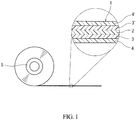
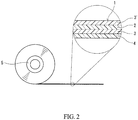
- FIG. 1 and FIG. 2 each show a structural example of the double-sided adhesive tape according to the present invention.
- a part of the double-sided adhesive tape is enlarged in a circle.
- a first adhesive layer 3 and a second adhesive layer 3' are formed respectively on both main surfaces of a PTFE porous film substrate 2.
- a first release liner 4 and a second release liner 4' are provided further on the first adhesive layer 3 and the second adhesive layer 3', respectively, to protect the respective adhesive layers.
- the double-sided adhesive tape 1 thus structured is wound around a core material 5.
- the first adhesive layer 3 and the second adhesive layer 3' are formed respectively on both main surfaces of the PTFE porous film substrate 2, and the release liner 4 only is provided on the first adhesive layer 3.
- the release liner 4 is releasably treated on both sides.
- each interface between the substrate and each adhesive layer is indicated by a dotted line for convenience. Actually, however, a part of each adhesive layer is penetrated into the pores of the substrate.
- the adhesion between the substrate and each adhesive layer is high, and the rupture of the substrate is unlikely to occur at the time of peeling of the double-sided adhesive tape.
- SRX212 platinum-type curing catalyst manufactured by Dow Corning Toray Co., Ltd.
- SD4584 an addition-reaction type silicone adhesive manufactured by Dow Corning Toray Co., Ltd.
- This silicone adhesive composition was applied to a releasably-treated surface of a release liner obtained by treating a polyethylene terephthalate (PET) film with a fluorinated silicone release agent so that the silicone adhesive composition had a thickness of 50 ⁇ m after being dried.
- PET polyethylene terephthalate
- the release liner having a silicone adhesive composition layer was obtained.
- a PTFE porous film having a thickness of 20 ⁇ m and an average pore diameter of 0.6 ⁇ m was bonded to the adhesive composition layer of the release liner. Subsequently, this was heated at 150°C for 3 minutes so that an adhesive layer was formed.
- FIG. 3 shows an enlarged cross-sectional photograph of this double-sided adhesive tape.
- the silicone adhesive composition in Example 1 was applied to a releasably-treated surface of a release liner obtained by treating a PET film with a fluorinated silicone release agent so that the silicone adhesive composition had a thickness of 80 ⁇ m after being dried.
- a release liner having a silicone adhesive composition layer was obtained.
- a PTFE porous film having a thickness of 50 ⁇ m and an average pore diameter of 3 ⁇ m was bonded to the adhesive composition layer of the release liner. Subsequently, this was heated at 150°C for 3 minutes so that an adhesive layer was formed.
- the silicone adhesive composition was applied to the surface of the PTFE porous film opposite to the surface to which the release liner had been bonded so that the silicone adhesive composition had a thickness of 30 ⁇ m after being dried. This was heated at 130°C for 3 minutes, and a release liner similar to the one mentioned above was bonded thereto. Thus, a double-sided adhesive tape was produced.
- the silicone adhesive composition in Example 1 was applied to a releasably-treated surface of a release liner obtained by treating a PET film with a fluorinated silicone release agent so that the silicone adhesive composition had a thickness of 30 ⁇ m after being dried. This was heated at 150°C for 3 minutes so that an adhesive layer was formed. A PTFE porous film having a thickness of 20 ⁇ m and an average pore diameter of 0.6 ⁇ m was bonded to the adhesive layer of the release liner.
- the silicone adhesive composition in Example 1 was applied to a releasably-treated surface of a release liner obtained by treating a PET film with a fluorinated silicone release agent so that the silicone adhesive composition had a thickness of 30 ⁇ m after being dried.
- FIG. 4 shows an enlarged cross-sectional photograph of this double-sided adhesive tape.
- the silicone adhesive composition in Example 1 was applied to a releasably-treated surface of a release liner obtained by treating a PET film with a fluorinated silicone release agent so that the silicone adhesive composition had a thickness of 30 ⁇ m after being dried. This was heated at 150°C for 3 minutes so that an adhesive layer was formed. A PTFE porous film having a thickness of 20 ⁇ m and an average pore diameter of 0.6 ⁇ m was bonded to the adhesive layer of the release liner. The silicone adhesive composition was applied to the surface of the PTFE porous film opposite to the surface to which the release liner had been bonded so that the silicone adhesive composition had a thickness of 30 ⁇ m after being dried. This was heated at 130°C for 3 minutes, and a release liner similar to the one mentioned above was bonded thereto. Thus, a double-sided adhesive tape was produced.
- Adhesive layers were provided respectively on both sides of a PTFE porous film having a thickness of 50 ⁇ m and an average pore diameter of 0.1 ⁇ m by using a product named "SAFV" (an epoxy resin adhesive sheet produced by Nikkan Industries Co., Ltd.). Release liners were further provided respectively on both sides thereof. This was pressed under the conditions in which the temperature was 130°C, the pressure was 3 kg/cm 2 and the pressing time was 3 minutes, with a hot press apparatus. Thus, a double-sided adhesive tape was produced.
- SAFV an epoxy resin adhesive sheet produced by Nikkan Industries Co., Ltd.
- each double-sided adhesive tape described above was stripped off to expose the adhesive layer, and the double-sided adhesive tape was bonded to a PET film having a thickness of 25 ⁇ m to be backed therewith.
- This backed adhesive tape was cut into a size of 20 mm in width and 100 mm in length to prepare a specimen.
- the specimen was pressure-bonded to a SUS plate serving as an adherend by one reciprocating movement of a 2 kg roller.
- the state of the double-sided adhesive tape used was observed visually to make a visual check on whether the double-sided adhesive tape was peeled off from the interface between the SUS plate surface and (the adhesive layer of) the double-sided tape. Thereby, the double-sided tape was evaluated into the following two categories.
- specimens in which no peeling occurred from the interface between the SUS plate surface and the double-sided tape were evaluated into the following three categories in terms of whether the PTFE porous film substrate was ruptured or not.
- the specimens in which no rupture of the substrate was observed were checked visually in terms of presence/absence of adhesive deposit on the SUS plate surface, and evaluated into the following two categories.
- the double-sided adhesive tapes in Examples 1 and 2 produced in such a manner that the adhesive composition was penetrated into the PTFE porous film substrate from both sides of the substrate were able to be peeled off without the rupture of the substrate and the adhesive deposit.
- Observation on the cross-section of the double-sided adhesive tape in Example 1 revealed that the adhesive layers formed respectively on both surfaces of the substrate were connected to each other inside the pores of the substrate.
- the double-sided adhesive tapes in Comparative Examples 1 and 2 produced by the process (transfer process) in which the adhesive composition was applied to the release liner and dried and thereafter the release liner was bonded to the PTFE porous film substrate, the adhesive was separated from the substrate and the adhesive deposit was observed.
- the double-sided adhesive tape obtained by the production method according to the present invention and the double-sided adhesive tape according to the present invention can be used in various industrial fields such as household electrical appliances, automobiles, and office automation apparatuses.
Landscapes
- Chemical & Material Sciences (AREA)
- Organic Chemistry (AREA)
- Adhesive Tapes (AREA)
- Adhesives Or Adhesive Processes (AREA)
Claims (4)
- Procédé pour produire une bande adhésive double face ayant un substrat en film poreux de polytétrafluoroéthylène et des couches adhésives formées respectivement sur les deux côtés du substrat, le procédé étant caractérisé en ce qu'il comprend les étapes (1) à (4) suivantes dans l'ordre :(1) une étape consistant à placer une composition adhésive sur une première doublure antiadhésive (4) ;(2) une étape consistant à coller la première doublure antiadhésive (4) sur laquelle la composition adhésive a été placée à une surface principale du substrat en film poreux de polytétrafluoroéthylène (2) ;(3) une étape consistant à former une première couche adhésive (3) en chauffant le substrat auquel la première doublure antiadhésive (4) a été collée ; et(4) une étape consistant à disposer une deuxième couche adhésive (3') sur une autre surface principale du substrat (2), une partie d'un adhésif dans la deuxième couche adhésive (3') pénétrant dans le substrat (2), laquelle étape (4) comprend les étapes (4A) et (4B) suivantes :dans lequel la composition adhésive placée sur la première doublure antiadhésive (4) est maintenue dans un état non séché depuis la fin de l'étape (1) jusqu'au début de l'étape (2),(4A) une étape consistant à placer une composition adhésive sur l'autre surface principale du substrat (2) ; et(4B) une étape consistant à former la deuxième couche adhésive (3') en chauffant le substrat (2) sur lequel la composition adhésive a été placée,
chacune des compositions adhésives contient un adhésif siliconé, et
le substrat en film poreux de polytétrafluoroéthylène (2) a un diamètre de pores moyen de 0,1 à 3 µm, une épaisseur de 10 à 100 µm, et une porosité de 40 à 99 %. - Procédé de production selon la revendication 1, dans lequel l'étape (4) comprend en outre l'étape (4C) suivante :
(4C) une étape consistant à coller une deuxième doublure antiadhésive (4') à la deuxième couche adhésive (3'). - Procédé de production selon l'une quelconque des revendications 1 et 2, dans lequel la température de chauffage dans l'étape (3) est de 130 °C ou plus.
- Procédé de production selon l'une quelconque des revendications 1 à 3, dans lequel chacune parmi la première couche adhésive (3) et la deuxième couche adhésive (3') a une épaisseur de 20 à 150 µm.
Applications Claiming Priority (2)
| Application Number | Priority Date | Filing Date | Title |
|---|---|---|---|
| JP2010020473A JP5508880B2 (ja) | 2010-02-01 | 2010-02-01 | 両面粘着テープおよびその製造方法 |
| PCT/JP2011/000202 WO2011093026A1 (fr) | 2010-02-01 | 2011-01-17 | Bande adhésive double face et son procédé de production |
Publications (3)
| Publication Number | Publication Date |
|---|---|
| EP2532724A1 EP2532724A1 (fr) | 2012-12-12 |
| EP2532724A4 EP2532724A4 (fr) | 2014-07-02 |
| EP2532724B1 true EP2532724B1 (fr) | 2019-09-04 |
Family
ID=44319025
Family Applications (1)
| Application Number | Title | Priority Date | Filing Date |
|---|---|---|---|
| EP11736743.3A Active EP2532724B1 (fr) | 2010-02-01 | 2011-01-17 | Bande adhésive double face et son procédé de production |
Country Status (5)
| Country | Link |
|---|---|
| US (1) | US20120255677A1 (fr) |
| EP (1) | EP2532724B1 (fr) |
| JP (1) | JP5508880B2 (fr) |
| CN (1) | CN102741371B (fr) |
| WO (1) | WO2011093026A1 (fr) |
Families Citing this family (14)
| Publication number | Priority date | Publication date | Assignee | Title |
|---|---|---|---|---|
| KR20160012122A (ko) * | 2013-05-23 | 2016-02-02 | 헨켈 아이피 앤드 홀딩 게엠베하 | 다층 장벽 접착 필름 |
| CN103242764A (zh) * | 2013-05-31 | 2013-08-14 | 苏州华周胶带有限公司 | 一种以聚四氟乙烯薄膜为基材的胶带的制造方法 |
| EP3027411A1 (fr) * | 2013-07-30 | 2016-06-08 | Ideal Jacobs Corporation | Protection pour une surface de construction d'imprimante 3d |
| US11053412B1 (en) | 2013-10-11 | 2021-07-06 | Spanx, Inc. | Two-sided garment tape having a non-slip coating and methods of making and using the same |
| KR102231515B1 (ko) | 2014-02-04 | 2021-03-25 | 삼성디스플레이 주식회사 | 액정 표시 장치 |
| TWI541316B (zh) * | 2014-02-05 | 2016-07-11 | 友達光電股份有限公司 | 顯示裝置及其膠帶結構 |
| JP6601921B2 (ja) * | 2015-04-27 | 2019-11-06 | 株式会社寺岡製作所 | 離型用粘着テープ |
| CN107236477B (zh) * | 2017-06-16 | 2020-08-14 | 九江市特种胶业有限公司 | 一种无残留型临时固定粘合剂及其制备方法 |
| US20190067652A1 (en) * | 2017-08-23 | 2019-02-28 | Apple Inc. | Electrically Isolated Battery Can Assembly |
| WO2019230610A1 (fr) * | 2018-05-30 | 2019-12-05 | 日東電工株式会社 | Feuille de transfert pour transfert de couche et feuille dotée d'une couche de catalyseur d'électrode |
| CN109868071A (zh) * | 2019-01-29 | 2019-06-11 | 武汉华星光电半导体显示技术有限公司 | 贴合胶膜及其制造方法 |
| CA3147894A1 (fr) | 2019-07-22 | 2021-01-28 | Vt Advantec, Llc | Amortisseurs pour equipement sportif et equipement sportif comprenant ceux-ci |
| CN112226167A (zh) * | 2020-09-17 | 2021-01-15 | 浙江天之元物流科技有限公司 | 双面可移胶制备工艺与双面可移胶制备设备 |
| CN117897459A (zh) * | 2021-08-31 | 2024-04-16 | 日东电工株式会社 | 罩构件、双面粘合片、密封构件以及构件供给用片 |
Family Cites Families (24)
| Publication number | Priority date | Publication date | Assignee | Title |
|---|---|---|---|---|
| US4055453A (en) * | 1972-02-19 | 1977-10-25 | Tajima Roofing Co., Ltd. | Process for producing laminated bituminous roofing membrane |
| JPS6485273A (en) * | 1987-09-26 | 1989-03-30 | Nitto Denko Corp | Pressure-sensitive adhesive tape its production |
| JP2573346B2 (ja) * | 1989-03-07 | 1997-01-22 | 日東電工株式会社 | シールテープ |
| TW293039B (fr) * | 1994-07-29 | 1996-12-11 | Tozen Kk | |
| JPH09157607A (ja) * | 1995-12-07 | 1997-06-17 | Nitto Denko Corp | シール材用テープおよびそれを用いたシール材の製法 |
| JPH09154933A (ja) * | 1995-12-12 | 1997-06-17 | Nitto Denko Corp | 医療用粘着テ−プ及び救急絆創膏 |
| JP3703568B2 (ja) * | 1996-06-28 | 2005-10-05 | ジャパンゴアテックス株式会社 | Icチップ接着用シートおよびicパッケージ |
| JPH10154777A (ja) * | 1996-11-25 | 1998-06-09 | Hitachi Ltd | 半導体装置 |
| JP3547921B2 (ja) * | 1996-12-02 | 2004-07-28 | 本田技研工業株式会社 | 非放射性誘電体線路及びその製造方法 |
| JP4049452B2 (ja) * | 1998-07-02 | 2008-02-20 | 日東電工株式会社 | 半導体素子用接着シートおよびそれを用いた半導体装置 |
| JP2000106372A (ja) * | 1998-09-29 | 2000-04-11 | Hitachi Chem Co Ltd | 両面接着フィルム、半導体搭載用有機基板および半導体装置 |
| JP4034478B2 (ja) * | 1999-07-02 | 2008-01-16 | スリーエム イノベイティブ プロパティズ カンパニー | 感圧接着シート及びその製造方法 |
| JP2001352171A (ja) * | 2000-06-09 | 2001-12-21 | Matsushita Electric Ind Co Ltd | 接着シート、接着シートを用いた回路基板及びその製造方法 |
| JP2003003134A (ja) | 2001-06-20 | 2003-01-08 | Japan Gore Tex Inc | Icチップ接着用シートおよびicパッケージ |
| AU2002315386A1 (en) * | 2001-06-22 | 2003-01-08 | Adhesives Research, Inc. | Double-faced silicone adhesive tape and method of use thereof in splicing |
| JP2003321659A (ja) * | 2002-04-26 | 2003-11-14 | Dengiken:Kk | 電気・電子絶縁材料 |
| JP4316253B2 (ja) * | 2003-02-18 | 2009-08-19 | リンテック株式会社 | ウエハダイシング・接着用シートおよび半導体装置の製造方法 |
| JP2005002335A (ja) * | 2003-05-21 | 2005-01-06 | Japan Gore Tex Inc | 接着フィルムおよびこれを使った半導体装置 |
| JP4646508B2 (ja) * | 2003-10-01 | 2011-03-09 | 日東電工株式会社 | 両面接着テープ又はシートおよびその製造方法 |
| JP2005243706A (ja) * | 2004-02-24 | 2005-09-08 | Nitto Denko Corp | 半導体装置製造用耐熱性粘着テープおよび半導体装置の製造方法 |
| JP2005325283A (ja) * | 2004-05-17 | 2005-11-24 | Shin Etsu Chem Co Ltd | 接着性樹脂フィルム及びその使用方法並びに半導体装置 |
| CN101263002A (zh) * | 2005-07-28 | 2008-09-10 | 高压制图公司 | 结合有多孔膜的植绒制品 |
| US20070190284A1 (en) * | 2006-02-10 | 2007-08-16 | Freudenberg-Nok General Partnership | Melt-processable adhesives for bonding pervious fluoropolymeric layers in multilayer composites |
| JP5231815B2 (ja) * | 2008-01-15 | 2013-07-10 | 日東電工株式会社 | マスキング用粘着テープおよびスパッタリングターゲットの製造方法 |
-
2010
- 2010-02-01 JP JP2010020473A patent/JP5508880B2/ja not_active Expired - Fee Related
-
2011
- 2011-01-17 WO PCT/JP2011/000202 patent/WO2011093026A1/fr not_active Ceased
- 2011-01-17 CN CN201180007095.4A patent/CN102741371B/zh not_active Expired - Fee Related
- 2011-01-17 US US13/516,557 patent/US20120255677A1/en not_active Abandoned
- 2011-01-17 EP EP11736743.3A patent/EP2532724B1/fr active Active
Non-Patent Citations (1)
| Title |
|---|
| None * |
Also Published As
| Publication number | Publication date |
|---|---|
| CN102741371B (zh) | 2014-05-28 |
| JP2011157476A (ja) | 2011-08-18 |
| CN102741371A (zh) | 2012-10-17 |
| US20120255677A1 (en) | 2012-10-11 |
| JP5508880B2 (ja) | 2014-06-04 |
| WO2011093026A1 (fr) | 2011-08-04 |
| EP2532724A4 (fr) | 2014-07-02 |
| EP2532724A1 (fr) | 2012-12-12 |
Similar Documents
| Publication | Publication Date | Title |
|---|---|---|
| EP2532724B1 (fr) | Bande adhésive double face et son procédé de production | |
| EP2274390B1 (fr) | Bande adhésive | |
| JP6602776B2 (ja) | 両面粘着テープ、作製方法、使用方法、およびそれにより組み立てられる物品 | |
| KR102292340B1 (ko) | 양면 점착 테이프 및 전자기기 | |
| KR101884943B1 (ko) | 양면 점착 테이프 및 터치패널 부착 표시장치 | |
| CN107405863B (zh) | 片材、使用该片材的被粘物的防潮方法和使用该片材的金属板的防腐蚀方法 | |
| EP3234055B1 (fr) | Article adhésif avec une couche barrière | |
| JPH0678505B2 (ja) | 剥離剤及びそれを用いた剥離紙の製造法 | |
| EP2316899A1 (fr) | Bande adhésive double face sensible à la pression et son procédé de fabrication | |
| CA2785886A1 (fr) | Bande adhesive alveolaire haute performance | |
| CN115427527B (zh) | 双面粘合带 | |
| JP2004123769A (ja) | 耐熱性シートの接着処理方法及び粘着テープ | |
| WO2008055789A1 (fr) | Matériau support notamment pour un ruban adhésif à support textile, ce support textile étant revêtu par extrusion d'un film plastique | |
| CN101233206A (zh) | 用于电气材料的带粘接剂的叠层膜 | |
| KR101809058B1 (ko) | 기재의 부직포 점착 방법 | |
| EP1429706B1 (fr) | Feuille d'emballage individuel et sachet pour serviette hygienique jetable | |
| KR101791216B1 (ko) | 피착물과의 이형성이 개선된 마스킹테이프 | |
| JPH08291274A (ja) | 両面粘着シ─ト | |
| JPH1017833A (ja) | 発泡基材系粘着部材 | |
| CN117885163B (zh) | 内置强化结构复合胶合板及其制备方法 | |
| CN121160237A (zh) | 丙烯酸导热胶带及其制备方法 | |
| CN117431021A (zh) | 一种基于复合工艺制备的导热型热熔胶膜及其制备方法 | |
| JP2023109091A (ja) | 自己吸着性積層体 | |
| JPH07224263A (ja) | 両面粘着テープの製造方法 |
Legal Events
| Date | Code | Title | Description |
|---|---|---|---|
| PUAI | Public reference made under article 153(3) epc to a published international application that has entered the european phase |
Free format text: ORIGINAL CODE: 0009012 |
|
| 17P | Request for examination filed |
Effective date: 20120807 |
|
| AK | Designated contracting states |
Kind code of ref document: A1 Designated state(s): AL AT BE BG CH CY CZ DE DK EE ES FI FR GB GR HR HU IE IS IT LI LT LU LV MC MK MT NL NO PL PT RO RS SE SI SK SM TR |
|
| DAX | Request for extension of the european patent (deleted) | ||
| A4 | Supplementary search report drawn up and despatched |
Effective date: 20140530 |
|
| RIC1 | Information provided on ipc code assigned before grant |
Ipc: C09J 183/04 20060101ALI20140523BHEP Ipc: C09J 7/02 20060101AFI20140523BHEP Ipc: C08L 83/04 20060101ALI20140523BHEP |
|
| STAA | Information on the status of an ep patent application or granted ep patent |
Free format text: STATUS: EXAMINATION IS IN PROGRESS |
|
| 17Q | First examination report despatched |
Effective date: 20180611 |
|
| REG | Reference to a national code |
Ref country code: DE Ref legal event code: R079 Ref document number: 602011061776 Country of ref document: DE Free format text: PREVIOUS MAIN CLASS: C09J0007020000 Ipc: C09J0007260000 |
|
| GRAJ | Information related to disapproval of communication of intention to grant by the applicant or resumption of examination proceedings by the epo deleted |
Free format text: ORIGINAL CODE: EPIDOSDIGR1 |
|
| GRAP | Despatch of communication of intention to grant a patent |
Free format text: ORIGINAL CODE: EPIDOSNIGR1 |
|
| RIC1 | Information provided on ipc code assigned before grant |
Ipc: C09J 183/04 20060101ALI20181130BHEP Ipc: C08L 83/04 20060101ALI20181130BHEP Ipc: C09J 7/26 20180101AFI20181130BHEP |
|
| GRAP | Despatch of communication of intention to grant a patent |
Free format text: ORIGINAL CODE: EPIDOSNIGR1 |
|
| STAA | Information on the status of an ep patent application or granted ep patent |
Free format text: STATUS: GRANT OF PATENT IS INTENDED |
|
| INTG | Intention to grant announced |
Effective date: 20190211 |
|
| GRAJ | Information related to disapproval of communication of intention to grant by the applicant or resumption of examination proceedings by the epo deleted |
Free format text: ORIGINAL CODE: EPIDOSDIGR1 |
|
| STAA | Information on the status of an ep patent application or granted ep patent |
Free format text: STATUS: EXAMINATION IS IN PROGRESS |
|
| GRAP | Despatch of communication of intention to grant a patent |
Free format text: ORIGINAL CODE: EPIDOSNIGR1 |
|
| STAA | Information on the status of an ep patent application or granted ep patent |
Free format text: STATUS: GRANT OF PATENT IS INTENDED |
|
| INTC | Intention to grant announced (deleted) | ||
| GRAJ | Information related to disapproval of communication of intention to grant by the applicant or resumption of examination proceedings by the epo deleted |
Free format text: ORIGINAL CODE: EPIDOSDIGR1 |
|
| GRAP | Despatch of communication of intention to grant a patent |
Free format text: ORIGINAL CODE: EPIDOSNIGR1 |
|
| GRAJ | Information related to disapproval of communication of intention to grant by the applicant or resumption of examination proceedings by the epo deleted |
Free format text: ORIGINAL CODE: EPIDOSDIGR1 |
|
| GRAP | Despatch of communication of intention to grant a patent |
Free format text: ORIGINAL CODE: EPIDOSNIGR1 |
|
| INTG | Intention to grant announced |
Effective date: 20190520 |
|
| INTG | Intention to grant announced |
Effective date: 20190605 |
|
| INTG | Intention to grant announced |
Effective date: 20190618 |
|
| GRAS | Grant fee paid |
Free format text: ORIGINAL CODE: EPIDOSNIGR3 |
|
| GRAA | (expected) grant |
Free format text: ORIGINAL CODE: 0009210 |
|
| STAA | Information on the status of an ep patent application or granted ep patent |
Free format text: STATUS: THE PATENT HAS BEEN GRANTED |
|
| AK | Designated contracting states |
Kind code of ref document: B1 Designated state(s): AL AT BE BG CH CY CZ DE DK EE ES FI FR GB GR HR HU IE IS IT LI LT LU LV MC MK MT NL NO PL PT RO RS SE SI SK SM TR |
|
| REG | Reference to a national code |
Ref country code: GB Ref legal event code: FG4D |
|
| REG | Reference to a national code |
Ref country code: CH Ref legal event code: EP |
|
| REG | Reference to a national code |
Ref country code: AT Ref legal event code: REF Ref document number: 1175319 Country of ref document: AT Kind code of ref document: T Effective date: 20190915 |
|
| REG | Reference to a national code |
Ref country code: DE Ref legal event code: R096 Ref document number: 602011061776 Country of ref document: DE |
|
| REG | Reference to a national code |
Ref country code: IE Ref legal event code: FG4D |
|
| REG | Reference to a national code |
Ref country code: NL Ref legal event code: MP Effective date: 20190904 |
|
| REG | Reference to a national code |
Ref country code: LT Ref legal event code: MG4D |
|
| PG25 | Lapsed in a contracting state [announced via postgrant information from national office to epo] |
Ref country code: LT Free format text: LAPSE BECAUSE OF FAILURE TO SUBMIT A TRANSLATION OF THE DESCRIPTION OR TO PAY THE FEE WITHIN THE PRESCRIBED TIME-LIMIT Effective date: 20190904 Ref country code: FI Free format text: LAPSE BECAUSE OF FAILURE TO SUBMIT A TRANSLATION OF THE DESCRIPTION OR TO PAY THE FEE WITHIN THE PRESCRIBED TIME-LIMIT Effective date: 20190904 Ref country code: SE Free format text: LAPSE BECAUSE OF FAILURE TO SUBMIT A TRANSLATION OF THE DESCRIPTION OR TO PAY THE FEE WITHIN THE PRESCRIBED TIME-LIMIT Effective date: 20190904 Ref country code: HR Free format text: LAPSE BECAUSE OF FAILURE TO SUBMIT A TRANSLATION OF THE DESCRIPTION OR TO PAY THE FEE WITHIN THE PRESCRIBED TIME-LIMIT Effective date: 20190904 Ref country code: BG Free format text: LAPSE BECAUSE OF FAILURE TO SUBMIT A TRANSLATION OF THE DESCRIPTION OR TO PAY THE FEE WITHIN THE PRESCRIBED TIME-LIMIT Effective date: 20191204 Ref country code: NO Free format text: LAPSE BECAUSE OF FAILURE TO SUBMIT A TRANSLATION OF THE DESCRIPTION OR TO PAY THE FEE WITHIN THE PRESCRIBED TIME-LIMIT Effective date: 20191204 |
|
| PG25 | Lapsed in a contracting state [announced via postgrant information from national office to epo] |
Ref country code: ES Free format text: LAPSE BECAUSE OF FAILURE TO SUBMIT A TRANSLATION OF THE DESCRIPTION OR TO PAY THE FEE WITHIN THE PRESCRIBED TIME-LIMIT Effective date: 20190904 Ref country code: AL Free format text: LAPSE BECAUSE OF FAILURE TO SUBMIT A TRANSLATION OF THE DESCRIPTION OR TO PAY THE FEE WITHIN THE PRESCRIBED TIME-LIMIT Effective date: 20190904 Ref country code: LV Free format text: LAPSE BECAUSE OF FAILURE TO SUBMIT A TRANSLATION OF THE DESCRIPTION OR TO PAY THE FEE WITHIN THE PRESCRIBED TIME-LIMIT Effective date: 20190904 Ref country code: GR Free format text: LAPSE BECAUSE OF FAILURE TO SUBMIT A TRANSLATION OF THE DESCRIPTION OR TO PAY THE FEE WITHIN THE PRESCRIBED TIME-LIMIT Effective date: 20191205 Ref country code: RS Free format text: LAPSE BECAUSE OF FAILURE TO SUBMIT A TRANSLATION OF THE DESCRIPTION OR TO PAY THE FEE WITHIN THE PRESCRIBED TIME-LIMIT Effective date: 20190904 |
|
| REG | Reference to a national code |
Ref country code: AT Ref legal event code: MK05 Ref document number: 1175319 Country of ref document: AT Kind code of ref document: T Effective date: 20190904 |
|
| PG25 | Lapsed in a contracting state [announced via postgrant information from national office to epo] |
Ref country code: AT Free format text: LAPSE BECAUSE OF FAILURE TO SUBMIT A TRANSLATION OF THE DESCRIPTION OR TO PAY THE FEE WITHIN THE PRESCRIBED TIME-LIMIT Effective date: 20190904 Ref country code: EE Free format text: LAPSE BECAUSE OF FAILURE TO SUBMIT A TRANSLATION OF THE DESCRIPTION OR TO PAY THE FEE WITHIN THE PRESCRIBED TIME-LIMIT Effective date: 20190904 Ref country code: PL Free format text: LAPSE BECAUSE OF FAILURE TO SUBMIT A TRANSLATION OF THE DESCRIPTION OR TO PAY THE FEE WITHIN THE PRESCRIBED TIME-LIMIT Effective date: 20190904 Ref country code: RO Free format text: LAPSE BECAUSE OF FAILURE TO SUBMIT A TRANSLATION OF THE DESCRIPTION OR TO PAY THE FEE WITHIN THE PRESCRIBED TIME-LIMIT Effective date: 20190904 Ref country code: NL Free format text: LAPSE BECAUSE OF FAILURE TO SUBMIT A TRANSLATION OF THE DESCRIPTION OR TO PAY THE FEE WITHIN THE PRESCRIBED TIME-LIMIT Effective date: 20190904 Ref country code: PT Free format text: LAPSE BECAUSE OF FAILURE TO SUBMIT A TRANSLATION OF THE DESCRIPTION OR TO PAY THE FEE WITHIN THE PRESCRIBED TIME-LIMIT Effective date: 20200106 Ref country code: IT Free format text: LAPSE BECAUSE OF FAILURE TO SUBMIT A TRANSLATION OF THE DESCRIPTION OR TO PAY THE FEE WITHIN THE PRESCRIBED TIME-LIMIT Effective date: 20190904 |
|
| PG25 | Lapsed in a contracting state [announced via postgrant information from national office to epo] |
Ref country code: SM Free format text: LAPSE BECAUSE OF FAILURE TO SUBMIT A TRANSLATION OF THE DESCRIPTION OR TO PAY THE FEE WITHIN THE PRESCRIBED TIME-LIMIT Effective date: 20190904 Ref country code: SK Free format text: LAPSE BECAUSE OF FAILURE TO SUBMIT A TRANSLATION OF THE DESCRIPTION OR TO PAY THE FEE WITHIN THE PRESCRIBED TIME-LIMIT Effective date: 20190904 Ref country code: IS Free format text: LAPSE BECAUSE OF FAILURE TO SUBMIT A TRANSLATION OF THE DESCRIPTION OR TO PAY THE FEE WITHIN THE PRESCRIBED TIME-LIMIT Effective date: 20200224 Ref country code: CZ Free format text: LAPSE BECAUSE OF FAILURE TO SUBMIT A TRANSLATION OF THE DESCRIPTION OR TO PAY THE FEE WITHIN THE PRESCRIBED TIME-LIMIT Effective date: 20190904 |
|
| REG | Reference to a national code |
Ref country code: DE Ref legal event code: R097 Ref document number: 602011061776 Country of ref document: DE |
|
| PLBE | No opposition filed within time limit |
Free format text: ORIGINAL CODE: 0009261 |
|
| STAA | Information on the status of an ep patent application or granted ep patent |
Free format text: STATUS: NO OPPOSITION FILED WITHIN TIME LIMIT |
|
| PG2D | Information on lapse in contracting state deleted |
Ref country code: IS |
|
| PG25 | Lapsed in a contracting state [announced via postgrant information from national office to epo] |
Ref country code: DK Free format text: LAPSE BECAUSE OF FAILURE TO SUBMIT A TRANSLATION OF THE DESCRIPTION OR TO PAY THE FEE WITHIN THE PRESCRIBED TIME-LIMIT Effective date: 20190904 Ref country code: IS Free format text: LAPSE BECAUSE OF FAILURE TO SUBMIT A TRANSLATION OF THE DESCRIPTION OR TO PAY THE FEE WITHIN THE PRESCRIBED TIME-LIMIT Effective date: 20200105 |
|
| 26N | No opposition filed |
Effective date: 20200605 |
|
| PG25 | Lapsed in a contracting state [announced via postgrant information from national office to epo] |
Ref country code: SI Free format text: LAPSE BECAUSE OF FAILURE TO SUBMIT A TRANSLATION OF THE DESCRIPTION OR TO PAY THE FEE WITHIN THE PRESCRIBED TIME-LIMIT Effective date: 20190904 Ref country code: MC Free format text: LAPSE BECAUSE OF FAILURE TO SUBMIT A TRANSLATION OF THE DESCRIPTION OR TO PAY THE FEE WITHIN THE PRESCRIBED TIME-LIMIT Effective date: 20190904 |
|
| REG | Reference to a national code |
Ref country code: CH Ref legal event code: PL |
|
| GBPC | Gb: european patent ceased through non-payment of renewal fee |
Effective date: 20200117 |
|
| REG | Reference to a national code |
Ref country code: BE Ref legal event code: MM Effective date: 20200131 |
|
| PG25 | Lapsed in a contracting state [announced via postgrant information from national office to epo] |
Ref country code: GB Free format text: LAPSE BECAUSE OF NON-PAYMENT OF DUE FEES Effective date: 20200117 Ref country code: LU Free format text: LAPSE BECAUSE OF NON-PAYMENT OF DUE FEES Effective date: 20200117 |
|
| PG25 | Lapsed in a contracting state [announced via postgrant information from national office to epo] |
Ref country code: CH Free format text: LAPSE BECAUSE OF NON-PAYMENT OF DUE FEES Effective date: 20200131 Ref country code: LI Free format text: LAPSE BECAUSE OF NON-PAYMENT OF DUE FEES Effective date: 20200131 Ref country code: BE Free format text: LAPSE BECAUSE OF NON-PAYMENT OF DUE FEES Effective date: 20200131 |
|
| PG25 | Lapsed in a contracting state [announced via postgrant information from national office to epo] |
Ref country code: IE Free format text: LAPSE BECAUSE OF NON-PAYMENT OF DUE FEES Effective date: 20200117 |
|
| PG25 | Lapsed in a contracting state [announced via postgrant information from national office to epo] |
Ref country code: TR Free format text: LAPSE BECAUSE OF FAILURE TO SUBMIT A TRANSLATION OF THE DESCRIPTION OR TO PAY THE FEE WITHIN THE PRESCRIBED TIME-LIMIT Effective date: 20190904 Ref country code: MT Free format text: LAPSE BECAUSE OF FAILURE TO SUBMIT A TRANSLATION OF THE DESCRIPTION OR TO PAY THE FEE WITHIN THE PRESCRIBED TIME-LIMIT Effective date: 20190904 Ref country code: CY Free format text: LAPSE BECAUSE OF FAILURE TO SUBMIT A TRANSLATION OF THE DESCRIPTION OR TO PAY THE FEE WITHIN THE PRESCRIBED TIME-LIMIT Effective date: 20190904 |
|
| PG25 | Lapsed in a contracting state [announced via postgrant information from national office to epo] |
Ref country code: MK Free format text: LAPSE BECAUSE OF FAILURE TO SUBMIT A TRANSLATION OF THE DESCRIPTION OR TO PAY THE FEE WITHIN THE PRESCRIBED TIME-LIMIT Effective date: 20190904 |
|
| REG | Reference to a national code |
Ref country code: DE Ref legal event code: R082 Ref document number: 602011061776 Country of ref document: DE Representative=s name: CBDL PATENTANWAELTE GBR, DE Ref country code: DE Ref legal event code: R082 Ref document number: 602011061776 Country of ref document: DE Representative=s name: CBDL PATENTANWAELTE EGBR, DE |
|
| PGFP | Annual fee paid to national office [announced via postgrant information from national office to epo] |
Ref country code: FR Payment date: 20231212 Year of fee payment: 14 |
|
| PGFP | Annual fee paid to national office [announced via postgrant information from national office to epo] |
Ref country code: DE Payment date: 20231128 Year of fee payment: 14 |
|
| REG | Reference to a national code |
Ref country code: DE Ref legal event code: R119 Ref document number: 602011061776 Country of ref document: DE |
|
| PG25 | Lapsed in a contracting state [announced via postgrant information from national office to epo] |
Ref country code: DE Free format text: LAPSE BECAUSE OF NON-PAYMENT OF DUE FEES Effective date: 20250801 |
|
| PG25 | Lapsed in a contracting state [announced via postgrant information from national office to epo] |
Ref country code: FR Free format text: LAPSE BECAUSE OF NON-PAYMENT OF DUE FEES Effective date: 20250131 |