EP2584903B1 - Neue heterozyklische verbindungen als erk-hemmer - Google Patents
Neue heterozyklische verbindungen als erk-hemmer Download PDFInfo
- Publication number
- EP2584903B1 EP2584903B1 EP11798821.2A EP11798821A EP2584903B1 EP 2584903 B1 EP2584903 B1 EP 2584903B1 EP 11798821 A EP11798821 A EP 11798821A EP 2584903 B1 EP2584903 B1 EP 2584903B1
- Authority
- EP
- European Patent Office
- Prior art keywords
- alkyl
- group
- aryl
- cycloalkyl
- compound
- Prior art date
- Legal status (The legal status is an assumption and is not a legal conclusion. Google has not performed a legal analysis and makes no representation as to the accuracy of the status listed.)
- Active
Links
- 0 C*C(C1)C2N(*)CC1C2 Chemical compound C*C(C1)C2N(*)CC1C2 0.000 description 24
- FDBCETYOPDCKJZ-UHFFFAOYSA-N Cc1nccc(-c(c2c3)n[nH]c2ccc3C(N)=O)c1 Chemical compound Cc1nccc(-c(c2c3)n[nH]c2ccc3C(N)=O)c1 FDBCETYOPDCKJZ-UHFFFAOYSA-N 0.000 description 3
- FYLUBFBVJQGPMC-UHFFFAOYSA-N O=C(c(cc12)ccc1[nH]nc2-c1ccncc1)NC1CN(Cc(cccc2)c2F)CCCC1 Chemical compound O=C(c(cc12)ccc1[nH]nc2-c1ccncc1)NC1CN(Cc(cccc2)c2F)CCCC1 FYLUBFBVJQGPMC-UHFFFAOYSA-N 0.000 description 3
- VIUCOJVTEBFQGR-JYFHCDHNSA-N CCN(CC[C@H]1c2ccccc2)C[C@H]1NC(c(cc1)cc2c1[nH]nc2-c(cn1)ccc1OC(C)C)=O Chemical compound CCN(CC[C@H]1c2ccccc2)C[C@H]1NC(c(cc1)cc2c1[nH]nc2-c(cn1)ccc1OC(C)C)=O VIUCOJVTEBFQGR-JYFHCDHNSA-N 0.000 description 2
- WTNZAAZMMYXXDC-NLFFAJNJSA-N CN(C)C([C@H](CC1)N(Cc(c(OC)ccc2)c2F)C[C@@H]1NC(c(cc1)cc2c1[nH]nc2-c1ccncc1)=O)=O Chemical compound CN(C)C([C@H](CC1)N(Cc(c(OC)ccc2)c2F)C[C@@H]1NC(c(cc1)cc2c1[nH]nc2-c1ccncc1)=O)=O WTNZAAZMMYXXDC-NLFFAJNJSA-N 0.000 description 2
- XEOMUEXWMYJZJS-UHFFFAOYSA-N CN(CC(C1)c2ccccc2)CC1NC(c(cc12)ccc1[nH]nc2-c1ccncc1)=O Chemical compound CN(CC(C1)c2ccccc2)CC1NC(c(cc12)ccc1[nH]nc2-c1ccncc1)=O XEOMUEXWMYJZJS-UHFFFAOYSA-N 0.000 description 2
- OEEGCZXWROZINM-UHFFFAOYSA-N COc1c(CN2CCCCC2)c(F)ccc1 Chemical compound COc1c(CN2CCCCC2)c(F)ccc1 OEEGCZXWROZINM-UHFFFAOYSA-N 0.000 description 2
- ABRPKKPLDKHCBA-UHFFFAOYSA-N Cc1nccc(C(c(cc(cc2)C(N)=O)c2N)=N)c1 Chemical compound Cc1nccc(C(c(cc(cc2)C(N)=O)c2N)=N)c1 ABRPKKPLDKHCBA-UHFFFAOYSA-N 0.000 description 2
- IBBWAFLNQALQIU-UHFFFAOYSA-N O=C(c(cc1)cc2c1[nH]nc2-c1ccncc1)NC1CN(Cc(c(F)ccc2)c2F)CCCC1 Chemical compound O=C(c(cc1)cc2c1[nH]nc2-c1ccncc1)NC1CN(Cc(c(F)ccc2)c2F)CCCC1 IBBWAFLNQALQIU-UHFFFAOYSA-N 0.000 description 2
- YJNWZSCTVKHUPG-LJQANCHMSA-N O=C(c(cc12)ccc1[nH]nc2-c1ccncc1)N[C@H](CCC1)CN1c1c2c(F)cccc2ncc1 Chemical compound O=C(c(cc12)ccc1[nH]nc2-c1ccncc1)N[C@H](CCC1)CN1c1c2c(F)cccc2ncc1 YJNWZSCTVKHUPG-LJQANCHMSA-N 0.000 description 2
- NPRAEQKJCWHOCK-UHFFFAOYSA-N C1CC2OCCOC2CC1 Chemical compound C1CC2OCCOC2CC1 NPRAEQKJCWHOCK-UHFFFAOYSA-N 0.000 description 1
- FTNJQNQLEGKTGD-UHFFFAOYSA-N C1Oc2ccccc2O1 Chemical compound C1Oc2ccccc2O1 FTNJQNQLEGKTGD-UHFFFAOYSA-N 0.000 description 1
- NFJPEKRRHIYYES-UHFFFAOYSA-N C=C1CCCC1 Chemical compound C=C1CCCC1 NFJPEKRRHIYYES-UHFFFAOYSA-N 0.000 description 1
- XUCUMGPNGUBFBJ-UHFFFAOYSA-N CC(C)(C)OC(N(CC(C1)c2ccccc2)CC1NC(c(cc1)cc2c1[n](C(c1ccccc1)(c1ccccc1)c1ccccc1)nc2-c1ccncc1)=O)=O Chemical compound CC(C)(C)OC(N(CC(C1)c2ccccc2)CC1NC(c(cc1)cc2c1[n](C(c1ccccc1)(c1ccccc1)c1ccccc1)nc2-c1ccncc1)=O)=O XUCUMGPNGUBFBJ-UHFFFAOYSA-N 0.000 description 1
- ZBIAVFWZCYPEQI-NEEKEDPPSA-N CC(C)(C)OC(N(CC1)CCN1C([C@H](CC1)N(Cc(c(OC)ccc2)c2F)C[C@@H]1NC(c(cc12)ccc1[nH]nc2-c1cc(C)ncc1)=O)=O)=O Chemical compound CC(C)(C)OC(N(CC1)CCN1C([C@H](CC1)N(Cc(c(OC)ccc2)c2F)C[C@@H]1NC(c(cc12)ccc1[nH]nc2-c1cc(C)ncc1)=O)=O)=O ZBIAVFWZCYPEQI-NEEKEDPPSA-N 0.000 description 1
- SSBVEAFNULHXDS-SSEXGKCCSA-N CC(C)(C)OC(N(CCC1)C[C@@H]1NC(c(cc1)cc2c1[n](C(c1ccccc1)(c1ccccc1)c1ccccc1)nc2Br)=O)=O Chemical compound CC(C)(C)OC(N(CCC1)C[C@@H]1NC(c(cc1)cc2c1[n](C(c1ccccc1)(c1ccccc1)c1ccccc1)nc2Br)=O)=O SSBVEAFNULHXDS-SSEXGKCCSA-N 0.000 description 1
- MEVVSVSOGVHQHI-UHFFFAOYSA-N CC(C)(C)OC(N(CCC1c2cccc(F)c2)CC1NC(c(cc1)cc2c1[n](C(c1ccccc1)(c1ccccc1)c1ccccc1)nc2-c1ccncc1)=O)=O Chemical compound CC(C)(C)OC(N(CCC1c2cccc(F)c2)CC1NC(c(cc1)cc2c1[n](C(c1ccccc1)(c1ccccc1)c1ccccc1)nc2-c1ccncc1)=O)=O MEVVSVSOGVHQHI-UHFFFAOYSA-N 0.000 description 1
- QXFCSBWRMBIUBG-UHFFFAOYSA-N CC(C)(C)OC(N(CCC1c2cccc(F)c2)CC1NC(c(cc1)cc2c1[n](C(c1ccccc1)(c1ccccc1)c1ccccc1)nc2Br)=O)=O Chemical compound CC(C)(C)OC(N(CCC1c2cccc(F)c2)CC1NC(c(cc1)cc2c1[n](C(c1ccccc1)(c1ccccc1)c1ccccc1)nc2Br)=O)=O QXFCSBWRMBIUBG-UHFFFAOYSA-N 0.000 description 1
- PGBBKXTYZXGACY-RPLLCQBOSA-N CC(C)(C)OC(N(CC[C@H]1c2ccccc2)C[C@H]1NC(c(cc1)cc(C(c(cc2)cc3c2OCC3)=N)c1N)=O)=O Chemical compound CC(C)(C)OC(N(CC[C@H]1c2ccccc2)C[C@H]1NC(c(cc1)cc(C(c(cc2)cc3c2OCC3)=N)c1N)=O)=O PGBBKXTYZXGACY-RPLLCQBOSA-N 0.000 description 1
- KFXXLGFZCOAYHZ-ZUKKLESISA-N CC(C)(C)OC(NCCCCN(C)C([C@H](CC1)N(Cc(c(F)ccc2)c2OC)C[C@@H]1NC(c(cc12)ccc1[nH]nc2-c1cc(C)ncc1)=O)=O)=O Chemical compound CC(C)(C)OC(NCCCCN(C)C([C@H](CC1)N(Cc(c(F)ccc2)c2OC)C[C@@H]1NC(c(cc12)ccc1[nH]nc2-c1cc(C)ncc1)=O)=O)=O KFXXLGFZCOAYHZ-ZUKKLESISA-N 0.000 description 1
- OXCGMILFKCVCFV-AMGIVPHBSA-N CC(C)(C)ONC([C@H](CC1)N(Cc(c(F)ccc2)c2OC)C[C@@H]1NC(c(cc12)ccc1[nH]nc2-c1cc(C)ncc1)=O)=O Chemical compound CC(C)(C)ONC([C@H](CC1)N(Cc(c(F)ccc2)c2OC)C[C@@H]1NC(c(cc12)ccc1[nH]nc2-c1cc(C)ncc1)=O)=O OXCGMILFKCVCFV-AMGIVPHBSA-N 0.000 description 1
- QHARNDVSGRJEAH-MHYSJHRXSA-N CC(C)(C)[Si+](C)(C)OC(C1)CON1C([C@H](CC1)N(Cc(c(F)ccc2)c2OC)C/C1=N/C(c(cc1)cc2c1[nH]nc2-c1cc(C)ncc1)=O)=O Chemical compound CC(C)(C)[Si+](C)(C)OC(C1)CON1C([C@H](CC1)N(Cc(c(F)ccc2)c2OC)C/C1=N/C(c(cc1)cc2c1[nH]nc2-c1cc(C)ncc1)=O)=O QHARNDVSGRJEAH-MHYSJHRXSA-N 0.000 description 1
- CAGOEUCHKREWFG-UHSQPCAPSA-N CC(C)C(C(C)C)NC([C@H](CC1)N(Cc2ccccc2)C[C@@H]1NC(c(cc1C(c2ccncc2)=N)ccc1N)=O)=O Chemical compound CC(C)C(C(C)C)NC([C@H](CC1)N(Cc2ccccc2)C[C@@H]1NC(c(cc1C(c2ccncc2)=N)ccc1N)=O)=O CAGOEUCHKREWFG-UHSQPCAPSA-N 0.000 description 1
- LSAFPRADYPISTQ-RPLLCQBOSA-N CC(C)Oc(cc1)ccc1-c(c1c2)n[nH]c1ccc2C(N[C@H](CN(C)CC1)[C@@H]1c1ccccc1)=O Chemical compound CC(C)Oc(cc1)ccc1-c(c1c2)n[nH]c1ccc2C(N[C@H](CN(C)CC1)[C@@H]1c1ccccc1)=O LSAFPRADYPISTQ-RPLLCQBOSA-N 0.000 description 1
- CKYVDAABVXTGQD-WIOPSUGQSA-N CC(C)Oc(nc1)ccc1-c1n[nH]c(cc2)c1cc2C(N[C@H](CN(C)CC1)[C@@H]1c1ccccc1)=O Chemical compound CC(C)Oc(nc1)ccc1-c1n[nH]c(cc2)c1cc2C(N[C@H](CN(C)CC1)[C@@H]1c1ccccc1)=O CKYVDAABVXTGQD-WIOPSUGQSA-N 0.000 description 1
- ZRTHDKLLNGQMJZ-FOIQADDNSA-N CC(C)Oc(nc1)ccc1-c1n[nH]c(cc2)c1cc2C(N[C@H](CNCC1)[C@@H]1C=C)=O Chemical compound CC(C)Oc(nc1)ccc1-c1n[nH]c(cc2)c1cc2C(N[C@H](CNCC1)[C@@H]1C=C)=O ZRTHDKLLNGQMJZ-FOIQADDNSA-N 0.000 description 1
- LNADTIOIDHWGGT-XUZZJYLKSA-N CC(C)Oc(nc1)ccc1-c1n[nH]c(cc2)c1cc2C(N[C@H](CNCC1)[C@@H]1c1ccccc1)=O Chemical compound CC(C)Oc(nc1)ccc1-c1n[nH]c(cc2)c1cc2C(N[C@H](CNCC1)[C@@H]1c1ccccc1)=O LNADTIOIDHWGGT-XUZZJYLKSA-N 0.000 description 1
- OERGTYGYDNZDQC-JOCHJYFZSA-N CC(C)Oc(nc1)ccc1-c1n[nH]c(cc2)c1cc2C(N[C@H]1CN(Cc2ccccc2F)CCC1)=O Chemical compound CC(C)Oc(nc1)ccc1-c1n[nH]c(cc2)c1cc2C(N[C@H]1CN(Cc2ccccc2F)CCC1)=O OERGTYGYDNZDQC-JOCHJYFZSA-N 0.000 description 1
- ICFVIYBZAZBOQC-UHFFFAOYSA-O CC(C)Oc(nc1)ccc1C(c(cc(cc1)C(NC2CN(Cc3ccccc3F)CCC2)=O)c1N)=[NH2+] Chemical compound CC(C)Oc(nc1)ccc1C(c(cc(cc1)C(NC2CN(Cc3ccccc3F)CCC2)=O)c1N)=[NH2+] ICFVIYBZAZBOQC-UHFFFAOYSA-O 0.000 description 1
- ODERYRHYCMCECT-WIOPSUGQSA-N CC(C)Oc(nc1)ccc1C(c(cc(cc1)C(N[C@H](CN(C)CC2)[C@@H]2c2ccccc2)=O)c1N)=N Chemical compound CC(C)Oc(nc1)ccc1C(c(cc(cc1)C(N[C@H](CN(C)CC2)[C@@H]2c2ccccc2)=O)c1N)=N ODERYRHYCMCECT-WIOPSUGQSA-N 0.000 description 1
- HTGOMCWLDSHETA-OEPDXVHDSA-N CC(CC1)(C(NCCOC)=C)N(Cc(c(OC)ccc2)c2F)CC1/C=N/C(c(cc1)cc2c1[nH]nc2-c1cc(C)ncc1)=O Chemical compound CC(CC1)(C(NCCOC)=C)N(Cc(c(OC)ccc2)c2F)CC1/C=N/C(c(cc1)cc2c1[nH]nc2-c1cc(C)ncc1)=O HTGOMCWLDSHETA-OEPDXVHDSA-N 0.000 description 1
- VFPBYSKYBZEXKH-RNAHPLFWSA-N CC(N(CC1)CCN1C([C@H](CC1)N(Cc(c(OC)ccc2)c2F)C[C@@H]1NC(c(cc12)ccc1[nH]nc2-c1cc(C)ncc1)=O)=O)=O Chemical compound CC(N(CC1)CCN1C([C@H](CC1)N(Cc(c(OC)ccc2)c2F)C[C@@H]1NC(c(cc12)ccc1[nH]nc2-c1cc(C)ncc1)=O)=O)=O VFPBYSKYBZEXKH-RNAHPLFWSA-N 0.000 description 1
- JLWMYRWVAONHGP-WPVBCDAESA-N CC(N=CC1)=CC1c1n[nH]c(cc2)c1cc2C(N[C@H](CC1)CN(Cc(c(F)ccc2)c2F)[C@@H]1C(N(C)C)=O)=O Chemical compound CC(N=CC1)=CC1c1n[nH]c(cc2)c1cc2C(N[C@H](CC1)CN(Cc(c(F)ccc2)c2F)[C@@H]1C(N(C)C)=O)=O JLWMYRWVAONHGP-WPVBCDAESA-N 0.000 description 1
- AAWNPPAHWUIETG-IYOYZZHUSA-N CC(O1)=NC2C1=CC(/C(/c(cc(cc1)C(NC3CN(Cc(c(F)ccc4)c4OC)CCC3)=O)c1N)=N/C)=CC2 Chemical compound CC(O1)=NC2C1=CC(/C(/c(cc(cc1)C(NC3CN(Cc(c(F)ccc4)c4OC)CCC3)=O)c1N)=N/C)=CC2 AAWNPPAHWUIETG-IYOYZZHUSA-N 0.000 description 1
- YTTWWVLXHOFXGB-UHFFFAOYSA-N CC(Oc(cc(cc1)-c2n[nH]c(cc3)c2cc3C(N)=O)c1N)=O Chemical compound CC(Oc(cc(cc1)-c2n[nH]c(cc3)c2cc3C(N)=O)c1N)=O YTTWWVLXHOFXGB-UHFFFAOYSA-N 0.000 description 1
- BQZZLOAKUINFFO-UHFFFAOYSA-N CC([n]1c(cccc2)c2c(CN2CCCCC2)c1)=O Chemical compound CC([n]1c(cccc2)c2c(CN2CCCCC2)c1)=O BQZZLOAKUINFFO-UHFFFAOYSA-N 0.000 description 1
- HDYHHEBCBCYKED-BYHPCDJZSA-N CC1(C2=CC(C3OC3N[C@H]3CN(Cc4ncccc4)CCC3)=CC1)NN=C2c(cc1)cc2c1OCC2 Chemical compound CC1(C2=CC(C3OC3N[C@H]3CN(Cc4ncccc4)CCC3)=CC1)NN=C2c(cc1)cc2c1OCC2 HDYHHEBCBCYKED-BYHPCDJZSA-N 0.000 description 1
- ARPDTQHEDLOYRM-FWKADWGYSA-N CC1(C=C=C=CC1CN(C[C@@H](CC1)NC(c(cc2)cc3c2[nH]nc3-c2cc(C)ncc2)O)[C@@H]1C(N(C)C)=O)F Chemical compound CC1(C=C=C=CC1CN(C[C@@H](CC1)NC(c(cc2)cc3c2[nH]nc3-c2cc(C)ncc2)O)[C@@H]1C(N(C)C)=O)F ARPDTQHEDLOYRM-FWKADWGYSA-N 0.000 description 1
- JFFAQPIYJPRWNU-UHFFFAOYSA-N CC1C=CC(F)=C(CN(CCC2)CC2NC(C2=CC3(C)C(c4ccncc4)=NNC3C=C2)=O)C1 Chemical compound CC1C=CC(F)=C(CN(CCC2)CC2NC(C2=CC3(C)C(c4ccncc4)=NNC3C=C2)=O)C1 JFFAQPIYJPRWNU-UHFFFAOYSA-N 0.000 description 1
- JBLJJAJNFRFEIE-GNFRPPHOSA-N CC1C=CC([C@H](CCNC2)[C@@H]2NC(c(cc23)ccc2[nH]nc3-c(cc2)cc3c2OCC3)=O)=CC1 Chemical compound CC1C=CC([C@H](CCNC2)[C@@H]2NC(c(cc23)ccc2[nH]nc3-c(cc2)cc3c2OCC3)=O)=CC1 JBLJJAJNFRFEIE-GNFRPPHOSA-N 0.000 description 1
- GMILOLUGWZXABV-UHFFFAOYSA-N CC1C=NC(C)=CC1c(c1c2)n[nH]c1ccc2C(NC(CC1)CN(Cc(c(OC)ccc2)c2F)C1=O)=O Chemical compound CC1C=NC(C)=CC1c(c1c2)n[nH]c1ccc2C(NC(CC1)CN(Cc(c(OC)ccc2)c2F)C1=O)=O GMILOLUGWZXABV-UHFFFAOYSA-N 0.000 description 1
- SHWYNUPKDVGJBQ-OTOKDRCRSA-O CC1SC(CN(CCC2)C[C@@H]2NC(c(cc2)cc(C(c(cc3)cc4c3OCC4)=[NH2+])c2N)=O)=NC1 Chemical compound CC1SC(CN(CCC2)C[C@@H]2NC(c(cc2)cc(C(c(cc3)cc4c3OCC4)=[NH2+])c2N)=O)=NC1 SHWYNUPKDVGJBQ-OTOKDRCRSA-O 0.000 description 1
- GKQHMGSGESDZEQ-UHFFFAOYSA-N CC1c2c[nH]nc2C=CC1c1n[nH]c(cc2)c1cc2C(N)=O Chemical compound CC1c2c[nH]nc2C=CC1c1n[nH]c(cc2)c1cc2C(N)=O GKQHMGSGESDZEQ-UHFFFAOYSA-N 0.000 description 1
- IOYIXNSGORVZJL-HFLPEKOISA-N CCC(C(N)=O)(c1ccccc1F)N(CCC1)C[C@@H]1NC(c(cc12)ccc1[nH]nc2-c1ccncc1)=O Chemical compound CCC(C(N)=O)(c1ccccc1F)N(CCC1)C[C@@H]1NC(c(cc12)ccc1[nH]nc2-c1ccncc1)=O IOYIXNSGORVZJL-HFLPEKOISA-N 0.000 description 1
- WTFRIRCSHXWUIE-HIWLXZCISA-N CCC/N=C(/c1ccncc1)\c1cc(C(N[C@H](CCC2)CN2C(C(NC)=O)c(c(F)ccc2)c2F)=O)ccc1C Chemical compound CCC/N=C(/c1ccncc1)\c1cc(C(N[C@H](CCC2)CN2C(C(NC)=O)c(c(F)ccc2)c2F)=O)ccc1C WTFRIRCSHXWUIE-HIWLXZCISA-N 0.000 description 1
- FZDLKLABGKMAQF-ZUKKLESISA-N CCCCN(CCCC)C([C@H](CC1)N(Cc(c(OC)ccc2)c2F)C[C@@H]1NC(c(cc1)cc2c1[nH]nc2-c1ccnc(C)c1)=O)=O Chemical compound CCCCN(CCCC)C([C@H](CC1)N(Cc(c(OC)ccc2)c2F)C[C@@H]1NC(c(cc1)cc2c1[nH]nc2-c1ccnc(C)c1)=O)=O FZDLKLABGKMAQF-ZUKKLESISA-N 0.000 description 1
- OMMNKNPSTUIBCV-GJZUVCINSA-N CCN(CC)C([C@H](CC1)N(Cc2ccc[s]2)C[C@@H]1NC(c(cc1)cc2c1[nH]nc2-c1ccnc(C)c1)=O)=O Chemical compound CCN(CC)C([C@H](CC1)N(Cc2ccc[s]2)C[C@@H]1NC(c(cc1)cc2c1[nH]nc2-c1ccnc(C)c1)=O)=O OMMNKNPSTUIBCV-GJZUVCINSA-N 0.000 description 1
- SYJWHQXNBDMMME-RDGATRHJSA-N CCNC([C@H](CC1)N(Cc2ccccc2)C[C@@H]1NC(c(cc12)ccc1[nH]nc2-c1ccncc1)=O)=O Chemical compound CCNC([C@H](CC1)N(Cc2ccccc2)C[C@@H]1NC(c(cc12)ccc1[nH]nc2-c1ccncc1)=O)=O SYJWHQXNBDMMME-RDGATRHJSA-N 0.000 description 1
- MLXOHTGMFLPMPI-UHFFFAOYSA-N CCOC(C)(CC=C1)C(CN(CC(C2)C(NC)=O)CC2NC(c(cc2)cc(C(C3=CC=NC(C)C3)=N)c2N)=O)=C1F Chemical compound CCOC(C)(CC=C1)C(CN(CC(C2)C(NC)=O)CC2NC(c(cc2)cc(C(C3=CC=NC(C)C3)=N)c2N)=O)=C1F MLXOHTGMFLPMPI-UHFFFAOYSA-N 0.000 description 1
- LHELDPOQOIZVMY-RNAHPLFWSA-N CCOC(N(CC1)CCN1C([C@H](CC1)N(Cc(c(OC)ccc2)c2F)C[C@@H]1NC(c(cc12)ccc1[nH]nc2-c1ccnc(C)c1)=O)=O)=O Chemical compound CCOC(N(CC1)CCN1C([C@H](CC1)N(Cc(c(OC)ccc2)c2F)C[C@@H]1NC(c(cc12)ccc1[nH]nc2-c1ccnc(C)c1)=O)=O)=O LHELDPOQOIZVMY-RNAHPLFWSA-N 0.000 description 1
- LGIDHEADGTZJMJ-UHFFFAOYSA-N CCOC(c(cc12)ccc1[n](C(c1ccccc1)(c1ccccc1)c1ccccc1)nc2-c1ccnc(C)c1)=O Chemical compound CCOC(c(cc12)ccc1[n](C(c1ccccc1)(c1ccccc1)c1ccccc1)nc2-c1ccnc(C)c1)=O LGIDHEADGTZJMJ-UHFFFAOYSA-N 0.000 description 1
- ZBPPWRCTXRQAQY-VPXZOBDRSA-N CC[C@H](C[C@H](C(N)[F]c1c(C)c(F)ccc1)NC(c(cc12)ccc1[nH]nc2-c1cc2c[n](C)nc2cc1)=O)C(F)(F)F Chemical compound CC[C@H](C[C@H](C(N)[F]c1c(C)c(F)ccc1)NC(c(cc12)ccc1[nH]nc2-c1cc2c[n](C)nc2cc1)=O)C(F)(F)F ZBPPWRCTXRQAQY-VPXZOBDRSA-N 0.000 description 1
- KDRBIKPUDBNQPU-TUHVGIAZSA-N CN(C)C(C(c1ccccc1F)N(CCC1)C[C@@H]1NC(c(cc1)cc2c1[nH]nc2-c1ccncc1)=O)=O Chemical compound CN(C)C(C(c1ccccc1F)N(CCC1)C[C@@H]1NC(c(cc1)cc2c1[nH]nc2-c1ccncc1)=O)=O KDRBIKPUDBNQPU-TUHVGIAZSA-N 0.000 description 1
- CEMZFXHPSOMGAQ-UHFFFAOYSA-N CN(C)C(Cc(c(F)ccc1)c1F)=O Chemical compound CN(C)C(Cc(c(F)ccc1)c1F)=O CEMZFXHPSOMGAQ-UHFFFAOYSA-N 0.000 description 1
- QANCSQQHEZDJCB-DFHRPNOPSA-N CN(C)C([C@H](CC1)N(Cc(c(OC)ccc2)c2F)C[C@@H]1NC(c(cc1)cc2c1[nH]nc2-c1cc2c[n](C)nc2cc1)=O)=O Chemical compound CN(C)C([C@H](CC1)N(Cc(c(OC)ccc2)c2F)C[C@@H]1NC(c(cc1)cc2c1[nH]nc2-c1cc2c[n](C)nc2cc1)=O)=O QANCSQQHEZDJCB-DFHRPNOPSA-N 0.000 description 1
- JRMMFEHGYTWKJP-OAQYLSRUSA-N CN(C)S(c(cc1)ccc1-c1n[nH]c(cc2)c1cc2C(N[C@H]1CN(Cc(c(F)ccc2)c2OC)CCC1)=O)(=O)=O Chemical compound CN(C)S(c(cc1)ccc1-c1n[nH]c(cc2)c1cc2C(N[C@H]1CN(Cc(c(F)ccc2)c2OC)CCC1)=O)(=O)=O JRMMFEHGYTWKJP-OAQYLSRUSA-N 0.000 description 1
- YOTUBMDHXXLOGT-UHFFFAOYSA-N CN(CC(Cc(c(F)ccc1)c1F)C1)CC1N Chemical compound CN(CC(Cc(c(F)ccc1)c1F)C1)CC1N YOTUBMDHXXLOGT-UHFFFAOYSA-N 0.000 description 1
- DZEQBPTXICASFA-UHFFFAOYSA-N CN(CC(Cc(c(F)ccc1)c1F)C1)CC1NC(c(cc12)ccc1[nH]nc2-c1nc(cccc2)c2[s]1)=O Chemical compound CN(CC(Cc(c(F)ccc1)c1F)C1)CC1NC(c(cc12)ccc1[nH]nc2-c1nc(cccc2)c2[s]1)=O DZEQBPTXICASFA-UHFFFAOYSA-N 0.000 description 1
- XENBJVLHVHCFBN-PXNSSMCTSA-N CN(C[C@H](Cc(c(F)ccc1)c1F)C1)C[C@H]1NC(c(cc12)ccc1[nH]nc2-c1cc2ncc[n]2cc1)=O Chemical compound CN(C[C@H](Cc(c(F)ccc1)c1F)C1)C[C@H]1NC(c(cc12)ccc1[nH]nc2-c1cc2ncc[n]2cc1)=O XENBJVLHVHCFBN-PXNSSMCTSA-N 0.000 description 1
- WDFJDRTXSQYMOL-OEPVSBQMSA-N CNC(C(c1ccccc1F)N(CCC1)C[C@@H]1NC(c(cc1)cc2c1[nH]nc2-c1ccncc1)=O)=O Chemical compound CNC(C(c1ccccc1F)N(CCC1)C[C@@H]1NC(c(cc1)cc2c1[nH]nc2-c1ccncc1)=O)=O WDFJDRTXSQYMOL-OEPVSBQMSA-N 0.000 description 1
- HWSGRGSBQYNYNU-NHCUHLMSSA-N COC[C@@H](CC1)N(Cc(c(OC)ccc2)c2F)C[C@@H]1NC(c(cc1)cc2c1[nH]nc2-c1ccncc1)=O Chemical compound COC[C@@H](CC1)N(Cc(c(OC)ccc2)c2F)C[C@@H]1NC(c(cc1)cc2c1[nH]nc2-c1ccncc1)=O HWSGRGSBQYNYNU-NHCUHLMSSA-N 0.000 description 1
- YSHWOGPAMQPDJF-UHFFFAOYSA-N COc1c(CN(CC(C2)NC(c(cc34)ccc3[nH]nc4-c3ccncc3)=O)CC2(F)F)c(F)ccc1 Chemical compound COc1c(CN(CC(C2)NC(c(cc34)ccc3[nH]nc4-c3ccncc3)=O)CC2(F)F)c(F)ccc1 YSHWOGPAMQPDJF-UHFFFAOYSA-N 0.000 description 1
- OIOXBVUZMYKPLN-UHFFFAOYSA-N COc1c(CN(CC(C2)NC(c(cc34)ccc3[nH]nc4-c3ccncc3)=O)CC2(F)F)cccc1 Chemical compound COc1c(CN(CC(C2)NC(c(cc34)ccc3[nH]nc4-c3ccncc3)=O)CC2(F)F)cccc1 OIOXBVUZMYKPLN-UHFFFAOYSA-N 0.000 description 1
- PKYGRAZBKUKUNR-LJQANCHMSA-N COc1c(CN(CCC2)C[C@@H]2NC(c(cc2)cc3c2[nH]nc3C(CC2)=CCS2(=O)=O)=O)c(F)ccc1 Chemical compound COc1c(CN(CCC2)C[C@@H]2NC(c(cc2)cc3c2[nH]nc3C(CC2)=CCS2(=O)=O)=O)c(F)ccc1 PKYGRAZBKUKUNR-LJQANCHMSA-N 0.000 description 1
- PBIQTUVJVOHWAF-LJQANCHMSA-N COc1c(CN(CCC2)C[C@@H]2NC(c(cc2)cc3c2[nH]nc3C2CCOCC2)=O)c(F)ccc1 Chemical compound COc1c(CN(CCC2)C[C@@H]2NC(c(cc2)cc3c2[nH]nc3C2CCOCC2)=O)c(F)ccc1 PBIQTUVJVOHWAF-LJQANCHMSA-N 0.000 description 1
- KSAWLQWRTIWPGL-HXUWFJFHSA-N COc1c(CN(CCC2)C[C@@H]2NC(c(cc23)ccc2[nH]nc3-c2cc([nH]nc3)c3cc2)=O)c(F)ccc1 Chemical compound COc1c(CN(CCC2)C[C@@H]2NC(c(cc23)ccc2[nH]nc3-c2cc([nH]nc3)c3cc2)=O)c(F)ccc1 KSAWLQWRTIWPGL-HXUWFJFHSA-N 0.000 description 1
- BDDLSKOWXOUZJK-MRXNPFEDSA-N COc1c(CN(CCC2)C[C@@H]2NC(c2ccc3[nH]nc(-c4cnc[nH]4)c3c2)=O)c(F)ccc1 Chemical compound COc1c(CN(CCC2)C[C@@H]2NC(c2ccc3[nH]nc(-c4cnc[nH]4)c3c2)=O)c(F)ccc1 BDDLSKOWXOUZJK-MRXNPFEDSA-N 0.000 description 1
- QRPKCPSXRINDJP-UHFFFAOYSA-N COc1c(CN2CCCCC2)[s]cc1 Chemical compound COc1c(CN2CCCCC2)[s]cc1 QRPKCPSXRINDJP-UHFFFAOYSA-N 0.000 description 1
- PYWMEPDOCHUPJG-LJQANCHMSA-N COc1cccc(F)c1CN(CCC1)C[C@@H]1NC(c1ccc2[nH]nc(C(CC3)CCS3(=O)=O)c2c1)=O Chemical compound COc1cccc(F)c1CN(CCC1)C[C@@H]1NC(c1ccc2[nH]nc(C(CC3)CCS3(=O)=O)c2c1)=O PYWMEPDOCHUPJG-LJQANCHMSA-N 0.000 description 1
- ROTSIKVGLFJOFD-LXFBAYGMSA-N COc1cccc(F)c1CN(C[C@@H](CC1)NC(c(cc2)cc3c2[nH]nc3-c2ccncc2)=O)[C@@H]1C(N1CCCCC1)=O Chemical compound COc1cccc(F)c1CN(C[C@@H](CC1)NC(c(cc2)cc3c2[nH]nc3-c2ccncc2)=O)[C@@H]1C(N1CCCCC1)=O ROTSIKVGLFJOFD-LXFBAYGMSA-N 0.000 description 1
- DIRLZPUXYYONHN-PBVYKCSPSA-N C[C@@H](C1)CN(Cc(c(F)ccc2)c2OC)CC1NC(c(cc1)cc2c1[nH]nc2-c(cc1)cc2c1nc(C)[s]2)=O Chemical compound C[C@@H](C1)CN(Cc(c(F)ccc2)c2OC)CC1NC(c(cc1)cc2c1[nH]nc2-c(cc1)cc2c1nc(C)[s]2)=O DIRLZPUXYYONHN-PBVYKCSPSA-N 0.000 description 1
- PQSHODILBAUMMD-PGRDOPGGSA-N C[C@@H](C1)CN(Cc(c(F)ccc2)c2OC)C[C@@H]1NC(c(cc12)ccc1[nH]nc2-c1cc2c[n](C)nc2cc1)=O Chemical compound C[C@@H](C1)CN(Cc(c(F)ccc2)c2OC)C[C@@H]1NC(c(cc12)ccc1[nH]nc2-c1cc2c[n](C)nc2cc1)=O PQSHODILBAUMMD-PGRDOPGGSA-N 0.000 description 1
- PFARVUCGFBLGRX-GHTZIAJQSA-O C[C@@H](C1)CN(Cc(c(F)ccc2)c2OC)C[C@@H]1NC(c(cc1C(c(cc2)c[n]3c2ncc3)=[NH2+])ccc1N)=O Chemical compound C[C@@H](C1)CN(Cc(c(F)ccc2)c2OC)C[C@@H]1NC(c(cc1C(c(cc2)c[n]3c2ncc3)=[NH2+])ccc1N)=O PFARVUCGFBLGRX-GHTZIAJQSA-O 0.000 description 1
- DHTTVNOAJVCZKD-NSHDSACASA-N C[C@@H]1CN(Cc(c(F)ccc2)c2OC)CCC1 Chemical compound C[C@@H]1CN(Cc(c(F)ccc2)c2OC)CCC1 DHTTVNOAJVCZKD-NSHDSACASA-N 0.000 description 1
- SYKHCHBPCITNMP-MXXMRYTGSA-N C[C@H](C1)CN(CC2C(OC)=CC=CC2F)C[C@@H]1NC(c(cc12)ccc1[nH]nc2-c(cc1)c[n]2c1ncc2)=O Chemical compound C[C@H](C1)CN(CC2C(OC)=CC=CC2F)C[C@@H]1NC(c(cc12)ccc1[nH]nc2-c(cc1)c[n]2c1ncc2)=O SYKHCHBPCITNMP-MXXMRYTGSA-N 0.000 description 1
- KGEDOMHYTIWKTE-DIAVIDTQSA-N C[C@H](C1)CN(Cc(c(OC)ccc2)c2F)CC1NC(c(cc1)cc2c1[nH]nc2-c(cc1)cc2c1nc[s]2)=O Chemical compound C[C@H](C1)CN(Cc(c(OC)ccc2)c2F)CC1NC(c(cc1)cc2c1[nH]nc2-c(cc1)cc2c1nc[s]2)=O KGEDOMHYTIWKTE-DIAVIDTQSA-N 0.000 description 1
- HOYRCAMTPNNGJO-UHFFFAOYSA-N C[n+]1cc(Cc(c(F)ccc2)c2F)cc(N)c1 Chemical compound C[n+]1cc(Cc(c(F)ccc2)c2F)cc(N)c1 HOYRCAMTPNNGJO-UHFFFAOYSA-N 0.000 description 1
- RHAXEXYNRMWZLR-KXYJPHMPSA-N C[n]1nc(ccc(-c(c2c3)n[nH]c2ccc3C(/N=C/C(C2)CN(Cc(c(F)ccc3)c3F)CC2C(F)(F)F)=O)c2)c2c1 Chemical compound C[n]1nc(ccc(-c(c2c3)n[nH]c2ccc3C(/N=C/C(C2)CN(Cc(c(F)ccc3)c3F)CC2C(F)(F)F)=O)c2)c2c1 RHAXEXYNRMWZLR-KXYJPHMPSA-N 0.000 description 1
- FHERMLNRHVUEEI-GOXGLGGOSA-N C[n]1nc(ccc(-c(c2c3)n[nH]c2ccc3C(N[C@H](CC2)CN(Cc(c(OC)ccc3)c3F)[C@@H]2C(Nc2nc(C3CCC3)c[s]2)=O)=O)c2)c2c1 Chemical compound C[n]1nc(ccc(-c(c2c3)n[nH]c2ccc3C(N[C@H](CC2)CN(Cc(c(OC)ccc3)c3F)[C@@H]2C(Nc2nc(C3CCC3)c[s]2)=O)=O)c2)c2c1 FHERMLNRHVUEEI-GOXGLGGOSA-N 0.000 description 1
- MEAMTSUTDFNTRZ-DICHSLLOSA-N Cc(cc1)cc(C)c1NC([C@H](CC1)N(Cc(c(F)ccc2)c2OC)C[C@@H]1NC(c(cc1)cc2c1[nH]nc2-c1ccnc(C)c1)=O)=O Chemical compound Cc(cc1)cc(C)c1NC([C@H](CC1)N(Cc(c(F)ccc2)c2OC)C[C@@H]1NC(c(cc1)cc2c1[nH]nc2-c1ccnc(C)c1)=O)=O MEAMTSUTDFNTRZ-DICHSLLOSA-N 0.000 description 1
- SLCYJJOKJIEDFZ-HSZRJFAPSA-N Cc1c(CN(CCC2)C[C@@H]2NC(c(cc23)ccc2[nH]nc3-c2cc(C)ncc2)=O)c(C)ccc1 Chemical compound Cc1c(CN(CCC2)C[C@@H]2NC(c(cc23)ccc2[nH]nc3-c2cc(C)ncc2)=O)c(C)ccc1 SLCYJJOKJIEDFZ-HSZRJFAPSA-N 0.000 description 1
- MYIFACOYRJQYKA-UHFFFAOYSA-N Cc1c(CN2CCCCC2)[s]cn1 Chemical compound Cc1c(CN2CCCCC2)[s]cn1 MYIFACOYRJQYKA-UHFFFAOYSA-N 0.000 description 1
- GLJHLEVRTWGVSK-UHFFFAOYSA-N Cc1cc(-c(c2c3)n[nH]c2ccc3C(NC2CN(Cc3ccccc3Cl)CCC2)=O)ccn1 Chemical compound Cc1cc(-c(c2c3)n[nH]c2ccc3C(NC2CN(Cc3ccccc3Cl)CCC2)=O)ccn1 GLJHLEVRTWGVSK-UHFFFAOYSA-N 0.000 description 1
- ZQIDUYBCXZZVPU-SQHAQQRYSA-N Cc1cc(-c(c2c3)n[nH]c2ccc3C(N[C@H](CC2)CN(CCc3ccccc3)[C@@H]2C(N(C2)CC2(F)F)=O)=O)ccn1 Chemical compound Cc1cc(-c(c2c3)n[nH]c2ccc3C(N[C@H](CC2)CN(CCc3ccccc3)[C@@H]2C(N(C2)CC2(F)F)=O)=O)ccn1 ZQIDUYBCXZZVPU-SQHAQQRYSA-N 0.000 description 1
- LMUFRONSMNHAAS-SQHAQQRYSA-N Cc1cc(-c(c2c3)n[nH]c2ccc3C(N[C@H](CC2)CN(CCc3ccccc3)[C@@H]2C(Nc2ncc[s]2)=O)=O)ccn1 Chemical compound Cc1cc(-c(c2c3)n[nH]c2ccc3C(N[C@H](CC2)CN(CCc3ccccc3)[C@@H]2C(Nc2ncc[s]2)=O)=O)ccn1 LMUFRONSMNHAAS-SQHAQQRYSA-N 0.000 description 1
- NBWWGBWMPUQGDB-GIGWZHCTSA-N Cc1cc(-c(c2c3)n[nH]c2ccc3C(N[C@H](CC2)CN(Cc(c(F)ccc3)c3OC)[C@@H]2C(N(CC2)CCN2C(OC)=O)=O)=O)ccn1 Chemical compound Cc1cc(-c(c2c3)n[nH]c2ccc3C(N[C@H](CC2)CN(Cc(c(F)ccc3)c3OC)[C@@H]2C(N(CC2)CCN2C(OC)=O)=O)=O)ccn1 NBWWGBWMPUQGDB-GIGWZHCTSA-N 0.000 description 1
- JIUCXVNOVPNPTE-NLFFAJNJSA-N Cc1cc(-c(c2c3)n[nH]c2ccc3C(N[C@H](CC2)CN(Cc(c(F)ccc3)c3OC)[C@@H]2C(NCC(F)(F)F)=O)=O)ccn1 Chemical compound Cc1cc(-c(c2c3)n[nH]c2ccc3C(N[C@H](CC2)CN(Cc(c(F)ccc3)c3OC)[C@@H]2C(NCC(F)(F)F)=O)=O)ccn1 JIUCXVNOVPNPTE-NLFFAJNJSA-N 0.000 description 1
- INSYHVDPRUNIDT-AMGIVPHBSA-N Cc1cc(-c(c2c3)n[nH]c2ccc3C(N[C@H](CC2)CN(Cc(c(F)ccc3)c3OC)[C@@H]2C(NCCCCl)=O)=O)ccn1 Chemical compound Cc1cc(-c(c2c3)n[nH]c2ccc3C(N[C@H](CC2)CN(Cc(c(F)ccc3)c3OC)[C@@H]2C(NCCCCl)=O)=O)ccn1 INSYHVDPRUNIDT-AMGIVPHBSA-N 0.000 description 1
- UEMBFPUPXGFQHE-GOXGLGGOSA-N Cc1cc(-c2n[nH]c(cc3)c2cc3C(N[C@H](CC2)CN(Cc(c(F)ccc3)c3OC)[C@@H]2C(N(C)c(cc2)ccc2OC)=O)=O)ccn1 Chemical compound Cc1cc(-c2n[nH]c(cc3)c2cc3C(N[C@H](CC2)CN(Cc(c(F)ccc3)c3OC)[C@@H]2C(N(C)c(cc2)ccc2OC)=O)=O)ccn1 UEMBFPUPXGFQHE-GOXGLGGOSA-N 0.000 description 1
- KIVNCONDVPRMRL-RNAHPLFWSA-N Cc1cc(-c2n[nH]c(cc3)c2cc3C(N[C@H](CC2)CN(Cc(c(F)ccc3)c3OC)[C@@H]2C(NCC2(CO)CCCC2)=O)=O)ccn1 Chemical compound Cc1cc(-c2n[nH]c(cc3)c2cc3C(N[C@H](CC2)CN(Cc(c(F)ccc3)c3OC)[C@@H]2C(NCC2(CO)CCCC2)=O)=O)ccn1 KIVNCONDVPRMRL-RNAHPLFWSA-N 0.000 description 1
- ROBZIPSGEAKWCS-NJHZRGNWSA-N Cc1cc(-c2n[nH]c(cc3)c2cc3C(N[C@H](CC2)CN(Cc(c(F)ccc3)c3OC)[C@@H]2C(Nc(cc2)ccc2OC)=O)=O)ccn1 Chemical compound Cc1cc(-c2n[nH]c(cc3)c2cc3C(N[C@H](CC2)CN(Cc(c(F)ccc3)c3OC)[C@@H]2C(Nc(cc2)ccc2OC)=O)=O)ccn1 ROBZIPSGEAKWCS-NJHZRGNWSA-N 0.000 description 1
- VLWYGJMAIORFPU-GIGWZHCTSA-N Cc1cc(-c2n[nH]c(cc3)c2cc3C(N[C@H](CC2)CN(Cc(c(F)ccc3)c3OC)[C@@H]2C(Nc2cnccc2)=O)=O)ccn1 Chemical compound Cc1cc(-c2n[nH]c(cc3)c2cc3C(N[C@H](CC2)CN(Cc(c(F)ccc3)c3OC)[C@@H]2C(Nc2cnccc2)=O)=O)ccn1 VLWYGJMAIORFPU-GIGWZHCTSA-N 0.000 description 1
- YGINAOFEJNQYRG-YKSBVNFPSA-N Cc1cc(-c2n[nH]c(cc3)c2cc3C(N[C@H](CC2)CN(Cc3ccc[s]3)[C@@H]2C(N(C)C)=O)=O)ccn1 Chemical compound Cc1cc(-c2n[nH]c(cc3)c2cc3C(N[C@H](CC2)CN(Cc3ccc[s]3)[C@@H]2C(N(C)C)=O)=O)ccn1 YGINAOFEJNQYRG-YKSBVNFPSA-N 0.000 description 1
- GWEDNHFJUIWDAB-BDPMCISCSA-N Cc1cc(-c2n[nH]c(cc3)c2cc3C(N[C@H]2CN(Cc(c(F)ccc3)c3F)CC(CCN)C2)=O)cc[n]1 Chemical compound Cc1cc(-c2n[nH]c(cc3)c2cc3C(N[C@H]2CN(Cc(c(F)ccc3)c3F)CC(CCN)C2)=O)cc[n]1 GWEDNHFJUIWDAB-BDPMCISCSA-N 0.000 description 1
- WXWUVZHUFCCMGW-UHFFFAOYSA-N Cc1n[n](C)c(cc2)c1cc2C(O)=O Chemical compound Cc1n[n](C)c(cc2)c1cc2C(O)=O WXWUVZHUFCCMGW-UHFFFAOYSA-N 0.000 description 1
- XHJDWYGOZSAVBK-UHFFFAOYSA-N Cc1nc(cc(cc2)C(c(cc(cc3)C(NC4CN(Cc(c(F)ccc5)c5OC)CCC4)=O)c3N)=N)c2[o]1 Chemical compound Cc1nc(cc(cc2)C(c(cc(cc3)C(NC4CN(Cc(c(F)ccc5)c5OC)CCC4)=O)c3N)=N)c2[o]1 XHJDWYGOZSAVBK-UHFFFAOYSA-N 0.000 description 1
- CUUCHNNIIXYHFI-UHFFFAOYSA-N Cc1nc(ccc(-c(c2c3)n[nH]c2ccc3C(N)=O)c2)c2[s]1 Chemical compound Cc1nc(ccc(-c(c2c3)n[nH]c2ccc3C(N)=O)c2)c2[s]1 CUUCHNNIIXYHFI-UHFFFAOYSA-N 0.000 description 1
- JPKQTWJJCQOXCU-UHFFFAOYSA-N Cc1nccc(-c(c2c3)n[nH]c2ccc3C(NC(C2)CN(Cc(c(OC)ccc3)c3F)CC2OC)=O)c1 Chemical compound Cc1nccc(-c(c2c3)n[nH]c2ccc3C(NC(C2)CN(Cc(c(OC)ccc3)c3F)CC2OC)=O)c1 JPKQTWJJCQOXCU-UHFFFAOYSA-N 0.000 description 1
- VJKUUGCXRUSJGI-UHFFFAOYSA-N Cc1nccc(-c(c2c3)n[nH]c2ccc3C(NC(CCCN2Cc(c(OC)ccc3)c3F)C2=O)=O)c1 Chemical compound Cc1nccc(-c(c2c3)n[nH]c2ccc3C(NC(CCCN2Cc(c(OC)ccc3)c3F)C2=O)=O)c1 VJKUUGCXRUSJGI-UHFFFAOYSA-N 0.000 description 1
- APADOXMKQCWQGW-UHFFFAOYSA-N Cc1nccc(-c(c2c3)n[nH]c2ccc3C(NC2CN(Cc(nccc3)c3F)CCC2)=O)c1 Chemical compound Cc1nccc(-c(c2c3)n[nH]c2ccc3C(NC2CN(Cc(nccc3)c3F)CCC2)=O)c1 APADOXMKQCWQGW-UHFFFAOYSA-N 0.000 description 1
- VMXDLSMFTWVWFT-NEEKEDPPSA-N Cc1nccc(-c(c2c3)n[nH]c2ccc3C(N[C@H](CC2)CN(Cc(c(F)ccc3)c3OC)[C@@H]2C(N(C2)CC2(F)[F]C2CCCC2)=O)=O)c1 Chemical compound Cc1nccc(-c(c2c3)n[nH]c2ccc3C(N[C@H](CC2)CN(Cc(c(F)ccc3)c3OC)[C@@H]2C(N(C2)CC2(F)[F]C2CCCC2)=O)=O)c1 VMXDLSMFTWVWFT-NEEKEDPPSA-N 0.000 description 1
- ROJRLHPCBOZKAV-GIGWZHCTSA-N Cc1nccc(-c(c2c3)n[nH]c2ccc3C(N[C@H](CC2)CN(Cc(c(F)ccc3)c3OC)[C@@H]2C(N(CC2)CCC2Cl)=O)=O)c1 Chemical compound Cc1nccc(-c(c2c3)n[nH]c2ccc3C(N[C@H](CC2)CN(Cc(c(F)ccc3)c3OC)[C@@H]2C(N(CC2)CCC2Cl)=O)=O)c1 ROJRLHPCBOZKAV-GIGWZHCTSA-N 0.000 description 1
- JCPLREQISQGSMG-RLWLMLJZSA-N Cc1nccc(-c(c2c3)n[nH]c2ccc3C(N[C@H](CC2)CN(Cc(c(F)ccc3)c3OC)[C@@H]2C(Nc2ncc[s]2)=O)=O)c1 Chemical compound Cc1nccc(-c(c2c3)n[nH]c2ccc3C(N[C@H](CC2)CN(Cc(c(F)ccc3)c3OC)[C@@H]2C(Nc2ncc[s]2)=O)=O)c1 JCPLREQISQGSMG-RLWLMLJZSA-N 0.000 description 1
- HKZIVOGNJIQLNX-BTYSJIOQSA-N Cc1nccc(-c(c2c3)n[nH]c2ccc3C(N[C@H](CC2)CN(Cc(c(OC)ccc3)c3F)[C@@H]2C(N(CC2)CCC2O)=O)=O)c1 Chemical compound Cc1nccc(-c(c2c3)n[nH]c2ccc3C(N[C@H](CC2)CN(Cc(c(OC)ccc3)c3F)[C@@H]2C(N(CC2)CCC2O)=O)=O)c1 HKZIVOGNJIQLNX-BTYSJIOQSA-N 0.000 description 1
- XFKPOJRIHDUBGV-DVECYGJZSA-N Cc1nccc(-c(c2c3)n[nH]c2ccc3C(N[C@H](CC2)CN(Cc(c(OC)ccc3)c3F)[C@@H]2C(N)=O)=O)c1 Chemical compound Cc1nccc(-c(c2c3)n[nH]c2ccc3C(N[C@H](CC2)CN(Cc(c(OC)ccc3)c3F)[C@@H]2C(N)=O)=O)c1 XFKPOJRIHDUBGV-DVECYGJZSA-N 0.000 description 1
- MEAGXPLLLCHWCX-DVECYGJZSA-N Cc1nccc(-c(c2c3)n[nH]c2ccc3C(N[C@H](CC2)CN(Cc(c(OC)ccc3)c3F)[C@@H]2C(NN)=O)=O)c1 Chemical compound Cc1nccc(-c(c2c3)n[nH]c2ccc3C(N[C@H](CC2)CN(Cc(c(OC)ccc3)c3F)[C@@H]2C(NN)=O)=O)c1 MEAGXPLLLCHWCX-DVECYGJZSA-N 0.000 description 1
- IQHMQVKCJZOCSR-YBJSGSKQSA-N Cc1nccc(-c(c2c3)n[nH]c2ccc3C([N]#CC(CC2)CN(Cc(c(OC)ccc3)c3F)[C@@H]2C(NC2CCCC2)=O)=O)c1 Chemical compound Cc1nccc(-c(c2c3)n[nH]c2ccc3C([N]#CC(CC2)CN(Cc(c(OC)ccc3)c3F)[C@@H]2C(NC2CCCC2)=O)=O)c1 IQHMQVKCJZOCSR-YBJSGSKQSA-N 0.000 description 1
- ZZMMBWRHTWGPGH-IBVKSMDESA-N Cc1nccc(-c2n[nH]c(cc3)c2cc3C(N[C@H](CC2)CN(Cc(c(F)ccc3)c3F)[C@@H]2C(N(C)C)=O)=O)c1 Chemical compound Cc1nccc(-c2n[nH]c(cc3)c2cc3C(N[C@H](CC2)CN(Cc(c(F)ccc3)c3F)[C@@H]2C(N(C)C)=O)=O)c1 ZZMMBWRHTWGPGH-IBVKSMDESA-N 0.000 description 1
- XPKJJSKALDJZNU-YNGRYLOTSA-N Cc1nccc(-c2n[nH]c(cc3)c2cc3C(N[C@H](CC2)CN(Cc(c(OC)ccc3)c3F)[C@@H]2/C(/N(C)C)=[O]/C2C=CC2)=O)c1 Chemical compound Cc1nccc(-c2n[nH]c(cc3)c2cc3C(N[C@H](CC2)CN(Cc(c(OC)ccc3)c3F)[C@@H]2/C(/N(C)C)=[O]/C2C=CC2)=O)c1 XPKJJSKALDJZNU-YNGRYLOTSA-N 0.000 description 1
- LLLSXSPOTFYLPW-YKSBVNFPSA-N Cc1nccc(-c2n[nH]c(cc3)c2cc3C(N[C@H](CC2)CN(Cc3ccc[s]3)[C@@H]2C(N(C2)CC2(F)F)=O)=O)c1 Chemical compound Cc1nccc(-c2n[nH]c(cc3)c2cc3C(N[C@H](CC2)CN(Cc3ccc[s]3)[C@@H]2C(N(C2)CC2(F)F)=O)=O)c1 LLLSXSPOTFYLPW-YKSBVNFPSA-N 0.000 description 1
- ILPJTSKYFROQGR-UHFFFAOYSA-N Cc1nccc(-c2n[nH]c(cc3)c2cc3C(O)=O)c1 Chemical compound Cc1nccc(-c2n[nH]c(cc3)c2cc3C(O)=O)c1 ILPJTSKYFROQGR-UHFFFAOYSA-N 0.000 description 1
- ABRPKKPLDKHCBA-UHFFFAOYSA-O Cc1nccc(C(c(cc(cc2)C(N)=O)c2N)=[NH2+])c1 Chemical compound Cc1nccc(C(c(cc(cc2)C(N)=O)c2N)=[NH2+])c1 ABRPKKPLDKHCBA-UHFFFAOYSA-O 0.000 description 1
- LQNRGLZGQHYOPX-RLWLMLJZSA-N Cc1nccc(C(c(cc(cc2)C(N[C@H](CC3)CN(Cc(c(OC)ccc4)c4F)[C@@H]3C(NN(C)C)=O)=O)c2N)=N)c1 Chemical compound Cc1nccc(C(c(cc(cc2)C(N[C@H](CC3)CN(Cc(c(OC)ccc4)c4F)[C@@H]3C(NN(C)C)=O)=O)c2N)=N)c1 LQNRGLZGQHYOPX-RLWLMLJZSA-N 0.000 description 1
- WPDCTFZUQMJAKD-UHFFFAOYSA-N FC(CN1CCCCC1)(c1ccccc1F)F Chemical compound FC(CN1CCCCC1)(c1ccccc1F)F WPDCTFZUQMJAKD-UHFFFAOYSA-N 0.000 description 1
- QYNGCEJVEQFGCC-UHFFFAOYSA-N FC(c1ccccc1CCN1CCCCC1)(F)F Chemical compound FC(c1ccccc1CCN1CCCCC1)(F)F QYNGCEJVEQFGCC-UHFFFAOYSA-N 0.000 description 1
- NGZUDBRHFKCOQN-UHFFFAOYSA-N Fc1ccccc1CN1CCCCC1 Chemical compound Fc1ccccc1CN1CCCCC1 NGZUDBRHFKCOQN-UHFFFAOYSA-N 0.000 description 1
- FDJBEPMFVNNAST-QFADGXAASA-N NC(C(c1ccccc1F)N(CCC1)C[C@@H]1NC(c(cc12)ccc1[nH]nc2-c1ccncc1)=O)=O Chemical compound NC(C(c1ccccc1F)N(CCC1)C[C@@H]1NC(c(cc12)ccc1[nH]nc2-c1ccncc1)=O)=O FDJBEPMFVNNAST-QFADGXAASA-N 0.000 description 1
- PGEPEPUXXSFXGH-UHFFFAOYSA-N NC(c(cc1)cc2c1[nH]nc2-c1cc(C2CC2)ncc1)=O Chemical compound NC(c(cc1)cc2c1[nH]nc2-c1cc(C2CC2)ncc1)=O PGEPEPUXXSFXGH-UHFFFAOYSA-N 0.000 description 1
- HFZKRKFPSGYFOM-UHFFFAOYSA-N Nc(ccc(C(NC(CNCC1)C1c1cc(F)ccc1)=O)c1)c1C(c1ccncc1)=N Chemical compound Nc(ccc(C(NC(CNCC1)C1c1cc(F)ccc1)=O)c1)c1C(c1ccncc1)=N HFZKRKFPSGYFOM-UHFFFAOYSA-N 0.000 description 1
- VEDBTNAMOWNSIO-JOCHJYFZSA-O Nc(ccc(C(N[C@H]1CN(Cc2ccncc2)CCC1)=O)c1)c1C(c(cc1)cc2c1OCC2)=[NH2+] Chemical compound Nc(ccc(C(N[C@H]1CN(Cc2ccncc2)CCC1)=O)c1)c1C(c(cc1)cc2c1OCC2)=[NH2+] VEDBTNAMOWNSIO-JOCHJYFZSA-O 0.000 description 1
- NITVGZXWRVOTRX-PPUHSXQSSA-N O=C(C(CC1)NC[C@@H]1NC(c(cc12)ccc1[nH]nc2-c1ccncc1)=O)NCc1ccccc1 Chemical compound O=C(C(CC1)NC[C@@H]1NC(c(cc12)ccc1[nH]nc2-c1ccncc1)=O)NCc1ccccc1 NITVGZXWRVOTRX-PPUHSXQSSA-N 0.000 description 1
- NITVGZXWRVOTRX-NFBKMPQASA-N O=C([C@@H](CC1)NC[C@@H]1NC(c(cc1)cc2c1[nH]nc2-c1ccncc1)=O)NCc1ccccc1 Chemical compound O=C([C@@H](CC1)NC[C@@H]1NC(c(cc1)cc2c1[nH]nc2-c1ccncc1)=O)NCc1ccccc1 NITVGZXWRVOTRX-NFBKMPQASA-N 0.000 description 1
- RRMIDCKHZVDROT-OFSOJUDTSA-N O=C([C@H](CC1)N(Cc2ccccc2)C[C@@H]1NC(c(cc1)cc2c1[nH]nc2-c1ccncc1)=O)NCc1ccccc1 Chemical compound O=C([C@H](CC1)N(Cc2ccccc2)C[C@@H]1NC(c(cc1)cc2c1[nH]nc2-c1ccncc1)=O)NCc1ccccc1 RRMIDCKHZVDROT-OFSOJUDTSA-N 0.000 description 1
- LOSHORMGXMXYQC-UHFFFAOYSA-N O=C(c(cc1)cc2c1[nH]nc2-c(cc1)cc2c1OCC2)NC1CN(Cc2ccccc2)CCC1 Chemical compound O=C(c(cc1)cc2c1[nH]nc2-c(cc1)cc2c1OCC2)NC1CN(Cc2ccccc2)CCC1 LOSHORMGXMXYQC-UHFFFAOYSA-N 0.000 description 1
- AIFHDOCFBUIADH-UHFFFAOYSA-N O=C(c(cc1)cc2c1[nH]nc2-c1ccncc1)NC1CC(CCc(c(F)ccc2)c2F)CCCC1 Chemical compound O=C(c(cc1)cc2c1[nH]nc2-c1ccncc1)NC1CC(CCc(c(F)ccc2)c2F)CCCC1 AIFHDOCFBUIADH-UHFFFAOYSA-N 0.000 description 1
- KNOJNDKGISTFHJ-GOSISDBHSA-N O=C(c(cc1)cc2c1[nH]nc2-c1ccncc1)N[C@H]1CN(CC2CC2)CCC1 Chemical compound O=C(c(cc1)cc2c1[nH]nc2-c1ccncc1)N[C@H]1CN(CC2CC2)CCC1 KNOJNDKGISTFHJ-GOSISDBHSA-N 0.000 description 1
- NWDKBBCVWYJPGV-HXUWFJFHSA-N O=C(c(cc1)cc2c1[nH]nc2-c1ccncc1)N[C@H]1CN(Cc2ccccc2F)CCC1 Chemical compound O=C(c(cc1)cc2c1[nH]nc2-c1ccncc1)N[C@H]1CN(Cc2ccccc2F)CCC1 NWDKBBCVWYJPGV-HXUWFJFHSA-N 0.000 description 1
- MCBOLGBHTRWCGK-MRXNPFEDSA-N O=C(c(cc1)cc2c1[nH]nc2-c1ccncc1)N[C@H]1CN(Cc2n[o]cn2)CCC1 Chemical compound O=C(c(cc1)cc2c1[nH]nc2-c1ccncc1)N[C@H]1CN(Cc2n[o]cn2)CCC1 MCBOLGBHTRWCGK-MRXNPFEDSA-N 0.000 description 1
- GFUGUYICEQXOQK-UHFFFAOYSA-N O=C(c(cc12)ccc1[nH]nc2-c1ccncc1)NC(C1)CN(Cc2ccccc2)CC1(F)F Chemical compound O=C(c(cc12)ccc1[nH]nc2-c1ccncc1)NC(C1)CN(Cc2ccccc2)CC1(F)F GFUGUYICEQXOQK-UHFFFAOYSA-N 0.000 description 1
- PQUGCEOVPBJRON-UHFFFAOYSA-N O=C(c(cc12)ccc1[nH]nc2-c1ccncc1)NC1COCCN(CCc(c(F)ccc2)c2F)C1 Chemical compound O=C(c(cc12)ccc1[nH]nc2-c1ccncc1)NC1COCCN(CCc(c(F)ccc2)c2F)C1 PQUGCEOVPBJRON-UHFFFAOYSA-N 0.000 description 1
- YGETVMCTYWZJPL-LJQANCHMSA-N O=C(c(cc12)ccc1[nH]nc2-c1ccncc1)N[C@H](CCC1)CN1c1ccccc1 Chemical compound O=C(c(cc12)ccc1[nH]nc2-c1ccncc1)N[C@H](CCC1)CN1c1ccccc1 YGETVMCTYWZJPL-LJQANCHMSA-N 0.000 description 1
- QLULGIRFKAWHOJ-UHFFFAOYSA-N OB(c1ccncc1)O Chemical compound OB(c1ccncc1)O QLULGIRFKAWHOJ-UHFFFAOYSA-N 0.000 description 1
- NZXNUVSXXWVMST-UHFFFAOYSA-N OC(c(cc1)cc2c1[nH]nc2-c1ccncc1)NC(C1)CNCC1c1ccccc1 Chemical compound OC(c(cc1)cc2c1[nH]nc2-c1ccncc1)NC(C1)CNCC1c1ccccc1 NZXNUVSXXWVMST-UHFFFAOYSA-N 0.000 description 1
Classifications
-
- C—CHEMISTRY; METALLURGY
- C07—ORGANIC CHEMISTRY
- C07D—HETEROCYCLIC COMPOUNDS
- C07D401/00—Heterocyclic compounds containing two or more hetero rings, having nitrogen atoms as the only ring hetero atoms, at least one ring being a six-membered ring with only one nitrogen atom
- C07D401/14—Heterocyclic compounds containing two or more hetero rings, having nitrogen atoms as the only ring hetero atoms, at least one ring being a six-membered ring with only one nitrogen atom containing three or more hetero rings
-
- A—HUMAN NECESSITIES
- A61—MEDICAL OR VETERINARY SCIENCE; HYGIENE
- A61K—PREPARATIONS FOR MEDICAL, DENTAL OR TOILETRY PURPOSES
- A61K31/00—Medicinal preparations containing organic active ingredients
- A61K31/33—Heterocyclic compounds
- A61K31/395—Heterocyclic compounds having nitrogen as a ring hetero atom, e.g. guanethidine or rifamycins
- A61K31/435—Heterocyclic compounds having nitrogen as a ring hetero atom, e.g. guanethidine or rifamycins having six-membered rings with one nitrogen as the only ring hetero atom
- A61K31/44—Non condensed pyridines; Hydrogenated derivatives thereof
- A61K31/445—Non condensed piperidines, e.g. piperocaine
- A61K31/4523—Non condensed piperidines, e.g. piperocaine containing further heterocyclic ring systems
- A61K31/454—Non condensed piperidines, e.g. piperocaine containing further heterocyclic ring systems containing a five-membered ring with nitrogen as a ring hetero atom, e.g. pimozide, domperidone
-
- A—HUMAN NECESSITIES
- A61—MEDICAL OR VETERINARY SCIENCE; HYGIENE
- A61K—PREPARATIONS FOR MEDICAL, DENTAL OR TOILETRY PURPOSES
- A61K31/00—Medicinal preparations containing organic active ingredients
- A61K31/33—Heterocyclic compounds
- A61K31/395—Heterocyclic compounds having nitrogen as a ring hetero atom, e.g. guanethidine or rifamycins
- A61K31/435—Heterocyclic compounds having nitrogen as a ring hetero atom, e.g. guanethidine or rifamycins having six-membered rings with one nitrogen as the only ring hetero atom
- A61K31/44—Non condensed pyridines; Hydrogenated derivatives thereof
- A61K31/445—Non condensed piperidines, e.g. piperocaine
- A61K31/4523—Non condensed piperidines, e.g. piperocaine containing further heterocyclic ring systems
- A61K31/4545—Non condensed piperidines, e.g. piperocaine containing further heterocyclic ring systems containing a six-membered ring with nitrogen as a ring hetero atom, e.g. pipamperone, anabasine
-
- A—HUMAN NECESSITIES
- A61—MEDICAL OR VETERINARY SCIENCE; HYGIENE
- A61K—PREPARATIONS FOR MEDICAL, DENTAL OR TOILETRY PURPOSES
- A61K31/00—Medicinal preparations containing organic active ingredients
- A61K31/33—Heterocyclic compounds
- A61K31/395—Heterocyclic compounds having nitrogen as a ring hetero atom, e.g. guanethidine or rifamycins
- A61K31/495—Heterocyclic compounds having nitrogen as a ring hetero atom, e.g. guanethidine or rifamycins having six-membered rings with two or more nitrogen atoms as the only ring heteroatoms, e.g. piperazine or tetrazines
- A61K31/505—Pyrimidines; Hydrogenated pyrimidines, e.g. trimethoprim
- A61K31/506—Pyrimidines; Hydrogenated pyrimidines, e.g. trimethoprim not condensed and containing further heterocyclic rings
-
- A—HUMAN NECESSITIES
- A61—MEDICAL OR VETERINARY SCIENCE; HYGIENE
- A61K—PREPARATIONS FOR MEDICAL, DENTAL OR TOILETRY PURPOSES
- A61K31/00—Medicinal preparations containing organic active ingredients
- A61K31/33—Heterocyclic compounds
- A61K31/395—Heterocyclic compounds having nitrogen as a ring hetero atom, e.g. guanethidine or rifamycins
- A61K31/535—Heterocyclic compounds having nitrogen as a ring hetero atom, e.g. guanethidine or rifamycins having six-membered rings with at least one nitrogen and one oxygen as the ring hetero atoms, e.g. 1,2-oxazines
- A61K31/5375—1,4-Oxazines, e.g. morpholine
- A61K31/5377—1,4-Oxazines, e.g. morpholine not condensed and containing further heterocyclic rings, e.g. timolol
-
- A—HUMAN NECESSITIES
- A61—MEDICAL OR VETERINARY SCIENCE; HYGIENE
- A61K—PREPARATIONS FOR MEDICAL, DENTAL OR TOILETRY PURPOSES
- A61K31/00—Medicinal preparations containing organic active ingredients
- A61K31/33—Heterocyclic compounds
- A61K31/395—Heterocyclic compounds having nitrogen as a ring hetero atom, e.g. guanethidine or rifamycins
- A61K31/55—Heterocyclic compounds having nitrogen as a ring hetero atom, e.g. guanethidine or rifamycins having seven-membered rings, e.g. azelastine, pentylenetetrazole
-
- A—HUMAN NECESSITIES
- A61—MEDICAL OR VETERINARY SCIENCE; HYGIENE
- A61K—PREPARATIONS FOR MEDICAL, DENTAL OR TOILETRY PURPOSES
- A61K31/00—Medicinal preparations containing organic active ingredients
- A61K31/33—Heterocyclic compounds
- A61K31/395—Heterocyclic compounds having nitrogen as a ring hetero atom, e.g. guanethidine or rifamycins
- A61K31/55—Heterocyclic compounds having nitrogen as a ring hetero atom, e.g. guanethidine or rifamycins having seven-membered rings, e.g. azelastine, pentylenetetrazole
- A61K31/551—Heterocyclic compounds having nitrogen as a ring hetero atom, e.g. guanethidine or rifamycins having seven-membered rings, e.g. azelastine, pentylenetetrazole having two nitrogen atoms, e.g. dilazep
-
- A—HUMAN NECESSITIES
- A61—MEDICAL OR VETERINARY SCIENCE; HYGIENE
- A61K—PREPARATIONS FOR MEDICAL, DENTAL OR TOILETRY PURPOSES
- A61K31/00—Medicinal preparations containing organic active ingredients
- A61K31/695—Silicon compounds
-
- A—HUMAN NECESSITIES
- A61—MEDICAL OR VETERINARY SCIENCE; HYGIENE
- A61K—PREPARATIONS FOR MEDICAL, DENTAL OR TOILETRY PURPOSES
- A61K45/00—Medicinal preparations containing active ingredients not provided for in groups A61K31/00 - A61K41/00
- A61K45/06—Mixtures of active ingredients without chemical characterisation, e.g. antiphlogistics and cardiaca
-
- C—CHEMISTRY; METALLURGY
- C07—ORGANIC CHEMISTRY
- C07D—HETEROCYCLIC COMPOUNDS
- C07D401/00—Heterocyclic compounds containing two or more hetero rings, having nitrogen atoms as the only ring hetero atoms, at least one ring being a six-membered ring with only one nitrogen atom
- C07D401/02—Heterocyclic compounds containing two or more hetero rings, having nitrogen atoms as the only ring hetero atoms, at least one ring being a six-membered ring with only one nitrogen atom containing two hetero rings
- C07D401/12—Heterocyclic compounds containing two or more hetero rings, having nitrogen atoms as the only ring hetero atoms, at least one ring being a six-membered ring with only one nitrogen atom containing two hetero rings linked by a chain containing hetero atoms as chain links
-
- C—CHEMISTRY; METALLURGY
- C07—ORGANIC CHEMISTRY
- C07D—HETEROCYCLIC COMPOUNDS
- C07D405/00—Heterocyclic compounds containing both one or more hetero rings having oxygen atoms as the only ring hetero atoms, and one or more rings having nitrogen as the only ring hetero atom
- C07D405/14—Heterocyclic compounds containing both one or more hetero rings having oxygen atoms as the only ring hetero atoms, and one or more rings having nitrogen as the only ring hetero atom containing three or more hetero rings
-
- C—CHEMISTRY; METALLURGY
- C07—ORGANIC CHEMISTRY
- C07D—HETEROCYCLIC COMPOUNDS
- C07D409/00—Heterocyclic compounds containing two or more hetero rings, at least one ring having sulfur atoms as the only ring hetero atoms
- C07D409/14—Heterocyclic compounds containing two or more hetero rings, at least one ring having sulfur atoms as the only ring hetero atoms containing three or more hetero rings
-
- C—CHEMISTRY; METALLURGY
- C07—ORGANIC CHEMISTRY
- C07D—HETEROCYCLIC COMPOUNDS
- C07D413/00—Heterocyclic compounds containing two or more hetero rings, at least one ring having nitrogen and oxygen atoms as the only ring hetero atoms
- C07D413/14—Heterocyclic compounds containing two or more hetero rings, at least one ring having nitrogen and oxygen atoms as the only ring hetero atoms containing three or more hetero rings
-
- C—CHEMISTRY; METALLURGY
- C07—ORGANIC CHEMISTRY
- C07D—HETEROCYCLIC COMPOUNDS
- C07D417/00—Heterocyclic compounds containing two or more hetero rings, at least one ring having nitrogen and sulfur atoms as the only ring hetero atoms, not provided for by group C07D415/00
- C07D417/14—Heterocyclic compounds containing two or more hetero rings, at least one ring having nitrogen and sulfur atoms as the only ring hetero atoms, not provided for by group C07D415/00 containing three or more hetero rings
-
- C—CHEMISTRY; METALLURGY
- C07—ORGANIC CHEMISTRY
- C07D—HETEROCYCLIC COMPOUNDS
- C07D471/00—Heterocyclic compounds containing nitrogen atoms as the only ring hetero atoms in the condensed system, at least one ring being a six-membered ring with one nitrogen atom, not provided for by groups C07D451/00 - C07D463/00
- C07D471/02—Heterocyclic compounds containing nitrogen atoms as the only ring hetero atoms in the condensed system, at least one ring being a six-membered ring with one nitrogen atom, not provided for by groups C07D451/00 - C07D463/00 in which the condensed system contains two hetero rings
- C07D471/04—Ortho-condensed systems
-
- C—CHEMISTRY; METALLURGY
- C07—ORGANIC CHEMISTRY
- C07F—ACYCLIC, CARBOCYCLIC OR HETEROCYCLIC COMPOUNDS CONTAINING ELEMENTS OTHER THAN CARBON, HYDROGEN, HALOGEN, OXYGEN, NITROGEN, SULFUR, SELENIUM OR TELLURIUM
- C07F7/00—Compounds containing elements of Groups 4 or 14 of the Periodic Table
- C07F7/02—Silicon compounds
- C07F7/08—Compounds having one or more C—Si linkages
- C07F7/18—Compounds having one or more C—Si linkages as well as one or more C—O—Si linkages
- C07F7/1804—Compounds having Si-O-C linkages
Definitions
- This invention related to compounds which can act as inhibitors of kinases, such as ERK, to uses of such compounds and to their preparation
- the processes involved in tumor growth, progression, and metastasis are mediated by signaling pathways that are activated in cancer cells.
- the ERK pathway plays a central role in regulating mammalian cell growth by relaying extracellular signals from ligand-bound cell surface tyrosine kinase receptors such as erbB family, PDGF, FGF, and VEGF receptor tyrosine kinase.
- ligand-bound cell surface tyrosine kinase receptors such as erbB family, PDGF, FGF, and VEGF receptor tyrosine kinase.
- Activation of the ERK pathway is via a cascade of phosphorylation events that begins with activation of Ras.
- Activation of Ras leads to the recruitment and activation of Raf, a serine-threonine kinase.
- Raf Activated Raf then phosphorylates and activates MEK1/2, which then phosphorylates and activates ERK1/2.
- ERK1/2 phosphorylates several downstream targets involved in a multitude of cellular events including cytoskeletal changes and transcriptional activation.
- the ERK/MAPK pathway is one of the most important for cell proliferation, and it is believed that the ERK/MAPK pathway is frequently activated in many tumors.
- Ras genes, which are upstream of ERK1/2, are mutated in several cancers including colorectal, melanoma, breast and pancreatic tumors. The high Ras activity is accompanied by elevated ERK activity in many human tumors.
- BRAF a serine-threonine kinase of the Raf family
- ERK1/2 signalling pathway is an attractive pathway for anticancer therapies in a broad spectrum of human tumours.
- small-molecules i.e., compounds that inhibit ERK activity (i.e., ERK1 and ERK2 activity), which small-molecules would be useful for treating a broad spectrum of cancers, such as, for example, melanoma, pancreatic cancer, thryroid cancer, colorectal cancer, lung cancer, breast cancer, and ovarian cancer.
- ERK activity i.e., ERK1 and ERK2 activity
- cancers such as, for example, melanoma, pancreatic cancer, thryroid cancer, colorectal cancer, lung cancer, breast cancer, and ovarian cancer.
- PCT publications WO 2007/070398 A1 and WO 2008/153858 A1 disclose polycyclic indazole derivatives useful as ERK inhibitors for the treatment of cancer.
- the present invention provides a novel class of compounds, pharmaceutical compositions comprising one or more said compounds, and methods for using said compounds for treating or preventing a disease associated with one or more kinases such as ERK1 and ERK2.
- the present invention provides a compound of the Formula I: or a pharmaceutically acceptable salt or solvate thereof, wherein:
- the compounds of Formula I, or the pharmaceutically acceptable salts or solvates thereof can be useful as protein kinase inhibitors.
- the compounds of Formula I, or the pharmaceutically acceptable salts or solvates thereof are useful as protein kinase inhibitors that inhibit the activity of ERK1 and/or the activity of ERK2.
- the compounds of Formula I, or the pharmaceutically acceptable salts or solvates thereof are useful as inhibitors of the phosphorylation of ERK1 and ERK2.
- the present invention provides a pharmaceutical composition
- a pharmaceutical composition comprising at least one compound of Formula I, or a pharmaceutically acceptable salt or solvate thereof and a pharmaceutically acceptable carrier.
- the present invention also provides at least one compound of Formula I, or a pharmaceutically acceptable salt or solvate thereof for use in treating cancer.
- “Mammal” means humans and other mammalian animals.
- At least one as used in reference to the number of compounds of this invention means for example 1-6, generally 1-4, more generally 1, 2 or 3, and usually one or two, and more usually one;
- At least one as used in reference to the number of chemotherapeutic agents used, means for example 1-6, generally 1-4, more generally 1, 2 or 3, and usually one or two, or one;
- one or more means for example 1-6, generally 1-4, more generally 1, 2 or 3, and usually_one or two, and more usually one;
- Alkyl means an aliphatic hydrocarbon group which may be straight or branched and comprising about 1 to about 20 carbon atoms in the chain. Preferred alkyl groups contain about 1 to about 12 carbon atoms in the chain.
- More preferred alkyl groups contain about 1 to about 6 carbon atoms in the chain.
- Branched means that one or more lower alkyl groups such as methyl, ethyl or propyl, are attached to a linear alkyl chain.
- Lower alkyl means a group having about 1 to about 6 carbon atoms in the chain which may be straight or branched.
- Alkyl may be unsubstituted or optionally substituted by one or more substituents which may be the same or different, each substituent being independently selected from the group consisting of halo, alkyl, aryl, cycloalkyl, heterocyclyl, heteroaryl, cyano, hydroxy, alkoxy, alkylthio, amino, -NH(alkyl), -NH(cycloalkyl), -N(alkyl) 2 , -O-C(O)-alkyl, -O-C(O)-aryl, -O-C(O)-cycloalkyl, carboxy and - C(O)O-alkyl.
- suitable alkyl groups include methyl, ethyl, n-propyl, isopropyl and t-butyl.
- Alkenyl means an aliphatic hydrocarbon group containing at least one carbon-carbon double bond and which may be straight or branched and comprising about 2 to about 15 carbon atoms in the chain.
- Preferred alkenyl groups have about 2 to about 12 carbon atoms in the chain; and more preferably about 2 to about 6 carbon atoms in the chain.
- Branched means that one or more lower alkyl groups such as methyl, ethyl or propyl, are attached to a linear alkenyl chain.
- “Lower alkenyl” means about 2 to about 6 carbon atoms in the chain which may be straight or branched.
- alkenyl may be unsubstituted or optionally substituted by one or more substituents which may be the same or different, each substituent being independently selected from the group consisting of halo, alkyl, heterocyclyl, heteroaryl, aryl, cycloalkyl, cyano, alkoxy and - S(alkyl).
- substituents include ethenyl, propenyl, n-butenyl, 3-methylbut-2-enyl, n-pentenyl, octenyl and decenyl.
- Alkynyl means an aliphatic hydrocarbon group containing at least one carbon-carbon triple bond and which may be straight or branched and comprising about 2 to about 15 carbon atoms in the chain.
- Preferred alkynyl groups have about 2 to about 12 carbon atoms in the chain; and more preferably about 2 to about 4 carbon atoms in the chain.
- Branched means that one or more lower alkyl groups such as methyl, ethyl or propyl, are attached to a linear alkynyl chain.
- “Lower alkynyl” means about 2 to about 6 carbon atoms in the chain which may be straight or branched.
- alkynyl groups include ethynyl, propynyl, 2-butynyl and 3-methylbutynyl.
- Alkynyl may be unsubstituted or optionally substituted by one or more substituents which may be the same or different, each substituent being independently selected from the group consisting of alkyl, aryl and cycloalkyl.
- Aryl means an aromatic monocyclic or multicyclic ring system comprising about 6 to about 14 carbon atoms, preferably about 6 to about 10 carbon atoms.
- the aryl group can be optionally substituted with one or more "ring system substituents" which may be the same or different, and are as defined herein.
- suitable aryl groups include phenyl and naphthyl.
- Heteroaryl means an aromatic monocyclic or multicyclic ring system comprising about 5 to about 14 ring atoms, preferably about 5 to about 10 ring atoms, in which one or more of the ring atoms is an element other than carbon, for example nitrogen, oxygen or sulfur, alone or in combination. Preferred heteroaryls contain about 5 to about 6 ring atoms.
- the "heteroaryl” can be optionally substituted by one or more "ring system substituents" which may be the same or different, and are as defined herein.
- the prefix aza, oxa or thia before the heteroaryl root name means that at least a nitrogen, oxygen or sulfur atom respectively, is present as a ring atom.
- heteroaryl may also include a heteroaryl as defined above fused to an aryl as defined above.
- suitable heteroaryls include pyridyl, pyrazinyl, furanyl, thienyl, pyrimidinyl, pyridone (including N-substituted pyridones), isoxazolyl, isothiazolyl, oxazolyl, thiazolyl, pyrazolyl, furazanyl, pyrrolyl, pyrazolyl, triazolyl, 1,2,4-thiadiazolyl, pyrazinyl, pyridazinyl, quinoxalinyl, phthalazinyl, oxindolyl, imidazo[1,2-a]pyridinyl, imidazo[2,1-b]thiazolyl, benzofurazany
- Aralkyl or “arylalkyl” means an aryl-alkyl- group in which the aryl and alkyl are as previously described. Preferred aralkyls comprise a lower alkyl group. Non-limiting examples of suitable aralkyl groups include benzyl, 2-phenethyl and naphthalenylmethyl. The bond to the parent moiety is through the alkyl.
- Alkylaryl means an alkyl-aryl- group in which the alkyl and aryl are as previously described. Preferred alkylaryls comprise a lower alkyl group. Non-limiting example of a suitable alkylaryl group is tolyl. The bond to the parent moiety is through the aryl.
- Cycloalkyl means a non-aromatic mono- or multicyclic ring system comprising about 3 to about 10 carbon atoms, preferably about 5 to about 10 carbon atoms. Preferred cycloalkyl rings contain about 5 to about 7 ring atoms.
- the cycloalkyl can be optionally substituted with one or more "ring system substituents" which may be the same or different, and are as defined above.
- suitable monocyclic cycloalkyls include cyclopropyl, cyclopentyl, cyclohexyl, cycloheptyl and the like.
- suitable multicyclic cycloalkyls include 1-decalinyl, norbornyl, adamantyl and the like.
- Cycloalkylalkyl means a cycloalkyl moiety as defined above linked via an alkyl moiety (defined above) to a parent core.
- suitable cycloalkylalkyls include cyclohexylmethyl, adamantylmethyl and the like.
- Cycloalkenyl means a non-aromatic mono or multicyclic ring system comprising about 3 to about 10 carbon atoms, preferably about 5 to about 10 carbon atoms which contains at least one carbon-carbon double bond. Preferred cycloalkenyl rings contain about 5 to about 7 ring atoms.
- the cycloalkenyl can be optionally substituted with one or more "ring system substituents" which may be the same or different, and are as defined above.
- suitable monocyclic cycloalkenyls include cyclopentenyl, cyclohexenyl, cyclohepta-1,3-dienyl, and the like.
- Non-limiting example of a suitable multicyclic cycloalkenyl is norbornylenyl.
- Cycloalkenylalkyl means a cycloalkenyl moiety as defined above linked via an alkyl moiety (defined above) to a parent core.
- suitable cycloalkenylalkyls include cyclopentenylmethyl, cyclohexenylmethyl and the like.
- Halogen means fluorine, chlorine, bromine, or iodine. Preferred are fluorine, chlorine and bromine.
- Ring system substituent means a substituent attached to an aromatic or non-aromatic ring system which, for example, replaces an available hydrogen on the ring system.
- Ring system substituents may be the same or different, each being independently selected from the group consisting of alkyl, alkenyl, alkynyl, aryl, heteroaryl, aralkyl, alkylaryl, heteroaralkyl, heteroarylalkenyl, heteroarylalkynyl, alkylheteroaryl, hydroxy, hydroxyalkyl, alkoxy, aryloxy, aralkoxy, acyl, aroyl, halo, nitro, cyano, carboxy, alkoxycarbonyl, aryloxycarbonyl, aralkoxycarbonyl, alkylsulfonyl, arylsulfonyl, heteroarylsulfonyl, alkylthio, arylthio, heteroarylthio, aralkylthio
- Ring system substituent may also mean a single moiety which simultaneously replaces two available hydrogens on two adjacent carbon atoms (one H on each carbon) on a ring system to form a carbocyclic or heterocyclic (aromatic or nonaromatic) ring.
- Examples of such moiety are methylene dioxy, ethylenedioxy, -C(CH 3 ) 2 - and the like which form moieties such as, for example:
- Heteroarylalkyl means a heteroaryl moiety as defined above linked via an alkyl moiety (defined above) to a parent core.
- suitable heteroaryls include 2-pyridinylmethyl, quinolinylmethyl and the like.
- Heterocyclyl means a non-aromatic saturated monocyclic or multicyclic ring system comprising about 3 to about 10 ring atoms, preferably about 5 to about 10 ring atoms, in which one or more of the atoms in the ring system is an element other than carbon, for example nitrogen, oxygen or sulfur, alone or in combination. There are no adjacent oxygen and/or sulfur atoms present in the ring system.
- Preferred heterocyclyls contain about 5 to about 6 ring atoms.
- the prefix aza, oxa or thia before the heterocyclyl root name means that at least a nitrogen, oxygen or sulfur atom respectively is present as a ring atom.
- Any -NH in a heterocyclyl ring may exist protected such as, for example, as an -N(Boc), -N(CBz), -N(Tos) group and the like; such protections are also considered part of this invention.
- the heterocyclyl can be optionally substituted by one or more "ring system substituents" which may be the same or different, and are as defined herein.
- the nitrogen or sulfur atom of the heterocyclyl can be optionally oxidized to the corresponding N-oxide, S-oxide or S,S-dioxide.
- heterocyclyl rings include piperidyl, pyrrolidinyl, piperazinyl, morpholinyl, thiomorpholinyl, thiazolidinyl, 1,4-dioxanyl, tetrahydrofuranyl, tetrahydrothiophenyl, lactam, lactone, and the like.
- Heterocyclyl may also mean a single moiety (e.g., carbonyl) which simultaneously replaces two available hydrogens on the same carbon atom on a ring system. Example of such moiety is pyrrolidone:
- Heterocyclylalkyl means a heterocyclyl moiety as defined above linked via an alkyl moiety (defined above) to a parent core.
- suitable heterocyclylalkyls include piperidinylmethyl, piperazinylmethyl and the like.
- Heterocyclenyl means a non-aromatic monocyclic or multicyclic ring system comprising about 3 to about 10 ring atoms, preferably about 5 to about 10 ring atoms, in which one or more of the atoms in the ring system is an element other than carbon, for example nitrogen, oxygen or sulfur atom, alone or in combination, and which contains at least one carbon-carbon double bond or carbon-nitrogen double bond. There are no adjacent oxygen and/or sulfur atoms present in the ring system.
- Preferred heterocyclenyl rings contain about 5 to about 6 ring atoms.
- the prefix aza, oxa or thia before the heterocyclenyl root name means that at least a nitrogen, oxygen or sulfur atom respectively is present as a ring atom.
- the heterocyclenyl can be optionally substituted by one or more ring system substituents, wherein "ring system substituent" is as defined above.
- the nitrogen or sulfur atom of the heterocyclenyl can be optionally oxidized to the corresponding N-oxide, S-oxide or S,S-dioxide.
- heterocyclenyl groups include 1,2,3,4- tetrahydropyridinyl, 1,2-dihydropyridinyl, 1,4-dihydropyridinyl, 1,2,3,6-tetrahydropyridinyl, 1,4,5,6-tetrahydropyrimidinyl, 2-pyrrolinyl, 3-pyrrolinyl, 2-imidazolinyl, 2-pyrazolinyl, dihydroimidazolyl, dihydrooxazolyl, dihydrooxadiazolyl, dihydrothiazolyl, 3,4-dihydro-2H-pyranyl, dihydrofuranyl, fluorodihydrofuranyl, 7-oxabicyclo[2.2.1]heptenyl, dihydrothiophenyl, dihydrothiopyranyl, and the like.
- Heterocyclenyl may also mean a single moiety (e.g., carbonyl) which simultaneously replaces
- Heterocyclenylalkyl means a heterocyclenyl moiety as defined above linked via an alkyl moiety (defined above) to a parent core.
- hetero-atom containing ring systems of this invention there are no hydroxyl groups on carbon atoms adjacent to a N, O or S, as well as there are no N or S groups on carbon adjacent to another heteroatom.
- N, O or S there are no N or S groups on carbon adjacent to another heteroatom.
- Alkynylalkyl means an alkynyl-alkyl- group in which the alkynyl and alkyl are as previously described. Preferred alkynylalkyls contain a lower alkynyl and a lower alkyl group. The bond to the parent moiety is through the alkyl. Non-limiting examples of suitable alkynylalkyl groups include propargylmethyl.
- Heteroaralkyl means a heteroaryl-alkyl- group in which the heteroaryl and alkyl are as previously described. Preferred heteroaralkyls contain a lower alkyl group. Non-limiting examples of suitable aralkyl groups include pyridylmethyl, and quinolin-3-ylmethyl. The bond to the parent moiety is through the alkyl.
- Hydroxyalkyl means a HO-alkyl- group in which alkyl is as previously defined. Preferred hydroxyalkyls contain lower alkyl. Non-limiting examples of suitable hydroxyalkyl groups include hydroxymethyl and 2-hydroxyethyl.
- acyl means an H-C(O)-, alkyl-C(O)- or cycloalkyl-C(O)-, group in which the various groups are as previously described.
- the bond to the parent moiety is through the carbonyl.
- Preferred acyls contain a lower alkyl.
- suitable acyl groups include formyl, acetyl and propanoyl.
- Aroyl means an aryl-C(O)- group in which the aryl group is as previously described. The bond to the parent moiety is through the carbonyl.
- suitable groups include benzoyl and 1- naphthoyl.
- Alkoxy means an alkyl-O- group in which the alkyl group is as previously described.
- suitable alkoxy groups include methoxy, ethoxy, n-propoxy, isopropoxy and n-butoxy.
- the bond to the parent moiety is through the ether oxygen.
- Aryloxy means an aryl-O- group in which the aryl group is as previously described.
- suitable aryloxy groups include phenoxy and naphthoxy.
- the bond to the parent moiety is through the ether oxygen.
- Alkyloxy means an aralkyl-O- group in which the aralkyl group is as previously described.
- suitable aralkyloxy groups include benzyloxy and 1- or 2-naphthalenemethoxy.
- the bond to the parent moiety is through the ether oxygen.
- Alkylthio means an alkyl-S- group in which the alkyl group is as previously described.
- suitable alkylthio groups include methylthio and ethylthio.
- the bond to the parent moiety is through the sulfur.
- Arylthio means an aryl-S- group in which the aryl group is as previously described.
- suitable arylthio groups include phenylthio and naphthylthio.
- the bond to the parent moiety is through the sulfur.
- Alkylthio means an aralkyl-S- group in which the aralkyl group is as previously described.
- Non-limiting example of a suitable aralkylthio group is benzylthio.
- the bond to the parent moiety is through the sulfur.
- Alkoxycarbonyl means an alkyl-O-CO- group.
- suitable alkoxycarbonyl groups include methoxycarbonyl and ethoxycarbonyl.
- the bond to the parent moiety is through the carbonyl.
- Aryloxycarbonyl means an aryl-O-C(O)- group.
- suitable aryloxycarbonyl groups include phenoxycarbonyl and naphthoxycarbonyl.
- the bond to the parent moiety is through the carbonyl.
- Alkoxycarbonyl means an aralkyl-O-C(O)- group.
- a suitable aralkoxycarbonyl group is benzyloxycarbonyl.
- the bond to the parent moiety is through the carbonyl.
- Alkylsulfonyl means an alkyl-S(O 2 )- group. Preferred groups are those in which the alkyl group is lower alkyl. The bond to the parent moiety is through the sulfonyl.
- Arylsulfonyl means an aryl-S(O 2 )- group. The bond to the parent moiety is through the sulfonyl.
- substituted means that one or more hydrogens on the designated atom is replaced with a selection from the indicated group, provided that the designated atom's normal valency under the existing circumstances is not exceeded, and that the substitution results in a stable compound. Combinations of substituents and/or variables are permissible only if such combinations result in stable compounds.
- stable compound' or “stable structure” is meant a compound that is sufficiently robust to survive isolation to a useful degree of purity from a reaction mixture, and formulation into an efficacious therapeutic agent.
- purified refers to the physical state of said compound after being isolated from a synthetic process (e.g. from a reaction mixture), or natural source or combination thereof.
- purified refers to the physical state of said compound after being obtained from a purification process or processes described herein or well known to the skilled artisan (e.g., chromatography, recrystallization and the like), in sufficient purity to be characterizable by standard analytical techniques described herein or well known to the skilled artisan.
- protecting groups When a functional group in a compound is termed "protected", this means that the group is in modified form to preclude undesired side reactions at the protected site when the compound is subjected to a reaction. Suitable protecting groups will be recognized by those with ordinary skill in the art as well as by reference to standard textbooks such as, for example, T. W. Greene et al, Protective Groups in organic Synthesis (1991), Wiley, New York .
- variable e.g., aryl, heterocycle, R 2 , etc.
- its definition on each occurrence is independent of its definition at every other occurrence.
- composition is intended to encompass a product comprising the specified ingredients in the specified amounts, as well as any product which results, directly or indirectly, from combination of the specified ingredients in the specified amounts.
- Prodrugs are also disclosed and solvates of the compounds of the invention are also contemplated herein.
- a discussion of prodrugs is provided in T. Higuchi and V. Stella, Pro-drugs as Novel Delivery Systems (1987) 14 of the A.C.S. Symposium Series , and in Bioreversible Carriers in Drug Design, (1987) Edward B. Roche, ed., American Pharmaceutical Association and Pergamon Press .
- the term "prodrug” means a compound (e.g, a drug precursor) that is transformed in vivo to yield a compound of Formula (I), or a pharmaceutically acceptable salt, hydrate or solvate of the compound. The transformation may occur by various mechanisms (e.g., by metabolic or chemical processes), such as, for example, through hydrolysis in blood.
- a prodrug can comprise an ester formed by the replacement of the hydrogen atom of the acid group with a group such as, for example, (C 1 -C 8 )alkyl, (C 2 -C 12 )alkanoyloxy-methyl, 1-(alkanoyloxy)ethyl having from 4 to 9 carbon atoms, 1-methyl-1-(alkanoyloxy)-ethyl having from 5 to 10 carbon atoms, alkoxycarbonyloxymethyl having from 3 to 6 carbon atoms, 1-(alkoxycarbonyloxy)ethyl having from 4 to 7 carbon atoms, 1-methyl-1-(alkoxycarbonyloxy)ethyl having from 5 to 8 carbon atoms, N-(alkoxycarbonyl)aminomethyl having from 3 to 9 carbon atoms, 1-(N-(alkoxycarbon
- a prodrug can be formed by the replacement of the hydrogen atom of the alcohol group with a group such as, for example, (C 1 -C 6 )alkanoyloxymethyl, 1-((C 1 -C 6 )alkanoyloxy)-ethyl, 1-methyl-1-((C 1 -C 6 )alkanoyloxy)ethyl, (C 1 -C 6 )alkoxycarbonyloxymethyl, N-(C 1 -C 6 )alkoxycarbonylaminomethyl, succinoyl, (C 1 -C 6 )alkanoyl, ⁇ -amino(C 1 -C 4 )alkanyl, arylacyl and ⁇ -aminoacyl, or ⁇ -aminoacyl- ⁇ -aminoacyl, where each ⁇ -aminoacyl group is independently selected from the naturally occurring L-amino acids, P(O)
- a prodrug can be formed by the replacement of a hydrogen atom in the amine group with a group such as, for example, R-carbonyl, RO-carbonyl, NRR'-carbonyl where R and R' are each independently (C 1 -C 10 )alkyl, (C 3 -C 7 ) cycloalkyl, benzyl, or R-carbonyl is a natural ⁇ -aminoacyl or natural ⁇ -aminoacyl, -C(OH)C(O)OY 1 wherein Y 1 is H, (C 1 -C 6 )alkyl or benzyl,-C(OY 2 )Y 3 wherein Y 2 is (C 1 -C 4 ) alkyl and Y 3 is (C 1 -C 6 )alkyl, carboxy (C 1 -C 6 )alkyl, amino(C 1 -C 4 )alkyl or mono
- R-carbonyl RO-carbonyl
- One or more compounds of the invention may exist in unsolvated as well as solvated forms with pharmaceutically acceptable solvents such as water, ethanol, and the like, and it is intended that the invention embrace both solvated and unsolvated forms.
- “Solvate” means a physical association of a compound of this invention with one or more solvent molecules. This physical association involves varying degrees of ionic and covalent bonding, including hydrogen bonding. In certain instances the solvate will be capable of isolation, for example when one or more solvent molecules are incorporated in the crystal lattice of the crystalline solid. "Solvate” encompasses both solution-phase and isolatable solvates. Non-limiting examples of suitable solvates include ethanolates, methanolates, and the like.
- “Hydrate” is a solvate wherein the solvent molecule is H 2 O.
- One or more compounds of the invention may optionally be converted to a solvate.
- Preparation of solvates is generally known.
- M. Caira et al, J. Pharmaceutical Sci., 93(3), 601-611 (2004 ) describe the preparation of the solvates of the antifungal fluconazole in ethyl acetate as well as from water.
- Similar preparations of solvates, hemisolvate, hydrates and the like are described by E. C. van Tonder et al, AAPS PharmSciTech., 5(1), article 12 (2004 ); and A. L. Bingham et al, Chem. Commun., 603-604 (2001 ).
- a typical, non-limiting, process involves dissolving the inventive compound in desired amounts of the desired solvent (organic or water or mixtures thereof) at a higher than ambient temperature, and cooling the solution at a rate sufficient to form crystals which are then isolated by standard methods.
- Analytical techniques such as, for example I. R. spectroscopy, show the presence of the solvent (or water) in the crystals as a solvate (or hydrate).
- Effective amount or “therapeutically effective amount” is meant to describe an amount of compound or a composition of the present invention effective in inhibiting the above-noted diseases and thus producing the desired therapeutic, ameliorative, inhibitory or preventative effect.
- the compounds of Formula I can form salts which are also within the scope of this invention.
- Reference to a compound of Formula I is understood to include reference to salts thereof, unless otherwise indicated.
- the term "salt(s)" denotes acidic salts formed with inorganic and/or organic acids, as well as basic salts formed with inorganic and/or organic bases.
- zwitterions inner salts may be formed and are included within the term "salt(s)" as used herein.
- Salts of the compounds of Formulae I may be formed, for example, by reacting a compound of Formula I, with an amount of acid or base, such as an equivalent amount, in a medium such as one in which the salt precipitates or in an aqueous medium followed by lyophilization.
- Exemplary acid addition salts include acetates, ascorbates, benzoates, benzenesulfonates, bisulfates, borates, butyrates, citrates, camphorates, camphorsulfonates, fumarates, hydrochlorides, hydrobromides, hydroiodides, lactates, maleates, methanesulfonates, naphthalenesulfonates, nitrates, oxalates, phosphates, propionates, salicylates, succinates, sulfates, tartarates, thiocyanates, toluenesulfonates (also known as tosylates,) and the like.
- Exemplary basic salts include ammonium salts, alkali metal salts such as sodium, lithium, and potassium salts, alkaline earth metal salts such as calcium and magnesium salts, salts with organic bases (for example, organic amines) such as dicyclohexylamines, t-butyl amines, and salts with amino acids such as arginine, lysine and the like.
- Basic nitrogen-containing groups may be quarternized with agents such as lower alkyl halides (e.g. methyl, ethyl, and butyl chlorides, bromides and iodides), dialkyl sulfates (e.g.
- dimethyl, diethyl, and dibutyl sulfates dimethyl, diethyl, and dibutyl sulfates
- long chain halides e.g. decyl, lauryl, and stearyl chlorides, bromides and iodides
- aralkyl halides e.g. benzyl and phenethyl bromides
- esters of the present compounds include the following groups: (1) carboxylic acid esters obtained by esterification of the hydroxy groups, in which the non-carbonyl moiety of the carboxylic acid portion of the ester grouping is selected from straight or branched chain alkyl (for example, acetyl, n-propyl, t-butyl, or n-butyl), alkoxyalkyl (for example, methoxymethyl), aralkyl (for example, benzyl), aryloxyalkyl (for example, phenoxymethyl), aryl (for example, phenyl optionally substituted with, for example, halogen, C 1-4 alkyl, or C 1-4 alkoxy or amino); (2) sulfonate esters, such as alkyl- or aralkylsulfonyl (for example, methanesulfonyl); (3) amino acid esters (for example, L-valyl or L-isoleucyl); (4) phosphoric acid
- the compounds of Formula I as set forth herein may contain asymmetric or chiral centers, and, therefore, exist in different stereoisomeric forms. It is intended that all stereoisomeric forms of the compounds of Formula I as well as mixtures thereof, including racemic mixtures, form part of the present invention.
- the present invention embraces all geometric and positional isomers. For example, if a compound of Formula I incorporates a double bond or a fused ring, both the cis- and trans-forms, as well as mixtures, are embraced within the scope of the invention.
- Diastereomeric mixtures can be separated into their individual diastereomers on the basis of their physical chemical differences by methods well known to those skilled in the art, such as, for example, by chromatography and/or fractional crystallization.
- Enantiomers can be separated by converting the enantiomeric mixture into a diastereomeric mixture by reaction with an appropriate optically active compound (e.g., chiral auxiliary such as a chiral alcohol or Mosher's acid chloride), separating the diastereomers and converting (e.g., hydrolyzing) the individual diastereomers to the corresponding pure enantiomers.
- an appropriate optically active compound e.g., chiral auxiliary such as a chiral alcohol or Mosher's acid chloride
- some of the compounds of Formula I may be atropisomers (e.g., substituted biaryls) and are considered as part of this invention.
- Enantiomers can also be separated by use of chiral HPLC column.
- All stereoisomers for example, geometric isomers, optical isomers and the like
- of the present compounds including those of the salts, solvates, esters and prodrugs of the compounds as well as the salts, solvates and esters of the prodrugs
- those which may exist due to asymmetric carbons on various substituents including enantiomeric forms (which may exist even in the absence of asymmetric carbons), rotameric forms, atropisomers, and diastereomeric forms, are contemplated within the scope of this invention, as are positional isomers (such as, for example, 4-pyridyl and 3-pyridyl).
- salt is intended to equally apply to the salt, solvate, ester and prodrug of enantiomers, stereoisomers, rotamers, tautomers, positional isomers, racemates or prodrugs of the inventive compounds.
- the present invention also embraces isotopically-labelled compounds of the present invention which are identical to those recited herein, but for the fact that one or more atoms are replaced by an atom having an atomic mass or mass number different from the atomic mass or mass number usually found in nature.
- isotopes that can be incorporated into compounds of the invention include isotopes of hydrogen, carbon, nitrogen, oxygen, phosphorus, fluorine and chlorine, such as 2 H, 3 H, 13 C, 14 C, 15 N, 18 O, 17 O, 31 P, 31 P, 35 S, 18 F, and 36 Cl, respectively.
- Certain isotopically-labelled compounds of Formula I are useful in compound and/or substrate tissue distribution assays. Tritiated (i.e., 3 H) and carbon-14 (i.e., 14 C) isotopes are particularly preferred for their ease of preparation and detectability. Further, substitution with heavier isotopes such as deuterium (i.e., 2 H) may afford certain therapeutic advantages resulting from greater metabolic stability (e.g., increased in vivo half-life or reduced dosage requirements) and hence may be preferred in some circumstances.
- Isotopically labelled compounds of Formula I can generally be prepared by following procedures analogous to those disclosed in the Schemes and/or in the Examples hereinbelow, by substituting an appropriate isotopically labelled reagent for a non-isotopically labelled reagent.
- the compounds of formula I are compounds wherein:
- R in formula I is selected from the group consisting of: H, C 1 -C 4 alkyl (e.g., C 1 -C 2 alkyl, such as, for example, methyl), and hydroxyC 1 -C 4 alkyl (e.g., hydroxyC 1 -C 2 alkyl, such as, for example, -CH 2 OH).
- C 1 -C 4 alkyl e.g., C 1 -C 2 alkyl, such as, for example, methyl
- hydroxyC 1 -C 4 alkyl e.g., hydroxyC 1 -C 2 alkyl, such as, for example, -CH 2 OH
- each halo e.g., F, Cl and Br, and in one example F
- R is H
- said R 1 is selected from the group consisting of imidazo[1,2-a]pyridinyl, pyridyl, pyrazolyl, [1,2,4]triazolo[1,5-a]pyridinyl, and [1,2,4]triazolo[4,3-a]pyridinyl, each of which is independently unsubstituted or substituted with at least one substituent independently selected from the group consisting of alkyl, cycloalkyl, haloalkyl, alkoxy and halo.
- R 1 is pyridyl, wherein said pyridyl is 4-pyridyl or 3-pyridyl, each of which is independently unsubstituted or substituted with at least one substituent selected from the group consisting of alkoxy, cycloalkyl, alkyl, haloalkyl, and halo.
- R 1 is pyridyl, which is 4-pyridyl or 3-pyridyl, each of which is independently unsubstituted or substituted with at least one substituent selected from the group consisting of methoxy, isopropyloxy, cyclopropyl, ethyl, methyl, and trifluoromethyl.
- said R 1 is selected from the group consisting of: wherein the second structure is unsubstituted or substituted with a cycloalkyl group.
- R 1 is selected from the group consisting of: phenyl, pyridyl, methylpyridyl, methylindazolyl, methylbenzothiazolyl, pyridazinyl, dihydropyran, dioxidodihydrothiopyran, dioxidotetrahydrothiopyran, imidazolyl, teterahydropyran, benzofuranyl, indazolyl, pyridazinyl, indazolyl, imidazopyridly, benzooxazolyl, benzothiadiazolyl, benzooxadiazolyl, benzothiazolyl, pyridine-one, triazolopyridinyl (e.g., [1,2,4]triazolo[1,5-a]pyridinyl, and [1,2,4]triazolo[4,3-a]pyridinyl), dihydrobenzoimidazolyl (e.
- each halo e.g., F, Cl and Br, and in one example F
- R 2 is alkyl, which is unsubstituted or substituted with at least one (in one embodiment one, in another embodiment two) aryl.
- R 2 is alkyl, which is unsubstituted or substituted with at least one phenyl.
- R 3 is -C(O)NR B R C , wherein R B and R C are each independently selected from the group consisting of: (1) H, (2) C 1 -C 6 alkyl (e.g., C 1 -C 4 alkyl, such as, for example, methyl, ethyl, propyl, and butyl), (3) C 3 -C 6 cycloalkyl (e.g., cylopropyl and cyclopentyl), (4) C 3 -C 6 cycloalkyl-C 1 -C 6 alkyl- (e.g., C 3 -C 6 cyclo-alkyl-C 1 -C 4 alkyl), (5) 5-6 membered heteroaryl comprising 1 to 3 (example 1, 2 or 3, and in another example 1 or 2, and in another example 2, and in another example 1) heteroatoms selected from the group consisting of N, O, and S (and in one example the heteroatoms are 1 or 2 nitrogen atoms,
- R 3 is -C(O)NH-alkyl-NR D R E , and R D and R E are independently selected from the group consisting of: H, C 1 -C 4 alkyl (e.g., methyl) and-C(O)OC 1 -C 4 alkyl (e.g., wherein said alkyl is t-butyl).
- R 3 is -C(O)NH-C 1 -C 2 alkyl-NR D R E .
- R 3 is -C(O)NH-C 1 -C 2 alkyl-NR D R E wherein R D and R E are independently selected from the group consisting of: H, C 1 -C 4 alkyl (e.g., methyl), and-C(O)OC 1 -C 4 alkyl (e.g., wherein said alkyl is t-butyl).
- R 3 is -C(O)NH-alkyl-O-alkyl-aryl wherein said R 3 group is, for example, -C(O)-NH-C 1 -C 2 alkyl-O-C 1 -C 2 alkyl-phenyl.
- R 3 is -C(O)R F wherein R F is a 4-7 membered heterocycloalkyl comprising 1 to 3 heteroatoms selected from the group consisting of O, N and S (e.g., pyrrolidinyl, piperidinyl, piperazinyl, azetidinyl, morpholinyl, isoxazolidinyl), said R F group is optionally substituted with 1-3 substituents independently selected from the group consisting of: -OH, halo (e.g., F), -C(O)OC 1 -C 4 alkyl (e.g., wherein said alkyl is methyl, ethyl, i-propyl, or t-butyl), -C(O)NH-C 1 -C 4 alkyl (e.g., wherein said alkyl is methyl or ethyl), -C(O)C 1 -C 4 alkyl
- R 3 is -C(O)NH-O-C 1 -C 4 alkyl (e.g., wherein said alkyl is t-butyl).
- R 3 is aryl wherein said aryl is phenyl.
- R 3 is -C(O)NH-O-C 1 -C 2 alkyl-C 3 -C 5 Cycloalkyl (e.g., wherein said alkyl moiety is -CH 2 and said cycloalkyl moiety is cyclopropyl).
- R 3 for formula I is as described in any one of the individual embodiments directed to R 3 above, and R 3' is
- R 3 is selected from the group consisting of: phenyl, -C(O)-NH-O-CH 2 -cyclopropyl, -C(O)-NH-cyclopropyl, -C(O)-N(CH 3 )-cyclopropyl, -C(O)-NH-pyridyl, -C(O)-NH-thiazolyl, -C(O)-NH-(F-phenyl), -C(O)-NH-(F,CH 3 O-phenyl), -C(O)-NH-(phenyl-(CH 3 ) 2 ), -C(O)-(piperidinyl-OH), -C(O)OH, -C(O)-NH-(CH 2 ) 2 -NH 2 , -C(O)-NH-CH 3 , -C(O)-N(CH 3 ) 2 , -C(O)-NH-CH 2 -pheny
- R 3 for formula I is as described in any one of the individual embodiments directed to R 3 above, and R 3' is
- R 3 for formula I is as described in any one of the individual embodiments directed to R 3 above, R 3' is and m is 1.
- R 3 for formula I is as described in any one of the individual embodiments directed to R 3 above, R 3' is m is 1, and n is 1.
- R 3' is wherein n is 1 or 2.
- R 3' is (A1), wherein n is 1, i.e., R 3' is and m is 0, 1 or 2.
- R 3' is selected from the group consisting of:
- R 3' is (A1), wherein n is 1, and m is 1 or 2, wherein R 3 is alkyl that is unsubstituted or substituted with at least one substituent selected from the group consisting of hydoxy, aryl, alkoxy, and -O-alkyl-O-alkyl.
- R 3' is (A1), wherein n is 1, and m is 1 or 2, wherein R 3 is -alkyl-aryl wherein the "aryl" portion of said -alkyl-aryl is substituted with at least one fluoro substituent.
- R 3' is (A1), wherein n is 1, and m is 1 or 2, and R 3 is aryl, wherein said aryl is phenyl which is unsubstituted or substituted with a halo.
- R 3' is (A1), wherein n is 1, and R 4 is H.
- R 3' is (A1), wherein n is 1, and R 4 is cycloalkyl, wherein when said R 4 cycloalkyl has two substituents on adjacent carbon atoms, said substituents together with the carbon atoms to which they are attached, optionally form a six-membered aryl.
- R 3' is (A1), wherein n is 1, and R 4 is cycloalkyl, wherein when said R 4 cycloalkyl has two substituents on adjacent carbon atoms, said substituents together with the carbon atoms to which they are attached, optionally form a six-membered aryl; wherein said R 4 cycloalkyl, optionally with said six-membered aryl is unstubstituted or substituted with at least one deuterium (D).
- D deuterium
- R 3' is (A1), wherein n is 1, and R 4 is cycloalkyl, wherein when said R 4 cycloalkyl has two substituents on adjacent carbon atoms, said substituents together with the carbon atoms to which they are attached, optionally form a six-membered aryl; wherein said R 4 cycloalkyl, optionally with said six-membered aryl is unstubstituted or substituted with at least one deuterium (D), wherein said R 4 cycloalkyl is a benzo fused cyclopentyl that is unstubstituted or substituted with a D.
- R 3' is (A1), wherein n is 1, and R 4 is is -(CR 5 R 6 ) 1-2 R 7 , wherein R 5 and R 6 are both H.
- R 3' is (A1), wherein n is 1, and R 4 is -(CR 5 R 6 ) 1-2 R 7 , wherein R 7 is aryl, wherein when said aryl has two substituents on adjacent carbon atoms, said substituents together with the carbon atoms to which they are attached, optionally form a five- or six-membered heterocyclyl or heteroaryl.
- R 3' is (A1), wherein n is 1, and R 4 is -(CR 5 R 6 ) 1-2 R 7 , wherein R 7 is aryl, wherein when said R 7 aryl has two substituents on adjacent carbon atoms, said substituents together with the carbon atoms to which they are attached, optionally form a five- or six-membered heterocyclyl or heteroaryl; wherein said R 7 aryl, optionally with said five- or six-membered heterocyclyl or heteroaryl is selected from the group consisting of phenyl, each of which is independently unsubstituted or substituted with at least one substituent independently selected from the group consisting of halo, cyano, alkoxy, haloalkyl, and-N(alkyl) 2 .
- R 3' is (A1), wherein n is 1, and R 4 is -(CR 5 R 6 ) 1-2 R 7 , wherein R 7 is heteroaryl, wherein when said heteroaryl has two substituents on adjacent carbon atoms, said substituents together with the carbon atoms to which they are attached, optionally form a phenyl.
- R 3' is (A1), wherein n is 2, i.e., R 3' is
- R 3' is (A1), wherein n is 2, and m is 0, i.e., R 3' is
- R 3' is (A1), wherein n is 2, m is 0, and R 4 is-(CR 5 R 6 ) 1-3 R 7 , R 5 and R 6 are both H, and R 7 is selected from the group consisting of cycloalkyl, aryl and heteroaryl, wherein when each of said R 7 cycloalkyl, aryl and heteroaryl has two substituents on adjacent carbon atoms, said substituents together with the carbon atoms to which they are attached, optionally form a five- or six-membered cycloalkyl, heterocyclyl, aryl or heteroaryl.
- R 3' is wherein m is 0, and R 4 is -CR 5 R 6 R 7 .
- R 3' is (A2), wherein m is 0, and R 4 is -CR 5 R 6 R 7 ; wherein R 5 and R 6 are H, and R 7 is aryl.
- R 3' is (A2), wherein m is 0, and R 4 is -CR 5 R 6 R 7 ; wherein R 5 and R 6 are H, and R 7 is phenyl which is unsubstituted or substituted with at least one substituent selected from the group consisting of halo and alkoxy.
- R 3' is wherein m is 0, and R 4 is -CR 5 R 6 R 7 .
- R 3' is (A3), wherein m is 0, and R 4 is -CR 5 R 6 R 7 , wherein R 5 and R 6 are H, and R 7 is aryl.
- R 3' is (A3), wherein m is 0, and R 4 is -CR 5 R 6 R 7 , wherein R 5 and R 6 are H, and R 7 is aryl, wherein said aryl is phenyl which is unsubstituted or substituted with at least one substituent selected from the group consisting of halo and alkoxy.
- R 3' is wherein n is 1, m is 0, and R 4 is -CR 5 R 6 R 7 .
- R 3' is (A4), wherein n is 1, m is 0, and R 4 is-CR 5 R 6 R 7 , wherein R 5 and R 6 are H, and R 7 is aryl.
- R 3' is (A4), wherein n is 1, m is 0, and R 4 is-CR 5 R 6 R 7 , wherein R 5 and R 6 are H, and R 7 is aryl, wherein said R 7 aryl is phenyl which is unsubstituted or substituted with at least one substituent selected from the group consisting of halo and alkoxy.
- R 3' is wherein m is 0 and R 4 is -CR 5 R 6 R 7 .
- R 3' is (A5), wherein m is 0 and R 4 is -CR 5 R 6 R 7 , wherein R 5 and R 6 are H, and R 7 is aryl.
- R 3' is (A5), wherein m is 0 and R 4 is -CR 5 R 6 R 7 , wherein R 5 and R 6 are H, and R 7 is aryl, wherein said R 7 aryl is phenyl which is unsubstituted or substituted with at least one halo substituent.
- R 3' is wherein R 4' is H, and R a is alkyl which is unsubstituted or substituted with an aryl substituent.
- R 3' is (A6) wherein R 4' is H, and R a is benzyl.
- R 4 is H, C 1 -C 4 alkyl (e.g., methyl and ethyl), C 3 -C 6 cycloalkyl (e.g., cyclopropyl, cyclopentyl, and cyclohexyl), C 6 -C 10 aryl (e.g.
- phenyl and benzocyclopentyl i.e., 2,3-dihydro-1H-indene
- 5-10 memebered heteroaryl comprising 1-3 heteroatoms independently selected from the group consisting of O, N and S (e.g., a 5-6 membered heteroaryl, such as, for example, quinolinyl, thienyl), -SO 2 -aryl (e.g., -S(O) 2 -(C 6 -C 10 )aryl and -S(O) 2 -phenyl), -C(O)-O-alkyl (-C(O)-O-C 1 -C 4 alkyl), such as, for example, -C(O)-O-t-butyl), -C(O)-O-alkylaryl (e.g., -C(O)-O-C 1 -C 4 alkyl-C 6 -C 10 aryl, -C(O)-O-C
- one of R 5 and R 6 in formula I is H, and the other is -C(O)NR H R 2 wherein R H and R 2 are independently selected from the group consisting of H and methyl.
- one of R 5 and R 6 is H and the other is -C(O)-O-alkyl (e.g., -C(O)-O-C 1 -C 4 alkyl and -C(O)-O-C 1 -C 2 alkyl, such as, for example, -C(O)-O-CH 3 ).
- -C(O)-O-alkyl e.g., -C(O)-O-C 1 -C 4 alkyl and -C(O)-O-C 1 -C 2 alkyl, such as, for example, -C(O)-O-CH 3 ).
- R 7 in formula I is selected from the group consisting of: H, -O-alkyl-aryl (e.g., -O-C 1 -C 4 -C 6 -C 10 aryl, -O-C 1 -C 2 -C 6 -C 10 aryl, and -O-C 1 -C 2 -phenyl), aryl (e.g., -O-alkyl-aryl (e.g., -O-C 1 -C 4 -C 6 -C 10 aryl, -O-C 1 -C 2 -C 6 -C 10 aryl, and -O-C 1 -C 2 -phenyl), aryl (e.g.
- C 6 -C 10 aryl such as, for example, phenyl and benzocyclopentyl
- heteroaryl e.g., 5-10 membered heteroaryl, 5-9 membered heteroaryl, and 5-6 membered hetereoaryl, wherein said heteroaryl comprises 1-3 heteroatoms independently selected from the group consisting of O, N and S, and wherein examples of said heteroaryl include, for example, pyrimidinyl, pyridyl, oxadiazolyl, thiazolyl, indolyl, benzothiophenyl (i.e., benzothienyl), benzofuranyl, and thienyl), wherein when said aryl or heteroaryl has two substituents on adjacent carbon atoms, said substituents together with the carbon atoms to which they are attached, optionally form a five- or six-membered ring selected from the group consisting of cycloalkylheterocyclyl, ary
- R 4 for formula I is selected from the group consisting of: phenyl, quinolinyl, -SO 2 -phenyl, -CH 2 -phenyl, di-F-phenyl, F-phenyl, -CH 2 -thienyl, -(CH 2 ) 2 -phenyl, -CH 2 -(D 3 CO-, F-phenyl), -CH(C(O)NH 2 )(F-phenyl), -CH(C(O)NHCH 3 )(F-phenyl), -CH(C(O)NH 2 )(di-F-phenyl), -CH(C(O)NHCH 3 )(di-F-phenyl), -CH(C(O)NHCH 3 )(di-F-phenyl),-CH(C(O)N(CH 3 ) 2 )(di-F-phenyl), -CH(C(O)N(CH 3 ) 2 )(F
- the compound of formula I is selected from the group consisting of: and or a pharmaceutically acceptable salt, solvate or ester thereof.
- Cancers that may be treated by the compounds, compositions and methods of the invention include, but are not limited to: Cardiac: sarcoma (angiosarcoma, fibrosarcoma, rhabdomyosarcoma, liposarcoma), myxoma, rhabdomyoma, fibroma, lipoma and teratoma; Lung: bronchogenic carcinoma (squamous cell, undifferentiated small cell, undifferentiated large cell, adenocarcinoma), alveolar (bronchiolar) carcinoma, bronchial adenoma, sarcoma, lymphoma, chondromatous hamartoma, mesothelioma; Gastrointestinal: esophagus (squamous cell carcinoma, adenocarcinoma, leiomyosarcoma, lymphoma), stomach (carcinom
- cancers that may be treated by the compounds, compositions and uses of the invention include, but are not limited to: lung cancer, pancreatic cancer, colon cancer, colorectal cancer, myeloid leukemias, acute myelogenous leukemia, chronic myelogenous leukemia, chronic myelomonocytic leukemia, thyroid cancer, myelodysplastic syndrome, bladder carcinoma, epidermal carcinoma, melanoma, breast cancer, prostate cancer, head and neck cancers, ovarian cancer, brain cancers, cancers of mesenchymal origin, sarcomas, tetracarcinomas, nuroblastomas, kidney carcinomas, hepatomas, non-Hodgkin's lymphoma, multiple myeloma, and anaplastic thyroid carcinoma.
- cancers that may be treated by the compounds, compositions and uses of the invention include, but are not limited to: breast, prostate, colon, colorectal, lung, brain, testicular, stomach, pancrease, skin, small intestine, large intestine, throat, head and neck, oral, bone, liver, bladder, kidney, thyroid and blood.
- the compounds of the invention are also useful in preparing a medicament that is useful in treating cancer.
- the instant compounds are also useful in combination with therapeutic, chemotherapeutic and anti-cancer agents.
- Combinations of the presently disclosed compounds with therapeutic, chemotherapeutic and anti-cancer agents are within the scope of the invention. Examples of such agents can be found in Cancer Principles and Practice of Oncology by V.T. Devita and S. Hellman (editors), 6th edition (February 15, 2001), Lippincott Williams & Wilkins Publishers . A person of ordinary skill in the art would be able to discern which combinations of agents would be useful based on the particular characteristics of the drugs and the cancer involved.
- Such agents include the following: estrogen receptor modulators, androgen receptor modulators, retinoid receptor modulators, cytotoxic/cytostatic agents, antiproliferative agents, prenyl-protein transferase inhibitors, HMG-CoA reductase inhibitors and other angiogenesis inhibitors, HIV protease inhibitors, reverse transcriptase inhibitors, inhibitors of cell proliferation and survival signaling, bisphosphonates, aromatase inhibitors, siRNA therapeutics, ⁇ -secretase inhibitors, agents that interfere with receptor tyrosine kinases (RTKs) and agents that interfere with cell cycle checkpoints.
- the instant compounds are particularly useful when coadministered with radiation therapy.
- Estrogen receptor modulators refers to compounds that interfere with or inhibit the binding of estrogen to the receptor, regardless of mechanism.
- Examples of estrogen receptor modulators include, but are not limited to, tamoxifen, raloxifene, idoxifene, LY353381, LY117081, toremifene, fulvestrant, 4-[7-(2,2-dimethyl-1-oxopropoxy-4-methyl-2-[4-[2-(1-piperidinyl)ethoxy]phenyl]-2H-1-benzopyran-3-yl]-phenyl-2,2-dimethylpropanoate, 4,4'-dihydroxybenzophenone-2,4-dinitrophenyl-hydrazone, and SH646.
- Androgen receptor modulators refers to compounds which interfere or inhibit the binding of androgens to the receptor, regardless of mechanism.
- Examples of androgen receptor modulators include finasteride and other 5 ⁇ -reductase inhibitors, nilutamide, flutamide, bicalutamide, liarozole, and abiraterone acetate.
- Retinoid receptor modulators refers to compounds which interfere or inhibit the binding of retinoids to the receptor, regardless of mechanism.
- retinoid receptor modulators include bexarotene, tretinoin, 13-cis-retinoic acid, 9-cis-retinoic acid, ⁇ -difluoromethylornithine, ILX23-7553, trans-N-(4'-hydroxyphenyl) retinamide, and N-4-carboxyphenyl retinamide.
- Cytotoxic/cytostatic agents refer to compounds which cause cell death or inhibit cell proliferation primarily by interfering directly with the cell's functioning or inhibit or interfere with cell myosis, including alkylating agents, tumor necrosis factors, intercalators, hypoxia activatable compounds, microtubule inhibitors/microtubule-stabilizing agents, inhibitors of mitotic kinesins, histone deacetylase inhibitors, inhibitors of kinases involved in mitotic progression, inhibitors of kinases involved in growth factor and cytokine signal transduction pathways, antimetabolites, biological response modifiers, hormonal/anti-hormonal therapeutic agents, haematopoietic growth factors, monoclonal antibody targeted therapeutic agents, topoisomerase inhibitors, proteosome inhibitors, ubiquitin ligase inhibitors, and aurora kinase inhibitors.
- cytotoxic/cytostatic agents include, but are not limited to, platinum coordinator compounds, sertenef, cachectin, ifosfamide, tasonermin, lonidamine, carboplatin, altretamine, prednimustine, dibromodulcitol, ranimustine, fotemustine, nedaplatin, oxaliplatin, temozolomide, heptaplatin, estramustine, improsulfan tosilate, trofosfamide, nimustine, dibrospidium chloride, pumitepa, lobaplatin, satraplatin, profiromycin, cisplatin, irofulven, dexifosfamide, cis-aminedichloro(2-methyl-pyridine)platinum, benzylguanine, glufosfamide, GPX100, (trans, trans, trans)-bis-mu-(hexane-1,6
- hypoxia activatable compound is tirapazamine.
- proteosome inhibitors include but are not limited to lactacystin and MLN-341 (Velcade).
- microtubule inhibitors/microtubule-stabilising agents include taxanes in general. Speicific compounds include paclitaxel (Taxol®), vindesine sulfate, 3',4'-didehydro-4'-deoxy-8'-norvincaleukoblastine, docetaxol (Taxotere®), rhizoxin, dolastatin, mivobulin isethionate, auristatin, cemadotin, RPR109881, BMS184476, vinflunine, cryptophycin, 2,3,4,5,6-pentafluoro-N-(3-fluoro-4-methoxyphenyl) benzene sulfonamide, anhydrovinblastine, N,N-dimethyl-L-valyl-L-valyl-N-methyl-L-valyl-L-prolyl-L-proline-t-butylamide, TDX258, the epothil
- topoisomerase inhibitors are topotecan, hycaptamine, irinotecan, rubitecan, 6-ethoxypropionyl-3',4'-O-exo-benzylidene-chartreusin, 9-methoxy-N,N-dimethyl-5-nitropyrazolo[3,4,5-kl]acridine-2-(6H) propanamine, 1-amino-9-ethyl-5-fluoro-2,3-dihydro-9-hydroxy-4-methyl-1H,12H-benzo[de]pyrano[3',4' :b,7] -indo lizino [1,2b]quinoline-10,13(9H,15H)dione, lurtotecan, 7-[2-(N-isopropylamino)ethyl]-(20S)camptothecin, BNP1350, BNPI1100, BN80915, BN80942, etoposide
- inhibitors of mitotic kinesins include, but are not limited to inhibitors of KSP, inhibitors of MKLP1, inhibitors of CENP-E
- histone deacetylase inhibitors include, but are not limited to, SAHA, TSA, oxamflatin, PXD101, MG98 and scriptaid. Further reference to other histone deacetylase inhibitors may be found in the following manuscript; Miller, T.A. et al. J. Med. Chem. 46(24):5097-5116 (2003 ).
- “Inhibitors of kinases involved in mitotic progression” include, but are not limited to, inhibitors of aurora kinase, inhibitors of Polo-like kinases (PLK; in particular inhibitors of PLK-1), inhibitors of bub-1 and inhibitors of bub-R1.
- PLK Polo-like kinases
- An example of an “aurora kinase inhibitor” is VX-680.
- Antiproliferative agents includes antisense RNA and DNA oligonucleotides such as G3139, ODN698, RVASKRAS, GEM231, and INX3001, and antimetabolites such as enocitabine, carmofur, tegafur, pentostatin, doxifluridine, trimetrexate, fludarabine, capecitabine, galocitabine, cytarabine ocfosfate, fosteabine sodium hydrate, raltitrexed, paltitrexid, emitefur, tiazofurin, decitabine, nolatrexed, pemetrexed, nelzarabine, 2'-deoxy-2'-methylidenecytidine, 2'-fluoromethylene-2'-deoxycytidine, N-[5-(2,3-dihydrobenzofuryl)sulfonyl]-N'-(3,4-dichlorophenyl)urea
- monoclonal antibody targeted therapeutic agents include those therapeutic agents which have cytotoxic agents or radioisotopes attached to a cancer cell specific or target cell specific monoclonal antibody. Examples include Bexxar.
- HMG-CoA reductase inhibitors refers to inhibitors of 3-hydroxy-3-methylglutaryl-CoA reductase.
- HMG-CoA reductase inhibitors include but are not limited to lovastatin (MEVACOR®; see U.S. Patent Nos. 4,231,938 , 4,294,926 and 4,319,039 ), simvastatin (ZOCOR®; see U.S. Patent Nos. 4,444,784 , 4,820,850 and 4,916,239 ), pravastatin (PRAVACHOL®; see U.S. Patent Nos.
- HMG-CoA reductase inhibitor as used herein includes all pharmaceutically acceptable lactone and open-acid forms (i.e., where the lactone ring is opened to form the free acid) as well as salt and ester forms of compounds which have HMG-CoA reductase inhibitory activity, and therefor the use of such salts, esters, open-acid and lactone forms is included within the scope of this invention.
- Prenyl-protein transferase inhibitor refers to a compound which inhibits any one or any combination of the prenyl-protein transferase enzymes, including farnesyl-protein transferase (FPTase), geranylgeranyl-protein transferase type I (GGPTase-I), and geranylgeranyl-protein transferase type-II (GGPTase-II, also called Rab GGPTase).
- FPTase farnesyl-protein transferase
- GGPTase-I geranylgeranyl-protein transferase type I
- GGPTase-II geranylgeranyl-protein transferase type-II
- prenyl-protein transferase inhibitors can be found in the following publications and patents: WO 96/30343 , WO 97/18813 , WO 97/21701 , WO 97/23478 , WO 97/38665 , WO 98/28980 , WO 98/29119 , WO 95/32987 , U.S. Patent No. 5,420,245 , U.S. Patent No. 5,523,430 , U.S. Patent No. 5,532,359 , U.S. Patent No. 5,510,510 , U.S. Patent No. 5,589,485 , U.S. Patent No. 5,602,098 , European Patent Publ.
- Angiogenesis inhibitors refers to compounds that inhibit the formation of new blood vessels, regardless of mechanism.
- angiogenesis inhibitors include, but are not limited to, tyrosine kinase inhibitors, such as inhibitors of the tyrosine kinase receptors Flt-1 (VEGFR1) and Flk-1/KDR (VEGFR2), inhibitors of epidermal-derived, fibroblast-derived, or platelet derived growth factors, MMP (matrix metalloprotease) inhibitors, integrin blockers, interferon-a, interleukin-12, pentosan polysulfate, cyclooxygenase inhibitors, including nonsteroidal anti-inflammatories (NSAIDs) like aspirin and ibuprofen as well as selective cyclooxy-genase-2 inhibitors like celecoxib and rofecoxib ( PNAS, Vol.
- NSAIDs nonsteroidal anti-inflammatories
- NSAIDs nonsteroidal anti-
- steroidal anti-inflammatories such as corticosteroids, mineralocorticoids, dexamethasone, prednisone, prednisolone, methylpred, betamethasone), carboxyamidotriazole, combretastatin A-4, squalamine, 6-O-chloroacetyl-carbonyl)-fumagillol, thalidomide, angiostatin, troponin-1, angiotensin II antagonists (see Fernandez et al., J. Lab. Clin. Med.
- agents that modulate or inhibit angiogenesis and may also be used in combination with the compounds of the instant invention include agents that modulate or inhibit the coagulation and fibrinolysis systems (see review in Clin. Chem. La. Med. 38:679-692 (2000 )).
- agents that modulate or inhibit the coagulation and fibrinolysis pathways include, but are not limited to, heparin (see Thromb. Haemost. 80:10-23 (1998 )), low molecular weight heparins and carboxypeptidase U inhibitors (also known as inhibitors of active thrombin activatable fibrinolysis inhibitor [TAFIa]) (see Thrombosis Res. 101:329-354 (2001 )).
- TAFIa inhibitors have been described in U.S. Ser. Nos. 60/310,927 (filed August 8, 2001 ) and 60/349,925 (filed January 18, 2002 ).
- Agents that interfere with cell cycle checkpoints refer to compounds that inhibit protein kinases that transduce cell cycle checkpoint signals, thereby sensitizing the cancer cell to DNA damaging agents.
- agents include inhibitors of ATR, ATM, the CHK11 and CHK12 kinases and cdk and cdc kinase inhibitors and are specifically exemplified by 7-hydroxystaurosporin, flavopiridol, CYC202 (Cyclacel) and BMS-387032.
- agents that interfere with receptor tyrosine kinases refer to compounds that inhibit RTKs and therefore mechanisms involved in oncogenesis and tumor progression.
- agents include inhibitors of c-Kit, Eph, PDGF, Flt3 and c-Met.
- Further agents include inhibitors of RTKs as described by Bume-Jensen and Hunter, Nature, 411:355-365, 2001 .
- “Inhibitors of cell proliferation and survival signalling pathway” refer to compounds that inhibit signal transduction cascades downstream of cell surface receptors. Such agents include inhibitors of serine/threonine kinases (including but not limited to inhibitors of Akt such as described in WO 02/083064 , WO 02/083139 , WO 02/083140 , US 2004-0116432 , WO 02/083138 , US 2004-0102360 , WO 03/086404 , WO 03/086279 , WO 03/086394 , WO 03/084473 , WO 03/086403 , WO 2004/041162 , WO 2004/096131 , WO 2004/096129 , WO 2004/096135 , WO 2004/096130 , WO 2005/100356 , WO 2005/100344 , US 2005/029941 , US 2005/44294 , US 2005/43361 , 60/734188 , 60/652737 , 60/
- NSAID's which are potent COX-2 inhibiting agents.
- an NSAID is potent if it possesses an IC 50 for the inhibition of COX-2 of 1 ⁇ M or less as measured by cell or microsomal assays.
- NSAID's which are selective COX-2 inhibitors are defined as those which possess a specificity for inhibiting COX-2 over COX-1 of at least 100 fold as measured by the ratio of IC 50 for COX-2 over IC 50 for COX-1 evaluated by cell or microsomal assays.
- Such compounds include, but are not limited to those disclosed in U.S. Patent 5,474,995 , U.S. Patent 5,861,419 , U.S. Patent 6,001,843 , U.S. Patent 6,020,343 , U.S. Patent 5,409,944 , U.S. Patent 5,436,265 , U.S.
- Patent 5,536,752 U.S. Patent 5,550,142 , U.S. Patent 5,604,260 , U.S. 5,698,584 , U.S. Patent 5,710,140 , WO 94/15932 , U.S. Patent 5,344,991 , U.S. Patent 5,134,142 , U.S. Patent 5,380,738 , U.S. Patent 5,393,790 , U.S. Patent 5,466,823 , U.S. Patent 5,633,272 and U.S. Patent 5,932,598 , all of which are hereby incorporated by reference.
- Inhibitors of COX-2 that are particularly useful in the instant method of treatment are: 3-phenyl-4-(4-(methylsulfonyl)phenyl)-2-(5 H )-furanone; and 5-chloro-3-(4-methylsulfonyl)phenyl-2-(2-methyl-5-pyridinyl)pyridine; or a pharmaceutically acceptable salt thereof.
- angiogenesis inhibitors include, but are not limited to, endostatin, ukrain, ranpirnase, IM862, 5-methoxy-4-[2-methyl-3-(3-methyl-2-butenyl)oxiranyl]-1-oxaspiro[2,5]oct-6-yl(chloroacetyl)carbamate, acetyldinanaline, 5-amino-1-[[3,5-dichloro-4-(4-chlorobenzoyl)phenyl]methyl]-1H-1,2,3-triazole-4-carboxamide,CM101, squalamine, combretastatin, RPI4610, NX31838, sulfated mannopentaose phosphate, 7,7-(carbonyl-bis[imino-N-methyl-4,2-pyrrolocarbonyl-imino[N-methyl-4,2-pyrrole]-carbonylimino]-bis-(1,3-na
- integrin blockers refers to compounds which selectively antagonize, inhibit or counteract binding of a physiological ligand to the ⁇ v ⁇ 3 integrin, to compounds which selectively antagonize, inhibit or counteract binding of a physiological ligand to the ⁇ v ⁇ 5 integrin, to compounds which antagonize, inhibit or counteract binding of a physiological ligand to both the ⁇ v ⁇ 3 integrin and the ⁇ v ⁇ 5 integrin, and to compounds which antagonize, inhibit or counteract the activity of the particular integrin(s) expressed on capillary endothelial cells.
- the term also refers to antagonists of the ⁇ v ⁇ 6 , ⁇ v ⁇ 8 , ⁇ 1 ⁇ 1 , ⁇ 2 ⁇ 1 , ⁇ 5 ⁇ 1 , ⁇ 6 ⁇ 1 and ⁇ 6 ⁇ 4 integrins.
- the term also refers to antagonists of any combination of ⁇ v ⁇ 3 , ⁇ v ⁇ 5 , ⁇ ⁇ v ⁇ 6 , ⁇ v ⁇ 8 , ⁇ 1 ⁇ 1 , ⁇ 2 ⁇ 1 , ⁇ 5 ⁇ 1 , ⁇ 6 ⁇ 1 and ⁇ 6 ⁇ 4 integrins.
- tyrosine kinase inhibitors include N-(trifluoromethylphenyl)-5-methylisoxazol-4-carboxamide, 3-[(2,4-dimethylpyrrol-5-yl)methylidenyl)indolin-2-one, 17-(allylamino)-17-demethoxygeldanamycin, 4-(3-chloro-4-fluorophenylamino)-7-methoxy-6-[3-(4-morpholinyl)propoxyl]quinazoline, N-(3-ethynylphenyl)-6,7-bis(2-methoxyethoxy)-4-quinazolinamine, BIBX1382, 2,3,9,10,11,12-hexahydro-10-(hydroxymethyl)-10-hydroxy-9-methyl-9,12-epoxy-1H-diindolo[1,2,3-fg:3',2',1'-kl]pyrrolo[3,4-i][1,
- Combinations with compounds other than anti-cancer compounds are also encompassed in the instant methods.
- combinations of the instantly claimed compounds with PPAR- ⁇ (i.e., PPAR-gamma) agonists and PPAR- ⁇ (i.e., PPAR-delta) agonists are useful in the treatment of certain malingnancies.
- PPAR- ⁇ and PPAR- ⁇ are the nuclear peroxisome proliferator-activated receptors ⁇ and ⁇ .
- the expression of PPAR- ⁇ on endothelial cells and its involvement in angiogenesis has been reported in the literature (see J. Cardiovasc. Pharmacol. 1998; 31:909-913 ; J. Biol. Chem. 1999;274:9116-9121 ; Invest.
- PPAR- ⁇ agonists and PPAR- ⁇ / ⁇ agonists include, but are not limited to, thiazolidinediones (such as DRF2725, CS-011, troglitazone, rosiglitazone, and pioglitazone), fenofibrate, gemfibrozil, clofibrate, GW2570, SB219994, AR-H039242, JTT-501, MCC-555, GW2331, GW409544, NN2344, KRP297, NP0110, DRF4158, NN622, GI262570, PNU182716, DRF552926, 2-[(5,7-dipropyl-3-trifluoromethyl-1,2-benzisoxazol-6-yl)oxy]-2-methylpropionic acid (disclosed in USSN 09/782,856 ), and 2(R)-7-(3-(2-chloro-4-(4-fluorophenoxy) phenoxy
- Another embodiment of the instant invention is the use of the presently disclosed compounds in combination with gene therapy for the treatment of cancer.
- Gene therapy can be used to deliver any tumor suppressing gene. Examples of such genes include, but are not limited to, p53, which can be delivered via recombinant virus-mediated gene transfer (see U.S. Patent No.
- a uPA/uPAR antagonist (" Adenovirus-Mediated Delivery of a uPA/uPAR Antagonist Suppresses Angiogenesis-Dependent Tumor Growth and Dissemination in Mice," Gene Therapy, August 1998;5(8):1105-13 ), and interferon gamma ( J. Immunol. 2000;164:217-222 ).
- the compounds of the instant invention may also be administered in combination with an inhibitor of inherent multidrug resistance (MDR), in particular MDR associated with high levels of expression of transporter proteins.
- MDR inhibitors include inhibitors of p-glycoprotein (P-gp), such as LY335979, XR9576, OC144-093, R101922, VX853 and PSC833 (valspodar).
- a compound of the present invention may be employed in conjunction with anti-emetic agents to treat nausea or emesis, including acute, delayed, late-phase, and anticipatory emesis, which may result from the use of a compound of the present invention, alone or with radiation therapy.
- a compound of the present invention may be used in conjunction with other anti-emetic agents, especially neurokinin-1 receptor antagonists, 5HT3 receptor antagonists, such as ondansetron, granisetron, tropisetron, and zatisetron, GABAB receptor agonists, such as baclofen, a corticosteroid such as Decadron (dexamethasone), Kenalog, Aristocort, Nasalide, Preferid, Benecorten or others such as disclosed in U.S.Patent Nos.
- neurokinin-1 receptor antagonists especially 5HT3 receptor antagonists, such as ondansetron, granisetron, tropisetron, and zatisetron, GABAB receptor agonists, such as baclofen, a corticosteroid such as Decadron (dexamethasone), Kenalog, Aristocort, Nasalide, Preferid, Benecorten or others such as disclosed in U.S.Patent Nos.
- an antidopaminergic such as the phenothiazines (for example prochlorperazine, fluphenazine, thioridazine and mesoridazine), metoclopramide or dronabinol.
- phenothiazines for example prochlorperazine, fluphenazine, thioridazine and mesoridazine
- metoclopramide metoclopramide or dronabinol.
- conjunctive therapy with an anti-emesis agent selected from a neurokinin-1 receptor antagonist, a 5HT3 receptor antagonist and a corticosteroid is disclosed for the treatment or prevention of emesis that may result upon administration of the instant compounds.
- Neurokinin-1 receptor antagonists of use in conjunction with the compounds of the present invention are fully described, for example, in U.S. Patent Nos. 5,162,339 , 5,232,929 , 5,242,930 , 5,373,003 , 5,387,595 , 5,459,270 , 5,494,926 , 5,496,833 , 5,637,699 , 5,719,147 ; European Patent Publication Nos.
- the neurokinin-1 receptor antagonist for use in conjunction with the compounds of the present invention is selected from: 2-(R)-(1-(R)-(3,5-bis(trifluoromethyl)phenyl)ethoxy)-3-(S)-(4-fluorophenyl)-4-(3-(5-oxo-1H,4H-1,2,4-triazolo)methyl)morpholine, or a pharmaceutically acceptable salt thereof, which is described in U.S. Patent No. 5,719,147 .
- a compound of the instant invention may also be administered with an agent useful in the treatment of anemia.
- an anemia treatment agent is, for example, a continuous eythropoiesis receptor activator (such as epoetin alfa).
- a compound of the instant invention may also be administered with an agent useful in the treatment of neutropenia.
- a neutropenia treatment agent is, for example, a hematopoietic growth factor which regulates the production and function of neutrophils such as a human granulocyte colony stimulating factor, (G-CSF).
- G-CSF human granulocyte colony stimulating factor
- Examples of a G-CSF include filgrastim.
- a compound of the instant invention may also be administered with an immunologic-enhancing drug, such as levamisole, isoprinosine and Zadaxin.
- an immunologic-enhancing drug such as levamisole, isoprinosine and Zadaxin.
- a compound of the instant invention may also be useful for treating or preventing cancer in combination with P450 inhibitors including: xenobiotics, quinidine, tyramine, ketoconazole, testosterone, quinine, methyrapone, caffeine, phenelzine, doxorubicin, troleandomycin, cyclobenzaprine, erythromycin, cocaine, furafyline, cimetidine, dextromethorphan, ritonavir, indinavir, amprenavir, diltiazem, terfenadine, verapamil, cortisol, itraconazole, mibefradil, nefazodone and nelfinavir.
- P450 inhibitors including: xenobiotics, quinidine, tyramine, ketoconazole, testosterone, quinine, methyrapone, caffeine, phenelzine, doxorubicin, troleandomycin, cyclo
- a compound of the instant invention may also be useful for treating or preventing cancer in combination with Pgp and/or BCRP inhibitors including: cyclosporin A, PSC833, GF120918, cremophorEL, fumitremorgin C, Ko132, Ko134, Iressa, Imatnib mesylate, EKI-785, Cl1033, novobiocin, diethylstilbestrol, tamoxifen, resperpine, VX-710, tryprostatin A, flavonoids, ritonavir, saquinavir, nelfinavir, omeprazole, quinidine, verapamil, terfenadine, ketoconazole, nifidepine, FK506, amiodarone, XR9576, indinavir, amprenavir, cortisol, testosterone, LY335979, OC144-093, erythromycin, vincristine, digoxin and talinolol.
- a compound of the instant invention may also be useful for treating or preventing cancer, including bone cancer, in combination with bisphosphonates (understood to include bisphosphonates, diphosphonates, bisphosphonic acids and diphosphonic acids).
- bisphosphonates include but are not limited to: etidronate (Didronel), pamidronate (Aredia), alendronate (Fosamax), risedronate (Actonel), zoledronate (Zometa), ibandronate (Boniva), incadronate or cimadronate, clodronate, EB-1053, minodronate, neridronate, piridronate and tiludronate including any and all pharmaceutically acceptable salts, derivatives, hydrates and mixtures thereof.
- a compound of the instant invention may also be useful for treating or preventing breast cancer in combination with aromatase inhibitors.
- aromatase inhibitors include but are not limited to: anastrozole, letrozole and exemestane.
- a compound of the instant invention may also be useful for treating or preventing cancer in combination with siRNA therapeutics.
- the compounds of the instant invention may also be administered in combination with ⁇ -secretase inhibitors and/or inhibitors of NOTCH signaling.
- Such inhibitors include compounds described in WO 01/90084 , WO 02/30912 , WO 01/70677 , WO 03/013506 , WO 02/36555 , WO 03/093252 , WO 03/093264 , WO 03/093251 , WO 03/093253 , WO 2004/039800 , WO 2004/039370 , WO 2005/030731 , WO 2005/014553 , USSN 10/957,251 , WO 2004/089911 , WO 02/081435 , WO 02/081433 , WO 03/018543 , WO 2004/031137 , WO 2004/031139 , WO 2004/031138 , WO 2004/101538 , WO 2004/101539 and WO 02/47671 (including LY
- Inhibitors of Akt are also useful in combination with potassium salts, magnesium salts, beta-blockers (such as atenolol) and endothelin-a (
- Inhibitors of Akt are also useful in combination with insulin, insulin secretagogues, PPAR-gamma agonists, metformin, somatostatin receptor agonist
- a compound of the instant invention may also be useful for treating or preventing cancer in combination with PARP inhibitors.
- a compound of the instant invention may be used in combination with a chemotherapeutic agent selected from the group consisting of: (1) taxanes, (2) platinum coordinator compounds, (3) epidermal growth factor (EGF) inhibitors that are antibodies, (4) EGF inhibitors that are small molecules, (5) vascular endolithial growth factor (VEGF) inhibitors that are antibodies, (6) VEGF kinase inhibitors that are small molecules, (7) estrogen receptor antagonists or selective estrogen receptor modulators (SERMs), (8) anti-tumor nucleoside derivatives, (9) epothilones, (10) topoisomerase inhibitors, (11) vinca alkaloids, (12) antibodies that are inhibitors of ⁇ V ⁇ 3 integrins, (13) folate antagonists, (14) ribonucleotide reductase inhibitors, (15) anthracyclines, (16) biologics; (17) inhibitors of angiogenesis and/or suppressors of tumor necrosis factor alpha (TNF-alpha) such as thalidomide
- chemotherapeutic agents include:
- chemotherapeutic agents include signal transduction inhibitors.
- Typical signal transduction inhibitors that are chemotherapeutic agents, include but are not limited to: (i) Bcr/abl kinase inhibitors such as, for example, STI 571 (Gleevec), (ii) Epidermal growth factor (EGF) receptor inhibitor such as, for example, Kinase inhibitors (Iressa, OSI-774) and antibodies (Imclone: C225 [ Goldstein et al. (1995), Clin Cancer Res. 1:1311-1318 ], and Abgenix: ABX-EGF) and (iii) HER-2/neu receptor inhibitors such as, for example, Herceptin® (trastuzumab).
- Bcr/abl kinase inhibitors such as, for example, STI 571 (Gleevec)
- EGF Epidermal growth factor
- HER-2/neu receptor inhibitors such as, for example, Herceptin® (trastuzumab).
- a compound of the instant invention may also be useful for treating cancer in combination with the following chemotherapeutic agents: abarelix (Plenaxis depot®); aldesleukin (Prokine®); Aldesleukin (Proleukin®); Alemtuzumabb (Campath®); alitretinoin (Panretin®); allopurinol (Zyloprim®); altretamine (Hexalen®); amifostine (Ethyol®); anastrozole (Arimidex®); arsenic trioxide (Trisenox®); asparaginase (Elspar®); azacitidine (Vidaza®); bendamustine hydrochloride (Treanda®); bevacuzimab (Avastin®); bexarotene capsules (Targretin®); bexarotene gel (Targretin®); bleomycin (Blenoxane®); bortezomib (Velcade®);
- the compounds of formula I can be administered orally (e.g., as a capsule), and the chemotherapeutic agents can be administered intravenously, usually as an intravenous (IV) solution.
- IV intravenous
- a pharmaceutical composition comprising more than one drug is within the scope of this invention.
- the compound of formula I and the chemotherapeutic agents are administered in therapeutically effective dosages to obtain clinically acceptable results, e.g., reduction or elimination of symptoms or of the tumor.
- the compound of formula I and chemotherapeutic agents can be administered concurrently or consecutively in a treatment protocol.
- the administration of the chemotherapeutic agents can be made according to treatment protocols already known in the art.
- the chemotherapeutic agents are administered on the same day either concurrently or consecutively in their standard dosage form.
- the chemotherapeutic agents are usually administered intravenously, preferably by an IV drip using IV solutions well known in the art (e.g., isotonic saline (0.9% NaCl) or dextrose solution (e.g., 5% dextrose)).
- the chemotherapeutic agents are generally administered on the same day; however, those skilled in the art will appreciate that the chemotherapeutic agents can be administered on different days and in different weeks.
- the skilled clinician can administer the chemotherapeutic agents according to their recommended dosage schedule from the manufacturer of the agent and can adjust the schedule according to the needs of the patient, e.g., based on the patient's response to the treatment.
- gemcitabine is used in combination with a platinum coordinator compound, such as, for example, cisplatin, to treat lung cancer
- a platinum coordinator compound such as, for example, cisplatin
- the compounds of this invention and chemotherapeutic agents can be administered in a treatment protocol that usually lasts one to seven weeks, and is repeated typically from 6 to 12 times. Generally the treatment protocol can last one to four weeks. Treatment protocols of one to three weeks can also be used. A treatment protocol of one to two weeks can also be used. During this treatment protocol or cycle the compounds of this invention can be administered daily while the chemotherapeutic agents can be administered one or more times a week. Generally, a compound of this invention can be administered daily (i.e., once per day), and in one embodiment twice per day, and the chemotherapeutic agent is administered once a week or once every three weeks.
- the taxanes e.g., Paclitaxel (e.g., Taxol®) or Docetaxel (e.g.,Taxotere®)
- the taxanes can be administered once a week or once every three weeks.
- treatment protocols can be varied according to the needs of the patient.
- the combination of compounds (drugs) used in the methods of this invention can be administered in variations of the protocols described above.
- the compounds of this invention can be administered discontinuously rather than continuously during the treatment cycle.
- the compounds of this invention can be administered daily for a week and then discontinued for a week, with this administration repeating during the treatment cycle.
- the compounds of this invention can be administered daily for two weeks and discontinued for a week, with this administration repeating during the treatment cycle.
- the compounds of this invention can be administered daily for one or more weeks during the cycle and discontinued for one or more weeks during the cycle, with this pattern of administration repeating during the treatment cycle.
- This discontinuous treatment can also be based upon numbers of days rather than a full week. For example, daily dosing for 1 to 6 days, no dosing for 1 to 6 days with this pattern repeating during the treatment protocol.
- the number of days (or weeks) wherein the compounds of this invention are not dosed do not have to equal the number of days (or weeks) wherein the compounds of this invention are dosed.
- the number of days or weeks that the compounds of this invention are dosed is at least equal or greater than the number of days or weeks that the compounds of this invention are not dosed.
- the chemotherapeutic agent could be given by bolus or continuous infusion.
- the chemotherapeutic agent could be given daily to once every week, or once every two weeks, or once every three weeks, or once every four weeks during the treatment cycle. If administered daily during a treatment cycle, this daily dosing can be discontinuous over the number of weeks of the treatment cycle. For example, dosed for a week (or a number of days), no dosing for a week (or a number of days, with the pattern repeating during the treatment cycle.
- inert, pharmaceutically acceptable carriers can be either solid or liquid.
- Solid form preparations include powders, tablets, dispersible granules, capsules, cachets and suppositories.
- the powders and tablets may be comprised of from about 5 to about 95 percent active ingredient.
- Suitable solid carriers are known in the art, e.g., magnesium carbonate, magnesium stearate, talc, sugar or lactose. Tablets, powders, cachets and capsules can be used as solid dosage forms suitable for oral administration. Examples of pharmaceutically acceptable carriers and methods of manufacture for various compositions may be found in A. Gennaro (ed.), Remington's Pharmaceutical Sciences, 18th Edition, (1990), Mack Publishing Co., East on, Pennsylvania.
- Liquid form preparations include solutions, suspensions and emulsions. As an example may be mentioned water or water-propylene glycol solutions for parenteral injection or addition of sweeteners and opacifiers for oral solutions, suspensions and emulsions. Liquid form preparations may also include solutions for intranasal administration.
- Aerosol preparations suitable for inhalation may include solutions and solids in powder form, which may be in combination with a pharmaceutically acceptable carrier, such as an inert compressed gas, e.g. nitrogen.
- a pharmaceutically acceptable carrier such as an inert compressed gas, e.g. nitrogen.
- solid form preparations that are intended to be converted, shortly before use, to liquid form preparations for either oral or parenteral administration.
- liquid forms include solutions, suspensions and emulsions.
- the compounds of the invention may also be deliverable transdermally.
- the transdermal compositions can take the form of creams, lotions, aerosols and/or emulsions and can be included in a transdermal patch of the matrix or reservoir type as are conventional in the art for this purpose.
- the compounds of this invention may also be delivered subcutaneously.
- the compound is administered orally or intravenously or intrathecally or some suitable combination(s) thereof.
- the pharmaceutical preparation is in a unit dosage form.
- the preparation is subdivided into suitably sized unit doses containing appropriate quantities of the active component, e.g., an effective amount to achieve the desired purpose.
- the quantity of active compound in a unit dose of preparation may be varied or adjusted from about 0.001 mg to about 500 mg. In one embodiment, the quantity of active compound in a unit dose of preparation is from about 0.01 mg to about 250 mg. In another embodiment, the quantity of active compound in a unit dose of preparation is from about 0.1 mg to about 100 mg. In another embodiment, the quantity of active compound in a unit dose of preparation is from about 1.0 mg to about 100 mg. In another embodiment, the quantity of active compound in a unit dose of preparation is from about 1.0 mg to about 50 mg. In still another embodiment, the quantity of active compound in a unit dose of preparation is from about 1.0 mg to about 25 mg.
- the actual dosage employed may be varied depending upon the requirements of the patient and the severity of the condition being treated. Determination of the proper dosage regimen for a particular situation is within the skill of the art. For convenience, the total daily dosage may be divided and administered in portions during the day as required.
- a typical recommended daily dosage regimen for oral administration can range from about 0.01 mg/day to about 2000 mg/day of the compounds of the present invention.
- a daily dosage regimen for oral administration is from about 1 mg/day to 1000 mg/day.
- a daily dosage regimen for oral administration is from about 1 mg/day to 500 mg/day.
- a daily dosage regimen for oral administration is from about 100 mg/day to 500 mg/day.
- a daily dosage regimen for oral administration is from about 1 mg/day to 250 mg/day.
- a daily dosage regimen for oral administration is from about 100 mg/day to 250 mg/day. In still another embodiment, a daily dosage regimen for oral administration is from about 1 mg/day to 100 mg/day. In still another embodiment, a daily dosage regimen for oral administration is from about 50 mg/day to 100 mg/day. In a further embodiment, a daily dosage regimen for oral administration is from about 1 mg/day to 50 mg/day. In another embodiment, a daily dosage regimen for oral administration is from about 25 mg/day to 50 mg/day. In a further embodiment, a daily dosage regimen for oral administration is from about 1 mg/day to 25 mg/day. The daily dosage may be administered in a single dosage or can be divided into from two to four divided doses.
- the therapy cycle can be repeated according to the judgment of the skilled clinician.
- the patient can be continued on the compounds of this invention at the same dose that was administered in the treatment protocol. This maintenance dose can be continued until the patient progresses or can no longer tolerate the dose (in which case the dose can be reduced and the patient can be continued on the reduced dose).
- chemotherapeutic agents used with the compounds of this invention, are administered in their normally prescribed dosages during the treatment cycle (i.e., the chemotherapeutic agents are administered according to the standard of practice for the administration of these drugs).
- the chemotherapeutic agents are administered according to the standard of practice for the administration of these drugs.
- the chemotherapeutic agents are administered according to the standard of practice for the administration of these drugs.
- the chemotherapeutic agents are administered according to the standard of practice for the administration of these drugs.
- the chemotherapeutic agents are administered according to the standard of practice for the administration of these drugs.
- the chemotherapeutic agents are administered according to the standard of practice for the administration of these drugs.
- the chemotherapeutic agents are administered according to the standard of practice for the administration of these drugs.
- the chemotherapeutic agents are administered according to the standard of practice for the administration of these drugs.
- the chemotherapeutic agents are administered according to the standard of practice for the administration of these drugs.
- Gleevec can be used orally in an amount of about 200 to about 800 mg/day.
- Thalidomide and related imids can be used orally in amounts of about 200 to about 800 mg/day, and can be contiuously dosed or used until releapse or toxicity. See for example Mitsiades et al., "Apoptotic signaling induced by immunomodulatory thalidomide analoqs in human multiple myeloma cells;therapeutic implications", Blood, 99(12):4525-30, June 15, 2002 , the disclosure of which is incorporated herein by reference thereto.
- the FPT inhibitor Sarasar® (brand of lonifarnib) can be administered orally (e.g., capsule) in amounts of about 50 to about 200 mg given twice a day, or in amounts of about 75 to about 125 mg given twice a day, or in amounts of about 100 to about 200 mg given twice a day, or in an amount of about 100 mg given twice a day.
- Paclitaxel e.g., Taxol® ⁇ , for example, can be administered once per week in an amount of about 50 to about 100 mg/m 2 and in another example about 60 to about 80 mg/m 2 .
- Paclitaxel e.g., Taxo® ⁇ can be administered once every three weeks in an amount of about 150 to about 250 mg/m 2 and in another example about 175 to about 225 mg/m 2 .
- Docetaxel e.g., Taxotere®
- Docetaxel can be administered once per week in an amount of about 10 to about 45 mg/m 2 .
- Docetaxel e.g., Taxotere®
- Docetaxel can be administered once every three weeks in an amount of about 50 to about 100 mg/m 2 .
- Cisplatin can be administered once per week in an amount of about 20 to about 40 mg/m 2 . In another example Cisplatin can be administered once every three weeks in an amount of about 60 to about 100 mg/m 2 .
- Carboplatin in another example can be administered once per week in an amount to provide an AUC of about 2 to about 3. In another example Carboplatin can be administered once every three weeks in an amount to provide an AUC of about 5 to about 8.
- the actual dosages and protocols for administration employed in the methods of this invention may be varied according to the judgment of the skilled clinician.
- the actual dosage employed may be varied depending upon the requirements of the patient and the severity of the condition being treated. Determination of the proper dosage for a particular situation is within the skill of the art. A determination to vary the dosages and protocols for administration may be made after the skilled clinician takes into account such factors as the patient's age, condition and size, as well as the severity of the cancer being treated and the response of the patient to the treatment.
- the amount and frequency of administration of the compound of formula I and the chemotherapeutic agents will be regulated according to the judgment of the attending clinician (physician) considering such factors as age, condition and size of the patient as well as severity of the cancer being treated.
- the chemotherapeutic agent can be administered according to therapeutic protocols well known in the art. It will be apparent to those skilled in the art that the administration of the chemotherapeutic agent can be varied depending on the cancer being treated and the known effects of the chemotherapeutic agent on that disease. Also, in accordance with the knowledge of the skilled clinician, the therapeutic protocols (e.g., dosage amounts and times of administration) can be varied in view of the observed effects of the administered therapeutic agents on the patient, and in view of the observed responses of the cancer to the administered therapeutic agents.
- the initial administration can be made according to established protocols known in the art, and then, based upon the observed effects, the dosage, modes of administration and times of administration can be modified by the skilled clinician.
- chemotherapeutic agent will depend upon the diagnosis of the attending physicians and their judgement of the condition of the patient and the appropriate treatment protocol.
- the practicing physician can modify each protocol for the administration of an chemotherapeutic agent according to the individual patient's needs, as the treatment proceeds. All such modifications are within the scope of the present invention.
- antihormonal agents optional chemotherapeutic agents and optional radiation will depend upon the diagnosis of the attending physicians and their judgment of the condition of the patient and the appropriate treatment protocol.
- the practicing physician can modify each protocol for the administration of antihormonal agents, optional chemotherapeutic agents and optional radiation according to the individual patient's needs, as the treatment proceeds. All such modifications are within the scope of the present invention.
- the attending clinician in judging whether treatment is effective at the dosage administered, will consider the general well-being of the patient as well as more definite signs such as relief of cancer-related symptoms (e.g., pain, cough (for lung cancer), and shortness of breath (for lung cancer)), inhibition of tumor growth, actual shrinkage of the tumor, or inhibition of metastasis. Size of the tumor can be measured by standard methods such as radiological studies, e.g., CAT or MRI scan, and successive measurements can be used to judge whether or not growth of the tumor has been retarded or even reversed. Relief of disease-related symptoms such as pain, and improvement in overall condition can also be used to help judge effectiveness of treatment.
- cancer-related symptoms e.g., pain, cough (for lung cancer), and shortness of breath (for lung cancer)
- Size of the tumor can be measured by standard methods such as radiological studies, e.g., CAT or MRI scan, and successive measurements can be used to judge whether or not growth of the tumor has been retarded or even reversed.
- the compounds of the invention can be made according to the processes described below.
- AIBN is azobisisobutyronitrile
- Boc is tert -butoxycarbonyl
- BBr3 is tribromo-borane
- dba is dibenzylideneacetone
- ACN is Acetonitrile
- AcOH is Acetic acid
- CBZ is benzyloxy carbonyl
- CDI carbodiimidazole
- CH 3 CN is acetonitrile
- DAST is (diethylamino)sulfur trifluoride
- DCC is Dicyclohexylcarbodiimide
- DCU is Dicyclo-hexylurea
- DCM is Dichloromethane
- DIAD is Diisopropylazodicarboxylate
- DIEA is Diisopropylethylamine
- DIPEA is diisopropylethylamine
- DMAP is 4-Dimethylamino-pyridine
- DME is Dimethoxyethane
- the LCMS conditions are: (1) column: C-18 reverse phase, 5um, 4.6 x 50 mm, (2) MS:PE Sciex API-150EX, (3) HPLC: Shimadzu LC-10 ADvp, 1ml/min, linerar gradient 10% acetonitirle in water to 95% acetonitrile in water, both contain 0.05% TFA, (4) Ascentis Express Column :C18, 75 mm x 3.0 mm ID, 2.7 micron column; 2 ⁇ L injection; 10% to 98% MeCN/H 2 O + 0.1% TFA gradient over 3.5 minutes; 1 mL/min flow; ESI; positive ion mode; UV detection at 254 nM, Bw8) and (5) Sunfire C18, 30 mm x 2.1 mm ID, 3.0 micron column; 2 ⁇ L injection; 3% to 98% MeCN/H 2 O + 0.1% TFA gradient over 1.9 minutes; 0.9 mL/min flow; ESI; positive ion mode; UV detection at
- ethyl 1H-indazole-5-carboxylate hydrochloride (146 g, 0.645 mol) was dissolved in ethanol (4 L, anhydrous). Bromine (113.3 g, 0.709 mol) in 200 ethanol was added at room temperature. The reaction mixture was allowed to stir for 17 hours at toom temperature. TLC (30% ethyl acetate/hexane) indicated thate starting material was left. Bromine (40 g in 100 mL of ethanol) was added at room temperature. After 1 hour, TLC indicated no starting material was left. Ethanol was evaporated (2 L removed) and the mixture was poured into ice-water (8 L).
- the purple solide was stirred and 750 mL of saturated Na 2 S 2 O 3 and NaOH solution was added to adjust the pH to 10-11. Total volumn was 10 L. The mixture was stirred for 30 minutes and the solid were filtered and washed with 1.5 L of water and dried in a vacuum oven to obtain 170 gram of product as yellow solid.
- ethyl 3-pyridin-4-yl-1-trityl-1 H- indazole-5-carboxylate 816 mg, 1.601 mmol
- LiOH 2402 ⁇ l, 2.402 mmol
- THF 8006 ⁇ l
- the vial was sealed and heated to 50 °C for 19 hours, after which the LCMS indicates formation of the desired product.
- Crude was quenched with HCl (2402 ⁇ l, 2.402 mmol) and the reaction was concentrated in vacuo. Material was dry loaded onto a 100 g column; was run from 100% dichloromethane to 25% methanol. Desired product eluted; fractions were collected and concentrated in vacuo to a white solid.
- the material was filtered through a column pre-packed with celite and was concentrated under reduced pressure. A column was run from 100% hexanes to 100% ethyl acetate. The desired product eluted and fractions were collected and concentrated in vacuo. The material was dissolved in acetonitrile and water and was dried on the lyophilizer.
- Step 3 N -[(3 R )-1-Phenylpiperidin-3-yl]-3-(pyridin-4-yl)-1-trityl-1 H -indazole-5-carboxamide
- Triethylsilane (100 ⁇ l, 0.626 mmol) was added and then the reaction mixture diluted with DMSO purified by mass-triggered reverse-phase HPLC to provide N -[(3 R )-1-phenylpiperidin-3-yl]-3-(pyridin-4-yl)-1 H -indazole-5-carboxamide.
- Step 1 In a sealed flask was added ethyl 3-(2-methylpyridin-4-yl)-1-trityl-1H-indazole-5-carboxylate (420 mg, 0.802 mmol), MeOH (6 ml), and sodium hydroxide (1N in water, 4 ml, 4.00 mmol). The resulting mixture was then heated for 60 min at a temperature of 80 °C with stirring.
- Step 2 The synthetic intermediate from Step 1 (392 mg, 0.791 mmol), dichloromethane (2 ml), and trifluoroacetic acid (2 ml) were combined in an open vial. Triethylsilane (1.011 ml, 6.33 mmol) was then added, and the resulting mixture was stirred at a temperature of 23°C for 50 minutes. The reaction mixture was then diluted with dichloromethane, and 2N HCl was added drop-wise until the pH of the mixture was between 4 and 5.
- Step 1 Sodium hydride (82 mg, 2.054 mmol) was added to a solution of tert-butyl 2-oxopiperidin-3-ylcarbamate (200 mg, 0.933 mmol) in dimethylformamide (2 ml) at 23°C and the resulting mixture was allowed to stir for 30 minutes. The mixture was then cooled to 0°C, and a solution of 2-(bromomethyl)-1-fluoro-3-methoxybenzene (214 mg, 0.977 mmol) in dimethylformamide (1.2 ml) added to the reaction mixture drop-wise. The resulting solution was allowed to stir for 90 minutes and was quenched with methanol.
- Step 2 The synthetic intermediate from Step 1 (329 mg, 0.934 mmol), dichloromethane (1 ml), and trifluoroacetic acid (1 ml) were combined in an open vial, and the mixture was allowed to stir for 1 hour. The mixture was then diluted with toluene (3 ml) and subsequently concentrated to dryness. Crude (3-amino-1-(2-fluoro-6-methoxybenzyl)piperidin-2-one so obtained was used in the next synthetic transformation without additional purification.
- 3-(2-methylpyridin-4-yl)-1H-indazole-5-carboxylic acid 50 mg, 0.154 mmol
- 3-amino-1-(2-fluoro-6-methoxybenzyl)piperidin-2-one 148 mg, 0.308 mmol
- 1-ethyl-3-(3-dimethylaminopropyl) carbodiimide 44.4 mg, 0.231 mmol
- hydroxybenzo-triazole 23.62 mg, 0.154 mmol
- HATU 2-(7-Aza-1H-benzotriazole-1-yl)-1,1,3,3-tetramethyluronium hexafluoro-phosphate
- tert-butyl 3-(3-bromo-1-trityl-1H-indazole-5-carboxamido)-4-(3-fluorophenyl)-piperidine-1-carboxylate 80 mg, 0.105 mmol was added to a vial containing pyridin-4-ylboronic acid (13 mg, 0.105 mmol) and tetrakis(triphenylphosphine)palladium (13 mg, 0.0105 mmol). After purging the vial with nitrogen gas, dioxane (0.5 mL) and 2M sodium carbonate (0.5 mL) was added to the vial respectively. The reaction mixture was stirred and was heated to 80 °C for overnight.
- Trifluoroacetic acid (1 mL) was added to tert-butyl 4-(3-fluorophenyl)-3-(3-(pyridin-4-yl)-1-trityl-1H-indazole-5 -carboxamido)piperidine-1 -carboxylate (0.105 mmol). The reaction was stirred at room temperature for 30 minutes. Triethylsilane (1 drop) was added to the reaction and stirred for an additional 5 minutes. The reaction was concentrated in vacuo and purified using prep LC/MS.
- a vial containing 3-(1,1-dioxido-3,6-dihydro-2 H- thiopyran-4-yl)- N- [(3 R )-1-(2-fluoro-6-methoxybenzyl)piperidin-3-yl]-1-trityl-1 H -indazole-5-carboxamide (100 mg, 0.132 mmol) was charged with ethyl acetate (20mL) to yield a homogenous solution.
- the resulting volume was continuously recycled through a 30mm 10% Pd/C cartridge on a CatCart Thalesnano instrument (flow rate: 1mL/min; temperature: 60 °C; pressure: 60 bar).
- a conical vial was charged with 3-bromo- N -[(3 R )-1-(2-fluoro-6methoxybenzyl) piperidin-3-yl]-1-trityl-1 H -indazole-5-carboxamide (100mg, 0.142mmoles), 1- ⁇ [2-(trimethylsilyl)ethoxy]methyl ⁇ -1 H -imidazole (42.3mg, 0.213mmoles), potassium carbonate (58.9mg, 0.426mmoles), butyldi-1-adamantylphosphine (10.2mg, 0.028mmoles), pivalic acid (21.8mg, 0.213mmoles) and allylpalladium(II)chloride dimer (2.6mg, 0.0071mmoles).
- the reaction vessel was put under an atmosphere of argon and dimethylacetamide (0.50mL) was injected. The reaction was heated to 105 °C for a period of 16 hours.
- HATU 2-(7-Aza-1H-benzotriazole-1-yl)-1,1,3,3-tetramethyluronium hexafluorophosphate
- Trifluoroacetic acid (1 mL) was added to tert-butyl 3-phenyl-5-(3-(pyridin-4-yl)-1-trityl-1H-indazol-5-ylcarbamoyl)piperidine-1-carboxylate (0.117 mmol). The reaction was stirred at room temperature for 30 minutes. Triethylsilane (1 drop) was added to the reaction and stirred for an additional 5 minutes. The reaction was concentrated in vacuo and purified using prep LC/MS. Structure Kd TdF (nM) cERK IC50 (nM) aERK IC50 (nM) M+H Calcd. M+H Obs. Retention Time minutes 8 69.4 123.7 398.2 398.2 2.2
- HATU 2-(7-Aza-1H-benzotriazole-1-yl)-1,1,3,3-tetramethyluronium hexafluorophosphate
- Trifluoroacetic acid (1 mL) was added to tert-butyl 3-phenyl-5-(3-(pyridin-4-yl)-1-trityl-1H-indazole-5-carboxamido)piperidine-1-carboxylate (0.104 mmol). The reaction was stirred at room temperature for 30 minutes. Triethylsilane (1 drop) was added to the reaction and stirred for an additional 5 minutes. The reaction was concentrated in vacuo and purified using prep LC/MS.
- HATU 2-(7-Aza-1H-benzotriazole-1-yl)-1,1,3,3-tetramethyluronium hexafluorophosphate
- the reaction was quenched with water (50 mL) and extracted with ethyl acetate (3 ⁇ 100 mL). The extracts were combined, dried using anhydrous sodium sulfate, filtered, and concentrated in vacuo. The crude product was progressed to the next step without purification.
- Trifluoroacetic acid (10 mL) was added to (R)-tert-butyl 3-(3-(2,3-dihydrobenzofuran-5-yl)-1-trityl-1H-indazole-5-carboxamido)piperidine-1-carboxylate (1 mmol). The reaction was stirred at room temperature for 30 minutes. Triethylsilane (0.3 mL) was added to the reaction and stirred for an additional 5 minutes. The crude product was progressed to the next step without purification.
- reaction was rotovap to dryness and the residue was purified by column chromatography on silica gel Biotage 40M, eluting with 10%MeOH/NH 3 (2M)CH 2 Cl 2 to give desired product as a brown solid (4.3g, 100 % yield).
- reaction was rotovap to dryness and the residue was purified by column chromatography on silica gel Biotage 40M, eluting with 5%MeOH/NH 3 (2M)CH 2 Cl 2 to give desired product as a brown solid (2 g, 3.76 mmol, 74.0 % yield).
- ethane-1,2-diamine (18mg, 0.290 mmol) was added to a stirred mixture of (2S,5R)-1-(2-fluoro-6-methoxybenzyl)-5-(3-(2-methylpyridin-4-yl)-1H-indazole-5-carboxamido)-piperidine-2-carboxylic acid (50 mg, 0.097 mmol), N,N-DIISOPROPYLETHYL-AMINE (0.084 ml, 0.483 mmol), HATU (73.5 mg, 0.193 mmol) in dimethylformamide and the mixture was stirred at room temperature for Overnight.
- reaction was rotovap to dryness and the residue was purified by column chromatography on silica gel Isolute Flash Si; 50 g prepacked, eluting with 5%MeOH/NH 3 (2M)CH 2 Cl 2 to give the desired (48.1 mg, 0.085 mmol, 88 % yield) as a white solid.
- the reaction was heated to 80 °C for 16 hours and was then allowed to cool to ambient temperature.
- the resulting solution was poured into water (100mL) and the aqueous emulsion was washed three times with chloroform/isopropanol (4:1, 50mL portions). The combined organic washings were dried over sodium sulfate, filtered and concentrated to dryness.
- Step 1 ( R )- N -(1-(Phenylsulfonyl)piperidin-3-yl)-3-(pyridin-4-y1)-1 H -indazole-5-carboxamide
- Step 2 R )- N -(1-(Phenylsulfonyl)piperidin-3-yl)-3-(pyridin-4-yl)-1 H -indazole-5-carboxamide
- the fourth compound of Table 4 was prepared according to the procedures set forth below. The remaining compounds were made using the same general methodology.
- HATU 2-(7-Aza-1H-benzotriazole-1-yl)-1,1,3,3-tetramethyluronium hexafluorophosphate
- tert -Butyl (3 R )-piperidin-3-ylcarbamate (0.1 g, 0.499 mmol), (2-fluorophenyl)boronic acid (0.070 g, 0.499 mmol) and glyoxilic acid monohydrate (0.045 g, 0.499 mmol) were taken up in DCM (2.25 mL)/HFIP (0.25 mL) in a 5 mL microwave vial. The reaction mixture was heated to 120 °C for 15 minutes under microwave irradiation.
- Step 3 tert -Butyl ( R )-1-(( R or S )-2-amino-1-(2-fluorophenyl)-2-oxoethyl)piperidin-3-ylcarbamate and tert -butyl ( R )-1-(( S or R )-2-amino-1-(2-fluorophenyl)-2-oxoethyl)piperidin-3-ylcarbamate
- Step 7 N -(( R )-1-(( S or R )-2-Amino-1-(2-fluorophenyl)-2-oxoethyl)piperidin-3-yl)-3-(pyridin-4-yl)-1 H -indazole-5-carboxamide
- tert -Butyl (3 R )-1-(2-(dimethylamino)-1-(2-fluorophenyl)-2-oxoethyl)piperidin-3-ylcarbamate (302 mg, 0.796 mmol), prepared according to the procedures described for tert- butyl (3 R )-1-(2-amino-1-(2-fluorophenyl)-2-oxoethyl)piperidin-3-ylcarbamate, was stirred in 3 M HCl in MeOH (8 mL) at 50 °C for 5 hours.
- Step 2 N -((3 R )-1-(2-(Dimethylamino)-1-(2-fluorophenyl)-2-oxoethyl)piperidin-3-yl)-3-(pyridin-4-yl)-1-trityl-1 H -indazole-5-carboxamide
- Step 3 N -(( R )-1-(( R or S )-2-(Dimethylamino)-1-(2-fluorophenyl)-2-oxoethyl)piperidin-3-yl)-3-(pyridin-4-yl)-1-trityl-1 H -indazole-5-carboxamide and N -(( R )-1-(( S or R )-2-(dimethylamino)-1-(2-fluorophenyl)-2-oxoethyl)piperidin-3-yl)-3-(pyridin-4-yl)-1-trityl-1 H -indazole-5-carboxamide
- Step 4 N -(( R )-1-(( S or R )-2-(Dimethylamino)-1-(2-fluorophenyl)-2-oxoethyl)piperidin-3-yl)-3-(pyridin-4-yl)-1 H -indazole-5-carbox amide
- Step 3 ( S )-Methyl 2-(( R )-3-( tert -butoxycarbonylamino)piperidin-1-yl)-2-(2,6-difluorophenyl)acetate and ( R )-methyl 2-(( R )-3-( tert- butoxycarbonylamino)piperidin-1-yl)-2-(2,6-difluorophenyl)acetate
- tert -Butyl (3 R )-piperidin-3-ylcarbamate (0.234 g, 1.168 mmol), methyl bromo(2,6-difluorophenyl)acetate (0.434 g, 1.636 mmol) and DIPEA (0.612 mL, 3.51 mmol) were taken up in MeCN (11 mL) in a 20 mL microwave vial. The reaction was stirred at 90 °C for 18 hours. Room temperature was attained, and the solvent removed in vacuo.
- the SAR (Structure Activity Relationship) for ERK ligands covered by this invention was interrogated using the TdF (Temperature Dependence Fluorescence) assay or best known as thermal shift assay [ 1 ].
- the TdF assay was mainly conducted in the 96-well based CHROMO-4 real time fluorescence plate reader (BioRad).
- the Sypro Orange (Sigma-Aldrich), environmentally sensitive fluorescence dye, was used to monitor the protein folding-unfolding transition. Protein-ligand binding was gauged by the change (or shift) in the unfolding transition temperature ( ⁇ T m ) acquired at protein alone with respect to protein in the presence of ligand of interest.
- DMSO stock typically concentration: 10mM
- Final percentage of DMSO resided in the sample was 2%.
- the sample plate was heated from 30°C to 90°C with thermal ramping rate of 1°C/min.
- the fluorescence signals were acquired with excitation and emission wavelengths centered at 490 and 560 nm respectively.
- the instrument thermal stability was ⁇ 0.2°C.
- the melting temperatures (T m ) for ERK protein under aforementioned conditions occurred at 61.0 ⁇ 0.2°C and 64.8 ⁇ 0.2°C respectively.
- TdF-based ligand binding affinity constant (K d ) followed closely those previously formulated by Brandts and Lin [ 2 ].
- the binding constant of the ligand at the T m is expressed as below:
- K L T m exp ⁇ ⁇ Hu T 0 / R 1 / T m ⁇ 1 / T 0 + ⁇ C p u / R ln T m / T 0 + T 0 / T m ⁇ 1 ⁇ 1 L Tm
- T 0 is the midpoint of unfolding for unliganded protein and T m is the midpoint of unfolding in presence of ligand.
- [ L Tm ] is free ligand at T m .
- the ⁇ H u and ⁇ Cp u are the enthalpy of unfolding and heat capacity change of unfolding for the protein respectively.
- the T 0 , ⁇ H u and ⁇ Cp u can be determined separately from nonlinear regression fitting the protein alone melting curve:
- F T Y n + m n T + Y u + m u T exp ⁇ ⁇ H u RT 1 ⁇ T T 0 + ⁇ C p u RT T ln T T 0 + T 0 ⁇ T 1 + exp ⁇ ⁇ H u RT 1 ⁇ T T 0 + ⁇ C p u RT T ln T T 0 + T 0 ⁇ T
- F(T) is the observed fluorescence intensity at any temperature T
- Y n and Y u are the predicted fluorescence intensities for fully folded and unfolded protein, respectively
- m n and m u are slope correction for changes in
- the ligand binding affinity constant at any temperature T can be thermodynamically connected to the preceding K L (T m ) via [ 2,3 ]
- K L T K L T m exp ⁇ H L T R 1 T ⁇ 1 T m + ⁇ C p L R ln T T m + 1 ⁇ T T m
- ⁇ H L (T) is the van't Hoff enthalpy of ligand binding at temperature T
- ⁇ Cp L is the heat capacity upon ligand binding.
- the ⁇ Cp L and ⁇ H L (T) were set to zero and -7 kcal/mol respectively.
- the uncertainty in the calculated ligand binding affinity constant was estimated to be ⁇ 50%.
- Coupled ERK2 (cERK) Assay :
- Activity of compounds against inactive ERK2 was tested in a coupled MEK1/ERK2 IMAP assay as follows: Compounds were diluted to 25x final test concentration in 100% DMSO. 14 ⁇ l of kinase buffer (10mM Tris.HCl pH 7.2, 10mM MgCl 2 , 0.01% Tween-20, ImM DTT) containing 0.4ng unphosphorylated Mouse ERK2 protein was added to each well of a black 384-well assay plate. 1 ⁇ l of 25x compound was added to each well and incubated at room temperature for 30 minutes to allow an opportunity for the compound to bind to the inactive enzyme. DMSO concentration during initial incubation is 6.7%.
- ERK2 activity was determined to be insensitive to DMSO concentrations up to 20%. ERK2 was then activated and it's kinase activity measured by the addition of 10 ⁇ l kinase buffer with the following components (final concentration per reaction): 2ng active (phosphorylated) human MEK1 protein and 4 ⁇ M (total) ERK2 IMAP substrate peptides (3.9 ⁇ M unlabeled IPTTPITTTYFFFK-CONH2 and 100nM IPTTPITTTYFFFK(5-carboxyfluorescein)-CONH2) and 30 ⁇ M ATP.
- DMSO concentration during ERK activation was 4%. After one hour, reactions were terminated by addition of 60 ⁇ l IMAP detections beads in binding buffer (Molecular Devices). Binding was allowed to equilibrate for 30 minutes before reading the plate on an LJL Analyst Fluorescence Polarization plate reader. Compound inhibition was calculated relative to DMSO and fully inhibited standards. Active compounds were reconfirmed in an independent assay
- Activated ERK2 activity was also determined in the IMAP assay format using the procedure outlined above. 1 ⁇ l of 25x compound was added to 14 ⁇ l of kinase buffer containing 0.25ng fully phosphorylated, active Mouse ERK2 protein. Following a 30 minute incubation, the reactions were initiated by addition of 10 ⁇ l of kinase buffer containing 1 ⁇ M ERK2 IMAP substrate peptide (0.9 ⁇ M unlabeled IPTTPITTTYFFFK-CONH2 and 100nM IPTTPITTTYFFFK(5-carboxyfluorescein)-CONH2) and 30 ⁇ M ATP. Reactions proceeded for 30 minutes before termination by addition of 60 ⁇ l IMAP detection beads in binding buffer. Plates were read as above after 30 minute binding equilibration. Active compounds were reconfirmed in an independent assay.
- Activated ERK2 activity was determined in an IMAP-FP assay (Molecular Devices). Using this assay format, the potency (IC 50 ) of each compound was determined from a 10 point (1:3 serial dilution, 3 ⁇ M starting compound concentration) titration curve using the following outlined procedure. 7.5 nL of compound (3333 fold dilution in final assay volume of 25 ⁇ L) was added to 15 ⁇ L of kinase buffer containing 0.0133 ng/mL (0.316 nM) of fully phosphorylated, mouse aERK2 enzyme.
- each reaction was initiated by the addition of 10 ⁇ L kinase buffer containing 2.45 ⁇ M ERK2 IMAP substrate peptides (2.25 ⁇ M-unlabeled IPTTPITTTYFFFK-COOH and 200 nM-labeled IPTTPITTTYFFFK-5FAM (5-carboxyfluorescein)-COOH), and 75 ⁇ M ATP.
- the final reaction in each well of 25 ⁇ L consists of 0.19 nM mouse ERK2, 900 nM unlabeled peptide, 80 nM labeled-peptide, and 30 uM ATP.
- the compounds of the present invention have aERK IC50 values of from about 0.05 nM to 1 ⁇ M; and in a preferred embodiment, less than 100 nM ( ⁇ 100 nM); and in a more preferred embodiment less than 10 nM ( ⁇ 10 nM).
Landscapes
- Chemical & Material Sciences (AREA)
- Health & Medical Sciences (AREA)
- Organic Chemistry (AREA)
- Medicinal Chemistry (AREA)
- Pharmacology & Pharmacy (AREA)
- Epidemiology (AREA)
- Life Sciences & Earth Sciences (AREA)
- Animal Behavior & Ethology (AREA)
- General Health & Medical Sciences (AREA)
- Public Health (AREA)
- Veterinary Medicine (AREA)
- Pharmaceuticals Containing Other Organic And Inorganic Compounds (AREA)
Claims (15)
- Eine Verbindung der Formel I
 R ausgewählt ist aus der Gruppe bestehend aus: H, Alkyl und Hydroxylalkyl,R1 ausgewählt ist aus der Gruppe bestehend aus: Phenyl, Pyridyl, Methylpyridyl, Methylindazolyl, Methylbenzothiazolyl, Pyridazinyl, Dihydropyran, Dioxidodihydrothiopyran, Dioxidotetrahydrothiopyran, Imidazolyl, Tetrahydropyran, Benzofuranyl, Indazolyl, Pyridazinyl, Indazolyl, Imidazopyridyl, Benzooxazolyl, Benzothiadiazolyl, Benzooxadiazolyl, Benzothiazolyl, Pyridinon, Triazolopyridinyl, Dihydrobenzoimidazolyl, Benzohydrofuranyl, und wobei das R1 gegebenenfalls substituiert ist mit 1 oder mehreren Substituenten, unabhängig ausgewählt aus der Gruppe bestehend aus: =O, -OH, Alkyl, Cycloalkyl, Halogenalkyl, Alkoxy, Halogen, -NH-C(=O)-Alkyl, -S(=O)2-N(Alkyl)2, -C(=O)-Alkyl, Cyano, -S(=O)2-Alkyl, -NH2 und -OC(=O)Alkyl,R2 H oder Alkyl ist, wobei das Alkyl gegebenenfalls substituiert ist durch einen oder mehrere Substituenten, die gleich oder verschieden sein können, wobei jeder Substituent unabhängig ausgewählt ist aus der Gruppe bestehend aus Halogen, Alkyl, Aryl, Cycloalkyl, Heterocyclyl, Heteroaryl, Cyano, Hydroxy, Alkoxy, Alkylthio, Amino, -NH(Alkyl), -NH(Cycloalkyl), -N(Alkyl)2, -O-C(O)-Alkyl, -O-C(O)-Aryl, -O-C(O)-Cycloalkyl, Carboxy und -C(O)O-Alkyl,R3' ausgewählt ist aus der Gruppe bestehend aus:
 jedes R3 unabhängig ausgewählt ist aus der Gruppe bestehend aus -C(=O)-O-Alkyl, Halogen, Halogenalkyl, -OSi(Alkyl)3, -C(=O)-OH, -C(O)NRBRC -C(O)NH-alkyl-NRDRE, -C(O)NH-Alkyl-O-alkylaryl, -C(O)RF, -C(O)NH-NHRG, -C(O)NH-O-Alkyl, -C(O)NH-O-Alkylcycloalkyl, Alkyl, Hydroxyl, Alkoxy, Alkenyl, Cycloalkyl, Cycloalkenyl, Alkinyl, Heterocyclyl, Heterocyclenyl, Aryl und Heteroaryl, oder wobei zwei R3-Gruppen zusammen mit dem Kohlenstoffatom, an das beide R3-Gruppen gebunden sind, -C(=O)- bilden,RB und RC jeweils unabhängig ausgewählt sind aus der Gruppe bestehend aus: H, Alkyl, Cycloalkyl, Cycloalkylalkyl-, Heteroaryl, Aryl, Heterocycloalkyl, Benzyl und Alkoxy, wobei die Alkyl-, Cycloalkyl-, Cycloalkylalkyl-, Heteroaryl-, Aryl-, Heterocycloalkyl-, Benzyl- und Alkoxygruppen gegebenenfalls substituiert sind mit 1 bis 3 Substituenten, unabhängig ausgewählt aus der Gruppe bestehend aus: -OH, Alkyl, Alkoxy, Hydroxyalkyl-, Halogen und -C(O)O-Alkyl,RD und RE jeweils unabhängig ausgewählt sind aus der Gruppe bestehend aus: H, Alkyl und -C(O)O-Alkyl,RF ein Heterocycloalkyl ist, gegebenenfalls substituiert mit 1-3 Substituenten, unabhängig ausgewählt aus der Gruppe bestehend aus: -OH, Halogen, -C(O)O-Alkyl, -C(O)NH-Alkyl, -C(O)Alkyl, Alkyl, -C(O)O-Cycloalkyl, -O-Si(alkyl)2 (wobei jedes Alkyl unabhängig ausgewählt ist) und -C(O)O-Heterocycloalkyl,RG ausgewählt ist aus der Gruppe bestehend aus: H, Alkyl und -C(=S)-NH-Alkyl,jedes m unabhängig 0, 1, 2 oder 3 ist,jedes n unabhängig 1 oder 2 ist,jedes R4 unabhängig ausgewählt ist aus der Gruppe bestehend aus: H, Alkyl, Cycloalkyl, Aryl, Heteroaryl, -SO2-Aryl, -C(O)-O-Alkyl, -C(O)-O-Alkylaryl und -(CR5R6)pR7, wobei p 1 oder 2 ist, wobei wenn das R4-Cycloalkyl zwei Substituenten an benachbarten Kohlenstoffatomen besitzt, diese Substituenten zusammen mit den Kohlenstoffatomen, an die sie gebunden sind, gegebenenfalls einen fünf- oder sechsgliedrigen Ring bilden, ausgewählt aus der Gruppe bestehend aus Heterocyclyl, Aryl und Heteroaryl,R4' ausgewählt ist aus der Gruppe bestehend aus H und Alkyl,Ra Alkyl ist,R5 und R6 unabhängig ausgewählt sind aus der Gruppe bestehend aus H, D, Halogen, -OH, -C(O)NRHR2, -C(O)-O-Alkyl und Alkyl, oder wobei ein -CR5R6--C(=O) ist,RH ausgewählt ist aus der Gruppe bestehend aus H und Alkyl, undR7 ausgewählt ist aus der Gruppe bestehend aus H, -O-Alkylaryl, Aryl und Heteroaryl, wobei wenn das Aryl oder Heteroaryl zwei Substituenten an benachbarten Kohlenstoffatomen besitzt, diese Substituenten zusammen mit den Kohlenstoffatomen, an die sie gebunden sind, gegebenenfalls einen fünf- oder sechsgliedrigen Ring bilden, ausgewählt aus der Gruppe bestehend aus Cycloalkylheterocyclyl, Aryl oder Heteroaryl.
 - Die Verbindung nach Anspruch 1, wobei R H ist.
- Die Verbindung nach einem vorhergehenden Anspruch, wobei das R2 Alkyl ist, das unsubstituiert oder substituiert ist mit wenigstens einem Aryl.
- Die Verbindung nach Anspruch 1, wobei R3'

wobei n 1 oder 2 ist. - Die Verbindung nach Anspruch 4, wobei:(a) n 1 ist, oder(b) n 1 ist und m 0, 1 oder 2 ist, oder(c) n 1 ist, m 1 oder 2 ist und R3 ausgewählt ist aus der Gruppe bestehend aus Halogen, Halogenalkyl, -OSi(Alkyl)3, Hydroxyl, Alkyl, Cycloalkyl, Alkoxy, Aryl, -C(=O)OH, -C(=O)-O-Alkyl, -C(=O)N(Alkyl)3, -C(=O)NH-Alkyl, oder wobei zwei R3-Gruppen zusammen mit dem Kohlenstoffatom, an das beide R3-Gruppen gebunden sind, -C(=O)- bilden.
- Die Verbindung nach Anspruch 1, wobei:(1) R3 ausgewählt ist aus der Gruppe bestehend aus:(a) -C(O)NRBRC, wobei RB und RC jeweils unabhängig ausgewählt sind aus der Gruppe bestehend aus: (1) H, (2) C1-C6-Alkyl, (3) C3-C6-Cycloalkyl, (4) C3-C6-Cycloalkyl-C1-C6-alkyl-, (5) 5-6-gliedriges Heteroaryl, das 1 bis 3 Heteroatome umfasst, ausgewählt aus der Gruppe bestehend aus N, O und S, (6) C6-C10-Aryl, (7) Benzyl, (8) C1-C2-Alkoxy, wobei jeder der Reste RB und RC gegebenenfalls substituiert ist mit 1 bis 3 Substituenten, unabhängig ausgewählt aus der Gruppe bestehend aus: -OH, C1-C4-Alkyl, -C1-C4-Alkoxy, -Hydroxy(C1-C3)alkyl-, Halogen, -C(O)OC1-C4-Alkyl, und die optionale Substitution von RB unabhängig von der optionalen Substitution von RC ist,(b) -C(O)NH-Alkyl-NRDRE, und RD und RE sind unabhängig ausgewählt aus der Gruppe bestehend aus: H, C1-C4-Alkyl und -C(O)OC1-C4-Alkyl,(c) -C(O)-NH-C1-C2-Alkyl-O-C1-C2-alkylphenyl,(d) -C(O)RF, wobei RF ausgewählt ist aus der Gruppe bestehend aus: Pyrrolidinyl, Piperidinyl, Piperazinyl, Azetidinyl, Morpholinyl und Isoxazolidinyl, und wobei die RF-Gruppe gegebenenfalls substituiert ist mit 1-3 Substituenten, unabhängig ausgewählt aus der Gruppe bestehend aus: -OH, Halogen, -C(O)OC1-C4-Alkyl, -C(O)NH-C1-C4-Alkyl, -C(O)C1-C4-Alkyl, -C(O)OC3-C6-Cycloalkyl, -O-Si(C1-C4-Alkyl)2, wobei jedes Alkyl unabhängig ausgewählt ist, und -C(O)O-Heterocycloalkyl, wobei der Heterocycloalkylrest ein 5- bis 6-gliedriger Ring ist, der 1 bis 3 Heteroatome umfasst, ausgewählt aus der Gruppe bestehend aus O, N und S,(e) -C(O)-NH-NHRG, wobei RG ausgewählt ist aus der Gruppe bestehend aus: H, C1-C4-Alkyl und -C(=S)-NH-C1-C4-Alkyl,(f) -C(O)NH-O-C1-C4-Alkyl,(g) -C(=O)-N(Alkyl)2, wobei jede Alkylgruppe unabhängig ausgewählt ist,(h) -C(=O)-NH-Alkyl,(i) Phenyl,(j) -C(O)NH-O-C1-C2-Alkyl-C3-C5-cycloalkyl,(2) R3'
 (3) m 1 ist und(4) n 1 ist.
 - Die Verbindung nach Anspruch 4, wobei R4 ausgewählt ist aus der Gruppe bestehend aus:(a) H,(b) Cycloalkyl, wobei wenn das R4-Cycloalkyl zwei Substituenten an benachbarten Kohlenstoffatomen trägt, die Substituenten zusammen mit den Kohlenstoffatomen, an die sie gebunden sind, gegebenenfalls ein sechsgliedriges Aryl bilden, und(c) -(CR5R6)1-2R7, wobei jeder der Reste R5 und R6 unabhängig H oder Alkyl ist, oder wobei ein -CR5R6- zusammen -C(=O)- ist und R7 ausgewählt ist aus der Gruppe bestehend aus H, Cycloalkyl, Heterocyclyl, -O-Alkylaryl, Aryl und Heteroaryl, wobei wenn jedes von R7-Cycloalkyl, -Heterocyclyl, -Aryl und -Heteroaryl zwei Substituenten an benachbarten Kohlenstoffatomen trägt, die Substituenten zusammen mit den Kohlenstoffatomen, an die sie gebunden sind, gegebenenfalls ein fünf- oder sechsgliedriges Cycloalkyl, Heterocyclyl, Aryl oder Heteroaryl bilden.
- Die Verbindung nach Anspruch 4, wobei:(a) n 2 ist, oder(b) n 2 ist und m 0 ist,(c) n 2 ist, m 0 ist und R4 -(CR5R6)1-3R7 ist, wobei jedes von R5 und R6 unabhängig H oder Alkyl ist, oder wobei eine -CR5R6- zusammen -C(=O)- ist und R7 ausgewählt ist aus der Gruppe bestehend aus Cycloalkyl, Aryl und Heteroaryl, wobei wenn jedes von R7-Cycloalkyl, -Aryl und -Heteroaryl zwei Substituenten an benachbarten Kohlenstoffatomen trägt, die Substituenten zusammen mit den Kohlenstoffatomen, an die sie gebunden sind, gegebenenfalls ein fünf- oder sechsgliedriges Cycloalkyl, Heterocyclyl, Aryl oder Heteroaryl bilden.
- Die Verbindung nach einem vorhergehenden Anspruch, wobei R4 ausgewählt ist aus der Gruppe bestehend aus: Phenyl, Chinolinyl, -SO2-Phenyl, -CH2-Phenyl, Di-F-phenyl, F-Phenyl, -CH2-Thienyl, -(CH2)2-Phenyl, -CH2-(D3CO-, F-Phenyl), -CH(C(O)NH2)(F-Phenyl), -CH(C(O)NHCH3)(F-Phenyl), -CH(C(O)NH2)(Di-F-phenyl), -CH(C(O)NHCH3)(Di-F-phenyl), -CH(C(O)N(CH3)2)(Di-F-phenyl), -CH(C(O)N(CH3)2)(F-Phenyl) und -CH(C(O)OCH3)(Di-F-phenyl).
- Die Verbindung nach einem der Ansprüche 1 bis 3, wobei R3' ausgewählt ist aus der Gruppe bestehend aus:


- Die Verbindung, ausgewählt aus der Gruppe bestehend aus:


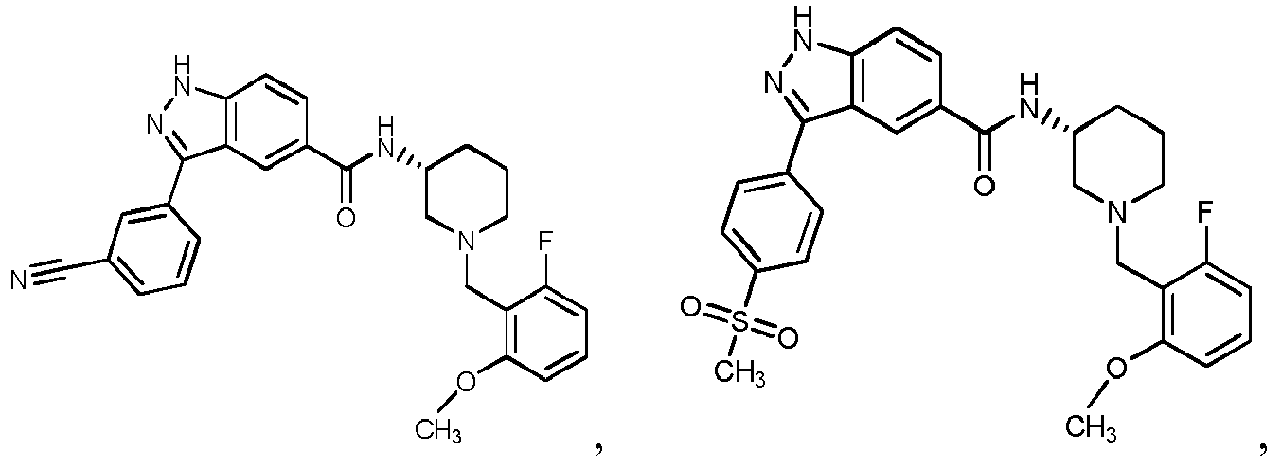
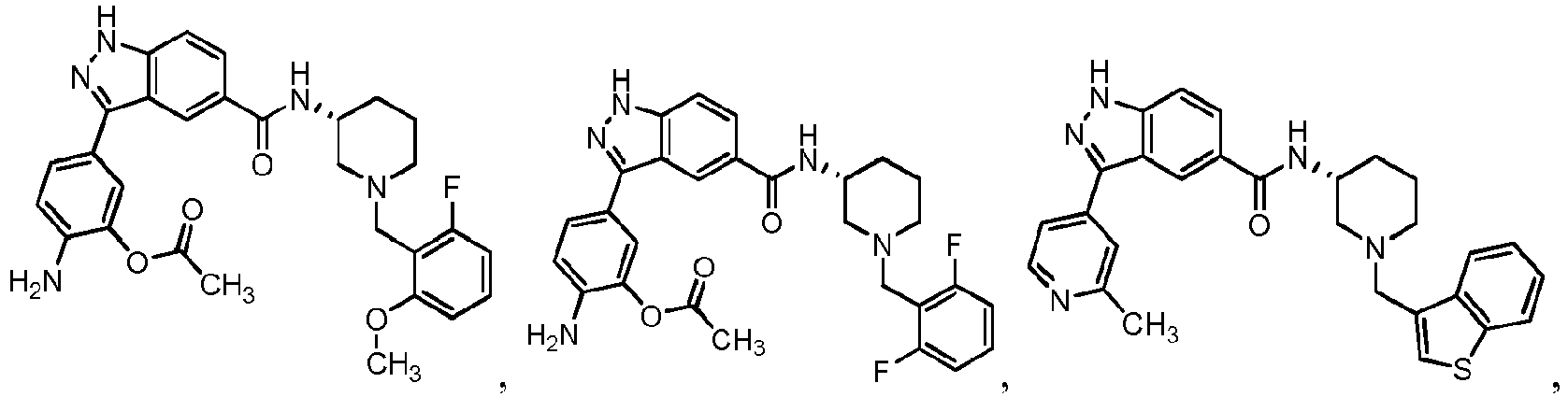
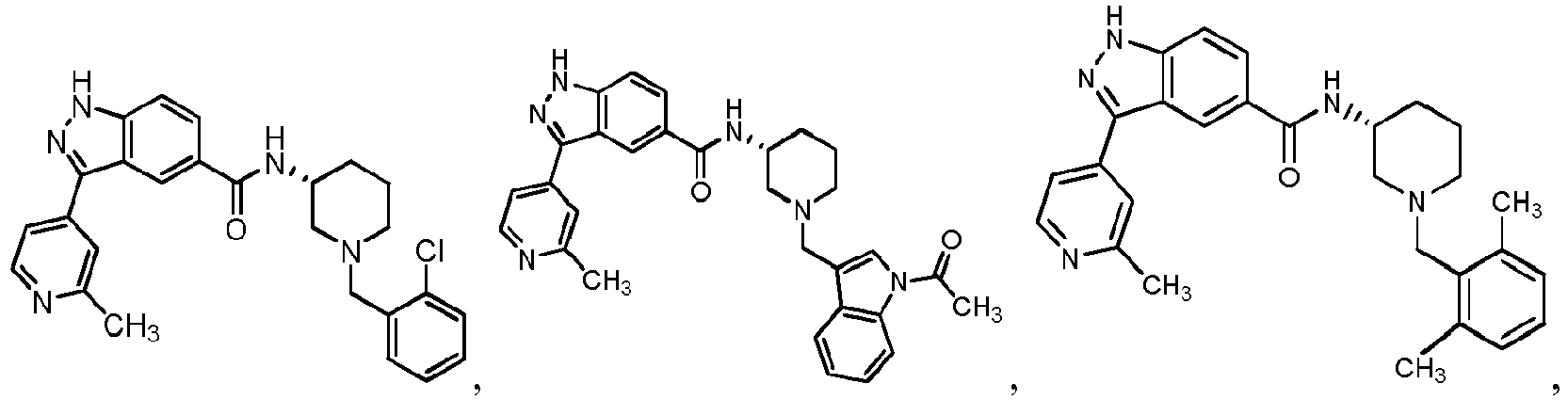

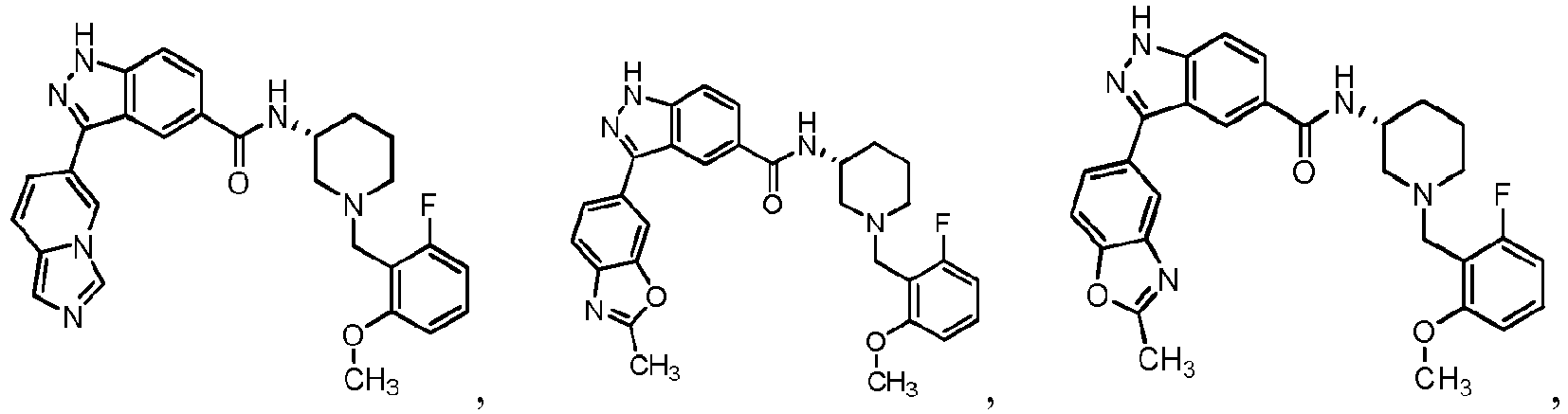


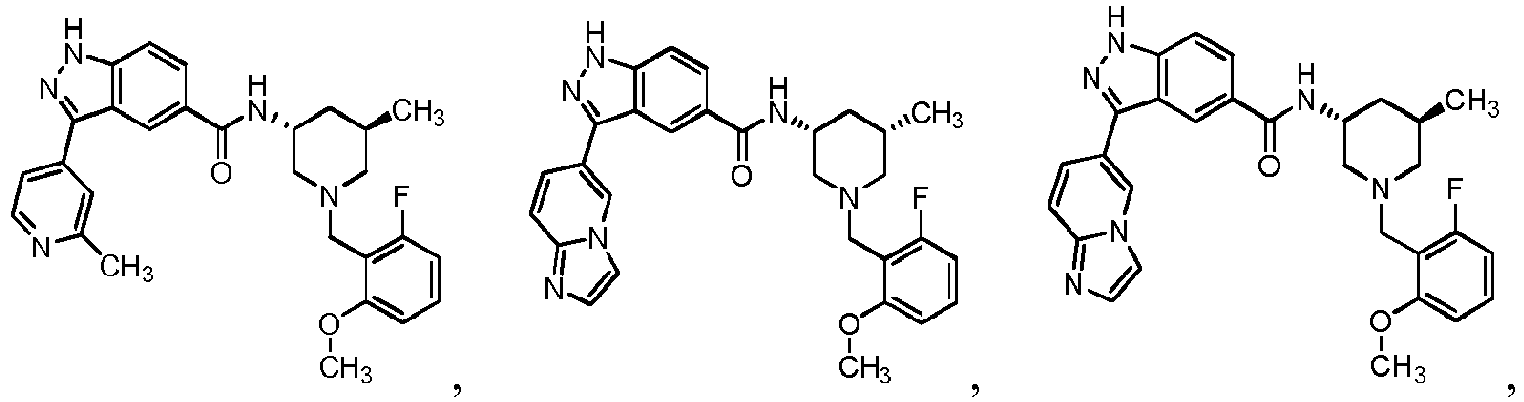

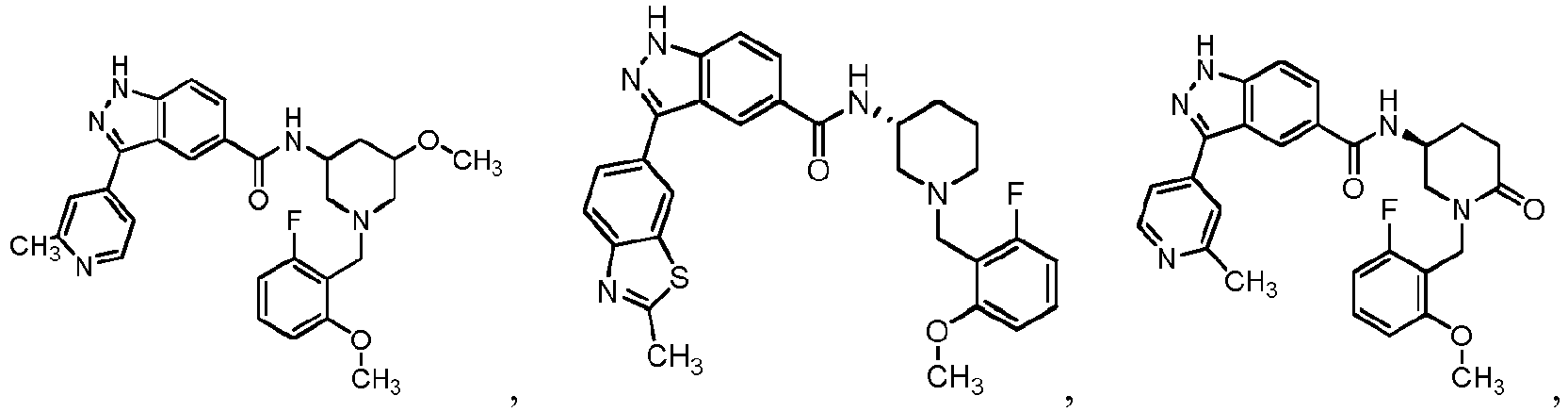

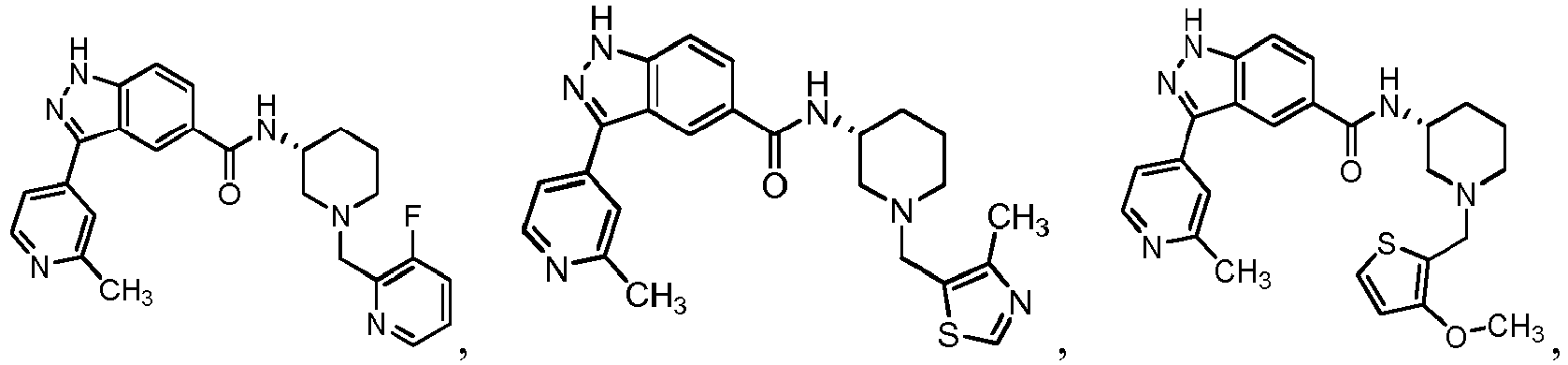


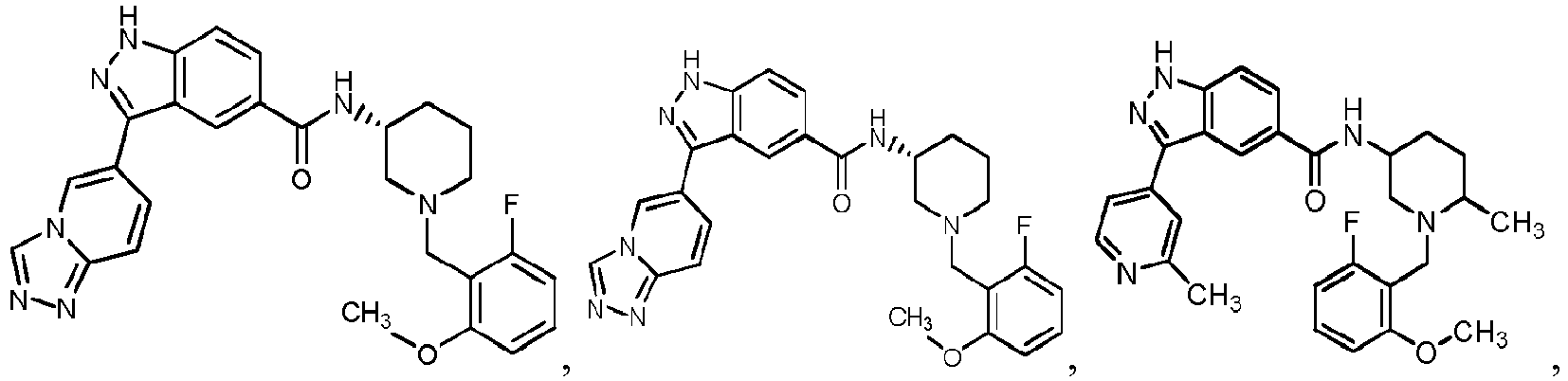


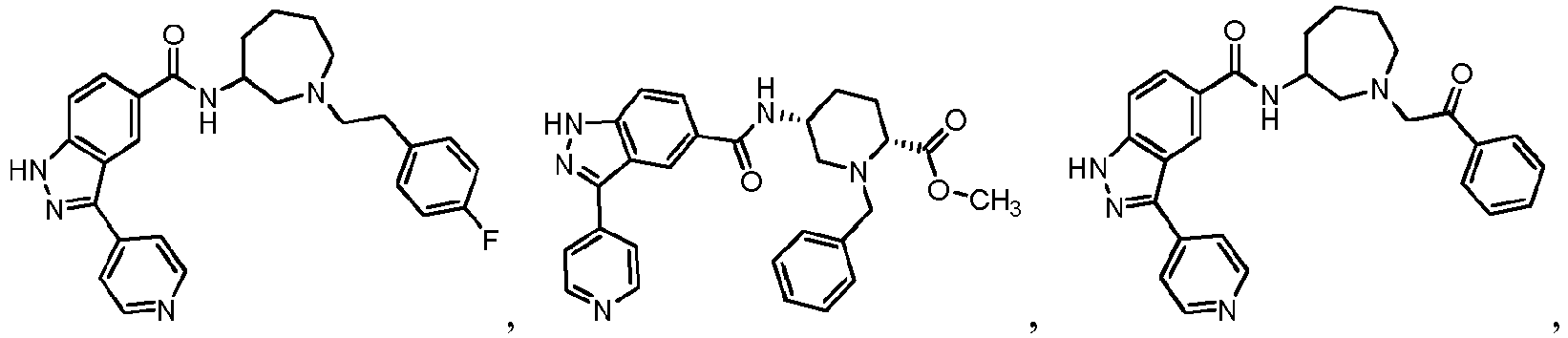


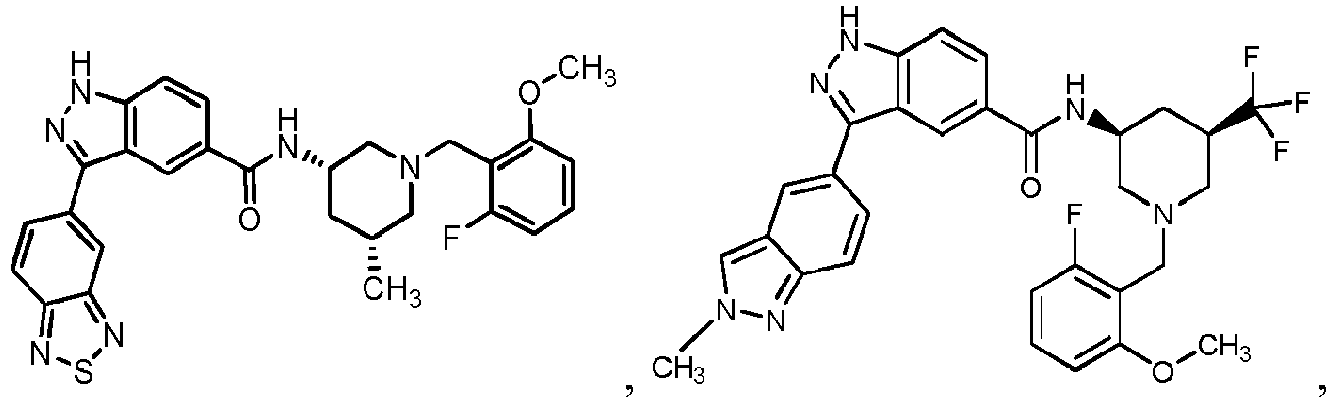


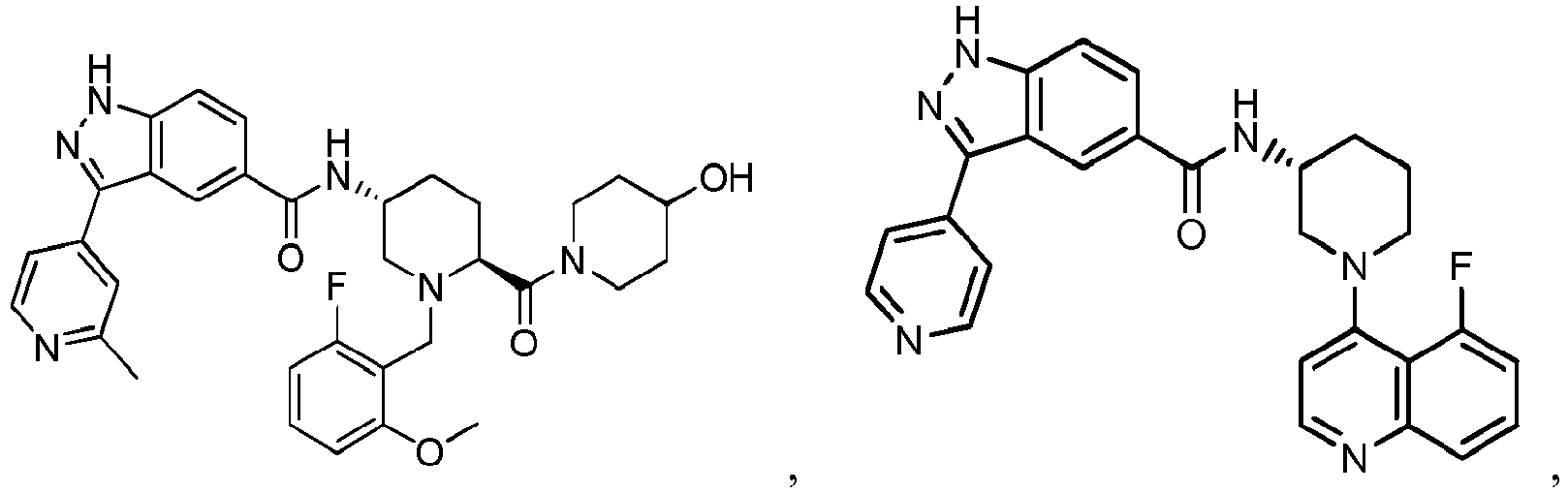


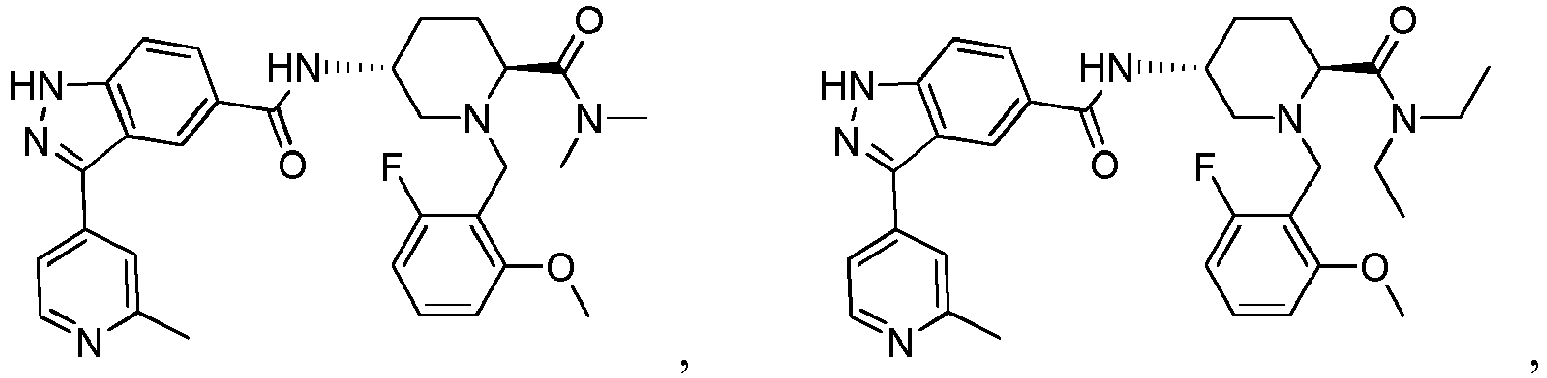
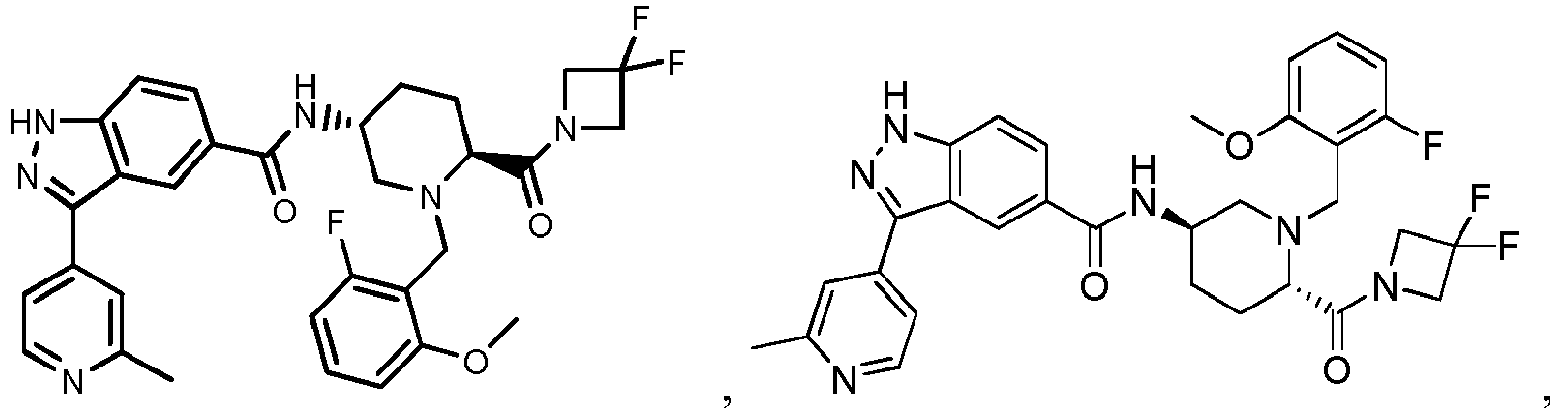
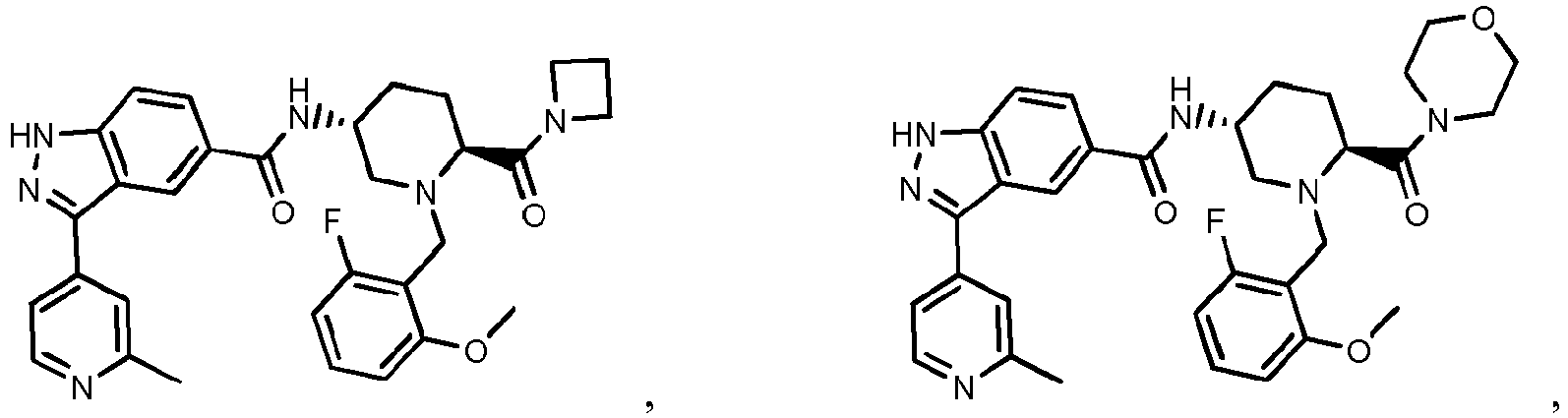


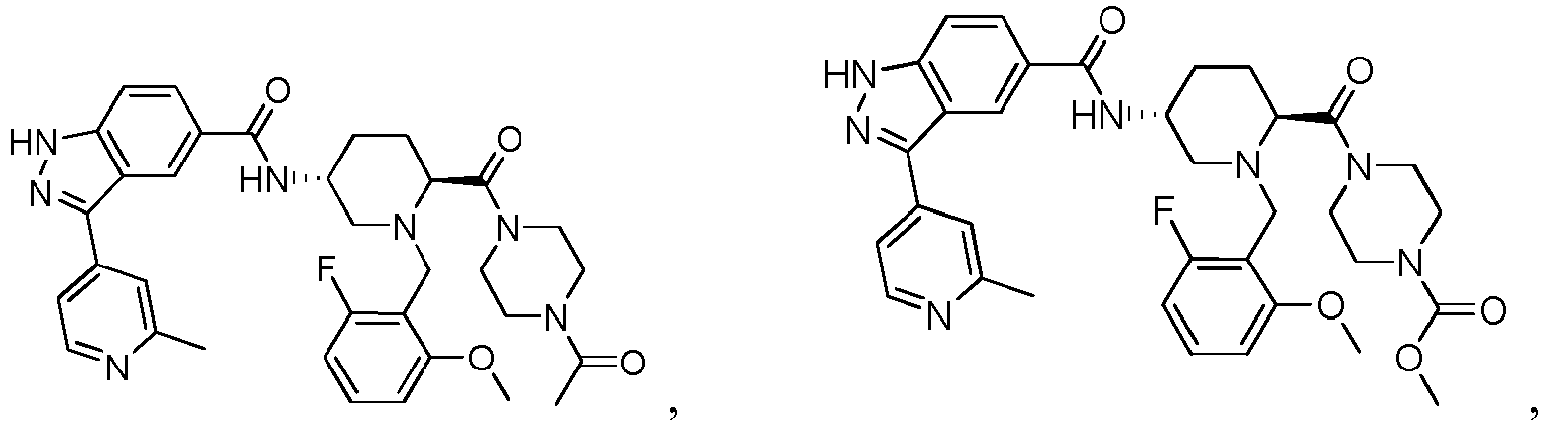


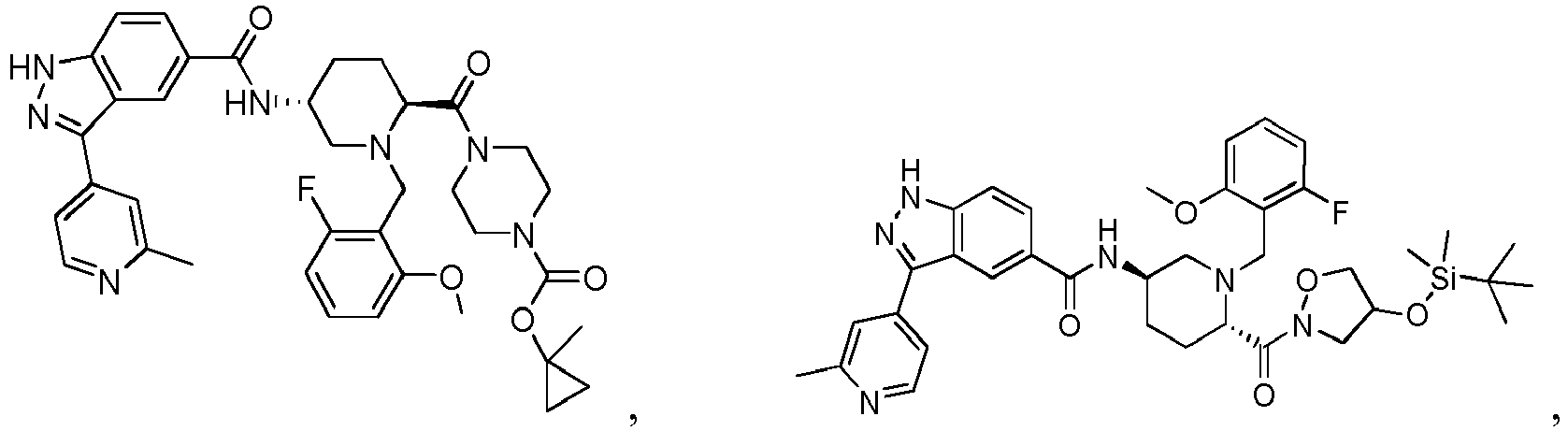

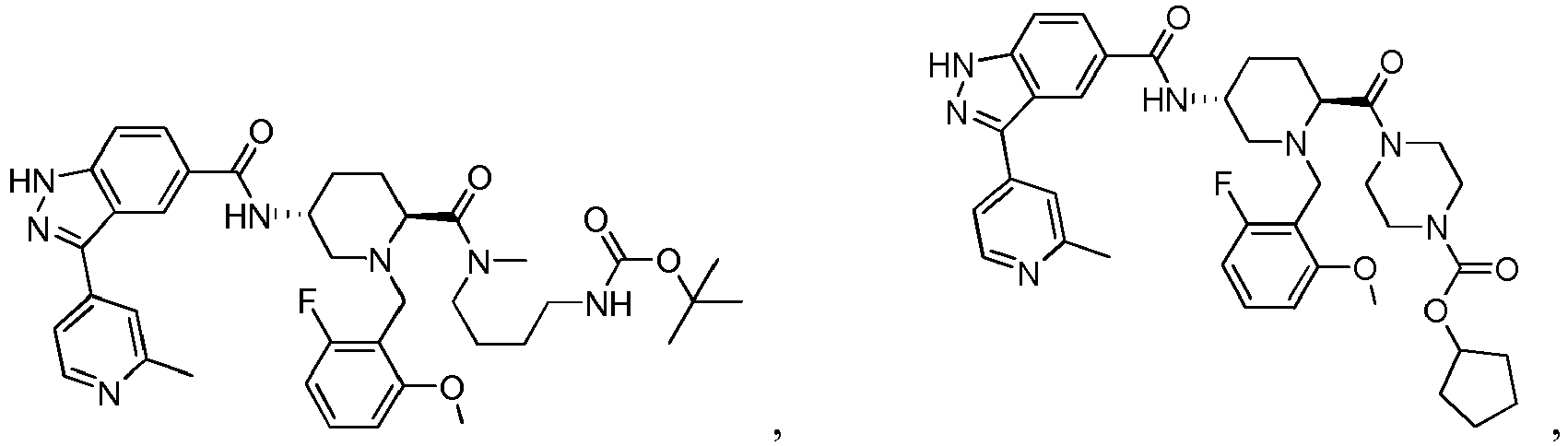

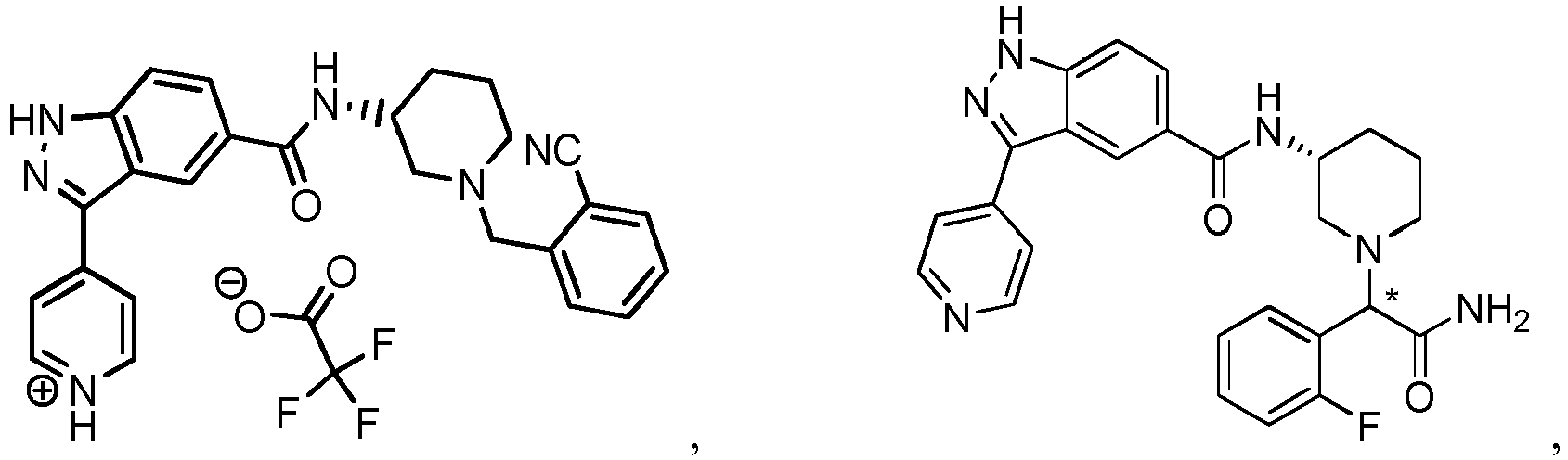


- Eine pharmazeutische Zusammensetzung, die wenigstens eine Verbindung nach einem vorhergehenden Anspruch oder ein pharmazeutisch annehmbares Salz oder Solvat davon und einen pharmazeutisch annehmbaren Träger umfasst.
- Eine Verbindung nach einem der Ansprüche 1 bis 11 oder ein pharmazeutisch annehmbares Salz oder Solvat davon zur Verwendung zur Behandlung von Krebs.
- Eine Verbindung nach einem der Ansprüche 1 bis 11 oder ein pharmazeutisch annehmbares Salz oder Solvat davon zur Verwendung zur:(a) Behandlung von Krebs,(b) Behandlung von Krebs, wobei die Verbindung mit wenigstens einem chemotherapeutischen Mittel verwendet wird, das sich von der Verbindung nach einem der Ansprüche 1 bis 11 unterscheidet,(c) Behandlung von Krebs, wobei die Verbindung mit Strahlentherapie und wenigstens einem chemotherapeutischen Mittel, das sich von der Verbindung nach einem der Ansprüche 1 bis 11 unterscheidet, verwendet wird,(d) Behandlung von Krebs, wobei die Verbindung mit wenigstens einem chemotherapeutischen Mittel, das sich von der Verbindung nach einem der Ansprüche 1 bis 11 unterscheidet, und wenigstens einem Signalübertragungsinhibitor verwendet wird, oder(e) Behandlung von Krebs, wobei der Krebs ausgewählt ist aus der Gruppe bestehend aus: Lungenkrebs, Bauchspeicheldrüsenkerbs, Kolonkrebs, Dickdarmkrebs, myeloische Leukämien, akute myeloische Leukämie, chronische myeloische Leukämie, chronische myelomonozytäre Leukämie, Schilddrüsenkrebs, myelodysplastisches Syndrom, Blasenkrebs, epidermales Karzinom, Melanom, Brustkrebs, Prostatakrebs, Kopf-Hals-Karzinome, Ovarialkarzinom, Gehirntumore, Karzinome mesenchymalen Ursprungs, Sarkoma, Teratokarzinome, Nuroblastome, Nierenkarzinome, Hepatome, Nicht-Hodgkin-Lymphome, multiple Myelome und anaplastische Schilddrüsenkarzinome.
- Eine Kombination, umfassend eine Verbindung nach einem der Ansprüche 1 bis 11 oder ein pharmazeutisch annehmbares Salz oder Solvat davon sowie therapeutische, chemotherapeutische oder antitumoröse Mittel.
Applications Claiming Priority (2)
| Application Number | Priority Date | Filing Date | Title |
|---|---|---|---|
| US35820610P | 2010-06-24 | 2010-06-24 | |
| PCT/US2011/041396 WO2011163330A1 (en) | 2010-06-24 | 2011-06-22 | Novel heterocyclic compounds as erk inhibitors |
Publications (3)
| Publication Number | Publication Date |
|---|---|
| EP2584903A1 EP2584903A1 (de) | 2013-05-01 |
| EP2584903A4 EP2584903A4 (de) | 2014-12-31 |
| EP2584903B1 true EP2584903B1 (de) | 2018-10-24 |
Family
ID=45371796
Family Applications (1)
| Application Number | Title | Priority Date | Filing Date |
|---|---|---|---|
| EP11798821.2A Active EP2584903B1 (de) | 2010-06-24 | 2011-06-22 | Neue heterozyklische verbindungen als erk-hemmer |
Country Status (3)
| Country | Link |
|---|---|
| US (1) | US8999957B2 (de) |
| EP (1) | EP2584903B1 (de) |
| WO (1) | WO2011163330A1 (de) |
Families Citing this family (33)
| Publication number | Priority date | Publication date | Assignee | Title |
|---|---|---|---|---|
| JP2013506669A (ja) | 2009-09-30 | 2013-02-28 | メルク・シャープ・アンド・ドーム・コーポレーション | Erk阻害剤である新規化合物 |
| EP2613782B1 (de) * | 2010-09-01 | 2016-11-02 | Merck Sharp & Dohme Corp. | Indazolderivate als erk-hemmer |
| US8829191B2 (en) * | 2011-06-17 | 2014-09-09 | Melanie Simone Ronsheim | Processes for preparing heterocyclic compounds including trans-7-oxo-6-(sulphooxy)-1,6-diazabicyclo[3,2,1]octane-2-carboxamide and salts thereof |
| US9580390B2 (en) * | 2011-10-12 | 2017-02-28 | University Health Network | Indazole compounds as kinase inhibitors and method of treating cancer with same |
| WO2013109142A1 (en) | 2012-01-16 | 2013-07-25 | Stichting Het Nederlands Kanker Instituut | Combined pdk and mapk/erk pathway inhibition in neoplasia |
| LT3495367T (lt) | 2012-06-13 | 2021-02-25 | Incyte Holdings Corporation | Pakeistieji tricikliniai junginiai, kaip fgfr inhibitoriai |
| LT2986610T (lt) | 2013-04-19 | 2018-04-10 | Incyte Holdings Corporation | Bicikliniai heterociklai, kaip fgfr inhibitoriai |
| EP3046557A1 (de) | 2013-09-20 | 2016-07-27 | Stichting Het Nederlands Kanker Instituut | Rock in kombination mit mapk-signalweg |
| WO2015041534A1 (en) | 2013-09-20 | 2015-03-26 | Stichting Het Nederlands Kanker Instituut | P90rsk in combination with raf/erk/mek |
| US9994845B2 (en) * | 2013-10-02 | 2018-06-12 | Albert Einstein College Of Medicine, Inc. | Methods and compositions to inhibit metastasis and to treat fibrosis and to enhance wound healing |
| US20170027940A1 (en) | 2014-04-10 | 2017-02-02 | Stichting Het Nederlands Kanker Instituut | Method for treating cancer |
| WO2015178770A1 (en) | 2014-05-19 | 2015-11-26 | Stichting Het Nederlands Kanker Instituut | Compositions for cancer treatment |
| MA41551A (fr) | 2015-02-20 | 2017-12-26 | Incyte Corp | Hétérocycles bicycliques utilisés en tant qu'inhibiteurs de fgfr4 |
| US10696687B2 (en) * | 2015-08-20 | 2020-06-30 | Changzhou Jiekai Pharmatech Co., Ltd. | Pyrazolo fused heterocyclic compounds as ERK inhibitors |
| WO2017058007A1 (en) | 2015-10-01 | 2017-04-06 | Stichting Het Nederlands Kanker Instituut-Antoni van Leeuwenhoek Ziekenhuis | Histone deacetylase inhibitors for the use in the treatment of drug resistant melanoma |
| WO2017099591A1 (en) | 2015-12-07 | 2017-06-15 | Stichting Het Nederlands Kanker Instituut-Antoni van Leeuwenhoek Ziekenhuis | Treatment of inhibitor resistant braf-mutant cancers |
| WO2017204626A1 (en) | 2016-05-24 | 2017-11-30 | Stichting Het Nederlands Kanker Instituut-Antoni van Leeuwenhoek Ziekenhuis | Combination therapy - combined map2k4/map3k1 and mek/erk inhibition |
| AR111960A1 (es) | 2017-05-26 | 2019-09-04 | Incyte Corp | Formas cristalinas de un inhibidor de fgfr y procesos para su preparación |
| ES3061844T3 (en) | 2018-05-04 | 2026-04-07 | Incyte Corp | Salts of an fgfr inhibitor |
| MX2020011718A (es) | 2018-05-04 | 2021-02-15 | Incyte Corp | Formas solidas de un inhibidor de receptores del factor de crecimiento de fibroblastos (fgfr) y procesos para prepararlas. |
| CN111057048B (zh) * | 2019-01-30 | 2022-03-18 | 上海凌达生物医药有限公司 | 一类氨基吡嗪/吡啶类化合物、制备方法和用途 |
| US11628162B2 (en) | 2019-03-08 | 2023-04-18 | Incyte Corporation | Methods of treating cancer with an FGFR inhibitor |
| US11591329B2 (en) | 2019-07-09 | 2023-02-28 | Incyte Corporation | Bicyclic heterocycles as FGFR inhibitors |
| US12122767B2 (en) | 2019-10-01 | 2024-10-22 | Incyte Corporation | Bicyclic heterocycles as FGFR inhibitors |
| TWI891666B (zh) | 2019-10-14 | 2025-08-01 | 美商英塞特公司 | 作為fgfr抑制劑之雙環雜環 |
| US11566028B2 (en) | 2019-10-16 | 2023-01-31 | Incyte Corporation | Bicyclic heterocycles as FGFR inhibitors |
| WO2021113462A1 (en) | 2019-12-04 | 2021-06-10 | Incyte Corporation | Derivatives of an fgfr inhibitor |
| CA3163875A1 (en) | 2019-12-04 | 2021-06-10 | Incyte Corporation | Tricyclic heterocycles as fgfr inhibitors |
| US12012409B2 (en) | 2020-01-15 | 2024-06-18 | Incyte Corporation | Bicyclic heterocycles as FGFR inhibitors |
| TW202304459A (zh) | 2021-04-12 | 2023-02-01 | 美商英塞特公司 | 包含fgfr抑制劑及nectin-4靶向劑之組合療法 |
| EP4352060A1 (de) | 2021-06-09 | 2024-04-17 | Incyte Corporation | Tricyclische heterocyclen als fgfr-inhibitoren |
| JP2024522189A (ja) | 2021-06-09 | 2024-06-11 | インサイト・コーポレイション | Fgfr阻害剤としての三環式ヘテロ環 |
| EP4695236A1 (de) * | 2023-04-14 | 2026-02-18 | Soley Therapeutics, Inc. | Substituierte phenylpiperazinylbasierte modulatoren zur behandlung von krankheiten |
Family Cites Families (303)
| Publication number | Priority date | Publication date | Assignee | Title |
|---|---|---|---|---|
| US3126375A (en) | 1964-03-24 | Chioacyl | ||
| US2789118A (en) | 1956-03-30 | 1957-04-16 | American Cyanamid Co | 16-alpha oxy-belta1, 4-pregnadienes |
| US2990401A (en) | 1958-06-18 | 1961-06-27 | American Cyanamid Co | 11-substituted 16alpha, 17alpha-substituted methylenedioxy steroids |
| US3048581A (en) | 1960-04-25 | 1962-08-07 | Olin Mathieson | Acetals and ketals of 16, 17-dihydroxy steroids |
| US3749712A (en) | 1970-09-25 | 1973-07-31 | Sigma Tau Ind Farmaceuti | Triamcinolone acetonide esters and process for their preparation |
| US3996359A (en) | 1972-05-19 | 1976-12-07 | Ab Bofors | Novel stereoisomeric component A of stereoisomeric mixtures of 2'-unsymmetrical 16,17-methylenedioxy steroid 21-acylates, compositions thereof, and method of treating therewith |
| SE378110B (de) | 1972-05-19 | 1975-08-18 | Bofors Ab | |
| SE378109B (de) | 1972-05-19 | 1975-08-18 | Bofors Ab | |
| US4231938A (en) | 1979-06-15 | 1980-11-04 | Merck & Co., Inc. | Hypocholesteremic fermentation products and process of preparation |
| US4319039A (en) | 1979-06-15 | 1982-03-09 | Merck & Co., Inc. | Preparation of ammonium salt of hypocholesteremic fermentation product |
| US4294926A (en) | 1979-06-15 | 1981-10-13 | Merck & Co., Inc. | Hypocholesteremic fermentation products and process of preparation |
| US4444784A (en) | 1980-08-05 | 1984-04-24 | Merck & Co., Inc. | Antihypercholesterolemic compounds |
| MX7065E (es) | 1980-06-06 | 1987-04-10 | Sankyo Co | Un procedimiento microbiologico para preparar derivados de ml-236b |
| JPS5889191A (ja) | 1981-11-20 | 1983-05-27 | Sankyo Co Ltd | 3−ヒドロキシ−ml−236b誘導体の製造法 |
| US5354772A (en) | 1982-11-22 | 1994-10-11 | Sandoz Pharm. Corp. | Indole analogs of mevalonolactone and derivatives thereof |
| US4911165A (en) | 1983-01-12 | 1990-03-27 | Ethicon, Inc. | Pliabilized polypropylene surgical filaments |
| US4681893A (en) | 1986-05-30 | 1987-07-21 | Warner-Lambert Company | Trans-6-[2-(3- or 4-carboxamido-substituted pyrrol-1-yl)alkyl]-4-hydroxypyran-2-one inhibitors of cholesterol synthesis |
| US4885314A (en) | 1987-06-29 | 1989-12-05 | Merck & Co., Inc. | Novel HMG-CoA reductase inhibitors |
| US4782084A (en) | 1987-06-29 | 1988-11-01 | Merck & Co., Inc. | HMG-COA reductase inhibitors |
| US4820850A (en) | 1987-07-10 | 1989-04-11 | Merck & Co., Inc. | Process for α-C-alkylation of the 8-acyl group on mevinolin and analogs thereof |
| US5030447A (en) | 1988-03-31 | 1991-07-09 | E. R. Squibb & Sons, Inc. | Pharmaceutical compositions having good stability |
| US5180589A (en) | 1988-03-31 | 1993-01-19 | E. R. Squibb & Sons, Inc. | Pravastatin pharmaceuatical compositions having good stability |
| US4916239A (en) | 1988-07-19 | 1990-04-10 | Merck & Co., Inc. | Process for the lactonization of mevinic acids and analogs thereof |
| US5118853A (en) | 1988-10-13 | 1992-06-02 | Sandoz Ltd. | Processes for the synthesis of 3-disubstituted aminoacroleins |
| US5290946A (en) | 1988-10-13 | 1994-03-01 | Sandoz Ltd. | Processes for the synthesis of 3-(substituted indolyl-2-yl)propenaldehydes |
| WO1990005525A1 (en) | 1988-11-23 | 1990-05-31 | Pfizer Inc. | Quinuclidine derivatives as substance p antagonists |
| US4929437A (en) | 1989-02-02 | 1990-05-29 | Merck & Co., Inc. | Coenzyme Q10 with HMG-CoA reductase inhibitors |
| US5189164A (en) | 1989-05-22 | 1993-02-23 | Sandoz Ltd. | Processes for the synthesis of syn-(E)-3,5-dihydroxy-7-substituted hept-6-enoic and heptanoic acids and derivatives and intermediates thereof |
| FI94339C (fi) | 1989-07-21 | 1995-08-25 | Warner Lambert Co | Menetelmä farmaseuttisesti käyttökelpoisen /R-(R*,R*)/-2-(4-fluorifenyyli)- , -dihydroksi-5-(1-metyylietyyli)-3-fenyyli-4-/(fenyyliamino)karbonyyli/-1H-pyrroli-1-heptaanihapon ja sen farmaseuttisesti hyväksyttävien suolojen valmistamiseksi |
| PH27357A (en) | 1989-09-22 | 1993-06-21 | Fujisawa Pharmaceutical Co | Pyrazole derivatives and pharmaceutical compositions comprising the same |
| UA41251C2 (uk) | 1990-01-04 | 2001-09-17 | Пфайзер, Інк. | Гідровані азотвмісні гетероциклічні сполуки, похідні піперидину, фармацевтична композиція та спосіб пригнічення активності речовини р в організмі |
| US5232929A (en) | 1990-11-28 | 1993-08-03 | Pfizer Inc. | 3-aminopiperidine derivatives and related nitrogen containing heterocycles and pharmaceutical compositions and use |
| US5420245A (en) | 1990-04-18 | 1995-05-30 | Board Of Regents, The University Of Texas | Tetrapeptide-based inhibitors of farnesyl transferase |
| AU648317B2 (en) | 1990-06-01 | 1994-04-21 | Pfizer Inc. | 3-amino-2-aryl quinuclidines, process for their preparation and pharmaceutical compositions containing them |
| DK0540526T3 (da) | 1990-07-23 | 1995-04-18 | Pfizer | Quinuclidinderivater |
| EP0550635B1 (de) | 1990-09-28 | 1995-04-19 | Pfizer Inc. | Ringverknüpfte analoge von stickstoffenthaltenden nichtaromatischen heterocyclen |
| US5177080A (en) | 1990-12-14 | 1993-01-05 | Bayer Aktiengesellschaft | Substituted pyridyl-dihydroxy-heptenoic acid and its salts |
| WO1992012151A1 (en) | 1991-01-10 | 1992-07-23 | Pfizer Inc. | N-alkyl quinuclidinium salts as substance p antagonists |
| US5242930A (en) | 1991-02-11 | 1993-09-07 | Merck Sharp & Dohme Ltd. | Azabicyclic compounds, pharmaceutical compositions containing them and their use in therapy |
| ES2065175T3 (es) | 1991-03-01 | 1995-02-01 | Pfizer | Derivados de 1-azabiciclo(3.2.2)nonan-3-amina. |
| US5747469A (en) | 1991-03-06 | 1998-05-05 | Board Of Regents, The University Of Texas System | Methods and compositions comprising DNA damaging agents and p53 |
| JPH0794440B2 (ja) | 1991-03-26 | 1995-10-11 | フアイザー・インコーポレイテツド | 置換ピペリジンの立体選択的製造 |
| PL172069B1 (pl) | 1991-05-22 | 1997-07-31 | Pfizer | Sposób wytwarzania nowych pochodnych podstawionej 3-aminochinuklidyny PL PL PL PL PL |
| WO1992020661A1 (en) | 1991-05-22 | 1992-11-26 | Merck & Co., Inc. | N, n-diacylpiperazines |
| CA2102179C (en) | 1991-05-31 | 1998-10-27 | Fumitaka Ito | Quinuclidine derivatives |
| GB9113219D0 (en) | 1991-06-19 | 1991-08-07 | Fujisawa Pharmaceutical Co | Peptide compound,processes for preparation thereof and pharmaceutical composition comprising the same |
| HU224443B1 (hu) | 1991-06-20 | 2005-09-28 | Pfizer Inc. | Fluor-alkoxi-benzaldehid-származékok |
| TW202432B (de) | 1991-06-21 | 1993-03-21 | Pfizer | |
| WO1993001169A2 (en) | 1991-07-05 | 1993-01-21 | Merck Sharp & Dohme Limited | Aromatic compounds, pharmaceutical compositions containing them and their use in therapy |
| ATE133658T1 (de) | 1991-07-10 | 1996-02-15 | Merck Sharp & Dohme | Aromatische verbindungen diese enthaltende pharmazeutische zusammensetzungen und ihre therapeutische verwendung |
| US5495047A (en) | 1991-07-10 | 1996-02-27 | Merck, Sharp & Dohme (Ltd.) | Fused tricyclic compounds, pharmaceutical compositions containing them and their use in therapy |
| EP0600952B1 (de) | 1991-08-20 | 1996-04-17 | MERCK SHARP & DOHME LTD. | Azacyclische verbindungen, verfahren zu ihrer herstellung und diese enthaltende pharmazeutische zubereitungen |
| JP2535134B2 (ja) | 1991-09-16 | 1996-09-18 | ファイザー・インコーポレーテッド | 縮合三環式窒素含有複素環 |
| JP2553020B2 (ja) | 1991-11-07 | 1996-11-13 | 吉富製薬株式会社 | キヌクリジン化合物およびその医薬用途 |
| FI942187A7 (fi) | 1991-11-12 | 1994-05-11 | Pfizer | Asyklisiä etyleenidiamiinijohdannaisia aine P-reseptoriantagonisteina |
| HU217629B (hu) | 1991-12-12 | 2000-03-28 | Novartis Ag. | Eljárás fluvasztatint tartalmazó stabilizált gyógyszerkészítmények előállítására |
| GB9200535D0 (en) | 1992-01-10 | 1992-02-26 | Fujisawa Pharmaceutical Co | New compound |
| GB9201179D0 (en) | 1992-01-21 | 1992-03-11 | Glaxo Group Ltd | Chemical compounds |
| US5328927A (en) | 1992-03-03 | 1994-07-12 | Merck Sharpe & Dohme, Ltd. | Hetercyclic compounds, processes for their preparation and pharmaceutical compositions containing them |
| JP2656702B2 (ja) | 1992-03-23 | 1997-09-24 | ファイザー製薬株式会社 | ペプチド性キヌクリジン |
| FR2689888B1 (fr) | 1992-04-10 | 1994-06-10 | Rhone Poulenc Rorer Sa | Nouveaux derives de perhydroisoindole, leur preparation et les compositions pharmaceutiques qui les contiennent. |
| EP0636130A1 (de) | 1992-04-15 | 1995-02-01 | Merck Sharp & Dohme Ltd. | Azaclyclische Verbindungen |
| ATE209186T1 (de) | 1992-05-18 | 2001-12-15 | Pfizer | Überbrückte azabicyclische derivate als substanz p antagonisten |
| GB9211193D0 (en) | 1992-05-27 | 1992-07-08 | Merck Sharp & Dohme | Therapeutic agents |
| IL106142A (en) | 1992-06-29 | 1997-03-18 | Merck & Co Inc | Morpholine and thiomorpholine tachykinin receptor antagonists, their preparation and pharmaceutical compositions containing them |
| US5719147A (en) | 1992-06-29 | 1998-02-17 | Merck & Co., Inc. | Morpholine and thiomorpholine tachykinin receptor antagonists |
| US5637699A (en) | 1992-06-29 | 1997-06-10 | Merck & Co., Inc. | Process for preparing morpholine tachykinin receptor antagonists |
| AU4713293A (en) | 1992-07-13 | 1994-01-31 | Merck Sharp & Dohme Limited | Heterocyclic amide derivatives as tachykinin derivatives |
| EP1251170A3 (de) | 1992-07-17 | 2002-10-30 | Ribozyme Pharmaceuticals, Inc. | Vergahren und Reagenz zur Behandlung von NF-kappaB abhängiger Tierischen Krankheiten |
| ES2124318T3 (es) | 1992-07-28 | 1999-02-01 | Merck Sharp & Dohme | Compuestos azaciclicos. |
| WO1994003429A1 (en) | 1992-07-31 | 1994-02-17 | Merck Sharp & Dohme Limited | Substituted amines as tachykinin receptor antagonists |
| CA2141051A1 (en) | 1992-08-04 | 1994-02-17 | Terry J. Rosen | Substituted nitrogen-containing heterocycles |
| EP1000930A3 (de) | 1992-08-13 | 2003-10-29 | Warner-Lambert Company | Tachykinin Antagoniste |
| US5721255A (en) | 1992-08-19 | 1998-02-24 | Pfizer Inc. | Substituted benzylamino nitrogen containing non-aromatic heterocycles |
| US5387595A (en) | 1992-08-26 | 1995-02-07 | Merck & Co., Inc. | Alicyclic compounds as tachykinin receptor antagonists |
| AU4973693A (en) | 1992-09-10 | 1994-03-29 | Merck Sharp & Dohme Limited | Alcohols and ethers with aromatic substituents as tachykinin-antagonists |
| GB9220286D0 (en) | 1992-09-25 | 1992-11-11 | Merck Sharp & Dohme | Therapeutic agents |
| JP2656699B2 (ja) | 1992-10-21 | 1997-09-24 | ファイザー製薬株式会社 | 置換ベンジルアミノキヌクリジン |
| GB9222262D0 (en) | 1992-10-23 | 1992-12-09 | Merck Sharp & Dohme | Therapeutic agents |
| JP2656700B2 (ja) | 1992-10-28 | 1997-09-24 | ファイザー製薬株式会社 | 置換キヌクリジン誘導体 |
| CA2146767A1 (en) | 1992-10-28 | 1994-05-11 | Timothy Harrison | 4-arylmethyloxymethyl piperidines as tachykinin antagonists |
| AU5342894A (en) | 1992-10-30 | 1994-05-24 | Merck Sharp & Dohme Limited | Tachykinin antagonists |
| US5886009A (en) | 1992-11-12 | 1999-03-23 | Pfizer Inc. | Quinuclidine derivative as a substance P antagonist |
| EP0675886B1 (de) | 1992-12-10 | 2000-07-05 | Pfizer Inc. | Aminomethylen substituierte heterocyclische verbindungen und ihre verwendung alssubstanz p antagonisten |
| US5604260A (en) | 1992-12-11 | 1997-02-18 | Merck Frosst Canada Inc. | 5-methanesulfonamido-1-indanones as an inhibitor of cyclooxygenase-2 |
| EP0673367A1 (de) | 1992-12-14 | 1995-09-27 | MERCK SHARP & DOHME LTD. | 4-aminomethyl/thiomethyl/sulfonylmethyl-4-phenyl-piperidine als tachykinin rezeptor antagonisten |
| GB9226581D0 (en) | 1992-12-21 | 1993-02-17 | Merck Sharp & Dohme | Therapeutic agents |
| GB9300051D0 (en) | 1993-01-04 | 1993-03-03 | Merck Sharp & Dohme | Therapeutic agents |
| EP0679157B1 (de) | 1993-01-15 | 1997-11-19 | G.D. Searle & Co. | 3,4-diarylthiophene und analoga davon, sowie deren verwendung als entzündungshemmende mittel |
| ATE166867T1 (de) | 1993-02-18 | 1998-06-15 | Merck Sharp & Dohme | Azacyclische verbindungen, sie enthaltende zusammensetzungen und ihre verwendung als tachykinin antagoniste |
| US5674889A (en) | 1993-02-22 | 1997-10-07 | Merck, Sharp & Dohme, Ltd. | Aromatic compounds, compositions containing them and their use in therapy |
| WO1994019357A1 (en) | 1993-02-23 | 1994-09-01 | Merrell Dow Pharmaceuticals Inc. | Farnesyl:protein transferase inhibitors as anticancer agents |
| US5298627A (en) | 1993-03-03 | 1994-03-29 | Warner-Lambert Company | Process for trans-6-[2-(substituted-pyrrol-1-yl)alkyl]pyran-2-one inhibitors of cholesterol synthesis |
| WO1994020500A1 (en) | 1993-03-04 | 1994-09-15 | Pfizer Inc. | Spiroazacyclic derivatives as substance p antagonists |
| US5409944A (en) | 1993-03-12 | 1995-04-25 | Merck Frosst Canada, Inc. | Alkanesulfonamido-1-indanone derivatives as inhibitors of cyclooxygenase |
| US5496833A (en) | 1993-04-13 | 1996-03-05 | Merck Sharp & Dohme Limited | Piperidine tachykinin receptor antagonists |
| HU224496B1 (hu) | 1993-05-06 | 2005-10-28 | Merrel Dow Pharmaceuticals Inc. | Pirrolidin-3-il-alkil-piperidin-származékok és e vegyületeket tartalmazó gyógyászati készítmények |
| WO1994026723A2 (en) | 1993-05-14 | 1994-11-24 | Genentech, Inc. | ras FARNESYL TRANSFERASE INHIBITORS |
| US5602098A (en) | 1993-05-18 | 1997-02-11 | University Of Pittsburgh | Inhibition of farnesyltransferase |
| IL109646A0 (en) | 1993-05-19 | 1994-08-26 | Pfizer | Heteroatom substituted alkyl benzylamino-quinuclidines |
| US5380738A (en) | 1993-05-21 | 1995-01-10 | Monsanto Company | 2-substituted oxazoles further substituted by 4-fluorophenyl and 4-methylsulfonylphenyl as antiinflammatory agents |
| AU680020B2 (en) | 1993-06-07 | 1997-07-17 | Merck & Co., Inc. | Spiro-substituted azacycles as neurokinin antagonists |
| US5436265A (en) | 1993-11-12 | 1995-07-25 | Merck Frosst Canada, Inc. | 1-aroyl-3-indolyl alkanoic acids and derivatives thereof useful as anti-inflammatory agents |
| US5474995A (en) | 1993-06-24 | 1995-12-12 | Merck Frosst Canada, Inc. | Phenyl heterocycles as cox-2 inhibitors |
| GB9602877D0 (en) | 1996-02-13 | 1996-04-10 | Merck Frosst Canada Inc | 3,4-Diaryl-2-hydroxy-2,5- dihydrofurans as prodrugs to cox-2 inhibitors |
| EP0708771B1 (de) | 1993-07-15 | 1998-10-07 | Pfizer Inc. | Benzyloxychinuclidine als substanz p antagonisten |
| TW365603B (en) | 1993-07-30 | 1999-08-01 | Rhone Poulenc Rorer Sa | Novel perhydroisoindole derivatives, their preparation and pharmaceutical compositions which contain them |
| GB9315808D0 (en) | 1993-07-30 | 1993-09-15 | Merck Sharp & Dohme | Therapeutic agents |
| GB9317987D0 (en) | 1993-08-26 | 1993-10-13 | Glaxo Group Ltd | Chemical compounds |
| EP1209157A1 (de) | 1993-09-17 | 2002-05-29 | Pfizer Inc. | Durch Geteroarylamion- und Heteroarylsulfonamido substituierte 3-Benzylaminomethylpiperidine und verwandte Derivate |
| ES2217269T3 (es) | 1993-09-17 | 2004-11-01 | Pfizer Inc. | Piperidinas 3-amino-5-carboxi sustituidas y pirrolidinas 3-amino-4-carboxi sustituidas como antagonistas de taquininas. |
| WO1995008542A1 (en) | 1993-09-22 | 1995-03-30 | Kyowa Hakko Kogyo Co., Ltd. | Farnesyltransferase inhibitor |
| IS4208A (is) | 1993-09-22 | 1995-03-23 | Glaxo Group Limited | 3-(tetrazólýl-benzyl)amínó-piperadidín afleiður |
| EP0723539B1 (de) | 1993-10-15 | 2001-12-12 | Schering Corporation | Tricyclische sulfonamide-derivate zur inhibierung der g-protein funktion und fur die bekandlung von proliferativen erkrantungen |
| US5721236A (en) | 1993-10-15 | 1998-02-24 | Schering Corporation | Tricyclic carbamate compounds useful for inhibition of G-protein function and for treatment of proliferative diseases |
| IL111235A (en) | 1993-10-15 | 2001-03-19 | Schering Plough Corp | Medicinal preparations for inhibiting protein G activity and for the treatment of malignant diseases, containing tricyclic compounds, some such new compounds and a process for the preparation of some of them |
| SG48750A1 (en) | 1993-10-15 | 1998-05-18 | Schering Corp | Tricyclic carbonate compounds useful for inhabition of g-protein function for treatment of proliferative diseases |
| US5719148A (en) | 1993-10-15 | 1998-02-17 | Schering Corporation | Tricyclic amide and urea compounds useful for inhibition of g-protein function and for treatment of proliferative diseases |
| US5661152A (en) | 1993-10-15 | 1997-08-26 | Schering Corporation | Tricyclic sulfonamide compounds useful for inhibition of G-protein function and for treatment of proliferative diseases |
| FI961621L (fi) | 1993-10-25 | 1996-04-12 | Parke Davis & Co | Proteiini:farnesyylitranseraasin substituoidut tetra- ja pentapeptidi-inhibiittorit |
| AU7947594A (en) | 1993-10-27 | 1995-05-22 | Merck Sharp & Dohme Limited | Substituted amides as tachykinin antagonists |
| US5344991A (en) | 1993-10-29 | 1994-09-06 | G.D. Searle & Co. | 1,2 diarylcyclopentenyl compounds for the treatment of inflammation |
| DE69417012T2 (de) | 1993-11-04 | 1999-10-07 | Abbott Laboratories, Abbott Park | Cyclobutan-derivate als inhibitoren der squalen-synthetase und der protein-farnesyltransferase |
| US5783593A (en) | 1993-11-04 | 1998-07-21 | Abbott Laboratories | Inhibitors of squalene synthetase and protein farnesyltransferase |
| WO1995012612A1 (en) | 1993-11-05 | 1995-05-11 | Warner-Lambert Company | Substituted di- and tripeptide inhibitors of protein:farnesyl transferase |
| US6403577B1 (en) | 1993-11-17 | 2002-06-11 | Eli Lilly And Company | Hexamethyleneiminyl tachykinin receptor antagonists |
| US5466823A (en) | 1993-11-30 | 1995-11-14 | G.D. Searle & Co. | Substituted pyrazolyl benzenesulfonamides |
| IT1271462B (it) | 1993-12-03 | 1997-05-28 | Menarini Farma Ind | Antagonisti delle tachichinine,procedimento per la loro preparazione e loro impiego in formulazioni farmaceutiche. |
| US5484799A (en) | 1993-12-09 | 1996-01-16 | Abbott Laboratories | Antifungal dorrigocin derivatives |
| IL111960A (en) | 1993-12-17 | 1999-12-22 | Merck & Co Inc | Morpholines and thiomorpholines their preparation and pharmaceutical compositions containing them |
| WO1995017382A1 (en) | 1993-12-21 | 1995-06-29 | Eli Lilly And Company | Non-peptide tachykinin receptor antagonists |
| NZ274915A (en) | 1993-12-29 | 1997-11-24 | Pfizer | N-(hetero)aryl methyl diazabicycloalkane derivatives |
| DE69434063D1 (de) | 1993-12-29 | 2004-11-11 | Merck Sharp & Dohme | Substituierte Morpholinderivate und ihre Verwendung als therapeutische Mittel |
| JPH09507500A (ja) | 1994-01-13 | 1997-07-29 | メルク シヤープ エンド ドーム リミテツド | gem二置換アザシクロ系のタキキニン拮抗薬 |
| EP0741704A1 (de) | 1994-01-28 | 1996-11-13 | MERCK SHARP & DOHME LTD. | Aralkylamino-substituierte azacyclische therapeutische mittel |
| US5393790A (en) | 1994-02-10 | 1995-02-28 | G.D. Searle & Co. | Substituted spiro compounds for the treatment of inflammation |
| GB9402688D0 (en) | 1994-02-11 | 1994-04-06 | Merck Sharp & Dohme | Therapeutic agents |
| US5610165A (en) | 1994-02-17 | 1997-03-11 | Merck & Co., Inc. | N-acylpiperidine tachykinin antagonists |
| IL112778A0 (en) | 1994-03-04 | 1995-05-26 | Merck & Co Inc | Substituted heterocycles, their preparation and pharmaceutical compositions containing them |
| WO1995024612A1 (de) | 1994-03-07 | 1995-09-14 | International Business Machines Corporation | Verfahren und vorrichtung zur schnellen interpolation von zwischenwerten aus periodischen phasenverschobenen signalen und zur erkennung von defekten in einem drehkörper |
| HUT77406A (hu) | 1994-03-15 | 1998-04-28 | Eisai Co., Ltd., | 1-(4-Amino-5-tio-pent-2-en)-il oldalláncot tartalmazó peptidomimetikumok és az ezeket tartalmazó gyógyszerkészítmények |
| FR2718136B1 (fr) | 1994-03-29 | 1996-06-21 | Sanofi Sa | Composés aromatiques aminés, procédé pour leur obtention et compositions pharmaceutiques les contenant. |
| US5523430A (en) | 1994-04-14 | 1996-06-04 | Bristol-Myers Squibb Company | Protein farnesyl transferase inhibitors |
| US5610145A (en) | 1994-04-15 | 1997-03-11 | Warner-Lambert Company | Tachykinin antagonists |
| EP0758329A1 (de) | 1994-05-05 | 1997-02-19 | MERCK SHARP & DOHME LTD. | Morpholin-derivate und deren verwendung als antagonisten von tachykininen |
| PL317127A1 (en) | 1994-05-07 | 1997-03-17 | Boehringer Ingelheim Kg | Novel derivatives of amino acids, method of obtaining them and pharmaceutic agents containing such derivatives |
| US5510510A (en) | 1994-05-10 | 1996-04-23 | Bristol-Meyers Squibb Company | Inhibitors of farnesyl protein transferase |
| US5563255A (en) | 1994-05-31 | 1996-10-08 | Isis Pharmaceuticals, Inc. | Antisense oligonucleotide modulation of raf gene expression |
| ATE206710T1 (de) | 1994-06-06 | 2001-10-15 | Warner Lambert Co | Tachykinin (nk1) rezeptor antagonisten |
| JPH10501259A (ja) | 1994-06-10 | 1998-02-03 | ローン−プーラン・ロレ・ソシエテ・アノニム | 新規ファルネシルトランスフェラーゼインヒビター、それらの製造およびそれらを含む医薬組成物 |
| US5571792A (en) | 1994-06-30 | 1996-11-05 | Warner-Lambert Company | Histidine and homohistidine derivatives as inhibitors of protein farnesyltransferase |
| GB9415996D0 (en) | 1994-08-08 | 1994-09-28 | Merck Sharp & Dohme | Therapeutic agents |
| TW432061B (en) | 1994-08-09 | 2001-05-01 | Pfizer Res & Dev | Lactams |
| WO1996005529A1 (en) | 1994-08-09 | 1996-02-22 | Micron Optics, Inc. | Temperature compensated fiber fabry-perot filters |
| AU3192395A (en) | 1994-08-11 | 1996-03-07 | Banyu Pharmaceutical Co., Ltd. | Substituted amide derivative |
| AU3192495A (en) | 1994-08-12 | 1996-03-07 | Banyu Pharmaceutical Co., Ltd. | N,n-disubstituted amic acid derivative |
| ES2157337T3 (es) | 1994-08-15 | 2001-08-16 | Merck Sharp & Dohme | Derivados de morfolina y su uso como agentes terapeuticos. |
| DE4429506B4 (de) | 1994-08-19 | 2007-09-13 | Degussa Gmbh | Verfahren zur Extraktion natürlicher Carotinoid-Farbstoffe |
| DE4429653C2 (de) | 1994-08-20 | 1997-04-03 | Anton Dr More | Konverter und Verfahren zum Frischen von Metallschmelzen insbesondere von Roheisen zu Stahl |
| DK0777666T3 (da) | 1994-08-25 | 1999-09-27 | Merrell Pharma Inc | Substituerede piperidiner anvendelige ved behandling af allergiske sygdomme |
| GB9417956D0 (en) | 1994-09-02 | 1994-10-26 | Merck Sharp & Dohme | Therapeutic agents |
| ES2172595T3 (es) | 1994-09-30 | 2002-10-01 | Novartis Ag | Compuestos de 1-acil-4-alifatilaminopiperidina. |
| KR100389754B1 (ko) | 1994-11-22 | 2003-10-17 | 코닌클리즈케 필립스 일렉트로닉스 엔.브이. | 반도체장치 |
| FR2727411B1 (fr) | 1994-11-30 | 1997-01-03 | Rhone Poulenc Rorer Sa | Nouveaux derives de perhydroisoindole, leur preparation et les compositions pharmaceutiques qui les contiennent |
| JPH10510261A (ja) | 1994-12-09 | 1998-10-06 | ワーナー−ランバート・カンパニー | タンパク質:ファルネシルトランスフェラーゼの置換テトラーおよびペンタペプチド阻害剤 |
| PE38997A1 (es) | 1994-12-13 | 1997-10-02 | Novartis Ag | Antagonista de taquicinina |
| GB9426103D0 (en) | 1994-12-23 | 1995-02-22 | Merck Sharp & Dohme | Therapeutic agents |
| WO1996021701A2 (en) | 1995-01-09 | 1996-07-18 | Magla International Ltd. | Wear resistant image printing on latex surfaces |
| JP3925662B2 (ja) | 1995-01-12 | 2007-06-06 | グラクソ,グループ,リミテッド | タキキニンアンタゴニスト活性を有するピペリジン誘導体 |
| JP3929069B2 (ja) | 1995-01-12 | 2007-06-13 | ユニバーシティ オブ ピッツバーグ | プレニルトランスフェラーゼの阻害剤 |
| FR2729390A1 (fr) | 1995-01-18 | 1996-07-19 | Rhone Poulenc Rorer Sa | Nouveaux inhibiteurs de farnesyl transferase, leur preparation et les compositions pharmaceutiques qui les contiennent |
| FR2730492B1 (fr) | 1995-02-09 | 1997-03-14 | Rhone Poulenc Rorer Sa | Nouveaux inhibiteurs de farnesyl transferase, leur preparation et les compositions pharmaceutiques qui les contiennent |
| FR2730491B1 (fr) | 1995-02-09 | 1997-03-14 | Rhone Poulenc Rorer Sa | Nouveaux inhibiteurs de farnesyl transferase, leur preparation et les compositions pharmaceutiques qui les contiennent |
| US5633272A (en) | 1995-02-13 | 1997-05-27 | Talley; John J. | Substituted isoxazoles for the treatment of inflammation |
| GB9505492D0 (en) | 1995-03-18 | 1995-05-03 | Merck Sharp & Dohme | Therapeutic agents |
| GB9505491D0 (en) | 1995-03-18 | 1995-05-03 | Merck Sharp & Dohme | Therapeutic agents |
| US5554641A (en) | 1995-03-20 | 1996-09-10 | Horwell; David C. | Nonpeptides as tachykinin antagonists |
| GB9505692D0 (en) | 1995-03-21 | 1995-05-10 | Glaxo Group Ltd | Chemical compounds |
| US5684013A (en) | 1995-03-24 | 1997-11-04 | Schering Corporation | Tricyclic compounds useful for inhibition of g-protein function and for treatment of proliferative diseases |
| US5700806A (en) | 1995-03-24 | 1997-12-23 | Schering Corporation | Tricyclic amide and urea compounds useful for inhibition of G-protein function and for treatment of proliferative diseases |
| IL117580A0 (en) | 1995-03-29 | 1996-07-23 | Merck & Co Inc | Inhibitors of farnesyl-protein transferase and pharmaceutical compositions containing them |
| US5565568A (en) | 1995-04-06 | 1996-10-15 | Eli Lilly And Company | 2-acylaminopropanamides as tachykinin receptor antagonists |
| US5712280A (en) | 1995-04-07 | 1998-01-27 | Schering Corporation | Tricyclic compounds useful for inhibition of G-protein function and for treatment of proliferative diseases |
| US5891872A (en) | 1995-04-07 | 1999-04-06 | Schering Corporation | Tricyclic compounds |
| CA2217351C (en) | 1995-04-07 | 2003-03-18 | Schering Corporation | Carbonyl-piperazinyl and piperidinyl compounds which inhibit farnesyl protein transferase |
| IL117798A (en) | 1995-04-07 | 2001-11-25 | Schering Plough Corp | Tricyclic compounds useful for inhibiting the function of protein - G and for the treatment of malignant diseases, and pharmaceutical preparations containing them |
| CA2217006C (en) | 1995-04-13 | 2001-05-22 | Hoechst Marion Roussel, Inc. | Novel substituted piperazine derivatives having tachykinin receptor antagonists activity |
| US5831115A (en) | 1995-04-21 | 1998-11-03 | Abbott Laboratories | Inhibitors of squalene synthase and protein farnesyltransferase |
| IL118101A0 (en) | 1995-05-03 | 1996-09-12 | Abbott Lab | Inhibitors of farnesyltransferase |
| WO1996037489A1 (en) | 1995-05-25 | 1996-11-28 | Fujisawa Pharmaceutical Co., Ltd. | 1-benzoyl-2-(indolyl-3-alkyl)-piperazine derivatives as neurokinin receptor antagonists |
| WO1997000252A1 (en) | 1995-06-16 | 1997-01-03 | Warner-Lambert Company | Tricyclic inhibitors of protein farnesyltransferase |
| GB9513121D0 (en) | 1995-06-28 | 1995-08-30 | Merck Sharp & Dohme | Therapeutic agents |
| GB9513117D0 (en) | 1995-06-28 | 1995-08-30 | Merck Sharp & Dohme | Therapeutic agents |
| JP3042894B2 (ja) | 1995-07-07 | 2000-05-22 | ファイザー製薬株式会社 | サブスタンスpアンタゴニストとしての置換ベンゾラクタム化合物 |
| FR2736641B1 (fr) | 1995-07-10 | 1997-08-22 | Rhone Poulenc Rorer Sa | Nouveaux inhibiteurs de farnesyl transferase, leur preparation et les compositions pharmaceutiques qui les contiennent |
| AT402617B (de) | 1995-07-11 | 1997-07-25 | Datacon Schweitzer & Zeindl Gm | Anlage zum automatisierten, hermetischen anlage zum automatisierten, hermetischen verschliessen von gehäusen verschliessen von gehäusen |
| FR2736638B1 (fr) | 1995-07-12 | 1997-08-22 | Rhone Poulenc Rorer Sa | Nouveaux inhibiteurs de farnesyl transferase, leur preparation et les compositions pharmaceutiques qui les contiennent |
| CH690163A5 (fr) | 1995-07-28 | 2000-05-31 | Symphar Sa | Dérivés gem-diphosphonates substitués utiles en tant qu'agents anti-cancers. |
| TW340842B (en) | 1995-08-24 | 1998-09-21 | Pfizer | Substituted benzylaminopiperidine compounds |
| US6020343A (en) | 1995-10-13 | 2000-02-01 | Merck Frosst Canada, Inc. | (Methylsulfonyl)phenyl-2-(5H)-furanones as COX-2 inhibitors |
| WO1997014671A1 (en) | 1995-10-18 | 1997-04-24 | Merck & Co., Inc. | Cyclopentyl tachykinin receptor antagonists |
| TW349948B (en) | 1995-10-31 | 1999-01-11 | Janssen Pharmaceutica Nv | Farnesyl transferase inhibiting 2-quinolone derivatives |
| DE19541283A1 (de) | 1995-11-06 | 1997-05-07 | Boehringer Ingelheim Kg | Neue Aminosäurederivate, Verfahren zu ihrer Herstellung und diese Verbindungen enthaltende pharmazeutische Zusammensetzungen |
| WO1997017070A1 (en) | 1995-11-06 | 1997-05-15 | University Of Pittsburgh | Inhibitors of protein isoprenyl transferases |
| GB9523244D0 (en) | 1995-11-14 | 1996-01-17 | Merck Sharp & Dohme | Therapeutic agents |
| ATE218556T1 (de) | 1995-11-17 | 2002-06-15 | Biotechnolog Forschung Gmbh | Epothilon-derivate und deren herstellung |
| JP2000500502A (ja) | 1995-11-22 | 2000-01-18 | メルク エンド カンパニー インコーポレーテッド | ファルネシル―タンパク質トランスフェラーゼ阻害剤 |
| WO1997019084A1 (en) | 1995-11-23 | 1997-05-29 | Merck Sharp & Dohme Limited | Spiro-piperidine derivatives and their use as tachykinin antagonists |
| GB9524157D0 (en) | 1995-11-25 | 1996-01-24 | Pfizer Ltd | Therapeutic agents |
| EE03484B1 (et) | 1995-12-08 | 2001-08-15 | Janssen Pharmaceutica N.V. | Farnesüülproteiintransferaasi inhibeerivad (5-imidasolüül)metüül-2-kinolinooni derivaadid ja nende kasutamine |
| GB9525296D0 (en) | 1995-12-11 | 1996-02-07 | Merck Sharp & Dohme | Therapeutic agents |
| CZ292791B6 (cs) | 1995-12-22 | 2003-12-17 | Schering Corporation | Tricyklické amidy, které se používají pro inhibici G-proteinové funkce a k léčení proliferativních onemocnění |
| US5874442A (en) | 1995-12-22 | 1999-02-23 | Schering-Plough Corporation | Tricyclic amides useful for inhibition of G-protein function and for treatment of proliferative disease |
| US6008372A (en) | 1996-01-16 | 1999-12-28 | Warner-Lambert Company | Substituted dinaphthylmethyl and diheteroarylmethylacetyl histidine inhibitors of protein farnesyltransferase |
| US6673927B2 (en) | 1996-02-16 | 2004-01-06 | Societe De Conseils De Recherches Et D'applications Scientifiques, S.A.S. | Farnesyl transferase inhibitors |
| US6011029A (en) | 1996-02-26 | 2000-01-04 | Bristol-Myers Squibb Company | Inhibitors of farnesyl protein transferase |
| CA2249601A1 (en) | 1996-04-03 | 1997-10-23 | Thorsten E. Fisher | Inhibitors of farnesyl-protein transferase |
| WO1997038986A1 (en) | 1996-04-12 | 1997-10-23 | G.D. Searle & Co. | Substituted benzenesulfonamide derivatives as prodrugs of cox-2 inhibitors |
| IL126833A0 (en) | 1996-05-22 | 1999-08-17 | Warner Lambert Co | Inhibitors of protein farnesyl transferase |
| AU709409B2 (en) | 1996-07-15 | 1999-08-26 | Bristol-Myers Squibb Company | Thiadioxobenzodiazepine inhibitors of farnesyl protein transferase |
| US5861419A (en) | 1996-07-18 | 1999-01-19 | Merck Frosst Canad, Inc. | Substituted pyridines as selective cyclooxygenase-2 inhibitors |
| US6242469B1 (en) | 1996-12-03 | 2001-06-05 | Sloan-Kettering Institute For Cancer Research | Synthesis of epothilones, intermediates thereto, analogues and uses thereof |
| AU6013998A (en) | 1996-12-30 | 1998-07-31 | Merck & Co., Inc. | Inhibitors of farnesyl-protein transferase |
| AU5719598A (en) | 1996-12-30 | 1998-07-31 | Merck & Co., Inc. | Inhibitors of farnesyl-protein transferase |
| US6632455B2 (en) | 1997-12-22 | 2003-10-14 | Schering Corporation | Molecular dispersion composition with enhanced bioavailability |
| JP2002536968A (ja) | 1999-01-29 | 2002-11-05 | イムクローン システムズ インコーポレイティド | Kdrに特異的な抗体およびその使用 |
| GB9904387D0 (en) | 1999-02-25 | 1999-04-21 | Pharmacia & Upjohn Spa | Antitumour synergistic composition |
| AU4972900A (en) | 1999-04-08 | 2000-11-14 | Arch Development Corporation | Use of anti-vegf antibody to enhance radiation in cancer therapy |
| CA2404125C (en) | 2000-03-20 | 2011-01-25 | Merck Sharp & Dohme Limited | Sulphonamido-substituted bridged bicycloalkyl derivatives |
| GB0012671D0 (en) | 2000-05-24 | 2000-07-19 | Merck Sharp & Dohme | Therapeutic agents |
| US7211594B2 (en) * | 2000-07-31 | 2007-05-01 | Signal Pharmaceuticals, Llc | Indazole compounds and compositions thereof as JNK inhibitors and for the treatment of diseases associated therewith |
| US6897231B2 (en) | 2000-07-31 | 2005-05-24 | Signal Pharmaceuticals, Inc. | Indazole derivatives as JNK inhibitors and compositions and methods related thereto |
| GB0025173D0 (en) | 2000-10-13 | 2000-11-29 | Merck Sharp & Dohme | Therapeutic agents |
| ES2248397T3 (es) | 2000-11-02 | 2006-03-16 | MERCK SHARP & DOHME LTD. | Sulfamidas como inhibidores de la gamma-secretasa. |
| UA74849C2 (en) | 2000-11-17 | 2006-02-15 | Lilly Co Eli | Lactam |
| GB0108592D0 (en) | 2001-04-05 | 2001-05-23 | Merck Sharp & Dohme | Therapeutic agents |
| GB0108591D0 (en) | 2001-04-05 | 2001-05-23 | Merck Sharp & Dohme | Therapeutic agents |
| WO2002083140A1 (en) | 2001-04-10 | 2002-10-24 | Merck & Co., Inc. | Inhibitors of akt activity |
| WO2002083139A1 (en) | 2001-04-10 | 2002-10-24 | Merck & Co., Inc. | Inhibitors of akt activity |
| ATE400274T1 (de) | 2001-04-10 | 2008-07-15 | Merck & Co Inc | Hemmstoffe der akt aktivität |
| WO2002083064A2 (en) | 2001-04-10 | 2002-10-24 | Merck & Co., Inc. | A method of treating cancer |
| AU2002251266A1 (en) | 2001-04-10 | 2002-10-28 | Merck Sharp And Dohme Limited | Inhibitors of akt activity |
| WO2002083648A1 (fr) * | 2001-04-16 | 2002-10-24 | Eisai Co., Ltd. | Nouveau compose a base de 1h-indazole |
| GB0119152D0 (en) | 2001-08-06 | 2001-09-26 | Merck Sharp & Dohme | Therapeutic agents |
| DK1421062T3 (da) | 2001-08-21 | 2008-02-18 | Merck Sharp & Dohme | Cyclohexylsulfoner |
| AU2002363429B2 (en) | 2001-11-07 | 2008-05-08 | Merck & Co., Inc. | Mitotic kinesin inhibitors |
| CA2467726A1 (en) | 2001-12-06 | 2003-06-19 | Merck & Co., Inc. | Mitotic kinesin inhibitors |
| WO2003049679A2 (en) | 2001-12-06 | 2003-06-19 | Merck & Co., Inc. | Mitotic kinesin inhibitors |
| US7378411B2 (en) | 2001-12-06 | 2008-05-27 | Merck & Co., Inc. | Substituted thienopyrimidinones as a mitotic kinesin inhibitor |
| AU2002363960B2 (en) | 2001-12-06 | 2008-07-10 | Merck Sharp & Dohme Corp. | Mitotic kinesin inhibitors |
| ATE424388T1 (de) | 2001-12-06 | 2009-03-15 | Merck & Co Inc | Mitotische kinesinhemmer |
| AU2003249597B2 (en) | 2002-03-08 | 2007-06-28 | Merck Sharp & Dohme Corp. | Mitotic kinesin inhibitors |
| US20060142178A1 (en) | 2002-04-08 | 2006-06-29 | Barnett Stanley F | Method of treating cancer |
| WO2003086279A2 (en) | 2002-04-08 | 2003-10-23 | Merck & Co., Inc. | Inhibitors of akt activity |
| WO2003086403A1 (en) | 2002-04-08 | 2003-10-23 | Merck & Co., Inc. | Inhibitors of akt activity |
| WO2003086394A1 (en) | 2002-04-08 | 2003-10-23 | Merck & Co., Inc. | Inhibitors of akt activity |
| US7273869B2 (en) | 2002-04-08 | 2007-09-25 | Merck & Co., Inc. | Inhibitors of Akt activity |
| GB0209995D0 (en) | 2002-05-01 | 2002-06-12 | Merck Sharp & Dohme | Therapeutic agents |
| GB0209991D0 (en) | 2002-05-01 | 2002-06-12 | Merck Sharp & Dohme | Therapeutic agents |
| GB0209997D0 (en) | 2002-05-01 | 2002-06-12 | Merck Sharp & Dohme | Therapeutic agents |
| DE60328182D1 (de) | 2002-05-01 | 2009-08-13 | Merck Sharp & Dohme | Heteroaryl substituierte spirocyclische sulfamide zur hemmung von gamma sekretase |
| CA2485343A1 (en) | 2002-05-23 | 2004-05-13 | Merck & Co., Inc. | Mitotic kinesin inhibitors |
| AU2003231799A1 (en) | 2002-05-23 | 2003-12-12 | Merck & Co., Inc. | Mitotic kinesin inhibitors |
| KR20050004214A (ko) * | 2002-05-31 | 2005-01-12 | 에자이 가부시키가이샤 | 피라졸 화합물 및 이것을 포함하여 이루어지는 의약 조성물 |
| KR20050010515A (ko) | 2002-06-14 | 2005-01-27 | 머크 앤드 캄파니 인코포레이티드 | 유사분열 키네신 억제제 |
| EP1515949B1 (de) | 2002-06-14 | 2007-03-14 | Merck & Co., Inc. | Inhibitoren von mitotischem kinesin |
| GB0223040D0 (en) | 2002-10-04 | 2002-11-13 | Merck Sharp & Dohme | Therapeutic compounds |
| GB0223038D0 (en) | 2002-10-04 | 2002-11-13 | Merck Sharp & Dohme | Therapeutic compounds |
| GB0223039D0 (en) | 2002-10-04 | 2002-11-13 | Merck Sharp & Dohme | Therapeutic compounds |
| AU2003287057B2 (en) | 2002-10-18 | 2008-08-21 | Merck Sharp & Dohme Corp. | Mitotic kinesin inhibitors |
| US20040102360A1 (en) | 2002-10-30 | 2004-05-27 | Barnett Stanley F. | Combination therapy |
| US7399764B2 (en) | 2002-10-30 | 2008-07-15 | Merck & Co., Inc. | Inhibitors of Akt activity |
| GB0225474D0 (en) | 2002-11-01 | 2002-12-11 | Merck Sharp & Dohme | Therapeutic agents |
| GB0225475D0 (en) | 2002-11-01 | 2002-12-11 | Merck Sharp & Dohme | Therapeutic agents |
| BR0316923A (pt) | 2002-12-06 | 2005-10-18 | Pharmacia Corp | Polipeptìdeo mitoneet de membranas mitocondriais, seus moduladores e métodos para utilização do mesmo |
| JP2006516140A (ja) | 2002-12-20 | 2006-06-22 | メルク エンド カムパニー インコーポレーテッド | 有糸分裂キネシン阻害剤 |
| WO2004058700A2 (en) | 2002-12-20 | 2004-07-15 | Merck & Co., Inc. | Mitotic kinesin inhibitors |
| GB0308318D0 (en) | 2003-04-10 | 2003-05-14 | Merck Sharp & Dohme | Therapeutic agents |
| CN1809351A (zh) | 2003-04-24 | 2006-07-26 | 麦克公司 | Akt活性抑制剂 |
| WO2004096131A2 (en) | 2003-04-24 | 2004-11-11 | Merck & Co., Inc. | Inhibitors of akt activity |
| JP4679514B2 (ja) | 2003-04-24 | 2011-04-27 | メルク・シャープ・エンド・ドーム・コーポレイション | Akt活性の阻害剤 |
| DE602004026047D1 (de) | 2003-04-24 | 2010-04-29 | Merck Sharp & Dohme | Hemmer der akt aktivität |
| KR20060013404A (ko) | 2003-05-16 | 2006-02-09 | 머크 샤프 앤드 돔 리미티드 | γ-세크레타제 억제용 사이클릭 설폰아미드 |
| US7454431B2 (en) | 2003-07-17 | 2008-11-18 | At&T Corp. | Method and apparatus for window matching in delta compressors |
| GB0318447D0 (en) | 2003-08-05 | 2003-09-10 | Merck Sharp & Dohme | Therapeutic agents |
| KR100536215B1 (ko) | 2003-08-05 | 2005-12-12 | 삼성에스디아이 주식회사 | 플라즈마 디스플레이 패널 |
| WO2005018638A1 (en) | 2003-08-13 | 2005-03-03 | Merck & Co., Inc. | Mitotic kinesin inhibitors |
| PE20050730A1 (es) | 2003-08-15 | 2005-09-20 | Merck & Co Inc | Derivados de 2,5-dihidropirrol 2,2-disustituidos como inhibidores de quinesinas mitoticas |
| EP1656146A4 (de) | 2003-08-15 | 2009-04-15 | Merck & Co Inc | Inhibitoren von mitotischem kinesin |
| CN1835746A (zh) | 2003-08-15 | 2006-09-20 | 默克公司 | 有丝分裂驱动蛋白抑制剂 |
| EP1664026B1 (de) | 2003-08-15 | 2009-01-21 | Merck & Co., Inc. | Inhibitoren von mitotischem kinesin |
| WO2005030731A1 (en) | 2003-09-24 | 2005-04-07 | Merck Sharp & Dohme Limited | Gamma-secretase inhibitors |
| US7294640B2 (en) | 2004-02-06 | 2007-11-13 | Merck & Co., Inc. | Mitotic kinesin inhibitors |
| EP1737843B1 (de) | 2004-04-09 | 2011-02-23 | Merck Sharp & Dohme Corp. | Hemmer der akt aktivität |
| CN1942470A (zh) | 2004-04-09 | 2007-04-04 | 默克公司 | Akt活性抑制剂 |
| GB0501999D0 (en) * | 2005-02-01 | 2005-03-09 | Sentinel Oncology Ltd | Pharmaceutical compounds |
| RU2442778C9 (ru) | 2005-12-13 | 2012-08-10 | Шеринг Корпорейшн | Новые соединения, действующие как ингибиторы erk |
| CA2647949A1 (en) | 2006-03-29 | 2007-11-08 | Array Biopharma Inc. | P38 inhibitors and methods of use thereof |
| WO2008061109A2 (en) | 2006-11-15 | 2008-05-22 | Forest Laboratories Holdings Limited | Indazole derivatives useful as melanin concentrating receptor ligands |
| AR068046A1 (es) | 2007-06-05 | 2009-11-04 | Schering Corp | Derivados policiclicos de indazol y su uso como inhibidores de erk para el tratamiento del cancer |
| WO2009018490A1 (en) * | 2007-07-31 | 2009-02-05 | Burnham Institute For Medical Research | Bi-dentate compounds as kinase inhibitors |
| RU2525389C2 (ru) * | 2008-02-21 | 2014-08-10 | Мерк Шарп И Доум Корп. | Соединения, которые являются ингибиторами erk |
| EP2464231A4 (de) * | 2009-08-10 | 2013-02-06 | Samumed Llc | Indazole als wnt/b-catenin-signalisierungspfadhemmer und therapeutische anwendungen davon |
-
2011
- 2011-06-22 EP EP11798821.2A patent/EP2584903B1/de active Active
- 2011-06-22 US US13/703,250 patent/US8999957B2/en active Active
- 2011-06-22 WO PCT/US2011/041396 patent/WO2011163330A1/en not_active Ceased
Non-Patent Citations (1)
| Title |
|---|
| None * |
Also Published As
| Publication number | Publication date |
|---|---|
| US20130096084A1 (en) | 2013-04-18 |
| EP2584903A4 (de) | 2014-12-31 |
| WO2011163330A1 (en) | 2011-12-29 |
| EP2584903A1 (de) | 2013-05-01 |
| US8999957B2 (en) | 2015-04-07 |
Similar Documents
| Publication | Publication Date | Title |
|---|---|---|
| EP2613782B1 (de) | Indazolderivate als erk-hemmer | |
| US8999957B2 (en) | Heterocyclic compounds as ERK inhibitors | |
| EP2934535B1 (de) | Substituierte pyrrolopyrimidine als hdm2-inhibitoren | |
| US9351965B2 (en) | Indazole derivatives useful as ERK inhibitors | |
| EP2935263B1 (de) | Substituierte imidazopyridine als hdm2 inhibitoren | |
| EP2488028B1 (de) | Substituierte piperidine zur erhöhung der p53-aktivität und ihre verwendung | |
| EP2615916B1 (de) | Kondensierte pyrazolderivate als neue erk-hemmer | |
| US8987274B2 (en) | Macrocycles that increase p53 activity and the uses thereof | |
| EP2953470B1 (de) | 2,6,7-substituierte purine als hdm2-inhibitoren | |
| EP3233858B1 (de) | Erk-hemmer | |
| EP2793890B1 (de) | Substituierte piperidine als hmd2-hemmer | |
| WO2013148227A1 (en) | Insulin-like growth factor-1 receptor inhibitors | |
| WO2012027240A1 (en) | Fused tricyclic inhibitors of mammalian target of rapamycin | |
| EP4608398A1 (de) | Pnu-anthracyclinderivate und verfahren zur verwendung davon | |
| US20260132164A1 (en) | Pnu anthracycline derivatives and methods of use thereof | |
| WO2025244963A1 (en) | Ecteinascidin derivatives and methods of use thereof as antitumor agents |
Legal Events
| Date | Code | Title | Description |
|---|---|---|---|
| PUAI | Public reference made under article 153(3) epc to a published international application that has entered the european phase |
Free format text: ORIGINAL CODE: 0009012 |
|
| 17P | Request for examination filed |
Effective date: 20130124 |
|
| AK | Designated contracting states |
Kind code of ref document: A1 Designated state(s): AL AT BE BG CH CY CZ DE DK EE ES FI FR GB GR HR HU IE IS IT LI LT LU LV MC MK MT NL NO PL PT RO RS SE SI SK SM TR |
|
| DAX | Request for extension of the european patent (deleted) | ||
| A4 | Supplementary search report drawn up and despatched |
Effective date: 20141128 |
|
| RIC1 | Information provided on ipc code assigned before grant |
Ipc: C07D 231/56 20060101ALI20141124BHEP Ipc: C07D 209/48 20060101ALI20141124BHEP Ipc: A01N 43/56 20060101AFI20141124BHEP Ipc: C07D 235/04 20060101ALI20141124BHEP |
|
| 17Q | First examination report despatched |
Effective date: 20160629 |
|
| STAA | Information on the status of an ep patent application or granted ep patent |
Free format text: STATUS: EXAMINATION IS IN PROGRESS |
|
| GRAP | Despatch of communication of intention to grant a patent |
Free format text: ORIGINAL CODE: EPIDOSNIGR1 |
|
| STAA | Information on the status of an ep patent application or granted ep patent |
Free format text: STATUS: GRANT OF PATENT IS INTENDED |
|
| INTG | Intention to grant announced |
Effective date: 20180509 |
|
| GRAS | Grant fee paid |
Free format text: ORIGINAL CODE: EPIDOSNIGR3 |
|
| GRAA | (expected) grant |
Free format text: ORIGINAL CODE: 0009210 |
|
| STAA | Information on the status of an ep patent application or granted ep patent |
Free format text: STATUS: THE PATENT HAS BEEN GRANTED |
|
| AK | Designated contracting states |
Kind code of ref document: B1 Designated state(s): AL AT BE BG CH CY CZ DE DK EE ES FI FR GB GR HR HU IE IS IT LI LT LU LV MC MK MT NL NO PL PT RO RS SE SI SK SM TR |
|
| REG | Reference to a national code |
Ref country code: GB Ref legal event code: FG4D |
|
| REG | Reference to a national code |
Ref country code: CH Ref legal event code: EP |
|
| REG | Reference to a national code |
Ref country code: IE Ref legal event code: FG4D |
|
| REG | Reference to a national code |
Ref country code: DE Ref legal event code: R096 Ref document number: 602011053255 Country of ref document: DE Ref country code: AT Ref legal event code: REF Ref document number: 1055590 Country of ref document: AT Kind code of ref document: T Effective date: 20181115 |
|
| REG | Reference to a national code |
Ref country code: NL Ref legal event code: MP Effective date: 20181024 |
|
| REG | Reference to a national code |
Ref country code: LT Ref legal event code: MG4D |
|
| REG | Reference to a national code |
Ref country code: AT Ref legal event code: MK05 Ref document number: 1055590 Country of ref document: AT Kind code of ref document: T Effective date: 20181024 |
|
| PG25 | Lapsed in a contracting state [announced via postgrant information from national office to epo] |
Ref country code: NL Free format text: LAPSE BECAUSE OF FAILURE TO SUBMIT A TRANSLATION OF THE DESCRIPTION OR TO PAY THE FEE WITHIN THE PRESCRIBED TIME-LIMIT Effective date: 20181024 |
|
| PG25 | Lapsed in a contracting state [announced via postgrant information from national office to epo] |
Ref country code: FI Free format text: LAPSE BECAUSE OF FAILURE TO SUBMIT A TRANSLATION OF THE DESCRIPTION OR TO PAY THE FEE WITHIN THE PRESCRIBED TIME-LIMIT Effective date: 20181024 Ref country code: AT Free format text: LAPSE BECAUSE OF FAILURE TO SUBMIT A TRANSLATION OF THE DESCRIPTION OR TO PAY THE FEE WITHIN THE PRESCRIBED TIME-LIMIT Effective date: 20181024 Ref country code: HR Free format text: LAPSE BECAUSE OF FAILURE TO SUBMIT A TRANSLATION OF THE DESCRIPTION OR TO PAY THE FEE WITHIN THE PRESCRIBED TIME-LIMIT Effective date: 20181024 Ref country code: PL Free format text: LAPSE BECAUSE OF FAILURE TO SUBMIT A TRANSLATION OF THE DESCRIPTION OR TO PAY THE FEE WITHIN THE PRESCRIBED TIME-LIMIT Effective date: 20181024 Ref country code: LT Free format text: LAPSE BECAUSE OF FAILURE TO SUBMIT A TRANSLATION OF THE DESCRIPTION OR TO PAY THE FEE WITHIN THE PRESCRIBED TIME-LIMIT Effective date: 20181024 Ref country code: LV Free format text: LAPSE BECAUSE OF FAILURE TO SUBMIT A TRANSLATION OF THE DESCRIPTION OR TO PAY THE FEE WITHIN THE PRESCRIBED TIME-LIMIT Effective date: 20181024 Ref country code: NO Free format text: LAPSE BECAUSE OF FAILURE TO SUBMIT A TRANSLATION OF THE DESCRIPTION OR TO PAY THE FEE WITHIN THE PRESCRIBED TIME-LIMIT Effective date: 20190124 Ref country code: IS Free format text: LAPSE BECAUSE OF FAILURE TO SUBMIT A TRANSLATION OF THE DESCRIPTION OR TO PAY THE FEE WITHIN THE PRESCRIBED TIME-LIMIT Effective date: 20190224 Ref country code: ES Free format text: LAPSE BECAUSE OF FAILURE TO SUBMIT A TRANSLATION OF THE DESCRIPTION OR TO PAY THE FEE WITHIN THE PRESCRIBED TIME-LIMIT Effective date: 20181024 Ref country code: BG Free format text: LAPSE BECAUSE OF FAILURE TO SUBMIT A TRANSLATION OF THE DESCRIPTION OR TO PAY THE FEE WITHIN THE PRESCRIBED TIME-LIMIT Effective date: 20190124 |
|
| PG25 | Lapsed in a contracting state [announced via postgrant information from national office to epo] |
Ref country code: AL Free format text: LAPSE BECAUSE OF FAILURE TO SUBMIT A TRANSLATION OF THE DESCRIPTION OR TO PAY THE FEE WITHIN THE PRESCRIBED TIME-LIMIT Effective date: 20181024 Ref country code: PT Free format text: LAPSE BECAUSE OF FAILURE TO SUBMIT A TRANSLATION OF THE DESCRIPTION OR TO PAY THE FEE WITHIN THE PRESCRIBED TIME-LIMIT Effective date: 20190224 Ref country code: SE Free format text: LAPSE BECAUSE OF FAILURE TO SUBMIT A TRANSLATION OF THE DESCRIPTION OR TO PAY THE FEE WITHIN THE PRESCRIBED TIME-LIMIT Effective date: 20181024 Ref country code: GR Free format text: LAPSE BECAUSE OF FAILURE TO SUBMIT A TRANSLATION OF THE DESCRIPTION OR TO PAY THE FEE WITHIN THE PRESCRIBED TIME-LIMIT Effective date: 20190125 Ref country code: RS Free format text: LAPSE BECAUSE OF FAILURE TO SUBMIT A TRANSLATION OF THE DESCRIPTION OR TO PAY THE FEE WITHIN THE PRESCRIBED TIME-LIMIT Effective date: 20181024 |
|
| REG | Reference to a national code |
Ref country code: DE Ref legal event code: R097 Ref document number: 602011053255 Country of ref document: DE |
|
| PG25 | Lapsed in a contracting state [announced via postgrant information from national office to epo] |
Ref country code: CZ Free format text: LAPSE BECAUSE OF FAILURE TO SUBMIT A TRANSLATION OF THE DESCRIPTION OR TO PAY THE FEE WITHIN THE PRESCRIBED TIME-LIMIT Effective date: 20181024 Ref country code: DK Free format text: LAPSE BECAUSE OF FAILURE TO SUBMIT A TRANSLATION OF THE DESCRIPTION OR TO PAY THE FEE WITHIN THE PRESCRIBED TIME-LIMIT Effective date: 20181024 Ref country code: IT Free format text: LAPSE BECAUSE OF FAILURE TO SUBMIT A TRANSLATION OF THE DESCRIPTION OR TO PAY THE FEE WITHIN THE PRESCRIBED TIME-LIMIT Effective date: 20181024 |
|
| PG25 | Lapsed in a contracting state [announced via postgrant information from national office to epo] |
Ref country code: SM Free format text: LAPSE BECAUSE OF FAILURE TO SUBMIT A TRANSLATION OF THE DESCRIPTION OR TO PAY THE FEE WITHIN THE PRESCRIBED TIME-LIMIT Effective date: 20181024 Ref country code: RO Free format text: LAPSE BECAUSE OF FAILURE TO SUBMIT A TRANSLATION OF THE DESCRIPTION OR TO PAY THE FEE WITHIN THE PRESCRIBED TIME-LIMIT Effective date: 20181024 Ref country code: EE Free format text: LAPSE BECAUSE OF FAILURE TO SUBMIT A TRANSLATION OF THE DESCRIPTION OR TO PAY THE FEE WITHIN THE PRESCRIBED TIME-LIMIT Effective date: 20181024 Ref country code: SK Free format text: LAPSE BECAUSE OF FAILURE TO SUBMIT A TRANSLATION OF THE DESCRIPTION OR TO PAY THE FEE WITHIN THE PRESCRIBED TIME-LIMIT Effective date: 20181024 |
|
| PLBE | No opposition filed within time limit |
Free format text: ORIGINAL CODE: 0009261 |
|
| STAA | Information on the status of an ep patent application or granted ep patent |
Free format text: STATUS: NO OPPOSITION FILED WITHIN TIME LIMIT |
|
| 26N | No opposition filed |
Effective date: 20190725 |
|
| PG25 | Lapsed in a contracting state [announced via postgrant information from national office to epo] |
Ref country code: SI Free format text: LAPSE BECAUSE OF FAILURE TO SUBMIT A TRANSLATION OF THE DESCRIPTION OR TO PAY THE FEE WITHIN THE PRESCRIBED TIME-LIMIT Effective date: 20181024 |
|
| PG25 | Lapsed in a contracting state [announced via postgrant information from national office to epo] |
Ref country code: MC Free format text: LAPSE BECAUSE OF FAILURE TO SUBMIT A TRANSLATION OF THE DESCRIPTION OR TO PAY THE FEE WITHIN THE PRESCRIBED TIME-LIMIT Effective date: 20181024 |
|
| REG | Reference to a national code |
Ref country code: CH Ref legal event code: PL |
|
| REG | Reference to a national code |
Ref country code: BE Ref legal event code: MM Effective date: 20190630 |
|
| PG25 | Lapsed in a contracting state [announced via postgrant information from national office to epo] |
Ref country code: TR Free format text: LAPSE BECAUSE OF FAILURE TO SUBMIT A TRANSLATION OF THE DESCRIPTION OR TO PAY THE FEE WITHIN THE PRESCRIBED TIME-LIMIT Effective date: 20181024 |
|
| PG25 | Lapsed in a contracting state [announced via postgrant information from national office to epo] |
Ref country code: IE Free format text: LAPSE BECAUSE OF NON-PAYMENT OF DUE FEES Effective date: 20190622 |
|
| PG25 | Lapsed in a contracting state [announced via postgrant information from national office to epo] |
Ref country code: BE Free format text: LAPSE BECAUSE OF NON-PAYMENT OF DUE FEES Effective date: 20190630 Ref country code: LI Free format text: LAPSE BECAUSE OF NON-PAYMENT OF DUE FEES Effective date: 20190630 Ref country code: CH Free format text: LAPSE BECAUSE OF NON-PAYMENT OF DUE FEES Effective date: 20190630 Ref country code: LU Free format text: LAPSE BECAUSE OF NON-PAYMENT OF DUE FEES Effective date: 20190622 |
|
| PG25 | Lapsed in a contracting state [announced via postgrant information from national office to epo] |
Ref country code: CY Free format text: LAPSE BECAUSE OF FAILURE TO SUBMIT A TRANSLATION OF THE DESCRIPTION OR TO PAY THE FEE WITHIN THE PRESCRIBED TIME-LIMIT Effective date: 20181024 |
|
| PG25 | Lapsed in a contracting state [announced via postgrant information from national office to epo] |
Ref country code: HU Free format text: LAPSE BECAUSE OF FAILURE TO SUBMIT A TRANSLATION OF THE DESCRIPTION OR TO PAY THE FEE WITHIN THE PRESCRIBED TIME-LIMIT; INVALID AB INITIO Effective date: 20110622 Ref country code: MT Free format text: LAPSE BECAUSE OF FAILURE TO SUBMIT A TRANSLATION OF THE DESCRIPTION OR TO PAY THE FEE WITHIN THE PRESCRIBED TIME-LIMIT Effective date: 20181024 |
|
| PG25 | Lapsed in a contracting state [announced via postgrant information from national office to epo] |
Ref country code: MK Free format text: LAPSE BECAUSE OF FAILURE TO SUBMIT A TRANSLATION OF THE DESCRIPTION OR TO PAY THE FEE WITHIN THE PRESCRIBED TIME-LIMIT Effective date: 20181024 |
|
| REG | Reference to a national code |
Ref country code: DE Ref legal event code: R081 Ref document number: 602011053255 Country of ref document: DE Owner name: MERCK SHARP & DOHME LLC, RAHWAY, US Free format text: FORMER OWNER: MERCK SHARP & DOHME CORP., RAHWAY, N.J., US |
|
| REG | Reference to a national code |
Ref country code: GB Ref legal event code: 732E Free format text: REGISTERED BETWEEN 20221013 AND 20221019 |
|
| PGFP | Annual fee paid to national office [announced via postgrant information from national office to epo] |
Ref country code: DE Payment date: 20250509 Year of fee payment: 15 |
|
| PGFP | Annual fee paid to national office [announced via postgrant information from national office to epo] |
Ref country code: GB Payment date: 20250508 Year of fee payment: 15 |
|
| PGFP | Annual fee paid to national office [announced via postgrant information from national office to epo] |
Ref country code: FR Payment date: 20250512 Year of fee payment: 15 |