EP2935263B1 - Substituierte imidazopyridine als hdm2 inhibitoren - Google Patents
Substituierte imidazopyridine als hdm2 inhibitoren Download PDFInfo
- Publication number
- EP2935263B1 EP2935263B1 EP13818899.0A EP13818899A EP2935263B1 EP 2935263 B1 EP2935263 B1 EP 2935263B1 EP 13818899 A EP13818899 A EP 13818899A EP 2935263 B1 EP2935263 B1 EP 2935263B1
- Authority
- EP
- European Patent Office
- Prior art keywords
- methyl
- trans
- imidazo
- pyridin
- methylcyclohexyl
- Prior art date
- Legal status (The legal status is an assumption and is not a legal conclusion. Google has not performed a legal analysis and makes no representation as to the accuracy of the status listed.)
- Active
Links
- 0 **(C(*)=*1)c2c1*(I)c(*)*c2* Chemical compound **(C(*)=*1)c2c1*(I)c(*)*c2* 0.000 description 15
- QGEBAEHSDJMFPB-CMTYHBQSSA-N CC(COC)c1nc(cc(C(N2)=NOC2=O)nc2-c3cncc(Cl)c3)c2[n]1C[C@H]1CC[C@H](C)CC1 Chemical compound CC(COC)c1nc(cc(C(N2)=NOC2=O)nc2-c3cncc(Cl)c3)c2[n]1C[C@H]1CC[C@H](C)CC1 QGEBAEHSDJMFPB-CMTYHBQSSA-N 0.000 description 2
- FPOPYVLIKBLTPL-QAQDUYKDSA-N C[C@H]1CC[C@H](CC[n]2c(Nc3ccccn3)nc3c2c(-c2cncc(Cl)c2)nc(C(N2)=NOC2=O)c3)CC1 Chemical compound C[C@H]1CC[C@H](CC[n]2c(Nc3ccccn3)nc3c2c(-c2cncc(Cl)c2)nc(C(N2)=NOC2=O)c3)CC1 FPOPYVLIKBLTPL-QAQDUYKDSA-N 0.000 description 2
- UMSCUFWHNVZDCG-SUBVVYJRSA-N C[C@H]1CC[C@H](C[n]2c(N(CCC3)C3c3nc(C)n[o]3)nc3c2c(-c2cncc(Cl)c2)nc(C(N2)=NOC2=O)c3)CC1 Chemical compound C[C@H]1CC[C@H](C[n]2c(N(CCC3)C3c3nc(C)n[o]3)nc3c2c(-c2cncc(Cl)c2)nc(C(N2)=NOC2=O)c3)CC1 UMSCUFWHNVZDCG-SUBVVYJRSA-N 0.000 description 2
- FVHPPCBSLJVBQR-BQBZGAKWSA-N C1C[C@@H]2OCCN[C@H]2C1 Chemical compound C1C[C@@H]2OCCN[C@H]2C1 FVHPPCBSLJVBQR-BQBZGAKWSA-N 0.000 description 1
- KCGSIIVKMWRNHC-MFWMIFASSA-N CC(C(CS(C)(=O)=O)c1nc(cc(C(N2)=NOC2=O)nc2-c3cncc(Cl)c3)c2[nH]1)C(C1)C2(CC2)CC[C@H]1I Chemical compound CC(C(CS(C)(=O)=O)c1nc(cc(C(N2)=NOC2=O)nc2-c3cncc(Cl)c3)c2[nH]1)C(C1)C2(CC2)CC[C@H]1I KCGSIIVKMWRNHC-MFWMIFASSA-N 0.000 description 1
- XLRTWQGQIRDOKY-UHFFFAOYSA-N CC(C)C(CS(C)(=O)=O)c1nc(cc(C(N2)=NOC2=O)nc2-c3cncc(Cl)c3)c2[n]1C(C1)C11CCC(C)CC1 Chemical compound CC(C)C(CS(C)(=O)=O)c1nc(cc(C(N2)=NOC2=O)nc2-c3cncc(Cl)c3)c2[n]1C(C1)C11CCC(C)CC1 XLRTWQGQIRDOKY-UHFFFAOYSA-N 0.000 description 1
- CRCYVDABEGRWRS-ZPTJUPFESA-N CC([C@H]1CC[C@H](C)CC1)[n]1c(N(C2)[C@H](C)C[C@H]2OC)nc2c1c(-c1cncc(Cl)c1)nc(C(N1)=NOC1=O)c2 Chemical compound CC([C@H]1CC[C@H](C)CC1)[n]1c(N(C2)[C@H](C)C[C@H]2OC)nc2c1c(-c1cncc(Cl)c1)nc(C(N1)=NOC1=O)c2 CRCYVDABEGRWRS-ZPTJUPFESA-N 0.000 description 1
- MVNZIJWMABRQLL-UHFFFAOYSA-N CC1CCC(C[n]2c(Br)nc3c2c(-c2cncc(Cl)c2)nc(C#N)c3)CC1 Chemical compound CC1CCC(C[n]2c(Br)nc3c2c(-c2cncc(Cl)c2)nc(C#N)c3)CC1 MVNZIJWMABRQLL-UHFFFAOYSA-N 0.000 description 1
- VUZLFBMECBJQTG-UHFFFAOYSA-N CC1CCC(C[n]2c(N(C)CC(F)(F)F)nc3c2c(-c2cncc(Cl)c2)nc(C(N2)=NOC2=O)c3)CC1 Chemical compound CC1CCC(C[n]2c(N(C)CC(F)(F)F)nc3c2c(-c2cncc(Cl)c2)nc(C(N2)=NOC2=O)c3)CC1 VUZLFBMECBJQTG-UHFFFAOYSA-N 0.000 description 1
- NZDPTPCHZKVOIW-UHFFFAOYSA-N CC1CCC(C[n]2c(NCCNC(OC(C)(C)C)=O)nc3c2c(-c2cncc(Cl)c2)nc(C#N)c3)CC1 Chemical compound CC1CCC(C[n]2c(NCCNC(OC(C)(C)C)=O)nc3c2c(-c2cncc(Cl)c2)nc(C#N)c3)CC1 NZDPTPCHZKVOIW-UHFFFAOYSA-N 0.000 description 1
- PJEQMRRJKYTMQD-UHFFFAOYSA-N CC1CCC(C[n]2c(NCCNC(OC(C)(C)C)=O)nc3c2c(-c2cncc(Cl)c2)nc(C(N2)=NOC2=O)c3)CC1 Chemical compound CC1CCC(C[n]2c(NCCNC(OC(C)(C)C)=O)nc3c2c(-c2cncc(Cl)c2)nc(C(N2)=NOC2=O)c3)CC1 PJEQMRRJKYTMQD-UHFFFAOYSA-N 0.000 description 1
- WLZGWTKXSDBWGC-UHFFFAOYSA-N CCC(c1nc(cc(C(N2)=NOC2=O)nc2-c3cncc(Cl)c3)c2[n]1CC(CC1)CCC1=C)OCC(F)(F)F Chemical compound CCC(c1nc(cc(C(N2)=NOC2=O)nc2-c3cncc(Cl)c3)c2[n]1CC(CC1)CCC1=C)OCC(F)(F)F WLZGWTKXSDBWGC-UHFFFAOYSA-N 0.000 description 1
- MRGBTZMLAHZILP-JCNLHEQBSA-N CCCC(c1nc(cc(C(N2)=NOC2=O)nc2-c3cncc(Cl)c3)c2[n]1C[C@H]1CC[C@H](C)CC1)=C Chemical compound CCCC(c1nc(cc(C(N2)=NOC2=O)nc2-c3cncc(Cl)c3)c2[n]1C[C@H]1CC[C@H](C)CC1)=C MRGBTZMLAHZILP-JCNLHEQBSA-N 0.000 description 1
- RZQIZEBJHZOKCN-PZRZGUINSA-N CCCNC(N(C[C@H]1C)C(C2)[C@@H]2N1c1nc(cc(C(N2)=NOC2=O)nc2-c3cncc(Cl)c3)c2[n]1C[C@H]1CC[C@H](C)CC1)=O Chemical compound CCCNC(N(C[C@H]1C)C(C2)[C@@H]2N1c1nc(cc(C(N2)=NOC2=O)nc2-c3cncc(Cl)c3)c2[n]1C[C@H]1CC[C@H](C)CC1)=O RZQIZEBJHZOKCN-PZRZGUINSA-N 0.000 description 1
- QYQGHXHJFCZPRE-PGUYCLEYSA-N CCOC(C1CC1)c1nc(cc(C(N2)=NOC2=O)nc2-c3cncc(Cl)c3)c2[n]1C[C@H]1CC[C@H](C)CC1 Chemical compound CCOC(C1CC1)c1nc(cc(C(N2)=NOC2=O)nc2-c3cncc(Cl)c3)c2[n]1C[C@H]1CC[C@H](C)CC1 QYQGHXHJFCZPRE-PGUYCLEYSA-N 0.000 description 1
- RSROZWALGUEZLN-LEWLWEGZSA-N CCOC(CO)c1nc(cc(C(N2)=NOC2=O)nc2-c3cncc(Cl)c3)c2[n]1C[C@H]1CC[C@H](C)CC1 Chemical compound CCOC(CO)c1nc(cc(C(N2)=NOC2=O)nc2-c3cncc(Cl)c3)c2[n]1C[C@H]1CC[C@H](C)CC1 RSROZWALGUEZLN-LEWLWEGZSA-N 0.000 description 1
- IOVLEIOWCGXBIH-PGUYCLEYSA-N CCOC(c1c[s]cn1)c1nc2cc(C(N3)=NOC3=O)nc(-c3cncc(Cl)c3)c2[n]1C[C@H]1CC[C@H](C)CC1 Chemical compound CCOC(c1c[s]cn1)c1nc2cc(C(N3)=NOC3=O)nc(-c3cncc(Cl)c3)c2[n]1C[C@H]1CC[C@H](C)CC1 IOVLEIOWCGXBIH-PGUYCLEYSA-N 0.000 description 1
- RSZUFKICRWRCAL-YTSMVRMISA-N CC[C@H]([C@@H](C)OCC1)N1c1nc(cc(C(N2)=NOC2=O)nc2-c3cncc(Cl)c3)c2[n]1C[C@H]1CC[C@H](C)CC1 Chemical compound CC[C@H]([C@@H](C)OCC1)N1c1nc(cc(C(N2)=NOC2=O)nc2-c3cncc(Cl)c3)c2[n]1C[C@H]1CC[C@H](C)CC1 RSZUFKICRWRCAL-YTSMVRMISA-N 0.000 description 1
- AFQBGTZTVSXPMM-ULUSZKPHSA-N C[C@H](CC1)NCC1OC Chemical compound C[C@H](CC1)NCC1OC AFQBGTZTVSXPMM-ULUSZKPHSA-N 0.000 description 1
- ZVYLBNJQLJWHMA-YXTQBTIXSA-N C[C@H]1CC[C@H](CC[n]2c(N(CC3)[C@H](C)C[C@H]3OC)nc3c2c(-c2cncc(Cl)c2)nc(C(N2)=NOC2=O)c3)CC1 Chemical compound C[C@H]1CC[C@H](CC[n]2c(N(CC3)[C@H](C)C[C@H]3OC)nc3c2c(-c2cncc(Cl)c2)nc(C(N2)=NOC2=O)c3)CC1 ZVYLBNJQLJWHMA-YXTQBTIXSA-N 0.000 description 1
- GMGWZBVXUNYMTM-WBTYWQJWSA-N C[C@H]1CC[C@H](CC[n]2c(N(C[C@@H](C3)OC)[C@@H]3C(F)F)nc3c2c(-c2cncc(Cl)c2)nc(C(N2)=NOC2=O)c3)CC1 Chemical compound C[C@H]1CC[C@H](CC[n]2c(N(C[C@@H](C3)OC)[C@@H]3C(F)F)nc3c2c(-c2cncc(Cl)c2)nc(C(N2)=NOC2=O)c3)CC1 GMGWZBVXUNYMTM-WBTYWQJWSA-N 0.000 description 1
- MJUZNNWODLJAIO-MLAXWGPQSA-N C[C@H]1CC[C@H](CN(C2[C@@](C)(c3cncc(Cl)c3)N=C3C(N4)=NOC4=O)C(N4[C@H](CCC5)[C@@H]5OCC4)=NC2=C3OC)CC1 Chemical compound C[C@H]1CC[C@H](CN(C2[C@@](C)(c3cncc(Cl)c3)N=C3C(N4)=NOC4=O)C(N4[C@H](CCC5)[C@@H]5OCC4)=NC2=C3OC)CC1 MJUZNNWODLJAIO-MLAXWGPQSA-N 0.000 description 1
- MVNZIJWMABRQLL-JOCQHMNTSA-N C[C@H]1CC[C@H](C[n]2c(Br)nc3c2c(-c2cncc(Cl)c2)nc(C#N)c3)CC1 Chemical compound C[C@H]1CC[C@H](C[n]2c(Br)nc3c2c(-c2cncc(Cl)c2)nc(C#N)c3)CC1 MVNZIJWMABRQLL-JOCQHMNTSA-N 0.000 description 1
- VPWNCVYUNKKLLJ-UBYUBHBCSA-N C[C@H]1CC[C@H](C[n]2c(N(C(CC3)C4)C3C4O)nc3c2c(-c2cncc(Cl)c2)nc(C(N2)=NOC2=O)c3)CC1 Chemical compound C[C@H]1CC[C@H](C[n]2c(N(C(CC3)C4)C3C4O)nc3c2c(-c2cncc(Cl)c2)nc(C(N2)=NOC2=O)c3)CC1 VPWNCVYUNKKLLJ-UBYUBHBCSA-N 0.000 description 1
- ARWOSQLEUJEPTK-LAVZWDNMSA-N C[C@H]1CC[C@H](C[n]2c(N(C3)C(CCCC4)C4CC3O)nc3c2c(-c2cncc(Cl)c2)nc(C(N2)=NOC2=O)c3)CC1 Chemical compound C[C@H]1CC[C@H](C[n]2c(N(C3)C(CCCC4)C4CC3O)nc3c2c(-c2cncc(Cl)c2)nc(C(N2)=NOC2=O)c3)CC1 ARWOSQLEUJEPTK-LAVZWDNMSA-N 0.000 description 1
- JXMJPBRRHXYCQE-ZKBIUBKQSA-N C[C@H]1CC[C@H](C[n]2c(N(C3)C(CCCC4)C4CC3O)nc3c2c(-c2cncc(Cl)c2)nc(C(N2)=NOC2=[U])c3)CC1 Chemical compound C[C@H]1CC[C@H](C[n]2c(N(C3)C(CCCC4)C4CC3O)nc3c2c(-c2cncc(Cl)c2)nc(C(N2)=NOC2=[U])c3)CC1 JXMJPBRRHXYCQE-ZKBIUBKQSA-N 0.000 description 1
- JQLCUXHUBKNKNO-DODAUVCRSA-N C[C@H]1CC[C@H](C[n]2c(N(C3)[C@@H](CCC4)[C@H]4N(C)C3=O)nc3c2c(-c2cncc(Cl)c2)nc(C(N2)=NOC2=O)c3)CC1 Chemical compound C[C@H]1CC[C@H](C[n]2c(N(C3)[C@@H](CCC4)[C@H]4N(C)C3=O)nc3c2c(-c2cncc(Cl)c2)nc(C(N2)=NOC2=O)c3)CC1 JQLCUXHUBKNKNO-DODAUVCRSA-N 0.000 description 1
- BESYXWPFLDXEOL-WYKVRPKTSA-N C[C@H]1CC[C@H](C[n]2c(N(C3)[C@H](C)CCC3OC)nc3c2c(-c2cncc(Cl)c2)nc(C(N2)=NOC2=O)c3)CC1 Chemical compound C[C@H]1CC[C@H](C[n]2c(N(C3)[C@H](C)CCC3OC)nc3c2c(-c2cncc(Cl)c2)nc(C(N2)=NOC2=O)c3)CC1 BESYXWPFLDXEOL-WYKVRPKTSA-N 0.000 description 1
- MOGQFADTJJOZHX-WGSAOQKQSA-N C[C@H]1CC[C@H](C[n]2c(N(CCC3)C33CCOCC3)nc3c2c(-c2cncc(Cl)c2)nc(C(N2)=NOC2=O)c3)CC1 Chemical compound C[C@H]1CC[C@H](C[n]2c(N(CCC3)C33CCOCC3)nc3c2c(-c2cncc(Cl)c2)nc(C(N2)=NOC2=O)c3)CC1 MOGQFADTJJOZHX-WGSAOQKQSA-N 0.000 description 1
- ZKHMHOXVQYBFNZ-AVYPCKFXSA-N C[C@H]1CC[C@H](C[n]2c(N(CCC3)[C@@H]3C(F)(F)F)nc3c2c(-c2cncc(Cl)c2)nc(C(O2)=NNC2=O)c3)CC1 Chemical compound C[C@H]1CC[C@H](C[n]2c(N(CCC3)[C@@H]3C(F)(F)F)nc3c2c(-c2cncc(Cl)c2)nc(C(O2)=NNC2=O)c3)CC1 ZKHMHOXVQYBFNZ-AVYPCKFXSA-N 0.000 description 1
- SYTZEKCWRJDEGS-NMUBWLRRSA-N C[C@H]1CC[C@H](C[n]2c(N(CCOC3)C3c3ccccc3)nc3c2c(-c2cncc(Cl)c2)nc(C(N2)=NOC2=O)c3)CC1 Chemical compound C[C@H]1CC[C@H](C[n]2c(N(CCOC3)C3c3ccccc3)nc3c2c(-c2cncc(Cl)c2)nc(C(N2)=NOC2=O)c3)CC1 SYTZEKCWRJDEGS-NMUBWLRRSA-N 0.000 description 1
- WQQBXFMMYBXVRZ-IZVMNLJQSA-N C[C@H]1CC[C@H](C[n]2c(N(CCOC3)[C@@H]3c3ccccc3)nc3c2c(-c2cncc(Cl)c2)nc(C(NC)=O)c3)CC1 Chemical compound C[C@H]1CC[C@H](C[n]2c(N(CCOC3)[C@@H]3c3ccccc3)nc3c2c(-c2cncc(Cl)c2)nc(C(NC)=O)c3)CC1 WQQBXFMMYBXVRZ-IZVMNLJQSA-N 0.000 description 1
- JAZIYSMLAMDBQY-WOVHNISZSA-N C[C@H]1CC[C@H](C[n]2c(N(CCOC3)[C@@H]3c3ccccc3)nc3c2c(-c2cncc(Cl)c2)nc(NS(C)(=O)=O)c3)CC1 Chemical compound C[C@H]1CC[C@H](C[n]2c(N(CCOC3)[C@@H]3c3ccccc3)nc3c2c(-c2cncc(Cl)c2)nc(NS(C)(=O)=O)c3)CC1 JAZIYSMLAMDBQY-WOVHNISZSA-N 0.000 description 1
- KKBSJDLRVGVTLG-RLSLOFABSA-N C[C@H]1CC[C@H](C[n]2c(N(CCOC3)[C@@H]3c3ccccc3)nc3c2c(-c2nnccc2)nc(C(N2)=NOC2=O)c3)CC1 Chemical compound C[C@H]1CC[C@H](C[n]2c(N(CCOC3)[C@@H]3c3ccccc3)nc3c2c(-c2nnccc2)nc(C(N2)=NOC2=O)c3)CC1 KKBSJDLRVGVTLG-RLSLOFABSA-N 0.000 description 1
- XBVDIYGNYLXXEQ-MHPIHPPYSA-N C[C@H]1CC[C@H](C[n]2c(N(CCOC3)[C@@H]3c3ccccc3)nc3c2c(C2=CC(Cl)=CNC2=O)nc(C(N2)=NOC2=O)c3)CC1 Chemical compound C[C@H]1CC[C@H](C[n]2c(N(CCOC3)[C@@H]3c3ccccc3)nc3c2c(C2=CC(Cl)=CNC2=O)nc(C(N2)=NOC2=O)c3)CC1 XBVDIYGNYLXXEQ-MHPIHPPYSA-N 0.000 description 1
- RCAKHZDTMCXVCJ-KFZAHXERSA-N C[C@H]1CC[C@H](C[n]2c(N3C(C)C(C)(C)OCC3)nc3c2c(-c2cc(Cl)cnc2)nc(C(N2)=NOC2=O)c3)CC1 Chemical compound C[C@H]1CC[C@H](C[n]2c(N3C(C)C(C)(C)OCC3)nc3c2c(-c2cc(Cl)cnc2)nc(C(N2)=NOC2=O)c3)CC1 RCAKHZDTMCXVCJ-KFZAHXERSA-N 0.000 description 1
- KOYAFLZGKBWSGS-YTFADCBGSA-N C[C@H]1CC[C@H](C[n]2c(N3C(CCC4)C4OCCC3)nc3c2c(-c2cc(Cl)cnc2)nc(C(N2)=NOC2=O)c3)CC1 Chemical compound C[C@H]1CC[C@H](C[n]2c(N3C(CCC4)C4OCCC3)nc3c2c(-c2cc(Cl)cnc2)nc(C(N2)=NOC2=O)c3)CC1 KOYAFLZGKBWSGS-YTFADCBGSA-N 0.000 description 1
- HIJREWDSVMLVQH-DBTMUERSSA-N C[C@H]1CC[C@H](C[n]2c(N3C(COC(F)(F)F)CCC3)nc3c2c(-c2cncc(Cl)c2)nc(C(N2)=NOC2=O)c3)CC1 Chemical compound C[C@H]1CC[C@H](C[n]2c(N3C(COC(F)(F)F)CCC3)nc3c2c(-c2cncc(Cl)c2)nc(C(N2)=NOC2=O)c3)CC1 HIJREWDSVMLVQH-DBTMUERSSA-N 0.000 description 1
- VMILFLXTGIMCOV-IYNDAXALSA-N C[C@H]1CC[C@H](C[n]2c(N3[C@@H](CCCC4)[C@H]4OCC3)nc3c2c(-c2cc(C)cnc2)nc(C(N2)=NOC2=O)c3)CC1 Chemical compound C[C@H]1CC[C@H](C[n]2c(N3[C@@H](CCCC4)[C@H]4OCC3)nc3c2c(-c2cc(C)cnc2)nc(C(N2)=NOC2=O)c3)CC1 VMILFLXTGIMCOV-IYNDAXALSA-N 0.000 description 1
- SKLQJOJDJCZFIG-KZNAEPCWSA-N C[C@H]1CC[C@H](C[n]2c(N3[C@H](C)CCCC3)nc3c2c(-c2cncc(Cl)c2)nc(C(N2)=NOC2=O)c3)CC1 Chemical compound C[C@H]1CC[C@H](C[n]2c(N3[C@H](C)CCCC3)nc3c2c(-c2cncc(Cl)c2)nc(C(N2)=NOC2=O)c3)CC1 SKLQJOJDJCZFIG-KZNAEPCWSA-N 0.000 description 1
- BEFJKKNPCRQIGE-BRWVUGGUSA-N C[C@H]1CC[C@H](C[n]2c(N3[C@H](C)CNCC3)nc3c2c(-c2cncc(Cl)c2)nc(C(N2)=NOC2=O)c3)CC1 Chemical compound C[C@H]1CC[C@H](C[n]2c(N3[C@H](C)CNCC3)nc3c2c(-c2cncc(Cl)c2)nc(C(N2)=NOC2=O)c3)CC1 BEFJKKNPCRQIGE-BRWVUGGUSA-N 0.000 description 1
- UVCDJCFRALIZKP-BRWVUGGUSA-N C[C@H]1CC[C@H](C[n]2c(N3[C@H](C)COCC3)nc3c2c(-c2cncc(Cl)c2)nc(C(N2)=NOC2=O)c3)CC1 Chemical compound C[C@H]1CC[C@H](C[n]2c(N3[C@H](C)COCC3)nc3c2c(-c2cncc(Cl)c2)nc(C(N2)=NOC2=O)c3)CC1 UVCDJCFRALIZKP-BRWVUGGUSA-N 0.000 description 1
- IZMACIODMJFJRV-XNFNUYLZSA-N C[C@H]1CC[C@H](C[n]2c(N3[C@H](CCC4)[C@@H]4OCC3)nc3c2c(-c2cc(Cl)cnc2)nc(C(N2)=NOC2=O)c3F)CC1 Chemical compound C[C@H]1CC[C@H](C[n]2c(N3[C@H](CCC4)[C@@H]4OCC3)nc3c2c(-c2cc(Cl)cnc2)nc(C(N2)=NOC2=O)c3F)CC1 IZMACIODMJFJRV-XNFNUYLZSA-N 0.000 description 1
- ZLAYKNIOGIYMRA-MCJPXMOYSA-N C[C@H]1CC[C@H](C[n]2c(N3[C@H](CCC4)[C@@H]4OCC3)nc3c2c(-c2cc(Cl)cnc2N(C)C)nc(C(N2)=NOC2=O)c3)CC1 Chemical compound C[C@H]1CC[C@H](C[n]2c(N3[C@H](CCC4)[C@@H]4OCC3)nc3c2c(-c2cc(Cl)cnc2N(C)C)nc(C(N2)=NOC2=O)c3)CC1 ZLAYKNIOGIYMRA-MCJPXMOYSA-N 0.000 description 1
- IUMHJKWIWSUJIH-DEPWHIHDSA-N C[C@H]1CC[C@H](C[n]2c(N3[C@H](CCC4)[C@@H]4OCC3)nc3c2c(-c2cncc(Cl)c2)nc(C(N2)=NOC2=O)c3OC)CC1 Chemical compound C[C@H]1CC[C@H](C[n]2c(N3[C@H](CCC4)[C@@H]4OCC3)nc3c2c(-c2cncc(Cl)c2)nc(C(N2)=NOC2=O)c3OC)CC1 IUMHJKWIWSUJIH-DEPWHIHDSA-N 0.000 description 1
- MCPFJHPOECZJPJ-MCJPXMOYSA-N C[C@H]1CC[C@H](C[n]2c(N3[C@H](CCCC4)[C@@H]4OCC3)nc3c2c(-c2cc(Cl)cnc2NC)nc(C(N2)=NOC2=O)c3)CC1 Chemical compound C[C@H]1CC[C@H](C[n]2c(N3[C@H](CCCC4)[C@@H]4OCC3)nc3c2c(-c2cc(Cl)cnc2NC)nc(C(N2)=NOC2=O)c3)CC1 MCPFJHPOECZJPJ-MCJPXMOYSA-N 0.000 description 1
- PDFUVLMSDRPILV-FHMYSUAKSA-N C[C@H]1CC[C@H](C[n]2c(N3[C@H](CCN(Cc4ccccc4)C4)[C@@H]4OCC3)nc3c2c(-c2cncc(Cl)c2)nc(C(N2)=NOC2=O)c3)CC1 Chemical compound C[C@H]1CC[C@H](C[n]2c(N3[C@H](CCN(Cc4ccccc4)C4)[C@@H]4OCC3)nc3c2c(-c2cncc(Cl)c2)nc(C(N2)=NOC2=O)c3)CC1 PDFUVLMSDRPILV-FHMYSUAKSA-N 0.000 description 1
- SBGYEFPPMMJYBQ-ZWOKBUDYSA-N C[C@H]1CC[C@H](C[n]2c(N3[C@H](CF)CCC3)nc3c2c(-c2cncc(Cl)c2)nc(C(N2)=NN(C)C2=O)c3)CC1 Chemical compound C[C@H]1CC[C@H](C[n]2c(N3[C@H](CF)CCC3)nc3c2c(-c2cncc(Cl)c2)nc(C(N2)=NN(C)C2=O)c3)CC1 SBGYEFPPMMJYBQ-ZWOKBUDYSA-N 0.000 description 1
- VVRDTUHPHCNDCL-WKILWMFISA-N C[C@H]1CC[C@H](C[n]2c(Nc3ccccc3F)nc3c2c(-c2cncc(Cl)c2)nc(C(N2)=NOC2=O)c3)CC1 Chemical compound C[C@H]1CC[C@H](C[n]2c(Nc3ccccc3F)nc3c2c(-c2cncc(Cl)c2)nc(C(N2)=NOC2=O)c3)CC1 VVRDTUHPHCNDCL-WKILWMFISA-N 0.000 description 1
- QJZXUYFUKFQOTE-PNKRRNQNSA-N C[C@H]1CC[C@H](C[n]2c(c(-c3cncc(Cl)c3)nc(C(N3)=NOC3=O)c3)c3nc2C(C)(COC)F)CC1 Chemical compound C[C@H]1CC[C@H](C[n]2c(c(-c3cncc(Cl)c3)nc(C(N3)=NOC3=O)c3)c3nc2C(C)(COC)F)CC1 QJZXUYFUKFQOTE-PNKRRNQNSA-N 0.000 description 1
- SIPCWONJDGHKEH-SWGGNHTLSA-N C[C@H]1CC[C@H](C[n]2c(c(-c3cncc(Cl)c3)nc(C(N3)=NOC3=O)c3)c3nc2C(C)(c2ccncc2F)F)CC1 Chemical compound C[C@H]1CC[C@H](C[n]2c(c(-c3cncc(Cl)c3)nc(C(N3)=NOC3=O)c3)c3nc2C(C)(c2ccncc2F)F)CC1 SIPCWONJDGHKEH-SWGGNHTLSA-N 0.000 description 1
- PACOWFLEOZWLED-PGUYCLEYSA-N C[C@H]1CC[C@H](C[n]2c(c(-c3cncc(Cl)c3)nc(C(N3)=NOC3=O)c3)c3nc2C(c2ncccc2)O)CC1 Chemical compound C[C@H]1CC[C@H](C[n]2c(c(-c3cncc(Cl)c3)nc(C(N3)=NOC3=O)c3)c3nc2C(c2ncccc2)O)CC1 PACOWFLEOZWLED-PGUYCLEYSA-N 0.000 description 1
- AHMZMWBDRSJXIL-YFABMJLLSA-N C[C@H]1CC[C@H](C[n]2c(c(-c3cncc(Cl)c3)nc(C([N-]O3)NC3=O)c3)c3nc2C(c(c(F)c2)ccc2F)O)CC1 Chemical compound C[C@H]1CC[C@H](C[n]2c(c(-c3cncc(Cl)c3)nc(C([N-]O3)NC3=O)c3)c3nc2C(c(c(F)c2)ccc2F)O)CC1 AHMZMWBDRSJXIL-YFABMJLLSA-N 0.000 description 1
- UTUCJRXVDLBGLM-JXBXZBNISA-N FC1C[C@H]2OCCN[C@@H]2C1 Chemical compound FC1C[C@H]2OCCN[C@@H]2C1 UTUCJRXVDLBGLM-JXBXZBNISA-N 0.000 description 1
- HGSNJOMHRLTENL-ARLHGKGLSA-N O=C(N1C[C@H]2OCCNC2CC1)OCc1ccccc1 Chemical compound O=C(N1C[C@H]2OCCNC2CC1)OCc1ccccc1 HGSNJOMHRLTENL-ARLHGKGLSA-N 0.000 description 1
- FYVRELZHWBLCBQ-DHIUTWEWSA-N O=C1ON=C(c(nc2-c3cncc(Cl)c3)cc3c2[n](Cc2cc(F)c(C(F)(F)F)cc2)c(N2[C@H](CCCC4)[C@@H]4OCC2)n3)N1 Chemical compound O=C1ON=C(c(nc2-c3cncc(Cl)c3)cc3c2[n](Cc2cc(F)c(C(F)(F)F)cc2)c(N2[C@H](CCCC4)[C@@H]4OCC2)n3)N1 FYVRELZHWBLCBQ-DHIUTWEWSA-N 0.000 description 1
Classifications
-
- A—HUMAN NECESSITIES
- A61—MEDICAL OR VETERINARY SCIENCE; HYGIENE
- A61K—PREPARATIONS FOR MEDICAL, DENTAL OR TOILETRY PURPOSES
- A61K31/00—Medicinal preparations containing organic active ingredients
- A61K31/33—Heterocyclic compounds
- A61K31/395—Heterocyclic compounds having nitrogen as a ring hetero atom, e.g. guanethidine or rifamycins
- A61K31/435—Heterocyclic compounds having nitrogen as a ring hetero atom, e.g. guanethidine or rifamycins having six-membered rings with one nitrogen as the only ring hetero atom
- A61K31/4353—Heterocyclic compounds having nitrogen as a ring hetero atom, e.g. guanethidine or rifamycins having six-membered rings with one nitrogen as the only ring hetero atom ortho- or peri-condensed with heterocyclic ring systems
- A61K31/437—Heterocyclic compounds having nitrogen as a ring hetero atom, e.g. guanethidine or rifamycins having six-membered rings with one nitrogen as the only ring hetero atom ortho- or peri-condensed with heterocyclic ring systems the heterocyclic ring system containing a five-membered ring having nitrogen as a ring hetero atom, e.g. indolizine, beta-carboline
-
- C—CHEMISTRY; METALLURGY
- C07—ORGANIC CHEMISTRY
- C07D—HETEROCYCLIC COMPOUNDS
- C07D471/00—Heterocyclic compounds containing nitrogen atoms as the only ring hetero atoms in the condensed system, at least one ring being a six-membered ring with one nitrogen atom, not provided for by groups C07D451/00 - C07D463/00
- C07D471/02—Heterocyclic compounds containing nitrogen atoms as the only ring hetero atoms in the condensed system, at least one ring being a six-membered ring with one nitrogen atom, not provided for by groups C07D451/00 - C07D463/00 in which the condensed system contains two hetero rings
- C07D471/04—Ortho-condensed systems
-
- A—HUMAN NECESSITIES
- A61—MEDICAL OR VETERINARY SCIENCE; HYGIENE
- A61K—PREPARATIONS FOR MEDICAL, DENTAL OR TOILETRY PURPOSES
- A61K31/00—Medicinal preparations containing organic active ingredients
- A61K31/33—Heterocyclic compounds
- A61K31/395—Heterocyclic compounds having nitrogen as a ring hetero atom, e.g. guanethidine or rifamycins
- A61K31/535—Heterocyclic compounds having nitrogen as a ring hetero atom, e.g. guanethidine or rifamycins having six-membered rings with at least one nitrogen and one oxygen as the ring hetero atoms, e.g. 1,2-oxazines
- A61K31/5375—1,4-Oxazines, e.g. morpholine
- A61K31/5377—1,4-Oxazines, e.g. morpholine not condensed and containing further heterocyclic rings, e.g. timolol
-
- A—HUMAN NECESSITIES
- A61—MEDICAL OR VETERINARY SCIENCE; HYGIENE
- A61K—PREPARATIONS FOR MEDICAL, DENTAL OR TOILETRY PURPOSES
- A61K31/00—Medicinal preparations containing organic active ingredients
- A61K31/33—Heterocyclic compounds
- A61K31/395—Heterocyclic compounds having nitrogen as a ring hetero atom, e.g. guanethidine or rifamycins
- A61K31/535—Heterocyclic compounds having nitrogen as a ring hetero atom, e.g. guanethidine or rifamycins having six-membered rings with at least one nitrogen and one oxygen as the ring hetero atoms, e.g. 1,2-oxazines
- A61K31/5375—1,4-Oxazines, e.g. morpholine
- A61K31/538—1,4-Oxazines, e.g. morpholine ortho- or peri-condensed with carbocyclic ring systems
-
- A—HUMAN NECESSITIES
- A61—MEDICAL OR VETERINARY SCIENCE; HYGIENE
- A61K—PREPARATIONS FOR MEDICAL, DENTAL OR TOILETRY PURPOSES
- A61K31/00—Medicinal preparations containing organic active ingredients
- A61K31/33—Heterocyclic compounds
- A61K31/395—Heterocyclic compounds having nitrogen as a ring hetero atom, e.g. guanethidine or rifamycins
- A61K31/535—Heterocyclic compounds having nitrogen as a ring hetero atom, e.g. guanethidine or rifamycins having six-membered rings with at least one nitrogen and one oxygen as the ring hetero atoms, e.g. 1,2-oxazines
- A61K31/5375—1,4-Oxazines, e.g. morpholine
- A61K31/5383—1,4-Oxazines, e.g. morpholine ortho- or peri-condensed with heterocyclic ring systems
-
- A—HUMAN NECESSITIES
- A61—MEDICAL OR VETERINARY SCIENCE; HYGIENE
- A61P—SPECIFIC THERAPEUTIC ACTIVITY OF CHEMICAL COMPOUNDS OR MEDICINAL PREPARATIONS
- A61P35/00—Antineoplastic agents
-
- C—CHEMISTRY; METALLURGY
- C07—ORGANIC CHEMISTRY
- C07D—HETEROCYCLIC COMPOUNDS
- C07D471/00—Heterocyclic compounds containing nitrogen atoms as the only ring hetero atoms in the condensed system, at least one ring being a six-membered ring with one nitrogen atom, not provided for by groups C07D451/00 - C07D463/00
- C07D471/02—Heterocyclic compounds containing nitrogen atoms as the only ring hetero atoms in the condensed system, at least one ring being a six-membered ring with one nitrogen atom, not provided for by groups C07D451/00 - C07D463/00 in which the condensed system contains two hetero rings
- C07D471/08—Bridged systems
-
- C—CHEMISTRY; METALLURGY
- C07—ORGANIC CHEMISTRY
- C07D—HETEROCYCLIC COMPOUNDS
- C07D498/00—Heterocyclic compounds containing in the condensed system at least one hetero ring having nitrogen and oxygen atoms as the only ring hetero atoms
- C07D498/02—Heterocyclic compounds containing in the condensed system at least one hetero ring having nitrogen and oxygen atoms as the only ring hetero atoms in which the condensed system contains two hetero rings
- C07D498/04—Ortho-condensed systems
-
- C—CHEMISTRY; METALLURGY
- C07—ORGANIC CHEMISTRY
- C07D—HETEROCYCLIC COMPOUNDS
- C07D519/00—Heterocyclic compounds containing more than one system of two or more relevant hetero rings condensed among themselves or condensed with a common carbocyclic ring system not provided for in groups C07D453/00 or C07D455/00
Definitions
- the present invention relates to novel compounds useful as Human Double Minute 2 ("HDM2") protein inhibitors, regulators or modulators, pharmaceutical compositions containing the compounds and the compounds and compositions for use to treat diseases such as, for example, cancer, diseases involving abnormal cell proliferation, and diseases caused by inadequate p53 levels.
- HDM2 Human Double Minute 2
- the tumor suppressor protein p53 plays a central role in maintaining the integrity of the genome in a cell by regulating the expression of a diverse array of genes responsible for DNA repair, cell cycle and growth arrest, and apoptosis [ May et al., Oncogene 18 (53) (1999) p. 7621-7636 ; Oren, Cell Death Differ. 10 (4) (2003) p. 431-442 , Hall and Peters, Adv. Cancer Res., 68: (1996) p. 67-108 ; Hainaut et al., Nucleic Acid Res., 25: (1997) p.151-157 ; Sherr, Cancer Res., 60: (2000) p. 3689-95 ].
- the cell In response to oncogenic stress signals, the cell triggers the p53 transcription factor to activate genes implicated in the regulation cell cycle, which thereby initiates either apoptosis or cell cycle arrest.
- Apoptosis facilitates the elimination of damaged cells from the organism, while cell cycle arrest enables damaged cells to repair genetic damage [reviewed in Ko et al., Genes & Devel. 10: (1996) p.1054-1072 ; Levine, Cell 88: (1997) p. 323-331 ].
- the loss of the safeguard functions of p53 predisposes damaged cells to progress to a cancerous state. Inactivating p53 in mice consistently leads to an unusually high rate of tumors [ Donehower et al., Nature, 356: (1992) p. 215-221 ].
- the p53 transcription factor promotes the expression of a number of cell cycle regulatory genes, including its own negative regulator, the gene encoding the Mouse Double Minute 2 (MDM2) protein [ Chene, Nature Reviews Cancer 3: (2003) p. 102-109 ; Momand, Gene 242 (1-2): (2000) p. 15-29 ; Zheleva et al. Mini. Rev. Med. Chem. 3 (3): (2003) p. 257-270 ].
- the MDM2 protein (designated HDM2 in humans) acts to down-regulate p53 activity in an auto-regulatory manner [ Wu et al, Genes Dev., 7: (1993) p.
- MDM2 acts to down-regulate p53 activity.
- MDM2 can bind to the N-terminal transcriptional activation domain of p53 to block expression of p53-responsive genes [ Kussie et al., Science, 274: (1996) p. 948-953 ; Oliner et al., Nature, 362: (1993) p. 857-860 ; Momand et al, Cell, 69: (1992) p. 1237-1245 ].
- MDM2 shuttles p53 from the nucleus to the cytoplasm to facilitate the proteolytic degradation of p53 [ Roth et al, EMBO J, 17: (1998) p. 554-564 ; Freedman et al., Mol Cell Biol, 18: (1998) p. 7288-7293 ; Tao and Levine, Proc. Natl. Acad. Sci. 96: (1999) p. 3077-3080 ].
- MDM2 possesses an intrinsic E3 ligase activity for conjugating ubiquitin to p53 for degradation within the ubiquitin-dependent 26S proteosome pathway [ Honda et al., FEBS Lett, 420: (1997) p.
- MDM2 impedes the ability of the p53 transcription factor to promote the expression of its target genes by binding p53 in the nucleus. Attenuating the p53-MDM2 auto-regulatory system can have a critical effect on cell homeostasis. Consistently, a correlation between the overexpression of MDM2 and tumor formation has been reported [ Chene, Nature 3: (2003) p. 102-109 ]. Functional inactivation of wild type p53 is found in many types of human tumors. Restoring the function of p53 in tumor cells by anti-MDM2 therapy would result in slowing the tumor proliferation and instead stimulate apoptosis.
- U.S. Pub. No. 2004/0259867 A1 and 2004/0259884 A1 describes Cis-imidazoles (Hoffmann La Roche Inc.) and WO2005/110996A1 and WO 03/051359 describes Cis-Imidazolines (Hoffmann La Roche Inc.) as compounds that inhibit the interaction of MDM2 with p53-like peptides resulting in antiproliferation.
- WO 2004/080460 A1 describes substituted piperidine compounds as MDM2-p53 inhibitors for treating cancer (Hoffmann La Roche Inc.).
- EP 0947494 A1 describes phenoxy acetic acid derivatives and phenoxy methyltetrazole that act as antagonists of MDM2 and interfere with the protein-protein interaction between MDM2 and p53, which results in anti-tumor properties (Hoffmann La Roche Inc.).
- Duncan et al., J. Am. Chem. Soc. 123 (4): (2001) p. 554-560 describes a p-53-MDM2 antagonist, chlorofusin, from a Fusarium Sp.. Stoll et al., Biochemistry 40 (2) (2001) p. 336-344 describes chalcone derivatives that antagonize interactions between the human oncoprotein MDM2 and p53.
- the present application discloses compounds that have potency in inhibiting or antagonizing the HDM2-p53 and MDM2-p53 interaction and/or activating p53 proteins in cells.
- the present invention provides novel compounds having HDM2 or MDM2 antagonist activity, pharmaceutical compositions comprising one or more of such compounds and the compounds for use in the treatment or prevention of one or more diseases associated with HDM2, MDM2, p53, or p53 peptides. Methods for preparing the compounds and the pharmaceutical compositions are also described.
- the present invention provides a novel class of substituted imidazopyridine compounds, pharmaceutical compositions comprising one or more said compounds, and said compounds for use in treating or preventing a disease associated with the HDM2 protein.
- the present invention provides a compound of Formula I:
- the present invention provides compounds illustrated as Formula I, as described above, or pharmaceutically acceptable salts thereof. Accordingly, in one aspect the present invention provides a compound of Formula I: Wherein
- R 3 is R 15 is independently haloC 1 -C 6 alkyl, haloC 2 -C 6 alkenyl, halo, haloC 1 -C 6 alkoxy, C 1 -C 6 alkoxy, C 1 -C 6 alkoxyC 1 -C 6 alkyl, C 1 -C 6 alkyl, C 2 -C 6 alkenyl, C 3 -C 6 cycloalkyl, amino, CN, OH, or SH; f is 0, 1 or 2; j is independently 0, 1, 2, 3, 4, 5, or 6.
- R 15 is independently halo, C 1 -C 3 alkyl, C 1 -C 3 haloalkyl, C 1 -C 3 alkoxy, C 1 -C 3 alkoxyC 1 -C 3 alkyl, or NH 2
- j is independently 0, 1 or 2.
- f is 0 or 1.
- R 3 is
- R 3 is
- R 3 is
- R 3 is In yet one embodiment, R 3 is In yet a another embodiment, R 3 is
- R 3 is
- R 3 is
- R 4 is R b is H, haloC 1 -C 3 alkyl or C 1 -C 3 alkyl; R g is H, or methyl; R s is H or halo; e is 0 or 1.
- R 4 is R b is independently H, halo, haloC 1 -C 3 alkyl or C 1 -C 3 alkyl;
- R g is H, C(O)NHR c , or methyl;
- R c is independently H or C 1 -C 3 alkyl optionally substituted with halo;
- I is 0, 1, 2, 3, 4 or 5; and
- e is 0, 1 or 2.
- R 4 is CH 2 -cyclohexyl, benzyl, and R b is H, haloC 1 -C 3 alkyl, haloC 2 -C 3 alkenyl, halo, haloC 1 -C 3 alkoxy, C 1 -C 3 alkoxy, C 1 -C 3 alkyl, C 2 -C 3 alkenyl, amino, CN, OH, or SH.
- R 4 is R g and R b are independently H or methyl.
- R 4 is or In one embodiment, R 4 is In a another embodiment, R 4 is In yet a further embodiment, R 4 is In another embodiment, R 4 is or
- alkyl is intended to include both branched and straight-chain saturated aliphatic hydrocarbon groups having the specified number of carbon atoms.
- C 1 -C 10 as in “C 1 -C 10 alkyl” is defined to include groups having 1, 2, 3, 4, 5, 6, 7, 8, 9 or 10 carbons in a linear or branched arrangement.
- C 1 -C 10 alkyl specifically includes methyl, ethyl, n -propyl, i -propyl, n- butyl, t -butyl, i- butyl, pentyl, hexyl, heptyl, octyl, nonyl, decyl, and so on.
- alkyl refers to the alkyl portion of the moiety and does not describe the number of atoms in the heterocyclyl portion of the moiety. In an embodiment, if the number of carbon atoms is not specified, the "alkyl” of “alkylaryl”, “alkylcycloalkyl” and “alkylheterocyclyl” refers to C 1 -C 12 alkyl and in a further embodiment, refers to C 1 -C 6 alkyl.
- cycloalkyl means a monocyclic, bicyclic or spirocyclic saturated aliphatic hydrocarbon group having the specified number of carbon atoms.
- the cycloalkyl is optionally bridged (i.e., forming a bicyclic moiety), for example with a methylene, ethylene or propylene bridge.
- the cycloalkyl may be fused with an aryl group such as phenyl, and it is understood that the cycloalkyl substituent is attached via the cycloalkyl group.
- cycloalkyl includes cyclopropyl, methylcyclopropyl, 2,2-dimethyl-cyclobutyl, 2-ethyl-cyclopentyl, cyclohexyl, and so on.
- cyclenyl means a monocyclic, bicyclic or spirocyclic unsaturated aliphatic hydrocarbon group having the specified number of carbon atoms.
- the cyclenyl is optionally bridged (i.e., forming a bicyclic moiety), for example with a methylene, ethylene or propylene bridge.
- the cyclenyl may be fused with an aryl group such as phenyl, and it is understood that the cyclenyl substituent is attached via the cyclenyl group.
- cyclenyl includes cyclopentenyl, cyclohexenyl and so on.
- alkyl refers to C 1 -C 12 alkyl and in a further embodiment, “alkyl” refers to C 1 -C 6 alkyl. In an embodiment, if the number of carbon atoms is not specified, “cycloalkyl” refers to C 3 -C 10 cycloalkyl and in a further embodiment, “cycloalkyl” refers to C 3 -C 7 cycloalkyl. In an embodiment, if the number of carbon atoms is not specified, “cyclenyl” refers to C 5 -C 10 cyclenyl and in a further embodiment, “cyclenyl” refers to C 5 -C 7 cyclenyl. In an embodiment, examples of “alkyl” include methyl, ethyl, n -propyl, i -propyl, n-butyl, t -butyl and i -butyl.
- alkylene means a hydrocarbon diradical group having the specified number of carbon atoms.
- alkylene includes -CH 2 -, -CH 2 CH 2 - and the like.
- alkylene refers to C 1 -C 12 alkylene and in a further embodiment, “alkylene” refers to C 1 -C 6 alkylene.
- alkenyl refers to a non-aromatic hydrocarbon radical, straight, branched or cyclic, containing from 2 to 10 carbon atoms and at least one carbon to carbon double bond. Preferably one carbon to carbon double bond is present, and up to four non-aromatic carbon-carbon double bonds may be present.
- C 2 -C 6 alkenyl means an alkenyl radical having from 2 to 6 carbon atoms.
- Alkenyl groups include ethenyl, propenyl, butenyl, 2-methylbutenyl and cyclohexenyl. The straight, branched or cyclic portion of the alkenyl group may contain double bonds and may be substituted if a substituted alkenyl group is indicated.
- Alkenylene means a diradical group of an alkenyl group that is defined above.
- alkynyl refers to a hydrocarbon radical straight, branched or cyclic, containing from 2 to 10 carbon atoms and at least one carbon to carbon triple bond. Up to three carbon-carbon triple bonds may be present.
- C 2 -C 6 alkynyl means an alkynyl radical having from 2 to 6 carbon atoms.
- Alkynyl groups include ethynyl, propynyl, butynyl, 3-methylbutynyl and so on.
- the straight, branched or cyclic portion of the alkynyl group may contain triple bonds and may be substituted if a substituted alkynyl group is indicated.
- substituents may be defined with a range of carbons that includes zero, such as (C 0 -C 6 )alkylene-aryl. If aryl is taken to be phenyl, this definition would include phenyl itself as well as -CH 2 Ph, -CH 2 CH 2 Ph, CH(CH 3 )CH 2 CH(CH 3 )Ph, and so on.
- Aryl is intended to mean any stable monocyclic, bicyclic or tricyclic carbon ring of up to 7 atoms in each ring, wherein at least one ring is aromatic.
- aryl elements include phenyl, naphthyl, tetrahydronaphthyl, indanyl and biphenyl.
- the aryl substituent is bicyclic and one ring is non-aromatic, it is understood that attachment is via the aromatic ring.
- aryl is an aromatic ring of 6 to 14 carbon atoms, and includes a carbocyclic aromatic group fused with a 5-or 6-membered cycloalkyl group such as indan.
- carbocyclic aromatic groups include, phenyl, naphthyl, e.g. 1-naphthyl and 2-naphthyl; anthracenyl, e.g. 1-anthracenyl, 2-anthracenyl; phenanthrenyl; fluorenonyl, e.g. 9-fluorenonyl, indanyl and the like.
- heteroaryl represents a stable monocyclic, bicyclic or tricyclic ring of up to 7 atoms in each ring, wherein at least one ring is aromatic and contains carbon and from 1 to 4 heteroatoms selected from the group consisting of O, N and S.
- heteroaryl refers to a monocyclic, bicyclic or tricyclic aromatic ring of 5- to 14-ring atoms of carbon and from one to four heteroatoms selected from O, N, or S.
- heteroaryl is also understood to include the N-oxide derivative of any nitrogen-containing heteroaryl.
- the attachment is via the heteroatom containing aromatic ring, respectively.
- Heteroaryl groups within the scope of this definition include but are not limited to acridinyl, carbazolyl, cinnolinyl, quinoxalinyl, pyrrazolyl, indolyl, benzotriazolyl, furanyl, thienyl, benzothienyl, benzofuranyl, quinolinyl, isoquinolinyl, oxazolyl, isoxazolyl, indolyl, pyrazinyl, pyridazinyl, pyridinyl, pyrimidinyl, pyrrolyl, tetrahydroquinoline.
- heteroaryl examples include, pyridyl, e.g., 2-pyridyl (also referred to as ⁇ -pyridyl), 3-pyridyl (also referred to as ⁇ -pyridyi) and 4-pyridyl (also referred to as ( ⁇ -pyridyl); thienyl, e.g., 2-thienyl and 3-thienyl; furanyl, e.g., 2-furanyl and 3-furanyl; pyrimidyl, e.g., 2-pyrimidyl and 4-pyrimidyl; imidazolyl, e.g., 2-imidazolyl; pyranyl, e.g., 2-pyranyl and 3-pyranyl; pyrazolyl, e.g., 4-pyrazolyl and 5-pyrazolyl; thiazolyl, e.g., 2-thiazolyl, 4-thiazolyl and 5-thiazolyl; thiadiazoly
- heteroaryl may also include a “fused polycyclic aromatic", which is a heteroaryl fused with one or more other heteroaryl or nonaromatic heterocyclic ring.
- fused polycyclic aromatic examples include, quinolinyl and isoquinolinyl, e.g.
- 2-benzothienyl and 3-benzothienyl ; indolyl, e.g. 2-indolyl and 3-indolyl; benzothiazolyl, e.g., 2-benzothiazolyl; benzooxazolyl, e.g., 2-benzooxazolyl; benzimidazolyl, e.g. 2-benzoimidazolyl; isoindolyl, e.g. 1-isoindolyl and 3-isoindolyl; benzotriazolyl; purinyl; thianaphthenyl, pyrazinyl and the like.
- Heterocyclyl means a non-aromatic saturated monocyclic, bicyclic, tricyclic or spirocyclic ring system comprising up to 7 atoms in each ring, or contains 3 to 14, or 5 to 10 ring atoms, in which one or more of the atoms in the ring system is an element other than carbon, for example, nitrogen, oxygen, phosphor or sulfur, alone or in combination. There are no adjacent oxygen and/or sulfur atoms present in the ring system.
- Preferred heterocyclyls contain about 5 to about 6 ring atoms.
- the heterocycle may be fused with an aromatic aryl group such as phenyl or heterocyclenyl.
- the heterocyclyl is optionally bridged (i.e., forming a bicyclic moiety), for example with a methylene, ethylene or propylene bridge.
- the prefix aza, oxa or thia before the heterocyclyl root name means that at least a nitrogen, oxygen or sulfur atom, respectively, is present as a ring atom.
- the nitrogen or sulfur atom of the heterocyclyl can be optionally oxidized to the corresponding N-oxide, S-oxide or S,S-dioxide.
- heterocyclyl rings examples include piperidyl, pyrrolidinyl, piperazinyl, morpholinyl, thiomorpholinyl, thiazolidinyl, 1,4-dioxanyl, tetrahydrofuranyl, tetrahydrothiophenyl, lactam, lactone, and the like.
- An example of such a moiety is pyrrolidone:
- the expression, "having one to x heteroatoms selected from the group of N, O, P and S" (wherein x is a specified integer), for example, means that each heteroatom in the specified heterocyclyl is independently selected from the specified selection of heteroatoms.
- Attachment of a heterocyclyl substituent can occur via a carbon atom or via a heteroatom. In cases where the heterocyclyl substituent is bicyclic and one ring is aromatic, unsaturated and/or contains no heteroatoms, in one embodiment, the attachment is via the heteroatom containing non-aromatic saturated ring.
- Heterocyclenyl means a non-aromatic unsaturated monocyclic, bicyclic, tricyclic or spirocyclic ring system comprising up to 7 atoms in each ring.
- the heterocyclenyl contains 3 to 14, or 5 to 10 ring atoms, in which one or more of the atoms in the ring system is an element other than carbon, for example nitrogen, oxygen or sulfur atom, alone or in combination, and which contains at least one carbon-carbon double bond or carbon-nitrogen double bond. There are no adjacent oxygen and/or sulfur atoms present in the ring system.
- Preferred heterocyclenyl rings contain about 5 to about 6 ring atoms.
- the heterocyclenyl is optionally bridged (i.e., forming a bicyclic moiety), for example with a methylene, ethylene or propylene bridge.
- the prefix aza, oxa or thia before the heterocyclenyl root name means that at least a nitrogen, oxygen, phosphor or sulfur atom respectively is present as a ring atom.
- the nitrogen or sulfur atom of the heterocyclenyl can be optionally oxidized to the corresponding N-oxide, S-oxide or S,S-dioxide.
- heterocyclenyl groups include 1,2,3,4- tetrahydropyridinyl, 1,2-dihydropyridinyl, 1,4-dihydropyridinyl, 1,2,3,6-tetrahydropyridinyl, 1,4,5,6-tetrahydropyrimidinyl, 2-pyrrolinyl, 3-pyrrolinyl, 2-imidazolinyl, 2-pyrazolinyl, dihydroimidazolyl, dihydrooxazolyl, dihydrooxadiazolyl, dihydrothiazolyl, 3,4-dihydro-2H-pyranyl, dihydrofuranyl, fluorodihydrofuranyl, 7-oxabicyclo[2.2.1]heptenyl, dihydrothiophenyl, dihydrothiopyranyl, and the like.
- the expression, "having one to x heteroatoms selected from the group of N, O, P and S" (wherein x is an a specified integer), for example, means that each heteroatom in the specified heterocyclenyl is independently selected from the specified selection of heteroatoms.
- the attachment is via the heteroatom containing non-aromatic unsaturated ring.
- alkylaryl group is an alkyl group substituted with an aryl group, for example, a phenyl group. Suitable aryl groups are described herein and suitable alkyl groups are described herein. The bond to the parent moiety is through the aryl group.
- alkylheteroaryl group is an alkyl group substituted with a heteroaryl group. Suitable heteroaryl groups are described herein and suitable alkyl groups are described herein. The bond to the parent moiety is through the heteroaryl group.
- alkylheterocyclyl group is an alkyl group substituted with a heterocyclyl group. Suitable heterocyclyl groups are described herein and suitable alkyl groups are described herein. The bond to the parent moiety is through the heterocyclyl group.
- alkylheterocyclenyl group is an alkyl group substituted with a heterocyclenyl group. Suitable heterocyclenyl groups are described herein and suitable alkyl groups are described herein. The bond to the parent moiety is through the heterocyclenyl group.
- alkylcycloalkyl group is an alkyl group substituted with a cycloalkyl group. Suitable cycloalkyl groups are described herein and suitable alkyl groups are described herein. The bond to the parent moiety is through the cycloalkyl group.
- arylalkyl group is an aryl group substituted with an alkyl group. Suitable aryl groups are described herein and suitable alkyl groups are described herein. The bond to the parent moiety is through the alkyl group.
- heteroarylalkyl group is a heteroaryl group substituted with an alkyl group. Suitable heteroaryl groups are described herein and suitable alkyl groups are described herein. The bond to the parent moiety is through the alkyl group.
- heterocyclylalkyl group is a heterocyclyl group substituted with an alkyl group. Suitable heterocyclyl groups are described herein and suitable alkyl groups are described herein. The bond to the parent moiety is through the alkyl group.
- heterocyclenylalkyl group is a heterocyclenyl group substituted with an alkyl group. Suitable heterocyclenyl groups are described herein and suitable alkyl groups are described herein. The bond to the parent moiety is through the alkyl group.
- cycloalkylalkyl group is a cycloalkyl group substituted with an alkyl group. Suitable cycloalkyl groups are described herein and suitable alkyl groups are described herein. The bond to the parent moiety is through the alkyl group.
- aryloxy group is an aryl group that is attached to a compound via an oxygen (e.g., phenoxy).
- alkoxy group is a straight chain or branched C 1 -C 12 or cyclic C 3 -C 12 alkyl group that is connected to a compound via an oxygen atom.
- alkoxy groups include methoxy, ethoxy and propoxy.
- arylalkoxy group is an arylalkyl group that is attached to a compound via an oxygen on the alkyl portion of the arylalkyl (e.g., phenylmethoxy).
- arylamino group is an aryl group that is attached to a compound via a nitrogen.
- alkylamino group is an alkyl group that is attached to a compound via a nitrogen.
- dialkylamino group is two alkyl groups that are attached to a compound via a nitrogen.
- an "arylalkylamino group” is an arylalkyl group that is attached to a compound via a nitrogen on the alkyl portion of the arylalkyl.
- alkylsulfonyl group is an alkyl group that is attached to a compound via the sulfur of a sulfonyl group.
- haloalkyl group as used herein, is an alkyl group substituted with a halo group, which is attached to a compound via the alkyl group.
- a "hydroxyalkyl group” as used herein, is an alkyl group substituted with a hydroxy group, which is attached to a compound via the alkyl group.
- the substitutable group can be a hydrogen atom that is replaced with a group other than hydrogen (i.e., a substituent group).
- a substituent group can be a group other than hydrogen.
- Multiple substituent groups can be present. When multiple substituents are present, the substituents can be the same or different and substitution can be at any of the substitutable sites. Such means for substitution are well known in the art.
- groups that are substituents are: alkyl, alkenyl or alkynyl groups (which can also be substituted, with one or more substituents), alkoxy groups (which can be substituted), a halogen or halo group (F, Cl, Br, I), hydroxy, nitro, oxo, - CN, -COH, -COOH, amino, azido, N-alkylamino or N,N-dialkylamino (in which the alkyl groups can also be substituted), N-arylamino or N,N-diarylamino (in which the aryl groups can also be substituted), esters (-C(O)-OR, where R can be a group such as alkyl, aryl, etc., which can be substituted), ureas (-NHC(O)-NHR, where R can be a group such as alkyl,
- protecting groups When a functional group in a compound is termed "protected", this means that the group is in modified form to preclude undesired side reactions at the protected site when the compound is subjected to a reaction. Suitable protecting groups will be recognized by those with ordinary skill in the art as well as by reference to standard textbooks such as, for example, T. W. Greene et al, Protective Groups in organic Synthesis (1991), Wiley, New York .
- variable e.g., aryl, heterocycle, R 2 , etc.
- its definition on each occurrence is independent of its definition at every other occurrence.
- an active agent or "a pharmacologically active agent” includes a single active agent as well a two or more different active agents in combination
- reference to "a carrier” includes mixtures of two or more carriers as well as a single carrier, and the like.
- composition is intended to encompass a product comprising the specified ingredients in the specified amounts, as well as any product which results, directly or indirectly, from combination of the specified ingredients in the specified amounts.
- the atoms may exhibit their natural isotopic abundances, or one or more of the atoms may be artificially enriched in a particular isotope having the same atomic number, but an atomic mass or mass number different from the atomic mass or mass number predominantly found in nature.
- the present invention is meant to include all suitable isotopic variations of the compounds of generic Formula I.
- different isotopic forms of hydrogen (H) include protium (1H) and deuterium (2H).
- Protium is the predominant hydrogen isotope found in nature. Enriching for deuterium may afford certain therapeutic advantages, such as increasing in vivo half-life or reducing dosage requirements, or may provide a compound useful as a standard for characterization of biological samples.
- Isotopically-enriched compounds within generic Formula I can be prepared without undue experimentation by conventional techniques well known to those skilled in the art or by processes analogous to those described in the Schemes and Examples herein using appropriate isotopically-enriched reagents and/or intermediates.
- Certain isotopically-labelled compounds of Formula (I) are useful in compound and/or substrate tissue distribution assays. Tritiated (i.e., 3 H) and carbon-14 (i.e., 14 C) isotopes are particularly preferred for their ease of preparation and detectability.
- Certain isotopically-labelled compounds of Formula (I) can be useful for medical imaging purposes. For instance those compounds labeled with positron-emitting isotopes like 11 C or 18 F can be useful for application in Positron Emission Tomography (PET) and those labeled with gamma ray emitting isotopes like 123 I can be useful for application in Single Photon Emission Computed Tomography (SPECT). Additionally, isotopic substitution of a compound at a site where epimerization occurs may slow or reduce the epimerization process and thereby retain the more active or efficacious form of the compound for a longer period of time.
- PET Positron Emission Tomography
- SPECT Single Photon Emission Computed Tomography
- stereoisomers When structures of the same constitution differ in respect to the spatial arrangement of certain atoms or groups, they are stereoisomers, and the considerations that are significant in analyzing their interrelationships are topological. If the relationship between two stereoisomers is that of an object and its nonsuperimposable mirror image, the two structures are enantiomeric, and each structure is said to be chiral. Stereoisomers also include diastereomers, cis-trans isomers and conformational isomers. Diastereoisomers can be chiral or achiral, and are not mirror images of one another.
- Cis-trans isomers differ only in the positions of atoms relative to a specified planes in cases where these atoms are, or are considered as if they were, parts of a rigid structure.
- Conformational isomers are isomers that can be interconverted by rotations about formally single bonds. Examples of such conformational isomers include cyclohexane conformations with chair and boat conformers, carbohydrates, linear alkane conformations with staggered, eclipsed and gauche conformers, etc. See J. Org. Chem. 35, 2849 (1970 ).
- a 50:50 mixture of enantiomers is referred to as a racemic mixture.
- Many of the compounds described herein can have one or more chiral centers and therefore can exist in different enantiomeric forms.
- a chiral carbon can be designated with an asterisk (*).
- bonds to the chiral carbon are depicted as straight lines in the Formulas of the invention, it is understood that both the (R) and (S) configurations of the chiral carbon, and hence both enantiomers and mixtures thereof, are embraced within the Formula.
- one of the bonds to the chiral carbon can be depicted as a wedge (bonds to atoms above the plane) and the other can be depicted as a series or wedge of short parallel lines (bonds to atoms below the plane).
- the Cahn-Inglod-Prelog system can be used to assign the (R) or (S) configuration to a chiral carbon.
- the compounds of the present invention contain one chiral center, the compounds exist in two enantiomeric forms and the present invention includes both enantiomers and mixtures of enantiomers, such as the specific 50:50 mixture referred to as a racemic mixtures.
- the enantiomers can be resolved by methods known to those skilled in the art, such as formation of diastereoisomeric salts which may be separated, for example, by crystallization (see, CRC Handbook of Optical Resolutions via Diastereomeric Salt Formation by David Kozma (CRC Press, 2001 )); formation of diastereoisomeric derivatives or complexes which may be separated, for example, by crystallization, gas-liquid or liquid chromatography; selective reaction of one enantiomer with an enantiomer-specific reagent, for example enzymatic esterification; or gas-liquid or liquid chromatography in a chiral environment, for example on a chiral support for example silica with a bound chiral ligand or in the presence of a chiral solvent.
- enantiomers may be synthesized by asymmetric synthesis using optically active reagents, substrates, catalysts or solvents, or by converting one enantiomer into the other by asymmetric transformation.
- Designation of a specific absolute configuration at a chiral carbon of the compounds of the invention is understood to mean that the designated enantiomeric form of the compounds is in enantiomeric excess (ee) or in other words is substantially free from the other enantiomer.
- the "R” forms of the compounds are substantially free from the “S” forms of the compounds and are, thus, in enantiomeric excess of the "S” forms.
- “S” forms of the compounds are substantially free of “R” forms of the compounds and are, thus, in enantiomeric excess of the “R” forms.
- Enantiomeric excess is the presence of a particular enantiomer at greater than 50%. In a particular embodiment when a specific absolute configuration is designated, the enantiomeric excess of depicted compounds is at least about 90%.
- a compound of the present invention When a compound of the present invention has two or more chiral carbons it can have more than two optical isomers and can exist in diastereoisomeric forms.
- the compound when there are two chiral carbons, the compound can have up to 4 optical isomers and 2 pairs of enantiomers ((S,S)/(R,R) and (R,S)/(S,R)).
- the pairs of enantiomers e.g., (S,S)/(R,R)
- the stereoisomers that are not mirror-images e.g., (S,S) and (R,S) are diastereomers.
- the diastereoisomeric pairs may be separated by methods known to those skilled in the art, for example chromatography or crystallization and the individual enantiomers within each pair may be separated as described above.
- the present invention includes each diastereoisomer of such compounds and mixtures thereof.
- One or more compounds of the invention may exist in unsolvated as well as solvated forms with pharmaceutically acceptable solvents such as water, ethanol, and the like.
- solvents such as water, ethanol, and the like.
- “Solvate” means a physical association of a compound of this invention with one or more solvent molecules. This physical association involves varying degrees of ionic and covalent bonding, including hydrogen bonding. In certain instances the solvate will be capable of isolation, for example when one or more solvent molecules are incorporated in the crystal lattice of the crystalline solid.
- “Solvate” encompasses both solution-phase and isolatable solvates. Examples of suitable solvates include ethanolates, methanolates, and the like.
- Solvents to prepare solvates include but are not limited to acetic acid, acetone, anisole, 1-butanol, 2-butanol, butyl acetate, tert-butylmethyl ether, cumene, heptane, isobutyl acetate, methyl acetate, 3-methyl-1-butanol, methylethyl ketone, methylisobutyl ketone, 2-methyl-1-propanol, dimethyl sulfoxide, ethanol, ethyl acetate, ethyl ether, ethyl formate, formic acid, pentane, 1-pentanol, 1-propanol, 2-propanol, propyl acetate and propylene glycol.
- "Hydrate” is a solvate wherein the solvent molecule is H 2 O.
- One or more compounds of the invention may optionally be converted to a solvate.
- Preparation of solvates is generally known.
- M. Caira et al, J. Pharmaceutical Sci., 93(3), 601-611 (2004 ) describe the preparation of the solvates of the antifungal fluconazole in ethyl acetate as well as from water.
- Similar preparations of solvates, hemisolvate, hydrates and the like are described by E. C. van Tonder et al, AAPS PharmSciTech., 5(1), article 12 (2004 ); and A. L. Bingham et al, Chem. Commun., 603-604 (2001 ).
- a typical process involves dissolving the inventive compound in desired amounts of the desired solvent (organic or water or mixtures thereof) at a higher than ambient temperature, and cooling the solution at a rate sufficient to form crystals which are then isolated by standard methods.
- Analytical techniques such as, for example I. R. spectroscopy, show the presence of the solvent (or water) in the crystals as a solvate (or hydrate).
- the active compounds disclosed can also be prepared in any solid or liquid physical form.
- the compound can be in a crystalline form, in amorphous form, and have any particle size.
- the compound particles may be micronized, or may be agglomerated, particulate granules, powders, oils, oily suspensions or any other form of solid or liquid physical form.
- the compounds of the present invention may also exhibit polymorphism.
- This invention further includes different polymorphs of the compounds of the present invention.
- polymorph refers to a particular crystalline state of a substance, having particular physical properties such as X-ray diffraction, IR spectra, melting point, and the like.
- the compounds of Formula I can form salts which are also within the scope of this invention.
- Reference to a compound of Formula I herein is understood to include reference to salts thereof, unless otherwise indicated.
- the term "salt(s)", as employed herein, denotes acidic salts formed with inorganic and/or organic acids, as well as basic salts formed with inorganic and/or organic bases.
- a compound of Formula I contains both a basic moiety, such as a pyridine or imidazole, and an acidic moiety, such as, a carboxylic acid, zwitterions (“inner salts”) may be formed and are included within the term "salt(s)" as used herein.
- Salts of the compounds of the Formula I may be formed, for example, by reacting a compound of Formula I with an amount of acid or base, such as an equivalent amount, in a medium such as one in which the salt precipitates or in an aqueous medium followed by lyophilization.
- Exemplary acid addition salts include acetates, ascorbates, benzoates, benzenesulfonates, bisulfates, borates, butyrates, citrates, camphorates, camphorsulfonates, fumarates, hydrochlorides, hydrobromides, hydroiodides, lactates, maleates, methanesulfonates, naphthalenesulfonates, nitrates, oxalates, phosphates, propionates, salicylates, succinates, sulfates, tartarates, thiocyanates, toluenesulfonates (also known as tosylates,) and the like.
- Exemplary basic salts include ammonium salts, alkali metal salts such as sodium, lithium, and potassium salts, alkaline earth metal salts such as calcium and magnesium salts, zinc salts, salts with organic bases (for example, organic amines) such as N-Me-D-glucamine, Choline, tromethamine, dicyclohexylamines, t-butyl amines, and salts with amino acids such as arginine, lysine and the like.
- Basic nitrogen-containing groups may be quarternized with agents such as lower alkyl halides (e.g. methyl, ethyl, and butyl chlorides, bromides and iodides), dialkyl sulfates (e.g.
- dimethyl, diethyl, and dibutyl sulfates dimethyl, diethyl, and dibutyl sulfates
- long chain halides e.g. decyl, lauryl, and stearyl chlorides, bromides and iodides
- aralkyl halides e.g. benzyl and phenethyl bromides
- pharmaceutical composition is also intended to encompass both the bulk composition and individual dosage units comprised of more than one (e.g., two) pharmaceutically active agents such as, for example, a compound of the present invention and an additional agent selected from the lists of the additional agents described herein, along with any pharmaceutically inactive excipients.
- the bulk composition and each individual dosage unit can contain fixed amounts of the afore-said "more than one pharmaceutically active agents”.
- the bulk composition is material that has not yet been formed into individual dosage units.
- An illustrative dosage unit is an oral dosage unit such as tablets, pills and the like.
- the herein-described potential method of treating a patient by administering a pharmaceutical composition of the present invention is also intended to encompass the administration of the afore-said bulk composition and individual dosage units.
- Isolation of the compound at various stages of the reaction may be achieved by standard techniques such as, for example, filtration, evaporation of solvent and the like. Purification of the product and the like, may also be performed by standard techniques such as recrystallization, distillation, sublimation, chromatography, conversion to a suitable derivative. Such techniques are well known to those skilled in the art.
- the compounds of this invention may be analyzed for their composition and purity as well as characterized by standard analytical techniques such as, for example, elemental analysis, NMR, mass spectroscopy, and IR spectra.
- this invention provides pharmaceutical compositions comprising the compounds of the invention as an active ingredient.
- the pharmaceutical compositions generally additionally comprise a pharmaceutically acceptable carrier diluent, excipient or carrier (collectively referred to herein as carrier materials).
- the present invention discloses methods for preparing pharmaceutical compositions comprising the compounds as an active ingredient.
- the active ingredients will typically be administered in admixture with suitable carrier materials suitably selected with respect to the intended form of administration, i.e. oral tablets, capsules (either solid-filled, semi-solid filled or liquid filled), powders for constitution, oral gels, elixirs, dispersible granules, syrups, suspensions, and the like, and consistent with conventional pharmaceutical practices.
- the active drug component may be combined with any oral nontoxic pharmaceutically acceptable inert carrier, such as lactose, starch, sucrose, cellulose, magnesium stearate, dicalcium phosphate, calcium sulfate, talc, mannitol, ethyl alcohol (liquid forms) and the like.
- suitable binders, lubricants, disintegrating agents and coloring agents may also be incorporated in the mixture.
- Powders and tablets may be comprised of from about 5 to about 95 percent inventive composition.
- Suitable binders include starch, gelatin, natural sugars, corn sweeteners, natural and synthetic gums such as acacia, sodium alginate, carboxymethylcellulose, polyethylene glycol and waxes.
- Lubricants in these dosage forms include boric acid, sodium benzoate, sodium acetate, sodium chloride, and the like.
- Disintegrants include starch, methylcellulose, guar gum and the like. Sweetening and flavoring agents and preservatives may also be included where appropriate.
- compositions of the present invention may be formulated in sustained release form to provide the rate controlled release of any one or more of the components or active ingredients to optimize the therapeutic effects.
- Suitable dosage forms for sustained release include layered tablets containing layers of varying disintegration rates or controlled release polymeric matrices impregnated with the active components and shaped in tablet form or capsules containing such impregnated or encapsulated porous polymeric matrices.
- Liquid form preparations include solutions, suspensions and emulsions.
- water or water-propylene glycol solutions may be included for parenteral injections or sweeteners and pacifiers may be added for oral solutions, suspensions and emulsions.
- Liquid form preparations may also include solutions for intranasal administration.
- Aerosol preparations suitable for inhalation may include solutions and solids in powder form, which may be in combination with a pharmaceutically acceptable carrier such as inert compressed gas, e.g. nitrogen.
- a pharmaceutically acceptable carrier such as inert compressed gas, e.g. nitrogen.
- a low melting wax such as a mixture of fatty acid glycerides such as cocoa butter is first melted, and the active ingredient is dispersed homogeneously therein by stirring or similar mixing. The molten homogeneous mixture is then poured into convenient sized molds, allowed to cool to solidify.
- solid form preparations which are intended to be converted, shortly before use, to liquid form preparations for either oral or parenteral administration.
- liquid forms include solutions, suspensions and emulsions.
- the compounds of the invention may also be deliverable transdermally.
- the transdermal compositions may take the form of creams, lotions, aerosols and/or emulsions and can be included in a transdermal patch of the matrix or reservoir type as are conventional in the art for this purpose.
- the compound is administered orally.
- the pharmaceutical preparation is in a unit dosage form.
- the preparation is subdivided into suitably sized unit doses containing appropriate quantities of the active components, e.g., an effective amount to achieve the desired purpose.
- the quantity of the inventive active composition in a unit dose of preparation may be generally varied or adjusted from about 1.0 milligram to about 1,000 milligrams, preferably from about 1.0 to about 500 milligrams, and typically from about 1 to about 250 milligrams, according to the particular application.
- the actual dosage employed may be varied depending upon the patient's age, sex, weight and severity of the condition being treated. Such techniques are well known to those skilled in the art.
- the actual dosage employed may be varied depending upon the requirements of the patient and the severity of the condition being treated. Determination of the proper dosage regimen for a particular situation is within the skill of the art. For convenience, the total daily dosage may be divided and administered in portions during the day as required.
- the human oral dosage form containing the active ingredients can be administered 1 or 2 times per day.
- the amount and frequency of the administration will be regulated according to the judgment of the attending clinician.
- a generally recommended daily dosage regimen for oral administration may range from about 1.0 milligram to about 1,000 milligrams per day, in single or divided doses.
- kits comprising a therapeutically effective amount of at least one compound of Formula I, or a pharmaceutically acceptable salt or solvate of said compound and a pharmaceutically acceptable carrier, vehicle or diluent.
- kits comprising an amount of at least one compound of Formula I, or a pharmaceutically acceptable salt or solvate of said compound and an amount of at least one anticancer therapy and /or anti-cancer agent described below, wherein the amounts of the two or more ingredients result in desired therapeutic effect.
- Capsule - refers to a special container or enclosure made of methyl cellulose, polyvinyl alcohols, or denatured gelatins or starch for holding or containing compositions comprising the active ingredients.
- Hard shell capsules are typically made of blends of relatively high gel strength bone and pork skin gelatins. The capsule itself may contain small amounts of dyes, opaquing agents, plasticizers and preservatives.
- Tablet- refers to a compressed or molded solid dosage form containing the active ingredients with suitable diluents.
- the tablet can be prepared by compression of mixtures or granulations obtained by wet granulation, dry granulation or by compaction.
- Oral gels- refer to the active ingredients dispersed or solubilized in a hydrophillic semi-solid matrix.
- Powders for constitution refer to powder blends containing the active ingredients and suitable diluents which can be suspended in water or juices.
- Diluent - refers to substances that usually make up the major portion of the composition or dosage form. Suitable diluents include but are not limited to sugars such as lactose, sucrose, mannitol and sorbitol; starches derived from wheat, corn, rice and potato; and celluloses such as microcrystalline cellulose. The amount of diluent in the composition can range from about 10 to about 90% by weight of the total composition.
- Disintegrants refers to materials added to the composition to help it break apart (disintegrate) and release the medicaments.
- Suitable disintegrants include modified starches such as sodium carboxymethyl starch; methylcellulose, microcrystalline celluloses and sodium croscarmellose; and sodium alginate.
- the amount of disintegrant in the composition can range from about 2 to about 10% by weight of the composition.
- Lubricant - refers to a substance added to the dosage form to enable the tablet, granules, etc. after it has been compressed, to release from the mold or die by reducing friction or wear.
- Suitable lubricants include metallic stearates such as magnesium stearate, calcium stearate or potassium stearate; stearic acid; high melting point waxes; and water soluble lubricants such as high molecular weight polyethylene glycols and d,l-leucine.
- Lubricants are usually added at the very last step before compression, since they must be present on the surfaces of the granules and in between them and the parts of the tablet press.
- the amount of lubricant in the composition can range from about 0.2 to about 5% by weight of the composition.
- Suitable glidents include silicon dioxide and talc.
- the amount of glident in the composition can range from about 0.1% to about 5% by weight of the total composition.
- Coloring agents - excipients that provide coloration to the composition or the dosage form.
- excipients can include food grade dyes and food grade dyes adsorbed onto a suitable adsorbent such as clay or aluminum oxide.
- the amount of the coloring agent can vary from about 0.1 to about 5% by weight of the composition.
- Conventional methods for preparing tablets are known. Such methods include dry methods such as direct compression and compression of granulation produced by compaction, or wet methods or other special procedures. Conventional methods for making other forms for administration such as, for example, capsules, suppositories and the like are also well known.
- HDM2, Hdm2, hDM2, and hdm2 are all equivalent representations of the Human Double Minute 2 protein.
- MDM2, Mdm2, mDM2, and mdm2 are all equivalent representations mouse Double Minute 2 protein.
- the compounds of Formula I can be inhibitors or antagonists of the Human or Mouse Double Minute 2 protein interaction with p53 protein and it can be activators of the p53 protein in cells. Furthermore, the pharmacological properties of the compounds of Formula I may be useful to treat or prevent cancer, treat or prevent other disease states associated with abnormal cell proliferation, and treat or prevent diseases resulting from inadequate levels of p53 protein in cells.
- cancer to be the name for diseases in which the body's cells become abnormal and divide without control.
- Cancers that may be treated by the compounds and compositions of the invention include: Cardiac: sarcoma (angiosarcoma, fibrosarcoma, rhabdomyosarcoma, liposarcoma), myxoma, rhabdomyoma, fibroma, lipoma and teratoma; Lung: bronchogenic carcinoma (squamous cell, undifferentiated small cell, undifferentiated large cell, adenocarcinoma), alveolar (bronchiolar) carcinoma, bronchial adenoma, sarcoma, lymphoma, chondromatous hamartoma, mesothelioma; Gastrointestinal: esophagus (squamous cell carcinoma, adenocarcinoma, leiomyosarcoma, lymphoma), stomach (carcinoma, lymphoma, leiomyosarcoma), pancreas (ductal adenocar
- cancers that may be treated by the compounds and compositions of the invention include: lung cancer, pancreatic cancer, colon cancer, colorectal cancer, myeloid leukemias, acute myelogenous leukemia, chronic myelogenous leukemia, chronic myelomonocytic leukemia, thyroid cancer, myelodysplastic syndrome, bladder carcinoma, epidermal carcinoma, melanoma, breast cancer, prostate cancer, head and neck cancers, ovarian cancer, brain cancers, cancers of mesenchymal origin, sarcomas, tetracarcinomas, neuroblastomas, kidney carcinomas, hepatomas, non-Hodgkin's lymphoma, multiple myeloma, and anaplastic thyroid carcinoma.
- AML acute myeloid leukemia
- liposarcoma liposarcoma
- colorectal cancer colorectal cancer
- gastric cancer gastric cancer and melanoma.
- ALL acute lymphoblastic leukemia
- lymphoma lymphoma
- lung breast
- glioblastoma glioblastoma
- the compounds of the invention are also useful in preparing a medicament that may be useful in treating cancer.
- the compounds of the invention are for the potential treatment of cancer.
- the compounds of Formula I may be useful to the treatment of a variety of cancers, including: carcinoma, including, of the bladder, breast, colon, rectum, endometrium, kidney, liver, lung, head and neck, esophagus, gall bladder, cervix, pancreas, prostrate, larynx, ovaries, stomach, uterus, sarcoma and thyroid cancer; hematopoietic tumors of the lymphoid lineage, including leukemia, acute lymphocytic leukemia, chronic lymphocytic leukemia, acute lymphoblastic leukemia, B-cell lymphoma, T-cell lymphoma, Hodgkins lymphoma, non-Hodgkins lymphoma, hairy cell lymphoma, mantle cell lymphoma, myeloma, and Burkett's lymphoma; hematopoetic tumors of myeloid lineage, including acute and chronic myelogenous leukemias, myelody
- the compounds of Formula I could act as agent to induce cell death which may be useful in the treatment of any disease process which features abnormal celllular proliferation eg, cancers of various origin and tissue types, inflammation, immunological disorders.
- the compounds of Formula I could act as reversible cytostatic agents which may be useful in the treatment of any disease process which features abnormal celllular proliferation
- inhibitors could act as reversible cytostatic agents which may be useful in the treatment of any disease process which features abnormal cell proliferation, e.g., benign prostate hyperplasia, familial adenomatosis polyposis, neuro-fibromatosis, atherosclerosis, pulmonary fibrosis, arthritis, psoriasis, glomerulonephritis, restenosis following angioplasty, or vascular surgery, hypertrophic scar formation, inflammatory bowel disease, transplantation rejection, endotoxic shock, and fungal infections.
- Chemoprevention is defined as inhibiting the development of invasive cancer by either blocking the initiating mutagenic event by blocking the progression of pre-malignant cells that have already suffered an insult or inhibiting tumor relapse.
- Compounds of Formula I may also be useful in inhibiting tumor angiogenesis and metastasis.
- Another aspect of this invention is a potential method of treating a mammal (e.g., human) having a disease or condition associated with HDM2 by administering a therapeutically effective amount of at least one compound of Formula I, or a pharmaceutically acceptable salt or solvate of said compound to the mammal.
- a mammal e.g., human
- a pharmaceutically acceptable salt or solvate of said compound is administered to the mammal.
- the invention also provides at least one compound of claim 1 or a pharmaceutically acceptable salt thereof for use in inhibiting one or more HDM2 proteins in a patient.
- Another aspect of the present invention is at least one compound of claim 1 or a pharmaceutically acceptable salt thereof for use in treating, or slowing the progression of a disease associated with one or more HDM2 proteins in a patient.
- Another aspect of the present invention is at least one compound of claim 1 or a pharmaceutically acceptable salt thereof for use in treating, or slowing the progression of a disease associated with inadequate p53 levels in a patient.
- Yet another aspect of the present invention is at least one compound of claim 1 or a pharmaceutically acceptable salt thereof for use in treating one or more diseases associated with HDM2, comprising administering to a mammal an amount of a first compound, which is a compound of the present invention, or a pharmaceutically acceptable salt thereof; and an amount of at least one second compound, the second compound being an anti-cancer agent.
- Another aspect of the present invention is at least one compound of claim 1 or a pharmaceutically acceptable salt thereof for use in treating one or more diseases associated with inadequate p53 levels, comprising administering to a mammal an amount of a first compound, which is a compound of the present invention, or a pharmaceutically acceptable salt thereof; and an amount of at least one second compound, the second compound being an anti-cancer agent.
- Another aspect of the present invention is at least one compound of claim 1 or a pharmaceutically acceptable salt thereof for use in treating, or slowing the progression of, a disease associated with a HDM2 protein comprising administering to a patient, a therapeutically effective amount of a pharmaceutical composition comprising in combination at least one pharmaceutically acceptable carrier and at least one compound according to the present invention, or a pharmaceutically acceptable salt thereof.
- Another aspect of the present invention is at least one compound of claim 1 or a pharmaceutically acceptable salt thereof for use in treating, or slowing the progression of, a disease associated with inadequate p53 levels in a patient, comprising administering to a patient, a therapeutically effective amount of a pharmaceutical composition comprising in combination at least one pharmaceutically acceptable carrier and at least one compound according to the present invention, or a pharmaceutically acceptable salt thereof.
- the dosage is about 0.001 to 500 mg/kg of body weight/day of the compound of Formula I. In another embodiment, the dosage is about 0.01 to 25 mg/kg of body weight/day of a compound of Formula I, or a pharmaceutically acceptable salt or solvate of said compound.
- Effective amount or “therapeutically effective amount” is meant to describe an amount of compound or a composition of the present invention effective in inhibiting the above-noted diseases and thus producing the desired therapeutic, ameliorative, inhibitory or preventative effect.
- Patient includes both human and animals.
- “Mammal” means humans and other mammalian animals.
- the instant compounds may also be useful in combination with therapeutic, chemotherapeutic and anti-cancer agents.
- Combinations of the presently disclosed compounds with therapeutic, chemotherapeutic and anti-cancer agents are within the scope of the invention. Examples of such agents can be found in Cancer Principles and Practice of Oncology by V.T. Devita and S. Hellman (editors), 6th edition (February 15, 2001), Lippincott Williams & Wilkins Publishers . A person of ordinary skill in the art would be able to discern which combinations of agents would be useful based on the particular characteristics of the drugs and the cancer involved.
- Such agents include the following: estrogen receptor modulators, androgen receptor modulators, retinoid receptor modulators, cytotoxic/cytostatic agents, antiproliferative agents, prenyl-protein transferase inhibitors, HMG-CoA reductase inhibitors and other angiogenesis inhibitors, HIV protease inhibitors, reverse transcriptase inhibitors, inhibitors of cell proliferation and survival signaling, bisphosphonates, aromatase inhibitors, siRNA therapeutics, ⁇ -secretase inhibitors, agents that interfere with receptor tyrosine kinases (RTKs) and agents that interfere with cell cycle checkpoints.
- the instant compounds may also be useful when co-administered with radiation therapy.
- the compounds of the present invention can be present in the same dosage unit as the anticancer agent or in separate dosage units.
- Another aspect of the present invention is a compound of the invention for use in treating one or more diseases associated with HDM2, comprising administering to a mammal an amount of a first compound, which is a compound of the present invention, or a pharmaceutically acceptable salt thereof; and an amount of at least one second compound, the second compound being an anti-cancer agent different from the compounds of the present invention.
- Suitable anti-cancer agents include cytostatic agents, cytotoxic agents, targeted therapeutic agents (small molecules, biologics, siRNA and microRNA) against cancer and neoplastic diseases,
- Such combination products employ the compounds of this invention within the dosage range described herein and the other pharmaceutically active agent or treatment within its dosage range.
- Compounds of Formula I may also be administered sequentially with known anticancer or cytotoxic agents when a combination formulation is inappropriate.
- the invention is not limited in the sequence of administration; compounds of Formula I may be administered either concurrent with, prior to or after administration of the known anticancer or cytotoxic agent. Such techniques are within the skills of the persons skilled in the art as well as attending physicians.
- this invention includes combinations comprising an amount of at least one compound of Formula I, or a pharmaceutically acceptable salt thereof, and an amount of one or more anti-cancer treatments and anti-cancer agents listed above wherein the amounts of the compounds/treatments result in potential therapeutic effect.
- Estrogen receptor modulators refers to compounds that interfere with or inhibit the binding of estrogen to the receptor, regardless of mechanism.
- Examples of estrogen receptor modulators include, tamoxifen, raloxifene, idoxifene, LY353381, LY117081, toremifene, fulvestrant, 4-[7-(2,2-dimethyl-1-oxopropoxy-4-methyl-2-[4-[2-(1-piperidinyl)ethoxy]phenyl]-2H-1-benzopyran-3-yl]-phenyl-2,2-dimethylpropanoate, 4,4'-dihydroxybenzophenone-2,4-dinitrophenyl-hydrazone, and SH646.
- Androgen receptor modulators refers to compounds which interfere or inhibit the binding of androgens to the receptor, regardless of mechanism.
- Examples of androgen receptor modulators include finasteride and other 5 ⁇ -reductase inhibitors, nilutamide, flutamide, bicalutamide, liarozole, and abiraterone acetate.
- Retinoid receptor modulators refers to compounds which interfere or inhibit the binding of retinoids to the receptor, regardless of mechanism.
- retinoid receptor modulators include bexarotene, tretinoin, 13-cis-retinoic acid, 9-cis-retinoic acid, ⁇ -difluoromethylornithine, ILX23-7553, trans-N-(4'-hydroxyphenyl) retinamide, and N-4-carboxyphenyl retinamide.
- Cytotoxic/cytostatic agents refer to compounds which cause cell death or inhibit cell proliferation primarily by interfering directly with the cell's functioning or inhibit or interfere with cell myosis, including alkylating agents, tumor necrosis factors, intercalators, hypoxia activatable compounds, microtubule inhibitors/microtubule-stabilizing agents, inhibitors of mitotic kinesins, histone deacetylase inhibitors, inhibitors of kinases involved in mitotic progression, inhibitors of kinases involved in growth factor and cytokine signal transduction pathways, antimetabolites, biological response modifiers, hormonal/anti-hormonal therapeutic agents, haematopoietic growth factors, monoclonal antibody targeted therapeutic agents, topoisomerase inhibitors, proteosome inhibitors, ubiquitin ligase inhibitors, and aurora kinase inhibitors.
- cytotoxic/cytostatic agents include, platinum coordinator compounds, sertenef, cachectin, ifosfamide, tasonermin, lonidamine, carboplatin, altretamine, prednimustine, dibromodulcitol, ranimustine, fotemustine, nedaplatin, oxaliplatin, temozolomide, heptaplatin, estramustine, improsulfan tosilate, trofosfamide, nimustine, dibrospidium chloride, pumitepa, lobaplatin, satraplatin, profiromycin, cisplatin, irofulven, dexifosfamide, cis-aminedichloro(2-methyl-pyridine)platinum, benzylguanine, glufosfamide, GPX100, (trans, trans, trans)-bis-mu-(hexane-1,6-diamine)-
- hypoxia activatable compound is tirapazamine.
- proteosome inhibitors examples include lactacystin and MLN-341 (Velcade).
- microtubule inhibitors/microtubule-stabilising agents include taxanes in general. Specific compounds include paclitaxel (Taxol®), vindesine sulfate, 3',4'-didehydro-4'-deoxy-8'-norvincaleukoblastine, docetaxol (Taxotere®), rhizoxin, dolastatin, mivobulin isethionate, auristatin, cemadotin, RPR109881, BMS184476, vinflunine, cryptophycin, 2,3,4,5,6-pentafluoro-N-(3-fluoro-4-methoxyphenyl) benzene sulfonamide, anhydrovinblastine, N,N-dimethyl-L-valyl-L-valyl-N-methyl-L-valyl-L-prolyl-L-proline-t-butylamide, TDX258, the epothilones
- topoisomerase inhibitors are topotecan, hycaptamine, irinotecan, rubitecan, 6-ethoxypropionyl-3',4'-O-exo-benzylidene-chartreusin, 9-methoxy-N,N-dimethyl-5-nitropyrazolo[3,4,5-kl]acridine-2-(6H) propanamine, 1-amino-9-ethyl-5-fluoro-2,3-dihydro-9-hydroxy-4-methyl-1H,12H-benzo[de]pyrano[3',4':b,7]-indolizino[1,2b]quinoline-10,13(9H,15H)dione, lurtotecan, 7-[2-(N-isopropylamino)ethyl]-(20S)camptothecin, BNP1350, BNPI1100, BN80915, BN80942, etoposide phosphate, BNP
- inhibitors of mitotic kinesins include, inhibitors of KSP, inhibitors of MKLP1, inhibitors of CENP-E, inhibitors of
- histone deacetylase inhibitors include, SAHA, TSA, oxamflatin, PXD101, MG98 and scriptaid. Further reference to other histone deacetylase inhibitors may be found in the following manuscript; Miller, T.A. et al. J. Med. Chem. 46(24):5097-5116 (2003 ).
- “Inhibitors of kinases involved in mitotic progression” include, but are not limited to, inhibitors of aurora kinase, inhibitors of Polo-like kinases (PLK; in particular inhibitors of PLK-1), inhibitors of bub-1 and inhibitors of bub-R1.
- PLK Polo-like kinases
- An example of an “aurora kinase inhibitor” is VX-680.
- Antiproliferative agents includes antisense RNA and DNA oligonucleotides such as G3139, ODN698, RVASKRAS, GEM231, and INX3001, and antimetabolites such as enocitabine, carmofur, tegafur, pentostatin, doxifluridine, trimetrexate, fludarabine, capecitabine, galocitabine, cytarabine ocfosfate, fosteabine sodium hydrate, raltitrexed, paltitrexid, emitefur, tiazofurin, decitabine, nolatrexed, pemetrexed, nelzarabine, 2'-deoxy-2'-methylidenecytidine, 2'-fluoromethylene-2'-deoxycytidine, N-[5-(2,3-dihydro-benzofuryl)sulfonyl]-N'-(3,4-dichlorophenyl)ure
- monoclonal antibody targeted therapeutic agents include those therapeutic agents which have cytotoxic agents or radioisotopes attached to a cancer cell specific or target cell specific monoclonal antibody. Examples include Bexxar.
- HMG-CoA reductase inhibitors refers to inhibitors of 3-hydroxy-3-methylglutaryl-CoA reductase.
- HMG-CoA reductase inhibitors include but are not limited to lovastatin (MEVACOR®; see U.S. Patent Nos. 4,231,938 , 4,294,926 and 4,319,039 ), simvastatin (ZOCOR®; see U.S. Patent Nos. 4,444,784 , 4,820,850 and 4,916,239 ), pravastatin (PRAVACHOL®; see U.S. Patent Nos.
- HMG-CoA reductase inhibitor as used herein includes all pharmaceutically acceptable lactone and open-acid forms (i.e., where the lactone ring is opened to form the free acid) as well as salt and ester forms of compounds which have HMG-CoA reductase inhibitory activity, and therefor the use of such salts, esters, open-acid and lactone forms is included within the scope of this invention.
- Prenyl-protein transferase inhibitor refers to a compound which inhibits any one or any combination of the prenyl-protein transferase enzymes, including farnesyl-protein transferase (FPTase), geranylgeranyl-protein transferase type I (GGPTase-I), and geranylgeranyl-protein transferase type-II (GGPTase-II, also called Rab GGPTase).
- FPTase farnesyl-protein transferase
- GGPTase-I geranylgeranyl-protein transferase type I
- GGPTase-II geranylgeranyl-protein transferase type-II
- prenyl-protein transferase inhibitors can be found in the following publications and patents: WO 96/30343 , WO 97/18813 , WO 97/21701 , WO 97/23478 , WO 97/38665 , WO 98/28980 , WO 98/29119 , WO 95/32987 , U.S. Patent No. 5,420,245 , U.S. Patent No. 5,523,430 , U.S. Patent No. 5,532,359 , U.S. Patent No. 5,510,510 , U.S. Patent No. 5,589,485 , U.S. Patent No. 5,602,098 , European Patent Publ.
- Angiogenesis inhibitors refers to compounds that inhibit the formation of new blood vessels, regardless of mechanism.
- angiogenesis inhibitors include, tyrosine kinase inhibitors, such as inhibitors of the tyrosine kinase receptors Flt-1 (VEGFR1) and Flk-1/KDR (VEGFR2), inhibitors of epidermal-derived, fibroblast-derived, or platelet derived growth factors, MMP (matrix metalloprotease) inhibitors, integrin blockers, interferon-a, interleukin-12, pentosan polysulfate, cyclooxygenase inhibitors, including nonsteroidal anti-inflammatories (NSAIDs) like aspirin and ibuprofen as well as selective cyclooxy-genase-2 inhibitors like celecoxib and rofecoxib ( PNAS, Vol.
- NSAIDs nonsteroidal anti-inflammatories
- steroidal anti-inflammatories such as corticosteroids, mineralocorticoids, dexamethasone, prednisone, prednisolone, methylpred, betamethasone), carboxyamidotriazole, combretastatin A-4, squalamine, 6-0-chloroacetyl-carbonyl)-fumagillol, thalidomide, angiostatin, troponin-1, angiotensin II antagonists (see Fernandez et al., J. Lab. Clin. Med.
- angiogenesis inhibitors include, endostatin, ukrain, ranpirnase, IM862, 5-methoxy-4-[2-methyl-3-(3-methyl-2-butenyl)oxiranyl]-1-oxaspiro[2,5]oct-6-yl(chloroacetyl)carbamate, acetyldinanaline, 5-amino-1-[[3,5-dichloro-4-(4-chlorobenzoyl)phenyl]methyl]-1H-1,2,3-triazole-4-carboxamide,CM101, squalamine, combretastatin, RPI4610, NX31838, sulfated mannopentaose phosphate, 7,7-(carbonyl-bis[imino-N-methyl-4,2-pyrrolocarbonyl imino[N-methyl-4,2-pyrrole]-carbonylimino]-bis-(1,3-naphthalene disulfon
- agents that modulate or inhibit angiogenesis and may also be used in combination with the compounds of the instant invention include agents that modulate or inhibit the coagulation and fibrinolysis systems (see review in Clin. Chem. La. Med. 38:679-692 (2000 )).
- agents that modulate or inhibit the coagulation and fibrinolysis pathways include, heparin (see Thromb. Haemost. 80:10-23 (1998 )), low molecular weight heparins and carboxypeptidase U inhibitors (also known as inhibitors of active thrombin activatable fibrinolysis inhibitor [TAFIa]) (see Thrombosis Res. 101:329-354 (2001 )).
- TAFIa inhibitors have been described in U.S. Ser. Nos. 60/310,927 (filed August 8, 2001 ) and 60/349,925 (filed January 18, 2002 ).
- Agents that interfere with cell cycle checkpoints refer to compounds that inhibit protein kinases that transduce cell cycle checkpoint signals, thereby sensitizing the cancer cell to DNA damaging agents.
- agents include inhibitors of ATR, ATM, the CHK11 and CHK12 kinases and cdk and cdc kinase inhibitors and are specifically exemplified by 7-hydroxystaurosporin, flavopiridol, CYC202 (Cyclacel) and BMS-387032.
- agents that interfere with receptor tyrosine kinases refer to compounds that inhibit RTKs and therefore mechanisms involved in oncogenesis and tumor progression.
- agents include inhibitors of c-Kit, Eph, PDGF, Flt3 and c-Met.
- Further agents include inhibitors of RTKs as described by Bume-Jensen and Hunter, Nature, 411:355-365, 2001 .
- “Inhibitors of cell proliferation and survival signalling pathway” refer to compounds that inhibit signal transduction cascades downstream of cell surface receptors. Such agents include inhibitors of serine/threonine kinases (including inhibitors of Akt such as described in WO 02/083064 , WO 02/083139 , WO 02/083140 , US 2004-0116432 , WO 02/083138 , US 2004-0102360 , WO 03/086404 , WO 03/086279 , WO 03/086394 , WO 03/084473 , WO 03/086403 , WO 2004/041162 , WO 2004/096131 , WO 2004/096129 , WO 2004/096135 , WO 2004/096130 , WO 2005/100356 , WO 2005/100344 , US 2005/029941 , US 2005/44294 , US 2005/43361 , 60/734188 , 60/652737 , 60/670469
- NSAID's which are potent COX-2 inhibiting agents.
- an NSAID is potent if it possesses an IC 50 for the inhibition of COX-2 of 1 ⁇ M or less as measured by cell or microsomal assays.
- NSAID's which are selective COX-2 inhibitors are defined as those which possess a specificity for inhibiting COX-2 over COX-1 of at least 100 fold as measured by the ratio of IC 50 for COX-2 over IC 50 for COX-1 evaluated by cell or microsomal assays.
- Such compounds include, but are not limited to those disclosed in U.S. Patent 5,474,995 , U.S. Patent 5,861,419 , U.S. Patent 6,001,843 , U.S. Patent 6,020,343 , U.S. Patent 5,409,944 , U.S. Patent 5,436,265 , U.S.
- Patent 5,536,752 U.S. Patent 5,550,142 , U.S. Patent 5,604,260 , U.S. 5,698,584 , U.S. Patent 5,710,140 , WO 94/15932 , U.S. Patent 5,344,991 , U.S. Patent 5,134,142 , U.S. Patent 5,380,738 , U.S. Patent 5,393,790 , U.S. Patent 5,466,823 , U.S. Patent 5,633,272 and U.S. Patent 5,932,598 .
- Inhibitors of COX-2 that may be useful are: 3-phenyl-4-(4-(methylsulfonyl)phenyl)-2-( 5H )-furanone; and 5-chloro-3-(4-methylsulfonyl)phenyl-2-(2-methyl-5-pyridinyl)pyridine; or a pharmaceutically acceptable salt thereof.
- integrin blockers refers to compounds which selectively antagonize, inhibit or counteract binding of a physiological ligand to the ⁇ v ⁇ 3 integrin, to compounds which selectively antagonize, inhibit or counteract binding of a physiological ligand to the ⁇ v ⁇ 5 integrin, to compounds which antagonize, inhibit or counteract binding of a physiological ligand to both the ⁇ v ⁇ 3 integrin and the ⁇ v ⁇ 5 integrin, and to compounds which antagonize, inhibit or counteract the activity of the particular integrin(s) expressed on capillary endothelial cells.
- the term also refers to antagonists of the ⁇ v ⁇ 6 , ⁇ v ⁇ 8 , ⁇ 1 ⁇ 1 , ⁇ 2 ⁇ 1 , ⁇ 5 ⁇ 1 , ⁇ 6 ⁇ 1 and ⁇ 6 ⁇ 4 integrins.
- the term also refers to antagonists of any combination of ⁇ v ⁇ 3 , ⁇ v ⁇ 5 , ⁇ v ⁇ 6 , ⁇ v ⁇ 8 , ⁇ 1 ⁇ 1 , ⁇ 2 ⁇ 1 , ⁇ 5 ⁇ 1 , ⁇ 6 ⁇ 1 and ⁇ 6 ⁇ 4 integrins.
- tyrosine kinase inhibitors include N-(trifluoromethylphenyl)-5-methylisoxazol-4-carboxamide, 3-[(2,4-dimethylpyrrol-5-yl)methylidenyl)indolin-2-one, 17-(allylamino)-17-demethoxygeldanamycin, 4-(3-chloro-4-fluorophenylamino)-7-methoxy-6-[3-(4-morpholinyl)propoxyl]quinazoline, N-(3-ethynylphenyl)-6,7-bis(2-methoxyethoxy)-4-quinazolinamine, BIBX1382, 2,3,9,10,11,12-hexahydro-10-(hydroxymethyl)-10-hydroxy-9-methyl-9,12-epoxy-1H-diindolo[1,2,3-fg:3',2',1'-kl]pyrrolo[3,4-i][1,
- Combinations of the instantly claimed compounds with PPAR- ⁇ (i.e., PPAR-gamma) agonists and PPAR- ⁇ (i.e., PPAR-delta) agonists may be useful in the treatment of certain malignancies.
- PPAR- ⁇ and PPAR- ⁇ are the nuclear peroxisome proliferator-activated receptors ⁇ and ⁇ .
- the expression of PPAR- ⁇ on endothelial cells and its involvement in angiogenesis has been reported in the literature (see J. Cardiovasc. Pharmacol. 1998; 31:909-913 ; J. Biol. Chem. 1999;274:9116-9121 ; Invest. Ophthalmol Vis. Sci. 2000; 41:2309-2317 ).
- PPAR- ⁇ agonists have been shown to inhibit the angiogenic response to VEGF in vitro; both troglitazone and rosiglitazone maleate inhibit the development of retinal neovascularization in mice. ( Arch. Ophthamol. 2001; 119:709-717 ).
- PPAR- ⁇ agonists and PPAR- ⁇ / ⁇ agonists include, but are not limited to, thiazolidinediones (such as DRF2725, CS-011, troglitazone, rosiglitazone, and pioglitazone), fenofibrate, gemfibrozil, clofibrate, GW2570, SB219994, AR-H039242, JTT-501, MCC-555, GW2331, GW409544, NN2344, KRP297, NP0110, DRF4158, NN622, G1262570, PNU182716, DRF552926, 2-[(5,7-dipropyl-3-trifluoromethyl-1,2-benzisoxazol-6-yl)oxy]-2-methylpropionic acid, and 2(R)-7-(3-(2-chloro-4-(4-fluorophenoxy)phenoxy)propoxy)-2-ethylchromane-2-
- Another embodiment of the instant invention is the use of the presently disclosed compounds in combination with gene therapy for the potential treatment of cancer.
- Gene therapy can be used to deliver any tumor suppressing gene. Examples of such genes include, but are not limited to, p53, which can be delivered via recombinant virus-mediated gene transfer (see U.S. Patent No.
- a uPA/uPAR antagonist (" Adenovirus-Mediated Delivery of a uPA/uPAR Antagonist Suppresses Angiogenesis-Dependent Tumor Growth and Dissemination in Mice," Gene Therapy, August 1998;5(8):1105-13 ), and interferon gamma ( J. Immunol. 2000;164:217-222 ).
- the compounds of the instant invention may also be administered in combination with an inhibitor of inherent multidrug resistance (MDR), in particular MDR associated with high levels of expression of transporter proteins.
- MDR inhibitors include inhibitors of p-glycoprotein (P-gp), such as LY335979, XR9576, OC144-093, R101922, VX853 and PSC833 (valspodar).
- a compound of the present invention may be employed in conjunction with anti-emetic agents to treat nausea or emesis, including acute, delayed, late-phase, and anticipatory emesis, which may result from the use of a compound of the present invention, alone or with radiation therapy.
- a compound of the present invention may be used in conjunction with other anti-emetic agents, especially neurokinin-1 receptor antagonists, 5HT3 receptor antagonists, such as ondansetron, granisetron, tropisetron, and zatisetron, GABAB receptor agonists, such as baclofen, a corticosteroid such as Decadron (dexamethasone), Kenalog, Aristocort, Nasalide, Preferid, Benecorten or others such as disclosed in U.S.Patent Nos.
- neurokinin-1 receptor antagonists especially 5HT3 receptor antagonists, such as ondansetron, granisetron, tropisetron, and zatisetron, GABAB receptor agonists, such as baclofen, a corticosteroid such as Decadron (dexamethasone), Kenalog, Aristocort, Nasalide, Preferid, Benecorten or others such as disclosed in U.S.Patent Nos.
- an antidopaminergic such as the phenothiazines (for example prochlorperazine, fluphenazine, thioridazine and mesoridazine), metoclopramide or dronabinol.
- phenothiazines for example prochlorperazine, fluphenazine, thioridazine and mesoridazine
- metoclopramide metoclopramide or dronabinol.
- conjunctive therapy with an anti-emesis agent selected from a neurokinin-1 receptor antagonist, a 5HT3 receptor antagonist and a corticosteroid is disclosed for the treatment or prevention of emesis that may result upon administration of the instant compounds.
- Neurokinin-1 receptor antagonists of use in conjunction with the compounds of the present invention are fully described, for example, in U.S. Patent Nos. 5,162,339 , 5,232,929 , 5,242,930 , 5,373,003 , 5,387,595 , 5,459,270 , 5,494,926 , 5,496,833 , 5,637,699 , 5,719,147 ; European Patent Publication Nos.
- the neurokinin-1 receptor antagonist for use in conjunction with the compounds of the present invention is selected from: 2-(R)-(1-(R)-(3,5-bis(trifluoromethyl)phenyl)ethoxy)-3-(S)-(4-fluorophenyl)-4-(3-(5-oxo-1H,4H-1,2,4-triazolo)methyl)morpholine, or a pharmaceutically acceptable salt thereof, which is described in U.S. Patent No. 5,719,147 .
- a compound of the instant invention may also be administered with an agent useful in the treatment of anemia.
- an anemia treatment agent is, for example, a continuous eythropoiesis receptor activator (such as epoetin alfa).
- a compound of the instant invention may also be administered with an agent useful in the treatment of neutropenia.
- a neutropenia treatment agent is, for example, a hematopoietic growth factor which regulates the production and function of neutrophils such as a human granulocyte colony stimulating factor, (G-CSF).
- G-CSF human granulocyte colony stimulating factor
- Examples of a G-CSF include filgrastim.
- a compound of the instant invention may also be administered with an immunologic-enhancing drug, such as levamisole, isoprinosine and Zadaxin.
- an immunologic-enhancing drug such as levamisole, isoprinosine and Zadaxin.
- a compound of the instant invention may also be useful for treating or preventing cancer in combination with P450 inhibitors including: xenobiotics, quinidine, tyramine, ketoconazole, testosterone, quinine, methyrapone, caffeine, phenelzine, doxorubicin, troleandomycin, cyclobenzaprine, erythromycin, cocaine, furafyline, cimetidine, dextromethorphan, ritonavir, indinavir, amprenavir, diltiazem, terfenadine, verapamil, cortisol, itraconazole, mibefradil, nefazodone and nelfinavir.
- P450 inhibitors including: xenobiotics, quinidine, tyramine, ketoconazole, testosterone, quinine, methyrapone, caffeine, phenelzine, doxorubicin, troleandomycin, cyclo
- a compound of the instant invention may also be useful for treating or preventing cancer in combination with Pgp and/or BCRP inhibitors including: cyclosporin A, PSC833, GF120918, cremophorEL, fumitremorgin C, Ko132, Ko134, Iressa, Imatnib mesylate, EKI-785, CI1033, novobiocin, diethylstilbestrol, tamoxifen, resperpine, VX-710, tryprostatin A, flavonoids, ritonavir, saquinavir, nelfinavir, omeprazole, quinidine, verapamil, terfenadine, ketoconazole, nifidepine, FK506, amiodarone, XR9576, indinavir, amprenavir, cortisol, testosterone, LY335979, OC144-093, erythromycin, vincristine, digoxin and talinolol
- a compound of the instant invention may also be useful for treating or preventing cancer, including bone cancer, in combination with bisphosphonates (understood to include bisphosphonates, diphosphonates, bisphosphonic acids and diphosphonic acids).
- bisphosphonates include but are not limited to: etidronate (Didronel), pamidronate (Aredia), alendronate (Fosamax), risedronate (Actonel), zoledronate (Zometa), ibandronate (Boniva), incadronate or cimadronate, clodronate, EB-1053, minodronate, neridronate, piridronate and tiludronate including any and all pharmaceutically acceptable salts, derivatives, hydrates and mixtures thereof.
- a compound of the instant invention may also be useful for treating or preventing breast cancer in combination with aromatase inhibitors.
- aromatase inhibitors include: anastrozole, letrozole and exemestane.
- a compound of the instant invention may also be useful for treating or preventing cancer in combination with siRNA therapeutics.
- the compounds of the instant invention may also be administered in combination with ⁇ -secretase inhibitors and/or inhibitors of NOTCH signaling.
- Such inhibitors include compounds described in WO 01/90084 , WO 02/30912 , WO 01/70677 , WO 03/013506 , WO 02/36555 , WO 03/093252 , WO 03/093264 , WO 03/093251 , WO 03/093253 , WO 2004/039800 , WO 2004/039370 , WO 2005/030731 , WO 2005/014553 , USSN 10/957,251 , WO 2004/089911 , WO 02/081435 , WO 02/081433 , WO 03/018543 , WO 2004/031137 , WO 2004/031139 , WO 2004/031138 , WO 2004/101538 , WO 2004/101539 and WO 02/47671 (including LY
- Inhibitors of Akt may also be useful in combination with potassium salts, magnesium salts, beta-blockers (such as atenolol) and endothelin-a
- Inhibitors of Akt may also be useful in combination with insulin, insulin secretagogues, PPAR-gamma agonists, metformin, somatostatin receptor
- a compound of the instant invention may also be useful for treating or preventing cancer in combination with PARP inhibitors: olaparib, MK-4827 and veliparib.
- a compound of the instant invention may also be useful for treating cancer in combination with the following chemotherapeutic agents: abarelix (Plenaxis depot®); aldesleukin (Prokine®); Aldesleukin (Proleukin®); Alemtuzumabb (Campath®); alitretinoin (Panretin®); allopurinol (Zyloprim®); altretamine (Hexalen®); amifostine (Ethyol®); anastrozole (Arimidex®); arsenic trioxide (Trisenox®); asparaginase (Elspar®); azacitidine (Vidaza®); bendamustine hydrochloride (Treanda®); bevacuzimab (Avastin®); bexarotene capsules (Targretin®); bexarotene gel (Targretin®); bleomycin (Blenoxane®); bortezomib (Velcade®);
- the compounds of this invention may be made by a variety of methods, including standard chemistry. Any previously defined variable will continue to have the previously defined meaning unless otherwise indicated. Illustrative general synthetic methods are set out below, and then specific compounds of the Formula (I) are prepared in the Examples.
- Compounds of general Formula (I) may be prepared by methods known in the art of organic synthesis as set forth in part by the following synthesis schemes. In all of the schemes described below, it is well understood that protecting groups for sensitive or reactive groups are employed where necessary in accordance with general principles of chemistry. Protecting groups are manipulated according to standard methods of organic synthesis ( T. W. Green and P. G. M. Wuts (1991) Protecting Groups in Organic Synthesis, John Wiley & Sons ). These groups are removed at a convenient stage of the compound synthesis using methods that are readily apparent to those skilled in the art. The selection of protecting groups as well as the reaction conditions and order of reaction steps shall be consistent with the preparation of compounds of Formula (I).
- the present invention includes all possible stereoisomers and includes not only mixtures of stereoisomers (such as racemic compounds) but the individual stereoisomers as well.
- a compound When a compound is desired as a single enantiomer, it may be obtained by stereospecific synthesis or by resolution of the final product or any convenient intermediate. Resolution of the final product, an intermediate, or a starting material may be effected by any suitable method known in the art. See, for example, Stereochemistry of Organic Compounds by E. L. Eliel, S. H. Wilen, and L. N. Mander (Wiley-Interscience, 1994 ).
- Example 1.2, Example 1.3 and Example 1.4 in Table 1 were prepared using procedures which are analogous to those described above in Example 1.1 (Step 1, Step 4 and Step 5).
- Example 1.2 and Example 1.3 were prepared from (R)-6-chloro-N-(1-cyclobutylethyl)-3-(4-(trifluoromethyl)benzyl)-3H-imidazo[4,5-c]pyridin-4-amine (Preparative Example 1.1).
- Example 1.4 was prepared from 4,6-dichloro-3-((trans-4-methylcyclohexyl)methyl)-3H-imidazo[4,5-c]pyridine (Preparative Example 2.3).
- Step 3 could be performed as follows: 4-(5-chloropyridin-3-yl)-3-[(trans-4-methylcyclohexyl)methyl]-3H-imidazo[4,5-c]pyridine-6-carbonitrile (1 g, 2.73 mmol) was dissolved in THF (10 mL). Disodium hydrogen phosphate (1.16 g, 8.20 mmol) was added and the reaction was warmed to 35 °C with stirring. 1,3-dibromo-5,5-dimethylhydantoin (0.938 g, 3.28 mmol) was added in 1 portion and the reaction was continued with stirring at 35 °C.
- 3-Quinolinol (10 g) was dissolved in THF (180 ml) and hydrogenated over Raney -Ni (3.0 g) with an initial pressure of 110 kg/cm 2 .
- the reaction was heated to 150°C during which time the pressure rose to 120 kg/cm 2 and these conditions were maintained for 24 hr.
- the solution was filtered through Celite, and the solvent was removed in vacuo leaving 10 g of oil. After standing, the oil solidified. A small amount of EtOAc was added, and the solid was removed by filtration and washed with EtOAc to give decahydroquinolin-3-ol as a white solid.
- Example 3.120 (4a S ,7a S )-4-[4-(5-chloropyridin-3-yl)-3-[( trans -4-methylcyclohexyl)methyl]-6-(5-oxo-4,5-dihydro-1,2,4-oxadiazol-3-yl)-3H-imidazo[4,5-c]pyridin-2-yl]-1-methyloctahydro-2H-cyclopenta[b]pyrazin-2-one
- Example 4.1 and Example 4.2 3- ⁇ 4-(5-chloropyridin-3-yl)-2-[(4a R ,7a R )-hexahydrocyclopenta[ b ][1,4]oxazin-4(4a H )-yl]-3-[(1 R )-1-( trans- 4-methylcyclohexyl)ethyl]-3 H -imidazo[4,5-c]pyridin-6-yl ⁇ -1,2,4-oxadiazol-5(4 H )-one and 3- ⁇ 4-(5-chloropyridin-3-yl)-2-[(4a R ,7a R )-hexahydrocyclopenta[ b ][1,4]oxazin-4(4a H )-yl]-3-[(1 S )-1-( trans -4-methylcyclohexyl)ethyl]-3 H -imidazo[4,5-c]pyridin-6-yl ⁇ -1,
- Diastereoisomer 2 3- ⁇ 4-(5-chloropyridin-3-yl)-2-[(4a R ,7a R )-hexahydrocyclopenta[ b ][1,4]oxazin-4(4a H )-yl]-3-[(1 S or R ) - 1 - ( trans- 4-methylcyclohexyl)ethyl]-3 H -imidazo[4,5- c ]pyridin-6-yl ⁇ -1,2,4-oxadiazol-5(4 H )-one, was obtained using the same chemistry as described in steps 4 - 6, starting with slower eluting enantiomer 2 produced in Step 3 above. MS ESI calc'd.
- reaction mixture was filtered through Celite®, and the filter cake was washed with ethyl acetate.
- the combined filtrate was dried over magnesium sulfate, filtered, evaporated under reduced pressure and dried in vacuo to give (4a R ,7a R )-octahydro-1 H -cyclopenta[ b ]pyrazine.
- Acetic acid (6.73 mg, 0.112 mmol), N,N -diisopropylethylamine (29.0 mg, 0.224 mmol) and HATU (42.6 mg, 0.112 mmol) were added to a stirred, cooled 0 °C solution of 3-(4-(5-chloropyridin-3-yl)-3-(( trans -4-methylcyclohexyl)methyl)-2-(( R )-2-methylpiperazin-1-yl)-3H-imidazo[4,5-c]pyridin-6-yl)-1,2,4-oxadiazol-5(4H)-one (HCl salt, 31.3 mg, 0.056 mmol) in DMF (1 ml), and the mixture was stirred at room temperature overnight.
- Examples 8.6 and 8.7 3- ⁇ 4-(5-chloropyridin-3-yl)-2-[(1 R or S )-1-fluoro-1-(3-fluoropyridin-2-yl)ethyl]-3-[( trans -4-methylcyclohexyl)methyl]-3 H -imidazo[4,5- c ]pyridin-6-yl ⁇ -1,2,4-oxadiazol-5(4 H )-one and 3- ⁇ 4-(5-chloropyridin-3-yl)-2-[(1 S or R )-1-fluoro-1-(3-fluoropyridin-2-yl)ethyl]-3-[( trans -4-methylcyclohexyl)methyl]-3 H -imidazo[4,5- c ]pyridin-6-yl ⁇ -1,2,4-oxadiazol-5(4 H )-one
- Example 10.1 (Table 10) was prepared as described above. Table 10 Ex. FRET IC 50 (nM) Structure Chemical Name Salt [M+H]+ Calc'd [M+H]+ Obsv'd 10.1 4 3- ⁇ 4-(5-chloropyrid in-3-yl)-3-[(trans-4-methylcyclohexyl)m ethyl]-2-[4-(1-methylethyl)pyridin-2-yl]-3H-imidazo[4,5-c]pyridin-6-yl ⁇ -1,2,4-oxadiazol-5(4H)-one TFA 544 544
- Example 11.1 3- ⁇ 7-bromo-4-(5-chloropyridin-3-yl)-3-[( trans -4-methylcyclohexyl)methyl]-2-[(3 R )-3-phenylmorpholin-4-yl]-3 H -imidazo[4,5- c ]pyridin-6-yl ⁇ -1,2,4-oxadiazol-5(4 H )-one
- Example 11.2 3- ⁇ 7-chloro-4-(5-chloropyridin-3-yl)-2-[(4a R ,7a R )-hexahydrocyclopenta[ b ][1,4]oxazin-4(4 aH )-yl]-3-[( trans -4-methylcyclohexyl)methyl]-3 H- imidazo[4,5- c ]pyridin-6-yl ⁇ -1,2,4-oxadiazol-5(4 H )-one
- Example 11.3 3- ⁇ 4-(5-chloropyridin-3-yl)-7-fluoro-2-[(4a R ,7a R )-hexahydrocyclopenta[ b ][1,4]oxazin-4(4a H )-yl]-3-[( trans -4-methylcyclohexyl)methyl]-3 H- imidazo[4,5- c ]pyridin-6-yl ⁇ -1,2,4-oxadiazol-5(4 H )-one
- Example 11.4 3- ⁇ 4-(5-chloropyridin-3-yl)-2-[(4a R ,7a R )-hexahydrocyclopenta[ b ][1,4]oxazin-4(4a H )-yl]-7-methoxy-3-[( trans -4-methylcyclohexyl)methyl]-3 H -imidazo[4,5- c ]pyridin-6-yl ⁇ -1,2,4-oxadiazol-5(4 H )-one
- Example 11.5 3- ⁇ 4-(5-chloropyridin-3-yl)-2-[(4aR,7aR)-hexahydrocyclopenta[b][1,4]oxazin-4(4aH)-yl]-7-methyl-3-[(trans-4-methylcyclohexyl)methyl]-3H-imidazo[4,5-c]pyridin-6-yl ⁇ -1,2,4-oxadiazol-5(4H)-one
- Example 11.6 4-(5-chloropyridin-3-yl)-7-(dimethylamino)-2-[(4a R ,7a R )-hexahydrocyclopenta[ b ][1,4]oxazin-4(4a H )-yl]-3-[( trans -4-methylcyclohexyl)methyl]-3 H- imidazo[4,5- c ]pyridine-6-carboxylic acid
- Examples 12.3 and 12.4 were prepared in the same manner as Examples 12.1 and 12.2, starting from the slower eluting enantiomer (enantiomer 2) of 2-bromo-4-(5-chloropyridin-3-yl)-3-[(1 S or R )-1-( trans -4-methylcyclohexyl)ethyl]-3 H -imidazo[4,5- c ]pyridine-6-carbonitrile (Example 4.1, Step 3).
- Table 12 Ex.
- Example 3.22 prepared from Example 2.1, Step 4 using a procedure similar to that described for Example 1.1, Step 5; 50 mg, 0.09 mmol) in DMF (2.0 mL) were added HATU (15 mg, 0.11 mmol), DIPEA (0.03 mL, 0.18 mmol), and 2.0 M methylamine in MeOH (0.09 mL, 0.18 mmol) at room temperature.
- Racemic 4-(5-chloropyridin-3-yl)-3-[(1 RS )-1-( trans -4-methylcyclohexyl)ethyl]-3 H- imidazo[4,5- c ]pyridine-6-carbonitrile (Example 4.1/4.2, Step 2) was separated into its enantiomers using chiral supercritical fluid chromatography (Phenomenex, 21 x 250 mm, 25% methanol in CO 2 ) to afford 4-(5-chloropyridin-3-yl)-3-[(1 S )-1-( trans -4-methylcyclohexyl)ethyl]-3 H -imidazo[4,5- c ]pyridine-6-carbonitrile and 4-(5-chloropyridin-3-yl)-3-[(1 R )-1-( trans -4-methylcyclohexyl)ethyl]-3 H -imidazo[4,5- c ]pyridine-6-carbonitrile.
- Example 15.1 Example 15.2 was prepared from the faster eluting diastereomer (diastereomer 1) of Ex. 15.1, Step 1.
- Examples 15.3 and 15.4 were prepared starting from the faster eluting enantiomer of Preparative Example 15.1.
- Examples 15.5-15.8 were prepared starting from the slower eluting enantiomer of Preparative Example 15.1. Table 15 Ex.
- Example 16.1 was prepared as described above. Table 16 Ex. FRET IC 50 (nM) Structure Chemical Name Salt [M+H] + Calc'd [M+H] + Obsv'd 16.1 1 3- ⁇ 4-(5-chloropyridin-3-yl)-2- ⁇ (2 R )-4-[(1-fluorocyclopropyl)carbonyl] -2-methylpiperazin-1-yl ⁇ -3-[(1 R or S )-1-( trans- 4-methylcyclohexyl)ethyl]-3 H -imidazo[4,5- c ]pyridin-6-yl ⁇ -1,2,4-oxadiazol-5(4 H )-one (single enatiomer) 623 623
- reaction was quenched with aqueous saturated NaHCO 3 solution (2 mL) and extracted with ethyl acetate (3 ⁇ 10 mL). The combined organic extracts were washed with brine (5 mL), dried over anhydrous Na 2 SO 4 , filtered, and concentrated.
- reaction mixture was then cooled to room temperature and concentrated under reduced pressure.
- the residue was dissolved in ethyl acetate and washed with water and brine.
- the organic layer was dried over anhydrous Na 2 SO 4 , filtered, and concentrated under reduced pressure.
- Example 20.1 was prepared as described above. Table 20 Ex. FRET IC 50 (nM) Structure Chemical Name Salt [M+H]+ Calc'd [M+H]+ Obsv'd 20.1 70 6- ⁇ 4-(5-chloropyridin-3-yl)-3-[(trans-4-methylcyclohexyl)meth yl]-2-[(3R)-3-phenylmorpholin-4-yl]-3H-imidazo[4,5-c]pyridin-6-yl ⁇ pyridin-2(1H)-one 595 595 595 595 595 595 595 595 595 595 595 595 595
- HDM2 FRET assay was developed to assess the compounds' inhibitory activity towards binding of p53 protein.
- a truncated version of HDM2 with residues 17 to125 (containing p53 binding surface, Science (1994) 265, 346-355 ), with N-terminal His and Thioredoxin tag was generated in pET32a expression vector and expressed in E. coli strain BL21 (DE3)Rosetta. Protein was purified using Ni-affinity chromatography, followed by size exclusion chromatography using Superdex 75 26/60 column.
- a FITC labeled 8-mer peptide (SEQ ID NO:1: Ac-Phe-Arg-Dpr-Ac6c-(6-Br)Trp-Glu-Glu-Leu-NH 2 ; Anal Biochem. 2004 Aug 1;331(1):138-46 ) with strong affinity towards the p53 binding pocket of HDM2 was used.
- the HDM2 assay buffer contained 1x Phosphate Buffered Saline (Invitrogen, Cat#14190), 0.01% BSA (Jackson ImmunoResearch, Cat# 001-000-162), 0.01% Tween-20.
- IC 50 DETERMINATIONS Dose-response curves were plotted from the inhibition data, from 10 point serial dilutions of inhibitory compounds. Concentration of compound was plotted against em520/Cem495 ratio signal. To generate IC 50 values, the dose-response curves were fitted to a standard sigmoidal curve and IC 50 values were derived by nonlinear regression analysis. IC 50 values in the above table are rounded to the nearest integer.
- compounds can be tested for activity at the HDM2 protein using the Cell Viability Assay (SJSA-1 or HCT-116 cell line), which measures the number of viable cells in culture after treatment with the inventive compound for a certain period of time e.g. 72 hours based on quantitation of the ATP present (Cell Viability. IC 50 ).
- SJSA-1 or HCT-116 cell line measures the number of viable cells in culture after treatment with the inventive compound for a certain period of time e.g. 72 hours based on quantitation of the ATP present (Cell Viability. IC 50 ).
- CellTiter-Glo® Luminescent Cell Viability Assay from Promega.
- IC 50 of compounds of the examples which values were determined in the SJSA-1 cell line ranged from 32 to 7963 nM.
- IC 50 of compounds of the examples which values were determined in the HCT-116 cell line ranged from 31 to 9866 nM.
Landscapes
- Chemical & Material Sciences (AREA)
- Organic Chemistry (AREA)
- Health & Medical Sciences (AREA)
- Veterinary Medicine (AREA)
- General Health & Medical Sciences (AREA)
- Medicinal Chemistry (AREA)
- Public Health (AREA)
- Pharmacology & Pharmacy (AREA)
- Life Sciences & Earth Sciences (AREA)
- Animal Behavior & Ethology (AREA)
- Epidemiology (AREA)
- General Chemical & Material Sciences (AREA)
- Nuclear Medicine, Radiotherapy & Molecular Imaging (AREA)
- Chemical Kinetics & Catalysis (AREA)
- Pharmaceuticals Containing Other Organic And Inorganic Compounds (AREA)
- Nitrogen Condensed Heterocyclic Rings (AREA)
- Nitrogen And Oxygen Or Sulfur-Condensed Heterocyclic Ring Systems (AREA)
- Medicines That Contain Protein Lipid Enzymes And Other Medicines (AREA)
Claims (9)
- Eine Verbindung, dargestellt durch Formel I:
 R1 COOH, C(O)ORc, C(O)NRcRc, C(O)NRcSO2Rc, C(O)NRcSO2NRcRc, NRcSO2Rc,

wobei Rd Methyl oder H ist,R2
 Rh unabhängig Halogen, NRcRc, Hydroxy-C1-C4-alkyl, Hydroxy-C1-C4-alkoxy, -OC1-C3-Alkyl-OC1-C3-alkyl, C1-C4-Alkyl oder C1-C4-Alkoxy ist,a 0, 1 oder 2 ist,R3
 R15 unabhängig ausgewählt ist aus der Gruppe bestehend aus Phenyl, 5- oder 6-gliedrigem Heteroaryl, Heterocyclus, Halogen-C1-C3-alkyl, Halogen, Halogen-C1-C3-alkoxy-C0-C3-alkyl, C1-C3-Alkoxy, C1-C3-Alkoxy-C1-C3-alkyl, C1-C3-Alkoxy-C1-C3-alkoxy, C1-C3-Alkoxy-C3-C5-cycloalkyl, C1-C6-Alkyl, C3-C6-Cycloalkyl, C(O)Rf, C(O)NRc 2 und Hydroxy-C1-C3-alkyl,zwei nichtbenachbarte R15 eine C2-C3-Alkylen-Brücke bilden,zwei benachbarte R15 ein kondensiertes C3-C6-Cycloalkyl oder einen 4-, 5- oder 6-gliedrigen heterocyclischen Ring bilden,oder zwei R15, die an denselben Kohlenstoff gebunden sind, =O, ein C3-C6-Cycloalkyl oder einen 5- oder 6-gliedrigen heterocyclischen Ring bilden,wobei das Phenyl, Heteroaryl, Cycloalkyl oder der Heterocyclus gegebenenfalls mit Halogen oder C1-C3-Alkyl substituiert sein kann,R16 unabhängig ausgewählt ist aus der Gruppe bestehend aus H, Halogen-C1-C3-alkyl, Halogen, Halogen-C1-C3-alkoxy-C0-C3-alkyl, C1-C3-Alkoxy, C1-C3-Alkoxy-C1-C3-alkyl, C1-C6-Alkyl, C3-C6-Cycloalkyl, C(O)Rf, C(O)NRc 2, S(O)2Rc, C(O)OR10 und Hydroxy-C1-C3-alkyl,Rc unabhängig H oder C1-C3-Alkyl ist, gegebenenfalls substituiert mit Halogen oder C1-C3-Alkoxy,R10 unabhängig C1-C3-Alkyl ist, gegebenenfalls mit Halogen substituiert,Rf unabhängig H, C1-C3-Alkyl oder C3-C4-Cycloalkyl ist, wobei das Alkyl oder Cycloalkyl gegebenenfalls substituiert ist mit Halogen, C1-C3-Alkoxy oder einem 4-6-gliedrigen Heterocyclus,f 0, 1 oder 2 ist,g 0 oder 1 ist,j unabhängig 0, 1 oder 2 ist,oder R3 NR8Rc, T-C1-C6-Alkyl, -T-Aryl, -T-Heteroaryl, T-Heterocyclus, T-C3-C7-Cycloalkyl ist, wobei das Alkyl, Aryl, Heteroaryl, der Heterocyclus und das Cycloalkyl gegebenenfalls substituiert sein können mit Halogen, ORc, SRc, SO2Rc, Halogen-C1-C3-alkyl, Halogen-C1-C3-alkoxy oder C1-C3-Alkyl,R8 H, C1-C6-Alkyl, Aryl-C1-C6-alkyl oder Heterocyclus ist, wobei das Alkyl, Aryl oder der Heterocyclus gegebenenfalls substituiert ist mit C1-C3-Alkoxy oder Halogen-C1-C3-alkyl,T unabhängig -(CRa 2)-, -C(=CH2)- oder -C(O)- ist,Ra unabhängig H, ORc, Halogen oder C1-C3-Alkyl ist, wobei das Alkyl gegebenenfalls substituiert ist mit OH, C1-C3-Alkoxy, Halogen oder Halogen-C1-C3-alkyl,R4
 Rb und Rs unabhängig H, Halogen, Halogen-C1-C3-alkyl oder C1-C3-Alkyl sind,Rg H, C(O)NHRc oder Methyl ist,R17 unabhängig ausgewählt ist aus der Gruppe bestehend aus H, Halogen, COOH, Oxadiazolon, C1-C6-Alkyl, C1-C6-Alkoxy, NRcRc, -(CRc 2)zC3-C8-Cycloalkyl,-(CRc 2)zHeteroaryl, -(CRc 2)zAryl und -(CRc 2)zHeterocylcus, wobei das Heteroaryl, Aryl, der Heterocyclus, das Cycloalkyl und Alkyl gegebenenfalls substituiert sein können mit C1-C6-Alkyl, OH, Halogen oder Halogen-C1-C6-alkyl,i und l unabhängig 0, 1, 2, 3, 4 oder 5 sind unde 0, 1 oder 2 ist,oder ein pharmazeutisch annehmbares Salz davon.
 - Die Verbindung nach Anspruch 1, wobeiR1 COOH, C(O)NRcSO2Rc, C(O)NRcSO2NRcRc,

 R2
R2 Rh unabhängig Halogen, Hydroxy-C1-C4-alkyl, Hydroxy-C1-C4-alkoxy, -OC1-C3-Alkyl-OC1-C3-alkyl, C1-C4-Alkyl oder C1-C4-Alkoxy ist,a 0, 1 oder 2 ist,R3
 X NR16, CR16 2 oder SO2 ist,R15 unabhängig ausgewählt ist aus der Gruppe bestehend aus Phenyl, 5- oder 6-gliedrigem Heteroaryl, Heterocyclus, Halogen-C1-C3-alkyl, Halogen, Halogen-C1-C3-alkoxy-C0-C3-alkyl, C1-C3-Alkoxy, C1-C3-Alkoxy-C1-C3-alkyl, C1-C6-Alkyl, C3-C6-Cycloalkyl, C(O)Rf, C(O)NRc 2 und Hydroxy-C1-C3-alkyl,zwei nichtbenachbarte R15 eine C2-C3-Alkylen-Brücke bilden,zwei benachbarte R15 ein kondensiertes C3-C6-Cycloalkyl oder einen 5- oder 6-gliedrigen heterocyclischen Ring bilden,oder zwei R15, die an denselben Kohlenstoff gebunden sind, =O, ein C3-C6-Cycloalkyl oder einen 5- oder 6-gliedrigen heterocyclischen Ring bilden,wobei das Phenyl, Heteroaryl, Cycloalkyl oder der Heterocyclus gegebenenfalls mit Halogen oder C1-C3-Alkyl substituiert sein kann,R16 unabhängig ausgewählt ist aus der Gruppe bestehend aus Halogen-C1-C3-alkyl, Halogen, Halogen-C1-C3-alkoxy-C0-C3-alkyl, C1-C3-Alkoxy, C1-C3-Alkoxy-C1-C3-alkyl, C1-C6-Alkyl, C3-C6-Cycloalkyl, C(O)Rf, C(O)NRc 2 und Hydroxy-C1-C3-alkyl, Rc unabhängig H oder C1-C3-Alkyl ist, gegebenenfalls substituiert mit Halogen,Rf unabhängig H, C1-C3-Alkyl oder C3-C4-Cycloalkyl ist,f 0, 1 oder 2 ist,g 0 oder 1 ist,j unabhängig 0, 1 oder 2 ist,oder R3 NR8Rc, T-C1-C6-Alkyl, -T-Aryl, -T-Heteroaryl, T-Heterocyclus, T-C3-C7-Cycloalkyl ist, wobei das Alkyl, Aryl, Heteroaryl, der Heterocyclus und das Cycloalkyl gegebenenfalls substituiert sein können mit Halogen, ORc, SO2Rc, Halogen-C1-C3-alkyl, Halogen-C1-C3-alkoxy oder C1-C3-Alkyl,R8 H, C1-C6-Alkyl, Aryl-C1-C6-alkyl oder Heterocyclus ist, wobei das Alkyl, Aryl oder der Heterocyclus gegebenenfalls substituiert ist mit C1-C3-Alkoxy oder Halogen-C1-C3-alkyl,T unabhängig -(CRa 2)-, -C(=CH2)- oder -C(O)- ist,Ra unabhängig H, ORc, Halogen oder C1-C3-Alkyl ist, wobei das Alkyl gegebenenfalls substituiert ist mit OH, C1-C3-Alkoxy, Halogen oder Halogen-C1-C3-alkyl,R4
 Rb und Rs unabhängig H, Halogen, Halogen-C1-C3-alkyl oder C1-C3-Alkyl sind,Rg H, C(O)NHRc oder Methyl ist,R17 unabhängig ausgewählt ist aus der Gruppe bestehend aus H, Halogen, COOH, Oxadiazolon, C1-C6-Alkyl, -(CRc 2)zC3-C8-Cycloalkyl, -(CRc 2)zHeteroaryl, -(CRc 2)zAryl und -(CRc 2)zHeterocyclus, wobei das Heteroaryl, Aryl, der Heterocyclus, das Cycloalkyl und Alkyl gegebenenfalls substituiert sein können mit C1-C6-Alkyl, OH, Halogen oder Halogen-C1-C6-alkyl,i und I unabhängig 0, 1, 2, 3, 4 oder 5 sind unde 0, 1 oder 2 ist.
 - Die Verbindung nach Anspruch 2, wobeiR1 COOH,
 R2
R2
- Die Verbindung nach Anspruch 2 oder 3, wobeiR4
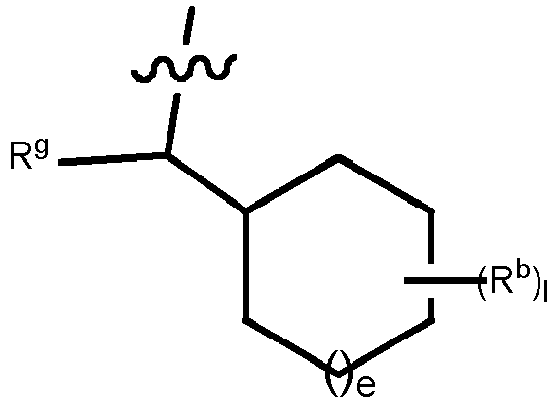 Rb unabhängig H, Halogen, Halogen-C1-C3-alkyl oder C1-C3-Alkyl ist,Rg H, C(O)NHRc oder Methyl ist,Rc unabhängig H oder C1-C3-Alkyl ist, gegebenenfalls substituiert mit Halogen,l 0, 1, 2, 3, 4 oder 5 ist,e 0, 1 oder 2 ist.
 - Die Verbindung nach Anspruch 1, ausgewählt aus der Gruppe bestehend aus:(R)-4-((1-Cyclobutylethyl)amino)-2-(4-isopropylpyridin-2-yl)-7-methyl-3-(4-(trifluormethyl)benzyl)-3H-imidazo[4,5-c]pyridin-6-carbonsäure,4-{[(1R)-1-Cyclobutylethyl]amino}-2-[4-(1-methylethyl)pyridin-2-yl]-3-[4-(trifluormethyl)benzyl]-3H-imidazo[4,5-c]pyridin-6-carbonsäure,4-{[(1R)-1-Cyclobutylethyl]amino}-2-(3-methylphenyl)-3-[4-(trifluormethyl)benzyl]-3H-imidazo[4,5-c]pyridin-6-carbonsäure,4-{[(1R)-1-Cyclobutylethyl]amino}-3-[(trans-4-methylcyclohexyl)methyl]-2-[4-(1-methylethyl)pyridin-2-yl]-3H-imidazo[4,5-c]pyridin-6-carbonsäure,3-{4-(5-Chlorpyridin-3-yl)-3-[(trans-4-methylcyclohexyl)methyl]-2-[(3R)-3-phenylmorpholin-4-yl]-3H-imidazo[4,5-c]pyridin-6-yl}-1,2,4-oxadiazol-5(4H)-on,5-{4-(5-Chlorpyridin-3-yl)-3-[(trans-4-methylcyclohexyl)methyl]-2-[(3R)-3-phenylmorpholin-4-yl]-3H-imidazo[4,5-c]pyridin-6-yl}-1,3,4-oxadiazol-2(3H)-on,3-{4-(5-Chlorpyridin-3-yl)-2-[(2S)-2-(fluormethyl)pyrrolidin-1-yl]-3-[(trans-4-methylcyclohexyl)methyl]-3H-imidazo[4,5-c]pyridin-6-yl}-1,2,4-oxadiazol-5(4H)-on,3-{4-(5-Chiorpyridin-3-yi)-2-((4aR,7aR)-hexahydrocyciopenta[b][1,4]oxazin-4(4aH)-yl)-3-[(trans-4-methylcyclohexyl)methyl]-3H-imidazo[4,5-c]pyridin-6-yl}-1,2,4-oxadiazol-5(4H)-on,3-{4-(5-Chlorpyridin-3-yl)-2-(hexahydrocyclopenta[b][1,4]oxazin-4(4aH)-yl)-3-[(trans-4-methylcyclohexyl)methyl]-3H-imidazo[4,5-c]pyridin-6-yl}-1,2,4-oxadiazol-5(4H)-on,3-[4-(5-Chlorpyridin-3-yl)-3-[(trans-4-methylcyclohexyl)methyl]-2-(octahydro-4H-1,4-benzoxazin-4-yl)-3H-imidazo[4,5-c]pyridin-6-yl]-1,2,4-oxadiazol-5(4H)-on,5-{4-(5-Chlorpyridin-3-yl)-2-(hexahydrocyclopenta[b][1,4]oxazin-4(4aH)-yl)-3-[(trans-4-methylcyclohexyl)methyl]-3H-imidazo[4,5-c]pyridin-6-yl}-1,3,4-oxadiazol-2(3H)-on,3-{4-(5-Chlorpyridin-3-yl)-2-[(2S)-2-(1-methoxy-1-methylethyl)pyrrolidin-1-yl]-3-[(trans-4-methylcyclohexyl)methyl]-3H-imidazo[4,5-c]pyridin-6-yl}-1,2,4-oxadiazol-5(4H)-on,5-{4-(5-Chlorpyridin-3-yl)-2-[(2S)-2-(fluormethyl)pyrrolidin-1-yl]-3-[(trans-4-methylcyclohexyl)methyl]-3H-imidazo[4,5-c]pyridin-6-yl}-1,3,4-oxadiazol-2(3H)-on,3-{4-(5-Chlorpyridin-3-yl)-2-((4aS,7aS)-hexahydrocyclopenta[b][1,4]oxazin-4(4aH)-yl)-3-[(trans-4-methylcyclohexyl)methyl]-3H-imidazo[4,5-c]pyridin-6-yl}-1,2,4-oxadiazol-5(4H)-on,3-[4-(5-Chlorpyridin-3-yl)-3-[(trans-4-methylcyclohexyl)methyl]-2-(octahydro-4H-1,4-benzoxazin-4-yl)-3H-imidazo[4,5-c]pyridin-6-yl]-1,2,4-oxadiazol-5(4H)-on,5-[4-(5-Chlorpyridin-3-yl)-3-[(trans-4-methylcyclohexyl)methyl]-2-(octahydro-4H-1,4-benzoxazin-4-yl)-3H-imidazo[4,5-c]pyridin-6-yl]-1,3,4-oxadiazol-2(3H)-on,5-{4-(5-Chlorpyridin-3-yl)-2-[(2S)-2-(1-methoxy-1-methylethyl)pyrrolidin-1-yl]-3-[(trans-4-methylcyclohexyl)methyl]-3H-imidazo[4,5-c]pyridin-6-yl}-1,3,4-oxadiazol-2(3H)-on,5-{4-(5-Chlorpyridin-3-yl)-2-((4aS,7aS)-hexahydrocyclopenta[b][1,4]oxazin-4(4aH)-yl)-3-[(trans-4-methylcyclohexyl)methyl]-3H-imidazo[4,5-c]pyridin-6-yl}-1,3,4-oxadiazol-2(3H)-on,5-{4-(5-Chlorpyridin-3-yl)-2-((4aR,7aR)-hexahydrocyclopenta[b][1,4]oxazin-4(4aH)-yl)-3-[(trans-4-methylcyclohexyl)methyl]-3H-imidazo[4,5-c]pyridin-6-yl}-1,3,4-oxadiazol-2(3H)-on,3-{4-(5-Chlorpyridin-3-yl)-2-[(3R,5R)-3,5-dimethylmorpholin-4-yl]-3-[(trans-4-methylcyclohexyl)methyl]-3H-imidazo[4,5-c]pyridin-6-yl}-1,2,4-oxadiazol-5(4H)-on,3-{4-(5-Chlorpyridin-3-yl)-3-[(trans-4-methylcyclohexyl)methyl]-2-[(2S)-2-(thfluormethyl)pyrrolidin-1-yl]-3H-imidazo[4,5-c]pyridin-6-yl}-1,2,4-oxadiazol-5(4H)-on,5-[4-(5-Chlorpyridin-3-yl)-3-[(trans-4-methylcyclohexyl)methyl]-2-(octahydro-4H-1,4-benzoxazin-4-yl)-3H-imidazo[4,5-c]pyridin-6-yl]-1,3,4-oxadiazol-2(3H)-on,5-{4-(5-Chlorpyridin-3-yl)-2-[(3R,5R)-3,5-dimethylmorpholin-4-yl]-3-[(trans-4-methylcyclohexyl)methyl]-3H-imidazo[4,5-c]pyridin-6-yl}-1,3,4-oxadiazol-2(3H)-on,5-{4-(5-Chlorpyridin-3-yl)-3-[(trans-4-methylcyclohexyl)methyl]-2-[(2S)-2-(thfluormethyl)pyrrolidin-1-yl]-3H-imidazo[4,5-c]pyridin-6-yl}-1,3,4-oxadiazol-2(3H)-on,4-(5-Chlorpyridin-3-yl)-3-[(trans-4-methylcyclohexyl)methyl]-2-[(3R)-3-phenylmorpholin-4-yl]-3H-imidazo[4,5-c]pyridin-6-carbonsäure,3-{4-(5-Chlorpyridin-3-yl)-3-[(trans-4-methylcyclohexyl)methyl]-2-[(3R)-3-methylmorpholin-4-yl]-3H-imidazo[4,5-c]pyridin-6-yl}-1,2,4-oxadiazol-5(4H)-on,3-{4-(5-Chlorpyridin-3-yl)-2-[(3S,5S)-3,5-dimethylmorpholin-4-yl]-3-[(trans-4-methylcyclohexyl)methyl]-3H-imidazo[4,5-c]pyridin-6-yl}-1,2,4-oxadiazol-5(4H)-on,3-[4-(5-Chlorpyridin-3-yl)-3-[(trans-4-methylcyclohexyl)methyl]-2-(octahydro-1H-cyclopenta[b]pyridin-1-yl)-3H-imidazo[4,5-c]pyridin-6-yl]-1,2,4-oxadiazol-5(4H)-on,3-{4-(5-Chlorpyridin-3-yl)-3-[(trans-4-methylcyclohexyl)methyl]-2-[6-(trifluormethyl)-2-azabicyclo[3.1.0]hex-2-yl]-3H-imidazo[4,5-c]pyridin-6-yl}-1,2,4-oxadiazol-5(4H)-on,3-{4-(5-Chlorpyridin-3-yl)-2-(3-ethylmorpholin-4-yl)-3-[(trans-4-methylcyclohexyl)methyl]-3H-imidazo[4,5-c]pyridin-6-yl}-1,2,4-oxadiazol-5(4H)-on,3-[4-(5-Chlorpyridin-3-yl)-3-[(trans-4-methylcyclohexyl)methyl]-2-(2-oxa-5-azabicyclo[4.1.0]hept-5-yl)-3H-imidazo[4,5-c]pyridin-6-yl]-1,2,4-oxadiazol-5(4H)-on, 3-{4-(5-Chlorpyridin-3-yl)-2-(2,5-dimethylmorpholin-4-yl)-3-[(trans-4-methylcyclohexyl)methyl]-3H-imidazo[4,5-c]pyridin-6-yl}-1,2,4-oxadiazol-5(4H)-on,3-[4-(5-Chlorpyridin-3-yl)-3-[(trans-4-methylcyclohexyl)methyl]-2-(3-methyl-1,4-oxazepan-4-yl)-3H-imidazo[4,5-c]pyridin-6-yl]-1,2,4-oxadiazol-5(4H)-on,3-{4-(5-Chlorpyridin-3-yl)-3-[(trans-4-methylcyclohexyl)methyl]-2-[2-(1-methylethyl)pyrrolidin-1-yl]-3H-imidazo[4,5-c]pyridin-6-yl}-1,2,4-oxadiazol-5(4H)-on,3-{4-(5-Chlorpyridin-3-yl)-2-[(2R,5R)-2,5-dimethylpyrrolidin-1-yl]-3-[(trans-4-methylcyclohexyl)methyl]-3H-imidazo[4,5-c]pyridin-6-yl}-1,2,4-oxadiazol-5(4H)-on,4-(5-Chlorpyridin-3-yl)-3-[(trans-4-methylcyclohexyl)methyl]-2-[(2S)-2-(trifluormethyl)pyrrolidin-1-yl]-3H-imidazo[4,5-c]pyridin-6-carbonsäure,3-{4-(5-Chlorpyridin-3-yl)-2-[3-(2-fluorphenyl)morpholin-4-yl]-3-[(trans-4-methylcyclohexyl)methyl]-3H-imidazo[4,5-c]pyridin-6-yl}-1,2,4-oxadiazol-5(4H)-on,3-{4-(5-Chlorpyridin-3-yl)-2-[2-(1-methoxyethyl)pyrrolidin-1-yl]-3-[(trans-4-methylcyclohexyl)methyl]-3H-imidazo[4,5-c]pyridin-6-yl}-1,2,4-oxadiazol-5(4H)-on,3-{4-(5-Chlorpyridin-3-yl)-2-[3-(2-fluorphenyl)morpholin-4-yl]-3-[(trans-4-methylcyclohexyl)methyl]-3H-imidazo[4,5-c]pyridin-6-yl}-1,2,4-oxadiazol-5(4H)-on,3-{4-(5-Chlorpyridin-3-yl)-2-(2,3-dimethylpyrrolidin-1-yl)-3-[(trans-4-methylcyclohexyl)methyl]-3H-imidazo[4,5-c]pyridin-6-yl}-1,2,4-oxadiazol-5(4H)-on,3-{4-(5-Chlorpyridin-3-yl)-2-(2-cyclopropylpyrrolidin-1-yl)-3-[(trans-4-methylcyclohexyl)methyl]-3H-imidazo[4,5-c]pyridin-6-yl}-1,2,4-oxadiazol-5(4H)-on,3-{2-(2-tert-Butylpyrrolidin-1-yl)-4-(5-chlorpyridin-3-yl)-3-[(trans-4-methylcyclohexyl)methyl]-3H-imidazo[4,5-c]pyridin-6-yl}-1,2,4-oxadiazol-5(4H)-on,3-{2-(5-Azaspiro[3.4]oct-5-yl)-4-(5-chlorpyridin-3-yl)-3-[(trans-4-methylcyclohexyl)methyl]-3H-imidazo[4,5-c]pyridin-6-yl}-1,2,4-oxadiazol-5(4H)-on,3-{4-(5-Chlorpyridin-3-yl)-2-[2-(1,1-dimethylpropyl)pyrrolidin-1-yl]-3-[(trans-4-methylcyclohexyl)methyl]-3H-imidazo[4,5-c]pyridin-6-yl}-1,2,4-oxadiazol-5(4H)-on, 3-{4-(5-Chlorpyridin-3-yl)-3-[(trans-4-methylcyclohexyl)methyl]-2-[2-(4-methyl-1,2,5-oxadiazol-3-yl)pyrrolidin-1 -yl]-3H-imidazo[4,5-c]pyridin-6-yl}-1,2,4-oxadiazol-5(4H)-on,3-{4-(5-Chlorpyridin-3-yl)-3-[(trans-4-methylcyclohexyl)methyl]-2-[(2R)-2-methylpiperidin-1-yl]-3H-imidazo[4,5-c]pyridin-6-yl}-1,2,4-oxadiazol-5(4H)-on und3-{4-(5-Chlorpyridin-3-yl)-2-[(2R,4R)-4-hydroxy-2-methylpyrrolidin-1-yl]-3-[(trans-4-methylcyclohexyl)methyl]-3H-imidazo[4,5-c]pyridin-6-yl}-1,2,4-oxadiazol-5(4H)-on oder ein Stereoisomer davonoder ein pharmazeutisch annehmbares Salz davon
oder ein pharmazeutisch annehmbares Salz des Stereoisomers davon. - Die Verbindung nach Anspruch 1, ausgewählt aus der Gruppe bestehend aus:3-{4-(5-Chlorpyridin-3-yl)-3-[(trans-4-methylcyclohexyl)methyl]-2-[2-(4-methyl-1,2,5-oxadiazol-3-yl)pyrrolidin-1 -yl]-3H-imidazo[4,5-c]pyridin-6-yl}-1,2,4-oxadiazol-5(4H)-on,4-(5-Chlorpyridin-3-yl)-2-((4aR,7aR)-hexahydrocyclopenta[b][1,4]oxazin-4(4aH)-yl)-3-((trans-4-methylcyclohexyl)methyl)-3H-imidazo[4,5-c]pyridin-6-carbonsäure,4-(5-Chlorpyridin-3-yl)-2-[(2S)-2-(fluormethyl)pyrrolidin-1-yl]-3-[(trans-4-methylcyclohexyl)methyl]-3H-imidazo[4,5-c]pyridin-6-carbonsäure,3-[4-(5-Chlorpyridin-3-yl)-3-[(trans-4-methylcyclohexyl)methyl]-2-(trans-2-methyl-5-phenylmorpholin-4-yl)-3H-imidazo[4,5-c]pyridin-6-yl]-1,2,4-oxadiazol-5(4H)-on,3-{4-(5-Chlorpyridin-3-yl)-2-[(2R,4R)-4-methoxy-2-methylpyrrolidin-1-yl]-3-[(trans-4-methylcyclohexyl)methyl]-3H-imidazo[4,5-c]pyridin-6-yl}-1,2,4-oxadiazol-5(4H)-on,3-{4-(5-Chlorpyridin-3-yl)-2-(hexahydro-4H-furo[3,4-b][1,4]oxazin-4-yl)-3-[(trans-4-methylcyclohexyl)methyl]-3H-imidazo[4,5-c]pyridin-6-yl}-1,2,4-oxadiazol-5(4H)-on,1-[4-(5-Chlorpyridin-3-yl)-3-[(trans-4-methylcyclohexyl)methyl]-6-(5-oxo-4,5-dihydro-1,2,4-oxadiazol-3-yl)-3H-imidazo[4,5-c]pyridin-2-yl]-N,N-dimethyl-D-prolinamid,1-[4-(5-Chlorpyridin-3-yl)-3-[(trans-4-methylcyclohexyl)methyl]-6-(5-oxo-4,5-dihydro-1,2,4-oxadiazol-3-yl)-3H-imidazo[4,5-c]pyridin-2-yl]-N-ethyl-N-methyl-D-prolinamid,3-{4-(5-Chlorpyridin-3-yl)-2-[2-(3-ethyl-5-methylisoxazol-4-yl)pyrrolidin-1-yl]-3-[(trans-4-methylcyclohexyl)methyl]-3H-imidazo[4,5-c]pyridin-6-yl}-1,2,4-oxadiazol-5(4H)-on,3-[4-(5-Chlorpyridin-3-yl)-3-[(trans-4-methylcyclohexyl)methyl]-2-{2-[(1-methylethoxy)methyl]pyrrolidin-1-yl}-3H-imidazo[4,5-c]pyridin-6-yl]-1,2,4-oxadiazol-5(4H)-on,3-[4-(5-Chlorpyridin-3-yl)-3-[(trans-4-methylcyclohexyl)methyl]-2-{2-[(trifluormethoxy)methyl]pyrrolidin-1-yl}-3H-imidazo[4,5-c]pyridin-6-yl]-1,2,4-oxadiazol-5(4H)-on,3-{4-(5-Chlorpyridin-3-yl)-3-[(trans-4-methylcyclohexyl)methyl]-2-[(2R)-2-methylpyrrolidin-1-yl]-3H-imidazo[4,5-c]pyridin-6-yl}-1,2,4-oxadiazol-5(4H)-on,3-{4-(5-Chlorpyridin-3-yl)-2-[(2S)-2-(methoxymethyl)pyrrolidin-1-yl]-3-[(trans-4-methylcyclohexyl)methyl]-3H-imidazo[4,5-c]pyridin-6-yl}-1,2,4-oxadiazol-5(4H)-on,3-{4-(5-Chlorpyridin-3-yl)-2-[(2S)-2-(difluormethyl)pyrrolidin-1-yl]-3-[(trans-4-methylcyclohexyl)methyl]-3H-imidazo[4,5-c]pyridin-6-yl}-1,2,4-oxadiazol-5(4H)-on,3-{4-(5-Chlorpyridin-3-yl)-2-(trans-2,3-dimethylmorpholin-4-yl)-3-[(trans-4-methylcyclohexyl)methyl]-3H-imidazo[4,5-c]pyridin-6-yl}-1,2,4-oxadiazol-5(4H)-on,3-[4-(5-Chlorpyridin-3-yl)-3-[(trans-4-methylcyclohexyl)methyl]-2-(7-oxa-1-azaspiro[4.4]non-1-yl)-3H-imidazo[4,5-c]pyridin-6-yl]-1,2,4-oxadiazol-5(4H)-on,3-[4-(5-Chlorpyridin-3-yl)-3-[(trans-4-methylcyclohexyl)methyl]-2-(8-oxa-1-azaspiro[4.5]dec-1-yl)-3H-imidazo[4,5-c]pyridin-6-yl]-1,2,4-oxadiazol-5(4H)-on,3-{4-(5-Chlorpyridin-3-yl)-2-(hexahydro-2H-pyrano[4,3-b]pyridin-1(5H)-yl)-3-[(trans-4-methylcyclohexyl)methyl]-3H-imidazo[4,5-c]pyridin-6-yl}-1,2,4-oxadiazol-5(4H)-on,3-{4-(5-Chlorpyridin-3-yl)-3-[(trans-4-methylcyclohexyl)methyl]-2-[2-(1H-1,2,3-triazol-5-yl)pyrrolidin-1-yl]-3H-imidazo[4,5-c]pyridin-6-yl}-1,2,4-oxadiazol-5(4H)-on,3-{4-(5-Chlorpyridin-3-yl)-3-[(trans-4-methylcyclohexyl)methyl]-2-[2-(1-methyl-1H-1,2,4-triazol-3-yl)pyrrolidin-1-yl]-3H-imidazo[4,5-c]pyridin-6-yl}-1,2,4-oxadiazol-5(4H)-on,3-{4-(5-Chlorpyridin-3-yl)-3-[(trans-4-methylcyclohexyl)methyl]-2-[2-(1-methyl-1H-1,2,4-triazol-5-yl)pyrrolidin-1-yl]-3H-imidazo[4,5-c]pyridin-6-yl}-1,2,4-oxadiazol-5(4H)-on,3-{4-(5-Chlorpyridin-3-yl)-3-[(trans-4-methylcyclohexyl)methyl]-2-[(2S)-2-(1,3-thiazol-2-yl)pyrrolidin-1-yl]-3H-imidazo[4,5-c]pyridin-6-yl}-1,2,4-oxadiazol-5(4H)-on,3-{4-(5-Chlorpyridin-3-yl)-3-[(trans-4-methylcyclohexyl)methyl]-2-[2-(3-methylisoxazol-5-yl)pyrrolidin-1-yl]-3H-imidazo[4,5-c]pyridin-6-yl}-1,2,4-oxadiazol-5(4H)-on,3-{4-(5-Chlorpyridin-3-yl)-2-[2-(3,5-dimethylisoxazol-4-yl)pyrrolidin-1-yl]-3-[(trans-4-methylcyclohexyl)methyl]-3H-imidazo[4,5-c]pyridin-6-yl}-1,2,4-oxadiazol-5(4H)-on,3-{4-(5-Chlorpyridin-3-yl)-3-[(trans-4-methylcyclohexyl)methyl]-2-[2-(3-methyl-1,2,4-oxadiazol-5-yl)pyrrolidin-1 -yl]-3H-imidazo[4,5-c]pyridin-6-yl}-1,2,4-oxadiazol-5(4H)-on,1-[4-(5-Chlorpyridin-3-yl)-3-[(trans-4-methylcyclohexyl)methyl]-6-(5-oxo-4,5-dihydro-1,2,4-oxadiazol-3-yl)-3H-imidazo[4,5-c]pyridin-2-yl]-N-ethyl-D-prolinamid,(5R)-4-[4-(5-Chlorpyridin-3-yl)-3-[(trans-4-methylcyclohexyl)methyl]-6-(5-oxo-4,5-dihydro-1,2,4-oxadiazol-3-yl)-3H-imidazo[4,5-c]pyridin-2-yl]-1,5-dimethylpiperazin-2-on,3-{4-(5-Chlorpyridin-3-yl)-2-[(2R)-5-methoxy-2-methylpiperidin-1-yl]-3-[(trans-4-methylcyclohexyl)methyl]-3H-imidazo[4,5-c]pyridin-6-yl}-1,2,4-oxadiazol-5(4H)-on,3-[4-(5-Chlorpyridin-3-yl)-3-[(trans-4-methylcyclohexyl)methyl]-2-(3-methyl-1,1-dioxidothiomorpholin-4-yl)-3H-imidazo[4,5-c]pyridin-6-yl]-1,2,4-oxadiazol-5(4H)-on, 3-{4-(5-Chlorpyridin-3-yl)-2-(2-methoxy-7-azabicyclo[2.2.1]hept-7-yl)-3-[(trans-4-methylcyclohexyl)methyl]-3H-imidazo[4,5-c]pyridin-6-yl}-1,2,4-oxadiazol-5(4H)-on,3-{4-(5-Chlorpyridin-3-yl)-2-[(2S,4R)-4-methoxy-2-(1-methylethyl)pyrrolidin-1-yl]-3-[(trans-4-methylcyclohexyl)methyl]-3H-imidazo[4,5-c]pyridin-6-yl}-1,2,4-oxadiazol-5(4H)-on,3-{4-(5-Chlorpyridin-3-yl)-2-[(2S,4R)-4-hydroxy-2-(1-methylethyl)pyrrolidin-1-yl]-3-[(trans-4-methylcyclohexyl)methyl]-3H-imidazo[4,5-c]pyridin-6-yl}-1,2,4-oxadiazol-5(4H)-on,3-{4-(5-Chlorpyridin-3-yl)-2-[(2S,4R)-2-(fluormethyl)-4-methoxypyrrolidin-1-yl]-3-[(trans-4-methylcyclohexyl)methyl]-3H-imidazo[4,5-c]pyridin-6-yl}-1,2,4-oxadiazol-5(4H)-on,3-{4-(5-Chlorpyridin-3-yl)-2-[(2R,4R)-2-(fluormethyl)-4-methoxypyrrolidin-1-yl]-3-[(trans-4-methylcyclohexyl)methyl]-3H-imidazo[4,5-c]pyridin-6-yl}-1,2,4-oxadiazol-5(4H)-on,3-{2-[(2R)-4-Acetyl-2-methylpiperazin-1-yl]-4-(5-chlorpyridin-3-yl)-3-[(trans-4-methylcyclohexyl)methyl]-3H-imidazo[4,5-c]pyridin-6-yl}-1,2,4-oxadiazol-5(4H)-on,3-{4-(5-Chlorpyridin-3-yl)-2-[(2R)-4-(cyclopropylcarbonyl)-2-methylpiperazin-1-yl]-3-[(trans-4-methylcyclohexyl)methyl]-3H-imidazo[4,5-c]pyridin-6-yl}-1,2,4-oxadiazol-5(4H)-on,3-{2-[(2R,6R)-4-Acetyl-2,6-dimethylpiperazin-1-yl]-4-(5-chlorpyridin-3-yl)-3-[(trans-4-methylcyclohexyl)methyl]-3H-imidazo[4,5-c]pyridin-6-yl}-1,2,4-oxadiazol-5(4H)-on,3-{4-(5-Chlorpyridin-3-yl)-2-[(2R,6R)-4-(cyclopropylcarbonyl)-2,6-dimethylpiperazin-1-yl]-3-[(trans-4-methylcyclohexyl)methyl]-3H-imidazo[4,5-c]pyridin-6-yl}-1,2,4-oxadiazol-5(4H)-on,3-{4-(5-Chlorpyridin-3-yl)-2-[cyclopentyl(ethoxy)methyl]-3-[(trans-4-methylcyclohexyl)methyl]-3H-imidazo[4,5-c]pyridin-6-yl}-1,2,4-oxadiazol-5(4H)-on,5-{4-(5-Chlorpyridin-3-yl)-2-[cyclopentyl(ethoxy)methyl]-3-[(trans-4-methylcyclohexyl)methyl]-3H-imidazo[4,5-c]pyridin-6-yl}-1,3,4-oxadiazol-2(3H)-on,3-(4-(5-Chlorpyridin-3-yl)-2-(1-ethoxyethyl)-3-((trans-4-methylcyclohexyl)methyl)-3H-imidazo[4,5-c]pyridin-6-yl)-1,2,4-oxadiazol-5(4H)-on,3-(4-(5-Chlorpyridin-3-yl)-2-(1-ethoxypropyl)-3-((trans-4-methylcyclohexyl)methyl)-3H-imidazo[4,5-c]pyridin-6-yl)-1,2,4-oxadiazol-5(4H)-on,3-(4-(5-Chlorpyridin-3-yl)-3-((trans-4-methylcyclohexyl)methyl)-2-(1-(2,2,2-trifluorethoxy)propyl)-3H-imidazo[4,5-c]pyridin-6-yl)-1,2,4-oxadiazol-5(4H)-on,3-(4-(5-Chlorpyridin-3-yl)-3-((trans-4-methylcyclohexyl)methyl)-2-(1-propoxypropyl)-3H-imidazo[4,5-c]pyridin-6-yl)-1,2,4-oxadiazol-5(4H)-on,3-{4-(5-Chlorpyridin-3-yl)-2-[ethoxy(phenyl)methyl]-3-[(trans-4-methylcyclohexyl)methyl]-3H-imidazo[4,5-c]pyridin-6-yl}-1,2,4-oxadiazol-5(4H)-on,3-{4-(5-Chlorpyridin-3-yl)-2-[(2,4-difluorphenyl)(hydroxy)methyl]-3-[(trans-4-methylcyclohexyl)methyl]-3H-imidazo[4,5-c]pyridin-6-yl}-1,2,4-oxadiazol-5(4H)-on,3-{4-(5-Chlorpyridin-3-yl)-2-[(2-fluorphenyl)(hydroxy)methyl]-3-[(trans-4-methylcyclohexyl)methyl]-3H-imidazo[4,5-c]pyridin-6-yl}-1,2,4-oxadiazol-5(4H)-on,3-{4-(5-Chlorpyridin-3-yl)-2-(1-hydroxy-2-methoxy-1-phenylethyl)-3-[(trans-4-methylcyclohexyl)methyl]-3H-imidazo[4,5-c]pyridin-6-yl}-1,2,4-oxadiazol-5(4H)-on,3-(4-(5-Chlorpyridin-3-yl)-2-(ethoxy(pyridin-2-yl)methyl)-3-((trans-4-methylcyclohexyl)methyl)-3H-imidazo[4,5-c]pyridin-6-yl)-1,2,4-oxadiazol-5(4H)-on,3-(4-(5-Chlorpyridin-3-yl)-2-(ethoxy(pyridin-3-yl)methyl)-3-((trans-4-methylcyclohexyl)methyl)-3H-imidazo[4,5-c]pyridin-6-yl)-1,2,4-oxadiazol-5(4H)-on,3-{4-(5-Chlorpyridin-3-yl)-2-[(2-fluorphenyl)carbonyl]-3-[(trans-4-methylcyclohexyl)methyl]-3H-imidazo[4,5-c]pyridin-6-yl}-1,2,4-oxadiazol-5(4H)-on,3-{4-(5-Chlorpyridin-3-yl)-2-[1-fluor-1-(2-fluorphenyl)ethyl]-3-[(trans-4-methylcyclohexyl)methyl]-3H-imidazo[4,5-c]pyridin-6-yl}-1,2,4-oxadiazol-5(4H)-on,3-{4-(5-Chlorpyridin-3-yl)-2-[1-(2,4-difluorphenyl)-1-fluorethyl]-3-[(trans-4-methylcyclohexyl)methyl]-3H-imidazo[4,5-c]pyridin-6-yl}-1,2,4-oxadiazol-5(4H)-on, 3-[4-(5-Chlorpyridin-3-yl)-3-[(trans-4-methylcyclohexyl)methyl]-2-(1-phenylethenyl)-3H-imidazo[4,5-c]pyridin-6-yl]-1,2,4-oxadiazol-5(4H)-on,3-{4-(5-Chlorpyridin-3-yl)-2-(2-methoxy-1-phenylethyl)-3-[(trans-4-methylcyclohexyl)methyl]-3H-imidazo[4,5-c]pyridin-6-yl}-1,2,4-oxadiazol-5(4H)-on und3-[4-(5-Chlorpyridin-3-yl)-3-[(trans-4-methylcyclohexyl)methyl]-2-(1-methylidenbutyl)-3H-imidazo[4,5-c]pyridin-6-yl]-1,2,4-oxadiazol-5(4H)-on,oder ein Stereoisomer davon
oder ein pharmazeutisch annehmbares Salz davon
oder ein pharmazeutisch annehmbares Salz des Stereoisomers davon. - Die Verbindung nach Anspruch 1, ausgewählt aus der Gruppe bestehend aus:3-{4-(5-Chlorpyridin-3-yl)-3-[(trans-4-methylcyclohexyl)methyl]-2-[methyl(2,2,2-trifluorethyl)amino]-3H-imidazo[4,5-c]pyridin-6-yl}-1,2,4-oxadiazol-5(4H)-on,3-(4-(5-Chlorpyridin-3-yl)-2-((trans-4-methoxytetrahydrofuran-3-yl)(methyl)amino)-3-((trans-4-methylcyclohexyl)methyl)-3H-imidazo[4,5-c]pyridin-6-yl)-1,2,4-oxadiazol-5(4H)-on,3-{4-(5-Chlorpyridin-3-yl)-3-[(trans-4-methylcyclohexyl)methyl]-2-[2-(1-methyl-1H-1,2,3-triazol-4-yl)pyrrolidin-1 -yl]-3H-imidazo[4,5-c]pyridin-6-yl}-1,2,4-oxadiazol-5(4H)-on,1-[4-(5-Chlorpyridin-3-yl)-3-[(trans-4-methylcyclohexyl)methyl]-6-(5-oxo-4,5-dihydro-1,2,4-oxadiazol-3-yl)-3H-imidazo[4,5-c]pyridin-2-yl]-N-ethyl-N-methyl-L-prolinamid,3-{4-(5-Chlorpyridin-3-yl)-2-[(2-fluorphenyl)amino]-3-[(trans-4-methylcyclohexyl)methyl]-3H-imidazo[4,5-c]pyridin-6-yl}-1,2,4-oxadiazol-5(4H)-on,3-{4-(5-Chlorpyridin-3-yl)-2-[2-(1-ethyl-1H-pyrazol-5-yl)pyrrolidin-1-yl]-3-[(trans-4-methylcyclohexyl)methyl]-3H-imidazo[4,5-c]pyridin-6-yl}-1,2,4-oxadiazol-5(4H)-on,3-{4-(5-Chlorpyridin-3-yl)-3-[(trans-4-methylcyclohexyl)methyl]-2-[2-(1-methyl-1H-pyrazol-4-yl)pyrrolidin-1-yl]-3H-imidazo[4,5-c]pyridin-6-yl}-1,2,4-oxadiazol-5(4H)-on,3-{4-(5-Chlorpyridin-3-yl)-3-[(trans-4-methylcyclohexyl)methyl]-2-[2-(5-methyl-1,2,4-oxadiazol-3-yl)pyrrolidin-1 -yl]-3H-imidazo[4,5-c]pyridin-6-yl}-1,2,4-oxadiazol-5(4H)-on,3-{4-(5-Chlorpyridin-3-yl)-3-[(trans-4-methylcyclohexyl)methyl]-2-[2-(3-methyl-1,2,4-oxadiazol-5-yl)pyrrolidin-1 -yl]-3H-imidazo[4,5-c]pyridin-6-yl}-1,2,4-oxadiazol-5(4H)-on,3-[4-(5-Chlorpyridin-3-yl)-3-[(trans-4-methylcyclohexyl)methyl]-2-(6-oxa-1-azaspiro[3.3]hept-1-yl)-3H-imidazo[4,5-c]pyridin-6-yl]-1,2,4-oxadiazol-5(4H)-on,3-{4-(5-Chlorpyridin-3-yl)-2-[(2-methoxy-2-methylpropyl)(methyl)amino]-3-[(trans-4-methylcyclohexyl)methyl]-3H-imidazo[4,5-c]pyridin-6-yl}-1,2,4-oxadiazol-5(4H)-on,3-{4-(5-Chlorpyridin-3-yl)-3-[(trans-4-methylcyclohexyl)methyl]-2-[2-(2-methyl-1,3-thiazol-4-yl)pyrrolidin-1-yl]-3H-imidazo[4,5-c]pyridin-6-yl}-1,2,4-oxadiazol-5(4H)-on,3-{4-(5-Chlorpyridin-3-yl)-2-[(2-methoxyethyl)(methyl)amino]-3-[(trans-4-methylcyclohexyl)methyl]-3H-imidazo[4,5-c]pyridin-6-yl}-1,2,4-oxadiazol-5(4H)-on,3-{4-(5-Chlorpyridin-3-yl)-2-[ethyl(2-methoxyethyl)amino]-3-[(trans-4-methylcyclohexyl)methyl]-3H-imidazo[4,5-c]pyridin-6-yl}-1,2,4-oxadiazol-5(4H)-on,1-[4-(5-Chlorpyridin-3-yl)-3-[(trans-4-methylcyclohexyl)methyl]-6-(5-oxo-4,5-dihydro-1,2,4-oxadiazol-3-yl)-3H-imidazo[4,5-c]pyridin-2-yl]-N,N-dimethyl-L-prolinamid,3-{4-(5-Chlorpyridin-3-yl)-2-[(2-methoxyethyl)(propyl)amino]-3-[(trans-4-methylcyclohexyl)methyl]-3H-imidazo[4,5-c]pyridin-6-yl}-1,2,4-oxadiazol-5(4H)-on,3-{4-(5-Chlorpyridin-3-yl)-3-[(trans-4-methylcyclohexyl)methyl]-2-[(1-pyridin-2-ylethyl)amino]-3H-imidazo[4,5-c]pyridin-6-yl}-1,2,4-oxadiazol-5(4H)-on,1-[4-(5-Chlorpyridin-3-yl)-3-[(trans-4-methylcyclohexyl)methyl]-6-(5-oxo-4,5-dihydro-1,2,4-oxadiazol-3-yl)-3H-imidazo[4,5-c]pyridin-2-yl]-N-ethyl-L-prolinamid,3-{2-[(2S,5S)-2,5-Bis(methoxymethyl)pyrrolidin-1-yl]-4-(5-chlorpyridin-3-yl)-3-[(trans-4-methylcyclohexyl)methyl]-3H-imidazo[4,5-c]pyridin-6-yl}-1,2,4-oxadiazol-5(4H)-on,3-{4-(5-Chlorpyridin-3-yl)-2-[cis-4-methoxy-2-methylpiperidin-1-yl]-3-[(trans-4-methylcyclohexyl)methyl]-3H-imidazo[4,5-c]pyridin-6-yl}-1,2,4-oxadiazol-5(4H)-on,3-{4-(5-Chlorpyridin-3-yl)-2-[trans-4-methoxy-2-methylpiperidin-1-yl]-3-[(trans-4-methylcyclohexyl)methyl]-3H-imidazo[4,5-c]pyridin-6-yl}-1,2,4-oxadiazol-5(4H)-on,3-{4-(5-Chlorpyridin-3-yl)-2-[cis-4-methoxy-2-methylpiperidin-1-yl]-3-[(trans-4-methylcyclohexyl)methyl]-3H-imidazo[4,5-c]pyridin-6-yl}-1,2,4-oxadiazol-5(4H)-on,(4aS,7aS)-4-[4-(5-Chlorpyridin-3-yl)-3-[(trans-4-methylcyclohexyl)methyl]-6-(5-oxo-4,5-dihydro-1,2,4-oxadiazol-3-yl)-3H-imidazo[4,5-c]pyridin-2-yl]-1-methyloctahydro-2H-cyclopenta[b]pyrazin-2-on,4-[4-(5-Chlorpyridin-3-yl)-3-[(trans-4-methylcyclohexyl)methyl]-6-(5-oxo-4,5-dihydro-1,2,4-oxadiazol-3-yl)-3H-imidazo[4,5-c]pyridin-2-yl]-5-ethyl-1-methylpiperazin-2-on,3-{4-(5-Chlorpyridin-3-yl)-2-(hexahydro-2H-pyrano[4,3-b]pyridin-1(5H)-yl)-3-[(trans-4-methylcyclohexyl)methyl]-3H-imidazo[4,5-c]pyridin-6-yl}-1,2,4-oxadiazol-5(4H)-on,Benzyl(4aR,8aR)-1-[4-(5-chlorpyridin-3-yl)-3-[(trans-4-methylcyclohexyl)methyl]-6-(5-oxo-4,5-dihydro-1,2,4-oxadiazol-3-yl)-3H-imidazo[4,5-c]pyridin-2-yl]octahydro-6H-pyrido[3,4-b][1,4]oxazin-6-carboxylat,3-{4-(5-Chlorpyridin-3-yl)-3-[(trans-4-methylcyclohexyl)methyl]-2-[(4aR,8aR)octahydro-1H-pyrido[3,4-b][1,4]oxazin-1-yl]-3H-imidazo[4,5-c]pyridin-6-yl}-1,2,4-oxadiazol-5(4H)-on,3-{2-[(4aR,8aR)-6-Benzyloctahydro-1H-pyrido[3,4-b][1,4]oxazin-1-yl]-4-(5-chlorpyridin-3-yl)-3-[(trans-4-methylcyclohexyl)methyl]-3H-imidazo[4,5-c]pyridin-6-yl}-1,2,4-oxadiazol-5(4H)-on,3-{4-(5-Chlorpyridin-3-yl)-2-(2-hydroxy-7-azabicyclo[2.2.1]hept-7-yl)-3-[(trans-4-methylcyclohexyl)methyl]-3H-imidazo[4,5-c]pyridin-6-yl}-1,2,4-oxadiazol-5(4H)-on, 3-{4-(5-Chlorpyridin-3-yl)-2-(2-methoxy-7-azabicyclo[2.2.1]hept-7-yl)-3-[(trans-4-methylcyclohexyl)methyl]-3H-imidazo[4,5-c]pyridin-6-yl}-1,2,4-oxadiazol-5(4H)-on,3-{4-(5-Chlorpyridin-3-yl)-2-[(2S,4S)-4-hydroxy-4-methyl-2-(1-methylethyl)pyrrolidin-1-yl]-3-[(trans-4-methylcyclohexyl)methyl]-3H-imidazo[4,5-c]pyridin-6-yl}-1,2,4-oxadiazol-5(4H)-on,3-{4-(5-Chlorpyridin-3-yl)-2-[(2S,4R)-4-methoxy-2-(methoxymethyl)pyrrolidin-1-yl]-3-[(trans-4-methylcyclohexyl)methyl]-3H-imidazo[4,5-c]pyridin-6-yl}-1,2,4-oxadiazol-5(4H)-on,3-{4-(5-Chlorpyridin-3-yl)-2-(3-hydroxyoctahydrochinolin-1(2H)-yl)-3-[(trans-4-methylcyclohexyl)methyl]-3H-imidazo[4,5-c]pyridin-6-yl}-1,2,4-oxadiazol-5(4H)-on,3-{4-(5-Chlorpyridin-3-yl)-2-[(2S,4R)-4-methoxy-2-(1-methoxycyclopropyl)-pyrrolidin-1-yl]-3-[(trans-4-methylcyclohexyl)methyl]-3H-imidazo[4,5-c]pyridin-6-yl}-1,2,4-oxadiazol-5(4H)-on,3-{4-(5-Chlorpyridin-3-yl)-2-[(2R,4R)-4-methoxy-2-(1-methoxycyclopropyl)-pyrrolidin-1-yl]-3-[(trans-4-methylcyclohexyl)methyl]-3H-imidazo[4,5-c]pyridin-6-yl}-1,2,4-oxadiazol-5(4H)-on,3-[4-(5-Chlorpyridin-3-yl)-3-[(trans-4-methylcyclohexyl)methyl]-2-(3-methylthiomorpholin-4-yl)-3H-imidazo[4,5-c]pyridin-6-yl]-1,2,4-oxadiazol-5(4H)-on,3-{4-(5-Chlorpyridin-3-yl)-2-[(2S,4R)-2-(difluormethyl)-4-methoxypyrrolidin-1-yl]-3-[(trans-4-methylcyclohexyl)methyl]-3H-imidazo[4,5-c]pyridin-6-yl}-1,2,4-oxadiazol-5(4H)-on,3-{4-(5-Chlorpyhdin-3-yl)-2-[(2S,4R)-4-ethoxy-2-(fluormethyl)pyrrolidin-1-yl]-3-[(trans-4-methylcyclohexyl)methyl]-3H-imidazo[4,5-c]pyridin-6-yl}-1,2,4-oxadiazol-5(4H)-on,(4aR,7aR)-4-[4-(5-Chlorpyridin-3-yl)-3-[(trans-4-methylcyclohexyl)methyl]-6-(5-oxo-4,5-dihydro-1,2,4-oxadiazol-3-yl)-3H-imidazo[4,5-c]pyridin-2-yl]-1-ethyloctahydro-2H-cyclopenta[b]pyrazin-2-on,3-{4-(5-Chlorpyridin-3-yl)-2-[(2S,4R)-4-(2-methoxyethoxy)-2-(1-methylethyl)pyrrolidin-1-yl]-3-[(trans-4-methylcyclohexyl)methyl]-3H-imidazo[4,5-c]pyridin-6-yl}-1,2,4-oxadiazol-5(4H)-on,3-{4-(5-Chlorpyridin-3-yl)-2-[(trans)-5,5-difluorhexahydrocyclopenta[b][1,4]oxazin-4(4aH)-yl]-3-[(trans-4-methylcyclohexyl)methyl]-3H-imidazo[4,5-c]pyridin-6-yl}-1,2,4-oxadiazol-5(4H)-on,3-{4-(5-Chlorpyridin-3-yl)-3-[(trans-4-methylcyclohexyl)methyl]-2-[(trans)-3-methylhexahydrocyclopenta[b][1,4]oxazin-4(4aH)-yl]-3H-imidazo[4,5-c]pyridin-6-yl}-1,2,4-oxadiazol-5(4H)-on,3-{4-(5-Chlorpyridin-3-yl)-2-[(2R,3R)-3-ethyl-2-methylmorpholin-4-yl]-3-[(trans-4-methylcyclohexyl)methyl]-3H-imidazo[4,5-c]pyridin-6-yl}-1,2,4-oxadiazol-5(4H)-on,3-{4-(5-Chlorpyridin-3-yl)-2-[(trans)-6,6-difluorhexahydrocyclopenta[b][1,4]oxazin-4(4aH)-yl]-3-[(trans-4-methylcyclohexyl)methyl]-3H-imidazo[4,5-c]pyridin-6-yl}-1,2,4-oxadiazol-5(4H)-on,3-{4-(5-Chlorpyridin-3-yl)-3-[(trans-4-methylcyclohexyl)methyl]-2-[(3R)-3-pyridin-2-ylmorpholin-4-yl]-3H-imidazo[4,5-c]pyridin-6-yl}-1,2,4-oxadiazol-5(4H)-on,3-{4-(5-Chlorpyridin-3-yl)-2-(hexahydro-4H,5H-pyrano[4,3-b][1,4]oxazin-4-yl)-3-[(trans-4-methylcyclohexyl)methyl]-3H-imidazo[4,5-c]pyridin-6-yl}-1,2,4-oxadiazol-5(4H)-on,3-[4-(5-Chlorpyridin-3-yl)-3-[(trans-4-methylcyclohexyl)methyl]-2-(2-methylhexahydro-4H,5H-pyrano[4,3-b][1,4]oxazin-4-yl)-3H-imidazo[4,5-c]pyridin-6-yl]-1,2,4-oxadiazol-5(4H)-on,3-{4-(5-Chlorpyridin-3-yl)-2-[(trans)-hexahydro-4H-furo[3,4-b][1,4]oxazin-4-yl]-3-[(trans-4-methylcyclohexyl)methyl]-3H-imidazo[4,5-c]pyridin-6-yl}-1,2,4-oxadiazol-5(4H)-on,3-{4-(5-Chlorpyridin-3-yl)-2-[(trans)-6-fluorhexahydrocyclopenta[b][1,4]oxazin-4(4aH)yl]-3-[(trans-4-Methylcyclohexyl)methyl]-3H-imidazo[4,5-c]pyridin-6-yl}-1,2,4-oxadiazol-5(4H)-on,3-{4-(5-Chlorpyridin-3-yl)-2-(hexahydro-2H-cyclopenta[b][1,4]oxazepin-5(5aH)-yl)-3-[(trans-4-methylcyclohexyl)methyl]-3H-imidazo[4,5-c]pyridin-6-yl}-1,2,4-oxadiazol-5(4H)-on,3-[4-(5-Chlorpyridin-3-yl)-3-[(trans-4-methylcyclohexyl)methyl]-2-(2,2,3-trimethylmorpholin-4-yl)-3H-imidazo[4,5-c]pyridin-6-yl]-1,2,4-oxadiazol-5(4H)-on,3-[4-(5-Chlorpyridin-3-yl)-3-[(trans-4-methylcyclohexyl)methyl]-2-(2-methyloctahydro-4H-1,4-benzoxazin-4-yl)-3H-imidazo[4,5-c]pyridin-6-yl]-1,2,4-oxadiazol-5(4H)-on,3-{2-(Benzylamino)-4-(5-chlorpyridin-3-yl)-3-[(trans-4-methylcyclohexyl)methyl]-3H-imidazo[4,5-c]pyridin-6-yl}-1,2,4-oxadiazol-5(4H)-on,3-{4-(5-Chlorpyridin-3-yl)-2-[(2-methoxy-1-methylethyl)amino]-3-[(trans-4-methylcyclohexyl)methyl]-3H-imidazo[4,5-c]pyridin-6-yl}-1,2,4-oxadiazol-5(4H)-on,3-{2-[Benzyl(methyl)amino]-4-(5-chlorpyridin-3-yl)-3-[(trans-4-methylcyclohexyl)methyl]-3H-imidazo[4,5-c]pyridin-6-yl}-1,2,4-oxadiazol-5(4H)-on,3-[4-(5-Chlorpyridin-3-yl)-3-[(trans-4-methylcyclohexyl)methyl]-2-(2-methylhexahydrocyclopenta[b][1,4]oxazin-4(4aH)-yl)-3H-imidazo[4,5-c]pyridin-6-yl]-1,2,4-oxadiazol-5(4H)-on,3-{4-(5-Chlorpyridin-3-yl)-3-[(trans-4-methylcyclohexyl)methyl]-2-[(2R,3R)-2,3,6-trimethylmorpholin-4-yl]-3H-imidazo[4,5-c]pyridin-6-yl}-1,2,4-oxadiazol-5(4H)-on,3-{4-(5-Chlorpyridin-3-yl)-2-[(2-methoxy-1-methylethyl)(methyl)amino]-3-[(trans-4-methylcyclohexyl)methyl]-3H-imidazo[4,5-c]pyridin-6-yl}-1,2,4-oxadiazol-5(4H)-on,3-[4-(5-Chlorpyridin-3-yl)-3-[(trans-4-methylcyclohexyl)methyl]-2-(pyridin-2-ylamino)-3H-imidazo[4,5-c]pyridin-6-yl]-1,2,4-oxadiazol-5(4H)-on,4-(5-Chlorpyridin-3-yl)-3-[(trans-4-methylcyclohexyl)methyl]-2-(pyridin-2-ylamino)-3H-imidazo[4,5-c]pyridin-6-carbonsäure,3-{4-(5-Chlorpyridin-3-yl)-3-[(trans-4-methylcyclohexyl)methyl]-2-[methyl(phenyl)amino]-3H-imidazo[4,5-c]pyridin-6-yl}-1,2,4-oxadiazol-5(4H)-on,4-(5-Chlorpyridin-3-yl)-3-[(trans-4-methylcyclohexyl)methyl]-2-[methyl(phenyl)amino]-3H-imidazo[4,5-c]pyridin-6-carbonsäure,3-[4-(5-Chlorpyridin-3-yl)-3-[(trans-4-methylcyclohexyl)methyl]-2-(phenylamino)-3H-imidazo[4,5-c]pyridin-6-yl]-1,2,4-oxadiazol-5(4H)-on,3-{4-(5-Chlorpyridin-3-yl)-2-[(4aR,7aR)-hexahydrocyclopenta[b][1,4]oxazin-4(4aH)-yl]-3-[(1R oder S)-1-(trans-4-methylcyclohexyl)ethyl]-3H-imidazo[4,5-c]pyridin-6-yl}-1,2,4-oxadiazol-5(4H)-on,3-(4-(5-Chlorpyridin-3-yl)-3-(1-(trans-4-methylcyclohexyl)ethyl)-2-((R)-3-methylmorpholino)-3H-imidazo[4,5-c]pyridin-6-yl)-1,2,4-oxadiazol-5(4H)-on,(5R)-4-[4-(5-Chlorpyridin-3-yl)-3-[1-(trans-4-methylcyclohexyl)ethyl]-6-(5-oxo-4,5-dihydro-1,2,4-oxadiazol-3-yl)-3H-imidazo[4,5-c]pyridin-2-yl]-1,5-dimethylpiperazin-2-on,3-{4-(5-Chlorpyridin-3-yl)-2-[(2S,4R)-2-(fluormethyl)-4-methoxypyrrolidin-1-yl]-3-[1-(trans-4-methylcyclohexyl)ethyl]-3H-imidazo[4,5-c]pyridin-6-yl}-1,2,4-oxadiazol-5(4H)-on,3-{4-(5-Chlorpyridin-3-yl)-2-[(2S,4R)-4-hydroxy-2-(propan-2-yl)pyrrolidin-1-yl]-3-[1-(trans-4-methylcyclohexyl)ethyl]-3H-imidazo[4,5-c]pyridin-6-yl}-1,2,4-oxadiazol-5(4H)-on,3-{4-(5-Chlorpyridin-3-yl)-2-[(2R,4R)-4-methoxy-2-methylpyrrolidin-1-yl]-3-[1-(trans-4-methylcyclohexyl)ethyl]-3H-imidazo[4,5-c]pyridin-6-yl}-1,2,4-oxadiazol-5(4H)-on,3-{4-(5-Chlorpyridin-3-yl)-2-[(2R,4R)-4-hydroxy-2-methylpyrrolidin-1-yl]-3-[1-(trans-4-methylcyclohexyl)ethyl]-3H-imidazo[4,5-c]pyridin-6-yl}-1,2,4-oxadiazol-5(4H)-on,3-{4-(5-Chlorpyridin-3-yl)-2-[(2R,6R)-2,6-dimethyl-4-(methylsulfonyl)piperazin-1-yl]-3-[(trans-4-methylcyclohexyl)methyl]-3H-imidazo[4,5-c]pyridin-6-yl}-1,2,4-oxadiazol-5(4H)-on,Ethyl-(3R,5R)-4-[4-(5-chlorpyridin-3-yl)-3-[(trans-4-methylcyclohexyl)methyl]-6-(5-oxo-4,5-dihydro-1,2,4-oxadiazol-3-yl)-3H-imidazo[4,5-c]pyridin-2-yl]-3,5-dimethylpiperazin-1-carboxylat,(3R,5R)-4-[4-(5-Chlorpyridin-3-yl)-3-[(trans-4-methylcyclohexyl)methyl]-6-(5-oxo-4,5-dihydro-1,2,4-oxadiazol-3-yl)-3H-imidazo[4,5-c]pyridin-2-yl]-N-ethyl-3,5-dimethylpiperazin-1-carboxamid,3-{4-(5-Chlorpyridin-3-yl)-2-[(2R,6R)-2,6-dimethyl-4-propanoylpiperazin-1-yl]-3-[(trans-4-methylcyclohexyl)methyl]-3H-imidazo[4,5-c]pyridin-6-yl}-1,2,4-oxadiazol-5(4H)-on,3-{4-(5-Chlorpyridin-3-yl)-2-[(2R,6R)-4-(cyclobutylcarbonyl)-2,6-dimethylpiperazin-1-yl]-3-[(trans-4-methylcyclohexyl)methyl]-3H-imidazo[4,5-c]pyridin-6-yl}-1,2,4-oxadiazol-5(4H)-on,3-{2-[(2R,6R)-4-Butanoyl-2,6-dimethylpiperazin-1-yl]-4-(5-chlorpyridin-3-yl)-3-[(trans-4-methylcyclohexyl)methyl]-3H-imidazo[4,5-c]pyridin-6-yl}-1,2,4-oxadiazol-5(4H)-on,Methyl-(3R,5R)-4-[4-(5-chlorpyridin-3-yl)-3-[(trans-4-methylcyclohexyl)methyl]-6-(5-oxo-4,5-dihydro-1,2,4-oxadiazol-3-yl)-3H-imidazo[4,5-c]pyridin-2-yl]-3,5-dimethylpiperazin-1-carboxylat,1-Methylethyl-(3R,5R)-4-[4-(5-chlorpyridin-3-yl)-3-[(trans-4-methylcyclohexyl)methyl]-6-(5-oxo-4,5-dihydro-1,2,4-oxadiazol-3-yl)-3H-imidazo[4,5-c]pyridin-2-yl]-3,5-dimethylpiperazin-1-carboxylat,(3R,5R)-4-[4-(5-Chlorpyridin-3-yl)-3-[(trans-4-methylcyclohexyl)methyl]-6-(5-oxo-4,5-dihydro-1,2,4-oxadiazol-3-yl)-3H-imidazo[4,5-c]pyridin-2-yl]-3,5-dimethyl-N-propylpiperazin-1-carboxamid,(3R,5R)-4-[4-(5-Chlorpyridin-3-yl)-3-[(trans-4-methylcyclohexyl)methyl]-6-(5-oxo-4,5-dihydro-1,2,4-oxadiazol-3-yl)-3H-imidazo[4,5-c]pyridin-2-yl]-3,5-dimethyl-N-(1-methylethyl)piperazin-1-carboxamid,3-{2-(4-Acetyl-2,3-dimethylpiperazin-1-yl)-4-(5-chlorpyridin-3-yl)-3-[(trans-4-methylcyclohexyl)methyl]-3H-imidazo[4,5-c]pyridin-6-yl}-1,2,4-oxadiazol-5(4H)-on,3-{4-(5-Chlorpyridin-3-yl)-2-[4-(cyclopropylcarbonyl)-2,3-dimethylpiperazin-1-yl]-3-[(trans-4-methylcyclohexyl)methyl]-3H-imidazo[4,5-c]pyridin-6-yl}-1,2,4-oxadiazol-5(4H)-on,3-{4-(5-Chlorpyridin-3-yl)-2-[(2R,6R)-2,6-dimethyl-4-(2-methylpropanoyl)piperazin-1-yl]-3-[(trans-4-methylcyclohexyl)methyl]-3H-imidazo[4,5-c]pyridin-6-yl}-1,2,4-oxadiazol-5(4H)-on,3-{4-(5-Chlorpyridin-3-yl)-2-[(4aR,7aR)-4-(cyclopropylcarbonyl)octahydro-1H-cyclopenta[b]pyrazin-1-yl]-3-[(trans-4-methylcyclohexyl)methyl]-3H-imidazo[4,5-c]pyridin-6-yl}-1,2,4-oxadiazol-5(4H)-on,3-{2-[(4aR,7aR)-4-Acetyloctahydro-1H-cyclopenta[b]pyrazin-1-yl]-4-(5-chlorpyridin-3-yl)-3-[(trans-4-methylcyclohexyl)methyl]-3H-imidazo[4,5-c]pyridin-6-yl}-1,2,4-oxadiazol-5(4H)-on,3-{4-(5-Chlorpyridin-3-yl)-2-[(4aR,7aR)-4-(difluoracetyl)octahydro-1H-cyclopenta[b]pyrazin-1-yl]-3-[(trans-4-methylcyclohexyl)methyl]-3H-imidazo[4,5-c]pyridin-6-yl}-1,2,4-oxadiazol-5(4H)-on,3-{4-(5-Chlorpyridin-3-yl)-2-[(4aR,7aR)-4-(cyclobutylcarbonyl)octahydro-1H-cyclopenta[b]pyrazin-1-yl]-3-[(trans-4-methylcyclohexyl)methyl]-3H-imidazo[4,5-c]pyridin-6-yl}-1,2,4-oxadiazol-5(4H)-on,(3R,5R)-4-[4-(5-Chlorpyridin-3-yl)-3-[(trans-4-methylcyclohexyl)methyl]-6-(5-oxo-4,5-dihydro-1,2,4-oxadiazol-3-yl)-3H-imidazo[4,5-c]pyridin-2-yl]-N,N,3,5-tetramethylpiperazin-1-carboxamid,(3R,5R)-4-[4-(5-Chlorpyridin-3-yl)-3-[(trans-4-methylcyclohexyl)methyl]-6-(5-oxo-4,5-dihydro-1,2,4-oxadiazol-3-yl)-3H-imidazo[4,5-c]pyridin-2-yl]-N-ethyl-N,3,5-trimethylpiperazin-1-carboxamid,3-{4-(5-Chlorpyridin-3-yl)-2-{(2R,6R)-4-[(1-fluorcyclopropyl)carbonyl]-2,6-dimethylpiperazin-1-yl}-3-[(trans-4-methylcyclohexyl)methyl]-3H-imidazo[4,5-c]pyridin-6-yl}-1,2,4-oxadiazol-5(4H)-on,3-{4-(5-Chlorpyridin-3-yl)-2-{(2R,6R)-4-[(2,2-difluorcyclopropyl)carbonyl]-2,6-dimethylpiperazin-1-yl}-3-[(trans-4-methylcyclohexyl)methyl]-3H-imidazo[4,5-c]pyridin-6-yl}-1,2,4-oxadiazol-5(4H)-on,3-{4-(5-Chlorpyridin-3-yl)-2-[(2R,6R)-4-(difluoracetyl)-2,6-dimethylpiperazin-1-yl]-3-[(trans-4-methylcyclohexyl)methyl]-3H-imidazo[4,5-c]pyridin-6-yl}-1,2,4-oxadiazol-5(4H)-on,3-{4-(5-Chlorpyridin-3-yl)-2-{(2R,6R)-2,6-dimethyl-4-[(3-methyloxetan-3-yl)carbonyl]piperazin-1-yl}-3-[(trans-4-methylcyclohexyl)methyl]-3H-imidazo[4,5-c]pyridin-6-yl}-1,2,4-oxadiazol-5(4H)-on,3-{4-(5-Chlorpyhdin-3-yl)-2-{(2R,6R)-2,6-dimethyl-4-[(1-methylcyclopropyl)carbonyl]piperazin-1-yl}-3-[(trans-4-methylcyclohexyl)methyl]-3H-imidazo[4,5-c]pyridin-6-yl}-1,2,4-oxadiazol-5(4H)-on,3-{4-(5-Chlorpyridin-3-yl)-2-[(2R,6R)-2,6-dimethyl-4-(oxetan-3-ylcarbonyl)piperazin-1-yl]-3-[(trans-4-methylcyclohexyl)methyl]-3H-imidazo[4,5-c]pyridin-6-yl}-1,2,4-oxadiazol-5(4H)-on,3-{4-(5-Chlorpyridin-3-yl)-2-[(2R,6R)-4-(methoxyacetyl)-2,6-dimethylpiperazin-1-yl]-3-[(trans-4-methylcyclohexyl)methyl]-3H-imidazo[4,5-c]pyridin-6-yl}-1,2,4-oxadiazol-5(4H)-on,3-{4-(5-Chlorpyridin-3-yl)-2-(1-ethoxy-2-hydroxyethyl)-3-[(trans-4-methylcyclohexyl)methyl]-3H-imidazo[4,5-c]pyridin-6-yl}-1,2,4-oxadiazol-5(4H)-on,3-{4-(5-Chlorpyridin-3-yl)-2-(1-ethoxy-2-methoxyethyl)-3-[(trans-4-methylcyclohexyl)methyl]-3H-imidazo[4,5-c]pyridin-6-yl}-1,2,4-oxadiazol-5(4H)-on,3-{4-(5-Chlorpyridin-3-yl)-2-[cyclopropyl(ethoxy)methyl]-3-[(trans-4-methylcyclohexyl)methyl]-3H-imidazo[4,5-c]pyridin-6-yl}-1,2,4-oxadiazol-5(4H)-on,3-{4-(5-Chlorpyridin-3-yl)-2-[ethoxy(tetrahydro-2H-pyran-4-yl)methyl]-3-[(trans-4-methylcyclohexyl)methyl]-3H-imidazo[4,5-c]pyridin-6-yl}-1,2,4-oxadiazol-5(4H)-on,3-{4-(5-Chlorpyridin-3-yl)-2-[cyclopropyl(2-methoxyethoxy)methyl]-3-[(trans-4-methylcyclohexyl)methyl]-3H-imidazo[4,5-c]pyridin-6-yl}-1,2,4-oxadiazol-5(4H)-on,3-(4-(5-Chlorpyridin-3-yl)-2-(ethoxy(pyridin-2-yl)methyl)-3-((trans-4-methylcyclohexyl)methyl)-3H-imidazo[4,5-c]pyridin-6-yl)-1,2,4-oxadiazol-5(4H)-on,3-{4-(5-Chlorpyridin-3-yl)-2-[ethoxy(1,3-thiazol-4-yl)methyl]-3-[(trans-4-methylcyclohexyl)methyl]-3H-imidazo[4,5-c]pyridin-6-yl}-1,2,4-oxadiazol-5(4H)-on,3-{4-(5-Chlorpyhdin-3-yl)-2-[ethoxy(1-methyl-1H-pyrazol-3-yl)methyl]-3-[(trans-4-methylcyclohexyl)methyl]-3H-imidazo[4,5-c]pyridin-6-yl}-1,2,4-oxadiazol-5(4H)-on,3-{4-(5-Chlorpyridin-3-yl)-2-[ethoxy(1,3-thiazol-4-yl)methyl]-3-[(trans-4-methylcyclohexyl)methyl]-3H-imidazo[4,5-c]pyridin-6-yl}-1,2,4-oxadiazol-5(4H)-on,3-{4-(5-Chlorpyridin-3-yl)-3-[(trans-4-methylcyclohexyl)methyl]-2-[pyridin-2-yl-(2,2,2-trifluorethoxy)methyl]-3H-imidazo[4,5-c]pyridin-6-yl}-1,2,4-oxadiazol-5(4H)-on,3-{4-(5-Chlorpyridin-3-yl)-2-[(1R oder S)-1-fluor-1-(3-fluorpyridin-2-yl)ethyl]-3-[(trans-4-methylcyclohexyl)methyl]-3H-imidazo[4,5-c]pyridin-6-yl}-1,2,4-oxadiazol-5(4H)-on,3-{4-(5-Chlorpyridin-3-yl)-2-[(1R oder S)-1-fluor-1-(3-fluorpyridin-4-yl)ethyl]-3-[(trans-4-methylcyclohexyl)methyl]-3H-imidazo[4,5-c]pyridin-6-yl}-1,2,4-oxadiazol-5(4H)-on,3-{4-(5-Chlorpyridin-3-yl)-2-[(1R oder S)-1-fluor-1-(3-methylpyridin-2-yl)ethyl]-3-[(trans-4-methylcyclohexyl)methyl]-3H-imidazo[4,5-c]pyridin-6-yl}-1,2,4-oxadiazol-5(4H)-on,3-{4-(5-Chlorpyridin-3-yl)-2-[(1R oder S)-1-fluor-1-(pyridin-2-yl)ethyl]-3-[(trans-4-methylcyclohexyl)methyl]-3H-imidazo[4,5-c]pyridin-6-yl}-1,2,4-oxadiazol-5(4H)-on,3-{4-(5-Chlorpyridin-3-yl)-2-(1-fluor-2-methoxy-1-methylethyl)-3-[(trans-4-methylcyclohexyl)methyl]-3H-imidazo[4,5-c]pyridin-6-yl}-1,2,4-oxadiazol-5(4H)-on,3-{4-(5-Chlorpyridin-3-yl)-2-[1-(3-fluorpyridin-2-yl)ethyl]-3-[(trans-4-methylcyclohexyl)methyl]-3H-imidazo[4,5-c]pyridin-6-yl}-1,2,4-oxadiazol-5(4H)-on,3-{4-(5-Chlorpyridin-3-yl)-2-[1-(methoxymethyl)butyl]-3-[(trans-4-methylcyclohexyl)methyl]-3H-imidazo[4,5-c]pyridin-6-yl}-1,2,4-oxadiazol-5(4H)-on,3-[4-(5-Chlorpyridin-3-yl)-3-[(trans-4-methylcyclohexyl)methyl]-2-(1-methylethenyl)-3H-imidazo[4,5-c]pyridin-6-yl]-1,2,4-oxadiazol-5(4H)-on,3-{4-(5-Chlorpyridin-3-yl)-2-(2-methoxy-1-methylethyl)-3-[(trans-4-methylcyclohexyl)methyl]-3H-imidazo[4,5-c]pyridin-6-yl}-1,2,4-oxadiazol-5(4H)-on,3-{4-(5-Chlorpyridin-3-yl)-2-(2-ethoxy-1-methylethyl)-3-[(trans-4-methylcyclohexyl)methyl]-3H-imidazo[4,5-c]pyridin-6-yl}-1,2,4-oxadiazol-5(4H)-on,3-{4-(5-Chlorpyridin-3-yl)-3-[(trans-4-methylcyclohexyl)methyl]-2-[1-methyl-2-(1-methylethoxy)ethyl]-3H-imidazo[4,5-c]pyridin-6-yl}-1,2,4-oxadiazol-5(4H)-on,3-{4-(5-Chlorpyridin-3-yl)-2-[1-(methoxymethyl)propyl]-3-[(trans-4-methylcyclohexyl)methyl]-3H-imidazo[4,5-c]pyridin-6-yl}-1,2,4-oxadiazol-5(4H)-on,3-{4-(5-Chlorpyridin-3-yl)-2-[2-methoxy-1-(methoxymethyl)ethyl]-3-[(trans-4-methylcyclohexyl)methyl]-3H-imidazo[4,5-c]pyridin-6-yl}-1,2,4-oxadiazol-5(4H)-on,3-{4-(5-Chlorpyridin-3-yl)-2-[1-(methoxymethyl)-2-methylpropyl]-3-[(trans-4-methylcyclohexyl)methyl]-3H-imidazo[4,5-c]pyridin-6-yl}-1,2,4-oxadiazol-5(4H)-on,3-{4-(5-Chlorpyridin-3-yl)-3-[(trans-4-methylcyclohexyl)methyl]-2-[4-(1-methylethyl)pyridin-2-yl]-3H-imidazo[4,5-c]pyridin-6-yl}-1,2,4-oxadiazol-5(4H)-on,3-{7-Brom-4-(5-chlorpyridin-3-yl)-3-[(trans-4-methylcyclohexyl)methyl]-2-[(3R)-3-phenylmorpholin-4-yl]-3H-imidazo[4,5-c]pyridin-6-yl}-1,2,4-oxadiazol-5(4H)-on,3-{7-Chlor-4-(5-chlorpyridin-3-yl)-2-[(4aR,7aR)-hexahydrocyclopenta[b][1,4]oxazin-4(4aH)-yl]-3-[(trans-4-methylcyclohexyl)methyl]-3H-imidazo[4,5-c]pyridin-6-yl}-1,2,4-oxadiazol-5(4H)-on,3-{4-(5-Chlorpyridin-3-yl)-7-fluor-2-[(4aR,7aR)-hexahydrocyclopenta[b][1,4]oxazin-4(4aH)-yl]-3-[(trans-4-methylcyclohexyl)methyl]-3H-imidazo[4,5-c]pyridin-6-yl}-1,2,4-oxadiazol-5(4H)-on,3-{4-(5-Chlorpyridin-3-yl)-2-[(4aR,7aR)-hexahydrocyclopenta[b][1,4]oxazin-4(4aH)-yl]-7-methoxy-3-[(trans-4-methylcyclohexyl)methyl]-3H-imidazo[4,5-c]pyridin-6-yl}-1,2,4-oxadiazol-5(4H)-on,3-{4-(5-Chlorpyridin-3-yl)-2-[(4aR,7aR)-hexahydrocyclopenta[b][1,4]oxazin-4(4aH)-yl]-7-methyl-3-[(trans-4-methylcyclohexyl)methyl]-3H-imidazo[4,5-c]pyridin-6-yl}-1,2,4-oxadiazol-5(4H)-on,4-(5-Chlorpyridin-3-yl)-7-(dimethylamino)-2-[(4aR,7aR)-hexahydrocyclopenta[b][1,4]oxazin-4(4aH)-yl]-3-[(trans-4-methylcyclohexyl)methyl]-3H-imidazo[4,5-c]pyridin-6-carbonsäure,3-{4-(5-Chlorpyridin-3-yl)-2-[(2R oder S)-1-methoxypropan-2-yl]-3-[(1R oder S)-1-(trans-4-methylcyclohexyl)ethyl]-3H-imidazo[4,5-c]pyridin-6-yl}-1,2,4-oxadiazol-5(4H)-on,4-(5-Chlorpyridin-3-yl)-2-[(4aR,7aR)-hexahydrocyclopenta[b][1,4]oxazin-4(4aH)-yl]-3-[(trans-4-methylcyclohexyl)methyl]-N-(methylsulfonyl)-3H-imidazo[4,5-c]pyridin-6-carboxamid,4-(5-Chlorpyridin-3-yl)-N-(dimethylsulfamoyl)-2-[(4aR,7aR)-hexahydrocyclopenta[b][1,4]oxazin-4(4aH)-yl]-3-[(trans-4-methylcyclohexyl)methyl]-3H-imidazo[4,5-c]pyridin-6-carboxamid,4-(5-Chlorpyridin-3-yl)-N-methyl-3-[(trans-4-methylcyclohexyl)methyl]-2-[(3R)-3-phenylmorpholin-4-yl]-3H-imidazo[4,5-c]pyridin-6-carboxamid,4-(5-Chlorpyridin-3-yl)-N,N-dimethyl-3-[(trans-4-methylcyclohexyl)methyl]-2-[(3R)-3-phenylmorpholin-4-yl]-3H-imidazo[4,5-c]pyridin-6-carboxamid,N-{4-(5-Chlorpyridin-3-yl)-3-[(trans-4-methylcyclohexyl)methyl]-2-[(3R)-3-phenylmorpholin-4-yl]-3H-imidazo[4,5-c]pyridin-6-yl}methansulfonamid,4-(5-Chlorpyridin-3-yl)-3-[(trans-4-methylcyclohexyl)methyl]-6-(1H-tetrazol-5-yl)-2-[(2S)-2-(trifluormethyl)pyrrolidin-1-yl]-3H-imidazo[4,5-c]pyridin,5-{4-(5-Chlorpyridin-3-yl)-2-[(2S)-2-(fluormethyl)pyrrolidin-1-yl]-3-[(trans-4-methylcyclohexyl)methyl]-3H-imidazo[4,5-c]pyridin-6-yl}-2-methyl-1,2-dihydro-3H-1,2,4-triazol-3-on,5-{4-(5-Chlorpyridin-3-yl)-2-[(2S)-2-(fluormethyl)pyrrolidin-1-yl]-3-[(trans-4-methylcyclohexyl)methyl]-3H-imidazo[4,5-c]pyridin-6-yl}-2,4-dihydro-3H-1,2,4-triazol-3-on,4-(5-Chlorpyridin-3-yl)-2-[(4aR,7aR)-hexahydrocyclopenta[b][1,4]oxazin-4(4aH)-yl]-3-[(trans-4-methylcyclohexyl)methyl]-6-(1H-tetrazol-5-yl)-3H-imidazo[4,5-c]pyridin,Methyl-4-(5-chlorpyridin-3-yl)-3-[(trans-4-methylcyclohexyl)methyl]-2-[(3R)-3-phenylmorpholin-4-yl]-3H-imidazo[4,5-c]pyridin-6-carboxylat,Ethyl-4-(5-chlorpyridin-3-yl)-3-[(trans-4-methylcyclohexyl)methyl]-2-[(3R)-3-phenylmorpholin-4-yl]-3H-imidazo[4,5-c]pyridin-6-carboxylat,3-{4-(5-Chlorpyridin-3-yl)-2-[(S oder R)-cyclopropyl(ethoxy)methyl]-3-[(1R oder S)-1-(trans-4-methylcyclohexyl)ethyl]-3H-imidazo[4,5-c]pyridin-6-yl}-1,2,4-oxadiazol-5(4H)-on,3-{4-(5-Chlorpyridin-3-yl)-2-[(1S oder R)-1-ethoxyethyl]-3-[(1R oder S)-1-(trans-4-methylcyclohexyl)ethyl]-3H-imidazo[4,5-c]pyridin-6-yl}-1,2,4-oxadiazol-5(4H)-on,3-{4-(5-Chlorpyridin-3-yl)-2-[(1R oder S)-1-ethoxy-2-methoxyethyl]-3-[(1R oder S)-1-(trans-4-methylcyclohexyl)ethyl]-3H-imidazo[4,5-c]pyridin-6-yl}-1,2,4-oxadiazol-5(4H)-on,3-{4-(5-Chlorpyridin-3-yl)-2-{(2R)-4-[(1-fluorcyclopropyl)carbonyl]-2-methylpiperazin-1-yl}-3-[(1R oder S)-1-(trans-4-methylcyclohexyl)ethyl]-3H-imidazo[4,5-c]pyridin-6-yl}-1,2,4-oxadiazol-5(4H)-on,3-{4-(5-Chlorpyridin-3-yl)-2-[(trans)-hexahydrocyclopenta[b][1,4]oxazin-4(4aH)-yl]-3-[4-(trifluormethyl)benzyl]-3H-imidazo[4,5-c]pyridin-6-yl}-1,2,4-oxadiazol-5(4H)-on,3-{4-(5-Chlorpyridin-3-yl)-3-[(trans-4-ethylcyclohexyl)methyl]-2-[(trans)hexahydrocyclopenta[b][1,4]oxazin-4(4aH)-yl]-3H-imidazo[4,5-c]pyridin-6-yl}-1,2,4-oxadiazol-5(4H)-on,5-{4-(5-Chlorpyridin-3-yl)-3-[(trans-4-ethylcyclohexyl)methyl]-2-[(trans)-hexahydrocyclopenta[b][1,4]oxazin-4(4aH)-yl]-3H-imidazo[4,5-c]pyridin-6-yl}-1,3,4-oxadiazol-2(3H)-on,3-{4-(5-Chlorpyridin-3-yl)-3-[3-fluor-4-(trifluormethyl)benzyl]-2-[(trans)hexahydrocyclopenta[b][1,4]oxazin-4(4aH)-yl]-3H-imidazo[4,5-c]pyridin-6-yl}-1,2,4-oxadiazol-5(4H)-on,3-[4-(5-Chlorpyridin-3-yl)-2-[(trans)-hexahydrocyclopenta[b][1,4]oxazin-4(4aH)-yl]-3-{[trans-4-(trifluormethyl)cyclohexyl]methyl}-3H-imidazo[4,5-c]pyridin-6-yl]-1,2,4-oxadiazol-5(4H)-on,3-{4-(5-Chlorpyridin-3-yl)-3-[(3-ethylcyclopentyl)methyl]-2-[(4aR,7aR)hexahydro-cyclopenta[b][1,4]oxazin-4(4aH)-yl]-3H-imidazo[4,5-c]pyridin-6-yl}-1,2,4-oxadiazol-5(4H)-on,3-{4-[5-Chlor-2-(dimethylamino)pyridin-3-yl]-2-[(trans)-hexahydrocyclopenta[b]-[1,4]oxazin-4(4aH)-yl]-3-[(trans-4-methylcyclohexyl)methyl]-3H-imidazo[4,5-c]-pyridin-6-yl}-1,2,4-oxadiazol-5(4H)-on,3-{4-(5-Chlor-2-methylpyridin-3-yl)-2-[(4aS,7aS)-hexahydrocyclopenta[b]-[1,4]oxazin-4(4aH)-yl]-3-[(trans-4-methylcyclohexyl)methyl]-3H-imidazo[4,5-c]pyridin-6-yl}-1,2,4-oxadiazol-5(4H)-on,3-{4-(5-Chlor-2-methylpyridin-3-yl)-2-[(4aR,7aR)-hexahydrocyclopenta[b][1,4]oxazin-4(4aH)-yl]-3-[(trans-4-methylcyclohexyl)methyl]-3H-imidazo[4,5-c]pyridin-6-yl}-1,2,4-oxadiazol-5(4H)-on,3-{4-[5-Chlor-2-(2-hydroxyethoxy)pyridin-3-yl]-2-[(trans)-hexahydrocyclopenta[b]-[1,4]oxazin-4(4aH)-yl]-3-[(trans-4-methylcyclohexyl)methyl]-3H-imidazo[4,5-c]pyridin-6-yl}-1,2,4-oxadiazol-5(4H)-on,3-{4-(5-Chlor-2-methoxypyridin-3-yl)-2-[(4aS,7aS)-hexahydrocyclopenta[b]-[1,4]oxazin-4(4aH)-yl]-3-[(trans-4-methylcyclohexyl)methyl]-3H-imidazo[4,5-c]pyridin-6-yl}-1,2,4-oxadiazol-5(4H)-on,3-{4-(5-Chlor-2-methoxypyridin-3-yl)-2-[(4aR,7aR)-hexahydrocyclopenta[b]-[1,4]oxazin-4(4aH)-yl]-3-[(trans-4-methylcyclohexyl)methyl]-3H-imidazo[4,5-c]pyridin-6-yl}-1,2,4-oxadiazol-5(4H)-on,3-{4-[5-Chlor-2-(2-methoxyethoxy)pyridin-3-yl]-2-[(4aR,7aR)-hexahydrocyclo-penta[b][1,4]oxazin-4(4aH)-yl]-3-[(trans-4-methylcyclohexyl)methyl]-3H-imidazo[4,5-c]pyridin-6-yl}-1,2,4-oxadiazol-5(4H)-on,3-{4-[5-Chlor-2-(2-methoxyethoxy)pyridin-3-yl]-2-[(4aS,7aS)-hexahydrocyclopenta[b][1,4]oxazin-4(4aH)-yl]-3-[(trans-4-methylcyclohexyl)methyl]-3H-imidazo[4,5-c]pyridin-6-yl}-1,2,4-oxadiazol-5(4H)-on,5-Chlor-3-{2-[(4aR,7aR)-hexahydrocyclopenta[b][1,4]oxazin-4(4aH)-yl]-3-[(trans-4-methylcyclohexyl)methyl]-6-(5-oxo-4,5-dihydro-1,2,4-oxadiazol-3-yl)-3H-imidazo[4,5-c]pyridin-4-yl}pyridin-2(1H)-on,3-{2-[(4aR,7aR)-Hexahydrocyclopenta[b][1,4]oxazin-4(4aH)-yl]-3-[(trans-4-methylcyclohexyl)methyl]-4-(5-methylpyridin-3-yl)-3H-imidazo[4,5-c]pyridin-6-yl}-1,2,4-oxadiazol-5(4H)-on,3-{2-[(4aS,7aS)-Hexahydrocyclopenta[b][1,4]oxazin-4(4aH)-yl]-3-[(trans-4-methylcyclohexyl)methyl]-4-(5-methylpyridin-3-yl)-3H-imidazo[4,5-c]pyridin-6-yl}-1,2,4-oxadiazol-5(4H)-on,3-{4-[5-Chlor-2-(methylamino)pyridin-3-yl]-2-[(trans)-hexahydrocyclopenta[b]-[1,4]oxazin-4(4aH)-yl]-3-[(trans-4-methylcyclohexyl)methyl]-3H-imidazo[4,5-c]pyridin-6-yl}-1,2,4-oxadiazol-5(4H)-on,5-Chlor-3-{3-[(trans-4-methylcyclohexyl)methyl]-6-(5-oxo-4,5-dihydro-1,2,4-oxadiazol-3-yl)-2-[(3R)-3-phenylmorpholin-4-yl]-3H-imidazo[4,5-c]pyridin-4-yl}pyridin-2(1H)-on,3-{3-[(trans-4-Methylcyclohexyl)methyl]-2-[(3R)-3-phenylmorpholin-4-yl]-4-pyrimidin-5-yl-3H-imidazo[4,5-c]pyridin-6-yl}-1,2,4-oxadiazol-5(4H)-on,3-{3-[(trans-4-Methylcyclohexyl)methyl]-2-[(3R)-3-phenylmorpholin-4-yl]-4-(pyrazin-2-yl)-3H-imidazo[4,5-c]pyridin-6-yl}-1,2,4-oxadiazol-5(4H)-on,3-{3-[(trans-4-Methylcyclohexyl)methyl]-2-[(3R)-3-phenylmorpholin-4-yl]-4-(pyridazin-4-yl)-3H-imidazo[4,5-c]pyridin-6-yl}-1,2,4-oxadiazol-5(4H)-on,3-{3-[(trans-4-Methylcyclohexyl)methyl]-2-[(3R)-3-phenylmorpholin-4-yl]-4-(pyridazin-3-yl)-3H-imidazo[4,5-c]pyridin-6-yl}-1,2,4-oxadiazol-5(4H)-on,3-{4-(5-Chlorpyridin-3-yl)-3-[(trans-4-methylcyclohexyl)methyl]-2-[1-methyl-2-(methylsulfanyl)ethyl]-3H-imidazo[4,5-c]pyridin-6-yl}-1,2,4-oxadiazol-5(4H)-on,3-{4-(5-Chlorpyridin-3-yl)-3-[(trans-4-methylcyclohexyl)methyl]-2-[1-methyl-2-(methylsulfonyl)ethyl]-3H-imidazo[4,5-c]pyridin-6-yl}-1,2,4-oxadiazol-5(4H)-on,3-[4-(5-Chlorpyhdin-3-yl)-3-[(trans-4-methylcyclohexyl)methyl]-2-{1-[(methylsulfanyl)methyl]propyl}-3H-imidazo[4,5-c]pyridin-6-yl]-1,2,4-oxadiazol-5(4H)-on,3-[4-(5-Chlorpyridin-3-yl)-3-[(trans-4-methylcyclohexyl)methyl]-2-{1-[(methylsulfonyl)methyl]propyl}-3H-imidazo[4,5-c]pyridin-6-yl]-1,2,4-oxadiazol-5(4H)-on,3-[4-(5-Chlorpyhdin-3-yl)-3-[(trans-4-methylcyclohexyl)methyl]-2-{2-methyl-1-[(methylsulfonyl)methyl]propyl}-3H-imidazo[4,5-c]pyridin-6-yl]-1,2,4-oxadiazol-5(4H)-on,6-{4-(5-Chlorpyridin-3-yl)-3-[(trans-4-methylcyclohexyl)methyl]-2-[(3R)-3-phenylmorpholin-4-yl]-3H-imidazo[4,5-c]pyridin-6-yl}pyridin-2(1H)-on,3-{4-(Cyclobutylmethoxy)-3-[(trans-4-methylcyclohexyl)methyl]-2-[(3R)-3-phenylmorpholin-4-yl]-3H-imidazo[4,5-c]pyridin-6-yl}-1,2,4-oxadiazol-5(4H)-on und3-{4-(1-Cyclobutylethoxy)-3-[(trans-4-methylcyclohexyl)methyl]-2-[(3R)-3-phenylmorpholin-4-yl]-3H-imidazo[4,5-c]pyridin-6-yl}-1,2,4-oxadiazol-5(4H)-on oder ein Stereoisomer davonoder ein pharmazeutisch annehmbares Salz davon
oder ein pharmaze.utisch annehmbares Salz des Stereoisomers davon. - Eine pharmazeutische Zusammensetzung, umfassend eine therapeutisch wirksame Menge wenigstens einer Verbindung nach einem der Ansprüche 1-7 in Kombination mit wenigstens einem pharmazeutisch annehmbaren Träger.
- Eine Verbindung gemäß einem der Ansprüche 1-7 zur Verwendung bei der Behandlung von Krebs.
Applications Claiming Priority (3)
| Application Number | Priority Date | Filing Date | Title |
|---|---|---|---|
| US201261740232P | 2012-12-20 | 2012-12-20 | |
| US201361777472P | 2013-03-12 | 2013-03-12 | |
| PCT/US2013/075906 WO2014100065A1 (en) | 2012-12-20 | 2013-12-18 | Substituted imidazopyridines as hdm2 inhibitors |
Publications (2)
| Publication Number | Publication Date |
|---|---|
| EP2935263A1 EP2935263A1 (de) | 2015-10-28 |
| EP2935263B1 true EP2935263B1 (de) | 2018-12-05 |
Family
ID=49943534
Family Applications (1)
| Application Number | Title | Priority Date | Filing Date |
|---|---|---|---|
| EP13818899.0A Active EP2935263B1 (de) | 2012-12-20 | 2013-12-18 | Substituierte imidazopyridine als hdm2 inhibitoren |
Country Status (14)
| Country | Link |
|---|---|
| US (2) | US8846657B2 (de) |
| EP (1) | EP2935263B1 (de) |
| JP (1) | JP6387013B2 (de) |
| KR (1) | KR102196882B1 (de) |
| CN (1) | CN105073746B (de) |
| AR (1) | AR094116A1 (de) |
| AU (1) | AU2013361694B2 (de) |
| BR (1) | BR112015013611A2 (de) |
| CA (1) | CA2895504A1 (de) |
| ES (1) | ES2707305T3 (de) |
| MX (1) | MX373639B (de) |
| RU (1) | RU2690663C2 (de) |
| TW (1) | TW201429969A (de) |
| WO (1) | WO2014100065A1 (de) |
Families Citing this family (46)
| Publication number | Priority date | Publication date | Assignee | Title |
|---|---|---|---|---|
| WO2014120748A1 (en) | 2013-01-30 | 2014-08-07 | Merck Sharp & Dohme Corp. | 2,6,7,8 substituted purines as hdm2 inhibitors |
| GB201311891D0 (en) | 2013-07-03 | 2013-08-14 | Glaxosmithkline Ip Dev Ltd | Novel compound |
| GB201311888D0 (en) | 2013-07-03 | 2013-08-14 | Glaxosmithkline Ip Dev Ltd | Novel compounds |
| KR102359214B1 (ko) | 2014-04-04 | 2022-02-07 | 델 마 파마슈티컬스 | 폐의 비소세포 암종 및 난소암을 치료하기 위한 디안하이드로갈락티톨 및 이의 유사체 또는 유도체 |
| US20180228907A1 (en) | 2014-04-14 | 2018-08-16 | Arvinas, Inc. | Cereblon ligands and bifunctional compounds comprising the same |
| WO2016112177A1 (en) * | 2015-01-08 | 2016-07-14 | Yale University | Novel Compositions Useful for Killing DNA Repair-Deficient Cancer Cells, and Methods Using Same |
| US12312316B2 (en) | 2015-01-20 | 2025-05-27 | Arvinas Operations, Inc. | Compounds and methods for the targeted degradation of androgen receptor |
| JP6817962B2 (ja) | 2015-01-20 | 2021-01-20 | アルビナス・オペレーションズ・インコーポレイテッドArvinas Operations, Inc. | ターゲティングされたアンドロゲン受容体分解のための化合物および方法 |
| WO2016197114A1 (en) | 2015-06-05 | 2016-12-08 | Arvinas, Inc. | Tank-binding kinase-1 protacs and associated methods of use |
| EP3319944A4 (de) | 2015-07-10 | 2019-04-24 | Arvinas, Inc. | Mdm2-basierte modulatoren der proteolyse und zugehörige verwendungsverfahren |
| EP3337476A4 (de) | 2015-08-19 | 2019-09-04 | Arvinas, Inc. | Verbindungen und verfahren für den gezielten abbau von bromdomänenhaltigen proteinen |
| CN109152843A (zh) | 2016-05-20 | 2019-01-04 | 豪夫迈·罗氏有限公司 | Protac抗体缀合物及其使用方法 |
| CN107488112B (zh) * | 2016-06-10 | 2021-06-04 | 山东新时代药业有限公司 | 一种普拉曲沙中间体的制备方法 |
| CN109819653A (zh) | 2016-08-16 | 2019-05-28 | 拜耳作物科学股份公司 | 制备2-(3,6-二卤代吡啶-2-基)-3H-咪唑[4,5-c]吡啶衍生物的方法以及通过3H-咪唑[4,5-c]吡啶衍生物与有机金属锌胺碱的反应得到的相关化合物 |
| KR102471278B1 (ko) | 2016-09-14 | 2022-11-25 | 바이엘 크롭사이언스 악티엔게젤샤프트 | 할로겐화 바이사이클릭 화합물의 제조 방법 |
| MX2019005007A (es) | 2016-11-01 | 2019-07-18 | Arvinas Inc | Protac dirigidos a la proteína tau y métodos asociados de uso. |
| IL266842B (en) | 2016-12-01 | 2022-09-01 | Arvinas Operations Inc | History of tetrahydronaphthalene and tetrahydroisoquinoline as estrogen receptor antagonists |
| WO2018111902A1 (en) | 2016-12-12 | 2018-06-21 | Multivir Inc. | Methods and compositions comprising viral gene therapy and an immune checkpoint inhibitor for treatment and prevention of cancer and infectious diseases |
| US10806737B2 (en) | 2016-12-23 | 2020-10-20 | Arvinas Operations, Inc. | Compounds and methods for the targeted degradation of fetal liver kinase polypeptides |
| US11173211B2 (en) | 2016-12-23 | 2021-11-16 | Arvinas Operations, Inc. | Compounds and methods for the targeted degradation of rapidly accelerated Fibrosarcoma polypeptides |
| IL325835A (en) | 2016-12-23 | 2026-03-01 | Univ Yale | Compounds and methods for the targeted degradation of rapidly accelerated fibrosarcoma polypeptides |
| CN110753693A (zh) | 2016-12-23 | 2020-02-04 | 阿尔维纳斯运营股份有限公司 | Egfr蛋白水解靶向嵌合分子和相关使用方法 |
| US11191741B2 (en) | 2016-12-24 | 2021-12-07 | Arvinas Operations, Inc. | Compounds and methods for the targeted degradation of enhancer of zeste homolog 2 polypeptide |
| IL300417A (en) | 2017-01-26 | 2023-04-01 | Arvinas Operations Inc | Bifunctional benzothiophene compounds, preparations containing them and their use in therapy |
| US11065231B2 (en) | 2017-11-17 | 2021-07-20 | Arvinas Operations, Inc. | Compounds and methods for the targeted degradation of interleukin-1 receptor- associated kinase 4 polypeptides |
| BR112020020307A2 (pt) | 2018-04-04 | 2021-01-12 | Arvinas Operations, Inc. | Moduladores de proteólise e métodos de uso associados |
| US11707452B2 (en) | 2018-08-20 | 2023-07-25 | Arvinas Operations, Inc. | Modulators of alpha-synuclein proteolysis and associated methods of use |
| EP3636645A1 (de) | 2018-10-11 | 2020-04-15 | Bayer Aktiengesellschaft | Verfahren zur herstellung schwefel-substituierter pyridinderivate |
| KR102793543B1 (ko) | 2018-10-11 | 2025-04-11 | 바이엘 악티엔게젤샤프트 | 이미다졸 유도체의 제조 방법 |
| EP4371987B9 (de) | 2018-10-31 | 2025-11-26 | Gilead Sciences, Inc. | Substituierte 6-azabenzimidazolverbindungen als hpk1-inhibitoren |
| EP3873608A1 (de) | 2018-10-31 | 2021-09-08 | Gilead Sciences, Inc. | Substituierte 6-azabenzimidazolverbindungen mit hpk1-hemmender aktivität |
| US11453681B2 (en) | 2019-05-23 | 2022-09-27 | Gilead Sciences, Inc. | Substituted eneoxindoles and uses thereof |
| WO2021041348A1 (en) | 2019-08-26 | 2021-03-04 | Arvinas Operations, Inc. | Methods of treating breast cancer with tetrahydronaphthalene derivatives as estrogen receptor degraders |
| CA3168146A1 (en) | 2020-01-20 | 2021-07-29 | Genzyme Corporation | Therapeutic tyrosine kinase inhibitors for relapsing multiple sclerosis (rms) |
| CN111233750B (zh) * | 2020-03-04 | 2023-12-05 | 艾琪康医药科技(上海)有限公司 | 一种3,3-二氟-1,2,3,6-四氢哌啶类衍生物及其制备方法 |
| WO2022047145A1 (en) | 2020-08-28 | 2022-03-03 | Arvinas Operations, Inc. | Rapidly accelerating fibrosarcoma protein degrading compounds and associated methods of use |
| AU2021342287A1 (en) | 2020-09-14 | 2023-04-13 | Arvinas Operations, Inc. | Crystalline forms of a compound for the targeted degradation of estrogen receptor |
| CA3201936A1 (en) | 2020-12-10 | 2022-06-16 | Minhua Chen | Crystal form of tolebrutinib and preparation method thereof |
| IL303834A (en) | 2020-12-23 | 2023-08-01 | Genzyme Corp | 4-amino-3-(4-phenoxyphenyl)-1,3-dihydro-2H-imidazo[4,5-C]pyridin-2-one derivatives and their salts |
| WO2022183006A1 (en) | 2021-02-25 | 2022-09-01 | Mayo Foundation For Medical Education And Research | Compounds for programmable protein degradation and methods of use for the disease treatment |
| WO2023056069A1 (en) | 2021-09-30 | 2023-04-06 | Angiex, Inc. | Degrader-antibody conjugates and methods of using same |
| CN113979909A (zh) * | 2021-10-21 | 2022-01-28 | 上海吉奉生物科技有限公司 | 一种(3s,5r)-5-(羟甲基)吡咯烷-3-醇盐酸盐的合成方法 |
| CN114015336A (zh) * | 2021-11-12 | 2022-02-08 | 中山市诺必佳光学材料有限公司 | 一种耐刮耐磨的耐折防爆水性替塑油及其制备方法 |
| EP4584258A1 (de) | 2022-09-07 | 2025-07-16 | Arvinas Operations, Inc. | Schnell beschleunigte fibrosarkom (raf)-abbauende verbindungen und zugehörige verfahren zur verwendung |
| PE20260006A1 (es) | 2023-01-26 | 2026-01-06 | Arvinas Operations Inc | Protacs degradadores de kras basados en cereblon y usos relacionados con los mismos |
| WO2024240858A1 (en) | 2023-05-23 | 2024-11-28 | Valerio Therapeutics | Protac molecules directed against dna damage repair system and uses thereof |
Family Cites Families (438)
| Publication number | Priority date | Publication date | Assignee | Title |
|---|---|---|---|---|
| US3126375A (en) | 1964-03-24 | Chioacyl | ||
| US2789118A (en) | 1956-03-30 | 1957-04-16 | American Cyanamid Co | 16-alpha oxy-belta1, 4-pregnadienes |
| US2990401A (en) | 1958-06-18 | 1961-06-27 | American Cyanamid Co | 11-substituted 16alpha, 17alpha-substituted methylenedioxy steroids |
| US3048581A (en) | 1960-04-25 | 1962-08-07 | Olin Mathieson | Acetals and ketals of 16, 17-dihydroxy steroids |
| US3749712A (en) | 1970-09-25 | 1973-07-31 | Sigma Tau Ind Farmaceuti | Triamcinolone acetonide esters and process for their preparation |
| SE378109B (de) | 1972-05-19 | 1975-08-18 | Bofors Ab | |
| SE378110B (de) | 1972-05-19 | 1975-08-18 | Bofors Ab | |
| US3996359A (en) | 1972-05-19 | 1976-12-07 | Ab Bofors | Novel stereoisomeric component A of stereoisomeric mixtures of 2'-unsymmetrical 16,17-methylenedioxy steroid 21-acylates, compositions thereof, and method of treating therewith |
| US3919193A (en) * | 1973-07-06 | 1975-11-11 | Icn Pharmaceuticals | 3-Deazaguanosine and derivatives thereof |
| DE2529533A1 (de) | 1975-07-02 | 1977-01-27 | Icn Pharmaceuticals | 3-desazaguanin sowie derivate dieser verbindung |
| US4319039A (en) | 1979-06-15 | 1982-03-09 | Merck & Co., Inc. | Preparation of ammonium salt of hypocholesteremic fermentation product |
| US4294926A (en) | 1979-06-15 | 1981-10-13 | Merck & Co., Inc. | Hypocholesteremic fermentation products and process of preparation |
| US4231938A (en) | 1979-06-15 | 1980-11-04 | Merck & Co., Inc. | Hypocholesteremic fermentation products and process of preparation |
| US4444784A (en) | 1980-08-05 | 1984-04-24 | Merck & Co., Inc. | Antihypercholesterolemic compounds |
| MX7065E (es) | 1980-06-06 | 1987-04-10 | Sankyo Co | Un procedimiento microbiologico para preparar derivados de ml-236b |
| US4315000A (en) | 1980-07-07 | 1982-02-09 | Warner-Lambert Company | β-D-Arabinofuranosylimidazo(4,5-c)pyridine compounds and methods for their production |
| JPS5889191A (ja) | 1981-11-20 | 1983-05-27 | Sankyo Co Ltd | 3−ヒドロキシ−ml−236b誘導体の製造法 |
| DE3150486A1 (de) | 1981-12-19 | 1983-08-25 | Merck Patent Gmbh, 6100 Darmstadt | Imidazo(4,5-c)pyridine, diese enthaltende pharmazeutische zubereitungen und verfahren zu ihrer herstellung |
| US5354772A (en) | 1982-11-22 | 1994-10-11 | Sandoz Pharm. Corp. | Indole analogs of mevalonolactone and derivatives thereof |
| US4911165A (en) | 1983-01-12 | 1990-03-27 | Ethicon, Inc. | Pliabilized polypropylene surgical filaments |
| EP0155911A1 (de) | 1984-03-19 | 1985-09-25 | Ciba-Geigy Ag | Purinderivate zur Regulierung des Pflanzenwachstums |
| US4681893A (en) | 1986-05-30 | 1987-07-21 | Warner-Lambert Company | Trans-6-[2-(3- or 4-carboxamido-substituted pyrrol-1-yl)alkyl]-4-hydroxypyran-2-one inhibitors of cholesterol synthesis |
| US4782084A (en) | 1987-06-29 | 1988-11-01 | Merck & Co., Inc. | HMG-COA reductase inhibitors |
| US4885314A (en) | 1987-06-29 | 1989-12-05 | Merck & Co., Inc. | Novel HMG-CoA reductase inhibitors |
| US4820850A (en) | 1987-07-10 | 1989-04-11 | Merck & Co., Inc. | Process for α-C-alkylation of the 8-acyl group on mevinolin and analogs thereof |
| US5180589A (en) | 1988-03-31 | 1993-01-19 | E. R. Squibb & Sons, Inc. | Pravastatin pharmaceuatical compositions having good stability |
| US5030447A (en) | 1988-03-31 | 1991-07-09 | E. R. Squibb & Sons, Inc. | Pharmaceutical compositions having good stability |
| US4916239A (en) | 1988-07-19 | 1990-04-10 | Merck & Co., Inc. | Process for the lactonization of mevinic acids and analogs thereof |
| EP0360390A1 (de) | 1988-07-25 | 1990-03-28 | Glaxo Group Limited | Spirolactamderivate |
| US5290946A (en) | 1988-10-13 | 1994-03-01 | Sandoz Ltd. | Processes for the synthesis of 3-(substituted indolyl-2-yl)propenaldehydes |
| US5118853A (en) | 1988-10-13 | 1992-06-02 | Sandoz Ltd. | Processes for the synthesis of 3-disubstituted aminoacroleins |
| MX18467A (es) | 1988-11-23 | 1993-07-01 | Pfizer | Agentes terapeuticos de quinuclidinas |
| US4929437A (en) | 1989-02-02 | 1990-05-29 | Merck & Co., Inc. | Coenzyme Q10 with HMG-CoA reductase inhibitors |
| US5164372A (en) | 1989-04-28 | 1992-11-17 | Fujisawa Pharmaceutical Company, Ltd. | Peptide compounds having substance p antagonism, processes for preparation thereof and pharmaceutical composition comprising the same |
| US5189164A (en) | 1989-05-22 | 1993-02-23 | Sandoz Ltd. | Processes for the synthesis of syn-(E)-3,5-dihydroxy-7-substituted hept-6-enoic and heptanoic acids and derivatives and intermediates thereof |
| FI94339C (fi) | 1989-07-21 | 1995-08-25 | Warner Lambert Co | Menetelmä farmaseuttisesti käyttökelpoisen /R-(R*,R*)/-2-(4-fluorifenyyli)- , -dihydroksi-5-(1-metyylietyyli)-3-fenyyli-4-/(fenyyliamino)karbonyyli/-1H-pyrroli-1-heptaanihapon ja sen farmaseuttisesti hyväksyttävien suolojen valmistamiseksi |
| PH27357A (en) | 1989-09-22 | 1993-06-21 | Fujisawa Pharmaceutical Co | Pyrazole derivatives and pharmaceutical compositions comprising the same |
| FI97540C (fi) | 1989-11-06 | 1997-01-10 | Sanofi Sa | Menetelmä terapeuttisesti käyttökelpoisten, aromaattisesti substituoitujen piperidiini- ja piperatsiinijohdannaisten valmistamiseksi |
| FR2654726B1 (fr) | 1989-11-23 | 1992-02-14 | Rhone Poulenc Sante | Nouveaux derives de l'isoindolone et leur preparation. |
| FR2654725B1 (fr) | 1989-11-23 | 1992-02-14 | Rhone Poulenc Sante | Nouveaux derives de l'isoindolone, leur preparation et les compositions pharmaceutiques qui les contiennent. |
| GB8929070D0 (en) | 1989-12-22 | 1990-02-28 | Fujisawa Pharmaceutical Co | Peptide compounds,processes for preparation thereof and pharmaceutical composition comprising the same |
| US5232929A (en) | 1990-11-28 | 1993-08-03 | Pfizer Inc. | 3-aminopiperidine derivatives and related nitrogen containing heterocycles and pharmaceutical compositions and use |
| UA41251C2 (uk) | 1990-01-04 | 2001-09-17 | Пфайзер, Інк. | Гідровані азотвмісні гетероциклічні сполуки, похідні піперидину, фармацевтична композиція та спосіб пригнічення активності речовини р в організмі |
| EP0515681A4 (en) | 1990-02-15 | 1993-12-29 | Fujisawa Pharmaceutical Co., Ltd. | Peptide compound |
| US5420245A (en) | 1990-04-18 | 1995-05-30 | Board Of Regents, The University Of Texas | Tetrapeptide-based inhibitors of farnesyl transferase |
| JPH072740B2 (ja) | 1990-06-01 | 1995-01-18 | フアイザー・インコーポレイテツド | 3―アミノ―2―アリールキヌクリジン |
| DE69106365T2 (de) | 1990-07-23 | 1995-05-04 | Pfizer | Chinuclidinderivate. |
| ATE121389T1 (de) | 1990-09-28 | 1995-05-15 | Pfizer | Ringverknüpfte analoge von stickstoffenthaltenden nichtaromatischen heterocyclen. |
| GB9023116D0 (en) | 1990-10-24 | 1990-12-05 | Fujisawa Pharmaceutical Co | Peptide compounds,processes for preparation thereof and pharmaceutical composition comprising the same |
| US5177080A (en) | 1990-12-14 | 1993-01-05 | Bayer Aktiengesellschaft | Substituted pyridyl-dihydroxy-heptenoic acid and its salts |
| ATE129409T1 (de) | 1990-12-21 | 1995-11-15 | Fujisawa Pharmaceutical Co | Neue verwendung von peptidderivat. |
| CA2100163A1 (en) | 1991-01-10 | 1992-07-11 | John A. Lowe, Iii | N-alkyl quinuclidinium salts |
| US5242930A (en) | 1991-02-11 | 1993-09-07 | Merck Sharp & Dohme Ltd. | Azabicyclic compounds, pharmaceutical compositions containing them and their use in therapy |
| DE69200921T2 (de) | 1991-03-01 | 1995-05-04 | Pfizer | 1-azabicyclo[3.2.2]nonan-3-aminderivate. |
| US5747469A (en) | 1991-03-06 | 1998-05-05 | Board Of Regents, The University Of Texas System | Methods and compositions comprising DNA damaging agents and p53 |
| AU647592B2 (en) | 1991-03-26 | 1994-03-24 | Pfizer Inc. | Stereoselective preparation of substituted piperidines |
| FR2677361A1 (fr) | 1991-06-04 | 1992-12-11 | Adir | Nouveaux peptides et pseudopeptides, derives de tachykinines, leur procede de preparation et les compositions pharmaceutiques qui les contiennent. |
| FR2676053B1 (fr) | 1991-05-03 | 1993-08-27 | Sanofi Elf | Nouveaux composes dialkylenepiperidino et leurs enantiomeres, procede pour leur preparation et compositions pharmaceutiques les contenant. |
| FR2676055B1 (fr) | 1991-05-03 | 1993-09-03 | Sanofi Elf | Composes polycycliques amines et leurs enantiomeres, procede pour leur preparation et compositions pharmaceutiques les contenant. |
| FR2676446B1 (fr) | 1991-05-17 | 1993-08-06 | Rhone Poulenc Rorer Sa | Nouveaux derives du thiopyranopyrrole, leur preparation et les compositions pharmaceutiques qui les contiennent. |
| FR2676447B1 (fr) | 1991-05-17 | 1993-08-06 | Rhone Poulenc Rorer Sa | Nouveaux derives du thiopyranopyrrole et leur preparation. |
| FR2676443B1 (fr) | 1991-05-17 | 1993-08-06 | Rhone Poulenc Rorer Sa | Nouveaux derives de perhydroisoindole et leur preparation. |
| FR2676442B1 (fr) | 1991-05-17 | 1993-08-06 | Rhone Poulenc Rorer Sa | Nouveau derives de perhydroisoindole, leur preparation et les compositions pharmaceutiques qui les contiennent. |
| RU2092486C1 (ru) | 1991-05-22 | 1997-10-10 | Пфайзер Инк. | Замещенные 3-аминохинуклидины |
| US5292726A (en) | 1991-05-22 | 1994-03-08 | Merck & Co., Inc. | N,N-diacylpiperazines |
| BR9206073A (pt) | 1991-05-31 | 1994-12-06 | Pfizer | Derivados de quinuclidina |
| GB9113219D0 (en) | 1991-06-19 | 1991-08-07 | Fujisawa Pharmaceutical Co | Peptide compound,processes for preparation thereof and pharmaceutical composition comprising the same |
| SK282203B6 (sk) | 1991-06-20 | 2001-12-03 | Pfizer Inc. | Fluoroalkoxybenzylamínové deriváty heterocyklov obsahujúcich dusík, spôsob ich prípravy, medziprodukty, spôsob prípravy medziproduktov, použitie a farmaceutický prostriedok |
| TW202432B (de) | 1991-06-21 | 1993-03-21 | Pfizer | |
| US5288730A (en) | 1991-06-24 | 1994-02-22 | Merck Sharp & Dohme Limited | Azabicyclic compounds, pharmaceutical compositions containing them and their use in therapy |
| AU664188B2 (en) | 1991-07-05 | 1995-11-09 | Merck Sharp & Dohme Limited | Aromatic compounds, pharmaceutical compositions containing them and their use in therapy |
| JPH06509087A (ja) | 1991-07-05 | 1994-10-13 | メルク シヤープ エンド ドーム リミテツド | 芳香族化合物、それらを含む医薬組成物、及び治療におけるそれらの使用 |
| EP0536817A1 (de) | 1991-07-05 | 1993-04-14 | MERCK SHARP & DOHME LTD. | Azabicyclische Verbindungen als Tachykinin-Antagonisten |
| US5495047A (en) | 1991-07-10 | 1996-02-27 | Merck, Sharp & Dohme (Ltd.) | Fused tricyclic compounds, pharmaceutical compositions containing them and their use in therapy |
| WO1993001165A2 (en) | 1991-07-10 | 1993-01-21 | Merck Sharp & Dohme Limited | Aromatic compounds, compositions containing them and their use in therapy |
| MY110227A (en) | 1991-08-12 | 1998-03-31 | Ciba Geigy Ag | 1-acylpiperindine compounds. |
| CA2112397A1 (en) | 1991-08-20 | 1993-03-04 | Raymond Baker | Azacyclic compounds, processes for their preparation and pharmaceutical compositions containing them |
| ES2149767T5 (es) | 1991-09-20 | 2005-06-16 | Glaxo Group Limited | Nuevo uso medico para antagonistas de taquiquininas. |
| EP0607164B1 (de) | 1991-09-26 | 2002-05-02 | Pfizer Inc. | Kondensierte trizyklische, stickstoffenthaltende Verbindungen als Substanz P Rezeptor Antagonisten |
| JP2553020B2 (ja) | 1991-11-07 | 1996-11-13 | 吉富製薬株式会社 | キヌクリジン化合物およびその医薬用途 |
| ES2111650T3 (es) | 1991-11-12 | 1998-03-16 | Pfizer | Derivados aciclicos de etilenodiamina como antagonistas de receptores de la sustancia p. |
| EP0545478A1 (de) | 1991-12-03 | 1993-06-09 | MERCK SHARP & DOHME LTD. | Heterocyclische Verbindungen als Tachykininantagoniste |
| HU9203780D0 (en) | 1991-12-12 | 1993-03-29 | Sandoz Ag | Stabilized pharmaceutical products of hmg-coa reductase inhibitor and method for producing them |
| GB9200535D0 (en) | 1992-01-10 | 1992-02-26 | Fujisawa Pharmaceutical Co | New compound |
| GB9201179D0 (en) | 1992-01-21 | 1992-03-11 | Glaxo Group Ltd | Chemical compounds |
| US5328927A (en) | 1992-03-03 | 1994-07-12 | Merck Sharpe & Dohme, Ltd. | Hetercyclic compounds, processes for their preparation and pharmaceutical compositions containing them |
| JP2656702B2 (ja) | 1992-03-23 | 1997-09-24 | ファイザー製薬株式会社 | ペプチド性キヌクリジン |
| FR2689888B1 (fr) | 1992-04-10 | 1994-06-10 | Rhone Poulenc Rorer Sa | Nouveaux derives de perhydroisoindole, leur preparation et les compositions pharmaceutiques qui les contiennent. |
| AU675786B2 (en) | 1992-04-15 | 1997-02-20 | Merck Sharp & Dohme Limited | Azacyclic compounds |
| GB2266529A (en) | 1992-05-01 | 1993-11-03 | Merck Sharp & Dohme | Tetrahydroisoquinoline derivatives |
| DE69331190T2 (de) | 1992-05-18 | 2002-04-18 | Pfizer Inc., New York | Überbrückte azabicyclische derivate als substanz p antagonisten |
| GB9211193D0 (en) | 1992-05-27 | 1992-07-08 | Merck Sharp & Dohme | Therapeutic agents |
| US5637699A (en) | 1992-06-29 | 1997-06-10 | Merck & Co., Inc. | Process for preparing morpholine tachykinin receptor antagonists |
| CA2099233A1 (en) | 1992-06-29 | 1993-12-30 | Conrad P. Dorn | Morpholine and thiomorpholine tachykinin receptor antagonists |
| US5719147A (en) | 1992-06-29 | 1998-02-17 | Merck & Co., Inc. | Morpholine and thiomorpholine tachykinin receptor antagonists |
| AU4713293A (en) | 1992-07-13 | 1994-01-31 | Merck Sharp & Dohme Limited | Heterocyclic amide derivatives as tachykinin derivatives |
| JPH07509133A (ja) | 1992-07-17 | 1995-10-12 | リボザイム・ファーマシューティカルズ・インコーポレイテッド | 動物疾患の処置のための方法および剤 |
| GB2268931A (en) | 1992-07-22 | 1994-01-26 | Merck Sharp & Dohme | Azabicyclic tachykinin-receptor antagonists |
| ATE173725T1 (de) | 1992-07-28 | 1998-12-15 | Merck Sharp & Dohme | Azazyklische verbindungen |
| GB2269170A (en) | 1992-07-29 | 1994-02-02 | Merck Sharp & Dohme | Azatricyclic tachykinin antagonists |
| AU4718093A (en) | 1992-07-31 | 1994-03-03 | Merck Sharp & Dohme Limited | Substituted amines as tachykinin receptor antagonists |
| AU4396193A (en) | 1992-08-04 | 1994-03-03 | Pfizer Inc. | 3-benzylamino-2-phenyl-piperidine derivatives as substance p receptor antagonists |
| GB9216911D0 (en) | 1992-08-10 | 1992-09-23 | Merck Sharp & Dohme | Therapeutic agents |
| CA2140640A1 (en) | 1992-08-13 | 1994-03-03 | David C. Horwell | Tachykinin antagonists |
| JP2909214B2 (ja) | 1992-08-19 | 1999-06-23 | フアイザー・インコーポレイテツド | 置換ベンジルアミノ窒素含有非芳香族複素環化合物 |
| US5387595A (en) | 1992-08-26 | 1995-02-07 | Merck & Co., Inc. | Alicyclic compounds as tachykinin receptor antagonists |
| DE69315920T2 (de) | 1992-09-04 | 1998-06-10 | Takeda Chemical Industries Ltd | Kondensierte heterozyklische Verbindungen, deren Herstellung und Verwendung |
| AU4973693A (en) | 1992-09-10 | 1994-03-29 | Merck Sharp & Dohme Limited | Alcohols and ethers with aromatic substituents as tachykinin-antagonists |
| GB9220286D0 (en) | 1992-09-25 | 1992-11-11 | Merck Sharp & Dohme | Therapeutic agents |
| JP2656699B2 (ja) | 1992-10-21 | 1997-09-24 | ファイザー製薬株式会社 | 置換ベンジルアミノキヌクリジン |
| GB9222262D0 (en) | 1992-10-23 | 1992-12-09 | Merck Sharp & Dohme | Therapeutic agents |
| GB9222486D0 (en) | 1992-10-26 | 1992-12-09 | Merck Sharp & Dohme | Therapeutic agents |
| JP2656700B2 (ja) | 1992-10-28 | 1997-09-24 | ファイザー製薬株式会社 | 置換キヌクリジン誘導体 |
| EP0666856B1 (de) | 1992-10-28 | 2000-01-05 | MERCK SHARP & DOHME LTD. | 4-arylmethyloxymethyl piperidine als tachykinin antagonisten |
| AU5342894A (en) | 1992-10-30 | 1994-05-24 | Merck Sharp & Dohme Limited | Tachykinin antagonists |
| NZ254604A (en) | 1992-11-12 | 1997-06-24 | Pfizer | Quinuclidine derivative and pharmaceutical compositions thereof |
| US5261188A (en) | 1992-11-23 | 1993-11-16 | The Standard Products Company | Belt weatherstrip with bulb |
| ES2147759T3 (es) | 1992-12-10 | 2000-10-01 | Pfizer | Heterociclos no aromaticos sustituidos con aminometileno y uso como antagonistas de la sustancia p. |
| US5604260A (en) | 1992-12-11 | 1997-02-18 | Merck Frosst Canada Inc. | 5-methanesulfonamido-1-indanones as an inhibitor of cyclooxygenase-2 |
| JPH08504435A (ja) | 1992-12-14 | 1996-05-14 | メルク シヤープ エンド ドーム リミテツド | タキキニン受容体拮抗剤としての4−アミノメチル/チオメチル/スルホニルメチル−4−フェニルピペリジン |
| GB9226581D0 (en) | 1992-12-21 | 1993-02-17 | Merck Sharp & Dohme | Therapeutic agents |
| EP0604181A1 (de) | 1992-12-21 | 1994-06-29 | Eli Lilly And Company | Antitumorpräparate und Behandlungsmethoden |
| GB9300051D0 (en) | 1993-01-04 | 1993-03-03 | Merck Sharp & Dohme | Therapeutic agents |
| AU6027694A (en) | 1993-01-15 | 1994-08-15 | G.D. Searle & Co. | Novel 3,4-diaryl thiophenes and analogs thereof having use as antiinflammatory agents |
| EP0610793A1 (de) | 1993-02-08 | 1994-08-17 | Takeda Chemical Industries, Ltd. | Tetracyclische Morpholin-Derivate und ihre Verwendung als Analgetika |
| WO1994019323A1 (en) | 1993-02-18 | 1994-09-01 | Merck Sharp & Dohme Limited | Azacyclic compounds, compositions containing them and their use as tachykinin antagonists |
| WO1994019320A1 (en) | 1993-02-22 | 1994-09-01 | Merck Sharp & Dohme Limited | Aromatic compounds, compositions containing them and their use in therapy |
| WO1994019357A1 (en) | 1993-02-23 | 1994-09-01 | Merrell Dow Pharmaceuticals Inc. | Farnesyl:protein transferase inhibitors as anticancer agents |
| US5298627A (en) | 1993-03-03 | 1994-03-29 | Warner-Lambert Company | Process for trans-6-[2-(substituted-pyrrol-1-yl)alkyl]pyran-2-one inhibitors of cholesterol synthesis |
| EP0687268B1 (de) | 1993-03-04 | 1998-05-27 | Pfizer Inc. | Spiroazacyclischderivate als substanz p antagonisten |
| US5409944A (en) | 1993-03-12 | 1995-04-25 | Merck Frosst Canada, Inc. | Alkanesulfonamido-1-indanone derivatives as inhibitors of cyclooxygenase |
| CA2118985A1 (en) | 1993-04-02 | 1994-10-03 | Dinesh V. Patel | Heterocyclic inhibitors of farnesyl protein transferase |
| US5496833A (en) | 1993-04-13 | 1996-03-05 | Merck Sharp & Dohme Limited | Piperidine tachykinin receptor antagonists |
| WO1994026735A1 (en) | 1993-05-06 | 1994-11-24 | Merrell Dow Pharmaceuticals Inc. | Substituted pyrrolidin-3-yl-alkyl-piperidines useful as tachykinin antagonists |
| US5843941A (en) | 1993-05-14 | 1998-12-01 | Genentech, Inc. | Ras farnesyl transferase inhibitors |
| US5602098A (en) | 1993-05-18 | 1997-02-11 | University Of Pittsburgh | Inhibition of farnesyltransferase |
| IL109646A0 (en) | 1993-05-19 | 1994-08-26 | Pfizer | Heteroatom substituted alkyl benzylamino-quinuclidines |
| US5380738A (en) | 1993-05-21 | 1995-01-10 | Monsanto Company | 2-substituted oxazoles further substituted by 4-fluorophenyl and 4-methylsulfonylphenyl as antiinflammatory agents |
| EP0702681A1 (de) | 1993-06-07 | 1996-03-27 | Merck & Co. Inc. | Spiro-substituierte azaringe als neurokinin antagonisten |
| US5474995A (en) | 1993-06-24 | 1995-12-12 | Merck Frosst Canada, Inc. | Phenyl heterocycles as cox-2 inhibitors |
| US5436265A (en) | 1993-11-12 | 1995-07-25 | Merck Frosst Canada, Inc. | 1-aroyl-3-indolyl alkanoic acids and derivatives thereof useful as anti-inflammatory agents |
| GB9602877D0 (en) | 1996-02-13 | 1996-04-10 | Merck Frosst Canada Inc | 3,4-Diaryl-2-hydroxy-2,5- dihydrofurans as prodrugs to cox-2 inhibitors |
| EP0634402A1 (de) | 1993-07-14 | 1995-01-18 | Takeda Chemical Industries, Ltd. | Isochinolinon-Derivate, ihre Herstellung und Verwendung |
| CA2167198C (en) | 1993-07-15 | 1999-03-16 | Kunio Satake | Benzylaminoquinuclidines |
| TW365603B (en) | 1993-07-30 | 1999-08-01 | Rhone Poulenc Rorer Sa | Novel perhydroisoindole derivatives, their preparation and pharmaceutical compositions which contain them |
| GB9315808D0 (en) | 1993-07-30 | 1993-09-15 | Merck Sharp & Dohme | Therapeutic agents |
| GB9317987D0 (en) | 1993-08-26 | 1993-10-13 | Glaxo Group Ltd | Chemical compounds |
| US5703065A (en) | 1993-09-17 | 1997-12-30 | Pfizer Inc. | Heteroarylamino and heteroarylsulfonamido substituted 3-benyzlaminomethyl piperidines and related compounds |
| DE69433744T2 (de) | 1993-09-17 | 2004-10-14 | Pfizer Inc. | 3-amino-5-carboxy-substituierte piperidine und 3-amino-4-carboxy-substituierte pyrrolidine als tachykinin-antagonisten |
| IS4208A (is) | 1993-09-22 | 1995-03-23 | Glaxo Group Limited | 3-(tetrazólýl-benzyl)amínó-piperadidín afleiður |
| EP0670314A4 (de) | 1993-09-22 | 1996-04-10 | Kyowa Hakko Kogyo Kk | Farnesyltransferase inhibitoren. |
| US5719148A (en) | 1993-10-15 | 1998-02-17 | Schering Corporation | Tricyclic amide and urea compounds useful for inhibition of g-protein function and for treatment of proliferative diseases |
| MY134819A (en) | 1993-10-15 | 2007-12-31 | Schering Corp | Tricyclic sulfonamide compounds useful for inhibition of g-protein function and for treatment of proliferative diseases |
| IL111235A (en) | 1993-10-15 | 2001-03-19 | Schering Plough Corp | Medicinal preparations for inhibiting protein G activity and for the treatment of malignant diseases, containing tricyclic compounds, some such new compounds and a process for the preparation of some of them |
| US5661152A (en) | 1993-10-15 | 1997-08-26 | Schering Corporation | Tricyclic sulfonamide compounds useful for inhibition of G-protein function and for treatment of proliferative diseases |
| JP2875393B2 (ja) | 1993-10-15 | 1999-03-31 | シェーリング コーポレイション | G−タンパク質機能の阻害および増殖性疾患の治療に有用な三環式カルバメート化合物 |
| US5721236A (en) | 1993-10-15 | 1998-02-24 | Schering Corporation | Tricyclic carbamate compounds useful for inhibition of G-protein function and for treatment of proliferative diseases |
| JPH09504295A (ja) | 1993-10-25 | 1997-04-28 | パーク・デイビス・アンド・カンパニー | タンパク質:ファルネシルトランスフェラーゼの置換されたテトラ‐およびペンタペプチド阻害剤 |
| AU7947594A (en) | 1993-10-27 | 1995-05-22 | Merck Sharp & Dohme Limited | Substituted amides as tachykinin antagonists |
| US5344991A (en) | 1993-10-29 | 1994-09-06 | G.D. Searle & Co. | 1,2 diarylcyclopentenyl compounds for the treatment of inflammation |
| CA2152822A1 (en) | 1993-11-04 | 1995-05-11 | William R. Baker | Cyclobutane derivatives as inhibitors of squalene synthetase and protein farnesyltransferase |
| US5783593A (en) | 1993-11-04 | 1998-07-21 | Abbott Laboratories | Inhibitors of squalene synthetase and protein farnesyltransferase |
| KR100362338B1 (ko) | 1993-11-05 | 2003-04-08 | 워너-램버트 캄파니 | 단백질:파르네실트랜스퍼라아제의치환디-및트리펩티드억제제 |
| US6403577B1 (en) | 1993-11-17 | 2002-06-11 | Eli Lilly And Company | Hexamethyleneiminyl tachykinin receptor antagonists |
| US5466823A (en) | 1993-11-30 | 1995-11-14 | G.D. Searle & Co. | Substituted pyrazolyl benzenesulfonamides |
| IT1271462B (it) | 1993-12-03 | 1997-05-28 | Menarini Farma Ind | Antagonisti delle tachichinine,procedimento per la loro preparazione e loro impiego in formulazioni farmaceutiche. |
| US5484799A (en) | 1993-12-09 | 1996-01-16 | Abbott Laboratories | Antifungal dorrigocin derivatives |
| IL111960A (en) | 1993-12-17 | 1999-12-22 | Merck & Co Inc | Morpholines and thiomorpholines their preparation and pharmaceutical compositions containing them |
| EP0736007A4 (de) | 1993-12-21 | 1997-03-19 | Lilly Co Eli | Nicht-peptidische tachykinin rezeptor antagonisten |
| IL112134A (en) | 1993-12-29 | 1999-12-22 | Merck Sharp & Dohme | Substituted morpholine derivatives their preparation and pharmaceutical compositions containing them |
| ATE177099T1 (de) | 1993-12-29 | 1999-03-15 | Pfizer | Diazabicyclische neurokinin antagonisten |
| JPH09507500A (ja) | 1994-01-13 | 1997-07-29 | メルク シヤープ エンド ドーム リミテツド | gem二置換アザシクロ系のタキキニン拮抗薬 |
| JPH09508376A (ja) | 1994-01-28 | 1997-08-26 | メルク シヤープ エンド ドーム リミテツド | アラルキル置換アザシクロ系の治療薬 |
| US5393790A (en) | 1994-02-10 | 1995-02-28 | G.D. Searle & Co. | Substituted spiro compounds for the treatment of inflammation |
| GB9402688D0 (en) | 1994-02-11 | 1994-04-06 | Merck Sharp & Dohme | Therapeutic agents |
| US5610165A (en) | 1994-02-17 | 1997-03-11 | Merck & Co., Inc. | N-acylpiperidine tachykinin antagonists |
| IL112778A0 (en) | 1994-03-04 | 1995-05-26 | Merck & Co Inc | Substituted heterocycles, their preparation and pharmaceutical compositions containing them |
| WO1995024612A1 (de) | 1994-03-07 | 1995-09-14 | International Business Machines Corporation | Verfahren und vorrichtung zur schnellen interpolation von zwischenwerten aus periodischen phasenverschobenen signalen und zur erkennung von defekten in einem drehkörper |
| CA2185441A1 (en) | 1994-03-15 | 1995-09-21 | Michael D. Lewis | Isoprenyl transferase inhibitors |
| FR2718136B1 (fr) | 1994-03-29 | 1996-06-21 | Sanofi Sa | Composés aromatiques aminés, procédé pour leur obtention et compositions pharmaceutiques les contenant. |
| HUT72440A (en) | 1994-03-31 | 1996-04-29 | Bristol Myers Squibb Co | Imidazole-containing inhibitors of farnesyl protein transferase and pharmaceutical compositions containing them |
| US5523430A (en) | 1994-04-14 | 1996-06-04 | Bristol-Myers Squibb Company | Protein farnesyl transferase inhibitors |
| US5610145A (en) | 1994-04-15 | 1997-03-11 | Warner-Lambert Company | Tachykinin antagonists |
| PE27997A1 (es) | 1994-04-29 | 1997-09-20 | Lilly Co Eli | Antagonistas de receptores de taquicininas |
| EP0758329A1 (de) | 1994-05-05 | 1997-02-19 | MERCK SHARP & DOHME LTD. | Morpholin-derivate und deren verwendung als antagonisten von tachykininen |
| MX9605128A (es) | 1994-05-07 | 1997-08-30 | Boehringer Ingelheim Kg | Nuevos derivados de aminoacidos, procedimientos para su preparacion y composiciones farmaceuticas que contienen estos compuestos. |
| US5510510A (en) | 1994-05-10 | 1996-04-23 | Bristol-Meyers Squibb Company | Inhibitors of farnesyl protein transferase |
| US5563255A (en) | 1994-05-31 | 1996-10-08 | Isis Pharmaceuticals, Inc. | Antisense oligonucleotide modulation of raf gene expression |
| DE69523154T2 (de) | 1994-06-06 | 2002-06-06 | Warner-Lambert Co., Morris Plains | Tachykinin (nk1) rezeptor antagonisten |
| EP0764149B1 (de) | 1994-06-10 | 1999-01-20 | Aventis Pharma S.A. | Farnesyl-transferase-inhibitoren, ihre herstellung und sie enthaltende pharmazeutische zusammensetzungen |
| CA2150992A1 (en) | 1994-06-10 | 1995-12-11 | Philip Arthur Hipskind | Cyclohexyl tachykinin receptor antagonists |
| US5571792A (en) | 1994-06-30 | 1996-11-05 | Warner-Lambert Company | Histidine and homohistidine derivatives as inhibitors of protein farnesyltransferase |
| AU688072B2 (en) | 1994-07-12 | 1998-03-05 | Eli Lilly And Company | Heterocyclic tachykinin receptor antagonists |
| CA2154116A1 (en) | 1994-07-22 | 1996-01-23 | Philip Arthur Hipskind | 1-aryl-2-acetamidopentanone derivatives for use as tachykinin receptor antagonists |
| GB9415997D0 (en) | 1994-08-08 | 1994-09-28 | Merck Sharp & Dohme | Therapeutic agents |
| GB9415996D0 (en) | 1994-08-08 | 1994-09-28 | Merck Sharp & Dohme | Therapeutic agents |
| TW432061B (en) | 1994-08-09 | 2001-05-01 | Pfizer Res & Dev | Lactams |
| WO1996005529A1 (en) | 1994-08-09 | 1996-02-22 | Micron Optics, Inc. | Temperature compensated fiber fabry-perot filters |
| CA2155448A1 (en) | 1994-08-11 | 1996-02-12 | Katerina Leftheris | Inhibitors of farnesyl protein transferase |
| DE69514367T2 (de) | 1994-08-11 | 2000-07-27 | Banyu Pharmaceutical Co., Ltd. | Substituierte amidderivate |
| EP0805154A1 (de) | 1994-08-12 | 1997-11-05 | Banyu Pharmaceutical Co., Ltd. | N,n-disubstituierte aminsäurederivate |
| ES2157337T3 (es) | 1994-08-15 | 2001-08-16 | Merck Sharp & Dohme | Derivados de morfolina y su uso como agentes terapeuticos. |
| DE4429506B4 (de) | 1994-08-19 | 2007-09-13 | Degussa Gmbh | Verfahren zur Extraktion natürlicher Carotinoid-Farbstoffe |
| DE4429653C2 (de) | 1994-08-20 | 1997-04-03 | Anton Dr More | Konverter und Verfahren zum Frischen von Metallschmelzen insbesondere von Roheisen zu Stahl |
| CN1067385C (zh) | 1994-08-25 | 2001-06-20 | 默里尔药物公司 | 用于治疗变应性疾病的新的取代的哌啶类化合物 |
| EP0699655B1 (de) | 1994-08-29 | 1997-09-24 | Akzo Nobel N.V. | Verfahren zur Herstellung von quaternären Diestern |
| GB9417956D0 (en) | 1994-09-02 | 1994-10-26 | Merck Sharp & Dohme | Therapeutic agents |
| GB9418545D0 (en) | 1994-09-15 | 1994-11-02 | Merck Sharp & Dohme | Therapeutic agents |
| US5457107A (en) | 1994-09-16 | 1995-10-10 | Merck & Co., Inc. | Polymorphic form of a tachykinin receptor antagonist |
| CA2198382A1 (en) | 1994-09-30 | 1996-04-11 | Novartis Ag | 1-acyl-4-aliphatylaminopiperidine compounds |
| TW397825B (en) | 1994-10-14 | 2000-07-11 | Novartis Ag | Aroyl-piperidine derivatives |
| FR2725986B1 (fr) | 1994-10-21 | 1996-11-29 | Adir | Nouveaux derives de piperidine, leur procede de preparation et les compositions pharmaceutiques qui les contiennent |
| DE69534213T2 (de) | 1994-10-25 | 2006-01-12 | Astrazeneca Ab | Therapeutisch wirksame Heterocyclen |
| GB9421709D0 (en) | 1994-10-27 | 1994-12-14 | Zeneca Ltd | Therapeutic compounds |
| JP4319251B2 (ja) | 1994-11-22 | 2009-08-26 | エヌエックスピー ビー ヴィ | 半導体素子を有し導体トラックが形成されている基板が接着層により結合されている支持本体を有する半導体装置 |
| CA2162786A1 (en) | 1994-11-22 | 1996-05-23 | Philip Arthur Hipskind | Heterocyclic tachykinin receptor antagonists |
| FR2727411B1 (fr) | 1994-11-30 | 1997-01-03 | Rhone Poulenc Rorer Sa | Nouveaux derives de perhydroisoindole, leur preparation et les compositions pharmaceutiques qui les contiennent |
| JPH10510261A (ja) | 1994-12-09 | 1998-10-06 | ワーナー−ランバート・カンパニー | タンパク質:ファルネシルトランスフェラーゼの置換テトラーおよびペンタペプチド阻害剤 |
| IL116323A0 (en) | 1994-12-13 | 1996-03-31 | Sandoz Ag | Tachykinin antagonists their preparation and pharmaceutical compositions containing them |
| GB9426103D0 (en) | 1994-12-23 | 1995-02-22 | Merck Sharp & Dohme | Therapeutic agents |
| BR9606896A (pt) | 1995-01-09 | 1997-10-21 | Magla Int Ltd | Impressão de imagem resistente á água em superficies de látex |
| WO1996021456A1 (en) | 1995-01-12 | 1996-07-18 | University Of Pittsburgh | Inhibitors of prenyl transferases |
| ES2229259T3 (es) | 1995-01-12 | 2005-04-16 | Glaxo Group Limited | Derivados de piperidina con actividad antagonista de taquiquinina. |
| FR2729390A1 (fr) | 1995-01-18 | 1996-07-19 | Rhone Poulenc Rorer Sa | Nouveaux inhibiteurs de farnesyl transferase, leur preparation et les compositions pharmaceutiques qui les contiennent |
| FR2729951B1 (fr) | 1995-01-30 | 1997-04-18 | Sanofi Sa | Nouveaux composes heterocycliques, procede pour leur preparation et compositions pharmaceutiques en contenant |
| FR2730492B1 (fr) | 1995-02-09 | 1997-03-14 | Rhone Poulenc Rorer Sa | Nouveaux inhibiteurs de farnesyl transferase, leur preparation et les compositions pharmaceutiques qui les contiennent |
| FR2730491B1 (fr) | 1995-02-09 | 1997-03-14 | Rhone Poulenc Rorer Sa | Nouveaux inhibiteurs de farnesyl transferase, leur preparation et les compositions pharmaceutiques qui les contiennent |
| US5633272A (en) | 1995-02-13 | 1997-05-27 | Talley; John J. | Substituted isoxazoles for the treatment of inflammation |
| GB9505492D0 (en) | 1995-03-18 | 1995-05-03 | Merck Sharp & Dohme | Therapeutic agents |
| GB9505491D0 (en) | 1995-03-18 | 1995-05-03 | Merck Sharp & Dohme | Therapeutic agents |
| US5554641A (en) | 1995-03-20 | 1996-09-10 | Horwell; David C. | Nonpeptides as tachykinin antagonists |
| GB9505692D0 (en) | 1995-03-21 | 1995-05-10 | Glaxo Group Ltd | Chemical compounds |
| EP0733632B1 (de) | 1995-03-24 | 2003-06-04 | Takeda Chemical Industries, Ltd. | Zyklische Verbindungen, ihre Herstellung und ihre Verwendung als Tachykininrezeptorantagonisten |
| US5700806A (en) | 1995-03-24 | 1997-12-23 | Schering Corporation | Tricyclic amide and urea compounds useful for inhibition of G-protein function and for treatment of proliferative diseases |
| US5684013A (en) | 1995-03-24 | 1997-11-04 | Schering Corporation | Tricyclic compounds useful for inhibition of g-protein function and for treatment of proliferative diseases |
| IL117580A0 (en) | 1995-03-29 | 1996-07-23 | Merck & Co Inc | Inhibitors of farnesyl-protein transferase and pharmaceutical compositions containing them |
| US5565568A (en) | 1995-04-06 | 1996-10-15 | Eli Lilly And Company | 2-acylaminopropanamides as tachykinin receptor antagonists |
| EP0820452B1 (de) | 1995-04-07 | 2003-06-04 | Schering Corporation | Carbonyl-piperaznyl und piperidinyl derivate zur hemmung farnesyl protein transferase |
| US5891872A (en) | 1995-04-07 | 1999-04-06 | Schering Corporation | Tricyclic compounds |
| US5712280A (en) | 1995-04-07 | 1998-01-27 | Schering Corporation | Tricyclic compounds useful for inhibition of G-protein function and for treatment of proliferative diseases |
| IL117798A (en) | 1995-04-07 | 2001-11-25 | Schering Plough Corp | Tricyclic compounds useful for inhibiting the function of protein - G and for the treatment of malignant diseases, and pharmaceutical preparations containing them |
| NZ306022A (en) | 1995-04-13 | 1998-09-24 | Hoechst Marion Roussel Inc | Phenyl, naphthyl or indolyl substituted piperazine derivatives and medicaments |
| US5831115A (en) | 1995-04-21 | 1998-11-03 | Abbott Laboratories | Inhibitors of squalene synthase and protein farnesyltransferase |
| IL118101A0 (en) | 1995-05-03 | 1996-09-12 | Abbott Lab | Inhibitors of farnesyltransferase |
| NZ307625A (en) | 1995-05-25 | 1999-02-25 | Fujisawa Pharmaceutical Co | 1-benzoyl-2-(indolyl-3-alkyl)-piperazine derivatives as neurokinin receptor antagonists |
| WO1997000252A1 (en) | 1995-06-16 | 1997-01-03 | Warner-Lambert Company | Tricyclic inhibitors of protein farnesyltransferase |
| GB9513121D0 (en) | 1995-06-28 | 1995-08-30 | Merck Sharp & Dohme | Therapeutic agents |
| GB9513117D0 (en) | 1995-06-28 | 1995-08-30 | Merck Sharp & Dohme | Therapeutic agents |
| GB9513118D0 (en) | 1995-06-28 | 1995-08-30 | Merck Sharp & Dohme | Therapeutic agents |
| JP3042894B2 (ja) | 1995-07-07 | 2000-05-22 | ファイザー製薬株式会社 | サブスタンスpアンタゴニストとしての置換ベンゾラクタム化合物 |
| FR2736641B1 (fr) | 1995-07-10 | 1997-08-22 | Rhone Poulenc Rorer Sa | Nouveaux inhibiteurs de farnesyl transferase, leur preparation et les compositions pharmaceutiques qui les contiennent |
| AT402617B (de) | 1995-07-11 | 1997-07-25 | Datacon Schweitzer & Zeindl Gm | Anlage zum automatisierten, hermetischen anlage zum automatisierten, hermetischen verschliessen von gehäusen verschliessen von gehäusen |
| FR2736638B1 (fr) | 1995-07-12 | 1997-08-22 | Rhone Poulenc Rorer Sa | Nouveaux inhibiteurs de farnesyl transferase, leur preparation et les compositions pharmaceutiques qui les contiennent |
| CH690163A5 (fr) | 1995-07-28 | 2000-05-31 | Symphar Sa | Dérivés gem-diphosphonates substitués utiles en tant qu'agents anti-cancers. |
| TW340842B (en) | 1995-08-24 | 1998-09-21 | Pfizer | Substituted benzylaminopiperidine compounds |
| US6020343A (en) | 1995-10-13 | 2000-02-01 | Merck Frosst Canada, Inc. | (Methylsulfonyl)phenyl-2-(5H)-furanones as COX-2 inhibitors |
| WO1997014671A1 (en) | 1995-10-18 | 1997-04-24 | Merck & Co., Inc. | Cyclopentyl tachykinin receptor antagonists |
| ATE236632T1 (de) | 1995-11-06 | 2003-04-15 | Univ Pittsburgh | Inhibitoren der protein-isoprenyl-transferase |
| DE19541283A1 (de) | 1995-11-06 | 1997-05-07 | Boehringer Ingelheim Kg | Neue Aminosäurederivate, Verfahren zu ihrer Herstellung und diese Verbindungen enthaltende pharmazeutische Zusammensetzungen |
| GB9523244D0 (en) | 1995-11-14 | 1996-01-17 | Merck Sharp & Dohme | Therapeutic agents |
| DE59609305D1 (de) | 1995-11-17 | 2002-07-11 | Biotechnolog Forschung Gmbh | Epothilon-Derivate und deren Herstellung |
| CA2238081A1 (en) | 1995-11-22 | 1997-05-29 | S. Jane Desolms | Inhibitors of farnesyl-protein transferase |
| EP1019410A1 (de) | 1995-11-23 | 2000-07-19 | MERCK SHARP & DOHME LTD. | Spiro-piperidine derivative und ihre verwendung als tachykinin antagoniste |
| GB9524157D0 (en) | 1995-11-25 | 1996-01-24 | Pfizer Ltd | Therapeutic agents |
| RU2135494C1 (ru) | 1995-12-01 | 1999-08-27 | Санкио Компани Лимитед | Гетероциклические соединения и композиция на их основе, проявляющая антагонистическое действие в отношении рецепторов тахикинина |
| DE69635966T2 (de) | 1995-12-08 | 2006-11-30 | Janssen Pharmaceutica N.V. | (Imidazol-5-yl)Methyl-2-Chinolinonderivate als Farnesyl Protein transferase Inhibitoren |
| GB9525296D0 (en) | 1995-12-11 | 1996-02-07 | Merck Sharp & Dohme | Therapeutic agents |
| SK86198A3 (en) | 1995-12-22 | 1999-02-11 | Schering Corp | Tricyclic amides useful for inhibition of g-protein function and for treatment of proliferative diseases |
| AU1529997A (en) | 1996-01-16 | 1997-08-11 | Warner-Lambert Company | Substituted histidine inhibitors of protein farnesyltransferase |
| US6673927B2 (en) | 1996-02-16 | 2004-01-06 | Societe De Conseils De Recherches Et D'applications Scientifiques, S.A.S. | Farnesyl transferase inhibitors |
| JPH09249566A (ja) | 1996-03-19 | 1997-09-22 | Takeda Chem Ind Ltd | ピペリジン化合物含有ケモカイン受容体拮抗剤 |
| EP0944388A4 (de) | 1996-04-03 | 2001-08-16 | Merck & Co Inc | Hemmern von farnesyl protein transferase |
| GEP20032998B (en) | 1996-04-12 | 2003-06-25 | Searle & Co | Substituted Benzenesulfonamide Derivatives as Prodrugs of Cox-2 Inhibitors |
| WO1997044350A1 (en) | 1996-05-22 | 1997-11-27 | Warner-Lambert Company | Inhibitors of protein farnesyl transferase |
| CA2260216A1 (en) | 1996-07-15 | 1998-01-22 | Bristol-Myers Squibb Company | Thiadioxobenzodiazepine inhibitors of farnesyl protein transferase |
| US5861419A (en) | 1996-07-18 | 1999-01-19 | Merck Frosst Canad, Inc. | Substituted pyridines as selective cyclooxygenase-2 inhibitors |
| EP1386922B1 (de) | 1996-12-03 | 2012-04-11 | Sloan-Kettering Institute For Cancer Research | Synthese von Epitholonen, Zwischenprodukte, Analoga und ihre Verwendung |
| CA2276150A1 (en) | 1996-12-30 | 1998-07-09 | Steven D. Young | Inhibitors of farnesyl-protein transferase |
| AU6013998A (en) | 1996-12-30 | 1998-07-31 | Merck & Co., Inc. | Inhibitors of farnesyl-protein transferase |
| EP0947494A1 (de) | 1998-03-30 | 1999-10-06 | F. Hoffmann-La Roche Ag | Phenoxyessigsäure- und Phenoxymethyltetrazolderivate mit Antitumoraktivität |
| GB9819860D0 (en) | 1998-09-12 | 1998-11-04 | Zeneca Ltd | Chemical compounds |
| JP2002536968A (ja) | 1999-01-29 | 2002-11-05 | イムクローン システムズ インコーポレイティド | Kdrに特異的な抗体およびその使用 |
| GB9904387D0 (en) | 1999-02-25 | 1999-04-21 | Pharmacia & Upjohn Spa | Antitumour synergistic composition |
| EP1187633A4 (de) | 1999-04-08 | 2005-05-11 | Arch Dev Corp | Verwendung eines anti-vegf antikörpers zur verstärkung der bestrahlung in der krebstherapie |
| JP2003528076A (ja) | 2000-03-20 | 2003-09-24 | メルク シャープ エンド ドーム リミテッド | スルホンアミド置換架橋ビシクロアルキル誘導体 |
| GB0012671D0 (en) | 2000-05-24 | 2000-07-19 | Merck Sharp & Dohme | Therapeutic agents |
| KR100604742B1 (ko) | 2000-06-15 | 2006-07-26 | 쉐링 코포레이션 | 트롬빈 수용체 길항제 |
| US6403584B1 (en) | 2000-06-22 | 2002-06-11 | Merck & Co., Inc. | Substituted nipecotyl derivatives as inhibitors of cell adhesion |
| GB0025173D0 (en) | 2000-10-13 | 2000-11-29 | Merck Sharp & Dohme | Therapeutic agents |
| DE60112957T2 (de) | 2000-11-02 | 2006-05-18 | Merck Sharp & Dohme Ltd., Hoddesdon | Sulfamide als gamma-secretase-inhibitoren |
| UA74849C2 (en) | 2000-11-17 | 2006-02-15 | Lilly Co Eli | Lactam |
| GB0108591D0 (en) | 2001-04-05 | 2001-05-23 | Merck Sharp & Dohme | Therapeutic agents |
| GB0108592D0 (en) | 2001-04-05 | 2001-05-23 | Merck Sharp & Dohme | Therapeutic agents |
| JP2004527531A (ja) | 2001-04-10 | 2004-09-09 | メルク エンド カムパニー インコーポレーテッド | 癌を治療する方法 |
| US6960584B2 (en) | 2001-04-10 | 2005-11-01 | Merck & Co., Inc. | Inhibitors of Akt activity |
| WO2002083140A1 (en) | 2001-04-10 | 2002-10-24 | Merck & Co., Inc. | Inhibitors of akt activity |
| JP4361276B2 (ja) | 2001-04-10 | 2009-11-11 | メルク エンド カムパニー インコーポレーテッド | Akt活性の阻害物質 |
| WO2002083139A1 (en) | 2001-04-10 | 2002-10-24 | Merck & Co., Inc. | Inhibitors of akt activity |
| GB0119152D0 (en) | 2001-08-06 | 2001-09-26 | Merck Sharp & Dohme | Therapeutic agents |
| JP3711131B2 (ja) | 2001-08-21 | 2005-10-26 | メルク シャープ エンド ドーム リミテッド | 新規のシクロヘキシルスルホン |
| CA2465491A1 (en) | 2001-11-07 | 2003-05-15 | Merck & Co., Inc. | Mitotic kinesin inhibitors |
| CN1596114A (zh) | 2001-11-13 | 2005-03-16 | 三维药物公司 | 取代的1,4-苯并二氮杂䓬类及其在治疗癌症中的应用 |
| JP4467979B2 (ja) | 2001-12-06 | 2010-05-26 | メルク・シャープ・エンド・ドーム・コーポレイション | 有糸分裂キネシン阻害剤 |
| ATE424388T1 (de) | 2001-12-06 | 2009-03-15 | Merck & Co Inc | Mitotische kinesinhemmer |
| CA2467916A1 (en) | 2001-12-06 | 2003-06-19 | Merck & Co., Inc. | Mitotic kinesin inhibitors |
| ATE372341T1 (de) | 2001-12-06 | 2007-09-15 | Merck & Co Inc | Inhibitoren von mitotischem kinesin |
| WO2003050122A2 (en) | 2001-12-06 | 2003-06-19 | Merck & Co., Inc. | Mitotic kinesin inhibitors |
| KR100650966B1 (ko) * | 2001-12-18 | 2006-11-30 | 에프. 호프만-라 로슈 아게 | 시스-2,4,5-트리페닐-이미다졸린 및 종양 치료에서의 그의용도 |
| JP4361798B2 (ja) | 2001-12-18 | 2009-11-11 | エフ.ホフマン−ラ ロシュ アーゲー | Mdm2インヒビターとしてのシス−イミダゾリン |
| WO2003066586A2 (en) * | 2002-02-08 | 2003-08-14 | Glsynthesis Inc. | Purine and isosteric antibacterial compounds |
| EP1492487B1 (de) | 2002-03-08 | 2009-11-11 | Merck & Co., Inc. | Mitotische kinesin-hemmer |
| WO2003086279A2 (en) | 2002-04-08 | 2003-10-23 | Merck & Co., Inc. | Inhibitors of akt activity |
| AU2003226301A1 (en) | 2002-04-08 | 2003-10-20 | Merck And Co., Inc. | Method of treating cancer |
| WO2003086404A1 (en) | 2002-04-08 | 2003-10-23 | Merck & Co., Inc. | Fused quinoxaline derivatives as inhibitors of akt activity |
| JP4451136B2 (ja) | 2002-04-08 | 2010-04-14 | メルク エンド カムパニー インコーポレーテッド | Akt活性阻害薬 |
| CA2480800C (en) | 2002-04-08 | 2008-09-23 | Mark T. Bilodeau | Inhibitors of akt activity |
| GB0209991D0 (en) | 2002-05-01 | 2002-06-12 | Merck Sharp & Dohme | Therapeutic agents |
| GB0209995D0 (en) | 2002-05-01 | 2002-06-12 | Merck Sharp & Dohme | Therapeutic agents |
| CA2484159C (en) | 2002-05-01 | 2011-02-22 | Merck Sharp & Dohme Limited | Heteroaryl substituted spirocyclic sulfamides for inhibition of gamma secretase |
| GB0209997D0 (en) | 2002-05-01 | 2002-06-12 | Merck Sharp & Dohme | Therapeutic agents |
| EP1517904A4 (de) | 2002-05-23 | 2007-02-21 | Merck & Co Inc | Inhibitoren von mitotischem kinesin |
| JP2005530806A (ja) | 2002-05-23 | 2005-10-13 | メルク エンド カムパニー インコーポレーテッド | 有糸分裂キネシン阻害薬 |
| CA2485641C (en) * | 2002-06-06 | 2010-12-14 | Eisai Co., Ltd. | Novel condensed imidazole derivatives |
| AU2003276005B2 (en) | 2002-06-14 | 2009-01-15 | Merck Sharp & Dohme Corp. | Mitotic kinesin inhibitors |
| IL165624A0 (en) | 2002-06-14 | 2006-01-15 | Merck & Co Inc | Mitotic kinesin inhibitors |
| GB0215650D0 (en) | 2002-07-05 | 2002-08-14 | Cyclacel Ltd | Bisarylsufonamide compounds |
| JP2004115416A (ja) | 2002-09-25 | 2004-04-15 | Japan Energy Corp | 細胞の異常増殖に起因する疾患の治療剤 |
| GB0223040D0 (en) | 2002-10-04 | 2002-11-13 | Merck Sharp & Dohme | Therapeutic compounds |
| GB0223038D0 (en) | 2002-10-04 | 2002-11-13 | Merck Sharp & Dohme | Therapeutic compounds |
| GB0223039D0 (en) | 2002-10-04 | 2002-11-13 | Merck Sharp & Dohme | Therapeutic compounds |
| US20040197893A1 (en) | 2002-10-16 | 2004-10-07 | Carsten Schubert | HDM2-inhibitor complexes and uses thereof |
| US7235580B2 (en) | 2002-10-18 | 2007-06-26 | Merck & Co., Inc. | Mitotic kinesin inhibitors |
| AU2003284981B2 (en) | 2002-10-30 | 2009-05-28 | Merck Sharp & Dohme Corp. | Inhibitors of Akt activity |
| US20040102360A1 (en) | 2002-10-30 | 2004-05-27 | Barnett Stanley F. | Combination therapy |
| GB0225475D0 (en) | 2002-11-01 | 2002-12-11 | Merck Sharp & Dohme | Therapeutic agents |
| GB0225474D0 (en) | 2002-11-01 | 2002-12-11 | Merck Sharp & Dohme | Therapeutic agents |
| WO2004053059A2 (en) | 2002-12-06 | 2004-06-24 | Pharmacia Corporation | Mitoneet polypeptide from mitochondrial membranes, modulators thereof, and methods of using the same |
| WO2004058148A2 (en) | 2002-12-20 | 2004-07-15 | Merck & Co., Inc. | Mitotic kinesin inhibitors |
| WO2004058700A2 (en) | 2002-12-20 | 2004-07-15 | Merck & Co., Inc. | Mitotic kinesin inhibitors |
| US6916833B2 (en) | 2003-03-13 | 2005-07-12 | Hoffmann-La Roche Inc. | Substituted piperidines |
| US7632920B2 (en) | 2003-04-10 | 2009-12-15 | Schering Corporation | Soluble, stable form of HDM2, crystalline forms thereof and methods of use thereof |
| GB0308318D0 (en) | 2003-04-10 | 2003-05-14 | Merck Sharp & Dohme | Therapeutic agents |
| DE602004026047D1 (de) | 2003-04-24 | 2010-04-29 | Merck Sharp & Dohme | Hemmer der akt aktivität |
| AU2004233827B2 (en) | 2003-04-24 | 2009-05-28 | Merck Sharp & Dohme Corp. | Inhibitors of Akt activity |
| US7414055B2 (en) | 2003-04-24 | 2008-08-19 | Merck & Co., Inc. | Inhibitors of Akt activity |
| AU2004233828B2 (en) | 2003-04-24 | 2009-05-28 | Merck Sharp & Dohme Corp. | Inhibitors of Akt activity |
| EA200501513A1 (ru) | 2003-04-25 | 2006-06-30 | Орто-Макнейл Фармасьютикал, Инк. | Замещённые 1, 4 - диазепины и их применения |
| KR20060013404A (ko) | 2003-05-16 | 2006-02-09 | 머크 샤프 앤드 돔 리미티드 | γ-세크레타제 억제용 사이클릭 설폰아미드 |
| MXPA05013465A (es) * | 2003-06-17 | 2006-03-09 | Hoffmann La Roche | Cis-imidazolinas como inhibidores de mdm2. |
| US7132421B2 (en) | 2003-06-17 | 2006-11-07 | Hoffmann-La Roche Inc. | CIS-imidazoles |
| US7425638B2 (en) | 2003-06-17 | 2008-09-16 | Hoffmann-La Roche Inc. | Cis-imidazolines |
| CA2475189C (en) | 2003-07-17 | 2009-10-06 | At&T Corp. | Method and apparatus for window matching in delta compressors |
| KR100536215B1 (ko) | 2003-08-05 | 2005-12-12 | 삼성에스디아이 주식회사 | 플라즈마 디스플레이 패널 |
| GB0318447D0 (en) | 2003-08-05 | 2003-09-10 | Merck Sharp & Dohme | Therapeutic agents |
| US7307085B2 (en) | 2003-08-13 | 2007-12-11 | Merck & Co., Inc. | Mitotic kinesin inhibitors |
| US7465746B2 (en) | 2003-08-15 | 2008-12-16 | Merck & Co., Inc. | Fluorinated 2,4-diaryl-2,5-dihydropyrrole inhibitors of the mitotic kinesin KSP |
| US7638549B2 (en) | 2003-08-15 | 2009-12-29 | Merck & Co. Inc. | Mitotic kinesin inhibitors |
| CA2533889A1 (en) | 2003-08-15 | 2005-03-03 | Merck & Co., Inc. | Mitotic kinesin inhibitors |
| AR045342A1 (es) | 2003-08-15 | 2005-10-26 | Merck & Co Inc | Inhibidores de quinesina mitotica |
| WO2005030731A1 (en) | 2003-09-24 | 2005-04-07 | Merck Sharp & Dohme Limited | Gamma-secretase inhibitors |
| WO2005051949A1 (ja) * | 2003-11-26 | 2005-06-09 | Dainippon Sumitomo Pharma Co., Ltd. | 新規縮合イミダゾール誘導体 |
| CN1909927A (zh) | 2003-12-24 | 2007-02-07 | 株式会社洛科摩基因 | 抑制癌的方法 |
| US7294640B2 (en) | 2004-02-06 | 2007-11-13 | Merck & Co., Inc. | Mitotic kinesin inhibitors |
| CA2561311A1 (en) | 2004-04-09 | 2005-10-27 | Merck & Co., Inc. | Inhibitors of akt activity |
| CN1942470A (zh) | 2004-04-09 | 2007-04-04 | 默克公司 | Akt活性抑制剂 |
| EP1734820A4 (de) | 2004-04-16 | 2008-01-23 | Neurogen Corp | Imidazopyrazine, imidazopyridine und imidazopyrimidine als crf1-rezeptorliganden |
| KR20080027969A (ko) | 2004-05-18 | 2008-03-28 | 에프. 호프만-라 로슈 아게 | 신규 cis-이미다졸린 |
| US7893278B2 (en) | 2004-06-17 | 2011-02-22 | Hoffman-La Roche Inc. | CIS-imidazolines |
| GB0419481D0 (en) | 2004-09-02 | 2004-10-06 | Cancer Rec Tech Ltd | Isoindolin-1-one derivatives |
| MX2007003375A (es) | 2004-09-22 | 2007-05-07 | Janssen Pharmaceutica Nv | Inhibidores de la interaccion entre mdm2 y p53. |
| CA2591738A1 (en) | 2004-12-22 | 2006-06-29 | Merck & Co., Inc. | Process for making substituted piperidines |
| AU2006216780B8 (en) | 2005-02-22 | 2010-04-22 | The Regents Of The University Of Michigan | Small molecule inhibitors of MDM2 and uses thereof |
| KR101139263B1 (ko) | 2005-03-16 | 2012-05-16 | 에프. 호프만-라 로슈 아게 | 시스-2,4,5-트리아릴-이미다졸린 및 항암 약제로서의그의 용도 |
| US8163744B2 (en) | 2005-03-18 | 2012-04-24 | Nexuspharma, Inc. | Tetrahydro-isoquinolin-1-ones for the treatment of cancer |
| DE102005012681A1 (de) | 2005-03-18 | 2006-09-21 | Weber, Lutz, Dr. | Neue 1,5-Dihydro-pyrrol-2-one |
| US7576082B2 (en) | 2005-06-24 | 2009-08-18 | Hoffman-La Roche Inc. | Oxindole derivatives |
| CN1935965B (zh) * | 2005-09-20 | 2010-12-15 | 天津天士力制药股份有限公司 | 一种精制挥发油及其制备方法 |
| US20090270431A1 (en) * | 2005-10-19 | 2009-10-29 | The University Of Georgia Research Foundation | Cyclopentenol Nucleoside Compounds Intermediates for their Synthesis and Methods of Treating Viral Infections |
| CN101316823B (zh) | 2005-12-01 | 2013-05-22 | 霍夫曼-拉罗奇有限公司 | 用作抗癌剂的作为p53和MDM2蛋白之间相互作用的抑制剂的2,4,5-三苯基咪唑啉衍生物 |
| ES2372976T3 (es) | 2005-12-13 | 2012-01-30 | Schering Corporation | Derivados de indazol policíclicos que son inhibidores de erk. |
| BRPI0710477A2 (pt) | 2006-01-18 | 2011-08-16 | Hoffmann La Roche | cis-4, 5- biarila - 2- imidazolinas heterocìclicas como inibidores da mdm2 |
| JP2009528280A (ja) | 2006-02-16 | 2009-08-06 | シェーリング コーポレイション | Erkインヒビターとしてのピロリジン誘導体 |
| US7495007B2 (en) | 2006-03-13 | 2009-02-24 | Hoffmann-La Roche Inc. | Spiroindolinone derivatives |
| DE602007011902D1 (de) | 2006-03-13 | 2011-02-24 | Hoffmann La Roche | Spiroindolinon-derivate |
| US20070213341A1 (en) | 2006-03-13 | 2007-09-13 | Li Chen | Spiroindolinone derivatives |
| WO2007107543A1 (en) | 2006-03-22 | 2007-09-27 | Janssen Pharmaceutica N.V. | Inhibitors of the interaction between mdm2 and p53 |
| AU2007228784B2 (en) | 2006-03-22 | 2012-03-08 | Janssen Pharmaceutica N.V. | Cyclic-alkylaminederivatives as inhibitors of the interaction between MDM2 and p53 |
| CA2656393A1 (en) | 2006-06-30 | 2008-01-10 | Schering Corporation | Method of using substituted piperidines that increase p53 activity |
| WO2008005268A1 (en) | 2006-06-30 | 2008-01-10 | Schering Corporation | Substituted piperidines that increase p53 activity and the uses thereof |
| CA2661354C (en) | 2006-08-30 | 2012-12-18 | The Regents Of The University Of Michigan | New small molecule inhibitors of mdm2 and the uses thereof |
| US8222288B2 (en) | 2006-08-30 | 2012-07-17 | The Regents Of The University Of Michigan | Small molecule inhibitors of MDM2 and the uses thereof |
| WO2008034039A2 (en) | 2006-09-15 | 2008-03-20 | Nexuspharma Inc. | Novel tetrahydro-isoquinolines |
| ATE467413T1 (de) | 2006-09-21 | 2010-05-15 | Hoffmann La Roche | Oxindolderivate als antikrebsmittel |
| US7638548B2 (en) | 2006-11-09 | 2009-12-29 | Hoffmann-La Roche Inc. | Spiroindolinone derivatives |
| EP2097386A2 (de) | 2006-11-27 | 2009-09-09 | Novartis AG | Substituierte dihydroimidazole und ihre verwendung bei der behandlung von tumoren |
| CN101605798A (zh) | 2006-12-14 | 2009-12-16 | 第一三共株式会社 | 咪唑并噻唑衍生物 |
| CN109627287A (zh) | 2007-02-23 | 2019-04-16 | 爱勒让治疗公司 | 三唑大环系统 |
| BRPI0810082A2 (pt) | 2007-03-29 | 2014-10-21 | Novartis Ag | 3-imidazolil-indóis para o tratamento de doenças proliferativas |
| US7625895B2 (en) | 2007-04-12 | 2009-12-01 | Hoffmann-Le Roche Inc. | Diphenyl-dihydro-imidazopyridinones |
| WO2008130614A2 (en) | 2007-04-20 | 2008-10-30 | University Of Pittsburg-Of The Commonwealth System Of Higher Education | Selective and dual-action p53/mdm2/mdm4 antagonists |
| US7553833B2 (en) | 2007-05-17 | 2009-06-30 | Hoffmann-La Roche Inc. | 3,3-spiroindolinone derivatives |
| US7834179B2 (en) | 2007-05-23 | 2010-11-16 | Hoffmann-La Roche Inc. | Spiroindolinone derivatives |
| AR067813A1 (es) | 2007-08-06 | 2009-10-21 | Janssen Pharmaceutica Nv | Fenilendiaminas sustituidas como inhibidores de l ainteraccion entre mdm2 y p53 |
| US8288377B2 (en) | 2007-09-21 | 2012-10-16 | Janssen Pharmaceutica N.V. | Inhibitors of the interaction between MDM2 and p53 |
| JO2704B1 (en) | 2007-09-21 | 2013-03-03 | جانسين فارماسوتيكا ان في | Interference inhibition factors between MD2 and B53 |
| WO2009047161A1 (en) | 2007-10-09 | 2009-04-16 | F. Hoffmann-La Roche Ag | Chiral cis-imidazolines |
| CA2719070A1 (en) | 2008-04-02 | 2009-10-08 | Novartis Ag | Substituted piperidines as therapeutic compounds |
| JPWO2009151069A1 (ja) | 2008-06-12 | 2011-11-17 | 第一三共株式会社 | 4,7−ジアザスピロ[2.5]オクタン環構造を有するイミダゾチアゾール誘導体 |
| AR073578A1 (es) | 2008-09-15 | 2010-11-17 | Priaxon Ag | Pirrolidin-2-onas |
| US8354444B2 (en) | 2008-09-18 | 2013-01-15 | Hoffmann-La Roche Inc. | Substituted pyrrolidine-2-carboxamides |
| US8835648B2 (en) * | 2009-06-11 | 2014-09-16 | Siena Biotech S.P.A. | Hedgehog pathway antagonists and therapeutic applications thereof |
| EA201200321A1 (ru) | 2009-08-26 | 2012-09-28 | Новартис Аг | Тетразамещенные гетероарильные соединения и их применение в качестве модуляторов mdm2 и/или mdm4 |
| US8017607B2 (en) | 2009-10-14 | 2011-09-13 | Hoffmann-La Roche Inc. | N-substituted-pyrrolidines as inhibitors of MDM2-P-53 interactions |
| CA2777043C (en) | 2009-10-14 | 2015-12-15 | Schering Corporation | Substituted piperidines that increase p53 activity and the uses thereof |
| CN104876938A (zh) | 2009-11-12 | 2015-09-02 | 密歇根大学董事会 | 螺-吲哚酮mdm2拮抗剂 |
| US8088815B2 (en) | 2009-12-02 | 2012-01-03 | Hoffman-La Roche Inc. | Spiroindolinone pyrrolidines |
| US8440693B2 (en) | 2009-12-22 | 2013-05-14 | Novartis Ag | Substituted isoquinolinones and quinazolinones |
| US8288431B2 (en) | 2010-02-17 | 2012-10-16 | Hoffmann-La Roche Inc. | Substituted spiroindolinones |
| US8217044B2 (en) | 2010-04-28 | 2012-07-10 | Hoffmann-La Roche Inc. | Spiroindolinone pyrrolidines |
| JO2998B1 (ar) | 2010-06-04 | 2016-09-05 | Amgen Inc | مشتقات بيبيريدينون كمثبطات mdm2 لعلاج السرطان |
| US20110313167A1 (en) | 2010-06-22 | 2011-12-22 | University Of Pittsburgh - Of The Commonwealth System Of Higher Education | Substituted Heterocycles as Therapeutic agents for treating cancer |
| US20120010235A1 (en) | 2010-07-12 | 2012-01-12 | Xin-Jie Chu | N-substituted pyrrolidines |
| US20120046306A1 (en) | 2010-08-18 | 2012-02-23 | David Joseph Bartkovitz | Substituted Heteroaryl Spiropyrrolidine MDM2 Antagonists |
| US20120065210A1 (en) | 2010-09-15 | 2012-03-15 | Xin-Jie Chu | Substituted hexahydropyrrolo[1,2-c]imidazolones |
| US20120071499A1 (en) | 2010-09-20 | 2012-03-22 | Xin-Jie Chu | Substituted Spiro[3H-Indole-3,6'(5'H)-[1H]Pyrrolo[1,2c]Imidazole-1',2(1H,2'H)-diones |
| WO2012045018A1 (en) | 2010-09-30 | 2012-04-05 | St. Jude Children's Research Hospital | Aryl-substituted imidazoles |
| PE20140408A1 (es) | 2010-11-12 | 2014-04-10 | Univ Michigan | Derivados espiro-oxindol como antagonistas de mdm2 |
| WO2012076513A1 (en) | 2010-12-09 | 2012-06-14 | F. Hoffmann-La Roche Ag | 3-cyano-1-hydroxymethyl-2-phenylpyrrolidine derivatives as inhibitors of mdm2-p53 interactions useful for the treatment of cancer |
| WO2012083181A1 (en) | 2010-12-16 | 2012-06-21 | Indiana University Research And Technology Corporation | Alpha helix mimetics and methods for using |
| CN103261229A (zh) | 2010-12-16 | 2013-08-21 | 罗切格利卡特公司 | 无岩藻糖基化cd20抗体与mdm2抑制剂的联合疗法 |
| TR201807311T4 (tr) | 2011-03-10 | 2018-06-21 | Daiichi Sankyo Co Ltd | Dispiropirolidin derivesi. |
| EP2721008B1 (de) | 2011-06-20 | 2015-04-29 | Novartis AG | Hydroxy substituierte isochinolinone als p53 (mdm2 or mdm4) inhibitoren |
| WO2012176123A1 (en) | 2011-06-22 | 2012-12-27 | Novartis Ag | 3 - imidazolyl- indoles for the treatment of proliferative diseases |
| MX352672B (es) | 2011-09-27 | 2017-12-04 | Amgen Inc | Compuestos heterocíclicos como inhibidores de mdm2 para el tratamiento del cáncer. |
| WO2013080141A1 (en) | 2011-11-29 | 2013-06-06 | Novartis Ag | Pyrazolopyrrolidine compounds |
| UY34591A (es) | 2012-01-26 | 2013-09-02 | Novartis Ag | Compuestos de imidazopirrolidinona |
| US8993614B2 (en) | 2012-03-15 | 2015-03-31 | F. Hoffmann-La Roche Ag | Substituted pyrrolidine-2-carboxamides |
| TWI586668B (zh) | 2012-09-06 | 2017-06-11 | 第一三共股份有限公司 | 二螺吡咯啶衍生物之結晶 |
-
2013
- 2013-12-18 WO PCT/US2013/075906 patent/WO2014100065A1/en not_active Ceased
- 2013-12-18 KR KR1020157019136A patent/KR102196882B1/ko not_active Expired - Fee Related
- 2013-12-18 CN CN201380073490.1A patent/CN105073746B/zh not_active Expired - Fee Related
- 2013-12-18 EP EP13818899.0A patent/EP2935263B1/de active Active
- 2013-12-18 AR ARP130104855A patent/AR094116A1/es unknown
- 2013-12-18 TW TW102147026A patent/TW201429969A/zh unknown
- 2013-12-18 MX MX2015008196A patent/MX373639B/es active IP Right Grant
- 2013-12-18 AU AU2013361694A patent/AU2013361694B2/en not_active Ceased
- 2013-12-18 BR BR112015013611A patent/BR112015013611A2/pt active Search and Examination
- 2013-12-18 CA CA2895504A patent/CA2895504A1/en not_active Abandoned
- 2013-12-18 US US14/132,946 patent/US8846657B2/en active Active
- 2013-12-18 ES ES13818899T patent/ES2707305T3/es active Active
- 2013-12-18 JP JP2015549596A patent/JP6387013B2/ja not_active Expired - Fee Related
- 2013-12-18 RU RU2015129538A patent/RU2690663C2/ru active
-
2014
- 2014-08-21 US US14/465,577 patent/US8962611B2/en active Active
Non-Patent Citations (1)
| Title |
|---|
| None * |
Also Published As
| Publication number | Publication date |
|---|---|
| KR20150095899A (ko) | 2015-08-21 |
| US20140179680A1 (en) | 2014-06-26 |
| TW201429969A (zh) | 2014-08-01 |
| AU2013361694A1 (en) | 2015-06-18 |
| CN105073746B (zh) | 2017-03-22 |
| AR094116A1 (es) | 2015-07-08 |
| KR102196882B1 (ko) | 2020-12-30 |
| US8846657B2 (en) | 2014-09-30 |
| MX373639B (es) | 2020-05-04 |
| CN105073746A (zh) | 2015-11-18 |
| BR112015013611A2 (pt) | 2017-11-14 |
| ES2707305T3 (es) | 2019-04-03 |
| WO2014100065A1 (en) | 2014-06-26 |
| MX2015008196A (es) | 2015-09-16 |
| JP2016508980A (ja) | 2016-03-24 |
| EP2935263A1 (de) | 2015-10-28 |
| AU2013361694B2 (en) | 2017-10-26 |
| US20140357618A1 (en) | 2014-12-04 |
| RU2690663C2 (ru) | 2019-06-05 |
| JP6387013B2 (ja) | 2018-09-12 |
| US8962611B2 (en) | 2015-02-24 |
| CA2895504A1 (en) | 2014-06-26 |
| RU2015129538A (ru) | 2017-01-26 |
Similar Documents
| Publication | Publication Date | Title |
|---|---|---|
| US8962611B2 (en) | Substituted imidazopyridines as HDM2 inhibitors | |
| EP2934535B1 (de) | Substituierte pyrrolopyrimidine als hdm2-inhibitoren | |
| EP2584903B1 (de) | Neue heterozyklische verbindungen als erk-hemmer | |
| EP2488028B1 (de) | Substituierte piperidine zur erhöhung der p53-aktivität und ihre verwendung | |
| US9351965B2 (en) | Indazole derivatives useful as ERK inhibitors | |
| EP2953470B1 (de) | 2,6,7-substituierte purine als hdm2-inhibitoren | |
| US9540377B2 (en) | 2,6,7,8 substituted purines as HDM2 inhibitors | |
| WO2013062923A1 (en) | MACROCYCLES THAT INCREASE p53 ACTIVITY AND THE USES THEREOF |
Legal Events
| Date | Code | Title | Description |
|---|---|---|---|
| PUAI | Public reference made under article 153(3) epc to a published international application that has entered the european phase |
Free format text: ORIGINAL CODE: 0009012 |
|
| 17P | Request for examination filed |
Effective date: 20150720 |
|
| AK | Designated contracting states |
Kind code of ref document: A1 Designated state(s): AL AT BE BG CH CY CZ DE DK EE ES FI FR GB GR HR HU IE IS IT LI LT LU LV MC MK MT NL NO PL PT RO RS SE SI SK SM TR |
|
| AX | Request for extension of the european patent |
Extension state: BA ME |
|
| RAX | Requested extension states of the european patent have changed |
Extension state: BA Payment date: 20150720 Extension state: ME Payment date: 20150720 |
|
| 17Q | First examination report despatched |
Effective date: 20161012 |
|
| REG | Reference to a national code |
Ref country code: DE Ref legal event code: R079 Ref document number: 602013047895 Country of ref document: DE Free format text: PREVIOUS MAIN CLASS: C07D0471040000 Ipc: C07D0471080000 |
|
| RIC1 | Information provided on ipc code assigned before grant |
Ipc: A61K 31/5377 20060101ALI20171214BHEP Ipc: A61K 31/538 20060101ALI20171214BHEP Ipc: C07D 471/08 20060101AFI20171214BHEP Ipc: A61K 31/498 20060101ALI20171214BHEP Ipc: C07D 498/04 20060101ALI20171214BHEP Ipc: A61K 31/5383 20060101ALI20171214BHEP Ipc: C07D 471/04 20060101ALI20171214BHEP Ipc: C07D 519/00 20060101ALI20171214BHEP Ipc: A61K 31/553 20060101ALI20171214BHEP Ipc: A61K 31/541 20060101ALI20171214BHEP Ipc: A61K 31/437 20060101ALI20171214BHEP Ipc: A61P 35/00 20060101ALI20171214BHEP |
|
| GRAP | Despatch of communication of intention to grant a patent |
Free format text: ORIGINAL CODE: EPIDOSNIGR1 |
|
| INTG | Intention to grant announced |
Effective date: 20180122 |
|
| GRAJ | Information related to disapproval of communication of intention to grant by the applicant or resumption of examination proceedings by the epo deleted |
Free format text: ORIGINAL CODE: EPIDOSDIGR1 |
|
| GRAS | Grant fee paid |
Free format text: ORIGINAL CODE: EPIDOSNIGR3 |
|
| GRAP | Despatch of communication of intention to grant a patent |
Free format text: ORIGINAL CODE: EPIDOSNIGR1 |
|
| INTC | Intention to grant announced (deleted) | ||
| INTG | Intention to grant announced |
Effective date: 20180619 |
|
| GRAA | (expected) grant |
Free format text: ORIGINAL CODE: 0009210 |
|
| AK | Designated contracting states |
Kind code of ref document: B1 Designated state(s): AL AT BE BG CH CY CZ DE DK EE ES FI FR GB GR HR HU IE IS IT LI LT LU LV MC MK MT NL NO PL PT RO RS SE SI SK SM TR |
|
| AX | Request for extension of the european patent |
Extension state: BA ME |
|
| REG | Reference to a national code |
Ref country code: GB Ref legal event code: FG4D |
|
| REG | Reference to a national code |
Ref country code: CH Ref legal event code: EP |
|
| REG | Reference to a national code |
Ref country code: AT Ref legal event code: REF Ref document number: 1072896 Country of ref document: AT Kind code of ref document: T Effective date: 20181215 |
|
| REG | Reference to a national code |
Ref country code: IE Ref legal event code: FG4D |
|
| REG | Reference to a national code |
Ref country code: DE Ref legal event code: R096 Ref document number: 602013047895 Country of ref document: DE |
|
| REG | Reference to a national code |
Ref country code: CH Ref legal event code: NV Representative=s name: SERVOPATENT GMBH, CH |
|
| REG | Reference to a national code |
Ref country code: NL Ref legal event code: FP |
|
| REG | Reference to a national code |
Ref country code: ES Ref legal event code: FG2A Ref document number: 2707305 Country of ref document: ES Kind code of ref document: T3 Effective date: 20190403 |
|
| REG | Reference to a national code |
Ref country code: AT Ref legal event code: MK05 Ref document number: 1072896 Country of ref document: AT Kind code of ref document: T Effective date: 20181205 |
|
| REG | Reference to a national code |
Ref country code: LT Ref legal event code: MG4D |
|
| PG25 | Lapsed in a contracting state [announced via postgrant information from national office to epo] |
Ref country code: LV Free format text: LAPSE BECAUSE OF FAILURE TO SUBMIT A TRANSLATION OF THE DESCRIPTION OR TO PAY THE FEE WITHIN THE PRESCRIBED TIME-LIMIT Effective date: 20181205 Ref country code: NO Free format text: LAPSE BECAUSE OF FAILURE TO SUBMIT A TRANSLATION OF THE DESCRIPTION OR TO PAY THE FEE WITHIN THE PRESCRIBED TIME-LIMIT Effective date: 20190305 Ref country code: AT Free format text: LAPSE BECAUSE OF FAILURE TO SUBMIT A TRANSLATION OF THE DESCRIPTION OR TO PAY THE FEE WITHIN THE PRESCRIBED TIME-LIMIT Effective date: 20181205 Ref country code: FI Free format text: LAPSE BECAUSE OF FAILURE TO SUBMIT A TRANSLATION OF THE DESCRIPTION OR TO PAY THE FEE WITHIN THE PRESCRIBED TIME-LIMIT Effective date: 20181205 Ref country code: LT Free format text: LAPSE BECAUSE OF FAILURE TO SUBMIT A TRANSLATION OF THE DESCRIPTION OR TO PAY THE FEE WITHIN THE PRESCRIBED TIME-LIMIT Effective date: 20181205 Ref country code: BG Free format text: LAPSE BECAUSE OF FAILURE TO SUBMIT A TRANSLATION OF THE DESCRIPTION OR TO PAY THE FEE WITHIN THE PRESCRIBED TIME-LIMIT Effective date: 20190305 Ref country code: HR Free format text: LAPSE BECAUSE OF FAILURE TO SUBMIT A TRANSLATION OF THE DESCRIPTION OR TO PAY THE FEE WITHIN THE PRESCRIBED TIME-LIMIT Effective date: 20181205 |
|
| PG25 | Lapsed in a contracting state [announced via postgrant information from national office to epo] |
Ref country code: RS Free format text: LAPSE BECAUSE OF FAILURE TO SUBMIT A TRANSLATION OF THE DESCRIPTION OR TO PAY THE FEE WITHIN THE PRESCRIBED TIME-LIMIT Effective date: 20181205 Ref country code: GR Free format text: LAPSE BECAUSE OF FAILURE TO SUBMIT A TRANSLATION OF THE DESCRIPTION OR TO PAY THE FEE WITHIN THE PRESCRIBED TIME-LIMIT Effective date: 20190306 Ref country code: SE Free format text: LAPSE BECAUSE OF FAILURE TO SUBMIT A TRANSLATION OF THE DESCRIPTION OR TO PAY THE FEE WITHIN THE PRESCRIBED TIME-LIMIT Effective date: 20181205 Ref country code: AL Free format text: LAPSE BECAUSE OF FAILURE TO SUBMIT A TRANSLATION OF THE DESCRIPTION OR TO PAY THE FEE WITHIN THE PRESCRIBED TIME-LIMIT Effective date: 20181205 |
|
| PG25 | Lapsed in a contracting state [announced via postgrant information from national office to epo] |
Ref country code: PL Free format text: LAPSE BECAUSE OF FAILURE TO SUBMIT A TRANSLATION OF THE DESCRIPTION OR TO PAY THE FEE WITHIN THE PRESCRIBED TIME-LIMIT Effective date: 20181205 Ref country code: CZ Free format text: LAPSE BECAUSE OF FAILURE TO SUBMIT A TRANSLATION OF THE DESCRIPTION OR TO PAY THE FEE WITHIN THE PRESCRIBED TIME-LIMIT Effective date: 20181205 Ref country code: PT Free format text: LAPSE BECAUSE OF FAILURE TO SUBMIT A TRANSLATION OF THE DESCRIPTION OR TO PAY THE FEE WITHIN THE PRESCRIBED TIME-LIMIT Effective date: 20190405 |
|
| PG25 | Lapsed in a contracting state [announced via postgrant information from national office to epo] |
Ref country code: RO Free format text: LAPSE BECAUSE OF FAILURE TO SUBMIT A TRANSLATION OF THE DESCRIPTION OR TO PAY THE FEE WITHIN THE PRESCRIBED TIME-LIMIT Effective date: 20181205 Ref country code: IS Free format text: LAPSE BECAUSE OF FAILURE TO SUBMIT A TRANSLATION OF THE DESCRIPTION OR TO PAY THE FEE WITHIN THE PRESCRIBED TIME-LIMIT Effective date: 20190405 Ref country code: EE Free format text: LAPSE BECAUSE OF FAILURE TO SUBMIT A TRANSLATION OF THE DESCRIPTION OR TO PAY THE FEE WITHIN THE PRESCRIBED TIME-LIMIT Effective date: 20181205 Ref country code: SM Free format text: LAPSE BECAUSE OF FAILURE TO SUBMIT A TRANSLATION OF THE DESCRIPTION OR TO PAY THE FEE WITHIN THE PRESCRIBED TIME-LIMIT Effective date: 20181205 Ref country code: LU Free format text: LAPSE BECAUSE OF NON-PAYMENT OF DUE FEES Effective date: 20181218 Ref country code: SK Free format text: LAPSE BECAUSE OF FAILURE TO SUBMIT A TRANSLATION OF THE DESCRIPTION OR TO PAY THE FEE WITHIN THE PRESCRIBED TIME-LIMIT Effective date: 20181205 |
|
| REG | Reference to a national code |
Ref country code: DE Ref legal event code: R097 Ref document number: 602013047895 Country of ref document: DE |
|
| REG | Reference to a national code |
Ref country code: IE Ref legal event code: MM4A |
|
| REG | Reference to a national code |
Ref country code: BE Ref legal event code: MM Effective date: 20181231 |
|
| PLBE | No opposition filed within time limit |
Free format text: ORIGINAL CODE: 0009261 |
|
| STAA | Information on the status of an ep patent application or granted ep patent |
Free format text: STATUS: NO OPPOSITION FILED WITHIN TIME LIMIT |
|
| PG25 | Lapsed in a contracting state [announced via postgrant information from national office to epo] |
Ref country code: SI Free format text: LAPSE BECAUSE OF FAILURE TO SUBMIT A TRANSLATION OF THE DESCRIPTION OR TO PAY THE FEE WITHIN THE PRESCRIBED TIME-LIMIT Effective date: 20181205 Ref country code: MC Free format text: LAPSE BECAUSE OF FAILURE TO SUBMIT A TRANSLATION OF THE DESCRIPTION OR TO PAY THE FEE WITHIN THE PRESCRIBED TIME-LIMIT Effective date: 20181205 Ref country code: DK Free format text: LAPSE BECAUSE OF FAILURE TO SUBMIT A TRANSLATION OF THE DESCRIPTION OR TO PAY THE FEE WITHIN THE PRESCRIBED TIME-LIMIT Effective date: 20181205 Ref country code: IE Free format text: LAPSE BECAUSE OF NON-PAYMENT OF DUE FEES Effective date: 20181218 |
|
| 26N | No opposition filed |
Effective date: 20190906 |
|
| PG25 | Lapsed in a contracting state [announced via postgrant information from national office to epo] |
Ref country code: BE Free format text: LAPSE BECAUSE OF NON-PAYMENT OF DUE FEES Effective date: 20181231 |
|
| PG25 | Lapsed in a contracting state [announced via postgrant information from national office to epo] |
Ref country code: MT Free format text: LAPSE BECAUSE OF NON-PAYMENT OF DUE FEES Effective date: 20181218 |
|
| REG | Reference to a national code |
Ref country code: CH Ref legal event code: PCAR Free format text: NEW ADDRESS: WANNERSTRASSE 9/1, 8045 ZUERICH (CH) |
|
| PG25 | Lapsed in a contracting state [announced via postgrant information from national office to epo] |
Ref country code: HU Free format text: LAPSE BECAUSE OF FAILURE TO SUBMIT A TRANSLATION OF THE DESCRIPTION OR TO PAY THE FEE WITHIN THE PRESCRIBED TIME-LIMIT; INVALID AB INITIO Effective date: 20131218 Ref country code: MK Free format text: LAPSE BECAUSE OF NON-PAYMENT OF DUE FEES Effective date: 20181205 Ref country code: CY Free format text: LAPSE BECAUSE OF FAILURE TO SUBMIT A TRANSLATION OF THE DESCRIPTION OR TO PAY THE FEE WITHIN THE PRESCRIBED TIME-LIMIT Effective date: 20181205 |
|
| PGFP | Annual fee paid to national office [announced via postgrant information from national office to epo] |
Ref country code: TR Payment date: 20211201 Year of fee payment: 9 Ref country code: NL Payment date: 20211115 Year of fee payment: 9 |
|
| PGFP | Annual fee paid to national office [announced via postgrant information from national office to epo] |
Ref country code: IT Payment date: 20211216 Year of fee payment: 9 Ref country code: CH Payment date: 20211110 Year of fee payment: 9 |
|
| PGFP | Annual fee paid to national office [announced via postgrant information from national office to epo] |
Ref country code: ES Payment date: 20220106 Year of fee payment: 9 |
|
| REG | Reference to a national code |
Ref country code: DE Ref legal event code: R081 Ref document number: 602013047895 Country of ref document: DE Owner name: MERCK SHARP & DOHME LLC, RAHWAY, US Free format text: FORMER OWNER: MERCK SHARP & DOHME CORP., RAHWAY, N.J., US |
|
| REG | Reference to a national code |
Ref country code: GB Ref legal event code: 732E Free format text: REGISTERED BETWEEN 20221013 AND 20221019 |
|
| REG | Reference to a national code |
Ref country code: CH Ref legal event code: PL |
|
| REG | Reference to a national code |
Ref country code: NL Ref legal event code: MM Effective date: 20230101 |
|
| PG25 | Lapsed in a contracting state [announced via postgrant information from national office to epo] |
Ref country code: NL Free format text: LAPSE BECAUSE OF NON-PAYMENT OF DUE FEES Effective date: 20230101 |
|
| PG25 | Lapsed in a contracting state [announced via postgrant information from national office to epo] |
Ref country code: LI Free format text: LAPSE BECAUSE OF NON-PAYMENT OF DUE FEES Effective date: 20221231 Ref country code: CH Free format text: LAPSE BECAUSE OF NON-PAYMENT OF DUE FEES Effective date: 20221231 |
|
| PG25 | Lapsed in a contracting state [announced via postgrant information from national office to epo] |
Ref country code: IT Free format text: LAPSE BECAUSE OF NON-PAYMENT OF DUE FEES Effective date: 20221218 |
|
| REG | Reference to a national code |
Ref country code: ES Ref legal event code: FD2A Effective date: 20240201 |
|
| PG25 | Lapsed in a contracting state [announced via postgrant information from national office to epo] |
Ref country code: ES Free format text: LAPSE BECAUSE OF NON-PAYMENT OF DUE FEES Effective date: 20221219 |
|
| PG25 | Lapsed in a contracting state [announced via postgrant information from national office to epo] |
Ref country code: ES Free format text: LAPSE BECAUSE OF NON-PAYMENT OF DUE FEES Effective date: 20221219 |
|
| PGFP | Annual fee paid to national office [announced via postgrant information from national office to epo] |
Ref country code: DE Payment date: 20251118 Year of fee payment: 13 |
|
| PGFP | Annual fee paid to national office [announced via postgrant information from national office to epo] |
Ref country code: GB Payment date: 20251113 Year of fee payment: 13 |
|
| PGFP | Annual fee paid to national office [announced via postgrant information from national office to epo] |
Ref country code: FR Payment date: 20251111 Year of fee payment: 13 |
|
| PG25 | Lapsed in a contracting state [announced via postgrant information from national office to epo] |
Ref country code: TR Free format text: LAPSE BECAUSE OF NON-PAYMENT OF DUE FEES Effective date: 20221218 |