EP2632961B1 - Ethylene-based polymers and processes for the same - Google Patents
Ethylene-based polymers and processes for the same Download PDFInfo
- Publication number
- EP2632961B1 EP2632961B1 EP11770304.1A EP11770304A EP2632961B1 EP 2632961 B1 EP2632961 B1 EP 2632961B1 EP 11770304 A EP11770304 A EP 11770304A EP 2632961 B1 EP2632961 B1 EP 2632961B1
- Authority
- EP
- European Patent Office
- Prior art keywords
- ethylene
- cycloalkyl
- alkyl
- phenyl
- polymer
- Prior art date
- Legal status (The legal status is an assumption and is not a legal conclusion. Google has not performed a legal analysis and makes no representation as to the accuracy of the status listed.)
- Not-in-force
Links
- 229920000642 polymer Polymers 0.000 title claims description 182
- 239000005977 Ethylene Substances 0.000 title claims description 143
- VGGSQFUCUMXWEO-UHFFFAOYSA-N Ethene Chemical compound C=C VGGSQFUCUMXWEO-UHFFFAOYSA-N 0.000 title claims description 139
- 238000000034 method Methods 0.000 title description 21
- 239000012986 chain transfer agent Substances 0.000 claims description 82
- 239000000203 mixture Substances 0.000 claims description 57
- 125000006552 (C3-C8) cycloalkyl group Chemical group 0.000 claims description 52
- 125000001997 phenyl group Chemical group [H]C1=C([H])C([H])=C(*)C([H])=C1[H] 0.000 claims description 46
- 239000000155 melt Substances 0.000 claims description 32
- 239000000178 monomer Substances 0.000 claims description 19
- 229910052757 nitrogen Inorganic materials 0.000 claims description 19
- 238000012546 transfer Methods 0.000 claims description 19
- 239000000126 substance Substances 0.000 claims description 18
- 238000005160 1H NMR spectroscopy Methods 0.000 claims description 15
- 238000005259 measurement Methods 0.000 claims description 15
- 125000001495 ethyl group Chemical group [H]C([H])([H])C([H])([H])* 0.000 claims description 14
- 238000007334 copolymerization reaction Methods 0.000 claims description 11
- 229910052698 phosphorus Inorganic materials 0.000 claims description 10
- 238000005482 strain hardening Methods 0.000 claims description 10
- BRDWIEOJOWJCLU-LTGWCKQJSA-N GS-441524 Chemical compound C=1C=C2C(N)=NC=NN2C=1[C@]1(C#N)O[C@H](CO)[C@@H](O)[C@H]1O BRDWIEOJOWJCLU-LTGWCKQJSA-N 0.000 claims description 5
- 125000002496 methyl group Chemical group [H]C([H])([H])* 0.000 claims description 2
- 238000006243 chemical reaction Methods 0.000 description 46
- NBBJYMSMWIIQGU-UHFFFAOYSA-N Propionic aldehyde Chemical compound CCC=O NBBJYMSMWIIQGU-UHFFFAOYSA-N 0.000 description 34
- 238000006116 polymerization reaction Methods 0.000 description 30
- 239000003999 initiator Substances 0.000 description 29
- IBDVWXAVKPRHCU-UHFFFAOYSA-N 2-(2-methylprop-2-enoyloxy)ethyl 3-oxobutanoate Chemical compound CC(=O)CC(=O)OCCOC(=O)C(C)=C IBDVWXAVKPRHCU-UHFFFAOYSA-N 0.000 description 27
- 239000000523 sample Substances 0.000 description 25
- -1 2,2-dimethyl-3-oxopropyl ester Chemical class 0.000 description 23
- IJGRMHOSHXDMSA-UHFFFAOYSA-N Atomic nitrogen Chemical compound N#N IJGRMHOSHXDMSA-UHFFFAOYSA-N 0.000 description 18
- ZTQSAGDEMFDKMZ-UHFFFAOYSA-N butyric aldehyde Natural products CCCC=O ZTQSAGDEMFDKMZ-UHFFFAOYSA-N 0.000 description 17
- 150000002978 peroxides Chemical class 0.000 description 16
- 239000000243 solution Substances 0.000 description 16
- IMNFDUFMRHMDMM-UHFFFAOYSA-N N-Heptane Chemical compound CCCCCCC IMNFDUFMRHMDMM-UHFFFAOYSA-N 0.000 description 15
- NIXOWILDQLNWCW-UHFFFAOYSA-N Acrylic acid Chemical compound OC(=O)C=C NIXOWILDQLNWCW-UHFFFAOYSA-N 0.000 description 12
- XEKOWRVHYACXOJ-UHFFFAOYSA-N Ethyl acetate Chemical compound CCOC(C)=O XEKOWRVHYACXOJ-UHFFFAOYSA-N 0.000 description 12
- 229920001684 low density polyethylene Polymers 0.000 description 10
- 239000004702 low-density polyethylene Substances 0.000 description 10
- 238000012360 testing method Methods 0.000 description 10
- 125000004169 (C1-C6) alkyl group Chemical group 0.000 description 9
- KFZMGEQAYNKOFK-UHFFFAOYSA-N Isopropanol Chemical compound CC(C)O KFZMGEQAYNKOFK-UHFFFAOYSA-N 0.000 description 8
- 150000001299 aldehydes Chemical class 0.000 description 8
- 239000012298 atmosphere Substances 0.000 description 8
- 239000011521 glass Substances 0.000 description 8
- 238000004128 high performance liquid chromatography Methods 0.000 description 8
- 238000005481 NMR spectroscopy Methods 0.000 description 7
- 238000004364 calculation method Methods 0.000 description 7
- 229920001038 ethylene copolymer Polymers 0.000 description 7
- PPBRXRYQALVLMV-UHFFFAOYSA-N Styrene Chemical compound C=CC1=CC=CC=C1 PPBRXRYQALVLMV-UHFFFAOYSA-N 0.000 description 6
- 125000004435 hydrogen atom Chemical group [H]* 0.000 description 6
- 230000010354 integration Effects 0.000 description 6
- 229910052760 oxygen Inorganic materials 0.000 description 6
- SWAXTRYEYUTSAP-UHFFFAOYSA-N tert-butyl ethaneperoxoate Chemical compound CC(=O)OOC(C)(C)C SWAXTRYEYUTSAP-UHFFFAOYSA-N 0.000 description 6
- PBKONEOXTCPAFI-UHFFFAOYSA-N 1,2,4-trichlorobenzene Chemical compound ClC1=CC=C(Cl)C(Cl)=C1 PBKONEOXTCPAFI-UHFFFAOYSA-N 0.000 description 5
- XYFRHHAYSXIKGH-UHFFFAOYSA-N 3-(5-methoxy-2-methoxycarbonyl-1h-indol-3-yl)prop-2-enoic acid Chemical compound C1=C(OC)C=C2C(C=CC(O)=O)=C(C(=O)OC)NC2=C1 XYFRHHAYSXIKGH-UHFFFAOYSA-N 0.000 description 5
- NIXOWILDQLNWCW-UHFFFAOYSA-M Acrylate Chemical compound [O-]C(=O)C=C NIXOWILDQLNWCW-UHFFFAOYSA-M 0.000 description 5
- 239000004698 Polyethylene Substances 0.000 description 5
- 239000000654 additive Substances 0.000 description 5
- QVGXLLKOCUKJST-UHFFFAOYSA-N atomic oxygen Chemical compound [O] QVGXLLKOCUKJST-UHFFFAOYSA-N 0.000 description 5
- 125000004432 carbon atom Chemical group C* 0.000 description 5
- 239000003795 chemical substances by application Substances 0.000 description 5
- 238000005227 gel permeation chromatography Methods 0.000 description 5
- 238000002347 injection Methods 0.000 description 5
- 239000007924 injection Substances 0.000 description 5
- 239000002198 insoluble material Substances 0.000 description 5
- 239000001301 oxygen Substances 0.000 description 5
- QQONPFPTGQHPMA-UHFFFAOYSA-N propylene Natural products CC=C QQONPFPTGQHPMA-UHFFFAOYSA-N 0.000 description 5
- 125000004805 propylene group Chemical group [H]C([H])([H])C([H])([*:1])C([H])([H])[*:2] 0.000 description 5
- 238000010526 radical polymerization reaction Methods 0.000 description 5
- 239000004711 α-olefin Substances 0.000 description 5
- YCRFCBYDGYKSRU-UHFFFAOYSA-N (2-methyl-3-oxopropyl) 2-methylprop-2-enoate Chemical compound O=CC(C)COC(=O)C(C)=C YCRFCBYDGYKSRU-UHFFFAOYSA-N 0.000 description 4
- VXNZUUAINFGPBY-UHFFFAOYSA-N 1-Butene Chemical compound CCC=C VXNZUUAINFGPBY-UHFFFAOYSA-N 0.000 description 4
- GTJOHISYCKPIMT-UHFFFAOYSA-N 2-methylundecane Chemical compound CCCCCCCCCC(C)C GTJOHISYCKPIMT-UHFFFAOYSA-N 0.000 description 4
- FQYVEEPGINVVPU-UHFFFAOYSA-N 4-oxobutyl 2-methylprop-2-enoate Chemical compound CC(=C)C(=O)OCCCC=O FQYVEEPGINVVPU-UHFFFAOYSA-N 0.000 description 4
- 0 CCCC[C@](C)C[C@@](C)CC[C@](C)[C@](C)[C@]1C(CCCC2)=C[C@@]2CC[C@@]1[C@@](*[C@]1C[C@@](C)CC1)[C@@](CC1)[C@]1C1CCC1 Chemical compound CCCC[C@](C)C[C@@](C)CC[C@](C)[C@](C)[C@]1C(CCCC2)=C[C@@]2CC[C@@]1[C@@](*[C@]1C[C@@](C)CC1)[C@@](CC1)[C@]1C1CCC1 0.000 description 4
- SGVYKUFIHHTIFL-UHFFFAOYSA-N Isobutylhexyl Natural products CCCCCCCC(C)C SGVYKUFIHHTIFL-UHFFFAOYSA-N 0.000 description 4
- 239000004743 Polypropylene Substances 0.000 description 4
- 239000004793 Polystyrene Substances 0.000 description 4
- 229920001577 copolymer Polymers 0.000 description 4
- 238000010438 heat treatment Methods 0.000 description 4
- VKPSKYDESGTTFR-UHFFFAOYSA-N isododecane Natural products CC(C)(C)CC(C)CC(C)(C)C VKPSKYDESGTTFR-UHFFFAOYSA-N 0.000 description 4
- 238000002156 mixing Methods 0.000 description 4
- 229920001155 polypropylene Polymers 0.000 description 4
- 229920002223 polystyrene Polymers 0.000 description 4
- 238000002360 preparation method Methods 0.000 description 4
- YDZIKFNRHXVDKZ-UHFFFAOYSA-N 1-phenylprop-2-ene-1-thiol Chemical compound C=CC(S)C1=CC=CC=C1 YDZIKFNRHXVDKZ-UHFFFAOYSA-N 0.000 description 3
- ZWEHNKRNPOVVGH-UHFFFAOYSA-N 2-Butanone Chemical compound CCC(C)=O ZWEHNKRNPOVVGH-UHFFFAOYSA-N 0.000 description 3
- CSCPPACGZOOCGX-UHFFFAOYSA-N Acetone Chemical compound CC(C)=O CSCPPACGZOOCGX-UHFFFAOYSA-N 0.000 description 3
- AMIMRNSIRUDHCM-UHFFFAOYSA-N Isopropylaldehyde Chemical compound CC(C)C=O AMIMRNSIRUDHCM-UHFFFAOYSA-N 0.000 description 3
- 229910052799 carbon Inorganic materials 0.000 description 3
- 238000000576 coating method Methods 0.000 description 3
- 239000013068 control sample Substances 0.000 description 3
- 239000000706 filtrate Substances 0.000 description 3
- 238000004519 manufacturing process Methods 0.000 description 3
- 230000000379 polymerizing effect Effects 0.000 description 3
- 150000003254 radicals Chemical class 0.000 description 3
- 239000003381 stabilizer Substances 0.000 description 3
- QOJXAPSXKQKFKS-UHFFFAOYSA-N (4-ethenylphenyl)methanethiol Chemical compound SCC1=CC=C(C=C)C=C1 QOJXAPSXKQKFKS-UHFFFAOYSA-N 0.000 description 2
- QVLAWKAXOMEXPM-DICFDUPASA-N 1,1,1,2-tetrachloro-2,2-dideuterioethane Chemical compound [2H]C([2H])(Cl)C(Cl)(Cl)Cl QVLAWKAXOMEXPM-DICFDUPASA-N 0.000 description 2
- XWJBRBSPAODJER-UHFFFAOYSA-N 1,7-octadiene Chemical compound C=CCCCCC=C XWJBRBSPAODJER-UHFFFAOYSA-N 0.000 description 2
- ZGEGCLOFRBLKSE-UHFFFAOYSA-N 1-Heptene Chemical compound CCCCCC=C ZGEGCLOFRBLKSE-UHFFFAOYSA-N 0.000 description 2
- AFFLGGQVNFXPEV-UHFFFAOYSA-N 1-decene Chemical compound CCCCCCCCC=C AFFLGGQVNFXPEV-UHFFFAOYSA-N 0.000 description 2
- LIKMAJRDDDTEIG-UHFFFAOYSA-N 1-hexene Chemical compound CCCCC=C LIKMAJRDDDTEIG-UHFFFAOYSA-N 0.000 description 2
- JRZJOMJEPLMPRA-UHFFFAOYSA-N 1-nonene Chemical compound CCCCCCCC=C JRZJOMJEPLMPRA-UHFFFAOYSA-N 0.000 description 2
- KWKAKUADMBZCLK-UHFFFAOYSA-N 1-octene Chemical compound CCCCCCC=C KWKAKUADMBZCLK-UHFFFAOYSA-N 0.000 description 2
- WSSSPWUEQFSQQG-UHFFFAOYSA-N 4-methyl-1-pentene Chemical compound CC(C)CC=C WSSSPWUEQFSQQG-UHFFFAOYSA-N 0.000 description 2
- BOBFCWYXYWTVDE-UHFFFAOYSA-N 5-oxopentyl prop-2-enoate Chemical compound C=CC(=O)OCCCCC=O BOBFCWYXYWTVDE-UHFFFAOYSA-N 0.000 description 2
- 101100238976 Arabidopsis thaliana MTPC3 gene Proteins 0.000 description 2
- OKTJSMMVPCPJKN-UHFFFAOYSA-N Carbon Chemical compound [C] OKTJSMMVPCPJKN-UHFFFAOYSA-N 0.000 description 2
- 101100346890 Oryza sativa subsp. japonica MTP8 gene Proteins 0.000 description 2
- 239000004809 Teflon Substances 0.000 description 2
- 229920006362 Teflon® Polymers 0.000 description 2
- DNQLDPBIFBTOGI-UHFFFAOYSA-N [3-(2-cyanoacetyl)oxy-2-hydroxypropyl] 2-methylprop-2-enoate Chemical compound CC(=C)C(=O)OCC(O)COC(=O)CC#N DNQLDPBIFBTOGI-UHFFFAOYSA-N 0.000 description 2
- 210000000988 bone and bone Anatomy 0.000 description 2
- 239000011203 carbon fibre reinforced carbon Substances 0.000 description 2
- 239000011248 coating agent Substances 0.000 description 2
- 150000001875 compounds Chemical class 0.000 description 2
- NLDGJRWPPOSWLC-UHFFFAOYSA-N deca-1,9-diene Chemical compound C=CCCCCCCC=C NLDGJRWPPOSWLC-UHFFFAOYSA-N 0.000 description 2
- 150000001993 dienes Chemical class 0.000 description 2
- 238000009826 distribution Methods 0.000 description 2
- 125000000816 ethylene group Chemical group [H]C([H])([*:1])C([H])([H])[*:2] 0.000 description 2
- 238000007765 extrusion coating Methods 0.000 description 2
- 125000000524 functional group Chemical group 0.000 description 2
- 229920001519 homopolymer Polymers 0.000 description 2
- 239000001257 hydrogen Substances 0.000 description 2
- 229910052739 hydrogen Inorganic materials 0.000 description 2
- NNPPMTNAJDCUHE-UHFFFAOYSA-N isobutane Chemical compound CC(C)C NNPPMTNAJDCUHE-UHFFFAOYSA-N 0.000 description 2
- 229920000092 linear low density polyethylene Polymers 0.000 description 2
- 239000004707 linear low-density polyethylene Substances 0.000 description 2
- 239000000463 material Substances 0.000 description 2
- YWAKXRMUMFPDSH-UHFFFAOYSA-N pentene Chemical compound CCCC=C YWAKXRMUMFPDSH-UHFFFAOYSA-N 0.000 description 2
- 229920000573 polyethylene Polymers 0.000 description 2
- 239000000047 product Substances 0.000 description 2
- 238000000425 proton nuclear magnetic resonance spectrum Methods 0.000 description 2
- 238000010926 purge Methods 0.000 description 2
- 229920006300 shrink film Polymers 0.000 description 2
- 229910001220 stainless steel Inorganic materials 0.000 description 2
- 239000010935 stainless steel Substances 0.000 description 2
- BFKJFAAPBSQJPD-UHFFFAOYSA-N tetrafluoroethene Chemical compound FC(F)=C(F)F BFKJFAAPBSQJPD-UHFFFAOYSA-N 0.000 description 2
- 125000000391 vinyl group Chemical group [H]C([*])=C([H])[H] 0.000 description 2
- 239000003643 water by type Substances 0.000 description 2
- LYHYCLGMCYPIRZ-UHFFFAOYSA-N (2,2-dimethyl-3-oxopropyl) prop-2-enoate Chemical compound O=CC(C)(C)COC(=O)C=C LYHYCLGMCYPIRZ-UHFFFAOYSA-N 0.000 description 1
- 125000006702 (C1-C18) alkyl group Chemical group 0.000 description 1
- MWZJGRDWJVHRDV-UHFFFAOYSA-N 1,4-bis(ethenoxy)butane Chemical compound C=COCCCCOC=C MWZJGRDWJVHRDV-UHFFFAOYSA-N 0.000 description 1
- PRBHEGAFLDMLAL-UHFFFAOYSA-N 1,5-Hexadiene Natural products CC=CCC=C PRBHEGAFLDMLAL-UHFFFAOYSA-N 0.000 description 1
- DBCAQXHNJOFNGC-UHFFFAOYSA-N 4-bromo-1,1,1-trifluorobutane Chemical compound FC(F)(F)CCCBr DBCAQXHNJOFNGC-UHFFFAOYSA-N 0.000 description 1
- 239000004641 Diallyl-phthalate Substances 0.000 description 1
- UFHFLCQGNIYNRP-UHFFFAOYSA-N Hydrogen Chemical compound [H][H] UFHFLCQGNIYNRP-UHFFFAOYSA-N 0.000 description 1
- 229920010126 Linear Low Density Polyethylene (LLDPE) Polymers 0.000 description 1
- CERQOIWHTDAKMF-UHFFFAOYSA-M Methacrylate Chemical compound CC(=C)C([O-])=O CERQOIWHTDAKMF-UHFFFAOYSA-M 0.000 description 1
- 239000006057 Non-nutritive feed additive Substances 0.000 description 1
- JKIJEFPNVSHHEI-UHFFFAOYSA-N Phenol, 2,4-bis(1,1-dimethylethyl)-, phosphite (3:1) Chemical compound CC(C)(C)C1=CC(C(C)(C)C)=CC=C1OP(OC=1C(=CC(=CC=1)C(C)(C)C)C(C)(C)C)OC1=CC=C(C(C)(C)C)C=C1C(C)(C)C JKIJEFPNVSHHEI-UHFFFAOYSA-N 0.000 description 1
- 239000004433 Thermoplastic polyurethane Substances 0.000 description 1
- 238000000333 X-ray scattering Methods 0.000 description 1
- BGYHLZZASRKEJE-UHFFFAOYSA-N [3-[3-(3,5-ditert-butyl-4-hydroxyphenyl)propanoyloxy]-2,2-bis[3-(3,5-ditert-butyl-4-hydroxyphenyl)propanoyloxymethyl]propyl] 3-(3,5-ditert-butyl-4-hydroxyphenyl)propanoate Chemical compound CC(C)(C)C1=C(O)C(C(C)(C)C)=CC(CCC(=O)OCC(COC(=O)CCC=2C=C(C(O)=C(C=2)C(C)(C)C)C(C)(C)C)(COC(=O)CCC=2C=C(C(O)=C(C=2)C(C)(C)C)C(C)(C)C)COC(=O)CCC=2C=C(C(O)=C(C=2)C(C)(C)C)C(C)(C)C)=C1 BGYHLZZASRKEJE-UHFFFAOYSA-N 0.000 description 1
- 230000001133 acceleration Effects 0.000 description 1
- 150000001252 acrylic acid derivatives Chemical class 0.000 description 1
- 230000000996 additive effect Effects 0.000 description 1
- 239000000853 adhesive Substances 0.000 description 1
- 230000001070 adhesive effect Effects 0.000 description 1
- 239000002671 adjuvant Substances 0.000 description 1
- 125000003545 alkoxy group Chemical group 0.000 description 1
- 238000004458 analytical method Methods 0.000 description 1
- 150000008064 anhydrides Chemical class 0.000 description 1
- 239000003963 antioxidant agent Substances 0.000 description 1
- 239000002216 antistatic agent Substances 0.000 description 1
- 238000000149 argon plasma sintering Methods 0.000 description 1
- 125000001797 benzyl group Chemical group [H]C1=C([H])C([H])=C(C([H])=C1[H])C([H])([H])* 0.000 description 1
- 230000001588 bifunctional effect Effects 0.000 description 1
- 230000005540 biological transmission Effects 0.000 description 1
- QUDWYFHPNIMBFC-UHFFFAOYSA-N bis(prop-2-enyl) benzene-1,2-dicarboxylate Chemical compound C=CCOC(=O)C1=CC=CC=C1C(=O)OCC=C QUDWYFHPNIMBFC-UHFFFAOYSA-N 0.000 description 1
- 229920001400 block copolymer Polymers 0.000 description 1
- 239000002981 blocking agent Substances 0.000 description 1
- 230000005587 bubbling Effects 0.000 description 1
- MTAZNLWOLGHBHU-UHFFFAOYSA-N butadiene-styrene rubber Chemical compound C=CC=C.C=CC1=CC=CC=C1 MTAZNLWOLGHBHU-UHFFFAOYSA-N 0.000 description 1
- 125000002915 carbonyl group Chemical group [*:2]C([*:1])=O 0.000 description 1
- 125000003178 carboxy group Chemical group [H]OC(*)=O 0.000 description 1
- 239000007795 chemical reaction product Substances 0.000 description 1
- MJSNUBOCVAKFIJ-LNTINUHCSA-N chromium;(z)-4-oxoniumylidenepent-2-en-2-olate Chemical compound [Cr].C\C(O)=C\C(C)=O.C\C(O)=C\C(C)=O.C\C(O)=C\C(C)=O MJSNUBOCVAKFIJ-LNTINUHCSA-N 0.000 description 1
- XEHUIDSUOAGHBW-UHFFFAOYSA-N chromium;pentane-2,4-dione Chemical compound [Cr].CC(=O)CC(C)=O.CC(=O)CC(C)=O.CC(=O)CC(C)=O XEHUIDSUOAGHBW-UHFFFAOYSA-N 0.000 description 1
- 239000008199 coating composition Substances 0.000 description 1
- 238000013329 compounding Methods 0.000 description 1
- 238000004132 cross linking Methods 0.000 description 1
- 238000000354 decomposition reaction Methods 0.000 description 1
- 238000001739 density measurement Methods 0.000 description 1
- LSXWFXONGKSEMY-UHFFFAOYSA-N di-tert-butyl peroxide Chemical compound CC(C)(C)OOC(C)(C)C LSXWFXONGKSEMY-UHFFFAOYSA-N 0.000 description 1
- 239000012933 diacyl peroxide Substances 0.000 description 1
- HBGGXOJOCNVPFY-UHFFFAOYSA-N diisononyl phthalate Chemical compound CC(C)CCCCCCOC(=O)C1=CC=CC=C1C(=O)OCCCCCCC(C)C HBGGXOJOCNVPFY-UHFFFAOYSA-N 0.000 description 1
- 238000004090 dissolution Methods 0.000 description 1
- 230000009977 dual effect Effects 0.000 description 1
- 239000000975 dye Substances 0.000 description 1
- 238000001941 electron spectroscopy Methods 0.000 description 1
- 125000004185 ester group Chemical group 0.000 description 1
- HQQADJVZYDDRJT-UHFFFAOYSA-N ethene;prop-1-ene Chemical group C=C.CC=C HQQADJVZYDDRJT-UHFFFAOYSA-N 0.000 description 1
- BITPLIXHRASDQB-UHFFFAOYSA-N ethenyl-[ethenyl(dimethyl)silyl]oxy-dimethylsilane Chemical compound C=C[Si](C)(C)O[Si](C)(C)C=C BITPLIXHRASDQB-UHFFFAOYSA-N 0.000 description 1
- STVZJERGLQHEKB-UHFFFAOYSA-N ethylene glycol dimethacrylate Substances CC(=C)C(=O)OCCOC(=O)C(C)=C STVZJERGLQHEKB-UHFFFAOYSA-N 0.000 description 1
- 239000005038 ethylene vinyl acetate Substances 0.000 description 1
- 238000001125 extrusion Methods 0.000 description 1
- 239000000835 fiber Substances 0.000 description 1
- 239000000945 filler Substances 0.000 description 1
- 239000003063 flame retardant Substances 0.000 description 1
- PYGSKMBEVAICCR-UHFFFAOYSA-N hexa-1,5-diene Chemical compound C=CCCC=C PYGSKMBEVAICCR-UHFFFAOYSA-N 0.000 description 1
- 150000002432 hydroperoxides Chemical class 0.000 description 1
- 125000002887 hydroxy group Chemical group [H]O* 0.000 description 1
- 239000012535 impurity Substances 0.000 description 1
- 239000003112 inhibitor Substances 0.000 description 1
- 238000011835 investigation Methods 0.000 description 1
- 239000001282 iso-butane Substances 0.000 description 1
- 239000010410 layer Substances 0.000 description 1
- 238000013178 mathematical model Methods 0.000 description 1
- 150000002734 metacrylic acid derivatives Chemical class 0.000 description 1
- TVMXDCGIABBOFY-UHFFFAOYSA-N n-Octanol Natural products CCCCCCCC TVMXDCGIABBOFY-UHFFFAOYSA-N 0.000 description 1
- IJDNQMDRQITEOD-UHFFFAOYSA-N n-butane Chemical compound CCCC IJDNQMDRQITEOD-UHFFFAOYSA-N 0.000 description 1
- 229920005615 natural polymer Polymers 0.000 description 1
- 239000004745 nonwoven fabric Substances 0.000 description 1
- 238000010606 normalization Methods 0.000 description 1
- 239000002667 nucleating agent Substances 0.000 description 1
- SSDSCDGVMJFTEQ-UHFFFAOYSA-N octadecyl 3-(3,5-ditert-butyl-4-hydroxyphenyl)propanoate Chemical compound CCCCCCCCCCCCCCCCCCOC(=O)CCC1=CC(C(C)(C)C)=C(O)C(C(C)(C)C)=C1 SSDSCDGVMJFTEQ-UHFFFAOYSA-N 0.000 description 1
- 150000001451 organic peroxides Chemical class 0.000 description 1
- 230000003647 oxidation Effects 0.000 description 1
- 238000007254 oxidation reaction Methods 0.000 description 1
- 235000019362 perlite Nutrition 0.000 description 1
- 239000010451 perlite Substances 0.000 description 1
- 125000000864 peroxy group Chemical group O(O*)* 0.000 description 1
- 150000004978 peroxycarbonates Chemical class 0.000 description 1
- 125000005634 peroxydicarbonate group Chemical group 0.000 description 1
- 239000000049 pigment Substances 0.000 description 1
- 239000004014 plasticizer Substances 0.000 description 1
- 229920002959 polymer blend Polymers 0.000 description 1
- 238000003825 pressing Methods 0.000 description 1
- WXKCRCGKCOKJEF-UHFFFAOYSA-N prop-2-enyl 2-cyanoacetate Chemical compound C=CCOC(=O)CC#N WXKCRCGKCOKJEF-UHFFFAOYSA-N 0.000 description 1
- FBCQUCJYYPMKRO-UHFFFAOYSA-N prop-2-enyl 2-methylprop-2-enoate Chemical compound CC(=C)C(=O)OCC=C FBCQUCJYYPMKRO-UHFFFAOYSA-N 0.000 description 1
- HXQIZSOBKJTOLW-UHFFFAOYSA-N prop-2-enyl 2-sulfanylacetate Chemical compound SCC(=O)OCC=C HXQIZSOBKJTOLW-UHFFFAOYSA-N 0.000 description 1
- AXLMPTNTPOWPLT-UHFFFAOYSA-N prop-2-enyl 3-oxobutanoate Chemical compound CC(=O)CC(=O)OCC=C AXLMPTNTPOWPLT-UHFFFAOYSA-N 0.000 description 1
- 239000011541 reaction mixture Substances 0.000 description 1
- 238000011084 recovery Methods 0.000 description 1
- 229920005989 resin Polymers 0.000 description 1
- 239000011347 resin Substances 0.000 description 1
- 238000000518 rheometry Methods 0.000 description 1
- 239000011435 rock Substances 0.000 description 1
- 239000000565 sealant Substances 0.000 description 1
- 239000004460 silage Substances 0.000 description 1
- 239000002356 single layer Substances 0.000 description 1
- 239000012748 slip agent Substances 0.000 description 1
- 239000000779 smoke Substances 0.000 description 1
- 239000002904 solvent Substances 0.000 description 1
- 238000003860 storage Methods 0.000 description 1
- 229920006302 stretch film Polymers 0.000 description 1
- 229920001935 styrene-ethylene-butadiene-styrene Polymers 0.000 description 1
- 229920001059 synthetic polymer Polymers 0.000 description 1
- 230000003797 telogen phase Effects 0.000 description 1
- OPQYOFWUFGEMRZ-UHFFFAOYSA-N tert-butyl 2,2-dimethylpropaneperoxoate Chemical compound CC(C)(C)OOC(=O)C(C)(C)C OPQYOFWUFGEMRZ-UHFFFAOYSA-N 0.000 description 1
- 125000000999 tert-butyl group Chemical group [H]C([H])([H])C(*)(C([H])([H])[H])C([H])([H])[H] 0.000 description 1
- 238000010998 test method Methods 0.000 description 1
- 229920001169 thermoplastic Polymers 0.000 description 1
- 229920002803 thermoplastic polyurethane Polymers 0.000 description 1
- 239000004416 thermosoftening plastic Substances 0.000 description 1
- 239000002759 woven fabric Substances 0.000 description 1
Images
Classifications
-
- C—CHEMISTRY; METALLURGY
- C08—ORGANIC MACROMOLECULAR COMPOUNDS; THEIR PREPARATION OR CHEMICAL WORKING-UP; COMPOSITIONS BASED THEREON
- C08F—MACROMOLECULAR COMPOUNDS OBTAINED BY REACTIONS ONLY INVOLVING CARBON-TO-CARBON UNSATURATED BONDS
- C08F10/00—Homopolymers and copolymers of unsaturated aliphatic hydrocarbons having only one carbon-to-carbon double bond
- C08F10/02—Ethene
-
- C—CHEMISTRY; METALLURGY
- C08—ORGANIC MACROMOLECULAR COMPOUNDS; THEIR PREPARATION OR CHEMICAL WORKING-UP; COMPOSITIONS BASED THEREON
- C08F—MACROMOLECULAR COMPOUNDS OBTAINED BY REACTIONS ONLY INVOLVING CARBON-TO-CARBON UNSATURATED BONDS
- C08F110/00—Homopolymers of unsaturated aliphatic hydrocarbons having only one carbon-to-carbon double bond
- C08F110/02—Ethene
-
- C—CHEMISTRY; METALLURGY
- C08—ORGANIC MACROMOLECULAR COMPOUNDS; THEIR PREPARATION OR CHEMICAL WORKING-UP; COMPOSITIONS BASED THEREON
- C08F—MACROMOLECULAR COMPOUNDS OBTAINED BY REACTIONS ONLY INVOLVING CARBON-TO-CARBON UNSATURATED BONDS
- C08F210/00—Copolymers of unsaturated aliphatic hydrocarbons having only one carbon-to-carbon double bond
- C08F210/02—Ethene
-
- C—CHEMISTRY; METALLURGY
- C08—ORGANIC MACROMOLECULAR COMPOUNDS; THEIR PREPARATION OR CHEMICAL WORKING-UP; COMPOSITIONS BASED THEREON
- C08F—MACROMOLECULAR COMPOUNDS OBTAINED BY REACTIONS ONLY INVOLVING CARBON-TO-CARBON UNSATURATED BONDS
- C08F220/00—Copolymers of compounds having one or more unsaturated aliphatic radicals, each having only one carbon-to-carbon double bond, and only one being terminated by only one carboxyl radical or a salt, anhydride ester, amide, imide or nitrile thereof
- C08F220/02—Monocarboxylic acids having less than ten carbon atoms; Derivatives thereof
- C08F220/10—Esters
- C08F220/26—Esters containing oxygen in addition to the carboxy oxygen
- C08F220/28—Esters containing oxygen in addition to the carboxy oxygen containing no aromatic rings in the alcohol moiety
-
- C—CHEMISTRY; METALLURGY
- C08—ORGANIC MACROMOLECULAR COMPOUNDS; THEIR PREPARATION OR CHEMICAL WORKING-UP; COMPOSITIONS BASED THEREON
- C08F—MACROMOLECULAR COMPOUNDS OBTAINED BY REACTIONS ONLY INVOLVING CARBON-TO-CARBON UNSATURATED BONDS
- C08F220/00—Copolymers of compounds having one or more unsaturated aliphatic radicals, each having only one carbon-to-carbon double bond, and only one being terminated by only one carboxyl radical or a salt, anhydride ester, amide, imide or nitrile thereof
- C08F220/02—Monocarboxylic acids having less than ten carbon atoms; Derivatives thereof
- C08F220/42—Nitriles
- C08F220/50—Nitriles containing four or more carbon atoms
-
- C—CHEMISTRY; METALLURGY
- C08—ORGANIC MACROMOLECULAR COMPOUNDS; THEIR PREPARATION OR CHEMICAL WORKING-UP; COMPOSITIONS BASED THEREON
- C08F—MACROMOLECULAR COMPOUNDS OBTAINED BY REACTIONS ONLY INVOLVING CARBON-TO-CARBON UNSATURATED BONDS
- C08F26/00—Homopolymers and copolymers of compounds having one or more unsaturated aliphatic radicals, each having only one carbon-to-carbon double bond, and at least one being terminated by a single or double bond to nitrogen or by a heterocyclic ring containing nitrogen
- C08F26/02—Homopolymers and copolymers of compounds having one or more unsaturated aliphatic radicals, each having only one carbon-to-carbon double bond, and at least one being terminated by a single or double bond to nitrogen or by a heterocyclic ring containing nitrogen by a single or double bond to nitrogen
-
- C—CHEMISTRY; METALLURGY
- C08—ORGANIC MACROMOLECULAR COMPOUNDS; THEIR PREPARATION OR CHEMICAL WORKING-UP; COMPOSITIONS BASED THEREON
- C08F—MACROMOLECULAR COMPOUNDS OBTAINED BY REACTIONS ONLY INVOLVING CARBON-TO-CARBON UNSATURATED BONDS
- C08F26/00—Homopolymers and copolymers of compounds having one or more unsaturated aliphatic radicals, each having only one carbon-to-carbon double bond, and at least one being terminated by a single or double bond to nitrogen or by a heterocyclic ring containing nitrogen
- C08F26/06—Homopolymers and copolymers of compounds having one or more unsaturated aliphatic radicals, each having only one carbon-to-carbon double bond, and at least one being terminated by a single or double bond to nitrogen or by a heterocyclic ring containing nitrogen by a heterocyclic ring containing nitrogen
- C08F26/08—N-Vinyl-pyrrolidine
-
- C—CHEMISTRY; METALLURGY
- C08—ORGANIC MACROMOLECULAR COMPOUNDS; THEIR PREPARATION OR CHEMICAL WORKING-UP; COMPOSITIONS BASED THEREON
- C08F—MACROMOLECULAR COMPOUNDS OBTAINED BY REACTIONS ONLY INVOLVING CARBON-TO-CARBON UNSATURATED BONDS
- C08F28/00—Homopolymers and copolymers of compounds having one or more unsaturated aliphatic radicals, each having only one carbon-to-carbon double bond, and at least one being terminated by a bond to sulfur or by a heterocyclic ring containing sulfur
- C08F28/02—Homopolymers and copolymers of compounds having one or more unsaturated aliphatic radicals, each having only one carbon-to-carbon double bond, and at least one being terminated by a bond to sulfur or by a heterocyclic ring containing sulfur by a bond to sulfur
- C08F28/04—Thioethers
-
- C—CHEMISTRY; METALLURGY
- C08—ORGANIC MACROMOLECULAR COMPOUNDS; THEIR PREPARATION OR CHEMICAL WORKING-UP; COMPOSITIONS BASED THEREON
- C08F—MACROMOLECULAR COMPOUNDS OBTAINED BY REACTIONS ONLY INVOLVING CARBON-TO-CARBON UNSATURATED BONDS
- C08F2/00—Processes of polymerisation
- C08F2/38—Polymerisation using regulators, e.g. chain terminating agents, e.g. telomerisation
-
- C—CHEMISTRY; METALLURGY
- C08—ORGANIC MACROMOLECULAR COMPOUNDS; THEIR PREPARATION OR CHEMICAL WORKING-UP; COMPOSITIONS BASED THEREON
- C08F—MACROMOLECULAR COMPOUNDS OBTAINED BY REACTIONS ONLY INVOLVING CARBON-TO-CARBON UNSATURATED BONDS
- C08F220/00—Copolymers of compounds having one or more unsaturated aliphatic radicals, each having only one carbon-to-carbon double bond, and only one being terminated by only one carboxyl radical or a salt, anhydride ester, amide, imide or nitrile thereof
-
- C—CHEMISTRY; METALLURGY
- C08—ORGANIC MACROMOLECULAR COMPOUNDS; THEIR PREPARATION OR CHEMICAL WORKING-UP; COMPOSITIONS BASED THEREON
- C08F—MACROMOLECULAR COMPOUNDS OBTAINED BY REACTIONS ONLY INVOLVING CARBON-TO-CARBON UNSATURATED BONDS
- C08F220/00—Copolymers of compounds having one or more unsaturated aliphatic radicals, each having only one carbon-to-carbon double bond, and only one being terminated by only one carboxyl radical or a salt, anhydride ester, amide, imide or nitrile thereof
- C08F220/02—Monocarboxylic acids having less than ten carbon atoms; Derivatives thereof
- C08F220/10—Esters
- C08F220/26—Esters containing oxygen in addition to the carboxy oxygen
- C08F220/28—Esters containing oxygen in addition to the carboxy oxygen containing no aromatic rings in the alcohol moiety
- C08F220/283—Esters containing oxygen in addition to the carboxy oxygen containing no aromatic rings in the alcohol moiety and containing one or more carboxylic moiety in the chain, e.g. acetoacetoxyethyl(meth)acrylate
-
- C—CHEMISTRY; METALLURGY
- C08—ORGANIC MACROMOLECULAR COMPOUNDS; THEIR PREPARATION OR CHEMICAL WORKING-UP; COMPOSITIONS BASED THEREON
- C08F—MACROMOLECULAR COMPOUNDS OBTAINED BY REACTIONS ONLY INVOLVING CARBON-TO-CARBON UNSATURATED BONDS
- C08F2500/00—Characteristics or properties of obtained polyolefins; Use thereof
- C08F2500/11—Melt tension or melt strength
-
- C—CHEMISTRY; METALLURGY
- C08—ORGANIC MACROMOLECULAR COMPOUNDS; THEIR PREPARATION OR CHEMICAL WORKING-UP; COMPOSITIONS BASED THEREON
- C08F—MACROMOLECULAR COMPOUNDS OBTAINED BY REACTIONS ONLY INVOLVING CARBON-TO-CARBON UNSATURATED BONDS
- C08F2500/00—Characteristics or properties of obtained polyolefins; Use thereof
- C08F2500/12—Melt flow index or melt flow ratio
-
- C—CHEMISTRY; METALLURGY
- C08—ORGANIC MACROMOLECULAR COMPOUNDS; THEIR PREPARATION OR CHEMICAL WORKING-UP; COMPOSITIONS BASED THEREON
- C08F—MACROMOLECULAR COMPOUNDS OBTAINED BY REACTIONS ONLY INVOLVING CARBON-TO-CARBON UNSATURATED BONDS
- C08F28/00—Homopolymers and copolymers of compounds having one or more unsaturated aliphatic radicals, each having only one carbon-to-carbon double bond, and at least one being terminated by a bond to sulfur or by a heterocyclic ring containing sulfur
- C08F28/02—Homopolymers and copolymers of compounds having one or more unsaturated aliphatic radicals, each having only one carbon-to-carbon double bond, and at least one being terminated by a bond to sulfur or by a heterocyclic ring containing sulfur by a bond to sulfur
Definitions
- LDPE low density polyethylene
- U.S. Publication No. 2008/0242809 discloses a process for the preparation of a copolymer of ethylene and a comonomer, and where the polymerization takes place in a tubular reactor, at a peak temperature between 290°C and 350°C.
- the comonomer is a di- or higher functional (meth)acrylate, and the co monomer is used in an amount between 0.008 mole percent and 0.200 mole percent, relative to the amount of ethylene copolymer.
- WO 2007/110127 discloses an extrusion coating composition comprising an ethylene copolymer.
- the ethylene copolymer is obtained by a polymerization process in a tubular reactor, at a peak temperature between 300°C and 350°C, and the comonomer is a bifunctional ⁇ , ⁇ -alkadiene.
- U.S. Patent No. 5,539,075 discloses the polymerization of ethylene and at least one monomer, which is copolymerizable with ethylene, and includes a polyunsaturated comonomer having a chain of at least eight carbon atoms and at least two non-conjugated double bonds, of which at least one is terminal.
- the polymerization takes place at a pressure of 100-300 MPa, and a temperature of 80°-300°C, under the action of a radical initiator.
- the polyunsaturated comonomer preferably is an ⁇ , ⁇ -alkadiene having 8-16 carbon atoms, and most preferred 1,9-decadiene.
- the polymerization may also involve another vinyl-unsaturated monomer, preferably containing at least one functional group selected from hydroxyl groups, alkoxy groups, carbonyl groups, carboxyl groups and ester groups.
- the ethylene copolymers produced have an increased degree of unsaturation, which can be used for cross-linking the ethylene copolymer or grafting reactive groups.
- the comonomer of formula (I) is 1,4-butanediol divinyl ether.
- the invention provides an ethylene-based polymer formed from at least the following: ethylene and a "monomeric chain transfer agent (monomeric CTA)," comprising a “copolymerization end” and a “chain transfer end” as disclosed in the claims.
- the invention provides an ethylene-based polymer formed from at least the following: ethylene and a "monomeric chain transfer agent (monomeric CTA)," comprising a “copolymerization end” and a “chain transfer end.”
- the "monomeric chain transfer agent” is not a “non-conjugated diunsaturated monomer.”
- the ethylene-based polymer comprises, in reacted form, at least 0.075 moles of the monomeric CTA per 1000 moles of ethylene-based polymer backbone carbons, based on the weight of the polymer.
- the ethylene-based polymer comprises, in reacted form, less than, or equal to, 10 moles monomeric CTA per 1000 moles of ethylene-based polymer back bone carbons, based on the weight of the polymer.
- the ethylene-based polymer comprises, in reacted form, less than, or equal to, 5 moles monomeric CTA per 1000 moles of ethylene-based polymer back bone carbons, based on the weight of the polymer.
- the ethylene-based polymer comprises, in reacted form, at least 0.03 wt% of the monomeric CTA, based on the weight of the polymer.
- the ethylene-based polymer has melt strength [MS] (cN) and melt index I2 (g/10 min) according to the following equation: MS > 15.5 * EXP ⁇ - log I 2 1.07 - 2.4
- the ethylene-based polymer has a strain hardening factor (SHF) greater than 3, at Hencky strain rates from 10 s -1 to 1.0 s -1 , and at 150°C.
- SHF strain hardening factor
- the SHF is the ratio of the extensional viscosity to three times of the shear viscosity at the same measurement time and at the same temperature.
- the "measurement time” is defined as the ratio of "three" to the "applied Hencky strain rate in the extensional viscosity measurement.” For example, the measurement time is 0.3 second for a strain rate of 10 s -1 , 3.0 second for a strain rate of 1 s -1 , and 30 seconds for a strain rate of 0.1 s -1 .
- the ethylene-based polymer has a melt index (I2) from 0.01 to 1000, typically from 0.05 to 100, and more typically from 0.1 to 50, grams per 10 minutes (g/10 min).
- the ethylene-based polymer has a melt index (I 2 ) from 0.3 to 100 g/10 min, or from 1 to 50 g/10 min, or from 2 to 20 g/10 min.
- the ethylene-based polymer has a density greater than, or equal to, 0.91, or greater than, or equal to, 0.92, or greater than, or equal to, 0.93, grams per cubic centimeter (g/cc or g/cm 3 ).
- the ethylene-based polymer has a density less than, or equal to, 0.96, or less than, or equal to, 0.95, or less than, or equal to, 0.94, grams per cubic centimeter (g/cc or g/cm 3 ).
- the ethylene-based polymer has a density from 0.91 to 0.96, or from 0.91 to 0.95, or from 0.91 to 0.94, g/cc.
- the ethylene-based polymer has an insoluble material content less than 10 wt%, preferably less than 8 wt%.
- the insoluble material content is determined by High Temperature Gel permeation Chromatography (HT GPC) as discussed herein.
- the invention also provides a composition comprising an inventive ethylene-based polymer, as described herein.
- the composition further comprises an ethylene/ ⁇ -olefin interpolymer with a density less than, or equal to, 0.94 g/cc.
- the invention also provides an article comprising at least one component formed from an inventive composition.
- the article is a film or a coating.
- the article is a film.
- the article is a coating.
- An inventive ethylene-based polymer may comprise a combination of two or more embodiments as described herein.
- An inventive composition may comprise a combination of two or more embodiments as described herein.
- An inventive article may comprise a combination of two or more embodiments as described herein.
- the invention also provides a process to form an inventive ethylene-based polymer, as described herein, the process comprising polymerizing ethylene in the presence of the monomeric chain transfer agent (monomeric CTA).
- monomeric chain transfer agent monomeric CTA
- the ethylene is polymerized in the presence of at least 50 mole ppm (based on amount of total monomers in reaction feed) of the monomeric chain transfer agent (monomeric CTA).
- the polymerization pressure is greater than, or equal to, 100 MPa.
- the polymerization takes place in at least one tubular reactor or at least one autoclave.
- the polymerization takes place in at least one autoclave.
- the polymerization takes place in at least one tubular reactor.
- the monomeric chain transfer agent is added to the polymerization in an amount from 0.0050 to 0.3000 mole percent, based on the total moles of ethylene and monomeric CTA added to the polymerization.
- the polymerization takes place in two reactors. In another embodiment, the polymerization takes place in one reactor.
- An inventive process may comprise a combination of two or more embodiments as described herein.
- inventive ethylene-based polymers have been discovered, and which are prepared from at least the following: ethylene and a monomeric chain transfer agent.
- the monomeric chain transfer agent preferably has a carbon-carbon double bond on one end of the molecule and a chemical functional group capable of reactive chain transfer on the other end.
- inventive polymers have been prepared by polymerizing ethylene in the presence of 2-propenoic acid, 2,2-dimethyl-3-oxopropyl ester, also known as isobutyl aldehyde acrylate (IBAA).
- IBAA isobutyl aldehyde acrylate
- the inventive polymers have improved (higher) melt strength as compared to conventional LDPE.
- inventive polymers can be blended with other polymers, such as linear low density polyethylene (LLDPE), to make blends that have superior melt strength and rheology compared to conventional LDPE/LLDPE blends.
- LLDPE linear low density polyethylene
- the enhanced rheological characteristics make the inventive polymers and their blends extremely suitable for extrusion coating or blown film applications. It has also been discovered that the inventive polymers contain low amounts of insolubles.
- a high pressure, free-radical initiated polymerization process is typically used.
- Two different high pressure free-radical initiated polymerization process types are known.
- an agitated autoclave vessel having one or more reaction zones is used.
- the autoclave reactor normally has several injection points for initiator or monomer feeds, or both.
- a jacketed tube is used as a reactor, which has one or more reaction zones. Suitable, but not limiting, reactor lengths may be from 100 to 3000 meters (m), or from 1000 to 2000 meters.
- reaction zone for either type of reactor, is typically defined by the side injection of either initiator of the reaction, ethylene, chain transfer agent (or telomer), comonomer(s), as well as any combination thereof.
- a high pressure process can be carried out in autoclave or tubular reactors having one or more reaction zones, or in a combination of autoclave and tubular reactors, each comprising one or more reaction zones.
- an initiator is injected prior to the reaction zone where free radical polymerization is to be induced.
- a conventional chain transfer agent is used to control molecular weight.
- one or more conventional chain transfer agents are added to an inventive polymerization process.
- Typical CTA that can be used include, but are not limited to, propylene, isobutane, n-butane, 1-butene, methyl ethyl ketone, acetone, ethyl acetate, propionaldehyde, ISOPAR (ExxonMobil Chemical Co.), and isopropanol.
- the amount of CTA used in the process is from 0.03 to 10 weight percent of the total reaction mixture.
- the process may include a process recycle loop to improve conversion efficiency.
- Ethylene used for the production of ethylene-based polymer may be purified ethylene, which is obtained by removing polar components from a loop recycle stream, or by using a reaction system configuration, such that only fresh ethylene is used for making the inventive polymer. It is not typical that purified ethylene is required to make ethylene-based polymer. In such cases ethylene from the recycle loop may be used.
- the ethylene-based polymer comprises ethylene and one or more comonomers, and preferably one comonomer.
- Comonomers include, but are not limited to, ⁇ -olefins, acrylates, methacrylates and anhydrides, each typically having no more than 20 carbon atoms.
- the ⁇ -olefin comonomers may have 3 to 10 carbon atoms, or in the alternative, the ⁇ -olefin comonomers may have 3 to 8 carbon atoms.
- Exemplary ⁇ -olefin comonomers include, but are not limited to, propylene, 1-butene, 1-pentene, 1-hexene, 1-heptene, 1-octene, 1-nonene, 1-decene, and 4-methyl-1-pentene.
- the ethylene-based polymer comprises ethylene and at least one monomeric CTA as the only monomeric units.
- a monomeric CTA is a comonomer, wherein one end of the comonomer incorporates (or reacts) by copolymerization, and another portion of the comonomer incorporates (or reacts) by chain transfer.
- the "copolymerization end" of the monomeric chain transfer agent is selected from the group consisting of the following:
- the notation " " represents a break at the center of a covalent bond between the "monomeric moiety (copolymerization end)" of the monomeric chain transfer agent and the remaining chemical structure of the monomeric chain transfer agent.
- the "copolymerization end" of the monomeric chain transfer agent is selected from the group consisting of structures a through i, as shown above.
- the "copolymerization end" of the monomeric chain transfer agent is selected from the group consisting of structures a through g, as shown above.
- the "copolymerization end" of the monomeric chain transfer agent is selected from the group consisting of structures a through d, as shown above.
- the "chain transfer end" of the monomeric chain transfer agent is selected from the group consisting of the following:
- the notation " " represents a break at the center of a covalent bond between the "chain transfer end" of the monomeric chain transfer agent and the remaining chemical structure of the monomeric chain transfer agent.
- the "chain transfer end" of the monomeric chain transfer agent is selected from the group consisting of structures 1 through 16, as shown above.
- the "chain transfer end" of the monomeric chain transfer agent is selected from the group consisting of structures 1 through 10, as shown above.
- the "chain transfer end" of the monomeric chain transfer agent is selected from the group consisting of structures 1 through 4, as shown above.
- a monomeric chain transfer agent may comprise a combination of two or more embodiments as disclosed herein.
- the monomeric chain transfer agent (monomeric CTA) is selected from the group consisting of the following:
- the monomeric chain transfer agent is selected from the group consisting of structures A through O, as shown above.
- the monomeric chain transfer agent is selected from the group consisting of structures A through J, as shown above.
- the monomeric chain transfer agent is selected from the group consisting of structures A through F, as shown above.
- the monomeric chain transfer agent is selected from the group consisting of structure D and structure J, as shown above.
- the monomeric chain transfer agent is selected from the group consisting of the following: and
- the monomeric CTA is selected from the group consisting of i) through vii) and x), as shown above.
- the monomeric CTA is selected from the group consisting of i) through iv), vi), viii), ix) and x), as shown above.
- the monomeric CTA is selected from the group consisting of i) through iv), vi) and x), as shown above.
- the monomeric chain transfer agent is an acrylate or a methacrylate.
- the monomeric chain transfer agent is selected from the group consisting of the following: allyl thio glycolate, isobutyl aldehyde acrylate, allyl acetoacetate, and allyl cyanoacetate.
- the monomeric chain transfer agent is selected from the group consisting of the following: 2-propenoic acid, 2,2-dimethyl-3-oxopropyl ester; 2-(methacryloyloxy) ethyl acetoacetate; 2-methyl-3-oxopropyl methacrylate; 4-oxobutyl methacrylate; 2-(2-cyano-N-methylacetamido) ethyl methacrylate; 2-(2-cyanoacetoxy) ethyl methacrylate; 5-oxopentyl acrylate; and 3-(2-cyanoacetoxy)-2-hydroxypropyl methacrylate.
- the monomeric chain transfer agent is selected from 2-propenoic acid, 2,2-dimethyl-3-oxopropyl ester; 2-(methacryloyloxy) ethyl acetoacetate; 2-methyl-3-oxopropyl methacrylate; 4-oxobutyl methacrylate; 2-(2-cyano-N-methylacetamido) ethyl methacrylate; or 2-(2-cyanoacetoxy) ethyl methacrylate.
- the monomeric chain transfer agent is selected from the group consisting of the following: IBAA (isobutyl aldehyde acrylate or 2-propenoic acid, 2,2-dimethyl-3-oxopropyl ester); AAEM (2-(methacryloyloxy) ethyl acetoacetate); 4-oxobutyl methacrylate; 2-methyl-3-oxopropyl methacrylate, 5-oxopentyl acrylate; and 3-(2-cyanoacetoxy)-2-hydroxypropyl methacrylate.
- the monomeric chain transfer is selected from IBAA or AAEM.
- the monomeric CTA is not a diene.
- dienes include 1,5-hexadiene; 1,7-octadiene, 1,9-decadiene, ethylene glycol dimethacrylate, allyl methacrylate, diallyl phthalate, and 1,3-divinyl tetramethyl disiloxane.
- the monomeric CTA has 1 H NMR signals from 3.0 to 5.0 ppm chemical shift.
- an inventive polymer is polymerized in the presence of at least two monomeric chain transfer agents as disclosed herein.
- a monomeric CTA may comprise a combination of two or more embodiments as described herein.
- Free radical initiators are generally used to produce the inventive ethylene-based polymers.
- Exemplary organic peroxides include, but are not limited to, cyclic peroxides, diacyl peroxides, dialkyl peroxides, hydroperoxides, peroxycarbonates, peroxydicarbonates, peroxyesters, and peroxyketals.
- Preferred initiators are t-butyl peroxy pivalate, di-t-butyl peroxide, t-butyl peroxy acetate and t-butyl peroxy-2-hexanoate, or mixtures thereof.
- these organic peroxy initiators are used in an amount from 0.001 to 0.2 weight percent, based upon the weight of polymerizable monomers.
- An inventive composition may comprise one or more additives.
- Additives include, but are not limited to, stabilizers, plasticizers, antistatic agents, pigments, dyes, nucleating agents, fillers, slip agents, fire retardants, processing aids, smoke inhibitors, viscosity control agents and anti-blocking agents.
- the polymer composition may, for example, comprise less than 10 percent of the combined weight of one or more additives, based on the weight of the inventive polymer.
- the polymers of this invention are treated with one or more stabilizers, for example, antioxidants, such as IRGANOX 1010, IRGANOX 1076 and IRGAFOS 168 (Ciba Specialty Chemicals; Glattbrugg, Switzerland).
- stabilizers for example, antioxidants, such as IRGANOX 1010, IRGANOX 1076 and IRGAFOS 168 (Ciba Specialty Chemicals; Glattbrugg, Switzerland).
- the polymers are treated with one or more stabilizers before extrusion or other melt processes.
- Blends and mixtures of the inventive polymer with other polymers may be performed.
- Suitable polymers for blending with the inventive polymer include natural and synthetic polymers.
- Exemplary polymers for blending include polypropylene, (both impact modifying polypropylene, isotactic polypropylene, atactic polypropylene, and random ethylene/propylene copolymers), various types of polyethylene, including high pressure, free-radical LDPE, Ziegler-Natta LLDPE, "single-site catalyzed" PE, including multiple reactor PE ("in reactor” blends of Ziegler-Natta PE and "single-site catalyzed” PE, such as products disclosed in USP 6,545,088 (Kolthammer et al.
- the polymers of this invention may be employed in a variety of conventional thermoplastic fabrication processes to produce useful articles, including monolayer and multilayer films; molded articles, such as blow molded, injection molded, or rotomolded articles; coatings; fibers; and woven or non-woven fabrics.
- An inventive polymer may be used in a variety of films, including but not limited to, clarity shrink films, collation shrink films, cast stretch films, silage films, stretch hood, sealants, and diaper backsheets.
- non-conjugated diunsaturated monomer refers to a molecule that has two non-conjugated carbon-carbon bonds anywhere in its structure, and preferably at the terminal ends of the molecule.
- composition includes a mixture of materials which comprise the composition, as well as reaction products and decomposition products formed from the materials of the composition.
- blend refers to a mixture of two or more polymers.
- a blend may or may not be miscible (not phase separated at molecular level).
- a blend may or may not be phase separated.
- a blend may or may not contain one or more domain configurations, as determined from transmission electron spectroscopy, light scattering, x-ray scattering, and other methods known in the art.
- the blend may be effected by physically mixing the two or more polymers on the macro level (for example, melt blending resins or compounding) or the micro level (for example, simultaneous forming within the same reactor).
- polymer refers to a compound prepared by polymerizing monomers, whether of the same or a different type.
- the generic term polymer thus embraces the term homopolymer (which refers to polymers prepared from only one type of monomer with the understanding that trace amounts of impurities can be incorporated into the polymer structure), and the term "interpolymer” as defined infra.
- interpolymer refers to polymers prepared by the polymerization of at least two different types of monomers.
- the generic term interpolymer includes copolymers (which refers to polymers prepared from two different monomers), and polymers prepared from more than two different types of monomers.
- ethylene-based polymer refers to a polymer that comprises a majority amount of polymerized ethylene, based on the weight of the polymer, and, optionally, may comprise at least one comonomer.
- ethylene-based interpolymer refers to an interpolymer that comprises a majority amount of polymerized ethylene based on the weight of the interpolymer, and comprises at least one comonomer.
- compositions claimed through use of the term “comprising” may include any additional additive, adjuvant, or compound, whether polymeric or otherwise, unless stated to the contrary.
- the term, “consisting essentially of” excludes from the scope of any succeeding recitation any other component, step, or procedure, excepting those that are not essential to operability.
- the term “consisting of” excludes any component, step, or procedure not specifically delineated or listed.
- Samples that were measured for density were prepared according to ASTM D 1928 Samples were pressed at 190°C (374°F) and 210 MPa (30,000 psi) for three minutes, and then at 21°C (70°F) and 210 MPa (30,000 psi) for one minute. Density measurements were made within one hour of sample pressing, using ASTM D792, Method B.
- the extrudate passed through the wheels of the Rheotens, located at 100 mm below the die exit, and was pulled by the wheels downward, at an acceleration rate of 2.4 mm/s 2 .
- the force (in cN) exerted on the wheels was recorded as a function of the velocity of the wheels (in mm/s). Samples were repeated at least twice, until two curves of the force (in cN) as a function of strand velocity (in mm/s) superimpose, then the curve that had the highest velocity at the strand break was reported. Melt strength was reported as the plateau force (cN) before the strand broke.
- Extensional viscosity was measured by an extensional viscosity fixture (EVF) of TA Instruments (New Castle, DE), attached onto a model ARES rheometer of TA Instruments. Extension viscosity at 150°C, and at Hencky strain rates of 10 s -1 , 1 s -1 and 0.1 s -1 , was measured.
- a sample plaque was prepared on a programmable Tetrahedron model MTP8 bench top press. The program held 3.8 grams of the melt at 180°C, for five minutes, at a pressure of 1 x 10 7 Pa, to make a "75 mm x 50 mm" plaque with a thickness from 0.7 mm to 1.1 mm.
- the TEFLON coated chase containing the plaque was then removed to the bench top to cool.
- Test specimens were then die-cut from the plaque using a punch press and a handheld die with the dimensions of "10 ⁇ 18 mm (WidthxLength)."
- the specimen thickness was in the range of 0.7 mm to 1.1 mm.
- the rheometer oven that encloses the EVF fixture was set to test temperature of 150°C, and the test fixtures that contact the sample plaque were equilibrated at this temperature for at least 60 minutes.
- the test fixtures were then "zeroed” by using the test software, to cause the fixtures to move into contact with each other. Then the test fixtures were moved apart to a set gap of 0.5 mm.
- the width and the thickness of each plaque were measured at three different locations on the plaque with a micrometer, and the average values of the thickness and width were entered into the test software (TA Orchestrator version 7.2).
- the measured density of the sample at room temperature was entered into the test software. For each sample, a value of "0.782 g/cc" was entered for the density at 150°C.
- the test was divided into three automated steps.
- the first step was a "pre-stretch step” that stretched the plaque at a very low strain rate of 0.005 s -1 for 11 seconds.
- the purpose of this step was to reduce plaque buckling, introduced when the plaque was loaded, and to compensate for the thermal expansion of the sample, when it was heated above room temperature.
- This step was followed by a "relaxation step” of 60 seconds, to minimize the stress introduced in the pre-stretch step.
- the third step was the "measurement step," where the plaque was stretched at the pre-set Hencky strain rate.
- the data collected in the third step was stored, and then exported to Microsoft Excel, where the raw data was processed into the Strain Hardening Factor (SHF) values reported herein.
- SHF Strain Hardening Factor
- Specimens for shear viscosity measurements were prepared on a programmable Tetrahedron model MTP8 bench top press.
- the program held 2.5 grams of the melt at 180°C, for five minutes, in a cylindrical mold, at a pressure of 1 x 10 7 Pa, to make a cylindrical part with a diameter of 30 mm and a thickness of 3.5 mm.
- the chase was then removed to the bench top to cool down to room temperature.
- Round test specimens were then die-cut from the plaque using a punch press and a handheld die with a diameter of 25 mm. The specimen was about 3.5 mm thick.
- Shear viscosity (Eta*) was obtained from a steady shear start-up measurement that was performed with the model ARES rheometer of TA Instruments, at 150°C, using "25 mm parallel plates" at a gap of 2.0 mm, and under a nitrogen purge. In the steady shear start-up measurement, a constant shear rate of 0.005 s -1 was applied to the sample for 100 seconds. Shear viscosities were collected as a function of time in the logarithmic scale. A total of 200 data points were collected within the measurement period.
- the Strain Hardening Factor (SHF) is the ratio of the extensional viscosity to three times of the shear viscosity, at the same measurement time and at the same temperature.
- the weight fraction of the insoluble materials in each experimental polymer was determined as follows. Each polymer sample (0.1 g) was dissolved in 1,2,4-trichlorobenzene (TCB, 50 mL), at 155°C, for four hours, to make a "2.0 mg/mL solution.” This solution was hot filtered through a Mott filter (Waters) or through a layer of Perlite. The filtrate was collected, and characterized on a High Temperature Gel Permeation Chromatograph (HT GPC, Waters Model 150C), equipped with an infrared concentration detector (IR-4, PolymerChar Inc.). The HT GPC had a fixed injection loop with a fixed injection volume (200 microliters).
- the concentration detector of the HT GPC was calibrated with NBS (National Bureau of Standards) 1475a, which is standardized polyethylene reference, at a concentration of 2.0 mg/mL.
- SMR soluble mass recovery
- Each NMR sample was prepared by adding approximately "0.10 g of ethylene-based polymer” to "2.7 g of tetrachloroethane-d 2 (TCE), containing 0.001 M Cr(AcAc) 3 (tris(acetylacetonato)-chromium(III))" in a "NORELL 1001-7 10 mm NMR tube.”
- TCE tetrachloroethane-d 2
- the samples were purged by bubbling nitrogen through the solvent via a pipette, inserted into the tube for approximately five minutes, to prevent oxidation, and then they were capped, sealed with TEFLON tape, and then soaked at room temperature overnight to facilitate sample dissolution.
- the samples were kept in a nitrogen purge box during storage, before, and after, preparation to minimize exposure to oxygen.
- the samples were heated and mixed with a vortex mixer at 115°C to ensure homogeneity. Each sample was visually inspected to ensure homogeneity.
- the data were collected using a BRUKER AVANCE 400 MHz NMR Spectrometer, equipped with a BRUKER DUAL DUL high-temperature CRYOPROBE, at a sample temperature of 120°C. Each analysis was run with a ZG pulse, 32 scans, SWH 10,000 Hz, AQ 1.64s, and D1 14s. Acquisitions were repeated using a D1 of 28s to check quantitation, and results were equivalent.
- Monomeric CTA Undiluted 2-propenoic acid, 2,2-dimethyl-3-oxopropyl ester (hereafter IBAA; CAS [69288-03-5]; see also U.S. 4191838 ) was loaded into a stainless steel supply vessel, and diluted with ethyl acetate, to produce a final concentration of 21.5 wt%. This vessel was purged with nitrogen.
- Initiator - Peroxide initiator tert-butyl peroxyacetate (125 gm of a 20% by weight solution in ISOPARTM H) was combined with 4400 gm of ISOPAR E, and loaded into a second stainless steel supply vessel. This vessel was purged with nitrogen.
- Control (A-0) - Ethylene was injected at 5440 gm/hr (194 moles/hr), at a pressure of 193.1 MPa (1931 bar), into an agitated (1600 rpm) 300 mL high pressure CSTR reactor, with an external heating jacket set at 250°C.
- Propylene (CTA) was added to the ethylene stream at a pressure of 6.2 MPa (62 bar) and at a rate of 100 gm/hr (2.38 mole/hr), before the mixture was compressed to 193.1 MPa (1931 bar), and injected into the reactor.
- the peroxide initiator was added directly to the reactor through the sidewall of the CSTR reactor, and at a pressure of 193.1 MPa (1931 bar), and at a rate of 1.85 x 10 -1 gm/hr (1.4 millimoles/hr).
- the ethylene conversion to polymer was 9.5 wt%, based on the mass of ethylene entering the reactor, and the average reaction temperature was 247°C.
- An ethylene-based polymer with a melt index (I2) of 1.13 g/10 min was formed. Approximately 490 grams of this ethylene-based polymer (A-0) was collected.
- Propylene (CTA) was added to the ethylene stream at a pressure of 6.2 MPa (62 bar), and at a rate of 69.9 gm/hr (1.66 mole/hr), before the mixture was compressed to 193.1 MPa (1931 bar) and injected into the reactor (see above).
- the solution of IBAA in ethyl acetate was pumped at a pressure of 193.1 MPa (1931 bar), and at a rate of 28.19 gm/hr (38.8 millimoles/hr) into the ethylene-propylene mixture, before said mixture was injected into the reactor.
- the peroxide initiator was added directly to the reactor, through the sidewall, at a pressure of 193.1 MPa (1931 bar), and at a rate of 2.26 x 10 -1 gm/hr (1.7 millimoles/hr).
- the ethylene conversion to polymer was 10.9 wt%, based on the mass of ethylene entering the reactor, and the average reaction temperature was 250°C.
- An ethylene-based polymer with a melt index (I2) of 1.10 g/10 min was formed. Approximately 870 grams of this ethylene-based polymer (A-1) was collected.
- the IBAA (mCTA) amount was increased twice to form two more inventive polymers (A-2 and A-3). Reaction polymerization conditions are summarized below in Table 1.
- Table 2 Properties of the polymers are shown in Table 2 below.
- Table 1 Polymerization Conditions Ethylene (gm/hr) Propylene (gm/hr) t-butyl peroxyacetate (gm/hr) 21.5 wt. % IBAA in Ethyl Acetate (gm/hr) Reaction Temperature (°C) Ethylene Conver-sion (wt.
- Each inventive ethylene-based polymer and control was analyzed by 1 H NMR.
- Virgin homopolymer of ethylene made by the high pressure radical process has > 99.9% of its 1 H NMR signal area in the region of 3 to -1 ppm (chemical shift), and ⁇ 0.1% of its 1 H NMR signal area in the region of 3 to 12 ppm (chemical shift).
- the 1 H NMR signal area in the region of 3 to -1 ppm (chemical shift) corresponds to the backbone hydrogen region of the 1 H NMR spectrum of LDPE. Because every mole of backbone carbon has two moles of backbone hydrogens bonded to it, if the moles of backbone hydrogens are measured, one can calculate the moles of backbone carbons.
- the 1 H NMR of the inventive polymer is acquired, and the signal area from a chemical shift of approximately 3 to -1.0 ppm is integrated, and set to 2000 moles of protons using the 1 H NMR software.
- This step normalizes the signal area of this region to "2000 moles of protons," which represents "1000 moles of backbone carbons," because on average every backbone carbon in LDPE is bonded to 2 protons.
- the 1 H NMR software automatically ratios all other proton signals to this value of "2000 moles of backbone protons.” If comonomers are present in the sample, they may have chemical moieties that have 1 H NMR signals in the region of 3 to 12 ppm (chemical shift).
- the hydrogens of the -O-CH 2 - moiety have a signal with a chemical shift in the range of 4.01 to 4.25 ppm.
- the aldehyde hydrogen has a chemical shift in the range of 9.51 to 9.68.
- Total moles of incorporated IBAA per 1000 moles of backbone carbons (1000 C) are determined as 1 ⁇ 2 the normalized integration of the -O-CH 2 - signal from approximately 4.01 to 4.25 ppm. This procedure is valid because there is only one mole of -O-CH 2 - moiety in every mole of IBAA.
- the total moles of the IBAA aldehyde protons remaining is determined directly from the integral of the aldehyde proton at approximately 9.51 to 9.68 ppm, since there is only one mole of aldehyde protons for every mole of IBAA.
- the calculated moles of IBAA branches per 1000 moles of backbone carbons (1000 C) is determined by subtracting the unreacted moles of aldehyde from the incorporated moles of IBAA per 1000 C. See sample calculation below.
- the NMR results are summarized in Table 3 below.
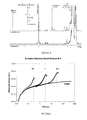
- FIG. 1 depicts the 1H NMR profile for the control A-0 polymer (lower profile) and the 1H NMR profile for the inventive A-3 polymer (upper profile). Also, all of the inventive polymers with IBAA had higher melt strength values than the control polymer (A-0), which did not contain the IBAA. The melt strength of the control without IBAA (A-0) was 16.6 cN at a melt index (I2) of 1.13.
- the melt strength of polymer A-1 was 19.3 cN at a melt index (I2) of 1.10
- the melt strength of polymer A-2 was 18.2 cN at a melt index (I2) of 1.65
- the melt strength of polymer A-3 was 18.1 cN at a melt index (I2) of 1.66.
- the extensional viscosity - Strain Hardening Factor was higher at both strain rates of 10 s -1 and 1 s -1 for each inventive polymer A-1, A-2 and A-3, as compared to the control sample (A-0) that did not contain IBAA.
- the insoluble content of all four ethylene-based polymers was less than 10 wt%; thus, low insoluble content was maintained in the inventive polymers.
- Initiator - The peroxide initiator tert-butyl peroxyacetate (2.3 grams of a 50% by weight solution in isododecane) was combined with 500 mL of n-heptane, and loaded into a third glass supply vessel. This solution was purged with nitrogen to minimize dissolved oxygen.
- Control (B-0) - Ethylene was injected at 1000 gm/hr (35.65 moles/hr), at a pressure of 200 MPa (2000 bar), into an agitated (2000 rpm) 54 mL high pressure CSTR reactor, with an external heating jacket set at 187°C. Without added peroxide initiator, only 0.1 wt% of the ethylene entering the reactor polymerized.
- the propionaldehyde was degassed by an HPLC degasser, and then was added to the ethylene stream at a pressure of 25.0 MPa (250 bar), and at a rate of 3.23 gm/hr (56 millimoles/hr), before the mixture was compressed to 200.0 MPa (2000 bar).
- the peroxide initiator was added to the ethylene-propionaldehyde mixture at a pressure of 200.0 MPa (2000 bar), and at a rate of 2.2 x 10 -3 gm/hr (0.017 millimoles/hr), before the mixture entered the reactor.
- the ethylene conversion to polymer was 10.5 wt% based on the mass of ethylene entering the reactor, and the average reaction temperature was 219°C.
- An ethylene-based polymer having a melt index (I2) of 2.9 g/10 min was obtained. Approximately 50 grams of ethylene-based polymer was collected (Control B-0).
- Undiluted AAEM was pumped at a pressure of 25.0 MPa (250 bar), and at a rate of 1.65 gm/hr (7.7 millimoles/hr) through an HPLC degasser, and then into the propionaldehyde stream, and mixed before said mixture was added to the ethylene stream and compressed to 200.0 MPa (2000) bar.
- the peroxide initiator was added to the ethylene-propionaldehyde-AAEM mixture at a pressure of 200.0 MPa (2000 bar), and at a rate of 2.5 x 10 -3 gm/hr (0.019 millimoles/hr), before the mixture entered the reactor.
- the ethylene conversion to polymer was 10 wt% based on the mass of ethylene entering the reactor, and the average reaction temperature was 216°C.
- An ethylene-based polymer having a melt index (I2) of 3.2 g/10 min was obtained.
- Approximately 100 grams of ethylene based polymer was collected (B-1).
- the AAEM (mCTA) amount was increased twice to form two more inventive polymers (B-2 and B-3).
- Reaction polymerization conditions are summarized below in Table 4. Some polymer properties are shown in Table 5 below.
- the monomeric CTA "2-(methacryloyloxy) ethyl acetoacetate (AAEM)" copolymerized into each polymer backbone.
- AAEM 2-(methacryloyloxy) ethyl acetoacetate
- all of the inventive polymers with the AAEM had higher melt strength values than the control polymer (B-0), which did not contain the AAEM.
- the melt strength of the control without AAEM (B-0) was 7.2 cN at a melt index (I2) of 2.9.
- the melt strength of polymer B-1 was 8.4 cN at a melt index (I2) of 3.2
- the melt strength of polymer B-2 was 9.5 cN at a melt index (I2) of 3.1
- the melt strength of polymer B-3 was 11.4 cN at a melt index (I2) of 2.8.
- the extensional viscosity - Strain Hardening Factor was higher at both strain rates of 10 s -1 and 1 s -1 for each inventive polymer B-1, B-2 and B-3, as compared to the control sample (B-0) that did not contain AAEM.
- Figure 2 is a plot of extensional viscosity versus time for inventive ethylene-based polymer B-3, at Hencky strain rates of 10 s -1 , 1.0 s -1 and 0.1 s -1 , and at 150°C.
- Monomeric CTA A mixture of 2-methyl-3-oxopropyl methacrylate, CAS [1215085-21-4] see U.S. 2011/0144267 , (45 gm); 4-oxobutyl methacrylate, CAS [139288-31-6], see U.S. 2011/0144267 , (54 gm); and n-heptane (74 gm) was loaded into a 0.25 L glass supply vessel, which was open to the atmosphere.
- Initiator - The peroxide initiator tert-butyl peroxyacetate (2.3 grams of a 50% by weight solution in isododecane) was combined with 500 mL of n-heptane, and loaded into a third glass supply vessel. This solution was purged with nitrogen to minimize dissolved oxygen.
- Control (C-0) - Ethylene was injected at 1000 gm/hr (35.65 moles/hr), at a pressure of 200.0 MPa (2000 bar), into an agitated (2000 rpm) 54 mL high pressure CSTR reactor, with an external heating jacket set at 187°C.
- the propionaldehyde was degassed by an HPLC degasser, and then was added to the ethylene stream at a pressure of 25.0 MPa (250 bar), and at a rate of 3.6 gm/hr (62 millimoles/hr), before the mixture was compressed to 200.0 MPa (2000 bar).
- the peroxide initiator was added to the ethylene-propionaldehyde mixture at a pressure of 200.0 MPa (2000 bar), and at a rate of 2.5 x 10 -3 gm/hr (0.019 millimoles/hr), before the mixture entered the reactor.
- the ethylene conversion to polymer was 10.5 wt% based on the mass of ethylene entering the reactor, and the average reaction temperature was 205°C.
- An ethylene-based polymer having a melt index (I2) of 1.5 g/10 min was obtained. Approximately 90 grams of ethylene-based polymer was collected (Control C-0).
- the monomeric CTA solution was pumped at a pressure of 25.0 MPa (250 bar) and at a rate of 2.73 gm/hr (10 millimoles/hr of monomeric CTA) through an HPLC degasser, and then into the propionaldehyde stream, and mixed before said mixture was added to the ethylene stream and compressed to 200.0 MPa (2000 bar).
- the peroxide initiator was added to the ethylene-propionaldehyde-mCTA mixture at a pressure of 200.0 MPa (2000 bar) and at a rate of 4.0 x 10 -3 gm/hr (0.030 millimoles/hr), before the mixture entered the reactor.
- the ethylene conversion to polymer was 9 wt% based on the mass of ethylene entering the reactor, and the average reaction temperature was 201°C.
- An ethylene-based polymer having a melt index (I2) of 1.8 g/10 min was obtained.
- Approximately 50 grams of ethylene based polymer was collected (C-1).
- Reaction polymerization conditions are summarized below in Table 7. Some polymer properties are shown in Table 8 below.
- Monomeric CTA - A mixture of 2-(2-cyano-N-methylacetamido) ethyl methacrylate (80 gm; CAS [116928-90-6]; see also EP 376590 A2 ), and 2-propanol (80 gm) was loaded into a 0.25 L glass supply vessel, which was open to the atmosphere.
- Initiator - The peroxide initiator tert-butyl peroxyacetate (2.3 grams of a 50% by weight solution in isododecane) was combined with 500 mL of n-heptane, and loaded into a third glass supply vessel. This solution was purged with nitrogen to minimize dissolved oxygen.
- Control (D-0)- Ethylene was injected at 1000 gm/hr (35.65 moles/hr), at a pressure of 200.0 MPa (2000 bar), into an agitated (2000 rpm) 54 mL high pressure CSTR reactor, with an external heating jacket set at 187°C.
- the propionaldehyde was degassed by an HPLC degasser, and then was added to the ethylene stream at a pressure of 25.0 MPa (250 bar), and at a rate of 3.7 gm/hr (64 millimoles/hr), before the mixture was compressed to 200.0 MPa (2000 bar).
- the peroxide initiator was added to the ethylene-propionaldehyde mixture at a pressure of 200.0 MPa (2000 bar), and at a rate of 2.3 x 10 -3 gm/hr (0.017 millimoles/hr), before the mixture entered the reactor.
- the ethylene conversion to polymer was 8 wt% based on the mass of ethylene entering the reactor, and the average reaction temperature was 204°C.
- An ethylene-based polymer having a melt index (I2) of 3.3 g/10 min was obtained. Approximately 60 grams of ethylene-based polymer was collected (Control D-0).
- the monomeric CTA solution was pumped at a pressure of 25.0 MPa (250 bar), and at a rate of 3.2 gm/hr (7.6 millimoles/hr of monomeric CTA) through an HPLC degasser, and then into the propionaldehyde stream, and mixed before said mixture was added to the ethylene stream and compressed to 200.0 MPa (2000 bar).
- the peroxide initiator was added to the ethylene-propionaldehyde-mCTA mixture at a pressure of 200.0 MPa (2000 bar), and at a rate of 6.3 x 10 -3 gm/hr (0.048 millimoles/hr), before the mixture entered the reactor.
- the ethylene conversion to polymer was 11 wt% based on the mass of ethylene entering the reactor, and the average reaction temperature was 220°C.
- An ethylene-based polymer having a melt index (I2) of 5 g/10 min was obtained.
- Approximately 70 grams of ethylene based polymer was collected (D-1). Reaction polymerization conditions are summarized below in Table 9. Some polymer properties are shown in Table 10 below.
- Monomeric CTA - A mixture of 2-(2-cyanoacetoxy) ethyl methacrylate (80 gm; CAS [21115-26-4]; see also US 3658878A and US 3554987A ), and 2-propanol (80 gm) was loaded into a 0.25 L glass supply vessel, which was open to the atmosphere.
- Initiator - The peroxide initiator tert-butyl peroxyacetate (2.3 grams of a 50% by weight solution in isododecane) was combined with 500 mL of n-heptane, and loaded into a third glass supply vessel. This solution was purged with nitrogen to minimize dissolved oxygen.
- Control - Sample D-0 was used as a control for inventive ethylene-based polymers E-1 and E-2 since the melt index of D-0 was similar to those of E-1 and E-2.
- the monomeric CTA solution was pumped at a pressure of 25.0 MPa (250 bar), and at a rate of 2.8 gm/hr (7.2 millimoles/hr of monomeric CTA) through an HPLC degasser, and then into the propionaldehyde stream, and mixed before said mixture was added to the ethylene stream and compressed to 200.0 MPa (2000 bar).
- the peroxide initiator was added to the ethylene-propionaldehyde-mCTA mixture at a pressure of 200.0 MPa (2000 bar), and at a rate of 4.7 x 10 -3 gm/hr (0.036 millimoles/hr), before the mixture entered the reactor.
- the ethylene conversion to polymer was 11.7 wt% based on the mass of ethylene entering the reactor, and the average reaction temperature was 210°C.
- An ethylene-based polymer having a melt index (I2) of 3.5 g/10 min was obtained.
- Approximately 95 grams of ethylene based polymer was collected (E-1). Reaction polymerization conditions are summarized below in Table 11. Some polymer properties are shown in Table 12 below.
- the monomeric CTA solution was pumped at a pressure of 25.0 MPa (250 bar), and at a rate of 4.2 gm/hr (10.7 millimoles/hr of monomeric CTA) through an HPLC degasser, and then into the propionaldehyde stream, and mixed before said mixture was added to the ethylene stream and compressed to 200.0 MPa (2000 bar).
- the peroxide initiator was added to the ethylene-propionaldehyde-mCTA mixture at a pressure of 200.0 MPa (2000 bar), and at a rate of 4.2 x 10 -3 gm/hr (0.032 millimoles/hr), before the mixture entered the reactor.
- the ethylene conversion to polymer was 11.8 wt% based on the mass of ethylene entering the reactor, and the average reaction temperature was 216°C.
- An ethylene-based polymer having a melt index (I2) of 3.5 g/10 min was obtained.
- Approximately 80 grams of ethylene based polymer was collected (E-2). Reaction polymerization conditions are summarized below in Table 11. Some polymer properties are shown in Table 12 below.
Landscapes
- Chemical & Material Sciences (AREA)
- Health & Medical Sciences (AREA)
- Chemical Kinetics & Catalysis (AREA)
- Medicinal Chemistry (AREA)
- Polymers & Plastics (AREA)
- Organic Chemistry (AREA)
- Addition Polymer Or Copolymer, Post-Treatments, Or Chemical Modifications (AREA)
- Polymerisation Methods In General (AREA)
Applications Claiming Priority (2)
| Application Number | Priority Date | Filing Date | Title |
|---|---|---|---|
| US40812410P | 2010-10-29 | 2010-10-29 | |
| PCT/US2011/054843 WO2012057975A1 (en) | 2010-10-29 | 2011-10-05 | Ethylene-based polymers and processes for the same |
Publications (2)
| Publication Number | Publication Date |
|---|---|
| EP2632961A1 EP2632961A1 (en) | 2013-09-04 |
| EP2632961B1 true EP2632961B1 (en) | 2014-12-24 |
Family
ID=44801222
Family Applications (1)
| Application Number | Title | Priority Date | Filing Date |
|---|---|---|---|
| EP11770304.1A Not-in-force EP2632961B1 (en) | 2010-10-29 | 2011-10-05 | Ethylene-based polymers and processes for the same |
Country Status (11)
| Country | Link |
|---|---|
| US (1) | US9150681B2 (ko) |
| EP (1) | EP2632961B1 (ko) |
| JP (1) | JP5980219B2 (ko) |
| KR (1) | KR101844104B1 (ko) |
| CN (1) | CN103282391B (ko) |
| AR (1) | AR083592A1 (ko) |
| BR (1) | BR112013010462B1 (ko) |
| CA (1) | CA2816287C (ko) |
| ES (1) | ES2530861T3 (ko) |
| SG (1) | SG190030A1 (ko) |
| WO (1) | WO2012057975A1 (ko) |
Families Citing this family (32)
| Publication number | Priority date | Publication date | Assignee | Title |
|---|---|---|---|---|
| EP2632961B1 (en) | 2010-10-29 | 2014-12-24 | Dow Global Technologies LLC | Ethylene-based polymers and processes for the same |
| EP2655444B2 (en) | 2010-12-22 | 2018-11-21 | Basell Polyolefine GmbH | Process for the preparation of ethylene copolymers in the presence of free-radical polymerization initiator by copolymerizing ethylene, a bi- or multifunctional comonomer and optionally further comonomers |
| ES2564545T3 (es) * | 2011-12-22 | 2016-03-23 | Dow Global Technologies Llc | Polímeros a base de etileno con resistencia en estado fundido mejorada y procedimientos para los mismos |
| JP6339565B2 (ja) * | 2012-06-27 | 2018-06-06 | ダウ グローバル テクノロジーズ エルエルシー | エチレン系ポリマーおよびそのプロセス |
| BR112015010787B1 (pt) | 2012-11-20 | 2022-01-18 | Dow Global Technologies Llc | Composição a base de etileno de baixa densidade, artigo e método de polimerização para formar uma composição a base de etileno de baixa densidade |
| WO2014105110A2 (en) | 2012-12-28 | 2014-07-03 | Dow Global Technologies Llc | Method to reduce the crystallization temperature of carboxylic acid comonomer at elevated pressures, and to improve the copolymerization of the same |
| ES2637970T3 (es) | 2013-05-22 | 2017-10-18 | Dow Global Technologies Llc | Composiciones poliméricas basadas en etileno de baja densidad con alta resistencia en estado fundido y control de densidad medio-alto |
| CN105189637B (zh) * | 2013-05-22 | 2018-02-06 | 陶氏环球技术有限责任公司 | 含有具高熔融强度低密度乙烯基聚合物的组合物和由其形成的膜 |
| KR20160107181A (ko) * | 2013-12-26 | 2016-09-13 | 다우 글로벌 테크놀로지스 엘엘씨 | 리튬 염-촉매된 트랜스에스테르화 공정용 억제제 배합물 및 리튬 염의 제거방법 |
| KR102315130B1 (ko) * | 2013-12-26 | 2021-10-22 | 다우 글로벌 테크놀로지스 엘엘씨 | 비대칭 폴리엔을 사용하여 형성된 에틸렌계 중합체 |
| US9718906B2 (en) | 2013-12-26 | 2017-08-01 | Dow Global Technologies Llc | Processes to form ethylene-based polymers using asymmetrical polyenes |
| SG11201605159UA (en) | 2013-12-26 | 2016-07-28 | Dow Global Technologies Llc | Processes to improve reactor stability for the preparation of ethylene-based polymers using asymmetrical polyenes |
| KR102359175B1 (ko) | 2014-06-27 | 2022-02-08 | 다우 글로벌 테크놀로지스 엘엘씨 | 일산화탄소 및 레올로지 개질제로부터 유도된 단위를 포함하는 에틸렌계 폴리머 |
| WO2015200430A1 (en) | 2014-06-27 | 2015-12-30 | Dow Global Technologies Llc | Process to prepare ethylene-based polymers using a distribution of carbon monoxide |
| KR102502365B1 (ko) | 2014-11-13 | 2023-02-23 | 다우 글로벌 테크놀로지스 엘엘씨 | 개선된 고압 자유 라디칼 중합을 위한 윤활제 조성물 |
| KR102617008B1 (ko) | 2015-06-17 | 2023-12-26 | 다우 글로벌 테크놀로지스 엘엘씨 | 관형 반응기에서 제조되고 그리고 선택적으로 분기제로 변형된 높은 용융 강도의 에틸렌계 폴리머를 사용하여 가교결합된 케이블 절연체를 제조하는 방법 |
| WO2016209381A1 (en) | 2015-06-24 | 2016-12-29 | Dow Global Technologies Llc | Processes to prepare ethylene-based polymers with improved melt-strength |
| US10730977B2 (en) * | 2015-06-25 | 2020-08-04 | Dow Global Technologies Llc | Process to make tubular ethylene based polymers with high G′ and broad MWD |
| US10400046B2 (en) | 2015-06-25 | 2019-09-03 | Joseph J. Matsko | Portable powered paint system |
| WO2016210308A1 (en) | 2015-06-25 | 2016-12-29 | Dow Global Technologies Llc | Improved process to make tubular ethylene based polymers with high melt strength |
| ES2775506T3 (es) | 2015-06-25 | 2020-07-27 | Dow Global Technologies Llc | Polímeros basados en etileno con bajo contenido de extraíbles con hexano |
| US10730973B2 (en) | 2015-06-25 | 2020-08-04 | Dow Global Technologies Llc | Ethylene-based polymers with low hexane extractables and low densities |
| ES2959186T3 (es) | 2015-06-30 | 2024-02-21 | Dow Global Technologies Llc | Composiciones poliméricas basadas en etileno para recubrimientos por extrusión mejorados |
| EP3238938A1 (en) | 2016-04-29 | 2017-11-01 | Borealis AG | Machine direction oriented films comprising multimodal copolymer of ethylene and at least two alpha-olefin comonomers |
| EP4345114B1 (en) | 2016-09-28 | 2025-08-13 | Dow Global Technologies Llc | Lubricant treatments for reducing peroxide content |
| ES2904923T3 (es) | 2016-12-22 | 2022-04-06 | Dow Global Technologies Llc | Proceso para obtener composiciones de polímero a base de etileno de alta densidad con alta resistencia en estado fundido |
| EP3630853B1 (en) | 2017-06-02 | 2021-03-17 | Dow Global Technologies LLC | Ethylene-based polymers and processes for the same |
| WO2019089750A1 (en) | 2017-10-31 | 2019-05-09 | Dow Global Technologies Llc | Ethylene/co interpolymers and processes to make the same |
| US20210395410A1 (en) * | 2018-12-04 | 2021-12-23 | Sabic Global Technologies B.V. | Polyolefin terpolymers, vitrimers made therefrom, and method of making the polyolefin terpolymers and vitrimers |
| WO2020202071A1 (en) * | 2019-04-05 | 2020-10-08 | Sabic Global Technologies B.V. | Semi-crystalline silyl ether based vitrimers, methods of making and uses thereof |
| US20230151195A1 (en) * | 2020-04-06 | 2023-05-18 | Dow Global Technologies Llc | Enhanced melt strength low-density polyethylene for use in films or blends |
| JP7514133B2 (ja) * | 2020-07-27 | 2024-07-10 | 旭化成株式会社 | 高圧法低密度ポリエチレン樹脂 |
Family Cites Families (30)
| Publication number | Priority date | Publication date | Assignee | Title |
|---|---|---|---|---|
| US3658878A (en) | 1965-12-20 | 1972-04-25 | Eastman Kodak Co | Ethylenically unsaturated cyano group containing compounds |
| US3554987A (en) | 1965-12-20 | 1971-01-12 | Eastman Kodak Co | Novel compounds and photographic materials containing said compounds |
| DE2722097C3 (de) | 1977-05-16 | 1981-09-17 | Basf Ag, 6700 Ludwigshafen | (Meth)acryloxy-alkylpropanale, Verfahren zu dessen Herstellung und Verwendung derselben |
| US4250070A (en) * | 1978-01-26 | 1981-02-10 | Basf Aktiengesellschaft | Aqueous dispersions, containing hydrazine derivatives, of carbonyl-containing copolymers |
| US5021511A (en) | 1988-12-27 | 1991-06-04 | Rohm And Haas Company | Polymer compositions derived from acryloxyalkylcyanoacetamides |
| SE9103077D0 (sv) | 1991-10-22 | 1991-10-22 | Neste Oy | Omaettad etensampolymer och saett foer framstaellning daerav |
| US6545088B1 (en) | 1991-12-30 | 2003-04-08 | Dow Global Technologies Inc. | Metallocene-catalyzed process for the manufacture of EP and EPDM polymers |
| CA2125780C (en) | 1991-12-30 | 2004-07-06 | Deepak R. Parikh | Ethylene interpolymer polymerizations |
| JP3550159B2 (ja) * | 1992-04-10 | 2004-08-04 | 住友化学工業株式会社 | 接着剤 |
| BR9405715A (pt) | 1993-01-29 | 1995-11-28 | Dow Chemical Co | Processo para preparar um composição de interpolímero de etileno/a-olefina e composição de interpolímero de etileno/a-olefina |
| US6448341B1 (en) | 1993-01-29 | 2002-09-10 | The Dow Chemical Company | Ethylene interpolymer blend compositions |
| ATE152138T1 (de) * | 1993-10-02 | 1997-05-15 | Basf Ag | Copolymerisate auf ethylenbasis und ihre verwendung als fliessverbesserer in erdölmitteldestillaten |
| US5869575A (en) | 1995-08-02 | 1999-02-09 | The Dow Chemical Company | Ethylene interpolymerizations |
| SE507045C2 (sv) | 1996-05-31 | 1998-03-23 | Borealis As | Etensampolymer med förhöjd omättnadsgrad och sätt för framställning därav |
| DE19733104A1 (de) * | 1997-07-31 | 1999-02-04 | Wacker Chemie Gmbh | Vernetzbare, in Wasser redispergierbare Pulverzusammensetzung |
| US6117492A (en) * | 1999-03-30 | 2000-09-12 | Air Products And Chemicals, Inc. | Polymers having dual crosslinkable functionality and process for forming high performance nonwoven webs |
| US6506696B2 (en) * | 2001-03-26 | 2003-01-14 | Air Products Polymers, L.P. | High performance synthetic nonwovens using polymers having dual crosslinkable functionality |
| US7064091B2 (en) | 2003-01-29 | 2006-06-20 | Air Products Polymers, L.P. | Incorporation of a self-crosslinking polymer into a nonwoven binder for use in improving the wet strength of pre-moistened wipes |
| EP1650232A1 (en) | 2004-10-25 | 2006-04-26 | Total Petrochemicals Research Feluy | LDPE-Like polymers with bisindenyl-based ligands having different rings |
| KR101391511B1 (ko) | 2005-03-09 | 2014-05-07 | 사우디 베이식 인더스트리즈 코포레이션 | 튜브형 반응기 내 공정으로 제조된 에틸렌 공중합체 |
| ES2367591T3 (es) | 2006-03-24 | 2011-11-04 | Saudi Basic Industries Corporation | Composición de recubrimiento por extrusión. |
| DE102009026819A1 (de) | 2008-09-08 | 2010-03-11 | Evonik Röhm Gmbh | Monomermischung, Polymer, Beschichtungsmittel und Verfahren zur Herstellung einer Beschichtung |
| CN102239188A (zh) * | 2008-10-07 | 2011-11-09 | 陶氏环球技术有限责任公司 | 使用高活性链转移剂制造的具有改进的光学性质的高压低密度聚乙烯树脂 |
| WO2011075465A1 (en) | 2009-12-18 | 2011-06-23 | Dow Global Technology Llc | Polymerization process to make low density polyethylene |
| JP5216028B2 (ja) | 2010-01-18 | 2013-06-19 | 住友ゴム工業株式会社 | インナーライナー用ゴム組成物及び空気入りタイヤ |
| EP2621963B1 (en) | 2010-09-30 | 2016-07-06 | Dow Global Technologies LLC | Polymerization process to make low density polyethylene |
| WO2012044503A1 (en) | 2010-09-30 | 2012-04-05 | Dow Global Technologies Llc | Ethylene-based interpolymers and processes to make the same |
| EP2632961B1 (en) | 2010-10-29 | 2014-12-24 | Dow Global Technologies LLC | Ethylene-based polymers and processes for the same |
| CN102002815B (zh) | 2010-11-03 | 2016-01-20 | 宁波泰力斯高分子科技有限公司 | 具有双向可伸缩的直立结构纤维棉及生产装置和方法 |
| EP2655444B2 (en) | 2010-12-22 | 2018-11-21 | Basell Polyolefine GmbH | Process for the preparation of ethylene copolymers in the presence of free-radical polymerization initiator by copolymerizing ethylene, a bi- or multifunctional comonomer and optionally further comonomers |
-
2011
- 2011-10-05 EP EP11770304.1A patent/EP2632961B1/en not_active Not-in-force
- 2011-10-05 US US13/881,358 patent/US9150681B2/en not_active Expired - Fee Related
- 2011-10-05 SG SG2013032248A patent/SG190030A1/en unknown
- 2011-10-05 WO PCT/US2011/054843 patent/WO2012057975A1/en not_active Ceased
- 2011-10-05 KR KR1020137013462A patent/KR101844104B1/ko not_active Expired - Fee Related
- 2011-10-05 CA CA2816287A patent/CA2816287C/en not_active Expired - Fee Related
- 2011-10-05 ES ES11770304T patent/ES2530861T3/es active Active
- 2011-10-05 JP JP2013536641A patent/JP5980219B2/ja not_active Expired - Fee Related
- 2011-10-05 BR BR112013010462-7A patent/BR112013010462B1/pt not_active IP Right Cessation
- 2011-10-05 CN CN201180062701.2A patent/CN103282391B/zh not_active Expired - Fee Related
- 2011-10-28 AR ARP110103994A patent/AR083592A1/es active IP Right Grant
Also Published As
| Publication number | Publication date |
|---|---|
| JP2013540877A (ja) | 2013-11-07 |
| CN103282391A (zh) | 2013-09-04 |
| WO2012057975A1 (en) | 2012-05-03 |
| JP5980219B2 (ja) | 2016-08-31 |
| ES2530861T3 (es) | 2015-03-06 |
| KR101844104B1 (ko) | 2018-03-30 |
| US9150681B2 (en) | 2015-10-06 |
| EP2632961A1 (en) | 2013-09-04 |
| SG190030A1 (en) | 2013-06-28 |
| AR083592A1 (es) | 2013-03-06 |
| CA2816287C (en) | 2019-06-18 |
| KR20140000254A (ko) | 2014-01-02 |
| CA2816287A1 (en) | 2012-05-03 |
| BR112013010462A2 (pt) | 2016-08-02 |
| US20130237678A1 (en) | 2013-09-12 |
| BR112013010462B1 (pt) | 2020-10-27 |
| CN103282391B (zh) | 2016-12-07 |
Similar Documents
| Publication | Publication Date | Title |
|---|---|---|
| EP2632961B1 (en) | Ethylene-based polymers and processes for the same | |
| EP2867261B1 (en) | Ethylene-based polymers and processes for the same | |
| EP2794675B1 (en) | Ethylene-based polymers with improved melt strength and processes for the same | |
| ES2640018T3 (es) | Polímeros a base de etileno de baja densidad con alta resistencia en estado fundido | |
| KR102171521B1 (ko) | 개선된 용융 강도, 출력 및 기계적 특성을 갖는 저밀도 에틸렌계 조성물 | |
| EP3087111B1 (en) | Processes to form ethylene-based polymers using asymmetrical polyenes | |
| WO2014190036A1 (en) | Compositions containing low density ethylene-based polymers with high melt strength and films formed from the same | |
| EP2478022B1 (en) | Polymers comprising units derived from ethylene and polyalkene | |
| CA2435284A1 (en) | Ethylene alkyl acrylate copolymers with improved heat resistance | |
| ES2691716T3 (es) | Polímeros que comprenden unidades derivadas de etileno y poli(alcóxido) | |
| JP7702383B2 (ja) | 分岐を有するエチレン系ポリマー組成物 | |
| US7112624B2 (en) | Ethylene alkyl acrylate copolymers with improved heat resistance |
Legal Events
| Date | Code | Title | Description |
|---|---|---|---|
| PUAI | Public reference made under article 153(3) epc to a published international application that has entered the european phase |
Free format text: ORIGINAL CODE: 0009012 |
|
| 17P | Request for examination filed |
Effective date: 20130501 |
|
| AK | Designated contracting states |
Kind code of ref document: A1 Designated state(s): AL AT BE BG CH CY CZ DE DK EE ES FI FR GB GR HR HU IE IS IT LI LT LU LV MC MK MT NL NO PL PT RO RS SE SI SK SM TR |
|
| DAX | Request for extension of the european patent (deleted) | ||
| GRAP | Despatch of communication of intention to grant a patent |
Free format text: ORIGINAL CODE: EPIDOSNIGR1 |
|
| INTG | Intention to grant announced |
Effective date: 20140709 |
|
| GRAS | Grant fee paid |
Free format text: ORIGINAL CODE: EPIDOSNIGR3 |
|
| GRAA | (expected) grant |
Free format text: ORIGINAL CODE: 0009210 |
|
| AK | Designated contracting states |
Kind code of ref document: B1 Designated state(s): AL AT BE BG CH CY CZ DE DK EE ES FI FR GB GR HR HU IE IS IT LI LT LU LV MC MK MT NL NO PL PT RO RS SE SI SK SM TR |
|
| REG | Reference to a national code |
Ref country code: GB Ref legal event code: FG4D |
|
| REG | Reference to a national code |
Ref country code: CH Ref legal event code: EP |
|
| REG | Reference to a national code |
Ref country code: IE Ref legal event code: FG4D |
|
| REG | Reference to a national code |
Ref country code: AT Ref legal event code: REF Ref document number: 703090 Country of ref document: AT Kind code of ref document: T Effective date: 20150115 |
|
| REG | Reference to a national code |
Ref country code: DE Ref legal event code: R096 Ref document number: 602011012573 Country of ref document: DE Effective date: 20150219 |
|
| REG | Reference to a national code |
Ref country code: ES Ref legal event code: FG2A Ref document number: 2530861 Country of ref document: ES Kind code of ref document: T3 Effective date: 20150306 |
|
| REG | Reference to a national code |
Ref country code: NL Ref legal event code: VDEP Effective date: 20141224 |
|
| PG25 | Lapsed in a contracting state [announced via postgrant information from national office to epo] |
Ref country code: LT Free format text: LAPSE BECAUSE OF FAILURE TO SUBMIT A TRANSLATION OF THE DESCRIPTION OR TO PAY THE FEE WITHIN THE PRESCRIBED TIME-LIMIT Effective date: 20141224 Ref country code: FI Free format text: LAPSE BECAUSE OF FAILURE TO SUBMIT A TRANSLATION OF THE DESCRIPTION OR TO PAY THE FEE WITHIN THE PRESCRIBED TIME-LIMIT Effective date: 20141224 Ref country code: NO Free format text: LAPSE BECAUSE OF FAILURE TO SUBMIT A TRANSLATION OF THE DESCRIPTION OR TO PAY THE FEE WITHIN THE PRESCRIBED TIME-LIMIT Effective date: 20150324 |
|
| REG | Reference to a national code |
Ref country code: LT Ref legal event code: MG4D |
|
| PG25 | Lapsed in a contracting state [announced via postgrant information from national office to epo] |
Ref country code: HR Free format text: LAPSE BECAUSE OF FAILURE TO SUBMIT A TRANSLATION OF THE DESCRIPTION OR TO PAY THE FEE WITHIN THE PRESCRIBED TIME-LIMIT Effective date: 20141224 Ref country code: RS Free format text: LAPSE BECAUSE OF FAILURE TO SUBMIT A TRANSLATION OF THE DESCRIPTION OR TO PAY THE FEE WITHIN THE PRESCRIBED TIME-LIMIT Effective date: 20141224 Ref country code: GR Free format text: LAPSE BECAUSE OF FAILURE TO SUBMIT A TRANSLATION OF THE DESCRIPTION OR TO PAY THE FEE WITHIN THE PRESCRIBED TIME-LIMIT Effective date: 20150325 Ref country code: SE Free format text: LAPSE BECAUSE OF FAILURE TO SUBMIT A TRANSLATION OF THE DESCRIPTION OR TO PAY THE FEE WITHIN THE PRESCRIBED TIME-LIMIT Effective date: 20141224 Ref country code: LV Free format text: LAPSE BECAUSE OF FAILURE TO SUBMIT A TRANSLATION OF THE DESCRIPTION OR TO PAY THE FEE WITHIN THE PRESCRIBED TIME-LIMIT Effective date: 20141224 |
|
| REG | Reference to a national code |
Ref country code: AT Ref legal event code: MK05 Ref document number: 703090 Country of ref document: AT Kind code of ref document: T Effective date: 20141224 |
|
| PG25 | Lapsed in a contracting state [announced via postgrant information from national office to epo] |
Ref country code: NL Free format text: LAPSE BECAUSE OF FAILURE TO SUBMIT A TRANSLATION OF THE DESCRIPTION OR TO PAY THE FEE WITHIN THE PRESCRIBED TIME-LIMIT Effective date: 20141224 |
|
| PG25 | Lapsed in a contracting state [announced via postgrant information from national office to epo] |
Ref country code: SK Free format text: LAPSE BECAUSE OF FAILURE TO SUBMIT A TRANSLATION OF THE DESCRIPTION OR TO PAY THE FEE WITHIN THE PRESCRIBED TIME-LIMIT Effective date: 20141224 Ref country code: RO Free format text: LAPSE BECAUSE OF FAILURE TO SUBMIT A TRANSLATION OF THE DESCRIPTION OR TO PAY THE FEE WITHIN THE PRESCRIBED TIME-LIMIT Effective date: 20141224 Ref country code: EE Free format text: LAPSE BECAUSE OF FAILURE TO SUBMIT A TRANSLATION OF THE DESCRIPTION OR TO PAY THE FEE WITHIN THE PRESCRIBED TIME-LIMIT Effective date: 20141224 Ref country code: CZ Free format text: LAPSE BECAUSE OF FAILURE TO SUBMIT A TRANSLATION OF THE DESCRIPTION OR TO PAY THE FEE WITHIN THE PRESCRIBED TIME-LIMIT Effective date: 20141224 |
|
| PG25 | Lapsed in a contracting state [announced via postgrant information from national office to epo] |
Ref country code: IS Free format text: LAPSE BECAUSE OF FAILURE TO SUBMIT A TRANSLATION OF THE DESCRIPTION OR TO PAY THE FEE WITHIN THE PRESCRIBED TIME-LIMIT Effective date: 20150424 Ref country code: PL Free format text: LAPSE BECAUSE OF FAILURE TO SUBMIT A TRANSLATION OF THE DESCRIPTION OR TO PAY THE FEE WITHIN THE PRESCRIBED TIME-LIMIT Effective date: 20141224 Ref country code: AT Free format text: LAPSE BECAUSE OF FAILURE TO SUBMIT A TRANSLATION OF THE DESCRIPTION OR TO PAY THE FEE WITHIN THE PRESCRIBED TIME-LIMIT Effective date: 20141224 |
|
| REG | Reference to a national code |
Ref country code: DE Ref legal event code: R097 Ref document number: 602011012573 Country of ref document: DE |
|
| PG25 | Lapsed in a contracting state [announced via postgrant information from national office to epo] |
Ref country code: DK Free format text: LAPSE BECAUSE OF FAILURE TO SUBMIT A TRANSLATION OF THE DESCRIPTION OR TO PAY THE FEE WITHIN THE PRESCRIBED TIME-LIMIT Effective date: 20141224 |
|
| PLBE | No opposition filed within time limit |
Free format text: ORIGINAL CODE: 0009261 |
|
| STAA | Information on the status of an ep patent application or granted ep patent |
Free format text: STATUS: NO OPPOSITION FILED WITHIN TIME LIMIT |
|
| 26N | No opposition filed |
Effective date: 20150925 |
|
| PG25 | Lapsed in a contracting state [announced via postgrant information from national office to epo] |
Ref country code: SI Free format text: LAPSE BECAUSE OF FAILURE TO SUBMIT A TRANSLATION OF THE DESCRIPTION OR TO PAY THE FEE WITHIN THE PRESCRIBED TIME-LIMIT Effective date: 20141224 |
|
| PG25 | Lapsed in a contracting state [announced via postgrant information from national office to epo] |
Ref country code: BE Free format text: LAPSE BECAUSE OF FAILURE TO SUBMIT A TRANSLATION OF THE DESCRIPTION OR TO PAY THE FEE WITHIN THE PRESCRIBED TIME-LIMIT Effective date: 20141224 Ref country code: LU Free format text: LAPSE BECAUSE OF FAILURE TO SUBMIT A TRANSLATION OF THE DESCRIPTION OR TO PAY THE FEE WITHIN THE PRESCRIBED TIME-LIMIT Effective date: 20151005 |
|
| REG | Reference to a national code |
Ref country code: CH Ref legal event code: PL |
|
| GBPC | Gb: european patent ceased through non-payment of renewal fee |
Effective date: 20151005 |
|
| PG25 | Lapsed in a contracting state [announced via postgrant information from national office to epo] |
Ref country code: MC Free format text: LAPSE BECAUSE OF FAILURE TO SUBMIT A TRANSLATION OF THE DESCRIPTION OR TO PAY THE FEE WITHIN THE PRESCRIBED TIME-LIMIT Effective date: 20141224 |
|
| REG | Reference to a national code |
Ref country code: IE Ref legal event code: MM4A |
|
| PG25 | Lapsed in a contracting state [announced via postgrant information from national office to epo] |
Ref country code: GB Free format text: LAPSE BECAUSE OF NON-PAYMENT OF DUE FEES Effective date: 20151005 Ref country code: CH Free format text: LAPSE BECAUSE OF NON-PAYMENT OF DUE FEES Effective date: 20151031 Ref country code: LI Free format text: LAPSE BECAUSE OF NON-PAYMENT OF DUE FEES Effective date: 20151031 |
|
| REG | Reference to a national code |
Ref country code: FR Ref legal event code: PLFP Year of fee payment: 6 |
|
| PG25 | Lapsed in a contracting state [announced via postgrant information from national office to epo] |
Ref country code: IE Free format text: LAPSE BECAUSE OF NON-PAYMENT OF DUE FEES Effective date: 20151005 |
|
| PG25 | Lapsed in a contracting state [announced via postgrant information from national office to epo] |
Ref country code: HU Free format text: LAPSE BECAUSE OF FAILURE TO SUBMIT A TRANSLATION OF THE DESCRIPTION OR TO PAY THE FEE WITHIN THE PRESCRIBED TIME-LIMIT; INVALID AB INITIO Effective date: 20111005 Ref country code: SM Free format text: LAPSE BECAUSE OF FAILURE TO SUBMIT A TRANSLATION OF THE DESCRIPTION OR TO PAY THE FEE WITHIN THE PRESCRIBED TIME-LIMIT Effective date: 20141224 Ref country code: BG Free format text: LAPSE BECAUSE OF FAILURE TO SUBMIT A TRANSLATION OF THE DESCRIPTION OR TO PAY THE FEE WITHIN THE PRESCRIBED TIME-LIMIT Effective date: 20141224 |
|
| PG25 | Lapsed in a contracting state [announced via postgrant information from national office to epo] |
Ref country code: CY Free format text: LAPSE BECAUSE OF FAILURE TO SUBMIT A TRANSLATION OF THE DESCRIPTION OR TO PAY THE FEE WITHIN THE PRESCRIBED TIME-LIMIT Effective date: 20141224 |
|
| PG25 | Lapsed in a contracting state [announced via postgrant information from national office to epo] |
Ref country code: MT Free format text: LAPSE BECAUSE OF FAILURE TO SUBMIT A TRANSLATION OF THE DESCRIPTION OR TO PAY THE FEE WITHIN THE PRESCRIBED TIME-LIMIT Effective date: 20141224 |
|
| REG | Reference to a national code |
Ref country code: FR Ref legal event code: PLFP Year of fee payment: 7 |
|
| PG25 | Lapsed in a contracting state [announced via postgrant information from national office to epo] |
Ref country code: MK Free format text: LAPSE BECAUSE OF FAILURE TO SUBMIT A TRANSLATION OF THE DESCRIPTION OR TO PAY THE FEE WITHIN THE PRESCRIBED TIME-LIMIT Effective date: 20141224 Ref country code: TR Free format text: LAPSE BECAUSE OF FAILURE TO SUBMIT A TRANSLATION OF THE DESCRIPTION OR TO PAY THE FEE WITHIN THE PRESCRIBED TIME-LIMIT Effective date: 20141224 |
|
| PG25 | Lapsed in a contracting state [announced via postgrant information from national office to epo] |
Ref country code: PT Free format text: LAPSE BECAUSE OF FAILURE TO SUBMIT A TRANSLATION OF THE DESCRIPTION OR TO PAY THE FEE WITHIN THE PRESCRIBED TIME-LIMIT Effective date: 20141224 |
|
| REG | Reference to a national code |
Ref country code: FR Ref legal event code: PLFP Year of fee payment: 8 |
|
| PG25 | Lapsed in a contracting state [announced via postgrant information from national office to epo] |
Ref country code: AL Free format text: LAPSE BECAUSE OF FAILURE TO SUBMIT A TRANSLATION OF THE DESCRIPTION OR TO PAY THE FEE WITHIN THE PRESCRIBED TIME-LIMIT Effective date: 20141224 |
|
| PGFP | Annual fee paid to national office [announced via postgrant information from national office to epo] |
Ref country code: FR Payment date: 20200914 Year of fee payment: 10 |
|
| PGFP | Annual fee paid to national office [announced via postgrant information from national office to epo] |
Ref country code: IT Payment date: 20200911 Year of fee payment: 10 Ref country code: ES Payment date: 20201104 Year of fee payment: 10 Ref country code: DE Payment date: 20200922 Year of fee payment: 10 |
|
| REG | Reference to a national code |
Ref country code: DE Ref legal event code: R119 Ref document number: 602011012573 Country of ref document: DE |
|
| PG25 | Lapsed in a contracting state [announced via postgrant information from national office to epo] |
Ref country code: DE Free format text: LAPSE BECAUSE OF NON-PAYMENT OF DUE FEES Effective date: 20220503 |
|
| PG25 | Lapsed in a contracting state [announced via postgrant information from national office to epo] |
Ref country code: FR Free format text: LAPSE BECAUSE OF NON-PAYMENT OF DUE FEES Effective date: 20211031 |
|
| PG25 | Lapsed in a contracting state [announced via postgrant information from national office to epo] |
Ref country code: IT Free format text: LAPSE BECAUSE OF NON-PAYMENT OF DUE FEES Effective date: 20211005 |
|
| REG | Reference to a national code |
Ref country code: ES Ref legal event code: FD2A Effective date: 20230213 |
|
| PG25 | Lapsed in a contracting state [announced via postgrant information from national office to epo] |
Ref country code: ES Free format text: LAPSE BECAUSE OF NON-PAYMENT OF DUE FEES Effective date: 20211006 |