EP2642457A2 - Procédé et système destinés à la réalisation dýun contrôle d'accès à un bâtiment - Google Patents
Procédé et système destinés à la réalisation dýun contrôle d'accès à un bâtiment Download PDFInfo
- Publication number
- EP2642457A2 EP2642457A2 EP13160163.5A EP13160163A EP2642457A2 EP 2642457 A2 EP2642457 A2 EP 2642457A2 EP 13160163 A EP13160163 A EP 13160163A EP 2642457 A2 EP2642457 A2 EP 2642457A2
- Authority
- EP
- European Patent Office
- Prior art keywords
- building
- door
- access control
- control system
- camera
- Prior art date
- Legal status (The legal status is an assumption and is not a legal conclusion. Google has not performed a legal analysis and makes no representation as to the accuracy of the status listed.)
- Withdrawn
Links
- 238000000034 method Methods 0.000 title claims abstract description 11
- 238000011156 evaluation Methods 0.000 claims abstract description 48
- 230000003068 static effect Effects 0.000 claims description 5
- 238000001454 recorded image Methods 0.000 abstract 1
- 238000012545 processing Methods 0.000 description 11
- 238000010586 diagram Methods 0.000 description 5
- 230000006870 function Effects 0.000 description 3
- 238000013475 authorization Methods 0.000 description 2
- 238000001514 detection method Methods 0.000 description 2
- 230000004888 barrier function Effects 0.000 description 1
- 230000000694 effects Effects 0.000 description 1
- 239000011521 glass Substances 0.000 description 1
- 238000005286 illumination Methods 0.000 description 1
- 230000003287 optical effect Effects 0.000 description 1
- 238000012360 testing method Methods 0.000 description 1
- 230000001960 triggered effect Effects 0.000 description 1
Images


Classifications
-
- G—PHYSICS
- G07—CHECKING-DEVICES
- G07C—TIME OR ATTENDANCE REGISTERS; REGISTERING OR INDICATING THE WORKING OF MACHINES; GENERATING RANDOM NUMBERS; VOTING OR LOTTERY APPARATUS; ARRANGEMENTS, SYSTEMS OR APPARATUS FOR CHECKING NOT PROVIDED FOR ELSEWHERE
- G07C9/00—Individual registration on entry or exit
- G07C9/00174—Electronically operated locks; Circuits therefor; Nonmechanical keys therefor, e.g. passive or active electrical keys or other data carriers without mechanical keys
- G07C9/00563—Electronically operated locks; Circuits therefor; Nonmechanical keys therefor, e.g. passive or active electrical keys or other data carriers without mechanical keys using personal physical data of the operator, e.g. finger prints, retinal images, voicepatterns
-
- G—PHYSICS
- G07—CHECKING-DEVICES
- G07C—TIME OR ATTENDANCE REGISTERS; REGISTERING OR INDICATING THE WORKING OF MACHINES; GENERATING RANDOM NUMBERS; VOTING OR LOTTERY APPARATUS; ARRANGEMENTS, SYSTEMS OR APPARATUS FOR CHECKING NOT PROVIDED FOR ELSEWHERE
- G07C9/00—Individual registration on entry or exit
- G07C9/00174—Electronically operated locks; Circuits therefor; Nonmechanical keys therefor, e.g. passive or active electrical keys or other data carriers without mechanical keys
- G07C9/00658—Electronically operated locks; Circuits therefor; Nonmechanical keys therefor, e.g. passive or active electrical keys or other data carriers without mechanical keys operated by passive electrical keys
- G07C9/00674—Electronically operated locks; Circuits therefor; Nonmechanical keys therefor, e.g. passive or active electrical keys or other data carriers without mechanical keys operated by passive electrical keys with switch-buttons
- G07C9/0069—Electronically operated locks; Circuits therefor; Nonmechanical keys therefor, e.g. passive or active electrical keys or other data carriers without mechanical keys operated by passive electrical keys with switch-buttons actuated in a predetermined sequence
Definitions
- the invention relates to a method and a system for carrying out a building access control, in particular a building access control using a door camera.
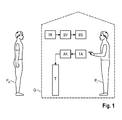
- Fig. 1 shows a conventional building access control system.
- a door T through which a person P a can gain access to the building G.
- the signal processing unit SV evaluates at least one camera image for a screen BS from the image data supplied by the door camera TK.
- On the screen BS thus appears a camera image of the face of standing in front of the building G person P a .
- a person P i located inside the building G can hear a ringtone which is triggered by the operation of a bell button by the outside person P a .
- the person P i located inside the building G goes to the door T, such as the front door, and looks at the screen BS to decide whether or not the outside person P a is allowed to enter the building. If the person P i decides that the outside person P a is allowed to enter the building G, he / she can actuate or activate an actuator 7 via a keyboard TA, which opens the door 2. If the person standing inside P i decides that the person P a should not enter the building G, he omits the actuation of the keyboard TA and gives an appropriate indication via an intercom system of the outside person P a . This in Fig.
- FIG. 1 illustrated conventional building access control system allows an outside person P a , which does not have a key or the like, an access to the building G only if there is already a person P i inside the building G, which allows access to recognize the person P a by means of the screen BS by operating the keyboard TA. Therefore, the in Fig. 1
- conventional building access control system illustrated does not represent a situation in which the outside person P a has forgotten their front door key or the like and there is no person P i inside the building G. Therefore has the outsiders person P a forgotten her house key and is at the same time no one inside the building or any person who knows the outsiders person P a, the outsiders person Pa has no chance to enter the building G.
- the person P a must either go to a person known to her who gives her a front door key or the like, or it must be a Aufsperrdienst claimed. Naturally, until a technician of the Aufsperrdienst reaches the building G, a certain amount of time passes before the person P a standing in front of the building G has to wait for the technician. In many cases, such as at night, such an unlock service is not available.
- biometric building access control systems are relatively uncertain in many applications. For example, if the biometric sensor is a finger pressure sensor, an outside person P a can not gain access to the building G in many cases if the hands or fingers are dirty due to, for example, an operation. In these cases, the finger pressure or fingerprint is not identified by the biometric building access control system, although the person P a is in itself entitled to access. Furthermore, many biometric building access control systems, in particular with face recognition, require that the person P a standing in front of the door T experiences a constant, defined illumination. This is not the case in many applications, especially in private buildings.
- the invention accordingly provides a building access control system with a door camera which is mounted on a door of a building and is provided for, at least one camera image an object located in front of the door, wherein the object displayed on a display of a mobile terminal, which is held by a person in front of the door camera, which can be displayed on a screen within the building, wherein an evaluation of the building access control system, the at least one recorded camera image for Evaluation of a pattern evaluates and automatically actuates the door depending on the evaluation result.
- the evaluation unit has access to a local database or data memory located in the building, in which reference data are stored, which are compared for detecting a pattern with the recorded camera image of the door camera by the evaluation unit.
- the evaluation unit has access via an interface and a data network to a remote central database in which there are reference data which can be compared with the recorded camera image of the door camera for the recognition of a pattern.
- the object has an identification code displayed on the display of the mobile terminal.
- the identification code is transmitted from an access control server via a base station of a mobile radio network to the mobile terminal.
- the identification code transmitted by the access control server to the mobile terminal is automatically changed at regular intervals or when an event occurs.
- the identification code transmitted to the mobile terminal is generated as a function of a device ID of the mobile terminal.
- the identification code is a graphically displayable one-dimensional or multidimensional code, in particular a QR code.
- the identification code is a numerical code, a bit pattern or a bar code.
- a keypad for entering a keyboard code is additionally provided on the door.
- a sensor for detecting the biometric feature of a person is additionally provided on the door.
- the building access control system evaluates the evaluation in addition to the camera image supplied by the door camera, an inputted keyboard code and / or a detected biometric feature provided by a sensor mounted on the door.
- the door camera supplies a biometric pattern, in particular a fingerprint.
- the door camera supplies at least one static camera image, which is evaluated by the evaluation unit optionally after signal processing.
- the door camera supplies a dynamic sequence of camera images, which are optionally evaluated by the evaluation unit after signal processing.
- the door camera and / or the evaluation unit is activated for a predetermined period of time as soon as a person actuates an attached key or keyboard on the door of the building.
- the door camera can be focused on the object located in front of the door.
- the invention further provides a method for performing a building access control having the features specified in claim 14.
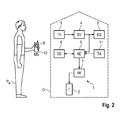
- FIG. 2 how to get out Fig. 2 can recognize, there is a building access control system 1 at the in Fig. 2 illustrated embodiment in a building G, in which a door 2 is located. Furthermore, a door camera 3 is attached to the door 2, which is intended to receive at least one object located in front of the image camera 3.
- the image data supplied by the door camera 3 are processed by a signal processing unit 4, wherein the processed camera image can be displayed on demand on a screen 5 of the building access control system 1.
- the processed camera image is further supplied to an evaluation unit 6, as in Fig. 2 shown.
- the evaluation unit 6 of the building access control system 1 evaluates the recorded camera image to recognize a pattern and actuates the door 2 as a function of the evaluation result. This is done, for example, by the evaluation unit 6, as in FIG Fig.
- the evaluation unit 6 has access to a local data memory 8, in which reference data are located.
- the evaluation unit 6 supplied by the signal processing 4 processed camera image with the data memory 8 stored reference data and actuate the actuator 7 at an approximate match of the recorded pattern with a reference pattern to the effect that he opens the door 2 for a standing in front of the door 2 person P a .
- the door camera 3 can record an object located in front of the door 2, on which a pattern is located.
- This pattern is an optical pattern used in the Fig. 2 illustrated embodiment consists of an identification code C. This identification code C is used in the in Fig.
- the mobile terminal 10 is, for example, a mobile phone or portable mobile terminal of the person P a .
- the identification code C which is displayed on the display 9 of the mobile terminal 10, can be permanently programmed or stored in the mobile terminal 10 in a data memory of the mobile terminal 10, for example. Alternatively, the displayed identification code C is changeable.
- the identification code C may be a one-dimensional or multi-dimensional code which can be represented graphically. In one possible implementation, the code is a so-called QR code.
- the identification code C may also be a numerical code, a bit pattern or a bar code.
- the identification code C is a static image or a statically displayed code C.
- a sequence of codes C can also be displayed dynamically on the display 9 of the mobile terminal 10.
- the displayed identification code can also be generated as a function of a device ID of the mobile terminal 10.
- the building access control system 1 further has a keyboard 11 which can be operated by a person located within the building G P i .
- the actuator 7 is actuated to open the door 2 only if on the one hand, the evaluation unit 6 passes due to the pattern comparison to the evaluation result that the door T is to be opened for the outside person P a and at the same time one within the building G person P i by entering a keyboard code in the keyboard 11 or a simple button allows this access.
- the person P i located within the building G additionally considers the camera image of the outside person P a displayed on the screen 5.
- the door camera 3 can first supply the camera image and the identification code C of the mobile phone or mobile terminal to the evaluation unit 6 after corresponding signal processing, which in the case of a positive evaluation result or in agreement with a reference pattern, the person located within the building G. P i informed, for example by means of ringing or an alarm message that an authorized person P a is in front of the door 2. Subsequently, the person P i located within the building G can go to the screen 5 and manually release the door 2 by actuating the keyboard 11. In this possible embodiment variant, the person P i located within the building G is thus only bothered by a ringtone when the person standing in front of the door P a has a suitable identification code C.
- This in Fig. 2 shown building access control system 1 has the advantage that a person located in front of the door 2 P a access to the building G can also obtain if there is no person P i within the building G, in particular if the evaluation unit 6 automatically actuates the actuator 7 to open the door 2 when the displayed identification code C matches a reference pattern, without additional inputs, for example via the keyboard 11, being necessary. Therefore has the in Fig. 2 illustrated embodiment, the outside person P a forgotten, for example, her front door key, she can achieve by holding the mobile terminal 10 in front of the door camera 3, that they still achieved access to the building G.
- the building access control system according to the invention has the further advantage that an already existing on the door 2 door camera 3 is also used for the building access control 1, so that keeps the technical overhead within narrow limits.
- the door camera 3, the signal processing device 4 of the screen 5 and the keyboard 11 and the actuator 7 in conventional building access control systems already exist and can be extended by an evaluation unit 6 with a reference data memory 8 to to provide the additional functionality of secure building access control.
- a person may gain access without relying on the person P i in the building.
- a person P a leave the building or the closed room G and forget, for example, a door key for the door 2, without having to order a Aufsperrdienst or the like in this case.
- the building access control system 1 in the in Fig. 3 illustrated embodiment, an external keyboard 12 as an input device, which allows a person standing in front of the door 2, in addition to input input information, in particular a keyboard code, which is additionally evaluated by the evaluation unit 6.
- the door 2 is opened only when the pattern supplied by the door camera 3 coincides with a reference data pattern locally stored in the data memory 8, and furthermore the outside person P a has correct input information, in particular a door code or Keyboard code of the building G enters the input device 12.
- one or more biometric sensors can additionally be attached to the evaluation unit 6, which additionally detect one or more biometric body features of a person standing in front of the door P a , which are additionally evaluated by the evaluation unit 6.
- the evaluation unit 6 evaluates not only one or more static camera images, which are delivered from the door camera 3, but rather a dynamic sequence of camera images can reflect, for example, a gesture, which originates from the located front of the door P a ,
- a person in front of the door 2 in front of the door camera 3 perform a special hand movement or the like, which can be recognized as a pattern by the evaluation unit 6 based on a reference data pattern.
- a person P a in front of the door camera 3 makes a V-mark with his fingers or moves a finger on the door camera with a certain movement pattern, which is supplied by the door camera 3 after signal processing to the evaluation unit 6.
- the evaluation unit 6 compares the executed gestures or the pattern entered with the finger with a reference data pattern and, if they match, releases the door 2 for entry into the building G.
- the components or units of the building access control system 1, in particular the door camera 3, the signal processing device 4 and the evaluation unit 6 and the actuator 7 are constantly active.
- certain components or units of the building access control system 1 are activated only when a person P a located in front of the door 2 actuates a keyboard or a switch. In this way, the power consumption of the building access control system 1 can be reduced.
- certain components or units of the building access control system are activated by a mounted in front of the building G motion detector.
- the door camera 3 is arranged to be movable and can be automatically directed at the occurrence of a movement on the moving object. Furthermore, it is possible for the door camera 3 to be automatically focusable on the object located in front of it.
- the identification code C is provided by an access control server.
- Figure 4 shows an embodiment variant in which the building access control system 1 located in the building G is connected via an interface 13 to a data network 14, which is a connection between an access control server 15 and the building access control system 1 can produce.
- the data network 14 may be, for example, the Internet.
- the building access control server 15A at the in Figure 4 illustrated embodiment have access to a central database 15B.
- the data network 14 can also exchange data via a gateway 16 with a mobile radio network 17 which has several base stations 18.
- the identification code C is transmitted from the access control server 15A via the base station 18 of the mobile radio network 16 to the mobile terminal 10 by means of a radio interface and displayed there on a display 9 of the mobile terminal 10.
- a person in front of the building G can then hold the displayed identification code C in front of the door camera 3 of the building access control system 1 in order to gain access to the building G in accordance with a reference data pattern.
- This reference data pattern can be located either in a local data memory 8 of the building access control system 1 or in the central database 15B of the access control server 15A.
- the downloading of the identification code C may be automatically initiated, for example, when the person in front of the building G operates a doorbell or the like. After pressing the doorbell transmits the evaluation or control unit 6 via the interface 13, a corresponding request or a request to the building access control server 15A, which then a current identification code via the data network 14 and the mobile network 17 and the air interface to mobile devices 10 of a or more than one authorized person. For example, an identification code C is automatically transmitted to all family members residing in the building G.
- a In front of the door 2 person P a which has a mobile terminal 10, such as a cell phone, via the air interface a corresponding request via the mobile network 17 and the data network 14 to the access authorization control server 15 A judge, then subsequently, for example, after testing a device ID or a device certificate to obtain a valid identification code C.
- a mobile terminal 10 such as a cell phone
- a person P a located in front of the door 2 may receive a valid identification code C if another person permits it, as in Fig. 5 shown.
- a person located in front of the door 2 has a first mobile terminal 10-1 and would like to gain access to the building G, it can actuate a doorbell and / or by request to the access control server 15A, for example via the mobile network 17 and the Data network 13, an identification code C, if another person who has a mobile terminal 10-2, allows this.
- the person in front of the door 2 may be a craftsman or the like who has to do a work within the building G.
- the craftsman now wants to enter the building G, he sends a corresponding request to obtain an identification code C to the access control server 15A, which asks an authorized person, for example the homeowner, if the person in front of the door 2 has access to the door 2 or not.
- the building owner may then give his permission so that the identification code C is transmitted to the mobile terminal 10-1 of the craftsman located in front of the door 2. It is also possible, for example, that with a camera of the first mobile terminal 10-1 first the camera image is transmitted to the mobile terminal 10-2 of the building owner, so that he can recognize that the craftsman located in front of the door 2 is actually the craftsman he has ordered.
- the in Fig. 5 illustrated embodiment thus receives a resident or owner of a building G, the possibility of service providers, such as craftsmen, specifically enter into his building G, without having to be on site.
- the transmitted identification code C is static or fixed for a longer period of time.
- family members receive a permanent identification code.
- the transmitted identification code C can be changed automatically at regular intervals to increase security.
- the transmitted identification code C is changed automatically in dependence on an event. For example, the identification code C is changed automatically each time the door 2 is opened. This also allows the security against unauthorized entry of the building G can be significantly increased.
- the building access control system or components and units of the building access control system 1 are automatically activated when a person located in front of the door 2 operates a time recording system, for example at an office building or the like.
- the door 2 may be, for example, the front door of a private house.
- the door 2 may also be the door of an office building that is of a plurality entering different people.
- the building access control system 1 according to the invention is also suitable for barriers, for example in parking garages or the like.
- the door 2 may be any door, for example a garage door of a private house or a gate entrance.
- a conventional door camera 2 can be used, so that the technical overhead is kept within limits.
- the object to be identified for example the identification code C
- the object to be identified can be held at a defined distance in front of the door camera 3 of the building access control system 1.
- a holding device or a glass pane is provided on the door 2, in front of which the mobile terminal 10 is held at a defined distance in front of the door camera 3. In this embodiment, it is not necessary that the door camera 3 can be focused.
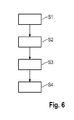
- Fig. 6 shows a flowchart for a simple embodiment of the method according to the invention for carrying out a building access control.
- step S2 the recorded camera image is displayed on the screen 5 of the building access control system 1 within the building 6 after appropriate signal processing.
- the camera image is additionally evaluated automatically in step S3 in addition to the detection of a pattern by the evaluation unit 6 of the building access control system 1.
- step S4 the door 2 is subsequently actuated in step S4, for example by controlling the actuator 7.
- Fig. 6 shown control method is performed for example on a microprocessor of the evaluation unit 6.
- different people may receive different identification codes with different access permissions.
- a first person in a first time window can receive an access authorization based on the identification code and another person in another time slot.
- 6 different measures can be carried out by the evaluation unit.
- a door 2 may be opened upon detection of a suitable pattern.
- a person located in front of the door 2 can also cause the door 2 to be firmly closed after leaving the building by providing a corresponding identification code C in front of the door camera 3.
- a door camera can also be provided inside the building G.
- a person may leave the building G only if he holds a suitable identification code C in front of the indoor camera. In this embodiment, an access control is thus exercised with regard to leaving the building 6.
Landscapes
- Physics & Mathematics (AREA)
- General Physics & Mathematics (AREA)
- Lock And Its Accessories (AREA)
- Closed-Circuit Television Systems (AREA)
Applications Claiming Priority (2)
| Application Number | Priority Date | Filing Date | Title |
|---|---|---|---|
| DE102012204435 | 2012-03-20 | ||
| DE201210205379 DE102012205379A1 (de) | 2012-03-20 | 2012-04-02 | Verfahren und System zur Durchführung einer Gebäudezugangskontrolle |
Publications (2)
| Publication Number | Publication Date |
|---|---|
| EP2642457A2 true EP2642457A2 (fr) | 2013-09-25 |
| EP2642457A3 EP2642457A3 (fr) | 2017-09-13 |
Family
ID=47913150
Family Applications (1)
| Application Number | Title | Priority Date | Filing Date |
|---|---|---|---|
| EP13160163.5A Withdrawn EP2642457A3 (fr) | 2012-03-20 | 2013-03-20 | Procédé et système destinés à la réalisation d'un contrôle d'accès à un bâtiment |
Country Status (2)
| Country | Link |
|---|---|
| EP (1) | EP2642457A3 (fr) |
| DE (1) | DE102012205379A1 (fr) |
Cited By (4)
| Publication number | Priority date | Publication date | Assignee | Title |
|---|---|---|---|---|
| CN103729925A (zh) * | 2014-01-15 | 2014-04-16 | 黄晓刚 | 一种智能化自动门管理系统 |
| WO2016034297A1 (fr) * | 2014-09-02 | 2016-03-10 | Rudolf King | Système et procédé de sécurité de porte et d'habitation |
| CN106327625A (zh) * | 2016-08-05 | 2017-01-11 | 易晓阳 | 一种智能识别门禁系统 |
| WO2018023525A1 (fr) * | 2016-08-04 | 2018-02-08 | 易晓阳 | Système de commande d'accès de reconnaissance intelligent |
Families Citing this family (4)
| Publication number | Priority date | Publication date | Assignee | Title |
|---|---|---|---|---|
| DE102016107020B4 (de) | 2016-04-15 | 2023-06-01 | Uniberry Gmbh | System und Verfahren zur Zutrittsregelung zu einem gesicherten Bereich zur Ablieferung von Paketsendungen |
| DE102018109179A1 (de) * | 2018-04-18 | 2019-10-24 | Marantec Antriebs- Und Steuerungstechnik Gmbh & Co. Kg | Verfahren zur Toröffnung |
| DE102020119961A1 (de) | 2020-07-29 | 2022-02-03 | Ni-Ko GmbH | Raumsystem |
| DE102023115190B3 (de) | 2023-06-12 | 2024-10-10 | Audi Aktiengesellschaft | Verfahren und System zum Steuern einer Zugangsvorrichtung eines Gebäudes |
Family Cites Families (5)
| Publication number | Priority date | Publication date | Assignee | Title |
|---|---|---|---|---|
| DE10146821B4 (de) * | 2001-09-20 | 2011-03-03 | Robert Bosch Gmbh | Zutrittskontrollsystem |
| JP2006090006A (ja) * | 2004-09-24 | 2006-04-06 | Matsushita Electric Works Ltd | 電気錠施錠/解錠機能付きテレビドアホン、及びそれを用いた共同玄関施解錠システム |
| DE102006062306A1 (de) * | 2006-12-27 | 2008-07-03 | ASTRA Gesellschaft für Asset Management mbH & Co. KG | Zugangs-, Überwachungs- und Kommunikationseinrichtung sowie Zugangs-, Überwachungs- und Kommunikationsverfahren |
| EP2237234A1 (fr) * | 2009-04-03 | 2010-10-06 | Inventio AG | Procédé et dispositif destinés au contrôle d'accès |
| DE202009005403U1 (de) * | 2009-04-08 | 2009-06-25 | Thürnau, Bernd | Vorrichtung für das Freigeben eines verschlossenen Schließelements, insbesondere einer Tür |
-
2012
- 2012-04-02 DE DE201210205379 patent/DE102012205379A1/de not_active Withdrawn
-
2013
- 2013-03-20 EP EP13160163.5A patent/EP2642457A3/fr not_active Withdrawn
Non-Patent Citations (1)
| Title |
|---|
| None |
Cited By (5)
| Publication number | Priority date | Publication date | Assignee | Title |
|---|---|---|---|---|
| CN103729925A (zh) * | 2014-01-15 | 2014-04-16 | 黄晓刚 | 一种智能化自动门管理系统 |
| WO2016034297A1 (fr) * | 2014-09-02 | 2016-03-10 | Rudolf King | Système et procédé de sécurité de porte et d'habitation |
| US10100556B2 (en) | 2014-09-02 | 2018-10-16 | Rudolf King | Door and home security system and method |
| WO2018023525A1 (fr) * | 2016-08-04 | 2018-02-08 | 易晓阳 | Système de commande d'accès de reconnaissance intelligent |
| CN106327625A (zh) * | 2016-08-05 | 2017-01-11 | 易晓阳 | 一种智能识别门禁系统 |
Also Published As
| Publication number | Publication date |
|---|---|
| DE102012205379A1 (de) | 2013-09-26 |
| EP2642457A3 (fr) | 2017-09-13 |
Similar Documents
| Publication | Publication Date | Title |
|---|---|---|
| EP2642457A2 (fr) | Procédé et système destinés à la réalisation dýun contrôle d'accès à un bâtiment | |
| EP3307666B2 (fr) | Systeme d'ascenseur dote d'une generation d'appel predictive | |
| EP3610465B1 (fr) | Système de contrôle d'accès avec reconnaissance faciale et radioélectrique | |
| EP3610466B1 (fr) | Procédé d'enregistrement et de contrôle d'accès de visiteurs | |
| EP2900581B1 (fr) | Procédé pour remettre un système de sécurité d'une installation d'ascenseur | |
| EP3729384B1 (fr) | Système de contrôle d'accès avec reconnaissance faciale et radioélectrique | |
| DE102018104152A1 (de) | Toranlage | |
| EP3215974B1 (fr) | Procédé pour fournir un code d'accès à un appareil portable, et appareil portable | |
| WO2019121336A1 (fr) | Système de contrôle d'accès avec authentification radio et acquisition de mot de passe | |
| DE102008058661B4 (de) | Zutrittskontrollsystem | |
| EP3748590B1 (fr) | Appareil d'authentification pouvant être monté au mur | |
| US20170140585A1 (en) | Access control system and method | |
| EP3220617B1 (fr) | Système de communication de porte, appareil externe pour un système de communication de porte et procédé de fonctionnement d'un système de communication de porte | |
| JP2013140462A (ja) | 入退室管理システム | |
| EP4452811A1 (fr) | Système d'ascenseur ayant des règles d'utilisation d'ascenseur au niveau d'une ouverture de porte de bâtiment | |
| EP2268878B1 (fr) | Système d'accès, unité de commande et procédé d'actionnement d'un mécanisme d'ouverture d'un système d'accès | |
| WO2003023722A2 (fr) | Procede de controle d'autorisation d'acces | |
| WO2022180088A1 (fr) | Procédé d'installation d'une pluralité de composants de porte | |
| DE102013100321A1 (de) | System und Verfahren zum Parametrieren von Flügeln bzw. Flügelanlagen | |
| DE202026100571U1 (de) | Zugangskontrollsystem für Gebäude mit Anzeigevorrichtung | |
| DE102008058659B3 (de) | Zutrittskontrollsystem | |
| EP1752929B2 (fr) | Procédé destiné au contrôle d'entrée d'une zone accessible à des personnes, en particulier pour une pièce fermée par une porte | |
| DE102008058658A1 (de) | Zutrittskontrollsystem | |
| EP3693932A1 (fr) | Installation de communication de porte pour une installation résidentielle ou commerciale dotée d'une pluralité d'unités résidentielles ou commerciales et procédé correspondant | |
| EP4409550A1 (fr) | Système de porte de bâtiment avec dispositifs de fonctionnement et d'orientation |
Legal Events
| Date | Code | Title | Description |
|---|---|---|---|
| PUAI | Public reference made under article 153(3) epc to a published international application that has entered the european phase |
Free format text: ORIGINAL CODE: 0009012 |
|
| AK | Designated contracting states |
Kind code of ref document: A2 Designated state(s): AL AT BE BG CH CY CZ DE DK EE ES FI FR GB GR HR HU IE IS IT LI LT LU LV MC MK MT NL NO PL PT RO RS SE SI SK SM TR |
|
| AX | Request for extension of the european patent |
Extension state: BA ME |
|
| PUAL | Search report despatched |
Free format text: ORIGINAL CODE: 0009013 |
|
| AK | Designated contracting states |
Kind code of ref document: A3 Designated state(s): AL AT BE BG CH CY CZ DE DK EE ES FI FR GB GR HR HU IE IS IT LI LT LU LV MC MK MT NL NO PL PT RO RS SE SI SK SM TR |
|
| AX | Request for extension of the european patent |
Extension state: BA ME |
|
| RIC1 | Information provided on ipc code assigned before grant |
Ipc: G07C 9/00 20060101AFI20170810BHEP |
|
| STAA | Information on the status of an ep patent application or granted ep patent |
Free format text: STATUS: THE APPLICATION HAS BEEN WITHDRAWN |
|
| 18W | Application withdrawn |
Effective date: 20180216 |