EP2652029B1 - Organische farbmittel und eingefärbte polymer-zusammensetzungen mit hoher stabilität gegen bewitterung - Google Patents
Organische farbmittel und eingefärbte polymer-zusammensetzungen mit hoher stabilität gegen bewitterung Download PDFInfo
- Publication number
- EP2652029B1 EP2652029B1 EP11799419.4A EP11799419A EP2652029B1 EP 2652029 B1 EP2652029 B1 EP 2652029B1 EP 11799419 A EP11799419 A EP 11799419A EP 2652029 B1 EP2652029 B1 EP 2652029B1
- Authority
- EP
- European Patent Office
- Prior art keywords
- weight
- polymer composition
- component
- und
- structures
- Prior art date
- Legal status (The legal status is an assumption and is not a legal conclusion. Google has not performed a legal analysis and makes no representation as to the accuracy of the status listed.)
- Active
Links
- 0 CC(*)(C=C1)C=CC(C(N23)=O)=C1C2=Nc1c2c3cccc2ccc1 Chemical compound CC(*)(C=C1)C=CC(C(N23)=O)=C1C2=Nc1c2c3cccc2ccc1 0.000 description 2
Classifications
-
- C—CHEMISTRY; METALLURGY
- C09—DYES; PAINTS; POLISHES; NATURAL RESINS; ADHESIVES; COMPOSITIONS NOT OTHERWISE PROVIDED FOR; APPLICATIONS OF MATERIALS NOT OTHERWISE PROVIDED FOR
- C09B—ORGANIC DYES OR CLOSELY-RELATED COMPOUNDS FOR PRODUCING DYES, e.g. PIGMENTS; MORDANTS; LAKES
- C09B57/00—Other synthetic dyes of known constitution
-
- C—CHEMISTRY; METALLURGY
- C08—ORGANIC MACROMOLECULAR COMPOUNDS; THEIR PREPARATION OR CHEMICAL WORKING-UP; COMPOSITIONS BASED THEREON
- C08K—Use of inorganic or non-macromolecular organic substances as compounding ingredients
- C08K5/00—Use of organic ingredients
- C08K5/16—Nitrogen-containing compounds
- C08K5/34—Heterocyclic compounds having nitrogen in the ring
- C08K5/3442—Heterocyclic compounds having nitrogen in the ring having two nitrogen atoms in the ring
- C08K5/3462—Six-membered rings
- C08K5/3465—Six-membered rings condensed with carbocyclic rings
-
- C—CHEMISTRY; METALLURGY
- C08—ORGANIC MACROMOLECULAR COMPOUNDS; THEIR PREPARATION OR CHEMICAL WORKING-UP; COMPOSITIONS BASED THEREON
- C08K—Use of inorganic or non-macromolecular organic substances as compounding ingredients
- C08K5/00—Use of organic ingredients
-
- C—CHEMISTRY; METALLURGY
- C08—ORGANIC MACROMOLECULAR COMPOUNDS; THEIR PREPARATION OR CHEMICAL WORKING-UP; COMPOSITIONS BASED THEREON
- C08K—Use of inorganic or non-macromolecular organic substances as compounding ingredients
- C08K5/00—Use of organic ingredients
- C08K5/16—Nitrogen-containing compounds
- C08K5/17—Amines; Quaternary ammonium compounds
-
- C—CHEMISTRY; METALLURGY
- C08—ORGANIC MACROMOLECULAR COMPOUNDS; THEIR PREPARATION OR CHEMICAL WORKING-UP; COMPOSITIONS BASED THEREON
- C08K—Use of inorganic or non-macromolecular organic substances as compounding ingredients
- C08K5/00—Use of organic ingredients
- C08K5/16—Nitrogen-containing compounds
- C08K5/17—Amines; Quaternary ammonium compounds
- C08K5/18—Amines; Quaternary ammonium compounds with aromatically bound amino groups
-
- C—CHEMISTRY; METALLURGY
- C08—ORGANIC MACROMOLECULAR COMPOUNDS; THEIR PREPARATION OR CHEMICAL WORKING-UP; COMPOSITIONS BASED THEREON
- C08K—Use of inorganic or non-macromolecular organic substances as compounding ingredients
- C08K5/00—Use of organic ingredients
- C08K5/16—Nitrogen-containing compounds
- C08K5/34—Heterocyclic compounds having nitrogen in the ring
-
- C—CHEMISTRY; METALLURGY
- C08—ORGANIC MACROMOLECULAR COMPOUNDS; THEIR PREPARATION OR CHEMICAL WORKING-UP; COMPOSITIONS BASED THEREON
- C08L—COMPOSITIONS OF MACROMOLECULAR COMPOUNDS
- C08L69/00—Compositions of polycarbonates; Compositions of derivatives of polycarbonates
-
- C—CHEMISTRY; METALLURGY
- C09—DYES; PAINTS; POLISHES; NATURAL RESINS; ADHESIVES; COMPOSITIONS NOT OTHERWISE PROVIDED FOR; APPLICATIONS OF MATERIALS NOT OTHERWISE PROVIDED FOR
- C09B—ORGANIC DYES OR CLOSELY-RELATED COMPOUNDS FOR PRODUCING DYES, e.g. PIGMENTS; MORDANTS; LAKES
- C09B47/00—Porphines; Azaporphines
- C09B47/04—Phthalocyanines abbreviation: Pc
- C09B47/06—Preparation from carboxylic acids or derivatives thereof, e.g. anhydrides, amides, mononitriles, phthalimide, o-cyanobenzamide
- C09B47/062—Preparation from carboxylic acids or derivatives thereof, e.g. anhydrides, amides, mononitriles, phthalimide, o-cyanobenzamide having alkyl radicals linked directly to the Pc skeleton; having carboxylic groups directly linked to the skeleton, e.g. phenyl
-
- C—CHEMISTRY; METALLURGY
- C09—DYES; PAINTS; POLISHES; NATURAL RESINS; ADHESIVES; COMPOSITIONS NOT OTHERWISE PROVIDED FOR; APPLICATIONS OF MATERIALS NOT OTHERWISE PROVIDED FOR
- C09B—ORGANIC DYES OR CLOSELY-RELATED COMPOUNDS FOR PRODUCING DYES, e.g. PIGMENTS; MORDANTS; LAKES
- C09B47/00—Porphines; Azaporphines
- C09B47/04—Phthalocyanines abbreviation: Pc
- C09B47/06—Preparation from carboxylic acids or derivatives thereof, e.g. anhydrides, amides, mononitriles, phthalimide, o-cyanobenzamide
- C09B47/065—Preparation from carboxylic acids or derivatives thereof, e.g. anhydrides, amides, mononitriles, phthalimide, o-cyanobenzamide having -COOH or -SO3H radicals or derivatives thereof, directly linked to the skeleton
-
- C—CHEMISTRY; METALLURGY
- C09—DYES; PAINTS; POLISHES; NATURAL RESINS; ADHESIVES; COMPOSITIONS NOT OTHERWISE PROVIDED FOR; APPLICATIONS OF MATERIALS NOT OTHERWISE PROVIDED FOR
- C09B—ORGANIC DYES OR CLOSELY-RELATED COMPOUNDS FOR PRODUCING DYES, e.g. PIGMENTS; MORDANTS; LAKES
- C09B47/00—Porphines; Azaporphines
- C09B47/04—Phthalocyanines abbreviation: Pc
- C09B47/06—Preparation from carboxylic acids or derivatives thereof, e.g. anhydrides, amides, mononitriles, phthalimide, o-cyanobenzamide
- C09B47/067—Preparation from carboxylic acids or derivatives thereof, e.g. anhydrides, amides, mononitriles, phthalimide, o-cyanobenzamide from phthalodinitriles naphthalenedinitriles, aromatic dinitriles prepared in situ, hydrogenated phthalodinitrile
- C09B47/0673—Preparation from carboxylic acids or derivatives thereof, e.g. anhydrides, amides, mononitriles, phthalimide, o-cyanobenzamide from phthalodinitriles naphthalenedinitriles, aromatic dinitriles prepared in situ, hydrogenated phthalodinitrile having alkyl radicals linked directly to the Pc skeleton; having carbocyclic groups linked directly to the skeleton
-
- C—CHEMISTRY; METALLURGY
- C09—DYES; PAINTS; POLISHES; NATURAL RESINS; ADHESIVES; COMPOSITIONS NOT OTHERWISE PROVIDED FOR; APPLICATIONS OF MATERIALS NOT OTHERWISE PROVIDED FOR
- C09B—ORGANIC DYES OR CLOSELY-RELATED COMPOUNDS FOR PRODUCING DYES, e.g. PIGMENTS; MORDANTS; LAKES
- C09B47/00—Porphines; Azaporphines
- C09B47/04—Phthalocyanines abbreviation: Pc
- C09B47/06—Preparation from carboxylic acids or derivatives thereof, e.g. anhydrides, amides, mononitriles, phthalimide, o-cyanobenzamide
- C09B47/067—Preparation from carboxylic acids or derivatives thereof, e.g. anhydrides, amides, mononitriles, phthalimide, o-cyanobenzamide from phthalodinitriles naphthalenedinitriles, aromatic dinitriles prepared in situ, hydrogenated phthalodinitrile
- C09B47/0678—Preparation from carboxylic acids or derivatives thereof, e.g. anhydrides, amides, mononitriles, phthalimide, o-cyanobenzamide from phthalodinitriles naphthalenedinitriles, aromatic dinitriles prepared in situ, hydrogenated phthalodinitrile having-COOH or -SO3H radicals or derivatives thereof directly linked to the skeleton
-
- C—CHEMISTRY; METALLURGY
- C09—DYES; PAINTS; POLISHES; NATURAL RESINS; ADHESIVES; COMPOSITIONS NOT OTHERWISE PROVIDED FOR; APPLICATIONS OF MATERIALS NOT OTHERWISE PROVIDED FOR
- C09B—ORGANIC DYES OR CLOSELY-RELATED COMPOUNDS FOR PRODUCING DYES, e.g. PIGMENTS; MORDANTS; LAKES
- C09B47/00—Porphines; Azaporphines
- C09B47/04—Phthalocyanines abbreviation: Pc
- C09B47/08—Preparation from other phthalocyanine compounds, e.g. cobaltphthalocyanineamine complex
- C09B47/12—Obtaining compounds having alkyl radicals, or alkyl radicals substituted by hetero atoms, bound to the phthalocyanine skeleton
-
- C—CHEMISTRY; METALLURGY
- C09—DYES; PAINTS; POLISHES; NATURAL RESINS; ADHESIVES; COMPOSITIONS NOT OTHERWISE PROVIDED FOR; APPLICATIONS OF MATERIALS NOT OTHERWISE PROVIDED FOR
- C09B—ORGANIC DYES OR CLOSELY-RELATED COMPOUNDS FOR PRODUCING DYES, e.g. PIGMENTS; MORDANTS; LAKES
- C09B47/00—Porphines; Azaporphines
- C09B47/04—Phthalocyanines abbreviation: Pc
- C09B47/08—Preparation from other phthalocyanine compounds, e.g. cobaltphthalocyanineamine complex
- C09B47/24—Obtaining compounds having —COOH or —SO3H radicals, or derivatives thereof, directly bound to the phthalocyanine radical
-
- C—CHEMISTRY; METALLURGY
- C09—DYES; PAINTS; POLISHES; NATURAL RESINS; ADHESIVES; COMPOSITIONS NOT OTHERWISE PROVIDED FOR; APPLICATIONS OF MATERIALS NOT OTHERWISE PROVIDED FOR
- C09B—ORGANIC DYES OR CLOSELY-RELATED COMPOUNDS FOR PRODUCING DYES, e.g. PIGMENTS; MORDANTS; LAKES
- C09B47/00—Porphines; Azaporphines
- C09B47/04—Phthalocyanines abbreviation: Pc
- C09B47/30—Metal-free phthalocyanines
-
- C—CHEMISTRY; METALLURGY
- C09—DYES; PAINTS; POLISHES; NATURAL RESINS; ADHESIVES; COMPOSITIONS NOT OTHERWISE PROVIDED FOR; APPLICATIONS OF MATERIALS NOT OTHERWISE PROVIDED FOR
- C09B—ORGANIC DYES OR CLOSELY-RELATED COMPOUNDS FOR PRODUCING DYES, e.g. PIGMENTS; MORDANTS; LAKES
- C09B5/00—Dyes with an anthracene nucleus condensed with one or more heterocyclic rings with or without carbocyclic rings
- C09B5/02—Dyes with an anthracene nucleus condensed with one or more heterocyclic rings with or without carbocyclic rings the heterocyclic ring being only condensed in peri position
- C09B5/16—Benz-diazabenzanthrones, e.g. anthrapyrimidones
-
- C—CHEMISTRY; METALLURGY
- C09—DYES; PAINTS; POLISHES; NATURAL RESINS; ADHESIVES; COMPOSITIONS NOT OTHERWISE PROVIDED FOR; APPLICATIONS OF MATERIALS NOT OTHERWISE PROVIDED FOR
- C09B—ORGANIC DYES OR CLOSELY-RELATED COMPOUNDS FOR PRODUCING DYES, e.g. PIGMENTS; MORDANTS; LAKES
- C09B5/00—Dyes with an anthracene nucleus condensed with one or more heterocyclic rings with or without carbocyclic rings
- C09B5/24—Dyes with an anthracene nucleus condensed with one or more heterocyclic rings with or without carbocyclic rings the heterocyclic rings being only condensed with an anthraquinone nucleus in 1-2 or 2-3 position
- C09B5/44—Azines of the anthracene series
- C09B5/46—Para-diazines
- C09B5/48—Bis-anthraquinonediazines (indanthrone)
-
- C—CHEMISTRY; METALLURGY
- C09—DYES; PAINTS; POLISHES; NATURAL RESINS; ADHESIVES; COMPOSITIONS NOT OTHERWISE PROVIDED FOR; APPLICATIONS OF MATERIALS NOT OTHERWISE PROVIDED FOR
- C09B—ORGANIC DYES OR CLOSELY-RELATED COMPOUNDS FOR PRODUCING DYES, e.g. PIGMENTS; MORDANTS; LAKES
- C09B57/00—Other synthetic dyes of known constitution
- C09B57/08—Naphthalimide dyes; Phthalimide dyes
-
- C—CHEMISTRY; METALLURGY
- C09—DYES; PAINTS; POLISHES; NATURAL RESINS; ADHESIVES; COMPOSITIONS NOT OTHERWISE PROVIDED FOR; APPLICATIONS OF MATERIALS NOT OTHERWISE PROVIDED FOR
- C09B—ORGANIC DYES OR CLOSELY-RELATED COMPOUNDS FOR PRODUCING DYES, e.g. PIGMENTS; MORDANTS; LAKES
- C09B67/00—Influencing the physical, e.g. the dyeing or printing properties of dyestuffs without chemical reactions, e.g. by treating with solvents grinding or grinding assistants, coating of pigments or dyes; Process features in the making of dyestuff preparations; Dyestuff preparations of a special physical nature, e.g. tablets, films
- C09B67/0033—Blends of pigments; Mixtured crystals; Solid solutions
-
- C—CHEMISTRY; METALLURGY
- C09—DYES; PAINTS; POLISHES; NATURAL RESINS; ADHESIVES; COMPOSITIONS NOT OTHERWISE PROVIDED FOR; APPLICATIONS OF MATERIALS NOT OTHERWISE PROVIDED FOR
- C09B—ORGANIC DYES OR CLOSELY-RELATED COMPOUNDS FOR PRODUCING DYES, e.g. PIGMENTS; MORDANTS; LAKES
- C09B67/00—Influencing the physical, e.g. the dyeing or printing properties of dyestuffs without chemical reactions, e.g. by treating with solvents grinding or grinding assistants, coating of pigments or dyes; Process features in the making of dyestuff preparations; Dyestuff preparations of a special physical nature, e.g. tablets, films
- C09B67/0033—Blends of pigments; Mixtured crystals; Solid solutions
- C09B67/0034—Mixtures of two or more pigments or dyes of the same type
Definitions
- the invention relates to a transparent thermoplastic polymer composition containing as thermoplastic polycarbonate and at least one combination of at least two organic colorants, special structure.
- the present invention also relates to the products produced from the transparent thermoplastic polymer compositions dyed according to the invention, shaped articles or shaped articles.
- panes which are used in the motor vehicle, rail vehicle and aircraft sectors or in the infrastructure sector must have a long service life and must not become brittle during this time.
- color and transparency should not or only slightly change over the lifetime, as well as the IR protection properties with appropriate IR protection of the disks, i. the protection against heat radiation.
- the disc must have sufficient scratch resistance.
- thermoplastics Due to the above-mentioned advantages of plastics, there is therefore a need for materials which have both the good physical properties of thermoplastics and the high color stability corresponding to colored glasses.
- polymers based on polycarbonate and polymethyl methacrylate (PMMA) are particularly well suited for use as a glazing material. Due to the high toughness, polycarbonate in particular has a very good profile of properties for such purposes.
- thermoplastic materials To improve the longevity of thermoplastic materials, it is known to provide them with UV protection and / or scratch-resistant coatings. In addition, a large number of colorants are known which have a high light fastness.
- thermoplastic compositions mentioned in the prior art are only insufficiently suitable when extremely high color stability is required. This is the case, for example, when glass panes and transparently colored panes of thermoplastic material are installed together. This shows that the color stability of glass is superior to the thermoplastic material. Color deviations are particularly noticeable when these materials are installed next to each other.
- the color of the molding may be necessary to make in a neutral color, since often the atmosphere of the Innraums or the interior is affected by an intensely colored disc.
- a color neutral gray is preferred.
- the coloration may be changed to a blue-gray, a green-gray, red-gray, or yellow-gray.
- the composition must be processable under the usual temperatures for thermoplastics, without the color or other optical properties change significantly during processing.
- many dyes have been described as being particularly light-fast and therefore also stable.
- the light fastness (determined at 1/3 standard depth with 1% TiO 2 (in the case of polystyrene 2% TiO 2 in accordance with DIN EN ISO 4892-2, transparent dyeings with 0.05% dye, assessed on 8-level blue scale) of the so-called Macrolex dyes (Lanxess Datasheets, Technical Information, Lanxess Germany GmbH, Functional Chemicals, High Performance Additives, Colorants, 51369 Leverkusen, Germany) such as the dyes Macrolex® Blue RR (Solvent Blue 97), Macrolex® Violet 3R (Solvent Violet 36), the
- Macrolex® Blue RR Solvent Blue 97
- Macrolex® Violet 3R Solvent Violet 36
- a further object of the present invention was to meet the following requirements:
- the change in the color values ⁇ E after 3000 hours of artificial weathering with xenon exposure at 0.75 W should be less than 5.0, preferably less than 4.0, particularly preferably be less than 3.0.
- Transparent thermoplastic polymers or the thermoplastic polymer compositions in the context of the present invention furthermore have an initial cloudiness before weathering of less than 5.0%, preferably 4.0%, more preferably less than 3.0%, particularly preferably less than 2.0 % on.
- the object could be achieved by the transparent thermoplastic polymer compositions according to the invention, prepared using the organic colorant combinations according to the invention.
- Such colorants are e.g. Macrolex® Orange 3G or Macrolex® Red EG available from Lanxess AG.
- Colorants of this structure (7) are commercially available under the Paliogen Blue series from BASF AG.
- the bulk volume (determined according to DIN ISO 787-11) of 21 / kg - 10 1 / kg, preferably 3 1 / kg - 8 1 / kg, a specific Surface (determined to DIN 66132) of 5 m 2 / g - 60 m 2 / g, preferably 10 m 2 / g - 55 m 2 / g, and a pH (determined according to DIN ISO 787-9) of 4 - 9 have.
- the radicals R (5-20) are each independently of one another hydrogen, methyl, ethyl, propyl, isopropyl, butyl, isobutyl, tert-butyl, pentyl, neopentyl, hexyl, thexyl, fluorine, chlorine, bromine, sulfone, CN.
- R (5-20) is the same in all positions. More preferably, R (5-20) is in all positions H. In an alternative embodiment, R (5-20) is Cl in all positions.
- Nickel H: nickel phthalocyanine, CAS: 14055-02-8
- Compounds of structure (8a) are e.g. Heliogen® Blue L 7460 available from BASF AG, Ludwigshafen.
- the use of the structures (4), (7) and (8a) or (8b) is particularly preferred, wherein as described above, the structure (4) by structure (5) can be replaced under the conditions described.
- Very particularly preferred is the use of colorants of the structure (7 A particularly preferred group of colorant combinations does not contain colorants of structure (3).
- colorant combinations with at least one colorant from groups a) and b) are preferably used in an alternative embodiment, different colorant combinations according to IX and X can be used in a particular embodiment.
- the explicit colorant structures mentioned as being preferred under the components a) and b) are correspondingly preferably used in these particularly suitable colorant combinations.
- the organic colorants disclosed as components a) and b) in the context of the present invention are, based on the particular individual component, in amounts of from 0.000001% by weight to 1.000000% by weight, preferably from 0.00005% by weight. to 0.50000 wt.%, and more preferably from 0.0001 wt.% to 0.1000 wt.%, in thermoplastic polymer compositions.
- the organic colorants according to the invention are used in amounts of from 0.00001% by weight to 0.30000% by weight, preferably from 0.00005% by weight, based on the respective individual component 0.10000 wt .-% and particularly preferably from 0.00010 wt .-% to 0.05000 wt .-% used in the thermoplastic polymer compositions.
- the quantities in wt .-% refer here to a resulting polymer composition containing the inventive organic colorant combinations.
- the colorant compositions according to the invention consist only of compounds of the abovementioned structures 1-8.
- thermoplastic polymer compositions according to the invention comprising the organic colorant combinations according to the invention are based here on the polymer component c).
- the polymer component c) contains: as a transparent thermoplastic, polycarbonate, copolycarbonate, polyester carbonate, or mixtures of said components, wherein the transparent thermoplastic material is added in an amount such that it gives 100 wt .-% with all other components.
- thermoplastic polymers in particular if they are miscible with one another in a transparent manner, are also possible, with a mixture of polycarbonate with PMMA (more preferably with PMMA ⁇ 2% by weight) or polyester being preferred in a specific embodiment.
- a further specific embodiment in this context comprises a mixture of polycarbonate and PMMA with less than 2.0%, preferably less than 1.0%, more preferably less than 0.5%, wherein at least 0.01% of PMMA are contained based on the amount of polycarbonate, wherein the PMMA preferably has a molecular weight ⁇ 40,000 g / mol.
- the proportion of PMMA is 0.2% and more preferably 0.1%, based on the amount of polycarbonate, wherein the PMMA preferably has a molecular weight ⁇ 40,000 g / mol.
- An alternative further specific embodiment comprises a mixture of PMMA and polycarbonate with less than 2%, preferably less than 1%, more preferably less than 0.5%, even more preferably 0.2% and more preferably 0.1% polycarbonate on the amount PMMA.
- Suitable polycarbonates for the production of the plastic composition according to the invention are all known polycarbonates. These are homopolycarbonates, copolycarbonates and thermoplastic polyestercarbonates.
- the suitable polycarbonates preferably have average molecular weights M w from 10,000 to 50,000, preferably from 14,000 to 40,000 and especially from 16,000 to 32,000, determined by Gel permeation chromatography with polycarbonate calibration
- M w average molecular weights
- the preparation of the polycarbonates is preferably carried out by the phase boundary process or the melt transesterification process, which are described in manifold ways in the literature.
- melt transesterification process is for example in Encyclopedia of Polymer Science, Vol. 10 (1969 ) Chemistry and Physics of Polycarbonates, Polymer Reviews, H. Schnell, Vol. 9, John Wiley and Sons, Inc. (1964 ) as well as in the patents DE-B 10 31 512 and US Pat. No. 6,228,973 described.
- the polycarbonates are preferably prepared by reactions of bisphenol compounds with carbonic acid compounds, in particular phosgene or in the melt transesterification process diphenyl carbonate or dimethyl carbonate.
- homopolycarbonates based on bisphenol A and copolycarbonates based on the monomers bisphenol A and 1,1-bis (4-hydroxyphenyl) -3,3,5-trimethylcyclohexane are particularly preferred.
- the polycarbonates may be linear or branched. Mixtures of branched and unbranched polycarbonates can also be used.
- Suitable branching agents for polycarbonates are known from the literature and described for example in the patents US-B 4 185 009 and DE 25 00 092 A1 (inventive 3,3-bis- (4-hydroxyaryl-oxindoles, see in each case entire document), DE 42 40 313 A1 (see page 3, lines 33 to 55), DE 19 943 642 A1 (see page 5, lines 25 to 34) and US Pat. No. 5,367,044 as well as in literature cited herein.
- polycarbonates used can also be intrinsically branched, in which case no branching agent is added during the polycarbonate production.
- intrinsic branches are so-called frieze structures, as used for melt polycarbonates in the EP 1 506 249 A1 are disclosed.
- chain terminators can be used in polycarbonate production.
- the chain terminators used are preferably phenols such as phenol, alkylphenols such as cresol and 4-tert-butylphenol, chlorophenol, bromophenol, cumylphenol or mixtures thereof.
- the colored transparent thermoplastic polymer compositions according to the invention contain at least one colorant combination of the combinations disclosed under I to X.
- inventive colored transparent thermoplastic polymer compositions preferably comprise a combination of organic colorants according to the invention, the organic colorant combinations according to the invention consisting of at least one colorant selected from the structures specified for component a) and at least one colorant selected from those specified for component b) structures.
- the colorant combinations used in the colored transparent thermoplastic polymer compositions according to the invention are explicitly those which have already been found to be particularly suitable in the context of the present disclosure.
- the explicit colorant structures mentioned as being preferred under the components a) and b) are correspondingly preferably used in these particularly suitable colorant combinations.
- composition must be below the temperatures usual for thermoplastics, i. at temperatures above 300 ° C, e.g. 350 ° C can be processed without changing the color or the performance data during processing significantly.
- the preparation of the polymer compositions according to the invention comprising the components a) to g) is carried out by conventional incorporation methods by combining, mixing and homogenizing, wherein in particular the homogenization preferably takes place in the melt under the action of shear forces.
- the merging and mixing takes place before the melt homogenization using powder premixes.
- premixes which have been prepared from solutions of the mixture components in suitable solvents, optionally homogenizing in solution and subsequently removing the solvent.
- composition according to the invention can be introduced by known methods such as, inter alia, as a masterbatch.
- masterbatches and of powder mixtures or compacted premixes is particularly suitable for introducing components a), b), d), e) and f).
- all the aforementioned components can be premixed.
- premixes of a) and b) or of a), b) and d) as well as any other combinations are possible.
- the above-mentioned component premixes are preferably filled up with powdery polymer component c) in such a way that good manageable total volumes are formed.
- the abovementioned components can be mixed to form a masterbatch, wherein the mixing preferably takes place in the melt under the action of shearing forces (for example in a kneader or twin-screw extruder).
- shearing forces for example in a kneader or twin-screw extruder.
- the preferred thermoplastic polymer is the polymer matrix, which is also the main component of the final overall polymer composition.
- the composition can be combined, mixed, homogenized and then extruded in conventional equipment such as screw extruders (for example twin-screw extruder, ZSK), kneaders, Brabender or Banbury mills. After extrusion, the extrudate can be cooled and comminuted. It is also possible to premix individual components and then to add the remaining starting materials individually and / or likewise mixed.
- the polymer compositions according to the invention can be processed into products or moldings by, for example, initially extruding the polymer compositions as described into granules and processing these granules by suitable processes to give various products or shaped articles in a known manner.
- compositions according to the invention may in this connection be converted, for example by hot pressing, spinning, blow molding, thermoforming, extrusion or injection molding, into products, shaped articles or shaped articles.
- multilayer systems Also of interest is the use of multilayer systems.
- the application may be simultaneous or immediately after the formation of the body, e.g. by coextrusion or multi-component injection molding.
- the application can also be done on the finished shaped body, e.g. by lamination with a film or by coating with a solution.
- Plates or moldings of base and optional cover layer / optional cover layers can be produced by (co) extrusion, direct skinning, direct coating, insert molding, film back-injection or other suitable processes known to the person skilled in the art.
- moldings or molded articles are glazings, such as car windows, windows of rail and aircraft, car sunroofs, safety glass, roofing or building glazings, LEDs, lamp covers for the interior of vehicles and buildings, outdoor lamp covers such as covers of street lamps, Visors, spectacles, extrusion and dissolution films for displays or electric motors, also ski films, ampoules containing the compositions according to the invention.
- glazings such as car windows, windows of rail and aircraft, car sunroofs, safety glass, roofing or building glazings, LEDs, lamp covers for the interior of vehicles and buildings, outdoor lamp covers such as covers of street lamps, Visors, spectacles, extrusion and dissolution films for displays or electric motors, also ski films, ampoules containing the compositions according to the invention.
- outdoor lamp covers such as covers of street lamps, Visors, spectacles, extrusion and dissolution films for displays or electric motors, also ski films, ampoules containing the compositions according to the invention.
- double-wall sheets or multi-sheet sheets can be used
- the articles are coated from the composition of the present invention.
- This coating serves to protect the thermoplastic material from general weathering (e.g., sunlight damage), as well as from mechanical deterioration of the surface (e.g., scratching), thus increasing the durability of the appropriately finished articles.
- polycarbonate can be protected against UV radiation by means of various coatings. Usually, these coatings contain UV absorbers. These layers also increase the scratch resistance of the corresponding article.
- the articles of the present invention may be monolayer or multi-layer systems. They can be coated on one or both sides. In a preferred embodiment, the article contains a scratch-resistant lacquer containing UV absorber. In a particular embodiment, the multi-layer product contains at least one layer containing the composition according to the invention, at least one UV protective layer and optionally a scratch-resistant coating.
- the article carries at least one scratch-resistant and / or. Anti-reflective coating on at least one side.
- melt volume rate (MVR) is carried out according to ISO 1133 (at 300 ° C, 1.2 kg).
- the color in transmission is determined using a Lambda 900 spectrophotometer from Perkin Elmer with a photometer ball in accordance with ASTM E1348 with the weighting factors and formulas described in ASTM E308.
- the CIELAB color coordinates L *, a *, b * are calculated for illuminant D 65 and 10 ° normal observer.
- the transmission measurements were carried out on a Perkin Elmer Lambda 900 spectrophotometer with a photometer sphere according to ISO 13468-2 (i.e., determination of the total transmission by measurement of the diffuse transmission and direct transmission).
- ⁇ E is a calculated who for the perceived color distance according to ASTM D 2244. In the present experiments, light D 65/10 ° was used. To calculate the ⁇ E value, formula 7 was used in ASTM D 2244.
- the visual color impression is determined with the naked eye on the basis of color sample plates (see Preparation of test specimens).
- the color sample plates are viewed under daylight against a white background and classified accordingly (classification see table test specimens and measurement results)
- Haze was determined according to ASTM D 1003 with a BYK Gardner Haze Gard.
- Macrolex Blue RR Color Index: Solvent Blue 97; CAS No .: 32724-62-2 ) of the company Lanxess Germany GmbH.
- Macrolex Violet 3R Gran (Color Index: Solvent Violet 36; CAS No: 61951-89-1 ) of the company Lanxess Germany GmbH.
- thermoplastic polymer compositions by compounding:
- the additives were compounded on a twin-screw extruder from KraussMaffei Berstorff, type ZE25, at a housing temperature of 260 ° C. or a melt temperature of 270 ° C. and a rotational speed of 100 rpm at a throughput of 10 kg / h with that indicated in the examples Quantities of components.
- a powder mixture of PC 1 (10% by weight of powder mixture based on the total composition) containing the further components given below is first prepared. This powder mixture is added during compounding to PC 2.
- the granules are dried at 120 ° C for 3 hours in a vacuum and then on an injection molding machine Arburg 370 with a 25 injection unit at a melt temperature of 300 ° C and a mold temperature of 90 ° C to color sample plates with the dimensions 60 mm x 40 mm x Z mm) processed; Z is 3.2 mm, 4.0 mm or 5.0 mm.
- the primer used is the product SHP470FT (Momentive Performance Materials Inc. Wilton, CT USA).
- the protective lacquer used is the product AS 4700 (Momentive Performance Materials Inc. Wilton, CT USA).
- the coating was carried out in a climate-controlled coating room under the respective specifications of the paint manufacturer at 23 to 25 ° C and 40 to 48% rel. Humidity.
- test specimens were cleaned with so-called iso-wipes (LymSat® from LymTech Scientific, saturated with 70% isopropanol and 30% deionized water), rinsed with isopropanol, dried in air for 30 min and blown off with ionized air.
- iso-wipes LiSat® from LymTech Scientific, saturated with 70% isopropanol and 30% deionized water
- the coating of the specimens is done by hand after the flood process.
- the primer solution is poured from the upper edge of the small part in the longitudinal direction over the plate, while at the same time the starting point of the primer on the plate from left to right over the plate width is performed.
- the primed plate was suspended perpendicular to a clamp hanging according to the respective manufacturer's instructions to dry dust and cured in a convection oven (flashed for 30 minutes at room temperature and cured at 125 ° C for 30 minutes). After cooling to room temperature, the primed surface was coated with AS 4700. After venting to dry dust, curing was carried out at 130 ° C. for 60 minutes in a circulating air oven.
- the primer layer thickness and the thickness of the topcoate can influence the weathering properties.
- the primer layer thickness for the examples below should be in the range 1.2-4.0 ⁇ m and the thickness of the topcoat should be between 4.0 and 8.0 ⁇ m.
- the following result table shows the primer layer thickness before the indent, the thickness of the topcoat after the indent in the column TopCoat.
- a polymer composition containing the amounts of the following components as described above is prepared by compounding.
- Macrolex Red EG component b): 0.00313% by weight Macrolex Blue RR (Colorant for Comparative Examples): 0.00320% by weight Lumogen IR 765 (component d)): 0.00180% by weight KHDS 06 (component d)): 0.01350% by weight
- BlackPearls 800 component f)
- PC 1 component c)
- PC 2 component c)
- PC 2 contains the additives listed above under PC 2.
- PC 2 contains 0.270 wt .-% mold release agent, 0.025 wt .-% thermal stabilizer and 0.200 wt .-% UV stabilizer in each case based on the amount of PC 2 used.
- a polymer composition is prepared containing the amounts of the following components as described above: Macrolex Red EG (component b)): 0.00335% by weight Macrolex Blue RR (Colorant for Comparative Examples): 0.00315% by weight Lumogen IR 765 (component d)): 0.00140% by weight KHDS 872G2 (component d)): 0.06000% by weight BlackPearls 800 (component f)): 0.00128% by weight PC 1 (component c)): 9.93082% by weight PC 2 (component c)): 90.00000% by weight
- PC 2 contains the additives listed above under PC 2.
- PC 2 contains 0.270 wt .-% mold release agent, 0.025 wt .-% thermal stabilizer and 0.200 wt .-% UV stabilizer in each case based on the amount of PC 2 used.
- a polymer composition is prepared containing the amounts of the following components as described above: Macrolex Red EG (component b)): 0.002450% by weight Macrolex Blue RR (Colorant for Comparative Examples): 0.003090% by weight Heliogen Blue K6911D (component b)): 0.000095% by weight KHDS 872G2 (component d)): 0.057000% by weight BlackPearls 800 (component f)): 0.001410% by weight PC 1 (component c)): 9,935,955% by weight PC 2 (component c)): 90.000000% by weight
- PC 2 contains the additives listed above under PC 2.
- PC 2 contains 0.270 wt .-% mold release agent, 0.025 wt .-% thermal stabilizer and 0.200 wt .-% UV stabilizer in each case based on the amount of PC 2 used.
- a polymer composition is prepared containing the amounts of the following components as described above: Macrolex Red EG (component b)): 0.00550% by weight Macrolex Blue RR (Colorant for Comparative Examples): 0.00392% by weight Heliogen Blue K6911D (component b)): 0.00133% by weight KHDS 06 (component d)): 0.03130% by weight BlackPearls 800 (component f)): 0.00167% by weight PC 1 (component c)): 9.955628% by weight PC 2 (component c)): 90.00000% by weight
- PC 2 contains the additives listed above under PC 2.
- PC 2 contains 0.270 wt .-% mold release agent, 0.025 wt .-% thermal stabilizer and 0.200 wt .-% UV stabilizer in each case based on the amount of PC 2 used.
- a polymer composition is prepared containing the amounts of the following components as described above: Macrolex Red EG (component b)): 0.00370% by weight Macrolex Violet 3R Gran (Colorant for Comparative Examples): 0.00240% by weight Heliogen Blue K6911D (component b)): 0.00230% by weight KHDS 06 (component d)): 0.03000% by weight BlackPearls 800 (component f)): 0.00065% by weight PC 1 (component c)): 9.96095% by weight PC 2 (component c)): 90.00000% by weight
- PC 2 contains the additives listed above under PC 2.
- PC 2 contains 0.270 wt .-% mold release agent, 0.025 wt .-% thermal stabilizer and 0.200 wt .-% UV stabilizer in each case based on the amount of PC 2 used.
- a polymer composition is prepared containing the amounts of the following components as described above: Macrolex Red EG (component b)): 0.00470% by weight Macrolex Violet 3R Gran (Colorant for Comparative Examples): 0.00117% by weight Heliogen Blue K6911D (component b)): 0.00262% by weight YMDS 874 (component d)): 0.10000% by weight BlackPearls 800 (component f)): 0.00188% by weight PC 1 (component c)): 9,88963% by weight PC 2 (component c)): 90.00000% by weight
- PC 2 contains the additives listed above under PC 2.
- PC 2 contains 0.270 wt .-% mold release agent, 0.025 wt .-% thermal stabilizer and 0.200 wt .-% UV stabilizer in each case based on the amount of PC 2 used.
- a polymer composition is prepared containing the amounts of the following components as described above: Paliogen Blue L6385 (component b)): 0.00278% by weight 1: 1 mixture (% by weight) of (1a) and (1b) (component a)): 0.00236% by weight KHDS 872G2 (component d)): 0.07000% by weight BlackPearls 800 (component f)): 0.00220% by weight PC 1 (component c)): 9.92266% by weight PC 2 (component c)): 90.00000% by weight
- PC 2 contains the additives listed above under PC 2.
- PC 2 contains 0.270 wt .-% mold release agent, 0.025 wt .-% thermal stabilizer and 0.200 wt .-% UV stabilizer in each case based on the amount of PC 2 used.
- a polymer composition is prepared containing the amounts of the following components as described above: Paliogen Blue L6385 (component b)): 0.00211% by weight 1: 1 mixture (% by weight) of (1a) and (1b) (component a): 0.00248% by weight KHDS 872G2 (component d)): 0.09000% by weight FMDS 874 (component d)): 0.12552% by weight BlackPearls 800 (component f)): 0.00139% by weight PC 1 (component c)): 9.77850% by weight PC 2 (component c)): 90.00000% by weight
- PC 2 contains the additives listed above under PC 2.
- PC 2 contains 0.270 wt .-% mold release agent, 0.025 wt .-% thermal stabilizer and 0.200 wt .-% UV stabilizer in each case based on the amount of PC 2 used.
- Table 1 Test specimens and measurement results example Thickness * [mm] Primer / TopCoat * [ ⁇ m] ⁇ E 1000h ** ⁇ E 2000h ** ⁇ E 3000h ** Visual color impression 3000h ** Visual color impression *** 1 (comparison) 5.0 2.2 / 5.1 1.89 3.41 4.76 - + 2 (comparison) 5.0 1.7 / 5.6 1.88 3.60 5.10 - + 3 (comparison) 5.0 1.4 / 5.4 1.85 3.69 5.11 - + 4 (comparison) 3.2 1.8 / 4.3 3.01 5.30 7.29 - + 5 (comparison) 3.2 1.3 / 6.1 1.50 2.73 3.77 O + 6 (comparison) 4.0 2.8 / 4.2 1.44 2.64 3.71 O + 8 (according to the invention) 3.2 1.4 / 6.4 0.94 1.29 1.69 + + 9 (according to the invention) 3.2 1.5 / 6.3 1.02 1.80 2.91 + + * Details of the test specimen; ** after weathering;
- the comparative examples show that the colorants can not be combined arbitrarily. Although Comparative Examples 1 to 6 have a similar color impression as the inventive examples. However, these examples show a significant and undesirable color shift after weathering. Although the comparative examples contain in part colorants which are also used in the compositions according to the invention, they are not weather-stable. This surprisingly shows that only the use of the colorant combinations according to the invention leads to the desired color-stable polymer compositions.
Landscapes
- Chemical & Material Sciences (AREA)
- Organic Chemistry (AREA)
- Chemical Kinetics & Catalysis (AREA)
- Health & Medical Sciences (AREA)
- Medicinal Chemistry (AREA)
- Polymers & Plastics (AREA)
- Compositions Of Macromolecular Compounds (AREA)
- Laminated Bodies (AREA)
Description
- Die Erfindung betrifft eine transparente thermoplastische Polymer-Zusammensetzung enthaltend als thermoplastischen Kunststoff Polycarbonat und mindestens eine Kombination von mindestens zwei organischen Farbmitteln, spezieller Struktur.
- Gegenstand der vorliegenden Erfindung sind zudem die aus den erfindungsgemäß eingefärbten transparenten thermoplastischen Polymer-Zusammensetzungen hergestellten Erzeugnisse Formkörper beziehungsweise geformten Gegenstände.
- Die Einfärbung von Kunststoffen an sich ist bekannt.
- Dennoch fehlte es bislang an Farbmittelkombinationen insbesondere für transparente Einstellungen, welche eine neutrale Farbeinstellung - z.B. eine graue Farbe - ermöglichen und über eine ausgezeichnete Bewitterungsstabilität für Anwendungen mit hohen optischen Anforderungen verfügen. Zu Anwendungen mit entsprechend hohen Anforderungen an die verwendeten Farbmittelkombinationen zählen unter anderem transparente Fertigteile für Automobilverscheibungen, die je nach Anwendung in unterschiedlicher Ausprägung eingefärbt werden können. Aufgrund der hohen Lebensdauer von Kraftfahrzeugen kommt es dabei insbesondere im Bereich hochpreisiger Automobile darauf an, daß der gewünschte qualitativ hochwertige Farbeindruck des Materials über den Zeitraum der Nutzungsdauer ohne nennenswerte Einbußen erhalten bleibt.
- Verscheibungen aus Zusammensetzungen, enthaltend transparente thermoplastische Polymere wie z.B. Polycarbonat, bieten für den Einsatz im Fahrzeugbereich und für Gebäude viele Vorteile gegenüber herkömmlichen Verscheibungen aus Glas. Hierzu zählen z.B. erhöhte Bruchsicherheit und/oder Gewichtsersparnis, die im Fall von Automobilverscheibungen eine höhere Insassensicherheit bei Verkehrsunfällen und einen niedrigeren Kraftstoffverbrauch ermöglichen. Schließlich lassen transparente Werkstoffe, die transparente thermoplastische Polymere enthalten, aufgrund der einfacheren Formbarkeit eine wesentlich größere Designfreiheit zu.
- Scheiben, welche im Kraftfahrzeug-, Schienenfahrzeug- und Luftfahrzeug- bzw. im Infrastrukturbereich eingesetzt werden, müssen zudem eine lange Lebensdauer aufweisen und dürfen während dieser nicht verspröden. Darüber hinaus sollen sich Farbe und Transparenz über die Lebensdauer nicht oder nur geringfügig verändern, ebenso wie die IR-Schutzeigenschaften bei entsprechender IR-Schutzausrüstung der Scheiben, d.h. der Schutz vor Wärmestrahlung. Ferner muss die Scheibe über eine ausreichende Kratzfestigkeit verfügen.
- Aufgrund der hohen geforderten Lebensdauer wird als Verscheibungsmaterial häufig Glas eingesetzt. Glas ist unempfindlich gegen UV-Strahlung, weist eine geringe Kratzempfindlichkeit auf und verändert die mechanischen Eigenschaften über lange Zeiträume nicht. Da als Pigmente und IR-Absorber anorganische Oxide, wie z.B. Eisenoxid, eingesetzt werden, verändern sich die IR- und Farbeigenschaften auch über lange Zeiträume praktisch nicht. Die Verwendung dieser Pigmente in thermoplastischen Materialien ist allerdings nicht möglich, da sie zu Trübung und/oder Abbau der entsprechenden Matrix führt.
- Aufgrund der oben geschilderten Vorteile von Kunststoffen besteht daher der Bedarf an Materialien, die sowohl die guten physikalischen Eigenschaften von Thermoplasten als auch die hohe Farbstabilität entsprechend eingefärbter Gläser aufweisen.
- Unter den transparenten thermoplastischen Kunststoffen sind zum Beispiel Polymere basierend auf Polycarbonat und Polymethylmethacrylat (PMMA) besonders gut für die Verwendung als Verscheibungsmaterial geeignet. Aufgrund der hohen Zähigkeit besitzt insbesondere Polycarbonat ein sehr gutes Eigenschaftsprofil für derartige Einsatzzwecke.
- Um die Langlebigkeit von thermoplastischen Materialien zu verbessern, ist bekannt, diese mit UV-Schutz und/oder Kratzfestbeschichtungen zu versehen. Darüber hinaus ist eine große Anzahl von Farbmitteln bekannt, die eine hohe Lichtechtheit aufweisen.
- Es zeigte sich allerdings, dass die im Stand der Technik genannten thermoplastischen Zusammensetzungen nur unzureichend geeignet sind, wenn eine außerordentlich hohe Farbstabilität erforderlich ist. Dies ist z.B. der Fall, wenn Glasscheiben und transparent eingefärbte Scheiben aus thermoplastischen Material zusammen verbaut werden. Hier zeigt sich, dass die Farbstabilität von Glas gegenüber dem thermoplastischen Material überlegen ist. Farbabweichungen fallen insbesondere dann auf, wenn diese Materialien nebeneinander verbaut werden.
- Das Ausbleichen von Farbmitteln führt nicht nur zur Veränderung der Farbeigenschaften sondern führt auch dazu, dass eine höhere Energietransmission auftritt, da etwa 50 % der durch eine Scheibe transmittierten Energie aus dem visuellen Bereich des solaren Spektrums stammt. Letzteres ist besonders im Bereich der Automobil- und Gebäudeverscheibung unerwünscht, da die jeweilige Inenraumtemperatur hierdurch beeinflußt wird.
- Ferner kann es erforderlich sein, die Farbgebung des Formkörpers in einer neutralen Farbe zu gestalten, da häufig die Atmosphäre des Innraums bzw. der Inneneinrichtung durch eine intensiv gefärbte Scheibe beeinflußt wird. In der Regel wird ein farbneutrales grau bevorzugt. In bestimmten Ausführungsformen kann die Farbgebung hin zu einem blau-grau, einem grün-grau, rot-grau oder gelb-grau verändert werden.
- Die Zusammensetzung muss unter den für Thermoplaste üblichen Temperaturen verarbeitbar sein, ohne daß sich bei der Verarbeitung die Farbe oder andere optischen Eigenschaften deutlich verändern. Im Stand der Technik sind viele Farbstoffe als besonders lichtecht und somit auch als stabil beschrieben worden. Die Lichtechtheit (ermittelt bei 1/3 Richttyptiefe mit 1% TiO2 (bei Polystyrol 2% TiO2 in Anlehnung an DIN EN ISO 4892-2; transparente Färbungen mit 0,05% Farbstoff; beurteilt nach 8stufigem Blaumaßstab) der sogenannten Macrolex-Farbstoffe (Lanxess Datenblätter; Technische Information, Lanxess Deutschland GmbH, Functional Chemicals, High Performance Additives, Colorants, 51369 Leverkusen, Deutschland) wie z.B. die Farbstoffe Macrolex® Blau RR (Solvent Blue 97), Macrolex® Violett 3R (Solvent Violet 36), die für die Verwendung in Polycarbonat vorgesehen sind, ist mit 7-8 (8 = Höchstwert) eingestuft worden. Dennoch zeigte sich im Rahmen der vorliegenden Versuche, daß formal als lichtecht eingestufte Farbmittel in Polycarbonatzusammensetzungen nicht die erfindungsgemäße Stabilität bei Bewitterung aufweisen. Vielmehr zeigte sich, dass sich nur eine sehr geringe Anzahl an Farbmitteln spezieller Struktur eignet. Insbesondere sind spezielle Kombinationen geeignet, um die vorliegende Aufgabe zu lösen.
- Es bestand daher die Aufgabe eine Farbmittelkombination mit hoher Farbstabilität gegen Bewitterung für transparente thermoplastische Polymere zur Verfügung zu stellen. Der visuelle Farbeindruck der gefärbten transparenten thermoplastischen Polymer-Zusammensetzung sollte sich dabei über die Lebensdauer nur geringfügig verändern.
- Hierbei war es zudem Aufgabe der vorliegenden Erfindung, die folgenden Vorgaben zu erfüllen: Die Veränderung der Farbwerte ΔE nach 3000 h künstlicher Bewitterung mit Xenon-Belichtung bei 0,75 W soll kleiner als 5,0, bevorzugt kleiner als 4,0, insbesondere bevorzugt kleiner als 3,0 sein.
- Ferner soll sich auch der visuelle Farbeindruch nicht ändern, womit insbesondere Schlieren und punktuell hohe Farbkonzentrationen gemeint sind.
- In einer besonderen Ausführungsform ist eine neutral graue Farbe mit Farbwerten von a* = 0 ± 5 und b* = 0 ± 5, insbesondere a* = 0 ± 4 und b* = 0 ± 4 bevorzugt.
- Unter Transparenz versteht man im Sinne der vorliegenden Erfindung, dass man den Hintergrund bei Durchsicht durch das transparente Material, z.B. in Form eines entsprechenden Formkörpers, deutlich erkennen kann. Bloße Lichtdurchlässigkeit wie z.B. bei Milchglas, durch welches der Hintergrund nur unscharf erscheint, genügt nicht, um das entsprechende Material als transparent zu bezeichnen. Transparente thermoplastischen Polymere beziehungsweise die thermoplastischen Polymer-Zusammensetzungen im Sinne der vorliegenden Erfindung weisen ferner eine Anfangstrübung vor Bewitterung von weniger als 5,0 %, bevorzugt 4,0 %, weiter bevorzugt weniger als 3,0 %, insbesondere bevorzugt weniger als 2,0 % auf.
- Ferner war es die Aufgabe der vorliegenden Erfindung, gefärbte transparente thermoplastische Polymer-Zusammensetzungen enthaltend mindestens eine organische Farbmittelkombination für die Herstellung von Mehrschichtartikeln, Form- und Fertigteilen zur Verfügung zu stellen.
- Überraschenderweise konnte die Aufgabe durch die erfindungsgemäßen transparenten thermoplastischen Polymer-Zusammensetzungen,hergestellt unter Verwendung der erfindungsgemäßen organischen Farbmittelkombinationen, gelöst werden.
- Erfindungsgemäße Farbmittelkombinationen sind folgende Kombinationen:
- I. (1a) und/oder (1b) und (7)
- II. (1a) und/oder (1b) und (4) und (7)
- III. (1a) und/oder (1b) und (5) und (7)
- IV. (3) und (4)
- V. (3) und (5)
- VI. (3) und (4) und (7)
- VII. (3) und (5) und (7)
- VIII. (1a) und/oder (1b) und (8)
- IX. (7) und (4)
- X. (7) und (5)
- a)

- Ra und Rb unabhängig voneinander für einen linearen oder verzweigten Alkylrest, oder Halogen stehen, bevorzugt für Methyl, Ethyl, Propyl, Isopropyl, Butyl, Isobutyl, tert.-Butyl, Pentyl, Neopentyl, Hexyl, Thexyl, oder Cl, weiter bevorzugt für Methyl, Cl und besonders bevorzugt für Cl steht.
- n steht unabhängig vom jeweiligen R für eine natürliche Zahl zwischen 0 und 3, wobei der Rest für n=0 Wasserstoff ist.
In einer bevorzugten Ausführungsform sind Ra und/oder Rb Cl und stehen in o und/oder p-Positionen zu den Kohlenstoffatomen, welche die Aminfunktionalitäten tragen, wie z.B. di-orthochlornapthalino-, di-ortho, mono-para-chlornaphthalino, sowie mono-ortho-naphthalino. Ferner stellen in einer bevorzugten Ausführungsform Ra und Rb jeweils einen tert-butylrest dar, welcher sich bevorzugt in meta Position zu den Kohlenstoffatomen, welche die Stickstofffunktionalitäten tragen, befindet.
In einer besonders bevorzugten Ausführungsform ist in allen Ringen n=0, so daß alle Ra und Rb = H sind.
Die Strukturen (1a) und (1b) verhalten sich isomer zueinander. Die jeweiligen Isomere können für sich allein oder in einem Gemisch eingesetzt werden. In einer besonderen Ausführungsform wird ein 1:1 Isomerengemisch (bezogen auf die jeweilige Menge des Isomers im Isomerengemisch in Gew.-%) von (1a) und (1b) eingesetzt.
Die Herstellung derartiger Farbmittel ist z.B. inDE 2148101 oderWO 2009 074504 A1 beschrieben worden.
Bevorzugt enthält die erfindungsgemäße Zusammensetzung mindestens ein Farbmittel der Strukturen (1a) und(1b)In einer weiteren Ausführungsform werden die Strukturen (1a)und (1b) als jeweils reine Isomere eingesetzt, wobei die reinen Isomere beispielsweise durch präparative HPLC erhalten werden können.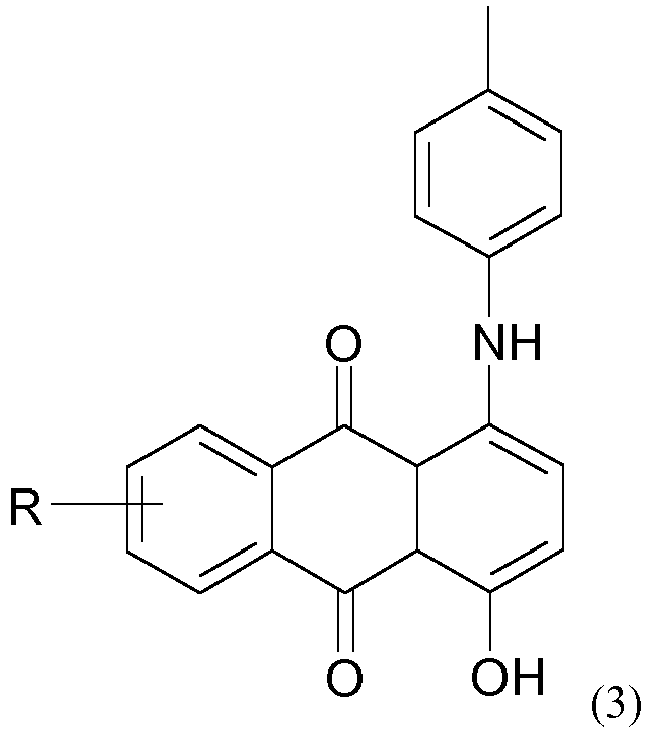
R ist ausgewählt aus der Gruppe, die aus H und p-Methylphenlyamin-Rest besteht; , bevorzugt ist R = H.
Derartige Farbmittel sind z.B. unter dem Handelsnamen Macrolex® Violet B von der Firma Lanxess AG erhältlich. In einer besonderen Ausführungsform wird kein Farbmittel der Struktur (3) eingesetzt. und - b)

- Derartige Farbmittel sind z.B. unter Macrolex® Orange 3G oder Macrolex® Rot EG bei der Firma Lanxess AG erhältlich.
- Dabei kann, wenn R3 für Cl steht und n = 4 ist, statt dem Farbmittel der Struktur (4) das Farbmittel mit der Struktur (5) eingesetzt werden, um dieselben Farbeigenschaften zu erzielen:

- Derartige Farbmittel sind z.B. unter dem Handelsnamen Macrolex® Rot E2G bei der Firma Lanxess AG erhältlich.

- R1 und R2 unabhängig voneinander für einen linearen oder verzweigten Alkylrest, oder Halogen stehen, bevorzugt für Methyl, Ethyl, Propyl, Isopropyl, Butyl, Isobutyl, tert.-Butyl, Pentyl, Neopentyl, Hexyl, Thexyl, oder Cl, weiter bevorzugt für Methyl, Cl und besonders bevorzugt für Cl steht.
- n steht für eine natürliche Zahl zwischen 0 und 4.
- In einer besonders bevorzugten Ausführungsform ist in allen Ringen n=0, so daß alle R1 und R2 = H sind.
- Farbmittel dieser Struktur (7) sind kommerziell erhältlich unter der Paliogen Blau Reihe der BASF AG.
- Bei Verwendung von Farbmitteln der Struktur (7) sind insbesondere die Pigmente bevorzugt, die ein Schüttvolumen (bestimmt nach DIN ISO 787-11) von 21/kg - 10 1/kg, bevorzugt 3 1/kg - 8 1/kg, eine spezifische Oberfläche (bestimmt nach DIN 66132) von 5 m2/g - 60 m2/g, bevorzugt 10 m2/g - 55 m2/g, und einen pH-Wert (bestimmt nach DIN ISO 787-9) von 4 - 9 aufweisen.

- Die Reste R(5-20) sind jeweils unabhängig von einander Wasserstoff, Methyl, Ethyl, Propyl, Isopropyl, Butyl, Isobutyl, tert.-Butyl, Pentyl, Neopentyl, Hexyl, Thexyl, Fluor, Chlor, Brom, Sulfon, CN.
- Bevorzugt ist R(5-20) in allen Positionen gleich. Weiter bevorzugt ist R(5-20) in allen Positionen H. In einer alternativen Ausführungsform ist R(5-20) in allen Positionen Cl.
- M ist bevorzugt Aluminium (mit R=H: Aluminiumphthalocyanin, CAS: 14154-42-8). Nickel (mit R=H: Nickelphthalocyanin, CAS: 14055-02-8), Cobalt (mit R=H: Kobaltphthalocyanin, CAS: 3317-67-7), Eisen (mit R=H: Eisenphthalocyanin, CAS: 132-16-1), Zink (mit R=H: Zinkphthalocyanin, CAS: 14320-04-08), Kupfer (mit R=H: Kupferphthalocyanin, CAS: 147-14-8; mit R=H und Cl: Polychlorkupferphthalocyanin, CAS: 1328-53-6; mit R=C1: Hexadecachlorphthalocyanin, CAS: 28888-81-5; mit R=Br: Hexadecabromphthalocyanin, CAS: 28746-04-5), Mangan (mit R=H: Manganphthalocyanin, CAS: 14325-24-7).
- Insbesondere bevorzugt ist die Kombination von M = Cu und R = H für alle Positionen. So ist eine Verbindung der Struktur (8b) mit M=Cu und R(5-20)=H als Heliogen® Blau K 6911D oder Heliogen® Blau K 7104 KW von der BASF AG, Ludwigshafen erhältlich.
- Verbindungen der Struktur (8a) sind z.B. als Heliogen® Blau L 7460 von der BASF AG, Ludwigshafen, erhältlich.
- Von den Strukturen (4), (7) und (8a) bzw. (8b) ist die Verwendung der Strukturen (4), (7) und (8b) insbesondere bevorzugt, wobei wie oben beschrieben, die Struktur (4) durch Struktur (5) unter den beschriebenen Voraussetzungen ersetzt werden kann. Ganz besonders bevorzugt ist die Verwendung von Farbmitteln der Struktur (7
Eine besonders bevorzugte Gruppe von Farbmittelkombinationen enthält keine Farbmittel der Struktur (3). - Während in einer alternativen Ausführungsform Farbmittelkombinationen mit mindestens jeweils einem Farbmittel aus den Gruppen a) und b) bevorzugt eingesetzt werden, können abweichend hiervon Farbmittelkombinationen nach IX und X in einer besonderen Ausführungsform verwendet werden. Dabei werden in diesen besonders geeigneten Farbmittelkombinationen die unter den Komponenten a) und b) als bevorzugt genannten expliziten Farbmittelstrukturen entsprechend bevorzugt eingesetzt. Die als Komponenten a) und b) im Rahmen der vorliegenden Erfindung offenbarten organischen Farbmittel werden bezogen auf die jeweilige Einzelkomponente in Mengen von 0,000001 Gew.-% bis 1,000000 Gew.-%, bevorzugt von 0,00005 Gew.-% bis 0,50000 Gew.-% und besonders bevorzugt von 0,0001 Gew.-% bis 0,1000 Gew.-% in thermoplastischen Polymer-Zusammensetzungen verwendet .
- In einer speziellen Ausführungsform für transparent eingefärbte thermoplastische Polymer-Zusammensetzungen werden die erfindungsgemäßen organischen Farbmittel bezogen auf die jeweilige Einzelkomponente in Mengen von 0,00001 Gew.-% bis 0,30000 Gew.-%, bevorzugt von 0,00005 Gew.-% bis 0,10000 Gew.-% und besonders bevorzugt von 0.00010 Gew.-% bis 0,05000 Gew.-% in den thermoplastischen Polymer-Zusammensetzungen verwendet.
- Die Mengenangaben in Gew.-% beziehen sich hierbei auf eine resultierende Polymer-Zusammensetzung enthaltend die erfindungsgemäßen organischen Farbmittelkombinationen.
- In einer bevorzugten Ausführungsform bestehen die erfindungsgemäßen Farbmittelzusammensetzungen nur aus Verbindungen der oben genannten Strukturen 1 - 8.
- Die erfindungsgemäßen transparenten thermoplastischen Polymer-Zusammensetzungen enthaltend die erfindungsgemäßen organischen Farbmittelkombinationen basieren hierbei auf der Polymer-Komponente c).
- Die Polymer-Komponente c) enthält:
als transparenten thermoplastischen Kunststoff, Polycarbonat, Copolycarbonat, Polyestercarbonat, oder Mischungen der genannten Komponenten, wobei der transparente thermoplastische Kunststoff in einer Menge zugegeben wird, daß diese mit allen übrigen Komponenten 100 Gew.-% ergibt. - Auch Mischungen von mehreren transparenten thermoplastischen Polymeren, insbesondere wenn sie transparent miteinander mischbar sind, sind möglich, wobei in einer speziellen Ausführungsform eine Mischung aus Polycarbonat mit PMMA (weiter bevorzugt mit PMMA < 2 Gew.%) oder Polyester bevorzugt ist.
- Eine weitere spezielle Ausführungsform enthält in diesem Zusammenhang eine Mischung aus Polycarbonat und PMMA mit weniger als 2,0%, vorzugsweise weniger als 1,0%, weiter bevorzugt weniger als 0,5%, wobei mindestens 0,01 % PMMA enthalten sind bezogen auf die Menge Polycarbonat, wobei das PMMA bevorzugt ein Molgewicht <40.000 g/mol aufweist. In einer besonders bevorzugten Ausführungsform beträgt der Anteil an PMMA 0,2% und besonders bevorzugt 0,1% bezogen auf die Menge Polycarbonat, wobei das PMMA bevorzugt ein Molgewicht <40.000 g/mol aufweist.
- Eine alternative weitere spezielle Ausführungsform enthält eine Mischung aus PMMA und Polycarbonat mit weniger als 2%, vorzugsweise weniger als 1%, weiter bevorzugt weniger als 0,5%, noch weiter bevorzugt mit 0,2% und besonders bevorzugt 0,1% Polycarbonat bezogen auf die Menge PMMA.
- Geeignete Polycarbonate für die Herstellung der erfindungsgemäßen Kunststoffzusammensetzung sind alle bekannten Polycarbonate. Dies sind Homopolycarbonate, Copolycarbonate und thermoplastische Polyestercarbonate.
- Die geeigneten Polycarbonate haben bevorzugt mittlere Molekulargewichte
M w von 10.000 bis 50.000, vorzugsweise von 14.000 bis 40.000 und insbesondere von 16.000 bis 32.000, ermittelt durch Gelpermeationschromatographie mit Polycarbonateichung Die Herstellung der Polycarbonate erfolgt vorzugsweise nach dem Phasengrenzflächenverfahren oder dem Schmelze-Umesterungsverfahren, welche mannigfaltig in der Literatur beschrieben werden. - Zum Phasengrenzflächenverfahren sei beispielhaft auf H. Schnell, "Chemistry and Physics of Polycarbonates", Polymer Reviews, Vol. 9, Interscience Publishers, New York 1964 S. 33 ff., auf Polymer Reviews, Vol. 10, "Condensation Polymers by Interfacial and Solution Methods", Paul W. Morgan, Interscience Publishers, New York 1965, Kap. VIII, S. 325, auf Dres. U. Grigo, K. Kircher und P. R- Müller "Polycarbonate" in Becker/Braun, Kunststoff-Handbuch, Band 3/1, Polycarbonate, Polyacetale, Polyester, Celluloseester, Carl Hanser Verlag München, Wien 1992, S. 118-145 sowie auf
EP 0 517 044 A1 verwiesen. - Das Schmelze-Umesterungsverfahren ist beispielsweise in der Encyclopedia of Polymer Science, Vol. 10 (1969), Chemistry and Physics of Polycarbonates, Polymer Reviews, H. Schnell, Vol. 9, John Wiley and Sons, Inc. (1964) sowie in den Patentschriften
DE-B 10 31 512 undUS-B 6 228 973 beschrieben. - Die Polycarbonate werden bevorzugt durch Reaktionen von Bisphenolverbindungen mit Kohlensäureverbindungen, insbesondere Phosgen oder beim Schmelzeumesterungsprozess Diphenylcarbonat bzw. Dimethylcarbonat, dargestellt.
- Hierbei sind Homopolycarbonate auf Basis Bisphenol-A und Copolycarbonate auf der Basis der Monomere Bisphenol-A und 1,1-Bis-(4-hydroxyphenyl)-3,3,5-trimethylcyclohexan besonders bevorzugt.
- Diese und weitere Bisphenol- bzw. Diolverbindungen, die sich für die Polycarbonatsynthese einsetzen lassen, sind unter anderem offenbart in
WO 2008037364 A1 (s.7, Z. 21 bis s. 10, Z. 5),EP 1 582 549 A1 ([0018] bis [0034]),WO 2002026862 A1 (S. 2, Z. 20 bis S. 5, Z. 14),WO 2005113639 A1 (S. 2, Z.1 bis S. 7, Z. 20). - Die Polycarbonate können linear oder verzweigt sein. Es könne auch Mischungen aus verzweigten und unverzweigten Polycarbonaten eingestzt werden.
- Geeignete Verzweiger für Polycarbonate sind aus der Literatur bekannt und beispielsweise beschrieben in den Patentschriften
US-B 4 185 009 undDE 25 00 092 A1 (erfindungsgemäße 3,3-bis-(4-hydroxyaryl-oxindole, s. jeweils gesamtes Dokument),DE 42 40 313 A1 (s. S. 3, Z. 33 bis 55),DE 19 943 642 A1 (s. S. 5, Z. 25 bis 34) undUS-B 5 367 044 sowie in hierin zitierter Literatur. - Darüber hinaus können die verwendeten Polycarbonate auch intrinsisch verzweigt sein, wobei hier kein Verzweiger im Rahmen der Polycarbonatherstellung zugegeben wird. Ein Beispiel für intrinsische Verzweigungen sind so genannte Fries-Strukturen, wie sie für Schmelzepolycarbonate in der
EP 1 506 249 A1 offenbart sind. - Zudem können bei der Polycarbonat-Herstellung Kettenabbrecher eingesetzt werden. Als Kettenabbrecher werden bevorzugt Phenole wie Phenol, Alkylphenole wie Kresol und 4-tert.-Butylphenol, Chlorphenol, Bromphenol, Cumylphenol oder deren Mischungen verwendet.
- Die erfindungsgemäßen transparenten thermoplastischen Polymer-Zusammensetzungen basierend auf der Polymer-Komponete c) können hierbei neben den erfindungsgemäßen organischen Farbmittelkombinationenen der Komponenten a) und b) optional noch weitere Komponenten enthalten. Hierzu zählen:
- d) optional 0,000 Gew.-% bis 0,015 Gew.-%, bevorzugt 0,00150 Gew.-% bis 0,01500 Gew.-%, weiter bevorzugt 0,00180 Gew% bis 0,01100 Gew.-% und besonders bevorzugt 0,00200 Gew% bis 0,00900 Gew.-% mindestens eines organischen oder anorganischen IR Absorbers berechnet als Feststoffanteil an IR-Absorber in der Polymer-Gesamtzusammensetzung. In einer speziellen Ausführungsform werden die IR-Absorber in einer Menge von bevorzugt 0,00350 Gew.-% bis 0,00850 Gew.-% und insbesondere bevorzugt 0,00400 Gew.-% bis 0,00800 Gew.% berechnet als Feststoffanteil an IR-Absorber in der Polymer-Gesamtzusammensetzung eingesetzt. Feststoffanteil an IR-Absorber meint in diesem Zusammenhang den IR-Absorber als Reinstoff und nicht eine Suspension oder andere Zubereitung, enthaltend den Reinstoff.
Geeignete IR-Absorber sind beispielsweise inEP 1 559 743 A1 ,EP 1 865 027 A1 ,DE 10022037 A1 ,DE 10006208 A1 sowie in den italienischen PatentanmeldungenRM2010A000225 RM2010A000227 RM2010A000228
Von den in der zitierten Literatur genannten IR-Absorbern sind solche auf Borid- und Wolframatbasis sowie auf ITO und ATO basierende Absorber sowie Kombinationen daraus bevorzugt. - e) optional 0,00 Gew% bis 20,00 Gew.-%, bevorzugt von 0,05 Gew% bis 10,00 Gew.-%, weiter bevorzugt von 0,10 Gew% bis 1,00 Gew.-%, noch weiter bevorzugt 0,10 Gew.-% bis 0,50 Gew.-% sowie ganz besonders bevorzugt 0,10 Gew.-% bis 0,30 Gew.-% mindestens eines UV-Absorbers. Geeignete UV-Absorber sind beispielsweise beschrieben in der
EP 1 308 084 A1 , in derDE 102007011069 A1 sowie in derDE 10311063 A1 . - f) optional 0,0 Gew.-% bis 5,0 Gew.-%, bevorzugt 0,01 Gew.-% bis 1,00 Gew.-% mindestens eines weiteren Additivs. Bei den weiteren Additiven handelt es sich um übliche Polymeradditive, wie z.B. die in
EP-A 0 839 623 ,WO-A 96/15102 EP-A 0 500 496 oder "Plastics Additives Handbook", Hans Zweifel, 5th Edition 2000, Hanser Verlag, München beschriebenen Flammschutzmittel, optische Aufheller, Fließverbesserer, Thermostabilisatoren, anorganischen Pigmente, Entformungsmittel oder Verarbeitungshilfsmittel. Die bereits als Komponenten a), b), d) und e) der vorliegenden Erfindung offenbarten Substanzen sind in diesem Zusammenhang ausdrücklich nicht Bestandteil der Komponente f).
Die Polymer-Zusammensetzung enthält optional ein anorganisches Pigment, bevorzugt Ruß. Der Ruß liegt bevorzugt fein dispergiert in der organischen Polymermatrix vor und ist bevorzugt nanoskalig. Geeignete Ruße weisen eine durchschnittliche Teilchengröße auf von bevorzugt weniger als 100 Nanometer (nm), weiter bevorzugt weniger als 75 nm , noch weiter bevorzugt weniger als 50 nm und besonders bevorzugt weniger als 40 nm, wobei die durchschnittliche Teilchengröße vorzugsweise größer als 0,5 nm. weiter bevorzugt größer als 1 nm und besonders bevorzugt größer als 5 nm ist. Die Teilchengröße wird durch TEM (Transmissionselektronenmikroskopie) bestimmt. - g) optional 0 Gew.-% bis 50 Gew.-%, bevorzugt 0 Gew.-% bis 35 Gew.-%, weiter bevorzugt 0 Gew.-% bis 30 Gew.-%, besonders bevorzugt 10 Gew.-% bis 30 Gew% Füll- und Verstärkungsstoffe. Füll- und Verstärkungsstoffe für Polymer-Zusammensetzungen sind beispielsweise beschrieben in der
EP 1 624 012 A1 ,DE 3742881 A1 ,US 6860539 B2 ,US 20060105053 A1 ,DE 102006055479 A1 ,WO 2005030851 A1 sowie in derWO 2008122359 A1 . - Die obigen Mengenangaben beziehen sich jeweils auf die gesamte Polymer-Zusammensetzung.
- In den erfindungsgemäßen gefärbten transparenten thermoplastischen Polymer-Zusammensetzungen ist mindestens eine Farbmittelkombination der unter I bis X offenbarten Kombinationen enthalten.
- Bevorzugt ist in den erfindungsgemäßen gefärbten transparenten thermoplastischen Polymer-Zusammensetzungen eine Kombination aus erfindungsgemäßen organischen Farbmitteln enthalten, wobei die erfindungsgemäßen organischen Farbmittelkombinationen bestehen aus mindestens einem Farbmittel ausgewählt aus den für Komponente a) angegebenen Strukturen und mindestens einem Farbmittel ausgewählt aus den für Komponete b) angegebenen Strukturen.
- Weiter bevorzugt werden in den erfindungsgemäßen gefärbten transparenten thermoplastischen Polymer-Zusammensetzungen explizit die Farbmittelkombinationen verwendet, die bereits im Rahmen der vorliegenden Offenbarung als besonders geeignet herausgestellt wurden. Dabei werden in diesen besonders geeigneten Farbmittelkombinationen die unter den Komponenten a) und b) als bevorzugt genannten expliziten Farbmittelstrukturen entsprechend bevorzugt eingesetzt.
- Die Zusammensetzung muss unter den für Thermoplaste üblichen Temperaturen, d.h. bei Temperaturen oberhalb von 300 °C, wie z.B. 350 °C verarbeitbar sein, ohne daß sich bei der Verarbeitung die Farbe oder die Leistungsdaten deutlich verändern.
- Die Herstellung der erfindungsgemäßen Polymer-Zusammensetzungen enthaltend die Komponenten a) bis g) erfolgt mit gängigen Einarbeitungsverfahren durch Zusammenführung, Vermischen und Homogenisieren, wobei insbesondere die Homogenisierung bevorzugt in der Schmelze unter Einwirkung von Scherkräften stattfindet. Gegebenenfalls erfolgt das Zusammenführen und Vermischen vor der Schmelzehomogenisierung unter Verwendung von Pulvervormischungen.
- Es können auch Vormischungen verwendet werden, die aus Lösungen der Mischungskomponenten in geeigneten Lösungsmitteln, wobei gegebenenfalls in Lösung homogenisiert wird und das Lösungsmittel anschließend entfernt wird, hergestellt worden sind.
- Insbesondere können hierbei die Komponenten der erfindungsgemäßen Zusammensetzung durch bekannte Verfahren wie unter anderem als Masterbatch eingebracht werden.
- Die Verwendung von Masterbatchen sowie von Pulvermischungen oder kompaktierten Vormischungen ist insbesondere zum Einbringen der Komponenten a), b), d), e) und f) geeignet. Hierbei können wahlweise alle vorgenannten Komponenten vorgemischt werden. Alternativ sind aber auch Vormischungen von a) und b) oder von a), b) und d) sowie beliebige andere Kombinationen möglich. In allen Fällen werden für eine bessere Dosierbarkeit bei der Herstellung der thermoplastischen Polymer-Zusammensetzungen die vorgenanten Komponenten-Vormischungen bevorzugt mit pulverförmiger Polymerkomponente c) so aufgefüllt, daß gut handhabbare Gesamtvolumina entstehen.
- In einer besonderen Ausführungsform können die oben genannten Komponenten zu einem Masterbatch vermischt werden, wobei die Vermischung bevorzugt in der Schmelze unter Einwirkung von Scherkräften (zum Beispiel in einem Kneter oder Zweischneckenextruder) stattfindet. Dieses Verfahren bietet den Vorteil, daß die Komponenten besser in der Polymermatrix verteilt werden. Zur Herstellung des Masterbatches wird als Polymermatrix bevorzugt der thermoplastische Kunststoff gewählt, der auch die Hauptkomponente der letztlichen Polymer-Gesamtzusammensetzung darstellt.
- In diesem Zusammenhang kann die Zusammensetzung in üblichen Vorrichtungen wie Schneckenextrudern (zum Beispiel Zweischneckenextruder, ZSK), Knetern, Brabender- oder Banbury-Mühlen zusammengeführt, vermischt, homogenisiert und anschließend extrudiert werden. Nach der Extrusion kann das Extrudat abgekühlt und zerkleinert werden. Es können auch einzelne Komponenten vorgemischt werden und dann die restlichen Ausgangsstoffe einzeln und/oder ebenfalls gemischt hinzugegeben werden.
- Die erfindungsgemäßen Polymer-Zusammensetzungen können zu Erzeugnissen oder Formkörpern verarbeitet werden, in dem man beispielsweise die Polymer-Zusammensetzungen zunächst wie beschrieben zu Granulat extrudiert und dieses Granulat durch geeignete Verfahren zu verschiedenen Erzeugnissen oder Formkörpern in bekannter Weise verarbeitet.
- Die erfindungsgemäßen Zusammensetzungen können in diesem Zusammenhang beispielsweise durch Heißpressen, Spinnen, Blasformen, Tiefziehen, Extrudieren oder Spritzgießen in Erzeugnisse, Formkörper oder geformte Gegenstände überführt werden. Von Interesse ist auch die Verwendung von Mehrschichtsystemen. Das Aufbringen kann zugleich oder unmittelbar nach der Formgebung des Grundkörpers geschehen, z.B. durch Coextrusion oder Mehrkomponentenspritzguss. Das Aufbringen kann aber auch auf den fertig geformten Grundkörper geschehen, z.B. durch Lamination mit einem Film oder durch Beschichtung mit einer Lösung.
- Platten beziehungsweise Formkörper aus Basis- und optionaler Deckschicht / optionalen Deckschichten (Mehrschichtsysteme) können durch (Co)extrusion, Direct Skinning, Direct Coating, Insert Moulding, Folienhinterspritzen, oder sonstige dem Fachmann bekannte geeignete Verfahren hergestellt werden.
- Spritzgießverfahren sind dem Fachmann bekannt und beispielsweise im "Handbuch Spritzgiessen", Friedrich Johannnaber/Walter Michaeli, München; Wien: Hanser, 2001, ISBN 3-446-15632-1 oder "Anleitung zum Bau von Spritzgiesswerkzeugen", Menges/Michaeli/Mohren, München; Wien: Hanser, 1999, ISBN 3-446-21258-2 beschrieben.
- Extrusionsverfahren sind dem Fachmann bekannt und beispielsweise für die Coextrusion unter anderem beschrieben in
EP-A 0 110 221 ,EP-A 0 110 238 undEP-A 0 716 919 . Für Details des Adapter- und Düsenverfahrens siehe Johannaber/Ast:"Kunststoff- Maschinenführer", Hanser Verlag, 2000 und in Gesellschaft Kunststofftechnik: "Coextrudierte Folien und Platten: Zukunftsperspektiven, Anforderungen, Anlagen und Herstellung, Qualitätssicherung", VDI-Verlag, 1990. - Erfindungsgemäß bevorzugte Erzeugnisse, Formkörper oder geformte Gegenstände sind Verscheibungen, beispielsweise Autofenster, Fenster von Schienen- und Luftfahrzeugen, Autosonnendächer, Sicherheitsscheiben, Bedachungen oder Gebäudeverglasungen, LEDs, Lampenabdeckungen für den Innenraumbereich von Fahrzeugen und Gebäuden, Lampenabdeckungen für den Außenbereich wie z.B. Abdeckungen von Straßenlaternen, Visiere, Brillen, Extrusions- und Lösungsfolien für Displays oder Elektromotoren, auch Skifolien, , Ampellinsen, die die erfindungsgemäßen Zusammensetzungen enthalten. Dabei können neben Massivplatten auch Doppelstegplatten oder Multistegplatten verwendet werden. Als weitere Komponenten der erfindungsgemäßen Erzeugnisse neben den erfindungsgemäßen Zusammensetzungen können beispielsweise weitere Werkstoffteile in den erfindungsgemäßen Erzeugnissen enthalten sein.
- In einer besonderen Ausführungsform werden die Artikel aus der Zusammensetzung der vorliegenden Erfindung beschichtet. Diese Beschichtung dient dem Schutz des thermoplastischen Materials gegenüber allgemeinen Witterungseinflüssen (z.B. Schädigung durch Sonnenlicht) sowie gegenüber mechanischer Beeinträchtigung der Oberfläche (z.B. Verkratzen) und erhöht somit die Beständigkeit der entsprechend ausgerüsteten Artikel.
- Es ist bekannt, dass Polycarbonat gegenüber UV-Strahlung mittels verschiedener Beschichtungen geschützt werden kann. Üblicherweise enthalten diese Beschichtungen UV-Absorber. Diese Schichten erhöhen ebenso die Kratzfestigkeit des entsprechenden Artikels. Die Artikel aus der vorliegenden Erfindung können Einschicht oder Mehrschichtsysteme tragen. Sie können ein- oder beidseitig beschichtet sein. In einer bevorzugten Ausführungsform enthält der Artikel einen Kratzfestlack enthaltend UV-Absorber. In einer besonderen Ausführungsform enthält das Mehrschichterzeugnis mindestens eine Schicht enthaltend die erfindungsgemäße Zusammensetzung, mindestens eine UV-Schutzschicht und optional eine Kratzfestbeschichtung.
- Bei Verscheibungsmaterialien trägt der Artikel mindestens eine Kratzfest- und/oder. Antireflexbeschichtung auf mindestens einer Seite.
- Im Folgenden wird die Erfindung anhand von Ausführungsbeispielen näher beschrieben, wobei die hier beschriebenen Bestimmungsmethoden für alle korrespondierenden Größen in der vorliegenden Erfindung zur Anwendung kommen, sofern nichts Gegenteiliges beschrieben worden ist.
- Die Bestimmung des Schmelzvolumenrate (MVR) erfolgt nach ISO 1133 (bei 300 °C; 1,2 kg).
- Die Bestimmung der Farbe in Transmission erfolgt mit einem Lambda 900 Spektralphotometer der Firma Perkin Elmer mit Photometerkugel in Anlehnung an ASTM E1348 mit den in der ASTM E308 beschriebenen Gewichtungsfaktoren und Formeln.
- Die Berechnung der CIELAB Farbkoordinaten L*, a*, b* erfolgt für Lichtart D 65 und 10° Normalbeobachter.
- Die Transmissionsmessungen wurden an einem Lambda 900 Spektralphotometer der Firma Perkin Elmer mit Photometerkugel nach ISO 13468-2 durchgeführt (d.h. Bestimmung der Gesamttransmission durch Messung der diffusen Transmission und direkten Transmission).
- ΔE ist ein errechneter Wer für den empfundenen Farbabstand nach ASTM D 2244. Bei den vorliegenden Versuchen wurde Lichtart D 65/10° verwendet. Für die Berechnung des ΔE-Wertes wurde die Formel 7 in der ASTM D 2244 herangezogen.
- Die künstliche Bewitterung mit Xenon-Belichtung wird nach Norm ASTM G 155 in einem Xenon-Weatherometer CI 5000 der Firma Atlas an Farbmusterplatten (s. Herstellung der Prüfkörper) durchgeführt. Als UV-Filter wurden zwei Borosilikatfilter verwendet. Die Einstrahlungsstärke beträgt 0.75 W/m2/nm bei 340 nm. Die Schwarzstandardtemperatur beträgt 80°C, die Probenraumtemperatur 40°C. Die Proben werden alle 120 min für 18 min beregnet, wobei die Belichtung auch während der Beregnungsphase eingeschaltet bleibt. Das vorgenannte Bewitterungsverfahren wird im folgenden Xe-Wom 0.75W genannt.
- Die Bestimmung des visuellen Farbeindrucks erfolgt mit bloßem Auge anhand von Farbmusterplatten (s. Herstellung der Prüfkörper). Hierzu werden die Farbmusterplatten unter Tageslicht vor einem weißen Hintergrund betrachtet und entsprechend klassifiziert (Klassifizierung s. Tabelle Prüfkörper und Meßergebnisse)
- Die Trübung wurde bestimmt nach ASTM D 1003 mit einem BYK Gardner Haze Gard.
- Materialien zur Herstellung der Probekörper:
- Komponente a)
- Als Farbmittel der Formel (1a, 1b) wird das Produkt aus A (alle R = H, siehe unten) verwendet.
- Als Farbmittel der Formel (3) wird Macrolex Violet B (Solvent Violet 13, CAS-No. 81-48-1) von der Firma Lanxess AG, Leverkusen, verwendet.
- Komponente b)
- Als Farbmittel der Struktur (4) wird Macrolex Rot EG (Solvent Red 135, CAS-No. 20749-68-2) von der Firma Lanxess AG, Leverkusen, verwendet.
- Als Farbmittel der Struktur (7) wird Paliogen Blau 6385 (Pigment Blue 60, CAS-No. 81-77-6) von der BASF SE, 67065 Ludwigshafen, Deutschland, verwendet. Dieses Farbmittel weist ein Schüttvolumen von 7 1/kg, einen pH-Wert von 6 - 9 und eine spezifische Oberfläche von 40 m2/g auf.
- Als Farbmittel der Struktur (8b) wird Heliogen Blau K 6911 D (CAS-No. 147-14-8) der Firma BASF SE, 67065 Ludwigshafen, Deutschland verwendet.
- Komponente c)
- Lineares Bisphenol-A-Polycarbonat mit Endgruppen basierend auf Phenol mit einer Schmelze-Volumenrate (MVR) von 6 cm3/10 min, gemessen bei 300 °C und 1,2 kg Belastung gemäß ISO 1033), nachfolgend als PC 1 bezeichnet.
- Lineares Bisphenol-A-Polycarbonat mit Endgruppen basierend auf Phenol mit einem MVR von 12,5 cm3/10 min, gemessen bei 300 °C und 1,2 kg Belastung gemäß ISO 1033), nachfolgend als PC 2 bezeichnet.
- PC 2 enthält noch eine Additivmischung bestehend aus Entformungsmittel, Thermostabilisator und UV-Stabilisator. Als Entformungsmittel wird Pentaerythrittetrastearat (CAS 115-83-3), als Thermostabilisator Triphenylphosphin (CAS 603-35-0) und als UV-Stabilisator Tinuvin® 329 (CAS 3147-75-9) eingesetz.
- Komponente d)
- Lanthanhexaborid, LaB6 (KHDS 06 der Firma Sumitomo Metal Mining, Japan, CAS-No. 857255-66-4). Das Produkt liegt in Form einer pulverförmigen Dispersion vor. Die Gewichtsangaben in den Beispielen beziehen sich auf das Produkt KHDS 06, wobei der Feststoffgehalt an Lanthanhexaborid in der eingesetzten kommerziellen KHDS06-Dispersion 21,5 Gew.-% beträgt.
- Lanthanhexaborid, LaB6 (KHDS 872G2 der Firma Sumitomo Metal Mining, Japan, CAS-No. 949005-03-2). Das Produkt liegt in Form einer pulverförmigen Dispersion vor. Die Gewichtsangaben in den Beispielen beziehen sich auf das Produkt KHDS 872G2, wobei der Feststoffgehalt an Lanthanhexaborid in der eingesetzten kommerziellen KHDS 872G2 Dispersion 10,0 Gew.-% beträgt.
- Lumogen IR 765 (ein Quaterrylen, CAS-No. 943969-69-5) der Firma BASF SE, 67065 Ludwigshafen, Deutschland.
- Als IR-Absorber auf Basis von ATO wurde eine pulverförmige Dispersion (FMDS 874 der Firma Sumitomo Metal Mining, Japan, Polyacrylat-Dispersion, CAS-No. 953384-75-3) eingesetzt, wobei der Feststoffgehalt an SnO2:Sb in der Dispersion 25 Gew.-% betrug.
- Komponente f)
- Als nanoskaliger Ruß (Partikelgröße ca . 17 nm) werden Black Pearls® 800 (CAS-No. 1333-86-4) der Firma Cabot Corp. eingesetzt.
- Als weiteres nicht erfindungsgemäßes Farbmittel wird Macrolex Blau RR (Color Index: Solvent Blue 97; CAS-No.: 32724-62-2) der Firma Lanxess Deutschland GmbH eingesetzt.
- Als weiteres nicht erfindungsgemäßes Farbmittel wird Macrolex Violett 3R Gran. (Color Index: Solvent Violet 36; CAS-No: 61951-89-1) der Firma Lanxess Deutschland GmbH eingesetzt.
- Die Compoundierung der Additive erfolgte auf einem Zweiwellenextruder der Firma KraussMaffei Berstorff, TYP ZE25, bei einer Gehäusetemperatur von 260°C bzw. einer Massetemperatur von 270°C und einer Drehzahl von 100 Upm bei einem Durchsatz von 10kg/h mit der in den Beispielen angegebenen Mengen an Komponenten. Hierbei wird zunächst zur besseren Vermischung eine Pulvermischung aus PC 1 (10 Gew.-% Pulvermischung bezogen auf die Gesamtzusammensetzung) enthaltend die unten angegebenen weiteren Komponenten angefertigt. Diese Pulvermischung wird bei der Compoundierung zu PC 2 zudosiert.
- Das Granulat wird bei 120 °C für 3 Stunden im Vakuum getrocknet und anschließend auf einer Spritzgussmaschine vom Typ Arburg 370 mit einer 25-Spritzeinheit bei einer Massetemperatur von 300°C und einer Werkzeugtemperatur von 90 °C zu Farbmusterplatten mit den Abmessungen 60 mm x 40 mm x Z mm) verarbeitet; Z ist dabei 3,2 mm, 4,0 mm bzw. 5,0 mm.
- Unter anderem wurden in den erfindungsgemäßen Beispielen Strukturen der Formel (1a) und (1b) eingesetzt. Die Herstellung dieser Farbstoffe erfolgte in Anlehnung an
DE 2148101 wie folgt: - A. Herstellung eines 1:1 Gemisches (Gew.-%) von (1a) und (1b):
5,62g (0,025mol) Benzol-1,2,4,5-tetracarbonsäuredianhydrid und 7,99g (0,05mol) 1,8-Diaminonaphthalin werden in 75ml N- Ethylpyrrolidon bei Raumtemperatur vorlegt und langsam auf 150 °C erhitzt. Bei dieser Temperatur wird für 5 Stunden gerührt. Nach Abkühlen werden 125ml Wasser zugegeben und der ausgefallene Niederschlag abfiltriert. Der Niederschlag wird noch mehrmals in Wasser aufgeschlämmt und auf diese Art gewaschen. Der Niederschlag wird im Hochvakuum bei 80°C getrocknet. Der getrocknete Niederschlag wird mit einer Mischung aus 50ml Eisessig und 25ml Acetanhydrid versetzt. Das Gemisch wird für 4 Stunden unter Rückfluss gekocht. Nach Abkühlen wird das Reaktionsgemisch in 500ml Wasser gegeben. Der Niederschlag wird abfiltriert, mit Wasser gewaschen und im Hochvakuum bei 80 °C getrocknet. Man erhält 12,5g lilafarbendes Pulver. - Als Primer wird das Produkt SHP470FT (Momentive Performance Materials Inc. Wilton, CT USA) verwendet. Als Schutzlack wird das Produkt AS 4700 (Momentive Performance Materials Inc. Wilton, CT USA) verwendet.
- Die Beschichtung erfolgte in einem klimakontrollierten Beschichtungsraum unter den jeweiligen Vorgaben des Lackherstellers bei 23 bis 25°C und 40 bis 48% rel. Feuchte.
- Die Prüfkörper wurden mit sogenannten Iso-Tüchern (LymSat® der Firma LymTech Scientific; gesättigt mit 70% Isopropanol und 30% deionisiertem Wasser) gereinigt, mit Isopropanol abgespült, 30 min an Luft getrocknet und mit ionisierter Luft abgeblasen.
- Die Beschichtung der Probekörper erfolgt per Hand nach dem Flutverfahren. Hierbei wird die Primerlösung ausgehend von der oberen Kante des Kleinteiles in Längsrichtung über die Platte gegossen, während gleichzeitig der Ansatzpunkt des Primers auf der Platte von links nach rechts über die Plattenbreite geführt wird. Die geprimerte Platte wurde senkrecht an einer Klammer hängend nach den jeweiligen Herstellervorgaben bis zur Staubtrockene abgelüftet und im Umluftofen gehärtet (30 Minuten bei Raumtemperatur abgelüftet und 30 Minuten bei 125 °C gehärtet). Nach dem Abkühlen auf Raumtemperatur erfolgte die Beschichtung der geprimerten Fläche mit AS 4700. Nach der Ablüftung bis zur Staubtrockene erfolgte die Härtung 60 min bei 130°C im Umluftofen.
- Die Primerschichtdicke und die Dicke des Topcoats können die Bewitterungseigenschaften beeinflussen.
- Um eine ausreichende und vergleichbare Schutzwirkung gegen Bewitterung zu erreichen soll die Primerschichtdicke für die nachfolgenden Beispiele im Bereich 1,2 - 4,0 µm und die Dicke des Topcoats zwischen 4,0 und 8,0 µm liegen. In der nachfolgenden Ergebnistabelle wird die Primerschichtdicke vor dem Spiegelstrich, die Dicke des Topcoats nach dem Spiegelstrich in der Spalte TopCoat angegeben.
- Es wird eine Polymerzusammensetzung enthaltend die Mengen der folgenden Komponenten wie oben beschrieben durch Compoundierung hergestellt.
Macrolex Rot EG (Komponente b)) : 0,00313 Gew.-% Macrolex Blau RR (Farbmittel für Vergleichsbeispiele) : 0,00320 Gew.-% Lumogen IR 765 (Komponente d)): 0,00180 Gew.-% KHDS 06 (Komponente d)): 0,01350 Gew.-% BlackPearls 800 (Komponente f)): 0,00144 Gew.-% PC 1 (Komponente c)): 9,97693 Gew.-% PC 2 (Komponente c)): 90,00000 Gew.-% - PC 2 enthält dabei die oben unter PC 2 aufgeführten Additive. PC 2 enthält dabei 0,270 Gew.-% Entformungsmittel, 0,025 Gew.-% Thermostabilisator und 0,200 Gew.-% UV-Stabilisator jeweils bezogen auf die Menge an eingesetztem PC 2.
- Es wird eine Polymerzusammensetzung enthaltend die Mengen der folgenden Komponenten wie oben beschrieben hergestellt:
Macrolex Rot EG (Komponente b)): 0,00335 Gew.-% Macrolex Blau RR (Farbmittel für Vergleichsbeispiele): 0,00315 Gew.-% Lumogen IR 765 (Komponente d)): 0,00140 Gew.-% KHDS 872G2 (Komponente d)): 0,06000 Gew.-% BlackPearls 800 (Komponente f)): 0,00128 Gew.-% PC 1 (Komponente c)): 9,93082 Gew.-% PC 2 (Komponente c)): 90,00000 Gew.-% - PC 2 enthält dabei die oben unter PC 2 aufgeführten Additive. PC 2 enthält dabei 0,270 Gew.-% Entformungsmittel, 0,025 Gew.-% Thermostabilisator und 0,200 Gew.-% UV-Stabilisator jeweils bezogen auf die Menge an eingesetztem PC 2.
- Es wird eine Polymerzusammensetzung enthaltend die Mengen der folgenden Komponenten wie oben beschrieben hergestellt:
Macrolex Rot EG (Komponente b)): 0,002450 Gew.-% Macrolex Blau RR (Farbmittel für Vergleichsbeispiele): 0,003090 Gew.-% Heliogen Blau K6911D (Komponente b)): 0,000095 Gew.-% KHDS 872G2 (Komponente d)): 0,057000 Gew.-% BlackPearls 800 (Komponente f)): 0,001410 Gew.-% PC 1 (Komponente c)): 9,935955 Gew.-% PC 2 (Komponente c)): 90,000000 Gew.-% - PC 2 enthält dabei die oben unter PC 2 aufgeführten Additive. PC 2 enthält dabei 0,270 Gew.-% Entformungsmittel, 0,025 Gew.-% Thermostabilisator und 0,200 Gew.-% UV-Stabilisator jeweils bezogen auf die Menge an eingesetztem PC 2.
- Es wird eine Polymerzusammensetzung enthaltend die Mengen der folgenden Komponenten wie oben beschrieben hergestellt:
Macrolex Rot EG (Komponente b)): 0,00550 Gew.-% Macrolex Blau RR (Farbmittel für Vergleichsbeispiele): 0,00392 Gew.-% Heliogen Blau K6911D (Komponente b)): 0,00133 Gew.-% KHDS 06 (Komponente d)): 0,03130 Gew.-% BlackPearls 800 (Komponente f)): 0,00167 Gew.-% PC 1 (Komponente c)): 9,95628 Gew.-% PC 2 (Komponente c)): 90,00000 Gew.-% - PC 2 enthält dabei die oben unter PC 2 aufgeführten Additive. PC 2 enthält dabei 0,270 Gew.-% Entformungsmittel, 0,025 Gew.-% Thermostabilisator und 0,200 Gew.-% UV-Stabilisator jeweils bezogen auf die Menge an eingesetztem PC 2.
- Es wird eine Polymerzusammensetzung enthaltend die Mengen der folgenden Komponenten wie oben beschrieben hergestellt:
Macrolex Rot EG (Komponente b)): 0,00370 Gew.-% Macrolex Violett 3R Gran (Farbmittel für Vergleichsbeispiele): 0,00240 Gew.-% Heliogen Blau K6911D (Komponente b)): 0,00230 Gew.-% KHDS 06 (Komponente d)): 0,03000 Gew.-% BlackPearls 800 (Komponente f)): 0,00065 Gew.-% PC 1 (Komponente c)): 9,96095 Gew.-% PC 2 (Komponente c)): 90,00000 Gew.-% - PC 2 enthält dabei die oben unter PC 2 aufgeführten Additive. PC 2 enthält dabei 0,270 Gew.-% Entformungsmittel, 0,025 Gew.-% Thermostabilisator und 0,200 Gew.-% UV-Stabilisator jeweils bezogen auf die Menge an eingesetztem PC 2.
- Es wird eine Polymerzusammensetzung enthaltend die Mengen der folgenden Komponenten wie oben beschrieben hergestellt:
Macrolex Rot EG (Komponente b)): 0,00470 Gew.-% Macrolex Violett 3R Gran (Farbmittel für Vergleichsbeispiele): 0,00117 Gew.-% Heliogen Blau K6911D (Komponente b)): 0,00262 Gew.-% YMDS 874 (Komponente d)): 0,10000 Gew.-% BlackPearls 800 (Komponente f)): 0,00188 Gew.-% PC 1 (Komponente c)): 9,88963 Gew.-% PC 2 (Komponente c)): 90,00000 Gew.-% - PC 2 enthält dabei die oben unter PC 2 aufgeführten Additive. PC 2 enthält dabei 0,270 Gew.-% Entformungsmittel, 0,025 Gew.-% Thermostabilisator und 0,200 Gew.-% UV-Stabilisator jeweils bezogen auf die Menge an eingesetztem PC 2.
- Es wird eine Polymerzusammensetzung enthaltend die Mengen der folgenden Komponenten wie oben beschrieben hergestellt:
Paliogen Blau L6385 (Komponente b)): 0,00278 Gew.-% 1:1 Gemisches (Gew.-%) von (1a) und (1b) (Komponente a)): 0,00236 Gew.-% KHDS 872G2 (Komponente d)): 0,07000 Gew.-% BlackPearls 800 (Komponente f)): 0,00220 Gew.-% PC 1 (Komponente c)): 9,92266 Gew.-% PC 2 (Komponente c)): 90,00000 Gew.-% - PC 2 enthält dabei die oben unter PC 2 aufgeführten Additive. PC 2 enthält dabei 0,270 Gew.-% Entformungsmittel, 0,025 Gew.-% Thermostabilisator und 0,200 Gew.-% UV-Stabilisator jeweils bezogen auf die Menge an eingesetztem PC 2.
- Es wird eine Polymerzusammensetzung enthaltend die Mengen der folgenden Komponenten wie oben beschrieben hergestellt:
Paliogen Blau L6385 (Komponente b)): 0,00211 Gew.-% 1:1 Gemisches (Gew.-%) von (1a) und (1b) (Komponente a): 0,00248 Gew.-% KHDS 872G2 (Komponente d)): 0,09000 Gew.-% FMDS 874 (Komponente d)): 0,12552 Gew.-% BlackPearls 800 (Komponente f)): 0,00139 Gew.-% PC 1 (Komponente c)): 9,77850 Gew.-% PC 2 (Komponente c)): 90,00000 Gew.-% - PC 2 enthält dabei die oben unter PC 2 aufgeführten Additive. PC 2 enthält dabei 0,270 Gew.-% Entformungsmittel, 0,025 Gew.-% Thermostabilisator und 0,200 Gew.-% UV-Stabilisator jeweils bezogen auf die Menge an eingesetztem PC 2.
Tabelle 1: Prüfkörper und Meßergebnisse Beispiel Dicke* [mm] Primer/TopCoat* [µm] ΔE 1000h ** ΔE 2000h ** ΔE 3000h ** Visueller Farbeindruck 3000h ** Visueller Farbeindruck *** 1 (Vergleich) 5,0 2,2/5,1 1,89 3,41 4,76 - + 2 (Vergleich) 5,0 1.7/5.6 1,88 3,60 5,10 - + 3 (Vergleich) 5,0 1.4/5.4 1,85 3,69 5,11 - + 4 (Vergleich) 3,2 1.8/4.3 3,01 5,30 7,29 -- + 5 (Vergleich) 3,2 1,3/6,1 1,50 2,73 3,77 O + 6 (Vergleich) 4,0 2.8/4.2 1,44 2,64 3,71 O + 8 (erfindungsgemäß) 3,2 1.4/6.4 0,94 1,29 1,69 + + 9 (erfindungsgemäß) 3,2 1.5/6.3 1,02 1,80 2,91 + + *Angaben zum Prüfkörper; **nach Bewitterung; ***vor Bewitterung
+ ansprechend ; O ausreichend; - schlecht; -- sehr schlecht - Insgesamt ist festzustellen, dass nur die erfindungsgemäßen Mischungen die geforderte Farbstabilität (ΔE) aufweisen.
- Die Vergleichbeispiele zeigen, dass die Farbmittel nicht beliebig kombiniert werden können. Die Vergleichsbeispiele 1 bis 6 weisen zwar einen ähnlichen Farbeindruck wie die erfindungsgemäßen Beispiele auf. Allerdings zeigen diese Beispiele eine deutliche und unerwünschte Farbverschiebung nach Bewitterung. Auch wenn die Vergleichsbeispiele zum Teil Farbmittel enthalten, die auch in den erfindungsgemäßen Zusammensetzungen verwendet werden, sind diese nicht witterungsstabil. Damit zeigt sich überraschend, dass nur die Verwendung der erfindungsgemäßen Farbmittelkombinationen zu den erwünschten farbstabilen Polymerzusammensetzungen führt.
Claims (7)
- Transparente thermoplastische Polymer-Zusammensetzung, enthaltend
als thermoplastischen Kunststoff Polycarbonat
und
eine Farbmittel-Zusammensetzung zur bewitterungsstabilen Färbung transparenter thermoplastischer Zusammensetzungen, enthaltend eine Farbmittelkombination der Strukturen ausgewählt aus:I. (1a) und/oder (1b) und (7)II. (1a) und/oder (1b) und (4) und (7)III. (1a) und/oder (1b) und (5) und (7)IV. (3) und (4)V. (3) und (5)VI. (3) und (4) und (7)VII. (3) und (5) und (7)VIII. (1a) und/oder (1b) und (8)IX. (7) und (4)X. (7) und (5)wobei die Strukturen wie folgt sind:1a, 1b: - Ra und Rb unabhängig voneinander für einen linearen oder verzweigten Alkylrest oder Halogen stehen;- n steht unabhängig vom jeweiligen R für eine natürliche Zahl zwischen 0 und 3, wobei der Rest für n=0 Wasserstoff ist;3:
R ausgewählt ist aus der Gruppe, die aus H und p-Methylphenylamin-Rest besteht;4: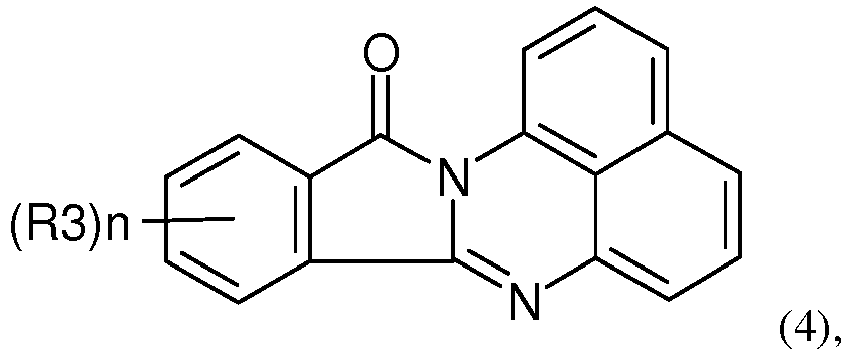 R3 Halogen ist;n=4 ist;5:
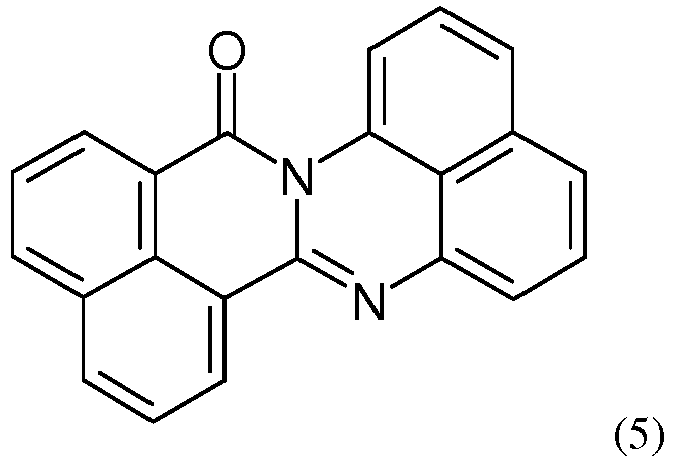 7:
7: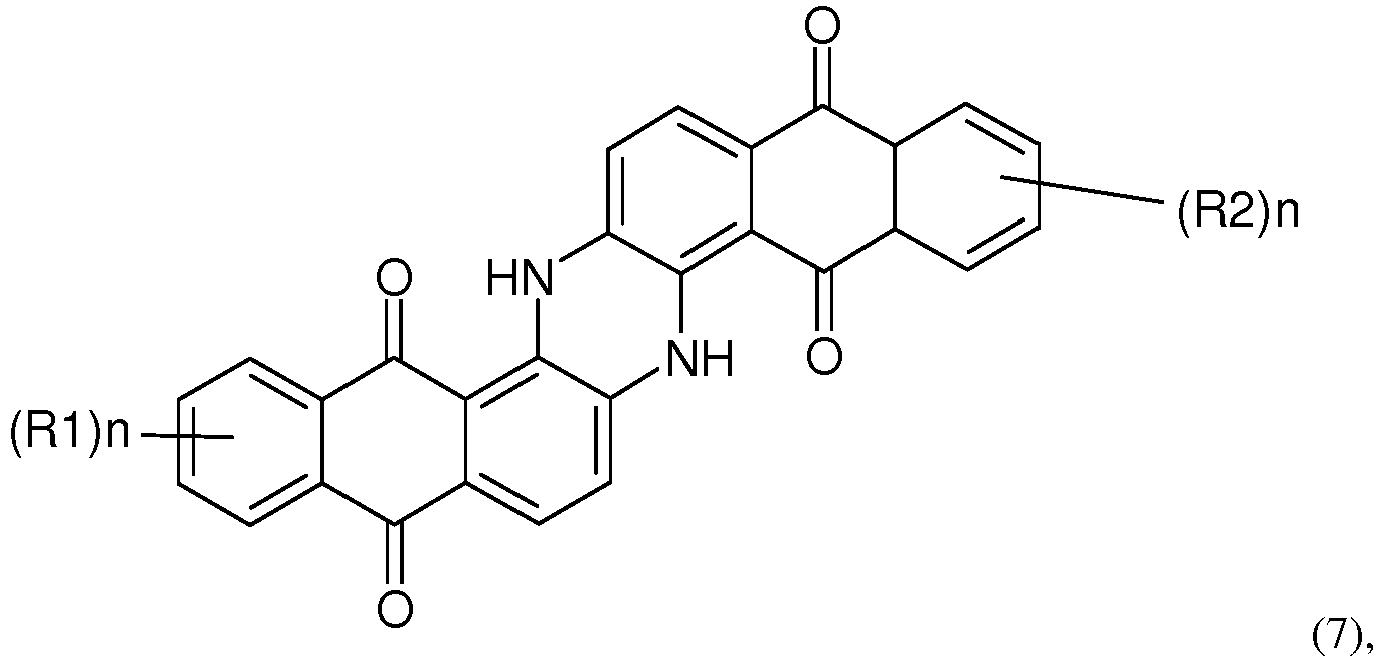 - R1 und R2 unabhängig voneinander für einen linearen oder verzweigten Alkylrest oder Halogen stehen;- n für eine natürliche Zahl zwischen 0 und 4 steht;8a, 8b:
 - die Reste R(5-20) jeweils unabhängig voneinander Wasserstoff, Methyl, Ethyl, Propyl, Isopropyl, Butyl, Isobutyl, tert.-Butyl, Pentyl, Neopentyl, Hexyl, Thexyl, Fluor, Chlor, Brom, Sulfon oder CN sind und- M ist ausgewählt aus der Gruppe, die Aluminium, Nickel, Cobalt, Eisen, Zink, Kupfer und Mangan umfasst,wobei die Farbmittel der Strukturen (1a), (1b), (3) und die Farbmittel der Strukturen (4), (5), (7), (8a/b) in der thermoplastischen Polymer-Zusammensetzung, bezogen auf die jeweilige Einzelkomponente, in Mengen von 0,000001 Gew.-% bis 1,000000 Gew.-%, bezogen auf die Gesamtpolymerzusammensetzung, verwendet werden.
 - Polymer-Zusammensetzung nach Anspruch 1, dadurch gekennzeichnet, dass das Farbmittel
der Struktur (7) ein Schüttvolumen bestimmt nach DIN ISO 787-11 von 2 l/kg - 10 l/kg, eine spezifische Oberfläche bestimmt nach DIN 66132 von 5
m2/g - 60 m2/g und einen pH-Wert bestimmt nach DIN ISO 787-9 von 4 - 9 aufweist. - Polymer-Zusammensetzung nach Anspruch 1, dadurch gekennzeichnet, dass die Farbmittel-Zusammensetzung die Farbmittel der Strukturen (1a) und (1b) in einem 1:1 Isomerengemisch enthält.
- Polymer-Zusammensetzung nach Anspruch 1, dadurch gekennzeichnet, dass die Farbmittel-Zusammensetzung die Farbmittel der Strukturen (1a) und (1b) jeweils nur als ein reines Isomer enthält.
- Polymer-Zusammensetzung nach einem der vorhergehenden Ansprüche, dadurch gekennzeichnet, dass diese weiterhin mindestens eine weitere Komponente enthält, ausgewählt aus der Gruppe, umfassend anorganische oder organische IR-Absorber, UV-Absorber und Ruß.
- Fahrzeugscheibe aus einer Polymer-Zusammensetzung nach einem der vorhergehenden Ansprüche.
- Fahrzeugscheibe nach Anspruch 6, dadurch gekennzeichnet, dass diese eine Kratzfestbeschichtung mit UV-Absorber aufweist.
Applications Claiming Priority (2)
| Application Number | Priority Date | Filing Date | Title |
|---|---|---|---|
| IT000670A ITRM20100670A1 (it) | 2010-12-17 | 2010-12-17 | Colorante organico e composizioni polimeriche colorate ad alta stabilità agli agenti atmosferici. |
| PCT/EP2011/072916 WO2012080398A2 (de) | 2010-12-17 | 2011-12-15 | Organische farbmittel und eingefärbte polymer-zusammensetzungen mit hoher stabilität gegen bewitterung |
Publications (2)
| Publication Number | Publication Date |
|---|---|
| EP2652029A2 EP2652029A2 (de) | 2013-10-23 |
| EP2652029B1 true EP2652029B1 (de) | 2019-10-09 |
Family
ID=43737303
Family Applications (1)
| Application Number | Title | Priority Date | Filing Date |
|---|---|---|---|
| EP11799419.4A Active EP2652029B1 (de) | 2010-12-17 | 2011-12-15 | Organische farbmittel und eingefärbte polymer-zusammensetzungen mit hoher stabilität gegen bewitterung |
Country Status (8)
| Country | Link |
|---|---|
| US (2) | US8641784B2 (de) |
| EP (1) | EP2652029B1 (de) |
| JP (1) | JP6078001B2 (de) |
| KR (1) | KR101850172B1 (de) |
| CN (1) | CN103443182B (de) |
| BR (1) | BR112013015173A2 (de) |
| IT (1) | ITRM20100670A1 (de) |
| WO (1) | WO2012080398A2 (de) |
Families Citing this family (13)
| Publication number | Priority date | Publication date | Assignee | Title |
|---|---|---|---|---|
| ITRM20100667A1 (it) * | 2010-12-17 | 2012-06-18 | Bayer Materialscience Ag | Composizione di polimeri con caratteristiche di assorbimento di calore ad alta stabilità agli agenti atmosferici. |
| ITRM20100670A1 (it) | 2010-12-17 | 2012-06-18 | Bayer Materialscience Ag | Colorante organico e composizioni polimeriche colorate ad alta stabilità agli agenti atmosferici. |
| CN103946310B (zh) * | 2011-11-30 | 2016-03-02 | 拜耳知识产权有限责任公司 | 由聚碳酸酯制成的带有深色光泽效果的多层制品 |
| WO2014095954A1 (de) * | 2012-12-20 | 2014-06-26 | Bayer Materialscience Ag | Gedeckt eingefärbte polycarbonat formmassen enthaltend ir-reflektierende pigmente |
| KR102258329B1 (ko) | 2012-12-20 | 2021-06-01 | 코베스트로 도이칠란드 아게 | 우수한 가공 특성을 갖는 유기 착색제 및 착색된 중합체 조성물 |
| EP3296352A1 (de) * | 2016-09-20 | 2018-03-21 | Essilor International | Polycarbonatharz mit verbesserten blauschnitt und neutraler farbe |
| US11440382B2 (en) | 2016-11-17 | 2022-09-13 | Covestro Deutschland Ag | Transparent multilayer structure for thermal management |
| CN108440543A (zh) * | 2017-02-16 | 2018-08-24 | 北京鼎材科技有限公司 | 萘嵌间二氮杂苯衍生物 |
| EP3891218B1 (de) * | 2018-12-05 | 2023-11-08 | Avient Corporation | Zusammensetzung zum schutz von lichtempfindlichen materialien |
| MX2022003600A (es) | 2019-09-26 | 2022-04-19 | Covestro Intellectual Property Gmbh & Co Kg | Superficie de dise?o metalizado translucido. |
| CH718830A1 (de) | 2021-07-14 | 2023-01-31 | Ems Chemie Ag | Transparente Polyamide mit guter Witterungsbeständigkeit. |
| EP4201664A1 (de) | 2021-12-23 | 2023-06-28 | Covestro Deutschland AG | Licht- und displayabdeckung mit dreidimensionalem dekor |
| EP4201671A1 (de) | 2021-12-23 | 2023-06-28 | Covestro Deutschland AG | Beleuchtete sensorabdeckung mit dreidimensionalem dekor |
Family Cites Families (116)
| Publication number | Priority date | Publication date | Assignee | Title |
|---|---|---|---|---|
| DE1007996B (de) | 1955-03-26 | 1957-05-09 | Bayer Ag | Verfahren zur Herstellung thermoplastischer Kunststoffe |
| US2889327A (en) | 1955-10-07 | 1959-06-02 | Ici Ltd | New colouring matters |
| DE1031512B (de) | 1955-12-21 | 1958-06-04 | Bayer Ag | Verfahren zur Herstellung von hochmolekularen faser- und filmbildenden Polycarbonaten |
| US2991273A (en) | 1956-07-07 | 1961-07-04 | Bayer Ag | Process for manufacture of vacuum moulded parts of high molecular weight thermoplastic polycarbonates |
| US3148172A (en) | 1956-07-19 | 1964-09-08 | Gen Electric | Polycarbonates of dihydroxyaryl ethers |
| US2999846A (en) | 1956-11-30 | 1961-09-12 | Schnell Hermann | High molecular weight thermoplastic aromatic sulfoxy polycarbonates |
| BE585496A (de) | 1958-12-12 | |||
| US3028635A (en) | 1959-04-17 | 1962-04-10 | Schlumberger Cie N | Advancing screw for gill box |
| US3299065A (en) | 1963-11-29 | 1967-01-17 | Allied Chem | Phthaloperinone compound |
| GB1122003A (en) | 1964-10-07 | 1968-07-31 | Gen Electric | Improvements in aromatic polycarbonates |
| NL152889B (nl) | 1967-03-10 | 1977-04-15 | Gen Electric | Werkwijze ter bereiding van een lineair polycarbonaatcopolymeer, alsmede orienteerbare textielvezel van dit copolymeer. |
| DE2036052A1 (en) | 1970-07-21 | 1972-01-27 | Milchwirtschafthche Forschungs und Untersuchungs Gesellschaft mbH, 2100 Hamburg | Working up of additives in fat and protein - contng foodstuffs |
| BE759906A (fr) | 1969-12-05 | 1971-06-04 | Ici Ltd | Coloration de matieres polymeres |
| US3846369A (en) * | 1969-12-05 | 1974-11-05 | Ici Ltd | Colouration of polymeric materials |
| DE2063050C3 (de) | 1970-12-22 | 1983-12-15 | Bayer Ag, 5090 Leverkusen | Verseifungsbeständige Polycarbonate, Verfahren zu deren Herstellung und deren Verwendung |
| DE2148101A1 (de) * | 1971-09-27 | 1973-04-05 | Dieter Dr Kaempgen | Temperaturbestaendige organische pigmentfarbstoffe aus pyromellithsaeuredianhydrid |
| DE2211956A1 (de) | 1972-03-11 | 1973-10-25 | Bayer Ag | Verfahren zur herstellung verseifungsstabiler blockcopolycarbonate |
| US4035958A (en) | 1973-03-30 | 1977-07-19 | Tokyo Kosei Kaken Co. Ltd. | Mobile floor cleaning and polishing device |
| JPS5039599B2 (de) | 1973-03-30 | 1975-12-18 | ||
| JPS521934B2 (de) * | 1973-12-24 | 1977-01-19 | ||
| DE2500092C3 (de) | 1975-01-03 | 1978-10-12 | Bayer Ag, 5090 Leverkusen | Verzweigte, hochmolekulare, thermoplastische und lösliche Polycarbonate |
| US4185009A (en) | 1975-01-03 | 1980-01-22 | Bayer Aktiengesellschaft | Branched, high-molecular weight thermoplastic polycarbonates |
| US4101513A (en) | 1977-02-02 | 1978-07-18 | Minnesota Mining And Manufacturing Company | Catalyst for condensation of hydrolyzable silanes and storage stable compositions thereof |
| US4395463A (en) | 1980-06-03 | 1983-07-26 | General Electric Company | Article comprising silicone resin coated, methacrylate-primed substrate |
| DE3302789C2 (de) | 1982-01-29 | 1986-03-06 | Citizen Watch Co., Ltd., Tokio/Tokyo | Uhrenarmband und Verfahren zu seiner Herstellung |
| DE8233007U1 (de) | 1982-11-25 | 1983-03-24 | Röhm GmbH, 6100 Darmstadt | Polycarbonat-kunststofftafel |
| DE3244953C2 (de) | 1982-12-04 | 1984-11-29 | Röhm GmbH, 6100 Darmstadt | Verfahren zur Herstellung einer Hohlkammerkunststofftafel |
| JPS6162040A (ja) | 1984-09-04 | 1986-03-29 | Fuji Xerox Co Ltd | 電子写真用感光体 |
| JPS6162039A (ja) | 1984-09-04 | 1986-03-29 | Fuji Xerox Co Ltd | 電子写真用感光体 |
| JPS61105550A (ja) | 1984-10-29 | 1986-05-23 | Fuji Xerox Co Ltd | 電子写真用感光体 |
| US4894972A (en) | 1986-12-19 | 1990-01-23 | Central Glass Company, Limited | Window assembly and method of producing same |
| US5239406A (en) * | 1988-02-12 | 1993-08-24 | Donnelly Corporation | Near-infrared reflecting, ultraviolet protected, safety protected, electrochromic vehicular glazing |
| JP2685229B2 (ja) | 1988-06-25 | 1997-12-03 | シャープ株式会社 | 感光体 |
| DE3844633A1 (de) | 1988-08-12 | 1990-04-19 | Bayer Ag | Dihydroxydiphenylcycloalkane, ihre herstellung und ihre verwendung zur herstellung von hochmolekularen polycarbonaten |
| NO170326C (no) | 1988-08-12 | 1992-10-07 | Bayer Ag | Dihydroksydifenylcykloalkaner |
| BE1002368A3 (nl) | 1988-08-16 | 1991-01-15 | Confect Schockaert Bv Met Bepe | Werkwijze voor het bevestigen van een gesp aan een riem. |
| US5041313A (en) | 1990-05-11 | 1991-08-20 | General Electric Company | Method for making silicone hardcoat composites and primer compositions |
| US5367044A (en) | 1990-10-12 | 1994-11-22 | General Electric Company | Blow molded article molded from a composition comprising a randomly branched aromatic polymer |
| DE4033221A1 (de) | 1990-10-19 | 1992-04-23 | Bayer Ag | Zweikomponenten-polyurethanklebstoffe |
| TW222292B (de) | 1991-02-21 | 1994-04-11 | Ciba Geigy Ag | |
| JPH04328154A (ja) * | 1991-04-30 | 1992-11-17 | Dainippon Ink & Chem Inc | 熱可塑性ポリエステル用着色剤および熱可塑性ポリエステルの着色方法 |
| DE4118232A1 (de) | 1991-06-04 | 1992-12-10 | Bayer Ag | Kontinuierliche herstellung von polycarbonaten |
| CA2093686A1 (en) | 1992-05-11 | 1993-11-12 | Gautam A. Patel | Heat curable primerless silicone hardcoat compositions, and thermoplastic composites |
| DE4240313A1 (de) | 1992-12-01 | 1994-06-09 | Bayer Ag | Polycarbonate für optische Datenträger |
| JP3329346B2 (ja) | 1993-07-22 | 2002-09-30 | 三菱瓦斯化学株式会社 | 耐候性ポリカーボネート樹脂成形品 |
| EP0639624A1 (de) | 1993-08-19 | 1995-02-22 | Bayer Ag | Phthaloperinonfarbstoffe |
| US5391795A (en) | 1994-02-18 | 1995-02-21 | General Electric Company | Silylated agents useful for absorbing ultraviolet light |
| DE69509952T2 (de) | 1994-03-04 | 1999-11-04 | General Electric Co., Schenectady | Beschichtungen geeignet zur Absorption von Ultraviolettlicht |
| US5574078A (en) * | 1994-11-10 | 1996-11-12 | Lasermaster Corporation | Thermal compositions |
| MX9703351A (es) | 1994-11-10 | 1997-08-30 | Basf Ag | Esteres 2-cianoacrilicos. |
| DE4444868A1 (de) | 1994-12-16 | 1996-06-20 | Bayer Ag | UV-geschützte, mehrschichtige Polycarbonatplatten |
| DE4445786A1 (de) | 1994-12-21 | 1996-06-27 | Bayer Ag | Arylphosphin-haltige Polycarbonate |
| JP3403867B2 (ja) * | 1995-06-20 | 2003-05-06 | 帝人化成株式会社 | 赤外線透過性樹脂組成物、この樹脂組成物から形成された赤外線透過フィルター |
| DE19548453A1 (de) * | 1995-12-22 | 1997-06-26 | Bayer Ag | Verfahren zur Herstellung polycyclischer Verbindungen |
| EP0786675B1 (de) | 1996-01-26 | 2002-11-06 | Teijin Chemicals, Ltd. | Brillenglas |
| CA2203595A1 (en) | 1996-04-26 | 1997-10-26 | Robert F. Hurley | Cross-linked polyolefin tape |
| DE19636032A1 (de) | 1996-09-05 | 1998-03-12 | Bayer Ag | Verbrückte Perinone |
| DE59702969D1 (de) | 1996-10-30 | 2001-03-08 | Ciba Sc Holding Ag | Stabilisatorkombination für das Rotomolding-Verfahren |
| US6476158B1 (en) | 1999-08-31 | 2002-11-05 | General Electric Company | Process for colored polycarbonate-polyester compositions with improved weathering |
| DE19943642A1 (de) | 1999-09-13 | 2001-03-15 | Bayer Ag | Behälter |
| DE10006208A1 (de) | 2000-02-11 | 2001-08-16 | Bayer Ag | IR-absorbierende Zusammensetzungen |
| DE10022037A1 (de) | 2000-05-05 | 2001-11-08 | Bayer Ag | IR-absorbierende Zusammensetzungen |
| US6228973B1 (en) | 2000-06-02 | 2001-05-08 | General Electric Company | Method for preparing high molecular weight polycarbonate |
| US6355723B1 (en) | 2000-06-22 | 2002-03-12 | General Electric Co. | Dark colored thermoplastic compositions, articles molded therefrom, and article preparation methods |
| DE10047483A1 (de) | 2000-09-26 | 2002-04-11 | Bayer Ag | Verwendung von Copolycarbonaten |
| JP2002123016A (ja) * | 2000-10-13 | 2002-04-26 | Sharp Corp | 電子写真感光体およびこれを用いた画像形成装置 |
| JP4250953B2 (ja) | 2002-01-18 | 2009-04-08 | 住友金属鉱山株式会社 | 6ホウ化物粒子とこの6ホウ化物粒子が分散された分散体および6ホウ化物粒子若しくは分散体を用いた物品 |
| EP1483308A1 (de) * | 2002-03-01 | 2004-12-08 | General Electric Company | Aus der schmelze verarbeitbare zusammensetzung enthaltend einen blend aus aliphatischem polyester und polyacrylat mit guter duktilität und wetterbeständigkeit |
| JP4402333B2 (ja) | 2002-05-01 | 2010-01-20 | 出光興産株式会社 | 二色成形品およびその成形方法 |
| US20030214070A1 (en) | 2002-05-08 | 2003-11-20 | General Electric Company | Multiwall polycarbonate sheet and method for its production |
| JP4187999B2 (ja) | 2002-05-13 | 2008-11-26 | 住友金属鉱山株式会社 | 熱線遮蔽樹脂シート材及びその製造方法 |
| EP1308084A1 (de) | 2002-10-02 | 2003-05-07 | Ciba SC Holding AG | Synergistisch wirksame UV-Absorbercombination |
| DE10311063A1 (de) | 2003-03-13 | 2004-09-23 | Basf Ag | Verwendung einer Stabilisatormischung in thermoplastischen Formmassen |
| US7591505B2 (en) | 2003-05-12 | 2009-09-22 | Teijin Chemicals, Ltd. | Sheet-form window member and window structure |
| JP2005047179A (ja) | 2003-07-30 | 2005-02-24 | Mitsubishi Gas Chem Co Inc | 熱線遮蔽樹脂シート |
| JP4328154B2 (ja) * | 2003-09-11 | 2009-09-09 | 株式会社東研 | Rfidタグを用いた物品管理システム |
| US20050065263A1 (en) | 2003-09-22 | 2005-03-24 | Chung James Y.J. | Polycarbonate composition |
| EP1676890B1 (de) | 2003-10-20 | 2019-06-26 | Sumitomo Metal Mining Co., Ltd. | Infrarotabschirmstoffmicropartikeldispersion, infrarotschirm, verfahren zur herstellung von infrarotabschirmstoffmicropartikeln sowie infrarotabschirmstoffmicropartikel |
| US20050119377A1 (en) * | 2003-12-02 | 2005-06-02 | Tomo Ishii | Colored resin composition for laser welding and composite molding product using the same |
| US7244376B2 (en) | 2004-01-26 | 2007-07-17 | Sumitomo Metal Mining Co., Ltd. | Hexaboride particles, hexaboride particle dispersion, and article making use of hexaboride particles or hexaboride particle dispersion |
| US20050165148A1 (en) | 2004-01-28 | 2005-07-28 | Bogerd Jos V.D. | Infra-red radiation absorption articles and method of manufacture thereof |
| US7365124B2 (en) | 2004-03-31 | 2008-04-29 | General Electric Company | Flame retardant resin blends based on polymers derived from 2-hydrocarbyl-3,3-bis(4-hydroxyaryl)phthalimidine monomers |
| JP4666940B2 (ja) * | 2004-04-09 | 2011-04-06 | 三菱化学株式会社 | 高衝撃性ポリカーボネート樹脂組成物及びその組成物からなる成形品 |
| DE102004022673A1 (de) | 2004-05-07 | 2005-11-24 | Bayer Materialscience Ag | Copolycarbonate mit verbesserter Fließfähigkeit |
| JP2005344006A (ja) | 2004-06-03 | 2005-12-15 | Teijin Chem Ltd | ポリカーボネート樹脂組成物 |
| KR20070084221A (ko) | 2004-11-16 | 2007-08-24 | 쓰리엠 이노베이티브 프로퍼티즈 컴파니 | 미소구가 충전된 중합체 복합물 |
| US7230113B2 (en) | 2004-12-17 | 2007-06-12 | General Electric Company | Chemical compositions for authenticatable polymers and articles, and authentication methods thereof |
| JP4839005B2 (ja) | 2005-03-14 | 2011-12-14 | 出光興産株式会社 | ポリカーボネート樹脂組成物及びその成形体 |
| JP2006307172A (ja) | 2005-03-28 | 2006-11-09 | Mitsubishi Engineering Plastics Corp | ポリカーボネート樹脂組成物及び熱線遮蔽能を備えた成形体 |
| CN101151321B (zh) * | 2005-03-28 | 2012-05-23 | 三菱工程塑料株式会社 | 聚碳酸酯树脂组合物和热辐射遮蔽性成形体 |
| DE102005017023A1 (de) | 2005-04-13 | 2006-10-19 | Bayer Materialscience Ag | UV-stabilisierte Polycarbonatformkörper |
| US8900693B2 (en) * | 2005-07-13 | 2014-12-02 | Sabic Global Technologies B.V. | Polycarbonate compositions having infrared absorbance, method of manufacture, and articles prepared therefrom |
| US20070129470A1 (en) * | 2005-12-05 | 2007-06-07 | Kuvshinnikova Olga I | Weatherable resinous composition with low heat storage and method |
| JP2007169503A (ja) | 2005-12-22 | 2007-07-05 | Mitsubishi Engineering Plastics Corp | ポリカーボネート樹脂組成物及び熱線遮蔽能を備えた成形体 |
| US20070210287A1 (en) | 2006-03-08 | 2007-09-13 | Spartech Corporation | Transparent plastic articles having controlled solar energy transmittance properties and methods of making |
| JP5102969B2 (ja) | 2006-04-14 | 2012-12-19 | 出光興産株式会社 | ポリカーボネート樹脂組成物及びその成形板 |
| US7550193B2 (en) | 2006-05-05 | 2009-06-23 | Nanofilm Ltd | Infrared radiation blocking laminate |
| JP2008063402A (ja) * | 2006-09-06 | 2008-03-21 | Mitsubishi Engineering Plastics Corp | ポリカーボネート樹脂組成物及び熱線遮蔽能を備えた成形体 |
| DE102006046330A1 (de) | 2006-09-28 | 2008-04-03 | Bayer Materialscience Ag | Polycarbonate und Copolycarbonate mit verbesserter Metallhaftung |
| US20080103267A1 (en) * | 2006-10-31 | 2008-05-01 | General Electric Company | Infrared transmissive thermoplastic composition |
| GB2444053A (en) | 2006-11-23 | 2008-05-28 | Eques Coatings | Hybrid UV-curable resins |
| DE102006055479A1 (de) | 2006-11-24 | 2008-05-29 | Bayer Materialscience Ag | Schlagzähmodifizierte gefüllte Polycarbonat-Zusammensetzungen |
| JP2008127557A (ja) * | 2006-11-27 | 2008-06-05 | Mitsubishi Engineering Plastics Corp | 赤色染料を含むポリカーボネート樹脂組成物、およびこの樹脂組成物製成形品 |
| JP2008156386A (ja) | 2006-12-20 | 2008-07-10 | Sumitomo Metal Mining Co Ltd | ポリカーボネート樹脂組成物および得られるペレット、並びにポリカーボネート樹脂成形体 |
| US7857905B2 (en) | 2007-03-05 | 2010-12-28 | Momentive Performance Materials Inc. | Flexible thermal cure silicone hardcoats |
| DE102007011069A1 (de) | 2007-03-07 | 2008-09-11 | Bayer Materialscience Ag | Polycarbonatzusammensetzung enthaltend UV-Absorber |
| JP2008214596A (ja) | 2007-03-08 | 2008-09-18 | Sumitomo Metal Mining Co Ltd | ポリカーカーボネート樹脂組成物及びそれを用いた熱線遮蔽成形体 |
| DE102007016786A1 (de) | 2007-04-05 | 2008-10-09 | Bayer Materialscience Ag | Polycarbonat-Formmassen |
| US8097668B2 (en) | 2007-08-27 | 2012-01-17 | Sabic Innovative Plastics Ip B.V. | Colorimetric indicator of radiation exposure |
| WO2009064860A1 (en) | 2007-11-13 | 2009-05-22 | Spartech Corporation | Stretched acrylic sheets having controlled solar transmittance properties |
| US8551237B2 (en) * | 2007-12-10 | 2013-10-08 | Basf Se | Synthesis of colorants in mixing apparatus |
| RU2011137186A (ru) | 2009-02-12 | 2013-03-20 | Басф Се | Полимерная композиция, содержащая поглотитель инфракрасного излучения в виде наночастиц |
| ITRM20100225A1 (it) | 2010-05-10 | 2011-11-10 | Bayer Materialscience Ag | Composizione di polimeri con caratteristiche di assorbimento del calore e migliorate caratteristiche di colore. |
| ITRM20100667A1 (it) * | 2010-12-17 | 2012-06-18 | Bayer Materialscience Ag | Composizione di polimeri con caratteristiche di assorbimento di calore ad alta stabilità agli agenti atmosferici. |
| ITRM20100668A1 (it) * | 2010-12-17 | 2012-06-18 | Bayer Materialscience Ag | Substrato-led a colorazione stabile. |
| ITRM20100670A1 (it) | 2010-12-17 | 2012-06-18 | Bayer Materialscience Ag | Colorante organico e composizioni polimeriche colorate ad alta stabilità agli agenti atmosferici. |
-
2010
- 2010-12-17 IT IT000670A patent/ITRM20100670A1/it unknown
-
2011
- 2011-12-15 BR BR112013015173A patent/BR112013015173A2/pt not_active IP Right Cessation
- 2011-12-15 KR KR1020137018640A patent/KR101850172B1/ko active Active
- 2011-12-15 EP EP11799419.4A patent/EP2652029B1/de active Active
- 2011-12-15 JP JP2013543784A patent/JP6078001B2/ja active Active
- 2011-12-15 US US13/326,438 patent/US8641784B2/en not_active Expired - Fee Related
- 2011-12-15 WO PCT/EP2011/072916 patent/WO2012080398A2/de not_active Ceased
- 2011-12-15 CN CN201180067769.XA patent/CN103443182B/zh active Active
-
2014
- 2014-01-03 US US14/146,805 patent/US9212272B2/en active Active
Non-Patent Citations (1)
| Title |
|---|
| None * |
Also Published As
| Publication number | Publication date |
|---|---|
| JP6078001B2 (ja) | 2017-02-08 |
| US8641784B2 (en) | 2014-02-04 |
| BR112013015173A2 (pt) | 2016-09-13 |
| WO2012080398A2 (de) | 2012-06-21 |
| ITRM20100670A1 (it) | 2012-06-18 |
| US20120152150A1 (en) | 2012-06-21 |
| CN103443182A (zh) | 2013-12-11 |
| CN103443182B (zh) | 2015-09-23 |
| EP2652029A2 (de) | 2013-10-23 |
| US20140121309A1 (en) | 2014-05-01 |
| WO2012080398A3 (de) | 2013-07-18 |
| KR20130130024A (ko) | 2013-11-29 |
| US9212272B2 (en) | 2015-12-15 |
| KR101850172B1 (ko) | 2018-04-18 |
| JP2014507491A (ja) | 2014-03-27 |
Similar Documents
| Publication | Publication Date | Title |
|---|---|---|
| EP2652026B1 (de) | Polymer-zusammensetzung mit wärme-absorbierenden eigenschaften und hoher stabilität gegen bewitterung | |
| EP2652029A2 (de) | Organische farbmittel und eingefärbte polymer-zusammensetzungen mit hoher stabilität gegen bewitterung | |
| EP2652030B1 (de) | Polymer-zusammensetzung mit wärme-absorbierenden eigenschaften und hoher stabilität gegen bewitterung | |
| EP2569354B1 (de) | Polymer-zusammensetzung mit wärme-absorbierenden eigenschaften und verbesserten farbeigenschaften | |
| EP2569353B1 (de) | Polymer-zusammensetzung mit wärme-absorbierenden eigenschaften und verbesserten farbeigenschaften | |
| EP2785795B1 (de) | Mehrschichtkörper aus polycarbonat mit tiefenglanzeffekt | |
| EP1287061B1 (de) | Ir-absorbierende zusammensetzungen | |
| EP2935437B1 (de) | Organische farbmittel und eingefärbte polymer-zusammensetzungen mit guten verarbeitungseigenschaften | |
| EP3802121B1 (de) | Opaker mehrschichtkörper aus polycarbonat mit hoher bewitterungsstabilität | |
| EP2935422B1 (de) | Mehrschichtkörper aus polycarbonat mit hoher bewitterungsstabilität | |
| EP2768895B1 (de) | Polymer-zusammensetzung mit wärme-absorbierenden eigenschaften | |
| EP2632721B1 (de) | Kunststoff-mehrschichtaufbau mit niedriger energietransmission |
Legal Events
| Date | Code | Title | Description |
|---|---|---|---|
| PUAI | Public reference made under article 153(3) epc to a published international application that has entered the european phase |
Free format text: ORIGINAL CODE: 0009012 |
|
| AK | Designated contracting states |
Kind code of ref document: A2 Designated state(s): AL AT BE BG CH CY CZ DE DK EE ES FI FR GB GR HR HU IE IS IT LI LT LU LV MC MK MT NL NO PL PT RO RS SE SI SK SM TR |
|
| AX | Request for extension of the european patent |
Extension state: BA ME |
|
| 17P | Request for examination filed |
Effective date: 20140120 |
|
| RBV | Designated contracting states (corrected) |
Designated state(s): AL AT BE BG CH CY CZ DE DK EE ES FI FR GB GR HR HU IE IS IT LI LT LU LV MC MK MT NL NO PL PT RO RS SE SI SK SM TR |
|
| DAX | Request for extension of the european patent (deleted) | ||
| RAP1 | Party data changed (applicant data changed or rights of an application transferred) |
Owner name: COVESTRO DEUTSCHLAND AG |
|
| 17Q | First examination report despatched |
Effective date: 20160816 |
|
| STAA | Information on the status of an ep patent application or granted ep patent |
Free format text: STATUS: EXAMINATION IS IN PROGRESS |
|
| GRAP | Despatch of communication of intention to grant a patent |
Free format text: ORIGINAL CODE: EPIDOSNIGR1 |
|
| STAA | Information on the status of an ep patent application or granted ep patent |
Free format text: STATUS: GRANT OF PATENT IS INTENDED |
|
| INTG | Intention to grant announced |
Effective date: 20190514 |
|
| GRAS | Grant fee paid |
Free format text: ORIGINAL CODE: EPIDOSNIGR3 |
|
| GRAA | (expected) grant |
Free format text: ORIGINAL CODE: 0009210 |
|
| STAA | Information on the status of an ep patent application or granted ep patent |
Free format text: STATUS: THE PATENT HAS BEEN GRANTED |
|
| AK | Designated contracting states |
Kind code of ref document: B1 Designated state(s): AL AT BE BG CH CY CZ DE DK EE ES FI FR GB GR HR HU IE IS IT LI LT LU LV MC MK MT NL NO PL PT RO RS SE SI SK SM TR |
|
| REG | Reference to a national code |
Ref country code: GB Ref legal event code: FG4D Free format text: NOT ENGLISH |
|
| REG | Reference to a national code |
Ref country code: CH Ref legal event code: EP |
|
| REG | Reference to a national code |
Ref country code: DE Ref legal event code: R096 Ref document number: 502011016171 Country of ref document: DE |
|
| REG | Reference to a national code |
Ref country code: IE Ref legal event code: FG4D Free format text: LANGUAGE OF EP DOCUMENT: GERMAN |
|
| REG | Reference to a national code |
Ref country code: AT Ref legal event code: REF Ref document number: 1188741 Country of ref document: AT Kind code of ref document: T Effective date: 20191115 |
|
| REG | Reference to a national code |
Ref country code: NL Ref legal event code: MP Effective date: 20191009 |
|
| REG | Reference to a national code |
Ref country code: LT Ref legal event code: MG4D |
|
| PG25 | Lapsed in a contracting state [announced via postgrant information from national office to epo] |
Ref country code: GR Free format text: LAPSE BECAUSE OF FAILURE TO SUBMIT A TRANSLATION OF THE DESCRIPTION OR TO PAY THE FEE WITHIN THE PRESCRIBED TIME-LIMIT Effective date: 20200110 Ref country code: FI Free format text: LAPSE BECAUSE OF FAILURE TO SUBMIT A TRANSLATION OF THE DESCRIPTION OR TO PAY THE FEE WITHIN THE PRESCRIBED TIME-LIMIT Effective date: 20191009 Ref country code: BG Free format text: LAPSE BECAUSE OF FAILURE TO SUBMIT A TRANSLATION OF THE DESCRIPTION OR TO PAY THE FEE WITHIN THE PRESCRIBED TIME-LIMIT Effective date: 20200109 Ref country code: SE Free format text: LAPSE BECAUSE OF FAILURE TO SUBMIT A TRANSLATION OF THE DESCRIPTION OR TO PAY THE FEE WITHIN THE PRESCRIBED TIME-LIMIT Effective date: 20191009 Ref country code: LV Free format text: LAPSE BECAUSE OF FAILURE TO SUBMIT A TRANSLATION OF THE DESCRIPTION OR TO PAY THE FEE WITHIN THE PRESCRIBED TIME-LIMIT Effective date: 20191009 Ref country code: NO Free format text: LAPSE BECAUSE OF FAILURE TO SUBMIT A TRANSLATION OF THE DESCRIPTION OR TO PAY THE FEE WITHIN THE PRESCRIBED TIME-LIMIT Effective date: 20200109 Ref country code: NL Free format text: LAPSE BECAUSE OF FAILURE TO SUBMIT A TRANSLATION OF THE DESCRIPTION OR TO PAY THE FEE WITHIN THE PRESCRIBED TIME-LIMIT Effective date: 20191009 Ref country code: PL Free format text: LAPSE BECAUSE OF FAILURE TO SUBMIT A TRANSLATION OF THE DESCRIPTION OR TO PAY THE FEE WITHIN THE PRESCRIBED TIME-LIMIT Effective date: 20191009 Ref country code: LT Free format text: LAPSE BECAUSE OF FAILURE TO SUBMIT A TRANSLATION OF THE DESCRIPTION OR TO PAY THE FEE WITHIN THE PRESCRIBED TIME-LIMIT Effective date: 20191009 Ref country code: ES Free format text: LAPSE BECAUSE OF FAILURE TO SUBMIT A TRANSLATION OF THE DESCRIPTION OR TO PAY THE FEE WITHIN THE PRESCRIBED TIME-LIMIT Effective date: 20191009 Ref country code: PT Free format text: LAPSE BECAUSE OF FAILURE TO SUBMIT A TRANSLATION OF THE DESCRIPTION OR TO PAY THE FEE WITHIN THE PRESCRIBED TIME-LIMIT Effective date: 20200210 |
|
| PG25 | Lapsed in a contracting state [announced via postgrant information from national office to epo] |
Ref country code: IS Free format text: LAPSE BECAUSE OF FAILURE TO SUBMIT A TRANSLATION OF THE DESCRIPTION OR TO PAY THE FEE WITHIN THE PRESCRIBED TIME-LIMIT Effective date: 20200224 Ref country code: HR Free format text: LAPSE BECAUSE OF FAILURE TO SUBMIT A TRANSLATION OF THE DESCRIPTION OR TO PAY THE FEE WITHIN THE PRESCRIBED TIME-LIMIT Effective date: 20191009 Ref country code: RS Free format text: LAPSE BECAUSE OF FAILURE TO SUBMIT A TRANSLATION OF THE DESCRIPTION OR TO PAY THE FEE WITHIN THE PRESCRIBED TIME-LIMIT Effective date: 20191009 |
|
| PG25 | Lapsed in a contracting state [announced via postgrant information from national office to epo] |
Ref country code: AL Free format text: LAPSE BECAUSE OF FAILURE TO SUBMIT A TRANSLATION OF THE DESCRIPTION OR TO PAY THE FEE WITHIN THE PRESCRIBED TIME-LIMIT Effective date: 20191009 |
|
| REG | Reference to a national code |
Ref country code: DE Ref legal event code: R097 Ref document number: 502011016171 Country of ref document: DE |
|
| PG2D | Information on lapse in contracting state deleted |
Ref country code: IS |
|
| PG25 | Lapsed in a contracting state [announced via postgrant information from national office to epo] |
Ref country code: EE Free format text: LAPSE BECAUSE OF FAILURE TO SUBMIT A TRANSLATION OF THE DESCRIPTION OR TO PAY THE FEE WITHIN THE PRESCRIBED TIME-LIMIT Effective date: 20191009 Ref country code: DK Free format text: LAPSE BECAUSE OF FAILURE TO SUBMIT A TRANSLATION OF THE DESCRIPTION OR TO PAY THE FEE WITHIN THE PRESCRIBED TIME-LIMIT Effective date: 20191009 Ref country code: CZ Free format text: LAPSE BECAUSE OF FAILURE TO SUBMIT A TRANSLATION OF THE DESCRIPTION OR TO PAY THE FEE WITHIN THE PRESCRIBED TIME-LIMIT Effective date: 20191009 Ref country code: RO Free format text: LAPSE BECAUSE OF FAILURE TO SUBMIT A TRANSLATION OF THE DESCRIPTION OR TO PAY THE FEE WITHIN THE PRESCRIBED TIME-LIMIT Effective date: 20191009 Ref country code: IS Free format text: LAPSE BECAUSE OF FAILURE TO SUBMIT A TRANSLATION OF THE DESCRIPTION OR TO PAY THE FEE WITHIN THE PRESCRIBED TIME-LIMIT Effective date: 20200209 |
|
| REG | Reference to a national code |
Ref country code: CH Ref legal event code: PL |
|
| PLBE | No opposition filed within time limit |
Free format text: ORIGINAL CODE: 0009261 |
|
| STAA | Information on the status of an ep patent application or granted ep patent |
Free format text: STATUS: NO OPPOSITION FILED WITHIN TIME LIMIT |
|
| REG | Reference to a national code |
Ref country code: BE Ref legal event code: MM Effective date: 20191231 |
|
| PG25 | Lapsed in a contracting state [announced via postgrant information from national office to epo] |
Ref country code: SM Free format text: LAPSE BECAUSE OF FAILURE TO SUBMIT A TRANSLATION OF THE DESCRIPTION OR TO PAY THE FEE WITHIN THE PRESCRIBED TIME-LIMIT Effective date: 20191009 Ref country code: SK Free format text: LAPSE BECAUSE OF FAILURE TO SUBMIT A TRANSLATION OF THE DESCRIPTION OR TO PAY THE FEE WITHIN THE PRESCRIBED TIME-LIMIT Effective date: 20191009 Ref country code: MC Free format text: LAPSE BECAUSE OF FAILURE TO SUBMIT A TRANSLATION OF THE DESCRIPTION OR TO PAY THE FEE WITHIN THE PRESCRIBED TIME-LIMIT Effective date: 20191009 |
|
| 26N | No opposition filed |
Effective date: 20200710 |
|
| PG25 | Lapsed in a contracting state [announced via postgrant information from national office to epo] |
Ref country code: FR Free format text: LAPSE BECAUSE OF NON-PAYMENT OF DUE FEES Effective date: 20191231 Ref country code: IE Free format text: LAPSE BECAUSE OF NON-PAYMENT OF DUE FEES Effective date: 20191215 Ref country code: LU Free format text: LAPSE BECAUSE OF NON-PAYMENT OF DUE FEES Effective date: 20191215 |
|
| PG25 | Lapsed in a contracting state [announced via postgrant information from national office to epo] |
Ref country code: BE Free format text: LAPSE BECAUSE OF NON-PAYMENT OF DUE FEES Effective date: 20191231 Ref country code: CH Free format text: LAPSE BECAUSE OF NON-PAYMENT OF DUE FEES Effective date: 20191231 Ref country code: LI Free format text: LAPSE BECAUSE OF NON-PAYMENT OF DUE FEES Effective date: 20191231 Ref country code: SI Free format text: LAPSE BECAUSE OF FAILURE TO SUBMIT A TRANSLATION OF THE DESCRIPTION OR TO PAY THE FEE WITHIN THE PRESCRIBED TIME-LIMIT Effective date: 20191009 |
|
| REG | Reference to a national code |
Ref country code: AT Ref legal event code: MM01 Ref document number: 1188741 Country of ref document: AT Kind code of ref document: T Effective date: 20191215 |
|
| PG25 | Lapsed in a contracting state [announced via postgrant information from national office to epo] |
Ref country code: CY Free format text: LAPSE BECAUSE OF FAILURE TO SUBMIT A TRANSLATION OF THE DESCRIPTION OR TO PAY THE FEE WITHIN THE PRESCRIBED TIME-LIMIT Effective date: 20191009 Ref country code: AT Free format text: LAPSE BECAUSE OF NON-PAYMENT OF DUE FEES Effective date: 20191215 |
|
| PG25 | Lapsed in a contracting state [announced via postgrant information from national office to epo] |
Ref country code: MT Free format text: LAPSE BECAUSE OF FAILURE TO SUBMIT A TRANSLATION OF THE DESCRIPTION OR TO PAY THE FEE WITHIN THE PRESCRIBED TIME-LIMIT Effective date: 20191009 Ref country code: HU Free format text: LAPSE BECAUSE OF FAILURE TO SUBMIT A TRANSLATION OF THE DESCRIPTION OR TO PAY THE FEE WITHIN THE PRESCRIBED TIME-LIMIT; INVALID AB INITIO Effective date: 20111215 |
|
| PG25 | Lapsed in a contracting state [announced via postgrant information from national office to epo] |
Ref country code: TR Free format text: LAPSE BECAUSE OF FAILURE TO SUBMIT A TRANSLATION OF THE DESCRIPTION OR TO PAY THE FEE WITHIN THE PRESCRIBED TIME-LIMIT Effective date: 20191009 |
|
| PG25 | Lapsed in a contracting state [announced via postgrant information from national office to epo] |
Ref country code: MK Free format text: LAPSE BECAUSE OF FAILURE TO SUBMIT A TRANSLATION OF THE DESCRIPTION OR TO PAY THE FEE WITHIN THE PRESCRIBED TIME-LIMIT Effective date: 20191009 |
|
| PGFP | Annual fee paid to national office [announced via postgrant information from national office to epo] |
Ref country code: DE Payment date: 20251119 Year of fee payment: 15 |
|
| PGFP | Annual fee paid to national office [announced via postgrant information from national office to epo] |
Ref country code: GB Payment date: 20251120 Year of fee payment: 15 |
|
| PGFP | Annual fee paid to national office [announced via postgrant information from national office to epo] |
Ref country code: IT Payment date: 20251126 Year of fee payment: 15 |