EP2677995B1 - Zusammensetzung zur färbung von keratinfasern mit einem direktfarbstoff mit einer disulfid/thiol-funktion, einem nichtionischen tensid, einem amphoteren tensid, einem alkalisierungsmittel und einem reduktionsmittel - Google Patents
Zusammensetzung zur färbung von keratinfasern mit einem direktfarbstoff mit einer disulfid/thiol-funktion, einem nichtionischen tensid, einem amphoteren tensid, einem alkalisierungsmittel und einem reduktionsmittel Download PDFInfo
- Publication number
- EP2677995B1 EP2677995B1 EP12705281.9A EP12705281A EP2677995B1 EP 2677995 B1 EP2677995 B1 EP 2677995B1 EP 12705281 A EP12705281 A EP 12705281A EP 2677995 B1 EP2677995 B1 EP 2677995B1
- Authority
- EP
- European Patent Office
- Prior art keywords
- group
- alkyl
- radical
- different
- optionally substituted
- Prior art date
- Legal status (The legal status is an assumption and is not a legal conclusion. Google has not performed a legal analysis and makes no representation as to the accuracy of the status listed.)
- Not-in-force
Links
- 0 C*[C@](C)(C=C*=C)C=[N+]C Chemical compound C*[C@](C)(C=C*=C)C=[N+]C 0.000 description 6
- SLEDLCZXMLACBH-UHFFFAOYSA-N CC1=NC=NC1 Chemical compound CC1=NC=NC1 SLEDLCZXMLACBH-UHFFFAOYSA-N 0.000 description 1
Classifications
-
- A—HUMAN NECESSITIES
- A61—MEDICAL OR VETERINARY SCIENCE; HYGIENE
- A61K—PREPARATIONS FOR MEDICAL, DENTAL OR TOILETRY PURPOSES
- A61K8/00—Cosmetics or similar toiletry preparations
- A61K8/18—Cosmetics or similar toiletry preparations characterised by the composition
- A61K8/30—Cosmetics or similar toiletry preparations characterised by the composition containing organic compounds
- A61K8/49—Cosmetics or similar toiletry preparations characterised by the composition containing organic compounds containing heterocyclic compounds
- A61K8/4906—Cosmetics or similar toiletry preparations characterised by the composition containing organic compounds containing heterocyclic compounds with one nitrogen as the only hetero atom
- A61K8/4933—Cosmetics or similar toiletry preparations characterised by the composition containing organic compounds containing heterocyclic compounds with one nitrogen as the only hetero atom having sulfur as an exocyclic substituent, e.g. pyridinethione
-
- A—HUMAN NECESSITIES
- A61—MEDICAL OR VETERINARY SCIENCE; HYGIENE
- A61K—PREPARATIONS FOR MEDICAL, DENTAL OR TOILETRY PURPOSES
- A61K8/00—Cosmetics or similar toiletry preparations
- A61K8/18—Cosmetics or similar toiletry preparations characterised by the composition
- A61K8/30—Cosmetics or similar toiletry preparations characterised by the composition containing organic compounds
- A61K8/49—Cosmetics or similar toiletry preparations characterised by the composition containing organic compounds containing heterocyclic compounds
- A61K8/4906—Cosmetics or similar toiletry preparations characterised by the composition containing organic compounds containing heterocyclic compounds with one nitrogen as the only hetero atom
- A61K8/4926—Cosmetics or similar toiletry preparations characterised by the composition containing organic compounds containing heterocyclic compounds with one nitrogen as the only hetero atom having six membered rings
-
- A—HUMAN NECESSITIES
- A61—MEDICAL OR VETERINARY SCIENCE; HYGIENE
- A61K—PREPARATIONS FOR MEDICAL, DENTAL OR TOILETRY PURPOSES
- A61K8/00—Cosmetics or similar toiletry preparations
- A61K8/18—Cosmetics or similar toiletry preparations characterised by the composition
- A61K8/30—Cosmetics or similar toiletry preparations characterised by the composition containing organic compounds
- A61K8/40—Cosmetics or similar toiletry preparations characterised by the composition containing organic compounds containing nitrogen
- A61K8/41—Amines
-
- A—HUMAN NECESSITIES
- A61—MEDICAL OR VETERINARY SCIENCE; HYGIENE
- A61K—PREPARATIONS FOR MEDICAL, DENTAL OR TOILETRY PURPOSES
- A61K8/00—Cosmetics or similar toiletry preparations
- A61K8/18—Cosmetics or similar toiletry preparations characterised by the composition
- A61K8/30—Cosmetics or similar toiletry preparations characterised by the composition containing organic compounds
- A61K8/40—Cosmetics or similar toiletry preparations characterised by the composition containing organic compounds containing nitrogen
- A61K8/44—Aminocarboxylic acids or derivatives thereof, e.g. aminocarboxylic acids containing sulfur; Salts; Esters or N-acylated derivatives thereof
- A61K8/442—Aminocarboxylic acids or derivatives thereof, e.g. aminocarboxylic acids containing sulfur; Salts; Esters or N-acylated derivatives thereof substituted by amido group(s)
-
- A—HUMAN NECESSITIES
- A61—MEDICAL OR VETERINARY SCIENCE; HYGIENE
- A61K—PREPARATIONS FOR MEDICAL, DENTAL OR TOILETRY PURPOSES
- A61K8/00—Cosmetics or similar toiletry preparations
- A61K8/18—Cosmetics or similar toiletry preparations characterised by the composition
- A61K8/30—Cosmetics or similar toiletry preparations characterised by the composition containing organic compounds
- A61K8/46—Cosmetics or similar toiletry preparations characterised by the composition containing organic compounds containing sulfur
-
- A—HUMAN NECESSITIES
- A61—MEDICAL OR VETERINARY SCIENCE; HYGIENE
- A61K—PREPARATIONS FOR MEDICAL, DENTAL OR TOILETRY PURPOSES
- A61K8/00—Cosmetics or similar toiletry preparations
- A61K8/18—Cosmetics or similar toiletry preparations characterised by the composition
- A61K8/30—Cosmetics or similar toiletry preparations characterised by the composition containing organic compounds
- A61K8/49—Cosmetics or similar toiletry preparations characterised by the composition containing organic compounds containing heterocyclic compounds
-
- A—HUMAN NECESSITIES
- A61—MEDICAL OR VETERINARY SCIENCE; HYGIENE
- A61K—PREPARATIONS FOR MEDICAL, DENTAL OR TOILETRY PURPOSES
- A61K8/00—Cosmetics or similar toiletry preparations
- A61K8/18—Cosmetics or similar toiletry preparations characterised by the composition
- A61K8/30—Cosmetics or similar toiletry preparations characterised by the composition containing organic compounds
- A61K8/49—Cosmetics or similar toiletry preparations characterised by the composition containing organic compounds containing heterocyclic compounds
- A61K8/4906—Cosmetics or similar toiletry preparations characterised by the composition containing organic compounds containing heterocyclic compounds with one nitrogen as the only hetero atom
- A61K8/4913—Cosmetics or similar toiletry preparations characterised by the composition containing organic compounds containing heterocyclic compounds with one nitrogen as the only hetero atom having five membered rings, e.g. pyrrolidone carboxylic acid
-
- A—HUMAN NECESSITIES
- A61—MEDICAL OR VETERINARY SCIENCE; HYGIENE
- A61K—PREPARATIONS FOR MEDICAL, DENTAL OR TOILETRY PURPOSES
- A61K8/00—Cosmetics or similar toiletry preparations
- A61K8/18—Cosmetics or similar toiletry preparations characterised by the composition
- A61K8/30—Cosmetics or similar toiletry preparations characterised by the composition containing organic compounds
- A61K8/49—Cosmetics or similar toiletry preparations characterised by the composition containing organic compounds containing heterocyclic compounds
- A61K8/494—Cosmetics or similar toiletry preparations characterised by the composition containing organic compounds containing heterocyclic compounds with more than one nitrogen as the only hetero atom
-
- A—HUMAN NECESSITIES
- A61—MEDICAL OR VETERINARY SCIENCE; HYGIENE
- A61K—PREPARATIONS FOR MEDICAL, DENTAL OR TOILETRY PURPOSES
- A61K8/00—Cosmetics or similar toiletry preparations
- A61K8/18—Cosmetics or similar toiletry preparations characterised by the composition
- A61K8/30—Cosmetics or similar toiletry preparations characterised by the composition containing organic compounds
- A61K8/49—Cosmetics or similar toiletry preparations characterised by the composition containing organic compounds containing heterocyclic compounds
- A61K8/494—Cosmetics or similar toiletry preparations characterised by the composition containing organic compounds containing heterocyclic compounds with more than one nitrogen as the only hetero atom
- A61K8/4946—Imidazoles or their condensed derivatives, e.g. benzimidazoles
-
- A—HUMAN NECESSITIES
- A61—MEDICAL OR VETERINARY SCIENCE; HYGIENE
- A61K—PREPARATIONS FOR MEDICAL, DENTAL OR TOILETRY PURPOSES
- A61K8/00—Cosmetics or similar toiletry preparations
- A61K8/18—Cosmetics or similar toiletry preparations characterised by the composition
- A61K8/30—Cosmetics or similar toiletry preparations characterised by the composition containing organic compounds
- A61K8/60—Sugars; Derivatives thereof
- A61K8/604—Alkylpolyglycosides; Derivatives thereof, e.g. esters
-
- A—HUMAN NECESSITIES
- A61—MEDICAL OR VETERINARY SCIENCE; HYGIENE
- A61K—PREPARATIONS FOR MEDICAL, DENTAL OR TOILETRY PURPOSES
- A61K8/00—Cosmetics or similar toiletry preparations
- A61K8/18—Cosmetics or similar toiletry preparations characterised by the composition
- A61K8/72—Cosmetics or similar toiletry preparations characterised by the composition containing organic macromolecular compounds
- A61K8/73—Polysaccharides
- A61K8/731—Cellulose; Quaternized cellulose derivatives
-
- A—HUMAN NECESSITIES
- A61—MEDICAL OR VETERINARY SCIENCE; HYGIENE
- A61Q—SPECIFIC USE OF COSMETICS OR SIMILAR TOILETRY PREPARATIONS
- A61Q5/00—Preparations for care of the hair
- A61Q5/06—Preparations for styling the hair, e.g. by temporary shaping or colouring
- A61Q5/065—Preparations for temporary colouring the hair, e.g. direct dyes
-
- A—HUMAN NECESSITIES
- A61—MEDICAL OR VETERINARY SCIENCE; HYGIENE
- A61Q—SPECIFIC USE OF COSMETICS OR SIMILAR TOILETRY PREPARATIONS
- A61Q5/00—Preparations for care of the hair
- A61Q5/10—Preparations for permanently dyeing the hair
-
- C—CHEMISTRY; METALLURGY
- C09—DYES; PAINTS; POLISHES; NATURAL RESINS; ADHESIVES; COMPOSITIONS NOT OTHERWISE PROVIDED FOR; APPLICATIONS OF MATERIALS NOT OTHERWISE PROVIDED FOR
- C09B—ORGANIC DYES OR CLOSELY-RELATED COMPOUNDS FOR PRODUCING DYES, e.g. PIGMENTS; MORDANTS; LAKES
- C09B23/00—Methine or polymethine dyes, e.g. cyanine dyes
- C09B23/10—The polymethine chain containing an even number of >CH- groups
- C09B23/105—The polymethine chain containing an even number of >CH- groups two >CH- groups
-
- C—CHEMISTRY; METALLURGY
- C09—DYES; PAINTS; POLISHES; NATURAL RESINS; ADHESIVES; COMPOSITIONS NOT OTHERWISE PROVIDED FOR; APPLICATIONS OF MATERIALS NOT OTHERWISE PROVIDED FOR
- C09B—ORGANIC DYES OR CLOSELY-RELATED COMPOUNDS FOR PRODUCING DYES, e.g. PIGMENTS; MORDANTS; LAKES
- C09B23/00—Methine or polymethine dyes, e.g. cyanine dyes
- C09B23/14—Styryl dyes
- C09B23/145—Styryl dyes the ethylene chain carrying an heterocyclic residue, e.g. heterocycle-CH=CH-C6H5
-
- C—CHEMISTRY; METALLURGY
- C09—DYES; PAINTS; POLISHES; NATURAL RESINS; ADHESIVES; COMPOSITIONS NOT OTHERWISE PROVIDED FOR; APPLICATIONS OF MATERIALS NOT OTHERWISE PROVIDED FOR
- C09B—ORGANIC DYES OR CLOSELY-RELATED COMPOUNDS FOR PRODUCING DYES, e.g. PIGMENTS; MORDANTS; LAKES
- C09B29/00—Monoazo dyes prepared by diazotising and coupling
- C09B29/0003—Monoazo dyes prepared by diazotising and coupling from diazotized anilines
-
- C—CHEMISTRY; METALLURGY
- C09—DYES; PAINTS; POLISHES; NATURAL RESINS; ADHESIVES; COMPOSITIONS NOT OTHERWISE PROVIDED FOR; APPLICATIONS OF MATERIALS NOT OTHERWISE PROVIDED FOR
- C09B—ORGANIC DYES OR CLOSELY-RELATED COMPOUNDS FOR PRODUCING DYES, e.g. PIGMENTS; MORDANTS; LAKES
- C09B29/00—Monoazo dyes prepared by diazotising and coupling
- C09B29/0014—Monoazo dyes prepared by diazotising and coupling from diazotized aminonaphthalene
-
- C—CHEMISTRY; METALLURGY
- C09—DYES; PAINTS; POLISHES; NATURAL RESINS; ADHESIVES; COMPOSITIONS NOT OTHERWISE PROVIDED FOR; APPLICATIONS OF MATERIALS NOT OTHERWISE PROVIDED FOR
- C09B—ORGANIC DYES OR CLOSELY-RELATED COMPOUNDS FOR PRODUCING DYES, e.g. PIGMENTS; MORDANTS; LAKES
- C09B29/00—Monoazo dyes prepared by diazotising and coupling
- C09B29/0025—Monoazo dyes prepared by diazotising and coupling from diazotized amino heterocyclic compounds
- C09B29/0029—Monoazo dyes prepared by diazotising and coupling from diazotized amino heterocyclic compounds the heterocyclic ring containing only nitrogen as heteroatom
- C09B29/0037—Monoazo dyes prepared by diazotising and coupling from diazotized amino heterocyclic compounds the heterocyclic ring containing only nitrogen as heteroatom containing a five-membered heterocyclic ring with two nitrogen atoms
-
- C—CHEMISTRY; METALLURGY
- C09—DYES; PAINTS; POLISHES; NATURAL RESINS; ADHESIVES; COMPOSITIONS NOT OTHERWISE PROVIDED FOR; APPLICATIONS OF MATERIALS NOT OTHERWISE PROVIDED FOR
- C09B—ORGANIC DYES OR CLOSELY-RELATED COMPOUNDS FOR PRODUCING DYES, e.g. PIGMENTS; MORDANTS; LAKES
- C09B29/00—Monoazo dyes prepared by diazotising and coupling
- C09B29/0025—Monoazo dyes prepared by diazotising and coupling from diazotized amino heterocyclic compounds
- C09B29/0029—Monoazo dyes prepared by diazotising and coupling from diazotized amino heterocyclic compounds the heterocyclic ring containing only nitrogen as heteroatom
- C09B29/0048—Monoazo dyes prepared by diazotising and coupling from diazotized amino heterocyclic compounds the heterocyclic ring containing only nitrogen as heteroatom containing a six-membered heterocyclic ring with one nitrogen atom
-
- C—CHEMISTRY; METALLURGY
- C09—DYES; PAINTS; POLISHES; NATURAL RESINS; ADHESIVES; COMPOSITIONS NOT OTHERWISE PROVIDED FOR; APPLICATIONS OF MATERIALS NOT OTHERWISE PROVIDED FOR
- C09B—ORGANIC DYES OR CLOSELY-RELATED COMPOUNDS FOR PRODUCING DYES, e.g. PIGMENTS; MORDANTS; LAKES
- C09B29/00—Monoazo dyes prepared by diazotising and coupling
- C09B29/06—Monoazo dyes prepared by diazotising and coupling from coupling components containing amino as the only directing group
- C09B29/08—Amino benzenes
- C09B29/0805—Amino benzenes free of acid groups
- C09B29/0807—Amino benzenes free of acid groups characterised by the amino group
- C09B29/0809—Amino benzenes free of acid groups characterised by the amino group substituted amino group
- C09B29/0811—Amino benzenes free of acid groups characterised by the amino group substituted amino group further substituted alkylamino, alkenylamino, alkynylamino, cycloalkylamino aralkylamino or arylamino
- C09B29/0821—Amino benzenes free of acid groups characterised by the amino group substituted amino group further substituted alkylamino, alkenylamino, alkynylamino, cycloalkylamino aralkylamino or arylamino substituted by SH, SR, SO2R, SO2XR, SO2N
-
- C—CHEMISTRY; METALLURGY
- C09—DYES; PAINTS; POLISHES; NATURAL RESINS; ADHESIVES; COMPOSITIONS NOT OTHERWISE PROVIDED FOR; APPLICATIONS OF MATERIALS NOT OTHERWISE PROVIDED FOR
- C09B—ORGANIC DYES OR CLOSELY-RELATED COMPOUNDS FOR PRODUCING DYES, e.g. PIGMENTS; MORDANTS; LAKES
- C09B29/00—Monoazo dyes prepared by diazotising and coupling
- C09B29/06—Monoazo dyes prepared by diazotising and coupling from coupling components containing amino as the only directing group
- C09B29/095—Amino naphthalenes
-
- C—CHEMISTRY; METALLURGY
- C09—DYES; PAINTS; POLISHES; NATURAL RESINS; ADHESIVES; COMPOSITIONS NOT OTHERWISE PROVIDED FOR; APPLICATIONS OF MATERIALS NOT OTHERWISE PROVIDED FOR
- C09B—ORGANIC DYES OR CLOSELY-RELATED COMPOUNDS FOR PRODUCING DYES, e.g. PIGMENTS; MORDANTS; LAKES
- C09B49/00—Sulfur dyes
-
- C—CHEMISTRY; METALLURGY
- C09—DYES; PAINTS; POLISHES; NATURAL RESINS; ADHESIVES; COMPOSITIONS NOT OTHERWISE PROVIDED FOR; APPLICATIONS OF MATERIALS NOT OTHERWISE PROVIDED FOR
- C09B—ORGANIC DYES OR CLOSELY-RELATED COMPOUNDS FOR PRODUCING DYES, e.g. PIGMENTS; MORDANTS; LAKES
- C09B57/00—Other synthetic dyes of known constitution
- C09B57/08—Naphthalimide dyes; Phthalimide dyes
-
- A—HUMAN NECESSITIES
- A61—MEDICAL OR VETERINARY SCIENCE; HYGIENE
- A61K—PREPARATIONS FOR MEDICAL, DENTAL OR TOILETRY PURPOSES
- A61K2800/00—Properties of cosmetic compositions or active ingredients thereof or formulation aids used therein and process related aspects
- A61K2800/40—Chemical, physico-chemical or functional or structural properties of particular ingredients
- A61K2800/42—Colour properties
- A61K2800/43—Pigments; Dyes
- A61K2800/432—Direct dyes
-
- A—HUMAN NECESSITIES
- A61—MEDICAL OR VETERINARY SCIENCE; HYGIENE
- A61K—PREPARATIONS FOR MEDICAL, DENTAL OR TOILETRY PURPOSES
- A61K2800/00—Properties of cosmetic compositions or active ingredients thereof or formulation aids used therein and process related aspects
- A61K2800/40—Chemical, physico-chemical or functional or structural properties of particular ingredients
- A61K2800/42—Colour properties
- A61K2800/43—Pigments; Dyes
- A61K2800/432—Direct dyes
- A61K2800/4322—Direct dyes in preparations for temporarily coloring the hair further containing an oxidizing agent
-
- A—HUMAN NECESSITIES
- A61—MEDICAL OR VETERINARY SCIENCE; HYGIENE
- A61K—PREPARATIONS FOR MEDICAL, DENTAL OR TOILETRY PURPOSES
- A61K2800/00—Properties of cosmetic compositions or active ingredients thereof or formulation aids used therein and process related aspects
- A61K2800/40—Chemical, physico-chemical or functional or structural properties of particular ingredients
- A61K2800/59—Mixtures
- A61K2800/596—Mixtures of surface active compounds
-
- A—HUMAN NECESSITIES
- A61—MEDICAL OR VETERINARY SCIENCE; HYGIENE
- A61K—PREPARATIONS FOR MEDICAL, DENTAL OR TOILETRY PURPOSES
- A61K2800/00—Properties of cosmetic compositions or active ingredients thereof or formulation aids used therein and process related aspects
- A61K2800/80—Process related aspects concerning the preparation of the cosmetic composition or the storage or application thereof
- A61K2800/88—Two- or multipart kits
- A61K2800/882—Mixing prior to application
-
- A—HUMAN NECESSITIES
- A61—MEDICAL OR VETERINARY SCIENCE; HYGIENE
- A61K—PREPARATIONS FOR MEDICAL, DENTAL OR TOILETRY PURPOSES
- A61K2800/00—Properties of cosmetic compositions or active ingredients thereof or formulation aids used therein and process related aspects
- A61K2800/80—Process related aspects concerning the preparation of the cosmetic composition or the storage or application thereof
- A61K2800/94—Involves covalent bonding to the substrate
Definitions
- the invention relates to a process for dyeing and/or lightening keratin fibres using direct dyes.
- Direct dyeing or semi-permanent dyeing consists in introducing colour via a coloured molecule that becomes adsorbed onto the surface of the hair or that penetrates into the hair.
- the process conventionally used in direct dyeing consists in applying to keratin fibres direct dyes, which are coloured and colouring molecules that have affinity for the fibres, leaving the fibres in contact with the colouring molecules and then optionally rinsing the fibres.
- this technique leads to chromatic colorations.
- the aim of the present invention is to provide novel systems for dyeing the hair, which make it possible, even without the use of a chemical oxidizing agent, to obtain improved colorations, especially in terms of fastness with respect to external agents, homogeneity of the coloration (little selectivity between the root and the end of the keratin fibres), and intensity, and/or which do not impair the cosmetic properties of the keratin fibres.
- a cosmetic composition comprising:
- Another subject of the invention is a process for dyeing and/or lightening keratin fibres, especially dark keratin fibres, by applying to the said fibres the ingredients i) to iv) as defined previously, the said ingredients being applied together or separately.
- compositions comprising i), ii), iii), iv) and v) as defined previously, for the dyeing and/or lightening of keratin fibres.
- the colorations obtained are attractive, aesthetic, intense, strong, chromatic and very fast or persistent with respect to common attacking factors or everyday assaults such as sun, sebum and especially with respect to perspiration, and other hair treatments such as successive shampooing, while at the same time respecting the keratin fibres.
- the intensity obtained is particularly noteworthy. The same is true for the colour homogeneity or selectivity of the colour.
- composition according to the invention is cosmetic, i.e. it is in a cosmetic medium and comprises:
- cosmetic medium means a medium that is suitable for dyeing keratin fibres, also known as a dye support, which is a cosmetic medium generally formed from water or a mixture of water and one or more organic solvents or a mixture of organic solvents.
- the composition comprises water in a content especially inclusively between 5% and 95% relative to the total weight of the composition.
- organic solvents examples include C 1 -C 4 lower alkanols, such as ethanol and isopropanol; polyols and polyol ethers, for instance 2-butoxyethanol, propylene glycol, propylene glycol monomethyl ether, diethylene glycol monoethyl ether and monomethyl ether, and also aromatic alcohols, for instance benzyl alcohol or phenoxyethanol, and mixtures thereof.
- C 1 -C 4 lower alkanols such as ethanol and isopropanol
- polyols and polyol ethers for instance 2-butoxyethanol, propylene glycol, propylene glycol monomethyl ether, diethylene glycol monoethyl ether and monomethyl ether
- aromatic alcohols for instance benzyl alcohol or phenoxyethanol, and mixtures thereof.
- the direct dye(s) bearing a disulfide, thiol or protected-thiol function used in the invention are of formula (I) as defined previously.
- the dyes of formula (I) bearing a thiol function are as defined previously, i.e. U representing the radical b) Y .
- Another particular embodiment of the invention relates to fluorescent dyes bearing a disulfide, thiol or protected-thiol function.
- the direct dye of formula (I) is a thiol dye, i.e. Y represents i) a hydrogen atom.
- Y is a protecting group known to those skilled in the art, for instance those described in the publications " Protective Groups in Organic Synthesis", T. W. Greene, published by John Wiley & Sons, NY, 1981, pp. 193-217 ; " Protecting Groups”, P. Kocienski, Thieme, 3rd edition, 2005, chapter 5 , and Ullmann's Encyclopedia, "Peptide Synthesis", pp. 4-5, 2005 Wiley-VCH Verlag GmbH & Co. KGaA , Weinheim 10.1002/14356007.a19 157;
- Y represents a thiol-function protecting group chosen from the following radicals:
- the thiol-protected dyes of formula (I) comprise a group Y chosen from i) aromatic cationic 5- or 6-membered monocyclic heteroaryl comprising from 1 to 4 heteroatoms chosen from oxygen, sulfur and nitrogen, such as oxazolium, isoxazolium, thiazolium, isothiazolium, 1,2,4-triazolium, 1,2,3-triazolium, 1,2,4-oxazolium, 1,2,4-thiadiazolium, pyrylium, pyridinium, pyrimidinium, pyrazinyl, pyrazinium, pyridazinium, triazinium, tetrazinium, oxazepinium, thiepinyl, thiepinium, imidazolium; ii) cationic 8- to 11-membered bicyclic heteroaryl such as indolinium, benzimidazolium, benzoxazolium, benzo
- Y represents a group chosen from oxazolium, isoxazolium, thiazolium, isothiazolium, 1,2,4-triazolium, 1,2,3-triazolium, 1,2,4-oxazolium, 1,2,4-thiadiazolium, pyrylium, pyridinium, pyrimidinium, pyrazinium, pyridazinium, triazinium and imidazolium, benzimidazolium, benzoxazolium, benzothiazolium, these groups being optionally substituted with one or more (C 1 -C 4 )alkyl groups, especially methyl.
- Y represents a protecting group such as:
- Substituents that may be mentioned include the following groups: i) amino, ii) (C 1 -C 4 )alkylamino, iii) (C 1 -C 4 )dialkylamino, or the group iv) R a -Z a -C(Z b )-Z c -, in which Z a , Z b , which may be identical or different, represent an oxygen or sulfur atom, or a group NR a ', Z c , representing a bond, an oxygen or sulfur atom or a group NR a and R a , represents an alkali metal, a hydrogen atom or a C 1 -C 4 alkyl group and R a , represents an alkali metal, a hydrogen atom or a C 1 -C 4 alkyl group and R a ' represents a hydrogen atom or a C 1 -C 4 alkyl group; more particularly, the groups iv) are chosen from carboxy
- C sat and C' sat represent a chain -(CH 2 ) k - with k being an integer between 1 and 8 inclusive.
- a and/or A' of formula (I) contain at least one cationic radical borne by, or included in, at least one of the chromophores.
- the cationic radical is a quaternary ammonium; more preferentially, the cationic charge is endocyclic.
- cationic radicals are, for example, a cationic radical:
- the chromophores (II-1) and (IV-1) are derived from Basic Red 51, Basic Yellow 87 and Basic Orange 31 or derivatives thereof: with Q' being an anionic counterion as defined previously, particularly a halide such as chloride or an alkyl sulfate such as methyl sulfate or mesityl.
- fluorescent chromophores A and/or A' that are useful in the present invention, mention may be made of radicals derived from the following dyes: acridines, acridones, benzanthrones, benzimidazoles, benzimidazolones, benzindoles, benzoxazoles, benzopyrans, benzothiazoles, coumarins, difluoro ⁇ 2-[(2H-pyrrol-2-ylidene-kN)methyl]-1H-pyrrolato-kN ⁇ bores (BODIPY®), diketopyrrolopyrroles, fluorindines, (poly)methines (especially cyanins and styryls/hemicyanins), naphthalimides, naphthanilides, naphthylamine (such as dansyls), oxadiazoles, oxazines, perilones, perinones, perylenes, polyenes/carotenoids
- W + or W' + is an imidazolium, pyridinium, benzimidazolium, pyrazolium, benzothiazolium or quinolinium optionally substituted with one or more identical or different C 1 -C 4 alkyl radicals.
- the dyes of the invention belong to formula (XVI) or (XVI'): in which formula (XVI) or (XVI'):
- composition according to the invention contains ii) one or more nonionic surfactants.
- polyethoxylated fatty amides preferably having from 2 to 30 mol of ethylene oxide, polyglycerolated fatty amides containing on average 1 to 5, and in particular 1.5 to
- fatty chain means a linear or branched, saturated or unsaturated hydrocarbon-based chain comprising from 6 to 30 carbon atoms and preferably from 8 to 30 carbon atoms.
- the mono- or polyglycerolated surfactants preferably comprise on average from 1 to 30 glycerol groups, more particularly from 1 to 10 and in particular from 1.5 to 5 glycerol groups.
- Use may be made, for example, of the polyglycerolated (3.5 mol) hydroxylauryl ether sold under the name Chimexane® NF from Chimex.
- the (poly)ethoxylated fatty alcohols that are suitable for performing the invention are chosen more particularly from alcohols containing from 8 to 30 carbon atoms, and preferably from 12 to 22 carbon atoms.
- the (poly)ethoxylated fatty alcohol(s) preferably have the following formula: R a -[O-CH 2 -CH 2 ] n -OH with
- nonionic surfactants use is preferably made of C 6 -C 24 alkyl polyglucosides and (poly)ethoxylated fatty alcohols, and C 8 -C 16 alkyl polyglucosides are more particularly used.
- composition according to the invention contains iii) one or more amphoteric surfactants.
- amphoteric or zwitterionic surfactant(s) that may be used in the present invention may especially be optionally quaternized secondary or tertiary aliphatic amine derivatives containing at least one anionic group, for instance a carboxylate, sulfonate, sulfate, phosphate or phosphonate group, and in which the aliphatic group or at least one of the aliphatic groups is a linear or branched chain comprising from 8 to 22 carbon atoms.
- the compounds corresponding to formula (XIX) are preferred. These compounds are also classified in the CTFA dictionary, 5th edition, 1993 , under the names disodium cocoamphodiacetate, disodium lauroamphodiacetate, disodium caprylamphodiacetate, disodium caprylamphodiacetate, disodium cocoamphodipropionate, disodium lauroamphodipropionate, disodium caprylamphodipropionate, disodium caprylamphodipropionate, lauroamphodipropionic acid, cocoamphodipropionic acid.
- amphoteric or zwitterionic surfactants iii) mentioned above use is preferably made of cocoylamidopropylbetaine, cocoylbetaine and the N-cocoylamidocarboxymethyl glycinate of an alkali metal such as sodium.
- composition according to the invention preferably comprises from 0.01% to 20% by weight, in particular from 0.5% to 10% by weight and better still from 1% to 5% by weight of amphoteric or zwitterionic surfactant(s) iii), relative to the total weight of the composition.
- the composition according to the invention may comprise a weight ratio of the amount of nonionic surfactant(s) ii) to the amount of amphoteric or zwitterionic surfactant(s) iii) of greater than 1 and better still greater than 3.
- the weight ratio of the amount of nonionic surfactant(s) ii) to the amount of amphoteric or zwitterionic surfactant(s) iii) is less than or equal to 100, better still less than or equal to 50, even better still less than or equal to 20 and even more preferentially less than 10.
- composition according to the invention comprises one or more alkaline agents.
- This agent may be chosen from mineral or organic or hybrid alkaline agents, or mixtures thereof.
- the mineral alkaline agent(s) are preferably chosen from aqueous ammonia, alkali carbonates or bicarbonates such as sodium or potassium carbonates and sodium or potassium bicarbonates, sodium hydroxide or potassium hydroxide, or mixtures thereof.
- the alkaline agent(s) are organic amines, i.e. they contain at least one substituted or unsubstituted amino group.
- the organic alkaline agent(s) are preferably chosen from organic amines with a pK b at 25°C of less than 12, preferably less than 10 and even more advantageously less than 6. It should be noted that it is the pK b corresponding to the function of highest basicity.
- Hybrid compounds that may be mentioned include the salts of the amines mentioned previously with acids such as carbonic acid or hydrochloric acid.
- Examples of such amines that may be mentioned include 1,3-diaminopropane, 1,3-diamino-2-propanol, spermine and spermidine.
- Alkanolamines such as monoalkanolamines, dialkanolamines or trialkanolamines comprising from one to three identical or different C 1 -C 4 hydroxyalkyl radicals are in particular suitable for performing the invention.
- the compounds corresponding to formula (XXI) are histidine, lysine, arginine, ornithine and citrulline.
- the organic amine may also be chosen from organic amines of heterocyclic type. Besides histidine that has already been mentioned in the amino acids, mention may be made in particular of pyridine, piperidine, imidazole, triazole, tetrazole and benzimidazole.
- the organic amine is chosen from compounds comprising a guanidine function.
- amines of this type that may be used in the present invention, besides arginine, which has already been mentioned as an amino acid, mention may be made especially of creatine, creatinine, 1,1-dimethylguanidine, 1,1-diethylguanidine, glycocyamine, metformin, agmatine, N-amidinoalanine, 3-guanidinopropionic acid, 4-guanidinobutyric acid and 2-([amino(imino)methyl]amino)ethane-1-sulfonic acid.
- the reducing agent(s) are chosen from thiols such as thioglycolic acid, thiolactic acid, 3-mercaptopropionic acid, thiomalic acid, 2,3-dimercaptosuccinic acid, cysteine, N-glycyl-L-cysteine, L-cysteinylglycine and also esters and salts thereof, thioglycerol, cysteamine and C 1 -C 4 acyl derivatives thereof, N-mesylcysteamine, N-acetylcysteine, N-mercaptoalkylamides of sugars such as N-(mercapto-2-ethyl) gluconamide, pantetheine, N-(mercaptoalkyl)- ⁇ -hydroxyalkylamides, for example those described in patent application EP-A-354 835 , N-mono- or N,N-dialkylmercapto-4-butyramides, for example those described in patent application
- the reducing agent may alternatively be chosen from hydrides such as sodium or potassium borohydride or alkali metal or alkaline-earth metal sulfites or bisulfites; or alternatively from phosphorus derivatives such as phosphines or phosphites.
- organic thickening polymer means a thickening polymer as defined previously, which is formed from carbon and hydrogen, and possibly nitrogen, oxygen, sulfur, halogens such as fluorine, chlorine or bromine, and also phosphorus, alkali metals such as sodium or potassium, or alkaline-earth metals such as magnesium or calcium.
- the organic polymers according to the invention do not comprise silicon.
- Aqueous-phase-thickening polymers that may be mentioned include non-associative thickening polymers bearing sugar units.
- sucgar unit means a unit derived from a carbohydrate of formula C n (H 2 O) n-1 or (CH 2 O) n , which may be optionally modified by substitution and/or by oxidation and/or by dehydration.
- sugar units that may be included in the composition of the thickening polymers of the invention are preferably derived from the following sugars:
- Thickening polymers of the invention that may especially be mentioned include native gums such as:
- These polymers may be physically or chemically modified.
- a physical treatment that may especially be mentioned is the temperature.
- Chemical treatments that may be mentioned include esterification, etherification, amidation and oxidation reactions. These treatments can lead to polymers that may especially be nonionic, anionic or amphoteric.
- guar gums are well known in the prior art and can be prepared, for example, by reacting the corresponding alkene oxides such as, for example, propylene oxides, with the guar gum so as to obtain a guar gum modified with hydroxypropyl groups.
- the degree of hydroxyalkylation preferably ranges from 0.4 to 1.2, and corresponds to the number of alkylene oxide molecules consumed by the number of free hydroxyl functions present on the guar gum.
- nonionic guar gums optionally modified with hydroxyalkyl groups are sold, for example, under the trade names Jaguar HP8, Jaguar HP60 and Jaguar HP120 by the company Rhodia Chimie.
- the botanical origin of the starch molecules used in the present invention may be cereals or tubers.
- the starches are chosen, for example, from corn starch, rice starch, cassava starch, barley starch, potato starch, wheat starch, sorghum starch and pea starch.
- the starches may be chemically or physically modified especially by one or more of the following reactions: pregelatinization, oxidation, crosslinking, esterification, etherification, amidation, heat treatments.
- Distarch phosphates or compounds rich in distarch phosphate will preferentially be used, for instance the products sold under the references Prejel VA-70-T AGGL (gelatinized hydroxypropyl cassava distarch phosphate), Prejel TK1 (gelatinized cassava distarch phosphate) and Prejel 200 (gelatinized acetyl cassava distarch phosphate) by the company Avebe, or Structure Zea from National Starch (gelatinized corn distarch phosphate).
- the starch molecules may be derived from any plant source of starch, especially such as corn, potato, oat, rice, tapioca, sorghum, barley or wheat. It is also possible to use the starch hydrolysates mentioned above.
- the starch is preferably derived from potato.
- the non-associative thickening polymers of the invention may be cellulose-based polymers not comprising any C 10 -C 30 fatty chains in their structure.
- cellulose-based polymer means any polysaccharide compound bearing in its structure sequences of glucose residues connected via ⁇ -1,4 bonds; besides unsubstituted celluloses, the cellulose derivatives may be anionic, cationic, amphoteric or nonionic;
- the cellulose-based polymers of the invention may be chosen from unsubstituted celluloses, including those in a monocrystalline form, and cellulose ethers.
- cellulose ethers cellulose esters and cellulose ester ethers are distinguished.
- cellulose esters are inorganic esters of cellulose (cellulose nitrates, sulfates, phosphates, etc.), organic cellulose esters (cellulose monoacetates, triacetates, amidopropionates, acetatebutyrates, acetatepropionates and acetatetrimellitates, etc.), and mixed organic/inorganic esters of cellulose, such as cellulose acetatebutyrate sulfates and cellulose acetatepropionate sulfates.
- cellulose ester ethers mention may be made of hydroxypropylmethylcellulose phthalates and ethylcellulose sulfates.
- Non-associative Among the nonionic cellulose ethers not containing a C 10 -C 30 fatty chain, i.e. " Non-associative " , mention may be made of (C 1 -C 4 )alkylcelluloses such as methylcelluloses and ethylcelluloses (for example Ethocel Standard 100 Premium from Dow Chemical); (poly)hydroxy(C 1 -C 4 )alkylcelluloses such as hydroxymethylcelluloses, hydroxyethylcelluloses (for example Natrosol 250 HHR sold by Aqualon) and hydroxypropylcelluloses (for example Klucel EF from Aqualon); mixed celluloses (poly)hydroxy(C 1 -C 4 )alkyl(C 1 -C 4 )alkylcelluloses such as hydroxypropyl methylcelluloses (for example Methocel E4M from Dow Chemical), hydroxyethyl methylcelluloses, hydroxyethyl ethylcelluloses (for example Berm
- anionic cellulose ethers not containing a fatty chain mention may be made of (poly)carboxy(C 1 -C 4 )alkylcelluloses, and salts thereof. Examples that may be mentioned include carboxymethyl celluloses, carboxymethyl methylcelluloses (for example Blanose 7M from the company Aqualon) and carboxymethylhydroxy ethylcelluloses, and the sodium salts thereof.
- cationic cellulose derivatives such as copolymers of cellulose or the cellulose derivatives grafted with a water-soluble quaternary ammonium monomer, and disclosed in particular in US 4 131 576 , such as (poly)hydroxy(C 1 -C 4 )alkyl celluloses, for instance hydroxymethyl, hydroxyethyl or hydroxypropyl celluloses grafted in particular with a methacryloylethyltrimethylammonium, methacrylamidopropyltrimethylammonium or dimethyldiallylammonium salt.
- the commercial products corresponding to this definition are more particularly the products sold under the names Celquat® L 200 and Celquat® H 100 by the company National Starch.
- nonassociative thickening polymers not bearing sugar units that may be used, mention may be made of crosslinked acrylic or methacrylic acid homopolymers or copolymers, crosslinked 2-acrylamido-2-methylpropanesulfonic acid homopolymers and crosslinked acrylamide copolymers thereof, ammonium acrylate homopolymers, or copolymers of ammonium acrylate and of acrylamide, alone or mixtures thereof.
- a first family of nonassociative thickening polymers that is suitable for use is represented by crosslinked acrylic acid homopolymers.
- the nonassociative thickening polymers may also be crosslinked (meth)acrylic acid copolymers, such as the polymer sold under the name Aqua SF1 by the company Noveon.
- the nonassociative thickening polymers may be chosen from crosslinked 2-acrylamido-2-methylpropanesulfonic acid homopolymers and the crosslinked acrylamide copolymers thereof.
- composition may similarly comprise, as nonassociative thickening polymers, ammonium acrylate homopolymers or copolymers of ammonium acrylate and of acrylamide.
- aqueous-phase thickening polymers mention may also be made of the non-cellulose-based associative polymers that are well known to those skilled in the art and especially of nonionic, anionic, cationic or amphoteric nature.
- associative polymers are polymers that are capable, in an aqueous medium, of reversibly associating with each other or with other molecules.
- Their chemical structure more particularly comprises at least one hydrophilic region and at least one hydrophobic region.
- hydrophobic group means a radical or polymer with a saturated or unsaturated, linear or branched hydrocarbon-based chain, comprising at least 10 carbon atoms, preferably from 10 to 30 carbon atoms, in particular from 12 to 30 carbon atoms and more preferentially from 18 to 30 carbon atoms.
- the hydrocarbon-based group is derived from a monofunctional compound.
- the hydrophobic group may be derived from a fatty alcohol such as stearyl alcohol, dodecyl alcohol or decyl alcohol. It may also denote a hydrocarbon-based polymer, for instance polybutadiene.
- anionic associative polymers those that are particularly preferred according to the invention are polymers formed from 20% to 60% by weight of acrylic acid and/or of methacrylic acid, from 5% to 60% by weight of lower alkyl (meth)acrylates, from 2% to 50% by weight of fatty-chain allyl ether, and from 0 to 1% by weight of a crosslinking agent which is a well-known copolymerizable unsaturated polyethylenic monomer, for instance diallyl phthalate, allyl (meth)acrylate, divinylbenzene, (poly)ethylene glycol dimethacrylate or methylenebisacrylamide.
- a crosslinking agent which is a well-known copolymerizable unsaturated polyethylenic monomer, for instance diallyl phthalate, allyl (meth)acrylate, divinylbenzene, (poly)ethylene glycol dimethacrylate or methylenebisacrylamide.
- crosslinked terpolymers of methacrylic acid, of ethyl acrylate and of polyethylene glycol (10 EO) stearyl alcohol ether (Steareth-10), in particular those sold by the company Ciba under the names Salcare SC 80® and Salcare SC 90®, which are aqueous 30% emulsions of a crosslinked terpolymer of methacrylic acid, of ethyl acrylate and of steareth-10 allyl ether (40/50/10);
- anionic associative polymers of this type use will be made more particularly of those formed from 95% to 60% by weight of acrylic acid (hydrophilic unit), 4% to 40% by weight of C 10 -C 30 alkyl acrylate (hydrophobic unit) and 0 to 6% by weight of crosslinking polymerizable monomer, or alternatively those formed from 98% to 96% by weight of acrylic acid (hydrophilic unit), 1% to 4% by weight of C 10 -C 30 alkyl acrylate (hydrophobic unit) and 0.1% to 0.6% by weight of crosslinking polymerizable monomer such as those described previously.
- Use will more preferably be made of (meth)acrylamido(C 1 -C 22 )alkylsulfonic acids, such as, for example, acrylamidomethanesulfonic acid, acrylamidoethanesulfonic acid, acrylamidopropanesulfonic acid, 2-acrylamido-2-methylpropanesulfonic acid, methacrylamido-2-methylpropanesulfonic acid, 2-acrylamido-n-butanesulfonic acid, 2-acrylamido-2,4,4-trimethylpentanesulfonic acid, 2-methacrylamidododecylsulfonic acid, 2-acrylamido-2,6-dimethyl-3-heptanesulfonic acid, and also partially or totally neutralized forms thereof.
- (meth)acrylamido(C 1 -C 22 )alkylsulfonic acids such as, for example, acrylamidomethanesulfonic acid, acrylamidoe
- APMS 2-Acrylamido-2-methylpropanesulfonic acid
- the polymers of this family may be chosen especially from random amphiphilic AMPS polymers modified by reaction with a C 6 -C 22 n-monoalkylamine or di-n-alkylamine, and such as those described in patent application WO 00/31154 .
- These polymers may also contain other ethylenically unsaturated hydrophilic monomers selected, for example, from (meth)acrylic acids, ⁇ -substituted alkyl derivatives thereof or esters thereof obtained with monoalcohols or mono- or polyalkylene glycols, (meth)acrylamides, vinylpyrrolidone, maleic anhydride, itaconic acid or maleic acid, or mixtures of these compounds.
- the preferred polymers of this family are chosen from amphiphilic copolymers of AMPS and of at least one ethylenically unsaturated hydrophobic monomer.
- copolymers may also contain one or more ethylenically unsaturated monomers not comprising a fatty chain, such as (meth)acrylic acids, ⁇ -substituted alkyl derivatives thereof or esters thereof obtained with monoalcohols or mono- or polyalkylene glycols, (meth)acrylamides, vinylpyrrolidone, maleic anhydride, itaconic acid or maleic acid, or mixtures of these compounds.
- monomers not comprising a fatty chain such as (meth)acrylic acids, ⁇ -substituted alkyl derivatives thereof or esters thereof obtained with monoalcohols or mono- or polyalkylene glycols, (meth)acrylamides, vinylpyrrolidone, maleic anhydride, itaconic acid or maleic acid, or mixtures of these compounds.
- copolymers of totally neutralized AMPS and of dodecyl methacrylate and also crosslinked and non-crosslinked copolymers of AMPS and of n-dodecylmethacrylamide, such as those described in the Morishima articles mentioned above.
- vinylpyrrolidone/dimethylaminopropylmethacrylamide/dodecyldimethylmethacrylamido-propylammonium tosylate terpolymers vinylpyrrolidone/dimethylaminopropylmethacrylamide/cocoyldimethylmethacrylamido-propylammonium tosylate terpolymers
- vinylpyrrolidone/dimethylaminopropylmethacrylamide/lauryldimethylmethacrylamido-propylammonium tosylate or chloride terpolymers are used in particular.
- amphoteric associative polymers are preferably chosen from those comprising at least one non-cyclic cationic unit. Even more particularly, the ones that are preferred are those prepared from or comprising 1 to 20 mol%, preferably 1.5 to 15 mol% and even more particularly 1.5 to 6 mol% of fatty-chain monomer relative to the total number of moles of monomers.
- Amphoteric associative polymers according to the invention are described and prepared, for example, in patent application WO 98/44012 .
- amphoteric associative polymers the ones that are preferred are acrylic acid/(meth)acrylamidopropyltrimethylammonium chloride/stearyl methacrylate terpolymers.
- the associative polymers of nonionic type that may be used according to the invention are preferably chosen from:
- the polyurethane polyethers comprise at least two hydrocarbon-based lipophilic chains containing from 6 to 30 carbon atoms, separated by a hydrophilic block, the hydrocarbon-based chains possibly being pendent chains or chains at the end of the hydrophilic block.
- the polymer may comprise a hydrocarbon-based chain at one end or at both ends of a hydrophilic block.
- the nonionic fatty-chain polyurethane polyethers may be triblock copolymers in which the hydrophilic block is a polyoxyethylenated chain comprising from 50 to 1000 oxyethylene groups.
- the nonionic polyurethane polyethers comprise a urethane bond between the hydrophilic blocks, whence arises the name.
- nonionic fatty-chain polyurethane polyethers include those in which the hydrophilic blocks are linked to the lipophilic blocks via other chemical bonds.
- the product DW 1206B® from Röhm & Haas containing a C 20 alkyl chain and a urethane bond, sold at a solids content of 20% in water, may also be used.
- polyurethane polyethers that may be used according to the invention are in particular those described in the article by G. Fonnum, J. Bakke and Fk. Hansen - Colloid Polym. Sci. 271, 380.389 (1993 ).
- a polyurethane polyether that may be obtained by polycondensation of at least three compounds comprising (i) at least one polyethylene glycol comprising from 150 to 180 mol of ethylene oxide, (ii) stearyl alcohol or decyl alcohol, and (iii) at least one diisocyanate.
- the preferred copolymers are those that simultaneously contain at room temperature a crystallizable block and an amorphous block that are both hydrophobic and lipophilic, sequentially distributed; mention may be made, for example, of polymers containing one of the crystallizable blocks and one of the amorphous blocks below:
- the semi-crystalline polymers that may be used in the context of the invention may be non-crosslinked or partially crosslinked, provided that the degree of crosslinking does not impede their dissolution or dispersion in the liquid oily phase by heating above their melting point. It may then be a case of chemical crosslinking, by reaction with a multifunctional monomer during the polymerization. It may also be a case of physical crosslinking, which may then be due either to the establishment of bonds of hydrogen or dipolar type between groups borne by the polymer, for instance dipolar interactions between carboxylate ionomers, these interactions being in small amount and borne by the polymer backbone; or due to a phase separation between the crystallizable blocks and the amorphous blocks borne by the polymer.
- polyamides used in the composition according to the present invention are preferably those described in document US-A-5 783 657 from the company Union Camp.
- ester groups of this polyamide represent from 15% to 40% and at best from 20% to 35% of the total number of ester and amide groups.
- n advantageously represents an integer ranging from 1 to 10 and better still from 1 to 5, limits inclusive.
- R 1 is a C 12 to C 22 and preferably C 16 to C 22 alkyl group.
- R 2 may be a C 10 to C 42 hydrocarbon-based (alkylene) group.
- at least 50% and better still at least 75% of the groups R 2 are groups containing from 30 to 42 carbon atoms.
- the other groups R 2 are C 4 to C 19 and better still C 4 to C 12 hydrogen-containing groups.
- R 3 represents a C 2 to C 36 hydrocarbon-based group or a polyoxyalkylene group and R 4 represents a hydrogen atom.
- R 3 represents a C 2 to C 12 hydrocarbon-based group.
- the hydrocarbon-based groups may be linear, cyclic or branched, and saturated or unsaturated groups.
- the alkyl and alkylene groups may be linear or branched, and saturated or unsaturated groups.
- polyamide resins resulting from the condensation of an aliphatic dicarboxylic acid and a diamine (including compounds containing, respectively, more than two carboxyl groups and more than two amine groups), the carbonyl and amine groups of adjacent individual units being condensed in the form of an amide bond.
- These polyamide resins are especially the products sold under the brand name Versamid® by the companies General Mills, Inc. and Henkel Corp., under the brand name Onamid®, especially Onamid S or C. These resins have a weight-average molecular mass ranging from 6000 to 9000.
- US-A-3 645 705 and US-A-3 148 125 Use is made more especially of Versamid® 30 or 744.
- structuring polyamides that may be used in the composition according to the invention, mention may also be made of the commercial products sold or manufactured by the company Arizona Chemical under the names Uniclear 80 and Uniclear 100. They are sold, respectively, in the form of an 80% (active material) gel and a 100% (active material) gel in a mineral oil. They have a softening point of from 88 to 105°C. These commercial products are a mixture of copolymers of a C36 diacid coupled with ethylenediamine, having an average molecular mass of about 6000. The terminal ester groups result from the esterification of the remaining acid end groups with cetyl alcohol, stearyl alcohol or mixtures thereof (also known as cetylstearyl alcohol).
- R 1 , R 2 and R 3 may represent hydrogen or an acyl group (R-C(O)-) in which R is a hydrocarbon-based radical as defined above, with the proviso that at least two of the said radicals R 1 , R 2 and R 3 are identical and other than hydrogen.
- the radicals R 1 , R 2 and R 3 may all contain an acyl group (R-C(O)), which is identical or different and especially identical.
- radicals R 1 , R 2 and/or R 3 which may be identical or different, contain an acyl group (R-C(O))
- these radicals may be chosen especially from caprylic, capric, lauric, myristic, palmitic, stearic, arachic, behenic, isobutyric, isovaleric, 2-ethylbutyric, ethylmethylacetic, isoheptanoic, 2-ethylhexanoic, isononanoic, isodecanoic, isotridecanoic, isomyristic, isopalmitic, isostearic, isoarachic, isohexanoic, decenoic, dodecenoic, tetradecenoic, myristoleic, hexadecenoic, palmitoleic, oleic, elaidic, asclepinic, gondoleic, eicosenoic, sorbic, l
- At least one dextrin palmitate is used as fatty acid ester of dextrin.
- This ester may be used alone or as a mixture with other esters.
- Copolymers comprising an alkylene or styrene block
- the thickeners are aqueous-phase thickeners.
- the polymers in the cosmetic compositions in accordance with the present invention advantageously have in solution or in dispersion, at 1% active material in water, a viscosity, measured using a Rheomat RM 180 rheometer at 25°C, of greater than 0.1 ps and even more advantageously greater than 0.2 cp, at a shear rate of 200 s -1 .
- the organic thickening polymer(s) are chosen from cellulose-based polymers.
- direct dyes are chosen, for example, from those conventionally used in direct dyeing, and among which mention may be made of any commonly used aromatic and/or non-aromatic dye such as neutral, acidic or cationic nitrobenzene direct dyes, neutral, acidic or cationic azo direct dyes, natural direct dyes, neutral, acidic or cationic quinone and in particular anthraquinone direct dyes, azine, triarylmethane, indoamine, methine, styryl, porphyrin, metalloporphyrin, phthalocyanine, cyanine and methine direct dyes, and fluorescent dyes, other than the dyes of formula (I).
- aromatic and/or non-aromatic dye such as neutral, acidic or cationic nitrobenzene direct dyes, neutral, acidic or cationic azo direct dyes, natural direct dyes, neutral, acidic or cationic quinone and in particular anthraquinone direct dyes, azine,
- composition comprising the dye(s) bearing a disulfide, thiol or protected thiol function especially of formula (I) as defined previously of the process of the invention may also contain one or more oxidation bases and/or one or more couplers conventionally used for the dyeing of keratin fibres.
- oxidation bases mention may be made of para-phenylenediamines, bis(phenyl)alkylenediamines, para-aminophenols, bis-para-aminophenols, ortho-aminophenols and heterocyclic bases, and the addition salts thereof.
- the oxidation base(s) present in the dye composition are each generally present in an amount of between 0.001% and 10% by weight and preferably between 0.005% and 6% by weight relative to the total weight of the dye composition.
- the process of the invention may also use another composition that comprises one or more chemical oxidizing agents.
- chemical oxidizing agent means chemical oxidizing agents other than atmospheric oxygen, such as those described previously.
- the pH of the composition is preferentially inclusively between 6 and 9, particularly between 7 and 9, and more particularly between 7.5 and 9.
- acidifying agents that may be mentioned, for example, are mineral or organic acids, for instance hydrochloric acid, orthophosphoric acid or sulfuric acid, carboxylic acids, for instance acetic acid, tartaric acid, citric acid and lactic acid, and sulfonic acids.
- alkaline agents that may be mentioned, for example, are aqueous ammonia, alkali metal carbonates, alkanolamines such as monoethanolamine, diethanolamine and triethanolamine, and other alkaline agents iv) as defined previously.
- the dye composition comprising i) the dye(s) bearing a disulfide, thiol or protected-thiol function especially of formula (I) as defined previously and the ingredients ii), iii), iv) and v) as defined previously may be in various galenical forms, such as in the form of liquids, lotions, creams or gels, or in any other form that is suitable for dyeing keratin fibres. They may also be conditioned under pressure in an aerosol can in the presence of a propellant or in a non-aerosol can, and form a mousse.
- the process for dyeing keratin fibres, especially dark keratin fibres, according to the invention comprises the step of applying to the keratin fibres:
- the dyeing process according to the invention may be performed in one step by applying to the keratin fibres the composition according to the invention comprising the ingredients i) to v) and optionally vii) as defined previously, in one or more steps.
- the reducing composition comprising the reducing agent v) and the ingredients iv) and iii) as defined previously is applied to the keratin fibres as a pretreatment before the application of the dye composition comprising the ingredients i) and ii) and optionally vii) as defined previously.
- the dyeing process does not comprise any reducing pretreatment or post-treatment step.
- the dyeing process comprises the step of applying the composition according to the invention, which comprises the ingredients i) to v) and optionally vii) as defined previously.
- Y protecting group deprotection alkylcarbonyl, pH>9 arylcarbonyl, pH>9 alkoxycarbonyl, pH>9 aryloxycarbonyl, pH>9 arylalkoxycarbonyl, pH>9 (di)(alkyl)aminocarbonyl, pH>9 (alkyl)arylaminocarbonyl, pH>9 optionally substituted aryl such as phenyl, pH>9 5-, 6- or 7-membered monocyclic heteroaryl such as oxazolium, pH>9 8- to 11-membered bicyclic heteroaryl such as benzimidazolium or benzoxazolium pH>9
- the deprotection step may also be performed during a step of pretreatment of the hair, for instance the hair reducing pretreatment.
- a treatment with one or more chemical oxidizing agents may optionally be performed after the application of ingredients i) to v) and optionally vii) as defined previously to the keratin fibres.
- a fixing composition comprising a cosmetic chemical oxidizing agent such as the ingredient vi) defined previously may be used.
- a cosmetic chemical oxidizing agent such as the ingredient vi) defined previously
- it may be chosen especially from hydrogen peroxide, urea peroxide, alkali metal bromates, persalts such as perborates and persulfates, and also enzymes, among which mention may be made of peroxidases, 2-electron oxidoreductases such as uricases, and 4-electron oxygenases such as laccases.
- the use of hydrogen peroxide is particularly preferred.
- the leave-on time of the oxidizing (fixing) composition is inclusively between 1 second and 40 minutes and preferably between 15 seconds and 15 minutes.
- the application of the fixing composition takes place after the application of the dye composition, i.e. the composition comprising the ingredient i) as defined previously.
- the keratin fibres are preferentially rinsed with water.
- the pH of the composition that contains i) is preferentially inclusively between 4 and 10 and particularly between 5 and 7; and the pH of the composition that contains v ) is preferentially inclusively between 4 and 10 and particularly between 7 and 10.
- the dyeing and/or lightening process according to the invention may be followed by shampooing with a standard shampoo and/or drying of the keratin fibres.
- compositions A, B and C in which:
- the dye composition A is mixed with the reducing composition B in the following proportions: 9 volumes of composition A are mixed with 1 volume of composition B in a bowl.
- the mixture is applied to the hair with a leave-on time preferably inclusively between 5 minutes and 1 hour and preferably between 10 minutes and 40 minutes.
- the hair is rinsed and is then optionally shampooed, shampooing preferably being performed, and the hair is then dried.
- the dyeing formula A is mixed with the reducing composition B in the following proportions: 9 volumes of composition A are mixed with 1 volume of composition B in a bowl.
- the mixture is applied to the hair with a leave-on time preferably inclusively between 5 minutes and 1 hour and more particularly inclusively between 10 minutes and 40 minutes.
- the hair is rinsed and is then optionally shampooed, shampooing preferably being performed, and the hair is then dried.
- Composition A Ingredient Commercial name Supplier Amount Disulfide dye of formula 44 having as counterion the disulfate ion SO 4 2- (ingredient i) ) 0.5 g% Hydroxyethylcellulose (MW: 720 000) Natrosol 250 MR Aqualon 2 g% Mixture of methyl, butyl, ethyl, propyl and isobutyl p-hydroxybenzoates (7/57/22/14) Sharomix 431 Clariant 0.12 g% (50/50 C 8 /C 10 )Alkyl polyglucoside (2) as an aqueous 60% solution (ingredient ii) ) Oramix CG 110 SEPPIC 10 g% Propylene glycol Propylene glycol USP/EP Univar 4 g% Polyethylene glycol (8 OE) Polyethylene glycol 400 DUB PEG 8 Stéarineries Dubois 6 g% Sodium N-cocoylamidocarboxy
- the hair is rinsed.
- the fixing formula C is applied to the hair, with a leave-on time of 5 minutes.
- the hair is rinsed, then shampooing is carried out and then the hair is dried.
- the color of the locks was evaluated in the L*a*b* system by means of a MINOLTA ® CM 3600D spectrocolorimeter (Illuminant D65).
- L* represents the lightness
- a* indicates the green/red color axis
- b* the blue/yellow color axis.
Landscapes
- Health & Medical Sciences (AREA)
- Life Sciences & Earth Sciences (AREA)
- Animal Behavior & Ethology (AREA)
- General Health & Medical Sciences (AREA)
- Public Health (AREA)
- Veterinary Medicine (AREA)
- Birds (AREA)
- Epidemiology (AREA)
- Chemical & Material Sciences (AREA)
- Organic Chemistry (AREA)
- Cosmetics (AREA)
Claims (22)
- kosmetische Zusammensetzung, umfassend:i) mindestens einen Direktfarbstoff mit einer Disulfidfunktion, einer Thiolfunktion oder einer geschützten Thiolfunktion der Formel (I):
A-(X)p-Csat -S-U (I)
Salze davon mit einer organischen Säure oder Mineralsäure, optische oder geometrische Isomere davon, Tautomere davon und Solvate davon wie die Hydrate, wobei in Formel (I) :• U für einen Rest steht, der ausgewählt ist aus:a) -S-C' sat -(X')p'-A' undb) - Y;• A und A', die gleich oder verschieden sein können, für einen Rest stehen, der mindestens einen quaternisierten kationischen Chromophor oder mindestens einen Chromophor mit einer quaternisierten oder quaternisierbaren kationischen Gruppe enthält;• Y für i) ein Wasserstoffatom oder ii) eine Thiolfunktionsschutzgruppe steht;• X und X', die gleich oder verschieden sein können, für eine lineare oder verzweigte, gesättigte oder ungesättigte zweiwertige C1-C30-Kette auf Kohlenwasserstoffbasis, die gegebenenfalls durch eine oder mehrere zweiwertige Gruppen oder Kombinationen davon, die aus:-N(R)-, -N+(R)(R)-, -O-, -S-, -CO-, -SO2-, wobei R, das gleich oder verschieden sein kann, aus Wasserstoff und einem C1-C4-Alkyl-, Hydroxyalkyl- oder Aminoalkylrest ausgewählt ist; einem aromatischen oder nichtaromatischen, gesättigten oder ungesättigten, anellierten oder nichtanellierten (hetero)cyclischen Rest, der gegebenenfalls ein oder mehrere gleiche oder verschiedene, gegebenenfalls substituierte Heteroatome umfasst; ausgewählt sind, unterbrochen und/oder an einem oder beiden ihrer Enden terminiert ist, stehen;• p und p', die gleich oder verschieden sein können, gleich 0 oder 1 sind;• Csat und C'sat, die gleich oder verschieden sein können, für eine gegebenenfalls cyclische, gegebenenfalls substituierte lineare oder verzweigte C1-C18-Alkylenekette stehen;ii) mindestens ein nichtionisches Tensid;ii) mindestens ein amphoteres Tensid;iii) mindestens ein alkalisches Mittel undiv) mindestens ein Reduktionsmittel.
 - Zusammensetzung nach dem vorhergehenden Anspruch, wobei die Reste A und/oder A' des Farbstoffs der Formel (I), die gleich oder verschieden sein können, für einen Rest mit mindestens einem quaternisierten kationischen Chromophor stehen.
- Zusammensetzung nach Anspruch 1 oder 2, wobei es sich bei dem Farbstoff bzw. den Farbstoffen der Formel (I) um Disulfid-Farbstoffe handelt, wobei U für einen Rest a) -S-C'sat-(X')p'-A' steht; es sich bei den erfindungsgemäßen Farbstoffen der Formel (I) insbesondere um symmetrische Disulfide handelt, d.h. die Formel (I) die folgende Formel aufweist: A-(X)p-Csat-S-S- C'sat -(X')p,- A', wobei A = A', X = X', p = p', Csat = C'sat.
- Zusammensetzung nach Anspruch 1, wobei es sich bei dem Farbstoff bzw. den Farbstoffen der Formel (I) um Farbstoffe mit einer Thiolfunktion oder geschützten Thiolfunktion handelt, d.h. U für den Rest b) Y steht, der insbesondere aus einem Wasserstoffatom und den folgenden Resten ausgewählt ist:▪ (C1-C4)Alkylcarbonyl;▪ (C1-C4)Alkylthiocarbonyl;▪ (C1-C4)Alkoxycarbonyl;▪ (C1-C4)Alkoxythiocarbonyl;▪ (C1-C4)Alkylthio-thiocarbonyl;▪ (Di)(C1-C4)(alkyl)aminocarbonyl;▪ (Di)(C1-C4)(alkyl)aminothiocarbonyl;▪ Arylcarbonyl, beispielsweise Phenylcarbonyl;▪ Aryloxycarbonyl;▪ Aryl(C1-C4)alkoxycarbonyl;▪ (Di)(C1-C4)(alkyl)aminocarbonyl, beispielsweise Dimethylaminocarbonyl;▪ (C1-C4)(Alkyl)arylaminocarbonyl;▪ Carboxyl;▪ SO3 -; M+, wobei M+ für ein Alkalimetall wie Natrium oder Kalium steht oder alternativ dazu ein Gegenion des kationischen Chromophors A und M+ fehlen;▪ gegebenenfalls substituiertem Aryl;gegebenenfalls substituiertem Heteroaryl;gegebenenfalls kationischem, gegebenenfalls substituiertem Heterocycloalkyl;-C(NR'cR'd)=N+R'eR'f; An'"-, wobei R'c, R'd, R'e und R'f, die gleich oder verschieden sein können, für ein Wasserstoffatom oder eine (C1-C4)Alkylgruppe stehen und An'"- für ein Gegenion steht;-C(NR'cR'd)=NR'e; wobei R'c, R'd und R'e wie oben definiert sind;gegebenenfalls substituiertem (Di)aryl(C1-C4)alkyl;gegebenenfalls substituiertem (Di)heteroaryl-(C1-C4)alkyl;-CR1R2R3, wobei R1, R2 und R3, die gleich oder verschieden sein können, für ein Halogenatom oder eine aus den folgenden Gruppen ausgewählte Gruppe steht:- (C1-C4)Alkyl;- (C1-C4)Alkoxy;- gegebenenfalls substituiertem Aryl;- gegebenenfalls substituiertem Heteroaryl;- P(Z1)R'1R'2R'3, wobei R'1 und R'2, die gleich oder verschieden sein können, für eine Hydroxyl-, (C1-C4)Alkoxy- oder Alkylgruppe stehen, R'3 für eine Hydroxyl- oder (C1-C4Alkoxygruppe steht und Z1 für ein Sauerstoff- oder Schwefelatom steht;▪ einem sterisch gehinderten Ring und▪ gegebenenfalls substituiertem Alkoxyalkyl.
- Färbezusammensetzung nach einem der vorhergehenden Ansprüche, wobei es sich bei dem Farbstoff bzw. den Farbstoffen der Formel (I) um Farbstoffe handelt, wobei Csat und C'sat, die gleich oder verschieden sein können, für eine Kette -(CH2)k- stehen, wobei k eine ganze Zahl zwischen 1 und 8 inklusive ist.
- Zusammensetzung nach einem der vorhergehenden Ansprüche, wobei es sich bei dem Farbstoff bzw. den Farbstoffen der Formel (I) um Farbstoffe handelt, in denen dann, wenn p und p' gleich 1 sind, X und X', die gleich oder verschieden sein können, für die folgende Sequenz stehen:
-(T)t-(Z)z-(T')t'-
wobei die Sequenz in Formel (I) folgendermaßen symmetrisch gebunden ist: -Csat (oder C'sat)-(T)t-(Z)z-(A oder A');
wobei :• T und T', die gleich oder verschieden sein können, für einen oder mehrere Reste oder Kombinationen davon stehen, die aus -O-; -S-; -N(R)-; -N+(R)(R°)-; -S(O)-; -S(O)2 -; -C(O)- ausgewählt sind; wobei R, R°, die gleich oder verschieden sein können, für ein Wasserstoffatom, einen C1-C4-Alkylrest, C1-C4-Hydröxyalkylrest oder einen Aryl(C1-C4)alkylrest stehen; und einem kationischen oder nichtkationischen, vorzugsweise monocyclischen Heterocycloalkyl- oder Heteroarylrest, der vorzugsweise zwei Heteroatome, weiter bevorzugt zwei Stickstoffatome) enthält und vorzugsweise 5- bis 7-gliedrig ist und weiter bevorzugt Imidazolium ist;
die Indices t und t', die gleich oder verschieden sein können, gleich 0 oder 1 sind;• Z für:-(CH2)m-, wobei m eine ganze Zahl zwischen 1 und 8 inklusive ist;-(CH2CH20)q- oder -(OCH2CH2)q-, wobei q eine ganze Zahl zwischen 1 und 5 inklusive ist;steht;einen Aryl-, Alkylaryl- oder Arylalkylrest steht, wobei der Alkylrest C1-C4 ist und der Arylrest vorzugsweise C6 ist, der gegebenenfalls durch mindestens eine Gruppe SO3M substituiert ist, wobei M für ein Wasserstoffatom, ein Alkalimetall oder eine Ammoniumgruppe, die durch einen oder mehrere gleiche oder verschiedene, lineare oder verzweigte C1-C18-Alkylreste, die gegebenenfalls mindestens ein Hydroxyl tragen, substituiert ist, steht;• z für 0 oder 1 steht. - Zusammensetzung nach einem der vorhergehenden Ansprüche, wobei der Farbstoff bzw. die Farbstoffe der Formel (I) einen Chromophor A und gegebenenfalls einen Chromophor A' umfasst bzw. umfassen, wobei A und A' gleich oder verschieden sind und aus den kationischen Hydrazono-Chromophoren der Formeln (II) und (III'), den Azo-Chromophoren (IV) und (IV') und den Diazo-Chromophoren (V) unten ausgewählt sind:
(*)-Het+-C(Ra)=N-N(Rb)-Ar, Q- (II) Q- , Het+-C(Ra)=N-N(Rb)-Ar'-(*), (II') (*)-Het+-N(Ra)-N=C(Rb)-Ar, Q- (III) Q-, Het+-N(Ra)-N=C(Rb)-Ar'-(*), (III') (*)-Het+-N=N-Ar, Q- (IV) Q-, Het+-N=N-Ar'-(*), (IV') (*)-Ar+-N=N-Ar", Q- (V) Q-, Ar+-N=N-Ar"-(*) (V') - Het+ für einen kationischen Heteroarylrest steht;- Ar+ für einen Arylrest mit einer exocyclischen kationischen Ladung steht;- Ar für eine gegebenenfalls substituierte Arylgruppe steht;- Ar' für eine gegebenenfalls substituierte zweiwertige (Hetero)atylengruppe steht;- Ar" für eine gegebenenfalls substituierte (Hetero)arylgruppe steht;- Ra und Rb, die gleich oder verschieden sein können, für ein Wasserstoffatom oder eine gegebenenfalls substituierte Gruppe (C1-C8)Alkyl stehen;
oder alternativ dazu der Substituent Ra mit einem Substituenten von Het+ und/oder Rb mit einem Substituenten von Ar zusammen mit den Atomen, die sie tragen, ein (Hetero) cycloalkyl bilden;- Q- für ein organisches oder mineralisches anionisches Gegenion steht;- (*) für den an den Rest des Moleküls der Formel (I) gebundenen Teil des Chromophors steht. - Zusammensetzung nach einem der Ansprüche 1 bis 6, wobei der Farbstoff bzw. die Farbstoffe der Formel (I) einen Chromophor A und gegebenenfalls einen Chromophor A' umfasst bzw. umfassen, wobei A und A' gleich oder verschieden sind und ausgewählt sind aus:a) den Polymethinylresten der nachstehenden Formeln (VI) und (VI'):
W+-[C(Rc)=C(Rd)]m'-Ar'-(*) Q- (VI) Ar-[C(Rd)=C(Rc)]m'-W'+-(*) Q- (VI') • W+ für eine kationische heterocyclische Gruppe oder Heteroarylgruppe steht;• W'+ für einen zweiwertigen heterocyclischen Rest oder Heteroarylrest wie für W+ definiert steht;• Ar für eine gegebenenfalls substituierte Arylgruppe steht;• Ar' für einen zweiwertigen Arylrest wie für Ar definiert steht;• m' eine ganze Zahl zwischen 1 und 4 inklusive ist;• Rc und Rd , die gleich oder verschieden sein können, für ein Wasserstoffatom oder eine gegebenenfalls substituierte (C1-C8)Alkylgruppe stehen oder alternativ dazu Rc zusammen mit W+ oder W'+ und/oder Rd zusammen mit Ar oder Ar' mit den Atomen, die sie tragen, ein (Hetero)cycloalkyl bilden;• Q- für ein anionisches Gegenion steht;• (*) für den an den Rest des Moleküls der Formel (I) gebundenen Teil des Chromophors steht; undb) den Naphthalimidylresten der nachstehenden Formel (VII) oder (VII'): wobeifür die Bindung mit der Gruppe X oder X', Csat oder C'sat steht,
 wobei in den Formeln (VII) und (VII'):Re, Rf, Rg und Rh, die gleich oder verschieden sein können, für ein Wasserstoffatom oder eine (C1-C6)Alkylgruppe, die gegebenenfalls substituiert ist, vorzugsweise durch eine Di(C1-C6)alkylamino- oder Tri(C1-C6)alkylammoniumgruppe, stehen.
 - Zusammensetzung nach einem der vorhergehenden Ansprüche, wobei es sich bei dem Farbstoff bzw. den Farbstoffen der Formel (I) um Disulfidfarbstoffe, die aus denjenigen der Formeln (VIII) bis (XIV) ausgewählt sind, und Thiolfarbstoffen oder geschützten Thiolfarbstoffen, die aus denjenigen der nachstehenden Formeln (VIII') bis (XIV') ausgewählt sind, handelt:


 • G und G', die gleich oder verschieden sein können, für eine Gruppe -NRcRd, -NR'cR'd oder C1-C6-Alkoxy, die gegebenenfalls substituiert ist, stehen; insbesondere G und G' für eine Gruppe -NRcRd bzw.-NR'cR'd stehen;• Ra und R'a , die gleich oder verschieden sein können, für eine Aryl(C1-C4)alkylgruppe oder eine C1-C6-Alkylgruppe, die gegebenenfalls durch eine Hydroxyl- oder Amino-, C1-C4-Alkylamino- oder C1-C4-Dialkylaminogruppe substituiert ist, stehen, wobei die Alkylreste gegebenenfalls mit dem Stickstoffatom, das sie trägt, einen 5- bis 7-gliedrigen Heterocyclus bilden, der gegebenenfalls ein weiteres Stickstoff- oder Nichtstickstoff-Heteroatom umfasst; vorzugsweise Ra und R'a für eine C1-C3-Alkylgruppe, die gegebenenfalls durch eine Hydroxygruppe substituiert ist, oder eine Benzylgruppe stehen;• Rb und R'b , die gleich oder verschieden sein können, für ein Wasserstoffatom, eine Aryl(C1-C4)alkylgruppe oder eine C1-C6-Alkylgruppe, die gegebenenfalls substituiert ist, stehen; vorzugsweise Rb und R'b für ein Wasserstoffatom oder eine C1-C3-Alkyl- oder Benzylgruppe stehen;• Rc, R'c, Rd und R'd, die gleich oder verschieden sein können, für ein Wasserstoffatom, eine Gruppe Aryl(C1-C4)alkyl oder C1-C6-Alkoxy oder eine Gruppe C1-C6-Alkyl, die gegebenenfalls substituiert ist, stehen;
oder alternativ dazu zwei benachbarte Reste Rc und Rd , R'c und R'd, die von demselben Stickstoffatom getragen werden, zusammen eine heterocyclische Gruppe oder Heteroarylgruppe bilden;• Re und R'e, die gleich oder verschieden sein können, für eine gegebenenfalls ungesättigte lineare oder verzweigte C1-C6-Alkylen- oder C2-C6-Alkenylenkette auf Kohlenwasserstoffbasis stehen;• Rf und R'f , die gleich oder verschieden sein können, für eine Gruppe Di(C1-C4)alkylamino, (R")(R"')N- oder eine quaternäre Ammoniumgruppe (R")(R"')(R"")N+-, wobei R", R"' und R"", die gleich oder verschieden sein können, für eine C1-C4-Alkylgruppe stehen oder alternativ dazu (R")(R"')(R"")N+- für eine gegebenenfalls substituierte kationische Heteroarylgruppe steht, stehen;• Rg, R'g, R"g, R"'g, Rh, R'h, R"h und R"'h, die gleich oder verschieden sein können, für ein Wasserstoffatom, ein Halogenatom, eine Amino-, C1-C4-Alkylamino-, C1-C4-Dialkylamino-, Cyano-, Carboxyl-, Hydroxyl- oder Trifluormethylgruppe, einen Acylamino-, C1-C4-Alkoxy-, (Poly)hydroxy(C2-C4)alkoxy-, Alkylcarbonyloxy-, Alkoxycarbonyl- oder Alkylcarbonylaminorest, einen Acylamino-, Carbamoyl- oder Alkylsulfonylaminorest, einen Aminosulfonylrest oder einen C1-C16-Alkylrest, der gegebenenfalls durch eine Gruppe, die aus C1-C12-Alkoxy, Hydroxyl, Cyano, Carboxyl, Amino, C1-C4-Alkylamino und C1-C4-Dialkylamino ausgewählt ist, substituiert ist oder alternativ dazu zwei Alkylreste, die von dem Stickstoffatom der Aminogruppe getragen werden, einen 5- bis 7-gliedrigen Heterocyclus bilden, der gegebenenfalls ein weiteres Stickstoff- oder Nichtstickstoff-Heteroatom umfasst, stehen;• oder alternativ dazu zwei Gruppen Rg und R'g; R"g und R"'g; Rh und R'h; R"h und R"'h, die von zwei benachbarten Kohlenstoffatomen getragen werden, zusammen einen Benzo- oder Indenoring, eine kondensierte Heterocycloalkylgruppe oder eine kondensierte Heteroarylgruppe bilden; wobei der Benzo-, Indeno-, Heterocycloalkyl- oder Heteroarylring gegebenenfalls durch ein Halogenatom, eine Amino-, C1-C4-Alkylamino-, C1-C4-Dialkylamino-, Nitro-, Cyano-, Carboxyl-, Hydroxyl- oder Trifluormethylgruppe, einen Acylamino-, C1-C4-Alkoxy-, (Poly)hydroxy(C2-C4)alkoxy-, Alkylcarbonyloxy-, Alkoxycarbonyl- oder Alkylcarbonylaminorest, einen Acylamino-, Carbamoyl- oder Alkylsulfonylaminorest, einen Aminosulfonylrest oder einen C1-C16-Alkylrest, der gegebenenfalls durch eine Gruppe, die aus C1-C12-Alkoxy, Hydroxyl, Cyano, Carboxyl, Amino, C1-C4-Alkylamino und C1-C4-Dialkylamino ausgewählt ist, substituiert ist oder alternativ dazu zwei Alkylreste, die von dem Stickstoffatom der Aminogruppe getragen werden, einen 5- bis 7-gliedrigen Heterocyclus bilden, der gegebenenfalls ein weiteres Stickstoff- oder Nichtstickstoff-Heteroatom umfasst, substituiert ist;• oder alternativ dazu zwei Gruppen Ri und Rg; R"'i und R"'g; R'i und R'h und/oder R"i und R"h zusammen ein kondensiertes (Hetero)cycloalkyl bilden;• oder alternativ dazu dann, wenn G für -NRcRd steht und G' für -NR'cR'd steht, zwei Gruppen Rc und R' g; R'c und R"g; Rd und Rg; R'd und R"'g zusammen ein gesättigtes Heteroaryl oder einen gesättigten Heterocyclus, das bzw. der gegebenenfalls durch eine oder mehrere Gruppen (C1-C6)Alkyl substituiert ist, vorzugsweise einen 5- bis 7-gliedrigen Heterocyclus mit einem oder zwei Heteroatomen, die aus Stickstoff und Sauerstoff ausgewählt sind, bilden;• Ri, R'i, R"i, und R"'i, die gleich oder verschieden sein können, für ein Wasserstoffatom oder eine C1-C4-Alkylgruppe stehen;• R1, R2, R3, R4, R'1, R'2, R'3 und R'4, die gleich oder verschieden sein können, für ein Wasserstoffatom oder eine C1-C4-Alkyl-, C1-C12-Alkoxy-, Hydroxyl-, Cyano-, Carboxyl-, Amino-, C1-C4-Alkylamino- oder C1-C4-Dialkylaminogruppe stehen, wobei die Alkylrest mit dem Stickstoffatom, das sie trägt, einen 5- bis 7-gliedrigen Heterocyclus, der gegebenenfalls ein weiteres Stickstoff- oder Nichtstickstoff-Heteroatom umfasst, bilden können;• Ta und Tb, die gleich oder verschieden sein können, für i) entweder eine kovalente σ-Bindung ii) oder einen oder mehrere Reste oder Kombinationen davon, die aus -SO2-, -O-, -S-, -N(R)-, -N+(R)(R°)-, -CO-ausgewählt sind, wobei R, R°, die gleich oder verschieden sein können, für ein Wasserstoffatom, einen C1-C4-Alkylrest, C1-C4-Hydroxyalkylrest oder einen Aryl(C1-C4)alkylrest stehen; oder iii) einen kationischen oder nichtkationischen Heterocycloalkyl- oder Heteroarylrest stehen;• •
• • m, m' , n und n', die gleich oder verschieden sein können, für eine ganze Zahl zwischen 0 und 6 inklusive stehen, wobei m+n und m'+n', die gleich oder verschieden sein können, für eine ganze Zahl zwischen 1 und 10 inklusive stehen;• Y wie in Anspruch 1 oder 3 definiert ist; insbesondere Y für ein Wasserstoffatom oder eine Schutzgruppe steht, die aus:(C1-C4)Alkylcarbonyl;Arylcarbonyl;(C1-C4)Alkoxycarbonyl;Aryloxycarbonyl;Aryl(C1-C4)alkoxycarbonyl;(Di)(C1-C4)(alkyl)aminocarbonyl;(C1-C4)(Alkyl)arylaminocarbonyl;gegebenenfalls substituiertem Aryl;einem 5- oder 6-gliedrige monocyclischen Heteroaryl;einem 5- oder 6-gliedrigen kationischen monocyclischen Heteroaryl;einem 8- bis 11-gliedrigen kationischen bicyclischen Heteroaryl;einem kationischen Heterocyclus der folgenden Formel:
 -C(NH2) =N+H2; An"'-; wobei An"'- für ein anionisches Gegenion steht;-C(NH2)=NH;SO3 -, M+, wobei M+ für ein Metall steht; ausgewählt ist; und• M' für ein anionisches Gegenion steht.
 - Zusammensetzung nach einem der Ansprüche 1 bis 5, 7 und 8, wobei es sich bei dem Farbstoff bzw. den Farbstoffen der Formel (I) um Farbstoffe handelt, die ausgewählt sind aus:- den Farbstoffen der Formeln (XIII), (XIII'), (XIV) und (XIV') gemäß dem vorhergehenden Anspruch;- den Farbstoffen der nachstehenden Formeln (XV) bis (XV'):
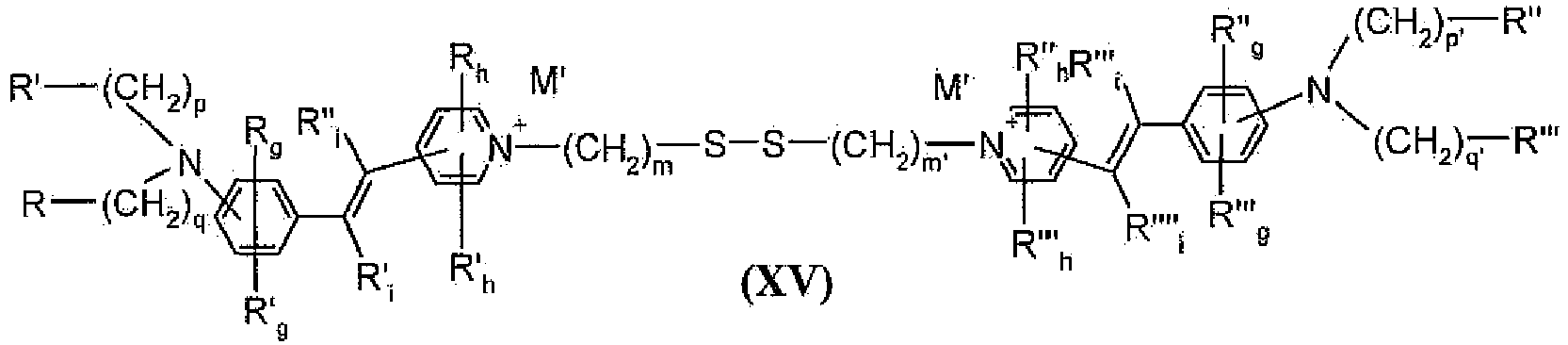
 R und R"', die gleich oder verschieden sein können, für eine Hydroxylgruppe, eine Aminogruppe (NRaRb) oder eine Ammoniumgruppe (N+RaRbRc), An-stehen; wobei Ra, Rb und Rc, die gleich oder verschieden sein können, für ein Wasserstoffatom oder eine (C1-C4)Alkylgruppe stehen und An- für ein anionisches Gegenion steht;
oder alternativ dazu zwei Alkylgruppen Ra und Rb der Amino- oder Ammoniumgruppe einen 5- bis 7-gliedrigen Heterocyclus, der gegebenenfalls ein weiteres Stickstoff- oder Nichtstickstoff-Heteroatom umfasst, bilden;R' und R", die gleich oder verschieden sein können, für ein Wasserstoffatom oder eine wie für R bzw. R"' definierte Gruppe stehen;Rg, R'g, R"g, R"'g, Rh, R'h, R"h und R"'h, die gleich oder verschieden sein können, für ein Wasserstoff- oder Halogenatom, eine Amino-, (Di)(C1-C4)alkylamino-, Cyano-, Carboxyl-, Hydroxyl-, Trifluormethyl-, Acylamino-, C1-C4-Alkoxy-, (Poly)hydroxy(C2-C4)alkoxy-, (C1-C4)Alkyl-carbonyloxy-, (C1-C4)Alkoxycarbonyl-, (C1-C4)Alkyl-carbonylamino-, Acylamino-, Carbamoyl- oder (C1-C4)Alkylsulfonylaminogruppe, einen Aminosulfonylrest oder einen Rest (C1-C16)Alkyl, der gegebenenfalls durch eine Gruppe, die aus (C1-C12)Alkoxy, Hydroxyl, Cyano, Carboxyl, Amino und (Di)(C1-C4)alkylamino ausgewählt ist, substituiert ist oder alternativ dazu zwei Alkylreste, die von dem Stickstoffatom der Aminogruppe getragen werden, einen 5- bis 7-gliedrigen Heterocyclus bilden, der gegebenenfalls ein weiteres Stickstoff- oder Nichtstickstoff-Heteroatom umfasst, stehen;R'i, R"i, R"'i und R""i, die gleich oder verschieden sein können, für ein Wasserstoffatom oder eine (C1-C4)Alkylgruppe stehen;m und m', die gleich oder verschieden sein können, für eine ganze Zahl zwischen 1 und 10 inklusive stehen;p, p', q und q', die gleich oder verschieden sein können, für eine ganze Zahl zwischen 1 und 6 inklusive stehen;M' für ein anionisches Gegenion steht undwobei es sich versteht, dass die Verbindung der Formel (XV) oder (XV') dann, wenn sie andere kationische Teile enthält, mit einem oder mehreren anionischen Gegenionen, die der Formel (XV) oder (XV') elektrische Neutralität verleihen, kombiniert ist;Y wie im vorhergehenden Anspruch definiert ist;- und den Farbstoffen der nachstehenden Formel (XVI) oder (XVI'):
 • R1 für eine C1-C6-Alkylgruppe, die durch eine oder mehrere Hydroxylgruppen öder -C(O)OR' substituiert ist, steht, wobei R' für ein Wasserstoffatom, eine C1-C4-Alkylgruppe oder alternativ dazu eine Gruppe -C(O)-O- steht und in letzterem Fall ein anionisches Gegenion An- fehlt;• R2 für eine C1-C6-Alkylgruppe, die gegebenenfalls durch eine oder mehrere Hydroxylgruppen substituiert ist, steht;• oder alternativ dazu die Gruppen R1 und R2 zusammen mit dem Stickstoffatom, das sie trägt, einen gesättigten heterocyclischen Rest, der durch mindestens eine Hydroxyl-, (Poly)hydroxy(C1-C4)-alkyl- und/oder -C(O)-OR'-Gruppe substituiert ist, bilden, wobei R' für ein Wasserstoffatom, eine C1-C4-Alkylgruppe oder eine Gruppe -C(O)-O- steht und in letzterem Fall ein anionisches Gegenion An-fehlt;• R3 für ein Wasserstoffatom oder eine Gruppe-C(O)OR" steht, wobei R" für ein Wasserstoffatom, ein Alkalimetall oder eine C1-C6-Alkylgruppe steht oder alternativ dazu R3 für eine Gruppe -C(O)-O-steht und in letzterem Fall ein anionisches Gegenion An- fehlt;• Z für eine zweiwertige Amidogruppe -C(O)-N(R)-,-N(R)-C(O)-, oder eine zweiwertige C1-C10-Alkylengruppe, die durch eine Amidogruppe -C(O)-N(R)-, -N(R)-C(O)- unterbrochen ist, wie -(CH2)n'-C(O)-N(R)-(CH2)p-, -(CH2)n"-N(R)-C(O)-(CH2)p-, steht, wobei n' für eine ganze Zahl zwischen 0 und 3 inklusive steht; vorzugsweise n' gleich 0, 2, 3 ist; p für eine ganze Zahl zwischen 0 und 4 inklusive steht, n" für eine gänze Zahl zwischen 0 und 3 inklusive steht und insbesondere n'=n"=p=0 und R für ein Wasserstoffatom oder eine C1-C6-Alkylgruppe steht;• An- für ein anionisches Gegenion steht;• Y wie im vorhergehenden Anspruch definiert ist; wobei es sich versteht, dass die Verbindung der Formel (XVI) oder (XVI') dann, wenn sie andere kationische Teile enthält, mit einem oder mehreren anionischen Gegenionen, die der Formel (XVI) oder (XVI') elektrische Neutralität verleihen, kombiniert ist.
 - Zusammensetzung nach einem der vorhergehenden Ansprüche, wobei es sich bei dem Farbstoff bzw. den Farbstoffen der Formel (I) um diejenigen handelt, die die folgenden chemischen Strukturen aufweisen:


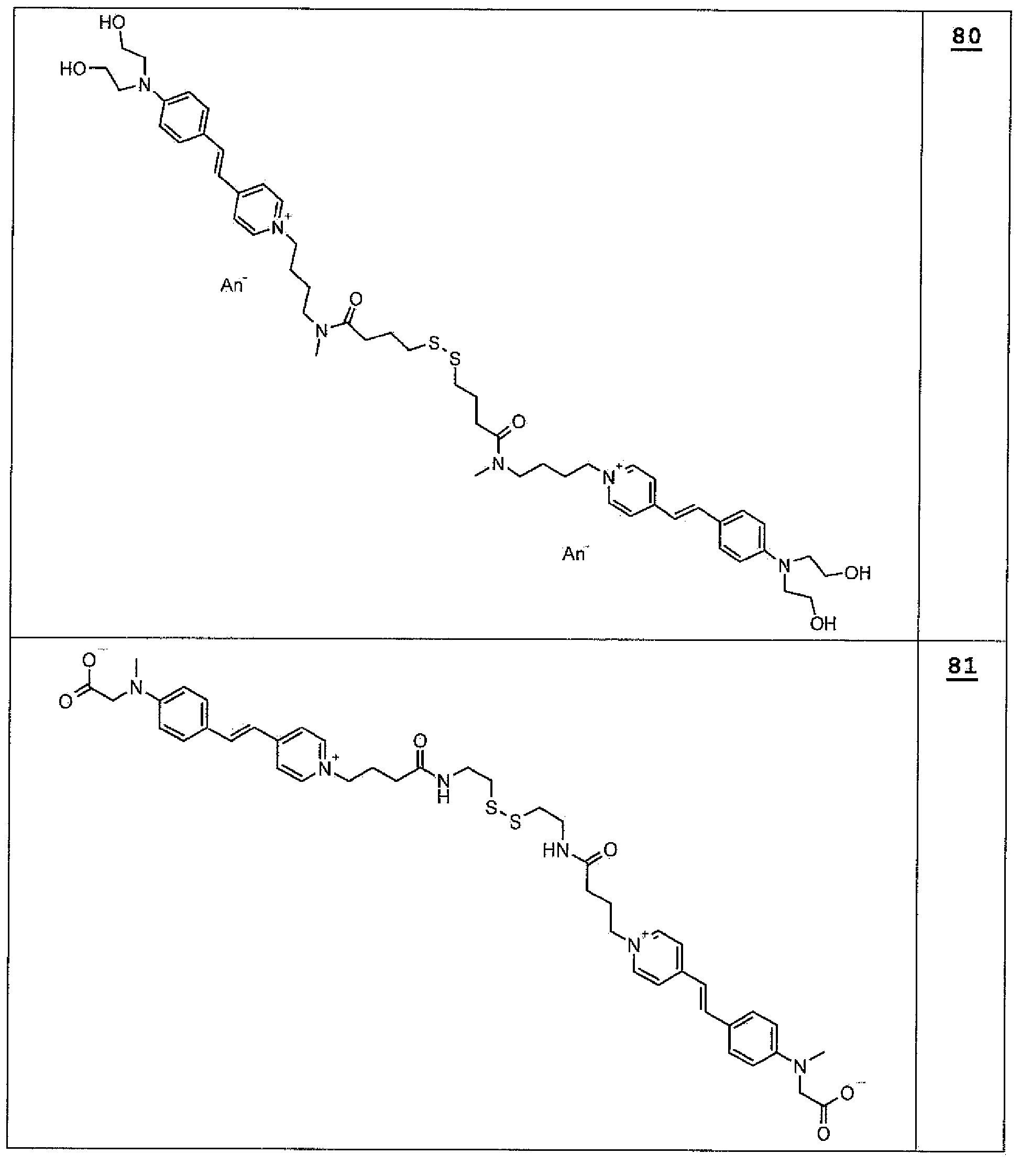


 wobei An- und M', die gleich oder verschieden, vorzugsweise gleich, sein können, für anionische Gegenionen stehen; insbesondere das anionische Gegenion aus Halogenidionen wie Chlorid, Alkylsulfaten wie Methylsulfat, Mesylat und ½ SO4 2- ausgewählt ist; vorzugsweise die Farbstoffe 44, 49, 49a und 55.
- Zusammensetzung nach einem der vorhergehenden Ansprüche, wobei ii) das nichtionische Tensid bzw. die nichtionischen Tenside aus- Fettalkoholen;- α-Diolen;- Alkylphenolen, wobei diese drei Verbindungstypen polyethoxyliert, polypropoxyliert und/oder polyglyceriniert sein können und eine Fettkette enthalten, die insbesondere 8 bis 22 Kohlenstoffatome umfasst, wobei die Zahl der Ethylenoxid- oder Propylenoxidgruppen insbesondere im Bereich von 2 bis 50 liegen kann und die Zahl der Glyceringruppen insbesondere zwischen 2 und 30 inklusive liegen kann;- Copolymeren von Ethylenoxid und Propylenoxid, Kondensaten von Ethylenoxid und Propylenoxid an Fettalkoholen;- polyethoxylierten Fettamiden, die vorzugsweise 2 bis 30 mol Ethylenoxid enthalten;- polyglycerinierten Fettamiden mit durchschnittlich 1 bis 5 und insbesondere 1,5 bis 4 Glyceringruppen;- oxyethylenierten Fettsäureestern von Sorbitan mit 2 bis 30 mol Ethylenoxid;- Fettsäureestern von Saccharose;- Fettsäureestern von Polyethylenglykol;- Alkylpolyglycosiden;- N-Alkylglucaminderivaten, Aminoxiden wie (C10-C14)-Alkylaminoxiden oder N-Acylaminopropylmorpholinoxidenausgewählt ist bzw. sind.
- Zusammensetzung nach einem der vorhergehenden Ansprüche, wobei ii) das nichtionische Tensid bzw. die nichtionischen Tenside aus (poly)ethoxylierten Fettalkoholen; glycerinierten Fettalkoholen; Alkylpolyglycosiden ausgewählt ist bzw. sind.
- Zusammensetzung nach einem der vorhergehenden Ansprüche, wobei iii) das amphotere Tensid bzw. die amphoteren Tenside aus (C8-C20-Alkyl)betainen, (C8-C20-Alkyl)amido(C2-C8-alkyl)betainen und den Produkten der jeweiligen nachstehenden Strukturen (XVIII) und (XIX)
Ra-C(O)-NH-CH2-CH2-N+(Rb)(Rc)-CH2-C(O)-O- (XVIII)
wobei in Formel (XVIII):• Ra für eine C10-C30-Alkyl- oder Alkenylgruppe, die sich von einer Säure Ra-C(O)-OH ableitet, die vorzugsweise in hydrolysiertem Kokosnussöl vorliegt, oder eine Heptyl-, Nonyl- oder Undecylgruppe steht;• Rb für eine β-Hydroxyethylgruppe steht und• Rc für eine Carboxymethylgruppe steht;und
Ra-C(O)-NH-CH2-CH2-N(B)B' (XIX)
wobei in Formel (XIX):• B für -CH2CH2OX' steht;• B' für -(CH2)z-Y' steht, wobei z = 1 oder 2;• X' für die Gruppe -CH2-C(O)-OH, -CH2-C(O)-OZ',-CH2=CH2-C(O)-OH, -CH2-CH2-C(O)-OZ' oder ein Wasserstoffatom steht;• Y' für -C(O)-OH, -C(O)OZ' oder die Gruppe -CH2-CH(OH)-SO3H oder -CH2-CH(OH)-SO3Z' steht;• Z' für ein Ion, das sich von einem Alkali- oder Erdalkalimetall, wie Natrium, Kalium oder Magnesium, ableitet; ein Ammoniumion oder ein Ion, das sich von einem organischen Amin und insbesondere von einem Aminoalkohol, wie Mono-, Di- und Triethanolamin, Mono-, Di- oder Triisopropoanolamin, 2-Amino-2-methyl-1-propanol, 2-Amino-2-methyl-1,3-propandiol und Tris(hydroxymethyl)aminomethan, ableitet, steht;• Ra für eine C10-C30-Alkyl- oder Alkenylgruppe, die sich von einer Säure Ra-C(O)-OH ableitet, die vorzugsweise in Kokosnussöl oder in hydrolysiertem Leinsamenöl vorliegt, oder eine Alkylgruppe, insbesondere eine C17-Alkylgruppe und deren Isoform, oder eine ungesättigte C17-Gruppe steht;und Mischungen davon ausgewählt ist bzw. sind. - Zusammensetzung nach einem der vorhergehenden Ansprüche, wobei iii) das amphotere Tensid bzw. die amphoteren Tenside aus Cocoylamidopropylbetain und Cocoylbetain und dem N-Cocoylamidocarboxymethylglycinat eines Alkalimetalls ausgewählt ist bzw. sind.
- Zusammensetzung nach einem der vorhergehenden Ansprüche, wobei iv) das alkalische Mittel bzw. die alkalischen Mittel aus wässrigem Ammoniak, Alkalimetallcarbonaten oder -hydrogencarbonaten wie Natrium- oder Kaliumcarbonat und Natrium- oder Kaliumhydrogencarbonat, Natrium- oder Kaliumhydroxid oder Mischungen davon, Alkanolaminen, oxyethylenierten und/oder oxypropylenierten Ethylendiaminen, Aminosäuren und den Verbindungen der nachstehenden Formel (XX) ausgewählt ist bzw. sind:
 • W für einen zweiwertigen C1-C6-Alkylenrest, der gegebenenfalls durch eine Hydroxylgruppe oder einen C1-C6-Alkylrest substituiert und/oder gegebenenfalls durch ein oder mehrere Heteroatome wie Sauerstoff oder NRu unterbrochen ist, steht;• Rx, Ry, Rz, Rt und Ru, die gleich oder verschieden sein können, für ein Wasserstoffatom oder einen C1-C6-Alkyl-, C1-C6-Hydroxyalkyl- oder C1-C6-Aminoalkylrest stehen;vorzugsweise das alkalische Mittel bzw. die alkalischen Mittel aus Alkanolaminen wie Monoethanolamin ausgewählt ist bzw. sind.
 - Zusammensetzung nach einem der vorhergehenden Ansprüche, wobei v) das Reduktionsmittel bzw. die Reduktionsmittel aus Thioglykolsäure, Thiomilchsure, 3-Mercaptopropionsäure, Thioäpfelsäure, 2,3-Dimercaptobernsteinsäure, Cystein, N-Glycyl-L-cystein, L-Cysteinylglycin sowie Estern und Salzen davon, Thioglycerin, Cysteamin und C1-C4-Acylderivaten davon, N-Mesylcysteamin, N-Acetylcystein, N-Mercaptoalkylamiden von Zuckern wie N-(Mercapto-2-ethyl)-gluconamid, Pantethein, N-(Mercaptoalkyl)-ω-hydroxy-alkylamiden, N-Mono- oder N,N-Dialkylmercapto-4-butyr-amiden, Aminomercaptoalkylamiden, N-(Mercaptoalkyl)-bernsteinsäuremonoamiden und N-(Mercaptoalkyl)succinimiden, Alkylaminomercaptoalkylamiden, dem azeotropen Gemisch von 2-Hydroxypropylthioglykolat und (2-Hydroxy-1-methyl)ethylthioglykolat, Mercaptoalkylaminoamiden und N-Mercaptoalkylalkandiamiden und vorzugsweise aus Thioglykolsäure und Cystein oder Salzen davon ausgewählt ist bzw. sind.
- Verfahren zum Färben von Keratinfasern, insbesondere dunklen Keratinfasern, bei dem man auf die Keratinfasern:i) mindestens einen Direktfarbstoff mit einer Disulfid-, Thiol- oder geschützten Thiolfunktion gemäß einem der Ansprüche 1 bis 11;ii) mindestens ein nichtionisches Tensid gemäß Anspruch 1, 12 oder 13;iii) mindestens ein amphoteres Tensid gemäß Anspruch 1, 14 oder 15;iv) mindestens ein alkalisches Mittel gemäß Anspruch 1 oder 16 undv) mindestens ein Reduktionsmittel gemäß Anspruch 1 oder 17 undvi) gegebenenfalls mindestens ein chemisches Oxidationsmittel undvii) gegebenenfalls mindestens ein verdickendes organisches Polymeraufbringt, wobei die Bestandteile i) bis vii) entweder zusammen oder separat auf die Fasern aufgebracht werden können.
- Verfahren nach dem vorhergehenden Anspruch durch Aufbringen einer Zusammensetzung nach einem der Ansprüche 1 bis 17 auf die Fasern.
- Verfahren nach Anspruch 19 durch Aufbringen einer reduzierenden Zusammensetzung, die die Bestandteile iv) bis v) gemäß den Ansprüchen 1, 16 und 17 umfasst, auf die Keratinfasern und anschließendes Aufbringen einer Farbstoffzusammensetzung, die die Bestandteile i) bis iii) gemäß einem der Ansprüche 1 bis 15 und gegebenenfalls vii) mindestens ein verdickendes organisches Polymer umfasst.
- Verfahren zum aufhellenden Färben von dunklen Keratinfasern, insbesondere mit einer Tonhöhe kleiner gleich 6 und vorzugsweise kleiner gleich 4, nach einem der Ansprüche 18 bis 20, umfassend den Schritt des Aufbringens auf die Keratinfasern, wobei der Bestandteil bzw. die Bestandteile i) die Formeln (XIII), (XIII'), (XIV), (XIV'), (XVa), (XV'a), (XV) bis (XV'), (XVI), (XVI'), (XVIa) und (XVI'a) gemäß den Ansprüchen 9 oder 10 und 11 aufweist bzw. aufweisen und insbesondere die Fluoreszenzfarbstoffe i) aus den Verbindungen 44, 49, 49a und 55 gemäß Anspruch 11 ausgewählt werden.
- Färbevorrichtung oder Färbe-"Kit" mit mehreren Kompartimenten, wobei:- das erste Kompartiment eine Farbstoffzusammensetzung, die die Zusammensetzung, die den Bestandteil i) gemäß einem der Ansprüche 1 bis 11 enthält, umfasst, enthält;- das zweite Kompartiment ein Reduktionsmittel v) gemäß Anspruch 1 oder 17 enthältund die Vorrichtung gegebenenfalls ein drittes Kompartiment umfasst;- wobei das dritte Kompartiment vi) mindestens ein chemisches Oxidationsmittel umfasst;wobei es sich versteht, dass die Bestandteile ii) bis iv) gemäß einem der Ansprüche 1 und 12 bis 16 auf die ersten zwei Kompartimente verteilt sind.
Applications Claiming Priority (3)
| Application Number | Priority Date | Filing Date | Title |
|---|---|---|---|
| FR1151555A FR2971936B1 (fr) | 2011-02-25 | 2011-02-25 | Composition pour colorer les fibres keratiniques comprenant un colorant direct a fonction disulfure/thiol, un tensioactif non ionique, un tensioactif amphotere, un alcool gras ethoxyle, un agent alcalin, et un agent reducteur |
| US201161448769P | 2011-03-03 | 2011-03-03 | |
| PCT/EP2012/052748 WO2012113722A2 (en) | 2011-02-25 | 2012-02-17 | Composition for dyeing keratin fibres comprising a direct dye bearing a disulfide/thiol function, a nonionic surfactant, an amphoteric surfactant, an ethoxylated fatty alcohol, an alkaline agent and a reducing agent |
Publications (2)
| Publication Number | Publication Date |
|---|---|
| EP2677995A2 EP2677995A2 (de) | 2014-01-01 |
| EP2677995B1 true EP2677995B1 (de) | 2017-04-26 |
Family
ID=44550255
Family Applications (1)
| Application Number | Title | Priority Date | Filing Date |
|---|---|---|---|
| EP12705281.9A Not-in-force EP2677995B1 (de) | 2011-02-25 | 2012-02-17 | Zusammensetzung zur färbung von keratinfasern mit einem direktfarbstoff mit einer disulfid/thiol-funktion, einem nichtionischen tensid, einem amphoteren tensid, einem alkalisierungsmittel und einem reduktionsmittel |
Country Status (9)
| Country | Link |
|---|---|
| US (1) | US9265705B2 (de) |
| EP (1) | EP2677995B1 (de) |
| CN (2) | CN103379896A (de) |
| BR (1) | BR112013021582B1 (de) |
| ES (1) | ES2627920T3 (de) |
| FR (1) | FR2971936B1 (de) |
| MX (1) | MX341597B (de) |
| RU (2) | RU2013143304A (de) |
| WO (1) | WO2012113722A2 (de) |
Families Citing this family (24)
| Publication number | Priority date | Publication date | Assignee | Title |
|---|---|---|---|---|
| FR2971937B1 (fr) | 2011-02-25 | 2013-02-15 | Oreal | Composition pour colorer les fibres keratiniques comprenant un colorant direct a fonction disulfure/thiol, un polymere epaississant non cellulosique, un agent alcalin, et un agent reducteur |
| FR2971938B1 (fr) | 2011-02-25 | 2013-08-02 | Oreal | Composition pour colorer les fibres keratiniques comprenant un colorant direct a fonction disulfure/thiol, un alcool gras faiblement ou non ethoxyle, un tensioactif cationique, un agent alcalin, et un agent reducteur |
| FR2971935B1 (fr) | 2011-02-25 | 2013-02-15 | Oreal | Composition pour colorer les fibres keratiniques comprenant un colorant direct a fonction disulfure/thiol, un polymere epaississant, un tensioactif non ionique, un agent alcalin, et un agent reducteur |
| RU2680068C2 (ru) * | 2013-09-02 | 2019-02-14 | Л'Ореаль | Способ окрашивания кератиновых волокон с применением катионных стириловых дисульфидных красителей и композиция, содержащая указанные красители |
| US9383644B2 (en) | 2014-09-18 | 2016-07-05 | Heraeus Precious Metals North America Daychem LLC | Sulfonic acid derivative compounds as photoacid generators in resist applications |
| FR3030237B1 (fr) | 2014-12-17 | 2017-07-14 | Oreal | Composition de coloration comprenant une base d'oxydation para-phenylenediamine, un tensio actif amphotere dans un milieu riche en corps gras |
| FR3030244B1 (fr) | 2014-12-17 | 2018-07-06 | L'oreal | Composition de coloration comprenant une base d'oxydation para-phenylenediamine et un coupleur particulier |
| FR3030233B1 (fr) | 2014-12-17 | 2016-12-09 | Oreal | Composition de coloration comprenant une base d'oxydation para-phenylenediamine, et un polymere amphotere ou cationique dans un milieu riche en corps gras |
| FR3030255B1 (fr) | 2014-12-17 | 2016-12-23 | Oreal | Composition de coloration comprenant une base d'oxydation para-phenylenediamine, un epaississant polysaccharide dans un milieu riche en corps gras |
| FR3030234B1 (fr) * | 2014-12-17 | 2018-05-18 | Oreal | Composition de coloration comprenant une base d'oxydation para-phenylenediamine, un tensio actif non ionique dans un milieu riche en corps gras |
| FR3030243B1 (fr) | 2014-12-17 | 2018-11-09 | L'oreal | Composition de coloration comprenant une base d'oxydation para-phenylenediamine et une base d'oxydation heterocyclique |
| US9477150B2 (en) | 2015-03-13 | 2016-10-25 | Heraeus Precious Metals North America Daychem LLC | Sulfonic acid derivative compounds as photoacid generators in resist applications |
| MX2017012137A (es) | 2015-03-19 | 2018-02-19 | Basf Se | Tinturas directas cationicas. |
| WO2018098821A1 (en) * | 2016-12-02 | 2018-06-07 | L'oreal | Process for shaping hair using nanoemulsion composition |
| FR3060990B1 (fr) * | 2016-12-22 | 2019-11-01 | L'oreal | Procede de coloration et detente de boucles des fibres keratiniques, mettant en oeuvre des agents reducteurs et des colorants capillaires, et kit associe |
| FR3066108B1 (fr) * | 2017-05-10 | 2020-10-30 | Oreal | Colorant direct fluorescent a chaine aliphatique et a fonction disulfure/thiol/thiol protege pour colorer les matieres keratiniques |
| FR3067597B1 (fr) | 2017-06-16 | 2020-09-04 | Oreal | Procede de coloration des fibres keratiniques mettant en œuvre au moins un colorant direct et au moins un colorant fluorescent disulfure, thiol ou thiol protege |
| FR3067599B1 (fr) | 2017-06-16 | 2020-09-04 | Oreal | Procede de coloration des matieres keratiniques mettant en oeuvre au moins un colorant bleu, violet ou vert et au moins un colorant fluorescent disulfure, thiol ou thiol protege |
| DE102017223419B4 (de) * | 2017-12-20 | 2025-05-22 | Henkel Ag & Co. Kgaa | Tönungsshampoo mit verbesserter Färbeleistung |
| DE102017223420B4 (de) * | 2017-12-20 | 2025-05-28 | Henkel Ag & Co. Kgaa | Verbesserte Tönungsshampoos |
| DE102018207024A1 (de) * | 2018-05-07 | 2019-11-07 | Henkel Ag & Co. Kgaa | Mittel zum Färben von Haaren enthaltend mindestens eine organische Siliciumverbindung, einen direktziehenden Farbstoff und ein filmbildendes, hydrophobes Polymer |
| EP3989924A4 (de) * | 2019-06-28 | 2023-08-16 | L'oreal | Kosmetische zusammensetzung zum oxidativen färben von keratinfasern |
| CN115916844B (zh) * | 2020-05-19 | 2024-12-10 | 国家科学研究中心 | 用重氮化合物化学官能化纤维素材料 |
| CN113151876B (zh) * | 2021-04-20 | 2022-05-06 | 深圳市曼特表面处理科技有限公司 | 铝合金阳极染色用稳染剂及其制备方法 |
Family Cites Families (112)
| Publication number | Priority date | Publication date | Assignee | Title |
|---|---|---|---|---|
| GB738585A (en) | 1952-07-17 | 1955-10-19 | May & Baker Ltd | Improvements in or relating to tetrazolium compounds |
| US2798053A (en) | 1952-09-03 | 1957-07-02 | Goodrich Co B F | Carboxylic polymers |
| BE535125A (de) | 1954-01-25 | |||
| DE1078081B (de) | 1958-02-25 | 1960-03-24 | Thera Chemie Chemisch Therapeu | Mittel zum Faerben von Haaren oder Pelzen |
| US3148125A (en) | 1961-03-22 | 1964-09-08 | Yardley Of London Inc | Clear lipstick |
| US3867456A (en) | 1965-07-30 | 1975-02-18 | Oreal | Mono-omega-haloalkyl amines |
| NL130871C (de) | 1965-07-30 | |||
| FR1516943A (fr) | 1966-01-10 | 1968-02-05 | Oreal | Colorants basiques utilisables pour la teinture des cheveux |
| LU50233A1 (de) | 1966-01-10 | 1967-07-10 | ||
| FR1540423A (fr) | 1966-07-25 | 1968-09-27 | Oreal | Nouveaux colorants, leurs procédés de fabrication et leurs applications |
| US3817698A (en) | 1966-07-25 | 1974-06-18 | Oreal | Keratinic fiber dye compositions containing n,n'-di-nitrophenyl or nitrophenyl - anthraquinone substituted alkylene diamine dyes and the mono-quaternary ammonium salts thereof |
| CH469060A (de) | 1966-08-05 | 1969-02-28 | Durand & Huguenin Ag | Verfahren zur Herstellung von wasserlöslichen, kationischen Monoazofarbstoffen und Verwendung derselben |
| LU53050A1 (de) | 1967-02-22 | 1968-08-27 | ||
| LU53095A1 (de) | 1967-03-01 | 1968-11-29 | ||
| US3524842A (en) | 1967-08-04 | 1970-08-18 | Durand & Huguenin Ag | Water-soluble cationic phenylazo-naphthol dyestuffs containing a quaternary ammonium group |
| US3645705A (en) | 1970-03-03 | 1972-02-29 | Kolar Lab Inc | Transparent combustible material suitable for candle bodies |
| CH560539A5 (de) | 1971-06-04 | 1975-04-15 | Oreal | |
| US4151162A (en) | 1971-06-04 | 1979-04-24 | L'oreal | Diazomerocyanines and mesomeric forms thereof |
| LU70835A1 (de) | 1974-08-30 | 1976-08-19 | ||
| US3985499A (en) | 1971-06-04 | 1976-10-12 | L'oreal | Diazamerocyanines for dyeing keratinous fibers |
| LU65539A1 (de) | 1972-06-19 | 1973-12-21 | ||
| GB1514466A (en) | 1974-06-21 | 1978-06-14 | Ici Ltd | Preparation of bipyridilium compounds |
| CH606154A5 (de) | 1974-07-02 | 1978-11-15 | Goodrich Co B F | |
| US3969087A (en) | 1974-08-07 | 1976-07-13 | Ajinomoto Co., Ltd. | Gels of nonpolar liquids with N-acyl amino acids and derivatives thereof as gelling agents |
| LU71015A1 (de) | 1974-09-27 | 1976-08-19 | ||
| GB1567947A (en) | 1976-07-02 | 1980-05-21 | Unilever Ltd | Esters of quaternised amino-alcohols for treating fabrics |
| US4131576A (en) | 1977-12-15 | 1978-12-26 | National Starch And Chemical Corporation | Process for the preparation of graft copolymers of a water soluble monomer and polysaccharide employing a two-phase reaction system |
| DE2806098C2 (de) | 1978-02-14 | 1984-08-30 | Hoechst Ag, 6230 Frankfurt | Verwendung von vernetzten Polymeren zur Erhöhung der Viskosität bei kosmetischen, pharmazeutischen und technischen Präparaten |
| US4509949A (en) | 1983-06-13 | 1985-04-09 | The B. F. Goodrich Company | Water thickening agents consisting of copolymers of crosslinked acrylic acids and esters |
| US4514552A (en) | 1984-08-23 | 1985-04-30 | Desoto, Inc. | Alkali soluble latex thickeners |
| LU85564A1 (fr) | 1984-10-01 | 1986-06-11 | Oreal | Nouvelles compositions de teinture des fibres keratiniques contenant un colorant azoique,procede de preparation de ce colorant et mise en oeuvre desdites compositions pour la teinture des fibres keratiniques |
| FR2586913B1 (fr) | 1985-09-10 | 1990-08-03 | Oreal | Procede pour former in situ une composition constituee de deux parties conditionnees separement et ensemble distributeur pour la mise en oeuvre de ce procede |
| US5089578A (en) | 1986-03-28 | 1992-02-18 | Exxon Research And Engineering Company | Hydrophobically associating terpolymers containing sulfonate functionality |
| DE3623215A1 (de) | 1986-07-10 | 1988-01-21 | Henkel Kgaa | Neue quartaere ammoniumverbindungen und deren verwendung |
| LU87310A1 (fr) | 1988-08-04 | 1990-03-13 | Oreal | N-(mercaptoalkyl)omega-hydroxyalkylamides et leur utilisation en tant qu'agents reducteurs,dans un procede de deformation permanente des cheveux |
| LU87378A1 (fr) | 1988-11-09 | 1990-06-12 | Oreal | Mercapto-4 butyramides n-mono ou n,n-disubstitues par un radical mono ou polyhydroxyalkyle,et leur utilisation en tant qu'agents reducteurs dans un procede de deformation permanente des cheveux |
| US5156911A (en) | 1989-05-11 | 1992-10-20 | Landec Labs Inc. | Skin-activated temperature-sensitive adhesive assemblies |
| FR2654617B1 (fr) | 1989-11-20 | 1993-10-08 | Oreal | Composition cosmetique reductrice pour permanente contenant, en tant qu'agent reducteur, de l'aletheine ou l'un de ses sels, et son utilisation dans un procede de deformation permanente des cheveux. |
| FR2663845B1 (fr) | 1990-07-02 | 1994-01-07 | Oreal | Composition cosmetique reductrice pour permanente contenant un derive d'acide n-(mercapto alkyl) succinamique ou de n-(mercapto alkyl) succinimide, et son utilisation dans un procede de deformation permanente des cheveux. |
| JPH04295417A (ja) | 1991-01-16 | 1992-10-20 | Estee Lauder Inc | スチレン−エチレン−プロピレン共重合体含有化粧品組成物およびその使用方法 |
| GB9104878D0 (en) | 1991-03-08 | 1991-04-24 | Scott Bader Co | Thickeners for personal care products |
| FR2676441B1 (fr) | 1991-05-17 | 1994-10-28 | Oreal | Nouveaux alkylamino-mercaptoalkylamides ou l'un de leurs sels cosmetiquement acceptables, et leur utilisation en tant qu'agents reducteurs, dans un procede de deformation permanente des cheveux. |
| FR2679448B1 (fr) | 1991-07-23 | 1993-10-15 | Oreal | Melange azetrope de thioglycolate d'hydroxy-2 propyle et de thioglycolate d'hydroxy-2 methyl-1 ethyle, son procede d'obtention et son utilisation dans un procede de deformation permanente des cheveux. |
| FR2679444B1 (fr) | 1991-07-25 | 1995-04-07 | Oreal | Utilisation comme agents epaississants des huiles, dans une composition cosmetique huileuse, d'une association de deux copolymeres. |
| DE4137005A1 (de) | 1991-11-11 | 1993-05-13 | Bitterfeld Wolfen Chemie | Mittel zum faerben von haaren |
| US5468477A (en) | 1992-05-12 | 1995-11-21 | Minnesota Mining And Manufacturing Company | Vinyl-silicone polymers in cosmetics and personal care products |
| DE4220388A1 (de) | 1992-06-22 | 1993-12-23 | Bitterfeld Wolfen Chemie | Kationische Azofarbstoffe zum Färben von Keratinmaterialien |
| FR2692481B1 (fr) | 1992-06-23 | 1994-09-02 | Oreal | Composition cosmétique réductrice pour la déformation permanente des cheveux à base d'un mercaptoalkylamino-amide et procédé de déformation permanente des cheveux. |
| TW311089B (de) | 1993-07-05 | 1997-07-21 | Ciba Sc Holding Ag | |
| FR2712286B1 (fr) | 1993-11-12 | 1995-12-22 | Oreal | Nouveaux N-mercaptoalkyl alcanediamines et leur utilisation. |
| US5888252A (en) | 1993-11-30 | 1999-03-30 | Ciba Specialty Chemicals Corporation | Processes for dyeing keratin-containing fibres with cationicazo dyes |
| TW325998B (en) | 1993-11-30 | 1998-02-01 | Ciba Sc Holding Ag | Dyeing keratin-containing fibers |
| US5500209A (en) | 1994-03-17 | 1996-03-19 | The Mennen Company | Deodorant and antiperspirant compositions containing polyamide gelling agent |
| DE59510392D1 (de) | 1994-11-03 | 2002-10-31 | Ciba Sc Holding Ag | Kationische Imidazolazofarbstoffe |
| EP0750899A3 (de) | 1995-06-30 | 1998-05-20 | Shiseido Company Limited | Ein aus einem wasserlöslichen amphiphilen Polyelektrolyten bestehender Emulgator oder Lösungsvermittler und eine diesen enthaltende emulgierte oder solubilisierte Zusammensetzung und ein diesen enthaltendes emulgiertes oder solubilisiertes Kosmetikum |
| FR2748932B1 (fr) | 1996-05-23 | 1998-07-03 | Oreal | Composition de teinture directe capillaire comprenant un polymere reticule a motifs acryliques et acrylates d'akyles en c10-c30 |
| US5783657A (en) | 1996-10-18 | 1998-07-21 | Union Camp Corporation | Ester-terminated polyamides of polymerized fatty acids useful in formulating transparent gels in low polarity liquids |
| GB9624590D0 (en) | 1996-11-27 | 1997-01-15 | Warner Jenkinson Europ Limited | Dyes |
| FR2757384B1 (fr) | 1996-12-23 | 1999-01-15 | Oreal | Composition de teinture d'oxydation des fibres keratiniques et procede de teinture mettant en oeuvre cette composition |
| FR2757385B1 (fr) | 1996-12-23 | 1999-01-29 | Oreal | Composition de teinture d'oxydation des fibres keratiniques et procede de teinture mettant en oeuvre cette composition |
| US5736125A (en) | 1997-01-10 | 1998-04-07 | National Starch And Chemical Investment Holding Corporation | Compositions containing copolymers as a thickening agent |
| FR2759756B1 (fr) | 1997-02-20 | 1999-04-23 | Hutchinson | Dispositif de liaison etanche entre des canaux |
| EP1005322B1 (de) | 1997-03-26 | 2005-11-09 | Avon Products, Inc. | Abriebfeste kosmetika |
| US5879670A (en) | 1997-03-31 | 1999-03-09 | Calgon Corporation | Ampholyte polymers for use in personal care products |
| FR2771409B1 (fr) | 1997-11-21 | 2000-01-14 | Oreal | Nouveaux composes azoiques, utilisation pour la teinture, compositions les contenant et procedes de teinture |
| ES2215284T3 (es) | 1997-12-05 | 2004-10-01 | L'oreal | Procedimiento de tinte directo en dos etapas de las fibras queratinicas empleando colorantes directos basicos. |
| WO1999040895A1 (en) | 1998-02-10 | 1999-08-19 | Yamahatsu Sangyo Kaisha, Ltd. | A permanent wave agent composition having dyeing effect and method for dyeing hair using the same |
| FR2776186B1 (fr) | 1998-03-20 | 2001-01-26 | Oreal | Composition de teinture d'oxydation des fibres keratiniques et procede de teinture mettant en oeuvre cette composition |
| US6225390B1 (en) | 1998-05-08 | 2001-05-01 | Shell Oil Company | Oil gel formulations containing polystyrene-polydimethylsiloxane or polyethylene-polydimethylsiloxane block copolymers dissolved in siloxane monomers |
| DE69832422T2 (de) | 1998-11-23 | 2006-08-10 | M-I L.L.C., Houston | Amphiphile polymere stabilisierte invert-emulsionen und verwendung zu bohrflüssigkeiten |
| FR2788433B1 (fr) | 1999-01-19 | 2003-04-04 | Oreal | Utilisation de composes phenyl-azo-benzeniques cationiques en teinture des fibres keratiniques, compositions tinctoriales et procedes de teinture |
| US6207778B1 (en) | 1999-05-07 | 2001-03-27 | Isp Investments Inc. | Conditioning/styling terpolymers |
| US6174968B1 (en) | 1999-08-24 | 2001-01-16 | Shell Oil Company | Oil gel formulations containing polysiloxane block copolymers dissolved in hydrogenated silicone oils |
| US7101928B1 (en) | 1999-09-17 | 2006-09-05 | Landec Corporation | Polymeric thickeners for oil-containing compositions |
| US6225690B1 (en) | 1999-12-10 | 2001-05-01 | Lsi Logic Corporation | Plastic ball grid array package with strip line configuration |
| DE60102904T2 (de) | 2000-03-09 | 2005-03-31 | Ciba Specialty Chemicals Holding Inc. | Verfahren zur färbung von haaren unter verwendung von kationischen farbstoffen |
| JP2001261535A (ja) | 2000-03-17 | 2001-09-26 | Kao Corp | 毛髪用染色剤組成物 |
| EP1133975B1 (de) | 2000-03-17 | 2008-02-13 | Kao Corporation | Verwendung einer Verbindung zum Haare färben |
| JP2005520868A (ja) | 2001-09-24 | 2005-07-14 | チバ スペシャルティ ケミカルズ ホールディング インコーポレーテッド | カチオン性反応染料 |
| WO2005097051A2 (en) | 2004-04-08 | 2005-10-20 | Ciba Specialty Chemicals Holding Inc. | Disulfide dyes, composition comprising them and method of dyeing hair |
| US7425221B2 (en) | 2004-09-13 | 2008-09-16 | L'oreal S.A. | Composition comprising at least one substituted derivative of carbocyanine, method for treating keratin fibers using it, device and use |
| FR2875130B1 (fr) | 2004-09-13 | 2006-12-15 | Oreal | Composition comprenant au moins un derive substitue de carbocyanine, procede de traitement des fibres keratiniques la mettant en oeuvre, dispositif et utilisation |
| FR2876576B1 (fr) * | 2004-10-14 | 2006-12-08 | Oreal | Composition de teinture comprenant un colorant disulfure particulier et procede de coloration des fibres keratiniques humaines a partir de ce colorant |
| US7488354B2 (en) | 2004-10-14 | 2009-02-10 | L'oreal S.A. | Dyeing composition comprising at least one disulphide dye and method of dyeing human keratin fibers using this dye |
| US7550015B2 (en) | 2005-03-31 | 2009-06-23 | L'oreal S.A. | Dye composition with a reduced content of starting materials, and process for dyeing keratin fibers using the same |
| WO2007110538A2 (fr) | 2006-03-24 | 2007-10-04 | L'oréal | Composition de teinture comprenant un colorant fluorescent thiol masque a groupe dimethylamino, a charge cationique interne, procede d'eclaircissement des matieres keratiniques a partir de ce colorant et de colorant disufure |
| WO2007110536A2 (fr) | 2006-03-24 | 2007-10-04 | L'oréal | Composition de teinture comprenant un colorant fluorescent thiol/disulfure a groupe ortho-pyridinium, a chaine alkylene non interrompue et a charge cationique interne, procede d'eclaircissement des matieres keratiniques a partir de ce colorant |
| WO2007110541A2 (fr) | 2006-03-24 | 2007-10-04 | L'oreal | Composition de teinture comprenant un colorant fluorescent thiol/disulfure a cycle condense et charge cationique interne, procede d'eclaircissement des matieres keratiniques a partir de ce colorant |
| FR2898903B1 (fr) | 2006-03-24 | 2012-08-31 | Oreal | Composition de teinture comprenant un colorant disulfure fluorescent, procede d'eclaircissement des matieres keratiniques a partir de ce colorant |
| WO2007110531A2 (fr) | 2006-03-24 | 2007-10-04 | L'oréal | Composition de teinture comprenant un colorant fluorescent naphtylimide thiol/disulfure, procede d'eclaircissement des matieres keratiniques a partir de ce colorant |
| JP5431916B2 (ja) | 2006-03-24 | 2014-03-05 | ロレアル | 外部カチオン電荷を含むチオール/ジスルフィド蛍光着色剤を含有する染色用組成物、および前記着色剤を使用してケラチン物質を明色化する方法 |
| WO2007110540A2 (fr) | 2006-03-24 | 2007-10-04 | L'oreal | Composition de teinture comprenant un colorant fluorescent thiol/disulfure a groupement alcoxy/hydroxy et a charge cationique interne, procede d'eclaircissement des matieres keratiniques a partir de ce colorant |
| ATE518916T1 (de) | 2006-03-24 | 2011-08-15 | Oreal | Färbezusammensetzung mit einem thiol/disulfid- leuchtfarbstoff mit einem heterozyklus und einer internen kationischen ladung sowie verfahren zur aufhellung von keratinmaterial mit diesem farbstoff |
| JP5378986B2 (ja) | 2006-03-24 | 2013-12-25 | ロレアル | 外部カチオン電荷を含み、中断された(interrupted)アルキレン鎖を含むチオール/ジスルフィド蛍光着色剤を含有する染色用組成物、および前記着色剤を使用してケラチン物質を明色化する方法 |
| ATE508170T1 (de) | 2006-03-24 | 2011-05-15 | Oreal | Färbezusammensetzung mit einem thiol/disulfid- leuchtfarbstoff mit amingruppen und einer internen kationischen ladung sowie verfahren zur aufhellung von keratinmaterial mit diesem farbstoff |
| WO2007110539A2 (fr) | 2006-03-24 | 2007-10-04 | L'oréal | Composition de teinture comprenant un colorant fluorescent thiol/disulfure a heterocycle et a charge cationique interne, procede d'eclaircissement des matieres keratiniques a partir de ce colorant |
| WO2007110535A2 (fr) | 2006-03-24 | 2007-10-04 | L'oréal | Composition de teinture comprenant un colorant fluorescent thiol/disulfure a groupe ortho-pyridinium a chaine alkylene interrompue et a charge cationique interne, procede d'eclaircissement des matieres keratiniques a partir de ce colorant |
| JP5254950B2 (ja) | 2006-03-24 | 2013-08-07 | ロレアル | 外部カチオン電荷を有する複素環を含むチオール/ジスルフィド蛍光着色剤を含有する染色用組成物、および前記着色剤を使用してケラチン物質を明色化する方法 |
| FR2910278A1 (fr) * | 2006-12-26 | 2008-06-27 | Oreal | Compositions comprenant un colorant direct et un tensioactif, procede et utilisation pour la coloration notamment eclaircissante des matieres keratiniques |
| FR2920778B1 (fr) | 2007-09-11 | 2009-10-30 | Oreal | Composes quinoliniums azoiques a motif disulfure/thiol, compositions les comprenant, procede de coloration de fibres keratiniques et dispositif. |
| FR2921376B1 (fr) | 2007-09-21 | 2009-10-30 | Oreal | Compose styryl tetrahydroquinolinium thiol/disulfure, procede d'eclaircissement des matieres keratiniques a partir de ce colorant |
| FR2921380B1 (fr) | 2007-09-21 | 2009-12-04 | Oreal | Colorant derive de pyridocycloalkyle styryle thiol/disulfure, composition tinctoriale comprenant ce colorant, procede d'eclaircissement des matieres keratiniques a partir de ce colorant |
| FR2921377B1 (fr) | 2007-09-21 | 2009-10-30 | Oreal | Compose styryl a motif hydroxy(cyclo)alkylamino thiol/disulfure, procede d'eclaircissement des matieres keratiniques a partir de ce colorant |
| FR2921258A1 (fr) | 2007-09-24 | 2009-03-27 | Oreal | Composition tinctoriale comprenant au moins un precurseur incolore disulfures/thiol, proced de coloration a partir de la composition |
| FR2921256B1 (fr) | 2007-09-24 | 2009-12-04 | Oreal | Composition pour la coloration de fibres keratiniques comprenant au moins un colorant direct a fonction disulfure/thiol et au moins un polymere a fonction thiol et procede utilisant la composition |
| CA2613049A1 (en) * | 2007-11-30 | 2008-04-03 | The Procter & Gamble Company | Coloring agents for keratin fibers |
| FR2928087B1 (fr) * | 2008-02-29 | 2010-02-26 | Oreal | Composition pour la coloration de fibres keratiniques comprenant au moins un colorant direct a fonction disulfure/thiol protege et au moins un compose silicie a fonction thiol et procede utilisant la composition. |
| FR2933297A1 (fr) | 2008-07-03 | 2010-01-08 | Oreal | Composition de teinture directe des fibres keratiniques comprenant une cellulose associative |
| FR2970173B1 (fr) * | 2011-01-10 | 2013-07-05 | Oreal | Procede de coloration ou d'eclaircissement mettant en oeuvre une composition riche en corps gras comprenant un alcool et un ester solides, compositions et dispositif |
| FR2971938B1 (fr) | 2011-02-25 | 2013-08-02 | Oreal | Composition pour colorer les fibres keratiniques comprenant un colorant direct a fonction disulfure/thiol, un alcool gras faiblement ou non ethoxyle, un tensioactif cationique, un agent alcalin, et un agent reducteur |
| FR2971937B1 (fr) | 2011-02-25 | 2013-02-15 | Oreal | Composition pour colorer les fibres keratiniques comprenant un colorant direct a fonction disulfure/thiol, un polymere epaississant non cellulosique, un agent alcalin, et un agent reducteur |
| WO2012113720A2 (en) | 2011-02-25 | 2012-08-30 | L'oreal | Composition for dyeing keratinous fibres comprising a direct dye having a disulphide/thiol functional group, a thickening polymer, an ethoxylated fatty alcohol and/or a nonionic surfactant, an alkaline agent and a reducing agent |
-
2011
- 2011-02-25 FR FR1151555A patent/FR2971936B1/fr not_active Expired - Fee Related
-
2012
- 2012-02-17 RU RU2013143304/15A patent/RU2013143304A/ru unknown
- 2012-02-17 MX MX2013009316A patent/MX341597B/es active IP Right Grant
- 2012-02-17 EP EP12705281.9A patent/EP2677995B1/de not_active Not-in-force
- 2012-02-17 CN CN2012800104599A patent/CN103379896A/zh active Pending
- 2012-02-17 CN CN201710124510.3A patent/CN107095796A/zh active Pending
- 2012-02-17 ES ES12705281.9T patent/ES2627920T3/es active Active
- 2012-02-17 BR BR112013021582-8A patent/BR112013021582B1/pt not_active IP Right Cessation
- 2012-02-17 US US14/001,324 patent/US9265705B2/en not_active Expired - Fee Related
- 2012-02-17 WO PCT/EP2012/052748 patent/WO2012113722A2/en not_active Ceased
- 2012-02-17 RU RU2017112504A patent/RU2017112504A/ru not_active Application Discontinuation
Non-Patent Citations (1)
| Title |
|---|
| None * |
Also Published As
| Publication number | Publication date |
|---|---|
| FR2971936A1 (fr) | 2012-08-31 |
| ES2627920T3 (es) | 2017-08-01 |
| CN103379896A (zh) | 2013-10-30 |
| WO2012113722A2 (en) | 2012-08-30 |
| MX2013009316A (es) | 2013-10-03 |
| MX341597B (es) | 2016-08-26 |
| RU2017112504A (ru) | 2019-01-29 |
| RU2017112504A3 (de) | 2020-08-11 |
| BR112013021582A2 (pt) | 2018-06-12 |
| WO2012113722A3 (en) | 2012-12-13 |
| RU2013143304A (ru) | 2015-03-27 |
| FR2971936B1 (fr) | 2013-02-15 |
| CN107095796A (zh) | 2017-08-29 |
| US20140137342A1 (en) | 2014-05-22 |
| EP2677995A2 (de) | 2014-01-01 |
| US9265705B2 (en) | 2016-02-23 |
| BR112013021582B1 (pt) | 2019-01-29 |
Similar Documents
| Publication | Publication Date | Title |
|---|---|---|
| US9265705B2 (en) | Composition for dyeing keratin fibres comprising a direct dye bearing a disulphide/thiol function, a nonionic surfactant, an amphoteric surfactant, an ethoxylated fatty alcohol, an alkaline agent and a reducing agent | |
| EP2677990B1 (de) | Zusammensetzung zur färbung von keratinfasern mit einem direktfarbstoff mit einer disulfid/thiol-funktion, einem wenig oder nicht-ethoxylierten fettalkohol, einem kationischen tensid, einem alkalisierungsmittel und einem reduktionsmittel | |
| EP2677994B1 (de) | Zusammensetzung zur färbung von keratinfasern mit einem direktfarbstoff mit einer disulfid-funktion, einem nicht-zellulose-basierten verdickungspolymer, einem alkalisierungsmittel und einem reduktionsmittel | |
| EP2677996B1 (de) | Zusammensetzung zur färbung von keratinfasern mit einem direktfarbstoff mit einer disulfid/thiol-funktionsgruppe, einem verdickungspolymer, einem ethoxylierten fettalkohol und/oder einem nichtionischen tensid, einem alkalisierungsmittel und einem reduktionsmittel | |
| US9522106B2 (en) | Composition for dyeing keratinous fibres comprising a direct dye having a disulphide/thiol functional group, a thickening polymer, an ethoxylated fatty alcohol and/or a nonionic surfactant, an alkaline agent and a reducing agent | |
| US20090282624A1 (en) | Composition comprising a hydrophobic dye and an alkylene carbonate or a lactone and dyeing of keratinous fibres | |
| WO2012113725A2 (en) | Composition for dyeing keratin fibres comprising a direct dye bearing a disulfide/thiol function, a fatty substance, an alkaline agent and a reducing agent | |
| FR2954101A1 (fr) | Agent de coloration et/ou de decoloration des fibres keratiniques en deux parties ou plus, comprenant une composition alcaline en emulsion inverse. | |
| FR2942594A1 (fr) | Composition comprenant un colorant naturel et le 3-phenyl-1-propanol, coloration de fibres keratiniques. | |
| FR2971934A1 (fr) | Composition pour colorer les fibres keratiniques comprenant un colorant direct a fonction disulfure/thiol, un polymere epaississant, un alcool gras ethoxyle, un agent alcalin, et un agent reducteur | |
| FR2942591A1 (fr) | Composition comprenant un colorant synthetique et un alcool monohydroxyle aliphatique, coloration de fibres keratiniques la mettant en oeuvre. | |
| FR2923708A1 (fr) | Composition de coloration d'oxydation des fibres keratiniques comprenant un polysaccharide cationique, procede de coloration la mettant en oeuvre et dispositif |
Legal Events
| Date | Code | Title | Description |
|---|---|---|---|
| PUAI | Public reference made under article 153(3) epc to a published international application that has entered the european phase |
Free format text: ORIGINAL CODE: 0009012 |
|
| 17P | Request for examination filed |
Effective date: 20130925 |
|
| AK | Designated contracting states |
Kind code of ref document: A2 Designated state(s): AL AT BE BG CH CY CZ DE DK EE ES FI FR GB GR HR HU IE IS IT LI LT LU LV MC MK MT NL NO PL PT RO RS SE SI SK SM TR |
|
| RIN1 | Information on inventor provided before grant (corrected) |
Inventor name: POURILLE, CHRYSTEL Inventor name: GUERIN, FREDERIC |
|
| DAX | Request for extension of the european patent (deleted) | ||
| REG | Reference to a national code |
Ref country code: DE Ref legal event code: R079 Ref document number: 602012031581 Country of ref document: DE Free format text: PREVIOUS MAIN CLASS: A61K0008490000 Ipc: A61K0008410000 |
|
| GRAP | Despatch of communication of intention to grant a patent |
Free format text: ORIGINAL CODE: EPIDOSNIGR1 |
|
| STAA | Information on the status of an ep patent application or granted ep patent |
Free format text: STATUS: GRANT OF PATENT IS INTENDED |
|
| RIC1 | Information provided on ipc code assigned before grant |
Ipc: A61K 8/41 20060101AFI20161128BHEP Ipc: A61K 8/49 20060101ALI20161128BHEP Ipc: A61K 8/44 20060101ALI20161128BHEP Ipc: A61K 8/46 20060101ALI20161128BHEP Ipc: A61K 8/60 20060101ALI20161128BHEP Ipc: A61Q 5/06 20060101ALI20161128BHEP |
|
| INTG | Intention to grant announced |
Effective date: 20161214 |
|
| GRAS | Grant fee paid |
Free format text: ORIGINAL CODE: EPIDOSNIGR3 |
|
| GRAA | (expected) grant |
Free format text: ORIGINAL CODE: 0009210 |
|
| STAA | Information on the status of an ep patent application or granted ep patent |
Free format text: STATUS: THE PATENT HAS BEEN GRANTED |
|
| AK | Designated contracting states |
Kind code of ref document: B1 Designated state(s): AL AT BE BG CH CY CZ DE DK EE ES FI FR GB GR HR HU IE IS IT LI LT LU LV MC MK MT NL NO PL PT RO RS SE SI SK SM TR |
|
| REG | Reference to a national code |
Ref country code: GB Ref legal event code: FG4D |
|
| REG | Reference to a national code |
Ref country code: CH Ref legal event code: EP |
|
| REG | Reference to a national code |
Ref country code: AT Ref legal event code: REF Ref document number: 887253 Country of ref document: AT Kind code of ref document: T Effective date: 20170515 |
|
| REG | Reference to a national code |
Ref country code: IE Ref legal event code: FG4D |
|
| REG | Reference to a national code |
Ref country code: DE Ref legal event code: R096 Ref document number: 602012031581 Country of ref document: DE |
|
| REG | Reference to a national code |
Ref country code: ES Ref legal event code: FG2A Ref document number: 2627920 Country of ref document: ES Kind code of ref document: T3 Effective date: 20170801 |
|
| REG | Reference to a national code |
Ref country code: NL Ref legal event code: MP Effective date: 20170426 |
|
| REG | Reference to a national code |
Ref country code: LT Ref legal event code: MG4D |
|
| REG | Reference to a national code |
Ref country code: AT Ref legal event code: MK05 Ref document number: 887253 Country of ref document: AT Kind code of ref document: T Effective date: 20170426 |
|
| PG25 | Lapsed in a contracting state [announced via postgrant information from national office to epo] |
Ref country code: NL Free format text: LAPSE BECAUSE OF FAILURE TO SUBMIT A TRANSLATION OF THE DESCRIPTION OR TO PAY THE FEE WITHIN THE PRESCRIBED TIME-LIMIT Effective date: 20170426 |
|
| PG25 | Lapsed in a contracting state [announced via postgrant information from national office to epo] |
Ref country code: FI Free format text: LAPSE BECAUSE OF FAILURE TO SUBMIT A TRANSLATION OF THE DESCRIPTION OR TO PAY THE FEE WITHIN THE PRESCRIBED TIME-LIMIT Effective date: 20170426 Ref country code: NO Free format text: LAPSE BECAUSE OF FAILURE TO SUBMIT A TRANSLATION OF THE DESCRIPTION OR TO PAY THE FEE WITHIN THE PRESCRIBED TIME-LIMIT Effective date: 20170726 Ref country code: GR Free format text: LAPSE BECAUSE OF FAILURE TO SUBMIT A TRANSLATION OF THE DESCRIPTION OR TO PAY THE FEE WITHIN THE PRESCRIBED TIME-LIMIT Effective date: 20170727 Ref country code: AT Free format text: LAPSE BECAUSE OF FAILURE TO SUBMIT A TRANSLATION OF THE DESCRIPTION OR TO PAY THE FEE WITHIN THE PRESCRIBED TIME-LIMIT Effective date: 20170426 Ref country code: LT Free format text: LAPSE BECAUSE OF FAILURE TO SUBMIT A TRANSLATION OF THE DESCRIPTION OR TO PAY THE FEE WITHIN THE PRESCRIBED TIME-LIMIT Effective date: 20170426 Ref country code: HR Free format text: LAPSE BECAUSE OF FAILURE TO SUBMIT A TRANSLATION OF THE DESCRIPTION OR TO PAY THE FEE WITHIN THE PRESCRIBED TIME-LIMIT Effective date: 20170426 |
|
| PG25 | Lapsed in a contracting state [announced via postgrant information from national office to epo] |
Ref country code: PL Free format text: LAPSE BECAUSE OF FAILURE TO SUBMIT A TRANSLATION OF THE DESCRIPTION OR TO PAY THE FEE WITHIN THE PRESCRIBED TIME-LIMIT Effective date: 20170426 Ref country code: RS Free format text: LAPSE BECAUSE OF FAILURE TO SUBMIT A TRANSLATION OF THE DESCRIPTION OR TO PAY THE FEE WITHIN THE PRESCRIBED TIME-LIMIT Effective date: 20170426 Ref country code: SE Free format text: LAPSE BECAUSE OF FAILURE TO SUBMIT A TRANSLATION OF THE DESCRIPTION OR TO PAY THE FEE WITHIN THE PRESCRIBED TIME-LIMIT Effective date: 20170426 Ref country code: BG Free format text: LAPSE BECAUSE OF FAILURE TO SUBMIT A TRANSLATION OF THE DESCRIPTION OR TO PAY THE FEE WITHIN THE PRESCRIBED TIME-LIMIT Effective date: 20170726 Ref country code: IS Free format text: LAPSE BECAUSE OF FAILURE TO SUBMIT A TRANSLATION OF THE DESCRIPTION OR TO PAY THE FEE WITHIN THE PRESCRIBED TIME-LIMIT Effective date: 20170826 Ref country code: LV Free format text: LAPSE BECAUSE OF FAILURE TO SUBMIT A TRANSLATION OF THE DESCRIPTION OR TO PAY THE FEE WITHIN THE PRESCRIBED TIME-LIMIT Effective date: 20170426 |
|
| REG | Reference to a national code |
Ref country code: FR Ref legal event code: PLFP Year of fee payment: 7 |
|
| REG | Reference to a national code |
Ref country code: DE Ref legal event code: R097 Ref document number: 602012031581 Country of ref document: DE |
|
| PG25 | Lapsed in a contracting state [announced via postgrant information from national office to epo] |
Ref country code: EE Free format text: LAPSE BECAUSE OF FAILURE TO SUBMIT A TRANSLATION OF THE DESCRIPTION OR TO PAY THE FEE WITHIN THE PRESCRIBED TIME-LIMIT Effective date: 20170426 Ref country code: SK Free format text: LAPSE BECAUSE OF FAILURE TO SUBMIT A TRANSLATION OF THE DESCRIPTION OR TO PAY THE FEE WITHIN THE PRESCRIBED TIME-LIMIT Effective date: 20170426 Ref country code: DK Free format text: LAPSE BECAUSE OF FAILURE TO SUBMIT A TRANSLATION OF THE DESCRIPTION OR TO PAY THE FEE WITHIN THE PRESCRIBED TIME-LIMIT Effective date: 20170426 Ref country code: CZ Free format text: LAPSE BECAUSE OF FAILURE TO SUBMIT A TRANSLATION OF THE DESCRIPTION OR TO PAY THE FEE WITHIN THE PRESCRIBED TIME-LIMIT Effective date: 20170426 Ref country code: RO Free format text: LAPSE BECAUSE OF FAILURE TO SUBMIT A TRANSLATION OF THE DESCRIPTION OR TO PAY THE FEE WITHIN THE PRESCRIBED TIME-LIMIT Effective date: 20170426 |
|
| PG25 | Lapsed in a contracting state [announced via postgrant information from national office to epo] |
Ref country code: SM Free format text: LAPSE BECAUSE OF FAILURE TO SUBMIT A TRANSLATION OF THE DESCRIPTION OR TO PAY THE FEE WITHIN THE PRESCRIBED TIME-LIMIT Effective date: 20170426 |
|
| PLBE | No opposition filed within time limit |
Free format text: ORIGINAL CODE: 0009261 |
|
| STAA | Information on the status of an ep patent application or granted ep patent |
Free format text: STATUS: NO OPPOSITION FILED WITHIN TIME LIMIT |
|
| 26N | No opposition filed |
Effective date: 20180129 |
|
| PG25 | Lapsed in a contracting state [announced via postgrant information from national office to epo] |
Ref country code: SI Free format text: LAPSE BECAUSE OF FAILURE TO SUBMIT A TRANSLATION OF THE DESCRIPTION OR TO PAY THE FEE WITHIN THE PRESCRIBED TIME-LIMIT Effective date: 20170426 |
|
| REG | Reference to a national code |
Ref country code: CH Ref legal event code: PL |
|
| PG25 | Lapsed in a contracting state [announced via postgrant information from national office to epo] |
Ref country code: MC Free format text: LAPSE BECAUSE OF FAILURE TO SUBMIT A TRANSLATION OF THE DESCRIPTION OR TO PAY THE FEE WITHIN THE PRESCRIBED TIME-LIMIT Effective date: 20170426 |
|
| REG | Reference to a national code |
Ref country code: IE Ref legal event code: MM4A |
|
| REG | Reference to a national code |
Ref country code: BE Ref legal event code: MM Effective date: 20180228 |
|
| PG25 | Lapsed in a contracting state [announced via postgrant information from national office to epo] |
Ref country code: CH Free format text: LAPSE BECAUSE OF NON-PAYMENT OF DUE FEES Effective date: 20180228 Ref country code: LI Free format text: LAPSE BECAUSE OF NON-PAYMENT OF DUE FEES Effective date: 20180228 Ref country code: LU Free format text: LAPSE BECAUSE OF NON-PAYMENT OF DUE FEES Effective date: 20180217 |
|
| PG25 | Lapsed in a contracting state [announced via postgrant information from national office to epo] |
Ref country code: IE Free format text: LAPSE BECAUSE OF NON-PAYMENT OF DUE FEES Effective date: 20180217 |
|
| PG25 | Lapsed in a contracting state [announced via postgrant information from national office to epo] |
Ref country code: BE Free format text: LAPSE BECAUSE OF NON-PAYMENT OF DUE FEES Effective date: 20180228 |
|
| PG25 | Lapsed in a contracting state [announced via postgrant information from national office to epo] |
Ref country code: MT Free format text: LAPSE BECAUSE OF NON-PAYMENT OF DUE FEES Effective date: 20180217 |
|
| PG25 | Lapsed in a contracting state [announced via postgrant information from national office to epo] |
Ref country code: TR Free format text: LAPSE BECAUSE OF FAILURE TO SUBMIT A TRANSLATION OF THE DESCRIPTION OR TO PAY THE FEE WITHIN THE PRESCRIBED TIME-LIMIT Effective date: 20170426 |
|
| PG25 | Lapsed in a contracting state [announced via postgrant information from national office to epo] |
Ref country code: HU Free format text: LAPSE BECAUSE OF FAILURE TO SUBMIT A TRANSLATION OF THE DESCRIPTION OR TO PAY THE FEE WITHIN THE PRESCRIBED TIME-LIMIT; INVALID AB INITIO Effective date: 20120217 Ref country code: PT Free format text: LAPSE BECAUSE OF FAILURE TO SUBMIT A TRANSLATION OF THE DESCRIPTION OR TO PAY THE FEE WITHIN THE PRESCRIBED TIME-LIMIT Effective date: 20170426 |
|
| PG25 | Lapsed in a contracting state [announced via postgrant information from national office to epo] |
Ref country code: MK Free format text: LAPSE BECAUSE OF NON-PAYMENT OF DUE FEES Effective date: 20170426 Ref country code: CY Free format text: LAPSE BECAUSE OF FAILURE TO SUBMIT A TRANSLATION OF THE DESCRIPTION OR TO PAY THE FEE WITHIN THE PRESCRIBED TIME-LIMIT Effective date: 20170426 |
|
| PG25 | Lapsed in a contracting state [announced via postgrant information from national office to epo] |
Ref country code: AL Free format text: LAPSE BECAUSE OF FAILURE TO SUBMIT A TRANSLATION OF THE DESCRIPTION OR TO PAY THE FEE WITHIN THE PRESCRIBED TIME-LIMIT Effective date: 20170426 |
|
| PGFP | Annual fee paid to national office [announced via postgrant information from national office to epo] |
Ref country code: FR Payment date: 20210113 Year of fee payment: 10 Ref country code: IT Payment date: 20210112 Year of fee payment: 10 |
|
| PGFP | Annual fee paid to national office [announced via postgrant information from national office to epo] |
Ref country code: DE Payment date: 20210202 Year of fee payment: 10 Ref country code: GB Payment date: 20210210 Year of fee payment: 10 Ref country code: ES Payment date: 20210309 Year of fee payment: 10 |
|
| REG | Reference to a national code |
Ref country code: DE Ref legal event code: R119 Ref document number: 602012031581 Country of ref document: DE |
|
| GBPC | Gb: european patent ceased through non-payment of renewal fee |
Effective date: 20220217 |
|
| PG25 | Lapsed in a contracting state [announced via postgrant information from national office to epo] |
Ref country code: FR Free format text: LAPSE BECAUSE OF NON-PAYMENT OF DUE FEES Effective date: 20220228 |
|
| PG25 | Lapsed in a contracting state [announced via postgrant information from national office to epo] |
Ref country code: GB Free format text: LAPSE BECAUSE OF NON-PAYMENT OF DUE FEES Effective date: 20220217 Ref country code: DE Free format text: LAPSE BECAUSE OF NON-PAYMENT OF DUE FEES Effective date: 20220901 |
|
| REG | Reference to a national code |
Ref country code: ES Ref legal event code: FD2A Effective date: 20230428 |
|
| PG25 | Lapsed in a contracting state [announced via postgrant information from national office to epo] |
Ref country code: IT Free format text: LAPSE BECAUSE OF NON-PAYMENT OF DUE FEES Effective date: 20220217 |
|
| PG25 | Lapsed in a contracting state [announced via postgrant information from national office to epo] |
Ref country code: ES Free format text: LAPSE BECAUSE OF NON-PAYMENT OF DUE FEES Effective date: 20220218 |