EP2679302A1 - Agent de sorption sélectif pour le nettoyage sanguin extracorporel - Google Patents
Agent de sorption sélectif pour le nettoyage sanguin extracorporel Download PDFInfo
- Publication number
- EP2679302A1 EP2679302A1 EP12174028.6A EP12174028A EP2679302A1 EP 2679302 A1 EP2679302 A1 EP 2679302A1 EP 12174028 A EP12174028 A EP 12174028A EP 2679302 A1 EP2679302 A1 EP 2679302A1
- Authority
- EP
- European Patent Office
- Prior art keywords
- sorbent
- plasma
- sorption
- blood
- sepsis
- Prior art date
- Legal status (The legal status is an assumption and is not a legal conclusion. Google has not performed a legal analysis and makes no representation as to the accuracy of the status listed.)
- Withdrawn
Links
- 238000001179 sorption measurement Methods 0.000 title claims abstract description 109
- 239000008280 blood Substances 0.000 title claims description 63
- 210000004369 blood Anatomy 0.000 title claims description 62
- 238000000746 purification Methods 0.000 title description 12
- 239000002245 particle Substances 0.000 claims abstract description 66
- 239000011148 porous material Substances 0.000 claims abstract description 66
- 102000004127 Cytokines Human genes 0.000 claims abstract description 50
- 108090000695 Cytokines Proteins 0.000 claims abstract description 50
- 239000011159 matrix material Substances 0.000 claims abstract description 21
- 230000007935 neutral effect Effects 0.000 claims abstract description 21
- 201000010099 disease Diseases 0.000 claims abstract description 16
- 208000037265 diseases, disorders, signs and symptoms Diseases 0.000 claims abstract description 16
- 230000010412 perfusion Effects 0.000 claims abstract description 16
- 230000005661 hydrophobic surface Effects 0.000 claims abstract description 9
- 239000002594 sorbent Substances 0.000 claims description 70
- 206010040047 Sepsis Diseases 0.000 claims description 40
- 230000002757 inflammatory effect Effects 0.000 claims description 31
- 239000000706 filtrate Substances 0.000 claims description 23
- 229920000642 polymer Polymers 0.000 claims description 23
- 238000011282 treatment Methods 0.000 claims description 23
- 229920001577 copolymer Polymers 0.000 claims description 22
- 239000000126 substance Substances 0.000 claims description 14
- LFQSCWFLJHTTHZ-UHFFFAOYSA-N Ethanol Chemical compound CCO LFQSCWFLJHTTHZ-UHFFFAOYSA-N 0.000 claims description 11
- 206010040070 Septic Shock Diseases 0.000 claims description 10
- 230000036303 septic shock Effects 0.000 claims description 10
- 208000010334 End Stage Liver Disease Diseases 0.000 claims description 9
- 208000011444 chronic liver failure Diseases 0.000 claims description 9
- 230000001154 acute effect Effects 0.000 claims description 8
- 108010040201 Polymyxins Proteins 0.000 claims description 7
- 108010028921 Lipopeptides Proteins 0.000 claims description 6
- 108010072542 endotoxin binding proteins Proteins 0.000 claims description 6
- 208000007788 Acute Liver Failure Diseases 0.000 claims description 5
- 206010000804 Acute hepatic failure Diseases 0.000 claims description 5
- 239000004793 Polystyrene Substances 0.000 claims description 5
- 231100000836 acute liver failure Toxicity 0.000 claims description 5
- 229920002223 polystyrene Polymers 0.000 claims description 5
- 229920003053 polystyrene-divinylbenzene Polymers 0.000 claims description 5
- 208000022559 Inflammatory bowel disease Diseases 0.000 claims description 3
- 201000004681 Psoriasis Diseases 0.000 claims description 3
- 206010039073 rheumatoid arthritis Diseases 0.000 claims description 3
- 208000023275 Autoimmune disease Diseases 0.000 claims description 2
- YKKDJUGGSDWUKX-UHFFFAOYSA-N 1,2-bis(ethenyl)-3-ethylbenzene Chemical compound CCC1=CC=CC(C=C)=C1C=C YKKDJUGGSDWUKX-UHFFFAOYSA-N 0.000 claims 1
- 208000006454 hepatitis Diseases 0.000 claims 1
- 231100000283 hepatitis Toxicity 0.000 claims 1
- 238000012360 testing method Methods 0.000 abstract description 19
- 239000003795 chemical substances by application Substances 0.000 abstract description 13
- 230000000694 effects Effects 0.000 abstract description 9
- 230000003110 anti-inflammatory effect Effects 0.000 abstract description 4
- 230000002456 anti-arthritic effect Effects 0.000 abstract 1
- 230000000844 anti-bacterial effect Effects 0.000 abstract 1
- 230000002682 anti-psoriatic effect Effects 0.000 abstract 1
- 230000003356 anti-rheumatic effect Effects 0.000 abstract 1
- 239000003435 antirheumatic agent Substances 0.000 abstract 1
- 230000001553 hepatotropic effect Effects 0.000 abstract 1
- 230000001506 immunosuppresive effect Effects 0.000 abstract 1
- 239000005550 inflammation mediator Substances 0.000 abstract 1
- 230000010534 mechanism of action Effects 0.000 abstract 1
- 239000012873 virucide Substances 0.000 abstract 1
- 210000002381 plasma Anatomy 0.000 description 104
- 229960000856 protein c Drugs 0.000 description 62
- 101800004937 Protein C Proteins 0.000 description 61
- 102000017975 Protein C Human genes 0.000 description 61
- 101800001700 Saposin-D Proteins 0.000 description 61
- 108060008682 Tumor Necrosis Factor Proteins 0.000 description 43
- 102000000852 Tumor Necrosis Factor-alpha Human genes 0.000 description 43
- MZOFCQQQCNRIBI-VMXHOPILSA-N (3s)-4-[[(2s)-1-[[(2s)-1-[[(1s)-1-carboxy-2-hydroxyethyl]amino]-4-methyl-1-oxopentan-2-yl]amino]-5-(diaminomethylideneamino)-1-oxopentan-2-yl]amino]-3-[[2-[[(2s)-2,6-diaminohexanoyl]amino]acetyl]amino]-4-oxobutanoic acid Chemical compound OC[C@@H](C(O)=O)NC(=O)[C@H](CC(C)C)NC(=O)[C@H](CCCN=C(N)N)NC(=O)[C@H](CC(O)=O)NC(=O)CNC(=O)[C@@H](N)CCCCN MZOFCQQQCNRIBI-VMXHOPILSA-N 0.000 description 34
- 239000003463 adsorbent Substances 0.000 description 34
- 102000008100 Human Serum Albumin Human genes 0.000 description 23
- 108091006905 Human Serum Albumin Proteins 0.000 description 23
- 210000001124 body fluid Anatomy 0.000 description 23
- 239000010839 body fluid Substances 0.000 description 23
- 239000002158 endotoxin Substances 0.000 description 21
- 108010049003 Fibrinogen Proteins 0.000 description 19
- 102000008946 Fibrinogen Human genes 0.000 description 19
- 229940012952 fibrinogen Drugs 0.000 description 19
- 239000000463 material Substances 0.000 description 18
- 238000000034 method Methods 0.000 description 18
- 238000011534 incubation Methods 0.000 description 16
- 108090001005 Interleukin-6 Proteins 0.000 description 14
- 239000000243 solution Substances 0.000 description 14
- 108090001007 Interleukin-8 Proteins 0.000 description 13
- 238000007873 sieving Methods 0.000 description 13
- 231100000331 toxic Toxicity 0.000 description 13
- 230000002588 toxic effect Effects 0.000 description 13
- 239000000306 component Substances 0.000 description 12
- 108090000174 Interleukin-10 Proteins 0.000 description 11
- 239000012503 blood component Substances 0.000 description 11
- 230000000770 proinflammatory effect Effects 0.000 description 11
- 102000009027 Albumins Human genes 0.000 description 10
- 108010088751 Albumins Proteins 0.000 description 10
- FAPWRFPIFSIZLT-UHFFFAOYSA-M Sodium chloride Chemical compound [Na+].[Cl-] FAPWRFPIFSIZLT-UHFFFAOYSA-M 0.000 description 10
- 238000002617 apheresis Methods 0.000 description 10
- 238000000576 coating method Methods 0.000 description 10
- 239000006228 supernatant Substances 0.000 description 10
- 239000000725 suspension Substances 0.000 description 10
- 230000008901 benefit Effects 0.000 description 9
- 239000011248 coating agent Substances 0.000 description 9
- 238000002474 experimental method Methods 0.000 description 9
- 229920006008 lipopolysaccharide Polymers 0.000 description 9
- -1 IL1-ß Proteins 0.000 description 8
- 230000017531 blood circulation Effects 0.000 description 8
- 229920005989 resin Polymers 0.000 description 8
- 239000011347 resin Substances 0.000 description 8
- 102000015081 Blood Coagulation Factors Human genes 0.000 description 7
- 108010039209 Blood Coagulation Factors Proteins 0.000 description 7
- 239000003114 blood coagulation factor Substances 0.000 description 7
- 230000001225 therapeutic effect Effects 0.000 description 7
- 230000007423 decrease Effects 0.000 description 6
- 230000000717 retained effect Effects 0.000 description 6
- 238000005070 sampling Methods 0.000 description 6
- 108060003951 Immunoglobulin Proteins 0.000 description 5
- 230000023555 blood coagulation Effects 0.000 description 5
- 230000015271 coagulation Effects 0.000 description 5
- 238000005345 coagulation Methods 0.000 description 5
- 239000012510 hollow fiber Substances 0.000 description 5
- 229920001600 hydrophobic polymer Polymers 0.000 description 5
- 102000018358 immunoglobulin Human genes 0.000 description 5
- 229940072221 immunoglobulins Drugs 0.000 description 5
- 239000012528 membrane Substances 0.000 description 5
- 229920002492 poly(sulfone) Polymers 0.000 description 5
- 238000002360 preparation method Methods 0.000 description 5
- 102000004169 proteins and genes Human genes 0.000 description 5
- 108090000623 proteins and genes Proteins 0.000 description 5
- 229940096437 Protein S Drugs 0.000 description 4
- 102000029301 Protein S Human genes 0.000 description 4
- 108010066124 Protein S Proteins 0.000 description 4
- 230000004913 activation Effects 0.000 description 4
- 230000000274 adsorptive effect Effects 0.000 description 4
- 238000013459 approach Methods 0.000 description 4
- 230000003115 biocidal effect Effects 0.000 description 4
- MPMBRWOOISTHJV-UHFFFAOYSA-N but-1-enylbenzene Chemical compound CCC=CC1=CC=CC=C1 MPMBRWOOISTHJV-UHFFFAOYSA-N 0.000 description 4
- 238000004140 cleaning Methods 0.000 description 4
- 230000001143 conditioned effect Effects 0.000 description 4
- 238000010790 dilution Methods 0.000 description 4
- 239000012895 dilution Substances 0.000 description 4
- 239000012153 distilled water Substances 0.000 description 4
- 238000000926 separation method Methods 0.000 description 4
- 239000011780 sodium chloride Substances 0.000 description 4
- 208000024891 symptom Diseases 0.000 description 4
- XLYOFNOQVPJJNP-UHFFFAOYSA-N water Chemical compound O XLYOFNOQVPJJNP-UHFFFAOYSA-N 0.000 description 4
- 241000894006 Bacteria Species 0.000 description 3
- 102000004506 Blood Proteins Human genes 0.000 description 3
- 108010017384 Blood Proteins Proteins 0.000 description 3
- 206010050685 Cytokine storm Diseases 0.000 description 3
- 102000015779 HDL Lipoproteins Human genes 0.000 description 3
- 108010010234 HDL Lipoproteins Proteins 0.000 description 3
- 101000611183 Homo sapiens Tumor necrosis factor Proteins 0.000 description 3
- 102000007330 LDL Lipoproteins Human genes 0.000 description 3
- 108010007622 LDL Lipoproteins Proteins 0.000 description 3
- 208000034486 Multi-organ failure Diseases 0.000 description 3
- 208000010718 Multiple Organ Failure Diseases 0.000 description 3
- 238000004458 analytical method Methods 0.000 description 3
- 239000003146 anticoagulant agent Substances 0.000 description 3
- 229940127219 anticoagulant drug Drugs 0.000 description 3
- 239000002775 capsule Substances 0.000 description 3
- 230000001413 cellular effect Effects 0.000 description 3
- 239000003153 chemical reaction reagent Substances 0.000 description 3
- 239000000470 constituent Substances 0.000 description 3
- 206010052015 cytokine release syndrome Diseases 0.000 description 3
- 239000003814 drug Substances 0.000 description 3
- 229940079593 drug Drugs 0.000 description 3
- 230000008030 elimination Effects 0.000 description 3
- 238000003379 elimination reaction Methods 0.000 description 3
- 230000003993 interaction Effects 0.000 description 3
- 230000000968 intestinal effect Effects 0.000 description 3
- 238000004519 manufacturing process Methods 0.000 description 3
- 239000011859 microparticle Substances 0.000 description 3
- 239000000178 monomer Substances 0.000 description 3
- 208000029744 multiple organ dysfunction syndrome Diseases 0.000 description 3
- 239000002504 physiological saline solution Substances 0.000 description 3
- 238000002616 plasmapheresis Methods 0.000 description 3
- 238000005086 pumping Methods 0.000 description 3
- 230000002829 reductive effect Effects 0.000 description 3
- IJGRMHOSHXDMSA-UHFFFAOYSA-N Atomic nitrogen Chemical compound N#N IJGRMHOSHXDMSA-UHFFFAOYSA-N 0.000 description 2
- OKTJSMMVPCPJKN-UHFFFAOYSA-N Carbon Chemical compound [C] OKTJSMMVPCPJKN-UHFFFAOYSA-N 0.000 description 2
- 108010078777 Colistin Proteins 0.000 description 2
- HTTJABKRGRZYRN-UHFFFAOYSA-N Heparin Chemical compound OC1C(NC(=O)C)C(O)OC(COS(O)(=O)=O)C1OC1C(OS(O)(=O)=O)C(O)C(OC2C(C(OS(O)(=O)=O)C(OC3C(C(O)C(O)C(O3)C(O)=O)OS(O)(=O)=O)C(CO)O2)NS(O)(=O)=O)C(C(O)=O)O1 HTTJABKRGRZYRN-UHFFFAOYSA-N 0.000 description 2
- 206010019663 Hepatic failure Diseases 0.000 description 2
- 208000010378 Pulmonary Embolism Diseases 0.000 description 2
- PPBRXRYQALVLMV-UHFFFAOYSA-N Styrene Chemical compound C=CC1=CC=CC=C1 PPBRXRYQALVLMV-UHFFFAOYSA-N 0.000 description 2
- 102100040247 Tumor necrosis factor Human genes 0.000 description 2
- 206010047249 Venous thrombosis Diseases 0.000 description 2
- 230000002411 adverse Effects 0.000 description 2
- 150000001450 anions Chemical class 0.000 description 2
- 239000003242 anti bacterial agent Substances 0.000 description 2
- 239000011324 bead Substances 0.000 description 2
- 230000004087 circulation Effects 0.000 description 2
- 230000003247 decreasing effect Effects 0.000 description 2
- 238000009826 distribution Methods 0.000 description 2
- 125000000524 functional group Chemical group 0.000 description 2
- 229960002897 heparin Drugs 0.000 description 2
- 229920000669 heparin Polymers 0.000 description 2
- 230000002209 hydrophobic effect Effects 0.000 description 2
- 230000006872 improvement Effects 0.000 description 2
- 230000004054 inflammatory process Effects 0.000 description 2
- 210000005027 intestinal barrier Anatomy 0.000 description 2
- 230000007358 intestinal barrier function Effects 0.000 description 2
- 239000003446 ligand Substances 0.000 description 2
- 210000004185 liver Anatomy 0.000 description 2
- 208000007903 liver failure Diseases 0.000 description 2
- 231100000835 liver failure Toxicity 0.000 description 2
- 239000000203 mixture Substances 0.000 description 2
- 210000000865 mononuclear phagocyte system Anatomy 0.000 description 2
- JORAUNFTUVJTNG-BSTBCYLQSA-N n-[(2s)-4-amino-1-[[(2s,3r)-1-[[(2s)-4-amino-1-oxo-1-[[(3s,6s,9s,12s,15r,18s,21s)-6,9,18-tris(2-aminoethyl)-3-[(1r)-1-hydroxyethyl]-12,15-bis(2-methylpropyl)-2,5,8,11,14,17,20-heptaoxo-1,4,7,10,13,16,19-heptazacyclotricos-21-yl]amino]butan-2-yl]amino]-3-h Polymers CC(C)CCCCC(=O)N[C@@H](CCN)C(=O)N[C@H]([C@@H](C)O)CN[C@@H](CCN)C(=O)N[C@H]1CCNC(=O)[C@H]([C@@H](C)O)NC(=O)[C@H](CCN)NC(=O)[C@H](CCN)NC(=O)[C@H](CC(C)C)NC(=O)[C@@H](CC(C)C)NC(=O)[C@H](CCN)NC1=O.CCC(C)CCCCC(=O)N[C@@H](CCN)C(=O)N[C@H]([C@@H](C)O)CN[C@@H](CCN)C(=O)N[C@H]1CCNC(=O)[C@H]([C@@H](C)O)NC(=O)[C@H](CCN)NC(=O)[C@H](CCN)NC(=O)[C@H](CC(C)C)NC(=O)[C@@H](CC(C)C)NC(=O)[C@H](CCN)NC1=O JORAUNFTUVJTNG-BSTBCYLQSA-N 0.000 description 2
- XDJYMJULXQKGMM-UHFFFAOYSA-N polymyxin E1 Natural products CCC(C)CCCCC(=O)NC(CCN)C(=O)NC(C(C)O)C(=O)NC(CCN)C(=O)NC1CCNC(=O)C(C(C)O)NC(=O)C(CCN)NC(=O)C(CCN)NC(=O)C(CC(C)C)NC(=O)C(CC(C)C)NC(=O)C(CCN)NC1=O XDJYMJULXQKGMM-UHFFFAOYSA-N 0.000 description 2
- 229940041153 polymyxins Drugs 0.000 description 2
- 230000008569 process Effects 0.000 description 2
- 230000002035 prolonged effect Effects 0.000 description 2
- 238000012552 review Methods 0.000 description 2
- 238000012216 screening Methods 0.000 description 2
- 239000007787 solid Substances 0.000 description 2
- 238000006467 substitution reaction Methods 0.000 description 2
- 238000002560 therapeutic procedure Methods 0.000 description 2
- 239000003053 toxin Substances 0.000 description 2
- 231100000765 toxin Toxicity 0.000 description 2
- 108700012359 toxins Proteins 0.000 description 2
- 230000001960 triggered effect Effects 0.000 description 2
- LOGFVTREOLYCPF-KXNHARMFSA-N (2s,3r)-2-[[(2r)-1-[(2s)-2,6-diaminohexanoyl]pyrrolidine-2-carbonyl]amino]-3-hydroxybutanoic acid Chemical compound C[C@@H](O)[C@@H](C(O)=O)NC(=O)[C@H]1CCCN1C(=O)[C@@H](N)CCCCN LOGFVTREOLYCPF-KXNHARMFSA-N 0.000 description 1
- NWRZGFYWENINNX-UHFFFAOYSA-N 1,1,2-tris(ethenyl)cyclohexane Chemical compound C=CC1CCCCC1(C=C)C=C NWRZGFYWENINNX-UHFFFAOYSA-N 0.000 description 1
- WVAFEFUPWRPQSY-UHFFFAOYSA-N 1,2,3-tris(ethenyl)benzene Chemical compound C=CC1=CC=CC(C=C)=C1C=C WVAFEFUPWRPQSY-UHFFFAOYSA-N 0.000 description 1
- QLLUAUADIMPKIH-UHFFFAOYSA-N 1,2-bis(ethenyl)naphthalene Chemical compound C1=CC=CC2=C(C=C)C(C=C)=CC=C21 QLLUAUADIMPKIH-UHFFFAOYSA-N 0.000 description 1
- GDOBGDUGIFUCJV-UHFFFAOYSA-N 2,2-dimethylbutane;2-methylprop-2-enoic acid Chemical compound CCC(C)(C)C.CC(=C)C(O)=O.CC(=C)C(O)=O.CC(=C)C(O)=O GDOBGDUGIFUCJV-UHFFFAOYSA-N 0.000 description 1
- 241000615866 Antho Species 0.000 description 1
- 229920006310 Asahi-Kasei Polymers 0.000 description 1
- 208000035143 Bacterial infection Diseases 0.000 description 1
- 208000012639 Balance disease Diseases 0.000 description 1
- 206010009192 Circulatory collapse Diseases 0.000 description 1
- KRKNYBCHXYNGOX-UHFFFAOYSA-K Citrate Chemical compound [O-]C(=O)CC(O)(CC([O-])=O)C([O-])=O KRKNYBCHXYNGOX-UHFFFAOYSA-K 0.000 description 1
- 102100022641 Coagulation factor IX Human genes 0.000 description 1
- 102100023804 Coagulation factor VII Human genes 0.000 description 1
- 206010053567 Coagulopathies Diseases 0.000 description 1
- 238000002965 ELISA Methods 0.000 description 1
- 108010076282 Factor IX Proteins 0.000 description 1
- 108010023321 Factor VII Proteins 0.000 description 1
- 108010014173 Factor X Proteins 0.000 description 1
- 241000192125 Firmicutes Species 0.000 description 1
- 241000233866 Fungi Species 0.000 description 1
- 206010019728 Hepatitis alcoholic Diseases 0.000 description 1
- 241000282412 Homo Species 0.000 description 1
- 101000941598 Homo sapiens Complement C5 Proteins 0.000 description 1
- 206010020751 Hypersensitivity Diseases 0.000 description 1
- 208000001953 Hypotension Diseases 0.000 description 1
- 206010061218 Inflammation Diseases 0.000 description 1
- 206010022489 Insulin Resistance Diseases 0.000 description 1
- 102000003777 Interleukin-1 beta Human genes 0.000 description 1
- 108090000193 Interleukin-1 beta Proteins 0.000 description 1
- 108090000978 Interleukin-4 Proteins 0.000 description 1
- 102000015696 Interleukins Human genes 0.000 description 1
- 108010063738 Interleukins Proteins 0.000 description 1
- 108090001030 Lipoproteins Proteins 0.000 description 1
- 102000004895 Lipoproteins Human genes 0.000 description 1
- 206010027280 Meningococcal sepsis Diseases 0.000 description 1
- 208000001145 Metabolic Syndrome Diseases 0.000 description 1
- 241000194105 Paenibacillus polymyxa Species 0.000 description 1
- 108010093965 Polymyxin B Proteins 0.000 description 1
- 102000007562 Serum Albumin Human genes 0.000 description 1
- 108010071390 Serum Albumin Proteins 0.000 description 1
- 208000007536 Thrombosis Diseases 0.000 description 1
- DAKWPKUUDNSNPN-UHFFFAOYSA-N Trimethylolpropane triacrylate Chemical compound C=CC(=O)OCC(CC)(COC(=O)C=C)COC(=O)C=C DAKWPKUUDNSNPN-UHFFFAOYSA-N 0.000 description 1
- 241000700605 Viruses Species 0.000 description 1
- 108091005605 Vitamin K-dependent proteins Proteins 0.000 description 1
- 208000004143 Waterhouse-Friderichsen Syndrome Diseases 0.000 description 1
- 201000000690 abdominal obesity-metabolic syndrome Diseases 0.000 description 1
- 230000009471 action Effects 0.000 description 1
- 208000002353 alcoholic hepatitis Diseases 0.000 description 1
- 125000001931 aliphatic group Chemical group 0.000 description 1
- 230000003321 amplification Effects 0.000 description 1
- 238000005349 anion exchange Methods 0.000 description 1
- 230000002429 anti-coagulating effect Effects 0.000 description 1
- 229940088710 antibiotic agent Drugs 0.000 description 1
- 230000010100 anticoagulation Effects 0.000 description 1
- 230000007234 antiinflammatory process Effects 0.000 description 1
- 239000007864 aqueous solution Substances 0.000 description 1
- 230000001580 bacterial effect Effects 0.000 description 1
- 208000022362 bacterial infectious disease Diseases 0.000 description 1
- 230000009286 beneficial effect Effects 0.000 description 1
- 108010081355 beta 2-Microglobulin Proteins 0.000 description 1
- 102000015736 beta 2-Microglobulin Human genes 0.000 description 1
- 239000013060 biological fluid Substances 0.000 description 1
- 230000015572 biosynthetic process Effects 0.000 description 1
- 210000000601 blood cell Anatomy 0.000 description 1
- 239000003130 blood coagulation factor inhibitor Substances 0.000 description 1
- 238000009534 blood test Methods 0.000 description 1
- 239000000969 carrier Substances 0.000 description 1
- 239000012876 carrier material Substances 0.000 description 1
- 238000005341 cation exchange Methods 0.000 description 1
- 210000004027 cell Anatomy 0.000 description 1
- 230000006037 cell lysis Effects 0.000 description 1
- 210000002421 cell wall Anatomy 0.000 description 1
- 229920001429 chelating resin Polymers 0.000 description 1
- 238000002512 chemotherapy Methods 0.000 description 1
- 230000035602 clotting Effects 0.000 description 1
- 229960003346 colistin Drugs 0.000 description 1
- 230000000295 complement effect Effects 0.000 description 1
- 150000001875 compounds Chemical class 0.000 description 1
- 230000001010 compromised effect Effects 0.000 description 1
- 230000003750 conditioning effect Effects 0.000 description 1
- 238000010276 construction Methods 0.000 description 1
- 239000003246 corticosteroid Substances 0.000 description 1
- 229960001334 corticosteroids Drugs 0.000 description 1
- 230000006378 damage Effects 0.000 description 1
- 230000008021 deposition Effects 0.000 description 1
- 238000013461 design Methods 0.000 description 1
- 238000001784 detoxification Methods 0.000 description 1
- 238000009792 diffusion process Methods 0.000 description 1
- AFOSIXZFDONLBT-UHFFFAOYSA-N divinyl sulfone Chemical compound C=CS(=O)(=O)C=C AFOSIXZFDONLBT-UHFFFAOYSA-N 0.000 description 1
- 238000002651 drug therapy Methods 0.000 description 1
- 239000003792 electrolyte Substances 0.000 description 1
- 230000012202 endocytosis Effects 0.000 description 1
- 230000007717 exclusion Effects 0.000 description 1
- 230000029142 excretion Effects 0.000 description 1
- 229960004222 factor ix Drugs 0.000 description 1
- 229940012413 factor vii Drugs 0.000 description 1
- 229940012426 factor x Drugs 0.000 description 1
- 230000002349 favourable effect Effects 0.000 description 1
- 238000011049 filling Methods 0.000 description 1
- 239000012530 fluid Substances 0.000 description 1
- 239000004023 fresh frozen plasma Substances 0.000 description 1
- 102000034238 globular proteins Human genes 0.000 description 1
- 108091005896 globular proteins Proteins 0.000 description 1
- 230000001951 hemoperfusion Effects 0.000 description 1
- 229920000140 heteropolymer Polymers 0.000 description 1
- 208000021760 high fever Diseases 0.000 description 1
- 229920001519 homopolymer Polymers 0.000 description 1
- 102000057041 human TNF Human genes 0.000 description 1
- 239000012051 hydrophobic carrier Substances 0.000 description 1
- 210000002865 immune cell Anatomy 0.000 description 1
- 230000007124 immune defense Effects 0.000 description 1
- 230000028993 immune response Effects 0.000 description 1
- 238000003018 immunoassay Methods 0.000 description 1
- 230000002779 inactivation Effects 0.000 description 1
- 208000015181 infectious disease Diseases 0.000 description 1
- 230000036512 infertility Effects 0.000 description 1
- 230000028709 inflammatory response Effects 0.000 description 1
- 238000001802 infusion Methods 0.000 description 1
- 230000002401 inhibitory effect Effects 0.000 description 1
- 229940047122 interleukins Drugs 0.000 description 1
- 210000000936 intestine Anatomy 0.000 description 1
- 230000035987 intoxication Effects 0.000 description 1
- 231100000566 intoxication Toxicity 0.000 description 1
- 210000001865 kupffer cell Anatomy 0.000 description 1
- 238000009533 lab test Methods 0.000 description 1
- 231100000225 lethality Toxicity 0.000 description 1
- 230000000670 limiting effect Effects 0.000 description 1
- 150000002632 lipids Chemical class 0.000 description 1
- 239000007788 liquid Substances 0.000 description 1
- 230000003908 liver function Effects 0.000 description 1
- 208000012866 low blood pressure Diseases 0.000 description 1
- 210000002540 macrophage Anatomy 0.000 description 1
- 230000014759 maintenance of location Effects 0.000 description 1
- 210000004379 membrane Anatomy 0.000 description 1
- QSHDDOUJBYECFT-UHFFFAOYSA-N mercury Chemical compound [Hg] QSHDDOUJBYECFT-UHFFFAOYSA-N 0.000 description 1
- 229910052753 mercury Inorganic materials 0.000 description 1
- 238000001000 micrograph Methods 0.000 description 1
- 239000004005 microsphere Substances 0.000 description 1
- 230000005012 migration Effects 0.000 description 1
- 238000013508 migration Methods 0.000 description 1
- 239000004570 mortar (masonry) Substances 0.000 description 1
- YKQOSKADJPQZHB-YNWHQGOSSA-N n-[(2s)-4-amino-1-[[(2s,3r)-1-[[(2s)-4-amino-1-oxo-1-[[(3s,6s,9s,12s,15r,18s,21s)-6,9,18-tris(2-aminoethyl)-3-[(1s)-1-hydroxyethyl]-12,15-bis(2-methylpropyl)-2,5,8,11,14,17,20-heptaoxo-1,4,7,10,13,16,19-heptazacyclotricos-21-yl]amino]butan-2-yl]amino]-3-h Polymers CCC(C)CCCC(=O)N[C@@H](CCN)C(=O)N[C@@H]([C@@H](C)O)C(=O)N[C@@H](CCN)C(=O)N[C@H]1CCNC(=O)[C@H]([C@H](C)O)NC(=O)[C@H](CCN)NC(=O)[C@H](CCN)NC(=O)[C@H](CC(C)C)NC(=O)[C@@H](CC(C)C)NC(=O)[C@H](CCN)NC1=O YKQOSKADJPQZHB-YNWHQGOSSA-N 0.000 description 1
- 229910052757 nitrogen Inorganic materials 0.000 description 1
- 238000003199 nucleic acid amplification method Methods 0.000 description 1
- 210000000056 organ Anatomy 0.000 description 1
- 229920000620 organic polymer Polymers 0.000 description 1
- 230000000242 pagocytic effect Effects 0.000 description 1
- 231100000255 pathogenic effect Toxicity 0.000 description 1
- 230000001717 pathogenic effect Effects 0.000 description 1
- 230000007170 pathology Effects 0.000 description 1
- 238000009832 plasma treatment Methods 0.000 description 1
- 231100000614 poison Toxicity 0.000 description 1
- 229920000024 polymyxin B Polymers 0.000 description 1
- KNIWPHSUTGNZST-UHFFFAOYSA-N polymyxin E2 Natural products CC(C)CCCCC(=O)NC(CCN)C(=O)NC(C(C)O)C(=O)NC(CCN)C(=O)NC1CCNC(=O)C(C(C)O)NC(=O)C(CCN)NC(=O)C(CCN)NC(=O)C(CC(C)C)NC(=O)C(CC(C)C)NC(=O)C(CCN)NC1=O KNIWPHSUTGNZST-UHFFFAOYSA-N 0.000 description 1
- 229960005266 polymyxin b Drugs 0.000 description 1
- 230000003389 potentiating effect Effects 0.000 description 1
- 238000011533 pre-incubation Methods 0.000 description 1
- 102000004196 processed proteins & peptides Human genes 0.000 description 1
- 108090000765 processed proteins & peptides Proteins 0.000 description 1
- 239000003805 procoagulant Substances 0.000 description 1
- 230000001105 regulatory effect Effects 0.000 description 1
- 230000028327 secretion Effects 0.000 description 1
- 206010040560 shock Diseases 0.000 description 1
- 230000011664 signaling Effects 0.000 description 1
- 239000002904 solvent Substances 0.000 description 1
- 230000001954 sterilising effect Effects 0.000 description 1
- 238000004659 sterilization and disinfection Methods 0.000 description 1
- 239000011550 stock solution Substances 0.000 description 1
- 239000000758 substrate Substances 0.000 description 1
- 229920001059 synthetic polymer Polymers 0.000 description 1
- 230000009897 systematic effect Effects 0.000 description 1
- 230000009885 systemic effect Effects 0.000 description 1
- 239000003440 toxic substance Substances 0.000 description 1
- 230000032258 transport Effects 0.000 description 1
- 238000011269 treatment regimen Methods 0.000 description 1
- 208000001072 type 2 diabetes mellitus Diseases 0.000 description 1
- 238000009736 wetting Methods 0.000 description 1
Images





Classifications
-
- A—HUMAN NECESSITIES
- A61—MEDICAL OR VETERINARY SCIENCE; HYGIENE
- A61M—DEVICES FOR INTRODUCING MEDIA INTO, OR ONTO, THE BODY; DEVICES FOR TRANSDUCING BODY MEDIA OR FOR TAKING MEDIA FROM THE BODY; DEVICES FOR PRODUCING OR ENDING SLEEP OR STUPOR
- A61M1/00—Suction or pumping devices for medical purposes; Devices for carrying-off, for treatment of, or for carrying-over, body-liquids; Drainage systems
- A61M1/34—Filtering material out of the blood by passing it through a membrane, i.e. hemofiltration or diafiltration
- A61M1/3472—Filtering material out of the blood by passing it through a membrane, i.e. hemofiltration or diafiltration with treatment of the filtrate
-
- A—HUMAN NECESSITIES
- A61—MEDICAL OR VETERINARY SCIENCE; HYGIENE
- A61K—PREPARATIONS FOR MEDICAL, DENTAL OR TOILETRY PURPOSES
- A61K31/00—Medicinal preparations containing organic active ingredients
- A61K31/74—Synthetic polymeric materials
- A61K31/745—Polymers of hydrocarbons
-
- A—HUMAN NECESSITIES
- A61—MEDICAL OR VETERINARY SCIENCE; HYGIENE
- A61K—PREPARATIONS FOR MEDICAL, DENTAL OR TOILETRY PURPOSES
- A61K38/00—Medicinal preparations containing peptides
- A61K38/04—Peptides having up to 20 amino acids in a fully defined sequence; Derivatives thereof
- A61K38/12—Cyclic peptides, e.g. bacitracins; Polymyxins; Gramicidins S, C; Tyrocidins A, B or C
-
- A—HUMAN NECESSITIES
- A61—MEDICAL OR VETERINARY SCIENCE; HYGIENE
- A61M—DEVICES FOR INTRODUCING MEDIA INTO, OR ONTO, THE BODY; DEVICES FOR TRANSDUCING BODY MEDIA OR FOR TAKING MEDIA FROM THE BODY; DEVICES FOR PRODUCING OR ENDING SLEEP OR STUPOR
- A61M1/00—Suction or pumping devices for medical purposes; Devices for carrying-off, for treatment of, or for carrying-over, body-liquids; Drainage systems
- A61M1/34—Filtering material out of the blood by passing it through a membrane, i.e. hemofiltration or diafiltration
- A61M1/3472—Filtering material out of the blood by passing it through a membrane, i.e. hemofiltration or diafiltration with treatment of the filtrate
- A61M1/3486—Biological, chemical treatment, e.g. chemical precipitation; treatment by absorbents
-
- A—HUMAN NECESSITIES
- A61—MEDICAL OR VETERINARY SCIENCE; HYGIENE
- A61M—DEVICES FOR INTRODUCING MEDIA INTO, OR ONTO, THE BODY; DEVICES FOR TRANSDUCING BODY MEDIA OR FOR TAKING MEDIA FROM THE BODY; DEVICES FOR PRODUCING OR ENDING SLEEP OR STUPOR
- A61M1/00—Suction or pumping devices for medical purposes; Devices for carrying-off, for treatment of, or for carrying-over, body-liquids; Drainage systems
- A61M1/36—Other treatment of blood in a by-pass of the natural circulatory system, e.g. temperature adaptation, irradiation ; Extra-corporeal blood circuits
- A61M1/3679—Other treatment of blood in a by-pass of the natural circulatory system, e.g. temperature adaptation, irradiation ; Extra-corporeal blood circuits by absorption
-
- A—HUMAN NECESSITIES
- A61—MEDICAL OR VETERINARY SCIENCE; HYGIENE
- A61P—SPECIFIC THERAPEUTIC ACTIVITY OF CHEMICAL COMPOUNDS OR MEDICINAL PREPARATIONS
- A61P1/00—Drugs for disorders of the alimentary tract or the digestive system
- A61P1/16—Drugs for disorders of the alimentary tract or the digestive system for liver or gallbladder disorders, e.g. hepatoprotective agents, cholagogues, litholytics
-
- A—HUMAN NECESSITIES
- A61—MEDICAL OR VETERINARY SCIENCE; HYGIENE
- A61P—SPECIFIC THERAPEUTIC ACTIVITY OF CHEMICAL COMPOUNDS OR MEDICINAL PREPARATIONS
- A61P29/00—Non-central analgesic, antipyretic or antiinflammatory agents, e.g. antirheumatic agents; Non-steroidal antiinflammatory drugs [NSAID]
-
- A—HUMAN NECESSITIES
- A61—MEDICAL OR VETERINARY SCIENCE; HYGIENE
- A61P—SPECIFIC THERAPEUTIC ACTIVITY OF CHEMICAL COMPOUNDS OR MEDICINAL PREPARATIONS
- A61P31/00—Antiinfectives, i.e. antibiotics, antiseptics, chemotherapeutics
- A61P31/04—Antibacterial agents
-
- A—HUMAN NECESSITIES
- A61—MEDICAL OR VETERINARY SCIENCE; HYGIENE
- A61P—SPECIFIC THERAPEUTIC ACTIVITY OF CHEMICAL COMPOUNDS OR MEDICINAL PREPARATIONS
- A61P7/00—Drugs for disorders of the blood or the extracellular fluid
-
- B—PERFORMING OPERATIONS; TRANSPORTING
- B01—PHYSICAL OR CHEMICAL PROCESSES OR APPARATUS IN GENERAL
- B01J—CHEMICAL OR PHYSICAL PROCESSES, e.g. CATALYSIS OR COLLOID CHEMISTRY; THEIR RELEVANT APPARATUS
- B01J20/00—Solid sorbent compositions or filter aid compositions; Sorbents for chromatography; Processes for preparing, regenerating or reactivating thereof
- B01J20/22—Solid sorbent compositions or filter aid compositions; Sorbents for chromatography; Processes for preparing, regenerating or reactivating thereof comprising organic material
- B01J20/26—Synthetic macromolecular compounds
- B01J20/261—Synthetic macromolecular compounds obtained by reactions only involving carbon to carbon unsaturated bonds
-
- B—PERFORMING OPERATIONS; TRANSPORTING
- B01—PHYSICAL OR CHEMICAL PROCESSES OR APPARATUS IN GENERAL
- B01J—CHEMICAL OR PHYSICAL PROCESSES, e.g. CATALYSIS OR COLLOID CHEMISTRY; THEIR RELEVANT APPARATUS
- B01J20/00—Solid sorbent compositions or filter aid compositions; Sorbents for chromatography; Processes for preparing, regenerating or reactivating thereof
- B01J20/22—Solid sorbent compositions or filter aid compositions; Sorbents for chromatography; Processes for preparing, regenerating or reactivating thereof comprising organic material
- B01J20/26—Synthetic macromolecular compounds
- B01J20/264—Synthetic macromolecular compounds derived from different types of monomers, e.g. linear or branched copolymers, block copolymers, graft copolymers
-
- B—PERFORMING OPERATIONS; TRANSPORTING
- B01—PHYSICAL OR CHEMICAL PROCESSES OR APPARATUS IN GENERAL
- B01J—CHEMICAL OR PHYSICAL PROCESSES, e.g. CATALYSIS OR COLLOID CHEMISTRY; THEIR RELEVANT APPARATUS
- B01J20/00—Solid sorbent compositions or filter aid compositions; Sorbents for chromatography; Processes for preparing, regenerating or reactivating thereof
- B01J20/28—Solid sorbent compositions or filter aid compositions; Sorbents for chromatography; Processes for preparing, regenerating or reactivating thereof characterised by their form or physical properties
- B01J20/28002—Solid sorbent compositions or filter aid compositions; Sorbents for chromatography; Processes for preparing, regenerating or reactivating thereof characterised by their form or physical properties characterised by their physical properties
- B01J20/28004—Sorbent size or size distribution, e.g. particle size
-
- B—PERFORMING OPERATIONS; TRANSPORTING
- B01—PHYSICAL OR CHEMICAL PROCESSES OR APPARATUS IN GENERAL
- B01J—CHEMICAL OR PHYSICAL PROCESSES, e.g. CATALYSIS OR COLLOID CHEMISTRY; THEIR RELEVANT APPARATUS
- B01J20/00—Solid sorbent compositions or filter aid compositions; Sorbents for chromatography; Processes for preparing, regenerating or reactivating thereof
- B01J20/28—Solid sorbent compositions or filter aid compositions; Sorbents for chromatography; Processes for preparing, regenerating or reactivating thereof characterised by their form or physical properties
- B01J20/28014—Solid sorbent compositions or filter aid compositions; Sorbents for chromatography; Processes for preparing, regenerating or reactivating thereof characterised by their form or physical properties characterised by their form
- B01J20/28016—Particle form
-
- B—PERFORMING OPERATIONS; TRANSPORTING
- B01—PHYSICAL OR CHEMICAL PROCESSES OR APPARATUS IN GENERAL
- B01J—CHEMICAL OR PHYSICAL PROCESSES, e.g. CATALYSIS OR COLLOID CHEMISTRY; THEIR RELEVANT APPARATUS
- B01J20/00—Solid sorbent compositions or filter aid compositions; Sorbents for chromatography; Processes for preparing, regenerating or reactivating thereof
- B01J20/28—Solid sorbent compositions or filter aid compositions; Sorbents for chromatography; Processes for preparing, regenerating or reactivating thereof characterised by their form or physical properties
- B01J20/28014—Solid sorbent compositions or filter aid compositions; Sorbents for chromatography; Processes for preparing, regenerating or reactivating thereof characterised by their form or physical properties characterised by their form
- B01J20/28016—Particle form
- B01J20/28019—Spherical, ellipsoidal or cylindrical
-
- B—PERFORMING OPERATIONS; TRANSPORTING
- B01—PHYSICAL OR CHEMICAL PROCESSES OR APPARATUS IN GENERAL
- B01J—CHEMICAL OR PHYSICAL PROCESSES, e.g. CATALYSIS OR COLLOID CHEMISTRY; THEIR RELEVANT APPARATUS
- B01J20/00—Solid sorbent compositions or filter aid compositions; Sorbents for chromatography; Processes for preparing, regenerating or reactivating thereof
- B01J20/28—Solid sorbent compositions or filter aid compositions; Sorbents for chromatography; Processes for preparing, regenerating or reactivating thereof characterised by their form or physical properties
- B01J20/28054—Solid sorbent compositions or filter aid compositions; Sorbents for chromatography; Processes for preparing, regenerating or reactivating thereof characterised by their form or physical properties characterised by their surface properties or porosity
- B01J20/28057—Surface area, e.g. B.E.T specific surface area
- B01J20/28061—Surface area, e.g. B.E.T specific surface area being in the range 100-500 m2/g
-
- B—PERFORMING OPERATIONS; TRANSPORTING
- B01—PHYSICAL OR CHEMICAL PROCESSES OR APPARATUS IN GENERAL
- B01J—CHEMICAL OR PHYSICAL PROCESSES, e.g. CATALYSIS OR COLLOID CHEMISTRY; THEIR RELEVANT APPARATUS
- B01J20/00—Solid sorbent compositions or filter aid compositions; Sorbents for chromatography; Processes for preparing, regenerating or reactivating thereof
- B01J20/28—Solid sorbent compositions or filter aid compositions; Sorbents for chromatography; Processes for preparing, regenerating or reactivating thereof characterised by their form or physical properties
- B01J20/28054—Solid sorbent compositions or filter aid compositions; Sorbents for chromatography; Processes for preparing, regenerating or reactivating thereof characterised by their form or physical properties characterised by their surface properties or porosity
- B01J20/28057—Surface area, e.g. B.E.T specific surface area
- B01J20/28064—Surface area, e.g. B.E.T specific surface area being in the range 500-1000 m2/g
-
- B—PERFORMING OPERATIONS; TRANSPORTING
- B01—PHYSICAL OR CHEMICAL PROCESSES OR APPARATUS IN GENERAL
- B01J—CHEMICAL OR PHYSICAL PROCESSES, e.g. CATALYSIS OR COLLOID CHEMISTRY; THEIR RELEVANT APPARATUS
- B01J20/00—Solid sorbent compositions or filter aid compositions; Sorbents for chromatography; Processes for preparing, regenerating or reactivating thereof
- B01J20/28—Solid sorbent compositions or filter aid compositions; Sorbents for chromatography; Processes for preparing, regenerating or reactivating thereof characterised by their form or physical properties
- B01J20/28054—Solid sorbent compositions or filter aid compositions; Sorbents for chromatography; Processes for preparing, regenerating or reactivating thereof characterised by their form or physical properties characterised by their surface properties or porosity
- B01J20/28057—Surface area, e.g. B.E.T specific surface area
- B01J20/28066—Surface area, e.g. B.E.T specific surface area being more than 1000 m2/g
-
- B—PERFORMING OPERATIONS; TRANSPORTING
- B01—PHYSICAL OR CHEMICAL PROCESSES OR APPARATUS IN GENERAL
- B01J—CHEMICAL OR PHYSICAL PROCESSES, e.g. CATALYSIS OR COLLOID CHEMISTRY; THEIR RELEVANT APPARATUS
- B01J20/00—Solid sorbent compositions or filter aid compositions; Sorbents for chromatography; Processes for preparing, regenerating or reactivating thereof
- B01J20/28—Solid sorbent compositions or filter aid compositions; Sorbents for chromatography; Processes for preparing, regenerating or reactivating thereof characterised by their form or physical properties
- B01J20/28054—Solid sorbent compositions or filter aid compositions; Sorbents for chromatography; Processes for preparing, regenerating or reactivating thereof characterised by their form or physical properties characterised by their surface properties or porosity
- B01J20/28078—Pore diameter
- B01J20/28083—Pore diameter being in the range 2-50 nm, i.e. mesopores
-
- B—PERFORMING OPERATIONS; TRANSPORTING
- B01—PHYSICAL OR CHEMICAL PROCESSES OR APPARATUS IN GENERAL
- B01J—CHEMICAL OR PHYSICAL PROCESSES, e.g. CATALYSIS OR COLLOID CHEMISTRY; THEIR RELEVANT APPARATUS
- B01J20/00—Solid sorbent compositions or filter aid compositions; Sorbents for chromatography; Processes for preparing, regenerating or reactivating thereof
- B01J20/28—Solid sorbent compositions or filter aid compositions; Sorbents for chromatography; Processes for preparing, regenerating or reactivating thereof characterised by their form or physical properties
- B01J20/28054—Solid sorbent compositions or filter aid compositions; Sorbents for chromatography; Processes for preparing, regenerating or reactivating thereof characterised by their form or physical properties characterised by their surface properties or porosity
- B01J20/28078—Pore diameter
- B01J20/28085—Pore diameter being more than 50 nm, i.e. macropores
-
- B—PERFORMING OPERATIONS; TRANSPORTING
- B01—PHYSICAL OR CHEMICAL PROCESSES OR APPARATUS IN GENERAL
- B01J—CHEMICAL OR PHYSICAL PROCESSES, e.g. CATALYSIS OR COLLOID CHEMISTRY; THEIR RELEVANT APPARATUS
- B01J20/00—Solid sorbent compositions or filter aid compositions; Sorbents for chromatography; Processes for preparing, regenerating or reactivating thereof
- B01J20/30—Processes for preparing, regenerating, or reactivating
- B01J20/32—Impregnating or coating ; Solid sorbent compositions obtained from processes involving impregnating or coating
- B01J20/3202—Impregnating or coating ; Solid sorbent compositions obtained from processes involving impregnating or coating characterised by the carrier, support or substrate used for impregnation or coating
- B01J20/3206—Organic carriers, supports or substrates
- B01J20/3208—Polymeric carriers, supports or substrates
- B01J20/321—Polymeric carriers, supports or substrates consisting of a polymer obtained by reactions involving only carbon to carbon unsaturated bonds
-
- B—PERFORMING OPERATIONS; TRANSPORTING
- B01—PHYSICAL OR CHEMICAL PROCESSES OR APPARATUS IN GENERAL
- B01J—CHEMICAL OR PHYSICAL PROCESSES, e.g. CATALYSIS OR COLLOID CHEMISTRY; THEIR RELEVANT APPARATUS
- B01J20/00—Solid sorbent compositions or filter aid compositions; Sorbents for chromatography; Processes for preparing, regenerating or reactivating thereof
- B01J20/30—Processes for preparing, regenerating, or reactivating
- B01J20/32—Impregnating or coating ; Solid sorbent compositions obtained from processes involving impregnating or coating
- B01J20/3214—Impregnating or coating ; Solid sorbent compositions obtained from processes involving impregnating or coating characterised by the method for obtaining this coating or impregnating
-
- B—PERFORMING OPERATIONS; TRANSPORTING
- B01—PHYSICAL OR CHEMICAL PROCESSES OR APPARATUS IN GENERAL
- B01J—CHEMICAL OR PHYSICAL PROCESSES, e.g. CATALYSIS OR COLLOID CHEMISTRY; THEIR RELEVANT APPARATUS
- B01J20/00—Solid sorbent compositions or filter aid compositions; Sorbents for chromatography; Processes for preparing, regenerating or reactivating thereof
- B01J20/30—Processes for preparing, regenerating, or reactivating
- B01J20/32—Impregnating or coating ; Solid sorbent compositions obtained from processes involving impregnating or coating
- B01J20/3231—Impregnating or coating ; Solid sorbent compositions obtained from processes involving impregnating or coating characterised by the coating or impregnating layer
- B01J20/3242—Layers with a functional group, e.g. an affinity material, a ligand, a reactant or a complexing group
- B01J20/3244—Non-macromolecular compounds
- B01J20/3246—Non-macromolecular compounds having a well defined chemical structure
-
- B—PERFORMING OPERATIONS; TRANSPORTING
- B01—PHYSICAL OR CHEMICAL PROCESSES OR APPARATUS IN GENERAL
- B01J—CHEMICAL OR PHYSICAL PROCESSES, e.g. CATALYSIS OR COLLOID CHEMISTRY; THEIR RELEVANT APPARATUS
- B01J20/00—Solid sorbent compositions or filter aid compositions; Sorbents for chromatography; Processes for preparing, regenerating or reactivating thereof
- B01J20/30—Processes for preparing, regenerating, or reactivating
- B01J20/32—Impregnating or coating ; Solid sorbent compositions obtained from processes involving impregnating or coating
- B01J20/3231—Impregnating or coating ; Solid sorbent compositions obtained from processes involving impregnating or coating characterised by the coating or impregnating layer
- B01J20/3242—Layers with a functional group, e.g. an affinity material, a ligand, a reactant or a complexing group
- B01J20/3268—Macromolecular compounds
- B01J20/3272—Polymers obtained by reactions otherwise than involving only carbon to carbon unsaturated bonds
- B01J20/3274—Proteins, nucleic acids, polysaccharides, antibodies or antigens
-
- A—HUMAN NECESSITIES
- A61—MEDICAL OR VETERINARY SCIENCE; HYGIENE
- A61M—DEVICES FOR INTRODUCING MEDIA INTO, OR ONTO, THE BODY; DEVICES FOR TRANSDUCING BODY MEDIA OR FOR TAKING MEDIA FROM THE BODY; DEVICES FOR PRODUCING OR ENDING SLEEP OR STUPOR
- A61M2202/00—Special media to be introduced, removed or treated
- A61M2202/04—Liquids
- A61M2202/0413—Blood
-
- A—HUMAN NECESSITIES
- A61—MEDICAL OR VETERINARY SCIENCE; HYGIENE
- A61M—DEVICES FOR INTRODUCING MEDIA INTO, OR ONTO, THE BODY; DEVICES FOR TRANSDUCING BODY MEDIA OR FOR TAKING MEDIA FROM THE BODY; DEVICES FOR PRODUCING OR ENDING SLEEP OR STUPOR
- A61M2202/00—Special media to be introduced, removed or treated
- A61M2202/04—Liquids
- A61M2202/0413—Blood
- A61M2202/0456—Lipoprotein
-
- A—HUMAN NECESSITIES
- A61—MEDICAL OR VETERINARY SCIENCE; HYGIENE
- A61M—DEVICES FOR INTRODUCING MEDIA INTO, OR ONTO, THE BODY; DEVICES FOR TRANSDUCING BODY MEDIA OR FOR TAKING MEDIA FROM THE BODY; DEVICES FOR PRODUCING OR ENDING SLEEP OR STUPOR
- A61M2202/00—Special media to be introduced, removed or treated
- A61M2202/04—Liquids
- A61M2202/0468—Liquids non-physiological
- A61M2202/049—Toxic
-
- A—HUMAN NECESSITIES
- A61—MEDICAL OR VETERINARY SCIENCE; HYGIENE
- A61M—DEVICES FOR INTRODUCING MEDIA INTO, OR ONTO, THE BODY; DEVICES FOR TRANSDUCING BODY MEDIA OR FOR TAKING MEDIA FROM THE BODY; DEVICES FOR PRODUCING OR ENDING SLEEP OR STUPOR
- A61M2205/00—General characteristics of the apparatus
- A61M2205/33—Controlling, regulating or measuring
- A61M2205/3303—Using a biosensor
-
- A—HUMAN NECESSITIES
- A61—MEDICAL OR VETERINARY SCIENCE; HYGIENE
- A61M—DEVICES FOR INTRODUCING MEDIA INTO, OR ONTO, THE BODY; DEVICES FOR TRANSDUCING BODY MEDIA OR FOR TAKING MEDIA FROM THE BODY; DEVICES FOR PRODUCING OR ENDING SLEEP OR STUPOR
- A61M2205/00—General characteristics of the apparatus
- A61M2205/75—General characteristics of the apparatus with filters
Definitions
- the invention relates to a sorbent comprising a porous sorption matrix having a neutral, hydrophobic surface.
- the sorbent has significantly improved selective properties with respect to the removal or depletion of inflammatory mediators from body fluids and is therefore particularly advantageous in the treatment of diseases and conditions associated with an increased concentration of at least one inflammatory mediator, in particular from the group of cytokines, preferably Key cytokines TNF-alpha are associated, in particular for the treatment of sepsis and sepsis-like conditions.
- Sepsis and associated complications contribute to a not inconsiderable extent to morbidity and mortality in humans.
- sepsis is due to infection with Gram-negative bacteria when high endotoxin levels enter the body and have systemic effects.
- Endotoxins are lipopolysaccharides (LPS) in the cell wall of Gram-negative bacteria and are released by cell lysis.
- LPS lipopolysaccharides
- Sepsis is characterized by high fever, low blood pressure and, in severe cases such as septic shock, multiple organ failure. Sepsis is a very serious condition; the lethality of individuals with severe sepsis or septic shock is approximately 30-60%, depending on the severity of the disease.
- liver failure or acute decompensation in chronic liver failure there are conditions that - biochemically - are very similar to sepsis.
- acute decompensation may occur in patients with chronic liver failure.
- endotoxins of the normal intestinal flora can overcome the intestinal barrier and stimulate the release of inflammatory mediators in the body, causing a sepsis-like condition.
- septic states can also be triggered by gram-positive bacteria, viruses and fungi.
- cytokines also called cytokine storm or hypercytokinemia.
- Cytokines are considered key mediators of sepsis and septic shock.
- the most important pro-inflammatory agents are tumor necrosis factor (TNF- ⁇ , often referred to as TNF) and interleukin-1 ⁇ (IL-1 ⁇ ).
- TNF- ⁇ tumor necrosis factor
- IL-1 ⁇ interleukin-1 ⁇
- Other important proinflammatory cytokines are IL-6 and IL-8.
- the initially released cytokine TNF- ⁇ triggers biological signal amplification via a mediator cascade leading to physiological changes, including severe biological balance disorders, and subsequently to circulatory collapse and multiple organ failure.
- the clinical picture of sepsis correlates with high blood concentrations of the key mediator TNF- ⁇ as well as other cytokines such as IL1-ß, IL-6, IL-8 in the case of the proinflammatory phase and IL-10 or IL-13 if one occurs anti-inflammatory phase, in which the proinflammatory mediators including cytokines have very low concentrations.
- other serious diseases such as inflammatory bowel disease, psoriasis and rheumatoid arthritis are associated with excessive TNF- ⁇ release.
- antibiotics or corticosteroids for the treatment of sepsis, antibiotics or corticosteroids, immunoglobulins and circulation-supporting medicines are used in addition to the standard intensive care treatment used.
- a disadvantage of the antibiotic therapy is the increasing spread of antibiotic-resistant bacteria.
- endotoxins are increasingly released by the antibiotic and the associated destruction of the bacterial cells, which in turn leads to an increased release of inflammatory mediators.
- an antibiotic treatment is often associated with side effects such as changes in the intestinal flora or allergic reactions.
- toxic blood components can be eliminated from the blood or blood plasma by means of extracorporeal blood or plasma cleaning methods (therapeutic apheresis methods) using suitable sorbents (adsorbents).
- therapeutic apheresis pathophysiologically relevant blood and plasma components such as biomolecules such as (glyco) proteins, peptides, lipids, lipoproteins and lipopolysaccharides and toxins, but also blood cells and blood plasma can be removed in a specific manner.
- apheresis methods can be used for diagnostic and therapeutic purposes, on the other hand they also represent a very effective way of obtaining certain blood components of healthy individuals in sufficient quantity and in sufficiently high purity.
- therapeutic apheresis Of great importance is attributed to therapeutic apheresis, as it is often a very effective and at the same time low-side effect alternative to drug treatment in certain indications.
- the plasma can either be completely separated and replaced with a substitution solution, or only certain components such as LDL, endotoxins, or immunoglobulins are removed therefrom by means of a suitable sorbent and the plasma subsequently returned to the donor / patient.
- Therapeutic apheresis methods also have the advantage over the aforementioned drug treatment strategies that the treatment is stopped at any time by switching off the apheresis device with immediate effect.
- Apheresis methods and adsorber materials for eliminating toxic and / or harmful blood components are well known in the art.
- adsorber materials which specifically adsorb cytokines, in particular TNF- ⁇ , and from Remove body fluids such as blood or blood plasma.
- the document US 2001/0070424 A1 discloses an adsorbent material based on a porous polymer having at least one transport pore with a diameter of 25 to 200 nm and effective pores with a diameter of 10 to 25 nm.
- the polymer may inter alia also be a non-ionic resin (neutral resin).
- the adsorber is used to remove protein molecules, especially cytokines and ⁇ 2-microglobulin.
- WO 2011/123767 A1 discloses a method of treating inflammation wherein a therapeutically effective dose of porous adsorbent particles for adsorbing inflammatory mediators is administered to a patient, wherein the total pore volume at a pore size of 5 to 300 nm is greater than 0.5 cc / g to 3.0 cc / g is.
- the separation matrix has a pore size of 5 .mu.m to 500 .mu.m and at least one functional group arranged on the matrix.
- the DE 19515554 A1 discloses methods and devices for simultaneous extracorporeal elimination of TNF- ⁇ and lipopolysaccharides from whole blood and / or blood plasma.
- the blood or blood plasma is passed in an extracorporeal perfusion system via a porous cation exchange and an anion exchange material.
- the porous support materials described therein have an average pore diameter of ⁇ 30 nm and / or a molecular exclusion size for globular proteins of ⁇ 10 6 daltons and in particular ⁇ 2 x 10 4 daltons.
- Neutral resins for removing toxic components, including cytokines, from a body fluid are further in the WO 2005/082504 A2 disclosed.
- the WO 2005/082504 A2 describes a detoxification device comprising activated carbon and at least one nonionic resin having an average pore size of 30 nm and an average diameter of 35-120 ⁇ m (Amberchrom CG300C) or with an average pore size of 45 nm and an average diameter of 560 ⁇ m ( Aliphatic ester based resin - Amberlite XAD-7HP).
- EP 0787500 B1 and EP 0958839 B1 disclose a hydrophobic carrier material having a pore size of 10 to 30 nm and particle sizes of 20 to 350 microns, preferably 10 to 100 microns or 250 to 350 microns for removing toxic components, in particular cytokines from a body fluid.
- the EP 1 944 046 B1 discloses a support material based on a polystyrene-divinylbenzene copolymer having a pore size of 30 nm and a particle size of 75 to 120 microns.
- Tetta et al. ( Tetta et al., Nephrol Dial Transplant (1998) 13: 1458-1464 ) describe an adsorbent of the amberchrome type CG 300md with a pore size of 30 nm for removing cytokines from a body fluid.
- the abovementioned adsorbers have the disadvantage of low effectiveness and / or selectivity, so that apart from the toxic / harmful blood constituents such as lipopolysaccharides and inflammatory mediators also physiologically important proteins or factors of the blood coagulation system (anticoagulants and procoagulants) are very effectively eliminated.
- anticoagulants and procoagulants also physiologically important proteins or factors of the blood coagulation system
- important patient-specific coagulation factors such as protein C and protein S or fibrinogen.
- protein C an anticoagulant factor.
- a decrease in the intracorporeal protein C concentration leads to severe coagulation complications such as venous thrombosis and pulmonary embolism.
- the anticoagulant heparin which is frequently used in extracorporeal blood purification processes and is additionally supplied by infusion into the extracorporeal blood circulation, is eliminated particularly rapidly by anion exchangers.
- the result is an imbalance of the intracorporeal coagulation system or an undesirable anticoagulation in the extracorporeal or intracorporeal blood circulation. This can be particularly problematic for high-risk patients such as patients with liver failure and sepsis.
- the great risk of occlusive thrombosis formation in the return of the extracorporeal blood purification system or in the patient after the return of the purified blood by the undesired binding of proteins of the blood coagulation system to the anion exchanger has recently been reported [ Meijers et al. 2007. Major Coagulation Disturbances During Fractionated Plasma Separation and Adsorption. At J Transplant 7 (9): 2195-2199 ].
- an immunoadsorber for use in sepsis therapy for plasmapheresis consisting of a support material of organic or synthetic polymers and bound thereon poly- or monoclonal antibodies directed against complement factors, lipopolysaccharides and against other sepsis mediators such as TNF- ⁇ and interleukins are.
- the DE 10 2004 029 573 A1 apparently an apheresis material or adsorbent and a method for the removal, depletion or inactivation of the cytokine MIF (macrophage migration inhibiting factor) from blood, blood plasma or other body fluids.
- the adsorbent comprises a solid support material on the surface of which MIF-binding molecules or functional groups are immobilized.
- an immunoadsorber for the treatment of insulin resistance and / or the metabolic syndrome wherein the immunoadsorber comprises bound ligand carriers specific for IL-6, IL-4 and C5a.
- toxic constituents such as inflammatory mediators, especially cytokines
- a sorbent of the type mentioned above which according to the invention comprises a porous sorption matrix with a neutral, hydrophobic surface, an average pore size of 11 to 20 nm and an average particle size of 75 to 150 ⁇ m, for the treatment of diseases and conditions, which are associated with an increased concentration of at least one inflammatory mediator, in particular cytokine.
- the invention provides a sorbent having markedly improved selectivity properties, which on the one hand removes toxic components such as high-efficiency inflammatory mediators from a body fluid and, on the other hand, undesirably adsorbs important body-derived substances, e.g. Coagulation factors bypassed or kept to a minimum. Thanks to the invention, diseases and conditions associated with an increased concentration of inflammatory mediators, particularly sepsis, including severe septic complications and sepsis-like conditions, can be efficiently treated. Most preferably, the sorbent is in an extracorporeal perfusion system, i.
- sorption agent according to the invention is its simple and economical production in comparison to the abovementioned immunoadsorbers, since no specific coatings with biomolecules which can be prepared in a technically complicated manner, such as e.g. Antibodies or similar specific ligands are necessary.
- the inventors have found in their experiments (see examples below) the surprising fact that in a highly efficient elimination of inflammatory mediators, in particular the potent pro-inflammatory key mediator TNF- ⁇ , the binding of protein C by the sorbent according to the invention is significantly lower compared to Polymers of larger average pore size.
- a pore size of less than 11 nm the adsorption efficiency for the toxic components to be removed decreases, ie Inflammatory mediators such as cytokines, especially TNF- ⁇ .
- the inner surface area becomes smaller and the adsorption capacity for the toxic components to be removed decreases, while protein C is increasingly adsorbed.
- the mean particle size is from 75 to 150 ⁇ m, since it has surprisingly been found that this particle size range has an advantageous effect on the adsorption of protein C and fibrinogen.
- the outer surface of the sorbent still seems to be small enough to sorb protein C, if at all, to a negligible extent; however, it is apparently still large enough to keep the diffusion paths for the substances to be adsorbed small.
- Protein C a vitamin K-dependent protein in blood plasma
- the sorbent according to the invention is an important regulator of the blood clotting process and has an anticoagulant effect. Thanks to the sorbent according to the invention, the clotting complications (venous thrombosis, pulmonary embolism) caused by undesired protein C adsorption can be avoided. It can be assumed that the adsorption of protein S is also significantly lower, since protein S (62,000 Da) has a similar relative molecular weight to protein C (69,000 Da). The same considerations apply to coagulation factors of similar molecular weight, e.g. Factor VII, Factor IX and Factor X.
- the sorbent according to the invention therefore has a significantly improved biocompatibility in comparison to the known sorbents.
- sorbent e.g., with human serum albumin (HSA)
- HSA human serum albumin
- the observed low adsorption of important coagulation factors by the sorption agent according to the invention, even with a longer incubation period, is surprising and was also unforeseeable.
- the inventors were able to ascertain the surprising fact that the adsorption of protein C by the sorption agent according to the invention is significantly reduced in comparison to the known sorption agents.
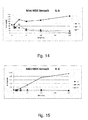
- the mean particle size is according to the invention at least 75 microns. At a mean particle size of 75 ⁇ m, the protein C concentration in the plasma was only about 25% higher than the initial concentration in the plasma even after a longer incubation period (60 min) lowered (compare Example 3 / Fig. 10 ).
- the average particle size must be at least 75 microns, since at a mean particle size of 75 microns just physiologically relevant amounts of protein C remain in the body fluid even after prolonged incubation.
- the inventors were able to determine that the protein C adsorption increases significantly with decreasing average particle size and the plasma protein C concentration assumes physiologically critical values. For very small mean particle sizes, protein C is almost completely adsorbed.
- the sorption matrix has an average particle size of 100 to 150 .mu.m, since this again a significant improvement in protein C adsorption can be achieved. More preferably, the sorbent matrix has an average particle size of 110 to 130 .mu.m, ideally an average particle size of about 120 .mu.m, since these particles sizes hardly adsorb toxic substances such as cytokines with high efficiency and important coagulation factors such as protein C and fibrinogen Even if the body fluid is brought into contact with the sorbent for a long time.
- the adsorption of important coagulation factors can be influenced by the selected average particle size, which according to the invention is in a range of 75 to 150 ⁇ m.
- the particle size is selected such that the sorbent lowers the concentration of protein C by not more than 25% relative to the initial concentration of protein C in the blood or blood plasma. By choosing a larger particle size, this percentage can be reduced.
- the choice of the desired particle size can be determined experimentally by a person skilled in the art without undue burden.
- the median particle size is preferably selected such that the sorbent of the present invention does not increase the concentration of protein C by more than 20%, more preferably not more than 15%, most preferably not more than 10% with respect to the starting concentration of protein C in the blood or blood plasma lowers.
- the inventors were able to establish in their experiments that, with a mean pore size of 15 to 20 nm and an average particle size of 120 ⁇ m, the protein C concentration in the plasma was not lowered by more than 10% even after a prolonged incubation period (60 min).
- the specific combination according to the invention of an average pore size of 11 to 20 nm and an average particle size of 75 to 150 .mu.m due to the significantly lower adsorption of important coagulation factors (eg protein C and fibrinogen) has clear advantages over the previously known sorbents .
- the sorbent according to the invention has a significantly improved biocompatibility and selectivity over the known sorbents, which are also based on neutral resins with a hydrophobic surface.
- the term "increased concentration of at least one inflammatory mediator” means that at least one inflammatory mediator is present in a body fluid (e.g., blood or blood plasma) in a concentration that causes adverse effects to the patient.
- Cytokines which may be mentioned as inflammatory mediators representative of the invention.
- the cytokine TNF- ⁇ is an endogenous signaling molecule that has an important regulatory role in immune response and inflammatory responses, but which exhibits toxic effects at elevated levels in the body fluid (eg, as a result of a cytokine storm, see above) with the pathology of numerous diseases and conditions, eg Sepsis and septic shock, communicating.
- Other representative examples are the cytokines IL-1 ⁇ , IL-6, IL-8 and IL-10.
- the levels of TNF- ⁇ in the proinflammatory phase are at least about 100-200 ng / ml.
- porous sorbent matrix having a neutral, hydrophobic surface refers to a porous, water-insoluble solid having outer and inner surfaces. The outer and inner surfaces are neutral and hydrophobic.
- neutral is non-ionic.
- inner surface of the carrier refers to the totality of the surfaces of the pores.
- outer surface refers to the entirety of the surfaces of the support that are directly accessible from outside.
- sorbent in the context of this disclosure is meant a means of effecting sorption, preferably adsorption, i. Molecules that are in a biological fluid are held in place by the surface forces of the sorbent.
- adsorbent or "adsorbent” or “adsorber” are used.
- body fluid refers to all types of body fluids such as blood, blood plasma, secretions, excretions and the like, but especially blood and blood plasma.
- other liquids such as anticoagulant containing solutions (heparin solution, citrate solution) or substitution solutions (electrolytes, fluids to compensate for fluid loss) in the extracorporeal blood circulation or in a blood plasma circulation / Filtrat Vietnameselauf bring ,
- anticoagulant containing solutions heparin solution, citrate solution
- substitution solutions electrolytes, fluids to compensate for fluid loss
- a body fluid is also to be understood as diluted blood or diluted blood plasma.
- the invention is intended primarily for the human medical field and therefore relates primarily to human body fluids. However, this does not exclude that the invention is also suitable for the veterinary field.
- the sorbent shows significant advantages in the treatment of diseases and conditions associated with an increased concentration of at least one inflammatory mediator, particularly a cytokine.
- Treatment with the sorbent is particularly advantageous when clinical symptoms are already evident and a rapidly worsening condition of the patient is to be expected, for example in the case of sepsis.
- the treatment may also be useful if an increased concentration of at least one inflammatory mediator is detectable, but no clinical symptoms are noticeable. This can be counteracted an uncontrolled activation of the nuclear phagocytic system even before the onset of clinical symptoms.
- the inflammatory mediator is preferably a potentially harmful proinflammatory inflammatory mediator, in particular a proinflammatory cytokine.
- proinflammatory cytokines are TNF- ⁇ , IL-1 ⁇ , IL-6 and IL-8, where TNF- ⁇ is of particular importance as an initial proinflammatory inflammatory mediator.
- the sorbent is therefore particularly beneficial for treating diseases and conditions due to the toxic effects of TNF- ⁇ .
- TNF- ⁇ , IL-1 ⁇ , IL-6, IL-8 and anti-inflammatory IL-10 are most efficiently eliminated by the sorbent of the present invention and therefore useful for the treatment of diseases and conditions are associated with an increased concentration of at least one inflammatory mediator, in particular a cytokine, are extremely well suited.
- the disease or condition associated with an increased concentration of at least one inflammatory mediator, especially cytokine is preferably selected from the group consisting of sepsis, especially septic shock, sepsis-like conditions, alcoholic hepatitis and autoimmune diseases, especially rheumatoid Arthritis, inflammatory bowel disease and psoriasis.
- the sorption agent according to the invention is ideally suited as adsorber material for the treatment of sepsis and its severe forms (severe sepsis, septic shock) as well as for the treatment of sepsis-like conditions.
- septic states are associated with greatly increased cytokine concentrations in the patient's blood.
- An efficient elimination or depletion of the key cytokine TNF- ⁇ is of particular importance.
- the term "sepsis” as used herein further includes all types of septic complications, e.g. Endotoxin-induced severe sepsis, septic shock, multiple organ failure and severe septic shock events such as meningococcal sepsis, Waterhouse-Friderichsen syndrome, etc.
- sepsis-like condition refers to a condition that, biochemically, is similar to sepsis, i. is associated with an uncontrolled activation of the mononuclear-phagocytic system.
- the sepsis-like condition is selected from the group consisting of acute liver failure and acute decompensation in chronic liver failure.
- the carrier is a neutral, preferably synthetic, polymer.
- a good reproducibility of the carrier material can be ensured, in particular with regard to the porosity and the particle size.
- the porosity and the particle size can be varied very well.
- the polymer may be both a homopolymer and a heteropolymer.
- the mean pore size refers to the mean diameter of the pores.
- the mean pore diameter is that which corresponds to the maximum of the distribution curve.
- the mean pore diameter can be determined, for example, by means of nitrogen adsorption (as described in US Pat Weber et al. 2008; Neutral styrene divinylbenzene copolymer for adsorption of toxins in liver failure.
- the pore size of a polymer is adjusted by varying the concentration of the monomers or co-monomers involved, the solvent or the modulator. The smaller the pores of the polymer are chosen, the larger the internal surface area of the polymer which is available for sorption, in particular adsorption. The larger the pores, the better the accessibility of the pores for larger molecules.
- a production method for a synthetic, hydrophobic polymer of defined pore size, as can be used for the invention, is described in the above-mentioned publication by Weber et al. described.
- Crosslinked polystyrene polymers and crosslinked ethylvinylbenzene polymers have proven to be particularly favorable for practical implementation. In extracorporeal blood purification, there are high demands on the sterility of the device components which come in contact with the body fluids of the patient. This also applies to sorbents.
- Crosslinked polystyrene polymers and crosslinked ethylvinylbenzene polymers are characterized by high stability to heat and chemicals and are already established in clinical practice.
- the crosslinked polystyrene polymer is a polystyrene-divinylbenzene copolymer.
- the crosslinked ethylvinylbenzene polymer is an ethylvinylbenzene-divinylbenzene copolymer.
- neutral hydrophobic polymers useful in the invention include, for example, polymers of styrene and ethylvinylbenzene monomers crosslinked with trivinylcyclohexane, trivinylbenzene, divinylnaphthalene, divinylsulfone, trimethylolpropane triacrylate, trimethylpropane trimethacrylate or based on resins aliphatic esters and mixtures thereof.
- the surface of the sorption matrix is coated with an endotoxin-binding lipopeptide, in particular polymyxin.
- an endotoxin-binding lipopeptide in particular polymyxin.
- endotoxins can be eliminated in addition to the inflammatory mediators.
- the pathogenic effect of the endotoxins lipopolysaccharides
- the endotoxin-binding lipopeptide molecules can be immobilized covalently as well as via noncovalent, adsorptive interactions on the surface of the sorption matrix, wherein attachment via noncovalent, adsorptive interactions is preferred.
- the endotoxin-binding lipopeptide is preferably polymyxin.
- Polymyxins are known chemical compounds that originally came from the bacterium Bacillus polymyxa .
- polymyxin B and polymyxin E are to be emphasized as polymyxins suitable for the present invention.
- known methods can be used for coating the surface with an endotoxin-binding lipopeptide.
- the EP 0110 409A and the EP 0 129 786 A2 the covalent attachment of polymyxin molecules to substrates.
- the describes WO 2010/083545 the preparation of a sorbent on the surface of which polymyxin is immobilized via noncovalent interactions.
- sorption agent as a filling material for a sorption device is particularly advantageous.
- Another object of the invention is therefore a sorption, which contains at least one type of sorbent according to the invention.
- the sorption device contains only one type of sorbent according to the invention.
- two or more different types of sorbent e.g. Sorbents of two or more different types of nonionic polymers, wherein the various sorbents may be present either as a mixture or in spatially separated compartments in the sorption.
- the term "sorption device” in particular comprises a column or cartridge which is filled with the sorbent particles. Such devices are well known to those skilled in the art.
- the body fluid to be purified e.g. Blood or blood plasma, passes through the adsorption column or cartridge, in which the toxic components are bound and removed from the body fluid.
- the sorbent according to the invention is used primarily as adsorbent material in apheresis processes, in particular for therapeutic purposes.
- a further subject of the invention is thus an extracorporeal perfusion device (blood and / or blood plasma cleaning device) which comprises at least one sorption agent according to the invention or a sorption device as mentioned above.
- the sorption device can be arranged on the blood side in an extracorporeal blood circuit and / or in a plasma circuit or filtrate circuit on the filtrate side.
- the body fluid passes through the sorption device, whereby the toxic components, in particular inflammatory mediators such as cytokines, are sorbed by the sorption matrix.
- the purified blood or blood plasma is returned to the patient.
- Apheresis or extracorporeal blood and plasma cleaning devices in which the sorbent described herein may find application are in accordance with the general principles known in the art and those skilled in the art designed or constructed and, for example, in [ Thomas Rimmele'and John A Kellum 2011: Clinical review: Blood purification for sepsis. Critical Care 15 (1): 205 ; Rafidah Atan, David Crosbie and Rinaldo Bello 2011: Techniques of Extracorporeal Cytokine Removal: A Systematic Review of the Literature. Blood Purification 33: 88-100 ].
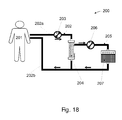
- an extracorporeal perfusion device comprises an extracorporeal blood circuit and a filtrate circuit which is connected to the extracorporeal blood circuit by means of a filter, the filter having a sieve coefficient of 5% for substances having a relative molecular mass of 340 kDa, and the sorption device is arranged in the filtrate circuit.
- a filter with a sieving coefficient of 5% for substances having a relative molecular mass of 340 kDa (340,000 Da) brings compared to the treatment without filter (ie the sorption is arranged as a whole blood adsorber directly on the blood side in the extracorporeal blood circulation) or a plasma filter only retains the cellular blood components, significant benefits.
- a filter with a sieving coefficient of 5% for substances with a relative molecular weight of 340 kDa allows fractionated plasma to be retained so that high molecular weight blood components such as fibrinogen, immunoglobulins, LDL, HDL etc. are retained while smaller blood components such as albumin or protein C pass through the filter membrane , It has been found that the adsorptive power for cytokines, above all TNF- ⁇ , is markedly better compared to a plasma filter which retains only the cellular blood components although through a filter with a sieving coefficient of 5% for substances with a relative molecular mass of 340 kDa less cytokines enter the fractionated plasma.
- a filter suitable for this embodiment is available under the trade name "Albuflow®” (manufactured by Fresenius Medical Care, material: polysulfone hollow fibers, sieving coefficient for albumin of ⁇ 0.6 and for fibrinogen ⁇ 0.1).
- the filtrate circuit is open and the fractionated plasma is fed directly to the extracorporeal blood circulation after passage of the sorption.
- the basic principle of this variant is currently used in immunoadsorption (for example, Apheresevortechnischen the company AsahiKasei, Japan).
- the filtrate cycle is closed and the fractionated plasma passes through the membrane of the Albuflow® back into the blood flowing in the extracorporeal blood circulation.
- the basic principle of the second variant is known by the blood purification system Prometheus® (Fresenius Medical Care GmbH, Germany). [ Falkenhagen D, Strobl W, Vogt G, Schrefl A, Linsberger I, Gerner FJ, Schoenhofen M .: Fractionated plasma separation and adsorption system: a novel system for the purification of albumin. Artif Organs. 1999 Jan; 23 (1): 81-6 ]
- the invention further relates to a method of treating diseases and conditions as defined above associated with an increased concentration of at least one inflammatory mediator, in particular cytokines, by contacting a body fluid with a sorbent as described herein, wherein the sorbent comprises a porous sorbent matrix having a sorbent neutral, hydrophobic surface, an average pore size of 11 to 20 nm and an average particle size of 75 to 150 microns comprises.
- body fluid corresponds to the definition given above.
- the method is preferably defined as an extracorporeal blood and / or blood plasma cleanup method as described in this disclosure.
- Extracorporeal perfusion systems as described above may also be useful because of the improved cytokine adsorption performance when combining a filter with a 5% screen coefficient for 340 kDa relative molecular weight substances (eg, an Albuflow® filter) with a less preferred sorbent, for example, with a sorbent having a mean pore size and / or an average particle size which are outside the preferred range of the invention.
- a filter with a 5% screen coefficient for 340 kDa relative molecular weight substances eg, an Albuflow® filter
- a less preferred sorbent for example, with a sorbent having a mean pore size and / or an average particle size which are outside the preferred range of the invention.
- the average pore size is in a range of 10-100 nm, more preferably in a range of 10 to 40 nm, still more preferably in a range of 10 to 25 nm, and most preferably in a range of 11 to 20 nm
- the average particle size is in a range of 3 to 200 ⁇ m, preferably in a range of 75 to 150 ⁇ m, more preferably in a range of 100 to 150 ⁇ m, most preferably in a range of 110 to 130 ⁇ m, and ideally 120 ⁇ m ,
- This therefore relates to an extracorporeal perfusion device comprising an extracorporeal blood circuit and a filtrate circuit communicating with the extracorporeal blood circuit by means of a filter, the filter having a sieving coefficient of 5% for substances having a relative molecular mass of 340 kDa, and wherein in the filtrate cycle a sorption device is arranged, wherein a sorption agent comprising a porous sorption matrix having a neutral, hydrophobic surface is
- the sorbent matrix is a crosslinked polystyrene polymer, preferably a polystyrene-divinylbenzene copolymer or an ethylvinylbenzene-divinylbenzene copolymer.
- the sorbent may also be present as a suspension in fractionated plasma.
- a suspension of the sorbent comes in a Microspheres-based Detoxificaton System (MDS), as described in the EP 0776223 B1 was described, for use.
- MDS Microspheres-based Detoxificaton System
- the microparticles circulate as a suspension in a filtrate circuit on the filtrate side of a membrane filter.
- a filter suitable for this arrangement meeting the above criteria is available under the trade name "Albuflow®” (manufactured by Fresenius Medical Care; material: polysulfone hollow fibers; sieving coefficient for albumin of ⁇ 0.6 and for fibrinogen ⁇ 0; 1).
- Ethylvinylbenzene-divinylbenzene copolymers of different pore sizes were examined and compared for their adsorption properties for cytokines (TNF- ⁇ , IL-1 ⁇ , IL-6, IL-8 and IL-10).
- ethylvinylbenzene-divinylbenzene copolymers (hereinafter also referred to as "adsorbents") of different mean pore sizes, supplied by Rohm & Haas, were provided.
- the adsorbers are listed in Table 1. ⁇ i> Table 1: Ethyl Vinylbenzene Divinylbenzene Copolymers ⁇ / i> Designation of the ethylvinylbenzene-divinylbenzene copolymer Mean pore size [nm] # 1822 15-20 # 1823 15-20 # 1824 30-40 # 1825 80-100 # 1826 80-100
- the mean particle size of the polymers is 5 ⁇ m +/- 3-4 ⁇ m.
- TNF- ⁇ , IL-1 ⁇ , IL-6, IL-8 and IL-10 are each reconstituted in 1 mL PBS-0.1% HSA buffer, aliquoted at 20 ⁇ L each and stored at -80 ° C.
- the stock solution is diluted 1:10 in plasma (fresh frozen plasma, Retz plasma donation center) (1:10, 5 ⁇ L stock + 45 ⁇ L plasma).
- the final concentration of the plasma spike (50 mL) for the cytokines used is shown in Table 2 below: ⁇ i> Table 2: ⁇ / i> Spot concentration [ ⁇ g / mL] Mortar dilution 1:10 Stockverd. to plasma [49905 ⁇ L] Final concentration in plasma [pg / mL] TNF- ⁇ 10 5 ⁇ L + 45 ⁇ L 7.5 ⁇ L 500 IL-1 ⁇ 5 5 ⁇ L + 45 ⁇ L 32.5 ⁇ L 250 IL-6 10 5 ⁇ L + 45 ⁇ L 17.5 ⁇ L 200 IL-8 10 5 ⁇ L + 45 ⁇ L 17.5 ⁇ L 200 IL-10 10 5 ⁇ L + 45 ⁇ L 20 ⁇ L 300
- the adsorbers listed in Table 1 were tested in a batch test for the adsorption of the cytokines TNF- ⁇ , IL-1 ⁇ , IL-6, IL-8 and IL-10 and compared.
- Each batch contains 10% (v / v) adsorber (0.5 ml adsorbent wet volume and 4.5 ml plasma spike) in a test tube.
- 10% (v / v) adsorber 0.5 ml adsorbent wet volume and 4.5 ml plasma spike
- a test tube without adsorber was carried.
- the cytokine concentrations were determined using a Luminex Bead Array System (Biorad).
- the adsorption of cytokines TNF- ⁇ ( Fig. 1 ), IL-1 ⁇ ( Fig. 2 ), IL-6 ( Fig. 3 ), IL-8 ( Fig. 4 ) and IL-10 ( Fig. 5 ) through the adsorber over time are in the Fig. 1 to 5 shown. From the Fig. 1 It can be clearly seen that TNF- ⁇ is most efficiently removed from the spiked plasma by microparticles having an average pore size of 15-20 nm.
- Ethylvinylbenzene-divinylbenzene copolymers with different average pore size and different mean particle size were pretreated differently and investigated in the triple-fold batch test for their adsorption properties for TNF- ⁇ , protein C and fibrinogen and compared. It should be shown if plasma proteins influence the adsorption capacity of cytokines. The main focus is on the deposition of albumin on the adsorber surface. Since in clinical application in an extracorporeal perfusion system the adsorber is constantly circulated with plasma, the attachment of plasma proteins can influence the cytokine adsorption. This does not happen in the case of small-pore adsorbers, since the larger proteins do not come into contact with the inner surface of the adsorber due to the sieving action.
- HSA human serum albumin
- ethylvinylbenzene-divinylbenzene copolymers used in this example having different average pore sizes and different average particle sizes are listed in Table 3.
- adsorbents ethylvinylbenzene-divinylbenzene copolymers
- Table 3 Ethyl Vinylbenzene Divinylbenzene Copolymers
- ⁇ / i> Designation of the ethylvinylbenzene-divinylbenzene copolymer Mean pore size [nm] Mean particle size [ ⁇ m] # 1996 15-20 120 # 1989 30 120 # 1981 30 - 40 10
- the adsorbers # 1996, # 1989 and # 1981 mentioned in Table 3 were tested in a triple-batch batch test for their adsorption properties for TNF- ⁇ , protein C and fibrinogen and compared with each other.
- the adsorbers were pretreated differently and used in 3 different 10% batches.
- Approach 1 Adsorber coated with HSA.
- HSA coating an appropriate amount of 10% HSA solution is prepared.
- the conditioned adsorbent is centrifuged off (4000 g, 10 min), the supernatant discarded and per ml Adsorbersediment 2.5 ml HSA solution for the coating pipetted.
- the adsorbent suspension is incubated for at least 12 h at room temperature with the HSA solution (Enviro Genie Shaker, frequency 25:50). After the incubation period, the HSA-coated adsorber is washed once with 5 times the volume of 0.9% NaCl solution. The adsorber is finally stored as a 50% suspension in 0.9% NaCl in the refrigerator.
- Adsorber preincubated in native citrated plasma 120 ⁇ l of adsorber in 300 ⁇ l of citrated plasma (corresponds to the ratio of the HSA coating with 1 ml of adsorber and 2.5 ml of 10% strength HSA solution) are incubated for 10 min directly before the batch test.
- Adsorber that was previously conditioned only. Conditioning of adsorbers: Dry adsorbers should be conditioned before use to allow good wetting with aqueous solutions or with plasma. Dry, hydrophobic adsorbers are pretreated as follows: The required amount of dry adsorbent is placed in a 50 ml Greiner tube and washed with 5 times the volume of undissolved ethanol (suspended and centrifuged for 5 min at 4000 rpm). The supernatant is lifted off and discarded and resuspended with fresh, undiluted ethanol and incubated for 1 h (Enviro Genie, frequency 25:50).
- the adsorbent suspension is centrifuged off (centrifuged for 5 min at 4000 rpm) and the supernatant discarded.
- the adsorber is then washed with 5 times the volume of distilled water (suspended and centrifuged for 5 min at 4000 rpm).
- the supernatant is lifted off and discarded and resuspended with fresh distilled water and incubated for 1 h (Enviro Genius, frequency 25:50).
- the adsorbent suspension is centrifuged off (centrifuged for 5 min at 4000 rpm) and the supernatant discarded.
- the adsorber will now with the 5-fold volume of physiological saline solution (suspended and centrifuged for 5 min at 4000 rpm). The supernatant is lifted off and discarded and resuspended with fresh physiological saline and incubated for 1 h (Enviro Genie, frequency 25:50). After incubation, the adsorbent suspension is centrifuged off (centrifuged for 5 min at 4000 rpm) and the supernatant discarded. Finally, a 50% Adsorbersuspension is prepared with physiological saline and stored in the refrigerator until use.
- TNF- ⁇ For the cytokine spike, 50 ml citrated plasma with expected 500 pg / ml TNF- ⁇ was used. TNF- ⁇ was reconstituted in 1 ml of PBS-0.1% HSA buffer, aliquoted to 20 ⁇ l and stored at -80 ° C (lot: AA3309093) (see Table 4). ⁇ i> Table 4: ⁇ / i> Stock concentration [ ⁇ g / mL] Stock dilution 1:10 Stockverd. to plasma [40000 ⁇ L] According to preliminary experiment expected final concentration in plasma [pg / mL] TNF- ⁇ 10 5 ⁇ L + 45 ⁇ L 6 ⁇ L 500
- the pretreated adsorbers were overlaid with spiked plasma, to which 10 ⁇ l of spiked plasma was added to 120 ⁇ l of adsorber. Three different 10% batches were prepared. As a control, a test tube with spiked citrated plasma (citrated plasma with TNF- ⁇ ) was carried without adsorber.
- TNF- ⁇ concentration was determined by means of commercially available TNF-ELISA (human TNF- ⁇ immunoassay, DTA00C, R & D Systems®) and a Microplate Reader (Anthos hat-III).
- Protein C and fibrinogen were analyzed on Sysmex (Siemens, CA560) with the associated reagents (Siemens, OUVV17).
- Adsorbers # 1989 and # 1981 have a marginally higher adsorption rate for TNF- ⁇ than Adsorber # 1996, which can be explained for better accessibility to the internal pores.
- the big advantage of the adsorber particle # 1996 according to the invention is thus that protein C is not significantly adsorbed.
- Ethylvinylbenzene-divinylbenzene copolymers having equal mean pore sizes (15-20 nm) but different average particle sizes of 3-5 ⁇ m, 35 ⁇ m, 75 ⁇ m, and 120 ⁇ m, respectively, are compared for protein C adsorptive property.
- ethylvinylbenzene-divinylbenzene copolymers of the same mean pore size and different average particle size used in this example are listed in Table 5. ⁇ i> Table 5: Ethyl Vinylbenzene Divinylbenzene Copolymers ⁇ / i> Designation of the ethylvinylbenzene-divinylbenzene copolymer Mean pore size [nm] Mean particle size [ ⁇ m] # 2000 15-20 3-5 # 1785 15-20 35 # 1760 15-20 75 # 2004 15-20 120
- the adsorbers # 2000, # 1785, # 1760 and and # 2004 mentioned in Table 5 were tested in bat test for their adsorption properties for protein C and compared.
- the adsorbers were conditioned (see Example 2 / Point 2.2.) And incubated for 15 min in plasma directly before the batch test, centrifuged off and then used in the batch test.
- Protein C was analyzed on the Sysmex (Siemens, CA560) with the associated reagents (Siemens, OUVV17).
- Fig. 10 shows the protein C concentration (stated in [%] with respect to the physiological protein C concentration in human plasma) over time for the individual adsorbers.
- the curves clearly show the dependence of protein C adsorption on the mean particle size. Pronounced protein C adsorption was found on adsorbers # 2000 and # 1785. For adsorber # 2000, protein C was already after 15 Minutes almost completely removed from the plasma. By contrast, Adsorber # 1760 and # 2004 absorbed protein C to a much lesser extent from the plasma. The observed for the adsorbent # 1760 protein C decrease of - 25% (after 60 min incubation) is just in a range in which physiologically relevant amounts of protein C remain in the plasma.
- adsorbent ethylvinylbenzene-divinylbenzene copolymer having a particle size of 120 ⁇ m and an average pore size of 15 to 20 nm (designation: # 1997) was examined for the adsorption properties of cytokines in a minisystem setup.
- the system structure 100 is in the Fig. 11 shown schematically.
- the blood contained in a vessel 101 (100 ml of blood sample) is passed in a blood circulation 102 by means of a blood pump 103 (pumping rate: 50 ml / min) through a plasma filter 104 and from there back into the vessel 101.
- a plasma filter 104 a portion of the blood plasma is filtered off and fed to a plasma circuit 105.
- the blood plasma guided in the plasma circulation 105 is pumped by means of a plasma pump 106 (pumping rate: 10 ml / min) through an adsorption device 107 filled with porous adsorbent particles and finally back into the vessel 101.
- adsorption 107 there are a total of 5 ml of a suspension of adsorbent particles, wherein the adsorber have an average particle size of 120 microns and a mean pore size of 15 to 20 nm (referred to as Adsorber # 1997).
- Adsorber # 1997 a mean pore size of 15 to 20 nm
- the adsorption device is designed as a drip chamber in the mini-system experimental setup.
- the Fig. 11 Figure 4 also shows, under the reference numeral 108, a micrograph of 120 micron microparticles for illustrative purposes.
- control system structure As a control system structure (not shown), the same system structure as in Fig. 11 used, but the control system structure has no Adsorberpgreg.
- the Adsorber # 1997 (ethylvinylbenzene-divinylbenzene copolymer, 120 ⁇ m, 15-20 nm) is filled into a cartridge (Empty Rezorian TM Tube Kit with PE frits, volume 5 mL, 57613-U, Sigma-Aldrich).
- the filled adsorber capsule is completely rinsed with 5 ml of ethanol and filled with ethanol and placed closed on both sides in the ultrasonic basin for one hour. Thereafter, the capsule is rinsed with 20 ml of distilled water, filled with distilled water again incubated for one hour in the ultrasonic bath and the same procedure carried out with NaCl solution. Finally, the capsule is again rinsed with 20 ml of NaCl solution and clamped as moist in the secondary circuit (as sterile as possible).
- the two cycles are completely set up the day before the experiment and filled with 70% ethanol absolutely free of air and incubated overnight.
- the two circuits are each flushed with 1 L NaCl phys. (Single pass) and recirculated for at least 15 min.
- the entire system is pumped empty to keep the dilution effect as low as possible.
- TNF- ⁇ , IL-1 ⁇ , IL-6, IL-8 and IL-10 are each reconstituted in 1 mL PBS-0.1% HSA buffer, aliquoted to 20 ⁇ L and stored at -80 ° C.
- Sample volumes Draw 1 ml of sample, centrifuge and separate plasma supernatant onto 2 Eppendorf tubes each: 30 ⁇ l for cytokine determination and 500 ⁇ l for determination of protein C (carried out using Sysmex).
- cytokine concentrations were determined using a Luminex Bead Array System (Biorad).
- the determination of the protein C concentration was carried out on the Sysmex (Siemens, CA560) with the associated reagents (Siemens, OUVV17).
- the Fig. 18 shows a schematic representation of an extracorporeal perfusion device 200 (extracorporeal blood purification device 200).
- the perfusion device 200 has an extracorporeal blood circuit 202 with an arterial inflow 202a (arterial limb) from a patient 201 to a filter 204 and a venous drain 202b (venous limb) from the filter 204 to the patient 201.
- the filter 204 has a sieving coefficient of 5% for substances with a relative molecular mass of 340 kDa and is for example a filter of the type Albuflow® (manufacturer: Fresenius Medical Care; material: polysulfone hollow fibers; screening coefficient for albumin of ⁇ 0.6 and for Fibrinogen ⁇ 0.1).
- a filter with a sieving coefficient of 5% for substances with a relative molecular weight of 340 kDa allows fractionated plasma to be retained so that high molecular weight blood plasma components such as fibrinogen, immunoglobulins, LDL, HDL etc.
- the adsorption device 207 is an adsorbent bed, wherein the adsorbent particles have an average particle size of 120 microns and a mean pore size of 15 to 20 nm (Adsorber # 1997 - see Example 4).
- the Fig. 19 shows the adsorption of the cytokine TNF- ⁇ (in [%] with respect to a control without adsorber) over time using a system construction as in Fig. 18 however, instead of a patient, a blood sample presented in a vessel (corresponding to vessel 101 of FIG Fig. 11 ) has been used.
- An Albuflow® filter manufactured by: Fresenius Medical Care, material: polysulfone hollow fibers, sieving coefficient for albumin of ⁇ 0.6 and fibrinogen ⁇ 0.1
- a conventional plasma filter containing only the retains cellular blood components.
- the Fig. 20 shows a schematic representation of an extracorporeal perfusion device 300 (extracorporeal blood purification device 300).
- the perfusion device 300 has an extracorporeal blood circuit 302 with an arterial inflow 302a (arterial limb). from a patient 301 to a filter 304 and a venous drain 302b (venous leg) from the filter 304 to the patient 301.
- arterial inflow 302a arterial limb
- a venous drain 302b venous leg
- the filter 304 has a sieving coefficient of 5% for substances with a relative molecular mass of 340 kDa and is for example a filter of the type Albuflow® (manufacturer: Fresenius Medical Care; material: polysulfone hollow fibers; screening coefficient for albumin of ⁇ 0.6 and for Fibrinogen ⁇ 0.1).
- a filter with a sieving coefficient of 5% for substances with a relative molecular weight of 340 kDa allows fractionated plasma to be retained so that high molecular weight blood plasma components such as fibrinogen, immunoglobulins, LDL, HDL etc. are retained while smaller blood components such as albumin or protein C pass through the filter membrane
- the adsorption device 307 is an adsorbent bed, wherein the adsorbent particles have an average particle size of 120 microns and a mean pore size of 15 to 20 nm (adsorber # 1997 - see Example 4).
Landscapes
- Chemical & Material Sciences (AREA)
- Health & Medical Sciences (AREA)
- Organic Chemistry (AREA)
- Chemical Kinetics & Catalysis (AREA)
- Analytical Chemistry (AREA)
- Life Sciences & Earth Sciences (AREA)
- Engineering & Computer Science (AREA)
- General Health & Medical Sciences (AREA)
- Veterinary Medicine (AREA)
- Public Health (AREA)
- Animal Behavior & Ethology (AREA)
- Heart & Thoracic Surgery (AREA)
- Vascular Medicine (AREA)
- Biomedical Technology (AREA)
- Hematology (AREA)
- Pharmacology & Pharmacy (AREA)
- Medicinal Chemistry (AREA)
- Anesthesiology (AREA)
- Molecular Biology (AREA)
- Nanotechnology (AREA)
- Epidemiology (AREA)
- Bioinformatics & Cheminformatics (AREA)
- Gastroenterology & Hepatology (AREA)
- Nuclear Medicine, Radiotherapy & Molecular Imaging (AREA)
- General Chemical & Material Sciences (AREA)
- Cell Biology (AREA)
- Biodiversity & Conservation Biology (AREA)
- Cardiology (AREA)
- Immunology (AREA)
- Proteomics, Peptides & Aminoacids (AREA)
- Biochemistry (AREA)
- Rheumatology (AREA)
- Diabetes (AREA)
- Communicable Diseases (AREA)
- Oncology (AREA)
- Pain & Pain Management (AREA)
- External Artificial Organs (AREA)
- Medicines That Contain Protein Lipid Enzymes And Other Medicines (AREA)
Priority Applications (8)
| Application Number | Priority Date | Filing Date | Title |
|---|---|---|---|
| EP12174028.6A EP2679302A1 (fr) | 2012-06-28 | 2012-06-28 | Agent de sorption sélectif pour le nettoyage sanguin extracorporel |
| EP13157246.3A EP2679301A1 (fr) | 2012-06-28 | 2013-02-28 | Dispositif de perfusion extracorporel |
| PCT/EP2013/063498 WO2014001445A1 (fr) | 2012-06-28 | 2013-06-27 | Dispositif de perfusion extracorporel |
| CN201380044579.5A CN104582835B (zh) | 2012-06-28 | 2013-06-27 | 体外灌流设备 |
| US14/411,665 US9861735B2 (en) | 2012-06-28 | 2013-06-27 | Extracorporeal perfusion apparatus |
| JP2015519091A JP6092380B2 (ja) | 2012-06-28 | 2013-06-27 | 体外灌流装置 |
| ES13736512.8T ES2676593T3 (es) | 2012-06-28 | 2013-06-27 | Aparato de perfusión extracorpórea |
| EP13736512.8A EP2866929B1 (fr) | 2012-06-28 | 2013-06-27 | Agent de sorption sélectif pour le nettoyage sanguin extracorporel |
Applications Claiming Priority (1)
| Application Number | Priority Date | Filing Date | Title |
|---|---|---|---|
| EP12174028.6A EP2679302A1 (fr) | 2012-06-28 | 2012-06-28 | Agent de sorption sélectif pour le nettoyage sanguin extracorporel |
Publications (1)
| Publication Number | Publication Date |
|---|---|
| EP2679302A1 true EP2679302A1 (fr) | 2014-01-01 |
Family
ID=47747528
Family Applications (3)
| Application Number | Title | Priority Date | Filing Date |
|---|---|---|---|
| EP12174028.6A Withdrawn EP2679302A1 (fr) | 2012-06-28 | 2012-06-28 | Agent de sorption sélectif pour le nettoyage sanguin extracorporel |
| EP13157246.3A Withdrawn EP2679301A1 (fr) | 2012-06-28 | 2013-02-28 | Dispositif de perfusion extracorporel |
| EP13736512.8A Not-in-force EP2866929B1 (fr) | 2012-06-28 | 2013-06-27 | Agent de sorption sélectif pour le nettoyage sanguin extracorporel |
Family Applications After (2)
| Application Number | Title | Priority Date | Filing Date |
|---|---|---|---|
| EP13157246.3A Withdrawn EP2679301A1 (fr) | 2012-06-28 | 2013-02-28 | Dispositif de perfusion extracorporel |
| EP13736512.8A Not-in-force EP2866929B1 (fr) | 2012-06-28 | 2013-06-27 | Agent de sorption sélectif pour le nettoyage sanguin extracorporel |
Country Status (6)
| Country | Link |
|---|---|
| US (1) | US9861735B2 (fr) |
| EP (3) | EP2679302A1 (fr) |
| JP (1) | JP6092380B2 (fr) |
| CN (1) | CN104582835B (fr) |
| ES (1) | ES2676593T3 (fr) |
| WO (1) | WO2014001445A1 (fr) |
Cited By (2)
| Publication number | Priority date | Publication date | Assignee | Title |
|---|---|---|---|---|
| CN106726557A (zh) * | 2017-01-22 | 2017-05-31 | 杭州聚立医疗用品有限公司 | 一种采血袋及用该采血袋去除纤维蛋白原的方法 |
| RU2860654C1 (ru) * | 2025-07-28 | 2026-04-21 | Федеральное государственное бюджетное образовательное учреждение высшего образования "Пермский государственный медицинский университет имени академика Е.А. Вагнера" Министерства здравоохранения Российской Федерации | Способ лечения сепсиса |
Families Citing this family (10)
| Publication number | Priority date | Publication date | Assignee | Title |
|---|---|---|---|---|
| EP2679302A1 (fr) | 2012-06-28 | 2014-01-01 | Zentrum für biomedizinische Technologie der Donau- Universität Krems | Agent de sorption sélectif pour le nettoyage sanguin extracorporel |
| JP6728536B2 (ja) * | 2014-03-31 | 2020-07-22 | ゾール メディカル コーポレイションZOLL Medical Corporation | 蘇生後症候群を治療するための炎症性バイオマーカーの血液濾過 |
| CN204521750U (zh) * | 2014-07-05 | 2015-08-05 | 黄昱 | 一种人工肝及血液净化系统 |
| CN108452395A (zh) * | 2017-02-22 | 2018-08-28 | 江苏博发生物科技有限公司 | 一种去除内毒素血液净化过滤器 |
| RU2653125C1 (ru) * | 2017-05-23 | 2018-05-07 | Акционерное общество "ПЕРСПЕКТИВНЫЕ МЕДИЦИНСКИЕ ТЕХНОЛОГИИ" | Полимерный сорбент, способ его получения и использования |
| WO2019085926A1 (fr) * | 2017-10-31 | 2019-05-09 | 上海医药工业研究院 | Analogue de polymyxine et son procédé de préparation |
| WO2020137756A1 (fr) * | 2018-12-25 | 2020-07-02 | 旭化成メディカル株式会社 | Dispositif de purification du sang et système de circulation sanguine extracorporelle pourvu d'un dispositif de réglage de composant sanguin |
| US12186472B2 (en) * | 2019-03-06 | 2025-01-07 | Gambro Lundia Ab | Blood treatment device comprising alkaline phosphatase |
| CN111202880A (zh) * | 2020-02-03 | 2020-05-29 | 深圳汉诺医疗科技有限公司 | 一种净化血液的净化柱、装置及方法 |
| WO2024024459A1 (fr) * | 2022-07-28 | 2024-02-01 | 国立大学法人 東京大学 | Système d'échange de plasma et procédé de commande de système d'échange de plasma |
Citations (14)
| Publication number | Priority date | Publication date | Assignee | Title |
|---|---|---|---|---|
| EP0110409A2 (fr) | 1982-12-02 | 1984-06-13 | Kanegafuchi Kagaku Kogyo Kabushiki Kaisha | Adsorbant et procédé pour le préparer |
| EP0129786A2 (fr) | 1983-06-24 | 1985-01-02 | Toray Industries, Inc. | Matière de détoxication d'endotoxines |
| DE19515554A1 (de) | 1995-04-27 | 1996-10-31 | Braun Melsungen Ag | Verfahren und Vorrichtung zur simultanen extrakorporalen Elimination von Tumor-Nekrose-Faktor alpha und bakteriellen Lipopolysacchariden aus Vollblut oder/und Blutplasma |
| EP0776223B1 (fr) | 1993-08-10 | 1999-06-09 | Dieter Falkenhagen | Systeme permettant d'eliminer des substances contenues dans des liquides, notamment du sang |
| EP0787500B1 (fr) | 1996-02-06 | 1999-12-01 | BELLCO S.p.A. | Dispositif de seperation de toxines en particulier de cytokines |
| DE19913707A1 (de) | 1999-03-26 | 2000-10-05 | Privates Inst Bioserv Gmbh | Immunadsorber zur Sepsistherapie |
| WO2003090924A1 (fr) | 2002-04-25 | 2003-11-06 | Alteco Medical Ab | Separation amelioree |
| WO2005082504A2 (fr) | 2004-02-23 | 2005-09-09 | Hemolife Medical, Inc. | Systeme de detoxification du plasma et procedes d'utilisation |
| DE102004029573A1 (de) | 2004-06-18 | 2005-12-29 | Gambro Lundia Ab | MIF-Adsorbent |
| DE102005046258A1 (de) | 2005-09-27 | 2007-03-29 | Adexter Technology Ltd. | Immunadsorber zur Behandlung von Insulinresistenz und des metabolischen Syndroms |
| WO2010083545A2 (fr) | 2009-01-22 | 2010-07-29 | Zentrum Für Biomedizinische Technologie Der Donau-Universität Krems | Sorbant pour endotoxines |
| EP1944046B1 (fr) | 2007-01-12 | 2010-08-11 | Bellco S.r.l. | Kit pour le traitement de maladies liées à l'inflammation systémique |
| US20110070424A1 (en) | 2006-11-20 | 2011-03-24 | Wei-Tai Young | Size-selective polymer system |
| WO2011123767A1 (fr) | 2010-04-01 | 2011-10-06 | Cytosorbents Corporation | Méthode permettant de traiter une inflammation |
Family Cites Families (17)
| Publication number | Priority date | Publication date | Assignee | Title |
|---|---|---|---|---|
| US4382124B1 (en) | 1958-07-18 | 1994-10-04 | Rohm & Haas | Process for preparing macroreticular resins, copolymers and products of said process |
| JPS5897366A (ja) | 1981-12-08 | 1983-06-09 | 旭化成株式会社 | 血液及び体液物質の除去装置 |
| JPS5946969A (ja) | 1982-09-09 | 1984-03-16 | 旭メディカル株式会社 | 血漿浄化装置 |
| US4678566A (en) | 1984-07-20 | 1987-07-07 | Terumo Kabushiki Kaisha | Apparatus for separating proteins from blood plasma |
| JPS6129362A (ja) * | 1984-07-20 | 1986-02-10 | テルモ株式会社 | 血漿中の蛋白質成分の分離除去装置 |
| JPS6414788A (en) | 1987-07-08 | 1989-01-18 | Seiko Epson Corp | Optical card recording and reproducing device |
| JPH04270965A (ja) | 1990-05-18 | 1992-09-28 | Burton W Blais | オリゴペプタイド吸着担体の調製方法、及びこれを使用したリポ多糖類の検定と除去方法 |
| JP3353467B2 (ja) | 1994-05-27 | 2002-12-03 | ニプロ株式会社 | 血液透析装置の透析液管理装置 |
| US5997496A (en) * | 1995-07-10 | 1999-12-07 | Asahi Medical Co., Ltd. | System and method of extracorporeally treating blood to alleviate the symptoms of inflammatory diseases |
| JPH10290833A (ja) | 1997-04-21 | 1998-11-04 | Kanegafuchi Chem Ind Co Ltd | トキシックショックシンドロームトキシン−1の吸着剤、その吸着除去方法および該吸着剤を充填してなる吸着器 |
| DE19937506A1 (de) | 1999-08-09 | 2001-04-19 | Infineon Technologies Ag | ACS-Einheit für einen Viterbi-Decodierer |
| JP2007089788A (ja) | 2005-09-28 | 2007-04-12 | Asahi Kasei Corp | CD49d強陽性細胞除去材料 |
| SK287315B6 (sk) | 2006-06-02 | 2010-06-07 | Biotika, A. S. | Spôsob izolácie polymyxínu B z vyfermentovanej pôdy |
| JP2006320729A (ja) | 2006-06-29 | 2006-11-30 | Kaneka Corp | トキシックショックシンドロームトキシン−1の吸着剤、該吸着剤の使用および該吸着剤を充填してなる吸着器 |
| US20130102948A1 (en) | 2010-04-19 | 2013-04-25 | Ilan K. Reich | Portable blood filtration devices, systems, and methods |
| AT509192B1 (de) | 2010-06-24 | 2011-07-15 | Zentrum Fuer Biomedizinische Technologie Der Donau Uni Krems | Sorptionsmittel für endotoxine |
| EP2679302A1 (fr) | 2012-06-28 | 2014-01-01 | Zentrum für biomedizinische Technologie der Donau- Universität Krems | Agent de sorption sélectif pour le nettoyage sanguin extracorporel |
-
2012
- 2012-06-28 EP EP12174028.6A patent/EP2679302A1/fr not_active Withdrawn
-
2013
- 2013-02-28 EP EP13157246.3A patent/EP2679301A1/fr not_active Withdrawn
- 2013-06-27 ES ES13736512.8T patent/ES2676593T3/es active Active
- 2013-06-27 WO PCT/EP2013/063498 patent/WO2014001445A1/fr not_active Ceased
- 2013-06-27 JP JP2015519091A patent/JP6092380B2/ja not_active Expired - Fee Related
- 2013-06-27 EP EP13736512.8A patent/EP2866929B1/fr not_active Not-in-force
- 2013-06-27 US US14/411,665 patent/US9861735B2/en not_active Expired - Fee Related
- 2013-06-27 CN CN201380044579.5A patent/CN104582835B/zh not_active Expired - Fee Related
Patent Citations (15)
| Publication number | Priority date | Publication date | Assignee | Title |
|---|---|---|---|---|
| EP0110409A2 (fr) | 1982-12-02 | 1984-06-13 | Kanegafuchi Kagaku Kogyo Kabushiki Kaisha | Adsorbant et procédé pour le préparer |
| EP0129786A2 (fr) | 1983-06-24 | 1985-01-02 | Toray Industries, Inc. | Matière de détoxication d'endotoxines |
| EP0776223B1 (fr) | 1993-08-10 | 1999-06-09 | Dieter Falkenhagen | Systeme permettant d'eliminer des substances contenues dans des liquides, notamment du sang |
| DE19515554A1 (de) | 1995-04-27 | 1996-10-31 | Braun Melsungen Ag | Verfahren und Vorrichtung zur simultanen extrakorporalen Elimination von Tumor-Nekrose-Faktor alpha und bakteriellen Lipopolysacchariden aus Vollblut oder/und Blutplasma |
| EP0958839B1 (fr) | 1996-02-06 | 2004-12-29 | BELLCO S.p.A. | Separation adsorptive de cytokines d'un patient affecte par la defaillance aigue d'un organe |
| EP0787500B1 (fr) | 1996-02-06 | 1999-12-01 | BELLCO S.p.A. | Dispositif de seperation de toxines en particulier de cytokines |
| DE19913707A1 (de) | 1999-03-26 | 2000-10-05 | Privates Inst Bioserv Gmbh | Immunadsorber zur Sepsistherapie |
| WO2003090924A1 (fr) | 2002-04-25 | 2003-11-06 | Alteco Medical Ab | Separation amelioree |
| WO2005082504A2 (fr) | 2004-02-23 | 2005-09-09 | Hemolife Medical, Inc. | Systeme de detoxification du plasma et procedes d'utilisation |
| DE102004029573A1 (de) | 2004-06-18 | 2005-12-29 | Gambro Lundia Ab | MIF-Adsorbent |
| DE102005046258A1 (de) | 2005-09-27 | 2007-03-29 | Adexter Technology Ltd. | Immunadsorber zur Behandlung von Insulinresistenz und des metabolischen Syndroms |
| US20110070424A1 (en) | 2006-11-20 | 2011-03-24 | Wei-Tai Young | Size-selective polymer system |
| EP1944046B1 (fr) | 2007-01-12 | 2010-08-11 | Bellco S.r.l. | Kit pour le traitement de maladies liées à l'inflammation systémique |
| WO2010083545A2 (fr) | 2009-01-22 | 2010-07-29 | Zentrum Für Biomedizinische Technologie Der Donau-Universität Krems | Sorbant pour endotoxines |
| WO2011123767A1 (fr) | 2010-04-01 | 2011-10-06 | Cytosorbents Corporation | Méthode permettant de traiter une inflammation |
Non-Patent Citations (11)
| Title |
|---|
| ANONYMOUS: "Rohm and Haas AMBERCHROM CG161 Product Data Sheet", 1 February 2005 (2005-02-01), Philadelphia, pages 1 - 4, XP055044261, Retrieved from the Internet <URL:http://www.rohmhaas.com/ionexchange/pharmaceuticals/Bioprocessing_doc/us_english/CG161.pdf> [retrieved on 20121114] * |
| CANTALUPPI ET AL., CRITICAL CARE, vol. 14, 2010, pages R4 |
| CANTALUPPI VINCENZO ET AL: "Protective effect of resin adsorption on septic plasma-induced tubular injury", CRITICAL CARE, BIOMED CENTRAL LTD., LONDON, GB, vol. 14, no. 1, 11 January 2010 (2010-01-11), pages R4, XP021070812, ISSN: 1364-8535 * |
| DIETER FALKENHAGEN ET AL: "Fluidized Bed Adsorbent Systems for Extracorporeal Liver Support", THERAPEUTIC APHERESIS AND DIALYSIS, vol. 10, no. 2, 1 April 2006 (2006-04-01), pages 154 - 159, XP055044253, ISSN: 1744-9979, DOI: 10.1111/j.1744-9987.2006.00357.x * |
| FALKENHAGEN D; STROBL W; VOGT G; SCHREFL A; LINSBERGER I; GERNER FJ; SCHOENHOFEN M.: "Fractionated plasma separation and adsorption system: a novel system for blood purification to remove albumin bound substances", ARTIF ORGANS, vol. 23, no. 1, January 1999 (1999-01-01), pages 81 - 6, XP055044216, DOI: doi:10.1046/j.1525-1594.1999.06292.x |
| MEIJERS ET AL.: "Major Coagulation Disturbances During Fractionated Plasma Separation and Adsorption", AM J TRANSPLANT, vol. 7, no. 9, 2007, pages 2195 - 2199 |
| RAFIDAH ATAN; DAVID CROSBIE; RINALDO BELLOMO: "Techniques of Extracorporeal Cytokine Removal: A Systematic Review of the Literature", BLOOD PURIFICATION, vol. 33, 2011, pages 88 - 100 |
| TETTA ET AL., NEPHROL DIAL TRANSPLANT, vol. 13, 1998, pages 1458 - 1464 |
| THOMAS RIMMELE; JOHN A KELLUM: "Clinical review: Blood purification for sepsis", CRITICAL CARE, vol. 15, no. 1, 2011, pages 205 |
| VIKTORIA WEBER ET AL: "Neutral Styrene Divinylbenzene Copolymers for Adsorption of Toxins in Liver Failure", BIOMACROMOLECULES, vol. 9, no. 4, 18 March 2008 (2008-03-18), pages 1322 - 1328, XP055043956, ISSN: 1525-7797, DOI: 10.1021/bm701396n * |
| WEBER ET AL.: "Neutral styrene divinylbenzene copolymers for adsorption of toxins in liver failure", BIOMACROMOLECULES, vol. 9, no. 4, 2008, pages 1322 - 1328, XP055043956, DOI: doi:10.1021/bm701396n |
Cited By (2)
| Publication number | Priority date | Publication date | Assignee | Title |
|---|---|---|---|---|
| CN106726557A (zh) * | 2017-01-22 | 2017-05-31 | 杭州聚立医疗用品有限公司 | 一种采血袋及用该采血袋去除纤维蛋白原的方法 |
| RU2860654C1 (ru) * | 2025-07-28 | 2026-04-21 | Федеральное государственное бюджетное образовательное учреждение высшего образования "Пермский государственный медицинский университет имени академика Е.А. Вагнера" Министерства здравоохранения Российской Федерации | Способ лечения сепсиса |
Also Published As
| Publication number | Publication date |
|---|---|
| EP2866929A1 (fr) | 2015-05-06 |
| US9861735B2 (en) | 2018-01-09 |
| US20150157779A1 (en) | 2015-06-11 |
| CN104582835A (zh) | 2015-04-29 |
| JP2015522577A (ja) | 2015-08-06 |
| WO2014001445A1 (fr) | 2014-01-03 |
| JP6092380B2 (ja) | 2017-03-08 |
| EP2679301A1 (fr) | 2014-01-01 |
| EP2866929B1 (fr) | 2018-02-21 |
| ES2676593T3 (es) | 2018-07-23 |
| CN104582835B (zh) | 2017-10-27 |
| US20150328387A2 (en) | 2015-11-19 |
Similar Documents
| Publication | Publication Date | Title |
|---|---|---|
| EP2585132B1 (fr) | Nouvel agent de sorption pour endotoxines | |
| EP2389242B1 (fr) | Sorbent pour endotoxins | |
| EP2866929B1 (fr) | Agent de sorption sélectif pour le nettoyage sanguin extracorporel | |
| DE3115608C2 (de) | Vorrichtung für die Adsorption von Blutproteinen | |
| EP0533727B1 (fr) | MATERIAU ADSORBANT D'ELIMINATION SELECTIVE DE LDL ET/OU vLDL | |
| DE19515554C2 (de) | Verwendung eines Mittels und Vorrichtung zur simultanen extrakorporalen Elimination von Tumor-Nekrose-Faktor alpha und bakteriellen Lipopolysacchariden aus Vollblut oder/und Blutplasma | |
| EP0592989A2 (fr) | Procédé d'élimination sélective et quantitative ou préparation du facteur de nécrose tumorale (TNF) et/ou de lipopolysaccharides (LPS) de solution aqueuse | |
| EP2389206B1 (fr) | Sorbant pour éliminer des substances liées à des protéines | |
| DE112005001901T5 (de) | Einfangen und entfernen von Biomolekülen aus Körperflüssigkeiten unter Verwendung von partiellen molekularen Abdrücken | |
| WO2011009555A1 (fr) | Adsorbant pour ladsorption dhepcidine | |
| EP1132129B1 (fr) | Méthode de préparation d'un adsorbant pour diminuer la concentration de fibrinogène et/ou de fibrine, adsorbant et son utilisation dans la fabrication d'un adsorbeur | |
| EP2254619B1 (fr) | Dialyse de bioéquivalence | |
| DE10147463B4 (de) | Verfahren zur Herstellung eines Absorbers, Absorber und dessen Verwendung | |
| DE3926539A1 (de) | Verwendung von tentakel-kationenaustauschern zur selektiven eliminierung von low-density-lipoproteinen (ldl), fibrinogen und/oder harnstoff aus fluessigkeiten | |
| DE10258944A1 (de) | Vorrichtung zur Entfernung von bakteriellen Lipopolysacchariden oder/und Lipoteichonsäuren aus proteinhaltigen Flüssigkeiten sowie deren Verwendung zur Behandlung von Sepsis | |
| EP0321597B1 (fr) | Adsorbant sélectif pour lier les lipoprotéines de faible densité | |
| WO2002089975A1 (fr) | Adsorbants pour perfusion sanguine et leurs procedes de production | |
| EP1602387B1 (fr) | Dispositif d'elimination des lipopolysaccharides et/ou de l'acide lipoteichoique des liquides contenant des proteines ainsi que son utlilisation pour fabriquer un moyen pour leurs elimination | |
| WO2015136107A1 (fr) | Granulés adsorbants pour éliminer les toxines urémiques | |
| DE10262333B4 (de) | Verwendung von chemisch modifizierten Hohlfasermaterialien zur Entfernung von bakteriellen Lipopolysacchariden oder/und Lipoteichonsäuren aus proteinhaltigen Flüssigkeiten sowie deren Verwendung zur Behandlung von Sepsis | |
| DD252547A1 (de) | Selektives adsorbens zur bindung von lipoproteinen niedrieger dichte | |
| DD265470A1 (de) | Spezifisches adsorbens zur bindung von anti-dna-autoantikoerpern |
Legal Events
| Date | Code | Title | Description |
|---|---|---|---|
| PUAI | Public reference made under article 153(3) epc to a published international application that has entered the european phase |
Free format text: ORIGINAL CODE: 0009012 |
|
| AK | Designated contracting states |
Kind code of ref document: A1 Designated state(s): AL AT BE BG CH CY CZ DE DK EE ES FI FR GB GR HR HU IE IS IT LI LT LU LV MC MK MT NL NO PL PT RO RS SE SI SK SM TR |
|
| AX | Request for extension of the european patent |
Extension state: BA ME |
|
| STAA | Information on the status of an ep patent application or granted ep patent |
Free format text: STATUS: THE APPLICATION IS DEEMED TO BE WITHDRAWN |
|
| 18D | Application deemed to be withdrawn |
Effective date: 20140702 |