EP2684858B1 - Verfahren zur herstellung von hochreinem isobuten unter verwendung von glycolether - Google Patents
Verfahren zur herstellung von hochreinem isobuten unter verwendung von glycolether Download PDFInfo
- Publication number
- EP2684858B1 EP2684858B1 EP12746570.6A EP12746570A EP2684858B1 EP 2684858 B1 EP2684858 B1 EP 2684858B1 EP 12746570 A EP12746570 A EP 12746570A EP 2684858 B1 EP2684858 B1 EP 2684858B1
- Authority
- EP
- European Patent Office
- Prior art keywords
- glycol
- isobutene
- cracking
- reaction
- ether
- Prior art date
- Legal status (The legal status is an assumption and is not a legal conclusion. Google has not performed a legal analysis and makes no representation as to the accuracy of the status listed.)
- Active
Links
Images
Classifications
-
- C—CHEMISTRY; METALLURGY
- C07—ORGANIC CHEMISTRY
- C07C—ACYCLIC OR CARBOCYCLIC COMPOUNDS
- C07C1/00—Preparation of hydrocarbons from one or more compounds, none of them being a hydrocarbon
- C07C1/20—Preparation of hydrocarbons from one or more compounds, none of them being a hydrocarbon starting from organic compounds containing only oxygen atoms as heteroatoms
- C07C1/22—Preparation of hydrocarbons from one or more compounds, none of them being a hydrocarbon starting from organic compounds containing only oxygen atoms as heteroatoms by reduction
-
- C—CHEMISTRY; METALLURGY
- C07—ORGANIC CHEMISTRY
- C07B—GENERAL METHODS OF ORGANIC CHEMISTRY; APPARATUS THEREFOR
- C07B37/00—Reactions without formation or introduction of functional groups containing hetero atoms, involving either the formation of a carbon-to-carbon bond between two carbon atoms not directly linked already or the disconnection of two directly linked carbon atoms
- C07B37/06—Decomposition, e.g. elimination of carbon dioxide
-
- C—CHEMISTRY; METALLURGY
- C07—ORGANIC CHEMISTRY
- C07C—ACYCLIC OR CARBOCYCLIC COMPOUNDS
- C07C1/00—Preparation of hydrocarbons from one or more compounds, none of them being a hydrocarbon
- C07C1/20—Preparation of hydrocarbons from one or more compounds, none of them being a hydrocarbon starting from organic compounds containing only oxygen atoms as heteroatoms
-
- C—CHEMISTRY; METALLURGY
- C07—ORGANIC CHEMISTRY
- C07C—ACYCLIC OR CARBOCYCLIC COMPOUNDS
- C07C11/00—Aliphatic unsaturated hydrocarbons
- C07C11/02—Alkenes
- C07C11/08—Alkenes with four carbon atoms
- C07C11/09—Isobutene
-
- C—CHEMISTRY; METALLURGY
- C07—ORGANIC CHEMISTRY
- C07C—ACYCLIC OR CARBOCYCLIC COMPOUNDS
- C07C31/00—Saturated compounds having hydroxy or O-metal groups bound to acyclic carbon atoms
- C07C31/18—Polyhydroxylic acyclic alcohols
- C07C31/20—Dihydroxylic alcohols
-
- C—CHEMISTRY; METALLURGY
- C07—ORGANIC CHEMISTRY
- C07C—ACYCLIC OR CARBOCYCLIC COMPOUNDS
- C07C41/00—Preparation of ethers; Preparation of compounds having groups, groups or groups
- C07C41/01—Preparation of ethers
- C07C41/05—Preparation of ethers by addition of compounds to unsaturated compounds
- C07C41/06—Preparation of ethers by addition of compounds to unsaturated compounds by addition of organic compounds only
-
- C—CHEMISTRY; METALLURGY
- C07—ORGANIC CHEMISTRY
- C07C—ACYCLIC OR CARBOCYCLIC COMPOUNDS
- C07C7/00—Purification; Separation; Use of additives
- C07C7/04—Purification; Separation; Use of additives by distillation
-
- C—CHEMISTRY; METALLURGY
- C07—ORGANIC CHEMISTRY
- C07C—ACYCLIC OR CARBOCYCLIC COMPOUNDS
- C07C2531/00—Catalysts comprising hydrides, coordination complexes or organic compounds
- C07C2531/02—Catalysts comprising hydrides, coordination complexes or organic compounds containing organic compounds or metal hydrides
- C07C2531/06—Catalysts comprising hydrides, coordination complexes or organic compounds containing organic compounds or metal hydrides containing polymers
- C07C2531/08—Ion-exchange resins
- C07C2531/10—Ion-exchange resins sulfonated
-
- Y—GENERAL TAGGING OF NEW TECHNOLOGICAL DEVELOPMENTS; GENERAL TAGGING OF CROSS-SECTIONAL TECHNOLOGIES SPANNING OVER SEVERAL SECTIONS OF THE IPC; TECHNICAL SUBJECTS COVERED BY FORMER USPC CROSS-REFERENCE ART COLLECTIONS [XRACs] AND DIGESTS
- Y02—TECHNOLOGIES OR APPLICATIONS FOR MITIGATION OR ADAPTATION AGAINST CLIMATE CHANGE
- Y02P—CLIMATE CHANGE MITIGATION TECHNOLOGIES IN THE PRODUCTION OR PROCESSING OF GOODS
- Y02P20/00—Technologies relating to chemical industry
- Y02P20/50—Improvements relating to the production of bulk chemicals
- Y02P20/582—Recycling of unreacted starting or intermediate materials
Definitions
- the present invention relates to a method of preparing high-purity isobutene using glycol ether and, more particularly, to a method of preparing isobutene whereby high-purity isobutene is separated (prepared) from a C 4 mixture by cracking glycol ether prepared from a C 4 mixture (in particular, C 4 raffinate-1) containing isobutene and glycol.
- Isobutene is an important industrial raw material and has recently received attention as a raw material of butyl rubber, polyisobutylene, isobutene oligomer, and methylmethacrylate (MMA).
- Isobutene is generally present as a mixture of an unsaturated hydrocarbon such as butadiene, N-butene or the like and a saturated hydrocarbon such as N-butane, isobutane, or the like.
- isobutene needs to be separated from the C 4 mixture.
- C 4 raffinate-1 remaining after separation of butadiene by extraction or extractive distillation in a first step of a post-treatment process of a C 4 mixture produced by cracking naphtha may be used.
- C 4 raffinate-1 is a hydrocarbon mixture containing olefins, i.e., isobutene, 1-butene and 2-butene (cis and trans) and saturated hydrocarbons, i.e., N-butane and isobutane.
- 1-butene has small difference in boiling point from isobutene and thus cannot be economically separated from the hydrocarbon mixture by distillation.
- a method of preparing (separating) isobutene from C 4 raffinate-1 a t-butyl alcohol (TBA) dehydration method using hydration and dehydration in combination, a methyl t-butyl ether (MTBE) cracking method in which isobutene is obtained by adding methanol to isobutene using an acid catalyst and cracking the methanol-added isobutene, an isobutane dehydrogenation method, or the like may be used.
- TSA t-butyl alcohol
- MTBE methyl t-butyl ether
- the isobutane dehydrogenation method generally uses a catalyst such as a Group VIII noble metal, tin, zeolite, or the like.
- a catalyst such as a Group VIII noble metal, tin, zeolite, or the like.
- isomerization and cracking which are side reactions, simultaneously occur, and byproducts generated by the side reactions reduce activity of the catalyst, shortening lifetime thereof, and making separation of isobutene difficult.
- US Patent Registration No. 4,727,216 discloses a method of minimizing byproduct and easily removing byproduct by using a sulfided type L zeolite catalyst.
- the method is suitable for use in a case in which a large amount of pure isobutane is used as a raw material and thus is not economical and it is deemed that it is impossible to use a great amount of pure isobutane as a raw material in an actual production process.
- Isobutene can be easily converted into a derivative thereof by water or alcohol, and thus, the TBA dehydration method and the MTBE cracking method, in which isobutene is selectively obtained from a C 4 mixture by addition of water or alcohol, may be generally used as a method of preparing (separating) isobutene from C 4 raffinate-1.
- the TBA dehydration method is a method in which isobutene of C 4 raffinate-1 is subjected to hydration reaction to prepare TBA, the TBA is separated, and then the separated TBA is subjected to dehydration to obtain isobutene.
- a hydration reaction method of isobutene Japanese Patent Application Laid-open Nos. Sho 56-10124 , 56-2855 and 55-64534 disclose a method of preparing TBA from isobutene through rechargeable fixed-bed reaction using a strongly acidic ion exchange resin. In the hydration reaction method, a catalyst is fixed and thus separation of isobutene from the catalyst is good, whereas contact efficiency is low and thus reactivity is low.
- Japanese Patent Application Laid-open No. Heisei 11-193255 discloses a method of enhancing reactivity of the hydration reaction method and hydration reaction selectivity through use of an appropriate solvent and optimal cycling.
- this method is fundamentally disadvantageous in that hydrocarbon and water as reaction raw materials are not mixed and most of a product needs to be cycled.
- the TBA dehydration to obtain isobutene from TBA generally uses a strong acid such as sulfuric acid or the like as a catalyst, and thus, a manufacturing apparatus that is resistant to corrosion of a strong acid is needed and waste sulfuric acid discharged after dehydration needs to be treated.
- dehydration may be performed using, as a catalyst, a strongly acidic ion exchange resin containing a sulfonic acid group.
- reaction temperature when reaction temperature is low, a composition ratio of water after reaction increases and thus reaction rate is significantly decreased.
- reaction temperature is high, isobutene as a reaction product is produced in large amounts, which results in production of large amounts of byproducts.
- U.S. Patent Registration No. 5,849,971 discloses an enhanced method through use of a reactive distillation column, as compared to existing methods.
- the MTBE cracking method is a method whereby MTBE is prepared by etherification of isobutene of C 4 raffinate-1 with methanol, the prepared MTBE is separated, and the separated MTBE is subjected to cracking (decomposition) to obtain isobutene.
- MTBE is a fuel component useful for engines of four-wheel vehicles to increase octane number, and addition reaction of methanol to isobutene in C 4 raffinate-1 is substantially faster than addition reaction of water. For this reason, the MTBE cracking method is most widely used for industrial application, and MTBE is widely used as an inexpensive precursor to obtain high-purity isobutene.
- U.S. Patent Registration No. 5,567,860 discloses preparation of MTBE and a method of preparing high-purity isobutene from a C 4 mixture through cracking of MTBE.
- MTBE, 2-methoxy butane (MSBE), an unreacted C 4 mixture, methanol, water, DME, isobutene oligomer, and the like may be obtained by etherification of a C 4 mixture containing isobutene with methanol, and, when the compounds are subjected to fractional distillation using a column, low boiling point materials including C 4 hydrocarbon (unreacted C 4 mixture), methanol and DME and high boiling point materials including C 4 oligomer (isobutene oligomer) may be obtained.
- MTBE and MSBE are obtained from a side stream taken from the column and cracked through a cracking process using an acid catalyst, thereby preparing isobutene.
- main components i.e., isobutene, N-butene, and methanol are obtained together with non-cracked MTBE and MSBE.
- the mixtures need to be separated by distillation, and a C 4 /methanol azeotrope containing isobutene and N-butene and DME is separated as a low boiling point component.
- the separation process requires washing and distillation one or more times.
- the method of preparing isobutene from MTBE is complicated in that accompanying materials in the C 4 mixture and unreacted reaction products or byproducts obtained through etherification and cracking in plural columns and a washing process have to be removed to obtain high-purity isobutene.
- DME and C 4 oligomer as byproducts have to be treated and methanol and MTBE, which form an azeotrope, have to be recycled to obtain high yield.
- JP 59 051224 A discloses isobutylene separation from C-4 hydrocarbon distillate fraction by countercurrent reaction with ethylene glycol in the presence of a cation exchange catalyst.
- EP 0 530 966 A2 relates to a two-step method of preparing isobutene, in which glycol mono-t-butyl ether is produced in the first step.
- the present invention has been made in view of the above problems, and it is an object of the present invention to provide a method of preparing isobutene in which high-purity isobutene may be prepared from glycol ether that is prepared from a C 4 mixture with high selectivity and thus contains no impurities and has high reactivity, using a simplified and economical manufacturing process.
- the isobutene preparation method according to the present invention may be used to economically prepare isobutene through simplified manufacturing processes by preparing, from a C 4 mixture such as C 4 raffinate-1 or the like, glycol ether that can be stably prepared in high yield and with high selectivity without production of byproducts and by using the prepared glycol ether as a precursor of isobutene.
- the isobutene preparation method uses an industrially widely used acid catalyst and strongly acidic catalyst, does not incur generation of wastewater due to no extraction process, is performed by simplified manufacturing processes, and has no loss in raw materials, and thus, energy and raw material costs may be more innovatively reduced.
- a reactive distillation column that enables simultaneous implementation of decomposition and distillation is used when isobutene is decomposed and thus raw material costs may further be reduced.
- An isobutene preparation method involves separation (preparation) of high-purity isobutene from a C 4 mixture and includes cracking glycol ether into isobutene and glycol at a temperature between 50°C and 300°C in the presence of a strongly acidic catalyst.
- the strongly acidic catalyst used herein is a general, commercially available strongly acidic catalyst having a Hammett (Ho) acidity function of +1.5 or less.
- the Hammett acidity function is the most common means of quantitatively measuring acidity of a solid acid.
- the strongly acidic catalyst may be a clay-based solid catalyst, zeolite, silica-alumina, an ion exchange resin, a heteropoly compound, or the like, preferably a clay-based solid catalyst having a Ho acidity function of less than -3.0.
- Shacnite #136 manufactured by Daeil Chemical, Co., Ltd
- which is an industrially economical clay-based strongly acidic catalyst may be used.
- Shacnite #136 is prepared by forming a surface with fine pores through elution of a soluble material in the structure by activation treatment, is of a granular type, and has a pore diameter of 30 to 50 ⁇ and a specific surface area of 150 to 300m 2 /g.
- specific surface area, porosity, stability, swelling properties, contractibility, or the like of the strongly acidic catalyst may vary according to preparation methods.
- Cracking of glycol ether into isobutene and glycol may be continuously or non-continuously performed on an acid catalyst (strongly acidic catalyst) located on a fixed bed.
- cracking may be performed in a glycol ether cracking reactor or a reactive distillation column.
- a glycol ether cracking reactor a fixed bed reactor, a shell and tube reactor, a kettle reactor, and the like may be used alone or in combination.
- the cracking reactor and reactive distillation column may be used in series, in parallel, or in combination thereof.
- the cracking of glycol ether into isobutene and glycol may be performed, for example, at a pressure between 0 bar (kgf/cm 2 ) and 19.6 bar (20 kgf/cm 2 ).
- the cracking is carried out at a temperature between 50°C and 300°C, preferably between 70°C and 200°C, and more preferably between 100°C and 150°C.
- the cracking reaction is a thermodynamically equilibrium reaction and, as cracking reaction temperature increases, cracking reaction rate increases. When the cracking reaction temperature is less than 50°C, the cracking reaction rate is too slow or glycol ether may not be cracked into isobutene and glycol. On the other hand, when the cracking reaction temperature exceeds 300°C, addition reaction may occur in the produced isobutene.
- the glycol ether used herein is prepared a by two-step reaction between a C 4 mixture containing isobutene and glycol in the presence of an acid catalyst, wherein in the first step glycol and isobutene of the C4 mixture generate in the presence of the acid catalyst glycol mono-t-butyl ether, and in the second step mono-t-butyl ether and isobutene generate in the presence of the acid catalyst glycol di-t-butyl ether.
- the acid catalyst may be a general, commercially available acid catalyst having a Hammett (Ho) acidity function of +1.5 or less, which is the most common means of quantitatively measuring acidity of a solid acid.
- the acid catalyst may be a polymer resin catalyst such as a clay-based solid catalyst, zeolite, silica-alumina, an ion exchange resin, a heteropoly compound, a strongly acidic solid ion exchange resin containing a sulfonic acid group, or the like.
- the acid catalyst may be a strongly acidic solid ion exchange resin containing a sulfonic acid group.
- Amberlyst 15 As the strongly acidic solid ion exchange resin, Amberlyst 15 (manufacturer: Rohm&Hass) may be used. Amberlyst 15 is a bead-type ion exchange resin, and has a particle size of 0.6 to 0.85 mm, a pore diameter of 300 ⁇ , and a specific surface area of 53m 2 /g.
- the C 4 mixture containing isobutene may be a C 4 mixture containing 10 wt% or more of isobutene.
- the C 4 mixture containing isobutene may be C 4 raffinate-1 remaining after extraction of 1,3-butadiene from C 4 raw materials, which are C 4 olefin components obtained through decomposition of naphtha.
- C 4 raffinate-1 contains paraffins such as isobutane and normal butane and olefins such as 1-butene, 2-butene, isobutene, and the like, and a content of isobutene is between about 30 wt% and about 50 wt%.
- a butane-butene (B-B) fraction which is a C 4 mixture obtained through a petroleum refining process, may be used as the C 4 mixture containing isobutene.
- glycol used herein is a compound represented by Formula 1 below.
- the glycol may be obtained by recycling of glycol separated through the cracking of glycol ether: wherein R 1 and R 2 are each independently a hydrogen atom or a C 1 -C 5 alkyl group, and n is an integer of 0 to 4.
- the glycol ether may be prepared through continuous reaction in a general fixed bed type glycol ether reactor by continuously supplying the C 4 mixture and glycol to the glycol ether reactor in the presence of the acid catalyst.
- the glycol ether is prepared through a two-step reaction as illustrated in Reaction Scheme 1 below.
- the amounts of the glycol and isobutene of the C 4 mixture supplied are not particularly limited, but the glycol and the isobutene may be supplied, for example, in a molar ratio of 1:1 to 5:1 (glycol: isobutene).
- glycol e.g., EG
- isobutene of the C 4 mixture C 4 raffinate-1
- ETB ethylene glycol mono-t-butyl ether
- DBE ethylene glycol di-t-butyl ether
- EG is used as the glycol in Reaction Scheme 1, but, even when other glycols are used, each glycol ether (glycol t-butyl ether) may be prepared through the same mechanism.
- the two-step reaction which is an exothermic reaction
- the two-step reaction may be performed at a reaction temperature between 20°C and 150°C, preferably between 20°C and 100°C, and more preferably between 30°C and 60°C.
- the reaction may be performed at a reaction pressure between 0.1 bar (0.1 kgf/cm 2 ) and 29.4 bar (30 kgf/cm 2 ), preferably between 0.2 bar (0.2 kgf/cm 2 ) and 19.6 bar (20 kgf/cm 2 ), and more preferably between 0.5 bar (0.5 kgf/cm 2 ) and 14.7 bar (15 kgf/cm 2 ).
- Table 1 below shows equilibrium conversion rates of ETB according to temperature
- Table 2 below shows equilibrium conversion rates of DBE according to temperature (rate constant: [m 3 /kmol/hr], k 1 : 2.48X10 ⁇ 8EXP(-10820/RT), k -1 : 7.94X10 ⁇ 14EXP(-21900/RT), k 2 : 2.02X10 ⁇ 7EXP(-10680/RT), k -2 : 7.48X10 ⁇ 14EXP(-22500/RT)).
- WHSV weight hourly space velocity
- a fraction a) containing glycol ether e.g., ETB and/or DBE, DETB and/or DDBE, or the like
- unreacted glycol, an unreacted C 4 mixture, and the like is obtained by reacting a C 4 mixture (e.g., C 4 reffinate-1 or the like) with glycol (e.g., EG, DEG, or the like) (step (i))
- the glycol ether (e.g., ETB and/or DBE, DETB and/or DDBE, or the like) present in the fraction a) is cracked into isobutene and glycol (e.g., EG, DEG, or the like) (step (ii))
- high-purity isobutene is obtained by separating the isobutene and glycol produced in step (ii) and the separated
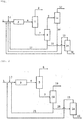
- FIG. 1 is a schematic block diagram for explaining an isobutene preparation method according to an embodiment of the present invention.
- a C 4 mixture 1 e.g., C 4 raffinate-1 or the like
- glycol 2 e.g., EG, DEG, or the like
- a reaction product mixture stream 4 containing glycol ether e.g., ETB and/or DBE, DETB and/or DDBE, or the like
- unreacted glycol, unreacted C 4 mixture, and the like is supplied to a first distillation column (a C 4 distillation column 5) from the glycol ether polymerization reactor 3.
- the unreacted C 4 mixture is separated and discharged as an unreacted C 4 mixture stream 6 from the first distillation column 5, and a reaction product mixture stream 7 from which the unreacted C 4 mixture has been removed is supplied to a second distillation column (i.e., a glycol ether distillation column 8) for separation of the base product.
- a second distillation column i.e., a glycol ether distillation column 8
- main products i.e., dialkyl ethers (DBE, DDBE, and the like) and monoalkyl ethers (ETB, DETB, and the like)
- DBE dialkyl ethers
- ETB monoalkyl ethers
- the monoalkyl ethers are all separated as a glycol ether stream 9, which is an upper stream, together with the dialkyl ethers when a large amount of dialkyl ethers is distilled.
- the glycol ether stream 9 may be supplied to a glycol ether cracking reactor 11 and then cracked into pure isobutene 12 and glycol 13.
- the dialkyl ether may be completely cracked in the glycol ether cracking reactor 11, and a remaining portion of the monoalkyl ether that has not been cracked may be recycled to the glycol ether polymerization reactor 3 together with the glycol 2 to be polymerized as dialkyl ether.
- Lower streams (regenerated glycol streams 10 and 17) of the second distillation column 8 mostly consist of glycol and may be recycled to the glycol ether polymerization reactor 3 or, as desired, may be supplied to a third distillation column (a distillation column 14 for regeneration of glycol) to be further separated into pure glycol 15 and then be recycled to the glycol ether polymerization reactor 3.
- the third distillation column 14 may separate thermally deformed glycol generated when glycol is recycled for a long period of time to obtain the pure glycol 15, and the thermally deformed glycol is separated and discharged through a deformed glycol stream 16.
- a general temperature-controllable fixed-bed reactor or the like may be used as the glycol ether polymerization reactor 3 and the glycol ether cracking reactor 11, and a general multi-stage (e.g., 10 to 50 theoretical plate) distillation column of a packing or tray type may be used as the first, second and third distillation columns 5, 8 and 14.
- a general multi-stage (e.g., 10 to 50 theoretical plate) distillation column of a packing or tray type may be used as the first, second and third distillation columns 5, 8 and 14.
- separation of the unreacted C 4 mixture stream 6 and the reaction product mixture stream 7 from which the unreacted C 4 mixture has been removed may be performed at a pressure between 0.1 bar (0.1 kgf/cm 2 ) and 29.4 bar (30 kgf/cm 2 ) and a temperature between 20°C and 250°C, preferably at a pressure between 2.9 bar (3 kgf/cm 2 ) and 9.8 bar (10 kgf/cm 2 ) and a temperature between 40°C and 200°C.
- separation of the glycol ether 8 and the glycols 10 and 17 in the second distillation column 8 may be performed at a pressure between 0.1 bar (0.1 kgf/cm 2 ) and 1 bar (1 kgf/cm 2 ) and a temperature between 200°C and 300°C, preferably at a pressure between 0.1 bar (0.1 kgf/cm 2 ) and 0.5 bar (0.5 kgf/cm 2 ) and a temperature between 220°C and 250°C.
- Separation of the pure glycol 15 and the deformed glycol stream 16 in the third distillation column 14 may be performed at a pressure between 0.1 bar (0.1 kgf/cm 2 ) and 9.8 bar (10 kgf/cm 2 ) and a temperature between 100°C and 300°C, preferably at a pressure between 0.5 bar (0.5 kgf/cm 2 ) and 2.9 bar (3 kgf/cm 2 ) and a temperature between 200°C and 250°C.
- FIG. 2 is a schematic block diagram for explaining an isobutene preparation method according to another embodiment of the present invention.
- the isobutene preparation method according to the present embodiment may use at least one reactive distillation column 18 instead of the second distillation column 8 and the glycol ether cracking reactor 11.
- the reactive distillation column 18 is prepared by forming a catalyst layer in a general multi-stage distillation column (by packing the multi-stage distillation column with a strongly acidic catalyst), and separation of isobutene through decomposition and distillation of glycol ether may be simultaneously performed in the reactive distillation column 18 and thus raw material costs may further be reduced.
- Lower streams (regenerated glycol streams 20 and 21) of the reactive distillation column 18 mostly consist of glycol and may be recycled to the glycol ether polymerization reactor 3 or, as desired, may be supplied to the third distillation column (the distillation column 14 for regeneration of glycol) to be further separated into the pure glycol 15 and then be recycled to the glycol ether polymerization reactor 3. In addition, thermally deformed glycol is separated and discharged through the deformed glycol stream 16.
- glycol ether having high reactivity as a cracking precursor of isobutene may be prepared from a C 4 mixture with high selectivity without production of impurities.
- isobutene may be economically prepared from glycol ether through a simplified preparation process that does not require an impurity removal process.
- glycol ether polymerization reactor 3 100 g of a strongly acidic solid ion exchange resin (Product name: Amberlyst 15, manufacturer: Rohm&Hass) as an acid catalyst packed into a vertical tubular reactor (made of SUS316), provided at an outer side thereof with an oil heating bath and having an inner diameter of 25.4 mm and a length of 100 cm, was used.
- a first distillation column C 4 distillation column 5
- a distillation column having a theoretical plate number of 15 was used as the first distillation column.
- distillation column having a theoretical plate number of 30 was used as the second distillation column (glycol ether distillation column 8) used to separate glycol ether, and 100 g of a strongly acidic solid catalyst (Product name: Shacnite #136, manufacturer: Daeil Chemical, Co., Ltd) packed into a vertical tubular reactor (SUS316), provided at an outer side thereof with an oil heating bath and having an inner diameter of 25.4 mm and a length of 100 cm, was used as the glycol ether cracking reactor 11.
- a distillation column having a theoretical plate number of 10 was used as the third distillation column (distillation column 14 for regeneration of glycol) used to regenerate pure glycol.
- the glycol ether polymerization reactor 3 and the glycol ether cracking reactor 11 had a double tubular shape and were used to control reaction temperature by cycling heat transfer oil of the oil heating bath via an outer tube thereof.
- the glycol ether polymerization reactor 3 was preheated to a temperature between 50°C and 60°C before reaction
- the glycol ether cracking reactor 11 was preheated to a temperature between 100°C and 150°C before reaction
- a pressure in the reaction tube was 2.9 bar (3 kgf/cm 2 ).
- glycol ether ethylene glycol di-t-butyl ether (DBE)
- ETB ethylene glycol mono-t-butyl ether
- C4 raffinate-1 having compositions shown in Table 3 below
- ethylene glycol (EG) were supplied to a lower portion of the glycol ether polymerization reactor 3.
- reaction was performed at a WHSV of 1.0 to 3.0(hr -1 ) based on C 4 raffinate-1, in a molar ratio of EG to isobutene of 2.0, and a reaction tube pressure of 9.8 bar (10 kgf/cm 2 ).
- unreacted C 4 mixture (C 4 raffinate-1, 6) was separated and discharged via the first distillation column 5 and then the reaction product mixture stream 7 from which the unreacted C 4 mixture has been removed was supplied to the second distillation column 8, to obtain the glycol ether stream 9 as a base product (a large amount of DBE and a small amount of ETB).
- the obtained DBE and ETB were supplied to the glycol ether cracking reactor 11, and glycol ether was cracked according to the reaction conditions shown in Table 4 below, to obtain isobutene 12.
- the EGs 10, 13 and 17 separated from the second distillation column 8 and the glycol ether cracking reactor 11 were recycled as reactants to the glycol ether polymerization reactor 3, or were supplied to the third distillation column 14 to remove the thermally deformed EG 16, followed by recycling of the pure EG 15.
- the unreacted C 4 mixture (C 4 raffinate-1, 6) was analyzed by gas chromatography (Device name: Agilent 7890A) to obtain reaction conversion rates of DBE and ETB into isobutene. Results are shown in Table 4 below.
- the isobutene preparation method according to the present invention uses glycol ether as a precursor that can be prepared in high yield and with high selectivity and thus isobutene may be prepared in high yield and with high selectivity, reaction processes may be simplified due to few impurities, and the method is economical and very innovative, when compared to a conventional t-butyl alcohol (TBA) dehydration method and methyl t-butyl ether (MTBE) cracking method that use TBA and MTBE, which have low reactivity, and need removal of unreacted reactants or byproducts produced during etherification and cracking through complicated processes including processing using plural columns and washing.
- TBA t-butyl alcohol
- MTBE methyl t-butyl ether
- a method of preparing high-purity isobutene using glycol ether, according to the present invention, is useful to separate (prepare) high-purity isobutene from a C 4 mixture, in particular C 4 raffinate-1 containing isobutene.
Landscapes
- Chemical & Material Sciences (AREA)
- Organic Chemistry (AREA)
- Chemical Kinetics & Catalysis (AREA)
- Engineering & Computer Science (AREA)
- Analytical Chemistry (AREA)
- Oil, Petroleum & Natural Gas (AREA)
- Water Supply & Treatment (AREA)
- Organic Low-Molecular-Weight Compounds And Preparation Thereof (AREA)
- Low-Molecular Organic Synthesis Reactions Using Catalysts (AREA)
Claims (6)
- Verfahren zur Herstellung von Isobuten, umfassend die Schritte:Herstellen von Glycolethern durch eine Zwei-Schritt-Reaktion zwischen einer C4-Mischung, enthaltend Isobuten und Glycol, in der Gegenwart eines Säurekatalysators, wobei im ersten Schritt Glycol und Isobuten der C4-Mischung in Gegenwart des Säurekatalysators Mono-t-butylether erzeugen, und in dem zweiten Schritt Mono-t-butylether und Isobuten in Gegenwart des Säurekatalysators Glycol-di-t-butylether erzeugen;Cracken des Glycolethers in Isobuten und Glycol bei einer Temperatur zwischen 50°C und 300°C in der Gegenwart eines stark sauren Katalysators mit einer Hammett-Aciditätsfunktion von +1,5 oder weniger,wobei das Glycol eine Verbindung ist, wiedergegeben durch nachstehende Formel 1:
 worin R1 und R2 jeweils unabhängig ein Wasserstoffatom oder eine C1-C5-Alkylkgruppe sind, und n eine ganze Zahl von 0 bis 4 ist.
 - Verfahren nach Anspruch 1, wobei der stark saure Katalysator ein Ton-basierter Feststoffkatalysator ist.
- Verfahren nach Anspruch 1, wobei das Cracken in einem Glycolether-Crackreaktor oder einer reaktiven Destillationskolonne durchgeführt wird.
- Verfahren nach Anspruch 1, wobei der Säurekatalysator ein stark saures Feststoff-Ionenaustauschharz ist, enthaltend eine Sulfonsäuregruppe.
- Verfahren nach Anspruch 1, wobei das Cracken kontinuierlich oder nicht kontinuierlich durchgeführt wird.
- Verfahren nach Anspruch 1, wobei während des Crackens des Glycol-di-alkylethers der Glycol-di-alkylether vollständig gecrackt wird und verbleibender Glycol-monoalkylether, der nicht gecrackt worden ist, recycliert wird zum Herstellungsschritt für die Glycolether, zusammen mit dem Glycol, um Glycol-di-alkylether zu polymerisieren.
Applications Claiming Priority (2)
| Application Number | Priority Date | Filing Date | Title |
|---|---|---|---|
| KR1020110014521A KR101331553B1 (ko) | 2011-02-18 | 2011-02-18 | 글리콜에테르를 이용한 고순도 이소부텐의 제조 방법 |
| PCT/KR2012/001214 WO2012112003A2 (ko) | 2011-02-18 | 2012-02-17 | 글리콜에테르를 이용한 고순도 이소부텐의 제조 방법 |
Publications (3)
| Publication Number | Publication Date |
|---|---|
| EP2684858A2 EP2684858A2 (de) | 2014-01-15 |
| EP2684858A4 EP2684858A4 (de) | 2015-11-11 |
| EP2684858B1 true EP2684858B1 (de) | 2019-09-04 |
Family
ID=46673064
Family Applications (1)
| Application Number | Title | Priority Date | Filing Date |
|---|---|---|---|
| EP12746570.6A Active EP2684858B1 (de) | 2011-02-18 | 2012-02-17 | Verfahren zur herstellung von hochreinem isobuten unter verwendung von glycolether |
Country Status (6)
| Country | Link |
|---|---|
| US (1) | US9637422B2 (de) |
| EP (1) | EP2684858B1 (de) |
| JP (1) | JP5890849B2 (de) |
| KR (1) | KR101331553B1 (de) |
| CN (1) | CN103380103B (de) |
| WO (1) | WO2012112003A2 (de) |
Families Citing this family (7)
| Publication number | Priority date | Publication date | Assignee | Title |
|---|---|---|---|---|
| CN104292066A (zh) * | 2014-09-04 | 2015-01-21 | 深圳市飞扬实业有限公司 | 高纯度异丁烯制备方法 |
| CN105152872A (zh) * | 2015-07-22 | 2015-12-16 | 深圳市前海飞扬新能源科技有限公司 | 一种仲丁基叔丁基醚的制备方法及其应用 |
| CN107739300B (zh) * | 2017-10-23 | 2021-02-09 | 黄河三角洲京博化工研究院有限公司 | 一种生产高纯异丁烯及乙二醇单叔丁基醚的工艺方法 |
| CN107778123B (zh) * | 2017-10-23 | 2021-02-09 | 黄河三角洲京博化工研究院有限公司 | 一种制备异丁烯的方法 |
| CN109928859B (zh) * | 2017-12-15 | 2021-07-23 | 万华化学集团股份有限公司 | 一种异丁烯精制釜残的处理方法 |
| WO2020006437A1 (en) | 2018-06-29 | 2020-01-02 | Ntp Tec, Llc | Processes for the manufacture of isobutylene, polyisobutylene, and derivatives thereof |
| US20240384013A1 (en) | 2023-05-19 | 2024-11-21 | Ntp Tec, Llc | Processes for converting c4 feeds to isobutylene, polyisobutylene, or derivatives thereof |
Family Cites Families (21)
| Publication number | Priority date | Publication date | Assignee | Title |
|---|---|---|---|---|
| FR796156A (fr) | 1934-11-09 | 1936-03-31 | Carbide & Carbon Chem Corp | Procédé de préparation d'éthers dialkyliques de glycols |
| JPS5126401B1 (de) * | 1969-03-12 | 1976-08-06 | ||
| JPS6051451B2 (ja) | 1978-11-06 | 1985-11-14 | 三菱レイヨン株式会社 | 第3級ブチルアルコ−ルの製造法 |
| JPS562855A (en) | 1979-06-19 | 1981-01-13 | Satake Eng Co Ltd | Device for humidifying cereal grain |
| JPS5610124A (en) | 1979-07-05 | 1981-02-02 | Sumitomo Chem Co Ltd | Preparation of tert-butyl alcohol |
| JPS56103127A (en) * | 1980-01-22 | 1981-08-18 | Cosmo Co Ltd | Preparation of ethylene glycol monotert-alkyl ether |
| JPS5951224A (ja) * | 1982-09-17 | 1984-03-24 | Cosmo Co Ltd | C↓4炭化水素留分からイソブチレンを分離する方法 |
| JPS59157037A (ja) * | 1983-02-26 | 1984-09-06 | Mitsubishi Gas Chem Co Inc | 第三級オレフインの製造法 |
| US4727216A (en) | 1983-09-12 | 1988-02-23 | Chevron Research Company | Dehydrogenation of isobutane over a zeolitic catalyst |
| JPS6327445A (ja) | 1986-07-17 | 1988-02-05 | Kogyo Kaihatsu Kenkyusho | ジメチルエーテルからジメトキシエタンを生成させる方法 |
| JPH0780800B2 (ja) * | 1987-04-08 | 1995-08-30 | 丸善石油化学株式会社 | プロピレングリコ−ル第3ブチルエ−テルの製造方法 |
| DE3923291A1 (de) * | 1989-07-14 | 1991-01-24 | Erdoelchemie Gmbh | Verfahren zur herstellung von reinen c(pfeil abwaerts)4(pfeil abwaerts)-c(pfeil abwaerts)7(pfeil abwaerts)-tert.-alkenen |
| US5146041A (en) * | 1991-09-03 | 1992-09-08 | Texaco Chemical Company | Method of separating isobutylene from a C-4 hydrocarbon fraction using montmorillonite catalysts |
| US5177301A (en) | 1992-01-21 | 1993-01-05 | Texaco Chemical Company | Method of separating isobutylene from a C-4 hydrocarbon fraction using a heteropoly acid on an inert support |
| EP0530966A3 (en) * | 1991-09-03 | 1993-04-14 | Texaco Chemical Company | Method of separating isobutylene from a c-4 hydrocarbon fraction |
| US5567860A (en) | 1992-08-13 | 1996-10-22 | Uop | High purity tertiary olefin process using removal of secondary ethers |
| US5552024A (en) * | 1994-02-28 | 1996-09-03 | Arco Chemical Technology, L.P. | Process for recovering dipropylene glycol tert-butyl ethers |
| DE19504555A1 (de) | 1995-02-11 | 1996-08-14 | Huels Chemische Werke Ag | Verfahren zur Spaltung von Tertiärbutylalkohol in einer Reaktionsdestillationskolonne |
| JPH10101606A (ja) * | 1996-09-25 | 1998-04-21 | Mitsubishi Chem Corp | 1,2−ブタンジオールモノ−t−ブチルエーテルの製造方法 |
| JPH11193255A (ja) | 1997-12-26 | 1999-07-21 | Mitsubishi Rayon Co Ltd | 第3級ブチルアルコールの製造方法 |
| DE10238370A1 (de) | 2002-08-22 | 2004-03-04 | Oxeno Olefinchemie Gmbh | Verfahren zur Herstellung von Isobuten aus technischen Methyl-tert.-butylether |
-
2011
- 2011-02-18 KR KR1020110014521A patent/KR101331553B1/ko not_active Expired - Fee Related
-
2012
- 2012-02-17 JP JP2013554398A patent/JP5890849B2/ja not_active Expired - Fee Related
- 2012-02-17 WO PCT/KR2012/001214 patent/WO2012112003A2/ko not_active Ceased
- 2012-02-17 US US14/000,095 patent/US9637422B2/en not_active Expired - Fee Related
- 2012-02-17 EP EP12746570.6A patent/EP2684858B1/de active Active
- 2012-02-17 CN CN201280009554.7A patent/CN103380103B/zh not_active Expired - Fee Related
Non-Patent Citations (1)
| Title |
|---|
| None * |
Also Published As
| Publication number | Publication date |
|---|---|
| US20130324781A1 (en) | 2013-12-05 |
| WO2012112003A2 (ko) | 2012-08-23 |
| KR101331553B1 (ko) | 2013-11-20 |
| WO2012112003A3 (ko) | 2012-10-26 |
| CN103380103A (zh) | 2013-10-30 |
| KR20120095082A (ko) | 2012-08-28 |
| JP5890849B2 (ja) | 2016-03-22 |
| JP2014513049A (ja) | 2014-05-29 |
| EP2684858A4 (de) | 2015-11-11 |
| US9637422B2 (en) | 2017-05-02 |
| CN103380103B (zh) | 2015-09-23 |
| EP2684858A2 (de) | 2014-01-15 |
Similar Documents
| Publication | Publication Date | Title |
|---|---|---|
| EP2684858B1 (de) | Verfahren zur herstellung von hochreinem isobuten unter verwendung von glycolether | |
| KR101157813B1 (ko) | 이소부텐 함유 탄화수소 혼합물로부터 3급 부탄올을제조하는 방법 | |
| EP2547639B1 (de) | Herstellung von propylen via gleichzeitige dehydrierung und skelettisomerisierung von isobutanol an säurekatalysatoren gefolgt von einer metathese-reaktion | |
| CN101497548B (zh) | 从c4烃的工业混合物i制备正丁烯低聚物和1-丁烯的方法 | |
| US8143468B2 (en) | Process for preparing 3-methylbut-1-ene | |
| US7026519B2 (en) | Obtaining tert-butanol | |
| CN102892729B (zh) | 异丁醇在酸性催化剂上的同时脱水和骨架异构化 | |
| EP2240423B1 (de) | Verfahren und katalysator zum spalten von ethern und alkoholen | |
| GB1580652A (en) | Process for the manufacture of methyl tertiary butyl ehter | |
| JP5192688B2 (ja) | C4炭化水素の工業的混合物からエチル−tert−ブチルエーテルを製造する方法 | |
| KR101376185B1 (ko) | 1-부텐계 스트림의 정밀 정제방법 | |
| JP2024503301A (ja) | 1-ヘキセンの精製方法 | |
| US9272965B2 (en) | Process for the conversion of alcohols to olefins | |
| EP2374780A1 (de) | Herstellung von Propylen via gleichzeitige Dehydrierung und Skelettisomerisierung von Isobutanol an Säurekatalysatoren gefolgt von einer Metathese-Reaktion | |
| US20120149549A1 (en) | Process for regenerating a catalyst | |
| KR101075381B1 (ko) | 3급 부탄올의 제조방법 | |
| EP2197825B1 (de) | Verfahren zur herstellung von tert.-amylethylether | |
| US20130261345A1 (en) | Production of fuel additives via simultaneous dehydration and skeletal isomerisation of isobutanol on acid catalysts followed by etherification | |
| KR20160023321A (ko) | 폴리부텐의 제조방법 | |
| US5157162A (en) | One step synthesis of methyl t-butyl ether from t-butanol using fluorosulfonic acid-modified clay catalysts | |
| US5157161A (en) | One-step synthesis of methyl t-butyl ether from t-butanol using hydrogen fluoride-modified montmorillonite clays | |
| KR102211625B1 (ko) | 이소부텐 올리고머를 제조하는 방법 | |
| TW200418769A (en) | Process for preparing tert-butanol | |
| KR0127863B1 (ko) | 고순도 디이소부텐의 제조방법 |
Legal Events
| Date | Code | Title | Description |
|---|---|---|---|
| PUAI | Public reference made under article 153(3) epc to a published international application that has entered the european phase |
Free format text: ORIGINAL CODE: 0009012 |
|
| 17P | Request for examination filed |
Effective date: 20130916 |
|
| AK | Designated contracting states |
Kind code of ref document: A2 Designated state(s): AL AT BE BG CH CY CZ DE DK EE ES FI FR GB GR HR HU IE IS IT LI LT LU LV MC MK MT NL NO PL PT RO RS SE SI SK SM TR |
|
| DAX | Request for extension of the european patent (deleted) | ||
| A4 | Supplementary search report drawn up and despatched |
Effective date: 20151014 |
|
| RIC1 | Information provided on ipc code assigned before grant |
Ipc: C07C 11/09 20060101AFI20151008BHEP Ipc: C07B 37/06 20060101ALI20151008BHEP Ipc: C07C 43/03 20060101ALI20151008BHEP |
|
| STAA | Information on the status of an ep patent application or granted ep patent |
Free format text: STATUS: EXAMINATION IS IN PROGRESS |
|
| 17Q | First examination report despatched |
Effective date: 20170320 |
|
| GRAP | Despatch of communication of intention to grant a patent |
Free format text: ORIGINAL CODE: EPIDOSNIGR1 |
|
| STAA | Information on the status of an ep patent application or granted ep patent |
Free format text: STATUS: GRANT OF PATENT IS INTENDED |
|
| RIC1 | Information provided on ipc code assigned before grant |
Ipc: C07B 37/06 20060101ALI20190304BHEP Ipc: C07C 1/20 20060101ALI20190304BHEP Ipc: C07C 43/03 20060101ALI20190304BHEP Ipc: C07C 41/06 20060101ALI20190304BHEP Ipc: C07C 11/09 20060101AFI20190304BHEP |
|
| INTG | Intention to grant announced |
Effective date: 20190326 |
|
| GRAS | Grant fee paid |
Free format text: ORIGINAL CODE: EPIDOSNIGR3 |
|
| GRAA | (expected) grant |
Free format text: ORIGINAL CODE: 0009210 |
|
| STAA | Information on the status of an ep patent application or granted ep patent |
Free format text: STATUS: THE PATENT HAS BEEN GRANTED |
|
| AK | Designated contracting states |
Kind code of ref document: B1 Designated state(s): AL AT BE BG CH CY CZ DE DK EE ES FI FR GB GR HR HU IE IS IT LI LT LU LV MC MK MT NL NO PL PT RO RS SE SI SK SM TR |
|
| REG | Reference to a national code |
Ref country code: GB Ref legal event code: FG4D |
|
| REG | Reference to a national code |
Ref country code: CH Ref legal event code: EP |
|
| REG | Reference to a national code |
Ref country code: AT Ref legal event code: REF Ref document number: 1175106 Country of ref document: AT Kind code of ref document: T Effective date: 20190915 |
|
| REG | Reference to a national code |
Ref country code: DE Ref legal event code: R096 Ref document number: 602012063632 Country of ref document: DE |
|
| REG | Reference to a national code |
Ref country code: IE Ref legal event code: FG4D |
|
| REG | Reference to a national code |
Ref country code: NL Ref legal event code: MP Effective date: 20190904 |
|
| REG | Reference to a national code |
Ref country code: LT Ref legal event code: MG4D |
|
| PG25 | Lapsed in a contracting state [announced via postgrant information from national office to epo] |
Ref country code: SE Free format text: LAPSE BECAUSE OF FAILURE TO SUBMIT A TRANSLATION OF THE DESCRIPTION OR TO PAY THE FEE WITHIN THE PRESCRIBED TIME-LIMIT Effective date: 20190904 Ref country code: BG Free format text: LAPSE BECAUSE OF FAILURE TO SUBMIT A TRANSLATION OF THE DESCRIPTION OR TO PAY THE FEE WITHIN THE PRESCRIBED TIME-LIMIT Effective date: 20191204 Ref country code: NO Free format text: LAPSE BECAUSE OF FAILURE TO SUBMIT A TRANSLATION OF THE DESCRIPTION OR TO PAY THE FEE WITHIN THE PRESCRIBED TIME-LIMIT Effective date: 20191204 Ref country code: FI Free format text: LAPSE BECAUSE OF FAILURE TO SUBMIT A TRANSLATION OF THE DESCRIPTION OR TO PAY THE FEE WITHIN THE PRESCRIBED TIME-LIMIT Effective date: 20190904 Ref country code: HR Free format text: LAPSE BECAUSE OF FAILURE TO SUBMIT A TRANSLATION OF THE DESCRIPTION OR TO PAY THE FEE WITHIN THE PRESCRIBED TIME-LIMIT Effective date: 20190904 Ref country code: LT Free format text: LAPSE BECAUSE OF FAILURE TO SUBMIT A TRANSLATION OF THE DESCRIPTION OR TO PAY THE FEE WITHIN THE PRESCRIBED TIME-LIMIT Effective date: 20190904 |
|
| PG25 | Lapsed in a contracting state [announced via postgrant information from national office to epo] |
Ref country code: ES Free format text: LAPSE BECAUSE OF FAILURE TO SUBMIT A TRANSLATION OF THE DESCRIPTION OR TO PAY THE FEE WITHIN THE PRESCRIBED TIME-LIMIT Effective date: 20190904 Ref country code: LV Free format text: LAPSE BECAUSE OF FAILURE TO SUBMIT A TRANSLATION OF THE DESCRIPTION OR TO PAY THE FEE WITHIN THE PRESCRIBED TIME-LIMIT Effective date: 20190904 Ref country code: GR Free format text: LAPSE BECAUSE OF FAILURE TO SUBMIT A TRANSLATION OF THE DESCRIPTION OR TO PAY THE FEE WITHIN THE PRESCRIBED TIME-LIMIT Effective date: 20191205 Ref country code: RS Free format text: LAPSE BECAUSE OF FAILURE TO SUBMIT A TRANSLATION OF THE DESCRIPTION OR TO PAY THE FEE WITHIN THE PRESCRIBED TIME-LIMIT Effective date: 20190904 Ref country code: AL Free format text: LAPSE BECAUSE OF FAILURE TO SUBMIT A TRANSLATION OF THE DESCRIPTION OR TO PAY THE FEE WITHIN THE PRESCRIBED TIME-LIMIT Effective date: 20190904 |
|
| REG | Reference to a national code |
Ref country code: AT Ref legal event code: MK05 Ref document number: 1175106 Country of ref document: AT Kind code of ref document: T Effective date: 20190904 |
|
| PG25 | Lapsed in a contracting state [announced via postgrant information from national office to epo] |
Ref country code: PT Free format text: LAPSE BECAUSE OF FAILURE TO SUBMIT A TRANSLATION OF THE DESCRIPTION OR TO PAY THE FEE WITHIN THE PRESCRIBED TIME-LIMIT Effective date: 20200106 Ref country code: EE Free format text: LAPSE BECAUSE OF FAILURE TO SUBMIT A TRANSLATION OF THE DESCRIPTION OR TO PAY THE FEE WITHIN THE PRESCRIBED TIME-LIMIT Effective date: 20190904 Ref country code: PL Free format text: LAPSE BECAUSE OF FAILURE TO SUBMIT A TRANSLATION OF THE DESCRIPTION OR TO PAY THE FEE WITHIN THE PRESCRIBED TIME-LIMIT Effective date: 20190904 Ref country code: AT Free format text: LAPSE BECAUSE OF FAILURE TO SUBMIT A TRANSLATION OF THE DESCRIPTION OR TO PAY THE FEE WITHIN THE PRESCRIBED TIME-LIMIT Effective date: 20190904 Ref country code: NL Free format text: LAPSE BECAUSE OF FAILURE TO SUBMIT A TRANSLATION OF THE DESCRIPTION OR TO PAY THE FEE WITHIN THE PRESCRIBED TIME-LIMIT Effective date: 20190904 Ref country code: RO Free format text: LAPSE BECAUSE OF FAILURE TO SUBMIT A TRANSLATION OF THE DESCRIPTION OR TO PAY THE FEE WITHIN THE PRESCRIBED TIME-LIMIT Effective date: 20190904 Ref country code: IT Free format text: LAPSE BECAUSE OF FAILURE TO SUBMIT A TRANSLATION OF THE DESCRIPTION OR TO PAY THE FEE WITHIN THE PRESCRIBED TIME-LIMIT Effective date: 20190904 |
|
| PG25 | Lapsed in a contracting state [announced via postgrant information from national office to epo] |
Ref country code: IS Free format text: LAPSE BECAUSE OF FAILURE TO SUBMIT A TRANSLATION OF THE DESCRIPTION OR TO PAY THE FEE WITHIN THE PRESCRIBED TIME-LIMIT Effective date: 20200224 Ref country code: CZ Free format text: LAPSE BECAUSE OF FAILURE TO SUBMIT A TRANSLATION OF THE DESCRIPTION OR TO PAY THE FEE WITHIN THE PRESCRIBED TIME-LIMIT Effective date: 20190904 Ref country code: SK Free format text: LAPSE BECAUSE OF FAILURE TO SUBMIT A TRANSLATION OF THE DESCRIPTION OR TO PAY THE FEE WITHIN THE PRESCRIBED TIME-LIMIT Effective date: 20190904 Ref country code: SM Free format text: LAPSE BECAUSE OF FAILURE TO SUBMIT A TRANSLATION OF THE DESCRIPTION OR TO PAY THE FEE WITHIN THE PRESCRIBED TIME-LIMIT Effective date: 20190904 |
|
| REG | Reference to a national code |
Ref country code: DE Ref legal event code: R097 Ref document number: 602012063632 Country of ref document: DE |
|
| PLBE | No opposition filed within time limit |
Free format text: ORIGINAL CODE: 0009261 |
|
| STAA | Information on the status of an ep patent application or granted ep patent |
Free format text: STATUS: NO OPPOSITION FILED WITHIN TIME LIMIT |
|
| PG2D | Information on lapse in contracting state deleted |
Ref country code: IS |
|
| PG25 | Lapsed in a contracting state [announced via postgrant information from national office to epo] |
Ref country code: DK Free format text: LAPSE BECAUSE OF FAILURE TO SUBMIT A TRANSLATION OF THE DESCRIPTION OR TO PAY THE FEE WITHIN THE PRESCRIBED TIME-LIMIT Effective date: 20190904 Ref country code: IS Free format text: LAPSE BECAUSE OF FAILURE TO SUBMIT A TRANSLATION OF THE DESCRIPTION OR TO PAY THE FEE WITHIN THE PRESCRIBED TIME-LIMIT Effective date: 20200105 |
|
| 26N | No opposition filed |
Effective date: 20200605 |
|
| PG25 | Lapsed in a contracting state [announced via postgrant information from national office to epo] |
Ref country code: SI Free format text: LAPSE BECAUSE OF FAILURE TO SUBMIT A TRANSLATION OF THE DESCRIPTION OR TO PAY THE FEE WITHIN THE PRESCRIBED TIME-LIMIT Effective date: 20190904 |
|
| REG | Reference to a national code |
Ref country code: CH Ref legal event code: PL |
|
| GBPC | Gb: european patent ceased through non-payment of renewal fee |
Effective date: 20200217 |
|
| REG | Reference to a national code |
Ref country code: BE Ref legal event code: MM Effective date: 20200229 |
|
| PG25 | Lapsed in a contracting state [announced via postgrant information from national office to epo] |
Ref country code: MC Free format text: LAPSE BECAUSE OF FAILURE TO SUBMIT A TRANSLATION OF THE DESCRIPTION OR TO PAY THE FEE WITHIN THE PRESCRIBED TIME-LIMIT Effective date: 20190904 Ref country code: LU Free format text: LAPSE BECAUSE OF NON-PAYMENT OF DUE FEES Effective date: 20200217 |
|
| PG25 | Lapsed in a contracting state [announced via postgrant information from national office to epo] |
Ref country code: CH Free format text: LAPSE BECAUSE OF NON-PAYMENT OF DUE FEES Effective date: 20200229 Ref country code: LI Free format text: LAPSE BECAUSE OF NON-PAYMENT OF DUE FEES Effective date: 20200229 |
|
| PG25 | Lapsed in a contracting state [announced via postgrant information from national office to epo] |
Ref country code: IE Free format text: LAPSE BECAUSE OF NON-PAYMENT OF DUE FEES Effective date: 20200217 Ref country code: GB Free format text: LAPSE BECAUSE OF NON-PAYMENT OF DUE FEES Effective date: 20200217 Ref country code: FR Free format text: LAPSE BECAUSE OF NON-PAYMENT OF DUE FEES Effective date: 20200229 |
|
| PG25 | Lapsed in a contracting state [announced via postgrant information from national office to epo] |
Ref country code: BE Free format text: LAPSE BECAUSE OF NON-PAYMENT OF DUE FEES Effective date: 20200229 |
|
| REG | Reference to a national code |
Ref country code: DE Ref legal event code: R081 Ref document number: 602012063632 Country of ref document: DE Owner name: DL CHEMICAL CO., LTD., KR Free format text: FORMER OWNER: DAELIM INDUSTRIAL CO., LTD., SEOUL/SOUL, KR Ref country code: DE Ref legal event code: R082 Ref document number: 602012063632 Country of ref document: DE Representative=s name: HENKEL & PARTNER MBB PATENTANWALTSKANZLEI, REC, DE |
|
| PGFP | Annual fee paid to national office [announced via postgrant information from national office to epo] |
Ref country code: DE Payment date: 20220217 Year of fee payment: 11 |
|
| PG25 | Lapsed in a contracting state [announced via postgrant information from national office to epo] |
Ref country code: TR Free format text: LAPSE BECAUSE OF FAILURE TO SUBMIT A TRANSLATION OF THE DESCRIPTION OR TO PAY THE FEE WITHIN THE PRESCRIBED TIME-LIMIT Effective date: 20190904 Ref country code: MT Free format text: LAPSE BECAUSE OF FAILURE TO SUBMIT A TRANSLATION OF THE DESCRIPTION OR TO PAY THE FEE WITHIN THE PRESCRIBED TIME-LIMIT Effective date: 20190904 Ref country code: CY Free format text: LAPSE BECAUSE OF FAILURE TO SUBMIT A TRANSLATION OF THE DESCRIPTION OR TO PAY THE FEE WITHIN THE PRESCRIBED TIME-LIMIT Effective date: 20190904 |
|
| PG25 | Lapsed in a contracting state [announced via postgrant information from national office to epo] |
Ref country code: MK Free format text: LAPSE BECAUSE OF FAILURE TO SUBMIT A TRANSLATION OF THE DESCRIPTION OR TO PAY THE FEE WITHIN THE PRESCRIBED TIME-LIMIT Effective date: 20190904 |
|
| REG | Reference to a national code |
Ref country code: DE Ref legal event code: R119 Ref document number: 602012063632 Country of ref document: DE |
|
| PG25 | Lapsed in a contracting state [announced via postgrant information from national office to epo] |
Ref country code: DE Free format text: LAPSE BECAUSE OF NON-PAYMENT OF DUE FEES Effective date: 20230901 |