EP2685257A1 - Méthode d'analyse - Google Patents
Méthode d'analyse Download PDFInfo
- Publication number
- EP2685257A1 EP2685257A1 EP12755365.9A EP12755365A EP2685257A1 EP 2685257 A1 EP2685257 A1 EP 2685257A1 EP 12755365 A EP12755365 A EP 12755365A EP 2685257 A1 EP2685257 A1 EP 2685257A1
- Authority
- EP
- European Patent Office
- Prior art keywords
- peptide
- glucagon
- gip
- seq
- secretin family
- Prior art date
- Legal status (The legal status is an assumption and is not a legal conclusion. Google has not performed a legal analysis and makes no representation as to the accuracy of the status listed.)
- Withdrawn
Links
Images






Classifications
-
- G—PHYSICS
- G01—MEASURING; TESTING
- G01N—INVESTIGATING OR ANALYSING MATERIALS BY DETERMINING THEIR CHEMICAL OR PHYSICAL PROPERTIES
- G01N33/00—Investigating or analysing materials by specific methods not covered by groups G01N1/00 - G01N31/00
- G01N33/48—Biological material, e.g. blood, urine; Haemocytometers
- G01N33/50—Chemical analysis of biological material, e.g. blood, urine; Testing involving biospecific ligand binding methods; Immunological testing
- G01N33/68—Chemical analysis of biological material, e.g. blood, urine; Testing involving biospecific ligand binding methods; Immunological testing involving proteins, peptides or amino acids
- G01N33/6803—General methods of protein analysis not limited to specific proteins or families of proteins
- G01N33/6848—Methods of protein analysis involving mass spectrometry
-
- C—CHEMISTRY; METALLURGY
- C07—ORGANIC CHEMISTRY
- C07K—PEPTIDES
- C07K14/00—Peptides having more than 20 amino acids; Gastrins; Somatostatins; Melanotropins; Derivatives thereof
- C07K14/435—Peptides having more than 20 amino acids; Gastrins; Somatostatins; Melanotropins; Derivatives thereof from animals; from humans
- C07K14/575—Hormones
- C07K14/605—Glucagons
-
- G—PHYSICS
- G01—MEASURING; TESTING
- G01N—INVESTIGATING OR ANALYSING MATERIALS BY DETERMINING THEIR CHEMICAL OR PHYSICAL PROPERTIES
- G01N30/00—Investigating or analysing materials by separation into components using adsorption, absorption or similar phenomena or using ion-exchange, e.g. chromatography or field flow fractionation
- G01N30/02—Column chromatography
- G01N30/88—Integrated analysis systems specially adapted therefor, not covered by a single one of the groups G01N30/04 - G01N30/86
- G01N2030/8809—Integrated analysis systems specially adapted therefor, not covered by a single one of the groups G01N30/04 - G01N30/86 analysis specially adapted for the sample
- G01N2030/8813—Integrated analysis systems specially adapted therefor, not covered by a single one of the groups G01N30/04 - G01N30/86 analysis specially adapted for the sample biological materials
- G01N2030/8831—Integrated analysis systems specially adapted therefor, not covered by a single one of the groups G01N30/04 - G01N30/86 analysis specially adapted for the sample biological materials involving peptides or proteins
-
- G—PHYSICS
- G01—MEASURING; TESTING
- G01N—INVESTIGATING OR ANALYSING MATERIALS BY DETERMINING THEIR CHEMICAL OR PHYSICAL PROPERTIES
- G01N30/00—Investigating or analysing materials by separation into components using adsorption, absorption or similar phenomena or using ion-exchange, e.g. chromatography or field flow fractionation
- G01N30/02—Column chromatography
- G01N30/62—Detectors specially adapted therefor
- G01N30/72—Mass spectrometers
- G01N30/7233—Mass spectrometers interfaced to liquid or supercritical fluid chromatograph
Definitions
- the quantitative methods using mass spectrometry are not yet satisfying in terms of quantitative sensitivity, and in the existing circumstances, the establishment of a quantitative method using a trace amount of sample is demanded.
- measured values can be changed.
- the present invention has been made in view of the above, and an object thereof is to provide a method in which glucagon-secretin family peptides can be stably analyzed under conditions that a measurement sample is less prone to undergo e.g. chemical changes during preservation and practical conditions.
- glucagon-secretin family peptides can be accurately analyzed even after time elapses from preparation.
- a trace amount of glucagon-secretin family peptide in a sample can be quantitated with high sensitivity, and reproducibility of quantitative values is good.
- exendin is known as a GLP-1 receptor agonist, and is also included in GLP-1 analogs.
- Exendin analogs are known, such as Exendin-3 [SEQ ID NO.: 56], Exendin-3 amide [the C-terminal amide derivative of the same sequence as SEQ ID NO.: 56], Exendin-4 [SEQ ID NO.: 57], Exendin-4 amide [the C-terminal amide derivative of the same sequence as SEQ ID NO.: 57], Exendin-4 acid [an acid variant of the same sequence as SEQ ID NO.: 57], Exendin-4-LysLysLysLysLys [SEQ ID NO.: 58], Exendin-4-LysLysLysLysLysLysLys [SEQ ID NO.: 59], Exendin-4 (1-30) [SEQ ID NO.: 60], Exendin-4 amide (1-30) [the C-terminal amide derivative of the same sequence as SEQ ID NO
- GLP-2 Glucagon-like peptide-2
- GLP-2 is an intestinotrophic peptide hormone with 33 amino acids which is formed via post-translational processing of proglucagon, and is commonly expressed by GLP-2 [SEQ ID NO.: 64].
- GIP GLP-2 loses its activity by cleavage of two amino acid residues on the N-terminal side by DPP-IV to form inactive GLP-2 (3-33) [SEQ ID NO.: 65].
- active GLP-2 and inactive GLP-2 can be distinguished and simultaneously analyzed or quantitated. Specifically, the following are well known as GLP-2 analogs.
- Glucagon is a peptide hormone consisting of 29 amino acids, and is commonly expressed by glucagon [SEQ ID NO.: 69]. Specifically, the following are well known as glucagon analogs. [Arg12]-Glucagon [SEQ ID NO.: 70], [Arg12, Lys20]-Glucagon [SEQ ID NO.: 71], [Arg12, Lys24]-Glucagon [SEQ ID NO.: 72], [Arg12, Lys29]-Glucagon [SEQ ID NO.: 73], [Glu9]-Glucagon [SEQ ID NO.: 74], [Glu9, Glul6, Lys29]-Glucagon [SEQ ID NO.: 75], [Lys13, Glu17]-Glucagon [SEQ ID NO.: 76], [Glu20, Lys24]-Glucagon [SEQ ID NO.: 77]
- the N-terminal side of aspartic acid can be cleaved or the C-terminal side thereof can be cleaved.
- the analysis using mass spectrometry can be carried out without using antibodies.
- multiply-charged ions are less prone to occur, and influences due to types of species can be reduced.
- positions 1-17 of the amino acid sequence have a high homology and are identical in human, rat and mouse. For preservation stability, it is important that a peptide fragment to be measured not comprise an oxidizable amino acid.
- glucagon-secretin family peptides There are methionine (Met), tryptophan (Trp) and cysteine (Cys) as oxidizable amino acids.
- Peptide fragments on the N-terminal glucagon-secretin family peptides do not comprise the above-mentioned amino acids, and preservation stability is good.
- glucagon-secretin family peptides are different, peptide fragments in the present method are different. It is thought that a peptide having the same sequence as a peptide on the N-terminal side cleaved at aspartic acid of a glucagon-secretin family peptide does not exist in a living body. Because of the above two points, peptide fragments on the N-terminal glucagon-secretin family peptides are distinguished by mass spectrometry and can be analyzed with high specificity.
- a specific precursor ion to a peptide to be quantitated is selected, and e.g. argon is then collided to dissociate the ion, and a new ion group is generated.
- One or more ions from this new ion group are analyzed by a mass spectrometer (MS). Therefore, quantitative determination can be carried out with high specificity.
- MS/MS/MS which has been developed in recent years, the establishment of a quantitative method with higher specificity is demanded.
- glucagon-secretin family peptides in a sample can be measured, and quantitative determination can be carried out even in a concentration range of not more than a standard concentration.
- the lower limit of quantification is the weakest concentration of standard concentration in a sample among samples in which a standard used to make a calibration curve is added, and means that the above-mentioned accuracy is within ⁇ 20%.
- the accuracy of a calibration curve is calculated by dividing a value obtained by subtracting an addition concentration from a quantitative value by the addition concentration.
- the above-mentioned correlation coefficient can be calculated by using spreadsheet software. Using a created calibration curve, glucagon-secretin family peptides in a sample can be quantitated.
- a substance to be measured and an internal standard have a mass difference, and thus are detected as different peaks by e.g. LC/MS, and quantitative determination can be carried out based on an area or height ratio of both peaks.
- a stable isotope-labeled internal standard can be the whole amino acid sequence of a glucagon-secretin family peptide, or can be a peptide fragment to be measured.
- An internal standard, in which part of the whole amino acid sequence is labeled, is preferred to increase accuracy of quantitative values. Supposing that an internal standard in which part of a peptide fragment to be measured is labeled is used, extraction efficiency in pretreatment up to the cleavage step will not be always the same as that of a glucagon-secretin family peptide to be quantitated. In addition, digestion efficiency by site specific proteases or acids is not always the same as that of a glucagon-secretin family peptide to be quantitated.
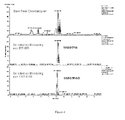
- GIP 1-8 one peak was observed (m/z 887.4 ([M + H] + )).
- GIP 1-16 two peaks were observed (m/z 905.9 ([M + 2H] 2+ ) and m/z 913.9 ([M + 2H] 2+ )).
- One peak observed in GIP 1-16 enlarged with time during refrigerated preservation, and the peak intensity ratio between the peak and another peak was almost 1 : 1 at 17 days after preparation.
- the peak changing with time was the peak of an oxidized form in which methionine (Met) of GIP 1-16 was oxidized.
- the peak enlarges with time, which shows that the molecular weight of the peptide changes with time and concentration in a sample cannot be accurately measured.
- the peptide fragment of GIP 1-8 was more stable than the peptide fragment of GIP 1-16 .
- Another embodiment for measuring active GIP [SEQ ID NO.: 13], a glucagon-secretin family peptide, is shown.
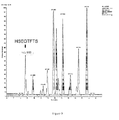
- As a cleaving agent trifluoroacetic acid was used. The analysis was carried out by the same method as in Example 2 except that 500 ⁇ L of 1% trifluoroacetic acid was added in place of 500 ⁇ L of 2% formic acid. The analysis results are shown in Figure 6 .
Landscapes
- Health & Medical Sciences (AREA)
- Life Sciences & Earth Sciences (AREA)
- Chemical & Material Sciences (AREA)
- Engineering & Computer Science (AREA)
- Molecular Biology (AREA)
- Physics & Mathematics (AREA)
- Biochemistry (AREA)
- General Health & Medical Sciences (AREA)
- Immunology (AREA)
- Analytical Chemistry (AREA)
- General Physics & Mathematics (AREA)
- Pathology (AREA)
- Medicinal Chemistry (AREA)
- Bioinformatics & Cheminformatics (AREA)
- Biophysics (AREA)
- Urology & Nephrology (AREA)
- Hematology (AREA)
- Biomedical Technology (AREA)
- Proteomics, Peptides & Aminoacids (AREA)
- Organic Chemistry (AREA)
- Bioinformatics & Computational Biology (AREA)
- Spectroscopy & Molecular Physics (AREA)
- Endocrinology (AREA)
- Gastroenterology & Hepatology (AREA)
- Toxicology (AREA)
- Biotechnology (AREA)
- Cell Biology (AREA)
- Zoology (AREA)
- Microbiology (AREA)
- Genetics & Genomics (AREA)
- Food Science & Technology (AREA)
- Peptides Or Proteins (AREA)
- Chemical Kinetics & Catalysis (AREA)
- Electrochemistry (AREA)
Applications Claiming Priority (2)
| Application Number | Priority Date | Filing Date | Title |
|---|---|---|---|
| JP2011049726 | 2011-03-08 | ||
| PCT/JP2012/055873 WO2012121302A1 (fr) | 2011-03-08 | 2012-03-07 | Méthode d'analyse |
Publications (2)
| Publication Number | Publication Date |
|---|---|
| EP2685257A1 true EP2685257A1 (fr) | 2014-01-15 |
| EP2685257A4 EP2685257A4 (fr) | 2014-10-01 |
Family
ID=46798258
Family Applications (1)
| Application Number | Title | Priority Date | Filing Date |
|---|---|---|---|
| EP12755365.9A Withdrawn EP2685257A4 (fr) | 2011-03-08 | 2012-03-07 | Méthode d'analyse |
Country Status (5)
| Country | Link |
|---|---|
| US (1) | US20130344524A1 (fr) |
| EP (1) | EP2685257A4 (fr) |
| JP (1) | JP5977733B2 (fr) |
| CA (1) | CA2828147A1 (fr) |
| WO (1) | WO2012121302A1 (fr) |
Cited By (1)
| Publication number | Priority date | Publication date | Assignee | Title |
|---|---|---|---|---|
| EP3901173A4 (fr) * | 2018-12-21 | 2022-11-23 | Jiangsu Hengrui Medicine Co., Ltd. | Protéine bispécifique |
Families Citing this family (13)
| Publication number | Priority date | Publication date | Assignee | Title |
|---|---|---|---|---|
| JP6100620B2 (ja) * | 2013-06-07 | 2017-03-22 | 株式会社Lsiメディエンス | 質量分析計を用いた生体試料中の蛋白質測定法 |
| CN117106085A (zh) | 2015-12-23 | 2023-11-24 | 美国安进公司 | 使用gipr结合蛋白与glp-1激动剂的组合来治疗或改善代谢病症的方法 |
| WO2018124011A1 (fr) | 2016-12-26 | 2018-07-05 | 花王株式会社 | Agent améliorant les fonctions motrices |
| EP3569248B1 (fr) | 2016-12-26 | 2023-12-06 | Kao Corporation | Inhibiteurs de gip pour l'amélioration de la fonction cognitive |
| US20190330332A1 (en) | 2016-12-26 | 2019-10-31 | Kao Corporation | Hypothermia Ameliorating Agent |
| EP4480537A3 (fr) | 2017-01-17 | 2025-03-12 | Amgen Inc. | Procédé de traitement ou d'amélioration de troubles métaboliques à l'aide d'agonistes du récepteur glp-1 conjugués à des antagonistes du récepteur du peptide inhibiteur gastrique (gipr) |
| CA3062194A1 (fr) | 2017-06-20 | 2018-12-27 | Amgen Inc. | Methode de traitement ou de reduction de troubles metaboliques a l'aide de proteines de liaison au recepteur du peptide inhibiteur gastrique (gipr) en association avec des agonist es du glp-1 |
| JP7250706B2 (ja) | 2017-06-21 | 2023-04-03 | アムジエン・インコーポレーテツド | 胃抑制ペプチド受容体(gipr)に対するアンタゴニスト結合タンパク質/glp-1受容体アゴニスト融合タンパク質を使用した代謝障害の治療又は寛解方法 |
| US10665440B1 (en) * | 2018-11-19 | 2020-05-26 | Thermo Finnigan Llc | Methods for multiplexed MS-3 analyses of peptides |
| CN112763636B (zh) * | 2020-12-07 | 2022-04-19 | 佛山汉腾生物科技有限公司 | 肽图分析方法 |
| US20220395767A1 (en) * | 2021-06-15 | 2022-12-15 | Perkinelmer Health Sciences, Inc. | Enhancing lcms analyte signals |
| JP2026511288A (ja) * | 2022-10-31 | 2026-04-13 | エフ ホフマン-ラ ロッシュ アクチェン ゲゼルシャフト | 同位体標識および非標識ゲンタマイシンc同族体 |
| CN118465154B (zh) * | 2024-07-12 | 2024-10-22 | 军科正源(北京)药物研究有限责任公司 | 一种用于检测贝那鲁肽的方法 |
Family Cites Families (11)
| Publication number | Priority date | Publication date | Assignee | Title |
|---|---|---|---|---|
| US5686570A (en) * | 1989-06-16 | 1997-11-11 | Cor Therapeutics, Inc. | Platelet aggregation inhibitors |
| ES2113879T3 (es) | 1990-01-24 | 1998-05-16 | Douglas I Buckley | Analogos de glp-1 utiles para el tratamiento de diabetes. |
| US6451987B1 (en) * | 1999-03-15 | 2002-09-17 | Novo Nordisk A/S | Ion exchange chromatography of proteins and peptides |
| AU2002323540A1 (en) * | 2001-08-31 | 2003-03-18 | Pharmacia Corporation | Peptide biomarker and method of identification |
| JP2003331776A (ja) * | 2002-05-10 | 2003-11-21 | Hitachi Ltd | イオン源および質量分析装置および質量分析方法 |
| US20050164402A1 (en) * | 2003-07-14 | 2005-07-28 | Belisle Christopher M. | Sample presentation device |
| PL1664108T3 (pl) * | 2003-08-21 | 2010-03-31 | Novo Nordisk As | Rozdzielanie polipeptydów zawierających racemizowany aminokwas |
| EP1972349A1 (fr) * | 2007-03-21 | 2008-09-24 | Biocompatibles UK Limited | Peptides à fusion GLP-1 associée à un/plusieurs polymères, leur production et utilisation |
| EP2171080A4 (fr) * | 2007-06-12 | 2010-10-27 | Glaxosmithkline Llc | Procédés de détection de protéine dans le plasma |
| US20100256056A1 (en) | 2007-09-07 | 2010-10-07 | Zheng Xin Dong | Analogues of exendin-4 and exendin-3 |
| JP5317336B2 (ja) * | 2009-02-23 | 2013-10-16 | 国立大学法人東北大学 | 質量分析装置を用いたタンパク質定量のための評価用ペプチド、人工標準タンパク質、及びタンパク質の定量方法 |
-
2012
- 2012-03-07 US US14/003,704 patent/US20130344524A1/en not_active Abandoned
- 2012-03-07 WO PCT/JP2012/055873 patent/WO2012121302A1/fr not_active Ceased
- 2012-03-07 EP EP12755365.9A patent/EP2685257A4/fr not_active Withdrawn
- 2012-03-07 JP JP2013503585A patent/JP5977733B2/ja not_active Expired - Fee Related
- 2012-03-07 CA CA2828147A patent/CA2828147A1/fr not_active Abandoned
Cited By (1)
| Publication number | Priority date | Publication date | Assignee | Title |
|---|---|---|---|---|
| EP3901173A4 (fr) * | 2018-12-21 | 2022-11-23 | Jiangsu Hengrui Medicine Co., Ltd. | Protéine bispécifique |
Also Published As
| Publication number | Publication date |
|---|---|
| EP2685257A4 (fr) | 2014-10-01 |
| JPWO2012121302A1 (ja) | 2014-07-17 |
| WO2012121302A1 (fr) | 2012-09-13 |
| US20130344524A1 (en) | 2013-12-26 |
| JP5977733B2 (ja) | 2016-08-24 |
| CA2828147A1 (fr) | 2012-09-13 |
Similar Documents
| Publication | Publication Date | Title |
|---|---|---|
| US20130344524A1 (en) | Analysis method | |
| US8901484B2 (en) | Quantification of impurities for release testing of peptide products | |
| EP2841950B1 (fr) | Quantification d'impuretes pour test d'autorisation de produits peptidiques | |
| EP2057472B1 (fr) | Procédé de détection et/ou de mesure de la concentration d'hepcidine dans un échantillon | |
| Tsubaki et al. | C-terminal modification of monoclonal antibody drugs: amidated species as a general product-related substance | |
| Bansal et al. | Quantitation of hepcidin in human urine by liquid chromatography–mass spectrometry | |
| CN107548460A (zh) | 通过质谱法定量胰岛素水平的方法 | |
| Thomas et al. | Metabolism of human insulin after subcutaneous administration: a possible means to uncover insulin misuse | |
| Terashima et al. | Identification of deamidation and isomerization sites on pharmaceutical recombinant antibody using H218O | |
| Kuuranne et al. | Insulins in equine urine: Qualitative analysis by immunoaffinity purification and liquid chromatography/tandem mass spectrometry for doping control purposes in horse‐racing | |
| EP3333571B1 (fr) | Procédé de quantification parallèle de variantes d'épissage du facteur de croissance endothélial vasculaire (vegf-a) | |
| Sauter et al. | Application of triple quadrupole tandem mass spectrometry to the bioanalysis of collision-induced dissociation-resistant cyclic peptides–Ultra-sensitive quantification of the somatostatin-analog pasireotide utilizing UHPLC-MS/MS | |
| Zheng et al. | Quantitation of a PEGylated protein in monkey serum by UHPLC-HRMS using a surrogate disulfide-containing peptide: a new approach to bioanalysis and in vivo stability evaluation of disulfide-rich protein therapeutics | |
| Wahl et al. | Development and validation of a new UHPLC method for related proteins in insulin and insulin analogues as an alternative to the European Pharmacopoeia RP-HPLC method | |
| EP3966224B1 (fr) | Procédés de fractionnement de protéines | |
| Zhang et al. | Quantitative analysis of a novel antimicrobial peptide in rat plasma by ultra performance liquid chromatography–tandem mass spectrometry | |
| CN111650313A (zh) | 定量测定生物样品中利拉鲁肽生物类似物含量的方法 | |
| Blackburn et al. | Quantitation of a therapeutic insulin analogue by immunoaffinity extraction–LC-MS/MS | |
| Beavis et al. | A novel protein cross-linking reaction in stressed Neutral Protamine Hagedorn formulations of insulin | |
| Norberg et al. | Identification of variant forms of the neuroendocrine peptide galanin | |
| Ohkubo et al. | Rapid determination of oxidized methionine residues in recombinant human basic fibroblast growth factor by ultra‐performance liquid chromatography and electrospray ionization quadrupole time‐of‐flight mass spectrometry with in‐source collision‐induced dissociation | |
| Thevis et al. | Qualitative determination of synthetic insulin analogues in human plasma by means of LC-MS/MS | |
| Li et al. | LC‐MS Bioanalysis of Peptides and Polypeptides | |
| Mane | Physicochemical Characterization and Identification of Related Substances in Insulin and Its Analogues | |
| Thomas et al. | Qualitative determination of rapid acting insulin analogues in urine by means of LC-MS/MS |
Legal Events
| Date | Code | Title | Description |
|---|---|---|---|
| PUAI | Public reference made under article 153(3) epc to a published international application that has entered the european phase |
Free format text: ORIGINAL CODE: 0009012 |
|
| 17P | Request for examination filed |
Effective date: 20131004 |
|
| AK | Designated contracting states |
Kind code of ref document: A1 Designated state(s): AL AT BE BG CH CY CZ DE DK EE ES FI FR GB GR HR HU IE IS IT LI LT LU LV MC MK MT NL NO PL PT RO RS SE SI SK SM TR |
|
| DAX | Request for extension of the european patent (deleted) | ||
| A4 | Supplementary search report drawn up and despatched |
Effective date: 20140902 |
|
| RIC1 | Information provided on ipc code assigned before grant |
Ipc: G01N 30/04 20060101ALI20140827BHEP Ipc: G01N 30/72 20060101ALI20140827BHEP Ipc: G01N 30/86 20060101ALI20140827BHEP Ipc: G01N 30/06 20060101ALI20140827BHEP Ipc: G01N 30/88 20060101AFI20140827BHEP Ipc: G01N 33/68 20060101ALN20140827BHEP |
|
| STAA | Information on the status of an ep patent application or granted ep patent |
Free format text: STATUS: THE APPLICATION IS DEEMED TO BE WITHDRAWN |
|
| 18D | Application deemed to be withdrawn |
Effective date: 20150331 |