EP2687524B1 - Dérivé azole - Google Patents
Dérivé azole Download PDFInfo
- Publication number
- EP2687524B1 EP2687524B1 EP12757646.0A EP12757646A EP2687524B1 EP 2687524 B1 EP2687524 B1 EP 2687524B1 EP 12757646 A EP12757646 A EP 12757646A EP 2687524 B1 EP2687524 B1 EP 2687524B1
- Authority
- EP
- European Patent Office
- Prior art keywords
- compound
- group
- hydroxy
- methyl
- pyrrolidin
- Prior art date
- Legal status (The legal status is an assumption and is not a legal conclusion. Google has not performed a legal analysis and makes no representation as to the accuracy of the status listed.)
- Active
Links
- 0 CC1C=C(C)**1 Chemical compound CC1C=C(C)**1 0.000 description 13
- RBAOHJWRCUKBEH-INIZCTEOSA-N CC(C)(C)/[O]=C\CN(CCC1)[C@@H]1c1nc(COc(cc2OC)ccc2OC)n[o]1 Chemical compound CC(C)(C)/[O]=C\CN(CCC1)[C@@H]1c1nc(COc(cc2OC)ccc2OC)n[o]1 RBAOHJWRCUKBEH-INIZCTEOSA-N 0.000 description 1
- OURBXCIHVSXMCE-ZBFHGGJFSA-N CC(C)(C)OC(N(CCC1)[C@@H]1C(NC[C@H](COc(cc1OC)ccc1OC)O)=O)=O Chemical compound CC(C)(C)OC(N(CCC1)[C@@H]1C(NC[C@H](COc(cc1OC)ccc1OC)O)=O)=O OURBXCIHVSXMCE-ZBFHGGJFSA-N 0.000 description 1
- HMEVZMGZABYEQB-FQEVSTJZSA-N CC(C)(CC(C)(C)C1)CC1(C(C(N(CCC1)[C@@H]1c1n[o]c(COC2=CNCC=C2)c1)=O)(F)F)O Chemical compound CC(C)(CC(C)(C)C1)CC1(C(C(N(CCC1)[C@@H]1c1n[o]c(COC2=CNCC=C2)c1)=O)(F)F)O HMEVZMGZABYEQB-FQEVSTJZSA-N 0.000 description 1
- JYQCYJBTGZHRFQ-BGERDNNASA-N CC(C)(CC(C)(C)C1)CC1(C(C(N(CCC1)[C@@H]1c1n[o]c(COc2cnccc2)c1)O)(F)F)O Chemical compound CC(C)(CC(C)(C)C1)CC1(C(C(N(CCC1)[C@@H]1c1n[o]c(COc2cnccc2)c1)O)(F)F)O JYQCYJBTGZHRFQ-BGERDNNASA-N 0.000 description 1
- JWNTXSSNXDFFTC-CTLMPHOESA-N CC(COC([C@H](C)C1OC)=CC=C1OC)O/C(/[C@H]1NCCC1)=N\N Chemical compound CC(COC([C@H](C)C1OC)=CC=C1OC)O/C(/[C@H]1NCCC1)=N\N JWNTXSSNXDFFTC-CTLMPHOESA-N 0.000 description 1
- YBUDXYLEPJSEMZ-UHFFFAOYSA-N Cc(c(OCC(CN)=O)c1)cc(OC)c1OC Chemical compound Cc(c(OCC(CN)=O)c1)cc(OC)c1OC YBUDXYLEPJSEMZ-UHFFFAOYSA-N 0.000 description 1
- DUVIUFGGMXSHNO-UHFFFAOYSA-N NNC(C(CCC1)N1P)=O Chemical compound NNC(C(CCC1)N1P)=O DUVIUFGGMXSHNO-UHFFFAOYSA-N 0.000 description 1
Images


Classifications
-
- C—CHEMISTRY; METALLURGY
- C07—ORGANIC CHEMISTRY
- C07D—HETEROCYCLIC COMPOUNDS
- C07D413/00—Heterocyclic compounds containing two or more hetero rings, at least one ring having nitrogen and oxygen atoms as the only ring hetero atoms
- C07D413/02—Heterocyclic compounds containing two or more hetero rings, at least one ring having nitrogen and oxygen atoms as the only ring hetero atoms containing two hetero rings
- C07D413/04—Heterocyclic compounds containing two or more hetero rings, at least one ring having nitrogen and oxygen atoms as the only ring hetero atoms containing two hetero rings directly linked by a ring-member-to-ring-member bond
-
- A—HUMAN NECESSITIES
- A61—MEDICAL OR VETERINARY SCIENCE; HYGIENE
- A61K—PREPARATIONS FOR MEDICAL, DENTAL OR TOILETRY PURPOSES
- A61K31/00—Medicinal preparations containing organic active ingredients
- A61K31/33—Heterocyclic compounds
- A61K31/395—Heterocyclic compounds having nitrogen as a ring hetero atom, e.g. guanethidine or rifamycins
- A61K31/41—Heterocyclic compounds having nitrogen as a ring hetero atom, e.g. guanethidine or rifamycins having five-membered rings with two or more ring hetero atoms, at least one of which being nitrogen, e.g. tetrazole
- A61K31/42—Oxazoles
-
- A—HUMAN NECESSITIES
- A61—MEDICAL OR VETERINARY SCIENCE; HYGIENE
- A61P—SPECIFIC THERAPEUTIC ACTIVITY OF CHEMICAL COMPOUNDS OR MEDICINAL PREPARATIONS
- A61P17/00—Drugs for dermatological disorders
-
- A—HUMAN NECESSITIES
- A61—MEDICAL OR VETERINARY SCIENCE; HYGIENE
- A61P—SPECIFIC THERAPEUTIC ACTIVITY OF CHEMICAL COMPOUNDS OR MEDICINAL PREPARATIONS
- A61P17/00—Drugs for dermatological disorders
- A61P17/14—Drugs for dermatological disorders for baldness or alopecia
-
- C—CHEMISTRY; METALLURGY
- C07—ORGANIC CHEMISTRY
- C07D—HETEROCYCLIC COMPOUNDS
- C07D403/00—Heterocyclic compounds containing two or more hetero rings, having nitrogen atoms as the only ring hetero atoms, not provided for by group C07D401/00
- C07D403/02—Heterocyclic compounds containing two or more hetero rings, having nitrogen atoms as the only ring hetero atoms, not provided for by group C07D401/00 containing two hetero rings
- C07D403/04—Heterocyclic compounds containing two or more hetero rings, having nitrogen atoms as the only ring hetero atoms, not provided for by group C07D401/00 containing two hetero rings directly linked by a ring-member-to-ring-member bond
-
- C—CHEMISTRY; METALLURGY
- C07—ORGANIC CHEMISTRY
- C07D—HETEROCYCLIC COMPOUNDS
- C07D413/00—Heterocyclic compounds containing two or more hetero rings, at least one ring having nitrogen and oxygen atoms as the only ring hetero atoms
- C07D413/14—Heterocyclic compounds containing two or more hetero rings, at least one ring having nitrogen and oxygen atoms as the only ring hetero atoms containing three or more hetero rings
-
- C—CHEMISTRY; METALLURGY
- C07—ORGANIC CHEMISTRY
- C07D—HETEROCYCLIC COMPOUNDS
- C07D417/00—Heterocyclic compounds containing two or more hetero rings, at least one ring having nitrogen and sulfur atoms as the only ring hetero atoms, not provided for by group C07D415/00
- C07D417/02—Heterocyclic compounds containing two or more hetero rings, at least one ring having nitrogen and sulfur atoms as the only ring hetero atoms, not provided for by group C07D415/00 containing two hetero rings
- C07D417/04—Heterocyclic compounds containing two or more hetero rings, at least one ring having nitrogen and sulfur atoms as the only ring hetero atoms, not provided for by group C07D415/00 containing two hetero rings directly linked by a ring-member-to-ring-member bond
Definitions
- the present invention relates to novel compounds that bind to FKBP12 or pharmaceutically acceptable salts thereof, as well as agents for preventing or treating alopecia that contain such novel compounds or pharmaceutically acceptable salts thereof as an active ingredient.
- Alopecia manifests itself in various types including male pattern alopecia, alopecia senilis, alopecia areata, and alopecia in postmenopausal women. While alopecia is not lifethreatening in many cases, the disease is cosmetically distressing and often involves mental pain; under the circumstances, effective agents for preventing or treating alopecia are desired.
- Hairs are born again through three stages, the anagen, catagen, and telogen phases (hair cycle).
- One hair cycle usually takes a period of two to seven years to complete and if something abnormal occurs to shorten this period, hair growth is arrested before reaching maturity. As a consequence, more hairs will fall out to result in a lower hair density or the thickness per hair will decrease.
- Factors that upset the rhythm of hair cycle include androgens such as testosterone and dihydrotestosterone, radiation, medicaments such as anticancer drugs, aging, and stress.
- a plurality of compounds that bind to immunophilin FKBP12 (an FK506 binding protein with a molecular weight of 12 kDa) without exerting the immunosuppressing action have recently been found (see Patent Documents 2-10.) Some of those derivatives have been disclosed to show a hair-development stimulating action (see Patent Documents 11 and 12.) Other derivatives, however, have not been reported to show any hair-development stimulating action and much remains unclear about the relationship between the activity of binding to immunophilin FKBP12 and the hair-development stimulating activity. What is more, the reported FKBP 12 binding compounds are not disclosed to have the same azole structures as specified in the present invention.
- JP 2001-247569 A relates to a pyrrolidine derivative or piperidine derivative represented by the general formula [1] wherein, R1 is H, a cycloalkyl which may be substituted, an aryl which may be substituted or a heterocyclic which may be substituted; and R 2 is an alkyl which may be substituted, a cycloalkyl which may be substituted, an aryl which may be substituted or a heterocyclic which may be substituted, and a medicinal composition, especially an agent for neurite outgrowth prepared by including the compound.
- the composition is said to be useful for prophylaxis and/or therapy of diseases accompanied with a nerve injury or a neurodegeneration.
- WO 99/62880 A1 relates to N-linked sulfonamides ofN-heterocyclic carboxylic acid and carboxylic acid isosteres, their preparation, and use for treating neurological disorders including physically damaged nerves and neurodegenerative diseases, and for treating alopecia and promoting hair growth.
- An object of the present invention is to find novel compounds that bind to FKBP12 or pharmaceutically acceptable salts thereof and provide new therapeutics useful in preventing or treating alopecia.
- the present invention relates to:
- the compounds of the present invention and pharmaceutically acceptable salts thereof bound to FKBP 12 and inhibited its peptidyl-prolyl isomerase (rotamase) activity.
- the compounds and pharmaceutically acceptable salts thereof had such high solubility that they showed profiles preferred for external use.
- the compounds and pharmaceutically acceptable salts thereof showed an outstanding hair-development stimulating action.
- the compounds of the present invention and pharmaceutically acceptable salts thereof do not markedly suppress the protein phosphatase calcineurin, so they have no serious immunosuppressing activity. Consequently, it is expected that preparations containing the compounds or pharmaceutically acceptable salts thereof exhibit high safety feature when used as agents for preventing or treating alopecia.
- halogen atom means a fluorine atom, a chlorine atom, a bromine atom, or an iodine atom.
- C 1-6 alkyl group means a straight or branched alkyl group having 1 to 6 carbon atoms and examples include a methyl group, an ethyl group, a propyl group, a butyl group, a pentyl group, a hexyl group, an isopropyl group, an isobutyl group, a tert-butyl group, a sec-butyl group, an isopentyl group, a neopentyl group, a tert-pentyl group, a 1,2-dimethylpropyl group, etc.
- C 1-6 alkoxy group means a straight or branched alkoxy group having 1 to 6 carbon atoms and examples include a methoxy group, an ethoxy group, a propoxy group, a butoxy group, a pentyloxy group, a hexyloxy group, an isopropoxy group, an isobutoxy group, a tert-butoxy group, a sec-butoxy group, an isopentyloxy group, a neopentyloxy group, a tert-pentyloxy group, a 1,2-dimethylpropoxy group, etc.
- aryl group means an aromatic carbocyclic group, which is monocyclic to tetracyclic, and that is composed of 6 to 18 carbon atoms, and examples include a phenyl group, a naphthyl group, an anthryl group, a phenanthryl group, a tetracenyl group, a pyrenyl group, etc.
- heteroaryl group means a monocyclic or fused cyclic aromatic heterocyclic group and examples include a pyridyl group, a pyridazinyl group, a pyrimidinyl group, a pyrazinyl group, a thienyl group, a pyrrolyl group, a thiazolyl group, an isothiazolyl group, a pyrazolyl group, an imidazolyl group, a furyl group, an oxazolyl group, an isoxazolyl group, an oxadiazolyl group, a 1,3,4-thiadiazolyl group, a 1,2,3-triazolyl group, a 1,2,4-triazolyl group, a tetrazolyl group, a quinolyl group, an isoquinolyl group, a naphthyridinyl group, a quinazolinyl group, a benzofuranyl group,
- the term "mono-C 1-6 alkylamino group” means an amino group substituted by a single C 1-6 alkyl group as defined above and examples include a methylamino group, an ethylamino group, a propylamino group, a butylamino group, a pentylamino group, a hexylamino group, an isopropylamino group, an isobutylamino group, a tert-butylamino group, a sec-butylamino group, an isopentylamino group, a neopentylamino group, a tert-pentylamino group, a 1,2-dimethylpropylamino group, etc.
- di-C 1-6 alkylamino group means an amino group substituted by two respectively independent C 1-6 alkyl groups as defined above and examples include a dimethylamino group, a diethylamino group, a dipropylamino group, a dibutylamino group, a dipentylamino group, a dihexylamino group, a diisopropylamino group, a diisobutylamino group, a di-tert-butylamino group, a di-sec-butylamino group, a di-isopentylamino group, a di-neopentylamino group, a di-tert-pentylamino group, a di-1,2-dimethylpropylamino group, an ethylmethylamino group, an isopropylmethylamino group, an isobutylisopropylamino group, etc.
- C 1-6 alkylsulfonyloxy group means a sulfonyloxy group substituted by the C 1-6 alkyl group defined above and examples include a methylsulfonyloxy group, an ethanesulfonyloxy group, a n-propylsulfonyloxy group, an isopropylsulfonyloxy group, a n-butylsulfonyloxy group, a 2-methyl-n-butylsulfonyloxy group, a tert-butylsulfonyloxy group, a n-pentylsulfonyloxy group, a n-hexylsulfonyloxy group, etc.
- Alopecia means a condition in which some or all hairs have shedded or disappeared or have changed to thinner and shorter hairs.
- Alopecia manifests itself in various types which include, but are not particularly limited to, male pattern alopecia, seborrheic alopecia, alopecia senilis, alopecia areata, alopecia medicamentosa due, for example, to the administration of cancer control drugs, scarring alopecia, and postpartum alopecia which manifests itself after delivery.
- Alopecia often results from a disrupted hair cycle and is triggered by a shortened anagen phase due, for example, to the arrest of cell proliferation.
- hair cycle refers to the growth cycle of hairs and represents a period consisting of three stages, (1) the anagen phase (the period during which the hair follicle repeats division to cause active growth of the hair; the anagen phase lasts from two to six years for the hairs on the scalp); (2) the catagen phase (the period during which the hair growth is lessened and the follicle shrinks; the catagen phase lasts from one to two weeks for scalp hair); and (3) the telogen phase (the period during which the follicle is completely degenerated and remains dormant; the telogen phase lasts from three to four months for scalp hair.)
- the anagen phase the period during which the hair follicle repeats division to cause active growth of the hair; the anagen phase lasts from two to six years for the hairs on the scalp
- the catagen phase the period during which the hair growth is lessened and the follicle shrinks; the catagen phase lasts from one to two weeks for scalp hair
- the telogen phase the period during which the
- Alopecia involves abnormalities in the hair cycle and, particularly in male pattern alopecia, the duration of the anagen phase is shortened and the hair makes a transition to the catagen/telogen phase before it grows to a thicker terminal hair, so the percentage of hairs in the telogen phase increases and the terminal hair changes to a fine vellus.
- agents for preventing or treating alopecia refers to drugs that have either one of the following actions: (1) inducing a transition from the telogen phase to the anagen phase (i.e., inducing hair development); (2) stimulating hair growth; (3) extending the anagen phase; and (4) inhibiting, delaying or reducing the shedding of hairs; drugs having more than one action are desired.
- salts means salts that are acceptable from a pharmaceutical viewpoint. Examples include: salts with acids such as acetic acid, propionic acid, butyric acid, formic acid, trifluoroacetic acid, maleic acid, tartaric acid, citric acid, stearic acid, succinic acid, ethylsuccinic acid, malonic acid, lactobionic acid, gluconic acid, glucoheptonic acid, benzoic acid, methansulfonic acid, ethanesulfonic acid, 2-hydroxyethanesulfonic acid, benzenesulfonic acid, p-toluenesulfonic acid (tosylic acid), laurylsulfuric acid, malic acid, aspartic acid, glutamic acid, adipic acid, cysteine, N-acetylcysteine, hydrochloric acid, hydrobromic acid, phosphoric acid, sulfuric acid, hydroiodic acid, nico
- the compounds of the present invention and pharmaceutically acceptable salts thereof can occur in various solvated forms. They may also be converted to hydrates from the viewpoint of applicability as pharmaceuticals.
- the compounds (1) of the present invention or pharmaceutically acceptable salts thereof may be used as they are or, alternatively, they may be formulated into preparations together with pharmaceutically acceptable carriers by per se known techniques.
- Pharmaceutically acceptable carriers are various organic or inorganic materials commonly used as pharmaceutical necessities depending on whether they are used in solid preparations or liquid preparations: examples for use in the former case include excipients (e.g., lactose, saccharose, D-mannitol, starch, corn starch, crystalline cellulose, light silicic anhydride, etc.), lubricants (e.g., magnesium stearate, calcium stearate, talc, colloidal silica, etc.), binders
- excipients e.g., lactose, saccharose, D-mannitol, starch, corn starch, crystalline cellulose, light silicic anhydride, etc.
- lubricants e.g., magnesium stearate, calcium stearate, talc, colloidal
- liquid preparations include solvents (e.g., water for injections, alcohols, propylene glycol, macrogol, sesame oil, corn oil, etc.), solvent promoters (e.g., polyethylene glycols, propylene glycol, D-mannitol, benzyl benzoate, ethanol, Tris-aminomethane, cholesterol, triethanolamine, sodium carbonate, sodium citrate, etc.), suspending agents (e.g., surfactants such as
- hydrophilic polymers such as polyvinyl alcohol, polyvinylpyrrolidone, carboxymethylcellulose sodium, methylcellulose, hydroxymethyl cellulose, hydroxypropyl cellulose, etc.), isotonic agents (e.g., glucose, D-sorbitol, sodium chloride, glycerin, D-mannitol, etc.), buffering agents (e.g., phosphates, acetates, carbonates, citrates, etc.), and soothing agents (e.g., benzyl alcohol, etc.)
- preservatives e.g., paraoxybenzoate esters, chlorobutanol, benzyl alcohol, phenethyl alcohol, dehydroacetic acid, sorbic acid, etc.
- antioxidants e.g., sulfites, ascorbic acid, etc.
- coloring agents sweetening agents, adsorbents,
- the compounds of the present invention or pharmaceutically acceptable salts thereof may be administered orally or non-orally (e.g., intravenously, topically, rectally, etc.)
- Dosage forms of their administration may be exemplified by tablets (including sugar-coated tablets and film-coated tablets), powders, granules, dusts, troches, capsules (including soft capsules), liquids, injections (e.g., subcutaneous, intravenous, intramuscular, intraperitoneal, etc.), external preparations (e.g., for nasal administration, transdermal application, ointments, creams, etc.), suppositories (e.g., rectal, vaginal, etc.), slow-release preparations (e.g., slow-release microcapsules, etc.), pellets, drops, etc.; each of these dosage forms may be manufactured by common pharmaceutical formulation techniques (e.g., the methods described in the 15 th Japanese Pharmacopoeia.) External preparations are a preferred dosage
- agents of the present invention for preventing or treating alopecia are administered in doses that can be appropriately adjusted depending on such factors as the weight, age, and sex of the patient.
- the agents are used as an external preparation, the compounds of the present invention are incorporated at concentrations of 0.0001% to 20% and the resulting preparation can be administered once to several times a day.
- the external preparation is applied to hairs in amounts ranging from about 0.00001 to about 4 mg/cm 2 , preferably from about 0.01 to about 1 mg/cm 2 .
- agents are to be used as an oral preparation, they may be administered once to several times a day, with the compounds of the present invention being contained in daily amounts of 1 to 1000 mg/kg per adult.
- the compounds of the present invention can be used in combination with other active ingredients for agents that are effective in preventing or treating alopecia.
- Drugs that can be combined include but are not limited to minoxidil and finasteride.
- the compounds can also be combined with such drugs as other hair growth stimulants/hair restorers, vasodilators, anti-androgens, cyclosporine derivatives, anti-microbials, antiinflammatories, thyroid hormone derivatives, prostaglandin agents or antagonists, retinoids, and triterpenes.
- the compounds and the other active ingredients for agents that are effective in preventing or treating alopecia may be used as separate preparations or, alternatively, they may be used as a single combined drug.
- Y 1 represents an oxygen atom, NMe, or NH
- R 1 , R 2 and X have the same meanings as defined above
- P represents an amino protecting group (e.g., a t-butoxycarbonyl group, a benzyloxycarbonyl group, etc.)
- Y 1 represents an oxygen atom, NMe or NH
- L represents a hydroxy group or a leaving group (e.g., chlorine, bromine, iodine, etc.)
- a compound represented by formula (a-1) is reacted with methoxymethylamine through commonly practiced acylation.
- the carboxylic acid compound represented by formula (a-1) is reacted with thionyl chloride, oxalyl chloride, etc. so that it is converted to the corresponding acid halide or, alternatively, the compound of formula (a-1) is reacted with ethyl chloroformate, isobutyl chloroformate, etc. so that it is converted to the corresponding mixed acid anhydride; the resulting product is then reacted with methoxymethylamine either in a solvent or with no solvent used, optionally in the presence of a base.
- the compound represented by formula (a-2) can also be obtained by reacting the compound (a-1) with methoxymethylamine using a condensing agent such as dicyclohexylcarbodiimide or 1-methyl-3-(3-dimethylaminopropyl)carbodiimide.
- the solvent may be a halogen-based solvent such as methylene chloride or chloroform, an ether-based solvent such as tetrahydrofuran or dioxane, an aromatic hydrocarbon-based solvent such as toluene or xylene, an aprotic polar solvent such as N,N-dimethyformamide, or mixtures of these solvents.
- the base may be an organic base such as pyridine or triethylamine, or an inorganic base such as sodium hydroxide or sodium hydrogencarbonate.
- a compound represented by formula (a-3) may be reacted with an organometallic reagent such as MeLi, n-BuLi or EtMgBr in a solvent to generate an acetylide, which is then reacted with the compound of formula (a-2).
- the solvent may be an ether-based solvent such as tetrahydrofuran or dioxane, an aliphatic hydrocarbon solvent such as hexane or pentane, or mixtures of these solvents.
- the compound of formula (a-4) is reacted with a compound represented by formula (a-5) or a salt thereof either in a solvent or with no solvent used, optionally in the presence of an acid or a base.
- the solvent may be an alcohol such as methanol or ethanol, an ether-based solvent such as tetrahydrofuran or dioxane, an aprotic polar solvent such as N,N-dimethyformamide, water, or mixtures of these solvents.
- the acid may be an inorganic acid such as hydrochloric acid or sulfuric acid, or an organic acid such as acetic acid or p-toluenesulfonic acid.
- the base may be an organic base such as pyridine or triethylamine, or an inorganic base such as AcONa, NaOMe, Na 2 SO 4 , or K 2 CO 3 .
- the amino protecting group in the compound of formula (a-6) is removed for deprotection.
- the protecting group is a t-butoxycarbonyl group
- deprotection may be effected by carrying out reaction with an acid such as trifluoroacetic acid or hydrochloric acid;
- the protectging group is a benzyloxycarbonyl group
- deprotection may be effected either by hydrogenation in the presence of a catalyst such as palladium-carbon or platinum oxide or by reaction with an acid such as HBr-AcOH.
- a catalyst such as palladium-carbon or platinum oxide
- reaction with an acid such as HBr-AcOH
- a compound represented by formula (a-9) is treated by the same method as described in Step A-1 so that it is converted to an acid halide and then reacted with the compound of formula (a-7), or it may be directly reacted with the compound of formula (a-7) in the presence of a condensing agent.
- a compound represented by formula (a-9) may be obtained by reacting a compound of formula (a-8) (where L is a leaving group) with the compound of formula (a-7) in a solvent, optionally in the presence of a base.
- ring A is represented by the following formula: may be produced by, for example, the following method.
- P represents an amino protecting group (e.g., a t-butoxycarbonyl group, a benzyloxycarbonyl group, etc.);
- L represents a hydroxy group or a leaving group (e.g., chlorine, bromine, iodine, etc.)
- a compound represented by formula (b-1) is reacted with CBr 4 and PPh 3 in a halogen-based solvent such as methylene chloride or chloroform by the method described in Journal of Medicinal Chemistry, 1990, vol. 33, page 3190 or a modified version of the method.
- a halogen-based solvent such as methylene chloride or chloroform
- the compound of formula(b-2) is reacted with a base in a solvent.
- the base may be MeLi, n-BuLi, sec-BuLi, LiN(i-Pr) 2 , or the like.
- the solvent may be an ether-based solvent such as tetrahydrofuran or dioxane, an aliphatic hydrocarbon solvent such as hexane or pentane, or mixtures of these solvents.
- the compound (b-3) may be reacted with an organometallic reagent such as MeLi, n-BuLi or EtMgBr in a solvent to generate an acetylide, which is then reacted with a compound represented by (b-4).
- the solvent may be an ether-based solvent such as tetrahydrofuran or dioxane, an aliphatic hydrocarbon solvent such as hexane or pentane, or mixtures of these solvents.
- an acetylide corresponding to the compound of formula (b-3) generated in situ by the reaction described in Step B-2 may be reacted with the compound of formula (b-4).
- the compound of formuola (b-5) is reacted with hydroxylamine or a salt thereof either in a solvent or with no solvent used, optionally in the presence of an acid or a base.
- the solvent may be an alcohol such as methanol or ethanol, an ether-based solvent such as tetrahydrofuran or dioxane, an aprotic polar solvent such as N,N-dimethyformamide, water, or mixtures of these solvents.
- the acid may be an inorganic acid such as hydrochloric acid or sulfuric acid, or an organic acid such as acetic acid or p-toluenesulfonic acid.
- the base may be an organic base such as pyridine or triethylamine, or an inorganic base such as AcONa, NaOMe, Na 2 SO 4 , or K 2 CO 3 .
- a compound represented by formula (b-7) is obtained from the compound of formula (b-6) by the same method as described in Step A-4.
- a compound represented by formula (b-8) is obtained from the compound of formula (b-7) by the same method as described in Step A-5.
- Y 2 represents an oxygen atom or a sulfur atom
- R 1 , R 2 and X have the same meanings as defined above;
- P represents an amino protecting group (such as a t-butoxycarbonyl group, a benzyloxycarbonyl group, etc.);
- Y 2 represents an oxygen atom or a sulfur atom;
- L represents a hydroxy group or a leavting group (e.g., chlorine, bromine, iodine, etc.))
- a compound represented by formula (c-1) is obtained from the compound of formula (a-1) and hydrazine by the commonly practiced acylation which is described in Step A-1.
- a compound represented by formula (c-3) is obtained from the compounds of formula (c-1) and (c-2) by the commonly practiced acylation which is described in Step A-1.
- a compound where Y 2 is an oxygen atom is obtained by subjecting the compound of formula (c-3) to cyclodehydration in a solvent using Burgess reagent or CBr 4 , PPh 3 , imidazole, etc.
- the solvent may be a halogen-bassed solvent such as methylene chloride or chloroform, or an aromatic hydrocarbon solvent such as toluene or xylene.
- a compound where Y 2 is a sulfur atom is obtained by reacting the compound of formula (c-3) with Lawesson's reagent or the like in a solvent.
- the solvent may be a halogen-bassed solvent such as methylene chloride or chloroform, or an aromatic hydrocarbon solvent such as toluene or xylene.
- a compound represented by formula (c-5) is obtained from the compound of formula (c-4) by the same method as described in Step A-4.
- a compound represented by formula (c-6) is obtained from the compound of formula (c-5) by the same method as described in Step A-5.
- Y 3 represents a hydrogen atom or a Me group
- R 1 , R 2 and X have the same meanings as defined above
- P represents an amino protecting group (such as a t-butoxycarbonyl group, a benzyloxycarbonyl group, etc.)
- Y 3 represents a hydrogen atom or a Me group
- L represents a hydroxy group or a leaving group (e.g., chlorine, bromine, iodine, etc.)
- a compound represented by formula (d-2) can be obtained from the compound of formula (a-1) by reacting it with a hydrazine compound of formula (d-1) by the commonly practiced acylation which is described in Step A-1; alternatively, the compound of formula (a-1) may be reacted with a protected form of hydrazine corresponding to the hydrazine compound of formula (d-1) and then deprotected.
- a compound represented by formula (d-4) is obtained from the compound of formula (d-2) and a cyano compound of formula (d-3) by means of heating in a solvent, optionally in the presence of an acid or a base.
- the solvent may be an alcohol such as methanol or butanol, or an ether-based solvent such as dioxane or diphenylether.
- the acid may be an organic acid such as acetic acid.
- the base may be an inorganic base such as NaOMe or K 2 CO 3 .
- the reaction may be performed at a temperature ranging from the solvent's reflux temperature to 220°C under atmospheric or superatmospheric pressure or under microwave irradiation.
- a compound represented by formula (d-5) is obtained from the compound of formula (d-4) by the same method as described in Step A-4.
- a compound represented by formula (d-6) is obtained from the compound of formula (d-5) by the same method as described in Step A-5.
- ring A is represented by the following formula: may be produced by, for example, the following method.
- P represents an amino protecting group (such as a t-butoxycarbonyl group, a benzyloxycarbonyl group, etc.)
- L represents a hydroxy group or a leaving group (e.g., chlorine, bromine, iodine, etc.)
- a compound represented by formula (e-2) can be obtained from the compound of formula (a-1) by reacting it with a compound of formula (e-1) by the commonly practiced acylation which is described in Step A-1.
- a compound represented by formula (e-3) is obtained by subjecting the compound of formula (e-2) to dehydration in a solvent, optionally in the presence of an acid or a base.
- the solvent may be an ether-based solvent such as dioxane or an aromatic hydrocarbon solvent such as toluene or xylene.
- the acid may be an organic acid such as p-toluenesulfonic acid.
- the base may be an organic base such as pyridine or triethylamine or an ammonium salt such as n-Bu 4 NF.
- the reaction may be performed at a temperature ranging from room temperature to the solvent's reflux temperature.
- a compound represented by formula (e-4) is obtained from the compound of formula (e-3) by the same method as described in Step A-4.
- a compound represented by formula (e-5) is obtained from the compound of formula (e-4) by the same method as described in Step A-5.
- Y 4 represents an oxygen atom or a sulfur atom
- R 1 , R 2 and X have the same meanings as defined above;
- P represents an amino protecting group (such as a t-butoxycarbonyl group , a benzyloxycarbonyl group, etc.);
- Y 4 represents an oxygen atom or a sulfur atom;
- L represents a hydroxy group or a leaving group (e.g., chlorine, bromine, iodine, etc.))
- a compound represented by formula (f-2) can be obtained from the compound of formula (a-1) by reacting it with a compound of formula (f-1) by the commonly practiced acylation which is described in Step A-1.
- a compound where Y 4 is an oxygen atom is obtained by subjecting the compound of formula (f-2) to cyclodehydration in a solvent using Burgess reagent or CBr 4 , PPh 3 , imidazole, etc.
- the solvent may be a halogen-bassed solvent such as methylene chloride or chloroform, or an aromatic hydrocarbon solvent such as toluene or xylene.
- a compound where Y 4 is a sulfur atom is obtained by reacting the compound of formula (f-2) with Lawesson's reagent or the like in a solvent.
- the solvent may be a halogen-bassed solvent such as methylene chloride or chloroform, or an aromatic hydrocarbon solvent such as toluene or xylene.
- a compound represented by formula (f-4) is obtained from the compound of formula (f-3) by the same method as described in Step A-4.
- a compound represented by formula (f-5) is obtained from the compound of formula (f-4) by the same method as described in Step A-5.
- the NMR spectra were those of proton NMR; tetramethylsilane was used as an internal reference, with ⁇ values being indicated in ppm.
- MS measurements were performed using LC/MS-2010EV (equipped with dual ESI/APCI source).
- Reverse-phae preparative HPLC was performed using GILSON preparative HPLC system. The following column and solvents were used for preparative purposes.
- n-BuLi 147 mL as 2.76 N hexane solution
- THF 1,2-dimethoxy-4-(prop-2-yn-1-yloxy)benzene
- a solution of (S)-t-butyl 2-(methoxy(methyl)carbamoyl)pyrrolidine-1-carboxylate 100.00g in THF (600 mL) was added dropwise and temperature was raised to room temperature over 2 hours, followed by stirring at 25°C for 30 minutes.
- the reaction mixture was added to a saturated aqueous solution of NH 4 Cl (3 L), ice water (2 L), hexane (1 L) and AcOEt (1 L); the organic layer was separated, washed with brine (5 L), water (2 L), and brine (1 L) successively, dried (MgSO 4 ), filtered and concentrated to give a brown oil (161.24 g), which was dissolved in EtOH (1000 mL); to the solution, hydroxylamine hydrochloride (53.79 g) was added and after heating under reflux for 13 hours, the mixture was stirred at room temperatuare for 13 hours.
- n-BuLi (10.3 mL, 2.64 N hexane solution) was added dropwise to a solution of t-butyldiphenyl(prop-2-yn-1-yloxy)silane (8.576 g) in THF (200 mL) at -78°C over 10 minutes, and after stirring at room temperature for 50 minutes, the reaction mixture was added dropwise to a solution of (S)-t-butyl 2-(methoxy(methyl)carbamoyl)pyrrolidine-1-carboxylate (5.01 g) in THF (200 mL) through a cannula and temperature was raised to room temperature over an hour.
- Example 1-(2) The procedure of Example 1-(2) was repeated, except that the compound obtained in Examle 1-(1) was replaced by the compound (150 mg) obtained in Example 3-(2); this gave the titled compound (133 mg, colorless amorphous.)
- Example 4-(2) The compound (40 mg) obtained in Example 4-(2) was dissolved in CHCl 3 (3 ml) and after adding benzoyl chloride (17 ⁇ L) and Et 3 N (43 ⁇ L), the mixture was stirred at room temperature for 19 hours. To the reaction mixture, CHCl 3 (20 ml) and 5% KHSO 4 (20 ml) were added to separate the organic layer.
- the titled compound was obtained by repeating the procedure of Example 4-(3), except that benzoyl chloride was replaced by benzenesulfonyl chloride.
- Example 3-(5) The compound (160 mg) obtained in Example 3-(5) was dissolved in MeCN and after adding a THF solution of dimethyllamine (2 M, 250 ⁇ L), the mixture was stirred at room temperature for 3 hours. To the reaction mixture, AcOEt (50 ml) and a saturated aqueous solution of NaCO 3 (50 ml) were added to separate the organic layer. The resulting organic layer was washed with brine (50 ml), dried (MgSO 4 ), filtered and concentrated to give a crude product, which was further purified by silica gel chromatography (AcOEt/hexane) to give the titled compound (83 mg, colorless amorphous.) ESI+ 428(M+H) +
- Example 1-(2) The procedure of Example 1-(2) was repeated, except that the compound obtained in Example 1-(1) was replaced by the compound (35.0 g) obtained in Example 8-(3); the resulting crude product was further purified by silica gel column chromatography (AcOEt/hexane) and thereafter recrystallized with AcOEt-pentane to give the titled compound (39.0 g) as a colorless solid.
- Example 1-(2) The procedure of Example 1-(2) was repeated, except that the compound obtained in Example 1-(1) was replaced by the compound (1.186 g) obtained in Example 9-(3); this gave the titled compound (1.287 g, colorless amorphous.)
- Example 3-(4) The procedure of Example 3-(4) was repeated, except that the compound obtained in Example 3-(3) was replaced by the compound (1.378 g) obtained in Example 9-(4); this gave the titled compound (750 mg, colorless solid.)
- Example 3-(5) The procedure of Example 3-(5) was repeated, except that the compound obtained in Example 3-(4) was replaced by the compound (340 mg) obtained in Example 9-(5); the resulting crude product was recrystallized (AcOEt/hexane) to give the titled compound (7349 mg, colorless powder.)
- Example 4 The procedure of Example 4 was repeated, except that the compound obtained in Example 3-(4) was replaced by the compound obtained in Example 9-(6); this gave the titled compound.
- Example 6 The procedure of Example 6 was repeated, except that the compound obtained in Example 3-(5) was replaced by the compound obtained in Example 9-(6); this gave the titled compound.
- Example 2-(3) and Example 2-(4) were repeated, except that the compound obtained in Example 2-(2) was replaced by the compound obtained in Example 12-(2); this gave the titled compound.
- Example 1-(2) The procedure of Example 1-(2) was repeated, except that the compound obtained in Example 1-(1) was replaced by the compound (274 mg) obtained in Example 13-(3); the resulting crude product was further purified by silica gel chromatography (AcOEt/hexane) to give the titled comound (129 mg, colorless amorphous.)
- Example 1-(2) The procedure of Example 1-(2) was repeated, except that the compound obtained in Example 1-(1) was replaced by the compound (321 mg) obtained in Example 14-(3); the resulting crude product was further purified by neutral silica gel chromatography (AcOEt/hexane) and NH-form silia gel chromatography (AcOEt/hexane) to give the titled compound (142 mg, yellow amorphous.)
- Example 13-(3) The procedure of Example 13-(3) was repeated, except that the compound obtained in Example 13-(2) was replaced by the compound (460 mg) obtained in Example 15-(1); this gave the titled compound (339 mg, pale brown oil.) ESI+ 304(M+H) +
- Example 1-(2) The procedure of Example 1-(2) was repeated, except that the compound obtained in Example 1-(1) was replaced by the compound (332 mg) obtained in Example 15-(2); the resulting crude product was further purified by silica gel chromatography (AcOEt/hexane) to give the titled compound (463 mg, pale pink amorphous.)
- Example 2-(3) The procedures of Example 2-(3) and Example 2-(4) were repeated, except that the compound obtained in Example 2-(2) was replaced by the compound obtained in Example 16-(1); this gave the titled compound.
- Example 2-(3) The procedures of Example 2-(3) and Example 2-(4) were repeated, except that the compound obtained in Example 2-(2) was replaced by the compound obtained in Example 17-(1); this gave the titled compound.
- Example 2-(3) The procedures of Example 2-(3) and Example 2-(4) were repeated, except that the compound obtained in Example 2-(2) was replaced by the compound obtained in Example 18-(1); this gave the titled compound.
- Example 19-(6) The procedure of Example 19-(6) was repeated, except that the compound obtained in Example 19-(5) was replaced by the compound obtained in Example 20-(2); this gave the titled compound (0.063 g, colorless solid.)
- Example 19-(7) The procedure of Example 19-(7) was repeated, except that the compound obtained in Example 19-(6) was replaced by the compound obtained in Example 20-(2); this gave the titled compound (0.077 g, colorless amorphous.)
- a sealed tube was charged with a mixture prepared by adding toluene (2 ml) to Compound 18 (30 mg), 4-bromopyridazine hydrobromide (22 mg), Pd(OAc) 2 (2 mg), Cs 2 CO 3 (37 mg), and [1,1'-binaphthalen]-2-yldi-tert-butylphosphine (3 mg) and the mixture was stirred at 100°C for 4 hours. After cooling the reaction mixture to room temperature, NH silica gel was added, followed by stirring for a while.
- Example 2-(2) the following intermediate as generated in situ was used to perform cyclization; if desired, this intermediate may be isolated before the cyclization.
- Table 1-1 Compound No. Structural formula PKBP12 rotamase inhibiting activity IC50 (nM) MS ESI/APCI dual Preparation method Compound 1 49 559 (M+Na)+ Example 1 Compound 2 62 538 (M+H)+ Example 8 Compound 3 500 ⁇ 1,000 538 (M+H)+ Example 12 Compound 4 145 554 (M+H)+ Example 16 Compound 5 119 537 (M+H)+ Example 17 Compound 6 500 ⁇ 1,000 537 (M+H)+ Example 19 Table 1-2 Compound 7 500 ⁇ 1,000 575 (M+Na)+ Example 20 Compound 8 189 551 (M+H)+ Example 18 Compound 9 500 ⁇ 1,000 550 (M+H)+ Example 13 Compound 10 500 ⁇ 1,000 559 (M+Na)+ Example 14 Compound 11 235 536 (M+H)+ Example 15 Compound 12 270 5
- the rotamase (peptidylprolyl isomerase) inhibiting activity of each test compound was measured by a known method ( Harding et al., Nature 341, 758-760, 1989 ; Holts et al., J. Am. Chem. Soc.
- a plastic cuvette was charged with 35 mM HEPES (pH 7.8), 12 nM human recombinant FKBP12 (Sigma, F-5398), 0.4 mg/mL ⁇ -chymotrypsin, and a tetst compound dissolved in DMSO at varying concentrations (DMSO's final concentration was 0.1%.) Subsequently, 24 mM of the substrate peptide, succinyl-Ala-Phe-Pro-Phe-paranitroanilide, as dissolved in trifluoroethanol containing 500 mM of LiCl was added to give a final concentration of 48 ⁇ M, whereupon reaction started.
- the reaction was carried out at 4°C and the change in absorbance at 390 nm accompanying the liberation of the paranitroaniline product was monitored. A calculateded initial rate minus the corresponding value in the absence of the enzyme was used as an index of rotamase activity.
- the rotamase inhibiting activity of a test compound was expressed in relative values (%) with respect to the control value of rotamase activity in the absence of the compound, and the concentration of the compound at which it was capable of inhibiting rotamase activity by 50% was calculated as an IC 50 value from its concentration response curve.
- the IC 50 values of the respective test compounds are indicated in Table 1-1 to Table 1-11.
- C57BL mice female, ca. 7-wk old were shaven on the back and the base prepared in Test 2 or a solution prepared by dissolving 5% (w/v) of Compound 1 in this base was administered by applying them to the shaven area in 200- ⁇ L portions once daily starting 3 days after the shaving (each group consisting of 10 heads.) Every 2 or 3 days after the start of the administration, the state of hair development in the shavn area was scored in accordance with the following criteria.
- Fig. 1 shows, the group administered with the solution of 5% Compound 1 had their hair development scores increased earlier than the group administered with the base.
- the hair development scores in the Compound 1 administered group were higher than those in the base administered group at day 15 of the administration and onward in the test period. It threfore became clear that the test compound showed a superior hair development stimulating effect.
- Such superior hair development stimulating effect is exhibited by the combination of various properties including not only the rotamase inhibiting effect of the compound but also its good stability, absorbability, and disposition.
- C57BL mice female, ca. 7-wk old were shaven on the back and the base prepared in Test 4 or a solution prepared by dissolving 5% (w/v) of Compound 40 in this base was administered by applying them to the shaven area in 200- ⁇ L portions once daily starting 3 days after the shaving (each group consisting of 10 heads.) Every 2 or 3 days after the start of the administration, the state of hair development in the shavn area was scored in accordance with the criteria described in Test 3.
- the group administered with the solution of 5% Compound 40 had their hair development scores increased earlier than the group administered with the base.
- the hair development scores in the Compound 40 administered group were higher than those in the base administered group at day 15 of the administration and onward in the test period. It threfore became clear that the test compound showed a superior hair development stimulating effect.
- the superior hair development stimulating effect of Compound 40 is exhibited by the combination of various properties including not only the rotamase inhibiting effect of the compound but also its good stability, absorbability, and disposition.
- PCNA proliferating cell nuclear antigen
- the anagen induction stimulating effect of a compound was measured by the following method with the quantity of skin PCNA being used as an index.
- C57BL mice female, ca. 7-wk old were shaven on the back and a base (80% ethanol) or a solution prepared by dissolving 5% (w/v) of Compound 40, 52, 59, 61, 63, 64 or 66 in this base was administered by applying them to the shaven area in 200- ⁇ L portions once daily for 2 days starting 3 days after the shaving (each group consisting of 5 heads.)
- a base 80% ethanol
- the skin at the application site was sampled and homogenized in a buffer containing 50 mM Tris-HCl (pH 7.6), 150 mM NaCl, 1% NP-40, and a protease
- the superior anagen induction stimulating effect of these compounds is exhibited by the combination of various properties including not only the rotamase inhibiting effect of the compounds but also their good stability, absorbability, and disposition.
- the present invention enables providing novel compounds that bind to FKBP12 or pharmaceutically acceptable salts thereof, as well as new therapeutics useful in the prevention or treatment of alopecia which comprise those compounds or pharmaceutically acceptable salts thereof.
Landscapes
- Chemical & Material Sciences (AREA)
- Organic Chemistry (AREA)
- Health & Medical Sciences (AREA)
- Veterinary Medicine (AREA)
- Pharmacology & Pharmacy (AREA)
- Public Health (AREA)
- General Health & Medical Sciences (AREA)
- Medicinal Chemistry (AREA)
- Animal Behavior & Ethology (AREA)
- Life Sciences & Earth Sciences (AREA)
- Nuclear Medicine, Radiotherapy & Molecular Imaging (AREA)
- Bioinformatics & Cheminformatics (AREA)
- Dermatology (AREA)
- General Chemical & Material Sciences (AREA)
- Chemical Kinetics & Catalysis (AREA)
- Engineering & Computer Science (AREA)
- Epidemiology (AREA)
- Pharmaceuticals Containing Other Organic And Inorganic Compounds (AREA)
- Plural Heterocyclic Compounds (AREA)
- Cosmetics (AREA)
Claims (17)
- Composé représenté par la formule (1)
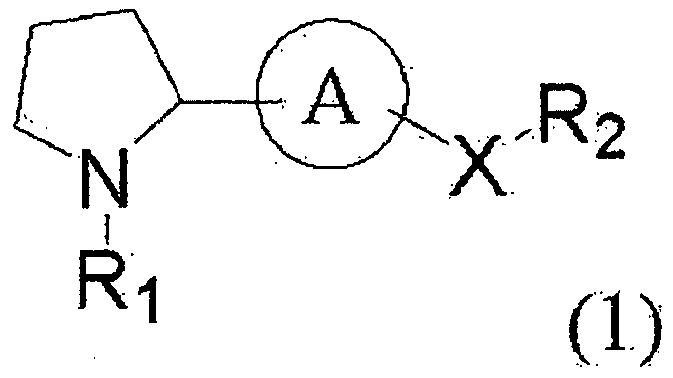


X1 représente une liaison, -O-, -NRaC(=O)-, -C(=O)NRb-, -NRcS(=O)2-, ou - S(=O)2NRd- ;
chacun de Ra, Rb, Rc, et Rd, qui peuvent être identiques ou différents, représente un atome d'hydrogène ou un groupe alkyle en C1 à C6 ;
chacun de m et n, qui peuvent être identiques ou différents, est un entier de 0 à 3 ;
R2 représente un groupe aryle, un groupe hétéroaryle (ledit groupe aryle ou hétéroaryle pouvant être substitués par 1 à 3 groupes substituants choisis dans l'ensemble constitué par un atome d'halogène, un groupe alkyle en C1 à C6, et un groupe alcoxy en C1 à C6 (ledit groupe alkyle en C1 à C6 ou groupe alcoxy en C1 à C6 pouvant être substitué par 1-3 groupes substituants choisis dans l'ensemble constitué par un atome d'halogène et un groupe hydroxy)), un groupe 1,3-benzodioxolanyle, un groupe indolyle, un groupe morpholyle, un groupe hydroxy, un groupe alkyle en C1 à C6 (ledit groupe alkyle en C1 à C6 pouvant être substitué par 1-2 groupes hydroxy), un groupe amino, un groupe monoalkylamino en C1 à C6, un groupe di(alkyle en C1 à C6)amino, un groupe alcoxy en C1 à C6, un groupe alkylsulfonyloxy en C1 à C6, un groupe pyridonyle, ou un groupe pyrimidinonyle,
ou un sel pharmaceutiquement acceptable d'un tel composé. - Composé ou sel pharmaceutiquement acceptable de celui-ci selon la revendication 1, dans lequel X est une liaison, -CH2O- -CH2-, -(CH2)2-, -(CH2)3-, -O-, -CH2-NHC(=O)-, -CH2-NHC(=O)-CH2-, ou -CH2-NHS(=O)2-.
- Composé ou sel pharmaceutiquement acceptable de celui-ci selon la revendication 1, dans lequel X est -CH2O- ou -CH2-.
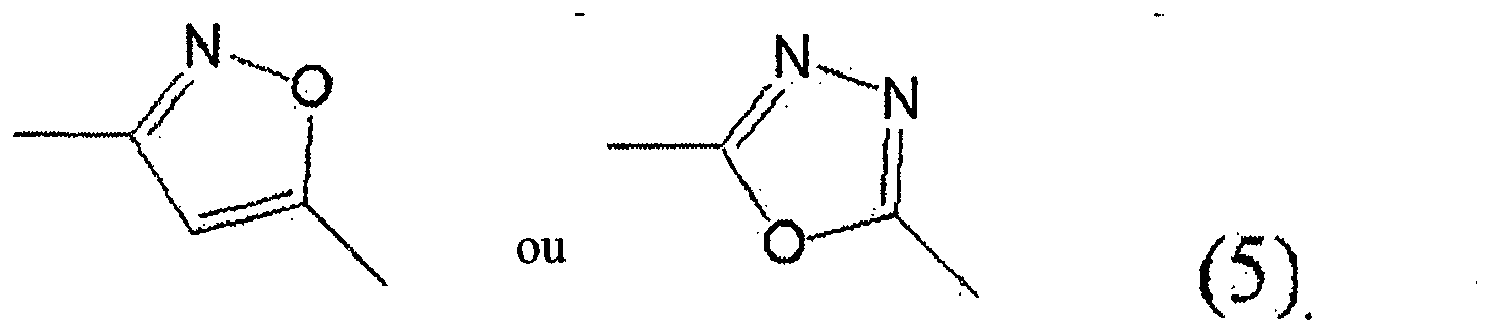
- Composé ou sel pharmaceutiquement acceptable de celui-ci selon l'une quelconque des revendications 1 à 3, dans lequel le cycle A est l'un des cycles de formule (5) suivante :

- Composé ou sel pharmaceutiquement acceptable de celui-ci selon l'une quelconque des revendications 1 à 4, dans lequel R2 est un groupe phényle, un groupe pyridyle, un groupe pyridazinyle ou un groupe pyrimidyle (ledit groupe phényle, groupe pyridyle ou groupe pyrimidyle pouvant être substitué par 1 à 3 atomes d'halogène ou groupes méthoxy), un groupe pyridonyle, ou un groupe pyrimidinonyle.
- Composé ou sel pharmaceutiquement acceptable de celui-ci selon la revendication 5, dans lequel R2 est un groupe phényle ou un groupe pyridyle (ledit groupe phényle ou groupe pyridyle pouvant être substitué par 1 à 3 groupes méthoxy).
- Composé ou sel pharmaceutiquement acceptable de celui-ci selon la revendication 1, dans lequel le cycle A est l'un des cycles de formule (5) suivante :
R2 est un groupe phényle ou un groupe pyridyle (ledit groupe phényle ou groupe pyridyle pouvant être substitué par 1 à 3 groupes méthoxy). - Composé selon la revendication 1, qui est l'un des suivants :(S)-1-(2-(5-((3,4-diméthoxyphénoxy)méthyl)isoxazol-3-yl)pyrrolidin-1-yl)-2,2-difluoro-2-(1-hydroxy-3,3,5,5-tétraméthylcyclohexyl)éthanone,(S)-2,2-difluoro-2-(l-hydroxy-3,3,5,5-tétraméthylcyclohexyl)-1-(2-(5-((pyridin-3-yloxy)méthyl)isoxazol-3-yl)pyrrolidin-1-yl)éthanone,(S)-2,2-difluoro-2-(l-hydroxy-3,3,5,5-tôtraméthylcyclohexyl)-1-(2-(5-((3,4,5-triméthoxyphénoxy)méthyl)isoxazol-3-yl)pyrrolidin-1-yl)éthanone,(S)-N-((3-(1-(2,2-difluoro-2-(1-hydroxy-3,3,5,5-tétraméthylcyclohexyl)acétyl)pyrrolidin-2-yl)isoxazol-5-yl)méthyl)benzamide,(S)-N-((3-(1-(2,2-difluoro-2-(1-hydroxy-3,3,5,5-tétraméthylcyclohexyl)acétyl)pyrrolidin-2-yl)isoxazol-5-yl)méthyl)benzènesulfonamide,(S)-1-(2-(5-((diméthylamino)méthyl)isoxazol-3-yl)pyrrolidin-1-yl)-2,2-difluoro-2-(1-hydroxy-3,3,5,5-tétraméthylcyclohexyl)éthanone,(S)-1-(2-(5-((3,4-diméthoxyphénoxy)méthyl)-1,3,4-oxadiazol-2-yl)pyrrolidin-1-yl)-2,2-difluoro-2-(1-hydroxy-3,3,5,5-tétraméthylcyclohexyl)éthanone,(S)-2,2-difluoro-2-(1-hydroxy-3,3,5,5-tétraméthylcyclohexyl)-1-(2-(5-(phénoxyméthyl)-1,3,4-oxadiazol-2-yl)pyrrolidin-1-yl)éthanone,(S)-N-((5-(1-(2,2-difluoro-2-(1-hydroxy-3,3,5,5-tétraméthylcyclohexyl)acétyl)pyrrolidin-2-yl)-1,3,4-oxadiazol-2-yl)méthyl)benzamide,(S)-1-(2-(5-((diméthylamino)méthyl)-1,3,4-oxadiazol-2-yl)pyrrolidin-1-yl)-2,2-difluoro-2-(1-hydroxy-3,3,5,5-tétraméthylcyclohexyl)éthanone,(S)-1-(2-(3-((3,4-diméthoxyphénoxy)méthyl)-1,2,4-oxadiazol-5-yl)pyrrolidin-1-yl)-2,2-difluoro-2-(1-hydroxy-3,3,5,5-tétraméthylcyclohexyl)éthanone,(S)-1-(2-(5-((3,4-diméthoxyphénoxy)méthyl)1-méthyl-1H-pyrazol-3-yl)pyrrolidin-1-yl)-2,2-difluoro-2-(1-hydroxy-3,3,5,5-tétraméthylcyclohexyl)éthanone,(S)-1-(2-(3-((3,4-diméthoxyphénoxy)méthyl)isoxazol-5-yl)pyrrolidin-1-yl)-2,2-difluoro-2-(1-hydroxy-3,3,5,5-tétraméthylcyclohexyl)éthanone,(S)-1-(2-(5-((3,4-diméthoxyphénoxy)méthyl)-1H-pyrazol-3-yl)pyrrolidin-1-yl-2,2-difluoro-2-(1-hydroxy-3,3,5,5-tétraméthylcyclohexyl)éthanone,(S)-1-(2-(5-((3,4-diméthoxyphénoxy)méthyl)-1,3,4-thiadiazol-2-yl)pyrrolidin-1-yl)-2,2-difluoro-2-(1-hydroxy-3,3,5,5-tétraméthylcyclohexyl)éthanone,(S)-1-(2-(5-((3,4-diméthoxyphénoxy)méthyl)-4H-1,2,4-triazol-3-yl)pyrrolidin-1-yl)-2,2-difluoro-2-(1-hydroxy-3,3,5,5-tétraméthylcyclohexyl)éthanone,(S)-1-(2-(5-((3,4-diméthoxyphénoxy)méthyl)-1-méthyl-1H-1,2,4-triazol-3-yl)pyrrolidin-1-yl)-2,2-difluoro-2-(1-hydroxy-3,3,5,5-tétraméthylcyclohexyl)éthanone,(S)-1-(2-(5-((3,4-diméthoxyphénoxy)méthyl)oxazol-2-yl)pyrrolidin-1-yl)-2,2-difluoro-2-(1-hydroxy-3,3,5,5-tétraméthylcyclohexyl)éthanone,(S)-1-(2-(5-((3,4-diméthoxyphénoxy)méthyl)thiazol-2-yl)pyrrolidin-1-yl)-2,2-difluoro-2-(1-hydroxy-3,3,5,5-tétraméthylcyclohexyl)éthanone,(S)-2,2-difluoro-2-(1-hydroxy-3,3,5,5-tétraméthylcyclohexyl)-1-(2-(5-(phénoxyméthyl)isoxazol-3-yl)pyrrolidin-1-yl)éthanone,(S)-2,2-difluoro-2-(1-hydroxy-3,3,5,5-tétraméthylcyclohexyl)-1-(2-(5-((pyrimidin-5-yloxy)méthyl)isoxazol-3-yl)pyrrolidin-1-yl)éthanone,(S)-1-((3-(1-(2,2-difluoro-2-(1-hydroxy-3,3,5,5-tétraméthylcyclohexyl)acétyl)pyrrolidin-2-yl)isoxazol-5-yl)méthyl)pyrimidin-4(1H)-one,(S)-2,2-difluoro-2-(1-hydroxy-3,3,5,5-tétraméthylcyclohexyl)-1-(2-(5-((pyrimidin-4-yloxy)méthyl)isoxazol-3-yl)pyrrolidin-1-yl)éthanone,(S)-2,2-difluoro-1-(2-(5-((3-fluorophénoxy)méthyl)isoxazol-3-yl)pyrrolidin-1-yl)-2-(1-hydroxy-3,3,5,5-tétraméthylcyclohexyl)éthanone, et(S)-1-((3-(1-(2,2-difluoro-2-(1-hydroxy-3,3,5,5-tétraméthylcydohexyl)acétyl)pyrrolidin-2-yl)isoxazol-5-yl)méthyl)pyridin-4(H)-one,ou un sel pharmaceutiquement acceptable de ces composés.
- Composé ou sel pharmaceutiquement acceptable de celui-ci selon la revendication 1, lequel composé est la (S)-1-(2-(5-((3,4-diméthoxyphénoxy)méthyl)isoxazol-3-yl)pyrrolidin-1-yl)-2,2-difluoro-2-(1-hydroxy-3,3,5,5-tétraméthylcyclohexyl)éthanone représentée par la formule suivante ou un sel pharmaceutiquement acceptable de celle-ci :

- Composé ou sel pharmaceutiquement acceptable de celui-ci selon la revendication 1, lequel composé est la (S)-1-(2-(5-((3,4-diméthoxyphénoxy)méthyl)-1,3,4-oxadiazol-1-yl)pyrrolidin-1-yl)-2,2-difluoro-2-(1-hydroxy-3,3,5,5-tétraméthylcyclohexyl)éthanone ou un sel pharmaceutiquement acceptable de celle-ci.
- Composé ou sel pharmaceutiquement acceptable de celui-ci selon la revendication 1, lequel composé est la (S)-2,2-difluoro-2-(1-hydroxy-3,3,5,5-tétraméthylcyclohexyl)-1-(2-(5-((3,4,5-triméthoxyphénoxy)méthyl)isoxazol-3-yl)pyrrolidin-1-yl)éthanone représentée par la formule suivante ou un sel pharmaceutiquement acceptable de celle-ci :

- Composé ou sel pharmaceutiquement acceptable de celui-ci selon la revendication 1, lequel composé est la (S)-2,2-difluoro-2-(1-hydroxy-3,3,5,5-tétraméthylcyclohexyl)-1-(2-(5-(phénoxyméthyl)-1,3,4-oxadiazol-2-yl)pyrrolidin-1-yl)éthanone ou un sel pharmaceutiquement acceptable de celle-ci.
- Composé ou sel pharmaceutiquement acceptable de celui-ci selon la revendication 1, lequel composé est la (S)-2,2-difluoro-2-(1-hydroxy-3,3,5,5-tétraméthylcyclohexyl)-1-(2-(5-((pyridin-3-yloxy)méthyl)isoxazol-3-yl)pyrrolidin-1-yl)éthanone représentée par la formule suivante ou un sel pharmaceutiquement acceptable de celle-ci :

- Composé ou sel pharmaceutiquement acceptable de celui-ci selon la revendication 1, lequel composé est la (S)-2,2-difluoro-2-(1-hydroxy-3,3,5,5-tétraméthylcyclohexyl)-1-(2-(5-((pyridin-4-yloxy)méthyl)isoxazol-3-yl)pyrrolidin-1-yl)éthanone ou un sel pharmaceutiquement acceptable de celle-ci.
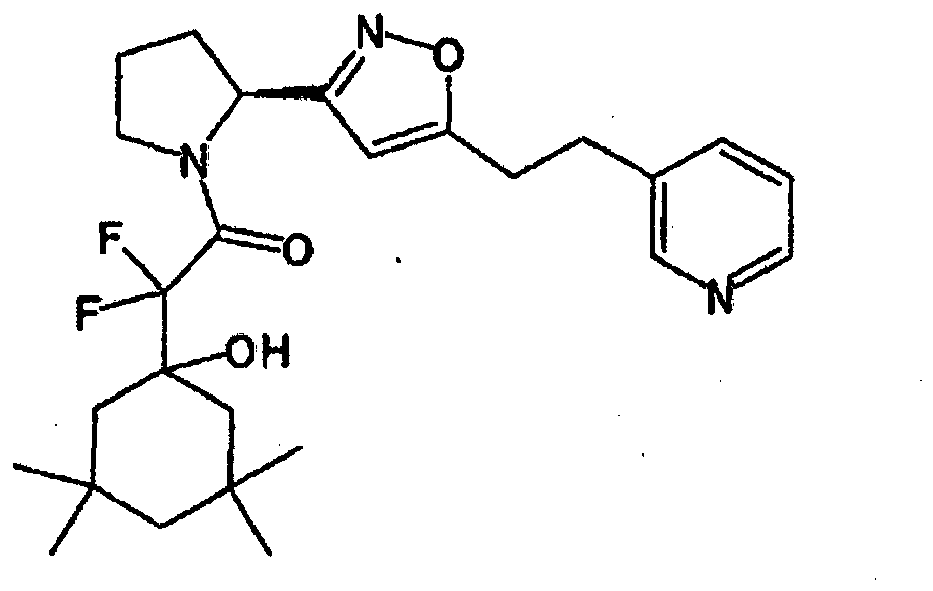
- Composé ou sel pharmaceutiquement acceptable de celui-ci selon la revendication 1, lequel composé est un composé représenté par la formule suivante ou un sel pharmaceutiquement acceptable de celui-ci :
- Produit pharmaceutique comprenant, à titre d'agent actif, le composé ou un sel pharmaceutiquement acceptable de celui-ci selon l'une quelconque des revendications 1 à 15.
- Composé ou un sel pharmaceutiquement acceptable de celui-ci selon l'une quelconque des revendications 1 à 15, pour utilisation dans la prévention ou le traitement de l'alopécie.
Priority Applications (5)
| Application Number | Priority Date | Filing Date | Title |
|---|---|---|---|
| SI201230334T SI2687524T1 (sl) | 2011-03-15 | 2012-03-15 | Derivati azola |
| PL12757646T PL2687524T3 (pl) | 2011-03-15 | 2012-03-15 | Pochodna azolu |
| HRP20151062TT HRP20151062T1 (hr) | 2011-03-15 | 2012-03-15 | Derivat azola |
| MEP-2015-201A ME02299B (me) | 2011-03-15 | 2012-03-15 | Derivat azola |
| CY20151101118T CY1117011T1 (el) | 2011-03-15 | 2015-12-08 | Παραγωγα αζολιου |
Applications Claiming Priority (2)
| Application Number | Priority Date | Filing Date | Title |
|---|---|---|---|
| JP2011056149 | 2011-03-15 | ||
| PCT/JP2012/056624 WO2012124750A1 (fr) | 2011-03-15 | 2012-03-15 | Dérivé azole |
Publications (3)
| Publication Number | Publication Date |
|---|---|
| EP2687524A1 EP2687524A1 (fr) | 2014-01-22 |
| EP2687524A4 EP2687524A4 (fr) | 2014-08-20 |
| EP2687524B1 true EP2687524B1 (fr) | 2015-09-30 |
Family
ID=46830815
Family Applications (1)
| Application Number | Title | Priority Date | Filing Date |
|---|---|---|---|
| EP12757646.0A Active EP2687524B1 (fr) | 2011-03-15 | 2012-03-15 | Dérivé azole |
Country Status (28)
| Country | Link |
|---|---|
| US (1) | US9181229B2 (fr) |
| EP (1) | EP2687524B1 (fr) |
| JP (1) | JP5828339B2 (fr) |
| KR (1) | KR101854949B1 (fr) |
| CN (1) | CN103502240B (fr) |
| AU (1) | AU2012229834B2 (fr) |
| BR (1) | BR112013022710A2 (fr) |
| CA (1) | CA2829746C (fr) |
| CY (1) | CY1117011T1 (fr) |
| DK (1) | DK2687524T3 (fr) |
| ES (1) | ES2549559T3 (fr) |
| HR (1) | HRP20151062T1 (fr) |
| HU (1) | HUE027055T2 (fr) |
| IL (1) | IL228319A (fr) |
| ME (1) | ME02299B (fr) |
| MX (1) | MX345264B (fr) |
| MY (1) | MY162945A (fr) |
| PH (1) | PH12013501897A1 (fr) |
| PL (1) | PL2687524T3 (fr) |
| PT (1) | PT2687524E (fr) |
| RS (1) | RS54377B1 (fr) |
| RU (1) | RU2573634C2 (fr) |
| SG (1) | SG193461A1 (fr) |
| SI (1) | SI2687524T1 (fr) |
| SM (1) | SMT201500319B (fr) |
| TW (1) | TWI534142B (fr) |
| WO (1) | WO2012124750A1 (fr) |
| ZA (1) | ZA201307179B (fr) |
Families Citing this family (4)
| Publication number | Priority date | Publication date | Assignee | Title |
|---|---|---|---|---|
| JP6020396B2 (ja) * | 2012-09-12 | 2016-11-02 | 大正製薬株式会社 | アゾール誘導体を含有する医薬 |
| MX368395B (es) * | 2015-02-25 | 2019-10-01 | Taisho Pharmaceutical Co Ltd | Composicion para el crecimiento de cabello para aplicacion cutanea. |
| JP2017078044A (ja) * | 2015-10-21 | 2017-04-27 | 大正製薬株式会社 | 発毛剤組成物 |
| CA3166630A1 (fr) | 2020-01-03 | 2021-07-08 | Berg Llc | Amides polycycliques utilises en tant que modulateurs d'ube2k pour le traitement du cancer |
Family Cites Families (16)
| Publication number | Priority date | Publication date | Assignee | Title |
|---|---|---|---|---|
| KR0159766B1 (ko) | 1989-10-16 | 1998-12-01 | 후지사와 토모키치로 | 양모제 조성물 |
| ES2137186T3 (es) | 1991-05-09 | 1999-12-16 | Vertex Pharma | Nuevos compuestos inmunosupresores. |
| US5859031A (en) | 1995-06-07 | 1999-01-12 | Gpi Nil Holdings, Inc. | Small molecule inhibitors of rotamase enzyme activity |
| US5945441A (en) | 1997-06-04 | 1999-08-31 | Gpi Nil Holdings, Inc. | Pyrrolidine carboxylate hair revitalizing agents |
| GB9804426D0 (en) | 1998-03-02 | 1998-04-29 | Pfizer Ltd | Heterocycles |
| AU743199B2 (en) | 1998-06-02 | 2002-01-24 | Bristol-Myers Squibb Company | Neurotrophic difluoroamide agents |
| CN1295561A (zh) | 1998-06-03 | 2001-05-16 | Gpinil控股公司 | N-杂环羧酸或羧酸等排物的n-结合氨磺酰 |
| WO1999062881A1 (fr) * | 1998-06-03 | 1999-12-09 | Gpi Nil Holdings, Inc. | Composes aza-heterocycliques utilises pour traiter les troubles neurologiques et la perte des cheveux |
| GB9815696D0 (en) | 1998-07-20 | 1998-09-16 | Pfizer Ltd | Heterocyclics |
| US6228872B1 (en) | 1998-11-12 | 2001-05-08 | Bristol-Myers Squibb Company | Neurotrophic diamide and carbamate agents |
| US6809107B1 (en) | 1999-07-09 | 2004-10-26 | Ortho-Mcneil Pharmaceutical, Inc. | Neurotrophic pyrrolidines and piperidines, and related compositions and methods |
| JP2001247569A (ja) | 1999-08-12 | 2001-09-11 | Japan Tobacco Inc | ピロリジン誘導体又はピペリジン誘導体及びその医薬用途 |
| US6818643B1 (en) | 1999-12-08 | 2004-11-16 | Bristol-Myers Squibb Company | Neurotrophic bicyclic diamides |
| JP4221989B2 (ja) | 2002-09-30 | 2009-02-12 | 大正製薬株式会社 | オキサジアゾール誘導体 |
| JP4240978B2 (ja) | 2002-09-30 | 2009-03-18 | 大正製薬株式会社 | アリールオキシメチルオキサジアゾール誘導体 |
| EP2100588A4 (fr) | 2006-12-20 | 2011-01-19 | Taisho Pharmaceutical Co Ltd | Agent ptophylactique ou thérapeutique contre l'alopécie |
-
2012
- 2012-03-14 TW TW101108668A patent/TWI534142B/zh not_active IP Right Cessation
- 2012-03-15 PL PL12757646T patent/PL2687524T3/pl unknown
- 2012-03-15 EP EP12757646.0A patent/EP2687524B1/fr active Active
- 2012-03-15 SI SI201230334T patent/SI2687524T1/sl unknown
- 2012-03-15 ES ES12757646.0T patent/ES2549559T3/es active Active
- 2012-03-15 MX MX2013010570A patent/MX345264B/es active IP Right Grant
- 2012-03-15 KR KR1020137024653A patent/KR101854949B1/ko not_active Expired - Fee Related
- 2012-03-15 US US14/004,997 patent/US9181229B2/en not_active Expired - Fee Related
- 2012-03-15 HR HRP20151062TT patent/HRP20151062T1/hr unknown
- 2012-03-15 PT PT127576460T patent/PT2687524E/pt unknown
- 2012-03-15 AU AU2012229834A patent/AU2012229834B2/en not_active Ceased
- 2012-03-15 PH PH1/2013/501897A patent/PH12013501897A1/en unknown
- 2012-03-15 CA CA2829746A patent/CA2829746C/fr not_active Expired - Fee Related
- 2012-03-15 DK DK12757646.0T patent/DK2687524T3/en active
- 2012-03-15 RS RS20150776A patent/RS54377B1/sr unknown
- 2012-03-15 HU HUE12757646A patent/HUE027055T2/en unknown
- 2012-03-15 CN CN201280013162.8A patent/CN103502240B/zh not_active Expired - Fee Related
- 2012-03-15 JP JP2013504765A patent/JP5828339B2/ja not_active Expired - Fee Related
- 2012-03-15 WO PCT/JP2012/056624 patent/WO2012124750A1/fr not_active Ceased
- 2012-03-15 MY MYPI2013701644A patent/MY162945A/en unknown
- 2012-03-15 SG SG2013069182A patent/SG193461A1/en unknown
- 2012-03-15 RU RU2013145886/04A patent/RU2573634C2/ru not_active IP Right Cessation
- 2012-03-15 ME MEP-2015-201A patent/ME02299B/me unknown
- 2012-03-15 BR BR112013022710A patent/BR112013022710A2/pt active Search and Examination
-
2013
- 2013-09-09 IL IL228319A patent/IL228319A/en active IP Right Grant
- 2013-09-25 ZA ZA2013/07179A patent/ZA201307179B/en unknown
-
2015
- 2015-12-08 CY CY20151101118T patent/CY1117011T1/el unknown
- 2015-12-21 SM SM201500319T patent/SMT201500319B/it unknown
Also Published As
Similar Documents
| Publication | Publication Date | Title |
|---|---|---|
| US10604532B2 (en) | Substituted benzylindazoles for use as BUB1 kinase inhibitors in the treatment of hyperproliferative diseases | |
| CN113272301B (zh) | 杂环类化合物、中间体、其制备方法及应用 | |
| EP3885340B1 (fr) | Composés de modulation du récepteur d'androgènes | |
| EP2714681B1 (fr) | Sulfonamides substitués utiles comme inhibiteurs de bcl anti-apoptotiques | |
| EP4406948A1 (fr) | Dérivé de pyridine et son utilisation | |
| EP1702919A1 (fr) | Nouveau derive de benzimidazole a substitution 2-heteroaryle | |
| KR20180064382A (ko) | Irak 억제제로서의 헤테로아릴 화합물 및 이의 용도 | |
| EP2017263A1 (fr) | Derive acide carboxylique inferieur d'heteroarylamide | |
| EP2687524B1 (fr) | Dérivé azole | |
| JP6020396B2 (ja) | アゾール誘導体を含有する医薬 | |
| EP4711368A1 (fr) | Composé d'azépine, composition et utilisation associées | |
| CN114728917A (zh) | 草酰胺类衍生物、其制备方法及其在医药上的应用 | |
| NZ615210B2 (en) | Azole derivative | |
| HK1189580B (en) | Azole derivative | |
| EP4215525A1 (fr) | Dérivé de pipérazine, son procédé de préparation et son utilisation |
Legal Events
| Date | Code | Title | Description |
|---|---|---|---|
| PUAI | Public reference made under article 153(3) epc to a published international application that has entered the european phase |
Free format text: ORIGINAL CODE: 0009012 |
|
| 17P | Request for examination filed |
Effective date: 20131004 |
|
| AK | Designated contracting states |
Kind code of ref document: A1 Designated state(s): AL AT BE BG CH CY CZ DE DK EE ES FI FR GB GR HR HU IE IS IT LI LT LU LV MC MK MT NL NO PL PT RO RS SE SI SK SM TR |
|
| AX | Request for extension of the european patent |
Extension state: BA ME |
|
| A4 | Supplementary search report drawn up and despatched |
Effective date: 20140717 |
|
| RIC1 | Information provided on ipc code assigned before grant |
Ipc: A61K 31/4245 20060101ALI20140711BHEP Ipc: C07D 417/04 20060101ALI20140711BHEP Ipc: A61K 31/433 20060101ALI20140711BHEP Ipc: A61K 31/422 20060101ALI20140711BHEP Ipc: C07D 413/14 20060101ALI20140711BHEP Ipc: A61P 17/14 20060101ALI20140711BHEP Ipc: A61K 31/4439 20060101ALI20140711BHEP Ipc: C07D 403/04 20060101AFI20140711BHEP Ipc: C07D 413/04 20060101ALI20140711BHEP Ipc: A61K 31/4155 20060101ALI20140711BHEP Ipc: A61K 31/506 20060101ALI20140711BHEP Ipc: A61K 31/5377 20060101ALI20140711BHEP Ipc: A61K 31/4196 20060101ALI20140711BHEP |
|
| GRAP | Despatch of communication of intention to grant a patent |
Free format text: ORIGINAL CODE: EPIDOSNIGR1 |
|
| INTG | Intention to grant announced |
Effective date: 20150429 |
|
| GRAS | Grant fee paid |
Free format text: ORIGINAL CODE: EPIDOSNIGR3 |
|
| GRAA | (expected) grant |
Free format text: ORIGINAL CODE: 0009210 |
|
| AK | Designated contracting states |
Kind code of ref document: B1 Designated state(s): AL AT BE BG CH CY CZ DE DK EE ES FI FR GB GR HR HU IE IS IT LI LT LU LV MC MK MT NL NO PL PT RO RS SE SI SK SM TR |
|
| AX | Request for extension of the european patent |
Extension state: BA ME |
|
| REG | Reference to a national code |
Ref country code: CH Ref legal event code: NV Representative=s name: E. BLUM AND CO. AG PATENT- UND MARKENANWAELTE , CH Ref country code: CH Ref legal event code: EP Ref country code: GB Ref legal event code: FG4D |
|
| REG | Reference to a national code |
Ref country code: HR Ref legal event code: TUEP Ref document number: P20151062 Country of ref document: HR |
|
| REG | Reference to a national code |
Ref country code: AT Ref legal event code: REF Ref document number: 752327 Country of ref document: AT Kind code of ref document: T Effective date: 20151015 |
|
| REG | Reference to a national code |
Ref country code: IE Ref legal event code: FG4D |
|
| REG | Reference to a national code |
Ref country code: ES Ref legal event code: FG2A Ref document number: 2549559 Country of ref document: ES Kind code of ref document: T3 Effective date: 20151029 |
|
| REG | Reference to a national code |
Ref country code: HR Ref legal event code: T1PR Ref document number: P20151062 Country of ref document: HR |
|
| REG | Reference to a national code |
Ref country code: DK Ref legal event code: T3 Effective date: 20151105 |
|
| REG | Reference to a national code |
Ref country code: DE Ref legal event code: R096 Ref document number: 602012011171 Country of ref document: DE |
|
| REG | Reference to a national code |
Ref country code: SE Ref legal event code: TRGR |
|
| REG | Reference to a national code |
Ref country code: RO Ref legal event code: EPE |
|
| REG | Reference to a national code |
Ref country code: PT Ref legal event code: SC4A Free format text: AVAILABILITY OF NATIONAL TRANSLATION Effective date: 20151130 |
|
| REG | Reference to a national code |
Ref country code: FR Ref legal event code: PLFP Year of fee payment: 5 |
|
| REG | Reference to a national code |
Ref country code: NO Ref legal event code: T2 Effective date: 20150930 |
|
| REG | Reference to a national code |
Ref country code: EE Ref legal event code: FG4A Ref document number: E011417 Country of ref document: EE Effective date: 20151201 |
|
| REG | Reference to a national code |
Ref country code: NL Ref legal event code: FP |
|
| REG | Reference to a national code |
Ref country code: SK Ref legal event code: T3 Ref document number: E 19935 Country of ref document: SK |
|
| REG | Reference to a national code |
Ref country code: GR Ref legal event code: EP Ref document number: 20150402584 Country of ref document: GR Effective date: 20160219 |
|
| REG | Reference to a national code |
Ref country code: DE Ref legal event code: R097 Ref document number: 602012011171 Country of ref document: DE |
|
| PLBE | No opposition filed within time limit |
Free format text: ORIGINAL CODE: 0009261 |
|
| STAA | Information on the status of an ep patent application or granted ep patent |
Free format text: STATUS: NO OPPOSITION FILED WITHIN TIME LIMIT |
|
| REG | Reference to a national code |
Ref country code: HU Ref legal event code: AG4A Ref document number: E027055 Country of ref document: HU |
|
| 26N | No opposition filed |
Effective date: 20160701 |
|
| REG | Reference to a national code |
Ref country code: FR Ref legal event code: PLFP Year of fee payment: 6 |
|
| REG | Reference to a national code |
Ref country code: AT Ref legal event code: UEP Ref document number: 752327 Country of ref document: AT Kind code of ref document: T Effective date: 20150930 |
|
| REG | Reference to a national code |
Ref country code: FR Ref legal event code: PLFP Year of fee payment: 7 |
|
| REG | Reference to a national code |
Ref country code: HR Ref legal event code: ODRP Ref document number: P20151062 Country of ref document: HR Payment date: 20190301 Year of fee payment: 8 |
|
| PGFP | Annual fee paid to national office [announced via postgrant information from national office to epo] |
Ref country code: RO Payment date: 20190225 Year of fee payment: 8 Ref country code: PL Payment date: 20190219 Year of fee payment: 8 Ref country code: IT Payment date: 20190325 Year of fee payment: 8 Ref country code: FI Payment date: 20190321 Year of fee payment: 8 Ref country code: NO Payment date: 20190325 Year of fee payment: 8 Ref country code: LT Payment date: 20190219 Year of fee payment: 8 Ref country code: DE Payment date: 20190321 Year of fee payment: 8 Ref country code: MC Payment date: 20190314 Year of fee payment: 8 Ref country code: IE Payment date: 20190322 Year of fee payment: 8 Ref country code: CZ Payment date: 20190314 Year of fee payment: 8 Ref country code: LU Payment date: 20190325 Year of fee payment: 8 Ref country code: FR Payment date: 20190322 Year of fee payment: 8 Ref country code: GB Payment date: 20190320 Year of fee payment: 8 Ref country code: IS Payment date: 20190218 Year of fee payment: 8 Ref country code: CH Payment date: 20190320 Year of fee payment: 8 Ref country code: BG Payment date: 20190321 Year of fee payment: 8 |
|
| PGFP | Annual fee paid to national office [announced via postgrant information from national office to epo] |
Ref country code: SM Payment date: 20190329 Year of fee payment: 8 Ref country code: NL Payment date: 20190320 Year of fee payment: 8 Ref country code: EE Payment date: 20190318 Year of fee payment: 8 Ref country code: SI Payment date: 20190218 Year of fee payment: 8 Ref country code: GR Payment date: 20190313 Year of fee payment: 8 Ref country code: TR Payment date: 20190301 Year of fee payment: 8 Ref country code: HR Payment date: 20190301 Year of fee payment: 8 Ref country code: SE Payment date: 20190320 Year of fee payment: 8 Ref country code: RS Payment date: 20190222 Year of fee payment: 8 Ref country code: LV Payment date: 20190320 Year of fee payment: 8 Ref country code: DK Payment date: 20190322 Year of fee payment: 8 Ref country code: HU Payment date: 20190314 Year of fee payment: 8 Ref country code: AT Payment date: 20190321 Year of fee payment: 8 Ref country code: BE Payment date: 20190320 Year of fee payment: 8 |
|
| PGFP | Annual fee paid to national office [announced via postgrant information from national office to epo] |
Ref country code: MK Payment date: 20190219 Year of fee payment: 8 Ref country code: SK Payment date: 20190227 Year of fee payment: 8 |
|
| PGFP | Annual fee paid to national office [announced via postgrant information from national office to epo] |
Ref country code: CY Payment date: 20190225 Year of fee payment: 8 Ref country code: ES Payment date: 20190418 Year of fee payment: 8 Ref country code: PT Payment date: 20190225 Year of fee payment: 8 |
|
| PGFP | Annual fee paid to national office [announced via postgrant information from national office to epo] |
Ref country code: MT Payment date: 20190221 Year of fee payment: 8 |
|
| PGFP | Annual fee paid to national office [announced via postgrant information from national office to epo] |
Ref country code: AL Payment date: 20190318 Year of fee payment: 8 |
|
| REG | Reference to a national code |
Ref country code: HR Ref legal event code: PBON Ref document number: P20151062 Country of ref document: HR Effective date: 20200315 |
|
| REG | Reference to a national code |
Ref country code: DE Ref legal event code: R119 Ref document number: 602012011171 Country of ref document: DE |
|
| REG | Reference to a national code |
Ref country code: FI Ref legal event code: MAE |
|
| REG | Reference to a national code |
Ref country code: EE Ref legal event code: MM4A Ref document number: E011417 Country of ref document: EE Effective date: 20200331 |
|
| REG | Reference to a national code |
Ref country code: NO Ref legal event code: MMEP |
|
| PG25 | Lapsed in a contracting state [announced via postgrant information from national office to epo] |
Ref country code: RO Free format text: LAPSE BECAUSE OF NON-PAYMENT OF DUE FEES Effective date: 20200315 Ref country code: FI Free format text: LAPSE BECAUSE OF NON-PAYMENT OF DUE FEES Effective date: 20200315 Ref country code: CY Free format text: LAPSE BECAUSE OF NON-PAYMENT OF DUE FEES Effective date: 20200315 Ref country code: CZ Free format text: LAPSE BECAUSE OF NON-PAYMENT OF DUE FEES Effective date: 20200315 Ref country code: MC Free format text: LAPSE BECAUSE OF NON-PAYMENT OF DUE FEES Effective date: 20200331 Ref country code: PT Free format text: LAPSE BECAUSE OF NON-PAYMENT OF DUE FEES Effective date: 20200915 |
|
| REG | Reference to a national code |
Ref country code: CH Ref legal event code: PL |
|
| REG | Reference to a national code |
Ref country code: DK Ref legal event code: EBP Effective date: 20200331 |
|
| REG | Reference to a national code |
Ref country code: NL Ref legal event code: MM Effective date: 20200401 |
|
| REG | Reference to a national code |
Ref country code: AT Ref legal event code: MM01 Ref document number: 752327 Country of ref document: AT Kind code of ref document: T Effective date: 20200315 |
|
| PG25 | Lapsed in a contracting state [announced via postgrant information from national office to epo] |
Ref country code: RS Free format text: LAPSE BECAUSE OF NON-PAYMENT OF DUE FEES Effective date: 20200315 Ref country code: LV Free format text: LAPSE BECAUSE OF NON-PAYMENT OF DUE FEES Effective date: 20200315 |
|
| REG | Reference to a national code |
Ref country code: SK Ref legal event code: MM4A Ref document number: E 19935 Country of ref document: SK Effective date: 20200315 |
|
| REG | Reference to a national code |
Ref country code: BE Ref legal event code: MM Effective date: 20200331 |
|
| REG | Reference to a national code |
Ref country code: LT Ref legal event code: MM4D Effective date: 20200315 |
|
| PG25 | Lapsed in a contracting state [announced via postgrant information from national office to epo] |
Ref country code: LU Free format text: LAPSE BECAUSE OF NON-PAYMENT OF DUE FEES Effective date: 20200315 Ref country code: NL Free format text: LAPSE BECAUSE OF NON-PAYMENT OF DUE FEES Effective date: 20200401 |
|
| REG | Reference to a national code |
Ref country code: SI Ref legal event code: KO00 Effective date: 20201116 |
|
| PG25 | Lapsed in a contracting state [announced via postgrant information from national office to epo] |
Ref country code: DE Free format text: LAPSE BECAUSE OF NON-PAYMENT OF DUE FEES Effective date: 20201001 Ref country code: LI Free format text: LAPSE BECAUSE OF NON-PAYMENT OF DUE FEES Effective date: 20200331 Ref country code: CH Free format text: LAPSE BECAUSE OF NON-PAYMENT OF DUE FEES Effective date: 20200331 Ref country code: HU Free format text: LAPSE BECAUSE OF NON-PAYMENT OF DUE FEES Effective date: 20200316 Ref country code: GR Free format text: LAPSE BECAUSE OF NON-PAYMENT OF DUE FEES Effective date: 20201008 Ref country code: EE Free format text: LAPSE BECAUSE OF NON-PAYMENT OF DUE FEES Effective date: 20200331 Ref country code: BG Free format text: LAPSE BECAUSE OF NON-PAYMENT OF DUE FEES Effective date: 20201130 Ref country code: FR Free format text: LAPSE BECAUSE OF NON-PAYMENT OF DUE FEES Effective date: 20200331 Ref country code: AT Free format text: LAPSE BECAUSE OF NON-PAYMENT OF DUE FEES Effective date: 20200315 Ref country code: NO Free format text: LAPSE BECAUSE OF NON-PAYMENT OF DUE FEES Effective date: 20200331 Ref country code: IE Free format text: LAPSE BECAUSE OF NON-PAYMENT OF DUE FEES Effective date: 20200315 Ref country code: LT Free format text: LAPSE BECAUSE OF NON-PAYMENT OF DUE FEES Effective date: 20200315 Ref country code: HR Free format text: LAPSE BECAUSE OF NON-PAYMENT OF DUE FEES Effective date: 20200315 Ref country code: SE Free format text: LAPSE BECAUSE OF NON-PAYMENT OF DUE FEES Effective date: 20200316 Ref country code: SM Free format text: LAPSE BECAUSE OF NON-PAYMENT OF DUE FEES Effective date: 20201008 |
|
| PG25 | Lapsed in a contracting state [announced via postgrant information from national office to epo] |
Ref country code: SK Free format text: LAPSE BECAUSE OF NON-PAYMENT OF DUE FEES Effective date: 20200315 Ref country code: BE Free format text: LAPSE BECAUSE OF NON-PAYMENT OF DUE FEES Effective date: 20200331 Ref country code: SI Free format text: LAPSE BECAUSE OF NON-PAYMENT OF DUE FEES Effective date: 20200316 |
|
| GBPC | Gb: european patent ceased through non-payment of renewal fee |
Effective date: 20200315 |
|
| PG25 | Lapsed in a contracting state [announced via postgrant information from national office to epo] |
Ref country code: DK Free format text: LAPSE BECAUSE OF NON-PAYMENT OF DUE FEES Effective date: 20200331 Ref country code: GB Free format text: LAPSE BECAUSE OF NON-PAYMENT OF DUE FEES Effective date: 20200315 |
|
| REG | Reference to a national code |
Ref country code: ES Ref legal event code: FD2A Effective date: 20210804 |
|
| PG25 | Lapsed in a contracting state [announced via postgrant information from national office to epo] |
Ref country code: IT Free format text: LAPSE BECAUSE OF NON-PAYMENT OF DUE FEES Effective date: 20200315 |
|
| PG25 | Lapsed in a contracting state [announced via postgrant information from national office to epo] |
Ref country code: ES Free format text: LAPSE BECAUSE OF NON-PAYMENT OF DUE FEES Effective date: 20200316 |
|
| PG25 | Lapsed in a contracting state [announced via postgrant information from national office to epo] |
Ref country code: PL Free format text: LAPSE BECAUSE OF NON-PAYMENT OF DUE FEES Effective date: 20200315 |
|
| PG25 | Lapsed in a contracting state [announced via postgrant information from national office to epo] |
Ref country code: TR Free format text: LAPSE BECAUSE OF NON-PAYMENT OF DUE FEES Effective date: 20200315 Ref country code: MT Free format text: LAPSE BECAUSE OF NON-PAYMENT OF DUE FEES Effective date: 20200315 |
|
| PG25 | Lapsed in a contracting state [announced via postgrant information from national office to epo] |
Ref country code: AL Free format text: LAPSE BECAUSE OF NON-PAYMENT OF DUE FEES Effective date: 20200315 |
|
| PG25 | Lapsed in a contracting state [announced via postgrant information from national office to epo] |
Ref country code: IS Free format text: LAPSE BECAUSE OF NON-PAYMENT OF DUE FEES Effective date: 20201007 |