EP2707708B1 - Immunassay-produkt - Google Patents
Immunassay-produkt Download PDFInfo
- Publication number
- EP2707708B1 EP2707708B1 EP12781832.6A EP12781832A EP2707708B1 EP 2707708 B1 EP2707708 B1 EP 2707708B1 EP 12781832 A EP12781832 A EP 12781832A EP 2707708 B1 EP2707708 B1 EP 2707708B1
- Authority
- EP
- European Patent Office
- Prior art keywords
- holder
- carrier
- membrane
- plate
- seal
- Prior art date
- Legal status (The legal status is an assumption and is not a legal conclusion. Google has not performed a legal analysis and makes no representation as to the accuracy of the status listed.)
- Active
Links
Images






Classifications
-
- G—PHYSICS
- G01—MEASURING; TESTING
- G01N—INVESTIGATING OR ANALYSING MATERIALS BY DETERMINING THEIR CHEMICAL OR PHYSICAL PROPERTIES
- G01N33/00—Investigating or analysing materials by specific methods not covered by groups G01N1/00 - G01N31/00
- G01N33/48—Biological material, e.g. blood, urine; Haemocytometers
- G01N33/50—Chemical analysis of biological material, e.g. blood, urine; Testing involving biospecific ligand binding methods; Immunological testing
- G01N33/53—Immunoassay; Biospecific binding assay; Materials therefor
- G01N33/543—Immunoassay; Biospecific binding assay; Materials therefor with an insoluble carrier for immobilising immunochemicals
- G01N33/54366—Apparatus specially adapted for solid-phase testing
-
- B—PERFORMING OPERATIONS; TRANSPORTING
- B01—PHYSICAL OR CHEMICAL PROCESSES OR APPARATUS IN GENERAL
- B01L—CHEMICAL OR PHYSICAL LABORATORY APPARATUS FOR GENERAL USE
- B01L3/00—Containers or dishes for laboratory use, e.g. laboratory glassware; Droppers
- B01L3/50—Containers for the purpose of retaining a material to be analysed, e.g. test tubes
- B01L3/502—Containers for the purpose of retaining a material to be analysed, e.g. test tubes with fluid transport, e.g. in multi-compartment structures
- B01L3/5023—Containers for the purpose of retaining a material to be analysed, e.g. test tubes with fluid transport, e.g. in multi-compartment structures with a sample being transported to, and subsequently stored in an absorbent for analysis
-
- B—PERFORMING OPERATIONS; TRANSPORTING
- B01—PHYSICAL OR CHEMICAL PROCESSES OR APPARATUS IN GENERAL
- B01L—CHEMICAL OR PHYSICAL LABORATORY APPARATUS FOR GENERAL USE
- B01L9/00—Supporting devices; Holding devices
- B01L9/52—Supports specially adapted for flat sample carriers, e.g. for plates, slides, chips
-
- G—PHYSICS
- G01—MEASURING; TESTING
- G01N—INVESTIGATING OR ANALYSING MATERIALS BY DETERMINING THEIR CHEMICAL OR PHYSICAL PROPERTIES
- G01N33/00—Investigating or analysing materials by specific methods not covered by groups G01N1/00 - G01N31/00
- G01N33/48—Biological material, e.g. blood, urine; Haemocytometers
- G01N33/50—Chemical analysis of biological material, e.g. blood, urine; Testing involving biospecific ligand binding methods; Immunological testing
- G01N33/53—Immunoassay; Biospecific binding assay; Materials therefor
- G01N33/543—Immunoassay; Biospecific binding assay; Materials therefor with an insoluble carrier for immobilising immunochemicals
- G01N33/54366—Apparatus specially adapted for solid-phase testing
- G01N33/54386—Analytical elements
- G01N33/54387—Immunochromatographic test strips
- G01N33/54391—Immunochromatographic test strips based on vertical flow
-
- B—PERFORMING OPERATIONS; TRANSPORTING
- B01—PHYSICAL OR CHEMICAL PROCESSES OR APPARATUS IN GENERAL
- B01J—CHEMICAL OR PHYSICAL PROCESSES, e.g. CATALYSIS OR COLLOID CHEMISTRY; THEIR RELEVANT APPARATUS
- B01J20/00—Solid sorbent compositions or filter aid compositions; Sorbents for chromatography; Processes for preparing, regenerating or reactivating thereof
- B01J20/28—Solid sorbent compositions or filter aid compositions; Sorbents for chromatography; Processes for preparing, regenerating or reactivating thereof characterised by their form or physical properties
- B01J20/28014—Solid sorbent compositions or filter aid compositions; Sorbents for chromatography; Processes for preparing, regenerating or reactivating thereof characterised by their form or physical properties characterised by their form
- B01J20/28033—Membrane, sheet, cloth, pad, lamellar or mat
- B01J20/28035—Membrane, sheet, cloth, pad, lamellar or mat with more than one layer, e.g. laminates, separated sheets
-
- B—PERFORMING OPERATIONS; TRANSPORTING
- B01—PHYSICAL OR CHEMICAL PROCESSES OR APPARATUS IN GENERAL
- B01J—CHEMICAL OR PHYSICAL PROCESSES, e.g. CATALYSIS OR COLLOID CHEMISTRY; THEIR RELEVANT APPARATUS
- B01J20/00—Solid sorbent compositions or filter aid compositions; Sorbents for chromatography; Processes for preparing, regenerating or reactivating thereof
- B01J20/28—Solid sorbent compositions or filter aid compositions; Sorbents for chromatography; Processes for preparing, regenerating or reactivating thereof characterised by their form or physical properties
- B01J20/28014—Solid sorbent compositions or filter aid compositions; Sorbents for chromatography; Processes for preparing, regenerating or reactivating thereof characterised by their form or physical properties characterised by their form
- B01J20/28033—Membrane, sheet, cloth, pad, lamellar or mat
- B01J20/2804—Sheets with a specific shape, e.g. corrugated, folded, pleated, helical
-
- B—PERFORMING OPERATIONS; TRANSPORTING
- B01—PHYSICAL OR CHEMICAL PROCESSES OR APPARATUS IN GENERAL
- B01L—CHEMICAL OR PHYSICAL LABORATORY APPARATUS FOR GENERAL USE
- B01L2200/00—Solutions for specific problems relating to chemical or physical laboratory apparatus
- B01L2200/02—Adapting objects or devices to another
- B01L2200/025—Align devices or objects to ensure defined positions relative to each other
-
- B—PERFORMING OPERATIONS; TRANSPORTING
- B01—PHYSICAL OR CHEMICAL PROCESSES OR APPARATUS IN GENERAL
- B01L—CHEMICAL OR PHYSICAL LABORATORY APPARATUS FOR GENERAL USE
- B01L2300/00—Additional constructional details
- B01L2300/06—Auxiliary integrated devices, integrated components
- B01L2300/0609—Holders integrated in container to position an object
-
- B—PERFORMING OPERATIONS; TRANSPORTING
- B01—PHYSICAL OR CHEMICAL PROCESSES OR APPARATUS IN GENERAL
- B01L—CHEMICAL OR PHYSICAL LABORATORY APPARATUS FOR GENERAL USE
- B01L2300/00—Additional constructional details
- B01L2300/06—Auxiliary integrated devices, integrated components
- B01L2300/0681—Filter
-
- B—PERFORMING OPERATIONS; TRANSPORTING
- B01—PHYSICAL OR CHEMICAL PROCESSES OR APPARATUS IN GENERAL
- B01L—CHEMICAL OR PHYSICAL LABORATORY APPARATUS FOR GENERAL USE
- B01L2300/00—Additional constructional details
- B01L2300/06—Auxiliary integrated devices, integrated components
- B01L2300/069—Absorbents; Gels to retain a fluid
-
- B—PERFORMING OPERATIONS; TRANSPORTING
- B01—PHYSICAL OR CHEMICAL PROCESSES OR APPARATUS IN GENERAL
- B01L—CHEMICAL OR PHYSICAL LABORATORY APPARATUS FOR GENERAL USE
- B01L2300/00—Additional constructional details
- B01L2300/08—Geometry, shape and general structure
- B01L2300/0809—Geometry, shape and general structure rectangular shaped
-
- B—PERFORMING OPERATIONS; TRANSPORTING
- B01—PHYSICAL OR CHEMICAL PROCESSES OR APPARATUS IN GENERAL
- B01L—CHEMICAL OR PHYSICAL LABORATORY APPARATUS FOR GENERAL USE
- B01L2300/00—Additional constructional details
- B01L2300/12—Specific details about materials
-
- B—PERFORMING OPERATIONS; TRANSPORTING
- B01—PHYSICAL OR CHEMICAL PROCESSES OR APPARATUS IN GENERAL
- B01L—CHEMICAL OR PHYSICAL LABORATORY APPARATUS FOR GENERAL USE
- B01L2300/00—Additional constructional details
- B01L2300/12—Specific details about materials
- B01L2300/126—Paper
-
- B—PERFORMING OPERATIONS; TRANSPORTING
- B01—PHYSICAL OR CHEMICAL PROCESSES OR APPARATUS IN GENERAL
- B01L—CHEMICAL OR PHYSICAL LABORATORY APPARATUS FOR GENERAL USE
- B01L2400/00—Moving or stopping fluids
- B01L2400/04—Moving fluids with specific forces or mechanical means
- B01L2400/0475—Moving fluids with specific forces or mechanical means specific mechanical means and fluid pressure
- B01L2400/0487—Moving fluids with specific forces or mechanical means specific mechanical means and fluid pressure fluid pressure, pneumatics
- B01L2400/049—Moving fluids with specific forces or mechanical means specific mechanical means and fluid pressure fluid pressure, pneumatics vacuum
-
- G—PHYSICS
- G01—MEASURING; TESTING
- G01N—INVESTIGATING OR ANALYSING MATERIALS BY DETERMINING THEIR CHEMICAL OR PHYSICAL PROPERTIES
- G01N2469/00—Immunoassays for the detection of microorganisms
- G01N2469/10—Detection of antigens from microorganism in sample from host
-
- G—PHYSICS
- G01—MEASURING; TESTING
- G01N—INVESTIGATING OR ANALYSING MATERIALS BY DETERMINING THEIR CHEMICAL OR PHYSICAL PROPERTIES
- G01N2469/00—Immunoassays for the detection of microorganisms
- G01N2469/20—Detection of antibodies in sample from host which are directed against antigens from microorganisms
-
- G—PHYSICS
- G01—MEASURING; TESTING
- G01N—INVESTIGATING OR ANALYSING MATERIALS BY DETERMINING THEIR CHEMICAL OR PHYSICAL PROPERTIES
- G01N33/00—Investigating or analysing materials by specific methods not covered by groups G01N1/00 - G01N31/00
- G01N33/48—Biological material, e.g. blood, urine; Haemocytometers
- G01N33/50—Chemical analysis of biological material, e.g. blood, urine; Testing involving biospecific ligand binding methods; Immunological testing
- G01N33/53—Immunoassay; Biospecific binding assay; Materials therefor
- G01N33/569—Immunoassay; Biospecific binding assay; Materials therefor for microorganisms, e.g. protozoa, bacteria, viruses
- G01N33/56911—Bacteria
Definitions
- the embodiments disclosed herein relate to a device for the detection and position of substances that are contained in a blotting membrane. More particularly, it concerns a device suitable for applying reagents, wash solutions and detection chemistries to a blotting membrane to accomplish this detection quickly via the use of vacuum or positive pressure.
- Nonbiological materials can also be separated using gels or other chromatographic supports as well, but the scope of effort with regard to biologicals is greater.
- Typical applications include separation of nucleic acid fragments of various sizes either in the context of sequence determination; in the detection of polymorphisms; or verification of sizes in other contexts. Also frequently conducted are separations of proteins, glycoproteins, protein fragments and application of gel separations as verification of homogeneity or purity, identification of post translational modifications and confirmation of molecular weight.
- the gel support is contacted with a blotting membrane to which the substances are transferred in the same pattern in which they appeared on the gel.
- the “spots” are then detected, at a minimum, by blocking the membrane with a protein or detergent solution to reduce non-specific binding (which otherwise leads to a high level of noise and low level of detection).
- Typical blocking agents include casein, bovine serum albumin (BSA), non-fat dry milk (generally about 1-5%) in a Tris buffer saline solution with TWEEN® surfactant (TBS-T solution) or phosphate buffer saline solution with TWEEN® surfactant (PBS-T solution).
- BSA bovine serum albumin
- TBS-T solution Tris buffer saline solution with TWEEN® surfactant
- PBS-T solution phosphate buffer saline solution with TWEEN® surfactant
- the membrane is then extensively washed to remove any contaminants, unbound blocking proteins or antibodies and the like.
- the membrane is then treated and incubated with a secondary enzyme-, radioisotope-, fluorfluor-, or biotin-conjugated antibody specific for the primary antibody.
- the membrane is then extensively washed again to remove any unbound secondary antibody.
- a detection reagent generally a chromogenic, chemiluminescent, fluorescent, radiological, or streptavidin-labeled material, is applied which either binds to, or is a substrate of the enzyme-conjugate.
- the appropriate detection device is used to determine the presence, absence, position, quantity, etc. of the biological entity.
- the last six steps generally take from 3-6 hours to overnight depending on the speed of the reaction between the selected reagents, the membrane and the biological entity.
- the process requires multiple incubation periods of the membrane on a rocking or other suitable mixing platform. It is a lengthy process that most researchers dislike and which consumes (wastes) a large volume of reagents.
- Hybrid-EaseTM hybridization chamber marketed by Hoefer Scientific Instruments. This chamber is comprised two grids between which the membrane is sandwiched. The grid plates are snapped into position surrounding the membrane, and syringes fitted into the open space created by the grids. One syringe is used to apply reagents and wash, and the other to withdraw excess.
- the system requires large volumes of liquid in order to operate, is cumbersome to employ and is still quite time consuming. It also mentions that in some particular assays, such as ELISA assays, in small volume wells (such as 96 well microtiter plate), others have used vacuum to draw liquids through a membrane in a washing step.
- a device formed of several layers including a porous support layer below the one or more layers of blotting membrane, a flow distributor above the blotting membrane(s) and a well on the flow distributor to contain the liquid to the desired area and to allow for lower starting volumes of such liquid.
- the flow distributor is a non-binding or low binding porous membrane.
- the invention relates to a device as defined in independent claim 1. Preferred aspects of the device are defined in the dependent claims.
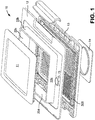
- the carrier 10 includes a lid 11, a carrier top plate 12, a carrier bottom plate 13, a cover 14, and a bubble level 15 on the carrier top plate 12.
- the carrier 10 serves to hold the blot holder flat and to deliver reagents such as antibodies, wash buffer, etc. to the blot holder.
- the carrier 10 is a standalone device, separate from a manifold base (discussed below), which allows the user to setup multiple blots at the same time. Thus, each carrier 10 can be selectively loaded with blot holders containing blots, their respective antibodies added, and then incubated.
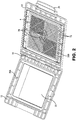
- FIG. 2 shows an embodiment of the carrier 10 in an open position, with the underside of the top plate 12 shown to the left in the drawing and the top side of the bottom plate 13 shown to the right.
- the top plate 12 and bottom plate 13 are hingedly connected at 16.
- the hinge is a "live" hinge that bonds the two portions together.
- the hinge could be made separately and attached using adhesives, heat bonds or mechanical fasteners.
- Other embodiments use no hinge (not shown) and use clips, elastic bands or cooperatively engaging fasteners such as a slot and detent, friction fit pin or the like form on or in the respective top and bottom portions to hold them together during use.
- Other comparable means will be obvious to one of skill in the art and it is meant to include them as well.
- the carrier top plate 12 may either have one or more wells 22, which can be used for holding and/or delivering washing fluids and reagents during use.
- the well(s) 22 may either be formed as part of the top surface of the top carrier plate 12 with upstanding walls 22a, 22b, 22c and 22d ( FIG. 1 ), or as a separate piece which is simply attached or placed on top of the carrier top plate 12.
- the lid 11 can be placed on the carrier 10 to cover the well 22 and prevent antibodies and other fluids from evaporating during extended incubation periods, particularly during overnight incubation.
- the carrier bottom plate 13 includes a porous support 4 that may be a simple screen, a grid, a flow directing grid or a sintered porous structure such as a POREX® membrane or a coarse or large pored microporous filter, such as a woven or non-woven paper, a polypropylene or polyethylene fabric, a glass mat or paper, or a 1-10 micron microporous filter.
- a porous support 4 may be a simple screen, a grid, a flow directing grid or a sintered porous structure such as a POREX® membrane or a coarse or large pored microporous filter, such as a woven or non-woven paper, a polypropylene or polyethylene fabric, a glass mat or paper, or a 1-10 micron microporous filter.
- Such supports can be made of polymer, glass, ceramic or metal materials including but not limited to metals, such as stainless steel or steel alloy, aluminum and the like, and polymers such as polyethylene, polypropylene,
- FIG. 2 shows a porous support 4 in the form of a flow directing grid including a series of grooves 72 and openings 74.
- the openings 74 are inwardly positioned from the perimeter of the porous support 4.
- the openings 74 are in fluid communication with the grooves 72 so that fluid is collected in the grooves 72 and directed through the openings 74.
- the grooves 72 collect and deliver the spent fluid to the openings 74 which direct the fluid to a waste chamber or collection tray (not shown). If the researcher wishes to collect one or more of the fluids, then a collection tray can be appropriately positioned to do so.
- a collection tray can be appropriately positioned to do so.
- Those skilled in the art will appreciate that other patterns of grooves or openings may be used, as the desired outcome is to direct the spent fluids to an opening or a series of openings that direct the spent fluids to a predetermined destination.
- the outer edges of the support 4 and the carrier top plate 12 may be made of the same materials as the support 4.
- an integral hinge it must be made of a flexible material such as polyethylene, polypropylene, an elastomer or one of the impact modified materials such as ABS, K-resin and the like.
- a separate hinge, clips, elastic bands, adhesive film or other securing means they may be made of metal, plastic or elastomers as desired.
- a first flange seal 30A is positioned on the underside of the top carrier plate 12 as shown, and cooperatively with a second flange seal 30B positioned about the porous support 4 on the carrier bottom plate 13, maintains a fluid tight system when the top and bottom plates are in the closed position with the blot holder engaged.
- the flange seals 30A and 30B are positioned so that when the top carrier plate 12 is rotated with respect to the bottom carrier plate 13 to a closed position, the two seals register or align with one another to seal the carrier.
- each flange seal 30A, 30B is preferably made of a flexible elastomer such as silicone, or thermoplastic elastomer (TPE) and is V-shaped, with one leg of the V being short than the other.
- TPE thermoplastic elastomer
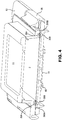
- the long end of each V-shaped flange seal seats in a respective recess of the top and bottom carrier plates ( FIG. 4 ).
- the short leg of each V-shaped seal is a raised, easily deformable feature. In the carrier closed and sealed position, the shorter legs of the V on the top carrier plate will contact the top surface of the blot holder. The shorter leg of the V on the bottom carrier plate will contact the bottom of the blot holder and deflect as best seen in FIG. 4 .
- the angled geometry of the seal exerts a force to pull or stretch the holder 2 when deflected, which "drums" the membrane and keeps it flat.
- a flat membrane avoids deformities that can create peaks and valleys on the membrane surface which pools the antibody volume, which in turn leads to areas of the blot membrane having more or less exposure to the antibodies, resulting in poor and inconsistent results.
- This seal prevents leaking and enables long term (e.g., overnight) incubation.
- the design of the seal also allows for a low force sealing mechanism and low clamp force required for the carrier 10. This helps to maintain flatness of the holder and the blot membrane.
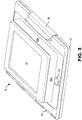
- a releasable latch 35 or other locking mechanism locks the carrier in the closed position ( FIG 3 ).
- a single flange seal can be used, preferably the flange seal 30B for the bottom plate.
- the bottom flange seal 30B functions to stretch the blot holder. Once stretched, the interface is designed so that the carrier top and bottom pinch the blot holder in place.
- Outer flange seals 300A, 300B are also shown in FIG. 4 .
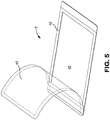
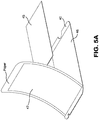
- FIGS. 5 , 5A and 5B show a holder 2 in accordance with certain embodiments.
- the holder 2 includes a frame 40 having a perimeter edge configured to support a protein blotting membrane 45.
- the frame 40 is constructed of plastic or paper.
- the material of the frame 40 can be bioresin, HIPS, paper, or, in other configurations not falling within the scope of the claimed invention, cardboard or any other suitable rigid material that can support the membrane and keep it flat.
- a flow distributor 46 such as a GVPP membrane, is laminated or otherwise attached to the frame, and over which over the blotting membrane 45 can be positioned.
- the flow distributor 46 is attached to the frame and the blot membrane is sandwiched between the flow distributor 46 and the porous support 47 when the blot holder is closed.
- the porous support 47 on the blot holder is supported and in contact with the porous support 4 of the carrier bottom plate.
- the flow distributor 46 functions to evenly distribute the blocking solution and the antibodies over the blot membrane. It also regulates flow through of these solutions when vacuum is applied.
- the holder 2 also includes a porous support 47, namely a piece of polypropylene non-woven mesh bound to the frame along one edge, allowing easy access for the user to add the blot membrane, and which supports the blot membrane and protects it from damage under vacuum force.
- the support 47 is porous to allow free flow of liquids through the blot holder 2.
- the holder 2 is shown properly positioned in the carrier 10 in FIG. 6 .
- the holder 2 can be made by laminating a pressure sensitive adhesive to the back of a polypropylene mesh such that after adding the blot membrane to the holder, the user removes a backing strip to expose the pressure sensitive adhesive and then seals the mesh to the flow distributor (e.g., to the GVPP membrane) to create a sealed envelope.
- the flow distributor e.g., to the GVPP membrane
- perforations and zippers can be included to tear open the envelope.
- a thin patapar® paper, wax paper or other thin sheet of paper material is laminated to one side of the polypropylene mesh.
- the wet paper backing sticks to the GVPP membrane, creating a temporary seal.
- the blot membrane is easy to remove without having to tear anything or manage sticky adhesives.
- the holder is then disposed of, as after the paper backing dries, it curls and the holder becomes unusable.
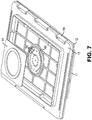
- FIGS. 7 and 8 illustrate the underside of the bottom carrier plate 13. Visible in FIG. 7 are the plurality of openings 74 in the porous support 4. Cover 14 is used to cover the openings to prevent leaking of antibodies during incubation, particularly when incubating for long periods of time, such as overnight, as seen in FIG. 8 .
- the openings 74 are surrounded by an annular raised ring 49, and the cover 14 has a corresponding annular slot 60 ( FIG. 4 ) configured to mate with the annular ring 49 and thus the cover can be pressed onto the ring to secure it to the carrier plate 13.
- the cover 14 can be eliminated, and an umbrella valve 144 can be used to retain the liquid during incubation, as shown in FIG. 4A .
- the valve When the vacuum is turned on, the valve opens and the liquid drains.
- the valve is made of EPDM (ethylene propylene diene monomer) due to its stiffness and ability to snap closed quickly when the vacuum is turned off. This helps to prevent backpressure and air trapping, which (with the silicone valves) was causing the blot holder to bow and lead to adverse antibody pooling.
- EPDM ethylene propylene diene monomer
- Antibody pooling leads to a non-uniform signal on the final blot readout - areas near the trapped air will have a weak signal (faint) and areas with pooled antibody will have a strong signal (bold).
- manifold 8 is a vacuum manifold that can be attached to a suitable source of vacuum (not shown).
- the manifold 8 may include a waste collection device (not shown), such as a receptacle, positioned in the manifold (not shown) to collect the liquid pulled through the carrier 10.
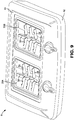
- the manifold 8 has a base 42, having a drain and support surface 44 on which one or more carriers 10 is placed.
- the support surface 44 includes one or more wells or carrier receiving regions 55A, 55B (two shown in FIG. 9 ) that may include a plurality of upstanding ribs 56 that receive the underside of the carrier bottom plate 13 to hold the carrier 10 in a stable manner in the manifold 8.
- Also shown are optional respective controls 62 for managing and monitoring the manifold 8 and the process.
- the device can be used with automated liquid handlers and the like if desired.
- the manifold 8 can process more than one holder to run parallel carriers with different blotting membranes or subparts of one blotting membrane, each membrane is typically processed with at least one different reagent.
- the manifold 8 can have a common pressure source or each station carrier receiving region can be pressure controlled individually.
- the manifold has leveling feet that when used in conjunction with one or more level indicators of one embodiment of the carrier allow the manifold and carrier to be leveled in a horizontal plane.
- the manifold has a series of feet that are capable of being adjusted in a vertical direction so as to level the manifold in relation to the level indicator(s) on the carrier when the carrier is attached to the manifold.
- the series of feet have a screw that fits into a threaded portion of the manifold bottom to allow the feet to be individually raised or lowered in a vertical direction.
- the base could be a closed chamber that could contain the carrier, and the lid 11 would become a pressure manifold to apply pressure to the well 22 of the carrier.
- each washing cycle is comprised of one or more washing steps. Generally, 2-5 steps are used per cycle.
- Another method is to use the embodiments disclosed herein in each step in which liquid needs to be moved through the blotting membrane such as after incubation of the antibodies or in the washing steps.
- any driving force suitable to move the liquid(s) through the device and into the manifold can be used. This can vary depending upon the membranes selected for blotting and the manifold used, the desired speed of the filtration and the supply of vacuum or positive pressure available to the researcher.
- the vacuum available may vary between 100 and 760mm Hg (133 millibars and 1013 millibars).
- the use of valves, pressure restrictors and the like may also be used to keep the vacuum within the allowed ranges for the membranes used.
- a preferred vacuum manifold of one embodiment uses of a vacuum of about 100 mm Hg.
- Other suitable vacuum manifolds include but are not limited to the MULTISCREENTM and MULTISCREENTM HTS vacuum manifolds available from Millipore Corporation of Billerica, Massachusetts.
- the positive pressure is supplied by an air line at pressures ranging from about 13,789.5 Pa (2 psi) to about 103,421.3 Pa (15 psi).
- the use of valves, pressure restrictors and the like may also be used to keep the pressure within the allowed ranges for the membranes used.
- pressure systems include but are not limited to Amicon® stirred cell devices available from Millipore Corporation of Billerica, Massachusetts and positive pressure filtration units available from Caliper Life Sciences of Hopkinton, Massachusetts.
- a device To use a device according to the embodiments disclosed herein, one simply takes a holder, opens it and places the blotting membrane(s) on one of the surfaces such that the lower surface of the blotting membrane is adjacent the porous support and the upper surface of the blotting membrane is adjacent the flow distributor when the device is closed around the membrane(s) so as to have no air bubbles between the blot and the flow distributor. Bubbles between these two surfaces can cause areas of no flow.
- the blot holder is then placed inside the carrier which is then securely closed with the latch mechanism.
- the device is placed on or in a manifold having a pressure supply (vacuum or positive pressure).
- the blotting membrane(s) has been prewet.
- the pressure (vacuum or positive pressure) is turned on and a liquid, such as a wash liquid or a reagent, is placed in the well of a carrier. The pressure continues until the liquid has been moved through the device and membrane(s). Then the pressure is turned off.
- blotting membranes When more than one blotting membrane is used, they can be arranged in series on top of each other and sufficient liquid containing the same desired reagents can be easily moved through the multiple layers in one process step. Generally when more than one layer is used it is preferred that one use between 2 and 10 layers, preferably between 2 and 5 layers at a time.
- the liquid can either be added with the pressure supply being off or the supply being turned on only briefly so as to get the liquid into the membrane(s) and is allowed to incubate (such as may be required with the primary or secondary antibodies).
- the pressure is then turned on to remove the liquid and/or replace it with another used sequentially.
- the vacuum is left on and remaining washes are added sequentially.
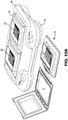
- a collection vessel 70 below the device ( FIG. 9A ), preferably in the manifold itself or downstream, such as an antibody collection tray. It can then be used to collect one or more unbound reagents that may be expensive and which can be collected and recycled for use in future assays.
- the vessel can also be subdivided into multiple chambers that are in alignment and fluid communication with the respective portion of the blotting membrane.
- the matrix is preferably in the form of a monolith, such as a pad, a plug or a paper sheet, that is positioned so that all the liquid passing through the blotting membrane and holder passes through the matrix. It can then either be removed and the reagent eluted or if desired, it can have the bound reagents eluted in situ after completion of the testing of the blotting membrane.
- the membrane contains, in its interstices, one or more substances to be detected. Generally these substances are present in the interstices either by virtue of having been blotted from a solid support for electrophoresis or chromatography or by direct application, usually to detect the presence, absence, or amount of a particular type of material such as an antibody or specific protein - i.e. a Dot-Blot type assay as described above.
- the definition of the membrane is not limited, however, to these instances, but applies to any case wherein a membrane contains in its interstices one or more substances to be detected.
- membranes commonly used to blot electrophoresis gels such as nitrocellulose; nylon; or various other polymeric membranes, such as polyvinylidene fluoride (PVDF), sold as IMMOBILONTM membranes by Millipore Corporation of Billerica, Massachusetts.
- PVDF polyvinylidene fluoride
- a variety of materials can be used to replicate the results of electrophoresis gels performed on various samples as is understood in the art. Most commonly, the samples contain biological substances such as individual proteins, antibodies, nucleic acids, oligonucleotides, complex carbohydrates, and the like, but the application of the technique is not limited to these substances. The technique is applicable to any membrane containing within it a substance to be detected regardless of the chemical composition of the membrane or of the target substances.
- the transfer of the substances to be detected from the gel to the membrane can be conducted by utilizing membranes containing transfer buffer, by electroelution, or by dry blotting of the gels. Techniques for these transfers are well understood in the art, and do not constitute part of the embodiments disclosed herein.
- the liquid to be supplied may contain detecting reagents or may simply be provided as a wash.
- the nature of the detecting reagent depends, of course, on the substance to be detected.
- proteins are detected by immunological reactions between antigen and antibody or immunoreactive portions thereof; typically the presence of nucleic acid fragments is detected by suitable oligonucleotide probes.
- the detecting substances responsible for the immediate or specific reaction with the substance to be detected may be further supplemented, if needed, with label and a multiplicity of applications of the detecting reagents may be needed- e.g., a protocol may include detection of an antigen by supplying an antibody labeled with an enzyme, e.g., commonly, horseradish peroxidase, and then this binding is detected by means of supplying substrate for this enzyme.
- an enzyme e.g., commonly, horseradish peroxidase
- Blots can be sequentially analyzed with multiple antibodies or probes in the present device and process by stripping the previously bound antibodies from the blot followed by subsequent incubations with antibodies or other probes specific other target proteins.
- the stripping process disrupts the antigen-antibody bonds and dissolves the antibodies in the surrounding buffer. This is usually achieved by a combination of detergent and heat or by exposure to either high or low pH.
- the device in combination with the flow distributor, enables the stripping of blots using the high or low pH method.
- the subsequent reprobing of blots either directly (e.g., using the same flow distributor used for striping) or subsequently after storage, would use the same protocol as the initial probing.
- Suitable kits for strip blotting are available from Chemicon International, Inc under the brand names of ReBlotTM Plus kit (catalogue # 2500), ReBlot Plus-Mild solution (catalogue # 2502) and ReBlot Plus-Strong solution (catalogue #2504).
- the antigen or target is transferred to a membrane support and probed with a suitable probe such as an antibody, protein (e.g., Protein A) or lectin (proteins or glycoproteins which binding to carbohydrate moieties).
- a reverse format e.g., reverse array
- the antibody or other probes are spotted onto a membrane or other support (typically in an array format) and the antigen or target is presented to the immobilized antibodies on the array.
- Visualization of a target-probe binding event can be achieved by labeling of the antigens or targets or by using a secondary antibody specific for the target.
- Reverse arrays often employ mixtures of targets, for example lysates labeled with different fluorescent colors to enable parallel processing. Reverse assays can also be performed with the embodiments disclosed herein.
Landscapes
- Health & Medical Sciences (AREA)
- Immunology (AREA)
- Life Sciences & Earth Sciences (AREA)
- Chemical & Material Sciences (AREA)
- Engineering & Computer Science (AREA)
- Hematology (AREA)
- Biomedical Technology (AREA)
- Molecular Biology (AREA)
- Urology & Nephrology (AREA)
- General Health & Medical Sciences (AREA)
- Analytical Chemistry (AREA)
- Food Science & Technology (AREA)
- General Physics & Mathematics (AREA)
- Medicinal Chemistry (AREA)
- Physics & Mathematics (AREA)
- Cell Biology (AREA)
- Biochemistry (AREA)
- Biotechnology (AREA)
- Microbiology (AREA)
- Pathology (AREA)
- Clinical Laboratory Science (AREA)
- Chemical Kinetics & Catalysis (AREA)
- Automatic Analysis And Handling Materials Therefor (AREA)
- Investigating Or Analysing Biological Materials (AREA)
- Apparatus Associated With Microorganisms And Enzymes (AREA)
- Separation Using Semi-Permeable Membranes (AREA)
- Sampling And Sample Adjustment (AREA)
Claims (11)
- Vorrichtung umfassend einen Halter (2) und einen Träger (10) für den Halter,a. wobei der Halter (2) einen oberen Teil und einen Bodenteil hat, wobei jeder obere Teil und jeder Bodenteil eine äußere Kante, eine Oberseite und eine Unterseite und eine Dicke zwischen der Oberseite und der Unterseite aufweist, wobei der obere Teil eine Öffnung innerhalb der äußeren Kante hat, wobei ein Strömungsteiler (46) die Öffnung abdeckt, wenn der Halter (2) geschlossen ist, und wobei der Halter (2) umfasst: (i) einen Rahmen (40) mit einer Umfangskante, die ausgebildet ist, eine Protein-Blot-Membran (45) zu stützen, wobei der Rahmen aus Kunststoff oder Papier hergestellt ist; (ii) einen Strömungsteiler (46) der eine Membran ist, die an dem Rahmen (40) angebracht ist und über die die Protein-Blot-Membran (45) positioniert werden kann; (iii) eine poröse Abstützung (47), die ein Polypropylen-Fließgewebe ist, das an dem Rahmen (40) entlang einer Kante fixiert ist, und ein Blatt Papier, das an das Polypropylen-Gewebe laminiert ist, wobei die poröse Abstützung (47) Zugang zu dem Halter (2) für einen Benutzer der Vorrichtung erlaubt, um die Protein-Blot-Membran (45) dem Halter (2) hinzuzufügen, wenn der Halter (2) geöffnet ist, so dass die Protein-Blot-Membran (45) zwischen dem Strömungsteiler (46) und der porösen Abstützung (47) liegen würde, wenn der Halter (2) geschlossen ist undb. wobei der Träger (10) für den Halter (2) aus einer oberen Platte (12) und einer Bodenplatte (13) besteht, wobei jede eine Breite und eine Länge, eine Oberseite und eine Unterseite und eine Dicke zwischen der Oberseite und der Unterseite, eine äußere Kante und mindestens eine Öffnung hat, wobei die Platten eine Länge und Breite aufweist, die größer sind als die Länge und Breite des Halters (2), wobei die obere Platte (12) des Trägers (10) eine Öffnung hat, die in ihrer Breite und Länge im Wesentlichen gleich der Öffnung des oberen Teils des Halters (2) ist, wobei die Unterseite der oberen Platte (12) und die Oberseite der Bodenplatte (13) jeweils ein oder mehrere Dichtungen haben, die aneinander ausgerichtet sind, wenn die zwei Platten aneinander anliegen und, wobei die Dichtungen auf jeder Seite an einer Breite und Länge angeordnet sind, die größer sind als die der Öffnung der oberen Platte (12), aber geringer sind als die äußeren Abmessungen des Halters (2), wobei mindestens eine der Platten eine zusätzliche Dichtung hat, die an die äußere Kante der Platte angrenzend und außerhalb der Dichtung dieser Platte gebildet ist.
- Vorrichtung nach Anspruch 1, weiter umfassend Mittel zum lösbaren Zusammenhalten der oberen Platte (12) und der Bodenplatte (13).
- Vorrichtung nach Anspruch 1, wobei die eine oder mehrere Dichtungen in der Oberseite der Bodenplatte (13) Flanschdichtungen sind.
- Vorrichtung nach Anspruch 1, weiter umfassend mindestens eine Füllstandanzeigevorrichtung, die an der Oberseite der oberen Platte (12) angeordnet ist.
- Vorrichtung nach Anspruch 1, wobei der Träger (10) ein oder mehrere Schächte (22) hat, die an der Oberseite der oberen Platte (12) angeordnet sind.
- Vorrichtung nach Anspruch 1, wobei ein Deckel (11) über der Öffnung der oberen Platte (12) des Halters positioniert ist.
- Vorrichtung nach Anspruch 1, wobei eine Abdeckung (14) lösbar mit der Öffnung der Bodenplatte (13) des Trägers abgedichtet ist.
- Vorrichtung nach Anspruch 1, wobei die Bodenplatte (13) des Trägers ein Ventil hat.
- Vorrichtung nach Anspruch 1, wobei die Dichtung an der Unterseite der oberen Platte (12) eine erste Flanschdichtung (30A) ist, wobei die Dichtung an der Oberseite der Bodenplatte (13) eine zweite Flanschdichtung (30B) ist, und wobei die ersten und zweiten Flanschdichtungen (30A, 30B) miteinander zusammenwirken, um den oberen Teil und den Bodenteil abzudichten, wenn der obere Teil und der Bodenteil zusammengebracht werden.
- Vorrichtung nach Anspruch 9, wobei jede Flanschdichtung (30A, 30B) ein V-förmiges Element umfasst, wobei ein Bein des V kürzer ist als das andere.
- Vorrichtung nach Anspruch 10, wobei jede Flanschdichtung (30A, 30B) aus einem flexiblen Elastomer gemacht ist.
Priority Applications (1)
| Application Number | Priority Date | Filing Date | Title |
|---|---|---|---|
| EP14191434.1A EP2835638B1 (de) | 2011-05-11 | 2012-05-10 | Halter für eine blotting-membran zur durchführung von immunoassays, dessen verwendung und verfahren zur durchführung von vakuumunterstützten immunoassays mit dem halter |
Applications Claiming Priority (2)
| Application Number | Priority Date | Filing Date | Title |
|---|---|---|---|
| US201161484701P | 2011-05-11 | 2011-05-11 | |
| PCT/US2012/037211 WO2012154905A1 (en) | 2011-05-11 | 2012-05-10 | Immunoassay product and process |
Related Child Applications (2)
| Application Number | Title | Priority Date | Filing Date |
|---|---|---|---|
| EP14191434.1A Division EP2835638B1 (de) | 2011-05-11 | 2012-05-10 | Halter für eine blotting-membran zur durchführung von immunoassays, dessen verwendung und verfahren zur durchführung von vakuumunterstützten immunoassays mit dem halter |
| EP14191434.1A Division-Into EP2835638B1 (de) | 2011-05-11 | 2012-05-10 | Halter für eine blotting-membran zur durchführung von immunoassays, dessen verwendung und verfahren zur durchführung von vakuumunterstützten immunoassays mit dem halter |
Publications (3)
| Publication Number | Publication Date |
|---|---|
| EP2707708A1 EP2707708A1 (de) | 2014-03-19 |
| EP2707708A4 EP2707708A4 (de) | 2014-12-24 |
| EP2707708B1 true EP2707708B1 (de) | 2021-01-20 |
Family
ID=47139647
Family Applications (2)
| Application Number | Title | Priority Date | Filing Date |
|---|---|---|---|
| EP12781832.6A Active EP2707708B1 (de) | 2011-05-11 | 2012-05-10 | Immunassay-produkt |
| EP14191434.1A Active EP2835638B1 (de) | 2011-05-11 | 2012-05-10 | Halter für eine blotting-membran zur durchführung von immunoassays, dessen verwendung und verfahren zur durchführung von vakuumunterstützten immunoassays mit dem halter |
Family Applications After (1)
| Application Number | Title | Priority Date | Filing Date |
|---|---|---|---|
| EP14191434.1A Active EP2835638B1 (de) | 2011-05-11 | 2012-05-10 | Halter für eine blotting-membran zur durchführung von immunoassays, dessen verwendung und verfahren zur durchführung von vakuumunterstützten immunoassays mit dem halter |
Country Status (7)
| Country | Link |
|---|---|
| US (2) | US9272279B2 (de) |
| EP (2) | EP2707708B1 (de) |
| JP (2) | JP5767401B2 (de) |
| CN (2) | CN103502808B (de) |
| ES (2) | ES2859496T3 (de) |
| SG (2) | SG193581A1 (de) |
| WO (1) | WO2012154905A1 (de) |
Families Citing this family (19)
| Publication number | Priority date | Publication date | Assignee | Title |
|---|---|---|---|---|
| JPH0752077B2 (ja) | 1988-11-21 | 1995-06-05 | 三菱電機株式会社 | 親子型誘導飛翔体の誘導方法 |
| US8652421B2 (en) * | 2005-11-03 | 2014-02-18 | Emd Millipore Corporation | Immunoassay product and process |
| US8640556B2 (en) | 2010-12-03 | 2014-02-04 | Alfa Wassermann | Automated aseptic sampling workstation and sample collection devices therefore |
| US8815179B2 (en) | 2010-12-03 | 2014-08-26 | Alfa Wassermann, Inc. | Automated aseptic liquid collection workstations and collection devices therefore |
| CN103502808B (zh) | 2011-05-11 | 2016-11-09 | Emd密理博公司 | 免疫测定产品和过程 |
| US10634590B2 (en) | 2014-03-11 | 2020-04-28 | Emd Millipore Corporation | IHC, tissue slide fluid exchange disposable and system |
| EP3017869A1 (de) * | 2014-11-05 | 2016-05-11 | Deutsche Sporthochschule Köln | Transport- und Lagerbehälter für Trockenblutprobenkarten |
| WO2016187535A2 (en) * | 2015-05-20 | 2016-11-24 | Zephyrus Biosciences, Inc. | System and methods for electrophoretic separation and analysis of analytes |
| JP6821785B2 (ja) | 2016-07-22 | 2021-01-27 | アルファ ワッサーマン インコーポレイテッドAlfa Wassermann,Inc. | 超遠心分離機用の流体取扱システム及び方法 |
| US11612888B2 (en) | 2017-01-04 | 2023-03-28 | The Research Foundation For The State University Of New York | Biomarker detection device |
| US11313829B2 (en) | 2017-06-13 | 2022-04-26 | Nanjing GenScript Biotech Co., Ltd. | Rapid blotting device and applications thereof |
| DE102018000965A1 (de) * | 2018-02-07 | 2019-08-08 | Lilian Labs GmbH | Vorrichtung und Verfahren zur Flüssigkeitsanalyse |
| JP2022547542A (ja) * | 2019-09-10 | 2022-11-14 | オルカ バイオシステムズ インコーポレイテッド | 細胞層調製のためのメッシュ |
| FR3112700B1 (fr) * | 2020-07-21 | 2022-11-11 | Netri | Dispositif de positionnement et de fixation de dispositifs microfluidiques |
| US12669469B2 (en) | 2020-08-19 | 2026-06-30 | Helena Laboratories Corporation | Blotter pad for electrophoresis |
| WO2022040062A1 (en) * | 2020-08-19 | 2022-02-24 | Helena Laboratories Corporation | Blotter pad for electrophoresis |
| WO2022115515A1 (en) * | 2020-11-25 | 2022-06-02 | Meso Scale Technologies, Llc. | Packaging for plates |
| EP4357785A1 (de) * | 2022-10-21 | 2024-04-24 | F. Hoffmann-La Roche AG | Laborinstrument |
| WO2026044035A1 (en) * | 2024-08-20 | 2026-02-26 | Bio-Rad Laboratories, Inc. | Automated protein blotting components and systems |
Family Cites Families (40)
| Publication number | Priority date | Publication date | Assignee | Title |
|---|---|---|---|---|
| US4427415A (en) | 1979-01-05 | 1984-01-24 | Cleveland Patrick H | Manifold vacuum biochemical test method and device |
| IT1196349B (it) | 1983-12-02 | 1988-11-16 | Vertrik Bioteknik Ab | Dispositivo per le analisi chimiche ed impiego di esso |
| US4826759A (en) | 1984-10-04 | 1989-05-02 | Bio-Metric Systems, Inc. | Field assay for ligands |
| US4948442A (en) | 1985-06-18 | 1990-08-14 | Polyfiltronics, Inc. | Method of making a multiwell test plate |
| US4834946A (en) | 1987-02-05 | 1989-05-30 | Levin Andrew E | Apparatus for blot screening numerous, small volume, antibody solutions |
| US4913791A (en) * | 1987-08-28 | 1990-04-03 | Bios Corporation | Blot frame and method of handling |
| US4874691A (en) | 1987-10-16 | 1989-10-17 | Quadra Logic Technologies Inc. | Membrane-supported immunoassays |
| US5108704A (en) | 1988-09-16 | 1992-04-28 | W. R. Grace & Co.-Conn. | Microfiltration apparatus with radially spaced nozzles |
| US5155049A (en) | 1989-08-22 | 1992-10-13 | Terrapin Technologies, Inc. | Blotting technique for membrane assay |
| US5541057A (en) * | 1989-09-18 | 1996-07-30 | Biostar, Inc. | Methods for detection of an analyte |
| US5039493A (en) | 1990-05-04 | 1991-08-13 | The United States Of America As Represented By The Secretary Of The Navy | Positive pressure blotting apparatus with hydropholic filter means |
| US5141719A (en) | 1990-07-18 | 1992-08-25 | Bio-Rad Laboratories, Inc. | Multi-sample filtration plate assembly |
| US5264184A (en) | 1991-03-19 | 1993-11-23 | Minnesota Mining And Manufacturing Company | Device and a method for separating liquid samples |
| US5149408A (en) | 1991-04-29 | 1992-09-22 | Brandeis University | Capillary blotting pad for molecular transfer to membranes |
| US5368729A (en) | 1993-07-23 | 1994-11-29 | Whatman, Inc. | Solid phase extraction device |
| AU8275998A (en) | 1997-06-27 | 1999-01-19 | Immunetics, Inc. | Rapid flow-through binding assay apparatus and method |
| GB2342443A (en) | 1998-10-02 | 2000-04-12 | Abp Diagnostics Limited | Immunoassay device |
| US6063579A (en) * | 1998-10-30 | 2000-05-16 | Incyte Pharmaceuticals, Inc. | Alignment mechanism |
| US20010001643A1 (en) | 1998-12-08 | 2001-05-24 | Nigel Simpson | Modular solid phase extraction plate assembly |
| WO2004013607A2 (en) | 2002-08-02 | 2004-02-12 | 20/20 Genesystems, Inc. | Methods, devices and kits for multiplex blotting of biological samples from multi-well plates |
| JP3823053B2 (ja) | 1999-08-06 | 2006-09-20 | サーモ エレクトロン コーポレイション−ポイント オブ ケア エンド ラピッド ダイアグノスティックス | 完全サンプル処理能力を備える、医療現場用検出自動化装置 |
| US6893562B2 (en) | 2000-05-05 | 2005-05-17 | Millipore Corporation | Underdrain for filtration membrane |
| US7267804B2 (en) | 2000-07-07 | 2007-09-11 | Buxbaum Robert E | Membrane reactor for gas extraction |
| US6395504B1 (en) | 2000-09-01 | 2002-05-28 | New Horizons Diagnostics Corp. | Use of phage associated lytic enzymes for the rapid detection of bacterial contaminants |
| EP1388005B1 (de) | 2001-04-26 | 2006-11-15 | Varian, Inc. | Hohlfasermembran probenpräparationsanordnungen |
| US20030143124A1 (en) | 2002-01-31 | 2003-07-31 | Roberts Roger Q. | Unidirectional flow control sealing matt |
| US20030235520A1 (en) * | 2002-06-21 | 2003-12-25 | Shea Laurence R. | Array assay devices and methods of using the same |
| US20040048392A1 (en) | 2002-09-09 | 2004-03-11 | The Gov't Of The U.S.A As Represented By The Secretary Of The Dept.Of Health And Human Services | Container for drying biological samples, method of making such container, and method of using same |
| US7658886B2 (en) | 2003-06-04 | 2010-02-09 | Millipore Corporation | Universal filtration plate |
| EP1631668A1 (de) | 2003-06-06 | 2006-03-08 | Applera Corporation | Gerät und methode zur reinigung von ribonukleinsäure in grossen volumen |
| US7824623B2 (en) * | 2003-06-24 | 2010-11-02 | Millipore Corporation | Multifunctional vacuum manifold |
| WO2005054501A1 (en) | 2003-11-28 | 2005-06-16 | Pamgene Bv | Methods and devices for compound screening |
| ES2295737T3 (es) | 2004-07-02 | 2008-04-16 | F. Hoffmann-La Roche Ag | Dispositivo para un analisis fiable. |
| US8652421B2 (en) | 2005-11-03 | 2014-02-18 | Emd Millipore Corporation | Immunoassay product and process |
| US8557600B2 (en) | 2005-11-03 | 2013-10-15 | Emd Millipore Corporation | Immunoassay product and process |
| CN1979164B (zh) * | 2005-11-03 | 2013-01-23 | Emd密理博公司 | 免疫产品及方法 |
| CN201382940Y (zh) | 2009-03-31 | 2010-01-13 | 沃克(天津)生物科技有限公司 | 印迹法蛋白点样装置 |
| CN201464481U (zh) | 2009-09-02 | 2010-05-12 | 肖乐义 | 横向免疫印迹蛋白质芯片及设有该蛋白质芯片的反应装置 |
| CN201765230U (zh) | 2010-07-09 | 2011-03-16 | 上海荣盛生物药业有限公司 | 用于免疫印迹法检测多种抗原或抗体的装置 |
| CN103502808B (zh) | 2011-05-11 | 2016-11-09 | Emd密理博公司 | 免疫测定产品和过程 |
-
2012
- 2012-05-10 CN CN201280022626.1A patent/CN103502808B/zh active Active
- 2012-05-10 EP EP12781832.6A patent/EP2707708B1/de active Active
- 2012-05-10 WO PCT/US2012/037211 patent/WO2012154905A1/en not_active Ceased
- 2012-05-10 ES ES12781832T patent/ES2859496T3/es active Active
- 2012-05-10 ES ES14191434T patent/ES2992713T3/es active Active
- 2012-05-10 EP EP14191434.1A patent/EP2835638B1/de active Active
- 2012-05-10 SG SG2013071188A patent/SG193581A1/en unknown
- 2012-05-10 US US13/468,258 patent/US9272279B2/en active Active
- 2012-05-10 SG SG10201602702QA patent/SG10201602702QA/en unknown
- 2012-05-10 JP JP2014508194A patent/JP5767401B2/ja active Active
- 2012-05-10 CN CN201610929085.0A patent/CN107064491B/zh active Active
-
2015
- 2015-06-18 JP JP2015122736A patent/JP6232399B2/ja active Active
-
2016
- 2016-01-26 US US15/006,153 patent/US9891218B2/en active Active
Non-Patent Citations (1)
| Title |
|---|
| None * |
Also Published As
| Publication number | Publication date |
|---|---|
| JP2015165248A (ja) | 2015-09-17 |
| US20160178625A1 (en) | 2016-06-23 |
| ES2859496T3 (es) | 2021-10-04 |
| EP2707708A1 (de) | 2014-03-19 |
| US9272279B2 (en) | 2016-03-01 |
| JP5767401B2 (ja) | 2015-08-19 |
| EP2707708A4 (de) | 2014-12-24 |
| SG10201602702QA (en) | 2016-05-30 |
| EP2835638A1 (de) | 2015-02-11 |
| JP2014513796A (ja) | 2014-06-05 |
| EP2835638B1 (de) | 2024-10-30 |
| US20120315189A1 (en) | 2012-12-13 |
| CN107064491B (zh) | 2019-05-28 |
| CN103502808B (zh) | 2016-11-09 |
| WO2012154905A1 (en) | 2012-11-15 |
| US9891218B2 (en) | 2018-02-13 |
| JP6232399B2 (ja) | 2017-11-15 |
| CN103502808A (zh) | 2014-01-08 |
| CN107064491A (zh) | 2017-08-18 |
| SG193581A1 (en) | 2013-10-30 |
| ES2992713T3 (en) | 2024-12-17 |
| EP2835638C0 (de) | 2024-10-30 |
Similar Documents
| Publication | Publication Date | Title |
|---|---|---|
| US9891218B2 (en) | Immunoassay product and process | |
| US8460618B2 (en) | Immunoassay product and process | |
| US20140011294A1 (en) | Immunoassay Product and Process | |
| US20180045620A1 (en) | Sequential lateral flow capillary device for analyte determination | |
| US5155049A (en) | Blotting technique for membrane assay | |
| EP0991928A2 (de) | Modulationsinstabilitäts- wellenlängenwandler | |
| CN1979164B (zh) | 免疫产品及方法 | |
| JP7825463B2 (ja) | 検出器具 | |
| RU92964U1 (ru) | Биочип для исследования клеток |
Legal Events
| Date | Code | Title | Description |
|---|---|---|---|
| PUAI | Public reference made under article 153(3) epc to a published international application that has entered the european phase |
Free format text: ORIGINAL CODE: 0009012 |
|
| 17P | Request for examination filed |
Effective date: 20130918 |
|
| AK | Designated contracting states |
Kind code of ref document: A1 Designated state(s): AL AT BE BG CH CY CZ DE DK EE ES FI FR GB GR HR HU IE IS IT LI LT LU LV MC MK MT NL NO PL PT RO RS SE SI SK SM TR |
|
| DAX | Request for extension of the european patent (deleted) | ||
| A4 | Supplementary search report drawn up and despatched |
Effective date: 20141124 |
|
| RIC1 | Information provided on ipc code assigned before grant |
Ipc: G01N 31/22 20060101AFI20141118BHEP Ipc: G01N 33/543 20060101ALI20141118BHEP Ipc: B01L 3/00 20060101ALI20141118BHEP |
|
| STAA | Information on the status of an ep patent application or granted ep patent |
Free format text: STATUS: EXAMINATION IS IN PROGRESS |
|
| 17Q | First examination report despatched |
Effective date: 20180322 |
|
| RAP1 | Party data changed (applicant data changed or rights of an application transferred) |
Owner name: EMD MILLIPORE CORPORATION |
|
| REG | Reference to a national code |
Ref country code: DE Ref legal event code: R079 Ref document number: 602012074226 Country of ref document: DE Free format text: PREVIOUS MAIN CLASS: G01N0031220000 Ipc: B01L0003000000 |
|
| GRAP | Despatch of communication of intention to grant a patent |
Free format text: ORIGINAL CODE: EPIDOSNIGR1 |
|
| STAA | Information on the status of an ep patent application or granted ep patent |
Free format text: STATUS: GRANT OF PATENT IS INTENDED |
|
| RIC1 | Information provided on ipc code assigned before grant |
Ipc: B01J 20/28 20060101ALN20200716BHEP Ipc: B01L 3/00 20060101AFI20200716BHEP Ipc: G01N 33/543 20060101ALI20200716BHEP |
|
| INTG | Intention to grant announced |
Effective date: 20200807 |
|
| RIN1 | Information on inventor provided before grant (corrected) |
Inventor name: GREENIZEN, KURT E. Inventor name: COLONNA, ROBERT Inventor name: AMARA, RYAN A. Inventor name: CLARK, PHILLIP Inventor name: SCOTT, CHRIS |
|
| GRAS | Grant fee paid |
Free format text: ORIGINAL CODE: EPIDOSNIGR3 |
|
| GRAA | (expected) grant |
Free format text: ORIGINAL CODE: 0009210 |
|
| STAA | Information on the status of an ep patent application or granted ep patent |
Free format text: STATUS: THE PATENT HAS BEEN GRANTED |
|
| AK | Designated contracting states |
Kind code of ref document: B1 Designated state(s): AL AT BE BG CH CY CZ DE DK EE ES FI FR GB GR HR HU IE IS IT LI LT LU LV MC MK MT NL NO PL PT RO RS SE SI SK SM TR |
|
| REG | Reference to a national code |
Ref country code: GB Ref legal event code: FG4D |
|
| REG | Reference to a national code |
Ref country code: CH Ref legal event code: NV Representative=s name: E. BLUM AND CO. AG PATENT- UND MARKENANWAELTE , CH Ref country code: CH Ref legal event code: EP |
|
| REG | Reference to a national code |
Ref country code: DE Ref legal event code: R096 Ref document number: 602012074226 Country of ref document: DE |
|
| REG | Reference to a national code |
Ref country code: AT Ref legal event code: REF Ref document number: 1355908 Country of ref document: AT Kind code of ref document: T Effective date: 20210215 |
|
| REG | Reference to a national code |
Ref country code: IE Ref legal event code: FG4D |
|
| REG | Reference to a national code |
Ref country code: NL Ref legal event code: FP |
|
| REG | Reference to a national code |
Ref country code: LT Ref legal event code: MG9D |
|
| REG | Reference to a national code |
Ref country code: AT Ref legal event code: MK05 Ref document number: 1355908 Country of ref document: AT Kind code of ref document: T Effective date: 20210120 |
|
| PG25 | Lapsed in a contracting state [announced via postgrant information from national office to epo] |
Ref country code: PT Free format text: LAPSE BECAUSE OF FAILURE TO SUBMIT A TRANSLATION OF THE DESCRIPTION OR TO PAY THE FEE WITHIN THE PRESCRIBED TIME-LIMIT Effective date: 20210520 Ref country code: LT Free format text: LAPSE BECAUSE OF FAILURE TO SUBMIT A TRANSLATION OF THE DESCRIPTION OR TO PAY THE FEE WITHIN THE PRESCRIBED TIME-LIMIT Effective date: 20210120 Ref country code: GR Free format text: LAPSE BECAUSE OF FAILURE TO SUBMIT A TRANSLATION OF THE DESCRIPTION OR TO PAY THE FEE WITHIN THE PRESCRIBED TIME-LIMIT Effective date: 20210421 Ref country code: HR Free format text: LAPSE BECAUSE OF FAILURE TO SUBMIT A TRANSLATION OF THE DESCRIPTION OR TO PAY THE FEE WITHIN THE PRESCRIBED TIME-LIMIT Effective date: 20210120 Ref country code: FI Free format text: LAPSE BECAUSE OF FAILURE TO SUBMIT A TRANSLATION OF THE DESCRIPTION OR TO PAY THE FEE WITHIN THE PRESCRIBED TIME-LIMIT Effective date: 20210120 Ref country code: NO Free format text: LAPSE BECAUSE OF FAILURE TO SUBMIT A TRANSLATION OF THE DESCRIPTION OR TO PAY THE FEE WITHIN THE PRESCRIBED TIME-LIMIT Effective date: 20210420 Ref country code: BG Free format text: LAPSE BECAUSE OF FAILURE TO SUBMIT A TRANSLATION OF THE DESCRIPTION OR TO PAY THE FEE WITHIN THE PRESCRIBED TIME-LIMIT Effective date: 20210420 |
|
| PG25 | Lapsed in a contracting state [announced via postgrant information from national office to epo] |
Ref country code: AT Free format text: LAPSE BECAUSE OF FAILURE TO SUBMIT A TRANSLATION OF THE DESCRIPTION OR TO PAY THE FEE WITHIN THE PRESCRIBED TIME-LIMIT Effective date: 20210120 Ref country code: RS Free format text: LAPSE BECAUSE OF FAILURE TO SUBMIT A TRANSLATION OF THE DESCRIPTION OR TO PAY THE FEE WITHIN THE PRESCRIBED TIME-LIMIT Effective date: 20210120 Ref country code: LV Free format text: LAPSE BECAUSE OF FAILURE TO SUBMIT A TRANSLATION OF THE DESCRIPTION OR TO PAY THE FEE WITHIN THE PRESCRIBED TIME-LIMIT Effective date: 20210120 Ref country code: PL Free format text: LAPSE BECAUSE OF FAILURE TO SUBMIT A TRANSLATION OF THE DESCRIPTION OR TO PAY THE FEE WITHIN THE PRESCRIBED TIME-LIMIT Effective date: 20210120 Ref country code: SE Free format text: LAPSE BECAUSE OF FAILURE TO SUBMIT A TRANSLATION OF THE DESCRIPTION OR TO PAY THE FEE WITHIN THE PRESCRIBED TIME-LIMIT Effective date: 20210120 |
|
| PG25 | Lapsed in a contracting state [announced via postgrant information from national office to epo] |
Ref country code: IS Free format text: LAPSE BECAUSE OF FAILURE TO SUBMIT A TRANSLATION OF THE DESCRIPTION OR TO PAY THE FEE WITHIN THE PRESCRIBED TIME-LIMIT Effective date: 20210520 |
|
| REG | Reference to a national code |
Ref country code: ES Ref legal event code: FG2A Ref document number: 2859496 Country of ref document: ES Kind code of ref document: T3 Effective date: 20211004 |
|
| REG | Reference to a national code |
Ref country code: DE Ref legal event code: R097 Ref document number: 602012074226 Country of ref document: DE |
|
| PG25 | Lapsed in a contracting state [announced via postgrant information from national office to epo] |
Ref country code: EE Free format text: LAPSE BECAUSE OF FAILURE TO SUBMIT A TRANSLATION OF THE DESCRIPTION OR TO PAY THE FEE WITHIN THE PRESCRIBED TIME-LIMIT Effective date: 20210120 Ref country code: CZ Free format text: LAPSE BECAUSE OF FAILURE TO SUBMIT A TRANSLATION OF THE DESCRIPTION OR TO PAY THE FEE WITHIN THE PRESCRIBED TIME-LIMIT Effective date: 20210120 Ref country code: SM Free format text: LAPSE BECAUSE OF FAILURE TO SUBMIT A TRANSLATION OF THE DESCRIPTION OR TO PAY THE FEE WITHIN THE PRESCRIBED TIME-LIMIT Effective date: 20210120 |
|
| PLBE | No opposition filed within time limit |
Free format text: ORIGINAL CODE: 0009261 |
|
| STAA | Information on the status of an ep patent application or granted ep patent |
Free format text: STATUS: NO OPPOSITION FILED WITHIN TIME LIMIT |
|
| PG25 | Lapsed in a contracting state [announced via postgrant information from national office to epo] |
Ref country code: RO Free format text: LAPSE BECAUSE OF FAILURE TO SUBMIT A TRANSLATION OF THE DESCRIPTION OR TO PAY THE FEE WITHIN THE PRESCRIBED TIME-LIMIT Effective date: 20210120 Ref country code: DK Free format text: LAPSE BECAUSE OF FAILURE TO SUBMIT A TRANSLATION OF THE DESCRIPTION OR TO PAY THE FEE WITHIN THE PRESCRIBED TIME-LIMIT Effective date: 20210120 Ref country code: SK Free format text: LAPSE BECAUSE OF FAILURE TO SUBMIT A TRANSLATION OF THE DESCRIPTION OR TO PAY THE FEE WITHIN THE PRESCRIBED TIME-LIMIT Effective date: 20210120 |
|
| 26N | No opposition filed |
Effective date: 20211021 |
|
| PG25 | Lapsed in a contracting state [announced via postgrant information from national office to epo] |
Ref country code: AL Free format text: LAPSE BECAUSE OF FAILURE TO SUBMIT A TRANSLATION OF THE DESCRIPTION OR TO PAY THE FEE WITHIN THE PRESCRIBED TIME-LIMIT Effective date: 20210120 Ref country code: LU Free format text: LAPSE BECAUSE OF NON-PAYMENT OF DUE FEES Effective date: 20210510 Ref country code: MC Free format text: LAPSE BECAUSE OF FAILURE TO SUBMIT A TRANSLATION OF THE DESCRIPTION OR TO PAY THE FEE WITHIN THE PRESCRIBED TIME-LIMIT Effective date: 20210120 |
|
| PG25 | Lapsed in a contracting state [announced via postgrant information from national office to epo] |
Ref country code: SI Free format text: LAPSE BECAUSE OF FAILURE TO SUBMIT A TRANSLATION OF THE DESCRIPTION OR TO PAY THE FEE WITHIN THE PRESCRIBED TIME-LIMIT Effective date: 20210120 |
|
| PG25 | Lapsed in a contracting state [announced via postgrant information from national office to epo] |
Ref country code: IE Free format text: LAPSE BECAUSE OF NON-PAYMENT OF DUE FEES Effective date: 20210510 |
|
| PG25 | Lapsed in a contracting state [announced via postgrant information from national office to epo] |
Ref country code: IS Free format text: LAPSE BECAUSE OF FAILURE TO SUBMIT A TRANSLATION OF THE DESCRIPTION OR TO PAY THE FEE WITHIN THE PRESCRIBED TIME-LIMIT Effective date: 20210520 |
|
| PG25 | Lapsed in a contracting state [announced via postgrant information from national office to epo] |
Ref country code: HU Free format text: LAPSE BECAUSE OF FAILURE TO SUBMIT A TRANSLATION OF THE DESCRIPTION OR TO PAY THE FEE WITHIN THE PRESCRIBED TIME-LIMIT; INVALID AB INITIO Effective date: 20120510 Ref country code: CY Free format text: LAPSE BECAUSE OF FAILURE TO SUBMIT A TRANSLATION OF THE DESCRIPTION OR TO PAY THE FEE WITHIN THE PRESCRIBED TIME-LIMIT Effective date: 20210120 |
|
| P01 | Opt-out of the competence of the unified patent court (upc) registered |
Effective date: 20230602 |
|
| PG25 | Lapsed in a contracting state [announced via postgrant information from national office to epo] |
Ref country code: MK Free format text: LAPSE BECAUSE OF FAILURE TO SUBMIT A TRANSLATION OF THE DESCRIPTION OR TO PAY THE FEE WITHIN THE PRESCRIBED TIME-LIMIT Effective date: 20210120 |
|
| PG25 | Lapsed in a contracting state [announced via postgrant information from national office to epo] |
Ref country code: TR Free format text: LAPSE BECAUSE OF FAILURE TO SUBMIT A TRANSLATION OF THE DESCRIPTION OR TO PAY THE FEE WITHIN THE PRESCRIBED TIME-LIMIT Effective date: 20210120 |
|
| PG25 | Lapsed in a contracting state [announced via postgrant information from national office to epo] |
Ref country code: MT Free format text: LAPSE BECAUSE OF FAILURE TO SUBMIT A TRANSLATION OF THE DESCRIPTION OR TO PAY THE FEE WITHIN THE PRESCRIBED TIME-LIMIT Effective date: 20210120 |
|
| PGFP | Annual fee paid to national office [announced via postgrant information from national office to epo] |
Ref country code: NL Payment date: 20260421 Year of fee payment: 15 |
|
| REG | Reference to a national code |
Ref country code: CH Ref legal event code: U11 Free format text: ST27 STATUS EVENT CODE: U-0-0-U10-U11 (AS PROVIDED BY THE NATIONAL OFFICE) Effective date: 20260601 |
|
| PGFP | Annual fee paid to national office [announced via postgrant information from national office to epo] |
Ref country code: ES Payment date: 20260601 Year of fee payment: 15 |
|
| PGFP | Annual fee paid to national office [announced via postgrant information from national office to epo] |
Ref country code: GB Payment date: 20260421 Year of fee payment: 15 |
|
| PGFP | Annual fee paid to national office [announced via postgrant information from national office to epo] |
Ref country code: IT Payment date: 20260421 Year of fee payment: 15 |
|
| PGFP | Annual fee paid to national office [announced via postgrant information from national office to epo] |
Ref country code: DE Payment date: 20260421 Year of fee payment: 15 |
|
| PGFP | Annual fee paid to national office [announced via postgrant information from national office to epo] |
Ref country code: CH Payment date: 20260601 Year of fee payment: 15 Ref country code: BE Payment date: 20260421 Year of fee payment: 15 |
|
| PGFP | Annual fee paid to national office [announced via postgrant information from national office to epo] |
Ref country code: FR Payment date: 20260422 Year of fee payment: 15 |