EP2722475A1 - Rollladen mit Kipplamellen - Google Patents
Rollladen mit Kipplamellen Download PDFInfo
- Publication number
- EP2722475A1 EP2722475A1 EP20120189350 EP12189350A EP2722475A1 EP 2722475 A1 EP2722475 A1 EP 2722475A1 EP 20120189350 EP20120189350 EP 20120189350 EP 12189350 A EP12189350 A EP 12189350A EP 2722475 A1 EP2722475 A1 EP 2722475A1
- Authority
- EP
- European Patent Office
- Prior art keywords
- slats
- slat
- plug
- tilting
- pin
- Prior art date
- Legal status (The legal status is an assumption and is not a legal conclusion. Google has not performed a legal analysis and makes no representation as to the accuracy of the status listed.)
- Granted
Links
Images


Classifications
-
- E—FIXED CONSTRUCTIONS
- E06—DOORS, WINDOWS, SHUTTERS, OR ROLLER BLINDS IN GENERAL; LADDERS
- E06B—FIXED OR MOVABLE CLOSURES FOR OPENINGS IN BUILDINGS, VEHICLES, FENCES OR LIKE ENCLOSURES IN GENERAL, e.g. DOORS, WINDOWS, BLINDS, GATES
- E06B9/00—Screening or protective devices for wall or similar openings, with or without operating or securing mechanisms; Closures of similar construction
- E06B9/24—Screens or other constructions affording protection against light, especially against sunshine; Similar screens for privacy or appearance; Slat blinds
- E06B9/26—Lamellar or like blinds, e.g. venetian blinds
- E06B9/28—Lamellar or like blinds, e.g. venetian blinds with horizontal lamellae, e.g. non-liftable
- E06B9/34—Lamellar or like blinds, e.g. venetian blinds with horizontal lamellae, e.g. non-liftable roller-type; Roller shutters with adjustable lamellae
Definitions
- the present invention relates to a roller shutter with tilting slats which can be inserted in openings, even large ones, in domestic, commercial or industrial premises.
- the present invention refers to a roller shutter, advantageously comprising metallic slats, which has a structure and a mechanism for tilting the slats in addition to rolling up or rolling down the shutter curtain like a traditional roller blind, using only an electric motor and/or mechanical devices able to rotate the roller tube of the shutter curtain.
- the roller shutter with tilting slats comprises a fixed supporting frame comprising two guide channels shaped to enable the vertical sliding of a roller curtain comprising a plurality of slats which can be tilted simultaneously by a mechanism operated by the roller tube.
- the roller tube is attached to the masonry structure above the opening where the roller shutter is inserted and is connected by a drive mechanism to a source of rotary power which rotates the roller and thereby enables rolling and unrolling of the shutter curtain on the roller tube.
- the present invention can be employed in the industrial sector which produces door and window frames, roller blinds and roller shutters for use in homes or more generally in the commercial and industrial sectors.
- roller shutter comprise a mobile structure supporting the slats, a rotor for winding the structure with its slats, a fixed frame fitted with supports for the rotor and guides in which the shutter curtain slides during raising and lowering.
- the slats are preferably made from a metal such as aluminium for example. This makes the complete shutter curtain heavy with the results that a source of motive power is needed to wind the shutter curtain onto the rotor and to control its movement during unwinding.
- the source of motive power usually consists of an electric motor inserted in the roller tube and fixed to it.
- the motor is operated and controlled from a pushbutton panel, an infra-red remote controller or a radio control.
- An alternative source of motive power is a mechanical device such as linkage rods with ball joint heads or equivalent solutions used to rotate the winding roller.
- the most common characteristic of roller shutters and the source of their problems has been the way that the slats are tilted.
- the slats have been oriented by mechanical devices with mechanisms which are connected to sources of power other than the motor used to wind the shutter curtain.
- the first function, raising, is performed by a pair of hooking elements which cooperate with the hooking elements on the slats and which connect the individual slats to each other vertically when they move in the vertical direction during raising and lowering of the shutter curtain.
- the second function, rotation is performed by a flat element fixed to the slats and positioned at both ends of the slats and where this flat element has an axis of rotation aligned with the longitudinal axis of the slats.
- This flat element is linked to a rotor whose axis is ideally aligned with the axis of rotation of the slats and which is inserted in a fixed support fitted with spacers at whose ends the rotors are positioned with a fixed and ideally constant pitch in relation to each other.
- This rotor is fitted with an angled arm which is mechanically connected to a mechanical device for moving all the rotors thereby simultaneously tilting all the slats to the same angle.
- the transfer of motive power from the powered winding roller to the mechanism for tilting the slats is performed by an epicycloidal gearbox, a costly device, activated by a solenoid valve or equivalent electromechanical device which mechanically connects and disconnects it with the powered winding roller.
- a critical factor is to guarantee that all the weight of the shutter curtain is, ideally, supported by the slats and that in order to do this all the slats should close perfectly with all the slats engaging with each other.
- roller shutter described in this patent is characterised in that the tilting movement of the slats does not require any moving mechanism but rather to open a slat it employs the weight of the slats above that slat alone.
- the first drawback of this principle for opening slats derives from the fact that the upper slats may not open because of the modest leverage provided by the weight and the low weight of the few slats above the slat to be opened.
- the first limitation concerns the fact that the slats do not tilt simultaneously but only one at a time in succession starting with the lower slats and working a slat at a time towards the upper slats. This solution therefore gives priority to the entry of light and air at the lower part of the shutter curtain thus going against the consolidated practice which gives priority to permitting the greater entry of light at the top.
- a further negative aspect concerns the fact that the maximum opening angle of the slats is very limited being restricted to approximately 45°.
- a further shortcoming consists of the fact that when the shutter curtain is fully lowered and with the slats in the closed position a person working from the outside only has to apply a small amount of force to the zone below the slats to start rotating the shutter upwards towards the open position. This solution is therefore not secure. Also not to be overlooked is the fact that the stresses mentioned previously can also be caused by atmospheric events such as high winds. High winds also cause the slats to vibrate and therefore create annoying vibrations and unnecessary noise.
- the entire weight of the shutter curtain has to be supported by the extruded aluminium stop strip on the last upper slat and in particular by the two small projections. It is clear that these projections have a limited capacity to resist shear stresses and that this shutter curtain cannot therefore be used on medium- to large-size roller shutters.
- the present invention provides a roller shutter with tilting slats which makes it possible to eliminate or at least reduce the drawbacks described above.
- the present invention also proposes a roller shutter which is simple to manufacture, has a small number of components and is therefore cost-effective to produce.
- the roller shutter with tilting slats comprises a fixed supporting frame comprising two guide channels shaped to enable the vertical sliding of a roller curtain itself comprising a plurality of slats which can be tilted simultaneously by a mechanism operated by the roller tube.
- the roller tube is attached to the masonry structure above the opening where the roller shutter is inserted and is connected by a drive mechanism to a source of rotary power which rotates the roller and thereby enables winding and unwinding of the roller curtain on the roller tube.
- Two chains positioned at the opposite ends of the slats enable simultaneous movement of the slats in the vertical direction during winding and unwinding of the shutter curtain.
- These chains comprise components connected to each other with hinges and where each component has a hole inside which a pin rotates and where this pin is connected to an end plug which is fixed on the end of each slat so as to enable tilting of the slats.
- the pin is fixed to the plug inserted in the ends of the slats and on the side opposite to the plug has a suitably shaped seat which is solidly attached to an arm which has a circular element which acts on another element, preferably metallic, which forms a link of the mechanism for tilting the slats.
- This mechanism consisting of links hinged to each other, is mechanically connected permanently to the rotor tube.
- the mechanism When the shutter curtain is fully lowered, when the rotor rotates in the curtain unwinding direction, the mechanism is moved and in turn transmits the motion to the arms and from these to the pins fixed to the plugs fixed to the slats which then begin to rotate to the open position rotating to a maximum angle of over 90°.
- the slats rotate in the opposite direction to previously until they are completely closed.
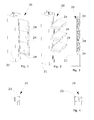
- the number 20 refers generally to a roller shutter and in particular to a roller shutter with tilting slats.
- the roller shutter 20 comprises a fixed frame 21 comprising two guide channels 23 each having sliding guide elements for the shutter curtain.
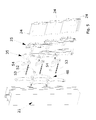
- Figure 5 shows the shutter curtain consisting of slats 24 with two closing elements 25 inserted into the ends.
- each closing element 25 has, on the slat side, projecting elements 26 which are inserted into corresponding cavities 27 of the slat 24 (in Figure 7 ) and a support seat 28 of the slat defined on the perimeter by raised surfaces 29 raised with respect to the support seat and having a geometry which matches the external geometry of the slat so as to create an effective link between the closing element and the slat which is without any play.
- each plug 25 On the side opposite to the slat, each plug 25 has a first pin 30 around which the plug rotates, and a second pin 31 which acts together with the first pin to transmit the rotary motion of the moving mechanism to the plug and to the slat joined to the plug.
- Figures 5 , 8 and 11 shows that the structure of the shutter curtain has, alongside the slat plugs, support components 35 which have a passing hole 36 in which the pin 30 of the slat plug 25 is inserted and a passing semi-circular slot 37 which is wide enough to permit the complete rotation of the second pin 31 of the slat plug 25 in the tilting movement of the plug and its slat.
- Figure 8a shows that the support components 35 have elements, located to the side of the slat plug 25, designed to protect against the ingress of light and comprising two projections 38 and 39 which, when the slats are closed, stop against the corresponding projections 33 and 34 present on the slat plug 25 and a semi-circular projection 40 ( Figure 8 ) which is inserted in the circular groove 32 of the slat plug.
- the support components 35 are connected to each other with hinged links thereby comprising a true and proper chain, each present on the opposing ends of the slats, so as to connect all the slats to each other and thereby create the shutter curtain structure.
- the hinged connections between the various components comprise a pin 41 located on the upper part of the support 35 which is inserted in a hole 42 located on the lower part of the support.
- a screw 43 inserted in the hole in the pin 41 prevents the various supports from detaching from each other.
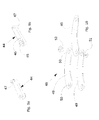
- Each individual structural component of the shutter curtain is completed by an arm 44, shown in Figure 9 , which is inserted on the two pins 30 and 31 of the slat plug 25 from the opposite side of the slat and after insertion of the slat plug in the chain support 35.
- the arm 44 has a recess 45 designed and suitably shaped to provide a seat for the end part of the pin 30 of the slat plug 25 which has a shape complementary to the recess.
- the second pin 31 of the slat plug 25 is seated in the circular seat 46 located on the same side as the recess 45 and which acts together with the rotation pin 31 to transmit rotary motion to the slat plug 25 and to the slat 24 to which it is connected.
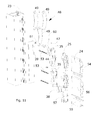
- the moving mechanism 48 ( Figures 5 and 10 ) comprises links 49, preferably metallic, connected to each other by hinged elements.
- the individual links 49 are connected to each other by inserting the pin 47 of the arms 44. This insertion is made possible by the presence of holes 50 on the ends of each link 49 and the links are then fastened by a screw 51 which prevents the individual links from detaching from each other and from the pin 47 in turn which is fitted with a metallic bush 52 provided in order to prevent any wear of the pin 47 resulting from rotation of the metallic links 49.
- the links 49 of the mechanism and the special terminal links 49' are made from metallic materials and have been designed and calculated to alone support the entire weight of the entire shutter curtain and to withstand any mechanical stresses which may occur during the various movements of the shutter curtain.
- the special terminal links (not shown), preferably metallic, have shapes and link elements which are able to transform the rotary motion of the roller tube into a traversing motion of the moving mechanism 48 which in turn transmits the movement to all the arms 44 and simultaneously rotates all the slat plugs 25 and related slats 24 of the shutter curtain.
- the shutter curtain comprises slats 24, slat plugs 25, support components 35 forming the chain, arms 44 and the moving mechanism 48 so that the shutter curtain can be rolled and unrolled on the roller tube (not shown) which in turn is connected to any energy source such as an electric motor (not shown) or a mechanical device such as drive pulleys and crank mechanisms (not shown) widely available on the market.
- any energy source such as an electric motor (not shown) or a mechanical device such as drive pulleys and crank mechanisms (not shown) widely available on the market.
- the electric motor can be controlled from the standard pushbutton panel and also from electronic remote controls, infra-red remote controls or radio controls. All these devices can control the raising and lowering of the shutter curtain and the angle of the slats.
- the tilting function of the shutter can only be operated when the shutter curtain is completely lowered and the slats 24 are closed. In this situation a rotation of the roller in the unwinding direction will start the mechanism 48 mechanically connected to the roller which simultaneously moves all the arms 44, the slat plugs 25 fixed to these and lastly, the slats 24 with slat plugs 25 fixed to their ends. By rotating the roller it is possible to block the slats at any intermediate opening angle up to a maximum angle of approximately 120°.
- the present invention also introduces devices designed to provide a greater degree of security and protection against intrusion in comparison with products considered to be state-of-the-art.
- This locking system comprises a screw 53 ( Figure 11 ) inserted in the hole present in the pin 30 of the slat plug 24.
- the screw 53 to be inserted in the hole 54 provided in each slat 24 is of the self-tapping type. When it is screwed in it taps the thread of the hole 54, thereby fixing the hole to the plug 24 and creating a fastening very similar to an interlocking joint. This will reduce any deformation created by attempts at intrusion when the curtain is closed and any deformation caused by the weight of the slats when they are in the open position and in particular in the horizontal position.
- the present invention also provides for the use of an end profile 55 ( Figure 11 ) needed to actuate the locking device which prevents the slats 24 from being forcibly rotated into the open position by the wind or other factors, when the shutter curtain is fully lowered and the slats are in the closed position.
- the end profile 55 has a "U" shape and inside can contain the last lower slat 56 of the shutter curtain which is non-tilting and has a different shape from the tilting slats 24.
- the two ends of the end profile 55 have a plug 57 whose function is to close and support the profile.
- the plug 57 also has an opening which enables vertical sliding with respect to the additional plug 38 together with the end profile 55 which runs vertically with respect to the last lower non-tilting slat 56.
- the lower non-tilting slat 56 is inserted in the end profile 55 for a minimum length which is not greater than approximately 10 mm.
- the first lower tilting slat cannot rotate to the open position because there is a lock element 39 fixed inside the guide channel 23 in a position corresponding to a projecting element 60 locked in position by a screw 61 at the end of the pin 47 of the arm 44 on which the first lower link 49 of the moving mechanism 48 hinges.
- the system for locking the first lower tilting slat 56 can also be used for all the tilting slats so as to increase the degree of resistance of the shutter curtain to any attempts at intrusion.
Landscapes
- Engineering & Computer Science (AREA)
- Structural Engineering (AREA)
- Architecture (AREA)
- Civil Engineering (AREA)
- Operating, Guiding And Securing Of Roll- Type Closing Members (AREA)
- Blinds (AREA)
Priority Applications (4)
| Application Number | Priority Date | Filing Date | Title |
|---|---|---|---|
| PT121893507T PT2722475E (pt) | 2012-10-19 | 2012-10-19 | Porta de enrolar com lâminas basculantes |
| ES12189350.7T ES2547150T3 (es) | 2012-10-19 | 2012-10-19 | Persiana enrollable con tablillas basculantes |
| EP12189350.7A EP2722475B1 (de) | 2012-10-19 | 2012-10-19 | Rollladen mit Kipplamellen |
| CY20151100809T CY1116946T1 (el) | 2012-10-19 | 2015-09-16 | Διαφραγμα ρολου με περσιδες που μπορουν να γειρουν |
Applications Claiming Priority (1)
| Application Number | Priority Date | Filing Date | Title |
|---|---|---|---|
| EP12189350.7A EP2722475B1 (de) | 2012-10-19 | 2012-10-19 | Rollladen mit Kipplamellen |
Publications (2)
| Publication Number | Publication Date |
|---|---|
| EP2722475A1 true EP2722475A1 (de) | 2014-04-23 |
| EP2722475B1 EP2722475B1 (de) | 2015-07-01 |
Family
ID=47323861
Family Applications (1)
| Application Number | Title | Priority Date | Filing Date |
|---|---|---|---|
| EP12189350.7A Active EP2722475B1 (de) | 2012-10-19 | 2012-10-19 | Rollladen mit Kipplamellen |
Country Status (4)
| Country | Link |
|---|---|
| EP (1) | EP2722475B1 (de) |
| CY (1) | CY1116946T1 (de) |
| ES (1) | ES2547150T3 (de) |
| PT (1) | PT2722475E (de) |
Cited By (7)
| Publication number | Priority date | Publication date | Assignee | Title |
|---|---|---|---|---|
| JP2016089565A (ja) * | 2014-11-10 | 2016-05-23 | アイシン精機株式会社 | シャッター装置 |
| WO2016078850A1 (en) | 2014-11-21 | 2016-05-26 | Teknalsystem S.R.L. | Roller blinds with adjustable slats installed on standard guides in situ |
| EP3205809A1 (de) * | 2016-02-15 | 2017-08-16 | Luigi Centrone | Rollladen mit drebaren leisten |
| FR3053719A1 (fr) * | 2016-07-11 | 2018-01-12 | Zurfluh Feller | Brise soleil orientable pour facade exterieure |
| WO2018154357A1 (en) * | 2017-02-24 | 2018-08-30 | Crupi, Giuseppe | Roller shutter with tiltable slats |
| WO2019111245A1 (en) * | 2017-12-06 | 2019-06-13 | G T A Motors Ltd | Roller shutter with tilting slats |
| IT201900018392A1 (it) | 2019-10-10 | 2021-04-10 | Giovanni Mancuso | Tapparella avvolgibile a lamelle orientabili provvista di mezzi semplificati per la rotazione angolare |
Citations (3)
| Publication number | Priority date | Publication date | Assignee | Title |
|---|---|---|---|---|
| EP0687793A1 (de) | 1994-05-15 | 1995-12-20 | Hagay Yadidya | Jalousierbarer Rolladen |
| ITVR20020044A1 (it) | 2002-04-24 | 2003-10-24 | Teknalsystems S R L | Persiana avvolgibile con lamelle automaticamente orientabili. |
| ITMT20090001A1 (it) | 2009-01-19 | 2010-07-19 | Nicola Benedetto | Avvolgibile a stecche orientabili senza meccanismo di movimentazione, atto ad ottenere in modo contemporaneo sia la protezione che l'aerazione dei locali. |
-
2012
- 2012-10-19 PT PT121893507T patent/PT2722475E/pt unknown
- 2012-10-19 EP EP12189350.7A patent/EP2722475B1/de active Active
- 2012-10-19 ES ES12189350.7T patent/ES2547150T3/es active Active
-
2015
- 2015-09-16 CY CY20151100809T patent/CY1116946T1/el unknown
Patent Citations (4)
| Publication number | Priority date | Publication date | Assignee | Title |
|---|---|---|---|---|
| EP0687793A1 (de) | 1994-05-15 | 1995-12-20 | Hagay Yadidya | Jalousierbarer Rolladen |
| ITVR20020044A1 (it) | 2002-04-24 | 2003-10-24 | Teknalsystems S R L | Persiana avvolgibile con lamelle automaticamente orientabili. |
| ITMT20090001A1 (it) | 2009-01-19 | 2010-07-19 | Nicola Benedetto | Avvolgibile a stecche orientabili senza meccanismo di movimentazione, atto ad ottenere in modo contemporaneo sia la protezione che l'aerazione dei locali. |
| WO2010082227A2 (en) * | 2009-01-19 | 2010-07-22 | Nicola Benedetto | Roller shutter for both protecting and aerating rooms |
Cited By (7)
| Publication number | Priority date | Publication date | Assignee | Title |
|---|---|---|---|---|
| JP2016089565A (ja) * | 2014-11-10 | 2016-05-23 | アイシン精機株式会社 | シャッター装置 |
| WO2016078850A1 (en) | 2014-11-21 | 2016-05-26 | Teknalsystem S.R.L. | Roller blinds with adjustable slats installed on standard guides in situ |
| EP3205809A1 (de) * | 2016-02-15 | 2017-08-16 | Luigi Centrone | Rollladen mit drebaren leisten |
| FR3053719A1 (fr) * | 2016-07-11 | 2018-01-12 | Zurfluh Feller | Brise soleil orientable pour facade exterieure |
| WO2018154357A1 (en) * | 2017-02-24 | 2018-08-30 | Crupi, Giuseppe | Roller shutter with tiltable slats |
| WO2019111245A1 (en) * | 2017-12-06 | 2019-06-13 | G T A Motors Ltd | Roller shutter with tilting slats |
| IT201900018392A1 (it) | 2019-10-10 | 2021-04-10 | Giovanni Mancuso | Tapparella avvolgibile a lamelle orientabili provvista di mezzi semplificati per la rotazione angolare |
Also Published As
| Publication number | Publication date |
|---|---|
| PT2722475E (pt) | 2015-10-14 |
| CY1116946T1 (el) | 2017-04-05 |
| ES2547150T3 (es) | 2015-10-02 |
| EP2722475B1 (de) | 2015-07-01 |
Similar Documents
| Publication | Publication Date | Title |
|---|---|---|
| EP2722475B1 (de) | Rollladen mit Kipplamellen | |
| EP2307654B1 (de) | Rollladen mit kippbaren lamellen | |
| HK1047966A1 (zh) | 折叠式门窗用百叶窗 | |
| WO2018158606A1 (de) | Vertikales schiebefenster für ein gebäude | |
| EP3214250B1 (de) | Vertikales schiebefenster für ein gebäude | |
| CN102046911A (zh) | 具有驱动装置和呈齿形带形式的驱动元件的卷帘 | |
| KR101930341B1 (ko) | 천장, 경사면, 곡면 및 외부 차양용 블라인드 장치 | |
| AU2017360021A1 (en) | Door driving mechanism for a swing door | |
| KR101588967B1 (ko) | 접이식 수평덧창 및 수평도어 | |
| KR101181985B1 (ko) | 장력 장치가 구비된 롤 스크린 장치 | |
| WO1996026347A1 (en) | Multifunction safety shutters for the building industry and other uses | |
| EP1913226B1 (de) | Jalousierbarer rollladen | |
| EP1913225B1 (de) | Rollladen für ein dachfenster | |
| EP3000956B1 (de) | Jalousierbarer rollladenpanzer | |
| EP4041978B1 (de) | Rollladen mit ausrichtbaren latten mit vereinfachter vorrichtung zur winkeldrehung | |
| ITVR20110078A1 (it) | Persiana avvolgibile a lamelle orientabili | |
| US3658112A (en) | Blind | |
| AU2011343291A1 (en) | Mechanism for rotating the slats of a roller shutter | |
| JP2004143753A (ja) | ブラインド内蔵複層ガラス | |
| EP4390047B1 (de) | Abschirmungsanordnung mit einer aufhängungsanordnung und verfahren zur montage der abschirmungsanordnung | |
| EP2307653B1 (de) | Vorhang mit einer schiebbaren wendevorrichtung für lamellen | |
| JPH02197682A (ja) | 雨戸装置 | |
| KR200481678Y1 (ko) | 수평전개방식의 전동창호 | |
| CN119933504A (zh) | 一种单电机驱动多角度及t型传动卷帘及应用 | |
| JP2000096953A (ja) | 電動式窓用シャッター |
Legal Events
| Date | Code | Title | Description |
|---|---|---|---|
| PUAI | Public reference made under article 153(3) epc to a published international application that has entered the european phase |
Free format text: ORIGINAL CODE: 0009012 |
|
| AK | Designated contracting states |
Kind code of ref document: A1 Designated state(s): AL AT BE BG CH CY CZ DE DK EE ES FI FR GB GR HR HU IE IS IT LI LT LU LV MC MK MT NL NO PL PT RO RS SE SI SK SM TR |
|
| AX | Request for extension of the european patent |
Extension state: BA ME |
|
| 17P | Request for examination filed |
Effective date: 20140926 |
|
| RBV | Designated contracting states (corrected) |
Designated state(s): AL AT BE BG CH CY CZ DE DK EE ES FI FR GB GR HR HU IE IS IT LI LT LU LV MC MK MT NL NO PL PT RO RS SE SI SK SM TR |
|
| GRAP | Despatch of communication of intention to grant a patent |
Free format text: ORIGINAL CODE: EPIDOSNIGR1 |
|
| INTG | Intention to grant announced |
Effective date: 20150309 |
|
| GRAP | Despatch of communication of intention to grant a patent |
Free format text: ORIGINAL CODE: EPIDOSNIGR1 |
|
| GRAS | Grant fee paid |
Free format text: ORIGINAL CODE: EPIDOSNIGR3 |
|
| INTG | Intention to grant announced |
Effective date: 20150429 |
|
| GRAA | (expected) grant |
Free format text: ORIGINAL CODE: 0009210 |
|
| AK | Designated contracting states |
Kind code of ref document: B1 Designated state(s): AL AT BE BG CH CY CZ DE DK EE ES FI FR GB GR HR HU IE IS IT LI LT LU LV MC MK MT NL NO PL PT RO RS SE SI SK SM TR |
|
| REG | Reference to a national code |
Ref country code: GB Ref legal event code: FG4D |
|
| REG | Reference to a national code |
Ref country code: AT Ref legal event code: REF Ref document number: 734076 Country of ref document: AT Kind code of ref document: T Effective date: 20150715 Ref country code: CH Ref legal event code: EP |
|
| REG | Reference to a national code |
Ref country code: IE Ref legal event code: FG4D |
|
| REG | Reference to a national code |
Ref country code: DE Ref legal event code: R096 Ref document number: 602012008343 Country of ref document: DE |
|
| REG | Reference to a national code |
Ref country code: ES Ref legal event code: FG2A Ref document number: 2547150 Country of ref document: ES Kind code of ref document: T3 Effective date: 20151002 |
|
| REG | Reference to a national code |
Ref country code: PT Ref legal event code: SC4A Free format text: AVAILABILITY OF NATIONAL TRANSLATION Effective date: 20150914 |
|
| REG | Reference to a national code |
Ref country code: FR Ref legal event code: PLFP Year of fee payment: 4 |
|
| REG | Reference to a national code |
Ref country code: AT Ref legal event code: MK05 Ref document number: 734076 Country of ref document: AT Kind code of ref document: T Effective date: 20150701 |
|
| REG | Reference to a national code |
Ref country code: NL Ref legal event code: MP Effective date: 20150701 |
|
| REG | Reference to a national code |
Ref country code: LT Ref legal event code: MG4D |
|
| PG25 | Lapsed in a contracting state [announced via postgrant information from national office to epo] |
Ref country code: LT Free format text: LAPSE BECAUSE OF FAILURE TO SUBMIT A TRANSLATION OF THE DESCRIPTION OR TO PAY THE FEE WITHIN THE PRESCRIBED TIME-LIMIT Effective date: 20150701 Ref country code: NO Free format text: LAPSE BECAUSE OF FAILURE TO SUBMIT A TRANSLATION OF THE DESCRIPTION OR TO PAY THE FEE WITHIN THE PRESCRIBED TIME-LIMIT Effective date: 20151001 Ref country code: LV Free format text: LAPSE BECAUSE OF FAILURE TO SUBMIT A TRANSLATION OF THE DESCRIPTION OR TO PAY THE FEE WITHIN THE PRESCRIBED TIME-LIMIT Effective date: 20150701 Ref country code: FI Free format text: LAPSE BECAUSE OF FAILURE TO SUBMIT A TRANSLATION OF THE DESCRIPTION OR TO PAY THE FEE WITHIN THE PRESCRIBED TIME-LIMIT Effective date: 20150701 Ref country code: GR Free format text: LAPSE BECAUSE OF FAILURE TO SUBMIT A TRANSLATION OF THE DESCRIPTION OR TO PAY THE FEE WITHIN THE PRESCRIBED TIME-LIMIT Effective date: 20151002 |
|
| PG25 | Lapsed in a contracting state [announced via postgrant information from national office to epo] |
Ref country code: PL Free format text: LAPSE BECAUSE OF FAILURE TO SUBMIT A TRANSLATION OF THE DESCRIPTION OR TO PAY THE FEE WITHIN THE PRESCRIBED TIME-LIMIT Effective date: 20150701 Ref country code: AT Free format text: LAPSE BECAUSE OF FAILURE TO SUBMIT A TRANSLATION OF THE DESCRIPTION OR TO PAY THE FEE WITHIN THE PRESCRIBED TIME-LIMIT Effective date: 20150701 Ref country code: SE Free format text: LAPSE BECAUSE OF FAILURE TO SUBMIT A TRANSLATION OF THE DESCRIPTION OR TO PAY THE FEE WITHIN THE PRESCRIBED TIME-LIMIT Effective date: 20150701 Ref country code: RS Free format text: LAPSE BECAUSE OF FAILURE TO SUBMIT A TRANSLATION OF THE DESCRIPTION OR TO PAY THE FEE WITHIN THE PRESCRIBED TIME-LIMIT Effective date: 20150701 Ref country code: IS Free format text: LAPSE BECAUSE OF FAILURE TO SUBMIT A TRANSLATION OF THE DESCRIPTION OR TO PAY THE FEE WITHIN THE PRESCRIBED TIME-LIMIT Effective date: 20151101 Ref country code: HR Free format text: LAPSE BECAUSE OF FAILURE TO SUBMIT A TRANSLATION OF THE DESCRIPTION OR TO PAY THE FEE WITHIN THE PRESCRIBED TIME-LIMIT Effective date: 20150701 |
|
| REG | Reference to a national code |
Ref country code: DE Ref legal event code: R097 Ref document number: 602012008343 Country of ref document: DE |
|
| PG25 | Lapsed in a contracting state [announced via postgrant information from national office to epo] |
Ref country code: EE Free format text: LAPSE BECAUSE OF FAILURE TO SUBMIT A TRANSLATION OF THE DESCRIPTION OR TO PAY THE FEE WITHIN THE PRESCRIBED TIME-LIMIT Effective date: 20150701 Ref country code: DK Free format text: LAPSE BECAUSE OF FAILURE TO SUBMIT A TRANSLATION OF THE DESCRIPTION OR TO PAY THE FEE WITHIN THE PRESCRIBED TIME-LIMIT Effective date: 20150701 Ref country code: CZ Free format text: LAPSE BECAUSE OF FAILURE TO SUBMIT A TRANSLATION OF THE DESCRIPTION OR TO PAY THE FEE WITHIN THE PRESCRIBED TIME-LIMIT Effective date: 20150701 Ref country code: SK Free format text: LAPSE BECAUSE OF FAILURE TO SUBMIT A TRANSLATION OF THE DESCRIPTION OR TO PAY THE FEE WITHIN THE PRESCRIBED TIME-LIMIT Effective date: 20150701 |
|
| PGFP | Annual fee paid to national office [announced via postgrant information from national office to epo] |
Ref country code: AL Payment date: 20151008 Year of fee payment: 4 |
|
| PLBE | No opposition filed within time limit |
Free format text: ORIGINAL CODE: 0009261 |
|
| STAA | Information on the status of an ep patent application or granted ep patent |
Free format text: STATUS: NO OPPOSITION FILED WITHIN TIME LIMIT |
|
| REG | Reference to a national code |
Ref country code: DE Ref legal event code: R082 Ref document number: 602012008343 Country of ref document: DE Representative=s name: HERNANDEZ, YORCK, DIPL.-ING., DE |
|
| PG25 | Lapsed in a contracting state [announced via postgrant information from national office to epo] |
Ref country code: LU Free format text: LAPSE BECAUSE OF FAILURE TO SUBMIT A TRANSLATION OF THE DESCRIPTION OR TO PAY THE FEE WITHIN THE PRESCRIBED TIME-LIMIT Effective date: 20151019 Ref country code: RO Free format text: LAPSE BECAUSE OF FAILURE TO SUBMIT A TRANSLATION OF THE DESCRIPTION OR TO PAY THE FEE WITHIN THE PRESCRIBED TIME-LIMIT Effective date: 20150701 |
|
| REG | Reference to a national code |
Ref country code: CH Ref legal event code: PL |
|
| 26N | No opposition filed |
Effective date: 20160404 |
|
| PG25 | Lapsed in a contracting state [announced via postgrant information from national office to epo] |
Ref country code: MC Free format text: LAPSE BECAUSE OF FAILURE TO SUBMIT A TRANSLATION OF THE DESCRIPTION OR TO PAY THE FEE WITHIN THE PRESCRIBED TIME-LIMIT Effective date: 20150701 |
|
| REG | Reference to a national code |
Ref country code: IE Ref legal event code: MM4A |
|
| PG25 | Lapsed in a contracting state [announced via postgrant information from national office to epo] |
Ref country code: LI Free format text: LAPSE BECAUSE OF NON-PAYMENT OF DUE FEES Effective date: 20151031 Ref country code: CH Free format text: LAPSE BECAUSE OF NON-PAYMENT OF DUE FEES Effective date: 20151031 |
|
| PG25 | Lapsed in a contracting state [announced via postgrant information from national office to epo] |
Ref country code: SI Free format text: LAPSE BECAUSE OF FAILURE TO SUBMIT A TRANSLATION OF THE DESCRIPTION OR TO PAY THE FEE WITHIN THE PRESCRIBED TIME-LIMIT Effective date: 20150701 |
|
| REG | Reference to a national code |
Ref country code: FR Ref legal event code: PLFP Year of fee payment: 5 |
|
| PG25 | Lapsed in a contracting state [announced via postgrant information from national office to epo] |
Ref country code: IE Free format text: LAPSE BECAUSE OF NON-PAYMENT OF DUE FEES Effective date: 20151019 |
|
| PG25 | Lapsed in a contracting state [announced via postgrant information from national office to epo] |
Ref country code: BE Free format text: LAPSE BECAUSE OF FAILURE TO SUBMIT A TRANSLATION OF THE DESCRIPTION OR TO PAY THE FEE WITHIN THE PRESCRIBED TIME-LIMIT Effective date: 20150701 |
|
| PG25 | Lapsed in a contracting state [announced via postgrant information from national office to epo] |
Ref country code: SM Free format text: LAPSE BECAUSE OF FAILURE TO SUBMIT A TRANSLATION OF THE DESCRIPTION OR TO PAY THE FEE WITHIN THE PRESCRIBED TIME-LIMIT Effective date: 20150701 Ref country code: BG Free format text: LAPSE BECAUSE OF FAILURE TO SUBMIT A TRANSLATION OF THE DESCRIPTION OR TO PAY THE FEE WITHIN THE PRESCRIBED TIME-LIMIT Effective date: 20150701 Ref country code: HU Free format text: LAPSE BECAUSE OF FAILURE TO SUBMIT A TRANSLATION OF THE DESCRIPTION OR TO PAY THE FEE WITHIN THE PRESCRIBED TIME-LIMIT; INVALID AB INITIO Effective date: 20121019 |
|
| GBPC | Gb: european patent ceased through non-payment of renewal fee |
Effective date: 20161019 |
|
| PG25 | Lapsed in a contracting state [announced via postgrant information from national office to epo] |
Ref country code: NL Free format text: LAPSE BECAUSE OF FAILURE TO SUBMIT A TRANSLATION OF THE DESCRIPTION OR TO PAY THE FEE WITHIN THE PRESCRIBED TIME-LIMIT Effective date: 20150701 |
|
| PG25 | Lapsed in a contracting state [announced via postgrant information from national office to epo] |
Ref country code: GB Free format text: LAPSE BECAUSE OF NON-PAYMENT OF DUE FEES Effective date: 20161019 |
|
| PG25 | Lapsed in a contracting state [announced via postgrant information from national office to epo] |
Ref country code: MT Free format text: LAPSE BECAUSE OF FAILURE TO SUBMIT A TRANSLATION OF THE DESCRIPTION OR TO PAY THE FEE WITHIN THE PRESCRIBED TIME-LIMIT Effective date: 20150701 |
|
| REG | Reference to a national code |
Ref country code: FR Ref legal event code: PLFP Year of fee payment: 6 |
|
| PG25 | Lapsed in a contracting state [announced via postgrant information from national office to epo] |
Ref country code: MK Free format text: LAPSE BECAUSE OF FAILURE TO SUBMIT A TRANSLATION OF THE DESCRIPTION OR TO PAY THE FEE WITHIN THE PRESCRIBED TIME-LIMIT Effective date: 20150701 |
|
| REG | Reference to a national code |
Ref country code: FR Ref legal event code: PLFP Year of fee payment: 7 |
|
| PG25 | Lapsed in a contracting state [announced via postgrant information from national office to epo] |
Ref country code: AL Free format text: LAPSE BECAUSE OF NON-PAYMENT OF DUE FEES Effective date: 20161019 |
|
| P01 | Opt-out of the competence of the unified patent court (upc) registered |
Effective date: 20230527 |
|
| PGFP | Annual fee paid to national office [announced via postgrant information from national office to epo] |
Ref country code: PT Payment date: 20251003 Year of fee payment: 14 |
|
| PGFP | Annual fee paid to national office [announced via postgrant information from national office to epo] |
Ref country code: DE Payment date: 20251028 Year of fee payment: 14 |
|
| PGFP | Annual fee paid to national office [announced via postgrant information from national office to epo] |
Ref country code: IT Payment date: 20251007 Year of fee payment: 14 |
|
| PGFP | Annual fee paid to national office [announced via postgrant information from national office to epo] |
Ref country code: FR Payment date: 20251027 Year of fee payment: 14 |
|
| PGFP | Annual fee paid to national office [announced via postgrant information from national office to epo] |
Ref country code: TR Payment date: 20251007 Year of fee payment: 14 |
|
| PGFP | Annual fee paid to national office [announced via postgrant information from national office to epo] |
Ref country code: CY Payment date: 20251008 Year of fee payment: 14 |
|
| PGFP | Annual fee paid to national office [announced via postgrant information from national office to epo] |
Ref country code: ES Payment date: 20251118 Year of fee payment: 14 |