EP2723342B1 - Utilisation de dérivés de 10h-benzo[g]ptéridine-2,4-dione - Google Patents
Utilisation de dérivés de 10h-benzo[g]ptéridine-2,4-dione Download PDFInfo
- Publication number
- EP2723342B1 EP2723342B1 EP12729136.7A EP12729136A EP2723342B1 EP 2723342 B1 EP2723342 B1 EP 2723342B1 EP 12729136 A EP12729136 A EP 12729136A EP 2723342 B1 EP2723342 B1 EP 2723342B1
- Authority
- EP
- European Patent Office
- Prior art keywords
- carbon atoms
- bis
- atoms
- mit
- aryl
- Prior art date
- Legal status (The legal status is an assumption and is not a legal conclusion. Google has not performed a legal analysis and makes no representation as to the accuracy of the status listed.)
- Active
Links
- 0 CC(I)=*=NCC1CC1 Chemical compound CC(I)=*=NCC1CC1 0.000 description 2
Images



Classifications
-
- C—CHEMISTRY; METALLURGY
- C07—ORGANIC CHEMISTRY
- C07D—HETEROCYCLIC COMPOUNDS
- C07D475/00—Heterocyclic compounds containing pteridine ring systems
- C07D475/12—Heterocyclic compounds containing pteridine ring systems containing pteridine ring systems condensed with carbocyclic rings or ring systems
- C07D475/14—Benz [g] pteridines, e.g. riboflavin
-
- A—HUMAN NECESSITIES
- A01—AGRICULTURE; FORESTRY; ANIMAL HUSBANDRY; HUNTING; TRAPPING; FISHING
- A01N—PRESERVATION OF BODIES OF HUMANS OR ANIMALS OR PLANTS OR PARTS THEREOF; BIOCIDES, e.g. AS DISINFECTANTS, AS PESTICIDES OR AS HERBICIDES; PEST REPELLANTS OR ATTRACTANTS; PLANT GROWTH REGULATORS
- A01N43/00—Biocides, pest repellants or attractants, or plant growth regulators containing heterocyclic compounds
- A01N43/90—Biocides, pest repellants or attractants, or plant growth regulators containing heterocyclic compounds having two or more relevant hetero rings, condensed among themselves or with a common carbocyclic ring system
-
- A—HUMAN NECESSITIES
- A61—MEDICAL OR VETERINARY SCIENCE; HYGIENE
- A61K—PREPARATIONS FOR MEDICAL, DENTAL OR TOILETRY PURPOSES
- A61K31/00—Medicinal preparations containing organic active ingredients
- A61K31/33—Heterocyclic compounds
- A61K31/395—Heterocyclic compounds having nitrogen as a ring hetero atom, e.g. guanethidine or rifamycins
- A61K31/495—Heterocyclic compounds having nitrogen as a ring hetero atom, e.g. guanethidine or rifamycins having six-membered rings with two or more nitrogen atoms as the only ring heteroatoms, e.g. piperazine or tetrazines
- A61K31/505—Pyrimidines; Hydrogenated pyrimidines, e.g. trimethoprim
- A61K31/519—Pyrimidines; Hydrogenated pyrimidines, e.g. trimethoprim ortho- or peri-condensed with heterocyclic rings
- A61K31/525—Isoalloxazines, e.g. riboflavins, vitamin B2
-
- A—HUMAN NECESSITIES
- A61—MEDICAL OR VETERINARY SCIENCE; HYGIENE
- A61K—PREPARATIONS FOR MEDICAL, DENTAL OR TOILETRY PURPOSES
- A61K41/00—Medicinal preparations obtained by treating materials with wave energy or particle radiation ; Therapies using these preparations
- A61K41/0057—Photodynamic therapy with a photosensitizer, i.e. agent able to produce reactive oxygen species upon exposure to light or radiation, e.g. UV or visible light; photocleavage of nucleic acids with an agent
-
- A—HUMAN NECESSITIES
- A61—MEDICAL OR VETERINARY SCIENCE; HYGIENE
- A61L—METHODS OR APPARATUS FOR STERILISING MATERIALS OR OBJECTS IN GENERAL; DISINFECTION, STERILISATION OR DEODORISATION OF AIR; CHEMICAL ASPECTS OF BANDAGES, DRESSINGS, ABSORBENT PADS OR SURGICAL ARTICLES; MATERIALS FOR BANDAGES, DRESSINGS, ABSORBENT PADS OR SURGICAL ARTICLES
- A61L15/00—Chemical aspects of, or use of materials for, bandages, dressings or absorbent pads
- A61L15/16—Bandages, dressings or absorbent pads for physiological fluids such as urine or blood, e.g. sanitary towels, tampons
- A61L15/42—Use of materials characterised by their function or physical properties
- A61L15/46—Deodorants or malodour counteractants, e.g. to inhibit the formation of ammonia or bacteria
-
- A—HUMAN NECESSITIES
- A61—MEDICAL OR VETERINARY SCIENCE; HYGIENE
- A61L—METHODS OR APPARATUS FOR STERILISING MATERIALS OR OBJECTS IN GENERAL; DISINFECTION, STERILISATION OR DEODORISATION OF AIR; CHEMICAL ASPECTS OF BANDAGES, DRESSINGS, ABSORBENT PADS OR SURGICAL ARTICLES; MATERIALS FOR BANDAGES, DRESSINGS, ABSORBENT PADS OR SURGICAL ARTICLES
- A61L29/00—Materials for catheters, medical tubing, cannulae, or endoscopes or for coating catheters
- A61L29/08—Materials for coatings
- A61L29/085—Macromolecular materials
-
- A—HUMAN NECESSITIES
- A61—MEDICAL OR VETERINARY SCIENCE; HYGIENE
- A61P—SPECIFIC THERAPEUTIC ACTIVITY OF CHEMICAL COMPOUNDS OR MEDICINAL PREPARATIONS
- A61P31/00—Antiinfectives, i.e. antibiotics, antiseptics, chemotherapeutics
-
- A—HUMAN NECESSITIES
- A61—MEDICAL OR VETERINARY SCIENCE; HYGIENE
- A61L—METHODS OR APPARATUS FOR STERILISING MATERIALS OR OBJECTS IN GENERAL; DISINFECTION, STERILISATION OR DEODORISATION OF AIR; CHEMICAL ASPECTS OF BANDAGES, DRESSINGS, ABSORBENT PADS OR SURGICAL ARTICLES; MATERIALS FOR BANDAGES, DRESSINGS, ABSORBENT PADS OR SURGICAL ARTICLES
- A61L2300/00—Biologically active materials used in bandages, wound dressings, absorbent pads or medical devices
- A61L2300/20—Biologically active materials used in bandages, wound dressings, absorbent pads or medical devices containing or releasing organic materials
- A61L2300/204—Biologically active materials used in bandages, wound dressings, absorbent pads or medical devices containing or releasing organic materials with nitrogen-containing functional groups, e.g. aminoxides, nitriles, guanidines
-
- Y—GENERAL TAGGING OF NEW TECHNOLOGICAL DEVELOPMENTS; GENERAL TAGGING OF CROSS-SECTIONAL TECHNOLOGIES SPANNING OVER SEVERAL SECTIONS OF THE IPC; TECHNICAL SUBJECTS COVERED BY FORMER USPC CROSS-REFERENCE ART COLLECTIONS [XRACs] AND DIGESTS
- Y02—TECHNOLOGIES OR APPLICATIONS FOR MITIGATION OR ADAPTATION AGAINST CLIMATE CHANGE
- Y02A—TECHNOLOGIES FOR ADAPTATION TO CLIMATE CHANGE
- Y02A50/00—TECHNOLOGIES FOR ADAPTATION TO CLIMATE CHANGE in human health protection, e.g. against extreme weather
- Y02A50/30—Against vector-borne diseases, e.g. mosquito-borne, fly-borne, tick-borne or waterborne diseases whose impact is exacerbated by climate change
Definitions
- the present invention relates to the use of 10H-benzo [g] pteridine-2,4-dione derivatives.
- infectious particles occur everywhere.
- the human body is colonized by a large number of microorganisms, which are usually kept under control by normal metabolism and an intact immune system.
- it can, for example, in a weakening of the immune system, come to a strong increase in the pathogens and, depending on the nature of the pathogen to different disease symptoms.
- the medicine holds for many pathogen-related diseases specific antidotes ready, for example, antibiotics against bacteria or antimicotics against fungi or antivirals against viruses.
- the incidence is increasing of resistant pathogens, some of which simultaneously have resistance to several antidotes.
- the occurrence of these resistant or multidrug-resistant pathogens has made the treatment of infectious diseases increasingly difficult.
- the clinical consequence of resistance is manifested by treatment failure, especially in immunocompromised patients.
- new approaches to combating resistant or multi-resistant pathogens are therefore the search for new antidotes, for example antibiotics or antimicotics, and on the other hand the search for alternative inactivation possibilities.
- the photodynamic inactivation of microorganisms has been proven.
- two different photooxidative processes play a crucial role.
- the prerequisite for the course of a photooxidative inactivation on the one hand the presence of a sufficient amount of oxygen and on the other hand, the localization of a so-called photosensitizer, which is excited by light of a corresponding wavelength.
- the excited photosensitizer can cause the formation of reactive oxygen species (ROS), on the one hand radicals, for example superoxide anions, hydrogen peroxide or hydroxyl radicals, and / or on the other hand excited molecular oxygen, for example singlet oxygen, can be formed.
- ROS reactive oxygen species
- ROS reactive oxygen species
- ROS reactive oxygen species
- photosensitizers are known from the prior art, for example from the group of porphyrins and their derivatives or phthalocyanines and their derivatives or fullerenes and their derivatives or derivatives of the phenothiazininium structure, such as methylene blue or toluidine blue, or representatives of the phenoxazinium series, such as Nile blue, come.
- the photodynamics of methylene blue or toluidine blue to bacteria, for example, is already used in dentistry.
- the photosensitizers known from the prior art are mostly substances with a relatively complex molecular structure and therefore expensive production processes,
- 10-methyl-10H-benzo [g] pteridine-2,4-dione derivatives, riboflavin and tetraacetyl riboflavin have high singlet oxygen yields, but their affinity for microorganisms is low. It is further known that Singlet oxygen can diffuse only a small distance before it reacts or degrades. Therefore, inactivation of microorganisms by 10-methyl-10H-benzo [g] pteridine-2,4-dione derivatives, riboflavin or tetraacetyl riboflavin is insufficient.
- Riboswisses are RNA elements in untranslated regions of the mRNA of prokaryotes, fungi and plants that bind low molecular weight metabolites, such as FMN, and subsequently regulate gene expression. For example, after binding of FMN to FMN riboswells of prokaryotes, the expression of enzymes responsible for riboflavin and FMN biosynthesis is repressed, thereby arresting riboflavin and FMN biosynthesis. Riboflavin plays a central role in metabolism as it serves as a precursor to flavin coenzymes. Therefore, suppressed riboflavin and FMN biosynthesis leads to a reduced survivability.
- FMN flavin mononucleotide
- the WO 03/057253 A1 relates to a method for treating liquids, wherein oxygen and a photosensitizer mixed with the liquid and the resulting liquid mixture is irradiated with light.
- the WO 2011 / 126567A1 concerns the use of flavin derivatives as riboswitch ligands.
- NK Thallaj et al., Eur. J. Inorg. Chem. 2007, 44-47 relates to the provision of metal chelates using riboflavin.
- the object of the present invention is therefore to provide new photosensitizers which inactivate microorganisms more efficiently.
- the compound of the formula (1) used in the present invention is a 10H-benzo [g] pteridine-2,4-dione or flavin derivative, which will also be referred to hereafter.
- any suitable anion can be used as the counterion to the positively charged nitrogen atom.
- anions are used as counterion to the positively charged nitrogen atom, which allow the provision of a pharmacologically acceptable salt.
- X in the compound of the formula (1) is an organic radical having only one positive nitrogen atom containing as counterion fluoride, chloride, bromide, iodide, sulfate, hydrogen sulfate, phosphate, dihydrogen phosphate, hydrogen phosphate, tosylate, Mesylate, formate, acetate, oxalate, benzoate, citrate and / or mixtures thereof.
- the electromagnetic radiation preferably visible light, UV light and / or Infrared light
- ROS reactive oxygen species
- photodynamic therapy is understood according to the invention to be the light-induced inactivation of cells or microorganisms.
- inactivation according to the invention, the reduction of viability or the destruction of a microorganism, preferably the destruction understood.
- a light-induced inactivation can be determined, for example, by reducing the number of microorganisms after irradiation of a defined starting amount of these microorganisms in the presence of at least one compound of the formula (1) used according to the invention.
- a reduction in viability is understood to mean that the number of microorganisms is at least 99.0%, preferably at least 99.9%, more preferably at least 99.99%, more preferably at least 99.999%, even more preferably at least 99.9999%, is reduced. Most preferably, the number of microorganisms is reduced by more than 99.9 to 100%, preferably by more than 99.99 to 100%.
- the reduction in the number of microorganisms according to Boyce, JM and Pittet, D. (“Guidelines for Hand hygiene in healthcare settings.") Recommendations of the Healthcare Infection Control Practices Advisory Committee and the HIPAC / SHEA / APIC / IDSA Hand Hygiene Task Force, Am.J, Infect.Control 30 (8), 2002, page 1-46 ) is given as a log 10 reduction factor.
- the term "log 10 reduction factor" the difference between the decadic logarithm of the number of microorganisms before and the decadic logarithm of the number of microorganisms after irradiation of these microorganisms with electromagnetic radiation in the presence of at least one compound of the formula (1) used according to the invention.
- the log 10 reduction factor after irradiation of microorganisms with electromagnetic radiation in the presence of at least one compound of formula (1) used in the invention is at least 2 log 10 , preferably at least 3 log 10 , more preferably at least 4 log 10 , more preferably at least 4 , 5 log 10 , more preferably at least 5 log 10 , more preferably at least 6 log 10 , even more preferably at least 7 log 10 , even more preferably at least 7.5 log 10 .
- a reduction in the number of microorganisms after irradiation of these microorganisms with electromagnetic radiation in the presence of at least one compound of the invention represented by formula (1) by 2 powers of ten, based on the initial amount of these microorganisms, means a log 10 reduction factor of 2 log 10 .
- the number of microorganisms after irradiation of these microorganisms with electromagnetic radiation in the presence of at least one compound of the formula (1) used according to the invention is also preferred by at least one order of magnitude, more preferably by at least two powers of ten, preferably by at least four powers of ten, more preferably by at least 5 powers of ten, more preferably by at least 6 orders of magnitude, even more preferably by at least 7 orders of magnitude, in each case based on the initial amount of these microorganisms reduced.
- microorganisms is understood to mean, in particular, viruses, archae, prokaryotic microorganisms, such as bacteria and bacterial spores, and eukaryotic microorganisms, such as fungi, protozoa, fungal spores, unicellular algae.
- the microorganisms may be unicellular or multicellular, for example as mushroom mycelium.
- D and E are each hydrogen.
- the 10H-benzo [g] pteridine-2,4-dione derivative of the formula (1) used according to the invention does not have a neutral, protonatable nitrogen atom which is bonded directly to the isoalloxazine ring, for example as amino radical, methylamino Residue or dimethylamino residue, and no positively charged nitrogen atom which is bonded directly to the isoalloxazine ring, for example as pyridin-1-ium-1-yl residue or trimethylammonio residue.
- the 10H-benzo [g] pteridine-2,4-dione derivative of the formula (1) used according to the invention contains no further basic, preferably neutral, protonatable and / or positively charged, nitrogen atoms and no quaternary nitrogen atoms.
- R5 is a non-cyclic polyol radical selected from the group consisting of arabityl, ribityl, xylityl, erythrityl, threityl, lactityl, mannityl and sorbityl, more preferably D-ribityl and D-arabityl, or an ether , Esters or acetals thereof.
- R5 is a non-cyclic polyol radical selected from the group consisting of arabityl, ribityl, xylityl, erythrityl, threityl, lactityl, mannityl and sorbityl, more preferably D-ribityl and D-arabityl, or an ether , Esters or acetals thereof.
- the radical X is a radical of the formula (5): wherein A is an oxygen or a sulfur atom and wherein n is an integer from 1 to 8 and m is an integer from 0 to 100, preferably from 0 to 59, preferably from 0 to 10, and wherein B is a radical of the formula ( 6a), (6b), (7) or (8): and wherein each of R (I) and R (II) is independently selected from hydrogen and C 1 to C 20 alkyl which may be straight chain or branched, and wherein R (III) is hydrogen and the radical of the formula (8) a substituted or unsubstituted heterocyclic radical having from 5 to 7 ring atoms which comprise at least one 1 carbon atom and one nitrogen atom and optionally 1 or 2 oxygen or sulfur atom, the heterocycl
- radicals R (I) and R (II) are independently selected from the group consisting of hydrogen and alkyl groups of the general formula - (CH 2 ) n -CH 3 , where n is an integer from 0 to 19 , preferably from 1 to 17, is selected.
- the radicals R (I) and R (II) are independently selected from the group consisting of hydrogen, methyl, ethyl, prop-1-yl, prop-2-yl, but-1-yl, But-2-yl, 2-methylprop-1-yl, 2-methylprop-2-yl, pent-1-yl, pent-2-yl, pent-3-yl, 2-methylbut-1-yl, 2-methylbut-2-yl, 2-methylbut-3-yl, 2-methylbut-4-yl, 2,2-dimethylprop-1-yl, hex-1-yl, hex-2-yl, hex-3 yl, hept-1-yl, oct-1-yl, 2-methylpent-1-yl, 2-methylpent-2-yl, 2-methylpent-3-yl, 2-methylpent-4-yl, 2-methylpentyl 5-yl, 3-methylpent-1-yl, 3-methylpent-2-yl, 3-methylpent-3-
- radicals R (I) R (II) and R (III) are independently selected from the group consisting of methyl, ethyl, prop-1-yl, but-1-yl, pent-1-yl , Hex-1-yl, hept-1 and oct-1-yl is selected.
- radicals R (I) and R (II) independently of one another are hydrogen or the radical of the formula ( II ): where r is an integer from 1 to 20, preferably from 1 to 8, more preferably from 1 to 4.
- radical of the formula (4) from the group consisting of radicals of the formulas (13a), (13b) and (13c) exists, selected.
- the radical of formula (8) means: a substituted or unsubstituted heterocyclic radical having 5 to 7 ring atoms and comprising at least one 1 carbon atom and 1 nitrogen atom and optionally 1 or 2 oxygen or sulfur atom, wherein the heterocyclic radical is saturated or unsaturated and preferably not quaternary Contains nitrogen atoms.
- heterocyclic cyclic compounds having ring-forming atoms of at least two different chemical elements, preferably carbon, nitrogen, oxygen or sulfur, understood.
- the group having the formula (4) is selected from the group consisting of azolylene, azolinylene, azolidinylene, thiazolylene, oxazolylene, oxazolinylene, oxazolidinylene, oxazinylene, dihydrooxazinylene, tetrahydrooxazinylene, thiazinylene, azepanylene, azepinylene, or thiaazepinylene , wherein the abovementioned heterocyclic radicals are unsubstituted or having at least one radical selected from the group consisting of halogen, preferably chlorine, bromine, iodine or fluorine, phenyl, benzyl, straight-chain or branched alkyl having 1 to 20 C atoms and Hydroxyl is selected, which may be substituted and preferably contain no quaternary nitrogen atoms.
- halogen preferably chlorine, bromine, iodine or
- the radical of the formula (4) is formed from compounds having 5 to 7 ring atoms, these compounds being selected from the group consisting of pyrrolidine, pyrrole, oxazole, oxazoline, oxazolidine, isoxazole, isoxazoline, isoxazolidine, thiazole, Thiazoline, thiazolidine, isothiazole, isothiazoline, isothiazolidine, piperidine, pyridine, oxazines, dihydrooxazines, tetrahydrooxazines, preferably morpholine, thiazine, azepines, azepane, and thiazepines, wherein said compounds are unsubstituted or having at least one radical selected from the group which may be selected from halogen, preferably chlorine, bromine, iodine or fluorine, phenyl, benzyl, straight or branched alkyl having
- the radical of the formula (4) is selected from the group consisting of pyrrolidinyl, piperidinyl, morpholinyl, pyridinyl, aminopyridinyl, azepan-1-yl, 2, 3, 4, 5-tetrahydro-1-benzazepine 1-yl, 2, 3, 4, 5-tetrahydro-3-benzazepin-3-yl.
- the radical of formula (8) means: a substituted or an unsubstituted cyclic heteroalkyl radical having 5 to 7 ring atoms which comprise at least one 1 carbon atom and 1 nitrogen atom and optionally 1 or 2 oxygen or sulfur atom and preferably contain no quaternary nitrogen atoms, or a substituted or unsubstituted cyclic heteroalkenyl radical having 5 to 7 ring atoms which comprise at least one 1 carbon atom and 1 nitrogen atom and optionally 1 or 2 oxygen or sulfur atom, and preferably contain no quaternary nitrogen atoms.
- variant A) and variant B) of the 10H-benzo [g] pteridine-2,4-dione derivative of the formula (1) used according to the invention as photosensitizer in the inactivation of microorganisms the abovementioned aldehyde radicals, ketone radicals, carboxylic acid radicals, carboxylic acid amide radicals, thioester radicals, Cycloalkyl radicals, cycloalkenyl radicals, alkyl radicals and alkenyl radicals straight-chain or branched, preferably straight-chain, and both unsubstituted or with at least one radical selected from the group consisting of hydroxy, halogen, preferably chlorine, bromine, iodine or fluorine, thiol, nitro, esters, Ether and acetal is selected is substituted be.
- the abovementioned alkyl radicals are each selected from the group consisting of methyl, ethyl, n-propyl, n-butyl, n-pentyl, n-hexyl, n-heptyl and n-octyl.
- the abovementioned alkyl radicals may be noncyclic polyol radicals of the general formula -CH 2 (CH (OH)) g CH 2 OH, where g is an integer from 1 to 10, preferably 1 to 4. More preferably, the non-cyclic polyol residues are selected from the group consisting of arabityl, ribityl xylityl, erythrityl, threityl, lactityl, mannityl and sorbityl, more preferably D-ribityl and D-arabityl.
- the aryl radicals in each case have no more than 4, more preferably no more than 3, more preferably not more than 2 , fused rings on. Even more preferably, the aryl radicals each have 1 ring.
- the abovementioned aryl radicals are selected from the group consisting of phenyl, benzyl, naphthyl, Anthracenyl, phenanthrenyl and pyrenyl is selected.
- the abovementioned Alkenyl radicals 2 to 17 C atoms, more preferably 2 to 13 C atoms, more preferably 2 to 9 C atoms, more preferably 2 to 5 C atoms on.
- the aforementioned alkenyl radicals are selected from the group consisting of ethenyl, n-propenyl and n-butenyl.
- the abovementioned aldehydes have 1 to 17 C atoms, more preferably 1 to 13 C-atoms, more preferably 1 to 9 C-atoms, more preferably 1 to 5 C-atoms, on.
- the aforementioned aldehydes are selected from the group consisting of methanal-1-yl (formyl), ethanal-1-yl (2-oxoethyl), n-propanal-1-yl (3-oxopropyl) and n- Butanal-1-yl (4-oxobutyl) is selected.
- the abovementioned ketones have 2 to 17 C atoms, more preferably 3 to 14 C-atoms, more preferably 3 to 9 C-atoms, on.
- the aforesaid ketones are selected from the group consisting of dimethylketyl, methylethylketyl, ethyl-methyl-ketyl, diethylketyl, methyl-propyl-ketyl, ethyl-propyl-ketyl, propyl-methyl-ketyl, propyl Ethyl ketyl and dipropyl ketyl, which may be straight chain or branched.
- the abovementioned aldehyde radicals and / or ketone radicals may be monosaccharide radicals, preferably pentose or keto radicals.
- suitable monosaccharide residues have 3 to 7 carbon atoms, preferably 5 to 6 carbon atoms, and have a carbonyl group, preferably aldehyde group or keto group, as well as at least one hydroxyl group, and may be open-chain or cyclic, preferably as furanose or pyranose.
- suitable monosaccharide residues are derived from monosaccharides selected from the group consisting of D-glyceraldehyde, L-glyceraldehyde, D-erythrose, L-erythrose, D-threose, L-threose, D-ribose, L-ribose, D- Arabinose, L-arabinose, D-xylose, L-xylose, D-lyxose, L-lyxose, D-allose, L-allose, D-altrose, L-altrose, D-glucose, L-glucose, D-mannose, L-mannose, D-gulose, L-gulose, D-idose, L-idose, D-galactose, L-galactose, D-talose, L-talose, dihydroxyacetone, D-erythrulose, L-erythrulose, D-ribulose, L-ribulose, L
- monosaccharides are selected from the group consisting of D-ribose, L-ribose, D-arabinose, L-arabinose, D-xylose, L-xylose, D-lyxose, L-lyxose, D-allose, L-allose , D-Altrose, L-Altrose, D-glucose, L-glucose, D-mannose, L-mannose, D-gulose, L-gulose, D-idose, L-idose, D-galactose, L-galactose, D -Talose, L-Talose, D-Talose, D-Talose, D-Talose, D-Talose, D-Talose, D-Talose, D-Talose, D-Talose, D-Talose, D-Talose, D-Talose, D-Talose, D-Talose, D-Talose, D-Talose
- the abovementioned carboxylic acid esters have 1 to 17 C atoms, more preferably 1 to 15 C-atoms, more preferably 1 to 12 C-atoms, on.
- the abovementioned carboxylic acid esters are selected from the group consisting of ethyl ester, n-propyl ester, i-propyl ester, n-butyl ester, sec-butyl ester, tert-butyl ester and benzyl ester.
- the abovementioned carboxylic acid amides have 1 to 17 C atoms, more preferably 1 to 15 C-atoms, more preferably 1 to 12 C-atoms, on.
- the abovementioned carboxylic acid amides are selected from the group consisting of amide, N-methylamide, N-ethylamide, N- (n-propyl) amide, N- (i-propyl) amide, N- (n-butyl) amide, N- (sec-butyl) amide, N- (tert-butyl) amide, N-phenylamide, N-benzylamide, N, N-dimethylamide, N-methyl-N-ethyl-amide, N, N- Diethylamide, N-methyl-N- (n-propyl) amide, N -methyl-N- (i-propyl) amide, N-methyl-N- (n-butyl) amide, N -methyl-N- (sec.
- the aforementioned heteroaryl radical containing no nitrogen atom is substituted by 4 to 20 ° C Atoms selected from the group consisting of thiophenyl, furanyl, benzothiofuranyl and benzofuranyl.
- the abovementioned ether residues have 2 to 17 C atoms, more preferably 2 to 13 C-atoms, more preferably 2 to 9 C-atoms, on.
- the abovementioned ether radicals are selected, for example, from the group consisting of methoxymethyl, methoxyethyl, methoxy-n-propyl, ethoxymethyl, n-propoxymethyl, 2-ethoxyethoxymethyl, 2- (2-ethoxyethoxy) ethyl, i-propoxymethyl, tert-butyloxymethyl and benzyloxymethyl, selected ..
- the abovementioned thioether radicals have 2 to 17 C atoms, more preferably 2 to 13 C-atoms, more preferably 2 to 9 C-atoms, on.
- the abovementioned thioether radicals are selected, for example, from the group consisting of methylsulfanylmethyl, methylsulfanylethyl, 3-methylsulfanyl-n-propyl, Ethylsulfanylmethyl, n-propylsulfanylmethyl, 2-ethylsulfanylethylsulfanylmethyl, 2- (2-ethylsulfanylethylsulfanyl) ethyl, 2-methylsulfanylpropyl, tert-butylsulfanylmethyl and benzylsulfanylmethyl.
- the 10H-benzo [g] pteridine-2,4-dione derivative of the formula (1) used according to the invention as a photosensitizer in the inactivation of microorganisms has a molecular weight of less than 1300 g / mol, preferably less than 990 g / mol, more preferably less than 810 g / mol, more preferably less than 690 g / mol, even more preferably less than 610 g / mol, even more preferably less than 600 g / mol, even more preferably less than 570 g / mol, up.
- Chirality centers may be in the R or S configuration unless otherwise specified.
- the invention relates to both the optically pure compounds and stereoisomer mixtures, such as mixtures of enantiomers and Diasteromerengemische, in any ratio.
- the invention also preferably relates to the use of mesomers and / or tautomers of the compound of formula (1), both the use of the pure compounds and the use of mixtures of isomers in any ratio.
- the 10H-benzo [g] pteridine-2,4-dione derivative of the formula (1) used according to the invention as a photosensitizer in the inactivation of microorganisms is selected from the group consisting of the compound of the formulas (14) to (17), selected:
- Suitable methods for removing the amino-protecting group PG are known in the art.
- benzyloxycarbonyl (Cbz) can be removed again by catalytic hydrogenation with hydrogenolytic cleavage of the benzyl-heteroatom bond with subsequent decarboxylation of the resulting unstable carbamic acid or treatment with acids.
- di-tert-butyloxycarbonyl (Boc) can be removed by acid hydrolysis.
- Allyloxycarbonyl (Alloc) can be cleaved, for example, by the action of tetrakis (triphenylphosphine) pailadtum (0) and a nucleophile.
- steps (B) and / or (C) take place in the presence of one or more solvents.
- Step (B) may be carried out, for example, in the presence of dichloromethane (DCM), dimethylformamide (DMF) or acetonitrile (MeCN).
- Step (C) may be carried out, for example, in the presence of water / dichloromethane or toluene / tetrabutylammonium iodide (TBAI).
- Single-cell or multicellular microorganisms can be the cause of infectious diseases.
- at least one pathogen-specific antidote for example antibiotic, antimicrobial or antiviral agent
- the number of pathogens can be reduced and / or the pathogen can be inactivated.
- the application of a pathogen-specific antidote can be systemic and / or topical.
- the agent-specific antidote is transferred into the blood and / or lymphatic system of the body to be treated and distributed throughout the body.
- Systemic uptake of the agent-specific antidote may result in degradation of the antidote and / or side effects, for example, by biochemical conversion (metabolism) of the antidote.
- the application of the antidote takes place where it is to act therapeutically, for example on an infected skin area, while the healthy skin is not burdened.
- systemic side effects can be largely avoided.
- Superficial skin or soft tissue infections do not necessarily have to be treated with systemic application of a pathogen-specific antidote because the antidote can be applied directly to the infected skin.
- the pathogen-specific antidotes known hitherto have, in the case of systemic as well as topical application, in some cases strong side effects and interactions. In addition, even with topical application, it may be due to unreliable drug intake (compliance) of the patient, especially when using antibiotics, come to resistance formation.
- microorganisms in which resistance to photodynamic inactivation is unknown.
- the number of pathogens is reduced and / or the pathogens are killed.
- mixtures of different microorganisms for example fungi and bacteria or different bacterial strains, can be controlled.
- the 10H-benzo [g] pteridine-2,4-dione derivative of the formula (1) used according to the invention as a photosensitizer in the inactivation of microorganisms in the surface cleaning and / or coating of medical devices, food packaging or hygiene articles exhibits irradiation with electromagnetic radiation suitable wavelength and energy density on a high yield of singlet oxygen.
- the electromagnetic radiation is preferably in the visible spectral range, ultraviolet and / or infrared range. More preferably, the electromagnetic radiation has a wavelength from a range of 280 to 1000 nm, more preferably from 380 to 1000 nm.
- the electromagnetic radiation has an energy density from a range of 1 ⁇ W / cm 2 to 1 MW / cm 2 , more preferably from 1 mW / cm 2 to 1 kW / cm 2 , on.
- the irradiation time may be varied depending on the type of microorganisms and / or the severity of the infection.
- the irradiation time is in a range of 1 ⁇ s to 1 h, more preferably from 1 ms to 1000 s.
- the electromagnetic radiation is generated by a radiation source selected from the group consisting of sun and artificial radiation sources, for example UV lamp, IR lamp, fluorescent lamps, light-emitting diodes, laser or chemical light,
- a radiation source selected from the group consisting of sun and artificial radiation sources, for example UV lamp, IR lamp, fluorescent lamps, light-emitting diodes, laser or chemical light,
- a 10H-benzo [g] pteridine-2,4-dione derivative of the formula (1) or a pharmacologically acceptable salt and / or ester and / or complexes thereof preferably has a high affinity to microorganisms.
- the 10H-benzo [g] pteridine-2,4-dione derivative of the formula (1) used in the present invention can effectively bind to microorganisms and locally generate enough singlet oxygen to inactivate, preferably kill, the microorganisms.
- At least one 10H-benzo [g] pteridine-2,4-dione derivative of formula (1) is bound by microorganisms.
- the microorganisms After irradiation with electromagnetic radiation of suitable wavelength and energy density, the microorganisms are inactivated by the resulting reactive oxygen species (ROS), preferably oxygen radicals and / or singlet oxygen, preferably killed.
- ROS reactive oxygen species
- the binding of at least one 1-OH-benzo [g] pteridine-2,4-dione derivative of the formula (1) to the formula (1) to microorganisms preferably also permits staining or localization of microorganisms. As a result, the course of the inactivation of microorganisms or of the decolonization can preferably also be monitored.
- the term "decolonization” is understood to mean the removal, preferably complete removal, of microorganisms.
- body surfaces such as skin or mucosa
- body surfaces may be treated by humans and animals, preferably mammals.
- Topical application is also understood to mean the application on or in the ear, preferably the outer ear.
- the outer ear includes the ear cartilage, the auricle, the earlobe and the external auditory canal or ear canal and the outside of the eardrum.
- an infectious, preferably viral, bacterial and / or mycotic, skin disease preferably selected from the group consisting of Sta
- At least one 10H-benzo [g] pteridine-2,4-dione derivative of the formula (1) used according to the invention or a pharmacologically acceptable salt and / or ester and / or complex thereof is used for the preparation of a pharmaceutical preparation wound healing, for example, in healing disorders after surgical interventions used.
- At least one 10H-benzo [g] pteridine-2,4-dione derivative used in the present invention is used of the formula (1) or a pharmacologically acceptable salt and / or ester and / or complex thereof or a pharmaceutical preparation containing at least one inventively used 10H-benzo [g] pteridine-2,4-dione derivative of the formula (1) or a pharmacologically acceptable salt and / or ester and / or complex thereof used in the disinfection and / or reduction of the bacterial count in infected wounds.
- At least one 10H-benzo [g] pteridine-2,4-dione derivative of the formula (1) used according to the invention or a pharmacologically acceptable salt and / or ester and / or complex thereof is used for the preparation of a pharmaceutical preparation the prophylaxis and / or treatment of infectious, preferably viral, bacterial and / or mycotic diseases of the ear, the upper respiratory tract, the oral cavity, the pharynx, the larynx, the lower respiratory tract and / or the esophagus.
- biofilms such as plaque or dental plaque
- proteins proteins, carbohydrates, phosphates and microorganisms.
- Dental plaque is created especially where tooth surfaces can not be kept free of coating by natural or artificial cleaning. This fact makes it difficult to access the microorganisms embedded in the biofilm.
- At least one 10H-benzo [g] pteridine-2,4-dione derivative of formula (1) or a pharmacologically acceptable salt and / or ester and / or complex thereof is used as a photosensitizer in the photodynamic inactivation of Microorganisms used in the oral cavity.
- At least one 10H-benzo [g] pteridine-2,4-dione derivative of the formula (1) used according to the invention or a pharmacologically acceptable salt and / or ester and / or complex thereof is used for the preparation of a pharmaceutical preparation the treatment and / or prophylaxis of an infectious, preferably viral, bacterial and / or mycotic, disease of the dental tissue, preferably plaque, caries or pulpitis, and / or infectious, preferably viral, bacterial and / or mycotic, disease of the periodontium, preferably gingivitis, Periodontitis, endodontitis or peri-implantitis, used.
- Benzo [g] pteridine-2,4-dione derivative of the formula (1) or a pharmacologically acceptable salt and / or ester and / or complex thereof used in the nasal decolonization of microorganisms benzo [g] pteridine-2,4-dione derivative of the formula (1) or a pharmacologically acceptable salt and / or ester and / or complex thereof used in the nasal decolonization of microorganisms.
- MRSA methicillin-resistant Staphylococcus aureus
- the present invention relates to the use of a pharmaceutical composition
- a pharmaceutical composition comprising at least one 10H-benzo [g] pteridine-2,4-dione derivative of the formula (1) or a pharmacologically acceptable salt and / or ester and / or complex thereof as a photosensitizer in the inactivation of microorganisms.
- the pharmaceutical composition is prepared by mixing at least one compound of formula (1) or a pharmacologically acceptable salt and / or ester and / or complex thereof with one or more physiologically acceptable excipient (s) and made into a suitable dosage form.
- a suitable dosage form of the pharmaceutical composition according to the invention is preferably selected from the group consisting of ointment, cream, gel, Lotion, shaking mixture, solution, for example in the form of drops or sprays, powder, microcapsule and paste is selected.
- composition of the invention may be applied topically, preferably nasally, orally, anal, vaginally or dermally.
- Suitable physiologically acceptable auxiliaries are the pharmaceutically customary liquid or solid fillers and extenders, solvents, emulsifiers, lubricants, flavoring agents, dyes and / or buffer substances.
- the pharmaceutical composition contains an effective amount of at least one 10H-benzo [g] pteridine-2,4-dione derivative of formula (1) used according to the invention or a pharmacologically acceptable salt and / or ester and / or complex thereof wherein the effective amount comprises from 0.01 ⁇ g to 1000 ⁇ g per gram of the composition, preferably from 0.1 ⁇ g to 500 ⁇ g per gram of the composition.
- the pharmaceutical composition comprises at least one 10H-benzo [g] pteridine-2,4-dione derivative of the formula (1) used according to the invention or a pharmacologically acceptable salt and / or ester and / or complex thereof and at least another pharmaceutically active ingredient.
- the at least one further pharmaceutically active ingredient is selected from the group consisting of antibiotics, antimicotics, antivirals, antihistamines, sympathomimetics, antihemorrhagics, emmolients and skin protectants, analgesics, disinfectants, immune sera and immunoglobulins, antiparasitic Substances, insecticides, repellents and corticosteroids is selected.
- the 10H-benzo [g] pteridine-2,4-dione derivative used according to the invention is used in the surface cleaning and / or coating, preferably of medical devices, food packaging or hygiene articles.
- the binding of at least one 10H-benzo [g] pteridine-2,4-dione derivative of the formula (1) used according to the invention to the formula (1) on microorganisms also preferably permits staining or localization of microorganisms. As a result, the course of the inactivation of microorganisms or of the decolonization can preferably also be monitored.
- the term "decolonization” is understood to mean the removal, preferably complete removal, of microorganisms.
- At least one 10H-benzo [g] pteridine-2,4-dione derivative of the formula (1) used in the invention or a pharmacologically acceptable salt and / or ester and / or complex thereof can be used to inactivate microorganisms on surfaces of all kinds.
- the 10H-benzo [g] pteridine-2,4-dione derivative used in the invention is used in surface cleaning and / or coating, preferably of medical devices, food packaging or sanitary articles.
- the irradiation can be carried out directly after the treatment of the surface with at least one 10H-benzo [g] pteridine-2,4-dione derivative of the formula (1) used according to the invention or a pharmacologically acceptable salt and / or ester and / or complex thereof, preferably after the application of the at least one 10H-benzo [g] pteridine-2,4-dione derivative of the formula (1) used according to the invention or a pharmacologically acceptable salt and / or ester and / or complex thereof to the surface and / or introduction at least one of the 10H-benzo [g] pteridine-2,4-dione derivatives of the formula (1) used according to the invention or a pharmacologically acceptable salt and / or ester and / or complex thereof in the surface, and / or at a later time Time, before or during use of the treated medical device.
- the wound dressing and / or dressing comprises in addition to at least one 10H-benzo [g] pteridine-2,4-dione derivative used according to the invention of the formula (1) or a pharmacologically acceptable salt and / or ester and / or complex thereof or a pharmacologically acceptable salt and / or ester and / or complex thereof, further constituents, preferably absorbents, for example calcium alginate or polyurethane foam, or other pharmaceutically active substances.
- At least one 10H-benzo [g] pteridine-2,4-dione derivative used according to the invention is used for inactivating microorganisms in a liquid or liquid, preferably aqueous, preparation, for example emulsion paint.
- the liquid is water.
- At least one 10H-benzo [g] pteridine-2,4-dione derivative used according to the invention can be used for the treatment of water for the beverage and food industry, the pharmaceutical, chemical and cosmetics industry, the electrical industry. Furthermore, at least one 10H-benzo [g] pteridine-2,4-dione derivative of the formula (1) according to the invention or a pharmacologically acceptable salt and / or ester and / or complex thereof in drinking water and rainwater treatment, the treatment of wastewater or used in the treatment of water for use in air conditioning.
- the liquid or liquid preparation may be described below a suitable radiation source, which generates electromagnetic radiation of suitable wavelength and energy density, are irradiated.
- a suitable radiation source which generates electromagnetic radiation of suitable wavelength and energy density
- the 10H-benzo [g] pteridine-2,4-dione derivative of the formula (1) or a pharmacologically acceptable salt and / or ester and / or complex thereof used in accordance with the invention will cause "self-disinfection" of the liquid during irradiation or the liquid preparation.
- the 10H-benzo [g] pteridine-2,4-dione derivative of the formula (1) used according to the invention or a pharmacologically acceptable salt and / or ester and / or complex thereof the 10H-benzo [ g] pteridine-2,4-dione derivative bound to a solid support and thus used as part of a solid matrix.
- Particularly preferred is at least one bonded to a solid support according to the invention used 10H-benzo [g] pteridine-2,4-dione derivative of the formula (1) or a pharmacologically acceptable salt and / or ester and / or complex thereof in the treated Liquid, preferably water or blood introduced.
- Particularly preferred as carrier is a polymer which covalently binds at least one inventively used 10H-benzo [g] pteridine-2,4-dione derivative of the formula (1) or a pharmacologically acceptable salt and / or ester and / or complex thereof wearing a bound way.
- This composition comprising the carrier and at least one 10H-benzo [g] pteridine-2,4-dione derivative of the formula (1) or a pharmacologically acceptable salt and / or ester and / or complex thereof used in the present invention develops a antimicrobial activity as soon as it is exposed to electromagnetic radiation of appropriate wavelength and energy density.
- the present invention relates to a coated article which contains at least one 10H-benzo [g] pteridine-2,4-dione derivative used according to the invention and / or is coated therewith.
- the surface of the coated article comprises at least one 10H-benzo [g] pteridine-2,4-dione derivative of the formula (1) according to the invention or a pharmacologically acceptable salt and / or ester and / or complex thereof.
- the coated article may subsequently be irradiated with a suitable radiation source which generates electromagnetic radiation of suitable wavelength and energy density.
- a suitable radiation source which generates electromagnetic radiation of suitable wavelength and energy density.
- the 10H-benzo [g] pteridine-2,4-dione derivative of the formula (1) used according to the invention or a pharmacologically acceptable salt and / or ester and / or complex thereof during the irradiation causes a "self-disinfection" of the surface of the coated article.
- the irradiation can be carried out directly after the treatment of the coated article with at least one 10H-benzo [g] pteridine-2,4-dione derivative of the formula (1) used according to the invention or a pharmacologically acceptable salt and / or ester and / or complex thereof , preferably after application of the at least one 10H-benzo [g] pteridine-2,4-dione derivative of the formula (1) used according to the invention or a pharmacologically acceptable salt and / or ester and / or complex thereof to the surface of the coated article and / or introducing the at least one 10H-benzo [g] pteridine-2,4-dione derivative of the formula (1) used according to the invention or a pharmacologically acceptable salt and / or ester and / or complex thereof into the surface of the coated article, and / or at a later time, preferably before or during the use of the coated article.
- Suitable articles are preferably selected from the group consisting of medical devices, food packaging or sanitary articles.
- a further preferred embodiment of the coated article involves at least one 10-H-benzo [g] pteridine-2,4-dione derivative of the formula (1) used according to the invention or a pharmacologically acceptable salt and / or ester and / or or complex thereof coated particles, for example inorganic or organic particles.
- the particles comprise at least one 10H-benzo [g] pteridine-2,4-dione derivative of the formula (1) or a pharmacologically acceptable salt and / or ester and / or complex thereof covalently bonded to the particles is present.
- a sample of the bacterial strain Staphylococcus. aureus (ATCC number: 25923) or Escherichia coli (ATCC number: 25922) was taken from a cryo-freezing culture, seeded on Mueller-Hinton agar plates and cultured under aerobic conditions at 37 ° C in an overnight culture. Subsequently, 5 ml of Müller-Hinton liquid medium was inoculated with a smear of the bacterial culture (single colony) and incubated overnight at 37 ° C. The bacterial suspension thus obtained was centrifuged for 10 minutes at 2500 rpm and the resulting bacterial pellet resuspended in 5 ml of sterile PBS.
- the biochemical analysis and resistance determination of the bacteria was performed with the VITEK2 system according to the guidelines M100-S14 of the NCCLS (2004).
- the Omnicure Series 2000 lamp (Photonics Solutions Inc., Edinburgh, UK) which emits light from a range of 390 nm to 500 nm and has emission maxima E max at 405 nm and 436 nm.
- the applied power was 50mW / cm 2 each.
- CFU or CFU colony-forming units per ml
- the determination of colony-forming units (CFU or CFU) per ml was carried out according to the method published by Miles and Misra ( Miles, AA; Misra, SS, Irwin, JO (1938 Nov). "The estimation of the bactericidal power of the blood.”. The Journal of Hygiene 38 (6): 732-49 ).
- serial dilutions of 10 -2 to 10 -9 of the corresponding bacterial suspension were prepared.
- 3 ⁇ 20 ⁇ l of the corresponding bacterial dilutions were then added dropwise to Müller-Hinton plates and incubated at 37 ° C. for 24 h. Thereafter, the number of surviving colony forming units (CFU or CFU) was determined. All experiments were repeated three times.
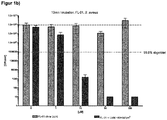
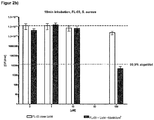
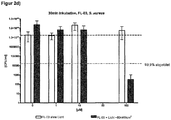
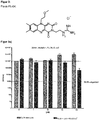
- the Figures 1-4 show the logarithmic decreases of the CFU / ml 24 hours after irradiation as well as the corresponding controls (only irradiated bacteria, bacteria incubated with photosensitizer, but not irradiated, untreated bacteria) for the specified photosensitizer.
- CFU or CFU colony-forming units
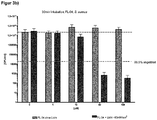
- FIG. 1 shows the effect of flavin FL-01 (chloride of the compound of formula (14)) on E. coli and S. aureus.
- FIG. 1a E. coli samples were incubated with different concentrations (0 ⁇ M, 1 ⁇ M, 10 ⁇ M, 50 ⁇ M, 100 ⁇ M) of Flavin FL-01 for 10 min. Subsequently, the samples were either irradiated with 50 mW / cm 2 (210 sec, 10.5 J / cm 2 ) (dark gray bars) or not irradiated (light gray bars). After 24 hours, the surviving colonies were counted (CFU / ml). The black line indicates the reference of the dark control (0 ⁇ M Flavin FL-01, no light).
- the dashed line labeled "99.9% killed” indicates a decrease in CFU / ml by 3 log 10 steps; this corresponds to a decrease of 99.9% ("antibacterial effect").
- N 3; Median CFU / ml ⁇ SEM.
- the dashed line labeled "99.9% killed” indicates a decrease in CFU / ml by 3 log 10 steps; this corresponds to a decrease of 99.9% ("antibacterial effect").
- N 3; Median CFU / ml ⁇ SEM.
- FIG. 2 shows the effect of flavin FL-03 (chloride of the compound of formula (16)) on E. coli and S. aureus.
- FIG. 2a E. coli samples were incubated with different concentrations (0 ⁇ M, 1 ⁇ M, 10 ⁇ M, 50 ⁇ M, 100 ⁇ M) of Flavin FL-03 for 10 min. Subsequently, the samples were either irradiated with 50 mW / cm 2 (210 sec, 10.5 J / cm 2 ) (dark gray bars) or unirradiated (white bars). After 24 hours, the surviving colonies were counted (CFU / ml). The black line indicates the reference of the dark control (0 ⁇ M Flavin FL-03, no light).
- the dashed line labeled "99.9% killed” indicates a decrease in CFU / ml by 3 log 10 steps; this corresponds to a decrease of 99.9% ("antibacterial effect").
- N 3; Median CFU / ml ⁇ SEM.
- FIG. 2b S. aureus samples were incubated with different concentrations (0 ⁇ M, 1 ⁇ M, 10 ⁇ M, 100 ⁇ M) of Flavin FL-03 for 10 min. Subsequently, the samples were either irradiated with 50 mW / cm 2 (210 sec, 10.5 J / cm 2 ) (dark gray bars) or unirradiated (white bars). After 24 hours, the surviving colonies were counted (CFU / ml). The black line indicates the reference of the dark control (0 ⁇ M Flavin FL-03, no light).
- the dashed line labeled "99.9% killed” indicates a decrease in CFU / ml at 3-log 10 levels; this corresponds to a decrease of 99.9% ("antibacterial effect").
- N 3; Median CFU / ml ⁇ SEM.
- FIG. 2d S. aureus samples were incubated with different concentrations (0 ⁇ M, 1 ⁇ M, 10 ⁇ M, 100 ⁇ M) of Flavin FL-03 for 30 min. Subsequently, the samples were either irradiated with 50 mW / cm 2 (210 sec, 10.5 J / cm 2 ) (dark gray bars) or unirradiated (white bars). After 24 hours, the surviving colonies were counted (CFU / ml). The black line indicates the reference of the dark control (0 ⁇ M Flavin FL-03, no light).
- the dashed line labeled "99.9% killed” indicates a decrease in CFU / ml by 3 log 10 steps; this corresponds to a decrease of 99.9% ("antibacterial effect").
- N 3; Median CFU / ml ⁇ SEM.
- FIG. 3 shows the effect of Flavin FL-04 (chloride of the compound of formula (17)) on E. coli and S. aureus.
- FIG. 3a E. coli samples were incubated with different concentrations (0 ⁇ M, 1 ⁇ M, 10 ⁇ M, 50 ⁇ M, 100 ⁇ M) of Flavin FL-04 for 30 min. Subsequently, the Samples irradiated with either 50 mW / cm 2 (210 sec, 10.5 J / cm 2 ) (dark gray bars) or unirradiated (light gray bars). After 24 hours, the surviving colonies were counted (CFU / ml). The black line indicates the reference of the dark control (0 ⁇ M Flavin FL-04, no light).
- the dashed line labeled "99.9% killed” indicates a decrease in CFU / ml by 3 log 10 steps; this corresponds to a decrease of 99.9% ("antibacterial effect").
- N 3; Median CFU / ml ⁇ SEM.
- FIG. 3b S. aureus samples were incubated with different concentrations (0 ⁇ M, 1 ⁇ M, 10 ⁇ M, 50 ⁇ M, 100 ⁇ M) of Flavin FL-04 for 30 min. Subsequently, the samples were either irradiated with 50 mW / cm 2 (210 sec, 10.5 J / cm 2 ) (dark gray bars) or not irradiated (light gray bars). After 24 hours, the surviving colonies were counted (CFU / ml). The black line indicates the reference of the dark control (0 ⁇ M Flavin FL-04, no light).
- the dashed line labeled "99.9% killed” indicates a decrease in CFU / ml by 3 log 10 steps; this corresponds to a decrease of 99.9% ("antibacterial effect").
- N 3; Median CFU / ml ⁇ SEM.
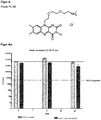
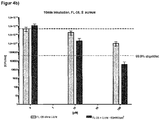
- FIG. 4 shows the effect of flavin FL-05 (chloride of the compound of formula (15)) on E. coli and S. aureus.
- FIG. 4b S. aureus samples were incubated with different concentrations (0 ⁇ M, 10 ⁇ M, 100 ⁇ M) of Flavin FL-05 for 10 min. Subsequently, the samples were either irradiated with 50 mW / cm 2 (210 sec, 10.5 J / cm 2 ) (dark gray bars) or not irradiated (light gray bars). After 24 hours, the surviving colonies were counted (CFU / ml). The black line indicates the reference of the dark control (0 ⁇ M Flavin FL-05, no light).
- the dashed line labeled "99.9% killed” indicates a decrease in CFU / ml by 3 log 10 steps; this corresponds to a decrease of 99.9% ("antibacterial effect").
- N 3; Median CFU / ml ⁇ SEM.
- Table 1 Summary of photodynamic inactivation photosensitizer Required concentration [ ⁇ M] to achieve a reduction of ⁇ 3 log 10 steps (decrease by 99.9%), irradiation with 10.5 J / cm 2 E. coli S. aureus FL-01 10 10 FL-03 > 100 (*) 10 FL-04 > 100 (*) 50 FL-05 > 100 (*) 100 (*) so far only a reduction of less than 3-log 10 levels could be achieved (99%), at a concentration of 100 uM and subsequent irradiation.
Landscapes
- Health & Medical Sciences (AREA)
- Life Sciences & Earth Sciences (AREA)
- Chemical & Material Sciences (AREA)
- General Health & Medical Sciences (AREA)
- Veterinary Medicine (AREA)
- Public Health (AREA)
- Animal Behavior & Ethology (AREA)
- Epidemiology (AREA)
- Organic Chemistry (AREA)
- Medicinal Chemistry (AREA)
- Pharmacology & Pharmacy (AREA)
- Engineering & Computer Science (AREA)
- Agronomy & Crop Science (AREA)
- Plant Pathology (AREA)
- Environmental Sciences (AREA)
- Zoology (AREA)
- Wood Science & Technology (AREA)
- Dentistry (AREA)
- Pest Control & Pesticides (AREA)
- Hematology (AREA)
- Materials Engineering (AREA)
- Biochemistry (AREA)
- Molecular Biology (AREA)
- Oncology (AREA)
- Communicable Diseases (AREA)
- Nuclear Medicine, Radiotherapy & Molecular Imaging (AREA)
- Chemical Kinetics & Catalysis (AREA)
- General Chemical & Material Sciences (AREA)
- Pharmaceuticals Containing Other Organic And Inorganic Compounds (AREA)
- Toxicology (AREA)
Claims (7)
- Utilisation d'un composé de formule (1) :

dans laquelle (A) seul 1 radical R1, R2, R3 ou R4 est un radical organique de formule générale (2), (3) ou (4) :
-(C(D)(E))h-X, (2)
-(C(D)(E))k-Aryl-(C(D)(E))l-X, (3)
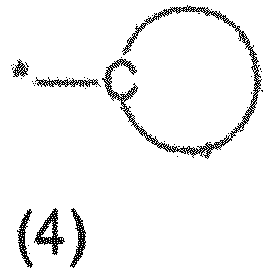
et dans laquelle le radical de formule (4) est un radical hétéroaromatique, qui est relié par l'intermédiaire d'un atome de carbone du radical hétéroaromatique au noyau isoalloxazine, et qui a) ne contient qu'un atome d'azote protonable neutre, ou b) ne contient qu'un atome d'azote positivement chargé, et
dans laquelle les radicaux R1, R2, R3 ou R4, qui ne représentent pas des radicaux organiques de formule générale (2), (3) ou (4), sont chacun indépendamment des autres identiques ou différents et représentent un atome d'hydrogène, un halogène, un groupe hydroxyle, nitro, carboxylate, aldéhyde ayant 1 à 20 atomes de carbone, cétone ayant 2 à 20 atomes de carbone, thiol, O-alkyle ayant 1 à 20 atomes de carbone, S-alkyle ayant 1 à 20 atomes de carbone, O-alcényle ayant 2 à 20 atomes de carbone, S-alcényle ayant 2 à 20 atomes de carbone, O-aryle ayant 5 à 20 atomes de carbone, S-aryle ayant 5 à 20 atomes de carbone, éther ayant 2 à 20 atomes de carbone, thioéther ayant 2 à 20 atomes de carbone, ester d'acide carboxylique ayant 1 à 20 atomes de carbone, carboxamide ayant 1 à 20 atomes de carbone, thioester ayant 1 à 20 atomes de carbone, alkyle ayant 1 à 20 atomes de carbone, alcényle ayant 2 à 20 atomes de carbone, cycloalkyle ayant 3 à 20 atomes de carbone, cycloalcényle ayant 3 à 20 atomes de carbone, aryle ayant 5 à 20 atomes de carbone ou hétéroaryle, qui ne contient aucun atome d'azote, ayant 4 à 20 atomes de carbone, les radicaux alkyle pouvant être des radicaux polyol non cycliques de formule générale-CH2(CH(OH))gCH2OH, dans laquelle g est un nombre entier de 1 à 10, de préférence de 1 à 4,
et
dans laquelle chacun des radicaux R5 ou R6 est, indépendamment de l'autre, identique ou différent, et représente un atome d'hydrogène, un groupe alkyle ayant 2 à 20 atomes de carbone, alcényle ayant 2 à 20 atomes de carbone, éther ayant 2 à 20 atomes de carbone, thioéther ayant 2 à 20 atomes de carbone, cycloalkyle ayant 3 à 20 atomes de carbone, cycloalcényle ayant 3 à 20 atomes de carbone, aryle ayant 5 à 20 atomes de carbone ou hétéroaryle, qui ne contient aucun atome d'azote, ayant 4 à 20 atomes de carbone, les groupes alkyle étant des groupes polyol non cycliques de formule générale -CH2(CH(OH))gCH2OH, dans laquelle g est un nombre entier de 1 à 10, de préférence de 1 à 4,
ou
dans laquelle (B) seul 1 un radical R5 ou R6 est un radical de formule générale (2), (3) ou (4) :
-(C(D)(E))h-X, (2)
-(C(D)(E))k-Aryl-(C(D)(E))l-X, (3)

et dans laquelle le radical de formule (4) est un radical hétéroaromatique, qui est relié par l'intermédiaire d'un atome de carbone du radical hétéroaromatique au noyau isoalloxazine, et qui a) ne contient qu'un atome d'azote protonable neutre, ou b) ne contient qu'un atome d'azote positivement chargé, et
dans laquelle le radical R5 ou R6, qui n'est pas un radical organique de formule générale (2), (3) ou (4), représente un atome d'hydrogène, un groupe alkyle ayant 1 à 20 atomes de carbone, alcényle ayant 2 à 20 atomes de carbone, éther ayant 2 à 20 atomes de carbone, thioéther ayant 2 à 20 atomes de carbone, cycloalkyle ayant 3 à 20 atomes de carbone, cycloalcényle ayant 3 à 20 atomes de carbone, aryle ayant 5 à 20 atomes de carbone ou hétéroaryle, qui ne contient aucun atome d'azote, ayant 4 à 20 atomes de carbone, les radicaux alkyle pouvant être des radicaux polyol non cycliques de formule générale-CH2(CH(OH))gCH2OH, dans laquelle g est un nombre entier de 1 à 10, de préférence de 1 à 4, et
dans laquelle les radicaux R1 à R4 sont chacun indépendamment des autres identiques ou différents et représentent chacun un atome d'hydrogène, un halogène, un groupe hydroxyle, thiol, nitro, carboxylate, aldéhyde ayant 1 à 20 atomes de carbone, cétone ayant 1 à 20 atomes de carbone, O-alkyle ayant 1 à 20 atomes de carbone, S-alkyle ayant 1 à 20 atomes de carbone, O-alcényle ayant 2 à 20 atomes de carbone, S-alcényle ayant 2 à 20 atomes de carbone, O-aryle ayant 5 à 20 atomes de carbone, S-aryle ayant 5 à 20 atomes de carbone, éther ayant 2 à 20 atomes de carbone, thioéther ayant 2 à 20 atomes de carbone, ester d'acide carboxylique ayant 1 à 20 atomes de carbone, carboxamide ayant 1 à 20 atomes de carbone, thioester ayant 1 à 20 atomes de carbone, alkyle ayant 1 à 20 atomes de carbone, alcényle ayant 2 à 20 atomes de carbone, cycloalkyle ayant 3 à 20 atomes de carbone, cycloalcényle ayant 3 à 20 atomes de carbone, aryle ayant 5 à 20 atomes de carbone ou hétéroaryle, qui ne contient aucun atome d'azote, ayant 4 à 20 atomes de carbone, les radicaux alkyle pouvant être des radicaux polyol non cycliques de formule générale -CH2(CH(OH))gCH2OH, dans laquelle g est un nombre entier de 1 à 10, de préférence de 1 à 4. - Utilisation selon la revendication 1, dans laquelle X est un radical de formule (5)


- Utilisation selon la revendication 1 ou 2, dans laquelle le radical de formule (4) :


- Utilisation selon l'une des revendications 1 à 3, dans laquelle le composé de formule (1) est choisi parmi les composés ayant les formules (14) à (17) :


- Utilisation selon l'une des revendications 1 à 4, dans laquelle, pour ce qui concerne les microorganismes, il s'agit de virus, d'archées, de bactéries, de spores bactériennes, de champignons, de spores fongiques, de protozoaires, d'algues et/ou de parasites transmissibles par le sang.
- Utilisation selon l'une des revendications 1 à 5, dans laquelle le dispositif médical est choisi dans le groupe consistant en les pansements, les bandages, les cathéters, les sondes creuses, les tubes flexibles et les aiguilles.
- Utilisation selon l'une des revendications 1 à 5, dans laquelle le dispositif médical est choisi dans le groupe consistant en les empreintes dentaires, les prothèses dentaires, en particulier les prothèses, les appareils d'orthodontie, les couronnes et les implants.
Priority Applications (2)
| Application Number | Priority Date | Filing Date | Title |
|---|---|---|---|
| EP18209950.7A EP3492104B1 (fr) | 2011-06-22 | 2012-06-22 | Utilisation de dérivés de 10h-benzo[g]pteridine-2,4-dione |
| DK18209950.7T DK3492104T3 (da) | 2011-06-22 | 2012-06-22 | Anvendelse af 10h-benzo [g] pteridin-2,4-dion-derivater |
Applications Claiming Priority (2)
| Application Number | Priority Date | Filing Date | Title |
|---|---|---|---|
| DE102011105660A DE102011105660A1 (de) | 2011-06-22 | 2011-06-22 | Verwendung von 10H-Benzo[g]pteridin-2,4-dion-Derivaten |
| PCT/EP2012/062142 WO2012175706A1 (fr) | 2011-06-22 | 2012-06-22 | Utilisation de dérivés de 10h-benzo[g]ptéridine-2,4-dione |
Related Child Applications (1)
| Application Number | Title | Priority Date | Filing Date |
|---|---|---|---|
| EP18209950.7A Division EP3492104B1 (fr) | 2011-06-22 | 2012-06-22 | Utilisation de dérivés de 10h-benzo[g]pteridine-2,4-dione |
Publications (2)
| Publication Number | Publication Date |
|---|---|
| EP2723342A1 EP2723342A1 (fr) | 2014-04-30 |
| EP2723342B1 true EP2723342B1 (fr) | 2018-12-05 |
Family
ID=46331329
Family Applications (2)
| Application Number | Title | Priority Date | Filing Date |
|---|---|---|---|
| EP18209950.7A Active EP3492104B1 (fr) | 2011-06-22 | 2012-06-22 | Utilisation de dérivés de 10h-benzo[g]pteridine-2,4-dione |
| EP12729136.7A Active EP2723342B1 (fr) | 2011-06-22 | 2012-06-22 | Utilisation de dérivés de 10h-benzo[g]ptéridine-2,4-dione |
Family Applications Before (1)
| Application Number | Title | Priority Date | Filing Date |
|---|---|---|---|
| EP18209950.7A Active EP3492104B1 (fr) | 2011-06-22 | 2012-06-22 | Utilisation de dérivés de 10h-benzo[g]pteridine-2,4-dione |
Country Status (5)
| Country | Link |
|---|---|
| US (2) | US9796715B2 (fr) |
| EP (2) | EP3492104B1 (fr) |
| DE (1) | DE102011105660A1 (fr) |
| DK (1) | DK3492104T3 (fr) |
| WO (1) | WO2012175706A1 (fr) |
Families Citing this family (16)
| Publication number | Priority date | Publication date | Assignee | Title |
|---|---|---|---|---|
| PT3225112T (pt) | 2016-04-01 | 2021-09-16 | Trioptotec Gmbh | Dispersão de fotossensibilizador e utilização da mesma |
| EP3725334A1 (fr) * | 2019-04-16 | 2020-10-21 | HUBL GmbH Edelstahltechnik | Dispositif et procédé de réduction du nombre de germes |
| EP4126558A1 (fr) | 2020-04-03 | 2023-02-08 | Giesecke+Devrient Currency Technology GmbH | Substrat de document de valeur et procédé de désinfection |
| EP3978038A1 (fr) | 2020-10-04 | 2022-04-06 | Elke Münch | Dispositif mobile de nettoyage et de désinfection de l'air ambiant pouvant fonctionner par différence de température et dispositif d'essai associé |
| EP3981442A1 (fr) | 2020-10-04 | 2022-04-13 | Elke Münch | Dispositif mobile de nettoyage et de désinfection de l'air ambiant pouvant fonctionner par différence de température |
| DE102020125921B4 (de) | 2020-10-04 | 2022-05-19 | Elke Münch | Durch eine Temperaturdifferenz betreibbare, mobile Vorrichtung zur Reinigung und Desinfizierung von Raumluft |
| DE102020125919B4 (de) | 2020-10-04 | 2022-06-23 | Elke Münch | Durch eine Temperaturdifferenz betreibbare, mobile Vorrichtung zur Reinigung und Desinfizierung von Raumluft und eine Testvorrichtung hierfür |
| DE102020125922B4 (de) | 2020-10-04 | 2022-06-02 | Elke Münch | Mobile Vorrichtung zur Reinigung und Desinfizierung von Raumluft |
| DE102020125920B4 (de) | 2020-10-04 | 2022-05-19 | Elke Münch | Durch eine Temperaturdifferenz betreibbare, mobile Vorrichtung zur Reinigung und Desinfizierung von Raumluft |
| DE102020006520A1 (de) | 2020-10-24 | 2022-04-28 | Magnetic Hyperthermia Solutions B.V. | Vorrichtung und Verfahren zur Attenuierung und/oderAbtötung von Mikroorganismen, Viren und Virionen |
| EP4279141A1 (fr) * | 2022-05-16 | 2023-11-22 | Mana Health Technologies GmbH | Solution de rinçage destinée à la désinfection photodynamique |
| DE102022001868A1 (de) | 2022-05-29 | 2023-11-30 | Elke Hildegard Münch | Biozid beschichtete, retikulierte Schaumstoffe aus Kunststoff, Verfahren zu ihrer Herstellung und ihre Verwendung |
| CN115710272B (zh) * | 2022-11-22 | 2024-03-26 | 上海交通大学 | 一种用于酶生物传感器的含乙烯基的异咯嗪衍生物及其制备方法 |
| DE102023105388B3 (de) | 2023-03-06 | 2024-05-29 | Multivac Sepp Haggenmüller Se & Co. Kg | Herstellen einer Verpackung aus einer photodynamischen Materialbahn |
| DE102023113228A1 (de) | 2023-05-20 | 2024-11-21 | Elke Münch | Biozide und viruzide Luftfiltermaterialien, ihre Verwendung sowie Verfahren zu ihrer Herstellung und ihrer umweltfreundlichen Entsorgung |
| CN121620352A (zh) | 2023-06-02 | 2026-03-06 | 威娜德国有限责任公司 | 含有光敏剂的漂白介质 |
Family Cites Families (6)
| Publication number | Priority date | Publication date | Assignee | Title |
|---|---|---|---|---|
| US6258577B1 (en) * | 1998-07-21 | 2001-07-10 | Gambro, Inc. | Method and apparatus for inactivation of biological contaminants using endogenous alloxazine or isoalloxazine photosensitizers |
| US20030141260A1 (en) * | 2001-12-28 | 2003-07-31 | Frank Corbin | Oxygen-enhanced pathogen inactivation |
| CN102176825A (zh) | 2008-08-11 | 2011-09-07 | 佰欧莱利克斯公司 | 黄素衍生物 |
| CA2765942A1 (fr) | 2009-06-30 | 2011-01-20 | Biorelix, Inc. | Derives des flavines |
| EP2555623A1 (fr) * | 2010-04-06 | 2013-02-13 | BioRelix, Inc. | Dérivés de flavine |
| WO2011126576A2 (fr) * | 2010-04-09 | 2011-10-13 | Duke University | Signatures génétiques présentes dans la glycoprotéine d'enveloppe du vih-1 |
-
2011
- 2011-06-22 DE DE102011105660A patent/DE102011105660A1/de not_active Ceased
-
2012
- 2012-06-22 DK DK18209950.7T patent/DK3492104T3/da active
- 2012-06-22 WO PCT/EP2012/062142 patent/WO2012175706A1/fr not_active Ceased
- 2012-06-22 US US14/127,453 patent/US9796715B2/en not_active Expired - Fee Related
- 2012-06-22 EP EP18209950.7A patent/EP3492104B1/fr active Active
- 2012-06-22 EP EP12729136.7A patent/EP2723342B1/fr active Active
-
2017
- 2017-07-19 US US15/653,663 patent/US10227348B2/en active Active
Non-Patent Citations (1)
| Title |
|---|
| None * |
Also Published As
| Publication number | Publication date |
|---|---|
| DE102011105660A1 (de) | 2012-12-27 |
| WO2012175706A1 (fr) | 2012-12-27 |
| DK3492104T3 (da) | 2023-04-24 |
| EP2723342A1 (fr) | 2014-04-30 |
| US20140128403A1 (en) | 2014-05-08 |
| US9796715B2 (en) | 2017-10-24 |
| EP3492104A1 (fr) | 2019-06-05 |
| US10227348B2 (en) | 2019-03-12 |
| US20180009812A1 (en) | 2018-01-11 |
| EP3492104B1 (fr) | 2023-02-15 |
Similar Documents
| Publication | Publication Date | Title |
|---|---|---|
| EP3492104B1 (fr) | Utilisation de dérivés de 10h-benzo[g]pteridine-2,4-dione | |
| EP2678035B1 (fr) | Dérivés de phénalène-1-one, leur procédé de production et leur utilisation | |
| DE69229548T2 (de) | Antimikrobielle zusammensetzungen für medizinische anwendungen | |
| EP3586632B1 (fr) | Dérivés de 10h-benzo[g]pteridin-2,4-dion, leur procédé de production et d'utilisation | |
| EP1392666B1 (fr) | Derives de bleu de methylene actifs sur le plan biologique | |
| DE69314949T3 (de) | Medikament zur Desinfektion der Mundhöhle | |
| EP2991658B1 (fr) | Compositions antimicrobiennes et leurs procédés de fabrication | |
| DE69018684T2 (de) | Antimikrobielle Kunststoffmaterialien mit Breitbandwirkung. | |
| WO2013020096A2 (fr) | Matériaux et procédés antimicrobiens | |
| EP2723742B1 (fr) | Dérivés de 10h-benzo[g]ptéridine-2,4-dione, procédé de production et d'utilisation desdits dérivés | |
| CN113197211A (zh) | 光动力微生物消杀剂 | |
| AR018335A1 (es) | Compuesto carbapenico, agente antibacteriano que lo comprende y compuesto carbapenico util como intermediario para la obtencion del primero | |
| JP2000159608A (ja) | 抗菌性組成物 | |
| RU2203035C1 (ru) | Фармацевтическая композиция с дезинфицирующими, спороцидными и ранозаживляющими свойствами | |
| EP0361301A1 (fr) | Compositions microbicides pour la désinfection des matériaux à empreintes dentaires | |
| DE69032220T2 (de) | Zusammensetzung und Verfahren zur Sterilisierung der Pathogene in Gegenwart von Wasser | |
| KR20110023085A (ko) | 외피용 살균소독용액 및 이의 사용방법 | |
| DE19532884C2 (de) | Flüssiges Desinfektionsmittel | |
| BG704Y1 (bg) | Състав на дезинфекционен разтвор | |
| HK1063788B (en) | Biologically active methylene blue derivatives |
Legal Events
| Date | Code | Title | Description |
|---|---|---|---|
| PUAI | Public reference made under article 153(3) epc to a published international application that has entered the european phase |
Free format text: ORIGINAL CODE: 0009012 |
|
| 17P | Request for examination filed |
Effective date: 20140121 |
|
| AK | Designated contracting states |
Kind code of ref document: A1 Designated state(s): AL AT BE BG CH CY CZ DE DK EE ES FI FR GB GR HR HU IE IS IT LI LT LU LV MC MK MT NL NO PL PT RO RS SE SI SK SM TR |
|
| DAX | Request for extension of the european patent (deleted) | ||
| 17Q | First examination report despatched |
Effective date: 20141209 |
|
| STAA | Information on the status of an ep patent application or granted ep patent |
Free format text: STATUS: EXAMINATION IS IN PROGRESS |
|
| GRAP | Despatch of communication of intention to grant a patent |
Free format text: ORIGINAL CODE: EPIDOSNIGR1 |
|
| STAA | Information on the status of an ep patent application or granted ep patent |
Free format text: STATUS: GRANT OF PATENT IS INTENDED |
|
| INTG | Intention to grant announced |
Effective date: 20180626 |
|
| GRAS | Grant fee paid |
Free format text: ORIGINAL CODE: EPIDOSNIGR3 |
|
| GRAA | (expected) grant |
Free format text: ORIGINAL CODE: 0009210 |
|
| GRAA | (expected) grant |
Free format text: ORIGINAL CODE: 0009210 |
|
| STAA | Information on the status of an ep patent application or granted ep patent |
Free format text: STATUS: THE PATENT HAS BEEN GRANTED |
|
| AK | Designated contracting states |
Kind code of ref document: B1 Designated state(s): AL AT BE BG CH CY CZ DE DK EE ES FI FR GB GR HR HU IE IS IT LI LT LU LV MC MK MT NL NO PL PT RO RS SE SI SK SM TR |
|
| REG | Reference to a national code |
Ref country code: GB Ref legal event code: FG4D Free format text: NOT ENGLISH |
|
| REG | Reference to a national code |
Ref country code: CH Ref legal event code: EP |
|
| REG | Reference to a national code |
Ref country code: AT Ref legal event code: REF Ref document number: 1072206 Country of ref document: AT Kind code of ref document: T Effective date: 20181215 |
|
| REG | Reference to a national code |
Ref country code: IE Ref legal event code: FG4D Free format text: LANGUAGE OF EP DOCUMENT: GERMAN |
|
| REG | Reference to a national code |
Ref country code: DE Ref legal event code: R096 Ref document number: 502012013938 Country of ref document: DE |
|
| RAP2 | Party data changed (patent owner data changed or rights of a patent transferred) |
Owner name: TRIOPTOTEC GMBH |
|
| REG | Reference to a national code |
Ref country code: CH Ref legal event code: NV Representative=s name: SCHNEIDER FELDMANN AG PATENT- UND MARKENANWAEL, CH |
|
| REG | Reference to a national code |
Ref country code: NL Ref legal event code: MP Effective date: 20181205 |
|
| REG | Reference to a national code |
Ref country code: LT Ref legal event code: MG4D |
|
| PG25 | Lapsed in a contracting state [announced via postgrant information from national office to epo] |
Ref country code: NO Free format text: LAPSE BECAUSE OF FAILURE TO SUBMIT A TRANSLATION OF THE DESCRIPTION OR TO PAY THE FEE WITHIN THE PRESCRIBED TIME-LIMIT Effective date: 20190305 Ref country code: LT Free format text: LAPSE BECAUSE OF FAILURE TO SUBMIT A TRANSLATION OF THE DESCRIPTION OR TO PAY THE FEE WITHIN THE PRESCRIBED TIME-LIMIT Effective date: 20181205 Ref country code: HR Free format text: LAPSE BECAUSE OF FAILURE TO SUBMIT A TRANSLATION OF THE DESCRIPTION OR TO PAY THE FEE WITHIN THE PRESCRIBED TIME-LIMIT Effective date: 20181205 Ref country code: FI Free format text: LAPSE BECAUSE OF FAILURE TO SUBMIT A TRANSLATION OF THE DESCRIPTION OR TO PAY THE FEE WITHIN THE PRESCRIBED TIME-LIMIT Effective date: 20181205 Ref country code: BG Free format text: LAPSE BECAUSE OF FAILURE TO SUBMIT A TRANSLATION OF THE DESCRIPTION OR TO PAY THE FEE WITHIN THE PRESCRIBED TIME-LIMIT Effective date: 20190305 Ref country code: ES Free format text: LAPSE BECAUSE OF FAILURE TO SUBMIT A TRANSLATION OF THE DESCRIPTION OR TO PAY THE FEE WITHIN THE PRESCRIBED TIME-LIMIT Effective date: 20181205 Ref country code: LV Free format text: LAPSE BECAUSE OF FAILURE TO SUBMIT A TRANSLATION OF THE DESCRIPTION OR TO PAY THE FEE WITHIN THE PRESCRIBED TIME-LIMIT Effective date: 20181205 |
|
| PG25 | Lapsed in a contracting state [announced via postgrant information from national office to epo] |
Ref country code: AL Free format text: LAPSE BECAUSE OF FAILURE TO SUBMIT A TRANSLATION OF THE DESCRIPTION OR TO PAY THE FEE WITHIN THE PRESCRIBED TIME-LIMIT Effective date: 20181205 Ref country code: SE Free format text: LAPSE BECAUSE OF FAILURE TO SUBMIT A TRANSLATION OF THE DESCRIPTION OR TO PAY THE FEE WITHIN THE PRESCRIBED TIME-LIMIT Effective date: 20181205 Ref country code: RS Free format text: LAPSE BECAUSE OF FAILURE TO SUBMIT A TRANSLATION OF THE DESCRIPTION OR TO PAY THE FEE WITHIN THE PRESCRIBED TIME-LIMIT Effective date: 20181205 Ref country code: GR Free format text: LAPSE BECAUSE OF FAILURE TO SUBMIT A TRANSLATION OF THE DESCRIPTION OR TO PAY THE FEE WITHIN THE PRESCRIBED TIME-LIMIT Effective date: 20190306 |
|
| PG25 | Lapsed in a contracting state [announced via postgrant information from national office to epo] |
Ref country code: NL Free format text: LAPSE BECAUSE OF FAILURE TO SUBMIT A TRANSLATION OF THE DESCRIPTION OR TO PAY THE FEE WITHIN THE PRESCRIBED TIME-LIMIT Effective date: 20181205 |
|
| PG25 | Lapsed in a contracting state [announced via postgrant information from national office to epo] |
Ref country code: PL Free format text: LAPSE BECAUSE OF FAILURE TO SUBMIT A TRANSLATION OF THE DESCRIPTION OR TO PAY THE FEE WITHIN THE PRESCRIBED TIME-LIMIT Effective date: 20181205 Ref country code: PT Free format text: LAPSE BECAUSE OF FAILURE TO SUBMIT A TRANSLATION OF THE DESCRIPTION OR TO PAY THE FEE WITHIN THE PRESCRIBED TIME-LIMIT Effective date: 20190405 Ref country code: IT Free format text: LAPSE BECAUSE OF FAILURE TO SUBMIT A TRANSLATION OF THE DESCRIPTION OR TO PAY THE FEE WITHIN THE PRESCRIBED TIME-LIMIT Effective date: 20181205 Ref country code: CZ Free format text: LAPSE BECAUSE OF FAILURE TO SUBMIT A TRANSLATION OF THE DESCRIPTION OR TO PAY THE FEE WITHIN THE PRESCRIBED TIME-LIMIT Effective date: 20181205 |
|
| PG25 | Lapsed in a contracting state [announced via postgrant information from national office to epo] |
Ref country code: IS Free format text: LAPSE BECAUSE OF FAILURE TO SUBMIT A TRANSLATION OF THE DESCRIPTION OR TO PAY THE FEE WITHIN THE PRESCRIBED TIME-LIMIT Effective date: 20190405 Ref country code: RO Free format text: LAPSE BECAUSE OF FAILURE TO SUBMIT A TRANSLATION OF THE DESCRIPTION OR TO PAY THE FEE WITHIN THE PRESCRIBED TIME-LIMIT Effective date: 20181205 Ref country code: EE Free format text: LAPSE BECAUSE OF FAILURE TO SUBMIT A TRANSLATION OF THE DESCRIPTION OR TO PAY THE FEE WITHIN THE PRESCRIBED TIME-LIMIT Effective date: 20181205 Ref country code: SM Free format text: LAPSE BECAUSE OF FAILURE TO SUBMIT A TRANSLATION OF THE DESCRIPTION OR TO PAY THE FEE WITHIN THE PRESCRIBED TIME-LIMIT Effective date: 20181205 Ref country code: SK Free format text: LAPSE BECAUSE OF FAILURE TO SUBMIT A TRANSLATION OF THE DESCRIPTION OR TO PAY THE FEE WITHIN THE PRESCRIBED TIME-LIMIT Effective date: 20181205 |
|
| REG | Reference to a national code |
Ref country code: DE Ref legal event code: R097 Ref document number: 502012013938 Country of ref document: DE |
|
| PLBE | No opposition filed within time limit |
Free format text: ORIGINAL CODE: 0009261 |
|
| STAA | Information on the status of an ep patent application or granted ep patent |
Free format text: STATUS: NO OPPOSITION FILED WITHIN TIME LIMIT |
|
| PG25 | Lapsed in a contracting state [announced via postgrant information from national office to epo] |
Ref country code: DK Free format text: LAPSE BECAUSE OF FAILURE TO SUBMIT A TRANSLATION OF THE DESCRIPTION OR TO PAY THE FEE WITHIN THE PRESCRIBED TIME-LIMIT Effective date: 20181205 Ref country code: SI Free format text: LAPSE BECAUSE OF FAILURE TO SUBMIT A TRANSLATION OF THE DESCRIPTION OR TO PAY THE FEE WITHIN THE PRESCRIBED TIME-LIMIT Effective date: 20181205 |
|
| 26N | No opposition filed |
Effective date: 20190906 |
|
| PG25 | Lapsed in a contracting state [announced via postgrant information from national office to epo] |
Ref country code: MC Free format text: LAPSE BECAUSE OF FAILURE TO SUBMIT A TRANSLATION OF THE DESCRIPTION OR TO PAY THE FEE WITHIN THE PRESCRIBED TIME-LIMIT Effective date: 20181205 |
|
| REG | Reference to a national code |
Ref country code: BE Ref legal event code: MM Effective date: 20190630 |
|
| PG25 | Lapsed in a contracting state [announced via postgrant information from national office to epo] |
Ref country code: TR Free format text: LAPSE BECAUSE OF FAILURE TO SUBMIT A TRANSLATION OF THE DESCRIPTION OR TO PAY THE FEE WITHIN THE PRESCRIBED TIME-LIMIT Effective date: 20181205 |
|
| PG25 | Lapsed in a contracting state [announced via postgrant information from national office to epo] |
Ref country code: IE Free format text: LAPSE BECAUSE OF NON-PAYMENT OF DUE FEES Effective date: 20190622 |
|
| PG25 | Lapsed in a contracting state [announced via postgrant information from national office to epo] |
Ref country code: BE Free format text: LAPSE BECAUSE OF NON-PAYMENT OF DUE FEES Effective date: 20190630 Ref country code: LU Free format text: LAPSE BECAUSE OF NON-PAYMENT OF DUE FEES Effective date: 20190622 |
|
| REG | Reference to a national code |
Ref country code: CH Ref legal event code: PFA Owner name: TRIOPTOTEC GMBH, DE Free format text: FORMER OWNER: TRIOPTOTEC GMBH, DE |
|
| PG25 | Lapsed in a contracting state [announced via postgrant information from national office to epo] |
Ref country code: CY Free format text: LAPSE BECAUSE OF FAILURE TO SUBMIT A TRANSLATION OF THE DESCRIPTION OR TO PAY THE FEE WITHIN THE PRESCRIBED TIME-LIMIT Effective date: 20181205 |
|
| PG25 | Lapsed in a contracting state [announced via postgrant information from national office to epo] |
Ref country code: HU Free format text: LAPSE BECAUSE OF FAILURE TO SUBMIT A TRANSLATION OF THE DESCRIPTION OR TO PAY THE FEE WITHIN THE PRESCRIBED TIME-LIMIT; INVALID AB INITIO Effective date: 20120622 Ref country code: MT Free format text: LAPSE BECAUSE OF FAILURE TO SUBMIT A TRANSLATION OF THE DESCRIPTION OR TO PAY THE FEE WITHIN THE PRESCRIBED TIME-LIMIT Effective date: 20181205 |
|
| PG25 | Lapsed in a contracting state [announced via postgrant information from national office to epo] |
Ref country code: MK Free format text: LAPSE BECAUSE OF FAILURE TO SUBMIT A TRANSLATION OF THE DESCRIPTION OR TO PAY THE FEE WITHIN THE PRESCRIBED TIME-LIMIT Effective date: 20181205 |
|
| P01 | Opt-out of the competence of the unified patent court (upc) registered |
Effective date: 20230519 |
|
| REG | Reference to a national code |
Ref country code: DE Ref legal event code: R084 Ref document number: 502012013938 Country of ref document: DE |
|
| PGFP | Annual fee paid to national office [announced via postgrant information from national office to epo] |
Ref country code: GB Payment date: 20240620 Year of fee payment: 13 |
|
| PGFP | Annual fee paid to national office [announced via postgrant information from national office to epo] |
Ref country code: DE Payment date: 20240626 Year of fee payment: 13 |
|
| PGFP | Annual fee paid to national office [announced via postgrant information from national office to epo] |
Ref country code: AT Payment date: 20240617 Year of fee payment: 13 |
|
| PGFP | Annual fee paid to national office [announced via postgrant information from national office to epo] |
Ref country code: FR Payment date: 20240621 Year of fee payment: 13 |
|
| PGFP | Annual fee paid to national office [announced via postgrant information from national office to epo] |
Ref country code: CH Payment date: 20240701 Year of fee payment: 13 |
|
| REG | Reference to a national code |
Ref country code: DE Ref legal event code: R081 Ref document number: 502012013938 Country of ref document: DE Owner name: JUFICO GMBH, DE Free format text: FORMER OWNER: TRIOPTOTEC GMBH, 93051 REGENSBURG, DE |
|
| REG | Reference to a national code |
Ref country code: DE Ref legal event code: R119 Ref document number: 502012013938 Country of ref document: DE |
|
| REG | Reference to a national code |
Ref country code: CH Ref legal event code: H13 Free format text: ST27 STATUS EVENT CODE: U-0-0-H10-H13 (AS PROVIDED BY THE NATIONAL OFFICE) Effective date: 20260127 |
|
| REG | Reference to a national code |
Ref country code: AT Ref legal event code: MM01 Ref document number: 1072206 Country of ref document: AT Kind code of ref document: T Effective date: 20250622 |
|
| GBPC | Gb: european patent ceased through non-payment of renewal fee |
Effective date: 20250622 |
|
| PG25 | Lapsed in a contracting state [announced via postgrant information from national office to epo] |
Ref country code: GB Free format text: LAPSE BECAUSE OF NON-PAYMENT OF DUE FEES Effective date: 20250622 |
|
| PG25 | Lapsed in a contracting state [announced via postgrant information from national office to epo] |
Ref country code: DE Free format text: LAPSE BECAUSE OF NON-PAYMENT OF DUE FEES Effective date: 20260101 |
|
| PG25 | Lapsed in a contracting state [announced via postgrant information from national office to epo] |
Ref country code: AT Free format text: LAPSE BECAUSE OF NON-PAYMENT OF DUE FEES Effective date: 20250622 |
|
| PG25 | Lapsed in a contracting state [announced via postgrant information from national office to epo] |
Ref country code: FR Free format text: LAPSE BECAUSE OF NON-PAYMENT OF DUE FEES Effective date: 20250630 |
|
| PG25 | Lapsed in a contracting state [announced via postgrant information from national office to epo] |
Ref country code: CH Free format text: LAPSE BECAUSE OF NON-PAYMENT OF DUE FEES Effective date: 20250630 |