EP2733780A2 - Électrolyte non aqueux et batterie secondaire au lithium l'utilisant - Google Patents
Électrolyte non aqueux et batterie secondaire au lithium l'utilisant Download PDFInfo
- Publication number
- EP2733780A2 EP2733780A2 EP12811452.7A EP12811452A EP2733780A2 EP 2733780 A2 EP2733780 A2 EP 2733780A2 EP 12811452 A EP12811452 A EP 12811452A EP 2733780 A2 EP2733780 A2 EP 2733780A2
- Authority
- EP
- European Patent Office
- Prior art keywords
- secondary battery
- electrolyte solution
- lithium secondary
- aqueous electrolyte
- carbonate
- Prior art date
- Legal status (The legal status is an assumption and is not a legal conclusion. Google has not performed a legal analysis and makes no representation as to the accuracy of the status listed.)
- Granted
Links
Images
Classifications
-
- H—ELECTRICITY
- H01—ELECTRIC ELEMENTS
- H01M—PROCESSES OR MEANS, e.g. BATTERIES, FOR THE DIRECT CONVERSION OF CHEMICAL ENERGY INTO ELECTRICAL ENERGY
- H01M10/00—Secondary cells; Manufacture thereof
- H01M10/05—Accumulators with non-aqueous electrolyte
- H01M10/056—Accumulators with non-aqueous electrolyte characterised by the materials used as electrolytes, e.g. mixed inorganic/organic electrolytes
- H01M10/0564—Accumulators with non-aqueous electrolyte characterised by the materials used as electrolytes, e.g. mixed inorganic/organic electrolytes the electrolyte being constituted of organic materials only
- H01M10/0566—Liquid materials
-
- H—ELECTRICITY
- H01—ELECTRIC ELEMENTS
- H01M—PROCESSES OR MEANS, e.g. BATTERIES, FOR THE DIRECT CONVERSION OF CHEMICAL ENERGY INTO ELECTRICAL ENERGY
- H01M10/00—Secondary cells; Manufacture thereof
- H01M10/05—Accumulators with non-aqueous electrolyte
- H01M10/056—Accumulators with non-aqueous electrolyte characterised by the materials used as electrolytes, e.g. mixed inorganic/organic electrolytes
- H01M10/0564—Accumulators with non-aqueous electrolyte characterised by the materials used as electrolytes, e.g. mixed inorganic/organic electrolytes the electrolyte being constituted of organic materials only
- H01M10/0566—Liquid materials
- H01M10/0569—Liquid materials characterised by the solvents
-
- H—ELECTRICITY
- H01—ELECTRIC ELEMENTS
- H01M—PROCESSES OR MEANS, e.g. BATTERIES, FOR THE DIRECT CONVERSION OF CHEMICAL ENERGY INTO ELECTRICAL ENERGY
- H01M10/00—Secondary cells; Manufacture thereof
- H01M10/05—Accumulators with non-aqueous electrolyte
- H01M10/052—Li-accumulators
-
- H—ELECTRICITY
- H01—ELECTRIC ELEMENTS
- H01M—PROCESSES OR MEANS, e.g. BATTERIES, FOR THE DIRECT CONVERSION OF CHEMICAL ENERGY INTO ELECTRICAL ENERGY
- H01M10/00—Secondary cells; Manufacture thereof
- H01M10/05—Accumulators with non-aqueous electrolyte
- H01M10/052—Li-accumulators
- H01M10/0525—Rocking-chair batteries, i.e. batteries with lithium insertion or intercalation in both electrodes; Lithium-ion batteries
-
- H—ELECTRICITY
- H01—ELECTRIC ELEMENTS
- H01M—PROCESSES OR MEANS, e.g. BATTERIES, FOR THE DIRECT CONVERSION OF CHEMICAL ENERGY INTO ELECTRICAL ENERGY
- H01M10/00—Secondary cells; Manufacture thereof
- H01M10/05—Accumulators with non-aqueous electrolyte
- H01M10/056—Accumulators with non-aqueous electrolyte characterised by the materials used as electrolytes, e.g. mixed inorganic/organic electrolytes
-
- H—ELECTRICITY
- H01—ELECTRIC ELEMENTS
- H01M—PROCESSES OR MEANS, e.g. BATTERIES, FOR THE DIRECT CONVERSION OF CHEMICAL ENERGY INTO ELECTRICAL ENERGY
- H01M4/00—Electrodes
- H01M4/02—Electrodes composed of, or comprising, active material
- H01M4/13—Electrodes for accumulators with non-aqueous electrolyte, e.g. for lithium-accumulators; Processes of manufacture thereof
- H01M4/131—Electrodes based on mixed oxides or hydroxides, or on mixtures of oxides or hydroxides, e.g. LiCoOx
-
- H—ELECTRICITY
- H01—ELECTRIC ELEMENTS
- H01M—PROCESSES OR MEANS, e.g. BATTERIES, FOR THE DIRECT CONVERSION OF CHEMICAL ENERGY INTO ELECTRICAL ENERGY
- H01M4/00—Electrodes
- H01M4/02—Electrodes composed of, or comprising, active material
- H01M4/13—Electrodes for accumulators with non-aqueous electrolyte, e.g. for lithium-accumulators; Processes of manufacture thereof
- H01M4/134—Electrodes based on metals, Si or alloys
-
- H—ELECTRICITY
- H01—ELECTRIC ELEMENTS
- H01M—PROCESSES OR MEANS, e.g. BATTERIES, FOR THE DIRECT CONVERSION OF CHEMICAL ENERGY INTO ELECTRICAL ENERGY
- H01M4/00—Electrodes
- H01M4/02—Electrodes composed of, or comprising, active material
- H01M4/13—Electrodes for accumulators with non-aqueous electrolyte, e.g. for lithium-accumulators; Processes of manufacture thereof
- H01M4/136—Electrodes based on inorganic compounds other than oxides or hydroxides, e.g. sulfides, selenides, tellurides, halogenides or LiCoFy
-
- H—ELECTRICITY
- H01—ELECTRIC ELEMENTS
- H01M—PROCESSES OR MEANS, e.g. BATTERIES, FOR THE DIRECT CONVERSION OF CHEMICAL ENERGY INTO ELECTRICAL ENERGY
- H01M4/00—Electrodes
- H01M4/02—Electrodes composed of, or comprising, active material
- H01M4/36—Selection of substances as active materials, active masses, active liquids
-
- H—ELECTRICITY
- H01—ELECTRIC ELEMENTS
- H01M—PROCESSES OR MEANS, e.g. BATTERIES, FOR THE DIRECT CONVERSION OF CHEMICAL ENERGY INTO ELECTRICAL ENERGY
- H01M4/00—Electrodes
- H01M4/02—Electrodes composed of, or comprising, active material
- H01M2004/026—Electrodes composed of, or comprising, active material characterised by the polarity
- H01M2004/027—Negative electrodes
-
- H—ELECTRICITY
- H01—ELECTRIC ELEMENTS
- H01M—PROCESSES OR MEANS, e.g. BATTERIES, FOR THE DIRECT CONVERSION OF CHEMICAL ENERGY INTO ELECTRICAL ENERGY
- H01M4/00—Electrodes
- H01M4/02—Electrodes composed of, or comprising, active material
- H01M2004/026—Electrodes composed of, or comprising, active material characterised by the polarity
- H01M2004/028—Positive electrodes
-
- H—ELECTRICITY
- H01—ELECTRIC ELEMENTS
- H01M—PROCESSES OR MEANS, e.g. BATTERIES, FOR THE DIRECT CONVERSION OF CHEMICAL ENERGY INTO ELECTRICAL ENERGY
- H01M2300/00—Electrolytes
- H01M2300/0017—Non-aqueous electrolytes
- H01M2300/0025—Organic electrolyte
- H01M2300/0028—Organic electrolyte characterised by the solvent
- H01M2300/0037—Mixture of solvents
-
- Y—GENERAL TAGGING OF NEW TECHNOLOGICAL DEVELOPMENTS; GENERAL TAGGING OF CROSS-SECTIONAL TECHNOLOGIES SPANNING OVER SEVERAL SECTIONS OF THE IPC; TECHNICAL SUBJECTS COVERED BY FORMER USPC CROSS-REFERENCE ART COLLECTIONS [XRACs] AND DIGESTS
- Y02—TECHNOLOGIES OR APPLICATIONS FOR MITIGATION OR ADAPTATION AGAINST CLIMATE CHANGE
- Y02E—REDUCTION OF GREENHOUSE GAS [GHG] EMISSIONS, RELATED TO ENERGY GENERATION, TRANSMISSION OR DISTRIBUTION
- Y02E60/00—Enabling technologies; Technologies with a potential or indirect contribution to GHG emissions mitigation
- Y02E60/10—Energy storage using batteries
Definitions
- the present invention relates to a non-aqueous electrolyte solution for a lithium secondary battery, which comprises ester-based compounds having a branched- and straight-chain alkyl group, and a lithium secondary battery using the same.
- a lithium secondary battery developed in the early 1990's comprises an anode made of carbon material capable of intercalating or disintercalating lithium ions, a cathode made of lithium-containing oxide, and a non-aqueous electrolyte solution obtained by dissolving a suitable amount of lithium salt in a mixed organic solvent.
- the lithium secondary battery has an average discharge voltage of about 3.6 to 3.7V, which is advantageously higher than those of other batteries such as alkali batteries or nickel-cadmium batteries.
- an electrolyte composition electrochemically stable in a charging/discharging voltage range of 0 to 4.2 V is required.
- a mixed solvent in which a cyclic carbonate compound such as ethylene carbonate and propylene carbonate, and a linear carbonate compound such as dimethyl carbonate, ethyl methyl carbonate and diethyl carbonate are suitably mixed to be used as a solvent of the electrolyte solution.
- a typical electrolyte solution uses lithium salt such as LiPF 6 , LiBF 4 and LiClO 4 as solutes, which acts as a source for supplying lithium ions in a battery and thus enables the lithium battery to operate.
- lithium ions emitted from a cathode active material such as a lithium-metal oxide is transferred into an anode active material such as graphite and inserted between the layers of the anode active material, at which high reactive lithium reacts with the electrolyte solution and carbon present in the anode active material on the surface of the anode active material such as graphite to produce a compound such as Li 2 CO 3 , Li 2 O and LiOH.
- the produced compound forms a kind of a solid electrolyte interface (SEI) layer on the surface of the anode active material such as graphite.
- SEI solid electrolyte interface
- the SEI layer functions as an ion tunnel, allowing only lithium ions to pass through.
- the SEI layer prevents the molecule of an organic solvent having large molecular weight, which is included in the electrolyte solution and transferred together with lithium ions, from being inserted between the layers of the anode active material to destroy the structure of the anode.
- direct contact of the electrolyte solution with the anode active material is prohibited to prevent the decomposition of the electrolyte solution and reversibly maintains the amount of lithium ions present in the electrolyte solution, thereby allowing a stable charging/discharging.
- the carbonate-based organic solvent may decompose to generate a gas such as CO, CO 2 , CH 4 and C 2 H 6 , which may cause the battery being charged to swell in thickness.
- a gas such as CO, CO 2 , CH 4 and C 2 H 6
- the SEI layer may be slowly broken down due to increased electrochemical energy and thermal energy over time, thereby causing continuous side reactions between the surface of the anode and the surrounding electrolyte solution and continuously generating gas.
- the inner pressure of the battery may be increased, thereby increasing the thickness of the battery to cause performance problems to electronics such as cellular phones and notebook computers equipped with the battery.
- the SEI layer has poor stability at a high temperature.
- ethylene carbonate has a high freezing point (37 to 39°C) and maintains a solid state at room temperature to have low ionic conductivity at a low temperature. Accordingly, a lithium battery using a non-aqueous solvent containing a large amount of ethylene carbonate has a poor conductivity at a low temperature.
- the present invention is designed to solve the problems of the prior art, and therefore it is an object of the present invention to provide a non-aqueous electrolyte solution for a lithium secondary battery having an improved life cycle at room temperature and a high temperature, and a lithium secondary battery comprising the non-aqueous electrolyte solution.
- a non-aqueous electrolyte solution for a lithium secondary battery comprising an electrolyte salt and an organic solvent
- the non-aqueous electrolyte solution further comprises a first ester-based compound having the following formula (I) and a second ester-based compound having the following formula (II), and the amount of the first and the second ester-based compounds is in the range of 50 to 90 vol% based on the total volume of the organic solvent and the ester-based compounds: wherein,
- a lithium secondary battery comprising a cathode, an anode and a non-aqueous electrolyte solution, wherein the non-aqueous electrolyte solution is the above non-aqueous electrolyte solution for a lithium secondary battery.
- the non-aqueous electrolyte solution according to one aspect of the present invention which comprises a combination of an ester-based compound having a branched-chain alkyl group and an ester-based compound having a straight-chain alkyl group, is used in a lithium secondary battery to minimize the capacity decrease and thickness change of the battery and provide a markedly improved life characteristics and stability even if charging/discharging cycles are repeated several hundred times at room temperature and a high temperature, as compared to a lithium battery having a non-aqueous electrolyte solution containing only an ester-based compound having a straight-chain alkyl group.
- the non-aqueous electrolyte solution for a lithium secondary battery comprises an electrolyte salt and an organic solvent, and further comprises a first ester-based compound having the following formula (I) and a second ester-based compound having the following formula (II), the amount of the first and the second ester-based compounds is in the range of 50 to 90 vol% based on the total volume of the organic solvent and the ester-based compounds: wherein,
- the non-aqueous electrolyte solution according to one aspect of the present invention comprises a combination of a first ester-based compound having a branched-chain alkyl group and a second ester-based compound having a straight-chain alkyl group.
- the branched-chain alkyl group is capable of easily producing a radical as compared to the straight-chain alkyl group.
- the first ester-based compound having a branched-chain alkyl group can produce a radical instead of a cyclic carbonate to inhibit the decomposition of the cyclic carbonate in the electrolyte solution, thereby maintaining the capacity of a secondary battery for a long period.
- the use of a combination of the first ester-based compound having a branched-chain alkyl group and the second ester-based compound having a straight-chain alkyl group can allow a radical-transfer reaction between different ester compounds to sustain a continuous decomposition of the radical of one chemical species, as compared to the alone use thereof.
- an SEI layer having good performances can be formed, similar to the case that the use of different kinds of linear carbonates allows to provide superior battery performances, rather than the use of one linear carbonate. Therefore, the ester compounds can sustain the decomposition of the SEI layer and the electrolyte solution to improve life performance when used as a combination thereof, rather than alone.
- R 1 may be substituted or unsubstituted straight- or branched-chain alkyl group having 1 to 8 carbon atoms
- R 2 may be substituted or unsubstituted branched-chain alkyl group having 3 to 8 carbon atoms
- R 3 and R 4 may be substituted or unsubstituted straight-chain alkyl group having 1 to 8 carbon atoms.
- R 1 may be substituted or unsubstituted alkyl group having straight-or branched-chain 1 to 6 carbon atoms
- R 2 may be substituted or unsubstituted isoalkyl group having 3 to 8 carbon atoms, substituted or unsubstituted sec -alkyl group having 4 to 8 carbon atoms or substituted or unsubstituted tert -alkyl group having 4 to 8 carbon atoms
- R 3 and R 4 may be substituted or unsubstituted straight-chain alkyl group having 1 to 6 carbon atoms.
- R 1 , R 3 and R 4 may be methyl, ethyl, propyl or butyl
- R 2 may be isopropyl, isobutyl, isopentyl, isohexyl, sec -butyl, sec -pentyl, tert -butyl or tert- pentyl.
- Non-limiting examples of the first ester-based compound may include at least one selected from the group consisting of isobutyl propionate, isoamyl propionate, isobutyl butylate, and isopropyl propionate.
- Non-limiting examples of the second ester-based compound may include at least one selected from the group consisting of methyl propionate, ethyl propionate, propyl propionate, butyl propionate, methyl acetate, ethyl acetate, propyl acetate, butyl acetate, methyl butylate, ethyl butylate, propyl butylate and butyl butylate.
- the amount of the first and the second ester-based compounds may be in the range of 50 to 90 vol%, preferably 55 to 80 vol%, based on the total volume of a non-aqueous solvent and the ester-based compounds.
- the volume mixing ratio (a:b) of the first ester-based compound (a) and the second ester-based compound (b) is 80:20 to 20:80, preferably 60:40 to 40:60. When such a volume ratio is satisfied, a synergetic effect due to the mixing of two ester compounds can be exhibited.
- R 1 to R 4 may be substituted, specifically, at least one hydrogen atom contained in the alkyl group of R 1 to R 4 may be optionally substituted with halogen, cyano, hydroxyl, nitro or amino (such as -NH 2 , -NH(R) and -N(R')(R"), wherein R' and R" are each independently C 1-10 alkyl).
- the branched-chain alkyl group, R 1 and R 2 may also be optionally substituted with C 1-12 alkyl, halogenated C 2-12 alkyl, C 1-12 alkenyl, C 2-12 alkynyl or C 6-12 aryl, as well as the foregoing substituents.
- the non-aqueous electrolyte solution comprises a lithium salt as an electrolyte salt.
- the lithium salt may be any one which is conventionally used in an electrolyte solution for a lithium secondary battery.
- an anion of the lithium salt may be any one selected from the group consisting of F - , Cl - , Br - , I - , NO 3 - , N(CN) 2 - , BF 4 ', ClO 4 - , PF 6 - , (CF 3 ) 2 PF 4 - , (CF 3 ) 3 PF 3 - , (CF 3 ) 4 PF 2 - , (CF 3 ) 5 PF - , (CF 3 ) 6 P - , CF 3 SO 3 - , CF 3 CF 2 SO 3 - , (CF 3 SO 2 ) 2 N - , (FSO 2 ) 2 N - , CF 3 CF 2 (CF 3 ) 2 CO
- the non-aqueous electrolyte solution comprises an organic solvent which is conventionally used in an electrolyte solution for a lithium secondary battery, for example, a linear carbonate, a cyclic carbonate, an ether, an ester, an amide or a mixture thereof.
- an organic solvent which is conventionally used in an electrolyte solution for a lithium secondary battery, for example, a linear carbonate, a cyclic carbonate, an ether, an ester, an amide or a mixture thereof.
- a linear carbonate, a cyclic carbonate, or a mixture thereof is representatively used.
- the cyclic carbonate compound may be selected from the group consisting of ethylene carbonate (EC), propylene carbonate (PC), 1,2-butylene carbonate, 2,3-butylene carbonate, 1,2-pentylene carbonate, 2,3-pentylene carbonate, vinylene carbonate, vinyl ethylene carbonate, a halide thereof and a mixture thereof.
- ethylene carbonate EC
- propylene carbonate PC
- 1,2-butylene carbonate 2,3-butylene carbonate
- 1,2-pentylene carbonate 2,3-pentylene carbonate
- vinylene carbonate vinyl ethylene carbonate
- a halide thereof vinylene carbonate
- the linear carbonate compound may be any one selected from the group consisting of dimethyl carbonate (DMC), diethyl carbonate (DEC), dipropyl carbonate, ethyl methyl carbonate (EMC), methyl propyl carbonate, ethyl propyl carbonate and a mixture thereof, but is not limited thereto.
- DMC dimethyl carbonate
- DEC diethyl carbonate
- EMC ethyl methyl carbonate
- methyl propyl carbonate ethyl propyl carbonate
- ethyl propyl carbonate a mixture thereof, but is not limited thereto.
- the cyclic carbonates such as ethylene carbonate and propylene carbonate have a high viscosity and a high dielectric constant to more easily dissociate a lithium salt in an electrolyte.
- Such a cyclic carbonate may be mixed with a linear carbonate with low viscosity and low dielectric constant such as dimethyl carbonate and diethyl carbonate in a suitable ratio to provide an electrolyte solution with a high electric conductivity.
- the ether which may be used as the organic solvent is any one selected from the group consisting of dimethyl ether, diethyl ether, dipropyl ether, methyl ethyl ether, methyl propyl ether, ethyl propyl ether and a mixture thereof, but is not limited thereto.
- ester which may be used as the organic solvent is any one selected from the group consisting of methyl acetate, ethyl acetate, propyl acetate, methyl propionate, ethyl propionate, ⁇ -butyrolactone, ⁇ -valerolactone, ⁇ -caprolactone, ⁇ -valerolactone, ⁇ -caprolactone and a mixture thereof, but is not limited thereto.
- the non-aqueous electrolyte solution for a lithium secondary battery according to one aspect of the present invention may further comprise an SEI layer-forming additive within a range which does not deviate from the object of the present invention.
- the SEI layer-forming additive which may be used in the present invention includes a cyclic sulfite, a saturated sultone, an unsaturated sultone, a non-cyclic sulfone and a mixture thereof, but is not limited thereto.
- cyclic carbonates mentioned above vinylene carbonate and vinyl ethylene carbonate may also be used as the SEI layer-forming additive to improve the life of a battery.
- Examples of the cyclic sulfite include ethylene sulfite, methyl ethylene sulfite, ethyl ethylene sulfite, 4,5-dimethyl ethylene sulfite, 4,5-diethyl ethylene sulfite, propylene sulfite, 4,5-dimethyl propylene sulfite, 4,5-diethyl propylene sulfite, 4,6-dimethyl propylene sulfite, 4,6-diethyl propylene sulfite and 1,3-butylene glycol sulfite;
- examples of the saturated sultone include 1,3-propane sultone and 1,4-butane sultone;
- examples of the unsaturated sultone include ethene sultone, 1,3-propene sultone, 1,4-butene sultone and 1-methyl-1,3-propene sultone; and examples of the non
- the SEI layer-forming additive may be used in a suitable amount depending on its specific type, for example, in an amount of 0.01 to 10 parts by weights based on 100 parts by weight of the non-aqueous electrolyte solution.
- the non-aqueous electrolyte solution may be instantly used as a liquid electrolyte or immersed in a polymer and then used in the form of a gel polymer electrolyte in a lithium secondary battery.
- the non-aqueous electrolyte solution according to one aspect of the present invention may be prepared by adding the electrolyte salt to the non-aqueous solvent and dissolving the first ester-based compound and the second ester-based compound therein in an amount of 50 to 90 vol% based on the total volume of the non-aqueous solvent, the first ester-based compound and the second ester-based compound.
- the compounds being added to the non-aqueous solvent and electrolyte solution are subject to pre-purification before using within a range which will not substantially deteriorate productivity, so as to have little or no impurity.
- air or carbon dioxide may be added to improve battery characteristics including the inhibition of gas generation by electrolyte solution decomposition, cycle characteristics over a long period and charging-preservation characteristics.
- carbon dioxide may be used by dissolving in the non-aqueous electrolyte solution.
- the carbon dioxide may be dissolved in an amount of 0.001 wt% or more, preferably 0.05 wt% or more, more preferably 0.2 wt% or more, most preferably until the carbon dioxide is saturated in the non-aqueous electrolyte solution.
- a lithium secondary battery comprising an electrode assembly consisting of a cathode, an anode and a separator interposed therebetween, and a non-aqueous electrolyte solution introduced in the electrode assembly, wherein the non-aqueous electrolyte solution is the above-mentioned non-aqueous electrolyte solution for a lithium secondary battery.
- the cathode, anode and separator composing the electrode assembly may be any one which is conventionally used in the preparation of a lithium secondary battery.
- the cathode has a structure wherein a cathode layer comprising a cathode active material, a conductive material and a binder is immersed in one side or both sides of a current collector.
- the lithium-containing transition metal oxide may be coated with a metal such as aluminum (Al) and a metal oxide.
- a metal such as aluminum (Al)
- metal oxide such as aluminum (Al)
- lithium-containing transition metal sulfide, selenide, or halide may also be used.
- any electron-conductive material is not particularly limited if it does not cause a chemical change in an electrochemical device.
- carbon black, graphite, carbon fiber, carbon nanotube, metal powders, a conductive metal oxide and an organic conductive material may be used.
- Examples of a commercially available conductive material include acetylene black-based products (Chevron Chemical Company or Gulf Oil Company), Ketjen Black EC-based products (Armak Company, Vulcan XC-72 (Cabot Company) and Super P (MMM Carbon Company).
- acetylene black, carbon black and graphite may be used.
- the anode has a structure wherein an anode layer comprising an anode active material and a binder is immersed in one side or both sides of a current collector.
- anode active material a carbon-based material, lithium metal, a metal compound or a mixture thereof which can conventionally intercalate and disintercalate lithium ions may be used.
- the carbon-based material may be low-crystalline carbon or high-crystalline carbon.
- the low-crystalline carbon include soft carbon and hard carbon
- representative examples of the high-crystalline carbon include natural graphite, Kish graphite, pyrolytic carbon, mesophase pitch based carbon fiber, meso-carbon microbeads, mesophase pitches, and high-temperature sintered carbon such as petroleum or coal tar pitch derived cokes.
- the metal compound may be a compound containing at least one metal selected from Si, Ge, Sn, Pb, P, Sb, Bi, Al, Ga, In, Ti, Mn, Fe, Co, Ni, Cu, Zn, Ag, Mg, Sr and Ba, or a mixture thereof.
- a metal compound may be used in the form of a combination, an alloy, an oxide (e.g., TiO 2 and SnO 2 ), a nitride, a sulfide, a boride, an alloy with lithium and any other form, and among these, forms such as a combination, an alloy, an oxide and an alloy with lithium can provide the high capacity of a battery).
- a compound containing at least one metal selected from Si, Ge and Sn, preferably Si and Sn can provide even higher capacity of a battery.
- a mixture of the metal compound and the carbon material may be used, for example, in a weight ratio of 1:99 to 40:60, preferably 3:97 to 33:67, more preferably 5:95 to 20:80.
- the weight ratio of the metal compound and the carbon material is within the above range, it is possible to minimize the reduction of an electrical conductivity which may occur when using one metal compound alone and a crack occurring in the active material due to volume swelling and improve a capacity of the anode active material, thereby providing good electrochemical characteristics in an electrochemical device to which such a mixture of the metal compound and the carbon material is applied.
- the binder used in the cathode and anode functions to maintain cathode and anode active materials in a current collector and connect active materials with each other, and may be any one which is conventionally used.
- binder polymers including vinylidene fluoride-hexafluoropropylene copolymer (PVDF-co-HFP), polyvinylidene fluoride, polyacrylonitrile, polymethylmethacrylate, styrene butadiene rubber (SBR) and carboxymethyl cellulose (CMC) may be used.
- PVDF-co-HFP vinylidene fluoride-hexafluoropropylene copolymer
- SBR styrene butadiene rubber
- CMC carboxymethyl cellulose
- the current collector used in the cathode and anode may be made of any high conductive metal as long as a slurry of the active material can easily adhere and has no reactivity within the voltage range of a battery.
- a cathode current collector include aluminum foils, nickel foils and a combination thereof
- an anode current collector include copper foils, gold foils, nickel foils, copper alloy foils and a combination thereof.
- the current collector may be used in a laminated form of substrates made of such materials.
- Each of the cathode and anode may be prepared by mixing an active material, a binder and a solvent having a high boiling point to form an electrode composite and applying the composite on the copper foil of a current collector, followed by drying, pressing and then heat-treatment at a temperature of 50 to 250 °C under vacuum for 2 hours.
- the cathode has a layer thickness (per one side of a current collector) of 30 to 120 ⁇ m, preferably 50 to 100 ⁇ m, and the anode has a layer thickness of 1 to 100 ⁇ m, preferably 3 to 70 ⁇ m.
- a sufficient amount of an active material is provided in the layer of an electrode material to prevent a battery capacity from being lowered and improve cycle and rate characteristics.
- the separator may be obtained from a porous polymer film which is conventionally used alone or in the form of lamination in conventional separators, for example, porous polymer films made of polyolefin-based polymers such as ethylene homopolymer, propylene homopolymer, ethylene/butene copolymer, ethylene/hexene copolymer and ethylene/methacrylate copolymer.
- porous non-woven fabrics such as a non-woven fabric made of glass fiber having a high melt point or polyethylene terephthalate fiber may be used, but is not limited thereto.
- the lithium secondary battery of the present invention is not limited to its shape, but may be a cylindrical shape using a can, an angled shape, a pouch shape or a coin shape.
- FEC fluoroethylene carbonate
- PC propylene carbonate
- isopropyl propionate 30 vol% of methyl propionate
- 3 parts by weight of 1,3-propene sultone and 3 parts by weight of 1,3-propane sultone were added based on 100 parts by weight of the mixture, and LiPF 6 was dissolved therein until 1M LiPF 6 solution is obtained, to prepare a non-aqueous electrolyte solution.
- Example 1-1 The procedure of Example 1-1 was repeated except that isobutyl propionate was used instead of isopropyl propionate, to prepare a non-aqueous electrolyte solution.
- Example 1-1 The procedure of Example 1-1 was repeated except that isopentyl propionate was used instead of isopropyl propionate, to prepare a non-aqueous electrolyte solution.
- Example 1-1 The procedure of Example 1-1 was repeated except that 35 vol% of fluoroethylene carbonate (FEC), 35 vol% of isopropyl propionate and 30 vol% of methyl propionate were used, to prepare a non-aqueous electrolyte solution.
- FEC fluoroethylene carbonate
- isopropyl propionate 35 vol% of isopropyl propionate
- methyl propionate 30 vol% of methyl propionate
- Example 1-1 The procedure of Example 1-1 was repeated except that 45 vol% of fluoroethylene carbonate (FEC), 30 vol% of isopropyl propionate and 25 vol% of methyl propionate were used, to prepare a non-aqueous electrolyte solution.
- FEC fluoroethylene carbonate
- Example 1-1 The procedure of Example 1-1 was repeated except that 20 vol% of fluoroethylene carbonate (FEC), 45 vol% of isopropyl propionate and 35 vol% of methyl propionate were used, to prepare a non-aqueous electrolyte solution.
- FEC fluoroethylene carbonate
- isopropyl propionate 35 vol% of methyl propionate
- Example 1-1 The procedure of Example 1-1 was repeated except that 65 vol% of methyl propionate instead of 35 vol% of isopropyl propionate and 30 vol% of methyl propionate, were used, to prepare a non-aqueous electrolyte solution.
- Example 1-1 The procedure of Example 1-1 was repeated except that 65 vol% of isopropyl propionate instead of 35 vol% of isopropyl propionate and 30 vol% of methyl propionate, were used, to prepare a non-aqueous electrolyte solution.
- Example 1-1 The procedure of Example 1-1 was repeated except that 65 vol% of isobutyl propionate instead of 35 vol% of isopropyl propionate and 30 vol% of methyl propionate, were used, to prepare a non-aqueous electrolyte solution.
- Example 1-1 The procedure of Example 1-1 was repeated except that 65 vol% of isopentyl propionate instead of 35 vol% of isopropyl propionate and 30 vol% of methyl propionate, were used, to prepare a non-aqueous electrolyte solution.
- Example 1-1 The procedure of Example 1-1 was repeated except that 60 vol% of fluoroethylene carbonate (FEC), 25 vol% of isopropyl propionate and 15 vol% of methyl propionate were used, to prepare a non-aqueous electrolyte solution.
- FEC fluoroethylene carbonate
- isopropyl propionate 25 vol% of isopropyl propionate
- 15 vol% of methyl propionate 15 vol%
- Example 1-1 The procedure of Example 1-1 was repeated except that 5 vol% of fluoroethylene carbonate (FEC), 50 vol% of isopropyl propionate and 45 vol% of methyl propionate were used, to prepare a non-aqueous electrolyte solution.
- FEC fluoroethylene carbonate
- isopropyl propionate 50 vol% of isopropyl propionate
- 45 vol% of methyl propionate were used, to prepare a non-aqueous electrolyte solution.
- LiCoO 2 as a cathode and meso-carbon microbeads, which is artificial graphite, as an anode were used to obtain electrodes, in which the non-aqueous electrolyte solution prepared in Example 1-1 was introduced, according to a conventional method known in the art, to prepare a lithium secondary battery.
- Example 2-1 The procedure of Example 2-1 was repeated except that the non-aqueous electrolyte solution prepared in Example 1-2 was used, to prepare a lithium secondary battery.
- Example 2-1 The procedure of Example 2-1 was repeated except that the non-aqueous electrolyte solution prepared in Example 1-3 was used, to prepare a lithium secondary battery.
- Example 2-1 The procedure of Example 2-1 was repeated except that the non-aqueous electrolyte solution prepared in Example 1-4 was used, to prepare a lithium secondary battery.
- Example 2-1 The procedure of Example 2-1 was repeated except that the non-aqueous electrolyte solution prepared in Example 1-5 was used, to prepare a lithium secondary battery.
- Example 2-1 The procedure of Example 2-1 was repeated except that the non-aqueous electrolyte solution prepared in Example 1-6 was used, to prepare a lithium secondary battery.
- LiCoO 2 as a cathode and a mixture of SiO and meso-carbon microbeads which is artificial graphite (the weight ratio of SiO and meso-carbon microbeads is 33:67) as an anode were used to obtain electrodes, in which the non-aqueous electrolyte solution prepared in Example 1-1 was introduced, according to a conventional method known in the art, to prepare a lithium secondary battery.
- Example 2-7 The procedure of Example 2-7 was repeated except that the non-aqueous electrolyte solution prepared in Example 1-2 was used, to prepare a lithium secondary battery.
- Example 2-7 The procedure of Example 2-7 was repeated except that the non-aqueous electrolyte solution prepared in Example 1-3 was used, to prepare a lithium secondary battery.
- Example 2-1 The procedure of Example 2-1 was repeated except that the non-aqueous electrolyte solution prepared in Comparative Example 1-1 was used, to prepare a lithium secondary battery.
- Example 2-1 The procedure of Example 2-1 was repeated except that the non-aqueous electrolyte solution prepared in Comparative Example 1-2 was used, to prepare a lithium secondary battery.
- Example 2-1 The procedure of Example 2-1 was repeated except that the non-aqueous electrolyte solution prepared in Comparative Example 1-3 was used, to prepare a lithium secondary battery.
- Example 2-1 The procedure of Example 2-1 was repeated except that the non-aqueous electrolyte solution prepared in Comparative Example 1-4 was used, to prepare a lithium secondary battery.
- Example 2-1 The procedure of Example 2-1 was repeated except that the non-aqueous electrolyte solution prepared in Comparative Example 1-5 was used, to prepare a lithium secondary battery.
- Example 2-1 The procedure of Example 2-1 was repeated except that the non-aqueous electrolyte solution prepared in Comparative Example 1-6 was used, to prepare a lithium secondary battery.
- Example 2-7 The procedure of Example 2-7 was repeated except that the non-aqueous electrolyte solution prepared in Comparative Example 1-1 was used, to prepare a lithium secondary battery.
- Example 2-7 The procedure of Example 2-7 was repeated except that the non-aqueous electrolyte solution prepared in Comparative Example 1-2 was used, to prepare a lithium secondary battery.
- Example 2-7 The procedure of Example 2-7 was repeated except that the non-aqueous electrolyte solution prepared in Comparative Example 1-6 was used, to prepare a lithium secondary battery.
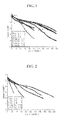
- Lithium secondary batteries (Capacity: 5.5 mAh) prepared in Examples 2-1 to 2-3 and Comparative Examples 2-1 to 2-4 were charged at 55°C with a constant current of 0.7 C up to 4.35 V and then with a constant voltage of 4.35 V, and the charging process was completed when the charging current reached 0.275 mA. After left for 10 minutes, the batteries were discharged with a constant current of 0.5 C up to 3.0 V. The charging/discharging was repeated 200 times under the same conditions, and then the capacity of the batteries were measured and shown in FIG. 1 .
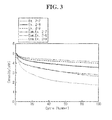
- Lithium secondary batteries (Capacity: 5.5 mAh) prepared in Examples 2-4 to 2-6 and Comparative Examples 2-5 and 2-6 were charged at 55°C with a constant current of 0.7 C up to 4.35 V and then with a constant voltage of 4.35 V, and the charging process was completed when the charging current reached 0.275 mA. After left for 10 minutes, the batteries were discharged with a constant current of 0.5 C up to 3.0 V. The charging/discharging was repeated 200 times under the same conditions, and then the capacity of the batteries were measured and shown in FIG. 2 .
- the unit "C” which is used herein refers to a charging/discharging current rate (C-rate) of a battery, represented by ampere (A), and is usually expressed by a percentage of the battery capacity. Accordingly, "1C" of the batteries prepared above means a current of 5.5 mA.
- Lithium secondary batteries (Capacity: 5.0 mAh) prepared in Examples 2-7 to 2-9 and Comparative Examples 2-7 to 2-9 were charged at 55°C with a constant current of 0.5 C up to 4.35 V and then with a constant voltage of 4.35 V, and the charging process was completed when the charging current reached 0.25 mA. After left for 10 minutes, the batteries were discharged with a constant current of 1.0 C up to 2.5 V. The charging/discharging was repeated 100 times under the same conditions, and then the capacity of the batteries were measured and shown in FIG. 3 .
- lithium secondary batteries having the electrolyte solution comprising an ester-based compound having a branched-chain alkyl group together with an ester-based compound having a straight-chain alkyl group exhibit superior life characteristics at a high temperature, as compared to lithium secondary batteries having the electrolyte solution comprising an ester-based compound having only one of a branched-chain alkyl group and a straight-chain alkyl group.
- lithium secondary batteries having the electrolyte solution comprising an ester-based compound having a branched-chain alkyl group together with an ester-based compound having a straight-chain alkyl group exhibit superior life characteristics at a high temperature, as compared to lithium secondary batteries having the electrolyte solution comprising an ester-based compound having only one of a branched-chain alkyl group and a straight-chain alkyl group or the electrolyte solution comprising an ester-based compound having a branched-chain alkyl group and an ester-based compound having a straight-chain alkyl group which fail to satisfy the amount range defined in the present invention.
Landscapes
- Chemical & Material Sciences (AREA)
- Engineering & Computer Science (AREA)
- Chemical Kinetics & Catalysis (AREA)
- Electrochemistry (AREA)
- General Chemical & Material Sciences (AREA)
- Manufacturing & Machinery (AREA)
- Inorganic Chemistry (AREA)
- Materials Engineering (AREA)
- Condensed Matter Physics & Semiconductors (AREA)
- General Physics & Mathematics (AREA)
- Physics & Mathematics (AREA)
- Secondary Cells (AREA)
- Battery Electrode And Active Subsutance (AREA)
Applications Claiming Priority (3)
| Application Number | Priority Date | Filing Date | Title |
|---|---|---|---|
| KR20110069838 | 2011-07-14 | ||
| PCT/KR2012/005656 WO2013009155A2 (fr) | 2011-07-14 | 2012-07-16 | Électrolyte non aqueux et batterie secondaire au lithium l'utilisant |
| KR1020120077045A KR101387603B1 (ko) | 2011-07-14 | 2012-07-16 | 비수 전해액 및 이를 이용한 리튬 이차전지 |
Publications (3)
| Publication Number | Publication Date |
|---|---|
| EP2733780A2 true EP2733780A2 (fr) | 2014-05-21 |
| EP2733780A4 EP2733780A4 (fr) | 2015-01-14 |
| EP2733780B1 EP2733780B1 (fr) | 2017-08-30 |
Family
ID=47839360
Family Applications (1)
| Application Number | Title | Priority Date | Filing Date |
|---|---|---|---|
| EP12811452.7A Active EP2733780B1 (fr) | 2011-07-14 | 2012-07-16 | Électrolyte non aqueux et batterie secondaire au lithium l'utilisant |
Country Status (7)
| Country | Link |
|---|---|
| US (2) | US9325035B2 (fr) |
| EP (1) | EP2733780B1 (fr) |
| JP (1) | JP5687804B2 (fr) |
| KR (1) | KR101387603B1 (fr) |
| CN (1) | CN103688402B (fr) |
| TW (1) | TWI464932B (fr) |
| WO (1) | WO2013009155A2 (fr) |
Families Citing this family (9)
| Publication number | Priority date | Publication date | Assignee | Title |
|---|---|---|---|---|
| KR101563585B1 (ko) | 2014-03-31 | 2015-10-28 | 한국과학기술연구원 | 자발공정을 이용하는 그래핀의 제조방법 |
| KR20170057349A (ko) * | 2014-09-19 | 2017-05-24 | 쓰리엠 이노베이티브 프로퍼티즈 컴파니 | 재충전식 배터리용 전해질 용액 |
| WO2016052996A1 (fr) * | 2014-09-30 | 2016-04-07 | 주식회사 엘지화학 | Batterie rechargeable au lithium comprenant un électrolyte non aqueux |
| KR101764266B1 (ko) | 2014-12-02 | 2017-08-04 | 주식회사 엘지화학 | 저온 성능이 향상된 리튬 이차전지용 전해액 및 이를 포함하는 리튬 이차전지 |
| EP3279998B8 (fr) * | 2015-03-31 | 2022-02-16 | LG Energy Solution Ltd. | Électrolyte non aqueux et batterie secondaire au lithium le comprenant |
| KR102553591B1 (ko) * | 2017-06-12 | 2023-07-11 | 삼성전자주식회사 | 포스페이트계 첨가제를 포함하는 리튬이차전지 |
| WO2023225897A1 (fr) * | 2022-05-25 | 2023-11-30 | 宁德新能源科技有限公司 | Dispositif électrochimique et dispositif électronique le comprenant |
| JP2025534112A (ja) * | 2022-11-04 | 2025-10-09 | エルジー エナジー ソリューション リミテッド | リチウム二次電池 |
| CN120113084B (zh) * | 2022-11-04 | 2026-04-07 | 株式会社Lg新能源 | 锂二次电池 |
Family Cites Families (18)
| Publication number | Priority date | Publication date | Assignee | Title |
|---|---|---|---|---|
| JPH0714610A (ja) * | 1993-06-28 | 1995-01-17 | Fuji Photo Film Co Ltd | 非水二次電池 |
| JPH08162152A (ja) * | 1994-12-02 | 1996-06-21 | Shin Kobe Electric Mach Co Ltd | リチウム二次電池 |
| JPH09147910A (ja) * | 1995-11-22 | 1997-06-06 | Sanyo Electric Co Ltd | リチウム二次電池 |
| CN1167165C (zh) * | 2000-04-11 | 2004-09-15 | 松下电器产业株式会社 | 非水电解质二次电池及其制造方法 |
| KR100756812B1 (ko) * | 2000-07-17 | 2007-09-07 | 마츠시타 덴끼 산교 가부시키가이샤 | 비수 전기화학 장치 |
| JP4333009B2 (ja) * | 2000-08-24 | 2009-09-16 | 宇部興産株式会社 | 非水電解液およびそれを用いたリチウム電池 |
| US7172834B1 (en) * | 2002-07-29 | 2007-02-06 | The United States Of America As Represented By The Secretary Of The Army | Additive for enhancing the performance of electrochemical cells |
| JP4946437B2 (ja) * | 2004-05-28 | 2012-06-06 | 宇部興産株式会社 | 非水電解液およびそれを用いたリチウム二次電池 |
| JP5235437B2 (ja) * | 2007-02-20 | 2013-07-10 | 三洋電機株式会社 | 二次電池用非水電解液及び非水電解液二次電池 |
| US20100266905A1 (en) | 2007-09-19 | 2010-10-21 | Lg Chem, Ltd. | Non-aqueous electrolyte lithium secondary battery |
| US20090081556A1 (en) * | 2007-09-26 | 2009-03-26 | Sanyo Electric Co., Ltd. | Non-aqueous electrolyte secondary battery |
| JP2009099536A (ja) * | 2007-09-26 | 2009-05-07 | Sanyo Electric Co Ltd | 非水電解質二次電池 |
| JP5338151B2 (ja) * | 2008-06-16 | 2013-11-13 | 三菱化学株式会社 | 非水系電解液及び非水系電解液電池 |
| KR100995413B1 (ko) * | 2008-08-01 | 2010-11-18 | 삼성에스디아이 주식회사 | 리튬 이온 이차 전지용 전해액 및 이를 포함하는 리튬 이온이차 전지 |
| JP2010056076A (ja) * | 2008-08-01 | 2010-03-11 | Sanyo Electric Co Ltd | 非水電解質二次電池 |
| JP5886870B2 (ja) * | 2010-12-15 | 2016-03-16 | ダウ グローバル テクノロジーズ エルエルシー | 所定のエステルベースの溶媒を含有する電解質溶液および当該電解質溶液を含有する電池 |
| US20120231325A1 (en) * | 2011-03-10 | 2012-09-13 | Su-Jin Yoon | Electrolyte for a lithium rechargeable battery, lithium rechargeable battery including the same, and method of manufacturing a lithium rechargeable battery |
| EP2720307B1 (fr) * | 2011-06-08 | 2020-04-01 | LG Chem, Ltd. | Électrolyte non-aqueux et batterie secondaire au lithium l'utilisant |
-
2012
- 2012-07-16 KR KR1020120077045A patent/KR101387603B1/ko active Active
- 2012-07-16 JP JP2014520143A patent/JP5687804B2/ja active Active
- 2012-07-16 TW TW101125730A patent/TWI464932B/zh active
- 2012-07-16 EP EP12811452.7A patent/EP2733780B1/fr active Active
- 2012-07-16 WO PCT/KR2012/005656 patent/WO2013009155A2/fr not_active Ceased
- 2012-07-16 CN CN201280034942.0A patent/CN103688402B/zh active Active
-
2013
- 2013-07-03 US US13/934,523 patent/US9325035B2/en active Active
-
2014
- 2014-12-02 US US14/557,726 patent/US20150086878A1/en not_active Abandoned
Also Published As
| Publication number | Publication date |
|---|---|
| JP2014523096A (ja) | 2014-09-08 |
| KR101387603B1 (ko) | 2014-04-21 |
| CN103688402B (zh) | 2016-05-11 |
| EP2733780A4 (fr) | 2015-01-14 |
| EP2733780B1 (fr) | 2017-08-30 |
| US9325035B2 (en) | 2016-04-26 |
| WO2013009155A3 (fr) | 2013-04-04 |
| TWI464932B (zh) | 2014-12-11 |
| JP5687804B2 (ja) | 2015-03-25 |
| US20130295468A1 (en) | 2013-11-07 |
| CN103688402A (zh) | 2014-03-26 |
| WO2013009155A2 (fr) | 2013-01-17 |
| KR20130009706A (ko) | 2013-01-23 |
| US20150086878A1 (en) | 2015-03-26 |
| TW201318245A (zh) | 2013-05-01 |
Similar Documents
| Publication | Publication Date | Title |
|---|---|---|
| EP2736112B1 (fr) | Électrolyte non aqueux et batterie secondaire au lithium l'utilisant | |
| EP2541663B1 (fr) | Noyau de coulée métallique profilé | |
| EP2212964B1 (fr) | Batterie secondaire au lithium à électrolyte non aqueux | |
| EP2720307B1 (fr) | Électrolyte non-aqueux et batterie secondaire au lithium l'utilisant | |
| EP2736113B1 (fr) | Batterie secondaire au lithium | |
| US9742004B2 (en) | Cathode additives for lithium secondary battery with high capacity | |
| US10193182B2 (en) | Non-aqueous electrolyte and lithium secondary battery comprising same | |
| EP2206189B1 (fr) | Batterie secondaire au lithium à électrolyte non aqueux | |
| US9325035B2 (en) | Non-aqueous electrolyte and lithium secondary battery using the same | |
| WO2008153347A1 (fr) | Electrolyte non aqueux et dispositif électrochimique le possédant | |
| KR20180083274A (ko) | 비수전해액 및 이를 포함하는 리튬 이차전지 | |
| KR20180086141A (ko) | 리튬 이차전지용 비수 전해액 및 이를 포함하는 리튬 이차전지 | |
| KR20180041602A (ko) | 리튬 이차전지용 전해액 및 이를 포함하는 리튬 이차전지 |
Legal Events
| Date | Code | Title | Description |
|---|---|---|---|
| PUAI | Public reference made under article 153(3) epc to a published international application that has entered the european phase |
Free format text: ORIGINAL CODE: 0009012 |
|
| 17P | Request for examination filed |
Effective date: 20131220 |
|
| AK | Designated contracting states |
Kind code of ref document: A2 Designated state(s): AL AT BE BG CH CY CZ DE DK EE ES FI FR GB GR HR HU IE IS IT LI LT LU LV MC MK MT NL NO PL PT RO RS SE SI SK SM TR |
|
| DAX | Request for extension of the european patent (deleted) | ||
| A4 | Supplementary search report drawn up and despatched |
Effective date: 20141216 |
|
| RIC1 | Information provided on ipc code assigned before grant |
Ipc: H01M 10/0569 20100101AFI20141210BHEP Ipc: H01M 10/052 20100101ALI20141210BHEP |
|
| 17Q | First examination report despatched |
Effective date: 20160921 |
|
| REG | Reference to a national code |
Ref country code: DE Ref legal event code: R079 Ref document number: 602012036711 Country of ref document: DE Free format text: PREVIOUS MAIN CLASS: H01M0010056700 Ipc: H01M0010056900 |
|
| RIC1 | Information provided on ipc code assigned before grant |
Ipc: H01M 10/0569 20100101AFI20170412BHEP Ipc: H01M 10/052 20100101ALI20170412BHEP |
|
| GRAP | Despatch of communication of intention to grant a patent |
Free format text: ORIGINAL CODE: EPIDOSNIGR1 |
|
| INTG | Intention to grant announced |
Effective date: 20170522 |
|
| GRAS | Grant fee paid |
Free format text: ORIGINAL CODE: EPIDOSNIGR3 |
|
| GRAA | (expected) grant |
Free format text: ORIGINAL CODE: 0009210 |
|
| AK | Designated contracting states |
Kind code of ref document: B1 Designated state(s): AL AT BE BG CH CY CZ DE DK EE ES FI FR GB GR HR HU IE IS IT LI LT LU LV MC MK MT NL NO PL PT RO RS SE SI SK SM TR |
|
| REG | Reference to a national code |
Ref country code: GB Ref legal event code: FG4D |
|
| REG | Reference to a national code |
Ref country code: CH Ref legal event code: EP |
|
| REG | Reference to a national code |
Ref country code: AT Ref legal event code: REF Ref document number: 924450 Country of ref document: AT Kind code of ref document: T Effective date: 20170915 |
|
| REG | Reference to a national code |
Ref country code: IE Ref legal event code: FG4D |
|
| REG | Reference to a national code |
Ref country code: DE Ref legal event code: R096 Ref document number: 602012036711 Country of ref document: DE |
|
| REG | Reference to a national code |
Ref country code: NL Ref legal event code: MP Effective date: 20170830 |
|
| REG | Reference to a national code |
Ref country code: LT Ref legal event code: MG4D |
|
| REG | Reference to a national code |
Ref country code: AT Ref legal event code: MK05 Ref document number: 924450 Country of ref document: AT Kind code of ref document: T Effective date: 20170830 |
|
| PG25 | Lapsed in a contracting state [announced via postgrant information from national office to epo] |
Ref country code: SE Free format text: LAPSE BECAUSE OF FAILURE TO SUBMIT A TRANSLATION OF THE DESCRIPTION OR TO PAY THE FEE WITHIN THE PRESCRIBED TIME-LIMIT Effective date: 20170830 Ref country code: LT Free format text: LAPSE BECAUSE OF FAILURE TO SUBMIT A TRANSLATION OF THE DESCRIPTION OR TO PAY THE FEE WITHIN THE PRESCRIBED TIME-LIMIT Effective date: 20170830 Ref country code: AT Free format text: LAPSE BECAUSE OF FAILURE TO SUBMIT A TRANSLATION OF THE DESCRIPTION OR TO PAY THE FEE WITHIN THE PRESCRIBED TIME-LIMIT Effective date: 20170830 Ref country code: FI Free format text: LAPSE BECAUSE OF FAILURE TO SUBMIT A TRANSLATION OF THE DESCRIPTION OR TO PAY THE FEE WITHIN THE PRESCRIBED TIME-LIMIT Effective date: 20170830 Ref country code: NO Free format text: LAPSE BECAUSE OF FAILURE TO SUBMIT A TRANSLATION OF THE DESCRIPTION OR TO PAY THE FEE WITHIN THE PRESCRIBED TIME-LIMIT Effective date: 20171130 Ref country code: HR Free format text: LAPSE BECAUSE OF FAILURE TO SUBMIT A TRANSLATION OF THE DESCRIPTION OR TO PAY THE FEE WITHIN THE PRESCRIBED TIME-LIMIT Effective date: 20170830 |
|
| PG25 | Lapsed in a contracting state [announced via postgrant information from national office to epo] |
Ref country code: BG Free format text: LAPSE BECAUSE OF FAILURE TO SUBMIT A TRANSLATION OF THE DESCRIPTION OR TO PAY THE FEE WITHIN THE PRESCRIBED TIME-LIMIT Effective date: 20171130 Ref country code: LV Free format text: LAPSE BECAUSE OF FAILURE TO SUBMIT A TRANSLATION OF THE DESCRIPTION OR TO PAY THE FEE WITHIN THE PRESCRIBED TIME-LIMIT Effective date: 20170830 Ref country code: GR Free format text: LAPSE BECAUSE OF FAILURE TO SUBMIT A TRANSLATION OF THE DESCRIPTION OR TO PAY THE FEE WITHIN THE PRESCRIBED TIME-LIMIT Effective date: 20171201 Ref country code: RS Free format text: LAPSE BECAUSE OF FAILURE TO SUBMIT A TRANSLATION OF THE DESCRIPTION OR TO PAY THE FEE WITHIN THE PRESCRIBED TIME-LIMIT Effective date: 20170830 Ref country code: ES Free format text: LAPSE BECAUSE OF FAILURE TO SUBMIT A TRANSLATION OF THE DESCRIPTION OR TO PAY THE FEE WITHIN THE PRESCRIBED TIME-LIMIT Effective date: 20170830 Ref country code: IS Free format text: LAPSE BECAUSE OF FAILURE TO SUBMIT A TRANSLATION OF THE DESCRIPTION OR TO PAY THE FEE WITHIN THE PRESCRIBED TIME-LIMIT Effective date: 20171230 |
|
| PG25 | Lapsed in a contracting state [announced via postgrant information from national office to epo] |
Ref country code: NL Free format text: LAPSE BECAUSE OF FAILURE TO SUBMIT A TRANSLATION OF THE DESCRIPTION OR TO PAY THE FEE WITHIN THE PRESCRIBED TIME-LIMIT Effective date: 20170830 |
|
| PG25 | Lapsed in a contracting state [announced via postgrant information from national office to epo] |
Ref country code: CZ Free format text: LAPSE BECAUSE OF FAILURE TO SUBMIT A TRANSLATION OF THE DESCRIPTION OR TO PAY THE FEE WITHIN THE PRESCRIBED TIME-LIMIT Effective date: 20170830 Ref country code: PL Free format text: LAPSE BECAUSE OF FAILURE TO SUBMIT A TRANSLATION OF THE DESCRIPTION OR TO PAY THE FEE WITHIN THE PRESCRIBED TIME-LIMIT Effective date: 20170830 Ref country code: DK Free format text: LAPSE BECAUSE OF FAILURE TO SUBMIT A TRANSLATION OF THE DESCRIPTION OR TO PAY THE FEE WITHIN THE PRESCRIBED TIME-LIMIT Effective date: 20170830 Ref country code: RO Free format text: LAPSE BECAUSE OF FAILURE TO SUBMIT A TRANSLATION OF THE DESCRIPTION OR TO PAY THE FEE WITHIN THE PRESCRIBED TIME-LIMIT Effective date: 20170830 |
|
| PG25 | Lapsed in a contracting state [announced via postgrant information from national office to epo] |
Ref country code: IT Free format text: LAPSE BECAUSE OF FAILURE TO SUBMIT A TRANSLATION OF THE DESCRIPTION OR TO PAY THE FEE WITHIN THE PRESCRIBED TIME-LIMIT Effective date: 20170830 Ref country code: SK Free format text: LAPSE BECAUSE OF FAILURE TO SUBMIT A TRANSLATION OF THE DESCRIPTION OR TO PAY THE FEE WITHIN THE PRESCRIBED TIME-LIMIT Effective date: 20170830 Ref country code: SM Free format text: LAPSE BECAUSE OF FAILURE TO SUBMIT A TRANSLATION OF THE DESCRIPTION OR TO PAY THE FEE WITHIN THE PRESCRIBED TIME-LIMIT Effective date: 20170830 Ref country code: EE Free format text: LAPSE BECAUSE OF FAILURE TO SUBMIT A TRANSLATION OF THE DESCRIPTION OR TO PAY THE FEE WITHIN THE PRESCRIBED TIME-LIMIT Effective date: 20170830 |
|
| REG | Reference to a national code |
Ref country code: DE Ref legal event code: R097 Ref document number: 602012036711 Country of ref document: DE |
|
| REG | Reference to a national code |
Ref country code: FR Ref legal event code: PLFP Year of fee payment: 7 |
|
| PLBE | No opposition filed within time limit |
Free format text: ORIGINAL CODE: 0009261 |
|
| STAA | Information on the status of an ep patent application or granted ep patent |
Free format text: STATUS: NO OPPOSITION FILED WITHIN TIME LIMIT |
|
| 26N | No opposition filed |
Effective date: 20180531 |
|
| PG25 | Lapsed in a contracting state [announced via postgrant information from national office to epo] |
Ref country code: SI Free format text: LAPSE BECAUSE OF FAILURE TO SUBMIT A TRANSLATION OF THE DESCRIPTION OR TO PAY THE FEE WITHIN THE PRESCRIBED TIME-LIMIT Effective date: 20170830 |
|
| REG | Reference to a national code |
Ref country code: CH Ref legal event code: PL |
|
| PG25 | Lapsed in a contracting state [announced via postgrant information from national office to epo] |
Ref country code: LU Free format text: LAPSE BECAUSE OF NON-PAYMENT OF DUE FEES Effective date: 20180716 Ref country code: MC Free format text: LAPSE BECAUSE OF FAILURE TO SUBMIT A TRANSLATION OF THE DESCRIPTION OR TO PAY THE FEE WITHIN THE PRESCRIBED TIME-LIMIT Effective date: 20170830 |
|
| REG | Reference to a national code |
Ref country code: BE Ref legal event code: MM Effective date: 20180731 |
|
| REG | Reference to a national code |
Ref country code: IE Ref legal event code: MM4A |
|
| PG25 | Lapsed in a contracting state [announced via postgrant information from national office to epo] |
Ref country code: CH Free format text: LAPSE BECAUSE OF NON-PAYMENT OF DUE FEES Effective date: 20180731 Ref country code: LI Free format text: LAPSE BECAUSE OF NON-PAYMENT OF DUE FEES Effective date: 20180731 Ref country code: IE Free format text: LAPSE BECAUSE OF NON-PAYMENT OF DUE FEES Effective date: 20180716 |
|
| PG25 | Lapsed in a contracting state [announced via postgrant information from national office to epo] |
Ref country code: BE Free format text: LAPSE BECAUSE OF NON-PAYMENT OF DUE FEES Effective date: 20180731 |
|
| PG25 | Lapsed in a contracting state [announced via postgrant information from national office to epo] |
Ref country code: MT Free format text: LAPSE BECAUSE OF NON-PAYMENT OF DUE FEES Effective date: 20180716 |
|
| PG25 | Lapsed in a contracting state [announced via postgrant information from national office to epo] |
Ref country code: TR Free format text: LAPSE BECAUSE OF FAILURE TO SUBMIT A TRANSLATION OF THE DESCRIPTION OR TO PAY THE FEE WITHIN THE PRESCRIBED TIME-LIMIT Effective date: 20170830 |
|
| PG25 | Lapsed in a contracting state [announced via postgrant information from national office to epo] |
Ref country code: PT Free format text: LAPSE BECAUSE OF FAILURE TO SUBMIT A TRANSLATION OF THE DESCRIPTION OR TO PAY THE FEE WITHIN THE PRESCRIBED TIME-LIMIT Effective date: 20170830 Ref country code: HU Free format text: LAPSE BECAUSE OF FAILURE TO SUBMIT A TRANSLATION OF THE DESCRIPTION OR TO PAY THE FEE WITHIN THE PRESCRIBED TIME-LIMIT; INVALID AB INITIO Effective date: 20120716 |
|
| PG25 | Lapsed in a contracting state [announced via postgrant information from national office to epo] |
Ref country code: CY Free format text: LAPSE BECAUSE OF FAILURE TO SUBMIT A TRANSLATION OF THE DESCRIPTION OR TO PAY THE FEE WITHIN THE PRESCRIBED TIME-LIMIT Effective date: 20170830 Ref country code: MK Free format text: LAPSE BECAUSE OF NON-PAYMENT OF DUE FEES Effective date: 20170830 |
|
| PG25 | Lapsed in a contracting state [announced via postgrant information from national office to epo] |
Ref country code: AL Free format text: LAPSE BECAUSE OF FAILURE TO SUBMIT A TRANSLATION OF THE DESCRIPTION OR TO PAY THE FEE WITHIN THE PRESCRIBED TIME-LIMIT Effective date: 20170830 |
|
| REG | Reference to a national code |
Ref country code: DE Ref legal event code: R081 Ref document number: 602012036711 Country of ref document: DE Owner name: LG ENERGY SOLUTION LTD., KR Free format text: FORMER OWNER: LG CHEM, LTD., SEOUL, KR Ref country code: DE Ref legal event code: R081 Ref document number: 602012036711 Country of ref document: DE Owner name: LG ENERGY SOLUTION, LTD., KR Free format text: FORMER OWNER: LG CHEM, LTD., SEOUL, KR |
|
| P01 | Opt-out of the competence of the unified patent court (upc) registered |
Effective date: 20230323 |
|
| REG | Reference to a national code |
Ref country code: GB Ref legal event code: 732E Free format text: REGISTERED BETWEEN 20230824 AND 20230831 |
|
| REG | Reference to a national code |
Ref country code: DE Ref legal event code: R081 Ref document number: 602012036711 Country of ref document: DE Owner name: LG ENERGY SOLUTION, LTD., KR Free format text: FORMER OWNER: LG ENERGY SOLUTION LTD., SEOUL, KR |
|
| PGFP | Annual fee paid to national office [announced via postgrant information from national office to epo] |
Ref country code: GB Payment date: 20250624 Year of fee payment: 14 |
|
| PGFP | Annual fee paid to national office [announced via postgrant information from national office to epo] |
Ref country code: FR Payment date: 20250624 Year of fee payment: 14 |
|
| PGFP | Annual fee paid to national office [announced via postgrant information from national office to epo] |
Ref country code: DE Payment date: 20250624 Year of fee payment: 14 |