EP2749663B1 - Acier résistant à la chaleur pour soupapes d'échappement - Google Patents
Acier résistant à la chaleur pour soupapes d'échappement Download PDFInfo
- Publication number
- EP2749663B1 EP2749663B1 EP12825948.8A EP12825948A EP2749663B1 EP 2749663 B1 EP2749663 B1 EP 2749663B1 EP 12825948 A EP12825948 A EP 12825948A EP 2749663 B1 EP2749663 B1 EP 2749663B1
- Authority
- EP
- European Patent Office
- Prior art keywords
- mass
- content
- heat
- exhaust valves
- comparative example
- Prior art date
- Legal status (The legal status is an assumption and is not a legal conclusion. Google has not performed a legal analysis and makes no representation as to the accuracy of the status listed.)
- Active
Links
Images

Classifications
-
- C—CHEMISTRY; METALLURGY
- C22—METALLURGY; FERROUS OR NON-FERROUS ALLOYS; TREATMENT OF ALLOYS OR NON-FERROUS METALS
- C22C—ALLOYS
- C22C38/00—Ferrous alloys, e.g. steel alloys
- C22C38/18—Ferrous alloys, e.g. steel alloys containing chromium
- C22C38/40—Ferrous alloys, e.g. steel alloys containing chromium with nickel
- C22C38/58—Ferrous alloys, e.g. steel alloys containing chromium with nickel with more than 1.5% by weight of manganese
-
- C—CHEMISTRY; METALLURGY
- C21—METALLURGY OF IRON
- C21D—MODIFYING THE PHYSICAL STRUCTURE OF FERROUS METALS; GENERAL DEVICES FOR HEAT TREATMENT OF FERROUS OR NON-FERROUS METALS OR ALLOYS; MAKING METAL MALLEABLE, e.g. BY DECARBURISATION OR TEMPERING
- C21D6/00—Heat treatment of ferrous alloys
- C21D6/004—Heat treatment of ferrous alloys containing Cr and Ni
-
- C—CHEMISTRY; METALLURGY
- C21—METALLURGY OF IRON
- C21D—MODIFYING THE PHYSICAL STRUCTURE OF FERROUS METALS; GENERAL DEVICES FOR HEAT TREATMENT OF FERROUS OR NON-FERROUS METALS OR ALLOYS; MAKING METAL MALLEABLE, e.g. BY DECARBURISATION OR TEMPERING
- C21D9/00—Heat treatment, e.g. annealing, hardening, quenching or tempering, adapted for particular articles; Furnaces therefor
- C21D9/0068—Heat treatment, e.g. annealing, hardening, quenching or tempering, adapted for particular articles; Furnaces therefor for particular articles not mentioned below
-
- C—CHEMISTRY; METALLURGY
- C22—METALLURGY; FERROUS OR NON-FERROUS ALLOYS; TREATMENT OF ALLOYS OR NON-FERROUS METALS
- C22C—ALLOYS
- C22C38/00—Ferrous alloys, e.g. steel alloys
- C22C38/001—Ferrous alloys, e.g. steel alloys containing N
-
- C—CHEMISTRY; METALLURGY
- C22—METALLURGY; FERROUS OR NON-FERROUS ALLOYS; TREATMENT OF ALLOYS OR NON-FERROUS METALS
- C22C—ALLOYS
- C22C38/00—Ferrous alloys, e.g. steel alloys
- C22C38/002—Ferrous alloys, e.g. steel alloys containing In, Mg, or other elements not provided for in one single group C22C38/001 - C22C38/60
-
- C—CHEMISTRY; METALLURGY
- C22—METALLURGY; FERROUS OR NON-FERROUS ALLOYS; TREATMENT OF ALLOYS OR NON-FERROUS METALS
- C22C—ALLOYS
- C22C38/00—Ferrous alloys, e.g. steel alloys
- C22C38/02—Ferrous alloys, e.g. steel alloys containing silicon
-
- C—CHEMISTRY; METALLURGY
- C22—METALLURGY; FERROUS OR NON-FERROUS ALLOYS; TREATMENT OF ALLOYS OR NON-FERROUS METALS
- C22C—ALLOYS
- C22C38/00—Ferrous alloys, e.g. steel alloys
- C22C38/06—Ferrous alloys, e.g. steel alloys containing aluminium
-
- C—CHEMISTRY; METALLURGY
- C22—METALLURGY; FERROUS OR NON-FERROUS ALLOYS; TREATMENT OF ALLOYS OR NON-FERROUS METALS
- C22C—ALLOYS
- C22C38/00—Ferrous alloys, e.g. steel alloys
- C22C38/18—Ferrous alloys, e.g. steel alloys containing chromium
- C22C38/40—Ferrous alloys, e.g. steel alloys containing chromium with nickel
- C22C38/44—Ferrous alloys, e.g. steel alloys containing chromium with nickel with molybdenum or tungsten
-
- C—CHEMISTRY; METALLURGY
- C22—METALLURGY; FERROUS OR NON-FERROUS ALLOYS; TREATMENT OF ALLOYS OR NON-FERROUS METALS
- C22C—ALLOYS
- C22C38/00—Ferrous alloys, e.g. steel alloys
- C22C38/18—Ferrous alloys, e.g. steel alloys containing chromium
- C22C38/40—Ferrous alloys, e.g. steel alloys containing chromium with nickel
- C22C38/48—Ferrous alloys, e.g. steel alloys containing chromium with nickel with niobium or tantalum
-
- C—CHEMISTRY; METALLURGY
- C22—METALLURGY; FERROUS OR NON-FERROUS ALLOYS; TREATMENT OF ALLOYS OR NON-FERROUS METALS
- C22C—ALLOYS
- C22C38/00—Ferrous alloys, e.g. steel alloys
- C22C38/18—Ferrous alloys, e.g. steel alloys containing chromium
- C22C38/40—Ferrous alloys, e.g. steel alloys containing chromium with nickel
- C22C38/50—Ferrous alloys, e.g. steel alloys containing chromium with nickel with titanium or zirconium
-
- C—CHEMISTRY; METALLURGY
- C22—METALLURGY; FERROUS OR NON-FERROUS ALLOYS; TREATMENT OF ALLOYS OR NON-FERROUS METALS
- C22C—ALLOYS
- C22C38/00—Ferrous alloys, e.g. steel alloys
- C22C38/18—Ferrous alloys, e.g. steel alloys containing chromium
- C22C38/40—Ferrous alloys, e.g. steel alloys containing chromium with nickel
- C22C38/54—Ferrous alloys, e.g. steel alloys containing chromium with nickel with boron
-
- F—MECHANICAL ENGINEERING; LIGHTING; HEATING; WEAPONS; BLASTING
- F01—MACHINES OR ENGINES IN GENERAL; ENGINE PLANTS IN GENERAL; STEAM ENGINES
- F01L—CYCLICALLY OPERATING VALVES FOR MACHINES OR ENGINES
- F01L3/00—Lift-valve, i.e. cut-off apparatus with closure members having at least a component of their opening and closing motion perpendicular to the closing faces; Parts or accessories thereof
- F01L3/02—Selecting particular materials for valve-members or valve-seats; Valve-members or valve-seats composed of two or more materials
Definitions
- the present invention relates to a heat-resistant steel for exhaust valves.
- An intake valve for introducing mixed gas of fuel and air into a cylinder and an exhaust valve for discharging combustion gas outside the cylinder are used in an engine.
- a material having high temperature characteristics for example, high temperature hardness, fatigue properties, high temperature strength, wear resistance and oxidation resistance
- Ni-based superalloy for example, NCF751
- austenitic heat-resistant steel for example, SUH35
- Ni-based superalloy is a material in which ⁇ ' phase has been precipitated by aging treatment, thereby enhancing strength at high temperature and wear resistance.
- the Ni-based superalloy is expensive, but has extremely high heat resistance. For this reason, a valve using this is mainly used in high output engines that are exposed to a temperature of 800°C or higher.
- the austenitic heat-resistant steel is a material in which M 23 C 6 type carbide has been precipitated, thereby enhancing strength at high temperature and wear resistance.
- the austenitic heat-resistant steel is poor in high temperature characteristics as compared with the Ni-based superalloy, but is inexpensive. For this reason, a valve using this is mainly used in engines that do not require high heat resistance.
- Patent Document 1 discloses a heat-resistant alloy for exhaust valves, containing, by weight%, C:0.01 to 0.2%, Si: 1% or less, Mn: 1% or less, Ni: 30 to 62%, Cr: 13 to 20%, W: 0.01 to 3.0%, Al: 0.7% or more and less than 1.6%, Ti: 1.5 to 3.0%, B: 0.001 to 0.01%, P: 0.02% or less, and S: 0.01% or less, with the balance being Fe and unavoidable impurities.
- Patent Document 2 discloses an Fe-Cr-Ni heat-resistant alloy containing, by weight%, C:0.01 to 0.10%, Si: 2% or less, Mn: 2% or less, Cr: 14 to 18%, Nb+Ta: 0.5 to 1.5%, Ti: 2.0 to 3.0%, Al: 0.8 to 1.5%, Ni: 30 to 35%, B:0.001 to 0.01%, Cu: 0.5% or less, P: 0.02% or less, S: 0.01% or less, O: 0.01% or less, and N:0.01% or less, with the balance being Fe and unavoidable impurities, and the alloy having a given component balance.
- Patent Document 3 discloses a method for producing an automobile engine valve, comprising subjecting an Fe-based heat-resistant steel having a composition of Fe-0.53% C-0.2% Si-9.2% Mn-3.9% Ni-21.5% Cr-0.43% N to solution heat treatment at from 1,100 to 1,180°C, forging a valve head part at from 700 to 1,000°C, and subjecting to aging treatment.
- This Patent Document describes that when the Fe-based heat-resistant steel having a given composition is subjected to solution heat treatment, forging and aging treatment under given conditions, a valve face part can be made to have hardness of HV 400 or more.
- Ni-based superalloy has large Ni content
- raw material cost and production cost of an exhaust valve made of an Ni-based superalloy greatly receive the influence of Ni price. For this reason, a material in which an amount of Ni is further reduced and fluctuation width of raw material cost is decreased is desired.
- Ni is a forming element of ⁇ ' phase that is a strengthening phase. Therefore, further reduction in the amount of Ni makes high strengthening utilizing ⁇ ' phase difficult.
- a carbide precipitation type austenitic heat-resistant steel is difficult to receive the influence of Ni price, but has a problem that high temperature characteristics are poor as compared with a ⁇ ' phase precipitation type Ni-based superalloy.
- a material obtained by highly strengthening SUH35 for example, overseas standard LV21-43 steel (SUH35+1W, 2Nb)
- SUH35+1W, 2Nb overseas standard LV21-43 steel
- the LV21-43 steel still has the problems such that structure is difficult to control and hot workability is poor.
- An object to be attained by the present invention is to provide a heat-resistant steel for exhaust valves, having relatively small Ni content, high mechanical characteristics (for example, tensile strength, fatigue strength, wear resistance and hardness) at high temperature, and excellent oxidation resistance.
- the heat-resistant steel for exhaust valves satisfies 5.2 ⁇ Mo/C ⁇ 8.0.
- the heat-resistant steel for exhaust valves according to the present invention contains the following elements, with the balance being Fe and unavoidable impurities.
- Kinds of elements added, its component range and the reason for limitation thereof are as follows.
- C is an austenite stabilizing element, and suppresses the formation of sigma phase and Laves phase that are harmful phases. Moreover, C preferentially bonds to Nb to form MC type carbide.
- the MC type carbide suppresses grain coarsening during solution heat treatment and improves strength characteristics.
- NbC is stable carbide, and the presence thereof in the structure suppresses grain coarsening, resulting in the improvement in hot workability.
- the MC type carbide acts as a hard phase and improves wear resistance.
- the C content is required to be 0.45 mass% or more.
- the C content is preferably more than 0.45 mass%, and more preferably more than 0.48 mass%.
- the C content is required to be less than 0.60 mass%.
- the C content is more preferably less than 0.57 mass%.
- N is an austenite stabilizing element, and acts as a substitute element of austenite forming elements such as Ni and Mn. Moreover, N has small atomic radium, and therefore acts as an interstitial solid solution strengthening element and strengthens a matrix. Additionally, N multiply acts with a substitution type solid solution strengthening element such as Mo and W, and contributes to the improvement in strength. C and N are strong austenite forming elements and effectively act as a substitute element of expensive Ni to reduce costs. Furtheremore, N further acts to form MX type carbonitride, in place of C site of MC type carbide. To obtain such an effect, the N content is required to be more than 0.30 mass%. The N content is more preferably more than 0.33 mass%.
- the N content is required to be less than 0.50 mass%.
- the N content is more preferably less than 0.47 mass%.
- Cr has an action to form a protective oxide coating film of Cr 2 O 3 in a use temperature region of an exhaust valve. For this reason, Cr is an essential element to improve corrosion resistance and oxidation resistance. Moreover, Cr bonds to C to form Cr 23 C 6 carbide, thereby contributing to the improvement in strength characteristics. To obtain such an effect, the Cr content is required to be 19.0 mass% or more.
- Cr is a ferrite stabilizing element. Therefore, excessive N content destabilizes austenite. Furthermore, excessive addition of Cr promotes formation of sigma phase and Laves phase that are embrittlement phases, resulting in deterioration in hot workability, strength characteristics and impact characteristics. Therefore, the Cr content is required to be less than 23.0 mass%.
- Ni is added as an austenite stabilizing element.
- the Ni content is required to be 5.0 mass% or more.
- the Ni content is required to be less than 9.0 mass%.
- Mn is added as an austenite stabilizing element.
- Mn not only acts as a substitute element of expensive Ni, but has the effect of increasing solubility of N. To obtain such an effect, the Mn content is required to be 8.5 mass% or more.
- the Mn content is required to be less than 10.0 mass%.
- Mo acts as a solid solution strengthening element of a matrix ⁇ phase, and is an element effective to improve high temperature strength. To obtain such an effect, the Mo content is required to be 2.5 mass% or more.
- the Mo content is preferably more than 3.0 mass%.
- the Mo content is required to be less than 4.0 mass%.
- the Mo content is preferably less than 3.5 mass%.
- the present invention limits to Mo addition.
- Solid solution strengthening amount by solid solution strengthening elements such as Mo or W greatly depends on atomic weight. Mo has small atomic weight as compared with W, and atomic number per unit mass% is large. Therefore, solid solution strengthening amount is large. For this reason, in the case of obtaining the equivalent solid solution strengthening amount by W addition, precipitation of Laves phase becomes dominant, and the effect equivalent to Mo is not obtained. For this reason, the present invention limits to Mo addition to maximally obtain the effect of solid solution strengthening.
- Si is an effective element as a deoxidizing agent during melting and to impart oxidation resistance in high temperature range. Furthermore, Si has the effect of improving strength as a solid solution strengthening element. To obtain such an effect, the Si content is required to be more than 0.01 mass%. The Si content is preferably 0.03 mass% or more.
- the Si content is required to be less than 0.50 mass%.
- the Si content is preferably less than 0.30 mass%.
- MX type carbonitride including MC type carbide, thereinafter the same.
- the MX type carbonitride having an appropriate size and an appropriate amount suppresses grain coarsening after solution heat treatment, and is effective to improve high temperature strength characteristics and hot workability.
- the Nb content is required to be 0.01 mass% or more.
- the Nb content is required to be less than 0.30 mass%.
- the Nb content is preferably less than 0.25 mass%.
- elements for forming the MX type compound include Ti and V, other than Nb, but the present invention limits to Nb. The reason for this is as follows.
- Ti has strong bonding force to C and N and crystallizes a large amount of relatively coarse primary crystal MX carbonitride (primary carbide).
- the primary carbide of Ti is carbide having very high stability, and the primary carbide does not dissolve even by solution heat treatment. Therefore, the coarse carbonitride greatly affects deterioration in impact characteristics. Furthermore, Ti has strong bonding force to O, and therefore forms Ti oxide, thereby remarkably deteriorating oxidation resistance of a material.
- V is effective to improve strength characteristics.
- V has strong bonding force to O, and therefore forms V oxide, thereby remarkably deteriorating oxidation resistance of a material.
- the MX type carbonitride forming element is limited to Nb from the balance of strength characteristics and oxidation resistance.
- the heat-resistant steel for exhaust valves according to the present invention may further contain at least any one of the following elements, in addition to the elements described above.
- Al, Mg and Ca each can be added as a deoxidizing and desulfurizing agent when melting an alloy.
- Al, Mg and/or Ca contribute to the improvement in hot workability of an alloy.
- the total content of Al, Mg and Ca is preferably 0.0001 mass% or more.
- the total content of Mg and Ca is preferably less than 0.01 mass%.
- B and Zr are segregated in crystal grain boundary and strengthen the boundary. To obtain such an effect, the contents of B and Zr are preferably 0.0001 mass% or more.
- the B content is preferably less than 0.03 mass%.
- the Zr content is preferably less than 0.1 mass%.
- B and Zr may be added, and both B and Zr may be added.
- the heat-resistant steel for exhaust valves according to the present invention is characterized in that component elements fall within the above ranges and additionally, the following conditions are satisfied.
- Nb becomes relatively excessive to C
- Nb dominantly bonds to C and a large amount of coarse primary crystal MX carbonitride is crystallized.
- the coarse primary crystal MX carbonnitride does not completely disappear even after solution heat treatment, leading to the deterioration in impact characteristics.
- Nb/C is required to be less than 0.70.
- Mo/C Mo/C
- Mo site of M 23 C 6 type carbide is substituted with Mo in a certain proportion.
- the Mo/C ratio is required to be less than 8.9.
- the Mo/C ratio is preferably 8.0 or less.
- a method for producing the heat-resistant steel for exhaust valves according to the present invention comprises a melting and casting step, a homogenizing heat treatment step, a forging step, a solution heat treatment step and an aging step.
- the melting and casting step is a step for melting and casting raw materials added so as to have a given composition.
- a method for melting raw materials and a method for casting molten metal are not particularly limited, and various methods can be used. Melting conditions can be any conditions so long as components are homogeneous and casting-capable molten metal is obtained.
- the homogenizing heat treatment step is a step of subjecting an ingot obtained by the melting and casting step to homogenizing heat treatment step.
- the homogenizing heat treatment is conducted to homogenize components of an ingot.
- the homogenizing heat treatment conditions select optimum conditions depending on components.
- the heat treatment temperature is from 1,100 to 1,250°C.
- the heat treatment time is from 5 to 25 hours.
- the forging step is a step of plastic-deforming the ingot after the homogenizing heat treatment into a given shape.
- the forging method and forging conditions are not particularly limited, and can be any forging method and forging conditions so long as the desired shape can be efficiently produced.
- the solution heat treatment step is a step of subjecting the material obtained by the forging step to solution heat treatment.
- the solution heat treatment step is conducted to cause coarse primary crystal MX carbonitride to disappear.
- the solution heat treatment conditions select optimum conditions depending on components.
- the residual amount of primary carbide is decreased and the amount of fine carbide in grains precipitated during aging treatment is increased, as the solution heat treatment temperature is increased. Therefore, high solution heat treatment temperature is effective to improve fatigue properties.
- the solution heat treatment conditions are preferably 1,000 to 1,200°C ⁇ 20 minutes or more + water cooling or oil cooling treatment.
- the aging step is a step of subjecting the material after the solution heat treatment to aging treatment.
- the aging step is conducted to precipitate M 23 C 6 type carbide.
- the aging treatment conditions select optimum conditions depending on components. Although varying depending on components, the aging treatment conditions are preferably 700 to 850°C ⁇ 2 hours or more + air cooling treatment.
- Alloys having compositions shown in Tables 1 and 2 were melted in a high frequency induction furnace, and 50 kg of ingot was obtained.
- the molten ingot was subjected to homogenizing heat treatment at 1,180°C for 16 hours, and then subjected to forging process to obtain a bar material having a diameter of 18 mm.
- the forged bar material was subjected to solution heat treatment (ST) of 1,050°C ⁇ 30 minutes - oil cooling. Furtheremore, the material after ST was subjected to aging treatment (AG) of 750°C ⁇ 4 hours -air cooling.
- ST solution heat treatment
- AG aging treatment
- Mo/C represents “W/C”. This may be attributed to the reason that regarding solid-solution strengthening, W achieves the effect similar to Mo.
- Hardness at 800°C of the material after the aging treatment was measured under measurement load of 5 kg using high temperature Vickers hardness tester.
- a material having high temperature hardness of 190 (HV) or more was judged as “ ⁇ (Excellent)”
- a material having high temperature hardness of 150 (HV) or more and less than 190 (HV) was judged as “ ⁇ (Good)”
- a material having high temperature hardness less than 150 (HV) was judged as " ⁇ (Fair)”.
- a test piece having 10 mm square, a length of 55 mm and 2 mm U notch (according to JIS Z2202) was cut off from each material after the aging treatment, and subjected to an impact test of 800°C. Incidentally, this test was carried out in the test content according to JIS B7722.
- a material having an impact value of 90 (J/cm 2 ) or more was judged as " ⁇ (Excellent)”
- a material having an impact value of 70 (J/cm 2 ) or more and less than 90 (J/cm 2 ) was judged as " ⁇ (Good)”
- a material having an impact value less than 70 (J/cm 2 ) was judged as " ⁇ (Fair)”.
- test piece having a diameter of a parallel part of 4.5 mm was prepared from the material having been subjected to forging process, and workability thereof was evaluated with a high temperature high speed tensile tester.
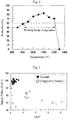
- the test conditions were temperature rising time up to test temperature: 100 s, holding time at test temperature: 60 s, and crosshead speed: 50.8 mm/s. After breaking the test piece, a reduction of area at break was measured. A temperature at which the reduction of area at break is 60% or more (working range temperature) was obtained in each material.
- Fig. 1 One example of the working range temperature is shown in Fig. 1 .
- a material having a working temperature range of 270°C or higher was judged as " ⁇ (Excellent)”
- a material having a working temperature range of 230°C or higher and lower than 270°C was judged as “ ⁇ (Good)”
- a material having a working temperature range lower than 230°C was judged as " ⁇ (Fair)”.
- a test piece having 25 mm ⁇ 13 mm ⁇ 2 mm was cut off from the material after the aging treatment, and subjected to a continuous oxidation test of 850°C ⁇ 400 hours.
- a material having oxidation weight gain of more than 1.6 (mg/cm 2 ) and 2.5 (mg/cm 2 ) or less was judged as " ⁇ (Good)”
- a material having oxidation weight gain more than 2.5 (mg/cm 2 ) was judged as " ⁇ (Fair)”.
- the high temperature hardness, impact value and working range temperature are shown in Tables 3 and 4.
- the relationship between Nb/C and the impact value is shown in Fig. 2 .
- the relationship between Mo/C and 800°C hardness is shown in Fig. 3 .
- the following facts are understood from Table 3, Table 4, Fig. 2 and Fig. 3 .
- the heat-resistant steel for exhaust valves according to the present invention can be used in exhaust valves of various engines.
Landscapes
- Chemical & Material Sciences (AREA)
- Engineering & Computer Science (AREA)
- Mechanical Engineering (AREA)
- Materials Engineering (AREA)
- Metallurgy (AREA)
- Organic Chemistry (AREA)
- Physics & Mathematics (AREA)
- Thermal Sciences (AREA)
- Crystallography & Structural Chemistry (AREA)
- Heat Treatment Of Articles (AREA)
- Heat Treatment Of Steel (AREA)
- Lift Valve (AREA)
Claims (2)
- Acier résistant à la chaleur pour soupapes d'échappement, ayant les constitutions suivantes :(1) l'acier résistant à la chaleur pour soupapes d'échappement comprenant :


 0,0001 ≤ Al, Mg et Ca au total ≤ 0,01 % en masse, et/ou au moins un élément choisi parmi :
 le reste étant Fe et d'inévitables impuretés ;(2) l'acier résistant à la chaleur pour soupapes d'échappement satisfaisant à 0,02 ≤ Nb/C < 0,70 ; et(3) l'acier résistant à la chaleur pour soupapes d'échappement satisfaisant à 4,5 ≤ Mo/C < 8,9.
 - Acier résistant à la chaleur pour soupapes d'échappement selon la revendication 1, qui satisfait à 5,2 ≤ Mo/C ≤ 8,0.
Applications Claiming Priority (3)
| Application Number | Priority Date | Filing Date | Title |
|---|---|---|---|
| JP2011182987 | 2011-08-24 | ||
| JP2012112238A JP5788360B2 (ja) | 2011-08-24 | 2012-05-16 | 排気バルブ用耐熱鋼 |
| PCT/JP2012/071511 WO2013027841A1 (fr) | 2011-08-24 | 2012-08-24 | Acier résistant à la chaleur pour soupapes d'échappement |
Publications (3)
| Publication Number | Publication Date |
|---|---|
| EP2749663A1 EP2749663A1 (fr) | 2014-07-02 |
| EP2749663A4 EP2749663A4 (fr) | 2016-02-24 |
| EP2749663B1 true EP2749663B1 (fr) | 2018-06-20 |
Family
ID=47746576
Family Applications (1)
| Application Number | Title | Priority Date | Filing Date |
|---|---|---|---|
| EP12825948.8A Active EP2749663B1 (fr) | 2011-08-24 | 2012-08-24 | Acier résistant à la chaleur pour soupapes d'échappement |
Country Status (6)
| Country | Link |
|---|---|
| US (1) | US9745649B2 (fr) |
| EP (1) | EP2749663B1 (fr) |
| JP (1) | JP5788360B2 (fr) |
| CN (1) | CN103764861B (fr) |
| BR (1) | BR112014004063A2 (fr) |
| WO (1) | WO2013027841A1 (fr) |
Families Citing this family (5)
| Publication number | Priority date | Publication date | Assignee | Title |
|---|---|---|---|---|
| EP3333277B1 (fr) | 2015-08-05 | 2019-04-24 | Sidenor Investigación y Desarrollo, S.A. | Acier faiblement allié à résistance élevée et à résistance élevée à l'oxydation à chaud |
| CN106011690B (zh) * | 2016-06-12 | 2018-03-09 | 安徽固齐线路器材有限公司 | 一种耐腐蚀防震锤的表面处理工艺 |
| CN107022717A (zh) * | 2017-04-25 | 2017-08-08 | 柳州市乾阳机电设备有限公司 | 耐热钢 |
| CN109957723B (zh) * | 2019-04-18 | 2020-12-25 | 江苏丰东热处理及表面改性工程技术研究有限公司 | 一种低成本、抗氧化炉用耐热钢 |
| GB2611819B (en) * | 2021-10-18 | 2024-09-18 | Alloyed Ltd | A heat-resistant austenitic stainless steel |
Family Cites Families (12)
| Publication number | Priority date | Publication date | Assignee | Title |
|---|---|---|---|---|
| JPS552775A (en) * | 1978-06-22 | 1980-01-10 | Hitachi Metals Ltd | High manganese heat resistant steel |
| JPS63210260A (ja) * | 1987-02-25 | 1988-08-31 | Hitachi Metals Ltd | 自動車エンジン排気弁用耐熱鋳鋼 |
| US4929419A (en) * | 1988-03-16 | 1990-05-29 | Carpenter Technology Corporation | Heat, corrosion, and wear resistant steel alloy and article |
| JP3073754B2 (ja) * | 1989-08-02 | 2000-08-07 | 日立金属株式会社 | エンジンバルブ用耐熱鋼 |
| JPH03285050A (ja) * | 1990-03-30 | 1991-12-16 | Aichi Steel Works Ltd | 高温特性の優れた排気バルブ用鋼 |
| JPH0617198A (ja) * | 1992-06-30 | 1994-01-25 | Aichi Steel Works Ltd | 高温強度に優れた排気バルブ用鋼 |
| CN1034819C (zh) * | 1995-07-19 | 1997-05-07 | 冶金工业部钢铁研究总院 | 一种高强度耐热钢 |
| JPH09279309A (ja) | 1996-04-12 | 1997-10-28 | Daido Steel Co Ltd | Fe−Cr−Ni系耐熱合金 |
| JP2001323323A (ja) | 2000-05-12 | 2001-11-22 | Aichi Steel Works Ltd | 自動車用エンジンバルブの製造方法 |
| JP3951943B2 (ja) | 2003-03-18 | 2007-08-01 | 本田技研工業株式会社 | 耐過時効特性にすぐれた高強度の排気バルブ用耐熱合金 |
| JP2010280950A (ja) * | 2009-06-04 | 2010-12-16 | Daido Steel Co Ltd | 排気バルブ用耐熱鋼及びその製造方法 |
| US20110236247A1 (en) * | 2010-03-25 | 2011-09-29 | Daido Tokushuko Kabushiki Kaisha | Heat resistant steel for exhaust valve |
-
2012
- 2012-05-16 JP JP2012112238A patent/JP5788360B2/ja active Active
- 2012-08-24 CN CN201280041280.XA patent/CN103764861B/zh active Active
- 2012-08-24 WO PCT/JP2012/071511 patent/WO2013027841A1/fr not_active Ceased
- 2012-08-24 US US14/240,187 patent/US9745649B2/en active Active
- 2012-08-24 EP EP12825948.8A patent/EP2749663B1/fr active Active
- 2012-08-24 BR BR112014004063A patent/BR112014004063A2/pt not_active Application Discontinuation
Non-Patent Citations (1)
| Title |
|---|
| None * |
Also Published As
| Publication number | Publication date |
|---|---|
| JP5788360B2 (ja) | 2015-09-30 |
| EP2749663A4 (fr) | 2016-02-24 |
| EP2749663A1 (fr) | 2014-07-02 |
| US9745649B2 (en) | 2017-08-29 |
| CN103764861B (zh) | 2016-03-16 |
| US20140212321A1 (en) | 2014-07-31 |
| JP2013060654A (ja) | 2013-04-04 |
| BR112014004063A2 (pt) | 2017-03-14 |
| WO2013027841A1 (fr) | 2013-02-28 |
| CN103764861A (zh) | 2014-04-30 |
Similar Documents
| Publication | Publication Date | Title |
|---|---|---|
| EP1696108B1 (fr) | Alliage résistant aux températures élevées pour soupapes d'échappement durables à 900°C et soupapes d'échappement fabriquées dans cet alliage | |
| EP1867740B1 (fr) | Superalliage à base de Ni à faible expansion thermique | |
| EP2826877B1 (fr) | Superalliage à base de Nickel à forgeage à chaud présentant une excellente résistance aux températures élevées | |
| EP2610360B1 (fr) | Alliage à base de co | |
| US20230166318A1 (en) | Metal gasket and production method therefor | |
| CN107075629A (zh) | 奥氏体系不锈钢板 | |
| JP3951943B2 (ja) | 耐過時効特性にすぐれた高強度の排気バルブ用耐熱合金 | |
| US20110236247A1 (en) | Heat resistant steel for exhaust valve | |
| JP3308090B2 (ja) | Fe基超耐熱合金 | |
| EP1837411B1 (fr) | Superalliage à base de Ni | |
| EP3095883B1 (fr) | Acier maraging | |
| US9745649B2 (en) | Heat-resisting steel for exhaust valves | |
| JP6160787B2 (ja) | 薄板及びその製造方法 | |
| EP2503012B1 (fr) | Acier thermorésistant durci par précipitation | |
| EP2447385B1 (fr) | Acier résistant à la chaleur pour soupape de moteur présentant une excellente résistance à des températures élevées | |
| EP3095884A1 (fr) | Acier maraging | |
| JP6738010B2 (ja) | 高温強度特性および高温クリープ特性に優れたニッケル基合金 | |
| JP4830443B2 (ja) | 高温における強度特性にすぐれた排気バルブ用耐熱合金 | |
| JP2000204449A (ja) | 冷間加工性と高温加熱安定性に優れたFe基耐熱合金 | |
| KR102758321B1 (ko) | 내열 합금 소재 및 이것을 가공 성형한 탄성 부재 | |
| JP6787246B2 (ja) | 耐熱部材用合金原板、耐熱部材用合金板、およびエンジンの排気系部材用のガスケット | |
| EP3252180B1 (fr) | Alliage à base de ni possédant d'excellentes caractéristiques de fluage à haute température, et élément de turbine à gaz utilisant celui-ci | |
| WO2021206142A1 (fr) | Élément d'étanchéité et son procédé de fabrication | |
| JP2015108177A (ja) | ニッケル基合金 | |
| JPH1129837A (ja) | 耐熱鋳鋼および耐熱鋳鋼部品 |
Legal Events
| Date | Code | Title | Description |
|---|---|---|---|
| PUAI | Public reference made under article 153(3) epc to a published international application that has entered the european phase |
Free format text: ORIGINAL CODE: 0009012 |
|
| 17P | Request for examination filed |
Effective date: 20140224 |
|
| AK | Designated contracting states |
Kind code of ref document: A1 Designated state(s): AL AT BE BG CH CY CZ DE DK EE ES FI FR GB GR HR HU IE IS IT LI LT LU LV MC MK MT NL NO PL PT RO RS SE SI SK SM TR |
|
| DAX | Request for extension of the european patent (deleted) | ||
| RA4 | Supplementary search report drawn up and despatched (corrected) |
Effective date: 20160126 |
|
| RIC1 | Information provided on ipc code assigned before grant |
Ipc: C22C 38/50 20060101ALI20160120BHEP Ipc: C22C 38/48 20060101ALI20160120BHEP Ipc: C21D 6/00 20060101ALI20160120BHEP Ipc: C22C 38/06 20060101ALI20160120BHEP Ipc: F01L 3/02 20060101ALI20160120BHEP Ipc: C22C 38/54 20060101ALI20160120BHEP Ipc: C21D 9/00 20060101ALI20160120BHEP Ipc: C22C 38/00 20060101AFI20160120BHEP Ipc: C22C 38/02 20060101ALI20160120BHEP Ipc: C22C 38/58 20060101ALI20160120BHEP Ipc: C22C 38/44 20060101ALI20160120BHEP |
|
| GRAP | Despatch of communication of intention to grant a patent |
Free format text: ORIGINAL CODE: EPIDOSNIGR1 |
|
| INTG | Intention to grant announced |
Effective date: 20180103 |
|
| RIN1 | Information on inventor provided before grant (corrected) |
Inventor name: TSUYUMU, TAKASHI Inventor name: UETA, SHIGEKI Inventor name: OSAKI, MOTOTSUGU |
|
| GRAS | Grant fee paid |
Free format text: ORIGINAL CODE: EPIDOSNIGR3 |
|
| GRAA | (expected) grant |
Free format text: ORIGINAL CODE: 0009210 |
|
| AK | Designated contracting states |
Kind code of ref document: B1 Designated state(s): AL AT BE BG CH CY CZ DE DK EE ES FI FR GB GR HR HU IE IS IT LI LT LU LV MC MK MT NL NO PL PT RO RS SE SI SK SM TR |
|
| REG | Reference to a national code |
Ref country code: GB Ref legal event code: FG4D |
|
| REG | Reference to a national code |
Ref country code: IE Ref legal event code: FG4D |
|
| REG | Reference to a national code |
Ref country code: AT Ref legal event code: REF Ref document number: 1010651 Country of ref document: AT Kind code of ref document: T Effective date: 20180715 |
|
| REG | Reference to a national code |
Ref country code: DE Ref legal event code: R096 Ref document number: 602012047715 Country of ref document: DE |
|
| RAP2 | Party data changed (patent owner data changed or rights of a patent transferred) |
Owner name: DAIDO STEEL CO.,LTD. Owner name: HONDA MOTOR CO., LTD. |
|
| REG | Reference to a national code |
Ref country code: DE Ref legal event code: R081 Ref document number: 602012047715 Country of ref document: DE Owner name: HONDA MOTOR CO., LTD., JP Free format text: FORMER OWNERS: DAIDO STEEL CO., LTD., NAGOYA-SHI, AICHI, JP; HONDA MOTOR CO., LTD., TOKYO, JP |
|
| REG | Reference to a national code |
Ref country code: NL Ref legal event code: MP Effective date: 20180620 |
|
| PG25 | Lapsed in a contracting state [announced via postgrant information from national office to epo] |
Ref country code: LT Free format text: LAPSE BECAUSE OF FAILURE TO SUBMIT A TRANSLATION OF THE DESCRIPTION OR TO PAY THE FEE WITHIN THE PRESCRIBED TIME-LIMIT Effective date: 20180620 Ref country code: SE Free format text: LAPSE BECAUSE OF FAILURE TO SUBMIT A TRANSLATION OF THE DESCRIPTION OR TO PAY THE FEE WITHIN THE PRESCRIBED TIME-LIMIT Effective date: 20180620 Ref country code: NO Free format text: LAPSE BECAUSE OF FAILURE TO SUBMIT A TRANSLATION OF THE DESCRIPTION OR TO PAY THE FEE WITHIN THE PRESCRIBED TIME-LIMIT Effective date: 20180920 Ref country code: FI Free format text: LAPSE BECAUSE OF FAILURE TO SUBMIT A TRANSLATION OF THE DESCRIPTION OR TO PAY THE FEE WITHIN THE PRESCRIBED TIME-LIMIT Effective date: 20180620 Ref country code: BG Free format text: LAPSE BECAUSE OF FAILURE TO SUBMIT A TRANSLATION OF THE DESCRIPTION OR TO PAY THE FEE WITHIN THE PRESCRIBED TIME-LIMIT Effective date: 20180920 |
|
| REG | Reference to a national code |
Ref country code: LT Ref legal event code: MG4D |
|
| PG25 | Lapsed in a contracting state [announced via postgrant information from national office to epo] |
Ref country code: RS Free format text: LAPSE BECAUSE OF FAILURE TO SUBMIT A TRANSLATION OF THE DESCRIPTION OR TO PAY THE FEE WITHIN THE PRESCRIBED TIME-LIMIT Effective date: 20180620 Ref country code: HR Free format text: LAPSE BECAUSE OF FAILURE TO SUBMIT A TRANSLATION OF THE DESCRIPTION OR TO PAY THE FEE WITHIN THE PRESCRIBED TIME-LIMIT Effective date: 20180620 Ref country code: LV Free format text: LAPSE BECAUSE OF FAILURE TO SUBMIT A TRANSLATION OF THE DESCRIPTION OR TO PAY THE FEE WITHIN THE PRESCRIBED TIME-LIMIT Effective date: 20180620 Ref country code: GR Free format text: LAPSE BECAUSE OF FAILURE TO SUBMIT A TRANSLATION OF THE DESCRIPTION OR TO PAY THE FEE WITHIN THE PRESCRIBED TIME-LIMIT Effective date: 20180921 |
|
| REG | Reference to a national code |
Ref country code: AT Ref legal event code: MK05 Ref document number: 1010651 Country of ref document: AT Kind code of ref document: T Effective date: 20180620 |
|
| PG25 | Lapsed in a contracting state [announced via postgrant information from national office to epo] |
Ref country code: NL Free format text: LAPSE BECAUSE OF FAILURE TO SUBMIT A TRANSLATION OF THE DESCRIPTION OR TO PAY THE FEE WITHIN THE PRESCRIBED TIME-LIMIT Effective date: 20180620 |
|
| PG25 | Lapsed in a contracting state [announced via postgrant information from national office to epo] |
Ref country code: EE Free format text: LAPSE BECAUSE OF FAILURE TO SUBMIT A TRANSLATION OF THE DESCRIPTION OR TO PAY THE FEE WITHIN THE PRESCRIBED TIME-LIMIT Effective date: 20180620 Ref country code: PL Free format text: LAPSE BECAUSE OF FAILURE TO SUBMIT A TRANSLATION OF THE DESCRIPTION OR TO PAY THE FEE WITHIN THE PRESCRIBED TIME-LIMIT Effective date: 20180620 Ref country code: SK Free format text: LAPSE BECAUSE OF FAILURE TO SUBMIT A TRANSLATION OF THE DESCRIPTION OR TO PAY THE FEE WITHIN THE PRESCRIBED TIME-LIMIT Effective date: 20180620 Ref country code: IS Free format text: LAPSE BECAUSE OF FAILURE TO SUBMIT A TRANSLATION OF THE DESCRIPTION OR TO PAY THE FEE WITHIN THE PRESCRIBED TIME-LIMIT Effective date: 20181020 Ref country code: CZ Free format text: LAPSE BECAUSE OF FAILURE TO SUBMIT A TRANSLATION OF THE DESCRIPTION OR TO PAY THE FEE WITHIN THE PRESCRIBED TIME-LIMIT Effective date: 20180620 Ref country code: AT Free format text: LAPSE BECAUSE OF FAILURE TO SUBMIT A TRANSLATION OF THE DESCRIPTION OR TO PAY THE FEE WITHIN THE PRESCRIBED TIME-LIMIT Effective date: 20180620 Ref country code: RO Free format text: LAPSE BECAUSE OF FAILURE TO SUBMIT A TRANSLATION OF THE DESCRIPTION OR TO PAY THE FEE WITHIN THE PRESCRIBED TIME-LIMIT Effective date: 20180620 |
|
| PG25 | Lapsed in a contracting state [announced via postgrant information from national office to epo] |
Ref country code: ES Free format text: LAPSE BECAUSE OF FAILURE TO SUBMIT A TRANSLATION OF THE DESCRIPTION OR TO PAY THE FEE WITHIN THE PRESCRIBED TIME-LIMIT Effective date: 20180620 Ref country code: SM Free format text: LAPSE BECAUSE OF FAILURE TO SUBMIT A TRANSLATION OF THE DESCRIPTION OR TO PAY THE FEE WITHIN THE PRESCRIBED TIME-LIMIT Effective date: 20180620 |
|
| REG | Reference to a national code |
Ref country code: DE Ref legal event code: R097 Ref document number: 602012047715 Country of ref document: DE |
|
| PG25 | Lapsed in a contracting state [announced via postgrant information from national office to epo] |
Ref country code: MC Free format text: LAPSE BECAUSE OF FAILURE TO SUBMIT A TRANSLATION OF THE DESCRIPTION OR TO PAY THE FEE WITHIN THE PRESCRIBED TIME-LIMIT Effective date: 20180620 |
|
| REG | Reference to a national code |
Ref country code: CH Ref legal event code: PL |
|
| PLBE | No opposition filed within time limit |
Free format text: ORIGINAL CODE: 0009261 |
|
| STAA | Information on the status of an ep patent application or granted ep patent |
Free format text: STATUS: NO OPPOSITION FILED WITHIN TIME LIMIT |
|
| PG25 | Lapsed in a contracting state [announced via postgrant information from national office to epo] |
Ref country code: CH Free format text: LAPSE BECAUSE OF NON-PAYMENT OF DUE FEES Effective date: 20180831 Ref country code: LU Free format text: LAPSE BECAUSE OF NON-PAYMENT OF DUE FEES Effective date: 20180824 Ref country code: LI Free format text: LAPSE BECAUSE OF NON-PAYMENT OF DUE FEES Effective date: 20180831 |
|
| REG | Reference to a national code |
Ref country code: BE Ref legal event code: MM Effective date: 20180831 |
|
| GBPC | Gb: european patent ceased through non-payment of renewal fee |
Effective date: 20180920 |
|
| 26N | No opposition filed |
Effective date: 20190321 |
|
| PG25 | Lapsed in a contracting state [announced via postgrant information from national office to epo] |
Ref country code: DK Free format text: LAPSE BECAUSE OF FAILURE TO SUBMIT A TRANSLATION OF THE DESCRIPTION OR TO PAY THE FEE WITHIN THE PRESCRIBED TIME-LIMIT Effective date: 20180620 |
|
| PG25 | Lapsed in a contracting state [announced via postgrant information from national office to epo] |
Ref country code: FR Free format text: LAPSE BECAUSE OF NON-PAYMENT OF DUE FEES Effective date: 20180831 Ref country code: SI Free format text: LAPSE BECAUSE OF FAILURE TO SUBMIT A TRANSLATION OF THE DESCRIPTION OR TO PAY THE FEE WITHIN THE PRESCRIBED TIME-LIMIT Effective date: 20180620 Ref country code: BE Free format text: LAPSE BECAUSE OF NON-PAYMENT OF DUE FEES Effective date: 20180831 |
|
| PG25 | Lapsed in a contracting state [announced via postgrant information from national office to epo] |
Ref country code: GB Free format text: LAPSE BECAUSE OF NON-PAYMENT OF DUE FEES Effective date: 20180920 |
|
| PG25 | Lapsed in a contracting state [announced via postgrant information from national office to epo] |
Ref country code: AL Free format text: LAPSE BECAUSE OF FAILURE TO SUBMIT A TRANSLATION OF THE DESCRIPTION OR TO PAY THE FEE WITHIN THE PRESCRIBED TIME-LIMIT Effective date: 20180620 |
|
| PG25 | Lapsed in a contracting state [announced via postgrant information from national office to epo] |
Ref country code: MT Free format text: LAPSE BECAUSE OF NON-PAYMENT OF DUE FEES Effective date: 20180824 |
|
| PG25 | Lapsed in a contracting state [announced via postgrant information from national office to epo] |
Ref country code: TR Free format text: LAPSE BECAUSE OF FAILURE TO SUBMIT A TRANSLATION OF THE DESCRIPTION OR TO PAY THE FEE WITHIN THE PRESCRIBED TIME-LIMIT Effective date: 20180620 |
|
| PG25 | Lapsed in a contracting state [announced via postgrant information from national office to epo] |
Ref country code: PT Free format text: LAPSE BECAUSE OF FAILURE TO SUBMIT A TRANSLATION OF THE DESCRIPTION OR TO PAY THE FEE WITHIN THE PRESCRIBED TIME-LIMIT Effective date: 20180620 Ref country code: HU Free format text: LAPSE BECAUSE OF FAILURE TO SUBMIT A TRANSLATION OF THE DESCRIPTION OR TO PAY THE FEE WITHIN THE PRESCRIBED TIME-LIMIT; INVALID AB INITIO Effective date: 20120824 |
|
| PG25 | Lapsed in a contracting state [announced via postgrant information from national office to epo] |
Ref country code: IE Free format text: LAPSE BECAUSE OF NON-PAYMENT OF DUE FEES Effective date: 20180824 Ref country code: MK Free format text: LAPSE BECAUSE OF NON-PAYMENT OF DUE FEES Effective date: 20180620 Ref country code: CY Free format text: LAPSE BECAUSE OF FAILURE TO SUBMIT A TRANSLATION OF THE DESCRIPTION OR TO PAY THE FEE WITHIN THE PRESCRIBED TIME-LIMIT Effective date: 20180620 |
|
| REG | Reference to a national code |
Ref country code: DE Ref legal event code: R084 Ref document number: 602012047715 Country of ref document: DE |
|
| PGFP | Annual fee paid to national office [announced via postgrant information from national office to epo] |
Ref country code: DE Payment date: 20210713 Year of fee payment: 10 |
|
| REG | Reference to a national code |
Ref country code: DE Ref legal event code: R119 Ref document number: 602012047715 Country of ref document: DE |
|
| PG25 | Lapsed in a contracting state [announced via postgrant information from national office to epo] |
Ref country code: DE Free format text: LAPSE BECAUSE OF NON-PAYMENT OF DUE FEES Effective date: 20230301 |
|
| PGFP | Annual fee paid to national office [announced via postgrant information from national office to epo] |
Ref country code: IT Payment date: 20250722 Year of fee payment: 14 |