EP2749876B1 - Méthode et dispositif d'analyse de données d'analyse de masses - Google Patents
Méthode et dispositif d'analyse de données d'analyse de masses Download PDFInfo
- Publication number
- EP2749876B1 EP2749876B1 EP11873617.2A EP11873617A EP2749876B1 EP 2749876 B1 EP2749876 B1 EP 2749876B1 EP 11873617 A EP11873617 A EP 11873617A EP 2749876 B1 EP2749876 B1 EP 2749876B1
- Authority
- EP
- European Patent Office
- Prior art keywords
- structural formula
- substance
- partial structure
- unknown substance
- unknown
- Prior art date
- Legal status (The legal status is an assumption and is not a legal conclusion. Google has not performed a legal analysis and makes no representation as to the accuracy of the status listed.)
- Not-in-force
Links
- 238000000034 method Methods 0.000 title claims description 48
- 238000004458 analytical method Methods 0.000 title claims description 32
- 239000000126 substance Substances 0.000 claims description 195
- 150000002500 ions Chemical class 0.000 claims description 126
- 238000001228 spectrum Methods 0.000 claims description 80
- 238000003379 elimination reaction Methods 0.000 claims description 66
- 238000004949 mass spectrometry Methods 0.000 claims description 39
- 238000007405 data analysis Methods 0.000 claims description 25
- 239000002243 precursor Substances 0.000 claims description 15
- 238000010494 dissociation reaction Methods 0.000 claims description 13
- 230000005593 dissociations Effects 0.000 claims description 13
- 230000008030 elimination Effects 0.000 claims description 9
- 239000000047 product Substances 0.000 description 61
- 230000004060 metabolic process Effects 0.000 description 19
- OMOVVBIIQSXZSZ-UHFFFAOYSA-N [6-(4-acetyloxy-5,9a-dimethyl-2,7-dioxo-4,5a,6,9-tetrahydro-3h-pyrano[3,4-b]oxepin-5-yl)-5-formyloxy-3-(furan-3-yl)-3a-methyl-7-methylidene-1a,2,3,4,5,6-hexahydroindeno[1,7a-b]oxiren-4-yl] 2-hydroxy-3-methylpentanoate Chemical compound CC12C(OC(=O)C(O)C(C)CC)C(OC=O)C(C3(C)C(CC(=O)OC4(C)COC(=O)CC43)OC(C)=O)C(=C)C32OC3CC1C=1C=COC=1 OMOVVBIIQSXZSZ-UHFFFAOYSA-N 0.000 description 15
- 238000012545 processing Methods 0.000 description 14
- 150000001875 compounds Chemical class 0.000 description 13
- 238000001360 collision-induced dissociation Methods 0.000 description 10
- 238000010586 diagram Methods 0.000 description 6
- 239000002207 metabolite Substances 0.000 description 6
- 239000012634 fragment Substances 0.000 description 5
- 238000005040 ion trap Methods 0.000 description 3
- 238000001819 mass spectrum Methods 0.000 description 3
- 125000002496 methyl group Chemical group [H]C([H])([H])* 0.000 description 3
- 238000000547 structure data Methods 0.000 description 3
- 239000006227 byproduct Substances 0.000 description 2
- 238000007796 conventional method Methods 0.000 description 2
- 238000001727 in vivo Methods 0.000 description 2
- 230000007935 neutral effect Effects 0.000 description 2
- 238000012916 structural analysis Methods 0.000 description 2
- 238000006467 substitution reaction Methods 0.000 description 2
- 239000003905 agrochemical Substances 0.000 description 1
- 230000015572 biosynthetic process Effects 0.000 description 1
- 150000001649 bromium compounds Chemical group 0.000 description 1
- 150000001793 charged compounds Chemical class 0.000 description 1
- 238000006243 chemical reaction Methods 0.000 description 1
- 150000001805 chlorine compounds Chemical group 0.000 description 1
- 238000000354 decomposition reaction Methods 0.000 description 1
- 238000003795 desorption Methods 0.000 description 1
- 239000003814 drug Substances 0.000 description 1
- 230000036267 drug metabolism Effects 0.000 description 1
- 239000002359 drug metabolite Substances 0.000 description 1
- 230000000694 effects Effects 0.000 description 1
- 125000001495 ethyl group Chemical group [H]C([H])([H])C([H])([H])* 0.000 description 1
- 238000010265 fast atom bombardment Methods 0.000 description 1
- 238000013467 fragmentation Methods 0.000 description 1
- 238000006062 fragmentation reaction Methods 0.000 description 1
- 238000007429 general method Methods 0.000 description 1
- 238000000752 ionisation method Methods 0.000 description 1
- 239000000463 material Substances 0.000 description 1
- 239000011159 matrix material Substances 0.000 description 1
- 229920000642 polymer Polymers 0.000 description 1
- 102000004169 proteins and genes Human genes 0.000 description 1
- 108090000623 proteins and genes Proteins 0.000 description 1
- 125000001424 substituent group Chemical group 0.000 description 1
- 238000003786 synthesis reaction Methods 0.000 description 1
Images

Classifications
-
- H—ELECTRICITY
- H01—ELECTRIC ELEMENTS
- H01J—ELECTRIC DISCHARGE TUBES OR DISCHARGE LAMPS
- H01J49/00—Particle spectrometers or separator tubes
- H01J49/0027—Methods for using particle spectrometers
- H01J49/0036—Step by step routines describing the handling of the data generated during a measurement
-
- G—PHYSICS
- G16—INFORMATION AND COMMUNICATION TECHNOLOGY [ICT] SPECIALLY ADAPTED FOR SPECIFIC APPLICATION FIELDS
- G16C—COMPUTATIONAL CHEMISTRY; CHEMOINFORMATICS; COMPUTATIONAL MATERIALS SCIENCE
- G16C20/00—Chemoinformatics, i.e. ICT specially adapted for the handling of physicochemical or structural data of chemical particles, elements, compounds or mixtures
- G16C20/20—Identification of molecular entities, parts thereof or of chemical compositions
Definitions
- the present invention relates to a method and a system for data analysis for analyzing the chemical structure of a substance by performing analysis of MS n spectrum data obtained with an MS n mass spectrometer (where n is equal to or greater than 2) or MS 1 spectrum data obtained by utilizing in-source decay (ISD) or the like and more particularly relates to a method and a system for mass spectrometry data analysis for estimating the structure of an unknown substance that is produced through partial structural change caused by some reason from a substance having a known structure or an unknown substance the structure of which is largely in common with and only partially differs from that of a substance having a known structure.
- MS n mass spectrometer where n is equal to or greater than 2
- ISD in-source decay
- US 2010/312487 A1 discloses a method and a system according to the preamble of claims 1 and 9.
- mass spectrometers capable of performing MS n analysis are widely used for structure analysis of various polymer compounds including protein. Specifically, when an ion originating from a substance of interest contained in a sample is dissociated by collision induced dissociation (CID), a molecular bond is broken at a specific site depending on the bond energy or other factors, and various product ions and neutral losses are produced. Therefore, an ion having a specific mass-to-charge ratio m/z corresponding to a substance of interest is selected from various ions produced from a sample, the selected ion is dissociated by CID, and various product ions (fragment ions) produced by the dissociation are subjected to mass spectrometry to obtain an MS 2 spectrum.
- CID collision induced dissociation
- the chemical structure of the substance of interest can be estimated by analyzing the MS 2 spectrum data.
- the structural analysis of the substance of interest utilizing the MS n spectrum (where n is equal to or greater than 3) obtained by repeating the CID operation a plurality of times is sometimes performed.
- a peak of a product ion or peaks of product ions fragmented from an ion originating from a sample component can be obtained in an MS 1 spectrum by a method called in-source decay. Therefore, there sometimes occurs a case that the structural analysis of the substance of interest can be performed utilizing the MS 1 spectrum in which a product ion or ions originating from the substance of interest is observed as described here instead of utilizing the MS n spectrum.
- the MS 1 spectrum and the MS n spectrum (where n is equal to or greater than 2) in both of which a product ion or ions are observed are together simply referred to as the MS n spectrum.
- the most general method for estimating the structure of an unknown substance using the MS n spectrum is a database search utilizing the comparison of the MS n spectrum pattern.
- the compound name, the molecular weight, the composition formula, structural formula, the MS n spectrum pattern, and other data are registered in a database (sometimes referred to as a library) for identification with regard to various known compounds, and when a measured MS n spectrum is obtained for an unknown substance, the unknown substance is identified and the structural formula is drawn out by searching, on the database, for a compound the peak pattern of which matches or similar to the measured MS n spectrum under a predetermined search condition.
- a database sometimes referred to as a library
- databases created by users themselves, and various existing databases that are open to the public provided by public institutions are utilized.
- the structure of an unknown substance is estimated by a combination of a fragment prediction and a known structural change pattern, where the fragment prediction is a prediction of fragments for a peak or peaks having a mass-to-charge ratio or ratios m/z appearing commonly in MS n spectra of a known substance and in an unknown substance.
- the "structural change pattern" is the information about replacement of substituents, addition of a component, elimination of a component, or the like. Owing to such estimation, it becomes possible to identify and determine the structural formula for a compound that is not stored in the identification database.
- the structure cannot be estimated for an unknown substance in which a structural change that is not registered as a structural change pattern has occurred.
- the structure of a drug metabolite is considered to have a structure formed in such a way that a partial structure in a substance before metabolism eliminates and then another partial structure is added to the elimination site or another site different from the elimination site.
- the eliminating partial structure varies widely depending on the substance before the metabolism, and it is difficult to register all the eliminating partial structures as structural change patterns in advance. For such a substance, therefore, it is likely to occur that the structure of an unknown substance cannot be determined.
- the present invention has been developed to solve the aforementioned problem, and the object is to provide a method and a system for mass spectrometry data analysis capable of estimating the structure of an unknown substance that is similar to a substance having a known structure or is produced from the substance having a known structure by a part of the structural changed, based on an MS n spectrum data efficiently and with high reliability even when the pattern of a structural change, such as that associated with metabolism or the like, is not prepared in a database or the like in advance.
- the first aspect of the present invention aimed at solving the aforementioned problem is a method for mass spectrometry data analysis for estimating the structure of an unknown substance produced through partial structural change from a known substance having a known structure based on MS n spectra (where n is an integer equal to or greater than 1) obtained by performing mass spectrometry of product ions produced by dissociating, in one or a plurality of times, a precursor ion or ions originating from the unknown substance, the method including:
- the second aspect of the present invention aimed at solving the aforementioned problem is a system for carrying out a method for mass spectrometry data analysis according to the first aspect of the present invention and is a system for mass spectrometry data analysis for estimating the structure of an unknown substance produced through partial structural change from a known substance having a known structure based on MS n spectra (where n is an integer equal to or greater than 1) obtained by performing mass spectrometry of product ions produced by dissociating, in one or a plurality of times, a precursor ion or ions originating from the unknown substance, the system including:
- the "unknown, substance" to be analyzed for the structure is, for example, a substance produced from a substance having a known structure through chemical change such as metabolism.
- the unknown substance may be a byproduct produced in synthesis or the like of a known substance, through partial replacement or loss, or addition of another component in the structure of the known substance.
- MS n spectrum where n is equal to 1 i.e. an MS 1 spectrum (MS 1 mass spectrum) is a result of performing a mass spectrometry of a product ion produced by performing fragmentation (dissociation) of an ion originating from the substance of interest by in-source decay
- MS n spectrum where n is equal to or greater than 2 is the result of performing mass spectrometry of a product ion produced by performing one or a plurality of times of dissociating operations by CID or the like.
- the substitution of the partial structure is considered separately in two stages, the elimination and the addition of a partial structure in the first and second aspects of the present invention.
- the eliminating partial structure depends on the structure of the original substance (i.e. substance before elimination), the reaction condition, or other factors, therefore generally varies considerably widely, and the prediction of the eliminating partial structure is difficult.
- the partial structure to be added mostly depends on the kind of metabolism and is quite narrowed, and therefore the prediction of the partial structure to be added is easy. Therefore, for example, a user estimates the partial structure to be added in advance and inputs it (or selects one from options of a plurality of partial structures prepared in advance), thereby information about the additional partial structure is given.
- the post-elimination structure estimating unit in the system for mass spectrometry data analysis calculates the mass of the post-elimination structural formula after the unknown eliminating partial structure is eliminated from the known substance from the mass of the additional partial structure determined from the information about the additional partial structure (e.g., composition formula) and the mass of the unknown substance determined from the information about the mass of the precursor ion originating from the unknown substance, and estimates the post-elimination structural formula from the mass and the information about the structural formula of the known substance.
- the post-elimination structural formula is not narrowed to one, a plurality of candidates for the post-elimination structural formula may be listed.
- a method of utilizing another MS n spectrum obtained by changing the analysis conditions, for example, as described later is considered in the case where a post-elimination structural formula cannot be obtained at all.
- the product ion structure estimating unit estimates the structural formula of each of product ions originating from the unknown substance by comparing the combined mass of the trunk partial structure that can be estimated from the candidate for the post-elimination structural formula with the additional partial structure, and the mass of the product ion corresponding to each peak on the MS n spectrum of the unknown substance.
- a plurality of candidates for the structural formula of the product ion may be listed.
- the unknown substance structure estimating unit can estimate the structural formula of the unknown substance by estimating the aspect of the dissociation that can produce the structure from a plurality of candidates for the structural formula of product ion.
- the reliability of the estimation can be improved or the processing speed can be enhanced by adding the process utilizing the information additionally in the first and second aspects of the present invention.
- the narrowing in estimating the structural formula of the unknown substance can be performed by estimating which site of the known substance the additional partial structure has been added to by comparing, for example, the product ion originating from the known substance determined from the MS n spectrum, with the product ion originating from the unknown substance determined from the MS n spectrum of the unknown substance.
- the composition of the additional partial structure is originally known, and therefore the composition of the eliminating partial structure becomes clear from the difference between the composition formula of the unknown substance and the composition of the additional partial structure. Thereby, it becomes possible to narrow the candidates for the post-elimination structural formula.
- the composition formula or the structural formula of at least one product ion originating from the unknown substance is given as the additional information, the structural formula estimation for some product ion becomes unnecessary or it becomes possible to narrow the structural formula.
- the result is considered to be narrowed by the selection of the intermediate data (the combination of the eliminating partial structure that is estimated or the partial structure after elimination corresponding to the product ion with the additional partial structure) by a user.
- the structural formula of the unknown substance may be estimated for each of the plurality of candidates for the post-elimination structural formulas in the product ion structure estimating step and the unknown substance structure estimating step and the plurality of candidates for the structural formula may be determined. Thereby, omissions in estimating the candidate for the structural formula of the unknown substance can be reduced.
- the candidates for the structural formula may be ranked in descending order of probability and the candidates for the structural formula is output together with the ranking.
- information calculated theoretically such as a level of the intramolecular bond energy in addition to information obtained in the analysis such as the extent of coincidence of the mass in determining the candidates for the structural formula of product ion may be utilized.
- the structural formula of the unknown substance may be estimated after determining, as a candidate for the structural formula of one product ion from the unknown substance, the estimated structural formula obtained by performing each of the steps for the MS n+1 spectrum obtained from the MS n+1 analysis performed using an ion having a specific mass-to-charge ratio in the MS n spectrum of the unknown substance as a precursor ion.
- each of the candidates for the structural formula of the unknown substance may be determined in each of the steps using a plurality of MS n spectra obtained under the different analysis conditions for the unknown substance, and the structure with high probability may be extracted by putting the results together and may be output as a estimation result of the structural formula of the unknown substance.
- the analysis condition here includes the dissociation condition. Since the mode of the dissociation changes when the analysis condition is changed, different MS n spectra are obtained from the same unknown sample. In the case where the candidates for the structural formula thus determined utilizing a plurality of MS n spectra different from one another are identical, it is highly possible that the candidate is the right structural formula. Accordingly, by the above-described method, even when the structure of the unknown substance is complicated, the structural formula of the unknown substance can be estimated with high reliability.
- a structural formula of the unknown substance can be estimated efficiently and with high reliability.
- a structural change pattern associated with a structural change such as metabolism is unknown, a structural formula of an unknown substance can be estimated with high reliability as long as a partial structure to be added in association with the structural change is known or can be estimated with high accuracy.
- Fig. 1 is a schematic configuration diagram of the mass spectrometry system according to the present embodiment.
- An MS n analyzing section main body 1 includes, although not shown in the figure, an ion source, an ion trap, a time-of-flight mass spectrometer (TOFMS), and an ion detector etc., performs MS n analysis using an ion, as a precursor ion, having a specific mass-to-charge ratio m/z among various ions produced from a sample and obtains an MS n spectrum data over a predetermined mass-to-charge ratio range.
- n is eual to 2, however, n may be equal to or greater than 3.
- n may be 1.
- in-source decay of a molecular ion produced by ionization is likely to occur in the case where the ion source is EI.
- EI an ion source in a matrix-assisted laser desorption/ionization method, fast atom bombardment ionization, or the like can also produce relatively many product ions.
- a so-called triple quadrupole mass spectrometer can also be utilized instead of the combination of the ion trap and the TOFMS.
- a data processing section 2 processing the MS n spectrum data obtained by an MS n analyzing section main body 1 comprises an unknown substance structure estimation processing part 21, a spectrum data storing part 22, a known substance structural formula storing part 23, and an additional partial structure storing part 24 as a functional block.
- the structural formulas of the various substances are stored in the known substance structural formula storing part 23, and the above-described identification database can be utilized as the known substance structural formula storing part 23.
- the information about partial structures to be added to a substance in association with various structural changes such as in vivo metabolism, specifically additional partial structures is stored in the additional partial structure storing part 24.
- the kind of metabolism and the additional partial structure can be stored in such a way that both are associated with each other based on the known information.
- an input section 3 for operations by a user and a display 4 on which analysis results or the like are displayed are connected to a data processing section 2.
- the data processing section 2 can be made using a personal computer as a hardware resource so as to have the constitution by which each of the above-described functional blocks are embodied by performing a dedicated processing/control program installed in the personal computer.
- the mass spectrometry system of the present embodiment is characterized by data analysis for estimating the structure of unknown substance having an unknown structure, such as a metabolite, a byproduct or a decomposition product, produced from a substance having a known structural formula (hereinafter, referred to as an "original substance") through partial structural change caused by some reason such as metabolism.
- an original substance such as a metabolite, a byproduct or a decomposition product
- a substance having a known structural formula hereinafter, referred to as an "original substance”
- the structural change is not limited to the metabolism, and the mass spectrometry system is applicable for various types of structural change in which a part of the structure of an original substance changes.
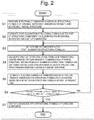
- Fig. 2 is a flowchart of an exemplified procedure of a metabolite structure estimating process performed in the data processing section 2
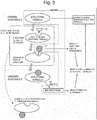
- Fig. 3 is a conceptual diagram describing a model of structural change of a known substance and a method for estimating a post-elimination structure after a partial structure is eliminated
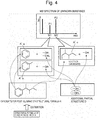
- Fig. 4 is a conceptual diagram of the metabolite structure estimating process. The detail of the metabolite structure estimating process in the mass spectrometry system of the present embodiment is described by Fig. 2 to Fig. 4 .
- MS 2 spectrum data which is a result of performing the MS 2 analysis using as a precursor ion an ion originating from the unknown substance contained in a sample that is an object of analysis is saved in the spectrum data storing part 22 at the process starting time.
- the unknown substance structure estimation processing part 21 reads an MS 2 spectrum data of the unknown substance that is an object of analysis from the spectrum data storing part 22, a structural formula data of an original substance from the known substance structural formula storing part 23, and an additional partial structure data to be added at the time of structural change from the original substance to the unknown substance from the additional partial structure storing part 24, respectively (step S1).
- structural formula data of various compounds are stored in the known substance structural formula storing part 23, it becomes possible to read out the structural formula data of the original substance by designating a compound that is the original substance from the input section 3 by a user.
- Various additional partial structure data are also stored in the additional partial structure storing part 24, and an additional partial structure data that can be added corresponding to the metabolism or the like can be read out by giving information such as the kind of metabolism from the input section 3 by a user.
- a user may directly input the structural formula of the original substance and the additional partial structure from the input section 3 without utilizing the data stored in the known substance structural formula storing part 23 and the additional partial structure storing part 24.
- an unknown substance B is produced from an original substance A having a known structure through structural change such as metabolism
- the additional partial structure D is not always added to the site from which the partial structure is eliminated (i.e. replaced with a structurally eliminating group or the like), it sometimes occurs that the additional partial structure D is added to another site quite different from the elimination site as in the case of an unknown substance B'.
- the structural formula of the original substance A, the additional partial structure D, and the MS 2 spectrum of the unknown substance B that are surrounded with a broken line in Fig. 3 are known information, specifically information that has already been given.
- the unknown substance structure estimation processing part 21 in the data processing section 2 first, based on the known information as described above, calculates a candidate for the structural formula (post-elimination structural formula) A' after the eliminating partial structure C is eliminated from the original substance A (step S2).
- the mass of the unknown substance B is determined from the mass-to-charge ratio m/z of the precursor ion in obtaining the MS 2 spectrum of the unknown substance B, and the mass of the additional partial structure D included in the unknown substance B is also determined from the structure that is known, and therefore the mass of the post-elimination structural formula A' is calculated from the difference.
- the post-elimination structural formula A' can be estimated from the mass of the post-elimination structural formula A' and the structural formula of the original substance A that is known.
- a plurality of candidates for the post-elimination structural formula A' that can be estimated are listed up.
- composition formula of the unknown substance B is given as the additional information besides the known information as described above, since the composition of the additional partial structure D is known, the composition corresponding to the post-elimination structural formula A' obtained by removing the additional partial structure D from the unknown substance B becomes clear. Accordingly, it is possible to narrow the candidates for the post-elimination structural formula A' using information about this composition, and the process after the narrowing can be simplified. Moreover, the selection of the post-elimination structural formula by a user may be performed.
- step S3 After selecting one candidate from among the candidates for the post-elimination structural formula A' calculated in the step S2 (step S3), the process of steps 4 to 5 is carried out for the selected candidate for the post-elimination structural formula A'.
- the post-elimination structural formula A' is considered to include a basic skeleton of the original material
- the candidates for the structural formula of each of product ions produced by the dissociation of the unknown substance B are comprehensively calculated by combining the partial structure derived from one candidate for the post-elimination structural formula A' with the known additional partial structure (step S4).
- the site at which a bond is broken by CID in the post-elimination structural formula A' is unknown, various patterns are considered as a partial structure that can be produced from one candidate for the post-elimination structural formula A' by CID.
- the mass-to-charge ratios of the peaks P1 and P2 appeared in the MS 2 spectrum of the unknown substance B are M1 and M2, respectively, and the mass of the product ion becomes clear from M1 and M2.
- the masses obtained by combining the partial structure of the post-elimination structural formula A' with the additional partial structure D are calculated, and the coincidence with the mass of the product ion is evaluated.
- the MS 2 spectrum of the original substance is given as the additional information besides the known information as described above, it is possible to estimate which partial structure the additional partial structure is added to by comparing the mass of the product ion obtained from the MS 2 spectrum of the original substance with the mass of the product ion obtained from the MS 2 spectrum of the unknown substance. Thereby, it becomes possible to narrow the candidates for the structural formula of the product ion, and the process after the narrowing can be simplified.
- composition formula or the structural formula of at least a part of the product ions originating from the unknown substance is given as the additional information besides the known information as described above, thereby it becomes possible to narrow the candidates for the structural formula of the product ion, and the process after the narrowing can be simplified.
- the combination that can be produced by the dissociation of the unknown substance B is found out by combining the candidates for the structural formula of the product ions and is selected as the structural formula of the unknown substance B (step S5).
- the appropriate combination cannot be found out, it is because, for example, the candidate for the post-elimination structural formula A' selected in the step S3 is not appropriate, and therefore it may be concluded that there is no proper output.
- a plurality of structural formulas may be listed as candidates.
- step S6 whether the process of the steps S4 and S5 has been performed or not is decided with regard to all the candidates for the post-elimination structural formula A' obtained in the step S2 (step S6), and when there is an unprocessed candidate for the post-elimination structural formula A', the above-described steps S4 and S5 are carried out by returning to the step S3 and selecting the unprocessed candidate for the post-elimination structural formula A'.
- the procedure proceeds to the step S7, then the structural formulas (or the candidates for the structural formula) of the unknown substance listed so far are output as an analysis result in the display 4.
- the information about the additional partial structure D that is known in the structural change in estimating the structure of the unknown substance produced through structural change such as metabolism is utilized.
- the structural change patterns used in the above-described conventional technique includes information about not only the additional partial structure but also the eliminating partial structure C, the site from which the eliminating partial structure is eliminated, the site to which the additional partial structure D is added, and the like, and therefore is very diverse, and it is difficult to predict all the structural change patterns that can happen.
- the patterns are readily predictable from the kind of metabolism or the like when the included information is only the additional partial structure D and the kind of the patterns can be considerably narrowed. Accordingly, if the information about the additional partial structure D that can be added in association with the structural change is given for sure and the structure of the unknown substance can be estimated based on the information with high reliability and efficiently.
- the plurality of the candidates for the structural formula may be ranked in descending order of probability, and the candidates for the structural formula may be output together with the ranking.
- information calculated theoretically such as a level of the intramolecular bond energy in addition to information obtained in the analysis such as, for example, the extent of coincidence of the mass in determining the candidate for the structural formula of the product ion may be utilized.
- the analysis is performed based on the MS 2 analysis result. It also possible to perform analysis based on spectrum data obtained by MS n analysis associated with the dissociating operation in two or more times, i.e., MS n analysis where n is equal to or greater than 3.
- MS n analysis where n is equal to or greater than 3.
- the structural formula of the unknown substance may be estimated after the structural formula estimated by performing the process of the steps S2 to S6 for the MS n+1 spectrum obtained by the MS n+1 analysis performed using as a precursor ion an ion having a specific mass-to-charge ratio in the MS n spectrum of the unknown substance is designated to the candidate for the structural formula of one product ion from the unknown substance.
- the mode of the dissociation is changed and it sometimes occurs that MS 2 spectra each having different patterns for the same unknown substance are obtained.
- the product ion is different when the MS 2 spectrum is different, and therefore, the process contents from S4 to S5 illustrated in Fig. 2 become different.
- the structural formula of the unknown substance B determined finally is supposed to be the same, and therefore when the structural formulas of a result of analysis based on the different MS 2 spectra are the same, it can be said that the reliability of the structural formula is high. Therefore, for example, the structural formulas that are derived from different MS 2 spectra obtained under different analysis conditions on an unknown substance and are the same may be output as a true structural formula. Moreover, such information may be utilized for the above-described ranking.
Landscapes
- Chemical & Material Sciences (AREA)
- Analytical Chemistry (AREA)
- Physics & Mathematics (AREA)
- Spectroscopy & Molecular Physics (AREA)
- Crystallography & Structural Chemistry (AREA)
- Life Sciences & Earth Sciences (AREA)
- Engineering & Computer Science (AREA)
- Bioinformatics & Cheminformatics (AREA)
- Bioinformatics & Computational Biology (AREA)
- Computing Systems (AREA)
- Theoretical Computer Science (AREA)
- Other Investigation Or Analysis Of Materials By Electrical Means (AREA)
- Electron Tubes For Measurement (AREA)
Claims (9)
- Méthode d'analyse de données de spectrométrie de masse permettant d'estimer une structure d'une substance inconnue (B) produite par une modification structurale partielle à partir d'une substance connue (A) ayant une structure connue basée sur des spectres MSn où n est un nombre entier égal ou supérieur à 1 obtenu en réalisant une spectrométrie de masse d'ions produits qui sont produits en dissociant, en une ou une pluralité de fois, un ion précurseur ou des ions provenant de la substance inconnue (B), la modification structurale partielle comprenant l'élimination d'une structure partielle d'élimination inconnue (C) et l'ajout d'une structure partielle additionnelle (D), le procédé comprenant :a) une étape d'obtention d'informations de structure partielle additionnelle consistant à obtenir des informations prédéfinies d'une structure partielle additionnelle (D) ;
caractérisée parb) une étape d'estimation de structure post-élimination consistant à estimer une formule structurales post-élimination (A') après qu'une structure partielle d'élimination inconnue (C) est éliminée de la substance connue (A) en tant que candidat pour la formule structurale post-élimination (A'), l'estimation étant réalisée sur la base d'informations prédéfinies concernant la formule structurale de la substance connue (A), d'informations concernant une structure partielle additionnelle (D) obtenues dans l'étape d'obtention d'informations de structure partielle additionnelle, et d'informations concernant une masse de l'ion précurseur à partir de la substance inconnue (B) obtenues à partir d'un spectre MSn ou de spectres MSn de la substance inconnue (B) ;c) une étape d'estimation de structure d'ion produit consistant à estimer une formule structurale de chacun des ions produits en cherchant une coïncidence entre une masse combinée d'une structure partielle de tronc et de la structure partielle additionnelle (D) et des masses d'ions produits obtenues à partir du spectre Msn ou des spectres MSn de la substance inconnue (B), la structure partielle de tronc étant dérivée d'une structure indiquée par une formule structurale du candidat pour la formule structurale post-élimination (A'), et énumérer des candidats pour les formules structurales des ions produits ; etd) une étape de détermination de structure de substance inconnue consistant à déterminer une formule structurale de la substance inconnue (B) en cherchant, sur la base des candidats pour les formules structurales des ions produits estimés dans l'étape d'estimation de structure d'ion produit, une formule structurale qui peut produire les candidats pour les formules structurales d'ions produits par dissociation. - Méthode d'analyse de données de spectrométrie de masse selon la revendication 1,
dans laquelle, dans le cas où un spectre MSn de la substance connue (A) est donné en tant qu'informations additionnelles, la réduction des formules structurales d'ions produits est réalisée en estimant à quel site de la substance connue (A) la structure partielle additionnelle (D) a été ajoutée en comparant des ions produits provenant de la substance connue (A) déterminés à partir d'un spectre MSn de la substance connue (A) avec des ions produits provenant de la substance inconnue (B) déterminés à partir d'un spectre MSn de la substance inconnue (B) dans l'étape d'estimation de structure d'ion produit. - Méthode d'analyse de données de spectrométrie de masse selon la revendication 1,
dans laquelle, dans le cas où une formule de composition de la substance inconnue (B) est donnée en tant qu'informations additionnelles, la réduction des candidats pour la formule structurale post-élimination (A') en utilisant une composition de la structure partielle d'élimination (C) déterminée à partir d'une différence entre une composition de la substance inconnue (B) et de la structure partielle additionnelle (D) dans l'étape d'estimation de structure post-élimination. - Méthode d'analyse de données de spectrométrie de masse selon la revendication 1,
dans laquelle, dans le cas où une formule de composition ou une formule structurale d' au moins un des ions produits provenant de la substance inconnue (B) est donnée en tant qu'informations additionnelles, une estimation des formules structurales de certains ions produits peut être omise ou la réduction des candidats pour les formules structurales de certains ions produits en utilisant les informations additionnelles dans l'étape d'estimation de structure d'ion produit. - Méthode d'analyse de données de spectrométrie de masse selon la revendication 1,
dans laquelle, dans le cas où il y a une pluralité de candidats pour la formule structurale post-élimination (A') estimée dans l'étape d'estimation de structure post-élimination, la formule structurale de la substance inconnue (B) est estimée pour chacun de la pluralité de candidats pour la formule structurale post-élimination (A') dans l'étape d'estimation de structure d'ion produit et l'étape d'estimation de structure de substance inconnue, et une pluralité de candidats pour la formule structurale sont déterminés. - Méthode d'analyse de données de spectrométrie de masse selon la revendication 1,
dans laquelle une pluralité de candidats pour la formule structurale de la substance inconnue (B) sont classés par ordre décroissant de probabilité et les candidats pour la formule structurale sont sortis conjointement avec le classement. - Méthode d'analyse de données de spectrométrie de masse selon la revendication 1,
dans laquelle la formule structurale de la substance inconnue (B) est estimée après la détermination, en tant que candidat pour la formule structurale d'un ion produit à partir de la substance inconnue (B, de la formule structurale estimée obtenue en réalisant chacune des étapes pour un spectre MSn+1 obtenu par une analyse MSn+1 réalisée en utilisant un ion ayant un rapport masse/charge spécifique dans le spectre MSn de la substance inconnue (B) en tant qu'ion précurseur. - Méthode d'analyse de données de spectrométrie de masse selon la revendication 1,
dans laquelle les candidats pour la formule structurale de la substance inconnue (B) sont déterminés en utilisant une pluralité de spectres Msn obtenus dans différentes conditions d'analyse pour la substance inconnue (B), et un candidat obtenu couramment parmi les différentes conditions d'analyse est sorti en tant que résultat estimé de la formule structurale de la substance inconnue (B). - Système d'analyse de données de spectrométrie de masse permettant d'estimer une structure d'une substance inconnue (B) produite par une modification structurale partielle à partir d'une substance connue (A) ayant une structure connue basée sur des spectres MSn où n est un nombre entier égal ou supérieur à 1 obtenu en réalisant une spectrométrie de masse d'ions produits qui sont produits en dissociant, en une ou une pluralité de fois, un ion précurseur ou des ions provenant de la substance inconnue (B), la modification structurale partielle comprenant l'élimination d'une structure partielle d'élimination inconnue (C) et l'ajout d'une structure partielle additionnelle (D), le système comprenant :a) une unité d'obtention d'informations de structure partielle additionnelle consistant à obtenir des informations prédéfinies d'une structure partielle additionnelle (D) ;
caractérisé parb) une unité d'estimation de structure post-élimination consistant à estimer une formule structurale post-élimination (A') après qu'une structure partielle d'élimination inconnue (C) est éliminée de la substance connue (A) en tant que candidat pour la formule structurales post-élimination (A'), l'estimation étant réalisée sur la base d'informations prédéfinies concernant la formule structurale de la substance connue (A), d'informations concernant une structure partielle additionnelle (D) obtenues par l'unité d'obtention d'informations de structure partielle additionnelle, et d'informations concernant une masse de l'ion précurseur à partir de la substance inconnue (B) obtenues à partir d'un spectre MSn ou de spectres MSn de la substance inconnue (B) ;c) une unité d'estimation de structure d'ion produits consistant à estimer une formule structurale de chacun des ions produits en cherchant une coïncidence entre des masses combinées d'une structure partielle de tronc et de la structure partielle additionnelle (D) et des masses d'ions produits obtenues à partir du spectre MSn ou des spectres MSn de la substance inconnue (B), la structure partielle de tronc étant dérivée d'une structure indiquée par une formule structurale du candidat pour la formule structurale post-élimination (A'), et énumérer des candidats pour les formules structurales des ions produits ; etd) une unité de détermination de structure de substance inconnue consistant à déterminer une formule structurale de la substance inconnue (B) en cherchant, sur la base des candidats pour les formules structurales des ions produits estimés dans l'étape d'estimation de structure d'ion produit, une formule structurale qui peut produire les candidats pour les formules structurales d'ions produits par dissociation.
Applications Claiming Priority (1)
| Application Number | Priority Date | Filing Date | Title |
|---|---|---|---|
| PCT/JP2011/073196 WO2013051148A1 (fr) | 2011-10-07 | 2011-10-07 | Méthode et dispositif d'analyse de données d'analyse de masses |
Publications (3)
| Publication Number | Publication Date |
|---|---|
| EP2749876A1 EP2749876A1 (fr) | 2014-07-02 |
| EP2749876A4 EP2749876A4 (fr) | 2015-05-13 |
| EP2749876B1 true EP2749876B1 (fr) | 2018-01-24 |
Family
ID=48043339
Family Applications (1)
| Application Number | Title | Priority Date | Filing Date |
|---|---|---|---|
| EP11873617.2A Not-in-force EP2749876B1 (fr) | 2011-10-07 | 2011-10-07 | Méthode et dispositif d'analyse de données d'analyse de masses |
Country Status (5)
| Country | Link |
|---|---|
| US (1) | US9595426B2 (fr) |
| EP (1) | EP2749876B1 (fr) |
| JP (1) | JP5733412B2 (fr) |
| CN (1) | CN103842809B (fr) |
| WO (1) | WO2013051148A1 (fr) |
Families Citing this family (8)
| Publication number | Priority date | Publication date | Assignee | Title |
|---|---|---|---|---|
| JP6229529B2 (ja) * | 2014-02-19 | 2017-11-15 | 株式会社島津製作所 | イオントラップ質量分析装置及びイオントラップ質量分析方法 |
| JP6149810B2 (ja) * | 2014-06-13 | 2017-06-21 | 株式会社島津製作所 | 代謝物解析システム及び代謝物解析方法 |
| CN105095448A (zh) * | 2015-07-24 | 2015-11-25 | 浙江大远智慧制药工程技术有限公司 | 一种适用于天然产物质谱数据解析的数据库构建方法 |
| WO2017179147A1 (fr) * | 2016-04-13 | 2017-10-19 | 株式会社島津製作所 | Procédé d'analyse d'isomères utilisant la spectrométrie de masse, et spectromètre de masse en tandem |
| CN107817309B (zh) * | 2016-09-13 | 2020-11-03 | 中国科学院大连化学物理研究所 | 一种规模化代谢组定性方法 |
| JP6835210B2 (ja) * | 2017-04-10 | 2021-02-24 | 株式会社島津製作所 | イオン分析装置及びイオン解離方法 |
| JP7266997B2 (ja) * | 2018-11-30 | 2023-05-01 | 日本電子株式会社 | 化学構造推定装置及び方法 |
| WO2025009246A1 (fr) * | 2023-07-04 | 2025-01-09 | 株式会社島津製作所 | Système d'analyse de composé |
Family Cites Families (11)
| Publication number | Priority date | Publication date | Assignee | Title |
|---|---|---|---|---|
| JPH08124519A (ja) * | 1994-10-21 | 1996-05-17 | Shimadzu Corp | Ms/ms質量分析装置用データ処理装置 |
| JPH1164285A (ja) * | 1997-08-21 | 1999-03-05 | Shimadzu Corp | 質量分析装置のデータ処理装置 |
| US7473892B2 (en) * | 2003-08-13 | 2009-01-06 | Hitachi High-Technologies Corporation | Mass spectrometer system |
| JP4393206B2 (ja) * | 2004-01-19 | 2010-01-06 | 株式会社日立ハイテクノロジーズ | 質量分析装置用データ処理装置 |
| JP2006017570A (ja) * | 2004-07-01 | 2006-01-19 | Sumitomo Chemical Co Ltd | 薬物代謝酵素反応により生じる代謝物の構造提案方法及びその利用 |
| JP2008522954A (ja) * | 2004-08-20 | 2008-07-03 | フィロジカ リミテッド | c−Jun二量化のペプチド阻害剤及びその使用 |
| US20090026360A1 (en) * | 2005-05-13 | 2009-01-29 | Shimadzu Corporation | Mass analysis data analyzing apparatus and program thereof |
| JP2007287531A (ja) * | 2006-04-18 | 2007-11-01 | Shimadzu Corp | 質量分析データ解析方法 |
| US20100312487A1 (en) * | 2006-11-15 | 2010-12-09 | Shimadzu Corporation | Mass analysis data analyzing method and apparatus thereof |
| WO2008065704A1 (fr) * | 2006-11-27 | 2008-06-05 | Shimadzu Corporation | Appareil servant à analyser des données spectrométriques de masse |
| US8417466B2 (en) * | 2007-10-22 | 2013-04-09 | Shimadzu Corporation | Mass analysis data processing apparatus |
-
2011
- 2011-10-07 CN CN201180074026.5A patent/CN103842809B/zh not_active Expired - Fee Related
- 2011-10-07 US US14/349,425 patent/US9595426B2/en active Active
- 2011-10-07 WO PCT/JP2011/073196 patent/WO2013051148A1/fr not_active Ceased
- 2011-10-07 EP EP11873617.2A patent/EP2749876B1/fr not_active Not-in-force
- 2011-10-07 JP JP2013537365A patent/JP5733412B2/ja active Active
Non-Patent Citations (1)
| Title |
|---|
| None * |
Also Published As
| Publication number | Publication date |
|---|---|
| US9595426B2 (en) | 2017-03-14 |
| US20140249766A1 (en) | 2014-09-04 |
| JPWO2013051148A1 (ja) | 2015-03-30 |
| EP2749876A1 (fr) | 2014-07-02 |
| WO2013051148A1 (fr) | 2013-04-11 |
| JP5733412B2 (ja) | 2015-06-10 |
| CN103842809A (zh) | 2014-06-04 |
| CN103842809B (zh) | 2016-01-13 |
| EP2749876A4 (fr) | 2015-05-13 |
Similar Documents
| Publication | Publication Date | Title |
|---|---|---|
| EP2749876B1 (fr) | Méthode et dispositif d'analyse de données d'analyse de masses | |
| US9791424B2 (en) | Use of windowed mass spectrometry data for retention time determination or confirmation | |
| JP5590156B2 (ja) | 質量分析方法及び装置 | |
| US20080067344A1 (en) | Method of analyzing mass analysis data and apparatus for the method | |
| JP6004080B2 (ja) | データ処理装置及びデータ処理方法 | |
| US11094399B2 (en) | Method, system and program for analyzing mass spectrometoric data | |
| JP7359302B2 (ja) | クロマトグラフ質量分析データ処理方法、クロマトグラフ質量分析装置、及びクロマトグラフ質量分析データ処理用プログラム | |
| JP2005083952A (ja) | 液体クロマトグラフ質量分析装置 | |
| JP6027436B2 (ja) | 質量分析データ解析方法 | |
| JP2016170174A (ja) | タンデム質量分析データ処理装置 | |
| JP5660218B2 (ja) | 質量分析データ解析方法及び装置 | |
| JP6295910B2 (ja) | 質量分析データ処理装置 | |
| WO2007132502A1 (fr) | Processeur de données de spectroscope de masse | |
| US20140217276A1 (en) | Sequential Low/High-Resolution Library Search |
Legal Events
| Date | Code | Title | Description |
|---|---|---|---|
| PUAI | Public reference made under article 153(3) epc to a published international application that has entered the european phase |
Free format text: ORIGINAL CODE: 0009012 |
|
| 17P | Request for examination filed |
Effective date: 20140328 |
|
| AK | Designated contracting states |
Kind code of ref document: A1 Designated state(s): AL AT BE BG CH CY CZ DE DK EE ES FI FR GB GR HR HU IE IS IT LI LT LU LV MC MK MT NL NO PL PT RO RS SE SI SK SM TR |
|
| DAX | Request for extension of the european patent (deleted) | ||
| REG | Reference to a national code |
Ref country code: DE Ref legal event code: R079 Ref document number: 602011045413 Country of ref document: DE Free format text: PREVIOUS MAIN CLASS: G01N0027620000 Ipc: H01J0049000000 |
|
| RA4 | Supplementary search report drawn up and despatched (corrected) |
Effective date: 20150415 |
|
| RIC1 | Information provided on ipc code assigned before grant |
Ipc: G06F 19/00 20110101ALI20150409BHEP Ipc: H01J 49/00 20060101AFI20150409BHEP |
|
| GRAP | Despatch of communication of intention to grant a patent |
Free format text: ORIGINAL CODE: EPIDOSNIGR1 |
|
| STAA | Information on the status of an ep patent application or granted ep patent |
Free format text: STATUS: GRANT OF PATENT IS INTENDED |
|
| INTG | Intention to grant announced |
Effective date: 20170803 |
|
| GRAS | Grant fee paid |
Free format text: ORIGINAL CODE: EPIDOSNIGR3 |
|
| GRAA | (expected) grant |
Free format text: ORIGINAL CODE: 0009210 |
|
| STAA | Information on the status of an ep patent application or granted ep patent |
Free format text: STATUS: THE PATENT HAS BEEN GRANTED |
|
| GRAT | Correction requested after decision to grant or after decision to maintain patent in amended form |
Free format text: ORIGINAL CODE: EPIDOSNCDEC |
|
| AK | Designated contracting states |
Kind code of ref document: B1 Designated state(s): AL AT BE BG CH CY CZ DE DK EE ES FI FR GB GR HR HU IE IS IT LI LT LU LV MC MK MT NL NO PL PT RO RS SE SI SK SM TR |
|
| REG | Reference to a national code |
Ref country code: GB Ref legal event code: FG4D |
|
| REG | Reference to a national code |
Ref country code: CH Ref legal event code: EP |
|
| REG | Reference to a national code |
Ref country code: AT Ref legal event code: REF Ref document number: 966219 Country of ref document: AT Kind code of ref document: T Effective date: 20180215 |
|
| REG | Reference to a national code |
Ref country code: IE Ref legal event code: FG4D |
|
| RAP2 | Party data changed (patent owner data changed or rights of a patent transferred) |
Owner name: SHIMADZU CORPORATION |
|
| REG | Reference to a national code |
Ref country code: DE Ref legal event code: R096 Ref document number: 602011045413 Country of ref document: DE |
|
| REG | Reference to a national code |
Ref country code: NL Ref legal event code: MP Effective date: 20180124 |
|
| REG | Reference to a national code |
Ref country code: LT Ref legal event code: MG4D |
|
| REG | Reference to a national code |
Ref country code: AT Ref legal event code: MK05 Ref document number: 966219 Country of ref document: AT Kind code of ref document: T Effective date: 20180124 |
|
| PG25 | Lapsed in a contracting state [announced via postgrant information from national office to epo] |
Ref country code: NL Free format text: LAPSE BECAUSE OF FAILURE TO SUBMIT A TRANSLATION OF THE DESCRIPTION OR TO PAY THE FEE WITHIN THE PRESCRIBED TIME-LIMIT Effective date: 20180124 |
|
| PG25 | Lapsed in a contracting state [announced via postgrant information from national office to epo] |
Ref country code: LT Free format text: LAPSE BECAUSE OF FAILURE TO SUBMIT A TRANSLATION OF THE DESCRIPTION OR TO PAY THE FEE WITHIN THE PRESCRIBED TIME-LIMIT Effective date: 20180124 Ref country code: HR Free format text: LAPSE BECAUSE OF FAILURE TO SUBMIT A TRANSLATION OF THE DESCRIPTION OR TO PAY THE FEE WITHIN THE PRESCRIBED TIME-LIMIT Effective date: 20180124 Ref country code: ES Free format text: LAPSE BECAUSE OF FAILURE TO SUBMIT A TRANSLATION OF THE DESCRIPTION OR TO PAY THE FEE WITHIN THE PRESCRIBED TIME-LIMIT Effective date: 20180124 Ref country code: NO Free format text: LAPSE BECAUSE OF FAILURE TO SUBMIT A TRANSLATION OF THE DESCRIPTION OR TO PAY THE FEE WITHIN THE PRESCRIBED TIME-LIMIT Effective date: 20180424 Ref country code: CY Free format text: LAPSE BECAUSE OF FAILURE TO SUBMIT A TRANSLATION OF THE DESCRIPTION OR TO PAY THE FEE WITHIN THE PRESCRIBED TIME-LIMIT Effective date: 20180124 Ref country code: FI Free format text: LAPSE BECAUSE OF FAILURE TO SUBMIT A TRANSLATION OF THE DESCRIPTION OR TO PAY THE FEE WITHIN THE PRESCRIBED TIME-LIMIT Effective date: 20180124 |
|
| PG25 | Lapsed in a contracting state [announced via postgrant information from national office to epo] |
Ref country code: LV Free format text: LAPSE BECAUSE OF FAILURE TO SUBMIT A TRANSLATION OF THE DESCRIPTION OR TO PAY THE FEE WITHIN THE PRESCRIBED TIME-LIMIT Effective date: 20180124 Ref country code: SE Free format text: LAPSE BECAUSE OF FAILURE TO SUBMIT A TRANSLATION OF THE DESCRIPTION OR TO PAY THE FEE WITHIN THE PRESCRIBED TIME-LIMIT Effective date: 20180124 Ref country code: PL Free format text: LAPSE BECAUSE OF FAILURE TO SUBMIT A TRANSLATION OF THE DESCRIPTION OR TO PAY THE FEE WITHIN THE PRESCRIBED TIME-LIMIT Effective date: 20180124 Ref country code: BG Free format text: LAPSE BECAUSE OF FAILURE TO SUBMIT A TRANSLATION OF THE DESCRIPTION OR TO PAY THE FEE WITHIN THE PRESCRIBED TIME-LIMIT Effective date: 20180424 Ref country code: GR Free format text: LAPSE BECAUSE OF FAILURE TO SUBMIT A TRANSLATION OF THE DESCRIPTION OR TO PAY THE FEE WITHIN THE PRESCRIBED TIME-LIMIT Effective date: 20180425 Ref country code: IS Free format text: LAPSE BECAUSE OF FAILURE TO SUBMIT A TRANSLATION OF THE DESCRIPTION OR TO PAY THE FEE WITHIN THE PRESCRIBED TIME-LIMIT Effective date: 20180524 Ref country code: RS Free format text: LAPSE BECAUSE OF FAILURE TO SUBMIT A TRANSLATION OF THE DESCRIPTION OR TO PAY THE FEE WITHIN THE PRESCRIBED TIME-LIMIT Effective date: 20180124 Ref country code: AT Free format text: LAPSE BECAUSE OF FAILURE TO SUBMIT A TRANSLATION OF THE DESCRIPTION OR TO PAY THE FEE WITHIN THE PRESCRIBED TIME-LIMIT Effective date: 20180124 |
|
| REG | Reference to a national code |
Ref country code: FR Ref legal event code: PLFP Year of fee payment: 8 |
|
| REG | Reference to a national code |
Ref country code: DE Ref legal event code: R097 Ref document number: 602011045413 Country of ref document: DE |
|
| PG25 | Lapsed in a contracting state [announced via postgrant information from national office to epo] |
Ref country code: IT Free format text: LAPSE BECAUSE OF FAILURE TO SUBMIT A TRANSLATION OF THE DESCRIPTION OR TO PAY THE FEE WITHIN THE PRESCRIBED TIME-LIMIT Effective date: 20180124 Ref country code: AL Free format text: LAPSE BECAUSE OF FAILURE TO SUBMIT A TRANSLATION OF THE DESCRIPTION OR TO PAY THE FEE WITHIN THE PRESCRIBED TIME-LIMIT Effective date: 20180124 Ref country code: EE Free format text: LAPSE BECAUSE OF FAILURE TO SUBMIT A TRANSLATION OF THE DESCRIPTION OR TO PAY THE FEE WITHIN THE PRESCRIBED TIME-LIMIT Effective date: 20180124 Ref country code: RO Free format text: LAPSE BECAUSE OF FAILURE TO SUBMIT A TRANSLATION OF THE DESCRIPTION OR TO PAY THE FEE WITHIN THE PRESCRIBED TIME-LIMIT Effective date: 20180124 |
|
| PGFP | Annual fee paid to national office [announced via postgrant information from national office to epo] |
Ref country code: FR Payment date: 20180913 Year of fee payment: 8 |
|
| PG25 | Lapsed in a contracting state [announced via postgrant information from national office to epo] |
Ref country code: SM Free format text: LAPSE BECAUSE OF FAILURE TO SUBMIT A TRANSLATION OF THE DESCRIPTION OR TO PAY THE FEE WITHIN THE PRESCRIBED TIME-LIMIT Effective date: 20180124 Ref country code: CZ Free format text: LAPSE BECAUSE OF FAILURE TO SUBMIT A TRANSLATION OF THE DESCRIPTION OR TO PAY THE FEE WITHIN THE PRESCRIBED TIME-LIMIT Effective date: 20180124 Ref country code: SK Free format text: LAPSE BECAUSE OF FAILURE TO SUBMIT A TRANSLATION OF THE DESCRIPTION OR TO PAY THE FEE WITHIN THE PRESCRIBED TIME-LIMIT Effective date: 20180124 Ref country code: DK Free format text: LAPSE BECAUSE OF FAILURE TO SUBMIT A TRANSLATION OF THE DESCRIPTION OR TO PAY THE FEE WITHIN THE PRESCRIBED TIME-LIMIT Effective date: 20180124 |
|
| PLBE | No opposition filed within time limit |
Free format text: ORIGINAL CODE: 0009261 |
|
| STAA | Information on the status of an ep patent application or granted ep patent |
Free format text: STATUS: NO OPPOSITION FILED WITHIN TIME LIMIT |
|
| 26N | No opposition filed |
Effective date: 20181025 |
|
| PGFP | Annual fee paid to national office [announced via postgrant information from national office to epo] |
Ref country code: DE Payment date: 20180925 Year of fee payment: 8 |
|
| PG25 | Lapsed in a contracting state [announced via postgrant information from national office to epo] |
Ref country code: SI Free format text: LAPSE BECAUSE OF FAILURE TO SUBMIT A TRANSLATION OF THE DESCRIPTION OR TO PAY THE FEE WITHIN THE PRESCRIBED TIME-LIMIT Effective date: 20180124 |
|
| PGFP | Annual fee paid to national office [announced via postgrant information from national office to epo] |
Ref country code: GB Payment date: 20181003 Year of fee payment: 8 |
|
| REG | Reference to a national code |
Ref country code: CH Ref legal event code: PL |
|
| REG | Reference to a national code |
Ref country code: BE Ref legal event code: MM Effective date: 20181031 |
|
| PG25 | Lapsed in a contracting state [announced via postgrant information from national office to epo] |
Ref country code: MC Free format text: LAPSE BECAUSE OF FAILURE TO SUBMIT A TRANSLATION OF THE DESCRIPTION OR TO PAY THE FEE WITHIN THE PRESCRIBED TIME-LIMIT Effective date: 20180124 Ref country code: LU Free format text: LAPSE BECAUSE OF NON-PAYMENT OF DUE FEES Effective date: 20181007 |
|
| REG | Reference to a national code |
Ref country code: IE Ref legal event code: MM4A |
|
| PG25 | Lapsed in a contracting state [announced via postgrant information from national office to epo] |
Ref country code: BE Free format text: LAPSE BECAUSE OF NON-PAYMENT OF DUE FEES Effective date: 20181031 Ref country code: LI Free format text: LAPSE BECAUSE OF NON-PAYMENT OF DUE FEES Effective date: 20181031 Ref country code: CH Free format text: LAPSE BECAUSE OF NON-PAYMENT OF DUE FEES Effective date: 20181031 |
|
| PG25 | Lapsed in a contracting state [announced via postgrant information from national office to epo] |
Ref country code: IE Free format text: LAPSE BECAUSE OF NON-PAYMENT OF DUE FEES Effective date: 20181007 |
|
| PG25 | Lapsed in a contracting state [announced via postgrant information from national office to epo] |
Ref country code: MT Free format text: LAPSE BECAUSE OF NON-PAYMENT OF DUE FEES Effective date: 20181007 |
|
| PG25 | Lapsed in a contracting state [announced via postgrant information from national office to epo] |
Ref country code: TR Free format text: LAPSE BECAUSE OF FAILURE TO SUBMIT A TRANSLATION OF THE DESCRIPTION OR TO PAY THE FEE WITHIN THE PRESCRIBED TIME-LIMIT Effective date: 20180124 |
|
| REG | Reference to a national code |
Ref country code: DE Ref legal event code: R119 Ref document number: 602011045413 Country of ref document: DE |
|
| PG25 | Lapsed in a contracting state [announced via postgrant information from national office to epo] |
Ref country code: PT Free format text: LAPSE BECAUSE OF FAILURE TO SUBMIT A TRANSLATION OF THE DESCRIPTION OR TO PAY THE FEE WITHIN THE PRESCRIBED TIME-LIMIT Effective date: 20180124 |
|
| PG25 | Lapsed in a contracting state [announced via postgrant information from national office to epo] |
Ref country code: HU Free format text: LAPSE BECAUSE OF FAILURE TO SUBMIT A TRANSLATION OF THE DESCRIPTION OR TO PAY THE FEE WITHIN THE PRESCRIBED TIME-LIMIT; INVALID AB INITIO Effective date: 20111007 Ref country code: MK Free format text: LAPSE BECAUSE OF NON-PAYMENT OF DUE FEES Effective date: 20180124 |
|
| PG25 | Lapsed in a contracting state [announced via postgrant information from national office to epo] |
Ref country code: DE Free format text: LAPSE BECAUSE OF NON-PAYMENT OF DUE FEES Effective date: 20200501 |
|
| GBPC | Gb: european patent ceased through non-payment of renewal fee |
Effective date: 20191007 |
|
| PG25 | Lapsed in a contracting state [announced via postgrant information from national office to epo] |
Ref country code: GB Free format text: LAPSE BECAUSE OF NON-PAYMENT OF DUE FEES Effective date: 20191007 Ref country code: FR Free format text: LAPSE BECAUSE OF NON-PAYMENT OF DUE FEES Effective date: 20191031 |