EP2762902A2 - Gegenseitiger Strominduktor und Strommessschaltung dafür - Google Patents
Gegenseitiger Strominduktor und Strommessschaltung dafür Download PDFInfo
- Publication number
- EP2762902A2 EP2762902A2 EP13193251.9A EP13193251A EP2762902A2 EP 2762902 A2 EP2762902 A2 EP 2762902A2 EP 13193251 A EP13193251 A EP 13193251A EP 2762902 A2 EP2762902 A2 EP 2762902A2
- Authority
- EP
- European Patent Office
- Prior art keywords
- current
- mutual inductor
- amorphous alloy
- current mutual
- saturation
- Prior art date
- Legal status (The legal status is an assumption and is not a legal conclusion. Google has not performed a legal analysis and makes no representation as to the accuracy of the status listed.)
- Withdrawn
Links
Images


Classifications
-
- G—PHYSICS
- G01—MEASURING; TESTING
- G01R—MEASURING ELECTRIC VARIABLES; MEASURING MAGNETIC VARIABLES
- G01R15/00—Details of measuring arrangements of the types provided for in groups G01R17/00 - G01R29/00, G01R33/00 - G01R33/26 or G01R35/00
- G01R15/14—Adaptations providing voltage or current isolation, e.g. for high-voltage or high-current networks
- G01R15/18—Adaptations providing voltage or current isolation, e.g. for high-voltage or high-current networks using inductive devices, e.g. transformers
- G01R15/183—Adaptations providing voltage or current isolation, e.g. for high-voltage or high-current networks using inductive devices, e.g. transformers using transformers with a magnetic core
-
- G—PHYSICS
- G01—MEASURING; TESTING
- G01R—MEASURING ELECTRIC VARIABLES; MEASURING MAGNETIC VARIABLES
- G01R19/00—Arrangements for measuring currents or voltages or for indicating presence or sign thereof
- G01R19/0092—Measuring current only
Definitions
- the present invention proposes a current mutual inductor for sensing alternating and direct current, based on magnetic modulation technology, and a current detection circuit including the current mutual inductor.
- the current mutual inductor is a common current sensing device, generally comprising a magnetic core and windings wound onto the magnetic core.
- the windings are divided into a primary winding and a secondary winding.
- the primary winding usually has a very small number of turns, and is connected in series in the circuit in which current is to be measured, so often has the entire current of the circuit flowing through it.
- the secondary winding has a higher number of turns and is connected in series in the measurement circuit, enabling detection to be carried out.
- T. Sonoda et al. in the paper "An AC and DC Current sensor of high accuracy" published in IEEE in 1992 ( T. Sonoda, R. Ueda, and K. Koga, IEEE Trans. On Industry Applications, vol. 28, no. 5, pp. 1087-1094, Sept.-Oct. 1992 ), proposed the use of a null method to measure the size of a current under measurement.
- the so-called null method involves balancing a drive current flowing through a mutual inductor with the current under measurement by means of negative feedback adjustment based on saturation time, so that the size of the current under measurement can be obtained on the basis of the size of the drive current.
- T. Sonada et al. used a drive current with a triangular waveform, and in two identical circuits detected forward magnetic saturation and negative magnetic saturation, respectively. The magnetic saturation position detected was used to adjust the drive current so as to be balanced with the current under measurement.
- the drive current only has sufficient time to stabilize when the detection frequency is lower than the excitation frequency.
- the solution can only detect currents with a frequency of at most a few hundred Hertz.
- Patent EP1610133 describes a magnetic modulation solution based on current amplitude feedback.
- oscillation of the current mutual inductor is maintained by flipping the excitation voltage (as shown by Vexcite in Fig. 1 ) when the current flowing through a coil of the mutual inductor reaches a certain threshold.
- the current threshold at which flipping occurs is a fixed value, and the current flowing through the mutual inductor always oscillates within a fixed range. Under the influence of the current under measurement, fluctuation occurs in the linear region of oscillation, as shown by Vampl in Fig. 1 .
- Vampl Before being outputted, Vampl must pass through a low-pass filter, to reduce the effect of the saturation region on the detection result while filtering out the frequency component of the excitation voltage.
- the low-pass filter used to filter out the excitation frequency must have a steeper frequency response curve in order to keep the noise produced by excitation within an acceptable range. Once a low-pass filter with a steeper frequency response is adopted, the frequency detection range of the system will fall.
- the present invention proposes a current mutual inductor for a magnetic modulation device, characterized by comprising: a magnetic core, comprising an amorphous alloy material; a winding encircling the magnetic core, for outputting a sensing signal; wherein the amorphous alloy material has a coercivity of less than 4 A/m under 1 kHz alternating current, and has a saturation magnetic induction strength of less than 1 T.
- the amorphous alloy material has a coercivity of less than 2 A/m under a 1 kHz alternating current. More preferably, the amorphous alloy material has a coercivity of less than 1 A/m under 1 kHz alternating current.
- the saturation magnetic induction strength of the amorphous alloy material is less than 0.5 T.
- the amorphous alloy material which may be used as the magnetic core of the current mutual inductor comprises: 67 wt% cobalt, 3 wt% nickel, 4 wt% iron, 2 wt% molybdenum, 12 wt% boron and 12 wt% silicon.
- the amorphous alloy material which may be used as the magnetic core of the current mutual inductor comprises: 67 wt% cobalt, 3 wt% nickel, 4 wt% iron, 2 wt% molybdenum, 12 wt% boron and 12 wt% silicon.
- the amorphous alloy material which may be used as the magnetic core of the current mutual inductor comprises: 66 wt% cobalt, 4 wt% iron and 30 wt% silicon, boron and molybdenum.
- the amorphous alloy material which may be used as the magnetic core of the current mutual inductor comprises: 58 wt% cobalt, 10 wt% nickel, 5 wt% iron, and 27 wt% boron and silicon.
- the amorphous alloy material contains more than 30 wt% nickel and more than 30 wt% iron.
- the ratio of the square root of the cross-sectional area of the magnetic core to the length of the magnetic path of the magnetic core is less than 0.02.
- the present invention proposes a current detection circuit, comprising: any one of the above current mutual inductors; and a drive circuit, for outputting a drive signal to the current mutual inductor; a sampling circuit, for detecting a current flowing through the current mutual inductor; a saturation detection circuit, for determining whether the current flowing through the current mutual inductor has reached saturation; and a polarity control circuit, which reverses the polarity of an excitation signal of the drive circuit in response to the saturation detection circuit detecting saturation.
- the sampling circuit comprises a sampling resistor connected in series with the winding of the current mutual inductor. More preferably, the saturation circuit determines whether the current mutual inductor has reached saturation by comparing a voltage drop across the sampling resistor with a threshold. Optionally, the saturation circuit determines whether the current mutual inductor has reached saturation by comparing a differential value of a voltage drop across the sampling resistor with a threshold.
- the drive signal outputted by the drive circuit to the current mutual inductor is essentially a constant voltage signal of a polarity which can be reversed alternately.
- a voltage drop across the sampling resistor is fed back to the drive circuit, and the drive circuit compensates for the voltage drop across the sampling resistor.
- a current detector used for residual current detection is proposed.
- the linear part of the excitation current waveform is by no means located in a central position, but deviates therefrom by a certain amount.
- Such a deviation is caused by the coercivity of the magnetic core material, with a larger coercivity giving rise to a larger deviation.
- such a deviation occupies the dynamic range of the voltage, so that the current detection range of the entire system is limited.
- the inventors of the present invention propose to search for a material with a lower coercivity to serve as the magnetic core material of the current mutual inductor.
- the drive circuit 3 preferably outputs a drive signal of stable voltage, as shown by Vexcite in Fig. 1 .
- the difference is that the triggering mechanism for reversal of drive signal polarity is no longer a fixed threshold, but rather the saturation operating point of the current mutual inductor.
- an amorphous alloy material with a lower coercivity is used as the magnetic core of the inductor 1 (i.e. the current mutual inductor) in Fig. 3 .
- amorphous means that no metallic bonding has occurred among the metal molecules to make the metal form crystals or grains.
- amorphous alloy materials have a lower coercivity than most metal materials at low frequency.
- an amorphous alloy with a low coercivity e.g. lower than 2 A/m
- the coercivity at low frequency of iron/nickel-based amorphous alloys is generally 0.6 A/m to 1.2 A/m. More preferably, an amorphous alloy with a coercivity of less than 0.5 A/m is used.
- the coercivity at low frequency of cobalt-based amorphous alloys such as Co 66 Fe 4 (Mo,Si,B) 30 and CO 58 Ni 10 Fe 5 (Si,B) 27 , is generally 0.2 A/m to 0.4 A/m. By comparison, the coercivity at low frequency of permalloys is higher, at 0.8 A/m to 6 A/m.
- an amorphous alloy material can operate at frequencies of several hundred kHz.
- Other ordinary magnetic materials such as permalloys experience a rapid deterioration in magnetic performance as the operating frequency increases.
- the coercivity of one permalloy sample increased from 2 A/m at 100 Hz to 19 A/m at 2.5 kHz.
- the increase in coercivity of amorphous alloy materials is generally smaller.
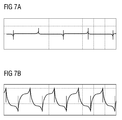
- Figs. 7A and 7B show waveforms of an amorphous alloy material and permalloy, respectively.
- the amorphous alloy material easily reaches saturation, i.e. has a relatively low saturation strength.
- amorphous alloy materials with a saturation strength less than 1 T are preferred, to satisfy the requirement for fast switching between positive and negative saturation.
- an iron-nickel alloy such as Fe 40 Ni 38 Mo 4 B 18 , with a saturation strength Bsat of about 0.75 T, can be used. More preferably, an amorphous alloy material with a saturation strength of less than 0.6 T is used.
- a cobalt-based amorphous alloy such as Co 66 Fe 4 (Mo,Si,B) 30 or Co 58 Ni 10 Fe 5 (Si,B) 27 , with a saturation strength Bsat of about 0.55 T, can be used as the magnetic core.
- the magnetic core repeatedly oscillates between the positive and negative saturation regions; in the linear regions, the current always increases or decreases in an approximately linear manner with time. If an easily saturated magnetic material as described above is used, the current mutual inductor will reach saturation in a shorter time and at a smaller current, so that the size of the excitation current decreases. Furthermore, the excitation frequency increases with the shortening of saturation time, so the detection circuit can filter out the excitation frequency from the current signal more easily.
- the low saturation magnetic induction strength of amorphous alloy materials can reduce the excitation power consumption and expand the frequency range.
- amorphous alloy materials can have a very low saturation magnetization, and a very low coercivity at low frequencies and at relatively high frequencies. These properties mean that these materials not only enter a saturated state easily, but are also demagnetized very easily. Since the null method on which magnetic modulation technology is based requires that the magnetic fields created by the current under measurement and the excitation current are equal in magnitude, a detection error will arise if there is remanence in the iron core material. Therefore if an iron core has been exposed to a strong magnetic field, it must be demagnetized in order to eliminate the detection error caused by remanence. The ease with which amorphous alloy materials are demagnetized enables them to be demagnetized by excitation directly in most application scenarios, with no need to subject the mutual inductor to any special processing.
- amorphous alloy materials have good ductility, so can be made into a form having a very small cross-sectional area.
- an amorphous alloy material can be used to make a magnetic core for which the ratio of the square root of cross-sectional area to the length of the magnetic path in the magnetic core is very small. In this way, the current detection range and frequency range can be increased significantly. By reducing this ratio to reduce the inductive reactance, the excitation frequency and detection frequency range can be increased, so that it becomes possible to expand the detection range by increasing the number of turns.
- an iron/nickel-based amorphous alloy and cobalt-based amorphous alloys are listed above as examples. Further amorphous alloys which may be used in the present invention are listed below.
- One example of an amorphous alloy is cobalt-based as before, and may comprise 67 wt% cobalt, 3 wt% nickel, 4 wt% iron, 2 wt% molybdenum, 12 wt% boron and 12 wt% silicon.
- the amorphous alloy material which may be used as the magnetic core of the current mutual inductor comprises: 67 wt% cobalt, 3 wt% nickel, 4 wt% iron, 2 wt% molybdenum, 12 wt% boron and 12 wt% silicon.
- the amorphous alloy material which may be used as the magnetic core of the current mutual inductor comprises: 66 wt% cobalt, 4 wt% iron and 30 wt% silicon, boron and molybdenum (the combined content of silicon, boron and molybdenum is 30 wt%).
- the amorphous alloy material which may be used as the magnetic core of the current mutual inductor comprises: 58 wt% cobalt, 10 wt% nickel, 5 wt% iron, and 27 wt% boron and silicon.
- Another example of an amorphous alloy is iron/nickel-based as before, and may comprise more than 30 wt% nickel and more than 30 wt% iron.
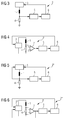
- Figs. 4 to 6 show schematic diagrams of three different current detection devices, in which reference numbers which are the same as in Fig. 3 represent the same units as in Fig. 3 . Their meanings will not be repeated here; only the differences will be discussed.
- the current detection device 2' shown in Fig. 4 the voltage across the sampling resistor is processed by a differential amplifier 7 before being sent to the saturation circuit. In this way, the saturation circuit can acquire the voltage drop across the sampling resistor. Thus, even if the other end of the sampling resistor is also connected to another circuit, it will be able to detect whether the magnetic core has reached saturation more accurately.
- the current detection circuit 2" in Fig. 5 differs from Fig. 3 by having an additional feedback line.
- This feedback line acquires from the sampling resistor the voltage value at the upper end of the sampling resistor. Since the lower end of the sampling resistor is connected to ground, the aforesaid voltage value is just the voltage drop across the sampling resistor. The voltage drop across the sampling resistor is fed back to the drive circuit 3', which can compensate for this voltage drop and thereby ensure that the voltage applied to the current mutual inductor is essentially constant.
- the current detection device 2"' shown in Fig. 6 not only detects the voltage drop across the sampling resistor by means of the differential amplifier 7, but also feeds this precisely measured voltage drop back to the drive circuit 3", enabling the drive circuit to compensate for the voltage drop across the sampling resistor promptly.
Landscapes
- Physics & Mathematics (AREA)
- General Physics & Mathematics (AREA)
- Engineering & Computer Science (AREA)
- Power Engineering (AREA)
- Measuring Instrument Details And Bridges, And Automatic Balancing Devices (AREA)
- Transformers For Measuring Instruments (AREA)
- Soft Magnetic Materials (AREA)
- Coils Or Transformers For Communication (AREA)
Applications Claiming Priority (1)
| Application Number | Priority Date | Filing Date | Title |
|---|---|---|---|
| CN201310039910.6A CN103969488B (zh) | 2013-01-31 | 2013-01-31 | 电流互感器及其电流检测电路 |
Publications (2)
| Publication Number | Publication Date |
|---|---|
| EP2762902A2 true EP2762902A2 (de) | 2014-08-06 |
| EP2762902A3 EP2762902A3 (de) | 2017-12-20 |
Family
ID=49679323
Family Applications (1)
| Application Number | Title | Priority Date | Filing Date |
|---|---|---|---|
| EP13193251.9A Withdrawn EP2762902A3 (de) | 2013-01-31 | 2013-11-18 | Gegenseitiger Strominduktor und Strommessschaltung dafür |
Country Status (3)
| Country | Link |
|---|---|
| EP (1) | EP2762902A3 (de) |
| CN (1) | CN103969488B (de) |
| BR (1) | BR102014002165A2 (de) |
Cited By (3)
| Publication number | Priority date | Publication date | Assignee | Title |
|---|---|---|---|---|
| CN109782047A (zh) * | 2019-02-26 | 2019-05-21 | 中国科学院宁波材料技术与工程研究所 | 一种基于非晶纳米晶异型磁芯的直放式电流传感器 |
| CN110133355A (zh) * | 2019-05-17 | 2019-08-16 | 中国科学院上海应用物理研究所 | 一种磁调制电流传感器及其制作方法 |
| CN117388557A (zh) * | 2023-10-25 | 2024-01-12 | 上海盛位电子技术有限公司 | 一种电流传感装置和磁调制方法 |
Families Citing this family (4)
| Publication number | Priority date | Publication date | Assignee | Title |
|---|---|---|---|---|
| CN104374984A (zh) * | 2014-11-17 | 2015-02-25 | 华北电力大学(保定) | 高精度磁调制式直流电流测量方法 |
| CN110190581B (zh) * | 2019-06-04 | 2021-11-23 | 上海良信电器股份有限公司 | 断路器的剩余电流保护装置及方法 |
| CN110927428B (zh) * | 2019-11-12 | 2022-03-08 | 中国船舶重工集团公司第七一九研究所 | 一种宽量程宽频高精度磁平衡式电流测量装置 |
| DE102021111286A1 (de) * | 2021-04-30 | 2022-11-03 | Magnetec Gmbh | Dämpfungsfolie und Verfahren zum Herstellen einer Dämpfungsfolie |
Citations (1)
| Publication number | Priority date | Publication date | Assignee | Title |
|---|---|---|---|---|
| EP1610133A2 (de) | 2004-06-21 | 2005-12-28 | ABB Service S.r.l | Messvorrichtung für Wechselstrom und/oder Gleichstrom |
Family Cites Families (24)
| Publication number | Priority date | Publication date | Assignee | Title |
|---|---|---|---|---|
| GB2075786B (en) * | 1980-03-21 | 1984-07-11 | Electrotech Instr Ltd | Switch mode converters |
| US4834816A (en) * | 1981-08-21 | 1989-05-30 | Allied-Signal Inc. | Metallic glasses having a combination of high permeability, low coercivity, low ac core loss, low exciting power and high thermal stability |
| DE3318270C1 (de) * | 1983-05-19 | 1984-08-02 | Daimler-Benz Ag, 7000 Stuttgart | Strommesssensor zur Funktionskontrolle elektrischer Verbraucher |
| US5284528A (en) * | 1983-05-23 | 1994-02-08 | Allied-Signal Inc. | Metallic glasses having a combination of high permeability, low coercivity, low ac core loss, low exciting power and high thermal stability |
| JPH0510980A (ja) * | 1990-11-26 | 1993-01-19 | Fuji Electric Co Ltd | 電流検出方法 |
| EP0513385B1 (de) * | 1990-11-30 | 1997-02-12 | Mitsui Petrochemical Industries, Ltd. | Weichmagnetlegierung auf eisen-basis |
| CN1031848C (zh) * | 1991-12-29 | 1996-05-22 | 首都钢铁公司 | 磁补偿式霍尔电流传感器用非晶磁芯制法 |
| JPH07128373A (ja) * | 1993-11-02 | 1995-05-19 | Sumitomo Special Metals Co Ltd | 直流電流センサー |
| US5552979A (en) * | 1993-11-30 | 1996-09-03 | Philips Electronics North America Corporation | Isolated current sensor for DC to high frequency applications |
| JP3286446B2 (ja) * | 1993-12-29 | 2002-05-27 | 住友特殊金属株式会社 | 直流電流センサー |
| US6432226B2 (en) * | 1999-04-12 | 2002-08-13 | Alliedsignal Inc. | Magnetic glassy alloys for high frequency applications |
| US6844799B2 (en) * | 2001-04-10 | 2005-01-18 | General Electric Company | Compact low cost current sensor and current transformer core having improved dynamic range |
| US6930581B2 (en) * | 2002-02-08 | 2005-08-16 | Metglas, Inc. | Current transformer having an amorphous fe-based core |
| ATE377833T1 (de) * | 2003-04-02 | 2007-11-15 | Vacuumschmelze Gmbh & Co Kg | Magnetkern, verfahren zur herstellung eines solchen magnetkerns, anwendungen eines solchen magnetkerns insbesondere bei stromtransformatoren und stromkompensierten drosseln sowie legierungen und bänder zur herstellung eines solchen magnetkerns |
| CN1305085C (zh) * | 2004-05-21 | 2007-03-14 | 清华大学 | 量计型电磁式电流互感器剩磁在线抑制装置 |
| FR2877486B1 (fr) * | 2004-10-29 | 2007-03-30 | Imphy Alloys Sa | Tore nanocristallin pour capteur de courant, compteurs d'energie a simple et a double etage et sondes de courant les incorporant |
| US7145321B2 (en) * | 2005-02-25 | 2006-12-05 | Sandquist David A | Current sensor with magnetic toroid |
| JP4716030B2 (ja) * | 2006-10-23 | 2011-07-06 | Tdk株式会社 | 電流センサ |
| ES2294966B1 (es) * | 2007-05-16 | 2009-02-16 | Premo, S.A. | "transductor de corriente de bajo consumo". |
| US7834613B2 (en) * | 2007-10-30 | 2010-11-16 | Power-One, Inc. | Isolated current to voltage, voltage to voltage converter |
| CN101701327B (zh) * | 2009-11-02 | 2012-07-04 | 中国科学院宁波材料技术与工程研究所 | 一种铁基大块非晶软磁合金及其制备方法 |
| CN102338822B (zh) * | 2010-07-15 | 2014-07-09 | 西门子公司 | 电流测量装置及其电流测量方法 |
| CN101996763B (zh) * | 2010-10-14 | 2011-12-28 | 北京四方继保自动化股份有限公司 | 调频电动机保护用电流互感器 |
| CN102534436A (zh) * | 2011-12-26 | 2012-07-04 | 哈尔滨工业大学 | 一种钴基非晶纳米晶双相金属纤维及其制备方法 |
-
2013
- 2013-01-31 CN CN201310039910.6A patent/CN103969488B/zh not_active Expired - Fee Related
- 2013-11-18 EP EP13193251.9A patent/EP2762902A3/de not_active Withdrawn
-
2014
- 2014-01-29 BR BR102014002165-5A patent/BR102014002165A2/pt not_active IP Right Cessation
Patent Citations (1)
| Publication number | Priority date | Publication date | Assignee | Title |
|---|---|---|---|---|
| EP1610133A2 (de) | 2004-06-21 | 2005-12-28 | ABB Service S.r.l | Messvorrichtung für Wechselstrom und/oder Gleichstrom |
Non-Patent Citations (1)
| Title |
|---|
| T. SONODA; R. UEDA; K. KOGA, IEEE TRANS. ON INDUSTRY APPLICATIONS, vol. 28, no. 5, September 1992 (1992-09-01), pages 1087 - 1094 |
Cited By (4)
| Publication number | Priority date | Publication date | Assignee | Title |
|---|---|---|---|---|
| CN109782047A (zh) * | 2019-02-26 | 2019-05-21 | 中国科学院宁波材料技术与工程研究所 | 一种基于非晶纳米晶异型磁芯的直放式电流传感器 |
| CN110133355A (zh) * | 2019-05-17 | 2019-08-16 | 中国科学院上海应用物理研究所 | 一种磁调制电流传感器及其制作方法 |
| CN110133355B (zh) * | 2019-05-17 | 2021-08-13 | 中国科学院上海应用物理研究所 | 一种磁调制电流传感器及其制作方法 |
| CN117388557A (zh) * | 2023-10-25 | 2024-01-12 | 上海盛位电子技术有限公司 | 一种电流传感装置和磁调制方法 |
Also Published As
| Publication number | Publication date |
|---|---|
| CN103969488A (zh) | 2014-08-06 |
| CN103969488B (zh) | 2017-09-29 |
| BR102014002165A2 (pt) | 2014-12-02 |
| EP2762902A3 (de) | 2017-12-20 |
Similar Documents
| Publication | Publication Date | Title |
|---|---|---|
| EP2871485B1 (de) | Stromerkennungsvorrichtung | |
| JP5948958B2 (ja) | 電流検出装置 | |
| EP3121609B1 (de) | Vorrichtung zur erkennung von gleichstrom-reststrom | |
| EP2924450B1 (de) | Stromdetektionsvorrichtung | |
| CN103969488B (zh) | 电流互感器及其电流检测电路 | |
| JP6123275B2 (ja) | 電流検知装置 | |
| JP5516079B2 (ja) | 電流検知装置 | |
| JP2016050921A (ja) | 電流検知装置 | |
| JP2000162244A (ja) | 直流電流センサ | |
| JP2019002768A (ja) | 電流センサ | |
| JP2016194483A (ja) | 電流検知装置 | |
| KR102039268B1 (ko) | 교류 및 직류 전류 감지 회로 | |
| JP6210193B2 (ja) | 電流検知装置 | |
| JP6024162B2 (ja) | 電流検知装置 | |
| JP2007316042A (ja) | 直流電流センサー及び直流電流検出装置 | |
| JP6191267B2 (ja) | 電流検出装置 | |
| JP2012063218A (ja) | 電流検知装置 | |
| JP2000266785A (ja) | 電流計測装置 | |
| JP6119384B2 (ja) | 電流検知装置 | |
| JP4287735B2 (ja) | フラックスゲート磁力計の計測装置 | |
| KR102039271B1 (ko) | 누설 전류 감지 회로 | |
| KR102039270B1 (ko) | 지락 전류 감지 회로 | |
| JP2008014921A (ja) | 直流電流検出方法及び直流電流検出器 | |
| JP2008107119A (ja) | 電流センサ | |
| KR102039269B1 (ko) | 누전 전류 감지 회로 |
Legal Events
| Date | Code | Title | Description |
|---|---|---|---|
| PUAI | Public reference made under article 153(3) epc to a published international application that has entered the european phase |
Free format text: ORIGINAL CODE: 0009012 |
|
| 17P | Request for examination filed |
Effective date: 20131118 |
|
| AK | Designated contracting states |
Kind code of ref document: A2 Designated state(s): AL AT BE BG CH CY CZ DE DK EE ES FI FR GB GR HR HU IE IS IT LI LT LU LV MC MK MT NL NO PL PT RO RS SE SI SK SM TR |
|
| AX | Request for extension of the european patent |
Extension state: BA ME |
|
| RIN1 | Information on inventor provided before grant (corrected) |
Inventor name: LU, XIANG DONG Inventor name: BAO, ZHANG YAO Inventor name: WU, DI |
|
| RAP1 | Party data changed (applicant data changed or rights of an application transferred) |
Owner name: SIEMENS AKTIENGESELLSCHAFT |
|
| PUAL | Search report despatched |
Free format text: ORIGINAL CODE: 0009013 |
|
| AK | Designated contracting states |
Kind code of ref document: A3 Designated state(s): AL AT BE BG CH CY CZ DE DK EE ES FI FR GB GR HR HU IE IS IT LI LT LU LV MC MK MT NL NO PL PT RO RS SE SI SK SM TR |
|
| AX | Request for extension of the european patent |
Extension state: BA ME |
|
| RIC1 | Information provided on ipc code assigned before grant |
Ipc: G01R 15/18 20060101AFI20171114BHEP Ipc: G01R 19/00 20060101ALI20171114BHEP |
|
| R17P | Request for examination filed (corrected) |
Effective date: 20180620 |
|
| RBV | Designated contracting states (corrected) |
Designated state(s): AL AT BE BG CH CY CZ DE DK EE ES FI FR GB GR HR HU IE IS IT LI LT LU LV MC MK MT NL NO PL PT RO RS SE SI SK SM TR |
|
| STAA | Information on the status of an ep patent application or granted ep patent |
Free format text: STATUS: THE APPLICATION IS DEEMED TO BE WITHDRAWN |
|
| 18D | Application deemed to be withdrawn |
Effective date: 20190601 |