EP2765088A1 - Selbstklebender Briefumschlag, entsprechendes Herstellungsverfahren und entsprechende Anwendung - Google Patents
Selbstklebender Briefumschlag, entsprechendes Herstellungsverfahren und entsprechende Anwendung Download PDFInfo
- Publication number
- EP2765088A1 EP2765088A1 EP14153561.7A EP14153561A EP2765088A1 EP 2765088 A1 EP2765088 A1 EP 2765088A1 EP 14153561 A EP14153561 A EP 14153561A EP 2765088 A1 EP2765088 A1 EP 2765088A1
- Authority
- EP
- European Patent Office
- Prior art keywords
- envelope
- fold
- closing
- tab
- main face
- Prior art date
- Legal status (The legal status is an assumption and is not a legal conclusion. Google has not performed a legal analysis and makes no representation as to the accuracy of the status listed.)
- Withdrawn
Links
Images


Classifications
-
- B—PERFORMING OPERATIONS; TRANSPORTING
- B65—CONVEYING; PACKING; STORING; HANDLING THIN OR FILAMENTARY MATERIAL
- B65D—CONTAINERS FOR STORAGE OR TRANSPORT OF ARTICLES OR MATERIALS, e.g. BAGS, BARRELS, BOTTLES, BOXES, CANS, CARTONS, CRATES, DRUMS, JARS, TANKS, HOPPERS, FORWARDING CONTAINERS; ACCESSORIES, CLOSURES, OR FITTINGS THEREFOR; PACKAGING ELEMENTS; PACKAGES
- B65D27/00—Envelopes or like essentially-rectangular flexible containers for postal or other purposes having no structural provision for thickness of contents
- B65D27/12—Closures
- B65D27/14—Closures using adhesive applied to integral parts, e.g. flaps
- B65D27/16—Closures using adhesive applied to integral parts, e.g. flaps using pressure-sensitive adhesive
-
- B—PERFORMING OPERATIONS; TRANSPORTING
- B65—CONVEYING; PACKING; STORING; HANDLING THIN OR FILAMENTARY MATERIAL
- B65D—CONTAINERS FOR STORAGE OR TRANSPORT OF ARTICLES OR MATERIALS, e.g. BAGS, BARRELS, BOTTLES, BOXES, CANS, CARTONS, CRATES, DRUMS, JARS, TANKS, HOPPERS, FORWARDING CONTAINERS; ACCESSORIES, CLOSURES, OR FITTINGS THEREFOR; PACKAGING ELEMENTS; PACKAGES
- B65D71/00—Bundles of articles held together by packaging elements for convenience of storage or transport, e.g. portable segregating carrier for plural receptacles such as beer cans or pop bottles; Bales of material
- B65D71/02—Arrangements of flexible binders
Definitions
- the invention also relates to a method of manufacturing such an envelope, a use of such an envelope, and a package comprising a plurality of such envelopes.
- the envelope comprises at least one glued surface comprising a scrub whose stickiness is activated by wetting.
- Such envelopes are generally intended for the mechanized insertion of their contents.
- the envelope comprises at least one glued surface comprising a permanent adhesive scrub protected by a silicone band.
- the protective strip is removed.
- Such envelopes are intended for the general public. They have an improved life, but are more expensive than those of the first family.
- the protective strip remains after the closure of the envelope and becomes a waste.
- the third family which is rather an entry-level, brings together the envelopes called "stickers".
- the adhesive used adheres in liquid form to the sheet of which the envelope is made. Once dried, the glue forms a scrub that sticks only "on itself” (glue on glue). There is no need to bring moisture or remove a protective tape to activate the bonding.
- the self-adhesive envelopes are made by depositing a glue, generally based on latex, on the closure tab and on a movable portion of the bottom.
- the movable portion is defined by an additional fold, called "third fold" stationery, made in the background.
- the bonded surfaces are located on the movable portion of the bottom and on the closure tab on the side where the movable portion and the closure tab are folded, the bonded surfaces do not come into contact with each other before the use of the envelope.
- Closing the envelope is effected by unfolding the closing tab, then by unfolding the movable part of the bottom, and finally by folding the closure tab on the unfolded mobile part of the closure tab, so as to put in contact with each other the glued surfaces.
- Such envelopes are relatively complicated to produce because of the additional fold made in the bottom to protect the bottom glued surface, but necessary for its proper operation.
- An object of the invention is therefore to provide a stationery envelope simple to produce, a very competitive cost and minimizing potential waste.
- the invention also relates to a use of a stationery envelope as described above, wherein, the envelope being initially in the storage position, the distal portion of the closure tab is unfolded at least partially according to the storage fold to allow the insertion of said contents of the envelope, then the distal portion is moved so as to fold the closure tab according to the fold of closing and bringing the glued closure tab surface into contact with the bottom glued surface, the envelope then being in the closed position.
- the invention also covers an envelope or an envelope package associated with a user manual describing, in whole or in part, schematically or not, the aforementioned use of the envelope.
- envelope is meant in this document a stationery envelope whose opening and closing are effected on at least one side, for example intended for postal use.
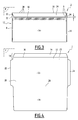
- the casing 2 is of generally flat and rectangular shape in a closed position shown in FIG. Figure 1 .
- the envelope 2 comprises two long sides 4, 6 and two small sides 8, 10.
- the envelope 2 is shown in a fully open position on the Figure 2 .
- the opening and closing of the envelope 2 are at the level of the long side 4.
- the opening of the envelope 2 is on one of the short sides 8, 10.
- the envelope 2 is then generally called "pocket”.
- the envelope 2 is shown in a storage position before use on the Figure 3 .
- the envelope 2 comprises a main face 12 extending substantially in a plane P, and a bottom 14 defining with the main face 12 an interstitial space 16 ( Figure 2 ) for a content (not shown) of the envelope.
- Envelope 2 includes also a closure tab 18 separated from the main face 12 by a closing fold 20 for closing the closure tab 18 on the bottom 14.
- the envelope 2 advantageously comprises two lateral lugs 22, 24 on which the base 14 is fixed. for example by gluing.
- fold is meant in this document a fold mark for folding the envelope 2 according to said fold.
- the envelope 2 is advantageously constituted essentially of a cut stationery sheet 26 represented on the Figure 4 .
- the stationery sheet 26 comprises for example one or more of the following materials: non-recycled paper, for example white, colored, kraft or white kraft; recycled paper, for example white, gray or kraft color; pure offset paper not recycled, eg white; virgin fiber kraft paper; matte or glossy coated paper; reinforced paper (offset or kraft); and colored paper other than white, gray or kraft paper.
- the sheet 26 consists of only one of the abovementioned materials on one of its faces corresponding to the outside of the envelope 2.
- Offset paper designates a suitable paper for printing according to the offset method known per se and is also suitable for the manufacture of envelopes.
- Kraft paper is a type of paper used in particular for different types of bags, resistant packaging and envelopes. It is very resistant, hence its name, which means “strength” in German.
- the basis weight of the sheet 26 is advantageously between 50 and 200 g / m 2 , for example 70, 75, 80, 90, 100, 110, 120 or 130 g / m 2 .
- the casing 2 comprises bellows to give the interstitial space 18 a greater thickness perpendicular to the plane P.
- the main face 12 then has a more complex shape including the bellows.
- the main face 12 extends substantially in the plane P when the envelope 2 is flat.
- the main face 12 is delimited by the sides 4, 6, 8, 10 of the envelope 2.
- the main face 12 is intended to receive the address (not shown) of a recipient, in case of use of the envelope 2 as a postal envelope.
- the address is for example written or printed on the front of the main face 12.
- the main face 12 comprises a transparent window for reading the printed address on the contents of the envelope 2 introduced into the interstitial space 16.
- front of the main face 12 is meant the side of the main face 12 corresponding to the outside of the envelope 2.
- the long side 4 defines an upper edge of the envelope 2
- the long side 6 defines a lower edge of the envelope 2.
- the short sides 8 and 10 form respectively the left and right edges of the envelope 2 .
- the main face 12 has a length L1 and a width L2 ( Figure 1 ) defining the envelope size 2.
- the width L1 is between 140 mm and 324 mm and the length L2 is between 90 mm and 229 mm.
- the format is for example one of the following, where the first value is the width L2 in mm and the second value is the length L1 in mm: 90x140, 114x162, 110x220, 110x155, 114x225, 114x229, 162x229 176x250, and 229x324.
- the format is for example one of the following: 114x162, 110x220, 162x229, 176x250, 229x324, 250x353, 260x330, 275x365, and 280x400.
- the closing fold 20 defines the long side 4 of the main face 12.
- the closure fold 20 has perforations 27 to facilitate tearing of the envelope 2 according to the fold 20. It is thus possible to open the envelope 2 once it has been closed and that the glued surfaces 30, 40 can no longer peel away from each other easily.
- the bottom 14 is a tab obtained by folding the sheet 26 in a bottom fold 28 defining the long side 6. The bottom fold 28 thus separates the main face 12 from the bottom 14.
- the bottom 14 comprises a bottom-glued surface 30 extending on the outer face of the bottom 14, that is to say the face turned towards the observer on the Figures 1 to 3 .
- the bottom 14 is advantageously devoid of any other fold, in particular a fold which would define a movable portion of the bottom 14 relative to the main face 12. This fold absent from the bottom 14 is the additional fold characteristic of the third family of the prior art mentioned above.
- the closing tab 18 extends in the plane P of the main face 12 when the casing 2 is in the open position.
- the closing tab 18 and the main face 12 extend on either side of the closure fold 20.
- the closing tab 18 is folded on the main face according to the closing fold 20 when the casing 2 is in the closed position.
- the closure lug 18 includes a proximal portion 32 and a distal portion 34 relative to the main face 12 when the casing 2 is in the open position shown in FIG. Figure 2 .
- the proximal portion 32 extends between the closure fold 20 and a storage bend 36 of the closure tab 18.
- the storage bend 36 is preferably substantially parallel to the closure fold 20.
- the storage bend 36 advantageously extends from one edge to the other of the closure tab 18.
- the storage bend 36 comprises, for example, perforations 38 to facilitate tearing of the envelope 2 according to the storage fold.
- the storage bend 36 is the sole fold of the closing tab 18 except the closing fold 20.
- the distal portion 34 is separated from the proximal portion 32 by the storage fold 36.
- the distal portion comprises a glued surface 40 of closure tab ( Figure 2 ).
- the glued surface 40 extends for example substantially parallel to the closing fold 20, according to points, lines or bands.
- the glued surface 40 advantageously extends parallel to the closure fold 20, for example over at least half the length of the distal portion 34, preferably at least 80% of the length of the distal portion 34.
- the bottom glued surface 30 is advantageously substantially symmetrical with the glued surface 40 with respect to the closing fold 20 in the open position shown in FIG. Figure 2 .
- the glued surface 40 of the closing tab is applied substantially against the bottom glued surface 30.
- the closing tab 18 is folded according to the storage fold 36.
- the proximal portion 32 and the distal portion 34 extend substantially in the plane P.
- the proximal portion 32 is not folded according to the closing fold 20, while that the distal portion 34 is folded over the proximal portion 32 according to the storage fold 36.
- the distal portion 34 does not cover the bottom 14 in the storage position.
- the distal portion 34 is at a distance from the bottom 14 defining the set J.
- the glued surfaces 30, 40 are for example about 1 cm wide.
- the glued surfaces 30, 40 are advantageously obtained, according to a method known per se, by depositing a glue so as to form a self-adhesive "glue-on-glue” type scrub. This means that the glued surfaces 30, 40 are intended to stick to one another and not to other unsized surfaces of the envelope 2.
- the glue used is a synthetic glue based on natural latex whose properties allow it to not stick to the paper once dried, but to stick on itself once dried.
- the casing 2 is advantageously devoid of any adhesive tape for protecting one or the other of the glued surface 40 of the closure lug and of the bottom-glued surface 30, the adhesive strip being intended to be removed before closing. the envelope 2.
- envelopes 2 are for example packaged in the form of a package 42 as shown in FIG. Figure 5 .
- the envelopes 2 are in the storage position and stacked one on the other to form a stack 43.
- the glue of the surface glued bottom 30 of the 2B envelope is in contact with the main face 12 of the envelope 2A.
- the bottom glued surface 30 of the envelope 2B does not permanently stick to the main face 12 of the envelope 2A because of the nature of the glue used. It is therefore possible to separate the envelope 2B from the envelope 2A. Therefore, it is possible to separate from the rest of the stack 43 any envelope 2 of the packet 42.
- the package 42 further comprises a link 44, for example a paper web surrounding the envelopes 2 or a plastic film (not shown) enveloping the envelopes, to hold them against each other within the package 42.
- a link 44 for example a paper web surrounding the envelopes 2 or a plastic film (not shown) enveloping the envelopes, to hold them against each other within the package 42.
- the envelope 2 is possibly extracted from the package 42 in which it has been packaged.
- the link 44 is torn or broken so as to release the envelopes 2 of the stack 43, or at least one of the stacked envelopes 2 is extracted from the pack 42 by sliding it out of the pack 42.
- the envelope 2 is initially in the storage position before use ( Figure 3 ).
- the closure lug 18 is then manipulated to unfold the distal portion 34 along the storage bend 36 and to bring the distal portion into the plane P, on the other side of the storage fold 36 relative to the proximal portion 32.
- the envelope 2 is then in the open position ( Figure 2 ).
- the content (not shown) of the envelope 2 is inserted in the interstitial space 16.
- the envelope 2 is then sealed by closing the closing tab 18.
- the closure tab 18 is folded according to the closing fold 20 so as to bring the distal portion 34 against the bottom 14, the glued portion 40 coming into contact with the bottom-glued portion 30.
- the envelope 2 is sealed in its closed position ( Figure 1 ).
- the envelope 2 is for example torn, either according to the perforations 27 of the closing fold 20 or the perforation 38 of the storage fold 36, which facilitate tearing.
- the envelope 2 is not sealed, but is then returned to the storage position. To do this, the distal portion 34 of the closure tab 18 is simply folded according to the storage bend 36. It is thus possible to subsequently change the contents of the envelope 2.
- the method comprises a step of obtaining the stationery sheet.
- the envelope 2 consists solely of the stationery sheet and the glue of the glued surfaces 30, 40.
- the stationery sheet is cut according to a pattern at least partially defining the main face 12, the bottom 14 and the closing tab 18, in order to obtain the cut sheet 26 shown on the drawing.
- Figure 4 the stationery sheet is cut according to a pattern at least partially defining the main face 12, the bottom 14 and the closing tab 18, in order to obtain the cut sheet 26 shown on the drawing.
- the cut sheet 26 is then folded to define at least the closure fold 20, the storage fold 36 and the bottom fold 28, to obtain a folded sheet (not shown).
- the cut sheet 26 is further folded along the short sides 8, 10 to define the side tabs 22, 24.
- the closing fold 20 is perforated to obtain the perforations 27.
- the storage fold 36 is advantageously perforated to obtain the perforations 38.
- Glue is deposited on the lateral tabs 22, 24.
- the bottom 14 is folded along the bottom fold 28 and adhered to the lateral tabs 22, 24.
- the folded sheet is then sized to obtain the bottom glued surface 30 and the glued surface 40 of the closure tab to form the envelope 2.
- a self-adhesive scrub is formed on each of the glued surfaces 30, 40.
- the envelope 2 is finally put in the storage position. To do this, the distal portion 34 of the closure tab 18 is folded over the proximal portion 32 according to the storage fold 36.
- the envelope 2 is stacked with other envelopes 2 to constitute the stack 43. Then the stack 43 is surrounded or secured by a link 44 or a film (not shown) to obtain the package of envelopes 42 ( Figure 5 ).
- the envelope 2 is simple to produce.
- the bottom 14 having no additional fold to protect the bottom glued surface 30, the production rate of the envelopes 2 is increased by a factor of about 30 to 40%, so the unit cost of the envelope 2 is very competitive.
- a protective strip is not necessary, there is no waste associated with the use of the envelope 2.
Landscapes
- Engineering & Computer Science (AREA)
- Mechanical Engineering (AREA)
- Cartons (AREA)
- Credit Cards Or The Like (AREA)
Applications Claiming Priority (1)
| Application Number | Priority Date | Filing Date | Title |
|---|---|---|---|
| FR1351019A FR3001717B1 (fr) | 2013-02-06 | 2013-02-06 | Enveloppe de papeterie autocollante, procede de fabrication et utilisation correspondants |
Publications (1)
| Publication Number | Publication Date |
|---|---|
| EP2765088A1 true EP2765088A1 (de) | 2014-08-13 |
Family
ID=48613777
Family Applications (1)
| Application Number | Title | Priority Date | Filing Date |
|---|---|---|---|
| EP14153561.7A Withdrawn EP2765088A1 (de) | 2013-02-06 | 2014-01-31 | Selbstklebender Briefumschlag, entsprechendes Herstellungsverfahren und entsprechende Anwendung |
Country Status (2)
| Country | Link |
|---|---|
| EP (1) | EP2765088A1 (de) |
| FR (1) | FR3001717B1 (de) |
Cited By (1)
| Publication number | Priority date | Publication date | Assignee | Title |
|---|---|---|---|---|
| CN115284682A (zh) * | 2022-08-17 | 2022-11-04 | 东莞市和信包装制品有限公司 | 可二次密封的快递包装袋的制造方法 |
Citations (6)
| Publication number | Priority date | Publication date | Assignee | Title |
|---|---|---|---|---|
| FR605739A (fr) * | 1925-11-06 | 1926-06-01 | Gaut Blancan Et Cie Soc | Perfectionnements aux bandes pour paquets d'enveloppes |
| DE698521C (de) * | 1935-12-19 | 1940-11-12 | Gustav Jaeckel | Umschlag, Beutel o. dgl. |
| US3733025A (en) * | 1971-06-10 | 1973-05-15 | Tension Envelope Corp | Easy opening envelope |
| US20050173506A1 (en) * | 2004-02-09 | 2005-08-11 | Cantar/Polyair Inc. | Reusable protective envelope |
| DE102009025418A1 (de) * | 2009-06-16 | 2010-12-23 | Böttcher, Dieter | Versandumschlag |
| DE202010014645U1 (de) * | 2010-10-26 | 2011-10-13 | Lemo Maschinenbau Gmbh | Verpackungsbeutel |
-
2013
- 2013-02-06 FR FR1351019A patent/FR3001717B1/fr not_active Expired - Fee Related
-
2014
- 2014-01-31 EP EP14153561.7A patent/EP2765088A1/de not_active Withdrawn
Patent Citations (6)
| Publication number | Priority date | Publication date | Assignee | Title |
|---|---|---|---|---|
| FR605739A (fr) * | 1925-11-06 | 1926-06-01 | Gaut Blancan Et Cie Soc | Perfectionnements aux bandes pour paquets d'enveloppes |
| DE698521C (de) * | 1935-12-19 | 1940-11-12 | Gustav Jaeckel | Umschlag, Beutel o. dgl. |
| US3733025A (en) * | 1971-06-10 | 1973-05-15 | Tension Envelope Corp | Easy opening envelope |
| US20050173506A1 (en) * | 2004-02-09 | 2005-08-11 | Cantar/Polyair Inc. | Reusable protective envelope |
| DE102009025418A1 (de) * | 2009-06-16 | 2010-12-23 | Böttcher, Dieter | Versandumschlag |
| DE202010014645U1 (de) * | 2010-10-26 | 2011-10-13 | Lemo Maschinenbau Gmbh | Verpackungsbeutel |
Cited By (2)
| Publication number | Priority date | Publication date | Assignee | Title |
|---|---|---|---|---|
| CN115284682A (zh) * | 2022-08-17 | 2022-11-04 | 东莞市和信包装制品有限公司 | 可二次密封的快递包装袋的制造方法 |
| CN115284682B (zh) * | 2022-08-17 | 2026-02-13 | 东莞市和信包装制品有限公司 | 可二次密封的快递包装袋的制造方法 |
Also Published As
| Publication number | Publication date |
|---|---|
| FR3001717A1 (fr) | 2014-08-08 |
| FR3001717B1 (fr) | 2015-03-06 |
Similar Documents
| Publication | Publication Date | Title |
|---|---|---|
| JP4573232B2 (ja) | 喫煙物パック用ラベル | |
| WO1999061348A1 (fr) | Emballage muni d'un coupon et procede d'obtention dudit emballage | |
| FR2542704A1 (fr) | Enveloppes reutilisables pour la reponse, a element de mise en place de la patte de fermeture pour la reexpedition, et procede de preparation de ces enveloppes pour l'expedition | |
| FR2738798A1 (fr) | Procede d'emballage et contenant en faisant application au moyen d'adhesif a effet prolonge | |
| JP2016505458A (ja) | タバコパケット | |
| EP0801778B1 (de) | Anhaftende hülle | |
| EP0633201A1 (de) | Mit mehr als einer Öffnungsmöglichkeit versehene Zigarettenverpackung | |
| EP3710242B1 (de) | Verfahren und maschine zur herstellung eines stapels von beuteln | |
| CA3024168A1 (fr) | Sac industriel avec un systeme de fermeture et d'ouverture comprenant une bande de fond apte a etre arrachee et procede de fabrication d'un tel sac | |
| EP0584431B1 (de) | Verpackung, insbesondere für Bündel von Produkten der Tabakindustrie, Zuschnitt und Herstellungsverfahren dieser Verpackung | |
| EP2765088A1 (de) | Selbstklebender Briefumschlag, entsprechendes Herstellungsverfahren und entsprechende Anwendung | |
| EP4188819B1 (de) | Wiederverwendbarer briefumschlag mit vorgeschnittener verschlussklappe, verfahren und maschine zur herstellung eines solchen umschlags | |
| EP3856650B1 (de) | Versand-/neuversandverpackungseinheit und vorgeschnittene schablone zur herstellung derselben | |
| EP1451792B1 (de) | Label mit mehrfachdaten und verfahren zu seiner herstellung | |
| US20070023490A1 (en) | Postcard and manufacturing process thereof | |
| CA2468889A1 (fr) | Boite polygonale et planche predecoupee utile pour la fabriquer | |
| EP3144238B1 (de) | Verpackung und zuschnitt für eine verpackung mit einer verbesserten öffnungsvorrichtung | |
| EP1167215B1 (de) | Faltschachtel, insbesondere aus Karton, und Verfahren zur Herstellung derselben | |
| EP0402192A1 (de) | Gegenstand aus Karton oder ähnlichem Material und Verfahren zu seiner Herstellung | |
| WO2002054893A1 (fr) | Dispositif pour collecter les megots | |
| EP3830000B1 (de) | Verpackung für ein produkt, insbesondere ein nahrungsmittelprodukt | |
| FR3095810A1 (fr) | Bande de fermeture rapportée sur un emballage du type sachet ou boîte | |
| JP6387723B2 (ja) | 紙製包装容器 | |
| WO2017029182A1 (en) | Cigarette paper dispenser | |
| WO1993021023A1 (fr) | Article destine a la confection d'une carte postale personnalisee |
Legal Events
| Date | Code | Title | Description |
|---|---|---|---|
| PUAI | Public reference made under article 153(3) epc to a published international application that has entered the european phase |
Free format text: ORIGINAL CODE: 0009012 |
|
| 17P | Request for examination filed |
Effective date: 20140131 |
|
| AK | Designated contracting states |
Kind code of ref document: A1 Designated state(s): AL AT BE BG CH CY CZ DE DK EE ES FI FR GB GR HR HU IE IS IT LI LT LU LV MC MK MT NL NO PL PT RO RS SE SI SK SM TR |
|
| AX | Request for extension of the european patent |
Extension state: BA ME |
|
| R17P | Request for examination filed (corrected) |
Effective date: 20150115 |
|
| RBV | Designated contracting states (corrected) |
Designated state(s): AL AT BE BG CH CY CZ DE DK EE ES FI FR GB GR HR HU IE IS IT LI LT LU LV MC MK MT NL NO PL PT RO RS SE SI SK SM TR |
|
| 17Q | First examination report despatched |
Effective date: 20180208 |
|
| STAA | Information on the status of an ep patent application or granted ep patent |
Free format text: STATUS: THE APPLICATION IS DEEMED TO BE WITHDRAWN |
|
| 18D | Application deemed to be withdrawn |
Effective date: 20191122 |