EP2785643B1 - Stabilisiertes mikroporöses kristallines material, verfahren zu seiner herstellung und verwendung zur selektiven katalytischen nox-reduktion - Google Patents
Stabilisiertes mikroporöses kristallines material, verfahren zu seiner herstellung und verwendung zur selektiven katalytischen nox-reduktion Download PDFInfo
- Publication number
- EP2785643B1 EP2785643B1 EP12805498.8A EP12805498A EP2785643B1 EP 2785643 B1 EP2785643 B1 EP 2785643B1 EP 12805498 A EP12805498 A EP 12805498A EP 2785643 B1 EP2785643 B1 EP 2785643B1
- Authority
- EP
- European Patent Office
- Prior art keywords
- microporous crystalline
- alkali
- earth metal
- sapo
- crystalline material
- Prior art date
- Legal status (The legal status is an assumption and is not a legal conclusion. Google has not performed a legal analysis and makes no representation as to the accuracy of the status listed.)
- Active
Links
- 239000002178 crystalline material Substances 0.000 title claims description 31
- 238000010531 catalytic reduction reaction Methods 0.000 title claims description 7
- 238000004519 manufacturing process Methods 0.000 title claims description 3
- 239000000463 material Substances 0.000 claims description 58
- XLYOFNOQVPJJNP-UHFFFAOYSA-N water Substances O XLYOFNOQVPJJNP-UHFFFAOYSA-N 0.000 claims description 47
- VYPSYNLAJGMNEJ-UHFFFAOYSA-N Silicium dioxide Chemical compound O=[Si]=O VYPSYNLAJGMNEJ-UHFFFAOYSA-N 0.000 claims description 40
- MWUXSHHQAYIFBG-UHFFFAOYSA-N nitrogen oxide Inorganic materials O=[N] MWUXSHHQAYIFBG-UHFFFAOYSA-N 0.000 claims description 34
- 239000011575 calcium Substances 0.000 claims description 32
- 229910001868 water Inorganic materials 0.000 claims description 32
- 229910052751 metal Inorganic materials 0.000 claims description 28
- 239000002184 metal Substances 0.000 claims description 28
- 239000000203 mixture Substances 0.000 claims description 25
- 239000010949 copper Substances 0.000 claims description 21
- 238000000034 method Methods 0.000 claims description 19
- 239000000377 silicon dioxide Substances 0.000 claims description 18
- RYGMFSIKBFXOCR-UHFFFAOYSA-N Copper Chemical compound [Cu] RYGMFSIKBFXOCR-UHFFFAOYSA-N 0.000 claims description 17
- 229910052802 copper Inorganic materials 0.000 claims description 17
- 239000013078 crystal Substances 0.000 claims description 16
- QGZKDVFQNNGYKY-UHFFFAOYSA-N Ammonia Chemical compound N QGZKDVFQNNGYKY-UHFFFAOYSA-N 0.000 claims description 14
- 229910052791 calcium Inorganic materials 0.000 claims description 14
- 229910052784 alkaline earth metal Inorganic materials 0.000 claims description 13
- 229910052681 coesite Inorganic materials 0.000 claims description 12
- 229910052906 cristobalite Inorganic materials 0.000 claims description 12
- 239000007789 gas Substances 0.000 claims description 12
- 229910052682 stishovite Inorganic materials 0.000 claims description 12
- 229910052905 tridymite Inorganic materials 0.000 claims description 12
- OYPRJOBELJOOCE-UHFFFAOYSA-N Calcium Chemical compound [Ca] OYPRJOBELJOOCE-UHFFFAOYSA-N 0.000 claims description 11
- 238000005470 impregnation Methods 0.000 claims description 11
- 150000002910 rare earth metals Chemical class 0.000 claims description 11
- 238000003786 synthesis reaction Methods 0.000 claims description 11
- 229910052783 alkali metal Inorganic materials 0.000 claims description 10
- 150000001340 alkali metals Chemical class 0.000 claims description 10
- PNEYBMLMFCGWSK-UHFFFAOYSA-N aluminium oxide Inorganic materials [O-2].[O-2].[O-2].[Al+3].[Al+3] PNEYBMLMFCGWSK-UHFFFAOYSA-N 0.000 claims description 10
- 229910052700 potassium Inorganic materials 0.000 claims description 10
- 239000011148 porous material Substances 0.000 claims description 9
- 229910052761 rare earth metal Inorganic materials 0.000 claims description 9
- ZLMJMSJWJFRBEC-UHFFFAOYSA-N Potassium Chemical compound [K] ZLMJMSJWJFRBEC-UHFFFAOYSA-N 0.000 claims description 8
- 239000011591 potassium Substances 0.000 claims description 8
- 230000015572 biosynthetic process Effects 0.000 claims description 7
- 238000005342 ion exchange Methods 0.000 claims description 7
- 239000007791 liquid phase Substances 0.000 claims description 6
- 150000002739 metals Chemical class 0.000 claims description 6
- 229910052712 strontium Inorganic materials 0.000 claims description 6
- 229910021529 ammonia Inorganic materials 0.000 claims description 5
- 229910052746 lanthanum Inorganic materials 0.000 claims description 5
- FYYHWMGAXLPEAU-UHFFFAOYSA-N Magnesium Chemical compound [Mg] FYYHWMGAXLPEAU-UHFFFAOYSA-N 0.000 claims description 4
- 229910052788 barium Inorganic materials 0.000 claims description 4
- DSAJWYNOEDNPEQ-UHFFFAOYSA-N barium atom Chemical compound [Ba] DSAJWYNOEDNPEQ-UHFFFAOYSA-N 0.000 claims description 4
- 229910052792 caesium Inorganic materials 0.000 claims description 4
- TVFDJXOCXUVLDH-UHFFFAOYSA-N caesium atom Chemical compound [Cs] TVFDJXOCXUVLDH-UHFFFAOYSA-N 0.000 claims description 4
- 229910052749 magnesium Inorganic materials 0.000 claims description 4
- 239000011777 magnesium Substances 0.000 claims description 4
- 229910052701 rubidium Inorganic materials 0.000 claims description 4
- IGLNJRXAVVLDKE-UHFFFAOYSA-N rubidium atom Chemical compound [Rb] IGLNJRXAVVLDKE-UHFFFAOYSA-N 0.000 claims description 4
- 239000002002 slurry Substances 0.000 claims description 4
- CIOAGBVUUVVLOB-UHFFFAOYSA-N strontium atom Chemical compound [Sr] CIOAGBVUUVVLOB-UHFFFAOYSA-N 0.000 claims description 4
- 229910052779 Neodymium Inorganic materials 0.000 claims description 3
- 238000010438 heat treatment Methods 0.000 claims description 3
- FZLIPJUXYLNCLC-UHFFFAOYSA-N lanthanum atom Chemical compound [La] FZLIPJUXYLNCLC-UHFFFAOYSA-N 0.000 claims description 3
- QEFYFXOXNSNQGX-UHFFFAOYSA-N neodymium atom Chemical compound [Nd] QEFYFXOXNSNQGX-UHFFFAOYSA-N 0.000 claims description 3
- 229910001404 rare earth metal oxide Inorganic materials 0.000 claims description 3
- -1 rare-earth metal salt Chemical class 0.000 claims description 3
- XSQUKJJJFZCRTK-UHFFFAOYSA-N Urea Chemical compound NC(N)=O XSQUKJJJFZCRTK-UHFFFAOYSA-N 0.000 claims description 2
- 239000004202 carbamide Substances 0.000 claims description 2
- 239000003795 chemical substances by application Substances 0.000 claims description 2
- 150000001875 compounds Chemical class 0.000 claims description 2
- 150000002430 hydrocarbons Chemical class 0.000 claims description 2
- 238000002156 mixing Methods 0.000 claims description 2
- 239000007790 solid phase Substances 0.000 claims 2
- 229910019142 PO4 Inorganic materials 0.000 claims 1
- 238000001354 calcination Methods 0.000 claims 1
- NBIIXXVUZAFLBC-UHFFFAOYSA-K phosphate Chemical compound [O-]P([O-])([O-])=O NBIIXXVUZAFLBC-UHFFFAOYSA-K 0.000 claims 1
- 239000010452 phosphate Substances 0.000 claims 1
- 150000003839 salts Chemical class 0.000 claims 1
- 229910052676 chabazite Inorganic materials 0.000 description 41
- UNYSKUBLZGJSLV-UHFFFAOYSA-L calcium;1,3,5,2,4,6$l^{2}-trioxadisilaluminane 2,4-dioxide;dihydroxide;hexahydrate Chemical compound O.O.O.O.O.O.[OH-].[OH-].[Ca+2].O=[Si]1O[Al]O[Si](=O)O1.O=[Si]1O[Al]O[Si](=O)O1 UNYSKUBLZGJSLV-UHFFFAOYSA-L 0.000 description 25
- XEEYBQQBJWHFJM-UHFFFAOYSA-N Iron Chemical compound [Fe] XEEYBQQBJWHFJM-UHFFFAOYSA-N 0.000 description 21
- 238000006243 chemical reaction Methods 0.000 description 21
- 238000010025 steaming Methods 0.000 description 20
- 238000001914 filtration Methods 0.000 description 19
- 238000001035 drying Methods 0.000 description 15
- 238000005406 washing Methods 0.000 description 15
- HNPSIPDUKPIQMN-UHFFFAOYSA-N dioxosilane;oxo(oxoalumanyloxy)alumane Chemical compound O=[Si]=O.O=[Al]O[Al]=O HNPSIPDUKPIQMN-UHFFFAOYSA-N 0.000 description 14
- 230000014759 maintenance of location Effects 0.000 description 14
- 229910021536 Zeolite Inorganic materials 0.000 description 12
- 239000010457 zeolite Substances 0.000 description 12
- XTVVROIMIGLXTD-UHFFFAOYSA-N copper(II) nitrate Chemical compound [Cu+2].[O-][N+]([O-])=O.[O-][N+]([O-])=O XTVVROIMIGLXTD-UHFFFAOYSA-N 0.000 description 11
- 239000008367 deionised water Substances 0.000 description 11
- 229910021641 deionized water Inorganic materials 0.000 description 11
- 229910052742 iron Inorganic materials 0.000 description 10
- IJGRMHOSHXDMSA-UHFFFAOYSA-N Atomic nitrogen Chemical compound N#N IJGRMHOSHXDMSA-UHFFFAOYSA-N 0.000 description 9
- YNAVUWVOSKDBBP-UHFFFAOYSA-N Morpholine Chemical compound C1COCCN1 YNAVUWVOSKDBBP-UHFFFAOYSA-N 0.000 description 8
- KWYUFKZDYYNOTN-UHFFFAOYSA-M Potassium hydroxide Chemical compound [OH-].[K+] KWYUFKZDYYNOTN-UHFFFAOYSA-M 0.000 description 8
- 239000003513 alkali Substances 0.000 description 6
- 229910052782 aluminium Inorganic materials 0.000 description 6
- 229940073455 tetraethylammonium hydroxide Drugs 0.000 description 6
- LRGJRHZIDJQFCL-UHFFFAOYSA-M tetraethylazanium;hydroxide Chemical compound [OH-].CC[N+](CC)(CC)CC LRGJRHZIDJQFCL-UHFFFAOYSA-M 0.000 description 6
- 230000032683 aging Effects 0.000 description 5
- 230000000052 comparative effect Effects 0.000 description 5
- NBIIXXVUZAFLBC-UHFFFAOYSA-N Phosphoric acid Chemical compound OP(O)(O)=O NBIIXXVUZAFLBC-UHFFFAOYSA-N 0.000 description 4
- XAGFODPZIPBFFR-UHFFFAOYSA-N aluminium Chemical compound [Al] XAGFODPZIPBFFR-UHFFFAOYSA-N 0.000 description 4
- QGZKDVFQNNGYKY-UHFFFAOYSA-O ammonium group Chemical group [NH4+] QGZKDVFQNNGYKY-UHFFFAOYSA-O 0.000 description 4
- ZCCIPPOKBCJFDN-UHFFFAOYSA-N calcium nitrate Chemical compound [Ca+2].[O-][N+]([O-])=O.[O-][N+]([O-])=O ZCCIPPOKBCJFDN-UHFFFAOYSA-N 0.000 description 4
- 238000001816 cooling Methods 0.000 description 4
- 229910052593 corundum Inorganic materials 0.000 description 4
- 230000000694 effects Effects 0.000 description 4
- 229910052757 nitrogen Inorganic materials 0.000 description 4
- 229910000069 nitrogen hydride Inorganic materials 0.000 description 4
- 239000000843 powder Substances 0.000 description 4
- 239000007787 solid Substances 0.000 description 4
- 238000003756 stirring Methods 0.000 description 4
- 229910001845 yogo sapphire Inorganic materials 0.000 description 4
- JEIPFZHSYJVQDO-UHFFFAOYSA-N iron(III) oxide Inorganic materials O=[Fe]O[Fe]=O JEIPFZHSYJVQDO-UHFFFAOYSA-N 0.000 description 3
- 239000002808 molecular sieve Substances 0.000 description 3
- URGAHOPLAPQHLN-UHFFFAOYSA-N sodium aluminosilicate Chemical compound [Na+].[Al+3].[O-][Si]([O-])=O.[O-][Si]([O-])=O URGAHOPLAPQHLN-UHFFFAOYSA-N 0.000 description 3
- 238000001179 sorption measurement Methods 0.000 description 3
- 238000013112 stability test Methods 0.000 description 3
- PAWQVTBBRAZDMG-UHFFFAOYSA-N 2-(3-bromo-2-fluorophenyl)acetic acid Chemical compound OC(=O)CC1=CC=CC(Br)=C1F PAWQVTBBRAZDMG-UHFFFAOYSA-N 0.000 description 2
- 229910052684 Cerium Inorganic materials 0.000 description 2
- 229910052777 Praseodymium Inorganic materials 0.000 description 2
- 238000002441 X-ray diffraction Methods 0.000 description 2
- 150000001342 alkaline earth metals Chemical class 0.000 description 2
- 229910000147 aluminium phosphate Inorganic materials 0.000 description 2
- 229910000323 aluminium silicate Inorganic materials 0.000 description 2
- VXAUWWUXCIMFIM-UHFFFAOYSA-M aluminum;oxygen(2-);hydroxide Chemical compound [OH-].[O-2].[Al+3] VXAUWWUXCIMFIM-UHFFFAOYSA-M 0.000 description 2
- AXCZMVOFGPJBDE-UHFFFAOYSA-L calcium dihydroxide Chemical compound [OH-].[OH-].[Ca+2] AXCZMVOFGPJBDE-UHFFFAOYSA-L 0.000 description 2
- 239000000920 calcium hydroxide Substances 0.000 description 2
- 229910001861 calcium hydroxide Inorganic materials 0.000 description 2
- 239000003054 catalyst Substances 0.000 description 2
- ZMIGMASIKSOYAM-UHFFFAOYSA-N cerium Chemical compound [Ce][Ce][Ce][Ce][Ce][Ce][Ce][Ce][Ce][Ce][Ce][Ce][Ce][Ce][Ce][Ce][Ce][Ce][Ce][Ce][Ce][Ce][Ce][Ce][Ce][Ce][Ce][Ce][Ce][Ce][Ce][Ce][Ce][Ce][Ce][Ce][Ce][Ce] ZMIGMASIKSOYAM-UHFFFAOYSA-N 0.000 description 2
- 239000003638 chemical reducing agent Substances 0.000 description 2
- 239000011248 coating agent Substances 0.000 description 2
- 238000000576 coating method Methods 0.000 description 2
- OPQARKPSCNTWTJ-UHFFFAOYSA-L copper(ii) acetate Chemical compound [Cu+2].CC([O-])=O.CC([O-])=O OPQARKPSCNTWTJ-UHFFFAOYSA-L 0.000 description 2
- 230000009849 deactivation Effects 0.000 description 2
- 239000011790 ferrous sulphate Substances 0.000 description 2
- 235000003891 ferrous sulphate Nutrition 0.000 description 2
- 229910003480 inorganic solid Inorganic materials 0.000 description 2
- BAUYGSIQEAFULO-UHFFFAOYSA-L iron(2+) sulfate (anhydrous) Chemical compound [Fe+2].[O-]S([O-])(=O)=O BAUYGSIQEAFULO-UHFFFAOYSA-L 0.000 description 2
- 229910000359 iron(II) sulfate Inorganic materials 0.000 description 2
- MRELNEQAGSRDBK-UHFFFAOYSA-N lanthanum oxide Inorganic materials [O-2].[O-2].[O-2].[La+3].[La+3] MRELNEQAGSRDBK-UHFFFAOYSA-N 0.000 description 2
- FYDKNKUEBJQCCN-UHFFFAOYSA-N lanthanum(3+);trinitrate Chemical compound [La+3].[O-][N+]([O-])=O.[O-][N+]([O-])=O.[O-][N+]([O-])=O FYDKNKUEBJQCCN-UHFFFAOYSA-N 0.000 description 2
- 238000005259 measurement Methods 0.000 description 2
- 239000013080 microcrystalline material Substances 0.000 description 2
- 239000004005 microsphere Substances 0.000 description 2
- KTUFCUMIWABKDW-UHFFFAOYSA-N oxo(oxolanthaniooxy)lanthanum Chemical compound O=[La]O[La]=O KTUFCUMIWABKDW-UHFFFAOYSA-N 0.000 description 2
- 239000002245 particle Substances 0.000 description 2
- 239000008188 pellet Substances 0.000 description 2
- 230000000737 periodic effect Effects 0.000 description 2
- FGIUAXJPYTZDNR-UHFFFAOYSA-N potassium nitrate Chemical compound [K+].[O-][N+]([O-])=O FGIUAXJPYTZDNR-UHFFFAOYSA-N 0.000 description 2
- PUDIUYLPXJFUGB-UHFFFAOYSA-N praseodymium atom Chemical compound [Pr] PUDIUYLPXJFUGB-UHFFFAOYSA-N 0.000 description 2
- 230000008569 process Effects 0.000 description 2
- 239000010453 quartz Substances 0.000 description 2
- RMAQACBXLXPBSY-UHFFFAOYSA-N silicic acid Chemical compound O[Si](O)(O)O RMAQACBXLXPBSY-UHFFFAOYSA-N 0.000 description 2
- 238000004088 simulation Methods 0.000 description 2
- 238000004438 BET method Methods 0.000 description 1
- 229910014454 Ca-Cu Inorganic materials 0.000 description 1
- 229910014460 Ca-Fe Inorganic materials 0.000 description 1
- UFHFLCQGNIYNRP-UHFFFAOYSA-N Hydrogen Chemical compound [H][H] UFHFLCQGNIYNRP-UHFFFAOYSA-N 0.000 description 1
- DGAQECJNVWCQMB-PUAWFVPOSA-M Ilexoside XXIX Chemical compound C[C@@H]1CC[C@@]2(CC[C@@]3(C(=CC[C@H]4[C@]3(CC[C@@H]5[C@@]4(CC[C@@H](C5(C)C)OS(=O)(=O)[O-])C)C)[C@@H]2[C@]1(C)O)C)C(=O)O[C@H]6[C@@H]([C@H]([C@@H]([C@H](O6)CO)O)O)O.[Na+] DGAQECJNVWCQMB-PUAWFVPOSA-M 0.000 description 1
- 239000004111 Potassium silicate Substances 0.000 description 1
- 238000003916 acid precipitation Methods 0.000 description 1
- 230000009471 action Effects 0.000 description 1
- QVGXLLKOCUKJST-UHFFFAOYSA-N atomic oxygen Chemical compound [O] QVGXLLKOCUKJST-UHFFFAOYSA-N 0.000 description 1
- VSGNNIFQASZAOI-UHFFFAOYSA-L calcium acetate Chemical compound [Ca+2].CC([O-])=O.CC([O-])=O VSGNNIFQASZAOI-UHFFFAOYSA-L 0.000 description 1
- 239000001639 calcium acetate Substances 0.000 description 1
- 235000011092 calcium acetate Nutrition 0.000 description 1
- 229960005147 calcium acetate Drugs 0.000 description 1
- 229910002091 carbon monoxide Inorganic materials 0.000 description 1
- 150000001768 cations Chemical class 0.000 description 1
- 238000002485 combustion reaction Methods 0.000 description 1
- 229910001873 dinitrogen Inorganic materials 0.000 description 1
- 238000011156 evaluation Methods 0.000 description 1
- 239000001257 hydrogen Substances 0.000 description 1
- 229910052739 hydrogen Inorganic materials 0.000 description 1
- XLYOFNOQVPJJNP-UHFFFAOYSA-M hydroxide Chemical compound [OH-] XLYOFNOQVPJJNP-UHFFFAOYSA-M 0.000 description 1
- 150000002500 ions Chemical class 0.000 description 1
- 239000007788 liquid Substances 0.000 description 1
- 239000001301 oxygen Substances 0.000 description 1
- 229910052760 oxygen Inorganic materials 0.000 description 1
- 235000010333 potassium nitrate Nutrition 0.000 description 1
- 239000004323 potassium nitrate Substances 0.000 description 1
- NNHHDJVEYQHLHG-UHFFFAOYSA-N potassium silicate Chemical compound [K+].[K+].[O-][Si]([O-])=O NNHHDJVEYQHLHG-UHFFFAOYSA-N 0.000 description 1
- 229910052913 potassium silicate Inorganic materials 0.000 description 1
- 235000019353 potassium silicate Nutrition 0.000 description 1
- 230000009467 reduction Effects 0.000 description 1
- 238000006722 reduction reaction Methods 0.000 description 1
- 229910052708 sodium Inorganic materials 0.000 description 1
- 239000011734 sodium Substances 0.000 description 1
- 238000004326 stimulated echo acquisition mode for imaging Methods 0.000 description 1
- RXSHXLOMRZJCLB-UHFFFAOYSA-L strontium;diacetate Chemical compound [Sr+2].CC([O-])=O.CC([O-])=O RXSHXLOMRZJCLB-UHFFFAOYSA-L 0.000 description 1
- 230000007704 transition Effects 0.000 description 1
- 239000003981 vehicle Substances 0.000 description 1
- 239000002912 waste gas Substances 0.000 description 1
Images

Classifications
-
- B—PERFORMING OPERATIONS; TRANSPORTING
- B01—PHYSICAL OR CHEMICAL PROCESSES OR APPARATUS IN GENERAL
- B01J—CHEMICAL OR PHYSICAL PROCESSES, e.g. CATALYSIS OR COLLOID CHEMISTRY; THEIR RELEVANT APPARATUS
- B01J29/00—Catalysts comprising molecular sieves
- B01J29/88—Ferrosilicates; Ferroaluminosilicates
-
- C—CHEMISTRY; METALLURGY
- C01—INORGANIC CHEMISTRY
- C01B—NON-METALLIC ELEMENTS; COMPOUNDS THEREOF; METALLOIDS OR COMPOUNDS THEREOF NOT COVERED BY SUBCLASS C01C
- C01B37/00—Compounds having molecular sieve properties but not having base-exchange properties
- C01B37/06—Aluminophosphates containing other elements, e.g. metals, boron
- C01B37/08—Silicoaluminophosphates [SAPO compounds], e.g. CoSAPO
-
- B—PERFORMING OPERATIONS; TRANSPORTING
- B01—PHYSICAL OR CHEMICAL PROCESSES OR APPARATUS IN GENERAL
- B01D—SEPARATION
- B01D53/00—Separation of gases or vapours; Recovering vapours of volatile solvents from gases; Chemical or biological purification of waste gases, e.g. engine exhaust gases, smoke, fumes, flue gases, aerosols
- B01D53/34—Chemical or biological purification of waste gases
- B01D53/92—Chemical or biological purification of waste gases of engine exhaust gases
- B01D53/94—Chemical or biological purification of waste gases of engine exhaust gases by catalytic processes
- B01D53/9404—Removing only nitrogen compounds
- B01D53/9409—Nitrogen oxides
- B01D53/9413—Processes characterised by a specific catalyst
- B01D53/9418—Processes characterised by a specific catalyst for removing nitrogen oxides by selective catalytic reduction [SCR] using a reducing agent in a lean exhaust gas
-
- B—PERFORMING OPERATIONS; TRANSPORTING
- B01—PHYSICAL OR CHEMICAL PROCESSES OR APPARATUS IN GENERAL
- B01J—CHEMICAL OR PHYSICAL PROCESSES, e.g. CATALYSIS OR COLLOID CHEMISTRY; THEIR RELEVANT APPARATUS
- B01J29/00—Catalysts comprising molecular sieves
- B01J29/03—Catalysts comprising molecular sieves not having base-exchange properties
- B01J29/035—Microporous crystalline materials not having base exchange properties, such as silica polymorphs, e.g. silicalites
- B01J29/0352—Microporous crystalline materials not having base exchange properties, such as silica polymorphs, e.g. silicalites containing iron group metals, noble metals or copper
- B01J29/0356—Iron group metals or copper
-
- B—PERFORMING OPERATIONS; TRANSPORTING
- B01—PHYSICAL OR CHEMICAL PROCESSES OR APPARATUS IN GENERAL
- B01J—CHEMICAL OR PHYSICAL PROCESSES, e.g. CATALYSIS OR COLLOID CHEMISTRY; THEIR RELEVANT APPARATUS
- B01J29/00—Catalysts comprising molecular sieves
- B01J29/04—Catalysts comprising molecular sieves having base-exchange properties, e.g. crystalline zeolites
- B01J29/06—Crystalline aluminosilicate zeolites; Isomorphous compounds thereof
- B01J29/064—Crystalline aluminosilicate zeolites; Isomorphous compounds thereof containing iron group metals, noble metals or copper
- B01J29/072—Iron group metals or copper
-
- B—PERFORMING OPERATIONS; TRANSPORTING
- B01—PHYSICAL OR CHEMICAL PROCESSES OR APPARATUS IN GENERAL
- B01J—CHEMICAL OR PHYSICAL PROCESSES, e.g. CATALYSIS OR COLLOID CHEMISTRY; THEIR RELEVANT APPARATUS
- B01J29/00—Catalysts comprising molecular sieves
- B01J29/04—Catalysts comprising molecular sieves having base-exchange properties, e.g. crystalline zeolites
- B01J29/06—Crystalline aluminosilicate zeolites; Isomorphous compounds thereof
- B01J29/70—Crystalline aluminosilicate zeolites; Isomorphous compounds thereof of types characterised by their specific structure not provided for in groups B01J29/08 - B01J29/65
- B01J29/7049—Crystalline aluminosilicate zeolites; Isomorphous compounds thereof of types characterised by their specific structure not provided for in groups B01J29/08 - B01J29/65 containing rare earth elements, titanium, zirconium, hafnium, zinc, cadmium, mercury, gallium, indium, thallium, tin or lead
- B01J29/7065—CHA-type, e.g. Chabazite, LZ-218
-
- B—PERFORMING OPERATIONS; TRANSPORTING
- B01—PHYSICAL OR CHEMICAL PROCESSES OR APPARATUS IN GENERAL
- B01J—CHEMICAL OR PHYSICAL PROCESSES, e.g. CATALYSIS OR COLLOID CHEMISTRY; THEIR RELEVANT APPARATUS
- B01J29/00—Catalysts comprising molecular sieves
- B01J29/04—Catalysts comprising molecular sieves having base-exchange properties, e.g. crystalline zeolites
- B01J29/06—Crystalline aluminosilicate zeolites; Isomorphous compounds thereof
- B01J29/70—Crystalline aluminosilicate zeolites; Isomorphous compounds thereof of types characterised by their specific structure not provided for in groups B01J29/08 - B01J29/65
- B01J29/72—Crystalline aluminosilicate zeolites; Isomorphous compounds thereof of types characterised by their specific structure not provided for in groups B01J29/08 - B01J29/65 containing iron group metals, noble metals or copper
- B01J29/76—Iron group metals or copper
- B01J29/763—CHA-type, e.g. Chabazite, LZ-218
-
- B—PERFORMING OPERATIONS; TRANSPORTING
- B01—PHYSICAL OR CHEMICAL PROCESSES OR APPARATUS IN GENERAL
- B01J—CHEMICAL OR PHYSICAL PROCESSES, e.g. CATALYSIS OR COLLOID CHEMISTRY; THEIR RELEVANT APPARATUS
- B01J29/00—Catalysts comprising molecular sieves
- B01J29/82—Phosphates
- B01J29/83—Aluminophosphates [APO compounds]
-
- B—PERFORMING OPERATIONS; TRANSPORTING
- B01—PHYSICAL OR CHEMICAL PROCESSES OR APPARATUS IN GENERAL
- B01J—CHEMICAL OR PHYSICAL PROCESSES, e.g. CATALYSIS OR COLLOID CHEMISTRY; THEIR RELEVANT APPARATUS
- B01J29/00—Catalysts comprising molecular sieves
- B01J29/82—Phosphates
- B01J29/84—Aluminophosphates containing other elements, e.g. metals, boron
- B01J29/85—Silicoaluminophosphates [SAPO compounds]
-
- B—PERFORMING OPERATIONS; TRANSPORTING
- B01—PHYSICAL OR CHEMICAL PROCESSES OR APPARATUS IN GENERAL
- B01J—CHEMICAL OR PHYSICAL PROCESSES, e.g. CATALYSIS OR COLLOID CHEMISTRY; THEIR RELEVANT APPARATUS
- B01J35/00—Catalysts, in general, characterised by their form or physical properties
- B01J35/40—Catalysts, in general, characterised by their form or physical properties characterised by dimensions, e.g. grain size
-
- C—CHEMISTRY; METALLURGY
- C01—INORGANIC CHEMISTRY
- C01B—NON-METALLIC ELEMENTS; COMPOUNDS THEREOF; METALLOIDS OR COMPOUNDS THEREOF NOT COVERED BY SUBCLASS C01C
- C01B39/00—Compounds having molecular sieve and base-exchange properties, e.g. crystalline zeolites; Their preparation; After-treatment, e.g. ion-exchange or dealumination
- C01B39/02—Crystalline aluminosilicate zeolites; Isomorphous compounds thereof; Direct preparation thereof; Preparation thereof starting from a reaction mixture containing a crystalline zeolite of another type, or from preformed reactants; After-treatment thereof
-
- C—CHEMISTRY; METALLURGY
- C01—INORGANIC CHEMISTRY
- C01B—NON-METALLIC ELEMENTS; COMPOUNDS THEREOF; METALLOIDS OR COMPOUNDS THEREOF NOT COVERED BY SUBCLASS C01C
- C01B39/00—Compounds having molecular sieve and base-exchange properties, e.g. crystalline zeolites; Their preparation; After-treatment, e.g. ion-exchange or dealumination
- C01B39/02—Crystalline aluminosilicate zeolites; Isomorphous compounds thereof; Direct preparation thereof; Preparation thereof starting from a reaction mixture containing a crystalline zeolite of another type, or from preformed reactants; After-treatment thereof
- C01B39/026—After-treatment
-
- C—CHEMISTRY; METALLURGY
- C01—INORGANIC CHEMISTRY
- C01B—NON-METALLIC ELEMENTS; COMPOUNDS THEREOF; METALLOIDS OR COMPOUNDS THEREOF NOT COVERED BY SUBCLASS C01C
- C01B39/00—Compounds having molecular sieve and base-exchange properties, e.g. crystalline zeolites; Their preparation; After-treatment, e.g. ion-exchange or dealumination
- C01B39/54—Phosphates, e.g. APO or SAPO compounds
-
- B—PERFORMING OPERATIONS; TRANSPORTING
- B01—PHYSICAL OR CHEMICAL PROCESSES OR APPARATUS IN GENERAL
- B01D—SEPARATION
- B01D2251/00—Reactants
- B01D2251/20—Reductants
- B01D2251/206—Ammonium compounds
- B01D2251/2062—Ammonia
-
- B—PERFORMING OPERATIONS; TRANSPORTING
- B01—PHYSICAL OR CHEMICAL PROCESSES OR APPARATUS IN GENERAL
- B01D—SEPARATION
- B01D2251/00—Reactants
- B01D2251/20—Reductants
- B01D2251/206—Ammonium compounds
- B01D2251/2067—Urea
-
- B—PERFORMING OPERATIONS; TRANSPORTING
- B01—PHYSICAL OR CHEMICAL PROCESSES OR APPARATUS IN GENERAL
- B01D—SEPARATION
- B01D2251/00—Reactants
- B01D2251/20—Reductants
- B01D2251/208—Hydrocarbons
-
- B—PERFORMING OPERATIONS; TRANSPORTING
- B01—PHYSICAL OR CHEMICAL PROCESSES OR APPARATUS IN GENERAL
- B01D—SEPARATION
- B01D2253/00—Adsorbents used in seperation treatment of gases and vapours
- B01D2253/10—Inorganic adsorbents
- B01D2253/106—Silica or silicates
- B01D2253/108—Zeolites
- B01D2253/1085—Zeolites characterized by a silicon-aluminium ratio
-
- B—PERFORMING OPERATIONS; TRANSPORTING
- B01—PHYSICAL OR CHEMICAL PROCESSES OR APPARATUS IN GENERAL
- B01D—SEPARATION
- B01D2255/00—Catalysts
- B01D2255/20—Metals or compounds thereof
- B01D2255/202—Alkali metals
-
- B—PERFORMING OPERATIONS; TRANSPORTING
- B01—PHYSICAL OR CHEMICAL PROCESSES OR APPARATUS IN GENERAL
- B01D—SEPARATION
- B01D2255/00—Catalysts
- B01D2255/20—Metals or compounds thereof
- B01D2255/202—Alkali metals
- B01D2255/2022—Potassium
-
- B—PERFORMING OPERATIONS; TRANSPORTING
- B01—PHYSICAL OR CHEMICAL PROCESSES OR APPARATUS IN GENERAL
- B01D—SEPARATION
- B01D2255/00—Catalysts
- B01D2255/20—Metals or compounds thereof
- B01D2255/204—Alkaline earth metals
-
- B—PERFORMING OPERATIONS; TRANSPORTING
- B01—PHYSICAL OR CHEMICAL PROCESSES OR APPARATUS IN GENERAL
- B01D—SEPARATION
- B01D2255/00—Catalysts
- B01D2255/20—Metals or compounds thereof
- B01D2255/204—Alkaline earth metals
- B01D2255/2042—Barium
-
- B—PERFORMING OPERATIONS; TRANSPORTING
- B01—PHYSICAL OR CHEMICAL PROCESSES OR APPARATUS IN GENERAL
- B01D—SEPARATION
- B01D2255/00—Catalysts
- B01D2255/20—Metals or compounds thereof
- B01D2255/204—Alkaline earth metals
- B01D2255/2045—Calcium
-
- B—PERFORMING OPERATIONS; TRANSPORTING
- B01—PHYSICAL OR CHEMICAL PROCESSES OR APPARATUS IN GENERAL
- B01D—SEPARATION
- B01D2255/00—Catalysts
- B01D2255/20—Metals or compounds thereof
- B01D2255/204—Alkaline earth metals
- B01D2255/2047—Magnesium
-
- B—PERFORMING OPERATIONS; TRANSPORTING
- B01—PHYSICAL OR CHEMICAL PROCESSES OR APPARATUS IN GENERAL
- B01D—SEPARATION
- B01D2255/00—Catalysts
- B01D2255/20—Metals or compounds thereof
- B01D2255/206—Rare earth metals
- B01D2255/2063—Lanthanum
-
- B—PERFORMING OPERATIONS; TRANSPORTING
- B01—PHYSICAL OR CHEMICAL PROCESSES OR APPARATUS IN GENERAL
- B01D—SEPARATION
- B01D2255/00—Catalysts
- B01D2255/20—Metals or compounds thereof
- B01D2255/206—Rare earth metals
- B01D2255/2065—Cerium
-
- B—PERFORMING OPERATIONS; TRANSPORTING
- B01—PHYSICAL OR CHEMICAL PROCESSES OR APPARATUS IN GENERAL
- B01D—SEPARATION
- B01D2255/00—Catalysts
- B01D2255/20—Metals or compounds thereof
- B01D2255/206—Rare earth metals
- B01D2255/2066—Praseodymium
-
- B—PERFORMING OPERATIONS; TRANSPORTING
- B01—PHYSICAL OR CHEMICAL PROCESSES OR APPARATUS IN GENERAL
- B01D—SEPARATION
- B01D2255/00—Catalysts
- B01D2255/20—Metals or compounds thereof
- B01D2255/206—Rare earth metals
- B01D2255/2068—Neodymium
-
- B—PERFORMING OPERATIONS; TRANSPORTING
- B01—PHYSICAL OR CHEMICAL PROCESSES OR APPARATUS IN GENERAL
- B01D—SEPARATION
- B01D2255/00—Catalysts
- B01D2255/20—Metals or compounds thereof
- B01D2255/207—Transition metals
- B01D2255/20738—Iron
-
- B—PERFORMING OPERATIONS; TRANSPORTING
- B01—PHYSICAL OR CHEMICAL PROCESSES OR APPARATUS IN GENERAL
- B01D—SEPARATION
- B01D2255/00—Catalysts
- B01D2255/20—Metals or compounds thereof
- B01D2255/207—Transition metals
- B01D2255/20761—Copper
-
- B—PERFORMING OPERATIONS; TRANSPORTING
- B01—PHYSICAL OR CHEMICAL PROCESSES OR APPARATUS IN GENERAL
- B01D—SEPARATION
- B01D2255/00—Catalysts
- B01D2255/50—Zeolites
-
- B—PERFORMING OPERATIONS; TRANSPORTING
- B01—PHYSICAL OR CHEMICAL PROCESSES OR APPARATUS IN GENERAL
- B01D—SEPARATION
- B01D2255/00—Catalysts
- B01D2255/90—Physical characteristics of catalysts
- B01D2255/92—Dimensions
- B01D2255/9205—Porosity
-
- B—PERFORMING OPERATIONS; TRANSPORTING
- B01—PHYSICAL OR CHEMICAL PROCESSES OR APPARATUS IN GENERAL
- B01D—SEPARATION
- B01D2255/00—Catalysts
- B01D2255/90—Physical characteristics of catalysts
- B01D2255/92—Dimensions
- B01D2255/9207—Specific surface
-
- B—PERFORMING OPERATIONS; TRANSPORTING
- B01—PHYSICAL OR CHEMICAL PROCESSES OR APPARATUS IN GENERAL
- B01D—SEPARATION
- B01D53/00—Separation of gases or vapours; Recovering vapours of volatile solvents from gases; Chemical or biological purification of waste gases, e.g. engine exhaust gases, smoke, fumes, flue gases, aerosols
- B01D53/34—Chemical or biological purification of waste gases
- B01D53/46—Removing components of defined structure
- B01D53/54—Nitrogen compounds
- B01D53/58—Ammonia
-
- B—PERFORMING OPERATIONS; TRANSPORTING
- B01—PHYSICAL OR CHEMICAL PROCESSES OR APPARATUS IN GENERAL
- B01J—CHEMICAL OR PHYSICAL PROCESSES, e.g. CATALYSIS OR COLLOID CHEMISTRY; THEIR RELEVANT APPARATUS
- B01J2229/00—Aspects of molecular sieve catalysts not covered by B01J29/00
- B01J2229/10—After treatment, characterised by the effect to be obtained
- B01J2229/18—After treatment, characterised by the effect to be obtained to introduce other elements into or onto the molecular sieve itself
- B01J2229/183—After treatment, characterised by the effect to be obtained to introduce other elements into or onto the molecular sieve itself in framework positions
-
- B—PERFORMING OPERATIONS; TRANSPORTING
- B01—PHYSICAL OR CHEMICAL PROCESSES OR APPARATUS IN GENERAL
- B01J—CHEMICAL OR PHYSICAL PROCESSES, e.g. CATALYSIS OR COLLOID CHEMISTRY; THEIR RELEVANT APPARATUS
- B01J2229/00—Aspects of molecular sieve catalysts not covered by B01J29/00
- B01J2229/10—After treatment, characterised by the effect to be obtained
- B01J2229/18—After treatment, characterised by the effect to be obtained to introduce other elements into or onto the molecular sieve itself
- B01J2229/186—After treatment, characterised by the effect to be obtained to introduce other elements into or onto the molecular sieve itself not in framework positions
-
- B—PERFORMING OPERATIONS; TRANSPORTING
- B01—PHYSICAL OR CHEMICAL PROCESSES OR APPARATUS IN GENERAL
- B01J—CHEMICAL OR PHYSICAL PROCESSES, e.g. CATALYSIS OR COLLOID CHEMISTRY; THEIR RELEVANT APPARATUS
- B01J2229/00—Aspects of molecular sieve catalysts not covered by B01J29/00
- B01J2229/30—After treatment, characterised by the means used
- B01J2229/36—Steaming
-
- C—CHEMISTRY; METALLURGY
- C01—INORGANIC CHEMISTRY
- C01B—NON-METALLIC ELEMENTS; COMPOUNDS THEREOF; METALLOIDS OR COMPOUNDS THEREOF NOT COVERED BY SUBCLASS C01C
- C01B39/00—Compounds having molecular sieve and base-exchange properties, e.g. crystalline zeolites; Their preparation; After-treatment, e.g. ion-exchange or dealumination
- C01B39/02—Crystalline aluminosilicate zeolites; Isomorphous compounds thereof; Direct preparation thereof; Preparation thereof starting from a reaction mixture containing a crystalline zeolite of another type, or from preformed reactants; After-treatment thereof
- C01B39/46—Other types characterised by their X-ray diffraction pattern and their defined composition
Definitions
- the present disclosure provides a microporous crystalline material according to claim 1.
- the present disclosure also relates to methods of making and using such microporous crystalline material, including for selective catalytic reduction (SCR) of nitrogen oxides (NOx) in exhaust gases.
- SCR selective catalytic reduction
- Nitric oxides have long been known to be polluting gases, principally by reason of their corrosive action. In fact, they are the primary reason for the cause of acid rain.
- a major contributor of pollution by NOx is their emission in the exhaust gases of diesel automobiles and stationary sources such as coal-fired power plants and turbines.
- SCR is employed and involves the use of zeolitic catalysts in converting NOx to nitrogen and water.
- Deepak B. et al discloses NO and CO adsorption studies on transition metal-exchanged silico-aluminophosphate of type 34 catalysts.
- Maggie Zamadics et al discloses a study on the effect of divalent cations on the location and coordination of Cu(ll) ions in SAPO-42 molecular sieves.
- microporous crystalline material that has enhanced performance and hydrothermal stability properties to allow for the selective catalytic reduction of NOx in exhaust gases.
- SAPO microporous crystalline silicoaluminophosphate
- said material comprises a crystal structure having building units of double-6-rings (d6r) and pore opening of 8-rings, and said crystal structure comprises structural codes of CHA, and has a pore opening ranging from 3 to 5 Angstroms and comprises an alkali-earth metal or a rare-earth metal or an alkali metal or mixtures thereof, and copper, where said alkali-earth or rare-earth metal or alkali metal comprises an amount of at least 0.2 weight percent of the total weight of said material.
- SAPO microporous crystalline silicoaluminophosphate
- the material described herein exhibits excellent hydrothermal stability properties.
- the disclosed material typically retains at least 40% of its surface area and micropore volume after heating in water slurry at 105 °C for 24 hours.
- the method comprises: at least partially contacting the exhaust gases with an article comprising a microporous crystalline material having pore opening ranging from 3-5 Angstroms, where the material comprises a first metal chosen from alkali earth group, rare-earth group, alkali group or mixtures thereof and copper.
- the material described herein may be used in article, such as one in the form of a channeled or honeycombed-shaped body; a packed bed, such as balls, pebbles, pellets, tablets, extrudates, other particles, or combinations thereof; microspheres; or structural pieces, such as in the form of plates or tubes.
- the channeled or honeycombed-shaped body or structural piece is formed by wash-coating said crystalline material onto a preformed honeycombed-shaped body or by extruding a mixture comprising the said crystalline material.
- “Hydrothermally stable” means having the ability to retain a certain percentage of initial surface area and/or microporous volume after exposure to elevated temperature and/or humidity conditions (compared to room temperature) for a certain period of time. For example, in one embodiment, it is intended to mean retaining at least 70%, such as at least 80%, at least 90%, or even at least 95%, of its surface area and micropore volume after exposure to conditions simulating those present in an automobile exhaust, such as temperatures up to 900 °C, including temperatures ranging from 700 to 900 °C in the presence of up to 10 volume percent (vol%) water vapor for times ranging from up to 1 hour, or even up to 16 hours, such as for a time ranging from 1 to 16 hours.
- temperatures up to 900 °C including temperatures ranging from 700 to 900 °C in the presence of up to 10 volume percent (vol%) water vapor for times ranging from up to 1 hour, or even up to 16 hours, such as for a time ranging from 1 to 16 hours.
- Initial Surface Area means the surface area of the freshly made crystalline material before exposing it to any aging conditions.
- Initial Micropore Volume means the micropore volume of the freshly made crystalline material before exposing it to any aging conditions.
- Direct synthesis refers to a method that does not require a metal-doping process after the zeolite has been formed, such as a subsequent ion-exchange or impregnation method.
- Double-6-rings (d6r) is a structural building unit described in " Atlas of Zeolite Framework Types,” ed. Baerlocher et al., Sixth Revised Edition (Elsevier 2007 ), which is herein incorporated by reference in its entirety.
- SCR Selective Catalytic Reduction
- Exhaust gas refers to any waste gas formed in an industrial process or operation and by internal combustion engines, such as from any form of motor vehicle.
- the phrases "chosen from” or “selected from” as used herein refers to selection of individual components or the combination of two (or more) components.
- the metal portion of the large crystal, organic-free chabazite described herein may be chosen from copper and iron, which means the metal may comprise copper, or iron, or a combination of copper and iron.
- Alkaline earth metals are the 6 elements that are located in Group 2 elements of the Periodic Table.
- Non-limiting examples of the alkaline earth metal that can comprise the first metal used herein include magnesium, calcium, strontium, or barium, or mixtures thereof.
- Alkali metals are the 6 elements that are located in Group 1 elements of the Periodic Table, excluding hydrogen.
- Non-limiting examples of the alkali metal that can comprise the first metal used herein include potassium, rubidium, cesium, or mixtures thereof.
- the material comprises a crystal structure having building units of double-6-rings ( d6r ) and pore opening of 8-rings as exemplified with framework types defined by the Structure Commission of the International Zeolite Association having structural codes of CHA ( Ch. Baerlocher, L.B. McCusker and D.H. Olson, Atlas of Zeolite Framework Types, 6th revised edition, Elsevier, Amsterdam, 2007 ).
- the microporous crystalline material may comprise a microporous aluminosilicate zeolite, such as an aluminosilicate chabazite.
- the material described herein typically has molar silica to alumina ratio (SAR) ranging from 3 to 10, such as from 5 to 7.
- SAR molar silica to alumina ratio
- the material may be synthesized by a process free of organic structure directing agent (OSDA).
- OSDA organic structure directing agent
- the first metal which includes, for example, magnesium, calcium, strontium, barium, lanthanum, cerium, praseodymium, neodymium, mixed rare earth oxides, potassium, rubidium, cesium or mixtures thereof, and second metals, e.g., copper or iron or mixtures thereof, can be introduced by liquid-phase or solid ion-exchange, impregnation or incorporated by direct-synthesis.
- the first and second metals may be introduced into the material by liquid-phase or solid ion-exchange, impregnation or incorporated by direct-synthesis.
- the first metal comprises an amount of at least 0.2 weight percent of the total weight of the material, and in one embodiment, in an amount ranging from 0.2 to 5.0 weight percent. In one embodiment, the first metal comprises calcium in an amount ranging from 0.2 to 5.0 weight percent of the total weight of the crystalline material.
- the atomic ratio of the first metal to aluminum may be between 0.05 and 0.80.
- the first metal of the material is calcium, and the calcium to aluminum atomic ratio is between 0.05 and 0.50.
- the second metal such as copper
- the second metal of the material is copper, and the copper to aluminum atomic ratio is between 0.05 and 0.20.
- the microporous crystalline material may also contain iron in an amount ranging from 0.5 to 10.0 weight percent of the total weight of the crystalline material.
- the second metal of the material is iron, and the iron to aluminum atomic ratio is between 0.05 and 0.30.
- the material typically comprises crystals having a mean size ranging from 0.3 to less than 10 microns, such as from 0.3 to 5.0 microns.
- the material described herein exhibits excellent hydrothermal stability properties.
- the disclosed material typically retains at least 70% of its surface area and micropore volume after exposure to temperatures of 700-800 °C in the presence of up to 10 volume percent water vapor for 1-16 hours.
- the material disclosed herein may be synthesized by a method comprising:
- the alumina and silica sources disclosed comprise potassium-exchanged, proton-exchanged, ammonium-exchanged zeolite Y, potassium silicate or mixtures thereof.
- the method comprises:
- the contacting step may be performed in the presence of ammonia, urea or an ammonia generating compound.
- the contacting step may be performed in the presence of hydrocarbon compound.
- the material used in the described method comprises a microporous crystalline silicoaluminophosphate (SAPO) material, where said material comprises a crystal structure having building units of double-6-rings (d6r) and pore opening of 8-rings, and said crystal structure comprises structural codes of CHA, and has a pore opening ranging from 3 to 5 Angstroms and comprises an alkali-earth metal or a rare-earth metal or an alkali metal or mixtures thereof, and copper, where said alkali-earth or rare-earth metal or alkali metal comprises an amount of at least 0.2 weight percent of the total weight of said material.
- SAPO microporous crystalline silicoaluminophosphate
- the material used in the disclosed method comprises a silicoaluminophosphate (SAPO) molecular sieve, such as SAPO-34 having CHA framework type.
- SAPO silicoaluminophosphate
- the crystalline SAPO molecular sieve used in the disclosed method may comprise SiO 2 in an amount ranging from 1 to 20 weight percent of the total weight of the crystalline material.
- the first metal which includes, for example, magnesium, calcium, strontium, barium, lanthanum, cerium, praseodymium, neodymium, mixed rare earth oxides, potassium, rubidium, cesium or mixtures thereof, and second metals, e.g., copper, can be introduced by liquid-phase or solid ion-exchange, impregnation or incorporated by direct-synthesis.
- the first metal comprises an amount of at least 0.2 weight percent of the total weight of the crystalline material.
- the first metal comprises calcium, it is typically used in an amount ranging from 0.2 to 5.0 weight percent of the total weight of the crystalline material.
- the second metal comprises copper
- it is typically used in an amount ranging from 0.5 to 10.0 weight percent of the total weight of the crystalline material.
- the second metal comprises iron
- it is also typically used in an amount ranging from 0.5 to 10.0 weight percent of the total weight of the crystalline material.
- the material used in the disclosed method comprises crystals in size ranging from 0.3 and 5 microns.
- the material described herein may be used in article, such as one in the form of a channeled or honeycombed-shaped body; a packed bed, such as balls, pebbles, pellets, tablets, extrudates, other particles, or combinations thereof; microspheres; or structural pieces, such as in the form of plates or tubes.
- the channeled or honeycombed-shaped body or structural piece is formed by wash-coating said crystalline material onto a preformed honeycombed-shaped body or by extruding a mixture comprising the said crystalline material.
- Deionized water, potassium hydroxide solution (45 wt% KOH) and potassium-exchanged zeolite Y powder were mixed together to form a gel with the following composition: 5.5 SiO 2 : 1.0 Al 2 O 3 : 1.09 K 2 O: 66 H 2 O.
- This gel composition has an OH/SiO 2 ratio of 0.05.
- the gel was stirred at room temperature for about 30 min before adding 1.5 wt% of chabazite seeds and stirring for another 30 min.
- the gel was then charged to an autoclave.
- the autoclave was heated to 120 °C and maintained at the temperature for 60 hours while stirring at 300 rpm. After cooling, the product was recovered by filtration and washed with deionized water.
- the resulting product had the XRD pattern of chabazite, an SAR of 5.5 and contained 16.5 wt% K 2 O.
- the product was exchanged with ammonium nitrate four times to reduce the potassium content to 0.27 wt% K 2 O.
- Example 1 The sample from Example 1 was subsequently exchanged with calcium nitrate at 80 °C for 2 hours. Following the exchange, the material was filtered, washed with deionized water and then dried.
- the calcium-exchanged chabazite sample from Example 2 was exchanged with ferrous sulfate at ambient temperature for 3 hours. After filtering, washing and drying the sample contained 2.5 wt% CaO and 5.2 wt% Fe 2 O 3 .
- the ammonium-exchanged chabazite sample from Example 1 was exchanged with ferrous sulfate at ambient temperature for 3 hours. After filtering, washing and drying the sample contained 3.2 wt% Fe 2 O 3 .
- the calcium-exchanged chabazite sample from Example 2 was exchanged with copper nitrate at 60 °C for 2 hours. After filtering, washing and drying the sample contained 2.7 wt% CaO and 5.5 wt% CuO.
- the ammonium-exchanged chabazite sample from Example 1 was exchanged with copper nitrate at 60 °C for 2 hours. After filtering, washing and drying the sample contained 5.0 wt% CuO.
- Deionized water, potassium hydroxide solution (45 wt% KOH) and potassium-exchanged zeolite Y powder were mixed together to form a gel with the following composition: 5.5 SiO 2 : 1.0 Al 2 O 3 : 1.02 K 2 O: 66 H 2 O.
- This gel composition has an OH/SiO 2 ratio of 0.025.
- the gel was stirred at room temperature for about 30 min before adding 0.5 wt% of chabazite seeds and stirring for another 30 min.
- the gel was then charged to an autoclave.
- the autoclave was heated to 140 °C and maintained at the temperature for 36 hours while stirring at 300 rpm. After cooling, the product was recovered by filtration and washed with deionized water.
- the resulting product had the XRD pattern of chabazite, an SAR of 5.6 and contained 16.7 wt% K 2 O.
- the product was exchanged with ammonium nitrate twice to reduce the potassium content to 2.0 wt% K 2 O.
- Example 7 The sample from Example 7 was subsequently exchanged with calcium nitrate at 80 °C for 2 hours. Following the exchange, the material was filtered, washed with deionized water and then dried.
- the calcium-exchanged chabazite sample from Example 8 was exchanged with copper nitrate at 60 °C for 2 hours. After filtering, washing and drying the sample contained 2.9 wt% CaO and 5.4 wt% CuO.
- the calcium-exchanged chabazite sample from Example 8 was exchanged with copper nitrate at 60 °C for 2 hours. After filtering, washing and drying the sample contained 3.1 wt% CaO and 3.2 wt% CuO.
- the calcium-exchanged chabazite sample from Example 8 was impregnated with copper acetate at ambient temperature. Following the impregnation, the material was calcined at 550 °C for 2 h. The sample contained 4.2 wt% CaO and 2.1 wt% CuO.
- Example 1 The sample from Example 1 was subsequently exchanged with strontium acetate at 80 °C for 2 hours. Following the exchange, the material was filtered, washed with deionized water and then dried.
- the strontium-exchanged chabazite sample from Example 12 was exchanged with copper nitrate at 60 °C for 2 hours. After filtering, washing and drying the sample contained 8.9 wt% SrO and 5.0 wt% CuO.
- Example 7 The sample from Example 7 was impregnated with a lanthanum nitrate solution at ambient temperature. Following the impregnation, the material was calcined at 550 °C for 2 h.
- the lanthanum-chabazite sample from Example 14 was exchanged with copper nitrate at 60 °C for 2 hours. After filtering, washing and drying the sample contained 8.7 wt% La 2 O 3 and 3.0 wt% CuO.
- Samples from Examples 3-6 and 9-15 were steamed at 700, 750 and/or 800 °C in the presence of 10 vol% water vapor for 16 hours to simulate automotive exhaust aging conditions.
- the surface area of the materials before and after aging was measured using nitrogen gas adsorption following the BET method.
- a Quantachrome Autosorb unit was used for these measurements, and the data was collected between relative pressures (P/P0) of 0.01 and 0.05 at liquid nitrogen temperatures.
- the nitrogen adsorption data collected at the same time as the surface area measurement were also used to calculate the micropore volume of the materials using the t-plot method.
- the gas composition for NH 3 -SCR was 500 ppm NO, 500 ppm NH 3 , 5 vol% O 2 , 0.6% H 2 O and balance N 2 .
- the space velocity was 50,000 h -1 .
- Reactor temperature was ramped and NO conversion was determined with an MKS MultiGas 2030 infrared analyzer at each temperature interval.
- Table 1 compares the surface area retention and NO conversion during NH 3 -SCR on Fe-chabazite with and without Ca after steaming at 700°C for 16 hours in 10 percent water/air.
- Table 1 Example Ex. 3 Comp. Ex. 4 Fe 2 O 3 wt% 5.2 3.2 CaO wt% 2.5 0 Fe/Al atomic ratio 0.15 0.09 Ca/Al atomic ratio 0.10 0.00
- Initial surface area m 2 /g 640 677 Surface area after steaming at 700 °C m 2 /g 564 328
- Surface area retention % 88 49 Initial micropore volume cc/g 0.24 0.26 Micropore volume after steaming at 700 °C cc/g 0.21 0.11 NO conversion at 300 °C % 90.7 14.9 NO conversion at 500 °C % 93.4 56.6
- Table 1 shows that the surface area retention of the Ca-Fe chabazite exceeds that of the comparable material without Ca.
- Surface area and micropore volume retention of materials of the current invention should be at least 70%, and preferably at least 80% after this deactivation simulation exposure.
- Table 2 compares the surface area retention and NO conversion during NH 3 -SCR on Cu-chabazite with and without Ca after steaming at 700°C for 16 hours in 10 percent water/air.
- Table 2 Example Ex. 5 Comp. Ex. 6 CuO wt% 5.5 5.0 CaO wt% 2.7 0.0 Cu/Al atomic ratio 0.16 0.15 Ca/Al atomic ratio 0.11 0.00
- Initial surface area m 2 /g 642 638 Surface area after steaming at 700 °C m 2 /g 583 512 Surface area retention % 91 80
- Initial micropore volume cc/g 0.25 0.24 Micropore volume after steaming at 700 °C cc/g 0.22 0.18 NO conversion at 175 °C % 99.7 86.1 NO conversion at 450 °C % 92.2 87.9
- Table 3 compares the surface area retention and NO x conversion during NH 3 -SCR on Cu-chabazite with and without Ca, Sr or La after steaming at 750°C for 16 hours in 10 percent water/air. Table 3 Example Comp. Ex. 6 Ex. 9 Ex. 13 Ex.
- Table 4 compares the surface area retention and NO conversion during NH 3 -SCR on Cu-chabazite with and without Ca after steaming at 800°C for 16 hours in 10 percent water/air.
- Table 4 Example Comp. Ex. 6 Ex. 10 Ex. 11 CuO wt% 5.0 3.2 2.0 CaO wt% 0.0 3.1 4.2 Cu/Al atomic ratio 0.15 0.10 0.06 Ca/Al atomic ratio 0.00 0.13 0.17
- Initial surface area m 2 /g 638 589 527 Surface area after steaming at 800 °C m 2 /g ⁇ 10 459 354
- Surface area retention % ⁇ 2 78 67 Initial micropore volume cc/g 0.24 0.22 0.20 Micropore volume after steaming at 800 °C cc/g ⁇ 0.01 0.17 0.13 NO conversion at 175 °C % 92.8 75.3 NO conversion at 450 °C % 87.2 87.9
- Tables 2-4 show that the surface area retention of the Ca-Cu chabazite exceeds the comparable material without Ca.
- Surface area and micropore volume retention of materials of the current invention should be at least 70%, and preferably at least 80% after these deactivation simulation exposures, for example at 700-800°C for 16 hours in 10 percent water/air.
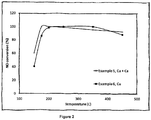
- Fig. 2 compares SCR data over Cu-chabazite with and without Ca after steaming at 700°C for 16 h in 10 percent water/air.
- the data in Fig. 2 shows improved NOx activity over a temperature ranging from 200 to above 400 °C.
- Pseudoboehmite alumina, phosphoric acid, ammonium-stabilized silica sol (Nyacol 2040NH4), tetraethylammonium hydroxide (TEAOH) solution, morpholine, and deionized water were mixed together to form a gel with the following molar composition: 0.6 SiO 2 : 1.0 Al 2 O 3 : 1.0 P 2 O 5 : 0.85 Morpholine : 0.4 TEAOH: 32.5 H 2 O
- the gel was stirred at room temperature for about 30 min and SAPO-34 seeds in the amount of about 1% of total inorganic solids of the gel were added before charged to an autoclave.
- the autoclave was heated to 180 °C and maintained at the temperature for 24 hours. After cooling, the product was recovered by filtration and washed with deionized water. The product was then dried and calcined to remove organic.
- the SAPO-34 product contained about 12% SiO 2 .
- the SAPO-34 sample from Example 16 was exchanged with copper nitrate at 60 °C for 3 hours. After filtering, washing and drying the sample contained 3.0 wt% CuO.
- the SAPO-34 sample from Example 16 was exchanged with calcium hydroxide at ambient temperature for 2 hours. After filtering, washing and drying the sample contained 0.9 wt% CaO.
- the Ca-SAPO-34 sample from Example 18 was exchanged with copper nitrate at ambient temperature for 4 hours. After filtering, washing and drying the sample contained 1.9 wt% CuO and 0.8 wt% CaO.
- the SAPO-34 sample from Example 16 was exchanged with potassium nitrate at 80 °C for 2 hours. After filtering, washing and drying the sample contained 1.5 wt% K 2 O.
- the K-SAPO-34 sample from Example 20 was exchanged with copper nitrate at ambient temperature for 4 hours. After filtering, washing and drying the sample contained 3.0 wt% CuO and 1.5 wt% K 2 O.
- Pseudoboehmite alumina, phosphoric acid, ammonium-stabilized silica sol (Nyacol 2040NH4), calcium acetate, tetraethylammonium hydroxide (TEAOH) solution, morpholine, and deionized water were mixed together to form a gel with the following molar composition: 0.5 SiO 2 : 1.0 Al 2 O 3 : 1.0 P 2 O 5 : 0.1 CaO : 0.85 Morpholine : 0.4 TEAOH: 31.5 H 2 O
- the gel was stirred at room temperature for about 30 min and SAPO-34 seeds in the amount of about 1% of total inorganic solids of the gel were added before charged to an autoclave.
- the autoclave was heated to 180 °C and maintained at the temperature for 24 hours. After cooling, the product was recovered by filtration and washed with deionized water. The product was then dried and calcined to remove organic.
- the Ca-SAPO-34 product contained about 11% SiO 2 and 1.7% CaO.
- the Ca-SAPO-34 sample from Example 22 was exchanged with copper nitrate at 60 °C for 3 hours. After filtering, washing and drying, the sample contained 3.0 wt% CuO.
- the Ca-SAPO-34 sample from Example 16 was exchanged with calcium hydroxide and copper nitrate at 40°C for 3 hours. After filtering, washing and drying, the sample contained 3.5 wt% CuO and 0.60 wt% CaO.
- the samples were also steamed at 900 °C in the presence of 10 vol% water vapor for 1 hour to simulate automotive exhaust aging conditions.
- the activities of the hydrothermally aged materials for NO conversion, using NH 3 as reductant, were tested with a flow-through type reactor. Powder zeolite samples were pressed and sieved to 35/70 mesh and loaded into a quartz tube reactor. Reactor temperature was ramped and NO conversion was determined with an infrared analyzer at each temperature interval.
- Table 5 compares the surface area retention of various SAPO-34 samples after water treatment at 105 °C for 24 hours.
- Example Ex. 16 Comp. Ex. 17 Ex. 18 Ex. 19 Ex. 20 Ex. 21 Ex. 23 Ex. 24
- Initial surface area m 2 /g 754 702 739 654 704 634 634 693 Surface area after water treatment m 2 /g 6 29 485 515 588 501 448 672
- Initial micropore volume cc/g 0.29 0.27 0.29 0.25 0.27 0.24 0.24 0.27 Micropore volume after water treatment cc/g 0.003 0.01 0.18 0.20 0.22 0.19 0.17 0.26
- Table 5 shows that the addition of Ca or K to SAPO-34, as in Examples 18, 19, 20, 21, 23 and 24, stabilizes the material to the hot water treatment, whereas the materials without Ca or K (SAPO-34 from Example 16 and Cu-SAPO-34 from Comparative Example 17) are essentially completely destroyed by the treatment. It is desirable that the SAPO-34 materials of the current invention retain at least 40% and preferably at least 60% of their surface area and micropore volume after being subjected to the hot water treatment.
- Table 6 compares the NO conversion during NH 3 -SCR of Examples 17, 23 and 24 after steaming at 900°C for 1 hour in 10 percent water/air. Table 6 Example Comp. Ex. 17 Ex. 23 Ex. 24 NO conversion at 175 °C % 81.7 97.6 96.1 NO conversion at 450 °C % 77.0 82.0 77.5
- Table 6 shows that inventive Examples 23 and 24 containing Ca are more active, especially at low temperatures such as 175°C, than Comparative Example 17 without Ca for NH 3 -SCR after steaming at 900°C for 1 hour.
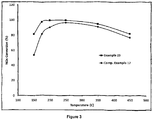
- Fig. 3 compares SCR data for Comparative Example 17 with inventive Example 23 after steaming at 900°C for 1 h in 10 percent water/air.
- the data show that SAPO-34 samples containing two metals (here calcium), exhibits improved NOx conversion efficiency compared to a sample not containing Ca.
Landscapes
- Chemical & Material Sciences (AREA)
- Organic Chemistry (AREA)
- Engineering & Computer Science (AREA)
- Chemical Kinetics & Catalysis (AREA)
- Materials Engineering (AREA)
- Life Sciences & Earth Sciences (AREA)
- General Life Sciences & Earth Sciences (AREA)
- Geology (AREA)
- Inorganic Chemistry (AREA)
- Crystallography & Structural Chemistry (AREA)
- Combustion & Propulsion (AREA)
- Health & Medical Sciences (AREA)
- Biomedical Technology (AREA)
- Environmental & Geological Engineering (AREA)
- Analytical Chemistry (AREA)
- General Chemical & Material Sciences (AREA)
- Oil, Petroleum & Natural Gas (AREA)
- Catalysts (AREA)
- Silicates, Zeolites, And Molecular Sieves (AREA)
- Exhaust Gas Treatment By Means Of Catalyst (AREA)
- Exhaust Gas After Treatment (AREA)
Claims (12)
- Mikroporöses kristallines Siliziumaluminophosphat(SAPO)-Material, wobei das Material eine Kristallstruktur mit Doppel-6-Ring(d6r)-Baueinheiten und 8-Ring-Porenöffnung umfasst und die Kristallstruktur CHA-Strukturcodes umfasst und eine Porenöffnung im Bereich von 3 bis 5 Angström aufweist und ein Erdalkalimetall oder ein Seltenerdmetall oder ein Alkalimetall oder Gemische davon, und Kupfer, umfasst, wobei das Erdalkali- oder Seltenerdmetall oder Alkalimetall eine Menge von mindestens 0,2 Gewichtsprozent des Gesamtgewicht des Materials umfasst.
- Mikroporöses kristallines Material nach Anspruch 1, wobei das Material SAPO-34 umfasst.
- Mikroporöses kristallines Material nach Anspruch 1, wobei das Material SiO2 in einer Menge im Bereich von 1 bis 20 Gewichtsprozent des Gesamtgewicht des Materials umfasst.
- Mikroporöses kristallines Material nach Anspruch 1, wobei das Erdalkalimetall oder Seltenerdmetall oder Alkalimetall ausgewählt ist aus Magnesium, Kalzium, Strontium, Barium, Lanthan, Neodym, gemischten Seltenerdoxiden, Kalium, Rubidium, Zäsium oder Gemischen davon.
- Mikroporöses kristallines Material nach Anspruch 1, wobei die Metalle durch Flüssigphasen- oder Festphasen-Ionenaustausch, Imprägnierung eingebracht oder durch direkte Synthese oder Kombinationen davon einbezogen werden.
- Mikroporöses kristallines Material nach Anspruch 1, wobei das Erdalkalimetall Kalzium in einer Menge im Bereich von 0,2 bis 5,0 Gewichtsprozent des Gesamtgewichts des Materials umfasst.
- Mikroporöses kristallines Material nach Anspruch 1, wobei das Kupfer eine Menge im Bereich von 0,5 bis 10,0 Gewichtsprozent des Gesamtgewichts des Materials umfasst.
- Mikroporöses kristallines Material nach Anspruch 1, wobei das Material eine mittlere Kristallgröße im Bereich von 0,3 bis 10 Mikron umfasst.
- Mikroporöses kristallines Material nach Anspruch 1, wobei das Material mindestens 40 % seiner Oberfläche und seines Mikroporenvolumens nach Exposition in Wasseraufschlämmung bei 105 °C für 24 Stunden beibehält.
- Verfahren zur selektiven katalytischen Reduktion von Stickstoffoxiden in Abgas, wobei das Verfahren umfasst:
mindestens teilweises Inkontaktbringen der Abgase mit einem Artikel umfassend ein mikroporöses kristallines Siliziumaluminophosphat(SAPO)-Material mit einer CHA-Kristallstruktur, nach einem der Ansprüche 1 bis 9. - Verfahren nach Anspruch 10, wobei der Kontaktschritt in der Gegenwart von Ammoniak, Harnstoff, einer ammoniakerzeugenden Verbindung oder einer Kohlenwasserstoffverbindung durchgeführt wird.
- Verfahren zur Herstellung eines mikroporösen kristallinen Siliziumaluminophosphat(SAPO)-Materials mit einer CHA-Kristallstruktur nach einem der Ansprüche 1 bis 9, wobei das Verfahren umfasst:Mischen von Quellen von Aluminiumoxid, Siliziumdioxid, Phosphat, mindestens eines organischen strukturbestimmenden Mittels, gegebenenfalls eines Erdalkalimetallsalzes oder Seltenerdmetallsalzes, und Wasser, um ein Gel zu bilden;Erhitzen des Gels in einem Autoklaven bei einer Temperatur im Bereich von 140 bis 220 °C, um ein kristallines SAPO-Produkt mit einer CHA-Kristallstruktur zu bilden;Kalzinieren des Produkts; undEinbringen eines Erdalkalimetalls oder eines Seltenerdmetalls oder eines Alkalimetalls oder von Gemischen davon und Kupfer durch Flüssigphasen- oder Festphasen-Ionenaustausch, Imprägnierung oder Einbezug durch direkte Synthese oder Kombinationen davon.
Applications Claiming Priority (2)
| Application Number | Priority Date | Filing Date | Title |
|---|---|---|---|
| US201161566106P | 2011-12-02 | 2011-12-02 | |
| PCT/US2012/067474 WO2013082550A1 (en) | 2011-12-02 | 2012-11-30 | Stabilized microporous crystalline material, the method of making the same, and the use for selective catalytic reduction of nox |
Publications (2)
| Publication Number | Publication Date |
|---|---|
| EP2785643A1 EP2785643A1 (de) | 2014-10-08 |
| EP2785643B1 true EP2785643B1 (de) | 2020-07-01 |
Family
ID=47358300
Family Applications (2)
| Application Number | Title | Priority Date | Filing Date |
|---|---|---|---|
| EP12801688.8A Active EP2785644B1 (de) | 2011-12-02 | 2012-11-30 | Stabilisiertes mikroporöses kristallines material, verfahren zu seiner herstellung und verwendung zur selektiven katalytischen nox-reduktion |
| EP12805498.8A Active EP2785643B1 (de) | 2011-12-02 | 2012-11-30 | Stabilisiertes mikroporöses kristallines material, verfahren zu seiner herstellung und verwendung zur selektiven katalytischen nox-reduktion |
Family Applications Before (1)
| Application Number | Title | Priority Date | Filing Date |
|---|---|---|---|
| EP12801688.8A Active EP2785644B1 (de) | 2011-12-02 | 2012-11-30 | Stabilisiertes mikroporöses kristallines material, verfahren zu seiner herstellung und verwendung zur selektiven katalytischen nox-reduktion |
Country Status (7)
| Country | Link |
|---|---|
| US (1) | US9517458B2 (de) |
| EP (2) | EP2785644B1 (de) |
| JP (3) | JP6320298B2 (de) |
| KR (2) | KR102078083B1 (de) |
| CN (3) | CN103987662B (de) |
| BR (2) | BR112014012818A2 (de) |
| WO (2) | WO2013082550A1 (de) |
Families Citing this family (47)
| Publication number | Priority date | Publication date | Assignee | Title |
|---|---|---|---|---|
| WO2010121257A1 (en) * | 2009-04-17 | 2010-10-21 | Johnson Matthey Public Limited Company | Small pore molecular sieve supported copper catalysts durable against lean/rich aging for the reduction of nitrogen oxides |
| EP3103979B1 (de) * | 2010-09-13 | 2018-01-03 | Umicore AG & Co. KG | Katalysator zur entfernung von stickoxiden aus dem abgas von dieselmotoren |
| WO2012091046A1 (ja) * | 2010-12-28 | 2012-07-05 | 東ソー株式会社 | 銅及びアルカリ土類金属を担持したゼオライト |
| US9981256B2 (en) * | 2011-12-02 | 2018-05-29 | Pq Corporation | Stabilized microporous crystalline material, the method of making the same, and the use for selective catalytic reduction of NOx |
| WO2013082550A1 (en) * | 2011-12-02 | 2013-06-06 | Pq Corporation | Stabilized microporous crystalline material, the method of making the same, and the use for selective catalytic reduction of nox |
| CN104302394A (zh) * | 2012-04-11 | 2015-01-21 | 庄信万丰股份有限公司 | 含有金属的沸石催化剂 |
| EP2908944B1 (de) * | 2012-10-19 | 2025-03-19 | BASF Mobile Emissions Catalysts LLC | 8-ring-molekularsieb mit kleinen poren und einem promotor zur erhöhung einer tieftemperaturleistung |
| DE102014112413A1 (de) * | 2013-08-30 | 2015-03-05 | Johnson Matthey Public Limited Company | Zeolithmischkatalysatoren zur behandlung von abgas |
| US9283548B2 (en) | 2013-11-19 | 2016-03-15 | Toyota Motor Engineering & Manufacturing North America, Inc. | Ceria-supported metal catalysts for the selective reduction of NOx |
| US9561469B2 (en) | 2014-03-24 | 2017-02-07 | Johnson Matthey Public Limited Company | Catalyst for treating exhaust gas |
| CN106232209B (zh) * | 2014-03-24 | 2022-09-02 | 庄信万丰股份有限公司 | 用于处理废气的系统和方法 |
| DE102014205783A1 (de) * | 2014-03-27 | 2015-10-01 | Johnson Matthey Public Limited Company | Katalysator sowie Verfahren zum Herstellen eines Katalysator |
| JP5740040B1 (ja) * | 2014-07-07 | 2015-06-24 | イビデン株式会社 | ゼオライト、ハニカム触媒及び排ガス浄化装置 |
| JP5732170B1 (ja) * | 2014-07-07 | 2015-06-10 | イビデン株式会社 | ゼオライト、ハニカム触媒及び排ガス浄化装置 |
| US10807082B2 (en) * | 2014-10-13 | 2020-10-20 | Johnson Matthey Public Limited Company | Zeolite catalyst containing metals |
| US10226754B2 (en) * | 2015-03-03 | 2019-03-12 | Basf Corporation | Lean NOx trap with enhanced high and low temperature performance |
| JP6503473B2 (ja) * | 2015-04-09 | 2019-04-17 | ピーキュー コーポレイション | 安定化されたマイクロポーラス結晶性物質、それを作成する方法、およびNOxの選択的触媒還元のためのその使用 |
| US10377638B2 (en) | 2015-04-09 | 2019-08-13 | Pq Corporation | Stabilized microporous crystalline material, the method of making the same, and the use for selective catalytic reduction of NOx |
| JP6599637B2 (ja) * | 2015-05-13 | 2019-10-30 | イビデン株式会社 | ゼオライト、該ゼオライトの製造方法、該ゼオライトを使用したハニカム触媒及び排ガス浄化装置 |
| CN104891528A (zh) * | 2015-06-12 | 2015-09-09 | 杭州回水科技股份有限公司 | 铜胺络合物作为模板剂固相合成Cu-SAPO-34分子筛的方法 |
| WO2017090382A1 (ja) * | 2015-11-27 | 2017-06-01 | 三菱化学株式会社 | 酸素8員環ゼオライト及びaei型ゼオライトの製造方法 |
| JP6951343B2 (ja) * | 2016-02-01 | 2021-10-20 | ユミコア・アクチエンゲゼルシャフト・ウント・コムパニー・コマンディットゲゼルシャフトUmicore AG & Co.KG | 鉄含有aeiゼオライト触媒の直接合成のための方法 |
| EP3452215B1 (de) * | 2016-05-03 | 2021-09-01 | Umicore AG & Co. KG | Scr-aktiver katalysator |
| CN121800199A (zh) * | 2016-06-08 | 2026-04-07 | 巴斯夫公司 | 来自无有机模板的合成的cha骨架结构的铜助催化沸石材料及其在nox的选择性催化还原中的用途 |
| EP3494089A4 (de) * | 2016-08-05 | 2020-09-16 | BASF Corporation | Artikel und systeme zur selektiven katalytischen reduktion |
| CN110997138A (zh) * | 2017-06-09 | 2020-04-10 | 巴斯夫公司 | 用于NOx减排的具有受控孔隙率的催化洗涂层 |
| AU2018299887B2 (en) | 2017-07-11 | 2021-07-29 | Shell Internationale Research Maatschappij B.V. | A catalyst and method of use thereof |
| EP3651899B1 (de) * | 2017-07-11 | 2026-05-06 | Shell Internationale Research Maatschappij B.V. | Katalysator und verfahren zur beseitigung von nox und n2o |
| KR102715371B1 (ko) * | 2018-03-21 | 2024-10-14 | 바스프 모바일 에미션스 카탈리스츠 엘엘씨 | Cha 제올라이트 물질 및 관련 합성 방법 |
| KR102746625B1 (ko) * | 2018-05-14 | 2024-12-30 | 우미코레 아게 운트 코 카게 | 안정한 소형 공극 제올라이트 |
| JP7412354B2 (ja) * | 2018-05-25 | 2024-01-12 | ビーエーエスエフ ソシエタス・ヨーロピア | アルミニウムに富む希土類元素含有ゼオライト材料 |
| CN113039157A (zh) * | 2018-09-11 | 2021-06-25 | 巴斯夫公司 | 制备具有骨架类型aei的沸石材料的方法 |
| US11724249B2 (en) * | 2018-10-23 | 2023-08-15 | N.E. Chemcat Corporation | Cu—P co-supported zeolite, and selective catalytic reduction catalyst and catalyst for exhaust gas using same |
| CN112585090B (zh) * | 2018-10-23 | 2023-12-15 | N.E.化学株式会社 | Cu-P共负载沸石的制造方法、能够用于其的催化剂前体组合物及处理液、以及层叠催化剂的制造方法 |
| CN109622029A (zh) * | 2019-01-21 | 2019-04-16 | 黑龙江大学 | 选择性催化还原氮氧化物的催化剂的制备方法及应用 |
| EP3969420A1 (de) | 2019-05-15 | 2022-03-23 | Basf Se | Verfahren zur herstellung der cha-aft-zeolith-verwachsung coe-10 und verwendung davon in der heterogenen katalyse |
| CN110193378B (zh) * | 2019-05-27 | 2022-02-11 | 天津大学 | 一种CuM/SAPO-34分子筛的制备方法及其应用 |
| CN114555525B (zh) * | 2019-08-02 | 2024-08-13 | 巴斯夫公司 | 包括有机和无机结构导向剂的菱沸石合成方法和具有片状形态的菱沸石沸石 |
| EP3812034A1 (de) * | 2019-10-24 | 2021-04-28 | Dinex A/S | Dauerhafter kupfer-scr-katalysator |
| CN111252781B (zh) * | 2020-02-05 | 2022-01-07 | 浙江大学 | 无有机模板剂晶种法合成高硅kfi沸石分子筛的方法 |
| CN111762795B (zh) * | 2020-07-13 | 2022-10-14 | 包头稀土研究院 | 含有稀土元素的分子筛及其生产方法 |
| KR20220060316A (ko) * | 2020-11-04 | 2022-05-11 | 현대자동차주식회사 | NOx 저장용 촉매 및 이의 제조 방법 |
| JP7320568B2 (ja) * | 2021-08-04 | 2023-08-03 | 株式会社キャタラー | 排ガス浄化触媒 |
| CN115055206A (zh) * | 2021-08-27 | 2022-09-16 | 华中科技大学 | 一种酸性位保护改性的Cu-SAPO-34催化剂及其制备方法和应用 |
| JP7372302B2 (ja) | 2021-12-06 | 2023-10-31 | 株式会社キャタラー | 排ガス浄化触媒装置 |
| CN117065787B (zh) * | 2023-06-26 | 2025-12-16 | 东风商用车有限公司 | 一氧化二氮吸附分解催化剂、制备方法及催化剂结构 |
| KR102918664B1 (ko) | 2023-11-02 | 2026-01-28 | 한국화학연구원 | Aei형 제올라이트 및 이의 제조방법 |
Citations (1)
| Publication number | Priority date | Publication date | Assignee | Title |
|---|---|---|---|---|
| US20130156668A1 (en) * | 2010-09-13 | 2013-06-20 | Umicore Ag & Co. Kg | Catalyst for removing nitrogen oxides from the exhaust gas of diesel engines |
Family Cites Families (14)
| Publication number | Priority date | Publication date | Assignee | Title |
|---|---|---|---|---|
| JPH0676204B2 (ja) * | 1988-12-20 | 1994-09-28 | ユニオン・カーバイド・コーポレーション | モレキュラーシーブの製造方法 |
| US5026532A (en) * | 1989-04-06 | 1991-06-25 | Air Products And Chemicals, Inc. | Process for the preparation of an improved chabazite for the purification of bulk gases |
| US6689709B1 (en) * | 2000-11-15 | 2004-02-10 | Engelhard Corporation | Hydrothermally stable metal promoted zeolite beta for NOx reduction |
| US6793911B2 (en) * | 2002-02-05 | 2004-09-21 | Abb Lummus Global Inc. | Nanocrystalline inorganic based zeolite and method for making same |
| RU2445166C2 (ru) | 2007-03-26 | 2012-03-20 | ПиКью КОРПОРЕЙШН | Новый микропористый кристаллический материал, включающий молекулярные сита или цеолит, имеющий восьмикольцевую структуру открытых пор, и способы его получения и применения |
| BRPI0810133B1 (pt) | 2007-04-26 | 2023-01-17 | Johnson Matthey Public Limited Company | Método para converter óxidos de nitrogênio de um gás em nitrogênio, sistema de escapamento para um motor de combustão interna de queima pobre veicular, e, aparelho |
| US20090196812A1 (en) * | 2008-01-31 | 2009-08-06 | Basf Catalysts Llc | Catalysts, Systems and Methods Utilizing Non-Zeolitic Metal-Containing Molecular Sieves Having the CHA Crystal Structure |
| US10583424B2 (en) * | 2008-11-06 | 2020-03-10 | Basf Corporation | Chabazite zeolite catalysts having low silica to alumina ratios |
| WO2010121257A1 (en) * | 2009-04-17 | 2010-10-21 | Johnson Matthey Public Limited Company | Small pore molecular sieve supported copper catalysts durable against lean/rich aging for the reduction of nitrogen oxides |
| EP2687284A1 (de) * | 2009-06-08 | 2014-01-22 | Basf Se | Cu-haltiges Silicoaluminiumphosphat (Cu-SAPO-34) |
| EP2308596B1 (de) | 2009-10-07 | 2016-09-21 | Ford Global Technologies, LLC | Cu/Zeolith SCR Katalysator zur NOx Reduzierung in Abgasen und Verfahren zu deren Herstellung |
| US20110286914A1 (en) * | 2010-05-21 | 2011-11-24 | Pq Corporation | NOVEL METAL-CONTAINING ZEOLITE BETA FOR NOx REDUCTION AND METHODS OF MAKING THE SAME |
| WO2012145323A1 (en) * | 2011-04-18 | 2012-10-26 | Pq Corporation | Large crystal, organic-free chabazite, methods of making and using the same |
| WO2013082550A1 (en) * | 2011-12-02 | 2013-06-06 | Pq Corporation | Stabilized microporous crystalline material, the method of making the same, and the use for selective catalytic reduction of nox |
-
2012
- 2012-11-30 WO PCT/US2012/067474 patent/WO2013082550A1/en not_active Ceased
- 2012-11-30 WO PCT/US2012/067485 patent/WO2013082560A1/en not_active Ceased
- 2012-11-30 JP JP2014544961A patent/JP6320298B2/ja not_active Expired - Fee Related
- 2012-11-30 US US13/691,727 patent/US9517458B2/en active Active
- 2012-11-30 KR KR1020147018399A patent/KR102078083B1/ko active Active
- 2012-11-30 EP EP12801688.8A patent/EP2785644B1/de active Active
- 2012-11-30 JP JP2014544966A patent/JP6104270B2/ja active Active
- 2012-11-30 KR KR1020147018398A patent/KR102170639B1/ko active Active
- 2012-11-30 BR BR112014012818A patent/BR112014012818A2/pt not_active Application Discontinuation
- 2012-11-30 BR BR112014012846-4A patent/BR112014012846B1/pt not_active IP Right Cessation
- 2012-11-30 EP EP12805498.8A patent/EP2785643B1/de active Active
- 2012-11-30 CN CN201280058960.2A patent/CN103987662B/zh not_active Expired - Fee Related
- 2012-11-30 CN CN201810052873.5A patent/CN108249454A/zh active Pending
- 2012-11-30 CN CN201280058962.1A patent/CN104039702A/zh active Pending
-
2017
- 2017-02-28 JP JP2017036467A patent/JP6427610B2/ja not_active Expired - Fee Related
Patent Citations (1)
| Publication number | Priority date | Publication date | Assignee | Title |
|---|---|---|---|---|
| US20130156668A1 (en) * | 2010-09-13 | 2013-06-20 | Umicore Ag & Co. Kg | Catalyst for removing nitrogen oxides from the exhaust gas of diesel engines |
Non-Patent Citations (1)
| Title |
|---|
| MAGGIE ZAMADICS ET AL: "Effect of divalent cations on the location and coordination of copper(II) ions in SAPO-42 molecular sieve", JOURNAL OF PHYSICAL CHEMISTRY, vol. 97, no. 13, 1 April 1993 (1993-04-01), US, pages 3359 - 3364, XP055381581, ISSN: 0022-3654, DOI: 10.1021/j100115a045 * |
Also Published As
| Publication number | Publication date |
|---|---|
| US9517458B2 (en) | 2016-12-13 |
| JP6320298B2 (ja) | 2018-05-09 |
| JP6427610B2 (ja) | 2018-11-21 |
| EP2785643A1 (de) | 2014-10-08 |
| JP6104270B2 (ja) | 2017-03-29 |
| WO2013082550A1 (en) | 2013-06-06 |
| EP2785644A1 (de) | 2014-10-08 |
| CN103987662A (zh) | 2014-08-13 |
| JP2017141154A (ja) | 2017-08-17 |
| CN104039702A (zh) | 2014-09-10 |
| KR102078083B1 (ko) | 2020-02-20 |
| KR20140107365A (ko) | 2014-09-04 |
| BR112014012846B1 (pt) | 2021-10-26 |
| KR20140107366A (ko) | 2014-09-04 |
| EP2785644B1 (de) | 2019-05-01 |
| BR112014012818A2 (pt) | 2017-06-13 |
| WO2013082560A1 (en) | 2013-06-06 |
| CN103987662B (zh) | 2018-10-23 |
| KR102170639B1 (ko) | 2020-10-27 |
| US20130142727A1 (en) | 2013-06-06 |
| JP2015505290A (ja) | 2015-02-19 |
| CN108249454A (zh) | 2018-07-06 |
| BR112014012846A2 (pt) | 2017-06-13 |
| JP2015502909A (ja) | 2015-01-29 |
Similar Documents
| Publication | Publication Date | Title |
|---|---|---|
| EP2785643B1 (de) | Stabilisiertes mikroporöses kristallines material, verfahren zu seiner herstellung und verwendung zur selektiven katalytischen nox-reduktion | |
| US9981256B2 (en) | Stabilized microporous crystalline material, the method of making the same, and the use for selective catalytic reduction of NOx | |
| JP2015502909A5 (de) | ||
| CA2681135C (en) | Novel microporous crystalline material comprising a molecular sieve or zeolite having an 8-ring pore opening structure and methods of making and using same | |
| KR20130019372A (ko) | 선택적 촉매 환원을 위한 고-실리카 체바자이트, 이를 제조하는 방법 및 이를 사용하는 방법 | |
| EP3307434B1 (de) | Stabilisiertes mikroporöses kristallines material, verfahren zu seiner herstellung und verwendung zur selektiven katalytischen nox-reduktion | |
| US11040337B2 (en) | Low-silica chabazite zeolites with high acidity | |
| US10377638B2 (en) | Stabilized microporous crystalline material, the method of making the same, and the use for selective catalytic reduction of NOx | |
| RU2807541C9 (ru) | Цеолиты типа шабазита с низким содержанием диоксида кремния, имеющие высокую кислотность | |
| BR112020021661B1 (pt) | Material cristalino microporoso, métodos de redução catalítica seletiva de óxidos de nitrogênio em gás de escape e para fazer material cristalino microporoso |
Legal Events
| Date | Code | Title | Description |
|---|---|---|---|
| PUAI | Public reference made under article 153(3) epc to a published international application that has entered the european phase |
Free format text: ORIGINAL CODE: 0009012 |
|
| 17P | Request for examination filed |
Effective date: 20140522 |
|
| AK | Designated contracting states |
Kind code of ref document: A1 Designated state(s): AL AT BE BG CH CY CZ DE DK EE ES FI FR GB GR HR HU IE IS IT LI LT LU LV MC MK MT NL NO PL PT RO RS SE SI SK SM TR |
|
| AX | Request for extension of the european patent |
Extension state: BA ME |
|
| STAA | Information on the status of an ep patent application or granted ep patent |
Free format text: STATUS: EXAMINATION IS IN PROGRESS |
|
| 17Q | First examination report despatched |
Effective date: 20180920 |
|
| REG | Reference to a national code |
Ref country code: DE Ref legal event code: R079 Ref document number: 602012071046 Country of ref document: DE Free format text: PREVIOUS MAIN CLASS: C01B0037080000 Ipc: B01J0029850000 |
|
| GRAP | Despatch of communication of intention to grant a patent |
Free format text: ORIGINAL CODE: EPIDOSNIGR1 |
|
| STAA | Information on the status of an ep patent application or granted ep patent |
Free format text: STATUS: GRANT OF PATENT IS INTENDED |
|
| RIC1 | Information provided on ipc code assigned before grant |
Ipc: B01J 35/02 20060101ALI20200115BHEP Ipc: C01B 39/54 20060101ALI20200115BHEP Ipc: C01B 39/02 20060101ALI20200115BHEP Ipc: B01J 29/76 20060101ALI20200115BHEP Ipc: B01J 29/70 20060101ALI20200115BHEP Ipc: B01J 29/035 20060101ALI20200115BHEP Ipc: C01B 39/46 20060101ALI20200115BHEP Ipc: C01B 37/08 20060101ALI20200115BHEP Ipc: B01J 29/85 20060101AFI20200115BHEP |
|
| INTG | Intention to grant announced |
Effective date: 20200203 |
|
| GRAS | Grant fee paid |
Free format text: ORIGINAL CODE: EPIDOSNIGR3 |
|
| GRAA | (expected) grant |
Free format text: ORIGINAL CODE: 0009210 |
|
| STAA | Information on the status of an ep patent application or granted ep patent |
Free format text: STATUS: THE PATENT HAS BEEN GRANTED |
|
| AK | Designated contracting states |
Kind code of ref document: B1 Designated state(s): AL AT BE BG CH CY CZ DE DK EE ES FI FR GB GR HR HU IE IS IT LI LT LU LV MC MK MT NL NO PL PT RO RS SE SI SK SM TR |
|
| AX | Request for extension of the european patent |
Extension state: BA ME |
|
| REG | Reference to a national code |
Ref country code: GB Ref legal event code: FG4D |
|
| REG | Reference to a national code |
Ref country code: CH Ref legal event code: EP Ref country code: AT Ref legal event code: REF Ref document number: 1285637 Country of ref document: AT Kind code of ref document: T Effective date: 20200715 |
|
| REG | Reference to a national code |
Ref country code: IE Ref legal event code: FG4D |
|
| REG | Reference to a national code |
Ref country code: DE Ref legal event code: R096 Ref document number: 602012071046 Country of ref document: DE |
|
| REG | Reference to a national code |
Ref country code: NL Ref legal event code: FP |
|
| REG | Reference to a national code |
Ref country code: LT Ref legal event code: MG4D |
|
| PG25 | Lapsed in a contracting state [announced via postgrant information from national office to epo] |
Ref country code: BG Free format text: LAPSE BECAUSE OF FAILURE TO SUBMIT A TRANSLATION OF THE DESCRIPTION OR TO PAY THE FEE WITHIN THE PRESCRIBED TIME-LIMIT Effective date: 20201001 |
|
| REG | Reference to a national code |
Ref country code: AT Ref legal event code: MK05 Ref document number: 1285637 Country of ref document: AT Kind code of ref document: T Effective date: 20200701 |
|
| PG25 | Lapsed in a contracting state [announced via postgrant information from national office to epo] |
Ref country code: LT Free format text: LAPSE BECAUSE OF FAILURE TO SUBMIT A TRANSLATION OF THE DESCRIPTION OR TO PAY THE FEE WITHIN THE PRESCRIBED TIME-LIMIT Effective date: 20200701 Ref country code: FI Free format text: LAPSE BECAUSE OF FAILURE TO SUBMIT A TRANSLATION OF THE DESCRIPTION OR TO PAY THE FEE WITHIN THE PRESCRIBED TIME-LIMIT Effective date: 20200701 Ref country code: SE Free format text: LAPSE BECAUSE OF FAILURE TO SUBMIT A TRANSLATION OF THE DESCRIPTION OR TO PAY THE FEE WITHIN THE PRESCRIBED TIME-LIMIT Effective date: 20200701 Ref country code: HR Free format text: LAPSE BECAUSE OF FAILURE TO SUBMIT A TRANSLATION OF THE DESCRIPTION OR TO PAY THE FEE WITHIN THE PRESCRIBED TIME-LIMIT Effective date: 20200701 Ref country code: NO Free format text: LAPSE BECAUSE OF FAILURE TO SUBMIT A TRANSLATION OF THE DESCRIPTION OR TO PAY THE FEE WITHIN THE PRESCRIBED TIME-LIMIT Effective date: 20201001 Ref country code: GR Free format text: LAPSE BECAUSE OF FAILURE TO SUBMIT A TRANSLATION OF THE DESCRIPTION OR TO PAY THE FEE WITHIN THE PRESCRIBED TIME-LIMIT Effective date: 20201002 Ref country code: ES Free format text: LAPSE BECAUSE OF FAILURE TO SUBMIT A TRANSLATION OF THE DESCRIPTION OR TO PAY THE FEE WITHIN THE PRESCRIBED TIME-LIMIT Effective date: 20200701 Ref country code: CZ Free format text: LAPSE BECAUSE OF FAILURE TO SUBMIT A TRANSLATION OF THE DESCRIPTION OR TO PAY THE FEE WITHIN THE PRESCRIBED TIME-LIMIT Effective date: 20200701 Ref country code: PT Free format text: LAPSE BECAUSE OF FAILURE TO SUBMIT A TRANSLATION OF THE DESCRIPTION OR TO PAY THE FEE WITHIN THE PRESCRIBED TIME-LIMIT Effective date: 20201102 Ref country code: AT Free format text: LAPSE BECAUSE OF FAILURE TO SUBMIT A TRANSLATION OF THE DESCRIPTION OR TO PAY THE FEE WITHIN THE PRESCRIBED TIME-LIMIT Effective date: 20200701 |
|
| PG25 | Lapsed in a contracting state [announced via postgrant information from national office to epo] |
Ref country code: RS Free format text: LAPSE BECAUSE OF FAILURE TO SUBMIT A TRANSLATION OF THE DESCRIPTION OR TO PAY THE FEE WITHIN THE PRESCRIBED TIME-LIMIT Effective date: 20200701 Ref country code: PL Free format text: LAPSE BECAUSE OF FAILURE TO SUBMIT A TRANSLATION OF THE DESCRIPTION OR TO PAY THE FEE WITHIN THE PRESCRIBED TIME-LIMIT Effective date: 20200701 Ref country code: LV Free format text: LAPSE BECAUSE OF FAILURE TO SUBMIT A TRANSLATION OF THE DESCRIPTION OR TO PAY THE FEE WITHIN THE PRESCRIBED TIME-LIMIT Effective date: 20200701 Ref country code: IS Free format text: LAPSE BECAUSE OF FAILURE TO SUBMIT A TRANSLATION OF THE DESCRIPTION OR TO PAY THE FEE WITHIN THE PRESCRIBED TIME-LIMIT Effective date: 20201101 |
|
| REG | Reference to a national code |
Ref country code: DE Ref legal event code: R097 Ref document number: 602012071046 Country of ref document: DE |
|
| PG25 | Lapsed in a contracting state [announced via postgrant information from national office to epo] |
Ref country code: EE Free format text: LAPSE BECAUSE OF FAILURE TO SUBMIT A TRANSLATION OF THE DESCRIPTION OR TO PAY THE FEE WITHIN THE PRESCRIBED TIME-LIMIT Effective date: 20200701 Ref country code: DK Free format text: LAPSE BECAUSE OF FAILURE TO SUBMIT A TRANSLATION OF THE DESCRIPTION OR TO PAY THE FEE WITHIN THE PRESCRIBED TIME-LIMIT Effective date: 20200701 Ref country code: IT Free format text: LAPSE BECAUSE OF FAILURE TO SUBMIT A TRANSLATION OF THE DESCRIPTION OR TO PAY THE FEE WITHIN THE PRESCRIBED TIME-LIMIT Effective date: 20200701 Ref country code: SM Free format text: LAPSE BECAUSE OF FAILURE TO SUBMIT A TRANSLATION OF THE DESCRIPTION OR TO PAY THE FEE WITHIN THE PRESCRIBED TIME-LIMIT Effective date: 20200701 Ref country code: RO Free format text: LAPSE BECAUSE OF FAILURE TO SUBMIT A TRANSLATION OF THE DESCRIPTION OR TO PAY THE FEE WITHIN THE PRESCRIBED TIME-LIMIT Effective date: 20200701 |
|
| PLBE | No opposition filed within time limit |
Free format text: ORIGINAL CODE: 0009261 |
|
| STAA | Information on the status of an ep patent application or granted ep patent |
Free format text: STATUS: NO OPPOSITION FILED WITHIN TIME LIMIT |
|
| PG25 | Lapsed in a contracting state [announced via postgrant information from national office to epo] |
Ref country code: AL Free format text: LAPSE BECAUSE OF FAILURE TO SUBMIT A TRANSLATION OF THE DESCRIPTION OR TO PAY THE FEE WITHIN THE PRESCRIBED TIME-LIMIT Effective date: 20200701 |
|
| 26N | No opposition filed |
Effective date: 20210406 |
|
| PG25 | Lapsed in a contracting state [announced via postgrant information from national office to epo] |
Ref country code: MC Free format text: LAPSE BECAUSE OF FAILURE TO SUBMIT A TRANSLATION OF THE DESCRIPTION OR TO PAY THE FEE WITHIN THE PRESCRIBED TIME-LIMIT Effective date: 20200701 Ref country code: SK Free format text: LAPSE BECAUSE OF FAILURE TO SUBMIT A TRANSLATION OF THE DESCRIPTION OR TO PAY THE FEE WITHIN THE PRESCRIBED TIME-LIMIT Effective date: 20200701 |
|
| REG | Reference to a national code |
Ref country code: CH Ref legal event code: PL |
|
| PG25 | Lapsed in a contracting state [announced via postgrant information from national office to epo] |
Ref country code: LU Free format text: LAPSE BECAUSE OF NON-PAYMENT OF DUE FEES Effective date: 20201130 |
|
| REG | Reference to a national code |
Ref country code: BE Ref legal event code: MM Effective date: 20201130 |
|
| PG25 | Lapsed in a contracting state [announced via postgrant information from national office to epo] |
Ref country code: CH Free format text: LAPSE BECAUSE OF NON-PAYMENT OF DUE FEES Effective date: 20201130 Ref country code: SI Free format text: LAPSE BECAUSE OF FAILURE TO SUBMIT A TRANSLATION OF THE DESCRIPTION OR TO PAY THE FEE WITHIN THE PRESCRIBED TIME-LIMIT Effective date: 20200701 Ref country code: LI Free format text: LAPSE BECAUSE OF NON-PAYMENT OF DUE FEES Effective date: 20201130 |
|
| REG | Reference to a national code |
Ref country code: IE Ref legal event code: MM4A |
|
| PG25 | Lapsed in a contracting state [announced via postgrant information from national office to epo] |
Ref country code: IE Free format text: LAPSE BECAUSE OF NON-PAYMENT OF DUE FEES Effective date: 20201130 |
|
| PGFP | Annual fee paid to national office [announced via postgrant information from national office to epo] |
Ref country code: NL Payment date: 20211129 Year of fee payment: 10 Ref country code: DE Payment date: 20211129 Year of fee payment: 10 Ref country code: FR Payment date: 20211129 Year of fee payment: 10 Ref country code: GB Payment date: 20211129 Year of fee payment: 10 |
|
| PG25 | Lapsed in a contracting state [announced via postgrant information from national office to epo] |
Ref country code: TR Free format text: LAPSE BECAUSE OF FAILURE TO SUBMIT A TRANSLATION OF THE DESCRIPTION OR TO PAY THE FEE WITHIN THE PRESCRIBED TIME-LIMIT Effective date: 20200701 Ref country code: MT Free format text: LAPSE BECAUSE OF FAILURE TO SUBMIT A TRANSLATION OF THE DESCRIPTION OR TO PAY THE FEE WITHIN THE PRESCRIBED TIME-LIMIT Effective date: 20200701 Ref country code: CY Free format text: LAPSE BECAUSE OF FAILURE TO SUBMIT A TRANSLATION OF THE DESCRIPTION OR TO PAY THE FEE WITHIN THE PRESCRIBED TIME-LIMIT Effective date: 20200701 |
|
| PG25 | Lapsed in a contracting state [announced via postgrant information from national office to epo] |
Ref country code: MK Free format text: LAPSE BECAUSE OF FAILURE TO SUBMIT A TRANSLATION OF THE DESCRIPTION OR TO PAY THE FEE WITHIN THE PRESCRIBED TIME-LIMIT Effective date: 20200701 |
|
| PG25 | Lapsed in a contracting state [announced via postgrant information from national office to epo] |
Ref country code: BE Free format text: LAPSE BECAUSE OF NON-PAYMENT OF DUE FEES Effective date: 20201130 |
|
| REG | Reference to a national code |
Ref country code: DE Ref legal event code: R119 Ref document number: 602012071046 Country of ref document: DE |
|
| REG | Reference to a national code |
Ref country code: NL Ref legal event code: MM Effective date: 20221201 |
|
| GBPC | Gb: european patent ceased through non-payment of renewal fee |
Effective date: 20221130 |
|
| PG25 | Lapsed in a contracting state [announced via postgrant information from national office to epo] |
Ref country code: NL Free format text: LAPSE BECAUSE OF NON-PAYMENT OF DUE FEES Effective date: 20221201 |
|
| PG25 | Lapsed in a contracting state [announced via postgrant information from national office to epo] |
Ref country code: GB Free format text: LAPSE BECAUSE OF NON-PAYMENT OF DUE FEES Effective date: 20221130 Ref country code: DE Free format text: LAPSE BECAUSE OF NON-PAYMENT OF DUE FEES Effective date: 20230601 |
|
| PG25 | Lapsed in a contracting state [announced via postgrant information from national office to epo] |
Ref country code: FR Free format text: LAPSE BECAUSE OF NON-PAYMENT OF DUE FEES Effective date: 20221130 |