EP2789247B1 - Antioxidative zubereitung - Google Patents
Antioxidative zubereitung Download PDFInfo
- Publication number
- EP2789247B1 EP2789247B1 EP13163647.4A EP13163647A EP2789247B1 EP 2789247 B1 EP2789247 B1 EP 2789247B1 EP 13163647 A EP13163647 A EP 13163647A EP 2789247 B1 EP2789247 B1 EP 2789247B1
- Authority
- EP
- European Patent Office
- Prior art keywords
- acid
- weight
- ribes
- und
- vaccinium
- Prior art date
- Legal status (The legal status is an assumption and is not a legal conclusion. Google has not performed a legal analysis and makes no representation as to the accuracy of the status listed.)
- Active
Links
Images
Classifications
-
- A—HUMAN NECESSITIES
- A61—MEDICAL OR VETERINARY SCIENCE; HYGIENE
- A61K—PREPARATIONS FOR MEDICAL, DENTAL OR TOILETRY PURPOSES
- A61K31/00—Medicinal preparations containing organic active ingredients
- A61K31/33—Heterocyclic compounds
- A61K31/335—Heterocyclic compounds having oxygen as the only ring hetero atom, e.g. fungichromin
- A61K31/35—Heterocyclic compounds having oxygen as the only ring hetero atom, e.g. fungichromin having six-membered rings with one oxygen as the only ring hetero atom
- A61K31/352—Heterocyclic compounds having oxygen as the only ring hetero atom, e.g. fungichromin having six-membered rings with one oxygen as the only ring hetero atom condensed with carbocyclic rings, e.g. methantheline
- A61K31/353—3,4-Dihydrobenzopyrans, e.g. chroman, catechin
-
- A—HUMAN NECESSITIES
- A23—FOODS OR FOODSTUFFS; TREATMENT THEREOF, NOT COVERED BY OTHER CLASSES
- A23B—PRESERVATION OF FOODS, FOODSTUFFS OR NON-ALCOHOLIC BEVERAGES; CHEMICAL RIPENING OF FRUIT OR VEGETABLES
- A23B2/00—Preservation of foods or foodstuffs, in general
- A23B2/70—Preservation of foods or foodstuffs, in general by treatment with chemicals
- A23B2/725—Preservation of foods or foodstuffs, in general by treatment with chemicals in the form of liquids or solids
- A23B2/729—Organic compounds; Microorganisms; Enzymes
- A23B2/742—Organic compounds containing oxygen
- A23B2/754—Organic compounds containing oxygen containing carboxyl groups
-
- A—HUMAN NECESSITIES
- A23—FOODS OR FOODSTUFFS; TREATMENT THEREOF, NOT COVERED BY OTHER CLASSES
- A23B—PRESERVATION OF FOODS, FOODSTUFFS OR NON-ALCOHOLIC BEVERAGES; CHEMICAL RIPENING OF FRUIT OR VEGETABLES
- A23B2/00—Preservation of foods or foodstuffs, in general
- A23B2/70—Preservation of foods or foodstuffs, in general by treatment with chemicals
- A23B2/725—Preservation of foods or foodstuffs, in general by treatment with chemicals in the form of liquids or solids
- A23B2/729—Organic compounds; Microorganisms; Enzymes
- A23B2/742—Organic compounds containing oxygen
- A23B2/754—Organic compounds containing oxygen containing carboxyl groups
- A23B2/758—Carboxylic acid esters
-
- A—HUMAN NECESSITIES
- A23—FOODS OR FOODSTUFFS; TREATMENT THEREOF, NOT COVERED BY OTHER CLASSES
- A23L—FOODS, FOODSTUFFS OR NON-ALCOHOLIC BEVERAGES, NOT OTHERWISE PROVIDED FOR; PREPARATION OR TREATMENT THEREOF
- A23L33/00—Modifying nutritive qualities of foods; Dietetic products; Preparation or treatment thereof
- A23L33/10—Modifying nutritive qualities of foods; Dietetic products; Preparation or treatment thereof using additives
- A23L33/105—Plant extracts, their artificial duplicates or their derivatives
-
- A—HUMAN NECESSITIES
- A61—MEDICAL OR VETERINARY SCIENCE; HYGIENE
- A61K—PREPARATIONS FOR MEDICAL, DENTAL OR TOILETRY PURPOSES
- A61K31/00—Medicinal preparations containing organic active ingredients
- A61K31/185—Acids; Anhydrides, halides or salts thereof, e.g. sulfur acids, imidic, hydrazonic or hydroximic acids
- A61K31/19—Carboxylic acids, e.g. valproic acid
- A61K31/192—Carboxylic acids, e.g. valproic acid having aromatic groups, e.g. sulindac, 2-aryl-propionic acids, ethacrynic acid
-
- A—HUMAN NECESSITIES
- A61—MEDICAL OR VETERINARY SCIENCE; HYGIENE
- A61K—PREPARATIONS FOR MEDICAL, DENTAL OR TOILETRY PURPOSES
- A61K31/00—Medicinal preparations containing organic active ingredients
- A61K31/33—Heterocyclic compounds
- A61K31/335—Heterocyclic compounds having oxygen as the only ring hetero atom, e.g. fungichromin
- A61K31/35—Heterocyclic compounds having oxygen as the only ring hetero atom, e.g. fungichromin having six-membered rings with one oxygen as the only ring hetero atom
- A61K31/352—Heterocyclic compounds having oxygen as the only ring hetero atom, e.g. fungichromin having six-membered rings with one oxygen as the only ring hetero atom condensed with carbocyclic rings, e.g. methantheline
-
- A—HUMAN NECESSITIES
- A61—MEDICAL OR VETERINARY SCIENCE; HYGIENE
- A61K—PREPARATIONS FOR MEDICAL, DENTAL OR TOILETRY PURPOSES
- A61K36/00—Medicinal preparations of undetermined constitution containing material from algae, lichens, fungi or plants, or derivatives thereof, e.g. traditional herbal medicines
- A61K36/18—Magnoliophyta (angiosperms)
- A61K36/185—Magnoliopsida (dicotyledons)
- A61K36/73—Rosaceae (Rose family), e.g. strawberry, chokeberry, blackberry, pear or firethorn
- A61K36/736—Prunus, e.g. plum, cherry, peach, apricot or almond
-
- A—HUMAN NECESSITIES
- A61—MEDICAL OR VETERINARY SCIENCE; HYGIENE
- A61K—PREPARATIONS FOR MEDICAL, DENTAL OR TOILETRY PURPOSES
- A61K8/00—Cosmetics or similar toiletry preparations
- A61K8/18—Cosmetics or similar toiletry preparations characterised by the composition
- A61K8/30—Cosmetics or similar toiletry preparations characterised by the composition containing organic compounds
- A61K8/33—Cosmetics or similar toiletry preparations characterised by the composition containing organic compounds containing oxygen
- A61K8/36—Carboxylic acids; Salts or anhydrides thereof
-
- A—HUMAN NECESSITIES
- A61—MEDICAL OR VETERINARY SCIENCE; HYGIENE
- A61K—PREPARATIONS FOR MEDICAL, DENTAL OR TOILETRY PURPOSES
- A61K8/00—Cosmetics or similar toiletry preparations
- A61K8/18—Cosmetics or similar toiletry preparations characterised by the composition
- A61K8/30—Cosmetics or similar toiletry preparations characterised by the composition containing organic compounds
- A61K8/49—Cosmetics or similar toiletry preparations characterised by the composition containing organic compounds containing heterocyclic compounds
- A61K8/4973—Cosmetics or similar toiletry preparations characterised by the composition containing organic compounds containing heterocyclic compounds with oxygen as the only hetero atom
- A61K8/498—Cosmetics or similar toiletry preparations characterised by the composition containing organic compounds containing heterocyclic compounds with oxygen as the only hetero atom having 6-membered rings or their condensed derivatives, e.g. coumarin
-
- A—HUMAN NECESSITIES
- A61—MEDICAL OR VETERINARY SCIENCE; HYGIENE
- A61Q—SPECIFIC USE OF COSMETICS OR SIMILAR TOILETRY PREPARATIONS
- A61Q17/00—Barrier preparations; Preparations brought into direct contact with the skin for affording protection against external influences, e.g. sunlight, X-rays or other harmful rays, corrosive materials, bacteria or insect stings
- A61Q17/04—Topical preparations for affording protection against sunlight or other radiation; Topical sun tanning preparations
-
- A—HUMAN NECESSITIES
- A61—MEDICAL OR VETERINARY SCIENCE; HYGIENE
- A61Q—SPECIFIC USE OF COSMETICS OR SIMILAR TOILETRY PREPARATIONS
- A61Q19/00—Preparations for care of the skin
-
- A—HUMAN NECESSITIES
- A61—MEDICAL OR VETERINARY SCIENCE; HYGIENE
- A61K—PREPARATIONS FOR MEDICAL, DENTAL OR TOILETRY PURPOSES
- A61K2800/00—Properties of cosmetic compositions or active ingredients thereof or formulation aids used therein and process related aspects
- A61K2800/40—Chemical, physico-chemical or functional or structural properties of particular ingredients
- A61K2800/52—Stabilizers
- A61K2800/522—Antioxidants; Radical scavengers
Definitions
- the invention is in the field of antioxidants and relates to preparations containing a synergistic combination of specific hydroxycinnamic acids, optionally together with polyphenols, extracts of plants and fruits containing them, a production process for such extracts based on sour cherries and applications of the invention synergistic combination of antioxidants in different areas.
- oxidative damage of cells especially of the genome.
- High-energy radiation in particular together with oxygen, produces "radical oxygen species" which, for example, are capable of altering the DNA such that thymine is oxidized to thymine glycol or guanine to 8-oxoguanine (8-oxoG).
- the latter is an aggressive mutagen because during replication to an 8-oxoG, both the normal cytosine nucleotide, but preferably an adenine nucleotide, can be incorporated.
- a faulty traversion is one of the causes, for cell defects and eventually cancer.
- Oxidative stress triggered by ROS also leads to accelerated aging of the skin, which is regularly observed, for example, in the case of excessive exposure to UV rays (for example in tanning studios).
- vitamin C ascorbic acid
- carotenes eg beta carotene, lycopene, lutein
- vitamin A and its derivatives tocopherol, tocopherol acetate and tocopherol palmitate
- polyphenols especially the anthocyanins and isoflavones, which are contained in a variety of red fruits, for example.
- DE 10 2011 052 708 describes a process for the stabilization of photolabile active substances in food and feed by polyphenols, characterized in that the polyphenols are benzoic acid derivatives (for example vanillic acid, gallic acid and protocatechuic acid), cinnamic acid derivatives (for example caffeic acid, p-coumaric acid, sinapinic acid, fumaric acid) or quercetin is.
- benzoic acid derivatives for example vanillic acid, gallic acid and protocatechuic acid
- cinnamic acid derivatives for example caffeic acid, p-coumaric acid, sinapinic acid, fumaric acid
- quercetin quercetin
- the object of the present invention has therefore been to improve existing polyphenol-containing preparations, especially extracts with a high content of anthocyanins or anthocyanidins in the direction of increased antioxidant performance.
- the preparations can be used both as such, as well as in the form of extracts which are obtainable from plants or fruits by a special method. Both the preparations and the extracts are excellently suitable as additives for foods, dietary supplements, but also for the production of pharmaceutical preparations aimed at improving the protection of cells against oxidative damage, for example by UV radiation. In addition to these applications, where the products are ingested orally, there is also a topical application into consideration, wherein the preparations or extracts are incorporated into cosmetic preparations, especially in skin, hair and sunscreen products.
- Caffeic acid (3,4-dihydroxycinnamic acid) and sinapinic acid (3- (4-hydroxy-3,5-dimethoxyphenyl) -2-propenoic acid)
- the polyphenols which form the optional component (c) are preferably anthocyanins or anthocyanidins.
- Anthocyanins are chymochromic dyes having the general structure (I), which can only be found in the cell sap of land plants, but not in animals, microorganisms or aquatic plants. Anthocyanins occur almost in all higher plants, usually in the flowers and fruits, but also in the leaves and roots. In the respective plant parts they are to be found above all in the outer cell layers such as the epidermis cells. The amounts found there are relatively large: One kilogram of blackberries, for example, contains about 1.15 grams of anthocyanins, and red and black legumes can produce up to 20 grams per kilogram of peel.
- Table A gives an overview of the most important anthocyanins: ⁇ b> Table A ⁇ / b> anthocyanins anthocyanidins base structure R 3 ' R 4 ' R 5 ' R 3 R 5 R 6 R 7 aurantinidin -H -OH -H -OH -OH -OH -OH cyanidin -OH -OH -H -OH -OH -H -OH delphinidin -OH -OH -OH -OH -OH -H -OH Europinidin -OCH 3 -OH -OH -OH -OCH 3 -H -OH Luteolinidin -OH -OH -H -H -OH -OH -OH pelargonidin -H -OH -H -OH -OH -H -OH malvidine -OCH 3 -OH -OCH 3 -OH -OH -H -OH peonidin
- glycosides of cyanidin, delphinidin, malvidin, pelargonidin, peonidin and petunidin which are called anthocyanins .
- anthocyanins glucosides, rutinsoids, rhamnosides, galactoside and arabinosides of cyanidin, delphinidin, peonidine and petunidin, as contained in particularly high concentrations, for example in sour cherries, are particularly preferred. Accordingly, accordingly, corresponding extracts are also preferred.
- the preparations or extracts may advantageously also contain flavones or flavone glycosides such as catechins (e.g., catechin, epicatechin, epigallocatechin gallate (EGCG), gallocatechin, gallocatechin-3-gallate, epicatechingallate), isocatechin or prunetin.
- catechins e.g., catechin, epicatechin, epigallocatechin gallate (EGCG), gallocatechin, gallocatechin-3-gallate, epicatechingallate
- EGCG epigallocatechin gallate
- gallocatechin gallocatechin
- gallocatechin-3-gallate epicatechingallate
- epicatechingallate isocatechin or prunetin.
- the content of disaccharides in the compositions is less than 2% by weight, in particular about 0.1 to 1.5% by weight. It is also typical that preferred formulations have a significant potassium content of, in particular, from about 10 to about 5,000, preferably from about 100 to about 2,500, and more preferably from about 200 to about 1,000 ppm.
- the juice can be made from the fruits, preferably by pressing. If, for example, hibiscus leaves are used, one can alternatively use an extract which is obtained by extraction or steam distillation. Accordingly, the extract may be aqueous, alcoholic or aqueous-alcoholic. Depending on the concentration, it is advisable to dilute the juice or extract with water, for example, so far that the amount of non-aqueous constituents is about 15 to 35, preferably about 20 to 25 wt .-%.
- Suitable adsorber resins comprise the product Lewatit ® VP OC 1064 MD PH, Amberlite XAD7 (Lanxess) or Symtrap ® (Symrise). The desorption then takes place with aqueous alcohol, especially aqueous ethanol.
- the ready-made products represent food to which the antioxidant preparations or extracts are added directly, are, for example, baked goods, such as bread, dry biscuits, cakes, other pastry, confectionery (for example, chocolates, chocolate bar products, other bar products, fruit gums, hard and Soft caramels, chewing gum), alcoholic or non-alcoholic drinks (for example coffee, tea, iced tea, wine, wine-based drinks, beer, beer-based drinks, liqueurs, brandies, brandies, (carbonated) fruit-based sodas, (carbonated) isotonic drinks, (carbonated) Soft drinks, nectars, spritzers, fruit and vegetable juices, fruit or vegetable juice preparations, instant drinks (for example instant cocoa drinks, instant tea drinks, instant coffee drinks, instant fruit drinks), meat products (for example ham, fresh sausage or raw sausage preparations, spiced or ma fresh or cured meat products), eggs or egg products (dry egg, egg whites, egg yolk), cereal products (eg breakfast cereals, muesli bars, pre-cooked finished rice products), dairy products (
- the preparations are usually added in amounts of about 0.1 to 5, preferably about 0.5 to 3 and in particular about 1 to 2 wt .-%.
- the same quantities apply; if appropriate, they relate to the active substance content.
- Macrocapsules or microcapsules are a preferred form of application here.
- Macrocapsules are preferably gelatin or spray-dried products which contain polysaccharides or dextrins as a base. These generally have particle diameters of 0.5 to 1.5 cm.
- microcapsule or “nanocapsule” the expert understood, however, spherical aggregates having a diameter in the range of about 0.0001 to about 5 and preferably 0.005 to 0.5 mm, which contain at least one solid or liquid core, which is enclosed at least one continuous shell. More specifically, it is finely dispersed liquid or solid phases coated with film-forming polymers, in the preparation of which the polymers precipitate on the material to be enveloped after emulsification and coacervation or interfacial polymerization. According to another method, molten waxes are taken up in a matrix (“microsponge”), which may additionally be enveloped as microparticles with film-forming polymers.
- microsponge a matrix
- particles are coated alternately with polyelectrolytes of different charge ("layer-by-layer” method).
- the microscopic capsules can be dried like powder.
- mononuclear microcapsules multinuclear aggregates, also called microspheres, are known, which contain two or more cores distributed in the continuous shell material.
- Mono- or polynuclear microcapsules can also be enclosed by an additional second, third, etc., sheath.
- the shell may be made of natural, semi-synthetic or synthetic materials.
- Natural shell materials are, for example, gum arabic, agar-agar, agarose, maltodextrins, alginic acid or its salts, for example sodium or calcium alginate, fats and fatty acids, cetyl alcohol, collagen, chitosan, lecithins, gelatin, albumin, shellac, polysaccharides, such as starch or Dextran, polypeptides, protein hydrolysates, sucrose and waxes.
- Semi-synthetic shell materials include chemically modified celluloses, in particular cellulose esters and ethers, for example cellulose acetate, ethylcellulose, hydroxypropylcellulose, hydroxypropylmethylcellulose and carboxymethylcellulose, and also starch derivatives, in particular starch ethers and esters.
- Synthetic shell materials are, for example, polymers such as polyacrylates, Polyamides, polyvinyl alcohol or polyvinylpyrrolidone.
- microcapsules of the prior art are the following commercial products (in parentheses is the shell material): Hallcrest Microcapsules (gelatin, gum arabic), Coletica Thalaspheres (marine collagen), Lipotec Millicapseln (alginic acid, agar-agar), Induchem Unispheres (lactose , microcrystalline cellulose, hydroxypropylmethylcellulose); Unicerin C30 (lactose, microcrystalline cellulose, hydroxypropylmethylcellulose), Kobo Glycospheres (modified starch, fatty acid esters, phospholipids), Softspheres (modified agar-agar) and Kuhs Probiol Nanospheres (phospholipids) as well as Primaspheres and Primasponges (chitosan, alginates) and Primasys (phospholipids) ,
- Another dosage form of the anti-oxidative preparations may be in the form of chewing gums. These products typically contain a water-insoluble and a water-soluble component.
- the water-insoluble base also known as the "rubber base”. usually includes natural or synthetic elastomers, resins, fats and oils, plasticizers, fillers, dyes and optionally waxes.
- the proportion of the base in the total composition is usually from 5 to 95, preferably 10 to 50 and in particular 20 to 35 wt .-% of.
- the base is comprised of 20 to 60% by weight of synthetic elastomers, 0 to 30% by weight of natural elastomers, 5 to 55% by weight of plasticizers, 4 to 35% by weight of fillers and minor amounts of additives such as dyes, antioxidants and the like, with the proviso that they are at most in small amounts soluble in water.
- Suitable synthetic elastomers are, for example, polyisobutylenes having average molecular weights (according to GPC) of 10,000 to 100,000 and preferably 50,000 to 80,000, isobutylene-isoprene copolymers ("butyl elastomers”), styrene-butadiene copolymers (styrene: butadiene ratio eg 1: 3 to 3: 1), polyvinyl acetates having average molecular weights (by GPC) of 2,000 to 90,000, and preferably 10,000 to 65,000, polyisoprenes, polyethylene, vinyl acetate-vinyl laurate copolymers, and mixtures thereof.
- suitable natural elastomers are rubbers such as smoked or liquid latex or guayules and natural rubbers such as Jelutong, Lechi caspi, Perillo, Sorva, Massaranduba balata, Massaranduba chocolate, Nispero, Rosindinba, Chicle, Gutta hang 1kang and mixtures thereof.
- the selection of synthetic and natural elastomers and their mixing ratios depend essentially on whether bubbles are to be produced with the chewing gum ("bubble gums") or not.
- Elastomer blends containing Jelutong, Chicle, Sorva and Massaranduba are preferably used.
- esters of resin acids are suitable, for example esters of lower aliphatic alcohols or polyols with completely or partially cured, monomeric or oligomeric resin acids.
- the methyl, glycerol or Pentareythritester and mixtures thereof are used.
- terpene resins are also suitable, which can be derived from alpha-pinene, beta-pinene, delta-limonene or mixtures thereof.
- Suitable fillers or texturing agents are magnesium or calcium carbonate, ground pumice, silicates, especially magnesium or aluminum silicates, clays, aluminum oxides.
- Talc titanium dioxide, mono-, di- and tricalcium phosphate as well as cellulose polymers.
- Suitable emulsifiers are tallow, hardened tallow, hardened or partially hydrogenated vegetable oils, cocoa butter, partial glycerides, lecithin, triacetin and saturated or unsaturated fatty acids having 6 to 22 and preferably 12 to 18 carbon atoms and mixtures thereof.
- Suitable dyes and whitening agents are the FD and C types, plant and fruit extracts and titanium dioxide permitted for coloring foods.
- the base stocks may contain waxes or be wax-free; Examples of wax-free compositions can be found inter alia in the patent specification US 5,286,500 , the contents of which are hereby expressly incorporated by reference.
- chewing gum preparations regularly contain a water-soluble portion formed, for example, from softeners, sweeteners, fillers, flavors, flavor enhancers, emulsifiers, colorants, acidulants, antioxidants and the like, provided that the ingredients have at least sufficient water solubility .
- individual constituents may accordingly belong to both the water-insoluble and the water-soluble phase.
- the water-insoluble content accounts for 5 to 95 and preferably 20 to 80 wt .-% of the preparation.
- Water-soluble softeners or plasticizers are added to the chewing gum compositions to improve chewability and chewing sensation and are typically present in the blends in amounts of from 0.5 to 15 percent by weight.
- Typical examples are glycerol, lecithin and aqueous solutions of sorbitol, hardened starch hydrolysates or corn syrup.
- Suitable sweeteners are both sugar-containing and sugar-free compounds which are used in amounts of 5 to 95, preferably 20 to 80 and in particular 30 to 60 wt .-% based on the chewing gum composition.
- Typical saccharide sweeteners are sucrose, dextrose, maltose, dextrin, dried invert sugar, fructose, levulose, galactose, corn syrup and mixtures thereof.
- Suitable sugar substitutes are sorbitol, mannitol, xylitol, hardened starch hydrolysates, maltitol and mixtures thereof.
- HIAS High Intensity Articifical Sweeteners
- sucralose for example sucralose, aspartame, acesulfame salts, alitame, saccharin and saccharin salts, cyclamic acid and its salts, glycyrrhizines, dihydrochalcones, thaumatin, monellin and the like, alone or in mixtures
- hydrophobic HIAS the subject of the international patent application WO 2002 091849 A1 (Wrigleys ) and stevia extracts and their active ingredients, in particular ribeaudioside A are.
- the amount used of these substances depends primarily on their performance and is typically in the range of 0.02 to 8 wt .-%.
- fillers such as Polydextrinate, Raftilose, Rafitilin, fructooligosaccharides (NutraFlora), Palatinoseoligosaaccharide, guar gum hydrolysates (Sun Fiber) and dextrins.
- the range of other flavors is virtually unlimited and uncritical of the essence of the invention.
- the total content of all flavorings is 0.1 to 15 and preferably 0.2 to 5 wt .-% based on the chewing gum composition.
- Suitable further flavoring agents are, for example, essential oils, synthetic flavors and the like, such as aniseed oil, star aniseed oil, caraway oil, eucalyptus oil, fennel oil, lemon oil, wintergreen oil, clove oil, and the like, which are also used, for example, in oral and dental care products.
- the chewing gums may further contain excipients and additives which are suitable, for example, for the care of the teeth, especially for controlling plaque and gingivitis, e.g. Chlorhexidine, CPC or trichlosan.
- excipients and additives which are suitable, for example, for the care of the teeth, especially for controlling plaque and gingivitis, e.g. Chlorhexidine, CPC or trichlosan.
- pH regulators eg buffer or urea
- anticaries agents eg phosphates or fluorides
- biogenic agents antibodies, enzymes, caffeine, plant extracts
- the preferred oral preparations may also be chewing gums. These products typically contain a water-insoluble and a water-soluble component.
- the water-insoluble base also known as the "rubber base”. usually includes natural or synthetic elastomers, resins, fats and oils, plasticizers, fillers, dyes and optionally waxes.
- the proportion of the base in the total composition is usually from 5 to 95, preferably 10 to 50 and in particular 20 to 35 wt .-% of.
- the base is comprised of 20 to 60% by weight of synthetic elastomers, 0 to 30% by weight of natural elastomers, 5 to 55% by weight of plasticizers, 4 to 35% by weight of fillers and minor amounts of additives such as dyes, antioxidants and the like, with the proviso that they are at most in small amounts soluble in water.
- Suitable synthetic elastomers are, for example, polyisobutylenes having average molecular weights (according to GPC) of 10,000 to 100,000 and preferably 50,000 to 80,000, isobutylene-isoprene copolymers ("butyl elastomers”), styrene-butadiene copolymers (styrene: butadiene ratio eg 1: 3 to 3: 1), polyvinyl acetates having average molecular weights (by GPC) of 2,000 to 90,000, and preferably 10,000 to 65,000, polyisoprenes, polyethylene, vinyl acetate-vinyl laurate copolymers, and mixtures thereof.
- suitable natural elastomers are rubbers such as smoked or liquid latex or guayules and natural rubbers such as Jelutong, Lechi caspi, Perillo, Sorva, Massaranduba balata, Massaranduba chocolate, Nispero, Rosindinba, Chicle, Gutta hang 1kang and mixtures thereof.
- the selection of synthetic and natural elastomers and their mixing ratios depend essentially on whether bubbles are to be produced with the chewing gum ("bubble gums") or not.
- Elastomeric mixtures containing Jelutong, Chicle, Sorva and Massaranduba are used.
- esters of resin acids are suitable, for example esters of lower aliphatic alcohols or polyols with completely or partially cured, monomeric or oligomeric resin acids.
- the methyl, glycerol or Pentareythritester and mixtures thereof are used for this purpose.
- terpene resins are also suitable, which can be derived from alpha-pinene, beta-pinene, delta-limonene or mixtures thereof.
- Suitable fillers or texturing agents are magnesium or calcium carbonate, ground pumice, silicates, especially magnesium or aluminum silicates, clays, aluminum oxides.
- Talc titanium dioxide, mono-, di- and tricalcium phosphate as well as cellulose polymers.
- Suitable emulsifiers are tallow, hardened tallow, hardened or partially hydrogenated vegetable oils, cocoa butter, partial glycerides, lecithin, triacetin and saturated or unsaturated fatty acids having 6 to 22 and preferably 12 to 18 carbon atoms and mixtures thereof.
- Suitable dyes and whitening agents are the FD and C types, plant and fruit extracts and titanium dioxide permitted for coloring foods.
- the base stocks may contain waxes or be wax-free; Examples of wax-free compositions can be found inter alia in the patent specification US 5,286,500 , the contents of which are hereby expressly incorporated by reference.
- chewing gum preparations regularly contain a water-soluble portion formed, for example, from softeners, sweeteners, fillers, flavors, flavor enhancers, emulsifiers, colorants, acidulants, antioxidants and the like, provided that the ingredients have at least sufficient water solubility .
- individual constituents may accordingly belong to both the water-insoluble and the water-soluble phase.
- the water-insoluble content accounts for 5 to 95 and preferably 20 to 80 wt .-% of the preparation.
- Water-soluble softeners or plasticizers are added to the chewing gum compositions to improve chewability and chewing sensation and are typically present in the blends in amounts of from 0.5 to 15 percent by weight.
- Typical examples are glycerol, lecithin and aqueous solutions of sorbitol, hardened starch hydrolysates or corn syrup.
- Suitable sweeteners are both sugar-containing and sugar-free compounds which are used in amounts of 5 to 95, preferably 20 to 80 and in particular 30 to 60 wt .-% based on the chewing gum composition.
- Typical saccharide sweeteners are Sucrose, dextrose, maltose, dextrin, dried invert sugar, fructose, levulose, galactose, corn syrup and mixtures thereof.
- Suitable sugar substitutes are sorbitol, mannitol, xylitol, hardened starch hydrolysates, maltitol and mixtures thereof.
- HIAS High Intensity Articifical Sweeteners
- sucralose for example sucralose, aspartame, acesulfame salts, alitame, saccharin and saccharin salts, cyclamic acid and its salts, glycyrrhizines, dihydrochalcones, thaumatin, monellin and the like alone or in mixtures
- hydrophobic HIAS the subject of the international patent application WO 2002 091849 A1 (Wrigleys ) as well as stevia extracts and their active ingredients, in particular ribeaudioside A.
- the amount used of these substances depends primarily on their performance and is typically in the range of 0.02 to 8 wt .-%.
- Fillers such as, for example, polydextrose, raftilose, rafitilin, fructooligosaccharides (NutraFlora), palatinose oligosaccharides, guar gum hydrolysates (Sun Fiber) and dextrins are particularly suitable for the production of low-calorie chewing gums.
- the range of other flavors is virtually unlimited and uncritical of the essence of the invention.
- the total content of all flavorings is 0.1 to 15 and preferably 0.2 to 5 wt .-% based on the chewing gum composition.
- Suitable further flavoring agents are, for example, essential oils, synthetic flavors and the like, such as aniseed oil, star aniseed oil, caraway oil, eucalyptus oil, fennel oil, lemon oil, wintergreen oil, clove oil, and the like, which are also used, for example, in oral and dental care products.
- the chewing gums may further contain excipients and additives which are suitable, for example, for the care of the teeth, especially for controlling plaque and gingivitis, e.g. Chlorhexidine, CPC or trichlosan.
- excipients and additives which are suitable, for example, for the care of the teeth, especially for controlling plaque and gingivitis, e.g. Chlorhexidine, CPC or trichlosan.
- pH regulators eg buffer or urea
- anticaries agents eg phosphates or fluorides
- biogenic agents antibodies, enzymes, caffeine, plant extracts
- the cosmetic compositions according to the invention may contain further typical auxiliaries and additives, such as, for example, mild surfactants, oil bodies, emulsifiers, pearlescent waxes, consistency regulators, thickeners, superfatting agents, stabilizers, polymers, silicone compounds, fats, waxes, lecithins, phospholipids, UV sun protection factors, humectants, biogenic agents, antioxidants, deodorants, antiperspirants, antidandruff agents, film formers, swelling agents, insect repellents, self-tanning agents, tyrosine inhibitors (depigmentation agents), hydrotropes, solubilizers, preservatives, perfume oils, dyes and the like. Since many pharmaceutical preparations have similar ingredients, the following examples apply here.
- mild surfactants such as, for example, mild surfactants, oil bodies, emulsifiers, pearlescent waxes, consistency regulators, thickeners, superfatting agents, stabilizers, polymers, silicone compounds, fats,
- Surfactants which may be present are anionic, nonionic, cationic and / or amphoteric or zwitterionic surfactants, the proportion of which in the compositions is usually from about 1 to 70, preferably from 5 to 50, and in particular from 10 to 30,% by weight.
- anionic surfactants are soaps, alkylbenzenesulfonates, alkanesulfonates, olefinsulfonates, alkyl ether sulfonates, glycerol ether sulfonates, ⁇ -methyl ester sulfonates, sulfo fatty acids, alkyl sulfates, alkyl ether sulfates, glycerol ether sulfates, fatty acid ether sulfates, hydroxy mixed ether sulfates, Monoglyceride (ether) sulfates, fatty acid amide (ether) sulfates, mono- and dialkyl sulfosuccinates, mono- and dialkyl sulfosuccinamates, sulfotriglycerides, amide soaps, ether carboxylic acids and their salts, fatty acid isethionates, fatty acid sarcosinates,
- anionic surfactants contain polyglycol ether chains, these may have a conventional, but preferably a narrow homolog distribution.
- Typical examples of nonionic surfactants are fatty alcohol polyglycol ethers, alkylphenol polyglycol ethers, fatty acid polyglycol ethers, fatty acid amide polyglycol ethers, fatty amine polyglycol ethers, alkoxylated triglycerides, mixed ethers, optionally partially oxidized alk (en) yloligoglycosides or glucuronic acid derivatives, fatty acid N-alkylglucamides, protein hydrolysates (especially wheat-based vegetable products).
- Nonionic surfactants contain polyglycol ether chains, these may have a conventional, but preferably a narrow homolog distribution.
- Typical examples of cationic surfactants are quaternary ammonium compounds such as dimethyl distearyl ammonium chloride, and ester quats, especially quaternized fatty acid trialkanolamine ester salts.
- Typical examples of amphoteric or zwitterionic surfactants are alkylbetaines, alkylamidobetaines, aminopropionates, aminoglycinates, imidazolinium betaines and sulfobetaines.
- surfactants mentioned are exclusively known compounds.
- particularly suitable mild, ie particularly skin-friendly surfactants are fatty alcohol polyglycol ether sulfates, monoglyceride sulfates, mono- and / or dialkyl sulfosuccinates, fatty acid isethionates, fatty acid sarcosinates, fatty acid taurides, fatty acid glutamates, ⁇ -olefinsulfonates, ethercarboxylic acids, alkyloligoglucosides, fatty acid glucamides, alkylamidobetaines, amphoacetals and / or protein fatty acid condensates, the latter preferably based on wheat proteins.
- oil bodies are Guerbet alcohols based on fatty alcohols having 6 to 18, preferably 8 to 10 carbon atoms, esters of linear C 6 -C 22 fatty acids with linear or branched C 6 -C 22 fatty alcohols or esters of branched C 6 -C 13 -carboxylic acids with linear or branched C 6 -C 22 -fatty alcohols, such as myristyl myristate, myristyl palmitate, myristyl stearate, Myristylisostearat, myristyl, Myristylbehenat, Myristylerucat, cetyl myristate, cetyl palmitate, cetyl stearate, Cetylisostearat, cetyl oleate, cetyl behenate, Cetylerucat, Stearylmyristat, stearyl palmitate, stearyl stearate , Stearylisostearat, stearyl oleate, ste
- esters of linear C 6 -C 22 -fatty acids with branched alcohols in particular 2-ethylhexanol, esters of C 18 -C 38 -alkylhydroxycarboxylic acids with linear or branched C 6 -C 22 fatty alcohols, in particular dioctyl malates, esters of linear and / or branched fatty acids with polyvalent ones Alcohols (such as propylene glycol, dimerdiol or trimer triol) and / or Guerbet alcohols, triglycerides based on C 6 -C 10 fatty acids, liquid mono- / di- / triglyceride mixtures based on C 6 -C 18 fatty acids, esters of C 6 - C 22 -fatty alcohols and / or Guerbet alcohols with aromatic carboxylic acids, in particular benzoic acid, esters of C 2 -C 12 -dicarboxylic acids with linear or branched alcohols having 1 to 22 carbon
- Typical examples of fats are glycerides, i. solid or liquid vegetable or animal products consisting essentially of mixed glycerol esters of higher fatty acids, used as waxes i.a. natural waxes, e.g. Candelilla wax, carnauba wax, Japan wax, esparto wax wax, cork wax, guaruma wax, rice germ oil wax, sugarcane wax, ouricury wax, montan wax, beeswax, shellac wax, spermaceti, lanolin (wool wax), crepe fat, ceresin, ozokerite (earth wax), petrolatum, paraffin waxes, microwaxes; chemically modified waxes (hard waxes), e.g.
- waxes i.a. natural waxes, e.g. Candelilla wax, carnauba wax, Japan wax, esparto wax wax, cork wax, guaruma wax, rice germ oil wax, sugarcane
- synthetic waxes such as e.g. Polyalkylene waxes and polyethylene glycol waxes in question.
- fats come as additives and fat-like substances such as lecithins and phospholipids in question.
- lecithin those skilled in the art will understand those glycerophospholipids which are formed from fatty acids, glycerol, phosphoric acid and choline by esterification. Lecithins are therefore often referred to in the art as Phosphatidylcholine (PC).
- Examples of natural lecithins include the cephalins, which are also referred to as phosphatidic acids and derivatives of 1,2-diacyl-sn-glycerol-3-phosphoric acids.
- cephalins which are also referred to as phosphatidic acids and derivatives of 1,2-diacyl-sn-glycerol-3-phosphoric acids.
- phospholipids are usually understood as meaning mono- and preferably diesters of phosphoric acid with glycerol (glycerol phosphates), which are generally regarded as fats.
- sphingosines or sphingolipids are also suitable.
- Suitable pearlescing waxes are, for example: alkylene glycol esters, especially ethylene glycol distearate; Fatty acid alkanolamides, especially coconut fatty acid diethanolamide; Partial glycerides, especially stearic acid monoglyceride; Esters of polybasic, optionally hydroxy-substituted carboxylic acids with fatty alcohols having 6 to 22 carbon atoms, especially long-chain esters of tartaric acid; Fatty substances, such as fatty alcohols, fatty ketones, fatty aldehydes, fatty ethers and fatty carbonates, which in total have at least 24 carbon atoms, especially lauron and distearyl ether; Fatty acids such as stearic acid, hydroxystearic acid or behenic acid, ring-opening products of olefin epoxides having 12 to 22 carbon atoms with fatty alcohols having 12 to 22 carbon atoms and / or polyols having 2 to 15 carbon atoms
- Coolants are compounds that produce a sensation of coldness on the skin.
- these are menthol compounds which - in addition to the main body menthol itself - for example, selected from the group formed by menthol methyl Ether, Menthone Glyceryl Acetal (FEMA GRAS 1 3807), Menthone Glyceryl Ketal (FEMA GRAS 3808), Menthyl Lactate (FEMA GRAS 3748), Menthol Ethylene Glycol Carbonate (FEMA GRAS 3805), Menthol Propylene Glycol Carbonate (FEMA GRAS 3806), Menthyl N-ethyloxamate, monomethyl succinate (FEMA GRAS 3810), monomenthyl glutamate (FEMA GRAS 4006), menthoxy-1,2-propanediol (FEMA GRAS 3784), menthoxy-2-methyl-1,2-propanediol (FEMA GRAS 3849) and the menthane carboxylic acid esters and amides WS-3, WS-4
- FEMA GRAS 3748 Frescolat ® ML
- FEMA GRAS 3807 Menthone glyceryl acetal
- FEMA GRAS 3808 Menthone glyceryl ketal
- menthones glyceryl acetal / ketal and the Menthyl Lactate and Menthol Ethylene Glycol carbonates or menthol Propylene Glycol Carbonatw have proven that the Applicant under the names Frescolat ® MGA, Frescolat ® ML, Frecolat ® MGC and Frescolat ® MPC sells.
- menthol compounds were developed for the first time, which have a C-C bond in the 3-position and from which a number of representatives can also be used. These substances are generally referred to as WS types.
- Base is a menthol derivative in which the hydroxyl is replaced by a carboxyl group (WS-1). From this structure, all other types of WS are derived, such as the preferred species WS-3, WS-4, WS-5, WS-12, WS-14 and WS-30.
- fatty alcohols or hydroxy fatty alcohols having 12 to 22 and preferably 16 to 18 carbon atoms and in addition partial glycerides, fatty acids or hydroxy fatty acids into consideration. Preference is given to a combination of these substances with alkyl oligoglucosides and / or fatty acid N-methylglucamides of the same chain length and / or polyglycerol poly-12-hydroxystearates.
- Suitable thickening agents are, for example, Aerosil types (hydrophilic silicas), polysaccharides, in particular xanthan gum, guar guar, agar agar, alginates and tyloses, carboxymethyl cellulose and hydroxyethyl and hydroxypropyl cellulose, and also higher molecular weight polyethylene glycol mono- and diesters of fatty acids, polyacrylates, (eg Carbopole® and Pemulen® grades from Goodrich, Synthalene® from Sigma, Keltrol grades from Kelco, sepiolite grades from Seppic, salcare grades from Allied Colloids), polyacrylamides, polymers, polyvinyl alcohol, and polyvinylpyrrolidone.
- Aerosil types hydrophilic silicas
- polysaccharides in particular xanthan gum, guar guar, agar agar, alginates and tyloses, carboxymethyl cellulose and hydroxyethyl and hydroxypropy
- Bentone ® Gel VS-5PC (Rheox)
- bentonites such as Bentone ® Gel VS-5PC (Rheox)
- surfactants such as, for example, ethoxylated fatty acid glycerides, esters of fatty acids with polyols, for example pentaerythritol or trimethylolpropane, fatty alcohol ethoxylates with narrow homolog distribution or alkyl oligoglucosides and also electrolytes, such as common salt and ammonium chloride.
- substances such as lanolin and lecithin as well as polyethoxylated or acylated lanolin and lecithin derivatives, polyol fatty acid esters, monoglycerides and fatty acid alkanolamides can be used, the latter also serving as foam stabilizers.
- metal salts of fatty acids e.g. Magnesium, aluminum and / or zinc stearate or ricinoleate can be used.
- Suitable cationic polymers are, for example, cationic cellulose derivatives, such as, for example, a quaternized hydroxyethylcellulose which is obtainable under the name Polymer JR 400® from Amerchol, cationic starch, copolymers of diallylammonium salts and acrylamides, quaternized vinylpyrrolidone / vinylimidazole polymers, such as, for example, Luviquat® (BASF) , Condensation products of polyglycols and amines, quaternized collagen polypeptides such as lauryldimonium hydroxypropyl hydrolyzed collagen (Lamequat®L / Grünau), quaternized wheat polypeptides, polyethylenimine, cationic silicone polymers such as amodimethicones, copolymers of adipic acid and dimethylaminohydroxypropyldiethylenetriamine (Cartaretine® / Sandoz), copolymers of Acrylic acid
- anionic, zwitterionic, amphoteric and nonionic polymers are vinyl acetate / crotonic acid copolymers, vinylpyrrolidone / vinyl acrylate copolymers, vinyl acetate / butyl maleate / isobornyl acrylate copolymers, methyl vinyl ether / maleic anhydride copolymers and their esters, uncrosslinked polyols crosslinked with polyols, acrylamidopropyltrimethylammonium chloride / acrylate -Copolymers, octylacrylamide / methyl methacrylate / tert.Butylaminoethylmethacrylat / 2-hydroxypropyl methacrylate copolymers, polyvinylpyrrolidone, vinylpyrrolidone / vinyl acetate copolymers, vinylpyrrolidone / dimethylaminoethyl methacrylate / vinylcaprolactam terpolymers
- Suitable silicone compounds are, for example, dimethylpolysiloxanes, methylphenylpolysiloxanes, cyclic silicones and amino, fatty acid, alcohol, polyether, epoxy, fluorine, glycoside and / or alkyl-modified silicone compounds which may be both liquid and resin-form at room temperature.
- simethicones which are mixtures of dimethicones having an average chain length of from 200 to 300 dimethylsiloxane units and hydrogenated silicates.
- UV-A filter in particular derivatives of benzoylmethane are suitable, such as 1- (4'-tert-butylphenyl) -3- (4'-methoxyphenyl) propane-1,3-dione, 4-tert-butyl 4'-methoxydibenzoylmethane (Parsol® 1789), 2- (4-diethylamino-2-hydroxybenzoyl) benzoic acid hexyl ester (Uvinul® A Plus), 1-phenyl-3- (4'-isopropylphenyl) -propane-1, 3-dione and enamine compounds.
- the UV-A and UV-B filters can also be used in mixtures.
- Particularly favorable combinations consist of the derivatives of benzoylmethane, e.g. 4-tert-butyl-4'-methoxydibenzoylmethane (Parsol® 1789) and 2-cyano-3,3-phenylcinnamic acid 2-ethylhexyl ester (octocrylene) in combination with esters of cinnamic acid, preferably 4-methoxycinnamic acid 2-ethylhexyl ester and / or 4-Methoxycinntklarepropylester and / or 4-Methoxycinntklareisoamylester.
- water-soluble filters e.g. 2-phenylbenzimidazole-5-sulfonic acid and their alkali, alkaline earth, ammonium, alkylammonium, alkanolammonium and glucammonium combined.
- insoluble photoprotective pigments namely finely dispersed metal oxides or salts
- suitable metal oxides are in particular zinc oxide and titanium dioxide and, in addition, oxides of iron, zirconium, silicon, manganese, aluminum and cerium and mixtures thereof.
- salts silicates (talc), barium sulfate or zinc stearate can be used.
- the oxides and salts are used in the form of the pigments for skin-care and skin-protecting emulsions and decorative cosmetics.
- the particles should have an average diameter of less than 100 nm, preferably between 5 and 50 nm and in particular between 15 and 30 nm.
- the pigments may have a spherical shape, but it is also possible to use those particles which have an ellipsoidal or otherwise deviating shape from the spherical shape.
- the pigments can also be surface-treated, ie hydrophilized or hydrophobized. Typical examples are coated titanium dioxides, for example Titandioxid T 805 (Degussa) or Eusolex ® T2000, Eusolex ® T, Eusolex ® T-ECO, Eusolex ® TS, Eusolex ® T-Aqua, Eusolex ® T-45D (all Merck), Uvinul TiO 2 (BASF).
- Hydrophobic coating agents are mainly silicones and in particular trialkoxyoctylsilanes or simethicones.
- micro- or nanopigments are preferably used.
- micronized zinc oxide such as Z-COTE ® or Z-COTE HP1 ® is used.
- Humectants serve to further optimize the sensory properties of the composition and to regulate the moisture of the skin. At the same time, the low-temperature stability of the preparations according to the invention, in particular in the case of emulsions, is increased.
- the humectants are usually contained in an amount of 0.1 to 15 wt .-%, preferably 1 to 10 wt .-%, and especially 5 to 10 wt .-%.
- biogenic active substances include tocopherol, tocopherol acetate, tocopherol palmitate, ascorbic acid, (deoxy) ribonucleic acid and their fragmentation products, ⁇ -glucans, retinol, bisabolol, allantoin, phytantriol, panthenol, AHA acids, amino acids, ceramides, pseudoceramides, essential oils, plant extracts, such as Prunus extract, Bambaranussex Install and vitamin complexes to understand.
- Antioxidants interrupt the photochemical reaction chain, which is triggered when UV radiation penetrates the skin.
- Typical examples are amino acids (eg glycine, histidine, tyrosine, tryptophan) and their derivatives, imidazoles (eg urocaninic acid) and their derivatives, peptides such as D, L-carnosine, D-carnosine, L-carnosine and their derivatives (eg anserine) , Carotenoids, carotenes (eg ⁇ -carotene, ⁇ -carotene, lycopene) and their derivatives, chlorogenic acid and its derivatives, lipoic acid and its derivatives (eg dihydrolipoic acid), aurothioglucose, propylthiouracil and other thiols (eg thioredoxin, glutathione, cysteine, cystine, Cystamine and its glycosyl, N-acetyl, methyl, ethyl,
- Suitable preservatives are, for example, phenoxyethanol, formaldehyde solution, parabens, pentanediol or sorbic acid and known under the name Surfacine ® are Silver complexes and the other classes of substances listed in Appendix 6, Part A and B of the Cosmetics Regulation.
- Natural fragrances are extracts of flowers (lily, lavender, roses, jasmine, neroli, ylang-ylang), stems and leaves (geranium, patchouli, petitgrain), fruits (aniseed, coriander, caraway, juniper), fruit peel (bergamot, lemon, Oranges), roots (macis, angelica, celery, cardamom, costus, iris, calmus), wood (pine, sandal, guaiac, cedar, rosewood), herbs and grasses (tarragon, lemongrass, sage, thyme), Needles and twigs (spruce, fir, pine, pines), resins and balsams (galbanum, elemi, benzoin, myrrh, olibanum, opoponax).
- Typical synthetic fragrance compounds are ester type products, ethers, aldehydes, ketones, alcohols and hydrocarbons. Fragrance compounds of the ester type are known e.g.
- the ethers include, for example, benzyl ethyl ether, to the aldehydes e.g.
- the linear alkanals of 8 to 18 carbon atoms citral, citronellal, citronellyloxyacetaldehyde, cyclamen aldehyde, hydroxycitronellal, lilial and bourgeonal, to the ketones e.g. the ionones, ⁇ -isomethylionone and methyl cedryl ketone, the alcohols A-nethol, citronellol, eugenol, isoeugenol, geraniol, linalool, phenylethyl alcohol and terpineol, the hydrocarbons mainly include the terpenes and balsams.
- fragrance oils which are most commonly used as aroma components, are useful as perfume oils, e.g. Sage oil, chamomile oil, clove oil, lemon balm oil, mint oil, cinnamon leaf oil, lime blossom oil, juniper berry oil, vetiver oil, oliban oil, galbanum oil, labolanum oil and lavandin oil.
- bergamot oil dihydromyrcenol, lilial, lyral, citronellol, phenylethyl alcohol, ⁇ -hexylcinnamaldehyde, geraniol, benzylacetone, cyclamen aldehyde, linalool, Boisambrene Forte, Ambroxan, indole, hedione, Sandelice, citron oil, tangerine oil, orange oil, Allylamylglycolat, Cyclovertal, Lavandinöl, Muskateller Sage oil, ⁇ -damascone, geranium oil Bourbon, cyclohexyl salicylate, Vertofix Coeur, Iso-E-Super, fixolide NP, evernyl, iraldeine gamma, phenylacetic acid, geranyl acetate, benzyl acetate, rose oxide, romilllat, irot
- Suitable flavors are, for example, peppermint oil, spearmint oil, aniseed oil, star aniseed oil, caraway oil, eucalyptus oil, fennel oil, citron oil, wintergreen oil, clove oil, menthol and the like.
- Dyes which may be used are those which are suitable and approved for cosmetic purposes, as described, for example, in the publication " Cosmetic colorants “of the Dye Commission of the Irish Klastician, Verlag Chemie, Weinheim, 1984, pp. 81-106 are compiled. Examples are Kochillerot A (CI 16255), Patent Blue V (CI42051), indigotine (CI73015), chlorophyllin (CI75810), quinoline yellow (CI47005), titanium dioxide (CI77891), indanthrene blue RS (CI 69800) and rag (CI58000). As a luminescent dye and luminol may be included. These dyes are usually used in concentrations of 0.001 to 0.1 wt .-%, based on the total mixture.
- the total amount of auxiliaries and additives may be 1 to 50, preferably 5 to 40 wt .-% - based on the means - amount.
- the preparation of the agent can be carried out by conventional cold or hot processes; It is preferable to work according to the phase inversion temperature method.
- a concentrate of sour cherry juice was diluted with water to a non-aqueous content of 20% by weight and adjusted to a pH of about 3 with 0.1% by weight hydrochloric acid to stably keep the anthocyanins in solution.
- the solution was placed on an adsorber with an adsorbent resin (Example 1a: Lewatit ® VP 0C1064, Lanxess AG, Example 1b: Amberlite XAD 7) was filled.
- this column material is characterized by the fact that both very polar and non-polar compounds are depleted. In this way, surprisingly, in particular the hydroxycinnamic acids in the stated weight ratio and the anthocyanins were enriched.
- Table 1 shows the composition of the extract. ⁇ b> Table 1 ⁇ / b> Ingredients of the extract (amounts in ppm) components 1a 1b Anthocyanins or anthocyanidins (total) * 98410 65056 ferulic acid ⁇ 1 10 gallic acid ⁇ 1 15 caffeic acid 80 650 ellagic acid 50 1200 p-coumaric acid 70 120 chlorogenic acid 2800 13,800 sinapinic 5 20 maltose kA 900 Weight ratio of caffeic acid: sinapinic acid 97: 3 * calculated as cyanidin-3-O-glucoside
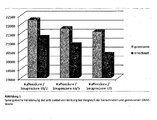
- the determination of the anti-oxidative effect and the synergy between the individual components was carried out according to the OARC fluorescein method, in which the inhibition time and the degree of inhibition are included in a measured value.
- the measurements were made on the device Synergy H4 Company Inc. BioTek performed, the calculated values were taken from a calibration curve compared with Trolox ® as standard.
- the method is, for example, in the publications of Prior et. al., J. Agric Food. Chem. 50, p. 4437-4444 (2000 ) as well Davalos et. al, ibid 52, pp. 58-54 (2004 ) described in detail. These documents are fully incorporated by reference into the patent application with respect to the description of the measuring method.
- test substances have an antioxidant activity which is significantly higher than that of an extract with a 1: 1 mixture of coffee and sinapinic acid.
- the test substances in the absence of EDTA, have a particularly high potential for quenching hydroxyl ions, thereby demonstrating that they form stable iron complexes. Finally, they have a strong potential to prevent the formation of superoxide anions.
Landscapes
- Health & Medical Sciences (AREA)
- Life Sciences & Earth Sciences (AREA)
- Veterinary Medicine (AREA)
- Animal Behavior & Ethology (AREA)
- General Health & Medical Sciences (AREA)
- Public Health (AREA)
- Epidemiology (AREA)
- Chemical & Material Sciences (AREA)
- Pharmacology & Pharmacy (AREA)
- Medicinal Chemistry (AREA)
- Natural Medicines & Medicinal Plants (AREA)
- Engineering & Computer Science (AREA)
- Birds (AREA)
- Dermatology (AREA)
- Food Science & Technology (AREA)
- Polymers & Plastics (AREA)
- Botany (AREA)
- Mycology (AREA)
- Emergency Medicine (AREA)
- Biotechnology (AREA)
- Nutrition Science (AREA)
- Microbiology (AREA)
- Medical Informatics (AREA)
- Alternative & Traditional Medicine (AREA)
- Wood Science & Technology (AREA)
- Zoology (AREA)
- Cosmetics (AREA)
- Medicines Containing Plant Substances (AREA)
- Confectionery (AREA)
Description
- Die Erfindung befindet sich auf dem Gebiet der Antioxidantien und betrifft Zubereitungen, die eine synergistische Kombination von speziellen Hydroxyzimtsäuren, gegebenenfalls zusammen mit Polyphenolen enthalten, Extrakte von Pflanzen und Früchten, die diese enthalten, ein Herstellverfahren für entsprechende Extrakte speziell auf Basis von Sauerkirschen und Anwendungen der synergistischen Kombination von Antioxidantien in unterschiedlichsten Bereichen.
- Zu den Umwelteinflüssen, die eine besondere Gefahr für den menschlichen Organismus darstellen, zählen insbesondere oxidative Schädigungen von Zellen, speziell auch vom Erbgut. Energiereiche Strahlung insbesondere zusammen mit Sauerstoff erzeugen hochreaktive Radikale ("radical oxygen species"), die beispielsweise in der Lage sind, die DNA so zu verändern, dass Thymin zu Thyminglycol oder Guanin zu 8-Oxoguanin (8-OxoG) oxidiert wird. Gerade letzteres ist ein aggressives Mutagen, weil während der Replikation gegenüber einem 8-OxoG sowohl das normale Cytosin-Nucleotid, jedoch bevorzugt ein Adenin-Nucleotid eingebaut werden kann. Eine fehlerhafte Traversion gehört zu den Ursachen, für Zelldefekte und schließlich Krebs. Oxidativer Stress, ausgelöst durch ROS führt auch zu einer beschleunigten Hautalterung, was etwa bei übermäßiger Exposition von UV-Strahlen (beispielsweise in Bräunungsstudios) regelmäßig zu beobachten ist.
- Es liegt daher auf der Hand, dass ein erhebliches Interesse daran besteht, den menschlichen Organismus vor derartigen oxidativen Schädigungen zu schützen. Dies kann beispielsweise durch die Verabreichung von Stoffen geschehen, die die Radikale abfangen ("quenchen"), wobei diese so genannten Antioxidantien oral aufgenommen werden können - entweder mit der Nahrung oder separat als Nahrungsmittelergänzungsstoffe- oder topische Anwendung finden, beispielsweise in kosmetische Produkten, die mit der Haut in Kontakt gebracht werden.
- Als Antioxidantien haben sich unterschiedliche Naturstoffe durchgesetzt. Zu den bekanntesten zählen neben Vitamin C (Ascorbinsäure) die unterschiedlichen Carotinderivate (z.B. beta Carotin, Lycopin, Lutein) und insbesondere Vitamin A und seine Ableger (Tocopherol, Tocopherolacetat und Tocopherolpalmitat). Eine weitere wichtige Gruppe stellen die Polyphenole, speziell die Anthocyane und Isoflavone dar, die beispielsweise in einer Vielzahl von roten Früchten enthalten sind. Zwar ist bekannt, dass entsprechende Säfte und Extrakte dieser Früchte auch geringe Mengen an phenolischen Säuren und Hydroxyzimtsäuren, insbesondere Chlorogensäure enthalten, im Hinblick auf ihren Einfluss auf das antioxidative Potential dieser anthocyanreichen Extrakte ist diesen Begleitstoffen bislang aber wenig Beachtung geschenkt worden.
-
DE 10 2011 052 708 beschreibt ein Verfahren zur Stabilisierung von photolabilen Wirkstoffen in Lebens- und Futtermitteln durch Polyphenole dadurch gekennzeichnet, daß es sich bei den Polyphenolen um Benzoesäurederivate (beispielsweise Vanillinsäure, Gallussäure und Protocatechusäure), Zimtsäurederivate (beispielsweise Kaffeesäure, p-Cumarsäure, Sinapinsäure, Fumarsäure) oder Quercetin handelt. - Nun besteht im Markt ein beständiges Interesse daran, das Leistungsvermögen und das Leistungsspektrum solcher natürlichen Antioxidantien zu verbessern, sei es, dass mit gleichen Mengen eine höhere Leistung erzielt werden soll oder umgekehrt die gleiche Leistung mit geringeren Mengen angestrebt wird.
- Die Aufgabe der vorliegenden Erfindung hat somit darin bestanden, bestehende Polyphenolhaltige Zubereitungen, speziell Extrakte mit einem hohen Gehalt an Anthocyanen bzw. Anthocyanidinen in Richtung einer erhöhten antioxidativen Leistung zu verbessern.
- In einer ersten Ausführungsform betrifft der Gegenstand der Erfindung eine antioxidative Zubereitung, enthaltend
- (a) Kaffeesäure,
- (b) Sinapinsäure sowie gegebenenfalls
- (c) Polyphenole,
- In einer zweiten Ausführungsform wird ein Extrakt beansprucht, der
- (a) Kaffeesäure,
- (b) Sinapinsäure sowie gegebenenfalls
- (c) Polyphenole,
- Überraschenderweise wurde gefunden, dass unter den in Anthocyanextrakten enthaltenen Hydroxyzimtsäuren gerade Kaffeesäure und Sinapinsäure bezüglich ihrer antioxidativen Eigenschaften eine starke Synergie zeigen, wie dies im ORAC Test nachgewiesen werden konnte. Diese positiven Eigenschaften sind zudem schon bereits in sehr kleine Einsatzmengen der beiden Stoffe nachweisbar und verstärken sich im Zusammenspiel mit Polyphenolen, insbesondere Anthocyanen.
- Die Zubereitungen können sowohl als solche eingesetzt werden, als auch in Form von Extrakten, die aus Pflanzen oder Früchten nach einem speziellen Verfahren erhältlich sind. Sowohl die Zubereitungen als auch die Extrakte eignen sich in vorzüglicher Weise als Zusatzstoffe für Nahrungsmittel, Nahrungsergänzungsmittel, aber auch zur Herstellung von pharmazeutischen Zubereitungen, die auf eine Verbesserung des Schutzes von Zellen gegen oxidative Schädigungen beispielsweise durch UV-Strahlung abzielen. Neben diesen Anwendungen, bei denen die Produkte oral aufgenommen werden, kommt auch eine topische Anwen-dung in Betracht, wobei die Zubereitungen oder Extrakte in kosmetische Zubereitungen, speziell in Haut-, Haar- und Sonnenschutzprodukte eingearbeitet werden.
-

- Bei den Polyphenole, die die fakultative Komponente (c) bilden, handelt es sich vorzugsweise um Anthocyane bzw. Anthocyanidine.
- Anthocyadine sind chymochrome Farbstoffe die die allgemeine Struktur (I) aufweisen,

Table A Anthocyane Anthocyanidine Basisstruktur R3' R4' R5' R3 R5 R6 R7 Aurantinidin 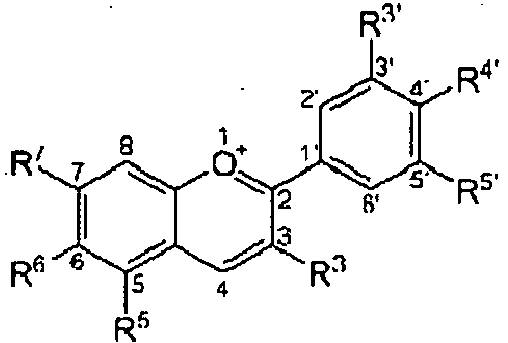
-H -OH -H -OH -OH -OH -OH Cyanidin -OH -OH -H -OH -OH -H -OH Delphinidin -OH -OH -OH -OH -OH -H -OH Europinidin -OCH3 -OH -OH -OH -OCH3 -H -OH Luteolinidin -OH -OH -H -H -OH -H -OH Pelargonidin -H -OH -H -OH -OH -H -OH Malvidin -OCH3 -OH -OCH3 -OH -OH -H -OH Peonidin -OCH3 -OH -H -OH -OH -H -OH Petunidin -OH -OH -OCH3 -OH -OH -H -OH Rosinidin -OCH3 -OH -H -OH -OH -H -OCH3 - Am häufigsten kommen in der Natur die Glykoside von Cyanidin, Delphinidin, Malvidin, Pelargonidin, Peonidin und Petunidin vor, die als Anthocyane bezeichnet werden. Im Sinne der Erfindung sind Glukoside, Rutinsoide, Rhamnoside, Galactosid und Arabinoside von Cyanidin, Delphinidin, Peonidin und Petunidin, wie sie in besonders hohen Konzentrationen beispielsweise in der Sauerkirsche enthalten sind, besonders bevorzugt. Dem entsprechend bevorzugt sind daher auch entsprechende Extrakte.
- Neben den Anthocyanen bzw. Anthocyanidinen können die Zubereitungen bzw. Extrakte vorteilhafterweise jedoch auch Flavone oder Flavonglykoside, wie beispielsweise Catechine (z.B. Catechin, Epicatechin, Epigallocatechingallat (EGCG), Gallocatechin, Gallocatechin-3-gallat, Epicatechingallat), Isocatechin oder Prunetin enthalten.
- Die erfindungsgemäßen Extrakte zeichnen sich vorzugsweise dadurch aus, dass sie
- (a) etwa 150 bis 1.000 ppm, vorzugsweise etwa 300 bis 900 ppm und insbesondere etwa 550 bis 750 ppm Kaffeesäure,
- (b) 10 bis 50 ppm, vorzugsweise etwa 12 bis 40 ppm und insbesondere etwa 15 bis 25 ppm Sinapinsäure, und
- (c) 10 bis 60 Gew.-%, vorzugsweise etwa 20 bis 50 Gew.-% und insbesondere etwa 25 bis 45 Gew.-% Polyphenole sowie
- Die Extrakte, speziell die Extrakte auf Basis von Sauerkirschen, zeichnen sich weiterhin dadurch aus, dass sie folgende Parameter mit der Maßgabe aufweisen, dass die Größen (a) bis (e) alle oder einzeln oder in beliebiger Kombination erfüllt sein können und daher alle möglichen Iterationen - auch bezüglich der Kombination von bevorzugten Bereichsangaben innerhalb verschiedener Parameter - hiermit ausdrücklich offenbart sind:
- (a) einen ORAC-Wert von größer 5.000, vorzugsweise größer 6.000 und insbesondere größer 10.000; und/oder
- (b) einen Polyphenolgehalt von größer 40 Gew.-%, vorzugsweise größer 45 Gew.-% und insbesondere größer 50 Gew.-%; und/oder
- (c) einen Anthocyangehalt von etwa 6 bis etwa 25 Gew.-%, vorzugsweise etwa 15 bis etwa 20 Gew.-% und insbesondere etwa 16 bis etwa 18 Gew.-%; und/oder
- (d) einen Aschegehalt von kleiner 3 Gew.-%, vorzugsweise kleiner 2 Gew.-% und insbesondere etwa 0,5 bis etwa 1 Gew.-%; und/oder
- (e) einen Zuckergehalt von kleiner 0,25 Gew.-%, vorzugsweise kleiner 0,1 Gew.-% und insbesondere von 0 Gew.-%.
- Die Extrakte werden auf Basis Pflanzen oder Früchten gewonnen, die ausgewählt sind aus der Gruppe, die gebildet wird
- Açai (Euterpe oleracea);
- Aronia (e.g. Aronia arbutifolia, Aronia melanocarpa; Aronia prunifolia);
- Schwarze und Rote Johannisbeeren (e.g. Ribes rubrum, Ribes spciatum, Ribes alpinum, Ribes schlechtendalii, Ribes multiflorum, Ribes petraeum, Ribes trite, Ribes nigrum);
- Brombeeren (Rubus sp.);
- Schwarze Karotten (Daucus ccrrota);
- Schwarze Tomaten (Solanum lycopersicum);
- Blutorangen (Citrus sinensis);
- Blaubeeren (Vaccinium corymbosum, Vaccinium angustifolium);
- Schwarzdorn (Prunus spinosa);
- Rauschbeeren (Vaccinium ulginosum);
- Moltebeeren (Rubus chamaemorus);
- Preiselbeeren (e.g. Vaccinium oxycoccos, Vaccinium microcarpus, Vaccinium macrocarpus, Vaccinium erythrocarpus);
- Krähenbeeren (e.g. Empetrum nigrum, Empetrum eamesii, Empetrum rumbrum, Empetrum hermaphroditum);
- Holunderbeeren (e.g. Sambucus nigra, Sambucus racemosa);
- Hibiskus (Hibiscus sabdariffa, Roselle);
- Kronsbeeren (e.g. Vaccinium vitus idaea);
- Magellanbeeren ("Calafate", Berberis microphylla, Breberis buxifolia);
- Makibeeren (e.g. Aristotelia chilensis);
- Bergbeeren (Vaccinium membranaceum);
- Pflaumen und Zwetschgen (Prunus domestica);
- Himbeeren (Rubus idaeus, Rubus occidentalis);
- Rote Stachelbeeren (Ribes uva-crispa, Ribes grossularia);
- Rote Trauben (Vitis vinifera, Vitis labrusca, Vitis riparia, Vitis rotundifolia);
- Rowanbeeren (Sorbus aucuparia);
- Sauerkirschen (e.g. Prunus avium, Prunus cerasus);
- Erdbeeren (Fragaria ananassa);
- Süßkirschen (Prunus avium);
- Taybeeren (Rubus X).
- Es ist des Weiteren vorteilhaft, wenn der Gehalt an Disacchariden in den Zusammensetzungen weniger als 2 Gew.-%, insbesondere etwa 0,1 bis 1,5 Gew.-% beträgt. Es ist ferner typisch, dass bevorzugte Zubereitungen einen signifikanten Kaliumgehalt von insbesondere etwa 10 bis etwa 5.000, vorzugsweise etwa 100 bis etwa 2.500 und besonders bevorzugt etwa 200 bis etwa 1.000 ppm aufweist.
- Ein weiterer Gegenstand der Erfindung betrifft ein Verfahren zur Herstellung eines entsprechenden Extraktes, welcher Kaffee- und Sinapinsäure im synergistischen Gewichtsverhältnis enthält, bei dem man
- (i) aus den Pflanzen oder Früchten einen Saft oder Auszug herstellt und ansäuert,
- (ii) das angesäuerte Produkt über eine Adsorbersäule gibt, die als Adsorptionsmittel ein makroporöses vernetztes nicht-funktionalisiertes Polystyrolharz enthält,
- (iii) die Mischung enthaltend die Komponenten (a), (b) und (c) mit wässrigem, bevorzugt angesäuertem Alkohol desorbiert und schließlich
- (iv) das Eluat trocknet.
- Der Saft kann aus den Früchten vorzugsweise durch Pressen hergestellt werden. Werden beispielsweise Hibiskusblätter eingesetzt, kann man alternativ einen Auszug einsetzten, den man durch Extraktion oder Wasserdampfdestillation gewinnt. Dem entsprechend kann der Auszug wässrig, alkoholisch oder wässrig-alkoholisch sein. Je nach Konzentration empfiehlt es sich den Saft oder Auszug mit Wasser zu verdünnen, beispielsweise so weit, dass die Menge an nicht-wässrigen Bestandteilen etwa 15 bis 35, vorzugsweise etwa 20 bis 25 Gew.-% beträgt. Um die Anthocyane und Hydroxyzimtsäuren stabil in Lösung zu halten, empfiehlt es sich, die Verdünnungen beispielsweise mit Ameisensäure, Milchsäure oder Zitronensäure anzusäuern und auf einen pH-Wert im Bereich von etwa 2 bis 4, vorzugsweise etwa 3 einzustellen. Anschließend wird die angesäuerte Verdünnung auf eine Adsorbersäule gegeben, die ein Harz enthält, welches selektiv für die Hydroxyzimtsäuren und Polyphenole ist. Es hat sich erwiesen, dass für diesen Zweck makroporöse vernetzte Polystyrolharze geeignet sind, die keine weiteren funktionellen Gruppen tragen. Diese sind nämlich nicht nur spezifisch für die Anthocyane bzw. Anthocyanidine, sondern reichern überraschenderweise die beiden Hydroxyzimtsäuren (a) und (b) im synergistischen Verhältnis an. Typische Beispiele für geeignete Adsorberharze umfassen das Produkt Lewatit® VP OC 1064 MD PH, Amberlite XAD7 (Lanxess) oder Symtrap® (Symrise). Die Desorption erfolgt dann mit wässrigem Alkohol, speziell wässrigem Ethanol.
- Ein weiterer Gegenstand der Erfindung betrifft Nahrungs- oder Nahrungsergänzungsmittel, enthaltend entweder antioxidative Zubereitungen, enthaltend
- (a) Kaffeesäure,
- (b) Sinapinsäure sowie gegebenenfalls
- (c) Polyphenole,
- (a) Kaffeesäure,
- (b) Sinapinsäure sowie gegebenenfalls
- (c) Polyphenole,
- Soweit die konfektionierten Produkte Nahrungsmittel darstellen, denen man die antioxidativen Zubereitungen oder die Extrakte direkt zusetzt, handelt es sich beispielsweise um Backwaren, beispielsweise Brot, Trockenkekse, Kuchen, sonstiges Gebäck, Süßwaren (beispielsweise Schokoladen, Schokoladenriegelprodukte, sonstige Riegelprodukte, Fruchtgummi, Hart- und Weichkaramellen, Kaugummi), alkoholische oder nicht-alkoholische Getränke (beispielsweise Kaffee, Tee, Eistee, Wein, weinhaltige Getränke, Bier, bierhaltige Getränke, Liköre, Schnäpse, Weinbrände, (carbonisierte) fruchthaltige Limonaden, (carbonisierte) isotonische Getränke, (carbonisierte) Erfrischungsgetränke, Nektare, Schorlen, Obst- und Gemüsesäfte, Frucht- oder Gemüsesaftzubereitungen, Instantgetränke (beispielsweise Instant-Kakao-Getränke, Instant-Tee-Getränke, Instant-Kaffeegetränke, Instant-Fruchtgetränke), Fleischprodukte (beispielsweise Schinken, Frischwurst- oder Rohwurstzubereitungen, gewürzte oder marinierte Frisch- oder Pökelfleischprodukte), Eier oder Eiprodukte (Trockenei, Eiweiß, Eigelb), Getreideprodukte (beispielsweise Frühstückscerealien, Müsliriegel, vorgegarte Fertigreis-Produkte), Milchprodukte (beispielsweise Milchgetränke, Buttermilchgetränke, Milcheis, Joghurt, Kefir, Frischkäse, Weichkäse, Hartkäse, Trockenmilchpulver, Molke, Molkegetränke, Butter, Buttermilch, teilweise oder ganz hydrolisierte Milchproteinhaltige Produkte), Produkte aus Sojaprotein oder anderen Sojabohnen-Fraktionen (beispielsweise Sojamilch und daraus gefertigte Produkte, Fruchtgetränke mit Sojaprotein, Sojalecithin-haltige Zubereitungen, fermentierte Produkte wie Tofu oder Tempe oder daraus gefertigte Produkte), Produkte aus anderen pflanzlichen Proteinquellen, beispielsweise Haferprotein-Getränke, Fruchtzubereitungen (beispielsweise Konfitüren, Fruchteis, Fruchtsoßen, Fruchtfüllungen), Gemüsezubereitungen (beispielsweise Ketchup, Soßen, Trockengemüse, Tiefkühlgemüse, vorgegarte Gemüse, eingekochte Gemüse), Knabberartikel (beispielsweise gebackene oder frittierte Kartoffelchips oder Kartoffelteigprodukte, Extrudate auf Mais- oder Erdnussbasis), Produkte auf Fett- und Ölbasis oder Emulsionen derselben (beispielsweise Mayonnaise, Remoulade, Dressings), sonstige Fertiggerichte und Suppen (beispielsweise Trockensuppen, Instant-Suppen, vorgegarte Suppen), Gewürze, Würzmischungen sowie insbesondere Aufstreuwürzungen (englisch: Seasonings), die beispielsweise im Snackbereich Anwendung finden. Die antioxidativen Zubereitungen oder die Extrakte können insbesondere in Sportgetränken eingesetzt werden, darunter insbesondere in solchen Sportgetränken, die der Regeneration des Sportlers nach einer intensiven sportlichen Tätigkeit dienen oder die die Leistungsfähigkeit steigern.
- Die Zubereitungen werden üblicherweise in Mengen von etwa 0,1 bis 5, vorzugsweise etwa 0,5 bis 3 und insbesondere etwa 1 bis 2 Gew.-% zugesetzt. Für die Extrakte gelten die gleichen Mengenangaben; gegebenenfalls beziehen sie sich auf den Wirkstoffgehalt.
- Handelt es sich bei den Produkten um Nahrungsmittelergänzungsstoffe, so werden diese in der Regel ohne weitere Zusatzstoffe eingesetzt, wobei von reinen Konfektionierungsmittel abzusehen ist. Eine bevorzugte Anwendungsform stellen hier Makro- oder Mikrokapseln dar. Makrokapseln bestehen vorzugsweise aus Gelatine oder es handelt sich um sprühgetrocknete Produkte, die als Basis Polysaccharide oder Dextrine enthalten. Diese weisen in der Regel Teilchendurchmesser von 0,5 bis 1,5 cm auf.
- Unter den Begriffen "Mikrokapsel" oder "Nanokapsel" werden vom Fachmann hingegen sphärische Aggregate mit einem Durchmesser im Bereich von etwa 0,0001 bis etwa 5 und vorzugsweise 0,005 bis 0,5 mm verstanden, die mindestens einen festen oder flüssigen Kern enthalten, der von mindestens einer kontinuierlichen Hülle umschlossen ist. Genauer gesagt handelt es sich um mit filmbildenden Polymeren umhüllte feindisperse flüssige oder feste Phasen, bei deren Herstellung sich die Polymere nach Emulgierung und Koazervation oder Grenzflächenpolymerisation auf dem einzuhüllenden Material niederschlagen. Nach einem anderen Verfahren werden geschmolzene Wachse in einer Matrix aufgenommen ("microsponge"), die als Mikropartikel zusätzlich mit filmbildenden Polymeren umhüllt sein können. Nach einem dritten Verfahren werden Partikel abwechselnd mit Polyelektrolyten unterschiedlicher Ladung beschichtet ("layer-by-layer"-Verfahren). Die mikroskopisch kleinen Kapseln lassen sich wie Pulver trocknen. Neben einkernigen Mikrokapseln sind auch mehrkernige Aggregate, auch Mikrosphären genannt, bekannt, die zwei oder mehr Kerne im kontinuierlichen Hüllmaterial verteilt enthalten. Ein- oder mehrkernige Mikrokapseln können zudem von einer zusätzlichen zweiten, dritten etc. Hülle umschlossen sein. Die Hülle kann aus natürlichen, halbsynthetischen oder synthetischen Materialien bestehen. Natürlich Hüllmaterialien sind beispielsweise Gummi Arabicum, Agar-Agar, Agarose, Maltodextrine, Alginsäure bzw. ihre Salze, z.B. Natrium- oder Calciumalginat, Fette und Fettsäuren, Cetylalkohol, Collagen, Chitosan, Lecithine, Gelatine, Albumin, Schellack, Polysaccharide, wie Stärke oder Dextran, Polypeptide, Proteinhydrolysate, Sucrose und Wachse. Halbsynthetische Hüllmaterialien sind unter anderem chemisch modifizierte Cellulosen, insbesondere Celluloseester und -ether, z.B. Celluloseacetat, Ethylcellulose, Hydroxypropylcellulose, Hydroxypropylmethylcellulose und Carboxymethylcellulose, sowie Stärkederivate, insbesondere Stärkeether und -ester. Synthetische Hüllmaterialien sind beispielsweise Polymere wie Polyacrylate, Polyamide, Polyvinylalkohol oder Polyvinylpyrrolidon. Beispiele für Mikrokapseln des Stands der Technik sind folgende Handelsprodukte (in Klammern angegeben ist jeweils das Hüllmaterial) : Hallcrest Microcapsules (Gelatine, Gummi Arabicum), Coletica Thalaspheres (maritimes Collagen), Lipotec Millicapseln (Alginsäure, Agar-Agar), Induchem Unispheres (Lactose, mikrokristalline Cellulose, Hydroxypropylmethylcellulose); Unicerin C30 (Lactose, mikrokristalline Cellulose, Hydroxypropylmethylcellulose), Kobo Glycospheres (modifizierte Stärke, Fettsäureester, Phospholipide), Softspheres (modifiziertes Agar-Agar) und Kuhs Probiol Nanospheres (Phospholipide) sowie Primaspheres und Primasponges (Chitosan, Alginate) und Primasys (Phospholipide).
- Eine weitere Darreichungsform der anti-oxidativen Zubereitungen kann in Form von Kaugummis erfolgen. Diese Produkte enthalten typischerweise eine wasserunlösliche und eine wasserlösliche Komponente.
- Die wasserunlösliche Basis, die auch als "Gummibasis" bezeichnet wird. umfasst üblicherweise natürliche oder synthetische Elastomere, Harze, Fette und Öle, Weichmacher, Füllstoffe, Farbstoffe sowie gegebenenfalls Wachse. Der Anteil der Basis an der Gesamtzusammensetzung macht üblicherweise 5 bis 95, vorzugsweise 10 bis 50 und insbesondere 20 bis 35 Gew.-% aus. In einer typischen Ausgestaltungsform der Erfindung setzt sich die Basis aus 20 bis 60 Gew.-% synthetischen Elastomeren, 0 bis 30 Gew.-% natürlichen Elastomeren, 5 bis 55 Gew.-% Weichmachern, 4 bis 35 Gew.-% Füllstoffe und in untergeordneten Mengen Zusatzstoffe wie Farbstoffe, Antioxidantien und dergleichen zusammen, mit der Maßgabe, dass sie allenfalls in geringen Mengen wasserlöslich sind.
- Als geeignete synthetische Elastomere kommen beispielsweise Polyisobutylene mit durchschnittlichen Molekulargewichten (nach GPC) von 10.000 bis 100.000 und vorzugsweise 50.000 bis 80.000, Isobutylen-Isopren-Copolymere ("Butyl Elastomere"), Styrol-Butadien-Copolymere (Styrol:Butadien-Verhältnis z.B. 1: 3 bis 3: 1), Polyvinylacetate mit durchschnittlichen Molekulargewichten (nach GPC) von 2.000 bis 90.000 und vorzugsweise 10.000 bis 65.000, Polyisoprene, Polyethylen, Vinylacetat-Vinyllaurat-Copolymere und deren Gemische. Beispiele für geeignete natürliche Elastomere sind Kautschuks wie etwa geräucherter oder flüssiger Latex oder Guayule sowie natürliche Gummistoffe wie Jelutong, Lechi caspi, Perillo, Sorva, Massaranduba balata, Massaranduba chocolate, Nispero, Rosindinba, Chicle, Gutta hang 1kang sowie deren Gemische. Die Auswahl der synthetischen und natürlichen Elastomere und deren Mischungsverhältnisse richtet sich im Wesentlichen danach, ob mit den Kaugummis Blasen erzeugt werden sollen ("bubble gums") oder nicht. Vorzugsweise werden Elastomergemische eingesetzt, die Jelutong, Chicle, Sorva und Massaranduba enthalten.
- In den meisten Fällen erweisen sich die Elastomere in der Verarbeitung als zu hart oder zu wenig verformbar, so dass es sich als vorteilhaft erwiesen hat, spezielle Weichmacher mitzuverwenden, die natürlich insbesondere auch alle Anforderungen an die Zulassung als Nahrungsmittelzusatzstoffe erfüllen müssen. In dieser Hinsicht kommen vor allem Ester von Harzsäuren in Betracht, beispielsweise Ester von niederen aliphatischen Alkoholen oder Polyolen mit ganz oder teilweise gehärteten, monomeren oder oligomeren Harzsäuren. Insbesondere werden für diesen Zweck die Methyl-, Glycerin-, oder Pentareythritester sowie deren Gemische eingesetzt. Alternativ kommen auch Terpenharze in Betracht, die sich von alpha-Pinen, beta-Pinen, delta-Limonen oder deren Gemischen ableiten können.
- Als Füllstoffe oder Texturiermittel kommen Magnesium- oder Calciumcarbonat, gemahlener Bimsstein, Silicate, speziell Magnesium- oder Aluminiumsilicate, Tone, Aluminiumoxide. Talkum, Titandioxid, Mono-, Di- und Tricalciumphosphat sowie Cellulosepolymere.
- Geeignete Emulgatoren sind Talg, gehärteter Talg, gehärtete oder teilweise gehärtete pflanzliche Öle, Kakaobutter, Partialglyceride, Lecithin, Triacetin und gesättigte oder ungesättigte Fettsäuren mit 6 bis 22 und vorzugsweise 12 bis 18 Kohlenstoffatomen sowie deren Gemische.
- Als Farbstoffe und Weißungsmittel kommen beispielsweise die für die Färbung von Lebensmitteln zugelassenen FD und C-Typen, Pflanzen- und Fruchtextrakte sowie Titandioxid in Frage.
- Die Basismassen können Wachse enthalten oder wachsfrei sein; Beispiele für wachsfreie Zusammensetzungen finden sich unter anderem in der Patentschrift
US 5,286,500 , auf deren Inhalt hiermit ausdrücklich Bezug genommen wird. - Zusätzlich zu der wasserunlöslichen Gummibasis enthalten Kaugummizubereitungen regelmäßig einen wasserlösliche Anteil, der beispielsweise von Softener, Süßstoffen, Füllstoffen, Geschmacksstoffen, Geschmacksverstärkern, Emulgatoren, Farbstoffen, Säuerungsmitteln, Antioxidantien und dergleichen gebildet werden, hier mit der Maßgabe, dass die Bestandteile eine wenigstens hinreichende Wasserlöslichkeit besitzen. In Abhängigkeit der Wasserlöslichkeit der speziellen Vertreter können demnach einzelne Bestandteile sowohl der wasserunlöslichen wie auch der wasserlöslichen Phase angehören. Es ist jedoch auch möglich, Kombinationen beispielsweise eines wasserlöslichen und eines wasserunlöslichen Emulgators einzusetzen, wobei sich die einzelnen Vertreter, dann in unterschiedlichen Phasen befinden. Üblicherweise macht der wasserunlösliche Anteil 5 bis 95 und vorzugsweise 20 bis 80 Gew.-% der Zubereitung aus.
- Wasserlösliche Softener oder Plastifiziermittel werden den Kaugummizusammensetzungen hinzugegeben um die Kaubarkeit und das Kaugefühl zu verbessern und sind in den Mischungen typischerweise in Mengen von 0,5 bis 15 Gew.-% zugegen. Typische Beispiele sind Glycerin, Lecithin sowie wässrige Lösungen von Sorbitol, gehärteten Stärkehydrolysaten oder Kornsirup.
- Als Süßstoffe kommen sowohl zuckerhaltige wie zuckerfreie Verbindungen in Frage, die in Mengen von 5 bis 95, vorzugsweise 20 bis 80 und insbesondere 30 bis 60 Gew.-% bezogen auf die Kaugummizusammensetzung eingesetzt werden. Typische Saccharid-Süssstoffe sind Sucrose, Dextrose, Maltose, Dextrin, getrockneter Invertzucker, Fructose, Levulose, Galactose, Kornsirup sowie deren Gemische. Als Zuckerersatzstoffe kommen Sorbitol, Mannitol, Xylitol, gehärtete Stärkehydrolysate, Maltitol und deren Gemische in Frage. Weiterhin kommen als Zusatzstoffe auch sogenannte HIAS ("High Intensity Articifical Sweeteners") in Betracht, wie beispielsweise Sucralose, Aspartam, Acesulfamsalze, Alitam, Saccharin und Saccharinsalze, Cyclamsäure und deren Salze, Glycyrrhizine, Dihydrochalcone, Thaumatin, Monellin und dergleichen alleine oder in Abmischungen. Besonders wirksam sind auch die hydrophoben HIAS, die Gegenstand der internationalen Patentanmeldung
WO 2002 091849 A1 (Wrigleys ) sowie Stevia Extrakte und deren aktiven Bestandteile, insbesondere Ribeaudiosid A sind. Die Einsatzmenge dieser Stoffe hängt in erster Linie von ihrem Leistungsvermögen ab und liegt typischerweise im Bereich von 0,02 bis 8 Gew.-%. - Insbesondere für die Herstellung kalorienarmer Kaugummis eignen sich Füllstoffe wie beispielsweise Polydextröse, Raftilose, Rafitilin, Fructooligosaccharide (NutraFlora), Palatinoseoligosaaccharide, Guar Gum Hydrolysate (Sun Fiber) sowie Dextrine.
- Die Auswahl an weiteren Geschmacksstoffen ist praktisch unbegrenzt und für das Wesen der Erfindung unkritisch. Üblicherweise liegt der Gesamtanteil aller Geschmacksstoffe bei 0,1 bis 15 und vorzugsweise 0,2 bis 5 Gew.-% bezogen auf die Kaugummizusammensetzung. Geeignete weitere Geschmacksstoffe stellen beispielsweise essentielle Öle, synthetische Aromen und dergleichen dar, wie etwa Anisöl, Sternanisöl, Kümmelöl, Eukalyptusöl, Fenchelöl, Citronenöl, Wintergrünöl, Nelkenöl, und dergleichen, wie sie auch beispielsweise in Mund- und Zahnpflegemittel Verwendung finden.
- Die Kaugummis können des weiteren Hilfs- und Zusatzstoffe enthalten, die beispielsweise für die Zahnpflege, speziell zur Bekämpfung von Plaque und Gingivitis geeignet sind, wie z.B. Chlorhexidin, CPC oder Trichlosan. Weiter können pH-Regulatoren (z.B. Puffer oder Harnstoff), Wirkstoffe gegen Karies (z.B. Phosphate oder Fluoride), biogene Wirkstoffe (Antikörper, Enzyme, Koffein, Pflanzenextrakte) enthalten sein, solange diese Stoffe für Nahrungsmittel zugelassen sind und nicht in unerwünschter Weise miteinander in Wechselwirkung treten.
- Bei den bevorzugten oralen Zubereitungen kann es sich auch um Kaugummis handeln. Diese Produkte enthalten typischerweise eine wasserunlösliche und eine wasserlösliche Komponente.
- Die wasserunlösliche Basis, die auch als "Gummibasis" bezeichnet wird. umfasst üblicherweise natürliche oder synthetische Elastomere, Harze, Fette und Öle, Weichmacher, Füllstoffe, Farbstoffe sowie gegebenenfalls Wachse. Der Anteil der Basis an der Gesamtzusammensetzung macht üblicherweise 5 bis 95, vorzugsweise 10 bis 50 und insbesondere 20 bis 35 Gew.-% aus. In einer typischen Ausgestaltungsform der Erfindung setzt sich die Basis aus 20 bis 60 Gew.-% synthetischen Elastomeren, 0 bis 30 Gew.-% natürlichen Elastomeren, 5 bis 55 Gew.-% Weichmachern, 4 bis 35 Gew.-% Füllstoffe und in untergeordneten Mengen Zusatzstoffe wie Farbstoffe, Antioxidantien und dergleichen zusammen, mit der Maßgabe, dass sie allenfalls in geringen Mengen wasserlöslich sind.
- Als geeignete synthetische Elastomere kommen beispielsweise Polyisobutylene mit durchschnittlichen Molekulargewichten (nach GPC) von 10.000 bis 100.000 und vorzugsweise 50.000 bis 80.000, Isobutylen-Isopren-Copolymere ("Butyl Elastomere"), Styrol-Butadien-Copolymere (Styrol:Butadien-Verhältnis z.B. 1: 3 bis 3: 1), Polyvinylacetate mit durchschnittlichen Molekulargewichten (nach GPC) von 2.000 bis 90.000 und vorzugsweise 10.000 bis 65.000, Polyisoprene, Polyethylen, Vinylacetat-Vinyllaurat-Copolymere und deren Gemische. Beispiele für geeignete natürliche Elastomere sind Kautschuks wie etwa geräucherter oder flüssiger Latex oder Guayule sowie natürliche Gummistoffe wie Jelutong, Lechi caspi, Perillo, Sorva, Massaranduba balata, Massaranduba chocolate, Nispero, Rosindinba, Chicle, Gutta hang 1kang sowie deren Gemische. Die Auswahl der synthetischen und natürlichen Elastomere und deren Mischungsverhältnisse richtet sich im Wesentlichen danach, ob mit den Kaugummis Blasen erzeugt werden sollen ("bubble gums") oder nicht. Vorzugsweise werden Elastomergemische eingesetzt, die Jelutong, Chicle, Sorva und Massaranduba enthalten.
- In den meisten Fällen erweisen sich die Elastomere in der Verarbeitung als zu hart oder zu wenig verformbar, so dass es sich als vorteilhaft erwiesen hat, spezielle Weichmacher mitzuverwenden, die natürlich insbesondere auch alle Anforderungen an die Zulassung als Nahrungsmittelzusatzstoffe erfüllen müssen. In dieser Hinsicht kommen vor allem Ester von Harzsäuren in Betracht, beispielsweise Ester von niederen aliphatischen Alkoholen oder Polyolen mit ganz oder teilweise gehärteten, monomeren oder oligomeren Harzsäuren. Insbesondere werden für diesen Zweck die Methyl-, Glycerin-, oder Pentareythritester sowie deren Gemische eingesetzt. Alternativ kommen auch Terpenharze in Betracht, die sich von alpha-Pinen, beta-Pinen, delta-Limonen oder deren Gemischen ableiten können.
- Als Füllstoffe oder Texturiermittel kommen Magnesium- oder Calciumcarbonat, gemahlener Bimsstein, Silicate, speziell Magnesium- oder Aluminiumsilicate, Tone, Aluminiumoxide. Talkum, Titandioxid, Mono-, Di- und Tricalciumphosphat sowie Cellulosepolymere.
- Geeignete Emulgatoren sind Talg, gehärteter Talg, gehärtete oder teilweise gehärtete pflanzliche Öle, Kakaobutter, Partialglyceride, Lecithin, Triacetin und gesättigte oder ungesättigte Fettsäuren mit 6 bis 22 und vorzugsweise 12 bis 18 Kohlenstoffatomen sowie deren Gemische.
- Als Farbstoffe und Weißungsmittel kommen beispielsweise die für die Färbung von Lebensmitteln zugelassenen FD und C-Typen, Pflanzen- und Fruchtextrakte sowie Titandioxid in Frage.
- Die Basismassen können Wachse enthalten oder wachsfrei sein; Beispiele für wachsfreie Zusammensetzungen finden sich unter anderem in der Patentschrift
US 5,286,500 , auf deren Inhalt hiermit ausdrücklich Bezug genommen wird. - Zusätzlich zu der wasserunlöslichen Gummibasis enthalten Kaugummizubereitungen regelmäßig einen wasserlösliche Anteil, der beispielsweise von Softener, Süßstoffen, Füllstoffen, Geschmacksstoffen, Geschmacksverstärkern, Emulgatoren, Farbstoffen, Säuerungsmitteln, Antioxidantien und dergleichen gebildet werden, hier mit der Maßgabe, dass die Bestandteile eine wenigstens hinreichende Wasserlöslichkeit besitzen. In Abhängigkeit der Wasserlöslichkeit der speziellen Vertreter können demnach einzelne Bestandteile sowohl der wasserunlöslichen wie auch der wasserlöslichen Phase angehören. Es ist jedoch auch möglich, Kombinationen beispielsweise eines wasserlöslichen und eines wasserunlöslichen Emulgators einzusetzen, wobei sich die einzelnen Vertreter, dann in unterschiedlichen Phasen befinden. Üblicherweise macht der wasserunlösliche Anteil 5 bis 95 und vorzugsweise 20 bis 80 Gew.-% der Zubereitung aus.
- Wasserlösliche Softener oder Plastifiziermittel werden den Kaugummizusammensetzungen hinzugegeben um die Kaubarkeit und das Kaugefühl zu verbessern und sind in den Mischungen typischerweise in Mengen von 0,5 bis 15 Gew.-% zugegen. Typische Beispiele sind Glycerin, Lecithin sowie wässrige Lösungen von Sorbitol, gehärteten Stärkehydrolysaten oder Kornsirup.
- Als Süßstoffe kommen sowohl zuckerhaltige wie zuckerfreie Verbindungen in Frage, die in Mengen von 5 bis 95, vorzugsweise 20 bis 80 und insbesondere 30 bis 60 Gew.-% bezogen auf die Kaugummizusammensetzung eingesetzt werden. Typische Saccharid-Süssstoffe sind Sucrose, Dextrose, Maltose, Dextrin, getrockneter Invertzucker, Fructose, Levulose, Galactose, Kornsirup sowie deren Gemische. Als Zuckerersatzstoffe kommen Sorbitol, Mannitol, Xylitol, gehärtete Stärkehydrolysate, Maltitol und deren Gemische in Frage. Weiterhin kommen als Zusatzstoffe auch sogenannte HIAS ("High Intensity Articifical Sweeteners") in Betracht, wie beispielsweise Sucralose, Aspartam, Acesulfamsalze, Alitam, Saccharin und Saccharinsalze, Cyclamsäure und deren Salze, Glycyrrhizine, Dihydrochalcone, Thaumatin, Monellin und dergleichen alleine oder in Abmischungen. Besonders wirksam sind auch die hydrophoben HIAS, die Gegenstand der internationalen Patentanmeldung
WO 2002 091849 A1 (Wrigleys ) sowie Stevia Extrakte und deren aktiven Bestandteile, insbesondere Ribeaudiosid A sind. Die Einsatzmenge dieser Stoffe hängt in erster Linie von ihrem Leistungsvermögen ab und liegt typischerweise im Bereich von 0,02 bis 8 Gew.-%. - Insbesondere für die Herstellung kalorienarmer Kaugummis eignen sich Füllstoffe wie beispielsweise Polydextrose, Raftilose, Rafitilin, Fructooligosaccharide (NutraFlora), Palatinoseoligosaaccharide, Guar Gum Hydrolysate (Sun Fiber) sowie Dextrine.
- Die Auswahl an weiteren Geschmacksstoffen ist praktisch unbegrenzt und für das Wesen der Erfindung unkritisch. Üblicherweise liegt der Gesamtanteil aller Geschmacksstoffe bei 0,1 bis 15 und vorzugsweise 0,2 bis 5 Gew.-% bezogen auf die Kaugummizusammensetzung. Geeignete weitere Geschmacksstoffe stellen beispielsweise essentielle Öle, synthetische Aromen und dergleichen dar, wie etwa Anisöl, Sternanisöl, Kümmelöl, Eukalyptusöl, Fenchelöl, Citronenöl, Wintergrünöl, Nelkenöl, und dergleichen, wie sie auch beispielsweise in Mund- und Zahnpflegemittel Verwendung finden.
- Die Kaugummis können des weiteren Hilfs- und Zusatzstoffe enthalten, die beispielsweise für die Zahnpflege, speziell zur Bekämpfung von Plaque und Gingivitis geeignet sind, wie z.B. Chlorhexidin, CPC oder Trichlosan. Weiter können pH-Regulatoren (z.B. Puffer oder Harnstoff), Wirkstoffe gegen Karies (z.B. Phosphate oder Fluoride), biogene Wirkstoffe (Antikörper, Enzyme, Koffein, Pflanzenextrakte) enthalten sein, solange diese Stoffe für Nahrungsmittel zugelassen sind und nicht in unerwünschter Weise miteinander in Wechselwirkung treten.
- Ein weiterer Gegenstand der Erfindung betrifft pharmazeutische Zubereitungen zum Schutz des menschlichen oder tierischen Körpers vor oxidativer Schädigung, enthaltend entweder antioxidative Zubereitungen, enthaltend
- (a) Kaffeesäure,
- (b) Sinapinsäure sowie gegebenenfalls
- (c) Polyphenole,
- (a) Kaffeesäure,
- (b) Sinapinsäure sowie gegebenenfalls
- (c) Polyphenole,
- Ein weiterer Gegenstand der Erfindung betrifft kosmetische Mittel, enthaltend entweder anti-oxidative Zubereitungen, enthaltend
- (a) Kaffeesäure,
- (b) Sinapinsäure sowie gegebenenfalls
- (c) Polyphenole,
- (a) Kaffeesäure,
- (b) Sinapinsäure sowie gegebenenfalls
- (c) Polyphenole,
- Die erfindungsgemäßen kosmetischen Mittel können weitere typische Hilfs- und Zusatzstoffe enthalten, wie beispielsweise milde Tenside, Ölkörper, Emulgatoren, Perlglanzwachse, Konsistenzgeber, Verdickungsmittel, Überfettungsmittel, Stabilisatoren, Polymere, Siliconverbindungen, Fette, Wachse, Lecithine, Phospholipide, UV-Lichtschutzfaktoren, Feuchthaltemittel, biogene Wirkstoffe, Antioxidantien, Deodorantien, Antitranspirantien, Antischuppenmittel, Filmbildner, Quellmittel, Insektenrepellentien, Selbstbräuner, Tyrosininhibitoren (Depigmentierungsmittel), Hydrotrope, Solubilisatoren, Konservierungsmittel, Parfümöle, Farbstoffe und dergleichen enthalten. Da viele pharmazeutische Zubereitungen ähnliche Inhaltsstoffe aufweisen, gelten die nachfolgenden Beispiele hier mit.
- Als oberflächenaktive Stoffe können anionische, nichtionische, kationische und/oder amphotere bzw. zwitterionische Tenside enthalten sein, deren Anteil an den Mitteln üblicherweise bei etwa 1 bis 70, vorzugsweise 5 bis 50 und insbesondere 10 bis 30 Gew.-% beträgt. Typische Beispiele für anionische Tenside sind Seifen, Alkylbenzolsulfonate, Alkansulfonate, Olefinsulfonate, Alkylethersulfonate, Glycerinethersulfonate, α-Methylestersulfonate, Sulfofettsäuren, Alkylsulfate, Alkylethersulfate, Glycerinethersulfate, Fettsäureethersulfate, Hydroxymischethersulfate, Monoglycerid(ether)sulfate, Fettsäureamid(ether)sulfate, Mono- und Dialkylsulfosuccinate, Mono- und Dialkylsulfosuccinamate, Sulfotriglyceride, Amidseifen, Ethercarbonsäuren und deren Salze, Fettsäureisethionate, Fettsäuresarcosinate, Fettsäuretauride, N-Acylaminosäuren, wie beispielsweise Acyllactylate, Acyltartrate, Acylglutamate und Acylaspartate, Alkyloligoglucosidsulfate, Proteinfettsäurekondensate (insbesondere pflanzliche Produkte auf Weizenbasis) und Alkyl(ether)phosphate. Sofern die anionischen Tenside Polyglycoletherketten enthalten, können diese eine konventionelle, vorzugsweise jedoch eine eingeengte Homologenverteilung aufweisen. Typische Beispiele für nichtionische Tenside sind Fettalkoholpolyglycolether, Alkylphenolpolyglycolether, Fettsäurepolyglycolester, Fettsäureamidpolyglycolether, Fettaminpolyglycolether, alkoxylierte Triglyceride, Mischether bzw. Mischformale, gegebenenfalls partiell oxidierte Alk(en)yloligoglykoside bzw. Glucoronsäurederivate, Fettsäure-N-alkylglucamide, Proteinhydrolysate (insbesondere pflanzliche Produkte auf Weizenbasis), Polyolfettsäureester, Zuckerester, Sorbitanester, Polysorbate und Aminoxide. Sofern die nichtionischen Tenside Polyglycoletherketten enthalten, können diese eine konventionelle, vorzugsweise jedoch eine eingeengte Homologenverteilung aufweisen. Typische Beispiele für kationische Tenside sind quartäre Ammoniumverbindungen, wie beispielsweise das Dimethyldistearylammoniumchlorid, und Esterquats, insbesondere quaternierte Fettsäuretrialkanolaminestersalze. Typische Beispiele für amphotere bzw. zwitterionische Tenside sind Alkylbetaine, Alkylamidobetaine, Aminopropionate, Aminoglycinate, Imidazoliniumbetaine und Sulfobetaine. Bei den genannten Tensiden handelt es sich ausschließlich um bekannte Verbindungen. Typische Beispiele für besonders geeignete milde, d.h. besonders hautverträgliche Tenside sind Fettalkoholpolyglycolethersulfate, Monoglyceridsulfate, Mono- und/oder Dialkylsulfosuccinate, Fettsäureisethionate, Fettsäuresarcosinate, Fettsäuretauride, Fettsäureglutamate, α-Olefinsulfonate, Ethercarbonsäuren, Alkyloligoglucoside, Fettsäureglucamide, Alkylamidobetaine, Amphoacetale und/oder Proteinfettsäurekondensate, letztere vorzugsweise auf Basis von Weizenproteinen.
- Als Ölkörper kommen beispielsweise Guerbetalkohole auf Basis von Fettalkoholen mit 6 bis 18, vorzugsweise 8 bis 10 Kohlenstoffatomen, Ester von linearen C6-C22-Fettsäuren mit linearen oder verzweigten C6-C22-Fettalkoholen bzw. Ester von verzweigten C6-C13-Carbonsäuren mit linearen oder verzweigten C6-C22-Fettalkoholen, wie z.B. Myristylmyristat, Myristylpalmitat, Myristylstearat, Myristylisostearat, Myristyloleat, Myristylbehenat, Myristylerucat, Cetylmyristat, Cetylpalmitat, Cetylstearat, Cetylisostearat, Cetyloleat, Cetylbehenat, Cetylerucat, Stearylmyristat, Stearylpalmitat, Stearylstearat, Stearylisostearat, Stearyloleat, Stearylbehenat, Stearylerucat, Isostearylmyristat, Isostearylpalmitat, Isostearylstearat, Isostearylisostearat, Isostearyloleat, Isostearylbehenat, Isostearyloleat, Oleylmyristat, Oleylpalmitat, Oleylstearat, Oleylisostearat, Oleyloleat, Oleylbehenat, Oleylerucat, Behenylmyristat, Behenylpalmitat, Behenylstearat, Behenylisostearat, Behenyloleat, Behenylbehenat, Behenylerucat, Erucylmyristat, Erucylpalmitat, Erucylstearat, Erucylisostearat, Erucyloleat, Erucylbehenat und Erucylerucat. Daneben eignen sich Ester von linearen C6-C22-Fettsäuren mit verzweigten Alkoholen, insbesondere 2-Ethylhexanol, Ester von C18-C38-Alkylhydroxycarbonsäuren mit linearen oder verzweigten C6-C22-Fettalkoholen, insbesondere Dioctyl Malate, Ester von linearen und/oder verzweigten Fettsäuren mit mehrwertigen Alkoholen (wie z.B. Propylenglycol, Dimerdiol oder Trimertriol) und/oder Guerbetalkoholen, Triglyceride auf Basis C6-C10-Fettsäuren, flüssige Mono-/Di-/Triglyceridmischungen auf Basis von C6-C18-Fettsäuren, Ester von C6-C22-Fettalkoholen und/oder Guerbetalkoholen mit aromatischen Carbonsäuren, insbesondere Benzoesäure, Ester von C2-C12-Dicarbonsäuren mit linearen oder verzweigten Alkoholen mit 1 bis 22 Kohlenstoffatomen oder Polyolen mit 2 bis 10 Kohlenstoffatomen und 2 bis 6 Hydroxylgruppen, pflanzliche Öle, verzweigte primäre Alkohole, substituierte Cyclohexane, lineare und verzweigte C6-C22-Fettalkoholcarbonate, wie z.B. Dicaprylyl Carbonate (Cetiol® CC), Guerbetcarbonate auf Basis von Fettalkoholen mit 6 bis 18, vorzugsweise 8 bis 10 C Atomen, Ester der Benzoesäure mit linearen und/oder verzweigten C6-C22-Alkoholen (z.B. Finsolv® TN), lineare oder verzweigte, symmetrische oder unsymmetrische Dialkylether mit 6 bis 22 Kohlenstoffatomen pro Alkylgruppe, wie z.B. Dicaprylyl Ether (Cetiol® OE), Ringöffnungsprodukte von epoxidierten Fettsäureestern mit Polyolen, Siliconöle (Cyclomethicone, Siliciummethicontypen u.a.) und/oder aliphatische bzw. naphthenische Kohlenwasserstoffe, wie z.B. wie Squalan, Squalen oder Dialkylcyclohexane in Betracht.
- Als Emulgatoren kommen beispielsweise nichtionogene Tenside aus mindestens einer der folgenden Gruppen in Frage:
- Anlagerungsprodukte von 2 bis 30 Mol Ethylenoxid und/ oder 0 bis 5 Mol Propylenoxid an lineare Fettalkohole mit 8 bis 22 C-Atomen, an Fettsäuren mit 12 bis 22 C-Atomen, an Alkylphenole mit 8 bis 15 C-Atomen in der Alkylgruppe sowie Alkylamine mit 8 bis 22 Kohlenstoffatomen im Alkylrest;
- Alkyl- und/oder Alkenyloligoglykoside mit 8 bis 22 Kohlenstoffatomen im Alk(en)ylrest und deren ethoxylierte Analoga;
- Anlagerungsprodukte von 1 bis 15 Mol Ethylenoxid an Ricinusöl und/oder gehärtetes Ricinusöl;
- Anlagerungsprodukte von 15 bis 60 Mol Ethylenoxid an Ricinusöl und/oder gehärtetes Ricinusöl;
- Partialester von Glycerin und/oder Sorbitan mit ungesättigten, linearen oder gesättigten, verzweigten Fettsäuren mit 12 bis 22 Kohlenstoffatomen und/oder Hydroxycarbonsäuren mit 3 bis 18 Kohlenstoffatomen sowie deren Addukte mit 1 bis 30 Mol Ethylenoxid;
- Partialester von Polyglycerin (durchschnittlicher Eigenkondensationsgrad 2 bis 8), Polyethylenglycol (Molekulargewicht 400 bis 5000), Trimethylolpropan, Pentaerythrit, Zuckeralkoholen (z.B. Sorbit), Alkylglucosiden (z.B. Methylglucosid, Butylglucosid, Laurylglucosid) sowie Polyglucosiden (z.B. Cellulose) mit gesättigten und/oder ungesättigten, linearen oder verzweigten Fettsäuren mit 12 bis 22 Kohlenstoffatomen und/oder Hydroxycarbonsäuren mit 3 bis 18 Kohlenstoffatomen sowie deren Addukte mit 1 bis 30 Mol Ethylenoxid;
- Mischester aus Pentaerythrit, Fettsäuren, Citronensäure und Fettalkohol und/oder Mischester von Fettsäuren mit 6 bis 22 Kohlenstoffatomen, Methylglucose und Polyolen, vorzugsweise Glycerin oder Polyglycerin.
- Mono-, Di- und Trialkylphosphate sowie Mono-, Di- und/oder Tri-PEG-alkylphosphate und deren Salze;
- Wollwachsalkohole;
- Polysiloxan-Polyalkyl-Polyether-Copolymere bzw. entsprechende Derivate;
- Block-Copolymere z.B. Polyethylenglycol-30 Dipolyhydroxystearate;
- Polymeremulgatoren, z.B. Pemulen-Typen (TR-1,TR-2) von Goodrich oder Cosmedia® SP von Cognis;
- Polyalkylenglycole sowie
- Glycerincarbonat.
- Im Folgenden werden besonders geeignete Emulgatoren näher erläutert:
- (i) Alkoxylate. Die Anlagerungsprodukte von Ethylenoxid und/oder von Propylenoxid an Fettalkohole, Fettsäuren, Alkylphenole oder an Ricinusöl stellen bekannte, im Handel erhältliche Produkte dar. Es handelt sich dabei um Homologengemische, deren mittlerer Alkoxylierungsgrad dem Verhältnis der Stoffmengen von Ethylenoxid und/ oder Propylenoxid und Substrat, mit denen die Anlagerungsreaktion durchgeführt wird, entspricht. C12/18-Fettsäuremono- und -diester von Anlagerungsprodukten von Ethylenoxid an Glycerin sind als Rückfettungsmittel für kosmetische Zubereitungen bekannt.
- (ii) Alkyl- und/oder Alkenyloligoglykosid. Alkyl- und/oder Alkenyloligoglycoside, ihre Herstellung und ihre Verwendung sind aus dem Stand der Technik bekannt. Ihre Herstellung erfolgt insbesondere durch Umsetzung von Glucose oder Oligosacchariden mit primären Alkoholen mit 8 bis 18 Kohlenstoffatomen. Bezüglich des Glycosidrestes gilt, daß sowohl Monoglycoside, bei denen ein cyclischer Zuckerrest glycosidisch an den Fettalkohol gebunden ist, als auch oligomere Glycoside mit einem Oligomerisationsgrad bis vorzugsweise etwa 8 geeignet sind. Der Oligomerisierungsgrad ist dabei ein statistischer Mittelwert, dem eine für solche technischen Produkte übliche Homologenverteilung zugrunde liegt.
- (iii) Partialglyceride. Typische Beispiele für geeignete Partialglyceride sind Hydroxystearinsäuremonoglycerid, Hydroxystearinsäurediglycerid, Isostearinsäuremonoglycerid, Isostearinsäurediglycerid, Ölsäuremonoglycerid, Ölsäurediglycerid, Ricinolsäuremoglycerid, Ricinolsäurediglycerid, Linolsäuremonoglycerid, Linolsäurediglycerid, Linolensäuremonoglycerid, Linolensäurediglycerid, Erucasäuremonoglycerid, Erucasäurediglycerid, Weinsäuremonoglycerid, Weinsäurediglycerid, Citronensäuremonoglycerid, Citronendiglycerid, Äpfelsäuremonoglycerid, Äpfelsäurediglycerid sowie deren technische Gemische, die untergeordnet aus dem Herstellungsprozeß noch geringe Mengen an Triglycerid enthalten können. Ebenfalls geeignet sind Anlagerungsprodukte von 1 bis 30, vorzugsweise 5 bis 10 Mol Ethylenoxid an die genannten Partialglyceride.
- (iv) Sorbitanester. Als Sorbitanester kommen Sorbitanmonoisostearat, Sorbitansesquiisostearat, Sorbitan-diisostearat, Sorbitantriisostearat, Sorbitanmonooleat, Sorbitansesquioleat, Sorbitan-dioleat, Sorbitantrioleat, Sorbitanmonoerucat, Sorbitansesquierucat, Sorbitandierucat, Sorbitantrierucat, Sorbitanmonoricinoleat, Sorbitansesquiricinoleat, Sorbitandiricinoleat, Sorbitantriricinoleat, Sorbitanmonohydroxystearat, Sorbitansesquihydroxystearat, Sorbitandihydroxystearat, Sorbitantrihydroxystearat, Sorbitanmonotartrat, Sorbitansesqui-tartrat, Sorbitanditartrat, Sorbitantritartrat, Sorbitanmonocitrat, Sorbitansesquicitrat, Sorbitandicitrat, Sorbitantricitrat, Sorbitanmonomaleat, Sorbitansesquimaleat, Sorbitan-dimaleat, Sorbitantrimaleat sowie deren technische Gemische. Ebenfalls geeignet sind Anlagerungsprodukte von 1 bis 30, vorzugsweise 5 bis 10 Mol Ethylenoxid an die genannten Sorbitanester.
- (v) Polyglycerinester. Typische Beispiele für geeignete Polyglycerinester sind Polyglyceryl-2 Dipolyhydroxystearate (Dehymuls® PGPH), Polyglycerin-3-Diisostearate (Lameform@ TGI), Polyglyceryl-4 Isostearate (Isolan® GI 34), Polyglyceryl-3 Oleate, Diisostearoyl Polyglyceryl-3 Diisostearate (Isolan® PDI), Polyglyceryl-3 Methylglucose Distearate (Tego Care® 450), Polyglyceryl-3 Beeswax (Cera Bellina®), Polyglyceryl-4 Caprate (Polyglycerol Caprate T2010/90), Polyglyceryl-3 Cetyl Ether (Chimexane® NL), Polyglyceryl-3 Distearate (Cremophor® GS 32) und Polyglyceryl Polyricinoleate (Admul® WOL 1403) Polyglyceryl Dimerate Isostearate sowie deren Gemische. Beispiele für weitere geeignete Polyolester sind die gegebenenfalls mit 1 bis 30 Mol Ethylenoxid umgesetzten Mono-, Di- und Triester von Trimethylolpropan oder Pentaerythrit mit Laurinsäure, Kokosfettsäure, Talgfettsäure, Palmitinsäure, Stearinsäure, Ölsäure, Behensäure und dergleichen.
- (vi) Anionische Emulgatoren. Typische anionische Emulgatoren sind aliphatische Fettsäuren mit 12 bis 22 Kohlenstoffatomen, wie beispielsweise Palmitinsäure, Stearinsäure oder Behensäure, sowie Dicarbonsäuren mit 12 bis 22 Kohlenstoffatomen, wie beispielsweise Azelainsäure oder Sebacinsäure.
- (vii) Amphotere und kationische Emulgatoren. Weiterhin können als Emulgatoren zwitterionische Tenside verwendet werden. Als zwitterionische Tenside werden solche oberflächenaktiven Verbindungen bezeichnet, die im Molekül mindestens eine quartäre Ammoniumgruppe und mindestens eine Carboxylat- und eine Sulfonatgruppe tragen. Besonders geeignete zwitterionische Tenside sind die sogenannten Betaine wie die N-Alkyl-N,N-dimethylammoniumglycinate, beispielsweise das Kokosalkyldimethylammoniumglycinat, N-Acylaminopropyl-N,N-dimethylammoniumglycinate, beispielsweise das Kokosacylaminopropyldimethyl-ammoniumglycinat, und 2-Alkyl-3-carboxylmethyl-3-hydroxyethylimidazoline mit jeweils 8 bis 18 C-Atomen in der Alkyl- oder Acylgruppe sowie das Kokosacylaminoethylhydroxyethylcarboxymethylglycinat. Besonders bevorzugt ist das unter der CTFA-Bezeichnung Cocamidopropyl Betaine bekannte Fettsäureamid-Derivat. Ebenfalls geeignete Emulgatoren sind ampholytische Tenside. Unter ampholytischen Tensiden werden solche oberflächenaktiven Verbindungen verstanden, die außer einer C8/18-Alkyl- oder Acylgruppe im Molekül mindestens eine freie Aminogruppe und mindestens eine -COOH- oder -SO3H-Gruppe enthalten und zur Ausbildung innerer Salze befähigt sind. Beispiele für geeignete ampholytische Tenside sind N-Alkylglycine, N-Alkylpropionsäuren, N-Alkylaminobuttersäuren, N-Alkyliminodipropionsäuren, N-Hydroxyethyl-N-alkylamidopropylglycine, N-Alkyltaurine, N-Alkylsarcosine, 2-Alkylaminopropionsäuren und Alkylaminoessigsäuren mit jeweils etwa 8 bis 18 C-Atomen in der Alkylgruppe.. Besonders bevorzugte ampholytische Tenside sind das N-Kokosalkylaminopropionat, das Kokosacylaminoethylaminopropionat und das C12/18-Acylsarcosih. Schließlich kommen auch Kationtenside als Emulgatoren in Betracht, wobei solche vom Typ der Esterquats, vorzugsweise methylquaternierte Difettsäuretriethanolaminester-Salze, besonders bevorzugt sind.
- Typische Beispiele für Fette sind Glyceride, d.h. feste oder flüssige pflanzliche oder tierische Produkte, die im Wesentlichen aus gemischten Glycerinestern höherer Fettsäuren bestehen, als Wachse kommen u.a. natürliche Wachse, wie z.B. Candelillawachs, Carnaubawachs, Japanwachs, Espartograswachs, Korkwachs, Guarumawachs, Reiskeimölwachs, Zuckerrohrwachs, Ouricurywachs, Montanwachs, Bienenwachs, Schellackwachs, Walrat, Lanolin (Wollwachs), Bürzelfett, Ceresin, Ozokerit (Erdwachs), Petrolatum, Paraffinwachse, Mikrowachse; chemisch modifizierte Wachse (Hartwachse), wie z.B. Montanesterwachse, Sasolwachse, hydrierte Jojobawachse sowie synthetische Wachse, wie z.B. Polyalkylenwachse und Polyethylenglycolwachse in Frage. Neben den Fetten kommen als Zusatzstoffe auch fettähnliche Substanzen, wie Lecithine und Phospholipide in Frage. Unter der Bezeichnung Lecithine versteht der Fachmann diejenigen Glycero-Phospholipide, die sich aus Fettsäuren, Glycerin, Phosphorsäure und Cholin durch Veresterung bilden. Lecithine werden in der Fachwelt daher auch häufig als Phosphatidylcholine (PC). Als Beispiele für natürliche Lecithine seien die Kephaline genannt, die auch als Phosphatidsäuren bezeichnet werden und Derivate der 1,2-Diacyl-sn-glycerin-3-phosphorsäuren darstellen. Dem gegenüber versteht man unter Phospholipiden gewöhnlich Mono- und vorzugsweise Diester der Phosphorsäure mit Glycerin (Glycerinphosphate), die allgemein zu den Fetten gerechnet werden. Daneben kommen auch Sphingosine bzw. Sphingolipide in Frage.
- Als Perlglanzwachse kommen beispielsweise in Frage: Alkylenglycolester, speziell Ethylenglycoldistearat; Fettsäurealkanolamide, speziell Kokosfettsäurediethanolamid; Partialglyceride, speziell Stearinsäuremonoglycerid; Ester von mehrwertigen, gegebenenfalls hydroxysubstituierte Carbonsäuren mit Fettalkoholen mit 6 bis 22 Kohlenstoffatomen, speziell langkettige Ester der Weinsäure; Fettstoffe, wie beispielsweise Fettalkohole, Fettketone, Fettaldehyde, Fettether und Fettcarbonate, die in Summe mindestens 24 Kohlenstoffatome aufweisen, speziell Lauron und Distearylether; Fettsäuren wie Stearinsäure, Hydroxystearinsäure oder Behensäure, Ringöffnungsprodukte von Olefinepoxiden mit 12 bis 22 Kohlenstoffatomen mit Fettalkoholen mit 12 bis 22 Kohlenstoffatomen und/oder Polyolen mit 2 bis 15 Kohlenstoffatomen und 2 bis 10 Hydroxylgruppen sowie deren Mischungen.
- Kühlstoffe sind Verbindungen, die auf der Haut ein Gefühlt der Kälte erzeugen. In der Regel handelt es sich dabei um Mentholverbindungen, die - neben dem Grundkörper Menthol selber - beispielsweise ausgewählt aus der Gruppe, die gebildet wird von Menthol Methyl Ether, Menthone Glyceryl Acetal (FEMA GRAS1 3807), Menthone Glyceryl Ketal (FEMA GRAS 3808), Menthyl Lactate (FEMA GRAS 3748), Menthol Ethylene Glycol Carbonate (FEMA GRAS 3805), Menthol Propylene Glycol Carbonate (FEMA GRAS 3806), Menthyl-N-ethyloxamat, Monomethyl Succinate (FEMA GRAS 3810), Monomenthyl Glutamate (FEMA GRAS 4006), Menthoxy-1,2-propanediol (FEMA GRAS 3784), Menthoxy-2-methyl-1,2-propandiol (FEMA GRAS 3849) sowie den Menthancarbonsäureestern und -amiden WS-3, WS-4, WS-5, WS-12, WS-14 und WS-30 sowie deren Gemischen.
1 FEMA steht für "Flavor and Extracts Manufacturers Association" und GRAS ist definiert als "Generally Regarded As Safe". Eine FEMA GRAS Bezeichnung bedeutet, dass die so gekennzeichnete Substanz nach Standardmethode getestet und für toxikologisch unbedenklich erachtet wird. - Ein erster wichtiger Vertreter dieser Stoffe stellt das Monomenthyl Succinate (FEMA GRAS 3810) dar. Sowohl das Succinat als auch das analoge Monomenthyl Glutarate (FEMA GRAS 4006) stellen wichtige Vertreter von Monomenthylestern auf Basis von Di- und Polycarbonsäuren dar:

- Beispiele für Anwendungen dieser Stoffe finden sich beispielsweise in den Druckschriften
WO 2003 043431 (Unilever) oderEP 1332772 A1 (IFF). - Die nächste wichtige Gruppe von im Sinne der Erfindung bevorzugten Mentholverbindungen umfasst Carbonatester von Menthol und Polyolen, wie beispielsweise Glykolen, Glycerin oder Kohlenhydraten, wie beispielsweise Menthol Ethylenglycol Carbonate (FEMA GRAS 3805 = Frescolat® MGC), Menthol Propylenglycol Carbonate (FEMA GRAS 3784 = Frescolat® MPC), Menthol 2-Methyl-1,2-propandiol Carbonate (FEMA GRAS 3849) oder den entsprechenden Zuckerderivaten. Ebenfalls bevorzugt sind die Mentholverbindungen Menthyl Lactate (FEMA GRAS 3748 = Frescolat® ML) und insbesondere das Menthone Glyceryl Acetal (FEMA GRAS 3807) bzw. Menthone Glyceryl Ketal (FEMA GRAS 3808), das unter der Bezeichnung Frescolat® MGA vermarktet wird. Als ganz besonders vorteilhaft haben sich unter diesen Stoffen Menthone Glyceryl Acetal/Ketal sowie das Menthyl Lactate sowie Menthol Ethylene Glycol Carbonate bzw. Menthol Propylene Glycol Carbonatw erwiesen, die die Anmelderin unter den Bezeichnungen Frescolat® MGA, Frescolat® ML, Frecolat® MGC und Frescolat® MPC vertreibt.
- In den 70er Jahren des vergangenen Jahrhunderts wurden erstmals Mentholverbindungen entwickelt, die in der 3-Stellung über eine C-C-Bindung verfügen und von denen ebenfalls eine Reihe von Vertretern eingesetzt werden können. Diese Stoffe werden im Allgemeinen als WS-Typen bezeichnet. Grundkörper ist ein Mentholderivat, bei dem die Hydroxyl- gegen eine Carboxylgruppe ersetzt ist (WS-1). Von dieser Struktur leiten sich alle weiteren WS-Typen ab, wie beispielsweise die bevorzugten Spezies WS-3, WS-4, WS-5, WS-12, WS-14 und WS-30.
- Als Konsistenzgeber kommen in erster Linie Fettalkohole oder Hydroxyfettalkohole mit 12 bis 22 und vorzugsweise 16 bis 18 Kohlenstoffatomen und daneben Partialglyceride, Fettsäuren oder Hydroxyfettsäuren in Betracht. Bevorzugt ist eine Kombination dieser Stoffe mit Alkyloligoglucosiden und/oder Fettsäure-N-methylglucamiden gleicher Kettenlänge und/oder Polyglycerinpoly-12-hydroxystearaten. Geeignete Verdickungsmittel sind beispielsweise Aerosil-Typen (hydrophile Kieselsäuren), Polysaccharide, insbesondere Xanthan-Gum, Guar-Guar, Agar-Agar, Alginate und Tylosen, Carboxymethylcellulose und Hydroxyethyl- und Hydroxypropylcellulose, ferner höhermolekulare Polyethylenglycolmono- und - diester von Fettsäuren, Polyacrylate, (z.B. Carbopole® und Pemulen-Typen von Goodrich; Synthalene® von Sigma; Keltrol-Typen von Kelco; Sepigel-Typen von Seppic; Salcare-Typen von Allied Colloids), Polyacrylamide, Polymere, Polyvinylalkohol und Polyvinylpyrrolidon. Als besonders wirkungsvoll haben sich auch Bentonite, wie z.B. Bentone® Gel VS-5PC (Rheox) erwiesen, bei dem es sich um eine Mischung aus Cyclopentasiloxan, Disteardimonium Hectorit und Propylencarbonat handelt. Weiter in Frage kommen Tenside, wie beispielsweise ethoxylierte Fettsäureglyceride, Ester von Fettsäuren mit Polyolen wie beispielsweise Pentaerythrit oder Trimethylolpropan, Fettalkoholethoxylate mit eingeengter Homologenverteilung oder Alkyloligoglucoside sowie Elektrolyte wie Kochsalz und Ammoniumchlorid.
- Als Überfettungsmittel können Substanzen wie beispielsweise Lanolin und Lecithin sowie polyethoxylierte oder acylierte Lanolin- und Lecithinderivate, Polyolfettsäureester, Monoglyceride und Fettsäurealkanolamide verwendet werden, wobei die letzteren gleichzeitig als Schaumstabilisatoren dienen.
- Als Stabilisatoren können Metallsalze von Fettsäuren, wie z.B. Magnesium-, Aluminium - und/oder Zinkstearat bzw. -ricinoleat eingesetzt werden.
- Geeignete kationische Polymere sind beispielsweise kationische Cellulosederivate, wie z.B. eine quaternierte Hydroxyethylcellulose, die unter der Bezeichnung Polymer JR 400® von Amerchol erhältlich ist, kationische Stärke, Copolymere von Diallylammoniumsalzen und Acrylamiden, quaternierte Vinylpyrrolidon/Vinylimidazol-Polymere, wie z.B. Luviquat® (BASF), Kondensationsprodukte von Polyglycolen und Aminen, quaternierte Kollagenpolypeptide, wie beispielsweise Lauryldimonium Hydroxypropyl Hydrolyzed Collagen (Lamequat®L/Grünau), quaternierte Weizenpolypeptide, Polyethylenimin, kationische Siliconpolymere, wie z.B. Amodimethicone, Copolymere der Adipinsäure und Dimethylaminohydroxypropyldiethylentriamin (Cartaretine®/Sandoz), Copolymere der Acrylsäure mit Dimethyl-diallylammoniumchlorid (Merquat® 550/Chemviron), Polyaminopolyamide sowie deren vernetzte wasserlöslichen Polymere, kationische Chitinderivate wie beispielsweise quaterniertes Chitosan, gegebenenfalls mikrokristallin verteilt, Kondensationsprodukte aus Dihalogenalkylen, wie z.B. Dibrombutan mit Bisdialkylaminen, wie z.B. Bis-Dimethylamino-1,3-propan, kationischer Guar-Gum, wie z.B. Jaguar® CBS, Jaguar® C-17, Jaguar® C-16 der Firma Celanese, quaternierte Ammoniumsalz-Polymere, wie z.B. Mirapol® A-15, Mirapol® AD-1, Mirapol® AZ-1 der Firma Miranol.
- Als anionische, zwitterionische, amphotere und nichtionische Polymere kommen beispielsweise Vinylacetat/Crotonsäure-Copolymere, Vinylpyrrolidon/Vinylacrylat-Copolymere, Vinylacetat/Butylmaleat/ Isobornylacrylat-Copolymere, Methylvinylether/Maleinsäureanhydrid-Copolymere und deren Ester, unvernetzte und mit Polyolen vernetzte Polyacrylsäuren, Acrylamidopropyltrimethylammoniumchlorid/ Acrylat-Copolymere, Octylacrylamid/Methylmeth-acrylat/tert.Butylaminoethylmethacrylat/2-Hydroxypropylmethacrylat-Copolymere, Polyvinylpyrrolidon,Vinylpyrrolidon/Vinylacetat-Copolymere, Vinylpyrrolidon/ Dimethylaminoethylmethacrylat/Vinylcaprolactam-Terpolymere sowie gegebenenfalls derivatisierte Celluloseether und Silicone in Frage.
- Geeignete Siliconverbindungen sind beispielsweise Dimethylpolysiloxane, Methylphenylpolysiloxane, cyclische Silicone sowie amino-, fettsäure-, alkohol-, polyether-, epoxy-, fluor-, glykosid- und/oder alkylmodifizierte Siliconverbindungen, die bei Raumtemperatur sowohl flüssig als auch harzförmig vorliegen können. Weiterhin geeignet sind Simethicone, bei denen es sich um Mischungen aus Dimethiconen mit einer durchschnittlichen Kettenlänge von 200 bis 300 Dimethylsiloxan-Einheiten und hydrierten Silicaten handelt.
- Unter UV-Lichtschutzfaktoren sind beispielsweise bei Raumtemperatur flüssig oder kristallin vorliegende organische Substanzen (Lichtschutzfilter) zu verstehen, die in der Lage sind, ultraviolette Strahlen zu absorbieren und die aufgenommene Energie in Form längerwelliger Strahlung, z.B. Wärme wieder abzugeben. Üblicherweise sind die UV-Lichtschutzfaktoren in Mengen von 0,1 bis 5 und vorzugsweise 0,2 bis 1 Gew.-% zugegen. UVB-Filter können öllöslich oder wasserlöslich sein. Als öllösliche Substanzen sind z.B. zu nennen:
- 3-Benzylidencampher bzw. 3-Benzylidennorcampher und dessen Derivate, z.B. 3-(4-Methylbenzyliden)campher beschrieben;
- 4-Aminobenzoesäurederivate, vorzugsweise 4-(Dimethylamino)benzoesäure-2-ethyl-hexylester, 4-(Dimethylamino)benzoesäure-2-octylester und 4-(Dimethylamino)benzoesäureamylester;
- Ester der Zimtsäure, vorzugsweise 4-Methoxyzimtsäure-2-ethylhexylester, 4-Methoxyzimtsäurepropylester; 4-Methoxyzimtsäureisoamylester 2-Cyano-3,3-phenylzimtsäure-2-ethylhexylester (Octocrylene);
- Ester der Salicylsäure, vorzugsweise Salicylsäure-2-ethylhexylester, Salicylsäure-4-isopropylbenzylester, Salicylsäurehomomenthylester;
- Derivate des Benzophenons, vorzugsweise 2-Hydroxy-4-methoxybenzophenon, 2-Hydroxy-4-methoxy-4'-methylbenzophenon, 2,2'-Dihydroxy-4-methoxybenzophenon;
- Ester der Benzalmalonsäure, vorzugsweise 4-Methoxybenzmalonsäuredi-2-ethylhexylester;
- Triazinderivate, wie z.B. 2,4,6-Trianilino-(p-carbo-2'-ethyl-1'-hexyloxy)-1,3,5-triazin und Octyl Triazon oder Dioctyl Butamido Triazone (Uvasorb® HEB);
- Propan-1,3-dione, wie z.B. 1-(4-tert.Butylphenyl)-3-(4'methoxyphenyl)propan-1,3-dion;
- Ketotricyclo(5.2.1.0)decan-Derivate.
- Als wasserlösliche Substanzen kommen in Frage:
- 2-Phenylbenzimidazol-5-sulfonsäure und deren Alkali-, Erdalkali-, Ammonium-, Alkylammonium-, Alkanolammonium- und Glucammoniumsalze;
- 1H-Benzimidazole-4,6-Disulfonic Acid, 2,2'-(1,4-Phenylene)Bis-, Disodium Salt (Neo Heliopan® AP)
- Sulfonsäurederivate von Benzophenonen, vorzugsweise 2-Hydroxy-4-methoxybenzophenon-5-sulfonsäure und ihre Salze;
- Sulfonsäurederivate des 3-Benzylidencamphers, wie z.B. 4-(2-Oxo-3-bornylidenmethyl)benzolsulfonsäure und 2-Methyl-5-(2-oxo-3-bornyliden)sulfonsäure und deren Salze.
- Als typische UV-A-Filter kommen insbesondere Derivate des Benzoylmethans in Frage, wie beispielsweise 1-(4'-tert.Butylphenyl)-3-(4'-methoxyphenyl)propan-1,3-dion, 4-tert.-Butyl-4'-methoxydibenzoylmethan (Parsol® 1789), 2-(4-Diethylamino-2-hydroxybenzoyl)-benzoic acid hexylester (Uvinul® A Plus), 1-Phenyl-3-(4'-isopropylphenyl)-propan-1,3-dion sowie Enaminverbindungen. Die UV-A und UV-B-Filter können selbstverständlich auch in Mischungen eingesetzt werden. Besonders günstige Kombinationen bestehen aus den Derivate des Benzoylmethans,, z.B. 4-tert.-Butyl-4'-methoxydibenzoylmethan (Parsol® 1789) und 2-Cyano-3,3-phenylzimtsäure-2-ethyl-hexylester (Octocrylene) in Kombination mit Ester der Zimtsäure, vorzugsweise 4-Methoxyzimtsäure-2-ethylhexylester und/oder 4-Methoxyzimtsäurepropylester und/oder 4-Methoxyzimtsäureisoamylester. Vorteilhaft werden derartige Kombinationen mit wasserlöslichen Filtern wie z.B. 2-Phenylbenzimidazol-5-sulfonsäure und deren Alkali-, Erdalkali-, Ammonium-, Alkylammonium-, Alkanolammonium- und Glucammoniumsalze kombiniert.
- Neben den genannten löslichen Stoffen kommen für diesen Zweck auch unlösliche Lichtschutzpigmente, nämlich feindisperse Metalloxide bzw. Salze in Frage. Beispiele für geeignete Metalloxide sind insbesondere Zinkoxid und Titandioxid und daneben Oxide des Eisens, Zirkoniums, Siliciums, Mangans, Aluminiums und Cers sowie deren Gemische. Als Salze können Silicate (Talk), Bariumsulfat oder Zinkstearat eingesetzt werden. Die Oxide und Salze werden in Form der Pigmente für hautpflegende und hautschützende Emulsionen und dekorative Kosmetik verwendet. Die Partikel sollten dabei einen mittleren Durchmesser von weniger als 100 nm, vorzugsweise zwischen 5 und 50 nm und insbesondere zwischen 15 und 30 nm aufweisen. Sie können eine sphärische Form aufweisen, es können jedoch auch solche Partikel zum Einsatz kommen, die eine ellipsoide oder in sonstiger Weise von der sphärischen Gestalt abweichende Form besitzen. Die Pigmente können auch oberflächenbehandelt, d.h. hydrophilisiert oder hydrophobiert vorliegen. Typische Beispiele sind gecoatete Titandioxide, wie z.B. Titandioxid T 805 (Degussa) oder Eusolex® T2000, Eusolex® T, Eusolex® T-ECO, Eusolex® T-S, Eusolex® T-Aqua, Eusolex® T-45D (alle Merck), Uvinul TiO2 (BASF). Als hydrophobe Coatingmittel kommen dabei vor allem Silicone und dabei speziell Trialkoxyoctylsilane oder Simethicone in Frage. In Sonnenschutzmitteln werden bevorzugt sogenannte Mikro- oder Nanopigmente eingesetzt. Vorzugsweise wird mikronisiertes Zinkoxid wie z.B. Z-COTE® oder Z-COTE HP1® verwendet.
- Feuchthaltemittel dienen zur weiteren Optimierung der sensorischen Eigenschaften der Zusammensetzung sowie zur Feuchtigkeitsregulierung der Haut. Gleichzeitig wird die Kältestabilität der erfindungsgemäßen Zubereitungen, insbesondere im Falle von Emulsionen, erhöht. Die Feuchthaltemittel sind üblicherweise in einer Menge von 0,1 bis 15 Gew.-%, vorzugsweise 1 bis 10 Gew.-%, und insbesondere 5 bis 10 Gew.-% enthalten.
- Erfindungsgemäß geeignet sind u.a. Aminosäuren, Pyrrolidoncarbonsäure, Milchsäure und deren Salze, Lactitol, Harnstoff und Harnstoffderivate, Harnsäure, Glucosamin, Kreatinin, Spaltprodukte des Kollagens, Chitosan oder Chitosansalze/-derivate, und insbesondere Polyole und Polyolderivate (z. B. Glycerin, Diglycerin, Triglycerin, Ethylenglycol, Propylenglycol, Butylenglycol, Erythrit, 1,2,6-Hexantriol, Polyethylenglycole wie PEG-4, PEG-6, PEG-7, PEG-8, PEG-9, PEG-10, PEG-12, PEG-14, PEG-16, PEG-18, PEG-20), Zucker und Zuckerderivate (u.a. Fructose, Glucose, Maltose, Maltitol, Mannit, Inosit, Sorbit, Sorbitylsilandiol, Sucrose, Trehalose, Xylose, Xylit, Glucuronsäure und deren Salze), ethoxyliertes Sorbit (Sorbeth-6, Sorbeth-20, Sorbeth-30, Sorbeth-40), Honig und gehärteter Honig, gehärtete Stärkehydrolysate sowie Mischungen aus gehärtetem Weizenprotein und PEG-20-Acetatcopolymer. Erfindungsgemäß bevorzugt geeignet als Feuchthaltemittel sind Glycerin, Diglycerin, Triglycerin und Butylenglycol.
- Unter biogenen Wirkstoffen sind beispielsweise Tocopherol, Tocopherolacetat, Tocopherolpalmitat, Ascorbinsäure, (Desoxy)Ribonucleinsäure und deren Fragmentierungsprodukte, β-Glucane, Retinol, Bisabolol, Allantoin, Phytantriol, Panthenol, AHA-Säuren, Aminosäuren, Ceramide, Pseudoceramide, essentielle Öle, Pflanzenextrakte, wie z.B. Prunusextrakt, Bambaranussextrakt und Vitaminkomplexe zu verstehen.
- Antioxidantien unterbrechen die photochemische Reaktionskette, welche ausgelöst wird, wenn UV-Strahlung in die Haut eindringt. Typische Beispiele hierfür sind Aminosäuren (z.B. Glycin, Histidin, Tyrosin, Tryptophan) und deren Derivate, Imidazole (z.B. Urocaninsäure) und deren Derivate, Peptide wie D,L-Carnosin, D-Carnosin, L-Carnosin und deren Derivate (z.B. Anserin), Carotinoide, Carotine (z.B. α-Carotin, β-carotin, Lycopin) und deren Derivate, Chlorogensäure und deren Derivate, Liponsäure und deren Derivate (z.B. Dihydroliponsäure), Aurothioglucose, Propylthiouracil und andere Thiole (z.B. Thioredoxin, Glutathion, Cystein, Cystin, Cystamin und deren Glycosyl-, N-Acetyl-, Methyl-, Ethyl-, Propyl-, Amyl-, Butyl- und Lauryl-, Palmitoyl-, Oleyl-, γ-Linoleyl-, Cholesteryl- und Glycerylester) sowie deren Salze, Dilaurylthiodipropionat, Distearylthiodipropionat, Thiodipropionsäure und deren Derivate (Ester, Ether, Peptide, Lipide, Nukleotide, Nukleoside und Salze) sowie Sulfoximinverbindungen (z.B. Buthioninsulfoximine, Homocysteinsulfoximin, Butioninsulfone, Penta-, Hexa-, Heptathioninsulfoximin) in sehr geringen verträglichen Dosierungen (z.B. pmol bis µmol/kg), ferner (Metall)-Chelatoren (z.B. α-Hydroxyfettsäuren, Palmitinsäure, Phytinsäure, Lactoferrin), α-Hydroxysäuren (z.B. Citronensäure, Milchsäure, Äpfelsäure), Huminsäure, Gallensäure, Gallenextrakte, Bilirubin, Biliverdin, EDTA, EGTA und deren Derivate, ungesättigte Fettsäuren und deren Derivate (z.B. γ-Linolensäure, Linolsäure, Ölsäure), Folsäure und deren Derivate, Ubichinon und Ubichinol und deren Derivate, Vitamin C und Derivate (z.B. Ascorbylpalmitat, Mg-Ascorbylphosphat, Ascorbylacetat), Tocopherole und Derivate (z.B. VitaminE-acetat), Vitamin A und Derivate (Vitamin-A-palmitat) sowie Koniferylbenzoat des Benzoeharzes, Rutinsäure und deren Derivate, α-Glycosylrutin, Ferulasäure, Furfurylidenglucitol, Carnosin, Butylhydroxytoluol, Butylhydroxyanisol, Nordihydroguajakharzsäure, Nordihydroguajaretsäure, Trihydroxybutyrophenon, Harnsäure und deren Derivate, Mannose und deren Derivate, Superoxid-Dismutase, Zink und dessen Derivate (z.B. ZnO, ZnSO4) Selen und dessen Derivate (z.B. Selen-Methionin), Stilbene und deren Derivate (z.B. Stilbenoxid, trans-Stilbenoxid) und die erfindungsgemäß geeigneten Derivate (Salze, Ester, Ether, Zucker, Nukleotide, Nukleoside, Peptide und Lipide) dieser genannten Wirkstoffe.
- Zur Verbesserung des Fließverhaltens können ferner Hydrotrope, wie beispielsweise Ethanol, Isopropylalkohol, oder Polyole eingesetzt werden; diese Stoffe entsprechen weitgehend den eingangs geschildern Trägern. Polyole, die hier in Betracht kommen, besitzen vorzugsweise 2 bis 15 Kohlenstoffatome und mindestens zwei Hydroxylgruppen. Die Polyole können noch weitere funktionelle Gruppen, insbesondere Aminogruppen, enthalten bzw. mit Stickstoff modifiziert sein. Typische Beispiele sind
- Glycerin;
- Alkylenglycole, wie beispielsweise Ethylenglycol, Diethylenglycol, Propylenglycol, Butylenglycol, Hexylenglycol sowie Polyethylenglycole mit einem durchschnittlichen Molekulargewicht von 100 bis 1.000 Dalton;
- technische Oligoglyceringemische mit einem Eigenkondensationsgrad von 1,5 bis 10 wie etwa technische Diglyceringemische mit einem Diglyceringehalt von 40 bis 50 Gew.-%;
- Methyolverbindungen, wie insbesondere Trimethylolethan, Trimethylolpropan, Trimethylolbutan, Pentaerythrit und Dipentaerythrit;
- Niedrigalkylglucoside, insbesondere solche mit 1 bis 8 Kohlenstoffen im Alkylrest, wie beispielsweise Methyl- und Butylglucosid;
- Zuckeralkohole mit 5 bis 12 Kohlenstoffatomen, wie beispielsweise Sorbit oder Mannit,
- Zucker mit 5 bis 12 Kohlenstoffatomen, wie beispielsweise Glucose oder Saccharose;
- Aminozucker, wie beispielsweise Glucamin;
- Dialkoholamine, wie Diethanolamin oder 2-Amino-1,3-propandiol.
- Als Konservierungsmittel eignen sich beispielsweise Phenoxyethanol, Formaldehydlösung, Parabene, Pentandiol oder Sorbinsäure sowie die unter der Bezeichnung Surfacine® bekannten Silberkomplexe und die in Anlage 6, Teil A und B der Kosmetikverordnung aufgeführten weiteren Stoffklassen.
- Als Parfümöle seien genannt Gemische aus natürlichen und synthetischen Riechstoffen. Natürliche Riechstoffe sind Extrakte von Blüten (Lilie, Lavendel, Rosen, Jasmin, Neroli, Ylang-Ylang), Stengeln und Blättern (Geranium, Patchouli, Petitgrain), Früchten (Anis, Koriander, Kümmel, Wacholder), Fruchtschalen (Bergamotte, Zitrone, Orangen), Wurzeln (Macis, Angelica, Sellerie, Kardamon, Costus, Iris, Calmus), Hölzern (Pinien-, Sandel-, Guajak-, Zedern-, Rosenholz), Kräutern und Gräsern (Estragon, Lemongras, Salbei, Thymian), Nadeln und Zweigen (Fichte, Tanne, Kiefer, Latschen), Harzen und Balsamen (Galbanum, Elemi, Benzoe, Myrrhe, Olibanum, Opoponax). Weiterhin kommen tierische Rohstoffe in Frage, wie beispielsweise Zibet und Castoreum. Typische synthetische Riechstoffverbindungen sind Produkte vom Typ der Ester, Ether, Aldehyde, Ketone, Alkohole und Kohlenwasserstoffe. Riechstoffverbindungen vom Typ der Ester sind z.B. Benzylacetat, Phenoxyethylisobutyrat, p-tert.-Butylcyclohexylacetat, Linalylacetat, Dimethylbenzylcarbinylacetat, Phenylethylacetat, Linalylbenzoat, Benzylformiat, Ethylmethylphenylglycinat, Allylcyclohexylpropionat, Styrallylpropionat und Benzylsalicylat. Zu den Ethern zählen beispielsweise Benzylethylether, zu den Aldehyden z.B. die linearen Alkanale mit 8 bis 18 Kohlenstoffatomen, Citral, Citronellal, Citronellyloxyacetaldehyd, Cyclamenaldehyd, Hydroxycitronellal, Lilial und Bourgeonal, zu den Ketonen z.B. die Jonone, α-Isomethylionon und Methylcedrylketon, zu den Alkoholen A-nethol, Citronellol, Eugenol, Isoeugenol, Geraniol, Linalool, Phenylethylalkohol und Terpineol, zu den Kohlenwasserstoffen gehören hauptsächlich die Terpene und Balsame. Bevorzugt werden jedoch Mischungen verschiedener Riechstoffe verwendet, die gemeinsam eine ansprechende Duftnote erzeugen. Auch ätherische Öle geringerer Flüchtigkeit, die meist als Aromakomponenten verwendet werden, eignen sich als Parfümöle, z.B. Salbeiöl, Kamillenöl, Nelkenöl, Melissenöl, Minzenöl, Zimtblätteröl, Lindenblütenöl, Wacholderbeerenöl, Vetiveröl, Olibanöl, Galbanumöl, Labolanumöl und Lavandinöl. Vorzugsweise werden Bergamotteöl, Dihydromyrcenol, Lilial, Lyral, Citronellol, Phenylethylalkohol, α-Hexylzimtaldehyd, Geraniol, Benzylaceton, Cyclamenaldehyd, Linalool, Boisambrene Forte, Ambroxan, Indol, Hedione, Sandelice, Citronenöl, Mandarinenöl, Orangenöl, Allylamylglycolat, Cyclovertal, Lavandinöl, Muskateller Salbeiöl, β-Damascone, Geraniumöl Bourbon, Cyclohexylsalicylat, Vertofix Coeur, Iso-E-Super, Fixolide NP, Evernyl, Iraldein gamma, Phenylessigsäure, Geranylacetat, Benzylacetat, Rosenoxid, Romilllat, Irotyl und Floramat allein oder in Mischungen, eingesetzt.
- Als Aromen kommen beispielsweise Pfefferminzöl, Krauseminzöl, Anisöl, Sternanisöl, Kümmelöl, Eukalyptusöl, Fenchelöl, Citronenöl, Wintergrünöl, Nelkenöl, Menthol und dergleichen in Frage.
- Als Farbstoffe können die für kosmetische Zwecke geeigneten und zugelassenen Substanzen verwendet werden, wie sie beispielsweise in der Publikation " Kosmetische Färbemittel" der Farbstoffkommission der Deutschen Forschungsgemeinschaft, Verlag Chemie, Weinheim, 1984, S.81-106 zusammengestellt sind. Beispiele sind Kochenillerot A (C.I. 16255), Patentblau V (C.I.42051), Indigotin (C.I.73015), Chlorophyllin (C.I.75810), Chinolingelb (C.I.47005), Titandioxid (C.I.77891), Indanthrenblau RS (C.I. 69800) und Krapplack (C.I.58000). Als Lumineszenzfarbstoff kann auch Luminol enthalten sein. Diese Farbstoffe werden üblicherweise in Konzentrationen von 0,001 bis 0,1 Gew.-%, bezogen auf die gesamte Mischung, eingesetzt.
- Der Gesamtanteil der Hilfs- und Zusatzstoffe kann 1 bis 50, vorzugsweise 5 bis 40 Gew.-% - bezogen auf die Mittel - betragen. Die Herstellung der Mittel kann durch übliche Kalt - oder Heißprozesse erfolgen; vorzugsweise arbeitet man nach der Phaseninversionstemperatur-Methode.
- Weitere Gegenstände der vorliegenden Erfindung umfassen:
- Ein erstes Verfahren zur Verbesserung der oxidativen Stabilität von Nahrungsmitteln, bei dem man diesen eine wirksame Menge der anti-oxidativen Zubereitung oder einen Extrakt, der diese enthält, zusetzt;
- Ein zweites nicht-therapeutisches Verfahren zum Schutz des menschlichen oder tierischen Körpers vor oxidativer Schädigung, bei dem man diesen mit einer wirksamen Menge der anti-oxidativen Zubereitung oder einem Extrakt, der diese enthält behandelt.
- Ein drittes Verfahren zur Verbesserung der oxidativen Stabilität von Nahrungsmitteln, bei dem man diesen eine wirksame Menge der anti-oxidativen Zubereitung oder einen Extrakt, der diese enthält, zusetzt.
- Eine erste Verwendung einer Mischung enthaltend
- (a) Kaffeesäure,
- (b) Sinapinsäure sowie gegebenenfalls
- (c) Anthocyane,
- Eine weitere Verwendung eines Extraktes, enthaltend
- (a) Kaffeesäure,
- (b) Sinapinsäure sowie gegebenenfalls
- (c) Anthocyane,
- Es versteht sich, dass die oben im Zusammenhang mit den Zubereitungen, des Extrakten und den Mittel, die sie enthalten, genannten vorteilhaften Ausführungsformen auch für die erfindungsgemäßen Verfahren und Verwendungen mitgelten. Insofern erübrigt sich eine Wiederholung.
- Ein Konzentrat eines Sauerkirschsaftes wurde mit Wasser auf einen nicht-wässrigen Anteil von 20 Gew.-% verdünnt und mit 0,1 Gew.%-iger Salzsäure auf einen pH-Wert von etwa 3 eingestellt, um die Anthocyane stabil in Lösung zu halten. Die Lösung wurde auf eine Adsorbersäule gegeben, die mit einem Adsorberharz (Beispiel 1a:Lewatit® VP 0C1064, Lanxess AG, Beispiel 1b: Amberlite XAD 7) gefüllt war. Anders als bei anderen Ionenaustauscherharzen zeichnet sich dieses Säulenmaterial dadurch aus, dass sowohl sehr polare als auch unpolare Verbindungen abgereichert werden. Auf diese Weise wurden überraschenderweise insbesondere die Hydroxyzimtsäuren im angegebenen Gewichtsverhältnis sowie die Anthocyane angereichert. Die Desorption erfolgte dann mit angesäuertem wässrigem Ethanol. Anschließend wurde das Eluat beispielsweise durch Lyophilisation, Bandtrocknung oder Sprühtrocknung entwässert wird. In Tabelle 1 ist die Zusammensetzung des Extraktes angegeben.
Tabelle 1 Inhaltsstoffe des Extraktes (Mengenangaben als ppm) Komponenten 1a 1b Anthocyane bzw. Anthocyanidine (gesamt)* 98.410 65.056 Ferulasäure <1 10 Gallussäure <1 15 Kaffeesäure 80 650 Ellagsäure 50 1.200 p-Cumarsäure 70 120 Chlorogensäure 2800 13.800 Sinapinsäure 5 20 Maltose k.A. 900 Gewichisverhältnis Kaffeesäure : Sinapinsäure 97:3 *berechnet als Cyanidin-3-O-Glucosid - Die Bestimmung der anti-oxidativen Wirkung und der Synergie zwischen den einzelnen Komponenten erfolgte nach der OARC -Fluorescein Methode, bei der Inhibierungszeit und der Grad der Inhibierung in einen Messwert einfließen. Die Messungen wurden auf dem Gerät Synergy H4 der Firma BioTek Inc. durchgeführt, die berechneten Werte wurden einer Kalibrierkurve gegenüber Trolox® als Standard entnommen. Das Verfahren ist beispielsweise in denr Veröffentlichungen von Prior et. al., J. Agric Food. Chem. 50, S. 4437-4444 (2000 ) sowie Davalos et. al, ibid 52, S. 58-54 (2004 ) ausführlich beschrieben. Diese Schriften werden bezüglich der Beschreibung der Messmethode voll umfänglich über Bezugnahme in die Patentanmeldung aufgenommen. Die Ergebnisse sind in Tabelle 2 zusammengefasst.
Tabelle 2 Gemessene und berechnete ORAC-Werte Bsp. Kaffeesäure Sinapinsäure Gemessen Berechnet Δ Δ[%] V1 100 Gew.-Teile - 21.587 - - - V2 - 100 Gew.-Teile 11.459 - - - V3 50 Gew.-Teile 50 Gew.-Teile 16.627 16.523 104 0,62 2 97 Gew.-Teile 3 Gew.-Teile 22.245 21.284 961 4,52 3 93 Gew.-Teile 7 Gew.-Teile 21.757 20.863 894 4.29 4 87 Gew.-Teile 13 Gew.-Teile 21.578 20.321 1.258 6.19 - Die zwischen den berechneten und gemessenen ORAC-Werten gefundene positive Differenz belegt, dass diese Mischungen eine synergistische Verstärkung in der oxidativen Wirkung zeigen. Mit 4 bis 6 % ist die Abweichung auch signifikant.
- Die Wirksamkeit der Testsubstanzen gegen freie Radikale wurde nach verschiedenen Methoden sowohl chemisch als auch biochemisch untersucht:
- Methode A
- In einem ersten Verfahren wurde Diphenylpicrylhydrazyl (DPPH°) eingesetzt, ein verhältnismäßig stabiles Radikal, welches eine purpurfarbene Lösung ergibt. Bestimmt wurde die optische Dichte (DO) bei 513 nm.
- Methode B
- In Gegenwart von Eisen(II)-ionen und EDTA wurden aus Wasserstoffperoxid Hydroxylradikale freigesetzt und zur Oxidation von Desoxyribose verwendet. Das Oxidationsprodukt bildet mit Thiobarbitursäure eine pinkfarbene Verbindung. Dessen Konzentration korrespondiert mit der optischen Dichte bei 532 nm. Untersucht wurde, ob in Gegenwart der Testprodukte weniger Desoxyribose oxidiert, d.h. weniger freie Radikale freigesetzt werden.
- Methode C
- Der zuvor geschilderte Versuch wurde in Abwesenheit von EDTA untersucht um die Eignung der Testsubstanzen, inaktive Eisenkomplexe zu bilden, zu überprüfen.
- Methode D
- Xanthin Oxidase ist ein Enzym welches infolge oxidativen Stresses ausgeschüttet wird und den Zerfall der Purinbasen Adenin und Guanin in Uronsäure und Superoxidanionen katabolisiert. Letztere dismutieren spontan oder in Gegenwart von Superoxid Dismutase in Wasserstoffperoxid und Sauerstoff. Die Menge an Superoxidanion kann durch NBT Reduktion über die optische Dichte bei 490 nm bestimmt werden. Untersucht wurde, ob in Gegenwart der Testsubstanzen weniger Superoxidanionen generiert bzw. mehr Anionen zerstört werden.
- Eingesetzt wurden Sauerkrisch-Extrakte mit standardisiertem Anthocyangehalt und einem Gehalt von Kaffee- und Sinapinsäure von 700 ppm. Die Extrakte unterschieden sich jedoch im Gewichtsverhältnis, in dem die beiden Säuren vorhanden waren. Die Ergebnisse sind in Tabelle 3 zusammengefasst.
Tabelle 3 Wirkung gegen freie Radikale (Angabe zu A in optischer Dichte, übrige Angabe in %-rel.) Bsp. Kaffeesäure Sinapinsäure Testmethode A B C D V4 50 Gew.-Teile 50 Gew.-Teile 0,0013 0,26 0,9 0,59 4 97 Gew.-Teile 3 Gew.-Teile 0,0019 0,23 0,9 0,54 5 93 Gew.-Teile 7 Gew.-Teile 0,0023 0,22 0,8 0,53 7 87 Gew.-Teile 13 Gew.-Teile 0,0026 0,21 0,8 0,52 - Die Ergebnisse lassen den Schluss zu, dass die Testsubstanzen eine antioxidative Wirksamkeit besitzen, die deutlich über der eines Extraktes mit einer 1:1 Mischung aus Kaffee- und Sinapinsäure liegt. Die Testsubstanzen besitzen in Abwesenheit von EDTA ein besonders hohes Potential zum Quenchen von Hydroxylionen, wodurch nachgewiesen ist, dass sie stabile Eisenkomplexe bilden. Schließlich besitzen sie ein starkes Potential, die Bildung von Superoxidanionen zu verhindern.
- Die Erfindung wird im Folgenden an Hand von zahlreichen Formulierungsbeispielen weiter erläutert ohne damit darauf eingeschränkt zu sein.
Tabelle I Erfrischungsgetränke (Mengenangaben als Gew.-%) Inhaltsstoffe A B C D E F G Sucrose 10 10 7 - - 8 7 Glucose/Fructose Sirup - - - - 10 - - Rebaudiosid A 95 % - - 0,02 0,05 - - - Zitronensäure 0,15 0,15 0,06 0,15 0,15 0,15 0,15 Phosphorsäure - - 0,07 - - - - Zuckercoleur - - 0,14 - - - - Koffein - - 0,01 - - - - Zitrusaroma 0,1 0,05 - 0,1 0,1 0,1 0,1 Limonenaroma - 0,05 - - - - - Getränkeemulsion Typ "Cola" - - 0,05 - - - - Phloretin - - 0,002 0,003 - 0,002 0,001 Hesperetin - - 0,001 0,002 - - 0,002 Sauerkirsch-Extrakt nach Beispiel 1 0,1 0,1 0,1 0,1 0,1 0,1 0,1 Homoeriodictyol-Na - - 0,005 0,005 - - - Wasser Ad 100 - Die Zutaten wurden in der angegebenen Reihenfolge gemischt und mit Wasser auf 100 % aufgefüllt. Die Mischungen werden in Glasflaschen gefüllt und carbonisiert.
Table II Hartkaramellen (Mengenangaben als Gew.-%) Inhaltsstoffe A B C D Zucker 74,50 - - - Palatinit, Type M - 74,00 75,50 75,00 Zitronensäure 0,5 1,0 0,5 - Farbstoff, gelb - 0,01 - - Farbstoff, rot - - 0,01 - Farbstoff, blau 0,01 - - 0,01 Pfefferminzaroma 0,1 - - 0,1 Zitrusaroma - 0,1 - - Rote Beeren-Aroma - - 0,1 - Rebaudiosid A 98 % - 0,040 - 0,040 Balansin A - 0,005 0,010 0,005 Hesperetin - 0,001 - 0,001 Phloretin - 0,002 - - Sauerkirsch-Extrakt nach Beispiel 1 0,02 0,01 0,02 0,02 Wasser ad 100 ad 100 ad 100 ad 100 Tabelle III Joghurt mit niedrigem Fettgehalt (Mengenangaben als Gew.-%) Inhaltsstoffe A B C D Sucrose 10 8 6 - Rebaudiosid A 98 % - - - 0,050 Sauerkirsch-Extrakt nach Beispiel 1 0,2 0,1 0,2 0,2 Hesperetin - 0,001 0,001 0,002 Phloretin - - 0,002 0,002 Homoeriodictyol-Natriumsalz - - - 0,005 Joghurt, 0,1 % Fett zu 100 % auffüllen Tabelle IV Fruchtgummis (Mengenangaben als Gew.-%) Inhaltsstoffe A B Saccharose 34, 50 8,20 Glucosesirup, DE 40 31,89 30,09 Iso Sirup C* Tru Sweet 01750 (Cerestar GmbH) 1,50 2,10 Gelatine 240 Bloom 8,20 9,40 Polydextrose (Litesse® Ultra, Danisco Cultor GmbH) - 24,40 Farbstoff 0,01 0,01 Zitrusaroma 0,20 Kirscharoma - 0,10 Sauerkirsch-Extrakt nach Beispiel 1 0,2 0,1 Wasser ad 100 ad 100 Table V Zuckerfreies Kaugummi (Mengenangaben als Gew.-%) Inhaltssoffe Gehalt Kaugummibasis 30.00 Sorbitolpulver Ad 100 Palatinit 9.50 Xylitol 2.00 Mannitol 3.00 Aspartam 0.10 Acesulfam K 0.10 Emulgum / Emulgator 0.30 Sorbitol 70 %. in Wasser 14.00 Glycerin 1.00 Pfefferminzaroma 1.50 Sauerkirsch-Extrakt nach Beispiel 1 0.20 Tabelle VI Sonnenschutzmittel (Wasser, Konservierungsmittel ad 100 Gew.-%) Zusammensetzung (INCI) A B C D E F G H I J Dehymuls® PGPH 4,0 3,0 - 5,0 - - - - - - Polyglyceryl-2 Dipolyhydroxystearate Lameform® TGI 2,0 1,0 - - - - - - - - Polyglyceryl-3 Diisostearate Emulgade® PL 68/50 - - - - 4,0 - - - 3,0 - Cetearyl Glucoside (and) Cetearyl Alcohol Eumulgin®B2 - - - - - - - 2,0 - - Ceteareth-20 Tegocare® PS - - 3,0 - - - 4,0 - - - Polyglyceryl-3 Methylglucose Distearate Eumulgin VL 75 - - - - - 3,5 - - 2,5 - Polyglyceryl-2 Dipolyhydroxystearate (and) Lauryl Glucoside (and) Glycerin Bees Wax 3,0 2,0 5,0 2,0 - - - - - - Cutina® GMS - - - - - 2,0 4,0 - - 4,0 Glyceryl Stearate Lanette® O - - 2,0 - 2,0 4,0 2,0 4,0 4,0 1,0 Cetearyl Alcohol Antaron® V 216 - - - - - 3,0 - - - 2,0 PVP / Hexadecene Copolymer Myritol® 818 5,0 - 10,0 - 8,0 6,0 6,0 - 5,0 5,0 Cocoglycerides Finsolv® TN - 6,0 - 2,0 - - 3,0 - - 2,0 C12/15 Alkyl Benzoate Cetiol® J 600 7,0 4,0 3,0 5,0 4,0 3,0 3,0 - 5,0 4,0 Oleyl Erucate Cetiol® OE 3,0 - 6,0 8,0 6,0 5,0 4,0 3,0 4,0 6,0 Dicaprylyl Ether Mineral Oil - 4,0 - 4,0 - 2,0 - 1,0 - - Cetiol® PGL - 7,0 3,0 7,0 4,0 - - - 1,0 1,0 - Hexadecanol (and) Hexyldecyl Laurate Bisabolol 1,2 1,2 1,2 1,2 1,2 1,2 1,2 1,2 1,2 1,2 Sauerkirschextrakt nach Beispiel 1 0,2 0,2 0,2 0,2 0,2 0,2 0,2 0,2 0,2 0,2 Hydagen® CMF 1,0 1,0 1,0 1,0 1,0 1,0 1,0 1,0 1,0 1,0 Chitosan Cophenol® F 1300 0,5 1,0 1,0 2,0 1,0 1,0 1,0 2,0 0,5 2,0 Tocopherol /Tocopheyl Acetate Neo Hellopan® Hydro 3,0 - - 3,0 - - 2,0 - 2,0 - Sodium Phenylbenzimidazole Sulfonate Neo Heliopan® 303 - 5,0 - - - 4,0 5,0 - - 10,0 Octocrylene Neo Heliopan® BB 1,5 - - 2,0 1,5 - - - 2,0 - Benzophenone-3 Neo Heliopan® E 1000 5,0 - 4,0 - 2,0 2,0 4,0 10,0 - - Isoamyl p-Methoxycinnamate Neo Heliopan® AV 4,0 - 4,0 3,0 2,0 3,0 4,0 - 10,0 2,0 Octyl Methoxycinnamate Uvinul® T 150 2,0 4,0 3,0 1,0 1,0 1,0 4,0 3,0 3,0 3,0 Octyl Triazone Zinc Oxide - 6,0 6,0 - 4,0 - - - - 5,0 Titanium Dioxide - - - - - - - 5,0 - - Glycerin (86 Gew.-%ig) 5,0 5,0 5,0 5,0 5,0 5,0 5,0 5,0 5,0 5.0
Extrakte enthaltend
Extrakte enthaltend
Extrakte enthaltend
Claims (11)
- Extrakt, enthaltend(a) Kaffeesäure,(b) Sinapinsäure sowie gegebenenfalls(c) Polyphenole,mit der Maßgabe, dass die Komponenten (a) und (b) im Gewichtsverhältnis von etwa 85:15 bis etwa 98:2 zugegen sind.
- Extrakt nach Anspruch 1, dadurch gekennzeichnet, das er(a) 150 bis 1.000 ppm Kaffeesäure,(b) 10 bis 50 ppm Sinapinsäure, und(c) 10 bis 60 Gew.-% Polyphenole sowiead 100 Gew.-% im Wesentlichen Lösungsmittel enthält.
- Extrakt nach Anspruch 1, dadurch gekennzeichnet, dass er einen Gesamtgehalt an Hydroxyzimtsäuren von etwa 0,5 bis etwa 3 Gew.-% aufweist.
- Extrakt nach Anspruch 1, dadurch gekennzeichnet, dass er aus Pflanzen oder Früchten gewonnen wird, die ausgewählt sind aus der Gruppe, die gebildet wird von Açai (Euterpe oleracea); Aronia (e.g. Aronia arbutifolia, Aronia melanocarpa; Aronia prunifolia); Schwarze und Rote Johannisbeeren (e.g. Ribes rubrum, Ribes spciatum, Ribes alpinum, Ribes schlechtendalii, Ribes multiflorum, Ribes petraeum, Ribes trite, Ribes nigrum); Brombeeren (Rubus sp.); Schwarze Karotten (Daucus carota); Schwarze Tomaten (Solanum lycopersicum); Blutorangen (Citrus sinensis); Blaubeeren (Vacciniumcorymbosum, Vaccinium angustifolium); Schwarzdorn (Prunus spinosa); Rauschbeeren (Vaccinium ulginosum); Moltebeeren (Rubus chamaemorus); Preiselbeeren (e.g. Vaccinium oxycoccos, Vaccinium microcarpus, Vaccinium macrocarpus, Vaccinium erythrocarpus); Krähenbeeren (e.g. Empetrum nigrum, Empetrum eamesii, Empetrum rumbrum, Empetrum hermaphroditum); Holunderbeeren (e.g. Sambucus nigra, Sambucus racemosa); Hibiskus (Hibiscus sabdariffa, Roselle); Kronsbeeren (e.g. Vaccinium vitus idaea); Magellanbeeren ("Calafate", Berberis microphylla, Breberis buxifolia); Makibeeren (e.g. Aristocelia chilensis); Bergbeeren (Vaccinium membranaceum); Pflaumen und Zwetschgen (Prunus domestica); Himbeeren (Rubus idaeus, Rubus occidentalis); Rote Stachelbeeren (Ribes uva-crispa, Ribes grossularia); Rote Trauben (Vitis vinifera, Vitis labrusca, Vitis riparia, Vitis rotundifolia); Rowanbeeren (Sorbus aucuparia); Sauerkirschen (Prunus avium, Prunus cerasus); Erdbeeren (Fragaria ananassa); Süßkirschen (Prunus avium); Taybeeren (Rubus X).
- Sauerkirschextrakt nach Anspruch 4, dadurch gekennzeichnet, dass er(a) einen ORAC-Wert von größer 5.000 und/oder(b) einen Polyphenolgehalt von größer 40 Gew.-% und/oder(c) einen Anthocyangehalt von etwa 6 bis etwa 25 Gew.-% und/oder(d) einen Aschegehalt von kleiner 3 Gew.-% und/oder(e) einen Zuckergehalt von kleiner 0,25 Gew.-%aufweist.
- Verfahren zur Herstellung eines Extraktes nach Anspruch 1, bei dem man(i) aus den Pflanzen oder Früchten einen Saft oder Auszug herstellt und ansäuert,(ii) das angesäuerte Produkt über eine Adsorbersäule gibt, die als Absorptionsmittel ein makroporöses vernetztes nicht-funktionalisiertes Polystyrolharz enthält,(iii) die Mischung enthaltend die Komponenten (a), (b) und (c) mit wässrigem Alkohol desorbiert und schließlich(iv) das Eluat trocknet.
- Nahrungs- oder Nahrungsergänzungsmittel, enthaltend den Extrakt nach Anspruch 1.
- Pharmazeutische Zubereitung zum Schutz des menschlichen oder tierischen Körpers vor oxidativer Schädigung, enthaltend den Extrakt nach Anspruch 1.
- Kosmetisches Mittel, enthaltend den Extrakt nach Anspruch 1.
- Verfahren zur Verbesserung der oxidativen Stabilität von Nahrungsmitteln, bei dem man diesen eine wirksame Menge eines Extrakts nach Anspruch 1 zusetzt.
- Verwendung eines Extraktes, enthaltend(a) Kaffeesäure,(b) Sinapinsäure sowie gegebenenfalls(c) Polyphenole,mit der Maßgabe, dass die Komponenten (a) und (b) im Gewichtsverhältnis von etwa 85:15 bis etwa 98:2 zugegen sind, als Antioxidans.
Priority Applications (2)
| Application Number | Priority Date | Filing Date | Title |
|---|---|---|---|
| EP13163647.4A EP2789247B1 (de) | 2013-04-14 | 2013-04-14 | Antioxidative zubereitung |
| US14/248,883 US9078872B2 (en) | 2013-04-14 | 2014-04-09 | Antioxidant composition |
Applications Claiming Priority (1)
| Application Number | Priority Date | Filing Date | Title |
|---|---|---|---|
| EP13163647.4A EP2789247B1 (de) | 2013-04-14 | 2013-04-14 | Antioxidative zubereitung |
Publications (2)
| Publication Number | Publication Date |
|---|---|
| EP2789247A1 EP2789247A1 (de) | 2014-10-15 |
| EP2789247B1 true EP2789247B1 (de) | 2015-11-18 |
Family
ID=48128131
Family Applications (1)
| Application Number | Title | Priority Date | Filing Date |
|---|---|---|---|
| EP13163647.4A Active EP2789247B1 (de) | 2013-04-14 | 2013-04-14 | Antioxidative zubereitung |
Country Status (2)
| Country | Link |
|---|---|
| US (1) | US9078872B2 (de) |
| EP (1) | EP2789247B1 (de) |
Cited By (1)
| Publication number | Priority date | Publication date | Assignee | Title |
|---|---|---|---|---|
| WO2025002625A1 (de) * | 2023-06-28 | 2025-01-02 | Maria Clementine Martin Klosterfrau Vertriebsgesellschaft Mbh | Zusammensetzung auf basis von pflanzenextrakten und bisabolol |
Families Citing this family (18)
| Publication number | Priority date | Publication date | Assignee | Title |
|---|---|---|---|---|
| EP2734215B1 (de) * | 2011-07-22 | 2019-06-05 | Goel, Pawan Kumar | Verbessertes verfahren zur pygeum-extraktion |
| CN104351357A (zh) * | 2014-11-13 | 2015-02-18 | 中国科学院山西煤炭化学研究所 | 一种抗氧化性能强的食用油及其制备方法 |
| CN104434686A (zh) * | 2014-12-10 | 2015-03-25 | 唯美度科技(北京)有限公司 | 一种含红加仑提取物眼霜及其制备方法 |
| WO2019071220A1 (en) | 2017-10-06 | 2019-04-11 | Cargill, Incorporated | SENSORY MODIFYING COMPOUNDS |
| RU2671191C1 (ru) * | 2017-10-17 | 2018-10-30 | Александр Александрович Кролевец | Способ получения нанокапсул сухого экстракта барбариса |
| CN107669548A (zh) * | 2017-10-28 | 2018-02-09 | 安徽孔氏奇医药科技有限公司 | 一种抗皱免洗面膜及其制备方法 |
| WO2019096363A1 (de) * | 2017-11-14 | 2019-05-23 | Symrise Ag | Antimikrobiell wirksame mischungen |
| SG11202100184SA (en) * | 2018-07-12 | 2021-02-25 | Ocusoft Inc | Anti-allergenic ocular compositions and eyelid cleansing wipes |
| MY184810A (en) * | 2018-09-03 | 2021-04-23 | Univ Kebangsaan Malaysia Ukm | A formulation that reduces oxidative stress |
| CN113727614B (zh) | 2019-04-06 | 2024-06-04 | 嘉吉公司 | 感官改性剂 |
| CN111771916A (zh) * | 2020-07-09 | 2020-10-16 | 安徽农业大学 | 一种富含花青素的水稻降镉叶面阻控剂及其施用方法 |
| CN112754947B (zh) * | 2021-01-12 | 2022-12-16 | 上海百雀羚生物科技有限公司 | 一种高效中和无机防晒剂产生自由基的防护体系及其应用 |
| JP7806240B2 (ja) | 2021-11-29 | 2026-01-26 | ザ プロクター アンド ギャンブル カンパニー | ざ瘡後の跡を処置するための方法 |
| WO2023097322A2 (en) * | 2021-11-29 | 2023-06-01 | The Procter & Gamble Company | Skin care composition |
| JP7810798B2 (ja) | 2021-11-29 | 2026-02-03 | ザ プロクター アンド ギャンブル カンパニー | 皮膚の外観を改善する方法 |
| FR3134973B1 (fr) * | 2022-04-28 | 2025-04-18 | Oreal | Composition de maquillage comprenant un polyphénol, un composé polyoxyalkyléné ou polyglycérolé, un monoalcool et un acide carboxylique hydroxylé, et procédé la mettant en œuvre |
| DE102023121682A1 (de) | 2023-06-28 | 2025-01-02 | Maria Clementine Martin Klosterfrau Vertriebsgesellschaft mit beschränkter Haftung | Zusammensetzung auf Basis von Pflanzenextrakten und Bisabolol |
| US12599569B1 (en) * | 2024-12-30 | 2026-04-14 | King Saud University | Encapsulated resveratrol (RSV) nanoparticles |
Family Cites Families (8)
| Publication number | Priority date | Publication date | Assignee | Title |
|---|---|---|---|---|
| US5286500A (en) | 1992-03-03 | 1994-02-15 | Wm. Wrigley Jr. Company | Wax-free chewing gum base |
| US7025999B2 (en) | 2001-05-11 | 2006-04-11 | Wm. Wrigley Jr. Company | Chewing gum having prolonged sensory benefits |
| HUP0402425A3 (en) | 2001-11-23 | 2005-11-28 | Unilever Nv | Water continuous food product with cooling flavour |
| US20030161802A1 (en) | 2002-02-05 | 2003-08-28 | Flammer Linda J. | Anti-dandruff and anti-itch compositions containing sensate and sensate enhancer-containing compounds |
| US7179841B2 (en) * | 2004-01-13 | 2007-02-20 | L'oreal Usa Creative, Inc. | Stabilized ascorbic acid compositions and methods therefor |
| EP2736484B1 (de) * | 2011-07-25 | 2020-12-16 | PCR Technology Holdings, LC | Botanische antioxidanszusammensetzungen |
| EP2550872B1 (de) * | 2011-07-29 | 2017-09-06 | Symrise AG | Verfahren zum erzeugen einer zusammensetzung umfassend anthocyane sowie entsprechende zusammensetzungen |
| DE102011052708A1 (de) * | 2011-08-15 | 2013-02-21 | Florian Schweigert | Verfahren zum Schutz photolabiler Wirkstoffe |
-
2013
- 2013-04-14 EP EP13163647.4A patent/EP2789247B1/de active Active
-
2014
- 2014-04-09 US US14/248,883 patent/US9078872B2/en active Active
Cited By (1)
| Publication number | Priority date | Publication date | Assignee | Title |
|---|---|---|---|---|
| WO2025002625A1 (de) * | 2023-06-28 | 2025-01-02 | Maria Clementine Martin Klosterfrau Vertriebsgesellschaft Mbh | Zusammensetzung auf basis von pflanzenextrakten und bisabolol |
Also Published As
| Publication number | Publication date |
|---|---|
| EP2789247A1 (de) | 2014-10-15 |
| US9078872B2 (en) | 2015-07-14 |
| US20140309294A1 (en) | 2014-10-16 |
Similar Documents
| Publication | Publication Date | Title |
|---|---|---|
| EP2789247A1 (de) | Antioxidative Zubereitung | |
| EP3219303B1 (de) | Zubereitungen | |
| EP2931225B1 (de) | Kühlende zubereitungen | |
| EP2849718B1 (de) | Mischungen mit verbesserter kühlwirkung | |
| EP2932956B1 (de) | Kapseln mit hoher Wirkstoffbeladung | |
| WO2013037977A2 (de) | Kosmetische zubereitungen | |
| EP3093002B1 (de) | Flüssige kühlstoffzubereitungen | |
| EP3689324B1 (de) | Neue kühlstoffe und zubereitungen, die diese enthalten | |
| EP3558030A1 (de) | Aromamischung zur reduktion des geruchs oder geschmacks biogener amine | |
| DE202012013357U1 (de) | Zubereitungen | |
| JP6882144B6 (ja) | 組成物および化粧品組成物 | |
| EP3231294A1 (de) | Zusammensetzung und herstellung von spinatextrakt mit beta-ecdyson | |
| WO2008028585A2 (de) | Kosmetische und/oder pharmazeutische zubereitungen enthaltend hoodia-extrakte | |
| EP2783578A1 (de) | Catechin Reaktionsprodukte | |
| WO2017101976A1 (de) | Zubereitungen mit carnosinen |
Legal Events
| Date | Code | Title | Description |
|---|---|---|---|
| PUAI | Public reference made under article 153(3) epc to a published international application that has entered the european phase |
Free format text: ORIGINAL CODE: 0009012 |
|
| 17P | Request for examination filed |
Effective date: 20130414 |
|
| AK | Designated contracting states |
Kind code of ref document: A1 Designated state(s): AL AT BE BG CH CY CZ DE DK EE ES FI FR GB GR HR HU IE IS IT LI LT LU LV MC MK MT NL NO PL PT RO RS SE SI SK SM TR |
|
| AX | Request for extension of the european patent |
Extension state: BA ME |
|
| REG | Reference to a national code |
Ref country code: DE Ref legal event code: R079 Ref document number: 502013001483 Country of ref document: DE Free format text: PREVIOUS MAIN CLASS: A23L0001300000 Ipc: A61K0008360000 |
|
| R17P | Request for examination filed (corrected) |
Effective date: 20150415 |
|
| RBV | Designated contracting states (corrected) |
Designated state(s): AL AT BE BG CH CY CZ DE DK EE ES FI FR GB GR HR HU IE IS IT LI LT LU LV MC MK MT NL NO PL PT RO RS SE SI SK SM TR |
|
| GRAP | Despatch of communication of intention to grant a patent |
Free format text: ORIGINAL CODE: EPIDOSNIGR1 |
|
| INTG | Intention to grant announced |
Effective date: 20150529 |
|
| RIC1 | Information provided on ipc code assigned before grant |
Ipc: A61K 31/352 20060101ALI20150518BHEP Ipc: A61K 8/36 20060101AFI20150518BHEP Ipc: A61K 31/192 20060101ALI20150518BHEP Ipc: A61K 8/49 20060101ALI20150518BHEP Ipc: A23L 1/30 20060101ALI20150518BHEP Ipc: A61K 36/736 20060101ALI20150518BHEP |
|
| RIN1 | Information on inventor provided before grant (corrected) |
Inventor name: SCHULD, RENE Inventor name: WINTERMEYER, CHRISTIAN Inventor name: STUERTZ, MELANIE Inventor name: ERFURT, HARRY Inventor name: NIEMEYER, HANS-JUERGEN |
|
| GRAS | Grant fee paid |
Free format text: ORIGINAL CODE: EPIDOSNIGR3 |
|
| GRAA | (expected) grant |
Free format text: ORIGINAL CODE: 0009210 |
|
| AK | Designated contracting states |
Kind code of ref document: B1 Designated state(s): AL AT BE BG CH CY CZ DE DK EE ES FI FR GB GR HR HU IE IS IT LI LT LU LV MC MK MT NL NO PL PT RO RS SE SI SK SM TR |
|
| REG | Reference to a national code |
Ref country code: GB Ref legal event code: FG4D Free format text: NOT ENGLISH |
|
| REG | Reference to a national code |
Ref country code: CH Ref legal event code: EP |
|
| REG | Reference to a national code |
Ref country code: AT Ref legal event code: REF Ref document number: 761156 Country of ref document: AT Kind code of ref document: T Effective date: 20151215 |
|
| REG | Reference to a national code |
Ref country code: IE Ref legal event code: FG4D Free format text: LANGUAGE OF EP DOCUMENT: GERMAN |
|
| REG | Reference to a national code |
Ref country code: DE Ref legal event code: R096 Ref document number: 502013001483 Country of ref document: DE |
|
| REG | Reference to a national code |
Ref country code: NL Ref legal event code: MP Effective date: 20160218 |
|
| REG | Reference to a national code |
Ref country code: LT Ref legal event code: MG4D |
|
| REG | Reference to a national code |
Ref country code: FR Ref legal event code: PLFP Year of fee payment: 4 |
|
| PG25 | Lapsed in a contracting state [announced via postgrant information from national office to epo] |
Ref country code: IS Free format text: LAPSE BECAUSE OF FAILURE TO SUBMIT A TRANSLATION OF THE DESCRIPTION OR TO PAY THE FEE WITHIN THE PRESCRIBED TIME-LIMIT Effective date: 20160318 Ref country code: NO Free format text: LAPSE BECAUSE OF FAILURE TO SUBMIT A TRANSLATION OF THE DESCRIPTION OR TO PAY THE FEE WITHIN THE PRESCRIBED TIME-LIMIT Effective date: 20160218 Ref country code: NL Free format text: LAPSE BECAUSE OF FAILURE TO SUBMIT A TRANSLATION OF THE DESCRIPTION OR TO PAY THE FEE WITHIN THE PRESCRIBED TIME-LIMIT Effective date: 20151118 Ref country code: IT Free format text: LAPSE BECAUSE OF FAILURE TO SUBMIT A TRANSLATION OF THE DESCRIPTION OR TO PAY THE FEE WITHIN THE PRESCRIBED TIME-LIMIT Effective date: 20151118 Ref country code: LT Free format text: LAPSE BECAUSE OF FAILURE TO SUBMIT A TRANSLATION OF THE DESCRIPTION OR TO PAY THE FEE WITHIN THE PRESCRIBED TIME-LIMIT Effective date: 20151118 Ref country code: HR Free format text: LAPSE BECAUSE OF FAILURE TO SUBMIT A TRANSLATION OF THE DESCRIPTION OR TO PAY THE FEE WITHIN THE PRESCRIBED TIME-LIMIT Effective date: 20151118 Ref country code: ES Free format text: LAPSE BECAUSE OF FAILURE TO SUBMIT A TRANSLATION OF THE DESCRIPTION OR TO PAY THE FEE WITHIN THE PRESCRIBED TIME-LIMIT Effective date: 20151118 |
|
| PG25 | Lapsed in a contracting state [announced via postgrant information from national office to epo] |
Ref country code: FI Free format text: LAPSE BECAUSE OF FAILURE TO SUBMIT A TRANSLATION OF THE DESCRIPTION OR TO PAY THE FEE WITHIN THE PRESCRIBED TIME-LIMIT Effective date: 20151118 Ref country code: SE Free format text: LAPSE BECAUSE OF FAILURE TO SUBMIT A TRANSLATION OF THE DESCRIPTION OR TO PAY THE FEE WITHIN THE PRESCRIBED TIME-LIMIT Effective date: 20151118 Ref country code: RS Free format text: LAPSE BECAUSE OF FAILURE TO SUBMIT A TRANSLATION OF THE DESCRIPTION OR TO PAY THE FEE WITHIN THE PRESCRIBED TIME-LIMIT Effective date: 20151118 Ref country code: PL Free format text: LAPSE BECAUSE OF FAILURE TO SUBMIT A TRANSLATION OF THE DESCRIPTION OR TO PAY THE FEE WITHIN THE PRESCRIBED TIME-LIMIT Effective date: 20151118 Ref country code: GR Free format text: LAPSE BECAUSE OF FAILURE TO SUBMIT A TRANSLATION OF THE DESCRIPTION OR TO PAY THE FEE WITHIN THE PRESCRIBED TIME-LIMIT Effective date: 20160219 Ref country code: LV Free format text: LAPSE BECAUSE OF FAILURE TO SUBMIT A TRANSLATION OF THE DESCRIPTION OR TO PAY THE FEE WITHIN THE PRESCRIBED TIME-LIMIT Effective date: 20151118 Ref country code: PT Free format text: LAPSE BECAUSE OF FAILURE TO SUBMIT A TRANSLATION OF THE DESCRIPTION OR TO PAY THE FEE WITHIN THE PRESCRIBED TIME-LIMIT Effective date: 20160318 |
|
| PG25 | Lapsed in a contracting state [announced via postgrant information from national office to epo] |
Ref country code: CZ Free format text: LAPSE BECAUSE OF FAILURE TO SUBMIT A TRANSLATION OF THE DESCRIPTION OR TO PAY THE FEE WITHIN THE PRESCRIBED TIME-LIMIT Effective date: 20151118 |
|
| REG | Reference to a national code |
Ref country code: DE Ref legal event code: R097 Ref document number: 502013001483 Country of ref document: DE |
|
| PG25 | Lapsed in a contracting state [announced via postgrant information from national office to epo] |
Ref country code: SM Free format text: LAPSE BECAUSE OF FAILURE TO SUBMIT A TRANSLATION OF THE DESCRIPTION OR TO PAY THE FEE WITHIN THE PRESCRIBED TIME-LIMIT Effective date: 20151118 Ref country code: BE Free format text: LAPSE BECAUSE OF NON-PAYMENT OF DUE FEES Effective date: 20160430 Ref country code: RO Free format text: LAPSE BECAUSE OF FAILURE TO SUBMIT A TRANSLATION OF THE DESCRIPTION OR TO PAY THE FEE WITHIN THE PRESCRIBED TIME-LIMIT Effective date: 20151118 Ref country code: SK Free format text: LAPSE BECAUSE OF FAILURE TO SUBMIT A TRANSLATION OF THE DESCRIPTION OR TO PAY THE FEE WITHIN THE PRESCRIBED TIME-LIMIT Effective date: 20151118 Ref country code: DK Free format text: LAPSE BECAUSE OF FAILURE TO SUBMIT A TRANSLATION OF THE DESCRIPTION OR TO PAY THE FEE WITHIN THE PRESCRIBED TIME-LIMIT Effective date: 20151118 Ref country code: EE Free format text: LAPSE BECAUSE OF FAILURE TO SUBMIT A TRANSLATION OF THE DESCRIPTION OR TO PAY THE FEE WITHIN THE PRESCRIBED TIME-LIMIT Effective date: 20151118 |
|
| PLBE | No opposition filed within time limit |
Free format text: ORIGINAL CODE: 0009261 |
|
| STAA | Information on the status of an ep patent application or granted ep patent |
Free format text: STATUS: NO OPPOSITION FILED WITHIN TIME LIMIT |
|
| 26N | No opposition filed |
Effective date: 20160819 |
|
| PG25 | Lapsed in a contracting state [announced via postgrant information from national office to epo] |
Ref country code: SI Free format text: LAPSE BECAUSE OF FAILURE TO SUBMIT A TRANSLATION OF THE DESCRIPTION OR TO PAY THE FEE WITHIN THE PRESCRIBED TIME-LIMIT Effective date: 20151118 |
|
| REG | Reference to a national code |
Ref country code: CH Ref legal event code: PL |
|
| PG25 | Lapsed in a contracting state [announced via postgrant information from national office to epo] |
Ref country code: LU Free format text: LAPSE BECAUSE OF FAILURE TO SUBMIT A TRANSLATION OF THE DESCRIPTION OR TO PAY THE FEE WITHIN THE PRESCRIBED TIME-LIMIT Effective date: 20160414 |
|
| REG | Reference to a national code |
Ref country code: IE Ref legal event code: MM4A |
|
| PG25 | Lapsed in a contracting state [announced via postgrant information from national office to epo] |
Ref country code: CH Free format text: LAPSE BECAUSE OF NON-PAYMENT OF DUE FEES Effective date: 20160430 Ref country code: LI Free format text: LAPSE BECAUSE OF NON-PAYMENT OF DUE FEES Effective date: 20160430 |
|
| REG | Reference to a national code |
Ref country code: FR Ref legal event code: PLFP Year of fee payment: 5 |
|
| PG25 | Lapsed in a contracting state [announced via postgrant information from national office to epo] |
Ref country code: IE Free format text: LAPSE BECAUSE OF NON-PAYMENT OF DUE FEES Effective date: 20160414 |
|
| REG | Reference to a national code |
Ref country code: FR Ref legal event code: PLFP Year of fee payment: 6 |
|
| PG25 | Lapsed in a contracting state [announced via postgrant information from national office to epo] |
Ref country code: HU Free format text: LAPSE BECAUSE OF FAILURE TO SUBMIT A TRANSLATION OF THE DESCRIPTION OR TO PAY THE FEE WITHIN THE PRESCRIBED TIME-LIMIT; INVALID AB INITIO Effective date: 20130414 |
|
| PG25 | Lapsed in a contracting state [announced via postgrant information from national office to epo] |
Ref country code: CY Free format text: LAPSE BECAUSE OF FAILURE TO SUBMIT A TRANSLATION OF THE DESCRIPTION OR TO PAY THE FEE WITHIN THE PRESCRIBED TIME-LIMIT Effective date: 20151118 Ref country code: MK Free format text: LAPSE BECAUSE OF FAILURE TO SUBMIT A TRANSLATION OF THE DESCRIPTION OR TO PAY THE FEE WITHIN THE PRESCRIBED TIME-LIMIT Effective date: 20151118 Ref country code: MT Free format text: LAPSE BECAUSE OF FAILURE TO SUBMIT A TRANSLATION OF THE DESCRIPTION OR TO PAY THE FEE WITHIN THE PRESCRIBED TIME-LIMIT Effective date: 20151118 Ref country code: MC Free format text: LAPSE BECAUSE OF FAILURE TO SUBMIT A TRANSLATION OF THE DESCRIPTION OR TO PAY THE FEE WITHIN THE PRESCRIBED TIME-LIMIT Effective date: 20151118 |
|
| PG25 | Lapsed in a contracting state [announced via postgrant information from national office to epo] |
Ref country code: BG Free format text: LAPSE BECAUSE OF FAILURE TO SUBMIT A TRANSLATION OF THE DESCRIPTION OR TO PAY THE FEE WITHIN THE PRESCRIBED TIME-LIMIT Effective date: 20151118 |
|
| PG25 | Lapsed in a contracting state [announced via postgrant information from national office to epo] |
Ref country code: AL Free format text: LAPSE BECAUSE OF FAILURE TO SUBMIT A TRANSLATION OF THE DESCRIPTION OR TO PAY THE FEE WITHIN THE PRESCRIBED TIME-LIMIT Effective date: 20151118 Ref country code: TR Free format text: LAPSE BECAUSE OF FAILURE TO SUBMIT A TRANSLATION OF THE DESCRIPTION OR TO PAY THE FEE WITHIN THE PRESCRIBED TIME-LIMIT Effective date: 20151118 |
|
| REG | Reference to a national code |
Ref country code: AT Ref legal event code: MM01 Ref document number: 761156 Country of ref document: AT Kind code of ref document: T Effective date: 20180414 |
|
| PG25 | Lapsed in a contracting state [announced via postgrant information from national office to epo] |
Ref country code: AT Free format text: LAPSE BECAUSE OF NON-PAYMENT OF DUE FEES Effective date: 20180414 |
|
| PGFP | Annual fee paid to national office [announced via postgrant information from national office to epo] |
Ref country code: DE Payment date: 20250417 Year of fee payment: 13 |
|
| PGFP | Annual fee paid to national office [announced via postgrant information from national office to epo] |
Ref country code: FR Payment date: 20250422 Year of fee payment: 13 |
|
| PGFP | Annual fee paid to national office [announced via postgrant information from national office to epo] |
Ref country code: GB Payment date: 20260324 Year of fee payment: 14 |