EP2838861B1 - Verbundmaterial mit dekorativer beschichtung sowie verfahren zu dessen herstellung - Google Patents
Verbundmaterial mit dekorativer beschichtung sowie verfahren zu dessen herstellung Download PDFInfo
- Publication number
- EP2838861B1 EP2838861B1 EP13719061.7A EP13719061A EP2838861B1 EP 2838861 B1 EP2838861 B1 EP 2838861B1 EP 13719061 A EP13719061 A EP 13719061A EP 2838861 B1 EP2838861 B1 EP 2838861B1
- Authority
- EP
- European Patent Office
- Prior art keywords
- layer
- composite material
- sol
- gel
- composite
- Prior art date
- Legal status (The legal status is an assumption and is not a legal conclusion. Google has not performed a legal analysis and makes no representation as to the accuracy of the status listed.)
- Active
Links
Images



Classifications
-
- C—CHEMISTRY; METALLURGY
- C03—GLASS; MINERAL OR SLAG WOOL
- C03C—CHEMICAL COMPOSITION OF GLASSES, GLAZES OR VITREOUS ENAMELS; SURFACE TREATMENT OF GLASS; SURFACE TREATMENT OF FIBRES OR FILAMENTS MADE FROM GLASS, MINERALS OR SLAGS; JOINING GLASS TO GLASS OR OTHER MATERIALS
- C03C17/00—Surface treatment of glass, not in the form of fibres or filaments, by coating
- C03C17/34—Surface treatment of glass, not in the form of fibres or filaments, by coating with at least two coatings having different compositions
- C03C17/42—Surface treatment of glass, not in the form of fibres or filaments, by coating with at least two coatings having different compositions at least one coating of an organic material and at least one non-metal coating
-
- B—PERFORMING OPERATIONS; TRANSPORTING
- B05—SPRAYING OR ATOMISING IN GENERAL; APPLYING FLUENT MATERIALS TO SURFACES, IN GENERAL
- B05D—PROCESSES FOR APPLYING FLUENT MATERIALS TO SURFACES, IN GENERAL
- B05D1/00—Processes for applying liquids or other fluent materials
- B05D1/36—Successively applying liquids or other fluent materials, e.g. without intermediate treatment
-
- B—PERFORMING OPERATIONS; TRANSPORTING
- B05—SPRAYING OR ATOMISING IN GENERAL; APPLYING FLUENT MATERIALS TO SURFACES, IN GENERAL
- B05D—PROCESSES FOR APPLYING FLUENT MATERIALS TO SURFACES, IN GENERAL
- B05D5/00—Processes for applying liquids or other fluent materials to surfaces to obtain special surface effects, finishes or structures
- B05D5/06—Processes for applying liquids or other fluent materials to surfaces to obtain special surface effects, finishes or structures to obtain multicolour or other optical effects
-
- B—PERFORMING OPERATIONS; TRANSPORTING
- B05—SPRAYING OR ATOMISING IN GENERAL; APPLYING FLUENT MATERIALS TO SURFACES, IN GENERAL
- B05D—PROCESSES FOR APPLYING FLUENT MATERIALS TO SURFACES, IN GENERAL
- B05D7/00—Processes, other than flocking, specially adapted for applying liquids or other fluent materials to particular surfaces or for applying particular liquids or other fluent materials
- B05D7/50—Multilayers
- B05D7/52—Two layers
-
- C—CHEMISTRY; METALLURGY
- C03—GLASS; MINERAL OR SLAG WOOL
- C03C—CHEMICAL COMPOSITION OF GLASSES, GLAZES OR VITREOUS ENAMELS; SURFACE TREATMENT OF GLASS; SURFACE TREATMENT OF FIBRES OR FILAMENTS MADE FROM GLASS, MINERALS OR SLAGS; JOINING GLASS TO GLASS OR OTHER MATERIALS
- C03C17/00—Surface treatment of glass, not in the form of fibres or filaments, by coating
- C03C17/006—Surface treatment of glass, not in the form of fibres or filaments, by coating with materials of composite character
- C03C17/008—Surface treatment of glass, not in the form of fibres or filaments, by coating with materials of composite character comprising a mixture of materials covered by two or more of the groups C03C17/02, C03C17/06, C03C17/22 and C03C17/28
-
- C—CHEMISTRY; METALLURGY
- C03—GLASS; MINERAL OR SLAG WOOL
- C03C—CHEMICAL COMPOSITION OF GLASSES, GLAZES OR VITREOUS ENAMELS; SURFACE TREATMENT OF GLASS; SURFACE TREATMENT OF FIBRES OR FILAMENTS MADE FROM GLASS, MINERALS OR SLAGS; JOINING GLASS TO GLASS OR OTHER MATERIALS
- C03C17/00—Surface treatment of glass, not in the form of fibres or filaments, by coating
- C03C17/28—Surface treatment of glass, not in the form of fibres or filaments, by coating with organic material
- C03C17/32—Surface treatment of glass, not in the form of fibres or filaments, by coating with organic material with synthetic or natural resins
-
- C—CHEMISTRY; METALLURGY
- C03—GLASS; MINERAL OR SLAG WOOL
- C03C—CHEMICAL COMPOSITION OF GLASSES, GLAZES OR VITREOUS ENAMELS; SURFACE TREATMENT OF GLASS; SURFACE TREATMENT OF FIBRES OR FILAMENTS MADE FROM GLASS, MINERALS OR SLAGS; JOINING GLASS TO GLASS OR OTHER MATERIALS
- C03C3/00—Glass compositions
- C03C3/04—Glass compositions containing silica
- C03C3/076—Glass compositions containing silica with 40% to 90% silica, by weight
- C03C3/089—Glass compositions containing silica with 40% to 90% silica, by weight containing boron
- C03C3/091—Glass compositions containing silica with 40% to 90% silica, by weight containing boron containing aluminium
-
- C—CHEMISTRY; METALLURGY
- C03—GLASS; MINERAL OR SLAG WOOL
- C03C—CHEMICAL COMPOSITION OF GLASSES, GLAZES OR VITREOUS ENAMELS; SURFACE TREATMENT OF GLASS; SURFACE TREATMENT OF FIBRES OR FILAMENTS MADE FROM GLASS, MINERALS OR SLAGS; JOINING GLASS TO GLASS OR OTHER MATERIALS
- C03C3/00—Glass compositions
- C03C3/04—Glass compositions containing silica
- C03C3/076—Glass compositions containing silica with 40% to 90% silica, by weight
- C03C3/089—Glass compositions containing silica with 40% to 90% silica, by weight containing boron
- C03C3/091—Glass compositions containing silica with 40% to 90% silica, by weight containing boron containing aluminium
- C03C3/093—Glass compositions containing silica with 40% to 90% silica, by weight containing boron containing aluminium containing zinc or zirconium
-
- C—CHEMISTRY; METALLURGY
- C03—GLASS; MINERAL OR SLAG WOOL
- C03C—CHEMICAL COMPOSITION OF GLASSES, GLAZES OR VITREOUS ENAMELS; SURFACE TREATMENT OF GLASS; SURFACE TREATMENT OF FIBRES OR FILAMENTS MADE FROM GLASS, MINERALS OR SLAGS; JOINING GLASS TO GLASS OR OTHER MATERIALS
- C03C2201/00—Glass compositions
- C03C2201/06—Doped silica-based glasses
- C03C2201/08—Doped silica-based glasses containing boron or halide
- C03C2201/10—Doped silica-based glasses containing boron or halide containing boron
-
- C—CHEMISTRY; METALLURGY
- C03—GLASS; MINERAL OR SLAG WOOL
- C03C—CHEMICAL COMPOSITION OF GLASSES, GLAZES OR VITREOUS ENAMELS; SURFACE TREATMENT OF GLASS; SURFACE TREATMENT OF FIBRES OR FILAMENTS MADE FROM GLASS, MINERALS OR SLAGS; JOINING GLASS TO GLASS OR OTHER MATERIALS
- C03C2201/00—Glass compositions
- C03C2201/06—Doped silica-based glasses
- C03C2201/30—Doped silica-based glasses containing metals
- C03C2201/34—Doped silica-based glasses containing metals containing rare earth metals
- C03C2201/36—Doped silica-based glasses containing metals containing rare earth metals containing rare earth metals and aluminium, e.g. Er-Al co-doped
-
- C—CHEMISTRY; METALLURGY
- C03—GLASS; MINERAL OR SLAG WOOL
- C03C—CHEMICAL COMPOSITION OF GLASSES, GLAZES OR VITREOUS ENAMELS; SURFACE TREATMENT OF GLASS; SURFACE TREATMENT OF FIBRES OR FILAMENTS MADE FROM GLASS, MINERALS OR SLAGS; JOINING GLASS TO GLASS OR OTHER MATERIALS
- C03C2201/00—Glass compositions
- C03C2201/06—Doped silica-based glasses
- C03C2201/30—Doped silica-based glasses containing metals
- C03C2201/40—Doped silica-based glasses containing metals containing transition metals other than rare earth metals, e.g. Zr, Nb, Ta or Zn
-
- C—CHEMISTRY; METALLURGY
- C03—GLASS; MINERAL OR SLAG WOOL
- C03C—CHEMICAL COMPOSITION OF GLASSES, GLAZES OR VITREOUS ENAMELS; SURFACE TREATMENT OF GLASS; SURFACE TREATMENT OF FIBRES OR FILAMENTS MADE FROM GLASS, MINERALS OR SLAGS; JOINING GLASS TO GLASS OR OTHER MATERIALS
- C03C2201/00—Glass compositions
- C03C2201/06—Doped silica-based glasses
- C03C2201/30—Doped silica-based glasses containing metals
- C03C2201/40—Doped silica-based glasses containing metals containing transition metals other than rare earth metals, e.g. Zr, Nb, Ta or Zn
- C03C2201/42—Doped silica-based glasses containing metals containing transition metals other than rare earth metals, e.g. Zr, Nb, Ta or Zn containing titanium
-
- C—CHEMISTRY; METALLURGY
- C03—GLASS; MINERAL OR SLAG WOOL
- C03C—CHEMICAL COMPOSITION OF GLASSES, GLAZES OR VITREOUS ENAMELS; SURFACE TREATMENT OF GLASS; SURFACE TREATMENT OF FIBRES OR FILAMENTS MADE FROM GLASS, MINERALS OR SLAGS; JOINING GLASS TO GLASS OR OTHER MATERIALS
- C03C2201/00—Glass compositions
- C03C2201/06—Doped silica-based glasses
- C03C2201/30—Doped silica-based glasses containing metals
- C03C2201/50—Doped silica-based glasses containing metals containing alkali metals
-
- C—CHEMISTRY; METALLURGY
- C03—GLASS; MINERAL OR SLAG WOOL
- C03C—CHEMICAL COMPOSITION OF GLASSES, GLAZES OR VITREOUS ENAMELS; SURFACE TREATMENT OF GLASS; SURFACE TREATMENT OF FIBRES OR FILAMENTS MADE FROM GLASS, MINERALS OR SLAGS; JOINING GLASS TO GLASS OR OTHER MATERIALS
- C03C2201/00—Glass compositions
- C03C2201/06—Doped silica-based glasses
- C03C2201/30—Doped silica-based glasses containing metals
- C03C2201/54—Doped silica-based glasses containing metals containing beryllium, magnesium or alkaline earth metals
-
- C—CHEMISTRY; METALLURGY
- C03—GLASS; MINERAL OR SLAG WOOL
- C03C—CHEMICAL COMPOSITION OF GLASSES, GLAZES OR VITREOUS ENAMELS; SURFACE TREATMENT OF GLASS; SURFACE TREATMENT OF FIBRES OR FILAMENTS MADE FROM GLASS, MINERALS OR SLAGS; JOINING GLASS TO GLASS OR OTHER MATERIALS
- C03C2217/00—Coatings on glass
- C03C2217/40—Coatings comprising at least one inhomogeneous layer
- C03C2217/425—Coatings comprising at least one inhomogeneous layer consisting of a porous layer
-
- C—CHEMISTRY; METALLURGY
- C03—GLASS; MINERAL OR SLAG WOOL
- C03C—CHEMICAL COMPOSITION OF GLASSES, GLAZES OR VITREOUS ENAMELS; SURFACE TREATMENT OF GLASS; SURFACE TREATMENT OF FIBRES OR FILAMENTS MADE FROM GLASS, MINERALS OR SLAGS; JOINING GLASS TO GLASS OR OTHER MATERIALS
- C03C2217/00—Coatings on glass
- C03C2217/40—Coatings comprising at least one inhomogeneous layer
- C03C2217/43—Coatings comprising at least one inhomogeneous layer consisting of a dispersed phase in a continuous phase
- C03C2217/46—Coatings comprising at least one inhomogeneous layer consisting of a dispersed phase in a continuous phase characterized by the dispersed phase
- C03C2217/48—Coatings comprising at least one inhomogeneous layer consisting of a dispersed phase in a continuous phase characterized by the dispersed phase having a specific function
- C03C2217/485—Pigments
-
- C—CHEMISTRY; METALLURGY
- C03—GLASS; MINERAL OR SLAG WOOL
- C03C—CHEMICAL COMPOSITION OF GLASSES, GLAZES OR VITREOUS ENAMELS; SURFACE TREATMENT OF GLASS; SURFACE TREATMENT OF FIBRES OR FILAMENTS MADE FROM GLASS, MINERALS OR SLAGS; JOINING GLASS TO GLASS OR OTHER MATERIALS
- C03C2217/00—Coatings on glass
- C03C2217/70—Properties of coatings
- C03C2217/72—Decorative coatings
-
- C—CHEMISTRY; METALLURGY
- C03—GLASS; MINERAL OR SLAG WOOL
- C03C—CHEMICAL COMPOSITION OF GLASSES, GLAZES OR VITREOUS ENAMELS; SURFACE TREATMENT OF GLASS; SURFACE TREATMENT OF FIBRES OR FILAMENTS MADE FROM GLASS, MINERALS OR SLAGS; JOINING GLASS TO GLASS OR OTHER MATERIALS
- C03C2218/00—Methods for coating glass
- C03C2218/30—Aspects of methods for coating glass not covered above
- C03C2218/36—Underside coating of a glass sheet
-
- F—MECHANICAL ENGINEERING; LIGHTING; HEATING; WEAPONS; BLASTING
- F24—HEATING; RANGES; VENTILATING
- F24C—DOMESTIC STOVES OR RANGES ; DETAILS OF DOMESTIC STOVES OR RANGES, OF GENERAL APPLICATION
- F24C15/00—Details
- F24C15/02—Doors specially adapted for stoves or ranges
-
- F—MECHANICAL ENGINEERING; LIGHTING; HEATING; WEAPONS; BLASTING
- F24—HEATING; RANGES; VENTILATING
- F24C—DOMESTIC STOVES OR RANGES ; DETAILS OF DOMESTIC STOVES OR RANGES, OF GENERAL APPLICATION
- F24C15/00—Details
- F24C15/10—Tops, e.g. hot plates; Rings
-
- Y—GENERAL TAGGING OF NEW TECHNOLOGICAL DEVELOPMENTS; GENERAL TAGGING OF CROSS-SECTIONAL TECHNOLOGIES SPANNING OVER SEVERAL SECTIONS OF THE IPC; TECHNICAL SUBJECTS COVERED BY FORMER USPC CROSS-REFERENCE ART COLLECTIONS [XRACs] AND DIGESTS
- Y10—TECHNICAL SUBJECTS COVERED BY FORMER USPC
- Y10T—TECHNICAL SUBJECTS COVERED BY FORMER US CLASSIFICATION
- Y10T428/00—Stock material or miscellaneous articles
- Y10T428/24—Structurally defined web or sheet [e.g., overall dimension, etc.]
- Y10T428/24355—Continuous and nonuniform or irregular surface on layer or component [e.g., roofing, etc.]
- Y10T428/24364—Continuous and nonuniform or irregular surface on layer or component [e.g., roofing, etc.] with transparent or protective coating
Definitions
- the invention relates to a method for producing a composite material with decorative coating and a corresponding decorative composite material.
- the invention relates to a glass-ceramic substrate, such as used for cooking surfaces, with a decorative bottom coating.
- Glass or glass ceramic substrates provided with a decorative coating are known.
- at least partially transparent glass-ceramic substrates, such as those used for cooking surfaces, are provided with a bottom-side coating.
- the decorative coating may be applied for functional reasons, for example for cooking hobs. Further, a decorative coating can only serve to create a special visual impression, for example to provide a hob in a particular color.
- silicone coatings are known. These have the advantage that they can easily be applied over a silicone ink, for example by means of screen printing, but usually have a non-optimal mechanical resistance and can discolor at high temperature load.
- glass flow-based layers so-called enamel layers.
- Such pigmented glass flux-based layers have the disadvantage that they put the glass-ceramic substrate under tension and thus reduce its strength. This disadvantage can be reduced by the application of porous layers, but this is accompanied by a dull appearance of the composite material produced in this way.
- the document WO 2012/010302 A1 shows a decorative layer of a sol-gel material, on which a silicone-based sealing layer with inorganic solid particles is applied.
- the invention is the object of the invention to provide a simple method for applying a high-temperature-resistant decorative layer with good visual appearance.
- the object of the invention is already achieved by a method for producing a composite material with decorative coating and by a composite material with decorative coating according to one of the independent claims.
- the invention relates to a method for producing a composite material with a decorative coating, wherein a decorative coating is also understood to mean a coating which is at least partially applied for functional reasons, such as, for example, a marking of cooking surfaces, an applied inscription etc.
- the coating is applied to a heat-resistant glass or glass-ceramic substrate.
- heat-resistant glass ceramic substrates are used for cooking surfaces.
- heat-resistant glass ceramic substrates are used for other sites with high temperature load, so in particular with a temperature load of more than 200 ° C, but also some special heat-resistant glasses can be used.
- the glass or glass ceramic substrate is preferably planar and at least partially transparent in the visible region.
- a sol-gel layer containing at least pigment particles is applied to the glass-ceramic substrate.
- a hybrid polymer is used for the sol-gel layer, so that after drying, a partially inorganic, partially organic layer formed.
- particles as provided in a preferred embodiment of the invention, other fillers, in particular inorganic, skeleton-forming material may be added.
- fillers in particular inorganic, skeleton-forming material
- metal or Halbmetalloxydp be used.
- the particles preferably have a size of from 0.5 to 200 nm, particularly preferably from 4 to 150 nm. It is also conceivable to add particles having an average particle size of from 10 to 50 nm. These can also be generated in particular via the sol-gel precursor.
- the coating material comprises particles having a chain and / or fibrous morphology.
- a chain or fibrous morphology refers to particles whose size along their main extension direction is at least twice, preferably three times, the size along the smallest dimension of the particle, which in turn applies on average to the particles used.
- particles with a chain-like morphology they are secondary particles which consist of a multiplicity of smaller primary particles arranged next to each other. It is understood that the particles may be at least partially branched.
- nanoparticles having an average length of 50 to 150 nm and an average size of 5 to 25 nm may be used.
- the Size can be determined by means of scanning electronical recordings, as will be described in detail below.
- the particle size of preferably used chain-shaped nanoparticles in a 0.05% by mass dispersion is determined by the dynamic light scattering method (apparatus: Deltanano HC, evaluation according to the method of Conten), the particle size is about 91 nm a very broad distribution and a standard deviation of about 70 nm.
- the diameter of the primary particles is in the SEM (scanning electron microscope) the measured chain-shaped particles at about 15 nm.
- the filler particles are of non-colorant material, such as silica, zirconia or alumina.
- the mass ratio of color-forming constituents to non-color-providing constituents is 0.02 to 5, preferably 0.3 to 2, particularly preferably 0.6 to 1.2.
- the volume ratio of color-giving scaffolding-forming constituents to non-color-providing framework-forming constituents are from 0.01 to 3.5, preferably from 0.2 to 1.5 and particularly preferably from 0.4 to 1.0.
- the density of the scaffold-forming material, in particular of the scaffold-forming material composed of nanoscale particles, in a preferred embodiment of the invention is between 2.0 and 6 g / cm 3 , preferably between 3 and 4 g / cm 3 .
- Skeletal density can be determined by He-pycnometry.
- the skeleton-forming material that is to say the material via which the porosity is provided, consists at least partially of oxides which have been formed as decomposition products of molecular-disperse sol-gel precursors.
- decomposition products of alkoxysilanes or Alkoxyzirkonaten be (GPTES: glycidyloxypropyltriethoxysilane, TEOS: tetraethoxysilane, MTEOS: methyltriethoxysilane, PhTEOS: Phenyltrithoxysilan, MPTES: methacryloxypropyltriethoxysilane, MPTMS: methacryloxypropyltrimethoxysilane, VTES: Venyltriethoxysilan, ATES: Allytriethoxysilan, zirconium tetrapropylate, titanium tetraethylate, Aluminiumsecundmaschinebutylat).
- GPTES glycidyloxypropyltriethoxysilane
- TEOS tetraethoxysilane
- MTEOS methyltriethoxysilane
- PhTEOS Phenyltrithoxysilan
- MPTES me
- the skeleton-forming matrix material used is preferably crystalline and / or glassy inorganic materials.
- the sol-gel layer is preferably applied by screen printing.
- a polymer layer is applied to the sol-gel layer, which is first baked to form a skeleton, whereby the sol-gel layer is infiltrated by the material of the polymer layer. It has surprisingly been found that a sol-gel layer with an average pore diameter of less than 100 nm, which appears as a dense layer in particular in the case of measurements of porosity by nitrogen adsorption, is penetrated by a polymer material, so that a dense composite layer is formed.
- the polymer layer preferably has a heat resistance at 1 hour loading time of over 200 ° C, preferably above 300 ° C, most preferably above 400 ° C.
- Polysiloxanes especially silicone inks such as methyl or phenyl silicone resins, are used. It is also conceivable to use a different sol-gel material for the polymer layer.
- the inventors have found that a combination of a partially inorganically formed layer which is filled with a polymer material can provide a homogeneous dense layer composite which can be of high gloss and far less prone to cracking under temperature stress than known sol-gel layers ,
- the color location before and after thermal stress is high-gloss, in particular with a gloss level of G1 according to EN ISO 2813.
- black layers in particular having a value L in the Lab color space of less than 28.0, are provided, more preferably of less than 27.5 and most preferably of less than 27.0.
- the skeletal density of the pigmented polymer layer in the homogeneous composite material according to the invention is in a preferred embodiment 1.3 to 5 g / cm 3 , preferably 1.5 to 4.0 g / cm 3 and more preferably 1.8 to 3.0 g / cm 3 .
- the material of the polymer layer penetrates the skeleton-forming material of the sol-gel layer almost homogeneously and on a nanoscale dimension.
- the skeletal density of the penetrating polymeric material in one preferred embodiment is 1.0 to 2.5 g / cm 3 , preferably 1.3 to 2.2 g / cm 3, and more preferably 1.5 to 1.9 g / cm 3 .
- Fluorinated polymers and / or polysiloxanes or sol-gel-derived hybrid polymers are also used in particular as polymer material.
- methyl- or phenyl-substituted sol-gel materials or polysiloxanes can be used.
- a high-temperature resistant methylphenylpolysiloxane resin and a silica-containing methylsiloxane resin are also conceivable.
- the volume ratio of the material of the first layer to the material of the polymer layer in a preferred embodiment of the invention is 10 to 0.5, preferably 4 to 1, particularly preferably 3 to 1.5, of the composite material produced.
- the material of the polymer layer is also mixed with fillers and / or pigments.
- fillers and / or pigments Preferably, fillers and / or pigments have an average particle size of 100 nm to 2 microns. Pure fillers can assume particle sizes between 1 nm and 300 ⁇ m.
- Silica particles, alumina particles, fumed silicas, soda lime, alkali aluminosilicate and / or borosilicate glass spheres and / or glass hollow spheres can be used in particular as fillers.
- Pigments which can be used in particular are: platelet- or rod-shaped pigments, coated effect pigments and absorption pigments (cobalt oxides / spinels, cobalt-aluminum spinels, cobalt-titanium spinels, cobalt-chorm spinels, cobalt-nickel-manganese-iron Chromium oxide / spinel, cobalt-nickel-zinc-titanium-aluminum oxide / spinel, iron oxide, iron-chromium oxide, iron-chromium-zinc-titanium oxide, copper-chromium spinel, nickel Chromium-antimony-titanium oxides, titanium oxides, zirconium-silicon-iron oxides / spinels, etc.).
- coated effect pigments and absorption pigments cobalt oxides / spinels, cobalt-aluminum spinels, cobalt-titanium spinels, cobalt-chorm spinels, cobalt-nickel-manganese
- platelet-shaped pigments in the material of the polymer layer can lead to particles and fillers of the material of the porous layer being at least partially covered.
- the porous layer after a thermal treatment of 400 ° C in a preferred embodiment of the invention has an open porosity of more than 10%, preferably more than 20%, more preferably more than 25%.
- the layer structure of the non-infiltrated layer after thermal treatment at 400 ° C has both micro and mesopores with an average pore diameter of 1-6 nm.
- the mean pore diameter is determined from the adsorption curves according to the BJH method from the N2 sorption.
- the open porosity is determined on scraped layers which have not been infiltrated but processed with identical parameters by means of the N2 sorption and He pycnometry methods. From the pore volume (N2 sorption) and the skeletal density (He pycnometry), the open porosity is then calculated.
- the composite material produced according to the invention which comprises a composite layer comprising a predominantly inorganic framework with pigment particles, which in turn comprises nanoscale pores filled with a polymer, preferably has a closed one Porosity of less than 20% by volume, more preferably less than 5% by volume.
- the open porosity is determined on scratched composite layers using the method of N 2 sorption and He-pycnometry. From the pore volume and skeletal density, the open porosity is then calculated.
- Open porosity refers to the porosity, which is calculated from the pore volumes, which can be measured by N 2 sorption.
- the composite layer produced is covered by further layers.
- pigmented sol-gel layers or polysiloxane layers can be used.
- the invention is also suitable for Glasinnbetikung, for example, for oven panes and fireplace viewing windows.
- Fig. 1 shows a schematically illustrated for illustration composite material 1 with a composite layer applied according to the invention.
- a Composite layer applied which consists of a porous layer which has been filled with a polymer layer.
- the composite layer comprises coloring pigment particles 3.
- the pigment particles 3 simultaneously serve to form a porous skeleton.
- a manganese ferrite spinel having an average particle size of less than 100 nm can be used.
- the material of the first layer applied initially as a sol-gel layer comprises non-coloring filler particles, in this embodiment filler particles 4 having a mean diameter between 15 and 150 nm.
- Further particles 5 are also non-coloring skeletal particles from a molecular sol-gel precursor
- silica of granular structure having an average particle size of less than 5 nm from pyrolyzed and previously hydrolyzed hybrid polymers e.g., GPTES, TEOS.
- the particles 3, 4, 5 of the first applied layer are filled with a polymer material 6, in this embodiment, with a high-temperature-resistant polysiloxane, so that a dense composite material 8 is formed.
- the polymer material 6 has been applied in such a large amount that a sealing layer 9 has formed over the composite material 8 which contains no filler particles 4, 5 and pigment particles 3 of the material of the first porous layer.
- Fig. 2a and Fig. 2b show on the basis of a flow chart, the essential steps of an embodiment of the invention.
- a glass-ceramic substrate is provided.
- the sol-gel layer is dried or hardened and optionally ( Fig. 2b ) baked at a temperature above 350 ° C, thereby forming a infiltratable by the silicone paint partially nanoscale-porous, partially inorganic scaffold.
- a pigmented silicone paint is applied and the resulting composite layer in which the silicone ink fills the nanoscale pores of the sol-gel layer is baked at a temperature of about 300 ° C. It goes without saying that it is also possible to remove organic constituents, in particular the sol-gel layer. However, the silicone paint used should have a temperature stability for baking the layer composite.
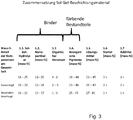
- Fig. 3 shows a table with a composition of the sol-gel coating material used in one simple and in preferred and particularly preferred embodiments.
- the hybrid polymer lacquer has, on the one hand, binder components which comprise a sol-gel hydrolyzate, nanoparticles.
- the hybrid polymer varnish comprises a high-boiling solvent.
- starters, organic crosslinkers and additives in the stated amount can be added.
- Fig. 4 shows a scanning electron micrograph of an embodiment of a dried hybrid polymer layer, which was applied as a first layer, but has not been infiltrated by a polymer.
- an infiltratable layer has formed.
- Fig. 5 shows this layer after the application of a polysiloxane.
- the structure of the first layer is still easy to recognize.
- the first layer was infiltrated by the polysiloxane, creating a dense composite layer.
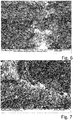
- Fig. 6 shows the in Fig. 5 shown composite layer after a temperature load of about 500 ° C. In the Fig. 5 to recognize structure has largely been preserved. The layer is therefore thermally stable up to over 500 ° C.
- Fig. 7 shows the in Fig. 4 shown layer without Silikoninfiltri für a thermal treatment after 400 ° C. It is a porous layer without infiltrated silicone resin.
- a composite material according to the invention can be produced as follows:
- MPTES methacryloxypropyltriethoxysilane
- the color is stirred homogeneously by means of a dissolver disc.
- the color is then printed on a transparent glass ceramic by means of a 140 sieve and then dried at 170 ° C. for 1 hour.
- the later a nanoscale scaffolding forming component is now applied.
- a second layer with the infiltrating component is also applied to the first layer by screen printing.
- a silicone ink based on a methyl / phenylsilicone resin is dissolved in xylene used.
- the silicone paint is 22% by mass of mica pigments with an average particle size of 15 microns admit.
- a sieve of 77 is used for the screen printing of the infiltrating component.
- the entire layer package is baked at 380 ° C for 1 hour.
- GPTES glycidoxypropyltriethoxysilane
- the color is stirred homogeneously by means of a dissolver disc.
- the color is then printed on a transparent glass ceramic by means of a 140 sieve and then dried at 170 ° C. for 1 hour and the layer is baked at 400 ° C.
- the later forming the nanoscale framework component is applied with it.
- a second layer with the infiltrating component is also applied to the first layer by screen printing.
- a silicone ink based on a methyl / phenylsilicone resin, dissolved in xylene, is used (DC 805 from Dow Corning).
- the silicone paint is thereby 30% by mass of mica pigments with an average particle size of 15 microns admit.
- a sieve of 77 is used for the screen printing of the infiltrating component.
- the entire layer package is baked at 420 ° C for 1 hour.
Landscapes
- Chemical & Material Sciences (AREA)
- Engineering & Computer Science (AREA)
- Life Sciences & Earth Sciences (AREA)
- Chemical Kinetics & Catalysis (AREA)
- General Chemical & Material Sciences (AREA)
- Geochemistry & Mineralogy (AREA)
- Materials Engineering (AREA)
- Organic Chemistry (AREA)
- Composite Materials (AREA)
- Wood Science & Technology (AREA)
- Combustion & Propulsion (AREA)
- Mechanical Engineering (AREA)
- General Engineering & Computer Science (AREA)
- Surface Treatment Of Glass (AREA)
- Laminated Bodies (AREA)
- Application Of Or Painting With Fluid Materials (AREA)
- Paints Or Removers (AREA)
- Other Surface Treatments For Metallic Materials (AREA)
- Induction Heating Cooking Devices (AREA)
Description
- Die Erfindung betrifft ein Verfahren zur Herstellung eines Verbundmaterials mit dekorativer Beschichtung sowie ein entsprechendes dekoratives Verbundmaterial. Insbesondere bezieht sich die Erfindung auf ein Glaskeramiksubstrat, wie es beispielsweise für Kochflächen verwendet wird, mit einer dekorativen Unterseitenbeschichtung.
- Mit einer dekorativen Beschichtung versehene Glas- oder Glaskeramiksubstrate sind bekannt. Insbesondere werden zumindest teiltransparente Glaskeramiksubstrate, wie sie für Kochflächen verwendet werden, mit einer Unterseitenbeschichtung versehen.
- Die dekorative Beschichtung kann aus funktionellen Gründen aufgebracht sein, beispielsweise zur Markierung von Kochfeldern. Weiter kann eine dekorative Beschichtung auch nur dazu dienen, einen besonderen optischen Eindruck zu erzeugen, beispielsweise um ein Kochfeld in einer bestimmten Farbe bereitzustellen.
- Zum Aufbringen von dekorativen Beschichtungen sind aus der Praxis eine Vielzahl von Möglichkeiten bekannt.
- Beispielsweise gibt es mittels eines Sputter-Verfahrens aufgebrachte dekorative Beschichtungen. Derartige SputterVerfahren sind aufwendig. Weiter ist die Auswahl hinsichtlich der optischen Anmutung begrenzt. Im Falle einer Teilbeschichtung, beispielsweise zur Markierung von Kochflächen, müssen aufwendige Maskierungsschritte vorgenommen werden und gesputterte Schichten haben häufig eine unerwünscht hohe Leitfähigkeit, so dass diese oft nicht hinter kapazitiven Schaltern angeordnet werden können.
- Weiter sind Silikonbeschichtungen bekannt. Diese haben den Vorteil, dass sie sich leicht über eine Silikonfarbe, beispielsweise mittels Siebdruck, aufbringen lassen, haben aber meist eine nicht optimale mechanische Beständigkeit und können sich bei hoher Temperaturbelastung verfärben.
- Weiter bekannt sind Glasfluss-basierte Schichten, sogenannte Emailleschichten. Derartige pigmentierte Glasfluss-basierte Schichten haben den Nachteil, dass sie das Glaskeramiksubstrat unter Zugspannung setzen und so dessen Festigkeit verringern. Dieser Nachteil kann durch das Aufbringen poröser Schichten reduziert werden, was allerdings mit einer matten Anmutung des so hergestellten Verbundmaterials einhergeht.
- Weiter bekannt sind pigmentierte Methylgruppenfunktionalsierte Sol-Gel-Schichten, welche allerdings zu Rissbildungen neigen, die sich als lokale Aufhellungen bemerkbar machen. Die Gefahr von Rissbildungen kann wiederum durch das Aufbringen von porösen Sol-Gel-Schichten reduziert werden, was wiederum mit einem matten Farbeindruck einhergeht. Insbesondere lassen sich keine tief schwarzen glänzenden Schichten bereitstellen.
- Schließlich ist noch das Aufbringen von Lüsterfarben bekannt. Auch bei Lüsterfarben ist die Farbwahl eingeschränkt und für die Herstellung von tief schwarzen Farben muss auf teure Edelmetall-basierende Farben zurückgegriffen werden.
- Das Dokument
WO 2012/010302 A1 zeigt eine Dekorschicht aus einem Sol-Gel-Material, auf welche eine Versiegelungsschicht auf Silikon-Basis mit anorganischen Feststoffpartikeln aufgebracht ist. - Der Erfindung liegt demgegenüber die Aufgabe zugrunde, ein einfaches Verfahren zum Aufbringen einer Hochtemperatur-beständigen dekorativen Schicht mit guter optischer Anmutung bereitzustellen.
- Die Aufgabe der Erfindung wird bereits durch ein Verfahren zum Herstellen eines Verbundmaterials mit dekorativer Beschichtung sowie durch ein Verbundmaterial mit dekorativer Beschichtung nach einem der unabhängigen Ansprüche gelöst.
- Bevorzugte Ausführungsformen und Weiterbildungen der Erfindung sind Gegenstand der Unteransprüche.
- Die Erfindung betrifft ein Verfahren zum Herstellen eines Verbundmaterials mit dekorativer Beschichtung, wobei unter einer dekorativen Beschichtung auch eine Beschichtung verstanden wird, welche zumindest teilweise aus funktionellen Gründen aufgebracht ist, wie beispielsweise eine Markierung von Kochflächen, eine aufgebrachte Beschriftung etc..
- Die Beschichtung wird auf ein hitzebeständiges Glas oder Glaskeramiksubstrat aufgebracht. Für Kochflächen werden in der Regel hitzebeständige Glaskeramiksubstrate verwendet. Für andere Einsatzorte mit hoher Temperaturbelastung, also insbesondere mit einer Temperaturbelastung von mehr als 200°C, können aber auch manche hitzebeständigen Spezialgläser verwendet werden.
- Das Glas oder Glaskeramiksubstrat ist vorzugsweise eben und im sichtbaren Bereich zumindest teilweise transparent ausgebildet.
- Auf das Glaskeramiksubstrat wird zunächst eine Sol-Gel-Schicht aufgebracht, welche zumindest Pigmentpartikel enthält. Insbesondere wird für die Sol-Gel-Schicht ein Hybridpolymer verwendet, so dass nach Trocknung eine teilweise anorganisch, teilweise organisch ausgebildete Schicht entsteht.
- Zum Erreichen einer hohen Porosität im nanoskaligen Bereich werden dem Sol-Gel Partikel zugesetzt werden.
- Als Partikel können, wie es bei einer bevorzugten Ausführungsform der Erfindung vorgesehen ist, auch weitere Füllstoffe, insbesondere anorganisches, Skelett bildendes Material, zugesetzt werden. Vorzugsweise werden Metall- oder Halbmetalloxydpartikel verwendet.
- Die Partikel haben vorzugsweise eine Größe von 0,5 bis 200 nm, besonders bevorzugt von 4 bis 150 nm. Weiter ist auch denkbar, Partikel mit einer mittleren Partikelgröße von 10 bis 50 nm zuzusetzen. Diese können insbesondere auch über die Sol-Gel-Vorstufe erzeugt werden.
- Gemäß der Erfindung umfasst das Beschichtungsmaterial Partikel mit einer ketten- und/oder faserförmigen Morphologie.
- Unter einer ketten- oder faserförmigen Morphologie werden Partikel verstanden, deren Größe entlang ihrer Haupterstreckungsrichtung mindestens doppelt, vorzugsweise dreimal, so groß ist wie die Größe entlang der geringsten Ausdehung des Partikels, was wiederum im Durchschnitt für die verwendeten Partikel gilt.
- Im Fall von Partikel mit einer kettenförmigen Morphologie handelt es sich um Sekundärpartikel, welche aus einer Mehrzahl aneinander gereihter kleinerer Primärpartikel bestehen. Es versteht sich, dass die Partikel zumindest teilweise verzweigt sein können.
- Insbesondere können Nanopartikel mit einer durchschnittlichen Länge von 50 bis 150 nm und einer durchschnittlichen Größe von 5 bis 25 nm verwendet. Die Größe kann mittels rasterelektronischer Aufnahmen bestimmt werden, wie im Folgenden noch detailliert beschrieben wird.
- Wird die Partikelgröße von bevorzugt verwendeten kettenförmigen Nanopartiklen in einer 0,05 mass-% Dispersion mit der Methode der dynamischen Lichtstreuung (DLS) bestimmt (Gerät: Deltanano HC; Auswertung nach der Methode von Conten) so liegt die Partikelgröße bei ca. 91 nm mit einer sehr breiten Verteilung und einer Standardabweichung von ca. 70 nm. Der Durchmesser der Primärpartikel liegt bei den im REM (Rasterelektronenmikroskop) den vermessen Kettenförmigen Partikeln bei ca. 15 nm.
- DLS - Messungen an Dispersionen mit keinen Kettenförmigen Sekundär-Partiklen, bestehend nur aus entsprechend Kugelförmigen Primärpartikeln (Durchmesser von ca. 15 nm im REM) zeigen dagegen einen Durchmesser von 38 nm bei einer Standardabweichung von ca. 14 nm.
- Bei einer Ausführungsform sind die Füllpartikel aus nicht Farb-gebendem Material, wie beispielsweise Siliziumoxid, Zirkonoxid oder Aluminiumoxid.
- Weiter ist auch denkbar, Polysiloxan-Nanopartikel und Farbgebende nanoskalige Pigmente zuzusetzen.
- Im Falle der Verwendung von Farb-gebenden Pigmentpartikeln und nicht Farb-gebenden Gerüst-bildenden Bestandteilen beträgt das Massenverhältnis von Farb-bildenden Bestandteilen zu nicht Farb-gebenden Bestandteilen 0,02 bis 5, bevorzugt 0,3 bis 2, besonders bevorzugt 0,6 bis 1,2. Das Volumenverhältnis von Farb-gebenden Gerüst-bildenden Bestandteilen zu nicht Farb-gebenden Gerüst-bildenden Bestandteilen liegt bei einer Ausführungsform der Erfindung bei 0,01 bis 3,5, bevorzugt bei 0,2 bis 1,5 und besonders bevorzugt bei 0,4 bis 1,0.
- Die Dichte des Gerüst-bildenden Materials, insbesondere des aus nanoskaligen Partikeln aufgebauten Gerüst-bildenden Materials, liegt bei einer bevorzugten Ausführungsform der Erfindung zwischen 2,0 und 6 g/cm3, bevorzugt bei 3 bis 4 g/ cm3. Die Skelettdichte kann über He-Pyknometrie bestimmt werden.
- Das Skelett-bildende Material, also das Material über das die Porosität bereitgestellt wird, besteht in einer Ausführungsform zumindest teilweise aus Oxiden, welche als Zersetzungsprodukte aus molekulardispersen Sol-Gel-Vorstufen entstanden sind.
- Dies können beispielsweise Zersetzungsprodukte von Alkoxysilanen oder Alkoxyzirkonaten sein (GPTES: Glycidyloxypropyltriethoxysilan, TEOS: Tetraethoxysilan, MTEOS: Methyltriethoxysilan, PhTEOS: Phenyltrithoxysilan, MPTES: Methacryloxypropyltriethoxysilan, MPTMS: Methacryloxypropyltrimethoxysilan, VTES: Venyltriethoxysilan, ATES: Allytriethoxysilan, Zirkontetrapropylat, Titantetraethylat, Aluminiumsecundärbutylat).
- Bevorzugt werden als Skelett-bildendes Matrixmaterial kristalline und/oder glasige anorganische Materialien verwendet.
- Die Sol-Gel-Schicht wird vorzugsweise mittels Siebdruck aufgebracht.
Auf die Sol-Gel-Schicht, welche zunächst getrocknet bzw. eingebrannt wird, um ein Skelett auszubilden, wird eine Polymerschicht aufgebracht, wobei die Sol-Gel-Schicht durch das Material der Polymerschicht infiltriert wird. Überraschenderweise hat sich gezeigt, das auch eine Sol-Gel-Schicht mit einem mittleren Porendurchmesser von unter 100 nm, welche insbesondere bei Porositätsmessungen durch Stickstoffadsorption als dichte Schicht scheint, durch ein Polymermaterial durchsetzt wird, dass eine dichte Kompositschicht entsteht.
Die Polymerschicht hat vorzugsweise eine Hitzebeständigkeit bei 1 Stunde Belastungsdauer von über 200 °C, bevorzugt über 300 °C, ganz besonders bevorzugt über 400 °C. Polysiloxane, insbesondere Silkonfarben wie beispielsweise Methyl- oder Phenylsilikon-Harze werden verwendet. Denkbar ist aber auch, für die Polymerschicht ein anderes Sol-Gel-Material zu verwenden.
Die Erfinder haben herausgefunden, dass sich über eine Kombination einer teilweise anorganisch ausgebildeten Schicht, welche mit einem Polymermaterial verfüllt wird, ein homogener dichter Schichtverbund bereitstellen lässt, der hochglänzend ausgebildet sein kann und weit weniger als bekannte Sol-Gel-Schichten zu Rissbildungen bei Temperaturbeanspruchung neigt. - Vielmehr ist der Farbort vor und nach thermischer Belastung hochglänzend, insbesondere mit einem Glanzgrad von G1 nach EN ISO 2813.
- Aufgrund der Dichte neigt der Schichtverbund auch beim Kontakt mit Schmutzstoffen oder deren Zersetzungsprodukten nicht zu lokalen Verfärbungen.
- Vorzugsweise werden schwarze Schichten, insbesondere mit einem Wert L im Lab-Farbraum von weniger als 28,0 bereitgestellt, besonders bevorzugt von weniger als 27,5 und ganz besonders bevorzugt von weniger als 27,0.
- Die Skelettdichte der pigmentierten Polymerschicht im erfindungsgemäß hergestellten homogenen Kompositmaterial beträgt bei einer bevorzugten Ausführungsform 1,3 bis 5 g/cm3, bevorzugt 1,5 bis 4,0 g/cm3 und besonders bevorzugt 1,8 bis 3,0 g/cm3.
- Das Material der Polymerschicht durchdringt das Skelett-bildende Material der Sol-Gel-Schicht nahezu homogen und auf nanoskaliger Dimension.
- Die Skelettdichte des durchdringenden polymeren Materials liegt Kompositmaterial bei einer bevorzugten Ausführungsform bei 1,0 bis 2,5 g/cm3, bevorzugt bei 1,3 bis 2,2 g/cm3 und besonders bevorzugt bei 1,5 bis 1,9 g/cm3.
- Als Polymermaterial werden insbesondere auch fluorierte Polymere und/oder Polysiloxane oder Sol-Gel-abgeleitete Hybridpolymere verwendet. Insbesondere können Methyl- oder Phenyl-substituierte Sol-Gel-Materialien oder Polysiloxane verwendet werden. In einer besonderen Ausführungsform wird ein Hochtemperatur-beständiges Methylphenylpolysiloxanharz und ein Siliziumoxid-haltiges Methylsiloxanharz verwendet. Denkbar sind aber auch Epoxid und/oder Polyester und/oder Methacrylat und/oder Phenyl-substituierte Siloxane.
- Das Volumenverhältnis des Materials der ersten Schicht zum Material der Polymerschicht beträgt dem hergestellten Verbundmaterial bei einer bevorzugten Ausführungsform der Erfindung 10 bis 0,5, bevorzugt 4 bis 1, besonders bevorzugt 3 bis 1,5.
- Bei einer weiteren Ausführungsform der Erfindung wird auch das Material der Polymerschicht mit Füllstoffen und/oder Pigmenten versetzt. Vorzugsweise haben Füllstoffe und/oder Pigmente eine mittlere Partikelgröße von 100 nm bis 2 µm. Reine Füllstoffe können Partikelgrößen zwischen 1 nm und 300 µm annehmen.
- Als Füllstoffe können insbesondere Silica-Partikel, Alumina-Partikel, pyrogene Kieselsäuren, Kalk-Natron-, Alkali-Alumosilicat- und/oder Borosilicatglaskugeln und/oder Glashohlkugeln verwendet werden.
- Als Pigmente können insbesondere verwendet werden: plättchen- oder stäbchenförmige Pigmente, beschichtete Effektpigmente und Absorptionspigmente (Cobalt-Oxide/- Spinelle, Cobalt-Aluminium-Spinelle, Cobalt-Titan-Spinelle, Cobalt-Chorm-Spinelle, Cobalt-Nickel-Mangan-Eisen-Chrom-Oxide / -Spinelle, Cobalt-Nickel-Zink-Titan-Aluminium-Oxide / -Spinelle, Eisen-Oxide, Eisen-Chrom-Oxide, Eisen-Chrom-Zink-Titan-Oxid, Kupfer-Chrom-Spinelle, Nickel-Chrom-Antimon-Titan-Oxide, Titan-Oxide, Zirkon-Silizium-Eisen-Oxide / -Spinelle etc.).
- Insbesondere die Verwendung von plättchenförmigen Pigmenten im Material der Polymerschicht kann dazu führen, dass Partikel und Füllstoffe des Materials der porösen Schicht zumindest teilweise abgedeckt werden.
- Die poröse Schicht nach einer thermischen Behandlung von 400 °C hat bei einer bevorzugten Ausführungsform der Erfindung eine offene Porosität von über 10 %, vorzugsweise von über 20 %, besonders bevorzugt von über 25 %. Das Schichtgefüge der nicht infiltrierten Schicht weist nach thermischer Behandlung bei 400 °C sowohl Mikro als auch Mesoporen auf mit einem mittleren Porendurchmesser von 1 - 6 nm auf.
- Der mittlere Porendurchmesser wird dabei aus den Adsorptionskurven nach der BJH-methode aus der N2-Sorption ermittelt.
- Die offene Porosität wird dabei an abgekratzten Schichten welche nicht infiltriert worden sind aber mit identischen Parametern prozessiert worden sind, mittels der Methode der N2-Sorption und der He-Pyknometrie bestimmt. Aus dem Porenvolumen (N2-Sorption) und der Skelettdichte (He-Pyknometrie) wird anschließend die offene Porosität errechnet.
- Das erfindungsgemäß hergestellte Verbundmaterial, welches eine Kompositschicht umfasst, die ein überwiegend anorganisches Gerüst mit Pigmentpartikeln umfasst, das seinerseits nanoskalige Poren umfasst, die mit einem Polymer aufgefüllt sind, hat vorzugsweise eine geschlossene Porosität von weniger als 20 Vol-%, besonders bevorzugt von weniger als 5 Vol- %.
- Die offene Porosität wird dabei an abgekratzten Komposit-Schichten mittels der Methode der N2-Sorption und der He-Pyknometrie bestimmt. Aus dem Porenvolumen und der Skelettdichte wird anschließend die offene Porosität errechnet.
- Als offene Porosität wird die Porosität bezeichnet, welche man aus den Porenvolumen errechnet, die über N2-Sorption messbar sind.
- In einer weiteren Ausführungsform der Erfindung wird die hergestellte Kompositschicht von weiteren Schichten überdeckt. Insbesondere können pigmentierte Sol-Gel-Schichten oder Polysiloxanschichten verwendet werden.
- Neben der bevorzugten Verwendung als Unterseitenbeschichtung für eine Glaskeramikkochfläche eignet sich die Erfindung auch zur Glasscheibenbedruckung, beispielsweise für Backofenscheiben und Kaminsichtscheiben.
- Die Erfindung soll im Folgenden Bezug nehmend auf die Zeichnungen
Fig. 1 bis Fig. 6 anhand schematisch dargestellter Ausführungsbeispiele näher erläutert werden. -
Fig. 1 zeigt ein zur Illustration schematisch dargestelltes Verbundmaterial 1 mit einer erfindungsgemäß aufgebrachten Kompositschicht. Auf ein Glaskeramiksubstrat 2 ist eine Kompositschicht aufgebracht, die aus einer porösen Schicht besteht, welche mit einer Polymerschicht aufgefüllt wurde. - Die Kompositschicht umfasst färbenden Pigmentpartikel 3. Die Pigmentpartikel 3 dienen gleichzeitig der Ausbildung eines porösen Skeletts. Beispielsweise kann ein ManganFerrit-Spinell mit einer mittleren Partikelgröße von weniger als 100 nm verwendet werden.
- Weiter umfasst das Material der zunächst als Sol-Gel-Schicht aufgebrachten ersten Schicht nicht färbende Füllstoffpartikel, in diesem Ausführungsbeispiel Füllpartikel 4 mit einem mittleren Durchmesser zwischen 15 und 150 nm. Weitere Partikel 5 sind ebenfalls nicht färbende Skelettpartikel aus einer molekularen Sol-Gel-Vorstufe, beispielsweise Siliziumoxid mit granularer Struktur mit einer mittleren Partikelgröße von unter 5 nm aus pyrolisierten und vorher hydrolisierten Hybridpolymeren (beispielsweise GPTES, TEOS).
- Die Partikel 3, 4, 5 der zuerst aufgebrachten Schicht sind mit einem Polymermaterial 6, in diesem Ausführungsbeispiel mit einem Hochtemperatur-beständigen Polysiloxan aufgefüllt, so dass ein dichtes Kompositmaterial 8 entstanden ist.
- In dem hier dargestellten Ausführungsbeispiel wurde das Polymermaterial 6 in einer derart großen Menge aufgebracht, dass über dem Kompositmaterial 8 eine Versiegelungsschicht 9 entstanden ist, die keine Füllstoff-Partikel 4, 5 und Pigmentpartikel 3 des Materials der ersten porösen Schicht enthält.
- Vielmehr wurde das Polymermaterial 6 mit größeren plättchenförmigen Pigmenten versetzt, welche sich als zusätzliche Schicht über die Partikel der ersten Schicht legen. Es ist mithin eine Versiegelungsschicht 9 entstanden.
-
Fig. 2a undFig. 2b zeigen anhand eines Flussbildes die wesentlichen Verfahrensschritte eines Ausführungsbeispiels der Erfindung. - Zunächst wird ein Glaskeramiksubstrat bereitgestellt.
- Sodann wird eine pigmentierte Sol-Gel-Schicht aufgebracht.
- Die Sol-Gel-Schicht wird getrocknet bzw. gehärtet und wahlweise (
Fig. 2b ) bei einer Temperatur über 350 °C eingebrannt, dabei entsteht ein durch die Silikonfarbe infiltrierbares teilweise nanoskalig-poröses, teilweise anorganisch ausgebildetes Gerüst. - Sodann wird eine pigmentierte Silikonfarbe aufgebracht und der so entstandene Schichtverbund, bei dem die Silikonfarbe die nanoskaligen Poren der Sol-Gel-Schicht auffüllt, wird bei einer Temperatur von über 300°C eingebrannt. Es versteht sich, dass dabei auch organische Bestandteile, insbesondere der Sol-Gel-Schicht entfernt werden können. Die verwendete Silikonfarbe sollte aber eine Temperaturstabilität zum Einbrennen des Schichtverbundes aufweisen.
-
Fig. 3 zeigt eine Tabelle mit einer Zusammensetzung des verwendeten Sol-Gel-Beschichtungsmaterials in einer einfachen sowie in bevorzugten und besonders bevorzugten Ausführungsvarianten. - Der Hybridpolymerlack weist zum Einen Binderkomponenten auf, welche ein Sol-Gel-Hydrolysat, Nanopartikel umfassen.
- Als färbende Bestandteile werden anorganische Pigmente zugesetzt.
- Weiter umfasst der Hybridpolymerlack ein hoch siedendes Lösungsmittel.
- Optional können Starter, organische Vernetzer und Additive in der genannten Menge zugesetzt werden.
-
Fig. 4 zeigt eine rasterelektronenmikroskopische Aufnahme eines Ausführungsbeispiels einer getrockneten Hybridpolymerschicht, welche als erste Schicht aufgetragen, aber noch nicht von einem Polymer infiltriert wurde. - Insbesondere aufgrund zugesetzter nanoskaliger Partikel ist eine infiltrierbare Schicht entstanden.
-
Fig. 5 zeigt diese Schicht nach dem Aufbringen eines Polysiloxans. Die Struktur der ersten Schicht ist weiterhin gut zu erkennen. Die erste Schicht wurde vom Polysiloxan infiltriert, eine dichte Kompositschicht ist entstanden. -
Fig. 6 zeigt die inFig. 5 gezeigte Kompositschicht nach einer Temperaturbelastung von über 500 °C. Die inFig. 5 zu erkennen Struktur ist weitgehend erhalten geblieben. Die Schicht ist mithin temperaturstabil bis über 500 °C. -
Fig. 7 zeigt die inFig. 4 dargestellte Schicht ohne Silikoninfiltrierung nach einer thermischen Behandlung nach 400 °C. Es ist eine poröse Schicht ohne infiltriertes Silikonharz entstanden. - Im Konkreten kann ein erfindungsgemäßes Verbundmaterial wie folgt hergestellt werden:
- Es werden zunächst 4 mol MPTES (Methacryloxypropyltriethoxysilan) mit 1 mol TEOS und 2,3g H2O, in welchem 0,344 g Paratoluolsulfonsäure gelöst sind, hydrolisiert. Von dem Gemisch wird anschließend am Rotationsverdampfer das Lösungsmittel entfernt und das sog. Hydrolysat erhalten.
- 18 g des Hydrolysates werden anschließend mit 55 g einer 35 Mass-%igen Lösung von kettenförmigen SiO2-Nanopartikeln in Diethylenglycolmonoethylether versetzt. Zu dieser Lösung werden anschließend 30 g eines nanoskaligen (< 100 nm) Schwarzpigmentes (Manganferrit-Spinell) gegeben..
- Die Farbe wird mittels einer Dissolverscheibe homogen verrührt.
- Die Farbe wird dann mittels eines 140er Siebes auf eine transparente Glaskeramik aufgedruckt und anschließend bei 170°C für 1 Stunde getrocknet. Die später ein nanoskaliges Gerüst ausbildende Komponente ist damit nun aufgebracht.
- Dann wird auf die erste Schicht eine zweite Schicht mit der infiltrierenden Komponente ebenfalls über Siebdruck aufgebracht. Hierfür wird eine Silikonfarbe auf Basis eines Methyl/Phenylsilikonharzes gelöst in Xylol
verwendet.(REN 80 von Wacker). Der Silikonfarbe sind dabei 22 Mass-% von glimmerförmigen Pigmenten mit einer mittleren Partikelgröße von 15 µm zugeben. Für den Siebdruck der infiltrierenden Komponente wird ein 77er Sieb verwendet. - Anschließend wird das gesamte Schichtpaket bei 380°C für 1 Stunde eingebrannt.
- Es wird dabei ein Glaskeramiksubstrat mit einer dichten homogenen Kompositschicht, überdeckt von einer pigmentierten Silikonschicht, hergestellt.
- Es werden zunächst 4 mol GPTES (Glycidoxypropyltriethoxysilan) mit 1 mol TEOS und 2,3 g H2O, in welchem 0,344 g Paratoluolsulfonsäure gelöst sind, hydrolisiert. Von dem Gemisch wird anschließend am Rotationsverdampfer das Lösungsmittel entfernt und das sog. Hydrolysat erhalten.
- 18 g des Hydrolysates werden anschließend mit 55 g einer 35 Mass-%igen Lösung von kettenförmigen SiO2-Nanopartikeln in Diethylenglycolmonoethylether versetzt. Zu dieser Lösung werden anschließend 30 g eines nanoskaligen (< 100 nm) Schwarzpigmentes (Manganferrit-Spinell) gegeben.
- Die Farbe wird mittels einer Dissolverscheibe homogen verrührt.
- Die Farbe wird dann mittels eines 140er Siebes auf eine transparente Glaskeramik aufgedruckt und anschließend bei 170°C für 1 Stunde getrocknet und die Schicht bei 400 °C eingebrannt. Die später das nanoskalige Gerüst ausbildende Komponente ist damit aufgebracht.
- Dann wird auf die erste Schicht eine zweite Schicht mit der infiltrierenden Komponente ebenfalls über Siebdruck aufgebracht. Hierfür wird eine Silikonfarbe auf Basis eines Methyl/Phenylsilikonharzes, gelöst in Xylol, verwendet (DC 805 von Dow Corning). Der Silikonfarbe sind dabei 30 Mass-% von glimmerförmigen Pigmenten mit einer mittleren Partikelgröße von 15 µm zugeben. Für den Siebdruck der infiltrierenden Komponente wird ein 77er Sieb verwendet.
- Anschließend wird das gesamte Schichtpaket bei 420°C für 1 Stunde eingebrannt.
- Es wird dabei ein Glaskeramiksubstrat mit einer dichten homogenen Kompositschicht, überdeckt von einer pigmentierten Silikonschicht, erhalten.
- Durch die Erfindung konnte ein Verfahren bereitgestellt werden, mit dem sich auf sehr einfache Weise hitzebeständige dekorative Beschichtungen mit nahezu beliebigen Farbort auf einem Glaskeramiksubstrat aufbringen lassen.
Claims (12)
- Verfahren zum Herstellen eines Verbundmaterials mit dekorativer Beschichtung, umfassend die Schritte:- Bereitstellen eines Glas- oder Glaskeramiksubstrats,- Aufbringen einer Sol-Gel-Schicht, welcher zumindest Pigmentpartikel und Oxidpartikel- zugesetzt werden,- Aufbringen einer Polymerschicht auf die Sol-Gel-Schicht, wobei Sol-Gel-Schicht durch das Material der Polymerschicht infiltriert wird, wobei als Material für die Polymerschicht ein Polysiloxan verwendet wird,- wobei dem Material der Polymerschicht Pigmente zugesetzt werden,dadurch gekennzeichnet, dass dem Sol-Gel Oxidpartikel mit faser- und/oder kettenförmiger Morphologie zugesetzt werden.
- Verfahren zum Herstellen eines Verbundmaterials mit dekorativer Beschichtung nach dem vorstehenden Anspruch, dadurch gekennzeichnet, dass als Oxidpartikel Nanopartikel verwendet werden, insbesondere SiO2-Nanopartikel.
- Verfahren zum Herstellen eines Verbundmaterials mit dekorativer Beschichtung nach einem der vorstehenden Ansprüche, dadurch gekennzeichnet, dass eine Sol-Gel-Schicht mit einem mittleren Porendurchmesser von weniger als 10 nm, bevorzugt weniger als 5 nm aufgebracht wird, und/oder dass die Sol-Gel-Schicht einen mittleren Porendurchmesser zwischen 0,5 und 500 nm, bevorzugt zwischen 1 und 200 nm, besonders bevorzugt zwischen 5 und 100 nm aufweist.
- Verfahren zum Herstellen eines Verbundmaterials mit dekorativer Beschichtung nach einem der vorstehenden Ansprüche, dadurch gekennzeichnet, dass die Polymerschicht vor einem Einbrand der Sol-Gel-Schicht aufgebracht wird.
- Verfahren zum Herstellen eines Verbundmaterials mit dekorativer Beschichtung nach einem der vorstehenden Ansprüche, dadurch gekennzeichnet, dass als Material für die Polymerschicht ein Methyl- oder Phenyl-Silikonharz wird.
- Verfahren zum Herstellen eines Verbundmaterials mit dekorativer Beschichtung nach einem der vorstehenden Ansprüche, dadurch gekennzeichnet, dass dem Material der Polymerschicht plättchenförmige Pigmente zugesetzt werden.
- Verfahren zum Herstellen eines Verbundmaterials mit dekorativer Beschichtung nach einem der vorstehenden Ansprüche, dadurch gekennzeichnet, dass die poröse Schicht und/oder die Polymerschicht mittels Siebdruck aufgebracht werden.
- Verfahren zum Herstellen eines Verbundmaterials mit dekorativer Beschichtung nach einem der vorstehenden Ansprüche, dadurch gekennzeichnet, dass der aus Polymerschicht und die Sol-Gel-Schicht entstandene Verbund thermisch gehärtet wird, insbesondere bei einer Temperatur von über 200 °C.
- Verbundmaterial, hergestellt mit einem Verfahren nach einem der vorstehenden Ansprüche, umfassend ein Glaskeramiksubstrat, wobei auf dem Glaskeramiksubstrat eine Kompositschicht angeordnet ist, die ein überwiegend anorganisches Gerüst mit Pigmentpartikeln sowie Oxidpartikeln mit faser- und/oder kettenförmiger Morphologie umfasst, welches nanoskalige Poren umfasst, die mit einem Polysiloxan aufgefüllt sind.
- Verbundmaterial nach einem der vorstehenden
Ansprüche, dadurch gekennzeichnet, dass die Kompositschicht eine geschlossene Porosität von weniger als 20 %, vorzugsweise von weniger als 5 % aufweist. - Verbundmaterial nach einem der vorstehenden
Ansprüche, dadurch gekennzeichnet, dass die Beschichtung glänzt, insbesondere mit einem Glanzgrad von G1 nach EN ISO 2813. - Verwendung eines Verbundmaterials nach einem der
vorstehenden Ansprüche als Teil eines Kochfeldes, als Kaminsichtscheibe oder Teil einer Backofentür.
Applications Claiming Priority (3)
| Application Number | Priority Date | Filing Date | Title |
|---|---|---|---|
| DE102012103507.5A DE102012103507B4 (de) | 2012-04-20 | 2012-04-20 | Verfahren zum Aufbringen einer dekorativen Beschichtung auf ein Glas- oder Glaskeramiksubstrat, beschichtetes Glas- oder Glaskeramiksubstrat und Kochfläche |
| DE201210109808 DE102012109808A1 (de) | 2012-10-15 | 2012-10-15 | Verbundmaterial mit dekorativer Beschichtung sowie Verfahren zu dessen Herstellung |
| PCT/EP2013/058218 WO2013156617A1 (de) | 2012-04-20 | 2013-04-19 | Verbundmaterial mit dekorativer beschichtung sowie verfahren zu dessen herstellung |
Publications (2)
| Publication Number | Publication Date |
|---|---|
| EP2838861A1 EP2838861A1 (de) | 2015-02-25 |
| EP2838861B1 true EP2838861B1 (de) | 2018-12-05 |
Family
ID=48143292
Family Applications (2)
| Application Number | Title | Priority Date | Filing Date |
|---|---|---|---|
| EP13719061.7A Active EP2838861B1 (de) | 2012-04-20 | 2013-04-19 | Verbundmaterial mit dekorativer beschichtung sowie verfahren zu dessen herstellung |
| EP13717776.2A Active EP2838860B1 (de) | 2012-04-20 | 2013-04-19 | Mit einer dekorativen beschichtung versehenes glas- oder glaskeramiksubstrat sowie verfahren zu dessen herstellung |
Family Applications After (1)
| Application Number | Title | Priority Date | Filing Date |
|---|---|---|---|
| EP13717776.2A Active EP2838860B1 (de) | 2012-04-20 | 2013-04-19 | Mit einer dekorativen beschichtung versehenes glas- oder glaskeramiksubstrat sowie verfahren zu dessen herstellung |
Country Status (5)
| Country | Link |
|---|---|
| US (3) | US10308548B2 (de) |
| EP (2) | EP2838861B1 (de) |
| JP (2) | JP6333237B2 (de) |
| CN (2) | CN104395258B (de) |
| WO (2) | WO2013156617A1 (de) |
Families Citing this family (26)
| Publication number | Priority date | Publication date | Assignee | Title |
|---|---|---|---|---|
| KR101885255B1 (ko) * | 2012-03-30 | 2018-08-03 | 코오롱인더스트리 주식회사 | 다공성 막 및 그 제조방법 |
| US9505051B2 (en) * | 2014-07-09 | 2016-11-29 | The Boeing Company | Mobile platforms for performing operations along an exterior of a fuselage assembly |
| DE102014218300B3 (de) | 2014-09-12 | 2016-01-07 | Evonik Degussa Gmbh | Verfahren zur Herstellung strukturierter Beschichtungen, strukturierte Beschichtung und ihre Verwendung |
| KR101642120B1 (ko) * | 2014-12-24 | 2016-07-22 | 코닝정밀소재 주식회사 | 유기발광소자용 광추출 기판 제조방법, 유기발광소자용 광추출 기판 및 이를 포함하는 유기발광소자 |
| JP6805127B2 (ja) * | 2015-03-06 | 2020-12-23 | 日本板硝子株式会社 | コーティング膜付きガラス板及びその製造方法 |
| JP2017145168A (ja) * | 2016-02-17 | 2017-08-24 | 日本電気硝子株式会社 | 耐熱ガラス |
| FR3052770B1 (fr) * | 2016-06-17 | 2018-07-13 | Eurokera S.N.C. | Article verrier de type vitroceramique et procede d'obtention |
| US10081164B1 (en) * | 2017-03-24 | 2018-09-25 | Ford Motor Company | Glass substrate with pigmented ceramic enamel layer |
| DE102017127624A1 (de) | 2017-11-22 | 2019-05-23 | Schott Ag | Beschichtetes Glas- oder Glaskeramik-Substrat, Beschichtung umfassend geschlossene Poren sowie Verfahren zur Beschichtung eines Substrats |
| KR101912129B1 (ko) * | 2018-03-06 | 2018-10-29 | (주)팍스메디 | 원적외선 방출이 가능한 주얼리 |
| EP3564200A1 (de) | 2018-05-04 | 2019-11-06 | Merck Patent GmbH | Keramische farben |
| EP3564197A1 (de) | 2018-05-04 | 2019-11-06 | Merck Patent GmbH | Keramische farben |
| JP2020094799A (ja) * | 2018-12-12 | 2020-06-18 | 日本電気硝子株式会社 | 調理器用トッププレート |
| WO2020130064A1 (ja) * | 2018-12-21 | 2020-06-25 | 日本電気硝子株式会社 | 調理器用トッププレート |
| JP7113358B2 (ja) * | 2019-03-26 | 2022-08-05 | パナソニックIpマネジメント株式会社 | 複合部材、並びにそれを用いた色調制御装置、発熱装置、建築部材、水廻り部材及び発光装置 |
| WO2020195182A1 (ja) * | 2019-03-26 | 2020-10-01 | パナソニックIpマネジメント株式会社 | 複合部材、並びにそれを用いた建築部材及び装飾部材 |
| CN113924278A (zh) * | 2019-04-16 | 2022-01-11 | 康宁公司 | 用于离子交换和汽车玻璃的填充孔装饰层 |
| DE102021202222A1 (de) | 2021-03-08 | 2022-09-08 | Schott Ag | Verbundmaterial |
| EP4112587A1 (de) * | 2021-06-29 | 2023-01-04 | Heraeus Deutschland GmbH & Co. KG | Verfahren zur herstellung eines metall-keramik-substrats mittels schnellem heizen |
| JP7796363B2 (ja) * | 2021-08-30 | 2026-01-09 | パナソニックIpマネジメント株式会社 | 加熱調理器用トッププレート |
| CN113854719B (zh) * | 2021-09-17 | 2023-07-28 | 广东顺德周大福珠宝制造有限公司 | 首饰及其表面处理方法 |
| US12584636B2 (en) * | 2021-12-21 | 2026-03-24 | Whirlpool Corporation | Sol-gel coated glass ceramic induction cooktop |
| CN114605087A (zh) * | 2022-03-21 | 2022-06-10 | 杭州杰奇玻璃材料有限公司 | 采用釉印技术制造柔视节能玻璃的加工方法 |
| CN115872631B (zh) * | 2022-10-26 | 2024-10-11 | 福耀玻璃工业集团股份有限公司 | 镀膜玻璃及其制备方法和夹层玻璃 |
| WO2024247927A1 (ja) * | 2023-05-30 | 2024-12-05 | Toppanホールディングス株式会社 | 太陽電池モジュール |
| CN116511010B (zh) * | 2023-07-03 | 2023-09-05 | 中国建筑西南设计研究院有限公司 | 一种用于多孔材料的陶瓷涂料及其制备和应用方法 |
Citations (2)
| Publication number | Priority date | Publication date | Assignee | Title |
|---|---|---|---|---|
| EP2141134A1 (de) * | 2008-07-04 | 2010-01-06 | Schott AG | Versiegelungsschicht für Dekorschichten von Glas- oder Glaskeramik-Artikeln |
| WO2012010302A1 (de) * | 2010-07-21 | 2012-01-26 | Schott Ag | Silikonbeschichtung als versiegelungsschicht für eine dekorbeschichtung |
Family Cites Families (33)
| Publication number | Priority date | Publication date | Assignee | Title |
|---|---|---|---|---|
| US2357399A (en) * | 1942-01-13 | 1944-09-05 | Waylande C Gregory | Composite glass and ceramic article and method of making |
| US3956558A (en) * | 1972-11-03 | 1976-05-11 | Commercial Decal, Inc. | Ceramic decalcomania and method |
| GB9012533D0 (en) * | 1990-06-05 | 1990-07-25 | Johnson Matthey Plc | Glass composition |
| JP3426284B2 (ja) * | 1993-05-31 | 2003-07-14 | セントラル硝子株式会社 | 撥水性ガラスおよびその製造方法 |
| WO1996019300A1 (en) | 1994-12-22 | 1996-06-27 | E.I. Du Pont De Nemours And Company | Cookware with smooth-rough pattern |
| JPH09208266A (ja) | 1996-01-29 | 1997-08-12 | Du Pont Kk | ガラス表面への有機系ポリマコーティング方法および有機系ポリマをコーティングしたガラス |
| JP3823431B2 (ja) * | 1997-03-27 | 2006-09-20 | 鳴海製陶株式会社 | 遮光性ガラスプレート |
| DE10063739B4 (de) * | 2000-12-21 | 2009-04-02 | Ferro Gmbh | Substrate mit selbstreinigender Oberfläche, Verfahren zu deren Herstellung und deren Verwendung |
| US6660980B2 (en) * | 2001-06-12 | 2003-12-09 | Nippon Electric Glass Co., Ltd. | Top plate for cooking device having electromagnetic-induction heating unit |
| DE10134374B4 (de) | 2001-07-14 | 2008-07-24 | Schott Ag | Kochfeld mit einer Glaskeramikplatte als Kochfläche und Verfahren zur Herstellung der Glaskeramikplatte |
| DE10163646A1 (de) | 2001-12-21 | 2003-07-03 | Hermsdorfer Inst Tech Keramik | Oberflächenmodifizierter Werkstoffverbund und Verfahren zu seiner Herstellung |
| DE10243500A1 (de) * | 2002-09-19 | 2004-04-01 | Schott Glas | Glas-/Glaskeramik-Kochfläche |
| CN100349999C (zh) * | 2003-02-28 | 2007-11-21 | 皇家飞利浦电子股份有限公司 | 含有含氟聚合物的溶胶凝胶涂料 |
| DE10338165B4 (de) * | 2003-08-20 | 2011-04-28 | Schott Ag | Glaskeramik-Kochfläche mit schwarz anmutender Dekorierung mittels einer Dekorfarbe |
| DE10355160B4 (de) | 2003-11-26 | 2008-04-03 | Schott Ag | Beschichtete Glaskeramikplatte, Verfahren zu ihrer Herstellung und Kochfeld mit einer solchen Glaskeramikplatte |
| DE202004015925U1 (de) | 2004-10-13 | 2005-11-24 | Schott Ag | Druckaufbau zur Erzeugung einer metallischen Anmutung für Vorsatzscheiben von Hausgeräten |
| DE102004053707B8 (de) * | 2004-11-03 | 2008-08-28 | Schott Ag | Verfahren zur Herstellung eines Glaskeramik-Artikels mit Diffusionsbarriere und Verwendung eines verfahrensgemäß hergestellten Glaskeramik-Artikels |
| DE102005018246A1 (de) * | 2005-04-19 | 2006-10-26 | Schott Ag | Glas- oder Glaskeramik-Artikel mit dekorativer Beschichtung |
| EP1715669A1 (de) | 2005-04-19 | 2006-10-25 | Ecole Polytechnique Federale De Lausanne (Epfl) | Ein Verfahren zum Unterdrücken eines Echos in einem Audiosignal |
| FR2894328B1 (fr) * | 2005-12-05 | 2017-10-06 | Eurokera | Plaque vitroceramique transparente ou translucide et son procede de fabrication |
| RU2457188C2 (ru) * | 2006-03-13 | 2012-07-27 | Агк Гласс Юроп | Стеклянный лист с покрытием |
| CN101415653A (zh) * | 2006-03-13 | 2009-04-22 | 旭硝子欧洲平板玻璃股份有限公司 | 涂覆玻璃板 |
| JP4311417B2 (ja) * | 2006-07-06 | 2009-08-12 | 鳴海製陶株式会社 | 電磁調理器用ガラストッププレート及びその製造方法 |
| JP2010009958A (ja) * | 2008-06-27 | 2010-01-14 | Nippon Electric Glass Co Ltd | 調理器用トッププレート |
| DE102008031428A1 (de) * | 2008-07-04 | 2010-01-07 | Schott Ag | Dekorative Beschichtung von Glas- oder Glaskeramik-Artikeln |
| DE102008058318B3 (de) | 2008-11-21 | 2010-06-17 | Schott Ag | Kratzfeste Silikonbeschichtung für Kochflächen aus Glas oder Glaskeramik |
| DE102009004784B4 (de) | 2009-01-13 | 2017-02-16 | Schott Ag | Verfahren zur Herstellung eines Glas- oder Glaskeramik- Artikels mit Dekorbeschichtung, Glas- oder Glaskeramik- Artikel und deren Verwendung |
| DE102009010952A1 (de) * | 2009-02-27 | 2010-09-09 | Schott Ag | Beschichtung für den Anzeigebereich von Glas- oder Glaskeramik-Scheiben, Verfahren zur Herstellung einer solchen Beschichtung und deren Verwendung |
| DE102009013127C5 (de) * | 2009-03-13 | 2024-12-19 | Schott Ag | Transparente, eingefärbte Kochfläche und Verfahren zum Anzeigen eines Betriebszustandes einer solchen |
| DE102010004741B4 (de) * | 2010-01-14 | 2023-02-23 | Schott Ag | Verfahren zur Herstellung eines Verbundmaterials sowie Küchengerät |
| CN102741358B (zh) * | 2010-02-04 | 2015-11-25 | 巴斯夫欧洲公司 | 具有改进闪光效应的颜料组合物 |
| JP5621121B2 (ja) * | 2010-03-15 | 2014-11-05 | 日本電気硝子株式会社 | 電磁加熱調理器用トッププレート |
| BE1019413A3 (fr) | 2010-07-09 | 2012-07-03 | Agc Glass Europe | Article en verre revetu d'une couche a base d'email. |
-
2013
- 2013-04-19 CN CN201380032640.4A patent/CN104395258B/zh active Active
- 2013-04-19 EP EP13719061.7A patent/EP2838861B1/de active Active
- 2013-04-19 WO PCT/EP2013/058218 patent/WO2013156617A1/de not_active Ceased
- 2013-04-19 JP JP2015506260A patent/JP6333237B2/ja active Active
- 2013-04-19 JP JP2015506259A patent/JP6257586B2/ja active Active
- 2013-04-19 WO PCT/EP2013/058224 patent/WO2013156622A1/de not_active Ceased
- 2013-04-19 CN CN201380032644.2A patent/CN104395259A/zh active Pending
- 2013-04-19 EP EP13717776.2A patent/EP2838860B1/de active Active
-
2014
- 2014-10-20 US US14/518,456 patent/US10308548B2/en active Active
- 2014-10-20 US US14/518,471 patent/US10590036B2/en not_active Expired - Fee Related
-
2019
- 2019-04-18 US US16/388,126 patent/US11713277B2/en active Active
Patent Citations (2)
| Publication number | Priority date | Publication date | Assignee | Title |
|---|---|---|---|---|
| EP2141134A1 (de) * | 2008-07-04 | 2010-01-06 | Schott AG | Versiegelungsschicht für Dekorschichten von Glas- oder Glaskeramik-Artikeln |
| WO2012010302A1 (de) * | 2010-07-21 | 2012-01-26 | Schott Ag | Silikonbeschichtung als versiegelungsschicht für eine dekorbeschichtung |
Also Published As
| Publication number | Publication date |
|---|---|
| CN104395259A (zh) | 2015-03-04 |
| US10308548B2 (en) | 2019-06-04 |
| US11713277B2 (en) | 2023-08-01 |
| EP2838860A1 (de) | 2015-02-25 |
| WO2013156622A1 (de) | 2013-10-24 |
| US20150037539A1 (en) | 2015-02-05 |
| JP2015523945A (ja) | 2015-08-20 |
| JP2015514668A (ja) | 2015-05-21 |
| EP2838860B1 (de) | 2020-02-12 |
| CN104395258B (zh) | 2018-10-12 |
| JP6333237B2 (ja) | 2018-05-30 |
| JP6257586B2 (ja) | 2018-01-10 |
| CN104395258A (zh) | 2015-03-04 |
| WO2013156617A1 (de) | 2013-10-24 |
| EP2838861A1 (de) | 2015-02-25 |
| US10590036B2 (en) | 2020-03-17 |
| US20150037507A1 (en) | 2015-02-05 |
| US20190241467A1 (en) | 2019-08-08 |
Similar Documents
| Publication | Publication Date | Title |
|---|---|---|
| EP2838861B1 (de) | Verbundmaterial mit dekorativer beschichtung sowie verfahren zu dessen herstellung | |
| DE102012109808A1 (de) | Verbundmaterial mit dekorativer Beschichtung sowie Verfahren zu dessen Herstellung | |
| EP1871719B1 (de) | Glas- oder glaskeramik-artikel mit dekorativer beschichtung | |
| DE102008031426B4 (de) | Verfahren zur Herstellung einer Versiegelungsschicht für Dekorschichten, Glas- oder Glaskeramik-Artikel und dessen Verwendung | |
| EP2141133B1 (de) | Dekorative Beschichtung von Glas- oder Glaskeramik-Artikeln | |
| EP2523915B1 (de) | Glas- oder glaskeramikverbundmaterial sowie verfahren zu dessen herstellung | |
| EP2595933B1 (de) | Silikonbeschichtung als versiegelungsschicht für eine dekorbeschichtung | |
| EP2718240A1 (de) | Beschichtungsmaterial für ein glas- oder glaskeramiksubstrat sowie beschichtetes glas- oder glaskeramiksubstrat | |
| WO2019101880A1 (de) | Beschichtetes glas- oder glaskeramik-substrat, beschichtung umfassend geschlossene poren sowie verfahren zur beschichtung eines substrats | |
| EP1272442A1 (de) | Glas-, keramik- und metall-substrate mit selbstreinigender oberfläche, verfahren zu deren herstellung und deren verwendung | |
| DE102009004784A1 (de) | Glimmerreduzierte dekorative Beschichtung von Glas- oder Glaskeramik | |
| DE102004063428B4 (de) | Keramischer Formkörper mit photokatalytisch-aktiver Beschichtung und Verfahren zur Herstellung desselben | |
| WO2005063645A1 (de) | Substrate mit einer transparenten, spiegelnden metalloxid-teilbeschichtung, deren herstellung und anwendung | |
| DE102009004783B4 (de) | Verfahren zur Herstellung einer glimmerreduzierten Versiegelungsschicht für Dekorschichten von Glas- oder Glaskeramik-Artikeln, mit diesem Verfahren hergestelltes Produkt sowie dessen Verwendung | |
| EP4455102A1 (de) | Glasscheibe umfassend eine in wenigstens einem bereich wenigstens einer seite der glasscheibe aufgetragene beschichtung, verbund umfassend eine solche sowie paste zur herstellung einer solchen glasscheibe | |
| DE102008012891A1 (de) | Glaskeramikartikel mit einer anorganischen lichtstreuenden Beschichtung, Verfahren zu seiner Herstellung und Beschichtungszusammensetzung | |
| DE68917288T2 (de) | Verfahren zur Herstellung von gefärbten Gegenständen aus Glas oder Glaskeramik mit einer nichthaftenden Beschichtung, verwendete Zusammensetzungen in diesen Verfahren und so erhaltene Gegenstände. | |
| EP2292878A2 (de) | Griff mit Oberflächenbeschichtung und Verfahren zu seiner Herstellung | |
| DE102024106445A1 (de) | Scheibenförmiges Glaselement sowie Paste und Verfahren zu dessen Herstellung sowie dessen Verwendung und Hausgerät umfassend ein solches Glaselement | |
| DE112023003990T5 (de) | Kochgerät-oberplatte |
Legal Events
| Date | Code | Title | Description |
|---|---|---|---|
| PUAI | Public reference made under article 153(3) epc to a published international application that has entered the european phase |
Free format text: ORIGINAL CODE: 0009012 |
|
| 17P | Request for examination filed |
Effective date: 20141110 |
|
| AK | Designated contracting states |
Kind code of ref document: A1 Designated state(s): AL AT BE BG CH CY CZ DE DK EE ES FI FR GB GR HR HU IE IS IT LI LT LU LV MC MK MT NL NO PL PT RO RS SE SI SK SM TR |
|
| AX | Request for extension of the european patent |
Extension state: BA ME |
|
| DAX | Request for extension of the european patent (deleted) | ||
| STAA | Information on the status of an ep patent application or granted ep patent |
Free format text: STATUS: EXAMINATION IS IN PROGRESS |
|
| 17Q | First examination report despatched |
Effective date: 20170704 |
|
| GRAP | Despatch of communication of intention to grant a patent |
Free format text: ORIGINAL CODE: EPIDOSNIGR1 |
|
| STAA | Information on the status of an ep patent application or granted ep patent |
Free format text: STATUS: GRANT OF PATENT IS INTENDED |
|
| INTG | Intention to grant announced |
Effective date: 20180827 |
|
| GRAS | Grant fee paid |
Free format text: ORIGINAL CODE: EPIDOSNIGR3 |
|
| GRAA | (expected) grant |
Free format text: ORIGINAL CODE: 0009210 |
|
| STAA | Information on the status of an ep patent application or granted ep patent |
Free format text: STATUS: THE PATENT HAS BEEN GRANTED |
|
| AK | Designated contracting states |
Kind code of ref document: B1 Designated state(s): AL AT BE BG CH CY CZ DE DK EE ES FI FR GB GR HR HU IE IS IT LI LT LU LV MC MK MT NL NO PL PT RO RS SE SI SK SM TR |
|
| REG | Reference to a national code |
Ref country code: GB Ref legal event code: FG4D Free format text: NOT ENGLISH |
|
| REG | Reference to a national code |
Ref country code: CH Ref legal event code: EP |
|
| REG | Reference to a national code |
Ref country code: AT Ref legal event code: REF Ref document number: 1072835 Country of ref document: AT Kind code of ref document: T Effective date: 20181215 |
|
| REG | Reference to a national code |
Ref country code: IE Ref legal event code: FG4D Free format text: LANGUAGE OF EP DOCUMENT: GERMAN |
|
| REG | Reference to a national code |
Ref country code: DE Ref legal event code: R096 Ref document number: 502013011758 Country of ref document: DE |
|
| REG | Reference to a national code |
Ref country code: NL Ref legal event code: MP Effective date: 20181205 |
|
| REG | Reference to a national code |
Ref country code: LT Ref legal event code: MG4D |
|
| PG25 | Lapsed in a contracting state [announced via postgrant information from national office to epo] |
Ref country code: HR Free format text: LAPSE BECAUSE OF FAILURE TO SUBMIT A TRANSLATION OF THE DESCRIPTION OR TO PAY THE FEE WITHIN THE PRESCRIBED TIME-LIMIT Effective date: 20181205 Ref country code: LV Free format text: LAPSE BECAUSE OF FAILURE TO SUBMIT A TRANSLATION OF THE DESCRIPTION OR TO PAY THE FEE WITHIN THE PRESCRIBED TIME-LIMIT Effective date: 20181205 Ref country code: NO Free format text: LAPSE BECAUSE OF FAILURE TO SUBMIT A TRANSLATION OF THE DESCRIPTION OR TO PAY THE FEE WITHIN THE PRESCRIBED TIME-LIMIT Effective date: 20190305 Ref country code: ES Free format text: LAPSE BECAUSE OF FAILURE TO SUBMIT A TRANSLATION OF THE DESCRIPTION OR TO PAY THE FEE WITHIN THE PRESCRIBED TIME-LIMIT Effective date: 20181205 Ref country code: BG Free format text: LAPSE BECAUSE OF FAILURE TO SUBMIT A TRANSLATION OF THE DESCRIPTION OR TO PAY THE FEE WITHIN THE PRESCRIBED TIME-LIMIT Effective date: 20190305 Ref country code: LT Free format text: LAPSE BECAUSE OF FAILURE TO SUBMIT A TRANSLATION OF THE DESCRIPTION OR TO PAY THE FEE WITHIN THE PRESCRIBED TIME-LIMIT Effective date: 20181205 Ref country code: FI Free format text: LAPSE BECAUSE OF FAILURE TO SUBMIT A TRANSLATION OF THE DESCRIPTION OR TO PAY THE FEE WITHIN THE PRESCRIBED TIME-LIMIT Effective date: 20181205 |
|
| PG25 | Lapsed in a contracting state [announced via postgrant information from national office to epo] |
Ref country code: GR Free format text: LAPSE BECAUSE OF FAILURE TO SUBMIT A TRANSLATION OF THE DESCRIPTION OR TO PAY THE FEE WITHIN THE PRESCRIBED TIME-LIMIT Effective date: 20190306 Ref country code: RS Free format text: LAPSE BECAUSE OF FAILURE TO SUBMIT A TRANSLATION OF THE DESCRIPTION OR TO PAY THE FEE WITHIN THE PRESCRIBED TIME-LIMIT Effective date: 20181205 Ref country code: AL Free format text: LAPSE BECAUSE OF FAILURE TO SUBMIT A TRANSLATION OF THE DESCRIPTION OR TO PAY THE FEE WITHIN THE PRESCRIBED TIME-LIMIT Effective date: 20181205 Ref country code: SE Free format text: LAPSE BECAUSE OF FAILURE TO SUBMIT A TRANSLATION OF THE DESCRIPTION OR TO PAY THE FEE WITHIN THE PRESCRIBED TIME-LIMIT Effective date: 20181205 |
|
| PG25 | Lapsed in a contracting state [announced via postgrant information from national office to epo] |
Ref country code: NL Free format text: LAPSE BECAUSE OF FAILURE TO SUBMIT A TRANSLATION OF THE DESCRIPTION OR TO PAY THE FEE WITHIN THE PRESCRIBED TIME-LIMIT Effective date: 20181205 |
|
| PG25 | Lapsed in a contracting state [announced via postgrant information from national office to epo] |
Ref country code: PL Free format text: LAPSE BECAUSE OF FAILURE TO SUBMIT A TRANSLATION OF THE DESCRIPTION OR TO PAY THE FEE WITHIN THE PRESCRIBED TIME-LIMIT Effective date: 20181205 Ref country code: IT Free format text: LAPSE BECAUSE OF FAILURE TO SUBMIT A TRANSLATION OF THE DESCRIPTION OR TO PAY THE FEE WITHIN THE PRESCRIBED TIME-LIMIT Effective date: 20181205 Ref country code: PT Free format text: LAPSE BECAUSE OF FAILURE TO SUBMIT A TRANSLATION OF THE DESCRIPTION OR TO PAY THE FEE WITHIN THE PRESCRIBED TIME-LIMIT Effective date: 20190405 Ref country code: CZ Free format text: LAPSE BECAUSE OF FAILURE TO SUBMIT A TRANSLATION OF THE DESCRIPTION OR TO PAY THE FEE WITHIN THE PRESCRIBED TIME-LIMIT Effective date: 20181205 |
|
| PG25 | Lapsed in a contracting state [announced via postgrant information from national office to epo] |
Ref country code: RO Free format text: LAPSE BECAUSE OF FAILURE TO SUBMIT A TRANSLATION OF THE DESCRIPTION OR TO PAY THE FEE WITHIN THE PRESCRIBED TIME-LIMIT Effective date: 20181205 Ref country code: SM Free format text: LAPSE BECAUSE OF FAILURE TO SUBMIT A TRANSLATION OF THE DESCRIPTION OR TO PAY THE FEE WITHIN THE PRESCRIBED TIME-LIMIT Effective date: 20181205 Ref country code: EE Free format text: LAPSE BECAUSE OF FAILURE TO SUBMIT A TRANSLATION OF THE DESCRIPTION OR TO PAY THE FEE WITHIN THE PRESCRIBED TIME-LIMIT Effective date: 20181205 Ref country code: IS Free format text: LAPSE BECAUSE OF FAILURE TO SUBMIT A TRANSLATION OF THE DESCRIPTION OR TO PAY THE FEE WITHIN THE PRESCRIBED TIME-LIMIT Effective date: 20190405 Ref country code: SK Free format text: LAPSE BECAUSE OF FAILURE TO SUBMIT A TRANSLATION OF THE DESCRIPTION OR TO PAY THE FEE WITHIN THE PRESCRIBED TIME-LIMIT Effective date: 20181205 |
|
| REG | Reference to a national code |
Ref country code: DE Ref legal event code: R097 Ref document number: 502013011758 Country of ref document: DE |
|
| PLBE | No opposition filed within time limit |
Free format text: ORIGINAL CODE: 0009261 |
|
| STAA | Information on the status of an ep patent application or granted ep patent |
Free format text: STATUS: NO OPPOSITION FILED WITHIN TIME LIMIT |
|
| PG25 | Lapsed in a contracting state [announced via postgrant information from national office to epo] |
Ref country code: DK Free format text: LAPSE BECAUSE OF FAILURE TO SUBMIT A TRANSLATION OF THE DESCRIPTION OR TO PAY THE FEE WITHIN THE PRESCRIBED TIME-LIMIT Effective date: 20181205 Ref country code: SI Free format text: LAPSE BECAUSE OF FAILURE TO SUBMIT A TRANSLATION OF THE DESCRIPTION OR TO PAY THE FEE WITHIN THE PRESCRIBED TIME-LIMIT Effective date: 20181205 |
|
| 26N | No opposition filed |
Effective date: 20190906 |
|
| REG | Reference to a national code |
Ref country code: CH Ref legal event code: PL |
|
| REG | Reference to a national code |
Ref country code: BE Ref legal event code: MM Effective date: 20190430 |
|
| GBPC | Gb: european patent ceased through non-payment of renewal fee |
Effective date: 20190419 |
|
| PG25 | Lapsed in a contracting state [announced via postgrant information from national office to epo] |
Ref country code: LU Free format text: LAPSE BECAUSE OF NON-PAYMENT OF DUE FEES Effective date: 20190419 Ref country code: MC Free format text: LAPSE BECAUSE OF FAILURE TO SUBMIT A TRANSLATION OF THE DESCRIPTION OR TO PAY THE FEE WITHIN THE PRESCRIBED TIME-LIMIT Effective date: 20181205 |
|
| PG25 | Lapsed in a contracting state [announced via postgrant information from national office to epo] |
Ref country code: GB Free format text: LAPSE BECAUSE OF NON-PAYMENT OF DUE FEES Effective date: 20190419 Ref country code: CH Free format text: LAPSE BECAUSE OF NON-PAYMENT OF DUE FEES Effective date: 20190430 Ref country code: LI Free format text: LAPSE BECAUSE OF NON-PAYMENT OF DUE FEES Effective date: 20190430 |
|
| PG25 | Lapsed in a contracting state [announced via postgrant information from national office to epo] |
Ref country code: BE Free format text: LAPSE BECAUSE OF NON-PAYMENT OF DUE FEES Effective date: 20190430 |
|
| PG25 | Lapsed in a contracting state [announced via postgrant information from national office to epo] |
Ref country code: TR Free format text: LAPSE BECAUSE OF FAILURE TO SUBMIT A TRANSLATION OF THE DESCRIPTION OR TO PAY THE FEE WITHIN THE PRESCRIBED TIME-LIMIT Effective date: 20181205 |
|
| PG25 | Lapsed in a contracting state [announced via postgrant information from national office to epo] |
Ref country code: IE Free format text: LAPSE BECAUSE OF NON-PAYMENT OF DUE FEES Effective date: 20190419 |
|
| REG | Reference to a national code |
Ref country code: AT Ref legal event code: MM01 Ref document number: 1072835 Country of ref document: AT Kind code of ref document: T Effective date: 20190419 |
|
| PG25 | Lapsed in a contracting state [announced via postgrant information from national office to epo] |
Ref country code: AT Free format text: LAPSE BECAUSE OF NON-PAYMENT OF DUE FEES Effective date: 20190419 |
|
| PG25 | Lapsed in a contracting state [announced via postgrant information from national office to epo] |
Ref country code: CY Free format text: LAPSE BECAUSE OF FAILURE TO SUBMIT A TRANSLATION OF THE DESCRIPTION OR TO PAY THE FEE WITHIN THE PRESCRIBED TIME-LIMIT Effective date: 20181205 |
|
| PG25 | Lapsed in a contracting state [announced via postgrant information from national office to epo] |
Ref country code: HU Free format text: LAPSE BECAUSE OF FAILURE TO SUBMIT A TRANSLATION OF THE DESCRIPTION OR TO PAY THE FEE WITHIN THE PRESCRIBED TIME-LIMIT; INVALID AB INITIO Effective date: 20130419 Ref country code: MT Free format text: LAPSE BECAUSE OF FAILURE TO SUBMIT A TRANSLATION OF THE DESCRIPTION OR TO PAY THE FEE WITHIN THE PRESCRIBED TIME-LIMIT Effective date: 20181205 |
|
| PG25 | Lapsed in a contracting state [announced via postgrant information from national office to epo] |
Ref country code: MK Free format text: LAPSE BECAUSE OF FAILURE TO SUBMIT A TRANSLATION OF THE DESCRIPTION OR TO PAY THE FEE WITHIN THE PRESCRIBED TIME-LIMIT Effective date: 20181205 |
|
| P01 | Opt-out of the competence of the unified patent court (upc) registered |
Effective date: 20230516 |
|
| PGFP | Annual fee paid to national office [announced via postgrant information from national office to epo] |
Ref country code: DE Payment date: 20250422 Year of fee payment: 13 |
|
| PGFP | Annual fee paid to national office [announced via postgrant information from national office to epo] |
Ref country code: FR Payment date: 20250425 Year of fee payment: 13 |